P R O F E S S I O N A L
VOLUME 17 ISSUE 08 £4.95
ROAD TEST
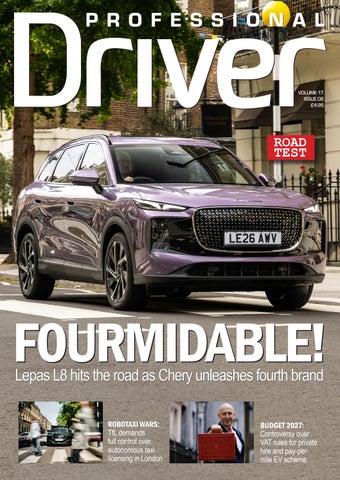
FOURMIDABLE! Lepas L8 hits the road as Chery unleashes fourth brand ROBOTAXI WARS: TfL demands full control over autonomous taxi licensing in London
BUDGET 2027: Controversy over VAT rules for private hire and pay-permile EV scheme
contents
24 18 24
28
14 12 30
4 4 8 12 14 18 28 30 36
Cover Story: Lepas L8 SUV on test News: Government to act on out-of-area working News: Anger over TfL 2028 ZEV plan News: TBR rebranded after Lyft takeover News:Analysis: TfL wants control of robotaxis News Analysis: Autumn budget pros and cons Show Report: Paris 2027 First Look: BMW i7 Protection First Look: Geely Monjaro QSi Awards 2027: Final call for Entries!
Regular features 32 34 35
EDITORIAL DIRECTOR
Mark Bursa 07813 320044 markbursa@prodrivermags.com
COMMERCIAL DIRECTOR
Paul Webb 07807 133527 paulwebb@prodrivermags.com
CONTRIBUTORS
Gary Jacobs, Kevin Willis, Tim Barnes-Clay, Dr Mike Galvin, Kwabena Dennot Nyack
The Advisor The Knowledge The Insider
COMPANY ADDRESS
50 Beechcroft Manor, Oatlands, Weybridge, KT13 9NZ
WEBSITE
Martin Coombes PageHub Design martin@pagehubdesign.co.uk
SUBSCRIPTIONS
Curwood CMS Ltd, The Barn, Abbey Mews, Robertsbridge, TN32 5AD 01580 883844 subs@prodrivermags.com
Registered in England No. 7086172 © 2026 All contents copyright of ProDriver Media Ltd
2
PROFESSIONAL DRIVER
opinion
The risk of too many wrong turns
W
Mark Bursa
“
We are in grave danger of setting in stone some bad legislation that will cause problems for the industry going forward
”
e seem to have spent much of 2026 poring over proposed legislation, court cases and Government consultations. Everything from VAT, private hire licensing, autonomous vehicles to electric cars has been placed under the microscope as the government tries to locate a big reset button for the industry. Trouble is, it’s not going as well as it might, and we are in grave danger of setting in stone some bad legislation that will cause problems for the industry going forward. Take the issue of VAT. Despite consultations and meetings with industry leaders, the shrillest voice in the room has turned out to be the tax man. HMRC waves around figures of £1.6 billion in potential revenue from whacking 20% on Uber fares over the next four years. And the Government cannot ignore that. Fair enough if that’s corporate account travellers who are paying the VAT, which their companies can reclaim. But not so good if it’s 82-year-old Mrs Miggins heading to Tesco to do her shopping. The idea that somehow that the 20% VAT levy can only apply to “big” fleets is cruising for a bruising in the competition courts, and we know how litigious the ride-hailers are. It’s worth pointing out that the same government that wants to charge private hire operators the full rate of VAT is the same government that published a glowing report earlier in the year about what a vital role PHVs play in the PUBLIC transport network, providing last-mile services, and being the only accessible service in remote locations or when buses and trains are not running. Every other transport mode is zero-rated for VAT. There is no reason why private hire should not be too. The argument that a bus or a train is somehow cleaner than a car is clearly nonsense with the advent of electric vehicles. 40 people travelling in 10 EVs is a cleaner proposition than 40 people on a dirty diesel bus. There’s yet another consultation on the way on this, and it’s vital that we have our say. Likewise we should keep up the pressure on the Government over plans to rush headlong into a “robotaxi” future. It’s very difficult to see any benefit in this. Proponents of AV taxis cite road safety as
PROFESSIONAL DRIVER
a positive, claiming AVs have fewer accidents than driven cars. But they are comparing a small number of very regulated “robocabs” with every motorist on the road: with 18-year-old Kevin, who lost his hot hatch while tryin’ some driftin’. Or myopic Mrs Miggins who shouldn’t be driving at 82. Or stressed Stephanie, who nodded off on the M1 after her sixth sales call. None of these are professional drivers. And I’ll bet you won’t find any executive chauffeur overtaking police cars trying to regulate traffic speed, or careering into coned-off road works, the way Waymo cars have been doing in the US. Waymo – which proudly claims to have millions of miles of testing under its belt – still has fundamental problems with its systems, even on big, straight, wide US freeways. How’s it going to cope round Chester or York? And who benefits? Not the customer, and not the private hire trade, which will not be offered these cars for sale. No, the winners will be US “tech bros”, who already harvest billions from the UK. British companies will be killed off by faceless corporations, or worse, ones with an unpleasant face at the helm. Tesla is planning to flood Europe with its ludicrous, dangerous and unsuitable two-door “Cybercabs” from a plant in, of all places, Berlin. TfL wants more control over AV taxi licensing, and for once, we think they’ve got it right. Which is more than can be said for its plans to switch new PHVs to all-electric ahead of its original plan. The infrastructure is not there to support this, and vehicle technology, especially PHEVs, are advancing to offer far cleaner motoring. TfL needs to press pause here, stick to the plan and then reassess closer to 2030. Common sense has to prevail. On the positive side, the Government is finally taking a look at airport drop-off charges, following strong campaigning from the Business Travel Association. British airports are out of step with the rest of Europe on this issue, where nobody charges for drop-offs. It’s gouging, nothing more, nothing less. And in a week when we started the process of moving much closer to the EU, a spot of alignment with continental best practice would not go amiss.
3
business news
Government aims to ‘curtail’ out-of-area working in PH bill Mark Bursa
The Department for Transport has published its response to the Transport Committee’s report on taxi and private hire licensing, which was published in June. The DfT addresses 19 recommendations made by the Transport Committee, which are broadly supported by the government. These include stronger national standards for safety, safeguarding, driver training and accessibility, while retaining some local flexibility. The DfT also said it would address inconsistent licensing standards and wants to reduce incentives for drivers and operators to work predominantly outside their licensing area. The government said it would publish a draft Taxis and Private Hire Vehicles Bill for pre-legislative scrutiny. The Transport Committee recommends that future legislation uses the Law Commission’s 2014 draft Bill and the Task and Finish Group report from 2019 as a starting point, updated to cover appbased operators. It also calls for a framework that keeps taxis and PHVs distinct. The Government agreed with this proposal, stating that the 2014 draft Bill was a strong foundation and that the taxi/PHV distinction will remain in its draft Bill. The Government noted that the two previous attempts at legislating the sector had a number of differences: the Law Commission proposed a flexible national framework with fewer limits on where journeys take place, whereas
4
the Task and Finish Group proposed tighter out-of-area controls and powers to cap vehicle numbers. The Government said it would draw on both and adapt them to the current market. The Committee called for a clear plan to “curtail outof-area working” and create greater incentives for drivers to license in the locality in which they operate, so that authorities can more easily use enforcement powers. The Government agreed that the current system was a “patchwork” that encourages “license shopping” in areas with lower standards, faster processing or lower fees. It points to proposals for national standards and a consultation on moving licensing to local transport authorities, thus reducing the number of licensing authorities, as a way to address this. The government response also noted that the English Devolution and Community Empowerment Act lets any local authority immediately suspend a license in the interests of public safety, wherever the driver is licensed. Guidance on using this power will follow.
However, the government said it would will weigh any limits on cross-border working carefully, recognising that there is a relationship between restrictions on cross-border working, service availability, and passenger safety. This suggests a blanket ban on outof-area operations is not being considered, which will come as a relief to operators who feared the dreaded “ABBA principle” might make a reappearance. The government said any measures that significantly restrict journeys across licensing boundaries could reduce vehicle availability in some areas, increase waiting times, and make it harder for passengers to access transport when and where they need it. It cites the Suzy Lamplugh Trust’s emphasis on balancing safety and provision. The issue of National Standards is covered extensively. Despite assurances from the transport committee chair, Ruth Cadbury MP, the word “minimum” appears as Recommendation 4 in the document: “The government’s plan for national minimum standards must not mean low by
default.” Variations between licensing areas should be minimised and standards set high, in order to avoid “license shopping”. The Government noted the recommendation, and said the English Devolution and Community Empowerment Bill gives the Secretary of State powers to set national standards for taxis and PHVs. The government maintained that these standards will be clear, enforceable and set at an appropriately high level, with some local flexibility. Core safety and safeguarding requirements will be set nationally. The government pledged to include safeguarding training and DBS recheck frequency in national standards and said work to create a national licensing database was progressing. The Government will include the issue of mandatory in-cab CCTV in the national standards consultation, due by the end of the year. It will balance safeguarding against privacy and data protection. The government also agreed that standards for English proficiency should be “proportionate”.
PROFESSIONAL DRIVER
business news
Anger over TfL’s 2028 ZEV plan for all new private hire vehicles Mark Bursa
The Licensed Private Hire Car Association has reacted angrily to Transport for London’s plans to replace the zero-emissions capable (ZEC) requirement for new private hire vehicles with a requirement for them to be fully electric. The proposals aim for all newly licensed PHVs to be ZEVs from July 2028, with the exception of wheelchair-accessible vehicles, which would need to be zero-emission from July 2030. Steve Wright, chair of the LPHCA, said he believed the target was “not achievable”, adding: “We have consistently said that most PHV drivers generally don’t have the ability to charge vehicles at home. The time and cost of charging onstreet is extremely expensive, alongside a lack of infrastructure.” TfL has launched a consultation on the subject, which closes on December 2. TfL claims that 70% of all PHVs in the capital are zero-emissions capable, roughly half of which are plug-in hybrids. Under rules that were introduced in 2023, only vehicles that qualify under strict rules for “zero emissions capable” vehicles could be licensed. These had to either have a maximum 50g/km CO₂ emissions with at least a 10mile zero-emission range, or a maximum 75g/km CO₂ emissions with at least a 20-mile zero-emission range. This meant standard “self-charging” hybrids could no longer be licensed as PHVs in London. This
was meant to be in place until 2030, but now TfL wants to bring it forward, as part of Mayor Sir Sadiq Khan’s plan for London to become a “net zero city” by 2030, 20 years ahead of the government’s UK national target. TfL forecasts suggest that, within 10 years, the proposed changes could reduce nitrogen oxide (NOx) emissions from minicabs by 9% and carbon dioxide (CO2) emissions by 35%. Over 18 years, the forecast is these emissions would reduce by 97%. Christina Calderato, director of strategy at TfL, said: “Private-hire vehicles are a vital component in London's transition to becoming a more sustainable and healthier city with less pollution. This consultation sets out our proposals to strengthen those achievements and drive forward the transition towards a zero-emission fleet.” TfL added that although the consultation focused on PHVs, TfL “continues to consider proposals” for a future ZEV requirement for London’s black taxis. Other changes, proposed to start from 1 March 2027, include no longer approving new alternative fuel conversion systems for vehicles, such as Liquefied Petrole-
PROFESSIONAL DRIVER
um Gas and Compressed Natural Gas, and new exhaust abatement systems, and reducing the maximum length of time for re‑licensing an expired taxi or private hire vehicle from 24 months to 12 months, beyond which it would become “new to licensing”. TfL also said it would
only license PHVs younger than 10 years old. TfL claims London already has the largest EV charging network in the UK, comprised of more than 29,500 public charging devices, including more than 2,000 rapid or ultra-rapid charging devices. Places for London, TfL’s wholly owned property company, has also partnered with EV charging operator Fastned (pictured) to develop several EV ultra-rapid charging hubs across the capital. The consultation, which runs until 23:59 on Wednesday 2 December 2026, can be accessed online at
https://tfl.gov.uk/tph-zero-emissions
THE BMW PARK LANE CHAUFFEUR PROGRAMME. EXCLUSIVELY AVAILABLE ON THE ALL-ELECTRIC BMW i7.
5 years
8 years
SERVICE PACK
BATTERY WARRANTY
Unlimited mileage
Or 100,000 miles
Free
S5 Pro
HOME CHARGER
TRACKER
2026 orders
Fitted
Contact the dedicated team at BMW Park Lane: 020 7171 1434
PL-SpecialistSales@bmwparklane.co.uk
5
business news
Lyft rebrands TBR Global as Alcove, creating major rival to Blacklane Mark Bursa
Ride-hailing giant Lyft has announced plans to rebrand its recently acquired chauffeur operation TBR Global Chauffeuring as Alcove. Alcove will be US-based Lyft’s dedicated brand for global chauffeuring services, and will compete directly with Blacklane, which was recently acquired by Lyft’s main global rival, Uber. The name change will happen in early 2027, the company said in a statement. Alcove will combine TBR Global Chauffeuring’s service expertise and global network with new technology to modernise global corporate ground transport. Lyft’s statement said: “Alcove will combine hightouch service and a worldclass passenger experience with greater visibility and control across global corporate travel programmes.” Business customers will be able to access Alcove in early 2027 through a new portal and through current TBR channels, followed
by a new mobile app later in the spring. In addition to current TBR Global Chauffeuring customers, Alcove will serve new corporate travel programmes, bookers, and passengers around the world, which is expected to bring incremental gross bookings and strong margins to Lyft. Building on TBR’s three decades of expertise, Alcove will support complex and high-profile trips, including VIP travel, events, and journeys involving multiple vehicles or extended bookings. Initially the new Alcove portal will be open to managed business account
customers, with self-service access and a mobile app to follow later in the spring. Additionally, Alcove will continue to support customers through experienced service teams and other channels, including corporate and travel management company relationships. Alcove marks another step in Lyft’s expansion beyond on-demand rideshare, extending the company’s reach into a global chauffeur market worth tens of billions of dollars. While Alcove will be a separate brand, Lyft Business customers will also be able to access its services.
“Lyft is moving up and out, creating customer-obsessed products up and down the value chain and in more places around the world. Alcove supercharges that strategy,” said Lyft CEO David Risher. “Great chauffeurs go above and beyond, and with Alcove, we are excited for more people to experience the highest levels of service. Like the bridge instead of the tunnel? Prefer 72 degrees? Want the rear window open just a bit? That’s what Alcove will offer.” Global Business Travel Association research highlights the challenges of managing global corporate travel programs: 61% of travel buyers say managing travel across regions is challenging, while only 12% have a consolidated view of their program from a single data source. Alcove aims to give programme managers greater visibility and control, bookers confidence that trips can be reliably managed, and passengers a premium experience built around their needs.
Reading to relax age and emissions regulations Mark Bursa Reading Borough Council is set to relax rules on taxi vehicle age and emissions levels, which will come as a relief to local taxi drivers. Earlier this year, the council brought in new rules which mandated that any new licensed vehicle must be an ultra-low emission vehicle (ULEV) and less than five years old. From October 2028, all new vehicles must have a Euro 6 emissions rating. But councillors have now agreed to make changes to the Hackney Carriage & Private Hire Licensing Policy to enable a longer transition period. Clyde Masson, the council’s principal licensing enforcement officer, said:
6
“Discussion with the trade representatives and operators highlighted that the limited availability of larger vehicles, namely seven-seat MPVs and wheelchair-accessible vehicles that meet the criteria, was causing problems for private hire operators, especially those that provide home-toschool transport, which in some cases use specialist transportation.” He continued: “Officers conducted extensive research of vehicles available on
the market that meet the new emissions and age policy. This research showed that there is sufficient availability and affordability of vehicles suitable for transporting between four and six passengers.” “Officers recognise that the availability of appropriate vehicles to transport seven passengers and wheelchair accessible vehicles is not as abundant and is creating supply difficulties and economic disadvantage.” So now the council has approved changes to the rukes, pausing the vehicle emissions policy to allow currently licensed vehicles to remain on the fleet, with any new vehicles being a minimum of Euro 5b emissions standard. A six-week consultation was launched on November 6, before the changes are ratified.
PROFESSIONAL DRIVER
Your next
business interruption might not be traffic-related. A single cyber incident could lock access to bookings, payment systems and client information at the worst possible moment. As chauffeur businesses become more connected, understanding digital risk has never been more important.
Reach out to Ricky or Cameron today. Cameron Scott Your contact for independent drivers and fleets under 6 vehicles
Ricky Chivers Your contact for fleets of 6 or more vehicles
020 8036 3968 cameron.scott@howdeninsurance.co.uk
020 8256 4916 ricky.chivers@howdeninsurance.co.uk
howdeninsurance.co.uk/chauffeur
Howden UK Brokers Limited is authorised and regulated by the Financial Conduct Authority No. 307663. Registered in England and Wales under company registration number 02831010. Registered Office: One Creechurch Place, London, EC3A 5AF. Calls may be monitored and recorded for quality assurance purposes. HUBL-CC-EDU-052-1024 HUBL-CS-CH-041-1026
PROFESSIONAL DRIVER
7
business news
Waymo suspends US highway rides after traffic incidents
Mark Bursa
Waymo has suspended its autonomous vehicles from operating on all US freeways after Californian authorities banned the driverless cabs from state freeways following a series of traffic incidents. California’s Department of Motor Vehicles said the Waymo vehicles were “an imminent hazard to public safety”. In one incident this month, several driverless Waymo vehicles entered an active construction zone on US Route 101 south of San Francisco. Waymo said it was working with state officials “diligently and responsibly to resume freeway operations”, adding that
no injuries or collisions were reported following the incident. In another incident, footage widely seen on social media appeared to show a Waymo car trying to overtake patrol vehicles that were deliberately slowing the pace of traffic on a San Francisco highway.
The California ban, which came into effect on 11 November, would remain in place until Waymo “demonstrates to the department that it has taken effective corrective actions to address the deficiencies that precipitated the restrictions”. A Waymo spokesperson said: “In alignment with our safety-first principles, we have also temporarily restricted freeway operations across our other operating markets to evaluate our performance.” Waymo currently operates driverless taxis in 15 US cities, but only offered freeway rides in San Francisco, Los Angeles and Miami. It is trialing its services in London, pending government legislation.
Addison Lee rolls out global booking app in 40 markets
Mark Bursa
Addison Lee is going global with the rollout of its booking platform into 40 key business travel destinations around the world. Destinations include New York, Paris and Singapore with further locations due to go live in the coming weeks. The move allows Addison Lee to leverage worldwide fleets owned by its parent company, Singapore-based transport giant ComfortDelgro in markets including Singapore and Australia, alongside a selected network of international partners. The service streamlines international travel by offering UK customers a single trusted provider for ground transportation worldwide. Each partner is selected for its ability to meet Addison Lee’s expectations for service quality, reliability and professionalism, helping
8
Many are adamant that there is a clear return on investment. Eight in ten (80%) say interThis ComfortDelGro cab in Singapore can now be national booked via the Addison Lee app travel ensure customers receive a helps them build relaconsistent experience wher- tionships that would not ever they travel. otherwise be possible while Customers can book a similar proportion (78%) through Addison Lee’s app, believe face-to-face meetwebsite or dedicated contact ings abroad produce better centre, choosing from pribusiness outcomes than vate hire, taxi and executive virtual alternatives. car services to suit their But this comes at a cost needs in each destination. to productivity. Business The launch comes as new travellers currently lose research commissioned by a full working week (39 Addison Lee reveals that hours) per year to unprodemand for business travel ductive transit time. And the is increasing, with more than experience is rarely seamhalf (52%) of international less – 80% rely on multiple business travellers saying separate providers and platthey have travelled more forms to piece together one frequently in the past year. international journey and
43% say it is difficult to find transport providers abroad who meet their standards. It is this friction that Addison Lee is looking to remove. Wesley Bishop, Chief Customer Officer at Addison Lee, said: “Our customers have told us they would benefit from a single platform that brings together the long and complex international journeys that remain so valuable to businesses. Managing travel across multiple cities, countries and suppliers often creates friction and unnecessary complexity – and that is exactly what we’re aiming to reduce.” More than three in ten business travellers (34%) said a single platform to manage all elements on their trip would improve their travel experience, while a similar proportion (33%) cite the importance of being able to work more productively in transit.
PROFESSIONAL DRIVER
Insure your fleet with the flexibility you need Taxi Commercial Self-Drive Hire Credit Hire Visit acorninsure.co.uk
Rated Excellent 16K+ reviews
January 2026
Acorn Insurance is a trading name of Acorn Insurance and Financial Services Ltd. who is authorised and regulated by the Financial Conduct Authority (FCA). Firm reference number 311873. Registered address: 98 Liverpool Road, Formby, Liverpool, L37 6BS, No. 01636368
PROFESSIONAL DRIVER
9
business news
Government to review airport drop-off fees after sharp rises Mark Bursa
The Government has launched a review into airport drop-off charges following complaints about sharp price rises in recent years. Drop-off and pick-up charges at major UK airports have risen by a third since the summer of 2025 on average. Sixteen of the UK’s 20 busiest airports have raised drop-off charges over the past 12 months, according to the RAC. Gatwick and Stansted are among the most expensive, jumping from £7 to £10. Charges at Edinburgh Airport have risen from £6 to £8.50, while fees at Bournemouth, Leeds Bradford and London City increased from £5 to £8. “We know airport drop-off charges are a growing source of anger and frustration,” said Rod Dennis, senior policy officer at the RAC. “Four-in-five drivers we’ve
surveyed believe they are a 'rip-off', with just one in 10 understanding why airports charge what they do.” The Department for Transport said a review was “vital to ensure travel remains accessible and that passengers are treated fairly”. The government added it hoped airports would exercise restraint on rises, “particularly where there are limited public transport alternatives”. The Business Travel Association has welcomed the move. CEO Clive Wratten
has campaigned for lower charges for the past 12 months, calling for charges to be capped at £3 and applied only at peak times. He said: “The review must take a serious look at affordability, accessibility and fairness, and lead to meaningful change rather than simply give airports the opportunity to justify the charges they already impose.” “Up to £10 for a few minutes at the kerb is a lot to ask of travellers, particularly when public transport is not always a practical alter-
native. Encouraging people to use public transport is one thing, but passengers must have a realistic alternative,” he added. The BTA has pointed out that many flights leave early in the morning or arrive late at night – after public transport has stopped running, so travellers have no option but to use private cars or taxis. By contrast, none of the top 10 airports in the EU charge for drop-offs, according to the RAC, which argues against drop-off fees. However, the airport industry said the charges were a necessary part of the business model of airports. “Airports outside the UK are typically publicly owned, while UK airports are generally privately owned and subject to the commercial rates of taxation,” said Karen Dee, chief executive of airport trade body Airports UK.
Birmingham Airport unveils £2bn expansion plan Mark Bursa
Birmingham Airport has unveiled a £2 billion plan that will see the airport handling 30 million passengers a year by 2041, more than double its current volume. The plan involves building new terminal facilities and expanding ground transport links, which could have a significant impact on private hire and airport transfer businesses across the West Midlands. The strategy covers the next 15 years and is now open for public consultation, and is based on making better use of existing runway capacity rather than building new runways. Birmingham Airport handled more
10
than 13.6m passengers in 2025. In a recent UK Civil Aviation Authority survey, Birmingham was found to be the airport with the highest proportion of passengers using taxis, PHVs and ride-hailing services among eight major English airports surveyed. The CAA’s 2025 departing passenger survey found that 32.6% of passengers
arriving at Birmingham Airport used a taxi, minicab or Uber. That compared with 31.2% at Heathrow and 30.1% at Manchester. Birmingham airport’s current car services include traditional black cabs and private hire services. Birmingham Airport said its proposed £2 billion investment would include significant improvements to surface access and terminal facilities. It wants more air travellers to use public transport, with a public transport mode share ambition of around 29%. The first phase of development could begin in 2027, with investment also directed towards baggage facilities and additional aircraft stands. A consultation runs until December 4: www.birminghamairport.co.uk/masterplan/Birmingham
PROFESSIONAL DRIVER
Your vehicles are insured.
Is your decision-making? Every business decision carries responsibility. From employment matters to regulatory issues, allegations can sometimes be directed at owners, directors and senior managers personally. Understanding those risks is an important part of running a resilient chauffeur business.
Reach out to Ricky or Cameron today. Cameron Scott Your contact for independent drivers and fleets under 6 vehicles
Ricky Chivers Your contact for fleets of 6 or more vehicles
020 8036 3968 cameron.scott@howdeninsurance.co.uk
020 8256 4916 ricky.chivers@howdeninsurance.co.uk
howdeninsurance.co.uk/chauffeur
Howden UK Brokers Limited is authorised and regulated by the Financial Conduct Authority No. 307663. Registered in England and Wales under company registration number 02831010. Registered Office: One Creechurch Place, London, EC3A 5AF. Calls may be monitored and recorded for quality assurance purposes. HUBL-CC-EDU-052-1024 HUBL-CS-CH-041-1026
PROFESSIONAL DRIVER
11
n e w s a n a l y s i s: T f L AV t a x i r e p o r t
TfL DEMANDS RO
T
he London Assembly has demanded a halt to the deployment of autonomous taxis in London. In a damning report, it has made 13 recommendations to bring strict regulation to the so-called “robotaxi” market.
The report, “Who’s driving the future of autonomous transport in London?” raises concerns over safety, safeguarding and driver employment. It has gained widespread support from drivers’ trade unions, which want to see AV taxis banned altogether. The report bluntly states: “As it stands, we currently have not heard sufficient evidence to persuade us that London should welcome autonomous passenger services.” It calls for the powers to license robotaxis to be transferred to Transport for London, and TfL should be given strong powers to cap robotaxi numbers and withdraw operating permits if operators fail to meet safety and transport policy requirements. Under the current rules, the government controls the issue of Automated Passenger Service permits through the DVSA. TfL must consent to permits covering London but does not hold the same licensing powers it has over conventional taxis and PHVs. The report calls for these powers to be transferred to TfL when the Automated Vehicles Act is introduced in 2027. The se devolved powers should also enable TfL to set a cap on the number of autonomous passenger vehicles operators can deploy in London, including across different areas in London, when the full regulations under the Automated Vehicles Act are put in place in 2027. Among the 13 recommendations, the report says a formal process should be established which would allow TfL to suspend an Automated Passenger Service (APS) permit. This should be introduced during the current pilot of the APS permitting framework. Safety is a prime concern. “TfL should adopt a stronger safety baseline than that of the ‘careful and competent driver’ as a condition for granting consent to an operator being given an APS permit, the report states. “TfL should require operators to provide concrete evidence of how their vehicles and deployment plans could contribute to reducing road danger in London as set out in the Mayor’s Vision Zero strategy, taking into account London’s unique road network and
12
London wants the power to cap AV taxi numbers and revoke operator licenses. Mark Bursa reports
multiple types of road user. TfL should not grant consent if applications do not meet this definition and should publish its criteria for granting consent.” The report states that because robotaxis operate relatively successfully in the US, it does not mean they will work here. “We have found there to be considerable uncertainty around many of the claimed benefits of autonomous passenger vehicles. Operators have made bold safety claims, yet evidence we heard from Jeff Tumlin, who was Director of Transportation of the San Francisco Metropolitan Transportation Agency when autonomous passenger vehicles were introduced in San Francisco, questioned these claims.” The report adds: “Operators’ safety claims are based on studies and assessments in US cities, and we remain unconvinced that this will necessarily translate on to London’s complex road network.” The report addresses the issue of potential congestion caused by empty robotaxis cruising the streets waiting for a booking. The report says TfL should establish an ‘empty miles driven’ reporting metric, as a condition for granting consent to APS permits. “Negative impacts on congestion should be a reason for withdrawal of
consent,” the report states. Safety reporting forms another element of the proposals. Operators should have to report crashes and near misses within 24 hours, including information about the automated driving system’s decisions leading up to an incident. Other recommendations cover the lack of wheelchair-accessible robotaxis, and the establishment of protocols for interaction with emergency vehicles. And the issue of driver employment is a key recommendation. “TfL should work with taxi and private hire drivers, their representatives and autonomous passenger service operators to develop a fair transition plan for the sector, should APS permits be issued. This should include management of any job losses, design of re-training and re-deployment opportunities, and a mechanism for funding transition arrangements.” Unions have reacted strongly to the report. The Independent Workers’ Union of Great Britain (IWGB) wants to see robotaxis banned altogether. Gholomreza ‘Rez’ Kamyabi, an Uber driver and vicechair of the IWGB private hire drivers branch, said: “We call on Sadiq Khan and TfL to stop driverless cars being unleashed on the streets of London. Many
PROFESSIONAL DRIVER
n e w s a n a l y s i s: T f L AV t a x i r e p o r t
OBOTAXI POWERS AV cars: a legal minefield for professional drivers Clare Galo Senior Associate at Reeds Solicitors LLP
A Wayve AV taxi operating under trial in London of our greatest anxieties were confirmed by this report from the London Assembly Transport Committee. Prior to its release, Autonomous Vehicles already represented a frightening prospect to every private hire driver. The report vindicates those fears.” Kamyabi said drivers feared the technology could threaten their ability to earn a living. “Every car feeds a family, and the prospect of not being able to earn money leaves us all with a deep uncertainty as to how we will provide for them. We already struggle to get by as it is.” IWGB President Alex Marshall described the possible job losses as a potential social and economic crisis and argued that technology companies and investors stood to benefit while workers bore the cost. “Their profit comes at our expense,” he said. App Drivers and Couriers Union (ADCU) general secretary Cristina-Georgiana Ioanitescu welcomed recommendations covering drivers’ jobs and livelihoods: “The Assembly has rightly identified this as a devolved government issue, something we know to be close to the new Prime Minister Andy Burnham’s heart, so we hope, and expect, that he will act to restore meaningful powers to license autonomous vehicles to TfL and away from the Department for Transport,” she said.
PROFESSIONAL DRIVER
AV technology promises safer roads, improved traffic flow and greater efficiency, but it also presents one of the biggest legal challenges road traffic law has faced since the driving offences were created. For professional drivers, fleet operators and anyone who earns a living behind the wheel, understanding where legal responsibility lies may soon become just as important as the Highway Code. Many vehicles already contain sophisticated driver assistance technology. Lane keeping, adaptive cruise control, automatic emergency braking and parking assistance are becoming commonplace, but these systems do not make a vehicle legally autonomous. Current UK law still requires a human driver to remain responsible for the vehicle at all times. Even if the car is steering, accelerating or braking independently, the person behind the wheel remains the driver in the eyes of the law. That distinction is crucial because many motorists mistakenly believe their vehicle is already capable of self-driving when, legally, it is simply providing assistance. That position is expected to change when the Automated Vehicles Act 2024 is brought into force, currently anticipated from late 2027. The Act introduces an entirely new legal concept: the user-incharge. Rather than treating the occupant as the driver while an authorised self-driving feature is operating, responsibility can transfer to the vehicle itself, with liability potentially shifting towards the manufacturer or the company responsible for the automated driving system. That immunity is far from absolute. A user-in-charge may still face prosecution if they ignore repeated requests to retake control, activate autonomous mode where it is not authorised, deliberately fail to intervene, or tamper with the vehicle's systems. The legislation creates a shared responsibility model rather than removing human accountability altogether. In traditional motoring cases, investi-
gators usually ask one straightforward question: Who was driving? Future prosecutions are likely to revolve around a very different issue: What driving mode was the vehicle in? That seemingly simple question may become surprisingly complex. Vehicles capable of switching between automated and manual operation continuously record steering inputs, braking commands, sensor data and software decisions. Establishing the precise moment control passed from the vehicle to the user could determine whether a criminal offence has been committed and, if so, by whom. A collision occurring during a transition between autonomous and manual driving may generate arguments that simply do not exist under current law. The days when CCTV, eyewitnesses and collision damage formed the backbone of every motoring prosecution may be coming to an end. Instead, investigators may need access to internal vehicle telemetry, software event logs and manufacturer data. Much of that evidence may not be held by either the police or the defendant, but by the automaker or software developer. That raises practical questions about preserving electronic data, disclosure obligations and obtaining specialist technical evidence. Police and legal practitioners alike are likely to require new expertise in interpreting digital driving records rather than relying solely upon conventional accident reconstruction. Although fully autonomous vehicles are not yet operating on UK roads, the legal framework is already taking shape. For taxi drivers and chauffeurs, the transition period may prove challenging as vehicles with sophisticated automation share the road with conventional cars. The key point is this: driver assistance and authorised self-driving are legally different concepts. Until a vehicle is operating under an authorised automated driving system, the human occupant remains responsible for its use. Courts will inevitably be asked to decide where responsibility begins and ends. The earliest cases are likely to shape UK motoring law for years to come.
13
news analysis Chancellor John Healey used the 2026 Autumn Budget to try and unscramble the chaos on private hire VAT. But has he come up wth a workable solution, or simply caused more confusion? Mark Bursa reports
T
he 2026 Budget contained a sting in the tail for the private hire industry as new Chancellor John Healey took the opportunity to try and sort out the current mess surrounding VAT on private hire fares. Unfortunately, HMRC’s need to raise revenue seems to have resulted in a decision that will not be welcomed in the trade. And furthermore, new problems appear to have been created, which will be addressed once again by yet another consultation. Healey announced that from January 2, 2028, where a taxi or private hire journey is supplied through an agent acting in its own name, the agent is treated as both buying the journey from the driver and supplying it to the passenger. This means a VAT-registered operator would charge VAT on the full fare, not the margin. In a bid to soften the blow for smaller operators, businesses below a turnover threshold would be left out of the obligation to charge VAT. The government suggests this would be a £50 million turnover – a sign that the ride-hailing operators and bigger fleets are the target. The threshold limit would be part of the consultation. The move is designed to “level up” the discrepancy between VAT rules for operators in London and elsewhere. This has been caused by a number of court concerning licensing issues, centred around Uber. In London, it is illegal for an operator to accept a booking other than as principal, following the case of United Trade Action Group Ltd v Transport for London (2021). Outside London, the notorious “Sefton case” of Uber Britannia Ltd v Sefton MBC (2023), overturned on appeal, resulted in the opposite outcome. So in London, private hire operators are already required to act as principals and account for VAT on the full fare. However, outside London, private hire vehicle operators can act as agents, with drivers responsible for accounting
14
STING IN THE TAIL!
for VAT on fares where they are VAT registered. As most private hire drivers don’t hit the VAT earnings threshold of £90,000 per year, it means few journeys incur VAT at all. Removing this unlevel playing field appears to be behind the latest decision. There is also quite a lot of money at stake here, according to HMRC. In the financial years ending 2029 through to 2032, HMRC expects to bring in £385m, £395m, £410m and £425m in VAT revenue, according to the Office of Budget Responsibility. The Treasury states that “this measure is not expected to have any significant macroeconomic impacts”, though it does acknowledge that the measure “may impact individuals who use taxis
or private hire vehicles if operators respond by changing their fares”. The Government does not seem to have listened to the argument that private hire should be considered as part of the public transport system. There is currently no VAT law specifically for private hire vehicles, so the general rules apply, meaning fares are standard-rated where the supplier is VAT-registered. The zero rate for passenger transport in the VAT Act, 1994 only covers vehicles designed or adapted to carry at least 10 passengers, so typical PHVs are not included. The new PHV VAT rules are separate from the change announced earlier in the year to the Tour Operators’ Margin Scheme. Under the Finance Act 2026,
PROFESSIONAL DRIVER
news analysis: budget 2026
eVED could add thousands to chauffeur costs unless charge rates come down
Kirsty O'Connor / No 10 Downing Street
private hire and taxi journeys are outside the scheme from 2 January 2026, unless the journeys are made in conjunction with supplies of accommodation or of transport by bus, coach, train, ship or aircraft. The wording of the statement leaves a number of unanswered questions. The clause applies only where the agent acts in its own name, and it is not explained how that test applies to particular booking terms. The Treasury statement does not define “annual fare turnover” or say whether related businesses are added together, and the clause does not define “private hire vehicle” or “taxi”. Hopefully the consultation document, which at the time of writing had not been published, will add clarity.
PROFESSIONAL DRIVER
Chancellor John Healey included a further potential sting in the tail for professional drivers who carry out higher mileages, as the Government outlined its planned Electric Vehicle Excise Duty scheme, which is designed to compensate for lost revenue from fuel duty (which was frozen in the Budget for another 12 months) as the country switches from petrol and diesel cars to EVs. The eVED scheme is due to begin on April 1, 2028, and it could cost a typical chauffeur covering 50,000 miles annually in a battery-electric car an additional £1,500 annual tax liability at the initial rate. Under the scheme, a battery-electric car would pay 3p per mile in eVED, while a plug-in hybrid car would pay 1.5p. A Hydrogen fuel-cell car would be rated at the same 3p per mile chare as an EV. These charges will apply in addition to existing Vehicle Excise Duty. Drivers will have to provide odometer readings and estimated annual mileages, which can be tallied against MOT records (though this does not apply for cars under three years old). The government is also looking to develop optional connected-vehicle reporting via Telematics, and special arrangements for leasing and rental fleets. The Government argues that running an EV is still cheaper than an ICE vehicle – though this is largely dependent on access to home charging. And the budget has not tried to harmonise the VAT differences between home EV charging, which is currently zero-rated, and using public charging facilities, which carry the full 20% VAT. This has created the so-called “driveway divide”, where people with off-street parking can run EVs far more cheaply than those who do have to use on-street or en-route chargers. AA president Edmund King said: “The Chancellor has missed the chance to help accelerate the transition to electric
cars by retaining the 20% VAT rate on public charging. Around two-fifths of households do not have any form of dedicated off-street parking, and retaining the difference in VAT rates only widens the Pavement Tax. Even more so considering that VAT on domestic energy is temporarily held at 0% to July 1, 2027 which is welcome and reduces the cost of home charging.” The Budget did not address the issue because the Chancellor’s announcement coincided with the publication of the Government-commissioned “Cost of Public Electric Vehicle Charging Review”, which recommends developing and piloting a system that would allow drivers without home charging to use their domestic electricity tariffs at local public chargepoints. The Chancellor has announced a new taskforce to explore how this could work, in a potential step towards tackling the driveway divide. On a more positive note, a further £100m over two years from spring 2027 has been allocated to help local authorities to lower the cost of residential street and lower-powered public chargers. This will save EV drivers with no home charging around £150 per year according to the government, narrowing the gap slightly between home and on-street charge costs. Elsewhere in the budget, self-employed taxi and private hire drivers earning over £50,000 must comply with HMRC’s Making Tax Digital for Income Tax starting April 6, 2026 (dropping to a £30,000 threshold in April 2027), requiring quarterly updates and a final end-of-year declaration. Chancellor Healey confirmed that the existing 5p-per-litre fuel-duty reduction will continue until July 2027. The announcement also confirmed previously announced changes to business mileage allowances, increasing the higher-mileage rate from 25p to 35p per mile and making permanent the earlier increase to the standard rate.
15
16
PROFESSIONAL DRIVER
PROFESSIONAL DRIVER
17
paris motor show report
French revelation M
otor Shows have dwindled in importance in recent years, and the demise of the Geneva Show in 2024 means Europe now only has one major annual car show. This alternates between Paris and Munich, and the 2024 Paris ‘Mondial’ shows that there’s perhaps life in the concept yet. Indeed, manufacturer support was very strong, with only BMW and Mini missing from mainstream manufacturers. Ford, Toyota and MercedesBenz, all absent in 2024, returned. The Chinese were again there in force, highlighting their ambitious approach to global sales, including some brands that have yet to arrive in the UK. Encouragingly for chauffeurs and private hire operators, not everything was SUV-shaped, with plenty of saloons and MPVs on show.
BYD Atto 4
The BYD Atto 4 is expected to strengthen BYD’s presence in the high-volume compact crossover segment. Positioned between entry-level urban EVs and larger family SUVs, the model leverages BYD’s e-platform architecture and Blade battery technology. The vehicle is expected to feature BYD’s latest infotainment platform. The Atto 4 targets vehicles such as the Volkswagen ID.4, Kia EV3 and Renault Scenic E-Tech. It fills a key volume segment where fleet demand and EV adoption continue to grow, and is expected to become one of BYD’s strongest European sellers when it goes on sale next year.
Avatr 06T The Avatr 06T made its European debut in Paris as a premium electric estate developed through the partnership between Changan, CATL, and Huawei. The vehicle is positioned against premium models such as the BMW i5 Touring, Audi A6 e-tron Avant and Denza Z9 GT. The 06T has a highly digital cabin including a 35.4in panoramic screen, large central touchscreen, and premium interior treatments focused on comfort and long-distance travel. European specifications or launch dates have not yet been announced.
18
Y Leclerq/Creative Commons
PROFESSIONAL DRIVER
paris motor show report
Geely Monjaro and KO11
Geely is looking to launch larger SUVs in 2027, and the first will be the Geely Monjaro (above). Built on Geely’s CMA architecture, which has strong links to Volvo engineering, the Monjaro comes with petrol-electric PHEV powertrains and all-wheel drive systems, and an impressive 105 miles of electric range. Monjaro will compete against vehicles such as the Skoda Kodiaq, Hyundai Santa Fe and Peugeot 5008 when it goes on sale next year. A second large SUV concept, the Geely KO11 (left), was also shown. The car is intended to showcase Geely’s electrification, connectivity, and autonomous driving capability. Positioning suggests a premium SUV designed for younger, technology-oriented customers.
Zeekr 001 Zeekr is Geely’s premium brand – it has a similar position in the group as Denza has to BYD. And it looks like it will be coming to the UK next year, with this car as its launch vehicle. The Zeekr 001 is a premium EV estate and is the flagship model for the brand. The vehicle uses SEA electrical architecture, enabling long range, rapid charging capability, advanced battery management, and powerful dual-motor configurations. Zeekr 001 will compete directly against vehicles such as the Porsche Taycan Sport Turismo, BMW i5 Touring and Audi A6 e-tron Avant.
PROFESSIONAL DRIVER
Y Leclerq/Creative Commons
19
paris motor show report
Omoda 4
Leapmotor B03 and D19 Stellantis-owned Leapmotor has targeted the lower end of the EV market and that push continues with the B03 (right), an affordable compact EV due next year. Technology focuses on simplicity, practicality, and value. The B03 competes against vehicles such as the MG4, Geely EX2 and BYD Dolphin. A lithium-iron-phosphate battery with a capacity of 53kWh gives a range of up to 242 miles. The car has fast-charging capabilities, from 10% to 80% in 21 minutes. It will go on sale early in the new year, priced in the low £20,000s. Leapmotor also revealed a larger D19 SUV, which will sit above existing models in the range. The D19 (lower picture) appears positioned higher in the lineup than the B03, targeting customers seeking greater space, technology, and comfort. No timeframe or pricing for the UK has been announced, but the vehicle is on sale in China in both EV and e-REV versions. The EV model has a range of around 370 miles.
20
The Omoda 4 is the smallest Omoda yet. It is a compact crossover aimed at younger urban buyers. The model will come in petrol, PHEV and EV versions, with prices expected to range between £20,000 for base petrol versions to upwards of £30,000 for full electric. EV versions are expected to have a range of around 280 miles. Its main rivals are likely to include Nissan Juke, Hyundai Kona and Volkswagen T-Roc, as well as other Chinese SUVs from the likes of Geely, BYD and MG. Compact crossovers make up one of Europe’s largest market segments. The car goes on sale next year.
PROFESSIONAL DRIVER
paris motor show report
Kia K4 and Seltos Kia has focused on EV launches in the past year or two, but it has not neglected ICE and hybrid models. Two new cars were shown at Paris. The Kia K4 is the replacement for the Ceed, which has finished production after a 20-year run. K4 launches as a 5-door hatchback, and will be joined by a Sportswagon estate version (replacing the Ceed/ProCeed estate lines) next year. It sticks to petrol and mild-hybrid options at launch, including 1.0-litre 3-cyl and 1.6-litre 4-cyl turbos. Also revealed was the Seltos, a compact petrol or HEV crossover with 1.6 and 2.0-litre engines that sits below the top-selling Sportage in the Kia range, effectively replacing the Soul.
Dacia Striker Orders for the Dacia Striker will open in early 2027, and the car is expected to start from under £25,000 when sales start by the end of the year. Sriker is a high-riding C-segment crossover-estate (4.62m long) that could have significant appeal in the private hire sector. It comes with self-charging hybrid powertrains based on a 1.8-litre petrol engine, pitching it against the popular Toyota Corola Verso. Practicality is always a big thing for Dacia, and Striker has a 600-litre boot, a three-part modular floor, and a hands-free electric tailgate.
PROFESSIONAL DRIVER
Y Leclercq/Creative Commons
21
munich motor show report
Changan Deepal 07 Changan has had a low-key start in the UK compared to other Chinese brands, but the Deepal 07 looks like a more sophisticated EV offering. The 07 is, which is now on sale, is intended to compete with vehicles such as Tesla Model Y and BYD Sealion 7. It’s priced just below the £40,000 tax break, and its 80kWh battery pack delivers up to 295 miles of WLTP range. A rear-wheel-drive 218PS electric motor with 320Nm of torque, gives 0-62mph in 7.6 to 7.9sec.
Y Leclercq/Creative Commons
Y Leclercq/Creative Commons
Aito 9
Chinese luxury EV brand Aito (no relation to Aion) is backed by tech companies Seres and Huawei. And at Paris it announced plans to launch in Europe in autumn 2027. At Paris Aito showcased a full lineup, including its latest offering its flagship 9 SUV, which targets premium SUVs from BMW, Audi and Tesla. The Aito 9 has been developed with substantial Huawei involvement, including advanced autonomous driving capabilities. It is available as an EV or range-extender e-REV.
Y Leclercq/Creative Commons
Nevo A06
Nevo is another Changan brand, specially created for export. In China the cars are sold as Qiyuan models, and the brand is positioned as a value brand compared to Deepal and Avatr. Sales in Spain and Italy will start in 2027. What’s really significant is that Nevo A06 is the first production passenger car to feature a sodium-ion (Na-ion) battery, using cells from Chinese battery giant CATL. Naion batteries do not use lithium so they are considerably cheaper to make. Nevo claims 06 has a range of 250 miles.
Aion GS7
The Aion GS7 is a mid-range hybrid SUV developed by Aion’s parent, GAC, and sold in China under the GAC brand. It will be exported as Aion, though, as all GAC European sales are focused on the Aion brand. Aion brand. GS7 goes on sale in the UK late next year as the third Aion model alongside the smaller electric V SUV and UT hatchback. It will cost around £40,000. GS7 will be the brand’s first UK model offered with self-charging hybrid and plug-in hybrid (PHEV), which offers over 90 miles of electric-only driving from a 36.3kWh battery.
22
PROFESSIONAL DRIVER
paris motor show report
Renault e-Space
Y Leclercq/Creative Commons
Renault has been scouring its history for models to revive – and the Espace, the car that launched the MPV concept more than 40 years ago, is an ideal candidate. The Renault e-Space concept is designed as an electric family flagship. Positioned above mainstream compact EVs, it targets buyers seeking maximum practicality. It has three rows of two seats and the middle row can swivel 180 degrees.. It’s still a concept, but Renault’s advanced EV platform strategy means it’s likely to follow the 5, 4 and Twingo into production.
Volkswagen ID.Tiguan Volkswagen’s “ID” numbering system on its electric range has not been a success, so the company has now changed tack, reviving traditional names for its new EVs. The ID.Tiguan follows the ID.Polo into production, and it’s only a matter of time before ID.Golf and ID.Passat are there too. ID.Tiguan is likely to become one of VW’s most important EVs. It effectively replaces the ID.4 in the range and it’s a lot more of a conventional SUV shape than the outgoing model. It offers WLTP driving range of up to 372 miles, with an estimated UK starting price expected to begin around £38,000.
Y Leclercq/Creative Commons
PROFESSIONAL DRIVER
Y Leclercq/Creative Commons
Mercedes-Benz VLE We drove Mercedes-Benz’s VLE premium electric people carrier earlier in the year, and it’s an impressive upgrade on the V-Class. A purpose-designed MPV rather than a van-based model, it has an electric range of 414 miles. VLE is built on an 800-volt architecture supporting over 300kW DC fast charging, adding 200 miles of range in about 15 minutes. Hybrid and ICE versions will follow, as will a LWB version with central stretch, more up-market VLS versions and a range-topping Maybach version. Prices are expected to start around £75,000 with top-line versions costing £100,000.
23
road test
GO FOURTH A
Lepas L8 Elevate PHEV SUV Mark Bursa
24
PROFESSIONAL DRIVER
road test
AND MULTIPLY O
ne of the big successes of the Chinese entry to the UK has been Chery, which has deployed three brands, Chery, Omoda and Jaecoo, with considerable success. The group has a year-todate market share of more than 7% in 2026, and the Jaecoo 7 has topped the sales charts for the past two months, less than two years after it was launched. In the light of this remarkable growth, you’d be forgiven for thinking the last thing Chery needed was another brand to launch. But here we are with Chery brand number four – Lepas. Lepas went on sale in the Summer and its first car is the one we’re testing here – the Lepas L8. It will be joined by two smaller models, L6 and L4, in the coming months. So where does Lepas sit in the portfolio? Chery says it’s the most luxurious of the four: Chery is a practical, family-oriented brand; Omoda more tech-focused and Jaecoo more rugged. Lepas is described as “quiet premium”, which aligns it with brands such as Volvo and Mazda, or slightly more premium-positioned Chinese brands, such as XPeng or MG’s IM sub-brand. It’s actually a pretty accurate summing-up of the Lepas L8, with its big chrome grille and upright SUV stance. Like the majority of Chery group products, the Lepas L8 is a plug-in hybrid. The group has some electric platforms but its main sales push has come from its hybrid system, which uses specially designed Atkinson cycle 1.5-litre petrol engines to give the sort of low-revving, high-efficiency power that maximises electric range and petrol mpg. One good feature is the provision of AC and DC charge sockets – which is not often the case on PHEVs. It does mean you can do a pretty quick top-up charge on the road, using a commercial DC charge point. DC fast charging is supported up to 40kW, so a 30–80% charge takes about 20 minutes. An all-electric L8 is on its way in 2027, Lepas says. Under the skin, the L8 is pretty much the same as most of its Chery group stablemates. It is built on the same modular platform architecture used across the Chery Group family, shared closely with models such as the Jaecoo 7 and 8, Omoda 7 and 9 and Chery Tiggo 7 and 8. Like just about every car in all four ranges, the Lepas L8 is an SUV. While rivals such as BYD venture into saloon and estate territory as well as “crossovers”, Chery’s quartet all aim at the heart of the mainstream market, which means soft-roader PHEVs. The interior is nicely finished, with a two-tone charcoal-and tan leather finish with plenty of aluminium-style
CONTINUED ON PAGE 20
PROFESSIONAL DRIVER
25
road test: Lepas L8 Elevate PHEV SUV
CONTINUED FROM PAGE 19
highlights and tasteful LED lighting, which also serves as a visual flashing hazard warning. The seats are very comfortable, with well-padded leather and plenty of softtouch materials on the dash and doors. There’s a panoramic glass roof too. It has an interesting central console with a vertical 13.2in screen, which makes a change from the usual tablet-shaped satnav. The vertical screen is integrated into a upswept centre console which contains a storage compartment, a wireless phone charge pad and two cupholders. A lower level shelf includes USB A and C ports. There are also a few knobs and buttons that control the temperature, fan and air conditioning, which is very handy as it removes the need to have to delve into touch-screen menus just to change the temperature one degree. You can also change the ride characteristics, with a choice of comfort, eco, sport, pure, and custom – though it’s pretty easy to accidentally push the hazard lights switch, which is in the middle of all this hardware. There’s a smaller wide tablet-shaped
26
dashboard like you find on most cars these days, containing basic information such as speed, range and direction instructions. Buttons on the steering wheel can control the information on the screen, as well as infotainment and cruise control. There is a single stalk on the left, which controls wipers, lights and indicators, and a column-mounted gear shift on the right. There are some other buttons, including a fuel filler cap opening and fog light switch, on the right-hand side of the dash. The plug-in hybrid powertrain combinines a 1.5-litre turbocharged petrol engine and 18.4kWh battery. This also functions as a range-extender, constantly topping up the battery. It has a long range. Lepas claims pure electric range of up to 56 miles (WLTP) and a combined total range of 745 miles (or over 800 miles depending on specs/testing). After a week of driving including a round trip from London to Birmingham and a fair amount of urban mileage, there was still 259 miles of range left, as well as 17% of electric capacity. The drive assist systems are a bit bing-bongy, though they are relatively easy to turn
off via the system. The Satnav can run on CarPlay, which looks better than the resident system. Indeed, the days of the native Satnav are probably numbered on cars. Rear seats are roomy with a flat floor, good legroom and plenty of headroom from the tall stance. The boot doesn’t look enormous, but its capacity is more than 500 litres and there’s a decent underfloor area. On the road the Lepas L8 is a very good long-distance car, providing you turn off the very “grabby” lane departure assist system, which is really quite unpleasant. It’s better suited to motorways than twisty B-roads, though the suspension copes pretty well with urban potholes and speed bumps. High-end Elevate trims on test here includes a 360-degree camera system, remote self-parking tech, laminated acoustic glass, and a 7-year/100,000mile vehicle warranty Certainly the £3,200 price difference between the entry-level L8 Essence (£34,700) and the range-topping Elevate model (£37,900) looks worthwhile and Lepas says the higher trim version will be the bigger seller in the UK.
PROFESSIONAL DRIVER
road test: Lepas L8 Elevate PHEV SUV
VERDICT
Lepas is off to a good start with the L8. The vehicle feels well made and does have a premium feel compared to the other three brands in the Chery stable. And despite the supposed upmarket positioning, even the top-line model we tested comes in at under £40,000, below the VED threshold for more expensive cars. It’s another SUV – if you’re looking to buy a Chery group SUV you really are spoilt for choice, with comparable models in all four brands: Jaecoo 8, Omoda 9 and Chery Tiggo 8 are all mechanically the same as the Lepas L8, and other than body panels and interiors, they use much of the same componentry. With brand loyalty seemingly a thing of the past, there’s no reason why a growing Lepas range can’t flourish alongside its three stablemates. And whisper it – Chery is readying a fifth brand for 2027, called iCaur, aimed at more serious off-road use. The Chinese brandwagon shows no sign of coming off the rails any time soon.
DATA Price
£37,900
SPECIFICATION
Powertrain 1.5-litre turbo GDi with electric motor Transmission Single-speed auto, front-drive Battery 18.4kWh LFP System power 279bhp System torque 365Nm Top speed 111mph 0-62mph 7.9sec Range 745 miles (WLTP) EV range 56 miles (WLTP) DC charging time 20min (40kW, 30-80%) AC Charging time 2hr 31min (7kW, 0-100%) CO2 emissions 21g/km (WLTP) Length 4,688mm Width 1,871mm Height 1,686mm Wheelbase 2,800mm Loadspace 507 litres Turning circle 11.4m Warranty 7 years / 100,000 miles Insurance Group 30E VED Band B
PROFESSIONAL DRIVER
27
BULLETPRO first look
BMW
Mark Bur
B
MW has unveiled a second armoured version of the 7-series, targeting lower-risk customers who still require a bulletproof, security-enabled luxury saloon without the weight and driveability penalties of the fully blast-proof BMW 7 Series Protection model. The Concept 7 Protection offers lower levels of protection than the existing BMW 7 Series Protection (protection level VR9, VPAM 10 as an option) or BMW X5 Protection (VR6). BMW believes differentiated protection concepts are needed to suit different risk profiles. The vehicle is designed with discretion, everyday usability, and the qualities of a BMW luxury sedan in mind. It complies with the new BayB secu-
28
rity standard. It is designed to provide protection against common handgun ammunition such as 9×19mm and .44 Magnum in situations such as armed carjacking attempts or hazardous situations while travelling.. The BMW Concept 7 Protection’s protection features are discreetly integrated into the vehicle. The concept vehicle is based on the BMW M760e xDrive. Its plug-in hybrid system combines a 3.0-litre six-cylinder in-line petrol engine with an integrated electric motor, with a combined output of 612 hp. Transmission is an 8-speed Steptronic auto driving all four wheels. Chassis, brakes and driver assistance systems are calibrated for the additional protection features. Interior highlights include the BMW
Individual rear console with foldable table and cool box, shown on a 7-series for the first time. It will be available on all 7s during the second half of 2027. The protection features include transparent and selected opaque sections of the passenger compartment. Bulletproof glass is fitted and the doors incorporate ballistic steel and fibre-reinforced composites to enhance protection, incorporate the overlaps between the doors, glazing, and bodywork into the overall protection concept. The rear triangular windows feature additional armour protection. The roof has an additional steel and fibre-reinforced composites beneath the standard panoramic glass sunroof. This seals the upper section of the
PROFESSIONAL DRIVER
OOF
first look
i7 Protection
rsa
passenger compartment, while the glass sunroof maintains the exterior appearance of the production vehicle. The bulkhead and rear wall are also reinforced against gunfire.An intercom system enables communication with persons outside the vehicle while doors and windows remain closed. An attack alarm system is fitted, which triggers visual and audible alerts. Leveraging more than 45 years of experience, BMW is developing and producing certified protection vehicles for a variety of user profiles. The BMW Concept 7 Protection offers protection from defined attack scenarios with handguns. As a high-security vehicle, the BMW 7 Series Protection offers higher levels of protection in line with protection level VR9, with VPAM 10 available as an option.
PROFESSIONAL DRIVER
29
first look
G
eely has unveiled its latest SUV model, the Monjaro EM-I Super Hybrid. The name is inspired by Mount Kilimanjaro, Africa’s tallest mountain, and the latest model from the ambitious Chinese automaker certainly scales new heights in performance, especially in term of electric range. It’s a plug-in hybdrid, with a choice of 30.7kWh or 40.1kWh battery packs, and the larger of the two delivers a whopping 105 miles of WLTP electric-only range. Even the smaller battery offers an impressive 85 miles on a full charge, without the petrol engine kicking in at all. This demonstrates how the latest generation of PHEVs have moved a long way past earlier models, which tended to offer less than 30 miles of range, to a point where they can be used most of the time in an urban environment as full EVs. In London, with traffic speeds averaging below 10mph, that would equate to a full 10 hours of electric driving – more than enough for a private hire shift. The Monjaro offers DC fast charging too, with a capability of up to 120kW – much faster than most PHEVs. This enables 30-80% charging in as little as 16 minutes, the company claims. The Monjaro EM-i is bigger than the existing Starray and EX5 models, at approximately 4.8 metres long, with a roomy interior and a 633-litre boot. It has been developed on Geely’s GEA Evo platform, which has been engineered around e-hybrid technology and advanced vehicle dynamics systems. In the UK, Monjaro EM-i will be offered in four grades: Pro, Max, Ultra and Hyper. Entry-level Pro and Max models feature a 30.7kWh battery pack and front-wheel drive, delivering a combined range of 706 miles. Ultra and Hyper models use the bigger 40.1kWh battery along with electric all-wheel drive, extending electric-only range to 105 miles while providing a combined range of 689 miles. Pro and Max models support DC charging at up to 90kW, while Ultra and Hyper versions increase this capability to 120kW. All models feature 6.6kW AC charging capability for convenient home or workplace charging. The hybrid powertrain delivers outputs of either 251PS on front-drive versions or up to 323PS on AWD variants. The flagship AWD models can accelerate from 0-62mph in just 5.86sec. The all-wheel-drive versions use a synchronous motor at the front of the vehicle and an asynchronous motor at the rear. The front motor is optimised for efficiency during everyday driving, while the rear motor provides additional power and traction when conditions demand. There are up to six drive modes including Pure, Hybrid, Power, Snow, Sand and Off-Road. The Monjaro EM-i plug-in hybrid will come with Geely’s 8-year/125,000 mile warranty, which apples to car and battery. It’ll go on sale in January 2027, and prices are expected to start just below £40,000.
30
PEAK P Geely Monjaro EM-i Mark Bursa
PROFESSIONAL DRIVER
first look
PERFORMER
PROFESSIONAL DRIVER
31
the advisor
The Budget and your cab: what actually changed
W
hen the Chancellor stood up on October 28, most drivers I spoke to were braced for bad news. After January’s VAT shock, when private hire was pushed out of the Tour Operators Margin Scheme, nobody in this trade takes a Budget on trust. So it is worth saying up front: this one was kinder to drivers than many expected. The headline rates of income tax, National Insurance and VAT did not move. But there are changes buried in the detail that will affect what you pay, and when.
Gary Jacobs
Eazitax gary@eazitax.co.uk
the miles. If you aren't keeping a proper mileage log, now is the time to start.
Trading allowance trebled
The trading allowance rises from £1,000 to £3,000 from April 6, 2027. It lets you earn up to that amount from self-employment without paying tax on it. For full-time drivers this changes Mileage: the big win little, because the allowance replaces For most self-employed drivers, your expenses rather than sitting on the most valuable change is to the top of them. If your fuel, insurance, mileage rates. The 55p-per-mile rate license and vehicle costs run into for the first 10,000 business miles has thousands, and they do, you’ll be far been made permabetter off claiming nent. More importhose as normal. tantly for this trade, But for someone from April 6, 2027 doing occasional the rate for miles weekend chauffeur above 10,000 rises work alongside a from 25p to 35p. PAYE job, with few That second figure costs of their own, matters, because fullthe new limit could time drivers routinely take that income out cover 25,000, 30,000 of tax altogether. or more business The Budget did not miles a year. change the rules on Take a driver doing declaring income, so Kirsty O'Connor / No 10 Downing Street 30,000 business don't assume you can miles. Today the claim is 10,000 miles stop filing a return without checking at 55p (£5,500) plus 20,000 at 25p first. (£5,000), which is £10,500 in total. Paying tax as you go, but not yet From April 2027 the same mileage produces £5,500 plus 20,000 at 35p The Budget confirmed that from (£7,000), which is £12,500. That is April 2029, people who currently £2,000 more knocked off your taxable make payments on account will move profit. to smaller, more regular payments For a basic-rate taxpayer paying through the year, instead of two large 20% income tax and 6% Class 4 Nalump sums in January and July. The tional Insurance, that’s around £520 exact dates and frequency haven't a year back in your pocket for doing been announced. nothing differently. I have mixed feelings about this. The catch, and there is always a For drivers who struggle to put money catch, is that you only benefit if you aside, paying little and often may use the mileage method and can prove genuinely help, because January is a
32
brutal month for many in this trade. But it also brings tax forward, which means less cash in your account for repairs, insurance renewals or a quiet spell. There's time to prepare, but it is coming.
The freeze continues Less welcome is the news that personal tax thresholds stay frozen until the end of 2030/31. As fares and earnings creep up, more of your income will be dragged into tax, and some of it into the higher-rate band. It’s a stealth tax, and it hits the self-employed as hard as anyone. On the plus side, fuel duty relief has been extended, which stops one of your biggest running costs jumping overnight.
Making Tax Digital: a small reprieve Making Tax Digital for Income Tax is still going ahead, with the threshold falling to £30,000 in April 2027. The Budget did offer a softer landing: people joining in April 2027 won’t get late-submission penalty points for their first four quarterly updates. That’s useful breathing space, but it’s no excuse to ignore it.
What I would do now • Start, or tidy up, a mileage log. From April 2027 every business mile over 10,000 is worth 40% more than it is today. • If you work part-time with low costs, check whether the new trading allowance could work for you • Get into the habit of setting tax aside every month, ready for the move to more regular payments. • Talk to your advisor before April 2027, not after. This wasn’t a Budget that will change your life. But for high-mileage drivers in particular, it has put real money back on the table, but only if you have the records available to claim it.
PROFESSIONAL DRIVER
EXPERTS IN CHAUFFEUR AND PRIVATE HIRE FINANCE
ASSET FINANCE SOLUTIONS FOR BUSINESS We provide bespoke packages funding and sourcing of vehicles for the chauffeur network. We have access to multiple funder options for vehicles finance. We provide support and guidance throughout the entire process
WHY CHOOSE ETHOS?
Here at Ethos Asset Finance, we understand the demands of the professional chauffeur services industry inside and out. We can provide you with specialised chauffeur finance solutions to support you with securing the vehicles you need.
Efficient payouts to support delivery and target needs.
With an extensive understanding of chauffeur specs and industry standards, we are more than equipped to finance vehicles that will help you make a lasting impression.
01423 608666
#WhatCantWeFund
We have access to competitive interest rates.
WWW.ETHOSFINANCE.CO.UK
Regional Agricultural Centre, Railway Road, Harrogate, North Yorkshire HG2 8NZ. Registered in England and Wales Registered No: 09843819 Ethos Asset Finance Limited is Authorised and Regulated by the Financial Conduct Authority for Full Permission Credit Broking under FRN 723779. Ethos PROFESSIONAL DRIVER Asset Finance Limited is a Broker and not a Lender.
33
the knowledge
Rank attempts at regulation
R
egulatory change seems to arrive at an unprecedented pace and I seriously fear that the industry cannot absorb the level of change to which it is being subjected. I rarely write about London, preferring to look at the national impacts of what is happening in the industry. But today I will make an exception as I feel the stream of consultations and changes are becoming hard to handle. Let’s start with the most recent consultation where Transport for London (TfL) is considering making changes that will mean that only all electric vehicles will be licensed from new in London. The Zero Emission Capable (ZEC) regulations have yet to complete a full cycle. They were introduced in January 2020 and we are only just over halfway through the cycle, but now there is a push to move to all electric. The charging network is creaking, rapid charging is prohibitively expensive and only a third of private hire drivers have off street parking. Surely it makes much sense to complete the cycle, get everyone migrated to ZEC vehicles and then consider moving the dial towards all electric?
Shaken and stirred Next, TfL are considering removing run-ins for taxis. Currently if a member of the public books a taxi using an app the driver engages their meter. If a booking office procures the taxi on behalf of the passenger, the driver engages the meter and drives to the customer’s home/office. This is a system that has worked well since the first phone was installed on a rank where the driver took the call, engaged the meter and drove to the customer’s address. The 1950’s saw London’s first radio taxi services and they followed the tradition. Do customers like run-in charges? Probably not. But if you want convenience, you need to pay for it. The alternative is to expect the driver to accept a booking, then drive past numerous outstretched arms and pick the customer up free of charge. The cost of the vehicle, fuel, insurance
34
Dr Michael Galvin Mobility Services Ltd mobilityserviceslimited.com
and driver’s wages in this scenario are ignored. There will be no unexpected consequences of this change as it is bleedin’ obvious what will happen. Pick-ups from homes and offices will become a thing of the past. A piece of free advice - if it’s not broke, don’t fix it!
Two inches too long While we need standards, we also need cabs To what do I allude? LEVC is no longer manufacturing the TX and instead has a new model that it is claimed will be available in November 2027. Meanwhile anyone’s taxi that can no longer be licensed in London due to age or emissions cannot be replaced. Hiring is fairly fraught these days due to the cost, if a cab can be found. So therefore it is somewhat puzzling that at a time of near constant change, new vehicles that are 2 inches longer than the Metropolitan Conditions of Fitness and don’t meet the turning circle requirements of said conditions cannot be approved. Is it the case that we would rather have no cab than one that is ever so slightly outside of the conditions set in 1906?
resentation caused not by the organisations that exist but by the industry’s reluctance to join and contribute their ideas, wants and needs, perhaps a body like the Institute of Licensing should be commissioned to carry out a comprehensive review with the industry to determine what is needed.
A growing mess The alternative is a growing mess caused by individual licensing authorities setting bars ridiculously high for issues such as electric vehicles where practicality is ignored and real hardship among drivers is likely to be the outcome. Meanwhile others sit back and hope that a new vehicle will magically appear that fits archaic and outdated standards set in another age. This is an important industry, it has
2 0 2 7
National standards Rather than continuing with the patchwork of changes and adjustments and the shrink wrapping of sacred cows, shouldn’t the move to national standards be the fulcrum for proper engagement with the industry to identify what needs to be changed and why? Due to the lack of proper rep-
sales of £13 billion per annum in England, it provides an income to 400,000 people directly and almost certainly to a similar number indirectly. How is the industry meant to provide safe, convenient services to the public when hands are being tied behind backs through archaic and outdated rules, where viability is threatened by abandoning ZEC just over halfway through the cycle with scant regard for the efficacy of the charging infrastructure, supply of power or impact on two thirds of PHV drivers? And yet well established customs such as run-ins can be scrapped leaving passengers who are happy to pay for the convenience of a vehicle arriving at their door are prevented from doing so. We deserve better than this!
PROFESSIONAL DRIVER
the insider
Go further than the extra mile and enter the QSi Awards!
S
adly I have had to turn down the very generous offer from ProDriver Magazine to, once again, serve as a judge on this year’s QSi Awards
panel. Initially I was sceptical that I was only chosen to be the piece of eye-candy on the panel and, it could be argued, being asked to preside over you all is tantamount to that of a lifetime achievement award. An award given to old(er) industry members who are probably retiring soon or worse… My initial disappointment in having to decline the judging day (lunch included) was tempered with recollections of last year’s effort, when I was forced to read more than a few, frankly, uninteresting “copy and paste” entries. So, as the wizened, elder statesman I have seemingly become, not forgetting a past winner of no less than three of these prestigious trophies, I have decided to inside trade the secrets needed for you to secure your passage to QSI glory. To start, you need to enter. Fine! You knew that and I need not have slept with any Chinese spy to justify imparting that gem of a secret. (Apologies to my wife and children as we ask for privacy in this difficult time.) Bear in mind that all judges are industry professionals and as such are well aware that all chauffeurs are “professional”, who “arrive to a pickup fifteen minutes early”. It is a given that you have “complimentary mineral water” secured within the nappa leather surround of your “fully valeted” vehicle. This is your job, as integral as knowing how to navigate to your clients destination once you go POB. Most of you are now mouthing “discretion” and “suited and booted”, alongside “reliable” and “conscientious”. Don’t get me wrong, you are right, we need all of
PROFESSIONAL DRIVER
Kevin Willis
Chirton Grange contact@chirtongrange.co.uk
the above but these are basic requirements, give us more! All professional drivers claim these traits so how are you better than the other company? What makes clients come back to you again and again? How are you still in business when others are not? And please, I am begging you, do NOT, tell us “you go the extra mile” or the next picture you see of me will come with the caption “and then he turned the gun on himself”… Once you have made the decision to blow your own trumpet on your company's sterling efforts I implore you to do something you do in your every day business: STAND OUT from the others. Okay. This past October I spent five days touring with a lovely Mexican couple. The final day was marred after the lady lost an obviously very expensive pendant, a gift from her recently deceased mother. Simple detective work deduced that it fell off and rolled from the golf buggy they had taken to the hotel’s satellite restaurant two miles away but still in the grounds of the fabulous, five star hotel. With them on a flight back to Monterrey I hired a metal detector and scoured the verges and puddles of the route they had taken. So, where you claim to go the extra mile, I walked nearly four miles in the pissing rain looking like a fat Mackenzie Crook (or a very large Toby Jones – Ed) in a scene from Detectorists. Service! We all supply “bottled water” in the cabin. My V Class has a bag secreted under the seat containing paracetamol, ibuprofen, tampons (three sizes)
stain remover, sick bags, wet-wipes, phone chargers and battery chargers. Travel pack of international adaptors, needle and thread, toothbrush and paste, comb (I have no use for them), toothpicks and tweezers. Gaffer tape, super-glue and, before this reads like a budget episode of the Generation Game, absolutely anything and everything I think a client might need to get out of a situation. Quality of Service! Most of my teachers from High School would hold up my limp, scrap of paper homework effort like they were holding a pair of soiled underwear. Having been a judge on last year’s QSi, I now have some sympathy for those teachers of mine. One page with two paragraphs on is not going to inspire any of us to fight your corner. Also, avoid putting it though AI, which is about as obvious as me copying all my homework from John Manning for the price of a quarter of chewing nuts. Tell them how you plan to beat the on-surge of driverless cars, how you survived Trump, fuel price rises and the economic downturn. How you train your staff and drivers or, if you are a one-man band like me, how you stay connected and ahead of the field. Innovation! Putting yourself and your company forward as being the best in the business is something to be proud of. It can justify you getting up at stupid-o’clock most mornings. A reason you cancel restaurants with your better half and recoil from booking weekends away because “work might come in”. It can be a great exercise in taking stock of your business, however large or small, a good way to see where you might improve going forward. Certainly it is an amazing way to realise how much you have already achieved. Go on, give it a crack. Think outside the box. Stick your chest out and tell us why you matter. Entries are open until November 30. To enter, visit: www.prodrivermags.com/qsi-awardshome/qsi-enter/
35
ENTER NOW!
E N I L D DEA NDED E T EX Enter by Monday, November 30, 2026
Save the date: QSi Awards in Brighton, Friday, January 22, 2027
W
e’re giving you a little extra time to get your entries in for the Professional Driver QSi Awards. Our judges aren’t getting together until December, so we’re giving you as much time as possible. The QSi Awards are back at the Hilton Metropole Hotel in Brighton on Friday, January 22, 2027 to celebrate the best operators and drivers in the taxi, provate hire and chauffeur
sector.You can book your table for the event via our website. Bring along your staff members to celebrate their success! Our winners will carry their Gold, Silver and Bronze titles throughout the year. We’ll also be revealing our Cars of the Year at the biggest and best in the industry. So get your entries in by November 30 so you can have a chance of adding that prestigious QSi rosette to your brand. Follow the link to enter.
AWARDS CATEGORIES Private Hire Group Private Hire Operator, 1-80 cars Private Hire Operator, 81+ cars New-Start Operator Award Community Award Marketing Award Environmental Award Chauffeur Operator, 1-10 cars Chauffeur Operator, 10+ cars Business Diversification Award Professional Driver of the Year
www.prodrivermags.com/qsi-awards-home/qsi-enter/