MOVING ON UP MOVING ON UP

BOOK YOUR PLACE: Take the opportunity to test and evaluate more than 50 of the latest new cars on August 11

EDITORIAL DIRECTOR
Mark Bursa 07813 320044
markbursa@prodrivermags.com
COMMERCIAL DIRECTOR
Paul Webb 07807 133527
paulwebb@prodrivermags.com
CONTRIBUTORS
Gary Jacobs, Kevin Willis, Tim Barnes-Clay, Dr Mike Galvin, Kwabena Dennot Nyack
COMPANY ADDRESS
50 Beechcroft Manor, Oatlands, Weybridge, KT13 9NZ
WEBSITE
Martin Coombes
PageHub Design
martin@pagehubdesign.co.uk
SUBSCRIPTIONS
Curwood CMS Ltd, The Barn, Abbey Mews, Robertsbridge, TN32 5AD 01580 883844
subs@prodrivermags.com
Registered in England No. 7086172 © 2026 All contents copyright of ProDriver Media Ltd
18
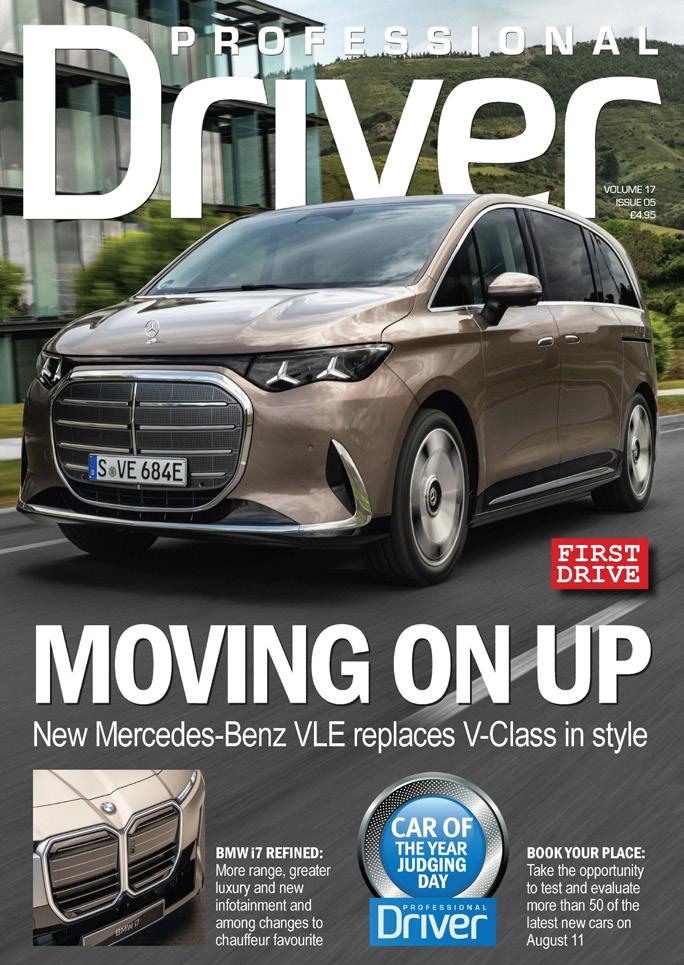
Cover Story: Mercedes Benz VLE first drive
4 News: Take Me in Warwickshire deal
5 News: DG Group moves into Lancashire
6 News: Veezu buys dispatch provider Cab9
8 News:Maidstone merger creates Kent powerhouse
10 News Analysis: EV targets to be relaxed
12 News Analysis: Why drivers are better than AV
16 CoTY Judging Day: register now to attend
22 First Look: BMW i7 facelift
26 First Look: VW Multivan becomes Caravelle
28 The Advisor 30 The Knowledge 31 The Insider
Levelling up required on VAT rules

Mark
Bursa
There’s always a risk of going over the same ground in this column, as the issues that occupy the industry seem to crop up every month. Licensing, cross-border, new regulations, VAT, autonomous taxis – it’s quite a list.
And with a government seemingly obsessed with consultations, I hope that these articles, plus contributions from our “wise men” toward the back of each issue, will help you get a handle on the issues, and prompt you to answer the consultations too.
It’s easy for our voices to be swamped in the shrill voices of pressure groups and better organised trade bodies. Ask yourself why the London black cab trade gets such a disproportionate amount of attention. Because the LTDA knows how to push the right buttons.
So a dwindling body representing 14,000 drivers gets the headlines, while private hire, chauffeurs and even hackney carriages outside London, find their voices at best discounted and at worst ignored.
What is wrong with this picture? Every other element of the public transport system, from buses to trains to trans to hovercraft, is not liable for VAT. Black cabs are not. Only private hire has to charge VAT.
This is a nonsensical situation. In the past, the government has argued that buses and trains are “greener” than PHVs, thus deserving of a bonus in VAT exemption. But even this does not stand up to scrutiny any more. Many buses and trains are dirty diesels. Increasingly, PHVs are clean electric or hybrid.
So if PHVs are part of an integrated travel system, level the playing field. Remove VAT on PHV journeys. This not only complies with the DfT plan for integrated transport, it solves, at a stroke, the discrepancy between London and elsewhere.
HMRC won’t like it – but remember, it’s not losing that much. Most private hire operators still use the self-employed driver “agency” model, which means only marginal VAT is charged.
“
It’s easy for our voices to be swamped in the shrill voices of pressure groups and better organised trade bodies ”
One major topic that requires attention is the unfair nature of VAT rules. We are now facing a ridiculous situation where private hire services in London are subject to 20% VAT, while outside the capital, they are not. This is a result of court rulings involving Uber, which have produced conflicting outcomes.
The Government seems reluctant to intervene – and HMRC is certainly not going to be flexible when the courts have provided it with a load of VAT revenue from London. But this cannot continue.
The Government’s latest attempt to draw up a taxi and private hire bill seems to have concluded that there is no reason for separate regulations within the London PCO area. A private hire vehicle offers the same service, regardless of whereabouts in the country it operates.
We agree. We also agree that the Government’s recently announced strategy of providing joined-up travel across different modes – rail, bus, tram, airline and yes, private hire – makes complete sense. We provide the vital first- and last-mile links , plus all the bits that join up a journey- airport transfers, late night collections from bars and restaurants, and so on. Very little “public transport” operates after midnight in the UK.
It also helps to keep fares down for the more vulnerable users of PHVs – the pensioners who rely on a cab to get to the shops, or to see their friends, for example. Or the latenight worker who needs to get home at 2am. There could be exemptions. There is a case for continuing to charge VAT on corporate account work, where the bills are paid monthly and are invoiced. But that only represents a relatively small proportion of the overall.
Let’s not forget the role Uber has played in this. Uber is happy to see VAT charged as it makes life more difficult for its competitors. With economies of scale, Uber can absorb VAT charges more easily than a local minicab firm.
Unfortunately, the Government (and the previous administration) both seemed content to give US tech giants a free pass, seeing them as somehow investing in Britian.
It’s happening with autonomous vehicles too – and again it looks like the government is being duped by the lure of 20,000 jobs for computer programmers – at the expense of 400,000 jobs for professional drivers.
Read our feature on page 12 and discover how a professional driver might do more than get someone to the station on time or help them with their shopping. That driver might save their life.
Stick that in your algorithm!
Rugby operator Dial-A-Cab becomes Take Me franchise
Mark Bursa
Take Me Group is continuing to expand its franchise business by signing up Rugby-based Dial-A-Cab. By joining forces, Dial-A-Cab will leverage Take Me’s extensive, scaled resources to inject new technology, drivers, and corporate accounts into the local area. The move gives Take Me access to Warwickshire.
Dial-A-Cab was founded in July 2011 by industry veteran Mark Bradshaw, starting operations with just two vehicles and growing to a substantial fleet.
The Covid pandemic affected the business as bookings plummeted. After the pandemic, Bradshaw recruited Rosie Linford, who had been made redundant by another local operator during the pandemic.
“Rosie brought a vibrant, modern mindset to the busi-
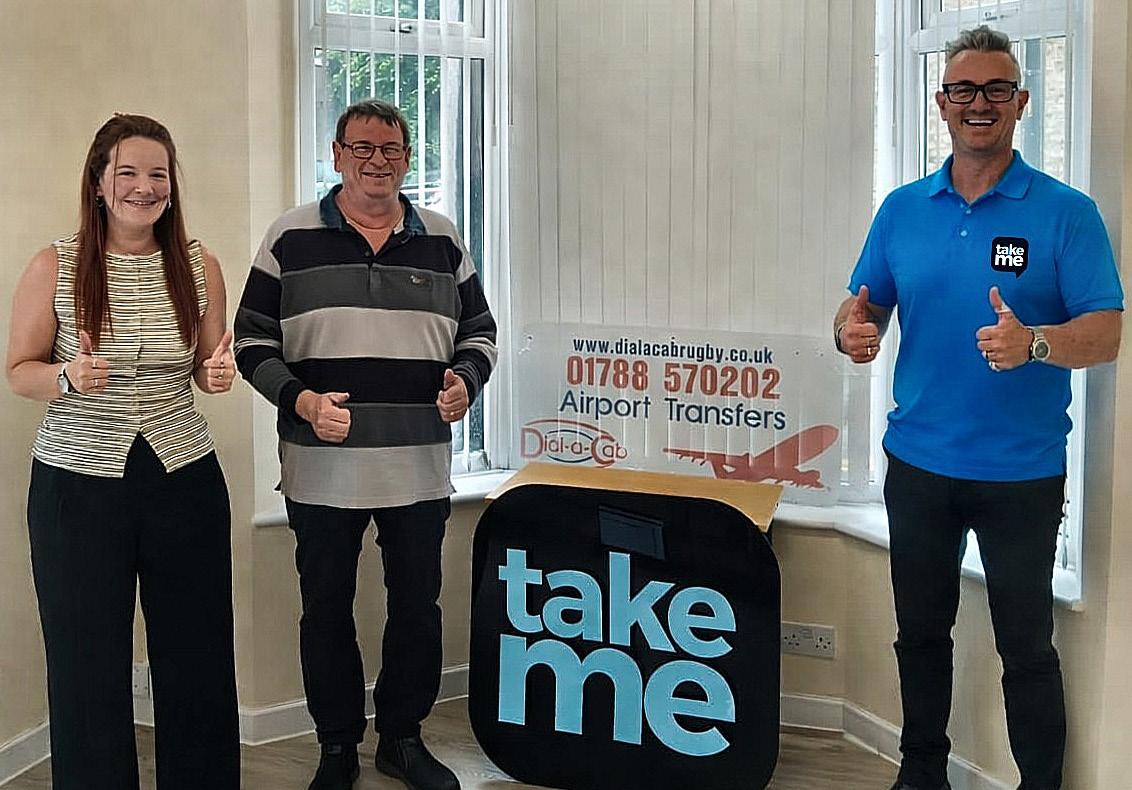
ness,” Bradshw said. However, the post-pandemic landscape brought a familiar industry headache, leaving Linford trapped in the daily grind, juggling bookings, dispatch, accounts, and driver shortages all by herself.
12 months ago ago, Ashley Butcher from Take Me approached the company,
offering guidance, free advice and industry insights. As a result, Bradshaw and Linford visited the Take Me headquarters in Loughborough to see how it supports its rapidly growing network of more than 45 companies nationwide.
This led to Dial-A-Cab officially signing a franchise agreement to take the busi-
ness to the next level.
A major focus of the new partnership will be driver recruitment, an area Bradshaw said had become needlessly difficult due to bureaucratic red tape.
Bradshaw said: “Right now, it feels easier to join the police force than to become a private hire driver. Every local council has different regulations and badge requirements. Applicants get frustrated by the lengthy delays and choose other industries.
Take Me is already on the ground working with Dial-A-Cab to boost local bookings, secure corporate accounts, reduce overhead costs, and recruit new drivers. Bradshaw added: “With Take Me’s backing, we can streamline our processes and make it attractive for local drivers to get back on the road. We look forward to the road ahead.”
Wayve signs autonomous vehicle deal with Government
Mark Bursa
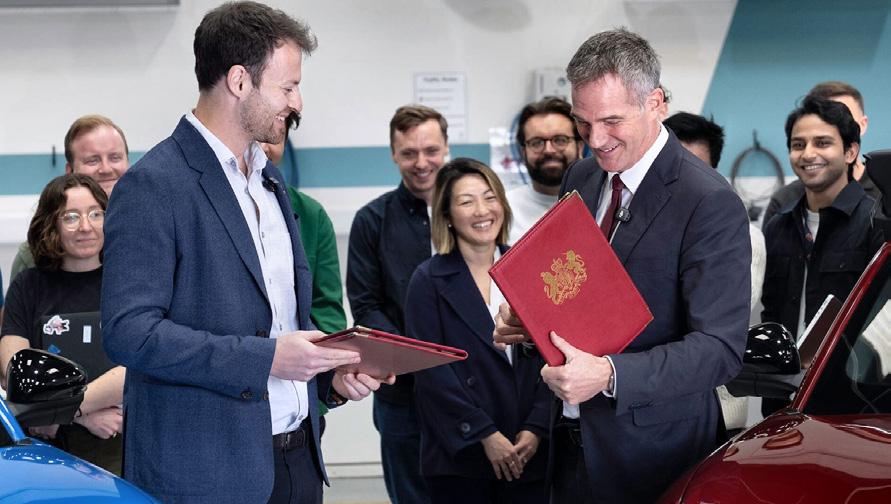
Autonomous taxi developer Wayve has signed a partnership with the UK Government aimed at putting the UK at the forefront of self-driving technology.
The Memorandum of Understanding (MoU) with the Department for Business & Trade will deepen collaboration on next-generation self-driving technologies as Wayve prepares to launch passenger service trials in the UK.
The agreement brings government and industry together around shared research interests, supporting responsible deployment of self-driving vehicles while reinforcing the UK’s global leadership in autonomous and AI-enabled mobility.
UK Business Secretary of State Peter Kyle said: “This partnership with Wayve shows how government is backing high-growth British scale-ups through our Modern Industrial Strategy to turn
world-leading research into real-world deployment.”
UK Science and Technology Secretary Liz Kendall said: “Wayve is a true British AI success story, putting the UK at the forefront of self-driving technology. This agreement will help secure high-skilled tech and advanced manufacturing jobs in this country. We are sending a clear signal
that the UK is the best place for ambitious tech firms to start up and scale up.”
Wayve co-founder and CEO Alex Kendall said: “Strengthening domestic capabilities will anchor high-value manufacturing in the UK, create thousands of skilled jobs across the supply chain, and support the future of the automotive industry. This is in addition to the transformative benefits to road safety to be gained from self-driving vehicles deployed at scale.”
The MoU sets out how DBT and Wayve will collaborate on research to help move self-driving vehicles from prototype to large-scale services on UK roads. Wayve will share insights from real-world trials with government, supporting to help unlock national roll-out of self-driving services and inform future regulations .
Dialed in: (from left) Rosie Linford and Mark Bradshaw of Rugbybased Dial-A-Cab with TakeMe’s Ashley Butcher
Alex Kendall, CEO and co-founder of Wayve (left) with Peter Kyle, UK Business Secretary of State
Taxi and private hire hit by higher-than-average inflation
Taxi and Private Hire business are among the UK sectors most heavily impacted by inflation, a new survey by UK-based card payment provider Dojo has revealed.
Operating costs across all UK businesses have increased by 48% on average over the past decade, But the cost rise has been higher for taxi and private hire companies, whose operating costs have increased by 54% in the same 10-year timeframe.

To understand which industries have faced the greatest pressure, Dojo analysed ten core cost categories, including business rates, energy, and industry-relevant supplies, between 2015 and 2025, to
create the UK Inflation Index, a sector-by-sector breakdown revealing where operating costs have risen fastest, and how business inflation now compares to consumer inflation.
Dojo’s research found taxi and private hire firms have faced sharper cost increases than the UK business average
over the past decade, particularly in technology and training costs, both of which have doubled over the past decade.
Charlie Ashworth, head of research & insights at Dojo, said: “While operating costs have risen significantly over the past decade, with the right insight into their cost structure, businesses can be better equipped to respond to these pressures.
“For business owners, the opportunity lies in control and efficiency. With labour, energy, insurance and technology costs all contributing to long-term structural change, understanding where your exposure sits is now a strategic advantage.”
DG Group looks north-west with Chorley-based Coopers takeover
Mark Bursa
DG Group is continuing its national expansion drive with the addition of a well-established Lancashire operator to its ranks.
Coopers Taxis of Chorley, which has been in business for more than 35 years, has officially joined the DG Group family, becoming the first north-west operator to come on board.
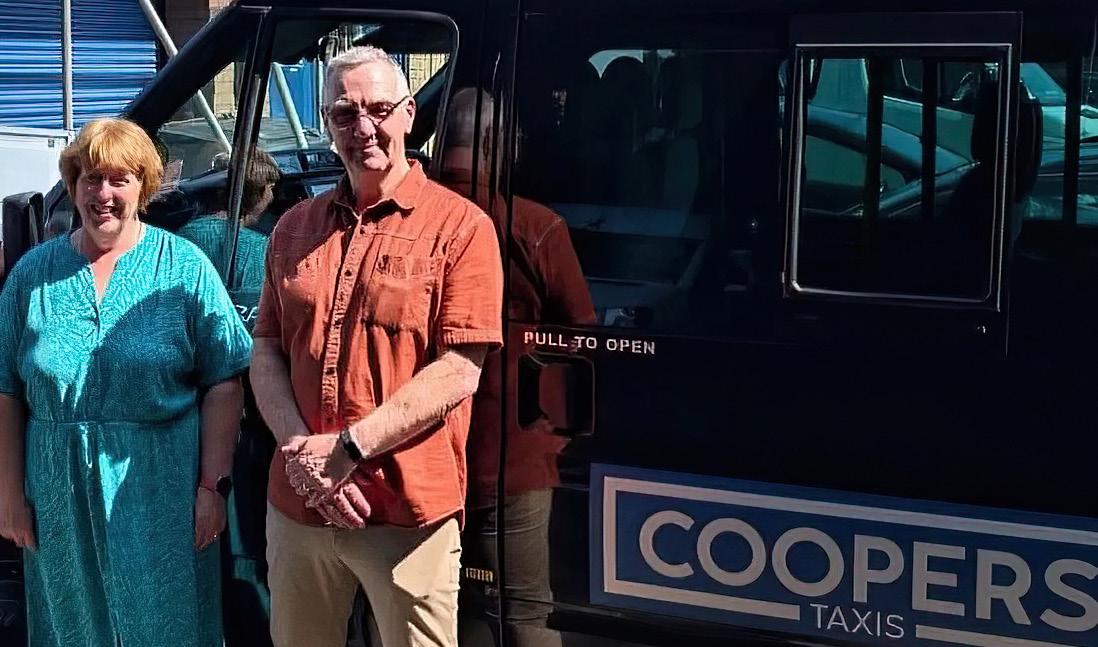
Coopers Taxis was launched in 1990 by Philip and Lynne Cooper (pictured) with just three cars. The company now operates around 100 vehicles from two bases, one in Chorley and one in South Ribble. Philip and Lynne’s sons Neil and Shaun later joined the business and now manage all day to day operations.
DG said in a statement: “This acquisition represents another important step in
our long-term vision to continue expanding DG across the UK. Coopers Taxis has built an outstanding reputation for providing reliable transport services across Chorley, Leyland and the surrounding areas, offering a diverse fleet ranging from 4- to 16-seat vehicles.”
“At the heart of this acquisition are the people who make these businesses successful every day. We’d like to extend a very warm welcome to all our new colleagues joining the DG
family. We look forward to working together, sharing knowledge and continuing to build a business that everyone can be proud to be part of.”
The statement continued: “A huge thank you must also go to everyone behind the scenes who has worked tirelessly to make this transition possible. Bringing businesses together takes an enormous team effort, and the dedication shown throughout this process has been exceptional.”
Alongside local passenger transport, executive travel and wedding hire services, DG continues to invest in transport technologies, including innovative e-booking platforms. This acquisition follows DG Group’s successful addition last year of Nippy Taxis, a 250-cars Scarborough operator, Arrow Specialised Transport of Mansfield and Nottingham, which has 20 years’ experience in SEN transport.
Earlier deals include an unrelated Arrow Taxis of Worthing in November 2023, Stanningley Cars in West Yorkshire in June 2023, CamCab of Cambridge and a third, unrelated ‘Arrow’, Leeds-based Arrow Cars, which serves Leeds-Bradford, East Midlands and Bristol Airports.
Ambitious Veezu buys stake in dispatch systems provider Cab9
Mark Bursa
Cardiff-based private hire giant Veezu has acquired a stake in leading booking and dispatch technology provider Cab9.
London-based Cab9, which provides its technology platform to hire and taxi operators across the UK and internationally, will continue to operate under its existing brand and leadership, with chief executive Tarpit Grover remaining in position.
Grover also remains a significant shareholder. The value of the investment and Veezu’s stake in the business has not been disclosed. Acquisitive Veezu partners with 16,000 drivers across the UK and handles around 25 million journeys a year.
Through its latest investment, Veezu, which is
backed by private equity firm MML Capital, said it will support the development of AI and automation technologies to enhance Cab9’s ability to provide innovative, reliable and cost-efficient solutions for customers to accelerate growth and increase service provision.
It will also provide additional investment to support
the continued development of Cab9’s platform and services, while maintaining its focus on delivering technology solutions for operators.
Grover said: “This is an exciting next chapter for Cab9 and the strongest leap forward in our journey so far. Over the last decade, we have built technology with purpose, care and a belief that the industry de-
serves better. That does not change. The people, passion and product thinking behind Cab9 are not going awaythey are being strengthened. I am delighted to continue leading Cab9 and look forward to working closely with the Veezu team.”
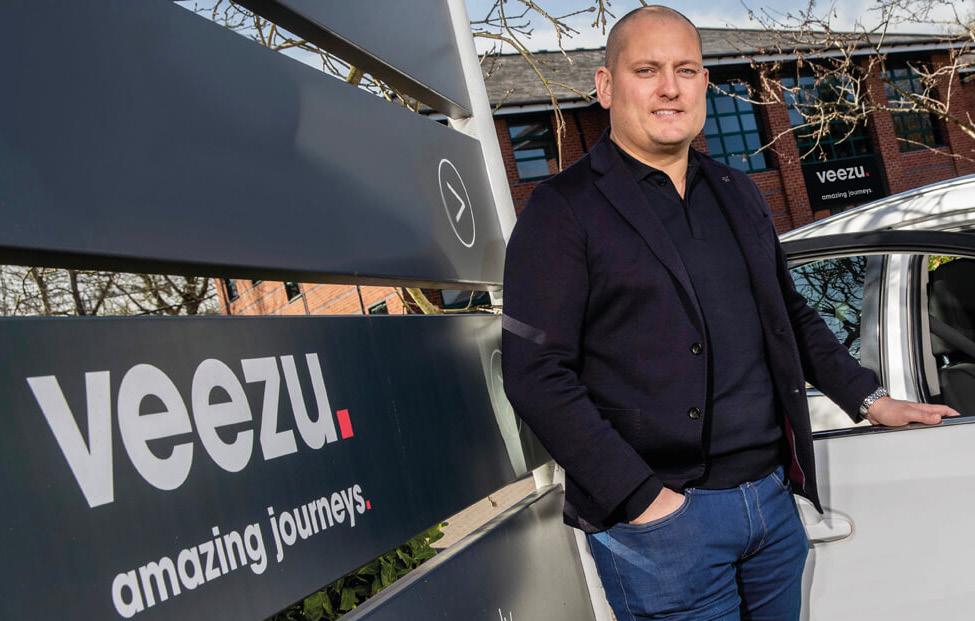
Nathan Bowles, co-founder and chief executive of Veezu (pictured), said: “Cab9 has built an excellent reputation for delivering high-quality technology to operators across the sector. As Veezu has grown nationally, technology has become increasingly important to our long-term strategy and ability to serve passengers, driver partners and business customers.”
Established in 2013, Veezu is now licensed by 63 local authorities and operates in hundreds of towns.
The Taxi Centre moves to new Glasgow premises
Mark Bursa
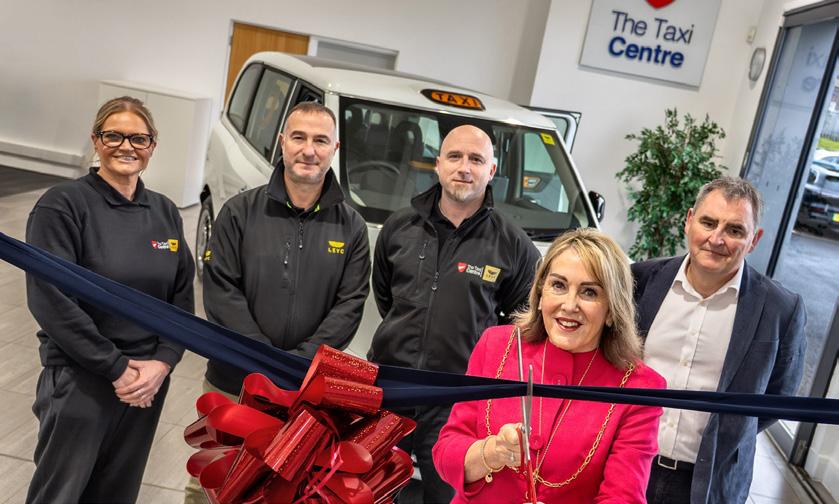
Leading specialist dealer The Taxi Centre has celebrated 25 years in business by relocating to new, upgraded premises in Glasgow. The new site was officially opened by Bailie Marie Garrity. It is a modern facility next door to its previous location on Kennishead Road in the Darnley area of the city.
The Vertu Motor-owned business said the relocation would keep it firmly rooted in its Glasgow heritage while significantly enhancing its operational capability and customer experience.
A key benefit of the new premises is the integration of vehicle sales and aftersales under one roof. For the first time, customers can access dedicated LEVC servicing facilities on site, bringing sales, maintenance and support together in a single, streamlined location designed around the needs of professional drivers.
Alongside the physical move, The Taxi Centre is expanding its vehicle offering with the introduction of models from Geely, reflecting changing driver needs and the rapid evolution of the taxi and private hire market.
The expansion builds on The Taxi Centre’s established expertise with electrified vehicles, including LEVC, and provides drivers with greater choice as
the industry transitions towards new technologies.
Stephen Porter, branch manager of The Taxi Centre, said: “Reaching 25 years gave us a moment to reflect on how far The Taxi Centre has come, but this move is really about what comes next. By bringing sales and aftersales together, we’re making life easier for our customers and improving the day-to-day experience for drivers who rely on their vehicles to earn a living.The new site gives us the space, facilities and flexibility to support them better than ever.”
Robert Forrester, Chief Executive of Vertu Motor, the parent company of The Taxi Centre, said: “The Taxi Centre’s relocation underlines the Group’s long-term commitment to the sector. It’s a strong example of how we back specialist businesses within Vertu.”
From left: Claire Newlands, Nigel Staniland (LEVC), The Taxi Centre's Stephen Porter, Bailie Marie Garrity, and Daniel Cross (LEVC).
Cross-border still the battleground as Government prepares taxi bill
Mark Bursa
Cross-border operations remain the biggest battle ground as the government plans to introduce a new Taxi and Private Hire Vehicle Bill.
Transport Secretary Heidi Alexander indicated that she wanted to see drivers licensed in their home town: “I believe that drivers and operators should be licensed where they intend to provide services,” she told the House of Commons. The Transport Secretary was responding to a question from Transport Committee Chair Ruth Cadbury, who asked what action the Government was taking to restrict out-ofarea working.
The issue was a major focus of the Transport Committee’s recently published inquiry into taxi and private hire licensing. The Committee urged the Government to develop a plan to curb the practice of out-of-area licensing while recognising that an outright ban would

be impractical.
Alexander suggested ministers would take a balanced approach to reform. She said: “We want to look at the issue of out-of-area working holistically to make sure that we do not reduce the availability of private hire services for everyone, while also making sure that we have very high standards in place.”
She said the Government had legislated to establish national standards and
to reform enforcement arrangements, allowing local inspectors to check any vehicle or driver, regardless of where they were licensed.
“Those standards will provide a robust framework to make sure that people are safe wherever they live, work or travel,” Alexander said.
The Transport Committee’s report, “Raising the standard: licensing of taxis and private hire vehicles”, concluded that modernising the licensing framework was vital.
The report warned the Government that its plan for national standards for taxis must not mean “low by default”, and called for a “clear plan” to reduce
high levels of out-of-area working.
The report states: “We are not persuaded that the plan to pursue national minimum standards will be sufficient, unless those standards are strong enough to avoid a lowest common denominator effect, and carefully specified to remove incentives for licence shopping. The department already accepts that in practice there should be an absolute standard in areas like safety.”
Indeed, industry bodies such as the LPHCA have lobbied hard for true national standards, not minimum standards, and succeeded in getting the word “minimum” removed from the draft document presented within the recent King’s Speech.
Alexander said the Government would be bringing forward a draft taxi and private hire vehicle Bill for pre-legislative scrutiny in this parliamentary session, called on the Transport Committee to contribute to the process.
Express creates Kent powerhouse with Apollo deal
Mark Bursa
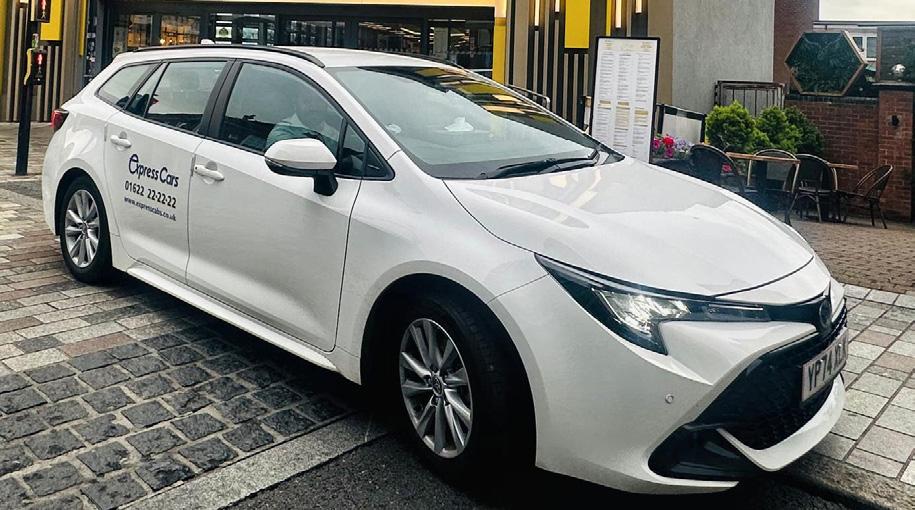
Maidstone-based Express Cabs has acquired local rival Apollo Taxis, creating a combined fleet of more than 400 vehicles and making Express Cabs the largest independent private hire operator in Kent. The acquisition marks the latest stage in Express Cabs’ expansion across the county. The move brings together two of Maidstone’s best-known operators, which should result in increased vehicle availability, faster response times and an even broader range of services, including executive vehicles, MPVs, 8-seaters, 16-seater minibuses and airport transfers.
The move also significantly strengthens the business’s ability to compete with national ride-hailing platforms such as
Uber, while retaining the local knowledge, customer service and community focus. As part of the acquisition, Apollo Taxis director Tom Veitch has joined Express Cabs as business development manager, where he will focus on expanding the company’s corporate portfolio and developing new
partnerships with businesses across Kent.
He said: “This is a hugely positive moment for the people of Maidstone and for businesses across Kent. By bringing Apollo and Express together, we’ve created the largest private hire operator in the county and put ourselves in an incredibly strong position for future growth.”
“We share the same ambitions, the same values and the same commitment to providing an outstanding local service. Together, we have the scale to compete with global operators while still offering the personal service, local knowledge and community focus that customers value.”
Heidi Alexander MP, secretary of state for transport
protection that fits the way you drive
With more chauffeurs working through app-based platforms like Blacklane and Wheely, we’ve expanded our offering to reflect how the industry is evolving.
Our advice is built around understanding your world – giving you cover that supports the way you work today. At Howden, we get you. Speak to a specialist who understands your business.
Your contact for independent drivers and fleets under six vehicles: Your contact for fleets of six or more vehicles:
Cameron Scott
T: 020 8036 3968
E: cameron.scott@howdeninsurance.co.uk
Ricky Chivers
T: 020 8256 4916
E: ricky.chivers@howdeninsurance.co.uk
Howden UK Brokers Limited is authorised and regulated by the Financial Conduct Authority No. 307663. Registered in England and Wales under company registration number 02831010. Registered Office: One Creechurch Place, London, EC3A 5AF. Calls may be monitored and recorded for quality assurance purposes. HUBL-CS-CH-035-0326 howdengroup.com/uk-en/blacklane-wheely
Government plans to slash EV mandate as automakers struggle with targets
Mark Bursa
The Government is planning to dilute the UK’s Zero Emission Vehicle (ZEV) mandate after intense lobbying from carmakers and the Unite union.
A formal consultation will be held over plans to slashing the target of mandating 80% of car sales in 2030 from 80% to 50%. The Government had originally planned to revies the target in 2027, but is planning to bring this forward to this year amid mounting pressure from MPs, unions and the car industry, which have warned that the strict mandate could see the UK lose potential investments in EV technology. Nissan has already cancelled plans to build an all-electric Qashqai model in Sunderland.
MPs on the Business and Trade Committee have urged the Government to bring forward the planned review of the ZEV mandate after warning of an “existential risk” to the UK’s automotive sector.
Unite’s general secretary Sharon Graham was reported as saying that the existing mandate was “significantly contributing” to job losses, and automakers may stop selling vehicles altogether rather than risk heavy fines, which are applied if automakers fail to sell the mandated proportion of their sales as EVs – in 2026, that is 33%. For every car above the 67% non-EV sold, automakers face fines of £15,000 per car – money they argue could be better spent on helping motorists switch to EVs.
SMMT chairman Mike Hawes said the EV quotas within the ZEV mandate
were unachievable. He said: “The latest industry outlook expecting BEVs to reach 26.8% market share by year end – impressive progress from 3.4% just a decade ago, but lagging the incredibly tough 33% mandated by government.”
Manufacturers can take advantage of government flexibility schemes, include banking and trading credits, borrowing from future targets, car/van cross-trading and earning extra credits by achieving lower overall CO2 emissions across their traditional (non-ZEV) fleets. The 2025 target of 22% was achieved as a result, and analysts expect the 2026 target of 33% to be achieved. However this will become significantly more difficult as the quotas ramp up.
The mandate currently requires 33% of cars and 24% of vans sold by every manufacturer in the UK to be zero-emission in 2026. These targets rise annually to 38%/28% in 2027, 52%/35% (2028), 66%/46%
(2029), and 80%/70% (2030).
Hawes added: “Automotive is renowned for its ambition but the economic conditions for delivering EV growth in 2026 are far more challenging than expected when the mandate was designed five years ago.
”Hawes concluded: “This is not an argument for slowing the transition – to which industry remains committed – but it is an argument for regulation that is credible from a market and economic perspective.”
A potential reversal of the ZEV mandate faces fierce opposition from charging operators and green groups who argue it threatens billions in infrastructure investments and undermines climate targets.
A new report by New AutoMotive argues that the Zero Emission Vehicle (ZEV) Mandate has become one of Britain’s most successful market-based industrial policies. The report claims that the ZEV Man-
date has than £41bn committed motive sector supported battery supply more than active projects; forecasted tion to the 334,000 sector by the public to more points.
Ben Nelmes, founder said: “The whether that success
The worst ment could is uncertainty.”
Vicky charging ChargeUK, on the ZEV not only in the critical infrastructure transition, mine the a market at all.”



A MATTER OF LIFE A MATTER OF LIFE
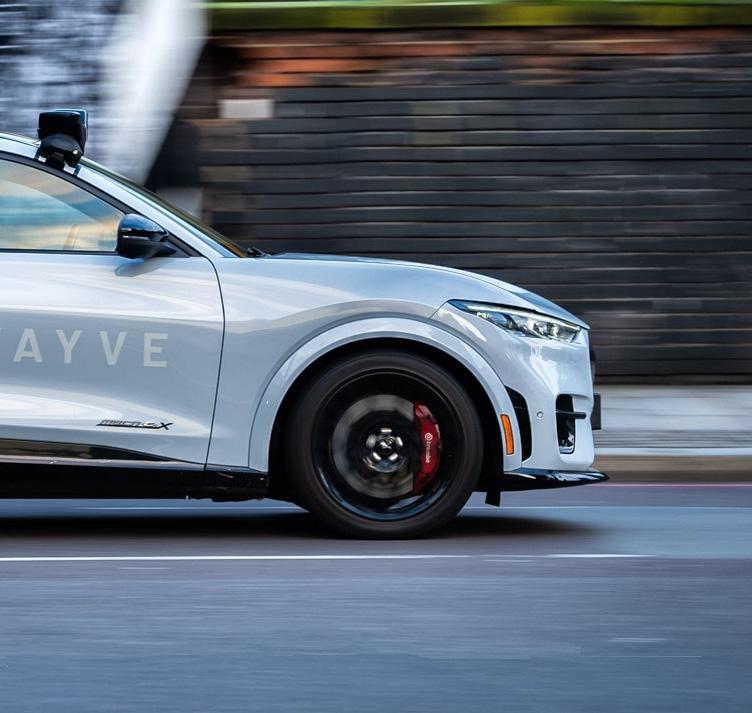
It’s not been a good few weeks in the world of Robotaxis. In America, Waymo had to withdraw and reprogram 4,000 autonomous taxis – because they kept driving into motorway construction sites.
It’s been happening here too – a Waymo car was filmed careering through a police cordon in Harlesden – despite having a so-called “safety driver” in the car.
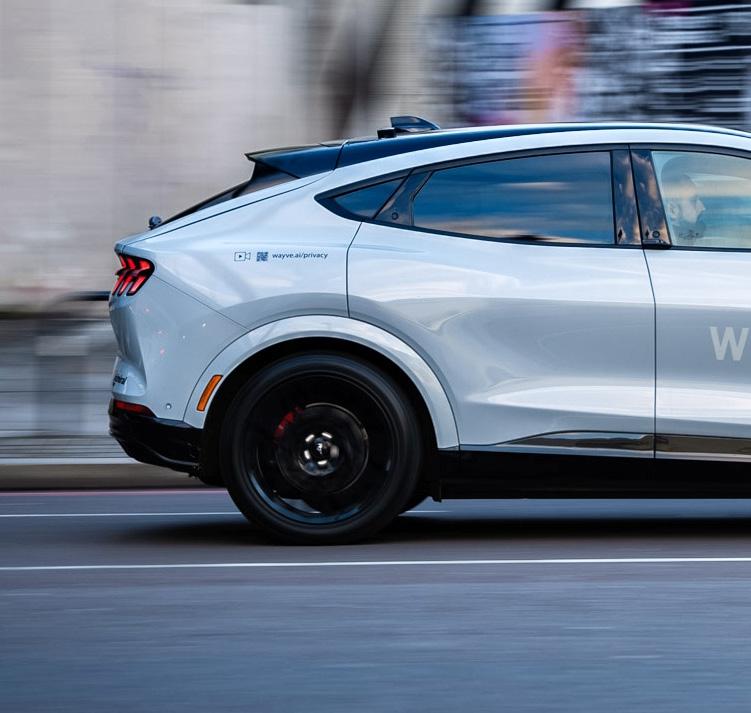
The government last month announced a partnership with UK-based Wayve, which is developing Uber’s AV taxi operation, trotting out the usual “white heat of technology” platitudes about creating thousands of tech jobs.
But trade unions have started to realise the clear and present threat to
drivers’ employment if the AV taxi sector takes off. A number of London drivers protested at City Hall, and a meeting on June 24 involving presentations from Waymo and Wayve was frequently interrupted by drivers from the Independent Workers’ Union of Great Britain (IWGB)
Beyond the issues of public safety, drivers’ job security and congestion, there is one very significant point that is being overlooked. Take away the driver and you might eliminate driver errors (though that does not appear to be the case as yet), but you lose far more.
A professional driver provides a lot more than transport. The AV isn’t going to help an elderly pensioner load her shopping and get safely to the front door. It’s not going to offer kindness and empathy to an autistic youngster
going to school. And at the most extreme, there’s one thing a driver can do that no algorithm-based device can do.
A driver can save your life.
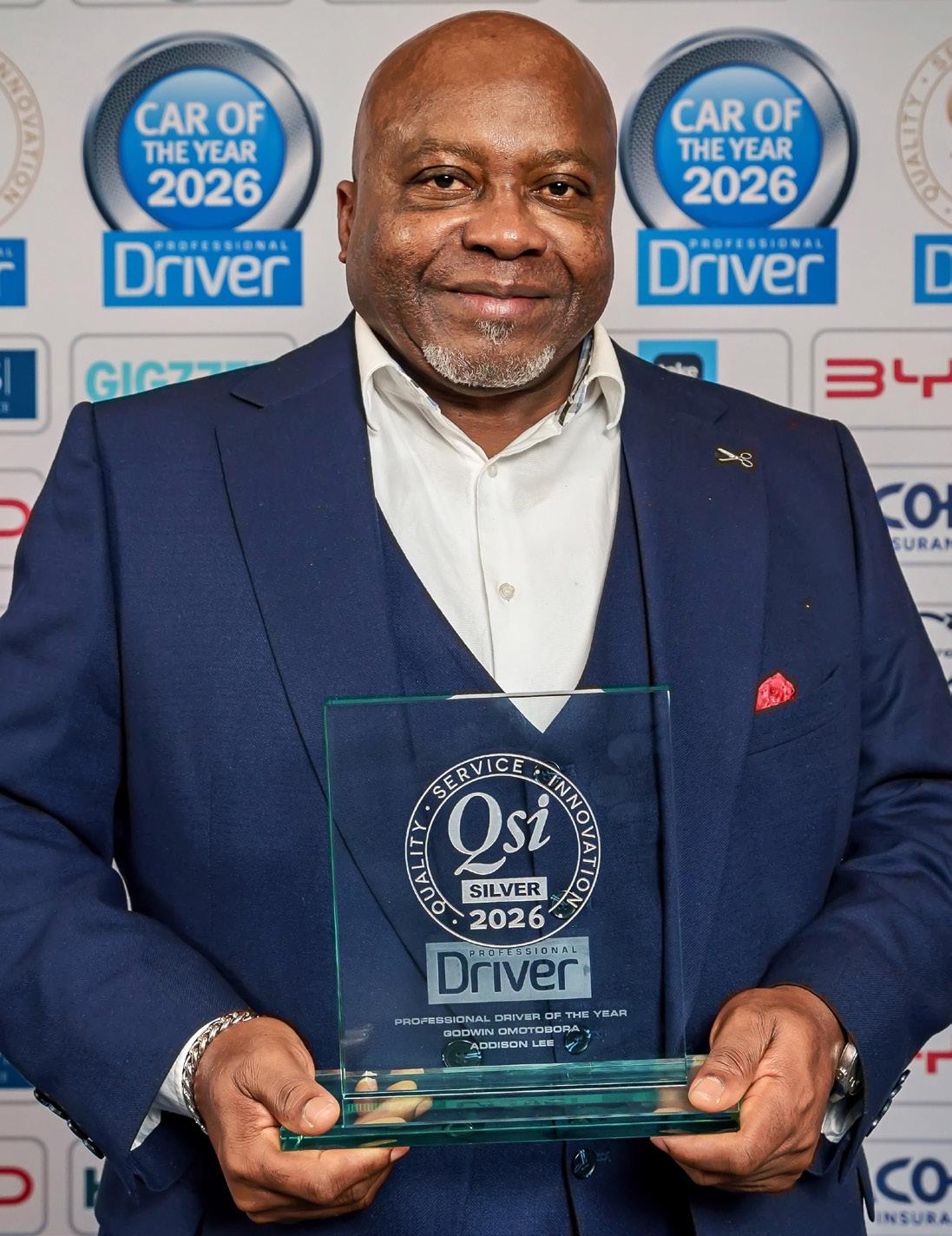
Experienced Addison Lee driver Godwin Omotobora was transporting a male passenger last October when he noticed something was seriously wrong in the back seat of his vehicle. Acting immediately, he safely pulled over, called 999 and began administering CPR, following instructions from the emergency operator.
Paramedics and police arrived within minutes and took over resuscitation efforts before transferring the passenger to hospital. Thanks to Godwin’s swift reactions, the passenger survived.
The police contacted Addison Lee after the incident saying: “If it wasn’t for
Driverless taxis are on test in London, but not everyone is enthusiastic. Take away the driver and you don’t just lose personal service. A professional driver might save your life. Mark Bursa reports
LIFE AND DEATH LIFE AND DEATH
the lightning reactions of your driver, the outcome for the passenger would have been very different. Godwin saved the man's life and is a hero.”
Godwin said: “When I realised something wasn’t right, I didn’t hesitate. I pulled over safely, called 999 and started CPR straight away. You don’t think in that moment - you just act.”
“It was an overwhelming experience, but I kept going with the support of the emergency operator and the police officers who arrived. Knowing that the passenger survived makes it all worthwhile.”
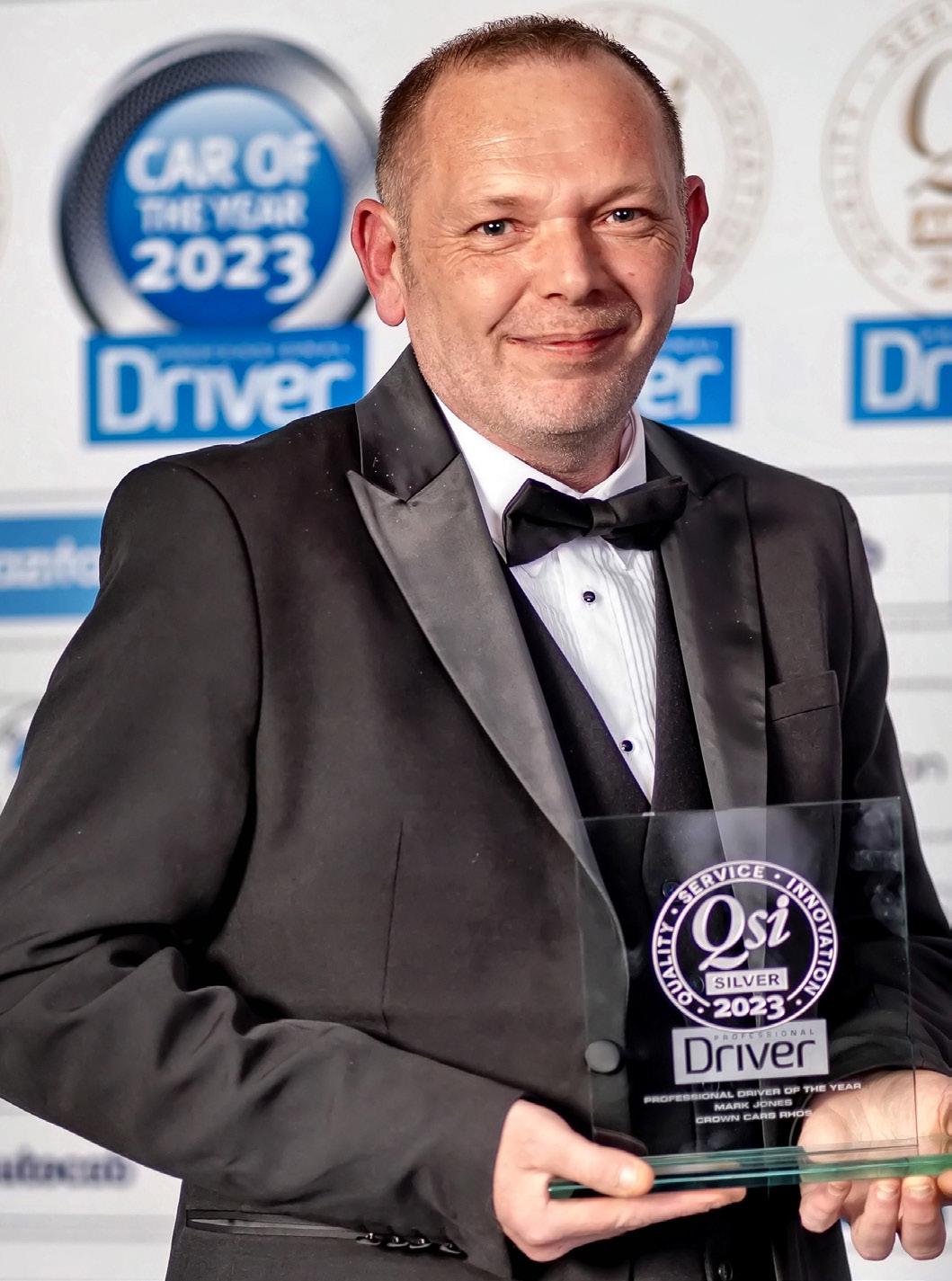
Godwin won a Professional Driver QSi Award for his lifesaving heroics. And he’s not the only driver to be rewarded in this way. Wrexham-based Crown Cars driver Mark Jones was on his regular shift when he received
a call from a dispatch operator, who had received a distressing call from the daughter of a loyal customer. The daughter expressed deep concern for her elderly father, Dave Jenkins, who was a diabetic and had called for an ambulance due to his deteriorating health. But the ambulance had not arrived, so she called a cab.
Upon arrival, Mark noticed that the elderly gentleman was struggling. Mark carefully helped him to the waiting car, fastened his seatbelt and set off for the nearby hospital.
Throughout the ride, Mark continued to provide reassurance and comforting conversation to Dave, who was rapidly slipping into a diabetic coma. At the hospital he quickly rushed inside to alert the medical staff, who promptly provided medical attention.
Crown Cars’ MD Andy Robers said: “Mark's actions on this day were nothing short of lifesaving, and we take immense pride in having him as a part of our team.”
Remarkably, this was not the first time Mark had acted as a life-saver. During the pandemic he picked up a distraught customer who requested to be taken to a vague location - an aqueduct - late at night. Mark knew that the location was a known spot for individuals contemplating suicide, and sensing that something was amiss, engaged the customer in conversation during the journey to better understand the situation.
He recognised that the young woman was grappling with mental health issues intensified by isolation. When CONTINUED ON PAGE 14
news analysis: AV taxis
CONTINUED FROM PAGE 13 they arrived at the drop-off point, Mark turned off the engine, and extended his unwavering support to the young woman and asked if he could drop her off somewhere else, without charging her.
She eventually confided in him, revealing her intention to take her own life, but Mark’s compassionate words convinced her to reconsider and return to her mother’s home, ensuring her safety. Once he knew she was secure, Mark promptly contacted the authorities as part of the safeguarding process. They arrived quickly, provided assistance to the girl, and transported her to the hospital.
Even when they’re running empty, a good driver might spot something amiss on the roadside. Workington-based KB Travel driver Taylor Kilburn was driving his taxi in the early hours of the morning when he noticed a man standing on a bridge, and felt the situation “just didn't look right.”
Taylor turned his car around and pulled over to check on the man’s welfare. “I asked him if he was okay and he basically just broke down into tears and said he wasn’t happy,” the driver said.
“He didn’t want to be here anymore
and he was going to basically himself off the bridge. me to leave him but I that’.” After talking with about ten minutes, Taylor persuaded him to get called emergency services
These are not isolated about every UK operator a tale like Godwin’s, or Taylor’s. Where alert, and empathetic drivers the call of duty and saved
Following Godwin’s Addison Lee has launched initiative with St John with a view to training drivers in basic first aid. tors are also looking to aid-related initiatives.
Chauffeur operator includes first aid training chauffeur academy training and has equipped its fleet ble defibrillators.
Meanwhile the App Couriers’ Union (ADCU) for an immediate pause sion of autonomous passenger trials in London, warning technology could put cessibility and more than

Mark Jones's actions were described as “lifesaving”
Godwin Omotobora:











Sponsored

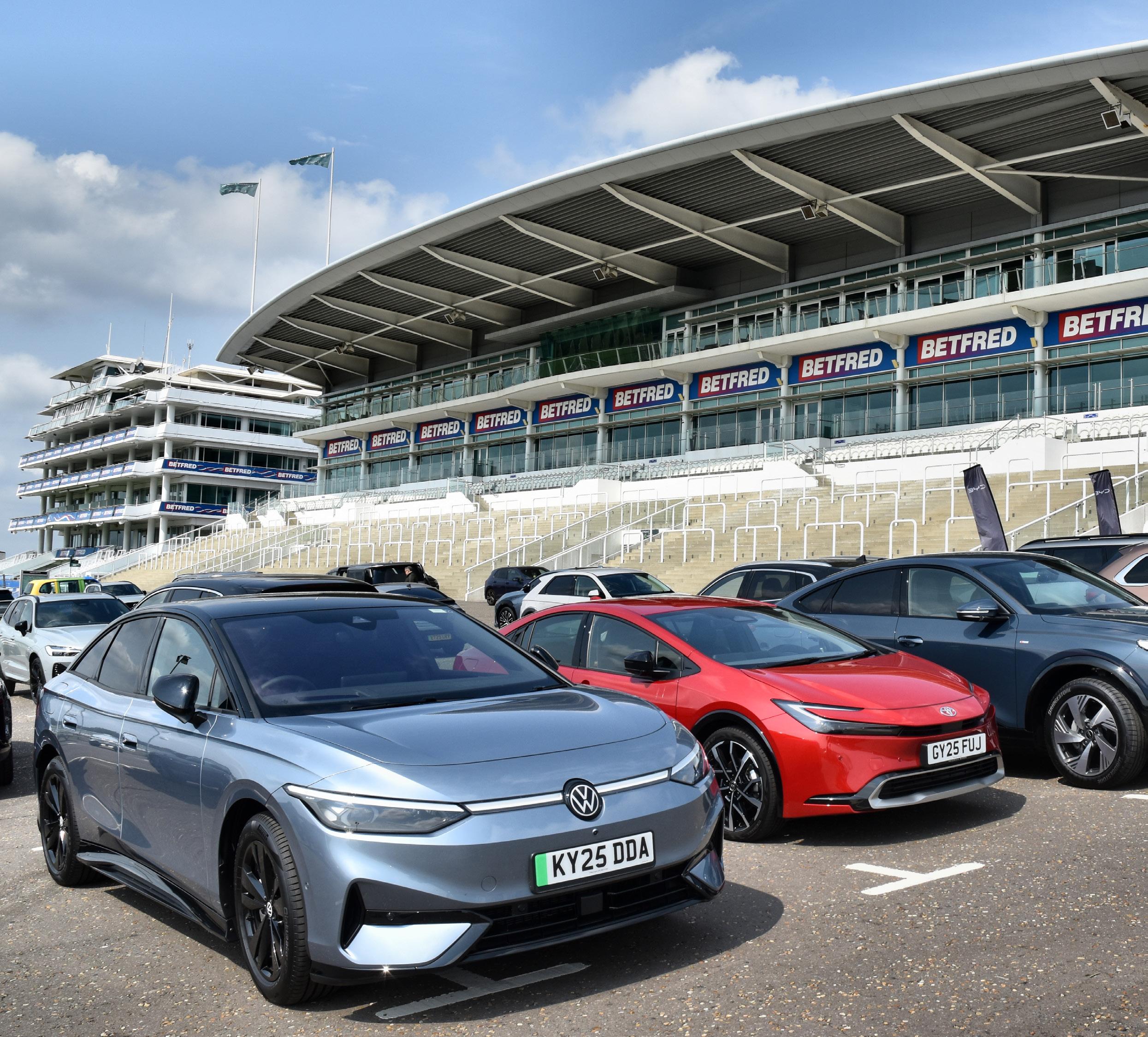
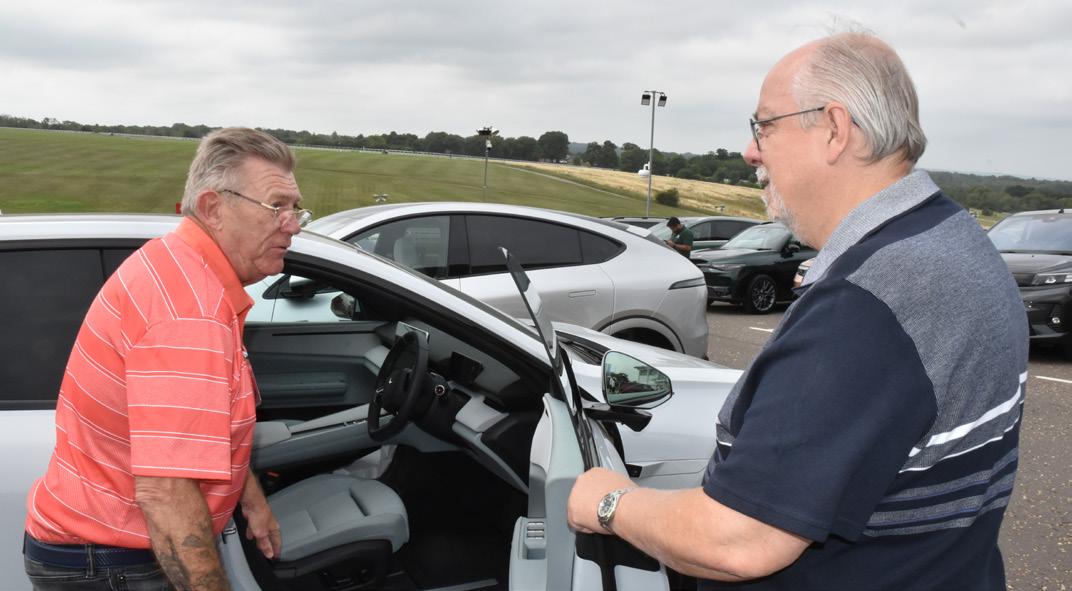
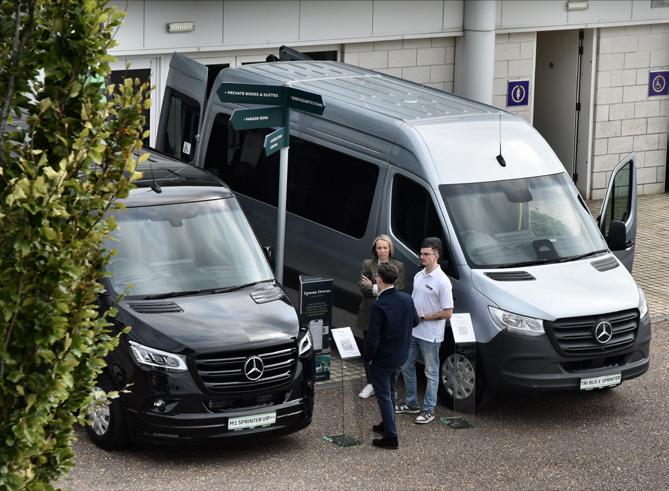
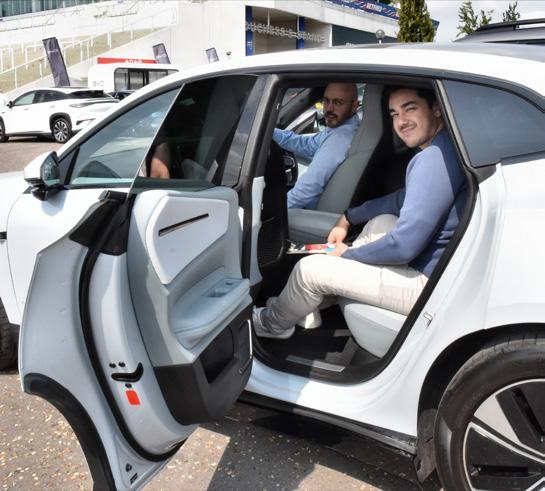
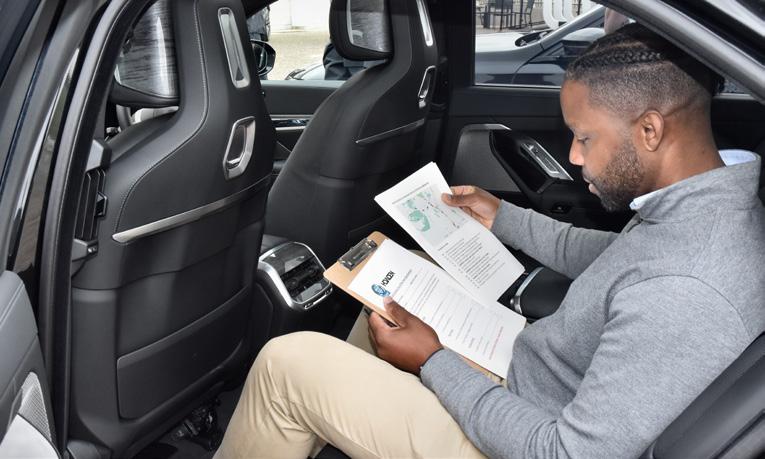
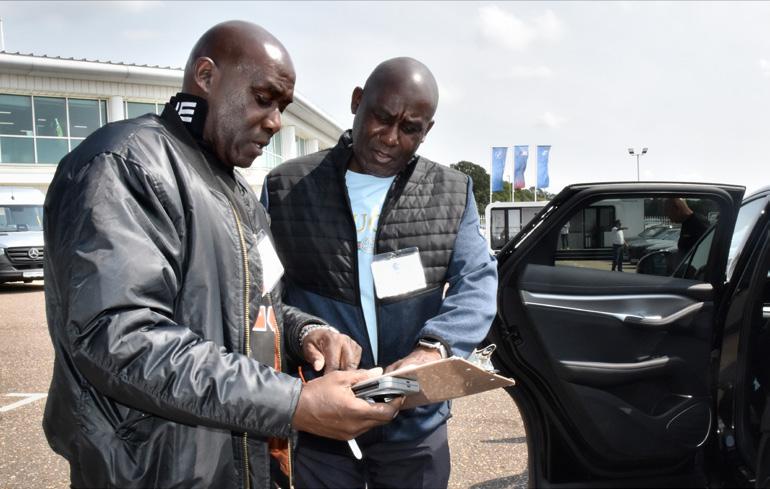
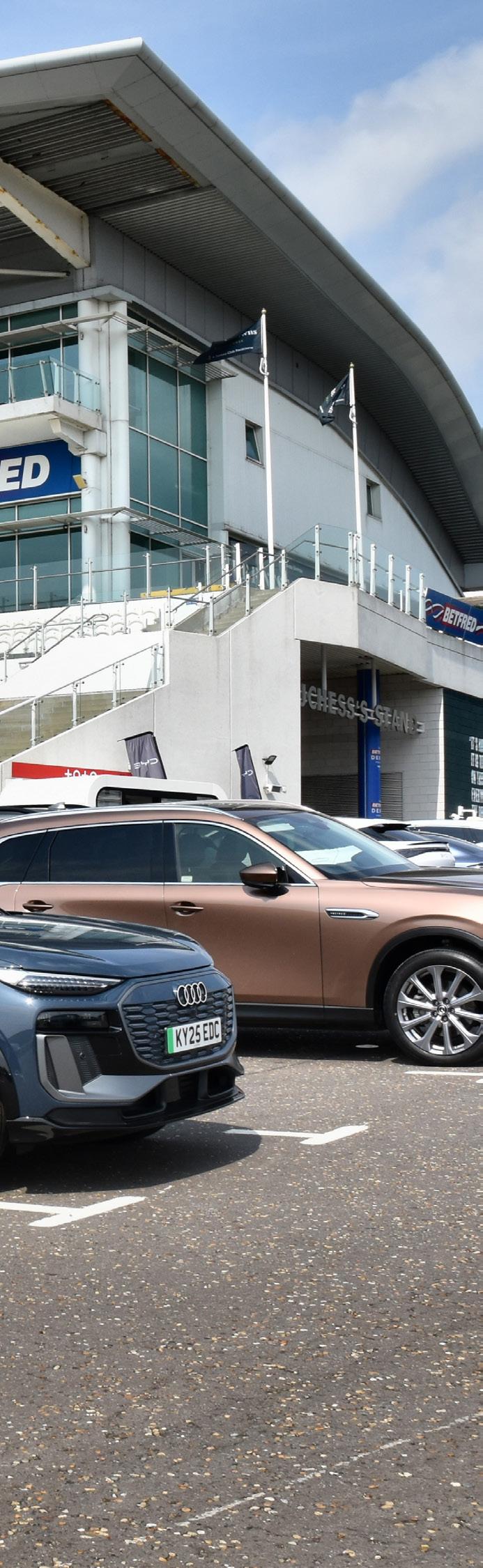
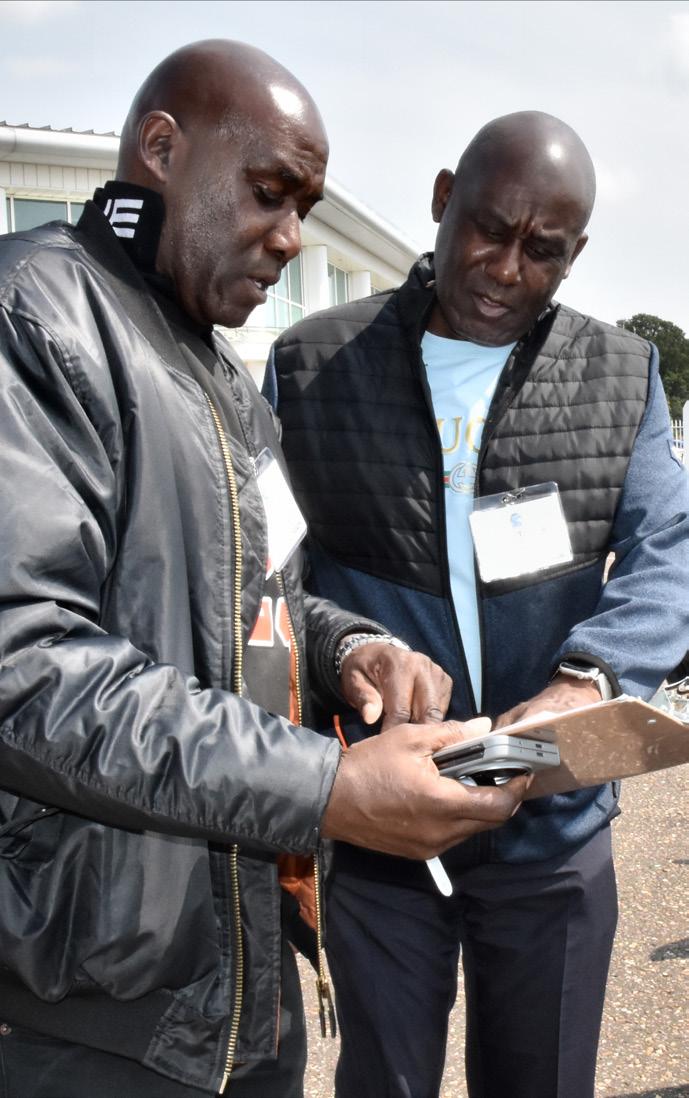
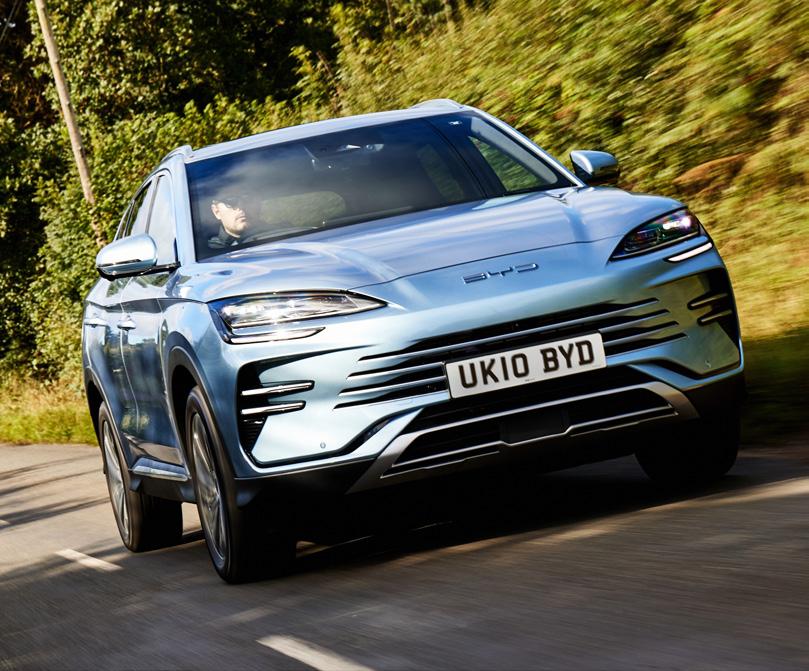
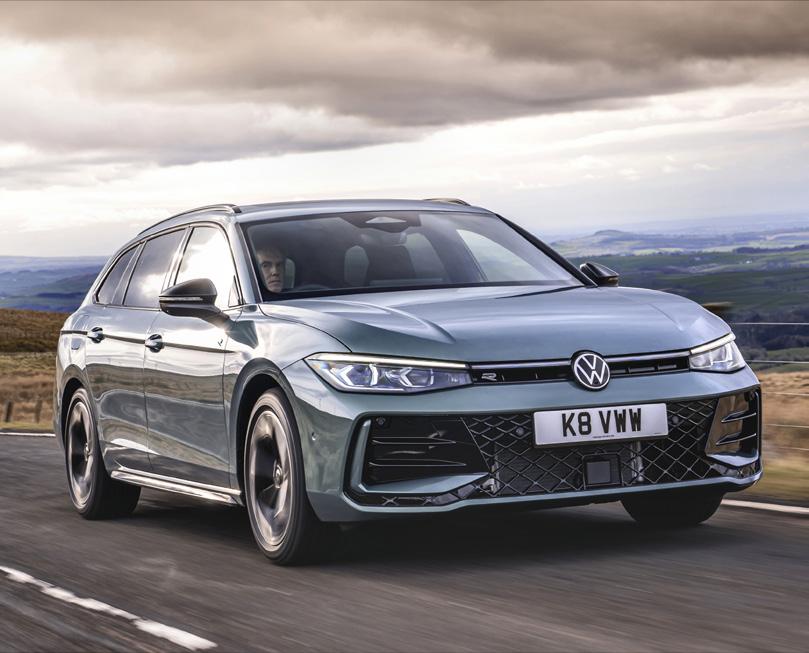
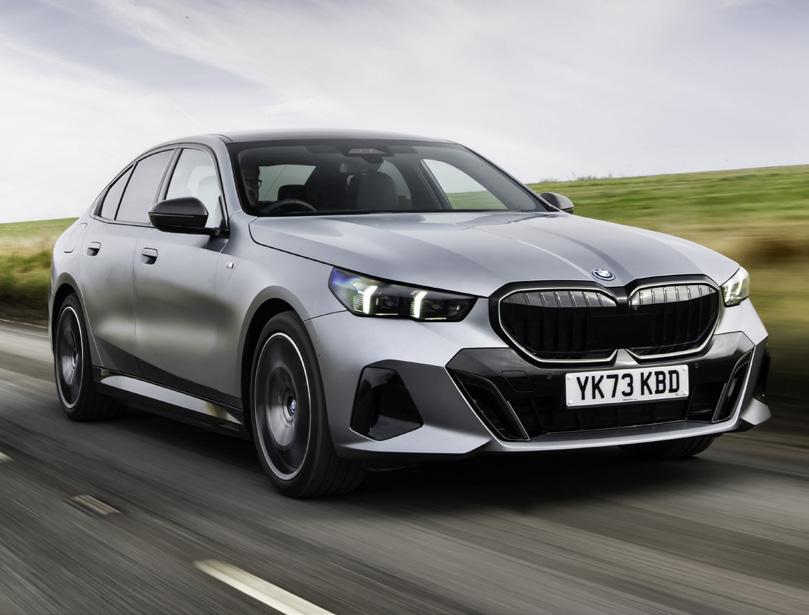
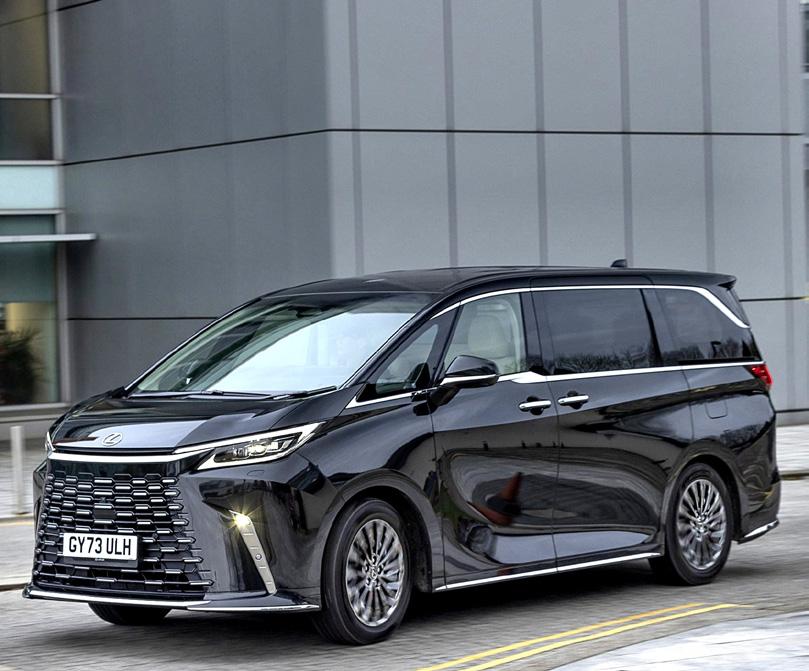
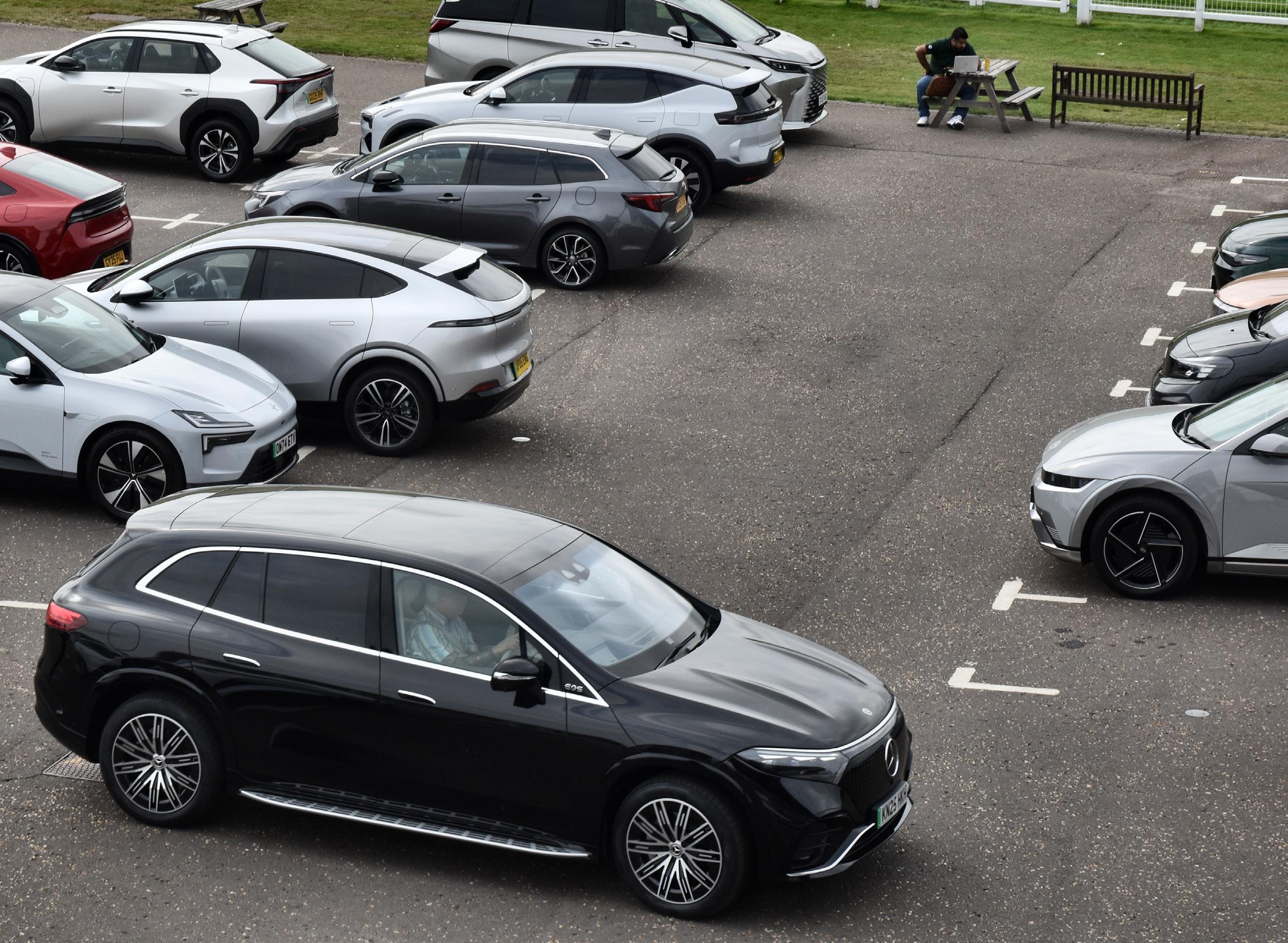
The Professional Driver Car of the Year awards are a fixture on the calendar– and here’s your chance to be a part of it. It’s free to register for anybody in the licensed taxi or private hire trade - and you’ll get the chance to try out up to 50 of the latest cars.
The event takes place at Epsom Racecourse on Tuesday, August 11. We ask our guests to take the cars for a test drive and give them a thorough once-over, then complete a 17-point checklist. The results are fed into the Professional Driver Supercomputer and that's how we choose our six cars of the year in six categories - Chauffeur Car, Executive Car, Private Hire Vehicle, Luxury SUV, Estate Car and MPV.
It's a great day out, with plenty of opportunities for networking as well as driving. Lunch and refreshments are provided.Visit our website for details of how to register - and we look forward to welcoming you on the day.
www.prodrivermags.com/car-of-the-year-home/

VISION OF THE VISION OF THE
Call it V-Class, call it Viano, call it EQV. For the past three decades, Mercedes-Benz’s luxury people-mover has been the only game in town for chauffeurs needing a seven-seater. It’s true that there are other vehicles that can offer similar functionality – Ford Tourneo Custom and Volkswagen Caravelle, for example. But they don’t have the cachet that the three-pointed star brings.
Despite its strength in the market, the V-class has its drawbacks. Firstly, it shares its basic body with the workaday Vito van. And as a design, it’s a bit long in the tooth – which is partly why the electric EQV adaptation doesn’t have quite the range that chauffeurs need – on a good day, it’ll give you about 250 miles between charges, far less that you should get from a purpose-designed EV.
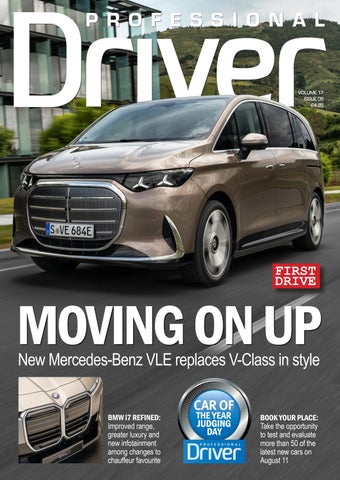
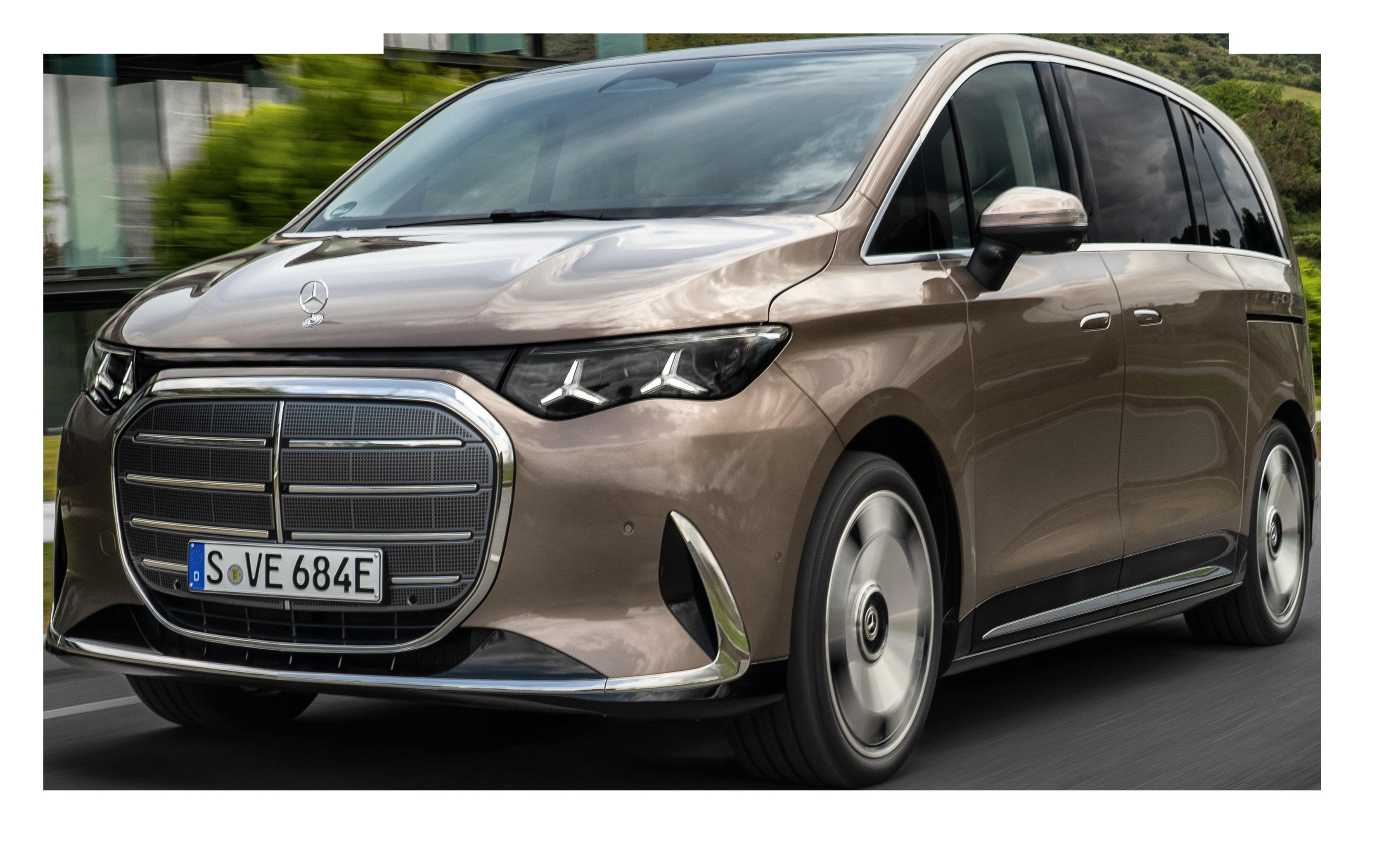
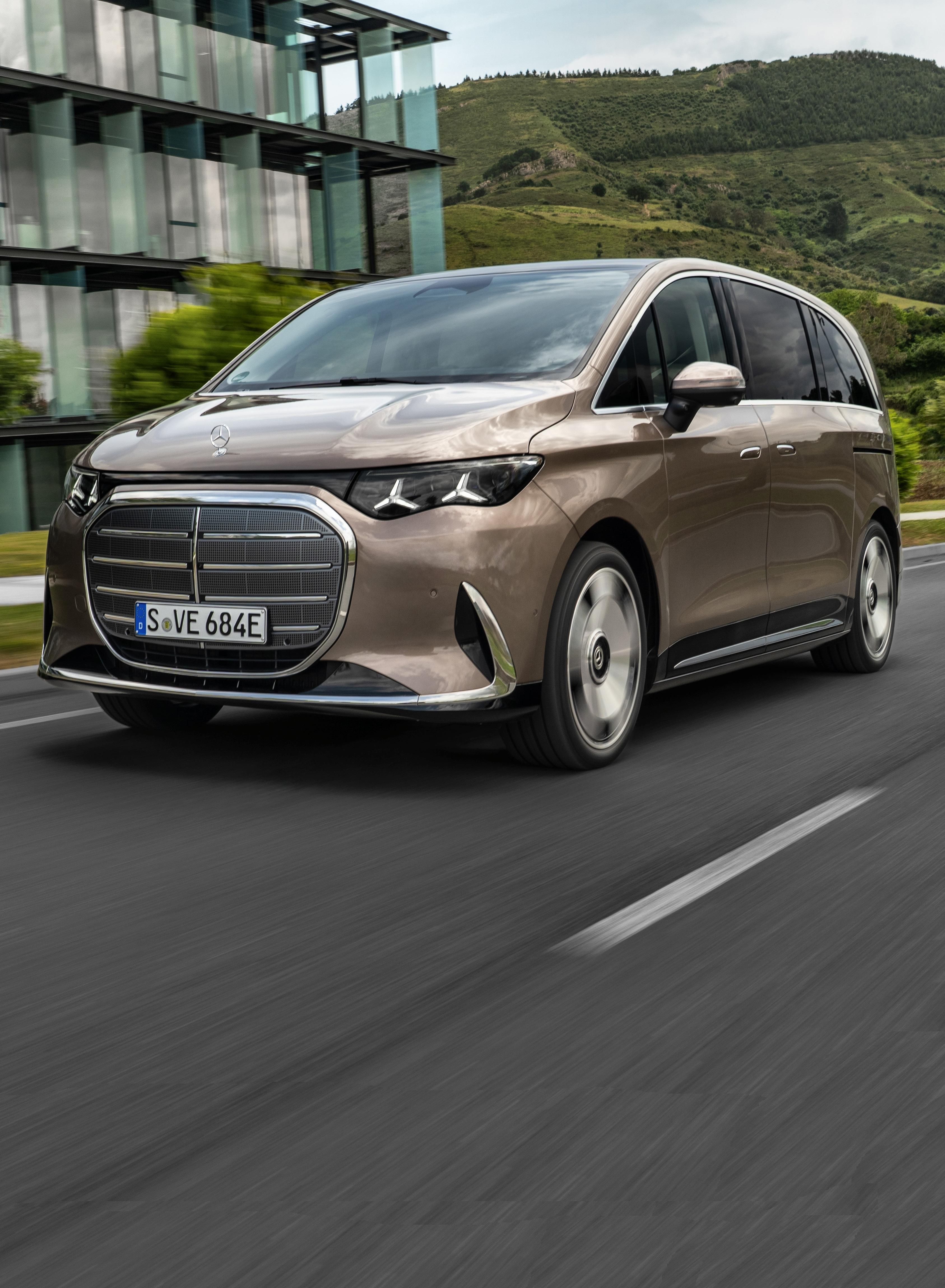
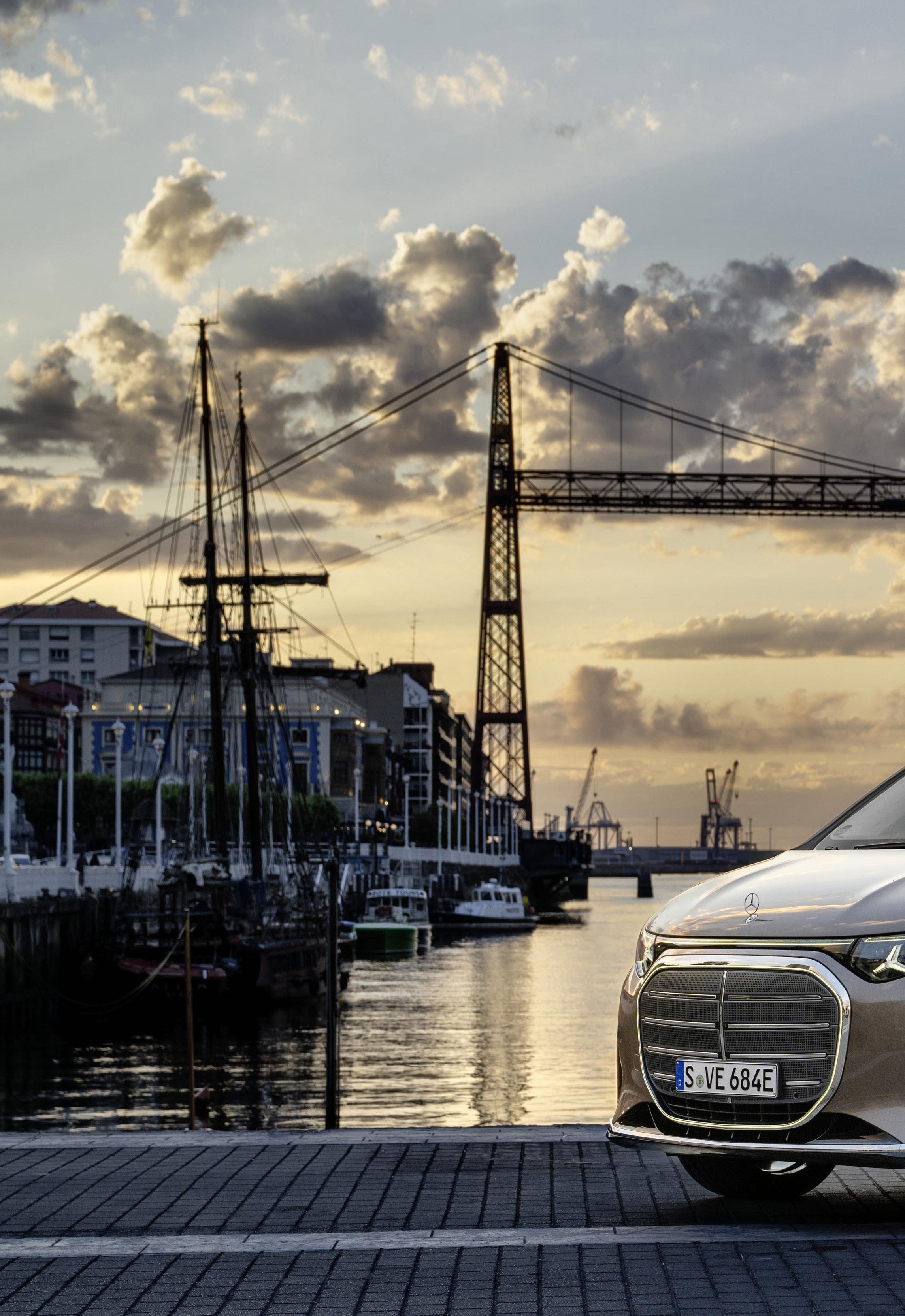
This is all about to change. Mercedes has unveiled the replacement for V-Class/EQV, and it’s a rather different beast. The VLE is a ground-up passenger MPV design, not an adapted van. Mercedes calls it a “Grand Limousine”, and it’s a more stylish and streamlined vehicle than the old V-class – a true MPV. What’s more, while it looks more compact than the outgoing EQV, it’s actually longer at just over 5.3m. And there’s a long-wheelbase version on the way too, with a 175mm stretch behind the B-pillar.
Indeed, the electric VLE we’re driving here is the launch model, the VLE 300 electric. This has an electric motor on the front axle. It will be followed by the top-of-the-range performance version, the all-wheel drive VLE 400 4Matic electric. This has more power thanks to a second electric motor on the rear, but slightly lower range. Both models feature a new NMC battery with a usable energy content of 115 kWh.
Next year, two additional models with lithium-iron-phosphate-cathode (LFP) batteries will follow, delivering a usable energy content of 80 kWh. There will also be petrol and diesel versions, as well as a more up-market VLS model, based on the LWB shell. The VLS range will be topped by a super-luxury Mercedes-Maybach version, all of which are expected in 2027.
Our first taste of European spec VLE involves driving around the Basque Country – chosen because the VLE is built at Mercedes’ Vitoria plant in the region, a facility that has been upgraded specifically to build the car. This will also build a replacement van for the Vito, but this will look significantly different to the VLE.
Mercedes has clearly been listening to customer feedback, and has addressed some of the main issues with EQV – specifically range. VLE 300 offers 435 miles on a single charge, while 800volt technology means very fast recharging is possible – Mercedes claims 220 miles (30-80%) can be added in 15 minutes.
CONTINUED ON PAGE 20
THE FUTURE THE FUTURE

Bursa Mark Bursa
first drive: Mercedes-Benz VLE 300
CONTINUED FROM PAGE 19
The VLE has been designed to feel car-like, including Airmatic air suspension with automatic ride-height control, and four-wheel steering to improve urban agility. The turning circle is just 10.9m. The Airmatic suspension allows the VLE to be raised or lowered by 40mm when stopped, giving increased ground clearance or easy entry. At speeds above 68mph, the system automatically lowers the vehicle by 15mm, reducing aerodynamic drag, increasing range and improving stability. The technology is loaded too. Level 2 autonomy is fitted, allowing hands-off autonomous driving, even in dense traffic jams.
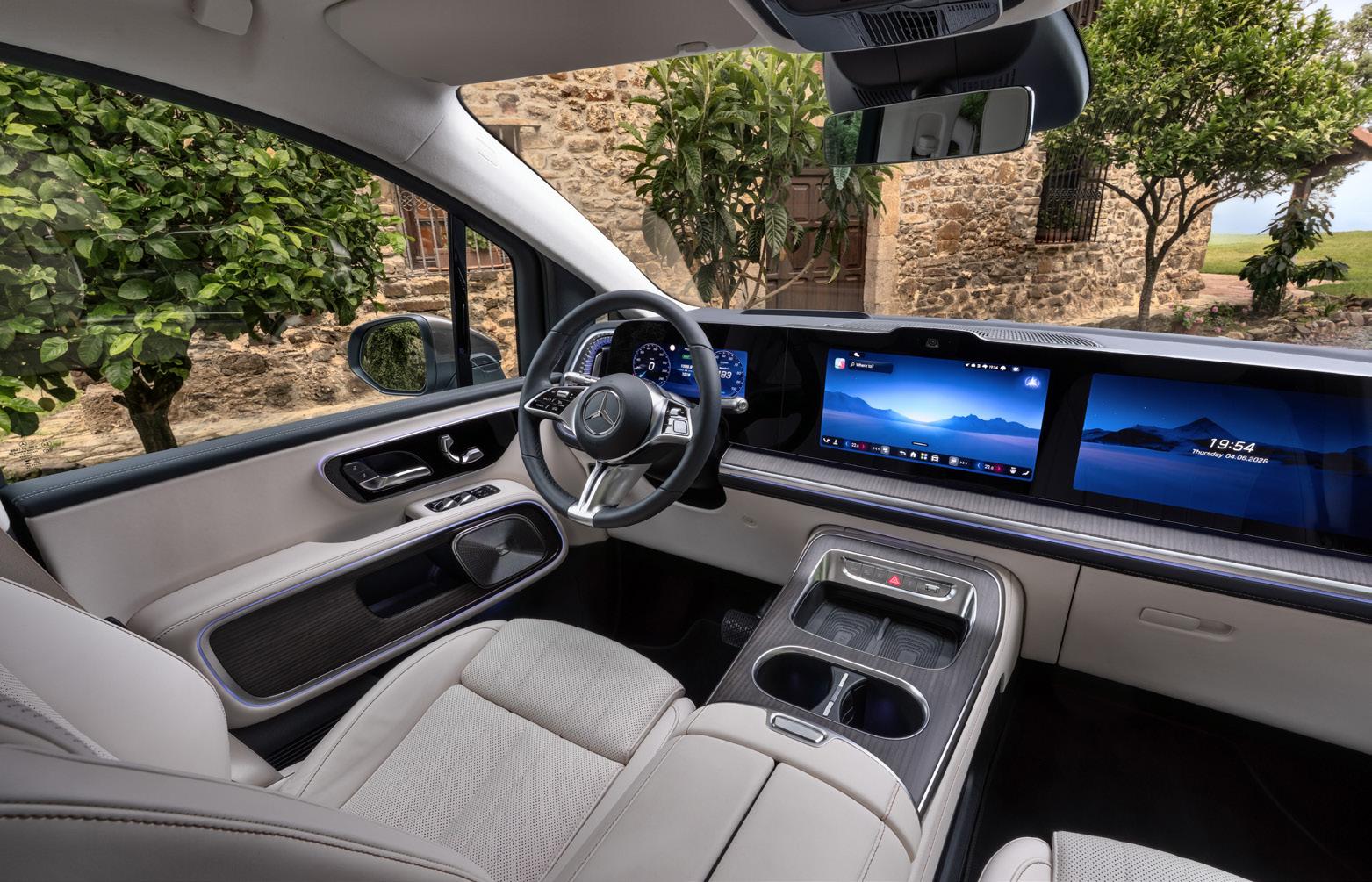
A lot of thought has also gone into the interior. The dashboard is a full-width digital panel, called the “MBUX Superscreen”. This is made of three screens behind a large glass surface: a 10.25in driver display, a 14in central display, and a 14in screen for the front passenger, which can show separate information such as video streaming, gaming or apps.
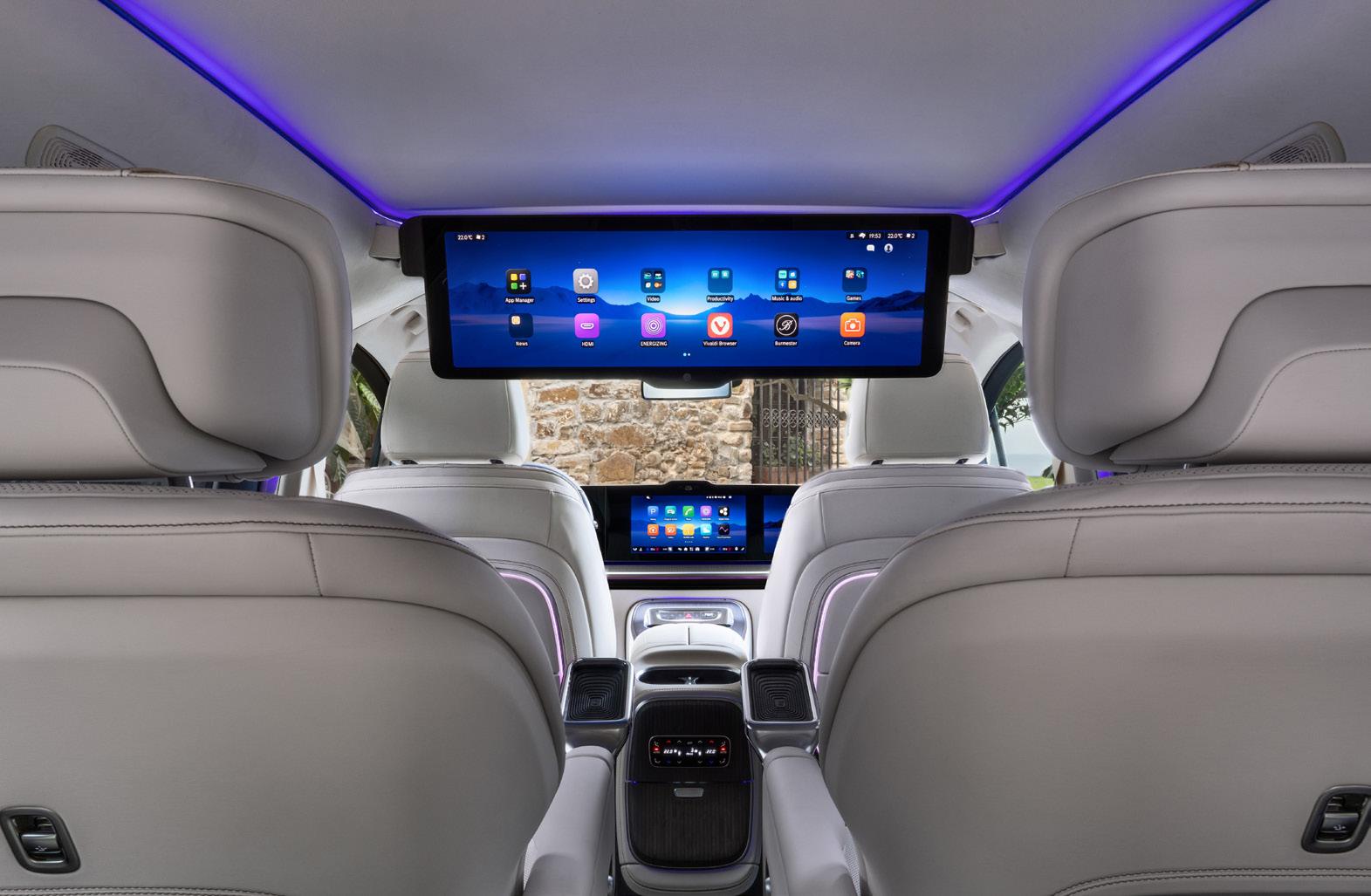
Behind the front seats, the headliner conceals a large 31.3in drop-down panoramic screen with 8K resolution, split-screen function and an eight-megapixel camera. This allows rear passengers to watch films, play video games or join video conferences.
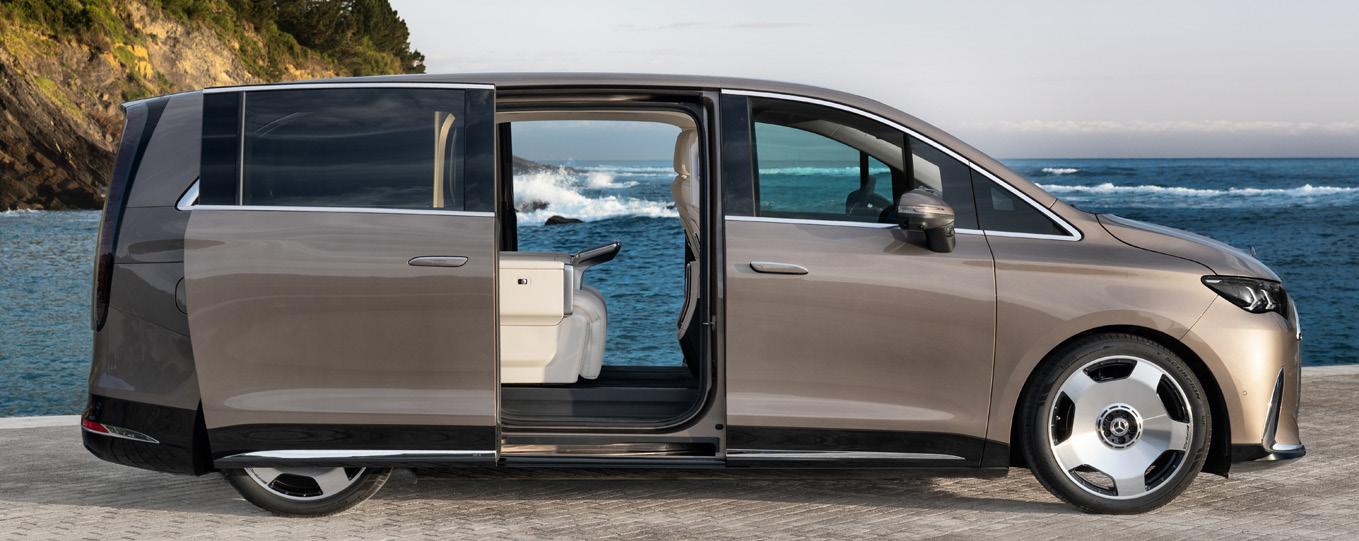
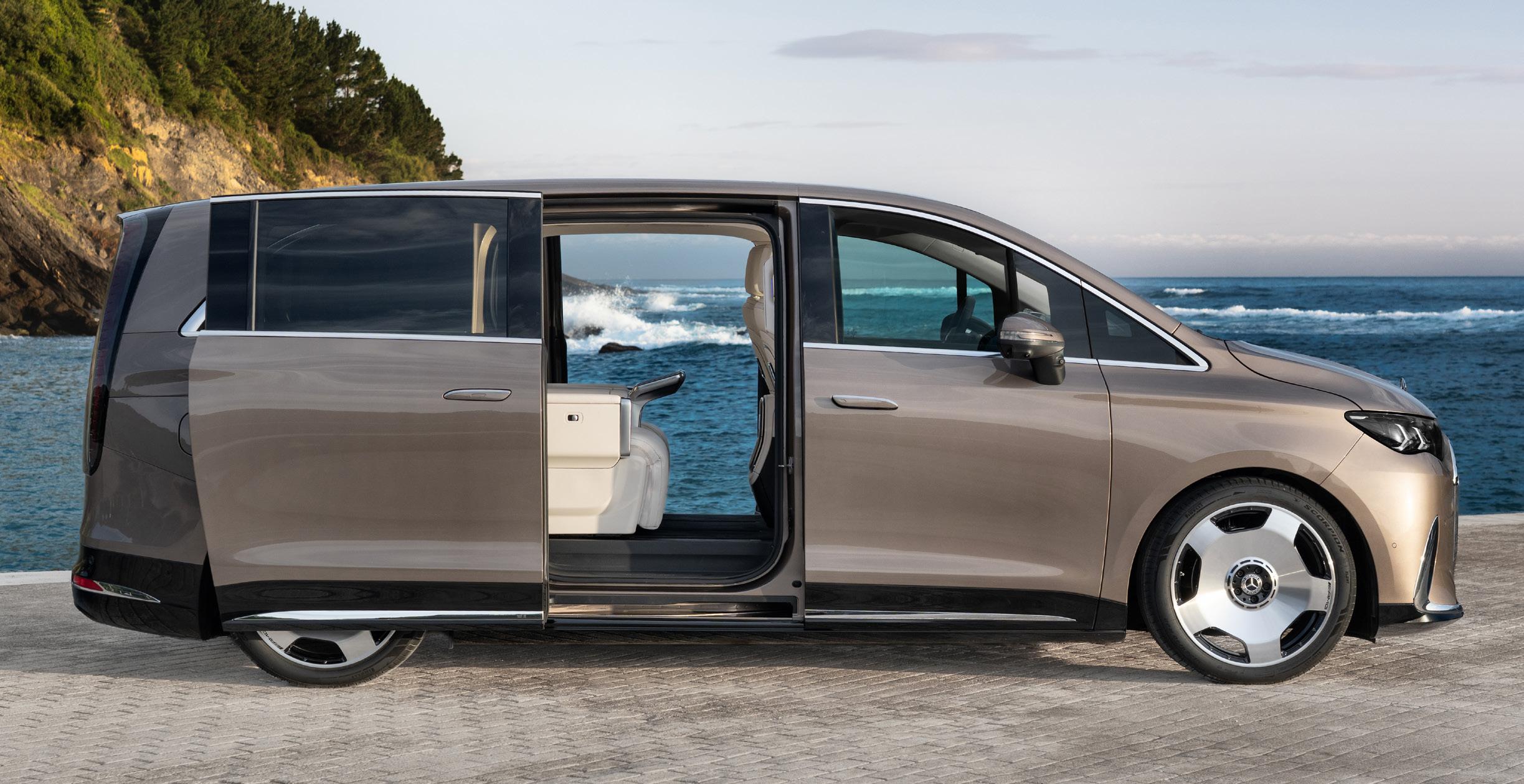
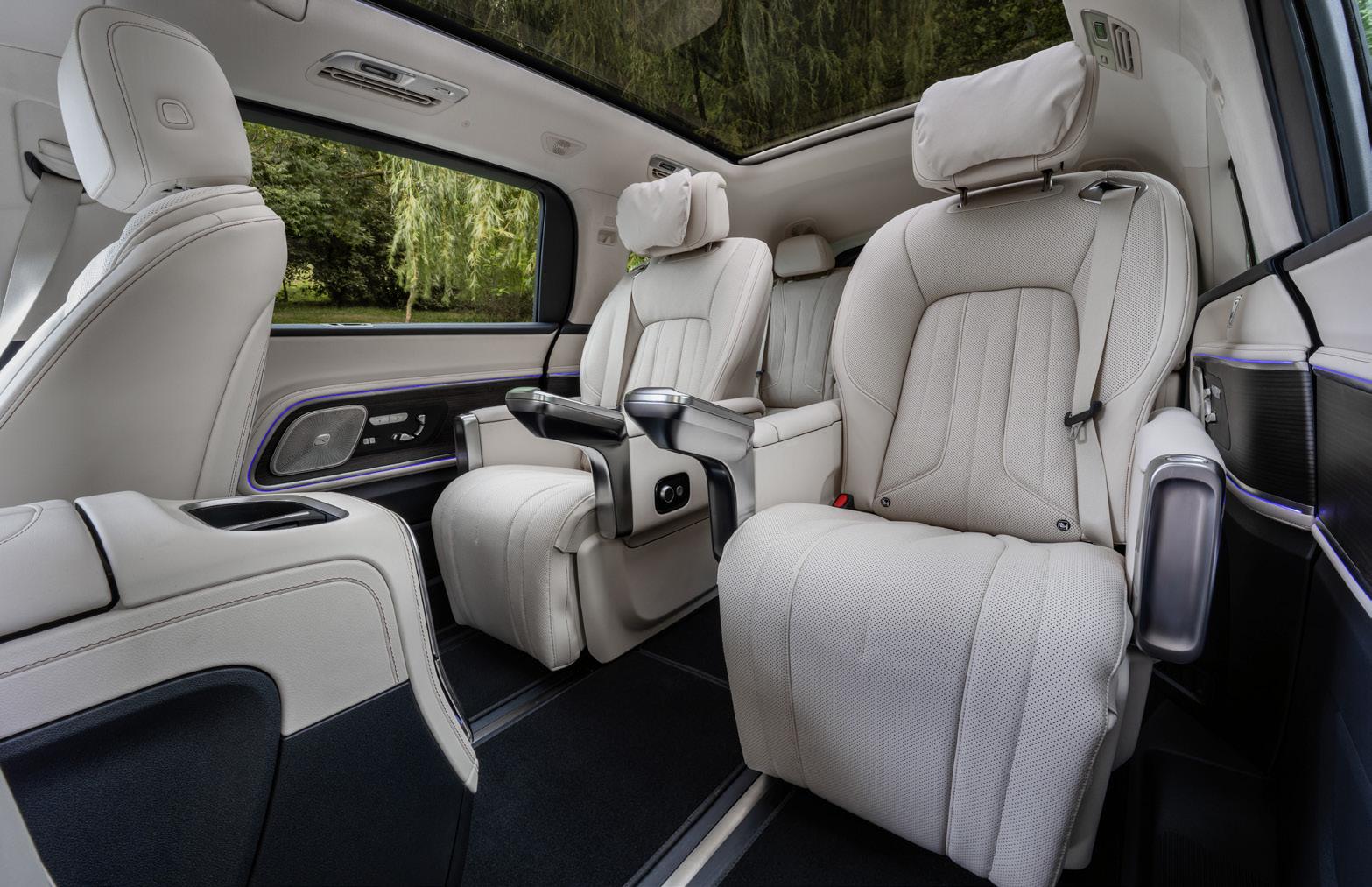
We drive two versions – the car you see in the photographs, with two large second row captain’s chairs and a three-seater bench, and a more basic version which uses Mercedes’ latest “rail and go” flexible seating system,
which allows rail-mounted seats to be easily unclipped and either removed, or positioned rearward-facing. The seats are light enough to pick up, and even have small wheels allowing easy movement if they have to be stored. When installed, the seat locks in place and a small LED green light at the bottom of the seat confirms they are firmly in place.
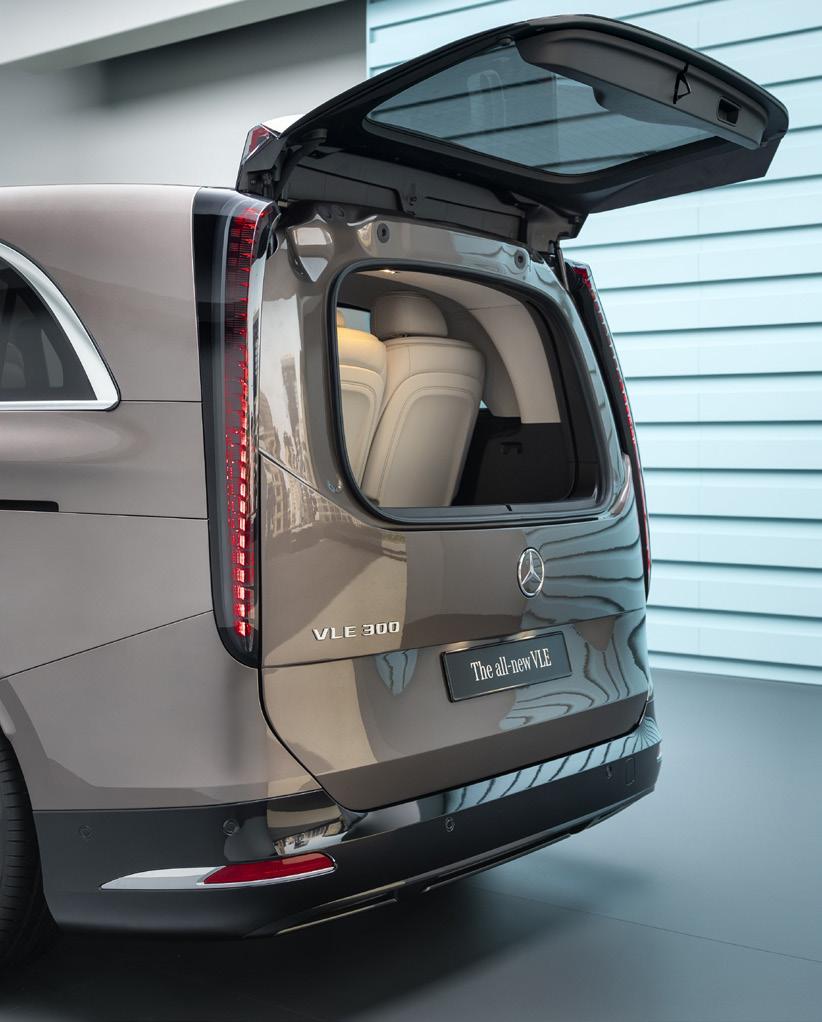
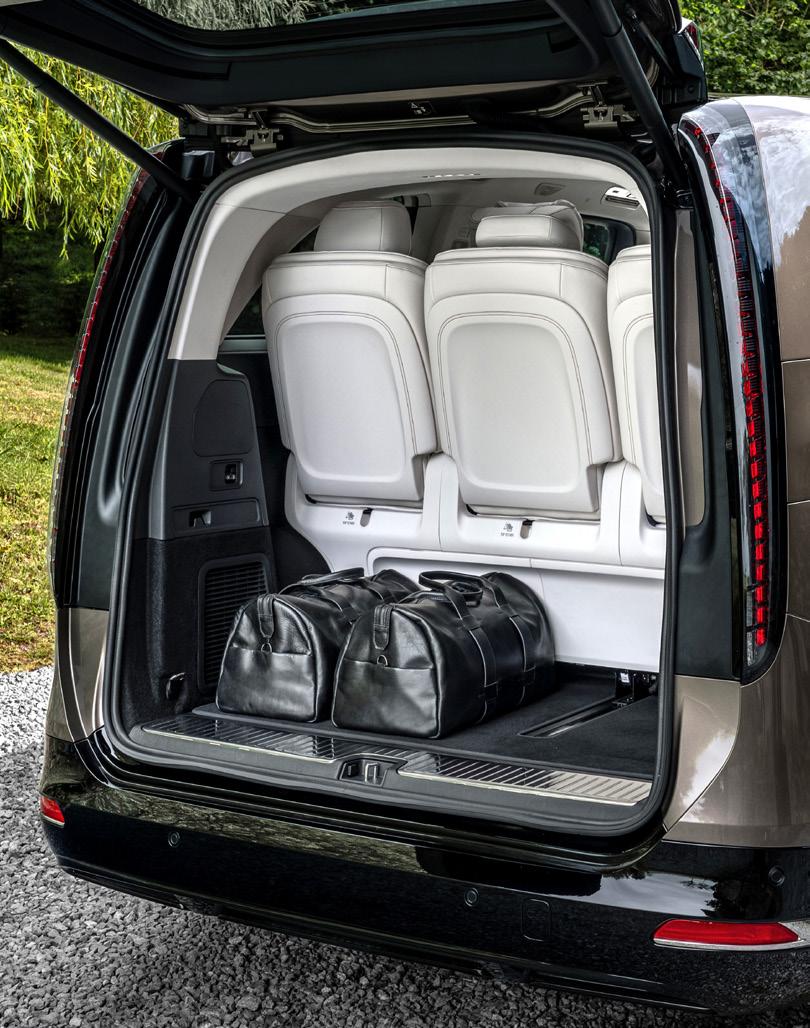
The third row can be moved forward to give more luggage space. Even with all three rows of seats in place, the VLE offers a load volume of almost 800 litres, enough space to accommodate up to six suitcases. The tailgate incorporates an opening window, so you can load smaller items without having to open the full tailgate.
A panoramic one-piece glass roof extends from the B-pillar to the rear, with ambient lighting in the surrounds and an electric sunblind.
On the road the VLE feels very stable. The four-wheel steering makes for smooth cornering on twisty mountain roads, while making the car surprisingly agile around town. There are three driving modes – the most comfortable being standard mode with regeneration turned down. It’s noticeably smoother, quieter and more refined than the EQV, especially with the smaller 19in wheels rather than the attractive 22in alloys on the more up-market version.
The Mercedes-Benz VLE is expected to go on sale in the UK in late 2026, with customer deliveries in early 2027. UK pricing is to be confirmed, but German pricing suggests the range will start at around £75,000.
VERDICT
The new VLE is a serious, and timely, raising of the game by Mercedes-Benz in the MPV sector. Breaking the link between the panel van bodyshell and the luxury passenger version is a significant upgrade for chauffeurs.
Perhaps the imminent arrival of several Chinese-made 7-seaters into Europe has spurred Mercedes to stay ahead of the game – and the VLE is certainly a lot more attuned to European tastes than the big MPVs on the way from Denza and XPeng, which look more like Asian people-movers from the likes of Toyota and Nissan.
Additionally, the VLE offers a very good improvement in performance, especially in terms of range and charging speed. A 435-mile range is in the very top bracket, and the VLE can charge at up to 300kW, minimising downtime at the charge point.
Mercedes calls it a Grand Limousine, and the build quality and driveability are certainly up to the customary standard. It seems you’ll be able to specify a gunsight grille too, which always plays well in the chauffeur market. It’ll be here early next year, but demand is likely to be strong – so get your orders in as soon as the books open.
DATA
Price (VLE 300) £75,000 (estimated)
SPECIFICATION
Powertrain Single electric motor
Transmission Single-speed, front drive
Battery 115kWh NMC Li-ion
Power 272bhp
Top speed 112mph
0-62mph 8.9sec
EV range 435 miles (WLTP)
DC Charging time 15min (300kW, 30-80%)
AC Charging time 12hr 30min (11kW, 0-100%)
CO2 emissions 0g/km
Length 5,309mm
Width 1,999mm
Height 1,943mm
Wheelbase 3,342mm
Loadspace 795 litres
Turning circle 10.9m
Warranty 8 years
Insurance Group TBC
VED Band A
THE CHAMPION THE CHAMPION
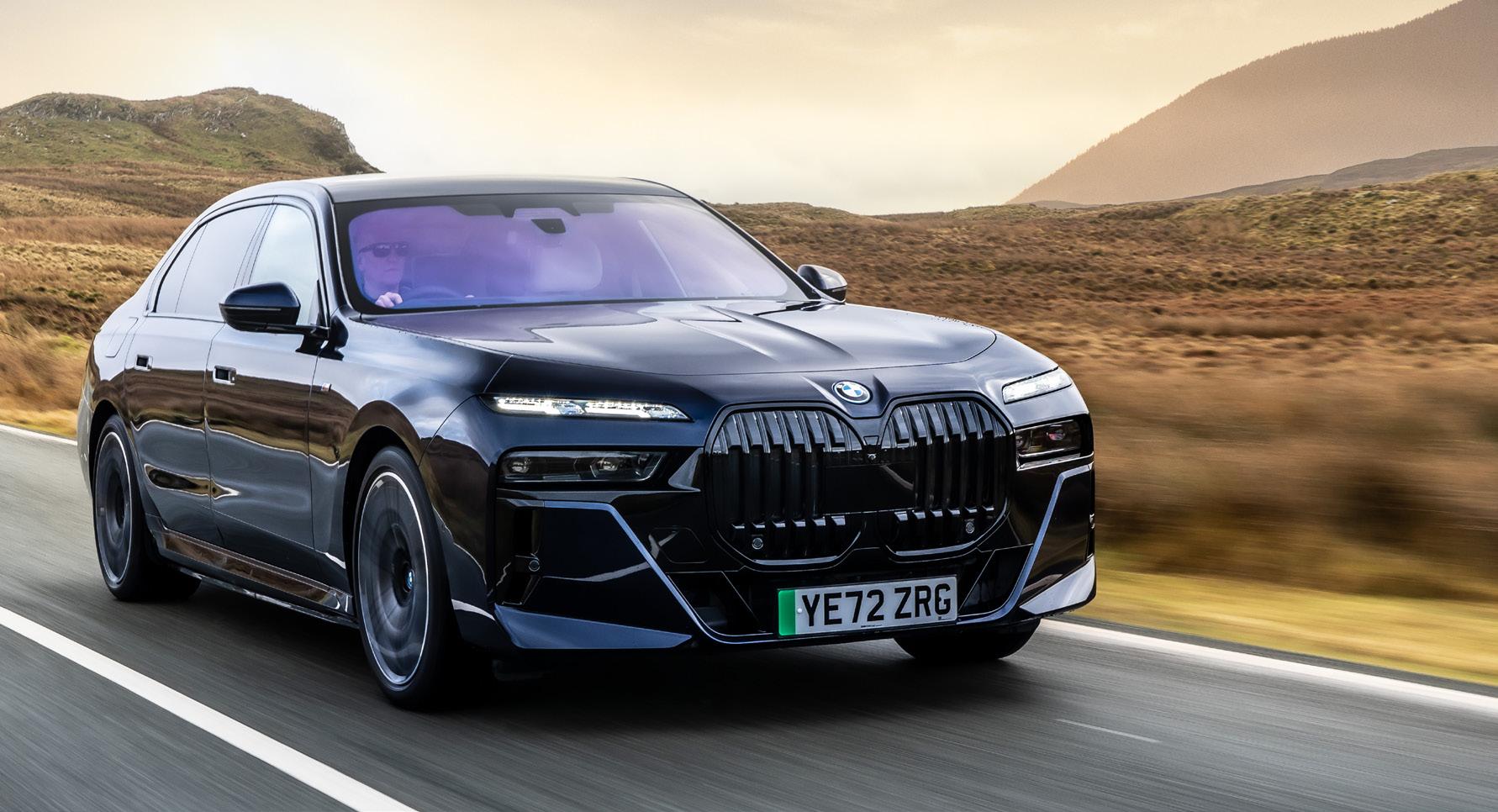
The BMW i7 has been on the market for more than three years, and it’s quickly established itself as the go-to chauffeur car, especially in London, where TfL's insistence on electric licensed cars has helped BMW build sales.
In a shrinking market where Audi and Jaguar have packed their bags and left, BMW has become the dominant player, exploiting Mercedes-Benz’s lack of an electric S-Class. The EQS is a lovely
car to drive, but doesn’t match the i7 for comfort and space.
Now BMW has revealed a mid-life facelift of the 7-series range, adding new features and functions to the i7.
Production of the three i7 variants begins in July, with UK market launch following in September. Two plug-in hybrid variants begin production in November, and will go on sale early in the new year.
BMW claims it is the most extensive model update the company has ever
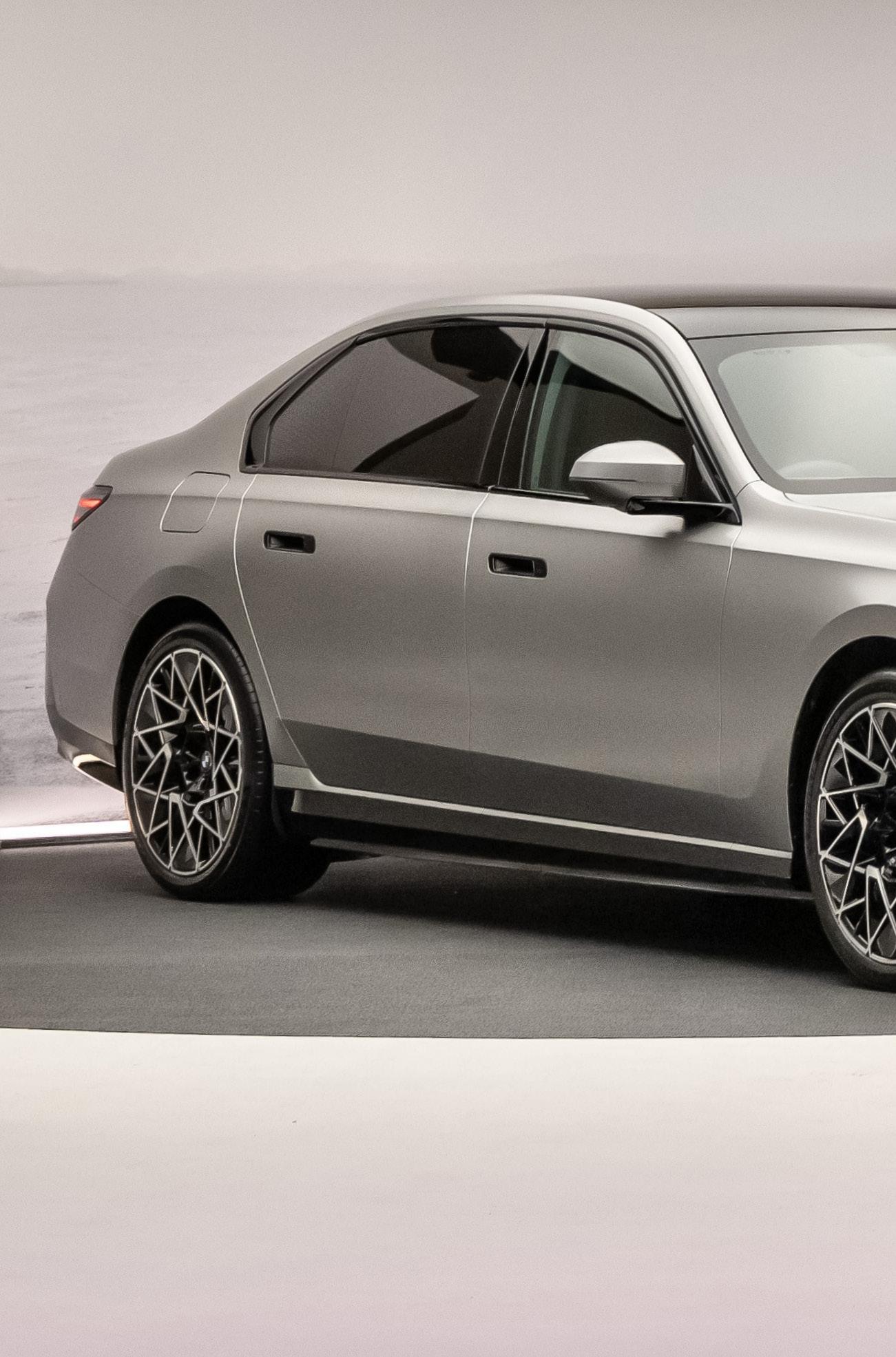
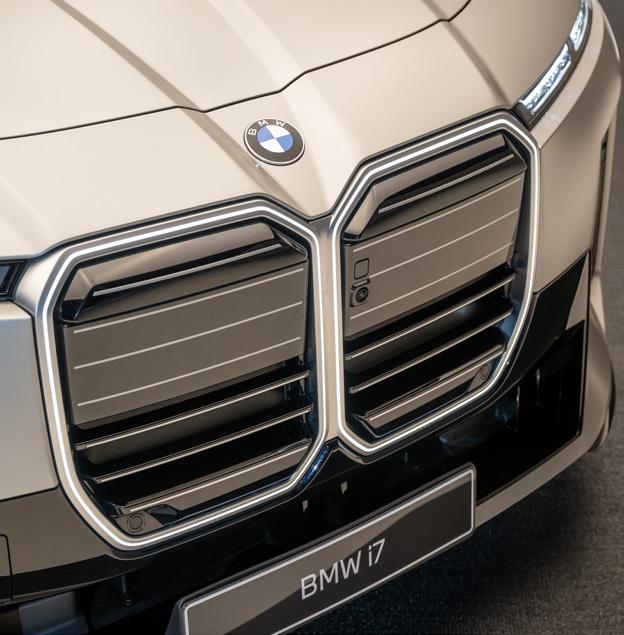
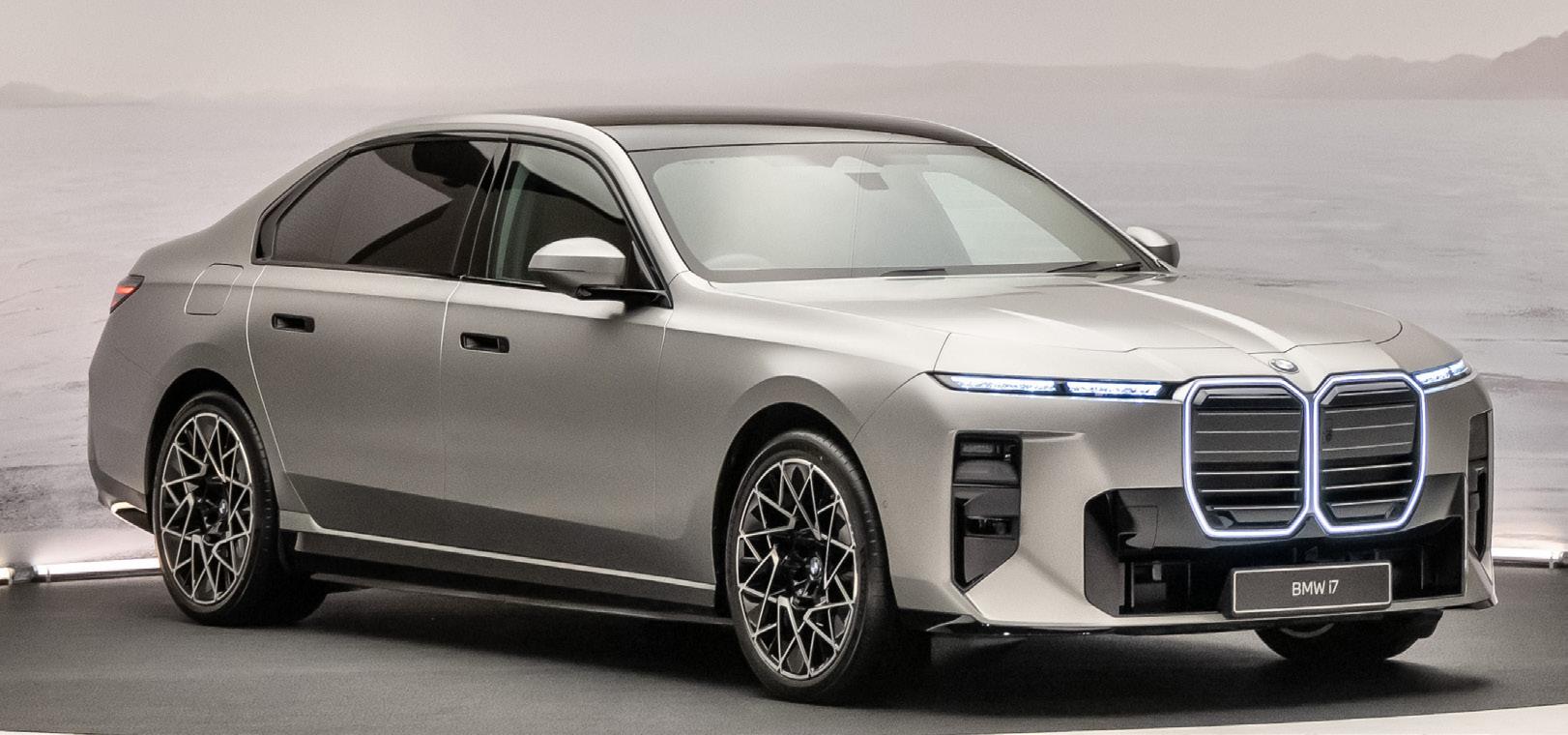
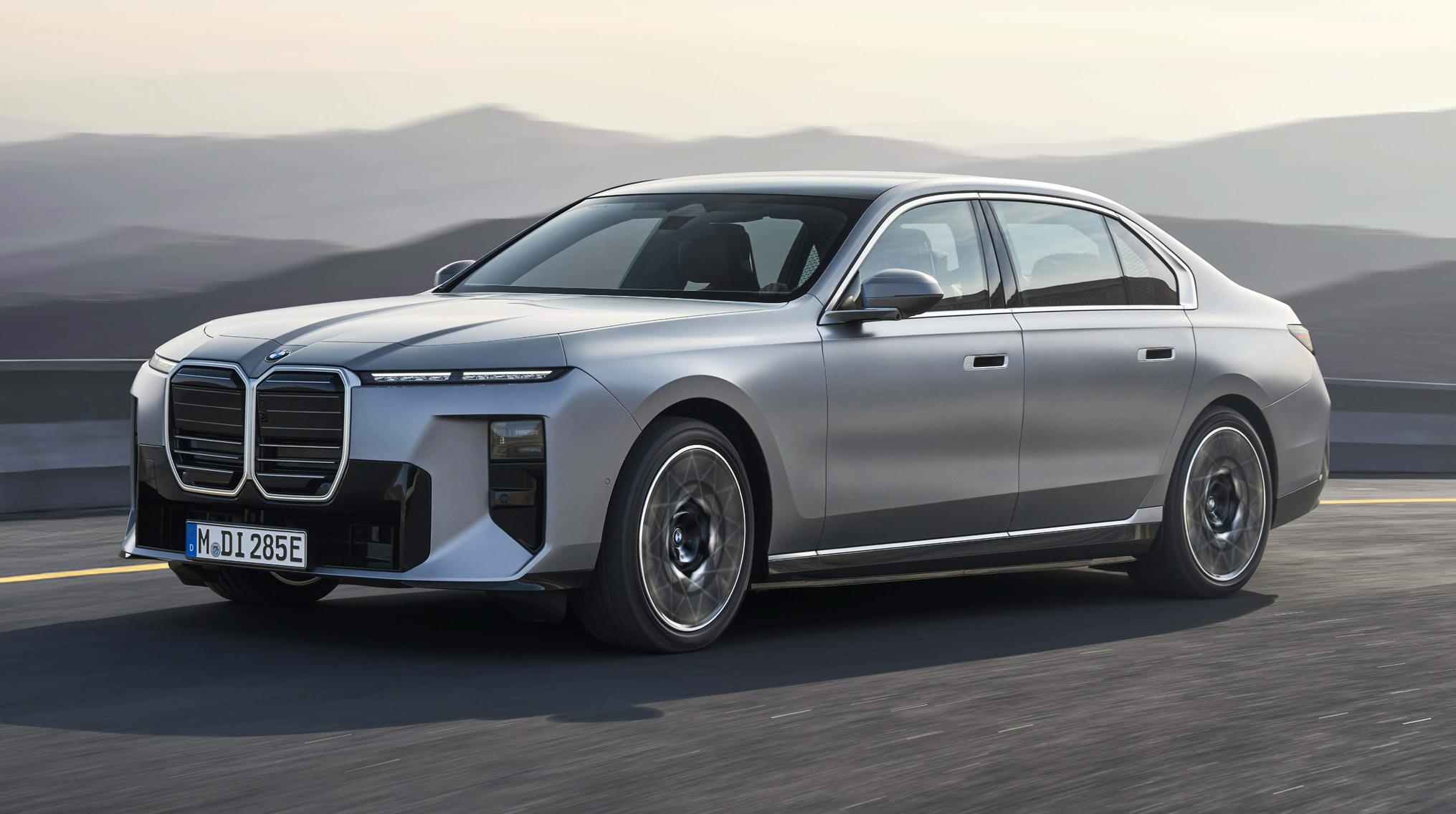
done, adding a host of ‘Neue Klasse’ technologies that have already been seen on the new iX3 and i3 models. The most noticeable external change is at the front of the car, where a new “face” includes a revised headlight design, with the main headlights now integrated into the bumper. There’s a reprofiled kidney grille, with the outline illuminated by LEDs on all models. At the rear, slim rear lights now meet closer in the middle, under the BMW roundel.
CHAMPION REBORN CHAMPION REBORN
BMW i7 facelift BMW i7 facelift
Mark Bursa Mark Bursa
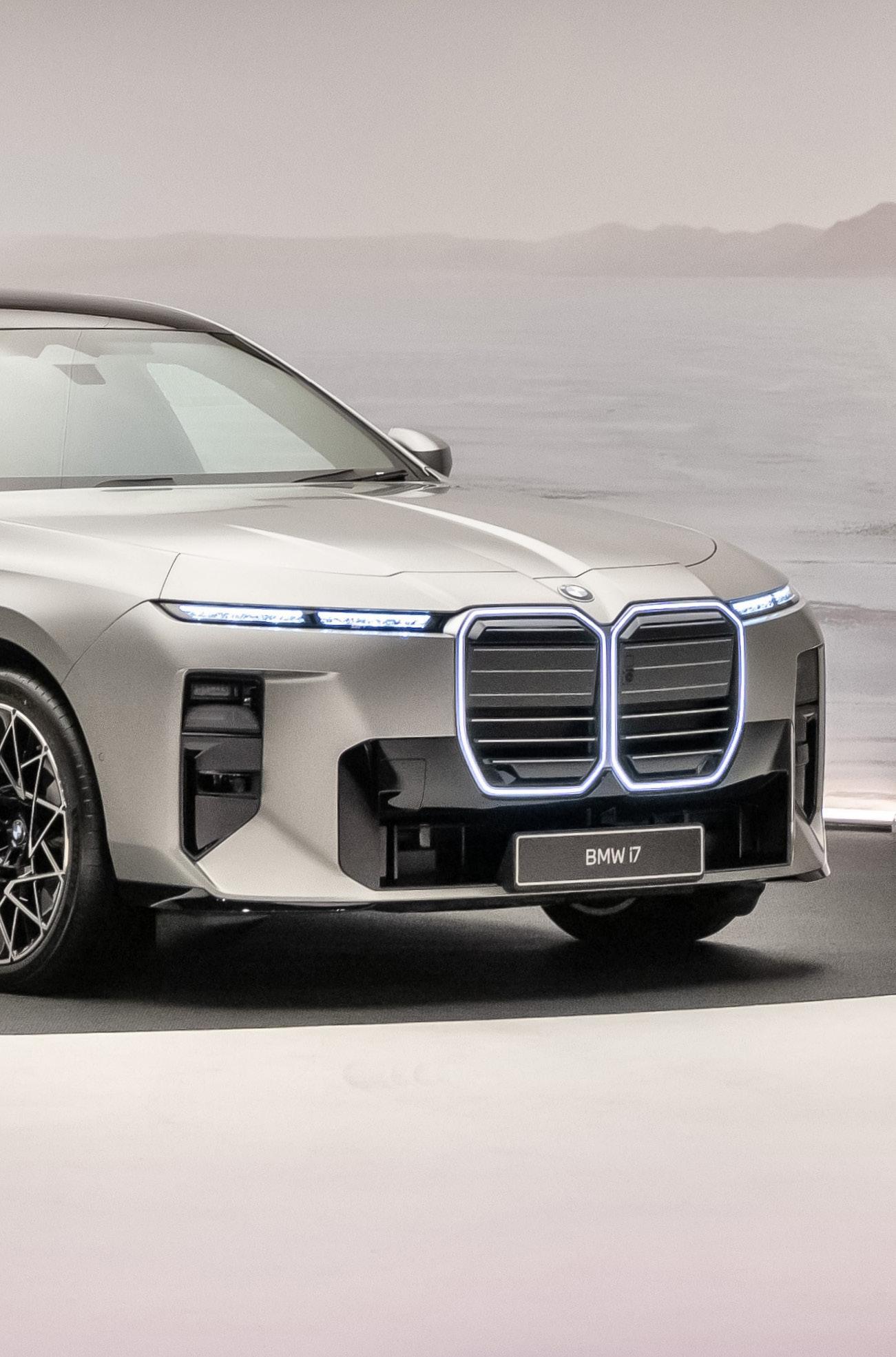
There is also a big transformation in the front cockpit. A new Panoramic iDrive screen, a central display that runs across the whole dashboard, has been carried over from the Neue Klasse i3 and iX3, including a separate screen for the front passenger. It is fully customisable, so you can determine what information it shows.
In-car cameras detect if the driver is getting distracted by the front passenger screen, and if so, it will start to dim. In the rear, there are significant
upgrades: new materials, new lighting, and the halo lights in the back of the headrests are a really nice touch. Sky Lounge is an option, adding 40 LEDs to the glass roof, creating a star effect at night.
The drop-down theatre screen has been enhhanced. It is now 8K and much more intuitive to use. The car comes complete with four years of digital premium subscription, which means all the data you need to power the theatre screen and the passenger screen comes
with the car. You do not need to worry about separate data connections, as was previously the case.
When you have the theatre screen down, rear vision out of the normal mirror is restricted. So a digital mirror will be available later in production.
There is a big leap in range and performance, for both the i7 and the 7-series PHEV plug-in hybrids. Two-axle air suspension is still standard on the car. Motorway Assistant is included, CONTINUED ON PAGE 24

ASSET FINANCE SOLUTIONS FOR BUSINESS

We provide bespoke packages funding and sourcing of vehicles for the chauffeur network.
We have access to multiple funder options for vehicles finance.
We provide support and guidance throughout the entire process
We have access to competitive interest rates.
Efficient payouts to support delivery and target needs.
WHY CHOOSE ETHOS?
Here at Ethos Asset Finance, we understand the demands of the professional chauffeur services industry inside and out. We can provide you with specialised chauffeur finance solutions to support you with securing the vehicles you need.
With an extensive understanding of chauffeur specs and industry standards, we are more than equipped to finance vehicles that will help you make a lasting impression.
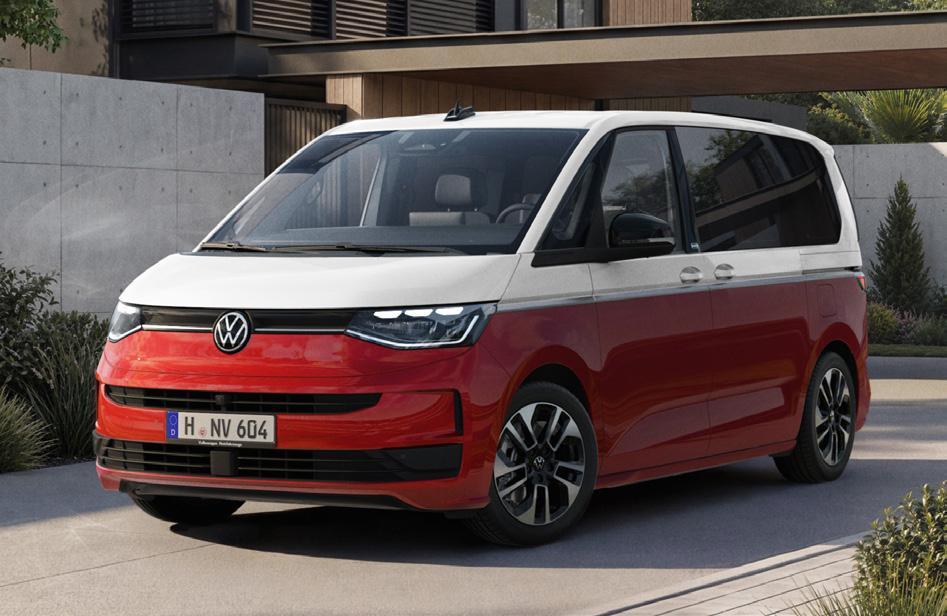
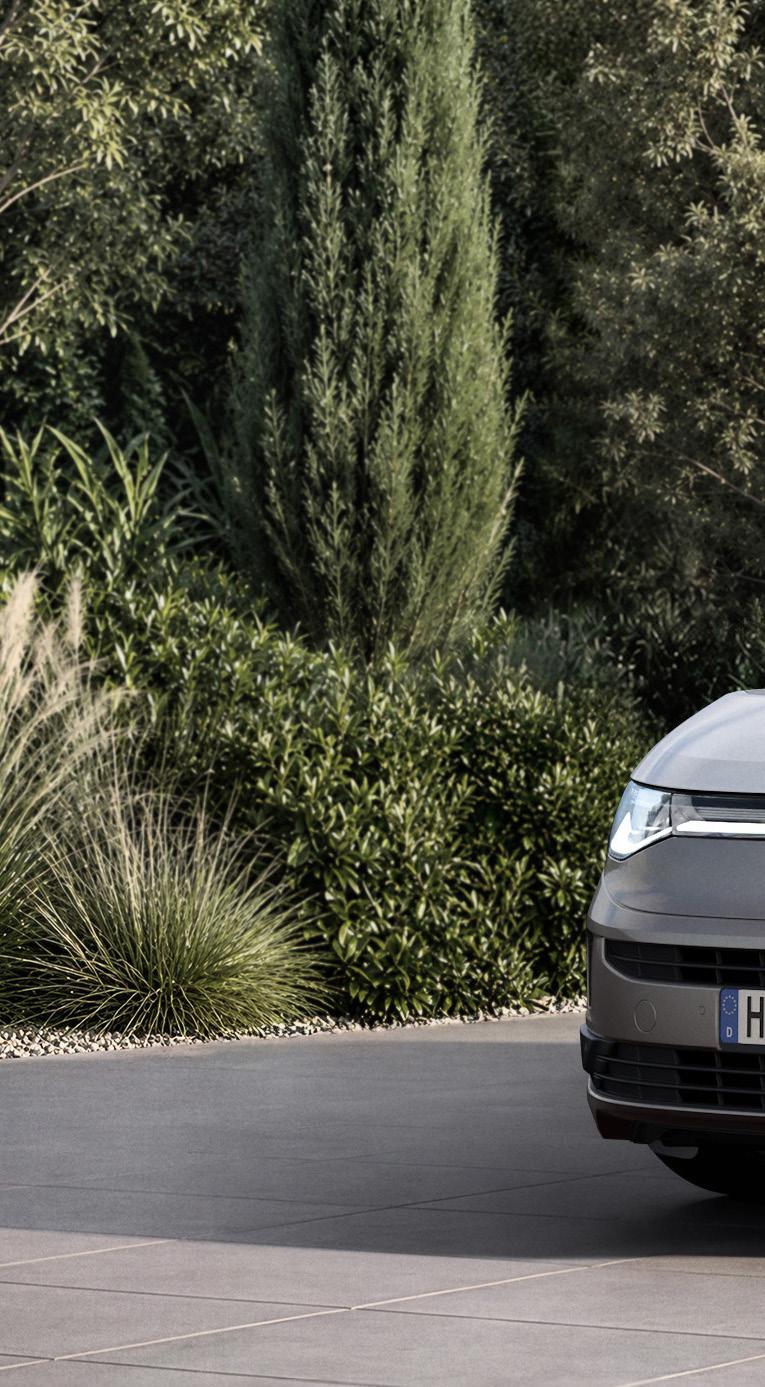
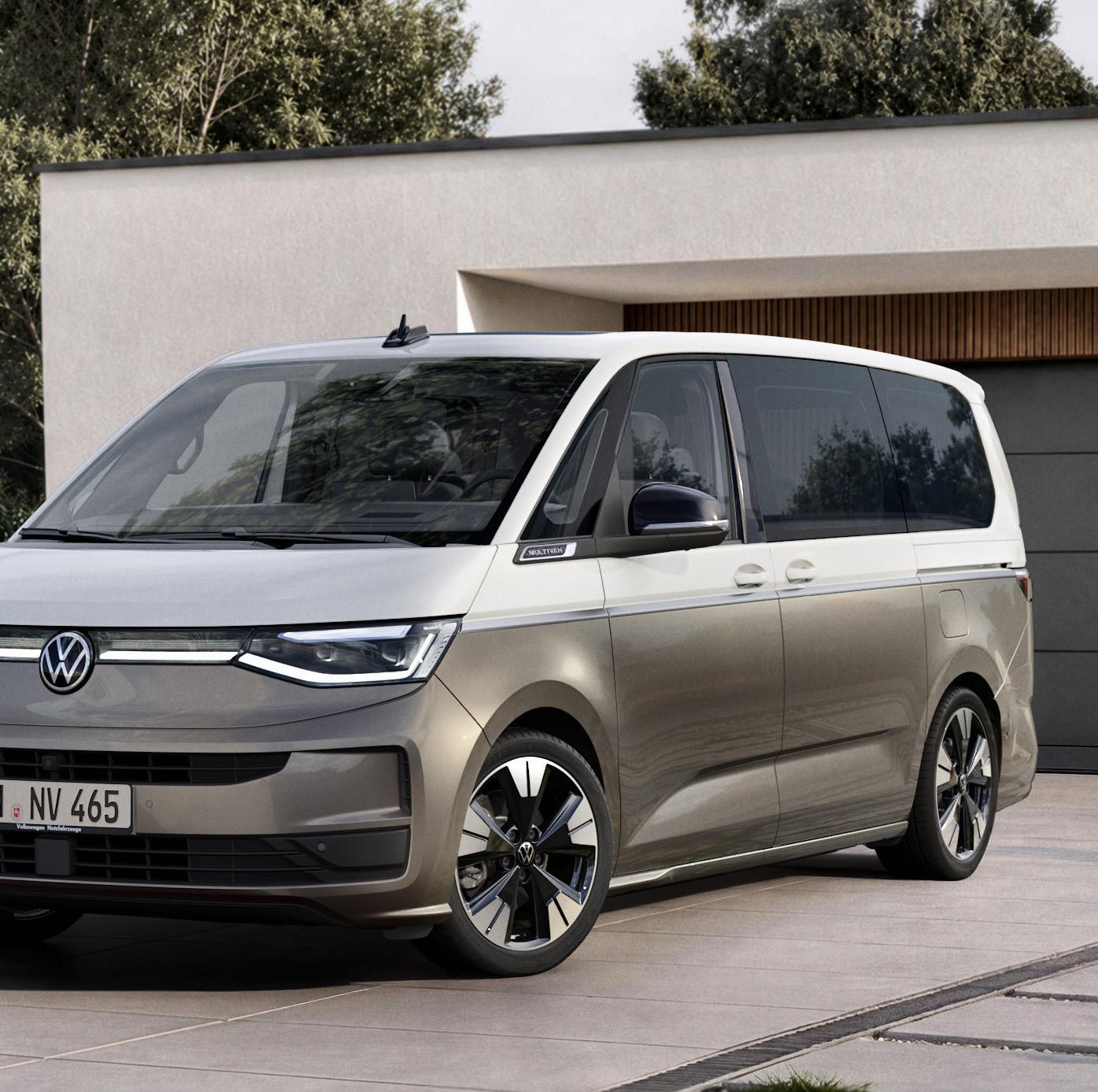
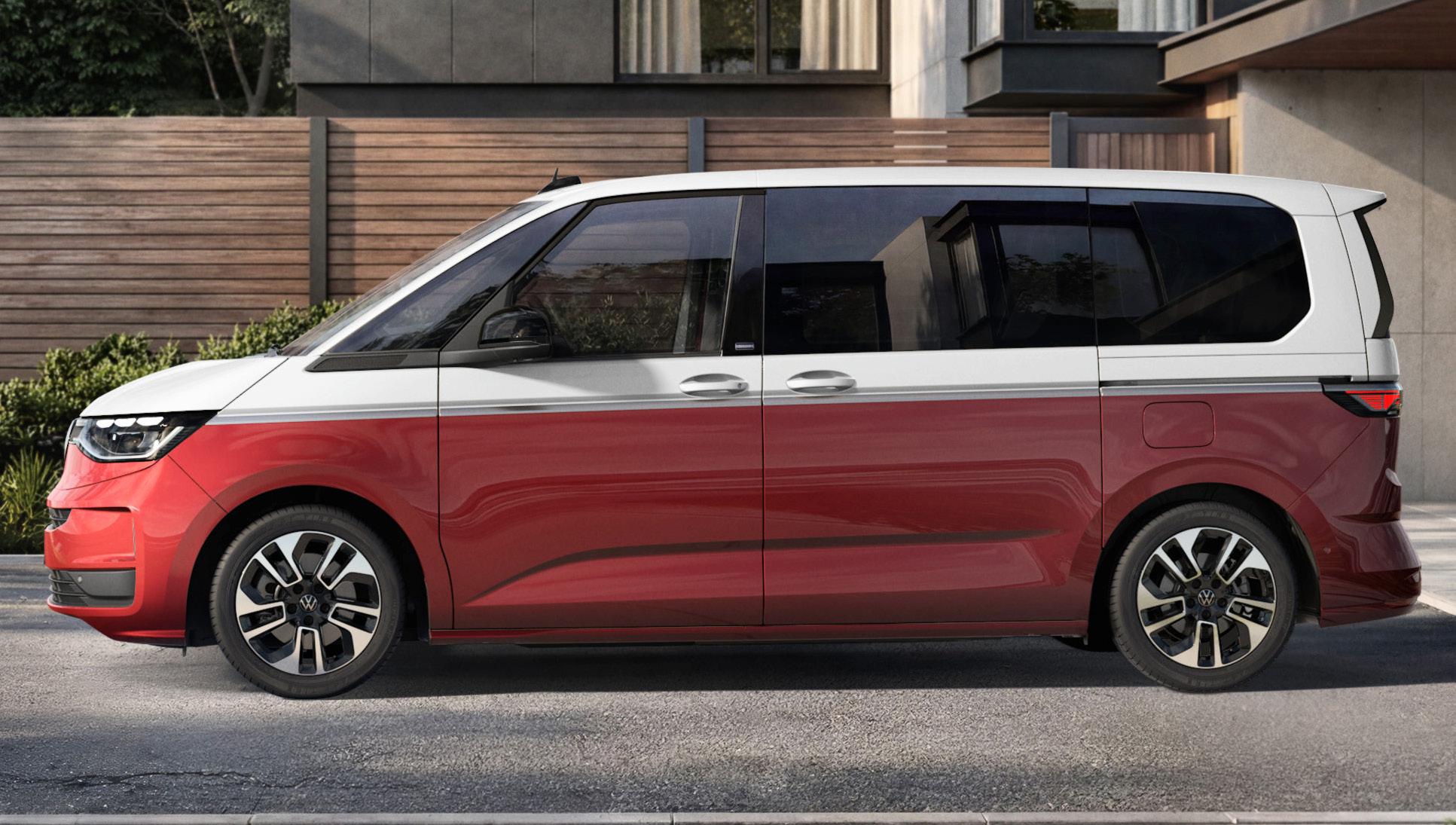
Volkswagen has revived the Caravelle nameplate for its seven-seater people mover, dropping the Multivan name after five years. A facelifted Multivan will carry the Caravelle name from later in the year, when it goes on sale.
The Caravelle badge adorned passenger versions of the Transporter van from 1979 to 2021, and its return is in line with VW's global branding policies.
The Caravelle was one of the first multi-purpose 7-seat vehicles available in Europe, and reintroducing the name is designed to ensures that customers see familiar names wherever they are in the world.
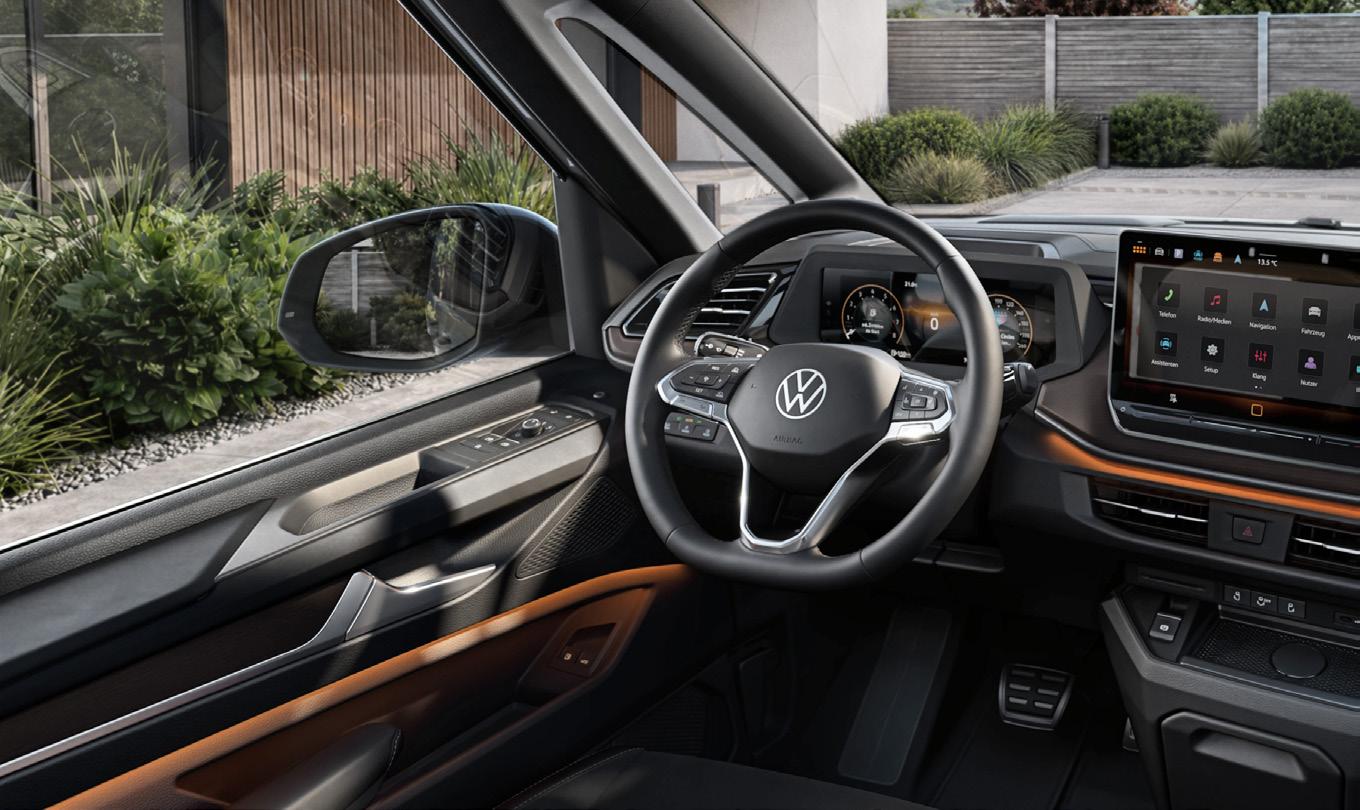
David Hanna, Volkswagen Commercial Vehicles managing director, said: “Bringing the Caravelle name back to the UK was essential, it is firmly anchored in people’s minds as to what it offers, a premium multi-seat vehicle, with the unmistakable Volkswagen logo at the front.” Distinguishing features of the new Caravelle include an enhanced front end, new colours and wheel rims and a completely new cockpit.
Multivan received a mechanical facelift in 2025, and this carries over. The eHybrid 4Motion plugin hybrid model was part of this revision. This has an all-wheel drive system with a power output of 245PS, and a 19.7kWh lithium-ion battery. In addition, front-wheel drive vehicles with a 150 PS turbodiesel engine and a turbocharged TSI petrol engine with an output of 204 PS will remain in the range. Volkswagen Commercial Vehicles will also offer the new Caravelle in two body lengths.
Several trim options will be offered. Caravelle Trend is the entry-level model, alongside Caravelle Life and the flagship Caravelle Style. A new Caravelle Generation special-edition model has higher specification and an exclusive optional Candy White/Sunset Red Metallic two-tone paint finish.
VW designers have revamped the front end of the Caravelle below the bonnet. The LED headlights are visually distinctive and are now larger, sharpening the typical VW Bus face. The upper daytime headlight is now more pronounced.
Two-tone paint finishes remain a major feature, including a new Candy White solid/Grey Brown metallic, one of three new two-tone colour variants. In addition, matt paintwork (Indium Grey matt) will be available for the Caravelle for the first time.
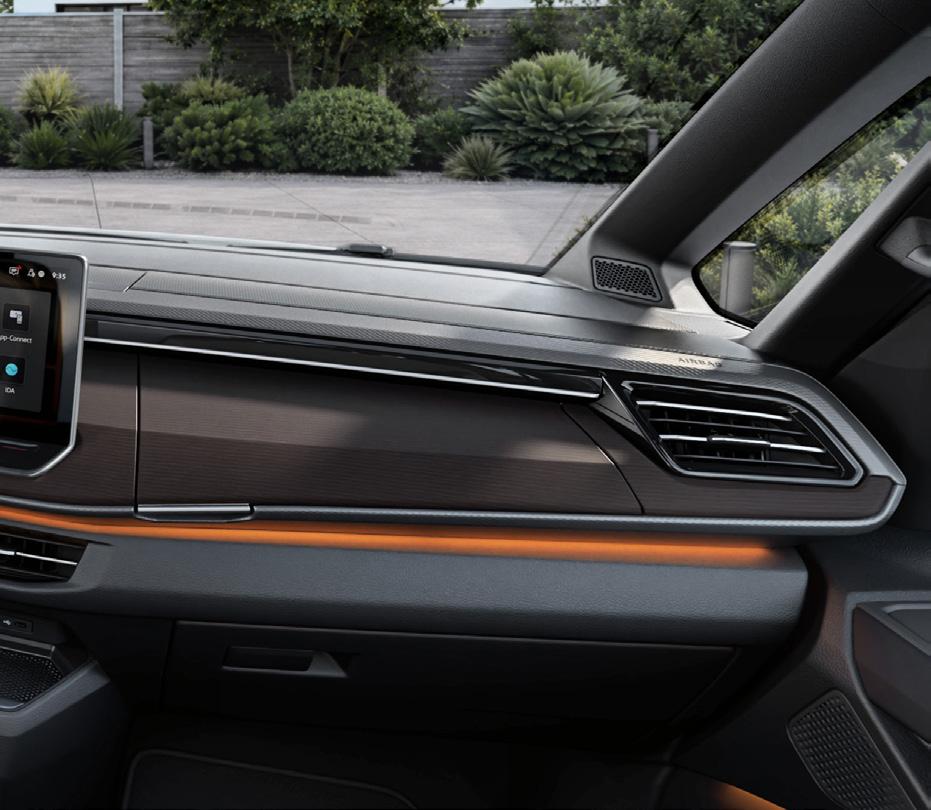
Inside, major changes have been made to the interior. These include a newly developed dash panel with even higher-quality surfaces and integrated topstitching.
The Digital Cockpit offers three different views, which can be changed in seconds using a ‘view’ button on the steering wheel. The 12.9in display itself is significantly larger than before. Illuminated touch sliders for the audio and air conditioning functions are integrated below the infotainment system.
The range of seat configurations for the Caravelle has been reorganised. For the first time in the eight-seater variant, two groups of three people can sit facing each other in the rear.
THE ICON IS BACK THE ICON IS BACK
Mark Bursa
Volkswagen Caravelle
VAT on fares in London: why we have to keep on fighting
The debate over VAT on private hire fares in London is far from finished.
Despite the various court cases and differing interpretations, many operators still feel they are standing on shifting sands. The key unresolved question remains: should VAT be added to fares – especially cash fares – and, if so, by whom and on what basis?
The Licensed Private Hire Car Association (LPHCA) is clear that this issue is not settled. The Association does not believe that the question of VAT on cash fares, both in London and nationally, has been resolved in a way that is fair, clear or sustainable for operators and drivers.
To move the debate forward, the LPHCA is:
z Hosting an open Zoom webinar for licensed operators, and
z Conducting a survey of the trade, with the results to be used to lobby government to re think the possibility of self employed drivers having to collect and charge VAT on fares UK wide on behalf of operators.
In other words, they want hard data

Gary Jacobs Gigzzee gigzzee.com
from the front line: how would this work in practice, what would it do to margins, pricing, competitiveness and driver income, and how realistic is it to push VAT accounting on to thousands of individual drivers in the name of tidying up a legal interpretation?
Operators who want to have their say – and who may later be affected by whatever “solution” emerges – are strongly encouraged to take part in the LPHCA’s exercise. The more structured feedback the trade can present, the harder it will be for policymakers to dismiss concerns as isolated grumbles.
Behind the scenes, an insider view is that HMRC is beginning to look at related VAT cases as a single policy issue, with a focus on parity of outcome. That means they are less interested in who has the cleverest legal argument on any one case, and more interested in ensuring that similar business models end up with broadly similar VAT results.
For London operators, that has two implications:
Inconsistency is unlikely to last forever. If one type of operator structure carries a clear VAT cost while another, economically similar model appears to avoid it, expect HMRC to keep probing until the gap narrows.
How you structure your business will come under greater scrutiny. Dispatch models, contractual chains, app terms and payment flows are all likely to be tested against the core question: who is really supplying the transport service to the passenger, and where should VAT bite?
In this climate, it is essential for operators to:
z Stay alert to LPHCA updates and industry briefings,
z Take proper advice on their contractual and VAT position, and
z Engage with consultations and surveys rather than waiting to see what is decided for them.
The direction of travel is clear: VAT on fares is moving from a niche technical argument to a mainstream policy issue where HMRC and government will want a coherent, defensible position across the whole sector.
Don’t get caught in HMRC’s ‘Irish Loop’
Alongside VAT on fares, another topic doing the rounds in the trade is the Irish tax model used by some transport and platform businesses.
For those who know, this is the long-standing idea of running part of the group – often intellectual property, platform or management services – through an Irish company in order to reduce the overall UK tax burden lawfully. What’s new is that this pattern has now, informally at least, acquired an HMRC label: The Irish Loop. That doesn’t mean that HMRC officially endorses it, still less that it becomes “approved”. HMRC does not certify tax schemes.
What it does tell us is that this model is now:
z Recognised as a distinct pattern of behaviour, and
z Being approached in some circumstances as something HMRC will work with rather than automatically fight, provided it is implemented correctly within the law.
For seasoned operators, that is a subtle but important shift. Once HMRC has language for a structure, it can analyse it across multiple cases, challenge weak or abusive versions, but also accept well founded ones where the facts and documentation support the tax outcome.
The practical takeaway for private hire businesses is the same as for VAT on fares: the era of half understood, “everyone’s doing it” tax planning is over.
If you are involved in, or being sold, any Irish based arrangement, you need: z Independent advice from a qualified accountant or tax adviser who under-
stands cross border structures.
z Clear, written explanations of how the model works, where value is genuinely created, and why the resulting tax position is defensible.
z Day-to-day operations, contracts and money flows that match the story on paper.
HMRC’s growing focus on patterns such as VAT on fares and the Irish Loop shows one consistent theme: substance over slogans.
Whether the issue is VAT on a London cash fare or corporation tax on an Irish linked group, only well designed, properly implemented, and fully compliant structures are likely to stand up to scrutiny. For everyone else, what once looked like a clever saving may turn into a very expensive conversation.

https://www.prodrivermags.com/qsi-awards-home/
Keep the faith over new rules
The political turmoil of recent weeks has started to sow the seeds of doubt as to whether the proposed taxi and private hire legislation recently announced in the King’s speech would see the light of day.
To delay would be to ignore the impact of the Casey Report. If one thing changed the mantra of recent governments’ “we will consider legislation if time permits” approach to definite action the Casey Report was it. This was augmented by the Transport Select Committee Evidence Sessions and now new legislation seems unlikely to be derailed.
Personally, I believe that a fresh look at what we do, how we do it and why we do it seems a great opportunity to reinvigorate the industry. What I don’t believe is that new legislation will somehow reduce competition or blunt the blades of the more aggressive and well-funded organisations in this industry.
New legislation should however deliver what is written on the tin; a safer and more accessible industry. Achieving those two goals alone would enable businesses to prosper by cutting out a bigger piece of a larger industry.
In order to gain those benefits the people in this industry need to develop their strategy and then get busy talking to their MP, their local council and responding to consultations, evidence gathering and the rest. If you

Dr Michael Galvin
Mobility Services Ltd mobilityserviceslimited.com
belong to a trade organisation talk to them too. They need to listen to members, and realise that they are not the fount of all knowledge.
Leaving it to others as usual will mean missing out on what could be generational benefits and waiting another 20, 30 or 50 years for the next opportunity.
Competitors are a fact of business. There’s nothing personal about it, you have business they want it and will work hard to take it. You need to work at least equally hard to keep it and if possible harder still to take some of theirs.
What won’t happen is that the DfT, Transport Select Committee or anyone else will protect your business to the detriment of other businesses even if they are new entrants.
Getting rid of cross-border appears to many people to be the change that will save their business. It won’t. What could happen is that the replacement to cross border may just screw everyone: operators, drivers and customers.
So what do we do? We do what all sensible people do and look at the data and the evidence and then make an informed decision about what is good for our business. And then promote that concept to the people who actual-
ly make the decisions.
Fighting the competition normally falls into a small number of tactics; price, service, reliability and availability. If you cannot compete on one, say price, then you need to make a virtue out of your pricing by improving your service, reliability and availability – people often pay more for good service.
When we talk about service, reliability and availability we need to look at it critically using data and evidence, and asking customers what they think of it. Simply blabbering old mantras about we provide the best service in Birmingham, Manchester or Budley Salterton won’t cut it.
Neither will the defeatist chants about how we can’t make people work anti-social hours, or they all have school jobs so no cabs between 08:00 and 10:00 and 15:00 and 17:00. Your job, in case no one ever told you, is to squeeze problems out of the system. These are not immovable objects. They are problems that need innovation to solve.
Sitting back and bellyaching about no support, how drivers don’t care about my customers when surge is running, or the fact that they are self-employed won’t cut it. There is no fairy godmother, that’s just for kids to believe in, not adult business owners.
Your business is your business, no one knows it better and no one knows better what you should do than you, you just have to do it.
Getting cold feet over the robotaxi revolution
If it looks too good…it probably is. The much-heralded nonsense that AVs will do away with drivers, do away with their costs and the well-financed American giants will send thousands of AVs out each morning and spend each night counting the money has quickly come apart at the seams.
Licensing Authorities, metro mayors and local government generally have quickly resiled from being cheerleaders to wondering a) is there a need, b) are they safe and
c) don’t we have enough problems with escooters, ebikes and the rest cluttering the streets and pavements up and now being faced with thousands of AVs dumped all over the place between demand peaks.
Add to this the AV developers’ antipathy towards being mediated by operators rather than interfacing with customers directly, not to mention the cost of AVs, not just the cars but the remote controllers, cyber security, reporting, maintenance, charging,
cleaning and so on, and the business models are starting to make finance directors look a little queasy. Even government, local and central are starting to worry about the 350k drivers’ employment prospects if they are dumped in favour of AVs. Press releases and stunts are cheap and easy to produce, services people want to use and especially profitable services that people wish to use are even harder. The fat lady hasn’t even left her house yet!
Staying cool and keeping calm as the temperatures keep rising
In the words of Peter Kay: “I like it hot, but this is too hot. I’m sweating cobs here!” Most of us, especially in the south of the country, have, and probably are still, trying to find every which way possible to survive this summer heatwave.
OK, firstly let’s put to bed this constant diatribe by people my age who spew forth that in 1976 we survived an equally hot summer without ever complaining. Also, remember we were ten years old and playing outside most of the day, not stuck like Velcro to a leather sofa.
Working in this heat brings a myriad of problems. Firstly, our own safety. Staying out of the sun isn’t always easy, especially in big towns and cities. Staying hydrated is obviously important but then so is having access to a toilet when needing to disperse the little fluid we haven’t yet perspired. Then, as true professionals, is it okay to lose the jacket or even take off our tie? Then looms the age old conundrum; where do we stand on running our A/C while stationary?
Kevin Willis
Chirton Grange contact@chirtongrange.co.uk
gine while stationary. He was correct but, for context, this had nothing to do with any heat issue and more down to a desperate need for me to get out a rather hilarious social media post to my followers.
Now, I could have left it there but, on principle, I pointed out to the gentleman that my vehicle was my place of work, needing heat in the winter and cooling in the summer. Just like his fancy office. He was reeling.
The safety of our clients is another cause for our concern. I recently sent four punters into the fiery cauldron of Stonehenge on one of these record breaking days, myself having valiantly taken to the air conditioned café whereupon I sipped iced peach tea like some Colonial plantation owner. Didn’t I have a responsibility to “call it” and talk them out of seeing what is after all, some rocks in a field for their own sanity. I mean safety?
Admittedly, I gave them umbrellas for shade, factor fifty sun cream and bottled water for the journey. Settling on the fact that it was at most a 45-minute round trip I ordered another cold drink safe in the knowledge they would survive. And to be fair, three of the four did. (genuine LOL – Ed)

Obviously this is bad for the environment. Greta never stops banging on about it, but with temperatures nudging, in the old money, 100 degrees Fahrenheit, we surely have a basic human right not to be sweating in our vehicles like a pig in a sausage factory.
Once, having just dropped off my clients at Chartwell House, the home of Winston Churchill, I was confronted by a well to do gentleman who complained that I was running my en-
I proceeded to finish off this MMA verbal joust by streaming him a litany of made-up facts, such as “China builds a new coal burning power station every month!” and “Dubai has a beach where the sand is air cooled!” And you are worried about my survival techniques? Stop being a lemming comrade. Rebel! Rebel!!
Which made it a tad awkward when I later bumped into him and his wife in the NT café while enjoying an obligatory cheese scone.
Our job constantly presents us with unique challenges and battling severe heat is up there with the best of what is thrown at us.
You know this, but carry more bottled water than you need, take a change of clothes, a fresh shirt at the very least, and store wet wipes to present to grateful customers. Park in the shade where possible. Have your tyres, coolant and oil checked and re-gas the air conditioning if needed.
Small details mean the world of difference to your service levels. Top tip though is to always drive calmly, like a chauffeur should and do not become distracted by the Grand Theft Auto VW Polo as he (mostly men) weaves in and out of traffic like the inconsiderate prick he undoubtedly is. Rise above it all.
Stay cool and keep your cool – and be safe.
Tuesday, August 11, 2026, Epsom Racecourse
Tuesday, August 19, 2025, Epsom Racecourse
Join our Car of the Year 2027 judging panel
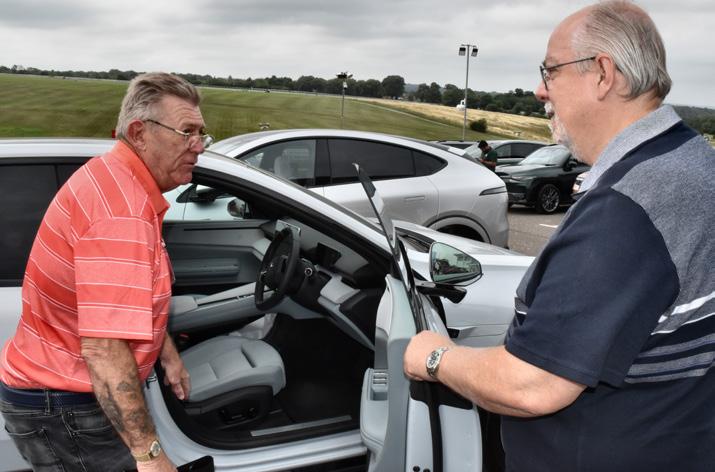
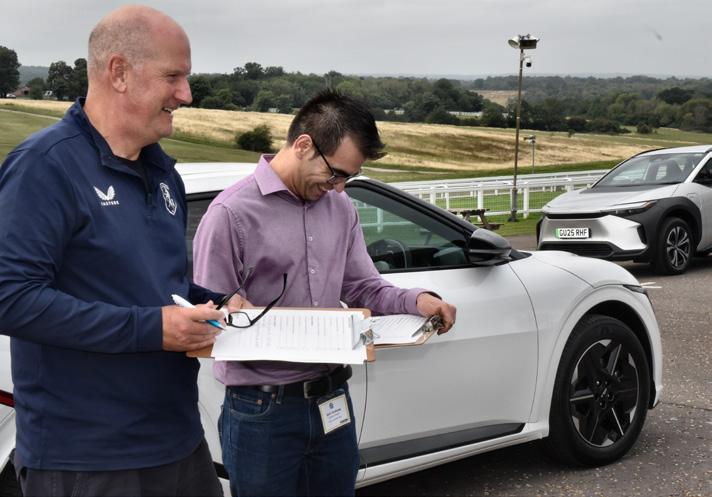
e’ll be judging next year’s Cars of the Year - yes, the 2027 winners - on Tuesday, August 11, 2026, at our regular venue, Epsom Racecourse in Surrey. It’s a fun day where you will have the chance to drive up to 50 of the latest cars suitablefor private hire and chauffeur work.
We’d love it if you could join us for the day and help us choose our winners. Put the date in your diary and let us know by emailing editor@prodrivermags.com and we’ll be in touch. See you there!