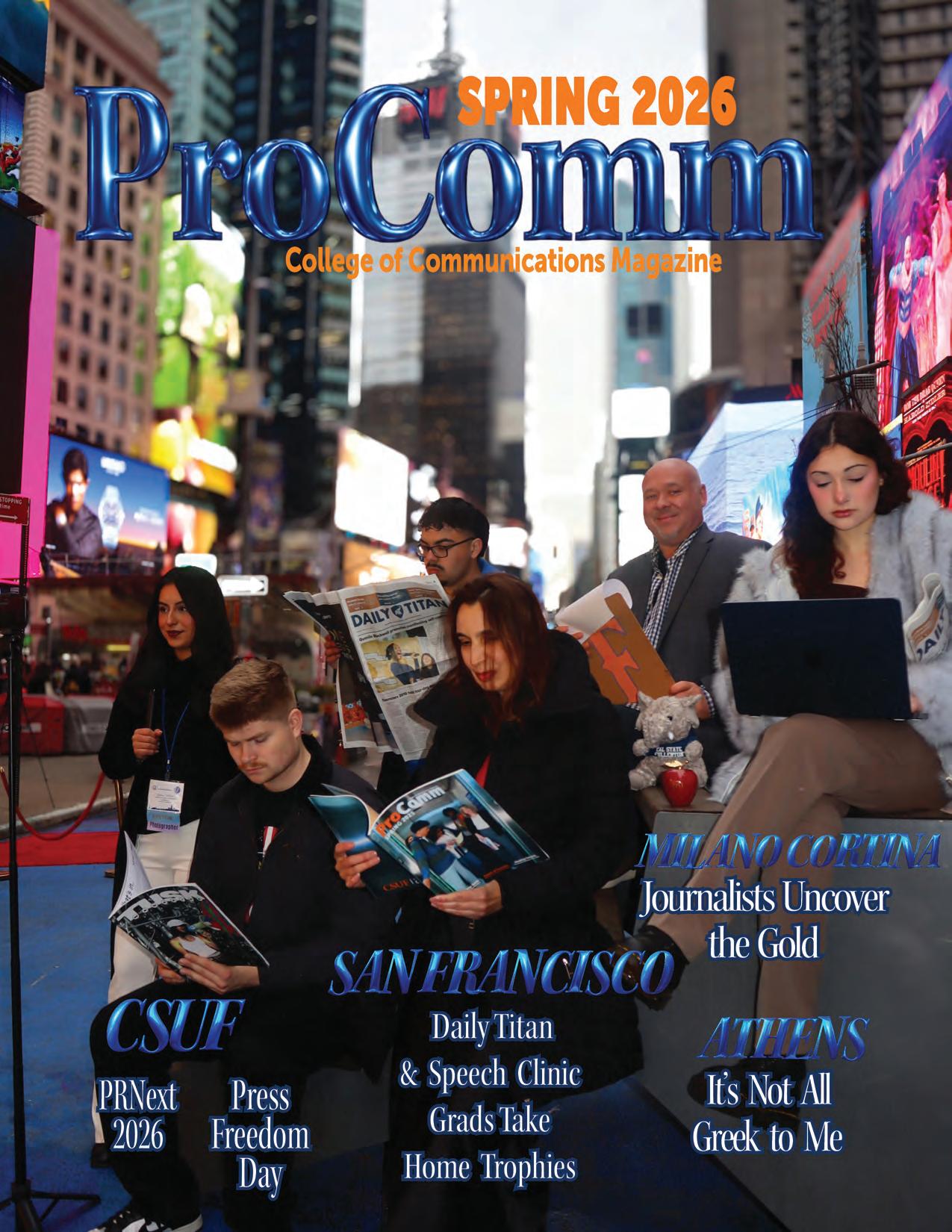











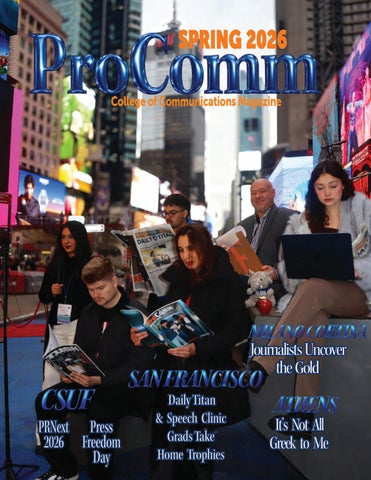











Embark on a journey across the many worlds of COMM, where every step leads to a new story, a new skill, a new horizon. This issue moves through classrooms, conferences and continents, following students and faculty who leap at opportunity and shape their own paths. Created in COMM 434: Magazine Editing and Production, ProComm Magazine celebrates the explorers, creators and communicators from The College of Communications at Cal State Fullerton who keep going, keep growing and keep seeing where CCOM can take them.
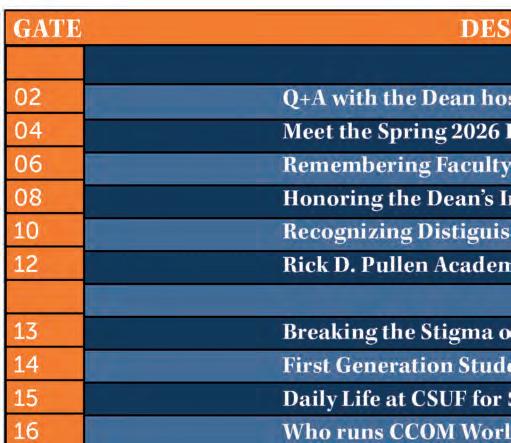
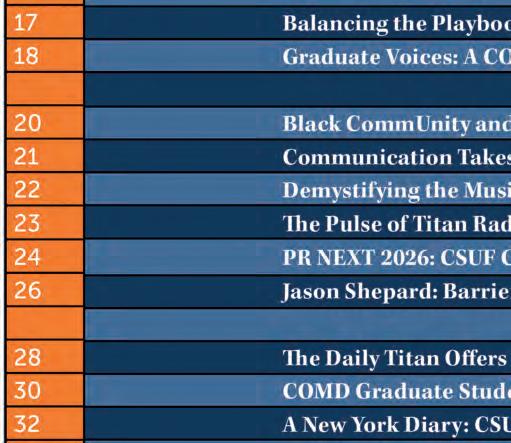
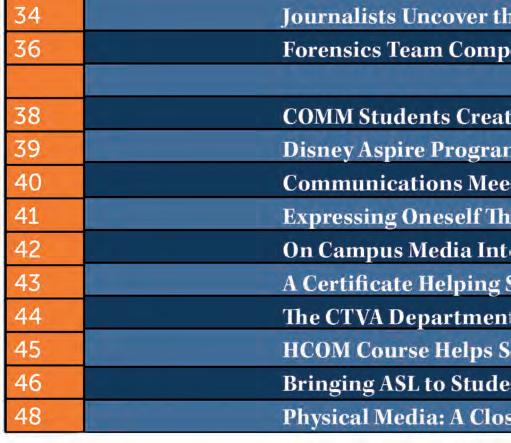
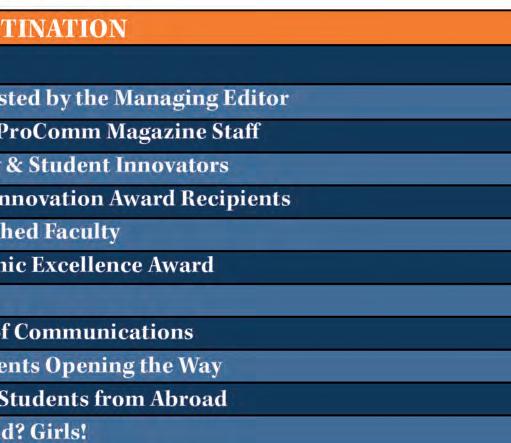
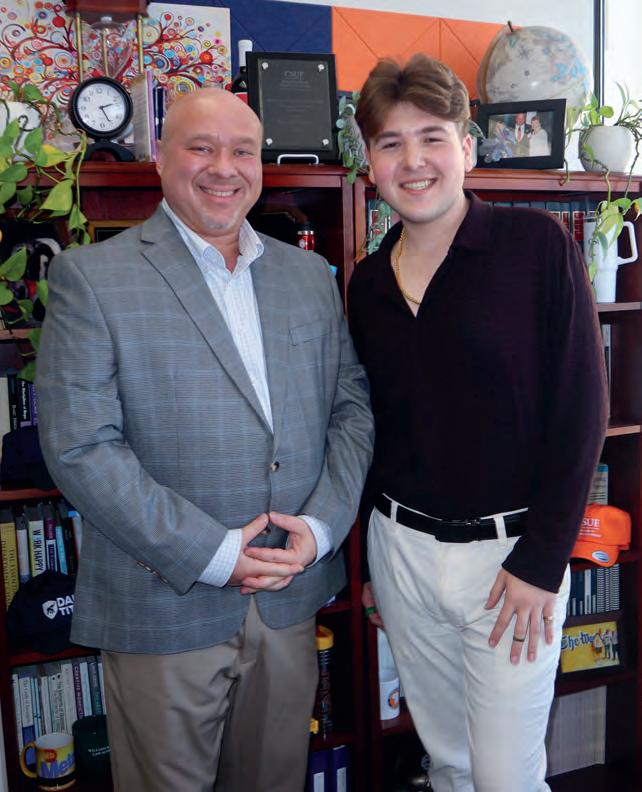
Q: “The College of Communications is one of the most diverse colleges on campus. How do you describe the value of having journalism, PR, advertising, entertain‑ ment, Comm Disorders, Human Comm and CTVA all under one umbrella?”
A: “That diversity is truly one of our strengths. As the only College of Communications in the CSU system, we have a unique breadth that allows students to explore communications from multiple perspectives. On the one end, we have programs like Communication Sciences and Disorders, which focus on how people develop and regain the ability to communicate. On the other end, you have large-scale storytelling and media production in areas like journalism, advertising, and cinema and television. We have areas where students learn how to communicate across contexts, from international interactions to intercultural and global media systems. Our college really does run the gamut in terms of what communication means.”
Q: “What do you think unites the programs and gives the College of Communications its shared identity?”
A: “While each department has its own focus and professional pathways, what unites us is a shared commitment to ethical and effective communication. Our students learn to tell stories, advocate for clients and analyze human interactions. They engage with questions about responsibility, impact and professionalism. The combination of professional readiness and ethical responsibility is really at the heart of who we are as a college.”
Q: “As industries evolve rapidly, how is the college adapting its curriculum and approach to prepare
students for careers that may look very different in the next decade?”
A: “The pace of change in the communications landscape is fast, and we have to be constantly thinking ahead and innovating our curriculum and programs and the opportunities we provide for our students. Our faculty are deeply engaged in both scholarship and professional practice. That helps ensure what we’re teaching is relevant and forward-looking.”
Q: “When you look at the College of Communications as a whole, what do you see as its core mission for students entering today’s communication‑driven world?”
A: “In a world where communications shapes everything from democracy to culture and technology, we want our students to be both highly skilled and deeply responsible communicators. We are grounded in a broad, liberal arts tradition that emphasizes critical thinking, ethical decisionmaking and adaptability. Our mission is to prepare students not just for jobs, but to be critical consumers, practitioners and leaders in a communications-driven society.”
Q: “Experience based learning has become a defining part of the college. What drives your commitment to supporting trips like San Francisco, New York, Milan, Greece and other immersive opportunities?”
A: “Students learn a lot in the classroom, but those lessons really come to life when they’re applied in the real world. Experiences like covering the Olympics or competing in state or international competitions allows students to connect theory and practice in powerful ways and sometimes gain once-in-a-lifetime experiences.”
Q: “How do donor contributions directly support student programs, travel opportunities and hands‑on experiences across the college?”
A: “Our donors are absolutely essential to what we’re able to offer. Their support helps funds scholarships, student travel, equipment, programming and hands-on learning opportunities that otherwise might be out of reach. What’s meaningful is that donors give for different reasons. Some see the impact our students are making. Others are alumni who want to give back. Many are former faculty and staff who remain deeply connected to our mission. One of the most rewarding parts of my role is connecting donors with programs and initiatives that align with their passions and seeing the direct impact their support has on student success.”
Q: “Looking ahead, what are you personally hoping to build, strengthen or introduce within the College of Communications over the next few years?”
A: “I want to continue to build on our strong foundations. That means supporting our faculty as they innovate in teaching and research, ensuring our curriculum stays relevant, and expanding opportunities for students to gain real-world experience. A key priority for me is access, making sure all students can take advantage of high-impact opportunities without taking on significant financial burden. Many of our students can graduate with little to no debt while getting a world-class education. I want to leverage that as one of our greatest strengths.”







Q: “Who are the individuals in your circle, like faculty, staff, advisors, coordinators, that you depend on to keep the College of Communications running and to help carry out this vision?”
A: “Our college is built on the hidden labor of so many people. That includes our amazing advising team that meets with thousands of students a year to make sure that they’re getting into the classes that they need. It’s the staff, some of whom have been here more than 30 years who show up every single day to make sure that all of the infrastructure is working for our faculty and our students. Our faculty are people who dedicate their lives to wanting to make a positive difference for our students. I think all of us are here because we really feel like the students are the best part of our jobs.”
Q: “What do you think students often overlook or mis‑ understand about the breadth of opportunities avail‑ able within the college?”
A: “One thing I sometimes hear from graduating students is they wish they had known earlier about all the opportunities available to them. On one hand, that speaks to the richness of what we offer, but on the other, it’s a reminder we could do a better job connecting students to those opportunities earlier. My goal is for students to engage early and often through our student clubs, organizations and signature programs. The earlier they get involved, the more they can take full advantage of everything the college has to offer, and the more prepared they’ll be when they graduate.”



































































































Stella Ting-Toomey, professor emeritus of human communication studies, passed away on June 13, 2025. A globally recognized scholar and beloved member of the Titan family, Ting-Toomey’s legacy of scholarship, mentorship and humanity leaves an indelible mark on the university and the world.
“Stella was not only an internationally renowned scholar but also a generous mentor, inspiring teacher, thoughtful colleague and kind friend,” said Zac Johnson, chair and professor of human communication studies. “Her passing is deeply felt across our campus and far beyond.”
For more than three decades, Ting-Toomey dedicated herself to Cal State Fullerton, helping to build the foundation of the Department of Human Communication Studies and shaping the College of Communications into a place that values intercultural dialogue, critical inquiry and empathy.
Born in Hong Kong on May 22, 1952, Ting-Toomey’s path to academia reflected the curiosity and courage she brought to every endeavor. In 1972, she came to the United States to study at the University of Iowa, where she earned both her bachelor’s and master’s degrees in mass communication in just five years. She later completed her Ph.D. in speech communication at the University of Washington before teaching at Rutgers and Arizona State. She joined Cal State Fullerton in 1989, where she found her academic home.
Ting-Toomey was internationally recognized for her groundbreaking work in intercultural communication, conflict negotiation and cultural identity. She developed two foundational frameworks — Face Negotiation Theory and Identity Negotiation Theory — that continue to shape the study of communication across cultures. Over her career, she authored or edited at least 17 books and more than 120 articles and chapters. Her research continues to guide scholars, educators and practitioners around the globe.
While her scholarship was widely celebrated, Ting-Toomey’s heart was in the classroom. She taught courses in intercultural communication, conflict resolution and communication competence, inspiring generations of students. Known for her high expectations paired with genuine care, she encouraged students to think deeply and carried a reputation for being both rigorous and nurturing. Many of her students went on to careers in education, diplomacy, counseling, media and beyond, carrying her influence with them.
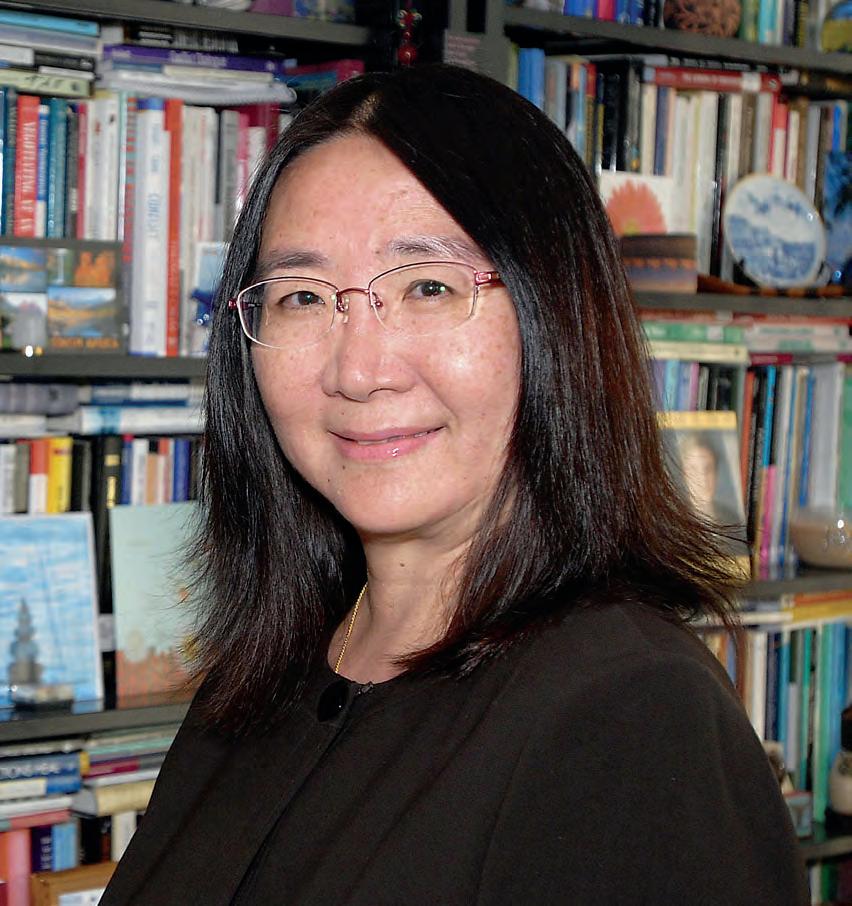
Ting-Toomey’s impact extended far beyond CSUF. She delivered keynote speeches on intercultural communication around the world and led training workshops for nonprofits, businesses and educational institutions. Her own experience as an international scholar enriched her work and deepened her ability to connect with others across cultural boundaries.
Her achievements were recognized with numerous honors, including the California State University system’s highest faculty honor, the Wang Family Excellence Award, in 2008, and CSUF’s Outstanding Professor Award the same year.
Beyond her accomplishments, Ting-Toomey will be remembered for her grace, warmth and generosity. In her influential book “Understanding Intercultural Communication,” she wrote: “Culture is communication, and communication is culture.” Those words capture the mission she pursued throughout her life — the belief that communication has the power to build bridges, transform relationships, and create more just and compassionate communities.
The College of Communications extends its deepest condolences to her family, friends, colleagues and former students worldwide.
“Stella taught so many of us how to listen with compassion, to speak with intention and to lead with humility,” said Dean Jason Shepard. “Her light lives on in every conversation she inspired, every classroom she touched and every life she helped shape.”

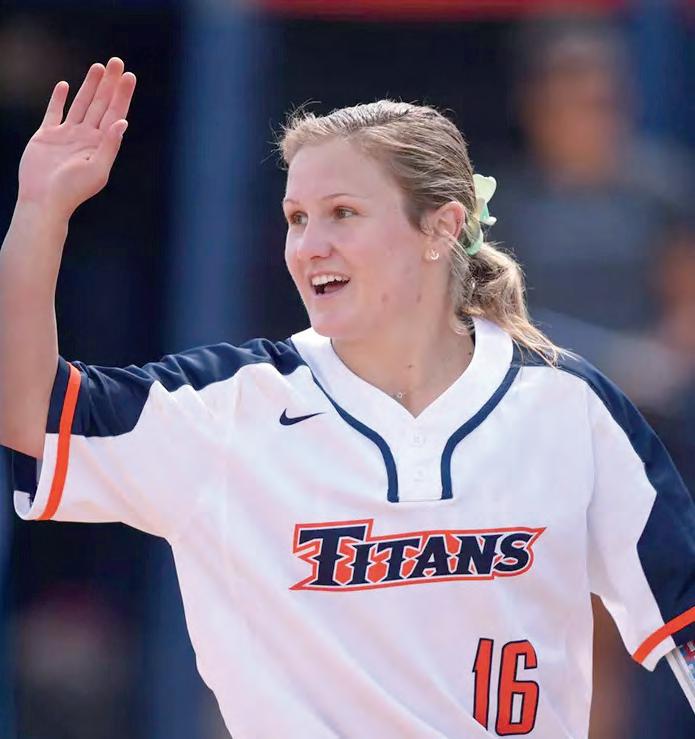
The College of Communications honors the life of Taylor Dockins, a Cal State Fullerton alumna who earned her Bachelor of Arts in communications with a concentration in journalism in 2023. Taylor passed away on June 2, 2024, at the age of 25 after an eight-year battle with cancer. She is remembered across campus for her achievements as a student, an athlete and a member of the Titans community.
Taylor joined CSUF Softball in 2018, where she made an immediate impact by throwing a five-inning no-hitter during her freshman season and earning Big West Pitcher of the Week honors. She later stayed connected to Titans Athletics through media work, serving as a co-host on the Titans Sports Network Preview Show and contributing as a play-by-play and color analyst for Titans Softball home games. Her achievements and continued involvement with the program led to her induction into the Titans Athletics Hall of Fame Class of 2025.
Taylor completed her degree from the College of Communications while navigating significant medical challenges, demonstrating determination and commitment to her academic path. Her work with Titans Athletics media and her presence within the college community remain part of the contributions she made during her time at CSUF.
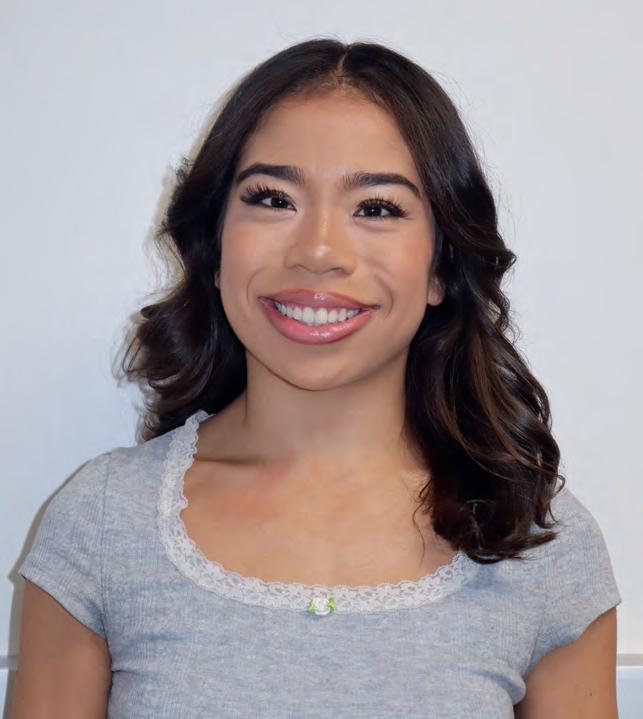
The College of Communications honors the life of Destiny Morris, a third year communications major with a concentration in journalism. Destiny was a member of the Titans Dance Team, a sister of Zeta Tau Alpha and a member of Tusk Magazine’s 26th edition, where she worked as a writer, a model and served on the outreach team. She brought warmth, laughter and a genuine love and curiosity into every space she entered.
Destiny passed on Nov. 14, 2025, due to two undetected congenital heart conditions. She is remembered as someone who lived with creativity and purpose. She was the definition of a creative being a dancer, a writer, a pianist, a vocalist, an actress and a painter. She approached every opportunity with a desire to grow, and she carried that same energy into the communities she joined across campus.
Her influence continues in the communities she shaped. Destiny lived with generosity and intention, and the college will remember her for the impact that lives on in the people who loved her and in the communities she strengthened. Her work in the classroom, her contributions to Tusk Magazine and her involvement across student organizations reflect the commitment she brought to her academic and creative pursuits. The connections she formed, the projects she contributed to and the spaces she helped build remain part of her lasting presence within the College of Communications.

The College of Communications honored five faculty members with its 2025 Dean’s Innovation Awards, recognizing forward-thinking projects that advanced the college’s mission to prepare ethical, engaged communicators who strengthen a democratic society.
The awards highlighted initiatives from the 2024–25 academic year that empowered students to leverage emerging trends and technology in ways that advanced democracy, professional practice and inclusive excellence. Each recipient received a $500 award in celebration of innovative achievement.
The Dean’s Innovation Awards were also designed to spotlight the college’s new Innovation Fund — an initiative intended to amplify faculty-driven projects and create new fundraising opportunities that expand their impact. Faculty submitted concise proposals outlining project goals, innovation and alignment with the college’s priorities, including professional training, ethical values, inclusive excellence, critical thinking and real-world impact. Proposals were evaluated on creativity, collaboration and demonstrated student benefit.
“This year’s awardees exemplified the very best of what our college strives to be,” Dean Jason Shepard said. “Their projects combined innovation with ethical purpose, expanding opportunities for students while advancing our democratic mission.”
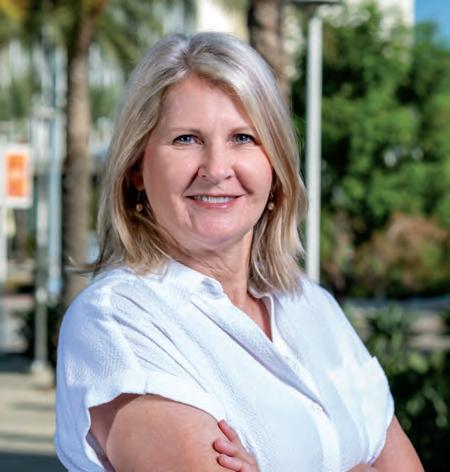
Dr. Gayle Jansen Brisbane received a Dean’s Innovation Award for leading the 2024 Paris Olympics Study Abroad Program.
Brisbane’s initiative provided 26 sports media students with the opportunity to report directly from the Paris Summer Olympics. Students produced multimedia stories on athletes, social issues and the Games’ impact on the host city. Their reporting appeared in professional outlets including the Orange County Register and The Sporting Tribune.
The program emphasized mobile reporting skills, ethical journalism and global awareness. Through grant support, Brisbane expanded access to ensure broader student participation. The experience gave students professional-level exposure on an international stage while reinforcing the role of journalism in democratic societies.
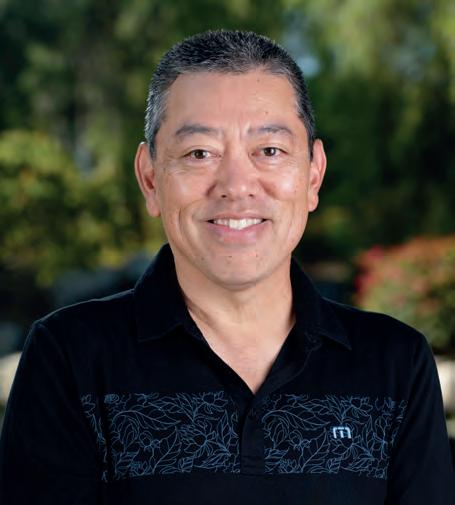
Ken Hagihara was recognized for transforming PRactical ADvantage Communications into a professional-style agency model that more closely mirrored industry practice.
Under his leadership, students engaged in year-long client partnerships organized into structured account teams. Corporate donations also helped secure high-performance laptops to enhance student production capabilities. Hagihara simultaneously strengthened CSUFs’ Public Relations Student Society of America (PRSSA) chapter, doubling membership, hosting the 2024 international conference and expanding the Southern California Coalition to 11 chapters.
The combined initiatives provided students with authentic industry experience while reinforcing ethical and creative standards in public relations practice.
Dr. Zac Johnson earned a Dean’s Innovation Award for his project, Translating Research into Practice: Fostering a Confirming Learning Environment.
Johnson’s initiative focused on converting communication scholarship into practical teaching tools for faculty. His developing tool kit includes classroom strategies and structured activities designed to help educators create environments where students feel recognized, respected and engaged.
By connecting research to instructional practice, Johnson’s project advanced inclusive excellence, student well-being and evidence-based pedagogy within the college.
Dr. Frank Russell was honored for a collaborative research project with undergraduate student Nollyanne Delacruz.
Together, they co-authored a peer-reviewed article published in Journalism, an international journal in the field. Their study examined how media critic Margaret Sullivan defended press freedom against challenges posed by hedge funds, digital platforms and authoritarianism.
The project provided Delacruz with hands-on scholarly experience while contributing to global conversations about press freedom and democratic accountability. The collaboration exemplified high-impact faculty mentorship and research engagement
Dr. Erika M. Thomas received a Dean’s Innovation Award for her work expanding the role of speech and debate beyond competitive rounds.
Thomas mentored students in transforming debate topics into advanced research and creative scholarship. Among those efforts, she guided student Max Wiessner in developing a forthcoming co-authored book chapter examining transgender and disability studies in film.
Her work prepared students for international debate forums while fostering inclusive, critical scholarship. By connecting competition, mentorship and research, Thomas redefined speech and debate as a platform for sustained intellectual growth.
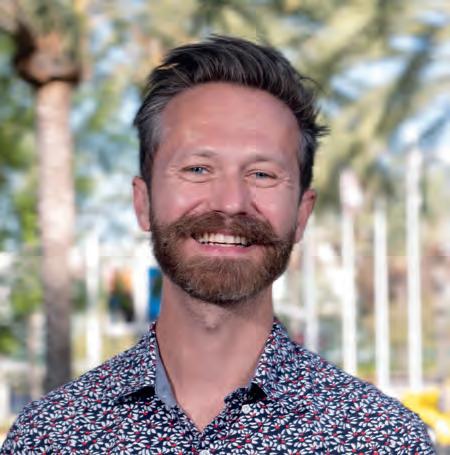
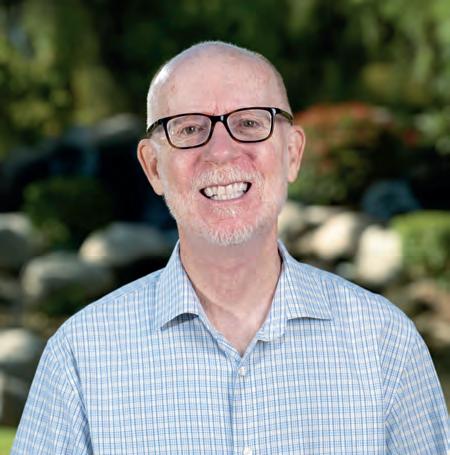
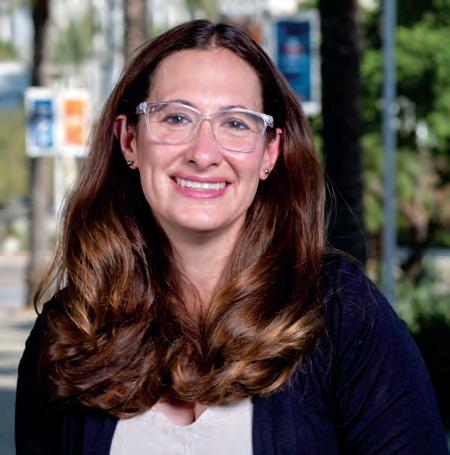
Across disciplines — from journalism and public relations to pedagogy, research and debate — the 2025 Dean’s Innovation Award recipients demonstrated how faculty initiative could deepen student learning while advancing democratic values. The awards underscored the College Innovation Fund’s goal of amplifying faculty passions and turning successful projects into expanded opportunities for fundraising and growth.
College leaders said the recognition affirmed the college’s broader commitment to critical inquiry, community engagement and professional practice.
“Each of these projects reflected creativity with purpose,” Shepard said. “They prepared students not only to succeed professionally, but to contribute thoughtfully and ethically to a democratic society.”
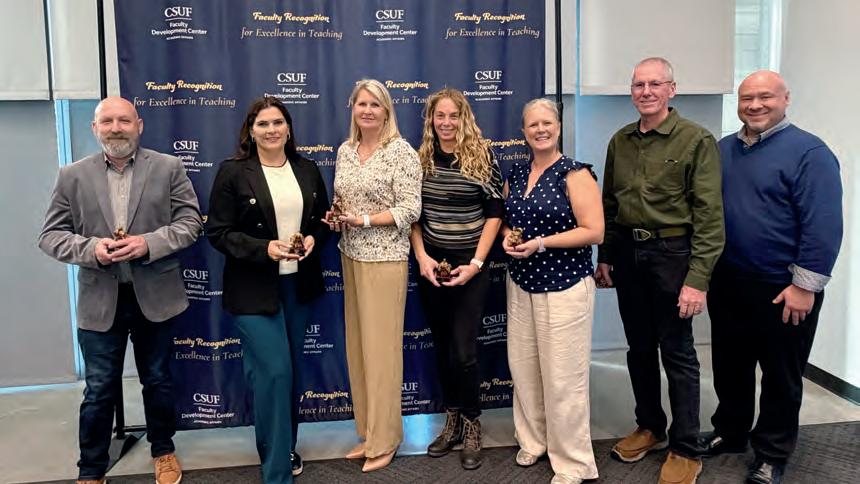
Seven faculty members in the College of Communications received Outstanding Teaching Recognition from the Faculty Development Center during the 2025-26 academic year. The recognition honored educators whose innovation, mentorship and commitment to student success exemplify the highest standards of academic excellence.
In the Department of Communication Sciences and Disorders, Dr. Reeman Marzouqah, assistant professor, earned recognition for her student-centered, evidence-based approach to teaching.
Marzouqah structures her courses with intentional scaffolding, guiding students step by step from foundational knowledge to advanced clinical reasoning. Her classes integrate case studies, role-play exercises, clinical demonstrations and guest speakers, allowing students to bridge theory and professional practice. Through flipped-learning strategies and digital tools — including carefully designed PowerPoint presentations with embedded research references and pre-recorded lectures — she enhances comprehension and encourages active engagement.
Peer observers have praised her logical course sequencing, reflective questioning techniques and ability to clarify complex clinical concepts through vivid, real-world examples. Students consistently note her respectful classroom environment and commitment to dialogue. Strong student evaluation scores and high response rates further underscore her impact, as does her responsiveness to student feedback and continuous course refinement. Colleagues describe Marzouqah as an innovative educator whose teaching prepares future speech-language pathologists with both competence and confidence.
In the Department of Communications, Dr. Cynthia King was honored for nearly 30 years of transformative teaching and mentorship. King is recognized for cultivating inclusive and engaging classrooms tailored to diverse learning styles. Her courses emphasize collaboration, critical thinking and hands-on application. By partnering with organizations such as Disney, Knott’s Berry Farm and the Alzheimer’s Association, she integrates real-world projects into her curriculum, giving students experience solving authentic industry challenges.
Beyond coursework, King organizes industry mixers and site tours that help students expand their professional networks.
Even in large lecture settings, she creates opportunities for personalized engagement through group projects, varied instructional formats and individualized feedback. Committed to continuous improvement, King has pursued faculty development opportunities and earned Quality Matters certification, ensuring her courses meet rigorous standards of instructional design. Her long-standing dedication to student success has shaped generations of communications professionals.
Dr. Gayle Jansen Brisbane, also of the Department of Communications, has distinguished herself through her leadership in broadcast journalism education. Brisbane teaches across all levels of the broadcast journalism curriculum, including the department’s capstone course and OC News. Drawing from her accomplished career in television news, she mentors students in professional standards, storytelling and newsroom ethics. As advisor for the Sports Media Certificate, she developed COMM 336: Sports Broadcast Journalism, expanding opportunities for students interested in sports media careers. In 2024, she led 26 students to the Paris Summer Olympics as part of a study abroad program, offering hands-on reporting experience at one of the world’s most significant sporting events.
Through a substantial Instructionally Related Activities grant she secured, she ensured that financial barriers did not prevent student participation, promoting inclusivity and access. Students’ coverage from Paris was published in multiple professional outlets, and the initiative earned Brisbane the Dean’s Innovation Award. She also led another cohort to the 2026 Winter Olympics in Milan, continuing to elevate experiential learning on a global stage.
Dr. Doug Swanson’s nomination reflects more than a decade of sustained impact on both undergraduate and graduate education within the Department of Communications. As founder of PRactical ADvantage Communications, the university’s student-run public relations agency, Swanson created one of the nation’s largest experiential learning programs in PR education. The agency has served more than 1,000 students, providing hands-on client experience that mirrors professional practice. Swanson has taught 54 sections of COMM 362: Public Relations Writing and mentored 48 graduate students through completion of their master’s capstone projects.
His scholarship includes widely adopted textbooks, most notably Public Relations Management: A Team-Based Approach, which is in its fourth edition and reinforces collab-
orative, real-world strategies. In addition to his classroom work, Swanson has strengthened college-wide assessment processes, co-authored major accreditation self-studies and served in leadership roles including department chair and interim associate dean. His integration of scholarship, pedagogy and institutional service has helped shape the college’s academic rigor and national reputation.
In the Department of Human Communication Studies, Dr. Alyssa Samek was recognized for her rigorous and forward-thinking pedagogy. Samek teaches across undergraduate, graduate and honors levels, encouraging students to critically analyze contemporary sociopolitical discourse within broader historical and cultural frameworks.
Her courses guide students in developing original research projects that address timely issues with scholarly depth. In graduate seminars, Samek has adopted an innovative “ungrading” approach, emphasizing reflective learning, revision and intellectual growth over traditional grading metrics. This method fosters autonomy and deeper engagement.
Her mentorship has led students to national recognition. One graduate student presented research on motherhood and TikTok discourse at the Western States Communication Association Conference, while another delivered work on toxic masculinity at an International Communication Association pre-conference. Through inclusive teaching and dedicated mentorship, Samek empowers students to contribute meaningfully to academic and public conversations.
Dr. Dan Sutko, also of Human Communication Studies, was honored for curricular innovation and mentorship. Sutko designed and launched HCOM 415: Artificial Intelligence and Communication — the university’s first course examining the social implications of AI and the first non-technical course at CSUF to integrate AI as a central
“These nominations represent the extraordinary depth of talent across our departments,” Dean Jason Shepard said. “Each faculty member embodies our mission to prepare communicators who advance society through ethical practice, critical inquiry and meaningful engagement.”
curricular component. The course equips students to analyze emerging technologies through ethical, cultural and communicative lenses.
He also redesigned HCOM 305: Digital Media using an equitable pedagogy framework, enhancing accessibility and inclusion in digital learning environments. Sutko actively mentors graduate students, guiding them to present original research at competitive conferences. One of his mentees received a Top Paper Award at the Western States Communication Association, reflecting the strength of his mentorship and scholarly rigor.
In the Department of Cinema and Television Arts, Lecturer Ben Sztajnkrycer has been nominated for his leadership in the MFA Screenwriting program. As supervisor of the graduate program, Sztajnkrycer collaborates closely with faculty to ensure courses are intentionally scaffolded, learning outcomes are achieved and grading standards remain consistent and rigorous. He incorporates process-based grading, mentorship strategies and culturally responsive teaching practices across the curriculum, updating syllabi to enhance accessibility and reduce bias.
He also develops annual assessment tools to evaluate program effectiveness and support continuous improvement. Teaching both undergraduate and graduate courses — including screenwriting structure, feature writing, rewriting and pedagogy — he balances creative exploration with disciplined craft. Students and colleagues alike praise his dedication to fostering inclusive learning communities and nurturing emerging storytellers.
Together, the award-winning faculty reflect the College of Communications’ commitment to innovative pedagogy, experiential learning and student achievement. From clinical simulations and industry partnerships to global reporting opportunities and AI-integrated curricula, their work underscores a shared dedication to preparing students for dynamic professional landscapes.
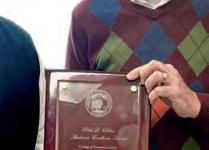
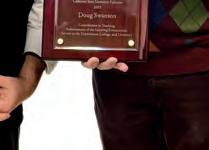
State Fullerton Professor of Communications Douglas J. Swanson, APR, has been named the recipient of the 2025 Rick D. Pullen Academic Excellence Award, an honor recognizing outstanding contributions to teaching and the enhancement of the learning environment.
The award, named for longtime retired Dean Rick Pullen, celebrates faculty members whose careers exemplify academic excellence, innovation, and dedication to student success. Swanson’s selection reflects a distinguished record spanning more than 35 years in higher education and professional communication, including 16 years at Cal State Fullerton.
Swanson has taught extensively across the undergraduate and graduate curriculum, including Principles and Ethics of Public Relations, Public Relations Writing, Public Relations Management, Public Relations Theory, Ethical Problems of Mass Media, Integrated Communications Media, and the M.A. Capstone Project. Over his tenure, he has taught 54 sections of Public Relations Writing, preparing more than 1,000 undergraduates for careers in professional communication, and has mentored 82 graduate capstone projects in the past six years.
Colleagues and students alike praise Swanson’s pedagogy for its clarity, rigor, and emphasis on connecting theory with professional practice. His courses are widely recognized for fostering critical thinking, ethical reasoning, and real-world skill development.
A defining element of Swanson’s impact is the founding of PRactical ADvantage Communications in 2011, the College of Communications’ curriculum-based student-run agency. Under his leadership, students developed and executed strategic communication campaigns for more than 200 nonprofit and corporate clients.



The agency has become one of the nation’s largest and most successful student-run programs, offering high-impact experiential learning opportunities that strengthen professional preparation, teamwork and ethical practice. Swanson’s scholarly record further amplifies his teaching contributions. He has authored or co-authored more than 60 peer-reviewed journal articles, book chapters and conference papers, along with influential books including “Real World Career Preparation” and multiple editions of “Public Relations Management: A Team-Based Approach.” His research explores experiential learning, crisis communication, ethics, student-run agencies and mindfulness in communication education.
Beyond the classroom, Swanson has demonstrated sustained national, professional and university service. Nationally, he has contributed to accreditation and assessment initiatives through work on Certification in Education for Public Relations (CEPR) and Accrediting Council on Education in Journalism and Mass Communications self-studies, and he has served as a WASC/WSCUC site visit evaluator. Professionally, he has been an active leader within the Public Relations Society of America (PRSA), serving on APR Readiness Review Panels and advancing conversations on ethics, experiential learning and mindfulness.
At CSUF, Swanson has provided exceptional leadership in student learning assessment, curriculum development and faculty governance. His administrative roles have included serving as acting chair of the Department of Communications in 2014 and interim associate dean of the College of Communications from 2017 to 2018.
Prior to joining CSUF, Swanson served on the faculties of the University of Wisconsin–La Crosse and California Polytechnic State University, San Luis Obispo. He earned his B.S. and M.A. in Communication from Eastern New Mexico University and his Ed.D. in Higher Education Teaching (Mass Communication) from Oklahoma State University.








Past recipients of the Rick D. Pullen Academic Excellence Award include Toya Wyatt (2024), Amber Chitty Wilson (2023), Shelly Murray (2022), Minjung Kim (2021), Beth Georges (2019), Kurt Kitselman (2019), Bonnie Stewart (2018), Kenneth Tom (2017), Andi Stein (2016), Jeanine Congalton (2015), Jule Selbo (2014), Carolyn Coal (2013), Edith Li (2012) and Philippe Perebinossoff (2011).

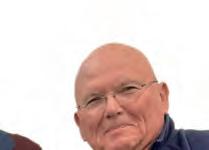
Jason Shepard, dean of the College of Communications (left), Doug Swanson, professor of Communications (middle) and Micheal McAlexander, chair and professor of the Department of Communications (right).
by Serin Jung and Marcus McGregor
Many students fear this question when being asked about their major. What may seem like a harmless comment actually unloads a list of assumptions that weigh on students throughout their education. This often leads communications majors to be reduced to stereotypes that devalue their discipline. Over time, these perceptions influence not only how others see them but also how students view themselves and their academic choices.
Communications is commonly minimized as being an easy major, often dismissed as just “talking” degree. In reality, the field demands a solid academic foundation where students are required to analyze how messages are created, hone in on public speaking, utilize research and understand it across various contexts while completing and creating writing-heavy assignments, multimedia projects and presentations with clarity and strategic thinking.
These experiences prepare students to balance creativity with analytical thinking and apply their knowledge in real-world situations. Communications can be a demanding and adaptable pathway that encourages students academically and professionally.
Another frequent stereotype is communication majors will face limited or unclear career opportunities. Students are often asked, “What kind of job can you even get with that?” implying the field lacks practical value. However, this perception dismisses the versatility of communication skills in today’s job market which prepares students for a wide range of career paths. Employers often seek

candidates who can think critically, collaborate effectively and communicate ideas clearly across different platforms. Communication majors align with those skills, gaining hands-on experience through internships, group projects and digital media work. Rather than limiting career options, the degree equips students with adaptable skills that are highly relevant in a rapidly evolving, media-driven world.
At ProComm Magazine, our staff members work to cover and showcase The College of Communications (CCOM) at Cal State Fullerton. We focus on the hands-on opportunities that extend beyond the classroom, and every person behind every lesson, conference, competition, campus media outlet, internship, department event, or club opportunity that is a part of that mission. Our writers, designers, photographers, editors and outreach staff work together to bring those stories to life and represent the full scope of our college.
Within the college is The Department of Communications (COMM), which is one of the larger programs on campus, reflecting its popularity and broad range of skillsets with concentrations of advertising, entertainment and tourism, journalism and public relations.
Alongside the Department of Communications, lies the Department of Human Communication Studies and Communication Disorders, often referred to as HCOM and COMD, as well as the Department of Cinema and Television Arts (CTVA). Each program approaches communication from a different angle, but all share the same foundation of understanding how people express themselves and how messages move through the world.
Photographed by Serin Jung
Jade Rodriguez
An adventurous friend once told me, “You are the reason I am here,” as we walked around his campus. I did not understand. My friend Brandon Beltran and I had been friends since middle school, but I never thought he would say something like that.
What he meant was I encouraged him to follow a path to attend college. Brandon had a goal to be the first to attend college in his family; however something stopped him.


He had no idea how he would get started. One day during my junior year in high school, I showed Brandon my school schedule for the next semester, and he questioned a class I was taking named Senior Seminar. This course prepared students and helped guide them on their pathway to college including filling out scholarships, college applications and general resumè help.

We updated each other on the colleges we applied to, how we did it and how having guidance made it flow easier. We knew it wouldn’t be easy becoming a communications major as many believe, since it is perceived as a “non-technical” major. We ultimately accepted the risk, and both became first-generation college and communication students.


The truth is the reason we are both attending college was from the reminder that college is possible, even with simple encouragement of friends, family and being that first person in your family to attend college. Communicating and staying connected is what guided us.
With programs like the I am First... program at Cal State Fullerton, first-generation college students are given the opportunity to achieve further career assistance, even throughout the communications concentrations.


On CSUF’s career center details that, “The I Am First… program will equip first-generation college students with the confidence, self-awareness, and career readiness knowledge to jumpstart into a successful journey towards achieving career and leadership development.”
This describes the program’s mission and “opens the way” for many first-generation students.

Photographed by Gregory Ferraro



It is this help from the school which can be essential when it comes to ensuring a support system for those first-generation students. In participating in the program, not only is there a focus on skill development, but there is also the support from fellow first-generation alumni, employers and faculty. Being a part of a community that is also looking to connect can be uplifting.
Speaking as part of first-generation students, representation and encouragement is what gives us success. From the point of view of a communications major, those moments of influence that Brandon and I shared completely shifted our intentions. The shared experiences and conversations we had were shaping our futures. Throughout the Department of Communications and College of Communications, there is one aspect that unites us, and it is connection.
A Personal Story by Serin Jung

For many Korean international students attending Cal State Fullerton, studying in the United States leads beyond academic pursuit. It is a daily process of adaptation, growth and self-discovery—both inside and outside the classroom.


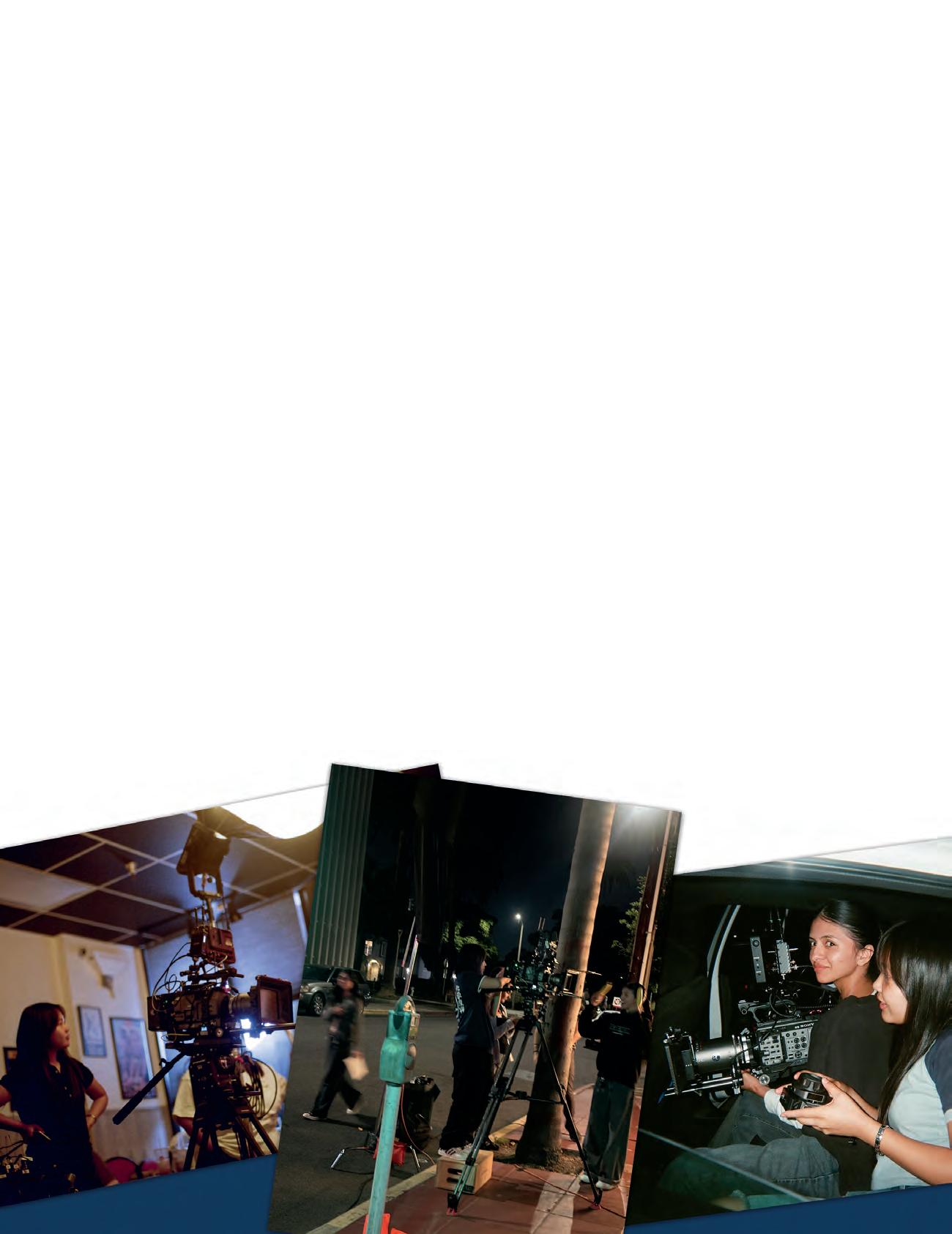
Yeheon Jang, a second-year CTVA major who arrived in Fall 2024, represents a growing number of Korean students who choose California for its proximity to the entertainment industry and hands-on educational opportunities. Minju Kim, a Korean exchange student majoring in Communications who arrived in Spring 2026, highlighted the diverse experiences of Korean students on campus.
Compared to South Korea, CSUF’s communication courses emphasize practical, on-set experience. Students gain opportunities to work through the entire production process—from pre-production to post-production—with access from school-funded resources. In one advanced production course, students received financial support to create their own film projects, relieving equipment and location costs.
“We didn’t have to worry about renting gear or budgeting everything ourselves,” Yeheon said. “We could focus on actually making the film we wanted.”
The university also provides access to professional quality camera equipment, allowing students to gain hands-on experience before entering the industry.
Despite the opportunities, international students face significant challenges—especially when it comes to language. Kim further explained: “It’s hard to explain your vision clearly in English sometimes.”
This language barrier can complicate collaboration on set especially when it heavily relies on teamwork and fastpaced decision-making. Another challenge involves building connections. While CSUF offers a variety of classes, students noted a lack of centralized communities or clubs specifically for film majors.
Efforts to create more opportunities are beginning to emerge. A recent campus film festival organized by student leadership provided a platform for students to showcase their work and connect with peers.
While challenges remain, many Korean students express overall satisfaction with their academic experience at CSUF. Faculty support and the program’s practical focus are frequently cited as strengths. Still, students hope for more structured opportunities to build networks and collaborate outside the classroom.
For Korean international students, life at CSUF is defined by constant adjustment—academically, socially and culturally. Yet within those challenges lies opportunity. While navigating language barriers, cultural differences and the demands of their major, these students are not only earning degrees — they are building resilience and shaping their futures under global context.
by Leah Thompson
Womenin communications at Cal State Fullerton are doing more than appears to the They are leading organizations, creating opportunities and redefining what leadership looks like in media and storytelling. Faculty mentorship is a key part of the experience.
Carrie Braun, a lecturer in the Department of Communications, did not always know she would end up in the field. Once she took her first communications class, she realized she had found the right profession for her, Braun built a career across television, public safety communications and higher education.
Braun draws on her experience working in a sheriff’s department, where she managed the agency’s public image. The role required her to think quickly in high-pressure situations and communicate effectively with the public and media. Braun said working in that environment gave her valuable, real-world insight into crisis communication and strategic messaging, which she now brings into the classroom.
“I have mentors who are my same age and even younger than me,” Braun said. “We have things to learn from each other.”
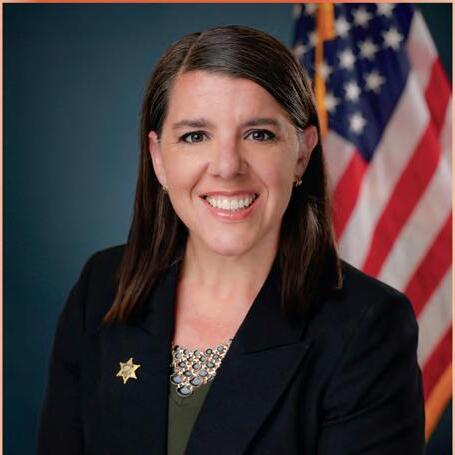
One mentor she remembers fondly is colleague Cymantha Atkinson, who influenced Braun’s approach to teaching and professional growth as well as Sheriff Sandra Hutchens, who also left a lasting impression.
“She exemplified strength but grace,” Braun said. These experiences continue to shape how Braun approaches her work with students today. Braun offers a piece of advice for preparing to enter the communications industry,
“Everything I have ever done was because of a connection,” said Carrie Braun.
“Having an idea of where you want to go is fantastic,” Braun said. “But leave room for things you don’t even know are possible.”
Forstudent leader Mariah Snow, communication is about more than creativity and influence. It is about community.

co-founder and president of the campus chapter of Her Campus, Snow has built a space where students can gain professional experience, collaborate and support one another while preparing for careers in journalism, media and public relations.
The idea for Her Campus at CSUF started during COMM Week, when Snow and her co-founder, Ali, noticed something missing.“We felt like there wasn’t a strong communications club that was just for communications and learning about the industry,” Snow said.
Now in its second semester, the club gives students hands-on opportunities to write, collaborate and build skills that translate directly into careers.
“This is only our second semester,” Snow said. “But we want to see the club last past our time here.”Snow also emphasizes inclusivity.“There are lots of students who aren’t even COMM majors,” Snow said. “I don’t want to put people in a box.”
“I want to leave people with a sense of community and feeling empowered,” said Mariah Snow.
Her Campus’ approach reflects a broader shift in communications, where leadership is becoming more collaborative and people-centered.“8 or 10 years ago, the space was very male-heavy,” Snow said. “Over time, women have really revolutionized it. In a room full of women, we all just understand each other and what work needs to be done.”
by Leah Thompson
AtCal State Fullerton, success isn’t confined to lecture halls or playing courts. For student-athletes like Mya Dominique Tillman, excellence means mastering both. It’s a mindset she carries from the volleyball court to her academics. Tillman, a Public Relations major with a minor in Marketing, recently completed her senior Volleyball season as a setter in a 6–2 offense formation.
Her days during the season were filled with early mornings, late nights studying her athletic film, and academic deadlines stacked between travel and game days. “You’re forced to maximize every hour,” she says. “People underestimate the load athletes carry. Film alone is analyzing patterns, studying data, preparing strategically, and then you still have homework.”
Her journey in volleyball began as a child when her father, a director of recreation parks and former football player at the University of Arizona, created a volleyball program, and she was the first team player to join. Her father, balancing athletics and education, shaped her own dreams of competing at the Division I level while earning her degree.
Communications felt like a natural extension of that path. Growing up, Tillman loved presentations and public speaking, even delivering a graduation speech in middle school. Years of navigating new teammates and coaches reinforced the importance of relationship-building and communication in sports.
“Volleyball is the avenue,” Tillman said. “But school is why I’m here. I’m a student first.”
Tillman’s academic focus has paid off, maintaining a GPA between 3.5 and 3.7, keeping Dean’s List recognition throughout her time at CSUF for three years. Her consistency opened the door to a milestone achievement: an internship with ESPN, where she recently hosted a fall preview show and her first live in-game interviews. For Tillman, the moment represented years of discipline and hard work.



















“After a tough loss, the marathon continues the clock keeps going,” said Mya Dominique Tillman.

The skills she’s built through volleyball, time management, punctuality, resilience, and relationship-building now shape her professional goals. Leadership has also defined her athletic career. As team captain her senior year, she helped guide her young teammates while setting the tone for the team after her.


She also mentioned one of herfavorite highlights of her volleyball experience playing for Kobe Bryant’s volleyball team, calling it an honor to represent someone she deeply admired.




Behind her success stands a strong support system. Tillman said that during her time at CSUF, her head coach and assistant coach have left a long-lasting impact on her, who emphasized empowerment on and off the court. “Volleyball is her vessel to empower young women to be beasts out in life,” she says of her coach’s motto. Through CSUF’s embedded mentorship program for athletes, she also received academic guidance to stay on track.
Balancing both sports and academics requires mental resets. After games, she takes drives while listening to SZA’s CTRL, her “comfort album,” and confides in her father to decompress.


Courtesy
of Kole Page
The students were interviewed by Cindy Nieblas, a communications graduate student at Cal State Fullerton herself, who will be referred to as CN in the interviews.
The College of Communications offers many degree programs, the Communications graduate program being one of many, which supply students with the tools to further their education with three concentration options. Five of these students were asked about their lived experiences in the graduate program, and here is what they had to say.
M.A. in Communications Student
Professional Communications Concentration
Social Media Marketing Student Assistant at Pollak Library
CN: “What is your dream job or dream career goal?”
NA: “Any place in sports is something that I see as a fun and exciting job and career to be in. I’m kind of looking more at the social media marketing aspect, since I do have experience in that.”
CN: “What has been your favorite or most mean‑ ingful experience in the program so far?”
NA: “One of my favorite moments would have to be the projects class [and] just being able to work with somebody in the real world, and being able to showcase what I can do and what content I can create, and what kind of engagement I can get and obtain for them has been rewarding and fun to see so far.”
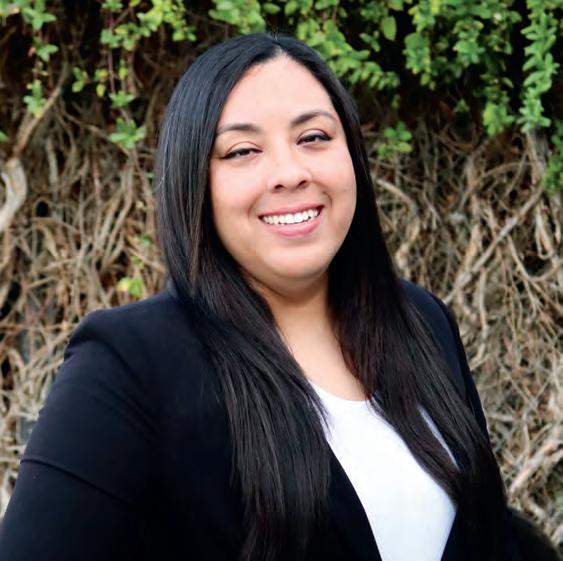
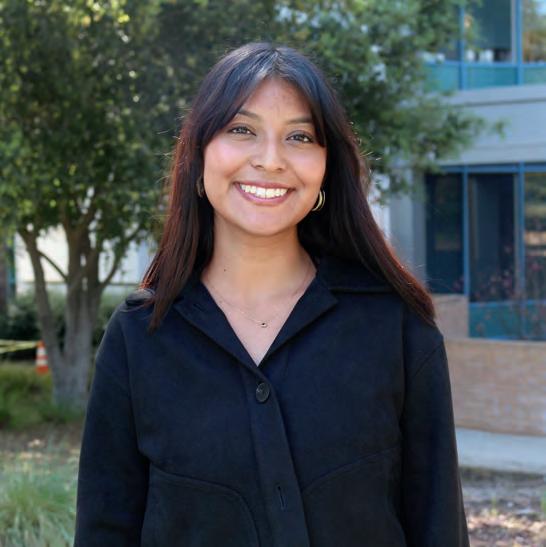
M.A. in Communications Student Entertainment & Tourism Communications Concentration Administrative Support Assistant at CSUF
CN: “What is your dream job or dream career goal?”
LB: ”I either want to help plan like major award shows, like the Oscars, the Grammys or the Golden Globes. I would really like to be on the back end of event planning a larger scale.”
CN: “What skills do you believe the program has strengthened for you?”
LB: “Definitely, how to research. I’ve actually learned how to use the tools around me, learned how to reach out to people that I probably wouldn’t have had the confidence to do back then. The people around you are big, big resources. So I feel like that is something that I’m relearning and seeing.”
M.A. in Communications Student
Mass Communications Research and Theory Concentration
President of The Rotaract Club of CSUF, Urban Activist and Social Media Manager at the National Association of Hispanic Journalists, Los Angeles
CN: “What is your dream job or dream career goal?”
GC: “An entrepreneur in the field of communications. I’m a professional photographer too, but somehow I want to expand on that because it keeps me grounded in the industry that I love more, journalism.”
CN: “Since you did previously attend Cal State Fullerton, do you think that experience guided your decision to return here for your master’s degree?”
GC: “I had nothing but the greatest experience with the professors here. Like Dr. King, I have had her twice, and she’s awesome. She’s very passionate. Valencia, second time around, he’s very passionate. Dr. Russell, very passionate about being a professor of journalism.”
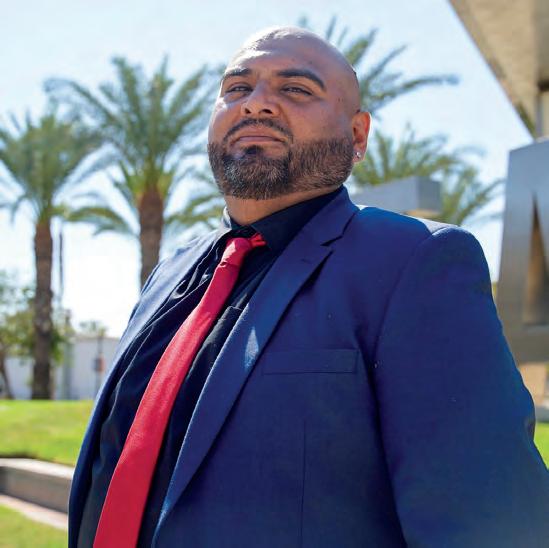
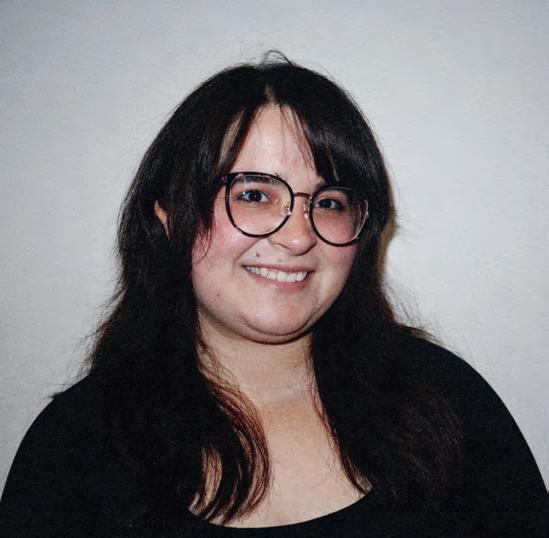
M.A. in Communications Student
Professional Communications ConcentrationPublicity Outreach Graduate Student Assistant for the Communications Department and the College of Communications
CN: “How do you believe the graduate program is preparing you to achieve your career goals?”
DN: “I feel there are a lot of programs where they don’t focus on that as much, but I feel for our program, they heavily emphasize it we have classes where you can add stuff to your portfolio and to your resume.”
CN: “What prompted your decision to enroll in a graduate program?”
DN: “Instead of getting another bachelor’s, why not try the master’s and challenge myself and add on to the knowledge that I already had with my psych degree. That was part of the motivation, the change in career and seeing how both of my degrees and both programs can still go hand in hand.”
M.A. in Communications Student
Professional Communications Concentration Communications Assistant, Marketing Intern
CN: “What is your dream job or dream career goal?”
AL: “ Since I’m working in government and a city position, I’m really interested in either getting into communications and marketing, so either becoming a specialist or a manager for a city. Any of that sounds exciting for me to really connect with the audiences.”
CN: “How do you believe the graduate program is pre‑ paring you to achieve that goal?”
AL: “It’s definitely been a shift from my previous school. I think it’s really helped me gain that real-world experience and see the different networks and meeting new people within this program as well.”
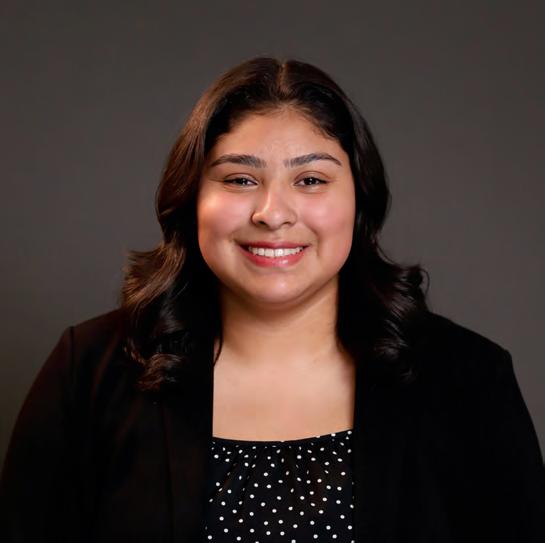
For Black students in the College of Communications, walking into classes and not seeing anyone who looks like them can feel isolating. Finding peers who share similar experiences can be challenging, but the Black CommUnity program seeks to promote the inclusion and retention of Black students at Cal State Fullerton by providing opportunities for them to build community.
The program launched in fall 2022 and was founded by co-directors College of Communications Internship Coordinator Amber Chitty Wilson and Associate Professor of Communications Jasmine Phillips, along with the help of former Assistant Professor of Communications Miya Williams Fayne. The program supports students both socially and professionally by hosting events that create social spaces for Black communications students to connect and network while offering financial assistance with housing, internships and travel through a range of stipends, scholarships and awards.
“The reality is that, especially when you’re in college, and you’re pursuing a degree field, a lot of the students that you’re in your classes with are going to be the next leaders of industry,” Wilson said. “They’re going to be in positions of power. So nurturing those relationships will kind of lay that foundation.”
by Leah Martinez
Phillips had the initial idea to start the program after serving as the faculty director of the Latino Communications Initiative, another program run by the College of Communications.
“During that year, I noticed that there was a need for something akin to that for the Black students. But I wasn’t sure how to go about, you know, doing it. But since I’d had this experience with LCI, it really inspired me to do something similar,” Phillips said.
and Wilson host a of events, from to informal coffee breaks. All events are to career resources we’re less to have that we do cultivate and
Phillips and Wilson host a variety of events, from internship workshops to informal coffee breaks. All events are designed provide career development resources for Black students.





“It’s all about the social capital. Historically, we’re less likely to have family and networks in very high positions,” Phillips said. “So, it’s important that we do cultivate and create those networks, because that’s often how you learn about different opportunities.”
Co-Director Amber Wilson
Hear from CSUF’s 2025-26










Club Treasurer Justin Rosette by Leah Martinez
The National Association of Black Journalists, a nonprofit founded in 1975, is the largest organization for journalists of color. With more than 4,000 members, NABJ focuses on connecting Black journalists and providing training for students and early-career reporters. Each summer, NABJ hosts its national Convention and Career Fair in rotating cities, offering panels, workshops and networking opportunities. One student who has attended multiple conventions with Cal State Fullerton’s NABJ chapter is Justin Rosette, a fourth year journalism major and the club’s treasurer. He sat down with ProComm for an interview that invites readers into his journey with NABJ.
Q: “Why did you decide to join NABJ?”
A: “I thought it would be a good idea to join the club not only because I’m Black, but also because there are other Black journalists who also have goals and aspirations the same way that I do. I figured it would be a good thing, just making connections and getting closer to people who are similar in grade and career interests to me as well.”











Q: “How has NABJ helped shape your career path and goals in journalism?”
A: “It’s helped to give me a better view of the different careers that I can have. I think before I was just set on being on TV anchoring, but traveling with NABJ, I’ve talked to people that have done kind of everything from TV, radio to writing. You don’t have to be so married to one idea, one career. If you let your abilities speak for themselves the possibilities are so much more than just being an anchor or just being a writer.”


Q: “Why do you think it’s important for Black students to have the opportunity to travel through NABJ?”




A: “As a Black student myself who hadn’t done a whole lot of traveling, it just gives you an opportunity to step out of your comfort zone, to meet people that you’ve never met, and to see things you’ve never seen. During the day, collectively, we’re all going to be networking and working our butts off, then later we can go chill and get good food. It really gives you an opportunity to see things outside of just the campus.”

Treasurer Justin Rosette




by Eddie Ursua
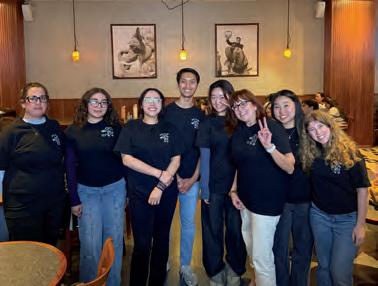
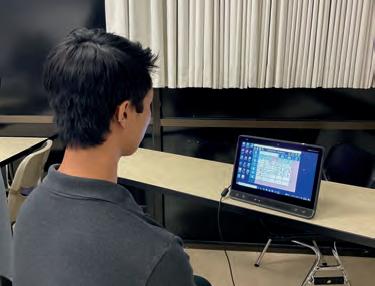
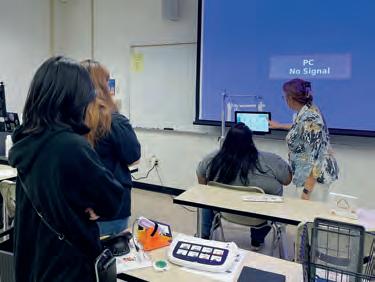
Augmentative and alternative communication may not be a term that everyone is familiar with but the impact AAC has can be life changing to those who utilize it, and a club on campus hopes to highlight these resources.
AAC is highly impactful because it can help those in the non-verbal community, assist in impairments in speech language production and people impacted by disabilities to express themselves, and increase effective communication. AAC is defined as a wide variety of different tools and techniques that can help individuals to better express ideas and emotions that they may have had prior-difficulties with through traditional forms of communication. These tools can vary from paper-based communication boards to more high-tech options such as speech generating devices or tablets with specific language applications.
The AAC Club has been active at Cal State Fullerton since Spring 2021 when a group of Communication Sciences and Disorders students came together guided by their passion for exploring how AAC can be beneficial to individuals who utilize these tools. The students realized they could fill a gap for what they determined as a lack of exposure to AAC for undergraduate students, while simultaneously providing constant-developing knowledge and potential resources that emphasize the importance of AAC.

These founding members formed the club along with the help of Dr. Lisa Erwin-Davidson, who became the adviser. Five years later, the mission of the AAC club still aims to provide an easier avenue for students to learn about aided augmentative and alternative communication and continually provide resources on the topic for the university and public.
The club hosts guest speakers each semester ranging from people who use AAC as a primary form of communication to professionals in the AAC field who discuss their research or developing tools.
Students can get involved further by joining the club during the semester and keep up to date about what the future has in store for the AAC community at CSUF.
by Diamond Hurd
The pathway to work in the music industry beyond performing can feel difficult to navigate. Job titles can feel intimidating or unclear and career paths are often shaped by gatekeepers in a constantly shifting industry. This leaves many music enthusiasts unsure how to turn their interest into a profession. Much of that confusion stems from the limited visibility of the central roles behind-the-scenes that enable music to reach audiences.
The Entertainment & Tourism Club at Cal State Fullerton aims to close that gap. Professor Waleed Rashidi has served as adviser of the student-run organization for the last 15 years and helps connect industry professionals to campus while offering work and volunteer opportunities giving students hands-on exposure and a clearer view of careers in entertainment.
“There are so many different aspects of the music industry,” said Ariana Rodriguez, fourth year Entertainment and Tourism major and ETC’s marketing director. “It’s not just singing or production – there are so many paths students can take and get involved in.”
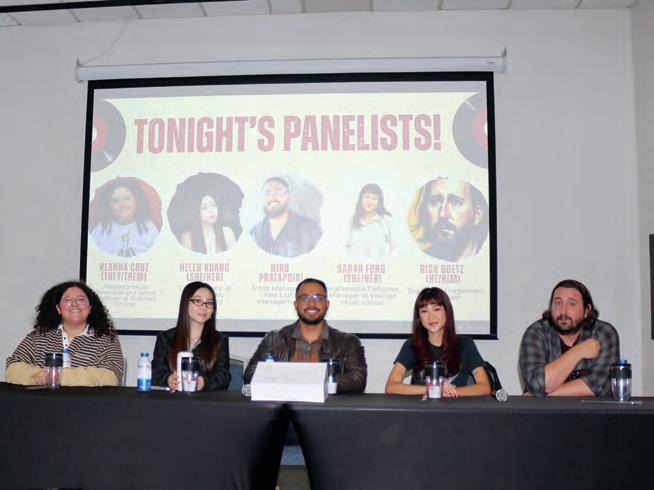
Professionals from across the music industry were invited to dissect what their work entails and share insight how students can move forward into the field at their February 2026 panel.
One of the panelists, Helen Kuang, who works in creative sync at Sony Music Publishing, described the process of placing music in film, television, and other media. Her role involves reviewing briefs and matching them with songs that best fit a scene or project. This acts as a bridge between artists and visual storytelling.
Ariana Rodriguez, Marketing Director
“I’m on a creative team. So we have a creative team and a music clearance team. The clearance team will handle all the negotiating of the rates, the approvals, while the creative sync team will receive music briefs from music supervisors or production companies,” Kuang said.
Niru Pratapgiri works in artist management at Red Light Management, where his role centers on overseeing every aspect of an artist’s career. His work ranges from coordinating tours and handling release schedules to managing social media and maintaining communication between labels, agents, and other partners. The job requires constant problem-solving, often shifting between logistics, creative input, and relationship management.
“As a manager, you’re the main point of contact for an artist,” he said. “Everything that pertains to their career is your responsibility.”
Pratapgiri’s path into management began as a musician. He studied guitar performance before becoming interested in the business side of the industry through internships in booking, A&R and music supervision. Over time, he moved toward management as a way to combine those experiences into a role that stays closely connected to the artist while guiding the broader direction of their career.
Sarah Fong works as a multimedia designer at Warner Music Group, where she creates visual content that supports artists and their releases. Her work includes digital assets and videos to large-scale promotional materials, shaping how artists are presented to audiences.
“I started off as a fangirl, deeply chronically online,” Fong said. “I was making fan edits and art for artists I liked.”
Fong’s path into the industry grew directly from that interest. She did not come from a traditional music background yet elevated her skills through creative projects online, eventually bringing that work into a professional setting. Her role now sits at the intersection of design and music, translating an artist’s identity into visuals that audiences recognize.
by Marcus McGregor
Playlists are the most recent addition to the music experience. Compiling the biggest and most loved songs for various moods, events and occasions makes the moments better than they already were. This innovation has led to the decline of the radio, seemingly taking away the importance of being a DJ. The radio, to this day, remains one of the most influential inventions the human race has seen amplifying messages to the masses through speeches, debates, sporting events and, most popularly, music.
Welcome to Titan Radio! This is a student-led radio station that offers any student at Cal State Fullerton hands-on experience in live broadcasting, show production, programming and audio storytelling.
While many campus organizations meet weekly, Titan Radio operates continuously with scheduled shows all throughout the day covering music genres, sports talk, interviews, culture segments and specialty programming. For many student hosts, joining starts with curiosity. Samantha Vo, a fourth-year communications student with an emphasis in journalism, is in her second semester hosting
on Titan Radio. Vo’s show, “Advice From Someone Who Shouldn’t Give it,” airs on Mondays from 2 to 3 p.m. When she was younger, Vo enjoyed making YouTube videos and having her voice heard – a combination that translates perfectly to her lifestyle-focused radio spot. She loves having an open mic in front of her and saying almost anything on her mind.

“It allows students to get involved in such a unique way where you aren’t given a role,” Vo said. “The opportunity can be for anyone, and just applying, getting your name down, being put on a list and learning the tools you are going to need to deliver the message that you want to share.”
In an era dominated by algorithmic playlists and on-demand audio, live student radio offers something different: personality and presence. Listeners hear real people in real time.
Titan Radio offers one of the best ways for students to get the experience they need for the broadcasting world. Long after lectures end and buildings close, the signal continues. One more show, one more voice, one more story sent out into the night for the world to hear.
Photographed by Gregory Ferraro
by Litzy Aguilar
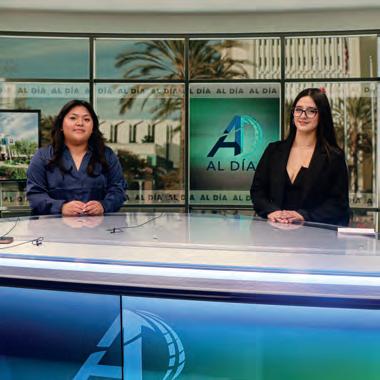
AlDía serves as Cal State Fullerton’s award-winning Spanish-language newscast, produced by students for students. This broadcast provides an essential platform for reporting on campus and community stories in Spanish while giving students hands-on experience in journalism.
Originally a course-based program, Al Día experienced a long hiatus before relaunching its first episode in May 2025. After another pause, it returned this spring semester under the guidance of adviser Andres Martínez along with Executive Producer and third-year broadcast journalism major Alejandra Chaves.
Martínez, who previously served as the adviser in 2022, remained connected to Al Día by maintaining its social media presence during the hiatus. After students expressed interest in reviving the newscast, he reached out to the communications department to offer his support. After meeting with the dean from the College of Communications, Dr. Jason Shepard and further discussions within the department, the program was given the green light to return this semester.
“I always said I’m the co-founder because I feel like that first class, everyone was part of the founding grounds of Al Día,” Martínez said. “It was very nice to have the opportunity again.”
Chaves also shared her reaction to being named executive producer and emphasized the importance of having a space where the school supports a Spanish-language broadcast.
“I was really surprised because last semester, I didn’t have the opportunity to work with Al Día,” Chaves said. “I’m grateful we are given the chance to start again, maybe not as a class but we have a studio we’re working in.”
As productions continue, Martínez and Chaves are excited to see the growth of Al Día and inspire more students to get involved.
“We’re not just playing journalists, we are journalists,” Chaves said. “We’re just showing a side of the school that has always been there, but now more people can see it.”
Anchor Jocelyn Avilés and Executive Producer Alejandra Chaves ready to deliver a Spanish newscast.
Photographed by Litzy Aguilar
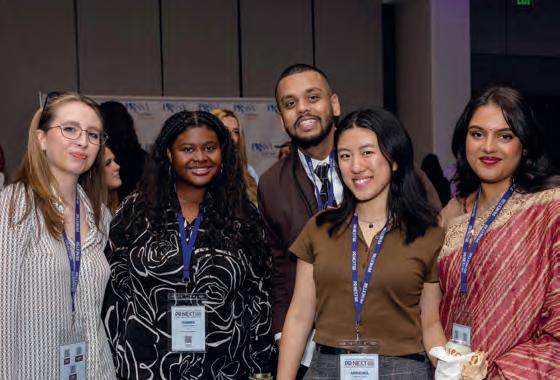
Former Cal State Long Beach PRSSA President Morgan Milobar who now serves on the PRSSA International Committee (left), San Jose State University PRSSA President Teairra Brown, Cal State Dominguez Hills PRSSA Social Media Coordinator Ayaz Rahman with Cal State Fullerton PRSSA President Angelina Wang and Titan Public Relations Co-Director Varshitha Selvarajan Uma (right) coming together at Cal State Fullerton building their network at PR Next 2026. Courtesy of Selvarajan Thiyagarajan

by Karen Wong
































“Hosting the 2026 PRSSA Western District Conference was not easy, but it was so worth it,” said CSUF PRSSA President Angelina Wang. “The CSUF PRSSA Chapter has always been committed to bringing our neighboring PRSSA chapters together and helping strengthen all of our professional development journeys.”







CSUF PRSSA Executive Board at PR Next 2026. President Angelina Wang, Vice President Grace Min, Vice President of Administration Brianna Meza, Vice President of External Communications Monét Andrade, Vice President of Internal Communications Vi Nguyen, Vice President of Professional Development Adam Atwi, Vice President of Events Ana Marin, Vice President of Sponsorship and Fundraising Esther Sepulveda-Wences, Vice President of University Relations Javier Diaz, Vice President of Outreach Mia Castro, Vice President of Finance Jennifer Leao, Vice President of Social Impact and Belonging Lucero Gonzalez and Titan Public Relations Co-Directors Varshitha Selvarajan Uma and Rigo Nava.
Executive Board Photograph Courtesy of Selvarajan Thiyagarajan
This year, Cal State Fullerton brought a network of industry opportunities directly to campus by hosting the 2026 PRSSA Western District Conference, PR Next: Ethics, AI, and the Future of Communication, from March 6–8. The three-day event gave students access to agency tours, leadership training and panels with professionals across the public relations field. The conference drew a wide network of emerging and established professionals who felt pulled toward the breadth of opportunities CSUF’s Public Relations Society of America brought together on its own campus. With access to agency tours, panels and workshops all in one place, the event created a space where chapters from across the region could step beyond their own programs and into a shared professional community.
Ayaz Rahman, a fourth year advertising major with a minor in public relations and Social Media Coordinator of Cal State Dominguez Hills PRSSA shared his experience attending PR Next 2026. Rahman felt drawn to CSUF because the conference offered a chance to step beyond his own campus and into a wider network of students exploring the same field. That sense of openness carried into his tour of Westbound Communications, where the environment matched the kind of support he hoped to find in the industry.
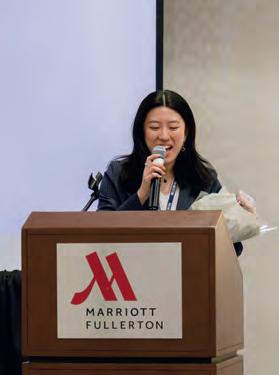
“When I became President of the CSUF PRSSA Chapter, I came in with the mindset of leveling the playing field and hosting a low-cost local conference was the perfect way to do that,” said Angelina Wang.
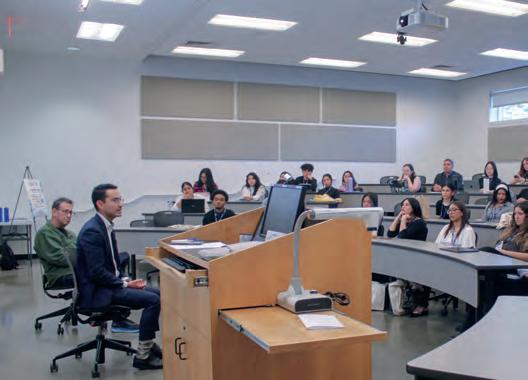
“There were around 20 to 25 of us, and Carrie Gilbreth, who is the owner of Westbound Communications, was very lovely. The whole vibe of the office was very welcoming, homey and they seemed like they were genuine people,” Rahman said. “They’re really there for you, and they really want to help you out with your experiences. And they really want to help you find the job and that niche for you.”
These growing networks gave communications students a chance to learn about the industry in a more direct and practical way than a textbook can offer, helping them to connect with professionals and build early relationships before entering the field. The conference also featured a PRSSA Leadership Summit led by PRSSA International President Alicia Caracciolo focusing on strategic communications and enhancing members’ learning experiences. The 2026 PRSSA Western District Conference also featured a range of panels with representatives from Warner Bros., the Path Project, RPA, the Los Angeles Dodgers, the Los Angeles Tourism & Convention Board and more. Khalid John Fraihat, a fourth year management information systems major at CSUF, shared why he attended the panels.
“One of the biggest reasons I came was because they were the industries I work in, and what my major is,” Fraihat said. “I am trying to get a glimpse of other professionals in different industries than my major, we had speakers from nonprofits, corporate retail and we’re having a clothing company.”
Alongside the panels, the conference also offered workshops led by industry professionals, including a session from Alzheimer’s Orange County presented by Scott Pansky. Experiences like these made the 2026 PRSSA Western District Conference a valuable learning opportunity, giving students space to apply their skills, receive feedback and engage with professionals across the field. In public relations, specialists and practitioners collaborate with people from a wide range of backgrounds and communication styles. Events like this bring those opportunities directly to students, helping them build confidence, expand their networks and see the kinds of paths they can pursue beyond the classroom. Ken Hagihara, a lecutrer in the Department of Communications, serves as PRSSA’s faculty advisor.
Lili Soto and Gregory Ferraro contributed to this article.
Panel Photography by Lili Soto
by Emily Massam
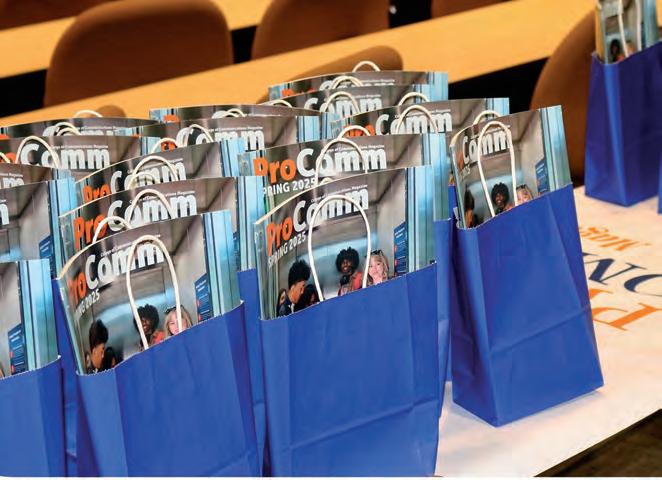
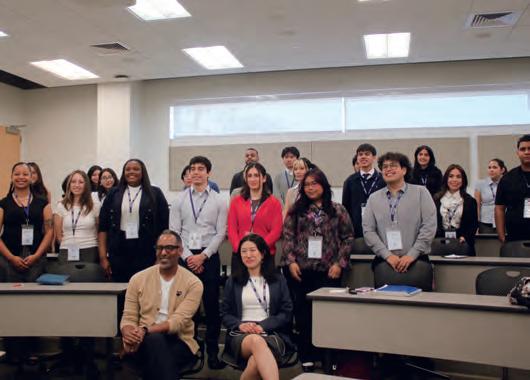
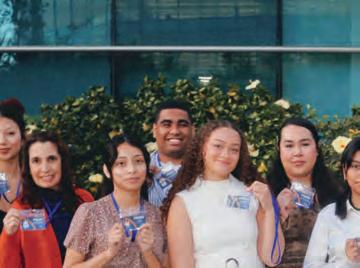
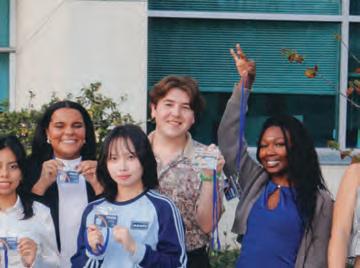
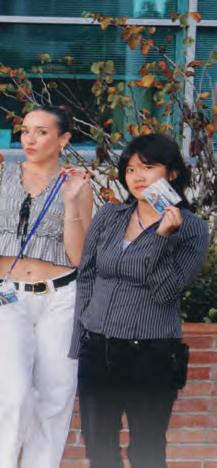
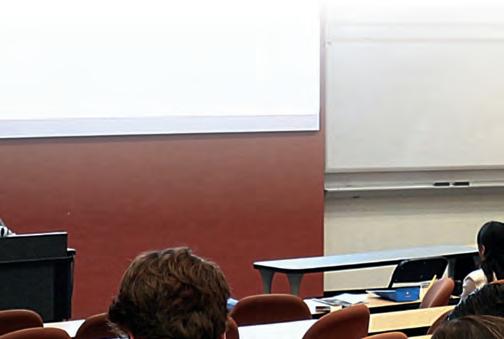
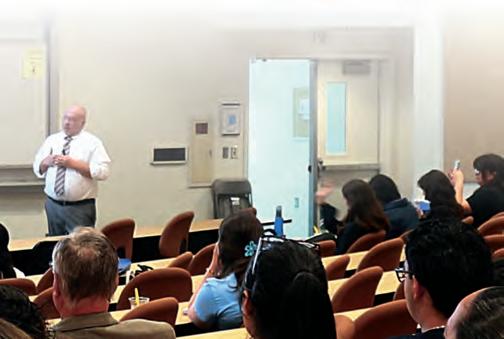
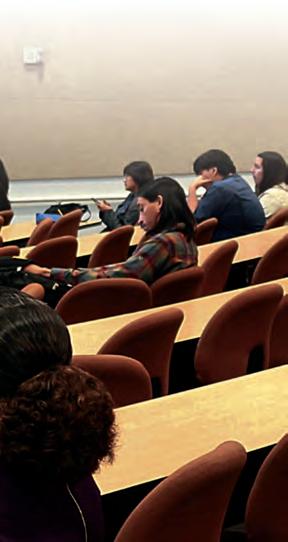
At Cal State Fullerton, student journalists, faculty and media professionals gathered for Student Press Freedom Day. The event was hosted by ProComm Magazine and organized by professor and adviser Marie Loggia-Kee. The event featured a keynote speech from Dean Jason Shepard, of the College of Communications and the Department of Communications, who delivered a timely and thought-provoking discussion on the state of the First Amendment and the evolving challenges facing the press.
Shepard began by grounding the audience in the foundational purpose of free expression, emphasizing that the First Amendment serves not only to protect speech, but to hold power accountable and sustain democracy. Referencing a landmark Supreme Court case, Mahanoy Area School District v. B.L., the dean highlighted the importance of protecting even unpopular speech — especially among students.
“America’s public schools are the nurseries of democracy,” Shepard said.
The discussion quickly turned to the modern media environment, particularly under the political influence of President Donald Trump. Shepard described Trump as the nation’s first “post-truth” president, noting his repeated use of terms like “fake news” and a broader strategy to discredit journalists.
According to Shepard, these tactics have had lasting consequences. Public trust in media institutions has declined, and journalists now face increasing legal and financial pressures. He pointed to a rise in lawsuits against news organizations — many of which are unsuccessful in court but costly to defend — as a growing concern.

“These lawsuits create a chilling effect,” Shepard explained. “Even without winning, the threat alone can impact what gets reported.”
Shepard outlined several trends shaping today’s media climate: restricted access to government officials, increased legal action against journalists and efforts to regulate or defund major news organizations. He also noted unprecedented moves, such as limiting press access to key institutions and loosening protections for journalists’ confidential sources.
Beyond legal threats, Shepard emphasized the dangers of misinformation in the digital age. With more people consuming news through social media, often without verification, false information can spread rapidly — especially with the rise of AI-generated content.

“We are in a moment where people don’t always know what’s true,” Shepard said. “That makes the traditional marketplace of ideas harder to navigate.”

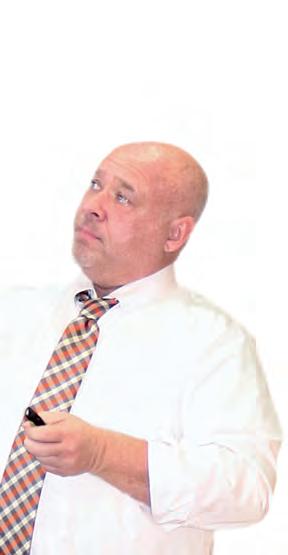

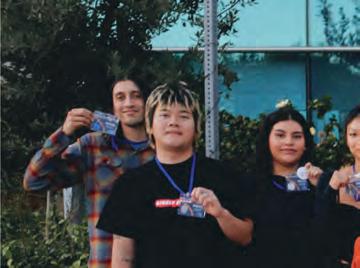



For aspiring journalists in the audience, Shepard offered both caution and encouragement. He stressed the importance of understanding First Amendment rights, maintaining ethical standards and pursuing truth despite external pressures. He also acknowledged the field’s changing nature — from shrinking newsrooms to debates over the use of AI in reporting — but reaffirmed journalism’s core mission.
“Journalism still plays a critical watchdog role,” Shepard said. “There may be fewer journalists, but the need for accountability has never been greater.”
As the event concluded, one message remained clear: the future of journalism depends on the next generation’s willingness to uphold its principles. In an era marked by political tension, technological disruption and declining trust, Student Press Freedom Day served as both a warning and a call to action. For CSUF students, the takeaway was simple but powerful — protecting press freedom isn’t just a professional responsibility; it’s essential to preserving democracy itself.

by Eddie Ursua
The Daily Titan is a student-run publication that was first formed in 1959. The first issue in print of the Daily Titan was published in 1960 and has had a presence online since 1992. Professor Frank Russell serves as the faulty editorial adviser and Renee Tuzee, a full-time lecturer, serves as the faculty advising adviser. COMM 471 is the capstone course on campus the Russell lead which works in tandem with the newsroom and introduces student journalists to hands-on experience working as a Daily Titan staff writer.
Capstone courses at Cal State Fullerton can offer some of the most important and rewarding learning opportunities that students can participate in, and for journalism majors in the Communications Program at CSUF this specific course gives these students the opportunity to work as part of a daily news publication. Besides simply writing the story, aspiring journalists research their topic, reach out to potential sources for interviews on the subject and finally compile all the info into a concise format that aligns with Daily Titan formatting and style. They also participate in weekly assessments that will help them explore topics ranging enhancing their understanding of journalism.



Being thrust into a fast-paced and detail-oriented environment like the Daily Titan may be daunting to some students, but current Editor-in-Chief of the 2025-26 academic year, Jayden Lovelady, explained how these students can be successful when adapting to the Daily Titan atmosphere as well as touching on her journey into the world of journalism. Lovelady first started as a freshman at the Daily Titan in 2023 as a lifestyle assistant before eventually moving into the roles of lifestyle editor and opinion editor. For students who might be new to writing for a news publication, Lovelady offers some useful advice to help them get the ball rolling and what to expect during the editorial process in the newsroom.
“It’s a very communication heavy job,” Lovelady explained. “Collaboration and understanding that back and forth sort of environment where a lot of people are working on your work along with you, or talking to you about your work, is not a reflection on your work quality or your work as a journalist, but more so the editorial process.”
Lovelady also shared some insight as well on what drives her and her fellow editors to produce high-quality work under the banner of the Daily Titan.
“We are in a current political climate that is not too fond or accepting of watchdog journalism, so I think the motivation is to still want to show up for your community and for society in that way – being a source of information or someone to further access to the truth and to awareness in your own community.”

The Daily Titan isn’t exclusive to journalism students, any student interested can apply and see if working in the newsroom might be a useful resource to help them dial in and improve their reporting skills.
“Everybody deserves a place in journalism, even people who don’t have journalism majors,” Lovelady clarified. “I think journalism is such an integral role in our society, I think everybody deserves a seat at that table, or at least a chance to get a seat at that table.”
by Cindy Nieblas and Emily Massam
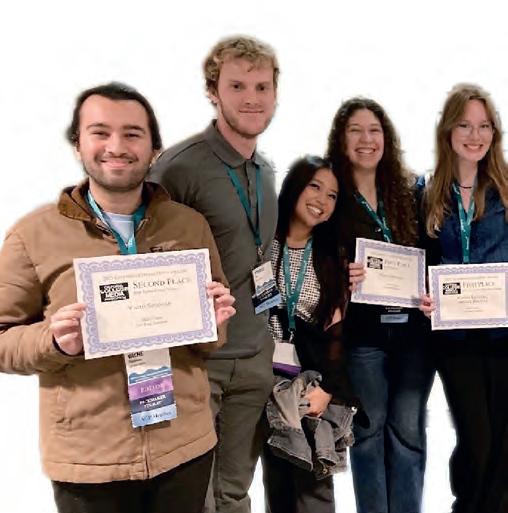
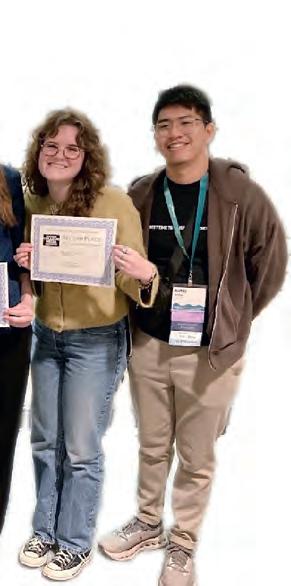
OnMarch 5-7, The Daily Titan attended the Associated Collegiate Press convention, in San Francisco. Michelle King and Raniel Santos both fourth-year journalism majors at Cal State Fullerton, were two of seven students attending the trip.
Michelle has been a part of The Daily Titan for over two years serving previously as the news editor, and has recently assumed the role of associate managing editor. She reflected on the meaning of these awards for the staff as a whole.
“Sixteen is a really an exceptional amount for us, so we’re very proud of all the work that we’ve done, and of our whole team,” King said. “It’s a collaborative effort even if it’s one person’s name on the certificate or the award, it’s really everyone in the newsroom who got that award.”
The San Francisco trip offered more than recognition for Santos—it expanded his perspective. Meeting student journalists from across the country inspired him to think more creatively and push the boundaries of storytelling.
“San Francisco is such a massive city, so there’s a lot to do, a lot of culture to take in, and it’s always fun to get to meet people from other campuses all over the country, to get different perspectives on all different kinds of journalism,” Santos said. “There’s different things going on, especially in our current times and every campus is cultured and has something unique to it, so it’s interesting to see how people tackle that.”
Currently, King is a Tracy A. Wood Memorial Fellow at the Voice of OC. This fellowship aims to promote women in journalism.
“The articles that I’ve written at The Daily Titan are where I got my start, where people had faith in me and what really threw me into journalism,” King said, “Without that I would never be where I am today, working with the voice of the OC and working with other publications – even on campus – it’s just been invaluable to work with Daily Titan. It got my foot in the door.”
From the newsroom to the national stage, The Daily Titan’s success shows how students grow when they’re given real responsibility and the chance to put their work out into the world.
Whether they’re learning the pace of the newsroom or representing CSUF among student journalists from across the country, the experiences reflect the same steady effort and commitment that define their work.

First place California College Press award-winning illustration by Head Illustrator Juno Cartwright for Gizelle Medina’s opinion article “Armored with academia, education defends democracy.”
Artwork Courtesy of Juno Cartwright and The Daily Titan
Editor-In-Chief Jayden Lovelady (left) and Managing Editor Sara Leon (right) of the Daily Titan after recieving the “Best of Show Award” at the Associated Collegiate Press Convention.
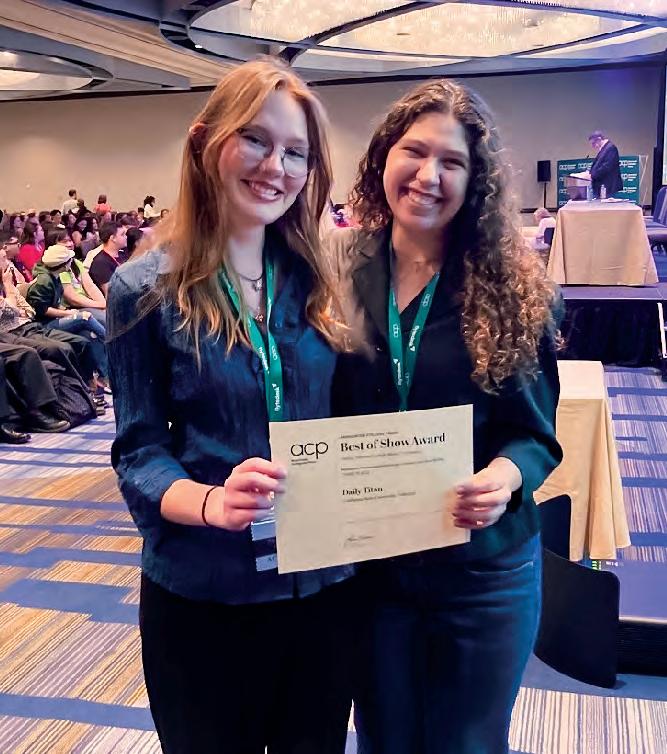
by Gregory Ferraro
Agroup of second year Speech Language Pathology graduate students from Cal State Fullerton traveled to San Francisco for the California Speech Language Hearing Association Convergence Conference and College Bowl competition. Four students competed and several classmates attended as cheerleaders with signs and pom poms. The trip brought the cohort together in a setting where the work of the past two years showed up in real time.
Dr. HyeKyeung Seung, chair of the Department of Communication Sciences and Disorders, said watching the students compete gave her a clear sense of their growth.
“I was amazed watching them,” Seung said. “Their growth and their enjoyment throughout the convention. Spending time with them outside the classroom was a very different experience.”
For the competitors the event was the first time they had answered questions under timed conditions in front of a statewide audience. Lauren Bagdonoff said the moment felt like a direct reflection of their training.
“Being on that stage felt like everything we have learned finally connected. Every class and every clinic hour and every late night study session,” Bagdonoff said. “Our hearts were racing the whole time but it made us realize how prepared we actually are.”
The team placed third against ten universities. They said the ranking mattered but the experience of competing mattered more. The questions moved quickly across topics and each one reminded them of specific lectures and clinical moments. Marissa Montanez said the range of questions made the field feel larger than it does in day to day coursework.
“All of our minds together were better than just one,” explained Montanez, “Every question reminded me of a different professor or class and it showed how broad our field is and how well we have been prepared at Cal State Fullerton.”


“Everyone had different strengths. There were questions only one of us knew and without that person we would not have gotten it.” She said the support from their classmates helped steady them. “Our cohort showed up with pom poms and signs and it felt really heartwarming to look back and see all of them there. My health tracker even thought I was exercising because my stress was so high during the competition.”
The competitors prepared by meeting in their hotel rooms to run through practice questions. They said the studying felt collaborative rather than stressful. Each person brought something different and the group leaned on that. For some of them the moment connected back to earlier years in the program. Several had attended the convention as undergraduates and remembered watching the College Bowl from the audience. Bagdonoff said the shift felt surreal. Last year she watched the competition from the crowd. This year she was answering the questions. Montanez said she never expected to be on stage when she first saw the event as an undergrad.
Their classmates in the audience said the competition was just as intense from their side of the room. They brought Titan signs and pom poms and reacted to every correct answer. Jazareth Alanis Ponce said she could tell when the team had the right answer before it was announced.
“Watching from the audience I could tell when our team got a question right before it was even announced. They would do these tiny celebrations and I would grab my pom poms and start cheering. I was so proud of them.”
Jessica Tran said the tension built as the rounds went on. “I have never been so nervous just watching something. When we saw they were tied for second we all screamed louder and shook the pom poms harder. Anything to push them forward. They did an incredible job against ten teams.”
After the competition the group met with faculty for a debrief. Students said it was one of the most valuable parts of the trip because it gave them space to talk openly about the profession and the transition into clinical practice. They ended the night with dinner and karaoke which gave the cohort a rare chance to relax together after months of clinic work and classes.
The competitors said the team dynamic shaped the way they handled the rounds. Each person had areas where they felt confident and areas where they relied on someone else. Emma Rose Gregory said the balance was clear as soon as the questions began.
After returning to CSUF, the group said they felt more confident in their training and more connected to their cohort. The College Bowl did not just test what they knew, it showed them how far they have come and how ready they are for the next step.
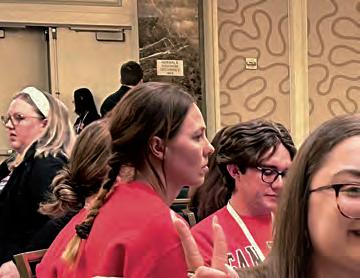

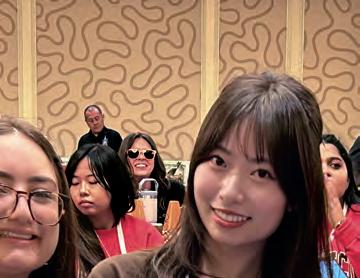
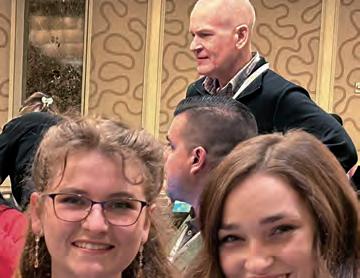
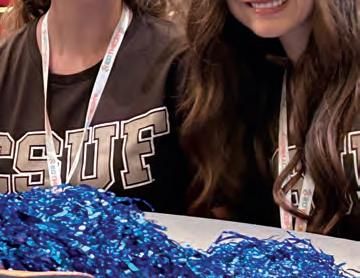
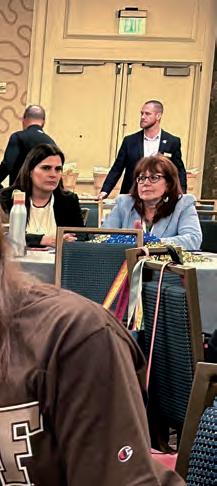



Cal State Fullerton’s on stage College Bowl competitors Marissa Montanez (left), Cheryl Jing, Emma Rose Gregory and Lauren Bagdonoff (right) sharing a second together before the competition heats up.
Photography Courtesy of HyeKyeung Seung

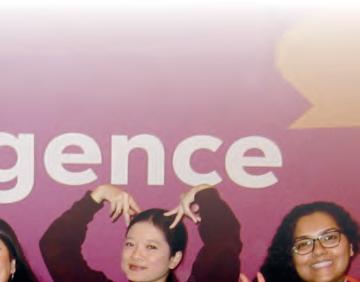
The entire group of second-year Speech Language Pathology students that attended the 2026 California Speech Language Hearing Association Convergence Conference.

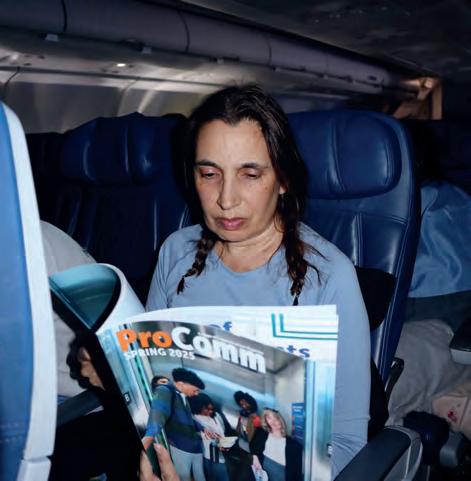
Marie Loggia-Kee also brought ProComm all the way to CMA! PhotographedbyGregory Ferraro
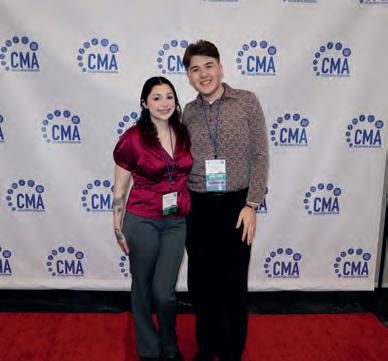
Leah Korenberg and Gregory Ferraro in between creating at the CMA!
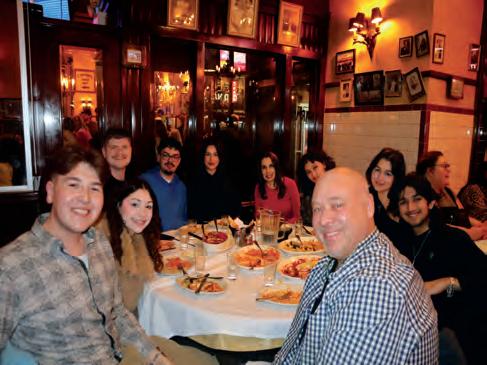
The group enjoyed a family style dinner with Dean Jason Shepard at Carmine’s in Times Square after his presentation.
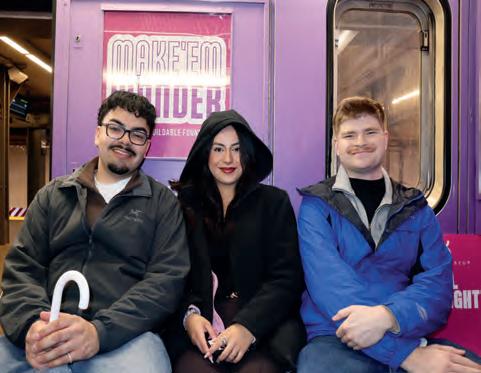
Sergio Gonzalez, Diana Vilchis and Colin Costigan adventuring The Big Apple. Photographed by Gregory Ferraro
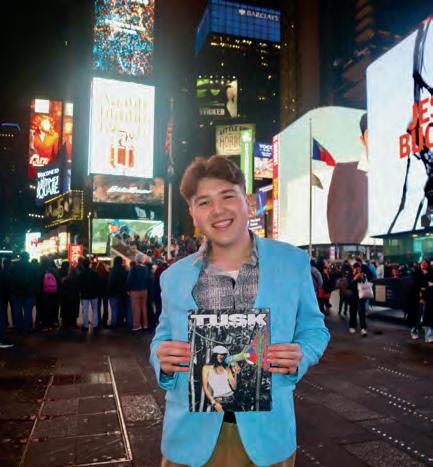
Gregory Ferraro spent the Fall 2025 semester filling Tusk Magazine with photos now it’s part of the picture. PhotographedbyLeah Korenberg
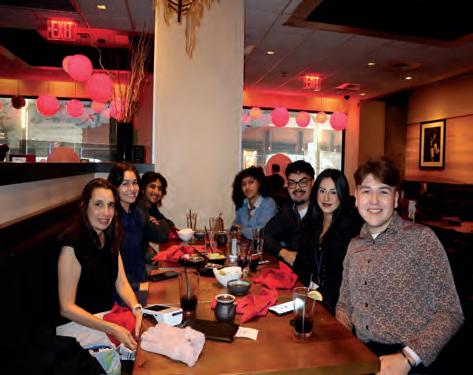
Photographed by Colin Costigan

The students sharing brunch in Times Square with Marie Loggia-Kee.
CSUF Creators Conquer the College Media Conference
A Personal Story by Gregory Ferraro
The College Media Association Convention in New York City gathers journalism majors from across the country into the center of the media world, offering a week of panels, critiques and newsroom tours that challenge students to think bigger about their work. Representing Cal State Fullerton as the Creative Director of Tusk Magazine and as a fourth-year Communications: Journalism major with Digital Media Certification and minors in Philosophy and Business: Entertainment and Hospitality — I felt the power of that environment immediately. It was the kind of setting that makes you reconsider the scale of your own ambitions and the lasting meaning of your work.
Even the Marriott Marquis set the tone for the week. Its lobby rose in glass and gold, buzzing with student journalists carrying cameras, notebooks and press badges. The elevators shot through the atrium like flashes with entire levels of the vast hotel dedicated to students’ work, and for a moment while checking in I stood still, taking in the movement and energy around me.
By the time the convention settled into its rhythm, the experience became less about the setting and more about the people I shared it with. Most notably was Leah Korenberg, my best friend of ten years and someone whose journalism and digital media journey has run parallel, but unique, to mine with her also receiving a minor in Anthropology. As a Social Media Producer, Writer and Photographer for Tusk Magazine and through her immense work with The Daily Titan during her fourth year at CSUF, Leah arrived in New York with a portfolio shaped by her dedication and need for creation, which set her up for this chance.
“An event like this just demonstrates that the university really cares about advancing our careers and is dedicated to supporting students that are passionate about journalism,” Leah said.
We spent the week moving through the city together, experiencing something that we could’ve never imagined when we met in seventh grade. From then to now our shared passion drives us and Leah talked about what this trip has meant for both of our growth.
Background Photographed by Gregory Ferraro
“At the college media conference, there were a lot of networking opportunities that we experienced together – we had the chance to meet journalists from all over the country and I was also able to tour The New York Times,” Leah said. “I’m really grateful for that opportunity because it gave me insight on how I’m able to advance my journalism career and what steps I need to take to get to where I want to be.”
Colin Costigan, Sports Editor of The Daily Titan and a fourthyear Journalism major, also toured The New York Times and captured the excitement of seeing journalism in the making.
“I really enjoyed my tour of the New York Times,” Colin said. “It was just really cool to see how an actual newsroom operates – It was just on a huge scale.”
For Diana Vilchis, Tusk Magazine’s Senior Editor and Photo Editor and a fourth-year journalism major with a minor in marketing, the standout moment was her visit to the independent non-profit newsroom, ProPublica, a stop I also attended alongside her group.
“I had speakers that talked about social media and photography, which is what I’m doing. So I thought it was very interesting,” Diana said. “You got that Q&A and you just got to talk to them and ask them questions – we had like 30 minutes for each person, so it was just very interesting.”
The staff of Tusk Magazine also got to attend a critique of their recent release. Leah shared how this helped her understand how to perfect her future work.
“The critique of the magazine really helped me understand that a body of work needs to be consistent,” Leah said. “It’s really important that everyone that’s a part of the magazine understands the shared vision, so we’re able to execute a consistent theme.”
Loggia-Kee. The concept behind the cover was something I’d been shaping for months — a single image that brought together multiple forms of communication at once, visually connecting every corner of our college in one frame. Watching the shot finally line up in the middle of the city felt like magic. It was a vision I’d been carrying since before I became ProComm’s Managing Editor and Photo Director.
As the trip came to a close, Leah also touched on how these opportunities gave us a taste of the world we’re building through our hard work.
“Being able to attend the CMA conference with my best friend was one of the most exciting and rewarding experiences because we were able to explore New York City together,” Leah said. “We also did a lot of exciting activities including being front row at ‘Death Becomes Her,’ which became our favorite Broadway performance.”
Leaving New York, I felt a shift, not dramatic, but grounding and solidifying. All of these experiences, the critiques, the panels, the newsroom tours, the conversations, the moments of recognition – all invigorated me for the role I stepped into as Managing Editor and Photo Director of the second edition of ProComm Magazine. New York didn’t just show me the future of journalism. It showed me the kind of editor, collaborator and storyteller I want to be as I helped shape this issue and as I move through the world.
Leah Korenberg contributed to this story.

I also planned, directed and shot the cover while we were in New York, fitting it in before dinner on our last night with the dean. After the ProPublica tour, we spent the afternoon downtown and stopped to look out at the Statue of Liberty before heading back for the shoot. The group managed to make it to Times Square with our props and coordinated Dean and
All of the travelers went to dinner on night two, including Adviser Marie Loggia-Kee (left), Co-Outreach Director Nicollette Toher, Managing Editor Demiana Ghobrial and Art Director Kabeer Kansara of Tusk Magazine, Sports Editor Colin Costigan and Digital Managing Editor Sergio Gonzalez of The Daily Titan, Senior Editor and Photo Editor Diana Vilchis, Creative Director Gregory Ferraro and Social Media Producer, Writer and Photographer Leah Korenberg of Tusk Magazine (right).
Group Photograph Courtesy of Emily Wilson, Former Daily Titan Editor-in-Chief and CSUF Communications Alum make it to Times with our props and coordinated the setup with Dean Jason Shepard and our adviser, Marie Communications











Photographed by Nicholas Wire

by Litzy Aguilar
Cal State Fullerton communications students applied their journalism and reporting skills through a three-week study abroad program, covering stories in Italy during the 2026 Milano Cortina Winter Olympics. Building on the success of the 2024 Summer Olympics trip in Paris, where 26 students reported from the world’s biggest sporting stage, 22 aspiring journalists experienced firsthand the sights, sounds and stories of one of the most prestigious sporting events in the world.
Gayle Jansen Brisbane, associate professor in the Department of Communications and former sports anchor and reporter with 20 years of experience in television news, organized both the Paris and Milano Cortina programs. After witnessing the success of Paris and seeing how it positively shaped students’ growth and career paths, she shared a key moment from the 2024 Summer Olympics when she used extra funds from Titans Give Day to buy tickets for students to attend the women’s gold medal soccer match.
“It was such an exciting game, and I said, ‘Let’s all meet at Gate B at the end of the match so we can all be together and celebrate,’” Brisbane said. “I remember everyone’s jumping around, ‘USA! USA! USA!,’ and just standing back and it was just like the perfect way to just wrap up three magical weeks in Paris.”
From coordinating hotel logistics to managing student recruitment, Brisbane described the planning process as both extensive and detailed. She worked closely with the study abroad office and a trusted travel vendor from the Paris program to book flights and lodging, while overseeing student selections and the Instructionally Related Activities funding applications more than a year in advance.
To ensure the trip ran smoothly, she enlisted support from student leads and Arizona State University Faculty Associate Robert “Bob” Young, delegating roles such as website management and daily logistics.
“Once we were there, it felt like things were moving along and it wasn’t all falling on me,” Brisbane said. “I decided I was going to have at least two or three student leads so that they could take some leadership role, and having the three leads and Bob there was definitely really helpful.”
From the moment the group arrived in Milan, each student applied the skills they had honed in the classroom to real-world reporting.
Jenny Guzman, fourth-year journalism major with a sports media certificate in progress, said this program helped expand the avenues she can pursue in journalism, particularly in reporting.
“A big part of what I report on always touches here and there on heritage,” Guzman said. “I do try and approach a majority of my projects through a heritage or cultural angle, because that’s what I lean into the most.”
Immersing herself in Italian culture and language on-site, Guzman covered events like alpine skiing in Cortina and interviewed family members of the U.S. women’s hockey team in Milan.
“I definitely had my eye out for this game, it was so particular, USA, our home country, versus the host country, Italy,” Guzman said. “For these two women teams to compete with each other, I thought would be a unique angle, especially to highlight women in sports. That’s my approach, that’s how I get involved in sports.”
David Martinez, a third-year journalism major and assistant sports editor at the Daily Titan, also covers the U.S. Men’s National Team and Los Angeles Football Club for The Sporting Tribune. He highlighted one of his favorite packages he produced abroad regarding the opening ceremony and was one of the students reporting live for the Milan broadcast.
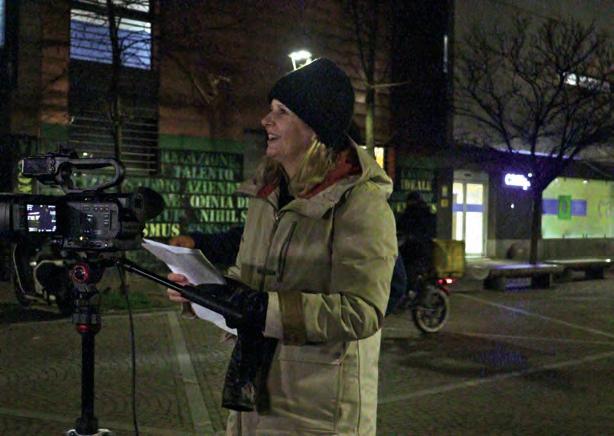
“As someone who has been so sports-centered throughout my career, I never expected to cover the hard news aspect of a sporting event,” Martinez said. “This program allowed me to refine and showcase my own storytelling ability, giving me multiple reps and content for my reel to show potential employers.”
Gayle Jansen Brisbane,
Photographed by Litzy Aguilar
Nicholas Wire, a fourth-year communications major with a journalism concentration, highlighted one of his favorite pieces he wrote while in Italy. He interviewed players and coaches from the Milano Rams, as well as athletes from the French and Irish leagues while exploring how the American Football is thriving across different countries.
“Being able to write a story about how football has evolved into different continents and different countries was really cool – and being able to talk with these players – that’s not something you would’ve thought of writing about when you go to Milan for the Olympics.”
Wire applied skills he developed at the Daily Titan, from on-the-spot interviews to storytelling for international audiences, allowing him to confidently connect with athletes and fans while producing polished, timely content.






“The work that I’ve done for the Daily Titan and other newsrooms have led into that, so It was a big honor to be able to be sent somewhere with our professors that are both established in their field and well respected,” Wire said. “Them taking us and mentoring us was a great opportunity and I’ve never been out of the country before so it was a big step that I am very honored, humbled and proud to do.”






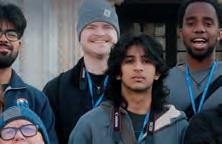





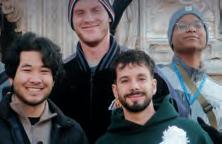














by Mandy Phu and Karen Wong
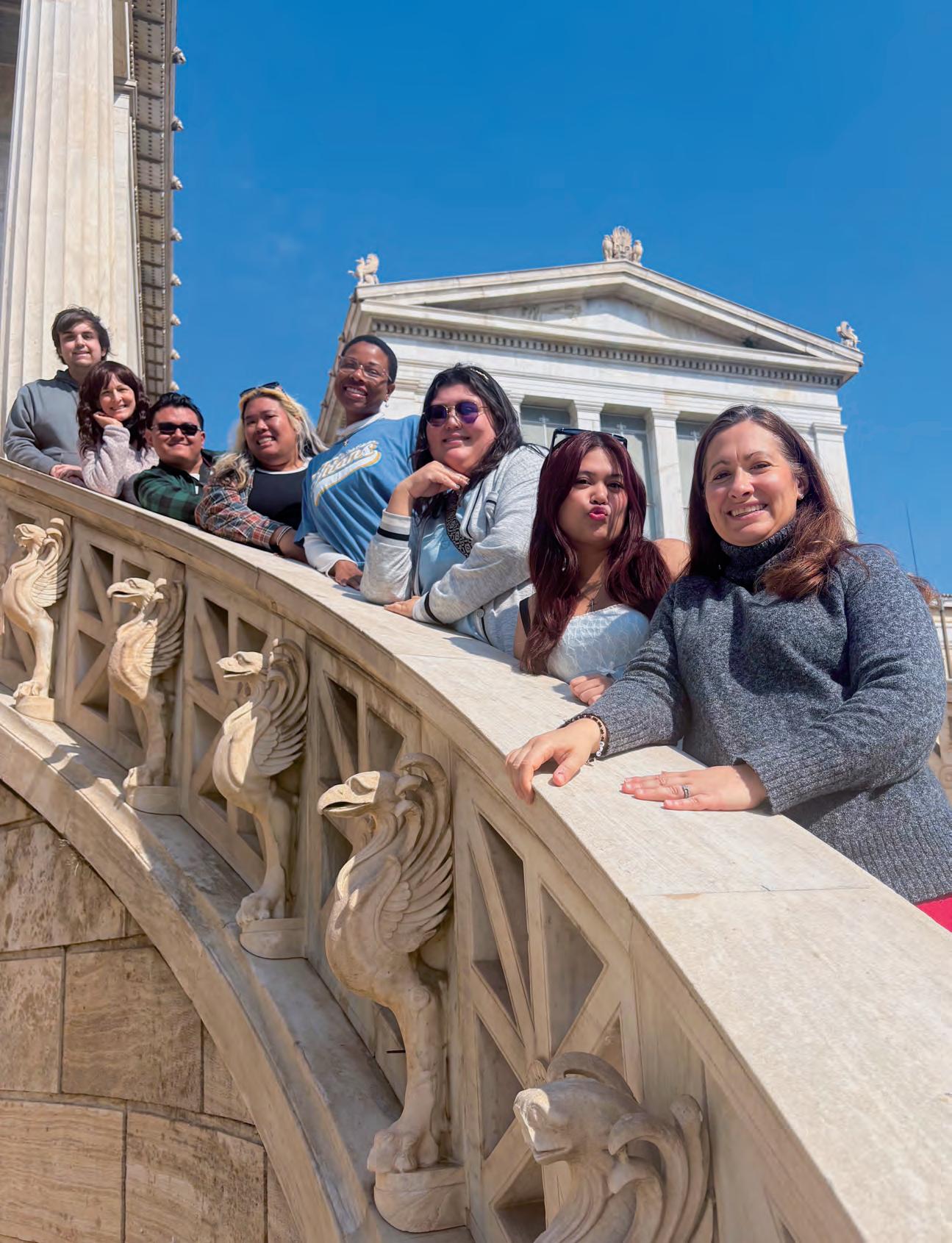
Head Coach of Individual Events Zachary Parkinson (top-left), Collette Blumer, Evan Andrade, Alyssa Olaes, Eve Dowdell, Graduate Assistant Stephanie Jo Marquez, Raven Rayos and CoDirector of Forensics Dr. Erika Thomas (bottom-right)
Cal
State Fullerton’s speech and debate team kicked off their tournament in Athens, Greece, competing against students from all over the world in the birthplace of public debate. The event, formally known as the International Forensics Association tournament, or IFA, rotates to different countries each year, bringing together universities for a truly global exchange.
This year’s setting offered students the chance to compete on an international stage, meeting other competitors and judges while navigating a setting far beyond their usual circuit of neighboring universities. The Speech and Debate team of Cal State Fullerton presented a wide range of thoughtful and diverse topics, adding their voices to a field shaped by different cultures, perspectives and styles of argument.
For Raven Rayos, a third-year political science major, the opportunity to compete internationally was both an exciting and nerve-wracking prospect. She has been competing for over a year and reflects on earning sixth place, a moment where Rayos felt her hard work became rewarding.
“It was a really good experience overall,” Rayos said.“Normally we kind of keep to the California schools and anyone who really comes to visit, but this was such a wide, different pool set.”
Stephanie Jo Marquez, graduate assistant and coach of the speech and debate team highlighted the opportunities that the program offers allowing students to compete in tournaments, travel, learn from others, gain experience and network with other debate students.

preparations stretch across the entire year and is evident in how they perform on the international stage.
”I really want to make sure that these kids are getting recognized for their hard work,” Marquez said. “They’re winning awards, they’re representing CSUF and I think they deserve to be recognized.”
Beyond competition, the trip gave them cultural experiences they had never encountered and helped strengthen their team bonds.
“Some of us had never even gone to Europe like myself. So to see a whole new world and a whole new culture, it was really fun. And I’m glad that it was shared with them,” Rayos said.
Another cultural moment for the team came during their visits to Greece’s historic sites, where they walked through places like the Acropolis of Athens, the Panathenaic Stadium, the Catacombs of Milos, the Lyceum and the National Garden. Alyssa Olaes, a third-year Human Communication major, said those shared moments helped the team grow closer and strengthened their bond.
“We were able to talk to people of different cultures, and even just interpersonally between the team, we were able to develop a sort of dynamic that we didn’t have before,” Olaes said. “And we were also communicating with other teams from different parts of the country, which we don’t really get to do all that much here.”
“It’s an honor to represent Cal State Fullerton globally and interact with teams from across the world.”
As the tournament wrapped in Greece, Marquez said she saw how much effort the students put in long before stepping into a competition. She emphasizes that their
Photography Courtesy of CSUF Forensics Team






Olaes said the trip also reminded her how far steady effort can take students in the College of Communications. She said the chance to compete abroad came from showing up, putting in the hours and trusting the process.
“Just keep going with what you’re doing,” Olaes said. “You can really do anything you put your mind to, as long as you’re trying really hard.”

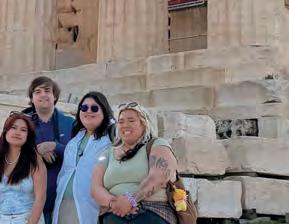






For some students, creativity does not end when class is over.
While assignments provide structure, passion projects offer a chance to grow, experiment and have the freedom to work on the skills that matter most to an individual.
For fourth-year communications student with a concentration in public relations, Karen Wong, creating outside of class began during a period of transition.
“It was this year during summer 2025,” Wong said. “I just transferred from my community college and needed something to do.”
Wong used to manage fan pages and blogs dedicated to her interests, but eventually took them down. After transferring to Cal State Fullerton, she realized she missed having a digital space of her own, so Wong started a TikTok account to advertise products she was selling on Mercari. When one of her posts went viral, both her page’s popularity and her sales on Mercari increased, giving her the motivation to continue.
As her online presence grew, Wong moved away from promotional posts and toward more introspective works, such as vlogs and edits. One example was editing a video of her favorite K-pop group, Loona, a project she worked on simply because she wanted to.
“Creating for myself instead of a grade gives me a sense of freedom,” Wong said.
She discovered that the creative process was more enjoyable without the pressure of a deadline or a criteria. Despite juggling work and school, she continues to publish consistently, posting two to three times a week and sometimes up to four.
“I always carve out a small section of my life and day to my account,” Wong said.
Wong sees more than just content when creating outside of class. It’s about her identity.

by Mandy Phu
“I believe it is important as it fosters my sense of creativity and sense of self,” Wong said.
For other communications students, creating outside the classroom can also mean collaborating with other students on larger creative projects. Cassidy Apolo, fourth-year communications student also concentrating in public relations, began creating outside of class after meeting fellow students during a spring internship with the Newport Beach Film Festival.
Through the internship, Apolo connected with three other people, Logan Shust, Kylee Viayra and Jason Wong, who were organizing a music video project for the summe. Apolo was approached with an invitation to contribute her fundraising experience to help produce the project.
“At the time, I didn’t really know what I was getting into because I’m a PR major, but I thought I could help with entertainment PR,” Apolo said.
The group produced a music video for an up-and-coming artist named El!jah and his song “settle4tonight.” While team members worked on shooting and storyboarding the video, Apolo helped by conceptualizing the project’s messaging and outreach. As the project went on, the crew found they loved working together and wanted to continue collaborating, eventually establishing Fools Story Studios, a production collective born from that initial experience.

Photography Courtesy of Cassidy Apolo
“When you make something creative, you have to be okay to be a fool. You kind of look foolish when you make creative stuff, right?” Apolo said.
Since starting Fools Story Studios, Apolo has overseen a wide range of projects, from music videos to short films and even fundraisers.These projects helped her learn how to plan strategically, use social media to promote and be a good mentor.
For students like Wong and Apolo, creating outside the classroom is more than making time go by. Opportunities like this allow students to pursue their own passions and put their own ideas to the test.
Karen Wong, Photographed by Mandy Phu
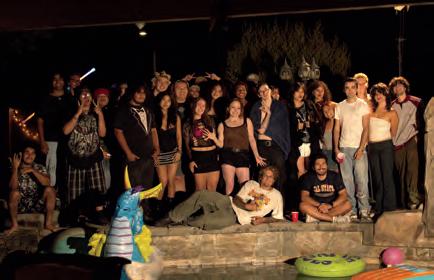
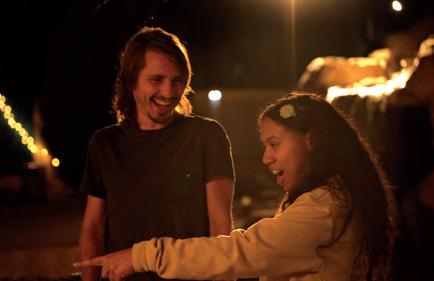
by Jade Rodriguez
Disney Aspire is a program tailored toward employees and cast members who are investing in their dreams through education. Rj Casas is one of those cast members whose experience with the Disney Aspire Program has brought joy and opportunity during his time at Cal State Fullerton.
Casas is studying communications with an emphasis in advertising, so balancing his work and school can be difficult. With the help of the funding provided by the Disney Aspire Program he is able to stay focused, manage his responsibilities and succeed.
Luckily, communications is one major that offers 100% tuition coverage upfront through Disney Aspire. For some majors and universities there is around a $5,000 per year cap on available funding.
“Dreams within Reach,” is the goal within the Disney Aspire program, which maps out details for cast members of over 100 programs so that they can pursue their education and make magic. There is a long list of program and degree options and Communications is one of those. The financial assistance through this opportunity provides Casas with some relief in his academic pursuit.
“That’s definitely a big weight off my shoulders knowing that I don’t have to carry student loans outside of college,” Casas remarks.
This opportunity that helps current employees is also helping current CSUF students with required books and fees that are covered by the program. Gaining access to networking and career development, the Disney Aspire Program becomes beneficial to communication students as the program invests in their future line of work.
Casas acknowledged how Disney is very flexible about accommodating toward student schedules with a system that allows them to give away shifts or pick up any if needed.
“I did that just this Monday,” Casas said. “I gave away one of my shifts, so I’m able to do homework today. Very easy,” Casas said. “They make a Facebook page for us with our other cast members that are lifeguards to give our shifts away –and they always accommodate school.”
About one in four applicants choose to apply at Disney for the Disney Aspire Program, but Casas was not one of those.
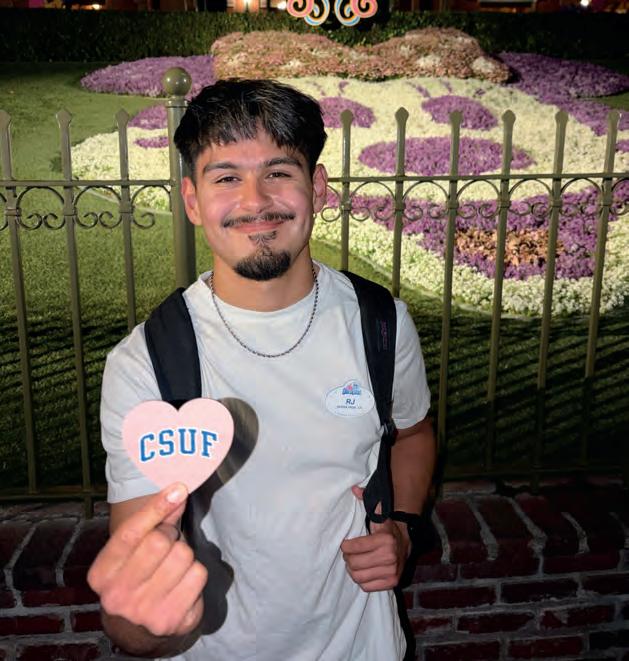
“I think it’s a big reason why I will be staying at Disney. I did not know about it before, but the pay is very competitive. The benefits are great. Along with the good benefit of, you know, getting my school paid for,” Casas describes.
Students applying to Disney are now getting informed about the Disney Aspire program. Learning about those benefits may be a reason some students choose to work with the company.
The Disney Aspire Program is also a valuable resource for employees who need guidance to pursue their dreams, with coaches available who help guide students step-bystep if needed. The program is not a restricted opportunity that only offers to select cast members. This investment program has over 70,000 eligible cast members and employees, and more than 11,000 of those who are currently enrolled in the program.
CSUF students don’t have to look far to find support for their educational dreams. Sometimes, the help comes from just down the street – the Disneyland Resort.

On any given weekday, Alyssa Lowry, a fourth year communications major with a concentration in public relations, can be found driving the freeway before sunrise, iced coffee in hand, rehearsing poses in her head. By 8 a.m., she’s on set in Los Angeles. By evening, she’s logged into a three-hour night class at Cal State Fullerton – camera on, notes open, planner beside her like a lifeline.
Balancing college and a fast-growing modeling career isn’t a side hustle—it’s a full-time commitment. Her weeks are carefully choreographed, her Google Calendar color-coded, and her planner non-negotiable.
Alyssa often travels to LA two to three times a week for castings, shoots, and fittings. Commuting from North Orange County often means long drives, unpredictable traffic and Zoom classes taken from parking lots. During her first semester of in-person classes, she scheduled all her courses at night after full days on set.
by Emily Massam
a background actor, she injected humor into her role by pretending to sleep.
“Then it came on,” she continued, “and I was literally fake sleeping on national television.”

After signing with Wilhelmina and spending two months in Mexico, she began a semester mid-flight. The first day of school? In the air. When she informed a professor about the opportunity, she was surprised by his response.
“He told me, ‘This is a once-in-a-lifetime opportunity. Take it.”’ So Lowry did, while remaining on track to graduate on time.
One of her most surreal experiences came during a commercial shoot for the prebiotic soda brand Poppi, featuring Charli XCX and Rachel Sennott, that aired nationwide after the Super Bowl halftime show in 2026. Originally cast as

Being part of the production and witnessing how major campaigns come to life was unforgettable for Lowry. While social media portrays modeling as effortless, she is quick to challenge that perception. Early call times, constant pressure, and harsh criticism are part of the job.
“It’s a double-edged sword,” Lowry said. “You can go from being torn apart in a casting to booking something incredible the next week.”
Despite industry pressures, she has learned to separate rejection from self-worth despite her experiences.
“School teaches you networking. Modeling teaches you confidence,” Lowry said.
Initially, Alyssa didn’t see the connection between her communications degree and modeling. Now, she considers them inseparable. On set, she networks with photographers, stylists and makeup artists while learning to pitch herself and represent her personal brand. After graduation, she plans to pursue a master’s degree in public relations while continuing to model.
“The craziest thing isn’t your dream. The craziest thing is not going for it.”


Photography by Gregory Ferraro





Fashion is often seen as just clothes, trends and styles, while communication is often thought of as talking, writing and using media. However, fashion is a form of communication on its own.
At first glance, people notice what we wear. Our clothes can quickly show others our identity, mood, job, culture and values – without us saying a word. In communication studies, this is called nonverbal communication — sharing meaning without using words.

In the professional world, fashion is also tied to branding and is used strategically. Businesses focus heavily on how their branding looks and feels to customers, emphasizing logos, colors and high-level design. With social media today, this connection between fashion and communication is even stronger. Visual content is flooded to everyone online, with outfit posts, curated feeds and fashion-focused visuals all telling an intentional story and creating identity.
A Note by Quan Dang
by Mandy Phu
For many communications students, the classroom is only the beginning. Unlike classroom lessons in ethics and theory, student-run media provides real-world experience through live audiences, strict deadlines and the pressure to create content on the fly. An internship is often the first opportunity a communications student explores whether a career in the media is the right fit.
Leah Korenberg, is a fourth-year communications major concentrating in journalism along with a minor in anthropology and a certificate in digital media. Working with the Daily Titan helped her realize that journalism is more than a classroom interest, it’s her future.
“Actually being able to report in the field and work on the Daily Titan really reiterated why I want to be in journalism,” Korenberg said. “It strengthened my love for reporting because I like to meet new people, hear different perspectives and cover events.”
A social media intern for the Daily Titan, Korenberg is responsible for more than just reporting. She shoots weekly content showcasing the editorial team of the newsroom and writes captions for Instagram and TikTok posts. Every Sunday, she gives viewers an inside glimpse of the newsroom and interviews the people behind the publication.
“I have a really integral role as the social media intern because I’m able to highlight and document the newsroom and the community that we build,” Korenberg said. Korenberg stressed that teamwork is essential in the newsroom, something she believes cannot be completely duplicated in a traditional classroom.
“You can’t really do all of this alone,” Korenberg said. “You need to have a team of people working alongside you to execute the vision you want for your article.”

Similarly, Diana Vilchis, a fourth-year journalism major with a marketing minor and a sports media certificate, also found her calling in the industry through internships.As the social media lead for Titan Sports Network and a social media intern for Titan TV, Vilchis balances two intensive production schedules at once. Though she originally began as a criminal justice major, her involvement in student media ultimately influenced her to change paths.
“For broadcast, I always knew that I wanted to be on screen,” Vilchis said. “I always felt like I was able to deliver news, and I just put both of them together and realized that this is something that I’m very passionate about.”
Now in her second semester with TSN, Vilchis has taken the lead in reestablishing the organization’s social media presence. After observing low engagement across its platforms, she gave the Instagram account a makeover. The result was a significant boost in engagement. In just a month’s time, she helped TSN gain 200 new followers by producing reels, conducting interviews and spotlighting interns.
Vilchis usually gets there two hours early to set up content strategy, coordinate with her team and check all equipment is in working order. She often adapts her content mid-game to accommodate live score updates, highlight filming and player interviews. Managing these internships, 150 hours for Titan TV and 120 hours for TSN, has taught her a key lesson in media production: the importance of time management, allowing her to also take on a social media internship role off campus at the Rose Bowl.





Leah Photographed Gregory
Leah Korenberg, by Gregory Ferraro

















exact content for each account, but them separate with creative ideas, really shows you can different types of work depending on the environment,”
“Being able to balance both and not produce the same exact content for each account, but keeping them separate with creative shows you can produce diff of work depending on the Vilchis said.


For students like Korenberg and Vilchis, internships are more than just a way to build resumes. They are front-row seats to the realities and action of media careers, where every deadline, post and broadcast lesson, giving these students inside scoop into the industry.



For students like and Vilchis, are more than a way to build their resumes. are front-row



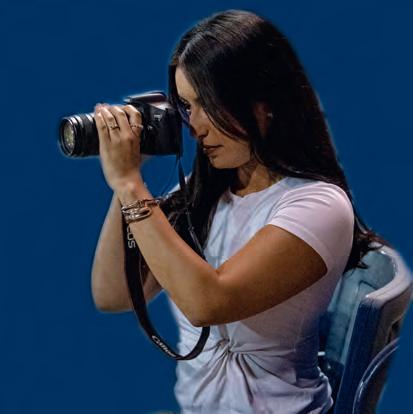
of media careers, where every deadline, post and broadcast is a lesson, these students the inside scoop into the Courtesy execute the vision you want for your article.”
Diana Vilchis, Photograph Courtesy of Sergio Gonzalez

by Jade Rodriguez


Communications majors are required to complete a collateral requirement, which means earning at least 12 units through a certificate, a minor or approved coursework. One option students often explore within that requirement is the Digital Media Certificate, a program that builds practical skills for today’s media landscape.
Digital Media, Photocommunications, Radio-Audio or Sports Media are all different certificate options offered by the Department of Communications. The Digital Communications Media Certificate has a unique objective that targets digital media designing, content creation and technological development.

Dr. Jiwoo Park, faculty adviser for the Digital Communications Media Certificate and a professor within the Department of Communications, elaborated and answered some questions for Titans that may be interested or those that are currently taking the certificate courses.
“Our curriculum goes beyond simply operating devices; it focuses on the strategic art of digital storytelling and effective audience engagement across various platforms, including professional websites and social media,” Park described.
Having the ability to build skills surrounding the digital audience is extremely important, especially in the modern day that requires knowledge within those fields. The Digital Communications Media Certificate is a more effective option if you’re interested in gaining the ability to master an ever-evolving media workplace.
There are numerous courses in the certificate program that students can choose from and direct themselves into the path of their choice. Whether that be a class about Communications Technologies or the Anthropology of Digital Media, all these courses are there to help students understand the digital culture that is implemented in our lives.
“In communications, it is crucial to recognize that technology is never neutral,” Park explained, “It is an evolving extension of our lives.”
Comprehending the social impact of digital media is “crucial” like Park mentioned. It allows students to communicate not just with everyday content but create impactful messages to serve into the digital age. Park described that she accomplishes this as the coordinator professionalizing student work, connecting students with the industry and maintaining an agile curriculum. For Park, it is a strategic way to implement students’ portfolios with digital technology skills and get students to be familiar with their future careers.
Any communication student is given the option to pursue the certificate or any of the other certificate options. Park is a professor that is motivated to help students succeed by ensuring pre-professional experience in digital media.
Jiwoo Park
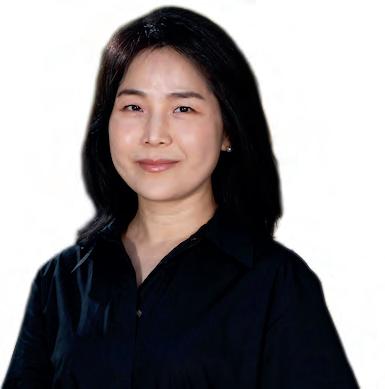
Cal State Fullerton is expanding its Cinema and Television Arts curriculum into gaming, turning what was once a single elective into a developing academic track that reflects the scale and influence of the industry. The shift comes as video games continue to outpace film and music combined. The expansion is being led by lecturer Shelley Murray, who has taught in the department for more than three decades. When the program’s only gaming course was nearly cut after its original creator retired, she stepped in to keep it alive.
“The faculty talked about possibly just dropping the course altogether, and I spoke up and said, ‘I think it’s more important than ever that we actually pursue this, not let it die,’” she said.
Murray then inherited Video Games and Storytelling, a class that worked to cover history, technology, narrative analysis and game mechanics all at once. She quickly realized the department needed more than a single catch-all course which led to the creation of Evolution of Video Games, which she is teaching for the second time this semester, as well as a new course launching in fall 2026, The Video Game Industry.
“We’re going to be looking at how the industry is structured, who answers to whom, how things get made, everything from the research and development process through distribution and marketing through all development phases of the game,” she said.
Game storytelling now crosses into film and television, highlighting the need to understand how games themselves are produced. Through her work, Murray has unintentionally battled the gender divide that has long shaped gaming culture. She traces many of the issues to early marketing decisions and decades of messaging that framed games as a male space, but rejects that framing entirely.
“The idea that the technology, the gameplay itself, or that being involved in a game or having interest in video games is just for one group of people makes no sense at all,” she said.
Murray has been a gamer for years, beginning with the first home console, the Magnavox Odyssey. She now brings those vintage systems to class so students can see the hardware that shaped the industry.
“I brought in an old VCS and the Atari 2600 with a bunch of games just so they could look at the cartridges. Some of them were like, ‘Can I take pictures?’” she said.
What began as a single course on the brink of disappearing is now the foundation of a growing academic pathway. With Murray driving the expansion, CTVA is diving into a space that’s redefining how stories are built, shared and experienced.

by Gregory Ferraro
by Eddie Ursua
The pursuit of happiness is a concept that can be very subjective and individualized, but a Human Communications Studies course at Cal State Fullerton hopes to help students work toward this lifetime goal with the help of effective communication skills.
The unique course at CSUF that aims to tackle this lofty goal is HCOM/428: “Communications and the Art of Happiness.” This HCOM course is mixed with real-life applications and offers an intriguing blend of communications skills through a transformative learning approach to help students get one step closer to developing their own version of happiness.
Jessica Kamrath, Ph.D. is an assistant professor in the Human Communication Department at CSUF who has been a faculty member since 2019. She initially started teaching this course at Arizona State University in 2014 where it originated under Dr. Sarah Tracy. Kamrath saw the importance in this work, which inspired her to help set-up and bring the course over to CSUF.
Kamrath shared how the transformative approach helps students to relearn their pre-programmed behaviors and beliefs. She emphasized that this approach encourages students to move away from the typical epistemological learning and encourages students into using actual real-life applications and becoming aware of their existing preconceptions.
“We train kids out of discovery very early on, by telling them there is this sort of good, bad, right and wrong,” Kamrath explained. “The way that language plays a role, and why it’s being taught from a communication perspective is because everything we create in language. We co-create meaning and then based on those meanings we know how to act and behave.”

they then go out and find scholarly sources on what they practiced all semester to see how the scholarly sources and research is lining up with their own experience,” Kamrath shared. “So their own experience is number one.”
Throughout the semester, students do up to 12 different research-based interventions that they go through each week and then reflect on each method within a journal. Some of the additional activities in the course range from discussion boards, mood tracker assignments and reflective exercises to better understand themselves and their definition of happiness. Topics covered can range from gratitude, cultivating optimism, forgiveness, resilience and organizational wellbeing. Kamrath described how the course has fostered connection between students as she becomes part of their journey toward happiness and contentment.
“For me what I’m really up to creating is connection, and human connection, and creating a space where they can explore some things that might then give them,” Kamrath shared, the tools to create flourishing in their own life. I think I’m just really grateful for that.”



From the onset, students work on developing their own definition of happiness and start to understand how their personal ideologies may be influenced by a familial or societal influence.
“It’s different in terms of even research, because they are actually doing research on their own behaviors. They’re getting all this anecdotal evidence from their own experience, and they don’t until a week before they turn in their final project, do

For those who are intrigued in taking this course to develop their own route to personal happiness, HCOM 428 will now be open to even more who are interested, since the initial six unit HCOM prerequisite has been recently dropped. Kamrath described how the course is something she is deeply involved in developing further and plans to take time next spring semester with an awarded sabbatical to research how the course can be further improved and integrated with a communication framework and concepts.








The future of the course will see this section being taught at the Honors College during the Fall and if all necessary approval is granted, the course will hopefully be offered in July 2027 as a study abroad program in Florence, Italy.

Jessica Kamrath, Photographed
by Eddie Ursua

by Diamond Hurd
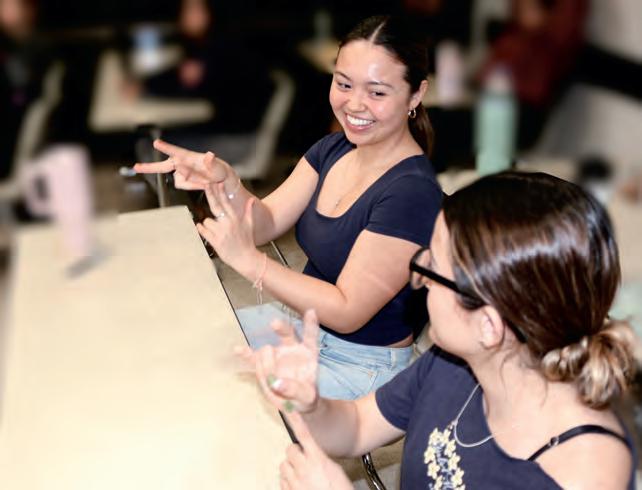
Jeff Lubman, professor of American Sign Language, continues to thrive and teach his students how to outshine silence through elements that empower unspoken messages in his course, COMD 302: Introduction to Sign Language.
Jeff Lubman, part-time lecturer in the Department of Communication Sciences and Disorders at Cal State Fullerton, continues to thrive and teach his students how to outshine silence through elements that empower unspoken messages in his course, COMD 302: Introduction to Sign Language. There is sound inside: laughter, the rustle of notebooks, chairs shifting when students break into pairs. But spoken language is off What carries the room instead is movement. Hands, facial expressions, posture and eye contact. Students look to one another, then back to the front, follow a language rooted in visual attention and shared space: sign language.
This is what makes Lubman’s class distinct. It is not centered on memorizing signs or simulating deaf norms for hearing students. It is taught by someone whose relationship to the language is lived, not borrowed.





Lubman is Deaf, and his approach to teaching American Sign Language reflects a lifetime of navigating a hearing-centered world. His classroom does not perform the Deaf perspective. It moves from it.
The materials taught by Lubman operate beyond sign memorization or simulating Deaf norms for hearing students. His approach behind teaching ASL reflects a lifetime of navigating a hearing-centered world.


Before teaching at Cal State Fullerton, Lubman was a rehabilitation counselor for the Deaf and Hard of Hearing services under the California Department of Rehabilitation as a vocational rehabilitation counselor, evaluator and statewide program coordinator. His work focused on employment access, counseling, training and supporting independence within the Deaf community.
Born with profound hearing loss, Lubman initially struggled in a world that misread him. He was misdiagnosed with aphasia until around age five, when testing revealed he was deaf. He began school already behind, placed in an oral education system that emphasized speech and lipreading while discouraging sign language in an effort to align Deaf students with hearing norms.

He began school without a correct diagnosis, placed in an oral education system that emphasized speech and lipreading while discouraging sign language in an effort to align Deaf children with hearing norms.







That changed when a teacher quietly affirmed that sign language was a legitimate language. He later continued his education in a setting where ASL was embraced as both language and identity, expanding not only his ability to communicate, but also his confidence, independence and understanding of deafness itself.
That changed when a teacher quietly affirmed that sign language was a legitimate language. He later continued his education in an environment where ASL was embraced as both language and identity, expanding not only his ability to communicate, but also his confidence and understanding of deafness itself.
“Once I learned sign language, I got more Deaf friends,” Lubman said. “I was placed in top classes, college prep and then Gallaudet University, Washington D.C., as the world’s first and only university designed specifically for deaf and hard of hearing students.”
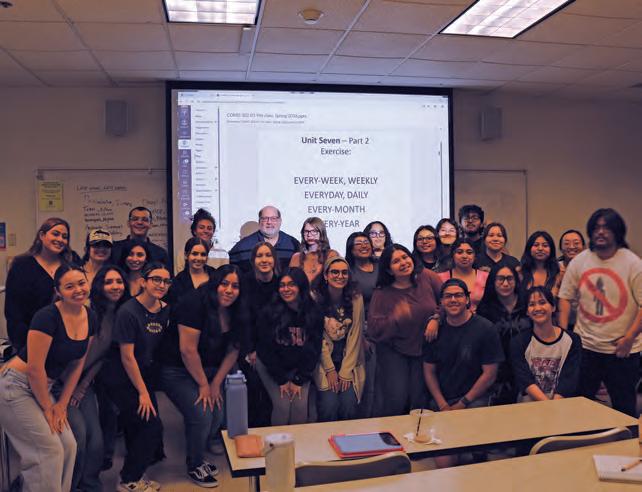
In later years, he completed his masters program in Rehabilitation Counseling at San Diego State University. While hearing educators may achieve fluency, they cannot fully replicate the lived experience Deaf educators bring one shaped by delayed language access, oral education and eventual immersion in a Deaf community. In his classroom, Lubman goes beyond how to sign, emphasizing why access to language matters.
He promotes Deaf Gain, a perspective that challenges the idea that deafness is defined by limitation and instead frames it as a different way of experiencing the world. It pushes back against hearing-centered norms that place the burden of communication on Deaf individuals, a dynamic that continues to shape his classroom.
Since joining CSUF as a part-time faculty member in 1999, Lubman has influenced students to pursue ASL beyond introductory courses. His professional background adds credibility to his teaching while exposing students to the growing demand for ASL in fields such as education, interpreting, audiology and advocacy.














































































More than a career skill, Lubman’s class reshapes how students think about access, language and responsibility – an impact that often becomes the most important lesson they carry forward.



















by



a Closing Message by Gregory Ferraro




In this ever-evolving and increasingly digital world, the use and preservation of physical media is being swallowed whole. With endless libraries of music, books, films and television shows available at a single click, news organizations updating exclusively online and media consumption shifting toward short-form content, the need for tangible media has been repeatedly questioned. Convenience has become the default, and the physical objects that once defined how we consumed information are now treated as relics of a lost era.




As a student-led print publication, ProComm Magazine upholds a practice many universities have already abandoned, physical media. Cal State Fullerton’s College of Communications supports multiple print outlets, giving students the rare opportunity to create tangible work. That commitment is strongly supported by Dean Jason Shepard, who has long emphasized the importance of preserving tangible forms of communication.
“We certainly live in a digital world and that makes communications so much more accessible and gives an individual the ability to find really anything they want at the touch of their fingers in their phone,” Shepard said. “But I’m still a giant fan of physical media. I subscribe to a print newspaper, I collect books and I still read printed books because the tangible act of engaging with media remains important.”






That commitment to tangible storytelling is echoed by a support from faculty who have spent their careers immersed in physical formats. Dr. Waleed Rashidi, an associate professor of communications at CSUF, has worked in music journalism and the entertainment industry for decades.



Rashidi’s perspective comes from years of working with physical formats as both a collector and a professional in the music industry. His experience has shown him how easily cultural history can disappear when it is not preserved.
“We have lost information, and we have lost music, because some of these publications become completely impossible to find and they were never placed online,” he said. “If they were not archived, then it becomes very difficult to retrieve that information.”



Taylor Nguyen, third-year advertising major.


Physical vs digital media?

“Physical media feels more immersive and emotionally engaging than digital content.”


What makes it memorable?

“The tangible aspect makes messages more memorable by engaging multiple senses.”


What would be lost?


“Culturally, we’d lose shared experiences and creativity that physical media brings.”


Leah Martinez, third-year public relations major.


Physical vs. digital media?

“The physical media I own needs to be something I will consume multiple times.”



He brings that understanding into the classroom, helping students see the history and evolution of the formats they often take for granted.
“I literally bring in physical media for them to see. I brought a vinyl record, I brought a cassette tape, I brought a CD and I also brought a master reel,” he said.





What makes it memorable?

“I remember the stories more of the books I physically own because I see them almost every day in my home.”


Does it engage deeper?



For students, that hands-on exposure becomes a reminder that media has weight, texture and history, qualities that can’t be replicated online. It gives them a sense of how earlier formats were built, handled and experienced, grounding their understanding of modern media in something physical and rooted in tradition.
CSUF’s commitment to physical media allows students to create work that endures, grounding their development as storytellers in care, tangible experience and a sense of permanence in this fast-moving digital world.


“People spend much more time and effort curating physical collections of art, books, vinyl records, etc.”


Student Perspectives by


Vannesa Gonzalez