WILO GROUP
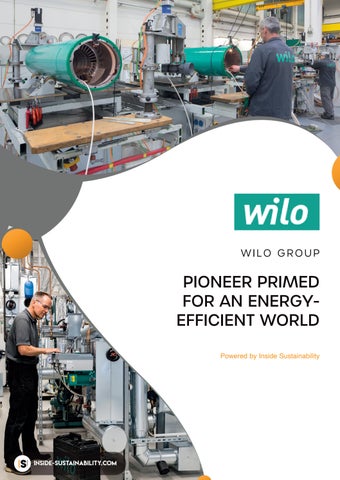
PIONEER PRIMED FOR AN ENERGYEFFICIENT WORLD Powered by Inside Sustainability
inside-SUSTAINABILITY.com
WILO GROUP
I PROFILE
172 Inside sustainability
The Wilo Group is a multinational technology leader and one of the world’s premium suppliers of pumps and pump systems for building services, water management and industrial sectors. As a sustainability champion, it is working hard to offer innovative, eco-friendly solutions that touch the lives of millions of people. President & CEO Oliver Hermes and Wilo UK’s Sales & Marketing Director David Williamson spoke to Andy Probert.
cipal driving forces that shaped the
E
supplier of pumps and pump systems
Wilo Group into a global technological
for building services, water manage-
powerhouse over the past 150 years.
ment and industry, it is also widely
Sustainably focused should be added to
recognised for high-quality hydraulic
those foundational tenets, as Wilo has
systems designed with leading OEMs
evolved into an industry pioneer in digital
and manufacturers of boilers, heat
climate action.
pumps and air-conditioning systems.
ndurance and versatility are the prin-
Regarded as a world-leading
Inside sustainability 173
Inside sustainability 175
WILO GROUP
I PROFILE
These innovative systems, smart products and eco-friendly solutions position the German group as a pioneer; thinking
extremely low discharge pressure,
ahead to address global mega-trends,
in the 1920s. In 1952, the company
such as climate change, energy scarcity
designed the first maintenance-free cir-
and water shortage.
culator and, in 2001, derived the first highefficiency pump, so demonstrating the
Trailblazer mentality
company’s sustainable engineering
“Wilo has always been ahead of the
and energy-efficiency credentials.
game and is a trailblazer in pioneering
Now a billion-euro business, Wilo
real developments and innovations,” said
employs 8,500 people across 60 locations
Wilo UK’s Sales and Marketing Director
worldwide. It has over 70 production and
David Williamson.
distribution sites, ensuring it can respond
Originally a brass copper works factory in Dortmund, Wilo, derived from family descendant Wilhelm Opländer, made
to new market growth and rising demand for high-performance technologies. At Wilo UK, that same quality-focus in
a name for itself pioneering a circulation
heating technology, air conditioning, water
accelerator, or a heating pump with
supply and sewage disposal continues to drive the company forward. Operational since 1985, the Burton-on-Trent establishment employs 100 people and has an annual turnover of £35m. It has an assembly-production plant with service, sales and general support for clients. “An uncompromising customer-driven mindset, immediate market proximity and a culture of innovation have made us who we are today,” said Mr Williamson. “We have grown organically from being a pump
176 Inside sustainability
provider to designing bespoke and
we take a proactive role, developing
complete solutions.
solutions that suit high-efficiency, waste
“We are also a consultant technology partner for clients to achieve the best in smart solutions. We support them
removal and bioactivity to breakdown material in waste products.” The UK water industry represents about
with strategies around energy efficiency
20% of Wilo UK’s business as its product
and encourage them to look at the
mix evolves to support the upgrade of
bigger picture.”
ageing water networks.
Around 15% of business is providing residential applications, such as heating
Green evolution
circulators and wastewater removal sys-
Ten per cent of the world’s energy is used
tems through installers, while the rest is
in pumping, with 90% of those pumping
dedicated to building services and com-
products outdated and working ineffi-
mercial, such as the construction industry.
ciently. “Wilo’s significant objective is to
Wilo UK also looks after water manage-
make people aware of that and consider
ment, working with water authorities
component replacement and upgrades
across the whole water cycle from
in their systems,” Mr Williamson added.
water out of the ground, through
Replacing an old heating circulator in
circulation to the tap in the house. That
a residential property with a new one
comprises solutions for raw water extrac-
that modulates, saves 80% of the
tion and potable water distribution, plus
running costs of that component alone
sewage and wastewater management.
and equates to £75 saving annually.
“We have products that exist in all those environments,” Mr Williamson said, “and
Considering the UK housing stock and the legacy heating systems they have,
Inside sustainability 177
WILO GROUP
I PROFILE
the impact would be significant from a carbon-reduction perspective. Wilo UK recently demonstrated its commitment to sustainability by achieving platinum status for the
This includes R&D and the manufacture
first time with independent rating
of a product from raw materials to its
provider EcoVadis.
performance. The challenge is significant,
Only 1% of 90,000 companies assessed
given Wilo has around 32,000 compo-
worldwide by EcoVadis achieve the
nents ranging from the smallest residen-
platinum rating. Oliver Hermes,
tial circulators to large vertical turbines
President and CEO of the Wilo Group,
for water distribution.
said: “Sustainability has always been
The UK company has enjoyed 40%
an integral part of our DNA. The platinum
growth in financial performance in recent
rating acknowledges our strategy, and
years. Business plans for the next few
with our efforts we hope to encourage
years will be the continual evolution from
others to pursue sustainability and
a pump manufacturer to becoming a sus-
climate protection.”
tainable business leader and innovator,
As part of its sustainability objectives,
supporting the sectors it is
the company wants to improve perfor-
active in. “We are transitioning quickly
mance and create more smart products.
to becoming a green-tech company,”
Mr Williamson acknowledged: “We are
Mr Williamson said.
looking to develop 15 per cent of our
Wilo has also developed a new £300
product portfolio each year and this
million facility in Dortmund that is climate
reflects a 2025 sustainability objective,
neutral. A further two have been done
which is an evolution of conventional
and Wilo plans to make all 70 production
products into smart ones.
sites worldwide climate neutral by
“The reason we are doing that is to
2025. These will sit alongside achieving
improve the efficiency of the components
sustainability targets, such as waste
within larger building services and water
minimisation, 20% reduction in potable
management systems.”
water use, de-centralised power across
178 Inside sustainability
all its production sites and storing the solar energy it generates. The Wilo Foundation was created
Mr Williamson gave a UK perspective: “The building and construction industry is still incredibly slow-moving
to further ESG activities worldwide by
in embracing new technology. The
providing financial support for initiatives
challenge here is to get these stake-
and projects in science, education and
holders to match their rhetoric in
social welfare, culture and sports.
what they want to achieve in terms
One challenge is to raise awareness about the flood of non-compliant cen-
of sustainability. “The key is for our suppliers to
tral heating pumps being imported into
match what we are trying to achieve
the UK. While an estimated 100,000
as a business. We go through a robust
non-compliant pumps are sold in the UK
process in the supply chain and contin-
annually, Wilo experts have seen some
ually evaluate their developments
units looking like genuine OEM pumps
and performance.
and equipped with fake CE markings.
“We aim to buy more from less, which
“The contribution of these non-certi-
gives us confidence that we are procuring
fied pumps is about ten per cent
carefully and ethically, and this engenders
globally,” Mr Williamson explained.
greater loyalty,” he concluded. “Meanwhile,
“The estimate of their non-compliant
we are continually expanding our client
performance contributes to about eight
base and laying firm foundations from
million CO2 emissions in the UK.”
which to thrive in the future.”
n
Inside sustainability 179