NORTH STAR
STEERING THE ENERGY TRANSITION
Powered by Inside Sustainability
inside-SUSTAINABILITY.com
NORTH STAR
I PROFILE
With five decades of experience supporting the offshore industry, North Star is in prime position to accelerate the shipping sector’s transition to green energy. Chief Technology Officer James Bradford explained how the company is doing exactly that, in an exclusive interview. Report by Imogen Ward.
H
aving worked continuously in the offshore sector since the 1970s, the UK’s leading infrastructure support
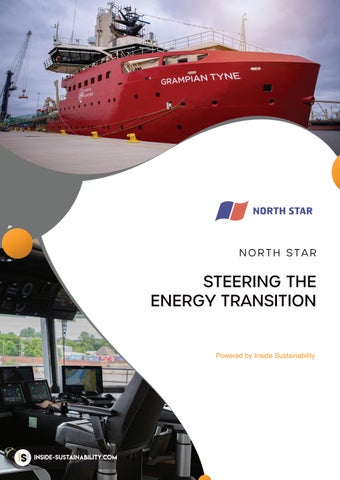
vessel operator North Star is no stranger to the marine industry’s journey towards net zero. Now, eager to extend its fleet beyond oil and gas – to offshore wind. The company, which employs more than 1,300 crew and onshore personnel from its bases in Aberdeen, Lowestoft, Newcastle and Hamburg, has set itself an ambitious goal. “Our strategy is to add 40 hybrid -electric SOVs to our fleet by 2040,” said Chief Technology Officer James Bradford. “And so far, we’ve made a great start, with our first two service operation vessels delivered ahead of schedule. We’ve received a lot of positive feedback for
266 Inside sustainability
the Grampian Tyne and the Grampian
“ERRVs are a mandatory requirement
Derwent’s unique and innovative design,
for all offshore oil and gas installations,”
as well as our project management skills –
said Mr Bradford. “With the changing
which is a great position to be in as we aim
demands of the energy industry driven
to build our business across Europe.”
by climatic considerations, the opportu-
Prior to working in the oil and gas sector,
nity to transition our years of experience
the firm was established 135 years ago
garnered in ERRV operations (and proven
to aid the fisheries sector. Seizing on the
track record for reliable on-time simulta-
North Sea’s oil boom, it quickly became
neous newbuild programmes) made our
a highly regarded and respected emer-
investment in a new ship design for the
gency response and rescue vessel (ERRV)
renewable sector an obvious choice.
operator. The firm has the largest ERRV fleet
“Not only is there an increasing need
in Europe and provides essential crew
for energy security across Europe, but
rescue, firefighting, and other emergency
with that comes a realisation that as we
response services to offshore energy
move to protect the planet, the need for
operations around the clock, 24/7, 365
oil and gas will start to decrease. That’s
days a year.
why we made a conscious decision to
Inside sustainability 267
NORTH STAR
I PROFILE
start diversifying the business into offshore wind. “But that’s not going to take a matter of weeks; it’s a transition that could take 20 years to complete.”
Emerging ESG In line with its commitment to the renewables market, North Star has also recently implemented its own ESG strategy. “The research really began in 2019,” said Mr Bradford. “It’s mainly being driven by metrics that have already been successfully applied to deep sea shipping: we are great believers in learning from other shipping categories that have previously been exposed to energy efficiency and decarbonisation regulatory diktats. “As part of our decarbonisation plans, we’ve introduced a carbon intensity index across our fleet, so that we can more accurately measure our emissions. We have also included a commercial metric which is linked to the business’ transition from using fossil fuels to green energy. That metric will indicate how quickly we are making that
268 Inside sustainability
move. We also have a technology roadmap
“We put together our specifications which
which identifies the partners who we’ll call
were based upon the project pillars of
on to accommodate the ever-increasing
quality, cost and build time. VARD scored
regulations of a transitioning industry.”
highly within all three areas. “We’re really making the most of the
Choosing the perfect partner
amazing technology available at VARD’s
The journey towards a greener fleet
Vietnam and European yards, including
needs a well-structured plan and a solid
a huge amount of automation, from steel
financial backing to execute it. North Star
cutting to welding and fabrication. Their
was acquired in 2022 by Partners Group
technology and our desire to deliver a clean,
(a leading global private markets firm)
energy efficient service to the renewables
which, along with other investors, has
sector really go hand-in-hand.”
offshore wind tonnage. The company selected VARD as its shipbuilder and has delivered the first two of four SOVs ahead of schedule for the Dogger Bank Wind Farm for decade-long minimum charters. It also has the first two of up to four Construction SOVs underway with the organisation. “We went through a comprehensive evaluation process that included several ship building yards,” said Mr Bradford.
Chief Technology Officer James Bradford
enabled North Star to build its world-class
Inside sustainability 269
NORTH STAR
I PROFILE
40 by 2040
up to full capacity, and we couldn’t be more
With the first two SOVs delivered, and four
delighted with the results.”
more underway, the ball is well and truly rolling for North Star’s ambitions.
The company is not one to rest on its laurels; the team always has an ear to the ground for
“The Grampian Tyne was delivered directly
new innovation developments. For example,
to Equinor for operations and maintenance
the North Star SOVs deploy the Electric Voith
work,” Mr Bradford explained. “She’s been
Schneider Propeller (eVSP) from Voith. The two
in service for a couple of months now and
eVSPs per vessel are eVSP 26/230 with 1850
is doing extremely well. From the feedback
kW each, plus an electronic control system.
we’ve received, the ship’s performance has
The eVSP has Voith roll stabilisation, a unique
been quite exceptional. Equinor has been an
feature which allows active roll reduction of
amazing support as we brought the vessel
the vessel, providing a more stable and safe working platform. “There is a saturation of technology within the market that could satisfy people’s needs for the next 10 years, but there’s nothing that is legacy at this time,” said Mr Bradford. “So we’ve configured our designs with high efficiency engines, open technology and energy storage systems – batteries – to afford North Star the time required to evaluate how the technology evolves and finally stabilises as the industry transitions. We have chosen methanol as our chosen future fuel for this transitionary period, which reduces our carbon emissions by 92 per cent. We are also installing energy storage back-up systems.” In the meantime, the company is currently looking at two future fuel options for its ERRVs and is in talks regarding
270 Inside sustainability
methanol, and HVO diesel supply and fuel blending technology. “HVO would reduce our emissions by 85 per cent if we applied it to all of our ERRVs,” Mr Bradford said. “The main barrier for that, though, is the price: currently HVO is three times more expensive than marine gas oil. In order to move forward, the industry really needs to come together to make it more affordable. The regulatory bodies can’t expect businesses to be financially compromised to go green.” North Star is also looking into drone technology to further aid its support to the offshore wind sector. With so much on the cards, the future for the firm looks bright. “I’m a great believer that if you’re happy with what you do, then you will always excel,” Mr Bradford concluded. “I’ve applied that to my entire life, and it is applicable to North Star as well. There’s an energy within the organisation that is hard to find. The atmosphere is buzzing, and the challenge is always forthcoming, which is great. “What North Star is achieving – along with its technology partners – is something you don’t come across very often. I really believe this company is one in a million, and being a part of this journey is absolutely fantastic.”
n
Inside sustainability 271