M46 n JUN/JUL 2021 n €15 MARITIME
NEWS SEVEN SEAS FIVE OCEANS
inside marine
O N E VO I C E
PORT OF LONG BEACH America’s second-busiest container seaport
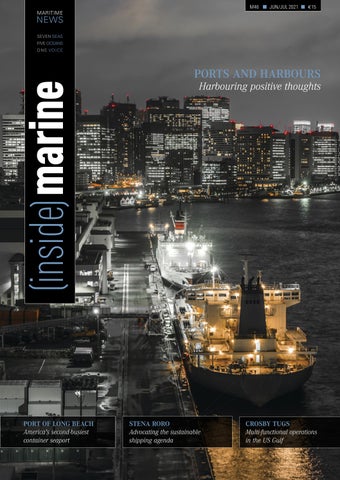
PORTS AND HARBOURS Harbouring positive thoughts
STENA RORO Advocating the sustainable shipping agenda
CROSBY TUGS Multi-functional operations in the US Gulf
Johan Caslberg Turrel Mooring System module load-oul Gantry and Manifold Copyright: SBM Offshore
..
I"
I II I ff I I I II I I I II I
John White Managing Director
PASS THE PORT! Managing Director John White toasts your successes.
W
elcome dear reader to your midyear edition of Inside Marine. I am pleased to report, that here and apparently with most of you, it is business as usual. Covid-19 has not disappeared, however, most of us have combatted it effectively and learned to adapt to navigate a route around it. It has been most refreshing to hear about your success stories; you have inspired my editorial and sales staff when speaking with them and we are proud to report on your many stories of improvisation, brilliant ideas for overcoming obstacles, diversification, and your general willingness to move forward with confidence. We like to look for the positives in a story when producing and publishing company profiles or advertisements and you have made this a surprisingly easy job given the rough ride that many companies have endured over the past 12 months or so. Therefore, it is with a degree of pride that I introduce you to this packed edition full of inspiring news, views, advertisements and more. This edition includes a robust focus on ports and harbours, regarded as an extremely popular edition amongst our readers by all accounts. I have often been asked, being a former mariner, what the difference is between a port and a harbour (read on for the answer). Colleagues and professionals in the industry will know the answer (I hope!), however, not everyone does and some of
their ideas about the definitions of each have been most entertaining. For those of us who have spent some years at sea and have worked around ports and harbours for most of our lives, we almost have our own language and must make a mental note to translate into the common tongue before speaking sometimes. I certainly had to switch from mariner to civilian during my time in the Royal Navy with all its traditional ‘Jack Speak’ as we used to call it. The (deliberately longwinded) answer: The way I try to explain the difference is by likening a harbour to somebody harbouring a thought or a criminal, protecting or sheltering it. A harbour shelters a ship from the open sea, whereas a port is where you might go to do some business once you are safely in the harbour. If I’m in a slightly playful mood, I might go on to say: “You could celebrate with a glass of port from the barrel of port that you offloaded at the port.” And if I really want to have some fun, I’ll add: “Maybe you lifted a glass to your mouth on passing the harbour mouth or you offloaded the barrel of port off the port side of your ship and had it checked by the port authorities who shared a glass with the harbour master.” (Usually at this point their eyes glaze over with confusion and they wish that they had never asked!). Thankfully, the pages that follow are a lot less confusing and much more inter-
esting than my little anecdotes, so do be sure to have a good read through them in search of new customers, new suppliers or simply to be impressed, as we have been, at the overwhelming sense of positivity in the face of adversity that many of the company profiles touch upon. One thing that stands out when we speak with you captains of maritime industry is the respect afforded to your crew, teams, employees, colleagues, staff… Call them what you will, you are full of praise for how they have conducted themselves during the pandemic and how reliable and dependable they have been. The same is certainly true of my team as I hope I have mentioned a few times of late. Therefore, let us crack open that barrel of port and raise a glass to all those who have ridden the storm and made it safely back into harbour. Oh dear, there is ‘no port left in the bottle’… n
Send us your feedback Your input matters to us at Inside Marine and we take all feedback on board to help our readers enjoy the magazine now and for years to come.
Send to: enquiries@insidemarine.com
Inside Marine
3
inside marine Managing Director John White Editorial Manager Daniel Barnes Editorial Assistant Jack Salter Profile Writers Filomena Nardi Colin Chinery Andy Probert James Wills Laura Watling Romana Moares Business Development Manager Darren Foiret Editorial Development Managers Natalie Martin Judi Wheaton-Mars Robert Stacey Adam White Katie Robinson Jeff Johnson Alice Hiscox Sales & Marketing Director Richard Brightmore
P52
Director’s comment Pass the port!
Sales Manager Helen Leisi Project Managers Alexander Paterson Tony Ingrouille Phil Forde Will Tottie Kym Hamilton Connor Doddington Ginelle Lorenzo Becky Scrivens Emma Holliman Ben Lloyd Chris Renicar
Inside Europe ABB sets course for sustainable river transport with ten all-electric Lisbon ferries Inside Asia BHP, Oldendorff and GoodFuels successfully complete first trial with sustainable biofuel supplied in Singapore
7
Art Editor Philip White
24
From simple ideas to engineering feats The latest innovations, ideas and product launches
30
Port expansion and a new green focus Port of Hirtshals Customer service key in port’s plan for expansion Port of Portland Keeping Britain trading Associated British Ports (ABP) Dynamic and the port of choice Port of Long Beach
Ports & harbours
Inside Marine asks the experts about their personal experience in the industry What have you discovered about your company or industry as a result of Covid-19?
34
40 44
P96
Shipyards 52
© Inside Marine 2021 No part of this publication in any form for any purpose, other than short sections for the purpose of review, must be reproduced without prior consent of the publisher.
Company Reg No: 06783092 Company VAT No: 167 6757 57
4
Inside Marine
Marine news in brief Latest news from the marine industry
What’s new in the marine industry?
Inside marine minds 10
Designers Daniel O’Malley Lauren Eastick Telephone: +44 (0)1493 445 121 +44 (0)1502 576 953 Email: media@insidemarine.com Website: www.insidemarine.com
12
Country focus 6
Art Director Ian Spencer
Webmaster Michael Stamp
News
Introduction 3
62
Connecting people, unifying a nation ASENAV Full steam ahead Ifestos Marine Works
Contents
Owners & managers P145
112 118
124
71 76
81
86 90
96 100 105
Where Italian innovation thrives Vittoria Shipyard Staying versatile on the Great Lakes Donjon Shipbuilding Resurrection of Greek proportions ONEX Group Shipyard hits full throttle Lyon Shipyard Hidden haven in Northern Adriatic Lošinj Shipyard Engaging the spirit of the seas Shipyard De Hoop Shipyard’s success lies in diversity St. Johns Ship Building Full shipyard services and cost effectiveness in the Dominican Republic Joseph Industrial Shipyard & Drydock
128 132 136 140
145
Stronger as one Ocean Network Express Thailand Parcelling services on the rise for leading dry bulk operator Ultrabulk Connecting today, sustaining tomorrow Navigator Gas Staying niche, staying afloat Seamanship Company World heavyweight champion UNITED GROUP Steaming with passion Landbridge Ship Management Oman’s number one spot Asyad Shipping & Drydocks Services Advocating the sustainable shipping agenda Stena RoRo
174 178 182
186 190
194
Yachts 200
206
Equipment, services & classification 156 166
Great tugs - and more Crosby Tugs Greek maritime association is encouraging its members to thrive WIMA
When trust matters DNV Masters at deep end Jade Dienst Keeping maritime safe and sustainable KraftPowercon All for one and one for all Navaltex Technology Group Innovative and trustworthy solutions for the shipping industry SeaCircle Historical Norwegian firm at the forefront of technological expertise SERVI Group
At the helm of superyacht innovation Sunreef Yachts Designed to delight Rosetti Superyachts
Offshore 212
218
Delivering dynamic marine solutions Edison Chouest Offshore Re-imagining subsea well services Helix Energy Solutions
Inside Marine
5
insideeurope
europe
Reporting on the latest developments from the marine industry around Europe
ABB sets course for sustainable river transport with ten all-electric Lisbon ferries ABB has secured a landmark contract with Spanish shipbuilder Astilleros GONDÁN to supply an all-electric power solution for ten urban passenger ferries, transporting up to 540 passengers each across Lisbon’s Tagus River.
T
he ten new ferries will be operated by the public ferry company Transtejo and will replace the existing fleet serving this route when they enter service between 2022 and 2024. In addition to energy storage, ABB will deliver a fully integrated electric power solution and an integrated marine and propulsion automation system. The fleet renewal project represents a significant commitment by Lisbon metropolitan planners to accelerate the introduction of emissions-free public transport solutions. Financial details of the contract were not disclosed.
Important industry milestone Increased electrification of transportation, including inland waterway transport, will play a key role in helping Portugal achieve carbon neutrality by 2050. According to the national 2050 Carbon Neutrality Roadmap, the transport sector aims to achieve 98% reduction in greenhouse gas emissions compared to 2005, by strengthening the role of the public transport system and replacing current fossil fuel means of transportation with a mainly electric fleet. ABB estimates that replacing the ten ferries operating on the Tagus River from diesel power to all-electric integrated power solution is expected to cut about 6,500 tonnes in CO2 emissions every year. This is equivalent to the annual carbon dioxide emissions generated by around 1,400 passenger cars annually. “Cutting greenhouse gas emissions are top priorities in urban planning. Today, the technologies chosen for fast ferries operating so close to the heart of the city must be clean and green, as well as proven in terms of safety and reliability,” said Antonio Pacheco, Director of GRP Division, Astilleros GONDÁN. 6
Inside Marine
“ABB has been selected both on the grounds of energy efficiency and its extensive experience in delivering all-electric and hybrid propulsion solutions to the ferry market.” Juha Koskela, Division President, ABB Marine & Ports, said: “Operators serving inland waters have been among the pioneers of zero-emission propulsion, and we are truly honoured that ABB’s technology will support the sustainability goals of one of Europe’s great capitals. “This project is another important industry milestone for zero-emission propulsion, showing that proven technology is available today to serve the future needs on sustainable fast passenger ferry transport.”
Sustainable shipping The new ferries, which will be pivotal to Lisbon’s public transport system, will be powered by battery packs with a total capacity of 1,860-kWh each. ABB’s initial contract covers the fully integrated electric power solution and an integrated marine and propulsion automation system for all ten ferries and the battery pack for the debut vessel of the series. ABB’s award-winning Onboard DC Grid power distribution system will ensure that the battery output is delivered to the ferry’s subsystems in the most optimal way, as well as enable safe integration and reliable operation of other propulsion system components. The overall power setup will be controlled by ABB’s Power and Energy Management System, which will also increase fault tolerance and provide a high degree of reliability while ensuring the maximum lifetime for the batteries.
The 40m-long ferries will each have capacity to carry up to 540 passengers on three key routes linking Lisbon to Cacilhas, Seixal and Montijo on the south bank of the Tagus River. They will have a service speed of 16 knots and a maximum speed of 17 knots. With the International Maritime Organisation targeting a cut in annual emissions from ships of at least 50% by 2050 against 2008 levels, the all-electric ferry project represents a significant contribution to sustainable shipping by the city of Lisbon. Ferry industry association Interferry estimates that the sector transports over two billion passengers worldwide every year, with electric propulsion considered a proven technology that can reduce emissions at global scale. Data from the Maritime Battery Forum indicates that over 130 battery-powered ferries are already in operation, and 90 more are on order. In line with its strong presence in vessel electrification, ABB has announced all-electric ferry projects with P&O Ferries, Washington State Ferries and Busan Port Authority in South Korea in recent times.
Spanish shipbuilding longevity With a construction programme of 10 vessels, GONDÁN’s GRP Division has a stable workload until 2024, bolstered with the recent contracting of two wind-powered vessels to be built on steel hulls at its Figueras facilities. As part of its policy of reinvestment and continuous improvement, GONDÁN is in a position to face in the near future its plan to expand and improve the productivity of several of its centres in Castropol; with the consequent positive impact on the generation of employment and revitalisation of the economic activity of the region. n
asia
insideasia
Reporting on the latest developments from the marine industry around Asia
BHP, Oldendorff and GoodFuels successfully complete first trial with sustainable biofuel supplied in Singapore Global resources company BHP, German shipping company Oldendorff Carriers, and advanced biofuels pioneer GoodFuels have conducted the first marine biofuel trial involving an ocean-going vessel bunkered in Singapore.
AS
part of the trial, with the support of the Maritime and Port Authority of Singapore (MPA), the 2020-built 81,290 DWT dry bulk carrier Kira Oldendorff was refuelled with ‘drop-in’ advanced biofuel blended with conventional fossil fuels. The key objectives of the biofuel bunkering trial included understanding the behaviour of the fuel, assessing engine and vessel operational performance during the trial, as well as exploring the technical and commercial merits and challenges of biofuels as a marine fuel. The trial will enable BHP to develop an informed strategy on the structural supply and use of biofuels to support its key shipping routes.
The advanced biofuel, supplied by GoodFuels, reduces CO2 emissions by 80-90% well-to-exhaust compared with HFO/VLSFO, and uses sustainable waste and residue streams as feedstock. Commenting on the partnership, Isabel Welten, Chief Commercial Officer at GoodFuels, said: “We are very excited about our first expansion into Singapore and the Asian market, especially since we have already identified Singapore as an important hub for many of our customers over the year. “This trial marks the start of a process for GoodFuels of facilitating more structural supply of sustainable marine biofuels in Singapore, in a commercial, operational and technically feasible manner.”
Sustainable biofuels
Small but necessary step
These objectives are in line with BHP’s strategy to assess biofuels as a potential low-carbon fuel of the future, which is an important step in enabling the company to establish pathways for meeting one of its Scope 3 greenhouse gas emission goals for 2030, which is to support the reduction of emissions intensity from BHP-chartered shipping by 40%. BHP’s Vice President of Maritime, Rashpal Bhatti, said: “We are delighted to be working with Oldendorff Carriers and GoodFuels, with the support of MPA, to carry out the first biofuel trial involving an ocean-going vessel bunkered here in Singapore. “We strive hard to work with our customers, suppliers and other stakeholders along the value chain to influence emissions reductions across the full life cycle of our products and we fully support moves to decarbonise the maritime industry.”
Oldendorff Carriers chose one of its modern Kamsarmaxes, Kira Oldendorff, for the trial as appropriate modifications to the vessel were easily carried out to burn the biofuel blend efficiently, and monitoring instruments were installed to capture the trial data as accurately as possible. Oldendorff Carriers Singapore’s Managing Director, Alex Vajsova-Jones stressed the importance of collaborating with the right partners: “Oldendorff Carriers and BHP’s views on a greener future are mutually aligned and being historically close partners, it made this trial a natural fit. “GoodFuels are leaders in biofuels and early movers in this segment and we felt they were an excellent choice, while MPA are strong supporters of green initiatives and are always instrumental in supporting industry participants in the shipping capital of the world.
“We are thrilled to have been selected to participate in this biofuel trial with our close partners, and pleased that the bunkering happened in Singapore. It’s a small but necessary step in our common goal to reduce our carbon footprint.” Captain Daknashamoorthy Ganasen, MPA’s Senior Director (Operations and Marine Services), said: “Singapore is committed to the environmental sustainability of the shipping industry. “We welcome interested parties to cooperate on the research, development and piloting of clean marine fuels in reducing the impact of shipping on the environment.”
MPA – the premier global hub port The benefits of using Singapore as a biofuel hub are obvious. Sitting at the centre of a web of trade routes and connected to 600 ports in over 120 countries, Singapore offers shipping companies seamless global trade connectivity. Singapore is the busiest port in the world in terms of shipping tonnage, with more than 130,000 vessel calls annually. At the Pasir Panjang container terminal, super post-Panamax quay cranes have been deployed to service some of the world’s biggest vessels, such as the Emma Maersk. This series of dynamic quay cranes are the first of their kind in the region. Singapore is also one of the top bunkering ports in the world, lifting more than 40 million tonnes of bunkers annually. A wide range of essential marine services are also available, including pilotage, towage, fresh water supply, crew changes, ship supplies and slop disposal. n Inside Marine
7
Inside Marine
9
Inside marine minds Inside Marine asks the experts about their personal experience in the industry
inside marine
minds
have you discovered about your question: What company or industry as a result of Covid-19?
“
10
Inside Marine
“
Here in Greece, I think the actions taken by the Greek government have enabled the likes of Dynamic Co to continue performing at its optimum best within the restrictions. Hopefully by November 2021, Covid will have retreated, 2022 will be much better and we will look back at the pandemic period as if it was a bad dream.
“
Ted Kirkpatrick, Director of Business Development, Heddle Shipyards
Johnny Gaskins, Vice President, Lyon Shipyard
Captain Yannis Nikolitsis, COO, Dynamic General Ships & Heavy Industries Repairs
Bill Calkins, General Manager, St. Johns Ship Building
“
We are a business where we have to have people on the ground, in the engine rooms, on the quay, in the workshop. So apart from the administration side, we are not in a position where we can send our people into a home office.
However, we have to meet the regulations, and this was really challenging for us. Shipping is a people business, and while it is possible to have video or telephone conferencing, it is not the same as meeting clients at a convention and having a beer in the evening. I have realised over the last few months that I am losing somewhat, that degree of personal contact and industry information, and I miss it.
“
“
It has definitely been a challenge, especially in terms of maintaining social distancing, managing people and reassessing operations in the yards. But it has also helped us manage the ins and outs and flow of the shipyard on a daily basis. And in a strange way, having less access to people has given us more access to people in terms of communication with our clients. Even so, we are still a company that very much likes to do things face to face.
“
The staff have been excellent at this difficult time, and really stepped up to the plate over the last 12 months to keep the business heading in the right direction.
“
“
Aaron Guidry, Director of Special Projects, Crosby Tugs
Germán Schacht, Business Development Director, ASENAV
“
The staff have been fantastic in responding to the challenges of the pandemic. They are considered an extension of the family and we all understood pretty quickly that it only takes one of us to shut the whole yard down. We were very careful to observe all the regulations to maintain output, and we never lost a day’s work.
“
“Zoom is helpful, but we are still meeting in person, still getting everybody together. As a human race, we are social beings.
“
We managed to adapt quickly to these unprecedented times in fulfilling our obligations and delivering projects to clients within deadlines. This was despite the difficulty of coordinating groups of people to work on the construction of a project. We’re incredibly grateful to the workforce for their dedication.
“
“
We made fewer crew changes, and checked on our employees more, making sure that on a psychological level, they and their families are ok, that there’s food on the table and nobody is struggling, and offering all the emotional and financial support we can. Right now, I think mental awareness is a very important topic.
Timo Schön, Managing Director, Jade Dienst
Gavin Higgins, CEO and Naval Architect, Nichols Brothers Boat Builders
Captain Sanjeev Verma, Managing Director, Landbridge Ship Management
“
Paolo Duò, President, Vittoria Shipyard
ASM also developed seafarers repatriation procedures for vessels touching Aqaba port in Jordan, adapted by the Jordan Maritime Authority and Pandemic Committee.
“
Faisal Assaf, General Manager, Arab Ship Management
“
There are always many ways to deal with crises, and crises help businesses to come up with innovative ideas to deal with them. Agility in decision making is important, and there is always room to improve QHSSE standards, and these improvements need to be ongoing.
“
“
Upon the general lockdown in Jordan in March 2020, and as a result of the fruitful investment in staff training, communications, MARAD and in-house web based IT applications, our activities were fully executed from home.
“
We have continued to work throughout the lockdown while considering the safety of our teams in the marine environment and to enable them to operate within the regulations. Business has, for us, remained very steady. Mel Klopper, Commercial Manager, Jenkins Marine
“
Shipping is one of the most resilient businesses you can be in. The crews and shorebased staff have gone through many changes and adapted quickly to ensure the vessels have performed smoothly. They have rolled from one extreme to another, but have always fought back to maintain balance and deliver.
“
“
It is always surprising the capacity of people to adapt to prevailing conditions and face even the most negative issues, such as the Covid-19 pandemic, with fortitude. We had to change some habits and the approach to the usual working life, but we learnt to coexist with the pandemic.
“
“
Francis Lapp, CEO and owner, Sunreef Yachts
“
It’s been eye-opening to realise that we all do have the ability to be resourceful, understand the challenges, accept change and work with each other differently.
“
“
Shipyards across the globe have had to reassess how to build and maintain relationships with their client base. This has meant coming up with new, creative solutions and showing resourcefulness and flexibility.
Dr Ibrahim Al-Nadhairi, CEO, Oman Shipping Company and Oman Drydock Company
Get Involved: What have you discovered about your company or industry as a result of Covid-19? We would love to hear your answers, so send an email over to our Editorial Manager Daniel Barnes and share your thoughts to all our readers.
db@insidemarine.com
Inside Marine
11
Marine News Latest news in the marine industry
Peninsula rebrands with fresh new visual identity
P
hysical bunker and lubricant supplier Peninsula has announced a rebrand of the business with a refreshed visual identity to reflect its future vision and focus. Peninsula has dropped “Petroleum” from its name to represent the company’s transition to a more sustainably focused brand. It has also updated its original blue and yellow colour scheme for a cleaner, more modern colour palette together with a logo reflective of its desire to offer simple and relevant solutions to its customers. Over the course of the last 25 years, Peninsula has achieved sustained growth through execution of a multi-phase strategy. For its next development phase, the company wanted to match its visual identity with its future journey. Peninsula’s evolution is built on core strategic pillars. These pillars focus on customer centricity, sustainability and technology. After successful transition into a low-sulphur marine fuels environment in 2020, the road to ‘zero carbon emissions’ represents a new challenge for bunkering and has been a major catalyst for Peninsula’s rebrand. “Peninsula’s sector expertise and long-standing experience places us in a fantastic position to deliver optimal solutions to our customers; both today and as they plan their own journey towards zero carbon,” said John A Bassadone, CEO of Peninsula. “I am personally committed to a sustainable future and will ensure that Peninsula is at the forefront of marine energy’s efforts to minimise carbon emissions.”
He added: “At present our transition fuel of choice is LNG and we are actively expanding our supply options and infrastructure. However, the future will undoubtedly bring new solutions and Peninsula’s pledge is to keep energy flowing to our customers.” Peninsula has also launched a new website – www.peninsula360.com. The site is a complete re-vamp of content and represents the company, more accurately, as a marine energy provider. John A Bassadone, CEO, Peninsula
Thun Tankers welcomes delivery of Thun Equality
S
wedish shipping company Thun Tankers has taken delivery of the 7,999 DWT Thun Equality, the third E-Class tanker in a series of four ordered from Scheepswerf Ferus Smit BV in the Netherlands. The E-class vessels are a further evolvement of Erik Thun’s existing fleet and focus on efficiency, environmental care and customers’ needs. The company said the vessels are built to the absolute latest designs, exceeding existing and forthcoming regulations. The new vessel provides reduced fuel consumption with an increased cargo intake, less exhaust emissions and lowered noise levels. “Equality describes how we want to approach people and the societies where we operate. With today’s delivery, we in Thun Tankers would like to wish the vessel and her crew fair winds with safe and sustainable sailings,” stated Joakim Lund, CCO at Thun Tankers BV. Thun Tankers is part of the Erik Thun Group, a company owned by the Källsson family since 1938. For decades, the company has designed increasingly economic and energy efficient quality ships, using in-house knowledge to provide sustainable and cost efficient transport solutions. “Equality is a big part of our sustainability work, and it has been and will be a focus ahead,” commented Johan Källsson, Managing 12
Inside Marine
Director at Erik Thun AB. “Today’s delivery of the Thun Equality is a great example of our vision to be a sustainable Swedish partner over generations.” Thun Equality has begun trading within the Gothia Tanker Alliance network, a European network for smaller and intermediate size tankers.
Korean Register awards SoF to Samsung Heavy Industries’ ship cyber security simulator
T
he Korean Register (KR) has awarded a Statement of Fact (SoF) for cyber security risk assessment and vulnerability diagnosis to Samsung Heavy Industries (SHI) for its ship cyber security simulator. KR and SHI signed a memorandum of understanding with Samsung Heavy Industries’ Ship & Ocean Research Center last year. KR confirmed the SoF was awarded to recognise the successful outcome of the cybersecurity vulnerability diagnosis and risk assessment. As information and communication technology (ICT) is widely applied across the maritime business world, the risk of critical information breaches in ships, system collapses, or ship cyberattacks using ransomware attack or hacking, has increased dramatically. In this respect, the IMO resolution of MSC.428(98) now states that cyber risks should be appropriately identified, analysed, and addressed within the Safety Management System no later than the first annual verification of the Company’s Document of Compliance after 1st January 2021. Several flag states including the USCG and the Australian Maritime Administration have also introduced regulations to manage cyber security risk better. KR provided technical expertise as part of the joint development project to improve the comprehensive cybersecurity level. The ship cyber security simulator is a test bed that examines the
cyber security of smart ships developed by Samsung Heavy Industries. By testing the vulnerabilities that might occur during installation and operation on an actual ship, KR has assessed the cyber security network configuration and security function safety, identifying technical measures to reduce cyber risk and improve safety. Lee Dong-yeon, Head of the Shipbuilding and Maritime Research Institute, SHI said: “The presentation of KR’s SoF confirms the reliability of the ship cyber security simulator developed by Samsung Heavy Industries. Using our research and through the development of new security solutions, we can now build a ship with the world’s best cybersecurity functions.” Kim Dae-Heon, EVP of KR R&D division, said: “Through this joint development, SHI has improved ship safety by strengthening cybersecurity for smart ships, and working towards a class notation in the future.” He added: “KR will further strengthen its cybersecurity technology leadership through the development of its cybersecurity certification capabilities and technical services, which are currently provided to all areas of the maritime industry, including shipping companies, shipyards and equipment manufacturers.”
Fincantieri and Comau team up to manufacture advanced welding robot vehicle for shipyards
I
talian shipyard group Fincantieri has signed a letter of intent with Italian robotics firm Comau, to develop prototypes of robotised steel welding solutions. The resulting construction of a series of machines, will be first implemented in Fincantieri shipyards. The operating agreement is currently underway with related tests scheduled at the Fincantieri shipyards by the first half of 2022. It will involve a welding robot vehicle consisting of an anthropomorphic welding robot and a remote control tracked vehicle. Paolo Carmassi, CEO of Comau, commented: “Comau has always been committed to the design and development of cutting-edge processes and technologies that allow us to provide our customers and partners with unique solutions that meet the challenges of an everchanging market. The collaboration with Fincantieri gives us the opportunity to join forces with a leading company on an innovative project that aims to extend the benefits of automation and robotics to new sectors.” Fincantieri and Comau will be co-owners of the intellectual property generated while developing the new concept design.
At a later stage, they will explore the possibility of marketing this kind of welding product not only in the shipbuilding industry, but also in relevant business segments, such as the production of large size steel products for infrastructure and special works (such as continuous structures for suspension bridges, structures for large size hoisting systems, and products for special constructions). Moreover, the companies agreed to continue considering and examining new opportunities to create highly innovative solutions and contents within the broader scope of a Digital Factory. Fincantieri General Manager, Fabio Gallia, said: “This partnership is an important innovation for the shipbuilding industry. Apart from improving the safety of workers and their ergonomic working conditions, these solutions will enable great progress in pursuing the competitiveness of our production system. Moreover, looking to the future, the possibility of developing projects together with Comau is a great opportunity to further broaden the group’s range of competencies.” Inside Marine
13
Marine News Latest news in the marine industry
DNV launches app for efficient safety inspections and reporting in ShipManager’s QHSE software
D
NV’s new Mobile Inspection App helps ship owners and managers digitalise and streamline the workflow, recording and follow-up of their onboard safety inspections, providing onshore staff with instant access to the results. Many shipping companies are aware of the possibility of inconsistent or incomplete safety reporting and limited possibilities for gaining useful analytics if inspectors are using non-digitalised reporting methods. ShipManager’s new solution address the problem as the Mobile Inspection App enables reporting online or offline on all devices, whether laptop, desktop, mobile or tablet. The solution is designed for all kinds of safety inspections by owners and managers, including planned inspections and ad-hoc vessel inspections. It is easy to capture the results of an inspec-
tion directly on site through text, audio, photos and videos. This improves the quality and accuracy of descriptions for findings, making it easier to determine the actions that need to be carried out, and with less risk of missing important information. Using the Mobile Inspection App with ShipManager Analyzer, ship managers can track a company’s safety performance more easily and identify potential improvements through state-of-theart dashboards. With the configuration options in ShipManager QHSE’s Safety Management Reporting module, users can easily create and configure company specific inspection templates, checklists and ratings. These are then made available on mobile devices through the Mobile Inspection App, ensuring standardisation across the entire company and fleet. “At DNV we are committed to supporting our customers in their digitalisation journey by building the software they need,” said Torsten Kappel, Head of Ship Product Line, Digital Solutions at DNV. “The Mobile Inspection App helps streamline workflows and improves data quality, which again will help our customers meet their safety KPIs.” The ShipManager solutions are part of DNV’s maritime software portfolio for ship management and operations, installed on board approximately 7,000 vessels worldwide. ShipManager provides modules for technical management, procurement, hull integrity management, dry docking, QHSE, crewing and business intelligence.
Maritime administration awards nearly $20 million in funding to strengthen US shipyard economic competitiveness
T
he US Department of Transportation’s Maritime Administration (MARAD) has handed out $19.6 million in grant awards to 31 small shipyards in 15 states through the Small Shipyard Grant Program. The funds are aimed at helping awardees modernise, increase productivity, and expand local employment opportunities while competing in the global marketplace. Since 2008, MARAD’s Small Shipyard Grant Program has awarded $262.5 million to nearly 300 shipyards in 32 states and territories throughout the US. “Small businesses are the backbone of the American economy, and small shipyards play a critical role in America’s maritime industry,” said US Secretary of Transportation Pete Buttigieg. “These grants go directly to small shipyards across the country and will help protect and create local jobs, 16
Inside Marine
strengthen America’s maritime industry, and bolster our economic security.” MARAD’s Small Shipyard Grant Program supports economic competitiveness through grants that can be used to purchase equipment or train employees. In addition, the purchase of Americanmade manufacturing equipment made possible by Small Shipyard grants supports a wide range of jobs throughout the country’s manufacturing base. “These grants will help small businesses do what they do best: build essential infrastructure while creating long-term jobs for American workers,” said Lucinda Lessley, Acting Maritime Administrator. “Better equipment means increased productivity and more ships moving through our small shipyards – and more ships mean more local jobs.”
Ambitious renewable energy hub plans unveiled for Port of Leith
F
orth Ports has unveiled ambitious proposals for the creation of Scotland’s largest and best located renewable energy hub on a 175 acre site at the Port of Leith, supporting Scotland’s economic recovery and energy transition plans and the achievement of Scotland’s net zero carbon emissions targets. This £40 million private investment will see the creation of a bespoke, riverside marine berth capable of accommodating the world’s largest offshore wind installation vessels. The facility will feature a heavy lift capability of up to 100 tonnes per square metre, backed up by 35 acres of adjacent land for logistics and marshalling. This will be supplemented by the upgrading of a 140 acre cargo handling site to accommodate lay down, assembly, supply chain and manufacturing opportunities. The total area is equivalent to around 100 full size football pitches. The Port of Leith Renewable Energy Hub has the potential to make a major contribution to Scotland achieving its 2045 net zero greenhouse gases target, secure the Firth of Forth as the driver for Scotland’s green energy transition, help spearhead Edinburgh’s and Scotland’s Covid-19 recovery plan, and support up to 1,000 high quality, long term direct jobs and about 2,000 indirect jobs. Launching the plans, Charles Hammond OBE, Group Chief Executive of Forth Ports, said: “We are committed to playing a significant role in the renewable energy sector and, through that, Scotland’s energy transition to net zero as we also tackle the challenges of Covid-19 recovery and economic regeneration. This is a pump-priming investment in logistics and marine infrastructure at the Port of Leith as we harness Scotland’s natural resources for future generations and has the potential to play a significant part in our forthcoming Firth of Forth Green Port bid.
“Leith’s proximity to the North Sea, which is set to become home to many more offshore wind developments, coupled with the natural deep waters of the Firth of Forth, makes this an ideal location to support not only those developments already planned, but the pipeline of projects that are sure to follow. Forth Ports is committed to both help make Scotland’s renewables future a reality and help it meet its carbon reduction targets.” Cabinet Secretary for Net Zero, Energy and Transport, Michael Matheson, said: “The Scottish Government has set ambitious targets to increase offshore wind capacity to 11GW of energy installed by 2030, enough to power more than eight million homes. This commitment, which will support our transition to a net-zero economy by 2045, capitalises on the fact that Scotland’s seas have some of the best offshore wind resources in the world.” With existing offshore wind farm development plans and the Crown Estate Scotland’s ScotWind seabed leasing round still to come, offshore wind alone has the potential to create enough work for this renewables hub for the next 30 years. Claire Mack, Chief Executive of Scottish Renewables, said: “Scotland is at the start of its offshore wind journey, with plans to increase capacity tenfold in the coming decade. Ports and harbour infrastructure have an enormous role to play in the growth of that multi-billion pound sector which, with support from government and industry, is likely to grow much more quickly than it has to date. “The Scottish Government’s Sectoral Marine Plan contains many sites for floating wind development which, coupled with investments in infrastructure capable of handling the scale of floating turbine technology, mean we have a chance to gain a foothold in a market with enormous economic and export opportunities, particularly in the US and Asia.” Inside Marine
17
Marine News Latest news in the marine industry
ITF: global vaccine rollout needed to stop crew crisis third wave S
eafarers’ unions have challenged governments, particularly those with maritime responsibilities, to endorse universal access to Covid-19 vaccines to prevent the crew change crisis from spiralling out of control for a third time. “If the wealthy countries do not support patent waivers at the 8th June TRIPS Council meeting, then not only will more seafarers’ lives be lost – we will also miss our opportunity to be rid of the crew change crisis and the daily risk it places on essential supply chains,” said International Transport Workers’ Federation (ITF) Seafarers’ Section chair David Heindel. The ITF estimates that there are still around 200,000 international seafarers forced to work on vessels beyond their contracts due to governments’ ongoing border and travel restrictions. Thousands have been on board more than a year. With unprece-
18
Inside Marine
dented Covid outbreaks gripping India and other major seafarer labour-providing nations, the maritime industry fears that the number of seafarers trapped working on ships could double within weeks. “We are at a crossroads. One path is universal access to vaccines for all seafarers by everyone doing their part: government, union, business; simultaneously and globally. The other path is seriously frightening: Covid on ships, seafarers dying at home, those on board unable to sign off,” said Mr Heindel. “We are on the precipice of a third wave of the crew change crisis. Now is the time for generosity and action from every kind of government. We need to see the home countries of seafarers prioritising them as key workers for vaccines. We need port states to offer vaccines to seafarers visiting their shores. We need flag states to vaccinate all seafarers on ships which fly their flags.” Mr Heindel said the ITF welcomed news that the Dutch government had partnered with shipowners and local unions to vaccinate 49,000 seafarers from mid-June at a number of ports in the Netherlands and at Schiphol International Airport. The singledose Johnson & Johnson’s Janssen vaccine will be given free to seafarers working aboard ships flying the Dutch flag or those under Dutch management. “Congratulations to the Dutch government for recognising their responsibility to vaccinate seafarers on ships flying their flag. Operating a ship registry is not an opportunity to make easy money; it is a serious commitment. Flag states must uphold health, safety and seafarer welfare on their ships. The Netherlands understand this, and they are leading the way in stepping up to their responsibilities. “Likewise, the US Coast Guard has assisted industry and labour representatives on an ad-hoc basis to vaccinate seafarers and plans are underway to introduce a programme to assist desiring crew in ports where a US state makes vaccines available.” Mr Heindel said that some governments were re-introducing border restrictions after earlier giving international seafarers exemptions to have crew changes. “We are deeply concerned that the Norwegian government has announced it is reintroducing quarantine for seafarers regardless of their Covid or vaccination status. This is the time for port state governments to be introducing new and expanded green lanes for international seafarers, not going backwards with more restrictions. Now is the time for them to welcome seafarers and use their ports as seafarer vaccination hubs.” He added: “Securing the global shipping industry requires global cooperation. The rich countries who have strong vaccine programmes should now turn their minds and resources to helping vaccinate these key workers.”
Marine News Latest news in the marine industry
OneOcean acquires further voyage planning capability
O
neOcean, a leading software provider for the global maritime industry, has acquired Shipping Guides, the pre-eminent provider of data and information on ports globally. The Guide to Port Entry intelligence will be integrated into the OneOcean platforms, further enhancing OneOcean’s voyage planning capability. Guide to Port Entry data has been built up over the last 50 years and is globally recognised as the favoured source of static and dynamic data for almost 15,000 ports worldwide. Today, it is trusted by over 10,000 maritime stakeholders who interface with it via a range of webbased solutions and APIs. OneOcean said this latest acquisition further enhances the company’s voyage planning capability, allowing its customers to make better decisions and to save both money and time. The proprietary data includes pre-arrival information and intelligent geographical polygons for all port areas, including port limits, anchorages, pilot areas and environmental information. This data complements the voyage planning and decision-making workflow, particularly in
the areas of port congestion, environmental monitoring and global information on shipping activities. “There is much debate and discussion about the best methods of optimisation in the maritime industry,” commented Martin Taylor, CEO of OneOcean. “At OneOcean, we believe having the best data to start the analysis is an essential first step to power the algorithms and give the best quality outputs. The Guide to Port Entry data will sit alongside our already comprehensive information on compliance, navigation and environmental factors to provide our customers with the best tools to enable decision making.” Feargal Hogan, Technology Director responsible for Guide to Port Entry added: “I am really excited by this acquisition. OneOcean will help us move further forward in providing the infrastructure and expertise for our customers to use our data through the considerable OneOcean digital footprint. The quality and capability of the data will now be even more accessible within the sector and we look forward to building further on the next level of intelligence and integration.”
Always at the forefront of marine news Email us your news: media@insidemarine.com 20
Inside Marine
EU awards nearly €25 million in funding to Rotterdam’s green port project AN international alliance of 45 companies, knowledge institutes and port authorities, headed by the Port of Rotterdam Authority, has been awarded nearly €25 million in EU funding. The consortium will be using this grant to execute 10 pilot projects and demonstration projects that focus on sustainable and smart logistics in port operations. In the years ahead, the transport sector is expected to transition to clean power. At this moment it is not clear yet which types it will be adopting exactly, and for which modes of transport. A number of renewable fuels and energy carriers are currently being developed further, including green hydrogen, large electric batteries, ammonia and bio-LNG. Each of these has its own advantages and challenges, with one option seeming more suited to shipping, another to applications within the port or transport to destinations in the hinterland. Some links in the chain from production to consumption have already been tested; others have not. The consortium’s broad, international research programme primarily focuses on those aspects in the use of new fuels and energy carriers that have not yet been tested in practice. This includes production, transport, storage, distribution (fuels) and charging (electric power). Examples include the operation of an electric battery-powered locomotive that uses power from an overhead line for both motive power and for recharging its battery, allowing it to work in areas that lack an overhead line – marshalling yards, for
instance. Other examples include bunkering ammonia as a transport fuel, or electrical power from shore for ships moored offshore to a mooring buoy. The partners will also design and implement several digitalisation and automation solutions in the context of the energy transition. In addition, they will be exploring how best to encourage companies to raise the sustainability of their logistics processes. And finally, one of the consortium’s outputs involves the development of a master plan that sets out how transport in, to and from the ports can be made carbon-free by 2050 – and what needs to be done in this context before 2030 and 2040. The project comes out of a collaboration between the port authorities of Rotterdam, DeltaPort (Germany), HAROPA PORT (France: Le Havre, Rouen, Paris) and Sines (Portugal), in partnership with 10 research institutes and over 30 companies in the Netherlands, Germany, France, Portugal, Denmark and Sweden. The research project has been given the acronym MAGPIE: sMArt Green Ports as Integrated Efficient multimodal hubs. The research project will run for five years. The European Commission has made a budget available within the Horizon 2020 green deal programme for research into opportunities to increase the sustainability of logistics operations in sea ports and airports. The results of the various pilot projects and studies will be shared with other European ports, knowledge institutes and companies.
Wallenius Wilhelmsen ramps up in Gothenburg
R
o-ro carrier Wallenius Wilhelmsen is investing heavily in the Port of Gothenburg, with increased frequency and more destinations to and from the port. The move is an incisive response to increased demand from the market for vehicles as well as breakbulk and project loads. “After a rough patch during 2020 we now have vessels in our global fleet back in traffic globally. Today, demand is bigger than in a long time and our vessels depart fully loaded,” said Nikolai Nymoen, General Manager at Wallenius Wilhelmsen in Sweden. Apart from the odd cancellation, the departure frequency in Gothenburg generally remained at four per month throughout the pandemic. During this spring, the number rose from four to six per month, with new departures opening up new destinations such as direct services from the Port of Gothenburg to the west coast of the USA, including Port Hueneme and Tacoma. “We are expanding our offering in response to the market. The situation is looking bright with increased volumes among our contract
customers and more enquiries on the spot market. There is considerable pressure and high demand, and we are doing our utmost to ease the situation by expanding our service schedule,” said Mr Nymoen. Wallenius Wilhelmsen was already operating direct services from Gothenburg to New York, Brunswick and Charleston on the east coast. Also, the shipping line offers six sailings per month to New Zealand, South Africa, South America and Central America via transloading on the continent. Wallenius Wilhelmsen’s vessels moor at Logent Ports and Terminals, which handles much of the Port of Gothenburg’s transoceanic ro-ro-traffic and the growing volume of project loads, including bridge sections. “Wallenius Wilhelmsen’s investment in Gothenburg is entirely in line with our ambition to consolidate our position as the optimal port for vehicle transport, project loads and breakbulk, and where we have identified significant growth potential,” said Richard Mellgren, Senior Business Development Manager at Gothenburg Port Authority. Inside Marine
21
22
Inside Marine
What’s new in the marine industry? The latest innovations, ideas and product launches
what’s
new
in the marine industry ? First pictures revealed of Sunreef Yachts’ eco solar power system The Sunreef Yachts Eco R&D Team has revealed pictures of the company’s in-house developed solar power system. Using ultrathin, shock resistant and highly-efficient solar cells, it is the industry’s first composite-integrated photovoltaic technology. The shipyard’s solar skin system is currently being integrated on both power and sail catamarans within the Sunreef Yachts Eco range of luxury catamarans. “Our team has challenged the status quo in marine photovoltaic technology, making solar panels an integral part of the Sunreef Yachts Eco design. This is something unique in the whole yachting world,” said Francis Lapp, Sunreef Yachts Founder and President.
Carbon-neutral methanol fuel cell system for shipping A fuel cell system based on high-temperature proton exchange membrane (HTPEM) technology from Blue World Technologies is being constructed for testing at the Alfa Laval Test & Training Centre in Aalborg, Denmark. The test installation, using methanol as fuel, will explore the technology’s potential as a source of marine auxiliary power. The aim of the project is to establish a highly efficient and cost-effective HTPEM fuel cell solution, giving marine vessels a realistic alternative to combustion-based auxiliary power within the near future. The fuel cell test setup will have a power of 200 kW, but the fully developed and modular design should be possible to scale up incrementally to a level of 5 MW. 24
Inside Marine
Videoworks revolutionises design of yacht lighting solutions Videoworks has unveiled its new ‘Lighting Engineering’ system, which creates a realistic 3D reproduction of onboard lighting, allowing owners to preview the lighting on board their yacht. Videoworks’ technicians and engineers are already working on future implementations of the system, such as the possibility of using 3D virtual vision in outdoor environments as well. “Following the design phase, which remains essential for us as designers and is the basis of the whole process, we will be able to offer the owner an interactive and dynamic 3D view of every part of the interiors,” said Leo Megna, Head of Lighting and Comfort Projects at Videoworks.
Garmin announces MSC 10 marine satellite compass The new MSC 10 marine satellite compass by Garmin provides precise positioning and heading accuracy, using satellite signals which eliminate magnetic interference. “An advanced navigation tool, the GPS-based MSC 10 won’t be impacted by magnetic interference, so even in challenging situations, you’ll know exactly where you’re headed,” said Dan Bartel, Garmin Vice President of Worldwide Sales. The MSC 10 is easy to install and can be used as the primary position and heading sensor across multiple systems, including autopilots. Along with heading, the MSC 10 will also deliver reliable, precise pitch, roll and heave information, even in rough seas, straight to a compatible Garmin chartplotter.
Ecochlor launches revolutionary
new filter-less BWMS Ecochlor’s new ballast water management system EcoOne™ eliminates the filter, maximising simplicity and reliability in ballasting operations, its makers suggest. The EcoOne™ BWMS recently completed extensive land-based testing, demonstrating compliance with the most recent, stringent USCG and IMO BWMS Code standards. “Our newest BWMS offers more options to the shipowner, allowing them to make informed decisions for the BWMS requirements for each of their vessels, all without sacrificing the reliability and ’best in class’ service and support that Ecochlor is known for throughout the industry,” said Steve Candito, CEO.
Electric boat supercharger opens in Norway The first supercharger in the world has been opened on the west coast of Norway, a historic milestone for electric boating in Florø. The supercharger from PLUG is the first in a series planned along the Norwegian coast, and enables electric boats and cars to be charged at lightning speed with more than 150kW of power. “The Florø supercharger is already becoming an important part of the charging journey along the coast. Even though there are not yet many electric boats at sea, it is important to build the chargers infrastructure to facilitate the transition,” said Maria Bos, General Manager of PLUG.
inside marine Send us your innovation We welcome all your latest innovations and product releases. If you wish for us to share these with our readers please send it to us today.
Send to: enquiries@insidemarine.com Inside Marine
25
Featured Photo Queen’s Award for International Trade for The Wight Shipyard Company The Wight Shipyard Company, the UK’s leading specialist manufacturer of aluminium marine craft, based in East Cowes on the Isle of Wight, has been awarded the prestigious Queen’s Award for International Trade in recognition of its work to increase British exports. The Wight Shipyard Company builds high-speed passenger ferries, tourist vessels and commercial workboats for the windfarm support vessel market, both domestically and internationally. Over the past three years, nearly 60% of the company’s turnover was for export markets – including the delivery of passenger ferry, Lady A, for Mexico operator Ultramar. The employment opportunities created on the Isle of Wight have made the Wight Shipyard Company a thriving hub of innovation in shipbuilding and high-tech manufacturing with a highly skilled local workforce. For more information, visit: www.wightshipyard.com Photo credited to: The Wight Shipyard Company
seven seas, five oceans, one voice
PORTS & HARBOURS port of hirtshals
port of portland
associated british ports
port of long beach
PORT OF HIRTSHALS I PROFILE
For forward-thinking Port of Hirtshals, the future is intermodal, with a new port expansion – the biggest investment in the port’s history – and a portside business arm developed on strong ecological principles and the latest sustainability technology. “The ports that are going into green thinking and sustainable development will be the ports of the future. And this is where we will be,” said acting Managing Director Andreas Duus. Colin Chinery reports.
F
or the Port of Hirtshals at the shoulder of the Jutland peninsula in Northern Denmark, location is the ace in an increasingly strong hand. Just 20 minutes away from the sea lanes between the European west coast, Britain, Scandinavia and the Baltics, and close to some of Europe’s best fishing grounds, it is also the starting gate of the European E39 motorway network. With infrastructure efficiencies combined with a good logistics system, the port is fast developing as an increasingly attractive logistics centre and natural turntable for transport, fishery and maritime services.
Geography matters Constructed in the 1920s and extended in 1966, the Port of Hirtshals has been through continuous development since its fishing origins (it is still the port with the largest value of fish landings in Denmark), and today transport activities account for 70% of revenue. Spurred by improved motorway access and an integrated railway, expanding port assets are now moving the Port of 30
Inside Marine
Hirtshals from its national position as a major maritime port, to an intermodal logistics centre in the heart of Scandinavia. And the future of this ambitious port is being driven along a twin track of blue and green, with a new port expansion – the biggest investments in the port’s history – and a portside business arm developed on strong ecological principles and the latest sustainability technology. “We are set on creating the perfect new port where we can handle larger ships than we are able to today,” said acting Managing Director Andreas Duus. “This is our primary goal.” In tandem, the Port of Hirtshals is also pursuing a business area focus on energy optimisation and the production of green fuels, biogas and Power-to-X. All are based on green hydrogen produced on site from wind energy.
Two route approach “We are now driving along two tracks: green development and sustainability as the new track,” stated Mr Duus. Acquired by the local municipality in 2001, the Port of Hirtshals operates as a self-funded private enterprise. Significant invest-
Inside Marine
31
PORT OF HIRTSHALS I PROFILE
ments between 2006 and 2013 saw a series of construction projects including the rebuilding of new ferry berths to accommodate Color Line’s new SuperSpeed ferries and Fjord Line’s new LNG ferries. Then in 2015, a new combi terminal for rail traffic was established next to the port. “From next year increased rail facilities will enable more cargo to go to and from Europe by train, a development many of our customers are interested in because of its green impact,” explained Mr Duus. With a 2025-2026 completion target, the new 1.2km quay area – handling larger vessels and also giving greater protection from the turbulent North Sea – is currently at the planning stage. And with environmental impact a major issue in Danish planning, this could last 12 months. “Our owner, Hjoerring Municipality, is very impressed with the project,” revealed Mr Duus. “We have advanced on several points, and are now a good deal closer to our goal, and welcoming new customers to the port.” For several years, the Port of Hirtshals has been actively increasing the use of sustainable energy and limiting resource, with solar cells producing heating and lighting in the port’s own warehouses and welfare facilities, and LED lighting in buildings and outdoor areas also creating significant energy savings. At the end of 2019, four wind turbines of 4.2 MW were erected, a starting point for investment in the production of future climatefriendly fuels such as hydrogen, ammonia and methanol. And 32
Inside Marine
with a 12,000 to 16,000 household power generation capability, the port’s industrial area will be making a substantial transfer to Northern Jutland’s energy needs. “Currently these four wind turbines make it possible for companies using a huge amount of electricity to have the option of buying,” said Mr Duus, adding that surplus heat within the port area can also be bought or sold.
Energy solutions With a clutch of energy solutions coming up at the Port of Hirtshals, Mr Duus said companies will be able to cooperate with each other in the use of energy within a port zone that is more than a conventional area of sea, rail and road transport solutions. “The green port is very important for us, and by 2025-2026 we expect to see increasing benefits from it, with the commercial enterprises here today getting cheaper electricity.” It is a grand strategy that the port incorporates in its clarion call, ‘Let’s Create New Blue Oceans!’ This is the business theory arguing that rather than struggling to survive in the existing shark-infested ‘Red Oceans’ of vicious competition, operators should move to the unexplored ‘Blue Oceans’ of little or no competition, vast and deep in terms of opportunity and profitable growth “The Blue Ocean strategy is to find solutions where there are no competitors within maybe 10 years,” suggested Mr Duus. “It has been said that the ports that are going into green thinking and
sustainable development will be the ports of the future. And this is where we will be.” The Port of Hirtshals is one of Denmark’s largest ferry ports, with services to Larvik, Langesund, Kristiansand, Stavanger and Bergen in Norway, Torshavn in the Faroe Islands, Seydisfjordur in Iceland, and most recently services to Reykjavik, St Petersburg, and Scrabster – the north east Scotland connection the Port of Hirtshals is keen to develop. The links to Norway, the Faroe Islands and Iceland account for approximately 2.5 million annual passengers, but while 2020 cargo volumes grew 10%, Covid reduced passenger flow to half of what it used to be over the same period, said Mr Duus.
Ferry figures rising “It’s very important for us to get these passengers into Denmark, and with ferries resuming sailing at the start of May, we hope we will see the pre-pandemic figures resuming from August onwards,” said Mr Duus. Three passenger lines are now sailing up to five times a day, a growing momentum that has seen the recent arrival of Fjord Line’s new catamaran, the 1,200-passenger Fjord FSTR. A hypermodern, high technological ferry, it is designed primarily for fast transport of cargo, as well as cars and passengers. And with a travel time of only 2 hours 15 minutes, Fjord FSTR is the fastest sea option between the continent and Norway. “The new catamaran will undoubtedly help to make the transport of both passengers and cargo via Hirtshals even more attractive in the future,” said Mr Duus. “More and more transport companies are looking at the Port of Hirtshals to see the opportunities of making a hub for cargo into Norway in the future. And this is an area we are building on.” He concluded: “The importance we place on the green harbour is very high. And taken together with the new port expansion and the opportunities it opens up, this is what we want the Port of Hirtshals to be known for.” n
Inside Marine
33
PORT OF PORTLAND I PROFILE
CUSTOMER SERVICE
KEY IN PORT’S PLAN FOR The Port of Portland in Oregon has been a hub for trade since the 19th century. James Wills interviewed Director of Marine Operations, Geoff Owen, to get the current lowdown on the port’s ongoing operations and its exciting objectives for the future.
34
Inside Marine
T
he history of the Port of Portland, Oregon, in America’s Northwest, makes fascinating reading. For a start it could have been called something completely different. In 1845, business partners William Overton of Portland Maine, and Asa Lovejoy of Boston, Massachusetts, both recognised where the Willamette and Columbia rivers
“
“
SM Line is interested in growing its business here and everyone involved wants the company to do just that met had potential to serve as a port to nearby Oregon City. They both wanted to name it after their home towns so they flipped a coin – and Overton won. Over the subsequent decades, the port continued to grow – in both size and influence. In 1936, construction began of an adjacent new airport which still serves the port and region with direct flights to international and domestic destinations.
Both are currently managed by a Board of Commissioners. Today, the port remains a thriving centre for both container imports and exports and serves as a national centre for the exportation of grain, potash and soda ash. Located 103 miles upstream from the Pacific coast, the Port of Portland moves autos, grain and other bulk items at its three marine facilities.
Automotive muscle On the automotive front, in 1953 the port began importing Volkswagens from Germany, and ever since that milestone, Portland has developed into a premier auto gateway for leading automotive manufacturers. To date, more than 11 million vehicles have moved through the port, including cars manufactured by Ford, Honda, Hyundai and Toyota. Since 1971, Toyota has maintained an auto import and processing facility at Terminal 4. Several facility expansions and improvements over the course of this four-decade partnership has led to Toyota’s Terminal 4 location currently handling Inside Marine
35
36
Inside Marine
“
“
We are also actively seeking to expand our break bulk and project cargo capabilities and we believe there are real opportunities to do this
more than 10,000 vehicles per month. It was also designated the first industrial facility to earn LEED Gold and Salmon Safe certifications. And on the vehicle export front, a burgeoning export market for American automotive companies is China. Models such as Lincoln’s MKCs, Continentals and Navigators are heading to China’s middle classes at an accelerating pace. For the Port of Portland, this has translated into a strong partnership with Auto Warehousing Company, a global logistics and processing company that ships the vehicles from Terminal 6. In 2017, AWC helped move more than 87,000 Fords and Lincolns through Portland on to the Far East.
Welcoming SM Line For the past year and-a-half, South Koreabased container carrier SM Line has been operating a weekly container shipping service to Portland. SM Line launched in 2017 and continues to expand its presence on the Asia-North America trade route to meet growing demand. The Port of Portland’s Terminal 6 was added to SM Line’s existing rotation to the Pacific Northwest, which includes stops in Vancouver, British Columbia and Seattle. The weekly service started from the port of Ningbo in China on December 22nd, 2019, using six 4,300 to 4,500 TEU vessels, and the full port rotation is Yantian, Ningbo, Shanghai, Pusan, Vancouver, Inside Marine
37
PORT OF PORTLAND I PROFILE
Seattle, Portland, Pusan, Kwangyang, and Yantian. SM Line’s inaugural vessel call at Terminal 6 arrived on January 14th 2020, with the 4,360 TEU vessel, the Qingdao. Portland was selected as an additional stop due to Terminal 6’s proximity to Oregon customers, a lack of congestion, and access to on-site rail connections that allow products to be quickly transported beyond Portland. Oregon is a trade-dependent state, with international trade to Asia powering the agricultural, forest, technology, manufacturing and distribution industries. SM Line’s new shipping service provides an important boost to Oregon's economic competitiveness and the growth of Oregon businesses – better connecting the region to the world. It also helps bring more jobs to Portland. As Oregon’s largest port, the Port of Portland uses land, sea and air to ship Oregon-made goods across the globe and
38
Inside Marine
help bring quality products back to the region. The SM Line service builds on the port’s successful partnership with BNSF Railway to move containers via rail to Seattle and Tacoma, and its recruitment of air cargo service offered by Cathay Pacific Cargo at Portland International Airport. FedEx and UPS also transport many of the goods bought and sold in the region.
Economic recovery The SM Line agreement puts a positive bookend on what was a challenging time in the port’s history, which included a legal dispute with a previous port operator and a loss of some key shipping contracts. But rather than dwelling on the past, Port of Portland’s current Director of Marine Operations, Geoff Owen, reflects the current mood of the port; defiant and optimistic. “We are now operating Terminal 6 through a subcontractor and just before
Covid-19 began, a weekly service was started with SM Line from Korea. Everyone realises the importance of this service to the region, and we have seen labour productivity numbers exceed anything we have seen before,” he commented. “After the crisis we faced, this is good news. SM Line is interested in growing its business here and everyone involved wants the company to do just that. There has been clear communication from all sides. As a result, it has gone exceedingly well so far.” Of course, this path to recovery was affected by Covid-19. Mr Owen reported that the airport was obviously hit extremely hard, estimating an 80% drop in business as a result of the global pandemic. “However, the port continued to operate,” he stated. “We saw imports exceed exports, we were not too affected by the tariff issues which hit some sectors and while there were peaks and troughs caused by global
issues affecting supply chains, we continued to help the flow of trade right across the globe.” So with Covid-19 on the decline (fingers crossed and touch wood), and the container situation improving, what is next for the port? “One of our main strengths is we have learned a lot from our airport operation about customer service and working closely with partners, so we offer the kind of relationship, customer service and personal attention companies will not receive from far bigger ports,” Mr Owen said. “We have challenges, such as the inescapable fact our location limits the size of ships which can access us, and there is also limited space for expansion, but we are always looking at how best to use our capital budget, and the various grants which are available, to attract new partners to the
port and to assist our existing customers to improve their efficiency.” As one current example Mr Owen was keen to highlight, the port will soon be embarking on an expensive project to remove a large redundant grain elevator from Terminal 4 which will provide an open area for development.
New opportunities “We are also actively seeking to expand our break bulk and project cargo capabilities and we believe there are real opportunities to do this,” revealed Mr Owen. “Traditionally, this has been handled through the Gulf but we are looking to increase our competitiveness and at ways of investing in capital improvement programmes to do that. “There is also a lot of buzz nationally about the opportunities wind energy represents and last year we handled turbine tower
sections for a client and we are interested in increasing our capacity in that sector.” At the heart of the organisation’s work is also its Shared Prosperity goal. This seeks to ensure its facilities – which support 30,000 jobs both directly and indirectly – benefits the whole community. Curtis Robinhold, the Port of Portland’s Executive Director, recently commented in the press: “While the port has evolved in a number of ways over the last years, for most of our existence, powerful business interests continued to benefit from our work. Now we need to focus on how we bring economic prosperity to the people who were left behind.” With its container trade growing, determination to attract new clients and a customer focused ethos its competitors cannot match, the port looks set to prosper even further, just as William Overton and Asa Lovejoy hoped it might, all those years ago. n
Inside Marine
39
ASSOCIATED BRITISH PORTS (ABP) I PROFILE
KEEPING
TRADING Associated British Ports (ABP) is critical to the very foundations of British business. Annually contributing £7.5 billion to the economy and handling £150 billion of UK trade, the nation’s largest port group also manages the UK’s busiest rail freight terminal. CEO Henrik Pedersen spoke to Inside Marine’s Andy Probert about ABP’s ambitions and the importance of its sustainability goals.
A
ssociated British Ports operates 21 ports across Britain, serves as the Statutory Harbour Authority controlling waters around several ports, and holds a sizeable freehold land bank. “These services in other countries are usually split up between public and private operators, but at ABP we hold these services in-house,” outlined ABP’s CEO Henrik Pedersen. “These different elements of ABP enable us to focus on supporting the economy and assisting our customers’ recovery as we come out of the pandemic. “We want to ensure over the next two to three years, we continue taking tangible steps in terms of sustainability, IT and technology. It’s not what we say; it’s what we do.”
Economic importance ABP’s importance to the nation cannot be underestimated. It supports around 120,000 jobs, contributes £7.5 billion to the economy annually, and handles around £150 billion worth of UK trade. 40
Inside Marine
Its ports include four ports on the Humber Estuary, the UK’s largest ports complex, as well as the Port of Southampton; the nation’s second-largest container port and the UK’s number one port for cars and cruises. £40 billion of UK exports pass through Southampton, making it the UK’s number one export port. The group’s other activities include rail terminal operations at Hams Hall Rail Freight Terminal, which handles 120,000 TEUs each year; port maintenance and dredging, and a marine and hydrographic consultancy (ABPmer). In handling a quarter of all the UK’s seaborne trade, ABP’s port locations are geographically diverse and excellently positioned for global and European routes. They comprise six in Scotland and the North West; seven in the East; five in South Wales, and three on England’s South Coast. “My time since 2018 has been a truly rollercoaster experience, a fantastic ride, but with challenges in terms of Brexit and the pandemic,” remarked
Mr Pedersen. “I think we are emerging stronger having come through these headwinds in the best possible way over the last two years. “Not only have we seen uninterrupted operations during the Covid 19 pandemic, working flat out to deliver for our customers, but ABP has achieved the best safety performance in the company’s history,” he revealed. “I have found it incredibly rewarding to work with our shareholders, five global and reputable infrastructure investment companies, who have a shared desire, together with the company and myself, to invest in the ports and help customers grow their businesses safely and sustainably.” He added: “Going forward, I see the country’s economy starting to get back to life. Throughout the pandemic, there was a big impact on various revenue
channels, but construction and agriculture held up, and we are now seeing those sectors that have been affected come back to life or expand. Confidence is slowly coming back.”
Investment in Freeports Four of ABP’s ports – the Humber hub (Hull, Immingham, Grimsby, Goole), Southampton, Plymouth, and Garston, (Liverpool) – were recently allocated Freeport status by UK Chancellor Rishi Sunak. The creation of these Freeports in England will offer the potential to unlock billions of pounds of investment, accelerate innovation and help de-carbonise the UK economy. Mr Pedersen added this was “a big milestone for ABP to be taking lead roles in the Freeports strategy”. Freeports are Inside Marine
41
ASSOCIATED BRITISH PORTS (ABP) I PROFILE
anticipated to create more jobs and generate further economic activity. ABP has maintained a high level of investment in new state-of-the-art equipment and facilities. These include the £310 million Green Port Hull offshore wind manufacturing facility which opened in 2017 as a joint investment with Siemens Gamesa, and the £140 million Immingham Renewable Fuels Terminal for Drax Group.
Sustainability and infrastructure Since 2016, ABP has invested over £250 million in new infrastructure and facilities to enhance the capacity of its ports to handle growing trade volumes. In its commitment to working to help build sustainable supply chains, the group has invested in renewable energy generation and green technologies. “ABP is transforming its ports and terminals into resilient, low-carbon transport and energy hubs,” Mr Pedersen affirmed. Since 2011, it has invested over £50 million in green technologies, including renewable energy projects, electric vehicles, fuel-efficient pilot vessels, high-efficiency transformers, and new LED high-mast lighting. Today, 17 ABP ports have renewable energy generation projects providing clean power for the business, its customers, and the National Grid. ABP is also undertaking a major investment in new IT systems and technology designed to further improve the company’s operational performance. This investment includes a joint venture with Verizon Business to deploy 5G at Southampton. Delivered in partner-
42
Inside Marine
ship with Nokia, Verizon’s private 5G platform will provide a secure, lowlatency private network connection and will be the first private 5G network of any port in Britain. Mr Pedersen said Southampton – Europe’s leading turnaround cruise port with around two million cruise passengers per year – has also benefitted from a £50 million investment injection to provide a fifth terminal for cruise ships. The investment includes a 500m deepwater quay at the new Horizon Cruise Terminal and will strengthen the Port of Southampton’s position in Europe’s cruise industry. The new terminal will benefit from roof-mounted solar power and will also have Shore Power connectivity installed. This further commitment to sustainable operations at the port will enable cruise ships, with the right onboard technology, to ‘plug in’ while they are alongside. “This project is a result of our firm belief in the cruise industry in the medium to long-term,” he stated. “It will be operational by July 2021 and, overall on the sustainability front, we have put our money where our mouth is and made real investments.”
Working safely ABP has also built many warehouses to support clients and allocated sizeable investments in catering for the post-Brexit world of trade between the UK and the EU with border control posts – ensuring clients can continue to seamlessly trade, highlighted Mr Pedersen, who confirmed there had been an overwhelming focus on safety through its ports, most notably when the pandemic first struck.
Henrik Pedersen, CEO
“We were able to take the desire, discipline, and structure in working safely and project that onto the health of our staff,” he stated. “From day one, we spent an enormous amount of time communicating our safe working processes. Having previously invested in IT, we acted quickly to ensure office staff could work from home and minimise human interaction in ports. “To the full credit of our staff, they followed and created the working guidelines, and we engaged with the UK Government to set up these practices. For us, the health and mental wellbeing of our staff has always been our top priority.” Addressing challenges, Mr Pedersen noted climate change was a major one. Continuing to support businesses impacted by Covid-19 is, unsurprisingly, another. “We believe ABP can turn these challenges into opportunities and positively impact the environment and business fronts,” he asserted, adding: “Questions arising for ABP include how do we continue to decarbonise our operations as we have seen a 36% drop in greenhouse gases. In February 2021, we were proud
to be ISO-certified for environmental management and we continue to invest in electric cranes, vehicles, and solar.” Mr Pedersen emphasised ABP had made multiple million-pound investments in natural habitat land for wildlife. “This is not well known but this means we can do expansion in the ports to support our customers and set aside land reserves in finding the right balance in business expansion and sustainability.” ABP had also partnered with the Logistics Institute at the University of Hull which had reported that if 10% of cargo was rerouted from the South Coast ports into the Humber Ports, closer to clients and the destinations, there would be a saving of 100,000 tonnes of carbon emissions annually. “It demonstrates that you can have an efficient, green supply chain. I foresee ports will play a massive role in alternative energy customers and hydrogen capture. ABP ports already support 50% of the UK’s offshore wind industry today.” He added that ABP had also signed a new contract with HST Marine at the Port of
Swansea in support of the offshore energy industry. The agreement covers the use of a one-acre, mixed-use site at the port, which contains open storage space and office accommodation. To prepare the location, ABP invested around £60,000 as part of work to install new fencing and gates to create a secure self-contained site. HST Marine is an owner and operator of modern, highly proficient offshore vessels, providing solutions to a range of industries, from offshore wind to construction and oil and gas.
Positive change Mr Pedersen said: “ABP is always keen to do business with its suppliers and clients. Those relationships are based on understanding their business and their needs. Having that understanding, as well as an open and honest dialogue, are key to helping their business to grow. “After Brexit, Covid-19, and the Suez Canal issues, many more people now understand the importance of shipping and ports. At ABP we are also acutely aware of the impact we have on the environment, and opportunity this brings to achieve positive change.” He concluded: “The environment and tech fronts will play massive roles in the next decade. For ABP, we are addressing those concerns today and believe our port locations are uniquely placed to play a vital role over that period. “Thanks to our people, we are in a situation where we can pull strongly out of Covid and get the UK’s economic wheels turning again.” n
Inside Marine
43
PORT OF LONG BEACH I PROFILE
DYNAMIC PORT OF CHOICE and the
Located in California’s San Pedro Bay complex that accounts for 40% of US waterborne imports, the Port of Long Beach is America’s second-busiest container seaport. Port Authority Deputy Executive Director and COO Dr Noel Hacegaba revealed to Colin Chinery how within weeks, pace-setting Long Beach turned Covid-threatened 2020 into a record boom year.
T
he Port of Long Beach is the premier US gateway for transPacific trade, second-busiest container seaport in the country, one of the few US ports that can handle today’s largest vessels, and pacesetter in environmental stewardship and sustainability. It is also standard bearer for driving ambition, innovation, and fortitude. And in the Covid year of 2020, all three moved into gear as the Southern Californian port in the San Pedro Bay complex – accounting for 40% of US waterborne imports – transformed pandemic crisis into record-breaking volumes. “In 2020, we saw our business shift from doom and gloom to fast and furious on a turn of a dime,” said the Port Authority’s Deputy Executive Director and COO, Dr Noel Hacegaba. If the statistics are hugely impressive – 8 million-plus container units (TEUs) valued at over $200 billion moved through
44
Inside Marine
the port last year – so too are the conditions in which they were achieved. “We worked around the clock to keep the supply chain moving. The port never closed a single day,” stated Dr Hacegaba. “At the height of the pandemic, we all came together as a port community to ensure that our workers were kept safe and containers carrying medical supplies and personal protective equipment were prioritised and expedited.”
Challenge and response As the pandemic gathered pace in the first five months of 2020, cargo volume went down 19%. But July saw a massive rebound, with a surge in imports brought on by a buying boom that continues to this day.
“It was one of the most challenging periods the port has ever faced, and I’m very proud of how we all pulled together to navigate the pandemic and keep the supply chain moving when our country needed it most,” reflected Dr Hacegaba. “Our ability to handle record cargo volumes while keeping our workforce safe is a great story of what is possible when we collaborate.” With imports and exports combined, China accounts for 70% of the port’s business, a figure hugely impacted by the 2018-2019 US China trade war that temporarily plateaued the port’s growth. But by late March 2021, 48 ships laden with Chinese goods destined for store shelves across the United States were sitting at anchor in San Pedro Bay, the busiest seaport complex in the US.
And with February the busiest month on record, shippers and ocean carriers sent a clear signal that the Port of Long Beach was their gateway of choice. So how did the port ride the pandemic and then masterplan the boom?
Collaboration turns the key In a word, collaboration, said Dr Hacegaba, the executive responsible for managing day-to-day administration and operations. “From day one, we knew it was critically important we play the role of facilitator of information. We were gathering information and pushing it out to all of our customers, supply chain partners and policy makers in almost real time. This was made possible by the establishment of the business recovery task force, which I have the pleasure of leading.” Inside Marine
45
46
Inside Marine
PORT OF LONG BEACH I PROFILE
The task force had a focused mission, one of which was working with stakeholders and the supply chain to anticipate and resolve operational challenges. “I believe it was that collaborative approach that helped to catapult our port to record volumes in 2020, our best year in our history.” Operating across 3,200 acres, the Port of Long Beach employs over 20,000, including dockers, truckers and rail operators. It has 22 terminals – including six container terminals – and services more than 180 shipping line companies. As part of an industry-leading capital improvement programme, the port is building some of the most modern, efficient and sustainable marine facilities in the world to accommodate bigger ships, while generating thousands of new jobs. “We have the most aggressive CapEx programme of any port authority in North America,” detailed Dr Hacegaba. “Over a 10year period, we invested more than $4 billion to upgrade our infrastructure, modernise our facilities and expand our rail capacity, which are all key to enhancing our ability to process more containers over time.” Last October saw the opening of the $1.5 billion six-lane, cable-stayed bridge, a major regional highway connector and cargo movement improver, linking Long Beach with Los Angeles and the wider world. “We call it the Bridge to Everywhere,” said Dr Hacegaba. Long Beach is also in the final phase of another $1.5 billion project. America’s largest container terminal redevelopment, the LBCT is the most technologically advanced and sustainable facility of its kind in the world. With an annual throughput capacity of 3.5 million container units, at full build-out the LBCT will be able to move twice the cargo with less than half the air pollution of the two terminals it replaces.
Rail is best And in another major project, the Pier B On-Dock Rail Support Facility, the port will be modernising its on-dock rail support infrastructure to secure more of the sustainable benefits of shipping goods by rail rather than truck. With a 2030 completion date, the scheme will progress in stages – the first over the next two years – with capacity increasing at the end of each phase. 48
Inside Marine
With trains up to 16,000 ft long, the Port of Long Beach estimates one train is the equivalent of over 2,000 truck trips. “Last year we processed eight million container units, and we expect that number to grow over time, so we are going to need more rail capacity,” stressed Dr Hacegaba. “Moving containers from ship to rail car is more efficient, gives the terminals greater flexibility and more capacity, and it’s also cleaner and more sustainable.” Sustainability is a core operational and ethical focus, with the port pursuing clean-air solutions for every cargo moving machine along with cutting-edge zero-emissions equipment throughout the docks. “We are very proud of being the first Green Port,” declared Dr Hacegaba. “Back in 2005, we made a strategic decision to green our operations and since that time we have led the industry in environmental stewardship and sustainable solutions. When you look at the results, every category of pollution has seen dramatic reductions since we began implementing our green port policies.”
Grow with green But even more impressive is the fact the port has been able to do that while growing its business, demonstrating that you can grow as you go green. “The latest iteration of our Clean Air Action Plan sets very aggressive goals; zero emissions cargo handling equipment by 2030 and zero emissions trucks by 2035, once again raising the bar on environmental stewardship while continuing to deliver world-class customer service. No other port in the world has set the bar this high.”
Meantime, Dr Hacegaba has identified a new pattern-changing logistics dynamic: Amazon. “By operating 24/7, Amazon has disrupted the supply chain and introduced a new model for goods movement. With the recent cargo surge and the dramatic growth in e-commerce, the time has come for us to take a serious look at what it will take to transition to a 24/7 end-to-end supply chain. “Every segment of the supply chain has to maximise its hours of operation, and the Amazon logistical model is paving the way on this front.”
Number one choice With the finalising of the Long Beach Container Port Terminal – by itself, matching the total capacity of the fifth largest port in the country – Long Beach has rebranded as ‘The Port of Choice.’ “That is what we are committed to. As we navigated through the pandemic, we made the strategic decision that we were not going to decelerate our CapEx programme,” said Dr Hacegaba. “And it was that decision to continue to build in the middle of a crisis that helped us, and will continue to help us, to become ‘The Port of Choice’.” n
Cavotec
Cavotec’s MoorMaster systems can save thousands of litres of fuel per year and cut CO2, NOx, SOx and particle emissions. As the inventors of vacuum mooring, Cavotec uses 20 years of innovation to meet environmental regulations by: cutting mooring times to reduce use of tugs, thrusters and vessel auxiliary engines; reducing vessel motion to offer higher port productivity; shortening turnaround times and slowing cruising speeds; and removing snap-back zones to prevent accidents. With ocean-going vessels remaining a major cause of the Port of Long Beach’s NOx emissions, MoorMaster is the next logical step.
editorial mention
Inside Marine
49
seven seas, five oceans, one voice
SHIPYARDS asenav
ifestos marine works vittoria shipyard donjon shipbuilding onex group lyon shipyard lošinj shipyard shipyard de hoop st. johns shipbuilding joseph industrial shipyard & drydock
ASENAV I PROFILE
With a German immigrant’s vision to connect Chile’s many islands, Astilleros y Servicios Navales (ASENAV) is upheld as a beacon of the best in shipbuilding in South America. On the cusp of its 50th anniversary, the family-run shipyard remains ambitious to continue to pioneer trends in design and build innovation. Profile by Andy Probert. 52
Inside Marine
Rich history, loyal supporter
T
he April 2021 launch of its 187th new build from its base in the city of Valdivia, on the Calle-Calle River and 15 km from the Pacific Coast, not only reconfirms ASENAV as a leading private shipbuilder in Chile, but underlines its dedication to technological innovation on a par with more advanced shipbuilding nations. The latest vessel in question has been completely designed by ASENAV’s engineering division and represents the first to be built
for the specific purpose of sea lice treatment to support the local salmon industry. ASENAV has been an unswerving loyal partner in supporting Chile’s marinefocused industries, such as fishing, and is renowned for helping to connect the nation’s many islands through its ferry building programme. That said, ASENAV is also a leading name on the global scene – building an array of vessels for private concerns in far-flung nations including Norway, Fiji, the Bahamas, the US and Canada. It is one of the leaders in wellboat constructions, a recognised builder of expedition ships and a pioneer in using new energy-efficient technologies.
“As ASENAV turns 50 in 2022, we will reflect on the tremendous history behind it, our continued contribution to the local community and the drive to complete another 50 years of historic shipbuilding here in southern Chile,” commented Germán Schacht, Business Development Manager, ASENAV. Mr Schacht is the third generation in his family to enter the business founded by his grandfather, naval architect and mechanical engineer Eberhard Kossmann. Kossmann’s back story is a testament to his tenacity to survive the odds, just like his shipyard. Originally from Germany, he fled Eastern Germany by swimming a lake to the West before embarking on a long journey to Peru to be with his brother. He then decided to head further south, ending up in Chile’s most southerly region. Settling in Valdivia, he was able to mix with the largely Germanic community and opened the shipyard in 1972. Today, the 130,000 sqm yard has three production plants, 30,000 sqm of building area, with capacities for 120m vessels, overInside Marine
53
56
Inside Marine
58
Inside Marine
ASENAV I PROFILE
We are now considered leaders in live fish carriers construction worldwide
head cranes between 10 and 50 tonne lifting capacity, and maximum lifting of 120 tonnes. ASENAV has docking piers of 188m and 82m long and drydocking of 1,300 tonnes. Its state-of-the-art equipment includes advanced robotic technology for welding, plasma cutting tables and associated works. Mr Schacht said the shipyard is one of the largest employers in Valdivia, with between 600 to 1,000 employed workers – approximately 30% of them are subcontractors, depending on the type and size of the vessel being built. The yard provides an important degree of sophistication in a regional economy dominated by the primary goods sector. In addition, ASENAV hires a large part of the naval engineering graduates from Universidad Austral de Chile, a local university from Valdivia. Mr Schacht said the employment of specialised professionals and the constant hiring of unskilled labour to train them, allows them to continually develop and master their trades throughout this progressive company.
Pioneering shipyard “We were the pioneers in ferry building, helping connect hundreds of islands in southern Chile. We introduced to the local market a simple, secure and lasting technique with a double-ended ferry solution, 60
Inside Marine
and we continue to make ferries for that same market today,” added Mr Schacht. “ASENAV remains critical to the connectivity of a country that is more than 4,000 km long and has over 3,000 islands. We have contributed to uniting Chileans for almost five decades.” The yard expanded into the fishing vessel market as the industry boomed in Chile during the 1980s. ASENAV was the first to introduce purse seine, trawler and combined technologies to the domestic market, and has exported similar vessels to Norway. Chile’s salmon farming industry – the second largest in the world – saw the yard pioneer design, construction and implementation of wellboats and fish handling systems. “This market evolved when clients approached us to solve their logistic problems of transporting salmon from far away farming centres to the production plants,” said Mr Schacht. “We are now considered leaders in live fish carriers construction worldwide.” The yard has also stepped into the expedition cruise vessel arena as the interest for a more personalised concept in the tourism industry has grown. ASENAV designed a tailor-made 91m, 100-passenger capacity vessel to meet the Polar Code’s demanding requirements, enabling it to operate in the Antarctic and Arctic.
“The vessel, Magellan Explorer, built for cruise operator Antarctica 21 based in southern Chile, has the autonomy to operate for 60 days without touching port and is equipped with Tier III emission reduction technology,” said Mr Schacht. “We have always been on top of the wave, responding to different trends and adapting proactively to the industry. Indeed, the biggest vessels we’ve ever built formed a sixbuild offshore support vessel programme for Maersk in the 2000s.” In 2020, the yard took a 10-step plan to ensure workers’ safety from Covid-19 and worked closely with Universidad Austral de Chile to actively monitor any cases. “The most important thing for us was to keep the shipyard open and maintain production. This was aimed at keeping staff working safely as they are the ones who would have suffered the most had the shipyard closed. To date, production has not stopped,” he revealed. The yard’s abilities to deal with highly complex demands from customers had been met with the release of Pelee Islander II RoRo passenger ship for Canada. This is a standout project as all the building requirements had to be approved and meet the demands imposed by Transport Canada on all new vessels entering its territory.
As a pioneer in the market and now advancing on 50 years, ASENAV has achieved a lot in its history Green technology advocate 2021’s builds will include the construction of a 70-tonne bollard pull tug, similar to the 26 of this vessel type delivered previously without failure, and Chile’s and the yard’s biggest wellboat design and build project, the 3,200 cbm Patagón XI. AVENAV is also accelerating production of green hydrogen power for ships. An experimental unit will be developed on a new 2,000 cbm capacity live fish carrier for a long-term private partner. Once trials are conducted, there will be an option to retrofit the technology on to the client’s other carriers. Mr Schacht confirmed it will be one of the first hydrogen-powered vessels in South America. “New restrictions due to environmental issues favour us, since, thanks to our engineering department and constant innovation, we are always ready to apply the most advanced technology available in our projects,” he said. “The first experimental vessels with hydrogen cells and propulsion based on auxiliary groups with LNG are a case in point.” He emphasised: “Chile is a country with the largest free trade agreements in the world, so ships built by ASENAV, in most cases, have advantages to be exported. We have the freedom to build with imported
materials and equipment from around the world without restrictions. “Chile also has a solid institutional framework, atypical for a developing South American country, and we have a deeprooted international business culture.”
Source of pride The company is also a source of pride for the city of Valdivia, and the quality of its work reflects an experienced and committed work team. “But the best advert for us is the completion and delivery of nearly 200 ships,” proudly acknowledged Mr Schacht. “Having complete design capabilities for a project, we can work closely with clients and tailormake a vessel to suit their needs. “We guarantee high-quality international standards at a competitive price, and since the company was founded, we have maintained a policy of delivering vessels to agreed deadlines.” He reflected that such foundations had seen many clients return for their new projects due to the yard’s reliability and agility. “We are also proud to have an unbroken 45-year record of never having claims or liabilities against us. Furthermore, the yard’s owners always meet their bills for key suppliers, and this has helped to foster long-
term relations. Working closely with them and our clients on fair business principles have enabled us to strike the right balance.” Mr Schacht said the company was continuing to advance expertise in propulsion with electric motors, up to 15,000 kW power, while its engineering division was exploring breakthroughs in the use of alternative fuels with low environmental impact. “ASENAV is not yet directly stalked by emerging shipyards, given the high specialisation of our ships and the state-of-the-art technology we have incorporated,” commented Mr Schacht. “As a pioneer in the market and now advancing on 50 years, ASENAV has achieved a lot in its history.” He concluded: “Through our tenacity and skill, we will continue to contribute to the local community and offer a level of work not often seen at national, South American or international level, hopefully, for the next half-a-century.” n Inside Marine
61
Full
IFESTOS MARINE WORKS I PROFILE
d a e h a m a ste
62
Inside Marine
Ifestos Marine Works offers complete drydock, shipyard and ship repair services from its secure location within the eastern Mediterranean port of Limassol, Cyprus. In an interview with Romana Moares, Operations Director Creon Tchacos described the company’s unique capability.
I
festos Marine Works was established as part of the EDT Offshore Group following the delivery of the EDT Ifestos floating drydock in 2015. The floating drydock joined EDT’s existing quayside shipyard facilities to build on the company’s experience of ship repair, refit and maintenance in the Eastern Mediterranean. “Ship management has always been the bread and butter of the parent company, which has been around for some 40 years, and the investment in the drydock facility was made primarily to cater for the needs of our own vessels,” said Operations Director Creon Tchacos. He explained that with its high maintenance standards, Ifestos’ owners soon realised that there were significant opportunities to explore the market for yacht and other commercial vessel repairs. The
interest in the company’s services was so high that today, some 80% of its work is done for third parties. Being centrally located between the busy shipping lanes of Europe, Asia and Africa makes Ifestos Marine Works ideally situated for ship owners and managers needing to drydock in Cyprus with minimal downtime. The location is also perfect for owners looking to schedule yacht and superyacht repair and refit following the busy summer charter season. “We are a family business, and the owners are always hands-on, watching the operation, actively participating in projects and pushing for progress,” Mr Tchacos remarked. “Our flat management structure means that we are very flexible, making decisions quickly, whilst always striving for the highest quality.”
Inside Marine
63
64
Inside Marine
Tototheo Maritime Being a leading maritime technology and connectivity provider is about understanding our customers’ specific needs and offering the right solution for them. A full range of solutions allows us to cater for your fleet with robust but flexible packages suitable for your operations, enabling your team to meet their goals.
editorial mention
66
Inside Marine
IFESTOS MARINE WORKS I PROFILE
Capable, flexible, efficient Working closely with its sister company EDT Agency Services has allowed Ifestos Marine Works to exceed the expectations of even the most demanding clients. The company continues to build and maintain strong long-term relationships with operators in all maritime sectors, providing comprehensive shipyard skills to all kinds of vessels, from offshore support vessel maintenance to superyacht refit services. “The range of services we provide is wide, from mechanical and electrical works, piping, outfitting and coating, to steelworks, in short, everything that a vessel may require,” assured Mr Tchacos. “Our own vessels are very complex, designed for subsea construction, air crash recovery, black box collections and other demanding activities, which means our people need to possess specialised skills and experience.” Ifestos Marine Works’ service portfolio is expanding to meet new, emerging needs. Just recently the company has become a dis-
68
Inside Marine
tributor of a system collecting plastics in the ocean, which is utilised in the drydock area, but will be also distributed to ports and marinas in the Eastern Mediterranean. “We consider ourselves a one-stop shop. Problem-solving is our business – this is rooted in the business’ very beginnings, when the parent company started with salvage. It was necessary to always think outside the box and this mentality continues in the ship repair business today,” said Mr Tchacos. In addition to ship repair and maintenance, the shipyard uses its capability and employees’ skills and experience in the design and manufacture of marine and offshore equipment and vessel conversions and modification, with a focus on completing projects quickly and efficiently. As an example, Mr Tchacos highlighted a project completed two years ago which entailed the design, building and commissioning of a Class Approved, CAP 437-compliant helideck on the aft deck of a vessel,
with provisions for installing a permanent refuelling system at a later date. In parallel to this major project deliverable, a complete AC refit was undertaken, along with main engine overhauls. The project was successfully delivered ahead of time and under budget. “The work took only three months to complete, an outstanding achievement for the industry,” he proudly stated.
Stable business Whilst the global pandemic has brought challenges in terms of material deliveries and staff health and safety, Mr Tchacos insists that not everything has been bad. “There was a drop in the market of course as yachts were not active last year, but the
Inside Marine
69
IFESTOS MARINE WORKS I PROFILE
bigger boats still needed maintenance. The crisis pushed us to improve internal systems and procedures and made us work more efficiently. This is something we will build on in the future, to the benefit of the business and our clients.” Despite some initial delays, the supply chain remained robust and some partnerships, acknowledged Mr Tchacos, have actually been enhanced. “Everybody was affected in the same way, and it made companies support each other, both on international and local levels. As a local business, we tried to help the local community and it seems that we have handled the challenge well. The fact is that no matter how much technology changes, the vessels will continue to need to be fixed or maintained somewhere, and ship repair and maintenance is generally a very stable industry.” While the company is keeping tight control of cash at the moment, the plan is to
70
Inside Marine
invest in new and bigger equipment and to increase the size of the floating dock once the market recovers. “90% of our client base consists of returning clients and we have never had negative feedback,” said Mr Tchacos. “The future looks promising and with our focus on quality, I believe we can look to the future with optimism. The key will be to sustain our level of efficiency.” This can only be achieved with a skilled and dedicated workforce, and the management is extremely aware of the value of its core asset. “Our experienced technicians and engineers are one of our key strengths, and we make sure this knowledge and expertise is sustained. We push to bring young people into the business, to assist the more experienced workers but also to train for the future. Skills transfer is key to maintaining and improving our level of quality and overall performance,” Mr Tchacos concluded. n
VITTORIA SHIPYARD I PROFILE
WHERE ITALIAN INNOVATION
th r i ve s Just six years shy of its 100th anniversary, the family-owned Italian shipbuilder Vittoria Shipyard continues to set the standard in military and patrol vessel development. A recent step change has seen the forming of Vittoria Yachts, a new business that will bring all the company’s hard-earned experience and knowhow to bear on the pleasure vessel market. Report by Andy Probert.
S
hipbuilding flows in the blood of the Duò family. Their Venetian area based Vittoria Shipyard is one of the oldest on the Mediterranean and continues to thrive to this day. Launched in 1927 by Luigi Duò, it remains a beacon in Northern Italy as an innovator in the sector. The yard is based in the port town of Adria, in the province of Adige, at themouths of the rivers Po and Adige. Adria was itself believed to be an important city during the times of the Etruscans and
served Felsina, a city founded in 510 BC, on the site of what is now Bologna. With history firmly on its side, Vittoria Shipyard, now passionately led by the family’s fourth generation, has continued to set new milestones and standards, not only in business but directly with the vessels it creates for a mix of public authorities and private owners. “Innovation never dies, and just like Vittoria, it continues to thrive right here in Adria,” proudly asserted Vittoria Inside Marine
71
VITTORIA SHIPYARD I PROFILE
Shipyard’s President Paolo Duò. “In fact, the shipyard more than doubled its turnover in 2020 compared to 2017.”
Flagship projects This upturn is primarily down to several awards of important European public tenders, among them the building of a 75m offshore patrol vessel P71, a flagship for Malta’s armed forces. P71, which was launched in early 2021, has a total displacement of 1,800 tonnes; a two-shaft diesel-electric main power plant with a total power of 10,880 kW that gives the vessel a top speed of over 20 knots. Hosting at least 60 crew, the ship is armed with a 25-mm remote weapon station and a 12.7-mm machine gun, complete with a helideck. The vessel is the largest in the Maltese fleet, and was the largest vessel to be built by Vittoria Shipyard. The contract, signed in 2019, was reputed to be worth €48.5 million, with €34 million allocated from EU funds to strengthen the EU’s southern borders against illegal immigration from Africa and the Middle East. “This type of larger OPV currently has a worldwide market, and Vittoria Shipyard aspires to continue to develop this business channel,” added Mr Duò. 72
Inside Marine
Excellence in several sectors Since 2018, the yard has also built four 38m patrol vessels for the Greek Coast Guard as part of a €55 million contract to further strengthen the EU’s external maritime borders, as well as five Search and Rescue (SAR) vessels for the Italian Coast Guard, informed Mr Duò. Vittoria Shipyard’s excellence in the patrol, security and military vessel sectors has been built consistently over decades, with flagship projects for many Mediterranean countries’ police and coast guard authorities.
Employing about 300 people, the 22,000 sqm yard is sustained through a production mix of materials including aluminium alloy, high-performance carbon steels, Duplex-type stainless steel resistant to all chemical agents, and epoxy or polyester resins reinforced with fibreglass, carbon or Kevlar. The company has launched nearly 900 boats to date. The portfolio also includes tugboats, cargo and fishing vessels, pusher tugs, dredgers and hoppers, tankers, pontoons and ferryboats for motor vehicles and passengers.
VITTORIA SHIPYARD I PROFILE
More than 100 vessels have been built for the coast guards of Italy, Croatia, Libya, Malta, Cyprus and Tunisia, deployed on the waves to tackle illegal immigration, drug trading, smuggling, terrorism, and protection of the environment and fishing grounds. Among the shipyard’s most requested vessels are the SAR boats, which are unsinkable and self-righting. Vittoria Shipyard has also built an enviable portfolio of fast interceptors, general-purpose guard ships as well as twin 58m patrol boats, the largest vessels ever created for the Italian Finance Police. It has built a 32m Ice Class 2 tug, with a towing capacity of 60 tonnes for the Russian market and recently completed several other commercial contracts, such as a high-speed aluminium-built ferry for transportation of up to 700 people. 74
Inside Marine
New exciting era beckons At the end of 2020, the Duò family established a new division, Vittoria Yachts, intending to venture into the luxury pleasure vessel sector. “It will be dedicated to designing and building yachts,” commented Mr Duò. “We will be bringing almost a century of experience and skills honed from the professional, military and paramilitary sectors to this new and exciting chapter in the yard’s history.” It is understood the yard will develop three product lines: Explorer, Support Vessel and Custom Vittoria. The first, in partnership with Hydro Tec, is the Bow Spirit project for the Explorer Line. The Bow Spirit will be just over 50m long and designed for long voyages and charter. The yacht can reach a top speed of 16 knots, a cruising speed of 14 knots and a range
Vittoria Shipyard’s President, Paolo Duò
of more than 6,000 nautical miles at an economical speed of 10 knots. Vittoria is planning to create a new production hub in Monfalcone dedicated to yacht completion. Due to open by the end of 2021, the hub will sit on 20,000 sqm of private land and a further 13,000 sqm of state-owned land. It will be responsible for the outfitting, delivery and winter servicing of yachts. “We have worked continuously toward product innovation thanks to a deep commitment to bringing diligence, passion and social responsibility to Vittoria,” added Mr Duò. He said that tightening regulations around safety and anti-pollution issues had spurred Vittoria to develop cuttingedge products, while trust, transparency and sharing of targets are drivers in any relationship, with either suppliers or clients. “R&D investments are a warranty for more modern and eco-friendly vessels from Vittoria,” said Mr Duò. “We strongly believe in the high quality of our products, and we are committed to improving them. Competition is high, but we rely upon our capacity to provide to the client a fully customised, tailored product.” n Inside Marine
75
DONJON SHIPBUILDING I PROFILE
Donjon Shipbuilding operates the largest shipyard of its kind on the southern shores of Lake Erie, Pennsylvania, providing a full-service hub for its parent company and clients. With a variety of jobs lined up, including renovation of a historic World War II submarine, there’s hardly a dull moment, General Manager Richard Hammer told Andy Probert. 76
Inside Marine
B
iting winds, freezing temperatures, ice and snow; these are just some of the challenges facing the workers at Donjon Shipbuilding & Repair Yard during the winter months on the shores of Lake Erie, the smallest by volume, and shallowest, of the five Great Lakes. But the grimmest season also blows in a boom time in repair and maintenance work, a business that supports a hub of around 100 people. “We may not see the same trends the global marine industry does, or there is a time-lag before we see them, but we crack on with our jobs irrespectively and continue supporting clients,” commented General Manager Richard Hammer. And just looking at its 2021 winter schedule reveals a diverse portfolio of works. Presently building a new hopper
barge, crews are gearing up for maintenance on everything from a self-unloading cargo vessel, a sand dredger and a 1,000-ft long barge.
Unique facility Its uniqueness lies in Donjon Shipbuilding having one of the Lakes’ biggest dry docks, measuring 1,250 ft in length and 120 ft wide. Longer than four football fields combined, it allows for bigger vessels to be repaired and built: a key difference from other competitors in the Lakes region and one that has allowed it to continue working away. A $780,000 renovation of the dry dock facility has been completed, funded through a Pennsylvania Department of Transportation grant. The project encompassed the replacement of four main-gate flood valves used to flood the dry dock; replacement of piping for
Inside Marine
77
DONJON SHIPBUILDING I PROFILE
pumping water out, a gate seal, and other associated works. “As one of only two operational dry docks on the Great Lakes capable of docking 1,000 ft vessels, it is central to our success. The renovations are very welcome and will enable us to have a world-class facility to match the quality workmanship of the Donjon team,” declared Mr Hammer. At E. Bayfront Parkway, the shipyard sits on a 44 acre site owned by the Erie-Western Pennsylvania Port Executive. It offers 200,000 sqft of production space, including fully enclosed fabrication and assembly buildings and a 4,000 ft pier for topside repairs. The original facility was created in 1968 when Litten Industries’ Erie marine division was awarded engineering contracts to build a shipbuilding facility, with, at the time, the longest graving dock in the US. It was purposely built for several constructions for 1,000 ft vessels on the Lakes. Over the years, the facility fell into various hands before New Jersey-based Donjon Marine acquired the yard in 2010 and quickly diversified the operation.
Meeting greater demands The parent company is a global pioneer in marine salvage services and a leader in both conventional and environmental dredging. Its expertise includes recycling, land and marine demolition, pollution control and remediation, heavy lift transport, marine transportation and landfill remediation/site management. The creation of Donjon Shipbuilding & Repair has enabled the company to utilise the 78
Inside Marine
vast experience and knowledge of the Erie staff to meet the ever-growing demands of various sectors in the shipbuilding industry. “As a full-service shipyard, we support 100 core employees, and we staff up in the winter seasons, which are usually busier as the Lakes freeze and all the locks close for maintenance. It is an intense three-month period when vessel owners want to get their maintenance work completed,” explained Mr Hammer. New builds out of the shipyard in the past have included 165 ft deck barges, an ATB tug, hopper barges, crane barges and a 580,000 barrel tank barge, to a 730ft self-unloading barge. Staff at the yard are currently working on three new builds of different vessel types. In 2019, the shipyard won a contract from the New York Power Authority to build nine hopper barges – three have already been completed – over the next several years. Mr Hammer said the 2021 winter season saw the company’s skills utilised on maintenance for a 1,000 ft self-unloading cargo vessel, an articulated tug/barge, a selfunloading lake freighter, a sand dredger, and a 1,000 ft tug/barge. He added: “Not only do we support work on Donjon Marine’s fleet and other various new build construction projects, but we also go after the normal winter repairs from vessels on the Lakes.”
Clear safety record Aside from the busy schedules, Donjon Shipbuilding was accepted into OSHA’s safety and healthy achievement recognition
programme (SHARP), which recognises companies operating exemplary workplace safety and health schemes. Mr Hammer said: “We have been working on this for many years, and in 2020 we achieved this standard. We have seen measurable success across the workforce, including reducing workplace injuries, reducing lost time due to injuries, a 75% reduction to workers compensation premiums, and improved worker morale. “We went from a high of 47 injuries with 291 workdays lost to 2019 where we recorded just three injuries and zero workdays lost. We currently have 700-plus days and counting without a lost-time injury.” He added: “This is all down to awareness and having safety programmes in place. We have a workplace safety commitment to audit for potential hazards. It’s a collective effort, and they realise that doing the job properly and professionally is better than hurrying it through and cutting corners. SHARP recognition is significant for us and differentiates from other shipyards.” Mr Hammer emphasised that Covid-19 had been a steep learning curve, not only highlighting the workforce’s agility to respond to emerging safety procedures but the need for the company to diversify its supply lines. “One lesson that opened our eyes was not to be too comfortable and reliant on just one supplier and vendor for your goods. When this pandemic hit, one issue that took us by surprise was the lack of filters for our welding respirators. “When the manufacturer switched to making masks for frontline medical workers,
Inside Marine
79
DONJON SHIPBUILDING I PROFILE
“
I know all of our employees by first names, and we take pride in the work we do. Our quality is the foundation of our reputation
Readying for times ahead As a small family-owned business, the company values its workers like a member of their family, according to Mr Hammer. “I know all of our employees by first names, and we take pride in the work we do. Our quality is the foundation of our reputation. “For customers, we want them to choose us for the long-term. We are fair and honest, and our quality and diversity of work show through. We are personable, and we thrive on earning customers’ trust who are prepared to hand over their 80
Inside Marine
“
it led to a supply shortage of the welding filters. It made us realise we have to look around and have a backup plan. The pandemic was unforeseen and impacted areas that we did not predict.” The biggest challenge now facing the shipyard is attracting new young employees that are interested in manual trades, such as carpentry, fitting and welding. “Shipyard work is tough,” admitted Mr Hammer. “It’s freezing in the winter and sweltering in the summer. It takes a different kind of person who’s not afraid of a challenge and puts in the hard work to get the reward. “For our employees, there is a tremendous sense of pride when they see a massive ship sail away, having put the blood, sweat and tears into that thing for months. It’s a job not a lot of people can or are willing to do.”
vessels for multi-million dollar work programmes.” As such, Donjon Shipbuilding’s future work schedule will include repair work on a product tanker, and herald the arrival of USS Cod, a historic World War II submarine. The latter will entail a $1.25 million overhaul project with Donjon crews tasked to repair and renew the underwater hull, paint the submarine and perform dry dock work. USS Cod played a key role in World War II, including sinking the Japanese destroyer Karukaya. Its greatest claim was in 1945 when it performed the only international submarine-to-submarine rescue in history of 56 sailors from the Dutch submarine O-19. Following decommissioning, the Cod became a training vessel in Cleveland water and was designated a National Historic Landmark, and has been open to public and private tours. Mr Hammer added: “We were preparing for one of the worst years on record due to the pandemic, but the reverse is true. We have been fielding many inquiries for quotations, availability, and our customers are gearing up for a healthy rebound.” He concluded: “This 2021 season will be one of our busiest. We are bidding for work beyond that, and we’re hoping to see things get better as the months progress.” n
ONEX GROUP I PROFILE
ESURRECTION OF PROPORTIONS
The ONEX Group has revealed ambitious plans to relight the touch-paper under the ailing Greek shipbuilding industry. Having bought the Neorion yard on Syros, it is poised to acquire the debt-laden Elefsis Shipyard, the country’s second-largest. ONEX President Panos Xenokostas told Andy Probert why a personal passion has now turned into a mission to bring a once proud industry back from the brink of no return.
P
anos Xenokostas does not paint himself as a knight in shining armour riding to the Greek shipbuilding industry’s rescue. “It’s business, but with an emotional edge. What I say, I prove in practice. And I always keep my word.” Nevertheless, a serious change of pace is now growing behind the affable Greek-American, whose ONEX Group acquired Neorion Shipyard on the Cyclades island of Syros in 2018, and is steadily closing in on the bankrupt Elefsis Shipyard. The fact ONEX has gone after Neorion, Greece’s third-largest and oldest shipyard, and Elefsis, the country’s second-largest, is not only throwing down the gauntlet, but making a clear, unequivocal statement of intent to the global shipping industry.
Transforming ‘ghost shipyards’ But to reach ground zero and herald a fresh start for both troubled yards has involved mind-boggling figures. “For Neorion, ONEX Group assumed €55 million in liabilities following its acquisition in 2018. Since then, we have invested €25 million in upgrading the shipyard and paid €10 million in back pay to hundreds of workers who went unpaid for two years,” detailed Mr Xenokostas.
ONEX also has plans to further invest €15 million in 2021 to upgrade the Syros shipyard. Now rebranded ONEX Syros Shipyard, it now has a fighting chance to thrive once again. For Elefsis – which he described as a “ghost shipyard” – Mr Xenokostas said it was in dire straits, and the deal was “more complicated, difficult, but achievable.” He continued: “We discovered Elefsis had accrued €430 million debts, including €35 million in unpaid wages to their 600 workers. To acquire the yard, we have to undertake at least €300 million and commit a further €200 million over the next five to seven years to aggressively modernise and expand the facility. So nearly half a billion euros will be needed to bring it back to life.” Mr Xenokostas remains relatively calm at the challenges in front of him, pointing out the acquisitions make perfect business sense and offer oceans of untapped potential. However, Syros stood idle for a year, and Elefsis closed for two years. Importantly, ONEX has very influential partners onboard backing its plans. The Elefsis deal is being funded through an agreement with the US International Development Finance Corporation (DFC) and other major financial institutions overseen by Greece’s Ministry of Development. Inside Marine
81
ONEX GROUP I PROFILE
There are plans for Elefsis to be transformed into a worldleading LNG tanker support hub for the eastern Mediterranean, which includes extending services to the Greek Hellenic Navy, US Navy’s 6th Fleet, and other defence and commercial interests. The takeover of Elefsis gained momentum over 2020 when the DFC issued a letter to Greece’s Development and Investment minister Adonis Georgiadis. The head of the US Development Project Finance Agency, Adam Boehler, said the investment would create a very important network to help and serve the transport of LNG from America and West Africa to Greece and the Balkans. Mr Boehler said the successful outcome of the reopening of the Syros shipyards by ONEX gives the guarantees for the regeneration of a strategic capital for the country, which will also help significantly to increase jobs. US Ambassador to Greece, Geoffrey R Pyatt, has also endorsed the Elefsis agreement, stating: “A successful investment will be good not only for the workers but also for the US-Greece trade and investment relationship and will establish Elefsina again as a critical hub for the support of LNG tankers, recognising that Greek-owned LNG tankers account for over 15% of global tonnage.” At the official handover of the Syros shipyard, at which Mr Georgiadis and Mr Pyatt attended, the latter commented that when he visited Syros in 2017, “this place was rusting away… more than 75,000 tonnes of sandblasting waste had accumulated at the port.”
Turning Syros around Two years on, ONEX Syros Shipyard is now turning around. It employs 600 people, nearly triple the workforce than five years ago, and has seen dozens of ships repaired and maintained.
82
Inside Marine
Vessels, including tankers, containerships, LPG, cargo and specialised ships of Greek and foreign ownership have utilised the shipyard. Syros is held in high regard in the Greek shipping industry’s psyche, being the oldest remaining in operation. Dating back to the 1860s, the yard had a chequered history until ONEX arrived in the nick of time. Mr Xenokostas sees a continued phase of development will provide additional services such as mega-yachting, repair and construction of platforms, oil and gas extraction and ship conversion to the so-called ‘green’ ships. Over 15 acres, the shipyard has piers totalling 1,800m in length and equipped with 20, 25 and 40 tonne cranes, four tugs, floating tanks of 75,000 and 40,000 DWT, a synchro lift of 2,500 tonnes capacity and serves ships up to 100m long. Today the shipyard sits among a variety of industries that the New York-based ONEX Group is involved in. Now employing around 2,000 people, the group is active in aviation, nanotechnology, ICT solutions, defence, security and energy. Mr Xenokostas said: “I started from nothing and began ONEX in 2004. We have slowly expanded over the years into different industries in Europe, North Africa and Asia. “The business that we see through Syros could overflow and easily be accommodated at Elefsina. But, aside from its mountain of debts, the infrastructure of Elefsina is obsolete.” The Elefsina agreement hinges on an agreement involving an application of Greece’s bankruptcy code covering restructuring and rehabilitating proceedings and receiving court backing. Only then can ONEX assert control and begin its ambitious plans, but Mr Xenokostas remains in a buoyant mood.
ONEX GROUP I PROFILE
Greek and the sea: our DNA Describing his decision to enter the sector, and with two of the worst underperforming shipyards, he remained philosophical. “Firstly, I am an engineer and like machines, aeroplanes and boats. I also see myself as an industrialist and technologist, so I like that kind of production. “But more so, I am Greek. I strongly believe our attraction to shipping, the sea, the water and the islands is in our DNA. I am attracted to that kind of business emotionally. The most important element is the human factor. We are as good as our people. Greek technicians, engineers, workers, superintendents are the best in ship repairing and shipbuilding. “Businesswise, Greeks are the biggest fleet owners globally, and so the market is there. Geo-politically, Greece is at the trading crossroads of everything, and there are 7,000 to 8,000 ships trafficking in that area every year. Put all that together, and operating a shipyard business makes absolute sense.” However, as Mr Xenokostas was keen to highlight, the real challenge is that upon ONEX’s arrival, there had been no profitable and competitive international shipping yard in Greece for the past 30 years. “The whole sector was dead,” he said. “That was the problem that needed to be solved. I was working for a couple of years to find a shipyard available for sale in Greece competitively again. We saw the problem and Syros happened. “Syros is a shipyard sizeable enough to do business and change things. What we have done is to design a new business model to operate from. Secondly, the yard was in a position to buy because it was in a bankrupt state. It is located in the Aegean, and all the ingredients were there. The culture of shipyard working and knowhow is there. The best shipyard workers and technicians are in Syros. For us, everything makes sense to start from Syros.”
84
Inside Marine
He added: “It was virtually a ghost town, the equipment was 10 to 15 years out of date, it had been working at 10% of its capacity for three to five years, and workers hadn’t been paid. “Elefsina is in a similar sad state of affairs, if not worse. But ONEX is determined to make both thrive again. We hope to be on the ground in Elefsina by later 2021 and begin a new era in 2022. “We enjoy the great support of the Greek shipowners, who are pushing me to move forward, acquiring the other two biggest shipyards in Greece. Greek shipowners are the best in Shipping. Greek shipowners are an inspiration for me and my team. I am really thankful for their support and valuable contribution.”
Customer-focused According to Mr Xenokostas, his vision for the shipyards includes creating a “family-owned shipyard culture, but one with a purely technocratic approach, very production-oriented and a Spartan discipline in our business culture. This combination is a unique experience for them, and they will find it only in our shipyard and nowhere else.” Having been awarded a contract for the repair, maintenance and upgrade of two floating docks for the Hellenic Navy in 2019, ONEX Syros Shipyards is now entering a new era. It has embarked on a partnership with Israel Shipyards to co-produce the Themistocles Corvette, a next-generation operational capability in future naval warfare. The new design foresees a multipurpose 72-80m vessel and full displacement of about 800-1,000 tonnes. The corvette will reach speeds of above 30km and can operate a medium-sized marine helicopter. It also supports the unique possibilities of deploying Special Forces units. Themistocles includes state-of-the-art weapons and electronic systems than can be tailor-made to customer-specific requirements.
create value for our customers, “ We and they are happy that they can come to us rather than having to utilise shipyards in our region
”
Mr Xenokostas commented: “This agreement is a positive and symbolic development and reflects the overall framework in strengthening Greece’s cooperation and strategic relationship with Israel in the Mediterranean.” Another critical partnership centred on Syros has been creating an International Maritime Technology and Innovation Centre with American technology conglomerate Cisco to develop new digital innovations for the shipping sector. It will seek to offer a new landscape of technologies and solutions for the improvement of the economy and shipping in Greece, link R&D efforts in an industrial area for better customer service, and through a platform, allow young people to develop start-ups in the technological field. Mr Xenokostas stated: “We are immensely proud of this project which will be very useful to our customers and will give added value to the Greek economy. We could not create such a centre anywhere other than at Syros, which has been a pioneer and has a long tradition in innovation.” Such is the vision and mission of Mr Xenokostas and his team that ONEX has received a number of awards. Mr Xenokostas has been recognised twice as one of the ten best entrepreneurs in Europe at the European Business Awards and named among the top 100 most influential Greeks in 2020/21. The ONEX team was also honoured with the Piraeus International Shipping Centre in the Lloyd’s List Greek Shipping Awards for singlehandedly reviving the prospects for Greek shipbuilding and ship repair.
Window of opportunity Mr Xenokostas said: “The ONEX Syros Shipyards team, my people, have worked tremendously well throughout the pandemic. They are well-versed in crisis management, and I salute them for ensuring that the logistics and our customers were served incredibly well. “But the main challenge that faces the industry is regulation. The bureaucracy is a massive problem; it’s a problem to itself. We need to have regulations to save the planet and be transparent, but we need flexibility and reliability. We need straight rules as we are competing internationally. “However, ONEX Syros, in the two years it has been trading, is very much a shipyard of the future. We are transparent, are faster and have better quality in our work. We go by the book, to deadline, and the customer is at the centre of everything we do. “We create value for our customers, and they are happy that they can come to us rather than having to utilise shipyards in our region. We develop a family-owned boutique shipyard, and I think it creates a unique customer experience, and they want to stay with us.” Mr Xenokostas strongly believes there is, right now, a window of opportunity for other Greek shipyards to follow the ONEX Syros example and flourish once again. “Our business model and the plans we have for the sector could create 5,000 jobs and increase Greek GDP by 0.5%,” he outlined. “Within the ONEX Group, we will continue to focus on solutions and opportunities, not obstacles and problems. The secret is to stay united and find ways to make the world a better place.” n
Inside Marine
85
LYON SHIPYARD I PROFILE
86
Inside Marine
E
stablished in 1928, Lyon Shipyard has been a permanent fixture in the lives of many families in the Norfolk, Virginia community on the US Eastern Seaboard. And, as it continues to bustle with as many as 34 jobs in the yard, the prospect of it being the focal point of generations to come remains high. The shipyard is a customer-focused, family-owned and operated facility that straddles both sides of the mouth of the Elizabeth River, which empties into the Atlantic Ocean some five miles downstream. “We’re at the mouth of the Chesapeake Bay, which puts us at a central location for work from the North, such as New York, Connecticut and Maine, and work from the South from North Carolina, Florida, and even from the Gulf Coast,” detailed Johnny Gaskins, Lyon’s Vice President. Uniquely placed, the yard has built a robust foundation on repair, renovation and conversion work colloquially known for ‘brown-water, projects: that of tugs, barges and dredgers.
In Z-drive While that work continues, the shipyard has won a series of contracts for the US military and is now eyeing the potential of the emerging US wind farm market coming to the US East Coast following an agreement with thruster manufacturer Schottel. As wind turbine installation vessels and service operation vessels are built with azimuth drives, Lyon’s speciality provides the requisite service and maintenance. Its workers’ experience with Z-drives was first put into action with Moran Towing’s tugs, which provide ship assistance for commercial vessels at the Port of Virginia, with several dry dockings annually at Lyon. Moran brought in a Schottel technician for the Z-drive overhauls with Lyon under their supervision. That blossomed into Lyon building a workshop for Z-drive maintenance. But, following a 2018 partnership agreement with Schottel, the yard constructed a 5,400 sqft Z-drive maintenance unit, with technician support from Schottel. With such a firm footing, the partners have flourished, with several lucrative jobs a year.
Lyon Shipyard is a well-established family-run operation in Norfolk, Virginia that has continued to thrive even through the pandemic. It is now eyeing the US wind farm sector after clinching a key partnership agreement. Report by Andy Probert.
Inside Marine
87
LYON SHIPYARD I PROFILE
“This has been a phenomenal relationship and a great milestone for us,” acknowledged Mr Gaskins. Based on this, Lyon and Schottel are now investigating the potential for further success as the US wind farm industry begins to take shape. Schottel’s strength in the more mature European offshore wind sector has seen it deploy two wind turbine installation vessels, with two more under construction. The emphasis is that the US presently has no such vessels to hand, and when wind turbines are installed, such vessels will be required. If Schottel’s vessels are engaged in US waters, they can call on Lyon’s expertise for service and maintenance. As the industry builds and grows, the need for more vessels, such as service support, will provide more opportunities for Lyon and Schottel to benefit from, Mr Gaskins outlined.
Investment and longevity Lyon Shipyard mainly services the booster commercial marine industry and several US agencies, including the navy, coast guard, the army, and Army Core Engineering. The latter was highlighted in recent years by multi-million dollar contracts to repair four berthing barges for the US navy, multi-year contracts for work on 12 navy yard patrol vessels and a near $2 million contract to repair the Williamsburg ferry, which runs between Jamestown and Scotland, connecting Surry and James City counties in Virginia. Lyon’s longevity is rooted back in the late 1920s when George C Lyon Sr and partners bought the GT Taylor Marine Railway 88
Inside Marine
facilities. Known initially as Moon Shipyard, it wasn’t until the late 1950s it became Lyon Shipyard, with George assuming the role as sole stockholder. His son, George Jr, joined in 1972 and a few years later, on his father’s passing, assumed control. Over the next threeand-a-half decades, he revamped the yard and positioned it for greater growth. The yard now has two floating cranes of 150 tonnes apiece, two crawler cranes of 420 and 110 tonne capacities, and an additional 110 tonne rough-terrain crane. It has three marine railways, three yard tugs and 25,000 sqft of interior weather-protected climatecontrolled, dry, lockable storage space. Timely investments have seen the yard expand to 36 acres with the purchase of two adjacent sites and doubling of its docking capacities. Another key to growth was the commissioning of a 3,800 tonne floating drydock which came into service in 2005. Mr Gaskins said: “Up to that point, we were down to one marine railway and one floating drydock. But the floating dock gave the business a significant boost, and in 2018, we commissioned a third floating drydock, which enabled us to service more vessels. “These have been in consistent use ever since, and we now achieve a 92-94% utilisation rate for the floating drydocks, which range between 1,900 and 4,900 tonnes.” Apart from Moran, Lyon’s clients also include Vulcan Materials, Weeks Marine Great Lakes Dredging and Docking, and Cooks Fisheries covering tugs, barges, dredges and fishing vessels.
“Despite Covid, we are looking full to the end of the third quarter of 2021, and that gives a lot of stability for the workforce,” assured Mr Gaskins. “The business has been on an upward growth spurt for the last few years of between 5-10% annually.”
Excellent reputation Lyon Shipyard’s biggest challenge, remarked Mr Gaskins, remains recruiting young quality workers willing to enter the industry. “We are still trying to find an answer to that industry-wide problem,” he said. “The real learning is done on the deck plate from our experienced craftsmen. But recruiting fresh blood into the industry remains an ongoing concern.” He said the yard had forged a reputation as one for quick and quality turnaround projects. “Our goal is to get a vessel in, and once in, we want to get them out as quick as possible. We go to work immediately and seek to have the vessel up and running with as little
downtime and at minimal cost to the client. We’re highly communicative with the client on their projects, and transparency and trust play parts in what we do,” he added. “We regularly have over 30 jobs in the yard at any one time, all at different stages,” outlined Mr Gaskins. “The need to keep on top of them, and keep the client informed, is a crucial strength of ours.” He concluded: “Ultimately, it is our policy to keep our word. If we say a boat will be out on Friday, then it will be out on Friday. Letting the client know where they stand not only bodes for a better completion on a job, but fosters better business relations for the long-term.” And with a heritage now well into its 90th decade of operation, long-term thinking is all in a day’s work for Lyon Shipyard. n
LOŠINJ SHIPYARD I PROFILE
Located on the seaways crossing on the Island of Lošinj in the Northern Adriatic, Lošinj Shipyard is a modern facility with well-equipped workshops and highly qualified staff. “We are available for our customers around the clock,” affirmed Commercial Director Marko Vuksan in an interview with Romana Moares.
90
Inside Marine
W
General Manager Antony Saganić
ith its roots going back to 1850, Lošinj Shipyard was once famous for building the largest wooden ship in the Mediterranean and the first steel sailing ship at any East Adriatic yard. Lošinjska plovidba was founded in 1958 as a shipping company, and took over the shipyard in 1973, primarily to overhaul the company’s own ships. “That was a turning point that led to what we do today – ship repair, rather than newbuildings,” said Commercial Director Marko Vuksan. “Although the facility has been fully modernised, its traditional skills and customer dedication have remained unaffected throughout historical developments and a variety of owners. The shipyard has operated without interruption over the centuries.” The company currently employs some 120 people on a full-time basis, supplemented by contractors to support repair tasks as required during the busy season from October to May, when most of the work for the company’s prime customer Jadrolinija, the largest ferry company in Croatia, is carried out.
Inside Marine
91
92
Inside Marine
LOŠINJ SHIPYARD I PROFILE
Today’s Lošinj Shipyard specialises in top-quality repair and maintenance capability. About 50 vessels of all types are drydocked annually at the facility. With its floating drydock accommodating vessels up to 10,000 tonnes, with almost 500 metres of berthing space and a large construction site, the facility is capable of completing a wide variety of ship repairs, from a relatively simple repair to the most complex projects. These include tankers, container carriers, bulk carriers, ferries, passenger ships, Ro-Ro passenger ferries, platform supply vessels, motor yachts, tugs, pontoons and others. It has the approval of the classification societies (CRS, RINA, BV) for ultrasonic and magnetoflux control of materials and the approval of the classification registry for welders in accordance with Euronorm (CRS, RINA).
Green developments “Over the years, Lošinj Shipyard has taken steps to improve the shipyard’s quality, safety and environmental protection through various operational initiatives,” continued Mr Vuksan. “We are committed to ensuring
94
Inside Marine
a healthy and safe working environment and to meeting clients’ quality requirements, while taking care of the sustainable use of the resources.” The shipyard has been striving to reduce its environmental footprint for many years, and fully complies with all EU environmental regulations. Waste management has been an important area of focus, and the shipyard has been trying to reduce the amount of generated waste to a minimum and to reuse as much as possible. Lošinj Shipyard is equipped to accept oily waters and solid waste according to the rules for waste disposal. In 2018, the shipyard reached an important milestone when it signed an agreement with the Norwegian company Optimarin, which specialises in developing systems for the environmentally-friendly purification of ballast water, whereby the dock on Lošinj has become Optimarin’s base for its operations in the Adriatic region. The dock in Lošinj will install the Optimarin ballast water treatment (BWT) system into vessels that are being overhauled in the Croatian shipyard.
“We are competing in a tender for Jadrolinija and if we get the contract, we plan to be the supplier of ballast water systems for them,” revealed Mr Vuksan.
Solid tradition, modern spirit The list of successful projects that have been completed in Lošinj is extensive and ranges from standard repairs to major overhauls. “A few years ago we completed a complex project to overhaul a cargo ship that had run aground; this needed a full overhaul of the engine and engine room equipment, all installations, piping, safety equipment and more, all completed within three months with our own resources,” Mr Vuksan outlined by way of an example of the shipyard’s capabilities. “We build relationships that last, based on trust. Our client-oriented approach speaks for itself. The majority of our clients come back again, relying on our top-notch services long term. When necessary, we operate 24 hours a day, seven days a week to deliver specific services to meet the clients’ needs professionally and in a timely manner, no matter what the complexity. That is also our key competitive advantage.”
He added: “We are known for our speed of problem solving. We do everything to make the customer happy. If a part is not available locally, we don’t hesitate to fly or drive miles to get it, in the middle of the night if need be. Our clients know that they can always communicate directly with the management and that their needs will be addressed in the best way possible.” Mr Vuksan pointed out that the company has long and solid relationships with its subcontractors, lasting decades in some cases, which also contribute to the shipyard’s reputation near and far. “Our location is another advantage, we are within a reasonable distance of the big ports in this part of the Adriatic including Trieste, Rijeka and Venice. A lot of shipowners know and use our capability.” Mr Vuksan confirmed that under a new management, the shipyard is set to look for new customers and expand the business. “At the moment we are investing in modernising the equipment but in the longer term we plan to build a new drydock and covered areas with internal controlled conditions. With the extended capacity, we will be able to increase the number of clients and secure further business growth.” n
Inside Marine
95
SHIPYARD DE HOOP I PROFILE
With more than 130 years under its belt, Shipyard De Hoop has emerged as a premier Dutch designer, engineer and builder of custom-built vessels for a diverse global client. Whether it’s offshore vessels or expedition cruise boats, the yard always thrives on a qualitydriven, innovative and personable approach to work. Written by Andy Probert.
THE SPIRIT
OF THE
F
or a shipyard that is probably one of the furthest inland from the sea on the Dutch-German border, Shipyard De Hoop has an impressive track record of custom-built vessels since it first opened for business in 1889. Having been carefully looked after by previous owners, its present incumbent Patrick Janssens not only acknowledges he is part of the living history of the yard but shoulders the pressures with great pride and responsibility.
96
Inside Marine
SEAS
“As I look out my window today, it is a personal milestone to see we are about to release the 100th new-build vessel since the day I acquired De Hoop,” commented Mr Janssens, who has been at the helm since 2007.
Robust, inland shipyard In that time, he has seen a successful transition of the yard that sits on the River Rhine, close to the town of Lobith. The pandemic has fast-forwarded a business plan that celebrates De Hoop’s strengths as an
uber-flexible and agile medium-sized fullservice facility. “We are as far away from the sea as possible, but we have always been building seagoing ships,” he said. The reason for its location was to be ideally located as close to Germany where steel and engines were produced, and sitting on the River Rhine, meant a front-row seat to enormous river traffic running from Rotterdam, the biggest port in Europe, to Germany, Australia, Switzerland and parts of France.
“Another reason, and a key benefit to our position, is that we don’t have that much influence from salt in the air,” added Mr Janssens. “Building ships of high quality, it’s difficult to keep them rust-free when working in salty environments nearer the sea. Inland, we aren’t that impacted.” He admitted to having to “fill some big shoes” given the yard has previously worked on semi-submersibles in the 1970s and the first series of offshore diving support vessels with DP3. “We are a shipyard that is continually in search of doing new builds and bring innovation along the way. Innovation is within the DNA of the yard. There are no standard processes; it is all about customisation.” De Hoop has a positive approach to trends and developments in the industry, allowing them to embrace change and even anticipate future developments quickly. It has a permanent workforce of around 130 people and a pool of sub-contractors of 300-500, depending on the workload. Shipyard De Hoop has two shipbuilding facilities, one at Lobith in the Dutch province of Gelderland and the other at Foxhol in Groningen. The shipyards cover a total of 130,000 sqm. Lobith has slipway facilities, including the longest in The Netherlands at 200m, with a second at 80m. The slipway at Foxhol is 135m long, while there is a further 200m available in the Rotterdam harbour area. All the required core disciplines, such as design, engineering and related activities, are provided in-house to build a complete vessel at both sites. The head office, design and planning and the engineering offices are housed at Lobith.
Impressive track record Shipyard De Hoop has an impressive track record in designing and constructing custom-built ships, including both seagoing and inland vessels, such as river cruise vessels, passenger vessels and high-end work and accommodation vessels for the offshore industry and renewables markets.
SHIPYARD DE HOOP I PROFILE
Patrick Janssens – Owner
The yard, which typically processes between 5,000 to 6,000 tonnes of shipbuilding steel a year, is characterised by its flexibility and quality work while simultaneously offering fast delivery dates. It also aims to deliver a complete package of products and services to support ship owners throughout their vessel’s lifetime. “You name it, we have built it, as we have never been focused on one sector,” continued Mr Janssens. “The staff and our contractors are the backbone of the yard that we have carefully built up over the years. Adaptation is the key to survival for us.” He said river cruise vessels, day passenger and event vessels had become an essential channel in which De Hoop is currently enjoying traction.
One of De Hoop’s vital milestone deliveries was Silver Origin, the yard’s second expedition vessel in two years. The first vessel, Celebrity Flora in 2019, marked Shipyard De Hoop as the first shipyard in the Netherlands since Prinsendam from the Merwede shipyard in 1973 to deliver a cruise ship. Intended for cruising the Galápagos Islands, the small cruise ship formulae turned out to be such a big success that Royal Caribbean Group/Celebrity Cruises took an option for a second ship. However, after the takeover of Silversea Cruises by Royal Caribbean, the option was handed over to Silversea. Silver Origin, handed over in June 2020, is an innovative expedition cruise vessel tailored in design and build to provide highend luxury cruising. Mr Janssens said that more than a decade of participating in smaller seagoing cruise vessel projects with the associated design development and investment in knowledge had paid off. Because of it cruising the Galápagos, Silver Origin has the lowest possible carbon footprint, including state-of-the-art technology and a dynamic positioning system that protects the delicate seabed and an advanced propulsion system. All suites feature a fresh water purification
Key milestones The 100th vessel that Mr Janssens was casting his eyes over during the interview was a “sailing theatre” that can facilitate up to 1,000 people for dinner shows. It is the fifth such vessel built for Dusseldorf-based Köln-Düsseldorfer (KD) that services events on water. “90% of clients are out of Europe, mainly in the US, Mexico, Kazakhstan, the Middle East such as Dubai and Abu Dhabi Australia and even for a client in Trinidad and Tobago,” listed the CEO.
98
Inside Marine
system that will significantly reduce plastic bottle usage. These characteristics make this cruise ship one of the most energy-efficient ships in its class, in addition to being IMO Tier III compliant. Mr Janssens revealed the yard pulled out all the stops in early 2020 when the pandemic broke to deliver Silver Origin. “We have been working away for the last 13 years to get a foothold in the seagoing expedition cruise sector, and Silver Origin is one of those key milestones that has placed us firmly on the map. These vessels are extremely complicated to create but show the quality of our work.”
Strength in cruise De Hoop has also shown its worth in the oil and gas market: in 2013, it landed the world’s biggest offshore order at that time for ten offshore platform support vessels for Abu Dhabi National Oil Company (ADNOC). “That contract enforced our position in that particular sector,” he confirmed. “These landmark projects with big companies have boosted the image of the shipyard, but we are just as proud that we are building ships for smaller clients. For example, we are building the 17th river cruise vessel for Luftner Cruises from Austria, a company we have been engaged with for 30 years, and one for which we have built their entire fleet for.”
Mr Janssens said: “The projects show deep staff commitment to a customer-oriented ethic in which quality, creativity, innovation and flexibility are paramount. Each product is unique and is always delivered on time.” In 2020, the shipyard was gearing up for a slew of orders from cruise ship clients, but Covid-19 temporarily delayed those projects. “Today our potential order book is looking very good, and it seems the world believes there is life after the pandemic,” positively remarked the CEO. This has also linked in with De Hoop’s decision to alter its infrastructure and outlook, converting from a focus only on offshore oil and gas and cruising to five new sectors. These include cruising, survey and research vessels, non-military naval fleets, offshore renewable energy industry and other projects ranging from unmanned vehicles to onshore installations. “A completely new focus is the living-onthe-water sector where villas are built on the water for the mainly Dutch and German sectors as more space along riverbeds are being utilised,” highlighted Mr Janssens. “This market is standing on its feet, and we have a couple of projects of up to 50 units. It’s a new exciting branch.”
Sustainability: a major priority Such projects that focus on sustainability and climate will only get stronger in the years ahead, Mr Janssens predicts. He is confident De Hoop is well-positioned as they begin to scale up. “In climbing out of a difficult time, we are coming forward very strongly with innovative designs that, for a client, can
make them money in the long-run, and, hopefully, ensure they come back to us for new orders. “The resilience of De Hoop is the ability and agility to adapt to new trends, new situations, bring new designs and, ultimately, bring forward new fleets that have zero-emissions and have minimal impact on the environment. “The challenge is not only to bring these new vessels forward fit for zero-climate impact, but we have to make them within the shipyard that doesn’t add to damaging the environment. So, we invest in having a modern infrastructure that reduces weld smoke, noise and pollution.” He added: “The way we work means that we can work closely with the client, either following or leading the way to deliver the best vessel for their requirements. “Our policy is to stick to our word: we do what we say, and we say what we do. There is a term in the yard: ABC – which means Above and Beyond Compliance. That’s what we want to do – we want a mutual, collaborative process allowing synergy towards the end result.” Looking back on the shipyard’s heritage and reputation , Mr Janssens remarked that in each decade of the shipyard’s history, it has managed to perform exceptionally well in a variety of markets. “Shipyard De Hoop, before the pandemic, had made a transition from offshore to small expedition vessels while not losing the other out of sight,” he said. “We’ve developed a business strategy – De Hoop 2.0 – that included a new ERP system, expanding the management and project teams, and is geared towards handling bigger projects.
Staying boutique “However, the pandemic has caused a 180degree turn from a larger company with extreme growth in front of it to a shipyard that went on hold and almost into a survival mode for some time.” He said: “We have now gone back to the basics of focusing on building next-generation ship instead of building more and more and bigger and bigger. This means we would rather be a boutique shipyard that provides added-value in our new five target markets. Silver Origin, for example, underscores that commitment to our future and has put us firmly on the cruise shipbuilding map.” In concluding, Mr Janssens said he strongly believes there are great prospects for the industry in making the world more sustainable. “We have to build new ships that are cleaner, smarter and better, and we are grasping sustainability throughout the whole of the build for a vessel. “With a rich history at our backs, Shipyard De Hoop is looking at many potential opportunities on which to thrive and drive us forward.” n
Inside Marine
99
ST. JOHNS SHIP BUILDING I PROFILE
St Johns Ship Building is a full-service shipyard based out of Florida whose work quality and diversity have proved to be the foundations for its success. “We are super-skilled in seeking new opportunities when trends develop in the industry,” acknowledged General Manager Bill Calkins, as the yard views the wind farm market as one for future potential. Report by Andy Probert.
100
Inside Marine
L
ocated on the US East Coast, St Johns Ship Building has built a formidable reputation as a full-service, quality-driven shipyard, with excellent access to the likes of New England and the Caribbean. Owner Steve Ganoe bought the 98-acre shipyard in Palatka, on Florida’s St Johns River, in Putnam County 70 miles southwest of Jacksonville and committed to renewing its infrastructure and doubling tonnage capacity. Today, St Johns delivers new-builds, repairs, renovations and conversions on a diverse portfolio of landing crafts, offshore vessels, barges, ferries, cargo vessels, deck barges and truckable or full-size tugs for domestic and international clients. With state-of-the-art equipment, including a 1,200-tonne dry dock, St Johns has become a central marine manufacturing hub. It features a crane capacity of 500 tonnes, 2,400 ft of water frontage with over 900 ft of bulkhead, including a 400 ft launch basin, two rail launch systems, a fabrication shop and complete carpentry, electrical and machine facilities.
Inside Marine
101
ST. JOHNS SHIP BUILDING I PROFILE
Attention to detail “We’ve had vessel and fleet managers tell us the vessels they get from us are the finest they have ever had, the finest they have ever seen, with immense attention to detail,” commented General Manager Bill Calkins. Although described as a small-scale shipyard, the amount of work it has seen in its short history demonstrates the 125-strong workforce’s ability to adapt to changing times and industry trends. The yard has experienced a boom in jobs thanks to its transition from steel-made vessels to aluminium and composites. “In the last three years, we have gone from no aluminium work to completely aluminium for hulls and super-structures,” emphasised Production Engineering Manager Steve Torok. “St. Johns was previously known as a steelyard, but we have transitioned as aluminium has been the lay of the land and demand for many clients,” added Mr Calkins. “The trend has been client-led,
102
Inside Marine
with the yard responding in kind. If you want the work, you have to commit fully. So we went at aluminium with everything we had and have done very well from it.” The yard strengthened its hand further, recently investing in a 40 ft rotatable in-house aluminium and composite material cutting machine.
Adaptable to trends Mr Torok said: “The yard has thrived by being adaptable to industry trends. We have gone from OSV to tug and barge work, and then passenger ferries came on strong.” Indeed, the shipyard has mined a rich seam in the ferry niche, completing four steel-hulled car-passenger ferries for a private client in Miami, and three aluminium-hulled high-speed passenger ferries for a New York-based operator. The new Subchapter K aluminium catamaran ferries are 97ft long and have a passenger and crew capacity of more than 350 people, commented Mr Calkins. The four double-ended car ferries are designed to transport up to 150 passengers and 30 vehicles at a time. The vehicle deck has been reinforced to accommodate heavy equipment and construction vehicles, including concrete trucks. The 152 ft vessels feature a host of luxury accommodation, including air conditioning, phone charging stations and flat-screen TVs. The success of the ferry projects was reflected recently when Mr Ganoe, commented: “We’re proud of our experienced craftsmen. We have a team that can build, service and repair all types of vessels. Our aluminium and steel fabrication provides unparalleled quality and workmanship.” St. Johns is due to complete on a world first: a 125-passenger prototype ferry, with six OXE Diesel outboard engines, which aims to set new standards for durability, fuel-efficiency and low emissions for an outboard engine. “We are also due to build an 87 ft landing craft with OXE Diesel outboards later this year,” revealed Mr Ganoe, while acknowledging
Inside Marine
103
St Johns is also in negotiations to build a 600-passenger ferry boat US Coast Guard Subchapter K Ferry boat in 2021. Other recent jobs include the delivery of a 25 ft truckable tug, the most recent of its Iron Series of truckable tug boats for the marine construction industry. Additionally, the yard completed repairs on research vessel OCearch, a 190 ft landing craft for Caribbean cargo transportation and is due to complete on a glass-bottomed boat for a state park in Putnam County, Florida.
currents while keeping the required material within the Cape Fear River system. While the yard remains busy through to the end of 2021, senior management is eyeing the windfarm sector’s potential on the back of US plans for more aggressive green-friendly policies in alternative energy. Mr Calkins said: “Windfarm structures are the next evolving trend in the industry, and we will be tapping that potential.”
Welcome one-off projects
Location, location, location
Mr Calkins added: “These all demonstrate the natural diversity, resilience and agility of the skills of the yard’s workforce, as well as our durability and tenacity to keep on going and stay in the game. We offer top quality workmanship and a commitment to strong, lifelong customer relationships built on honesty and value.” St. Johns’ diverse approach had enabled it to enjoy building many one-offs or special projects for clients. A case in point is the present construction of a self-propelled, 10,000 gallon, USCG-inspected, double-hull tankship. Being built for Intracoastal Marine Fuel (IMF) of Jupiter, Florida and designed by JMS Naval Architects, the tankship is unique for its compact size and diesel outboard propulsion. It is the smallest vessel to receive US Coast Guard plan approval. The vessel will be utilised to deliver marine diesel to megayachts, commercial and recreational vessels in Florida’s Palm Beach area. It will provide fuelling services where needed via high-speed pumps and variable-speed control for maximum safety and efficiency. The four-stroke, V8 CXO300 diesel outboard engine delivers a combination of high power, high torque and single fuel, enabling it to offer the same performance and efficiency of an inboard, but with the convenience and flexibility of an outboard. The vessel is set for service in summer 2021. The shipyard also finished construction of the first water injection dredger for IHC America on behalf of the North Carolina State Ports Authority. The dredger was designed to offer easy maintenance and smooth operation. The vessel will perform maintenance in Wilmington and Morehead City’s main seaports to safeguard the ports’ depths. To do so, it will move sediment from the main channel with the assistance of natural
Reflecting on work for its international clientele, Mr Torok said the yard’s location had enabled it to pick up volume from Trinidad and the Bahamas for OSV work. A new Panama-flagged build for a Honduras client was due to be signed off shortly. “Our proximity to the Caribbean and the owner’s history in the shipping market bring clients to our door that might not look to a US shipyard for projects,” he added. “We are one of the few new yards on the entire East Coast. Otherwise you have to go to yards on the mid-Atlantic or the north-east comparable to what we do. So we are pretty unique in that regard and we never compromise on quality.” While the yard had ploughed on through the pandemic, there had been a knock-on impact on supply chains. Mr Calkins reflected: “We’re still waiting on deliveries that should have been here months ago. It has had a minor impact on our time schedules, but we have worked around that and haven’t lost a day’s work.” He added: “Trust, loyalty and paying your bills on time are vital to building long-term relations. The industry we’re in is not that big, and you can quickly get a bad name. People know who you are, and that reputation can be tough to shake off. “What also sets us apart is our willingness to engage in projects that some yards shy away from. We get work through word-of-mouth recommendations, and clients have been highly impressed.” He concluded: “We are presently experiencing an 80-20 split in favour of new-builds, with intentions to expand into the repair sector. We always help our clients over and above their expectations to ensure they get the right boat for their application.” n
104
Inside Marine
JOSEPH INDUSTRIAL SHIPYARD & DRYDOCK I PROFILE
IN THE
FULL SHIPYARD SERVICES AND COST EFFECTIVENESS
DOMINICAN
REPUBLIC
In the Dominican Republic, a shipyard has re-opened under new ownership boasting two dry docks, a multitude of services and most importantly, a can-do attitude. James Wills reports on Joseph Industrial Shipyard & Drydock.
T
he Dominican Republic is on the up. For the last 25 years the island nation of 11 million people has boasted one of the fastest growing economies in the Western world, has the most tourism visitors of any Caribbean destination and is famed for its climate, beaches and golf courses. For recently re-opened shipyard Joseph Industrial, DR has another major benefit: it is slap bang in the middle of the Caribbean and perfectly positioned to service all manner of vessels sailing those waters. But first, let’s sail back in time. In the 1950s, Puerto Rican engineer Felix Benitez Rexach was responsible for constructing many of the nation’s ports. It therefore made perfect sense for him to build his own shipyard and dock to repair his own vessels such as dredges and cranes. He constructed a facility with a graving dock that has two levels
(500ft x 59ft and 300ft x 59ft) and 430ft docking space with 18ft of draft. After his death, the facility continued to run as a shipyard until it eventually closed down around a decade ago. Then in stepped the Acero family. Jose Alberto Acero, Director of Joseph Industrial Development Corp, said: “We have various family business enterprises in the country, including scrap yards and a shipbreaking business, and so this seemed a natural diversification and addition to our portfolio. “We took over the site two years ago and it took us six months of very hard work and a huge financial investment to repair and upgrade the facility to get it into the condition it is today. It had not been operational for ten years, so we had to rebuild the pumps, the casing and refurbish the whole site.” Inside Marine
105
JOSEPH INDUSTRIAL SHIPYARD & DRYDOCK I PROFILE
Now it is operational, the new and improved shipyard offers the entire range of ship maintenance and repair services and has already attracted several major international clients. Mr Acero said: “We have already worked on all types of vessels, mostly from countries outside the DR. Our clients have included major tug, vessels and barge companies that have units trading in the Caribbean region, as well as ship management companies that have hundreds of vessels operating worldwide with some of them trading in the Caribbean. We also have certifications of the American Bureau of Shipping (ABS) for welding procedures.” He added: “Surface preparation, painting, steel work, piping work, mechanical servicing and repairs, propulsion, electrical we can do the lot.”
Prime location Joseph Industrial not only benefits from its central location in the Caribbean but also from the location of the shipyard itself with in DR. “We are based in the capital city of Santo Domingo, next to its ports and airport, so that means good accommodation for crew is easy to find,” said Mr Acero. “All the suppliers we might need
106
Inside Marine
Inside Marine
107
JOSEPH INDUSTRIAL SHIPYARD & DRYDOCK I PROFILE
are within a ten kilometre radius, and if there are any specialist tasks to do on the vessels we do not have the capacity locally to do, the required experts can be flown in extremely quickly. “Our staff has huge experience in this field, all the required international certifications and another advantage for our customers is the fact because we have a lower wage economy than many of our competitors, we are far more cost effective.” Presently, Mr Acero revealed the company is working with strategic international partners to build a top of the line shipyard with Panamax and Post Panamax drydocks in the northern part of the country. “Our biggest challenge, alongside the continual improvement of our site and equipment, is simply the fact because we are a new operation we need to get the word out that we are here, operational and ready to help any company which has ships sailing in this part of the world.”
Positive attitude Among the biggest advantages the company has, outlined Mr Acero, are not just its location and capabilities, but its attitude. “We work 24/7 to get the job done,” he assured. “Everyone at the company has an incredible work ethic and transparency – not even Covid could stop us. While the virus has had a terrible
108
Inside Marine
impact on our country’s tourism industry, despite lockdowns and curfews we have worked throughout the crisis helping our customers. Some ship owners have taken advantage of the reduction in shipping demand to get maintenance and repairs done and we have been here for them. “A perfect example was one of our first major jobs which took place on Easter weekend last year. The DR is a very Catholic country so everything shuts down – not even large lorries are
allowed on the roads. However, we were doing some vital work on a vessel in port and so even though I run the company, I spent the weekend picking up welders, their equipment and other supplies in a pick-up truck and ferrying them to the site.” He concluded: “We have a strong work philosophy, we love getting projects completed on cost and on time to the very highest of standards and we look forward to strengthening our reputation, not just in the Caribbean, but further afield as well.” n
Inside Marine
109
seven seas, five oceans, one voice
OWNERS & MANAGERS ocean network express thailand ultrabulk navigator gas seamanship company united group landbridge ship management asyad shipping & drydock services stena roro
OCEAN NETWORK EXPRESS THAILAND I PROFILE
AS Network Express rs an ce O y, ph so ilo ph stomers and partne ’s cu ny s it pa h m it w co e e th on h as it nge In line w to face every challe ng the coronavirus t ri se du is s ) nd nd de la vi ai di Th id E has pa Thailand (ON es. ons. This attitude ti lu so al m with Romana Moar ti w op ie r rv fe te of in d an an er in i konam to discov irector Kiyoshi To D g in ag an M ed crisis, affirm
112
Inside Marine
fu ll an d m ax im um nt rib ut in g to ou r co to ed sta bl e itt m m co “We ar e so ciety, th ro ug h cs in du str y an d to sti gi lo ai Th e th ex te nt to ” e tra ns po rta tio n. an d sa fe m ar iti m
m iss io n ye ar s ag o wi th a esta bl ish ed fo ur s tra ns od go e m NE Th ai la nd wa s nc tu al m ar iti pu d an fe sa e, bl ce d to pr ov id e sta at gl ob al ly ha s fa ai ne rs , a ta sk th po rt at io n in co nt 17 21. Three to ONE ess (ONE) Thailand was established in 20d) es in 20 20 an d 20 ed th e ct fe af , 20 pr 20 Lt e s, Ex se rio us ch al le ng st rie k Ex pr es s Pt Oc ea n Network ac ro ss m os t in du E (O ce an Networ th e pa nON of , g ny in d pa nn an m “A s fo r ever yo ne gi co ne be Li w e at th , M OL , K as pa rt of a ne ct on nd ly, pa rt ic ul ar ly est oc ea n ca rr ie rs bu si ne ss pr of ou th e ne ga tive impa Ja pa n’s th re e la rg us of rio r bu sin es se s an d up se e ne w ad ai ho m nt co ew ’ on e kn e co mpa ni es ON E Th ai la nd re of th e or th ct r ro le in de m ic , wh en no re ng Di ni g bi in ag NY K. Co m up to pl ay a m ajo co m m en te d M an t ve nt ur e wa s set in jo w tra de wo ul d be ,” ne e th s, al te rm in i. pi ng in du str y. , we re co rd ed Ki yo sh i To ko na m ns ive lin er al co nt ai ne r sh ip ar ch to M ay 20 20 ob M gl e of s th th on , of fe rin g an ex te rm e 18 pa re n, 20 th ai in e t ag th ke g se ar in ea m ur cr e “D es in te rn at io nsta rte d to in ON E ca m e to th g over 10 0 co un tri r wh ich de m an d ed te rin er af ve gg %, co tri 20 io r ol va of ve rtf op we po dr a US . Th is ho se rv ic e an d in no network se rv ice fro m As ia to th e flows.” id in g en ha nc ed ics ov ist pr log on f d s af te st cu up fo ed sr tic ul arly in tra de y and di ex pe rie nc al ly wi th a ke ent of containers pr of es si on al an d d in a ly lte gh su hi re a n by io d at chaos in the movem te tu is si eet. tio n, su pp or in te d ou t th at th an cia l ba la nc e sh us ed r M r To ko na m i po n wi th a str on g fin e in du st ry an d ca ol tio sa wh ng ap or e to fu rt he e ni Si th ga r in or fo is ty rs on tin ui he ad qu ar te ta ge s an d al or ob . sh gl t ce ’s en en tre m en do us di sc ny es pm pa pr ui m r eq Th e co l tra di ng su ch as co nt ai ne ro ng in te rn at io na ciin co nven ie nc es e its in te nd ed st nc . ha ss el s, ac tive pa rti ys en la ve 0 de 22 le y n du he be an exce pt io st of ap pr ox im atel te to et la le e fle ch ro ni c ve ss el sc ab th al t of ob no t gl s en a wa With e th at ON E ne s, de pl oy m io n bl la at ta de tu et si tra gr e re al Th s ob s. gl wa t or , or “I rt fo lio rs hi p op er at pa tio n in al l m aj al ow ne rs hi p po ms l of th e co nt ai ne ex te ns ive te rm in ue to fa ce pr ob le an in d to th is am on g al nt an s co s em er st om sy st IT as so m e cu re m ai ns vo la til e, es . lti cu ffi di n ai ch an d su pp ly
O
Inside Marine
113
114
Inside Marine
OCEAN NETWORK EXPRESS THAILAND I PROFILE
ONE has enjoyed a sound position, striving to expand the business. ONE Thailand operates as a subsidiary of the parent company, in charge of providing container cargo transportation both inbound and outbound worldwide from Thailand, with its prime focus on the intra-Asian region – notably Japan, Indonesia, Malaysia and Philippines – but also covering the US, Europe and Africa.
The human factor Since its launch, ONE has established a firm position in the industry, and the Thai subsidiary plays an important role both within the national economy as well as the group itself, representing the fourth strongest country for ONE in terms of business, following China, the United States and Japan. “We are doing well, focusing on strengthening our links with defined territories, such as North America, Japan and south Asian countries. My responsibility is to maintain and further expand our position,” affirmed Mr Tokonami. To achieve that, he has a clear vision of the way forward: “It is not easy to find a competitive edge in our industry – a ship is a ship, a container is a container. But there are three differentiation
116
Inside Marine
factors: cost, satisfaction and system software. Our job is to make the customer choose ONE if presented with the same price. This can be achieved by having better software and better customer service – values that we can certainly provide.” To create such an attractive proposition for customers cannot be accomplished, Mr Tokonami acknowledged, without exceptionally high quality staff and supporting IT systems. “The human resources strategy of ONE Thailand is to encourage people to take full ownership of their tasks, encourage them to keep questioning, analysing and coming up with solutions to do their jobs the best way,” he said. “Taking personal responsibility motivates staff to do their best.”
Good – and green – future ahead Continuous improvement has not been hindered by the pandemic at either the group or subsidiary level. As a major global container carrier, ONE has focused efforts on integrating sustainability into their broader business strategy and objectives. To this end, the company recently established a new Green Strategy Department to drive environmental sustainability endeavours through close collaboration with various internal and external stakeholders. The objective is to meet the relevant
“
As long as people are consuming products manufactured elsewhere, logistics will play a key role. We are needed as an integral part of a functioning economy
CEO Kiyoshi Tokonami
“
industrial and international standards at the same time as ensuring that ONE is at the forefront of green thinking in the shipping and logistics industry, to ultimately become a lead player. “Environmental protection is a big issue for our business and a topic we continue to discuss with our clients, with a view to find the cleanest and, at the same time, the most cost-effective solution,” noted Mr Tokonami, adding that the company is committed to using best industry practices and accelerating its environmental response with new technologies. Summarising the latest developments, Mr Tokonami reflected that despite its consequences, Covid-19 has also brought some positive messages – it has highlighted the importance of logistics for people’s lives on a global scale. “As long as people are consuming products manufactured elsewhere, logistics will play a key role. We are needed as an integral part of a functioning economy.” He concluded: “I have been involved in this industry for 30 years but this is the first time I came to fully realise the importance of logistics. Covid-19 has made me feel proud of providing such an irreplaceable service, which makes me proud of the performance of our employees. Focusing on further improving what we do, I believe we have a good future ahead.” n
Inside Marine
117
ULTRABULK I PROFILE
Ultrabulk, a leading dry bulk operator, offers safe and efficient maritime transportation globally. Saskia Hochstein, Senior General Manager – Head of Parcel Services, spoke to Andy Probert about the division’s increasing dominance in the sector.
E
stablished in 1960 by Captain Albert von Appen, Ultranav remains a family-owned Chile-based diversified shipping company. Operating 425 vessels, the company has offices in 15 countries and operates 11 business units across five market segments: oil, gas, coastal, towage and offshore, and dry bulk. In 2010, the company entered the Supramax and Panamax segments with the acquisition of Eitzen Bulk, whose roots in Danish shipping date back to 1897 in the form of Rederiet Myren, which was initially part of the East Asiatic Company. Its dry bulk subsidiary, Ultrabulk, has for nearly 40 years been a leading global dry bulk operator, servicing customers in their 118
Inside Marine
maritime transportation needs through its mixed 170-strong fleet of Panamax, Supramax, Handysize and MPP vessels, and with specialist parcel services.
Diverse experience and knowhow Ultrabulk, strategically headquartered near Copenhagen, Denmark, carries a broad range of core commodities, such as coal, minerals, grain, fertilizer, construction, steel, forestry products, sale and petcoke. The subsidiary has a 100-strong workforce through seven offices in Denmark, South Africa, Singapore, Australia, USA, Chile and Brazil. As part of the operation, its niche parcel services offers tailor-made specialist cargo handling solutions to a broad range of clients.
Saskia Hochstein, Senior General Manager – Head of Parcel Services, explained: “We cater to all transportation needs and have the experience and know-how to transport various cargoes from when it leaves production site – during loading, shipment and discharge – to intermediary storage and final delivery.” Ms Hochstein was first to join the newly created and diversified Parcel Services in 2013 to start up the unit, which first encompassed steel cargoes, but today now includes other commodities in various sizes. “It gave clients more possibilities to ship part cargoes and not necessarily for an entire ship. The focus was initially on shipping from Europe, the Mediterranean and the Black Sea to the Americas and the Caribbean. Inside Marine
119
120
Inside Marine
Inside Marine
121
ULTRABULK I PROFILE
Core services
“Having increased our staff to seven charterers and operators, in 2015, we expanded with the MPP Africa Service offering the same service but from Africa and back. Four years ago, we opened our Cape Town branch to include parcelling up to Capesize from Africa to China, and also from South Africa to the continent again.” The company has added a new person in Singapore on the MPP Parcelling side and expanded with three box-open hatches 40,000 DWT vessels to primarily support the forest product activities from Germany to the USA.
122
Inside Marine
Today, Ultrabulk’s Baltic/Continent route offers a liner service from fixed ports in Brake, Germany and Varberg, Sweden and with fixed sailing dates into the US east coast and Gulf with timber. If space allows, they can combine steels/fertilisers/general cargo. In Brake, a range of equipment for safe handling of cargo offers a reliable schedule with three sailings per month with sizeable open hatch box Handysize vessels. The Mediterranean route is a traditional parcel service, meaning it follows cargo origins, customers and destinations. The company loads four or five vessels a month from the East Mediterranean/Black Sea to the Americas, including the Caribbean. Ultrabulk’s MPP Services Africa sees regular sailings offered from the Baltic, UK, continental Europe, Mediterranean, Adriatic and the Black Sea to East and South Africa, including islands either via West Africa or the Red Sea and backloading from Mozambique and South Africa to the Mediterranean, Continent, UK and Baltic. “Our parcelling trades now average 30 to 40 ship operations a week for Ultrabulk,” said Ms Hochstein. “We cater to a broad range of customers, based on our flexibility, reliability and experience. We can satisfy their need to transport bulk and breakbulk in full cargo to many destinations on our trade routes. “Each of our specialised parcelling teams is made up of qualified and empowered staff providing services on core cargoes as well as other commodities.”
In 2020, business growth almost doubled over 2019 and has grown four times since the parcelling service was established Saskia Hochstein, Senior General Manager & Head of Parcel Services
The number of chartered voyages for the parcelling service (not including MPP or African services) has increased from 47 in 2014 to 194 in 2020. This equates to about 1,200 ship days in 2014 and increasing up to 4,270 ship days last year. Despite some challenges during the pandemic, business remained buoyant, and Ultrabulk developed new business – reaching a peak of 180 vessels a week. “In 2020, business growth almost doubled over 2019 and has grown four times since the parcelling service was established,” Ms Hochstein revealed.
Ms Hochstein said: “We see increasing demands on our parcelling service. Partnerships with close customers are the core of our business, and considerable effort is put into visualising and meeting their needs. “Ultrabulk is a partner you can trust and the central philosophy that drives us. We live up to our promises, and we have been doing business with clients for many years. You can call us and book a small parcel or up to Capesize. The experience, know-how and reliability are here under one roof.”
Positive for the future Clear mandate Ultrabulk is committed to reducing emissions and minimising its environmental footprint. One of the biggest climate challenges for the global shipping industry is the IMO target to reduce greenhouse gas emissions (GHG) by at least 50% by 2050. Ms Hochstein said: “Ultrabulk has a clear mandate to go green, but there remains challenges in the market, not least the insecurities over what politicians will decide globally. “We would appreciate clear set rules that are fair to everyone, so shipping can adapt, and people can make the investments. New builds are at a record low because the industry isn’t sure of what engines are required for the future.” Ultrabulk’s partnership philosophy is based on long-term relationships, combining cargo contracts and tonnage procurement into the vital core of its business model. These long-term partnerships are the basis for a stable platform and sustainable future growth. A designated operator with specialised commodity, regional and trade knowledge is allocated to each partner. This ensures a smooth dialogue and a constructive environment to ensure clients’ requirements and priorities are met.
The more unusual projects have included transshipping pipes into the Black Sea for the South Stream pipeline project, as well as moving oil rigs and brewery tanks. “Such a diversified approach gives clients enormous confidence and trust in what we do. We try to understand their business and challenges, and deliver solutions.” Ultrabulk’s CEO Per Lange, in looking forward, recently commented: “Ultrabulk is confident the worst of Covid-19 is behind us, and the company is well-positioned to address the opportunities that will arise under present market conditions. “Ultrabulk remains positive to the dry bulk market in 2021 and the nearby years, predominantly founded on low deliveries of new vessels in combination with a healthy growth in demand.” Ms Hochstein echoed that sentiment, concluding: “We have a sustainable market in future demand and believe the fundamentals are positive. There is a lot of cargo which needs extra transportation, and that goes for all our segments, including parcelling.” n
Inside Marine
123
NAVIGATOR GAS I PROFILE
sustaining tomorrow At the very heart of Navigator Gas is a desire to make carbon-neutral voyages a common occurrence across the shipping industry. Having the world’s largest fleet of Handysize liquefied gas carriers, the company leads the way. In an interview with Inside Marine, Chief Commercial Officer Oeyvind Lindeman discussed how the business is going to the next level with the launch of an ethylene marine export terminal. Article by Andy Probert.
124
Inside Marine
Chief Commercial Officer Oeyvind Lindeman
N
avigator Gas has enjoyed organic growth over the past two decades in the seaborne transportation of petrochemical gases, such as ethylene and ethane; liquefied petroleum gas (LPG) and ammonia, to the point, it is now recognised as a world leader. Taking that concept several steps forward, the ambitious UKheadquartered company has heralded several recent firsts: the joint launch of a new refrigerated ethylene storage facility in Houston, the world’s largest ethylene shipment and the first carbon-neutral Handysize LPG voyage.
Carbon reducing “Carbon reduction is a strategic objective for us and underpins our mission of connecting the world today while creating a sustainable tomorrow,” explained Chief Commercial Officer Oeyvind Lindeman. “Navigator Gas is leading from the front in applying new solutions to address the existing carbon footprint associated with seagoing vessels.” Established in 1997, the company built and operated a fleet of five semi-refrigerated, ethylene-capable gas carriers. By 2012, it had acquired 11 Handysize gas vessels from Maersk Tankers for $470 million, gaining the position as the world’s largest owner of Handysize gas vessels. Today, Navigator Gas has a fleet of 38 Handysize gas carriers, employs 70 people ashore in the UK, New York, Gdynia (Poland)
and Riga (Latvia). Around 1,500 crew members serve on its vessels. LPG, petrochemical gases and ammonia cargos are transported for a mix of energy companies, industrial users and commodity traders worldwide. “Between 2007, when I joined, and 2021, it has been an exciting journey for us,” outlined Mr Lindeman, noting performance in 2020 amounted to 400 ship-to-ship operations, 1,281 port calls and the transhipment of 6.3 million metric tonnes.
Versatile and flexible “Our positioning has always been versatile and flexible as our assets can carry all liquefied gases, from simple to more complex cryogenic cargoes, such as ethylene. Our whole play from the beginning was to be a large player in a niche segment, and the assets could rely on different supply and demand fundamentals in those three areas. “We have built up our competencies as gas experts, and we have consolidated our position to be the leader in our segment. We are also publicly listed on the New York Stock Exchange since 2013.” He assured: “Through our development and expansion, we’ve continued to play a broader strategic part in the logistic value chain as well as continuing our drive to pioneer sustainability in the shipping sector to decarbonise the maritime supply chain.” While boasting elite partners and clients, including Shell, Borealis, BASF, Petronas, ExxonMobil, Total, INEOS and SIBUR, Inside Marine
125
NAVIGATOR GAS I PROFILE
the focus has turned to Navigator Gas’ $350 million joint venture with Enterprise Products Partners. The project is the construction, operation and commercial running of the world’s largest ethylene storage facility, at Enterprise’s Morgan’s Point complex in Houston. The terminal features two docks and a capacity to load one million tonnes per year of ethylene, along with a refrigerated storage tank capable of holding 60,000 cbm of product.
Terminal developments The export terminal is pipeline-connected to Enterprise’s Mont Belvieu, Texas complex, where Enterprise’s high-capacity ethylene salt dome storage and extensive pipeline network acts as an open market storage and trading hub for the US ethylene industry. Enterprise’s ethylene storage facility will have approximately 600 MM pounds of capacity with an injection/withdrawal rate of 210,000 pounds per hour expandable to 420,000 pounds per hour. Mr Lindeman said the terminal is a strategic investment complementing Enterprise’s integrated pipeline and storage network and Navigator’s specialised 14-strong ethylene tanker fleet. Commercial operations of the ethylene export terminal commenced following phase 1 of the construction in 2019. Navigator Europa was the first to depart the new terminal in January 2020, carrying 25 million lbs of ethylene from the plant for Marubeni Corp. Meanwhile, the second phase – the building of the 30,000 tonne refrigerated ethylene storage unit – was completed, and Navigator Atlas, a 21,000 cbm ethylene gas carrier, became the first vessel to utilise the new service at 2020’s end. Mr Lindeman shared: “The aim is to connect upstream producers in the US with clients internationally via our specialised fleet. In this way, customers wanting ethylene can have access to both terminal and shipping which makes the logistics more efficient and economical. “It makes a lot of sense, enabling greater stability for our assets, expansion on the value chain, and offers a fourth stream of revenue for Navigator Gas. It’s also highly unique for a ship126
Inside Marine
ping company to become involved on the shore side as well. We are creating a virtual pipeline of individual ships connecting Houston to Europe and Asia underpinning our service-offering of safety, reliability and efficiency.”
Carbon neutral opportunities Further deepening its sustainability credentials, Navigator Gas completed the first carbon-neutral Handysize LPG voyage in January 2021. Navigator Capricorn, a 20,550 cbm semi-refrigerated gas carrier, loaded LPG for US midstream company Sunoco Partners from Marcus Hook export terminal in Pennsylvania for an Atlantic-bound voyage to Morocco. In collaboration with the Norwegian climate and technology company CHOOOSE, Navigator had committed to offsetting 1,068 metric tonnes of CO2 by supporting a UN-verified renewable energy project. The IslaSol Island Solar Power project in the Philippines was chosen to offset their emissions, which intends to bring daytime power to approximately 200,000 homes throughout the year whilst reducing carbon emissions in the region. “Carbon reduction is a key strategic objective for us. Offsetting is one of several tools we choose to use to deliver a true carbonneutral voyage,” indicated Mr Lindeman. “We are looking at ways to promote further and develop similar voyages in collaboration with our stakeholders while always keeping the UN’s Sustainable Development Goals in mind.” The company has previously converted one of the engines on a vessel, Navigator Aurora, to go from heavy fuels to run on ethane as fuel in partnership with client Borealis. This helped reduce emission and, per annum, took the equivalent of 4,000 cars off the road. “These activities are all important to the industry, but also to Navigator in proving and doing the right thing in reducing emissions,” commented the CCO. Looking to challenges, Mr Lindeman acknowledged that emerging regulation was a puzzle as “no one has the answer on future approaches to emissions. Different regulations and technologies are being contemplated. The collective industry does not have the right answer today but it gives me confidence that
through collaboration, we will find better solutions to reducing maritime greenhouse gas emissions.” He added: “We are doing our own measures to reduce emissions through improvements in energy management and how we operate our vessels. We see tremendous opportunities in further improvements which should benefit all stakeholders.”
Sustaining for tomorrow Everything carried out at Navigator Gas, said Mr Lindeman, is underpinned by the company’s anchor values that help it to deliver three fundamentals: to deliver a safe, reliable and efficient service. “That is a differentiating factor in what we provide to clients,” he asserted. “The other competitive advantage is how we are using our assets. We can engage and connect with more customers because we carry a wide array of cargo types. “With the terminal’s addition, we can form a 360-degree global, informed view of what a client requires and what we need to do to meet those. All these offer the ability to form transparent, trustworthy long-term relations with clients.”
Mr Lindeman cited many examples of Navigator’s collaborative approach with clients, including working with the Indonesian Government in supporting their efforts to move from kerosene as domestic fuel to the use of cleaner LPG; supporting a Russian company with the construction of an export terminal in the Baltic and construction of ice-class ships on long-term charter; and the construction of an ammonia ship for a partner, OCP. Looking at the long-term view on his industry, Mr Lindeman reflected: “The world is moving from oil to something else as an energy source. So gas is a viable stepping stone on that journey. “Gas is competitive against oil, and many boardrooms around the world are asking how they can take advantage of moving from oil to gas as it is less polluting to use gas as energy, to use gas in the production process of petrochemical products. That movement is picking up pace.” He concluded: “Our part in that transition is to connect the international community with those that have gas. Gas is the medium on that road of transition, and we will be at the heart of that by connecting the world today and sustaining it for the long term.” n Inside Marine
127
SEAMANSHIP COMPANY I PROFILE
STAYING NICHE,
E
stablished in 1994 by Amnuay Chooratn, a former Lieutenant Commander of the Thai Royal Navy, the Seamanship Company has witnessed the highs and lows of the maritime oil and gas transportation market. Having reached peak ownership of operating seven vessels across the South East Asian region, the company has, since 2016, owned and operated two Japanese-built tankers with capacities of 3,517 cbm. The two tankers are dedicated to long-term charter with Japanese clients to transport vinyl chloride monomer (VCM), primarily used to manufacture polyvinyl chloride (PVC), to final destinations in China and occasionally Vietnam. “We are a specialist in a very niche market that is experiencing a lot of world focus due to the actions against minimising plastics,” observed Abdul Ghani, Seamanship’s Marine Superintendent. “But we remain positive that the demand for VCM will persist for at least another decade.”
128
Inside Marine
VCM is a chlorinated hydrocarbon and has a flammability limit of 4 – 33% by volume and toxicity characteristics similar to many cargoes of hydrocarbon origin. It is primarily used to manufacture polyvinyl chloride (PVC), a very stable, non-flammable, lightweight and durable plastic. PVC is used in a variety of applications and can be found in everyday building products, including pipes and window frames.
Reliable and zero incidents But Seamanship, headquartered in Wang Thonglang District, Bangkok, proudly asserts that in the last 20 years of operation, across its past and present fleets, it has not recorded a single accident or pollution incident. “With zero accidents, we can demonstrate to a client that their cargo is in very safe hands,” asserted Mr Ghani.
Seamanship Company is one of Thailand’s foremost specialists in handling vinyl chloride monomer (VCM), which is primarily used to manufacture polyvinyl chloride for clients across South East Asia. The company’s Marine Superintendent ‘Abdul Ghani’ spoke to Inside Marine’s Andy Probert about the company’s operations.
Dedication to detail, particularly with such a dangerous cargo, has become a vital characteristic of the company, which has been built on the foundations of Mr Chooratn’s career post-Thai Navy. At a freight forwarding company, Mr Chooratn was assigned in charge of a vessel transporting liquefied petroleum gas (LPG), which is said to be the first LPG carrier vessel in Thailand in 1978. Over the next 16 years of commitment to this field, he realised the potential increase of LPG usage and continuously provided the logistics of LPG transportation. In 1994, Mr Chooratn’s new company bought its first vessel, named Seaman, with a cargo capacity of 2,200 tonnes, and provided an opportunity to step into the petroleum gas transportation sector. The buoyancy of the sector took the company through to expanding operations and increasing its fleet to seven tankers which catered for a mix of propane, propylene, butane propane, butadiene and isoprene. Over the years, clients have included ESSO, Shell, TPC, NGL, Eastport, Duckyang and Daelim based in Korea.
High quality standards Having run a fleet of ships with small capacities, the company decided to sell them off and in 2000, decided to upscale its fleet operations with bigger units of 3,500 cbm capacity. Mr Ghani explained: “Our fleet increased to seven ships throughout the 2000s, and then with a downturn in the market, we opted to sell five vessels. We retained two tankers and now specialise in the VCM sector.”
Inside Marine
129
SEAMANSHIP COMPANY I PROFILE
Both the Thai-flagged 2010-built Sea Valary and 2003-built Sea Liberty tankers are locked in on yearly-renewed contracts for two Japanese clients, Marubeni Corporation and Mitsui. VCM cargoes are primarily transported to clients in China, as well as Vietnam and Korea. The company now employs 15 onshore staff and 35 directlyemployed Thai crew, who undergo regular onsite training and education to ensure they remain highly-qualified in focusing on the VCM cargo transportation. He explained: “While the VCM market is unstable, highly competitive and very niche, as well as the world’s growing regulations around the impact of plastics, we believe that demand in this sector will remain positive for the next 10 or 20 years as there is a call on VCM to continue to make many products. “As the company has maintained zero accidents or pollution incidents since 2000, we have an excellent reputation in the sector and our clients enjoy a very professional standard of service.”
Trustworthy and time-efficient Mr Ghani, who has been with the company for 16 years, added: “If Seamanship is to invest in new tankers in the future, then we will consider looking at vessels for LPG cargo with a capacity of 5,000 cbm.
130
Inside Marine
“But, for the moment, we are content to focus investment purely on maintaining our two tankers to the highest standard and in ongoing training and safety education for our Thai crews. “We have built our experiences and established world-wide connections with owners, charterers and traders in this field. They are based on providing quality, trustworthy and time-efficient services.” He revealed the company had successfully deployed strict regulations on its crews in light of the Covid-19 pandemic and, to date, had no records of anyone contracting coronavirus. “We have been able to keep the vessels operating throughout this difficult period, but it is also because our charterers trust us to deliver our cargoes punctually. We listen carefully and often communicate with clients to ensure transparency and good flow of dialogue between both,” he emphasised Mr Ghani concluded: “We are always looking for new opportunities in the marine market, and we are hopeful that we can continue to build on our safety-first approach and expand our business base throughout the 2020s.” n
Inside Marine
131
UNITED GROUP I PROFILE
HEA W VYW ORLD E CH A I G H T MPI ON
Since they burst on the scene in 2015, the heavy lift specialists united under the umbrella of the UNITED GROUP have achieved a global ascendency, with strong partnerships and an outstanding high-tech fleet. “It’s the only one out there. None of our competitors can match it,” said Lars Rolner, Founder and Senior Advisor of the UNITED GROUP. Report from Colin Chinery.
IN
the six years since its formation, Hamburg-based heavy lift specialist UNITED GROUP has launched four dedicated divisions, formed major international partnerships, and grown a state of art fleet to become a global leader in its sector. “What we have achieved in a few years has not been seen in our market segment for a long time,” proudly reflected Lars 132
Inside Marine
Rolner, founder and senior advisor of the UNITED GROUP. Heavy lift is the high value marine segment dealing with the large, and the awkward; indivisible items weighing from a few hundred to several thousand tonnes, and lighter but vast, and sometimes fragile project-delivered components, such as those used in offshore wind farms.
New player opening United Heavy Lift (UHL) was the first of the group’s companies, with a focus on the transport of heavy and over-sized project cargo. This was in 2015, when Danish-born Lars Rolner, with a 30-year executive background in the heavy lift industry, saw there was room for another player in the market.
“I set out to establish long term relationships through customer satisfaction with well-established ship owners, offering a new choice to customers who required reliable first-class heavy lift transportation.” Two years later, United Wind Logistics, and United Engineering Solutions – “a strong engineering team, and the core of our company,” acknowledged Lars Rolner – were added to the stable, each with its own business entity. Partnerships have been a major driver in this remarkable story, following the 2018 decision to push globally: Lars Bonnesen, founder of Scan-Trans and former partner at Intermarine, and Christian Monsted, former partner at Scan-Trans and Intermarine, joined the
team. Mr Bonnesen became Managing Director of United Heavy Lift, while Mr Monsted as General Manager is responsible for United Marguisa Line. For this purpose, a company office has been established in Denmark. “We have known each other now for three decades. Trust and respect are the basis of our mutual success,” said Lars Rolner. That same year, United Wind Logistics partnered with Fred Olsen in a 50/50 affiliation, and 2019 saw a seminal link with global project cargo and Multipurpose-heavy lift carriage specialist, Danish-basedOcean7 Projects. Then in mid-2020, the group further extended its portfolio with United Heavy Transport (UHT), tapping into project
sector demand, including cargos for petrochemical plants, ports and other projects. UHT represents a fleet of five semi-submersible heavy transport vessels under a partnership agreement with China-based owner Guangzhou Salvage and commercial agent GS-Pango. Four of the ships are now operating, while the fifth, MV Hua Rui Long, will be delivered in early 2022 and will be an 82,000 DWT, open-stern and open-bow semi-submersible vessel. The addition of UHT to the suite of specialised heavy-lift carriers and companies, opened a variety of vessel types and capabilities, including heavy-lift vessels, module carriers, deck carriers and semi-submersibles.
Strategic leverage Andreas Rolner, Managing Director, United Heavy Lift
Lars Rolner, Founder and Senior Advisor
It was a strategic move that not only gave the UNITED GROUP shared access to Ocean7’s offices in Denmark, Norway, Netherlands, Spain, Italy, UAE, Malaysia, China and Japan – a major administrative saving – but also enlarged fleet leverage. In addition, UHL and UHT were established in Houston, where they continue to share an office. “With our partnership we are controlling a total fleet of up to 50 vessels, giving us a far stronger position in the market, and driving down operational costs,” said Lars
Inside Marine
133
UNITED GROUP I PROFILE
Rolner. “We see many owners who operate 15 to 20 vessels with expensive offices around the globe, and that’s a heavy cost burden.” 2020 saw a partnership with Madridbased container, RoRo, and multi-purpose operator Marguisa, which under the United Marguisa Lines title gives each a stronger position in the African market. And 2021 began with another deal – this time a 50/50 United Heavy Lift arrangement with Gustav Zech Stiftung, who have contributed 17 F-900 Eco Lift vessels. “We see it as a strategic partnership and having secured the F-900 Eco Lifters for 14 years, one that provides us with a strong position in the market,” outlined Lars Rolner. F900s entered the UNITED GROUP fleet 12 months earlier, when the group acquired nine on a time charter basis from the financially troubled Zeamarine operation based in Bremen. But within weeks, a single word was to cause the company to question the move – Covid.
‘What have we done?’ “We had to ballast a number of vessels from South America, USA and Africa into loading positions, and then Covid struck. And with many clients unable to get their cargo into ports, we faced very high costs as a consequence. I thought, what have we done? “However, our QHSE team quickly worked out good contingency plans for ensuring the safety of the crew and vessel, and from that point we started performing with the contracts we had. Within a couple of months, our situation was more or less back to normal, and we went on to have an amazing year in 2020.” Success continues. In January this year, the first in a series of eight state-of-the-art
F900s was delivered to United Heavy Lift – bringing the UNITED GROUP fleet up to 26 with five more identical ships expected this year, and a further two in 2022. Once the new-building programme is completed, UHL will have a fleet of 17 F900s, the most modern, versatile, and homogeneous heavy lift fleet in the market.
Efficiency and compliance For Lars Rolner, the F900s combine two core objectives: high efficiency, and environmental compliance. Not only are F900s the most fuel-efficient heavy lift vessels in service, they also have a carbon footprint 30-50% less than other heavy lift fleets in the market, while offering superior intake and crane capacity to meet the demands of a wide range of clients and cargos. He added: “Taken together, it demonstrates our company’s commitment to contributing to an eco-friendly shipping industry by investing in fuel-efficient tonnage.” Meanwhile, the group’s project portfolio has extended with Japan’s first offshore wind project, while work in the South Flank Project, a $3.6 billion iron ore programme in the far north of Western Australia is “going like clockwork.” While innovation is a key driver, so is the group response to the increasing environmental demands made on the shipping business. “In the coming years substantial investments will have to be made, not only to comply with regulations, but also to fulfil the requirements of clients,” noted Lars Rolner. “It will certainly be a challenge for the MPP and heavy lift owners, with the average age of the MPP fleet above 20 years – which itself will become a problem. Unfortunately, a poor market
In 2022, UHT will introduce the 82,000 DTW semi-sub MV Hua Rui Long to the market
134
Inside Marine
Romy Zech at the naming ceremony of F900 newbuilding MV UHL Faith in Hamburg, March 2021
MV Hua Sheng Long load out of manifold & gantry for FPSO, weighing 2,500 mts and 1,800 mts
which lasted for 10 years does not leave room for large investments.” He added: “We have the advantage of establishing the company in 2015, free from the economic legacy of the 2008 turmoil that continued into 2015. So we started with a clean sheet, enabling us to develop in compliance with the environmental regulations. And being in various markets as we are, creates a stable business.” For the near future, offshore wind is clearly the largest single growth segment. And in the long perspective, the challenges are going to be size, said Mr Rolner,
and how to carry the future generations of wind turbines. “These are growing tremendously, and it’s going to boil down to engineering solutions,” he said. “We will be following the market, and the market is the client and client need.”
Class of one For the UNITED GROUP, sector leadership is driven above all by an outstanding 26 vessel fleet. “We operate a modern, fuel efficient fleet, complying with regulations, and new ones coming up,” summarised Lars
Rolner. “It’s the only one out there. None of our competitors can match it. We have the best ships and the right crew. “It’s also a matter of being close to the client, reading his needs, and adjusting to them. You are measured by your performance, and you are only as good as your last performance. We don't compromise.” He concluded: “We are on an expanding course, one of the largest seen in the heavy lift market in recent years. And with innovation and the environment key drivers, we are always looking at opportunities.” n
Inside Marine
135
LANDBRIDGE SHIP MANAGEMENT I PROFILE
STEAMING WITH PASSION With a young fleet of VLCCs, Hong Kong-based Landbridge Ship Management is built on a unique team of industry experts with a global view of the maritime industry. In conversation with Andy Probert, Managing Director Captain Sanjeev Verma spoke further on the company’s aims and goals. Andy Probert reports.
E
stablished in 2018, Landbridge Ship Management has asserted itself quickly as one with an enviable reputation with strong business links to several oil majors and traders. Operating six Very Large Crude Carrier (VLCC) tankers, the Hong Kong-based shipping platform has been adept at keeping its assets quietly ticking over, even in these worst of times, on various routes across the globe, with no accidents to date. The management company is part of the Landbridge Group, a private multinational conglomerate from Shandong Province, China. It operates Landbridge Port, China’s biggest private port as well as a handful of ports overseas, and has business interests in logistics, oil and gas, real estate and tourism, manufacturing and trade. “The owner decided to enter the ship owning sector in 2014 and in 2016 took three new VLCCs from China’s reputed Dalian Shipyard. But he decided quickly to scale up further and, by 2020, took another three new VLCCs. With six in the fleet, the ship management company followed, and we have been fully operational since 2019,” commented Capt Sanjeev Verma, Managing Director, Landbridge Ship Management.
Dynamic and on top With a team of 22 shore-based staff, they oversee a pool of 300 seafarers from China, India and the Philippines to maintain the VLCCs, which each have a capacity of 310,000 DWT. “Two-thirds of the pool is from the Philippines as they are mostly ratings. We’re proud to say that they all mesh together and provide exceptional service,” stated Capt Verma, a Master Mariner with 26 years in the shipping industry. He has spent the last eleven years in different shore roles, from being a risk assessor for oil majors and heading the quality and safety department of a leading shipowner in Hong Kong. The VLCCs are chartered out to global oil majors, traders and pool operators on either long-term contracts and operate on wellknown, established routes worldwide.
136
Inside Marine
Inside Marine
137
While several ship management companies are relocated out of Hong Kong, Landbridge is regarded as one of the youngest entrants. Still, it is making a mark as a dynamic, quick-acting company. “We may well be a tiny player, but we differentiate ourselves in a crowded marketplace as a uniquely young, go-getting dynamic and enthusiastic team,” declared Capt Verma. “We manage our vessels seamlessly. Running tankers and catering to the oil majors from the start, complying with their rules and regulations and the industry’s best standards, has been a significant achievement. “But the additional milestone for the team is not in reaching the top, but staying at the top and maintaining that excellent performance.”
Making a difference The company’s next ambition is to expand the third-party management business. “Definitely, now that we have consolidated our platform and presence in the market, we are interested in taking more ships into ship management,” asserted Capt Verma. “We are exploring many avenues, and we are confident of meeting any clients’ requirements. We are in advanced talks with ship owning parties and are looking to leverage our experience on to their non-VLCCs.” He added: “We can cater for any vessel, whether it’s tankers, dry bulk or containers, as our ship management can easily diversify and adapt.” Reflecting on the impact of Covid-19, the Captain said Landbridge’s crews and land-based management have been working extremely hard throughout the process. “The inability to carry out crew changes as frequently as possible has been a challenge for the maritime industry. Seafarers 138
Inside Marine
have been seriously impacted by the pandemic due to significant restrictions to travel home. Equally, there have not been enough commercial flights to bring new crews in. It has also affected opportunities to carry out services and inspections on vessels, with shore-based staff being unable to travel and reduced face-to-face interaction with captains and crew. “Thirdly, trying to supply a vessel adequately has resulted in costs spiralling upwards as a result of Covid-19,” he reported.
A new unchartered territory Capt Verma zeroed in on major challenges facing the industry, the biggest of which was the compliance of environmental regulations. “It may well be a target for our industry to cut carbon emissions, but we have been operating for the last 80 years relying on oil. The question that arises is: what is next. “A lot of research is ongoing into alternative fuels, but where do we have the engines for burning these potential fuels and full supply chain to deliver these fuels? And yet, in achieving environmental compliance, everything comes at a high cost and will reflect in future investments for shipowners. “The IMO’s goals are optimistic and will require a lot of effort not only in terms of finding the right fuels and developing the right engines, but in finding the answer to how this will affect the entire global supply chain to a vessel.” As a young company, Landbridge has established an IT-savvy infrastructure with a light cloud-based platform, enabling its employees to work anywhere in the world and to seamlessly connect with their ships. “When I look at us and compare with other ship management companies, yes we are young and dynamic, but our IT-driven strategy in day-to-day operations helps to heighten our transparency,” he said. “That puts us in a different position from
market leaders with traditional legacy systems. IT is a strength for us, and we have nothing to hide. “Secondly, we operate one of the biggest VLCC fleets out of Hong Kong with scrubbers. Operating five ships with scrubbers gives us exceptional operational and technical expertise. We were the pioneer to made a quick decision with owners to install scrubbers in response to the IMO 2020 low sulphur convention, which in hindsight, was the best decision to make.” He added: “Having a young shore team with an average age of about 42 years means that we bring a lot of different ideas to the operational performance for Landbridge. “We treat each and every vendor, supplier and service provider as a partner. For us, our philosophy is evident: anyone serving us is in a partnership. If we grow, they will grow. It’s a mutual advantage for all.”
Positives from the pandemic Reflecting on the trials and tribulations of the past Covidridden 12 months, Capt Verma said: “In the mid to short term, the tanker sector is still near the bottom of the cycle, but it is improving. China has recovered well, and that is reflected well in different parts of the shipping sector. It is not yet there for
tankers, but we need to wait one or two quarters to see some recovery of freight rates. “Going forward, in 2022-23, I hope the tanker market will improve. Environmental regulations and new technologies will begin to kick in, and demand for new and modern vessels will organically grow.” He commented: “The pandemic has taught us many things. Among them, that ships are still running, and the broader use of technology means we don’t need to be in an office. “But we need to be careful that as a ship manager, we don’t micro-manage ships from shore. Captains should be trusted and allowed the responsibility of managing their vessels. The industry has diluted down the management of ships from ship to shore too much. “The transition of the last decade moved management from ship to shore. But in the last year, it has shifted back, and that’s the biggest positive.” He concluded: “In today’s world, people need to be embracing IT more and adopt a holistic approach to interpret the data coming from the ships so that informed decision-making is made more on analysis than gut, historical memory or previous practised experience. I believe the next decade will be completely revolutionary.” n
Inside Marine
139
ASYAD SHIPPING & DRYDOCK SERVICES I PROFILE
Oman’s
Based in Oman, Asyad Shipping & Drydock Services brings shipping and ship repair services under a single roof, and last year’s integration of two of the group’s companies – Oman Shipping Company and Oman Drydock Company – under Asyad’s comprehensive logistics services, is already delivering results. “Both services, shipping and ship repair, are set for expansion in new markets and are well geared-up to serve our global customers and leverage the huge market opportunities,” said Dr Ibrahim Al-Nadhairi, CEO of the Shipping and Drydock services. Colin Chinery reports. 140
Inside Marine
SPOT L
ocated on one of the world’s most strategic shipping routes, the Strait of Hormuz, Oman is the first point of entry to the growing markets of MENA, the Indian subcontinent, and Africa. A major logistics service provider in this 4.9 million population Sultanate, the $4 billion enterprise Asyad Group provides integrated logistics solutions with end-toend services across shipping, ports and free zones. Asyad Group was formed to maximise the financial returns and economic impact of the government’s Vision 2040 strategy pinpointing infrastructure and the transport and logistics sector as key economic instruments. In line with this national agenda, Asyad brings together services, solutions and companies under one entity, improving performance, creating efficiencies and offering economies of scale across segments such as shipping and ship repair, ports and terminals.
“The integration of Oman Shipping Company and Oman Drydock Company under the umbrella of Asyad Group to form Asyad Shipping & Drydock Services will allow us to deliver end-to-end logistics solutions with flawless experience to our global customers,” said Dr Ibrahim AlNadhairi, CEO of the Shipping and Drydock business units.
Impressive returns The early returns were impressive, 2020 closing with container handling exceeding its target by 21%, a fleet expanding to 60 vessels and drydock servicing 160 ships globally. “Both services are set for new challenges and are well geared-up to serve our global customers and leverage the huge market opportunities,” said Dr Al-Nadhairi. “We believe the maritime industry in the region has the right tools to make a difference in the international market where we can improve our footprint by providing a good bundle of diversified services including shipping, ship repairs, conversion and ship building in the long term.” Dr Al-Nadhairi assumed the CEO role in December 2020, having been Chief Operating Officer of OSC where he was in charge of the
technical management of the fleet and overseeing the running of the company’s assets. In his new role he leads an organisation with mobile units, 1,900 people spread across the globe and a shipyard with over 3,000 permanent employees. “Through shipping services, Asyad Group will be able to offer end-to-end solutions as sea shipping is an important part of the global supply chain,” he said. “It also plays a major role in offering connectivity to Omani ports especially through its container shipping network, thus attracting volumes to ports and industrial hubs.” Set up in 2003, Oman Shipping Company (Asyad Shipping Services) grew out of the Omani government’s vision of developing a national fleet meeting the transportation needs of the country’s rapidly growing hydrocarbon, petrochemical, mining and metallurgical industries.
Fleet evolution Focused initially on the transit of domestically produced LNG cargo to international markets, Asyad Shipping Services’ fleet evolved to include very large crude carriers,
product and chemical tankers, bulk, LPG, very large ore carriers, multi-purpose vessels and, most recently, a container ship. Today, with a well-diversified fleet of 60 modern vessels – both owned and charteredin – Asyad Shipping Services is indisputably the nation’s shipping transportation services provider of choice. “Asyad Shipping Services has gone through a good development scheme by expanding its VLCC fleet with three newly built ECO tankers and seven second-hand Ultramax bulk carriers, and with the eighth on the way,” said Dr Al-Nadhairi. “We also expect to have our first owned Panamax container ship in the coming weeks. It is important to note that we have recently got our five-year strategy approved, where we intend to acquire up to 35 ships of different types and sizes including new green ships. “Our fleet diversification strategy has helped us in dealing with market fluctuations. For example, although the VLCC market dropped, we were able to take advantage of the dry bulk/container market.” Inside Marine
141
ASYAD SHIPPING & DRYDOCK SERVICES I PROFILE
Asyad’s premium quality and standard shipping services, driven by high level operational efficiency and excellence, a young, state-of-art fleet, and comprehensive chartering capabilities, have won a series of awards over the past three years, including MENA Shipping Company of the Year and top place in best management, safety and finance categories.
Dedication and support “The dedication of the Asyad Shipping Services team, together with the support of the shareholders, has taken the services to a different level of competitivity to become a global player in the shipping industry,” acknowledged Dr Al-Nadhairi. Formed in 2011, eight years after the launch of Oman Shipping Company (Asayd Shipping Services), Oman Drydock Company (Asyad Drydock Services), based at the Port of Duqm, provides ship maintenance and conversion facilities for every vessel type. Strategically located close to global shipping routes, Asyad Drydock Services benefits customers by reducing the time vessels are out of service. Specialising initially in LNG and VLCC vessels, customer demand saw it extend
142
Inside Marine
into gas carriers, car carriers, bulk carriers, pipe layers, heavy lift ships, cruise vessels and oil tankers. In 2016, Asyad Drydock Services entered a joint venture with Babock International for engineering support and training to back naval vessel servicing. In 2020, Asyad Drydock Services entered a joint venture with TOR Group for engineering support and training to back tugs and fishing crawlers building. In a further expansion to its services, Asyad Drydock Services designs and fabricates steel works for the petrochemical sector, and construction and maintenance of offshore platforms for the oil and gas industry. New technology is also being backed by increasing investment.
Top clients With a growing repeat business portfolio that includes Dynacom, Maersk, ITM Shipmanagement, Shipping Corporation of India and Eastern Mediterranean Maritime, as well as Asyad Shipping Services, a 100% capacity landmark recently saw a record 19 ships serviced in a single day. “Asyad Drydock Services’ state-of-the-art yard and facilities are able to handle the
biggest ships in terms of repairs and conversion,” said Dr Al-Nadhairi. “The yard is set for new business streams of landing craft, tugboats and fishing trawlers building as well as industrial activities. “Ship repair services is also a major player, our strategic position on major trade routes attracting ship owners to Duqm as one-stop shop. Asyad Drydock Services recently achieved the best ship repair yard in the region award, and altogether it closed last year with very positive results, despite all challenges due to Covid-19 and associated travel restrictions.” Future growth strategies highlighted by Dr Al-Nadhairi include diversifying Asyad Drydock Services revenue streams via small boat shipbuilding activities, implementing further joint commercial initiatives between Asyad Shipping Services and Asyad Drydock Services, fleet growth and regional container network expansion. “Asyad Shipping Services is going to expand and diversify its fleet of ships by going green to enhance its efficiency and to comply with the current and future requirement and to play a role in protecting the environment,” he continued.
Inside Marine
143
ASYAD SHIPPING & DRYDOCK SERVICES I PROFILE
CEO Dr Ibrahim Al-Nadhairi
“For Asyad Drydock, service expansion will include ship building and industrial activities, as well as having a flying squad to attend different ships outside the Duqm area. Each plan will play a major role in employing local talents and have the maritime sector as an industry of interest for the local community.”
Trust and leadership With the operations of Asyad Shipping and Drydock, remaining distinct and separate to allow for increasing innovation and efficiencies Dr Al-Nadhairi emphasised the importance of co-operation and personal example.
144
Inside Marine
“Our main values are having the right capabilities and trust amongst team members, with the leaders leading by example and everyone accountable for the decisions they take.” And the success of Asyad Shipping and Drydock Services is set to become a template for further integrations. “As part of a bigger group, we should focus on a bigger picture, and the shared service integration between the two companies could be replicated to cover more companies within Asyad,” Dr Al-Nadhairi implied. “Integration meets the group’s aspirations of providing global markets with endto-end logistics solutions and fortifying the
Sultanate’s position as a logistic gateway to the Middle East and North Africa markets.” Oman’s unique location in the centre of the international trade routes makes it an attractive business proposition, said Dr Al-Nadhairi. “Oman’s strength as a country with which to do business extends from strong government support to political stability, diversified resources, undiscovered economical potential and its recent positive credit rating.” He concluded: “We are a young nation, with the ability to adapt to changes in the international market, and all these and more allows the country to be a global logistics hub.” n
STENA RORO I PROFILE
A D V O C AT I N G
T H E
Stena RoRo is one of the leading innovators of the roll on/roll off cargo and passenger concepts with a focus on sustainable development – a concept further accentuated in the wake of the global pandemic, detailed Managing Director Per Westling. Romana Moares reports.
Inside Marine
145
STENA RORO I PROFILE
S
ince 1977, Stena RoRo has led the development of new marine RoRo, cargo and passenger concepts, specialising in custombuilt vessels, as well as standardised RoRo and RoPax vessels. The company leases about 15 vessels to operators worldwide, both to other Stena companies and to third parties. Stena RoRo has a solid track record in applying its technical expertise to the design and production of new ships and to the conversion of existing ships, to deliver tailored transport solutions to its customers. This is what the company calls “Stenability”. Inside Marine spoke to Per Westling two years ago – a time when global pandemics were still safely confined to works of fiction in books or on screen. With international travel hugely restricted over the past 12-15 months, Mr Westling gave an update on how the company has adjusted to recent challenges that have impacted the shipping industry in Europe and globally. 146
Inside Marine
“Of course the impact of recent negative developments on the shipping industry has been quite significant, but the crisis opened up some new opportunities as well, such as the increased ferry service between Ireland and the continent as a result of Brexit,” he remarked. “The Covid-19 pandemic has affected the market in a different way. Leaving its tragic consequences aside, passenger safety has become of prime importance. Nobody wants to share cabins anymore, for example. This shift towards more private cabins is likely to remain. This will have a direct impact on the number of cabins on a vessel and thus on costs and revenues.”
Ground-breaking conversion Despite the challenges, Stena RoRo has remained on track with its projects. The company is now in the final stage of converting the RoPax vessels Stena Scandica and Stena Baltica.
148
Inside Marine
150
Inside Marine
Inside Marine
151
STENA RORO I PROFILE
The two modern RoPax vessels were built at the Italian shipyard Cantiere Navale Visentini in 2005 and have been operating on Stena Line’s Irish Sea route between Belfast and Liverpool for the last 10 years, with the names Stena Lagan and Stena Mersey. Before they start operating on their new route in the Baltic Sea in 2021 under new names, the two vessels are being modernised and lengthened. Stena RoRo is responsible for the design and execution of the project, which includes cutting the ships in half and installing new mid-sections. “We are very excited about the project. Not only are we extending the ships by 36m, but we are enhancing the vessels’ features as well, with new interiors and modern technology, more efficient operation and an upgraded passenger concept. Reduced emissions per cargo unit are also obtained,” said Mr Westling. The conversion also means that the number of cabins will be increased by 80 to a total of 200. New openable bow sections to enable drive-through operations are being installed, which together with new internal ramps in both directions means more efficient loading and unloading. Installation of hybrid scrubbers for exhaust gas cleansing and a new purification system for ballast water effectively reduce the vessels’ environmental impact.
Delivered on schedule On the other side of the globe, Stena RoRo is progressing with its E-Flexer programme, the new generation of passenger ferries ordered from CMI Jinling Weihai Shipyard in China. In September last year, the Galicia, the first of three ships in the E-Flexer class ordered by Brittany Ferries was successfully delivered. The Galicia is chartered by Brittany Ferries on a long-term basis and has been especially adapted to the wishes of the French ferry company. Construction of the E-Flexers is based on a standard developed for flexibility, and each vessel is tailored to customer needs. In the case of Brittany Ferries, the basic model car deck on deck 7 has been converted to cabins. This, in combination with the deckhouse having been extended on both decks 7 and 8, has enabled the number of cabins to be increased from 175
152
Inside Marine
Managing Director Per Westling
to 343. In addition, the Galicia has two scrubbers, one for each main engine, and two extra lifeboats added due to the ferry’s increased passenger capacity. “The Galicia is special because she is the first in the E-Flexer series to be delivered to an external customer,” highlighted Mr Westling. “We are very happy about the fact that the design has been adapted to Brittany Ferries’ special requirements and the yard has been able to deliver according to schedule despite the ongoing pandemic.” He explained that Stena RoRo has an agreement with Brittany Ferries for long-term charters of two more vessels in the Stena E-Flexer series. Both will be powered by LNG, are under construction and will be delivered in 2021 and 2023, respectively.
Towards a greener environment The company is also continuing its participation in the Global Mercy project – the world’s largest civilian hospital ship, built for the Mercy Ships charity. With Global Mercy, the organisation will double its capacity to bring healthcare to the African continent. The ship is planned to start operating in 2022. Stena RoRo has been responsible for the design, contracting and construction oversight of the complex vessel which is being
built at the Tianjin Xingang shipyard in northern China. In addition to the Chinese shipyard, the project includes several European, American and Asian subcontractors. “While Covid-19 did not impact the supply chain in relation to the conversion project, we did have to implement some changes with regard to the projects in China and the inability of our people to travel,” noted Mr Westling. “Covid-19 imposed a new way of working – a lot had to be communicated and agreed online, which posed new challenges, but I believe we have all adapted as best as we could.” Speaking about general market developments, Mr Westling acknowledged that some improvements can be seen for 2021 as people are striving to go on holiday again, but full recovery is only to be expected in the more distant future. “While we are focused on handling the impacts of Covid-19, we are also concentrating on complying with the new environmental requirements and preparing for new technologies and new fuels, looking at biogas and power-take-in solutions. These solutions are already being applied, to various degrees, in the vessels under construction in China.” He concluded: “Sustainability and environmental protection are big topics and we are fully aligned with the development towards a green maritime industry.” n
Inside Marine
153
seven seas, five oceans, one voice
EQUIPMENT, SERVICES & CLASSIFICATION crosby tugs wima dnv jade dienst kraftpowercon navaltex technology group seacircle servi group
CROSBY TUGS I PROFILE
156
Inside Marine
GREAT TUGS – AND MORE From a single tugboat launched in the 1970s, Crosby Tugs has grown to become a leader in multi-functional operations in the US Gulf. “We always find a way of getting things done, identifying a problem, and then finding its solution,” said Director of Special Projects Aaron Guidry. Colin Chinery reports.
C
rosby Tugs is one of the world's most experienced tugboat operators. The Louisiana-based company has been delivering wide-ranging offshore and inland marine towing services along the Gulf Coast region and beyond, powered by a fleet of 130 push boats and tugboats from 600 to 9,200 brake horsepower. “If I am asked to summarise what we offer and deliver, I would say service, redundancy, and consistency,” said Director of Special Projects Aaron Guidry. For more than four decades, the Crosby name has been synonymous with tugs. But this family operation in Galliano, south of New Orleans, extends far beyond its founding specialty, owning and operating deck barges, dredges, spud barges, cranes and tank barges. The vessels are mainly used by utilities, commodity companies, manufacturers and
Inside Marine
157
158
Inside Marine
CROSBY TUGS I PROFILE
shippers. They transport bulk and industrial cargoes in both domestic and foreign trades, offshore and inland along the Illinois and Ohio rivers and the lower and upper Mississippi.
a sense, demonstrates what Crosby Tugs represents, and the resilient character of Louisiana as well. We get knocked down, we get up, and we keep fighting.” The second timestamp was the 2014 oil collapse that saw prices plunging from Just one tug $107.95 to $44.08 a barrel – a 59% drop in However, it was a tug that gave birth to the seven months. Crosby name and reputation. Back in 1977, “From then, we began diversifying at when Vinton – Aaron’s late grandfather – a more rapid pace into other business areas, and his son, Kurt Crosby, launched the tug and this has all been accomplished by our Paddy Crosby. The compeople being willing and pany was a one boat, one able to transition with the captain, one deckhand company,” acknowledged We responded within operation at its outset. Mr Crosby. Since then, largely hours after the An impressive through one-by-one storm passed, and portfolio vessel acquisitions, this was made possiWith a workforce of 800 Crosby Tugs has grown ble only because we employed across its diviinto one of the biggest had vessels and crew sions, Crosby discharges an privately-owned transimpressive operational portport businesses in the ready and available to folio, ranging from towing marine industry. go out and help jack-up rigs and derrick Two dates have been barges to dredging, shoresignificant in this expanline stabilisation, and project management. sion. The first was 2005, when Hurricane Heavy rock and aggregate transportation Katrina struck the New Orleans region, along inland waterways see Crosby curcausing over 1,800 deaths and $125 billion rently engaged in a 700,000-ton limestone in damage. At the time, it was the costliest project and a major jetty undertaking in tropical cyclone on record. Panama City. “Post Katrina, things really began to skySalvage support, another growing segrocket on the offshore side, with the inland ment, brought Crosby into national focus in fleet growing at a steadier pace,” recalled the aftermath of the capsizing in September CEO Kurt Crosby. “Hurricane response, in
“
”
160
Inside Marine
2019 of the 200-metre-long car carrier Golden Ray near the Port of Brunswick in Georgia. With 4,200 vehicles still aboard, it was declared a total loss, and more than 18 months on, the massive scrap salvage operation continues today. The Golden Ray is being cut into eight large sections, the second of which was removed in January, secured to a barge for towing to a recycling facility in Louisiana by the tug Kurt J Crosby. “This has been an incredible project for us, especially on the experience side,” Mr Guidry remarked.
Crosby’s hallmark – response time Fast response is a Crosby hallmark. With one of the largest fleets of high-power tugs on the US South Coast, Crosby Tugs quickly reacts to emergency calls, providing marine equipment to salvage operations and local rescue and safety operations. “What differentiates us from everybody else is that we have redundancy in each class of tug; small tugs, agile shallow draught vessels for the shallow inland waterways in Louisiana and Texas, and medium-sized vessels that are fuel-efficient,” said Mr Guidry. “And we also have some of the largest tugs in the United States, so we have a very broad portfolio.” This spare capacity availability made possible by a large fleet is a key competitive advantage.
Inside Marine
161
CROSBY TUGS I PROFILE
“And with everyone experiencing maintenance downtime over the course of a project, Crosby can quickly replace tugs to keep the project on schedule,” said Mr Guidry. “With the sheer size of our fleet, so many different vessels, newer class, and older class, we have everything required to suit a customer and their needs. If they want a fuel-efficient smaller vessel, we have many of those; if they are looking for more horsepower with appropriate equipment on board for rougher seas, we cover that as well,” said Mr Guidry. “We have many vessels crewed and ready, just waiting to jump on the next opportunity. And that’s what our clients expect from us. We are typically part of a larger, more costly marine spread, so maintaining or beating project timelines is how we offer value.”
Resources and expertise Underpinning these operations are three company shipyards in Houma, Louisiana, where the Crosby fleet is serviced in-house round the clock. “Our yards and people are as busy as can be,” commented Mr Crosby. “We have the resources and know-how to tow anything, anywhere, from supporting major construction projects, towing barges in domestic liner services, to working with government and commercial entities. At every point, we provide the expertise and service quality our clients have relied on since the very start of the company.” Crosby Tugs is a generational family business, with co-founder Kurt, now 63, still at the helm.
162
Inside Marine
TowWorks TowWorks began working with Crosby Tugs just over a year ago, following Crosby’s recent partnership with a long-time TowWorks customer. As a team, TowWorks has enjoyed learning Crosby’s business and their people. We are excited by the growth Crosby has achieved and look forward to continuing to provide solutions that aid future expansion of the enterprise. editorial mention
Inside Marine
163
CROSBY TUGS I PROFILE
of our mariners have been “ Many with the company for 30 or 40 years and have brought on their sons and their nephews, which has been great recruiting
”
“He loves his business as his own child,” smiled Mr Guidry. “I think it’s tremendous to have a generational family business. With the corporate world continuing to swallow up businesses of our size, there are not many of us left out there. We are agile, able to move faster and make decisions on the spot. And along with great resources, we have a great team of honest and hardworking employees.” He added: “Many of our mariners have been with the company for 30 or 40 years and have brought on their sons and their nephews, which has been great recruiting. We treat our mariners well and attribute the majority of our growth
164
Inside Marine
to our people. Rain or shine, our people bring their knowledge and capabilities to work every day.”
Continuing the legacy Going forward, Mr Guidry highlights further advances in the civil construction and project cargo businesses. The company’s portfolio now includes 4 - 24" hydraulic dredges, an 850-acre port development in Cameron, Louisiana, and some of the largest excavators in the United States. The Crosby family established a new division called Tala Marine in October of 2020. Tala Marine operates 50 tank barges and 17 push boats. “We have pushed heavily into several new business lines over the last 12 months, moving cargo such as windmill blades, tower sections, modules, and many new liquid commodities.” Most recently, Crosby has invested in Float Freight – a sustainability-focused and environmentally sound barge transportation
and logistics company. This partnership affirms Crosby’s commitment to reducing its carbon footprint and developing environmentally friendly solutions in the tug industry and beyond. “I think this is where the company will continue to grow; with our expertise in logistics, solving problems and offering new solutions is all in days’ work at Crosby,” says Mr Guidry. “Being a privately owned company, we can focus on our long-term vision of growth and sustainability. If this means less profitability for a longer sustainable future, that’s what we are building here at Crosby.” Not only does Crosby Tugs boast diverse resources, but its people are also committed to upholding the same values the company had when it began operations 40 years ago. “We always find a way of getting things done, identifying a problem, and then finding its solution,” assured Mr Guidry. “Now, our clients are asking us to handle their entire projects from A to Z. They are not just calling us for a tugboat anymore.” n
WIMA I PROFILE
GREEK MARITIME ASSOCIATION
IS ENCOURAGING ITS MEMBERS
TO THRIVE H Greece has a proud maritime history and remains a major player on the global stage. One not-forprofit organisation – the Worldwide Industrial Marine Association (WIMA) – is encouraging its members to thrive. After speaking to WIMA’s Chairman Elias Hajiefremidis, James Wills found out exactly how it is going about its business.
166
Inside Marine
istorically speaking, the shipping industry and the many islands that make up Greece have always been two terms inextricably linked to each other. Possessing an estimated 18% of the worldwide tonnage capacity, Greek shipowners are successors to the Homeric adventurer who is unafraid of odysseys into uncharted waters. At the same time, Greece is moving forward to re-establish its network of ports to better serve the maritime industry. It is commonly agreed that the country has been sailing through stormy waters for the last decade. The financial collapse in 2005 saw its economy punctured below the waterline and economically, it still has some way to sail before reaching a safe harbour. But in the maritime sector, things are quite different.
Elias Hajiefremidis, Chairman
While Greece is a minor player in shipbuilding terms, a rowboat compared to the super tankers of China, South Korea and Japan, when it comes to ship ownership, it dominates the waters. Greece remains the dominant ship owning country in the world. In every major sector from tankers, bulk vessels and LNGs, it tops the table. Greek owners control around 22% of commercial vessels on the waves, with assets worth more than $100 billion. For 16 years, one non-profit organisation – the Worldwide Industrial Marine Association (WIMA) – has put its efforts into ensuring as many of those ships as possible, and those from other nations too, use their Greek member companies for re-fits, repairs and even new vessel construction. As the organisation’s Chairman, Elias Hajiefremidis, explained: “WIMA was created in 2006 and the vision of the founders, including myself, was to establish an association consisting of companies
working in different maritime sectors, to act as a hub in organising and carrying out turnkey solutions for ship owners. “In search of reputable, certified companies to carry out works onboard their vessels, shipowners often find it difficult and time consuming to locate the most reliable ones, particularly when they are not aware of the local market. They might receive quotes from countless companies worldwide, but still require certainty that the work will be done to the highest standards and at a fair price.” This is precisely where WIMA steps in. It works directly with the ship owners to get them in touch with member companies. “Our members deal independently with the ship owner but work under WIMA’s umbrella, being supervised by a superintendent engineer who oversees the whole project and liaises with the owners to ensure they are happy at every stage,” explained Mr Hajiefremidis. “We provide them with the right solution and assist in finding the very best contractors.” Inside Marine
167
168
Inside Marine
Inside Marine
171
WIMA I PROFILE
He added: “We have successfully managed to introduce a new concept in the maritime market; a network of certified companies with global reach, working together to effectively cover any requirement, in every sector of the shipping industry.”
Membership benefits The benefits of such an organisation seem obvious, even to a landlubber, but how does WIMA choose its members – who pay an annual subscription – and ensure the right companies are on its books? Mr Hajiefremidis said: “In 2006 we started with eight companies who were already acquainted to each other, had been working together on various projects and shared the same philosophy, good reputation, working practices and vision of what 172
Inside Marine
WIMA membership should mean. We then started to branch out bringing in other areas of expertise. “We concluded very early on that we could not accept as members two companies which performed the same tasks, as that would lead to internal competition due to conflict of interest. Thus, all our members have a single specialty they bring to the table.” The process of becoming WIMA member, detailed Mr Hajiefremidis, is vigorous. Each company must be certified, reliable and have an excellent reputation in the market. “Our board of directors will scrutinise the background of each prospective member which is required to be proposed by at least two directors among existing member companies. We have lengthy meetings with them, visiting their premises, in order to ensure their reliability and reputation, interviewing the owner and carrying out every sort of check,” he outlined. “Our strength and success lies within our commitment to include only companies with management that share our ethics, ideas and philosophy. Just as important is the fact we show little hesitation in removing those members who do not follow our goals or maintain our standards.” The success of the scheme can be measured by the fact between 2011 and 2017, WIMA members worked together on more than €20 million worth of major
projects, most of which was retrofitting and repair works. And those figures do not include the hundreds of individual jobs members have undertaken. “Obviously our members benefit from the strength of Greek ship owning, as local owners prefer works carried out by companies they are familiar with. At the same time, we take steps to attract vessels of foreign ownership, by promoting the professionalism of our services in Greece,” Mr Hajiefremidis said. “Greece has a superb reputation in the maritime industry and while other countries might do the work cheaper, owners prefer Greece due to the first-class job quality and maritime know-how.”
Lobbying on its members’ behalf WIMA also plays other important roles for its members. Mr Hajiefremidis continued: “WIMA members benefit on a daily basis by communicating with each other on the current affairs of the shipping industry and exchanging information about ongoing projects as well as prospective ones. The member appointed to carry out some work, who is also aware it will involve other tasks beyond its own activities, will communicate such information to our members through our headquarters. This way, more of our members
can provide their services and products onboard a specific vessel.” WIMA also acts as a central hub in terms of promoting its members at worldwide events. Exhibition space for many of the world’s most prestigious maritime events comes at a premium, so WIMA’s approach is to book a pavilion, providing more attractive rates for its members. At the same time, one of the most important benefits, highlighted Mr Hajiefremidis, is the ability to support the mission of WIMA as an advisory body to positively influence legislation that affects the maritime industry. “The combined resources of WIMA members can be used to influence policy makers’ opinion more positively towards the goals of the association. With the increased level of government regula-
tions in many industries, this is an absolute necessity for the survival of all businesses in the field. “We also act as a lobbying organisation for the shipbuilding industry,” he added. “Greece has glorious weather, beaches, history and the right infrastructure so getting tourists here is relatively easy. On the other hand, the promotion of the shipping industry is more complicated and requires dedicated and responsive support of governments and the right incentives to help the industry thrive. We lobby for those.” In recent years, the Greek shipbuilding industry has been struggling to survive. Despite WIMA’s success and the nation’s maritime reputation, two out of the country’s four major companies shut their doors, but the repair and refit market has
remained strong and Mr Hajiefremidis is anticipating even brighter days ahead. “In the early days of WIMA, our biggest challenge was to convince owners to trust our association, proving our work consistence, occupying only solid, reliable and certified companies with great reputation. This has been successfully proven over the last 15 years and we look forward to further growth, expecting our members to be established as among the best professionals in the world.” Closing the interview Elias Hajiefremidis referred to a well-known quote from the Greek Nobelist poet Odysseas Elytis that says: “If you disintegrate Greece, in the end you will see that you are left with an olive tree, a vineyard and a boat. Which means that’s all you need to rebuild it.” n
Inside Marine
173
WHEN TRUST
mat ters
DNV I PROFILE
Strong competence and a customer-centric approach are just two of the factors that make DNV a soughtafter partner for marine companies to ensure their operations are safe and efficient. Dr Loizos Isaias, Vice President, Manager Maritime Service Centre & Advisory Unit for the Region of South East Europe, Middle East and Africa, described the company’s capability. Romana Moares reports.
T
he world’s leading classification society and a recognised advisor for the maritime industry, DNV, is helping businesses as sure the performance of their assets, organisations, products, people, facilities and supply chains. As a trusted voice for many of the world’s most successful organisations, DNV uses its knowledge to advance safety and performance, set industry benchmarks, and to inspire and invent solutions to tackle global transformations. DNV offers a long-term relationship with the Greek shipping industry that goes back for 100 years. Dr Loizos Isaias, the Vice President of DNV’s Maritime Service Centre & Advisory Unit based in Piraeus, said the area is unique in the maritime world with its great concentration of shipping companies.
Diverse region “Our region includes south-east Europe, the Middle East and Africa – a large region of contrasting areas, with various cultural differences, which makes our business both exciting, and at the same time, challenging,” he said. 174
Inside Marine
Region, and in 2021 the company celebrates 100 years of DNV’s presence in Greece. In this context, Dr Isaias expressed his gratitude to the staff as well as to all stakeholders who have stood by the company all these years. “Such marked success cannot be achieved by a company alone, but only with the support of loyal partners and committed, motivated employees.”
Providing the best
“There are several key aspects which have influenced the development of DNV in this part of the world,” said Dr Isaias. “These include the fact that Greek ship owners have maintained the number-one position in the world for many years; the concentration of several big ship management companies in Cyprus; strong ship repair and lately new-build activity in Turkey, with some developing owners; the presence of major oil companies and the strategic location of the Middle East with high traffic in tankers and other vessels.” The region includes two geographical areas – the eastern Mediterranean and Black Sea area; and the Middle East and Africa. Here the company offers surveys for existing ships, newbuildings and CMC (Certification of Material and Components), as well as management systems auditing (ISM/ISPS/MLC/etc). In addition to the surveys and auditing services, the MSC & Advisory Unit offers a large variety of projects to the entire region. “The Maritime Service Centre & Advisory offers all the other services except surveys and audits,” explained Dr Isaias. “We enjoy a solid position as a result of our strong competence, a customer-centric approach, a differentiation strategy offering value-added services provided from a local basis and building trust with customers.” DNV is nowadays celebrating two important milestones. In 2020, it commemorated 20 years of the Maritime Service Centre in the
DNV stands out in a number of ways. A focus on R&D is one of these – DNV spends 5% of revenue on R&D on a global basis. The Unit in Greece is involved in innovative research in collaboration with other companies and academia internationally and locally, with the objective of developing services of direct interest and use to ship owners. The company also offers advisory services from Piraeus and Dubai, pre-contract services and offers plan approval and CAP on a local basis, as well as academic competence, offering technical courses, management systems courses and courses on soft issues like performance and resilience. “As a result of Covid, all our courses are now delivered electronically on a remote basis. A hybrid approach can be expected after Covid,” Dr Isaias remarked, before adding that DNV helps maritime operators address the two hot topics of the moment – decarbonisation and digitisation. “DNV has launched the Maritime Forecast to 2050 report, which supports the maritime industry into navigating towards the IMO decarbonisation targets for 2050. In terms of digitisation, we offer the My-Services Portal on our Veracity platform (class status, regulatory update, fleet PSC performance, etc), e-certificates, DATE (Direct Access to Technical Experts), use of drones and mobile phones in surveys, SSB (Smart Survey Booking), newbuilding approvals through virtual teams, AI in client support and approvals, and APPs to assist owners with preparation of manuals, remote surveys.” He added: “There are rapid developments coming, such as new technologies and alternative carbon-neutral fuels – for example ammonia and hydrogen – for decarbonisation and, on the digitisation side, more complex vessels, increased connectivity and Inside Marine
175
DNV I PROFILE
Dr Loizos Isaias, DNV Vice President, Manager Maritime Service Centre & Advisory, Region of South East Europe, Middle East and Africa
integration, remote operations and maintenance. Overall, the main issue is safety for all stakeholders in the maritime industry. Safety is our main business as a classification society.”
The new future Commenting on the company’s development, Dr Isaias notes that over the last five years, the DNV fleet in Greece has increased by 25% by number of vessels and 30% by gross tonnage – an impressive achievement in the Greek market with its fierce competition. “The contribution of MSC & Advisory was significant to achieving such a result. We will continue along these lines during the next few years.” The company has always promoted long-term relationships with its customers based on mutual trust, reflected in its motto ‘When Trust Matters’. “We provide customised approaches according to the specific needs of our customers and specific markets – each customer is different and each customer matters as much,” said Dr Isaias. “In line with the DNV corporate values ‘We Care, We Dare, We Share’ – we care about our customers, we dare to try to find practical and viable solutions to their problems, and we share with our 176
Inside Marine
DNV MSC & Advisory milestones over the last 20 years Approval of 44 conversions to double hull tankers, including conversions of VLCCs to VLOCs and conversions of tankers to bulkers Approval of 500 BW treatment installations customers and other partners relevant and useful information to improve their operations, efficiencies and safety.” The outbreak of the Covid-19 pandemic brought digitisation into the spotlight, as the key enabler for almost every industry’s business continuity within the lockdown periods. DNV was wellprepared, thanks to all the digital class services which already existed at a highly advanced level; the company also moved forward in further enhancing those services. “At DNV we keep delivering despite the challenges of the Covid-19 crisis,” assured Dr Isaias, adding that the main tasks have remained the same as before – namely continuing to work for the safety of life, property and the environment, with a focus on offering benefits to customers, along with benefits for the wellbeing of the employees. “The focus will be on assisting customers to cope with the new decarbonisation and digitisation requirements, with new relevant services, and to continue developing further the safety regime to cope with new industry developments.” The IMO has embarked on the ambition to reduce CO2 intensity by 40% by 2030 (compared to 2008 baseline levels), and by 70% by 2050, whereas the ambition for the GHG level is a reduction of 50% by 2050. Other industry stakeholders are imposing their requirements, such as the Poseidon Principles (PP), RightShip and others. “All these requirements are expected to affect both new builds as well as existing ships and we are here to provide our services to help customers prepare for a greener future,” concluded Dr Isaias. n
Approval of 500 vessels for IHM 500 CAP Hull and 200 CAP MC projects from Piraeus, covering all Europe ‘except Scandinavia’ Conducted 1,550 courses within Greece, attended by 17,560 participants, from 430 companies Academy in Greece won the SMART4SEA 2020 training award COSSMOS program which was developed from DNV’s R&D Unit in Piraeus spread world wide Several mega projects in excess of $1m carried from DNV’s Advisory in Dubai Strategic collaborations with local key customers and authorities – notably Abu Dhabi Ports Company (ADPC) with scope including R&D, training, development of the local maritime cluster Several hundred pre-contract services offered to NB customers R&D collaborations with significant industrial partners and academia, world-wide, funded by EU, Innovation Norway and other initiatives Inside Marine
177
JADE DIENST I PROFILE
Formed in 1958, Jade Dienst rapidly developed an expertise in mooring, heavy goods loading and transportation related services in the port of Wilhelmshaven. But a period of decline saw a 2020 buy-out, and new management that quickly embarked on a radical – and successful – restructuring. “To a small degree, we have to reinvent Jade Dienst, permanently adapting to the requirements of the market,” said Managing Director Timo Schön. Colin Chinery reports. 178
Inside Marine
N
ow into its sixth decade, Jade Dienst is the dominant marine facility operator in Germany’s only deep-sea port, Wilhelmshaven. Delivering a range of services including mooring, heavy goods loading and transportation, Jade Dienst is a “Swiss Knife operation,” said Managing Director Timo Schön. “We do everything that is connected to the shipping industry in Wilhelmshaven. We have a perfectly situated, privately owned terminal and are the only one stop service shop in Wilhelmshaven. We are the market leader for mooring/unmooring services, handling about 93% of the vessels entering the port.” Originally a naval base and once home to the Imperial German fleet, Wilhelmshaven’s 18-metre-deep waters on the Jade estuary were to become increasingly attractive to the fast-expanding post World War II merchant shipping industry.
Key intersection 1958 saw the first pier for deep draught tankers built, and Jade Dienst’s formation as a one-stop shop for tanker maritime services at the key intersection between the port’s inner and outer harbours. Over the next decades the core business expanded across mooring, project loading and transport, and technical repairs. Ship supplies, work on sea construction sites and ship waste and waste oils disposal were also added to the portfolio. But from around 2000 onward – a period that included two changes of ownership – Jade Dienst was under-performing, and at one point seemed on the point of closure. But the start of 2020 brought a turn-around reconfiguration with its acquisition by two new major shareholders; moorings service operator HLM Hamburg Lines Men, and J Johannsen and Sohn, the Inside Marine
179
JADE DIENST I PROFILE
180
Inside Marine
Lübeck-based towage, mooring, line handling, stevedoring and cargo securing specialist. Along with these hard-hitters, a 12.5% employee-ownership stake and a new management structure, Jade Dienst immediately set about re-establishing both its credentials and potential.
Complete change With over 20 years’ experience in the maritime sector, including two years as Managing Director of Lower Saxony’s Seaports of Niedersachsen before joining the reformed Jade Dienst a year ago, Mr Schön pinpointed its new compass bearing. “The new ownership has brought a complete change, with a far closer industry involvement bringing a new focus to the whole operation,” he said. “The idea is to go back to the original concept of Jade Dienst, and those operational basics we are good at, such as moorings and transport.” In marine services the former company was offering almost everything, said Mr Schön, including water construction sites. “All of this was a bit too much, so we brought it back, and with a fleet of 15 vessels, analysed what marine services were for us. And that is what we are focusing on. “Essentially, we have returned to the original concept; how many people do we have, what are their skills, and how can we create quality services for our customers? And that’s what we are doing right now. “We have extended some of the services, explored new areas and grown some that were not sufficiently beneficial in the past. But the major purpose and drive behind Jade Dienst is to serve the bay.” Operational expansion saw the start in February 2021 of a new monthly liner service between Wilhelmshaven and North Africa, with the arrival of the 4,000-car carrier Pelagic Piranha at the Jade Dienst quayside. “We have never had a ship of this size as a guest before,” revealed Mr Schön. “Our stevedores have once again proven their efficiency and reliability and were a guarantee for quick loading and punctual departure.”
German hub Wilhelmshaven port consists of two sections: the outer deep-water port and the inner port, independent from the tides and located behind a dual chamber sea lock. Equipped with modern quay facilities for general, bulk and refrigerated cargo, containers and project shipments, and with two local coal fired power plants and modern train loading facilities, Wilhelmshaven is a central transhipment hub for crude oil, petroleum products, coal and chemical products. In short, it ensures a secure energy supply for Germany. “With our own pier in the inner harbour, our own workshop, cranes, more than 70 industrial employees on site and a network of local specialist companies established for decades, we make sure that our clients’ deadlines are met,” assured the Managing Director. “We offer the hydraulic engineering industry the Jade Hiev pontoo: a self-propelled, multi-purpose support frame suitable for tidal flats for crane, dredging and pile driving work. In combination with our own 100 tonne crawler cranes, the device is also particularly suitable for salvages.” To capitalise on the north German port’s unique geographical and logistical backdrop, the reformed Jade Dienst has utilised the
strong capabilities and experience of its two major shareholders. In the case of J Johannsen and Sohn, this can predominantly be seen in technical management and an extensive experience in running its own tugboat fleet.
Skillset for market demand “In addition to our own long-standing capabilities, we have the skills and background of shareholders who knows the demands of the market,” acknowledged Mr Schön. The benefits of the port location are also enjoyed by the Container Terminal, Jade-Weser-Port, Germany’s only deep-water terminal for the next generations of large-scale container vessels. “It is the only one in Germany capable of handling the new generation container vessels – not Hamburg, not Bremerhaven. No other port can handle these types of vessel.” But while the coronavirus has seen 2020 tonnage in the nine seaports of Lower Saxony falling by 9% a year on, the figure for Wilhelmshaven dropped almost 39%. “In future, when the ships are fully loaded again, Jade-Weser-Port represents an extra benefit for the port of Wilhelmshaven,” stated Mr Schön. “But I see little potential for growth over the coming months and possibly one or two years. It has suffered a lot during coronavirus, with a huge drop in volumes.” While, inevitably, the pandemic also hit Jade Dienst, its diverse operational portfolio went a long way to cushioning the impact. “While we were significantly affected, we are broadly based – the Swiss Knife – with compensatory parts such as the new ship repair workshop. Fortunately, the company is based on more than one leg.”
Meeting unprecedented change A year after its reformation, Jade Dienst continues its alignment with changing conditions. “While shipping has developed in each and every century tremendously, we are now facing a period of huge change such as we have never had before,” highlighted Mr Schön. “To a small degree, we have to reinvent Jade Dienst, permanently adapting to the requirements of the market. “On the other hand, we must avoid repeating the mistakes of the past, and not loosen our relationships with our roots and core expertise.” In the meantime the company is adjusting its focus, extending beyond its own region, and further into Germany and even neighbouring countries, notably with engine repair services. “In realising these goals,” said Mr Schön, “we are putting ourselves in a strong position. We are a reliable partner across all our services, taking care of our clients, concerns and needs, with a state-of-the-art authority and reputation.” n Inside Marine
181
KRAFTPOWERCON I PROFILE
KEEPING MARITIME
A N D S U S TA I N A B L E Electrical and electronic manufacturer KraftPowercon has a long, rich history in the electrochemical industry, and adapted it to provide the power behind ballast water management. With more than 2,000 systems installed, the company continues to innovate and stay one step ahead in its sector. Profile by Andy Probert.
K
raftPowercon is the result of a 2010 merger between Sweden’s Kraftelektronik and India’s Powercon. Bringing them together has helped establish itself as a global leader in manufacturing high voltage rectifiers, uninterruptible power solutions, high current rectifiers and marine rectifiers. With Kraftelektronik established in 1935, notably delivering power supplies for electrostatic precipitators since 1955, and Powercon, founded in 1971, KraftPowecon’s combined efforts bring more than 100 years’ experience to bear. The company essentially transforms electricity to secure processes in everything from nuclear plants to supertankers to traditional industries and highly futuristic projects. Within marine, the business focuses on providing power for ballast water treatment systems and anti-fouling solutions.
182
Inside Marine
Focused on reliability Headquartered outside Gothenburg, Sweden, the company employs 450 people worldwide in manufacturing plants and offices in Sweden, China, India, South Korea, USA, Mexico, Hong Kong and Taiwan. “Through our products we increase reliability, helping to achieve a safer and more efficient process where costly downtime is minimised,” said Tommy Rochhausen, Business Unit Director, Marine. Challenges faced by vessel owners today includes biofouling, where marine growth build up within a vessel can increase fuel consumption and reduce efficiencies or reduce the cooling efficiency of the watercooling system. Equally, microorganisms following supertankers and other vessels worldwide can cause havoc when released into new environments. KraftPowercon’s specially-designed rectifiers work actively to eliminate
waste, improve performance and efficiencies, and to ensure power for safe and efficient ballast water management. Mr Rochhausen explained that while there are multiple technologies to treat ballast water and remove unwanted organisms before discharge into foreign waters, the most common process today is Electro Chlorination Systems (EC). This involves ballast water being fed through an electrochemical cell. An electric current is then passed through the cell, breaking down the saltwater into hydrogen and sodium hypochlorite, killing any remaining organisms. This ensures organisms are not transported between seas or between ports.
New product innovation One component in this process is the rectifier that supplies the cell with the electrical current. Here, KraftPowercon
actively asserts its experience, and is further attested by its latest product, ECKraft, the company’s first air-cooled rectifier designed especially for ballast water management. Göran Stenmark, Global Product Manager, explained that an ECKraft unit uses fans to cool the rectifier components and, in comparison with watercooled rectifiers, is considerably easier to install as it doesn’t require a separate water cooling connection. ECKraft is designed to meet the strict vibration requirements that apply to BWMS without the need for vibration dampers, which are otherwise a standard solution for isolating vibration onboard ships. The advantage of eliminating vibration dampers is that the rectifier doesn’t move relative to the ship, so connections are simplified, and there is no need for expensive flexible cables.
Inside Marine
183
KRAFTPOWERCON I PROFILE
“An important consideration when choosing a system is to make sure it is designed to maximise availability. ECKraft’s modular design assures a reliable power supply and a system that will continue to work, albeit at reduced capacity, if something goes wrong, which is extremely important. This way, the user can focus on loading and unloading the cargo,” added Mr Stenmark. ECKraft is type-approved by certification bodies DNV-GL and the Korean Register, meaning the product meets IMO and USCG regulations. “This will make it easier to add these products in the Type Approval of an OEMs BWMS, and by having the total control of the products, Type Approval, it will
184
Inside Marine
enable us to make the changes needed to meet new requirements or improving the design,” added Mr Stenmark. It is a major technical development stepup from its FlexKraft Marine forerunner, a BWMS water-cooled rectifier. More than 2,000 units have been supplied to clients since its release in 2016. It has been tested and approved according to both IMO and USCG and holds a Type Approval from both DNVGL and KR.
Continued advancement Mr Rochhausen said: “Our advances in the marine industry with a focus on BWM processes have been rapid and progressive, and been a big game-changer for us. We see the ballast water business
peaking by about 2023-24, but our R&D division is already actively working on different and new applications.” Further advancing its expertise, KraftPowercon acquired ownership of Marsulex Environmental Technologies Corporation (MET), a US-based, globaltrading technology leader in air quality control systems (AQCS), specifically in the control of particulate (dust) and gaseous emissions from power plants and industrial boilers. For over 80 years, MET has provided air pollution control systems and services that cost-effectively minimise pollutants, including sulphur dioxide (SO2), particulates, nitrogen oxide (NOx), mercury and acid gas from emissions of electric utili-
ties, petrochemical and general industrial facilities around the world. The acquisition enables the possibility to introduce these solutions to the marine industry. Tommy Rochhausen, Business Unit Director, Marine
Göran Stenmark, Global Product Manager, Marine
Independent and assured Mr Rochhausen said KraftPowercon had developed excellent relations with many manufacturers and clients due to its broad experience in this particular industry segment. “KraftPowercon operates independently, and as we have all the necessary type approvals for our products, they offer many more possibilities and opportunities. Those are key advantages and differentiators over and above our competitors.” Even as the company’s products are easy to service and maintain, KraftPowercon has a global service network that can provide rapid support. Called Powercare TM , KraftPowercon has developed a world-class and unique service solution to guarantee
continued operational capacity and safety throughout every product’s lifecycle. “The reliability and performance of our rectifiers are a product of our long maritime experience, commitment to quality, and relentless pursuit of innovation. But more importantly, it is a testament to our overriding customer promise that we won’t, under any circumstances, let them down,” said Mr Stenmark. A global network of spare part hubs ensures clients have quick and close access to genuine spare parts that meet the most frequent and urgent needs. KraftPowercon hubs are based in Europe, Asia and the US. Mr Stenmark concluded: “With KraftPowercon, clients are always in safe hands. We operate based on friendliness, openness and close collaboration so that we are appreciated more as a partner. This ensures we provide the best systems to meet their requirements and even exceed their expectations.” n
Inside Marine
185
NAVALTEX TECHNOLOGY GROUP I PROFILE
All for one
AND ONE FOR ALL Navaltex Technology Group is a global consortium of independent companies that combine to offer a host of services for some of the world’s leading maritime and offshore clients. Andy Probert caught up with Founder and Managing Director Andrey Andreev on how this business model has worked successfully for the past 15 years. 186
Inside Marine
C
ombining the skills and experience of more than 250 employees, Navaltex Technology Group is a much sought-after service provider for some of the world’s leading companies in the maritime, offshore and oil and gas industries. Where the twist comes is that this same workforce is independently-based around the globe. But they come together under the Navaltex brand to provide in-house expertise for the engineering and manufacturing of vessels and advanced equipment. Worldwide, Navaltex’s offers design and engineering services, project management, production, maintenance and repair, retrofits, and renovations. “Our workforce is based in various locations as diverse as The Netherlands, Bulgaria, United States, the UK, Australia, Singapore and Bulgaria,” said Andrey Andreev, Managing Director of Navaltex, a derivative of ‘naval technologies export’. “We are essentially a consortium of technology companies connected to operate as a unified global service provider under one name and one project management. Our three constants are quality, reliability and innovation.”
Close-knit, remote team Mr Andreev added: “Over the last ten years, as commissioning and communication technologies have advanced, overcoming time and distance between our geographically-spread independent members, we have seen greater and more efficient synergies between them. “It means smaller companies can benefit from being part of a big corporation, and yet retain their agility and independence as a small company. We provide all the means, skills and experience needed for a project.” Mr Andreev said the Navaltex business model was more common in the civil industry than in offshore or shipbuilding. “When I began I realised smaller companies would not be able to compete effectively in the present-day global market unless they were united,” he explained. “Today, our members bring specific skills and solutions to the clients of Navaltex, and we compete alongside other lead providers and suppliers in the marketplace.” Mr Andreev acknowledged that Navaltex meets the desired strategy of any client that wishes to access one contractor as a single point of contact and with complete responsibility placed on the suppliers’ side.
Inside Marine
187
NAVALTEX TECHNOLOGY GROUP I PROFILE
“We have experienced, over the years, that clients engaged on larger maritime and offshore projects want a sole contractor that can do everything as a turnkey project. Navaltex more than fulfils that role, acting as a clear interface with customers who look for relationships, and clear structure and turnkey support.”
Full transparency He explained that all participants on a project – the client, classification society and authorities, naval architects, subcontractors, detail design teams and so on – have access to the system and the project data, but only to a restricted extent reflecting their need to only see the information they require. “The client has access to the files and the documents developed during the
188
Inside Marine
project, and can interact directly with the naval architects and the working group via the discussion boards within the project environment.” Digital scans of a ship’s geometry, structures and systems and reconstruction in a 3D model for precise project development mean the ship owner need not be present onsite. “The accurate model and the precise design saves time and money later during actual conversions and modifications,” outlined Mr Andreev. Under the Navaltex umbrella, their Bulgarian-based members include Smart Design 2006, an engineering company specialising in shipbuilding and power plant design and civil engineering, and IHB ShipDesign, another engineering specialist, and Galera-07, which provides pro-
duction facilities for the building of small vessels, cranes and offshore equipment. The operations in north Europe are based in the Netherlands with the support of production facilities from one of the newest members, VDR. Some of the key partners include Bulyard Shipbuilding and Terem Shipyard, whose capabilities comprise two dry docks of 240m and 190m in length, two floating docks of 8,000 and 2,200 tonnes respectively; two gantry cranes and six quay cranes, as well as several mobile cranes up to 50 tonnes. Mr Andreev said Navaltex clients have included Fugro Marine Services, Vroon BV, Royal IHC, Roll Group, Combifloat and FGBM Ltd amongst others. “Our innovative approach in the maritime and offshore industries have helped us to
create a sustainable workflow for our members around the globe,” reiterated the Managing Director. Among company milestones that he touched on was the selection of the “right and strong” members for Navaltex, and, latterly, embarking on plans with a partner with workshop and production facilities to mobilise on projects catering to North European and North Sea clients. He revealed the group members had been responsible for completing 170 scrubbers and ballast water management system retrofits for every conceivable vessel, from tankers and RoRos to containers, bulk carriers and general cargo ships.
every task and milestone,” commented Mr Andreev. “Our fast and flexible turnarounds give us a very competitive edge when compared to our peers. We try to operate as a client’s internal outsourced engineering department. Developing close relationships is what we are fully focused on and clients know we are there for them at every step of the work scope.” He concluded: “As a fully integrated global entity, we are at the ones that can offer complete turnkey solutions with a wealth of skills, experience, innovations and know-how to hand.” n
Fast and flexible The company is also working on the development of hydraulic cranes for offshore uses, as well as prototypes for different vessels. Navaltex is aided in its research and development advances not only by its in-house team but through partnerships in cooperation with external research organisations and maritime universities. These include the Technical University of Varna and IST Lisbon, as well as taking part in joint industry research programs on both national and international levels. “We have also adopted an online system for project management, giving the client the option to monitor their project in real-time, in every detail and on
Inside Marine
189
SEACIRCLE I PROFILE
INNOVATIVE AND TRUSTWORTHY SOLUTIONS FOR THE
INDUSTRY Founded only a few years ago, SeaCircle is expanding its services to promote the most innovative and reliable solutions for the shipping industry. Romana Moares reports.
S
eaCircle’s core belief is that through its carefully selected network of associate partners, the company can offer ship owners and ship operators the industry’s newest and most reliable solutions to ensure smooth vessel repairs. In addition to a range of maritime services, SeaCircle also provides a variety of equipment suitable for marine and industry applications using its solid relationships with leading European and Asian manufacturers, with multiple delivery options and locations. The company opened its London office in 2017, followed with its Greek office in 2018, and has never stopped growing. “While 2020 was not easy, we were achieving record sales in the first months of 2021,” reported Director of the London office, Thanos Kapralos. “The combination of quality and price is what has been pushing the growth.” The company was specifically set up in two locations to cater for a diversified clientele and at the moment, most of the company’s business is generated from its Greek-based office.
190
Inside Marine
Konstantinos Kompotis Director of the Athens office
“While there is not much competition for a brokerage service of this kind in the UK, the client base is also much smaller,” said Mr Kapralos. “The market in Greece is much bigger with hundreds of companies in the ship management business.”
The core expertise Konstantinos Kompotis, Director of the Athens office, outlined that from the very beginning, the company focused on developing its core specialisation – underwater hull maintenance, from inspections and assessments to execution. From simple IRM services to complex diving operations, SeaCircle’s highly skilled partners provide cost-effective solutions, with a 24/7 response time. These services include underwater inspections, hull cleaning, propeller polishing, UWILD, underwater welding and more.
Thanos Kapralos Director of the London office
“We have extensive knowledge of how to protect the vessel coating, an important factor in the marine industry,” said Mr Kompotis. “Vessel fouling from marine life negatively impacts overall performance and needs to be periodically removed to ensure a smooth operation.” SeaCircle’s is a business requiring a comprehensive approach; too much cleaning can damage the antifouling coating and may lead to bare metal exposure. Also, different coating types and their age may require different approaches in order to secure the optimum result. To achieve this, SeaCircle has developed a special quality assessment system enabling it to precisely define what type of approach is required for each particular vessel. Responding to its returning customers’ requirements, in 2020 SeaCircle included afloat repairs, followed by BWTS installation related services, from 3D scan/survey and feasibility
Inside Marine
191
192
Inside Marine
“
In summary, our business is based on excellent relationships with suppliers, a detailed approach to project planning and the utmost availability for our clients
“
studies to turn-key solutions. The services are provided in any port of the world from Europe and North America to the Middle East and Asia. Outstanding project management, detailed preparation and the highest level of flexibility are all critical factors to succeed in this line of business. “We are here for our customers 24/7. We always answer their call, be it in the middle of the night or during a holiday,” assured Mr Kompotis. “Understanding the technical details of each project is key to being able to match the plan exactly to an individual client’s requirements. Our availability and this attention to technical details is what our customers really appreciate.”
Growing in partnerships It goes without saying that SeaCircle’s partners play a key role in the business, and the relationships must be rock solid. And that indeed is the case, affirmed Mr Kompotis. “We grow in partnerships and selecting the right partners is the core ingredient of that growth,” he said. “We have developed a very solid partner assessment system to see their capability and test their competence on smaller jobs at first, and on that basis we assign the jobs. In other words, we direct the right job to the right partner to achieve a win-win outcome.” Mr Kompotis added: “What is also very important to highlight is that we always stand by our suppliers. We don’t approach all
suppliers just to get the best price; we approach only the ones that we believe can do the work the best. Our partnerships are like marriages, we stick together through thick and thin. While we do constantly extend our supplier network, we continue to work with the ones we have selected and are happy with.” The quality of SeaCircle’s project management as well as the reliability of its local partners was demonstrated recently when completing a challenging dry dock project in China just before the Chinese New Year festival, when workers were scarce. Still, as a result of excellent planning for both the shipyard capacity and local staff availability, the project was completed within the agreed timescales and to the required specification. Mr Kompotis said the company follows market developments closely, to be able to offer novel approaches such as ultrasound fouling prevention or new robotic cleaning systems using hydro-blasting. “In summary, our business is based on excellent relationships with suppliers, a detailed approach to project planning and the utmost availability for our clients. This is what differentiates us from others and this is what drives our growth.” In concluding, Mr Kompotis affirmed that SeaCircle will continue to expand its operation by investing in its people and reflecting the latest technical innovations in its services. “Last year our expansion focused on services, in 2021 we will expand our teams. Even in the wake of the coronavirus crisis, we are hiring. That speaks for itself.” n Inside Marine
193
SERVI GROUP I PROFILE
Norwegian hydraulics, pneumatics, and associated technologies firm SERVI Group has a long and proud history and shows every indication of maintaining that success – even helping out with the country’s Covid-19 efforts. James Wills reports.
L A C I E G H O T L O N AT
E S I T R O R E F E R P FO EX H C M E T R FI NT OF
IN
February 2020, Covid-19 began to rampage throughout Europe. Health authorities struggling to treat patients reached out to companies in a desperate bid to quickly produce lifesaving emergency ventilators. In Norway, the country’s Defence and Research Establishment asked the technological experts at SERVI Group – better known as a hydraulics company in the oil industry – if they could assist with a solution. The company immediately assigned a third of its engineers to the project to work alongside the Norwegian medical equipment firm Laerdal Medical. And as Executive Vice President and Chief Technology Officer Morten Brøvig-Thomassen explained, time was of the essence. “At this particular point in time, it was literally a life and death situation,” he stressed. “The quicker these ventilators could be
194
Inside Marine
designed and manufactured, the more lives would be saved. Numerous other companies were given the same task but by working 24/7, I am delighted to say SERVI and Laerdal Medical won the contract and ramped up to supply 1,000 emergency ventilators in a very short time span. “I think this ventilator project perfectly demonstrates the versatility and entrepreneurial spirit that SERVI possesses. The ability to develop new products and solutions in new industries is a skill that we will look to build on for the future,” added Henning Midttun who joined the company as Vice President, Business Development earlier this year. The ventilator project is a success story which humanises SERVI’s strengths because as Vice President, Development Nils Harald Flaa laughingly admitted, hydraulics, pneumatics, actuators and flange valves are rarely hot topics of conversation over dinner tables: “When we start talking about work, all our friends say, ‘what on earth are you going on about?’” The truth is, of course, fluid power systems and similar technologies which SERVI produces are vital cogs in a huge
Henning Midttun, Vice President, Business Development
Morten Brøvig-Thomassen, Chief Technology Officer
Nils Harald Flaa, Vice President, Development
Inside Marine
195
SERVI GROUP I PROFILE
array of maritime and industrial sectors, and SERVI is a world leader in making and distributing them. “We produce a large number of products, many of which are worldwide recognised brands,” added Mr Flaa. “For example, Hydranor is a leading brand in manifolds and control valves for large cranes and winches to the marine market worldwide, and the quality and diversity of our product range means we still carry and produce spares for machinery we produced in the 1960s and 1970s.
“Our company has more than 100 years of experience in hydraulics and a unique competence in integrating various products into hydraulic systems for a wide range of applications.”
Adapt and grow
Renowned reputation SERVI is a true manufacturer in that it takes the raw material to make components and then assemble the finished product. These are typically specially-designed large systems, custom made in accordance with customer requirements for when an off-the-shelf product is not an option. Hydraulic technology is by far the biggest part of SERVI’s turnover, accounting roughly for two-thirds of trade. “We sell high numbers of some off-theshelf products such as winch manifolds and hydraulic cylinders for the marine industry, but SERVI’s edge is not in being a mass volume producer,” remarked Mr Midttun. “We are perhaps more renowned for being a one-stop-shop for customers with one-off specialised projects. They know our company has a longstanding reputation for engineering, product and application knowledge, especially in the offshore and marine sectors. They will approach us with a project and we design solutions for them.” Mr Brøvig-Thomassen added. 196
Inside Marine
not handicapped by being 4,200 miles from the Chinese shipyards, for example? Mr Flaa said not. “The tailor-made equipment we produce is so specialised there is not a great deal of competition in the market for it. Far Eastern manufacturers tend to concentrate on making hydraulic systems where the volumes are higher, for the agricultural sector for example, and so our specialisation and reputation means our products are still in demand.”
SERVI is also a market leader in integrating increasing amounts of digitalisation in its products. “Integrated condition-based monitoring is of increasing importance in all technological fields,” highlighted Mr Brøvig-Thomassen. “Our technology is often used in challenging environments and so performance monitoring with sensors helps clients to be able to monitor the health condition on their equipment and to reduce energy consumption. Predicative maintenance will identify problems before they occur, and customers can be sent the relevant spare parts in anticipation of this. In the maritime sector, with so many new ships being built in the Far East, is SERVI
In terms of its customer base, SERVI has long focused on serving the demands of the oil and gas sector which, admitted Mr Brøvig-Thomassen, can be challenging. “One of the biggest issues we face, like many companies, are the peaks and troughs in the oil market,” he commented. “When oil prices are high there is naturally more investment in the infrastructure which uses our technology; when the price falls, so does demand. “However, we recognise the cyclic nature of such fluctuations and plan for them. SERVI’s history dates back to 1912 and throughout our history we have constantly evolved, adapting to market changes with new technologies, bringing new approaches and specialities to the business as required. Its longstanding dominance and reputation in its various sectors means a third of its turnover is based on maintenance and servicing its existing products (for example its product catalogue covers hundreds of pages of everything from linear actuators in its electromechanics section to ATEX certified
windscreen wipers used on ships and oil rigs across the globe). In addition to the more traditional oil and gas industries, SERVI is also busy in the alternative energy sector – an industry in which Norway, as a nation, is a technological pace-setter. “If you compare an offshore oil installation with installation of an offshore windfarm there are many similarities, particularly in the heavy power motion control systems our products are part of,” continued Mr Brøvig-Thomassen. “We have had a number of contracts to create and supply systems to windfarm installation vessels – not so much with the pitch and yaw controls of the wind turbines themselves – but we are exploring such opportunities with the turbine manufacturers as well.” This emphasis on green technology also applies to SERVI’s own products, suggested Mr Flaa. “Whenever we develop new products they have to meet some of the United Nation’s 17 sustainable environment goals, be it reducing pollution by being less reliant on oil in our systems, or saving energy. If it doesn’t meet these goals, it doesn’t get developed.”
Future mindset Employing 320 people in eight Norwegian coastal sites, SERVI looks set to continue to adapt and grow. “While we are still expecting the maritime and oil and gas sector to generate
a large chunk of revenues for SERVI in the coming years, we are also aggressively pursuing growth in new segments, such as aquaculture and offshore wind,” revealed Mr Midttun. “We see that our industrial competence as a manufacturer and system integrator, in combination with our focus on high quality, also have a high value outside our typical customer base.” The company is seeing increasing demand for its specialty products in aquaculture, where SERVI – developed and manufactured technology is helping with not just installing fish farm infrastructure, but also in processing and transferring the farmed fish. And as for Covid-19, SERVI implemented the usual working practice changes commonly adapted worldwide, but how did it affect turnover? “Rather strangely, and thankfully, our turnover in 2020 was similar to 2019,” Mr Flaa said.
One suspects that might not have been the same for all companies in this industry, but SERVI’s adaptability and reputation may have gone a long way in helping it see off the worst of the virus economic effects, just as its engineers did their very best to help save lives during it. n
Demonstration of the Laerdal Servi emergency ventilators. Credit: Laerdal Medical
seven seas, five oceans, one voice
YACHTS sunreef yachts
rosetti superyachts
SUNREEF YACHTS I PROFILE
200
Inside Marine
Since Inside Marine last spoke to the luxury yacht builder Sunreef Yachts, the company’s new shipyard has come into play and new projects are being received with great success on the market. Ensuring it is ahead of the game in every way, Sunreef Yachts’ next step is to take the ecoyacht industry by storm. CEO and owner Francis Lapp revealed more to Laura Watling.
D
Historically located in the historic seafaring city of Gdansk, with its production halls in the heart of the old Gdansk Shipyard, the new 81,000 sqm shipyard on the outskirts of the city gives a plentiful amount of space to cover all of the building and design aspects of the business. The final touches on the new, ultra-modern site, which includes Europe’s largest CNC machine, have recently been completed, meaning Sunreef Yachts is now operating at both shipyards in parallel. From hull production to carpentry, painting to steel work and upholstery, the space has been adapted to facilitate the
exacting requirements and standards associated with superyacht builds. The yard also provides a comprehensive mechanical, electrical and electronic service – all overseen by extremely experienced craftsmen and women. There is also a dry and warm storage space for storing materials while the yacht is under construction, which is very convenient for any captain or project manager. “Overall, the size of our yachts are growing. With that in mind, we are already planning expansion of the production facilities, warehouses and workshops,” said Mr Lapp.
CEO and owner Francis Lapp
espite a challenging year for the economy worldwide, for Poland based Sunreef Yachts, the right investment made at the right time has paid dividends. In the last few years, the highly-reputed yacht builder has invested in a brand new shipyard, featuring a new manufacturing infrastructure and office. “The investments we’ve made have been dedicated to strengthening our production capacity,” explained CEO and owner Francis Lapp. “The expansion has made a hugely positive impact on our business, allowing us to respond to growing demand.”
Inside Marine
201
202
Inside Marine
Style and sustainability One such range taking pride of place within the new shipyard, is Sunreef Yachts’ recent expansion into eco-yachts. This joins its existing range of power, sailing and supreme yachts. In 2020, Nico Rosberg, who since winning the Formula One World Championship in 2016 moved away from the sport in pursuit of more environmental and sustainable endeavours, became the brand ambassador for the Sunreef Yachts Eco brand. Emphasising this commitment towards sustainability, Sunreef Yachts is currently building the world’s most advanced sustainable luxury catamaran. The all-electric Sunreef 80 Eco is an autonomous craft blending ultramodern green technology and supreme levels of comfort. Premiering this summer, the custom sail yacht is intended for long offshore navigation in total silence, whilst even generating renewable energy both above and below waterline while cruising. Engineered and produced in-house by Sunreef Yachts, a solar skin system consisting of the world’s lightest solar cells will be fully integrated with the hull sides, superstructure, bimini and carbon mast of the Sunreef 80 Eco. The photovoltaic system will be covering a total surface of 150m² delivering up to 34 kWp. “The Sunreef 80 Eco is all about responsible sailing and relying on renewable energy,” affirmed Mr Lapp. “We are now pairing the industry’s most innovative solar power system with hydro generation. On top of that, the yacht will be able to save massive amounts of energy thanks to an air conditioning system available exclusively on Sunreef Yachts, catamarans. 204
Inside Marine
The yacht’s wind-free propulsion will come from twin 180kW electric engines providing top energy efficiency and performance. While under sail, the Sunreef 80 Eco will recover energy from the propeller rotation thanks to an advanced hydrogeneration system. The energy obtained will be used to power both the propulsion and house appliances. Recovering energy from the yacht’s two propellers, the system will be able to generate over 15 kWh while sailing above 7 kts. Sunreef Yachts has spent time researching the eco sector to ensure the company is offering what Mr Lapp described as “the most accurate eco-yacht proposition on the market.” “The idea behind our new range is a 360degree approach to sustainability,” discussed Mr Lapp. “For example, even down to the upholstery, we ensure the fabrics are eco-responsible.” In addition, Sunreef Yachts ensures batteries are custom engineered for the eco range, which have an unmatched weight-to-efficiency ratio. “All of this is in an effort to create a harmony between luxury and sustainability.”
60 Sunreef Power joins the fleet Sunreef Yachts has kicked off the early 2021 summer season by announcing the addition of 60 Sunreef Power to its fleet of Sunreef Yachts’ custom motor yachts. Equipped with twin 730HP engines and intended for long offshore navigation, the all-new 60-footer blends great performance, supreme comfort and bespoke interior design. Sunreef Yachts has recently launched a custom 60 Sunreef Power. The catamaran
was given a 4-cabin custom layout including 3 airy guest cabins as well as a large owner’s suite with a private fitness area. On main deck level, the yacht’s saloon is split between an open galley and a relaxing lounging and dining area. As this latest launch perfectly illustrates, all 60 Sunreef Power yachts can be customised to each client’s wants and needs. As all motoryachts from Sunreef Yachts’ new power range, the 60 Sunreef Power is equipped with a hydraulic platform accommodating the tender. When lowered and levelled with the aft skirts, the platform offers a 10,7m-wide private beach club. The flybridge of the catamaran offers an immense lounging space. The first customers for 60 Sunreef Power – from the US and Middle East – will get to enjoy the luxury of the catamaran once all tests and sea trials are completed in Gdansk.
Offering comfort and style As well as launching two 80-foot catamarans featuring the solar power system this year, Sunreef Yachts still maintains a strong focus on the other core elements of its business. Recently launched was the new Sunreef 70 yacht, part of Sunreef’s Sailing line. The design of this model features a large hydraulic platform in the aft cockpit, which can also be used as a beach club. In addition, Sunreef 70 boasts a spectacular fly bridge and bow terrace. “The main focus for the design of this catamaran was to provide maximum comfort inside and out,” explained Mr Lapp. “She’s a fantastic vessel for all year – round navigation.”
Sunreef Yachts has a number of large, upcoming projects too. This includes the 49m super yacht, Sunreef Power, along with the 100 Sunreef Power, which is an addition to its motor yacht range.
Overcoming industry challenges Sunreef Yacht Charter, its aptly named chartering service, is still an important part of Sunreef Yachts activity. However, it will come as no surprise that this element of the business has been impacted heavily in the past year by the Covid-19 pandemic. The industry has also seen all of recent boat shows cancelled, postponed or moved to a virtual offering, meaning Mr Lapp and his senior colleagues at Sunreef Yachts have reassessed the company’s approach to building customer relations. “We’ve put much more emphasis on quality online activity,” said Mr Lapp. “We’ve implemented guided remote yacht visits, a live content on our social media channels and held online press conferences.” Happily however, Sunreef Yachts, model of working almost exclusively in-house, has meant that projects have been able to carry on as usual “All design, construction and finishing takes place at our facilities which has brought us crucial advantages,” Mr Lapp explained, “Although we did face issues in the supply chain, we don’t need to rely on subcontractors and suppliers to regain their capacity.”
Sunreef Yachts’ builds delivered to China and Qatar. Why then, are clients coming far and wide to have their luxury yacht designed by Sunreef? The business specialises in bespoke products, something which is unique in the catamaran market. “Every aspect of our yachts can be customtailored to match every owner’s expectations, taste and lifestyle,” explained Mr Lapp. “Not only that, we create pioneering crafts,
like the 49m Sunreef Power, which will prove that multihulls can make outstanding and original superyachts.” With innovation at the forefront of Sunreef Yachts, the builders are looking set to continue to rise. Mr Lapp concluded by telling Inside Marine what was in the offering in the months and years ahead – further expansion, more developments into its Eco offering and super yachts continuing to form an important part of the business’ strategy. n
Made to measure Thanks to increasing global interest in luxury catamarans, Sunreef Yachts has witnessed expansion in its marketplace. Whilst Europe is still the dominating market for the brand, growth in America now takes up a third of its order book. Recently, projects have also seen Inside Marine
205
ROSETTI SUPERYACHTS I PROFILE
Building on the extensive experience of its parent company, the Rosetti Marino Group, Rosetti Superyachts offers new-build and refitting services at its drydock in the port of Ravenna, with direct access to the Adriatic Sea. Tailor-made and designed to perform, RSY vessels meet the highest requirements, delighting even the most discerning of clients. Romana Moares reports.
R
osetti Superyachts is a distinguished part of Rosetti Marino, a strong group with a century-long history and a global leader in the engineering, procurement, construction and installation of both onshore and offshore plants. The group also boasts wide experience in building commercial ships, ranging from ocean-going tugs and platform supply vessels to passenger ferries equipped with state-of-the-art equipment for propulsion, automation, navigational aids and control systems. 206
Inside Marine
The San Vitale yard, a historical Rosetti Marino facility at the Italian port of Ravenna, is where all Rosetti Superyachts’ aweinspiring vessels are built and where the refitting services are performed. The shipyard covers a total area of 65,000 sqm, and includes construction sheds, mechanical workshops, assembly halls with overhead cranes, gantry cranes and a 160m drydock. “Rosetti Superyachts was established in 2017 to make use of the parent company’s specific competence and experience, with
a clear focus on the yachting segment,” said Andrea Giora, Sales and Marketing Director – New Build & Refit at Rosetti Superyachts. “The group operates two shipyards and as a result of changing market conditions a few years ago, decided to partially convert one of them to yachting.” He explained that in its first year, the company developed a few concepts with highly respected yacht designers and signed its first contract for an explorer vessel in late 2018, a key milestone. Over the following months, efforts were spent on increasing market awareness of the new company and of its capability. With its focus on the highest quality, backed by competence of the parent com-
pany, such as the ability to manage difficult processes and large financial projects as well as first-class engineering skills, the company’s visibility soon increased.
Built to perfection Rosetti Superyachts’ concepts originate from close cooperation with designers and engineering studios, aiming at offering something new to the market. Each concept is backed by a preliminary engineering analysis to allow customisation according to the owners’ personal taste and requirements. “The concepts that we have developed include, for example, the 65m Explorer and the 52m Explorer. With their steel hulls and
Inside Marine
207
ROSETTI SUPERYACHTS I PROFILE
their superstructures in aluminium, both vessels guarantee the performance and solutions of a supply vessel yacht, together with the design and finish of a superyacht. They were developed in cooperation with wellknown architects,” noted Mr Giora. The company recently added another vessel to its portfolio – a 55m support vessel, developed in partnership with HydroTec. The product offers superyacht owners a shadow vessel that can house extra crew and staff, essential for providing impeccable on-board service on the main ship. The vast 224 sqm open deck is able to accommodate a range of toys and tenders, submarines, a helicopter and containers for cargo and provisions. “With a top speed of 22 knots, thanks to two 2,600 HP engines, this support vessel is fast enough to reach destinations ahead of the mother ship so that all the tenders and toys can be unloaded and ready for the guests on arrival,” explained Mr Giora.
208
Inside Marine
In addition to its own concepts, the company also develops customer design projects, using RSY’s own engineering expertise. The result is a fully custombuilt yacht with an uncompromising construction quality and overall safety, able to face any kind of sea conditions. “The ability to produce a customer design project is the message we have conveyed over the last 12 months,” outlined Mr Giora. “Basically, this approach means we are taking over a project where the customer has already chosen the designer and is looking for a reliable ship builder. We welcome customer participation in the selection process of the suppliers during construction, so that the right solution for every piece of the boat is found.”
The right answer Needless to say, good relationships with suppliers are key, and while Rosetti Superyachts is using the group’s established and proven
suppliers, the division is also building its own in-house portfolio of suppliers fully dedicated and specialised in yachting. After a promising start three years ago, the company has been affected by the unprecedented Covid-19 challenge. “Like everyone else, we have been hit by the global pandemic,” Mr Giora noted. “We had to close the yard for two months and
consequently we had to postpone delivery of a boat to a customer. Travel restrictions did not help either – owners of course want to see our facilities in person. “However, Covid-19 also pushed us to focus on exploring internal improvements. We believe that we are stronger now than 12 months ago, ready to embrace the opportunities that are out there.”
This pause has also given the company a chance to look at new segments. “We have all the right tools for the refit market,” offered Mr Giora. “Rosetti Marino has refitted hundreds of commercial vessels and has vast experience with refits of both interiors and exteriors, a competence that can be perfectly applied to the yacht sector. “To summarise, while we are newcomers to the yachting segment, we have a proven track record in the marine sector and can offer a unique set of skills and capabilities. We believe that for customers looking for reliable vessels and who wish to interact with us in terms of design and in the selection of suppliers, we are the perfect answer.” n
Inside Marine
209
seven seas, five oceans, one voice
OFFSHORE edison chouest offshore
helix energy solutions
EDISON CHOUEST OFFSHORE I PROFILE
DELIVERING
Edison Chouest Offshore (ECO) is a Louisiana-based multi-level transportation provider that has become an unrivalled leader in the maritime industry. Inside Oil & Gas reports on how the company has remained at the top of its game.
212
Inside Marine
AS
a truly global concern, family-owned Edison Chouest Offshore (ECO) has diverse interests; from owning a fleet of over 300 vessels, operating shipyards and ports, and offering essential subsea services to meet the complex challenges facing today’s offshore industry. Established firstly as a one-man boat operation in Galliano, Louisiana in 1960, the group has always been at the forefront of integrating new technologies such as advances in subsea support, integrated bridge systems and global communication. The company has grown rapidly, and under current President Gary Chouest, it is the third-largest offshore marine owner in the world, employing over 10,000 people. It is, arguably, one of the most dynamic and diverse marine transportation providers globally.
Shipyard facilities and port operations The majority of ECO’s vessels are designed, engineered and built at Chouest-affiliated world-class shipbuilding facilities. Among the 16 in-house shipbuilding facilities in North America are North American Shipbuilding (NAS) in Larose, Louisiana; LaShip, Houma, Louisana; Gulfship, Mississippi; Tampa Ship in Florida. They also have a facility in Navegantes, and Brazil. The company has in-house naval architecture and design engineering teams that can design, build and operate their own vessels. It has also built vessels for government and other peer groups, with over 1,000 vessels built and more than 200 conversions to date.
ECO’s extensive port facilities provide superior vessel support and unmatched efficiency. In an industry where the bottom line is controlled by efficiency in cargo movement, expediting vessel turnaround is critical in determining profit or loss. The company’s port services are second to none, reinforcing its role as the preeminent offshore supply source in the Gulf of Mexico and Brazil. Central to this is ECO’s C-Port, a revolutionary multi-service terminal concept at Port Fourchon. The three C-Port facilities serve as the focal point of Chouest port operations, incorporating 24 specialised slips working around the clock to transfer cargo and provide support to deepwater offshore vessels. It also operates a port in George Town, Guyana, where its offshore vessel fleet supports ExxonMobil’s drilling operations in the Stabroek block, offshore Guyana. ECO also has B-Port, a state-of-the-art facility in Brazil, a massive logistics base and naval repair shipyard at the Port of Açu, located in northern Rio de Janeiro. The 574,200 sqm facility features nine 25.2m wide slips, 567m of docks and a 13,700 tonne floating drydock, enabling it to support 15 vessels simultaneously.
Exceptional client services ECO supports the majority of the US Gulf deepwater operations and an expanding global market with its fleet of highly specialised new generation offshore service and supply vessels. The fleet, with parts of it deployed across South America, Africa and beyond, include all manner of vessels ranging from 87ft to 525ft in length, and comprising light construction, tugs, anchor
Inside Marine
213
214
Inside Marine
EDISON CHOUEST OFFSHORE I PROFILE
handling towing supply, multi-purpose, platform supply, oil spill response, ice breakers and fast supply ships. It operates a host of services supporting the marine operation for subsurface and topside, with a maintenance, repair, contracting and inspection division, and another that does offshore and onshore construction and project maintenance.
Leading and supporting sustainable protection The world is collectively looking at the energy transformation question, with demands for the reduction of greenhouse gases, emissions, cleaning up the supply chain and how industry can move on with a global infrastructure. ECO finds itself in that transformation phase as well, cleaning up emissions and conducting various activities to reduce its carbon footprint in a gradual, balanced and progressive way. Afterall, many experts agree that extraction of hydrocarbons is needed today and for many years to come. As such, ECO looks set to continue supporting clients for the foreseeable, but done in a cleaner and more sustainable fashion. By way of example, at Fourchon, ECO began a partnership with Entergy Louisiana in 2020 to build the first utility-scale shore power installation. Shore power is a beneficial electrification product developed by Entergy’s innovation department, KeyString Labs, to enable customers to reach their own sustainability goals by leveraging Entergy’s cleaner generation profile. Shore power in Entergy’s service areas is estimated to potentially achieve as much as a 42% net reduction in carbon emissions, 48% net reduction in sulfur oxides emissions and a 98% net reduction in nitrogen oxides emissions when comparing the emissions rate of marine diesel oil versus Entergy’s at-the-plug emissions rate. This initial installation extends Entergy Louisiana’s local distribution system to accommodate 10 ECO marine vessels at port simultaneously. ECO developed and deployed technology that allows marine vessels to seamlessly transition from fossil fuelgenerated ship power to cleaner electric grid power. In 2016, ECO won a contract against Alyeska Pipeline Service Company in Alaska to support marine services in Prince William Sound, providing tugs, terminals, logistics and appropriate assets to respond to marine incidents or spills. This became effective in 2018, with ECO deploying brand new, fit-for-purpose escort and general purpose tugs, along with response barges. The vessels have increased power, better towing equipment and electronics, while the barges have clean decks designed to operate a new, more efficient type of skimmer. ECO was also part of a triumvirate of companies, alongside Ørsted and Eversource, to execute a long-term charter agreement to provide the first-ever US-flagged Jones Act-compliant service operations vessel (SOV). The SOV will be engineered, constructed and operated by ECO as an integral part of the operation and maintenance of the Revolution Wind, South Fork Wind and Sunrise Wind offshore wind farms in the US northeast.
216
Inside Marine
The SOV will be utilised during the operation and maintenance phases of the wind farm projects, serving as an at-sea base of operations to accommodate and transfer technicians, tools and parts safely to and from the wind turbine generators. This vessel is a special-purpose design focusing on passenger comfort and safety, enhanced manoeuvrability and ship motions, extended offshore endurance and reduced emissions. Being built at a combination of ECO’s shipyards, it is set for operational duties in 2023-24. In keeping with the environmental goals of the offshore wind industry, the vessel will operate on diesel-electric power that meets EPA Tier 4 emission standards. It will feature proprietary ECO Variable Frequency Drive (VFD) to reduce greenhouse gas emissions.
Recent milestones 2020 also saw a country first with ECO involved in the first-ever DP remote failure mode effect analysis with ABS as part of completing a special survey employing ECO’s remote monitoring centre and platform supply vessel, Cat Island. Chouest has a platform supply vessel (PSV) fleet capable of providing remote troubleshooting and inspections, which reduces the need for technicians to travel to vessels, and supports social distancing, considered crucial in today’s business to minimise Covid-19 impact. These remote offerings also help reduce emissions and improve efficiency for ECO’s clients by limiting business travel emissions to and from port locations. The company has also executed the first long-term contract with a major oil and gas company in the US Gulf of Mexico to install a battery-on-board system aboard an ECO 312 Class PSV, with options for additional systems. The vessel has been augmented with the latest sustainable BoB technology to reduce carbon footprint during operations and port standby periods. This integrated solution between marine propulsion and battery system is one of the first of its kind to allow the PSV to work on one generator in the 500-meter zone.
Standing firm Facing up to challenges, ECO has offered much online and virtual training though its Fourchon academy while complying with the necessary measures globally against the pandemic. With political, client and consumer pressure, environmental regulations and concerns are at the forefront today, and ECO is responding to those arising challenges. Positioned in many different markets, there are certainly many positive stories to flow out of ECO in the years ahead. As a progressive family-led company, ECO looks set to continue to innovate and develop and be at the forefront of where its client base wants it to be. n
Inside Marine
217
subsea well ser vices
HELIX ENERGY SOLUTIONS I PROFILE
218
Inside Marine
Helix Energy Solutions has long been a pioneer in the world of rigless subsea well intervention, and as James Wills discovered, the company has been re-imagining its business in order to respond to a major change in the market.
“W
hen things go wrong, hope is not a tactic.” That was one of the taglines of the 2016 Hollywood blockbuster movie, Deepwater Horizon. The film was a dramatisation of the 2010 Macondo oil well blowout and subsequent explosion which destroyed the Deepwater Horizon drilling rig and cost 11 lives. The climax of the film shows two of the stars jumping off the burning rig to safety. But in real life, the disaster was far from over. The well was spewing millions of barrels of oil into the Gulf of Mexico and had to be capped. “As an indication of our reputation, of all the vessels working in the Gulf of Mexico on that day, ours was the one that got the first phone call to say there was a massive problem and they needed help fixing it,” recalled Helix Energy Solutions Group’s David Carr. “Our business, at its most basic level, is to fix subsea wells and that was about the most broken subsea well you could imagine,” said Mr Carr. While the human and environmental consequences of the tragedy will never be forgotten, it helped to cement Helix’s reputation as the world’s leading deepwater subsea well intervention company. However the company’s story goes back further. Helix carried out the first ever rigless subsea well intervention in the North Sea in 1987 for BP, has performed over 1,500 well interventions globally (about 70% of all rigless subsea interventions ever carried out worldwide) and its seven intervention vessels represent more than half of the world’s entire Light Well Intervention (LWI) fleet. It is also at the forefront of a change in the industry, where – to reference the film’s tag line again – proactively preventing things going wrong is of increasing importance.
A change of perspective Mr Carr said: “Traditionally, people in the oil and gas industry have gotten very excited about exploration, finding new fields and drilling wells. Many were less enthusiastic about maximising economic returns from existing wells by proactive management through well intervention.” However, Mr Carr identified that there has been a change in emphasis to this, and rather than spending billions on exploration and new wells, “Companies now want to Inside Marine
219
HELIX ENERGY SOLUTIONS I PROFILE
ensure they are getting the best returns out of their existing well stock, and so we reimagined our company to meet these stewardship goals. Maximising economic recovery is the future of the industry.” He added: “Without intervention work, wells can easily suffer production issues. For example, they start producing sand, become blocked with wax or suffer downhole equipment malfunctions. On landbased wells, such problems are relatively easily fixed, but it is a different matter when the problem is two kilometres (1.2 miles) underwater on the sea bed off the Shetland Isles during a summer storm and in 15 metre (49 ft) waves. That is where we come in.” With such a seismic sea change in the industry, surely other companies have also evolved to meet this demand? Mr Carr, Senior Vice President (International) at Helix Well Ops, said: “One of the differences our company has 220
Inside Marine
is an extremely proactive leadership. We are a major player in a niche field and these interventions are our life blood. There are large oilfield service companies with big brands and bigger marketing budgets which have small divisions that compete in this sector against us, but they tend to try and win contracts first, and then invest in the technology needed to deliver. “We put our money where our mouth is and provide complete solutions. Where we don’t provide a service, we enter into riskshared partnerships, such as our highly successful collaboration with Schlumberger (The Subsea Services Alliance), so that we can deliver them.” He continued: “Even during the most recent downturn, we have invested in new well access systems and a new vessel, the Q7000, which is purpose built for enhancing recovery in harsh and remote environments. As my boss (Owen Kratz, Helix President and CEO) puts it: ‘We give you the car
WITH the engin’. When we enter a market, we do so properly.” Such intervention work represents approximately 65% of the company’s turnover, with 25% in another previously “unloved” sector. If you think companies were previously less than enthusiastic about proactively managing wells to maximise returns, you can imagine how thrilled they were about decommissioning them. Mr Carr said: “No one gets excited about decommissioning because it costs a lot of money with zero return on that investment. However, as the inventory of global subsea wells matures, and regulation to address this increases, our offering of a ‘one stop shop’ to address this represents a growing segment for us.” The remaining 10% of Helix’s business is in the growing renewable energy sector. “We have recently conducted several projects off the east coast of England,” detailed Mr Carr. “Before companies can
Inside Marine
221
HELIX ENERGY SOLUTIONS I PROFILE
Great people at the heart of Helix
Prepared for the future Helix is the world leader in the burial of power from shore projects since their inception in the mid-2000s. The electrification of offshore oil and gas assets has been pioneered in Norway by Statoil, who transport hydroelectricity from shore to installations hundreds of kilometres offshore via HVDC cables. Helix has been involved in every power from shore project on the Norwegian continental shelf along with the first project in the Middle East off Qatar. “One of the most polluting elements of an oil platform is actually generating power to operate it. This also results in burning excess gas, so powering them with renewables is an innovative solution to this,” said Mr Carr. “We love technology, and we see applications for our services in a range of emerging areas. We have been involved in methane hydrate recovery studies in the United States, the installation of a tidal turbine offshore Japan and there are clear applications for our subsea trenching capability in green and blue hydrogen, as well as for our well access expertise in carbon capture storage and sequestration (CCSS). 222
Inside Marine
Four Helix Energy Solutions employees are rowing across the Atlantic this year as part of the Talisker Whisky Atlantic Challenge. Mr Carr said: “We could not be prouder of these guys and it’s an honour to be the title sponsor of the crew. This event encompasses everything we value as a company – teamwork, respect, hard work – and of course it’s taking place in a marine setting in an environmentally responsible manner.” For more details on the intrepid four, visit
www.thebubbleheads.co.uk or contact David Carr
“
“
build offshore windfarms, the seabed needs to be cleared of unexploded ordinance from both world wars and other hazards, and then you need to connect the turbines with subsea cabling, and then link them back to the shore.
When people know the full touching story behind this adventure, I know many companies will want to sponsor and be associated with the race
Such growth is key to Helix’s future plans. “My role in the company is to get us into new markets, whether that is geographically, or segment based,” said Mr Carr. The company has recently penetrated the West Africa market with a successful ongoing campaign for several major operators offshore Nigeria, with potential to continue in the region. “We will be spending a significant amount of time restoring and improving production in the region this year. That will only touch upon about 1.5% of the wells along that coast though – imagine what an opportunity that represents?”
The company also recently won a contract in Australia where there are large opportunities, particularly in decommissioning. Mr Carr said: “During challenging times for the industry we are finding ways to future-proof our business, protect our people, offer them meaningful careers and we are always looking for new technologies to invest in and the right companies to acquire. “At heart, we are still a traditional oil and gas sector company, but however the industry changes, and whatever the future brings, we will be ready for it.” n