The Bulb: Issue 1 – Going Home in the Face of Oppression
THE BULB
anabolitionistmagazine from the inside of NY State’s correctionalfacilities
Going Home in the Face of Oppression Going Home in the Face of Oppression art + essays + poetry + more
INTRO MATTER
ESSAYS
ARTWORK
POETRY
AND MORE
ABOUT THE BULB MAGAZINE
A NOTE FROM THE PRISONERS’ BRAIN TRUST
THE FEAR OF OPPRESSIVE SYSTEMS
REENTRY HINDRANCE
THE CONTINUITY OF RESTRICTIONS AND
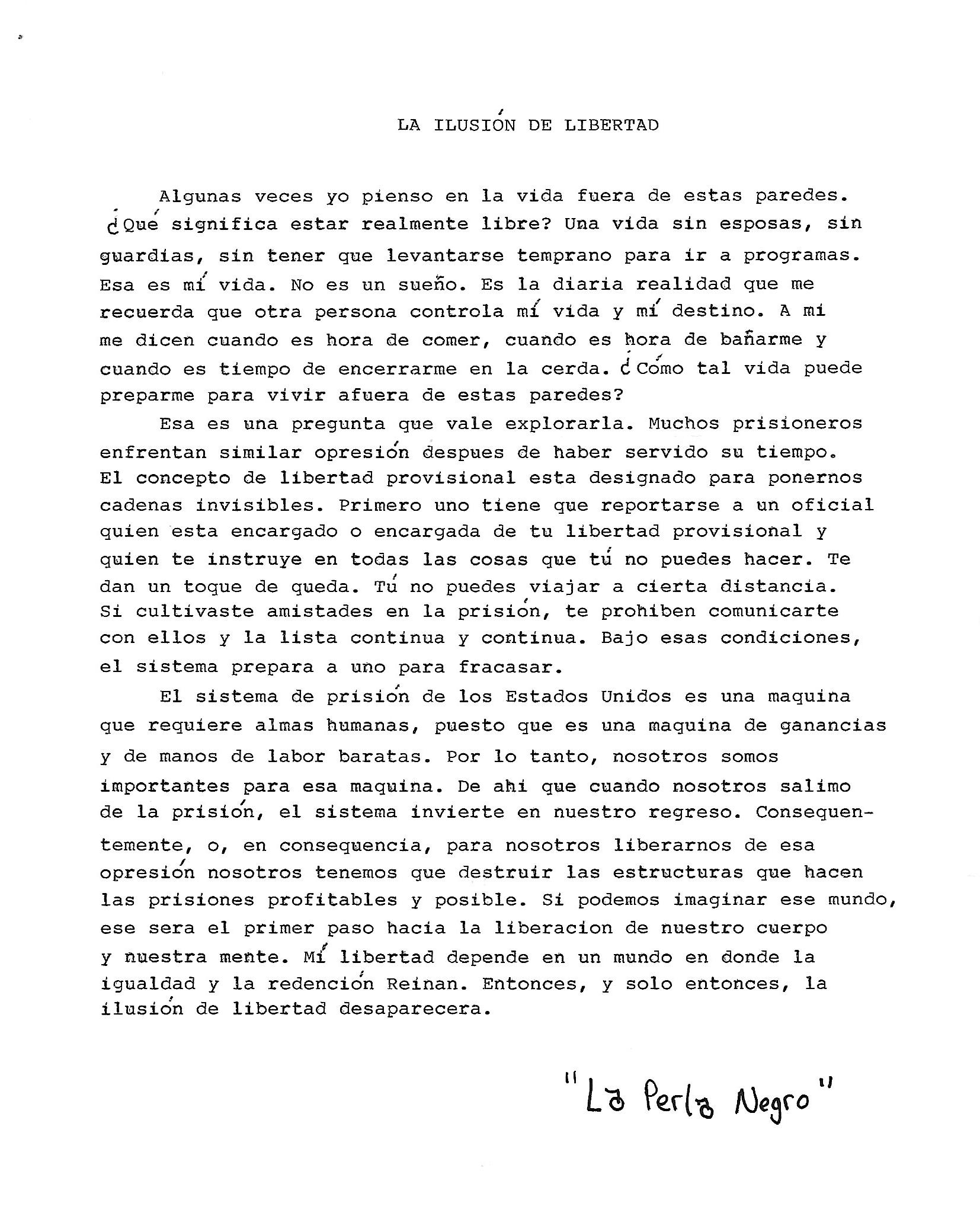
LA ILUSIÓN DE LA LIBERTAD
THE PEDAGOGY OF RESISTANCE
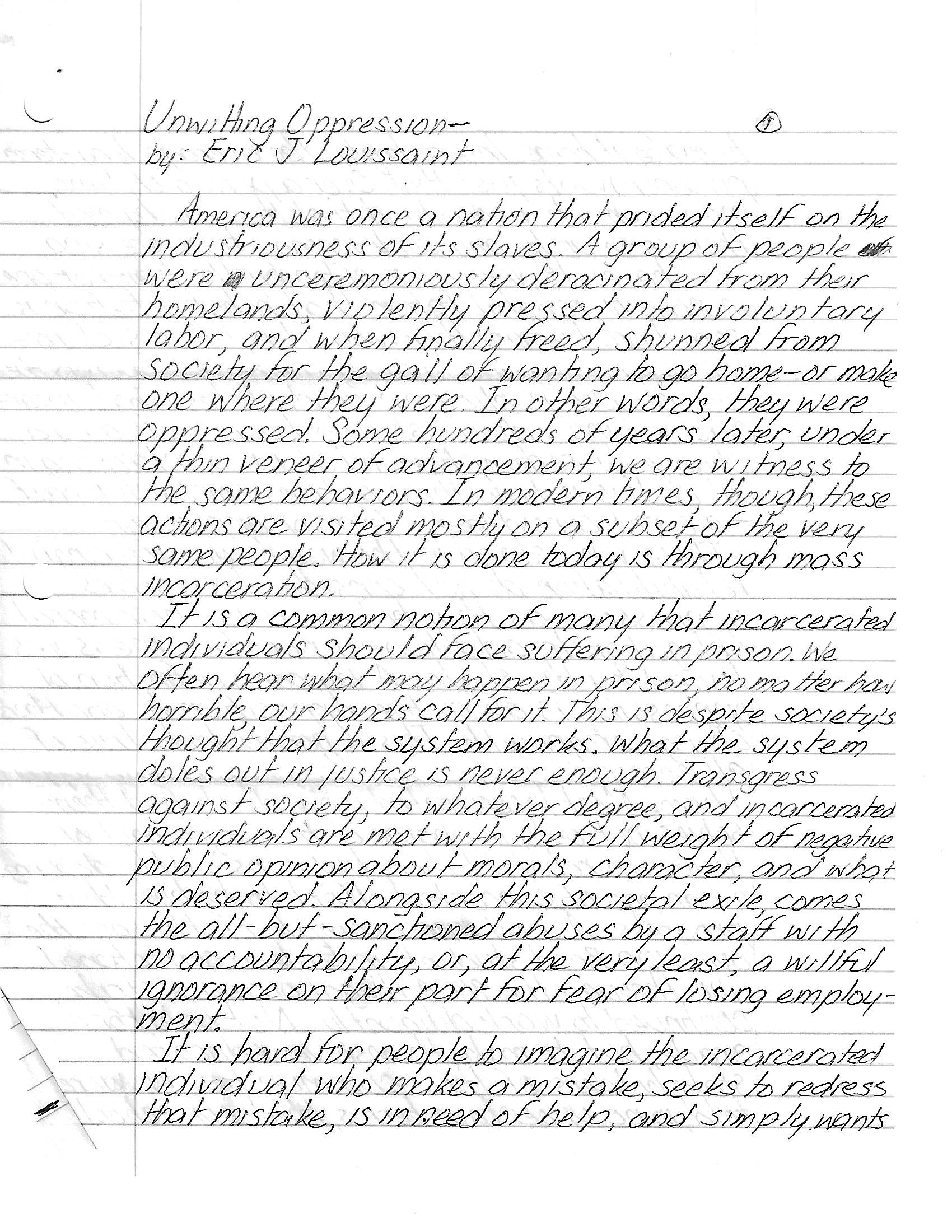
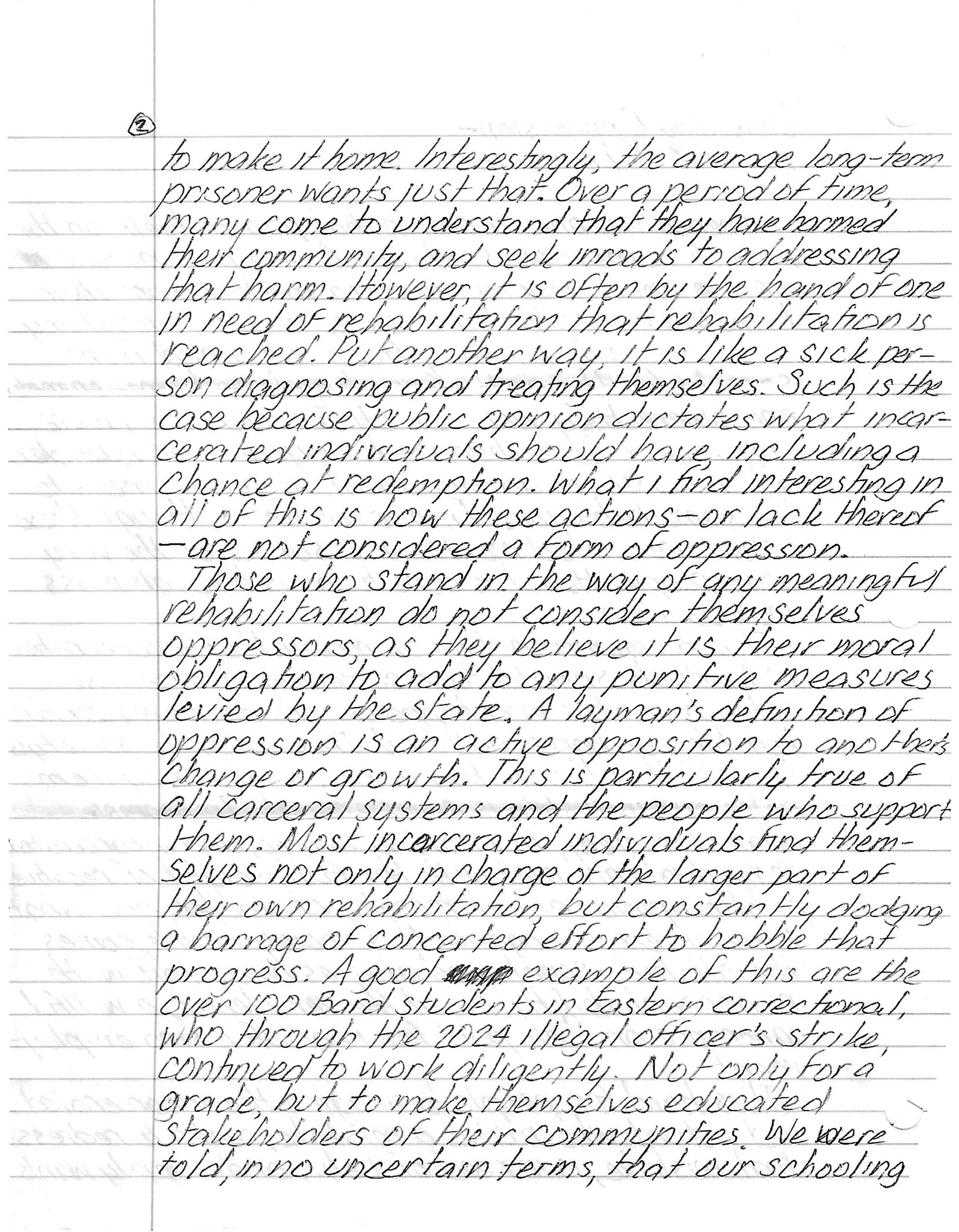
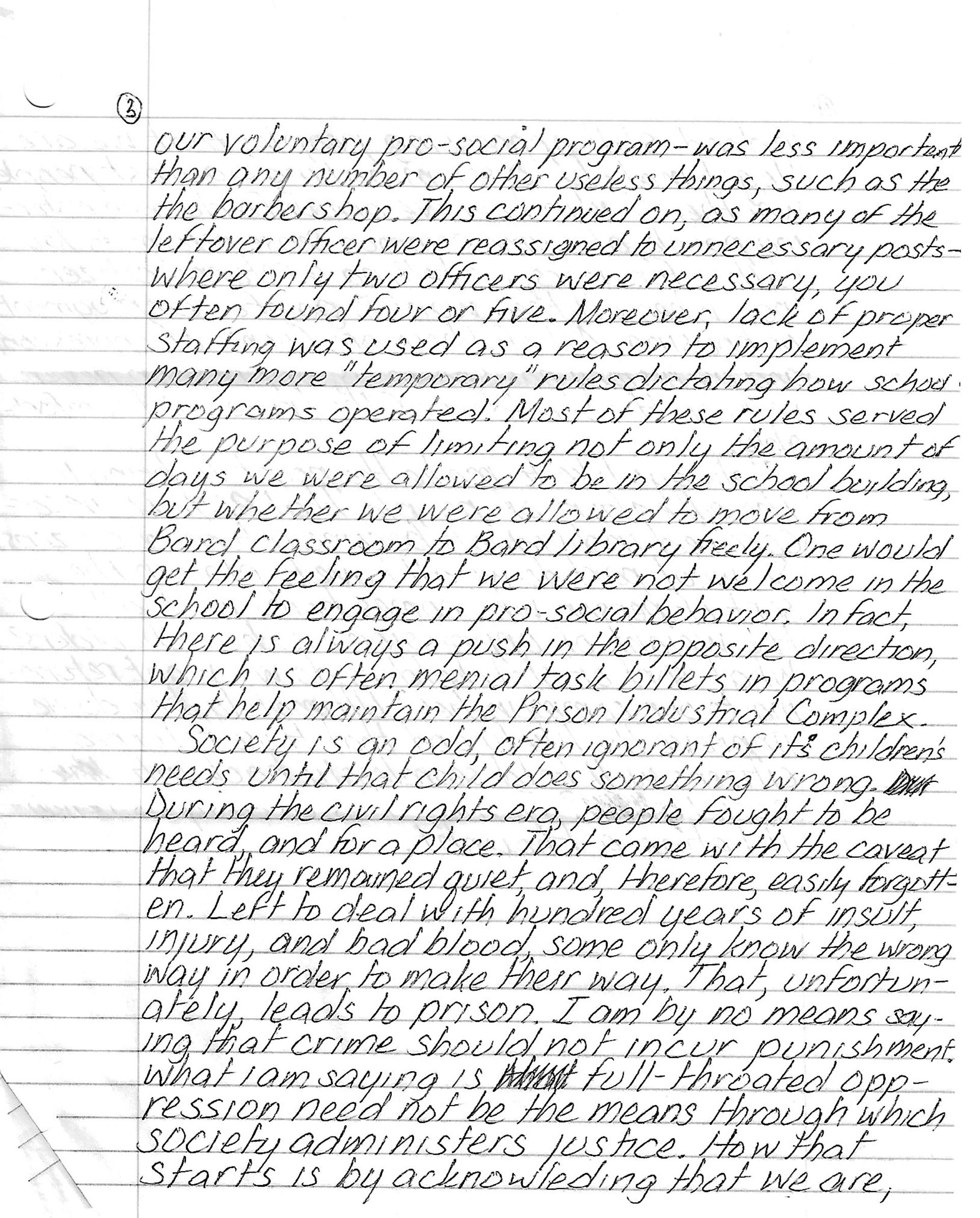
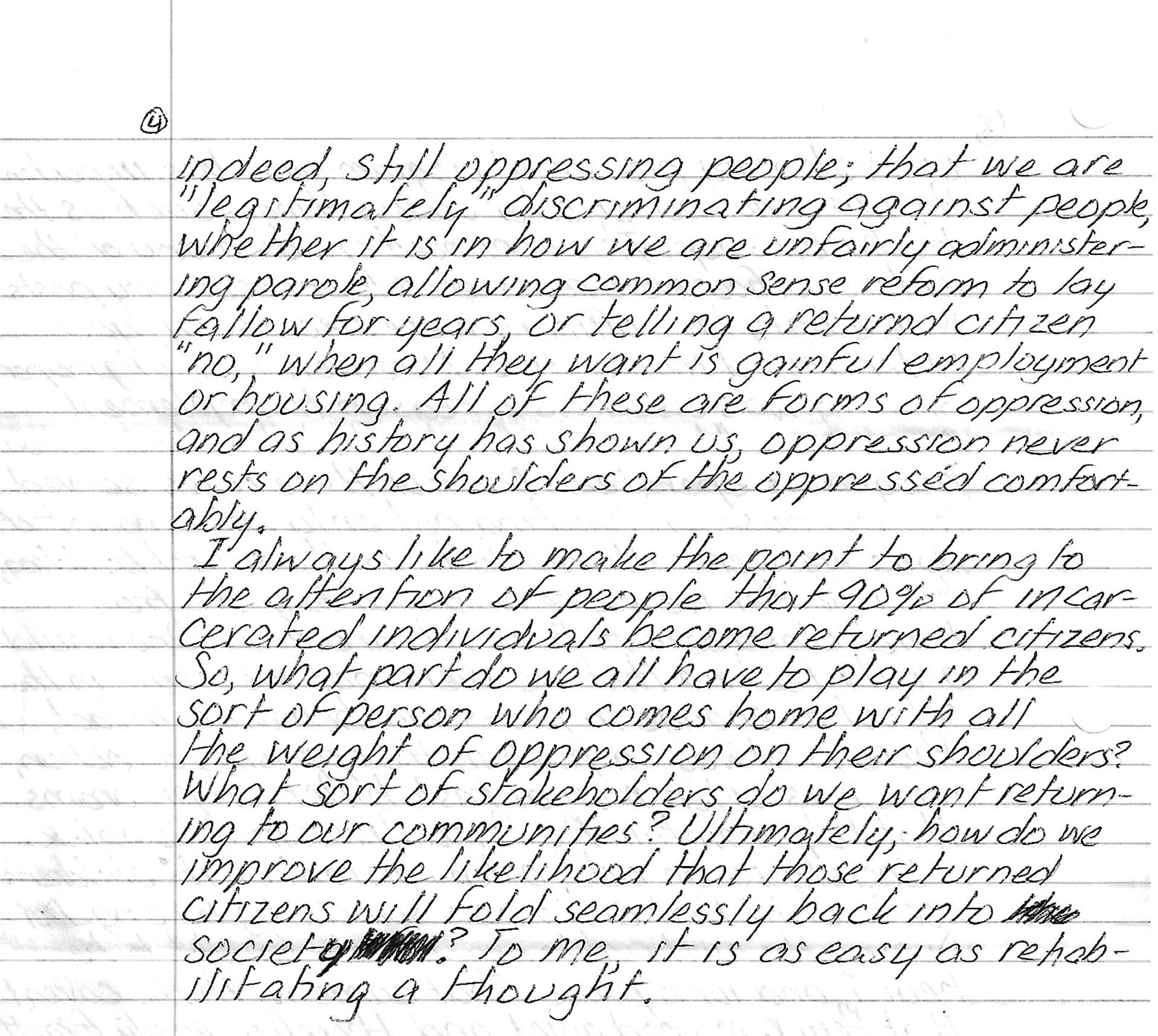
THIS IS HOW I SPEND MY TIME UNWITTING OPPRESSION
UNDER THE PRESSURE
GOING HOME IN THE FACE OF OPPRESSION: A VETERAN’S RETURN HOME
DADDY’S HOME! BEHIND THE WALL: WHEN THE FIGHT FOR
WHEN WE DON’T KNOW OUR NEXT HOME INTO THE FAMILIAR AND SOCIAL ORDER
FIND FEATURED ARTWORK THROUGHOUT
HER EXODUS TICK, TOCK. MY BODY AND OPPRESSIVE SYSTEMS AFTER THE GATE OPENS
I’M A PERSON
A RECIPE FROM THE INSIDE AUTHOR SPOTLIGHT: IN CONVERSATION WITH ARTIST SPOTLIGHT: IN CONVERSATION WITH RESOURCES & RECOMMENDATIONS
ABOUT THE BULB MAGAZINE
Dear Readers,
The Prisoners’ Brain Trust (PBT) and associated staff are very excited to bring you the first issue of The Bulb Magazine. For those who may not know, The Bulb initially launched two years ago as a monthly e-newsletter that brought original poetry, artworks, essay, and political commentary created by incarcerated people still on the inside. However, obtaining new material within a 30-day window from people on the inside presented obstacles that were out of the control of both PBT and the authors of the work. The Bulb as a quarterly magazine is PBT’s solution. By recreating The Bulb as a quarterly magazine, we position the vision, mission, and goal to achieve greater success. Not only does this approach afford more time to PBT and authors to ensure the richness of the content, but also enhances the range to the platform provided to our incarcerated brothers and sisters. We can now add photos, audio, videos, links, etc. to enrich the experience and reach a larger audience. Again, we are the Prisoners’ Brain Trust, and for this first issue we focused on the theme of “Going Home in the Face of Oppression.” We hope you appreciate the work that was put in, the new features and, most of all, the content. We also encourage you to write to The Bulb with any feedback.
Love, Laughter, Peace, and Solidarity,
Santos Lopez, Editor-in-chief
Contact us at admin@prisonersbraintrust.com
VISION MISSION
The vision of The Bulb is to build a vital bridge between incarcerated people and society by providing a platform that affords them the opportunity to narrate their own lived experience through creative forms of writing and expression.
The mission is to provide original content of poetry, spoken word, artworks, essays, and political commentary created by incarcerated people who are still on the inside. We believe this has the power to enhance society’s understanding of incarcerated people’s lived experience while also empowering us as a collective to reconsider some of the preconceived notions and stigmas often associated with these human beings.
GOING HOME IN THE FACE OF OPPRESSION
We have entitled this issue of The Bulb as Going Home in the Face of Oppression. We present within the reflections of incarcerated folks in prose, poetry, and visual art on their hopes and dreams for release from the prison industrial complex and the joy of that moment. However, they also share with us their fears of the authoritarian structures that have controlled their lives for so long being violently imposed on the homes they hope to return to soon.
Those of us who have been incarcerated well recognize the tyranny of state-sanctioned violence and the curtailing of one’s constitutional rights. For some of us, these attacks have been perpetrated upon our communities since we were born. For others, we became intimately familiar with these violences during our incarceration. Nonetheless, all of us lived, thrived, and survived within the maw of a fascist state–the American prison; a place where accountability for brutality and the protection of human rights were treated as afterthoughts at best and more often disdained as impediments to “security.”
Now, on the streets of our homes, we see the same lack of accountability, the same brutality, the same cowardice of power that we encountered behind the wall for decades magnified and normalized once again as “public safety.” Because this is what happens when oppression abandons subtlety and brutality replaces responsibility. The wall rises around our entire society–and the whole country becomes a prison.
- Jared Bozydaj, Associate editor
A LETTER FROM OUR EDITORS
SUBMISSIONS ACKNOWLEDGEMENTS
All submissions come from artists and writers within the NYSDOCCs Green Haven and Eastern Correctional Facilities. Submissions aim to reflect our mission while platforming as many voices as possible, specifically those that have historically been oppressed. Additionally, The Bulb is interested in displaying an array of creative mediums, including those that may seem incompatible with the magazine format – we strive to think creatively within our internal design team.
We extend our gratitude to everybody who helped make this edition possible, including contributors, editors, graphic designers, printers, as well as the many pairs of eyes that attentively reviewed the magazine in its evolving stages. Special thank you to Taqiy Walton and Santos Lopez for collecting contributions that speak to the soul of The Bulb. These voices are the lifeblood of the work at hand: a call for a just world and an end to dehumanization.
A NOTE FROM THE PRISONERS’ BRAIN TRUST
With immense pride and gratitude, we welcome you to the first issue of The Bulb in its new form. What began as an e-newsletter has evolved into a full digital magazine, an intentional shift that allows us to deepen our storytelling, amplify more voices, and bring forward the art, analysis, and lived experience that define the work of the Prisoners’ Brain Trust community. This transformation reflects our growth, and our commitment to building a platform worthy of the brilliance and resilience within our movement.
This issue would not exist without the dedication and vision of our editorial and creative team. We extend heartfelt thanks to Chief Editor Santos Lopez, Associate Editors Jared Bozydaj and Taqiy Walton, and our design team, Olivia Vela Page and Georgia Calvert, whose creativity and care shaped these pages. To every writer and artist featured in this magazine: thank you for trusting us with your words, your art, and your truth. The Bulb is a collective offering, and your contributions make it shine.
At this moment, the Prisoners’ Brain Trust is helping lead
one of the most urgent justice campaigns in New York State. Through the Faces of the Felony Murder Campaign, we are working to repeal New York’s felony murder doctrine alongside New York State Senator Julia Salazar and New York State Assemblymember Robert Carroll, with community partners including Legal Aid Society and University at Buffalo School of Law. The felony murder rule has long allowed individuals to be convicted of murder even when they did not commit the killing or intend for anyone to die. Repealing this doctrine is not only a legal reform, it is a moral imperative rooted in fairness, accountability, and human dignity.
Beyond legislative advocacy, our work continues in classrooms and communities. In collaboration with Dr. Jasmine Syedullah and the Vassar College Prison Studies Program, we brought incarcerated scholars into the classroom for a twelve-lecture series. These scholar-educators shared both research and lived experience, teaching Vassar students about the intersecting systems that shape the Prison Industrial Complex. Topics included youth development, mental health, prison organizing,
carceral policy, immigration, and environmental sustainability. These exchanges demonstrate what becomes possible when knowledge is shared across walls and generations.
We also look forward to gathering with community on September 12th in Poughkeepsie, New York for the 7th Annual Attica Community Remembrance Day, a time to honor those lost, reflect on the ongoing struggle for justice, and recommit ourselves to collective liberation.
This past September, we launched our website, prisonersbraintrust.org, expanding access to our work and creating a digital home for organizing, education, and storytelling. We invite you to follow us on Instagram @prisonersbraintrust to stay up to date with the latest from our community.
To our readers and supporters: thank you. This journey has been long, and we are forever growing. As we learn and evolve, we must remain grounded in our values and principles. In the face of oppression, we do not waver. When everything around us feels as though it is being taken away, we go on. We go on
because together we are stronger than any governor, legislature, president, prison, or institution. We, the people, will thrive in the face of oppression.
Community members are taken from our neighborhoods every day by the carceral system, yet every day our people are also returning home. Their return is not an ending, it is a responsibility and an opportunity for collective care, healing, and restoration. We must meet them with dignity, support, and belonging, because strong communities do not abandon their own. Though we may struggle against systems that continue to cage our people, we remain rooted in solidarity and guided by principle. Though we may fight for a sunrise we may never see, it is our principles that guide us toward truth and justice.
Together, we continue forward, Alisha Kohn and E. Paris Whitfield, Co-Executive Directors
EDITORIAL TEAM
Santos Lopez, Editor in chief
Taqiy Walton, Associate editor
Jared Bozydaj, Associate editor
Olivia Vela Page, Designer and project coordinator
Georgia Calvert, Designer
Alisha Kohn, PBT coordinator
While large parts of the work behind this magazine were done remotely, PBT’s mission and the facilities we work with are on the stolen Munsee Lenape, Mohican, and Schaghticoke territories known as NY State.
us:
The Fear of OPPRESSIVE SYSTEMS
BY LUIS GUZMAN
I am a 33 year-old man. I have been incarcerated since I was 19 years old. For me, going home in the face of oppression is scary. I left society as an adolescent. My memories of society are from the perspective of a teenager who was immature, dependent, and idealistic, all of which I had to grow out of while growing up in prison. The things I witnessed and experienced, the things we are conditioned to in prison are not tolerated, or tolerable as a man, in society. My experiences as an adult –all of them–are associated with prison life: fatherhood, dating, marriage, friendship, education, etcetera. I do not know what it is like to be an adult man in society. I have learned how to avoid and deal with conflict in prison by using different methods of communication, and recognizing cues of negativity, such as body language or whispers of gossip.
effort and metacognition? These types of doubts and oppressive thoughts are what I grapple with, especially considering all of the images of chaos, disconnect, and hardship that are continuously displayed on the news and television shows regarding society.
The oppressive thoughts I face place me as my own enemy due to the paralyzing effects of fear. I fear that I may fail. I fear that I will not be accepted. I fear the expectations others have placed on me to fulfill. And yes, the
this positivity to continue and thrive when I am released. They believe I have developed critical thinking skills, which I have, but they expect me to apply them seamlessly.
There are things I cannot fathom until I actually encounter them. There are things that prison rehabilitation does not prepare you for in society.
Should I use this same approach with people in society? Will the shock or pace of society trigger my adolescent ways of dealing with conflict? How do I navigate the transitions of thoughts and processes, from then, to now, to the future? Will it happen automatically or will it require further
growth and transformation I have displayed throughout my incarceration has been positive and productive. I went from participating in gangs to participating in college, from starting problems to collaborating on ways to solve them. I have switched from an agent of chaos to an agent of structure. As a result, family and friends expect
The application of critical thinking under captivity and society, while similar in some respect, is different. They are not taking into account the structuralism of society. This is something I have given a lot of thought to. There are circumstances in the real world (society) that I have never encountered as an adult man, things I am not familiar with or don’t understand: systems, customs, and cultural differences. The application of critical thinking skills under these circumstances will be a lot different and immense. There are things I cannot fathom until I actually encounter them. There are things that prison rehabilitation does not prepare you for in society.
Oppressive structuralism affects people in an extreme way who have never been incarcerated. In just months, some people go insane or take their life. The same can be said for those who spend a decade or more in prison
and now have to return to society to learn everything over at an older age. With this mind, I can only imagine the potential devastating effects it can have on me, a person who has spent more years incarcerated than in society, during a time when I was supposed to be transitioning into adulthood. Maybe I can articulate this point with more clarity.
I never had a job interview. I never scheduled a doctor’s appointment. I never voted. I never had a driver’s license, applied for housing, or experienced the trials and errors that are expected of a young adult. This lack of experiencees will be held against me, if not blatantly, then tacitly. It is difficult to get a job with little or no work experience, and that level of difficulty doubles when one is marked as a Felon. It is difficult to obtain housing or purchase a car without a history of credit. It is difficult to receive proper health care without the above mentioned or the knowledge and experience of knowing which provider or medical institution can meet my specific needs. There are people who will take note, and then advantage, of my inadequate social skills.
There is no doubt that I will experience the feeling of embarrassment and alienation for not knowing what to say or for not understanding something during conversations on topics that are common to most. The consequence may lead to ostracizing, the ruining of new relationships, anxiety, depression, and then antisocial behavior. These are
How do Inavigate t hetransitionofthoughts and
the ingredients for a recipe that leads to old ways or relapse. And although many former incarcerated people knew this prior to going home, they still fall victim to it.
Will this affect my role as a husband? Will this affect my role as a father? Most of the friends I had prior to incarceration have moved on in life. The people I can consider to be “friends,” I have made in prison and will be leaving behind. How does the relationship I have built with them help me foster new friendships in society? I will not be able to communicate with Felons upon release because of parole stipulations.
These are the things I think about. These are the things that will present my greatest challenges. Again, these are the fears that stem from the
oppressive systems that await me in society, the things that former incarcerated individuals have faced and succumb to. There are those who have also succeeded by enduring and overcoming, with the right mentors and support system. While these fears are not just a thing of the mind — there are systemic processes and challenges that turn them to real life experiences and hurdles — I am also of the belief that if I was able to adjust and do what was necessary to survive and grow in prison, and the oppressive systems that come along with it, that I will figure it out in society. Not only is failure not an option for me at this point, but the systems associated with prison are a lot more fearful.
Luis A. Guzman is a father, husband, and college student. Learn more in his Author Spotlight.
“
I NEVER HAD A I NEVER SCHEDULED DOCTOR’S APPOINTMENT.
I NEVER VOTED. HAD A DRIVER’S APPLIED FOR EXPERIENCED THE ERRORS THAT ARE OF A YOUNG
JOB INTERVIEW.
SCHEDULED A APPOINTMENT. VOTED.
I NEVER DRIVER’S LICENSE,
HOUSING, OR THE TRIALS AND ARE EXPECTED YOUNG ADULT. “
BY DAVID GREENE
Patterns of inequality that originated in the slavery experience have produced a chain effect of social problems, and a major consequence is the normalization of crime and violence in poor urban neighborhoods. This normalization has produced a culture of criminal behavior among the poorest in low-income neighborhoods. I am a product of this culture.
I grew up in the Edenwald Housing project, one of many housing projects located in the Bronx borough of New York City. I had a rough childhood growing up in a single parent home. My father died when I was around 8 years old. I found myself in the troubling situations that were common among marginalized youth
administered here in the United States, which are not what they should and are truly supposed to be.
During my first incarceration I did everything in my power to make a change. I took all of the rehabilitative programs, such as horticulture, woodshop, food handling, and general maintenance. I also became a facilitator for Aggression Replacement Training (A.R.T.). Through these achievements, I had to circumvent the actions of the staff and officers who were diligently attempting to hinder my rehabilitation, the same staff and officers who were supposed to be responsible for administering rehabilitation. So, in all actuality, I was attempting to rehabilitate myself in spite of the system that was given the
I guess you could say that I am intimately familiar with rehabilitation and reintegration, especially the versions that are administered here in the United States, which are not what they should and are truly supposed to be.
like me: fighting, delinquency, and troubles with the law. I went to prison for the first time when I was just 15 years old, and I wasn’t released until I was 19. I continued to go back and forth to prison until finally being sentenced to 23 years to life, of which I have now served around 18 years.
I guess you could say that I am intimately familiar with rehabilitation and reintegration, especially the versions that are
responsibility but was instead hindering my success.
Instead of constructing productive members of society, it persistently attempts to break and discourage individuals from that achievement. During that first incarceration, I went to the parole board with the achievements that I mentioned, along with a perfect disciplinary record, no misbehavior reports whatsoever, and yet I was still
denied parole. In fact, I was hit with an additional 24 months— the maximum amount that was allotted. Ultimately, I ended up serving 4 years of a maximum five year sentence. I was finally released due to my “Conditional Release” date.
While serving that one year of parole, I suffered so much hardship because of parole. I struggled to find employment. When the opportunity for employment arose, my parole officer did not allow me to take the jobs. I wasn’t allowed to take one of the jobs because it was an overnight warehouse position that would have violated the curfew stipulation, and another because it was in Queens and I was paroled to Westchester County—my parole officer deemed the distance was too far.
Eventually, my parole officer informed me that I was going to be violated and sent back to pris-
on if I did not find employment. Afraid of what that consequence entailed, I decided to not return to parole. Subsequently, I ended up returning to prison because of the violation and a new charge. For many years, I went back and forth to prison and experienced similar circumstances as my first incarceration. From state prison, to county lock-ups, and even Federal prison, including Federal parole supervision.
rehabilitation and reintegration are held accountable, they will be compelled to actually give it a legit effort, and as a side effect, mass incarceration in the United States will decline.
Throughout my experiences, it was always the same, the system continued to hinder my rehabilitation or reintegration back into society. Although a few changes have been made to what constitutes a parole violation worthy of prison and some language changes in the law, the system is still broken and in drastic need of justice reform. But maybe if the individuals who are supposed to be responsible for administering
David Green is a Bard College student currently completing his B.A. in Social Studies, with a 3.78 GPA. He has spent over half of his life in correctional facilities, beginning at the age of fifteen, predominantly due to many adverse childhood experiences. He plans to use the knowledge he has gained from his negative experiences, coupled with his education, to help youth who are growing up in similar circumstances as his. As Mr Green would say: “Our troubled youth have great potential; they just need some guidance to help lead them to a great future.”
THE CONTINUITY OF RESTRICTIONS AND OPPRESSIVE SYSTEMS POST-INCARCERATION
BY SANTOS LOPEZ
In thinking critically about the theme of “Going Home in the Face of Oppression,” it was something I found impossible to do without first considering what I had already been subjected to and experienced while incarcerated.
I have served 17 years of a 22-years-to-life prison sentence. With 5 years remaining to my initial parole hearing, and approximately 13 years dedicated to “true” rehabilitation, reentry is a concept I often contemplate: what am I returning to, and what obstacles will I have to overcome? Two lingering concerns (and frustrations) are the blanket of general restrictions and oppressive systems I will be forced to navigate if I want my “liberty” reinstated, despite demonstrating growth and great work ethics while incarcerated. But what does that even mean? And, more importantly, what does that look like?
The blanket: I will have a curfew, more than likely, between 8:00 - 9:00 pm to begin. I will not be able to leave the state, country and, if from N.Y.C., the boroughs. I will not be able to obtain certain employment. I will have to report weekly to parole. I will be subjected to drug testing. I will be subjected to “pat frisks” and “searches.” I will have to apply for a substance abuse or aggression treatment program (if not both). And if the residence I have been planning to return to is in a community deemed a “red zone,” I may be forced into a shelter. How does this sort of criteria for release affect the psyche or moral compass of a rehabilitated
How does this sort of criteria for release affect the psyche or moral compass of a rehabilitated incarcerated individual prior to and after release?
This means that prior to release I will receive a contractual list of restrictions from parole that I must sign if I want to be released.
incarcerated individual prior to and after release? Speaking for myself, while still incarcerated, it triggers my anxiety and causes stress just thinking about it.
If I have been incarcerated for 17 years and have never tested positive for drugs or alcohol, why should I be forced to attend substance abuse treatment? Similarly, If I have successfully completed and been certified for aggression replacement training, and have not engaged in any violent conduct since, why should I be forced to attend aggression treatment? This sort of approach to “treatment” not only becomes a form of oppression, because it takes away time that can be used productively elsewhere, but also takes away space from those really in need of treatment. After being away from my family and loved ones for over a decade or two, why should I not be allowed to go on a vacation with them? Or after having my wife visit me in correctional facilities for over a decade or two, why should I not be allowed to take her to a candlelight dinner and movie that extends beyond 9:00 pm? These are the privileges and moments that make people feel blessed, valued, and appreciate life.
RESTRICTIONS
If I earned a college degree and several certificates, why can I not return to my community with this knowledge and lived experience to inspire a positive mindset shift and provoke meaningful change? These are the contributions and practices that encourage connectivity and stitch together the social fabric of “community.” If I am no longer engaging in criminal activities, why must I still be “pat frisked” or have my personal property “searched” as if I am? This treatment is not only acknowledged and felt by the formerly incarcerated, but also civilians, neighbors, relatives, and children. Furthermore, it causes confusion and fear, and produces biases and stigmas associated with criminality.
Many of these “supervisory” practices have implications that are criminalizing, demoralizing and, quite frankly, discouraging. Moreover, they amplify past carceral traumas, are a consistent reminder of captivity, and perpetuate a current form of confinement– physically, mentally, and emotionally. But thus far, I have briefly touched on the issue of the “blanket” concern solely based on the contractual restrictions. Let us now examine
a couple of examples that can potentially broaden our lens regarding harmful practices and oppressive systems.
I have a friend whose residency was denied by parole because it was deemed a “red zone,” which is an area considered to be high in crime. As a result, he was forced to reside in a shelter and, more than likely, took the space of someone who was in fact homeless. Within an 8 month span, he was bounced from shelter to shelter and borough to borough—Manhattan, Queens, and
The
community—the people and place that manifest the very concept of “home”. This is typically the core motivation and glue that helps the incarcerated to “hold it together,” and “want to be better.” Again, in what ways does this instability and detachment affect the psyche of the formerly incarcerated?
concept of the “red zone” is one that forces the formerly incarcerated to be severed from friends, family, and community—the people and place that manifest the very concept of “home”. This is typically the[ir] core motivation and glue.
Brooklyn (three shelters in total). The stress he endured because of this unstable circumstance caused by the system, left me counseling and encouraging him about not “losing [your] cool” and “sticking to the game plan.” He is currently still in a shelter and doing what is necessary to sustain his liberty, but I wonder sometimes about how hard it must be for him, especially considering that he was not allowed to return home. The concept of the “red zone” is one that forces the formerly incarcerated to be severed from friends, family, and
In another example, on October 16, 2025, 27-year-old John Martinez was shot and killed in front of 79 Alexander, in the Bronx (N.Y.). For those unfamiliar with the location, this incident occurred in front of the parole building after Martinez reported to his parole officer. Why should this be of concern? This should be of concern because Mr. Martinez was not the first parolee killed as a result of reporting to parole, which suggests that this was not only a foreseeable incident but also a preventable one. Formerly incarcerated individuals have to report to a location (institution) for oversight, which means there is a likelihood that those who had conflicts while in NYSDOCCS custody will cross paths after release. Not everyone returns to society fully forgiving of past transgressions against them, and not everyone in society is forgiving of those who may have gone to prison for harming one of their loved ones. Based on this indisputable fact and under-
standing, why would government officials, policy makers, or parole officers not demand or mandate more law enforcement outside of these institutions and spaces? The implication suggests that our safety and lives are not of significant importance or equal protection, yet we are supposed to reintegrate in a productive manner and contribute to “civil society”.
Here lies an opportunity to consider the many ways we actually endanger the wellbeing of the formerly incarcerated and make it extremely difficult for them to reintegrate and be productive members of society. Here lies an opportunity to step back and reconsider our role and responsibility, as a community, in the successful reentry of the formerly incarcerated. Believe it or not, our continued absence and ostracizing means that the community is still not whole and fractured because we come from these communities. But we have the power to repair and change that narrative. These personal anecdotes and analytical perspectives are not intended to undermine some of the progress we have made as a people, community, or state regarding our policies and laws. Rather, the hope is to underscore the need to share and deepen our information and understanding of people , structures, systems, and policies, so we can execute new practical and meaningful strategies that allow us to grow, improve, and create powerful communities of solidarity and love. And I believe I have a fair and pretty simple sug-
gestion: include us in the conversation about what may be “good” and “not good” for people. The outcome just might surprise you. After all, WE ARE PEOPLE.
HERE LIES AN OPPORTUNITY TO CONSIDER THE MANY WAYS WE ACTUALLY ENDANGER THE WELLBEING OF
FORMERLY INCARCERATED AND MAKE IT EXTREMELY
DIFFICULT FOR THEM TO REINTEGRATE AND BE
PRODUCTIVE MEMBERS OF SOCIETY.
Santos Lopez is an incarcerated individual who is nearing the end of a 22 years-life prison sentence. He has dedicated his time to education, earning an Associate’s Degree in the Arts, and is currently working on his senior project to earn a Bachelor’s Degree from Bard college. Rather than waiting for his release to perform his civic duties, Mr. Lopez is an active member today, writing conversational pieces that afford readers different perspectives into the effects of policies, community, and mass incarceration. He is an active member of PBT, focusing on Community Education and Reentry, and is editor-inchief of The Bulb. He is also a creative writing instructor, and tutor, all made possible through his role as a husband, son, brother, friend, and community member.
LA ILUSIÓN DE LA
Sometimes I think about life beyond these walls. What would it mean to be truly free? A life with no handcuffs, no guards, no need to get up early every day to go to prison programming. That is my life. It’s not a dream. It’s a daily reality that reminds me that someone else is in control of my life and my destiny. Someone else tells me when it’s time to eat, time to shower, time to lock myself in my cell. How is this life supposed to prepare me to live beyond these walls?
That’s a question worth asking. Many prisoners face similar forms of oppression after having served their time. The concept of provisional freedom is designed to give us invisible chains. First you have to report to an official that is in charge of your provisional freedom and instructs you on everything that you can’t do. You are given a curfew. You can’t travel past a certain distance. If you built friendships in prison, you cannot communicate with them. The list goes on and on. Under these conditions, the system is setting you up to fail.
The US prison system is a machine that requires human souls, given that it is a money making machine based on cheap labor. Thus, we are essential to that machine. That’s why when we leave prison, the system invests in getting us back inside. Therefore, to liberate ourselves from that oppression, we must destroy the structures that make prisons both possible and profitable. If we can imagine that world, that will be the first step towards liberation of our mind and body. My freedom and liberation depend on a world where equality and redemption reign. Then, and only then, will the illusion of freedom disappear.
- La Perla Negro
THE PEDAGOGY OF RESISTANCE
BY TAQIY WALTON
With 2025 coming to a dizzying end, the tumult of the first ten months of Donald Trump’s last (catching my breath) presidency is nothing short of an apocalyptic disaster. In this short span of time, America’s feckless leader has transformed the U.S. government into a nine headed hydra, its poisonous ideology infecting every neighborhood and back alley in America. There is a surreal sense that we are witnessing a country suspended in a perpetual state of regression. The country is being divided. And this, I am observing, from the farthest side of the social divide: behind a forty foot wall in a New York state maximum security prison. A captive of the state, I am not immune to societies’ ills. In fact, prison is a microcosm of the outside world. Drug overdoses, corruption, and violence are customary. This, of course, is not a groundbreaking revelation. On the contrary, prison reform advocates have been highlighting such similarities for decades. Yet, as honorable and humanistic as these advocates are, there still exist numerous untold stories of optimism and hope which have evaded the social radar. Here is one of them.
Across New York State, many incarcerated individuals are fighting to go home. In most
instances the fight consists of legal battles with courts, while with others, the fight is more primal—a survival by any means necessary mentality. But often overlooked, is the fight for educational liberation. As college in prison programs continue to grow, those of us who are degree holders (including myself) see our education as a form of resistance to the monetization of higher education and
The pursuit of higher education is also a push against long worn out stereotypes about people in prison.
the subsequent socio-economic disenfranchisement it causes. But the pursuit of higher education is also a push against long worn out stereotypes about people in prison: “we are irredeemable and unworthy of expressions of humanity”. My fight to go home is anchored in the ethos of the humanities-civic engagement and mutually beneficial partnerships.
It looks like this. Each week local college students arrive at college in prison programs across the state to volunteer their time as tutors. The exchanges are mutually beneficial. These volunteers tutor students in need of help, which of course, aids them in the retention of course work. But above all, these volunteers
get to experience our humanity in real-time. Observation is a key element to understanding. Thus, working with incarcerated individuals invigorates in them a deeper sense of civic duty that reciprocates into action-often leading them into careers as social justice advocates, grassroots organizers or public policy officials. Seeing the big picture is always better from outside the frame. What I see in these volunteers are revolutionaries in the making. I see trail-blazers. I see reformers. Most importantly, I see in them the desire to be agents of change and bridge builders for justice, equality and humanity. The spirit of resistance flourishes when people are willing to challenge their own assumptions about reality and step outside their socially constructed comfort zones.
The spirit of resistance flourisheswhen
RESISTANCE
their own assumptions.
Taqiy Walton is a self-taught visual artist, writer, and social justice activist, and an See more about Taqiy in his artist spotlight.
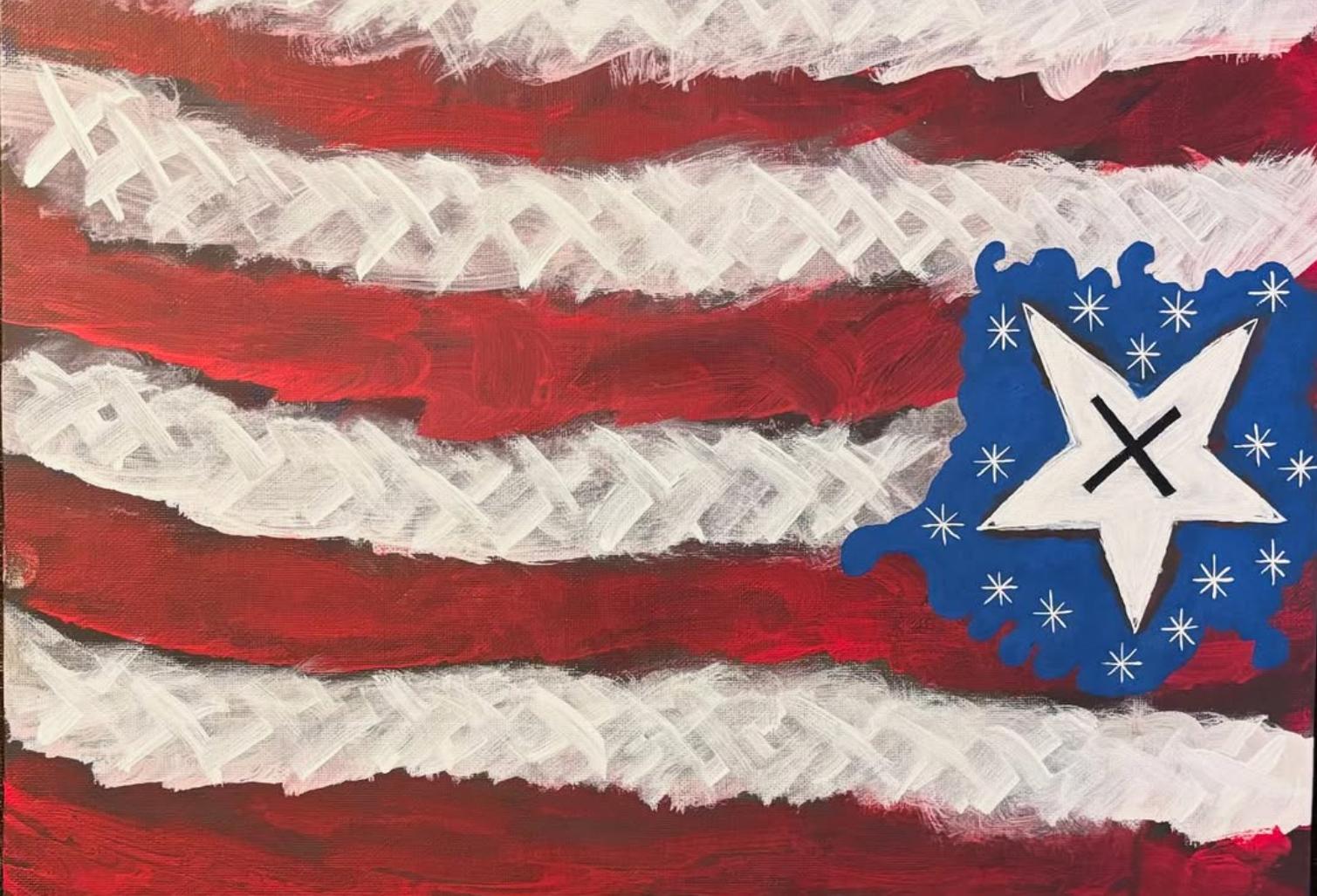
The New America after DOGE
THIS IS HOW I SPEND MY
BY E. PARIS WHITFIELD
I don’t fight or struggle to get home, nor do I have a need to “resist” or “survive” New York state’s carceral complex. When I tell this to people, they automatically assume I’m institutionalized. But I am not. In these twenty-three years I have served (thus far), when I think on the time, I could easily have a panic attack. So I’m not saying that serving a sentence is a cakewalk, because it is not. But why don’t I fight or struggle to get home, nor have a need to “resist” or “survive” New York state’s carceral complex? I have seen many people go home, without doing anything more than waking up everyday, gambling, fighting, cussing, hustling (others), drinking, drugging, you name it — and they go home, granted they cycle in and out without much thought. But they do go home, so that isn’t a rarity. My fight is getting up every morning — over, and over, and over again at 4:30 am — to plan my day, not because I love it, but because I don’t. And, it is in doing the thing I least love, like I do love it, that has taught me the discipline needed to become comfortable in the uncomfortable. I have trained my mind for the toughness, so my struggle isn’t facing obstacles, those are
inevitable, but knowing that I’ve practiced for the toughness, and knowing that if I hadn’t trained my mind for the daily grind (of prison or elsewhere) so when a tough situation shows up, so does my training.
I am not in perpetual want, whether that be for going “home” or something else. What I want can’t always be in someone’s hands or in a day, week, month,
And, it is in doing the thing I least love, like I do love it, that has taught me the discipline needed to become comfortable in the uncomfortable.
illusive “home” but lose ourselves in that process? Prison is temporary, but what I am preparing for is lasting: my legacy is in defining and refining my being... my mentality... my spirituality, so when I’m back in society I will know where my people are, and what “home” outside of myself ought to feel like. Seeing and reclaiming my life’s truest purpose, only I can do that. Even if I fell on my knees to ask that God intercede, I have to be willing to allow that work to take root in meaning.
or in a year that has not even come. So I don’t fight or struggle to get home, because home is wherever I am, and physically my body is captive, but my mind is not. I resist the biggest lie: that these walls are what contain me, or define me. I am so much more than what the naked eye can see. I have DNA from my ancestors and just as the struggle is within, so is the fight and the victory... You all don’t hear me. So when I walk out of the carceral revolving door, I break the cycle that so many of us are trapped in. And that’s the bondage mindset: that what any of us need and want lies far, far, outside of ourselves. What is the price — to gain some
You all don’t hear me. My perspective can be my prison or my passport. To get home, I need only to “resist” and “survive” not New York state’s carceral complex, but those other lies, such as “this isn’t who I am” and the follow up, “I’m just getting by.” Those lies that are the acquiescence to prison norms, rooted in an upside down kingdom’s right is wrong and that wrong mentality is rewarded with subtle trinkets that reduce humanity down to extra shower time, or worse, selling another brother (or sister) out in the struggle for prison power. New York state’s carceral complex isn’t my focus. (Sigh...) This is not a new system — but one that is reminiscent of the neighborhood I come from, Spanish
EMIHarlem, where violence, over-policing, and open air prisons sit with NYCHA’s names instead of NYDOCCS’s. Fear is what imprisons us. I am not institutionalized, in fact, one could even say I’m wise when it comes to the Left/ Right/Moderate Bullsh!% — packaged as tough-on-crime to prison reform pantomime. The conditions by which we incarcerated people live are rooted in the erasure of our identity and
our The conditions by which we incarcerated people live are rooted in the erasure of our identity and our sense of humanity. None but ourselves can free our minds from mental slavery. So I don’t fear it or struggle against prison. I’d rather spend my time practicing for what’s inevitable: greatness and my intention on breaking the carceral system.
I resist the biggest lie: that these walls are what contain me, or define me.
The Remnants of Aura
UNWITTING
OPPRESSION
Eric is currently earning a master’s degree in Public Humanities, and his focus is on the intersection of technology and the public. A graduate of Bard College’s Prison Initiative, with a bachelor’s in Social Studies, he is an avid amateur mathematician and software engineer, and serves as a BPI math and writing fellow, tutoring the student community. He is an active member of PBT, where he focuses on Education and De-carceral Policy, creating and advocating for policies that prioritize the return and rehabilitation of community members. He currently resides in New York State.
UNDER THE PRESSURE
BY ROBERT MCLEE
“Nothing is more desirable than to be released from an affliction, but nothing is more frightening,” states James Baldwin. Prison is an affliction that most, if not all, wish to rid themselves of. This is true for many reasons. Perhaps chief amongst them is the loss of liberty and identity that is inherent in being incarcerated. Prison is a place designed to instill a sense of order, discipline, and compliance in people deemed to be in need of structure. Prison has a unique way of reminding people that no matter how special or privileged you may feel that , ultimately, you are “nothing.” As a prisoner you are reduced to a number and you are no longer “the man,” rather you are just a casualty of a system caught in the ever churning wheels of justice.
To be released from such conditions is seemingly a prideful and joyous moment, but it can be daunting and full of trepidation as well. Humans fear the unknown, and what a person’s future prospects are after incarceration are most assuredly unknown. The tag of a felon is a heavy burden to carry and often becomes too cumbersome for
many to bear. A felon is defined as a criminal or someone guilty of a felony. On the surface, this is a simple enough definition. However, society has made felon into a dirty word. Felon has a specific connotation in the American imagination and connotes an evil plot. Felons are usually associated with a type of person.
For many, a felon means a Black or Brown male of a particular age and look. In Michelle Alexander’s book, The New Jim Crow, she highlighted that it is no longer politically correct for Americans to say “I hate Black people,” but it is alright to say “I hate prisoners.” This means that
an endless cycle of poverty and oppression. This phenomenon is evinced when applying for a job, housing, or school. Seemingly, all of the institutions within the American social landscape have a way to stifle the opportunities for a “felon.”
While being released from prison may be the greatest moment in life for many, it is concomitantly the beginning of an uphill battle to shake the stigma of incarceration.
Black and Brown people that are fortunate enough to be released from prison are twice stigmatized: once for being a minority in America, and twice for being justice impacted. This label is a tough one to shed and often restricts a person’s life chances so heavily that their life becomes
This is not by accident, but is an intentional device and the byproduct of the continuing effort to keep “Blacks” in their place. The Thirteenth Amendment of the United States Constitution codified this loophole to slavery. The loophole reads: “Neither slavery, nor involuntary servitude, except as a punishment for a crime whereof the party shall have been duly convicted, shall exist within the United States, or any place subject to their jurisdiction.” This means that incarceration became a new tool to further the agendas of slavery and to dominate and disenfranchise the people already at the bottom of the American social hierarchy. Despite the ratification of the 13th Amendment outlawing slavery, the racist infrastructure that allowed it to thrive was never addressed. White supremacy was at the heart of slavery and the machinations of the criminal
“justice” system only reinforced this truth. This is the social reality for many people leaving prisons today. While being released from prison may be the greatest moment in life for many, it is concomitantly the beginning of an uphill battle to shake the stigma of incarceration.
Rehabilitation is supposed to be an integral part of doing a bid (prison sentence), but it has been excised from the modern criminal justice apparatus and replaced by a sense of hopelessness. Recidivism is a definitive product of the lack of rehabilitative programming available to prisoners. The goal of many in correctional spaces is to leave people deemed as criminals to their own devices with the hope that they will re-offend and by extension ensure future job security for the corrections staff. The fact goes ignored that the majority of the same incarcerated individuals will be released into society. These same men, whether rehabilitated or not, will be released and have the opportunity to victimize someone they (corrections staff) may love. It seems counterintuitive to not want the incarcerated to return to society better educated, with skills that could prevent them from re-offending. However, rehabilitation has become a personal journey that people must choose to seek out or not.
Despite proof that people tend to age out of criminality, and that after serving long-term sentences of 15 years or more an individual’s propensity to commit crimes
are greatly reduced, there are still those in positions of power that sabotage programming and wish to limit educational opportunities. Oppression is baked into the fabric of the Department of Corrections in most places. The culture dictates that the incarcerated must fight to rehabilitate themselves, to get out of prison, but also to navigate in spaces once released. The system is not set up for formerly incarcerated to thrive, but rather to oppress and stifle their life chances.
It is past time that as a nation we stop paying lip service to the ideals we claim to extol but to internalize them and live by them. One of those ideals is that once someone has finished their prison sentence that their “debt to society” has been paid. Incarceration is a tool utilized to do many things, but one of them should not be to further oppress and subjugate people that have made bad decisions in the past and are looking to change their life’s trajectory.
eop le to t hrive, but rather to o ppress and
Robert McLee is a 43 year old Black man and U.S. citizen. He has been incarcerated for 23 years of a 125 years to life sentience. Mr. McLee received an associates in Liberal Arts through Bard Prison Initiative (BPI) of Bard College and currently has 22 credits to gain his bachelors. Mr. McLee also facilitates for several incarcerated individual run organizations: Alternatives to Violence (AVP), Prisoners AIDS and Counseling and Education (PACE), and Project for A Calculated Transition (PACT). Mr. McLee enjoys weight-lifting, playing soccer, football, and handball. He is an avid reader of both fiction and nonfiction, as well as an amateur movie buff.
GOING HOME IN THE FACE OF The Process of Preparation
BY MICHAEL COBB
My name is Michael Cobb, and I’ve been incarcerated more than 34 years for a crime I did not commit. That and the emotional weight of being sentenced to 41 years to life, are both forms of psychological oppression. I’m doing everything I can with the limited financial and emotional resources of support available to me. As I’m dealing with this ordeal through the course of my continuous fight toward overturning my wrongful conviction via legal litigation, I’m still managing to work towards earning my Bachelor’s Degree while participating in and facilitating various therapeutic programs. Programs better equip me to overcome the challenges of going home and being successful in the face of oppression and opposition, such as the challenges of employment, shelter, and the re-acclimation to societal norms.
I’m currently the vice president of the Project Build Organization here at Green Haven Correctional Facility. In that role, I teach a nine month class to a cohort of 55 men. The program has an intensive re-entry and reintegration based curricula that I facilitate in connection with Exodus
Transitional Services. We teach a myriad of topics that address some of the possible problems going home after serving a substantial amount of time may cause, such as antisocial behavior, poor employment readiness, criminal thinking, and twisted value systems.
During each class I ask my participants if they agree with the following statement: “One of man’s greatest fears is being faced with the possibility of being released from a maximum security prison.” Most men won’t readily admit they agree with this statement,and it usually sparks some deep discussions. In every class you can see how strongly they claim they are not oppressed by this fear. Again, although most incarcerated men won’t admit they might be fearful of going home, the root of their fear is usually the inability to identify their concerns about possible forms of oppression they may face once released.
Common examples include ignorance of social norms, social stigmas associated with the term “a convicted felon,” or being trapped in circumstances which
result in a return to prison. One of many fears is to possibly be released on conditions in which you’re assigned to a parole officer who is oppressive, and whose aim is to make your transition back into society as difficult as possible. In various conversations surrounding parole supervision, this person is termed the “parole officer from hell.” I’ve heard many stories regarding bad parole officers, and people who get released and fail to transition into society smoothly. This is a legitimate concern for many incarcerated people that are about to be released, especially those who are less prepared and don’t have an actionable plan for their release.
In facilitating these classes, I had to internalize this statement and apply it to my own life and circumstances to better prepare myself for my inevitable release. While teaching and providing the men with these essential tools, and connecting them with various outside organizations for housing and other resources necessary for successful reentry, I have learned these same lessons and developed the same skills. In doing so, I’m now confident
The Heart
OF OPPRESSION:
the challenges I encounter upon my release would not burden me with fear or become some sort of oppression. Proper preparation prevents poor performance. If one fears being oppressed, one should take measures to address that.
tunity, once released, to either revert back to that old self of base-level survival strategies, which were often criminogenic , or we can rise above and exult in
antidote to post-release internal and external oppression is a plan of action, with reasonable short and long term goals, and a solid support system, housing, and other resources. These situations of challenges and difficulties are the testing ground for those of us who are preparing ourselves while inside. The work is to exercise that mental faculty of introspection, to experience that process of a transformed mind and embark on a different way of thinking. These moments are opportunities to display redemption and transformation. So, going home in the face of oppression, however that might look to those of us who are incarcerated, isn’t a problem. We all, individually, must now prepare ourselves so the thought of going home won’t be intimidating or oppressive. It’ll be a hope, prayer, and goal that we all strive and fight for continuously.
The possibilities for oppression are real, but I’ve come to the conclusion that when faced with oppression while going home, the solution to these fears and failures is education and preparation. The other men and I have the oppor-
our humanity. These times are when the measure of our true resilience and preparation is displayed, but that’s only when we’re thinking and have the tools needed to assist us. The
Michael Cobb has served over 34 years of a 41-years-to-life sentence for a wrongful conviction, which he is still fighting to overturn. While doing so, he enrolled in Hudson Link’s college program, attending Columbia University courses in his pursuit of his Bachelor’s Degree. He’s also Vice President of the Project Build Organization where he teaches various aspects of self-awareness and reentry tools.
Heart has a Window which Opens on the Unseen World of Spirits
A VETERAN’S RETURN HOME
BY JASON LEE
For most men and women who are returning home from prison, a criminal record is the only status that the public sees-not their humanity, not their potential, not their repentance. All of these men and women deserve a chance to succeed after prison. As a community, we need to be willing to look past the criminal record and recognize the formerly incarcerated as the productive citizens that they can be, and want to be, for society. For J.M, a seventy-five-year-old Vietnam Veteran, having another opportunity to contribute to his community again was a privilege he wouldn’t treat lightly.
It is six in the morning – count time at New York State’s Comstock Correctional Facility; J.M. is already up and packed; he’s going home today after twenty-five years in prison. The white draft bag nestled next to his bed contains all of his worldly goods: a pair of sneakers, green sweat pants, a warm jacket, toiletries, and some food. Normally, people would leave such things behind, but J.M. is going to a shelter. He can’t stand being cold and hungry.
By nine-thirty, J.M. is on a bus heading home to Syracuse, New York, one of the poorest cities in America. When he left the city twenty-five years earlier, he’d
been a driver for a non-profit that cared for elderly men and women. Monday through Friday, J.M. drove his clients to their appointments and listened to them as they reminisced about their triumphs and struggles. As a veteran, he was especially fond of the elderly men who opened up to him about harrowing events on foreign battlefields. The trust that these men placed in him made J.M. feel like he mattered, like he could be something more the emotional wreck he’d become after returning from the war. Nobody really understood him like these elderly veterans. They knew what it was like to lose a best friend in combat. They knew what it was like to have an entire platoon wounded by an exploding artillery shell. They knew what it was like to be the only survivor of an enemy attack. In Vietnam, J.M’s artillery unit had been hit by a missile. He
an invader, and turned their backs on him when he needed help. The shock caused him to fall into a deep depression. He ran away from everything he’d loved before the war. Drug and alcohol abuse followed. For the next fifteen years he lived on the streets, in homeless shelters, or with strangers who took pity on him for a week or two. In 1988, he met Sheryl, a street preacher who worked with wounded veterans. She drove him to the local VA hospital.
Twenty-five years of incarceration has made J.M. nearly irrelevant in today’s modern job market.
suffered a concussion. The others were burnt and mutilated.
When he returned home from Vietnam in 1973, he was expecting a hero’s welcome. Instead, his neighbors threw rocks and bottles at him, treated him like
They diagnosed him with PTSD and provided a course of treatment for him. Things changed. He started working for Sheryl’s ministry and began to feel like a person again. The two got married in 1992. By June of 1999, he was a proud father of two boys, and expecting another in September. In July, a drunk driver plowed into Sheryl’s car while she was returning home from choir practice. The driver survived. Sheryl and the unborn baby were killed on impact. The two boys in the back seat were ejected from the car. One died on the way to the hospital. The other held on for a week before slipping into a coma and dying. J.M. can’t remember what he did in the few days that passed between losing his family and being arrested for trying to
strangle the drunk driver with his I.V. cord.
“It’s still a blank space,” he tells the probation officer who picks him up at the bus station an hour after arriving in Syracuse. “I’m sorry.” Even if he could remember, J.M. didn’t expect the guy to sympathize with his pain, or his shame over losing his self-control. “I don’t believe you’re sorry,” the man said. His hostile voice and posture told J.M. everything that he could expect from the general public. J.M’s the enemy again – and this time he is returning home with the full weight of a criminal record against him.
In the months that followed, J.M. moved out of the shelter and began receiving a disability check from the Veteran’s Administration and a partial Social Security check, less than $19,000 annually – hardly enough to cover his living expenses. With his PTSD under control, J.M. felt like he could do just about anything, but finding an employer who would hire a seventy five-year-old with a criminal record proved to be too daunting a task, even Walmart turned him down. Worse, twenty-five years of incarceration has made J.M. nearly irrelevant
in today’s modern job market. He’d never used a cell-phone, or any type of social media. He was unfamiliar with word processors, spread-sheets, and other types of software. After weeks of searching, J.M. gave up looking for work.
After a year of struggling to barely get by, his veteran status allowed him to move onto a farm that took in veterans who were willing to help feed and take care of the animals. Today, he finds the work fulfilling. The animals are not old men sharing war stories, but they need him, and make him feel like he matters again – a feeling that all men and women returning from prison need. Instead of oppressing the formerly incarcerated we should find ways to show them that they still matter. This shift in attitudes and policies will lead to more productive citizens, and safer, more vibrant communities. This is what our society wants. This is why caring about the formerly incarcerated matters.
The trust that these men placed in him made
J.M.feellike he mattered, like he cou
’d
Jason Lee is a graduate student in Public Humanities through Bard College’s Prison Initiative. He is the author of a number of essays on incarcerated veterans, the immigrant presence in literature, and family history. He is currently working on a documentary of the War of 1812.
DADDY’S HOME!
BY ANTHONY “$CHEMEZ” NEGRIN
That’s what Shamani said when she saw him walk in the apartment after being in prison for 7 years. Shamani is my 8 year-old sister whose memory of dad is vague because she was barely a year old when he went away. As a result, most of Shamani’s memories of dad are from prison visiting rooms.
“Daddy!” Shamani yelled. “Can we go to Disney Land, please Daddy?” He responds, “Okay, my love.” But the look on Dad’s face as he turned to walk away was one of uncertainty, as if to say, “How am I gonna tell Shamani we can’t go to Disney Land?”
Before Dad came home from prison we had to move to this new apartment in Queens, N.Y., because where we lived (Crown Heights, Brooklyn) was categorized as a “red zone.” A red zone is an area with high crime rates: thefts, robberies, assaults, shootings, and, worst of all, murders. Where we lived, the area in which my parents grew up, these things happened on a regular basis.
How is my dad supposed to be a “Dad” to his children if he is not allowed to take us on vacation because his parole officer says there are restrictions that exist against him leaving the state of
New York?
Who will hire him after being a convicted Felon? Who will pay him affordable wages having a criminal record? Where is he supposed to live if the only neighborhoods he can afford to pay rent are all in red zones? Does he go back to the old neighborhood where he became accustomed to crime? What is a convicted Felon’s alternative to navigate aspects of life, especially in urban cities where crime is rampant? These are the kinds of questions we need to ask ourselves when observing someone who was previously incarcerated and is now reentering society.
In theory, programming in prison certifies an incarcerated individual prior to them being released back into society so that they will be prepared to live a productive and crime free life. But what does someone re-entering society from prison do when they aren’t able to attain a job that will pay affordable wages to maintain a living in a location not deemed a red zone, which is usually the issue pertaining to housing in many inner cities?
How can we effectively resolve the issue of formerly incarcerated people going home in the face of oppression, when a system
HOW IS MY DAD “DAD” TO HIS
exists that tends to keep a man (or woman) hemmed into submission through high rents, employment biases, lower than affordable pay wages, parole restrictions, limited health care access, etc.?
First, we need to acknowledge that the issue exists – that the problem is a real thing. Second, we need to work on resolutions that create successful programs and pathways that afford opportunities for financial stability and peace of mind. Ultimately, we should want our fellow human beings to be productive members of society, to use their lived experiences in a positive and meaningful way, to contribute to the idea of “community,” and to live crime-free lives. I believe this issue bears the question: What are we doing as a people, as a community, to accomplish that end goal?
Anthony Negrin has viction. He has earned Diploma, and earned has completed the Alternatives Replacement Training Education (P.A.C.E.) to to his mentoring and to be the best version
DAD SUPPOSED TO BE A CHILDREN?
WHO WILL PAY HIM AFFORDABLE WAGES HAVING A CRIMINAL RECORD?
WHO WILL HIRE HIM AFTER BEING A CONVICTED FELON?
WHERE IS HE SUPPOSED TO LIVE IF THE ONLY NEIGHBORHOODS HE CAN AFFORD TO PAY RENT ARE ALL IN RED ZONES?
DOES HE GO BACK TO THE OLD NEIGHBORHOOD WHERE HE BECAME ACCUSTOMED TO CRIME?
WHAT IS A CONVICTED FELON’S ALTERNATIVE TO NAVIGATE ASPECTS OF LIFE?
been incarcerated for 17 years on a wrongful cona GED, despite already having had a High School his Associate’s Degree via SUNY Sullivan. Negrin Alternatives to Violence Program (AVP), Aggression Training (ART), and Prisoners for AIDS, Counseling, and to name a few rehabilitative programs. In addition positive leadership skills in encouraging his peers version of themselves, he is a friend, son, brother, uncle, and grandson to a loving family and community.
Behind the Wall: WHEN THE FIGHT FOR FREEDOM MEETS BY
THOMAS PRYOR
When people talk about “law and order,” they rarely mention the families who wait by the phone every night for a call from a loved one incarcerated that might never come. They don’t talk about the fathers writing letters to their children that they can’t hold, or mothers counting down the days to a parole hearing that will likely be denied. Across New York State, thousands of incarcerated men and women are fighting not only for their freedom, but also for the right to be seen as a human inside a system built to strip them of their humanity.
For years, advocates and formerly incarcerated people have warned how these tactics do not make prisons safer – they make them more violent. The state continues to treat confinement as the default solution, despite overwhelming evidence demonstrating that isolation increases suicide risk, worsens mental health, and delays a person’s rehabilitation. When correctional officers use work stoppage and strikes to demand harsher conditions, the ripple effect has been devastating. It strengthens the
Incarcerated
The recent strike by New York State correctional officers exposed more than just labor tensions – it also reveals a policy where long term solitary confinement is the preferred method of control. Their push for expanded solitary confinement, under the guise of “safety’’ echoes the decades of institutional logic that confuses brutality with order. Solitary confinement is not a management tool; it’s simply psychological warfare. It is designed to break a person’s mind, body and spirit, as well as separate them from the communities and people that give them purpose.
I’m a social justice activist that is fighting for reform of the criminal justice system. I’m passionate about illuminating the abuses inflicted upon people of color in prison and in their communities. My writing is inspired by the desire to see equality in world by those who have experienced it the least. -Thomas Pryor
men and women are fighting not only for their freedom, but also for the right to be seen as a human inside a system built to strip them of their humanity.
worst punitive voices in Albany while silencing voices like mine that are trapped on the inside.
Meanwhile, families on the outside carry the burden of this harsh reality. Every policy that extends a sentence, delays a release, or enforces isolation, only causes a deep impact that will affect generations. These children will end up growing up without the proper guidance,
partners will be left to navigate life alone, while barely being able to survive. These are not abstract statistics, but rather reflect the harsh realities of community dismantlement. The state calls it “corrections.” However, what exactly are they correcting when the methods they use only reproduce the same cycles of trauma and family instability that lead people to prison in the first place?
The deaths of Robert Brooks and Meshiaa Nawita are grim reminders of what happens when human suffering becomes routine. Both individuals died in state custody,their lives cut short by neglect and indifference. Their names should haunt the conscience of every policymaker that voted against reform, and every administrator who has prioritized order over dignity. Yet
MEETS THE POLITICS OF CONTROL
instead of accountability, we get excuses.
To resist these tactics of control is not to defend crime, it is to defend humanity. People like myself inside New York State prisons are doing a multitude of positive things such as organizing reading groups, music classes that teach piano and guitar, mentoring younger prisoners, participating in higher education, obtaining degrees, and an array of re-entry programs as well. We are doing the work that the state claims to value, –personal responsibility, rehabilitation, transformation – often with no support or recognition. In turn, we lose not only their potential but also our own moral grounding as a society.
Public safety is something we should all take seriously, and believe in truly, but we also must believe in accountability for everyone. This means protecting the lives of the incarcerated, enforcing humane conditions, and rejecting political narratives that equate extreme punishment with justice. The state cannot continue to hide behind the rhetoric of “security’’ while people die in cages in the state’s custody. Acknowledging the wrongs that are taking place and holding those accountable for committing acts of violence on incar-
cerated individuals is necessary in the process of making a change – in order to create a safer environment for everyone.
The families that wait for their loved ones to make it back home alive understand something that lawmakers seem to
us are willing to speak, write, and organize to challenge these behaviors perpetuated by the systems of control.
We must understand that the fight for freedom does not end at the prison gate. It extends to every courtroom, every leg-
What exactly are they correcting when the methods they use only reproduce the same cycles of trauma and family instability that lead people to prison in the first place?
have forgotten, and that is that freedom is not a favor, but a right that must be constantly defended, even — and especially — from the institutions that claim to uphold it. The correctional officers’ strike may have seemed like it was brief to those on the outside, but for us on the inside it felt like an eternity, which was devastating, to say the least ,for all of those caged in for days on end for no fault of their own. Yet the message was loud and clear:
State power is willing to cease its duty to custody and control in order to preserve the status quo, despite the negative impact it has on the lives of those incarcerated. The question now is whether the rest of
islature, every voting booth, and every conversation that dares to see the incarcerated as a human, not as a statistic, embodied with humanity, hope, family,the capacity to change for the better, and to make a positive difference in society.
New York has a choice: continue to keep building walls of indifference, or to build bridges of compassion and reform. The cost of doing nothing is not just measured in lives lost behind bars, but it is measured in the impact we as community members have on society.
WHEN WE DON’T KNOW Our Next Home
BY EZY-ART
We have not yet achieved true freedom when the prison gate opens.
There remain political obstacles forged to keep us in an oppressed state; we have more work ahead to truly obtain the liberty we deserve. Not only for individuals freshly relieved from the chains of incarceration, but also for the community they find themselves in. The question of oppression after one’s incarceration requires the endeavor of both our communities and the will of those formerly incarcerated to actively address it. Release from the confines of prison should serve as a start in the fight against oppressive policies that await us. All most recently released prisoners have their hopes and dreams to better themselves and their communities. Using imprisonment as a time to reflect on the wrongs they caused or that were perpetrated on them and consciously deciding to make a positive contribution to the society from which they were separated, equips them to effectively tackle injustice.
After serving punitive sentences, where do we go? Moving past prison we realize that oppression operates through different forms. We mostly
The question of oppression after one’s incarceration requires the endeavor of both our communities and the will of those formerly incarcerated to actively address it.
encounter it during our search for a stable home. It is likewise found in job sectors, where convictions deem us unemployable. Some are barred from returning to the communities from which they came, due to restrictive policies that neglect the changes made by formerly incarcerated people. Most individuals with convictions are not allowed to move into public housing accommodations for the mere fact that they
are on parole. This should not be; it places a hindrance on individuals, restricting them from making amends with the community they call home. Due to this limitation they find themselves pushed into restrictive shelters. In shelters, they are forced to live as if still incarcerated and are constantly surveilled. I understand the necessity for accountability, but such restrictions need to be balanced, taking into consideration productive and positive changes made by these individuals. Furthermore, shelters often lack vital reinforcements necessary for a smooth transition back into society, such as the support and warmth of family.
The issue of housing for newly released prisoners is essential. But the most disheartening encounter faced by those who have served out their sentence is finding themselves re-imprisoned under the guise of immigration laws. In such cases, long-term residents are usually stripped of their legal status after having paid for their
The
crime. Instead of going home to family members that have long awaited their return, they are faced with yet another obstacle under ICE. This is typically double jeopardy. Separation from the communities where they are fully invested is indeed repressive.
Families should not be subjected to the agony of separation after one has already paid for his or her misdeed. Today, under the current administration, ICE is forcefully detaining residents and sending them to undisclosed venues. These residents are being
carted off to foreign nations where they have no roots or family ties. The oppression enforced through ICE presently affects migrants and citizens. We have to reexamine our immigration policies, especially pertaining to residents with deep family links in this country. The dual suffering imposed on the children, spouses, parents and relatives of those under the yoke of ICE is overwhelmingly unjust. After punitive conditions in prison, families do not deserve to face the torture of losing their loved ones to our immigration policies.
Newly released persons do not even know where or when they will plant their feet upon release. For them, the concept of home is a far-fetched dream. Their families are likewise devastated from not knowing if they will eventually reunite. Let us bear in mind that everyone who considers themselves an American migrated to this land from somewhere (except, of course, for the true Natives against whom we committed a hideous crime similar to the ongoing war in Gaza). The deportation of migrants contradicts our founding principles. Therefore, our immigration policies need revisiting and reconsideration.
Ezy-Art is the father of two, boy and girl, and a firm believer in the principles of egalitarianism as the only way to overcome inequalities in our society. His work revolves around creating a fair and better humanity for the future generations. He strives off breaking down borders of barriers that separate us from our neighbors. Ezy-Art remains a student of life, holding strong ethical perspective as a guiding light.
BY E. PARIS WHITFIELD
INTO THE FAMILIAR AND Social Order
From as far back as I can recall, power has been conceived as masculine. Moreover, this idea spills over into many areas of people’s lives — seemingly banal but rooted in a patriarchal paradigm. Patriarchy is built into the fabric of our nation.
Sure, every country has enacted their own brand of patriarchy, but the U.S. version is uniquely corrosive. The U.S. founders, white men, defined what whiteness would be and controlled for how white supremacy could be enacted through the elite class. But this idea of whiteness also had to appeal to the poorest of newly arrived Europeans. For the founders, whiteness consisted of Christians who were both heteronormative men and land owners who controlled access to resources. Only these persons could legally vote. Poor white men, some at least, would eventually gain entry into the white class as it expanded.
folks, and Indigenous people. The current president’s ban on immigrants of color into the U.S. — while accepting white people from South Africa — is his attempt to add more people into the white category: such as when the Irish, Italians, and some Jewish people were added. The current authoritarian leaning president’s executive order to severely limit (or stop altogether) people of color from entering this country isn’t new, but an old attempt to return the US to its “original social order.”
This social order is biopolitical
reproduce that legacy of strong white men. This is an albatross that weighs heavily on the entire US civil society. Civil society depends on people power. Let’s face it, it’s hard for individual citizens to stand up when civic structures (education, religion, business, or government) are too weak to support them. Authoritarianism flourishes when it erodes moral norms and simultaneously corrodes our minds, laws, and language: normalizing foul, crude, and racist behavior as acceptable.
Authoritarianism flourishes when it erodes moral norms and simultaneously corrodes our minds, laws, and language: normalizing foul, crude, and racist behavior as acceptable.
Who, then, was left out of their definition? Black and Brown people, women, non-binary
power because it demonstrates how the current US president insists that more white women bear more white children. Patriarchy, through a biopolitical lens, believes that it’s their “duty” to
Patriarchy is what ills me — before prison, while inside, and well after I will return back to society. Patriarchal structures weigh heavily around my neck as a continuous oppressive weight that permeates every aspect of my life. Often, when people inquire about the lives of incarcerated people, they search for any morsel detail of trauma-porn that happened in our lives — as if the trauma of doing time isn’t enough. Patriarchy is what ills me, because through this ideology, social roles have been enshrined into social mores and laws that justify
how I should be treated and seen, if I am seen at all. More so, patriarchy is the system that is hellbent on the erasure and the subjugation of people who look like me, people who are gendered differently, and it lubricates the train-wheels by funneling Black and Brown people in various pipelines-to-prison. My skin color, my incarceration, my gender, and my geographical upbringing (SHOUT OUT: Spanish Harlem, New York) all elicit the same scorn before I even entered prison, while in prison, and will when I return back to society.
Many people, newly incarcerated and some in society, who happen to be heteronormative (Black, Brown and white), offer me the same words of encouragement “that the world has become so much more accepting of queer people.” I assume that they are colorblind, or that my queerness isn’t compatible, in their minds, with the overall Black experience. I believe they are well meaning. But, what they fail to realize, is that in queer spaces racial attitudes and patriarchal harm also exist. For some Black and Brown queer people, white-violence, often passive aggressive, is all too common and performed by other white queer folks.
I committed no crime by existing in my skin, but still I am sentenced to a life of subtle, direct hostilities before prison, while in prison, and once I’m back in society because these hostilities are rooted in patriarchal values. In either case, we (all) look at people through patriar-
chal values, which are rooted in gender hierarchy, subjugation, exploitation, racial violence, and white supremacy, all of which are currently being carnival barked on by an authoritarian mascot. Gender, race, age, status (incarcerated/formerly) are ever present in the social constructs that wield power over every individual in our society. As Sara Ahmed writes, “Rather than thinking about the question of inheritance in terms of nature versus nurture, or biology versus culture, we would be thinking in terms of contingency or contact (touch), things are shaped by their proximity to other things, whereby this proximity itself is inherited in the sense that it is the condition of our arrival into the world. Biological as well as social processes involve the drama and contingency of such proximity. I want to suggest that inheritance can be rethought in terms of what we receive from others, as our “point of arrival” into the familiar and social order.”
When I reenter the world, my arrival into the familiar and social order is not without the continuum of patriarchal oppression, and being aware of it now, unlike before, is how I will survive it. Patriarchy uses masculinity as a conduit for power. This power is demonstrated in both terrains.
My
arrival into the familiar and social order is not without the continuum of patriarchal oppression, and being aware of it now, unlike before, is how I will survive it.
Eric Paris Whitfield is a Narrative Lab essayist/journalist, Study and Struggle book reviewer, and 2023 graduate from Bard College. His senior thesis was entitled Feminist Theory, NYC Black LGBTQ+ Youth and the Complexities of Intersectionality: Finding Autonomy amid Heteronormalcy and Racism. Currently, he is working on obtaining a Master’s Degree in Public Humanities at Bard College.
Gerry King is a multidisciplinary artist, musician, songwriter, and student at the Bard Prison Initiative. At 54 years old, he brings wisdom, warmth, and an unwavering passion for environmental justice.
Weathering the Storm, Gerry King
Radheya Matthers is an artist whose work mainly focuses on drawing portraits and abstract in graphite & colored pencils. Photography and painting are mediums that he aspires to pursue in the future, but his main hope is to inspire and open pathways for others to find and express the creativity within themselves.
Life is Judgement, R. Matthews
Her Exodus
BY MARIO CASTRO
My daughter’s woman-deep voice now greets me with a stranger’s careful kindness. I remember her face in fragments: school and visiting room pictures, our pixelated and pixelated bond a blur. She was conceived in a cinder block womb and I want to say I learned how to stay alive for her but my mouth still speaks in counts and cautions.
Freedom is crowded. Rows of bodies moving, humming through grocery isles with synchronized rhythm of an ant colony, each one of their purposeful moves contribute to a system unfamiliar to me. So I pretend to read labels hoping they don’t read mine. My heart starts to rattle its old tin can alarm. Freedom is loud.
They ask about gaps at the interview. I give them silence, polished and professional. Their eyes already know what my mouth avoids. Felon floats above the table.
I have no bedsheets, no cell curtain to conceal the way I wear my confined years. I smile.
Men speak to me in ways I have forgotten how to answer.
Compliments feel like hands searching for a latch. Authority wears cologne and a badge of friendliness. I rehearse neutrality
–no tilt, no softness–because survival taught me that beauty can be mistaken for consent.
I lie awake at night voting in my head: for school, for women like me, for futures I am not allowed to select. Democracy, like forgiveness, exists somewhere I am not allowed to enter.
Guilt visits often. It sits beside me on the couch, names the harms I caused, names them again. It asks why I deserve to be out when so many sisters still count their lives in bunks and bells. I answer the only way I know: by breathing carefully by loving clumsily, by trying not to disappear.
I am not the woman I was when they took me. I am not the woman everyone expects back. I am something unfinished, tender as scar tissue, proof that even damaged time can learn new ways to hold space.
Mario Castro has been incarcerated for 19 years. He is a motivational speaker, mentor, and college student who turns his errors into lessons on the power of family, community, and responsibility. Nothing makes him prouder than being the father of a precious 6 year-old boy and the husband to a remarkable wife.
TICK, TOCK.
BY BRYAN PANARELLA
Tick,Tock.
The sound that vibrates.... while the hands rotate nonstop.
For some odd reason my mind goes around with every hour every minute every second....
That is passing me by, I am trying to find meaning – within time.
Ideologies of my crafted identity weigh heavily on me... my mind – is consumed with society’s labels... Felon.
That stamp on me defines me as a liability, the safety of my community – is at jeopardy
Maybe if I stay still for a moment in time in order, to give myself some time, to think then there could be... a possibility, that my problems will shrink, as my Blessings increase my foresight to know I am someone.
See... All my life I – have been missing the signs, towards the sun so to bring some shine to my dimness....
So in my moment of stillness I can refocus on the present moment. Only then can I silence the voices of my past, and erase those anxieties that flutter in my mind’s eye...
When I think too far into my future.
Within an instant, my life can elevate to a mountainous height, even if as life around me continuously tries to blind my insight.
Within a moment my mind can recapture, those thoughts that were always meant to be mine.
I am talking about peace, tranquility... oppose to jealousy and envy...
Two of the deadliest of sins. No longer do I question who, but when will I be crossed.
I currently accept that – I am sitting behind bars made out of steel... caused by the fact that I never took time to be still,
not even for a moment.
Unfortunately, my movements were too swift... and that cost me my gifts.
However, through meditation I have discovered the reality – of my decisions of – my past were costly.
My actions affected not only me, but many others directly and indirectly.
Diligently, With patience, I am beginning to free myself from those remnants of violence rooted in poverty.
Both have served to rob me of happiness and prosperity.
My thoughts of positivity arm-wrestle with the hand of negativity,
As, I simply breathe slowly,
I remember that I am alive.
My spirituality excels with every inhale....
I take a moment to react, instead of acting out of instinct.
Because if I do not think... I, now, know in a moment that my life, as well as another can change – forever.
So I take that most needed pause when I stand still even if it is just for a moment.
Bryan is a published essayist, poet, and book reviewer. Bryan is an active member of PBT, where he focuses on political artivism, highlighting artwork to inspire community education and civic engagement. Through his leadership he is able to organize events by bringing poets and artists together into a non-judgmental environment. Bryan’s vision is to have the public acknowledge the talents, and not the flaws of himself and his peers. With his ability to push past his limits, and his supportive attitude towards others’ growth he is able to not only uplift himself but also uplift those around him. Though he is serving a 15 years to life sentence for Felony Murder, due to his involvement in a robbery, he does not allow his prior bad decisions to limit his ability to make better decisions today.
Commercial Inheritance #1
My Body and Oppressive
BY SANTOS LOPEZ
My thoughts are in a constant race to figure out the right questions to ask and finding the right solution
My eyes are dry and worrisome from the constant observation of bars, gates, cages, fences, and walls
My eardrums ache from the clashing of rods and bodies, screams and howls, weeps and moans
My cheeks are the complexion of dry, red cherries from turning the other after embracing for impact
My nose bleeds from the consistent scent and aroma of fear, confusion, misery, torture, and death
My lips are chapped and tongue exhausted from providing explanations and advocating for justice
My neck cramps and stiffens up from the way it shifts when habitually looking over both shoulders
My shoulders are permanently slumped from the daily lifting of unwarranted loads that must be carried
My back yawns for more hours of rest to gain strength and support while it struggles to stay upright
My high blood pressure and premature ventricular contractions caused by stress compromises my heart
Systems
My arms dangle at their side for a moment of relief in anticipation of the next obstacle and challenge
My knuckles and fingertips are swollen, bruised, cut, and scraped from the brutal arena of survival
My palms are red and have welts and blisters from the tools of hope and desperation I use intensely
My legs and ankles and feet are unstably sore from kicking, pounding, jumping, and climbing for new outcomes
My concern: nothing will change after release due to the oppressive systems that await me in society
After The Gate Opens
BY STEVEN MARINEZ
12 years folded into a plastic bag
Time stamped on my bones
The gate opens
But the world keeps its distance
Jobs ask for forgiveness
Eyes ask questions mouths won’t say
I walk out branded by survival
Released but not relieved
Carrying a sentence...
That never learned how to end
Steven Marinez is a 27 year-old man from Washington Heights. During his 7 years of incarceration he has earned certificates in Culinary Arts, Auto Mechanics, Electrician, and P.A.C.E. Marinez has also achieved his G.E.D. and is currently in pre-college. In addition to a track record that demonstrates his dedication to rehabilitation and the betterment of self, Marinez is currently enrolled in the Academy of Hope program. Here, he works on inner transformation and uses his lived experience and former gang affiliation to influence positive mind-set shifts and reduce violence, underscoring his potential for reentry to society and community building.
Within a Shrinking Habitat, the Orb Weaver Endures
I’m a Person
BY DAMEON BODE
I’m a person
Although I’m trapped in a cage
Stuck in a stage
Of incubated rage
I’m a person
Although you only see me
From your paradigm
Of when people who look like me
Looked our best
Wearing 19th century jumpsuits of white and black
Yet you pretend that you’re color blind
I’m a person
I am a person
Standing here speaking to you
And your tone and social injustice deaf ears
So long as you have a secured pension
Not to mention job security for your children and your peers
I am a person
Although you’ve accused me
Abused me
Misused me
And worst of all
Like a pair of car keys
When you’re running late
After you locked me away
You just lose me
Yet I persist
I am a person
Here in need
Hurting
Not helpless
Just helped less
Than majority
Of this country’s priority
Simply because I am a minority
Except for where you sentenced me
Here for some reason are where all who look just like me
Seem to be
Yet the one thing we all have in common is the fact that As unique and talented as we are
We are
All classified and labeled the same
Even though I came
From my mother
To you I’m not her son
Which is why I feel the need to remind you
That just like you
I too
Am A Person
A RECIPE THAT TASTES
Some background on the recipe: It is from an incarcerated individual named Ali, from the Punjabi region of India, who works in the kitchen here. He was a cook in his country and he told me that this recipe reminds him “of back home.” Surprisingly, even with all the complex ingredients, this dish is essentially street food. He made a variation of this meal in here, minus the quiona, coriander, and masala, and it was out of this world delicious!
-Taqiy Walton
Bombay Wings with OF HOME
Cilantro-Mint Raita
Ingredients
2 containers of Greek yogurt
5 Tbsp fresh lemon juice
2 tsp minced fresh garlic plus 1 small garlic clove mashed w/ a pinch of salt.
1 Tbsp minced fresh ginger
2 tsp garam masala
1 tsp ground coriander
1 tsp turmeric
1/2 tsp ground cayenne
1 tsp ground cumin
1 1/2 tsp kosher salt
3 lb chicken wings
1 Tbsp finely chopped cilantro
1 Tbsp finely chopped mint
1/2 tsp honey
Canola oil, for brushing
Quinoa
Instructions
1) In a baking dish large enough to hold the wings, add a container of yogurt with 3 Tbsp of the lemon juice. Add the minced garlic, minced ginger, garam masala, coriander, turmeric, cayenne, 1/2 tsp of the cumin, and 1 tsp of the salt. Add the wings and toss to coat thoroughly. Cover and refrigerate for 3 to 4 hours.
2) To make the Raita, use a small bowl to combine the other container of yogurt with 2 Tbsp of lemon juice, the mashed garlic clove, and 1/2 tsp each of cumin and salt. Add the cilantro, mint, and honey. Cover and refrigerate.
3) Preheat oven to 450° F. Line two heavy, rimmed baking sheets with parchment. Put wings skin side down on the baking sheets. Brush lightly with oil and roast for 15 minutes. Turn the wings and roast until golden and cooked through. Once done serve with Raita dip over a bed of quinoa.
4) Quinoa can be cooked 20-25 minutes before serving.
author spotlight: IN CONVERSATION W
Life Still Exists
Luis A. Guzman is a father, husband, and college student. He is from the Bronx, N.Y. His extracurricular activities include tutoring, peer support and encouragement, and mentorship for the youth. Some of his interests include mathematics, community work, and screenplays. In addition, Mr. Luis enjoys playing sports, having meaningful conversations, and the culinary arts.
WITH LUIS GUZMAN
with Bulb editor Santos Lopez
SL: Why did you decide to write on the theme of “Going Home in the Face of Oppression” for The Bulb?
I have an upcoming court date and these are the things I will be up against, sooner rather than later. It’s something I been thinking about..
SL: How do you balance your hopes about your return to society with your anxieties about the challenges?
Just remind myself about how far I have come while being content that I have a strong family support system.
SL: What is your biggest concern upon your release?
My biggest concern is that I don’t set expectations that are too high for myself.
SL: Do you believe a network of support is necessary for success?
Yes. 100 %. They’re going to be the ones that guide and help me to navigate things that I’m
unfamiliar with, along with resources and things. And just having people around you know love and care for you – people you can trust.
SL: What do you believe is your most realistic expectation about your release and return?
That I will be able to establish stability for myself.
SL: What do you look forward to the most upon your release? I look forward to being a father, spending time with my son, teaching him, and helping him to grow into a better person, a better man.
SL: What is your relationship to writing? In what contexts do you write and what genres? Liberty. I like creative writing-”free writing.” It allows me to express myself without restraints or restrictions.
SL: What are some favorite authors or readings? I love The Grasshopper and the
Ant, Outwitting the Devil, 1984, and Green Eggs and Ham.
SL: Do you have a favorite screenplay?
In the Heights was a good one. Not sure but I think I saw him in a few other roles like Hamilton and one of the Transformer movies.
SL: And lastly, what does going home mean to you?
A second chance at life: family, friends, freedom, etc. It means responsibility, but it also means happiness – I can’t wait.
artist spotlight: IN CONVERSATION W
“ I THINK THE
SUBJECTIVE, MEANINGFUL TO MAKE A STATEMENT
Taqiy Walton is steadfast in his commitment to truth telling and community building. He believes that grassroots alliances are the bedrock to social change and transformation. Taqiy has a B.A. degree in social studies from Bard College, and is currently pursuing a Masters degree in the Public Humanities. His motto is: “we don’t need a perfect world, only a just one.”
See more of his work on instagram @ufolibre
WITH TAQIY WALTON
with Bulb designer Olivia Vela Page
BEAUTY PART IS SUBJECTIVE, BUT TO MAKE ART, YOU HAVE STATEMENT ABOUT SOMETHING. “
OVP: Let’s start at the beginning, how did you start creating?
TW: Great question! Art has always been a part of my life, it runs in my family. For example, my mother crocheted growing up, and I was surrounded by art forms in general. I have always dabbled a little bit, but never took it seriously. To be honest the art world seemed very elitist so I kinda rebelled against it. That’s how I see art anyways, going against a lot of social antagonisms.
I started painting just by chance. At first I just had some cans of spray paint and did graffiti kind of stuff, but eventually that got too risky, so I got into painting. At the time I was dating someone who worked in a town in Westchester County. There was this gallery in Westchester County that was owned by a famous artist named Paolo Corvino. That gallery was always closed, but one Saturday, we were going to the farmers’ market and it was open, so we went in. The owner was sick, he had diabetes. He showed me a book containing his works that were in museums around the world. He also did sculptures. He was a real simple frail old guy. He asked me if I painted, and I said, “ya I have some stuff I do.” I showed it to him and he liked it. So I took two pieces to him, and he sold the two pieces. He said, “I’m gonna give you all the money, cuz we’re all struggling artists.”
OVP: What keeps you painting?
TW: My view of the world really keeps me active. Seeing how society changes and transforms and has done so throughout history. I paint struggles and triumphs, technological innovations... it is a way of seeing where the world is going. I try to keep my spirit grounded to the world. I paint some mundane things, and don’t stop painting until I finish. Before, I really wanted to be a poet. I used to go down to the city and go to open mics. I still write poetry, but I see poetry and art as in conversation with each other. Visual arts reaches beyond the limits of what we can express with word, and vice versa; the two have conversations all the time. Poetry and art are always a conversation about something. I like to think of something that Toni Morrison said: “The best art is political and you ought to be able to make it unquestionably political and irrevocably beautiful at the same
time.” I think the beauty part is subjective, but to make meaningful art, you have to make a statement about something.
OVP: Your work has a pretty broad range, some of it more literal than others. For example your piece called After Progress is quite abstract or conceptual. Tell me about it.
TW: Oh yeah, this is an interesting one. I had this professor from Peru that specialized on Cuban history and took it to him. It has a very deep meaning, but I don’t like to explain my art honestly. I think the best way to understand it is to smoke a joint and relax
How the West Was Won
and not think too deeply. Some stuff is very abstract. I love animals and nature. I have a series of paintings that feature a gorilla, a frog, and a penguin each. Those speak to a lot of things – global warming, a home. Those things really concern me. Another piece I have shows a turtle, a cat, and a horse. The inspiration for that piece was an article I read about animals and war. We don’t think about the animals that get left behind during wars and then are abandoned or killed. I had never really thought about that, but the article talked about this man that would go around war zones and feed the pets. I titled that one One Love, with the caption “humans are not the only casualties of war and conflict.”
OVP: Where else does your inspiration come from?
TW: I love to read novels, I think they are an art form in itself. I see them as a way to see a lot of social rules. With novels it’s a learning thing, they show us different ways to act in the world. Most of them reflect what is going on in the world in a certain place or time. That’s why I like to read from all over the world.
OVP: What are you read-
ing right now? Any recent favorites?
Currently I’m reading Like Water for Chocolate, which deals with themes of food and indigenous cultures. I have been loving this book, it has given me some ideas and I’ve sketched some stuff. There’s a Nigerian writer named Wole Soyinka, he has a book called The Man Died that is about the history of his time being incarcerated during the Nigerian civil war, and it informs a lot. Being incarcerated we don’t have access to too much info, so I like to read novels from writers from all over the world to really get exposed to the world as much as possible.
OVP: Do you have a favorite author?
TW: My favorite writer is probably Kurt Vonnegut. His writing is political satire but is also making real critique in a way that’s digestible and really turns the reader on. I have an affinity to that. It’s not too difficult, not high brow, it’s real simple – I think that’s the best way to communicate.
OVP: What about your favorite visual artists and/or poets?
TW: Vasco is definitely one of my favorite graffiti artists, from Chile. Pisa73 is a German artist that is very similar to Banksy. He also does stencils, which takes a lot of skill – I used to do a lot of that. I really like the contemporary artists David Hammons, Barnett Newman, who is more in the vein of abstract expres-
sionism, Lichtenstein, although he was heavily critiqued because people said he wasn’t original. Paul Reubens’ portraits are pretty dope too. William Blake has some real good composition drawings, and Degas is another good reference.
OVP: What is your setup for painting? Where do you do it and what materials do you have inside?
I do all the painting in my cell, I have this special corner for it. I have a hobby permit which lets me paint and I have a painting board and a special towel. There’s this bucket I like to sit down on.
Tell us a bit more about your process once you have an idea.
I sketch out all my paintings first, and then I just get to painting. Music is one of the most important elements to paint. I have a playlist that is kind of broken down into themes, but I like to listen to different music from around the world. I really like Joe Arroyo from Colombia, I listen to him to make sure my Spanish stays strong. I play music like that to really relax my mind and put me in that state of mind of resistance and inspiration.
OVP: Do you ever feel blocked or overwhelmed by the blank canvas?
TW: Yeah, for sure. For example, every year P.B.T. has the Annual Attica Remembrance Day and Alisha [Kohn] asks me for some artwork or creative pieces. Every time I create for that
I have to meet a deadline and think about something that will be relevant, but that’s not how I usually work. Sometimes I go months without creating, I will just wait until something really stirs my spirit. I try not to force anything. Sometimes you have those mental blocks, and for me when that happens, I just dive into books. They really spark my creativity and get my ideas going. I just read a book, and every time, something in that book will spark something.
OVP: Do you sell your art? Do you see it as something that is or could become a form of income?
TW: Well, actually I have been thinking about this. My friend Andre [K. Calderon], in addition to his day job as an architect in L.A., he’s working on designing a concept for a new hip hop cultural center, because he’s really into hip hop and so am I. He’s putting together this cool hip hop architecture book, and he’s actually using one of my paintings in his book. The other day he asked me, “how much are you gonna charge me for the royalties?”. And to be honest I had never thought of that, so I’m trying to figure that out.
I also started reaching out to some galleries, and have been sending artwork home for a while now. I think I will pursue some gallery work. Before I got incarcerated, my sister made some of my artwork into clothes and I’ve been thinking about doing that again – sweaters,
handbags. There’s two galleries I sent pieces to that are interested in selling my stuff. But sometimes we grow a deep connection to the artwork we create and don’t want to let it go. So I told the gallery I would prefer to be out there with my pieces rather than in here, so I can sort of explain it even though I don’t always tell people what a piece is about. There’s two opportunities I have declined because of that and most of my stuff I send back to my mother, and she is really intimidated by the art world.
OVP: What is your relationship to the art world?
TW: I think that it’s true, the art world is very pretentious and everyone seems to follow a certain aesthetic. I actually got involved with PBT because [the co-president] Paris had seen one of my art pieces and said “woah, you can’t see that this was made by someone behind bars, it’s not prison art”. And that’s because that is just not how my soul speaks to the world. Even though I’m in here I don’t make art to reflect prison, I make art to reflect the world.
OVP: On the theme of this edition, how do you balance your hopes about your return to society with your anxieties about the challenges?
I don’t necessarily see it as a balance between hopes and anxieties. I’m pretty much a realist about the society we are in right now. I’m not really anxious; I’m looking forward to it. I have been in here and am fortifying
my mind and heart. I think I’m really well prepared for it. Having an education, a masters’ degree, is definitely a big plus, hopefully it will be a lever for some of those obstacles. I know that now I’m looking at the world with a different set of lenses than when I came here, and I have good family support and friends.
OVP: In what ways do you think art will be a part of your return home?
Art will definitely be a part of my return. I had a project for one of my graduate classes where I created a historical exhibit out of a cardboard box. It was a re-imagining of the Trans Atlantic slave trade, humanizing the nameless cargo. When I think about art, I think about collapsing the status quo, in order for the creative landscape of the high art world to be less exclusionary. So an object as innocuous as a piece of cardboard can be transformed to convey a message that is layered with depth.
OVP: You’re a very multidisciplinary artist and creator, are there any other projects you’re working on?
I’m currently working on my capstone project for my master’s degree, which I’m doing on an issue of environmental racism in South Bronx and the impacts on children. At first I didn’t know what I was getting into, but once I started researching it was kinda horrifying and it all started to make sense to me. I used to live near the South Bronx, and there’s all these major highways
that intersect it; 17% of kids have asthma in the Mott Haven section of the Bronx. Just next door, in the suburbs where my mother lives, they don’t have that statistic. So yeah, that’s what I’m researching for my master’s in Public Humanities.
I’m interested in anything that has to do with social equity, racial equity, the ways that the legacy of colonialism impacts us. I like to ask myself: how can we talk about these issues in a way
that we can get people involved? I’m that person, that no matter what I’m just there, with a bullhorn ready to make noise.
After Progress
Albany, NY community event!
Van Services
Noley (City pick-ups): 917-449-6530: Call for pricing
James (City pickups): 347-413-6530: Call for pricing
Love One’s Link (Jessica McLean, Transportation Coordinator): Loveoneslink@osborneny.org, (833)-437-3368 (DOCCS)
RECOMMENDATIONS
MUSIC, BOOKS & FILMS FROM THE AUTHORS
Joe Arroyo’s Rebelión & Bob Marley’s War Taqiy Walton recommends listening to:
“Both songs inspire my thinking and reflects, on one hand, the historical memory of the transatlantic slave trade and on the other, the turbulence of today’s geopolitical climate. Bob’s words are prophetic for its clarity and relevance. Keep in mind that both songs also inform the root causes of the prison industrial complex.”
And recommends reading: The Gulag Archipelago by Aleksander Solzhenitsyn
Chef Ali recommends watching: The Motorcycle Diaries
Andlistening to:
share your ideas get involved
All of the content of this magazine was created by incarcerated or formerly incarcerated individuals, along with PBT volunteers. Any monetary donations are welcome and will help support the cost of creation.
If you want to help us print, design, coordinate, distribute, etc. please reach out! The next edition of The Bulb will be launched for the Summer of 2026, with submissions due May 1, 2026 to our inside team coordinators.