1
Editorial – Mrs Lynch This first edition of the Prior’s Field Academic
CONTENT
Journal brings together a selection of work that reflects both the range of subjects studied and
01 English
03
questions and ideas that have animated learning
02 Food Technology
13
What stands out across the collection is the
03 Geography
14
04 History
20
05 Languages
30
a readiness to grapple with uncertainty, rather
06 Business and Economics
32
Several contributions are particularly striking
07 Maths
33
08 Model United Nations
36
09 Philosophy and Religion
37
10 Science
42
11 Sport
50
the thoughtful engagement of our students. It is intended not simply as a showcase of strong
academic writing, but as a snapshot of the across the school this year.
willingness of students to take their thinking
further. In subjects as varied as history, geography, religious studies and literature,
these essays move beyond description to analysis and evaluation. For example, pieces that examine historical interpretation or political change show a clear awareness that the past
is not fixed, but contested. Others exploring ethical or philosophical questions demonstrate than reach for easy conclusions.
for the way they connect academic study to the
wider world. Essays considering contemporary global
issues,
whether
environmental
challenges, social identity, or cultural change,
remind us that academic work is at its most meaningful when it helps us better understand
the world we live in. Equally, more specialised pieces, rooted in close textual or scientific analysis, highlight the precision and discipline that underpin strong scholarship.
Another notable feature is the individuality of
voice that runs throughout. While each piece meets the demands of its subject, there is a clear
sense that students are beginning to develop their own perspectives, testing ideas, weighing evidence, and expressing their conclusions with
Art and Design and Design Technology work is featured throughout this Academic Journal.
growing confidence.
This journal marks the beginning of what we
hope will become an established tradition.
It celebrates the effort and originality of the students whose work is included, and it sets a
standard for those who follow: to think carefully, to write clearly, and to take pride in the process of academic enquiry.
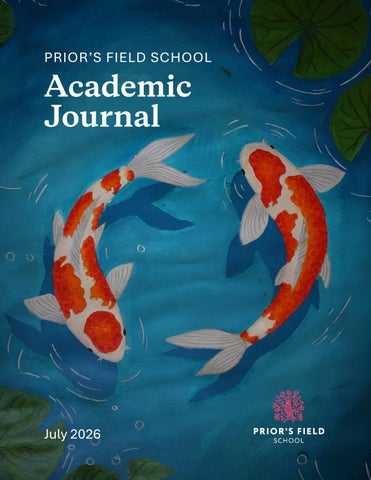
Front Cover: By Willow Latimer - Second Form. Willow entered her painting into the Religious Studies, Spirited Arts Competition. Submissions for the Academic Journal are welcome throughout the year. Please email Mr Garvey with your submission.
2
ENGLISH A Speech: what does planet earth mean to you? Edie Goldsmith - Fifth Form Ladies and gentlemen, today I will open my speech with a question for
you: What does planet Earth mean to you? This planet is our home. We
breathe the very air our ancestors once did. We drink the water that once
touched their lips. We tread the soil that they discovered. We gaze upon the stars that guided them. We eat the
fruit from the trees they meticulously planted.
But we are tainting this
world. You and I pump chemicals into the rivers and skies, but why? Why do
we taint this being that has provided for us, nurtured us, created us? I do not know why.
Water, fresh gushing water. It sings over riverbeds, it foams on the crests
of waves, it shimmers on the surface of lakes as it reflects the sun above.
As I cannot cover all the dangers this planet faces, today I will focus
on water. Water is the key to survival
for every living being; name me one
organism that doesn’t depend on it
captured, torn from their families,
bottle lids, a three-metre-long rope,
isn’t one. The oceans provide around
They swim in circles surrounded
pack of Haribo. Any one of these items
body is made up of 75% water. Water
dancing in the sea, knowing no
industry, culture.
decide it is acceptable to drag huge,
Yet, every day we pump sewage into
that catch everything in their paths,
due to our dependence on fossil fuels
vegetation, leaving the area barren
But all hope is not lost, we can turn
our fertilisers leach into rivers causing
fish we catch in this activity known as
companies to take responsibility are
kill those that inhabit the sea. Sharks
dead to rot in the sea. I went to the
as vicious predators. Cetaceans are
up? A traffic cone, dozens of plastic
to live? See, you can’t, because there
and for what? Our entertainment?!
50% of the world’s oxygen; the human
by concrete when they should be
provides us with food, sanitation,
boundaries, meeting no walls. We weighted nets along the seabed
kelp forests; we bleach the coral reefs
whilst stirring up silt and destroying
that increase the acidity of our oceans;
for generations. Three quarters of the
algal blooms and eutrophication. We
bottom trawling are thrown away. Left
are culled because they are deemed
beach last week, guess what I picked
two ghost nets, surgical gloves and a could have been ingested by aquatic
life then worked its way up the food chain, to us. Did you know that you
eat around 150,000 plastic particles
annually – that roughly translates to twelve plastic grocery bags.
the tide. Campaigns for sewage
prominent. The other day I saw on the news a girl had died from E.coli
she contracted from swimming at a polluted beach, now Surfers Against
3
Sewage is calling for justice. We can
opinions. If you are going on a whale
reduce the amount of chemicals we
guarantee you will see a whale shark; it
adapt our farming techniques to
use. We can reduce our use of fossil fuels by using renewable sources. For example, there is a micro-hydro scheme in Nepal, a country that faces
the threat of energy insecurity, that means that poorer communities can have access to reliable and sustainable
energy. Educate yourself about sharks, they hold vital roles within ecosystems.
I read that more people get bitten
or shark watching cruise and they can
their propaganda and greenwashing,
do your own research, form your own
conservation targets globally.
plant Earth? We are destroying our
or better yet choose to reduce your
intake. Recently, the supermarket chain Waitrose has published that it
will no longer be selling mackerel to
its customers due to a steep decline in the population of the species.
to plastic that is made from entirely
tortured anyway? Do not buy into
supporting
about where you get your fish from,
by sharks. Do not buy the ticket to
would you want to see an animal being
and
Thus, I end my speech with a question:
chum into the water. Be responsible
Scientists in Japan provided us with
that aquarium or dolphin show, why
activity
is generally because they are throwing
by other people in New York than the amount of people bitten globally
human
hope as they invented a substitute natural resources and dissolves in salt water in under 30 minutes. Recently, the High Seas Treaty has been formed,
a legally binding contract that creates marine protected areas by regulating
What are you willing to do to protect
home. What will you do so that your
descendants can breathe the very air
you do? What will you do so that they can drink the water that touches your
lips now? What will you do so they too can tread the soils of this marvellous
planet? What will you do so that the
stars familiar light will shine down on them some day? What will you do so
that they can eat the fruit from the seed that lies in your palm? I for one
am done with the speeches. I am done
with talking. The warmth of hope is great, but what does it mean if we do not use it to fuel the fire of action?
Pewter Jewellery Annabelle Sudlow - Third Form
4
The clothing craze that's crumbling retail: how bad can it possibly be? Bibi Ager - Fifth Form You can’t disagree that each new
shopping so detestable?
global chaos created by our insatiable
The disadvantages are infinite. Let’s
complex issues, greater than the world
global carbon footprint, delivering
generation is lazier than the next. The cravings
for
convenience
creates
has ever seen before. In fact, we are so lazy that we made it possible to plan
a luxurious soirée or secure a multi-
million pound corporate deal without
emerging from the cozy covers of our beds. So, what benefits would be worth the environmental turmoil and intellectual deficits we consequently face?
I myself am no stranger to online
shopping. Amazon and I have a close relationship. He always sends me gifts every birthday and refills my
snack drawer when the Mini Egg stash
starts running low. Sure, the reliance is scary, but saving time and energy is important in a world as busy as ours has
grown to be. Online shopping during
the Covid-19 pandemic was my family’s saviour, preventing high-risk people
from having to expose themselves
to a potentially life-threatening viral miasma while still allowing them to get their weekly shops. Many
thanks to every delivery driver who
supported us in this troubling period. Furthermore,
online
retail
allows
for creative expression beyond the
wildest dreams of Donatello and Da
Vinci. With just a few clicks, artists gain access to every hue, musicians
can experiment with sounds far more exciting than their native timbre, and
the most fashionable among us can get their claws on every belt, beret, or bell-bottom jean that their heart could
possibly desire. So what makes online
state
the
obvious:
an
increased
thousands of packages a day back
and forth to warehouses, bustling town centres and suburban villages at the very edge of the world; a reduced
number of customers taking the time to trample into town and support local businesses, excluding small, eclectic boutiques and pop-ups in
favour of conglomerate commercial
giants that now line every nook and cranny
of
local
highstreets;
bad
quality materials and risky production methods,
exchanging
hand-sewn
silks and satins for the 100% polyester sweatshop
tat
constructed
by
starving children in a country so far away and foreign that it doesn’t
register to you that these people are real people. I’d rather wear something lovingly knitted by an entrepreneurial
auntie from Sheffield than a poorly
made, partly disintegrating dress from Shein’s newest industrial prison
in Bangladesh, wouldn’t you? Bear
in mind, we’ve barely scratched the
surface of all the horrors brought about by online shopping. Is all of
this horror worth it just to be ogled
by people on Tik Tok? It’s not right. Now, you can complain about the
prices of the higher-quality goods we once valued, but if it weren’t for the
competition of the digital vampires of
fast-fashion,
the
good-quality
objects and articles wouldn’t need to
put their prices up for their creators to barely earn a liveable wage from
the few customers they have left. And,
to support that I believe is frankly shameful.
And so, how can you change your
ways? Some of you readers may
consider me a woke joke by this point, but for those who don’t, just know that
a quick Google search about the ethics of your favourite shoe brand probably takes even less clicks than going to
buy the shoes in the first place. And,
even better for the modern youth, you can learn about these issues from
the comfort of your bed. I beg of you, make good choices; your choices shape everyone’s future.
Now, as I bid you farewell, my dear
reader, never forget that being good
doesn’t need to come at a hefty price, and learning the true consequences
of your actions hurts no one and helps everyone. You could maybe even take a trip to the one remaining vintage
shop in town, marvel at its wares. Who knows what true beauty you could find?
5
Comparing how the poets Wilfred Owen and Jessie Pope effectively show war Lara Stevens – Third Form happy summer days and nice food with friends. I believe this makes the line sound lighter and less serious,
even though she says that it won’t be
a picnic. Looking more closely, if you
exchanged the word picnic with that of easy, it sounds a lot different. “Who
knows it won’t be easy…” sounds darker and more perilous. War is often a theme in poetry, as
war is the cause of so much horror and pain and emotion that can be channelled into words. Poems and poets employed by the government often show a different story, though,
as seen in one of the poems I will be writing about today, “Who’s for the
Game?” by Jessie Pope. Pope uses her
poem to inspire young boys to take to the battlefield and disguises the
suffering and fear that is war. In stark contrast to this, Wilfred Owen’s poem
“Dulce et Decorum Est” warns people
about his time on the battlefield and stands up against the propaganda that makes war seem like a good thing.
Wilfred Owen uses his poem “Dulce
et Decorum Est” to show the horrors
of war by using his last line to get across his point perfectly. The last
line in question is “the old lie: Dulce et decorum est pro patria mori”,
which, translated from Latin, means “the old lie: it is sweet and noble to die for your country”. The word “lie”
in this quotation is what makes it so powerful, because it means that
“they” were actively going out of their way to deceive and trick young boys
into joining the fight, from which only
59% would come out without horrific
In contrast to this, Owen uses as much
wounds, or come out at all.
horrific imagery as possible to try
Although not said explicitly, these lies
fighting in the war. For example, he
“Who’s for the Game?” by Jessie Pope.
every jolt, the blood / come gargling
opposite to that of Owen’s, where she
corrupted is especially effective, as it
you”. The poet uses direct address to
being infected and decayed slowly by
often used in propaganda, especially
imagery is startling but useful, as it
and warn wannabe soldiers against
fed to the people included the poem
uses the line, “if you could hear, at
The last line of her poem is a stark
from froth-corrupted lungs”. The word
says, “she’s looking and calling for
shows the idea of a clean pair of lungs
get the point across. The word “you” is
the mustard gas. The blood and death
posters, to target the person reading;
really describes the war honestly.
needs you” and “Who’s absent — is it
In conclusion, the most honest
examples of this include “Your country you?”. In the poem she refers to our
representation of war was Owen’s
creates the idea of Britain as a maiden
served as a true account of what war
soldiers. The quotation also uses
the most useful representation of
reinforce the perception of Britain as a
“Who’s for the Game?”, as it inspired
country as “she”. I believe that this
poem “Dulce et Decorum Est”, as it
that needs saving by some big, strong
was actually like. On the other hand,
the verbs “looking” and “calling” to
war was that of Jessie Pope’s poem
damsel in distress. I think that this idea
many a soldier to go and fight for their
especially as the audience for this
future generations.
In the poem “Who’s for the Game?”
Sidenote: I am not condoning the lying to, and therefore murder of, innocent boys in order to protect England. It’s horrible, but in the end made our world a better place for a while. So, in the end, I think both poems served their purpose and were effective in their own ways.
would have worked well as a tactic, poem was mainly young men.
Jessie Pope conceals the horror of
war by using light words in her lines. An example of this is where she says, “Who knows it won’t be a picnic…”.
The word picnic has connotations of
country and, in the end, protect us and
6
The key Anna O’Grady– First Form I have a key in a crack in my wall I found it just last evening
The key must lead to a faraway place
Where does it fit in, this bundle of grace? Could be, it opens a door to a hotel, Stuffed full of suitcases and beds,
And maybe it fits into a submarine
By the shimmering sea nature bears.
Or maybe it unlocks the school gates
With its secrets within that nobody knows And if I find out all those secrets,
I’ll know all those secrets that the school holds.
I guess it could open a safe full of money and gold I’d be too young to handle it now
But I’ll be able to handle it when I am older.
When I am older I’ll have all that money I’ll buy a fancy car What if it opens the King’s palace?
Full of corgis and the King drinking his tea I could see the King
From my ladder at his coronation.
My adventures could go on forever if I just hold on to this key I don’t have to know what it opens, It’s more fun making believe
Hope not Hate Chloe Woodington– First Form A soft snuffle in the darker hour
A little traveller with spiky power
Year after year their numbers falling Cities and towns ever sprawling Why are humans quite so cruel
We don’t see them as nature’s jewel Cars whizz by, squashing them flat Drivers never even looking back
But a clever scientist has now found
Our prickly pals can hear ultrasonic sound Soon a device will send a warning Putting a stop to our mourning
A bright future is almost in sight
Finally ending the hedgehog’s plight.
7
Grass Poem Emmy Osime – First Form This year I will not give you a teddy bear or a love card. You will not receive a crimson red rose. This year I give you grass. The emerald, green blaze reflects on how pure you heart is. It is fresh and succulent. It gives the world greenery. It is picturesque just like your face. It stains your palm. leaves its small wild on your skin A truth roses never dare to tell. Keep it, it will have the fresh smell of rain or scatter it back to the earth. Either way it will grow just like us, from the root to the tip.
Great Grandmother
Summers Day Blue Jay
Audrey Childs - Third Form
Chloe Woodington - First Form
8
Parallel Lines Tayla Close – Fourth Form He was a map
Yet I thought I knew the land He was an ocean
In a world I feared the sand He was the sun
Yet I only dare to look at the moon. He was December
In a world where I was June. He was a mirror
Yet I could never chance a look He was a story
In a world I never read a book He was a flower
Yet I picked each one I’d find He was colour
In a world I was born blind He was the air
Yet I could never catch my breath He was Romeo
In a world I only knew Macbeth. He was a song
Yet it was one I didn’t hear He was a cube
In a world where I’m a sphere He was a jungle
Yet I couldn’t reach the trees He was a door
In a world I always forgot the keys He was a throne
Yet I never took a seat He was my lover
In a world we’d never meet
9
Social constructionism and the etiquette of shaving: An investigation into the history of cultural norms, the power of advertisement and the extremity of gendered ideal Disa Morgenstern - Upper Sixth
In this essay I will explore the dynamic between gender and body hair and the influential nature of advertising in shaping social norms on what is ‘hygienic’ and ‘desirable’ as well as the contrast between ‘feminine’ and ‘masculine’ natures of hair removal. I will highlight that from a sociological perspective, these social norms are a clear example of social constructionism, which when applied to this topic demonstrates that body hair itself is not naturally 1.
a problem, but is distorted into one. In sociology, social constructionism suggests that various concepts, beliefs, norms and values are formed from continuous interactions and negotiations within society, as opposed to being based on empirical observation or physical reality1. Arguably one of the most observable examples in history is gender and its associated roles and expectations; this theory posits that gender is not
defined by biology but is a product of human definition, culture and social interaction, which is created and developed over time. Thus, whilst the growth of body hair is a natural biological process, the cultural, social and gendered meanings assigned to hair—and the decision to remove it— are formed by society. While hair removal may feel like a modern practice, it actually has ancient origins. Let’s consider Ancient
Wikipedia contributors. (2026, March 18). Social constructionism. Wikipedia. https://en.wikipedia.org/wiki/Social constructionism
10
Egypt, Rome and India, cultures that subjected society to hair removal practices similar to today’s.2 Dating back to 3,000 BC, the first razors were made from seashells, and Ancient Egyptians removed hair with sugarbased waxes. That said, these practices were not always universally prevalent. In the late 19th century—particularly during the Victorian era (circa. 1837– 1901) in the United States—it was uncommon for women to shave their legs or underarms. Therefore, the question remains, where do modern stigmas around body hair originate? In 1915, The US-based Gillette company (founded in 1901) branched out into female-focused products by introducing the ‘Milady Décolleté’, the first razor marketed specifically to women and designed for the underarms.3 With this campaign, Gillette did not just diversify its previously male-focussed product to sell razors to women but also sold an idea: underarm hair is ‘unfeminine’ and ‘embarrassing’, words that were plastered all over Gillette’s adverts at the time. This moment in history is key to understanding how advertising influences what society upholds was and still is ‘normal’ for women’s bodies. Twenty-four years later, in the midst of the Second World War, Gillette moved to its next victim: leg hair. Nylon, which was originally used for stockings, was repurposed for essential military supplies, leaving women to have bare legs in public.4 This was seen as an opportunity to launch a campaign that stimulated a new trend of babysmooth, ‘feminine’, bare legs. As soon as the industry’s potential became evident, advertising targeting body hair proliferated. Author Rebecca Herzig asserts that such emerging 2. 3. 4. 5. 6.
ideas were a form of “gendered social control,”5 accomplished by convincing women that they had to be hairless to ‘stand a chance’. Over the following decades, hair removal went from being a status marker to a universally accepted standard blindly followed by the masses, reinforcing how this feminine ideal was and is a product of social constructivism. Fast forward to the early 2000s, when Gillette released several adverts with the slogan ‘reveal the goddess in you’, and that women can ‘discover her with Venus’.6 Typically, these adverts included either one or several conventionally attractive, thin women, depicted in a euphoric, otherworldly setting like a beach or a cloud of
bubbles. Razor in hand, she begins to shave… an already flawless, silkysmooth leg. When was the last time you saw a Gillette advert in which the model actually shaves her hair? The central issue with this ‘goddess’ aesthetic is that it subconsciously manufactures insecurity and shame for the female viewers, especially the young impressionable ones. Gillette uses a shame-based marketing strategy: they outline the problem (body hair keeping a woman from ‘discovering her inner goddess’) then illustrate how their product (a razor) will fix this problem. This strategy remains successful to this day, as a survey conducted by the American Laser Centres states that the average woman spends between $10,000
Barringer, T. (2013, March 28). History of hair removal. ELLE https://www.elle.com/beauty/makeup-skin-care/tips/g8l55 /history-of-hair-removal/ Blachor, Devorah. ‘Key Moments In Women’s Shaving History. McSweeney’s Internet Tendency. https://www.mcsweeneys.net/articles/key-moments-in-Womens-Shaving-History’ The Great Stocking Shortage: A Vintage Fashion Perspective. Rosie Revolution, https://rosierevolution.com/f/the-great-stocking-shortage-a-vintage-fashion-perspective. Herzig, Rebecca M. Plucked: A History of Hair Removal. New York University Press, 2015. Biopolitics: Medicine, Technoscience and Health in the 21st Century. YouTube. https://www.youtube.com/watch?si=JVa1GLO9yofUwomN&v=iNAy-qu865E&feature=youtu.be(Accessed 9 April 2026).
11
and $23,000 to remove body hair over a lifetime.7 Interestingly, the marketing of beauty products usually embraces the before/after shot in order to illustrate the products’ abilities—namely wrinkle creams, acne wash, weight loss programmes and whitening toothpaste. Has body hair become so stigmatised that it doesn’t deserve screentime in its own advertisement? Men’s razor adverts, however, do not concern themselves with any such hairless fantasy. Certainly today, shaving is a matter of daily routine for most men, and it is estimated that a man will shave at least 20,000 times in his lifetime, averaging on 3,000 hours over the course of their lifetimes.8 As opposed to the ‘goddess’ aesthetic of women’s razors, in which shaving is a corrective measure for an undesirable 7. 8. 9.
trait, Gillette frames shaving for men as routine and maintenance. In 1989, the company launched its ‘Best a Man Can Get’9 campaign during the Superbowl. This empowering slogan was projected onto softfocus vignettes of male American life: men playing sport, thriving at work, kissing beautiful women. It did what advertising has been built to do: prop up a fantasy vision of manhood— one that relies on smooth abs and smouldering eyes to sell products. While on the surface this kind of male celebration is not in itself problematic, it further reinforces a divide between masculine and feminine ‘success’, in which both are extreme. On one side, hyper-feminine imagery depicts ‘smoothness’ and ‘softness’; on the other, masculine campaigns emphasise strength and achievement. The danger of this contrast is that over
time, what began as external pressure becomes internal preference. Social constructivism asserts that viewers will internalise these societal ideals as they feel ‘natural’. The question remains: where does the urge to shave originate? Is it personal preference, a desire for hygiene, or fear of judgement? Social constructionism suggests that these motivations are not entirely independent but shaped by the cultural environment. We often believe we dislike something because it is inherently undesirable, when in reality we have been taught to perceive it that way. Ultimately, the etiquette of hair removal serves as a compelling example of this theory in society. What is often framed as a personal choice is, in many ways, the product of historical, cultural, and commercial influences.
Women Spend up to $23,000 to Remove Hair. United Press International, 24 June 2008. Ultimate Personal Shaver. https://www.ultimatepersonalshaver.com/tips-and-how-to-26-75-fun-facts-and-myths-about-shaving YouTube. https://www.youtube.com/watch?si=7OLJh0xsioozyxY&v=ThDBf14qPsc&feature=youtu.be
Emmeline Pankhurst Grace Hoyle - Third Form
My Granny Martha Finney
12
FOOD TECHNOLOGY An analysis of how environmental factors and the production of food can impact food security Millie Martin St Valery – Fifth Form
Environmental factors can impact
yields of crops. For example, the use
farming or excess grazing without
excess rainfall reducing the yield
like a large-scale industrial operation)
and disrupt the nutrient cycle. The
food security, such as drought or
of crops. A harsh climate can also reduce yield, or a lack of flat, fertile
farmland can mean a country is unable to supply their own food through
agriculture, such as if the country is very mountainous or sandy.
Climate change is also affecting
food production as global average temperatures are increasing, reducing the yield of crops that require lots of
moisture, and increased frequency of extreme weather events can destroy
farmland. The production of food can also affect food security, as different agricultural methods produce varying
of agribusiness (treating agriculture
can produce a high yield of crops, and increase food security by providing
a reliable supply of food. However, this
is
not
very
environmentally
sustainable as it requires the use of
pesticides and fertilisers, which can cause
environmental
issues
such
as eutrophication in local bodies of
water and disruption of local wildlife. Cattle
farming
also
contributes
towards climate change as cows release methane through digestive processes, which contributes towards the
enhanced
greenhouse
effect
and therefore global warming. Over-
moving cattle can reduce soil fertility increased demand for imported food also
has
negative
environmental
consequences, as the transport of
food from countries, such as green beans from Kenya which is over 500 miles away, increases the carbon footprint of food.
Consumer choices can be made more sustainable by increasing the
consumption of organic food, which does not use artificial fertilisers, minimising damage to ecosystems.
Increased consumption of local, in season food can also help to reduce food miles and support local farmers.
13
GEOGRAPHY An investigation into the opportunities and challenges of rapid urbanisation Abi Pennell – Fourth Form risk of natural hazards like mudslides.
Waste is unlikely to be collected due to limited road access and often
ends up in sewers and drains causing
outbreaks of cholera and dengue fever. Residents are often poorly paid, doing informal work as they lack basic
skills and the areas are associated with crime, violence and drugs. In early 2012 there were 8 murders in just 2 months in Rocinha.
Rio also has social challenges. Only
55% of city has a family health clinic and often children must work to support family so drop out of school and get involved in crime. 12% of Rio’s
Above is a graph showing the increase in annual population in Rio
population lack access to running
Source: Population of Rio de Janeiro 2024| Statista
water and 37% of it is lost through leaky
Newly Emerging Economy (NEE)
previously hosted the Olympics in
are frequent blackouts due to poor
cause of this is rural-urban migration,
cities in the Southern Hemisphere with
favelas illegally tap into mains supply
as sugar loaf mountain as well as the
electrocution.
cities are growing rapidly. One main which means the large amount of
people moving to towns and cities. Another significant cause is they have a high natural increase, caused by high fertility rates due to more youthful populations.
In this investigation I will focus on Rio de Janeiro as my example. Rio is
a well-known city located on Brazil’s
Atlantic coast. It shows importance both regionally and nationally as well
as globally. It was the capital city of
Brazil until 1960 and is now known
as its cultural capital holding a yearly carnival of music and dance and
pipes, fraud and illegal access. There
2014. Rio is one of the most visited
maintenance of cables and people in
stunning beaches and mountains such
which is also dangerous as they risk
statue of Christ the Redeemer.
means there are more people than
Rio de Janeiro experiences many
unemployed or working in informal
of squatter settlements or favelas,
often lack education and skill needed
Rio’s
rapid
growth
jobs available so many people are left
challenges for example the growth
jobs like car washers. Migrants also
which it now has over 600 of, the
for many formal jobs.
services and have no legal right to
Crime is not just a problem in the
near main roads or any other land
and shoot out between gangs are not
made by any material available for
residents. The Pacifying Police Units
Their locations often leave them at
favelas; they plan to let locals live
largest being Rocinha. They lack basic
the land. Often located on steep hills,
favelas of Rio. Murder rates are high
left unused, they consist of houses
uncommon and can kill police and
example, wood or corrugated iron.
aim to try and take back control from
14
have been developed to decrease the
environmental
challenges
I
mentioned earlier. To manage waste
an energy recovery plant has been set up, fishermen are paid to collect waste from Guanabara Bay and 8 electric
waste
collection
vehicles
have been introduced to the area. To
help with water quality 4km of new sewage pipes have been laid and
a new sewage treatment has been developed. Ships are also fined for discharging fuel and oil into the bay. Additionally, making coastal roads
one way in rush hour has improved traffic flow and toll roads have been created in the city centre to improve
air quality and the transport system.
The image highlights Rocinha’s location on a steep and hill as well as displaying its derelict nature
Expansions of the metro system and
more safely, improve sanitation, steer
leading into it. However, there are also
do this.
tourism. However, some people say
Let’s start off with its economic
youth away from crime and increase
the police are too controlling and it also expensive and puts charity members and others involved at risk.
There are many environmental issues in Rio. As I mentioned earlier, waste
disposal is a problem in favelas as they are inaccessible, so it often
must be brought down by foot or
burned. Burning waste may set fire to
many opportunities in Rio de Janeiro. opportunities.
It
provides
formal
employment in the Primary sector
(extracting raw goods, for example oil in the Campos Basin), Secondary
sector (making products for example food, textiles and metal goods) and also the Tertiary sector (Providing
services for example stock exchange, retail and TNC offices like Shell)
surrounding houses and the smoke is
T h e re
air off the Atlantic is also mixed with
resources and services. In inaccessible
harmful leading to air pollution. The vehicle exhaust fumes and factory
smoke to create an even lower air
quality. 75% of air pollution is caused by
traffic
which
has
increased
dramatically in the last 10 years as there have been 40% more cars in this
period. Transport is difficult because
of the mountains and there are illegal vans providing bus services at same price as official buses causing even
more congestion. Guanabara Bay
is heavily polluted from oil spills
and ships emptying tanks as well as waste and sewage from the 55 rivers
a re
also
many
social
opportunities repeating to both
favelas, for example Santa Marta, health care kits that can detect and treat up to 20 diseases are available.
There is also a ‘family health strategy’ where nurses visit poor families monthly; this has increased life expectancy and resulted in a drop on infant mortality. The ‘Bolsa Escola’
project aims to encourage poor families to stay in school by offering
free lessons in sports like football and swimming.
Furthermore, management strategies
efficient bus services with cheap fares have also been established in order to
However, this is not easy; managing these challenges is a struggle for many
reasons. The scale of the task is a huge challenge as the problem grows faster
than it can be managed. Rio’s physical
geography is also a problem because the mountains trap air pollution and make transport difficult. Furthermore, modern fuel-efficient cars along with
most forms of public transport are
expensive so may not be as accessible to locals. It is also hard to regulate
activities such as tank emptying in
Guanabara Bay and factories continue to pollute the area as they still receive profits so have not closed.
In conclusion, it is clear that, at least in the case of Rio, rapid urbanisation results
in
more
opportunities
for
challenges its
than
residents.
Although there are some opportunities for residents in terms of jobs, services
and resources, the challenges are at a larger scale. Furthermore, in the long term these challenges are likely
to still exist because, as I previously explained, they can be very hard to manage.
15
Evaluating the potential impact of changes in the carbon budget on the Amazon rainforest Grace Mattison - Upper Sixth Changes in the carbon budget can
have a range of impacts on a tropical rainforest, such as the Amazon. One
major impact is on the climate. The process of slash‑and‑burn releases
large amounts of carbon dioxide into the atmosphere, contributing to rising
temperatures, which are predicted to increase by 2– 3°C in the Amazon by 2050. Deforestation also reduces evapotranspiration,
meaning
less
water vapour enters the atmosphere. This leads to further warming and a
drier atmosphere. With less water vapour, humidity decreases, and as
air masses move inland they become increasingly arid when passing over
deforested areas. This increases the likelihood of drought, which can cause
vegetation dieback due to water stress. However, increased carbon
dioxide can enhance plant growth through carbon fertilisation, showing that the impact on climate depends on feedback systems.
Changes to the carbon budget also affect soils. Removing trees and vegetation reduces the humus layer, making it harder for water to infiltrate. This
reduces
soil
porosity
and
increases overland flow, which can lead to flooding and the loss of soil carbon. Although slash‑and‑burn produces ash that temporarily increases soil
nutrient content, exposed soils are quickly eroded, meaning carbon is rapidly lost. Drier conditions also
increase the risk of wildfires, which
release even more carbon into the
16
atmosphere. Continued deforestation
risk of further fires. Although higher
produce
regenerate and reverse these impacts.
through carbon fertilisation, recent
infiltration increases surface runoff,
reduces the rainforest’s ability to
Vegetation is also affected by changes to the carbon budget. Reduced
rainfall and more frequent droughts can lead to forest dieback, meaning
CO₂ levels can promote tree growth evidence suggests the Amazon is
losing its capacity to absorb CO₂, especially where water availability is limited. This indicates that the overall
further
shallower
limits
clouds,
rainfall.
which
Reduced
raising the risk of flooding. Overall, a changing carbon cycle reinforces the drying of the rainforest.
impact is negative.
In conclusion, the impacts of changes
positive feedback loop: deforestation
Rainfall and river systems are also
rainforest are severe and largely
raises temperatures and causes more
cycle. In the Amazon, vegetation plays
less carbon is stored. This creates a
increases carbon dioxide levels, which tree mortality, releasing even more
carbon. In the Amazon, billions of trees have already been lost, and large
areas of vegetation have died back. This raises concerns that the rainforest
may no longer function effectively as a carbon sink. Forest fires also destroy
trees, creating a more flammable environment
and
increasing
the
affected by changes in the carbon
a major role in recycling water through evapotranspiration.
Deforestation
reduces this process, leading to lower humidity and reduced rainfall,
with some studies suggesting a 20% decrease. Fewer trees also mean less
interception and fewer condensation nuclei,
reducing
cloud
formation
and precipitation. Deforested areas
Cynthia Erivo
in the carbon budget on the Amazon negative. Feedback loops result in
increased warming, reduced forest cover and widespread vegetation
loss. Although carbon fertilisation
may temporarily slow these impacts, it is limited by water availability and ongoing deforestation. Overall, the impacts are extremely serious and may push the Amazon towards a tipping point.
Betty Davison - First Form
Chloe Woodington - First Form
17
To what extent do you agree that the impacts of plastic pollution are environmental? Josie Biszczanik - Third Form I agree to a certain extent that the impacts of plastic pollution are environmental. I think this because plastic ends up in oceans and it takes hundreds of years to break down so usually marine animals are affected by this. Also, they could even eat pieces of plastics so it could get stuck in their intestines. The graph below shows the increase of plastic pollution in the ocean in 2005 to 2019. In 2019 we had 10 million metric tons, now we have (in 2026) we have 75 to 199 million metric tons of plastic in the ocean, which is a huge increase, threating our oceans.
Over 1 million sea birds are killed per year from eating plastic or entanglement. Plastic pollution also damages ecosystems by contaminating soil and water, reducing biodiversity, and harming coral reefs. Marine organisms can grow on floating plastic, and then the plastic carries them far away to other places and these organisms arrive in new areas and could harm local ecosystems. The Great Pacific Garbage Patch has over 45,000 metric tons of plastic, so it hugely effects marine animals and their habitat and environment around them.The Great Pacific Garbage Patch moves in a big circular pattern called a gyre. Over time, this creates a large area where lots of floating plastic stays concentrated in one place.
18
Are physical factors the main cause of uneven development ? Suzie Trounce - Third Form Physical factors do cause uneven development. For example, the climate of a country can affect whether a crop receives enough rainfall or sunlight to grow properly or to its best. This means that if a country has a poor climate, it will find it difficult to get a steady supply of good crops to use or sell. Natural hazards can also affect a crop if there is a drought or a flood as the crops will be damaged and no longer able to be used for a profit. These hazards (along with tectonic activity) can also destroy
However, there are also historical
competition or demand. This means a
factors causing uneven development.
country may not receive a very great
If a country was colonised, it would
or stable profit if it has a poor harvest
have been used for plentiful resources
(which shows a link between physical
taken for the lowest price possible. This
factors), or other countries do not
meant that ‘the rich got richer’ while
need or want to buy their crops that
controlled counties, when given their
time. Global trade deals also affect the
independence, were left with a lack of
price paid for resources. North America
services and infrastructure. Conflicts
and Europe dominate this market as
also cause uneven development as
they pay very little when trading with
money must be spent on weapons,
weaker countries to ensure a big profit.
and afterwards on restoration and
Sometimes a country ’s resources
human aid which are all very costly.
can be used by only a few individuals
The democratic Republic of Congo’s
rather than for the benefit of the whole
infrastructure and buildings, and harm people, so money must be spent on repair or aid rather than development. For example, the 2022 Pakistan floods from monsoons and melting glaciers submerged one third of the country, destroying four million acres of crops and leading to billions being spent on restoration. Pakistan would then not focus on developing the country further, but bringing it back to what it was before, showing a hold back in progression. If a country is landlocked it will be difficult to transport crops for sale as they will have to be taken through other countries- which costs more money and equals less profit. It will also be difficult for the country to use modern technologies to help develop itself if it is landlocked as fibre optic cables are laid under the seafurther away from the place of usage in a country far inland. Overall physical factors cause uneven development as they mean less ability to grow and sell crops, which could be a country’s main source of income to then be spent on development.
civil war from 1996 to 2003 resulted in five million deaths and a difficulty
country (like for development) and this is called corruption. In Zimbabwe there
to restore order before progression.
are many corrupt officials meaning not
The historical facts mainly use up a lot
much is put towards the development
of money that could have been spent
of the country. These economic
on development on restoring what
factors misdirect money towards more
another country had done to hold
powerful people or countries leading to
them back.
less chance for development.
Finally, there are also economic factors
So overall, I partly agree that physical factors are the main cause of uneven development since I think all three
such as reliance on cash crops. These are grown for sale and not use, but their prices may vary by quality and
factors have a similar effect.
19
HISTORY The abolition of the British Slave Trade Amelie Clipsham - Second Form
The most significant cause of the
not be forcibly taken from England. He
abolitionists such as Granville Sharp.
abolition of the Slave Trade in 1807 in
helped with this case by representing
These campaigners encouraged
England was from white middle-class
James Somerset in court by arguing
Equiano to write an autobiography
campaigners.
that since English law did not explicitly
to spread the word about the terrible
recognise slavery, Somerset’s status
things that happen to the enslaved
One example of the impact of white
as a ‘ slave’ could not be maintained.
people. This book was published in
middle-class campaigners helping
These examples proved that, when
1789. To help speed up widespread
to abolish slavery was William
enough of the population combined
knowledge about the atrocities of
Wilberforce. William put laws through
forces and put pressure on supporters of the slave trade, that slavery could be
slavery even more, Olaudah travelled
parliament to abolish slavery. He presented a bill for the abolition of the
abolished.
slave trade every year, from 1789 to
around the UK, giving talks and sharing his experiences with people everywhere. His actions proved that
1807, where it finally passed. This, along
A second significant cause for the
with over 519 petitions with thousands
abolition of the slave trade in 1807 in
of signatures showed the high number
England was the actions of slaves and
their futures. A further example of the
of individuals who disagreed with
ex-slaves. One example of this was the
actions of slaves and ex-slaves helping
slavery and the slave trade. Another
actions of Olaudah Equiano, who wrote
to abolish slavery were the efforts
example of the impact of white middle-
an autobiography about the horrors of
made by Toussaint Louverture, who
class campaigners helping to abolish
slavery. Olaudah Equiano was forcibly
led the fight for freedom of slaves in
the slave trade was Granville Sharp.
taken and sold into slavery for an
France. Toussaint was born into slavery,
Granville Sharp is most well known
estimated 10-11 years but bought his
but gained freedom around 1776,
for his involvement in the Somerset
freedom in 1766 and became friends
and became a property owner and
Case which ruled that a slave could
with a considerable number of British
plantation overseer himself. Louverture
the formally enslaved could change
things and gave the enslaved hope for
20
became the leader of the Haitian
plantation owners would receive
that due to a navigational error the
revolution and laid the foundations
less money, meaning slaves less in
ship ended up having to spend an extra
for other countries to abolish slavery
demand and less were taken in the
three days at sea. The lack of supplies
or face the major consequences of
first place. This act happened in 1791-
meant that many slaves were sure
1792 and involved 300,000 people
to die and if this happened onboard
revolutions. The actions of these exslaves proved that the enslaved and
(the majority of whom were women).
the ship, the slave traders could not
formerly enslaved would not allow the
One individual who participated in
collect any insurance and would lose a
heinous crimes committed by the slave
sugar boycotting was Hannah Moore,
significant amount of money. With the
owners to continue, and scared those
who was an enthusiastic anti-slavery
supplies and water running out, the
involved with the slave trade because
campaigner, who encouraged even
crew murdered 131 enslaved people
of the possibility of an uprising among
more to participate in the abolition
by throwing them overboard. This
the slaves.
movement.
horrific case was used by abolitionists such as Olaudah Equiano and Thomas
Another significant cause of the
A further economic reason causing
Clarkson to portray just how brutally
abolition of slave trade in 1807 in
the abolition of slave trade in England
the traders treated enslaved people.
England was economic reasons. For
was the Zong case, which was just one
These economic reasons meant that
example, the sugar boycotts, which
example of the atrocities committed
plantation owners lost money and
was the act of not purchasing sugar.
by slave traders at the time. The Zong
therefore were unable to buy as many
This helped abolish slavery because
was an overcrowded slave ship that
slaves as before, which led to slave
sugar was created from sugar cane,
carried the enslaved to America in
traders losing customers and therefore
which enslaved people were forced
1781, with not enough supplies for
less people were enslaved.
to farm and the act of not buying
the slaves to survive the journey. This
this meant that slave owners and
atrocity was not helped by the fact
Isla Foden-Reekie - Third Form 21
How far do you agree that the most significant method of control used by the Nazis in Germany in the years 19331939 was censorship? Rachel Flude - Fourth Form I agree to a limited extent that
own and increase their own influence
and became less of a threat to the Nazis.
censorship was the most significant
in Germany.
Furthermore, the SS were also in charge
method used by the Nazis between
of running concentration camps, where
1933 and 1939. Whilst censorship did
Another significant method of control
they held political prisoners. Here, the
contribute to the Nazis gaining control
used by the Nazis in Germany was
prisoners were subjected to immense
over the German people, this was also
the police state. This included the SS,
cruelty, through torture and exhausting
caused by the use of the police state
who were responsible for arresting
work. This led to many deaths inside
and youth movements.
and torturing opponents such as Jews
the camps, meaning that the Nazis
and Communists. This meant that the
greatly weakened their opponents.
The first significant Nazi method
Nazis quickly began to eliminate all
As a result, the Nazis destroyed any
of control used from 1933 to 1939
other political and racial groups who
threat from existing enemies, as well as
was censorship. The Nazis believed
they deemed inferior, in order to make
intimidating other German citizens into
that if they could suppress certain
Germany ‘pure’. As a result, many of
showing loyalty to Hitler. Therefore, the
information from the public, then they
these opponents faced severe brutality,
police state greatly increased the Nazis’
Civilians crowd around a uniformed Nazi holding the morning edition of the Wiener Montagblatt newspaper announcing Hitler’s arrival in Vienna, 1938.
United States Holocaust Memorial Museum, courtesy of National Archives and Records Administration, College Park
would have control over Germany. For example, the Ministry of Propaganda made a list of un-Nazi literature which they thought did not reflect their views. This led to students being encouraged to participate in mass book burnings, with a particular focus on the destruction of Jewish authors’ works. As a result, the Nazis eliminated the threat of writers who disagreed with their policies, allowing them to gain popularity themselves. In addition, the Nazis controlled all of the newspapers in German and only allowed the publication of stories which favoured their party. This meant that the German people were only exposed to a positive representation of Hitler and his followers and were consequently led to believe that he was a favourable leader. Therefore, the use of censorship allowed the Nazis to remove ideas which were not their
22
influence and power over Germany.
more impressionable. Furthermore,
significant method of control used
activities in the youth movements
by the Nazis in Germany in the years
A final significant method of control
were made enjoyable, with physical
1933 to 1939. This is because, whilst
used by the Nazis in 1933 to 1939
activities emphasising teamwork. This
it did allow the Nazis to reduce the
was youth movements. These were
led to an increase in support for the
influence of other groups, they did
created in an attempt to channel the
Nazis from the youth, as they found
this at a much greater rate by use of
natural rebellion of youth and build
fun in being part of the Nazi Youth. As a
intimidation through the SS and the
a future Nazi generation. In 1933, the
result, young people were more likely to
Gestapo as well as concentration
Nazis banned all other youth groups,
continue attending and participating in
camps. Youth movements additionally
except for the Hitler Youth. This meant
youth organisations. Therefore, youth
only focused on the young population
that children and young people were
movements allowed the Nazis to build
of Germany, rather than on every
taught only to support the Nazis, and
their power amongst the young people
citizen. It was therefore the use of the
also that to support any other group
of Germany.
police state which caused great fear amongst the German people, allowing
was morally wrong. As a result, the Nazis expanded their influence to
In conclusion, I agree to a limited
the Nazis to assert their control and
the younger generation who were
extent that censorship was the most
spread their influence.
Can’t Cut It Juliette Olchowicz-Smith 23
Was the Great Depression the main reason Hitler became chancellor of Germany in January 1933? Sophia Shields - Fourth Form The appointment of Hitler as chancellor
time there was chaos in Germany. For
gave Hitler the opportunity he needed
in January 1933 was the result of
example, 50% of people aged 16–30
to gain votes as many people were
several key factors including Nazi
were unemployed in 1933, even people
looking for new views to support. The
propaganda and the reorganisation
with a good level of education. This
Great Depression put Germany into
of the Nazi party. However, while these
was a result of thousands of German
a financial crisis, leading to Hitler’s
reasons were very important the
businesses closing because of the Wall
popularity increasing.
most significant cause was the Great
Street Crash. Many people felt betrayed
Depression. The economic crisis gave
by the Weimar government as they
Another reason why Hitler became
Hitler the perfect opportunity to use
seemed unable to fix the crisis. This
Chancellor was because of Nazi
the public’s desperation to increase
encouraged many people to become
propaganda. For example, the Nazis
support and show himself as the
more willing to support extremists such
owned eight different newspapers,
solution that Germany needed.
as Hitler. Furthermore, unemployment
each of which aimed to sell their
benefits were reduced, so many people
message to a different audience.
One reason why Hitler became
were struggling to afford essentials.
By tailoring the Nazi message to a
Chancellor in January 1933 is because
The government also tried to increase
specific audience, the messages could
of the Great Depression. The US
taxes to account for the growing
be spread to many groups of people,
economy was destroyed due to the Wall
unemployment rate. This caused many
all of which would hopefully support
Street Crash. This meant that Germany
people to be angry at the Weimar
Hitler’s ideas. As well as this, parades
had to repay the loans that the US had
government who were struggling to
and marches were organised by Nazi
given them. This led to a period called
make decisive decisions due to the
mobile units. These included political
the Great Depression. During this
fragile coalitions in the Reichstag. This
speeches as well as entertainment such as plays and sport. This would have appealed to a younger audience and made people more interested in what was being said by Hitler, as they were being kept entertained. Moreover, posters were put up around Germany. These were designed to target specific groups. The messages were made clear and simple. The posters portrayed Hitler as powerful and a decisive leader. This was key in a time where the government were unable to come to concise decisions. These posters played a crucial role in boosting Hitler’s public image, spreading Nazi ideas quickly, and helping the Nazis to become the largest party in the Reichstag. The Nazi propaganda, which was organised by Goebbels,
24
was vital in attracting new supporters
votes. The Nazis began taking part
and that he will not leave until he does.
during a crisis.
in elections and became the largest
The reorganisation of the Nazi Party
party in the Reichstag by 1932. This
meant that once a crisis (the Great
A final reason why Hitler became
gave Hitler strong legal chances as to
Depression) hit, the Nazis were well
Chancellor was because of the
why he should become Chancellor,
prepared to take advantage of it.
reorganisation of the Nazi Party after
as well as meaning other politicians
its relaunch in February 1925. After
couldn’t ignore him. By staying within
I n co n c lu s io n , a lt h o u g h N a z i
the Munich Putsch in 1924, Hitler was
the Weimar system, he looked like
propaganda such as putting up posters,
imprisoned. This gave him lots of time
a genuine politician rather than a
and party reorganisation to use legal
to think and plan what he would do next.
threat. Furthermore, Hitler created
methods played key roles in his rise
Whilst in prison, Hitler wrote a book
a new private bodyguard called the
to becoming chancellor. However,
called Mein Kampf, which contained his
Schutzstaffel or SS, who were vital
the Great Depression was the most
key beliefs such as antisemitism. The
in helping Hitler keep control and
important as it created the conditions
book became a bestseller. This helped
eliminate opposition. The SS were
that allowed the other factors to work.
Hitler as people across Germany could
trained to be completely loyal, and
Without the mass unemployment,
have read his views without hearing
their discipline and appearance helped
poverty and loss of faith in the Weimar
him speak. Another crucial decision
to create an image of a powerful and
government caused by the Great
Hitler made whilst in prison was that
organised regime. This in turn made
Depression, Hitler would not have
once the Nazis were relaunched, they
Hitler seem strong and untouchable,
gained the widespread support he
would begin using legal methods
emphasising the fact that he is willing
needed to become chancellor.
rather than illegal methods to gain
to fight to win Germany’s approval
'Frida Kahlo' Embroidery
Taylor Swift
Eleanor Haines - Upper Sixth
Emily Pink - First Form
25
To what extent did British policies towards its colonies, mandates and dominions strengthen the British Empire in the inter-war years? Georgia de Villiers - Upper Sixth of India Act in 1935, though the Congress Party were not content with anything less than Dominion status or independence. Indians were able to recognise the fact these uprisings and Britain’s attempts to make concessions showcased the Empire’s slipping control over India in its attempts to preserve it, and therefore kept pushing for independence throughout the inter-war years. The Round Table Conferences of 1930 and 1931 further supported this, with both conferences being called due to the opposition movements for independence in British policies towards its colonies,
While the 1919 Government of India
mandates, and dominions, while
Act saw provincial councils run by
acting to attempt to consolidate
elected Indian Ministers, though still
short-term control in the inter-war
under a viceroy, this ‘concession’
years, instead weakened long-term
the British made to quell increasing
control and accelerate growing
nationalism was reviewed by the
independence movements in the cases
Simon Commission in 1929. This
of India and Africa, and contributed
quashed the progress made towards
to worsened ethnic tensions in the
India becoming a system of Dominion
Middle East. While the creation of
self-government, proposing a federal
the Commonwealth acted to extend
system to be created across India
British influence over the Empire’s
under direct British rule to ensure
dominions, it still contributed to a
overall British control. Consequently,
gradual shift towards the Dominions’
this exacerbated nationalist sentiment
journey to independence, and thus
and led to many protests, such as
largely weakened the Empire’s control
the Salt March headed by Gandhi
over its holdings.
in 1930. British policies in India thus
Britain’s attempts to establish ‘dyarchy’
kept requiring the British to make
within India and denial of Dominion
concessions in the face of resistance
status acted to weaken its control
movements, as seen in the Gandhi-
over the colony in the inter-war years.
Irwin Pact of 1931 and the Government
India. Despite Britain denying selfgoverning dominion status for India due to its desire to maintain their own economic and strategic interests, it only confirmed to resistance movements that their actions had impact. Thus, Britain’s policies in India only fuelled independence movements and their subsequent concessions merely exacerbated nationalist feeling throughout the inter-war years and effectively paved a path for India to obtain independence in 1947. Policies imposed by the Empire in Africa in the inter-war years, while seemingly beneficial in its promotion of social and economic development, as well as instances of granting a degree of self-government, in the long-term saw further growth of nationalist movements. Economic development
26
can be seen through indirect rule in
saw some success in their ability to
East Africa, where Britain allocated
maintain influence in both Palestine
10 million pounds in 1925 to improve
and Iraq, though this foothold was
rail and dock facilities, as well as in
fragile. Effective military intervention
Sudan through the Gezira Cotton
in Iraq in 1920, as well as the Anglo-Iraqi
Scheme in 1920. Both initiatives, whilst
Treaty of 1922, managed to appease
acting to seemingly improve both
the populace. The treaty saw Faisal
regions’ economic development,
I become King, who served British
mostly benefitted Britain, especially
interests by maintaining good relations
considering major African colonies
with them and had a strong reputation
were expected to be self-financing,
as a leader, which the British were able
which came from higher taxes.
to use to maintain an image despite
Discontent from these policies were
most government departments
exacerbated by the Great Depression,
having senior British advisers being
which outweighed the funding
appointed to them. Even with Iraq
supplied by the Colonial Development
gaining independence in 1932, which
Act of 1929. The economic problems
weakened their imperial image, Britain
that worsened through the depression
was still able to serve imperial interests
resulted in waves of strikes by African
and retain influence over the oil
workers, such as the copper mines
industry in Mosul. However, in Palestine,
in Northern Rhodesia. Therefore,
inconsistent policies worsened ethnic
while the Empire’s initiatives and
tensions between Jewish settlers
economic policies intended to grow
and the Arab population. Britain was
its colonies, the strain of funding
forced to expend military resources in
them amidst a global Depression
an attempt to maintain peace between
only fuelled resistance movements
the two groups, but soon adopted a
which acted to weaken the Empire’s
policy of repression between 1937 and
influence in these regions. Additionally,
1939 to deal with the violence, a total of
Britain’s granting of Kenya relative
25000 troops being sent to the region.
self-governance in 1920 indirectly
With the threat of the war however, this policy changed to support Palestinian independence despite pressures from Jewish organisations. While all groups were discontented, tensions still volatile, Britain was able to maintain Palestine as a buffer to protect the Suez Canal. However, these tensions and conflicts would continue beyond the inter-war years and meant that while Britain maintained influence in the region, this influence was fragile, so did not necessarily act to strengthen
worked against them, with the Kikuyu peoples engaging in some of the first instances of African nationalism due to discrimination they faced now being under white settler rule. Even with the issuing of the Devonshire Declaration in 1923, discriminatory legislation remained and continued to build momentum behind the political movements among both African and Indian settlers. Therefore, British policies had again acted to weaken them through attempts to develop self-governance in its colonies and see long-term damages in the form of rapidly growing resistance in its African
the Empire. British policies towards its Dominions acted to strengthen ties between the regions, but ultimately still saw its imperial image weaken throughout
colonies beyond the inter-war years.
the inter-war years. The creation of
British policies in its Middle Eastern
Belfour Declaration and 1931 Statute
mandates through the inter-war years
the Commonwealth under the 1926 of Westminster acted to strengthen
relationships between the nations and allowed the Empire to retain influence in each Commonwealth nation without the heavy costs of imperial rule. Furthermore, it acted to quell tensions with South Africa, which Britain feared might cut ties
with Empire entirely, which would see
their influence and access to resources such as gold entirely lost. While this actively served the interests of Empire in retaining its global influence and was promoted within Empire as an example of its civilised nature to revive a sense of jingoism about it amongst citizens, it did not necessarily solve issues surrounding diplomatic disunity. Similar to the 1922 Chanak Crisis where the Dominion powers were reluctant to aid Britain, the Second World War saw inconsistency in Commonwealth nations supporting Britain despite their continued relationship, for example, the Irish Free State remaining neutral, thus showcasing that this supposed unity was not as cohesive. This, coupled with the fact Britain through creating the Commonwealth dampened its imperial image and demonstrated it was willing to compromise with its imperial holdings, likely lay the foundations for Commonwealth members to push for total independence beyond the interwar years, thus weakening the Empire. Ultimately, the Empire was mostly weakened through Britain’s policies to its colonies, mandates and Dominions. Its attempts to assert short-term control resulted in the rise of nationalist movements who, through British concessions and compromises, were further encouraged to rebel against British control. Even with the creation of the Commonwealth, there was still tensions amidst Commonwealth nations that did not guarantee support for Britain that it had enjoyed prior to the Belfour Declaration, though it did safeguard its global influence.
27
Trinket Box Tabs Molesworth - Fifth Form
Bluetooth Speaker Audrey Childs - Third Form
28
Flowers Naomi Solomon
Malala Yousafzai Willow Latimer -Second Form
Phoebe Parfitt
Jane Martha Phillips - Fourth Form 29
LANGUAGES Is violence presented as inevitable in the film La Haine by Mathieu Kassovitz? Adelina Martynenko - Lower Sixth
Dans le film La Haine de Mathieu
scène particulièrement démonstrative
processus mentaux. Hubert est un
Kassovitz, la violence est-elle présentée
est la situation dans le commissariat,
bon exemple. Il est seul protagoniste
comme inévitable ?
où Saïd et Hubert sont humiliés par
qui veut éviter cette réalité. Il résiste
des policiers au pouvoir. Ces actions
en boxant et en s’occupant de la
“La Haine” illustre une société dans
créent la tension entre la publique et
salle de gym. L’homme exprime son
les années 90. Le film montre la vie
les autorités. Le cycle de la violence
désir de quitter cet endroit en parlant
réelle dans les banlieues et plusieurs
se forme et influence les autres à
avec sa mère. De plus, il y a beaucoup
problèmes sociaux. La violence est
se comporter de la même manière.
d’autres gens qui pensent de la même
une chose qui est omniprésente
Bien que la police essaye de calmer
façon. C’est la raison pour laquelle
pendant tout le film. Certains se
les gens, la tendance du manque de
on peut espérer que la violence peut
demandent si la violence est une
respect devient plus populaire. Hubert
réponse logique ou si c’est une
affirme : « La haine attire la haine». Si on
exagération de Mathieu Kassovitz.
continue à répondre physiquement, le
À mon avis, les actions du groupe
cycle ne s’arrêtera pas. Il semble que la
complexe sont plus prévalentes
violence soit inévitable.
que l’envie de chaque individu. Pour
Tout d’abord, on note les attitudes
être évitable.
conclure, la violence peut être évitée,
négatives dans chaque scène. Elles commencent par les émeutes en ville
Cependant, on ne peut pas négliger
mais chaque personne doit changer
et elles finissent par un coup de feu. La
l’importance de l’individu et ses
ses valeurs.
30
To what extent did the "Affair of the Diamond Necklace” influence MarieAntoinette’s reputation, despite her complete innocence? April Studley – Upper Sixth Dans quelle mesure l’affaire du
fait que les juges aient reconnu que le
collier a-t-elle influencé la réputation
cardinal aurait pu être convaincu que
de Marie-Antoinette, malgré son
Marie-Antoinette envoyait ces lettres
innocence complète ?
signifie qu’un tel comportement était plausible, voire attendu, par la reine.
L’affaire commence avec deux choses: en premier, un collier, de 674 diamants et une valeur de presque 2 millions livres, crée par les joailliers Boehemer et Bassenge. Deuxièmement, une arnaqueuse, Jeanne de la Motte, véritable descendante de la branche royale, mais si éloignée que Marie
Cela a fortement influencé la perception de la reine, de manière très négative. à côté de cela, il faut cependant considérer les autres raisons pour lesquelles la réputation de Marie-Antoinette était déjà ternie :
Antoinette ne la connaissait pas.
- Premièrement, la reine était connue
Des rumeurs quant à une amitié intime
des jeux d’argent ; on estime qu’elle a
entre La comtesse et la reine, et même une fausse rencontre secrète, ont fait complètement croire au cardinal de Rohan qu’il est dans les bonnes grâces de la reine. En fabriquant des lettres personnelles signés ‘Marie Antoinette,’ donnant le feu vert, Jeanne a manipulé le cardinal pour qu’il effectue l’achat du collier. L’escroquerie a donc été un succès ; Marie-Antoinette ne savait rien, jusqu’à ce que Boehemer la contacte directement au sujet du premier versement du paiement. Totalement inconsciente, la reine était furieuse et incrédule. Immédiatement impliqué, le cardinal est emprisonné à la Bastille, mais, contre toute attente, il est blanchi. Bien que cela démontre la culpabilité de Jeanne de la Motte, le scandale
pour ses dépenses extravagantes, sur perdu environ 180.000 livres pour la seule année 1778. - de plus, ses achats somptueux, tels que 260 000 livres en 1786 pour la mode, ont clairement donné au public un motif de colère. - Ainsi, à mon avis, sa réputation de tendances si déconnectées a rendu Marie-Antoinette très susceptible à la critique ; il était presque insignifiant qu’elle ne fasse pas partie du scandale, puisque l’affaire du collier incarnait toutes les rumeurs détestés par le peuple. Donc, étant la quintessence du fossé croissant entre l’aristocratie et la population pauvre de l’époque, l’affaire du collier a été, à mon avis, un catalyseur clé qui a précipité la chute de Marie Antoinette.
retombe terriblement sur la reine ; le
31
BUSINESS AND ECONOMICS Assess the importance of high levels of competition in causing Misguided to fail Adelina Martynenko - Lower Sixth A competitive market is when a lot of businesses selling similar products compete for the same group of customers. One reason why high levels of competition led to Misguided’s failure is the entrance of cheaper competitors like Shein. They managed to spot the trend of “Tik Tok fashion” quickly and adapt their products towards the customers’ desires, while maintaining low prices. In order to keep up with Shein, Misguided had to lower their prices. However, the cost of sales remained relatively high, which eventually led to a drop in profit margins, which negatively affected liquidity and led to business failure. Another reason was Misguided’s inability to control production. In contrast Shein had control over the design and production of its products as well as the larger scale of production which led to more trendy products, economies of scale and reduced unit costs. They were able to completely outcompete Misguided. In order to stay competitive Misguided should have produced clothing specifically tailored to the needs of their customers, thereby boosting sales and brand loyalty. However, not only high levels of competition led to Misguided’s failure. Post-covid changed customer trends
significantly. People wanted to shop
generally would have dropped leading
more in person often having been
to an affordability issue.
locked in their own homes for long periods. Misguided did not spot this
Overall, the importance of high
trend in time and lost sales as a result.
levels of competition depends on Misguided’s young customers, if they
Another factor was the economic
had been brand loyal, they would
environment itself could have led to
not have been as likely to switch to
business failure. The rising interest
alternatives like Shein, but they were
rate (a 0.4% increase) as well as
not, and seemed to be looking for
inflation (a 6.6% increase) would
cheaper substitutes. Therefore, it
have negatively affected customers’
is fair to conclude that the level of
disposable incomes. As prices rose,
competition played a significant part
demand for fashion and clothing
in Misguided’s demise.
32
MATHS The Maths of Rapunzel’s Hair Sophia Shields - Fourth Form
Rapunzel’s iconic hair may be a fun
On average, the hair on a human
fairy tale symbol but analysing it
head grows six inches per year, this
through mathematics and physics
rate does not vary much from person
reveals forces far beyond what the
to person. Although the growth rate
human body can withstand. The first
is steady, when the growth phase is
copy of Rapunzel was published in
prolonged, hair strands can increase
18121 : the book depicts the story of
in both thickness and overall length.
Rapunzel who is a girl taken at birth by
You cannot make your hair grow faster
a sorceress and raised in a tower. She is
but keeping it healthy can help it stay
known for her extraordinarily long hair.
longer. Rapunzel’s hair is portrayed
Her tale has since been retold many
as being around twenty metres long;
times, most famously in the animated
we can model hair growth as a linear
film Tangled , yet the physical reality
function :
2
of her hair remains far more complex than the fantasy suggests. 1. 2. 3. 4. 5. 6.
3
L(t)=L_0+r∙t
With a typical scalp hair growth rate
of around 0.3-0.4mm per day we can estimate the maximum possible length of her hair over time. The hair growth cycle has four stages4; during the first stage, anagen, the hair grows at a steady rate on the scalp this lasts between two-eight years. The maximum hair length is determined by the duration of anagen, not the growth rate. Even fast‑growing hair will only grow for the span of the anagen phase before stopping. This gives us the formula :
L_max=r∙T_anagen.
First published by the Brothers Grimm as part of their collection “Children’s and Household Tales” Produced by Walt Disney animation studios, premiered in 2010. Where L(t)= hair length at time t. L_0= initial length r= growth rate (mm/day) and t= time (days) How Hair Grows: The Hair Growth Cycle Explained | ScalpMasters https://biologyinsights.com/why-does-hair-only-grow-to-a-certain-length/?utm_source=copilot.com Where L_max= maximum possible hair length r= growth rate (mm/day) and T_anagen= length of anagen phase (days).
33
Using this we can calculate how long
have a mass of roughly 13kg similar to
exceeds the ultimate tensile strength
Rapunzel’s anagen phase would need
the mass of a very heavy backpack.
of its material. Human hair has a
to be for her 20m hair: T_anagen= 20000mm/(0.35mm day)
T_anagen=57,143 days=157 years For Rapunzel’s hair to be biologically possible, her hair would need to grow continuously for over a century, which is impossible given that Rapunzel is only eighteen. To achieve such hair length, her hair follicles would need to be genetically altered beyond anything seen in nature.
tensile strength of around 200×106 Rapunzel’s hair is significantly more
Pa16 which we take as σ_max. To find
than 20 times longer than normal for
the cross-sectional area of the braid
a human10 . Therefore, even very long
we use:
hair usually weighs under 1kg. The
Atotal=N∙πr2 17: Atotal
scalp can tolerate some tension, but strong pulling on hair over around 1-2kg can be very painful, too much
Atotal=5×10⁻⁴ m2
tension can pull hair out and cause
Which is roughly the size of the base of
skin damage. The neck can withstand large forces briefly, such as during sports but constantly supporting
Rapunzel’s hair and compare this to what a human scalp and neck can safely withstand. To find the mass, we need the thickness, length and density of hair. By modelling each strand as a thin cylinder, we can calculate the volume of each hair strand using the formula for the volume of a cylinder7 :
V=πr2 L. A density (p)
of 1,300 kg/m³ is
single strand of Rapunzel’s hair is:
pain and muscle fatigue . A human
Fmax=(200×106 )∙(5×10⁻⁴ )=100,000N.
single=1300∙π∙(4×10 ) ∙20
m
scalp could not support the mass of Rapunzel’s hair without significant
-5 2
extremely strong and can withstand
A key feature in the story of Rapunzel
100 princes). However, as proved
is that her hair is used as a ladder for others to climb, so the next question is whether a human could realistically support that much weight. As we’ve light adult climber weighs at least 40 kg , far beyond what the scalp can 12
tolerate. Hair is easily pulled out under small forces, and the neck cannot tens of kilograms. Even if Rapunzel’s hair were magically strong, the real
m_single= 1.3×10⁻⁴kg
limitation would be the human body
With around 100,000 strands on the human scalp (N), the total mass is:
By treating Rapunzel’s braid as a rope
m_total=N∙ m_(single )
total=100,000∙1.3× 10-4=13kg.
m
This means Rapunzel’s hair would 7. 8. 9. 10. 11. 12. 13. 14.
This reveals that hair as a material is
pain and likely injury.
safely support continuous loads in the
single=p∙V
m
a hair rope could carry is18 :
Fmax=σmax∙Atotal
already seen, the answer is no: even a
assumed8. Using this, the mass of a
a glue stick. Next, the maximum force
10-20kg of hair would cause chronic 11
Next, we can estimate the mass of
Atotal=100000∙π∙(4×10⁻⁵ )2
supporting it . 13
made of many hair fibres, we can apply standard rope strength equations using stress, tensile strength14 and
up to around 10,000kg of mass19 (over earlier, Rapunzel’s scalp and neck would fail long before the hair itself reached this limit. Braiding Rapunzel’s hair adds an important structural element to the analysis and, frankly, makes the idea of having 20 metres of hair feel slightly more manageable! In topology, a braid is defined by the way its strands cross, repeat, and form a symmetrical pattern that distributes load evenly, and makes the braid behave like a strong, mechanically stable rope. The increased friction between strands prevents slipping by raising the internal shear resistance,20 meaning the braid can withstand
cross-sectional area :
greater tension and transfer force
σ=F/A
described as21 :
15
The rope breaks when the stress
more effectively. This friction can be
friction=μN
F
Where V= volume, r= radius (half the thickness of a strand) and L= length This value is commonly used in physics problem solving contexts as an approximate value based on keratin’s density, although no peer reviewed measurement for human hair density is available. How Many Hairs Are on the Human Head? Averages and Facts Sample of teens in Godalming showed maximum of 60cm hair in April 2026. How Much Weight Can Your Neck Support? - Biology Insights Human Weight Average: The Shocking, Simple Facts - Liv Hospital For context, Rapunzel would need roughly 750 mL of shampoo per wash—essentially an entire bottle—making hair care arguably her greatest limitation. Strength of hair roots | How strong are hair roots?
34
Braiding increases the normal force, so the friction increases as well. It is also worth noting that braiding reduces the visible length of hair by up to 30% , as the strands are forced to 22
travel a longer internal route than the straight non braided length. Finally, we can calculate tension at different points along the braid, the force of a person climbing a hair-rope would create enormous tension towards the top, since even a light person produces a downward force of at least 400N23 Above the climber, the braid must support both the climber’s weight and the weight of the braid below that point, giving 15. 16. 17. 18. 19. 20. 21. 22. 23. 24.
the general tension equation 24 :
Rapunzel’s scenario impossible. Her
T(x)=Wc+w∙x
such extreme lengths, and even if it
This means tension increases the higher you move toward the anchor point, reaching its maximum where the braid meets the scalp, despite the physics showing that the braid behaves like a strong rope, the human body attached to it does not act as a strong anchor. In conclusion, while human hair is remarkably strong, especially
hair would never realistically reach did, the combined weight of the braid and any additional load would place substantial stress on her scalp and neck. Long before anyone could climb the tower, the extreme tension at the roots would cause severe damage or simply pull the hair out entirely. Overall, unless Rapunzel is simply magical, no amount of braiding can make her fairy-tale physics possible.
when braided or formed into a rope capable of supporting substantial loads, the biological limitations of the human body ultimately make
where tension (F) which is the pulling force on the rope, cross- sectional area (A) how thick the rope is and stress (σ) force per unit area. Human Hair Science: Growth, Hair Loss & Synthetic Toxins - mini f9 Where N is the number of hairs (100,000) Where F_”max” = maximum force before the braid snaps σ_”max” = tensile strength of hair and A_”total” = total cross sectional area of all hairs in the braid Formula for mass used m=F/g where F= force and g= gravitational field strength = 10N/Kgon Earth Understand Shear Forces [An Engineering Explanation] - Structural Basics Where μ is the coefficient of friction between hairs and N is the normal force which is the pressure of the strands pushing together. Braids: Shortening Effect On Hair Length | ShunSalon For a 40kg person calculated using w=mg where Wc= weight of climber W=weight per metre of braid X= distance from the climber upward
The Thomas Sisters Jess Thomas - Fourth Form
35
MODEL UNITED NATIONS Resolution passed at MUN Conference: Special Committee – War of the Gods Country: Venezuela Anna Tracey – Second Form Acknowledges
B r a z i l’ s
01 Recommends helping to please
government has been changed into
that
Demeter by proposing to stop
05 Seeks a treaty to be signed by
animals and is being kept in Brazilian
harm towards her from our oil
Brazil, promising a decrease
zoos;
reserves, which are currently open
in deforestation by focusing
to the world, to ensure that Brazil’s
on finding and ending illegal
Recognises that there may be a
government can retransform back
deforestation, which causes 94% of
conflict between the three most
into humans;
Amazon rainforest deforestation;
powerful gods over control of the Earth; Expresses deep condolences that Gaia, the embodiment of the Earth, has recently passed away; Understands that there is an Anti‑God movement in Africa being led by Prometheus; Registers that Charron, the ferryman of the underworld, has gone on strike due to poor working conditions;
02 Aims to decrease deforestation by i n fo r m i n g B ra z i l a b o u t deforestation and the harm that it is doing to the world and to Demeter,
through deforestation;
06 Recommends persuading China
into an alliance with Prometheus’ Anti‑God movement to help restore the sun’s orbit around the Earth
and the harm it did to Gaia;
and give light to other countries
03 Advises joining BRICS, the intergovernmental organisation,
also help to appease Demeter with
to help reform the global financial system, causing the end of unnecessary deforestation for
to supply solar energy, which will natural energy sources; 07 Requests that the USA stops taking Venezuela’s oil, as this
economic reasons in Brazil;
is angering Demeter and is
04 Encourages drastic change
of not only the Venezuelan
from the 4.4 million hectares of trees that were cut down in 2024
threatening the transformation government into animals but also the USA
36
PHILOSOPHY AND RELIGION
“The simile of the cave tells us nothing about reality.” Discuss Meme Egerton - Lower Sixth Plato’s simile of the cave is widely interpreted as an allegory for the ignorant person’s journey to becoming a philosopher, moving from ignorance to knowledge through the distinction between the world of appearances and the world of forms. However, while this metaphor has been highly influential in philosophical thought, it can be argued that it tells us very little about reality itself. From an empirical viewpoint, the simile of the cave lacks testable evidence
cannot be trusted to tell us what is true, so must become an enlightened philosopher. There are two issues with this. Firstly, Plato separates existence into a dualistic division of reality, which many regard as deeply problematic. There is no observable evidence for the existence of the Forms, nor any way to verify them. Secondly, Aristotle rejected this unnecessary and overly
criticised as elitist, as it suggests that true understanding is only available to a philosophical minority. This raises important questions about who gets to interpret reality, who has authority to educate others, and who ultimately holds power. As a result, the simile of the cave arguably undervalues sensory experience and rationalism, and being grounded as it is in this unprovable theory, offers little substance to help us understand
and relies heavily on metaphysical presuppositions that are neither observable nor demonstrable. It can therefore be argued that the allegory of the cave adds little to our understanding of reality and is therefore meaningless. The simile of the cave is grounded in Plato’s theory of Forms, a metaphysical concept for which there is no empirical evidence and which some philosophers argue has little relevance to understanding the real world – as argued by Aristotle. In the simile, Plato describes prisoners who observe shadows on a wall, symbolising the world of appearances. Outside the cave lies the ‘ real world’ , representing the world of forms, which consists of perfect, unchanging objects and concepts that exist beyond the physical world. According to Plato, the physical world is a flawed reflection of these true realities and, as a result, our senses
abstract symbolism, arguing instead
reality as we actually experience it, and
that reality is found in the material
whilst it provides symbolic value, it fails
world rather than in some untestable
to correspond to reality that science
metaphysical realm accessible only
and reason engage with. However,
to those like Plato – philosophers
it can also be argued that the simile
constantly in search of the ‘truths’.
of the cave does offer meaningful
Plato’s approach can therefore be
insights into reality, particularly
37
in relation to human perception,
by their culture and upbringing and
describe physical reality in scientific
knowledge, and the search for truth.
may resist ideas that challenge their
Plato’s allegory highlights the idea
worldview. In this sense, the simile of
terms, this simile can still be seen as
that people often live in ignorance,
the cave can be seen as providing a
human experience and the nature of
mistaking distorted reflections of
useful framework for understanding
knowledge, suggesting that it does tell
truth for reality itself. These distortions
h u m a n l ife a n d e n co u ra g i n g
us something valuable about reality,
may be caused by ‘ puppeteers’,
individuals to seek truth and broaden
even if it is in a more abstract nature.
representing those in positions
their perspectives. The journey out
In conclusion, while Plato’s simile of
of power who shape beliefs and
of the cave symbolises the pursuit
the cave offers powerful metaphors
perceptions. Genuine understanding,
of enlightenment and truth despite
for ignorance and enlightenment,
Plato suggests, requires a challenging
societal pressure and doubt. For this
it ultimately fails to inform us about
and often uncomfortable process of
reason, the simile remains relevant
physical reality itself. Rooted in the
enlightenment.
today, particularly in discussions of
unobservable theory of Forms, the
showing deeper truths about the
education and religious or spiritual
dualistic metaphysical worldview it
Although the theory of Forms lacks
awakening. Some theologians,
presents lacks empirical grounding
empirical support, the metaphors
for instance, have interpreted the
and is therefore incompatible with
used in the simile still resonate
simile as representing the soul’s
modern scientific understandings of
strongly with human experience. For
ascent towards knowledge of the
reality, and so is of no use to us.
example, individuals are often shaped
divine. Therefore, while it may not
My Grandma Isla Foden-Reekie - Third Form
38
Should AI systems be granted legal personhood and responsibility? Sapphire Latimer - Fourth Form With new AI systems becoming
good.”
of what responsibility is – physical
issues begin to arise. One of these
This definition of moral responsibility
should be considered. ‘Responsibility’
being whether AI should be held
requires a conscious decision being
in the context of one thing being the
accountable for showing or giving
made. Someone who drinks before
cause of a specific effect, according
users illegal or harmful information, or
driving could be the cause of a car
to the Merriam- Webster Dictionary,
does the lack of conscious choice and
accident, as it was their decision
can refer simply to “being the cause or
inability to feel emotional responsibility
to drink, assuming they were, as
explanation”, giving the example of “
prevent the need?
Thomas Bivins describes, free of
mechanical defects were responsible
external compulsion and aware of the
for the accident”. An inanimate object
consequence.
can be ‘ physically ’ responsible for
constantly developed and used, some
I first want to clarify what responsibility
responsibility is another aspect that
a n d a cco u n t a b i l it y re fe r s to.
something – however, this now arises a
Thomas Bivins says “It is important
In the context of AI, this would not
new question - is physical responsibility
to note that as early as Aristotle,
give reason for an AI model to be
enough to allow the need for legal
moral responsibility was viewed as
responsible. Currently, AI does not have
accountability?
originating with the moral agent
the ability to make moral decisions
(decision maker) and grew out of
based off its own conception of good.
My answer is no. If you consider a
an ability to reason (an awareness
AI is trained to give responses and
mentally unwell person that commits
of action and consequences) and a
information based off the way we train
a serious crime, they do not go to jail
willingness to act free from external
it to respond. Holding it accountable
(if evidence is found to show that the
compulsion. For Aristotle, a decision
for its actions seems wrong - surely
crime was committed purely because
is a particular kind of desire resulting
the creators and trainers of the system
of their insanity) and instead to a
from deliberation, one that expresses
should be responsible?
mental institution. Due to their inability
the agent’s conception of what is
However, this only covers one branch
to make a conscious decision because
39
of their mental state, they don’t receive punishment in the same way a mentally healthy person would if they made the choice to commit the same crime. Until AI systems can make conscious decisions based off their own moral values, this shows that they should not be granted legal personhood. You could argue that since many corporations have been given a legal persona, so AI could be treated the same way. Depending on the legal situation, AI could be compared to humans in some ways, and having the option of a legal personhood could help understand the situation in the same way as corporations. This does not necessarily require AI to always be fully considered as a fictional human. Corporations clearly often ‘switch’ between human and nonhuman roles. However, the concept of corporations having the ability to switch between having a persona and being simply a corporation hasn’t turned out well. Stuart Kirsch says this: “The inconsistency in these rulings— that corporations have the right to
free speech and religion, like natural persons, but lack a corresponding
right to privacy—suggests that these decisions are being made on a case-
by-case basis rather than uniformly
applying an established definition of corporate personhood. The metaphor of corporate personhood allows
the courts to treat corporations as
legal ‘ persons in some respects and as nonpersons for other purposes’
Berger 2004:181)” In general, it seems
people are sceptical of corporations being treated like humans, and its likely people will feel the same about AI. Claudio Novelli says “The notion of legal personality is a dynamic one. During the different political seasons, legal systems have had to review many times
the perimeter of the entities considered as proper persons in law ”. It’s clear to see that not only is AI incapable of taking moral accountability for actions, but also giving it a legal, fictional person would let AI developers as well as users to escape their own fault in a situation. In any legal situation involving AI, fault can and should be assigned to the AI developers and/or users. If AI is used for the wrong reasons, and it took the legal accountability, then this may end up reducing the consequences that ought to be faced by the human who consciously used it. Of course, you could argue that AI being given responsibility wouldn’t necessarily mean that humans would be able to use it as an excuse. In a legal situation, as well as the users and developers being held accountable, the AI can also be responsible. However, I would argue back that it could get to a stage where it would be difficult to measure how much of the responsibility should be given to AI and how much to people. With the rate AI is developing, it could be hard to tell if, for example, content generated by AI for a user was the user’s fault for asking the wrong questions or giving
it the wrong prompts, or whether AI (assuming in the future it may have moral choice) generated that content out of its own choice. Another issue with AI being granted even a limited level of personhood is that giving it the same type of responsibility as a human is a gateway to AI having equal rights to a human. If AI systems are given a legal fictional person, then where do we draw the line of non-humans having rights? The problem is with AI having the same rights as humans is that until it has its own ability to make moral decisions, it shouldn’t have human rights. This argument doesn’t deny that in the future, when AI can have moral judgement, it should be allowed legal personhood. Currently, AI is limited to not having a consciousness. As AI is continuously developed, it could have an ability to make its own decisions on the same level as a human, and I think when that happens, it might end up being the only option. Even though at that stage, people might try to use AI as an excuse, if AI makes its own decision, naturally, there is no choice but to treat it as a legal person. At this stage though, until it is proven that AI can make its own choices, it should not be granted legal personhood.
40
What do we mean by truth? Can we know what is real? Molly Shepherd - First Form some truth as this is the only thing we know as real. As well as this, if we only know that this is real what other thing do we have to prove us wrong? I also agree with the idea I know there is more truth somewhere else as where we are is too small to be the whole truth in time. The only thing that sets us back is the question ‘do I actually know anything?’. The philosopher I found the most challenging was Plato. This is because, as he thinks that everything is not perfect here, wouldn’t that mean his idea is not perfect. He would challenge me by saying the only thing we can rely on is our mind but, imagine if it wasn’t the right thing to rely on or nothing was truly perfect. He is also the one that says nothing is perfect. Therefore, his truth claim is not exactly true. Questions I would like to ask about this topic are ‘ could a subjective statement be provable in any way?’. I chose this question because I feel that there may be proof for everything somewhere. Another question is ‘why are we here on earth?’. I chose this question because I feel that people are not trying to find out and they may be doing it In this topic in Religious Studies, I
exactly true because it makes me
have been learning about different
think deeper about the outside world.
claims about truth, knowledge, and
Is there another world than just here?
whether we can know what is real. The
Also, it’s more interesting because he
philosopher I found most interesting
must know that everything he does
was Plato. This is because his theory
isn’t quite perfect.
on the ‘ world of forms’ and the ‘ world
The idea I found the most agreeable
of appearances’ is interesting. I quite
was the Blind Men and the Elephant.
like the idea that everything here isn’t
This is because I know that we can see
deliberately. My last question is ‘is there something beyond the universe that could be true?’. I chose this question because no one has ever exited the universe. But the universe could not be true and, if it isn’t real what are we exploring? Is there something we just can’t reach?
41
SCIENCE Amazing Atoms: Can nuclear science change the world? Derry Litten - Lower Sixth Nuclear science is the ultimate overlap
happens to be radioactive which
where the UK government has invested
between biology, chemistry, and
impacts how we can dispose of it. We
into this research.
physics and through Dr Tim Gregory’s
were shown two ways to get rid of the
lecture, I discovered not only how
waste; the first being to bury the waste
nuclear engineering occurs but its
which is already being implemented in
process and even the uses of nuclear
countries such as Finland. The waste
energy. The true potential of nuclear
remains buried until it eventually
science is not restrained to just
decays completely. The second way is
achieving net zero but even curing
to recycle the waste which is possible
cancer in new ways and helping us to
as 95% of the atoms in nuclear waste
discover more in outer space.
are recyclable. These recyclable atoms
I was educated on uranium which is a nuclear fuel with five isotopes.
can be used in many scenarios such as in medicine or in space.
Nuclear energy is also used in space, specifically in space batteries. The batteries are used to power scientific equipment, and nuclear is used as it can last approximate decades. It can be used on planets on the outside of the solar system where solar panels for example don’t have enough sun to function. The most common radioactive substance used in space is the plutonium isotope Pu-238, which is so radioactive it glows red
Uranium-235 and uranium-238 are
Dr Gregory works at the forefront of
the most abundant in the natural
nuclear energy as a nuclear chemist,
environment with the latter making
and as this is a growing industry
up 99.3% and the former being 0.7%.
that will only need more people to
The isotope -235 is a fuel of nuclear
investigate the uses of nuclear energy,
reactors. Nuclear fission is what occurs
it was an inspiring part of his lecture.
in these reactors. Dr Gregory informed
He spoke of the techniques he used
us on the background of fission and
such as mass spectrometry and gas
how the name originated from biology
chromatography.
for Pu-238 and that is Am-241 which
As mentioned previously there are a
Helpfully when the plutonium isotopes
and cell division before later being coined as a term used in nuclear science. Fission is when a neutron is fired at a uranium atom at the right
couple of situations where the waste of nuclear fission is used, one being
speed to then split the atom.
in medicine. Dr Gregory spoke about
The reason why nuclear energy is so
then injected into the cancerous
fascinating in helping us achieve net zero is how little of the radioactive substance is needed to produce large amounts of energy. For example, 10mg of uranium would charge a lightbulb for 4 years whilst only having a carbon footprint the same size as the one produced by wind power. Like many reactions however nuclear fission produces waste. In this situation it
designing molecular keys which are tumour cells. The keys would have to be injected due to them being too sensitive to the air around the patient. After the key is injected, as it is radioactive it would begin to decay causing the tumour cells to become radioactive and then ultimately as decay continues it kills the tumour cells. A recent example of an isotope being used as another form of cancer treatment is Lead-212,
hot. However, we are running out of this isotope which makes it harder to continue researching outer space by making space journeys. In the UK there is roughly 141 tons of plutonium remaining, including all 6 isotopes. There is one substitute which is perfect
can be formed in the decay of Pu-241. are sat there for many years some will begin to decay and when the Pu-241 isotope decays into americium, this can replace the plutonium isotope in space usage. Overall, Dr Gregory has highlighted how nuclear science can be used to tackle some of the world’s most pressing challenges. His own enthusiasm emphasised how interesting nuclear science is, and how something perceived to be so dangerous as a radioactive substance can actually be used to help and save people.
42
Do dogs understand humans? An examination of canine language and emotional cognition Emmie Wilcock - Lower Sixth Dogs have lived alongside humans
whether dogs process human
adapted for dog vocalisations, 13% for
for tens of thousands of years,
language in ways comparable to
human stimuli and 48% for nonvocal
forming one of the most successful
humans. Studies into dog brains
sounds. However, in contrast, human
interspecies relationships in the
and language processing were
auditory regions are overwhelmingly
natural world. This shared history
caried out by Attila Andics and the
specialised for human speech.
has led to scientific interest into how
research included the use of MRI
Further evidence has suggested
deeply this bond extends in terms
scanners to carry out scans on a
hemispheric specialisation in canine
of cognition and communication.
number of different humans and
brains. The left hemisphere is used
The central question in this field
dogs. Auditory regions of the brain
for identifying word meaning and
is whether dogs truly understand
were then identified using different
the right hemisphere is used for
humans, and if this is the case, how
sounds and a silent contrast. Similar
this understanding is supported
sound-sensitive brain regions were
by their language processing and
identified in dogs and humans.
comprehension, social awareness,
However, it was found that dogs
emotional sensitivity and evolutionary development.
determining intonation and emotion. Notably the reward centres of the brain activate when verbal praise aligns with a positive tone of voice and
and humans have different levels of
this is a feature that is also observed in
adaptations for different vocal stimuli.
human brains. This indicates that dogs
In dogs, 29% of the subregions are
are able to integrate communicative
This article explores canine cognition through an examination of four key areas: language processing and comprehension in dogs, social cognition and communication, emotional intelligence and humandog interactions and finally it co n s ide r s do m e st ic at io n a n d evolutionary interests. Together, these perspectives provide a framework for understanding dog cognition, as well as why these abilities have developed, offering an insight into the complex relationship between humans and dogs. Language
Processing
and
Comprehension in Dogs A key area of investigation concerns
Dogs participating in non-invasive brain imaging (fMRI) study whilst listening to different vocal stimuli
43
and emotional cues when interpreting
sense.2
children learn approximately 10
speech.
new words each day reaching an
1
Additional research into so-called
average vocabulary of 60,000
In terms of vocabulary on average
‘gifted word learner’ dogs indicates
words by the age of 17. When
dogs can understand 89 words
that dogs are capable of picking up
children learn words they apply
said by humans. However, there
object names simply by overhearing
have been exceptional cases that
their owners’ conversations, which is
rules and principles. However, there
challenge this average. One notable
an ability similar to that of a 1 month
example is Chaser the Border Collie
old child. In controlled experiments,
who was trained to recognise the
certain dogs successfully learned
object-name associations, and some
names of 1022 proper nouns at the
object labels and despite not being
dogs can acquire hundreds of these
end of a 3 year period. Chaser was
able to see the toys when hearing their
associations, however dogs learn
names most of the gifted dogs learnt
names for objects, not language.4
able to categorise named objects, complete tasks such as touching
the new labels with 81% accuracy.
the correct toy with her nose or paw
This shows that the socio-cognitive
and she was able to infer the name
process that enables word learning
is currently no conclusive evidence to suggest that this principle is the same as in dogs. Dogs can form
Social Cognition and Communication
Comparison of areas of the brain adapted for different types of vocal stimuli of a new object by elimination in the set of familiar objects. This study suggested that dogs have good skills for comprehension however, the production side is missing as they lack the biological cognitive apparatus for language production so they are unable to vocalise words or construct syntax to communicate back to us. The barks and growls as well as body language are used to convey emotional states or intentions and they do not ‘speak’ in a linguistic 1. 2. 3.
4.
from overheard speech is not uniquely
Research into puppy development
human and under the right conditions
provides further insight into canine
some dogs present behaviours that
cognition. A puppy social cognition
are similar to those of young children.
study carried out by Duke University
However, such abilities appear limited
found that whilst most cognitive skills
to a subset of dogs labelled ‘gifted
in puppies emerge surprisingly early,
word learner’ dogs and so this ability
they do not develop as a single unified
is not representative of the species as
system, instead, different skills appear
a whole.
at different stages across a window of
Importantly, canine word learning
rapid development from 8 to 20 weeks
differs fundamentally from human
old. The research also suggests that
language acquisition. By around the
puppies are biologically predisposed
age of two typical English-speaking
toward cooperative communication
3
(Title: Voice-Sensitive Regions in the Dog and Human Brain Are Revealed by Comparative fMRI, Website Link: https://www.cell.com/current-biology/fulltext/ S0960-9822(14)00123-7, Author: Attila Andics et al., Date Published: [20/02/2014], Date Accessed: [10/04/2026]) (Title: Border collie comprehends object names as verbal referents, Website Link: https://www.sciencedirect.com/science/article/abs/pii/S0376635710002925, Author: John W. Pilley & Alliston K. Reid, Date Published: [01/02/2011], Date Accessed: [10/04/2026]) (Title: Gifted “word learner” dogs can learn words by eavesdropping on their owners’ talk, Website Link: https://www.biotechniques.com/veterinary-science/ teaching-an-old-dog-new-tricks-gifted-canines-learn-words-by-overhearing-their-owners/, Author: Maddy Chapman, Date Published: [28/01/2026], Date Accessed: [17/04/2026]) (Title: Some dogs can pick up hundreds of words – do they learn like children?, Website Link: https://www.port.ac.uk/news-events-and-blogs/blogs/ academic-expertise/some-dogs-can-pick-up-hundreds-of-words-do-they-learn-like-children, Author: Juliane Kaminski, Date Published: [21/01/2026], Date Accessed: [17/04/2026])
44
with abilities such as interpreting
word outside. This shows that words
that dogs are particularly skilled
basic human gestures developing
matter to dogs and that they respond
at recognising, distinguishing and
early, alongside foundational skills
to the words themselves and not just
responding to human communicative
like working memory. Interestingly
to associated cues. The experiment
signals, including a range of gestural
the study showed that extremely high
demonstrates that dogs at the very
cues. For instance, dogs are widely
levels of socialisation do not enhance
least are capable of learning an
considered more proficient than
cognitive growth. Puppies raised
association between these words or
chimpanzees at following human
on Duke’s campus encountered far
buttons and their outcomes in the
cues, and their success in object-
more people and experiences than
world. Also, as they responded the
choice tasks involving pointing is
typical household dogs, yet their
same to the owner or an external
comparable to that of two-year- old
cognitive development was similar to
person pressing the button it
children.
that of puppies raised in normal home
suggests that they are responding
settings. This suggests that there is a
to the buttons themselves and not to
Dogs are also able to differentiate
‘biological blueprint guiding how and
unrelated unintentional cues provided
between human facial expressions
when these skills emerge’5 and so
by the owners.7
of opposing emotional valence and
these abilities are guided by genetic
adjust their behaviour accordingly.
and evolutionary factors rather than
Emotional Intelligence and Human-
This includes showing different
solely by experience. Finally the
Dog interaction
g a ze p at te r n s w h e n v iew i n g
study revealed that extreme levels
happy versus angry faces as well
of socialisation don’t necessarily
Beyond language, dogs exhibit
as engaging in increased mouth-
enhance cognitive development.
sophisticated emotional intelligence
licking when exposed to angry
in their interactions with humans.
human expressions compared with
From an evolutionary perspective,
Comparative studies with other
it has been proposed that humans
domestic or social animals have shown
happy ones. 9 Additionally, dogs
modify their own facial expressions
and dogs underwent parallel selection pressures favouring reduced aggression and increased sociability. This led to similar changes in cognitive traits that facilitate cooperative communication.6 Such adaptations are evident in modern examples, including dogs trained to use button-based communication systems. These dogs appear capable of using the buttons to communicate a need or they are able to understand the command given to them by the button. Regardless of whether it was an owner or a stranger talking or pressing a button, the animals frequently reacted appropriately going to the door for instance at the 5. 6. 7. 8. 9.
Graph showing the average proportion of each behaviour type shown after the condition was given
(Title: Inside the Minds of Puppies: How Do They Develop Their Thinking Skills?, Website Link: https://www.today.duke.edu/2025/12/inside-minds-puppieshow-do-they-develop-their-thinking-skills, Author: Susan R. Miller, Date Published: [04/12/2025], Date Accessed: [17/04/2026]) (Title: Inside the Minds of Puppies: How Do They Develop Their Thinking Skills?, Website Link: https://www.today.duke.edu/2025/12/inside-minds-puppieshow-do-they-develop-their-thinking-skills, Author: Susan R. Miller, Date Published: [04/12/2025], Date Accessed: [17/04/2026]) (Title: Associations between canine temperament and salivary concentrations of cortisol and serotonin, Website Link: https://journals.plos.org/plosone/ article?id=10.1371%2Fjournal.pone.0307189, Author: Youngwook Jung et al., Date Published: [04/02/2026], Date Accessed: [17/04/2026]) (Title: Associations between canine temperament and salivary concentrations of cortisol and serotonin, Website Link: https://journals.plos.org/plosone/ article?id=10.1371%2Fjournal.pone.0307189, Author: Youngwook Jung et al., Date Published: [04/02/2026], Date Accessed: [17/04/2026]) (Title: Dogs use human communicative signals and show flexible social-cognitive skills in dog–human interactions, Website Link: https://www.sciencedirect. com/science/article/abs/pii/S0376635718302353, Author: Miklósi et al., Date Published: [01/08/2018], Date Accessed: [17/04/2026])
45
Mean rate (±1SD) of facial movement AU101 (Inner eye brow raise) as a function of condition12 depending on human attention. Historically, animal facial expressions have been considered ‘inflexible and involuntary displays of emotional states rather than active attempts to communicate with others’ . However 10
studies have shown that dogs produce significantly more facial movements when the human was attentive then when they were not, this is evidence that dogs are sensitive to the human’s attentional state when producing facial expressions, This suggests that the facial expressions are not
that spend extended time together
who were unwilling versus unable to
are frequently exposed to shared
provide rewards. Four experiments
environmental pressures, which
were carried out and the results were
can lead to similar stress responses
that dogs preferred to approach
across individuals. In addition, stress
the unable over the unwilling
transmission has been observed
experimenter. These results suggest
within species, for example, students
that dogs can exploit intentionality
have been found to exhibit elevated
when choosing social partners under
cortisol levels when taught by highly
certain conditions.15
stressed teachers. Not only does
Domestication and Evolutionary
emotional contagion occur within
Origins
a species, it has also been shown to
The cognitive and emotional
occur between different species, for
capacities observed in dogs are
example between dogs and humans.
closely tied to their evolutionary
Evidence suggests that this alignment
h i s t o r y.
of stress levels is influenced more
domestication that influenced many
strongly by the owner’s personality
species including dog evolution from
than by the dog’s own traits. This
wolves is self-domestication. This
indicates that dogs may be more
process involves natural selection
likely to mirror the stress states of
gradually favouring traits that move
their owners rather than owners
animals toward what we recognise as
responding to stress in their dogs.13
domesticated characteristics, without
An
e a r ly
stage
of
direct human intervention. Once these Further evidence of dogs’ sensitivity
traits become established, humans
to h u m a n i n te n t io n s co m e s
began to intentionally breed animals,
from experiments in which dogs
reinforcing and shaping specific
differentiate between individuals
features. In the case of dogs, all of the
just inflexible involuntary displays of emotional states as historically suggested but instead active attempts to communicate with others, specifically humans.11 A particularly compelling instance of canine emotional cognition is the phenomenon of emotional contagion between dogs and humans, where
The hair cortisol concentration (HCC) synchronization of dogs and their owners was
long-term stress levels often appear
moderated by lifestyle (Acompeting dogs red, pet dogs blue) and sex of the dog (Bfemales
to become aligned between pets
red, males blue). Dotted lines show linear fitted lines for lifestyle and sex of the dog14.
and their owners. Social species 10. 11. 12. 13. 14. 15.
(Title: Human attention affects facial expressions in domestic dogs, Website Link: https://www.nature.com/articles/s41598-017-12781-x, Author: Juliane Kaminski, Jennifer Hynds, Paul Morris & Bridget M. Waller, Date Published: [19/10/2017], Date Accessed: [17/04/2026]) (Title: Human attention affects facial expressions in domestic dogs, Website Link: https://www.nature.com/articles/s41598-017-12781-x, Author: Juliane Kaminski, Jennifer Hynds, Paul Morris & Bridget M. Waller, Date Published: [19/10/2017], Date Accessed: [17/04/2026]) (Title: Human attention affects facial expressions in domestic dogs, Website Link: https://www.nature.com/articles/s41598-017-12781-x, Author: Juliane Kaminski, Jennifer Hynds, Paul Morris & Bridget M. Waller, Date Published: [19/10/2017], Date Accessed: [17/04/2026]) (Title: Long-term stress levels are synchronized in dogs and their owners, Website Link: https://www.nature.com/articles/s41598-019-43851-x, Author: AnnSofie Sundman et al., Date Published: [06/06/2019], Date Accessed: [17/04/2026]) (Title: Long-term stress levels are synchronized in dogs and their owners, Website Link: https://www.nature.com/articles/s41598-019-43851-x, Author: Ann-Sofie Sundman et al., Date Published: [06/06/2019], Date Accessed: [17/04/2026]) (Title: ‘Unwilling’ vs. ‘Unable’: do domesticated dogs choose partners based on their intentional actions?, Website Link: https://pmc.ncbi.nlm.nih.gov/articles/ PMC12886311/, Author: Yael Y. et al., Date Published: [Not explicitly stated on page], Date Accessed: [17/04/2026])
46
with humans. Based on this idea, he suggested that the earliest stages of domestication likely involved selecting animals that were the least fearful and most tolerant of humans. Through a series of selective breeding experiments, Belyaev demonstrated that selecting for tameness alone can produce many of the traits associated Mechta (Dream), the first of the domesticated foxes to have floppy ears (1969)19
with the domestication syndrome. Within just a few generations, some foxes developed floppy ears and curled tails. By generation fifteen, their stress hormone levels were
most commonly seen European dog breeds that we see today developed through artificial selection starting around 150 years ago but dogs evolved as much as 20,000 years ago. Artificial selection cannot account for the initial origin of the species, even though it explains the diversity of modern breeds. Experiments carried out on foxes and chickens show that when you select for friendliness you
approximately half those of wild foxes. Over time, their adrenal glands also became progressively smaller, while serotonin levels increased, leading to calmer behaviour. Over the course of the experiment the foxes also began to show mottled ‘mutt-like’ coat patterns, along with more juvenile facial structures and body proportions further reinforcing the link between tameness and the broader suite of
decision to choose between a human and a dog. The wolves chose the dog and the puppies chose the humans. This shows that for dogs, humans are their preferred social partner. Conclusion The evidence suggests that dogs are not able to ‘understand’ humans in the same way that humans can understand one another, yet their abilities are far from superficial. Dogs demonstrate a form of cognition that allows them to interpret human language and gestures with remarkable accuracy. Dogs are able to navigate complex social interactions and respond to emotional cues presenting a suite of skills that allow for effective communication with humans. Importantly, these abilities do not appear to arise solely from learning
domestication related traits.
or exposure. Research shows that
domestication.16
This shows that the evolution of dogs
in dogs’ evolutionary history. The
One of the most well-known
process with domestication taking
get a whole syndrome of changes that appear as what we think of as
domestication studies is Belyaev’s foxes. ‘Belyaev noted that many domesticated animals share a common set of traits, including floppy ears, short curly tails, juvenilised facial and body features, reduced stress hormone levels, mottled fur and relatively long reproductive seasons. This suite of traits is now known as the domestication syndrome.’17 Belyaev proposed that a key requirement in the domestication of any species is the ability to interact prosocially 16. 17. 18. 19.
18
and humans has been a co-evolution place, leading to the many dog breeds that we know today. In this way dogs have become adapted to become the best possible social companions to humans. Including examples such as ‘puppy eyes’, this requires a special muscle in the forehead that wolves do not have and so dogs have developed this and evolved to be able to produce this movement to gain human affection. This same idea was shown through a study where wolf puppies and dog puppies were given the
many of these traits are deeply rooted process of domestication, particularly the selection for prosocial behaviour, has shaped dogs into animals that are biologically primed to engage with humans. Ultimately, understanding dogs is about recognising that they have evolved to think with us. They have a capacity to form an interspecies relationship highlighting the unique nature of the human-dog relationship and this relationship offers valuable insight into how cognition can be shaped by both evolution and the social environment.
(Title: Canine Cognition, Website Link: https://www.apa.org/news/podcasts/speaking-of-psychology/canine-cognition, Author: American Psychological Association (hosted interview with Brian Hare, PhD), Date Published: [Not explicitly stated on page], Date Accessed: [17/04/2026]) (Title: Dogs use human communicative signals and show flexible social-cognitive skills in dog–human interactions, Website Link: https://link.springer.com/ article/10.1186/s12052-018-0090-x, Author: Ádám Miklósi et al., Date Published: [01/01/2018], Date Accessed: [17/04/2026]) (Title: Dogs use human communicative signals and show flexible social-cognitive skills in dog–human interactions, Website Link: https://link.springer.com/ article/10.1186/s12052-018-0090-x, Author: Ádám Miklósi et al., Date Published: [01/01/2018], Date Accessed: [17/04/2026]) Title: Dogs use human communicative signals and show flexible social-cognitive skills in dog–human interactions, Website Link: https://link.springer.com/ article/10.1186/s12052-018-0090-x, Author: Ádám Miklósi et al., Date Published: [01/01/2018], Date Accessed: [17/04/2026])
47
Henrietta Leavitt and the “standard candles” of Astronomy Izzy Astfalck - Upper Sixth What is a Cepheid Variable:
nights.This was done by gathering
did not completely overlap. Once
The Cepheid Variable is a type of
five images of one section of sky from
identified, changes in the variable’s
variable star that pulsates radially.
different nights (four negative images
brightness and its period were
They vary in both diameter and
and one positive) and overlaying each
determined by comparing plates taken
temperature. They change brightness,
negative in turn on the positive print.
of the same section of sky on different
with a well-defined stable period.
Each plate contained thousands of
dates through a magnifying glass and
Cepheids are important as they have
stars, and she had to carefully examine
measuring the diameter on each night
a strong direct relationship between
each one looking for the smallest
as an approximation of its brightness.
their luminosity and pulsation period
changes in brightness.
which are used to determine large distances in space.
Leavitt’s Law: S t a r s o f co n st a n t b r ig h t n e ss
Over time, she observed a pattern
neutralized the differences between
with a type of variable star called the
Who was Henrietta Swan Leavitt:
their positive and negative images and
Cepheid star. Cepheid stars with long
Henrietta Swan Leavitt was a
looked grey, while variables showed
periods were relatively brighter than
crucial part of the discovery of the
with black or white rings, where they
Cepheid stars with short periods.
relationship between the period of the star’s dimming and the star’s intrinsic brightness. She was born in Massachusetts in 1868 and was part of a small group of women in the United States that had the opportunity to study at university. She studied at Harvard University’s school for women, later renamed to Radcliffe. There, in her final year, she took a course on astronomy at the Harvard College Observatory. After university, she volunteered as a research assistant at the Harvard College Observatory where she worked in a group called the “computers”. This group of women would classify stars by their colours, brightness and spectra. Leavitt was tasked with classifying variable stars. Identifying Variable Stars and their brightness and period: To classify variable stars, she had to compare a pair of photographs, recorded on plates of glass, taken of the same part of the sky on different
RS Puppis, one of the brightest known Cepheid variable stars in the Milky Way Galaxy. (Wikipedia.org 26/01/26)
48
She determined there was a direct
The relationship was later named
galaxies too remote for stellar parallax
relationship between the period of a
“Leavitt’s Law”.
observations to be useful.
This meant that if an astronomer could
A standard candle is an astronomical
measure the period of any Cepheid star,
object that has a known absolute
In 1904, her work on variable stars
they could infer its intrinsic brightness.
magnitude. They are extremely
in the Orion nebula was presented,
Once a star’s intrinsic brightness is
important to astronomers since by
co n f i r m i n g 1 6 va r i a b le s a n d
known, astronomers can calculate how
measuring the apparent magnitude
discovering a further 73 (55 definitely
far away the star is by knowing how
of the object we can determine its
variable and 18 possible). In 1908
light dims the further it travels.
distance using the formula:
Variables in the Magellanic Clouds”
Standard Candle and determining
m-M = 5 log d – 5
At the end of this paper she gave a
distances of galaxies:
list of sixteen variable stars, showing
One year after Leavitt reported her
their periods and magnitudes, and
results, Ejnar Hertzsprung determined
said: “It is worthy of notice that the
the distance to several Cepheids
brighter variables have the longer
in the Milky Way using parallax
periods.” This was confirmed by her
measurements. With this calibration,
further observations in 1912, where
the distance to any Cepheid could be
she states in another paper that
accurately determined. Leavitt’s law
there was “a simple relation between
made these stars the first “standard
the brightness of the variables and
candle” in astronomy, allowing
their periods” for Cepheid variables.
scientists to compute the distances to
star’s dimming and the star’s intrinsic brightness.
Leavitt published the 21-page “1777
where m is the apparent magnitude of the object, M is the absolute magnitude of the object, and d is the distance to the object in parsecs. After her death, Edwin Hubble used Leavitt’s luminosity–period relation, together with the galactic spectral shifts first measured by Vesto Slipher at Lowell Observatory, to establish that the universe is expanding.
Leavitt working at the Harvard College Observatory. (Image from American Institute of Physics, Emilio Segrè Visual Archives)
49
SPORT The importance of sports to me Maya Hughes - Fourth Form Sport has been the backdrop to my life
Sport teaches you how to lose and
tired. Making time to rest properly,
for both my primary and senior school
shows you what it’s like to win and
eat well and do things that I enjoy
years and I’m very passionate about
the effort you have to put in to get
other than sports has become just
it. I’ve grown up with so many sports
that rewarding feeling. This in many
as important as finishing homework.
around me: my siblings, parents and
ways can be transferred over to
Doing this has helped me understand
even grandparents all play or played sports which really helps motivate me. Sports provides people with a wide array of skills and experiences. There are so many benefits to doing sport, especially team sports. It teaches team work, leadership, the ability to give and take instructions, physical and mental resilience and playing in teams – inside and outside of school – builds friendships. But on top of all that, it helps me study better. Sport has taught me so many things that I have taken over to my studies, such as: dedication, perseverance, the importance of practice and how to stay calm in stressful situations.
school and education.
As well as all this, sport has taught me how to prioritise and sort out my studies and extra-curricular commitments around each other. For example, I do most of my homework or revision on Friday night so that I can train and see my friends on Saturday and play my hockey match on Sunday. Through balancing sport and school work, I’ve learnt how important rest and recovery is. When you’re training lots and playing matches most weekends, it quickly shows you that you can’t perform well, either on the pitch or in the classroom, if you are
that balance isn’t just about squeezing everything in, but is about making sure you look after yourself and actually enjoy the things you are doing. Finally, sport has also allowed me to have a huge support network that can help with school. My team mates, teachers, coaches and parents understand the pressure of juggling commitments and having this support network encourages me to keep going when things get hard. Some of my closest friends are people I’ ve met through sport and having those groups of people who understand you is really helpful when school gets difficult.
50
Go forward as yourself With admiration, hope & love ADMIRATION
HOPE
LOVE
and of those who have gone
because hope is stronger than
endeavour and be the fellow
before us.
optimism, being based on faith in
traveller of kindness.
of the achievements of our peers
for the present and for the future,
must underpin every worthwhile
ourselves and in our values.
51
INDEPENDENT DAY AND BOARDING SCHOOL FOR GIRLS AGED 11–18 52