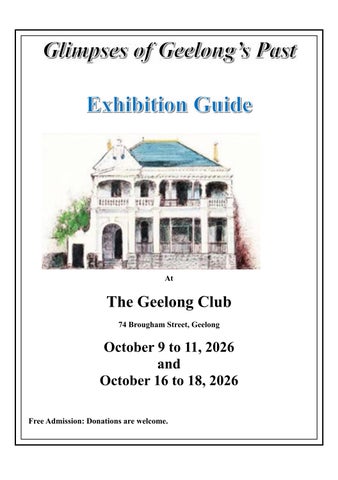
At
The Geelong Club 74 Brougham Street, Geelong
October 9 to 11, 2026 and October 16 to 18, 2026 Free Admission: Donations are welcome.
Note: The material presented in this exhibition reflects the perspectives of the non-indigenous settlers and residents who created the surviving historical record. We acknowledge the Wadawurrung People as the Traditional Owners of this Country and recognise that Indigenous histories and cultural knowledge should be presented by and in partnership with Aboriginal communities.
Photographs, personal objects, and names on Honour Boards tell us much about people who have left their mark on Geelong’s society, from the humble to the famous. Artefacts show the objects they valued and cherished. Our Exhibition displays, through personal, family, and Geelong Historical Society archives, objects that reflect the fashions they chose, society’s trends, and the technology available. We can learn about their work, homes, roles in the family and participation in the community. In July 2026, the Geelong Club and the Geelong Historical Society entered into a partnership to promote Geelong’s history. This Exhibition is the first outcome of our partnership.
Welcome to the Geelong Club The Club was founded in 1859 and has met in many venues. For various reasons, the Club fell into dormancy until Edward Harewood Lascelles resumed operations in 1881. Since that time, the Club has operated continuously. Located in Mack’s Hotel just next door, the club decided in 1881 that it was time to have its own establishment, and it acquired land here on Brougham Street. You can view the financial documents and original plans in this exhibition. The rest is HISTORY! Throughout the Club’s history, its members have come from different occupations. Like Lascelles, many were involved in Geelong’s commerce and industry. Many members also came from the political classes at local, state, and national levels of government. Pastoralists from the Western district also appear in the Club's membership. The Geelong
E. H. LASCELLES
Club has been a social microcosm of Geelong’s society. The Club’s building and its features remind us of times when people with power and influence could mingle and share their dreams for Geelong’s prosperous future. The Honour Boards have captured the names of people who have participated in the Club, going back to 1859. They speak about the commitment those people have made. Some are remembered for their service and sacrifice to our nation during war, service to the Club’s
administration, and participation in Club activities. Each person has their own story and a legacy. Founded in 1944, the Geelong Historical Society has collected important objects that tell Geelong’s past. These objects, together with its quarterly Investigator magazine and monthly talks, bring Geelong’s past to life. In this Exhibition, we offer visitors and Geelong residents the opportunity to explore the building, its contents, and important artefacts from our City’s past.
Exhibition Format The Geelong Club building is an exhibition in its own right. As you access the building on both the ground and first floors, you will view the many items of historic furniture, paintings, photographs and objects that furnish this historic building. A tour through the Geelong Club is like stepping back in time. It is a voyage of discovery where the past comes to life. On the first floor, some of Geelong Historical Society’s artefacts are on display. They blend comfortably with the historic surroundings, alongside Geelong Club furniture, pictures and paintings. A range of artefacts, donated by the Geelong public since 1944, are on exhibition for the first time since that year. Arranged by theme, the objects offer glimpses of the past: clothing worn from cradle to grave, and artefacts for communication and entertainment. Pictures and maps from the past show how much we have evolved.
Lectures On two Fridays at 11 am, we have guest speakers in the ground floor front room. Friday October 9 – Dr Norman Houghton will speak about the History of the Geelong Club. Friday, October 16 – Dr David Rowe will speak about a relevant topic associated with the Exhibition. After the speakers, you can buy lunch at the Geelong Club’s Café Felix.
Walk through History Welcome to our Exhibition.
Ground Floor– The Geelong Club Built in 1889, the Geelong Club building exemplifies Queen Anne architecture. Designed by respected Ballarat architect Charles Figgis and built by the famous Geelong firm of J.C. Taylor, the building now enjoys Victorian Heritage protection. Through two large, welcoming doors, you are enveloped in its warm old-world charm and inviting features. Be transported to another century, when the horse dominated road transport, and wood fed its open fireplaces, warming its occupants. Surrounded by ornate timber features, members relaxed in the luxurious décor.
Self-Guided Tour of the Club’s rooms Travel through downstairs corridors and rooms and view wall-mounted and standing objects such as honour boards, trophies, pictures, plans, sketches, photographs, and memorabilia from another age in Geelong’s past. Marvel as you enter the Turner Billiard Room on your way to the 19th-century heritage-listed Member's bathroom, then return via the tranquil ‘hidden garden’. You will observe our walls at both levels covered with bookshelves. They are the silent witnesses of our past, and their stories are ready to be unlocked by the inquisitive eye. What interesting stories could they tell?
Follow the direction arrows to navigate through the building.
Entry The first spacious room on your right is where Victorian Premier Sir Henry Bolte and Australia’s 16th Governor-General, Lord Richard Casey, sat to view Geelong’s waterfront. Little has changed apart from a large reverse-image painting by Harold Freedman. He used it as part of his 50-metre mosaic in the Government State Offices on Little Malop Street.
Through the stained-glass doorway and turn right Through the bespoke stained-glass interior entry doors, you arrive at the foot of the stairs. Turn right here to enter the ground floor of the Club. Honour Boards grace the walls. One tells us about those who made the ultimate sacrifice for our nation and Empire. Others inform us about the many Presidents who devoted personal time to advance the Club. Many presidents were distinguished Geelong community leaders.
Furniture Historic, period furniture, including a sideboard buffet and ornate hall stand. The Grandfather Clock was ubiquitous in wealthy houses. Analogue, wind-up clocks chiming the hour tell the ‘mechanical’ time before the digital age.
Pictures, Plans, Paintings and documents As you make your way through the corridor, take time to examine the variety of framed messages on the walls. • Corio Bay images speak to the bay's importance for communication and the import and export of produce. • Eastern Beach’s sea baths highlighted aquatic recreation, even as open swimming was discouraged in public. • Geelong Club is presented almost as it was when it was new in 1889. • At the end of the passage, you will see the original plans for the Geelong Club are displayed.
The door to the right is Lascelles’ Bar. You can buy refreshments here or continue on. This comfortable lounge is the centre meeting area. • Many paintings and photographs that show scenes of Geelong’s past. • A stag’s head (not de rigueur today), wearing the Club necktie, gazes at us above the fireplace.
The door straight ahead is the G.M. Turner Billiard Room. This amazing room is architecturally unique and takes us back in time.
Through the door to the right is the Heritage Gentlemen’s bathroom. Once a very modern facility, its interior shows its age. No changes are possible; this is a heritagelisted building. After the ALL CLEAR, venture in.
Return to Lascelles’ Bar Follow the arrows and enter the Hidden Garden This tranquil green space adds serenity to the inner city.
To the right is the wonderful Garden worthy of a quick visit.
Return to the Foyer and climb the stairs to the First Floor
First Floor – Geelong Historical Society Exhibition First Floor - three upstairs rooms and balcony Geelong Historical Society was formed on February 22, 1944, with the opening of the Historical Exhibition. The Society’s first Historical Exhibition was its last. Many Society objects were donated to the Geelong Heritage Centre and can be viewed there. Now, eighty-two years on, we share a few selected items from our collection with the public. THEME Clothing Communication Employment and Transport
THEME Household Goods Notable Geelong Residents Photographs, Pictures & Maps
Labels and descriptions are attached to every listed Exhibit item. Names of many donors are unknown. Clothing
First Floor Landing
Baby’s dress Health Centre Noticeboard and poster Black mourning ensemble, skirt and hat Black skirt and top hat Girl’s dress and petticoat Pre-1905 mourning dress and cape Wedding dresses Wedding dress and bridesmaid dress
Communication
Large front room
Argus Newspaper bound copy January - March 1889 & April to June 1889 Argus Newspaper bound copy October to December 1920 Poster William Jackson Thomas – first telephone in Victoria Stromberg-Carlson Mantle Valve radio (1936) Portable Writing Desk (c. 1850) Healing His Master’s Voice valve radio (1946) Underwood typewriter CO8 Candlestick telephone, pre 1912
CO7 Underwood Typewriter 1917
Your partner in business
We custom design and print an extensive range of products Call 1800 720 100 14 Hepner Place, North Geelong sales@printdesignaustralia.com.au www.printdesignaustralia.com.au
Employment and Transport
Small front room
Corio Abattoir – 1920s Steam engine on Railway Pier (Cunningham Pier) Goods being loaded on Railway Pier’s electric conveyor Wool bales being exported from Strachan, Bostock & Co. Wool Stores Meat Freezing works at Corio Quay Lascelles’ Wharf construction Opening of the Hopetoun Channel Members of the Royal Garter present and grant to the Geelong Harbour Trust a symbol of an anchor through a naval crown William Fagg’s store on the corner of Moorabool and Barwon Terrace c 1880 Fagg Brothers store decorated for Queen Elizabeth II’s visit to Geelong in 1954
Household Goods Bedspread 1879 Cane Cradle Child welfare poster Hand crocheted tablecloth Nursery years photograph frame Oil lamp funnel with brass base and frosted glass shade School Photograph Silver teapot – donated to Buchans by Drysdale church 1883 Tablecloth – linen and handmade crocheted lace Weights for balance scales Vintage Art Deco “Diana” figurine table lamp 1790 dinner set donated by the Rhind/Spence family Trait lemonade barrel
Large front room
Notable Geelong Residents
Library
Captain Foster Fyans’ Chair Captain Foster Fyans’ portable desk Stovepipe hat like that worn by Fyans Information board 1 Information board 2 Book – Memoirs of Captain Foster Fyans Mayor’s Chair South Barwon – 20th Century The E.C. DeGaris Shield for Geelong Women’s Debating Association 1936
Photographs, Pictures & Maps
Small front room
Eastern Beach construction Eastern Beach Children and adults bathing at Eastern Beach c. 1900 Port of Geelong from Eastern Beach c. 1850 Port of Geelong from Western Beach c. 1850 Freemans’ certificate HMS Barwon 1946 Parish of Barrabool Property Owners Map Smythe’s 1838 plan of the town of Geelong Opening of Federal Parliament picture presented to the Geelong Mechanics Institute Incorporated (1907) A picture board of the 1904 to 1907 Borough Council of Newtown and Chilwell presented by Cr. H. Bloomfield – Mayor Choir collage 1903
A slide show of Geelong scenes is played continuously on the TV.
Our Special Display Items – Geelong Heritage Centre Geelong Regional Library
Open Tuesday to Friday 10 am to 4 pm Some items are too precious and too valuable to transport to our Exhibition, so part of the Geelong Historical Society’s collection is housed at the Geelong Heritage Centre. You can view two sets of items, plus many others, at the Heritage Centre. Entry is free. It is on Level 3 of the Geelong Regional Library on Little Malop Street. ➢
1790 2 x china teacups, saucer, teapot etc. – Donors – Rhind/Spence Family Images of Tea set
➢
Joseph H Scammell (ship – sank 1891) 19th Century French Crystal Bowl and ruby cranberry enamelled glass tumbler
Crystal Bowl
Joseph H Scammell, sank at Point Danger in 1891
Tumbler
Acknowledgements The Geelong Club and Geelong Historical Society thank many people for their assistance in mounting our Exhibition. Geelong Historical Society Inc Exhibition Subcommittee Denise Feldman Coral Turner Julia Thompson Freda Craddock Pauline Fairfoot
Urban Design and Place and
General Committee
Michael O’Donnell (Secretary/Web Master) Mark Thomas (Vice President) Tony Cust (Treasurer) Peter Fogarty Lana Capon Harry Roberts (President)
Geelong Heritage Centre Team Lucy Lara Nick Melody
The Geelong Club Glenn King Anthony Trainor and Club volunteers
Tracey Jacqui Fern
Glenn King President The Geelong Club
Margie Mackie Janine Barrand Ben Petkov
National Wool Museum Padraic Fisher Josephine Rout Luci Wilson
National Trust Linda Carr
Special Advisor Bob Gartland
Geelong Historical Society Volunteers
Harry Roberts President Geelong Historical Society Inc
Become a member of Geelong Historical Society
View our award-winning website https://www.geelonghistoricalsociety.org.au Click on the Join Now link Join us and help promote stories of Geelong’s past. Our modest annual membership fee of $40 entitles you to receive four Investigator magazines, access to our members’ section of the award-winning Society website and monthly updates on events.