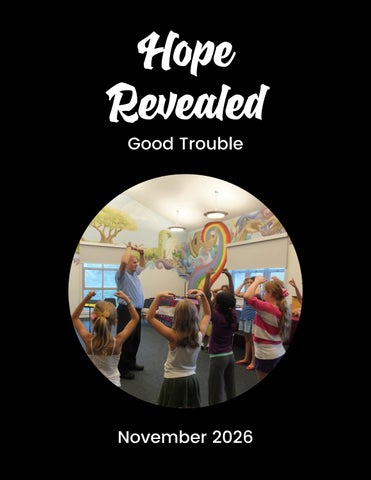
Hope Revealed Good Trouble
November 2026
“Get in good trouble, necessary trouble, and help redeem the soul of America.”
This quote by the late Congressman John Lewis is often used in conversations of peaceful action against systemic injustice. Lewis himself was an outspoken proponent during the Civil Rights movement and thereafter. He participated in the 1963 March on Washington (where he was brutally beaten in Selma on the Edmund Pettus Bridge during ‘Bloody Sunday’) and was arrested 40 times between 1960 and 1966 for marches, sit-ins, and the likes. This year we reached out to a few young adults who attended Princeton UMC as a child and teen within the last decade. We wanted to know what they understood this quote to mean in today’s context. How do they envision God’s renewed creation? What gives them courage to participate in saving or redeeming America? God’s promised future transforms how we live in the present. Reading how these young people have hope in the future can help us all change how we live now. As the wonder card for November 22 says: “Picture the kingdom. Imagine all hope is possible. What is one act you can take to live in this vision today?” Note – If you weren’t included in the poll and would like to respond, we would love to hear from you!
Prompt: “What good trouble, necessary trouble can help redeem the soul of America? Have you seen it? What do you want to see?” In other words, what is “good trouble” to you, in the context of activism or saving/redeeming America? What are your thoughts for how to make the country better? Do you see it? What do you want to see?
Of History and Hope by Miller Williams
We have memorized America, how it was born and who we have been and where. In ceremonies and silence we say the words, telling the stories, singing the old songs. We like the places they take us. Mostly we do. The great and all the anonymous dead are there. We know the sound of all the sounds we brought. The rich taste of it is on our tongues. But where are we going to be, and why, and who? The disenfranchised dead want to know. We mean to be the people we meant to be, to keep on going where we meant to go.
But how do we fashion the future? Who can say how except in the minds of those who will call it Now? The children. The children. And how does our garden grow? With waving hands—oh, rarely in a row— and flowering faces. And brambles, that we can no longer allow.
Who were many people coming together cannot become one people falling apart. Who dreamed for every child an even chance cannot let luck alone turn doorknobs or not.
Whose law was never so much of the hand as the head cannot let chaos make its way to the heart.
Who have seen learning struggle from teacher to child cannot let ignorance spread itself like rot. We know what we have done and what we have said, and how we have grown, degree by slow degree, believing ourselves toward all we have tried to become— just and compassionate, equal, able, and free.
All this in the hands of children, eyes already set on a land we never can visit—it isn’t there yet— but looking through their eyes, we can see what our long gift to them may come to be. If we can truly remember, they will not forget.
Flawed, we stray from “where we meant to go”; recognizing these detours, owning them, and learning from them model a path for the generation that follows to “fashion the future.” As you read the newsletter and “reunite” with our youth, marvel at the future they are creating now. - Kate Lasko
Kasey Angello
To me, good trouble means choosing what is morally right even when it is difficult, inconvenient, or unpopular. Advocacy is essential to redeeming the soul of America, especially when confronting injustices like the deportation of immigrants and the dehumanization of vulnerable communities. I’ve seen good trouble in the courage of people who speak up, organize, and refuse to let their neighbors be treated as disposable. These acts remind us that social change is built through collective responsibility. I hope to see more radical love, more neighborly action, and more people willing to stand up for one another.
Kasey Angello is in her fourth year at Drexel University, earning her Bachelor of Architecture.
Gillian Bartels-Quansah
To me, good trouble means being selfless toward all of our neighbors: looking at someone beyond face value, recognizing the struggles or injustices they may face, and helping in whatever way one can, big or small. It means leaving someone’s life a little lighter than you found it. Good trouble does not have to be loud or extravagant. It can be as small as helping someone carry in their groceries. It can mean questioning why your school bans certain books, volunteering to help undocumented families access food and education, or going to your local town hall to question the laws that govern your community. I believe these small acts of courage and compassion can create meaningful change. I see good trouble within my own community. I see it in my friend who volunteers at animal shelters each weekend, and in another friend who volunteers with the elderly so they feel a little less lonely. I see it in a coworker who helps organize community fundraisers for people in countries facing crises, including Sudan, the Congo, Haiti, and Palestine. I’ve seen people brave enough to share their art with their friends and communities: to protest injustice, spark conversation, and bring attention to causes that might otherwise go unheard. I also see it in people who use their platforms to create tangible change. I see it in efforts to expand access to universal childcare in New York City. I see it in professional basketball players who advocate for greater equality for female athletes. I see it in musicians who use their songs to tell the stories of the unheard and the struggling, reaching thousands, if not millions, of people and giving a voice to experiences that might otherwise go unseen.
To redeem our soul as Americans is not necessarily to make grand gestures, but to make small changes that reverberate across our country. Just imagine what our world would look like if everyone took even a minute of their day to think of others, question something that is unjust, or help ease the pain of someone who is struggling. That is the good trouble I hope to see more of. Gillian Bartels-Quansah is a graduate of Barnard College and is now a Software Engineer in Chicago.
Melanie Doren
To me, “good trouble” is an oxymoron we have created to describe the radical idea of following through on what we have promised. I do not believe America needs to be “saved.” I believe we need to acknowledge the shortcomings of this young nation and continually refine the ways in which we serve, include, and care for the people who call it home. The word “others” has historically been used to separate people from one another—to define who belongs and who does not. But, in reality, that term once described each of us in some way, until we recognized that we are all part of the same US. To make the country better, I believe we need to: Increase federal taxing of corporations: Fund vital public services, infrastructure, and social programs without solely relying on individual income taxes and allow for harm reduction in communities. Provide reliable housing and medical care for veterans: Mitigate the economic and untreated servicerelated hardships that further contribute to severe transition hardships. Stronger education: Invest in public education from kindergarten through higher education, with an approach that prepares people not only for careers, but also for thoughtful citizenship, critical thinking, and lifelong learning. Create affordable healthcare: Work toward a healthcare system in which quality care is accessible and affordable, regardless of a person's circumstances. This would be tied into #3 by plateauing the barriers that prevent laypeople from pursuing medicine. Create family planning resources: Ensure that individuals and families have access to the information, resources, and support they need to make informed decisions about their futures. Practice listening: Encourage ourselves to listen as though we could be wrong —even when we are certain that we are not. There is still something we can learn from another person's experience, perspective, or story.
Stop demonizing one another: Move away from the constant cycle of blame and division that benefits those who profit from keeping us apart. We can disagree but still leave room for another’s perspective without dehumanizing one another. Remember our roots and that strength is collective: We are stronger together than we are apart. Our differences do not have to be the things that divide us; they can be the things that broaden our understanding of what this country can become. For me, making America better does not mean returning to some idealized version of its past. It means being honest about where we have fallen short, listening to one another, and continuing the work of building a country that lives more fully up to the ideals it has promised to pursue - life, liberty, and the pursuit of happiness. Melanie Doren is a community member and a graduate of Rutgers University. You can find her Sunday mornings singing in the Intergenerational Choir.
Leanne Griffiths
I think “good trouble” today means being willing to speak up when something is wrong, even when doing so is uncomfortable or unpopular. I’ve seen it in young people who refuse to accept inequality as inevitable and instead organize, protest, volunteer, and advocate for change in their communities. What I want to see is more people taking that same energy beyond social media and turning it into action, especially when it comes to racial and economic inequality and protecting people whose voices are often overlooked. To me, continuing John Lewis’s legacy means recognizing that progress is never guaranteed, it instead requires ordinary people to care enough to get involved. Leanne Griffiths is in her fourth year at the University of Pennsylvania, majoring in Political Science and History, minoring in French and Legal Studies.
Nate Griffiths
The “good trouble” that can help redeem our country is the willingness to address organizations, movements, and systems that promote any form of dehumanization, while holding people accountable when their actions violate the law. Many of the challenges we face stem from economic insecurity, inadequate education, social inequality, and the tendency to direct frustration toward other people rather than address deeper problems.
I believe the government should do more to support people through stronger financial safety nets, effective social programs, better education, and investment in communities that have been overlooked. We also need to take a more honest look at the difference between the values our country says it upholds and how those values are practiced in everyday life. To me, good trouble means having difficult but respectful conversations, recognizing what needs to change, and working together to create a fairer and more supportive society. Nate Giffiths is a graduate of The College of New Jersey and is a Sales Agent in Florida.
Yannick Ibrahim
When I think about “good trouble,” I think about the everyday moments when we voice our opinions with one another, even when it would be easier to stay quiet. It can be sharing a new idea to solve a problem, questioning a habit or policy simply because “that’s always been the norm,” or encouraging others to see things differently. Good trouble can also mean helping someone who needs a hand, saying hello to a neighbor, or noticing someone who could use a little kindness. Good trouble and necessary trouble aren’t always about political events or big moments of change; sometimes they are simply about caring enough to speak up, help, or just try something different. Maybe “good trouble” is as simple as putting our faith into action and remembering Jesus’ words to “love your neighbor as yourself.” Perhaps the good trouble we make in our everyday lives can be a small but meaningful way of making things a little better for those around us. Yannick Ibrahim is a graduate of Montclair State University, and a Customer Care Representative at Target. You can also find him singing on Sunday mornings in the Intergenerational Choir.
Connor Langdon
There is no doubt America has been in trouble, or been the trouble for a long time. There's an argument to be made about whether or not we've been anything other than in trouble or the trouble for the entirety of our nation's history. The Revolution and the corresponding war that led to the creation of our nation stands out in our minds as the kind of trouble America should be in. The founding fathers are lauded as heroes for the under-represented colonies, defying the British Crown and throwing tea in the harbor.
We are led to believe this trouble is rewarded by God, and thus the creation of the nation and a beacon of democracy in the west. By uplifting those that came before us, we have an ideal to look back on and aspire to achieve as we look forward to the future and the things we have yet to realize. Those who have grown up in the 21st century have had their youth marked by realization after realization that the world they were told existed and was promised to them as the future of society, has never really existed before, and certainly will not be accessible to them now. Colonists were taxed at a rate we would deem today as insignificant relative to how much we are taxed on groceries or stamps, let alone military spending or social security. Many of the founding fathers owned slaves; an institution our country took 80 more years to extinguish, 21 years after Britain had already done so. Corporations and SuperPACs have more power over elections now than they ever have, leaving our beacon of democracy a shell of the promise it claims to uphold. Our minds are quick to be captured by but slow to realize the pervasive nature of media, dominating our attention span and feeding an addiction to reactionary content. The farther back you pull the curtain, the more it becomes clear that bad trouble has been running the show for a while now. With so much of our minds enveloped in how to exist in a world or culture we do not have access to, where do we go? What do we do? How can we get ourselves into “good” trouble, if the only thing we’ve known is trouble to begin with? Perhaps the answer is that good trouble begins with refusing to accept trouble as inevitable. If America has always been imperfect, then perhaps our responsibility is not to restore some imaginary version of the country that never existed, but to continue the work of making its promises more real. The ideals that we associate with America are not invalid simply because our history has so often failed to live up to them. In fact, their failure makes them more important. Good trouble means becoming unwilling to look away from the places where that promise breaks down. It means questioning institutions when they fail the people they are supposed to serve, speaking up when silence is more comfortable, and being willing to inconvenience myself for the sake of someone else's dignity or opportunity.It means caring about the politics of my town as much as the politics of Washington, volunteering in my community, voting, organizing, teaching, listening, and having difficult conversations with people whose understanding of America differs from my own.
Perhaps most importantly, I think good trouble means resisting the temptation to confuse outrage with action. We live in a culture that is exceptionally good at making us angry and exceptionally bad at convincing us that we can do anything about it. It is easy to mistake having a strong reaction for having made a difference. Good trouble requires sustained attention and participation. I want to see people who are willing to challenge the country precisely because they believe it is capable of becoming better. Connor Langdon currently teaches History and coaches cross country and lacrosse at a boarding school in West Connecticut.
William Ponder
An example of causing good, necessary trouble is definitely whistle blowing and institutional accountability. Some would put transparency-forcing acts leaking, testifying against powerful interests or resisting unlawful orders. I see this today by things like the “Me Too” movement or simply minorities posting about the different forms of oppression they are experiencing currently. I want to see more people doing this. I want to see more people speaking out against the atrocities that this country is currently facing. The more we talk/highlight these issues and bad people, the quicker we can put a stop to it. William Ponder is a sophmore at Howard University, majoring in Psychology and minoring in Playwriting.
Youth choir, 2016
These statements came from youth who grew up at PUMC — going to Sunday School, singing in the choir, being in fellowship. Here are some pictures that illustrate those years. Above, Youth Fellowship, 2013 Below, Children’s Musical, 2016
Eighth grade confirmands, 2019
Holy Communion and Annointing, 2018
Fifth and sixth grade class, 2017
Bible Presentation, 2015
Advent Night, 2015
Special thanks to: Barbara Fox, Marie Griffiths, and Kate Lasko. Also to all the young adults who responded with thoughtful responses and inspired all of us to ponder the late Senator Lewis’ words deeper.
609.924.2613 7 Vandeventer Ave., Princeton, NJ, 98542
www.princetonumc.org