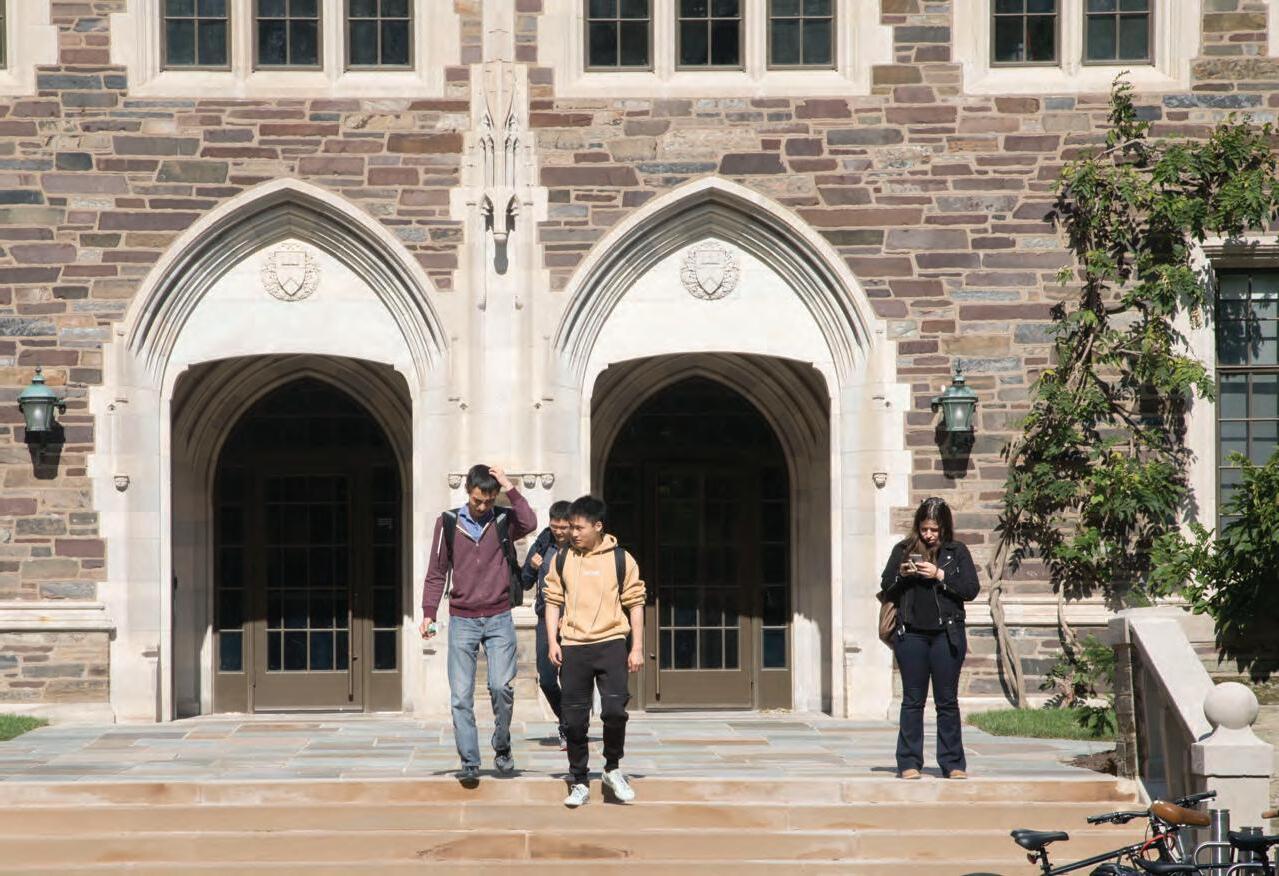
Established in 2011, the Julis-Rabinowitz Center for Public Policy & Finance at the Princeton School of Public and International Affairs promotes teaching and research about the interactions between financial markets and the macroeconomy, with the aim of improving the design and implementation of public policy.
The Center offers opportunities for collaborations among students and faculty in the Princeton School of Public & International Affairs, other departments and the wider policy community. The Center encourages crossing boundaries both within economics and across disciplines such as economics, finance, law, politics, history and ethics.
ACKNOWLEDGMENTS
Princeton University gratefully acknowledges the generosity of the following donors:
THE JULIS-RABINOWITZ FAMILY for the founding gift that made the Center possible.
PHILIP D. BENNETT *79
JOYCE CHANG ’90 AND FAMILY
MARK R. GENENDER ’87 AND FAMILY
NOAH GOTTDIENER ’78
DEAN N. MENEGAS ’83
For a more comprehensive view of the Center’s programs and activities, visit us at jrc.princeton.edu.
Message from the Director
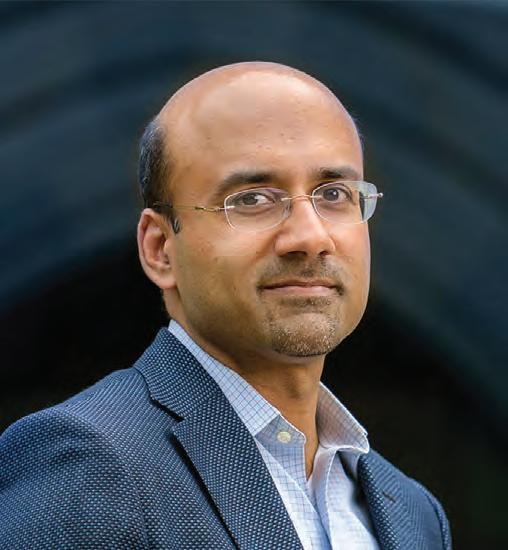
Iam delighted to present the Center’s annual report for the 2024–25 academic year. Our achievements this year reflect the extraordinary energy and commitment of our students, faculty, alumni, and supporters, whose engagement continues to elevate the work of the Center.
Now in its fifteenth year, the Julis-Rabinowitz Center for Public Policy & Finance (JRCPPF) remains dedicated to advancing the understanding of macroeconomics and finance as essential tools of public policy. By advancing rigorous, data-driven research and cultivating the next generation of policy leaders, our efforts continue to reinforce SPIA’s commitment to world-class scholarship.
Over the past year, the Center deepened its research footprint through scholarly work on topics ranging from global inequality and industrial policy to financial stability, taxation, and climate-related financial risks. This research is already informing debates in national capitals and multilateral institutions. Our academic initiatives, including the Financial Markets Short Course, the Economic History Workshop, the Macrofinance Lab, and the Africa Policy Lab, offered both graduate and undergraduate students hands-on analytical training and exposure to pressing global challenges.
The spring semester brought unprecedented headwinds for universities preparing students for publicsector careers, as job opportunities contracted sharply. In response, the Center intensified its practitioner engagement, bringing distinguished leaders and policymakers to campus to discuss current events and career pathways. We also deepened our international collaborations, from advancing Pakistan’s energytransition strategy to supporting student-led work in Africa, reflecting our belief that navigating today’s economic challenges requires global awareness, interdisciplinary insight, and a willingness to innovate.
As the Center marks a milestone year, I look ahead with renewed purpose. This report captures the momentum of the past year, and I am excited for what lies ahead as JRCPPF continues to drive research excellence, experiential learning, and meaningful policy engagement.
ATIF MIAN
Director, Julis-Rabinowitz Center for Public Policy & Finance
John H. Laporte, Jr. Class of 1967 Professor of Economics, Public Policy, and Finance Princeton School of Public and International Affairs
4,910
517,000
research & SCHOLARSHIP
Reflecting Princeton’s core values of evidence-based inquiry, world-class scholarship, and service, our researchers combine cutting-edge empirical methods with deep theoretical insight.
Over the past year, the Center supported four faculty and postdoctoral affiliates whose work spans an exciting range of issues, reflecting the breadth and ambition of the Center’s research agenda. The projects that follow, from new estimates of the natural rate of interest and global saving patterns, to the geopolitics of trade, the historical evolution of public credit, and the structure of production and supply-chain networks, demonstrate how rigorous research can distill the underlying processes driving economic stability, growth, and distributional outcomes. Together, they form a cohesive research agenda dedicated to generating actionable insights that inform more resilient, equitable, and forward-looking economic policy.
Research Highlights
JOHN STURM BECKO POSTDOCTORAL RESEARCH ASSOCIATE
Becko is an applied economic theorist interested in macroeconomics, public finance, and trade. An overarching theme of this agenda is to explore the gap between benchmark policy models and key empirical facts. He holds a B.S. from Harvard College and a Ph.D. in economics from MIT.
Becko’s research focuses on optimal policy design in two main areas: trade and the economics of income taxation. In the first area, he is exploring how geopolitics shapes trade policy. His working paper “Strategic (Dis)Integration,” coauthored with Daniel O’Connor (MIT), analyzes how countries anticipating future sanctions should design peacetime trade and industrial policies to strengthen their bargaining positions. A related paper, “Optimal Tariffs with Geopolitical Alignment,” coauthored with Gene Grossman (Princeton) and Elhanan Helpman (Harvard), models how great powers such as the United States and China use tariffs and free trade agreements as strategic tools to extract geopolitical concessions, and the welfare tradeoffs of escalating great power rivalry.
The second strand of Becko’s research addresses optimal income tax policy when households differ in their economic behavior. A recent working paper examines which tax policies can definitely be ruled out even with very limited insight into exactly how households’ preferences differ. Another working paper in this area, “Technological Change and the Cost of Redistribution,” identifies a channel through which technological progress raises the cost of redistributing income and consequently increases income inequality. When households that are more responsive to both tax changes and to technological improvements become overrepresented among top earners, taxes on high incomes become more distortionary.
VICTOR DEGORCE POSTDOCTORAL RESEARCH ASSOCIATE
Degorce investigates current issues in macrofinance and international economics from a long-run and historical perspective. His multidisciplinary research draws on the fields of macroeconomics, finance, and economic history. He holds a Ph.D. in economics from the Paris School of Economics.
Degorce studies the historical dynamics of global credit and international finance, with a focus on how public institutions shape long-run financial and macroeconomic cycles. A recent article, “The Great Depression as a Savings Glut” (with Eric Monnet), in the Journal of Economic History, examines how excessive non-bank savings combined with tightened credit exacerbated financial instability during the interwar period. In another paper on covered interest parity (CIP), Degorce digitized daily data on exchange and interest rates from 1920–2020. The analysis reveals that significant deviations from CIP have been the norm, except for G10 currencies in 2000-2006, the years preceding the Global Financial Crisis. These results highlight the persistent limits to arbitrage in foreign exchange markets since 1920. For his working paper “Public Credit and the Financial Cycle,” he digitized archival records on total public sector lending across thirteen major economies from 1950 to 2020. The results show that public credit accounts for over a fifth of total lending, is largely resilient to U.S. monetary policy tightening, and, in free economies, counters private-sector credit booms and busts.
Two recent projects study the historical role of exchange controls in currency market integration. The first considers exchange rationing as industrial policy, based on digitization of six decades of records on exchange and trade policies, to examine how post-WWII currency controls affected productivity convergence between Europe and the United States. The second project, “Exchange Controls and the Segmentation of International Currency Markets,” combines monthly data from 17 financial centers, over the period 1900-2020, to construct a new long-run measure of currency markets integration and assess impacts on bilateral trade flows.
ERNEST LIU ASSISTANT PROFESSOR OF ECONOMICS
Liu’s research is centered around the implications of weak financial institutions for economic growth, allocation of resources, and economic development. His research applies network models to answer general-equilibrium, policy-relevant questions, often from a long-run growth perspective, on a broad range of topics, including industrial policy, resource allocation, innovation, spatial economics, and global capital flows. He holds a B.A. in math from Carleton College and a Ph.D. in Economics from MIT.
Over the past year, Liu’s work has explored how interconnected firms, sectors, and countries respond to shocks and policy interventions in an increasingly globalized and data-driven economy. Along with a team of researchers from Yale, UVA, and Rochester, he has developed methodologies to identify disruptions in critical goods supply chains across regions, product origins, and categories. Recently, the team launched an innovative tool that helps firms and governments monitor disruptions with unprecedented precision and granularity.
Liu’s current projects extend these themes to the green transition, supply-chain finance, and innovation networks. Ongoing collaborations examine how sectoral interdependencies shape the diffusion of green technologies, how financial constraints propagate along supply chains, and how declining interest rates contribute to industry concentration and “superstar” firms. Together, this body of work offers new theoretical and empirical insights into the structural forces linking production, finance, and long-run economic growth. Other recent papers include “A Dynamic Model of InputOutput Networks,” which develops a dynamic framework to understand how production linkages amplify or mitigate economic fluctuations over time, and “International Friends and Enemies,” an analysis of how geopolitical relationships influence trade patterns and economic integration.
ATIF MIAN PROFESSOR & JRCPPF DIRECTOR
Mian’s work explores the connections between finance and the macroeconomy. His 2014 book, House of Debt, with Amir Sufi, describes how excessive household debt precipitated the Great Recession. Mian's research has appeared in top journals, including Econometrica, Quarterly Journal of Economics, Journal of Finance, Review of Financial Studies, and Journal of Financial Economics. He holds a Ph.D. in Economics from MIT. Mian, together with Jonathon Hazell (London School of Economics) and former predoctoral research specialist Veronica Backer Peral, recently completed a paper titled “Dynamics of the Long-Term Housing Yield: Evidence from Natural Experiments,” forthcoming in the American Economic Review. The study uses historical data on long-term returns to real estate in the United Kingdom to estimate the natural rate of interest and the sustainability of fiscal policy in low-interest rate environments.
Mian’s work on the global savings glut was featured in a recent Financial Times article about fiscal deficits and economic growth. A forthcoming book by Mian and Ernest Liu will synthesize a decade of work on the interaction of finance and macroeconomic policy, linking academic research to actionable insight.
In addition to advancing existing work, Mian launched two new projects over the last year. The first analyzes the dynamics of long-run global financial cycles using historical data on foreign borrowing in non-OECD countries and countrylevel growth, to study whether consumption booms financed by external capital ultimately slow longterm growth. The second investigates how Trump tariff announcements affected firm-level market valuations by tracing disruptions through global supply chains. This project employs large-languagemodels to classify and quantify high-frequency financial data gathered from real-time policy wires and major financial media, laying the groundwork for empirical tests of market reactions to policy shocks.
Awards & Recognitions
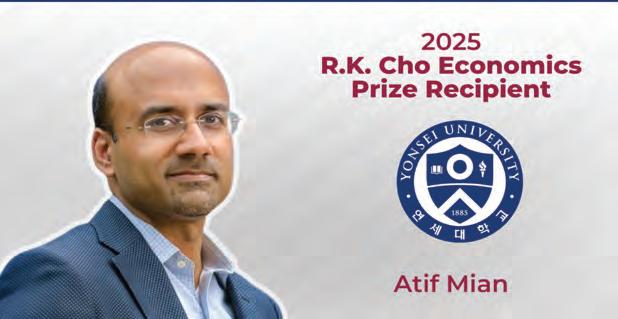
ATIF MIAN gave a keynote address on “LongRun Interest Rates: Past, Present, and Future” at the annual conference of the Chilean central bank. His scholarship on sovereign debt, macrofinancial linkages, and inequality was recognized with the 2025 R.K. Cho Economics Award. Presented by South Korea’s Yonsei University, the award is among the most prestigious in the field, honoring economists who have made significant contributions to both scholarship and education. Mian was also appointed a Distinguished Term Professor in Economics and Finance by the Monetary Authority of Singapore and the National University of Singapore. During his two-week visit, he delivered a public lecture on the effects of inequality on sovereign debt and financial growth, and engaged with academic researchers and senior policymakers.
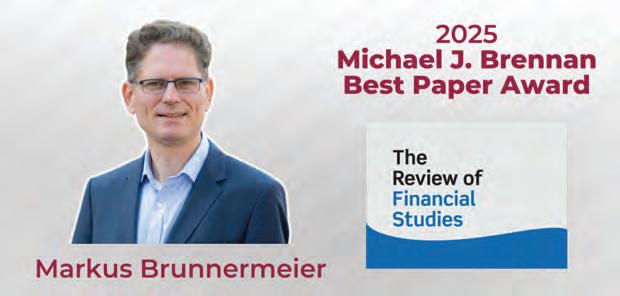
MARKUS BRUNNERMEIER, together with co-authors Kristian Bickle and Stephan Luck, received the Michael J. Brennan Best Paper Award for their article “Who Can Tell Which Banks Will Fail?” which examines the 1931 run on the German banking system. The award is presented annually by The Review of Financial Studies (RFS). Brunnermeier, who is the JRCPPF founding director, also delivered a keynote talk at the ESM–SUERF Bruegel Workshop in Luxembourg on “Shifting Global Order: Resilience during the Transition.” The workshop focused on the risks facing Europe and the policy architecture needed to enhance the continent’s resilience.
In April 2025, the Princeton Sovereign Finance Lab, led by JRCPPF affiliate LAYNA MOSLEY, professor of politics and international affairs, hosted the second annual conference on the Politics of Sovereign Finance in Washington, DC. The event, which brought together government officials, private sector leaders, and scholars from around the world, was co-sponsored by the Julis-Rabinowitz Center for Public Policy & Finance.
In June 2025, Princeton's economics department held a conference in honor of NOBUHIRO KIYOTAKI, the Harold H. Helms 1920 Professor of Economics and Banking and a JRCPPF affiliate. The conference coincided with his 70th birthday and was attended by family, current and former colleagues, teachers, and students from around the world.
MAGNUS IRIE was appointed as an assistant professor in economics. He first joined Princeton as a Pyewacket Fellowship Postdoctoral Researcher through the Bendheim Center for Finance in 2024.
Academic Visitors & Fellows
JOHN STURM BECKO is a postdoctoral research associate at the Center. He researches optimal policy design in macroeconomic settings. His work provides policy guidance about topical issues like international trade sanctions and targeted fiscal policy. At the same time, it also seeks to address fundamental questions in welfare economics, such as when markets are prone to coordination failures and whether Pareto efficiency tests provide robust policy guidance. John holds a Ph.D. in economics from MIT, a M.Phil. in economics from Cambridge, and a B.A. in physics and math from Harvard.
DONAL BYARD is a lecturer in the economics department at Princeton University and professor of accounting at the Zicklin School of Business, Baruch CollegeCUNY. Since 2017, he has taught Financial Accounting at Princeton. He is an expert on financial reporting standards, Securities and Exchange Commission regulation, European securities markets, international securities regulation and has published in numerous scholarly journals. His current research focuses on financial analysts’ use of voluntary disclosures and externalities (or spillover effects) arising from the adoption of the International Financial Reporting Standards in Europe. A graduate of the University of Limerick and University College Dublin, he holds a Ph.D. in accounting from the University of Maryland.
JEAN-CHRISTOPHE DE
SWAAN is a lecturer in the economics department, where he teaches courses on ethics in finance and Asian capital markets. Separately, de Swaan is a partner at Cornwall Capital, a global investment fund. His book Seeking Virtue in Finance calls on finance practitioners to restore the discipline’s focus on serving society. He is also a regular contributor to key business publications including Financial Times, Nikkei Asia, and others. JC de Swaan received his B.A. from Yale, M.Phil. from Cambridge, and an MPP from Harvard’s Kennedy School.
VICTOR DEGORCE is a postdoctoral research associate at the Center. His research investigates current topics in empirical macrofinance, such as the international transmission of monetary policies and exchange rate determination from a long-run perspective. His work is multidisciplinary in essence, drawing on macroeconomics, finance, and economic history. He holds a master’s degree in social sciences from Sciences Po and a Ph.D. from the Ecole des Hautes Etudes en Sciences Sociales (EHESS) in Paris.
ALAN XIAOCHEN FENG *15 is an economist at the International Monetary Fund (IMF). His responsibilities at the IMF include leading capacity development projects across IMF membership countries, covering financial sector issues in IMF’s bilateral consultations for Italy, Singapore, and Lao PDR, among other membership countries, as well as leading analytical chapters for IMF’s flagship publication Global Financial Stability Report. His research interests include macrofinancial issues, climate and ESG finance, and the use of technology in financial services. He received his bachelor’s degree in computer science and mathematics (double major) from the Hong Kong University of Science and Technology and a Ph.D. in economics from Princeton University.
EKATERINA (KATYA)
GRATCHEVA is a Senior Advisor on Climate and Sustainable Finance at the International Monetary Fund (IMF). Over her 20-year career in the financial industry, she has led policy dialogue with ministries of finance, central banks, public pension funds, and international financial institutions on issues related to sovereign assets, liabilities and risks, and developing access to capital markets. Prior to joining the IMF, she led the finance function of the $10 billion World Bank’s Climate Investment Funds. Katya’s work applies evidencebased approaches to study sovereign ESG and sustainable finance. Her widely cited sovereign ESG publications raise fundamental issues about current
Academic Visitors & Fellows
sovereign ESG approaches and proposed solutions. She also focuses on developing alternative approaches and data sources, such as satellite data, and advises the Human Rights Measurement Initiative. Her earlier experience included investment management of the World Bank Group’s own assets, risk and performance management, and banking. She holds an MPA from Harvard Kennedy School, an M.Sc. in applied math from Moscow State University, and a Ph.D. in operations research from George Washington University.
FADI HASSAN is a visiting research scholar at the Center and a senior economist at the Bank of Italy where he leads the international financial flows unit. He is also a research affiliate of the Center for Economic Policy Research (CEPR), and a research associate in the Center for Economic Performance at the London School of Economics (CEP-LSE). His research explores questions in international finance, trade, and macroeconomics. He has been a visiting associate professor of economics at MIT, a visiting scholar of economics at Harvard, and an assistant professor of economics at Trinity College Dublin. He has served as a consultant to the ECB, the European Commission, the European Investment Bank, and the World Bank. He holds a Ph.D. from the London School of Economics.
BUNMI OTEGBADE *19 is a global social impact leader and currently Senior Director at Ashoka where he leads knowledge production for peerdriven networks and strategic institutional partnerships in North America. He is also a venture investor, debt and equity, in fast-growing technology firms in life sciences, deep tech, clean energy, and inclusive financial technologies in emerging markets with a focus on Africa. His interests range from innovation policy and technology transfer to the financial market institutions that drive inclusive economic development in emerging markets. He holds a B.Eng. from Baylor University and an MPP from Princeton’s School of Public and International Affairs.
MAROOF A. SYED is a nonresident fellow of Center and the president and CEO of the Centre for Economic Research in Pakistan (CERP). He has over 25 years of entrepreneurship, investment, and leadership experience in multiple sectors. His public policy interests include innovation for economic development, data analytics and decision sciences, and evidence-based governance. Before leading CERP, Syed was a senior manager at Broadcom Corporation (formerly Silicon Spice), Texas Instruments, and Intel Corporation (formerly Dialogic). He co-founded Karnybo Group investing in late-stage pre-IPO technology companies, including Tesla, Twitter, Facebook, Jawbone, Square, and Palantir. Syed holds a B.S. from Rensselaer Polytechnic Institute and an MPA from Harvard’s Kennedy School.
Predoctoral Research Conference
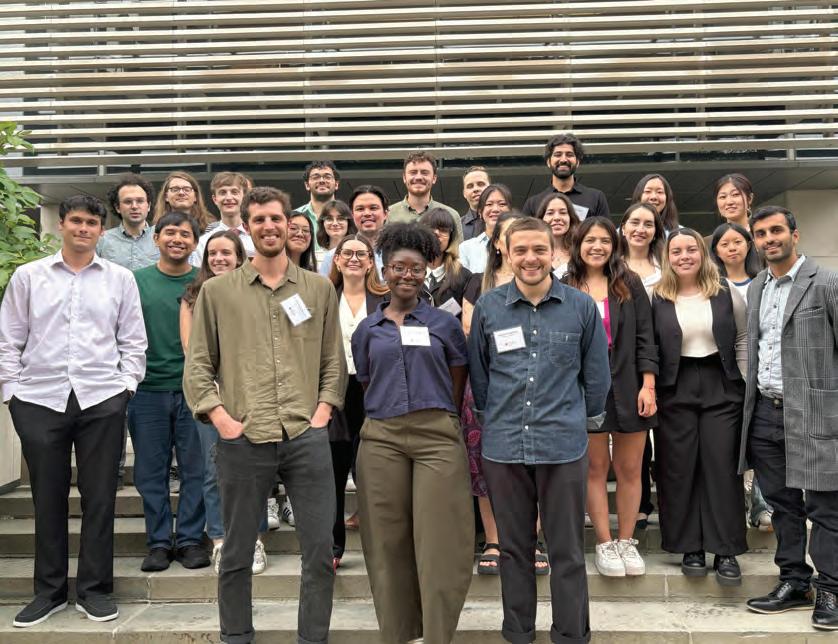
In May 2025, JRCPPF co-sponsored the annual Predoctoral Economics Research Conference, organized by a team of predocs affiliated with SPIA and Economics. This year’s conference widened its scope, with presenters not only from Princeton but also from other universities, the International Monetary Fund, and the Federal Reserve System. The event provided early-career researchers the opportunity to share works-in-progress, build professional networks, and engage with leading scholars in the field.
Predoctoral Researchers
Building a pipeline of emerging talent in economics and public policy remains a key part of the Center’s mission. Through its predoctoral research specialist (predoc) program
SAM NAK-KYU BARNETT is a senior research specialist at the Center. His research interests include macrofinance, behavioral finance, and spatial economics particularly as applied to housing and land use policy. Previously, he worked at Harvard Business School and the Puget Sound Business Journal. He recently earned a B.A. in mathematical economics from Columbia University, where he wrote a senior thesis on the student loan market.
and summer research internships, the Center continues to foster a vibrant intellectual community for young researchers aspiring to careers in academia, policy, and finance.
AMIL MUMSSEN is a senior research specialist at the Center. His research interests include macroeconomics, finance, and environmental economics. He holds a B.S. in applied mathematics and economics from Brown University. Born and raised in Washington, DC, he has always been passionate about understanding the world through the lens of politics. Outside of academics, he enjoys playing soccer, mastering the piano, and spending time in nature.
center INITIATIVES
The Center’s initiatives reflect a commitment to bridging rigorous scholarship with real-world policy engagement across a wide range of global contexts. From the Macrofinance Lab and the Economic History Workshop, both designed to deepen analytical foundations in financial markets, macroeconomic dynamics, and long-run economic development, to internationally oriented efforts like the Africa Policy Lab and our collaboration with partners in Pakistan on a sustainable energy transition, the Center fosters research that is empirically grounded, globally informed, and policy relevant. Complementing these efforts, the Sustainable Finance Lab brings students and faculty together to tackle emerging challenges at the intersection of finance, climate, and development. Together, these initiatives cultivate a vibrant intellectual ecosystem that connects data-driven research with the pressing economic and policy issues shaping countries and markets around the world.
Macrofinance Lab
The Center-supported Macrofinance Lab, under the leadership of Atif Mian and Ernest Liu, is a key hub for advancing research on global macrofinance and training the next generation of economists. The lab is developing an open-source textbook based on the doctoral-level course taught by Mian and Liu, which will help to promote teaching and research about the linkages between finance, debt, and macro-level outcomes. The lab has also supported the development of several long-run, historical macrofinancial datasets, made available at macrofinance.princeton.edu
NEW DATASETS
Covered Interest Parity in Historical Perspective
A comprehensive dataset of daily foreign exchange (FX) spot-swap quotes and money market interest rates, for 19 advanced economies spanning over a century (1921–2025).
Public Credit Database
A long-run, quarterly-frequency dataset of public credit (i.e., state-loans to firms and households) for a sample of 13 countries, both advanced and emerging, over the period roughly 1950–2020. This dataset was constructed by manually collecting archival and statistical data from central banks, treasuries, and other government agencies, and structured to allow analysis of how public credit relates to the broader credit cycle and macroeconomic dynamics.
Currency Markets and Exchange Controls
This novel long-run monthly dataset of official FX rates across 17 major financial centers from 1900 to 1999 allows for a detailed study of how currency markets have been integrated (or segmented) over time and how exchange controls may have shaped those dynamics. Data was digitized from centralbank archives, national statistical reports, financial newspapers and libraries.
Foreign Exchange Rationing and Trade Policy
This project digitizes and links the archival data on FX reserves, FX controls, and import liberalization with sectoral output between 1949 and 1970 over 23 countries. This rich, granular dataset will allow exploration of how and when exchange rationing can spur the development of national industries.
Affiliated Faculty & Researchers
ERNEST LIU, Associate Professor of Economics
ATIF MIAN, John H. Laporte, Jr. ’67 Professor of Economics, Public Policy and Finance
SAM BARNETT, Senior Research Specialist
JOHN STURM BECKO, Postdoctoral Researcher
VICTOR DEGORCE, Postdoctoral Researcher
MAGNUS IRIE, Pyewacket Fellow
MORITZ LENEL, Assistant Professor of Economics
AMIL MUMSSEN, Senior Research Specialist
JONATHAN PAYNE, Assistant Professor of Economics
Ph.D. Students
Samya Aboutajdine
Naman Agrawal
Narek Alexanian
Max Alston
Christine Blandhol
Francisco Cocco
Kevin Cui
Jan Ertl
Rafael Goncalves
Sebastian Guarda
Zhouzhou Gu
Nicolas Hommel
Michael Jenuwine
Zhuowen (Jason) Jiang
Jiwon Lee
Chun Beng Leow
Dexin Li
Shiqi Li
ShuoLi Liu
Jessica Min
Vivikth Narayanan
Georgios Nikolakoudis
Lorenzo Pedretti
Manuel Perez
Yifei Ren
Raul Rosales
Eric Qian
Yinan Qui
Junyi Que
Sebastian Roelsgaard
Constantin Schesch
Niklas Rafael Schwalb
Vartan Shadarevian
Yinshan Shang
Ruairidh South
Yifeng Wu
Chansik Yoon
So Hye Yoon
Yinjie Yu
Alicia Zhang
Jingtong Zhang
Xiang Zhang
Ziqiao Zhang
William Zhao
Ziqi (Jack) Zhao
Yuci Zhou
Africa Policy Lab
The Africa Policy Lab is a graduate reading group, sponsored by the Center, that focuses on key questions for African macroeconomic policy and connects students with leading policy practitioners on the continent. This year’s focus was regional economic communities, monetary unions, and trade integration across the continent, with particular attention to the East Africa regional networks. Readings and discussions explored monetary and customs unions, regional trading blocs, pathways for deeper integration, such as intra-African trade and labor mobility, and the implications of these developments for Africa’s position in global value chains. The seminar culminated in a spring-break trip to Tanzania to meet with policymakers in the East African Community about the region’s customs union and common market.
Lab Coordinators
VICTOR DEGORCE, Postdoctoral Research Associate
PALLAVI NUKA, Associate Director
2024 Teaching Fellows
NICHOLAS BROWN, MPA ’25
ELIJAH GOLDBERG, MPA ‘25
BENTON COBLENTZ, MPA ‘26
TOGBEDJI GANSEY, PHD ‘28
MADDIE LEGEMAH, MPA ‘26
JIYA NAIR, MPA ‘26
STEFAN TOBIAS, MPA ‘26
EMMA WRONA, MPA ‘26
Members
AMANA ABDURREZAK, MPA ‘25
JACKSON BLACKWELL, MPA ‘25
SARAH BRYANT, MPA ‘26
VALERIE CHUA, MPA ‘26
MARIA DOOLING, MPA ‘25
CLAIRE FONDRIE-TEITLER, MPA ‘25
BEHDAD GILZAD-KOHAN, MPA ‘26
AIDAN HEMPSON-JONES, MPP ‘25
GELA MAMULASHVILI, MPA ‘26
FATIMA MUMTAZ, MPA ‘25
OLADOYIN PHILLIPS, PHD ‘28
RIAS REED, MPA ‘25
SYDNEY SMITH, PHD ‘28
MATTEO TREVIÑO, MPA ‘26
ASHLEY WANG, MPA ‘26
Economic History Workshop
Ajoint initiative between JRCPPF and the Center for Collaborative History, this iterndisciplinary seminar series is led by doctoral students from history and economics. The workshop provides a platform for faculty, scholars, and students across both fields to discuss research, ideas, and methodologies within the field of economic history, broadly construed.
Affiliated Faculty
MICHAEL BORDO, Visiting Research Scholar; Emeritus Professor of Economics, Rutgers University
VICTOR DEGORCE, Postdoctoral Research Associate, JRCPPF, Princeton University
HAROLD JAMES, Claude and Lore Kelly Professor in European Studies; Professor of History and International Affairs (faculty advisor)
ILYANA KUZIEMKO, Theodore A. Wells 1929 Professor of Economics; co-director of the Griswold Center for Economic Policy Studies and the Program in Public Finance
EKATERINA PRAVILOVA, Rosengarten Chair of Modern and Contemporary History; Professor of History; Acting Director, Program in Russian, East European, and Eurasian Studies
Ph.D. Students
FRIEDRICH ASSCHENFELDT *25, Coordinator
BRENDAN GREELEY, Coordinator
PIETRO BURI
KAAN CANKAT
BIANCA CENTRONE *25
PIER PAOLO CREANZA
REBECCA GIBLON *25
PEILUN HAO
TRISTAN HUGHES
GRIFFIN JONES
EVAN MILLER
ILIA PELLE
NEEL THAKKAR
MEREDITH THORNBURGH
CAITLIN TULLY
JING WU
SALLY EUNSONG YI
WRITING THE BIOGRAPHY OF A CURRENCY
Political sovereignty and monetary sovereignty aren’t always the same thing. Even today, different kinds of dollars are in use all over the world, coordinated privately but with the tacit support of the United States. Held on May 1-2, 2025, this conference brought together economists, historians and policymakers to re-examine the basic terms of shared money in the age of blockchain and crypto.
KEYNOTE SPEAKERS: Christine Desan, Harvard Law School; Michael Hsu, former U.S. Comptroller of the Currency; Perry Mehrling, Boston University
SPEAKERS: Inaki Aldasoro, Bank of International Settlements; Ulrich Bindseil, European Central Bank; Markus Brunnermeier, Princeton University; Mara Caden, University of Chicago; Barry Eichengreen, UC-Berkeley; Mark Flandreau, University of Pennsylvania; Brendan Greeley, Princeton University; Haizhou Huang, PBC School of Finance, Tsinghua University; Stefan Ingves, Sveriges Riksbank; Pawel Kowalewski, Narodowy Bank Polski; Katya Pravilova, Princeton University; Rebecca Spang, Indiana University Bloomington; Roger Vicquery, Bank of England
MODERATORS: Tracy Alloway, Bloomberg; Robert Armstrong, Financial Times; Linda Goldberg, Federal Reserve Bank of New York; Harold James, Princeton University; Joe Weisenthal, Bloomberg
Financing the Energy Transition
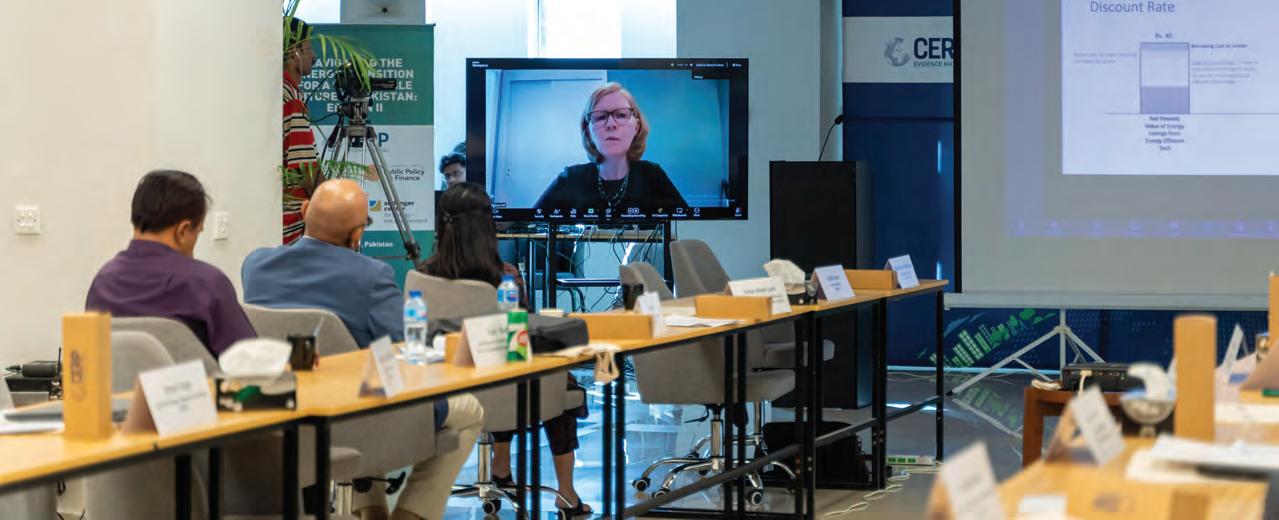
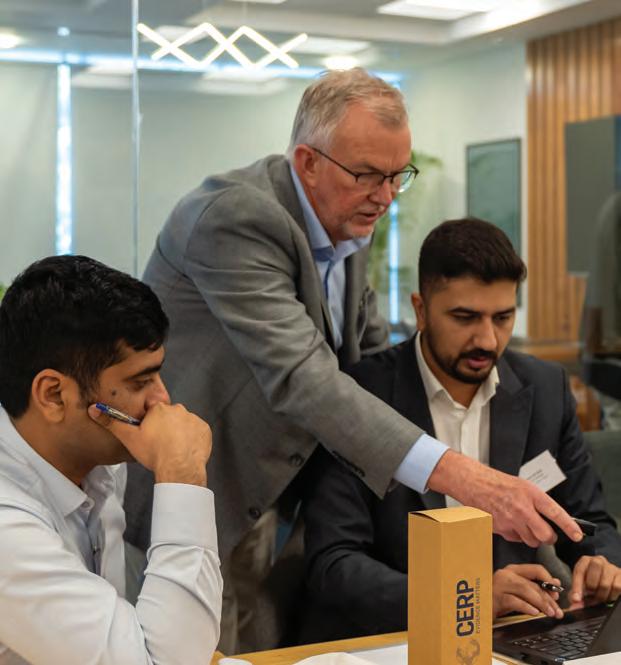
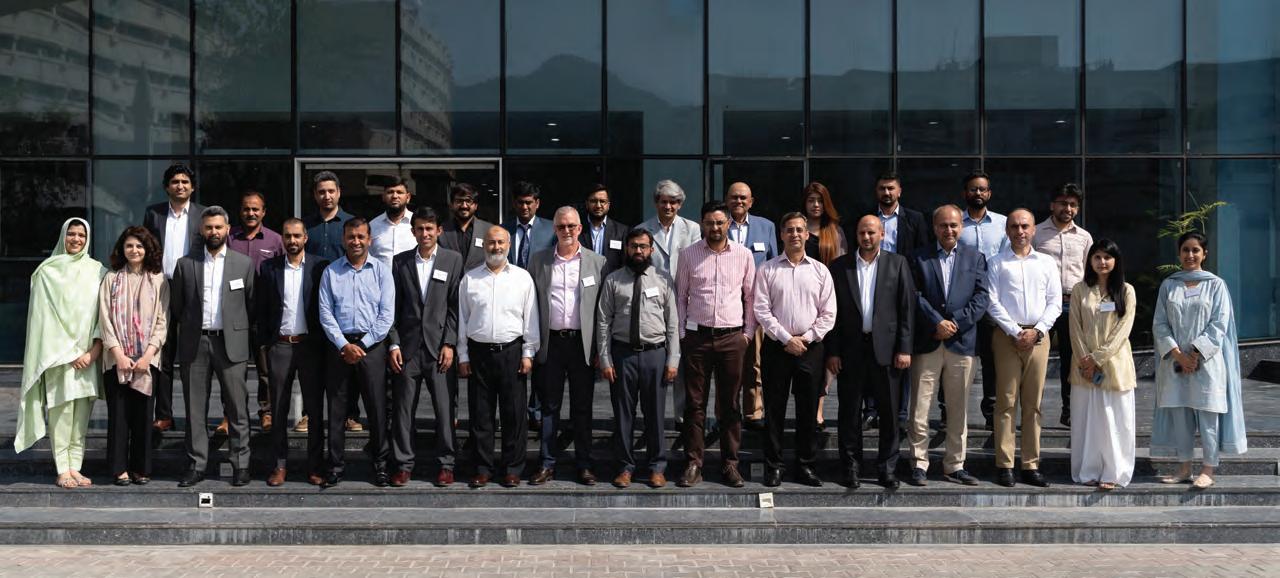
In May 2025, Princeton’s JRCPPF and the Andlinger Center for Energy and Environment teamed up with the Center for Economic Research in Pakistan (CERP) to host their third joint workshop in Islamabad, convening over 50 policymakers, researchers, and industry experts. The two-day event focused on charting a pathway for Pakistan’s energy sector to move away from costly imported fuels to a cleaner, resilient, growthcompatible energy roadmap. Workshops led by faculty from Princeton’s Andlinger Center, the School of Public & International Affairs, and the Lahore University of Management Sciences (LUMS) explored demand forecasting, scenario planning, and energy finance.
A milestone for this three-year initiative was the formal launch of Pakistan’s Energy Transition Roadmap Project, led by national stakeholders including CERP and the National Disaster Risk Management Fund, to develop evidence-based, development-compatible strategies for sustainable energy. Senior figures included Federal Energy Minister Sardar Awais Leghari, the Andlinger Center’s Chris Greig, CERP CEO Maroof A. Syed, JRCPPF’s Pallavi Nuka, and academic partners Naveed Arshad and Usman Khan from LUMS.
student programs & COURSES
The Student Associates program continues to serve as a cornerstone of the Center’s commitment to experiential learning, providing students with unparalleled opportunities to connect classroom training with real-world policy and finance. This year, undergraduate associates engaged in a diverse portfolio of hands-on activities, from connecting with finance and policy practitioners during visits to New York City, Philadelphia, and Washington, D.C., to summer internships at the intersection of finance, public policy, and global development. Graduate associates participated in roundtable discussions with visiting policy experts, and the three-day intensive Financial Markets short course equipped master’s level policy students with the analytical foundations needed to navigate today’s complex financial landscape while exposing them to practitioners who bring policy challenges to life. Together, these experiences foster a vibrant community of emerging leaders who engage deeply with the economic issues that shape our world.
Students in the Field
FROM PRINCETON TO WALL STREET: FINANCE & POLICY
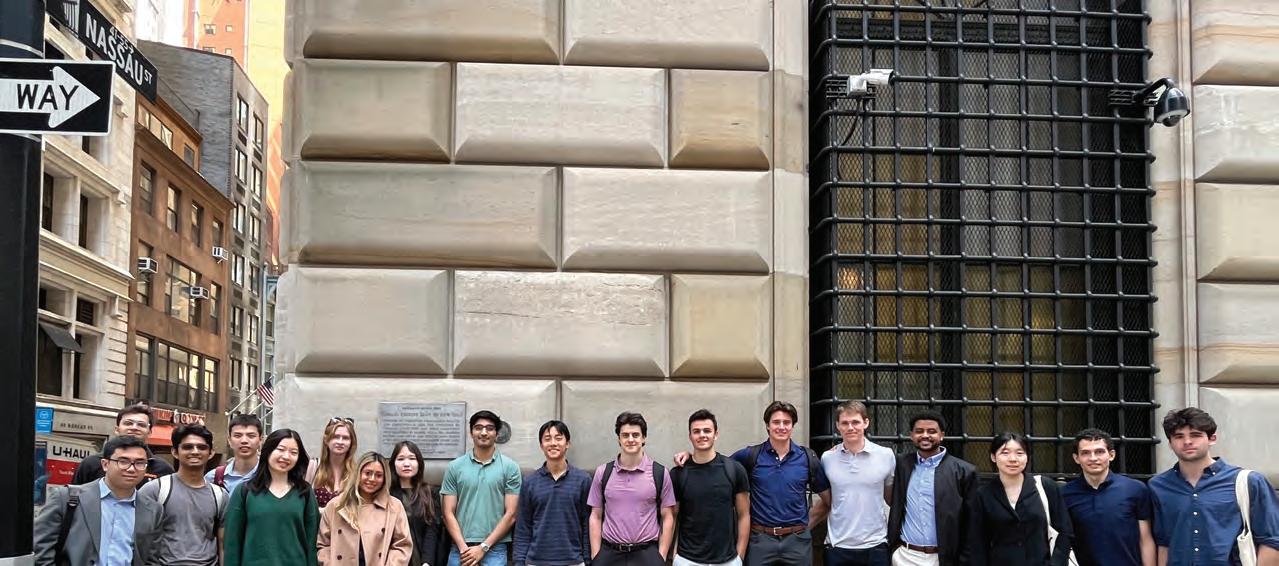
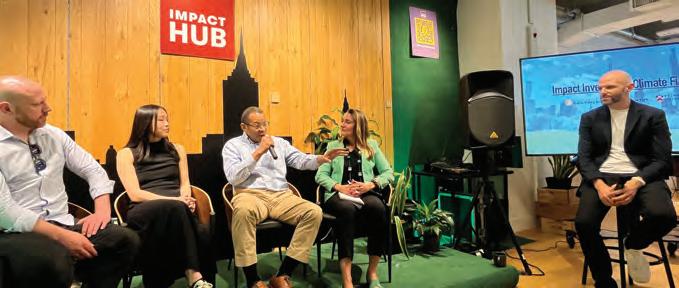
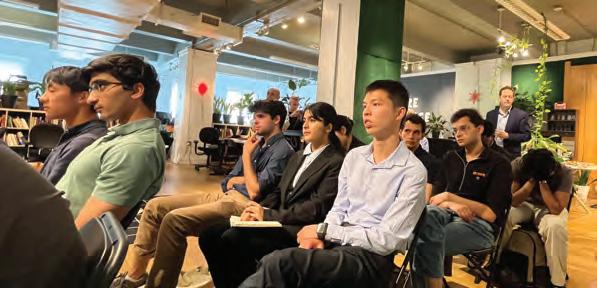
FIELD DAY IN NYC. Connecting classroom learning to realworld institutions, on May 1, 2025, the JRCPPF, alongside the Bendheim Center for Finance, led 20 undergraduates on a finance and policy field day in New York City. The day opened with an exclusive tour of the New York Fed’s historic gold vault and a panel discussion featuring Princeton alumni working in public-policy finance. Following, students attended two panels at Impact Hub NYC on impact investing, climate finance, fintech entrepreneurship, and cross-border innovation, offering a powerful blend of inspiration, real-world insight, and engagement with pioneering leaders in both policy and markets.
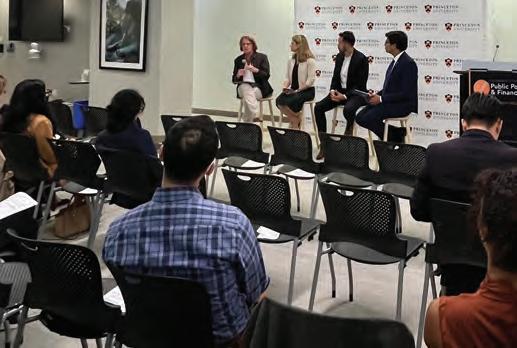
ALIGNING POLICY & FINANCE TO ADVANCE CLIMATE SOLUTIONS. On April 25, 2025, the Center co-hosted two high-impact panels at Princeton SPIA’s Washington, DC, office, in coordination with The Climate Group during the World Bank–International Monetary Fund spring meetings. The first discussion—featuring Adam Kent ’14, Kyle Danish ’96, Angela Anderson, and Erin Burns—focused on the Inflation Reduction Act and how to scale carbon markets within today’s political framework. The second panel, with Elizabeth Littlefield, Carter Ingram, and David Chen, explored how nature-based solutions can simultaneously address development and climate goals. The event was organized by undergraduate associate leaders Sunrit Panda ’25 and Emma Limor ’25, who co-founded Nirvana Carbon Solutions, a climate-tech startup operating in India and Kazakhstan.
Summer Internships
In summer 2024, six Princeton undergraduates received internship awards from the Center, through generous support from Joyce Chang *90. These summer experiences provided opportunities for students to apply classroom learning to real economic policy questions both at the local level and globally. The internships varied significantly in terms of specific topic and geographic location, but all provided the students with very valuable experiences to inform their future career paths.
ABIGAIL LEIBOWITZ ’26 conducted a survey of small businesses and entrepreneurship for the Beloved Community Incubator (BCI), a community trust in the Washington, D.C. metro region. Leibowitz analyzed the challenges, such as lack of capital, debt fears, and legal hurdles, facing aspiring entrepreneurs hoping to start businesses in the region. Leibowitz said the experience working with BCI was a remarkable opportunity to learn about material needs and economic conditions in the Washington metro area, as well as innovative collective ownership models that can sustain thriving local communities.
SOL SEO CHOI ’26 and JOSEPHINE WENDER ’26 both interned with the Danish Institute for Human Rights (DIHR) in Copenhagen, studying the critical minerals industry. Choi helped draft four major reports, including analyses of the Lobito Economic Corridor’s battery value chain, and African policies related to the just energy transition. Wender’s project examined how to ensure fair labor practices and value chain improvements particularly in Zambia and the DRC, and she developed actionable policy insights for DIHR. Overall, their work on the challenges of Africa’s green energy transition highlights the importance of smart policy to align the incentives of mining companies and external investors with the requirements for environmental protection and respect for human rights.
ALISTAIR WRIGHT ’27 interned at WOWS Global, a company focused on increasing equity in the startup ecosystem through provision of legal advice, financial management tools, and connections to investors, all via a digital platform. Over the course of his internship in Bangkok, Wright researched business models, engaged with companies, and communicated with investors to align their funding goals with the needs of startups. Overall, his internship provided valuable insights on disrupting fundraising inequalities and has helped shaped his future career aspirations, Wright said.
LAURA KAHU ’27 spent her summer internship in Cape Town, South Africa, working with DiiVe and the Two Oceans Aquarium Foundation. She was a member of a team assessing the design of a new marine conservation center through customer surveys and stakeholder interviews. Kahu said the experience offered insights into consulting, teamwork, and the culture of South Africa that has profoundly shaped her personal and professional growth.
SUNRIT PANDA ’25 interned with KREEYA, doing field research on the environmental and financial challenges of crop stubble burning in West Bengal. Working with two community partners, he assessed the financial and environmental costs of current practices compared to alternative, burn-free, seeding methods. Panda hopes to continue this work through his senior thesis on the topic and by pursuing a Fulbright grant to support further research.
Student Associates
CLASS OF 2025
MOSES ABRAHAMSON, History
ANIKA ASTHANA, History
RAWAND DARA AZIZ, Computer Science
OVINABO BANERJEE, SPIA
MICHAEL BATH, Economics
SAMIR BHOJWANI*, Economics
MALIK BIGHARASSEN, ORFE
ANJALI BRUNNERMEIER, Economics, highest honors
BRANDON CHENG*, Computer Science, highest hons.
ANNA CORNELISSEN, Economics, highest honors
JAMES CROSS*, Economics
MAXFIELD THOMAS EVERS, Economics
SHLOMO FORTGANG, Computer Science, highest hons.
LUKE FREEMAN*, Economics
SOFIE GROUWS, Economics, highest honors
Learned Society Recognitions
PHI BETA KAPPA: Anna Cornelissen, Sofie Grouws, Oliver Zhong, Nolan Musslewhite
SIGMA XI MEMBERSHIP: Brandon Cheng, Shlomo Fortgang, Owais Ibrahim, Cherie
TAU BETA PI MEMBERSHIP: Brandon Cheng, Kok Wei Pua
ALAN GUTIÉRREZ, SPIA
HAJRA HAMID, SPIA
DAPHNE HAO, Molecular Biology, high honors
OWAIS IBRAHIM, Computer Science
JULIAN JENSEN-LIM, Economics, honors
NICHAREE JIRAPHANPHONG**, Computer Science
JIHAN JUN, Economics
CHRISTIAN LALIN, Economics
EMMA LIMOR*, ORFE
VINCENT MARIN, Economics
JENNIFER MELO, SPIA
LEENA MEMOM, ORFE
GIANMARCO MIRANDA BUENO, Economics
ANAIS MOBARAK, Chemistry
EMMA MOHABIR, SPIA
NOLAN MUSSLEWHITE, a history major and co-chair of the Undergraduate Student Associates, was named a 2025 Marshall Scholar. Musslewhite will pursue a master’s in African studies at the School of Oriental and African Studies in London, followed by a master’s in modern British history at the University of Oxford.
Student Associates
UNDERGRADUATE ASSOCIATES
NOLAN MUSSLEWHITE**, History, highest honors
WILLIAM NASH, History
HAN NGUYEN, Economics
VINCENT NGUYEN, Mathematics, honors
WINDSOR NGUYEN, Computer Science
LIA OPPERMAN, SPIA
SUNRIT PANDA*, ORFE
KELLY PARK, History, honors
WALKER KULIK PENFIELD, Economics
JOAQUIN PERALTA BIERMAN, Politics
KOK WEI PUA, Computer Science
SKYLA QIAN, Computer Science, honors
MAIYA RAGHU, Economics, high honors
LAYA REDDY*, Economics
ALEXANDRA ROBERTS, Economics, honors
FELICIA SANDERS, Molecular Biology, honors
NABEEL SHAD, Economics
ALBERT SHI, ORFE
FARIHA SHOILY, Economics, honors
MAGUIRE SHOLETTE, SPIA
JASON SUTTON, Economics, honors
MASON THIEU, Economics, honors
KELECHI (GLORIA) UKAOMA, ORFE
ABHI VELLORE*, ECE, honors
LAWRENCE WANG, Economics
ANNIE XIONG, Comparative Literature
OLIVER ZHONG*, Economics, highest honors
** STUDENT ASSOCIATES CO-CHAIRS
* STUDENT ASSOCIATES LEADERS
HONORS AND AWARDS
ANJALI BRUNNERMEIER, Griswold Center for Economic Policy Studies Prize
BRANDON CHENG, Outstanding Computer Science Senior Thesis Award
SHLOMO FORTGANG, Outstanding Computer Science Senior Thesis Award
ANAIS MOBARAK, Royal Society of Chemistry Certificate of Undergraduate Excellence
NOLAN MUSSLEWHITE, William Koren, Jr. Class of 1930 and Henry Lloyd Thornell Koren Class of 1933 Memorial Prize in History
LEENA MEMON, School of Engineering and Applied Sciences Tau Beta Prize; Allen Macy Dulles ’51 Spirit of Princeton Award
JULIAN JENSEN-LIM, Daniel L. Rubinfeld ‘67 Prize in Empirical Economics
OLIVER ZHONG, Halbert White ’72 Prize in Economics, Burton G. Malkiel *64 Senior Thesis Prize in Finance
SOFIE GROUWS, Griswold Center for Economic Policy Studies Prize
Student Associates
CLASS OF 2025 GRADUATE ASSOCIATES
FRIEDRICH J. ASSCHENFELDT, Ph.D., History
YEIMY BAEZ, MPP
MD BAKY BILLAH, MPP
JACKSON BLACKWELL, MPA, International Relations
NICHOLAS BROWN, MPA, International Development
AMY CHANG, MPA, Economics and Public Policy
MICHAEL CHAPMAN, MPA, Economics and Public Policy
KATIE DEAL, MPA, Domestic Policy
DYLAN GATES, MPA, Economics and Public Policy
ELIJAH GOLDBERG, MPA, International Development
CAROLINA GOMMA DE AZEVEDO DOMINGUES, MPP
BENJAMIN HARRIS, MPA, Economics and Public Policy
BEN HAWRILUK, MPA, International Relations
SVYATOSLAV KARNASEVYCH, MPA, Economics and Public Policy
KLAAS KEIRSE, MPP
MORGAN LONERGAN, MPA, International Relations
JULIAN LUTZ, MPA/JD, Domestic Policy
DANIEL LYNG, Ph.D., Politics and Political Economy
RACHEL MORROW, MPA, Domestic Policy
TOBIN NELSON, MPP, International Relations
RIAS REED, MPA, International Development
AYUSHI VIG, MPA, International Development
DAVID WHYMAN, MPA, Economics and Public Policy
CHRISTOPHER WONG, MPA, Economics and Public Policy
JING XIE, MPA, Economics and Public Policy
TUNÇ EKIN YAVUZ, MPA, International Development
GRADUATE ASSOCIATE AWARDS
NICHOLAS BROWN, Distinction on the qualifying exams in years 1 & 2.
SVYATOSLAV KARNASEVYCH, Co-recipient of the Somers Award, for domestic policy interests with a distinguished academic and public service record. Established by the late Anne Somers in memory of the late Herman “Red” Somers, a former SPIA faculty member.
DANIEL LYNG, Recipient of the George Kateb Preceptor Award. Given annually to recognize the best graduate student preceptors in the Department of Politics.
RACHEL MORROW, Recipient of the Stokes Prize, recognizing both academic achievement and public service leadership, named after the late Donald Stokes, dean of the School from 1974-92.
POLICY & FINANCE COURSES AY 2024-2025
■ ECO 101 Introduction to Macroeconomics, Alan Blinder
■ ECO 315 Topics in Macroeconomics, Nobuhiro Kiyotaki
■ ECO 361 Financial Accounting, Donal Byard
■ ECO 342 Money and Banking, Markus Brunnermeier
■ ECO 362 Financial Investments, Motohiro Yogo
■ ECO 416/FIN 516 Fintech, Jonathan Payne
■ ECO 466/FIN 521 Fixed Income, Options, and Derivatives, Yacine Aït-Sahalia, Caio Ibsen Rodrigues de Almeida
■ ECO 492/FIN 592 Asian Capital Markets, JC de Swaan
■ ECO 494/FIN 594 Chinese Financial and Monetary Systems, Wei Xiong
■ ECO 507 Introduction to Macro-Finance, Atif Mian
■ ECO 523 Public Finance, Henrik J. Kleven
■ ECO 526 Corporate Finance, Moritz F. Lenel, Wei Xiong
■ POL 335 The Political Economy of the United States, Nolan M. McCarty
■ POL 492/SPI 422 Political Economy and Development, Leonard Wantchekon
■ SPI 466/HIS 467 Financial History, Harold James
■ SPI 340/PSY 321 Psychology of Decision Making and Judgment, Eldar Shafir
■ SPI 524 The Political Economy of Central Banking, Alan Blinder
■ SPI 525 Public Economics and Public Policy, Henrik Kleven
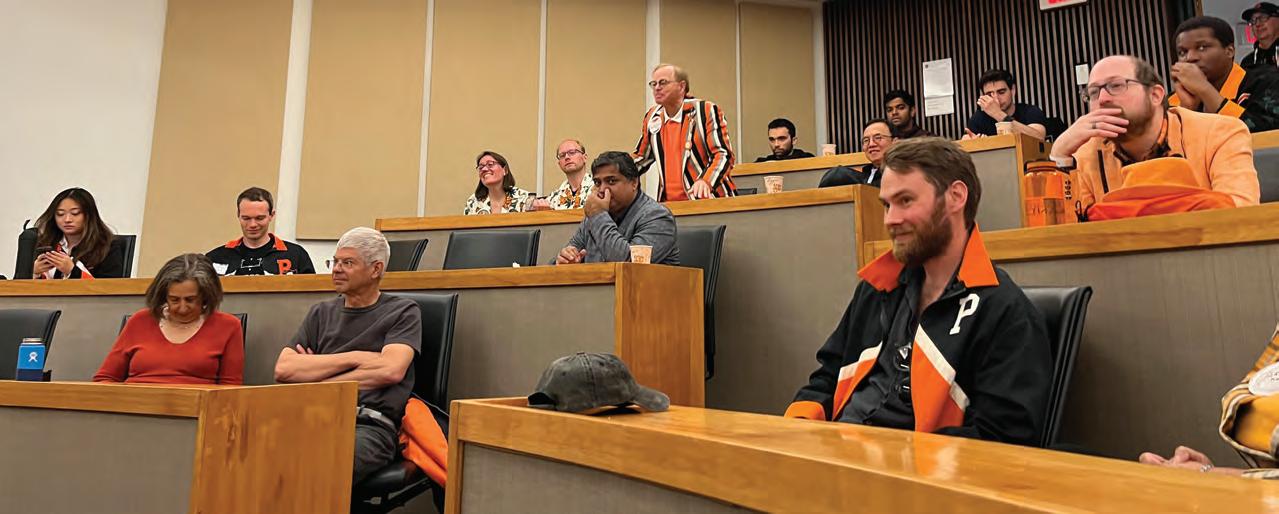
Forty-eight MPA, MPP, and Ph.D. students kicked off the spring semester with an immersive threeday deep dive into the world of finance at the annual FINANCIAL MARKETS FOR PUBLIC POLICY PROFESSIONALS (FMPP) short course, held January 20–22, 2025. Launched in the wake of the Great Financial Crisis, this intensive program has become a signature offering at the Princeton School of Public and International Affairs. Now in its 15th year the course has equipped over 700 graduate students with essential financial fluency. Participants move quickly from the building blocks of financial markets and the role of banks to the inner workings of the Federal Reserve and Treasury, gaining a richer understanding of how public institutions both shape and are shaped by market forces. Lectures and panel conversations round out the curriculum, covering topics such as financial regulation, the Great Financial Crisis, state and local financing, Asian markets, and the future of distributed finance. The course has been generously supported by NOAH GOTTDIENER ’78 since 2015.
Program & Speakers
FRAMEWORK FOR UNDERSTANDING FINANCIAL MARKETS: Lance Eckel & Matt Porio, Managing Partner, Finance IQ
ACCOUNTING FOR POLICY MAKERS: Donal Byard, Zicklin School of Business, Baruch College
MORTGAGES, DERIVATIVES, AND THE GREAT FINANCIAL CRISIS: Alan Blinder, Princeton University
ASIAN CAPITAL MARKETS: Wei Xiong, Princeton University
MUNICIPAL BOND MARKETS: RJ Gallo, Federated Investors
NATIONAL AND INTERNATIONAL FINANCIAL REGULATION: Norm Champ ’85, Kirkland Ellis, LLP; Dianne Dobbeck *96, Federal Reserve Bank of New York; Aaron Klein *02, Brookings Institution
Visit: jrc.princeton.edu/teaching/fmpp
center EVENTS
The Center’s events and policy engagement activities serve as a vital bridge between academic research and real-world decision-making. Through its annual conference, high-profile speaker series, policy panels, and practitioner-focused events, the Center convenes scholars, policymakers, and industry leaders to engage with pressing economic challenges. These forums foster rigorous debate, translate cuttingedge research into actionable insights, and create opportunities for students to engage directly with those shaping policy at the national and global levels. Together, the Center’s events advance informed dialogue and reinforce its mission to connect scholarship with service.
2025 Annual Conference
jrc.princeton.edu/conferences
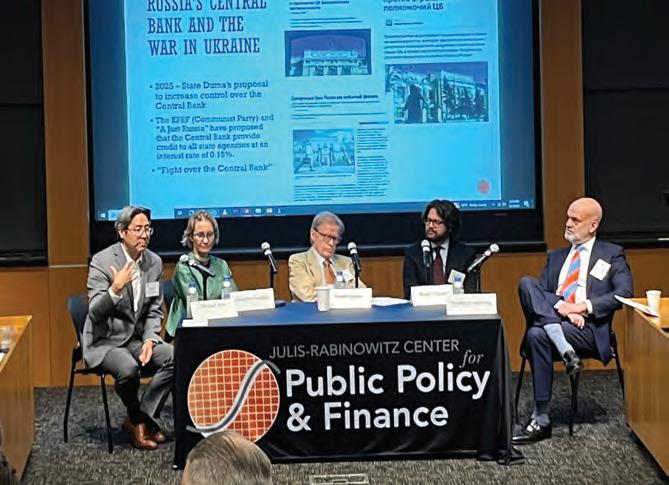
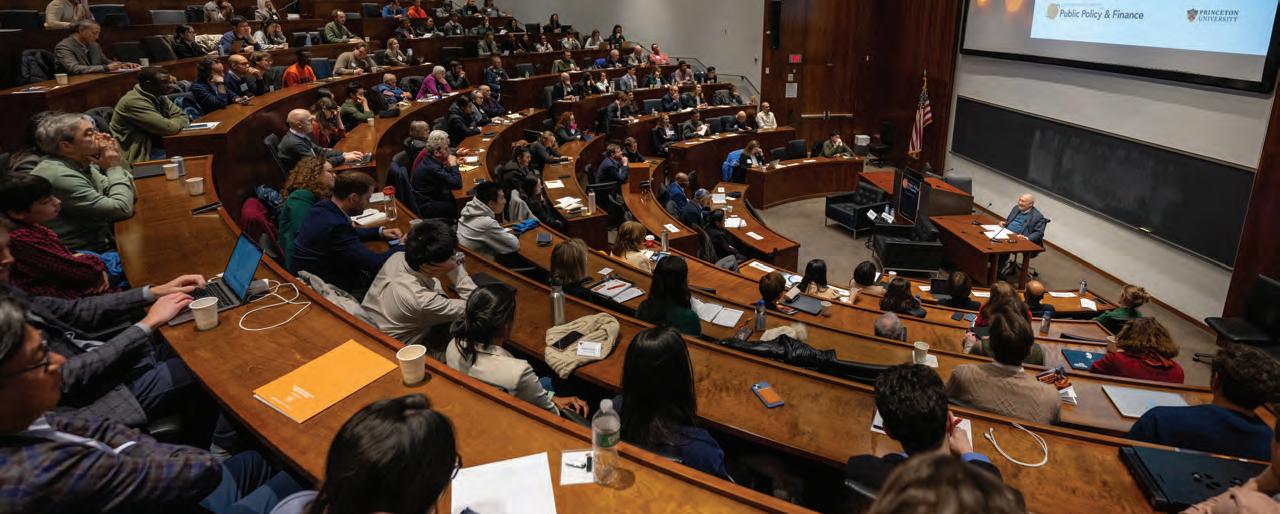
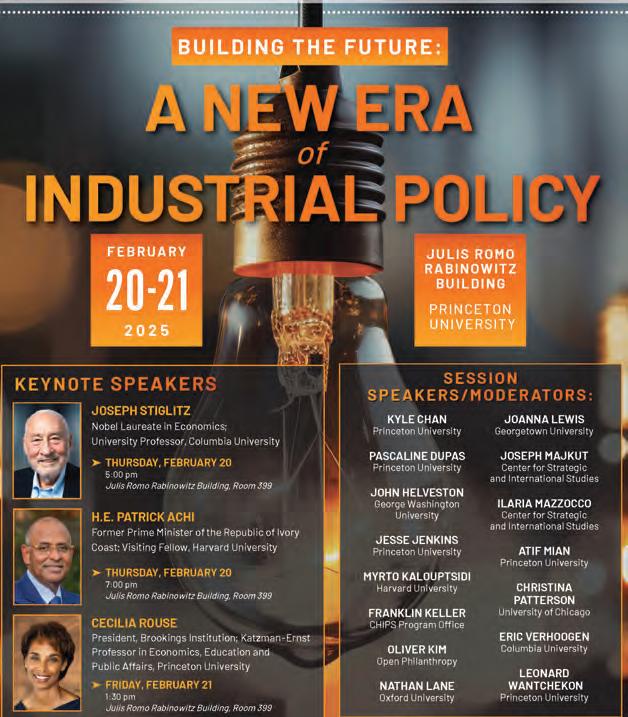
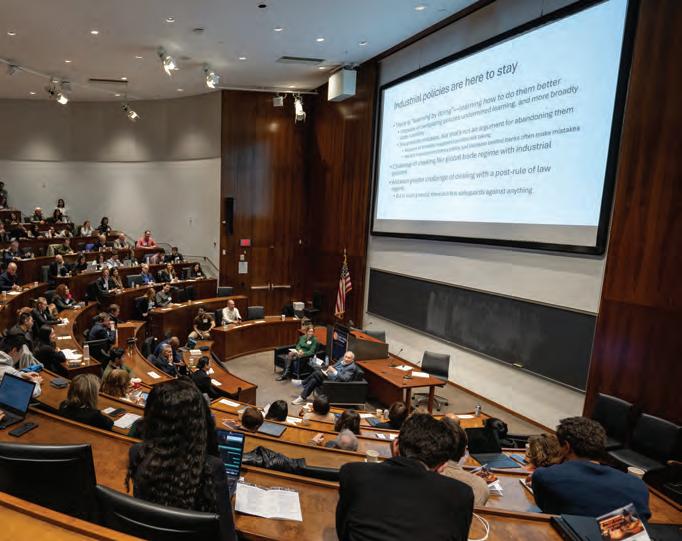
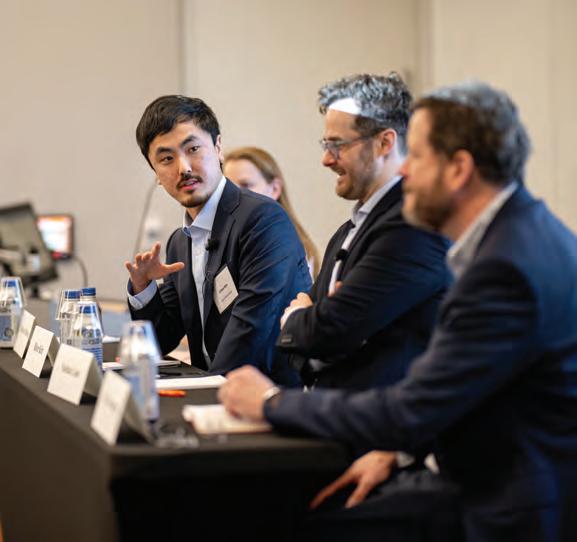
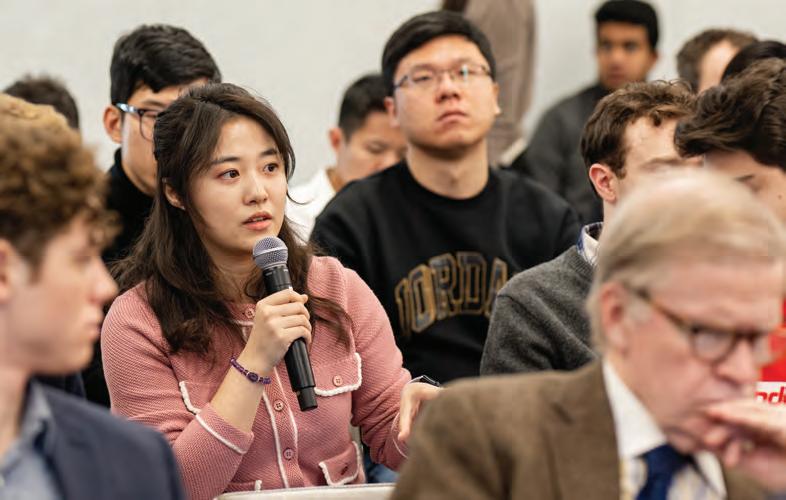
On February 20–21, 2025, the JulisRabinowitz Center for Public Policy & Finance hosted its 14th annual conference, BUILDING THE FUTURE: A NEW ERA OF INDUSTRIAL POLICY. The conference brought together leading academics, policymakers, and practitioners, including economists, engineers, and political scientists, to debate how states can build more resilient and technologically advanced economies.
Panel sessions moderated by KYLE CHAN, ERIC VERHOOGEN, and JESSE JENKINS addressed China’s industrial policy model, industrial policy in emerging markets, and recent industrial policy initiatives like the CHIPS Act and Inflation Reduction Act.
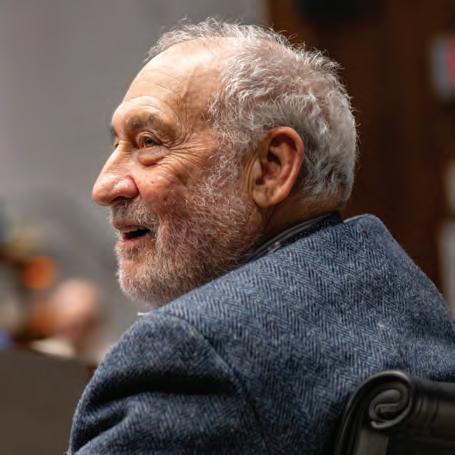
Nobel Laureate JOSEPH STIGLITZ, in a talk moderated by Professor PASCALINE DUPAS, noted that contemporary industrial policy is marked by a deeper understanding of the market failures that help justify it, and decisionmakers today have a broader suite of policy instruments.
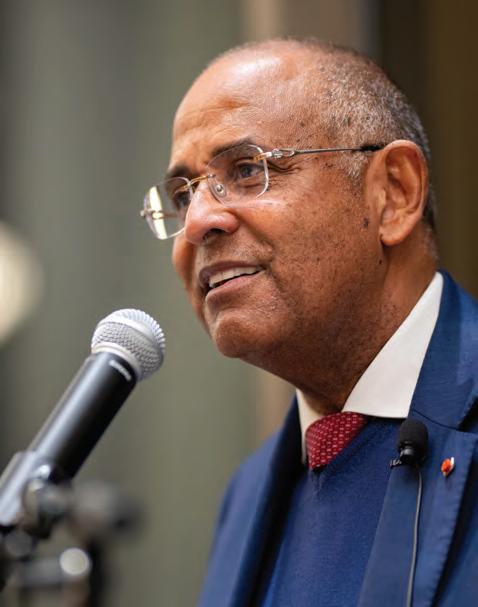
Former Prime Minister of Côte d’Ivoire PATRICK ACHI, in conversation with Princeton professor LEONARD WANTCHEKON, highlighted the importance of industrial policy for emerging markets, especially in the African context.
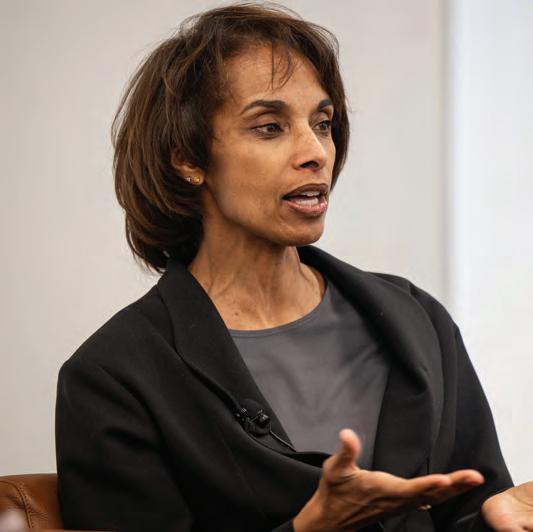
In a conversation moderated by JRCPPF director ATIF MIAN, CECILIA ROUSE, President of the Brookings Institution, stressed that successful
industrial policy is not just about spending but about execution. She argued the U.S. must strengthen its administrative capacity, improve program evaluation, and deliver services more effectively in the face of changing needs.
Sponsored by the JRCCPPF, PRINCETON’S CENTER FOR POLICY RESEARCH ON ENERGY AND THE ENVIRONMENT, AND THE SCHOOL OF PUBLIC & INTERNATIONAL AFFAIRS, the conference underscored JRCPPF’s commitment to bridging scholarship and real-world policy, fostering dialogue at the intersection of finance, macroeconomics, and industrial strategy.
“If this is the only way we get reform in the federal government, shame on us. ...There has to be a better way that we build our systems and our institutions so that we’re doing the assessment and willing to let go of things that aren’t working.”
— CECILIA ROUSE, President of the Brookings Institution
“Industrial policies are about correcting a broad range of market failures—not about picking winners, but about shaping the economy and deciding what kind of society we want.”
— JOSEPH STIGLITZ, Nobel Laureate in Economcs
" I went to Vietnam, Malaysia, Singapore, China… because I said I want to change things, and where else can I learn but from countries that were able to make it. They understood very early that development would not come from outside. They had to pick key strategic sectors and push them. "
— PATRICK ACHI, former Prime Minister of
Côte d’Ivoire
Featured Events
FALL 2024
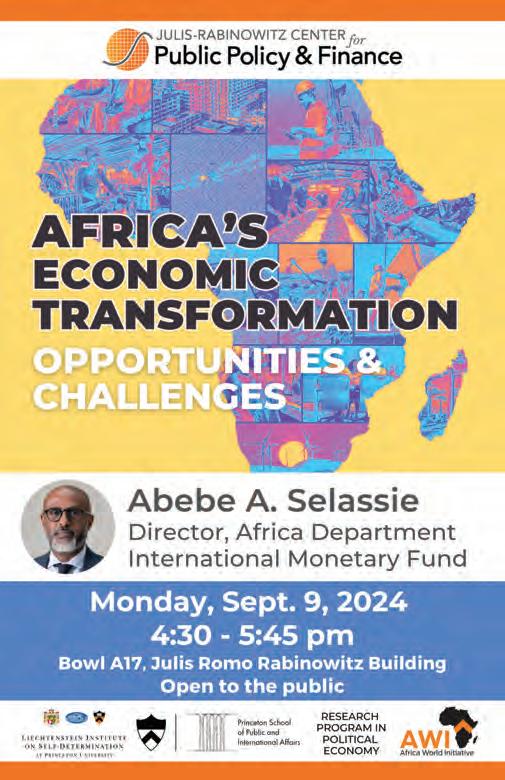
Africa’s Economic Transformation: Opportunities & Challenges, Abebe Selassie, International Monetary Fund; Atif Mian, Princeton University
Milton Friedman: The Last Conservative (book talk), Jennifer Burns, Stanford University; Harold James and Carolyn Wilkins, Princeton University
The Crisis of Democratic Capitalism (book talk), Martin Wolf, Financial Times, Markus Brunnermeier, Princeton University
The Drive to Repair Our Economy: Understanding What’s Broken, Why It Broke, and How We Can Fix It (SPIA–New Jersey), Adam Goldstein, Princeton University; Brandon McKoy, The Fund for New Jersey; Marleina Ubel, New Jersey Policy Perspective; Felicia Wong, The Roosevelt Institute
The Uses of AI for Writing Economic History, Louis Hyman, Johns Hopkins University; Matthew Jones, Princeton University
Can We Fix It? Yes We Can: New and Effective Ideas to Promote a More Inclusive, Productive, and Healthy Economy for All (SPIA–New Jersey), Natalie Foster, Economic Security Project; Ilyana Kuziemko, Princeton University; Brandon McKoy, The Fund for New Jersey; and Nedia Morsy, Make the Road New Jersey
Where Do We Go From Here: Pursuing Rights, Justice, and Love as Economic Goals for New Jersey and the Country (SPIA–New Jersey), Asha Banerjee, Princeton University; Darrick Hamilton, The New School; Ryan Haygood, New Jersey Institute for Social Justice; Brandon McKoy, The Fund for New Jersey
SPRING 2025
Envision 2025: Technology, AI Policy & Ethics Conference
Plastic Capitalism: Banks, Credit Cards, and the End of Financial Control (book talk), Sean Vanatta, University of Glasgow, Julian Zelizer, Princeton University
Inflation Expectations and Monetary Policymaking, Adriana Kugler, Federal Reserve Board Governor; Alan Blinder, Princeton University
Transitioning to a Multi-polar World: US-China Geopolitics & Asian Capital Markets, Benjamin Hung, Standard Chartered; J.C. de Swaan, Princeton University
Why Politicians Lie About Trade and What You Need to Know About It (book talk), Dmitry Grozoubinski, Explain Trade; Gene Grossman, Princeton University
Charting the Future of Sustainable Investing, Richa Kothari, Impact Investment Exchange; Rick Davis, LOHAS; Brian Mizoguchi, FinPublica; Pallavi Nuka, Princeton University; John-Paul Parmigiani, Impact Hub NYC
Second Politics of Sovereign Finance Conference: Aligning Policy & Finance to Advance Climate Solutions, Katya Gratcheva, International Monetary Fund; Carter Ingram, Pollination; Adam Kent *14, Natural Resources Defense Council; Elizabeth Littlefield, West Africa Blue; Angela Anderson, World Resources Institute; Kyle Danish, Van Ness Feldman; David Chen, ClimeCo
King Dollar: The Past and Future of the World’s Dominant Currency (book talk), Paul Blustein, Independent Journalist, Harold James, Princeton University
Accelerating India’s Development: A StateLed Roadmap for Effective Governance (book talk), Karthik Muralidharan, University of California San Diego
How to Write the Biography of a Currency (conference)
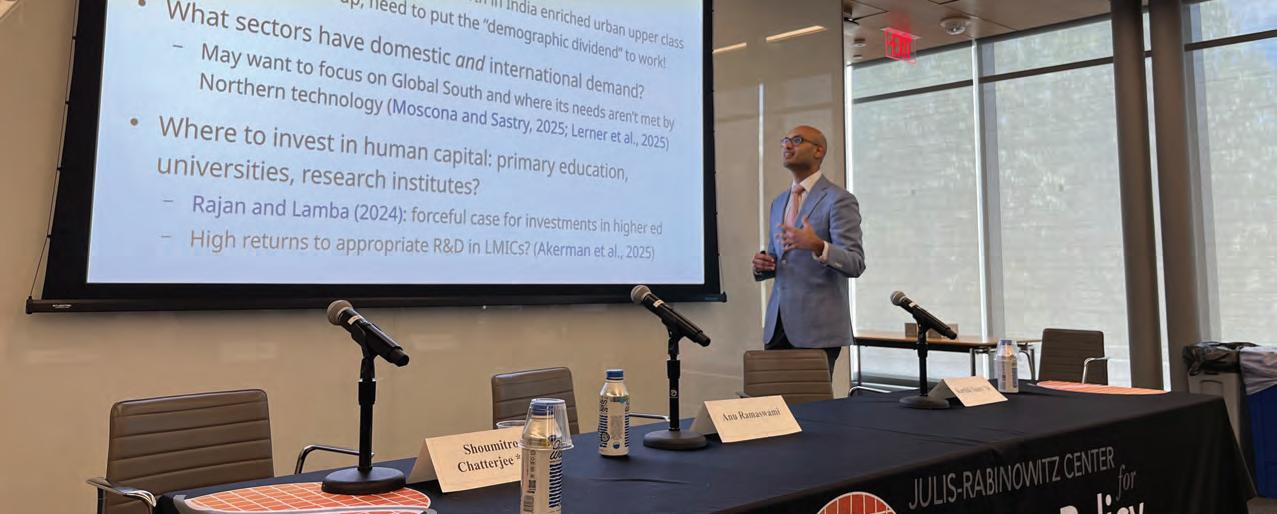
Reunions Panel: Trump 2.0 and the Indian Economy Shoumitro Chatterjee *18, Johns Hopkins University; Karthik Sastry ’16, Princeton University; Anu Ramaswami, Princeton University
Reunions Panel: Money Creators: Financial History for Finance Professionals, Sean Vanatta *18, University of Glasgow; Harold James, Princeton University, Brendan Greeley *27, GS; Tiger Gao ’21, Apax Digital
2024–2025 Faculty Affiliates
MARK A. AGUIAR, Walker Professor of Economics and International Finance
YACINE AIT-SAHALIA, Otto A. Hack 1903 Professor of Finance and Economics
ROLAND J.M.
BÉNABOU, Theodore A. Wells 1929 Professor of Economics and Public Affairs
ALAN S. BLINDER,* Gordon S. Rentschler Memorial Professor of Economics and Public Affairs
MARKUS K. BRUNNERMEIER,* Edwards S. Sanford Professor of Economics, and Director, Bendheim Center for Finance
MIGUEL A. CENTENO, Executive Vice Dean, Princeton School of Public and International Affairs, Musgrave Professor of Sociology, and Professor of Sociology and International Affairs
MAGNUS IRIE, Assistant Professor of Economics
AMANEY A. JAMAL,* Dean, Princeton School of Public and International Affairs, Edwards S. Sanford Professor of Politics, and Professor of Politics and International Affairs
HAROLD JAMES,* Claude and Lore Kelly Professor in European Studies, Professor of History and International Affairs, and Director, Program in Contemporary European Politics and Society
JAKUB KASTL, Professor of Economics
NOBUHIRO KIYOTAKI, Harold H. Helms 1920 Professor of Economics and Banking
HENRIK J. KLEVEN, Lynn Bendheim Thoman, Class of 1977, and Robert Bendheim, Class of 1937, Professor of Economics and Public Affairs
MORITZ LENEL, Assistant Professor of Economics
ERNEST LIU, Assistant Professor of Economics
BURTON G. MALKIEL, Chemical Bank Chairman’s Professor of Economics, Emeritus
NOLAN MCCARTY, Susan Dod Brown Professor of Politics and Public Affairs, and Vice Dean for Academic Affairs, Office of the Dean of the Faculty
*Executive Committee Member
ATIF MIAN,* Director, Julis-Rabinowitz Center for Public Policy & Finance, and John H. Laporte, Jr. Class of 1967 Professor of Economics, Public Policy and Finance
LAYNA MOSLEY, Professor of Politics and International Affairs
JONATHAN E. PAYNE, Assistant Professor of Economics
STEPHEN J. REDDING, Harold T. Shapiro 1964 Professor in Economics, Professor of Economics and International Affairs
ELDAR SHAFIR, Class of 1987 Professor in Behavioral Science and Public Policy, Professor of Psychology and Public Affairs, and Director, Kahneman-Treisman Center for Behavioral Science and Public Policy
CHRISTOPHER A. SIMS, John J.F. Sherrerd 1952 Professor of Economics, Emeritus
LEONARD
WANTCHEKON, James Madison Professor of Political Economy, and Professor of Politics and International Affairs
WEI XIONG,* John H. Scully 1966 Professor in Finance, and Professor of Economics
MOTOHIRO YOGO, Hughes-Rogers Professor of Economics
OWEN ZIDAR, Professor of Economics and Public Affairs
Leadership & Staff
ATIF MIAN, Director, Julis-Rabinowitz Center for Public Policy & Finance, and John H. Laporte, Jr. Class of 1967 Professor of Economics, Public Policy and Finance
PALLAVI NUKA *04, Associate Director, JulisRabinowitz Center for Public Policy & Finance
NANCY TURCO, Program Coordinator, Julis-Rabinowitz Center for Public Policy & Finance
Executive Committee
ATIF MIAN, Director, Julis-Rabinowitz Center for Public Policy & Finance, and John H. Laporte, Jr. Class of 1967 Professor of Economics, Public Policy and Finance
ALAN S. BLINDER '67, Gordon S. Rentschler Memorial Professor of Economics and Public Affairs
MARKUS K. BRUNNERMEIER, Edwards S. Sanford Professor of Economics, and Director, Bendheim Center for Finance
AMANEY A. JAMAL, Dean, Princeton School of Public and International Affairs, Edwards S. Sanford Professor of Politics and Professor of Politics and International Affairs
HAROLD JAMES, Claude and Lore Kelly Professor in European Studies, Professor of History and International Affairs, and Director, Program in Contemporary European Politics and Society
WEI XIONG, John H. Scully 1966 Professor in Finance, and Professor of Economics
External Advisory Council
JOYCE CHANG *90, Managing Director and Chair of Global Research, JP Morgan Chase & Co.
MARK GENENDER ’87, Managing Partner, Bristol Growth Capital, LLC
LINDA S. GOLDBERG *88, Financial Research Advisor, Federal Reserve Bank of New York
MITCHELL R. JULIS ’77, Co-founder and Co-CEO, Canyon Partners, LLC
CHRISTOPHER MARKS *96, Managing Director and Head of Emerging Markets, Mitsubishi UFJ Financial Group
DEAN MENEGAS ’83, General Counsel, Spinnaker Capital Group
BING SHEN ’71, Board Director, CTCI Corporation and Far Eastern International Bank
AJAY G. SHROFF ’98, Chief Investment Officer, Ridgeleigh Capital
CHARLES YI *03, Senior Advisor & Chief of Regulatory Affairs, Independent Community Bankers of America