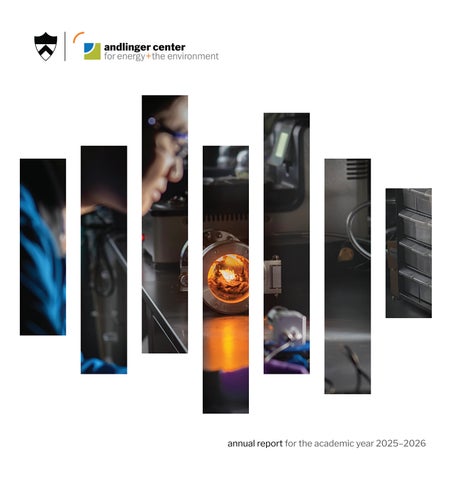
annual report for the academic year 2025–2026
table of contents
2
1 2 3
Director’s Message Vision and Mission Research Initiatives
4 6 8 11 14 16 19 24 26
Net-Zero Initiative Transforming Industry, Annual Meeting E-ffiliates Retreat Sustainable Buildings and Transportation Cross-Sector Solutions Greening the Grid Water as a Versatile Resource Climate Resilience Carbon Management
28 32 34
Education E-ffiliates By the Numbers
36 37
Leadership Supporters
Front Cover Lin Lin, a postdoctoral research associate in Kelsey Hatzell’s lab, uses a handcrafted sintering setup where LLZO (Lithium Lanthanum Zirconium Oxide) samples were heated at high temperatures. (Photo and design treatment by Bumper DeJesus)
Right Iain McCulloch gives the welcome introductions at the E-ffiliates Retreat. (Photo by Lori M. Nichols)
andlinger center director’s message
Global developments in the past year have dramatically highlighted the interconnected nature of challenges related to climate risk and energy security. Unprecedented demand growth for electricity and critical materials has exacerbated resource constraints and exposed supply-chain vulnerabilities. At the same time, support for clean energy, climate, and sustainability research in the United States is facing a period of prolonged uncertainty. Starting last year, more than a dozen federal awards supporting Andlinger Center-related research were terminated or modified in ways that eliminated future funding. Thanks to institutional support, many affected faculty members were able to continue their work with minimal disruption. Even so, the outlook remains challenging. Recent changes in the federal research funding landscape have raised new questions about the future availability and prioritization of research support. Against this backdrop, the importance of rigorous, solutions-oriented research has grown. Guided by the six research initiatives identified in our 2025 strategic plan, specifically Carbon Capture, Utilization, and Storage; Climate Resilience Engineering; Decarbonizing Buildings and Transportation; Industrial Decarbonization; Renewable Energy Systems; and the Water-Energy-Resource Nexus, our faculty, students, and researchers continued to translate fundamental discoveries into practical impact. Across these areas, researchers have developed next-generation technologies and new approaches and understandings for advancing sustainability. For example, Kelsey Hatzell’s team is developing a new, more durable type of battery, which you can read about on page 16. On page 19, we highlight the research of Z. Jason Ren evaluating how wastewater could be used as a source for hydrogen production. The Andlinger Center has additionally awarded funding to a range of our researchers including Barry Rand, who is working on protecting perovskites solar cells from degradation (page 18), and Chris Greig who is seeking to lower the barriers preventing commercial investment in decarbonization technologies (page 15). Building on the success of Net-Zero America and Australia, the Net-Zero Initiative expanded through active collaborations in China, India, Brazil, and South Korea. These partnerships
reflect the reality that developing decision making tools for the energy transition is a global undertaking, one that depends on both rigorous analysis and strong collaboration with local experts. Together, these efforts are helping policymakers, industry leaders, and communities better understand pathways for achieving emissions-reduction goals and navigating the broader societal and environmental implications of those choices. You can read more about new Net-Zero partnerships on page 4 of this booklet. While research underpins our mission, we are committed to seeking solutions through interdisciplinary collaboration and external engagement. Through the Princeton E-ffiliates Partnership, the Center continues to bring together leaders in industry, government, academia, and the nonprofit sector to address emerging issues ranging from industrial circularity and biomanufacturing to datacenter development and critical mineral supply chains. These engagements keep our activities grounded in real-world demands while creating opportunities for research to inform decision-making at scale. On page 32, you can find more about those relationships and read about the latest members to join our E-ffiliates program. We also remain focused on developing the next generation of energy and environmental leaders. This year marked an important milestone as the first cohort of students completed Princeton’s “Minor in Sustainable Energy.” Combined with internships, fellowships, seminars, and hands-on research opportunities, these programs provide our early stage researchers with the knowledge, skills, and perspectives needed to address increasingly complex challenges throughout their careers. Read more about the Andlinger Center’s education program on page 28. As we look ahead, the path forward for energy and environmental research remains uncertain as the funding landscape continues to evolve. Yet the need for innovation, evidence-based decisionmaking, and sustained collaboration has never been greater. I remain confident that our community’s ingenuity and dedication will continue to drive significant progress. Together, we are advancing the knowledge, technologies, and leaders needed to build a more resilient, secure, and sustainable future, and that gives me every reason for optimism about the years ahead.
Iain McCulloch Director; Gerhard R. Andlinger ‘52 Professor in Energy and the Environment; Professor of Electrical and Computer Engineering and the Andlinger Center for Energy and the Environment
annual report for the academic year 2025-2026
1
andlinger center
Vision Achieve transformative breakthroughs in energy and environmental technologies through collaborative, interdisciplinary research leadership
Mission Translate use-inspired ideas into technology and policy solutions, by fostering interdisciplinary research and education to address societal needs, accelerating innovation and impact through collaboration, creating a vibrant community to train the next generation of experts and leaders, and providing guidance for decision makers on energy and environmental policy
Adobe Stock
2
The Andlinger Center advances strategic research initiatives leveraging Princeton faculty’s interdisciplinary expertise to address pressing energy and environmental challenges.
Research Initiatives RENEWABLE ENERGY SYSTEMS
INDUSTRIAL DECARBONIZATION
Develop improved approaches to generate and transition to clean electrical power and enable effective deployment at scale.
Develop approaches for process electrification and energy efficiency improvements to decarbonize heavy industry in materials, chemicals, and fuels.
DECARBONIZING BUILDINGS AND TRANSPORTATION
CARBON CAPTURE, UTILIZATION, AND STORAGE
Decrease the carbon intensity of buildings and transportation systems by developing and deploying novel materials, technologies, and processes.
Develop new materials and systems that improve the efficiency and practicability of carbon dioxide capture, valorization, and sequestration.
THE WATER-ENERGY-RESOURCE NEXUS
CLIMATE RESILIENCE ENGINEERING
Reduce the energy and resource intensity of water and wastewater treatment, recover energy and valuable resources from process waste, and develop technologies for effective pollution remediation.
Create effective strategies for making infrastructure and energy systems more resilient to climate risks and mitigate the impacts of climate change on human health and wellbeing.
Convergent research on these complex problems will leverage our community’s broad expertise and be advanced through three complementary, cross-cutting themes: Enabling Technologies, Systems Modeling, and Policy and Decision Making.
annual report for the academic year 2025-2026
3
Net-Zero Initiative The Net-Zero Initiative led by the Andlinger Center for Energy and the Environment advances research and innovation to accelerate the transition to a net-zero emissions energy system, with a focus on clean electricity, industrial decarbonization, and sustainable energy technologies. stock.adobe.com
RESEARCH IN ACTION
Net-Zero Initiative: Expanding Princeton’s global impact In 2020, a group of Princeton-led researchers released the Net-Zero America (NZA) report to significant response. The report — which was led by Eric Larson, Chris Greig, and Jesse Jenkins, associate professor of mechanical and aerospace engineering and the Andlinger Center —laid out five technological pathways for the United States to shift its economy with existing technologies in order to reach net-zero carbon emissions by 2050. The leaders gave over 300 briefings on the report’s findings to government, private industry, non-governmental advocacy organizations, and other stakeholders. The impact on domestic industry and policy decision-making inspired NZA leaders to go global with the work. Wei Peng, assistant professor of public and international affairs and the Andlinger Center, joined the leadership group, and operating under the name Net-Zero Initiative — stylized as NZx — the team is partnering with leading research institutions around the world to model pathways to net-zero in a variety of countries. The goal is to work with countries where the researchers believe they can make the biggest difference. “We are committed to working with the big future emitters,” says Greig. Since launching Net-Zero Australia — the first of the international collaborations — the team has partnered on projects in China, India, Brazil, South Korea, and Poland. More projects are being explored in Pakistan, Mexico, Indonesia, Southern Africa, and the Middle East and North Africa.
4
Greig, Theodora D. ’78 & William H. Walton III ’74 Senior Research Scientist in the Andlinger Center for Energy and the Environment, is spearheading Princeton’s involvement in the Net-Zero India project that is led by the Indian Institute of Technology Delhi and the Prayas Energy Group. India faces unique challenges. Despite being the third biggest greenhouse gas emitting country in the world, India still doesn’t break the top 100 in terms of emissions per capita. With extremely rapid development projected in the coming decades, the progression of demand in the country is on an unpredictable path. Princeton’s involvement in the Net-Zero Brazil study is led by Larson, senior research engineer in the Andlinger Center. Collaborators in Brazil include the State University of Campinas and the System for Estimating Greenhouse Gas Emissions, a non-profit group. The team also includes collaborators from the University of Lisbon, Oxford University, and the University of Minnesota who bring expertise on land-use modeling, which is a key consideration for Brazil. Larson is also heading Princeton’s involvement with the Net-Zero China project led by Tsinghua University. China is projected to have the world’s largest economy by 2050, making the road to the country’s net-zero by 2060 pledge demanding. Yet, China is a world leader in renewable energy capacity and growth. The nation already produces more than 35% of its energy renewably and builds twice as much solar and wind capacity annually than the rest of the world combined. The NZ-China team will consider challenges such as the impact of transitioning away from fossil fuels on the coal sector workforce and the leadership role China could play in global decarbonization.
INDUSTRY ENGAGEMENT
Net-Zero South Korea study to accelerate Korea’s energy transition With support from the Andlinger Center’s Fund for Energy Research with Corporate Partners, researchers at Princeton and the Korea Advanced Institute of Science and Technology (KAIST) have launched the Net-Zero South Korea project. The collaboration aims to accelerate the Republic of Korea’s energy and industrial decarbonization in the near term and strengthen policy decision support over the longer term. The Net-Zero South Korea project, which is supported by the Andlinger Center and E-ffiliates member Google, will expand the pioneering energy-system transition modeling frameworks introduced in Princeton’s Net-Zero America study. Energy-system models are vital tools for understanding energy transitions and helping to guide national decarbonization strategies. Along with deep knowledge of the Korean context, KAIST researchers will contribute expertise in global integrated assessment modeling, which will be coupled with Princeton’s subnational modeling approach. Wei Peng is leading the Princeton side of the Net-Zero South Korea effort. Her research uses computational models to quantify social, political, and environmental tradeoffs around climate policy. “We are delighted to be working with world-class integrated assessment modelers at KAIST,” said Peng. “Integrating our two modeling approaches will build new capabilities relevant for application in many countries, like Korea, where global supply chains and trade are so important to the national economy.”
Top: Eric Larson (second from left) and members of the Net-Zero Brazil team Top Larson from left) and members the Net-Zero Brazil poseinset: for aEric group shot (second at the Andlinger Center in March of 2026. team pose for a group shot at the Andlinger Center in March 2026. Bottom: The skyline of Beijing, China (stock.adobe.com) Bottom inset: The skyline of Seoul, Korea (stock.adobe.com)
annual report for the academic year 2025-2026
5
Transforming Industry Tackling carbon emissions from hard-to-abate industries — including chemicals, fuels, and building materials — the Andlinger Center is transforming industrial processes to leverage clean energy and sustainable feedstocks.
2025 ANNUAL MEETING
Conference takes a closer look at the rewards and risks of a circular economy
The opportunities and complexities facing a circular economy were at the heart of the 2025 Annual Meeting of the Andlinger Center. The conference, “Strategies for Circularity: Prospects and Challenges,” brought together top experts from academia, industry, and non-profit sectors to discuss building greater circularity into our consumer systems. Circularity refers to the concept of reusing or regenerating products and resources throughout the lifecycle of the products to reduce waste and the need for virgin materials. While there was wide agreement that a circular economy rather than a linear one is good for business and the environment, participants also agreed it will be extremely complicated to shift the current global economy away from consumption-based growth. Conference participants said that meaningful progress toward circularity will require consumers to change their behaviors and corporations to change their business models and value chains. The conference’s keynote speakers, Andre Argenton from Dow and Shannon Bouton from Delterra, sought to illuminate the systemic challenges to a circular economy. The fractured recycling system in the U.S. makes it difficult to find enough recyclable plastic to create a reliable feedstock for recycled plastics. Less than 9% of plastic waste is recycled in the United States compared to more than 40% in Europe. With a steady stream of recyclables, companies could produce new materials from recycled materials, but they will only do so if it is profitable.
6
transforming industry
“The biggest challenge is a clear, consistent demand for recycled plastics,” said Adam Gross, senior decarbonization specialist at the Andlinger Center. “It’s very hard to compete with virgin materials.” Governments can play an important role in bringing down the cost of using recycled material by adopting more stringent recycling requirements and mandating the use of recycled materials. Beyond plastics, a circular economy also includes ways to extract and reuse carbon, metals, and minerals, said Michele Sarazen, associate professor of chemical and biological engineering at Princeton and co-organizer of the conference. For example, “carbon can be removed from urban waste, such as food waste and garbage, and converted to jet fuels, polymers and other products,” said Z. Jason Ren, professor of civil and environmental engineering and the Andlinger Center. Other chemicals can also be removed from wastewater to clean the water and recover valuable substances. A founder of Princeton Critical Minerals, Ren and his students have developed a product called “Lilypad” that can extract lithium from brine such as seawater, saltwater lakes, groundwater or industrial wastewater. Lithium is in increasingly high demand and is crucial for the transition to a clean energy economy, vital for lithium-ion batteries in electric vehicles and renewable energy storage. “Circularity doesn’t happen in isolation,” said Jennifer Woolfsmith, vice president of sustainability at the petrochemical company NOVA Chemicals. “It requires deliberate effort to de-risk investments and build systems that work.”
Banner: Illustration by Bumper DeJesus Left: Adam Gross speaks during the a panel session entitled “Scaling Circularity.”
FUND FOR ENERGY RESEARCH WITH CORPORATE PARTNERS
Decarbonizing chemicals production Production of chemicals — especially building-block chemicals like the ammonia, methanol, and olefins heavily used in industry, pharmaceuticals, and agriculture — accounts for about five percent of global greenhouse gas emissions, according to the nonprofit Rocky Mountain Institute (RMI). With demand expected to double by 2050, chemical producers have expressed interest in decarbonizing the industry. Chris Greig, Jesse Jenkins, and Eric Larson are working to inform decision-makers on how to accelerate the decarbonization of the chemicals industry with research supported by the Andlinger Center’s Fund for Energy Research with Corporate Partners. Using a computational model to help generate insights into behaviors of energy and industrial-systems, the researchers plan to explore pathways for achieving net-zero emissions in basic chemical production in the U.S. and China — the world’s two largest producing countries. The modeling will consider how producers might compete for the resources needed to achieve decarbonization and the impact on decarbonization timelines, investments, and infrastructure. E-ffiliates member Deloitte will collaborate on the project as the corporate partner.
Right: Emily Mayo, a Ph.D. student in civil and environmental engineering, shares insights from her research on greenhouse gas emissions in the wastewater sector to Michele Sarazen during the poster session in the Frick Chemistry Laboratory Atrium. (Photos by Lori M. Nichols)
annual report for the academic year 2025-2026
7
transforming industry
2026 E-FFILIATES RETREAT
Building a stronger rare earths supply chain: Insights from the E-ffiliates Retreat Experts from academia, industry, and the public and private sectors joined the Andlinger Center’s thirteenth annual Princeton E-ffiliates Partnership Retreat to discuss potential pathways and bottlenecks for harnessing and scaling the production of rare earth elements in the U.S. Rare earth elements are a set of 17 critical minerals, including yttrium, neodymium, and cerium, that are critical for use in high-tech electronics, defense systems, and clean energy technologies. Currently, the U.S. imports more than 75 percent of its rare earth elements, leaving industry beholden to price fluctuations, supply restrictions, and geopolitical tensions. Global demand for rare earths is expected to triple by 2035. Discussions at the E-ffiliates retreat centered on the opportunities to enhance traditional supplies of rare earths, how to harness unconventional sources for extracting these elements, and the potential for electroprocessing techniques to be the next frontier of recovery and processing. Less than two percent of the rare earth elements mined worldwide are extracted in the U.S. and much of the processing after extraction happens abroad. Speakers on the first panel explored how to overcome obstacles to building talent, increasing efficiency, and creating resilience. They agreed that rare earth resilience for the U.S. relies on access to every part of the supply chain, even if a fully domestic mine-to-magnet operation isn’t achieved. “You have to know how to do everything, but how much you actually do is negotiable,” said Anthony Ku, a non-resident fellow at the Andlinger Center.
8
Another panel touched on critical minerals that are abundant in a number of unconventional and recycled sources, including in wastewater and along the ocean floor. More than 30 million tons of critical minerals are present in industrial wastewaters, according to research from the lab of Ryan Kingsbury, assistant professor of civil and environmental engineering and the Andlinger Center. “Some of those critical minerals are present to a degree that they actually exceed the projected demand for those minerals from clean energy technologies,” said Kingsbury. Once rare earth elements are extracted, the actual manufacturing and refining processes traditionally rely heavily on fossil fuels. The final panel of the day centered around whether the fuels generating those processes could be replaced with clean electricity. “I think these opportunities look incredible and they will be a part of the future,” said Chris Greig, who co-chaired the retreat. Top: Keynote speaker Vasileios Tsianos, senior vice president of Neo Performance Materials and chairman of the Rare Earth Industry Association, discussed current and future demand in the U.S. and the challenges of scaling up supplies. Inset: Emily A. Carter, co-chair of the retreat, led a panel on electro-processing techniques for REE extraction, recovery, and processing from ores and waste streams. (Photos by Lori M. Nichols)
transforming industry
CONVENING INDUSTRY
Leaders chart strategy for scalable biomanufacturing How can the United States fulfill the promise of a prosperous biomanufacturing future? The Andlinger Center brought together experts from academia, industry, finance, government, and NGOs to answer this question by working toward a strategy framework that reflects the interconnectedness between current challenges in biomanufacturing scale-up and a future industry that’s highly efficient, competitive, and enduring. The all-day workshop featured keynote speakers, lightning talks, and roundtable discussions during which participants focused on three critical domains: feedstocks, process technology, and energy and power. Attendees explored how industrial innovation across these domains might be leveraged to realize the full potential of biomanufacturing in terms of product costs, waste reduction, and economic growth. In the opening remarks, Sarah Glaven, the Gerhard R. Andlinger Visiting Fellow who led the event, painted a vision of a world in which materials and molecules are available for everyday life thanks to an on-demand manufacturing approach which taps into renewables to increase efficiency while reducing pollution. Conversations at the workshop probed the manufacturing challenges facing this potential future. “Our core bottleneck is not technology,” said Mark Warner, chief technology officer for the contract manufacturer Liberation Bioindustries, during his morning keynote presentation. “It’s manufacturing capacity.”
In a session devoted to feedstocks, Director for the Alternative Fuels and Feedstocks Office at U.S. Department of Energy (DOE) Valerie Reed sat down in conversation with Eric Larson to talk about the government’s role in scaling and funding biotechnology. Reed invoked a laboratory scientist making a potentially massive discovery in the bioenergy space, but being unable to scale it because the market doesn’t see the discovery as bankable. “In order to move up the technology readiness level, you have to have somebody on the other end saying, ‘I’m going to buy it,’” said Reed. “And so for us, public-private partnerships are essential.” After establishing bottlenecks and probing possible solutions, the next series of talks explored how future biomanufacturing systems could reach their full potential by leveraging earlystage technologies. Speakers touched on industrial symbiosis, microfactories for smaller and simpler processes, and modular, full-stack biomanufacturing processes that allow on-demand processing while maintaining a fully domestic supply chain. The framework based on discussions from the workshop and created by Glaven, who was recently appointed as the inaugural executive director of research strategy and operations at the Omenn-Darling Bioengineering Institute, will identify a set of recommendations for consideration by policymakers, investors and government sponsors. “There is a role for all stakeholders to achieve a future vision for biomanufacturing that is efficient, reduces waste, and ensures technological competitiveness,” said Glaven. Left: Sarah Glaven outlined the workshop’s goal at the Convocation Room. Right: Eric Larson, senior research engineer at the Andlinger Center, sat with Valerie Reed of the DOE for a conversation on mapping feedstock across the U.S.
annual report for the academic year 2025-2026
9
transforming industry
White honored with 2026 Robert L’Hermite Medal Claire White, professor of civil and environmental engineering and the Andlinger Center, won the 2026 Robert L’Hermite Medal in recognition of her outstanding scientific contributions to sustainable construction and its decarbonization. The International Union of Laboratories and Experts in Construction Materials, Systems and Structures (RILEM) presents the medal annually to a researcher under 40 years of age who has made an exceptional scientific contribution to the field of construction materials and structures.
AWARDS AND HONORS
Yao named fellow of the Materials Research Society Nan Yao, professor of the practice in the Princeton Materials Institute and founding director of Princeton University’s Imaging and Analysis Center, has been elected to the 2026 class of Materials Research Society Fellows. The honor is in recognition of his distinguished research accomplishments and contributions to the advancement of materials research worldwide. Beyond his own discoveries, Yao has built advanced capabilities and collaborations that amplify research across disciplines. His work includes visualizing electron-orbital signatures within individual atoms, advancing electron and helium-ion microscopy, mechanically breaking a single dative bond, and revealing atomic-scale mechanisms governing chemical reactivity. Among his achievements is co-discovering the first naturally occurring quasicrystal, demonstrating this remarkable form of solid matter exists in nature. Since joining Princeton in 1993, Yao helped to build the Imaging and Analysis Center into a world-class interdisciplinary research facility supporting engineering, the physical sciences, and the life sciences. He has earned 14 Princeton teaching awards. As founding chair of the Princeton–Nature conference series on frontiers in electron and scanning probe microscopy, he brings together leading researchers worldwide.
10
White’s research group focuses on sustainable cement materials, materials for carbon dioxide capture, and carbon dioxide storage technologies. She uses experimental and computational methods to uncover fundamental insights on physicochemical processes that influence material properties and performance, with the goal of improving performance and reducing cement-based carbon dioxide emissions. “I’m deeply honored to be recognized with the Robert L’Hermite Medal, and grateful for RILEM’s support and community throughout my career,” said White.
GERHARD R. ANDLINGER VISITING FELLOW
Electromanufacturing for decarbonization In September 2026, the Andlinger Center welcomed industrial decarbonization leader Paul Majsztrik as a Gerhard R. Andlinger Visiting Fellow to help develop transformative electromanufacturing technologies to sustainably produce materials and chemicals. Majsztrik brings 17 years of experience as an industry researcher including in the U.S. Department of Energy. He will collaborate with sponsors Claire White, Emily A. Carter, the Gerhard R. Andlinger Professor in Energy and the Environment and professor of mechanical and aerospace engineering and the Andlinger Center and applied and computational mathematics, and Yiguang Ju, Robert Porter Patterson Professor in Mechanical and Aerospace Engineering, to grow the Industrial ElectroManufacturing Initiative which was started by Carter in 2022. Majsztrik aims to enhance Andlinger Center’s work in industrial decarbonization, help bring in additional funding to support the mission, and enrich student education. Funding is provided by the Gerhard R. Andlinger Professorships and Visiting Professorships in Energy and the Environment Fund.
Sustainable Buildings and Transportation With expertise spanning materials science, process modeling and optimization, and policy, researchers at the Andlinger Center are lowering the carbon intensity of the built environment.
RESEARCH IN ACTION
Optics research utilizes dim light to produce bright LEDs through upconversion Digital displays on everything from televisions to iPhones to gaming devices have been transformed by organic-light emitting diode (OLED) technology because they provide exceptionally fast response times and low power consumption. Despite the benefits, the technology remains plagued by the “Blue Problem,” because generating blue light requires high energy and can lead to instability, making blue OLEDs challenging to operate. The Blue Problem may be solved with a technique called upconversion. During upconversion, molecules absorb energy from incoming light and temporarily store it by shifting electrons into an excited orbital state. The excited molecules collide and release the stored energy as higher-energy (bluer) versions of light. Yet, older upconversion techniques require high-power input, limiting their applicability Now, Princeton researchers have developed a technique that substantially improves the ability of materials to turn low-energy light into a high-energy version. Led by Barry Rand, professor of electrical and computer engineering and the Andlinger Center, the research team proposed leveraging a phenomenon called plasmonics to boost upconversion on a thin metal film. A paper on the work was published in the journal Nature Photonics. Some materials, mainly metals, have electrons that are not bound to specific atoms and instead exist as free electrons in the metal. When light hits these free electrons, it sets off an oscillation that merges the light’s energy with the electrons’ movement. These oscillations, called plasmons, concentrate light and enhance the electromagnetic field.
Banner: Jesse Wisch, a former Rand Lab graduate student now at Apple, led experimental work that could enhance lighting and displays. Above: A schematic of plasmon-enhanced upconversion. Princeton researchers used a silver film to generate surface plasmons by exposing the film to low-energy light. (Courtesy of the researchers) Opposite page: Nan Yao at the Andlinger Center (Photo by Denise J. Applewhite, Office of Communications)
annual report for the academic year 2025-2026
11
sustainable buildings and transportation
GRANT FOR INNOVATIVE RESEARCH IN ENERGY AND THE ENVIRONMENT
AI and robotics advance building energy efficiency The Andlinger Center is supporting a team led by Arash Adel, assistant professor at the School of Architecture, to apply artificial intelligence and robotic manufacturing to radically improve the process of designing and manufacturing external insulation panels for buildings. External insulating panels can drastically cut energy wastage caused by inefficiencies in existing buildings’ design and construction, such as the lack of proper insulation. In practice, the project will involve developing AI models to make digital reconstructions of building exteriors, using these models to design cost- and performance-optimized retrofit panels, and developing a robotics platform coupled with AI to create adaptive manufacturing of insulating panels from custom materials. The Grant for Innovative Research in Energy and the Environment is funded by a generous gift from John E. Cross ‘72 and Mary Tiffany Cross.
FUND FOR ENERGY RESEARCH WITH CORPORATE PARTNERS
Decarbonizing load-bearing systems in buildings Buildings and infrastructure drive one-third of global carbon dioxide emissions. In turn, the largest share of those emissions are produced from the manufacturing of supportive structures that carry a building’s weight. These load bearing systems are typically created from new materials produced by energy-intensive processes. With support from the Andlinger Center’s Fund for Energy Research with Corporate Partners, Sigrid Adriaenssens, Ritter Professor of Civil and Environmental Engineering, and Parastoo Abtahi, assistant professor of computer science, will develop an augmented reality construction framework for producing loadbearing systems from reclaimed masonry. The project will be carried out with the architectural and engineering firm SOM as the corporate partner.
12
The research team described how they used a silver film to generate surface plasmons by exposing the film to low-energy light. As the plasmons propagated across the silver film, they increased the absorption of light by upconversion molecules on the film by about ten times compared to previous setups. The researchers said that in experiments the increased absorption reduced the power needed to drive the reaction by 19 times compared to a non-plasmonic system. The researchers then built an OLED to test the method and demonstrate viability. They used the plasmonic film to generate blue light, and then combined the blue light with green and red light from an existing OLED to generate white light. With their demonstration, the researchers showed that the thin-film technology can serve as a blue-light source without the need for high-energy input or special materials.
The proteins that could turn husks into fuel Stalks, husks and other crop waste show promise as feedstock for sustainable biofuels, but finding microbes that can convert woody plant matter into fuel at industrial scale has proven difficult. Now, researchers from the lab of Jonathan Conway, assistant professor of chemical and biological engineering, have taken a step toward engineering a bacterium that converts the material cellulose, found in nearly all plants, into fuels and valuable chemical products. In a study, the research team looked at the metabolic system of the bacterium Anaerocellum bescii, which is capable of breaking down tough cellulose into bite-sized chunks of sugars, then eating those sugars and metabolizing them into fuel. The study identifies the proteins responsible for pulling those chunks inside the microbe’s cell to be metabolized into fuel and shows how editing the organism’s genome can make the microbe even more useful. In addition to directly improving the microbe’s performance in making fuels, Conway’s group is seeking to better understand its basic biology. “The only way for metabolic engineering to really progress is by having a much better sense of what you are trying to engineer in the first place,” said the paper’s first author, graduate student Hansen Tjo.
sustainable buildings and transportation
AWARDS AND HONORS
Hatzell named Frontiers of Science Fellow by the National Academy of Sciences Kelsey Hatzell, associate professor of mechanical and aerospace engineering and the Andlinger Center for Energy and the Environment, has been named a 2026 Frontiers of Science Fellow by the National Academy of Sciences. The honor is in recognition of her exceptional research and contributions to science. Hatzell develops new materials and devices for sustainable energy storage. Her research helps to improve performance and manufacturability of solid-state batteries, aiming to support the transition to clean energy. She has also developed carbon capture technologies to reduce the impact of fossil fuels, and specialized materials that aid in water purification.
GERHARD R. ANDLINGER VISITING FELLOW
Former Princetonian returns as visiting fellow Tor Brostrom, a 1980 Princeton alumnus, joined the Andlinger Center in January 2026 as a Gerhard R. Andlinger Visiting Fellow, with the aim of examining the Princeton campus as a case study in reducing the carbon footprint of historic buildings while preserving their unique attributes. Potential disruption to the character of a historic building’s exterior is the subject of many concerns around methods — such as external insulation or window replacements — used to increase energy efficiency. Other solutions, including heat pumps and district heating, could reduce the carbon footprint with little effect on the historic values of the buildings. “I want to present the campus as a whole as a case study of how you can balance between preserving historic buildings and being net-zero by 2046,” he says. Brostrom is a professor in building conservation at Uppsala University, Sweden. Throughout his career Brostrom has applied his engineering education to a mixture of research, advising on policy and approach at the national and European levels, and teaching. Funding is provided by the Gerhard R. Andlinger Professorships and Visiting Professorships in Energy and the Environment Fund.
The Frontiers of Science symposia are hosted each year by the National Academy of Sciences. The three-day event brings together scientific leaders to share ideas across disciplines. Hatzell spoke at the 2026 United States symposium in Irvine, California in March. Hatzell joined Princeton’s faculty in 2021 and is an associated faculty member with the Princeton Materials Institute. Past honors include a Presidential Early Career Award for Scientists and Engineers, an Alfred P. Sloan Research Fellowship in Chemistry, an NSF CAREER Award, the Camille Dreyfus Teacher-Scholar Award, the Materials Research Society’s Nelson “Buck” Robinson Award, and three teaching commendations from Princeton’s School of Engineering and Applied Science.
Opposite page: Researchers hope to engineer microbes to convert biomass, like these soybean husks in the Conway lab, into useful chemical products, including fuel. Above: Tor Brostrom discusses the balance between building conservation and energy conservation, emphasizing that supply-side solutions like heat pumps and district heating can reduce carbon footprints without compromising historic building values.
annual report for the academic year 2025-2026
13
Andlinger Center faculty reach across disciplines and sectors to tackle the complex and interrelated challenges of the clean energy transition, helping countries around the world achieve economy-wide decarbonization.
RESEARCH IN ACTION
“Carrot-Then-Stick” approach shows promise for driving decarbonization Economists have long argued that punitive policy measures such as carbon taxes (“sticks”) are the most cost-effective way to reduce carbon emissions. Yet, in practice, governments often instead opt to take supportive measures like subsidising green technologies (“carrots”). A paper from Princeton researchers published in Nature Climate Change shows that using these strategies in sequence, particularly a carrot-first strategy in which the stick follows, could be a pathway to decarbonization.
“Achieving deep decarbonization requires bold mitigation actions across every sector,” said Peng. “This includes rapidly deploying low-carbon technologies in power and transportation sectors, as well as cutting emissions in areas where doing so is still expensive.”
The study found that under the right conditions, a “carrot-thenstick” approach could result in a reduction of up to 80% in energyrelated carbon emissions by 2050. “Carrots speed things in the right direction, especially by making green technologies cheaper as they are deployed more quickly,” said Wei Peng. “But sticks are still needed to achieve the widespread and transformative changes required.”
From Ambition to Reality under strain
The authors used a state-level energy systems model called the Global Change Analysis Model to simulate how different policy approaches influence emissions, technology costs, and clean energy adoption across all 50 U.S. states through 2050. The results suggested that financial incentives — including tax credits for electric vehicles and renewable power, government grants for clean manufacturing, and rebates for homeowners to install energy-saving
14
upgrades — can spark rapid adoption of cleaner technologies in the near term. Still, without policies that also punish polluters, the model showed achieving near-zero energy system emissions might not be possible.
INDUSTRY ENGAGEMENT
Andlinger Center researchers joined forces with E-ffiliates member Worley to develop a new delivery paradigm for building low-carbon infrastructure needed to achieve global net-zero ambitions by mid-century. This paradigm is laid out in a series of four papers titled From Ambition to Reality, the first of which was released in 2021. The series focuses on five key shifts in thinking about industry practices that will be needed to meet the net-zero challenge. Overall, the papers emphasize the need for businesses and governments to transform not only how they develop and deliver infrastructure projects, but also how they engage with the communities the projects will serve.
Illustration by Bumper DeJesus
Cross-Sector Solutions
cross-sector solutions
In the years since the first paper in the From Ambition to Reality series was published, obstacles on the path to net-zero have grown in number and complexity. Geopolitical instability, the greater need for affordability, energy security concerns, rapidly increasing energy demands, and the impacts of a changing climate are complicating the energy transition. Chris Greig worked with Worley to examine how these hurdles can be considered and overcome. Research from the From Ambition to Reality series inspired Gerhard R. Andlinger Professor in Energy and the Environment Elke Weber to partner with E-ffiliates member Evidn on a research project focused on building trust among the leaders, workers, and communities involved in decarbonization projects. The idea is that a social compact built from trust is key in delivering net zero infrastructure.
GERHARD R. ANDLINGER VISITING FELLOW
Supporting pragmatic energy solutions Andlinger Center welcomed geoscientist Cindy Yeilding as a Gerhard R. Andlinger Visiting Fellow in August 2026. Yeilding brings with her 35 years of experience in energy that spans business development, operations, and technology innovation. She plans to explore an intersectional suite of interests that include evaluating and applying technologies along with policy and decision making. She will work with sponsor Chris Greig to investigate the impacts trust and collaboration have on the implementation of energy infrastructure and conversations surrounding climate and energy solutions. “Through this fellowship, I hope to advance fact-based discourse, support pragmatic energy solutions, and help prepare the next generation of researchers and leaders to navigate some of the defining energy challenges of our time,” said Yeilding. Funding is provided by the Gerhard R. Andlinger Professorships and Visiting Professorships in Energy and the Environment Fund.
FUND FOR ENERGY RESEARCH WITH CORPORATE PARTNERS
Picking up the pace to decarbonization An Andlinger Center-funded project seeks to lower barriers for commercial investment to flow into decarbonization technologies as a way to speed progress on sustainability goals. In 2023, Chris Greig teamed up with the Clean Air Task Force, and E-ffiliates members Deloitte and Google, with support from Andlinger’s Fund for Energy Research with Corporate Partners, to investigate the constraints facing deployment of clean energy technology globally at scale. They found that a lack of funding from investors is in part responsible for slowing the advancement of emerging green technologies. Investors often want to see proof of commercial viability before committing capital to an emerging technology. This creates a “chicken-and-the-egg” problem for first-of-a-kind technologies, which require large amounts of capital to prove their viability, but need proof of viability to attract investment. The resulting lack of funds further delays the drastic emission reductions needed to reach net-zero. To address the problem, Greig and the Clean Air Task Force published a framework to help investors, policymakers, and other stakeholders identify the risks that act as investment barriers and develop solutions that can help accelerate first-of-a-kind decarbonization projects. Greig and his team are now at work assessing other, non-financial — such as social and natural — roadblocks to speedy decarbonization.
Top right: “Net zero at the speed of trust” – The fourth paper in the From Ambition to Reality series.
annual report for the academic year 2025-2026
15
Greening the Grid Acknowledging the power sector’s role as a lynchpin for economy-wide decarbonization, the Andlinger Center is advancing clean energy and grid modernization solutions to transition toward sustainable electric power.
RESEARCH IN ACTION
Blending cathode materials for a new type of battery New technologies driven by advances in AI — such as self-driving taxis, delivery drones, and wearable medical monitors — demand batteries that are lighter, longer lasting, safer and more powerful. To make them, engineers must improve a key battery component called a cathode. The cathode, a battery’s positive electrode, is usually the most expensive part of the battery and often determines whether a battery is commercially viable. Because it typically contains most of the battery’s active material, the cathode drives performance including capacity, power, safety and stability. At Princeton, a research group led by Kelsey Hatzell is working to understand a range of questions concerning battery development and the manufacturing of new battery systems, including promising advances in solid state batteries. Solid-state batteries promise to transform energy storage by improving battery performance and mitigating the risk of fire and other hazards. But engineers must overcome technical challenges before the new batteries can move into mass production. To solve these challenges, Hatzell’s group teamed up with scientists at Brookhaven National Labs to look inside solid-state batteries under operating conditions. The goal: build safe batteries with enough energy density to last all day and enough power density that users can get a full charge in minutes rather than hours. The strategy: combine two types of cathode materials into a new type of solid-state device.
16
Simon Si Ming Ji (banner), a graduate student in Kelsey Hatzell’s lab and lead author of the study, and Zhou Li (above), a postdoctoral researcher in the lab, helped uncover how blended cathode materials behave inside solid-state batteries using advanced X-ray imaging at Brookhaven National Laboratory.
greening the grid
The results, published in the journal Advanced Energy Materials, demonstrate that a blend of two leading cathode materials integrates both materials’ advantages while mitigating thermal risk. Using experiments with batteries that Princeton engineers collected at Brookhaven National Lab, researchers looked inside solid-state batteries and explored novel ‘blended’ formulations that combine Lithium Iron Phosphate (LFP) and Nickel Manganese Cobalt (NMC). The blended cathode showed ability to meet performance requirements, and the research demonstrated steps needed to work with the LFP-NMC blend. The researchers wanted to understand how blending these two materials could create a new type of cathode with advantages of both materials while minimizing the heat-related drawbacks of NMC cathodes. Particularly, they wanted to understand the factors behind the electrochemical performance of the blended cathode, its thermal performance and stability. Hatzell said the goal is to provide a clear path to a manufactured device. To develop workable batteries, researchers need to address the full spectrum of manufacturing challenges. “Our laboratory has been looking at the synergy between new materials, packaging, and external/internal effects related to heat generation,” she said.
(Illustration by Bumper DeJesus)
reliability of future commercial reactors for electricity generation. “Diag2Diag is kind of giving your diagnostics a boost without spending hardware money,” said Egemen Kolemen, principal investigator of the research and professor of mechanical and aerospace engineering jointly appointed with the Andlinger Center.
AWARDS AND HONORS
New AI tool fills gaps in fusion data, enhancing plasma monitoring
National Academy of Inventors names Rand to 2025 Class of Fellows
Imagine watching a favorite movie when suddenly the sound stops. The data representing the audio is missing. All that’s left are images. What if AI could analyze each frame of the video and provide the audio automatically based on the pictures, reading lips and noting each time a foot hits the ground?
Barry Rand, an expert in advanced electronics and clean energy technologies, was named to the 2025 Class of Fellows for the National Academy of Inventors, an organization that supports inventors and aims to increase visibility for academic innovation.
That’s the general concept behind a new AI that fills in missing data about plasma, the fuel of nuclear fusion energy reactors. A paper about the AI, known as Diag2Diag, was published in Nature Communications. The name Diag2Diag originates from the word diagnostic, a reference to the technique of analyzing a plasma via various sensors. Diagnostics take measurements at regular intervals, often a fraction of a second apart. But some don’t measure the plasma often enough to detect particularly fast-evolving plasma instabilities: sudden changes in the plasma that can make it hard to produce power reliably. The new AI enhances the way scientists can monitor and control the plasma inside a fusion system and could help to maintain the
Rand’s research has advanced organic solar cells, an emerging technology that enables flexible and lightweight devices that can be applied to curved or irregular surfaces. His group also specializes in working with metal halide perovskites, a class of semiconductors with unique optical and electrical properties, including exceptional light absorption and high tolerance to defects. Rand’s team discovered the key to managing heat in perovskite LEDs and developed a novel technique that allows nanoparticles to self-assemble to increase efficiency and durability. Rand has filed approximately 30 patents with Princeton’s Office of Technology Licensing related to thin-film electronics and solar energy conversion.
annual report for the academic year 2025-2026
17
greening the grid
MAEDER GRADUATE FELLOWSHIP
Improving solar panel performance with perovskites The Andlinger Center awarded chemical and biological engineering graduate student Elizabeth Wall a 2026 Maeder Graduate Fellowship in Energy and the Environment. Wall, who is advised by Lynn Loo, Theodora D. ‘78 and William H. Walton III ‘74 Professor in Engineering and professor of chemical and biological engineering, studies perovskites for photovoltaic applications. Perovskites, a class of crystalline compounds, show potential for increasing the energy absorption efficiency of typical silicon solar cells. “Silicon only absorbs a certain part of the solar spectrum,” said Wall. By adding a perovskite — which absorbs a wider range of the light spectrum — in tandem with a silicon cell, researchers can create a cell that generates more electricity. Yet, creating perovskite solar cells at scale is a challenge. “Perovskites are usually deposited as thin films, which means that they are only several hundred nanometers thick,” said Wall. Labscale devices are typically deposited on the centimeter-scale. “The next step is figuring out how to deposit perovskite films over large areas.”
about the environment and sustainability,” said Wall. “This research is tied to improving or to reducing our use of fossil fuels and that’s exciting for me.”
Wall works on a method that helps to deposit the perovskite films on a solar cell uniformly, improving the solar cell reliability. “I care a lot
The Maeder Graduate Fellowship is supported by the Paul A. Maeder ‘75 Fund for Innovation in Energy and the Environment.
FUND FOR ENERGY RESEARCH WITH CORPORATE PARTNERS
18
Protecting perovskite solar cells from degradation
Software for optimal stellarator design
Solar cells made with crystalline minerals called perovskites are much more efficient than traditional silicon solar cells, but tend to degrade under exposure to moisture, light, and high temperatures. Barry Rand received support from the Andlinger Center’s Fund for Energy Research with Corporate Partners in 2023 to develop a surface treatment to protect perovskite solar cells from these environmental stressors. Working with E-ffiliates member CubicPV, Rand and his team found that coating the surface of a perovskite cell with a layer of a chloride-based film prevents degradation. Rand and CubicPV have filed a patent for the surface treatment process.
Egemen Kolemen received support in 2024 from the Andlinger Center’s Fund for Energy Research with Corporate Partners to expand an opensource software suite called DESC into a tool that can be used to optimize a type of plasma fusion reactor called a stellarator. In a stellarator, superheated plasma is confined into a complex three-dimensional geometry with the help of a magnetic field. Working with private fusion companies including E-ffiliates member NT-Tao, Thea Energy, and Type One Energy, Kolemen and his team have been taking DESC from a research code to a reactor-design tool that can optimize plasma shape and magnetic coils to achieve controlled fusion reactions.
Water as a Versatile Resource Leading the charge toward a circular economy, researchers at the Andlinger Center are transforming water and wastewater systems for improved resource management and effective pollution remediation.
RESEARCH IN ACTION
Dirty water boosts prospects for clean hydrogen Wastewater can replace clean water as a source for hydrogen production, eliminating a major drawback to hydrogen fuel and reducing water treatment costs by up to 47 percent, according to research from the lab of Z. Jason Ren. Producing hydrogen with renewable energy, known as green hydrogen, relies on electrolysis to split water into hydrogen and oxygen gas. Green hydrogen electrolysis uses renewable electricity and produces low carbon emissions, but requires ultrapure water, created by treating tap water or groundwater with processes such as reverse osmosis to remove impurities that could interfere with electrolysis. The team tested whether they could bypass the purification process by using treated wastewater rather than tap water. In this scenario, the wastewater is “reclaimed,” meaning treated to the point where it could be discharged to aquifers or used for irrigation or industrial cooling. The method had been tried before but typically failed, Ren said. To find out why, the researchers performed diagnostic experiments in a proton exchange membrane water electrolyzer — the same technology currently used commercially with ultrapure water. Analyzing the performance of pure water compared to reclaimed wastewater in the reactors, they identified ions of calcium and
Banner: Princeton Ph.D. student Lin Du tested hydrogen electrolysis with reclaimed wastewater. Researchers found calcium and magnesium ions as the main cause of performance loss. These ions stick to the membrane, blocking ion transport and turning it from a porous pathway to a solid barrier. Above: The Princeton team tested bypassing the purification process by using treated wastewater instead of tap water. This reclaimed wastewater can be discharged to aquifers, used for irrigation, or used for industrial cooling. Opposite: Elizabeth Wall’s research focuses on perovskite photovoltaics and environmental control of perovskite processing. (Photo courtesy of Lynn Loo)
annual report for the academic year 2025-2026
19
water as a versatile resource
magnesium — the same minerals that cause scale buildup on household faucets and kettles — as the main cause of performance loss. These ions stick to the membrane, blocking ion transport. To address this issue, the researchers came up with a simple solution: acidifying the water with sulfuric acid. The resulting acidic buffer acts as a rich source of protons that outcompete other ions, maintaining ion conductivity, sustaining electrical current and enabling continuous hydrogen production. “It’s expensive to remove all those ions so you have ultrapure water going into the electrolyzer,” said Ren. “Now, you can just acidify it a bit, then put ion-containing water into the electrolyzer.” His team estimated that using reclaimed wastewater rather than purified water could reduce the cost of water production by about 47% and the energy cost of water treatment by about 62%.
Many nations underestimate greenhouse emissions from wastewater systems, but the lapse is fixable Research led by Z. Jason Ren shows that nations worldwide underestimate greenhouse gas emissions from wastewater systems. Outdated inventory methods and failure to include items like latrines and untreated sewage in national reports are main reasons. In an article, the researchers reported that nations underestimated emissions of gases including methane and nitrous oxide by amounts ranging from 19% to 27%. The researchers said that much of the underestimate is caused by countries relying on 2006 Intergovernmental Panel on Climate Change (IPCC) guidance to estimate wastewater gas emissions rather than incorporating updates in the 2019 refinement. A secondary research team led by Mark Zondlo, professor of civil and environmental engineering, and Ren reported in another article that collectively sewer plants produced 1.9 times the nitrous oxide gas estimated by the Environmental Protection Agency and 2.4 times the methane. Based on the new measurements, wastewater plants contribute 2.5 percent of U.S. methane emissions and 8.1 percent of nitrous oxide. Both methane and nitrous oxide are potent greenhouse gases, collectively responsible for about 22 percent of global warming since 1850, the researchers said.
“Wastewater plants are often complex. Many plants were built in the ’70s and have been added to with changing technologies. Our approach says let’s look at the entire facility, let’s look at a lot of facilities and let’s look at different times.” – Mark Zondlo The researchers said the good news is that much of the emissions are produced by a small number of wastewater plants. This means that taking steps to improve relatively few plants would have an outsized impact on overall pollution. Zondlo said the work highlights the importance of greenhouse gas emissions from wastewater systems, which play a key role in public and environmental health. In a policy paper accompanying the first research article, Ren said that accurate estimates are a foundation for sound public reporting and practical decision-making in the wastewater sector. He urged the IPCC and policymakers to take note of these differences and move countries toward the most accurate wastewater standards when developing national inventories.
20
water as a versatile resource
New materials make high-performance membranes the filters of the future From water desalination to waste recovery, countless industrial processes rely on separating charged molecules, known as ions, from water. Yet for many complex waste streams and environments, the conventional approaches to ion separations remain too costly and inefficient for widespread deployment, leaving potentially valuable ions to flow away. Researchers in the lab of Kelsey Hatzell, are demonstrating how membranes made from next-generation materials called MXenes, a class of water-loving, single-layer materials with high electrical conductivity, show promise when separating ions and other compounds from complex solutions. The researchers investigated the performance of MXene membranes in solutions with more than one kind of ion, comparing how sodium, lithium, and calcium ions traveled through the tiny channels in the membrane by themselves and when they were in solutions with one another. In nearly every case, the ions moved slower through the membranes in multi-ion solutions than they did alone, signaling that the ions in these complex solutions were in direct competition. The findings could inform new membrane designs that are more effective at filtering one or another ion from a complex solution. In another round of experiments, the team added cesium ions between the layers of the MXene membranes to change the amount of water present in the membrane. Cesium ions interfere with the weak forces that keep nearby water molecules close together, so by adding cesium, the researchers lowered the membrane’s water content. With less water, the membrane had narrower channels and fewer defects, ultimately yielding higher selectivity for ions such as lithium. The research suggests that ions like cesium could be a powerful tool to tailor the structure of these MXene membranes for specific tasks.
FUND FOR ENERGY RESEARCH WITH CORPORATE PARTNERS
Acid-base batteries for large-scale energy storage As weather patterns become more extreme and unpredictable, harnessing wind and solar energy at scale for the electrical grid becomes more complicated. Batteries can solve the problem by storing large amounts of energy for long durations and then deploying that stored energy when needed. However, typical lithium-ion batteries — often found in electric vehicles — can supply grid-scale energy for only about four hours. Supported by the Andlinger Center’s Fund for Energy Research with Corporate Partners, Ryan Kingsbury is working to advance the development of a long-duration, high efficiency acid-base flow battery for large-scale energy storage. Kingsbury, assistant professor of civial and environmental engineering and the Andlinger Center, is collaborating with corporate partner Captura on the research. Acid-base flow batteries work by using membranes to split water molecules from a salt solution into a simple acid and base, which can then be stored indefinitely. When the acid and base are eventually recombined, the battery produces energy. However, some salt solutions can cause leakage across the membrane, greatly reducing efficiency. The researchers will evaluate the performance of acid-base flow batteries using different salt solutions in order to create the most energy efficient battery.
Opposite: Researchers measured emissions from plants nationwide, including this one in Pennsylvania. (Photo courtesy of Nathan Li) Above: A close-up of a MXene membrane, a class of 2D nanomaterial that exhibits tunable surface properties.
annual report for the academic year 2025-2026
21
water as a versatile resource
INDUSTRY ENGAGEMENT
Managing environmental pollutants Peter Jaffé, the William L. Knapp ’47 Professor of Civil Engineering and professor of civil and environmental engineering, worked with E-ffiliates member Komline to develop innovative solutions for managing environmental pollutants and increase the efficacy of industrial separation processes. One key area of interest is developing ways to remove “forever chemical” PFAS (perand polyfluoroalkyl substances) from biosolids — the solid organic matter recovered from the wastewater treatment process — without destroying their value for agricultural applications. Currently, most existing technologies for removing PFAS from biosolids leave the waste materials unusable.
MAEDER GRADUATE FELLOWSHIP
Membranes for sustainable ion separations Chemical and biological engineering graduate student Austin Booth became an Andlinger Center Maeder Graduate Fellow in September 2026. Booth, who is advised by Kelsey Hatzell, researches membrane materials for recovering useful ions from brines and wastewater. In particular, Booth studies a membrane material known as MXene (pronounced like “Maxine”) — atomically thin flakes of titanium carbide. These flakes can be layered to create a permeable membrane, which researchers then chemically modify to selectively recover specific metal ions from water. Typical separation methods, such as distillation, are energy intensive or may leave behind harmful waste streams. MXene membranes, by comparison, require less energy and are environmentally stable, making them a sustainable alternative.
In the last year, Jaffé’s lab has focused on studying materials such as activated carbon and clays that are used to remove PFAS from stormwater runoff. They treated these sorbents with microbes to see if bacteria could degrade the absorbed PFAS, thus renewing the materials to an original PFAS-free state. This biological treatment of the sorbents increased the absorption of PFAS and allowed the chemicals to be broken down. Other uses are being investigated as the collaboration continues.
Booth’s primary research focus is applying MXene for separating lithium ions from other ions. The chemical stability of MXenes allows them to perform in caustic environments where lithium ions may be found, like battery waste, which would present a solution to the complexities of battery recycling. Over the course of the fellowship, Booth plans to investigate MXene membranes for separating other critical minerals, including cobalt, magnesium and lanthanum. “If we can move away from distillation and go towards membrane processes, that’d save a lot of energy,” said Booth. The Maeder Graduate Fellowship is supported by the Paul A. Maeder ‘75 Fund for Innovation in Energy and the Environment.
22
stock.adobe.com
water as a versatile resource
Royal Society of Chemistry and the International Water Association, as well as the Paul L. Busch Award, the AEESP Frontier in Research Award, and the Walter L. Huber Civil Engineering Research Prize. In addition to his academic research, Ren has worked with students to help translate innovations beyond the laboratory. He co-founded two companies, including Princeton Critical Minerals, which is advancing Princeton-developed technologies for extracting lithium directly from briny water and other materials. The company’s systems reduce energy use and chemical inputs compared to previous methods.
Jaffé receives University’s Distinguished Faculty Service Award Peter Jaffé received the Distinguished Faculty Service Award, which recognizes faculty who have made exceptional contributions in service to Princeton within and beyond their academic departments.
AWARDS AND HONORS
AAAS honors Ren for transformative advances in water technology and decarbonization Z. Jason Ren has been elected a fellow to the American Association for the Advancement of Science (AAAS). AAAS fellows are recognized for distinguished contributions across science, engineering, and innovation, including research, teaching, technology development, administration, and public engagement. Ren was elected for “pioneering contributions to water-energyclimate nexus research, advancing resource recovery and decarbonization science, and national and local leadership in advancing implementation of water technologies.” Ren’s Water & Energy Technologies (WET) Lab integrates electrochemistry, microbiology, and data-driven methods to understand the carbon and electron flows and to improve the design, operation, and monitoring of complex engineering systems. His work has also been recognized through prior honors, including election as a Fellow of the
Jaffé has played a pivotal role in shaping several academic units at Princeton since joining the faculty in 1985. He was the first chair of the Department of Civil and Environmental Engineering from 1999 to 2005 and contributed significantly to the creation of the High Meadows Environmental Institute, founded in 1994 as Princeton Environmental Institute. He also played a key role in the early days of the Andlinger Center for Energy and the Environment, stepping in as associate director for research from 2013 to 2019. His research interests relate to the physical, chemical, and biological processes that govern the transport and transformation of pollutants in the environment and their application toward the remediation of contaminated systems.
Opposite: Austin Booth’s research focused on membrane nanofiltration, an effective way to pick out and recover metals that are in high demand from wastewater and brine. Above: Z. Jason Ren and the 2025 AAAS Fellows celebrated their induction at a ceremony in Washington, D.C., on May 2026. (Photo courtesy of The American Association for the Advancement of Science)
annual report for the academic year 2025-2026
23
As the impacts of climate change intensify, researchers at the Andlinger Center are developing solutions that mitigate climate risks to human health, infrastructure, and energy and food systems.
INDUSTRY ENGAGEMENT
Understanding power outages for future resilience Power interruptions are a routine feature of life in the U.S., with an estimated annual economic burden of approximately $79 billion in the U.S. alone. But the costs are not only economic. For households and critical facilities such as hospitals, outages can trigger cascading risks as patients are moved, equipment is restarted, and backup generation is strained. Ning Lin, professor of civil and environmental engineering, is working with E-ffiliates member Siemens to model and predict power outages caused by extreme weather, which is the dominant cause of large-scale outages in the U.S. Her goal is to enable better preparations.
24
sub-kilometer resolution while consistently reproducing larger-scale observations at the county level.
In a recent paper, Lin’s team developed a model for hurricaneinduced power outages in the U.S. East and Gulf coasts. Prior approaches to modeling outages provided either high-resolution forecasts for a small number of utilities or studied broad geographical regions without enough spatial resolution for local planning.
In analyzing these outages, Lin found a consistent relationship: neighborhoods with higher social vulnerability face higher outage rates when storms occur. The infrastructure analysis showed that this was because the least vulnerable communities have a higher proportion of power lines running underground compared to the vulnerable communities, regardless of whether the communities are rural or urban.
The team assembled high-resolution, sub-kilometer-scale data from tropical-cyclone-driven outages, spanning 12 years of storms that had made landfall on the eastern and Gulf coasts. Using this data, they developed a predictive model that estimates outages at
Lin’s team will continue to undertake new work to model hurricane hazards such as wind, surge, and rainfall under various climate scenarios. This will eventually be coupled with their high-resolution outage model to enable the team to predict future outage risk.
stock.adobe.com
Climate Resilience
climate resilience
RESEARCH FELLOWSHIPS
Maintaining grid reliability under decarbonization Itamar Karbi joined the Andlinger Center in October 2026 as a Distinguished Postdoctoral Fellow to study how to adapt future lowcarbon power grids to imbalances in supply and demand of electricity caused by a changing climate. Karbi will work with Gabriel Vecchi, professor of geosciences, and Jesse Jenkins. The project will leverage advanced climate simulations and energy-systems modeling to understand how climate change affects the generation of renewable energy and, subsequently, the pathways to strengthen grid resilience in the face of unpredictable and extreme weather. Karbi’s goal is to connect an understanding of climate science to better infrastructure design and effective policy.
INTERN SPOTLIGHT
Kyle Gschwend With support from the Andlinger Center’s summer internship program, civil and environmental engineering undergraduate Kyle Gschwend gained hands-on experience analyzing private sector investment in climate adaptation. Under the guidance of Chris Greig and Richard Moss, Gschwend looked at data from water companies with the goal of untangling the reasons behind why some water utilities invest in climate resilience infrastructure and others do not. Using publicly available information on financial reporting from water companies, Gschwend found that each firm recognized climate risks, yet some companies, especially smaller ones, lack the framework to make informed investment decisions on climate adaptations. Inspired by his experience at the Andlinger Center, Gschwend applied for Princeton’s Scholars in the Nation’s Service Initiative. Through the program, he will complete a two-year master’s in public affairs at the Princeton School of Public and International Affairs and a two-year fellowship within a federal government agency. “The Andlinger Center has been the home for my exploration from traditional civil engineering into the interdisciplinary world of energy policy, regulation, and economics,” said Gschwend. “The breadth of courses offered, combined with the research opportunities and career opportunities, has been foundational in shaping the career that I’m set to go into.”
Funding is provided by Gerhard R. Andlinger Innovation Fund, the HME Merit Fellowship Fund, and R. Gipson ’67 Fund.
FUND FOR ENERGY RESEARCH WITH CORPORATE PARTNERS
Corporate investment in climate infrastructure As extreme weather events — like rising temperatures, flooding, fires, and extreme storms — ramp up, private businesses are confronting the risks these hazards pose to infrastructure. Energy and water utilities, in particular, face growing strain. Yet, research has indicated while these entities understand the risks, they don’t consistently consider building infrastructure to improve their resilience when making investment decisions. Chris Greig, Elke Weber, and Richard Moss *87, a non-resident fellow at the Andlinger Center, are studying the financial and institutional mechanisms that shape the decisions to invest or not invest in climate resilience with support from the Andlinger Center’s Fund for Energy Research with Corporate Partners. The researchers are working in collaboration with E-ffiliates member Deloitte.
Opposite: A section of a figure that shows spatiotemporal risks of distribution network outages and distributed solar generation under the hurricane hazard. (Courtesy of the researchers) Above: Kyle Gschwend at the Andlinger Center.
annual report for the academic year 2025-2026
25
Carbon Management Through technology and policy solutions, the Andlinger Center is lowering the barriers for widespread adoption of carbon capture, utilization, and storage, recognizing its important role in supporting a net-zero energy future.
RESEARCH IN ACTION
New insights into sustainable cement chemistry improve durability Cement production generates five to eight percent of the world’s carbon dioxide emissions, but alternatives to common cement show promise to reduce this environmental burden. Alkaliactivated materials (AAMs) are one such cement alternative and are manufactured more sustainably from industrial by-products. The downside is that AAMs react with atmospheric carbon dioxide, which can degrade and weaken concrete in a process called carbonation. Now, research from Claire White reveals tactics that may increase the longevity of alternatives to common cement by manipulating the internal structure of AAMs. White and colleagues used stateof-the-art analysis techniques to study the structural details of alkali-activated slag, a promising type of AAM. The team subjected several samples to intense carbonation conditions such as would be found in carbon dioxide rich environments such as geological carbon dioxide sequestration wells. During carbonation, the acidic carbon dioxide molecules dissolve in the cement altering the internal conditions. Acidification transforms some of the slag’s calcium-rich gel into regions of calcium carbonate, which weakens the cement.
26
Using synchrotron X-ray analysis showed that if high levels of magnesium are incorporated into the calcium carbonate regions as they form, the regions stabilize as amorphous calcium carbonate because magnesium hinders their crystallization. This stabilization reduces further removal of calcium from the calcium-rich gel, meaning that greater magnesium concentrations limit the amount of carbonation and increase the durability of the cement. Future studies will help better understand the intricacies of alkaliactivated slag chemistry and the impact of external factors. “For instance, humidity and temperature are known to have a big effect on the carbonation of cement-based materials, so looking at these behaviors across a range of humidity and temperature levels will be important for alkali-activated slag,” says White.
carbon management
AWARDS AND HONORS
Peters named Fellow of the American Geophysical Union Catherine Peters, the George J. Magee Professor of Geological Engineering and professor of civil and environmental engineering, has been elected a Fellow of the American Geophysical Union (AGU). The honor recognizes her work in environmental geochemistry with a focus on sustainable energy technologies. Peters joins 52 individuals in the 2025 Class of Fellows. AGU, the largest Earth and space science association, bestows this honor to researchers who have made exceptional scientific contributions, a group that has included less than 0.1% of AGU members each year since the program’s inception in 1962. Peters has made breakthrough contributions that have revealed new and unexpected ways that mineral reactions alter hydrodynamic processes. By observing complex cascades of geochemical reactions in porous and fractured media at scales down to the nanometer, her insights have changed researchers’ understanding of reactive transport — the interplay of chemical reactions and fluid flows. Her work has shed light on previously unexplained fluid flow phenomena and has inspired new strategies for altering fluid flows using materials with different permeabilities. This technology is enabling advancements in sustainable energy technologies such as geological carbon sequestration, geothermal energy extraction and underground hydrogen storage.
Schmidt Transformative Technology Fund awarded to Princeton team Emily A. Carter has received an Eric and Wendy Schmidt Transformative Technology Fund to work with Satish Myneni and Catherine Peters on speeding up natural hydrogen generation for clean energy. Natural hydrogen gas is a promising alternative to fossil fuels. While conventional methods for producing hydrogen gas require expensive electricity to split water into molecules of hydrogen and oxygen, natural hydrogen gas can be harvested without an electric power source. The researchers will use the award to study and test strategies to accelerate the process of mineral-driven hydrogen gas generation. Discovering how to control the processes of natural hydrogen gas generation could make production carbon-negative rather than simply carbon-neutral. The project shows promise toward helping scale the production of sustainable hydrogen gas.
GRANT FOR INNOVATIVE RESEARCH IN ENERGY AND THE ENVIRONMENT
Enhanced rock weathering captures carbon, benefits farms The Andlinger Center awarded a Grant for Innovative Research in Energy and the Environment to Satish Myneni, professor of geosciences, to examine enhanced rock weathering (ERW). Rock weathering is a natural process that removes carbon dioxide from the atmosphere. The goal of the research project is to better quantify the ability of ERW to provide long-term carbon dioxide removal and evaluate possible drawbacks. Myneni’s team aims to investigate both carbon dioxide capture efficiency and its relation to organic carbon retention within the soil, as well as exploring chemical modifications that could improve ERW performance. With a better understanding of the overall process, the potential impact of ERW on atmospheric carbon dioxide and agriculture could be more accurately quantified. The Grant for Innovative Research in Energy and the Environment is funded by a generous gift from John E. Cross ‘72 and Mary Tiffany Cross.
Banner: Capillary samples of cementitious materials in Claire White’s lab. Researchers subjected cement samples to intense carbonation to see how different magnesium content affected the carbonation process. Inset: Identification of phases in low and high Mg carbonated alkali-activated slag via analysis of pair distribution function computed tomography data, respectively. (Courtesy of the researchers)
annual report for the academic year 2025-2026
27
Education The Andlinger Center prepares future leaders to tackle energy and environmental challenges through courses, internships, fellowships, seminars, and the Minor in Sustainable Energy, fostering innovation and interdisciplinary learning across engineering, social sciences, humanities, and public policy.
2026 CLASS DAY
From classroom to climate impact: Sustainable Energy Minor celebrates Class of 2026
Alex Tseng for his work on an algorithm for battery dispatch, or the scheduled control of a battery storage system. The work was chosen for both its outstanding research and commitment to solving one of the world’s pressing energy challenges.
The Andlinger Center honored 22 graduating seniors at its annual Class Day ceremony in May for their successful completion of the Minor in Sustainable Energy.
“Part of the reason I came to Princeton was for the Andlinger Center. Energy storage, which is really an emerging market, seems like the perfect thing to work in.” – Alex Tseng
Minor in Sustainable Energy gives Princeton students hands-on experiences with a wide range of energy and environmental topics, from exploring next-generation energy technologies to learning the intricacies of energy markets and regulations. The program challenges students to gain a well-rounded understanding of how energy and society interact, providing them with the rigorous foundation they need to make tangible, positive impacts on the world. At the ceremony, the Andlinger Center also recognized students for undertaking a variety of independent research projects, including investigations of industrial decarbonization, critical minerals policy, photovoltaics, clean energy supply chains, and more. The center’s honor for independent work, the Research Prize in Energy and the Environment, went to electrical and computer engineering student
28
Large grid-connected batteries can store cheap, clean electricity when renewable energies — like wind and solar — produce more power than the grid needs. This stored energy can then be released later, during peak demand, reducing reliance on expensive, polluting power. Tseng’s thesis attempts to improve the forecasting and optimization required to control these assets so they can more effectively make the grid cheaper, cleaner, and more reliable. Tseng and his classmates will pursue a diverse range of careers after graduation. Some students will proceed into graduate programs in fields varying from public affairs to aerospace engineering. Others will go into industry as environmental engineers or as investment
education
BY THE NUMBERS 2025-2026
172k
$
awarded to graduate and undergraduate students in SAFE funding and summer internship awards
analysts focused on renewable energy and carbon capture technologies. In closing the ceremony, Egemen Kolemen, director of the Minor in Sustainable Energy, thanked the students and their families for joining in the celebration. “My colleagues and I offer each member of the Program in Sustainable Energy, Class of 2026, our warmest congratulations, and wish you the very best as you embark in your careers and future studies,” said Kolemen.
Banner: Alex Tseng, under the guidance of his adviser Jesse Jenkins, conducted his thesis titled “Bidding on Tomorrow: Dispatch Algorithms for Energy Storage Resources.” Top: Chana Mitty, a politics major, celebrates with her family during the Class Day ceremony in Maeder Courtyard. Mitty also received the Lyman H. Atwater Prize for the best thesis in the Department of Politics and graduated magna cum laude from the university.
34
courses and cross-listed courses with the Andlinger Center
51
Princeton undergraduates pursuing or receiving a Minor in Sustainable Energy
Inset: Rebecca Chleboski, who completed her studies in electrical and computer engineering, receives her certificate and parting gift from Egemen Kolemen.
annual report for the academic year 2025-2026
29
education
Andlinger Center summer internships In 2026, the Andlinger Center funded 22 summer internships for Princeton students across 16 different energy and environmental research projects. Since the internship program began in 2011, the Center has supported 207 students, who have worked alongside Princeton faculty and our non-profit and public sector partners to tackle a myriad of energy and environmental challenges. The student internship program is supported by the Peter B. Lewis Fund for Student Innovation in Energy and the Environment, The Sustainability Fund, the Dede T. Bartlett P03 Fund for Student Research in Energy and the Environment, and Princeton University’s Learning and Education in Service (LENS) initiative.
30
Kleiber Castanon (MAE ’27) and Kevin Tsao (MAE ’28) / Professor Yiguang Ju / Plasma Assisted CO2 Reduction Minli Guo (ECE ’28) and Sarah Rinzan (ECE ’27) / Professor Barry Rand / Controlling the Orientation of Organic Emitters in Thin-Film Host Matrices AJ Harris (CBE ’28) / Moonshot Missions / Water Utility Research Intern Toroti Jolaosho (MAE ’28) and Seth Markey (MAE ’28) / Associate Professor Jyotirmoy Mandal / Designing Optical and Thermal Strategies for Thermoregulating Buildings and the Broader Environment
education
Ashley Jimenez (CBE ’28) and Gianna Maltbie (CBE ’29) / Associate Professor Michele Sarazen / Aqueous Pollutant Degradation Using Microporous Sponges Roy Kariuki (ECO ’28) / American Council for an EnergyEfficient Economy / BEAR Hub Initiative Intern Cole Kawaja (Undecided ’29) / Professor Ronnie Sircar / AI-Aided Electricity Grid Digital Twins David Lee (ORF ’27) and Vishrut Thoutam (COS ’29) / Professor Egemen Kolemen / AI Foundation Models for Understanding and Controlling Fusion Plasmas Nathan Lee (CBE ’29) and Eli Swerdloff (MAE ’29) / Associate Professor Kelsey Hatzell / Solid Horizons: Advanced Solid-State Batteries for Next-Generation Electric Mobility Khadija Ndiaye (ECE ’28) / Associate Professors Jesse Jenkins and Forrest Meggers / Bridging Building Energy Models and Capacity Expansion for Climate-Resilient Electrification Arshad Persaud (ECE ’29) / Associate Professor Forrest Meggers / Novel Control and Operation of Heat Pumps Caitlyn B. Rodrigues (’29) / Instituto SENAI de Inovacao em Eletroquimica, Brazil Intern Moulya Sayana (AST ’29) / Professor José Avalos / Biotechnological Solutions to Challenges in Sustainable Energy and the Environment
Highlight Seminar Series Donna Vorhees (September 2025), Health Effects Institute, “Impartial Science in an Era of Skepticism: Energy and Health Research” Jess Adkins (October 2025), California Institute of Technology, “From Step Edges to Shipping: How We Are Using the Accelerated Dissolution of Limestone to Reduce CO2 Emissions“ Andrés Clarens (November 2025), University of Virginia, “The Hard Stuff: University Research on Industrial Decarbonization in an Uncertain Policy Era“ Rick Duke (December 2025), Gigaton Strategies, LLC and Former U.S. State Department Deputy Special Envoy for Climate, “Multispeed Mitigation to Manage Midcentury Overheating Above 1.5C“ Joseph DeCarolis (February 2026), Carnegie Mellon University, “Projected Impacts of Data Centers and Cryptocurrency Mining on U.S. Electricity Costs and Emissions” Andrew Holland (March 2026), Fusion Industry Association, “The Growth and Future of the Fusion Energy Industry” Kimberly Kurtis (April 2026), Georgia Institute of Technology, “Greening a Gray World: Advancing Design of Complex, Lower-Clinker Cement Systems for Sustainable Infrastructure”
Amelie Sillitoe (PHY ’28) / Professor Emily A. Carter / Modeling Magnesium-Carbonate Ion Pairing in Water with MachineLearning-Accelerated Molecular Dynamics Based on Density Functional Theory and Beyond Sastha Tripathi (SPI ’28) / Environmental Defense Fund / Global Engagement and Partnerships Intern Andrew Zhou (’29) / Global Centre for Maritime Decarbonisation Intern Opposite: Gianna Maltbie (left) and Ashley Jimenez (right) in the Sarazen Lab in the new chemical and biological engineering building. Right: Andrés Clarens speaks at Maeder Hall Auditorium.
annual report for the academic year 2025-2026
31
E-ffiliates Princeton E-ffiliates Partnership cultivates robust partnerships with industry to accelerate the development and implementation of innovative energy and environmental solutions. As a corporate membership program, it positions organizations to engage with academic experts, Princeton students, and partners from diverse sectors. Princeton University and E-ffiliates members held the day-long workshop in the newly-built Commons area. (Photo by Kevin Birch)
INDUSTRY ENGAGEMENT
Worley and Princeton convene industry leaders to explore the future of data centers In response to artificial intelligence driving an unprecedented wave of data center investment, E-ffiliates member Worley brought together industry senior leaders from across technology, energy, finance, academia, and infrastructure with the aim of tackling a critical question: How can we deliver data centers at pace without compromising community needs, sustainability, and long-term value? Hosted by Worley in collaboration with the Andlinger Center and another E-ffiliates member, the workshop coalesced organizations across the data center ecosystem at Princeton University to identify practical ways to overcome delivery challenges and sustainability issues. At the workshop, participants widely concurred that durable data center development will rely on responsible resource stewardship, early community engagement, resilient workforces and supply chains, transparent governance, and aligned financing and risk. Though profitability is important, participants emphasized that long-term value depends on community acceptance, sustainability performance, reliable access to power and water, and the ability to adapt to evolving technologies.
32
Speakers further discussed low- or net-zero carbon infrastructure and onsite power generation as ways to future-proof developments. Others noted smarter management and repeatable design approaches, drawing on proven engineering, technology, and operating models as ways to streamline deployment while minimizing risk. “It’s important that industries come together to find solutions – data centers are rapidly becoming critical infrastructure,” said Fabricio Sousa, president at Worley Consulting and Technology Solutions. “As the pace and scale of development accelerates, decisions made today around power, water, permitting, community impacts, and sustainability will shape not only the performance of these assets, but also their impact on the energy systems, communities, and economies that depend on them.”
NEW MEMBERS ARA PARTNERS is a global private equity and infrastructure firm focused on industrial decarbonization and the transition to a lower‑carbon economy. The firm invests in companies that deliver practical, scalable solutions to reduce emissions and lower the intensity of resource and energy consumption in heavy industry. As an E‑ffiliates member, Ara Partners will contribute its perspective on mobilizing private capital and structuring projects to accelerate the deployment of critical industrial process technologies. The firm is particularly focused on transforming core industrial systems—applying technical expertise, creativity, and rigorous engineering to redesign
e-ffiliates
processes in the highest-emitting sectors of the industrial economy. By partnering with the Andlinger Center, Ara aims to deepen its view on the future of industrial decarbonization and use those insights to guide its investment strategy and portfolio development. SIEMENS ENERGY is a corporation that delivers energy technology solutions with a focus on transforming the grid and energy infrastructure. The company, wholly independent following its spin off from Siemens AG in 2020, is currently located in 90 countries and operates across the energy landscape to provide the solutions, products, hardware, digital applications and more that companies need to reduce greenhouse gas emissions while increasing their reliable and affordable energy supply. As an E-ffiliates member, Siemens Energy is interested in exploring strategies for covering the rapidly expanding energy needs of data centers. The company has started working with faculty to model different scenarios in which the energy that powers data centers could be sourced in part from local clean energy sources contracted out with power purchasing agreements.
stock.adobe.com
E-ffiliates Tech Talks E-ffiliates convenes industry, academic, and government experts to discuss emerging energy technologies and ideas. The meetings highlight the energy challenges on which the Andlinger Center and its corporate partners are at the vanguard of global progress. Recent talk topics have included: Low-Cost, Electrolytic Hydrogen: From Industrial Uses to Grid Stabilization: April 2026 Financing Clean Tech in Hard-to-abate Sectors: January 2026
All these companies participated in Princeton E-ffilates Partnership during the academic year 2025—26.
annual report for the academic year 2025-2026
33
By the Numbers Multi-Year Trends
Sponsored Research Expenditures $14m
Undergraduate Summer Intern Numbers
$12m $10m 40
$8m
35
$6m
30
$4m
25
$2m 0
20 15
FY2018 FY2019 FY2020 FY2021 FY2022 FY2023 FY2024 FY2025 FY2026
Support from External Partners
10 5 0 2018
$10m
2019
2020
2021
2022
2023
2024
2025
2026
$7m
$5m
$3m
$1m FY2018 FY2019 FY2020 FY2021 FY2022 FY2023 FY2024 FY2025 FY2026
34
External Partners include support from industry and foundations through the Princeton E-ffiliates Partnership, the Andlinger Center’s Fund for Energy Research with Corporate Partners, and research grants and gifts.
Research Expenditures
FY2026 (July 1, 2025 – June 30, 2026)
• Renewable Energy Systems • Industrial Decarbonization • Cross-Sector Solutions (including Net-Zero X) • Fundamental Energy Research • The Water-Energy-Resource Nexus • Decarbonizing Buildings and Transportation • Carbon Capture, Utilization, and Storage • Climate Resilience Engineering Research Personnel Supported FY2026 Postdocs and Research Scholars Graduate Students Undergraduate Students
96 142 41
$5.7m $4.5m $4.3m
21.5m
$
$2.3m $2.1m $1.7m $0.7m $0.2m
Research Expenditures by Source FY2026 Federal Government
$7.63m
University and Endowment
$7.08m
Industry Partners
$3.28m
Foundations
$3.44m
Other
$0.06m
annual report for the academic year 2025-2026
35
andlinger center for energy and the environment 2025–2026
Leadership Staff
Robert Eich Program Administrator for Research
Iain McCulloch Director, Andlinger Center for Energy and the Environment; Gerhard R. Andlinger ‘52 Professor in Energy and the Environment; Professor of Electrical and Computer Engineering and the Andlinger Center for Energy and the Environment
Vivian Fuhrman Assistant Director for External Partnerships
Claire E. White Associate Director for Research, Andlinger Center for Energy and the Environment; Professor of Civil and Environmental Engineering and the Andlinger Center for Energy and the Environment Barry P. Rand Associate Director for Research, Andlinger Center for Energy and the Environment; Professor of Electrical and Computer Engineering and the Andlinger Center for Energy and the Environment (July 2026) Chris Greig Associate Director for External Partnerships, Andlinger Center for Energy and the Environment; Theodora D. ’78 and William H. Walton III ’74 Senior Research Scientist, Andlinger Center for Energy and the Environment Forrest Meggers Associate Director for Education, Andlinger Center for Energy and the Environment; Associate Professor of Architecture and the Andlinger Center for Energy and the Environment Raphael L. Aryeetey Executive Director (Aug 2026) Diane Carlino Executive Director for Administration Victoria Cleave Managing Director, BioLEC Andlinger Center for Energy and the Environment Department of Chemistry Bumper DeJesus Visual Communications Specialist Diana Dudash Program Administrator for E-ffiliates and Events
36
Allison Gasparini Communications Specialist (April 2026) Sarah Jackson Administrative Assistant Lori A. Kinney Financial Assistant Colton Poore Communications Specialist Kennedy Popek Grants Manager Ashlee Prewitt-Crosby Senior Grants and Finance Manager Moira Selinka Program Manager, Education and Outreach
Jesse Jenkins Associate Professor of Mechanical and Aerospace Engineering and the Andlinger Center for Energy and the Environment
Z. Jason Ren Higgins Professor of Civil and Environmental Engineering and the Andlinger Center for Energy and the Environment
Ryan Kingsbury Assistant Professor of Civil and Environmental Engineering and the Andlinger Center for Energy and the Environment
Elke U. Weber Gerhard R. Andlinger Professor in Energy and the Environment; Professor of Psychology and Public Affairs, Princeton School of Public and International Affairs
Egemen Kolemen Professor of Mechanical and Aerospace Engineering and the Andlinger Center for Energy and the Environment; Staff Research Physicist, PPPL Eric Larson Senior Research Engineer, Energy Systems Analysis Group, Andlinger Center for Energy and the Environment
Faculty and Researchers
Christos Maravelias Anderson Family Professor in Energy and the Environment; Professor of Chemical and Biological Engineering and the Andlinger Center for Energy and the Environment; Chair, Department of Chemical and Biological Engineering
Emily A. Carter Gerhard R. Andlinger Professor in Energy and the Environment, Professor of Mechanical and Aerospace Engineering, the Andlinger Center for Energy and the Environment, and Applied and Computational Mathematics
Iain McCulloch Director, Andlinger Center for Energy and the Environment; Gerhard R. Andlinger ‘52 Professor in Energy and the Environment; Professor of Electrical and Computer Engineering and the Andlinger Center for Energy and the Environment
Minjie Chen Associate Professor of Electrical and Computer Engineering and the Andlinger Center for Energy and the Environment
Forrest Meggers Associate Director for Education, Andlinger Center for Energy and the Environment; Associate Professor of Architecture and the Andlinger Center for Energy and the Environment
Charlie Sharpless Assistant Director for Research
Chris Greig Associate Director for External Partnerships, Andlinger Center for Energy and the Environment; Theodora D. ’78 and William H. Walton III ’74 Senior Research Scientist, Andlinger Center for Energy and the Environment Kelsey B. Hatzell Associate Professor of Mechanical and Aerospace Engineering and the Andlinger Center for Energy and the Environment
annual report for the academic year 2025-2026
Wei Peng Assistant Professor of Public and International Affairs and the Andlinger Center for Energy and the Environment Barry P. Rand Associate Director for Research, Andlinger Center for Energy and the Environment; Professor of Electrical and Computer Engineering and the Andlinger Center for Energy and the Environment
Claire E. White Associate Director for Research, Andlinger Center for Energy and the Environment; Professor of Civil and Environmental Engineering and the Andlinger Center for Energy and the Environment
External Advisory Council D. Michelle Addington Energy Policy Advisor and Sustainability Consultant Merrick G. Andlinger ’80 President Andlinger & Company, Inc. Sue Brown Executive Group Director Sustainability Worley Yet-Ming Chiang Kyocera Professor of Materials Science and Engineering Massachusetts Institute of Technology David Eaglesham Founder and Chief Technology Officer Electric Hydrogen Menachem Elimelech Nancy and Clint Carlson Professor, Department of Civil and Environmental Engineering Rice University Peter Green Emeritus Deputy Laboratory Director, Science and Technology and Chief Research Officer National Laboratory of the Rockies Jennifer Holmgren Chief Executive Officer LanzaTech
andlinger center for energy and the environment 2025–2026
Ralph Izzo Former President, CEO and Chairman; Public Service Enterprise Group Incorporated
Sir Steven C. Cowley Director, Princeton Plasma Physics Laboratory; Professor of Astrophysical Sciences
Paul A. Maeder ’75 Chair, Co-founder, and General Partner Highland Capital Partners
Claire F. Gmachl Eugene Higgins Professor of Electrical Engineering; Chair, Department of Electrical and Computer Engineering; Head, Whitman College
Catherine McVay Hughes ‘82 Ceres, President’s Council Linda F. Nazar FRS, FRSC, OC Senior Canada Research Chair in Solid State Energy Materials Distinguished University Research Professor, Department of Chemistry; University of Waterloo Fellow of the Royal Society (U.K.) Gregory H. Olsen President GHO Ventures, LLC Matthew Tirrell D. Gale Johnson Distinguished Service Professor Emeritus University of Chicago Elizabeth Wilson Professor of Environmental Studies Dartmouth College
Executive Committee Craig B. Arnold Vice Dean for Innovation; Susan Dod Brown Professor of Mechanical and Aerospace Engineering José Avalos Associate Professor of Chemical and Biological Engineering and the Omenn-Darling Bioengineering Institute Emily A. Carter Gerhard R. Andlinger Professor in Energy and the Environment, Professor of Mechanical and Aerospace Engineering, the Andlinger Center for Energy and the Environment, and Applied and Computational Mathematics Minjie Chen Associate Professor of Electrical and Computer Engineering and the Andlinger Center for Energy and the Environment
Chris Greig Associate Director for External Partnerships, Andlinger Center for Energy and the Environment; Theodora D. ’78 and William H. Walton III ’74 Senior Research Scientist, Andlinger Center for Energy and the Environment Kelsey B. Hatzell Associate Professor of Mechanical and Aerospace Engineering and the Andlinger Center for Energy and the Environment Peter R. Jaffé William L. Knapp ’47 Professor of Civil Engineering; Professor of Civil and Environmental Engineering
Anu Ramaswami Sanjay Swani ’87 Professor of India Studies; Professor of Civil and Environmental Engineering, Princeton Institute for International and Regional Studies, and the High Meadows Environmental Institute; Director, M.S. Chadha Center for Global India Barry P. Rand Associate Director for Research, Andlinger Center for Energy and the Environment; Professor of Electrical and Computer Engineering and the Andlinger Center for Energy and the Environment Richard Register Eugene Higgins Professor of Chemical and Biological Engineering; Director, Princeton Materials Institute Z. Jason Ren Higgins Professor of Civil and Environmental Engineering and the Andlinger Center for Energy and the Environment Gregory Scholes William S. Tod Professor of Chemistry
Egemen Kolemen Professor of Mechanical and Aerospace Engineering and the Andlinger Center for Energy and the Environment; Staff Research Physicist, PPPL
Gabriel A. Vecchi Director, High Meadows Environmental Institute at Princeton University; Knox Taylor Professor of Geosciences, Professor in the High Meadows Environmental Institute
Christos Maravelias Anderson Family Professor in Energy and the Environment, Professor of Chemical and Biological Engineering and the Andlinger Center for Energy and the Environment; Chair, Department of Chemical and Biological Engineering
Elke U. Weber Gerhard R. Andlinger Professor in Energy and the Environment, and Professor of Psychology and the School of Public and International Affairs
Iain McCulloch Director, Andlinger Center for Energy and the Environment; Gerhard R. Andlinger ‘52 Professor in Energy and the Environment; Professor of Electrical and Computer Engineering and the Andlinger Center for Energy and the Environment Forrest Meggers Associate Director for Education, Andlinger Center for Energy and the Environment; Associate Professor of Architecture and the Andlinger Center for Energy and the Environment
Claire E. White Associate Director for Research, Andlinger Center for Energy and the Environment; Professor of Civil and Environmental Engineering and the Andlinger Center for Energy and the Environment Mark A. Zondlo Professor of Civil and Environmental Engineering
Supporters The Andlinger Center for Energy and the Environment at Princeton University is grateful to the following supporters whose gifts help to realize the vision of the center. Gerhard R. Andlinger ’52 Founding Gift Lydia B. and William M. Addy ’82 to establish the Addy/ISN North American Low Carbon Emission Energy Self-Sufficiency Fund to support innovative research, equipment, policy development, and teaching Dwight W. Anderson ’89 to establish the Anderson Family Professorship in Energy and the Environment Solomon D. Barnett ’05 to further the center’s mission James W. and Dede T. Bartlett to the Dede T. Bartlett P03 Fund for Student Research in Energy and the Environment* John E. Bartlett ’03 to the Dede T. Bartlett P03 Fund for Student Research in Energy and the Environment* Peter J. Bartlett ’77 and Erin T. Bartlett to further the center’s mission Erik C. Blachford ’89 to further the center’s mission Patricia A. Bonardi to the David P. Simons Fund for Energy and the Environment Howard E. Cox, Jr. ’64 to the WEF/ Young Global Leaders Executive Education Module Nancy A. Curtin ’79 and John Stafford to establish the Nancy A. Curtin ’79 and John Stafford Research Innovation Fund John E. Cross ’72 and Mary Tiffany Cross to further the center’s mission John O. Dabiri ’01 to establish the John O. Dabiri ’01 Family Fund for Excellence in Energy and Environmental Research
annual report for the academic year 2025-2026
37
andlinger center for energy and the environment 2025–2026
The de Carvalho-Heineken Family to establish the de Carvalho-Heineken Family Fund for Environmental Studies for faculty and student research F. Clement Dinsmore, J.D. ’65 to further the center’s mission John P. Drzik ’83 and Ann L. Thorsell ’83 to establish the John Drzik and Ann Thorsell Fund for Innovation A. Donald Grosset, Jr. ’54 in memory of John E. Stauffer ’54 Alexandra Hess ‘90 and Peter Gutman to provide support for research in the Andlinger Center for Energy and the Environment High Meadows Foundation to establish the Andlinger Center for Energy and the Environment Director’s Fund Kerry L. and William F. Holekamp for equipment Thomas W. Horton Family for equipment Gerald P. Kaminsky to the David P. Simons Fund for Energy and the Environment Fred W. Kittler, Jr. ’70 to further the center’s mission Peter C. Klosowicz ’76 to establish the Peter C. Klosowicz ’76 Fund for Energy and the Environment for research and teaching
William N. Neidig ’70 and Christy E. Neidig to further the center’s mission Nicholas J. Nicholas, Jr. ’62 to establish the Nicholas Family Fund for the Environment to advance public understanding of important issues related to energy and the environment Nicholas G. Nomicos ’84 and Kathleen Connor Nomicos ’84 to establish the Nicholas and Kathleen Nomicos Class of 1984 Fund for the Andlinger Center for Energy and the Environment to advance public understanding of important issues related to energy and the environment Gregory H. Olsen to establish the Gregory H. Olsen Postdoctoral Fellowship Fund Sarah Finnie Robinson ’78 to further the center’s mission Mark F. Rockefeller ’89 to establish the Renee and Mark F. Rockefeller ’89 Fund for the Environment for faculty and student research Ernest H. Ruehl, Jr. ’85 to establish the Ruehl Family Fund for the Environment for faculty and student research Elchin A. Safarov and Dilyara Allakhverdova to further the center’s mission
David T. Liu ’99 *04 to further the center’s mission
Patrick and Mary Scanlan to further the center’s mission
Sally Liu ’87 and Bay-Wei W. Chang ’87 to establish the Sally Liu ’87 and Bay Chang ’87 Fund for Energy and the Environment
Gloria G. and Karl F. Schlaepfer ’49 to further the center’s mission and to establish the Schlaepfer Family Fund for equipment
David R. Loevner ‘76 and Catherine P. Loevner to support the Rapid Switch Initiative
Richard and Enika Schulze Foundation for research
Paul A. Maeder ’75 for construction of Maeder Hall and to establish the Paul A. Maeder ’75 Fund for Innovation in Energy and the Environment for graduate fellowships Jay P. Mandelbaum ’84 to establish the Laurie and Jay P. Mandelbaum ’84 Fund for Energy and the Environment
38
Lisa Lee Morgan ’76 *79 for research in renewable energy
Erika Simons to the David P. Simons Fund for Energy and the Environment Alexander L. Smorczewski ’07 to further the center’s mission Valerie Brown Stauffer to establish the John E. Stauffer ’54 Teaching Laboratories in the Andlinger Center for Energy and the Environment
annual report for the academic year 2025-2026
Lewis W. van Amerongen ’62 to establish the Lewis W. van Amerongen ’62 Fund for Energy Research for equipment Alex L. Volckhausen ’93, Sharon Volckhausen ’91, and Mrs. William A. Volckhausen to support the Rapid Switch Initiative William H. Walton, III ’74 and Theodora D. Walton ’78 to establish the Theodora D. ‘78 and William H. Walton, III ‘74 Research Scientist Fund Leigh Walzer ’81 to further the center’s mission Ari I. Weinberg ’99 to further the center’s mission Maura Wong ’88 and Kenneth Chen ’87 to further the center’s mission Anonymous gifts for construction of the Andlinger Center building Anonymous gift for environmental policy research Anonymous gift for the highest priorities of the center, including research, equipment, and a visitors program Anonymous gift for research Anonymous gift to further the center’s mission Anonymous gift to establish the Peter B. Lewis Fund for Student Innovation in Energy and the Environment for student projects, particularly field work and laboratory research Anonymous gift to establish the Sustainability Fund for student research Anonymous gift for research in carbon sequestration, solar energy, and fusion energy Anonymous gift to establish the Parallax Fund for Energy and the Environment for faculty and student research Anonymous gift to support the Rapid Switch Initiative Anonymous gift to support the Net-Zero Research Initiative
Inside cover Yunseul Kim, a postdoctoral research associate in Iain McCulloch’s lab, uses a benchtop NMR paired with a state-of-the-art PAL RSI sample robot to analyze organic polymers for semiconductor applications. Back cover Top left: Monong Wang, a postdoctoral research associate in Ryan Kingsbury’s group, presents her research on designing nanomaterialbased membranes for treating alternative water sources during the New Light: Rising Stars in Energy and the Environment summer seminar series. Top right: Cynthia Jacobson, a gradute of the Andlinger Center’s Minor in Sustainability program, presents her research on supporting water utilities to graduate student, Mohamed Atouife, at the 2025 Annual Meeting poster session. Bottom: Forrest Meggers and Eric Teitelbaum ’14 *20, a senior engineer in Meggers’ lab, gave people a sneak peek of their cooling pavilion under construction at Maeder courtyard for a Princeton Reunions event.
andlinger center for energy and the environment 2025–2026
Where to Find Us Andlinger Center for Energy and the Environment 86 Olden Street Princeton University Princeton, NJ 08544 Email acee@princeton.edu Phone 609-258-4899 Web https://acee.princeton.edu BlueSky @andlingercenter.bsky.social Instagram @andlingercenter LinkedIn @andlingercenter X @andlingercenter YouTube @andlingercenter
Editor and Writer Allison Gasparini Designer and Photographer Bumper DeJesus Contributing Writers and Editors Raphael L. Aryeetey, Diane Carlino, Victoria Cleave, Vivian Fuhrman, Sarah Jackson, Jeanne Jackson DeVoe, Colton Poore, Steven Schultz, Moira Selinka, Charlie Sharpless, and John Sullivan Project Manager Robert Eich
Diversity and Non-Discrimination Princeton University is committed to equal opportunity and non-discrimination. To maximize excellence, we seek talent from all segments of American society and the world, and we take steps to ensure everyone at Princeton can thrive while they are here. That is the sole rationale and purpose of our diversity and inclusion programs, all of which are voluntary and open to all, and which comply with federal and state non-discrimination laws. Princeton does not discriminate on the basis of race, sex, ethnicity, color, national origin, religion, disability, or any other protected characteristic, and Princeton does not provide special benefits or preferential treatment on the basis of a protected characteristic. © 2026 The Trustees of Princeton University In the Nation’s Service and the Service of Humanity
annual report for the academic year 2025-2026
39