C ON S T RU C T I ON E S TA B L I S H M E N T OF DE F E N C E A D M I N I S T R AT I ON OF F I N L A N D Au g u s t 2 015
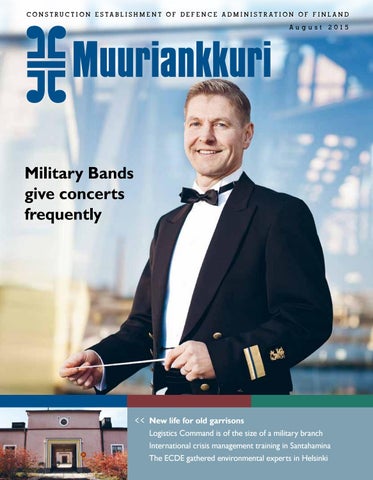
Military Bands give concerts frequently
<<
New life for old garrisons Logistics Command is of the size of a military branch International crisis management training in Santahamina The ECDE gathered environmental experts in Helsinki
EDITORIAL
Partnership with Logistics Command entails continuous development
T
he Finnish Defence Forces Logistics Command started on 1 January 2015. With an annual budget of over 1,000 million euro, it provides logistics services for all the three military branches, the Army, the Navy and the Air Force. It serves as a centralised interface between the Defence Forces and the strategic partners. The Construction Establishment is a strategic partner to the Logistics Command. The partnership obliges us to continuously develop our operations. We already have implemented all the major changes as required for the Defence Forces Reform by 2015. Our organisation and personnel are now in line with the demands of the Logistics Command and the current garrison network.
I
n the future, we still have a lot to do. We need to polish our operating models to promote productivity and process efficiency, and to maintain the high levels of competence, customer satisfaction and job satisfaction. An important tool for this work is the new Customer Service Centre, which started in May 2015. It enables us to serve our customers nationwide 24/7, in close co-operation with our service units, and to comprehensively manage information related to defence real estates and environmental matters.
T
he new Santahamina Building was completed in February 2015. Practically all of the National Defence University’s activities are now located on the campus on the military island of Santahamina. The Finnish Defence Forces International Centre (FINCENT) is among the users of the multi-purpose building.
F
ive garrisons areas and three fortification islands were closed down in the Defence Forces Reform. Some have already been sold to new owners with different plans for their future use. The Environmental Services of the Construction Establishment have carried out soil remediation of any contaminated areas before their transfer for civilian use. The documents related to the closed garrisons are now filed in the archives of our Central Unit in Hamina.
T
o mark the two international events taking place in Helsinki this year, namely the European Conference of Defence and the Environment (ECDE) on 9-10 June and the Annual Conference of the Nordic Defence Estates (NDE) on 1-3 September, we decided to publish an English edition of the summer issue of our stakeholder magazine. A report on the ECDE is included to provide the readers with a look at topical environmental matters within defence administration.
Enjoy the read! Pekka Salojärvi
Director Construction Establishment
The Finnish word muuriankkuri refers to a cramp iron: a bar of iron with bent ends that was used to hold together stones in the walls of a castle or fort. The logo of the Construction Establishment of Defence Administration depicts a cramp iron, and the word is used as the name of this magazine, Muuriankkuri, to reflect the role of the Construction Establishment as the organisation providing expertise and the best-on-the-market services in the field of construction and facilities management for the Finnish Defence Administration.
2 MUURIANKKURI
Contents
FINCENT moved into brand new faciltiies.
p. 8
The 2nd ECDE conference took place in Helsinki in June 2015. The programme included a total of 40 presentations. p. 26
Muuriankkuri August 2015 English edition of the stakeholder magazine of the Construction Establishment of Finnish Defence Administration, issued in Finnish in June 2015 (vol.14). Publisher Construction Establishment of Finnish Defence Administration, Central Unit P.O. Box 1, FI-49401 Hamina, Finland tel. +358 (0)299 8300, www.phrakl.fi
Customer Support Centre started operations in Jyväskylä
4
The new Logistics Command enables Defence Forces operations
5
Crisis management training at the brand new Santahamina Building
8
New era for military bands in Finland
12
Clothing repair facilities provide intact, clean and suitable gear
16
The environmental problem caused by chemical cleaning now under control
18
New life for former garrisons
20
Archivist Ritva Sateila is in her dream job
22
Five decades of national defence information services
24
Reporting on the ECDE conference: Environmental protection is a shared value
26
Electric vans for electricians
31
Editor-in-Chief Pekka Salojärvi, tel. +358 (0)299 831 000, pekka.salojarvi@phrakl.fi
Printing Multiprint Oy
Production PR Office Princeps Oy, managing editor Kirsti Helin, tel. +358 (0)400 447 382, kirsti.helin@princeps.fi Layout: Sanna Moisio Translation: Integra Oy Cover photos: Juha Ketola, Senior Conductor of the Lapland Military Band (photo Defence Forces) Garrison in Kauhava (photo Kirsti Helin)
ISSN-L 1459-1480 Subscriptions, changes of address and correspondence to editors: info@princeps.fi.
MUURIANKKURI 3
N E W S
Customer Support Centre now operational
T
he new Customer Support Centre of the Construction Establishment initiated operations on 18 May 2015. Located in Jyväskylä in Central Finland, the Centre is a hub for the coordination of the maintenance and repair services for defence real properties across the country. The Finnish Defence Forces have approx. 2.9 million square metres of facilities at their disposal and, for most part, their maintenance and repair services will be coordinated by the Customer Service Centre. The new ERP system (HUTO) will be the most comprehensive real estate and facilities management system in Finland. Any repair or maintenance work done on the field will be recorded directly to the ERP system by the field personnel using their smart phones.
”
A nationwide hub for defence property maintenance”
The HUTO system contains the necessary engineering and technical data, as well as administrative information, such as inspections conducted by the authorities. The system provides status reports concerning the systems and equipment that are critical for the national defence, thereby supporting crisis preparedness. 4 MUURIANKKURI
The Customer Support Centre specialists are on call 24/7.
The centralised building automation control system (KIVA) enables the Customer Support Centre to, for example, supervise and control the automated systems, promote energyefficiency and monitor indoor air quality – all this from a single location. The team of eight specialists based in Jyväskylä will serve customers nationwide. They have expertise in the real estate and ERP systems, as well as the processes facilitating collaboration between the customers and field personnel.
Service requests through the online portal The online service portal (known as Asiakastuki) is the primary channel for customers to submit fault reports and service requests. Upon receiving the requests, the Customer Support Centre will ensure that they are promptly processed and forwarded to the relevant professionals for further measures.
There is a direct link from the Defence Forces internal portal (Torni) to the Asiakastuki portal, and in urgent cases, one can also call the Customer Support Centre by phone. One benefit of the electronic system is that the person who submitted the service request will be provided with timely information about the progress of the repair or maintenance. The Torni portal is not, however, accessible for all of the customers of the Construction Establishment. For example, the personnel of Leijona Catering, Millog, the Ministry of Defence and Soldiers’ homes will need to submit their requests by e-mail, text message or by phone. The system is being further developed to make it possible for these organisations to access the Asiakastuki portal in the future. Any requests that fall outside the scope of the contracted facilities management services shall be submitted directly to the relevant service units of the Construction Establishment.
M A N A G E M E N T TeXT: Kirsti Helin
Photos: Kirsti Helin, Sofia Virtanen and Finnish Defence Forces
Logistics Command enables operations The Finnish Defence Forces Logistics Command creates the prerequisites for operations, whether it involves materiel acquisition, maintenance of defence real properties, or the provision of catering and health care for conscripts.
T
he idea of being an enabler was already mentioned in the logistics strategy drawn up for the Defence Forces in 2009, says Chief of Logistics Command, Major General Timo Rotonen. “The logistics reform aimed to standardise procedures, improve cost-efficiency and ensure smooth functioning at all levels. For example, while matters related to commercial law were previously handled by 120 people across the country, they are now processed by 80 people located in Tampere. By centralising expertise, we can reinforce our position as a purchaser of materials and services for the Defence Forces.” The new Logistics Command is comprised of the Headquarters, three Logistics Regiments, Joint Systems Centre, Explosives Centre, Centre for Military Medicine and Logistics School. “Each separate unit has its specific features and a clearly defined role within the overall logistics services,” Rotonen sums up.
“By centralising expertise, we reinforce our position as a purchaser of materials and services,” explains Chief of Logistics Command, Major General Timo Rotonen.
Size of a military branch Establishing the Logistics Command was the largest project in the Defence Forces Reform. It was formed by joining tasks and personnel from more than 30 different units. It has a personnel of 2,230 and an annual budget of approx. 1,300 million euro. Of the budget, 240 million euro are allocated for real property and facilities management, and the sum is divided equally between rentals
<<<
MUURIANKKURI 5
M A N A G E M E N T
(Senate Properties) and maintenance (Construction Establishment). The Logistics Command is responsible for the logistics of all three military branches (Army, Navy and Air Force). In itself, it is of the size of a military branch. It operates nationwide with over 70 offices or service units in 44 locations. The Headquarters in Tampere are located in a former office block of Nokia. The Logistics Command is a major employer in Finland. Apart from its own personnel, it provides work for thousands of people employed by service providers, partners and subcontractors.
”
Building maintenance and investments are important.”
Positive experiences of co-operation negotiations Before the logistics reform, the Defence Forces logistics tasks employed 600 people more than today. In the reform, a minimal number of employees were dismissed as nearly all of the 600 got a job in other units within the defence or government administration, or were employed by co-operative partners. “In the Defence Forces, good employer principles have been a standard in all organisational reforms since the 1990s. The logistics reform was no exception. We arranged change coaching, induction training for new tasks and practical assistance for those who moved to a new location.” “In the Defence Forces, employee co-operation negotiations may mean positive development, such as new challenging duties or even promotions,”says Rotonen. Listening to the feedback with a sensitive ear The new Logistics Command officially started in January 2015, but its operational processes had been in planning for nearly three years. Current Chief of Defence, General Jarmo Lindberg led the planning process in the capacity of Deputy Chief of Staff responsible for Logistics and Armaments. Before being appointed Chief of Logistics Command, Timo Rotonen was involved with logistics for 15 years in several different positions, most recently as Chief of Staff at the Army Materiel Command Headquarters and as Assistant Chief of Staff for Logistics at Army Command and at Defence Command. “The Logistics Command has only been operational for about six months, so we cannot draw any definite conclusions about the success
6 MUURIANKKURI
of the organisation reform or new operating models. Adjustments are inevitable, when a structural reorganisation of this volume is implemented, based largely on a theoretical model.” “The years 2015 and 2016 will be used to establish the operational forms and make the necessary adjustments in resources and procedures. I will carefully observe and respond to the feedback coming from our customers and personnel. Our work community is comprised of individuals with special expertise in various fields, and if they are not given the opportunity to share their views, we would lose a great deal of potential,” Timo Rotonen explains.
Construction Establishment is a strategic partner The strategic co-operative partners of the Logistics Command include, among others, Millog, Patria, Leijona Catering, Senate Properties and the Construction Establishment of Defence Administration. Strategic partnership means that the partners’ services must be available even in exceptional situations. “In terms of real property and facilities management, the Construction Establishment is a significant strategic partner for us. The war economy agreement contracted in late 2014 clarifies the co-operation and division of duties in exceptional times as well. The Construction Establishment has successfully made arrangements as required by the Defence Forces Reform, thus ensuring efficient cooperation with the Logistics Command in the future.” “The personnel of the Construction Establishment have solid expertise as well as experience and knowledge of the garrisons and the Defence Forces. Garrisons are
M A N A G E M E N T
Finnish Defence Forces Logistics Command Acquires and maintains the armaments and materiel required by the Finnish Defence Forces Accounts for the health care and catering services, environmental management as well as real properties and facilities management for the Finnish Defence Forces Contracts to integrate the Finnish Defence Forces with the national and international logistics systems
Leopard 2A6 main battle tanks are among the latest materiel acquisitions by the Finnish Defence Forces.
special buildings whose maintenance calls for special competencies.” “Within the Defence Forces, there is little need for new buildings right now but the existing buildings require proper upkeeping. It is thus vital that we complete the current investment and maintenance plan during the course of the next four years. The plan includes many different projects.
7 administrative units
One major initiative is the construction of new explosive storages by the year 2018.” “The Defence Forces have approx. 2.9 million square metres of premises and nearly 300,000 hectares of land areas at their disposal. This means that we need to fulfil various environmental obligations, for example, the on-going remediation of shooting ranges.”
Over 70 offices and service sites in 44 locations 2,230 employees Annual allocation of around 500 million euro for materiel acquisitions Annual budget approx. 1,300 million euro
Logistics Command Organisation, 1 January 2015 Deputy Chief of Staff, Logistics and Armaments
Defence Command, Logistics Division
Chief, Logistics Command Deputy Chief Finance Director
Headquarters
Logistics School
Joint Systems Centre
1st Logistics Regiment
2nd Logistics Regiment
3rd Logistics Regiment
Explosives Centre
Centre for Military Medicine
MUURIANKKURI 7
CO NST RUC T I O N Text: Kirsti Helin PHOTOS: Henrik Helin and Defence Forces/Harri Larinen
The Finnish Defence Forces International Centre returned to its roots The Finnish Defence Forces International Centre (FINCENT) has been relocated to the military island of Santahamina in Helsinki. In a way, it returned to its roots, as this is where it all started in 1964, with the temporary rotation training of peacekeepers for the Cyprus operation.
I
Instructors from different Nordic countries are preparing for the upcoming three-week UNMEM course.
8 MUURIANKKURI
n the brand new Santahamina Building, international crisis management training is up and running. In early May, instructors are busy preparing for the upcoming three-week UNMEM course. A dozen instructors from the Nordic countries, together with a visiting instructor from South Korea, are involved in the drafting of the curriculum. “Recently, the demand for UN courses has increased as a result of the decrease in the number of NATO-led operations and simultaneous increase in UN-led operations, especially in Africa,” explains Lieutenant Colonel Jari Salonen, Chief of Course Department at FINCENT. Mandated by the United Nations, Military Experts on Mission (UNMEM) is a course that provides students with the basic knowledge and skills required to serve as UN Military Observers, Military Liaison Officers or Military Advisers. UNMEM courses are arranged three times
CO NST RU C TIO N
The Finnish Defence Forces International Centre (FINCENT) • Arranges and hosts national and international courses, exercises and seminars related to military crisis management within the framework of the UN, the AU, the EU, NATO and NATO Partnership programmes. • Acts as the Finnish Defence Forces OCC E&F Centre to support NATO’s Operational Capabilities Concept Evaluation and Feedback Programme. • Supports Finnish civilian crisis management efforts. • Sends Finnish officers to participate in courses abroad. • Cooperates with national and international civilian and military partner organisations. • As of the start of 2015, is part of the Finnish National Defence University.
a year within the framework of the Nordic Defence Cooperation (NORDEFCO). Future students will be trained for UN expert missions, first for a period of one week in Santahamina and then for two weeks in the exercise area in Niinisalo, where the team site known as Camp President offers conditions similar to those of actual crisis management bases. Reviews of the Santahamina Building “Based on two days’ experience, I can say that the Santahamina Building is an excellent venue for international courses, both in terms of providing a learning environment and accommodation,” says Lieutenant Colonel (ret) Rolf Kullberg, who serves as the chief instructor of the UNMEM course. LtCol Jari Salonen is also satisfied with the premises. “In addition to the high-standard auditorium and classrooms, the Santahamina Building offers comfortable rooms for accommodation, as well as a gym and sauna. On the island, there are plenty for opportunities for physical activities, including jogging in natural environs or swimming in
“The Santahamina Building offers excellent facilities for international courses,” says LtCol (ret) Rolf Kullberg.
the Olympic-size indoor swimming pool.” “As a location, Santahamina is superior to our former location in Tuusula. Here, in the capital city of Helsinki, foreign students will get to know Finland from a variety of perspectives.” “The Santahamina Building was built somewhat smaller than originally planned and, for example, there is insufficient room to house the offices of our staff of 25 permanent employees. Fortunately, we will have additional office rooms in one
of the buildings that will be renovated in the near future.” Inspiring work as an instructor Rolf Kullberg retired from active service in 2009, from the position of the Chief of the Crisis Management Centre in Pori Brigade, and since then he has served as a part-time instructor at FINCENT. During his long career in the Finnish Army, Kullberg gained experience in international crisis management by serving, among others, in five operations in the Middle East and the Balkans.
<<<
MUURIANKKURI 9
CJ O R UMC I T NI OE NN O NH S TT A
”
Former officers act as crisis management trainers.”
“As a retired officer, I find teaching an inspiring task. Each year, I teach several courses, some of which are implemented abroad. Altogether, I work for 4–5 months per year,” says Kullberg. “The instructors on our courses are all experienced peacekeepers and former officers from Finland and other countries, some of whom have been involved in up to 12 crisis management operations. We have an instructor pool of approximately 50 highly qualified professionals,” explains Jari Salonen.
A school for leaders and experts FINCENT is responsible for training leaders and experts to serve in crisis management operations. The courses teach students how to initiate and manage co-operation between the military, police forces, civil population and organisations within the operation zone, as well as how to deal with and solve different situations 10 MUURIANKKURI
and problems that may arise in the field. Training is implemented in partnership with the Crisis Management Centre (CMC) Finland in Kuopio, a centre of expertise in civilian crisis management. “In terms of our course activities, international networking is a must. Our co-operative partners include the UN, NORDEFCO, the EU, the AU and NATO. We have an obligation to send our instructors abroad and correspondingly, we have visiting instructors from other countries.” “Crisis management training is global. Representatives from peacekeeping training centres all over the world convene annually, and there is also regional co-operation. We support each other and our familiarity with one another makes it easy to work together,” explains Salonen. Some 30–40 courses will be arranged annually in the Santahamina Building. Of the around 700 students, one half come from other countries. Additionally, FINCENT arranges for some 120 Finnish students to take part in training offered by cooperating partners in different countries. Why is Finland an interesting destination for military students from other countries? “The Finnish educational system, in general, has a good reputation globally, we are a militarily neutral country, and our long experience in crisis management operations is valued,” answers Jari Salonen. “The feedback we receive on our training is excellent, both in terms of the contents of the training and the accommodation arrangements and leisure activities. In 2014, the course ratings averaged 4.4 (on scale 1–5).”
CJ OO NHS TT RA UMC IT NI OE NN
FINCENT to coordinate NATO crisis management training During 2015, FINCENT will assume the Department Head responsibility for coordinating NATO crisis management training. “Our task will be to coordinate
NATO crisis management training in various parts of the world,” explains Jari Salonen. “We will be responsible for developing the structure, cost-efficiency and quality of the training to meet the requirements set by NATO.” “The Department Head status is the
most significant recognition received by FINCENT throughout its history. For Finland, this task is an opportunity to utilise and further develop our expertise in crisis management and to profile ourselves as a top country in crisis management training.”
The Santahamina Building completes the National Defence University’s campus In February 2015, the military island of Santahamina in Helsinki saw the completion of the new, longed-for multipurpose building constructed for the Finnish National Defence University. The University now has all its functions, except for the Military Museum of Finland and the National Defence Courses, located within the Santahamina campus. In addition to the University’s Department of Military Technology, the Santahamina Building houses the Defence Forces International Centre FINCENT and the Central Library for War Studies. The library and cafeteria, which are open to the public, are on the ground floor, as is also the auditorium with seats for an audience of 300. The first floor has classrooms and learning facilities, including controlled exam rooms where students can take their exams any time of the day. The office rooms and the common room for instructors are also located on the first floor. The rooms for accommodation are on the second floor.
Course participants have at their disposal: • 66 accommodation rooms (single/double) • Self-service laundry rooms, kitchens and lounges • Gym and sauna • Cafeteria • Classrooms and auditorium • National Defence University Library
MUURIANKKURI 11
C onstruction TEXT: Kirsti Helin PHOTOS: Kirsti Helin and Defence Forces/Marco Caruso, Arttu Korhonen, Maarit Kytöharju, Jari Laine, Lauri Viljavuori
New era for military bands in Finland As a result of the Defence Forces Reform, the number of military orchestras was reduced from twelve to six, including five professional bands and one conscript band. The bands are now bigger in size and more diversified, and moreover, they have new rehearsal and concert facilities at their disposal.
T
he Lapland Military Band in Rovaniemi practices in rooms that have been renovated specifically for the band, the Conscript Band moved from Lahti to brand new premises in Parola, and the new facilities for the Dragoon Band in Lappeenranta are under construction. Chief Conductor, Music Lieutenant Colonel (1 June 2015) Jyrki Koskinen is in charge of the Defence Forces music activities, after the retirement of his predecessor Music Lieutenant Colonel Elias Seppälä. During his career, Koskinen has served as the chief of several military bands, starting with the Conscript Band, and before the current position, as the chief of the Guards Band and the director of the Hamina Tattoo military music festival. “I will start my new task by getting acquainted with all of our military bands. After mapping the situation, it’s time to outline future activities. We will definitely Jyrki Koskinen is the new Chief Conductor of the Defence Forces.
12 MUURIANKKURI
C onstruction
continue to give high-end concerts to a variety of audiences in the future as well,” Koskinen promises. “With a smaller number of bands and a reformed organisation, we managed to accomplish savings as required for the Defence Forces Reform. From a human perspective, the reform that cut permanent positions by a third was a hard one.” Today, the Defence Forces employ a total of 180 professional musicians. “The larger units and band compositions will enable us to meet the musical demands of today. The planning of activities calls for a more proactive approach, for example, our clients had to place their orders for concerts in 2016 already in March 2015.”
High-end concerts for a variety of audiences Military music is an integral part of the Defence Forces ceremonies and events. Typically, military music is associated with parades and military oath ceremonies. The music is accentuated by the visual and soldierly performance. Recently, the military bands have reached out to the general public by giving concerts and performances on various occasions. Each year, there are around one thousand performances all over Finland and even abroad. “Music makes an emotional impact and gives permanent memories,” says Jyrki Koskinen. “Most people remember their wedding waltz and stand up when hearing the national honorary march. There is music that unites people across generations. One such masterpiece is Finlandia by Jean Sibelius, the national composer whose 150th anniversary is being celebrated in 2015.” In the summer, the military bands entertain the public in free-of-charge MILjazz concerts. On 10 September, there will be a magnificent display of military music at the Hartwall Arena in Helsinki: the Tattoo Show 2015 will gather all of the six military bands together to perform with some brilliant solo artists.
The fabulous farewell concert marked the end of Elias Seppälä’s 43-year-long career.
Chief Conductor Elias Seppälä’s Grande Finale On 21 May 2015, a concert entitled Grande Finale was arranged at Finlandia Hall in Helsinki in honour of Chief Conductor, Lieutenant Colonel (Music) Elias Seppälä, who retired after an outstanding career as a developer of Finnish wind band and military music.
At the concert, Elias Seppälä directed the symphonic wind band comprised of the Lapland Military Band and Guards Band, and the male choir Polyteknikkojen Kuoro (the Polytech Choir), with soprano Helena Juntunen and baritone Aarne Pelkonen as soloists. The full house enjoyed a great concert with music by Tchaikovsky, Sallinen and Rautavaara, among others. The audience was thrilled and the applauses never seemed to end. In his farewell speech, Elias Seppälä expressed his gratitude to his colleagues and superiors for their collaboration during the course of his nearly 43 years of service. He also extended his thanks to the audience for giving inspiration, and stated that military music belongs to all people: “Without audience, there are no concerts, and without concerts, there is no military music.”
<<<
MUURIANKKURI 13
C onstruction
Lapland Military Band covers half of Finland Geographically, the operating area of the Lapland Military Band covers one half of Finland, namely the provinces of Lapland, Northern Ostrobothnia and Kainuu. “Yesterday, we performed in Kajaani at the annual ceremonies of the Kainuu Brigade, all day from the parade to the evening concert. Last week, we performed in Salla, and before that, in Inari. Next on the schedule is 4 June in Oulu, with the national parade and ceremonies of the Defence Forces Flag day and a MILjazz concert,” Chief of the Lapland Military Band, Music Major Juha Ketola lists.
“Annually, we receive about two hundred requests of which we can realise some 120 performances, so there is demand for military music. We attempt to combine several performances to avoid excessive travelling.”
Tailor-made facilities for musicians The interview with Juha Ketola at the Someroharju garrison in Rovaniemi took place in early spring, and he was keen to show the new, still unfurnished rooms waiting for the Lapland Military Band. “We now have absolutely great
The Lapland Military Band is rehearsing in its concert hall, which was built in the former movie theatre.
14 MUURIANKKURI
facilities for training, better than ever before in the history of the band,” says Ketola with enthusiasm. “I really look forward to moving in. Earlier, our musicians trained in ordinary conscript training rooms. Now we have proper acoustic structures in all rooms, both in the individual training rooms for musicians and in the concert hall, which was built in the former movie theatre a year ago.” “We are planning to give concerts for children and students, so that they can join us in playing music.” As part of the Defence Forces Reform, the Lapland Air Defence Regiment
C onstruction
was integrated to the Jaeger Brigade located in Sodankylä. Once the Regiment had moved out, the empty building was renovated to house, among others, the Lapland Military Band. The two-storey building represents the red-brick architecture of the 1970s. Its total floor area is 2,700 square metres, of which the Band has about 1,200 square metres at their disposal.
Travelling is part of the job The Lapland Military Band was formed by joining the three military bands operating in Northern Finland. “Some of our musicians live here in Rovaniemi, some have their homes and families elsewhere. I myself have lived in Kaarina in SouthWestern Finland throughout my career.” “Although not always so pleasant, travelling is part of the job when the operating area is as extensive as it is for our band.” “Rovaniemi is a great place, but it is challenging to recruit people to live and work here in the north. This year, we will have two positions opening in our band, and hopefully they will attract young musicians.” Juha Ketola started his career playing trumpet in the Navy Military Band, and continued with conductor studies later on. Before his appointment as Chief of the Lapland Military Band, he served as the chief of the Defence Forces Conscript Band. Ketola is the boss for 30 professional musicians and an additional 3-4 conscripts who serve as musicians or media assistants responsible for the band marketing communications.
Defence Forces Military Bands The Guards band has the Finlandia Hall in Helsinki as its home hall. Founded in 1819, the Guards Band is the official representative band of the Defence Forces. The band gives public concerts all through the year. It is the only full-sized professional symphonic wind band in Finland. The Navy Band has its home in the Sigyn Hall in Turku. The band gives classical music concerts in churches and concert halls around the region. Traditionally, it performs at the Christmas Peace Declaration in Turku. The Air Force Band is located in the Tikkakoski garrison. It is the only Defence Forces military band that specialises in popular and entertainment music. The Dragoon Band operates under the Army Academy in Lappeenranta, with new band facilities currently under construction.The band keeps up the cavalry traditions and performs, among others, in entertainment music concerts. The Lapland Military Band is the only professional symphonic wind band in northern Finland. Apart from military occasions, the band plays a key role in the northern musical culture, with the nature and folk music of Lapland as essential themes.
“We now have great training facilities in the Rovaniemi garrison,”says Chief of Lapland Military Band, Music Major Juha Ketola.
The Defence Forces Conscript Band has new training and concert facilities in the Parola garrison. Annually, around 80 conscripts are trained as members of the Conscript Band, and some conscripts serve in other military bands as well. The Conscript Band’s specialties include figure march and concert music. The Military Band programmes are online at konserttikalenteri.puolustusvoimat.fi/en MUURIANKKURI 15
G A R R I S O N Text and photos: Kirsti Helin
The Defence Forces´Clothing repair facilities, located in Säkylä and Mikkeli, ensure that conscripts are provided with intact and clean clothing and gear.
Processing 2.6 million kilos of clothing and gear every year 16 MUURIANKKURI
G A R R I S O N
E
very day, one truck load of textiles and other materials are transported to each of the two Defence Forces’ Clothing repair facilities, which are located within the Säkylä and Mikkeli garrison areas. Annually, they wash 2.6 million kilos of laundry and repair some 500,000 items of clothing and equipment. Until autumn 2014, there was a third unit in Sodankylä, which was, for a fixed term, run by an external partner. “As far as I know, Sodankylä was the only case in which the Defence Forces decided to reassume the operation of an outsourced service. To us, it signified the recognition of our operational costefficiency and continuous competence development,” says Markku Hannus, Manager of the Defence Forces’ Clothing repair facilities.
Intact, clean and suitable “Our service includes the washing, drying, inspecting, folding and packing of laundry. The objective is to return the washed and repaired textiles to their users within a week. Our motto is to provide intact, clean and suitable gear. The units in Säkylä and Mikkeli have identical tasks and duties. In Säkylä,
“Our objective is to return the cleaned and repaired items to their users across Finland within one week,” says Manager Markku Hannus.
however, there is also a boot washing machine for washing and sanitizing all rubber boots and winter footwear used within the Defence Forces, and additionally, Säkylä is responsible for all equipment used in crisis management operations. The maintenance of clothing used by the Defence Forces is stipulated by law, and conscripts are not allowed to wash their service clothing at home. According to Markku Hannus, the repair of broken clothing and footwear is an essential part of the process. “In the earlier days, we even used
to darn socks, but today, only the most valuable items are repaired, such as camouflage outerwear, military boots, protective vests and other expensive equipment.” “Despite rising labour costs, it is worthwhile to repair clothing. Assuming that the repair costs for a given volume are 2.1 million euro per year, the acquisition of the corresponding new materials would cost 21 million euro.” Nowadays, chemical cleaning is necessary only for some special pieces of clothing, and any chemical cleaning required is outsourced.
Today, only the most valuable items are repaired, such as camouflage outerwear and military boots.
MUURIANKKURI 17
E NVIRON ME N T Text and photos: Kirsti Helin
The environmental problem caused by chemical cleaning now under control
T
he Defence Forces’ Clothing repair facility within the garrison area in Säkylä used to have a chemical cleaning laundry of its own, because a major part of the conscripts’ clothing, such as mantel overcoats or uniforms, required chemical cleaning. Although no longer operational, it left behind unpleasant traces in the area. Built in 1963, the Clothing repair facility has a floor area of 10,000 square metres. Underneath the building, three underground tanks were installed to contain chemical solvents that were drained from the laundry. The 5-cubic-metre steel tanks were equipped with safety containment, but over the years, they started leaking and were finally taken 18 MUURIANKKURI
out of use. In 1998, elevated concentrations of tri- and tetrachloroethane were observed in water samples taken from the local water intake plant. The municipality of Säkylä immediately banned the use of the water intake plant. Also, all private wells in the area were taken out of use and, with funding from the Ministry of Defence, water pipelines were constructed to houses in the area to supply water to the households. Regular monitoring of the quality of the groundwater was initiated.
A difficult target to remedy In the 2000s, the soil in the area has been examined and cleaned in several phases. The latest and, for now, the final cleaning procedure was completed in 2013.
”
Groundwater cleansing may take decades.”
“The task of remediating the groundwater area in Säkylä has been one of the most challenging environmental projects we have carried out,” says Senior Specialist Kari Koponen of the Environmental Services unit of the Construction Establishment. “We have examined and analysed the soil under and around the Clothing repair facility, cleaned the grounds when the tanks were removed, and transported loads of contaminated soil away from the area. To clean the contamination underneath the building, we have used the soil vacuum extraction method, because that is the only way to clean the soil without breaking the structures. By the year 2013, we managed to remove over 16,000 kilos of chlorinated solvents and the concentrations have seen a clear drop,” explains Koponen. The protective pumping and purification of groundwater started in December 2013 when a new well and purification system were taken into use. Significant amounts of solvents have been removed from the soil along with the pumped groundwater. Ekokem Oy, a company specialising in environmental and water engineering, is the contractor for the project. The company has undertaken the responsibility for the operation and maintenance of the water purification plant in compliance with the required concentration limits. Ekokem has also been in charge of the transportation and further processing of the contaminated soil.
The cleansed water is recycled Contaminated groundwater is pumped up from a filter pipe well and led to a water purification
E N V I RO N MEN T
“The purified water is being recycled for use in laundry processes,” explains Senior Specialist Kari Koponen of the Construction Establishment.
system, in which volatile organic compounds (VOCs) are removed by means of a stripping process and activated carbon filters. “Protective pumping is important because it will lower the surface of the groundwater, thus preventing the contaminated water from flowing away from the area.” “The groundwater area is monitored on a regular basis and there are several observation points in the area. In addition to chlorinated solvents, the water is tested for, among other things, iron concentration and hardness.” “Until now, the water was drained, after purification, to a ditch, but since May 2015, the water has been recovered and used in laundry processes. Water is being pumped at a daily rate of approx. 100 cubic metres, which translates to savings of tens of thousands euro in the Clothing repair facility’s annual water consumption invoicing. So, there is something good in this case as well,” Koponen sums up. As a result of the solvent leakage, the contaminated groundwater area is now classified as a risk area that is in poor state. The natural cleansing of the groundwater may Ekokem’s specialist Antti Seppälä is in charge of the operation and maintenance of the water purification system. take decades. MUURIANKKURI 19
garrison TeXT: Juhani Heimonen PHOTOS: Kirsti Helin, Risto Laine and Defence Forces
New owners, a new future The Finnish Defence Forces have undergone a radical structural reform. Finding new owners and uses for the closed garrisons has been a major undertaking.
T
he aim of the Defence Forces Reform is to safeguard Finland’s military defence capabilities into the 2020s within the framework of available funding. The Defence Forces have taken the necessary steps by closing down garrisons, downsizing personnel and reorganising Defence Forces units. The set goals included savings of 825 million euro, a more efficient organisation and a strong material foundation for national defence. The reform is in its final straight. Six garrisons across the country have been closed down, and the relevant military units have either been abolished or merged into other units. The sound of marching feet no longer echoes in the Häme Regiment in Lahti, the North Karelia Brigade in Kontiolahti, the Engineer Regiment in Keuruu, the Coastal Batallion in Kotka, the Training Air Wing in Kauhava or the Air Force Technical School in Jämsä. As a result of the structural and organisational reforms, the Defence Forces have given up real estates and facilities with a total area of approx. 280,000 square metres, thus saving almost 20 million euro in annual rental costs.
A lakeside tourism magnet in North Karelia Senate Properties is handling the sales of garrisons and related areas through an open sales process. Potential buyers have also been offered an opportunity to develop new uses in co-operation with Senate Properties. Both options have attracted interested parties. In North Karelia, the municipality of Kontiolahti paid 1.1 million
20 MUURIANKKURI
garrison
The Kauhava garrison area was mainly built in the 1920s and 1930s. Today, the premises are being marketed for future use as offices or industrial plants.
Kontiolahti will become the home of a new recreational and wellness resort. During the Biathlon World Championships 2015, the garrison was used for accommodation.
euro to acquire the entire 158-hectare garrison area of Kontioranta in January 2014. The municipality is currently drawing up plans for a residential area, including 70 detached houses as well as terraced houses and blocks of flats, in the vicinity of the former garrison. The key project, however, concerns the development of a lakeside recreation and wellness resort in the extraordinary landscapes by Lake Höytiäinen, featuring a hotel, restaurants and versatile physical activities and related services. A limited company, Kontionloikka Oy, has been founded to implement the project, and the municipality of Kontiolahti is among its shareholders.
there are grand plans for the future of the area. With its old parks, Hennala is a green zone amidst an expansive city, and as such, it is optimal for urban housing. There is a city plan in the making, which would facilitate the construction of 3,000 new homes for 10,000 residents in an area covering a total of 75 hectares. Once the old railway stop is reinstated, Hennala will be only 45 minutes away from the capital city of Helsinki. The Hennala garrison buildings are being actively marketed to private purchasers, corporations and investors. It is a large-scale undertaking, as there are altogether 40 buildings for sale.
Luxury homes in Lahti Located at a distance of just a few kilometres from the centre of the City of Lahti in southern Finland, Hennala is among the best known urban garrison areas in Finland. The garrison was originally built in 1910 for the army of the Russian Czar, and its military history came to an end when the Häme Regiment´s standard was hauled down for the last time on 29 December 2014. People in Lahti, however, trust in the survival of the ‘spirit of Hennala’, which influenced city life for over a century. To this end,
New business in Kauhava At the start of 2015, the Air Forces’ properties located at Kauhava and Kokkola in Ostrobothnia were acquired by a limited company, LSK Business Park Oy. A total of 500 hectares and 45,000 square metres of potential office, industrial, conference and accommodation facilities thus found a new owner. With a runway of its own, the sky’s the limit for future business! In terms of its architecture, the former Air Academy of Kauhava is among the most prestigious properties of the
Finnish Defence Forces. The National Board of Antiquities has made a proposal for the protection of the area as a major cultural heritage environment representing the military architecture of the first decades of independent Finland.
The idyllic island of Isosaari Located off Helsinki, the island of Isosaari was fortified in 1915, when Finland was part of the Russian Empire. It has played a key role in the development of Finnish coastal artillery and the defence of the region surrounding the capital city. Today, the idyllic island is awaiting new life as a recreational area and tourist attraction. Whatever the investments in the future, Isosaari already offers one modern facility: there is a nine-hole golf course running among the trees and bunkers. It was initiated by an enthusiastic golfer who worked as an electrician on the island in the 1980s. Similar visions, and actually one step closer to implementation, exist for the former fortress islands off Kotka in south-eastern Finland. The islands of Rankki and Kirkonmaa were bought by a local entrepreneur who intends to create a destination that attracts nature lovers, boaters and conference guests. MUURIANKKURI 21
P e r s o n Text and photos: Kirsti Helin
Archivist Ritva Sateila is in her dream job “Many people probably think that an archivist’s work is boring but I love my job!”
T
he building history of Finnish garrisons is fascinating, and being able to serve researchers and other people seeking information from the archives is the best thing about the job. Located in Hamina, the archives of the Central Unit of the Construction Establishment have about one kilometre of shelves filled with drawings and other documents related to the current and former defence real properties. Archivist Ritva Sateila is proud of the archives in her care. “We have optimal facilities for archives, maybe the best in Finland,” says Sateila, who has previously worked, for example, at the National Archives in Helsinki. The Central Unit with its archives was moved from Helsinki to Hamina four years ago. At that time, a 19th century garrison barrack was completely renovated for the new purpose.
A hundred requests every year “We receive about one hundred enquiries annually. Building drawings are most often requested by defence administration personnel or researchers, but increasingly also by civilians,” Ritva Sateila explains. “Over the decades, the buildings originally built for the Defence Forces have been transferred to use by public administration or businesses, sometimes even by private persons. For example, in Eastern Finland, near the Salpalinja fortification line, small semidetached houses were built for officers during the interim peace, which are now used as 22 MUURIANKKURI
“The building history of Finnish garrisons is fascinating,” says Ritva Sateila, Archivist at the Construction Establishment.
P e r s o n
summer cottages and the new owners ask for their drawings.” “As a public authority, we have the duty to provide information about any defence property, with the exception of security-classified buildings. Those asking for material must apply for permission and sign a non-disclosure agreement. If anyone wishes to study the drawings or documents here in Hamina, it must be agreed upon in advance. Lately, Ritva Sateila has been busy receiving and filing material related to those garrisons that were closed down as a result of the Defence Forces Reform. The new owners of the garrisons are provided with copies of the original drawings and documents. The
oldest of the closed garrisons are Hennala from the Russian era and Kauhava from the 1920s. “We do not have complete documentation for all of the garrisons built under Russian rule. It is possible that the Russians took some of the drawings with them at the time when Finland gained independence.”
Military history as a leisure interest Ritva Sateila graduated as a construction engineer from Turku Technical College in 1988. She continued studies in the field of humanities and became interested in archive work and the history of buildings.Currently, she is taking Open University courses in art history. “Even on these courses, there are
surprisingly many links with sites of military history significance,” explains Sateila. Archives and military history keep Ritva Sateila busy even on her days off. She is a member of the Association for Military History in Finland and has visited, for example, Berlin and Naples on journeys arranged by the Association. “In other countries, military history naturally interests me from the viewpoint of buildings. In Finland, I have visited many places of military history importance, as well as sites that have been transferred to civilian use. Having first seen the drawings in our archives, it is interesting to see what the buildings look like in real life.”
Ritva Sateila shows the most precious drawing of the archives, dated 1898. The building still stands on the Bulevardi street in Helsinki.
MUURIANKKURI 23
C ommunications Text: Juhani Heimonen PHOTOS: Kirsti Helin
Five decades of national def ABDI measures opinions and provides information The Finns’ will to defend their country is among the strongest and most stable in the world. This statement is not an educated guess, but based on solid research data, which the Advisory Board for Defence Information (ABDI) has systematically gathered through opinion surveys over the past 50 years.
T
he ABDI (or MTS for short in Finnish) is a permanent parliamentary committee set up by the Government for one Parliament term at a time. Apart from political parties, it has representatives from, among others, the Defence Command, the Tampere Peace Research Institute, the Union of Journalists in Finland and the Federation of the Finnish Media Industry. The ABDI and its five branches work with the assistance of external specialists.
Before the Parliamentary election in spring 2015, the leaders of political parties discussed national defence issues at a seminar arranged by the ABDI. The seminar gathered an audience of over 200 and gained plenty of media publicity.
24 MUURIANKKURI
Administratively, the ABDI works under the Ministry of Defence. Permanent employees include Secretary General Heli Santala, Assistant Secretary General Markus Kinkku and Communications Secretary Jaana Riihimaa. Based on a decree, which was last updated in 2012, the ABDI is tasked to maintain and promote dialogue and communication concerning security policy, national defence and preparedness for crises and exceptional conditions. To implement its task, the ABDI arranges seminars, discussion events and education, and conducts opinion surveys concerning national defence and security issues. The annual reports show that the various tools are in frequent use. In 2014, the ABDI organised altogether seven seminars. The themes speak for themselves: ‘Conscription – in or out?’, ‘Weighing the defence’, ‘Ukraine’, ‘Propaganda – the cleverest weapon’. The audiences ranged from the defence administration personnel to journalists and the public at large. According to the feedback received on the events, their content and arrangements were deemed good and appropriate.
Long continuum of opinion surveys The ABDI conducts, on an annual basis, opinion surveys on themes related to national defence and security issues as well as foreign and security policies. The results gain extensive publicity in the media. For the purposes of research, the survey material is highly valued because of its long
C ommunications
ence information services continuum. Some of the questions form an uninterrupted time series over five decades, starting from 1964. The results are even internationally comparable, since similar opinion surveys have been and are being conducted in Sweden and Norway as well. Since the 1970s, the citizens’ will to defend the country has been measured by asking ”If there was a military aggression against Finland, should Finland, in your opinion, defend itself militarily in all situations, even if the outcome was uncertain?” The wording originates from Sweden, where attitudes toward national defence have been surveyed since World War II.
”
The will to defend is constantly at a high level.”
Researcher Risto Sinkko has studied the survey results for trend analyses and found that Finns’ will to defend their country is closely linked with global political movements. The bottom was reached in the early 1970s when, to quote Sinkko, “people may have clenched their fists in their pockets but didn’t dare to show or express their true opinions”. At that time, only about 40 per cent of respondents answered ‘yes’ to the above question. Since then, the share of positive answers has risen and reached the peak, over 80 per cent, in the year 2000.
As an explanation, Sinkko offers the ‘EU effect’, in other words, Finland’s joining the European Union in 1995. During the past 15 years, the will to defend has remained constantly at the level of 70–80 per cent. Changes in the global situation and, in particular, within Finland’s neighbouring areas, seem to be reflected in the attitudes towards NATO. The majority of Finns have long rejected the membership of the Western alliance, but a certain revision of standpoint can now be seen. In the survey conducted by the ABDI in December 2014, almost every third respondent was in favour of Finland seeking membership in NATO. The proportion of NATO supporters (30%) is the highest in the history of ABDI surveys.
Assistant Secretary General Markus Kinkku and Secretary General Heli Santala are responsible for arranging seminars on national defence themes.
Advisory Board of Defence Information (ADBI) The Advisory Board of Defence Information (in Finnish, Maanpuolustustiedotuksen suunnittelukunta, MTS) is a permanent parliamentary committee working under the Ministry of Defence. It is comprised of the Chair and 12–20 members. The ABDI is appointed for one Parliament term at a time. Its composition reflects the division of power between political parties following the Parliamentary election. In addition to Members of Parliament, the ABDI has members representing the Prime Minister’s Office, the Defence Command, the National Defence University, the Tampere Peace Research Institute, the Finnish broadcasting company Yle, the news agency STT-Lehtikuva, the Federation of Finnish Media Industry and the Union of Journalists in Finland.
MUURIANKKURI 25
ENVIRON ME N T Text: Marika Valve photos: Marika Valve and Defence Forces
Environmental protection is a shared value for the European defence administration The second European Conference of Defence and the Environment (ECDE) took place in Helsinki on June 9–10, 2015.
T
he ECDE brought together environmental experts and scientists from all over Europe and North America to present and discuss research information, best practices, competencies and innovative projects. Protection of the environment is a shared value and important goal for defence administration across the countries.
Opening speeches focused on collaboration The ECDE conference was opened by Director General Jukka Juusti (Finnish Ministry of Defence). In his opening speech, Juusti
Environmental protection in heavy weapons ranges was a special theme at the ECDE.
26 MUURIANKKURI
emphasized the active participation of the Finnish Defence Forces in the Nordic and European defence co-operation. “With the situation in Europe changing, we need to invest in defence regardless of the economic recession,” said Juusti. He also spoke about environmental threats, energy efficiency and collaboration to minimize environmental hazards. Chief of Logistics, Major General Kyösti Halonen (Finnish Defence Forces) discussed the role of environmental values in the implementation of the Defence Forces Reform in Finland. Environmental experts have helped the Defence Forces adopt new ways of operating in a more energy-efficient and ecological
E N V I RO N M EN T
The conference gathered together 140 participants from 21 countries: defence sector stakeholders, environmental experts, authorities, political decision-makers, researchers and representatives of industries.
The programme of the two-day conference included a total of 40 presentations. Denis Roger, Florence Lalanne and Stephen Doe were the invited plenary speakers.
manner. “Environmental protection cannot be separated from the core activities, rather it is a natural part thereof,” said Halonen. As an example of environmental protection efforts undertaken by the Defence Forces, he mentioned the ongoing remediation and renovation of shooting ranges. He also highlighted the co-operation at the Nordic and European level and the open sharing of best practices for the common good. Director Pekka Salojärvi (Construction Establishment of the Defence
Administration of Finland, CEDA) pointed out that environmental protection became an integral part of the agency’s service portfolio about 10 years ago. Over the past decade, the specialists of the Environmental Branch have worked in co-operation with the Defence Forces to promote environmental protection. Salojärvi also emphasized the significance of the Nordic Defence Estates (NDE), the co-operation forum that enables stakeholders within defence administration to share knowledge. The co-operation is now expanding to include the Baltic countries as well. Plenary speeches on legislation, environmental values and defence policies The plenary session was opened by Director Denis Roger from the European Synergies and Innovation (ESI) directorate within the European Defence Agency (EDA). The EDA acts as an interface between the European Ministries of Defence and wider EU policies. Its primary mission is to support the Council and the Member States in their efforts to improve the European Union’s defence capabilities. Within the EDA, issues related to energy efficiency and environmental protection fall within the sphere
of the ESI. According to Roger, the strategic drivers for energy and environment management include operational security, economic impact, as well as energy resilience and autonomy. The second plenary speaker was the Chairwoman of DEFNET Florence Lalanne, who serves as the Head of the European Law Office in the Department of legal affairs within the French Ministry of Defence. DEFNET is a network of environmental specialists from the Ministries of Defence of the EU Member States. In her address, Lalanne focused on the road of sustainability. The EU environmental law constitutes the framework for defence policies. Lalanne views DEFNET as a channel between the EU law-makers and national defence forces. The plenary session was concluded by Stephen Doe, representative of the REACH Impact Working Group within the ASD (AeroSpace and Defence Industries Association of Europe). He introduced the audience to the complexity of supply chains for the aerospace and defence technologies. Given the strict safety and reliability requirements for materials, and the classified nature of undertakings, any changes in the supply chains will inevitably take their time.
<<<
MUURIANKKURI 27
E NVIRONME N T
Parallel sessions provided deeper insights into various themes Following the plenary session, the ECDE continued with parallel sessions allowing the participants to go deeper into the themes of the conference:
• • • • • • •
Energy and Material Efficiency Heavy Weapons Heavy Weapons Ranges Small Arms Ranges Noise Nature Values Management & Reporting
In the following, to give an overview of the issues addressed during the two days, there are brief reports on some of the sessions and presentations. The conference materials are available in their entirety through the website www.ecde.info.
Explosions, fumes and bat shelters I - Heavy Weapons Ranges Chief of Environmental Protection Terhi Svanström, Defence Command Finland, presented the Nordic initiative for developing the environmental protection on heavy weapon ranges. The first workshop had taken place day before the ECDE. The aim of the initiative is to collect, assess and develop different technical solutions to reduce the environmental impact of heavy weapons shooting. In Finland, for example, the shooting ranges are often located in groundwater areas, Natura 2000 areas or other sensitive habitats. Svanström was optimistic about continued development work after the 3-year term of the initiative. Philip de Lasson has studied former and current shooting ranges and training areas of the Danish Defence Forces. Using historical examples and photos, he presented his own 28 MUURIANKKURI
Michael Walsh and Kari Koponen co-chairing the Heavy Weapons Ranges session.
work and working methods. De Lasson explained why we should be concerned about the traces of 300-yearold cannonballs in the soil: the soil, groundwater, lakes and rivers become polluted, and harmful substances are transferred from the plants to, for example, cows and further to the milk we drink. Researchers Marianne and Michael Walsh work at the US Army Cold Regions Research and Engineering Laboratory. Marianne Walsh presented an experimental study in which explosives were detonated on snowcovered ice in optimal temperature and wind conditions. On the basis of the residues of explosives on the snow, it is possible to determine the environmental impact of explosions. Michael Walsh pointed out that residues from different type of ammunition vary widely. He emphasized the significance of efficient detonation. The environmental load of unexploded ammunitions is often considerably larger than that of ammunition that have exploded as planned and
efficiently. “Scientific knowledge is essential for us to be able to maintain shooting ranges and carry out shootings,” Walsh summed up. Senior Adviser Kari Koponen, Environmental Branch (CEDA), described methods for examining the explosive residues and the related guideline values, and the difficulty of determining exact limit values for exposure for the energetic substances. Substances can be classified as, for example, hazardous, toxic or carcinogenic. Contamination of surface soil will expose people to harmful substances through direct skin contact or by inhaling dust. Senior Advisor Magne Bolstad, Norwegian Defence Estates Agency, presented the methods used over the past 23 years to examine soil and water samples taken from shooting ranges and their vicinity. Special attention has been paid to lead and copper concentrations. In 2014, new methods were implemented in Norway for the remediation and development of current shooting ranges.
E N V I RO N MEN T
Sara Kajander.
II - Small Arms Ranges Research Director Ulf Qvarfort, Swedish Defence Research Agency, gave a presentation on the environmental impacts of small calibre ammunition in marine environment. He stated that research is often based more on educated guesses than exact calculations. In Sweden, the salvage of the warship Vasa 333 years after it was wrecked brought old musket balls to the surface. Soaked in the sea for three centuries, they were analysed, and calculations have been made to estimate the amount of lead dissolved in the water over the years.
Director of Environmental Branch, Quality Director Sara Kajander (CEDA) presented the implementation of Best Available Techniques (BAT) for the environmental protection of small arms ranges in Finland. The English translation of the BAT report on a survey conducted in 2010-2014 is available for free from the ECDE site at http://www.ecde.info/materials. Kajander gave special thanks to the coauthors of the report, Noise Specialist Asko Parri (Army Command Finland) and Project Manager Teemu Hourula (CEDA). As part of the survey project, risk levels were determined and recommendations given for the environmental protection of shooting ranges accordingly. The report contains guidelines and best practices, but it is up to the party responsible for the management of a particular shooting range to decide on the applicable actions. Kajander also discussed the current situation of the strategic development plan for Finnish Defence Forces’ small
arms ranges. The timeframe for the project is 2012-2018, and the total estimated budget is 22.5 million euro. Range-specific costs vary from 10,000 euro to 3.4 million euro. As major challenges in the project, Kajander mentioned the long duration of the environmental permit processes, incongruent permit regulations, interruptions caused by the remediation of contaminated soil, and the use of unsuitable building materials in shooting ranges. Chemical engineer Ida Vaa Johnsen, Norwegian Defense Research Establishment, presented Norwegian research on the emission of toxic fumes and metals from weapons and ammunition. The research focused on emissions in closed environments, such as indoor spaces or in combat vehicles or tanks. Johnsen described the symptoms of poisoning caused by, for example, lead or copper. According to her, the best means to prevent exposure include better ventilation and the use of fresh air masks.  
Best Available Techniques (BAT) for the environmental protection of small arms ranges have been developed and implemented in Finland.
<<< MUURIANKKURI 29
E NVIRONM E NT
III - Management and Reporting Environmental Director at Swedish Armed Forces, LtCol Arne Wessner started his presentation by asking what we have to do to protect the environment and how it differs from what we want to do. The Swedish Armed Forces are subject to environmental laws as any other party in society. Wessner presented examples of environmental projects carried out within the defence sector in Sweden, including environmentally friendly solutions for energy consumption and waste and water management, for example, in training camps. Local residents are informed about major training exercises, and the Armed Forces share in the social media any participation in campaigns, such as the cleaning of Kebnekaise. According to Wessner, the Swedish Armed Forces aim to be known as a trustworthy authority and a sustainable part in the Swedish society. He concluded by stating that “environmental protection is a matter of such significance that we want to do all that is needed and more for its sake”. Senior Adviser Timo Seppälä from the Finnish Environment Institute introduced the audience to perfluorinated compounds (PFCs). Perand polyfluoroalkylated substances (PFASs) and perfluorinated octylsulfonates (PFOSs) are used in, for example, fire-fighting foams, metal plating and aviation hydraulic fluids. They are
Arne Wessner.
stable and may be toxic, some are not degraded in any natural conditions. Currently, the use of PFOSs is highly restricted and regulated, and they are being replaced by shorter-chain alternatives. Because of their wide use, PFAS compounds are detected globally in the environment and organisms, even in drinking water. Environmental Specialist Hanna Luhtio (CEDA) presented the environmental data management systems in use within the Finnish Defence Administration. She explained that IT applications improve situation awareness and facilitate experts’ work. The GIS-based environmental data management system, Y-KIRAVE (Ympäristö-Kirave) is customized to meet the specific needs of the CEDA. The system contains, for example,
2nd European Conference of Defence and the Environment, 9–10 June 2015, Helsinki, Finland • Arranged by the Finnish Ministry of Defence (MoD), Finnish Defence Forces (FDF) and the Construction Establishment of Defence Administration (DEFA) • In co-operation with Nordic Defence Estates (DFE) and DEFNET • 140 participants from 21 countries • 40 presentations All conference materials are available at www.ecde.info
30 MUURIANKKURI
maps, documents and archives for environmental analyses. Environmental Specialist Simona Kobel from the Swiss Air Force introduced the environmental strategy and values of the Swiss Air Force. Environmentally friendly performance is a strategic objective, as are environmental awareness and education, communication, and legal compliance. As examples of environmental activities, Kobel presented projects to protect bats and wild bees at air bases: former air-raid shelters now serve as shelters for bats and wild bees can lay eggs in ‘hangars’ built for them. In his presentation, Colonel (Eng) Georgios Drosos, Head of the Department of Infrastructure & Environment, Hellenic Ministry of National Defence, addressed the issues of sustainability and environmental consciousness. In addition to raising environmental awareness and influencing attitudes, it is important that political decision-makers adopt environmental values. Drosos presented a personnel survey conducted in 2014 which showed a high level of environmental consciousness within the Hellenic Armed Forces. Knowledge affects our attitudes and attitudes affect our behaviour.
E N V I RO N M EN T Text and photos: Kirsti Helin
Electric vans for electricians
Wouldn’t an electric van be a good match for an electrician? To find an answer to this question, Chief electrician Kari Pirinen and Head of real estate services Marko Hirvonen at the Helsinki Service Unit of the Construction Establishment began investigating the pros and cons of electric vans.
W
e assumed that driving an electric van would only cost one third of the expenses of an ordinary van. If the electricity is produced using renewable energy sources, an electric van would be a truly sustainable option, Kari Pirinen and Marko Hirvonen explain. An electric van would be in line with the responsible energy consumption principles adopted by the Construction Establishment.
Two electric vans for a start In June 2015, the Helsinki Service Unit decided to purchase two electric vans
for the use of electricians and real estate maintenance personnel. The Nissan e-NV200 vans’ interiors were tailored to meet the demands of the work and tools. “Once we have sufficient experience of their use, we will see if it is worth expanding the acquisition and purchase electric vans for use in other sites as well. It seems that there is interest both within the Construction Establishment and the Defence Forces,” says Service Unit Director Aki Toivonen. The Construction Establishment is among the first government units to acquire electric vans.
Optimal in urban conditions The Construction Establishment had
Kari Pirinen and Marko Hirvonen are happy with the acquisition of electric vans.
three recharging stations installed within the Helsinki metropolitan area. The vans are equipped with two recharging cables, one for the standard Schuko sockets and one for the specific electric car recharging stations. It takes about 4–6 hours to fully recharge the batteries.
No emissions and minimal service costs Electric cars are an efficient means for reducing emissions caused by traffic, and many states support the acquisition of electric cars through taxation. In the Nordic countries, Norway is a pioneer in the use of electric cars. Electricity may not be the cheapest source of energy, but what makes the difference is the efficiency ratio. In a petrol engine, the energy efficiency ratio is on average 25%, compared to 90% for an electric engine. An electric engine uses energy very efficiently to keep the car moving. In Finland, there are altogether more than 1,000 electric cars. They are more expensive to buy than other cars, but in the future, the prices may come down since the government aims to lower the car tax. The tax will be reduced for cars that cause less pollution.
MUURIANKKURI 31
Construction Establishment of Defence Administration Telephone exchange +358 (0)299 8300 Internet www.phrakl.fi Our e-mail addresses are in the form: firstname.lastname@phrakl.fi Record office: kirjaamo@phrakl.fi
Sodankylä
Central Unit Isoympyräkatu 10, P.O. Box 1 FI-49401 HAMINA Director Pekka Salojärvi
Central Unit Service Units
Service Units Kouvola Kouvolankatu 13 FI-45100 Kouvola Director Tapio Laitinen
Säkylä Huovintie 24 B FI-27910 Säkylä Director Jouni Aro
Jyväskylä Rykmentintie 7 FI-41160 Tikkakoski Director Taisto Hämäläinen
Helsinki Santahaminantie 18 FI-00860 Helsinki Director Aki Toivonen
Hämeenlinna Vankanlähde 7 P.O. Box 307 FI-13131 Hämeenlinna Director Heikki Ilmonen
Kajaani P.O. Box 630 FI-87101 Kajaani Director Sakari Hukkanen
Turku Heikkilän kasarmi, P.O. Box 20 FI-20811 Turku Director Reima Johansson
Tampere Lapintie 4 P.O. Box 253 FI-33101 Tampere Director Jani Haataja
Sodankylä P.O. Box 5 FI-99601 Sodankylä Director Jyrki Siirtola
Kajaani
Jyväskylä
Tampere Säkylä
Hämeenlinna
Turku
Hamina Helsinki
Optimal service solutions • Energy services • Real estate services • Construction services • Cleaning services • Technical services • Security services • Environmental services
Kouvola