CONSTRUCTION ESTABLISHMENT OF DEFENCE ADMINISTRATION OF FINLAND
Summer 2011
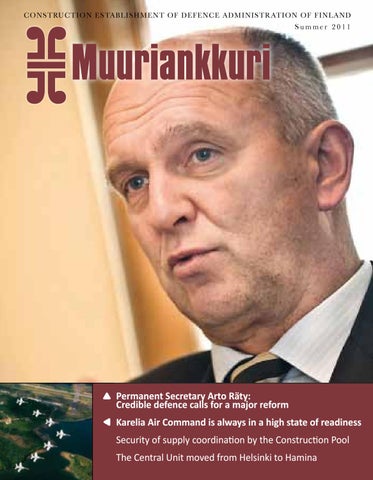
Permanent Secretary Arto Räty: Credible defence calls for a major reform Karelia Air Command is always in a high state of readiness Security of supply coordination by the Construction Pool The Central Unit moved from Helsinki to Hamina
Editorial
Dear reader S
ince May 2011, the Construction Establishment’s Central Unit has been in full operation in its new location in Hamina. The inauguration of the new premises was celebrated on 6 April by an audience of about 200 people representing our personnel and various interest groups.
The transfer of the Central Unit from Helsinki to Hamina was accomplished within a relatively short transition period of about 2.5 years. The aim was to ensure that operations continue efficiently throughout this period and to minimise the negative effects on the personnel. The Central Unit employs a total of 55 persons, and by now, 21 new employees have been recruited locally in Hamina and the Kymi region.
T
he Finnish defence system is undergoing a reform that will have an impact on all structures of the Defence Administration across the board. In order to achieve major savings, it is necessary to reduce costs for both the personnel and infrastructure. Within the real estate and environmental operations, we must make preparations for
future changes based on political decisions, for example, to close down individual garrisons. Of the various readiness brigades of the Finnish Defence Forces, the Karelia Air Command has a 24/7 operational command and control capability even in peacetime. At its main base, Rissala near the town of Kuopio, underground caves and facilities play a major role; they can be considered as an integral part of the air force weapon system. The Construction Establishment has long-term experience in maintaining the caves, which were originally constructed in the 1970s.
T
he structural change of the public sector and the globalisation of industry and trade have increased the need to enhance the preparedness against natural disasters and other disturbances affecting our society. In the field of construction and the related industry, the Construction Pool has served as the cooperative body between the private sector and relevant authorities. Celebrating its 90th anniversary, the Soldiers’ Home Organisation is present in the daily lives of conscripts and personnel at all garrisons. In the Säkylä garrison, the newly completed basic renovation of the Soldiers’ Home is a prime example of successful cooperation between the Construction Establishment and the local Soldiers’ Home Society. Similar renovation projects have been implemented in recent years in many other garrisons as well. In this issue, our columnist writes about the increasing role of the Baltic Sea as an important energy transportation route. Marine areas are also in the focus in the article concerning the survey of the environmental impact of the Defence Forces’ shooting range and training area operations. This is the 10th year of publication of Muuriankkuri, and the first issue ever published in English. I wish you enjoyable reading and a sunny summer! Pekka Salojärvi Director
The Finnish word muuriankkuri refers to a cramp iron: a bar of iron with bent ends that was used to hold together stones in the walls of a castle or fort. The logo of the Construction Establishment of Defence Administration depicts a cramp iron, and the word is used as the name of this magazine, Muuriankkuri, to reflect the role of the Construction Establishment as the organisation providing expertise and the best-on-the-market services in the field of construction and facilities management for the Finnish Defence Administration.
2
Contents 4
The Reserve Officer School is completely modernised
6
Renovation of the Soldiers’ Home in Säkylä
8
Construction Pool – preparing for serious disturbances in society
12
Permanent Secretary Arto Räty: A radical defence force reform is needed Eero Sivunen serves as the Secretary General for the Construction Pool, a cluster of 170 companies critical for the security of supply.
16
The Karelia Air Command is a dynamic readiness formation
In Hamina, an old barrack transformed into modern offices for the Central Unit of the Construction Establishment.
21
No environmental harm from the shooting activities in Lohtaja
24
The Central Unit’s new premises were taken into use in Hamina
28
The Soldiers’ Home Organisation celebrated its 90th anniversary
29
Professor Kari Liuhto: The strategic role of the Baltic Sea is increasing
30
Appointments The ‘green sisters’ celebrated the 90th anniversary of the Soldiers’ Home Organisation in Helsinki on 16 April.
31
News
The environmental effects of shooting activities are being surveyed. In Lohtaja, no residuals of explosives or fuels were found in the sea.
Muuriankkuri Summer 2011, Volume 10. Customer and interest group magazine of the Construction Establishment of Defence Administration. Publisher Construction Establishment of Defence Administration, Central Unit, P.O. Box 1, FI-49401 Hamina, Finland, tel. +358 (0)299 8300, www. phrakl.fi Editor-in-Chief Pekka Salojärvi, Production Princeps Oy, managing editor Kirsti Helin, tel. +358 (0)400 447 382, tel. +358 (0)299 831 000, pekka.salojarvi@phrakl.fi kirsti.helin@princeps.fi, layout Sanna Moisio Translation Integra Oy Printed by Kopijyvä Oy Cover photos Petri Puromies and Defence Forces ISSN 1459-1480 Subscriptions, changes of address and correspondence to editors info@princeps.fi. Muuriankkuri is published biannually, in June and December.
3
C O N S T RU C T I O N Text: KIRSTI HELIN PHOTOS: RISTO LAINE AND RUK
The renovated Reserve Officer School is
T
he Reserve Officer School (RUK) in Hamina has undergone a complete renovation, and the inauguration event was held on 1 April 2011. The historical Main Building and the adjacent Manège now constitute the technically and functionally most modern barrack buildings in Finland. The Main Building serves primarily as accommodation facilities for the RUK, and the Manège is a prime venue for festive occasions or larger courses and seminars for the whole Hamina garrison. The renovation was largely accomplished using traditional manual methods so as to preserve the special characteristics of the buildings. The
4
opinions of the National Board of Antiquities (NBA) were duly considered in the planning and implementation of the project. The renovation covered a total floor area of approx. 8,000 square metres. Of the original 19th century architecture, the Main Building’s façade, part of the load-bearing structures, the entrance hall and main stairway were preserved. In addition, two new buildings were constructed around the courtyard to serve as storage and tent drying facilities.
Improved functionality and indoor air quality Improved quality of indoor air, better energy efficiency and material durability were among the principal
aspects considered during the renovation project. New technology and installations are well hidden from view. The premises are now up-to-date and more functional than before. The greatest change took place in the two topmost floors: the rooms are now completely reserved for accommodation purposes, with beds for a total of 276 conscripts. The ground floor houses classrooms, offices and staff facilities. The main contractor was a local company, Lujatalo Oy from nearby Kotka. Given that all the ten or so subcontractors were also based in the region, this project had a significant effect on employment in SouthEastern Finland. On an average, the
the most modern barrack in Finland site employed more than 100 persons. “We were able to keep to the project schedule thanks to a successful timing of the different work phases. The most challenging task was to match concurrent extraordinary demolition work and the construction of new
load-bearing structures. Harmful substances were unexpectedly found in the old structures which required more extensive demolition than originally planned,” explains Project Manager Vesa Rakkola. “At a large site like this, seamless co-
operation between the commissioner, user, designers, engineers and contractors is a must. In Hamina, cooperation was smooth and any problems appearing during the work were solved rapidly, so the project advanced just as planned.”
Finland’s largest leadership school Audience at the inauguration of the new RUK on 1 April 2011. M.Sc. (Eng.) Vesa Rakkola of the Construction Establishment acted as the Project Manager for the RUK renovation.
The Reserve Officer School (RUK) is a brigade-level unit that belongs to the Eastern Finland Military Province. Since 1920, the RUK has trained a total of more than 168,000 reserve officers for the Defence Forces’ reserve. The reserve officer training is an integral part of the life in the town of Hamina, which has a long history of military tradition. The Main Building was completed in 1898, and for the first decades it served as the Officer Cadet School. The building was designed by Johan Jakob Ahrenberg and Sebastian Gripenberg. The adjacent manège was designed by Carl Ludvig Engel and completed in 1832. These two buildings are the oldest of those currently in use by the RUK. In the previous renovation in 1960-61, the manège was transformed to serve as the venue for festive occasions of the RUK, to be known as the Manège. The RUK unit badge is an emblem designed by Alvar Aalto and adopted in 1923. One of Finland’s most renowned architects, Aalto served as officer cadet in course No 4. The emblem consists of two cavalry officer’s swords, the letters RUK, and heraldic leaves and roses.
5
C O N S T RU C T I O N Text and photos: SAMULI VAHTERISTO
Renewed Soldiers’ Home in Säkylä
T
he basic renovation of the Soldiers’ Home (colloquially ‘Sotku’) in the Säkylä garrison took over a year. It was finally completed by the summer along with the finishing of the outdoor areas and landscaping. The project totalled 3.9 million euros. The 50-year-old building services systems were completely renewed, and many details affecting customer service, the ambient milieu and the daily work of the voluntary ‘green sisters’ were
modernised. The largest changes were made behind the scenes: the kitchen and bakery, staff rooms, and goods reception were comprehensively rearranged. New windows mean better energy efficiency, and the elevator facilitates the transfer of goods between the floors. The safety and security installations and automated alarm systems were updated. Customer service counters and dish return areas were renewed. Waste management and
Soldiers’ Home voluntary Tuija Ryömä, Regional Manager Jouni Aro and Supervising Construction Engineer Janne Lehtonen all agree that the outcome of the demanding renovation exceeds the expectations.
6
sorting systems now meet the current requirements. One aim of the project was to ensure a smooth customer flow in the premises, which seat up to 600. The outcome of the project is excellent, and the local Soldiers’ Home Society praises the work of the Construction Establishment, the constructor, designers and the National Board of Antiquities (NBA). “Our dreams have come true. The green sisters are extremely happy with
the end result. With new staff rooms, machines and equipment, we have now a much better environment for working and serving our customers. We can now serve freshly baked doughnuts even during peak times,” praises Tuija Ryömä of the local Soldiers’ Home Society. The Society funded the renovation by a total of approx. 400,000 euros. The main part was used for purchasing equipment but money was also used to buy 1,200 new coffee cups. The garrison was not without the Soldiers’ Home services for a single day. The renovation started in February 2010. Well in advance, temporary facilities had been constructed in the sports ground, where the Soldiers’ Home moved in December 2009. The temporary premises consisted of ten containers with an area of 40 m2 each, and a large tent with an area of 500 m2.
Respecting the original architecture The central buildings of the Säkylä garrison – those housing the Bridage’s Command HQ , the Soldiers’ Home, cinema, sports facilities and canteen – are as a whole protected by the NBA. They represent the Brutalist architecture of the 1960s, which emphasised the construction materials and techniques; e.g., concrete surfaces were allowed to reveal the texture of the wooden forms used in casting. These buildings are designed by Architect, Professor Osmo Lappo who gives credit to the designers and builders for showing respect for the original architecture. The representatives of the NBA also praise the work. “Definitely the most difficult tasks during the entire project were the installation of modern building services systems, that is, HPAC and electrical systems, as well as the updating of the safety and security systems, while at the same time respecting the culturally and
The service counter was updated to meet the requirements of the conscripts and other visitors.
The new bakery rooms have modern facilities, machines and equipment that facilitate the production of freshly baked buns and doughnuts even during peak times with up to 2,000 customers every day.
historically valuable, over 67 years old building. Original concrete surfaces, wooden grid ceilings and tiled floors were among the structures to be preserved,” explain Supervising Construction Engineer Janne Lehtonen and Regional Manager Jouni Aro of the Säkylä Local Office of the Construction Establishment.
Listening to the users’ wishes Regional Manager Aro says that the success of the project relied largely on the contribution of Merja Lankinen, Manager of the Säkylä Soldiers’ Home. “She informed designers and
builders about the wishes of the green sisters. Without her active involvement, the excellent end result would not have been possible.” The conscripts say that the renewed ‘Sotku’ is like a new world when compared to the temporary tent. “There is space and light, and the atmosphere is cosy. The game room downstairs is up-to-date, the library satisfies even the most demanding reader’s wishes, and the bakery products are super,” Corporal Ekku Lehtonen sums up the sentiments of a group of conscripts enjoying their coffee during a break. 7
C O N S T RU C T I O N
Construction Pool – preparing for serious disturbances in society
TEXT: KIRSTI HELIN | PHOTOS: Petri Puromies AND Tiia Harju
The security of supply for construction and the construction industry requires the maintenance of an adequate capacity in serious disturbances and emergency situations. For example, the building contractors’ equipment forms the reserve for storms and floods.
8
T
he Construction Pool is a cooperation body for construction companies and the authorities. The pool is tasked with planning preparedness and coordinating resources so that, in the event of natural disasters or other disturbances, there is a sufficient reserve of, for example, clearance machinery, construction workers, and construction materials and products. Secretary General of the Construction Pool, Senior Engineer Eero Sivunen of the Confederation of Finnish Construction Industries RT emphasises that rescue authorities always request equipment directly from companies and all missions are carried out under their supervision. The Construction Pool is subordinated to the National Emergency Supply Agency, which belongs to the administrative branch of the Ministry of Employment and the Economy, and it is headed by the Construction Pool committee. The Construction Pool has six regional committees that promote the cooperation between the authorities and construction companies, and the regional upkeep of the security of supply. Once a year, the regional construction capacity and production reserves are checked. Preparedness exercises are organised every other year in each committee region by invitation from both the Construction Pool and the Defence Forces. In addition, a preparedness seminar is held every other year. “Currently, the Construction Pool consists of about 170 companies critical to the security of supply. Participation is voluntary, and so far, not one company invited to join has declined,” says Sivunen. “The Construction Pool is still lacking a wider representation of clients. Construction preparedness planning should be done between all parties to make it as practical as possible and not to break the construction chain at any stage.”
Framework agreement and pilot projects
In summer 2010, Finns learned a new word: downburst. Hectares of forest fell down and summer cottages were left without power. The equipment of contractors now forms the reserve for serious disturbances.
The Ministry of the Interior, the National Emergency Supply Agency and the Construction Pool signed a framework agreement in November 2010, which aims to enhance the availability of private lifting, clearing and earth-moving equipment in the event of natural disasters or major accidents. The framework agreement allows regional rescue departments to ensure the rapid availability of clearing equipment by making preparedness agreements with companies indicated by the Construction Pool. A preparedness agreement between a rescue department and a company includes details on, for example, the amount of equipment, response time and basis of payment. According to the framework agreement, rescue authorities can also command the use of equipment. 9
”
The Construction Pool is not a rescuer but provides rescuers with what is required.”
The Construction Pool’s Secretary General Eero Sivunen and the Construction Establishment’s Head of Preparedness Raimo Huttunen cooperate in the preparedness planning for defence real estate and participate in joint preparedness exercises.
“This year, rescue departments and municipalities will take part in three pilot projects that test the cooperative functioning of the various parties and their ability to cope in the event of a major accident. The experiences of the pilot projects will form the basis for model contracts for building contractors to use,” Eero Sivunen explains. “The law requires that municipalities and authorities draw up preparedness and rescue plans, but these also need to be tested. Contractors should be invited to take part in deciding if the plans are realistic and if they can be followed in real situations.”
Preparing in cooperation with the private sector The preparedness agreement and letter of intent system of the Construction Pool is necessary, because currently, construction resources are mainly in the hands of the private sector. In the case of a disturbance under normal circumstances, there is no preparedness law under which the authorities could assign contractors to work. The Rescue Act grants certain powers. 10
In the past, the state’s major construction organisations could support rescue authorities in serious disturbances. Such organisations no longer exist, instead private planners and contractors carry out almost all construction projects. At the same time, the construction materials industry has become internationalised, and not all basic construction products are manufactured in Finland. “For example, concrete reinforcing bars come from abroad,” Eero Sivunen says. The Construction Pool has representatives from all the branches important for the construction and materials industry: construction product industry, building construction, earth and waterworks contracting, asphalt contracting, electrical and telecommunications contracting, HPAC contracting and surface contracting.
Benefits of the Construction Pool What added value does the Construction Pool bring to preparedness planning? Eero Sivunen notes that using the
Construction Pool’s preparedness agreement and letter of intent system, the authorities are able to clarify their task description and areas of responsibility. “The contracts tell us what resources are available and necessary on the national and regional levels. The Pool has working contacts with the core groups of companies and with the actors critical to the security of supply.” “The system forces the client to commission feasible construction plans and to ensure the availability of contractors. The contractors themselves sign a commitment to reserve the necessary resources and to carry out the projects by the deadline.” “The preparedness agreement and letter of intent define the tasks of the client and the builder, thus improving cost and timetable awareness. The named main contractor is responsible for organising the work and timetables.” And how do companies benefit from the system? “The pool’s member companies take part in preparedness planning, exercises and various training and orientation events, so the system
offers them an opportunity to create contacts with the authorities, clients and other contractors.” “In serious disturbances and emergency situations, the authorities will attempt to secure the energy, raw materials and transport logistics needs of the pool companies, so that they remain operational even under poor conditions. Companies critical to the security of supply can also apply for their key personnel to be exempt from military service during wartime.” “Every company taking part in the Construction Pool must have named a head of preparedness and will take part in preparedness planning as well as the exercises organised by the pool and the Defence Forces. This will help the company make their own risk analyses and contingency plans,” Eero Sivunen lists.
Help in case of major accidents We can still remember the major storm damage of summer 2010, when Finns learned a new word: downburst. The storms Asta and Veera left hundreds of people stranded in their summer cottages for weeks without power. Hectares of forest fell down, and a number of cottage lots were left empty of trees. Experts predict that similar weather phenomena will increase with climate change. “One possible natural disaster could be a strong water mass rising from the Baltic Sea and causing destruction. If the sea level in the Gulf of Finland were to rise by, for example, 2.5 metres, it would have a devastating effect on the district heating and electrical grid built in tunnels in the Helsinki metropolitan area. Another possible threat could be an oil spill in the Gulf of Finland, in which case the Construction Pool would be responsible for procuring the necessary amount of excavators, transport equipment and dump sites for the oil. We need to make plans for these kinds of situations and to rehearse implementing them in practice as well,” Eero Sivunen stresses.
Construction Establishment has preparedness plans for emergency situations The Construction Establishment of Defence Administration acts as the Defence Forces’ construction consultant in preparedness construction. It primarily means building premises for military intelligence, control and command systems as well as fortifications connected to them, and building harbour structures. The preparedness plan of the Construction Establishment takes into consideration the necessary reserves of contractor companies and production capacities. “We have taken part in the Construction Pool’s coordination work group focusing on the state of the Defence Forces’ preparedness construction, and as a result, the cooperation relations and responsibilities of preparedness construction have been significantly clarified,” explains the Construction Establishment’s Head of Preparedness Raimo Huttunen. According to the performance agreement with the Ministry of Defence, the Construction Establishment must draw up preparedness plans by the end of 2012 for the maintenance and development of defence real estate. So far, the Construction Establishment has reached a cooperation agreement on preparing for emergency situations with the Air Force. The cooperation regarding the preparedness planning for real estate and space utilisation began already in 2000 at the Karelia Air Command, when the first preparedness exercises were organised there. The Karelia Air Command is spearheading garrison development preparedness and has signed contracts with external builders according to the Construction
Head of Preparedness Raimo Huttunen is, jointly with the regional heads of preparedness, responsible for preparedness planning within the Construction Establishment.
Pool’s preparedness agreement and letter of intent system. On behalf of the Construction Establishment, the pilot projects of preparedness planning have been organised by Tapio Paldanius, regional head of preparedness in Eastern Finland. According to the agreement, the Construction Establishment will provide the Air Force with facilities management services in emergency situations. The Air Commands and regional Construction Establishment offices have drawn up detailed agreements on the planning and execution of preparedness tasks. This means the preparedness construction of 1st and 2nd class bases, real estate maintenance, energy supply and other separately agreed actions. The Air Force agreement has served as a model for cooperation with the other branches of defence as well. Preparedness planning with the Navy is currently in progress, and contract negotiations with the Army are to be started during this year.
11
LEADERSHIP
Permanent Secretary Arto Räty:
Finland needs a more cost-efficient defence Text: KIRSTI HELIN | Photos: PETRI PUROMIES
For improved cost-efficiency, it is vital to streamline the peacetime structures, to reduce wartime strength, and to optimise operational processes.
“The defence force reform provides an opportunity to safeguard the future of our defence until the 2020s,” says Permanent Secretary Arto Räty.
12
system ”
T
he goal is to achieve a more cost-effective defence system already during the current Government period. A structural reform of the Finnish Defence Administration is necessary in order to ensure our capability to meet our statutory obligations in the 2020s,” explains Lieutenant General Arto Räty, Permanent Secretary at the Ministry of Defence. “Major reforms of the defence administration always require a political decision. The newly elected Parliament and future Government must be able to make bold, responsible and comprehensive decisions that will safeguard the future of our defence, not only for this Government period, but far into the 2020s. A statement concerning the prompt initiation of such a reform should be included in the new Government programme,” Räty points out. Permanent Secretary Räty stresses that the core function of the defence, that is, wartime preparedness, must be the starting point for the reform. It is essential to streamline the peacetime structures, to reduce wartime strength, and to optimise operational processes. Part of the old must be given up, while at the same time building up new, relevant systems.”
Reductions affect both personnel and infrastructure “The defence force reform is not just
about cutting down the number of garrisons. It involves a comprehensive review of all defence branches and command structures, as well as operating principles. The structures must be made even more cost-efficient,” states Räty. He points out, however, that in comparison with other European countries, the Finnish Defence Forces are already extremely cost-efficient as they are.
“
We must give up unnecessary properties.”
“Unfortunately, the only way to accomplish permanent savings is by reducing personnel and trimming the infrastructure. On the other hand, we must safeguard the maintenance and development of the materiel of the Defence Forces, as it is useless to have a training organisation that lacks the necessary tools.” Räty stresses that the materiel will continue to be based on keeping up the old and extending its life cycle, but new materiel is needed as well.” “As regards the real estate branch, cost-efficiency can be enhanced by giving up those properties that are not absolutely necessary. The Construction Establishment has developed its activities
in an exemplary manner, and their representatives should be engaged in the planning of the reform right from the start.” “I believe that, even after the reform, the Defence Forces will continue to operate extensively throughout our country and that voluntary defence training can rely on both material and personnel support from local garrisons. Reducing the number of garrisons will mainly mean longer distances. Rather than being wartime forts, the Finnish garrisons serve as training organisations, especially those of the Army.”
The reform will take at least four years “It is not easy to renew the defence capability. The Defence Forces must simultaneously carry out both renewals and savings. In terms of the operating expenditure of the Defence Forces, the cost pressure by the year 2015 totals 135–150 million euros. The reform will initially be costly, but it will succeed, if the current resource level, which is based on the resolutions in the Finnish Security and Defence Policy 2009, is sustained up to the end of 2015,” Arto Räty states. “The aim is to draw up a new Defence Policy so that political decisionmaking can be completed in early 2012 and the necessary measures by 2016. Accomplishing a major reform will always take at least four years.” 13
“
Credible defence is like the back of a chair.”
“The reform and the necessary adjustments call for a strong commitment by the political leaders, because the adjustments will have an impact on both the personnel and regions. It is essential to manage changes involving personnel very carefully, as the personnel is our most important resource.”
Training reductions already at pain threshold “Both field practices and the use of aircrafts and vessels in the training of conscripts have been diminished. Training reductions have already reached the pain threshold, and no more such reductions should be made,” Räty stresses. The Defence Administration has for a long time been carrying out various measures to produce savings. The personnel has declined from the over 22,000 employees in the 1990s to the current 15,500 employees, that is, by 250 employees per year. According to the State productivity programme, it shall further be reduced by 1,153 employees by 2016. Within the State administration, the Defence Forces are in the forefront as regards measures aiming at improved costefficiency. Administrative streamlining, 14
rationalisation of infor mation management, and partnership with the private sector are good examples of such measures. The defence force reform has sought insights from the private sector as well. Recently, an extensive benchmarking round was carried out involving listed companies, towns and certain comparable countries. The aim is not to copy but to learn from other organisations by investigating how they have increased cost-efficiency, improved organisational structures and managed the change. “In Finland, there are several corporations and towns that have significantly improved their cost-efficiency, and the same principles are equally applicable to State administration,” states Räty.
Defence credibility must be maintained The structural development of the defence system aims at maintaining the credibility of the Finnish defence. “Finland is not subject to any immediate military threat, but history – unfortunately also the very recent history elsewhere in the world – has taught us that the situation can change very rapidly. Credible defence is like the back of a chair: it is nicer to sit when you
know that there is something to lean on, if need arises,” Räty describes. “Situated on the outer border of the EU, Finland is in an interesting position. Driven by decreasing resources, the EU states’ defence policy pursues to intensify international co-operation, promote joint acquisitions and dismantle old structures. Crisis management has become the priority task for the European armed forces. At the same time in the East, Russia, China and India are increasing their defence expenditure and improving their armed forces, and for them, crisis management is not the number one task.” “We can be proud of our defence based on universal service, which unifies our society. Our defence is capable of meeting challenges in a flexible manner, and if need arises, of defending Finland with military action. The Defence Forces also support society in many ways, for instance, by providing authorities with assistance in various situations hundreds of times each year.” “Last year, the Newsweek magazine named Finland as the best country to live in. A high level of education, functioning democracy and social safety are matters that are valued. We feel this society is worth defending,” Arto Räty concludes.
PHOTO: Defence Forces
For a soldier, commander’s duties are the number one
On 9 September 2010, upon the proposal of the Government, the President of the Republic Tarja Halonen appointed Lieutenant General Arto Räty as Permanent Secretary at the Ministry of Defence. The term of office commenced on 1 January 2011 and will end on 31 December 2015. The previous holder of the office, Lieutenant General Kari Rimpi, retired with pension. The Permanent Secretary’s tasks include managing, developing and supervising the activities of the Ministry of Defence and the related administrative branch. The position is a civil office. Prior to his appointment as Permanent Secretary, Arto Räty (born 1955) served as the Deputy Chief of Staff Operations, Defence Command. Earlier in his career he had held the following positions: Chief of Staff, Army Command; Director of the National Defence Policy Unit at the Ministry of Defence; Director of National Defence Courses; Commander of Pori Brigade; Commander of the Finnish Battalion, KFOR, in Kosovo; Deputy Chief of Division in the International Division at the Defence Staff; Deputy military attaché and NATO liaison officer in Brussels; staff officer in the Operations Division at the Defence Staff, and staff officer and Chief of Staff at Helsinki Military District HQ. Räty completed the General Staff Officer Course in 1989. He has also studied in the United States, Sweden, Germany and Norway. He was promoted to Lieutenant
General in June 2010. Arto Räty explains that he chose the military career as a young man when he, after his military service, stayed in service as a second lieutenant over summer. “I liked the work in the army, so I decided to apply to the military academy, the Officer Cadet School. Law studies were another option. Over the years, there have been times when I’ve thought of a change of career, but nevertheless, here I am, and I’m happy with my choice.” “Each task I’ve had during my career has been interesting and challenging. For a soldier, commander’s duties are, of course, the number one. Being a Commander in Kosovo and Pori Brigade have been such tasks for me. In your work as a commander you can do what you’re trained for as an officer.” “Being an officer means frequently changing tasks. It is challenging and giving, but sometimes also mentally stressful. Six years as a teacher in the Cadet School has been the longest single period for me. During my assignments abroad, our family home has been in Helsinki, except for the assignments in Middle East and Brussels when my family accompanied me. Our children, 29-year-old twins have now moved out to live on their own.” Arto Räty’s leisure activities include golf and hunting. On the day before the interview, he had returned from a golf holiday in Belek, Turkey.
15
GARRISON
Karelia Air Command – a dynamic Text: KIRSTI HELIN | Photos: Karelia Air Command, Kirsti Helin
The Karelia Air Command is one of the readiness formations of the Finnish Defence Forces and it is in a high state of readiness even in peacetime. The Air Command provides airspace surveillance in Eastern Finland, prevents airspace violations, and trains conscripts, reservists and personnel.
16
readiness formation
T
he Air Command’s radar stations constantly produce identified aerial photography, and if necessary, Hornet fighter jets will be deployed to reconnoitre. Aircraft are also used to provide assistance to other authorities, for example, airspace surveillance or participant transport during international summit meetings. The Air Command’s readiness and performance are constantly being developed. “Following the second mid-life upgrade of our fighter fleet, our current air-to-air capabilities will be complemented by air-to-surface capabilities. Our ‘eyes’,the radar system, will also be upgraded. Medium-range radars will be renewed over the next three years, and long-range radars will undergo a mid-life upgrade,” explains Colonel Ari Jussila, Commander of Karelia Air Command. “The defence force reform means that we need to be even more efficient than before and continually rationalise our processes. During the last couple of years, for example, we have centralised administration and expanded our personnel’s job descriptions. At the moment, the move to a new human resources data system is causing a considerable amount of extra work for some colleagues. Changes are challenging, and we as superiors must ensure that staff members do not overexert themselves,” Jussila emphasises. International exercises are part of the Air Command’s ascending flight training system. Joint exercises are most often arranged with the Swedish and Norwegian air forces, and once or twice a year, Finnish troops take part in larger multinational exercises. 17
“The Finnish Security and Defence Policy 2004 tasked the Air Force with the forming of a detachment capable of participating in international crisis management as part of a multinational flying unit. Our units have been trained and evaluated to be NATO compatible in terms of equipment and procedures. The Air Force has not yet taken part in a single international operation, as it always requires a political mandate,” Ari Jussila reminds.
Working in caves Half of the Karelia Air Command’s staff work in underground facilities in Rissala. This is more than in any other garrison. “The first autumn working in a cave environment felt tiring, with never really being able to see the daylight, but you did get used to it eventually.
We have tried to make the caves more welcoming, for example, by painting the walls white and introducing plants,” explains Commander Ari Jussila. “The caves in Rissala were built in the 1970s, when nuclear weaponry posed a threat. The caves function as everyday work space, but they are also wartime facilities. Many readiness-related issues were considered in the design of the facilities, for example, the electrical grid is secure and communications will work in a state of emergency, too.” “The tasks of the Construction Establishment have widely been outsourced, but restricted facilities, like the ones in Rissala, are maintained by our own staff,” says Local Manager Raimo Mulari of the Construction Establishment. The total building volume of the Karelia Air Command
is 370,000 cubic metres, 2/3 of which is taken up by shelters. Commander Ari Jussila is satisfied with the condition of the Air Command facilities and the services of the Construction Establishment. “All in all, the Karelia Air Command has good facilities that provide good protection. The caves are in better condition than the Air Command’s buildings above ground. The building services systems are the original ones, but they have been upgraded over the years, and we have had no major problems. A few offices had some problems, but they were repaired, and our indoor air committee has been very active.” “The Construction Establishment has lately been undergoing a positive development and we as the users of the facilities are particularly pleased with the
“You get used to working in the caves,” ensure Commander Ari Jussila and Local Manager Raimo Mulari. The caves have been made more welcoming, for example, by painting the walls white.
18
high level of knowledge about the Air Command’s operations among the staff of the Construction Establishment,” Ari Jussila says. “The challenge is to keep all facilities fully operational, as some of them are already quite old. Some buildings have undergone condition inspections, which helps in prioritising repairs,” Mulari mentions.
Shelters for materiel The purchase of the F-18 Hornet interceptors in the 1990s was a big thing for the Air Command and required new buildings. The latest large-scale construction in Rissala was undertaken in 1996–1997, when a new airport plate, storage space and a hush house were built for the Hornets. “Last year, the Air Force acquired new Pilatus liaison aircraft, and the construction plan now includes a new hangar for them. The current hangar was built by the Germans in the 1940s, and even though it has been upgraded from time to time, it is starting to be insufficient for new aircraft. Our aim is to get a new hangar in 2014,” reveals Ari Jussila. “Other topical projects include constructing an emergency area and an explosives magazine.” Amid beautiful lake scenery in Savo The roots of the Karelia Air Command, now situated in Northern Savo, are in the Karelian Isthmus. Flight Detachment II was established in Antrea in spring 1918. Later, the Air Command was stationed in Utti, Southern Karelia, for a long time and moved to Rissala, 20 kilometres north of Kuopio, in 1961. Ari Jussila praises the location. “This is a fantastic place in the middle of the most beautiful Finnish lake scenery. Some two hundred members of the Air Command live in Kuopio, a little over a hundred in Siilinjärvi and the rest in other surrounding municipalities. Very
The Karelia Air Command is constantly in a high state of readiness, with F-18 Hornet as the main aircraft.
few still live in the garrison area, and some of the old apartment buildings are awaiting demolition.” Ari Jussila has been living with his family in Kuopio since 1993. In addition to the Karelia Air Command, he has served in the Satakunta Air Command, the Air Force Academy in Kauhava, the Air Force Command Finland in Tikkakoski and as Commander of the Aircraft and Weapon Systems Training Wing in Halli. He was appointed Commander of the Karelia Air Command in 2009. Over his entire career, Jussila has a total of 2,600 flight hours, and he completed the latest type course earlier this year with the Pilatus liaison aircraft.
“Our aim is to get a modern hangar for the new Pilatus liaison aircraft in 2014,” says Commander Ari Jussila.
19
Karelia Air Command One of the readiness formations of the Defence Forces. Located near Kuopio Airport in Rissala, Siilinjärvi. Area of operations: Eastern and South-Eastern Finland. Core materiel comprised of radar stations and the Hornet inter ceptors of Fighter Squadron 31. Operations Centre formed by Headquarters, Control Centre and Defence Centre. 600 people serve in the Air Command, of whom 430 are paid staff. About 250 conscripts trained every year. The premises of the Karelia Air Command are largely restricted and also function as emergency facilities
Local Office in Kuopio’s old garrison area The Kuopio Local Office of the Construction Establishment has a total strength of 50 employees, who work for the Karelia Air Command and, for example, the North Karelia Brigade in Kontiolahti, near the town of Joensuu. The local office has its seat in Kuopio’s former garrison area, where nine employees work. The Construction Establishment resides in the same red brick barracks as other Defence Administration organisations, such as the North Savo Regional Office, the National Defence Training Association of Finland (MPK) and the Kuopio unit of the Defence Forces C4 Agency. All in all, around 50 people work in two buildings. The Kuopio garrison area was originally established in the 1880s to house the Kuopio Sharpshooter Battalion. The town garrison tells of Kuopio’s status as a province capital. Altogether 30 buildings were designed for the area, including barracks, a
20
canteen, a hospital, headquarters, an officers’ club and outbuildings. The design was made by August Boman and L. I. Lindqvist of the Board of Public Building. In the last years of the 19th century, a two-storey apartment building was built for non-commissioned officers with families. Sharpshooter battalions were disbanded in 1901. Afterwards, the garrison was used to house Russian military, for whom brick barracks and outbuildings were built in 1914–1916. After Finland gained independence, the garrison buildings became the property of the Finnish Army. The actual military use of the Kuopio garrison ended in 1964, when the North Savo Brigade stationed there moved to Kajaani. When the state surrendered the area entirely to the town of Kuopio in 1972, buildings were converted into facilities for the bureaus of the town and for the community college.
E N V I RO N M E N T TEXT: SARA KAJANDER AND MATIAS WARSTA | PHOTOS: FCG Finnish Consulting Group, Defence Forces
Environmental effects of shooting assessed with even more precision The marine environment of the Lohtaja training grounds has been thoroughly investigated
T
he environmental effects of the shooting and training activities of the Defence Forces are assessed more thoroughly than before. The aim is to draft environmental reports on all regions, detailing the environmental situation and value of the region and assessing the effects of
training action on them. A recently completed report reveals that the shooting and training activities of the Defence Forces have not caused significant harm to the marine environment at Vattajanniemi in Lohtaja, most of which is used by the Defence Forces as a shooting and
training range. The Vattajanniemi area has seen decades of live fire exercises with various weapon systems directed at sea. The investigation found no traces of explosives or fuels on the sea floor. The investigation was conducted by FCG Finnish Consulting Group Oy. 21
“
In Lohtaja, no traces of explosives or fuels were found on the sea floor.�
The investigation was limited to the shooting sector used in training.
Sea floor sounded and sediments examined The investigation started with the gathering of basic data about the history and current state of the area. The basic data detailed the amount and type of ammunition used in the area, the location of activities, and the biodiversity of the region, such as marine flora and fauna. The investigation was limited to the shooting sector used in training, and searches focused on the areas where targets were located. A basal dynamics model of the area was constructed, which was used to estimate sediment erosion, transport and accumulation. The results of the modelling were checked by sounding the sea floor. Sounding was also used to assess the amount of ammunition and other metal waste in the surface layer of the sea floor. Based on the basic data and the results of the modelling and sounding, a sample collection plan was drawn. Divers collected sediment samples from the areas with the highest load. The study also used a control location outside the shooting sector, estimated to be clean, and another 22
one outside the town of Kokkola. The sediment samples were analysed for explosives, metals, fuel contaminants and organotin compounds used in ships’ bottom paints. The number and abundance of benthos in the area were mapped. The possible negative ecological effects on the target area sediment were investigated by biotesting. Biotesting complements contaminant analyses and provides a clearer picture of acute and chronic sediment toxicity. Biotesting can also be used to verify the bioavailability and compound effects of possible contaminants. The effects of shooting activities on the marine environment were assessed based on the results of both chemical and organism analyses, by referencing international literature and studies.
Effects of shooting minimal The chemical analyses of the samples showed no traces of explosives or fuels and no significant concentrations of organotin compounds and polycyclic aromatic hydrocarbons (PAHs). Metal concentrations were mainly low as well.
Two locations showed slightly elevated concentrations of arsenic, nickel and cadmium. Elevated concentrations were limited to individual areas of the sea floor, and no wider elevation of contaminant concentrations could be demonstrated. Benthic mapping found the same benthic species at both the shooting range and the clean reference location, typical of a clean sea floor in the deeper regions of the southern Bothnian Bay. The sample collected outside the town of Kokkola showed a clearly less diverse benthos, consisting of a single species. In all likelihood, the difference can be explained by the composition of the bottom sediment. The bottom material at the research location outside Lohtaja is sand and outside Kokkola, mud. Based on the incidence and abundance of species, it can be estimated that shooting or possible contaminants from shooting have caused the benthos no harm. Biotesting was conducted on four groups of organisms from samples collected from four locations. Based on the responses detected in the testing, the toxicity of the sediments at the shooting
The investigation was conducted in cooperation by the Defence Command, Construction Establisment and FCG Finnish Consulting Group Oy.
The samples were analysed for explosives, metals and other contaminants. The abundance of benthos was mapped.
range did not differ from that at the control location. At no location studied were significant effects on benthos discovered. In fact, the highest toxicity responses were detected in a clean reference location. Based on biotesting, shooting activities do not seem to influence the survival of the organisms tested. To summarise, the study and risk assessment of the shooting range did not show long-term shooting activities to have caused any detectable changes to the marine environment or any significant environmental risk.
Dr. Matias Warsta is the Head of Environmental Protection in the Logistics Division of Defence Command. M.Sc. Sara Kajander is Senior Specialist in the Construction Establishment of Defence Administration.
Arto Itkonen (FCG), Terhi Svanstrรถm (FCG), Sara Kajander (Construction Establishment) and Kari Koponen (FCG) are planning the investigation in Lohtaja.
23
TEXT: KIRSTI HELIN | PHOTOS: OSCAR LINDELL
The Central Unit’s new premises in Hamina taken into use
T
he inauguration of the new premises of the Central Unit of the Construction Establishment of Defence Administration in Hamina took place on 4 April 2011. The event gathered an audience of two hundred, representing the personnel and various interest groups. Building No. 56, an old red-brick barrack fallen in rather a poor shape, was renovated and turned into modern facilities for the use of the Central Unit. The actual move from Helsinki to Hamina was finally completed in early May. The Unit employs a staff of 55: architects, engineers, and financial and HR management personnel. The organisation is divided into three units: the construction, maintenance and administrative units.
Military Chaplain Suvi Kouri administered the blessing of the new premises.
Chairman of the Construction Establishment’s Board Jouko Tuunainen, Chairman of the Hamina Town Council Kalervo Tulokas and Minister of Defence Jyri Häkämies.
Audience arriving at the new premises.
24
In his inauguration speech, Minister of Defence Jyri Häkämies stated that the previous presence of the Defence Forces in Hamina was an essential aspect in selecting the location for the Central Unit. “Generally speaking, it is important that the decentralised units are in line with the competence capital, business environment and labour supply of the potential location.” “The Construction Establishment is an organisation of profound special expertise, so its transfer to Hamina had a positive effect on the image of the town. The renovation of Building 56 signified the preservation of cultural heritage,” Häkämies concluded. Pekka Salojärvi, Director of the Construction Establishment, stated in his address that the renovated Building 56 meets perfectly the technical and functional requirements set by the Central Unit for its premises. “In the future, we will pursue to establish contacts with other players in
South-Eastern Finland. For example, it would be interesting to start with the Lappeenranta University of Technology (LUT) a joint project aimed at improved energy-efficiency. The LUT as well as Kotka University of Applied Sciences could provide new channels for recruiting competent staff in the future,” said Salojärvi. For the official inauguration of the Central Unit’s premises, the ribboncutting ceremony took place in front of Building 56. The prayer to bless the new premises was administered by Military Chaplain Suvi Kouri.
The old army barrack, Building No. 56 has completely transformed into pleasant, modern office facilities. The two-storey building houses both separate offices and open office space. Special attention has been paid to building services systems and data security. Thick walls, vault arches, lattice windows and pastel colours create an atmosphere of the old days, contrasting with the modern interior decoration and furniture.
25
Director Pekka Salojärvi recollected that the Construction Establishment was founded exactly 17 years ago.
Building No. 56 in the Hamina garrison
A 200-year-old army barrack transformed into modern offices
26
Building No. 56 was originally built in the era when the area surrounding Hamina, known as the Old Finland, belonged to Russia, while the rest of Finland was part of Sweden. In 1807, the French and Russian Emperors had agreed in a meeting in Tilsit that Russia would start pressing Sweden to join the continental system, which aimed at a blockade of British trade. Consequently, Russia started preparations for war against Sweden by, among other things, constructing new barracks in Hamina. Completed in 1809, Building 56 was built in accordance with standard drawings. Two other buildings had already been built in 1807 and 1808 in Hamina using the same drawings. The first one served later as the Main Building of the Officer Cadet School, and the second was located on the spot of the current Soldiers’ Home. Building 56 was built for use as a barrack to accommodate soldiers. The two-storey building had four large barrack rooms on each floor. A central brick wall ran longitudinally through the building, and the main stairway was located in the middle
The lunch was served at the Hamina Garrison Club.
Black-and-white photographs by Photographic Artist Jari Arffman decorate the hallway and meeting rooms. Personnel Director Jari Kajavirta from the Ministry of Defence and Administrative Director Ritva Peura from the Construction Establishment are pleased with the outcome of the decentralisation process.
Minister Jyri Häkämies and Head of Department Teemu Penttilä from the Ministry of Defence toured the new premises, escorted by Pekka Salojärvi.
The press conference attracted several interested journalists.
of the building. The large barrack rooms accommodated one hundred men each, as was usual in the armies of the great powers of those days. Instead of separate bunks, there were wide platforms for several men to sleep on. An area of 0.8 x 1.8 metres was reserved for each man, and there was space for their personal gear at the head end. The basic layout of the barrack remained unchanged through the 19th century. In 1864, the original saddleback roof was replaced by a lower-profile hipped roof. Towards the end of the century, the window area was increased by cutting another similar opening next to each window. The fireplaces were relocated a few times. From 1917 onward, the building continued to serve as an accommodation barrack for the Defence Forces of the independent Finland. No major changes were made regarding the framework, openings or heating. The rooms were made smaller, but still they accommodated dozens of men each. The common sleeping platforms had already been replaced by
Tarja Tarjasalo, Ritva Peura, Pekka Salojärvi, Tuula Koskinen and Kirsti Helin were on the event organising committee.
individual bunks during the Russian era, resulting in reduced accommodation capacity. In the 1930s, men frequently complained about the scarcity of space and coldness in the building, and no improvement was seen after the wars either. The first major makeover was in 1949–50, as the building was renovated to serve as lodgings for the Kymi Jaeger Battalion. The room division was completely renewed, and the heating and other building technology was updated. The Battalion used the building until the 1970s, and thereafter, it was mostly used for storage purposes. In 2009–2011, Building 56 was fully renovated for the use of the Central Unit of the Construction Establishment of Defence Administration, which was being transferred from Helsinki to Hamina. The transformation of the old barrack into modern offices was complete: now the building has both separate rooms and open office space for working. The area is 1,825 square metres and volume 6,800 cubic metres. The project cost was approximately 4.5 million euros.
27
Text and photos: KIRSTI HELIN
The Soldiers’ Home Organisation celebrates its 90th anniversary
T
he oldest Finnish voluntary defence organisation, the Soldiers’ Home Organisation, celebrates its 90th anniversary this year. The main event was held on 16 April at the Helsinki Fair Centre. About one thousand ‘green sisters’ from all over Finland gathered to the joyful event. They represented different generations, from veterans who served during the wars 1939–45 to young volunteers of today. In his address, the Chief of Staff of the Defence Command, Lieutenant General Markku Koli stressed the immeasurable value of the Soldiers’ Home, or ‘Sotku’, to the conscripts. “Our Defence Forces are subject to continued change, but the import of the Soldiers’ Home remains unchanged. The ‘green sisters’ are our strategic partners. The ‘Sotku’ is an oasis for the conscripts, a place for personal contacts and socialising with friends. The colder and more remote the location in the field,
the greater the invigorating effect of the mobile ‘Sotku’.” To celebrate the anniversary, the Soldiers’ Home Organisation challenged conscripts to take part in a rap competition. The performance of Miika Saloranta a.k.a. Comeetta received huge applause from the audience. Another campaign this year is the ‘Wool Socks for the Unknown Soldier’ campaign that encourages not only the members but anyone interested, to knit wool socks for the conscripts. The target is to receive 25,000 pairs of hand-knitted socks so that every conscript entering service during 2011 can get one pair. The project also aims to make the Soldiers’ Home activities better known. Many knitting bloggers have encouraged their readers to join the campaign.
At the garrisons and in the field There are approximately 6,000 ‘green sisters’ working on a voluntary basis
Ulla Puusniekka, Marikki Jukarainen and Kati Ruuskanen work as volunteers in the Soldiers’ Home Society of Rissala. Of them, Ulla has been active for 21 years, Marikki 2 years and Kati 15 years. They work normally once a week at the garrison’s cafeteria or library or the mobile ‘Sotku’. “This is a nice hobby and suits people of all ages,” say the green sisters.
28
for local Soldiers’ Home Societies. The Soldiers’ Homes serve conscripts at the garrisons and camp areas, and during field practices. It is a place for conscripts to meet their friends and families, to access the Internet, to read newspapers and magazines, and to enjoy refreshments. The Soldiers’ Homes are maintained by 37 independent Societies. At the national level, the organisation uses more than 500,000 euros each year to arrange concerts, purchase sports equipment, and maintain the libraries and Internet facilities of individual Soldiers’ Homes.
The ideology came from Germany The Soldiers’ Home Organisation is the oldest voluntary defence organisation in Finland that has operated uninterruptedly since its foundation. The ideology was brought to Finland from Germany by the jaeger officers who were trained in Germany, and via the YMCA from Denmark. The first 16 Soldiers’ Homes were opened in Finland during the year 1918. The Soldiers’ Home Organisation (Sotilaskotiliitto–Soldathemsförbundet) was founded in April 1921 in Helsinki. The first chairperson of the organisation and pioneer in the work was Katri Bergholm, a renowned female writer and social opinion leader. The most important task for the new organisation was to agree with the Finnish Defence Forces on co-operation principles and practices concerning the work among soldiers, and to disseminate information to the individual societies. The aim was to guide, in a Christian and patriotic spirit, the leisure of the conscripts of the young independent army.
C olumn
“
The role of the Navy is emphasised as the strategic significance of the baltic sea increases.”
Kari Liuhto
The Baltic Sea is the EU’s key energy route
T
he Baltic Sea and the surrounding region are strategically more important for the European Union than many of us realise. The energy imported from Russia covers one fifth of the primary energy consumption within the EU, in other words, 100 million EU citizens are transported, their houses are heated and the machines at their workplaces are driven by Russian oil, gas, electricity and coal. A significant part of this Russian energy is transported via the Baltic Sea. Located at the end of the Finnish Gulf, Primorsk is the largest oil terminal in Russia. The completion of the Baltic Pipeline System 2, perhaps already in 2012, and the subsequent initiation of oil exports from the Ust-Luga terminal mean that the Baltic Sea will beat the Black Sea as the principal export route for Russian oil. The first test transportations from Ust-Luga took place in January. The Baltic Sea’s role as a key energy transportation route will be further reinforced once the first Nord Stream pipeline is taken into use in November. The second pipeline is scheduled to be launched by the end of next year, provided that the European gas market recovers from the LNG tsunami caused by the shale gas production in the USA. How the EU and
Gazprom, in particular, will recover from this phenomenon, depends largely on German nuclear power decisions and the possible initiation of shale gas production in Poland. In addition to fossil fuels, electricity is actively transported from one country to another around the Baltic Sea. For example, one fifth of the electricity consumed in Finland is imported from our eastern neighbour. Hence, we import more electricity from Russia than the nuclear power units in Loviisa produce. The energy debate is currently electrified by the construction of the new nuclear power plant in Kaliningrad. At least three quarters of its future production will be exported. A positive development within the electricity market is on the horizon along with the completion of the NordBalt and EstLink 2 cables by 2016, which will intensify cooperation between Finland and Estonia as well as Sweden and Lithuania. The EU’s top leaders are aware of the rapidly growing strategic importance of the Baltic Sea. The EU Strategy for the Baltic Sea Region is updated regularly and implemented through special flagship projects. Although the Baltic Sea and the surrounding region are highly stable, the
Russian military leadership is increasingly investing time and money in the Baltic Sea Navy and military bases located in the vicinity of the Baltic Sea as the role of the sea as an energy route is strengthening. For Finland, like all the other smaller Baltic Sea states, the Baltic Sea region is immensely important. Despite the China phenomenon, the majority of our foreign trade takes place within this region. Also, our investments are largely targeted at locations in the region, and correspondingly, a major portion of foreign investments in Finland come from the Baltic Sea region. Our geographical position emphasises the role of the Baltic Sea. Over 80 per cent of our foreign trade is transported via the Baltic Sea. We are the northernmost island of the EU so it is vital for us to ensure that our external goods supply services function in calm and storm alike. While the strategic status of the Baltic Sea within the EU and in Russia increases, Finland must continue to develop the Navy. Irrespective of our 1,000-kilometrelong borderline on land, I would argue that the Navy is growing into the strategically most important defence branch for Finland. Kari Liuhto is the Director of the Centrum Balticum Foundation and Professor at the Turku School of Economics, University of Turku.
29
A ppointments Veli-Matti Airola has been appointed as Construction Project Manager at the Central Unit in Hamina. Rauno Almi has been appointed as Head of Preparedness, Western Finland Region, at Turku Regional Office. Erkki Annala has been appointed as Technical Advisor, Southern Finland Region, at Helsinki Regional Office.
Veli-Matti Airola
Rauno Almi
Erkki Annala
Tuija Husso
Päivi Jarva Harri Keskinen
Ossi Korja
Tuomo Kotola
Anna Laakko
Voitto Leinonen
Teija Malmilaakso
Tarja Paavola
Irma Pyy
Jenny Pärnänen
Niina Saralahti
Ritva Sateila
Tommi Seppä
Sari Takanen
Leena Tammilehto
Pirjo Venäläinen
Tuija Husso has been appointed as Financial Secretary at the Central Unit in Hamina. Päivi Jarva has been appointed as Accountant at the Central Unit in Hamina. Harri Keskinen has been appointed as Construction Project Manager at the Central Unit in Hamina. Ossi Korja has been appointed as Designer at the Central Unit in Hamina. Tuomo Kotola has been appointed as Construction Project Manager at the Central Unit in Hamina. Anna Laakko has been appointed as Executive Assistant at the Central Unit in Hamina. Voitto Leinonen has been appointed as Head of Preparedness, Kainuu and Lapland Regions, at Kajaani Regional Office. Teija Malmilaakso has been appointed as Secretary, Purchase invoice processing, Kainuu Region, at Kajaani Regional Office. Tarja Paavola has been appointed as Human Resources Administrator at the Central Unit in Hamina. Irma Pyy has been appointed as Secretary, Residential management, Kainuu Region, at Kajaani Regional Office. Jenny Pärnänen has been appointed as Secretary, Sales invoice processing, Kainuu Region, at Kajaani Regional Office. Niina Saralahti has been appointed as Secretary, Western Finland Region, at Turku Regional Office. Ritva Sateila has been appointed as Records Manager at the Central Unit in Hamina. Tommi Seppä has been appointed as Electrical Engineer at the Central Unit in Hamina. Sari Takanen has been appointed as Human Resources Specialist at the Central Unit in Hamina. Leena Tammilehto has been appointed as Real Estate Secretary at the Central Unit in Hamina. Pirjo Venäläinen has been appointed as Secretary at the Central Unit in Hamina.
30
NEWS Finland hosts the annual meeting of the Nordic coThe Baltic Sea region’s operation forum, the Nordic Defence Estates (NFB), on August in Hamina. In addition to colleagues from defence estate organisations 29–31 Sweden, Norway and Denmark, representatives from the Estonian, Latvian and Lithuanian organisations have been invited. Joint working groups for different topical areas, meet in Hamina such as energy, environment and benchmarking, facilitate the sharing of best practices between the countries. The programme also includes sightseeing in Hamina and a visit to the Maritime Centre Vellamo in Kotka.
Facilities maintenance staff updating their skills To update their skills related to building services systems, a group of electricians and maintenance men of the Construction Establishment were trained at the Tampere Adult Education Centre (TAKK). The practically-oriented training focused on the technology, fault diagnostics, and control of automated building services systems. The trainees practiced controlling the heating and ventilation systems, either on the spot or remotely over the network, of a test environment built in the premises of the TAKK in Tampere. The training also included online exercises in which the instructor generated error
messages in the systems located in Tampere, and the trainees diagnosed and remedied the faults remotely at their workstations. “Controlling the test environment over the network gives you self-confidence, and it is then much easier to solve similar types of faults in real life. The causes for different problems can often be identified and in many cases even corrected over the network. The aim is to maintain the systems so that our customers never even notice there has been any disturbance,” explains Juha Tuominen, Senior Maintenance Man.
Analysing the contents of waste containers at garrisons
PHOTO: Defence Forces / OSCAR LINDELL
The Construction Establishment has actively campaigned for waste sorting at the garrisons, but the desired progress has not been achieved. Recyclable waste, including paper, cardboard, wood, metals, plastics and food packages (e.g. food tins, hard-bread folios), should be sorted out from mixed waste more efficiently. In summer 2011, the issue is tackled quite tangibly at three garrisons by analysing the contents of mixed-waste containers and assessing the share of useful waste. The containers are literally tipped over and their contents are separated by waste type. At the Upinniemi garrison, one half of the contents of mixed-waste containers consisted of energy waste (such as packaging plastic, polystyrene or cardboard). The number of deposit bottles thrown away was also surprisingly high. Education seems to have succeeded for the part of metals and electrical or hazardous waste, since their share was minimal. Detailed results will be reported by the end of August.
31
The new addresses of the Central Unit are: Visiting address: Building 56, Hamina Garrison, Hamina Mailing address: P.O. Box 1, FI-49401 Hamina
A single telephone number for contacting us All units of the Construction Establishment can be reached through the nationwide telephone exchange at +358 (0)299 8300.
Construction Establishment of Defence Administration Telephone exchange +358 (0)299 8300 Internet www.phrakl.fi Our e-mail addresses are in the form: firstname.lastname@phrakl.fi Record office: kirjaamo@phrakl.fi
Central Unit
Central Finland Region
Building 56, Hamina Garrison P.O. Box 1 FI-49401 HAMINA Director Pekka Salojärvi
Jyväskylä Regional Office FI-41160 TIKKAKOSKI Regional Manager Pekka Karelo
Southern Finland Region Helsinki Regional Office Building D34 FI-00860 HELSINKI Regional Manager Aki Toivonen
Häme Region
Eastern Finland Region Mikkeli Regional Office Karkialampi FI-50150 MIKKELI Regional Manager Tapio Laitinen
Kainuu Region
Hämeenlinna Regional Office P.O. Box 307 FI-13131 HÄMEENLINNA Regional Manager Matti Leppänen
Kajaani Regional Office P.O. Box 630 FI-87601 KAJAANI Regional Manager Sakari Hukkanen
Western Finland Region
Lapland Region
Turku Regional Office Heikkilä Garrison FI-20810 TURKU Regional Manager Reima Johansson
Sodankylä Regional Office P.O. Box 5 FI-99601 SODANKYLÄ Regional Manager Yrjö Heiniemi
The Construction Establishment provides the Defence Forces with expertise and services in facilities management, procurement and construction: • Comprehensive and cost-effective real estate maintenance and energy supply services • In-house staff and special competence for the provision of services at strategic locations • Best-on-the-market services • A strong defence interest in the planning and implementation of investment projects • Efficient real estate information management • Enabling the Defence Forces to focus on their core task and the real estate owners on financing and developing real properties.
Optimal service solutions for the Defence Administration • Real estate project planning • Real estate construction • Land use planning • Landscape planning • Real estate maintenance • Energy supply • Environmental protection • Real estate information management • Residential management