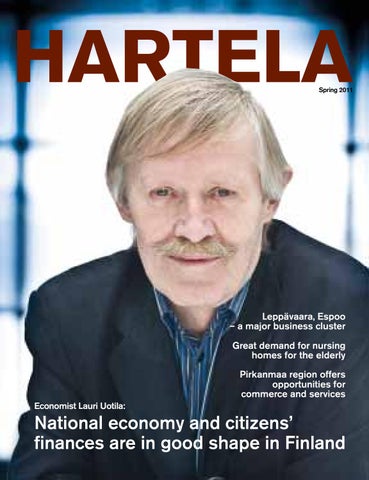
Spring 2011
Leppävaara, Espoo – a major business cluster Great demand for nursing homes for the elderly Pirkanmaa region offers opportunities for commerce and services Economist Lauri Uotila:
National economy and citizens’ finances are in good shape in Finland
E D ITO R iAL
CO NTE NTS
Hartela 2011. Publisher Hartela Group, Kaupintie 2, P.O. Box 32, FI-00441 Helsinki, Finland, tel. +358 (0)10 561 3000, www.hartela.fi Editor-in-Chief Ville Kuusniemi Production Princeps Oy / Kirsti Helin and Sanna Moisio Translation Integra Oy Cover photo Petri Puromies ISSN 1796-4733 Printed by Finepress Oy Correspondence to editors info@hartela.fi
4
Lauri Uotila popularizes the most difficult financial matters
6
Quartetto Business Campus houses large and small companies alike
8
Basware operates in 13 countries
10
Kesko Group expands in the Pirkanmaa region
12
Homelike living environment for the elderly
14
Painiitty – a new village-like housing area close to Helsinki
Professionals deserve appreciation
B
uilders are happy when the snowy winter is over, but as the summer is approaching, we will be faced with the scarcity of resources in the construction industry. Currently, a large proportion of resources are tied up in the production of rental housing. As a result of regulatory measures, new rental flats are being built at an exceptionally rapid pace. The situation on the rental market will be relieved in the short run, but how permanently? There is a danger that a considerable part of the rental flats now under construction will be sold after a few years as allowed by the regulations. That would probably have an effect on the decision-making concerning project initiations within privately financed housing construction. The present trend of increasing control over the construction of commercial premises will decrease the activities of professional project developers. It is true that there have been excesses in the business, but are they
2
really a result of the activities of professionals in the field? We all know that the threshold of entering the construction business is low, meaning that there are many nonprofessionals in the field, and judgements of the entire branch are easily made on the basis of their actions. At the same time, there are large numbers of professionals, those skilled, responsible and innovative developers whose actions have brought about so much good and who have built this country – without making any particular fuss about their work. Is it reasonable to restrict their activities by instituting more and more regulations? Forecasting the future is difficult in an industry that is sensitive to economic fluctuations. A stable production volume would be an advantage for all parties, including consumers. Control measures and rapidly changing regulations governing the construction industry are of no help in an attempt to achieve stable production. Rather than instituting new controls and regulations, it might be more fruitful
to consider how to promote the appreciation of the professionals in the field. Could a higher entry threshold safeguard quality and enhance independent product development? The market would then determine the appropriate production volume, which is our shared goal. This magazine presents some recent examples of professional building. Construction is a happy business, but let’s not forget to enjoy the summer as well!
Kimmo Aspholm Executive Vice President Rakennusosakeyhtiö Hartela
Swing Life Science Center Plus underway in Keilaniemi, Espoo
Marketing of Porvoo Art Factory has started The marketing of the Porvoo Art Factory facilities started at the Congress Fair in Helsinki in April. Lease contracts have already been signed with the following companies: Vuoristo-Yhtiรถt Oy will run the Art Factory main restaurant, Bio Rex Cinemas Oy will operate the Media Center cinema, and Nordic Ravintolat Oy will run the bistro. The Art Factory Congress Centre will open in April 2012. Once completed,
the five-hectare area will provide versatile facilities for arts and culture, conferences and congresses, cinemas and lecture halls, artist studios and galleries, as well as a pedestrian street with special shops, entertainment and restaurants, a grocery store, a hotel, and congress and tourism services. Different types of residential housing will also be built in the area.
A new school at Kangasala The Tampere unit of Hartela is the contractor for a new upper secondary school at Kangasala. The building will be completed by the end of May 2012, thus allowing the school work to begin in August 2012.
Luhta sewing workshop became a shopping centre In Lahti, the former industrial sewing workshop of Luhta is now shopping centre Valo. The opening ceremonies of the new shopping centre were held in March. Situated in the Laune district, the shopping centre has an area of approx. 10,000 m2, and it houses, among others, Asko, Sotka, Hoplop, Lumo by Wellfit and Luhta Outlet.
Modern wooden houses in Uusikaupunki
Construction of Logomo continues in Turku The construction work to render the former engineering workshop of the Finnish Railway company VR into a cultural centre, Logomo, will continue throughout the Turku 2011 Capital of Culture year, and the facilities will be completed in stages. The Logomo Hall, which is currently under construction in the central part of the complex, will be the venue for a major opera production in November 2011. A limited company, Logomo Oy, was founded in March to be responsible for future facilities management and rental activities. Artists can hire workspace in Logomo, but there will also be offices available for long-term use and other rooms for short-term events. Logomo is a central venue for the Capital of Culture events, and its exhibitions and concerts have already attracted over 80,000 visitors during the first quarter of the year.
In the tradition of wooden town houses, a new residential area with wooden houses will be built in Uusikaupunki. The Janhuanniemi area is located by the sea, just about one kilometre from the town centre. A total of 14 detached houses, with areas varying between 100 and 160 m2, are currently under construction by Hartela.
HARTELA
2011
3
N EWS
Swing Life Science Center is being extended by three new office buildings. The first building will be completed during spring 2012. It will contain 5,400 m2 of commercial and office premises for lease. The Swing Life Science Center Plus is prominently located near the Aalto University, Nokia and other high-tech companies.
“Different threats and worst case scenarios are easy to present, but on the whole, the global economy seems to be on a good track. There is no reason to be overly gloomy, ” says Lauri Uotila, Senior Adviser at Sampo Bank.
In Finland, the national economy and citizens’
O
ften named as ‘the best economic prophet in Finland’, Lauri Uotila knows how to put even the most difficult financial issues in plain language. He forecasts that, regardless of the debt crises in Europe, the turmoil in Libya and the catastrophe in Japan, the global economy will continue to grow. The growth is particularly fast in the developing countries, such as China, India and Brazil, and a bit slower in the United States and Europe. “In Greece, Portugal, Ireland, Spain and Italy, the state is massively indebted, but this will not have any great effect on the Finnish economy. Finland is well positioned because our primary trading partners, namely Sweden, Germany and Russia, all have good economic outlooks. In Sweden, the growth is especially rapid, Russia has its oil, and Germany has otherwise managed to fix its economy.” Uotila does not believe in a new bank crisis either, provided that the indebted European states will be able to manage their loans. “If the states went bankrupt, it would shake the entire European banking system. In such a situation, Finnish banks would not be able to lend money to their customers, and it would disturb our own business life.Thus, the issuing of bank guarantees is the best option for Finland,” explains Uotila.
4
“The European Union and the common currency will prevail despite the debt crises. The EU is a result of an integration policy that has been carried out systematically since the 1950s.The European internal market will be of benefit for Finland in the long run. It is probable that the development gradually leads towards a European federation, but there is still a long way to a ‘United States of Europe’.”
Thriving exports even in the construction industry Lauri Uotila is optimistic about Finnish exports: “The traditional metal and forest industries are doing well. Finnish exports took a turn to a rapid rise in 2010,and the growth has continued into the current year. For Nokia, time will show what the outcome of the partnership with Microsoft will be. Fortunately, the role of Nokia in terms of the Finnish economy is no longer as significant as in the 1990s.Today, Finland is increasingly exporting also services, for example, engineering and design for the production in China and India.” “The construction industry is particularly sensitive to economic fluctuations, and in recent years, the branch has anticipated recessions even more swiftly than it used to do. Unfinished sites are easily suspended, but once the recession is over, the work will be
resumed quickly. The branch managed to rise rapidly from a deep pit to a new growth. Housing production has assumed its normal growth track, and there is a high demand for new residences due to the internal migration in Finland.” “Business is also boosted by the export to Russia where the volume of construction is clearly on the increase. In contrast, there are no contracts in Arab countries for Finnish companies visible in the near future.The future reconstruction in Japan will open export prospects for Finnish suppliers of wooden houses. I would imagine that wooden houses withstand earthquakes better than houses made of brick or other similar materials,” Uotila lists.
Super low interest rates start to rise “In Finland, the households’ borrowing is at a reasonable level in comparison to many other European countries, and the super low interest rates make it easier to manage the loans. In view of the present situation, interest rates will inevitably start to rise slowly, but the increases will remain minor, at least during the next couple of years. I assume that the European Central Bank will raise its steering interest rate to 2 per cent early next year, and it will still
photoS: Petri Puromies
“In Finland, things are in good shape. The debt level is low, employment is good, exports are thriving, and people are optimistic and happy,” says Lauri Uotila, one of Finland’s foremost economists.
finances are in good shape be under 3 per cent at the end of 2012. The Euribor rate will be around 3.5 per cent at the end of 2012, which is still a low interest rate level,” says Uotila. “The rising interest rates will, to some extent, hold back the rise of housing prices, but I do not believe that the prices would actually decrease. History has shown that the housing prices will only decrease in a situation where unemployment grows rapidly and interests on loans increase significantly, and no such situation is on the horizon. All signs indicate that unemployment will further decrease in Finland. In February, the unemployment rate was 8.4 per cent, in other words, the employment situation is now much better than it was assumed to be as a result of the recession in 2009. I believe that the unemployment rate will remain at about 7.5 per cent this year.”
Finland is world-class elite In Finland, things are in good shape. The national debt and households’ loans are relatively small, and according to recent surveys, the citizens in Finland are the most optimistic in the world as regards future outlooks. In happiness surveys, we are in the top league worldwide. Lauri Uotila points out that the general
standard of living in Finland has improved enormously: “When compared with other European countries, our standard of living has risen more than anywhere else since the 1970s. Additionally, our public debt is among the lowest in Europe.” “The new Government will have to deal with the challenge of balancing the national and municipal economies in order to avoid expanding indebtedness. It will be necessary to both increase taxes and cut public expenditure. The share of private services should be increased whenever it is the financially more efficient solution.” “Maintaining the welfare state requires consumption so as to keep the wheels of the economy rolling. Sure, it is a good habit to spare some money and not to spend all of one’s income. How to invest the saved money – that is a good question. It is wise to invest in stocks and shares, if you can afford to tie the funds for a long period, like 10–20 years. Looking for instant wins means gambling, and that I would not recommend except for excitement, using small chips. If your life situation allows it, you can enter the stock markets full-time and spend all your days selling and buying. If you don’t have time for that, banks and banking firms will happily offer their expertise,” Uotila advises.
“Real estate investing involves a low risk, especially if you invest in a residence that is easy to rent out and the rent is profitable.Although a real estate investment may yield a safe return, it is not the best alternative in terms of value increase, and you cannot get rich by trading residences in the same way as by trading stocks in the exchange market.”
Popularizing financial matters Lauri Uotila has served as an economist for Sampo Bank for 29 years, and up until last autumn, he was the bank’s Head Economist. “I have no intention of retiring yet. I enjoy doing my job and working together with great colleagues and managers,” says Uotila. “Last year, Economist Pasi Kuoppamäki was appointed Head Economist upon my proposal. I wanted that my junior colleague would know his future career path, rather than waiting for the old man to retire.” “My intention is to continue to analyse topical economic situations and to popularize the issues. I travel around Finland to present financial reviews at various interest group events and seminars. Last year, I gave some 200 economic reviews in different locations, and there were days when I gave three speeches during the same day.”
HARTELA
2011
5
Quartetto Business Campus
– a cluster of 50 enterprises in Leppävaara
I
n Leppävaara, Espoo, the construction of the final, ninth building of the Quartetto Business Campus has started. Once completed in May 2012, the campus will offer business and office premises totalling 53,000 m2 for approximately 50 enterprises. The Quartetto Business Campus is optimally located in terms of traffic and transport, near the Kehä I orbital motorway, the Turku motorway, and the railroad. “The planning of Quartetto originally started in 1999 when we outlined the first sketches for Hartela,” explains Architect Pekka Piha, Managing Director, Arkkitehtitoimisto Larkas & Laine. The first four buildings were constructed in the years 2001–2002, and they were named Violin, Alto, Basso and Cello. In 2003, the business park was extended by building Estrade and Fuuga on the opposite side of Linnoitustie. The next building, Gongi, was built in 2009, and the latest one, Harmonia, in winter 2010. “The name Quartetto has proved to be a good choice, even though at first it sounded slightly strange for a business park. It has been easy to find names for the new buildings from the field of music,” says Pekka Piha. The ninth building currently under construction is owned by OP Life Assurance Company Ltd, and it will be linked by means of a corridor to the adjacent building owned by the same company. The new building will include premises with an area of 5,800 m2.
Timeless and modifiable premises A common feature for all of the Quartetto buildings is their excellent spatial adaptability and leasability, which have made them attractive investment objects as well. The “Timeless architecture and modifiability were the guiding principles in the design of Quartetto, and looking at the buildings completed ten years ago, I’d say we have succeeded very well,” says Pekka Piha, Architect and Managing Director at Larkas & Laine. photoS: Petri Puromies
6
In the southern Leppävaara area, Hartela has built over 100,000 m2 of business premises, currently housing the workplaces of over 5,000 people. The construction work continues with the Säterinkallio and Andante Business Park projects that are planned to be built along the Turku motorway.
owners of the buildings include the Local Government Pensions Institution (Keva), Jenny and Antti Wihuri Foundation, the Finnish Cultural Foundation,Varma Mutual Pension Insurance Company,Tapiola Pension Mutual Insurance Company, the Sonera Pension Fund, the Parish Union of Helsinki, the Central Church Fund of Finland, and OP Life Assurance Company. “Because the plots are of different shapes, the buildings also have varying layouts. In many cases we have been able to influence the shapes and forms of the buildings as early as the land use planning phase,” Pekka Piha explains. “Timeless architecture and modifiability were the guiding principles in the design of Quartetto.The façades are primarily of finewashed white dolomite, silvery metal and glass. Trend colours are only used in fittings and furniture, which are easy to change with lower costs, if needed. In my opinion, we have succeeded in creating timelessness: the first buildings that were completed ten years ago have withstood the passing of time excellently – one might think they were built quite recently.” “The users of the premises have to some extent been involved in planning the facilities, but all in all, the facilities are universally applicable and suit the needs of different types of businesses. During the past decade, some companies have moved out and been replaced by others but it has always been easy to adjust the premises to the new uses and requirements.”
Versatile business services The Quartetto Business Campus provides the enterprises with a full range of services, including reception and office services, restaurants and cafeterias, fully equipped conference rooms of varying sizes, catering services, a sauna department, a gym and physiotherapist services. All services are accessible through a portal, which also serves as the channel for internal communications between the enterprises operating in the buildings.
In each building, the main entrance lobby has a reception desk that serves the in-house enterprises and visitors alike.The receptionists’ duties include, for example, the reception of guests, telephone services, mail handling, safety and security, and other services as requested by the enterprises. KJ-Kiinteistöjohto Oy is responsible for the facilities management of the Quartetto Business Campus, including the administrative, financial and technical management, and it also attends to the overall satisfaction of the enterprises operating in the buildings as well as to the user services.
Leppävaara – a demonstration of partnership With a staff of 59, Larkas & Laine is one of the largest architect companies in Finland.The company has designed dozens of projects for Hartela, not only business and office premises, shopping centres and hotels but also individual residential buildings and entire housing areas. The company’s sales totalled 4.9 million euros in 2010. “During the recession in 2009, the planning of new business properties came to a full stop and our sales went down by 45 per cent. Nevertheless, we managed to get over by means of temporary lay-offs, and in 2010 we reached again the level of sales that prevailed before the recession,” Pekka Piha explains. “The Leppävaara area in Espoo is the most prominent demonstration of our partnership with Hartela: in addition to the Quartetto Business Campus, our joint accomplishments include the buildings for Nokia – totalling over 60,000 m2 – and for 3M Finland and Sony Finland.” “Hartela is a pioneer in business property development in Finland, and together we have gained massive experience in the design of business and office premises,” Piha concludes. Construction work in Leppävaara continues. The Andante Business Park, a complex of three office blocks with a total area of 16,000 m2 is under construction in the Perkkaa area along the Turku motorway.
The final, ninth building will be completed in spring 2012.
The atrium of the Fuuga building.
HARTELA
2011
7
Basware is the best in the world in its field In the course of 25 years, the Finnish software company Basware Corporation has grown into a globally leading supplier of financial process automation solutions.
B
asware is developing into an international service company, and its goal is to become the leading supplier of e-invoicing services worldwide as well.
Headquartered in Finland, Basware has offices in Sweden, Norway, Denmark, the Netherlands, Great Britain, France, Germany, the USA, Australia, India, Russia and Singapore. Basware employs over 1,000
people, of whom 450 are based in Finland. The subsidiary in India has grown to be the second largest unit of the group. Basware’s net sales reached the milestone of 100 million euros in 2010. Nearly 55 per
photoS: Petri Puromies
8
Basware has had its headquarters in Quartetto Business Park for 10 years. cent of the net sales come from foreign operations. The primary growth markets are North America and, in Europe, Great Britain, France and Germany. “Our operations have expanded both through organic growth and acquisitions,” explains Mika Harjuaho, Chief Financial Officer at Basware. “A large part of the personnel in our foreign units is recruited locally, and actually, many of the Finns working abroad have also been recruited on the spot. English is the corporate language, and all essential documentation is drawn up in English.”
Recognition in Finland and internationally Basware has been recognized for its achievements both in Finland and internationally. In 2004, it received the Internationalization Award of the President of the Republic of Finland. Recently, the international Global Finance journal named Basware the best supplier of invoice automation solutions – for the second successive year. In its recent report, Forrester Research, Inc. ranked Basware’s procurement system among the best in the world. Investors have also found Basware. The share price has increased constantly, and in 2010 it rose by as much as 70.1 per cent.The corporation’s market value has exceeded the threshold of the category of medium-sized companies at NASDAQ OMX, and since the beginning of 2011, its shares have been quoted in the mid-size companies market category. Basware has been publicly listed since the year 2000.
Long-term product development In 1997, Basware released a globally pioneering product, the first-ever system for the electronic processing of purchase invoices. Five years later, Basware “In the future, we aim at a strong international growth. In Finland, we have already gained a leading market position,” says Mika Harjuaho, CFO at Basware.
Basware has decorated its headquarters in Quartetto Business Park with several works of art by young artists. In an informal meeting, Office and Travel Manager Hanne Grönlund and Mika Harjuaho.
introduced another innovation: the concept of automated workflow as part of the purchase invoice management system. In 2004, a comprehensive invoice automation solution was launched, including a module for matching invoices with purchase orders. In early 2007, Basware launched a mobile application for invoice approval and in 2009, its 100% E-invoicing Solution as well as its Software as a Service (SaaS) solution specifically intended for medium-sized businesses. In the future, Basware aims to become the globally leading supplier of e-invoicing solutions. International market survey institutes have estimated that the share of electronic invoicing is within the range of 5–20 per cent in different countries worldwide. Finland is in the frontline of electronic invoicing. According to TIEKE Finnish Information Society Development Centre, more than 200 million invoices are transmitted between Finnish enterprises annually, and some 35 percent of them are e-invoices. In Finland, the adoption of e-invoicing has been boosted, among other things, by the fact that State agencies have no longer accepted paper invoices since the beginning 2010. Basware is investing in the development of e-invoicing services especially in the European and North American markets.The goal is to reach the milestone of 100 million e-invoices by the year 2014.
Pleasant headquarters in Quartetto Basware has had its headquarters in one of the Quartetto Business Park buildings in Leppävaara, Espoo for 10 years, that is, since the completion of the building. “We have been able to adjust the facilities
to meet the needs of increasing personnel. We have also managed to lease additional space when other companies have moved out of the building. Currently, we have the entire five-storey tower at our disposal. The premises are now optimal for our operations with, for example, the conference rooms conveniently arranged on the same floor. I believe that the increased work space and the relevant modifications have contributed to the high level of work satisfaction among our personnel,” states Mika Harjuaho. Quartetto is optimally located, whether you come by train, bus, car or bicycle from whichever direction. The business park offers daily services, such as guest reception, auditorium services, and cafeterias and restaurants. There is also a gym available for the personnel. The nearby shopping centre, Sello, offers an abundance of services.
The Art of Basware Basware’s premises are decorated by numerous works of art, making the milieu more attractive and pleasant. The works are by young artists who have taken part in the Art of Basware competitions. Arranged annually since 2000, the competition has gained a good standing among young visual artists and art schools. In 2010, a total of 200 candidates with 550 works took part in the competition. The Art of Basware 2011 competition is currently running under the theme ‘Courage’. The top works will be displayed in an exhibition to be held on June 1–11, 2011 at Sanomatalo, Helsinki. The exhibition is an opportunity for the public to purchase works of promising young artists.
HARTELA
2011
9
The growing Pirkanmaa region offers opportunities for commerce and services Second only to the Helsinki metropolitan area, the Pirkanmaa region is the most prominent growth centre in Finland. The region has approximately 450,000 residents, of whom 350,000 live in or near the City of Tampere, and the estimated migration to the region is 90,000 by the year 2030.
“T
ampere is an old industrial city, and the share of trade and commerce is smaller than the average in Finland. The services sector is undersupplied in Pirkanmaa, which creates excellent opportunities for developing the share of commerce and services,” states Jari Alanen, District Director at Kesko Group. Jari Alanen says that, although trade and commerce are currently undergoing a transition, Finland has excellent operating conditions for businesses in the retail and service sectors. “Regardless of the increasing e-commerce, people still want to shop locally and deal with local service providers. Operating through multiple channels is the
key to success, especially in the retail of special goods. Kesko pursues to reinforce the competitiveness of the utility goods trade by developing the existing online stores and electronic services, and by opening new ones.”
Make a career as a K-shopkeeper With the exception of Anttila department stores, Budget Sports stores and the Citymarkets’ utility goods departments, all Kesko stores are operated by independent shopkeepers. “Entrepreneurial shopkeepers are Kesko’s asset. Customers like it when their local shop is run by a familiar shopkeeper who attends to the selection and guarantees the quality of service. Shopkeepers can, for
example, decide independently on the share of foods that come from local producers,” explains Jari Alanen. “In the Pirkanmaa region, there is potential for future K-shopkeepers. The individual starting points vary: young people may enter Kesko’s shopkeeper training right after leaving school, or it is possible for, say, a bank manager to make a career change after an intensive training. Normally, shopkeepers start their careers from a smaller store and proceed to managing larger units, but there are also entrepreneurs who have started directly as managers of a Citymarket or a larger K-rauta hardware store. The basic shopkeeper training takes 6–18 months, depending on the student’s background.”
Tom Olli at Hartela and Jari Alanen at Kesko work in close co-operation for new shopping centre projects. The next implementations include a Citymarket driven shopping centre in Valkeakoski, and the Tesoma shopping centre in Tampere is currently on the designer’s table. photoS: MERJA OJALA
10
Kesko has developed, in co-operation with certain universities of applied sciences, a study module that introduces students to the world of retail trading and provides training for the career of a self-employed shopkeeper. The study module is currently offered at 15 universities of applied sciences. Since the 1950s, Kesko’s own institute for professional training, K-instituutti, has provided both basic training for future K-shopkeepers and tailored courses in customer service, selling, leadership, personnel management, financial administration and communications.
Fragmented demand Over the past decade, grocery store selections have changed to better meet the fragmented demand. People appreciate different aspects: tradition, convenience, healthy food, organic food, local food, locally baked bread, service counters and so on. The larger the selection, the more space is required. The K grocery stores focus on excelling in their fruit, vegetable, bread, meat, fish and ready-to-eat meal selections, as well as products with the Pirkka brand label. “A small shop has limited space, so it cannot offer everything for everyone. To ensure efficient operations, extensive selections and affordable prices, the larger grocery stores should have an area of 3,500 m2 as a minimum,” Jari Alanen points out. “The development of a store is always based on the needs of customers in order to serve them in the best possible manner. People want to do their daily shopping at a nearby store, and concentrate their weekend shopping and other major purchases at supermarkets where they can buy everything at the same time.The demand for local services will grow along with the increasing number of single and elderly people. For us to be able to offer alternative options, we need both local shops and large-scale units.” “It is the customers who determine the future of shops through their shopping behaviour. A population of 4,000–5,000 people is needed even for a small grocery store to remain profitable,” Alanen reminds.
The location matters Finland’s new land use and construction legislation means more regulations as regards the location and construction of premises for trade and commerce. The intent of the new law is to support shopping in city centres. “But do we really want to have, for example, large hardware stores in city centres, with all the builders blocking the traffic with
Kesko IN Pirkanmaa Kesko Group has currently a total of 142 stores in the Pirkanmaa region; of them, 90 are grocery stores and the rest are different special stores, including K-rauta and Rautia hardware stores, K-maatalous agricultural stores, Intersport, Kesport and Budget Sport stores, Musta Pörssi consumer electronics stores, K-kenkä and Andiamo shoe stores, and Kodin Ykkönen and Anttila department stores. The total sales of the Kesko stores in Pirkanmaa exceeded 800 million euros in 2010, and Kesko employs approximately 3,000 persons in the region.
“Establishing a new location is a long process, so we need to have several projects on the drawing table at all times,” says Jari Alanen, District Manager at Kesko.
their trailers and bulky loads?” asks Jari Alanen. Kesko Group aims at continued expansion of the network of hardware store locations. In city centres, the costs of space-taking retail trade would be higher because of the higher land prices. Night-time logistics in central locations is not a simple matter either, and it is expensive to construct parking areas for the customers. “The rising costs would inevitably be transferred to the prices of products. Trade and commerce should be allowed to compete on its own terms, instead of being excessively regulated by legislation. The rules of the game are necessary, of course,” Alanen continues. Jari Alanen serves as the chairman of the Finnish Council of Shopping Centers, and he emphasizes that the customers should have the opportunity to do shopping and use public services under the same roof at one stop. It would make it easier and faster to attend to errands, and it would also be more ecologic.
In co-operation with the builder Establishing a new store is a long process that starts with market surveys and profitability analyses. One must consider carefully the future of a potential new store after 15 years. City planning and its multiple phases will also take time. So, it may take several years to start even a small shop. Kesko and Hartela have a long history of partnership in building shopping centres and stores all around Finland. “An individual project may be initiated by Kesko or by Hartela. In shopping centre and commercial centre initiatives, a Kesko grocery store serves as an engine and contributes to the success of
the project. We work in close co-operation that involves not only project planning and development but also many other matters,” explains Tom Olli, Tampere Area Manager at Hartela. “From the perspective of future commercial operations, it is important to start the co-operation with the builder as early as possible, preferably before the actual planning phase. Our co-operation with Hartela has worked well. The contact threshold is low, and any questions are answered quickly,” says Jari Alanen. In the Pirkanmaa region, the next shopping centres driven by a Kesko store will be built in Valkeakoski and in Tesoma, Tampere. A new shopping centre totalling approximately 9,950 m2 will be built in central Valkeakoski. In addition to a Citymarket, it will house a number of special retailing stores. It will be completed during the year 2012. Tesoma is a suburban area located approximately 8 kilometres away from central Tampere.The project involves the integration of three existing commercial properties into a shopping centre and the construction of additional premises for both commercial and public services. The total area of the shopping centre will be around 25,000 m2, and it will house a large grocery store and an additional 40 other retail shops.The first phase is expected to be completed in 2013. “We must have several new project embryos in planning at all times to ensure their prompt implementation after the long planning phases and statement procedures. At present, we have a few store projects on the drawing table,” Alanen explains.
HARTELA
2011 11
Municipalities obliged to provide care for elderly people and to give up hospital-like institutions
Great demand for nursing homes
“T
here is a huge demand for nursing homes for elderly people. The timetables set by the latest recommendations for dissolving hospital-like, institutional care for the elderly would require the construction of 4,000 nursing-home residences per year.The current construction volume is maximum 2,000 residences per year,” explains Tuomas Terho, Facilities Management Manager, Attendo MedOne Ltd. The operating idea of Attendo MedOne’s nursing homes is to provide a good living environment for elderly people. The
12
company has built a total of 15 nursing homes in various locations in Finland, and another 15 are under planning or construction. The newest nursing home opened in Hirvensalo, Turku in early April. The nursing homes provide the residents a homelike, safe and active living environment. In addition to accommodation, they offer catering as well as diverse health-care and rehabilitation services. The residents are encouraged to do things together, and if they wish, they can take part in, for instance, preparing meals or baking. “In order to be able to deliver care
and support for the elderly 24/7, a nursing home for 60 residents employs a staff of 36 working in three shifts.We also have doctors for small-scale medical services. The mean age of our residents is about 85 years.” According to Terho, recruiting employees to work at Attendo MedOne’s nursing homes is easy. “At best, one nursing home received over 400 job applications. We have roughly the same pay level as the branch in general, but the new and well functioning premises of our nursing homes are attractive, as is also the fact that we pursue to continuously develop our operations.”
“In order to get rid of the institutionalized care of the elderly by the year 2015, a total of 4,000 nursing-home residences should be constructed per year,” says Tuomas Terho, Facilities Management Manager, Attendo MedOne Ltd. Nursing homes offer homelike living and a wide range of nursing and care services.
All residents have rooms of their own “Typically, our nursing homes are designed for 60 residents, who all have their own private rooms. Each room has an area of 20 m2, a bathroom and a built-in wardrobe. The room is furnished with a hospital bed, which is important for both the resident’s wellbeing and the nursing staff ’s ergonomics. The residents’ own pieces of furniture, paintings and other personal internal decoration make the rooms homelike,” explains Tuomas Terho. Attendo MedOne’s own interior designer has designed a consistent colour scheme for the private and common rooms, and also the pleasant lightning for all rooms. In all of the nursing homes, the common rooms are furnished with furniture manufactured by the same Ostrobothnian factory. The nursing home consists of four group homes for 15 persons each, which are categorized according to the health status and general condition of the residents. There are specific arrangements for the demented and patients in need of terminal care. The group homes have glazed balconies and common yards for the residents’ shared use. In the large yards, there are physical exercise equipment and other stimulating facilities that are specifically designed for elderly people. To make the nursing home and its operations better known, the neighbourhood can be invited to, for example, a coffee party in the yard.
Building costs and living expenses “The building of a nursing home costs us approximately 100,000 euros per resident. Currently, the national average of building
costs is approx. 130,000 euros.Thanks to our systematic product development, we have been able to keep the costs at a reasonable level.There are no extraordinary decorations or monumental elements in the buildings; rather, we invest in high-quality solutions and pleasant, homelike premises. Small things, such as colours, can make a difference at a low cost,” explains Tuomas Terho. The nursing home rents vary between 300 and 550 euros per month, depending on the location, and the residents are entitled to the housing allowance granted by the Social Insurance Institution (Kela). The catering and nursing services cost the municipalities approximately 100 euros per day for each resident. The nursing home is usually owned by the municipality, or by a private real-estate investor that leases the facilities to Attendo MedOne which, in turn, provides the nursing services. Attendo MedOne is the leading provider of outsourced social and health care services in the Nordic countries, employing about 4,000 people in Finland and about 7,000 in Sweden.
Prefabricated modules Up to date, Hartela has built seven nursing homes for Attendo MedOne: two in Kuopio and one in Raasepori, Kempele, Kokkola, Hämeelinna and Turku. In March 2011, Hartela started the construction of a nursing home in Lohja. Hartela utilizes prefabrication for building the nursing homes. A standard nursing home is to a large extent constructed at Hartela’s element factory in Rauma. The
prefabricated bathrooms are complete with tiling and fittings. The individual room and bathroom modules are transported to the site, and only the mid-section of the nursing home is constructed on-site. Finally, the complex is finished with external brickwork or plaster. “One of the advantages of prefabricated modules is that the construction work can be carried out in optimal circumstances indoors, thus avoiding problems with moisture, and material wastage is minimized. The site itself will remain clean and there is little need to transport waste from the site,” explains Terho. “Hartela is an excellent partner for us. Our co-operation is smooth, and they are very flexible and helpful in their operations. The contact persons have been the same in all projects, and the dialogue has been open in both directions.” “It takes 10–12 months to build a nursing home, depending on the location and terrain. Keeping to the schedules is vital, since the residents will move in according to a timetable set in advance.” Attendo MedOne’s nursing homes are much sought-after, and they are usually filled within six months. According to a survey carried out among the residents, their families and the staff members, all parties have been satisfied with the nursing homes. “Through the survey we received good ideas and comments enabling us to further develop the new nursing homes still under construction. The survey also showed that some residents had initially been reluctant to move into a nursing home, but once they had lived there for a while, they would no longer move out to live elsewhere.”
HARTELA
2011 13
Painiitty – a new village-like community in natural surroundings close to Helsinki
A
new village-like housing area is being built in Painiitty, Espoo, only some 10 kilometres from central Helsinki. The area will offer a wide range of residential options, recreational areas in natural surroundings, and public services. The 46-hectare area has been preserved as a natural island surrounded by the suburbs of Lintuvaara, Konala and Uusmäki, thus linking the cities of Espoo, Helsinki, and Vantaa. The landscape consists mainly of fields and meadows that used to be cultivated but now grow bushes and trees, but there are also rocky hills and high cliffs with leafy groves underneath. Painiitty will turn into ‘our village’, a living area for around 2,000 residents.The idea is to leave about one half of the land unconstructed, thus creating a wide green belt within the area. The recreational facilities including illuminated jogging and skiing tracks will offer pleasure in natural surroundings for both the future Painiitty residents and people living in the vicinity.
Earth-heated townhouses During the course of the next 5–7 years, Hartela will build homes with a total area of approximately 80,000 m2. Additionally, approx. 10,000 m2 of premises for public services will be built in Painiitty. The homes are mainly two-storey
townhouses, semi-detached or terraced houses. In the middle of the area, there will be three quarters of blocks of flats with 3 or 4 storeys, and one of them will offer right-ofoccupancy housing for elderly people. The first 20 townhouses will be completed in summer 2011. Homes are currently for sale in the housing companies entitled Painiitynportti and Heikunankulma. All of the houses will be earth-heated. For this purpose, a geothermal field with deep drilled boreholes is constructed on the land owned by the housing companies. In test drillings, the ground was found to be suitable for earth heating, which is an excellent solution for the water-circulating floor heating system of the houses. This is up to date the most extensive earth heating system in Espoo. In the pilot area, VTT Technical Research Centre of Finland and GTK Geological Survey of Finland were involved in the examination of the heat conductivity of the ground. It is believed that earth heating will in the long run be a system less expensive for the residents than district heating.
Planning started from residential wishes In the initial planning phase of the Painiitty area, extensive background research was
carried out in order to find out what people actually hope for and desire as regards their home and neighbourhood. The area is now being built to meet these wishes: there is plenty of space, sufficient playgrounds and a short distance to jogging tracks. The homes are designed to be easily adaptable for different types of families. The aim is to create – in the Helsinki metropolitan area – a community with a “this is our village” spirit, where people know each other and are able to enjoy the benefits of village life, such as safety, a pleasant environment and natural surroundings.
Independent, diversified Hartela HARTELA GROUP STATISTICS 2011
DID YOU KNOW THAT
Net sales forecast MEUR 370 Personnel 1,100 Founded 1942
• • • • •
St. Petersburg oscow
Kharkov
firstname.lastname@hartela.fi premises@hartela.fi www.hartela.fi
Hartela is a limited company, established in 1942. Hartela is one of the top ten construction companies and real estate developers in Finland. Hartela´s Finnish operations cover the entire country, with offices in Helsinki, Turku, Tampere, Lahti, Oulu, Rauma and Tammisaari. Hartela has foreign offices in Moscow, St. Petersburg and Kharkov. Hartela has diversified its operations through acquisitions and is one of the largest providers of building services in Finland.
Painiitty has excellent public transport connections in all directions thanks to the nearby Kehä I orbital motorway, the Leppävaara railway station, and the bus line running through the area. There is also an extensive network of pedestrian and cycle paths for convenient moving around. The area will offer commercial and public services, including a school and kindergarten.The larger shopping centres of Sello in Leppävaara and Ristikko in Konala are located just a couple of kilometres away. The Painiitty area was designed in cooperation with the architect company Arkkitehtitoimisto Larkas & Laine. RAKENNUSOSAKEYHTIÖ HARTELA Kaupintie 2, P.O. Box 32, FI-00441 HELSINKI tel. +358 (0)10 561 3000 fax +358 (0)10 561 3001
HARTELA OY Läntinen Rantakatu 53, P.O. Box 623, FI-20101 TURKU tel. +358 (0)10 561 2000 fax +358 (0)10 561 2001
HARTELA-FORUM OY Kasarmintie 23, P.O. Box 55, FI-90101 OULU tel. +358 (0)10 561 2600 fax +358 (0)10 561 2601
Lahti Regional Office Vesijärvenkatu 31 c, FI-15140 LAHTI tel. +358 (0)10 561 3300 fax +358 (0)10 561 3301
Rauma Regional Office Seminaarinkatu 5, FI-26100 RAUMA tel. +358 (0)10 561 2700 fax +358 (0)10 561 2701
HARTELA TALOTEKNIIKKA OY HARTELA BUILDING SERVICES LTD Kaupintie 2, P.O. Box 32, FI-00441 HELSINKI tel. +358 (0)10 561 3000 fax +358 (0)10 561 3001
Hartela Kiinteistömarkkinointi Oy Kaupintie 2, P.O. Box 32, FI-00441 HELSINKI tel. +358 (0)10 561 3200 fax +358 (0)10 561 3001 O. Salonen Oy Kaupintie 2, P.O. Box 32, FI-00441 HELSINKI tel. +358 (0)10 561 3000 fax +358 (0)10 561 3001
Tammisaari Regional Office Viherlehdonkatu 8, FI-10600 TAMMISAARI tel. +358 (0)10 561 2200 fax +358 (0)10 561 2201 Tampere Regional Office Hämeenkatu 31 A, FI-33100 TAMPERE tel. +358 (0)10 561 2500 fax +358 (0)10 561 2501 Hartela Kiinteistömyynti Oy Läntinen Rantakatu 53, P.O. Box 623 FI-20101 TURKU tel. +358 (0)10 561 2100 fax +358 (0)10 561 2001
Saipu Oy Lansantie 23, FI-02630 ESPOO tel. +358 (0)10 561 3830 fax +358 (0)10 561 3831 HT-Sähköpalvelu Oy Arentitie 5, FI-00410 HELSINKI tel. +358 (0)10 561 3500 fax +358 (0)10 561 3601 Turun Valo ja Voima Oy Hiidenkatu 9, FI-20360 TURKU tel. +358 (0)10 561 2900 fax +358 (0)10 561 2901