FI N P R IN
Rising cancer drug costs
L
The next phase of CAR T
A T IS S U E
Prime Therapeutics Report | Fall 2026
Breast cancer updates
SP EC I A LTY S O LU TI O N S FO R MANAG ED CARE
Prime Therapeutics FALL 2026
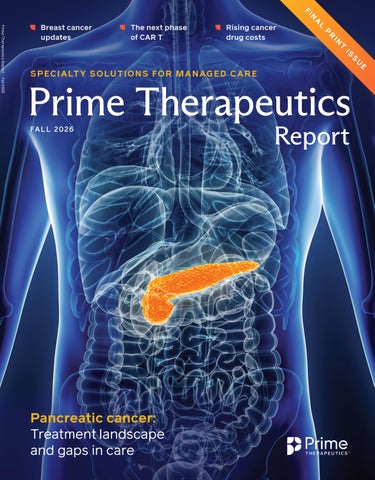
Pancreatic cancer: Treatment landscape and gaps in care
Report
The next chapter is digital Beginning in 2027, the Prime Therapeutics Report will be published digitally each spring and fall. Twice a year, you’ll get comprehensive reports on the pharmacy and healthcare topics shaping our industry, all with the timely insights and perspectives you expect.
Make sure you never miss a future edition. Subscribe today
The PBM that stands for
Purpose Beyond Margins
Prime Therapeutics (Prime) believes cost, convenience and access are more important than our bottom line. And we don’t hide behind complexity. Instead, we pass savings back to our customers so they can invest in better care. With Prime as your PBM, you get clear, compassionate support that puts your people first. Experience the difference at ReimaginePBM.com
Published By Prime Therapeutics 2900 Ames Crossing Road Eagan, MN 55121 PrimeTherapeutics.com Editor Lindsay Speicher, J.D. Sr. Project Manager, Specialty Lindsay.Speicher@PrimeTherapeutics.com
Contents 4
Advertising, Sales and Distribution Lindsay Speicher, J.D. Sr. Project Manager, Specialty Lindsay.Speicher@PrimeTherapeutics.com
TRADITIONAL APPROVALS AND WITHDRAWALS
14
SVP, Sales and Business Development, Specialty Joe.Tavares@PrimeTherapeutics.com
Steve Cutts, PharmD SVP, Specialty and Clinical Solutions
Pancreatic cancer PERSISTENT UNMET NEED AND THE PROMISE OF RAS-TARGETED THERAPY
Joe Tavares
Contributors
Oncology accelerated approval update
21
Breast cancer TREATMENT LANDSCAPE AND PIPELINE
Haita Makanji, PharmD VP, Clinical Strategy and Innovation, Specialty
Joe Tavares SVP, Sales and Business Development, Specialty
Abby Kim, PharmD, BCOP
30
The next phase of CAR T EXPANDING INDICATIONS AND EMERGING FRONTIERS
Clinical Oncology Pharmacist Senior Principal
Caroline Quinn, PharmD, BCOP Special Clinical Program Director
Shelae Cheng Marketing Principal, Brand Marketing Strategy
Brian MacDonald, PharmD
39
MANAGEMENT IN THE ERA OF AI
Sr. Director, Specialty Clinical Strategy and Programs
Editorial Advisory Board Dennis Bourdette, M.D., FAAN, FANA Chair and Roy and Eulalia Swank Family Research Professor, Department of Neurology, Oregon Health & Science University
Yousaf Ali, M.D., FACR Chief, Division of Rheumatology, Mount Sinai St. Luke's and Mount Sinai West Professor of Medicine, Icahn School of Medicine at Mount Sinai
Rising cancer drug costs
44
Subcutaneous oncology biologics WHAT UTILIZATION AND ALLOWED AMOUNT DATA REVEAL
52
Pipeline
Steven L. D’Amato, B.S.Pharm. Founding Partner, Scientia Pharmacy Advisors
Joseph Mikhael, M.D., M.Ed., FRCPC, FACP Chief Medical Officer, International Myeloma Foundation
Steve Marciniak, RPh President, ClarityRX
Saira A. Jan, M.S., PharmD VP and Chief Pharmacy Officer, Horizon Blue Cross Blue Shield of New Jersey
The content of Prime Therapeutics Report — including text, graphics, images and information obtained from third parties, licensors and other material (“content”) — is for informational purposes only. The content is not intended to be a substitute for professional medical advice, diagnosis or treatment. Prime Therapeutics Report does not verify any claims or other information appearing in any of the advertisements contained in the publication and cannot take responsibility for any losses or other damages incurred by readers in reliance on such content. Developed by D Custom. All brand names are property of their respective owners.
© 2026 Prime Therapeutics LLC
ISSN: 2159-5372
10444M
A note from our SVP Dear managed care colleagues, Welcome to the fall 2026 issue of the Prime Therapeutics Report. We’re dedicated to bringing our readers valuable updates in managed care trends. In our 2026 oncology issue, we focus on trends in oncology treatment and management. This issue’s cover story (Page 14) explores advances in pancreatic cancer treatment and discusses the unmet need in this category and the promise of RAS-targeted therapy.
This issue also includes a discussion of expanding indications and frontiers in CAR T therapy, subcutaneous oncology biologics and oncology accelerated approvals. An oncology pipeline rounds out the issue. To learn more about how we’re supporting transformative payer initiatives, feel free to contact us at PTReport@PrimeTherapeutics.com. As always, we value any feedback you may have. Enjoy the report!
Another article (Page 39) focuses on the rising cost of cancer drugs and management in the era of artificial intelligence.
Sincerely,
In another article (Page 21), we discuss the shifting treatment landscape and pipeline for breast cancer, specifically focusing on precision medicine and targeted treatments.
Steve Cutts, PharmD
Senior Vice President, Specialty and Clinical Solutions Prime Therapeutics
Subscribe today! Stay on top of managed care trends and become a Prime Therapeutics Report subscriber. Subscribe today at www.PrimeTherapeutics.com/Prime-Therapeutics-Report-Subscription. Prime Therapeutics Report provides pharmacy and medical management solutions for managed care executives and clinicians. We hope you enjoy the issue. Thank you for reading.
PRIMETHERAPEUTICS.COM | 3
Oncology accelerated approval update Traditional approvals and withdrawals Approval through the U.S. Food and Drug Administration (FDA) accelerated approval pathway is conditional, and traditional approval depends on results from a required confirmatory trial verifying actual clinical benefit. Table 1 shows the new oncology drugs approved via the accelerated approval pathway since our fall 2025 update.1
Lindsay Speicher, JD Senior Project Manager, Specialty Prime Therapeutics
Traditional approvals The FDA grants traditional approval to drugs previously approved via the accelerated approval pathway upon completion of a confirmatory trial demonstrating clinical benefit. Table 2 outlines the oncology accelerated approval drugs that have received traditional approval since the fall 2025 update.2
Selpercatinib (Retevmo) In July 2026, the FDA granted traditional approval to selpercatinib (Retevmo) for adult and pediatric patients age 2 and older with locally advanced or metastatic solid tumors with a RET gene fusion as detected by an FDA-approved test, that have progressed or on following prior systemic treatment or who have no satisfactory alternative treatment options.3 Efficacy data from the multicenter, open-label, multicohort trial (LIBRETTO-001) supported Retevmo’s approval.4 The trial included 75 patients with RET fusion-positive tumors other than non-small cell lung cancer and thyroid cancer with disease progression on or following prior systemic treatment or who had no satisfactory alternative treatment options.4 Overall response rate (ORR) and median duration of response were 47% and 24.5 months, respectively.4 Tumor types with responses included colorectal, pancreatic adenocarcinoma, salivary, soft tissue sarcoma, cholangiocarcinoma, carcinoma of the
4 | PRIME THERAPEUTICS REPORT | FALL 2026
Table 1. Current oncology accelerated approvals awaiting traditional approval1 Drug
Accelerated approval indication
Accelerated approval date
Project completion
iberdomide (Zenbexus)
In combination with daratumumab and hyaluronidasefihj and dexamethasone, for the treatment of adult patients with MM who have received at least one prior line of therapy including a proteasome inhibitor and an immunomodulatory agent
8/13/2026
5/31/2028
sevabertinib (Hyrnuo)
Treatment of adult patients with locally advanced or NSCLC whose tumors have HER2 TKD activating mutations, as detected by FDA-authorized test
9/09/2026
10/31/2029
camizestrant (Etcamah)
In combination with abemaciclib, palbociclib or ribociclib for the treatment of adult patients with HR+, HER2-, locally advanced or metastatic breast cancer upon detection of ESR1 mutation during aromatase inhibitor and CDK4/6 inhibitor therapy, based on an FDA-authorized test
9/04/2026
9/30/2028
vusolimogene oderparepvec-wtpg (Tudriqev)
In combination with nivolumab for treatment of adult patients with unresectable advanced cutaneous melanoma who experienced disease progression with a PD-1-blocking antibody-based regimen
8/06/2026
3/31/2031
sonrotoclax (Beqalzi)
Treatment of adult patients with relapsed or refractory MCL after at least two lines of systemic therapy, including a BTK inhibitor
5/13/2026
9/30/2030
zongertinib (Hernexeos)
Treatment of adult patients with unresectable or metastatic non-squamous NSCLC whose tumors have HER2 (ERBB2) TKD activating mutations, as detected by an FDAauthorized test
2/26/2026
11/30/2029
sevabertinib (Hyrnuo)
Treatment of adult patients with locally advanced or metastatic non-squamous NSCLC whose tumors have HER2 (ERBB2) TKD activating mutations, as detected by an FDA-approved test, and who have received a prior systemic therapy
11/19/2025
10/31/2029
Bruton’s tyrosine kinase (BTK); human epidermal growth factor receptor 2 (HER2); hormone receptor (HR); mantle cell lymphoma (MCL); multiple myeloma (MM); non-small cell lung cancer (NSCLC); programmed cell death-1 (PD-1); tyrosine kinase domain (TKD)
skin, unknown primary, breast, bronchial carcinoid, ovarian, small intestine and neuroendocrine (including pancreatic).4 LIBRETTO-121 evaluated efficacy in pediatric and young adult patients with locally advanced refractory RET fusion-positive solid tumors who were unresponsive to available therapies or had no standard systemic curative therapy available.5 The following patients had observed responses: one patient with congenital infantile fibrosarcoma, one patient with spindle cell sarcoma, and in patients with RET fusion-positive thyroid cancer.5 Prescribing information includes warnings and precautions for hepatotoxicity, interstitial lung disease/pneumonitis, hypertension, QT interval prolongation, hemorrhagic events, hypersensitivity, tumor lysis syndrome, risk of impaired wound healing, hypothyroidism, embryo-fetal toxicity, and slipped capital femoral epiphysis/slipped upper femoral epiphysis in pediatric patients.3
For adult and adolescent patients age 12 and older, the recommend selpercatinib dose based on body weight is 120 mg orally twice daily for patients less than 50 kg and 160 mg orally twice daily for patients 50 kg or greater.3
Nivolumab (Opdivo) The FDA granted traditional approval to nivolumab with doxorubicin, vinblastine and dacarbazine (AVD) in March 2026 for the two indications in adults with relapsed or refractory classical Hodgkin lymphoma (cHL): after autologous hematopoietic stem cell transplantation (HSCT) and brentuximab vedotin, and after three or more lines of systemic therapy that includes autologous HSCT.6 Nivolumab in combination with AVD was evaluated in Study CA209-8UT, a randomized, open-label, multicenter trial in 994 patients age 12 and older with
PRIMETHERAPEUTICS.COM | 5
ONCOLOGY ACCELERATED APPROVAL UPDATE
previously untreated Stage III and Stage IV cHL.7 Patients were randomized to receive nivolumab plus AVD or brentuximab vedotin plus AVD.7 Progression-free survival (PFS) was superior in the nivolumab arm compared to the brentuximab vedotin arm.7 After a median follow-up of 36.7 months, there were 1.8% deaths in the nivolumab arm compared to 3.4% in the brentuximab vedotin arm.7 In the nivolumab arm, serious adverse reactions occurred in 39% of patients and immune reactions occurred in 9%.6 The recommended nivolumab dose is 240 mg (for adults and pediatric patients weighing > 40 kg) or 3 mg/ kg (for pediatric patients weighing < 40 kg), administered intravenously in combination with AVD on Days 1 and 15 of each 28-day cycle for up to six cycles.6
Teclistamab (Tecvayli) In March 2026, the FDA granted traditional approval for teclistamab (Tecvayli) as monotherapy in adults with relapsed or refractory multiple myeloma who have received at least four prior lines of therapy, including a proteasome inhibitor, an immunomodulatory agent and an anti-CD38 monoclonal antibody.8 Teclistamab was evalulted for efficacy in the MajesTEC-3 randomized, open-label, multicenter trial.9 Five hundred and eightyseven patients were randomized to receive either teclistamab and daratumumab hyaluronidase-fihj or the investigator’s choice (daratumumab, pomalidomide and dexamethasone, or daratumumab, bortezomib and dexamethasone).9 Median PFS was not reached in the teclistamab arm and was 18.1 months in the investigator’s choice arm. Median overall survival (OS) was not reached in either arm.9 Teclistamab’s prescribing information includes a boxed warning for life-threatening or fatal cytokine release syndrome and neurologic toxicity, including immune effector cell-associated neurotoxicity (ICANS).8 The treatment is available through a restricted program under a Risk Evaluation and Mitigation Strategy.8 The most common side effects associated with teclistamab (in combination with daratumumab hyaluronidase-fihj) include hypogammaglobulinemia, upper respiratory tract infection, cough, diarrhea, musculoskeletal pain, COVID-19 infection, pneumonia, injection site reaction, fatigue, pyrexia, headache, nausea, gastroenteritis and decreased weight.8
6 | PRIME THERAPEUTICS REPORT | FALL 2026
Encorafenib (Braftovi) The FDA granted traditional approval to encorafenib in combination with cetuximab and fluorouracil-based chemotherapy for the treatment of adult patients with metastatic colorectal cancer (CRC) with a BRAF V600E mutation, as detected by an FDA-authorized test.10 BREAKWATER was a randomized, active-controlled, open-label, multicenter trial in patients with treatmentnaïve, BRAF V600E mutation-positive metastatic CRC, as detected using Qiagen’s Therascreen BRAF V600E RGQ PCR Kit.11 The Phase 3 portion of BREAKWATER initially randomized patients 1:1:1 to one of the following three arms: encorafenib orally once daily with cetuximab IV infusion every two weeks (experimental, Arm A); encorafenib orally once daily with cetuximab IV infusion every two weeks and mFOLFOX6 every two weeks (experimental, Arm B); or mFOLFOX6 or FOLFOXIRI (both every two weeks) or CAPOX (every three weeks), each with or without bevacizumab (control, Arm C).11 Randomization was then limited to Arm B and Arm C, and a new cohort, Cohort 3, was initiated with the following treatment arm: encorafenib orally once daily with cetuximab IV infusion every two weeks and FOLFIRI every two weeks (experimental, Arm D); or FOLFIRI every two weeks, with or without bevacizumab (control, Arm E).11 Median PFS was 12.8 months and 7.1 months in Arms B and C, respectively. Median OS was 30.3 months and 15.1
an androgen receptor pathway inhibitor they had not previously received or docetaxel.13 A statistically significant improvement in radiographic PFS (rPFS) was demonstrated in the rucaparib arm compared to treatment of physician’s choice in patients with BRCAm and in the overall population.13 For patients with BRCAm, median PFS was 11.2 months and 6.4 months in the rucaparib and physician’s choice arms, respectively.13 Median OS was 23.2 months for the rucaparib arm and 21.2 months for the physician’s choice arm.13 Rucaparib’s prescribing information includes warnings and precautions for myelodysplastic syndrome/acute myeloid leukemia and embryo-fetal toxicity.12 The recommended dose is 600 mg (two 300 mg tablets) taken orally twice daily, with or without food, for a total daily dose of 1,200 mg until disease progression or unacceptable toxicity.12
Pirtobrutinib (Jaypirca) months in both arms, respectively.11 For the Cohort 3 portion of BREAKWATER, ORR was 64% in Arm D and 39% in Arm E.11 Encorafenib comes with warnings and precautions for new primary malignancies, tumor promotion in BRAFwild-type tumors, cardiomyopathy, hepatotoxicity, hemorrhage, uveitis, QT prolongation and embryo-fetal toxicity.10 The recommended encorafenib dose is 300 mg orally once daily in combination with cetuximab and mFOLFOX6 or in combination with cetuximab and FOLFIRI until disease progression or unacceptable toxicity.10
Rucaparib (Rubraca) In December 2025, the FDA granted traditional approval to rucaparib (Rubraca) for adults with deleterious BRCA mutation (BRCAm)-associated metastatic castrationresistant prostate cancer (mCRPC) previously treated with an androgen receptor-directed therapy.12 Patients should be selected for therapy using an FDA-approved companion diagnostic.12 Traditional approval of Rubraca was granted based on efficacy results from the TRITON3 randomized, open-label trial involving 405 patients with mCRPC, of whom 302 had BRCAm and 103 of whom had ATM mutations.13 These patients were randomized to receive either rucaparib or physician’s choice of
The FDA granted traditional approval to pirtobrutinib (Jaypirca) in December 2025 for adults with relapsed or refractory chronic lymphocytic leukemia or small lymphocytic lymphoma (CLL/SLL) who have previously been treated with a covalent Bruton’s tyrosine kinase inhibitor.14 BRUIN-CLL-321, a randomized, open-label, active-controlled trial, evaluated Jaypirca’s efficacy.15 In the trial, 238 patients who were previously treated for CLL/SLL were randomized to receive either pirtobrutinib or investigator’s choice of idelalisib plus a rituximab product or bendamustine plus a rituximab product.15 PFS was the primary efficacy outcome measure; median PFS was 11.2 months in the pirtobrutinib arm compared with 8.7 months in the investigator’s choice arm.15 In the investigator’s choice arm, 50 of the 119 patients crossed over to receive pirtobrutinib therapy.15 Pirtobrutinib’s prescribing information includes warnings and precautions for infections, hemorrhage, cytopenias, cardiac arrhythmias, secondary primary malignancies, hepatotoxicity and embryo-fetal toxicity.14
Daratumumab and hyaluronidase-fihj (Darzalex Faspro) In November 2025, daratumumab and hyaluronidasefihj (Darzalex Faspro) received traditional approval from the FDA for the treatment of adults with high-risk
PRIMETHERAPEUTICS.COM | 7
ONCOLOGY ACCELERATED APPROVAL UPDATE
smoldering multiple myeloma (SMM).16 An open-label, randomized trial (AQUILA) in 390 patients with highrisk SMM evaluated the efficacy of daratumumab and hyaluronidase.17 Patients in the treatment arm received daratumumab and hyaluronidase 1,800 mg/30,000 units administered subcutaneously once weekly from Weeks 1 to 8, once every two weeks from Weeks 9 to 24 and once every four weeks starting with Week 25 until 39 cycles or up to 36 months or until diagnosis to multiple myeloma (MM) or unacceptable toxicity.17 The median PFS was not evaluable in the daratumumab and hyaluronidase arm and 41.5 months in the active monitoring arm.17 Prescribing information for this treatment includes warnings and precautions for hypersensitivity and other administration reactions, cardiac toxicity in patients with light chain amyloidosis, infections, neutropenia, thrombocytopenia, embryo-fetal toxicity, and interference with cross-matching and red blood cell antibody screening.16 Daratumumab and hyaluronidase has a recommended dose of 1,800 mg/30,000 units administered subcutaneously over approximately three to five months.16
Tarlatamab-dlle (Imdelltra) The FDA granted tarlatamab-dlle (Imdelltra) traditional approval in November 2025 for adults with extensive
stage small cell lung cancer with disease progression on or after platinum-based chemotherapy.18 Efficacy data comes from the DeLLphi-304 multicenter, randomized, open-label trial in patients with SCLC with disease progression following treatment with platinum-based chemotherapy with or without an anti-PD-L1 antibody.19 In the trial, 509 patients were randomized to receive either tarlatamab or standard of care (SOC) chemotherapy until disease progression or unacceptable toxicity.19 OS was the primary efficacy outcome measure, while key secondary efficacy outcome measures were PFS and select patient-reported outcomes.19 The median OS was 13.6 months and 8.3 months for the tarlatamab and SOC arms, respectively, and the median PFS was 4.2 months for the tarlatamab arm and 3.2 months for the SOC arm.19 Patients randomized to tarlatamab demonstrated statistically significant dyspnea improvement at Week 18 compared to SOC.19 The recommended tarlatamab-dlle dose is 1 mg on Cycle 1, Day 1, followed by 10 mg on Days 8, 15 and every two weeks thereafter until disease progression or unacceptable toxicity.18 Tarlatamab comes with a boxed warning for life-threatening or fatal cytokine release syndrome and neurologic toxicity, including ICANS, as well as warnings and precautions for cytopenias, infections, hepatotoxicity, hypersensitivity and embryo-fetal toxicity.18
Epcoritamab-bysp (Epkinly) In November 2025, the FDA granted epcoritamabbysp (Epkinly) traditional approval as monotherapy for relapsed or refractory follicular lymphoma (FL) after two or more lines of systemic therapy.20 At the same time, the FDA approved epcoritamab-bysp with lenalidomide and rituximab for relapsed or refractory FL.20 Traditional approval of epcoritamab as a monotherapy was granted based on the confirmatory Phase 3 EPCORE FL-1 study.21 The most common adverse reactions associated with epcoritamab were injection site reactions, cytokine release syndrome, COVID-19 infection, fatigue, upper respiratory tract infection, musculoskeletal pain, rash, diarrhea, pyrexia, cough and headache.20
8 | PRIME THERAPEUTICS REPORT | FALL 2026
Table 2. Recent traditional approvals: Accelerated approval oncology drugs Drug
Accelerated approval indication
Accelerated approval date
Traditional approval date
selpercatinib (Retevmo)
Adult patients with locally advanced or metastatic solid tumors with a RET gene fusion that have progressed on or following prior systemic treatment or who have no satisfactory alternative treatment options
9/21/2022
7/14/2026
nivolumab (Opdivo)
Treatment of adult patients with classical Hodgkin lymphoma that has relapsed or progressed after: autologous HSCT and brentuximab vedotin, or three or more lines of systemic therapy that includes autologous HSCT
4/25/2017
3/20/2026
nivolumab (Opdivo)
For the treatment of classical Hodgkin lymphoma that has relapsed or progressed after autologous HSCT and post-transplantation brentuximab vedotin
5/17/2016
3/20/2026
teclistamab-cqyv (Tecvayli)
Adult patients with relapsed or refractory MM who have received four or more prior lines of therapy, including a PTI, IM agent and an anti-CD38 monoclonal antibody
10/25/2022
3/5/2026
encorafenib (Braftovi)
In combination with cetuximab and mFOLFOX6 for the treatment of patients with mCRC with a BRAF V600E mutation, as detected by an FDA-approved test
12/20/2024
2/24/2026
retifanlimab-dlwr (Zynyz)
Adult patients with metastatic or recurrent locally advanced MCC
3/22/2023
12/17/2025
rucaparib (Rubraca)
Treatment of adult patients with a deleterious BRCA mutation (germline and/or somatic)-associated mCRPC who have been treated with androgen receptordirected therapy and a taxan-based chemotherapy
5/15/2020
12/17/2025
pirtobrutinib (Jaypirca)
Adult patients with CLL/SLL who have received at least two prior lines of therapy, including a BTK inhibitor and a BCL-2 inhibitor
12/1/2023
12/2/2025
daratumumab and hyaluronidase-fihj (Darzalex Faspro)
Treatment of patients with light chain AL in combination with bortezomib, cyclophosphamide and dexamethasone in newly diagnosed patients
1/15/2021
11/19/2025
tarlatamab-dlle (Imdelltra)
Adult patients with ES-SCLC with disease progression on or after platinum-based chemotherapy
5/16/2024
11/19/2025
epcoritamab-bysp (Epkinly)
Treatment of adult patients with relapsed or refractory FL after two or more lines of systemic therapy
6/24/2024
11/18/2025
accelerated approvals (AA); amyloidosis (AL); chronic lymphocytic leukemia (CLL); extensive stage small cell lung cancer (ES-SCLC); follicular lymphoma (FL); hematopoietic stem cell transplantation (HSCT); immunomodulator (IM); Merkel cell carcinoma (MCC); metastatic colorectal cancer (mCRC); metastatic castration (mCRPC); multiple myeloma (MM); proteasome inhibitor (PTI); small lymphocytic lymphoma (SLL)
PRIMETHERAPEUTICS.COM | 9
ONCOLOGY ACCELERATED APPROVAL UPDATE
Withdrawals
Selinexor (Xpovio)
In the event the confirmatory trial for a drug that has received accelerated approval fails to demonstrate actual clinical benefit, the drug of approved indications may be withdrawn from the market.
The FDA withdrew accelerated approval for Selinexor (Xpovio) in April 2026.24 After the Phase 3 confirmatory trial in patients with relapsed or refractory diffuse large B-cell lymphoma (DLBCL) was not conducted, Karyopharm Therapeutics submitted an application to voluntarily withdraw the DLBCL indication.24
Since our last update, two drugs have been withdrawn from the market (see Table 3).22
Challenges with accelerated approvals
Tazemetostat (Tazverik) In March 2026, Ipsen voluntarily withdrew tazemetostat (Tazverik) for follicular lymphoma and epithelioid sarcoma.23 The decision was based on emerging data from the ongoing Phase Ib/III SYMPHONY-1 trial after the Independent Data Monitoring Committee advised that, based on adverse events of secondary hematologic malignancies, the risks may outweigh potential benefits for patients. 23
Since the accelerated approval pathway often relies on surrogate endpoints, concerns remain about the predictive value of clinical benefits.25 Of the new drugs that have received accelerated approval since the pathway’s inception in 1992, about 80% have been in oncology.25 Authors of a research letter in the Journal of the American Medical Association (JAMA) noted that confirmatory trials for drugs that receive accelerated approvals should address clinical benefit more
Table 3. Withdrawals Drug
Accelerated approval indication
Accelerated approval date
Withdrawal date
tazemetostat (Tazverik)
Treatment of adults and pediatric patients age 16 and older with metastatic or locally advanced epithelioid sarcoma not eligible for complete resection
1/23/2020
6/22/2026
tazemetostat (Tazverik)
Treatment of adult patients with R/R FL whose tumors are positive for an EZH2 mutation as detected by an FDAapproved test and who have received at least two prior systemic therapies; treatment of adult patients with R/R FL who have no satisfactory alternative treatment options
6/18/2020
6/22/2026
Selinexor (Xpovio)
Treatment of adult patients with relapsed or refractory DLBCL, not otherwise specified, including DLBCL arising from FL, after two or more lines of systemic therapy
6/22/2020
4/30/2026
Abbreviations: diffuse large B-cell lymphoma (DLBCL); follicular lymphoma (FL); relapsed/refractory (R/R)
10 | PRIME THERAPEUTICS REPORT | FALL 2026
consistently, leading to more confidence in the safety and efficacy of products receiving accelerated approval.25 These concerns for the actual clinical benefit of certain accelerated approval drugs become more important when considering data that suggests prescribing increased after accelerated approval than after conversion to regular approval.26 A cross-sectional study of cancer drug indications granted accelerated approval found that, among the 16 eligible accelerated approval indications that transitioned to regular approval, prescribing increased by 23% and 30% after accelerated and regular approval, respectively.26 Investigators in that study noted that the findings, along with evidence that prices do not increase after conversion to regular approval, suggest that drug manufacturers have little incentive to complete accelerated approval postmarketing requirements quickly. Given the rapid uptake of accelerated approvals, timely confirmatory evidence for these drugs is even more critical.26 An assessment of Tufts Medical Center Specialty Drug Evidence and Coverage Database showed that 97% of policies provided some degree of coverage for
accelerated approval drugs and 89% of active coverage decisions were for oncology indications.27 Payer coverage and spending for treatments with unconfirmed clinical benefit can be challenging. Data from a 2021 JAMA Internal Medicine study showed that between 2017 and 2019, Medicare Parts B and D spent at least $569 million on 10 cancer drug indications that had received accelerated approval but later confirmed to lack overall survival benefit.28 Of that total, $171 million corresponded to indications voluntarily withdrawn and $398 million to indications reevaluated by the FDA.28 These scenarios can lead payers to incur high costs for drugs that may eventually be withdrawn. Traditional approvals may help payers make more informed coverage and formulary decisions to effectively manage these therapies. Without concrete proof of clinical benefit, payers face challenges of managing costs associated with market withdrawals. Timely confirmatory results and verification of clinical benefit are critical to managing these accelerated approvals to improve outcomes and mitigate economic burden on payers.
Our partners, your partners Discover PartnerIQ™, a hub of vetted thirdparty vendor solutions that help you simplify care, deliver better experiences and improve member health.
Learn more
PRIMETHERAPEUTICS.COM | 11
ONCOLOGY ACCELERATED APPROVAL UPDATE
REFERENCES 1.
U.S. Food and Drug Administration. (n.d.). Ongoing | Cancer accelerated approvals. https://www.fda.gov/ drugs/resources-information-approved-drugs/ ongoing-cancer-accelerated-approvals
2.
U.S. Food and Drug Administration. (n.d.). Verified clinical benefit | Cancer accelerated approvals. https://www.fda. gov/drugs/resources-information-approved-drugs/ verified-clinical-benefit-cancer-accelerated-approvals
3.
U.S. Food and Drug Administration. (2026, July 14). FDA grants traditional approval for selpercatinib for locally advanced or metastatic RET fusionpositive solid tumors. https://www.fda.gov/ drugs/resources-information-approved-drugs/ fda-grants-traditional-approval-selpercatinib-locallyadvanced-or-metastatic-ret-fusion-positive
4.
Stenger, M. (2025, April 25). Final results of LIBRETTO-001: Selpercatinib in RET fusion-positive NSCLC. The ASCO Post. https://ascopost.com/issues/april-25-2025/ final-results-of-libretto-001-selpercatinib-in-ret-fusionpositive-nsclc/
5.
Morgenstern, D. A., Casanova, M., van Tilburg, C. M., Ziegler, D. S., Campbell, M., Carens Watt, T., Pappo, A. S., Theodore Willis Laetsch, T.W., Liu, D.,Liming, K., Kang, S., J., Kang, H. J. (2024). Safety and efficacy of selpercatinib in pediatric patients with RET-altered solid tumors: Updated results from LIBRETTO-121. Journal of Clinical Oncology, 42(16_suppl), 10022. https://doi.org/10.1200/ JCO.2024.42.16_suppl.10022
6.
U.S. Food and Drug Administration. (2026, March 20). FDA approves nivolumab with chemotherapy for previously untreated Hodgkin lymphoma. https://www. fda.gov/drugs/resources-information-approved-drugs/ fda-approves-gedatolisib-fulvestrant-or-withoutpalbociclib-hr-positive-her2-negative-locally
7.
Herrera, A. F., LeBlanc, M., Castellino, S. M., Li, H., Rutherford, S. C., Evens, A. M., Davison, K., Punnett, A., Parsons, S. K., Ahmed, S., Casulo, C., Bartlett, N. L., Tuscano, J. M., Mei, M. G., Hess, B. T., Jacobs, R., Saeed, H., Torka, P., Hu, B., … Friedberg, J. W. (2024). Nivolumab+AVD in advanced-stage classic Hodgkin's lymphoma. New England Journal of Medicine, 391(15), 1379–1389. https://doi. org/10.1056/NEJMoa2405888
8.
U.S. Food and Drug Administration. (2026, March 5). FDA approves teclistamab in combination with daratumumab hyaluronidase-fihj for relapsed or refractory multiple myeloma. https://www.fda.gov/ drugs/resources-information-approved-drugs/ fda-approves-teclistamab-combination-daratumumabhyaluronidase-fihj-relapsed-or-refractory-multiple
12 | PRIME THERAPEUTICS REPORT | FALL 2026
9.
Costa, L. J., Bahlis, N. J., Perrot, A., Nooka, A. K., Lu, J., Pawlyn, C., Mina, R., Caeiro, G., Kentos, A., Hungria, V., Reece, D., Niu, T., Mylin, A. K., Hansen, C. T., Teipel, R., Besemer, B., Dimopoulos, M. A., Zamagni, E., Yoshihara, S., … Mateos, M. V. (2025). Teclistamab plus daratumumab in relapsed or refractory multiple myeloma. New England Journal of Medicine, 394(8), 739–752. https://doi. org/10.1056/NEJMoa2514663
10.
U.S. Food and Drug Administration. (2026, February 24). FDA grants traditional approval to encorafenib for metastatic colorectal cancer with BRAF V600E mutation. https://www.fda.gov/ drugs/resources-information-approved-drugs/ fda-grants-traditional-approval-encorafenib-metastaticcolorectal-cancer-braf-v600e-mutation
11.
Elez, E., Yoshino, T., Shen, L., Lonardi, S., Van Cutsem, E., Eng, C., Kim, T. W., Wasan, H. S., Desai, J., Ciardiello, F., Yaeger, R., Maughan, T. S., Morris, V. K., Wu, C., Usari, T., Laliberte, R., Dychter, S. S., Zhang, X., Tabernero, J., … Kopetz, S. (2025). Encorafenib, cetuximab, and mFOLFOX6 in BRAF-mutated colorectal cancer. New England Journal of Medicine, 392(24), 2425–2437. https://doi.org/10.1056/ NEJMoa2501912
12.
U.S. Food and Drug Administration. (2025, December 17). FDA grants regular approval to rucaparib for metastatic castration-resistant prostate cancer. https://www.fda. gov/drugs/resources-information-approved-drugs/ fda-grants-regular-approval-rucaparib-metastaticcastration-resistant-prostate-cancer
13.
Fizazi, K., Piulats, J. M., Reaume, M. N., Ostler, P., McDermott, R., Gingerich, J. R., Pintus, E., Sridhar, S. S., Bambury, R. M., Emmenegger, U., Lindberg, H., Morris, D., Nolè, F., Staffurth, J., Redfern, C., Sáez, M. I., Abida, W., Daugaard, G., Heidenreich, A., … Bryce, A. H. (2023). Rucaparib or physician's choice in metastatic prostate cancer. New England Journal of Medicine, 388(8), 719–732. https://doi. org/10.1056/NEJMoa2214676
14.
U.S. Food and Drug Administration. (2025, December 3). FDA grants traditional approval to pirtobrutinib for chronic lymphocytic leukemia and small lymphocytic lymphoma. https://www.fda.gov/ drugs/resources-information-approved-drugs/ fda-grants-traditional-approval-pirtobrutinib-chroniclymphocytic-leukemia-and-small-lymphocytic
15.
Sharman, J. P., et al. (2025). Phase III trial of pirtobrutinib versus idelalisib/rituximab or bendamustine/rituximab in covalent Bruton tyrosine kinase inhibitor-pretreated chronic lymphocytic leukemia/small lymphocytic lymphoma (BRUIN CLL-321). Journal of Clinical Oncology. https://doi.org/10.1200/JCO-25-00166
16.
U.S. Food and Drug Administration. (2025, November 6). FDA approves daratumumab and hyaluronidase-fihj for high-risk smoldering multiple myeloma. https://www.fda. gov/drugs/resources-information-approved-drugs/ fda-approves-daratumumab-and-hyaluronidase-fihjhigh-risk-smoldering-multiple-myeloma
REFERENCES 17.
18.
19.
20.
21.
Dimopoulos, M. A., Voorhees, P. M., Schjesvold, F., Cohen, Y. C., Hungria, V., Sandhu, I., Lindsay, J., Baker, R. I., Suzuki, K., Kosugi, H., Levin, M.-D., Beksac, M., Stockerl-Goldstein, K., Oriol, A., Mikala, G., Garate, G., Theunissen, K., Spicka, I., Mylin, A. K., … Rajkumar, S. V. (2025). Daratumumab or active monitoring for high-risk smoldering multiple myeloma. New England Journal of Medicine, 392(18), 1777–1788. https://doi.org/10.1056/NEJMoa2409029 U.S. Food and Drug Administration. (2025, November 19). FDA grants traditional approval to tarlatamab-dlle for extensive-stage small cell lung cancer. https://www. fda.gov/drugs/resources-information-approved-drugs/ fda-grants-traditional-approval-tarlatamab-dlleextensive-stage-small-cell-lung-cancer Mountzios, G., Sun, L., Cho, B. C., Demirci, U., Baka, S., Gümüş, M., Lugini, A., Zhu, B., Yu, Y., Korantzis, I., Han, J.-Y., Ciuleanu, T.-E., Ahn, M.-J., Rocha, P., Mazières, J., Lau, S. C. M., Schuler, M., Blackhall, F., Yoshida, T., … Rudin, C. M. (2025). Tarlatamab in small-cell lung cancer after platinum-based chemotherapy. New England Journal of Medicine, 393(4), 349–361. https://doi.org/10.1056/ NEJMoa2502099 U.S. Food and Drug Administration. (2024, June 26). FDA grants accelerated approval to epcoritamab-bysp for relapsed or refractory follicular lymphoma. https://www. fda.gov/drugs/resources-information-approved-drugs/ fda-grants-accelerated-approval-epcoritamab-bysprelapsed-or-refractory-follicular-lymphoma AbbVie. (2025, November 18). AbbVie announces U.S. FDA approval of EPKINLY® (epcoritamab-bysp) in combination with rituximab and lenalidomide for relapsed or refractory follicular lymphoma. PR Newswire. https://www.prnewswire. com/news-releases/abbvie-announces-us-fda-approvalof-epkinly-epcoritamab-bysp-in-combination-withrituximab-and-lenalidomide-for-relapsed-or-refractoryfollicular-lymphoma-302618968.html
22.
U.S. Food and Drug Administration. (2026, June 22). Withdrawn | Cancer accelerated approvals. https://www. fda.gov/drugs/resources-information-approved-drugs/ withdrawn-cancer-accelerated-approvals
23.
Ipsen. (2026, March 9). Ipsen voluntarily withdraws Tazverik® (tazemetostat) in follicular lymphoma and epithelioid sarcoma. https://www.ipsen.com/ press-release/ipsen-voluntarily-withdraws-tazveriktazemetostat-in-follicular-lymphoma-and-epithelioidsarcoma-3251503/
24. American Society of Clinical Oncology. (2026, May 7). FDA withdraws accelerated approval of Xpovio (selinexor) for diffuse large B-cell lymphoma. https:// www.asco.org/news-initiatives/policy-news-analysis/ fda-withdraws-accelerated-approval-xpovio-dlbcl 25.
McCormick, B. (2025, July 14). Concerns persist over reliance on surrogate endpoints in FDA accelerated approvals. AJMC. https://www.ajmc.com/view/ concerns-persist-over-reliance-on-surrogateendpoints-in-fda-accelerated-approvals
26.
Parikh, R. B., et al. (2025). Prescribing changes after accelerated vs regular approval of oncology therapies. JAMA Network Open. https://doi.org/10.1001/ jamanetworkopen.2025.20726
27.
LaMountain, F., Beinfeld, M. T., & Chambers, J. D. (2024, March 14). Despite criticisms of accelerated approval pathway—commercial payers defer to FDA. Center for the Evaluation of Value and Risk in Health, Tufts Medical Center. https://cevr.tuftsmedicalcenter.org/news/ despite-criticisms-of-accelerated-approval-pathwaycommercial-payers-defer-to-fda
28.
Shahzad, M., Naci, H., & Wagner, A. K. (2021). Estimated Medicare spending on cancer drug indications with a confirmed lack of clinical benefit after US Food and Drug Administration accelerated approval. JAMA Internal Medicine, 181(12), 1673–1675. https://doi.org/10.1001/ jamainternmed.2021.5989
PRIMETHERAPEUTICS.COM | 13
Pancreatic cancer Persistent unmet need and the promise of RAS-targeted therapy
Mike Harvey, PharmD Director of Pharmacy AultCare Pharmacy
Pancreatic cancer develops in the pancreas from two kinds of cells: exocrine cells and neuroendocrine cells.1,2 While pancreatic neuroendocrine tumors (such as islet cell tumors) are less common and have a better prognosis, exocrine tumors are more common and typically found at an advanced stage.1,2 Exocrine glands make pancreatic enzymes that are released into ducts, which then empty into the pancreatic duct. This duct merges with the common bile duct, ultimately emptying into the duodenum.1,2 Pancreatic ductal adenocarcinoma (PDAC), which forms when exocrine cells in the pancreas start to grow uncontrollably, is the most common type of pancreatic cancer, making up about 95% of pancreatic cancers.1,2 In 2026, an estimated 67,530 individuals in the United States will be diagnosed with pancreatic cancer. An estimated 52,740 will die of pancreatic cancer, which accounts for 8.4% of all cancer deaths.3 On average, the lifetime risk of pancreatic cancer is slightly higher in men (1 in 56) compared to women (1 in 60).3 In the United States, there is a 13.7% five-year survival rate associated with pancreatic cancer.4 There are some common risk factors, specifically family history, associated with pancreatic cancer.1,2 Some common tests for those whose families are at high pancreatic cancer risk include an endoscopic ultrasound or magnetic resonance cholangiopancreatography. However, these tests are not used to screen the general public.1,2 Other risk factors include tobacco use, excessive body weight, diabetes, chronic pancreatitis, workplace exposure to chemicals, age, sex and race.1,2
14 | PRIME THERAPEUTICS REPORT | FALL 2026
Pancreatic cancer often does not manifest observable symptoms until it has progressed and metastasized. There is currently no federally approved screening test for pancreatic cancer, though some potential advancements, including liquid biopsies, are on the horizon. Some early evidence shows that liquid biopsies correctly distinguished healthy individuals 98% of the time and identified 73% of pancreatic cancer patients.5,6
Treatment landscape Treatment by stage Pancreatic cancer treatment is determined by the stage of disease. See Table 1 for treatment guidelines by stage from the National Comprehensive Cancer Network (NCCN).7 According to those guidelines, a majority of pancreatic cancer patients will still receive cytotoxic chemotherapy, since effective targeted options for the broader pancreatic cancer population remain limited.
Biomarker testing Care teams and providers often use biomarker testing to determine how fast a patient’s pancreatic cancer is
Early evidence shows that liquid biopsies correctly distinguished healthy individuals 98% of the time and identified 73% of pancreatic cancer patients. growing, how the cancer is responding to treatment and which treatment might work.8 Testing can play a critical role in treatment selection by determining the presence of certain abnormalities, such as microsatellite instability-high or mismatch repair deficiency, in which case providers may determine immunotherapy is the most appropriate treatment path.8 The presence of biomarkers such as an NTRK fusion, RET gene fusion or NRG1 gene fusion can help steer care teams toward targeted therapies that might produce more positive outcomes.8
Oncology insights, all year long New developments are shaping oncology care. Hear from Prime’s clinical experts about how you can stay ahead of what’s next.
Explore the insights
PRIMETHERAPEUTICS.COM | 15
PANCREATIC CANCER
Table 1. NCCN treatment guidelines by disease stage Stage
Preferred treatment • • •
Resectable or borderline resectable disease
•
Other recommended
Useful in certain circumstances
Albumin-bound paclitaxel/gemcitabine Albumin-bound paclitaxel/gemcitabine with consolidative chemoradiation FOLFIRINOX (leucovorin/fluorouracil/ irinotecan/oxaliplatin) or modified FOLFIRINOX FOLFIRINOX or modified FOLFIRINOX with consolidative chemoradiation
Only for known BRCA1/2 or PALB2 mutations: • cisplatin/gemcitabine (>2–6 cycles) • cisplatin/gemcitabine (>2–6 cycles) with consolidative chemoradiation • FOLFIRINOX or modified FOLFIRINOX • FOLFIRINOX or modified FOLFIRINOX with consolidative chemoradiation
Locally advanced disease
• • •
Albumin-bound paclitaxel/gemcitabine FOLFIRINOX or modified FOLFIRINOX NALIRIFOX (liposomal irinotecan/ fluorouracil/leucovorin/oxaliplatin)
Good PS Only for known BRCA1/2 or PALB2 mutation: • cisplatin/gemcitabine • FOLFIRINOX or modified FOLFIRINOX
• • • • • • • • •
capecitabine/gemcitabine erlotinib/gemcitabine gemcitabine Albumin-bound paclitaxel/cisplatin/ gemcitabine capecitabine CAPOX (capecitabine/oxaliplatin) Continuous infusion fluorouracil GTX (gemcitabine fixed-dose-rate/ docetaxel/capecitabine) OFF (oxaliplatin/fluorouracil/leucovorin) •
• Intermediate PS
• • •
Albumin-bound paclitaxel/gemcitabine capecitabine gemcitabine
• • • • •
•
Poor PS
• • •
gemcitabine 1000 mg/m2 over 30 minutes, weekly for three weeks every 28 days capecitabine Continuous infusion fluorouracil gemcitabine fixed-dose-rate (10 mg/ m2/min) may be substitute for standard infusion gemcitabine over 30 minutes
16 | PRIME THERAPEUTICS REPORT | FALL 2026
Induction chemotherapy with any of the preferred regimens (>4–6 cycles) followed by chemoradiation or SBRT in selected patients (locally or advanced disease without systemic metastases) Chemoradiation or SBRT (in patients who are not candidates for induction chemotherapy) dabrafenib/trametinib (if BRAF V600E mutation-positive) dabrafenib/trametinib (if BRAF V600E mutation-positive) entrectinib or larotrectinib or repotrectinib (if NTRK gene fusion-positive) pembrolizumab (if MSI-H, dMMR or TMB-H) selpercatinib (if RET gene fusion-positive)
Table 1. NCCN treatment guidelines by disease stage (cont.) Stage
Preferred treatment
Other recommended
Useful in certain circumstances
• • •
•
Metastatic disease • • • • Good PS
Intermediate PS
Albumin-bound paclitaxel/gemcitabine FOLFIRINOX NALIRIFOX Modified FOLFIRINOX
Only for known BRCA1/2 or PALB2 mutations: • FOLFIRINOX • Cisplatin/gemcitabine • Modified FOLFIRINOX • • • • • •
• • • •
Albumin-bound paclitaxel/gemcitabine capecitabine CAPOX FOLFIRI (leucovorin/fluorouracil/ irinotecan) FOLFOX (leucovorin/fluorouracil/ oxaliplatin) gemcitabine
•
Palliative and best supportive care
• • •
• • • • •
Poor PS
erlotinib/gemcitabine gemcitabine Albumin-bound paclitaxel/cisplatin/ gemcitabine capecitabine/gemcitabine CAPOX GTX OFF
• • •
gemcitabine 1000 mg/m2 over 30 minutes weekly for three weeks every 28 days capecitabine Continuous infusion fluorouracil gemcitabine fixed-dose-rate (10 mg/m2/ min) may be substituted for standard infusion of gemcitabine over 30 minutes
• • • •
dabrafenib/trametinib (if BRAF v600E mutation-positive) entrectinib or larotrectinib or repotrectinib (if NTRK gene fusion-positive) pembrolizumab (if MSI-H, dMMR or TMB-H) selpercatinib (if RET gene fusion-positive) dabrafenib/trametinib (if BRAF V600E mutation-positive) entrectinib or larotrectinib or repotrectinib (if NTRK gene fusion-positive) pembrolizumab (if MSI-H, dMMR or TMB-H) selpercatinib (if RET gene fusion-positive) larotrectinib (if NTRK gene fusion-positive) pembrolizumab (if MSI-H, dMMR or TMB-H) dabrafenib/trametinib (if BRAF V600E mutation-positive) entrectinib or repotrectinib (if NTRK gene fusion-positive)
DNA mismatch repair (dMMR); microsatellite instability-high (MSI-H); performance status (PS); stereotactic body radiation therapy (SBRT); tumor mutational burden-high (TMB-H)
Genetic testing should also guide treatment selection.8 For example, patients with the inherited BRCA1/2 mutation might respond better to certain chemotherapies or benefit from maintenance therapy.8
Gaps in care RAS targeting RAS is a family of proteins known to mutate in ways that drive many forms of cancer growth.9 RAS is the primary oncogenic driver in an estimated 92% of PDAC.10 Cancers in which RAS mutation is present tend to be more aggressive tumor phenotypes, leading to poor prognosis and low survival.10 Since RAS has been historically difficult to target, a successful RAS-directed therapy would represent a
significant treatment advancement. Targeting a PDAC driver could allow treatment to move beyond nonspecific chemotherapy for selected patients.
Daraxonrasib In August 2026, the U.S. Food and Drug Administration approved daraxonrasib (Rasonque) for adults with metastatic pancreatic adenocarcinoma after at least one prior systemic therapy. Daraxonrasib is an oral, multiselective RAS(ON) inhibitor that forms a tri-complex with cyclophilin A and active RAS to block downstream signaling that drives tumor growth. Data from a Phase 3 study was presented at the 2026 ASCO Annual Meeting II, during which researchers presented data from a Phase 3 study, daraxonrasib demonstrated unprecedented overall survival (OS) and progression-free survival (PFS) improvements compared to chemotherapy in
PRIMETHERAPEUTICS.COM | 17
PANCREATIC CANCER
Pipeline Drug
Manufacturer
Route of administration
Mechanism of action
Status
CEA CAR T
Sorrento Therapeutics
Injectable
CAR T immunotherapy
Phase 3
telisotuzumab adizutecan (ABBV-400)
AbbVie
IV
Cytotoxic agent; anti-cMET antibody
Phase 3
paclitaxel (EndoTAG-1)
SynCore Biotechnology; Medigene
IV
Mitotic inhibitor
Phase 3
aldoxorubicin
CytRx; LadRx
IV
Anthracycline antibiotic
Phase 3
ivospemin (SBP-101)
Panbela Therapeutics
SC
Apoptosis inducer (cell death inducer)
Phase 3
glufosfamide (Eleison)
Eleison Pharma
IV
Alkylating agent
Phase 3
zoldonrasib (RMC-9805)
Revolution Medicines
Oral
RAS(ON) inhibitor
Phase 3
atebimetinib (IMM-1-104)
Immuneering
Oral
MEK inhibitor
Phase 3
setidegrasib (ASP3082)
Astellas
IV
KRAS inhibitor
Phase 3
INCB161734
Incyte
Oral
KRAS inhibitor
Phase 3
quemliclustat
Arcus Biosciences; Gilead
IV
CD73 inhibitor
Phase 3
navlimetostat (MRTX1719)
Mirati; Bristol Myers Squibb
Oral
PRMT5
Phase 3
VS-7375
Verastem; GenFleet Therapeutics
Oral
KRAS inhibitor
Phase 2
defactinib (Fakzynja)
Verastem; Pfizer
Oral
Kinase inhibitor
Phase 2
vopimetostat (TNG462)
Tango Therapeutics
Oral
PRMT5
Phase 2
ENB003
ENB Therapeutics
Injectable
ERA
Phase 2
batiraxcept (AVB-500)
Aravive
IV
Kinase inhibitor
Phase 2
brigimadlin (BI 907828)
Boehringer Ingelheim
Oral
MDM2 inhibitor
Phase 2
mitazalimab
Alligator Bioscience
IV
CD40 agonist
Phase 2
onvansertib (PCM-075)
Cardiff Oncology
Oral
PLK inhibitor
Phase 2
ulenistamab
Prestige Biopharma
IV
Anti-PAUF antibody
Phase 2
ELI-002
Elicio Therapeutics
SC
Cancer treatment vaccine
Phase 2
aglatimagene besadenovec (CAN-2409)
Candel Therapeutics
Other
Immunomodulators
Phase 2
namodenoson (CF102)
Can-Fite Biopharma
Oral
Adenosine A3 receptor agonist
Phase 2
elraglusib (9-ING-41)
Actuate Therapeutics
Oral; IV
GSK-3 inhibitor
Phase 2
pelareorep (Reolysin)
Oncolytics Biotech
IV
Oncolytic virus
Phase 2
satricabtagene autoleucel (CT041)
CARsgen Therapeutics
IV
CAR T immunotherapy
Phase 1
chimeric antigen receptor T-cell (CAR T); endothelin receptor antagonists (ERA); GSK-3 = glycogen synthase kinase-3; IV = intravenous; Kirsten Rat sarcoma viral oncogene homolog (KRAS); mitogen-activated protein kinase (MEK); pancreatic adenocarcinoma upregulated factor (PARP); polo-like kinase (PLK); protein arginine methyltransferase 5 (PRMT5); Rat sarcoma (RAS); subcutaneous (SC)
18 | PRIME THERAPEUTICS REPORT | FALL 2026
patients with second-line metastatic pancreatic ductal adenocarcinoma (mPDAC).11 In the RASolute 302 study, patients with second-line mPDAC were randomized to receive daraxonrasib 300 mg daily or the investigator’s choice of standard of care cytotoxic chemotherapy.11 A total of 248 patients were randomized to daraxonrasib and 252 to chemotherapy.11 There were statistically significant, clinically meaningful improvements in OS versus 6.6 months and PFS in the daraxonrasib arm compared to the chemotherapy arm.11 The most common adverse effects of daraxonrasib were rash and stomatitis.11 The data show that daraxonrasib demonstrated unprecedented improvement in both OS and PFS in patients with second-line mPDAC, with or without an identified tumor RAS mutation.11 If approved, this oral therapy alternative could represent one of the most meaningful recent treatment advances for previously treated mPDAC.11 This new RAS-targeted treatment class and standard of care would shift the treatment paradigm for this population.11
If approved, the daraxonrasib oral therapy alternative could represent one of the most meaningful recent treatment advances for previously treated mPDAC. Payer and managed care considerations Relatively little has changed in pancreatic cancer standard management compared with other cancers, so a targeted oral therapy with clinically meaningful survival data could represent a major shift. Many current pancreatic cancer regimens are older, lower-cost therapies that may not be actively managed through utilization management. However, daraxonrasib’s introduction could create a new need for payer policy development in a disease area that has historically required less targeted oversight. Pancreatic cancer treatment management — previously dominated by medical benefit chemotherapy administration — may shift to the pharmacy benefit for an oral targeted therapy. This would require payers to adapt how their coverage, prior authorization, patient cost share and dispensing pathways are evaluated. Timely access to biomarker testing may be a critical consideration in the overall approach to effective pancreatic cancer management. Overall, daraxonrasib’s potential approval may require payers to rapidly define clinical policy, sequencing criteria, specialty pharmacy processes and value considerations in the category.
PRIMETHERAPEUTICS.COM | 19
PANCREATIC CANCER
REFERENCES 1.
American Cancer Society. (2024, February 5). What is pancreatic cancer? https://www.cancer.org/cancer/types/ pancreatic-cancer/about/what-is-pancreatic-cancer.html
2.
National Cancer Institute. (n.d.). Pancreatic cancer— Patient version. https://www.cancer.gov/types/pancreatic
3.
American Cancer Society. (2026, January 13). Key statistics for pancreatic cancer. https://www.cancer.org/cancer/ types/pancreatic-cancer/about/key-statistics.html
4.
National Cancer Institute. (n.d.). Cancer stat facts: Pancreatic cancer. https://seer.cancer.gov/statfacts/html/ pancreas.html
5.
Boyle, P. (2025, December 16). Liquid biopsies spark hope for early cancer detection. AAMC. https://www.aamc.org/ news/liquid-biopsies-spark-hope-early-cancer-detection
6.
Montoya Mira, J. L., Quentel, A., Patel, R. K., Keith, D., Sousa, M., Minnier, J., Kingston, B. R., David, L., Esener, S. C., Sears, R. C., Lopez, C. D., Sheppard, B. C., Demirci, U., Wong, M. H., & Fischer, J. M. (2025). Early detection of pancreatic cancer by a high-throughput protease-activated nanosensor assay. Science Translational Medicine, 17(785), eadq3110. https://doi.org/10.1126/scitranslmed.adq3110
7.
National Comprehensive Cancer Network. (2026, April 22). NCCN clinical practice guidelines in oncology: Pancreatic adenocarcinoma. https://www.nccn.org/guidelines/ guidelines-detail?category=1&id=14558
20 | PRIME THERAPEUTICS REPORT | FALL 2026
8.
ORCE Hereditary Cancer and Genetic Testing. (n.d.). Pancreatic cancer: Biomarker testing. https://www. facingourrisk.org/info/risk-management-and-treatment/ cancer-treatment/by-cancer-type/pancreatic/ biomarkers-genetic-testing#genetic
9.
Doughterty, B. (2026, May 26). RAS inhibitors for pancreatic cancer: What to know. Dana-Farber Cancer Institute. https://blog.dana-farber.org/insight/2026/05/ ras-inhibitors-pancreatic-cancer/
10.
Pant, S., Kar, S., Lin, K. K., & Ahler, E. (2025). Frequency and incidence of oncogenic RAS mutations in patients with metastatic pancreatic ductal adenocarcinoma: Derived from the real-world evidence database Foundation Medicine Insights. Journal of Clinical Oncology, 43(4_suppl), 777. https://doi.org/10.1200/ JCO.2025.43.4_suppl.777
11.
Wolpin, B. M., Wainberg, Z. A., Hendifar, A., Borad, M. J., Pietrantonio, F., Pant, S., Hammel, P., Cremolini, C., Manji, G. A., Oberstein, P. E., Garrido-Laguna, I., Springfeld, C., Azad, N. S., Ueno, M., Chui, S. Y., Zhang, Y., Patel, H., Lee, Y., Salman, Z., & O’Reilly, E. M. (2026). Daraxonrasib, a RAS(ON) multiselective inhibitor vs chemotherapy in previously treated metastatic pancreatic adenocarcinoma (mPDAC): Primary and final analysis from the phase 3 RASolute 302 study. Journal of Clinical Oncology, 44(17_suppl), LBA5. https:// doi.org/10.1200/JCO.2026.44.17_suppl.LBA5
Breast cancer Treatment landscape and pipeline Breast cancer is the most commonly diagnosed cancer among women in the United States, excluding skin cancers, and accounts for 1 in 3 new cancers in women yearly.1 In 2026, an estimated 321,910 women will be diagnosed with invasive breast cancer and 60,730 will be diagnosed with ductal carcinoma in situ.1 An estimated 42,140 women in the United States will die from breast cancer in 2026.1 The five-year relative survival rate is 91.9%.2
Sangeet K. RattanGilbert, PharmD, RPh AVP, Pharmacy Operations - Clinical Strategy CareSource
Increased screenings have helped reduce deaths and decrease the number of women diagnosed with late-stage cancer.3 Screening every two years for women age 50 to 74 reduces breast cancer deaths by 26% and has contributed to a 29% reduction in the number of women diagnosed with metastatic breast cancer.3 Although screening and treatment improvements have contributed to better outcomes, breast cancer remains a leading cause of cancer-related morbidity and mortality. In 2020, breast cancer had the highest treatment cost of any cancer, accounting for $29.8 billion, or 14%, of cancer costs overall.3 Of that total cost, $26.2 billion was for medical services and $3.5 billion was for prescription drugs.3 When divided by phase of care, the average per-patient cost for both medical services and prescription drugs was highest at the end-of-life phase, followed by the initial care phase and the continuing care phase.3
PRIMETHERAPEUTICS.COM | 21
BREAST CANCER
Treatment landscape Precision medicine Breast cancer treatment has been reshaped by precision medicine, leveraging molecular subtyping, biomarker identification, genomic profiling and targeted therapies.4 Precision medicine presents an approach more specifically tailored to molecular and biomarker characteristics rather than tumor subtype alone.4 This has paved the way for improved outcomes for hormone receptor-positive (HR+), HER2-positive (HER2+) and triple-negative breast cancer (TNBC) subtypes through key innovations, such as cyclin-dependent kinase 4/6 inhibitors, antibody-drug conjugates (ADCs) and immune checkpoint inhibitors.4 Additional emerging advancements, such as phosphoinositide 3-kinase inhibitors, poly (ADP-ribose) polymerase inhibitors and mRNA-based therapies present the potential for targeting specific genetic mutations and further improvement treatment response in some difficult-totreat breast cancer subtypes.4
PFS compared to Arm C (9.3 months, 7.4 months and 2.0 months, respectively).6 In patients with measurable disease, ORR was 32% in Arm A, 28% in Arm B and 1% in Arm C.6 Patients in Arm A had a median DOR of 17.5 months compared to 12 months in Arm B; DOR was not estimable in Arm C.6
Data from ASCENT03 supported approval of sacituzumab govitecan as a single agent.
Recent approvals
Gedatolisib has a recommended dosage of 180 mg as an intravenous infusion over 30 minutes once weekly on Days 1, 8 and 15 of every 28-day cycle in combination with fulvestrant, with or without palbociclib, until disease progression or unacceptable toxicity.5
Gedatolisib (Revtorpyk)
Sacituzumab govitecan-hziy (Trodelvy)
In July 2026, the U.S. Food and Drug Administration (FDA) approved gedatolisib (Revtorpyk) in combination with fulvestrant, with or without palbociclib, for adults with HR+, HER2- locally advanced or metastatic breast cancer (mBC) without a PIK3CA mutation detected following progression on or after treatment with at least one line of endocrine therapy in a metastatic setting.5
The FDA approved sacituzumab govitecan-hziy (Trodelvy) for two indications in June 2026.7 The first is for sacituzumab govitecan as a single agent for the first-line treatment of adults with unresectable locally advanced or metastatic TNBC who are not candidates for PD-1 or PD-L1 inhibitor-based therapy.7 The second indication is for the therapy in combination with pembrolizumab (Keytruda) or pembrolizumab and berahyaluronidase alfa-pmph (Keytruda Qlex) for the first-line treatment of adults with unresectable locally advanced or metastatic TNBC whose tumors express PD-L1 as determined by an FDA-authorized test.7
Approval was based on efficacy data from Study 1 of VIKTORIA-1, an open-label, randomized, multicenter trial that enrolled 392 adults with locally advanced or metastatic HR+, HER2- breast cancer.6 Participants were randomized to receive either gedatolisib in combination with fulvestrant and palbociclib (Arm A), gedatolisib in combination with fulvestrant (Arm B), or fulvestrant alone (Arm C). Progression-free survival (PFS) was compared between patients enrolled in Arm A and Arm C, and between patients enrolled in Arm B and Arm C.6 Overall survival (OS), overall response rate (ORR) and duration of response (DOR) were also assessed.6 Both Arms A and B showed a statistically significant improvement in
22 | PRIME THERAPEUTICS REPORT | FALL 2026
Data from ASCENT-03 supported approval of sacituzumab govitecan as a single agent.8 This multicenter, open-label, randomized trial included 558 patients with unresectable locally advanced or metastatic TNBC who had not received previous systemic therapy for advanced disease and who were not candidates for PD-1 or PD-L1 inhibitor therapy.8 Patients were randomized to receive either sacituzumab govitecan on Days 1 and 8
of a 21-day cycle or nab-paclitaxel on Days 1, 8 and 15 of a 28-day cycle, paclitaxel on Days 1, 8 and 15 of a 28-day cycle, or gemcitabine and carboplatin AUC2 on Days 1 and 8 of a 21-day cycle (the TPC arm).8 The sacitizumab govitecan arm had a median PFS of 9.7 months compared to 6.9 months in the TPC arm.8 ASCENT-04/KEYNOTE-D19 evaluated the efficacy of sacitizumab govitecan in combination with pembrolizumab.9 The trial included 443 patients with locally advanced or metastatic TNBC who had not received previous systemic therapy for advanced disease and whose tumor expressed PD-L1 according to the PD-L1 IHC 22C3 pharmDx assay.9 The two arms included patients who were received sacitizumab govitecan on Days 1 and 8 of a 21-day cycle in combination with pembrolizumab on Day 1 in a 21-day cycle, or nabpaclitaxel on Days 1, 8 and 15 of a 28-day cycle, paclitaxel on Days 1, 8 and 15 of a 28-day cycle, or gemcitabine and carboplatin AUC2 on Days 1 and 8 of a 21-day cycle in combination with pembrolizumab on Day 1 of a 21-day cycle (the TPC plus pembrolizumab arm).9 PFS in the sacituzumab govitecan arm was 11.2 months compared to 7.8 months in the TPC plus pembrolizumab arm.9
Sacituzumab govitecan comes with a boxed warning for diarrhea and neutropenia and includes warnings and precautions for hypersensitivity and infusion-related reactions, nausea/vomiting, patients with reduced UGT1A1 activity, and embryo-fetal toxicity.8
Palbociclib (Ibrance) In June 2026, the FDA approved palbociclib (Ibrance) in combination with trastuzumab, with or without pertuzumab, and endocrine therapy for the maintenance of adults with HR+, HER2+ locally advanced or mBC following induction treatment.10 Efficacy results from the PATINA randomized, openlabel trial informed the approval. In the trial, 518 patients were randomized to receive either palbociclib with trastuzumab, with or without pertuzumab, and endocrine therapy (fulvestrant or an aromatase inhibitor) or trastuzumab with or without pertuzumab, and endocrine therapy alone.11 A statistically significant improvement in PFS was observed for the palbociclib arm compared to the control arm.11
PRIMETHERAPEUTICS.COM | 23
BREAST CANCER
The recommended dose for palbociclib is 125 mg orally once daily for 21 days followed by seven days off treatment to complete a 28-day cycle.10 The prescribing information for palbociclib includes warnings and precautions for neutropenia, interstitial lung disease and embryo-fetal toxicity.10
Datopotamab deruxtecan-dlnk (Datroway) In May 2026, the FDA approved datopotamab deruxtecan-dlnk for adult patients with unresectable or metastatic TNBC who are not candidates for PD-1/ PD-L1 inhibitor therapy.12 Approval was based on efficacy results from the TROPION-Breast02 multicenter, openlabel, randomized trial of 644 patients with unresectable or metastatic TNBC who had not received prior chemotherapy or other systemic anticancer therapy and who were not candidates for PD-1/PD-L1 inhibitor therapy.13 The patients were randomized to receive either datopotamab deruxtecan-dlnk or investigator’s choice (IC) of chemotherapy.13 The median PFS was 10.8 months and 5.6 months for the datopotamab deruxtecandlnk arm and IC arm, respectively.13 Median OS was 23.7 months for the datopotamab arm compared to 18.7 months for the IC arm.13 Confirmed ORR was 64% and 30% for the datopotamab arm and IC arm, respectively.13 The recommended dose of datopotamab deruxtecandlnk is 6 mg/kg administered as an intravenous infusion once every three weeks (21-day cycle).12 Datopotamab deruxtecan-dlnk comes with prescribing information that includes warnings and precautions for interstitial lung disease and pneumonitis, ocular adverse reactions, stomatitis/oral mucositis, and embryo-fetal toxicity.12
Vepdegestrant (Veppanu) In May 2026, the FDA approved vepdegestrant (Veppanu) for adults with ER+, HER2-, ESR1-mutated advanced or mBC, with disease progression following at least one line of endocrine therapy.14 Vepdegestrant is a heterobifunctional protein degrader.14 A companion diagnostic test, Guardant360 CDx, has also been approved by the FDA to identify patients with breast cancer with ESR1 mutations.14 Vepdegestrant’s efficacy was evaluated in the VERITAC-2, randomized, open-label, active-controlled, multicenter trial. There were 624 adults with ER+, HER2-, advanced
24 | PRIME THERAPEUTICS REPORT | FALL 2026
or mBC in the trial, 270 of whom had tumors carrying ESR1 mutations.15 Of those enrolled, patients were randomized to receive vepdegestrant orally once daily or fulvestrant intramuscularly on Days 1 and 15 of Cycle 1 and then once monthly.15 In the ESR1 population, median PFS was five months and 2.1 months in the vepdegestrant arm and fulvestrant arm, respectively.15 ORR was 19% in the vepdegestrant arm and 4% in the fulvestrant arm.15 Vepdegestrant comes with warnings and precautions for QT interval prolongation and embryo-fetal toxicity and has a recommended dose of 200 mg taken orally once daily with food.
Pipeline Drug
giredestrant (RG6171)
Manufacturer
Roche; Genentech
Route of administration
Oral
Mechanism of action
SERD
Indication
Status
adjuvant therapy for HR+ breast cancer
Pending (11/30/2026)
in combination with everolimus for patients with ER+, HER2-, ESR1-mutated locally advanced or mBC
Pending (12/18/2026)
pertuzumab (PERT-IJS)
Biocon
IV
Anti-HER2 antibody
HER2+ breast cancer
Pending (Q4 2026)
camizestrant (AZD9833)
AstraZeneca
Oral
SERD
HR+ breast cancer
Pending (H2 2026)
GLSI-100
Greenwich Biosciences
Intradermal
Immunostimulant
HER2+ breast cancer
Phase 3
Bria-IMT
BriaCell Therapeutics
Intradermal
Cellular immunotherapy
HR+ breast cancer
Phase 3
leuprolide acetate (TOL2506)
Tolmar
SC
GnRH/LHRH agonists
HR+ breast cancer
Phase 3
encequidar; paclitaxel (Oraxol)
Athenex; Hanmi Pharma
Oral
Mitotic inhibitor; P-gp pump
Breast cancer
Phase 3
izalontamab brengitecan (BL-B01D1)
Bristol Myers Squibb; SystImmune
IV
Anti-HER3 antibody; antiEGFR antibody
Breast cancer
Phase 3
prifetrastat (PF-07248144)
Oncology One; Pfizer
Oral
KAT6 inhibitor
Breast cancer
Phase 3
lasofoxifene
Sermonix Pharmaceuticals; Ligand Pharmaceuticals
Oral
SERM
Breast cancer
Phase 3
letrozole SIE
Rovi Pharmaceuticals
Injectable
Aromatase inhibitor
Breast cancer
Phase 3
Breast cancer
Phase 3
palazestrant (OP-1250)
Olema Pharmaceuticals
Oral
Estrogen receptor antagonist; selective estrogen receptor
taragarestrant (D-0502)
InventisBio
Oral
SERD
Breast cancer
Phase 3
atirmociclib (PF-0722060)
Pfizer
Oral
CDK4 inhibitor
HR+ breast cancer
Phase 3
BGB-43395
BeOne Medicines
Oral
CDK4 inhibitor
HR+ breast cancer
Phase 3
PRIMETHERAPEUTICS.COM | 25
BREAST CANCER
Pipeline (cont.) Drug
Manufacturer
Route of administration
Mechanism of action
Indication
Status
zovegalisib (RLY-2608)
Relay Therapeutics
Oral
PI3K inhibitor
HR+ breast cancer
Phase 3
tersolisib (LY4064809)
Lilly; Scorpion Therapeutics
Oral
PI3K inhibitor
HR+ breast cancer
Phase 3
afuresertib
1A Pharma; 123 Acurae Pharma
Oral
Akt inhibitor
HR+ breast cancer
Phase 3
saruparib
AstraZeneca
Oral
PARP inhibitor
Breast cancer
Phase 3
pumitamig (BNT327)
BioNTech; Bristol Myers Squibb
IV
VEGF inhibitor
Breast cancer
Phase 3
sacituzumab tirumotecan (SKB264)
Kelun-Biotech; Merck
IV
Topoisomerase I inhibitor; antiTrop2 antibody
Breast cancer
Phase 3
trastuzumab pamirtecan (DB-1303)
Duality Biologics; BioNTech
IV
Anti-HER2 antibody; topoisomerase I inhibitor
HR+ breast cancer
Phase 3
pyrotinib (HTI-1001)
Jiangsu Hengrui Medicine
Oral
EGFR inhibitor; HER inhibitor
HER2+ breast cancer
Phase 3
bizrolertinib (RG6596)
Roche
Oral
Tyrosine kinase inhibitor
HER2+ breast cancer
Phase 3
endoxifen (Atossa)
Atossa Therapeutics
Oral
SERM
HR+ breast cancer
Phase 2
spartalizumab (PDR001)
Novartis
IV
PD-1 inhibitor
Breast cancer
Phase 2
gotistobart (ONC-392)
OncoC4; BioNTech
IV
CTLA-4 inhibitor
Breast cancer
Phase 2
patritumab deruxtecan (DS-1402)
Daiichi Sankyo; Merck
IV
Anti-HER3 antibody; cytotoxic agent
Breast cancer
Phase 2
Epidermal growth factor receptor (EGFR); estrogen receptor-positive (ER+); human epidermal growth factor receptor 2-positive (HER2+); human epidermal growth factor receptor 2-negative (HER2-); hormone receptor positive (HR+); intravenous (IV); luteinizing hormone-releasing hormone (LHRH); metastatic breast cancer (mBC); poly (ADP-ribose) polymerase (PARP); programmed cell death-1 (PD-1); phosphoinositide 3-kinase (PI3K); subcutaneous (SC); selective estrogen receptor degrader (SERD); selective estrogen receptor modulator (SERM); vascular endothelial growth factor (VEGF)
26 | PRIME THERAPEUTICS REPORT | FALL 2026
Payer management Biomarker testing is becoming increasingly important in breast cancer management, and the use of ESR1 mutation testing, HER2 characterization, genomic profiling and ctDNA monitoring is expanding. As the landscape shifts to include more precision medicine options, it is critical to identify patients who are most likely to benefit from targeted therapies. Emerging payer strategies may require more frequent or more sophisticated molecular assessment, and appropriate testing will remain foundational to the utilization of precision therapies. As the growing number of endocrine therapies and targeted treatments creates additional sequencing decisions, this process continues to become more complex. There are still questions surrounding the optimal placement of oral selective estrogen receptor degraders, estrogen receptor degraders, ADCs and other emerging therapies, and limited comparative data may
add to this uncertainty. Clinical pathways and guidelines will continue to evolve as more evidence becomes available. As new therapies continue to expand treatment options across breast cancer subtypes, appropriate patient selection will be critical to maximizing value and outcomes. Utilization management strategies may require updates as standards and guidelines evolve. Personalized treatment approaches will likely continue to challenge traditional formulary frameworks. The inclusion of targeted therapies in earlier stages of disease may increase overall treatment duration and specialty pharmacy utilization. Additionally, expanding biomarker-selected populations may increase the eligibility for high-cost therapies. It will be critical for payers to evaluate clinical benefit alongside budget impact and long-term value. Payers will need to balance innovation, affordability and access. Management strategies will be key to mitigating costs and ensuring access.
Tune in! Listen to “Autoimmune Care: Seeing the Full Picture” for insights on how coordinated clinical support can help manage specialty costs and improve the member experience.
PRIMETHERAPEUTICS.COM | 27
BREAST CANCER
REFERENCES 1.
American Cancer Society. (2026, June 24). Key statistics for breast cancer. https://www.cancer.org/cancer/types/ breast-cancer/key-statistics.html
2.
National Cancer Institute. (n.d.). Cancer stat facts: Female breast cancer. Surveillance, Epidemiology, and End Results Program. https://seer.cancer.gov/statfacts/html/ breast.html
3.
National Center for Chronic Disease Prevention and Health Promotion. (2026, May 26). Health and economic benefits of breast cancer interventions. Centers for Disease Control and Prevention. https://www.cdc.gov/ nccdphp/priorities/breast-cancer.html
4.
Bai, J., Gao, Y., & Zhang, G. (2025). The treatment of breast cancer in the era of precision medicine. Cancer Biology & Medicine, 22(4), 322–347. https://doi.org/10.20892/j. issn.2095-3941.2024.0510
5.
U.S. Food and Drug Administration. (2026, July 14). FDA approves gedatolisib with fulvestrant, with or without palbociclib, for HR-positive, HER2-negative locally advanced or metastatic breast cancer. https://www.fda. gov/drugs/resources-information-approved-drugs/ fda-approves-gedatolisib-fulvestrant-or-withoutpalbociclib-hr-positive-her2-negative-locally
6.
Hurvitz, S. A., Layman, R. M., Curigliano, G., André, F., Cristofanilli, M., Kim, S.-B., Martínez Rodríguez, J. L., Nadal, J. C., Kim, G. M., Lo, L., Remolina-Bonilla, Y. A., Rosselli, G., Emile, G., Korbenfeld, E., Puig, J. M., Wesolowski, R., Martin, M., Ring, A., Han, H. S., … Pistilli, B. (2026). VIKTORIA-1 trial of gedatolisib plus fulvestrant with or without palbociclib in hormone receptor-positive/HER2-/PIK3CA wild-type advanced breast cancer. Journal of Clinical Oncology, 44(12), 1108–1119. https://doi.org/10.1200/JCO-25-02643
7.
U.S. Food and Drug Administration. (2026, June 24). FDA approves sacituzumab govitecan-hziy as monotherapy and in combination with pembrolizumab for first-line treatment of triple-negative breast cancer. https://www.fda.gov/ drugs/resources-information-approved-drugs/fdaapproves-sacituzumab-govitecan-hziy-monotherapyand-combination-pembrolizumab-first-line
28 | PRIME THERAPEUTICS REPORT | FALL 2026
8.
Cortés, J., Punie, K., Barrios, C., Hurvitz, S. A., Schneeweiss, A., Sohn, J., Tokunaga, E., Brufsky, A., Park, Y. H., Xu, B., Hegg, R., Oliveira, M., Fabi, A., Vaksman, N., Valdez, T., Zhang, X., Lai, C., & Tolaney, S. M. (2025). Sacituzumab govitecan in untreated, advanced triple-negative breast cancer. New England Journal of Medicine, 393(19), 1912–1925. https://doi. org/10.1056/NEJMoa2511734
9.
Tolaney, S. M., de Azambuja, E., Kalinsky, K., Loi, S., Kim, S.-B., Yam, C., Rapoport, B., Im, S.-A., Pistilli, B., Mchayleh, W., Cescon, D. W., Watanabe, J., Lara Bañuelas, M. A., FreitasJunior, R., Salvador Bofill, J., Afshari, M., Gary, D., Wang, L., Lai, C., … Schmid, P. (2025). Sacituzumab govitecan (SG) + pembrolizumab (pembro) vs chemotherapy (chemo) + pembro in previously untreated PD-L1–positive advanced triple-negative breast cancer (TNBC): Primary results from the randomized phase 3 ASCENT-04/KEYNOTE-D19 study. Journal of Clinical Oncology, 43(17_suppl), LBA109. https://doi.org/10.1200/JCO.2025.43.17_suppl.LBA109
10.
U.S. Food and Drug Administration. (2026, June 24). FDA approves palbociclib with trastuzumab, with or without pertuzumab, and endocrine therapy for the maintenance treatment of HR-positive, HER2positive metastatic breast cancer. https://www.fda. gov/drugs/resources-information-approved-drugs/ fda-approves-palbociclib-trastuzumab-or-withoutpertuzumab-and-endocrine-therapy-maintenance
11.
Metzger, O., Mandrekar, S., Goel, S., Gligorov, J., Lim, E., Ciruelos, E., Loibl, S., Dockter, T., Gonzàlez Farré, X., Francis, P. A., Lynce, F., Lanzillotti, J., DuFrane, C., Wall, A., Strand, C., Krop, I., Vaz-Luis, I., Tripathy, D., Loi, S., … Carey, L. A. (2026). Palbociclib for hormone-receptor–positive, HER2-positive advanced breast cancer. New England Journal of Medicine, 394(5), 451–462. https://doi.org/10.1056/NEJMoa2511218
12.
U.S. Food and Drug Administration. (2026, May 22). FDA approves datopotamab deruxtecan-dlnk for unresectable or metastatic triple-negative breast cancer. https://www. fda.gov/drugs/resources-information-approved-drugs/ fda-approves-datopotamab-deruxtecan-dlnkunresectable-or-metastatic-triple-negative-breast-cancer
REFERENCES 13.
Dent, R., Shao, Z., Schmid, P., Cortes, J., Cescon, D. W., Saji, S., Jung, K. H., Bachelot, T., Wang, S., Ramírez, E. M., Basaran, G., Stradella, A., Mathiba, R., Chen, S.-C., Shen, K., Wéber, Á., Battelli, N., Niikura, N., Luo, T., … Traina, T. (2026). Datopotamab deruxtecan in patients with untreated, advanced triple-negative breast cancer (TROPIONBreast02): A randomised, open-label, international, phase III trial. Annals of Oncology, 37(8), 1066–1080. https://doi. org/10.1016/j.annonc.2026.03.008
14.
FU.S. Food and Drug Administration. (2026, May 1). FDA approves vepdegestrant for ER-positive, HER2-negative, ESR1-mutated advanced or metastatic breast cancer. https://www.fda.gov/ drugs/resources-information-approved-drugs/ fda-approves-vepdegestrant-er-positive-her2-negative-esr1-mutated-advanced-or-metastatic-breast
15.
Campone, M., De Laurentiis, M., Jhaveri, K., Hu, X., Ladoire, S., Patsouris, A., Zamagni, C., Cui, J., Cazzaniga, M., Cil, T., Jerzak, K. J., Fuentes, C., Yoshinami, T., RodriguezLescure, A., Sezer, A., Fontana, A., Guarneri, V., Molckovsky, A., Mouret-Reynier, M.-A., … Hamilton, E. P. (2025). Vepdegestrant, a PROTAC estrogen receptor degrader, in advanced breast cancer. New England Journal of Medicine, 393(6), 556–568. https://doi.org/10.1056/NEJMoa2505725
PRIMETHERAPEUTICS.COM | 29
The next phase of CAR T Expanding indications and emerging frontiers
Timothy O’Shea, M.S., PharmD Director, Specialty Pharmacy Horizon Blue Cross Blue Shield of New Jersey
Chimeric antigen receptor (CAR) T-cell therapy has evolved from scientific breakthrough to established treatment option for select hematologic malignancies. Since the first CAR T approval in 2017, the category has expanded across lymphomas, leukemias and multiple myeloma (MM), and several products are now moving into earlier lines of therapy.1 This clinical evolution is reshaping the treatment landscape, but it is also creating a second, equally important challenge: how to safely and sustainably deliver these high-cost, complex therapies to a larger population of eligible patients. For payers and oncology stakeholders, the central question is no longer whether CAR T can transform outcomes for select patients. The question is whether the delivery ecosystem can keep pace. As CAR T expands into earlier lines of therapy, additional hematologic malignancies and potentially new disease areas, treatment capacity may become a strategic constraint. Historically, CAR T therapy has been concentrated in inpatient academic medical centers, where specialized infrastructure and experience were necessary to manage toxicity and operational complexity. That model supported early adoption but also created access, capacity and cost challenges as demand increased.2,3 As a result of these operational and clinical barriers, only an estimated 20% to 30% of clinically eligible patients ultimately receive CAR T therapy, underscoring the need for more scalable and accessible treatment pathways. The next phase of CAR T therapy will likely be defined by the intersection of clinical innovation and care delivery transformation. New approvals and pipeline advances will increase demand, while evolving accreditation pathways, real-world experience and regulatory changes may support broader delivery in outpatient and community settings.2,3 At the same time, payers and employers are increasingly seeking strategies to manage the financial impact of these therapies. As access expands, stakeholders will face growing pressure to balance innovation, affordability and sustainable care delivery.
30 | PRIME THERAPEUTICS REPORT | FALL 2026
CAR T expansion and pipeline The approved CAR T landscape has grown substantially since initial approvals in 2017. Current approved products include CD19-directed therapies for B-cell acute lymphoblastic leukemia, large B-cell lymphoma (LBCL), follicular lymphoma, mantle cell lymphoma, chronic lymphocytic leukemia/small lymphocytic lymphoma and marginal zone lymphoma, as well as B-cell maturation antigen (BCMA)-directed therapies for MM. Several of these products have expanded beyond their initial late-line indications, with notable movement into earlier treatment settings.1 In MM, BCMA-directed CAR T therapies have advanced from heavily pretreated populations into earlier relapsed settings.4,5 In lymphoma, CD19-directed products have similarly expanded into second-line or broader relapsed/ refractory use. This shift increases the potential eligible population and may bring CAR T into clinical decisionmaking earlier in a patient’s treatment journey.6 The pipeline is also moving in multiple directions. Oncology-focused development includes dual-target CAR T-cell constructs, armored CAR T cells designed to improve activity in challenging tumor microenvironments, allogeneic or “off-the-shelf” approaches, and manufacturing platforms intended to reduce veinto-vein time. Solid tumors remain an important but difficult frontier due to antigen heterogeneity, immune suppression within the tumor microenvironment, and challenges with T-cell trafficking and persistence.7 At the same time, CAR T development is expanding beyond oncology into early autoimmune studies, the most notable to date being myasthenia gravis and systemic lupus erythematosus. Manufacturer pipelines are also exploring broader applications.8 Despite the enthusiasm, clinical uncertainty remains. Several manufacturers have recently paused clinical programs in certain autoimmune indications while reviewing safety findings, underscoring both the potential of improved outcomes and the need for continued evaluation of long-term risk and benefit.
CAR T development is expanding beyond oncology into early autoimmune studies, the most notable to date being myasthenia gravis and systemic lupus erythematosus. supportive care, inpatient escalation pathways and established quality systems. Accreditation from the Foundation for the Accreditation of Cellular Therapy (FACT) frequently served as a practical proxy for this level of readiness because FACT standards were rooted in hematopoietic cellular therapy and evaluated core processes related to collection, processing, administration, quality management, training and patient safety.2, 10
Accreditation and provider readiness When CAR T was first approved, delivery was concentrated in centers with established transplant infrastructure. In practice, that often meant academic or large specialty programs with experience managing high-acuity cellular therapy patients, multidisciplinary
PRIMETHERAPEUTICS.COM | 31
THE NEXT PHASE OF CAR T
Table 1. Currently approved CAR T oncology therapies1
tisagenlecleucel (Kymriah)
August 2017 Up to 25 years B-cell ALL refractory in second or later relapse
May 2018 Adults R/R LBCL after two or more lines
May 2022 Adults R/R FL after two or more lines
axicabtagene (Yescarta)
October 2017 Adults R/R LBCL after two or more lines
March 2021 Adults FL after two or more lines
May 2022* Adults LBCL refractory to or relapse within 12 months of Cl
brexucabtagene (Tecarlus)
July 2020 Adults RUR MCL
October 2021 Adults R/R B-cell ALL
lisocabtagene (Breyanzi)
February 2021 Adults R/R LBCL after two or more lines
June 2022* Adults LBCL refractory to or relapse within 12 months of Cl
idecabtagene (Abecma)
March 2021 Adults R/R MM after four or more lines
April 2024* Adults R/R MM after two or more lines
ciltacabtagene (Carvykti)
February 2022 Adults R/R MM after four or more lines
April 2024* Adults R/R MM after one or more lines
obecabtagene (Aucatzyl)
November 2024 Adults F/R B-cell ALL
March 2024 Adults R/R CLL or SLL after two or more lines
May 2024 Adults R/R FL or MCL after two or more lines
December 2025 Adults R/R MZL after two or more lines
*Expansion to earlier line of therapy acute lymphoblastic leukemia (ALL); chemoimmunotherapy (CI); chronic lymphocytic leukemia (CLL); follicular lymphoma (FL); large B-cell lymphoma (LBCL); mantle cell lymphoma (MCL); multiple myeloma (MM); marginal zone lymphoma (MZL); relapsed/refractory (R/R); small cell lymphoma (SLL)
CAR T cell
Manufacturer
First approval date
Indications
tisagenlecleucel
Novartis
2017
B-cell ALL; LBCL; FL
axicabtagene ciloleucel
Kite Pharma
2017
LBCL; FL
brexucabtagene autoleucel
Kite Pharma
2020
MCL; B-cell ALL
lisocabtagene maraleucel
Bristol Myers Squibb
2021
LBCL; CLL/SLL; FL; MCL
idecabtagene vicleucel
Bristol Myers Squibb
2021
MM
ciltacabtagene autoleucel
Johnson & Johnson Innovative Medicine
2022
MM
obecabtagene autoleucel
Autolus
2024
B-cell ALL
acute lymphoblastic leukemia (ALL); chronic lymphocytic leukemia/ small lymphocytic lymphoma (CLL/SLL); follicular lymphoma (FL); large B-cell lymphoma (LBCL); mantle cell lymphoma (MCL); multiple myeloma (MM)
32 | PRIME THERAPEUTICS REPORT | FALL 2026
CAR T manufacturers also require site qualification or certification before a center can access and administer a specific product. These requirements are separate from FACT accreditation and are generally productspecific, focusing on training, product handling, chain of identity, chain of custody, adverse event management, and reporting and compliance with manufacturerspecific procedures. This distinction remains important: A center may meet a manufacturer’s requirements for a particular CAR T product even if it does not hold traditional transplant-based or immune cell effector FACT accreditation, while FACT accreditation alone does not replace product-specific manufacturer requirements.11 As CAR T became more common and began moving into earlier lines of therapy, the field has increasingly questioned whether treatment needed to remain limited to traditional transplant centers. Community oncology programs may have deep experience delivering complex cancer care, but many do not have transplant infrastructure, creating tension between access needs and legacy accreditation models. FACT responded to this evolving landscape by convening the Community CAR T Working Group, which included community-based physicians, academic medical center leaders and medical society representatives, to adapt
In November 2025, FACT published the first edition of the Standards for Immune Effector Cells in the Community Clinical Setting. immune effector cell standards for the “fit-for-purpose” needs of community oncology programs. In November 2025, FACT published the first edition of the Standards for Immune Effector Cells in the Community Clinical Setting to help community oncology programs deliver cellular therapies closer to where eligible patients live and work while maintaining a quality and safety framework. For some community centers, however, FACT accreditation may remain a barrier not because of insufficient clinical or operational capability, but because of the cost, administrative lift and ongoing resource commitment required to obtain and maintain accreditation.10 The implication for managed care is that provider readiness should not be defined by accreditation status or legacy site-of-care designation alone. A more forward-looking, innovative and durable approach is to evaluate whether a center can demonstrate the capabilities required to safely deliver a specific CAR T product, including manufacturer qualification, trained clinical teams, defined toxicity management pathways, timely escalation to higher-acuity care, pharmacy and operational controls, caregiver education, monitoring infrastructure, and outcomes tracking.
Real-world experience in outpatient and community settings Real-world evidence is actively and increasingly reframing the CAR T site-of-care discussion. The question is no longer whether outpatient delivery is possible — select programs have been doing so successfully for several years. The more relevant question is how broadly these models can scale as CAR T utilization increases,
PRIMETHERAPEUTICS.COM | 33
THE NEXT PHASE OF CAR T
indications expand and community oncology programs begin building the infrastructure necessary to participate more directly in cellular therapy delivery.12 Early outpatient CAR T experience has generally emerged in highly selected programs with mature cellular therapy infrastructure. These models have relied on careful patient selection, caregiver availability, proximity to care, trained multidisciplinary teams, direct admission pathways, ready access to tocilizumab and corticosteroids, and clear protocols for cytokine release syndrome (CRS) and immune effector cell–associated neurotoxicity syndrome (ICANS). In this model, outpatient CAR T is not loweracuity care; it is a structured, high-touch model in which infusion and early monitoring occur outside the inpatient unit, with rapid escalation built into the pathway.12 Several studies illustrate why this transition has become more credible. In a multicenter outpatient experience with tisagenlecleucel for lymphoma, 59% of patients received CAR T in the outpatient setting and 45% required admission, with a median time to admission of 2.5 days.13 Other single-center outpatient experiences with CD19 and BCMA-directed products across lymphoma, leukemia and MM have reported greater than 80% of patients receiving CAR T in the outpatient setting with 36% to 87.5% requiring admission with a median time to admission of two to four days.14-18 These findings support the central managed care point. Outpatient treatment has not
eliminated the need for hospitalization entirely, but it has shown that some patients can safely begin care outside the inpatient setting and be admitted only if toxicity or clinical status warrants escalation.19 The safety and efficacy signal is also extending beyond outpatient academic centers. The OUTREACH study evaluated lisocabtagene maraleucel in relapsed or refractory LBCL at community sites with outpatient monitoring permitted. Among 82 treated patients, 70% were treated and monitored as outpatients. Among outpatients, 25% did not require hospitalization and 32% were hospitalized less than 72 hours. Initial hospitalization was shorter for patients who started as outpatients (six days) compared with those managed as inpatients (15 days), reinforcing that community-linked outpatient delivery can be feasible when product characteristics, patient selection and escalation pathways align.20 More recent claims-based evidence further supports the feasibility of broadening delivery beyond traditional FACTaccredited centers. In a recent analysis of patients with LBCL receiving CAR T across FACT and non-FACT centers, baseline characteristics, safety outcomes, time to next treatment and healthcare resource utilization were broadly similar. Rates of CRS, ICANS and infections were comparable within 15 and 30 days after infusion, and similar time to next treatment suggested consistent disease control across treatment settings. Importantly, patients treated at FACT
Table 2. Near-term CAR T-cell therapy pipeline9 Drug
Manufacturer
Clinical use
Expected approval determination
anitocabtagene autoleucel
Arcellx; Kite Pharma
MM
12/23/2026
anzutresgene autoleucel
Immatics
Melanoma
2027
autologous mRNA CAR T-cell therapy (Descartes-08)
Cartesian Therapeutics
Myasthenia gravis
Phase 3
mivocabtagene autoleucel
Kyverna Therapeutics
Myasthenia gravis
Phase 3
arlocabtagene autoleucel
Bristol Myers Squibb
MM
Phase 3
AZD0120
AstraZeneca
MM
Phase 3
zolacabtagene autoleucel
Bristol Myers Squibb
Systemic sclerosis
Phase 3
KITE-753
Kite Pharma
B-cell lymphoma
Phase 3
rondecabtagene autoleucel
Lyell Immunopharma
B-cell lymphoma
Phase 3
multiple myeloma (MM)
34 | PRIME THERAPEUTICS REPORT | FALL 2026
centers were more likely to travel more than 50 miles to receive care, while patients treated at non-FACT centers had a shorter median travel distance. For managed care, this is an important signal that broader qualified-site models may improve access while maintaining outcomes.21 Cost data add a second dimension to the access argument. In the TRANSFORM study, investigators evaluated post-infusion monitoring costs over six months among patients receiving lisocabtagene maraleucel as second-line therapy for relapsed or refractory LBCL.
Total post-infusion monitoring costs were lower with outpatient administration than inpatient administration over the six-month period.
with $17.1 million if access expanded to academic and community multispecialty hospitals and $14.66 million at any specialized treatment facility. The largest savings were associated with lodging and meals. The same body of work and related access analyses show that restricted site availability can disproportionately affect patients with lower socioeconomic resources, limited insurance coverage or substantial travel requirements.24
Total post-infusion monitoring costs were lower with outpatient administration than inpatient administration — estimated at $27,458 versus $59,438, respectively — over the six-month period. Facility costs were the largest contributor to total monitoring costs, particularly in the first month after infusion. Among patients treated as outpatients who required later hospitalization, median length of stay was 5.5 days shorter than for patients treated in the inpatient setting. These findings suggest that, for appropriately selected patients, outpatient delivery can reduce resource use and monitoring costs while preserving the ability to admit when clinically necessary.22 The PILOT study and TRANSCEND studies tell a similar story, demonstrating lower cost of care with outpatient administration.22,23
Taken together, the evidence supports a more nuanced managed care conclusion. CAR T delivery is moving from an inpatient academic-center default toward a stratified network model. Academic and transplant-experienced centers remain essential for complex or high-risk patients, while outpatient and community-linked programs can safely manage selected patients when they meet defined readiness standards. The reimbursement question should therefore not be framed as whether outpatient or community CAR T is universally appropriate, but whether payment and network policies can recognize safe, product-qualified, protocolized delivery in lower-acuity settings when clinically appropriate.
Travel and caregiver burden are also material cost drivers. A geographic and economic modeling study estimated that national travel-related costs for CAR T in relapsed or refractory diffuse LBCL would be $21.12 million if therapy were available only at academic hospitals, compared
As CAR T use begins earlier in treatment and demand increases, payers will need benefit designs and contracting approaches that support safe access outside the inpatient academic default without diluting expectations for outcomes, toxicity response, data
PRIMETHERAPEUTICS.COM | 35
THE NEXT PHASE OF CAR T
The future of CAR T will depend on whether the healthcare system can build scalable, high-quality models to deliver them. reporting and patient support. The implication is not that every community practice should administer CAR T therapy, but that appropriately resourced, trained and product-qualified community programs can become part of a broader cellular therapy network.
Conclusion CAR T therapy is entering its next phase. The field is expanding across approved indications, moving earlier in treatment, advancing through new pipeline approaches
36 | PRIME THERAPEUTICS REPORT | FALL 2026
and potentially extending beyond oncology. These clinical advances will likely increase demand for cellular therapy infrastructure, making the traditional academic center model increasingly difficult to sustain. At the same time, accreditation standards, manufacturer qualification pathways, regulatory requirements and real-world delivery models are evolving. For managed care, the opportunity is to move toward network and reimbursement models that recognize demonstrated readiness across care settings rather than treating any single designation as the sole marker of quality. This approach can expand access and potentially lower costs while preserving rigorous expectations for safety, accountability and outcomes. The future of CAR T will depend not only on the therapies themselves but also on whether the healthcare system can build scalable, high-quality models to deliver them. As cellular therapy moves into its next chapter, site-ofcare strategy may become one of the most important determinants of patient access and system sustainability. Equally important will be the development of innovative reimbursement models, including outcomes-based agreements between payers and manufacturers that align payment with real-world clinical outcomes and longterm therapeutic value.
REFERENCES 1.
U.S. Food and Drug Administration. (n.d.). Oncology (cancer)/hematologic malignancies approval notifications. Retrieved August 19, 2026, from https://www.fda.gov/ drugs/resources-information-approved-drugs/oncologycancerhematologic-malignancies-approval-notifications
10.
Foundation for the Accreditation of Cellular Therapy. (2025). FACT standards for immune effector cells in the community clinical setting (1st ed.). Foundation for the Accreditation of Cellular Therapy. https://www.factglobal. org
2.
Byrne, M. T., Lyss, A. J., & Mullangi, S. (2025). Key challenges in CAR T-cell therapy access in community oncology. JAMA Oncology, 11(5), 481–482. https://doi. org/10.1001/jamaoncol.2025.0042
11.
3.
Simmons, G. L., Cross, S., & Pittos, E. C. (2026). Advancing access to CAR T-cell therapy: Insights and real-world experience from a community oncology practice. Frontiers in Oncology, 16, 1712533. https://doi.org/10.3389/ fonc.2026.1712533
4.
Rodriguez-Otero, P., Ailawadhi, S., Arnulf, B., Patel, K., Cavo, M., Nooka, A. K., Manier, S., Callander, N., Costa, L. J., Vij, R., Bahlis, N. J., Moreau, P., Solomon, S. R., Delforge, M., Berdeja, J., Truppel-Hartmann, A., Yang, Z., Favre-Kontula, L., Wu, F., … Giralt, S. (2023). Ide-cel or standard regimens in relapsed and refractory multiple myeloma. New England Journal of Medicine, 388(11), 1002–1014. https://doi. org/10.1056/NEJMoa2213614
Nikiforow, S., Frigault, M. J., Frey, N. V., Gardner, R. A., Komanduri, K. V., Perales, M.-A., Kebriaei, P., Warkentin, P. I., Pasquini, M., Aho, J. L., Levine, B. L., Heslop, H. E., Hlucky, T. L., Habucky, K., Gharibo, M., Jagasia, M., & Locke, F. L. (2023). Paving the road for chimeric antigen receptor T cells: American Society for Transplantation and Cellular Therapy 80/20 Task Force consensus on challenges and solutions to improving efficiency of clinical center certification and maintenance of operations for commercially approved immune effector cell therapies. Transplantation and Cellular Therapy, 29(4), 228–239. https://doi.org/10.1016/j.jtct.2023.01.021
12.
Oluwole, O. O., Dholaria, B., Knight, T. E., Jain, T., Locke, F. L., Ramsdell, L., Nikiforow, S., Hashmi, H., Mooney, K., Bhaskar, S. T., Morris, K., Gatwood, K., Baer, B., Anderson, L. D., Jr., & Hamadani, M. (2024). Chimeric antigen receptor T-cell therapy in the outpatient setting: An expert panel opinion from the American Society for Transplantation and Cellular Therapy. Transplantation and Cellular Therapy, 30(2), 131–142. https://doi.org/10.1016/j.jtct.2023.11.008
13.
Ahmed, N., Wesson, W., Mushtaq, M. U., Porter, D. L., Nasta, S. D., Brower, J., Bachanova, V., Hu, M., Nastoupil, L. J., Oluwole, O. O., Patel, V. G., Oliai, C., Riedell, P. A., Bishop, M. R., Shah, G. L., Perales, M.-A., Schachter, L., Maziarz, R. T., & McGuirk, J. P. (2023). Patient characteristics and outcomes of outpatient tisagenlecleucel recipients for B cell non-Hodgkin lymphoma. Transplantation and Cellular Therapy, 29(7), 449.e1–449.e7. https://doi.org/10.1016/j. jtct.2023.04.019
14.
Bansal, R., Paludo, J., Holland, A., Spychalla, M., McClanahan, A., Hathcock, M., Alkhateeb, H., Dingli, D., Wang, Y., Kenderian, S., Kumar, S., Shah, M. V., Siddiqui, M., Warsame, R. M., Villasboas, J. C., Bennani, N. N., Johnston, P. B., Ansell, S. M., Haddad, T. C., & Lin, Y. (2021). Outpatient practice pattern and remote patient monitoring for axicabtagene ciloleucel CAR-T therapy in patients with aggressive lymphoma [Conference abstract]. Journal of Clinical Oncology, 39(15_suppl), 7554. https://doi. org/10.1200/JCO.2021.39.15_suppl.7554
15.
Nasta, S. D., Hughes, M. E., Namoglu, E. C., Garfall, A., DiFilippo, H., Ballard, H. J., Barta, S. K., Chong, E. A., Frey, N. V., Gerson, J. N., Landsburg, D. J., Ruella, M., Schuster, S. J., Svoboda, J., Weber, E., & Porter, D. L. (2022). Outcomes of tisagenlecleucel in lymphoma patients with predominant management in an ambulatory setting. Clinical Lymphoma, Myeloma & Leukemia, 22(8), e730–e737. https://doi. org/10.1016/j.clml.2022.04.012
5.
6.
San-Miguel, J., Dhakal, B., Yong, K., Spencer, A., Anguille, S., Mateos, M.-V., Fernández de Larrea, C., Martínez-López, J., Moreau, P., Touzeau, C., Leleu, X., Avivi, I., Cavo, M., Ishida, T., Kim, S. J., Roeloffzen, W., van de Donk, N. W. C. J., Dytfeld, D., Sidana, S., … Einsele, H. (2023). Cilta-cel or standard care in lenalidomide-refractory multiple myeloma. New England Journal of Medicine, 389(4), 335–347. https://doi. org/10.1056/NEJMoa2303379 Locke, F. L., Miklos, D. B., Jacobson, C. A., Perales, M.-A., Kersten, M.-J., Oluwole, O. O., Ghobadi, A., Rapoport, A. P., McGuirk, J., Pagel, J. M., Muñoz, J., Farooq, U., van Meerten, T., Reagan, P. M., Sureda, A., Flinn, I. W., Vandenberghe, P., Song, K. W., Dickinson, M., … Westin, J. R. (2022). Axicabtagene ciloleucel as second-line therapy for large B-cell lymphoma. New England Journal of Medicine, 386(7), 640–654. https://doi.org/10.1056/NEJMoa2116133
7.
Adly, A. S., Cartron, G., Adly, A. S., Egea, J.-C., Collart Dutilleul, P.-Y., Adly, M. S., & Villalba, M. (2026). CAR-T cells: Current status, challenges, and future prospects. MedComm, 7(5), e70606. https://doi.org/10.1002/ mco2.70606
8.
Yam, S., Shu, X., & Xiao, Y. (2026). CAR-T cell therapy: A new dawn in the treatment of autoimmune disease. Cell Transplantation, 35, 1–18. https://doi. org/10.1177/09636897251414211
9.
IPD Analytics. (2026). Pipeline & forecasts: CAR T-cell therapy. IPD Analytics.IPD Analytics. Pipeline & Forecasts: CAR T-Cell Therapy. IPD Analytics; 2026. Accessed August 19, 2026.
PRIMETHERAPEUTICS.COM | 37
THE NEXT PHASE OF CAR T
REFERENCES 16.
McGann, M., Davis, J. A., Gaffney, K. J., Smith, D., Edward, K., Hess, B.T., Hashmi, H. (2022). Real-world experience and optimization of outpatient chimeric antigen receptor T cell therapy. Transplantation and Cellular Therapy, 28(9), 583–585. https://doi.org/10.1016/j.jtct.2022.06.021
17.
Dholaria, B., Mehraban, N., Baer, B., Long, N., Jayani, R. V., Byrne, M. T., Kassim, A. A., Engelhardt, B. G., Savani, B. N., & Oluwole, O. O. (2022). Feasibility of outpatient administration of axicabtagene ciloleucel and brexucabtagene autoleucel using telemedicine tools: The Vanderbilt experience. British Journal of Haematology, 198(6), 1073–1075. https://doi.org/10.1111/bjh.18339
18.
Ly, A., Sanber, K., Tsai, H. L., Ondo, A., Mooney, K., Shedeck, A., Baker, J., Imus, P. H., Wagner-Johnston, N., & Jain, T. (2023). Outpatient CD19-directed CAR T-cell therapy is feasible in patients of all ages. British Journal of Haematology, 203(4), 688–692
19.
Perez, A., Sagheer, T. A., Nahas, G. R., Linhares, Y.P.L. (2024). Outpatient administration of CAR T-cell therapy: A focused review with recommendations for implementation in community-based centers. Frontiers in Immunology, 15, 1412002. https://doi.org/10.3389/fimmu.2024.1412002
20.
Linhares, Y., Freytes, C. O., Cherry, M., Bachier, C., Maris, M., Hoda, D., Varela, J. C., Bellomo, C., Cross, S., Essell, J., Fanning, S., Terebelo, H., Yimer, H., Courtright, J., Sharman, J. P., Kostic, A., Vedal, M., Ogasawara, K., Avilion, A., … Mattar, B. (2024). OUTREACH: Phase 2 study of lisocabtagene maraleucel as outpatient or inpatient treatment at community sites for R/R LBCL. Blood Advances, 8(23), 6114–6126. https://doi.org/10.1182/ bloodadvances.2024013254
38 | PRIME THERAPEUTICS REPORT | FALL 2026
21.
Raj, R. V., Beer, T. C., Liu, F. F., Bahuguna, A., Shi, X., Roy, D., Fu, C. T., Li, Y., Gordon, L. N., & Porter, D. L. (2026). Realworld patient characteristics, outcomes, and resource utilization of chimeric antigen receptor (CAR) T cell therapy across Foundation for the Accreditation of Cellular Therapy (FACT) and non-FACT treatment centers in large B-cell lymphoma (LBCL) [Conference abstract]. Journal of Clinical Oncology, 44(16_suppl), 7023. https://doi. org/10.1200/JCO.2026.44.16_suppl.7023
22.
McGarvey, N., Gitlin, M., Lee, A., Keating, S. J., Barghout, V., & Tiwana, S. K. (2023). Postinfusion monitoring health care resource utilization and costs by site of care among inpatients and outpatients with relapsed or refractory large B-cell lymphoma who received second-line treatment with lisocabtagene maraleucel in the TRANSFORM and PILOT clinical trials [Conference abstract]. Blood, 142(Supplement 1), 2340. https://doi. org/10.1182/blood-2023-178017
23.
Palomba, M. L., Jun, M. P., Lymp, J., Nguyen, A., McGarvey, N., Gitlin, M., Pelletier, C., Keating, S. J., & Godwin, J. (2021). Postinfusion monitoring costs by site of care for patients with relapsed/refractory large B-cell lymphoma receiving third- or later-line treatment with lisocabtagene maraleucel in the TRANSCEND NHL 001 and OUTREACH trials. Leukemia & Lymphoma, 62(9), 2169–2176. https://doi. org/10.1080/10428194.2021.1910686
24.
Snyder, S., Albertson, T., Garcia, J., Gitlin, M., & Jun, M. P. (2021). Travel-related economic burden of chimeric antigen receptor T cell therapy administration by site of care. Advances in Therapy, 38(8), 4541–4555. https://doi. org/10.1007/s12325-021-01839-y
Rising cancer drug costs Management in the era of AI Cancer treatment has never been more sophisticated, but its costs have also never been higher. Global spending on oncology medicines has increased substantially over the past several years and is projected to continue growing, reflecting a complex interplay of clinical, economic and policy factors.1 Cancer therapies now rank among the most expensive medications in healthcare.1 The resulting financial burden affects patients, payers and providers alike. As stakeholders search for ways to improve both outcomes and affordability, maximizing the value of every dollar spent on cancer care has become an increasingly important goal. Caroline Quinn, PharmD, BCOP Specialty Clinical Program Director Prime Therapeutics
One technology receiving significant attention in this discussion is artificial intelligence (AI). At first glance, AI appears well positioned to address some of the challenges associated with rising cancer costs. The technology has been linked to opportunities to improve efficiency, support more personalized care and enhance decision-making across the oncology continuum.2,3 However, AI also introduces an important paradox. While it may help improve the precision and efficiency of cancer care, it could also accelerate innovation and expand treatment options in ways that contribute to additional spending.1,2 The key question for payers may not be whether AI lowers costs, but whether it increases the overall value of oncology care.
PRIMETHERAPEUTICS.COM | 39
RISING CANCER DRUG COSTS
N E W C LI N I C A L I N S I G H T S
Alzheimer’s in Focus Explore evidence and perspectives across Alzheimer’s diagnosis, treatment, risk reduction and caregiver support.
Scan to read the white paper.
The cost challenge The United States accounts for a disproportionate share of global oncology drug spending despite representing a relatively small proportion of the worldwide patient population.1 The drivers of this trend are multifactorial. High launch prices remain a significant contributor to oncology expenditures, and manufacturers may also implement price increases following approval that further increase spending over time.1 Many oncology therapies command premium prices that are substantially higher than those of treatments used in other disease states.1 Over the past decade, oncology therapies have also received hundreds of label expansions, extending the reach of novel treatments into new patient populations, additional disease settings and earlier lines of therapy.4 Together, these factors continue to drive oncology spending upward and complicate efforts to balance access to innovation with affordability. The burden of rising oncology costs extends well beyond the price of therapy itself. To manage treatment-related expenses, some patients have reported exhausting savings, taking on debt or borrowing money.5 Financial toxicity in oncology has also been associated with treatment adherence challenges, quality-of-life concerns and broader economic hardship.1,5 Providers must also
40 | PRIME THERAPEUTICS REPORT | FALL 2026
navigate a challenging reality. As treatment options continue to expand and costs rise, clinicians must balance increasingly complex treatment decisions with discussions about affordability, access and the potential value of therapy. Together, these pressures have intensified efforts to identify strategies to address rising cancer medicine costs while preserving incentives for innovation.1
AI and the future of oncology value Artificial intelligence use has emerged as one such strategy. As AI becomes more integrated into oncology research and care, many of the trends contributing to oncology spending growth could continue to accelerate. One area attracting particular interest is drug development. By analyzing large and complex datasets, AI may help identify therapeutic targets and streamline portions of the drug development process.2 These advances could shorten research timelines and increase the number of therapies advancing into clinical evaluation and ultimately reaching commercialization.2 While accelerated innovation could benefit patients by expanding treatment options, the introduction of additional high-cost therapies may also contribute to continued oncology spending growth.1
With expanding treatment options comes a growing need to match patients with the therapies most likely to provide clinical benefit. Biomarker testing and targeted therapies have become increasingly common in oncology, supporting more personalized approaches to treatment and helping guide therapy selection.4 AI is increasingly being explored as a tool to support biomarker discovery and identify patients most likely to benefit from specific therapies.3 As additional biomarkers are identified, opportunities emerge to further refine treatment selection and expand the use of targeted therapies.3 However, these advances may also increase utilization of biomarker testing and other precision medicine technologies. The clinical promise of AI-enabled biomarker discovery is significant, but its impact extends beyond patient care to broader questions of coverage and healthcare spending. Although AI is often discussed as a potential solution to rising healthcare costs, its economic impact is unlikely to be straightforward. The same technologies driving drug development and biomarker discovery could also contribute to increased utilization of testing, targeted therapies and other precision medicine approaches. At the same time, these advances could help improve patient selection, reduce ineffective care and support more efficient use of healthcare resources. Consequently, AI’s greatest contribution may be improving the value of
Expanded biomarker discovery is likely to increase the use of diagnostic testing technologies that help guide treatment selection in precision oncology. oncology care rather than reducing overall expenditures. For payers, the challenge will be determining how these evolving technologies fit within existing frameworks for coverage, utilization management and budget planning.
Considerations for payers Health plans face growing pressure to provide access to innovative cancer therapies while managing affordability and budget impact.6 As AI-enabled technologies continue to emerge, payers will need to assess both their clinical benefits and their implications for healthcare spending. Regardless of how a therapy is developed, coverage decisions should continue to be grounded in clinical evidence and demonstrated improvements in patient outcomes. Expanded biomarker discovery is likely to increase the use of diagnostic testing technologies that help guide treatment selection in precision oncology.3 As the number of available tests and biomarkers grows, so does the complexity of the coverage decisions surrounding their use. Health plans face the challenge of determining which tests should be covered and under what circumstances. Testing options can range from single-gene assays to broader next-generation sequencing panels, and different approaches may be appropriate depending on the tumor type, biomarker and clinical context.7 As the number of available biomarkers grows, determining when broader genomic profiling provides value relative to more targeted testing will become increasingly important.
PRIMETHERAPEUTICS.COM | 41
RISING CANCER DRUG COSTS
The long-term financial impact of AI will likely depend on the balance between increased innovation and improvements in treatment efficiency. Future oncology spending will be shaped by far more than the cost of therapies alone. AI-enabled innovation has the potential to affect expenditures through drug development, biomarker testing, diagnostic technologies and treatment selection.2,3 As precision oncology becomes increasingly biomarkerdriven, spending decisions can no longer be separated from testing decisions. Effective planning for future spending will require closer coordination across teams responsible for testing policies, formulary strategy, utilization management and budget forecasting. Traditional projections based primarily on historical drug utilization may become less reliable if new biomarkers,
Health plans must also consider how the results of those tests are likely to be used. The clinical utility of individual biomarkers can vary substantially depending on the strength of supporting evidence, inclusion in clinical guidelines and the availability of actionable treatment options.7 Biomarker adoption in practice is often influenced by all three factors. As a result, diagnostic testing and treatment coverage decisions are becoming increasingly interconnected, requiring health plans to evaluate both in the context of how test results are likely to influence patient care. Once a biomarker is identified, how should therapy be selected and managed? As biomarker-driven care becomes more common, patients may increasingly qualify for multiple treatment options based on different molecular characteristics. Similar therapies may also compete for overlapping biomarker-defined populations, making treatment selection and sequencing decisions more challenging. In this environment, comparative clinical and economic assessments may play a larger role when evaluating therapies with similar indications, mechanisms of action or clinical outcomes.8 Oncology pathways and utilization management programs will likely need to adapt more rapidly as emerging evidence continues to redefine which therapies are appropriate for increasingly specific patient populations.
42 | PRIME THERAPEUTICS REPORT | FALL 2026
Organizations that integrate testing, treatment and budget planning into a single strategic framework may be better positioned to manage future oncology spending. targeted therapies and precision medicine approaches are adopted more rapidly than in the past. In the era of AI-enabled precision oncology, organizations that integrate testing, treatment and budget planning into a single strategic framework may be better positioned to manage future oncology spending.
REFERENCES 1.
Tibau, A., Vokinger, K. N., Kesselheim, A. S., & Hwang, T. J. (2026). High cost of cancer medicines in the United States: Opportunities for policy reforms. JCO Oncology Practice, 22(8), 1374–1379. https://doi.org/10.1200/OP-26-00328
2.
Bailleux, C., Gal, J., Chamorey, E., Mograbi, B., & Milano, G. (2024). Artificial intelligence and anticancer drug development—Keep a cool head. Pharmaceutics, 16(2), 211. https://doi.org/10.3390/pharmaceutics16020211
3.
Alum, E. U. (2025). AI-driven biomarker discovery: Enhancing precision in cancer diagnosis and prognosis. Discover Oncology, 16, 313. https://doi.org/10.1007/ s12672-025-02064-7
4.
IQVIA Institute for Human Data Science. (2025). Global oncology trends 2025: Adopting new therapies as modalities shift and expenditures rise. https://www. iqvia.com/-/media/iqvia/pdfs/institute-reports/ global-oncology-trends-2025/iqvia-institute-globaloncology-trends-2025-05-25-forweb.pdf
5.
PDQ Adult Treatment Editorial Board. (2024, May 29). Financial toxicity and cancer treatment (PDQ®): Health professional version. National Cancer Institute. https:// www.cancer.gov/about-cancer/managing-care/ track-care-costs/financial-toxicity-hp-pdq
6.
Runyan, A., Banks, J., & Severi Bruni, D. (2019). Current and future oncology management in the United States. Journal of Managed Care & Specialty Pharmacy, 25(2), 272–281. https://doi.org/10.18553/jmcp.2019.25.2.272
7.
IQVIA Institute for Human Data Science. (2026). Advancing precision oncology: Trends in oncology biomarker testing in the U.S. https://www.iqvia.com/-/media/iqvia/pdfs/ institute-reports/advancing-precision-oncology/iqviainstitute-advancing-precision-oncology-03-26-forweb.pdf
8.
Banerjee, S. (2024). Cost-effectiveness and the economics of genomic testing and molecularly matched therapies. Surgical Oncology Clinics of North America, 33(2), 231–242. https://doi.org/10.1016/j.soc.2023.12.010
PRIMETHERAPEUTICS.COM | 43
Subcutaneous oncology biologics What utilization and allowed amount data reveal The introduction of subcutaneous (SC) formulations for oncology biologics presents an attractive value proposition: shorter administration times, improved patient convenience, reduced infusion center burden and potentially lower healthcare costs. Clinical studies have consistently shown that SC formulations provide efficacy and safety comparable to their intravenous (IV) counterparts while reducing chair time and improving patient and provider satisfaction.1-4 Abby Kim, PharmD, BCOP Senior Director, Oncology Clinical Strategy & Specialty Solutions Prime Therapeutics
While these benefits are important, the key question for payers is whether SC formulations warrant preferred or comparable coverage when IV reference and IV biosimilar options may offer a more favorable overall cost profile. To better understand real-world utilization patterns and economic implications, Prime Therapeutics performed a retrospective observational analysis of medical and pharmacy claims of 19 million members within commercial (17 million), Medicare (1 million) and Medicaid (1 million) populations between 2023 and 2025. The analysis evaluated
44 | PRIME THERAPEUTICS REPORT | FALL 2026
utilization of IV and SC products at initiation, patterns of administration route switching during treatment, time to switch, rural-urban commuting area (RUCA) classification, and average drug and administration allowed amounts per dose. Members must have had a new initiation with greater than or equal to one study drug claim, a cancer indication, and continuous enrollment. To enable consistent cost comparisons, we based representative maintenance regimens on the most commonly observed real-world dosing patterns and validated against FDAapproved labeling. Drug costs were estimated using average real-world allowed amounts per clinical unit and standardized using product-specific dose-equivalency conversion factors, where applicable. Oncology biologics were eligible for inclusion if both IV and SC formulations were available during the evaluated time period; these agents were rituximab, trastuzumab, trastuzumab/pertuzumab, daratumumab, nivolumab and atezolizumab. The findings suggest that SC formulations’ economic impact is more nuanced than commonly assumed.
IV remains predominant route of administration Despite the growing availability of SC formulations, IV administration remained the dominant treatment initiation route.5 Among 5,219 patients receiving a study biologic, 90.4% initiated treatment with an IV formulation compared with only 9.6% who initiated SC therapy. These findings indicate that availability alone does not guarantee rapid SC formulation adoption. While manufacturers have emphasized the convenience associated with SC administration, treatment decisions appear to be influenced by a combination of clinical, operational and economic factors.
Adoption varies substantially by product
Table 1. Characteristics (n = 5,219) Age (years), mean
57.2 ± 13
Female, n (%)
3,634 (69.6)
IV administration, n(%)
4,717 (90.4)
SC administration, n(%)
502 (9.6)
Table 2. Switch rate and median time to switch Index drug (IV)
IV-to-SC switch rate
Median time to switch (days)
rituximab (n = 2,422)
2.7%
28
trastuzumab (n = 872)
4.7%
105
pertuzumab + trastuzumab (n = 1,219)
15.3%
166
daratumumab (n = 7)
28.6%
91
nivolumab (n = 85)
1.2%
286
atezolizumab (n = 70)
5.7%
162
Table 3. Site of care
IV
Hospital outpatient department
59.7%
38.7%
Physician office
37.7%
56.0%
Inpatient
2.33%
5.3%
SC
Rural-Urban Commuting Area (RUCA)
8.49% 83.23%
IV 8.28%
A second key finding was the substantial variation in IV-to-SC switch rates across biologics. Among patients who initiated therapy intravenously (n = 4,717), 300 transitioned to a subcutaneous formulation during follow-up. However, switching behavior differed dramatically among products. Switching rates ranged from just 1.2% for nivolumab to 28.6% for daratumumab. Trastuzumab demonstrated a 4.7% switch rate, while the trastuzumab/pertuzumab combination reached 15.3%.
8.02% 84.36%
SC 7.62% 0%
40%
20% Rural
60%
Suburban
80%
100%
Urban
PRIMETHERAPEUTICS.COM | 45
SUBCUTANEOUS ONCOLOGY BIOLOGICS
Opportunities may remain for payers to drive greater value through broader siteof-care management strategies regardless of administration route. Subcutaneous trastuzumab/pertuzumab’s higher uptake likely reflects more than administration convenience alone. Phesgo combines two biologics into a single fixed-dose injection, simplifying treatment delivery and reducing treatment complexity for both patients and providers. Conversely, the availability of standalone SC formulations did not appear sufficient to drive widespread switching for many products. Notably, nivolumab and atezolizumab were indexed shortly after SC approval, thus early adoption may not reflect long-term utilization patterns. These findings suggest that SC therapy adoption may be product-specific rather than representative of a broad market trend.
Site-of-care shift considerations One argument frequently used to support SC formulations is their potential to shift care away from higher-cost hospital outpatient infusion departments. Our analysis showed some movement in this direction, but the shift was not absolute. IV therapies were administered in hospital outpatient departments more often (59.7%), while SC therapies were more evenly distributed across settings, with physician offices accounting for a slight majority of administrations (56.0%). However, 38.7% of SC administrations still occurred in hospital outpatient departments, underscoring that route of administration alone does not ensure site-of-care optimization. Opportunities may remain for payers to drive greater value through broader site-of-care management strategies regardless of administration route.
46 | PRIME THERAPEUTICS REPORT | FALL 2026
RUCA classification offered additional context for interpreting route-of-administration patterns. Although SC formulations are often positioned as offering a potential access advantage for patients in rural or less urban areas, route selection in this analysis did not appear to be driven by rurality alone. This suggests payer evaluations should consider geography alongside other factors, including site-of-care availability, provider practice patterns, contracting dynamics and patientspecific access considerations.
Factors shaping IV versus SC value Much of the discussion surrounding SC oncology biologics has focused on reducing administration time, chair time, resource utilization and patient burden. These operational and patient-experience benefits are supported by existing studies that demonstrate shorter preparation and administration times, reduced healthcare resource utilization, and increased patient and provider satisfaction associated with SC administration.1-4 However, for payers, these advantages need to be evaluated within the broader context of total allowed cost. Our analysis found administration average allowed amounts per dose for SC products were comparable
Figure 1. Commercial hospital outpatient department Average drug allowed amount per dose
Average administration allowed amount per dose $1,283
$40,000
$30,000
$2,608
$1,169 $2,359
$1,001
$20,000
$39,101
$1,194 $1,366
$19,564
$20,115
Te ce nt riq
IV
He rc e P Tr er pti as je n I tu ta V zu IV m IV ab + bio Pe s rje imi ta lar IV Ph es go SC
$7,881
H Hy er le ce ct pt a in SC
$6,347
IV Tr as bi tu os z im um ila ab rI V
$9,959
He rc ep tin
Ri tu xa n
$14,036
Hy Ri ce tux la an SC
$9,651
IV bi Rit os ux im im ila ab rI V
$14,126
$24,323
$23,176
$627
$1,117
+
$10,000
Te ce nt riq
$1,632
SC
$1,060
Figure 2. Commercial physician office Average drug allowed amount per dose
Average administration allowed amount per dose $507
$758
$905 $530
$12,000
$888
$423
$433
$659
$536 $8,000
$12,823
$8,608
$206
$440
$4,000
$10,322 $9,235
$423 $4,373
$11,724
$11,312
$10,905
Te ce nt riq IV Te ce nt riq SC
$525
IV
$12,366
$7,836
$5,004
$4,157
Ri tu xa n
IV Ri tu xa n
He Tr + rce as Pe p tu rje tin zu ta IV m IV a IV b + bio Pe s rje imi ta lar IV Ph es go SC
He rc ep tin Tr IV as bi tu os z u im m ila ab rI V He Hy r le ce ct pt a in SC
Hy Ri ce tux la an SC
Ri tu xa n IV bi Rit os ux im im ila ab rI V
$2,755
PRIMETHERAPEUTICS.COM | 47
SUBCUTANEOUS ONCOLOGY BIOLOGICS
Figure 3. Medicare hospital outpatient department Average drug allowed amount per dose
Average administration allowed amount per dose $380
$10,000 $374 $251
$8,000 $155 $371
$6,000
$10,118 $4,000
$171 $6,232
$65
$8,166
$269
$7,874
$5,248 $2,000
$3,512
$2,146
$165
$3,952
SC Ph es go
Tr as tu zu m IV ab + bio Pe s rje imi ta lar IV
He rc Pe ep rje tin ta IV IV +
H Hy er le ce ct pt a in SC
IV
Tr a bi stu os z im um ila ab rI V
He rc ep tin
Hy Ri ce tux la an SC
bi Rit os ux im im ila ab rI V
Ri tu xa n
IV
$1,560
Figure 4. Medicare physician office Average drug allowed amount per dose
Average administration allowed amount per dose
$12,000 $788 $10,000 $829
$178
$8,000 $560 $307
$10,047 $251
$350
$4,000
$2,000
$3,693
$391
$3,644
SC Ph es go
Tr as tu zu m IV ab + bio Pe s rje imi ta lar IV
IV He rc ep tin
48 | PRIME THERAPEUTICS REPORT | FALL 2026
Tr a bi stu os z im um ila ab rI V
$1,457
Hy Ri ce tux la an SC
bi Rit os ux im im ila ab rI V
IV
$2,679
Ri tu xa n
$7,656
$5,319
He rc Pe ep rje tin ta IV IV
$544
$7,811
+
$6,204
H Hy er le ce ct pt a in SC
$6,000
to, and in some cases lower than, IV administration average allowed amounts per dose. However, average administration allowed amounts represented only a small portion of the average total allowed amount per dose. Average drug allowed amounts remained the primary cost driver, meaning lower administration allowed amounts did not necessarily translate into lower overall payer expenditures. This distinction was most apparent when biosimilar competition was available. Across commercial and Medicare populations, IV biosimilars generally demonstrated lower average drug allowed amounts per dose than both IV reference products and corresponding SC formulations. As a result, even when SC products reduced administration allowed amounts, those savings often did not offset higher drug expenditures. In these scenarios, the total average allowed per dose profile was frequently more favorable for IV biosimilars than for SC products. Importantly, this pattern was not uniform across all products. Phesgo represented a notable exception among the evaluated agents, often comparing more favorably when both drug and administration allowed amounts were considered. This likely reflects its fixeddose combination formulation of trastuzumab and pertuzumab, which simplifies treatment delivery and may alter the overall cost comparison relative to administering
This landscape will continue to evolve as new SC formulations enter the market, additional biosimilars become available and oncology treatments change over time. separate IV products. However, this finding may evolve as Perjeta biosimilars enter the market soon. Together, these findings suggest payer evaluations of SC oncology biologics should not rely on administration savings alone. Instead, coverage and formulary decisions should consider the full cost equation, including drug allowed amounts, administration allowed amounts, biosimilar availability, product-specific pricing and siteof-care patterns. The key question is not whether SC administration is less resource-intensive, but whether the reduction in administration burden is sufficient to justify comparable or preferred coverage when IV options may offer a more favorable total allowed cost profile.
Implications for payers For payers, these findings reinforce that the value of SC oncology biologics cannot be assessed by route of administration alone. While SC formulations may offer meaningful operational and patient-centered advantages, including shorter administration time, reduced treatment burden and potential site-of-care flexibility, those benefits must be weighed against the full cost profile. In this analysis, average drug allowed amounts remained the primary driver of total allowed amount per dose, while administration allowed amounts represented a smaller share of the overall economic impact. When available, IV biosimilars are likely to remain the most cost-effective option for many oncology biologics, particularly when their lower drug allowed amounts offset any
PRIMETHERAPEUTICS.COM | 49
SUBCUTANEOUS ONCOLOGY BIOLOGICS
nuanced, but the same principle applies: payer decisions should be anchored in total allowed amount rather than assumptions about administration efficiency alone.
SC adoption should be evaluated alongside biosimilar management, siteof-care strategy, contracting dynamics and real-world utilization patterns. operational advantages associated with SC administration. This does not mean SC products lack value, but it suggests comparable or preferred coverage should be supported by product-specific evidence showing that the total cost, clinical value, access considerations and patient experience justify the formulary position. For products without biosimilar competition, the IV versus SC comparison may be more
50 | PRIME THERAPEUTICS REPORT | FALL 2026
The findings also suggest SC adoption should be evaluated alongside biosimilar management, site-of-care strategy, contracting dynamics and real-world utilization patterns. Route selection may influence where care is delivered and how efficiently treatment is administered, but it does not automatically shift care to lower-cost settings or reduce payer expenditures. For health plans, the most actionable opportunity is to evaluate each product within its specific market context, including the availability of IV biosimilars, relative drug and administration allowed amounts, siteof-care mix, and whether the SC formulation meaningfully changes treatment delivery or total cost. This landscape will continue to evolve as new SC formulations enter the market, additional biosimilars become available and oncology treatments change over time. As a result, payer strategies should remain dynamic rather than fixed around route of administration. Ongoing reassessment of real-world utilization, allowed amounts, biosimilar uptake and regimen-specific economics will be essential to ensuring coverage and formulary decisions support both patient access and sustainable oncology value management.
REFERENCES 1.
George, S., Bourlon, M. T., Overman, M. J., Dixon, M., Shelley, K., Markus, K. J., Kewley, R. M., Pope, S. I., & Albigès, L. (2025). Systematic literature review of intravenous versus subcutaneous administration of oncology therapies: A clinical, economic and patient perspective. Cancer Treatment Reviews, 139, 102974. https://doi.org/10.1016/j. ctrv.2025.102974
4.
Aguiar-Ibáñez, R., Fotheringham, I., Mittal, L., Sillah, A., & Pathak, S. (2024). Differences between intravenous and subcutaneous modes of administration in oncology from the patient, healthcare provider, and healthcare system perspectives: A systematic review. Advances in Therapy, 41(12), 4396–4417. https://doi.org/10.1007/ s12325-024-02985-9
2.
Kim, J., Kesselheim, A. S., Cliff, E. R. S., & Rome, B. N. (2025). Medicare spending and use of subcutaneous biologic formulations with hyaluronidase. The Oncologist, 30(6), oyaf149. https://doi.org/10.1093/oncolo/oyaf149
5.
3.
De Cock, E., Oskar, S., Lourdudoss, C., Eiras, R., Pietanza, M. C., Arunachalam, A., Alves, G., Martinengo, G. L., & Felip, E. (2025). A time and motion study comparing subcutaneous pembrolizumab versus intravenous pembrolizumab in combination with chemotherapy for the treatment of metastatic non-small cell lung cancer. Advances in Therapy, 42(12), 6175–6189. https://doi.org/10.1007/ s12325-025-03365-7
U.S. Food and Drug Administration. (n.d.). Oncology (cancer)/hematologic malignancies approval notifications. Retrieved August 21, 2026, from https://www.fda.gov/ drugs/resources-information-approved-drugs/oncologycancerhematologic-malignancies-approval-notifications
PRIMETHERAPEUTICS.COM | 51
Pipeline Pipeline drug list Drug
Manufacturer
Clinical use
Dosage form
Development status
FDA decision
belzutifan (Welireg)
Eisai; Merck
RCC (clear cell component, progression post anti-PD-1/PD-L1 therapy, in combination with lenvatinib)
Oral
sNDA
10/04/2026
lenvatinib (Lenvima)
Eisai; Merck
RCC (clear cell component, progression post anti-PD-1/PD-L1 therapy, in combination with belzutifan)
Oral
sNDA – BT
10/04/2026
atezolizumab (Tecentriq)
Genentech
CRC (Stage 3, dMMR or MSI-H, in combination with chemotherapy)
IV
sBLA – PR
10/09/2026
atezolizumab/ hyaluronidase-tqjs (Tecentriq Hybreza)
Genentech
CRC (Stage 3, dMMR or MSI-H, in combination with chemotherapy)
SC
sBLA – PR
10/09/2026
ifinatamab deruxtecan
Daiichi Sankyo; Merck
SCLC (extensive-stage, prior platinum-based therapy)
IV
BLA – BT, OD, PR, RTOR
10/10/2026
amivantamab/ hyaluronidase-lpuj (Rybrevant Faspro)
Johnson & Johnson Innovative Medicine
Head and neck squamous cell carcinoma (recurrent or metastatic)
SC
sBLA – BT, PR
November 2026
ivonescimab
Akeso; Summit Therapeutics
NSCLC (EGFR-mutated, locally advanced or metastatic, non-squamous, in combination with chemotherapy)
IV
BLA – FT
11/14/2026
neladalkib
Nuvalent
NSCLC (advanced, ALK+, TKI pre-treated)
Oral
NDA – BT, PR
11/27/2026
bezuclastinib
Cogent Biosciences
GI stromal tumor (prior imatinib therapy)
Oral
NDA – OD, RTOR, PR
11/30/2026
giredestrant
Genentech
Breast cancer (HR+, HER2-, stages 1–3)
Oral
NDA – FT, PR
11/30/2026
zanzalintinib
Exelixis
CRC (metastatic, third-line, with atezolizumab)
Oral
NDA
12/18/2026
giredestrant
Genentech
Breast cancer (HR+, HER2-, ESR1-mutated, locally advanced or metastatic, prior endocrine-based regimen)
Oral
NDA – FT
12/18/2026
tirabrutinib
Gilead
PCNSL
Oral
NDA – OD, seeking AA
12/18/2026
52 | PRIME THERAPEUTICS REPORT | FALL 2026
Pipeline drug list (cont.) Drug
Manufacturer
Clinical use
Dosage form
Development status
FDA decision
anitocabtagene autoleucel
Gilead
MM (R/R, fourth-line)
IV
BLA – FT, OD, RMAT
12/23/2026
bezuclastinib
Cogent Biosciences
Mastocytosis (nonadvanced, systemic)
Oral
NDA – BT, OD
12/30/2026
bevacizumab (biosimilar to Genentech’s Avastin)
Henlius
CRC; NSCLC; glioblastoma; RCC; cervical cancer; ovarian cancer
IV
BLA
Q4 2026
pertuzumab (biosimilar to Genentech’s Perjeta)
Biocon
Breast cancer
IV
BLA
Q4 2026
talazoparib (Talzenna)
Pfizer
Prostate cancer (HRR gene-altered, metastatic, castration-sensitive, in combination with enzalutamide)
Oral
sNDA – PR
Q4 2026
teclistamab (Tecvayli)
Johnson & Johnson Innovative Medicine
MM (monotherapy, one to three prior lines of therapy)
SC
sBLA
Q4 2026
serplulimab
Henlius
SCLC (extensive-stage and limited-stage)
IV
BLA – OD
January 2027
taletrectinib adipate (Ibtrozi)
Nuvation Bio
NSCLC (ROS1+)
Oral
sNDA – BT, OD
1/04/2027
nogapendekin alfa inbakicept-pmln (Anktiva)
ImmunityBio
Bladder cancer (BCG-unresponsive, nonmuscle invasive, papillary tumors, in combination with BCG)
Intravesical
sBLA – BT, FT
1/06/2027
mosunetuzumab-axgb (Lunsumio VELO)
Genentech
LBCL (R/R, in combination with polatuzumab vedotin-piiq, second-line)
SC
sBLA
2/09/2027
polatuzumab vedotin-piiq (Polivy)
Genentech
LBCL (R/R, in combination with mosunetuzumabaxgb, post prior line of systemic therapy)
IV
sBLA
2/09/2027
zipalertinib
Taiho Pharmaceutical
NSCLC (locally advanced or metastatic, EGFR exon 20 insertion mutations, postplatinum chemotherapy)
Oral
NDA – BT
2/27/2027
tafasitamab-cxix (Monjuvi)
Incyte
DLBCL (first-line)
IV
sBLA – OD
Q1 2027
talquetamab-tgvs (Talvey)
Johnson & Johnson Innovative Medicine
MM (R/R, in combination with daratumumab/ hyaluronidase-fihj)
SC
sBLA – BT, OD
Q1 2027
ozekibart
Inhibrx
Chondrosarcoma (conventional, unresectable/ metastatic)
IV
BLA – FT, OD
4/14/2027
varegacestat
Immunome; Bristol Myers Squibb
Desmoid tumors
Oral
NDA – FT, OD
4/28/2027
sunvozertinib (Zegfrovy)
AstraZeneca; Dizal Pharmaceutical
NSCLC (locally advanced or metastatic, EGFR exon 20 insertions, first-line)
Oral
sNDA – BT
H1 2027
accelerated approval (AA); biologics license application (BLA); breakthrough therapy (BT); colorectal cancer (CRC); diffuse large B-cell lymphoma (DLBCL); fast track (FT); human epidermal growth factor receptor 2-negative (HER2-); hormone receptor-positive (HR+); intravenous (IV); multiple myeloma (MM); new drug application (NDA); non-small cell lung cancer (NSCLC); orphan drug designation (OD); primary central nervous system lymphoma (PCNSL); programmed cell death protein 1 (PD-1); programmed death-ligand 1 (PD-L1); priority review (PR); renal cell carcinoma (RCC); regenerative medicine advanced therapy (RMAT); relapsed/refractory (R/R); real-time oncology review (RTOR); supplemental biologics license application (BLA); subcutaneous (SC); small cell lung cancer (SCLC); supplemental new drug application (sNDA)
THE MERCK ACCESS PROGRAM (MAP)
Actor Portrayal
MAY BE ABLE TO HELP ANSWER QUESTIONS ABOUT Benefit investigations
Co-pay assistance for eligible patients
Billing and coding
The prior authorizations and appeals process
Product distribution
Referral to the Merck Patient Assistance Program for eligibility determination (provided through the Merck Patient Assistance Program, Inc.)
CONTACT THE MERCK ACCESS PROGRAM
VISIT
merckaccessprogram-keytruda.com/ keytrudaqlex/
CALL
855-257-3932, Monday through Friday, 8 am to 8 pm ET
Copyright © 2025 Merck & Co., Inc., Rahway, NJ, USA and its affiliates. All rights reserved. US-PDS-00366 10/25 keytrudahcp.com and keytrudahcp.com/qlex