







The supreme law of the land, the U.S. Constitution was written in 1787 and is one of the world’s longest-surviving charters of government. Its future, however, is in doubt due to the rise of an unchecked executive branch that seems bent on seeing the carefully crafted document go up in smoke.


Is it time to say goodbye to the American Dream?
4
advice.
President’s Podium
Are we beyond the point of no return? page 12

Every lawyer in Primerus™ shares a commitment to a set of common values known as the Six Pillars:
of these values,
A fascination with football holds a firm grip on a nation throughout the year
page 20
A former New York fan has a dramatic change of heart
page 22
San Antonio attorney made a name for himself at A&M as part of ‘12th Man Team’ page 26
Mid-management
Virginia attorney played a vital role for the Spiders
page 30
Detroit football fan holds firm in a steadfast belief that Lions’ day will come page 34
A coveted football recruit changed his college plans, much to his mom’s dismay page 38
Lawyer and his wife are making the most of their second shot at parenthood
page 42
rise
Developing Partners Section finds its footing in short order
page 46
Phoenix attorney knows how to untangle even the messiest of financial fraud cases
page 50
Winter Olympics placed a global spotlight on best that dual-host cities offer page 56
Pitching in
Primerus firms display commitment to the Global Day of Service
page 60
trip
Former journalist made most of a second chance in the law
Page 64
In a special class
California law firm takes a proactive approach in defending class actions
page 68
A Notre Dame degree proved worth the wait page 74
Higher frequency
Virginia attorney enjoys testing the radio waves
page 78
Primerus Member Law Firm Directory
Page 82

By Tom Kirvan

Is the American Dream alive and well, or is it on life support?
To answer that question, Americans must first understand what the “Dream” was meant to be and how it has been impacted over the past year by the presidential administration’s hotly debated tariff program, immigration crackdown, and military/foreign policy.
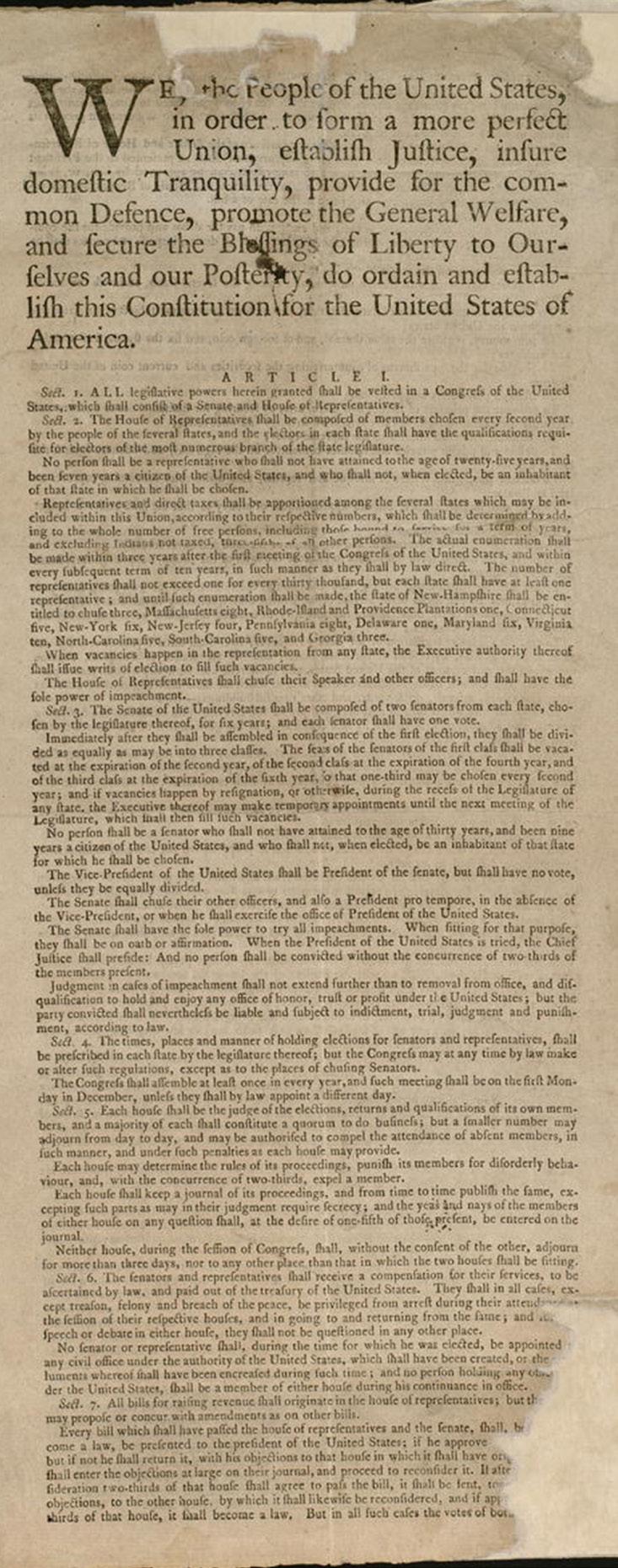
Rooted in the Declaration of Independence’s promise of “Life, Liberty and the pursuit of Happiness,” the concept of the American Dream has evolved through the centuries – from frontier self-reliance as pioneers explored the West, to Horatio Alger’s 19th-century tales of upward mobility, to the post-World War II ideal of home ownership and generational progress.
The American Dream traces its origins to the Revolutionary War, when colonists rejected monarchal rule in favor of self-governance. The Declaration of Independence articulated a radical premise: that all individuals are endowed with certain unalienable rights, including “Life, Liberty and the pursuit of Happiness.” This was not merely a political statement but a philosophical foundation for what would become known as the “American Experiment.”
Unlike European societies structured around inherited status, the United States was conceived as a nation where opportunity was not predetermined by birth. The Constitution, and later the Bill of Rights, sought to institutionalize those freedoms, creating a framework that emphasized individual liberty, property rights, and representative government.
Historian James Truslow Adams formally coined the term “American Dream” in his 1931 bestseller, “The Epic of America,” which was written by the Yale alumnus during the depths of the Great Depression.

Adams, a native of New York, defined it as “that dream of a land in which life should be better and richer and fuller for everyone, with opportunity for each according to ability or achievement.”
Adams emphasized that it was not merely about the ability to buy a home, a traditional gateway to prosperity for many Americans, but also was about a social order in which each person could achieve “the fullest stature of which they are innately capable.”
Today, during President Donald Trump’s second term in office, that Dream is being reinterpreted – and fiercely debated –through the lenses of tariffs, immigration, and U.S. military action in the Middle East.
When President Trump was sworn in again on January 20, 2025, he pledged to restore what he called “economic sovereignty.” Within weeks, his administration expanded sweeping tariffs on imported
goods, particularly from China, arguing the measures were necessary to revive American manufacturing, even if longtime trade allies (such as Canada, Mexico, Japan, and European countries) were caught in the crossfire.
The intellectual roots of the administration’s tariff argument stretch back years. Robert Lighthizer, who served as U.S. trade representative during Trump’s first term, argued in his 2023 book “No Trade Is Free” that decades of free-trade orthodoxy had hollowed out American industry. In interviews promoting the book in July 2023, Lighthizer said U.S. trade policy must prioritize domestic production and worker leverage over theoretical global efficiency.
Similarly, Oren Cass, founder of the conservative think tank American Compass, wrote in a March 2020 Foreign Affairs essay titled “The Once and Future Worker” that “the American Dream
depends on productive work.” Cass has repeatedly argued, including at a May 2024 National Conservatism conference, that tariffs can be a legitimate tool to rebuild domestic supply chains and restore middle-class stability.
Trump himself has long framed tariffs as patriotic policy. On July 2, 2018, during his first term, he wrote on Twitter: “A nation without borders is not a nation.” He has frequently paired that message with trade nationalism, arguing in campaign rallies that economic borders are as important as geographic boundaries.
But critics see tariffs differently and have taken issue with Trump’s heavy-handed approach to U.S. trade policy, claiming that it has endangered relationships with long valued trading partners.
Douglas Irwin, a Dartmouth economist and historian of U.S. trade policy, wrote in his book “Clashing Over Commerce” that
tariffs historically produce “concentrated benefits and diffuse costs,” meaning protected industries gain while consumers and downstream businesses quietly absorb higher prices.
Those economic debates took a constitutional turn on February 20 of this year, when the U.S. Supreme Court struck down key elements of the administration’s expanded tariff program. In its 6-3 ruling, the Supreme Court held that the executive branch had exceeded its delegated authority under federal trade statutes, reaffirming that Article I of the Constitution grants Congress the primary power to regulate commerce with foreign nations. The Supreme Court noted that while the president can impose tariffs via delegated authority from Congress, this does not include inherent, unilateral power to create new taxes.
“The President asserts the extraordinary power to unilaterally impose tariffs of
unlimited amount, duration, and scope,” wrote Chief Justice John Roberts in the majority decision. “In light of the breadth, history, and constitutional context of that asserted authority, he must identify clear congressional authorization to exercise it.”
Justice Neil Gorsuch, a Trump appointee in 2017, wrote a separate concurring opinion, declaring that the president had overstepped his authority.
“Yes, legislating can be hard and take time. And yes, it can be tempting to bypass Congress when some pressing problem arises,” Gorsuch wrote. “But the deliberative nature of the legislative process was the whole point of its design.”
In the ruling’s aftermath, Trump sharply criticized the six justices who voted against him, calling them “very unpatriotic and disloyal to our Constitution.” He vowed to overcome the ruling, saying that he would sign more executive orders to
restore tariffs by other means, announcing on February 21 that he would impose a new, global tariff of 15 percent under Section 122 of the Trade Act of 1974.
“I have the right to do tariffs,” Trump maintained in a statement of defiance. “I’ve always had the right to do tariffs.”
Ilya Somin, a constitutional scholar at George Mason University, has long criticized expansive executive trade authority.
In a 2019 analysis, Somin argued that Congress has delegated too much trade power to presidents, creating separationof-powers concerns. After a 2025 U.S. Court of Appeals ruling that the tariffs were illegal, Somin wrote that the decision “reasserts the constitutional balance envisioned by the framers.”
Former Acting Solicitor General Neal Katyal similarly emphasized constitutional limits.

The nine-member U.S. Supreme Court dealt a legal blow to the president’s tariff policies in a February decision.
In public commentary during Trump’s first term, Katyal argued that executive authority must operate within statutory guardrails. Following the Court of Appeals 2025 decision, Katyal said that the ruling underscored “the importance of the separation of powers in protecting liberty.”
For supporters of the tariffs, however, the Court’s intervention represented a setback for industrial revival.
U.S. Senator Josh Hawley (R-Mo.) said that “America’s workers need a government willing to stand up to China,” and called for Congress to grant clearer authority to impose trade penalties.
At its core, the tariff fight reflects a philosophical split over the American Dream: Is it secured through open markets and global integration, or through protection of national industry and economic self-determination?
If tariffs represent one front in the battle over the economic meaning of the American Dream, immigration policy represents another – with this one steeped in symbolism, history, and political consequence.
Since returning to office in 2025, Trump has implemented a sweeping immigration crackdown, expanding deportations, tightening asylum standards, flooding a number of major cities with ICE agents, and increasing border enforcement.
In his January 20, 2025 inaugural address, Trump declared: “We are a nation of laws. A country cannot survive without borders.”
The line echoed language he has used repeatedly since his first campaign in 2015

and reflects the administration’s argument that border control is foundational to sovereignty, and, by extension, to economic opportunity for citizens.
Stephen Miller, White House deputy chief of staff and chief architect of the administration’s immigration agenda, reinforced that view during a White House press briefing on February 6, 2025, stating that large-scale deportations are necessary to “restore the rule of law and protect American workers from unfair labor competition.”
Supporters contend that uncontrolled migration depresses wages for lowerincome Americans and strains housing, health care, and public education systems. Sen. Tom Cotton (R-Ark.), speaking on Fox News, argued that “you cannot have a functioning middle class if you have open borders,” framing enforcement as a defense mechanism for working-class upward mobility.
But critics counter that such policies undermine one of the American Dream’s oldest traditions, that of welcoming newcomers seeking hope and opportunity.
Ken Cuccinelli, who served as acting deputy secretary of Homeland Security during Trump’s first term, famously reinterpreted the Statue of Liberty’s inscription in August 2019, telling CNN: “Give me your tired and your poor who can stand on their own two feet and who will not become a public charge.”
That remark ignited debate about whether the American Dream is conditional – limited to those who arrive with resources – or expansive in its embrace of the vulnerable.
Economic historians push back against such restrictionist arguments. In a 2024 panel at the Brookings Institution, economist Giovanni Peri of the University of California, Davis, said: “Immigrants are disproportionately entrepreneurial. Over time, they expand the economy rather than shrink it.”
Peri has published extensive research showing immigrants are more likely than native-born Americans to start businesses and file patents.
Faith leaders also have weighed in. In a February 2025 statement from the U.S. Conference of Catholic Bishops, Archbishop Timothy Broglio said expanded deportation efforts “risk undermining the nation’s long moral tradition of offering refuge.”
Pope Leo XIV, the first American-born pontiff, also has been a vocal critic of the Trump administration’s immigration policies, slamming the “extremely disrespectful treatment of migrants” in comments made to the press last November. He urged “all people in the United States to listen” to the U.S.

Masked ICE agents have been a common sight on American streets since President Trump returned to office in January 2025.
Conference of Catholic Bishops, which a week earlier called for an end to the “climate of fear” that the Trump administration has created.
Civil liberties organizations have criticized expanded detention policies and expedited removals. David Cole, who served as legal director of the American Civil Liberties Union (ACLU) from 2017-24, said during a January 28, 2025 press call that “family unity and due process are not obstacles to the American Dream – they are part of its constitutional foundation.”
Public opinion, meanwhile, remains complex. A Pew Research Center survey released in April 2025 found that a majority of Americans support stronger border enforcement but also agree that immigrants “strengthen the country because of their hard work and talents.” That duality reflects a longstanding tension in American life: the desire for order alongside a belief in renewal.
The Statue of Liberty, a gift from France that was dedicated in 1886, has long symbolized that renewal. Emma Lazarus’s poem, “The New Colossus,” inscribed on the Statue of Liberty’s pedestal in 1903, frames America as a refuge for the world’s “huddled masses.”
Whether that inscription remains an active policy principle or a historical artifact is now at the center of national debate, one certain to gain even more steam as the midterm elections approach in November.
Trump’s approach to foreign policy has been characterized by a shift toward unilateralism and a reevaluation of the U.S.’s traditional alliances. His administration has frequently emphasized burden-sharing within NATO and questioned the value of long-standing international commitments.
His supporters argue that his approach reflects a pragmatic reassessment of U.S. interests. By pressing allies to contribute more to collective defense, they contend, Trump has sought to reduce the financial burden on American taxpayers.
Critics, however, warn that such strategies risk undermining global stability. Former diplomats and foreign policy experts have expressed concern that strained relationships with allies could weaken the cooperative frameworks that have supported economic growth and security since World War II.
The current military action in the Middle East, a conflict that the U.S. and Israel began against Iran and its proxies on February 28, has raised questions about the long-term implications for both global stability and domestic priorities. It also has magnified concerns about Trump’s mental fitness, particularly after he unleashed a tirade on his social media platform threatening to annihilate Iran unless it opened up the Strait of Hormuz.

The flag of the North Atlantic Treaty Organization (NATO) symbolizes the global reach of the military alliance, which the Trump administration has threatened to abandon in recent years.
“Tuesday will be Power Plant Day, and Bridge Day, all wrapped up in one, in Iran,” declared Trump. “There will be nothing like it!!! Open the Fuckin’ Strait, you bunch of crazy bastards, or you’ll be living in Hell – JUST WATCH!”
Several days later, he declared that “a whole civilization will die tonight, never to be brought back again,” a threat that he fortunately did not carry out.
French President Emmanuel Macron, a frequent target of Trump’s ire, has made clear that he and others in the European community no longer see the American president as the leader of the free world.
“When we’re serious, we don’t every day say the opposite of what we said the day before,” Macron said of Trump’s rants and coarse insults. “And, maybe, one shouldn’t speak every day.”
Trump’s actions and proverbial chestthumping stand in marked contrast to a pair of American presidents who played a
critical role in shaping and sustaining the ideal of the American Dream.
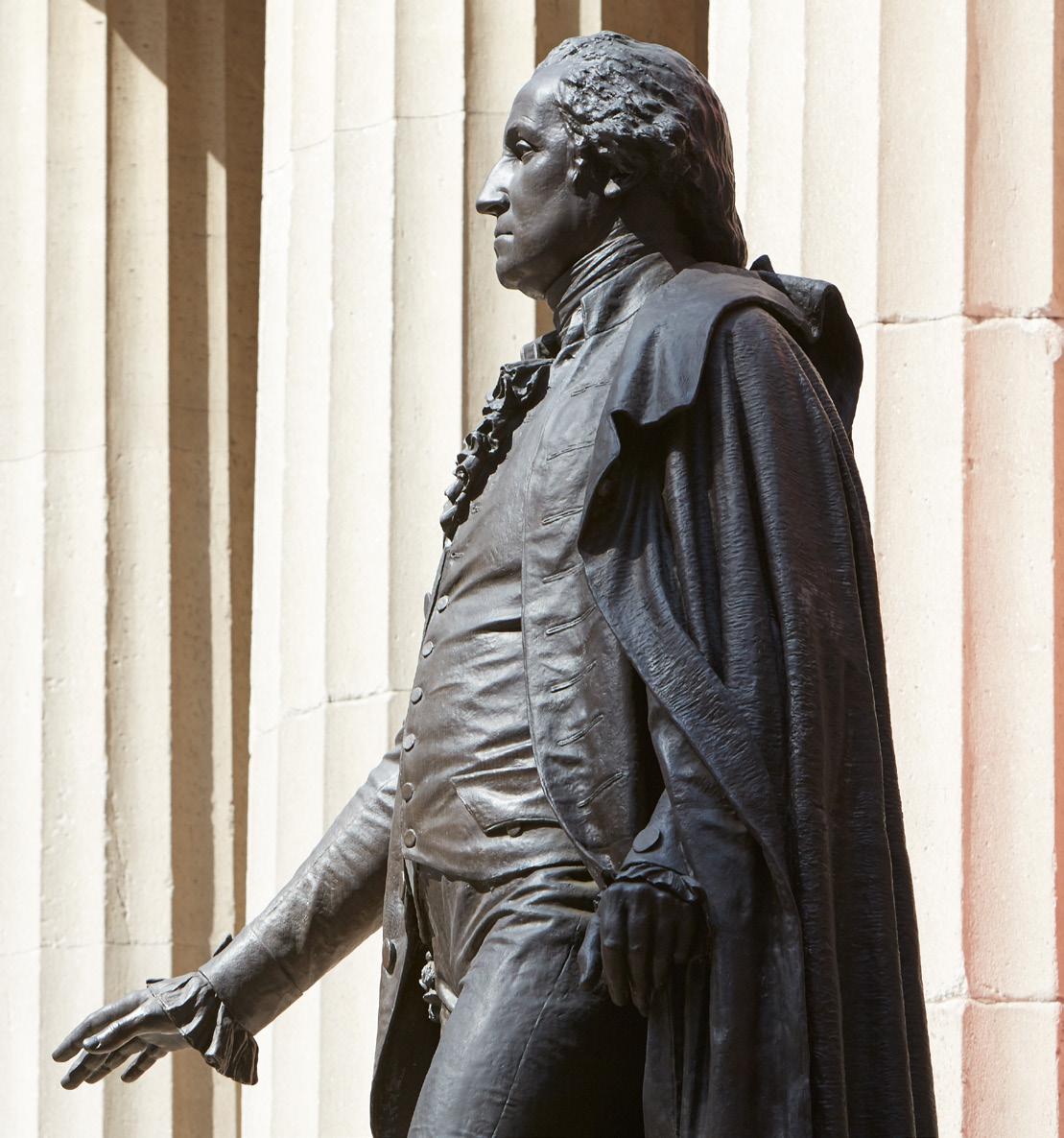
George Washington, as the nation’s first president, set a precedent for steady civilian leadership and the peaceful transfer of power. Washington’s voluntary relinquishment of authority after two terms in office reinforced the idea that the United States would not replicate the monarchy it had fought to escape. His leadership helped establish credibility for the fledgling republic and affirmed that governance would be rooted in principles rather than personal power.
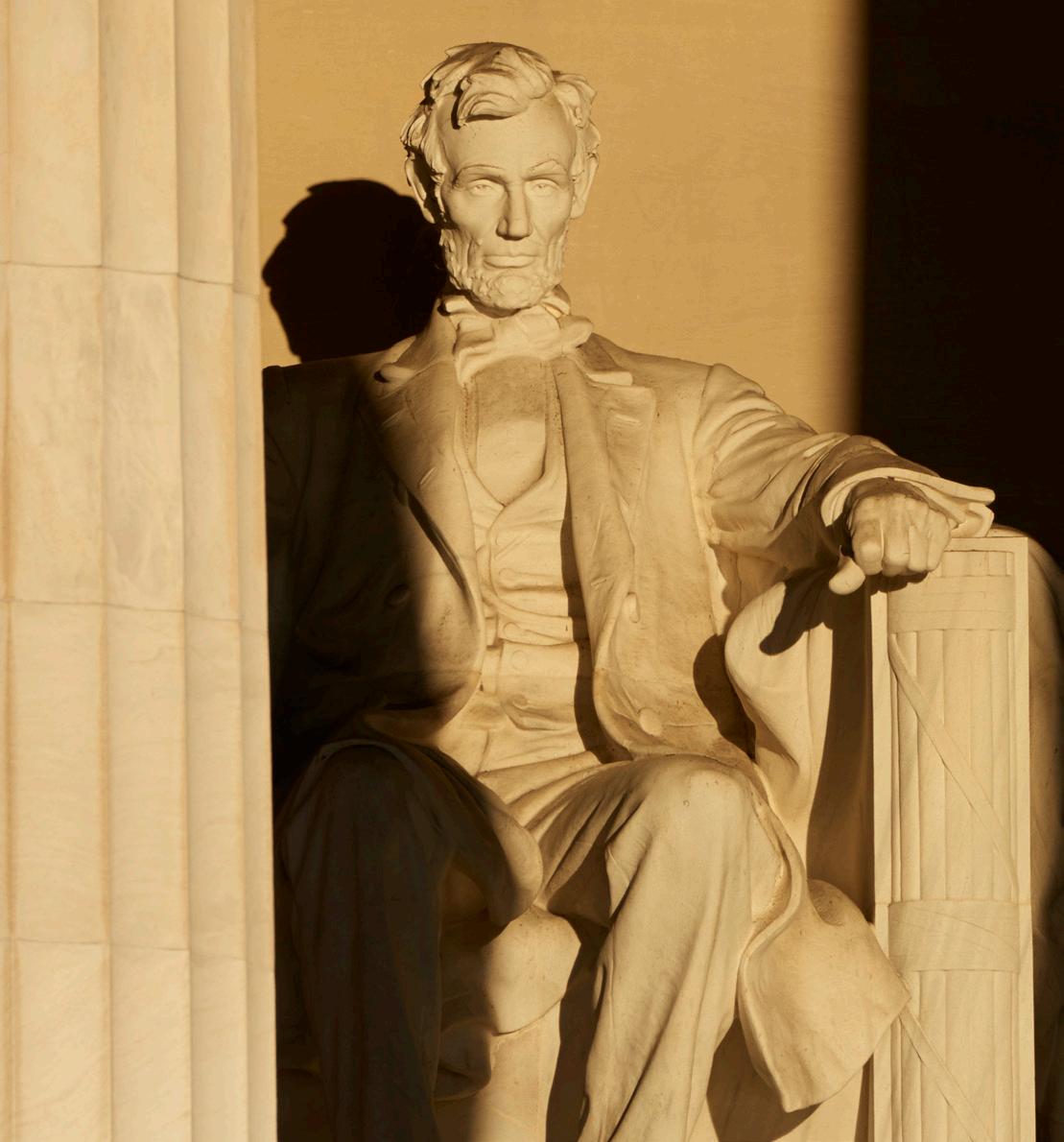
Decades later, Abraham Lincoln confronted the nation’s greatest internal crisis with a reasoned and rational approach. During the Civil War, Lincoln framed the conflict not only as a battle to preserve the Union but as a moral struggle to extend the promise of freedom to all Americans, whatever the color of their skin. His Gettysburg Address redefined the nation’s purpose, emphasizing equality and the unfinished work of creating a “more perfect union.”
Among the nation’s most revered presidents, George Washington and Abraham Lincoln were both strong and principled leaders in times of crisis.
Lincoln’s leadership expanded the American Dream beyond its original limitations. By abolishing slavery, the nation’s 16th President moved the country closer to its founding ideals.
Today, the Dream stands at a crossroads. Donald Trump’s presidency has amplified longstanding debates about economic fairness, global engagement, and national identity. Supporters of the president see a necessary course correction, while critics see a radical departure from the nation’s core ideals.
As the nation approaches the 2026 midterm elections, the central question remains unchanged: Can the United States continue to offer a path to opportunity that is both attainable and inclusive? The answer will determine not only the future of the American Dream, but the direction of the American Experiment itself.
John C. Buchanan

SSome readers might consider the above headline as illusory, in the form of a so-called warning shot across the bow about the perilous situation America’s democracy is facing as the current presidential administration freely exercises its autocratic ambitions.
Other readers may prefer to view it as a gross mischaracterization of the current political state in America, which they see as a long overdue reckoning designed to make the government strong, its enemies weak, and the nation god-fearing and “great” once again.
The chief difference between the two views is that in a deeply polarized democracy such as in the U.S., the lines between reality and illusion are constantly blurred with little chance for clarity.
In many ways, the political circumstances of today are unprecedented, a touchstone time racked by culture wars, deeply partisan talking points promoted as fact on both sides, and an ongoing power grab that could lead democracy down a path to ruin, thereby sending shock waves through the spine of every American.
We now have a president who is a master at stirring the political pot and for making nonsensical statements that are tailor-made for the 24-hour news cycle, where intense, shocking events are rapidly replaced by new ones, dulling the everyday public’s emotional responses over time.
In effect, Donald Trump has turned his presidency into nothing more than a grim reality show, characterized by high-stakes drama such as his unprovoked war with
Iran, unscripted moments like his desire to award himself the Congressional Medal of Honor, and his media-focused performances where he fancies himself as worthy of a place on Mount Rushmore.
How else can we explain the actions of a man who depicts himself in Christ-like scenes on social media, who picks online fights with Pope Leo XIV, who posts memes of former President Barack Obama and former First Lady Michelle Obama as apes, and who takes delight in the deaths of award-winning director Rob Reiner and former FBI Director Robert Mueller.
For purposes of this column, the question of how America drifted toward democratic erosion should be addressed within the framework of the rise of Third
Reich, Adolf Hitler’s Nazi regime that ruled Germany from 1933-45.
By way of a quick history refresher, Hitler rose to power in January 1933 when he was appointed Chancellor of a country that was still dealing with the harsh aftermath of World War I. He quickly seized upon Germany’s economic uncertainty by consolidating power into a totalitarian dictatorship centered on Aryan supremacy and extreme antisemitism. He reveled in sinister power struggles, capitalizing on the fact that democracies are imperfect institutions that need to be constantly defended.
If only the Germans of that time had been attuned to a message from years earlier
that was delivered by George Santayana, a Harvard-educated thinker who taught the likes of Learned Hand, Felix Frankfurter, T.S. Eliot, Robert Frost, and Gertrude Stein.
“Those who cannot remember the past are condemned to repeat it.”
Santayana’s words were written in 1905, before a pair of world wars would dramatically alter the course of history. They followed an earlier sentiment from German philosopher Georg Wilhelm Hegel who wrote, “We learn from history that we do not learn from history.”
Their words should resonate profoundly today as American democracy is creaking under the weight of a leader who thrives
on division, disinformation, and the erosion of guardrails – much like Germany experienced in the run-up to the horrors of World War II.
The parallels between the rise of the Third Reich and that of the MAGA (Make America Great Again) movement led by Trump are striking and instructive, illuminating what should be warning signs in our own political life today.
In the 1930s, Hitler and the Nazi Party fused economic anxiety with an explicitly racialized story about why Germany had fallen into economic despair following its defeat in World War I. Anti-Semitism was not incidental to the Nazi Party’s rise, it became a central component woven

the nation’s birth, growth, development, and preservation.
into a program of extreme nationalism, emergency decrees, physical intimidation, and eventually one-party rule. While factories purred and wages for workers rose, few Germans could see any reason to stand in the way of a ruler promising to restore the country to its former glory.
Within weeks of Hitler’s appointment as chancellor in 1933, the Nazis used the deliberate burning of the German parliament building – the Reichstag – to consolidate power and to crush opposition parties.
Nearing the end of his first term in office, Trump attempted a similar tactic, inciting an insurrection at the U.S. Capitol on January 6, 2021 in a desperate and failed attempt to hang on to presidential power.
The near-tragedy was brought back into view on Presidents’ Day 2026 when former President George W. Bush published an essay as part of a new nonpartisan history
project. His subject was our nation’s first president, George Washington.
“Few qualities have inspired me more than Washington’s humility,” former President Bush wrote in the essay.
“Our first president could have remained all-powerful, but twice he chose not to,” Bush declared, referring to Washington’s decision to give up the leadership of the Army after the American Revolution, and then to step down from the presidency after two terms.
“By relinquishing power rather than holding onto it, he ensured America wouldn’t become a monarchy, or worse,” Bush noted, while deftly sidestepping any obvious present-day parallels that could be drawn.
Trump’s initial ascent in 2016 was fueled by an “Us vs. Them” narrative in which he blamed our supposed decline on the influx of immigrants, Muslims, and
internal “enemies” such as a liberalleaning press. His attacks on the media, framed as “the enemy of the people,” have become a central theme in his efforts to lash out at critics and to delegitimize any independent institution that can check him.
In the wake of the burning of the Reichstag, the Nazis converted emergency powers into permanent architecture, legislating without the need for parliament while the German judiciary largely acquiesced.
A similar pattern has been followed by Trump in his second presidential term, ruling by decree and removing any constraints, thanks to an enabling GOP-controlled Congress and a decidedly conservative U.S. Supreme Court that has acted as his rubber stamp.
Sadly, the election of Donald Trump was not a fluke. It was the predictable outcome

At a 2002 meeting in Rome to inaugurate the NATO-Russia Council, British Prime Minister Tony Blair and President George W. Bush expressed high hopes for a unified approach on terrorism and weapons of mass destruction.

of decades of institutional decay, cultural division, and political cynicism.
First, polarization transformed politics into a form of tribal warfare. For millions of voters, who live in echo chambers where they are bombarded by the sounds of what they want to hear politically, the question was no longer “Who is
fit to lead?” but “Who will defeat the other side?”
In such an environment, character becomes negotiable. Norms become optional. Even truth becomes secondary. Trump – with all his warts as someone who has no regard for decency or ethical behavior – did not need to be exemplary. He only needed to be preferable to
the alternative, most notably his three presidential opponents who had various political and personal shortcomings that he took great glee in exploiting.
Second, the collapse of a shared reality made accountability nearly impossible and contributed greatly to his rise. In an earlier era, a president’s falsehoods or attempts to shade the truth would have been
Massive protests have erupted in Minneapolis at various points this year following violent, fatal encounters between ICE agents and local residents.

filtered through a relatively unified media landscape. Today, fragmented information ecosystems allow supporters to dismiss criticism as partisan attacks, no matter how well documented. When every fact is contested as “fake news” or yet another “witch hunt,” nothing is disqualifying.
Third, widespread distrust in institutions created fertile ground for a figure who openly challenged them. Many Americans already believed that government was corrupt, that elites were self-serving, and the political system was rigged. Trump did not create that sentiment. He just learned how to weaponize it for his own political advantage. By both positioning himself as both an insider (as a supposed brilliant businessman) and an outsider (someone who will “drain the political swamp”), he convinced voters that dismantling norms
was not a threat to democracy but was a necessary and long overdue correction.
While America’s Constitution has proven to be sturdy during a range of good and bad presidencies, it also depends on each branch of government to do its job. Trump’s approach has been to stretch executive power to – and in some cases far past – its limits, then to attack any institution that resists.
As history has shown, authoritarians demand personal loyalty and treat dissidents with disdain. Hitler, of course, mastered the art while rising to power, as the civil service, courts, schools, unions, and press were brought to heel or abolished during his reign.
Trump, in turn, has purged or sidelined officials who place law over loyalty, and
has conditioned service on fealty to his narratives and political objectives. The messaging system that helps sustain him brands any unfavorable reporting as “fake” and any opponents as “enemies,” while dismissing independent expertise, such as from scientists and election administrators, as corrupt.
The Third Reich brought the politics of expulsion into full view, as Nazi radicalization moved from exclusion to deportation to extermination. Early “resettlement” efforts eventually gave way to systematic deportations of Jews and various ethnic groups to ghettos and killing centers at concentration camps.
While the U.S., thankfully, is nowhere near that societal abyss, talk of mass deportation is no longer on the political fringe. Trump has repeatedly proposed
or considered large-scale expulsions, sweeping detention operations, and the use of military-style “processing camps” such as the so-called “Alligator Alcatraz” in the swamps of Florida and the aptly-named “Cornhusker Clink” in the fields of Nebraska.
He has unleashed thousands of masked ICE agents to patrol the streets in major left-leaning cities across the U.S., rounding up illegal immigrants and then crushing organized dissent by protesters, resulting in the tragic deaths of two nonimmigrant, Minnesota residents who were victims of a law enforcement agency that has gone horribly bad.
He has created a climate where individuals and organizations fear reprisal for opposing his policies, leading to self-censorship

and reduced accountability for the radical actions of his administration.
The parallels between Nazi Germany and the MAGA movement are now being forged into one very disturbing reality: America stands at the precipice of its own destruction, ironically at a time when we will observe the 250th anniversary of our Declaration of Independence this summer.
Germany’s descent into darkness, historians believe, was not inevitable. It was methodical and incremental, sparked by a ruthless leader who possessed a certain charisma that turned normal people into abnormal killers.
Trump’s two terms in office reveal a coherent pattern, one designed to centralize authority, shrink oversight, and flood the zone with narratives that make
accountability feel partisan. He has been working from a blueprint (the Heritage Foundation’s Project 2025) that seems destined to erode democracy and to upend life as we know it.
His efforts have been abetted by silence from political, corporate, and civil society leaders – including the likes of major law firms in the U.S. – which has allowed for the consolidation of power and the dismantling of institutional checks.
What, then, can be done to stop the dismantling?
Foremost, we must learn the lessons of history. The Nazi-led catastrophe was a sequence of choices that began with words, proceeded with laws, and ended with trains bound for concentration camps.

Now, in the Trump era of governing, we are witnessing one-way tickets to a network of detention centers scattered across remote regions of America where immigrants are housed in deplorable conditions that degrade any claim that we live in the “land of the free.”
We must put a stop to using scapegoating, propaganda, emergency “temporary” powers, and personal loyalty tests as the primary means of governing.
We must support the freedom of the press and back judges who apply the law instead
of bowing to the political whims of a man who has renamed the Kennedy Center in his honor and has orchestrated the destruction of the East Wing of the White House to make room for a $300 million ballroom that will glorify the excesses of his presidential administration.
We must demand that Congress legislate rather than spectate, and we must reject the politics of expulsion, whereby citizens are pitted against citizens.
We must reject the dismantling of alliances and abandonment of
international agreements, otherwise we run the risk of a radical uncertainty that increases the likelihood of global conflict and nuclear proliferation.
Restoring honesty and decency in political life is not a matter of nostalgia or status quo. It is a matter of survival for a functioning democracy.
It requires voters who are willing to prioritize principle over party. It requires leaders who are willing to tell uncomfortable truths rather than convenient lies. And it requires a

collective refusal to accept behavior that undermines the very system that makes political choice possible.
Efforts to distort historical events or cast doubt on future elections – such as the November 3, 2026 midterms – must be met with clarity and resolve. Democracy depends not just on fair processes, but on public confidence in those processes. Undermining that confidence for short-term gain is a long-term threat to everyone.
America, as we approach what might be the most consequential election in our nation’s history, is not beyond the no point of return. But it is dangerously close to a place where democratic erosion becomes normalized.
The real danger is not one presidency, one personality, or one moment. It is the gradual acceptance of conduct that weakens our system from within.
Our path forward is not easy. It will require confronting uncomfortable truths about how we got here – and about our own role
in allowing it to happen. But democracies are resilient when their citizens choose to be equally strong.
The question is no longer whether the system can hold. It is whether enough Americans still care enough to do the work to hold it firmly together.
Best regards,



Now known as “America’s Sport,” football is a phenomenon that has become deeply ingrained in American culture, capturing the hearts and minds of millions of fans across the country due to its TV-friendly format, weekly event structure, and powerful community pull that unites diverse segments of a society in the joy and excitement of a shared spectacle.
Whether played on high school, college, or professional gridirons, football has cast a mesmerizing spell on the U.S. that lasts year-round, thanks to the collective marketing genius of the stewards of the sport. In many respects, it has become symbolic of strength, toughness, and teamwork, three qualities that America has long cherished.
On the following pages, you will see multiple examples of how a nation’s love affair with a game has played out, carving a permanent place in the American psyche while launching such rituals as tailgating, Monday morning quarterbacking, and endless fixating on which teams will square off in the Super Bowl each February. Those are among the narratives that help define America’s football identity, resulting in a paradigm shift that is destined to keep football king for years to come.

By Tom Kirvan

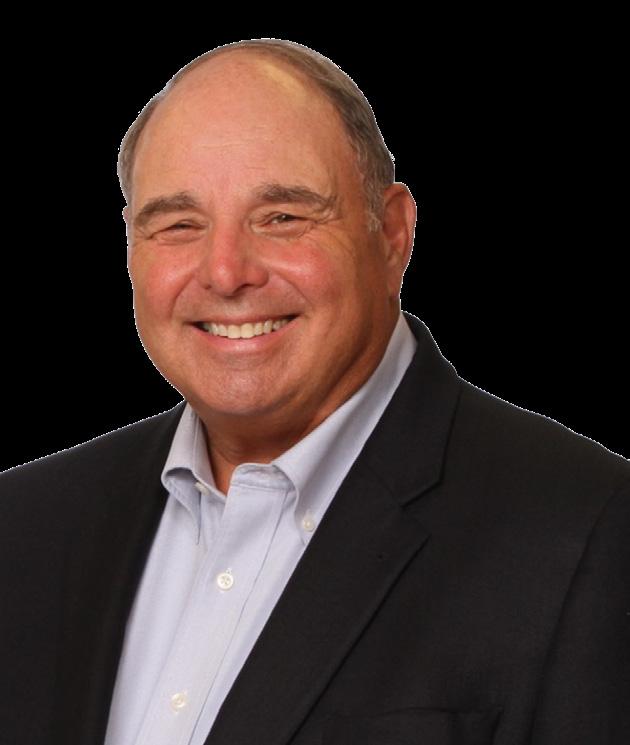
As a kid growing up in Westchester County, N.Y., Jeff Rosenthal admitted to being a “rebel” who gave his parents pause.
But unlike the teen character portrayed by James Dean in a 1955 movie classic, Rosenthal had a “cause” – which quite simply was to torment all the New York Giants fans in his family.
“I grew up near Peekskill, the training camp for the New York Jets and they had this rebel quarterback named Joe Willie Namath,” Rosenthal recalled. “Being a rebellious teenager in a family of Giants fans, I became a Jets fan. When the Jets won the Super Bowl in January 1969 in a massive upset that Joe Namath predicted, I was jumping all over the Giants fans in the family.”
Now a partner with the New Jersey law firm of Mandelbaum Barrett PC, Rosenthal has long since left his allegiance to the Jets behind, principally due to his decision to attend college at the University of Pittsburgh (Pitt) in that eventful year of 1969 when man walked on the moon and Woodstock signified a pivotal moment in the counterculture movement.
Back then, Rosenthal didn’t exactly fit the look of a future lawyer. He sported a mop of curly hair that resembled an afro, long sideburns, a beard, braces, and a decidedly disheveled appearance often topped off by a “Keep on Truckin” T-shirt. He enrolled at Pitt after skating through high school.
“I was the typical disruptive ADHD child,” Rosenthal said in matter-of-fact fashion.
“I was the class clown who got through high school only because I’m a really good test-taker.”
When Rosenthal began his studies at Pitt, which has a reputation for regularly producing Fulbright Scholars, the school’s
football program was struggling, offering little in the way of excitement for diehard Panther fans.
“Football games at Pitt were only good to provide a venue for outdoor drinking since the team was really bad, although they were better than the Steelers who were 1-13,” Rosenthal said with a laugh.
With two sad-sack teams in the Steel City, Rosenthal was slow to embrace the football culture of Pittsburgh until 1972 when the Steelers made their first of eight straight playoff appearances thanks to a team led by quarterback Terry Bradshaw, running back Franco Harris, and defensive lineman “Mean” Joe Greene.
Coached by Chuck Noll, the 1972 team was about to become the legendary “Steel Curtain” dynasty that produced four Super Bowl titles over a six-year period.
The resurgence wasn’t confined to just the Steelers, however, as Pitt suddenly became the talk of the town under new coach Johnny Majors, who turned around
the fortunes of the Panthers during his reign from 1972-76.
“He recruited a fellow named Tony Dorsett, who won the Heisman Trophy his senior season while leading Pitt to an undefeated season and the national title,” Rosenthal said of the magical 1976 year. “In many respects, it was the golden era of football in Pittsburgh.”
Which gave Rosenthal all the more reason to pursue a Master of Business Administration at Pitt after earning his bachelor’s degree from there in 1973, while also admitting that he had an even more compelling reason to stick around the city where three major rivers converge.
Love.
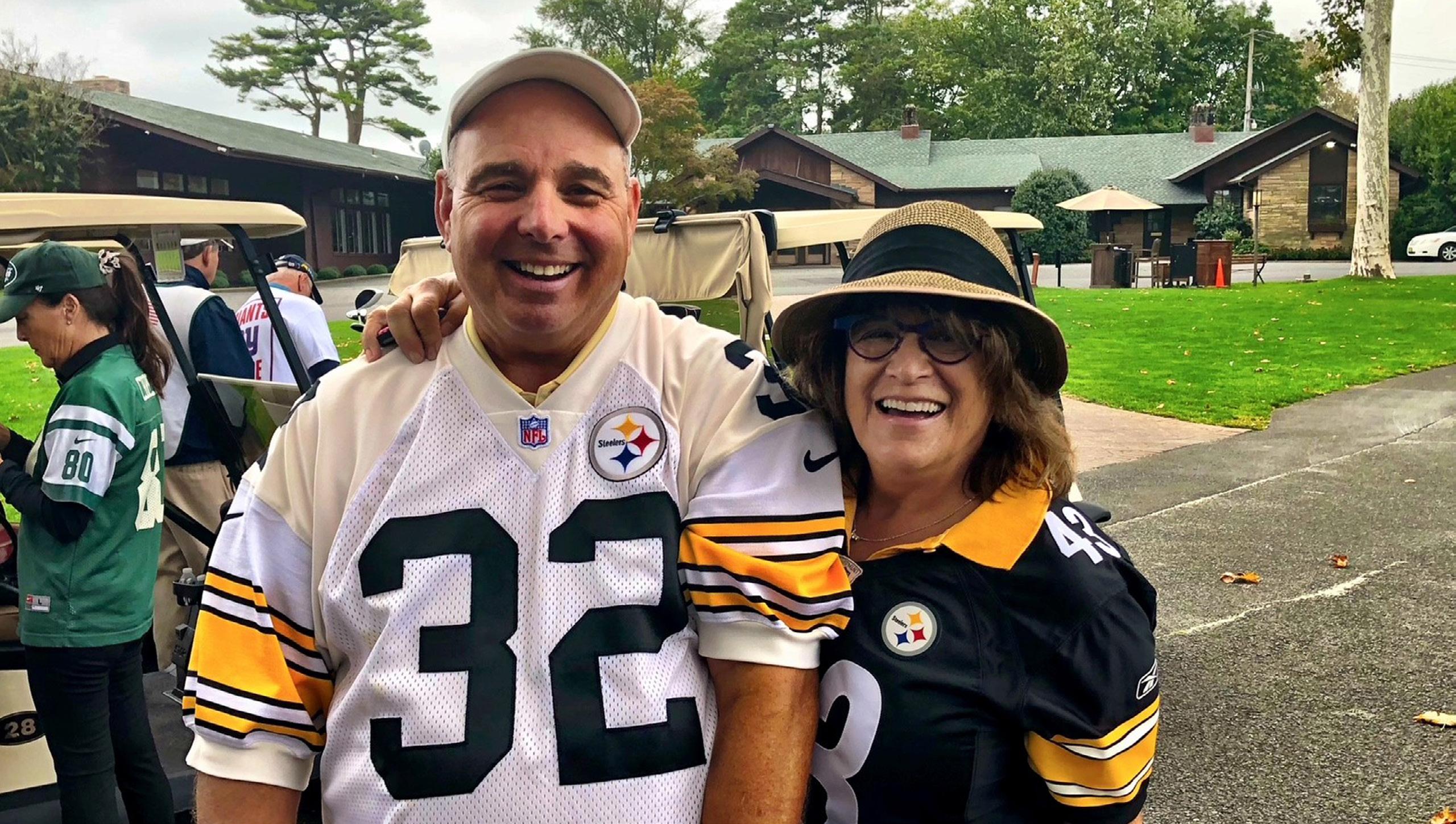
“I spent eight years in Pittsburgh, married a cute girl from Pittsburgh, and was a (Steelers) season ticket holder by 1974,” Rosenthal related. “I have been a diehard Steelers fan ever since and they have saved my kids, grandkids, and me from a life of misery as a Jets fan.”
His college romance, which would blossom into a marriage that is now in its 51st year, began near the end of his sophomore year when he “stumbled” into the library to take a nap after drinking heavily at a nearby campus bar. A studious pharmacy student by the name of Susan caught his eye, and after briefly being introduced to her by a mutual friend, Rosenthal was determined to ask her out on a date. She rebuffed his initial request, but over the next several days he continued to return to the library to talk with her in hopes of changing her mind. On his fourth try, she relented.
“And the rest, as they say, is history,” said Rosenthal with a broad smile.
The couple has two children, both of whom are lawyers. Their son, Paul, is a litigator and partner at Faegre Drinker in New Jersey, while their daughter, Erica, is deputy general counsel for Orrick in New York.
“Both of them have done very well. I’m very proud of them,” said Rosenthal, who
has five grandchildren. “When the three of us start to talk about legal stuff, people just leave the table. I don’t understand it.”
When the talk shifts to football, however, everyone in the family is at rapt attention, according to Rosenthal.
“We all live and die with the Steelers,” Rosenthal proclaimed. “Everyone knows that whenever the Steelers are playing, don’t even bother to call me. I’m not gonna talk to you. I’m focused on the game.”
To such a degree that his wife blocks out game days on her calendar and the only interruptions Rosenthal permits are from Steelers buddies on a text thread as they commiserate or celebrate about the inevitable ups and downs of the game.
“That’s the only distraction I allow during the game,” Rosenthal said adamantly. “We ramble on throughout the game, offering such comments as ‘Oh my God, did you see that call? What an awful call was that.’ It’s like we don’t even have to finish the thought because we all know what we’re saying and thinking.
“There is an understanding that if you live in Pittsburgh for more than a couple of years, you have to be a Steelers fan,” Rosenthal remarked. “They are the soul of the city and as the team goes, so goes the mood of the city.”
Early in the 2025 season, Rosenthal – being the good father and grandfather that he is – issued an invitation to everyone in his immediate family to join him for the Steelers-Jets game at MetLife Stadium in East Rutherford, N.J.
“I told them that I was treating,” said Rosenthal of the invitation, which suddenly became especially appealing since he was picking up the tab.
“We all showed up in Steelers T-shirts and hats and everything else. And I brought a bunch of Terrible Towels for us to wave,” he said of the black and gold rally towels that have come to symbolize the team’s tough, gritty reputation. “The usher standing next to me was this very nice woman who’s probably been there for 10 to 12 years. She said, ‘Wow, there sure are a lot of Steelers fans here today.’
“I looked at her and said, ‘That’s because every Steelers game is a home game.’ She got a kick out of that.”

San Antonio attorney made a name for himself at A&M as part of ‘12th Man Team’

By Tom Kirvan
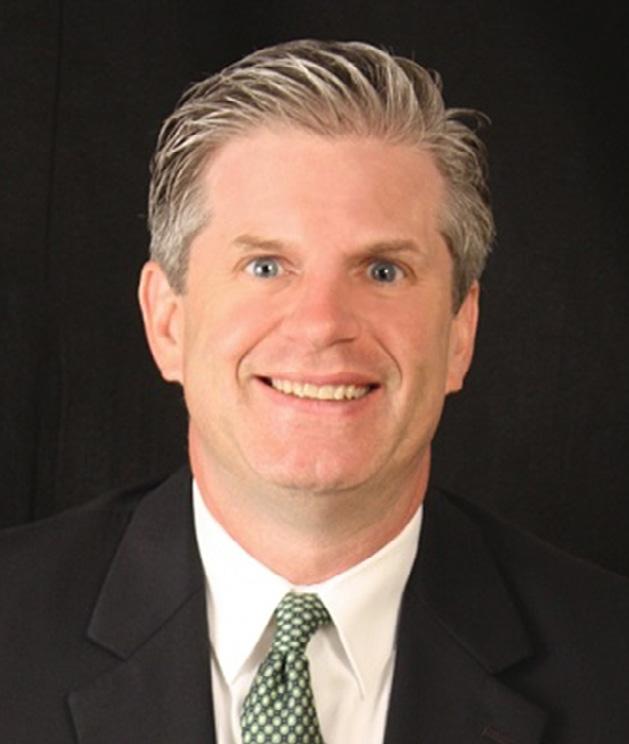
R. Sean Page Member Thornton, Biechlin, Reynolds & Guerra, L.C.

It’s been nearly 40 years since Sean Page last suited up for the Texas A&M football team, but the San Antonio attorney can still feel the magnetic pull of the gridiron at the 102,733-seat Kyle Field, where he was a proud part of a kickoff unit that etched its name in Aggie lore.
Born and raised in the Lone Star State, where football reigns supreme, Page was a track standout in high school, a three-time letterwinner who displayed a special burst of speed that would catch the eye of the special teams coach at A&M in the mid-’80s when the Aggies were guided by Jackie Sherrill.
Sherrill, who coached Heisman Trophy winner Tony Dorsett at the University of Pittsburgh before landing the head coaching job at A&M, had a well-deserved reputation as a master motivator and innovator when he was hired to revive the football fortunes of the Aggies.
One of his first “out-of-the-box” moves involved the creation of the “12th Man Kickoff Team,” a coverage unit comprised entirely of walk-on players who possessed the grit, determination, and perseverance to succeed.
Players like Page, a product of Churchill High School in San Antonio where he had a less than notable career as a wingback.
“I was not a very accomplished high school player,” Page admitted. “I was a 149-pound wingback and there wasn’t a high market for those types of guys in college. On the other hand, I was fast and I was hard to catch.”
When he enrolled at A&M in College Station, Page packed 30 pounds of muscle onto his slender frame in hopes that he could earn a walk-on role as a defensive back for the Aggies.
“I always wanted to be a defensive player,” Page said. “I wanted to go hit somebody. I didn’t want to get hit. I didn’t want my football career to be defined by how I played in high school, which included fumbling twice in one of my final games. I didn’t want it to end that way. So, I went from fearing success to striving for success. It’s a mindset that I’ve embraced ever since.”
Page punched his ticket to the team by being a “four-four” guy in the 40-yard dash, the speed measurable that equates to 4.4 seconds to cover the sprint distance.
“There weren’t too many guys who could run a 4.4, so that definitely caught the eye of the defensive backs coach and the special teams coach,” Page noted. “Speed was my way of being on the team. You can’t coach or teach speed.”
During Page’s walk-on career at A&M, the Aggies won three straight Southwest Conference titles and earned three Cotton Bowl berths, competing against the likes of such football powers as Auburn University, The Ohio State University, and University of Notre Dame.
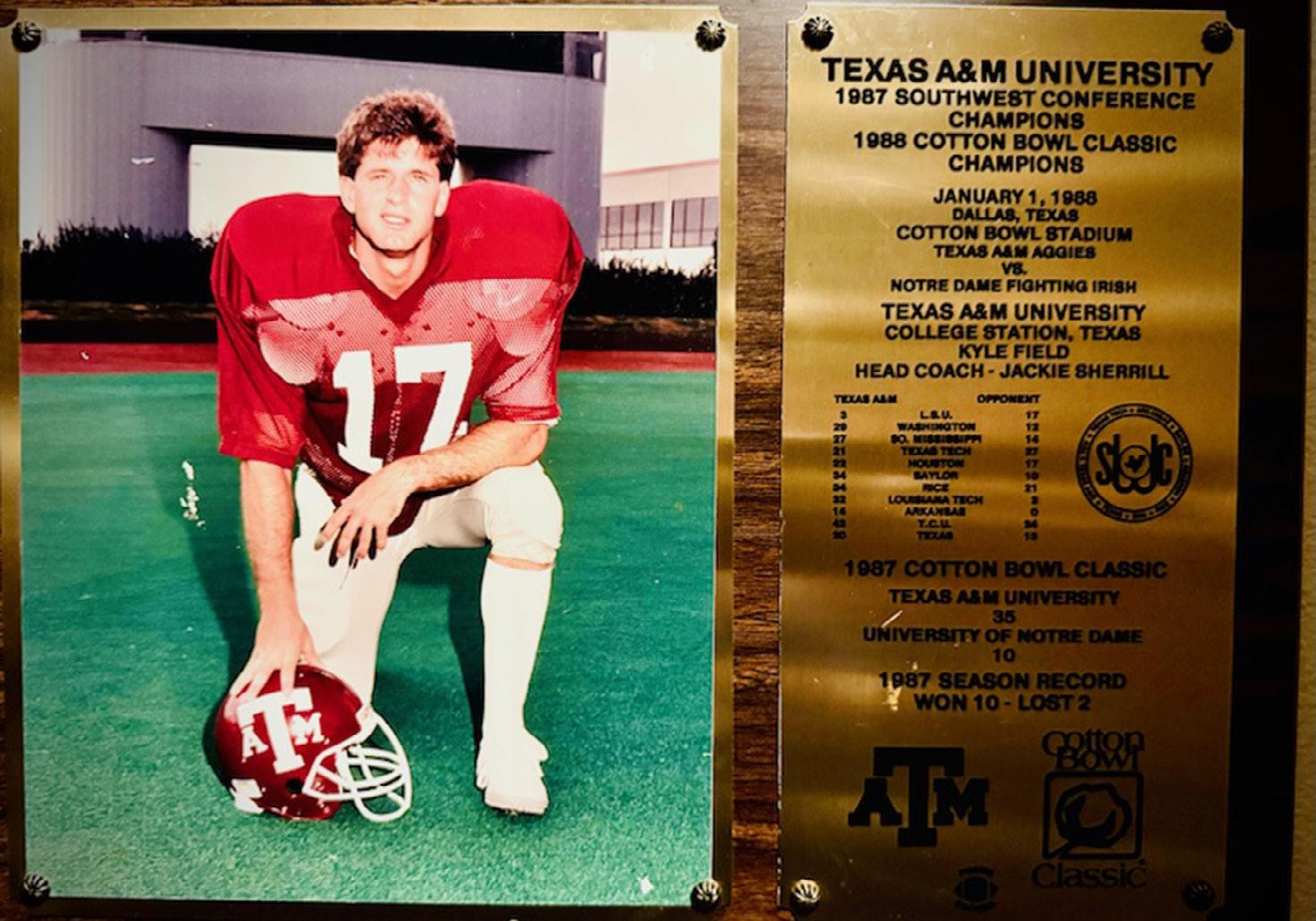
“The first time we went to the Cotton Bowl, we beat Auburn (36-16) and their star running back Bo Jackson,” Page proudly recounted. “The next year, we lost to Ohio State, who had All-Americans Chris Spielman and Cris Carter on their team. My final year, we defeated Notre Dame (35-10) and their star receiver Tim Brown, who won the Heisman Trophy that year. We had a lot of success during that stretch.”
Page credits Coach Sherrill for sparking the A&M resurgence, saying his leadership inspired players and team alike.
“He taught us how to believe in ourselves, especially when others did not,” Page said of Sherrill, who coached the Aggies from
1982-88. “He never quit on a player who did not first quit on himself.”
Sherrill built a coaching staff at A&M that included such notables as defensive coordinator R.C. Slocum, who later would become the winningest football coach in Aggie history; linebackers coach Bob Davie, who led the Notre Dame program from 1997 to 2001; and defensive backs coach Curley Hallman, who went on to be the head coach at Southern Mississippi University, where he had star quarterback and future NFL great, Brett Favre.
For Page, plying his football trade with such company paid off handsomely in a memorable 1987 game against Louisiana State University (LSU), the traditional Southeastern Conference power that has produced more than its share of national titles, All-Americans, and Heisman Trophy winners.
In 1987, the LSU Tigers featured a bevy of star running backs and kick returners, including a speedster who broke off a long run against the 12th Man Kickoff Team in the first half.
“We kicked off to him to start the second half and all of a sudden he breaks free again,” Page recounted. “I was playing safety and it was just me and him. Basically, I’m thinking that if he scores, that’s going to be the end of this experiment of the ‘Kickoff Team.’ But I was lucky that day – I got him, hauling him down and preventing a touchdown.”
As a cherished reminder of his touchdown-saving play, Page was presented with a special plaque that now hangs in his home office. It symbolizes all
the hard work, the two-a-day practices in Texas heat, and “all the preparation that boiled down to that one moment,” said Page.
“To this day, Coach Sherrill always drops me a line before we play LSU, asking which one of our guys is ‘going to make a play’ like I did that day,” Page said with a broad smile.
Page also smiles when he thinks about the times that he and others on the A&M squad paid visits to kids hospitalized at Scottish Rite for Children in Dallas.
“Coach Sherrill organized those visits as part of our Cotton Bowl experiences,” Page said. “It was his way of emphasizing the importance of giving back and making a difference in the lives of others.”
It also helped spawn the creation of a nonprofit, the 12th Man Kickoff Team Foundation, to support scholarships at A&M, as well as to funnel financial support to the Emory Bellard ALS Clinic in Georgetown, Texas; Scottish Rite for Children; and MD Anderson Hospital in Houston.
According to Page, “setting up the foundation is my proudest career
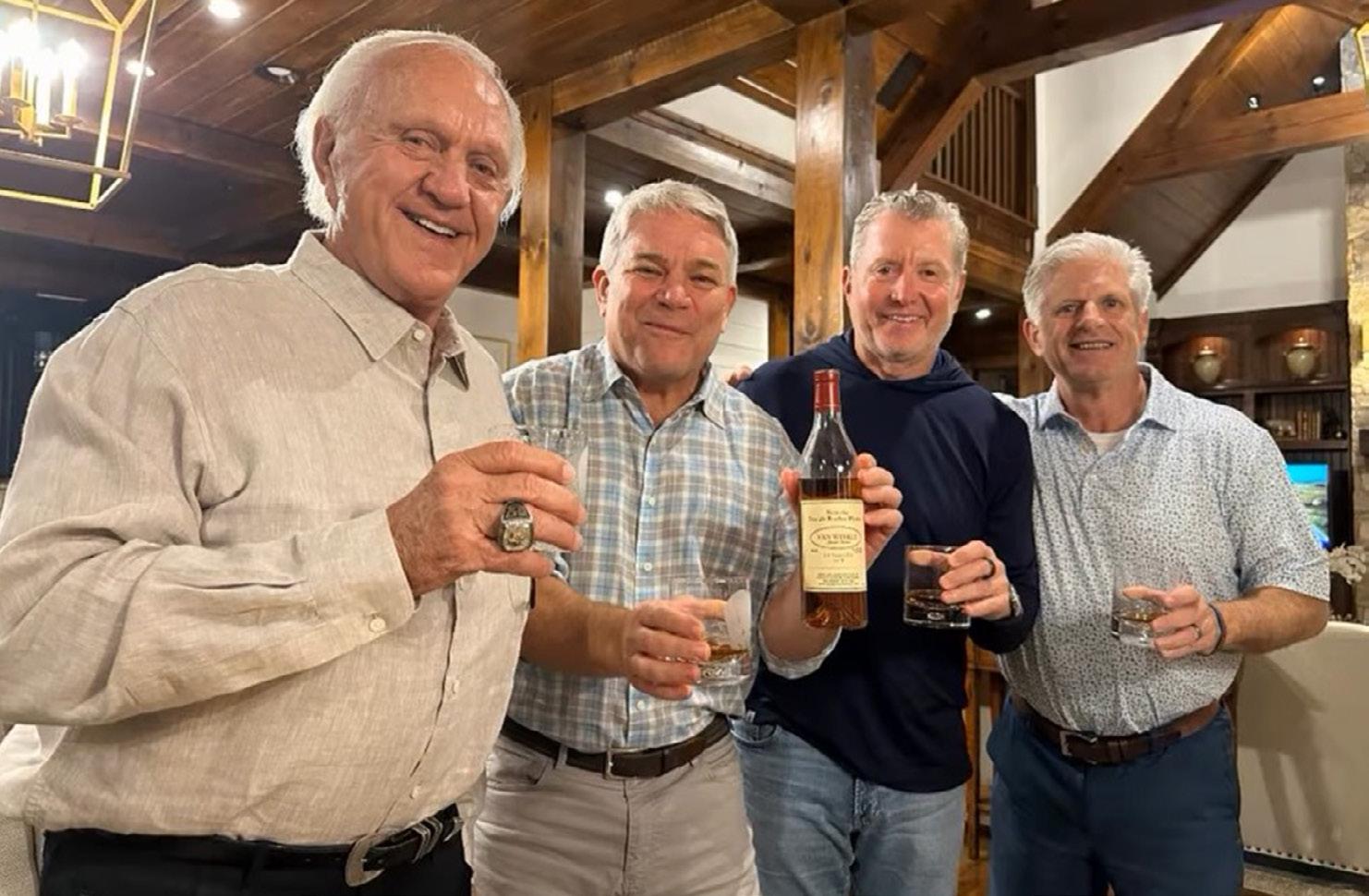
achievement” based on the lasting impact it has made on a wide range of funding recipients.
Two years after obtaining his bachelor’s degree from A&M, Page earned a Master of Business Administration from Southern Methodist University. Three years later, he was awarded a law degree from St. Mary’s University School of Law in San Antonio.
Now as a partner in the San Antonio firm of Thornton, Biechlin, Reynolds & Guerra, L.C., Page focuses his practice on the defense of commercial motor vehicle and automotive claims. He also defends personal injury actions and property damage cases.
“One of the things I learned in football is that no matter how good you are, there’s always someone better –someone faster, smarter, and more talented,” Page said. “When you come up against those kinds of players or in the legal world, those kinds of lawyers, a lot depends on how you prepared for such a challenge. If you prepared yourself to the best of your ability, then everything will take care of itself.”
A fellow believer in the importance of preparation is Page’s wife, Mary Strauss, an attorney who serves as managing partner of Thornton Biechlin.
A University of Texas alumna, Strauss graduated from St. Mary’s School of Law in 1998. She has focused her
practice on litigation in the areas of premises liability, motor vehicle accidents, and first party liability/bad faith claims.
“When she came to the firm, she actually took my job,” said Page, who had been with the firm for three years and had been mentored by a partner who had a tough-minded – and occasionally high-decibel – approach to learning the law.
“He had a totally different approach to mentoring her, however,” said Page. “So, we were wondering, ‘Why isn’t he yelling at her?’ But then his lead paralegal, who had been with him forever, came in and set us straight: ‘No, it’s just because she’s smarter than you. She just knows what she’s doing.’”

By Tom Kirvan
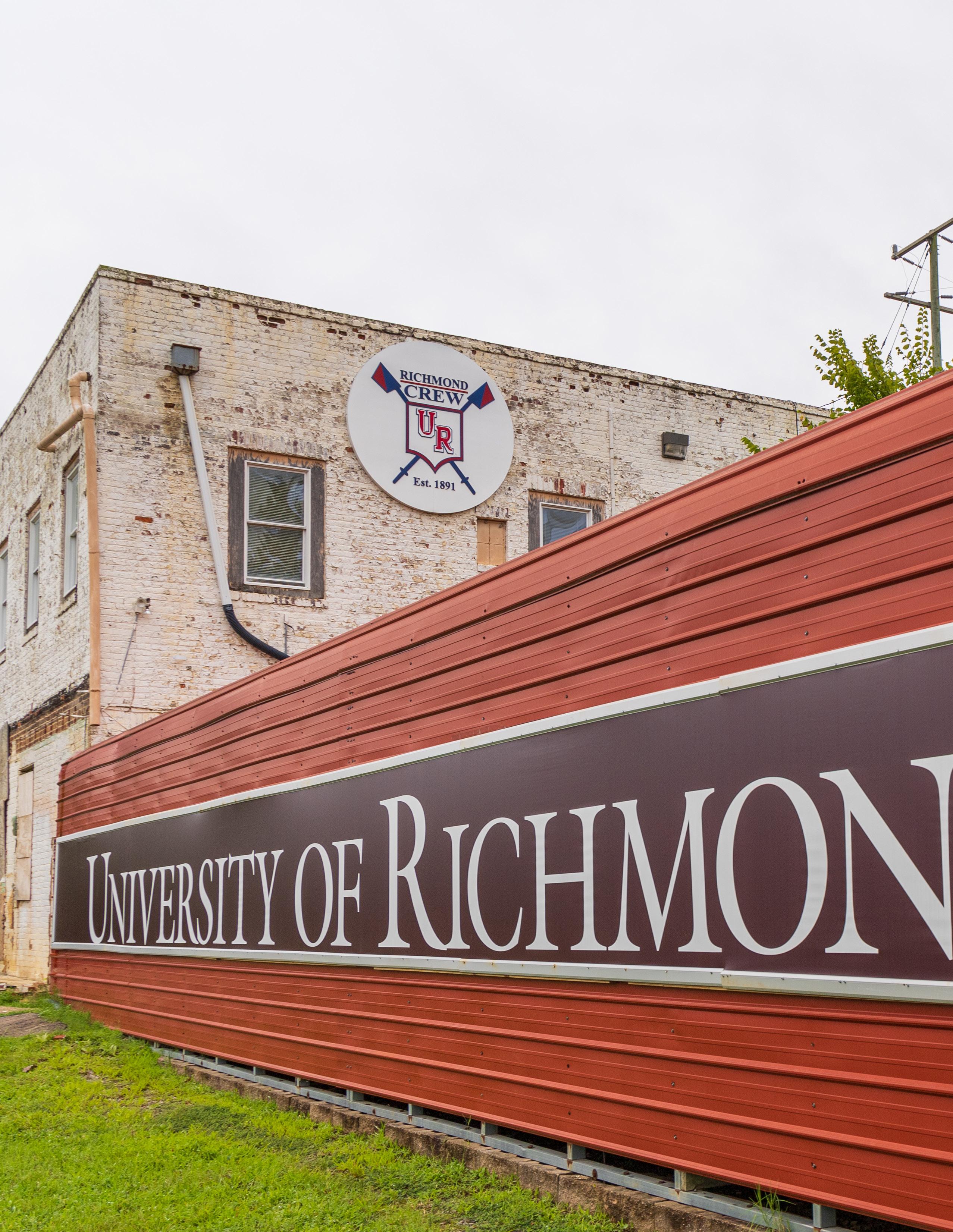
Ranked among the top 25 liberal arts colleges by U.S. News & World Report, the University of Richmond is located on a 350-acre campus.
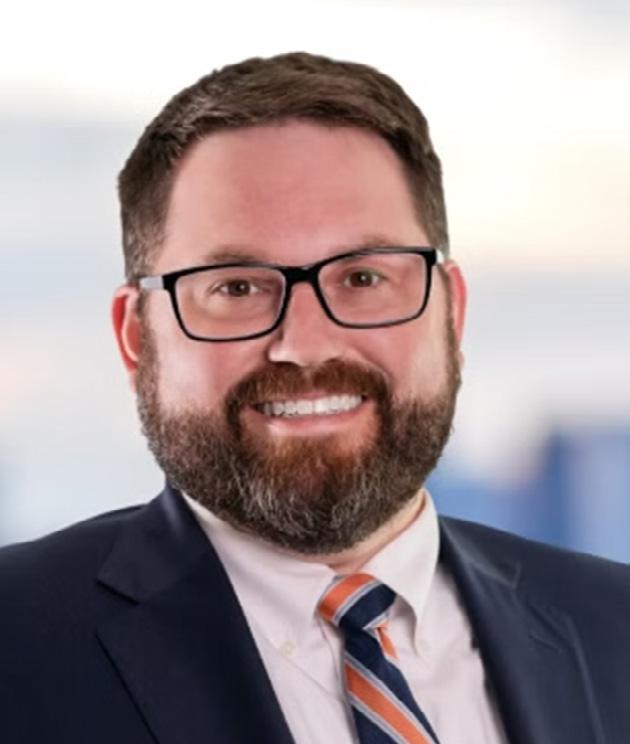

Both Brian Vieth and his wife, Hannah, served in managerial capacities during their college days at the University of Richmond (U of R), where they met and then became close colleagues while juggling work and school responsibilities at the private university of 3,100 students.
Their work – as student managers of the U of R football team – was a four-year ride filled with highs and lows, ranging from the thrill of a national championship in their first season of service to the Spiders, to an interim coach-led squad mired with a 3-8 record during their final year on the sidelines.
“There are ups and downs with any job, of course, but the friendships we made and the experiences we had made it all worthwhile,” said Vieth, a medical malpractice attorney with Goodman Allen Donnelly in Glen Allen, Va.
The couple met on the day before pre-season practice began in 2008, a year that will live a long life in the U of R history books for the gridiron glory that ensued under the leadership of head coach Mike London.
“Little did we know that we were about to be part of a team that would win the first national title for the University of Richmond in any sport,” said Vieth.
“That was not on our radar when we began practice that season. We were just trying to contribute to the success of the program, to be part of a team that had hopes of a winning season.”
Vieth sported a football background when he enrolled at U of R, playing all four years of high school as an offensive lineman. Hannah, now a senior project manager for Capital One Bank, was also an athlete in high school as a member of the soccer and volleyball teams.
“I played from middle school through high school, but I knew that playing at the college level was not in the cards for me even though I was part of a team that won the regional championship and made the state semis my junior year,” Vieth admitted. “I was too small and too slow to make it in college.”
But during his senior year of high school, Vieth received an unexpected email from the head equipment manager for the U of R football team, gauging his interest in being a student manager.
“I jumped at the chance, as it was my way to stay connected to football, a sport that I loved,” Vieth remarked. “I had also been going to their games since I was a kid and was well aware of their recent success.”
The Spiders began the season with a 4-3 mark, which included a last-second loss to rival James Madison University. The heartbreaking loss, ironically, set the stage for Richmond’s unprecedented run of nine consecutive wins en route to the Division
IAA title with a convincing victory over University of Montana, 24-7.
“We beat William & Mary to get into the playoffs, and then defeated App State, Northern Iowa, and Montana,” Vieth said of the magical run that coincided with the end of the semester and exam time.
“I think most of us were pulling allnighters during those three weeks, as we bussed eight hours to play App State in North Carolina, then traveled to the semifinals in Cedar Falls, Iowa to play Northern Iowa, and finally flew to Chattanooga [Tennessee] for the championship game,” Vieth related. “It was a blur because there was so much going on. You never really had a chance to step back and say, ‘This is really cool.’ We stayed at the Chattanooga Choo Choo Hotel and there were all these fans coming out of the woodwork for the big game. It was definitely exciting to be a part of all that.”
Each member of the squad, including all the coaches and managers, also received championship rings that serve as treasured reminders of the success the team enjoyed during the 2008 season.
During their four seasons as managers, both Vieth and his wife received plenty of Nike gear that the sports apparel giant dished out to members of the Richmond athletic program. The gifts were part of the partnership agreement that the company had with the university to be the official athletic footwear, apparel, and accessory brand for the Spiders.
“I got a lot of Nike shorts, shoes, jackets, and pants during those four years,” Vieth recalled. “It wasn’t until about 2020 that I actually had to buy a new set of athletic pants because all of the elastic had finally worn out from the ones I had in college. I still have my letterman’s jacket that I wear occasionally to a football game.”
Vieth said the five-member student manager team played an integral role
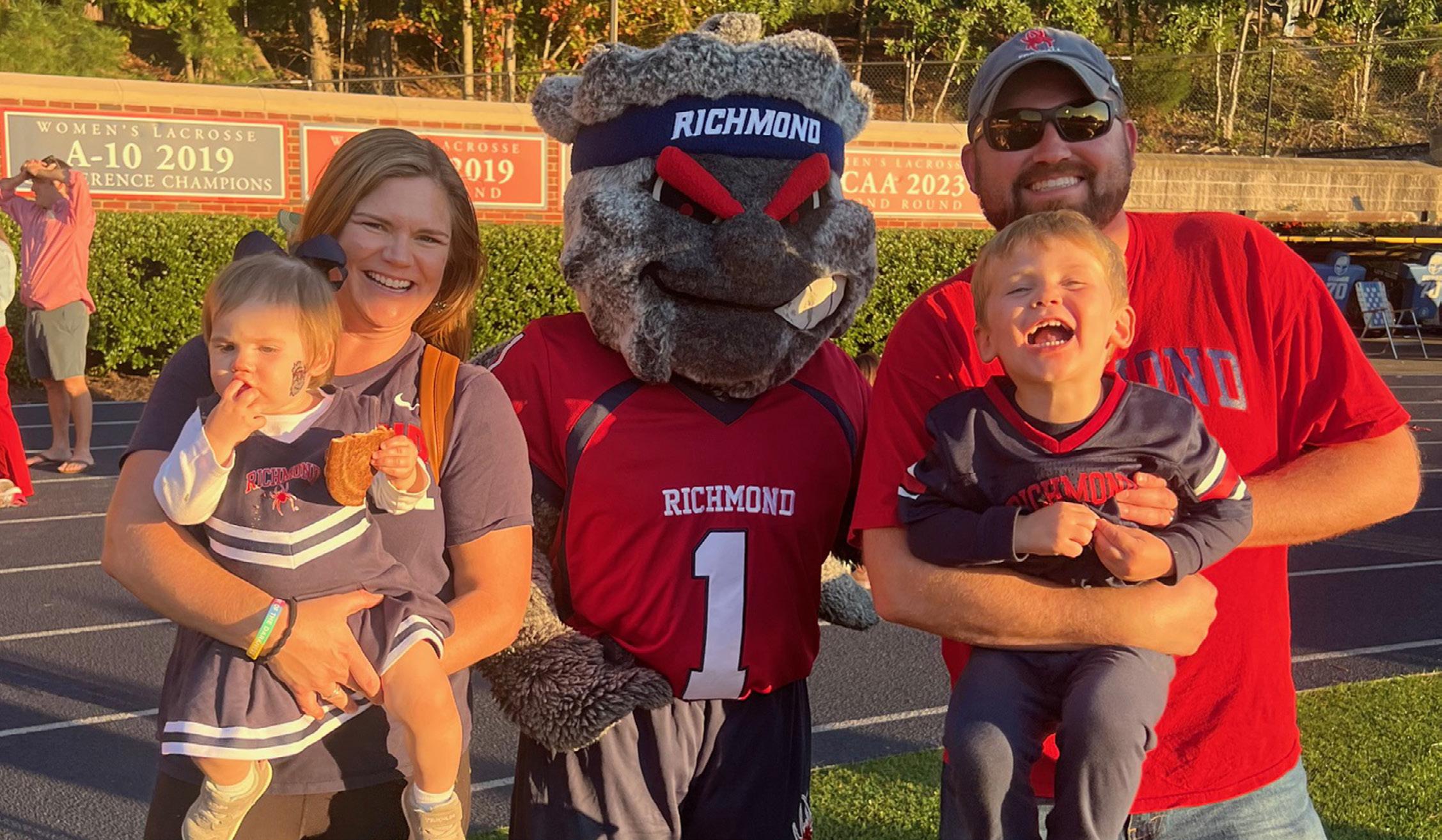
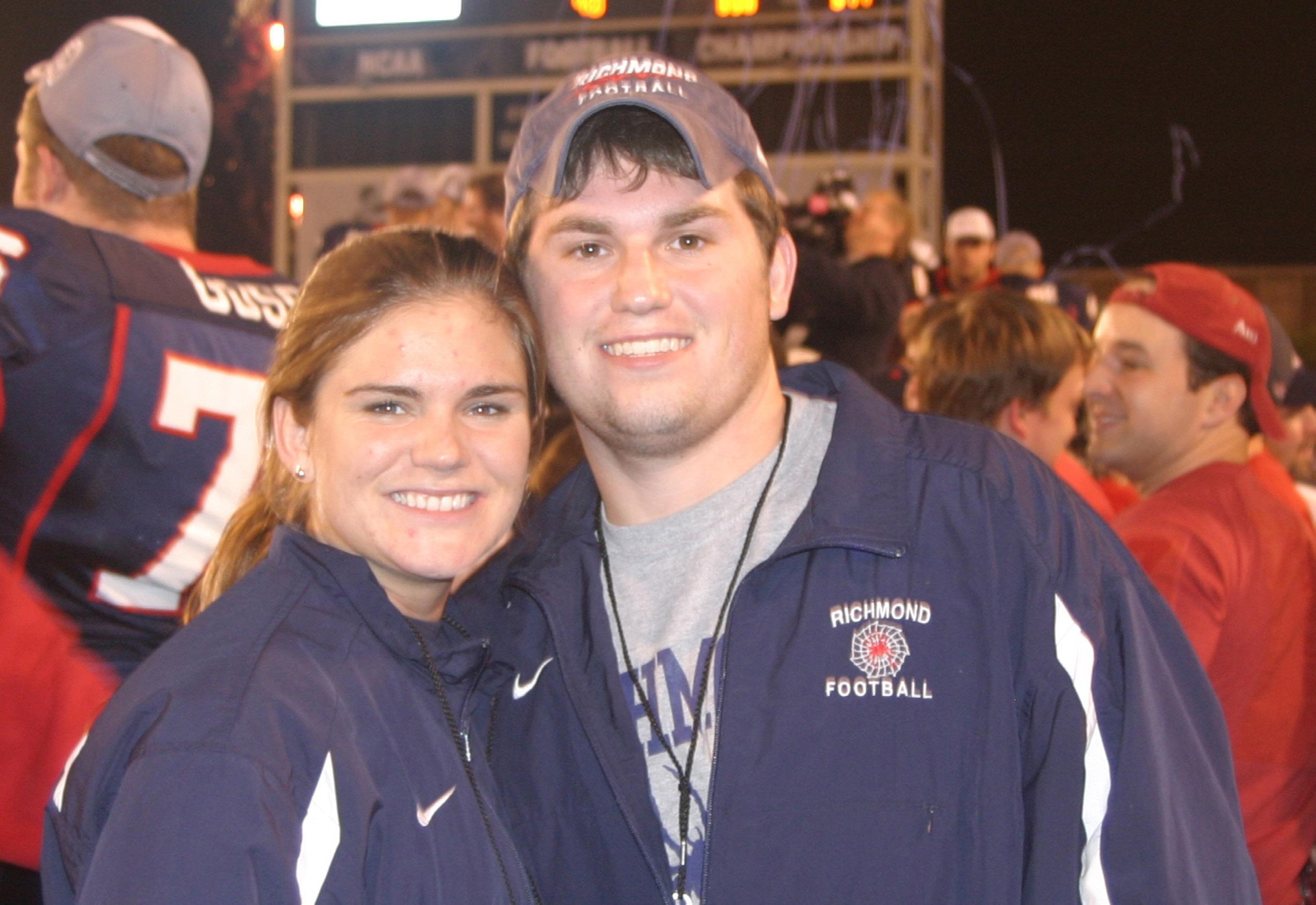
in supporting coaches and players with day-to-day operations, which included equipment management, practice setup, and assisting during various on-field drills.
“We would get there 45 minutes before practice and often would stay long after it ended, providing the behind-thescenes support that the team needed,” he indicated. “The coaches and players, I think, appreciated all that we did, but they didn’t necessarily say so at the time. We also could be dressed down by a coach if we did something that didn’t meet with their satisfaction, but generally they appreciated that we were doing our best to make their job go smoother.”
Certain players, who came in via transfer from a bigger school in search of a starting position, could be demanding at times, according to Vieth.
“Some of them had this ‘kiss the ring mentality’ that we had to deal with,” Vieth recalled. “I made it clear to them that ‘you’re just another player to me’ and my job here is to make your life easier.
“But I also would tell them that ‘I have a lot of discretion in my job, and if you’re good to me, I will go out of my way to be good to you.’ Otherwise, they might find out the hard way that their clothes might not get cleaned,” Vieth said with a laugh.
Now, as a father of two young children –Weston, 4, and Emmie, 2 – Vieth has been forced to alter his football watching.
“I’ve had season tickets for years, but it’s a little harder to go to all the games now because the kickoff is during nap time for our kids,” Vieth said of the sacrifice he needs to periodically make in pursuit of effective parenting.
Vieth comes from a long line of lawyers, as his father, grandfathers, and an uncle all practiced law.
Vieth’s father, Peter, spent the bulk of his career as a medical malpractice attorney before becoming the editor of Virginia Lawyers Weekly, a BridgeTower Media publication.
“Like me, he also graduated from the University of Richmond Law School, and has been my legal role model,” said Vieth, whose mother, Gwen, primarily raised the couple’s four children. “I was born when he was in law school and some of the faculty and staff more than 20 years later remembered me as an infant and toddler from back then.”

By Tom Kirvan
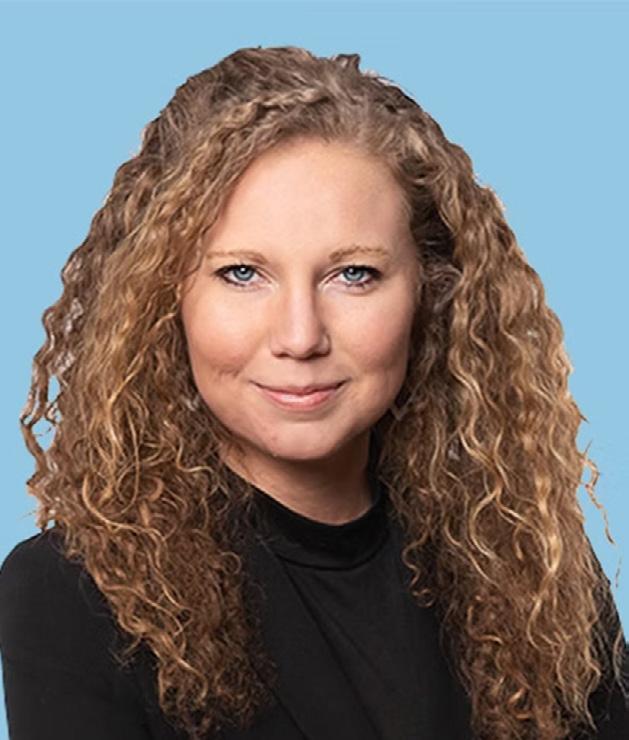
Astoried NFL franchise, the Detroit Lions have enjoyed recent success on the gridiron, making the playoffs in 2024 and 2025 while narrowly missing a berth in the Super Bowl after falling to the San Francisco 49ers in the National Football Conference championship game two seasons ago.
The Lions, nevertheless, have also been dogged by the dubious distinction of being the only NFL team to never have made an appearance in the Super Bowl, even though they have been around for all
60 of the games that have evolved into the most-watched sporting event in America each year.
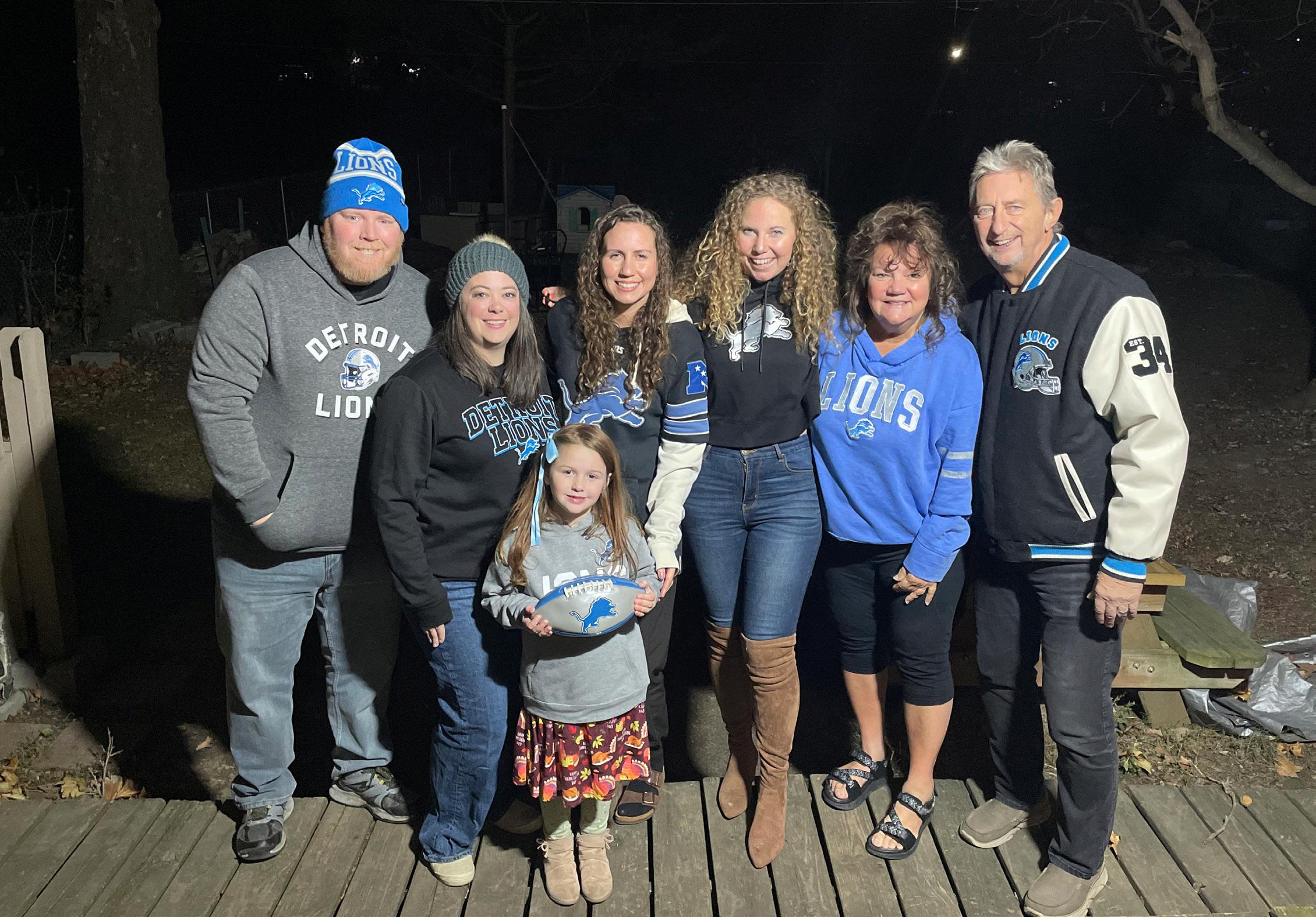
That unfortunate piece of history for Lions fans is of little mind to Abigail Wasil, an attorney with the law firm of Cardelli Lanfear Law in Troy, Mich., a suburb of Detroit. As a longtime fan of the Lions and a devoted season ticket holder, Wasil “bleeds” Honolulu blue, the primary color of the NFL squad that plays its home games at the 65,000-seat Ford Field in downtown Detroit.

“Even though historically we haven’t had the best run of things, I still remain optimistic that eventually we’re going to win the Super Bowl,” Wasil declared as the 2025 season wound down with Lions posting a 9-8 record that kept them on the outside looking in when the playoffs began. “I’m 100 percent sure that our day will come and that we’re going to go all the way one of these seasons.”
Such optimism was ingrained in Wasil at an early age thanks to her parents, George

and Elizabeth, who have been loyal Lions supporters since they were kids.
“When you grow up in the Detroit area, you automatically become a fan of the Lions and hope that they do well each season,” explained Wasil, who turned 30 in 2025. “I’m the youngest of three children, and both my brother (Joseph) and sister (Hannah) are big Lions fans as well. Cheering them on is something that we really enjoy as a family. I have fond memories during my childhood of always going outside on Thanksgiving Day to play a game of touch football with my family. It’s one of those memories that I will always treasure.”
Wasil, who earned her law degree from Liberty University School of Law in Virginia in 2021, is particularly enamored with Detroit’s head coach, Dan Campbell, a former NFL tight end whose tough, gritty, never-quit attitude resonates with the Lions fanbase.
“He speaks from the heart and mirrors Detroit’s working-class background,” said Wasil. “He is very authentic and has remade the culture of the Lions with a swagger that makes him really relatable. I just think he’s the best.”
During the 2025 NFL season, Wasil shared her Lions fandom with her mom, helping hold and unfurl a giant American flag that covered much of Ford Field while the
Star-Spangled Banner was played during a pre-game ceremony.
“It was special to be on the field for that occasion, sharing the experience with my mom,” Wasil said. “It was a thrill to be part of something that big that was on national television.”
Wasil, who was raised in the Detroit suburb of Fraser, played volleyball and softball in high school, while her siblings and parents preferred to display their athletic talents on the ice.
“My dad was a really good ice hockey player, and his high school team won the nationals one year,” Wasil proudly said. “He’s in his early 70s now, and he can still outskate all of us.
“My parents have always been such amazing people in my life, and they serve as the inspiration for everything that I do,” proclaimed Wasil, who is an alumna of Rochester University (Michigan).
“They always stressed the importance of faith, academics, and in giving back to the community.”
Wasil has taken the message to heart since graduating from law school and now serves as a trustee on the Board of Education for Fraser Public Schools, a district that sports an enrollment of more than 4,500 students.
“I applied for an opening and was appointed to the board in July 2022 and was elected to a full term that fall,” said Wasil, who was motivated to serve the community after suffering the loss of a close friend in a car accident during law school.
“She was one of my best friends, and had everything going for her,” Wasil said. “She was married, had a baby, and had just started her own business when the accident occurred. Her death impacted
me in a profound way and gave me even more desire to serve the community in a positive way.”
Around the same time, Wasil was asked by one of her church pastors to meet with the founder of The Joseph Project, a nonprofit organization that connects human trafficking survivors with pro bono legal services. According to Wasil, the creation of The Joseph Project was inspired by the biblical account of history’s earliestrecorded trafficking survivor, Joseph, who transitioned from exploitation to empowerment.
“The Joseph Project was started by Nate Knapper in Michigan and now has expanded to other states as well,” Wasil indicated. “Nate is an attorney and a federal agent who served on a task force to combat human trafficking in Southeast Michigan when he got the idea to start this
organization. It’s been his goal to create a nationwide network with the capacity to help every identifiable trafficking survivor on a pro bono basis. Its chief focus is to address the gap in legal services for trafficking victims.”
Wasil now serves as board chair of the nonprofit and is firmly committed to its mission of offering legal assistance to trafficking survivors.
“Unfortunately, the human trafficking problem continues to grow, which means the need for legal help is also increasing,” Wasil lamented.
All of Wasil’s community service work is in addition to her busy law practice, which focuses on defending no-fault insurance and premises liability cases for clients of Cardelli Lanfear Law.
“I was a legal assistant and paralegal before law school, and have always been involved in civil defense work,” said Wasil, who joined Cardelli Lanfear Law in 2023.
“I’m blessed to be part of a firm that has great mentors, great attorneys, and a great work environment. There are a number of amazing attorneys here who have been practicing for years and are very willing to share their knowledge and expertise with me. When asked, they always offer valuable insight and advice.”
Now, as Lions’ fans lick their wounds after a disappointing 2025 season, Wasil remains characteristically upbeat, predicting a rebound in the 2026 gridiron campaign.
“We will be back in the playoffs,” she declared. “I have faith in the Lions.”
By Tom Kirvan

and Director
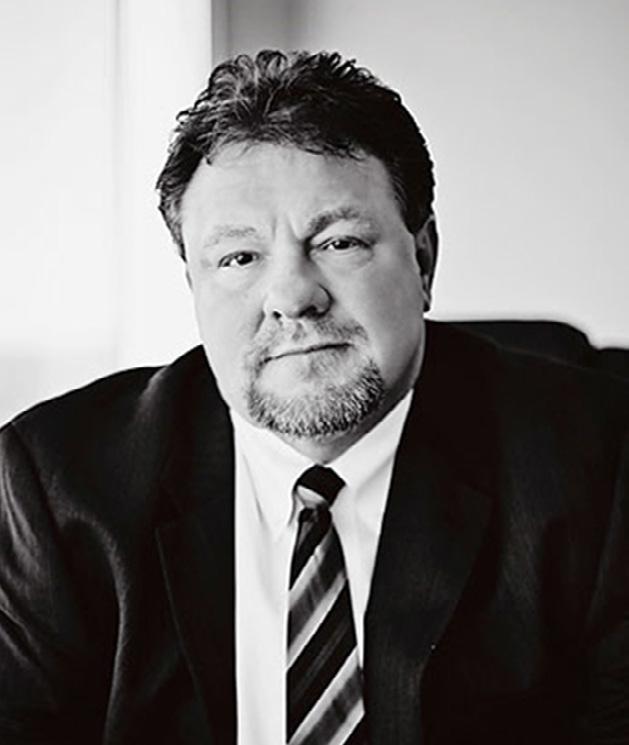
A 1991 graduate of the University of Texas School of Law, Singley specializes in the areas of workers’ compensation and employer liability. He currently serves as an executive council member for the Workers’ Compensation Section of the State Bar of Texas.

Tim Singley grew up in Killeen, Texas, in the shadows of Ft. Hood, one of America’s largest military bases with a population of more than 200,000 personnel over a land mass covering 215,000 acres.
The youngest of four children, Singley was the son of an Army command sergeant major who did three tours of duty overseas, fighting in the Korean and Vietnam wars before returning to Fort Hood to retire when tragedy unexpectedly struck.
“He got out of the Army after 29 years, went to school while he was working, graduated, and died a month later of a massive heart attack at age 49,” said Singley of his father, Harold. “I was in sixth grade at the time. It was a shock, but I came from a family where you put one foot in front of another. When something bad happens, you don’t sit around and wallow in it. You move forward as best you can.”
And for a promising athlete like Singley, that objective meant channeling his energies into excelling on the gridiron, which is hallowed ground for boys growing up in Texas.
By the time he reached high school, Singley had already developed the reputation as a budding football star, a two-way player who possessed college potential.
“I played pretty well in high school, well enough to get noticed by college recruiters,” said Singley, a member and director in the San Antonio office of Thornton, Beichlin, Reynolds & Guerra, L.C., where he focuses on workers’ compensation and employment liability matters.
Among those courting Singley for his football talents was Texas Christian
University Coach Jim Wacker, the 1984 AP Coach of the Year after leading the Horned Frogs to a No. 12 ranking and an 8-3 record.
“He was extremely charismatic, and he recruited the heck out of my mom (Wanda),” Singley said of Wacker. “As a result, I verbally committed to play at TCU. This was long before high school players had press conferences to disclose their college choice. Back then on signing day, you just went up to your (high school) coach’s office and signed your letter of intent, simple as that.”
While TCU appeared to be in the catbird seat for Singley’s football services, the Killeen High School product also had another college suitor – Texas Tech, a Southwest Conference school located in Lubbock, a lengthy six-hour drive away.
“I was very blessed that on my high school team we had 18 players sign Division 1 scholarships that year,” Singley indicated. “We were a talented team, and I was proud to be part of it. So, on signing day, my mom got all dressed up for the occasion in the coach’s office. It was going to be a very special time for her.”
But Singley suddenly had other ideas about his preferred college choice.
“Literally 15 minutes before I was scheduled to sign with TCU, I made a call to Lubbock to see if I still had an offer to go to Texas Tech,” Singley recalled. “When they said ‘yes,’ I made the decision to go to Tech without telling my mom.”
His about-face, not surprisingly, didn’t sit well with the family matriarch, the woman who had her heart set on seeing her son suit up in the purple and white uniform of TCU, a private school located just two hours away.
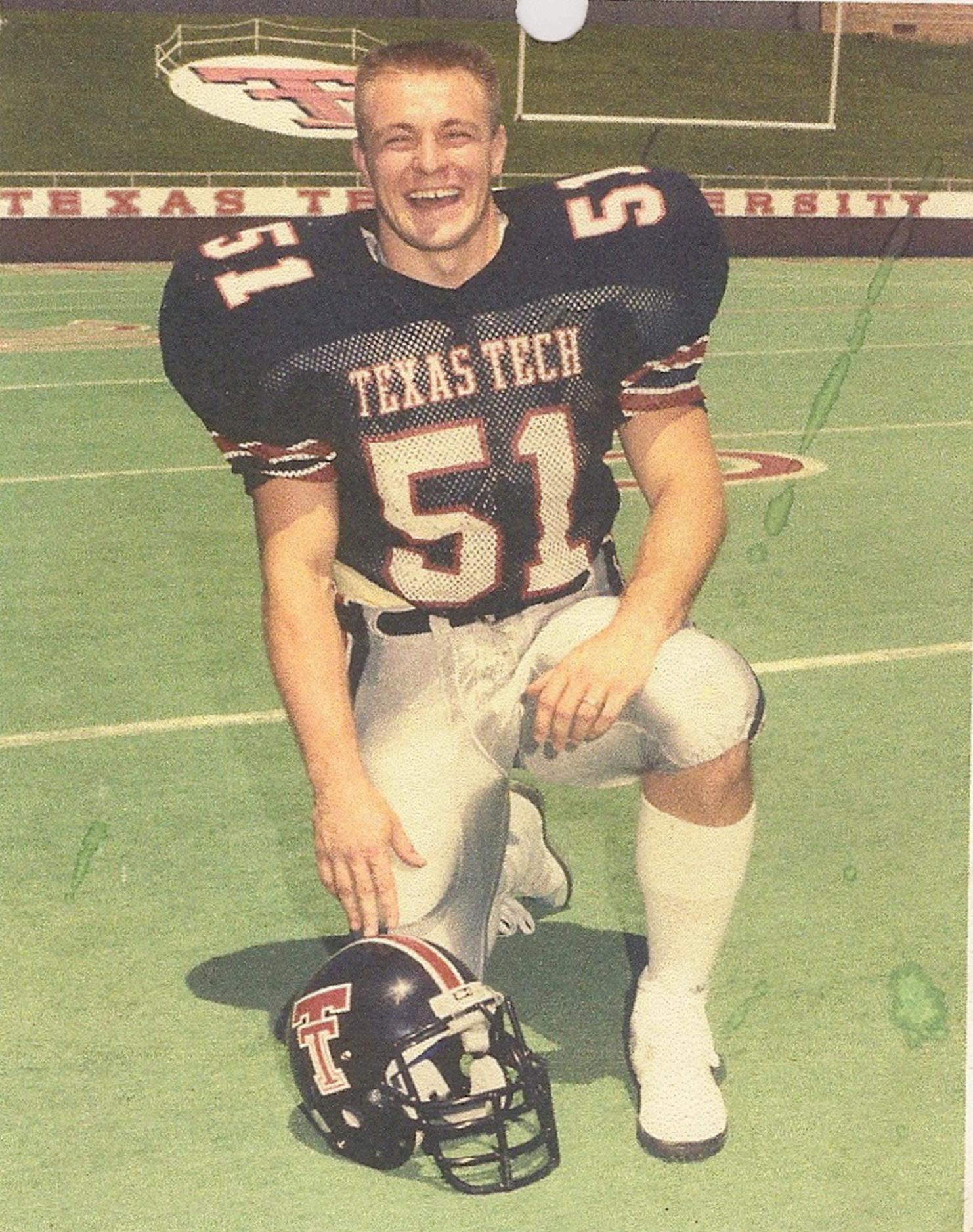
“Let’s just say she was more than a bit upset,” Singley said of his mother’s response to his signing day switcheroo. “She wouldn’t – and didn’t – talk to me for two or three weeks.”
Despite the family fallout, Singley maintains that he has “no regrets” about his college decision.
“It, in all honesty, was an impulse decision, but it also turned out to be the best decision I ever made because I had to grow up,” he declared. “I had to start making my own decisions in life and that certainly was a very big one at the time.
Fortunately, my mom – rest her soul –eventually forgave me, realizing that I had some growing up to do and that Tech would be the place to do it.”
It wouldn’t be an easy task, as Tech was about to embark on a coaching carousel over the next four years.
“We had three different head coaches during my four years there,” Singley explained, rattling off the names of Jerry Moore, David McWilliams, and Spike Dykes. “If I had called up my mom and told her that I didn’t want any more of
that, she would have told me to ‘suck it up buttercup.’”
And forge on he would, eventually starting at linebacker for the Red Raiders, who went to several bowl games during his playing days there.
“They weren’t the big bowls, but they were bowls nevertheless,” Singley said. “We started the streak of Tech going to bowl games, so I’m very proud of that.”
Among his most memorable games at Tech were 1986 wins over two top 15 opponents, University of Arkansas and University of Texas. In the 23-21 victory over the Texas Longhorns in Lubbock, Singley made a particularly sterling defensive play.
“I can’t remember the name of their running back that game, but I literally knocked him out with a tackle, right there on national television,” Singley recounted. “But the announcer got so excited about the hit that he called me ‘Tom Singley’ instead. So, when I called up my grandmother in Pennsylvania after the game, as I always did, she said: ‘Oh, honey, I didn’t know that you had another Singley on the team.’ Of course, I had to tell her that was really me who made the hit. My one claim to fame and it got shot in the foot.”
Earlier that season, the Red Raiders hit the road to take on the No. 1-ranked University of Miami Hurricanes in the Orange Bowl. The Hurricanes featured a bevy of future NFL stars, including quarterback Vinny Testaverde, wide receiver Michael Irvin, running back Alonzo Highsmith, and safety Bennie Blades.
“We were a bunch of boys from West Texas who had never been anywhere like Miami,” Singley recalled. “We were even more fortunate to being staying at the Fontainebleau Hotel. We were living large that weekend.”
Then, when Singley and a few of his teammates were riding an elevator with a hotel housekeeper, they got a taste of the reality that was to come.
“She asked who we were in town to play,” Singley said. “When we told her the Hurricanes, she looked at us with a smile and said, ‘Oh, honey, they’re gonna kick your ass.’”
Which they did, 61-11, en route to an undefeated regular season record.
“We were humbled,” Singley said of the shellacking. “They were unlike any team we’d ever played – bigger, stronger, faster. I particularly remember being on the punt return unit and getting picked up by one of their guys and tossed like a ragdoll. It was embarrassing.”
And yet, Singley confessed that despite the setbacks, the sacrifices, and the assorted injuries that he suffered during his football career, he has a conscience clear of any regrets.
“Physically, I’ve got plenty of issues because of football,” he acknowledged. “Both my knees have been cut on. I’ve got three herniated discs in my back. I had a three-level fusion in my neck, a pin in my shoulder, and various other problems. And when people ask me now whether I’d elect to play again, I always say, ‘You bet – in a New York second.’ It’s all about the friendships; the lifelong friends I’ve made because of football. Those are the treasures that have been with me for a lifetime.”


By Tom Kirvan

When Tim Singley became a grandparent for the first time, little did he know that it would be his ticket to being a parent once again.
If that scenario sounds strange, Singley is the first to admit so after he and his wife, Sherri, had two children and then suffered the loss of a baby girl just days after she was born with a rare heart condition.
Their children, Travis and Shelbi, each have one child of their own, Sonora and Luke, respectively. The Singleys, who have been married for 37 years, can only wonder if the daughter they lost in infancy, Savannah, would have blessed them with even more grandchildren.
“There’s a hole there that will never in anyway be filled – ever,” declared Singley of the death of his baby daughter. “Every Christmas, every birthday, we ask, ‘What would Savannah being doing?’ Those questions will be with us for the rest of time.”
But despite living with an ache in their hearts over the loss of their youngest child, the Singleys were firmly dedicated to being the best parents they could be for their other children. That desire even extended to their support for St. Jude’s Ranch for Children, a nonprofit that assists abused and neglected girls and boys.
“My wife volunteered there for years, and she has always made our house a welcoming place for children to gather,” Singley explained. “A lot of people talk about helping people, but talk is talk and action is action. Thanks principally to my wife, we’ve done our best to help others throughout our marriage.”
And then, on December 17, 2017, the Singleys got the surprise of their lives when their daughter, Shelbi, gave birth to a son while a student at Savannah College of Art and Design in Georgia. They received

the news in an unexpected fashion after she was taken to a hospital ER by her boyfriend after experiencing severe stomach pains.
“We got a call from him that Shelbi was in the hospital and that they didn’t know what was the matter with her,” Singley related. “So, I said to him, let me talk to the doctor. And then in the background, I hear, ‘Oh my God, it’s a baby!’”
Not surprisingly, Singley and his wife were in disbelief, especially after seeing their daughter less than a month before when she came home for Thanksgiving.
“There was no sign of her being pregnant at that time,” Singley said. “No sign at all. She looked like the typical college coed, wearing the tight leggings, the T-shirt. She looked like a normal girl.”
But, in fact, she was an expectant mother who was unaware she was pregnant. She was in the midst of what is known medically as a “cryptic pregnancy,” a pregnancy that is not detected by the mother until she is in labor. While the so-called “hidden pregnancy” is uncommon, experts suggest that about 1 in 2,500 pregnancies are not discovered until delivery.
“Of course, I didn’t believe any of that at the time,” said Singley, who admitted that his initial fury at hearing the pregnancy news soon gave way to overriding concern about the health of his daughter and new grandson.
“Just the year before, in 2016, Shelbi almost died of a heart condition and it looked like she might need a heart transplant until she was put on an experimental medication that helped save her life,” Singley noted. “And so, at that point in time, my focus went from being mad, to ‘we want this new (grand) kid scanned from stem to stern to make sure he is okay’ because there were no
studies on the effects of the experimental medication on fetuses or children.”
Fortunately, said Singley, the new addition to the family is “perfectly normal,” and for the past eight years has been living with his mom under the roof of his grandparents.
“He was meant to be here,” Singley said of his grandson, Luke. “My wife and I have discussed that this isn’t quite how we envisioned our future, but we are so grateful that this is how our life is turning out. For me personally, I choose to look at it in a way of how many granddads get the
chance to spend this much time with their grandson? It’s priceless, and I’m going to enjoy every second of it until I pass.”
As a prime example, Singley accompanied his grandson on a Cub Scout camping trip in October in the Texas Hill Country, not far from the site of the catastrophic flash flood on July 4 that claimed the lives of 27 campers and counselors. For Singley, the camping trip with his grandson brought back flashbacks to a similar weekend outing with his son, Travis, years ago.
“The very first campout I took my son on when he was in Cub Scouts, our tent
got flooded during a heavy rainstorm,” Singley recalled. “This most recent time camping with my grandson, the same thing happened when it started raining like crazy one night. Luckily, where we camped was on high ground, so we got through it safely even though our tent got swamped during the storm. Apparently, it’s now a rite of passage for us.”


By Brian Cox

You’re no longer a young lawyer, but you don’t yet have the experience of a managing partner.
Instead, you’re somewhere in that “messy” middle ground of your career where you’re taking on new challenges within your firm such as business development, supervision, mentorship, and management responsibilities. A lot is being thrown at you that you didn’t learn about in law school.
So, it’s likely you have questions and might find a support network of peers valuable.
The Primerus Developing Partners Section (DPS) is here to help.
At its outset in early 2023, the DPS set an ambitious but measured goal: Create meaningful, impactful, and valuable content for attorneys in the middle stage of their careers.
The intent behind the section’s formation was to bridge the gap between Primerus’ Young Lawyers Section and its Managing Partners Section by offering substantive programming resources and networking opportunities to attorneys from senior associates to junior and mid-level partners.
To achieve that objective, the section committed to organizing four educational events and four networking events annually.
Two years later, the section can proudly consider that objective met. In a short span of time, the DPS has offered its members a wide range of practical, actionable strategies for law practice management. Its substantive programs have explored topics such as digital and AI fluency; attracting and recruiting good talent; the art of delegation across the generational divide;

litigation funding; how to build a book of business; key leadership skills for partners; maximizing profitability; and business development.
The networking events, which are typically on Zoom but also include happy hours at Primerus conferences, are popular, well attended, and dynamic.
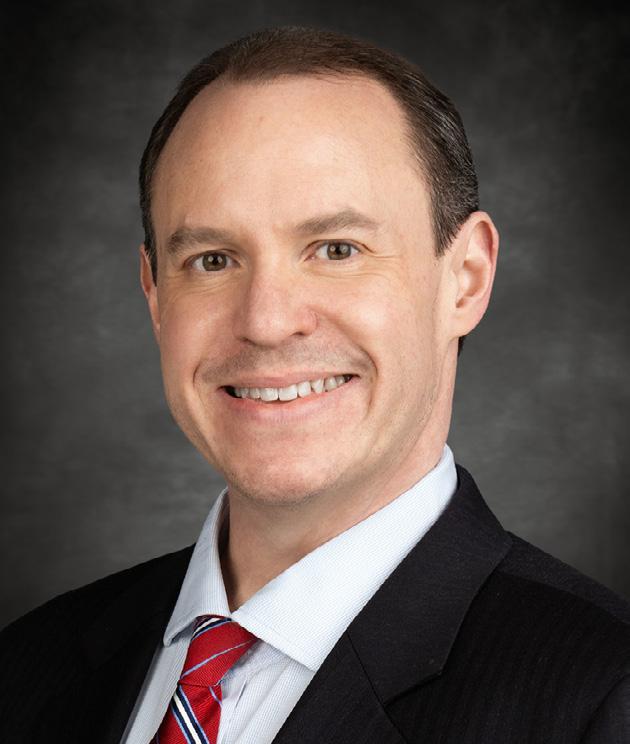
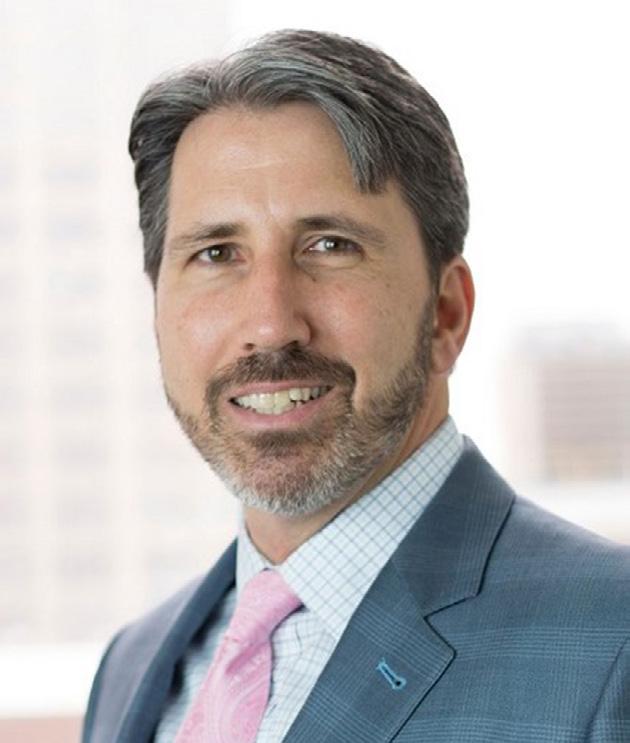
“We started with a ‘bang’ thanks to a very strong executive committee,” says Ryan Billings, chair of the section and a partner at the Milwaukee-based law firm of Kohner, Mann & Kailas, S.C. “We’ve accomplished the goals we initially set out to achieve. The question is, what’s the next chapter? What’s the next level up for us?” In answering the question of how to evolve, the section’s leadership is cautious about flooding attorneys with too much content, especially given the terrific demands on their time. The DPS executive committee feels it is currently in “the sweet spot” with the right amount
of content but is aware it needs to continue curating relevant content for attorneys in order to increase involvement and participation.
While participation in the section is easy and the time commitment is minimal, the benefits can be significant, according to Jerome “Jerry” Weitzel, a partner at Kozacky Weitzel McGrath, P.C. in Chicago, who has served on the DPS Executive Committee since the section was created.
“If you participate in all eight of the events, people see you every month and a half and that’s enough to be top of mind,” says Weitzel. “If you’re in the stage of your career when you’re developing your practice and have at your disposal an organization with nearly 150 firms that could potentially send you business, you should take advantage of meeting people at those firms.”
Attorneys who have hit the “middle band” of their career know how to practice law, understand the substantive area of law they practice, and know the nuts and bolts of running their practice. But they are now taking on challenges that are “law adjacent,” according to Billings. They are transitioning into different roles that involve book building, business development, supervision, and firm management.
Questions are certain to arise that might be more comfortably discussed with peers outside of the law firm – such as how best to deal with a mid-level associate who has mishandled a project or how to navigate the delicate issue of a senior partner whose abilities have started to decline.
“Some questions you can ask the people in your firm,” says Billings, “but sometimes you might want to have those conversations with someone who has no role in evaluating you or working with you
going forward – someone who’s a free sounding board that has no economic ties to you.”
In addition to Billings and Weitzel, the DPS Executive Committee is made up of Iker Dieguez (Cacheaux Cavazos & Newton), Melissa Demorest LeDuc (Demorest Law Firm, PLLC), and Daniel Pierron (Widerman Malek, P.L.).
The section’s networking events are designed to offer attendees access to years of experience and hard-earned wisdom.
Another aim is to promote crossgenerational collaboration and comprehensive representation across
all levels of practice. The DPS Executive Committee makes a concerted effort to involve representatives from the Young Lawyers Section and the Managing Partners Section in events with the intent of providing a range of perspectives.
“You put people from different groups in the same room and ask them to talk about something they all care about and it’s amazing the results you see,” says Billings. An additional reason that the Developing Partners Section was formed was to address succession issues when well-known Primerus lawyers who have been mainstay members of the organization since the beginning start to retire. The section hopes to get out in front of that transition by getting the next
generation of Primerus lawyers interested, involved, and invested.
DPS offers the opportunity for members to forge deep relationships with peers of a similar age that can last the length of an attorney’s career.
“We really want to create a venue and a forum where we can connect with people who are close to our own age and start forming relationships that can last for the next couple of decades,” says Billings.
For more information on upcoming events, visit the Developing Partners Section of our Practice Groups page at Primerus.com

The Developing Partners Section is dedicated to two purposes: (1) creating program content and networking opportunities for Primerus lawyers in the “middle band” of their careers (e.g., from senior associate to junior/ mid-level partner); and (2) promoting cross-generational collaboration and
comprehensive representation across all age and practice levels.
It serves as a place to learn and grow for lawyers who are taking on new challenges such as business development, mentoring, and management responsibilities within their firms. The section aspires to facilitate the successful transition of lawyers from
young to seasoned attorneys within their firms and within Primerus, and to ensure the long-term success of Primerus as an active and effective source of referrals by encouraging participation at all levels and providing opportunities to develop leadership skills and visibility within Primerus for the next generation of managing partners.

By Brian Cox
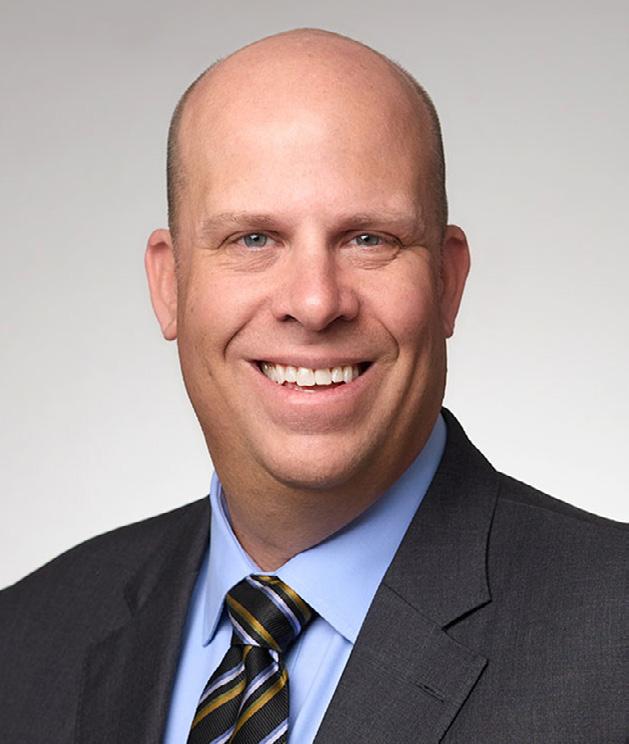
As an Arizona attorney who has earned a top-shelf reputation in the field of receiverships, Ryan Anderson relishes opportunities to don a white hat and be the good guy.
For more than two decades, he has assisted clients who have been appointed receivers by the courts to shut down fraudulent operations and help victims recover a portion of their lost assets.

A receivership is a legal process in which a neutral third party – the receiver – is appointed by a court to take custody, control, and management of a business or organization. As an agent of the court, the receiver is assigned to stop harm, unwind damage, and return as much value as possible to those who have been wronged.
“The engagements that are complicated and challenging are the ones that I am most interested in. My preferred
receivership engagements are when the government has placed something into a receivership because then I get to work with clients to unwind complicated issues,” says Anderson, a partner at Burch & Cracchiolo, P.A. in Phoenix. “I’m working for the defrauded victims and helping them recover money that they’d never have a chance to recover.”
The cases can vary widely. One month may involve dismantling a classic Securities
and Exchange Commission Ponzi scheme. The next could involve liquidating the assets of a fraudulent company selling fake medications.
Some of Anderson’s most memorable cases read like crime novels. One recently concluded matter began with a suicide and a box of cash hidden in a clothes dryer. The case involved a hard-money lending business whose principal was deceived by a reality television star into lending hundreds of millions of dollars under false pretenses.
“I get a phone call from the Arizona Corporation Commission,” Anderson recalls, “And they say we have a case where we have a deceased bank president and a box of money. Inside the box were written instructions on how to launder the money.”
Working with forensic accountants and investigators, Anderson helped reconstruct
a sprawling fraud involving fake property purchases, falsified documents, and exploitation of weaknesses in Arizona’s foreclosure statutes. The case culminated in a marathon deposition where the alleged fraudster was confronted with documents and recordings he did not know the receiver had uncovered – a moment that could have come out of a Perry Mason novel written by Erle Stanley Gardner.
“At the end of it, we had boxed him in. I knew I had him at that point,” Anderson says. “Months later, he was indicted, and he’s now serving a decade in prison for what he did.”
Over time, Anderson has built a reputation for handling high-profile receivership matters in collaboration with government agencies. The model itself has expanded well beyond financial fraud. In Arizona, state law allows education authorities to seek receiverships over failing or troubled

school districts. Anderson has represented clients in those matters, as well as working with forensic examiners and fraud specialists appointed to decipher complex schemes.
Anderson encountered his first receivership case during his second year at Southwestern Law School in Los Angeles. That summer, he was a law clerk for a small law firm in Phoenix where he was tasked with doing more than research motions or draft memos.
The firm had become involved in a series of state and federal receiverships and Anderson suddenly found himself entering fraudulent businesses alongside undercover police officers with guns drawn. The young law student found the work thrilling and marveled that a lawyer could be in this type of practice.
“I was hooked,” he says.
That same summer marked his first appearance in federal court when he accompanied a client to Tucson, Ariz. with the expectation of shuttering a fraudulent business once the order was filed in state court back in Phoenix. Instead, he was unexpectedly thrust before a federal judge hearing a case on the company to explain why a state-court receivership should take precedence. He wasn’t even wearing a suit.
That sense of immediacy and consequence has never faded for Anderson. He is invigorated by complicated situations that require sophisticated unraveling. Part of the field’s appeal is also philosophical. In a receivership, he does not represent a conventional client.
“You are an agent of the court,” he explains. “I get to tell the truth to everybody I interact with in a receivership. It’s the most refreshing thing.”
Every material decision is transparent and court-approved. Motions to sue, settle, or sell assets are laid out for judicial review. That neutrality, Anderson believes, is often misunderstood – even by lawyers who claim to practice in the space.
“There are a lot of people that put on their websites that they do receiverships,” he says. “But they don’t appreciate that their role is effectively as an officer of the court. Unfortunately, they are looking at it as if they’re a plaintiff or a defendant, and in the receiver position, you are not.”
The benefits of the receivership model, in Anderson’s view, are not merely ethical but economic. Compared to bankruptcy proceedings, receiverships can dramatically increase recoveries for victims. In bankruptcy, professional fees often consume large portions of the estate. In receiverships, creditor lawyers do not get paid from recovered funds.

“In recent receivership cases that I’ve closed,” Anderson says, “even though the case runs for a decade or more, we’re looking at recoveries of 60 to 70 cents on the dollar.”
He points to a striking historical comparison from the aftermath of the 2009-10 mortgage crash. Two nearly identical Arizona mortgage companies – Mortgages Limited and Landmark Capital Investment Company – collapsed under fraud. Mortgages Limited went through bankruptcy; Landmark entered receivership.
“The recovery for victims in Mortgage Limited was pennies on the dollar,” Anderson says. “A recovery for victims in Landmark was 70 cents on the dollar.”
For Anderson, that twin study remains a powerful illustration of why receiverships are often the superior tool for figuring out complex financial disasters.

“While I do a ton of bankruptcy work and represent bankruptcy trustees,” he says, “I do believe for a complicated financial problem, a receivership is the trusted model we all should use.”
Anderson’s ability to foresee how a case is likely to unfold has become the hallmark of his practice.
“I think clients would say my main skill is the ability to strategize how the case is going to work,” he says. “I am also not shy about being creative in this practice space. I think to solve complicated problems, you need to have some creativity on what to do.”
Parallel to his receivership work, Anderson has also built a significant practice in liquor licensing, which is why
he sometimes describes his practice as a “unicorn.”
“The people that I work with in the receivership world have no clue that I have a huge liquor licensing practice,” he says. “And the liquor licensing practice people have no idea I’m over here doing these massive receivership cases.”
The duality appealed to him as a young lawyer. Liquor licensing provided a steady, predictable workflow – a hedge against the cyclical nature of receiverships, which tend to surge when economic conditions worsen.
“You don’t control when the government brings a case,” Anderson says. “And you don’t control how long those cases last.”
Today, Anderson leads what he describes as the largest liquor licensing practice in Arizona. He represents major national retailers including Safeway, Albertsons, Target, and Walmart, serving as agent on more than a thousand liquor licenses.
The work is deceptively complex. In Arizona, certain liquor licenses – such as the Series 9 license required for grocery stores – can cost up to $1 million USD, making them major corporate assets. Anderson advises clients not just on compliance, but on long-term strategic planning, especially amid consolidation in the grocery and retail sectors.
What he enjoys most, however, is the problem-solving aspect.
“When I started to do some work in that space, I was always trying to focus on
how do we use the liquor licensing to do something different,” he says.
Arizona’s liquor laws, many drafted in the 1950s, were not designed for modern lifestyle developments, planned communities, or open-container entertainment districts. Anderson has been at the forefront of adapting those statutes to new realities, including licensing structures for homeowners’ associations and large shopping centers.
“That’s what I actually enjoy doing on the liquor side,” he says. “Sort of, the more complicated stuff.”
Outside the office, Anderson’s life centers around family. He is married to Dina L. Anderson, who recently retired after nearly 16 years as a federal bankruptcy trustee. They have two children: a daughter who’s a high school senior immersed in musical theater, and a son who’s a high school freshman with a burgeoning baseball card business that has drawn in Anderson, who himself is a lifelong Dodgers fan and avid sports enthusiast.
For all the scale and complexity of his work, Anderson remains invested in educating others. He regularly presents to government agencies, teaches CLEs
for the Arizona Attorney General’s Office, and advises agencies on the use of receiverships.
Over the last two years, Anderson has seen both of his practice areas grow exponentially.
But that’s okay with him.
“It just keeps me really, really, really busy,” he says.

By Brian Cox

Giuseppe Cattani Managing Partner

At a time when the world may seem especially splintered and afflicted with grievous strife, it seems fitting that “harmony” served as the theme of the opening ceremony at the 2026 Winter Olympics in Milan.
The traditional Olympic spectacle, which was held February 6 in San Siro Olympic Stadium, celebrated a world where differences inspire dialogue between peoples and cultures rather than conflict and accord between humans and nature rather than exploitation.
Giuseppe Cattani, a corporate attorney and managing partner with FDL Studio Legale in Milan, planned to attended the highly anticipated event with his family.
“Experiencing the Olympics in our own city is a rare privilege and a unique occasion that we did not want to miss,” he says. “Beyond the sporting excitement, the games create a unique atmosphere of unity and celebration that is felt throughout Milan. Being part of that experience is something we looked forward to with enthusiasm.”
The Milano Cortina Winter Olympics were the first winter Olympics held in Europe in 20 years. For the first time, the games had dual-host cities: the vibrant city of Milan and the posh Alpine resort town of Cortina d’Ampezzo. Covering an area of nearly 10,000 square miles, the 2026 Games was among the most widespread Winter Olympics and Winter Paralympics ever. Events took place across several top Italian ski resorts, including Livigno and Bormio in Alta Valtellina, Anterselva (Antholz) in South Tyrol and Tesero and Predazzo in Val di Fiemme.
There were 116 medal events over 19 days across 16 winter sport disciplines, which fall into three categories: snow sports, ice sports, and sliding sports. More than 3,500

athletes from 93 countries competed for 195 medals.
Milan, a dynamic global hub for fashion, finance, and design, showcased ice hockey, figure skating, short track speed skating, and speed skating.
The games have attracted major investment in various Milanese sectors, mainly in infrastructure and tourism. Infrastructure investments are primarily focused on creating permanent sports facilities and upgrading the public transport network. Total investments for the games were projected to be around €3.5 billion. There was also a significant influx of capital into the hotel sector and related real estate developments considering the expected increase in tourists during and after the event.
The games, according to Cattani, bring global attention to the city’s capabilities.

But beyond the economic dimension, Cattani says hosting the Olympics is also a milestone for the city socially and symbolically.
“It reinforces Milan’s identity as a dynamic, innovative, and internationally connected metropolis,” he says.
The legal framework behind the Olympics is very wide and complex, according to Cattani. It involves large-scale contracts, procurement rules, sponsorship agreements, and compliance with international regulations and governance standards. IP protection, particularly regarding branding and broadcasting rights, is also crucial, as well as navigating environmental and public-law issues.
“Hosting the games requires seamless coordination between institutions, private partners, and global organizations,” he explains, adding that his firm was involved
in numerous matters in the run-up to the games. “The Olympics has generated new professional opportunities for us, particularly among clients involved in hospitality and commercial or sponsorship projects linked to the games. The Olympics have served as a catalyst for certain innovative ventures, and we are pleased to support businesses seeking to contribute to this great event.”
FDL Studio Legale is a boutique firm built on the idea that clients deserve both technical excellence and a highly personalized relationship with their legal advisors. Since 1974, it has provided high-quality legal expertise to national and international companies, ranging from small to middle-sized, up to large multinational groups.
The business law firm’s work spans corporate and commercial law, labor law, domestic and international contracts
and litigation, and complex cross-border matters – areas where Cattani says strategic insight makes the difference.
“Over time, we have shaped an identity rooted in competence, reliability, and a forward-looking mindset,” he says. “However, what truly defines us is our culture: we are intellectually rigorous but flexible and collaborative, as we believe that our legal work must always fit with the business needs of our clients.”
For many years, the firm had its offices in Palazzo Borromeo, a renaissance palace built in the 16th century. The location was a reflection of both Milan’s heritage and the firm’s longstanding ties to the city’s professional community. Recently, the firm relocated its offices to another historic and prestigious building in Via Saffi, an area known for its concentration of respected law firms and notaries. It is a very elegant and central neighborhood

– rich in history and just steps away from Leonardo da Vinci’s “Last Supper” – that captures the essence of Milan’s cultural and intellectual life.
“This new location represents continuity in our identity, deeply rooted in tradition yet positioned at the heart of contemporary legal and business activity,” says Cattani.
The 2026 Winter Olympics brought the world’s finest athletes to Milan and Italy won a record-breaking 30 medals, including 10 gold. Italian athletes traditionally excel at alpine and crosscountry skiing, which are also the sports where they have historically won the most Olympic medals. More recently, Italy has developed strengths in biathlon, snowboarding, and short track speed skating.
Cattani is especially passionate about downhill skiing.

“Sports offer a valuable balance to the intensity and sedentary lifestyle of legal work, therefore I try to remain active whenever my schedule allows,” says Cattani, who enjoys hiking or skiing most weekends.
Milan is less than a two-hour drive from the Alps and from many popular ski resorts and only three hours away from the incredible Dolomites, a mountain range in northeastern Italy renowned for skiing and mountain climbing and a UNESCO World Heritage Site.
“If you live in Milan and want to enjoy outdoor sports, you’ll be spoiled for choice,” says Cattani proudly.

By Tom Kirvan
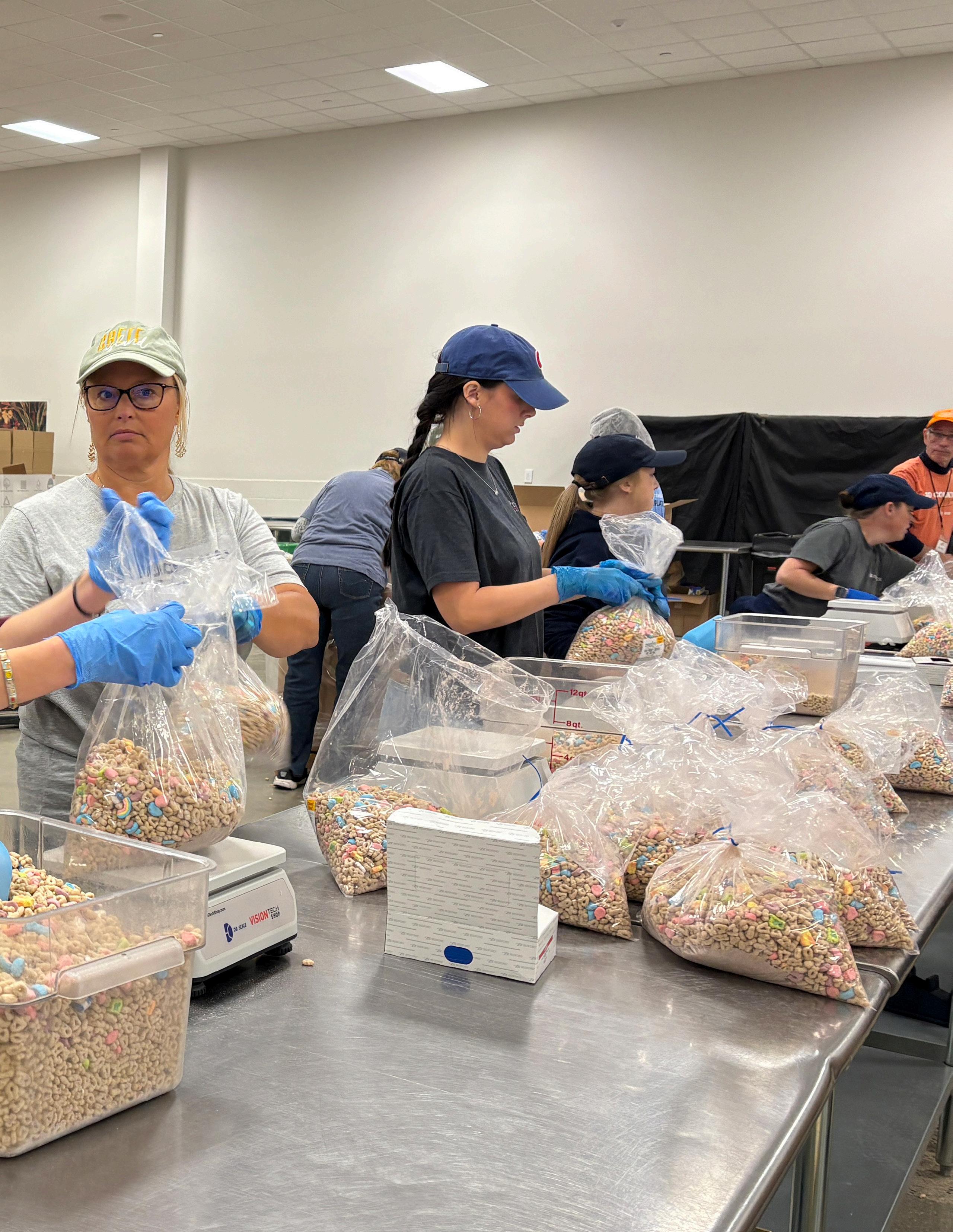
In the world of Primerus, December 5 is annually observed as the Global Day of Service, a time when member law firms prioritize community involvement as a way of contributing to the public good.
The occasion dovetails with International Volunteer Day, which has been annually celebrated since 1985 on December 5 by the United Nations, “amplifying the importance of people-led solutions to our common challenges,” according to the UN.
Whatever the title participation falls under, the day serves as an opportunity for people and volunteer-driven organizations to work with social service agencies, nonprofits, community groups, academia, and the private sector in a joint effort to weave together values of compassion and solidarity.
Florida attorney Mark Warzecha, who has chaired the Primerus Community Service Board for the past five years, has been a longtime believer in the importance of active participation in local events, activities, and initiatives aimed at improving the wellbeing of the community.
“Giving back is a core part of being a good lawyer,” said Warzecha, a partner with Widerman Malek, P.L. in the coastal city of Melbourne, Fla. “It helps build trust and fosters goodwill and also has an additional benefit of building meaningful connections in the community.”
Warzecha noted that community service, which is the sixth pillar in Primerus’ core mission, should not be limited to a single day, but should be part of a year-round commitment to make a positive impact.
“Whether it is spreading joy through Timmy Vee’s Toys for Kids, supporting families of children with disabilities through our No Bad Days Foundation, mentoring the next generation
through Junior Achievement and other youth programs, or raising funds for Make-A-Wish through the Ippoliti Brothers’ Celebration Exotic Car Festival, we are dedicated to make a lasting impact,” Warzecha insisted.
“Being a great lawyer is not just about the courtroom,” he indicated. “It is about showing up for the communities we serve.”
In the most recent observance of Global Day of Service, a number of Primerus participants focused their efforts on aiding the hungry. This came in the wake of more than $1 billion in federal funding cuts for initiatives that connected local farmers with schools and food banks. The cuts began in early 2025 and have led to reduced food supplies for communities struggling with hunger and have caused an increased strain on small farms.
To help counter the food shortfalls, the following Primerus firms pitched in to help the hungry in their respective communities:
• Schneider Bell, based in Cleveland, partnered with FrontLine Services for a November 1 food drive to benefit the community’s homeless veterans. The firm collected nearly 250 nonperishable food items.
• Demorest Law Firm, PLLC, based in Royal Oak (Mich.), channeled its efforts at Detroit’s Forgotten Harvest food distribution center, helping sort through food and pack totes of donations.
• Ogden Sullivan Stover & Saar, P.A., based in Tampa (Fla.), spent three days in December supporting Feeding Tampa Bay, sorting food items and other household essentials at its warehouse facility.

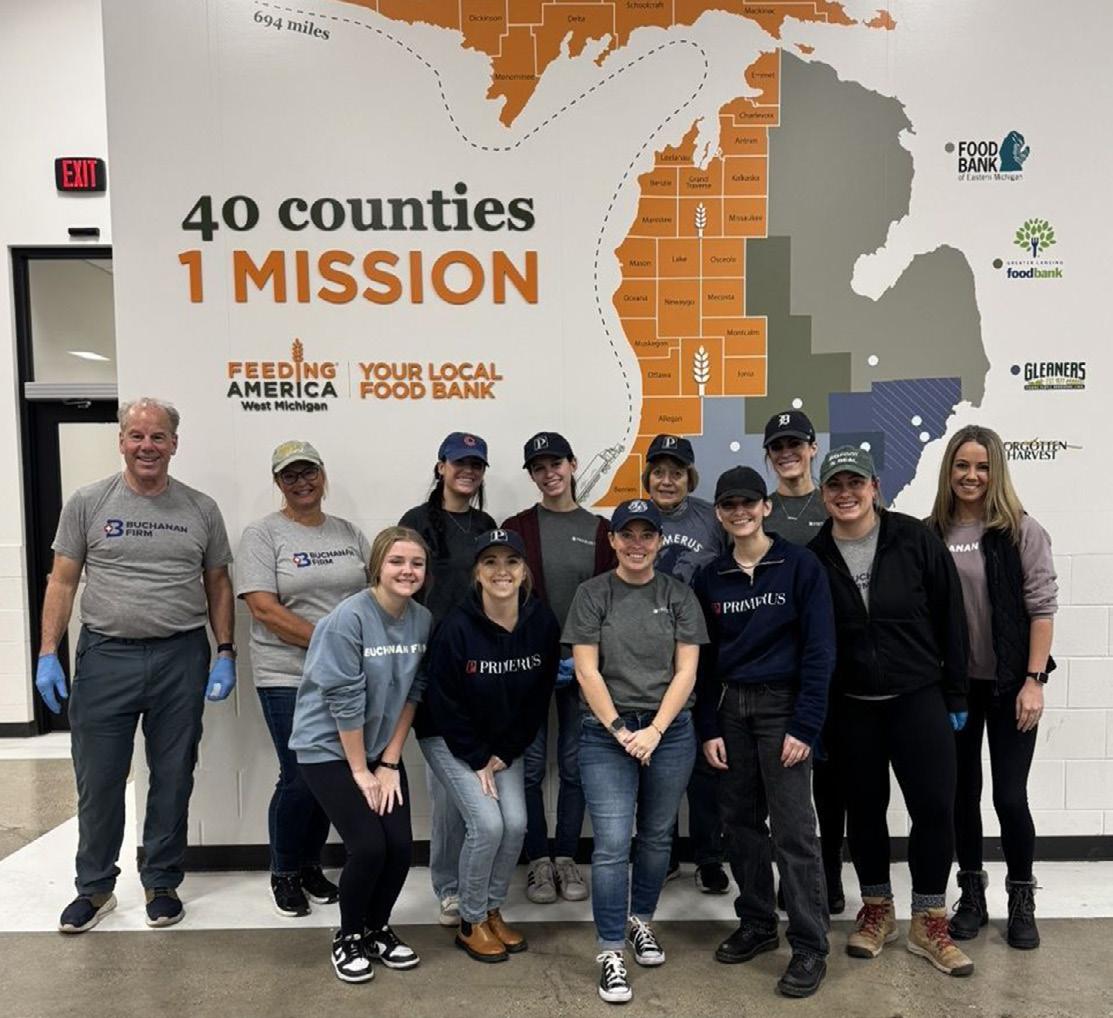
• Primerus and Buchanan Firm, both based in the Grand Rapids (Mich.) community, came to the aid of the Feeding America West Michigan chapter, packing 1,200 one-pound bags of cereal to help needy families.
• Greenberg Glusker, based in Los Angeles, hosted a Thanksgiving potluck at its office, and employees were encouraged to donate to the Los Angeles Regional Food Bank. The combined donation, according to the program’s website, will provide up to 10,620 meals to hungry children, seniors, and families.
Other Primerus firms chose to direct their energies to a host of other worthy causes. A sampling:
• Coleman & Horowitt, LLP, based in Fresno (Calif.), aided their local Goodwill, sorting through the donations the store received and restocking its shelves with donated items.
• Collins & Lacy, P.C., based in Columbia (S.C.), assisted the Families Helping Families organization, devoting more than a week to collecting and buying



gifts, wrapping presents, and then delivering packages to the needy in the community.
• Mhishi Nkomo Legal Practice, based in Harare, Zimbabwe, participated in a tree planting initiative on December 10 at Mt. Pleasant High School in Harare.
• Widerman Malek, P.L. supported the Timmy Vee’s Toys for Kids in Brevard County, an organization dedicated to brightening the holidays for needy families in the community.
• Greenberg Glusker also participated in the Building Owners and Managers Association (BOMA) Greater Los Angeles toy drive, spreading holiday cheer for children in need.
Thank you to everyone who participated in Primerus’ Global Day of Service – we applaud the efforts to give back in the communities you call home!

By Tom Kirvan

Aformer member of the Fourth Estate, Milwaukee attorney Lance Duroni admits he took a somewhat circuitous route to a career in law, a profession in which his father excelled as the longtime general counsel for The Hershey Company.
“It was almost by accident that I got into law, where I spent many years in courtrooms reporting on trials, first in Delaware in the Chancery Court and the Bankruptcy Court and later in Chicago covering the federal courts,” Duroni explained. “I observed and wrote about many trials and legal disputes as a reporter before I ever set foot in law school. I was fascinated by the legal profession and ultimately decided to try my hand at it.”
But his first rung on the career ladder was as a journalist for Law360, a legal news website that lived up to its name, churning out stories at such a rate that it became a veritable 24/7 operation that eventually was merged into the news division of LexisNexis.
“Working for an internet-based website comes with certain demands, as there is a real aggressive push to create content,” said Duroni, a University of Wisconsin alum who holds his master’s degree in journalism from Temple University in Philadelphia. “Because of that expectation, I sometimes felt I was leaving some meat on the bone with certain stories. I wanted to dig deeper and write more in-depth pieces but simply didn’t have the time for it. Everyone understood that it was imperative to get the story, get it accurate, and get it up on the site as soon as possible.”
The demands of the job, coupled with the uncertainty surrounding the world of journalism, eventually gave Duroni pause, prompting him to reconsider an opportunity to attend law school.
“I contemplated going to law school in the first couple of years after graduating from the University of Wisconsin, but I was kind of restless then and decided to move out west to Jackson Hole [Wyoming], where I spent my time skiing and working in hotels,” Duroni said. “I just wasn’t ready to get on a solid career path at the time, so the idea of going to law school just fell by the wayside.”
Nearly 15 years after obtaining his bachelor’s degree, Duroni had a change
of heart and enrolled in law school at Marquette University in Milwaukee, where he graduated with honors in 2019.
With his strong writing background, Duroni was a natural choice to serve as associate editor of the Marquette Law Review, earning further recognition as a published author. He also won a CALI Award for achieving the highest grade in Constitutional Law, Legal Analysis Research, and Writing II. In addition, Duroni landed coveted internships during
law school with Justice Rebecca Bradley of the Wisconsin Supreme Court and the Federal Defender Services in Madison.
“I know that my father (Chuck) was happy when I decided to go to law school,” Duroni related. “He had encouraged me to give it a try and was convinced that I had the talents to succeed. Going to law school was a mid-life career change for me. The law was a fortuitous second option after legacy media took a turn for the worse.”
In 2022, as he approached his fifth year as an attorney and as an associate with Kohner, Mann & Kailas, S.C. (KMK) in Milwaukee, Duroni was recognized by the Wisconsin Law Journal as a “Rising Young Lawyer” for his work in the firm’s litigation department.
“While I’m still relatively early in my career, I was proud that my colleagues at the firm saw fit to nominate me and that the publication recognized me,” Duroni said of the honor. “It’s been an interesting dynamic for me to be recognized as a ‘young lawyer,’ when I’m a middle-aged person. Even though I’m in that age group, I willingly acknowledge that I’m young in terms of my overall legal experience.”
Duroni credits two of KMK’s managing partners, Ryan Billings and Melinda Bialzik, with serving as valued mentors, saying that the wisdom and support they have shared has been instrumental to his growth as an attorney.
Their mentorship, according to Duroni, was particularly helpful during the early stages of his career which coincided with the outbreak of COVID.
“It was six months into my legal career when all of a sudden we were cooped up inside and not doing any hearings in person,” recalled Duroni. “It was such an uncertain time, not only for those of us in the legal profession but also everyone
else in the business world. Fortunately, the firm was able to navigate it well without laying off anyone and keeping our client base intact.”
As a litigator, Duroni represents a cross-section of clients in civil litigation, mediation, arbitration, and appellate matters.
“I’ve been involved in a pretty broad swath of commercial litigation, especially in the construction industry related to breach of contract and construction lien cases,” he said. “I’m starting to take on more complex cases with a greater variety of claims. I’m also hoping to become more involved in appellate work given my background in writing.”
One of four children, Duroni grew up in Lancaster, a South-Central Pennsylvania community known for its historic charm, Amish culture, and vibrant arts scene. His father, who earned his juris doctor from the University of Wisconsin Law School, had a distinguished legal career that included key roles with Rockwell International, H.J. Heinz Company, and The Hershey Company. Duroni’s late mother, Charlene, was a reporter for The Lancaster Intelligence Journal, covering the lifestyle beat.
Duroni, who enjoys skiing and live music, has three children – Henry (18), Isabella (16), and Charlie (14).
“I have three high-schoolers and two of them go to different schools than the other, which can make it challenging at times,” Duroni noted. “They’re all terrific kids, and I do my best to be as supportive and involved with them as I can.
“And they’re all good skiers,” he said. “I work out during the off-season to stave off the day where I have to catch up to them on the slopes. That day is coming as my back and knees slowly give out, but we’re not quite there yet.”


By Tom Kirvan
Boasting the nickname as “America’s Finest City,” San Diego is known for its mild climate, beautiful beaches, and deep connection to the U.S. Navy.

The demands of defending a class action lawsuit are inherently daunting, typically focused on developing a multi-faceted strategy that combines aggressive legal tactics with deep factual investigation, often aimed at derailing class certification to avoid a potentially crippling financial outcome.
So say attorneys Michael Pérez and Jeffrey Feasby, named partners in the San Diego law firm of Pérez Vaughn & Feasby (PVF), which since its founding two decades ago
has specialized in trial work and other business litigation matters.
Pérez and Feasby, who were joined by John Vaughn in 2016, have a track record of success when defending class action suits, representing a host of clients that includes giants in the public utility, banking, financial services, consumer, manufacturing, real estate, and technology sectors among others.
A class action is a lawsuit where one or more people sue on behalf of a larger group who are affected by the same issue. This is referred to as “the class.”
“Clients value communication, trust, and relationships – we lean into those things,” said Pérez, who began his career with a major San Francisco-based law firm before spending nearly seven years in the public service sector, including three years as an Assistant U.S. Attorney in the Southern District of California. “We believe in the
principles of efficiency, effectiveness, and expertise, which are at the heart of our firm.”
Feasby, a University of Colorado alum who earned his law degree from the University of San Diego, echoed the comments, noting that the firm has been successful in securing dismissals before a class could be certified by demonstrating that the alleged claims were baseless.
“We take pride in being nimble, adjusting our legal strategy as the facts in each case warrant and become apparent,” said Feasby, who has experience litigating consumer class actions and other complex business disputes before various courts and arbitration forums across the country. “One of the challenges in defending class action claims is determining the best time
to attack a plaintiff’s class allegations. In some cases, it can be done at the pleadings stage, whereas in others it has to wait until the discovery stage when there is a fact-based inquiry. Discovery, of course, is a process that incurs defense costs, which need to be weighed in trying to narrow the scope of the case.”
Both Pérez and Feasby note that, during the past decade, class action activity has generally grown annually, attributing part of the uptick to increased access to public and consumer information, as well as advances in technology, particularly in such emerging sectors as cryptocurrencies and artificial intelligence.
When the firm was formed in 2005, class action defense work amounted to just a small percentage of its caseload, according

to Pérez and Feasby. That figure changed in succeeding years as an outgrowth of other litigation cases in which PVF achieved successful results, burnishing its reputation as a “go-to” law firm.
As a side benefit, class action cases also serve as a “good combination of work that is both strategically heady and require some real candle power on day-to-day decisions such as discovery,” Pérez indicated.
“It also has the various parts of litigation that allow young lawyers to get trained and learn how to become better lawyers,” explained Pérez, who gained much of his initial trial experience as a federal prosecutor. “In many respects, it’s a sweet spot for us, and we enjoy doing class action work when we have the
opportunity. It probably makes up a fraction of our practice until one of those cases comes in, and then it becomes a very significant part of what we are doing at any particular time.”
Of notable significance is the high level of success that the firm has achieved in defending class action cases, according to Pérez.
“I know of the cases that Jeff and I have worked on, we’ve won almost all of them by summary judgment,” Pérez shared. “I can recall only one class action case that went to trial, so most of the cases we get involved in are those that we’ve received early and favorable results. The one matter that went to trial for Wells Fargo received a favorable verdict and the recovery of attorneys’ fees.”
Such success can be traced initially to a key first step, according to Feasby.
“It’s essential to secure all relevant documents, making sure that there’s a litigation hold in place to determine who are all the relevant custodians,” Feasby declared. “It’s important to make an early determination of what systems are there in terms of electronically stored information. And then to ask, ‘Is it all preserved?’ and if not, what do we need to do to preserve it and then start to gather and analyze it?”
Feasby noted that the party filing a class action lawsuit – the so-called “lead plaintiff” – must first demonstrate that there are enough parties affected that a class action is appropriate, and secondly that they have sufficiently similar damages that the relevant legal issues and
arguments can be applied to everyone in the class.
“Typically, one of the first steps would be some sort of pleading challenge as to the definition of the proposed class and whether it meets all the legal requirements in terms of numbers and commonality in terms of the damages they have allegedly suffered,” Feasby said. “The pleading requirements can be quite different in state as opposed to federal courts, where they tend to be more technical.
“Once the pleadings are finalized, what we try to do next is to obtain either an agreement from plaintiff’s counsel or an order from the court, limiting discovery in the first instance to those issues relating to class certification,” Feasby added. “If you can limit discovery in the first instance, it saves everyone time and

money, while also moving the case along to a point of resolution.”
While employing such a strategy would seem to have universal appeal, Pérez said some firms in the Big Law sector prefer a different approach.
“Some big firms like to jump into discovery right away, billing a lot of hours in the initial stages of the case,” Pérez related. “Certainly, in some cases you could justify that and that’s certainly one approach. But I think there is a much more cost-effective and practical way of moving forward, and I believe that clients really appreciate when you don’t treat every class action claim as
if it’s one size fits all, because that is rarely the case.
“There’s usually an approach to those cases that cannot only lead to defeating a class certification, but that also could lead to an early resolution and/or settlement,” said Pérez. “In such a settlement, where instead of paying hundreds of thousands of dollars to your lawyers, you could use that money for settlement purposes that might drive an early resolution that would be much more cost-effective for the client rather than just burying your head and engaging in ‘scorched earth’ litigation.”
Feasby added that the high stakes nature of a single certified class action can

expose a company to massive damages and create huge business disruption, making early resolution or summary disposition pivotal.
In the event that the defense prevails at trial, then the issue of being awarded attorneys’ fees comes into play, according to Pérez and Feasby.
“We’ve found in numerous cases where we have prevailed and then seek attorneys’ fees, the difference between what we’ve billed versus what the other side billed has been striking,” Pérez said.
In such cases, where for instance a Big Law firm may have billed at rates
as high as $1,500 to $2,500 per hour, courts have allowed PVF to argue for attorneys’ fees based on various formulas, notwithstanding an actual hourly rate which is significantly lower.
“One of the formulas is the Lodestar Method, which allows you to increase your attorneys’ fees based on factors like experience, practice area, case complexity, and market rates,” Pérez explained. “Even when those formulas are applied, the new and higher rate that we are awarded is still significantly less than what the Big Law firms have been charging.”
When PVF joined Primerus in 2025, it did so with several goals in mind, most

notably to foster connections with corporate counsels across the country, Pérez indicated.
“It’s very important for us to develop relationships with companies that are involved in litigation in California and recognize that the rates are higher here than in other states,” Pérez said, noting that a growing number of those companies are willing to retain a “highlyregarded boutique law firm” that charges reasonable rates.
“A good example is that we represent a company out of Atlanta,” he related. “If they were to hire a large law firm in California, they would be paying two or
three times what they would pay us on an hourly basis. So, even though they might be able to find a cheaper law firm in Tennessee or Arizona or Nevada, they know when they come out to California, they’re going to be paying significant legal fees. Our rates, by comparison, are very favorable, while companies also benefit from our background and experience.
“One of our goals with Primerus is to develop relationships with counsel outside of California that might need our help,” Pérez added. “We have a better opportunity to show them how we can help both because of our experience and qualifications, but also in a more costeffective way.”
By Tom Kirvan

For Michael Pérez, it was a dream deferred to attend University of Notre Dame, the renowned Catholic educational institution that prides itself in fostering intellectual growth and moral character in equal measure.
When it came time to weigh his college options in the early 1980s, Pérez discovered that he was a wanted man, as elite schools around the country offered an array of attractive scholarships to pique his interest in attending their respective university.
Among his primary “suitors” was Stanford University, which offered the San Diego native a full-ride scholarship.
“As a Catholic, Notre Dame was always my dream school,” Pérez declared. “I had my heart set on attending Notre Dame.”
Then-football coach Jerry Faust even recruited Pérez, hoping that the opportunity to don the iconic gold helmet would tip the scales in favor of the Fighting Irish.
“I received a partial football scholarship to go to Notre Dame, which if you saw my size and stature would be a major surprise,” Pérez said in poking fun at himself. “I was not your typical football recruit.”
But, as he sat down with his parents to consider his final college destination, Pérez got a sudden jolt of reality.
“My parents said something to the effect of ‘You don’t have a choice, son. Where’s the rest of the money going to come from if you go to Notre Dame?’ That question, quite simply, was why I ended up attending Stanford,” explained Pérez, whose mother (Lydia) was a medical receptionist while his father (Ralph) spent the bulk of his career with a phone company before serving for 15 years as a high school bilingual teacher. “There
was no way I could turn down a full-ride scholarship to one of the great universities in the world.”
And yet, three weeks after beginning his studies at Stanford, Pérez received an unexpected call from the admissions office at Notre Dame.
“They asked me why I didn’t go to Notre Dame,” Pérez related. “When I told them it was because I didn’t have the money, they confessed to a huge blunder on their part. They said that as a President’s Scholar, I would have everything paid for and since their semester hadn’t even started yet that fall, I still had time to enroll at Notre Dame. I was shocked. I was never notified.

“But, of course, I was already three weeks into my classes at Stanford by the time of the call and couldn’t pull up stakes there and head cross country to Notre Dame,” he noted. “Still, for years it kept nagging at me that I could have gone to college at Notre Dame, my dream school and played football there even as a scrub team member.”
Some 35 years later, that dream was partially and vicariously fulfilled when Pérez’s son, Tony, graduated from Notre Dame, setting the stage for a career in the medical field, first as an EMT and now as a physician’s assistant working at Mount Sinai Hospital in New York.
“When my son was at Notre Dame, I really connected with the university, particularly people in the Theology Department,” indicated Pérez, the managing partner of Pérez Vaughn & Feasby in San Diego. “I just kind of got tugged and pulled in the heart to enroll in a master’s program there. It’s normally a two-year program, but it took me five years to complete it because I was basically taking one course at a time, in addition to all of my lawyering duties with the firm and my parenting responsibilities at home. I had a lot going on during that time.”
Despite the demands of a jam-packed schedule, Pérez earned his master’s degree in theology in July 2025, defending
a thesis on sin, redemption, and ecumenism. The project, he explained, was born from a desire to bridge misunderstandings among Christian denominations and to promote unity through shared understanding.
“It took me awhile to earn the degree, but I finally accomplished it and I’ve become really connected to the university as a result,” Pérez said, noting that he bonded with a number of his fellow students, including a Harvard professor and an Episcopal priest from Texas. “There were people from all over enrolled in the program, but the vast majority were 25-year-old college kids who were on-campus students. It also was

interesting in the sense that I was older than all of my professors. All in all, it was a great experience, and I got to know the professors very well, becoming very good friends with some of them.”
As a bonus, Pérez “had the pleasure of beginning a friendship with Amy Coney Barrett,” the U.S. Supreme Court justice who is an alumna of the University of Notre Dame Law School where she graduated first in her class.
“Her good friend is one of those friends of mine who’s the chair of the Theology Department at Notre Dame,” said Pérez, marveling at the fact that “it’s interesting how everything in life kind of
comes around” and how he has enjoyed becoming friends with Justice Barrett’s husband, Jesse.
While he now admits to taking immense pride in obtaining a Notre Dame degree, Pérez said his college allegiance remains clear, particularly since he wrestled at –“and bled for” – Stanford.
“Whenever Stanford plays Notre Dame, I’m always going to be rooting for Stanford,” the 1987 Cardinal alum said with a smile.

By Tom Kirvan
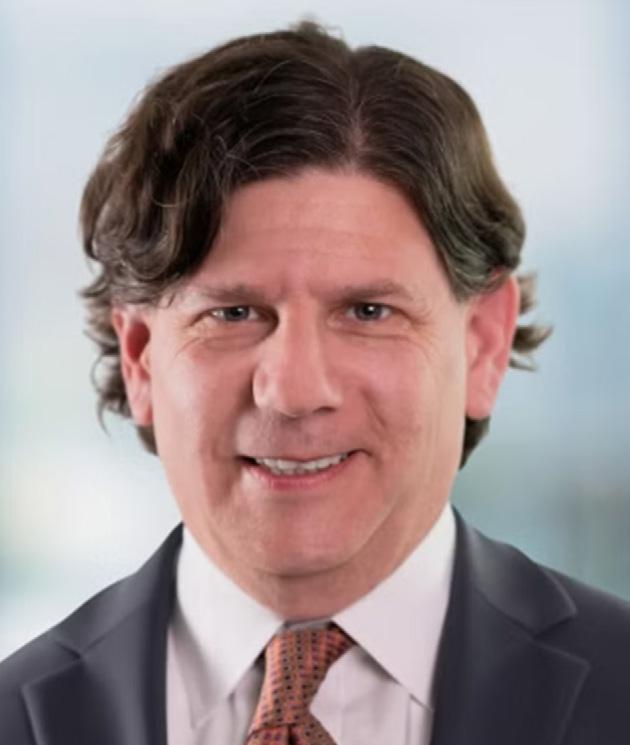
Moonlighting comes naturally for attorney Daniel Krasnegor, a partner with the law firm of Goodman Allen Donnelly in Charlottesville, Va.
A lifelong love of music spawned Krasnegor’s interest in becoming a part-time radio DJ at WNRN, a listenersupported FM station in the Virginia city that was home to two U.S. presidents, Thomas Jefferson and James Monroe.
“When not lawyering, I DJ on the air at WNRN two to three times a week,” said Krasnegor, the law firm’s lead attorney with its veterans benefit group. “The radio

gig is volunteer, but it definitely balances my life out.”
His interest in radio broadcasting began in college at Washington University in St. Louis, traditionally ranked among the top 20 academic institutions in the country.
“I got involved with the college radio station there, working as a DJ in a role that was a lot of fun,” Krasnegor related. “It just sort of scratched a different itch than all the academic stuff attached to college. And then when I went to law school at Emory University [Atlanta], the college was trying to start up a radio station for the undergraduates at Emory, so I got involved
in that as well. I did whatever they needed to get it up and running.”
Krasnegor’s involvement even extended to teaming up with another music afficionado in a publishing venture.
“While at Emory, I met another music fan who was interested in publishing a discography of a certain genre, so I collaborated with him on publishing a little book that was a descriptive catalog of musical recordings,” Krasnegor noted. “Of course, this was back before the internet, which would have made a project like that of little consequence.”
Upon graduating from law school in 1993, Krasnegor put his radio interests on hold while he launched his legal career, a path that included jobs with a title company, the Board of Veterans’ Appeals, and the Veterans Affairs General Counsel Office before entering the world of private practice in 1998.
“There wasn’t much time for side interests during those years, as I was building a practice focused on the welfare of veterans and their dependents,” Krasnegor indicated. “It offered me an opportunity to be pretty entrepreneurial in developing a practice specifically designed to help veterans and their families obtain the benefits they deserve.
“When I first started focusing my work on representing veterans, I had clients from World War I and World War II,” he noted. “Of course, in recent years, I’ve represented clients who served in the Vietnam War, the Gulf Wars, and in Afghanistan. This representation includes claims for VA compensation benefits, widow’s benefits, pension, education benefits, and more.”
Once his private practice began flourishing, Krasnegor said he was “itching” to get back into radio work in his spare time, volunteering with a public radio station that was in need of someone to read news clips at the top of the hour one day a week.

“I’d get up at 5 o’clock in the morning and write up little 15-second news clips and then read them live on the air all morning,” he said. “I did that once a week for several years, before I was approached by one of the leaders of the station who wondered if I would be interested in doing some DJing. That was back in 2009, so it’s been about 16 years that I have been doing regular radio shifts. I’m also finishing up my final year of six years on the board of directors of the radio station, since it is a nonprofit.”
Krasnegor said he has been a music buff since his youth, even if he never was a musician himself.
“I don’t know if young people feel this way now, but when I was growing up, I felt like radio was this magic and wonderful thing,” Krasnegor admitted. “I still feel that way to a degree, as I’m happy that I get the opportunity to be part of a radio team that regularly connects with an audience.”
Broadcasting since 1996, WNRN is an independent music radio network with 12 stations throughout Virginia, including the state capital Richmond, Charlottesville, Roanoke, Lynchburg, and Harrisonburg. As a nonprofit, the WNRN radio network derives 85 percent of its funding from listener support and sponsorship underwriting.
“We play a mix of everything from folk to rock and roll with about half of it new and the other half going back to the ‘60s,” Krasnegor explained. “Some of what we play now is what’s called in the music industry as ‘Triple A,’ which stands for Adult Album Alternative. And there’s sort of a branch of country music that appeals to non-country folk called ‘Americana.’ So, there’s a little dash of Americana, but there’s also a bit of New Wave and stuff like that. I specialize during a two-hour show on music from the ‘70s, ‘80s, and ‘90s.”
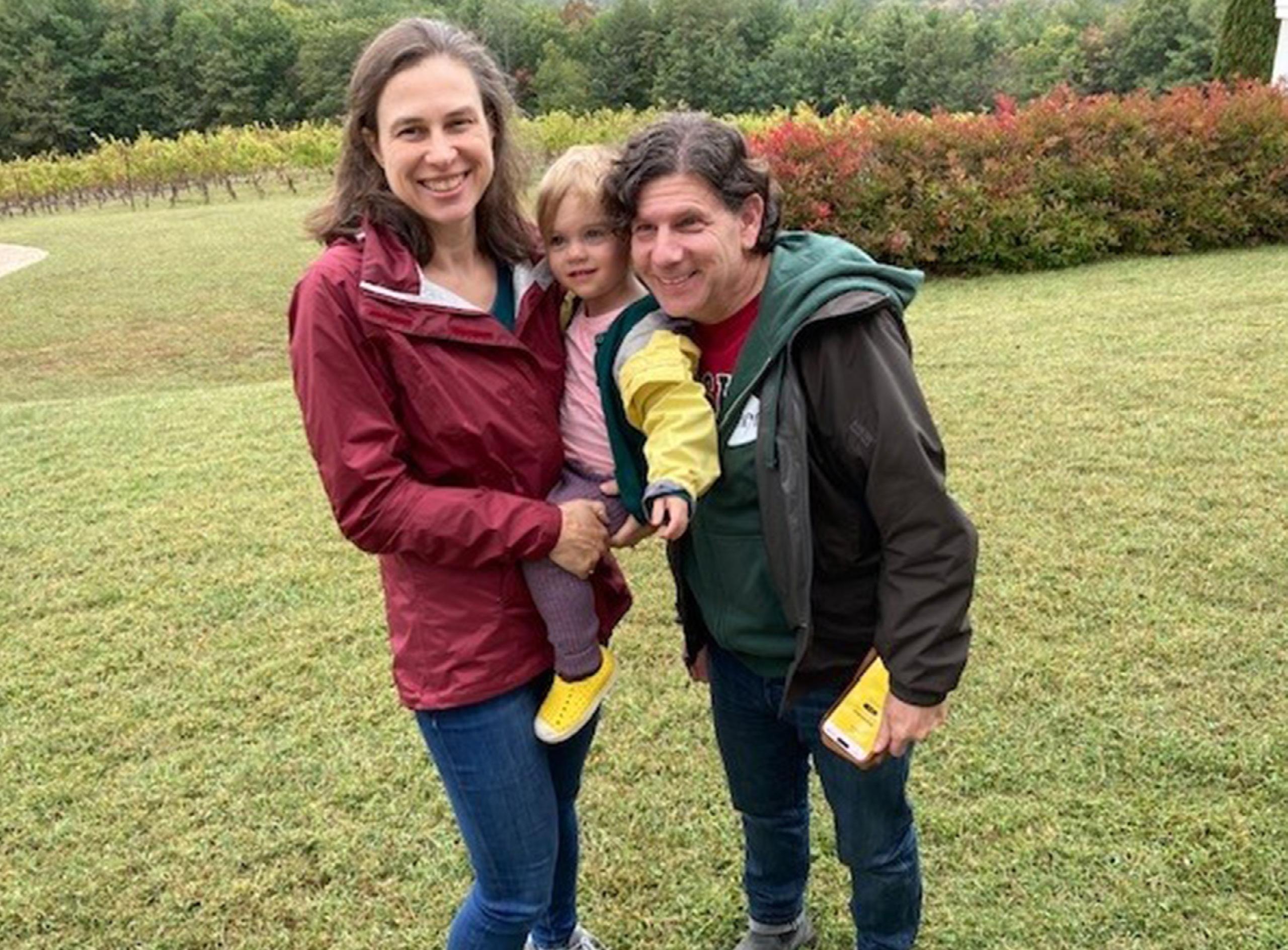
On a family outing, Krasnegor with his wife, Kristin, and their daughter, Zelda.
In addition to his DJ duties, Krasnegor participates in a weekly focus group “where we listen to all the new music that’s come in” to determine whether it is air worthy.
“It serves as a nice break in the day and inevitably gives me a boost in energy and makes me smile,” Krasnegor said of his radio work. “We’ve got a really good team at the radio station that is dedicated to best serving a loyal and diverse audience.”
Krasnegor grew up in Reston, Va., a suburb of Washington, D.C., where his late father, Norman, was a psychologist for the National Institute of Health and his mother, Rebecca, worked as a sociologist before owning an art gallery. One of two children, Krasnegor has a younger
brother, Josh, who is a consultant in the tech industry.
In 2023, at the age of 54, Krasnegor became a first-time father of a now “precocious two-year-old named Zelda, who keeps my wife [Kristin Jensen] and I hopping but in a good way.”
Krasnegor and Jensen were married in 2016 following a seven-year courtship. A project manager for the library system at the University of Virginia (UVA), Jensen earned her bachelor’s degree from Mount Holyoke before obtaining her doctoral degree in English from UVA.
“She’s a huge opera fan and recently traveled to Oslo to see a production there,” Krasnegor related. “It’s a real
passion of hers. We’ve gone to a number of interesting places as part of her opera travels and that makes it extra fun.”
Parenting a young child has also brought a special joy into Krasnegor’s life, as he relishes each opportunity to interact with his baby daughter.
“Fatherhood is amazing and puts everything else in life into perspective, as it obviously is the most important thing out there for me,” said Krasnegor, who enjoys cooking for the family. “It’s really a blast to watch this little person emerge and develop on a weekly basis.”
Alphabetical by Country/Province/State
Asia Pacific
Australia
Carroll & O’Dea Lawyers
China
HJM Asia Law & Co LLC
Pamir Law Group
Watson & Band
Hong Kong
ONC Lawyers
India
Sarthak Advocates & Solicitors
Japan
GI&T Law Office
Pakistan
Meer & Hasan Law Associates
Singapore
HJM Asia Law & Co LLC
Taiwan
Pamir Law Group
Vietnam
Bross & Partners
Austria
OBLIN Rechtsanwälte
Botswana
Brown and Company Attorneys
Cameroon
Neneng Law Office
Cyprus
AMG Mylonas & Associates, LLC
France
Jasper Avocats
Ghana
Legalstone Solicitors
Greece
Bahas, Gramatidis & Partners
Guinea
ASK AVOCATS
Ireland
Sweeney McGann Solicitors
Italy
FDL Studio Legale
Kenya
Njoroge Regeru & Company
Lebanon
SAAS Lawyers
Europe, Middle East and Africa
Lesotho
Kleingeld Attorneys
Malawi
Sauti & Company
The Netherlands
Russell Advocaten B.V.
Slovenia
JK Law ltd.
Spain
BPV Abogados
Dr. Frühbeck Abogados S.L.P.
Switzerland
Suter Howald Rechtsanwälte
Tunisia
Adly Bellagha and Associates
Turkey
Kavasoğlu Law Firm
Uganda
Angualia Busiku & Co. Advocates
Ukraine
Serafim Lawyers
United Arab Emirates
Reina Consulting FZ LLC
United Kingdom
Marriott Harrison LLP
Zimbabwe
Mhishi Nkomo Legal Practice
Alphabetical by Country/Province/State
Argentina
Badeni, Cantilo, Carricart & Bilbao
Belize
Quijano & Associates
Brazil
Simões, Ribeiro, Bernardini & Furiati Advogados
British Virgin Islands
Quijano & Associates
Chile
Magliona Abogados
Colombia
Pinilla, González & Prieto Abogados
Costa Rica
Guardia Montes Abogados
Cuba
Dr. Frühbeck Abogados S.L.P.
Guatemala
Iurisconsulti Abogados y Notarios
Honduras
Ulloa & Asociados
Mexico
Cacheaux Cavazos & Newton
Panama
Quijano & Associates
Perú
Llona & Bustamante Abogados
Trinidad & Tobago
Martin George & Company
Canada
Manitoba PKF Lawyers
Ontario
Mann Lawyers LLP
United States
Alabama
Ball, Ball, Matthews & Novak, P.A
Christian & Small LLP
Alaska
Landye Bennett Blumstein LLP
Arizona
Burch & Cracchiolo, P.A.
California
Coleman & Horowitt, LLP
Demler, Armstrong & Rowland, LLP
Ferris & Britton, A Professional Corporation
Greenberg Glusker
Law Office of Blane A. Smith
Pérez Vaughn & Feasby
Wilke Fleury LLP
Colorado
Ogborn Mihm LLP
Timmins LLC
Connecticut
Brody Wilkinson PC
Szilagyi & Daly
Florida
Nicklaus, Nicklaus & Associates, P.A.
Ogden Sullivan Stover & Saar, P.A
Padula Law Firm
Saalfield Shad, P.A.
Trembly Law Firm
Widerman Malek, P.L.
Georgia
Aspire Law
Illinois
Kozacky Weitzel McGrath, P.C.
Lipe Lyons Murphy Nahrstadt & Pontikis Ltd.
Roberts Perryman P.C.
Indiana
Hackman Hulett LLP
Alphabetical by Country/Province/State
Kentucky
Eddins Domine Law Group, PLLC
Louisiana
Degan, Blanchard & Nash, PLC
Maine
The Bennett Law Firm, P.A.
Massachusetts
Rudolph Friedmann LLP
Michigan
Buchanan Firm
Cardelli Lanfear Law
Demorest Law Firm, PLLC
McKeen & Associates, P.C.
Minnesota
Bernick Lifson
Mississippi
Young Wells Williams P.A.
Missouri
Roberts Perryman P.C.
Montana
Datsopoulos, MacDonald & Lind, P.C.
Nevada
Sklar Williams PLLC
Winner & Booze
New Hampshire
The Bennett Law Firm, P.A.
New Jersey
Mandelbaum Barrett PC
Thomas Paschos & Associates, P.C.
New Mexico
Hinkle Shanor LLP
New York
Barton LLP
Ohio
Manley Burke
McNeal, Schick, Archibald & Biro Co., L.P.A.
Schneider Bell
Oklahoma
The Handley Law Center
Smiling, Smiling & Burgess
Oregon
Haglund Kelley, LLP
Pennsylvania
Law Offices of Thomas J. Wagner, LLC
Rhode Island
Sayer Regan & Thayer, LLP
South Carolina
Collins & Lacy, P.C.
Tennessee
Cornelius & Collins, LLP
Texas
Donato, Brown, Pool & Moehlmann PLLC
Downs & Stanford, P.C.
Moses, Palmer & Howell, L.L.P.
Stephenson Fournier
Thornton, Biechlin, Reynolds & Guerra, L.C.
Virginia
Goodman Allen Donnelly
Wharton Aldhizer & Weaver, PLC
Wisconsin
Kohner, Mann & Kailas, S.C.
Wyoming
Gary L. Shockey, PC