









5. Contra ow
Investing in well-planned transport infrastructure usually delivers wider economic bene ts
6. News
Hydrogen network for Germany; gamechanger highway for Houston, TX; Vietnam’s massive infrastructure programme; new Mumbai tunnel project
10. Construction technology
Topcon highlights technology delivering next gen highways; Bentley’s US road asset sitemap; Trimble’s partnerships with Caterpillar and John Deere
14. IRF
IRF World Congress in Istanbul report; IRF relaunched; IRF Global conferences in Riyadh and Kuala Lumpur; IRF Global membership bene ts




18. Key project
A road project in France has bene ted from the use of 3D technology
26. Asphalt paving
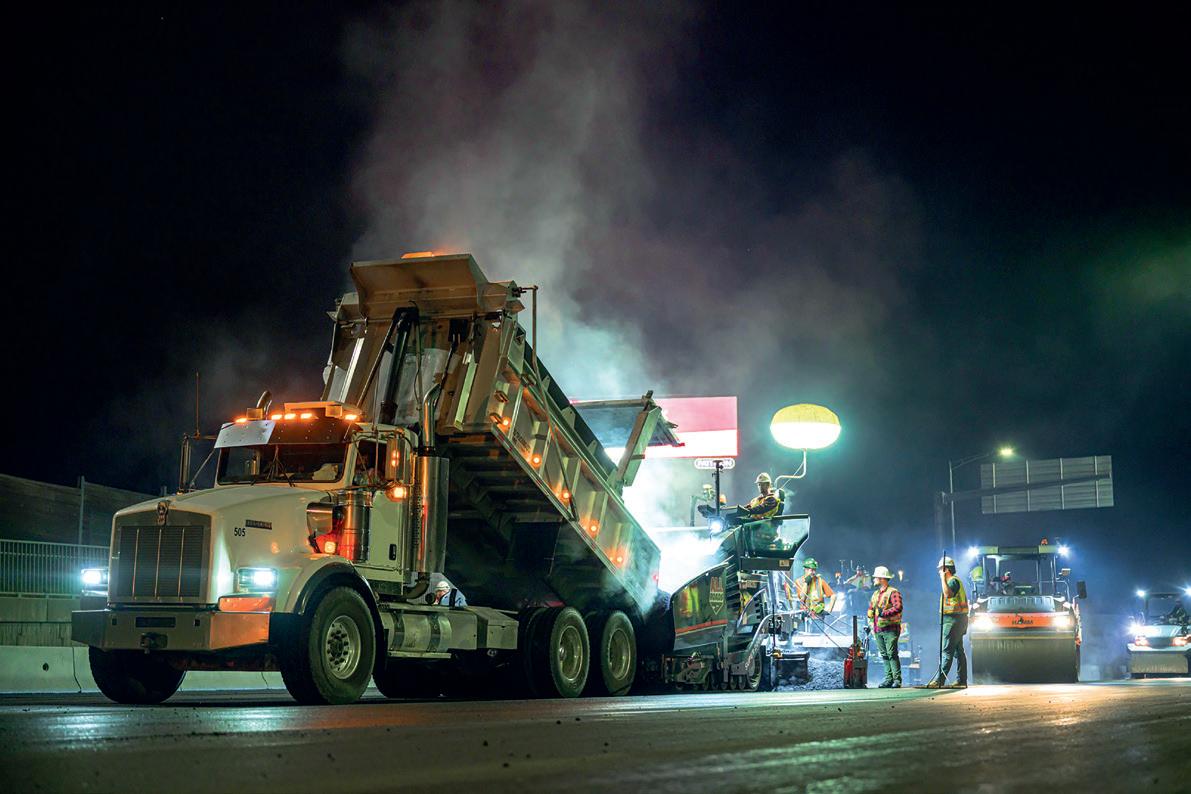
Paving Shanghai’s F1 circuit; Aggregate Industries offering high percentage recycling; autonomous paving with Sany; low noise surface with Vögele; innovative paving and compaction with BOMAG
32. Asphalt plants
Lintec plant in Jordan; Benninghoven cuts emissions
34. Recycling
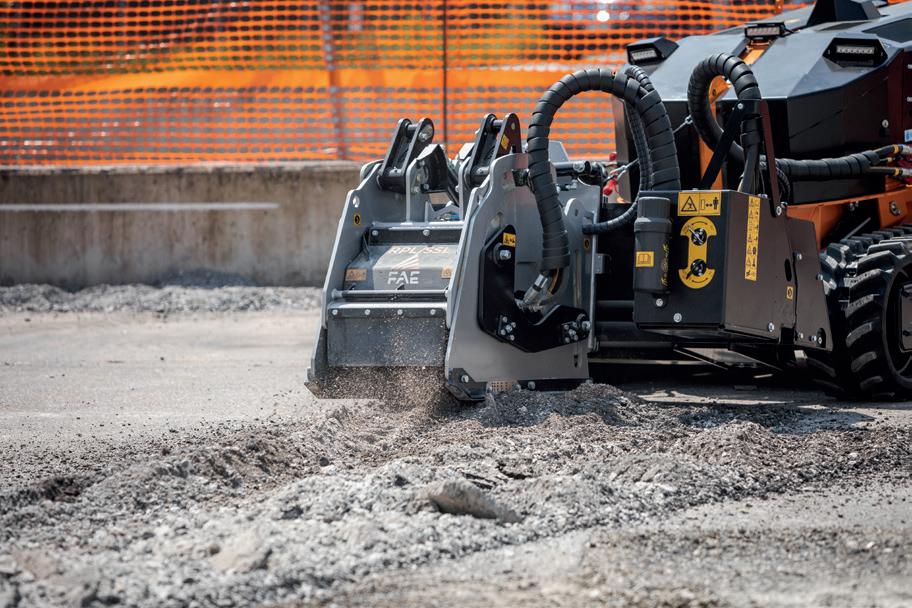
Wirtgen’s road recycling solution; carrier/planer option from FAE; CDE’s recycling plant
38. Bridge & tunnel
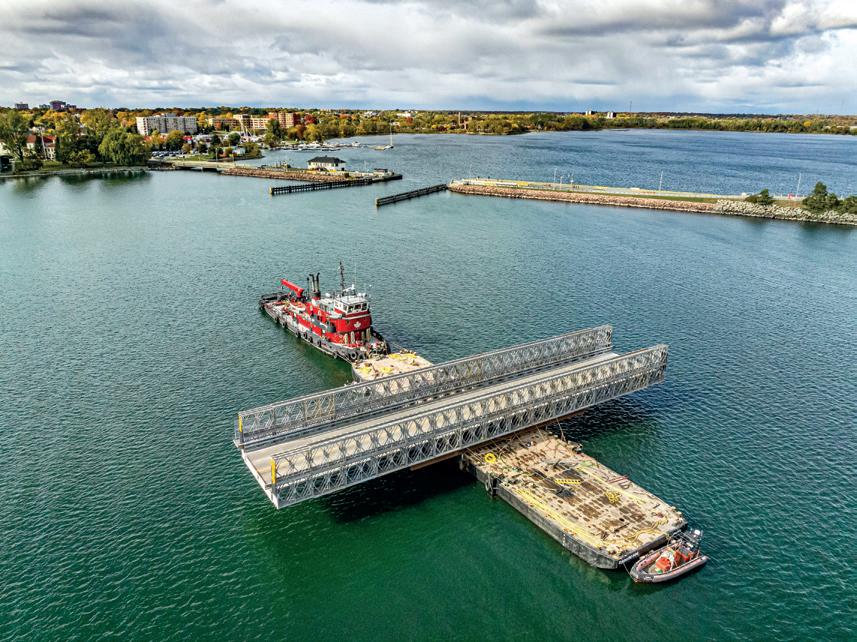
Enerpac’s bridge solution in Minnesota; Ontario bridge detour with Acrow; Altrad RMD offers overbridge system
42. Concrete paving
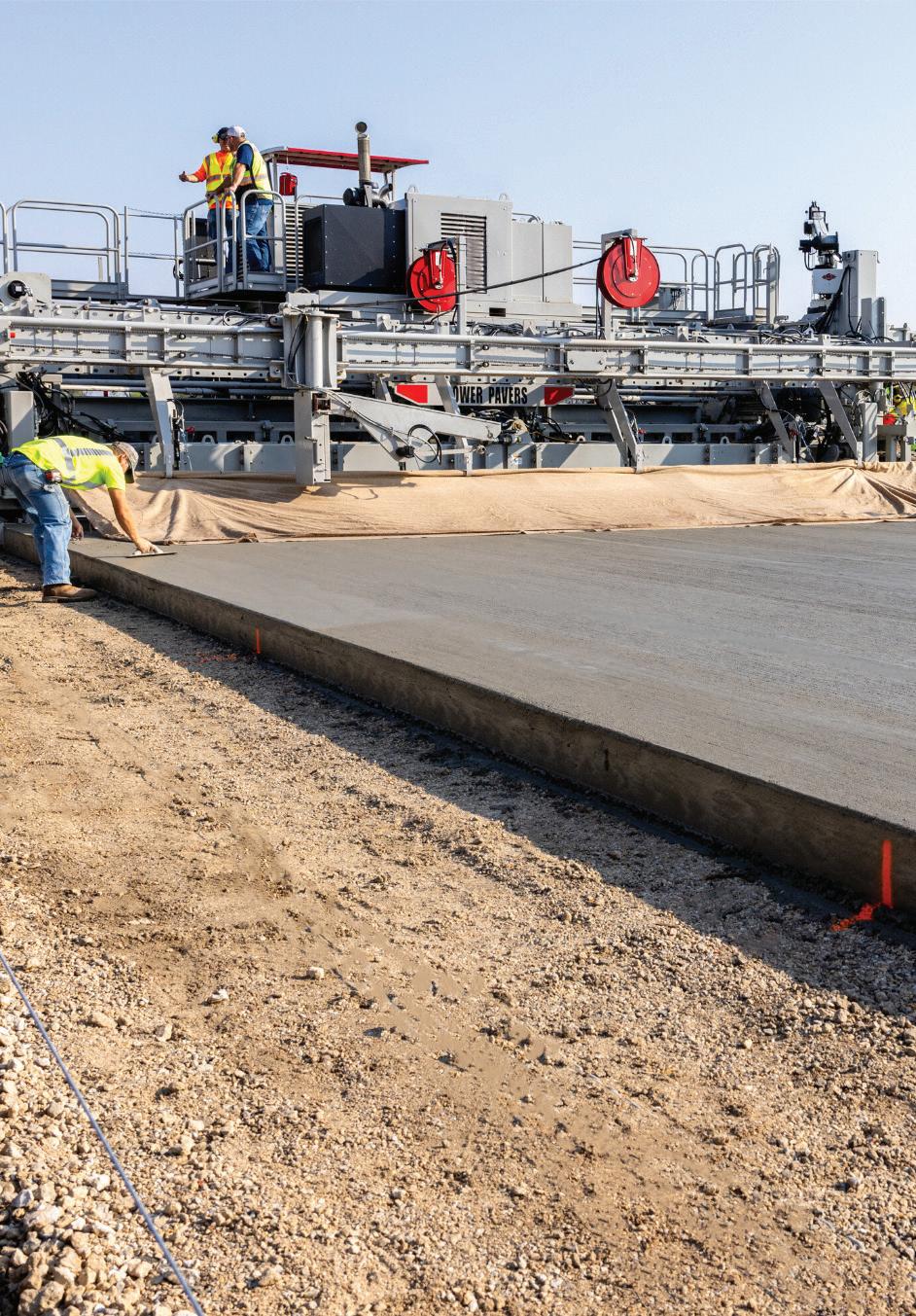
Concrete road construction in Uruguay with Wirtgen; Leica Geosystems provides 3D control for electric paver; Power Pavers slipforms Iowa road; Cemex’s new electric mixer eet
46. Earthmoving
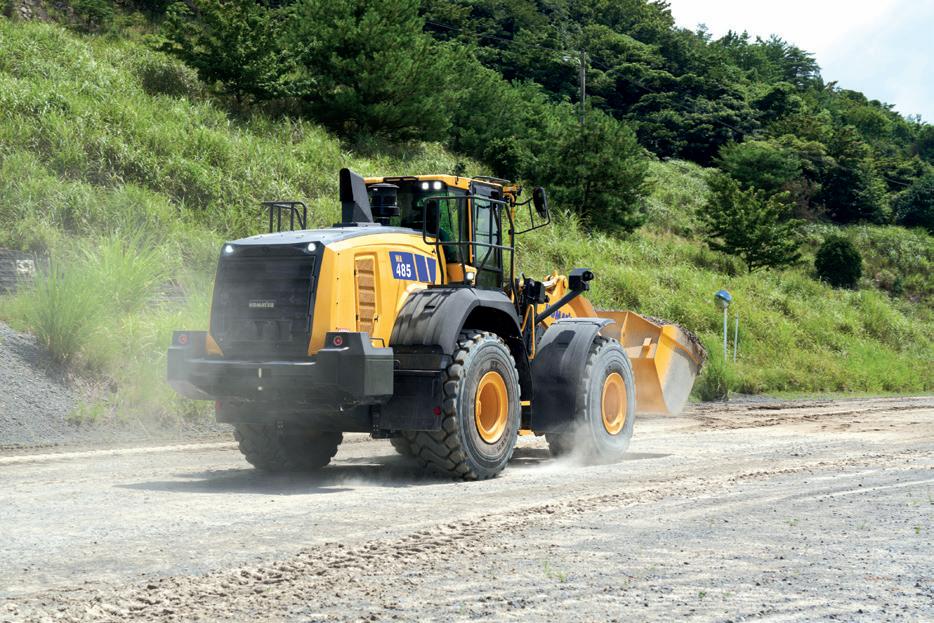
New wheeled loader models from Caterpillar and Komatsu; Rokbak’s new telematics system
48. Engines
Hydrogen pathway from Cummins; Volvo Penta plans power transition; award for FPT’s latest engine
50. Onsite
Lekatech’s electric breaker performs; success for German contractor using Smart Construction technology






















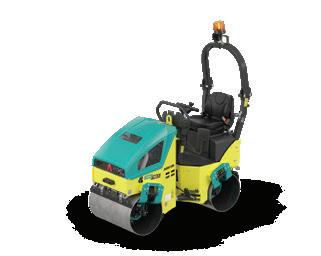
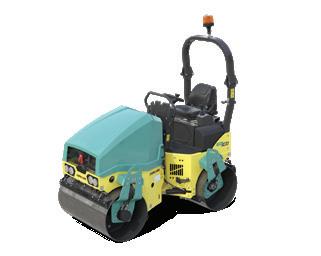
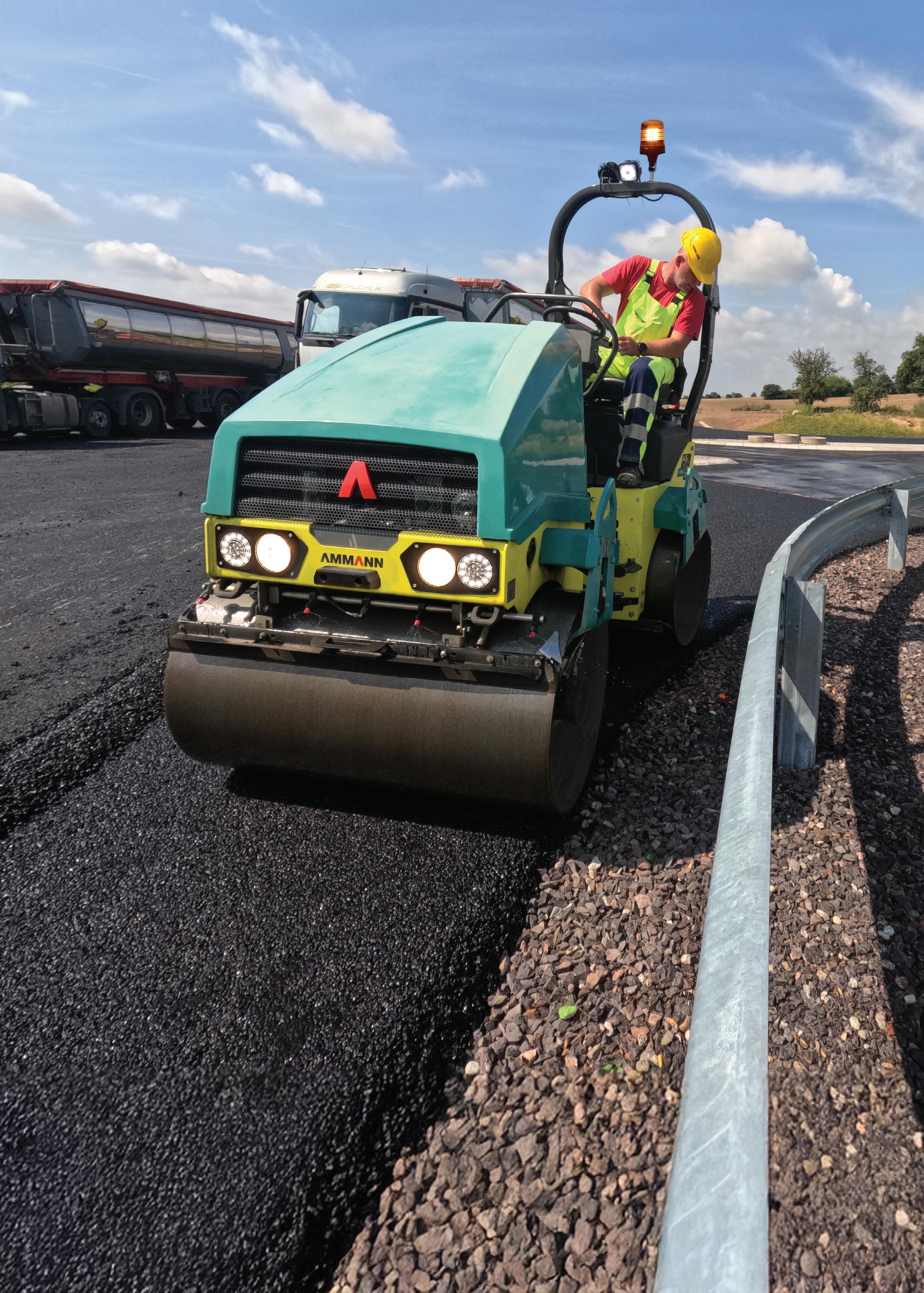
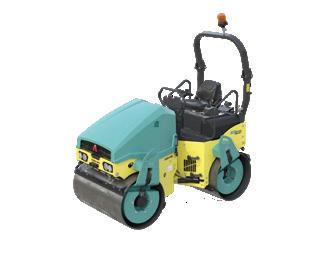
Ammann ARX Light Tandem Rollers excel in the open, where covering ground quickly is the goal. But other jobsites call for a compactor that can work tight against obstructions, such as curbs, without losing productivity.
OTHER KEY FEATURES:
• • Electronic drive lever for smooth starts and stops, especially important on asphalt jobs
• • Optional ACEforce , the Intelligent Compaction tool for optimal efficiency
• • Perfect all-around machine visibility and LED lights for safety on the jobsite

Editor: Mike Woof
Deputy Editor: David Arminas
Sub-Editor: Kevin O'Shea
Contributing Editor: Guy Woodford
Editorial Contributors:
Shem Oirere, Kristina Smith, Mauro Nogarin, Eugene Gerden, Partha Basistha, Lucio Garofolo
Designers: Simon Ward, Andy Taylder
Production Manager: Nick Bond
O ce Manager: Kelly Thompson
Data & Marketing Manager: Alan Cansick
Web Manager: Sarah Biswell
Managing Director: Andrew Barriball
Chairman: Roger Adshead
Publishing Director: Geo Hadwick
ADDRESS: Route One Publishing Limited, Second oor, West Hill House, West Hill, Dartford Kent DA1 2EU, UK
Tel: +44 1322 612055 Fax: +44 1322 788063
Email: [initialsurname]@ropl.com
(eg: radshead@ropl.com)
ADVERTISEMENT SALES
Head of Construction Sales: Graeme McQueen
Tel: +44 1322 612069 Email: gmcqueen@ropl.com
Sales Director: Philip Woodgate
Tel: +44 1322 612067 Email: pwoodgate@ropl.com
Sales Director: Dan Emmerson
Tel: +44 1322 612068 Email: demmerson@ropl.com
UK / CLASSIFIED, NORTH AMERICA: Dan Emmerson Tel: +44 1322 612068 Email: demmerson@ropl.com
ITALY: Fulvio Bon glietti
Tel: +39 339 1010833 Fax: +39 02 700446321
Email: bon glietti@tiscali.it
JAPAN: Akiyoshi Ojima
Tel: +81 3 3263 5065 Fax: +81 3 3234 2064
Email: ojima@echo-Japan.co.jp
ASIA / AUSTRALASIA: Roger Adshead
Tel: +44 7768 178163 Email: radshead@ropl.com
SUBSCRIPTION RATES & ENQUIRIES: World Highways/Routes du Monde is available on subscription at the rate of: £142/US$246/€186 per annum. Single copies £20 / US$35 / €26
Subscription enquiries to: Tel: +44 1322 612061 Fax: +44 1322 788063 Email: subs@ropl.com

No part of this publication may be reproduced in any form whatsoever without the express written permission of the publisher. Contributors are encouraged to express their personal and professional opinions in this publication, and accordingly views expressed herein are not necessarily the views of Route One Publishing Ltd, or the International Road Federation. From time to time statements and claims are made by the manufacturers and their representatives in respect of their products and services. While reasonable steps are taken to check their accuracy at the time of going to press, the publisher cannot be held liable for their validity and accuracy
WORLD HIGHWAYS/ROUTES DU MONDE (PE 8757) is published 6 times a year with combined issues in January/ February, March/April, May/June, July/August, September/ October and November/December by Route One Publishing Ltd, Second Floor, West Hill House, West Hill, Dartford, Kent, DA1 2EU, UK.
The US annual subscription price is US$246.00 Airfreight and mailing in the USA by agent named World Container Inc., c/o BBT 150-15, 183rd St, Jamaica, NY 11413, USA. Periodicals postage paid at Brooklyn, NY 11256.
Periodicals postage paid at: Brooklyn, NY 11256
POSTMASTER: Send address changes to WORLD HIGHWAYS/ ROUTES DU MONDE, World Container Inc., c/o BBT 150-15, 183rd St, Jamaica, NY 11413, USA.
Air Business Ltd is acting as our mailing agent.
Subscription records are maintained at Route One Publishing Ltd, Second Floor, West Hill House, West Hill, Dartford, Kent, DA1 2EU, UK.
Printed by: Warners Midlands PLC’



Delaying infrastructure projects means, inevitably, that they will cost more.
Mike Woof, EDITOR mwoof@ropl.com
The UK Government announced recently that the decision whether to continue with the Lower Thames Crossing (LTC) project has been deferred until May 2025. This has triggered an intense debate over whether the project is actually needed, as well as its massive cost.
A key bone of contention over the LTC is its staggeringly high cost. Even before construction work has started, the bill for the preparation work carried out is over £800 million and building the link is expected to cost at least £9 billion. This comes at a time when the new UK Government is having to unravel the extensive economic mismanagement of the previous administration and other projects have already been halted on grounds of insuf cient funds. But it is worth bearing in mind that delaying transport infrastructure projects means, inevitably, that they will cost more. Also worth noting is the economic bene t arising from transport infrastructure investment.
The US economy bene ted from a massive boost to prosperity following the construction of the Interstate network, which commenced in 1956. This boom did not go unnoticed in other countries either and the huge highway construction programmes in Asia, most notably China, India, Indonesia and Vietnam, owe a good deal to the in uence of the Interstate system.
Conversely, traf c delays hinder economic prosperity, and saving money on infrastructure by cancelling or delaying works can be a false economy. Put simply, longer transport times increase costs for business. Building the LTC will deliver a huge economic boost, not just for the South East of England, but for the whole of the UK given the strategic importance of the M25 for the country’s transport network.

The existing Dartford Crossing was designed to handle up to 135,000 vehicles/day, currently has to cope with upwards of 150,000 vehicles/day on average and peak traf c volumes have been known to hit 180,000 vehicles/day, according to National Highways. As anyone who lives in the area and uses the link even occasionally will know, traf c delays for the Dartford Crossing are commonplace. As the link is already congested, even minor issues such as vehicle breakdowns, lost loads or low speed collisions can result in long tailbacks of traf c.
The LTC was originally conceived in the late 1980s, but this project was set aside and revived as a tunnel link in the early 2000s. Three alignment options were proposed with the current route proving the most suitable.
The existing Dartford Crossing features two road tunnels and a bridge, with the rst tunnel opening in 1963, the second in 1980 and the bridge having opened to traf c in 1991. The tunnels each carry two lanes of traf c with the west tunnel handling traf c, while the cable-stayed bridge has four traf c lanes. The Dartford Crossing is clearly unable to cope with demand and like it or not, the only way to address the issue is with the construction of the new tunnel connection.
As with the cancellation of the Stonehenge Bypass on the A303, stopping work on a project on the grounds of cost means that the traf c problems that required its construction in the rst place will remain. And the environmental and archaeological concerns over the proposed Stonehenge Bypass could well result in a new design with a longer tunnel section, costing even more.
What the bean counters have to do is determine whether cancelling the LTC will cost more than it saves. MW





Germany plans to spend nearly €19 billion on the construction of a new hydrogen network. The network will extend 9,0404km, although around 60% of this will be for conventional natural gas pipelines that will be modi ed to handle hydrogen instead.
The project is being managed by the Bundesnetzagentur (BNetzA), Germany’s regulatory of ce for electricity, gas, telecommunications, post and railway markets. It is a federal agency of the Federal Ministry for Economic Affairs and Climate Action and headquartered in Bonn.

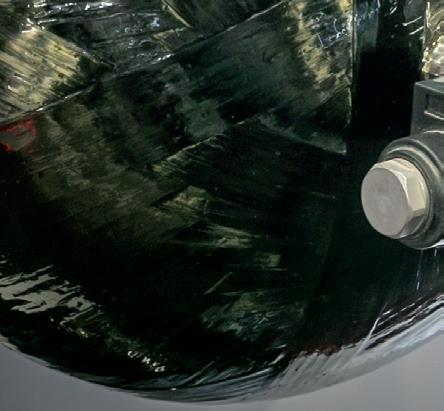
According to BNetzA, “The aim of the National Hydrogen Strategy is the market ramp-up of hydrogen. To achieve this aim, measures are being taken to ensure the availability of suf cient hydrogen and the development of an ef cient hydrogen infrastructure.
“The rst step in developing a hydrogen infrastructure is planning and setting up a hydrogen core network. The hydrogen core network is to connect what are expected to be Germany's major hydrogen consumption and generation regions – central locations such as large industrial centres, storage facilities, power plants
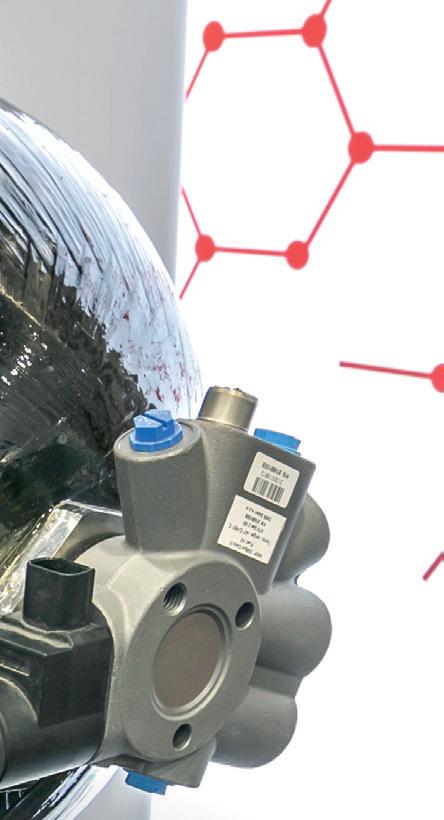




and import corridors – with each other. The hydrogen core network is to comprise key hydrogen infrastructure to be put into operation by 2032.
Hydrogen will become a crucial fuel for industrial purposes. Vehicle and offhighway construction machinery manufacturers are already developing engines able to run on hydrogen. More importantly, the use of hydrogen in industrial applications such as heating for asphalt plants or in cement and concrete production could yield massive reductions in CO2 emissions and help reduce the most disastrous effects of climate change.
A new 37.5km expressway project costing nearly US$2.8 billion is planned for the Philippines. Funding for much of the project is being provided in a $1.7 billion loan from the Asian Development Bank (ADB). This will help pay for work to nearly 30km of the route. A $904 million loan from the ExportImport Bank of Korea will pay for the northern stretch of the road. A further $188 million loan from the Asian Infrastructure Investment Bank will pay for the remainder of the project.
Called the Laguna Lakeshore Road Network (LLRN), the project is expected to deliver a new route running alongside Laguna Lake, the largest lake in the Philippines. The new route will be designed to be climate resilient, with two lanes in either direction for much of the length but three lanes in either direction for a 12km section expected to carry the most tra c. The new expressway will feature nine interchanges located at Binangonan, Morong, Tanay, Pililla North, Pililla South, Jala-Jala, Santa Cruz, Victoria/ Calauan, and Los Baños.
Construction work has started on the US$13 billion I-45 expansion project near Houston in Texas. The project has been described as a ‘gamechanger’ for the city by the Texas Department of Transportation (TxDOT).
The work is being managed jointly by TxDOT in partnership with the city of Houston, Harris County and the Harris County Flood Control District. According to TxDOT, the I-45 North Houston Highway Improvement Project (NHHIP) is designed to expand roadway capacity, reduce congestion, improve safety, and enhance mobility along I-45 from I-69 to Beltway 8 North. It also includes rebuilding downtown Houston’s freeway system, which covers I-45, I-69, I-10, and SH 288. A key element is rerouting I-45 to run parallel with I-69 and I-10 through downtown Houston.
The work will take until 2042 to complete. TxDot also says that the I-45 NHHIP will address current population growth and also lays a foundation for the region’s sustainable development. The project targets congestion
relief, improves evacuation routes, and promotes multimodal transportation options.
TxDOT says that the rst phase, Segment 3B-1, will focus on stormwater management with the installation of box culverts to direct
stormwater to detention ponds, enhancing ood resiliency. St. Emanuel Street will serve as a feeder road for this portion of I-45. This phase, expected to be completed by 2027, has a budget of $121 million.

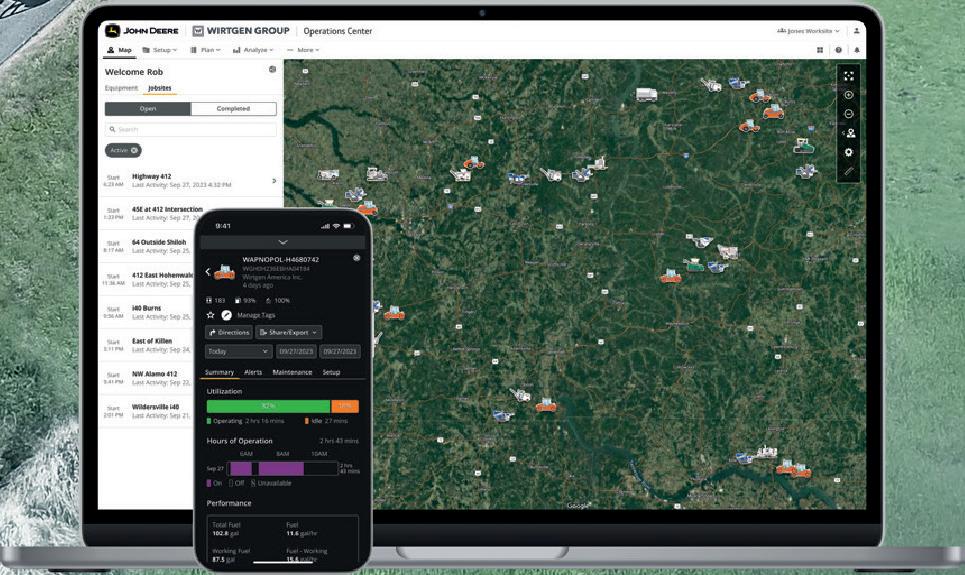




A series of transport infrastructure works are planned for Vietnam that are worth a total of US$4.86 billion.
Construction of the 175km expressway linking Vietnam and Cambodia will start in 2026. Work for the Ha Tien-Rach Gia-Bac Lieu Expressway is expected to cost $3.44 billion. This will speed transport between the Mekong Delta region in Vietnam and Cambodia, boosting trade between the two nations and a prefeasibility study for the project is
São Paulo, Brazil


now being analysed by Vietnam’s Ministry of Transport.
Another of the major projects is for the Tu Lien Bridge that will span the Red River. This is expected to cost $851.4 million and the Vingroup is proposing to the Hanoi People's Committee to build the project. It will include building a 2.9km cable-stayed bridge as well as 11.5km of link roads. Construction of the bridge will cut congestion on the existing Chuong Duong, Long Bien and Nhat Tan Bridges, reducing journey times. The new bridge will



link Tay Ho district with Dong Anh district.
Meanwhile, plans are moving ahead for upgrading work to the Cam Lo-La Son section of the North-South Expressway East. The work will be carried out in Quang

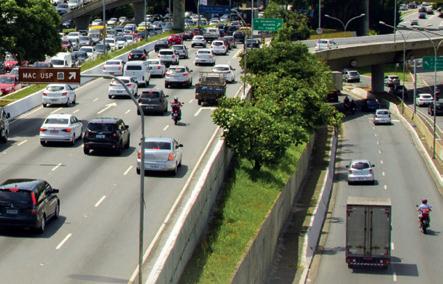
Province and Thua Thien Hue Province. The route will be widened so that it has two lanes in either direction and is expected to cost $276.3 million. The road will be reconstructed with a new base and then resurfaced.


US$1.84 billion tunnel for Mumbai area in India
Financing worth US$1.84 billion is being secured for a major road tunnel project in the Mumbai area in India. This will be used for the new tunnel connecting Thane with Borivli.

The Rota do Zebu highway concession in Brazil’s Minas Gerais State is expected to require US$1.7 billion of investments. This will include upgrades, improvements and maintenance works. The plans will include widening the 44km road itself as well as adding nearly 4km of access roads.
Meanwhile, interest has been strong for the concession for the Sorocabana road in São Paulo State. The winner of the tender has yet to be announced. Meanwhile, bidding is open for a 320km section of
the BR-101 highway. The deal is expected to require investments worth in the region of worth US$1.2 billion. This section of highway will link Rio-Niteroi Bridge with Espirito Santo.

A 49km stretch of the highway route will be widened. The concession will be for 23 years. The concession tender is being managed by the National Agency of Terrestrial Transport (ANTT). At present the concession is being run by AFL Concessionaria de Rodovias.
Work is now commencing for the US$298 million Daejeodaegyo Bridge Construction Project in Busan, South Korea.
The 8.23km bridge will provide a new link between Samrak-dong in Sasang-gu and Sikmandong in Gangseo-gu.
The project has been planned for some time and completion is planned for 2029. The new route will feature two lanes in either direction and is being built
to meet strict environmental legislation. Construction of the link will help the development of Busan, cutting chronic congestion and speeding commuting, while meeting growth targets for the city.
Spanning the Nakdonggang River, the new bridge is being in such a way as to protect the environment of the area and so as not to threaten local ora and fauna, protected bird species in particular.
The tunnel stretches will total 10.25km, with a further 1.6km of linking roads. The project will deliver India’s longest tunnel, with three lanes in either direction.


The project is being managed by the Mumbai Metropolitan Region Development Authority (MMRDA). The new tunnel project is expected to reduce journey times between Thane and Borivli.








Modern road markings must be easily “readable” for both the human eye and driver assistance systems. Yellow road markings present a significant challenge. They reflect less light than white markings. As a result, standard specifications cannot be achieved easily and road safety is reduced.















SWARCO SOLIDPLUS premium reflective glass beads provide an effective solution. They enable excellent retroreflection values even with coloured road markings. The required standard values can be achieved even after several years of traffic exposure. In addition, yellow road markings with SWARCO SOLIDPLUS offer excellent visibility at night and in wet and foggy conditions.






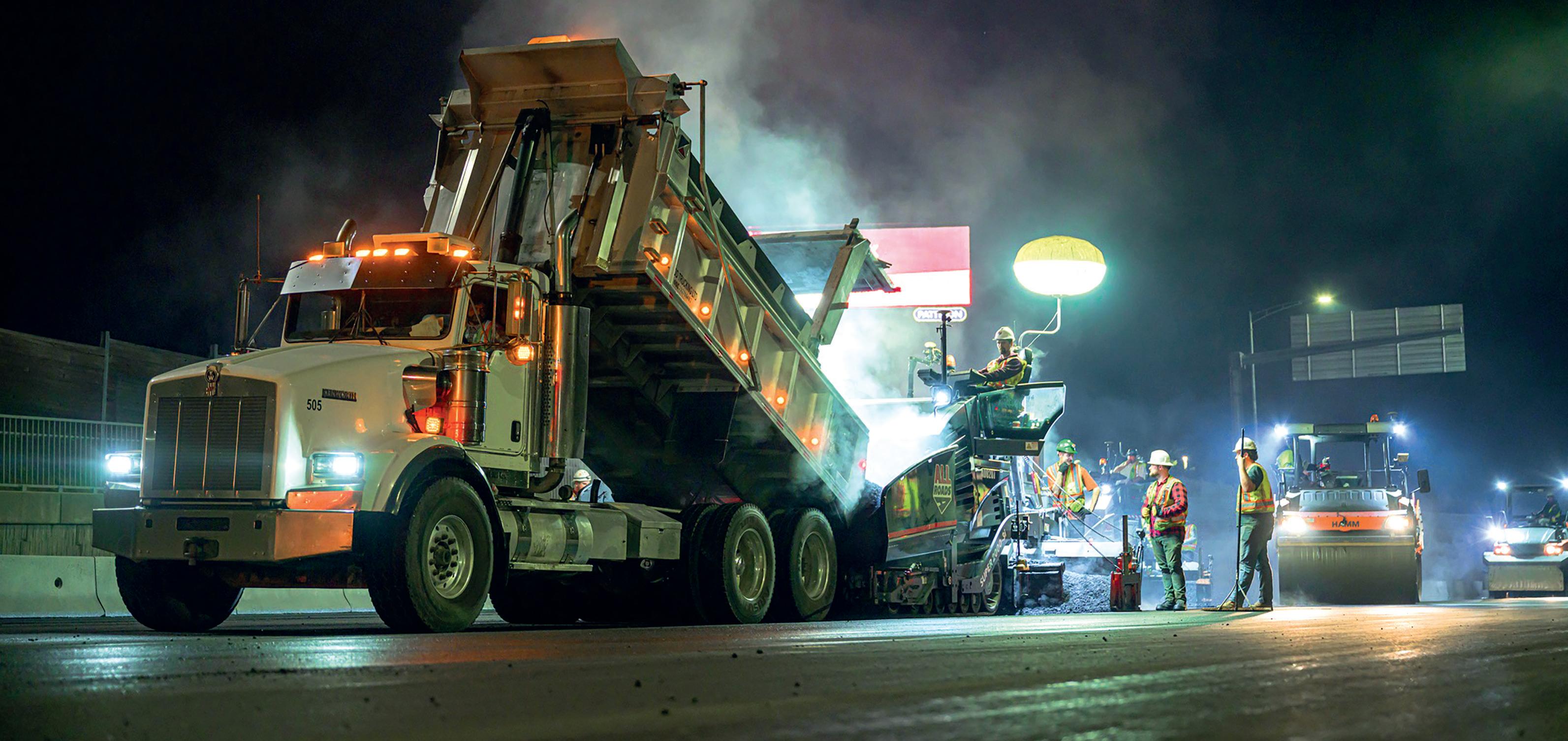


Highways and other major infrastructure projects are crucial to building robust economies and prosperous communities. But while some countries push ahead with large projects to improve transport and stimulate economic growth, persisting high in ation is causing others to put theirs on hold. One constant, however, is high bar when it comes to the ef ciency, collaboration and connectivity required from contractors. Digital, data-driven work ows are crucial to delivering all three for business.
There has always been an imperative to work fast when it comes to roadworks. Road closures are expensive and disruptive, and delivering work quickly and accurately is nothing new for contractors. Add to that a requirement for sustainable work ows and there is huge emphasis on achieving leaner projects with little to no waste on costs, time, or materials.
It means every stage of the project is under the microscope, and contractors are expected to be able to account for the cost and carbon impact of their work in detail. These pressures are part of the reason that many rms are scaling up the use of digital technologies. However, many still overlook the value of digital work ows in reducing waste and enabling collaboration across different teams and even different contractors.
The added accuracy and ef ciency offered by machine control is just one factor when it comes to the value of precision technology. By expanding to full digital work ows for asphalt paving, such as SmoothRide by Topcon, contractors can access thousands of data points at each stage of a job. This allows project managers to view the breadth of the
project and also zoom in to examine a single task in detail.
Whether it is working towards net zero, or looking after material, fuel and time usage, connected digital work ows bring relevant data together to allow different jobs to support one another. For example, a precise understanding of material requirements –alongside the need for less, if any, rework –helps bring down emissions from deliveries.
There is even more value to be unlocked when it comes to sustainability and reporting.
A rm’s sustainability commitments rely on its ability to measure its current emissions and reduce them. Pulling together this data into a report, whether it is for regulators, investors, or tender applications, is made much easier when operational data is gathered by precision technology then amalgamated by digital work ow software.
For the regions where large-scale infrastructure contracts are being awarded, joint ventures are common, putting the emphasis on the ability for different contractors, or even different countries, to work together.
On these projects, the point where a handover is carried out between rms is often where inef ciencies, inaccuracies and
delays can happen. The value of digital- rst work ows for smoothing this process cannot be overestimated. It means being able to provide hundreds and thousands of data points, alongside detailed digital plans that future teams can refer to at any point in the build. The latest systems make this process easier than ever, with intuitive and highly compatible software packages that mean the data the new team receives does not require hours of work before the crucial information can be extracted.
The bottom line is that construction, and highways projects in particular, cannot afford to pass up this opportunity to work smarter, more sustainably, and more collaboratively. Precision technology is not just about increasing ef ciency and accuracy on individual jobs. This is of course a key bene t, one that will help the industry deliver faster and better end products, but the overall boost for the industry is far larger than the sum of its parts. Implemented broadly and effectively, the industry will wonder how it ever worked without precision technology and digital work ows.
Topcon Positioning www.topconpositioning.com


Trimble has established high-level partnerships with key construction machinery manufacturers Caterpillar and John Deere.
Caterpillar and Trimble are extending their long-standing technology joint venture. The agreement includes expanded distribution of grade control solutions in construction to accelerate innovation and customer adoption.
Meanwhile, Trimble has set up a new strategic relationship with John Deere that will speed the adoption of grade control technology for construction.
Since 2002, the Caterpillar Trimble Control Technologies (CTCT) joint venture has provided construction with grade control solutions, boosting jobsite safety and productivity.
The renewed agreement will increase industry reach and provide customers with broader availability of interoperable grade control solutions via a flexible platform for use by Caterpillar, Trimble and other technology providers and equipment manufacturers. With a strengthened partnership, this agreement enables both Trimble and Caterpillar to increase innovation and differentiation, develop new offerings and pursue new industry and geographic opportunities.
For Caterpillar customers, the company's Cat Grade 3D Ready option allows upgrading at any point within the machine life cycle. There will be expanded aftermarket and digital offerings directly through Cat dealers. Meanwhile, Trimble customers also benefit from broader availability with continued mixed-fleet support from trusted SITECH dealers, expanded distribution networks to meet the needs of mixed-fleet customers. In addition, streamlined access to grade control through the Trimble Construction One suite of digital solutions further extends Trimble’s construction technology ecosystem.
Similarly, the availability of the Trimble Earthworks Grade Control technology integrated with the John Deere SmartGrade platform will make it easier for John Deere customers to leverage the full benefits of machine control for increased productivity, efficiency and better decision-making.
For more than a decade, John Deere has offered a Trimble Ready option on selected machines to simplify installation in the aftermarket. With this expanded relationship, selected John Deere machines equipped with SmartGrade technology will make Trimble Earthworks available direct from the factory or as a field upgrade. This integration will allow machines equipped with SmartGrade to fit seamlessly into the Trimble technology ecosystem, simplifying the ways to connect the office to the field and leverage jobsite data.
This collaboration will boost jobsite safety and efficiency and promote the adoption of machine control technology in construction.
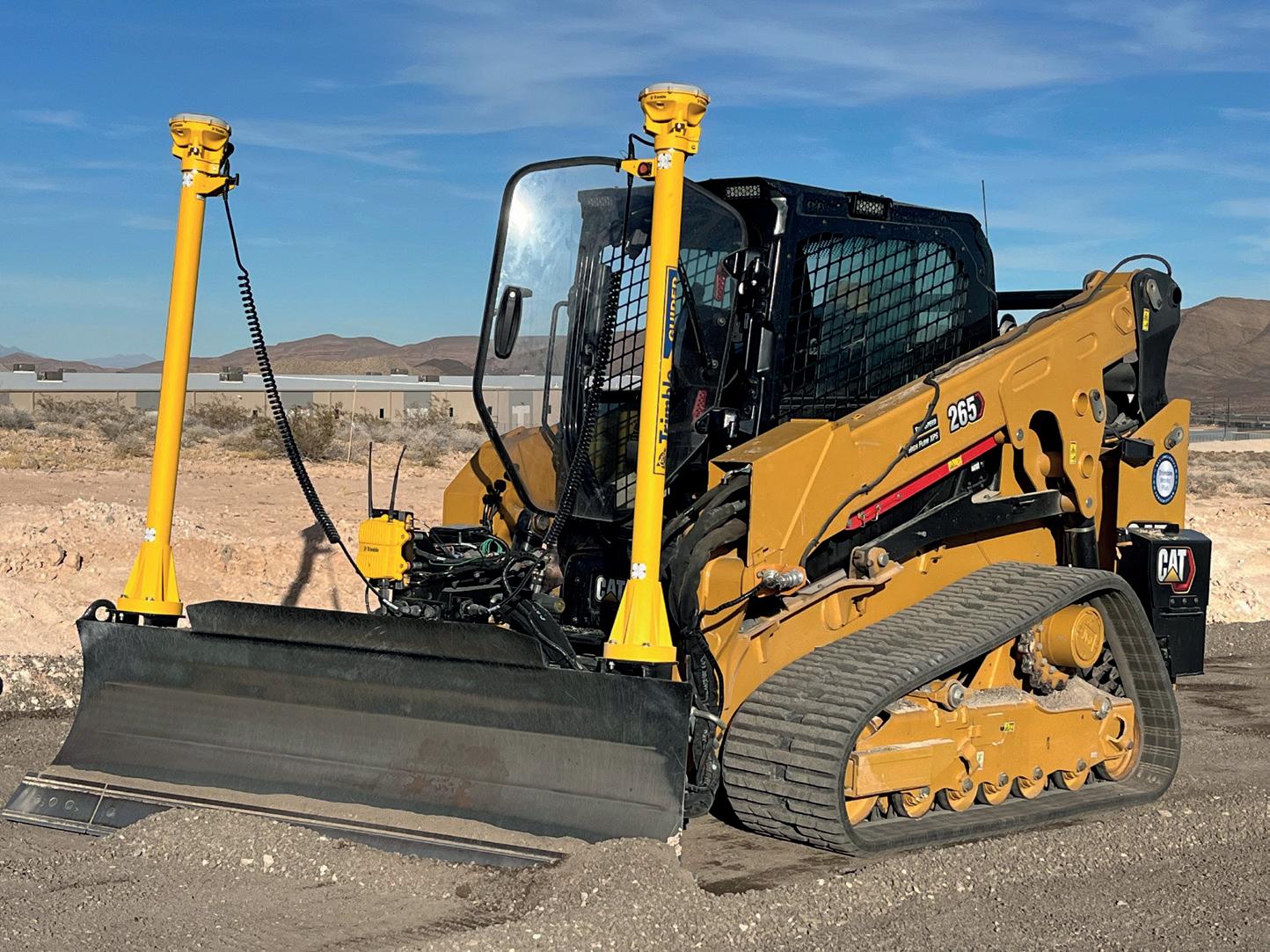
To make adoption seamless for the customer, various purchasing options will be available in the future for John Deere SmartGrade with Trimble Earthworks, including factory direct or field installations, and as part of the Trimble Construction One suite of digital solutions.
Integrating Trimble Earthworks will provide John Deere customers greater access to Trimble’s construction technology ecosystem. This allows the customer to elevate operations by connecting and managing data throughout the design-buildoperate life cycle of construction projects.
Meanwhile, developing machine control solutions for the compact equipment market is a sector the connected construction technology suppliers have yet to cultivate.
According to Steve Di Benedetto at Trimble,
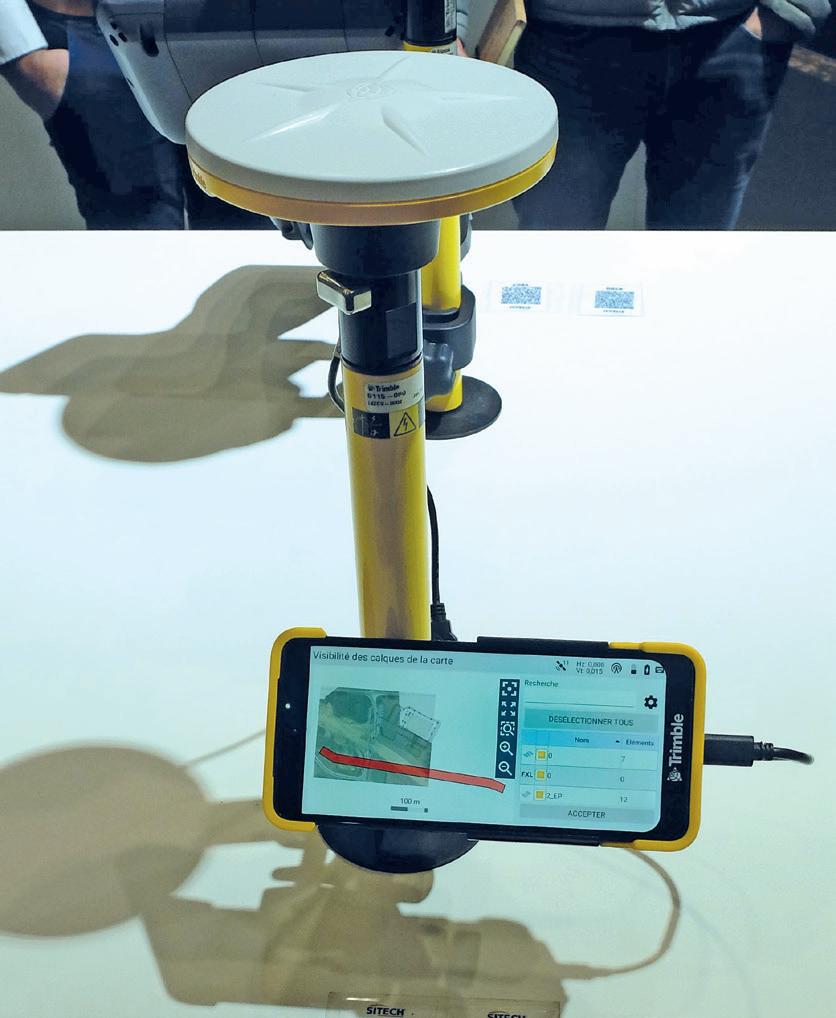
“There is a tremendous potential for Trimble.”
Democratisation of machine control technology means that systems are becoming available for use with compact equipment and these packages will be of key interest for smaller firms looking to boost working efficiency. The latest development is a new package for use with skid steer loaders and compact tracked loaders.
A key feature of this new system is the fact that the customer can use a conventional smartphone or tablet. It is this detail that makes the system so much easier to use given that customers will already be familiar with a wide range of apps on their phones. Di Benedetto commented, “They’re already doing so much on the phone. They’re doing it in the cloud so they don’t have to install software. It’s in a language and a user interface that they’re already familiar with.”
According to Trimble, the addition of Siteworks Machine Guidance for compact track loaders further boosts versatility, providing an all-in-one solution for layout, grading and levelling. Trimble says that users can also move the system between multiple machines and jobsites, and to utilise their existing technology easily, with the addition of a simple-to-install machine kit and the Siteworks software module.
Caterpillar www.cat.com
John Deere www.deere.com
Trimble www.trimble.com

Blyncsy, part of Bentley Systems, has published a comprehensive public map of all interstate highways in the United States.
This shows key roadway assets such as guardrails, speed limit signs, and work zones to support roadway safety and maintenance conditions. This data is now available to all state US Department of Transportation (DOT) agencies. The information allows the states to better address safety, maintenance and repair operations of deteriorating and at-risk roads more efficiently and cost-effectively, especially during times of natural disasters.
The new Blyncsy interstate highway map uses crowdsourced dash camera imagery from over 1 million vehicles in use. When coupled with Blyncsy’s powerful AI image analysis toolset, the system can detect over 40 different road conditions and asset inventory issues in near-real time. These issues include potential
roadway safety hazards from guardrail damage, missing signage, and lack of proper road striping to roadway vulnerabilities from crashes, natural disasters, and work zone areas.
Blyncsy’s AI-powered crowdsourced data is delivered through an open API, providing state DOTs a solution that is infinitely scalable and more cost-efficient when compared to other manual data collection technologies like LiDAR, or traditional road inspection methods which require road maintenance crews to be dispatched.
"The application of advanced technologies like AI, combined with new sources of data, are transforming the transportation sector, giving us better information as we make investments in safety and mobility,” said Laura Chace, President and CEO of ITS America.
"We applaud companies like Blyncsy for deploying these forward-thinking technologies
and making this digital infrastructure data available to the public in an accessible format. We're excited to see how Blyncsy's data launch will support the core values of safety and equity while furthering the digital infrastructure movement on a national scale."
“With increasing workloads and smaller budgets, state DOTs need a way to improve roadway safety and operational efficiencies,” said Mark Pittman, Blyncsy CEO and Bentley’s Director of Transportation AI. “Today, we’re supporting a national digital infrastructure vision and democratising roadway data by publishing an open dataset of US highways to help state DOTs better prepare, maintain, and repair more miles and create safer environments for maintenance crews and drivers alike.”
Blyncsy www.blyncsy.com
Bentley Systems is now offering a sophisticated tool that allows users to analyse the carbon profile of construction works more accurately. The new Carbon Analysis capabilities in iTwin Experience mean that construction firms can assess and reduce carbon impacts to allow a more sustainable infrastructure. The new Carbon Analysis capabilities enable infrastructure engineers to simplify carbon reporting, easily visualise embodied carbon, and rapidly explore alternatives for better
designs.
Chris Bradshaw is chief sustainability officer at Bentley Systems and commented, “These days sustainability is vital to everyone.” He continued that determining an accurate embodied carbon analysis is essential for construction operations going forward so as to help achieve sustainable development.
“Between now and 2050, embodied carbon linked to new infrastructure, is projected to be responsible for half of the world’s
carbon footprint released - even before the infrastructure is used,” added Savina Carluccio, executive director, International Coalition for Sustainable Infrastructure (ICSI).
“Given its significant contribution to global emissions, the sector must act with urgency to reduce embodied carbon at scale, as part of wider decarbonisation and climate action efforts - from leveraging a highly connected and collaborative value chain to using new digital technologies that enable the selection and use of
alternative, carbon-efficient materials in sustainable infrastructure designs.”
Bentley’s new Carbon Analysis capabilities integrate a user’s design data with their chosen carbon assessment tool. This enables infrastructure professionals to link carbon footprints directly to design choices and see impacts change across design iterations.
Bentley Systems www.bentley.com






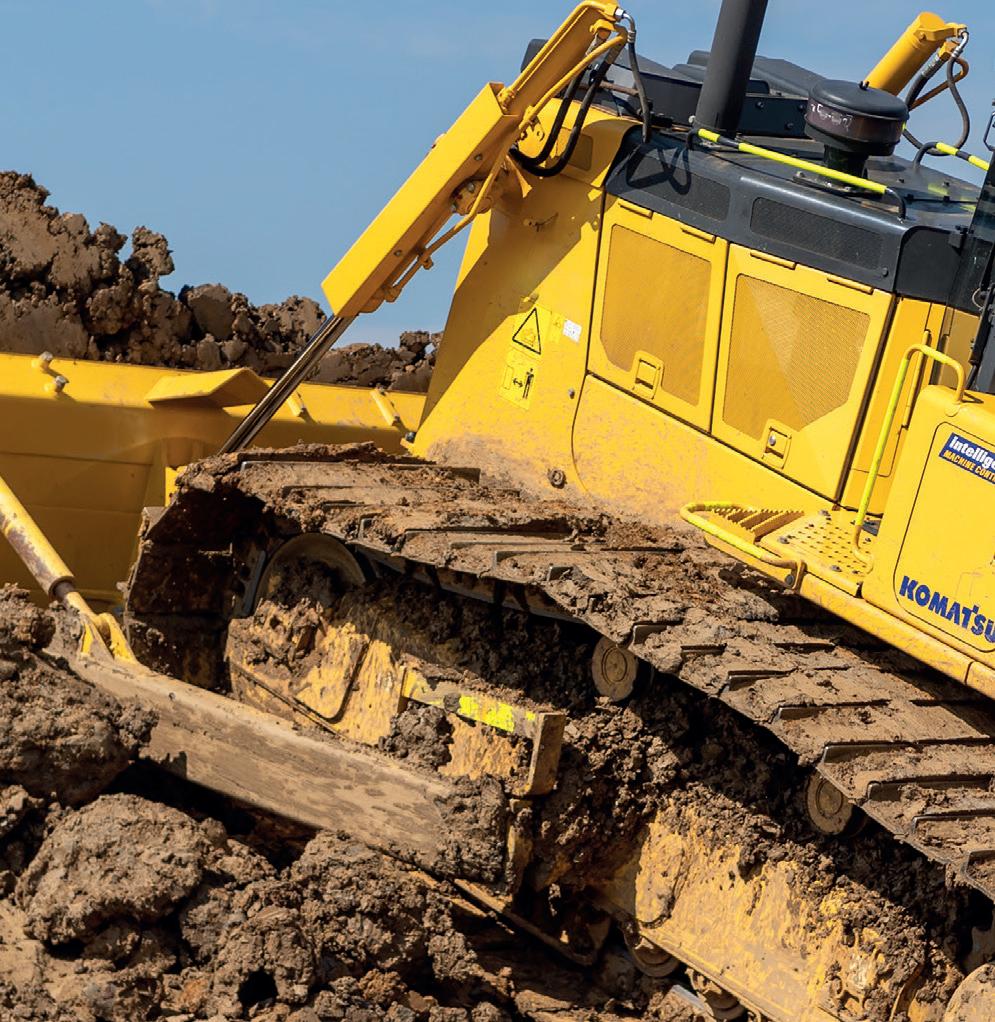
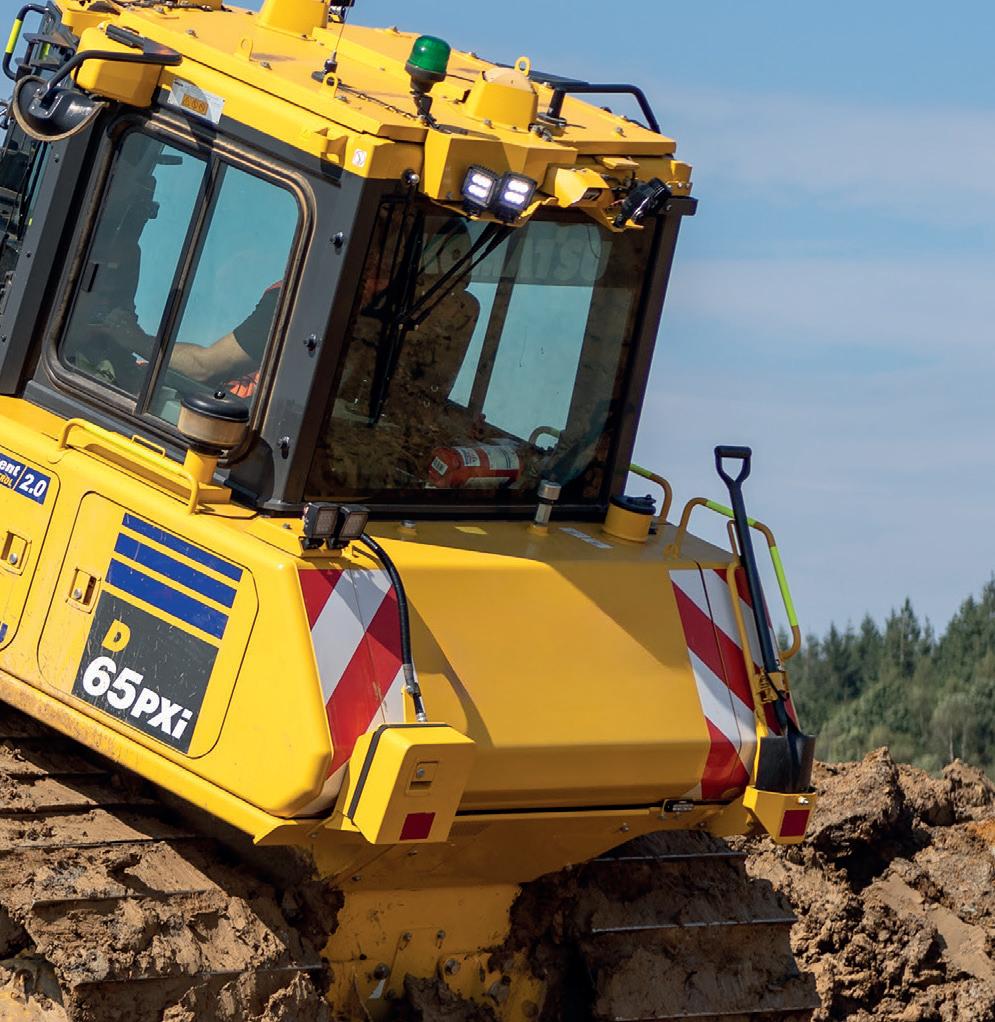


Your new dozer will boost productivity and accuracy with second generation intelligent Machine Control that continuously scans the job site to plan the next pass. The 164 kW / 220 HP torque converter drive system with automatic lock-up offers impressive power while ensuring low fuel consumption. You can work in automation modes almost continuously, from rough cut to finish grade.










Organised by the International Road Federation (IRF) in collaboration with the Ministry of Transport and Infrastructure of the Republic of Türkiye, the IRF World Congress took place from 15-18 October 2024 in Istanbul
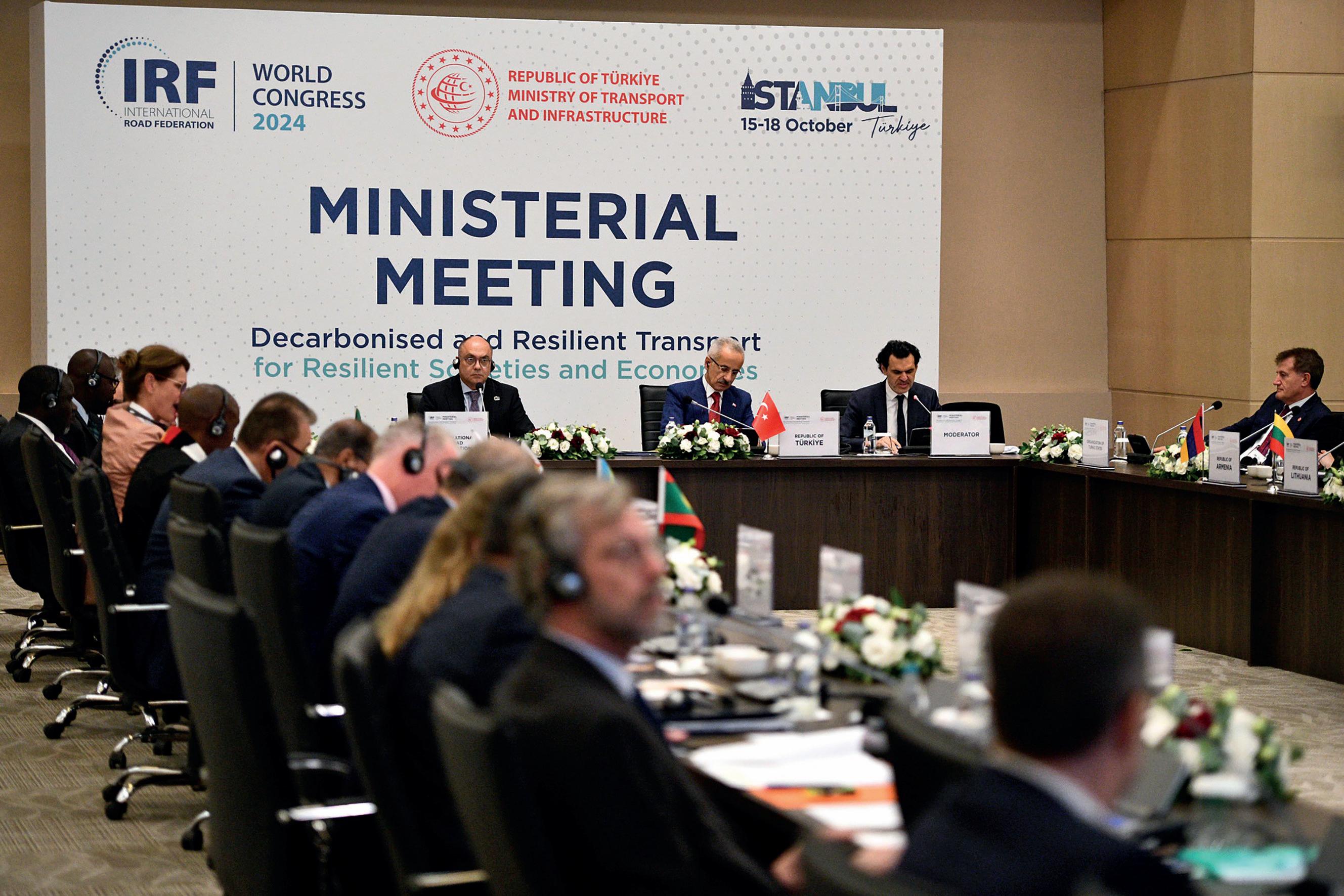
The event welcomed over 2,000 participants from more than 80 countries, including over 30 ministers, international organisations, and prominent public and private sector stakeholders. In his opening address, Recep Tayyip Erdoğan, president of the Republic of Türkiye, highlighted the essential role of infrastructure in a nation’s development, re ecting the theme of the 2024 Congress: Connecting to Empower Mobility: Roads as Enablers of a Sustainable Future for All. “Roads are civilisation,” stated president Erdoğan. “Roads mean transport, industry, production, tourism, trade, safety, development, and integration with the world.”
Collaboration and the necessity of speaking with a collective voice to support the sector were central themes in the opening remarks by IRF president Dimitris Mandalozis. He reminded attendees that, “For over seven decades, the IRF has united [the] public and private sector, fostering partnerships that deliver meaningful impact. This is the core of who we are and what we do as a Federation” he said. “Today, amidst global challenges our collective voice as a transport community and not just as a federation is more important than ever. Sustainability is not a choice – it is an imperative” he continued. “Let us seize this moment to raise a strong, united voice that says NO to road deaths and injuries and YES to a decarbonised, resilient and sustainable transport that leaves no one behind,” Mandalozis concluded.
The Ministerial Meeting, held during the Congress, brought together over 30 ministers alongside representatives of international organisations, providing a platform to explore transformative pathways for transport systems. Guided by shared goals of resilience, sustainability, and inclusivity, discussions addressed key themes essential to the future of the sector.
The discussions emphasised the need for infrastructure capable of withstanding climate change and supporting clean energy goals. These aspirations are achievable through innovative nancing models and robust public-private partnerships, deemed critical for sustainable progress.
Inclusivity was another central topic of the debate. From urban to rural areas, calls
focused on expanding pedestrian and cycling networks, enhancing public transport, and implementing low-emission solutions - key elements for building more connected and inclusive societies.
Technology was recognised as a driving force behind this transformation, with digital tools such as intelligent transport systems considered essential for improving ef ciency, conserving resources, and fostering decarbonisation.
The Congress concluded with a call to action and a joint commitment from all stakeholders to prioritise resilience, accessibility, and environmental responsibility to shape a future where mobility is ef cient, equitable, and accessible to all.
For more information about the IRF World Congress, visit irf2024.irfof cial.org or contact the IRF at info@irfof cial.org.

In the margins of the IRF World Congress 2024 held in Istanbul, the International Road Federation (IRF) has unveiled a new domain name, www. irfof cial.org coupled with a refreshed visual identity and a tagline guiding its mission “Connecting to Empower Mobility”.







Roads do more than just connect destinations, they are the veins of society, linking communities, fostering sustainable development and creating pathways to opportunity. Just as roads link cities, countries, and people, IRF brings together experts, policymakers, and organisations to make sustainable mobility a reality for all.





The International Road Federation was founded in 1948 to bring countries together and rebuild a war-torn Europe, Since then, and now for over seven decades, the IRF has championed the development of sustainable road networks. From its headquarters in Geneva and engaging in over 130 countries worldwide, the IRF shares knowledge and expertise, brings together people, business and organisations, and drives policy and advocacy for safer, more ef cient, and resilient road systems worldwide.

Guided by the principle of “Connecting to






Empower Mobility” the now-refreshed logo and website address re ect our vision and embody the commitment to connecting the dots for a more inclusive future, creating lasting impact worldwide.








Visit www.irfof cial.org and join the IRF to build a more connected and sustainable future. lasting impact worldwide. IRF’s core resources. With a user-friendly and the IRF World Road Statistics
The redesigned website complements this identity, offering streamlined access to IRF’s core resources. With a user-friendly layout, visitors can explore key sections, including IRF-organised and supported events, training opportunities, major project initiatives, membership bene ts, and the IRF World Road Statistics among much more. The site also features the recently launched International Registry for Road Safety Auditors, offering access to a list of certi ed road safety auditors, showcasing our commitment to safety and excellence in road infrastructure.

list of certi ed road safety auditors, safety infrastructure.


















Advancing road safety and sustainability worldwide, a remarkable conference in Riyadh; a global call for innovation
The International Road Federation (IRF Global), in partnership with Saudi Arabia’s Roads General Authority, hosted the landmark Road Safety & Sustainability Conference in Riyadh from November 3-4. With over 1,000 participants from 50 countries, the conference explored how innovation can drive progress in road safety and sustainable transport under the theme
'Innovating for Tomorrow.'
Discussions at the conference emphasised the importance of modern solutions to reduce road traf c accidents and enhance the resilience of transportation networks. Among the highlights was a ministerial session featuring high-ranking of cials from Saudi Arabia, Kuwait, Georgia, Cyprus, and Nepal. The panel shared insights on successful road safety policies and the critical lessons learned from implementation.
The conference also brought attention to sustainable practices in infrastructure
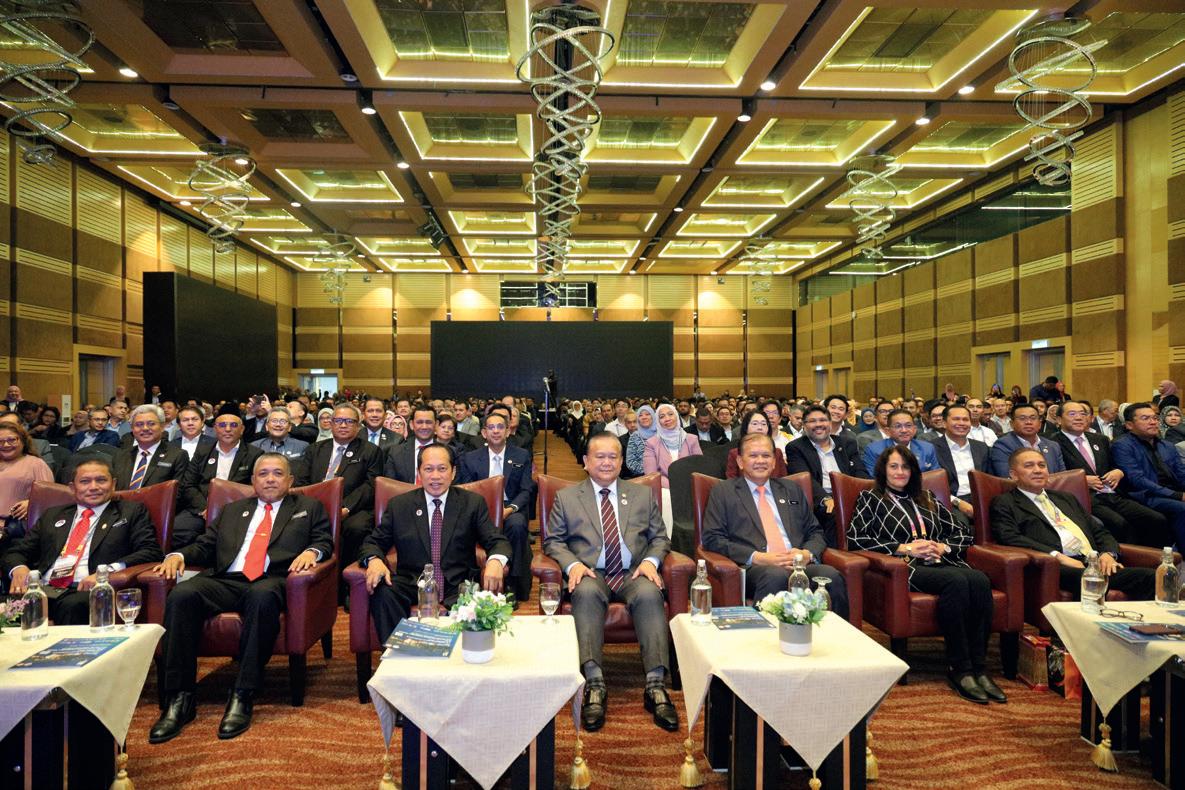
development, including the use of ecofriendly materials and innovative construction techniques. Alongside the discussions, an exhibition showcased state-of-the-art technologies designed to improve road safety and optimise transport ef ciency.
Saudi Arabia’s Vision 2030 framework was a guiding force throughout the event, underlining the Kingdom’s ambition to modernise its infrastructure while making roads safer and more sustainable.
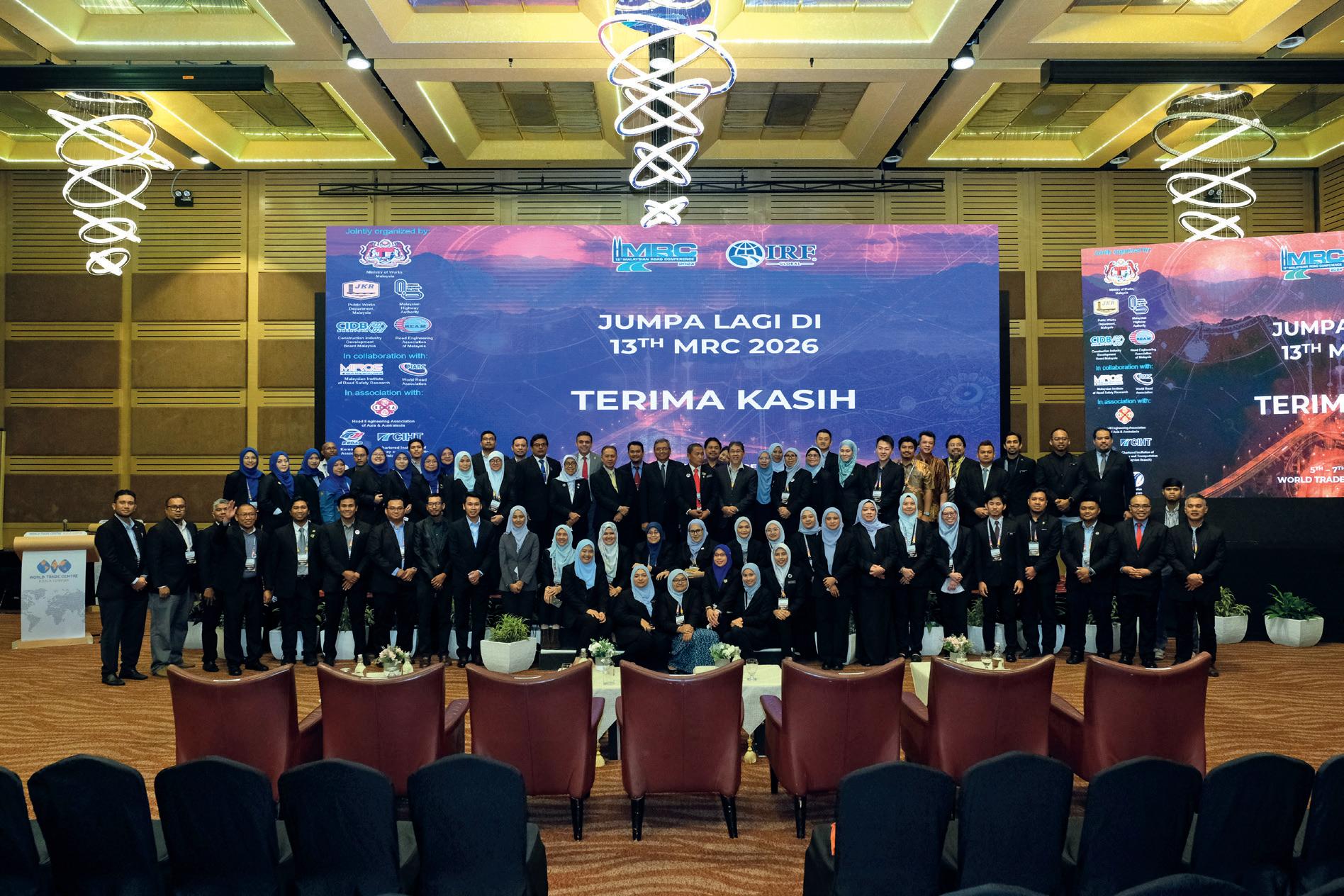
The 5th IRF Asia-Paci c Regional Congress and 12th Malaysian Road Conference & Exhibition, held from November 5-12 in Kuala Lumpur, Malaysia, brought together over 1,500 participants to discuss sustainable development and resilience in the road sector.
Held by the International Road Federation in partnership with the Ministry of Works of Malaysia and
the Road Engineering Association of Malaysia, the event highlighted strategies to meet the unique challenges facing Asia-Paci c nations.
Key discussions focused on integrating resilience into infrastructure planning to address the impacts of rapid urbanisation sand climate change. The programme also highlighted regional partnerships as a vital tool
for ensuring nancial and technical sustainability in road projects.
The event featured a dedicated exhibition showcasing cuttingedge solutions in construction, maintenance, and traf c management. Exhibitors presented innovations designed to extend the lifespan of infrastructure while minimising environmental impact.
The congress reinforced Kuala Lumpur’s role as a regional hub for knowledge-sharing and collaboration. Delegates left with actionable insights to help drive the sustainable development of road networks across the Asia-Paci c region.
Headquartered in Washington, DC, US, since 1948, the International Road Federation (IRF Global) has been at the forefront of revolutionising global transport infrastructure.
Membership with the International Road Federation (IRF Global) is an opportunity to become part of an in uential global network committed to advancing safer, more sustainable, and more e cient roads for the future. With over 120 countries represented among its members, IRF Global is a hub for collaboration, knowledgesharing, and the exchange of transformative ideas.


In the past year alone, IRF Global brought together nearly 5,000 professionals from over 130 countries at four landmark conferences. These events connected decision-makers, engineers, and thought leaders, fostering innovative solutions to pressing challenges in road safety, infrastructure resilience, and sustainable mobility. Participants included ministers, CEOs, and technical experts who collectively shaped the discussions.

programmes have equipped thousands of professionals with the tools to implement e ective solutions across a wide range of elds, from road safety audits to advanced construction techniques. The impact of these initiatives is felt across every corner of the industry.
As an IRF Global member, you will also gain privileged access to cutting-edge research, industry publications, and webinars that keep you at the forefront of developments in the road sector. Membership provides a unique opportunity to participate in specialised working groups where you can shape the policies and standards driving global progress.



IRF Global’s commitment to empowering its members is evident in its rapidly expanding global events calendar. From major international conferences to targeted training sessions, IRF Global provides platforms that address immediate challenges and long-term visions for the road transport sector. These gatherings are invaluable for staying connected to the pulse of innovation and forming partnerships that last.
This is your chance to join an organisation that is not only shaping the future of roads and mobility but also empowering its members to be at the heart of that transformation. By becoming a member, you will ensure your voice is heard in the global dialogue on transport and infrastructure, and you will gain the tools to make a lasting impact.


IRF Global membership goes far beyond attending events. It opens the door to a wealth of exclusive bene ts, including access to world-class education programs tailored to the needs of the road transport sector. These



One of the most valued aspects of IRF Global membership is the opportunity to build lasting connections with a diverse and in uential community. Whether through high-level networking at conferences, collaborative working sessions, or professional training programs, members consistently engage with leaders from government agencies, private industry, and academia.







Visit www.irf.global/membership to learn more and take the rst step in joining this extraordinary network.

















Contractor 2AGE-MCS achieved precision and speed in milling the Route Centre-Europe Atlantique in France with the use of 3D technology
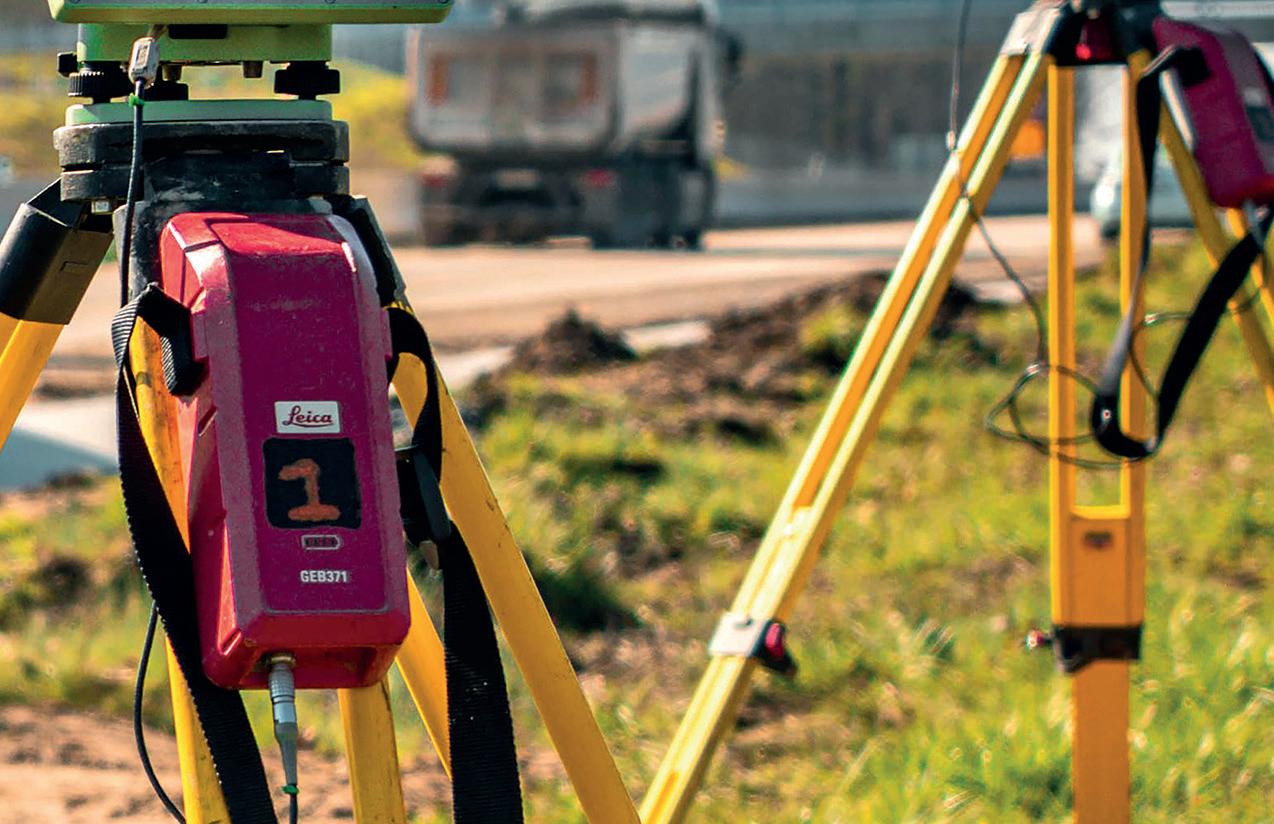
Acontractor in France has utilised the latest machine control technology to deliver high-quality road milling for a key project. The rm, 2AGEMCS, has had a very successful collaboration with Leica Geosystems on the RCEA (Route Centre-Europe Atlantique) project in central France. Using machine control solutions from Leica Geosystems, 2AGE-MCS delivered high-quality milling results that left no room for error and also stayed ahead of the tight schedule demanded for the project.
On road construction projects, precision and speed are key factors for all involved. For contractors and operators who manage complex projects, cutting-edge technology can help keep everything on track.


The job required milling 4km of road in just two days, a major challenge for any contractor. This formed part of the RCEA project, a major infrastructure initiative to enhance one of France’s critical traf c routes.
The Roger Martin Group entrusted 2AGE-MCS with the responsibility of

carrying out the precise and swift milling work for the RCEA road expansion between Paray and Charolles, guaranteeing the road surface met top safety and quality standards.

The pressure was not only to nish the job in time but also to do it with such precision that the asphalt mix would also be laid precisely over






the milled surface. The contractor achieved this using the latest 3D machine control.
"Leica Geosystems’ machine control solutions have truly proven their worth," said Bastien Lambert, director of 2AGE-MCS.

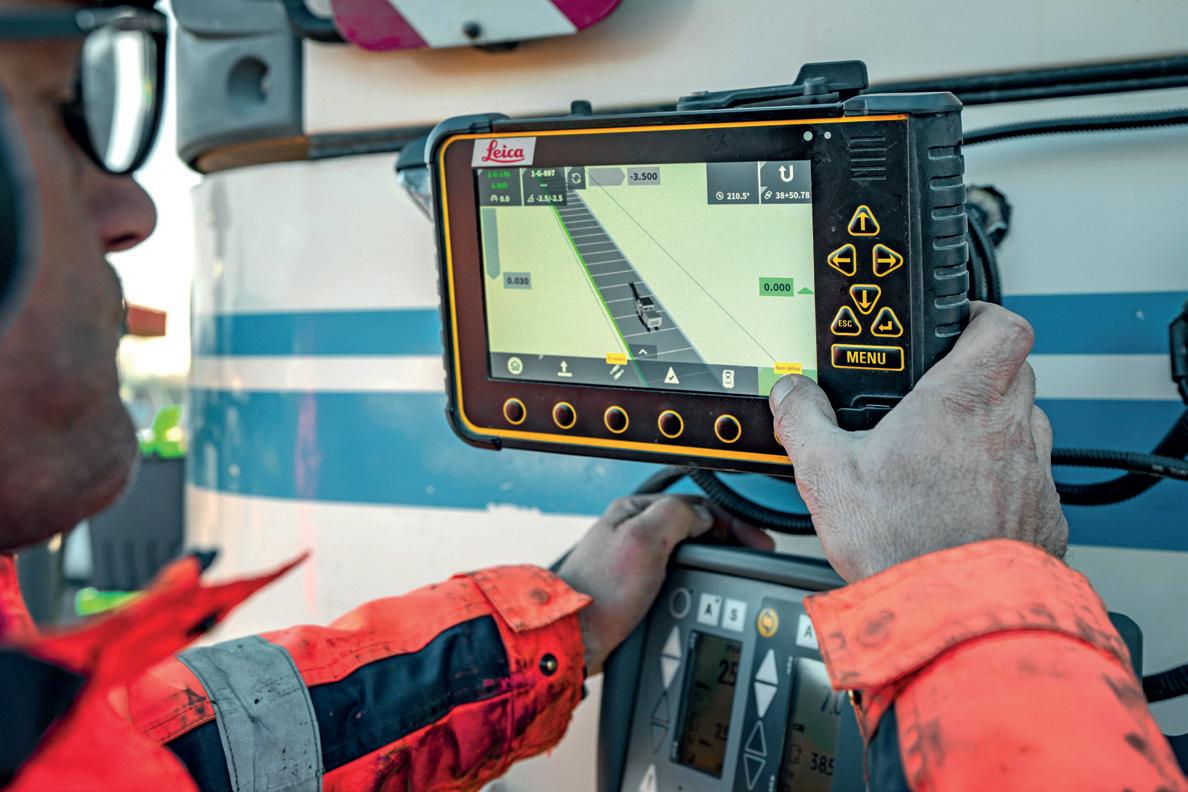
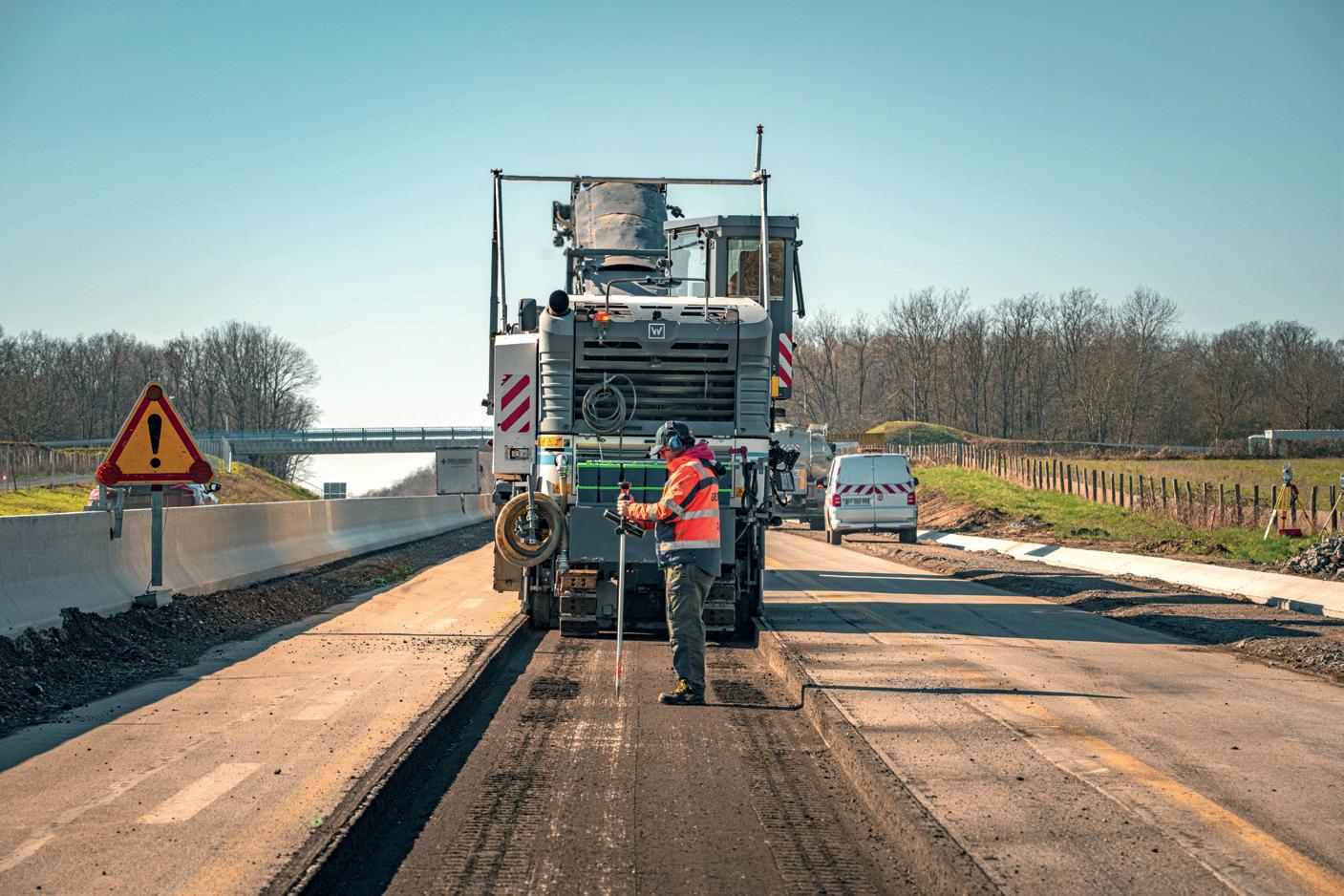
Equipped with the Leica MC1 3D milling solution, mounted on a Wirtgen W 210 XP cold milling machine, the team was able to meet the tough schedule while delivering the high-quality performance required.
The system followed the prede ned 3D models very closely, ensuring that the surface was millimetre-accurate once the milling bits passed over the surface. This level of accuracy reduced the need for follow-up corrections, saving both time and money.
The setup of the system was signi cantly less complex and time consuming than the contractor anticipated. Thanks to the sophisticated yet easy to use technology, the Leica MC1 system was up and running in just 20 minutes. This quick setup allowed the team to start milling right away, a critical factor given their tight schedule.

a bene t that signi cantly reduces downtime and potential errors. By allowing continuous machine guidance, this system ensures that the milling process remains consistently accurate, even over long distances.


Speed was not the only bene t either as the technology also delivered intelligent systems. Leica’s technology features an automatic device-switching feature, called Leica 1-Up system, which saved the team even more time by reducing manual interventions. This tool switches automatically between different total stations without requiring manual intervention,


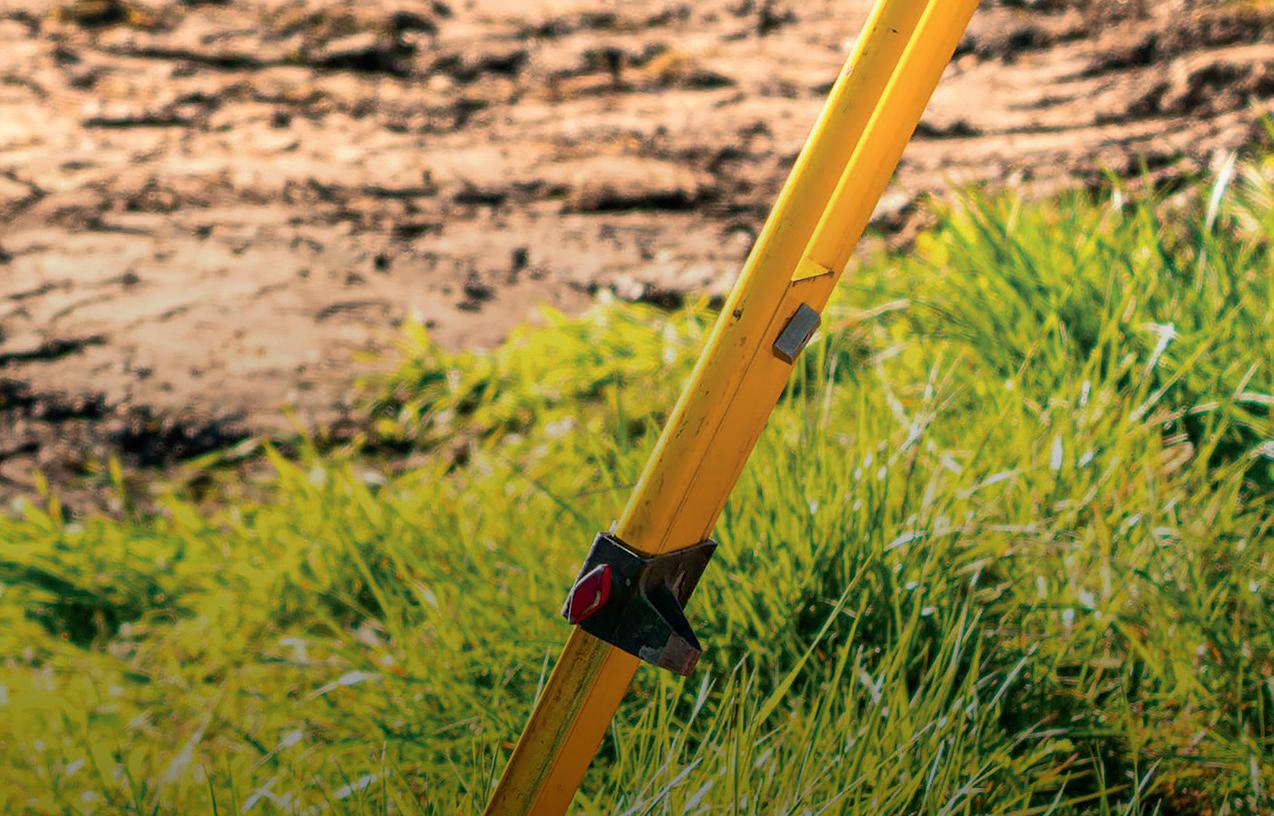
As Bastien Lambert, Director of 2AGEMCS, pointed out, "This functionality saved us considerable time," highlighting its critical role in maintaining high-quality results throughout the project. To maximise the system's effectiveness, Lambert's team positioned four total stations every 125m, enabling real-time monitoring and control that kept the milling operation precisely on track from start to nish.
As the team milled away, real-time data streamed from the total stations to the milling machine at 10Hz. That means the machine made tiny corrections ten times/second to stay on course. This kind of high frequency adjustment is like having a super accurate autopilot guiding the machine, ensuring that the nal road surface is as smooth as a runway.
"Without 3D guidance, this would have been impossible. Manual measurement would have signi cantly reduced our precision and speed," Lambert acknowledged.

In just two days, 2AGE-MCS milled approximately 1,500tonnes of road surface, moving at a steady pace of about 12m/min. As a result, the contractor was able to achieve an accurately milled road that meets all regulatory standards and is ready for the next phase of the project. Thanks to the synergy between 2AGEMCS’s expertise and Leica Geosystems’ cuttingedge technology, the project was a resounding success.
When it comes to large-scale infrastructure projects, investing in 3D machine control solutions can be the difference between hitting a deadline with precision or falling short.


The contractor, Roger Martin Group was impressed with the accuracy and the short amount of time the job was delivered. Anthony Teriele from Roger Martin commented, “We selected 2AGE-MCS due to their proven expertise and our need for high precision and rapid implementation."
As Lambert put it, "Leica Geosystems’ solutions have been instrumental in achieving our goals swiftly and accurately. Their technology has truly enhanced our operational ef ciency and precision."

Milling work was carried out speedily and with precision whilst tight speci cations were met for the job due to the use of 3D technology

Leica Geosystems www.leica-geosystems.com
Wirtgen www.wirtgen-group.com







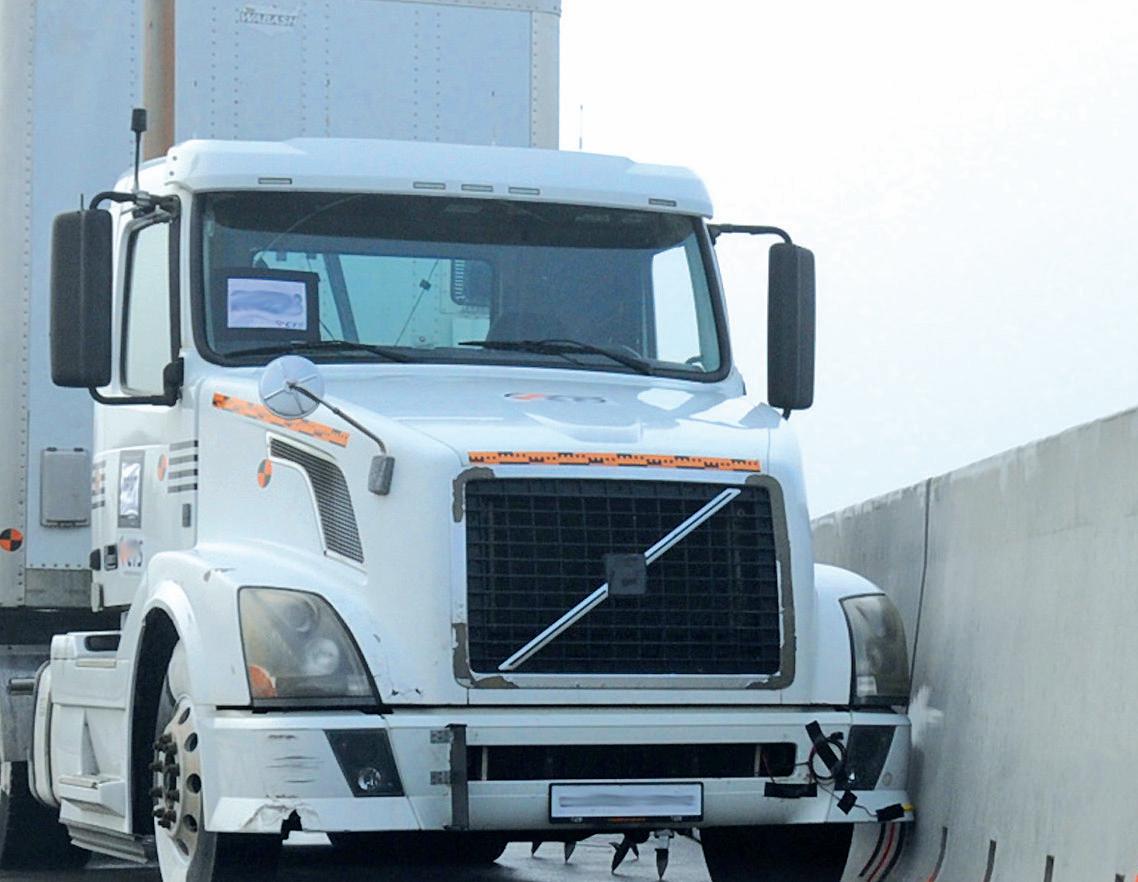




This year, Rebloc celebrated its 15th anniversary. Since 2009, the company has been developing, producing and marketing modern vehicle restraint systems (VRS) made of precast concrete elements for road safety worldwide
Rebloc was founded in 2009 with a clear vision to raise the bar for modern, sustainable and modular safety barriers made of precast concrete.
To date, the company has conducted over 230 real crash tests to ensure the highest levels of safety and reliability. From tested permanent solutions to temporary solutions, transitions, integrated noise protection and special solutions, Rebloc has continuously expanded its product portfolio. The company sees its commitment in improving road safety through technically sophisticated and ef cient solutions.
Each year, Rebloc invests in high-level research and development to push forward existing and new application areas worldwide. The Rebloc
system is successfully tested according to EN 1317, MASH 2016 and JTG standards, demonstrating its commitment to global standards. Rebloc holds more than 100 patents and is already present in 49 countries on six continents.
With 15 years of milestones and achievements, Rebloc stands as a global leader in road safety, dedicated to innovative and highperformance vehicle restraint systems made of precast concrete barriers. As roads have created connections through centuries and will continue to do so into the future, Rebloc’s commitment remains clear: to make roads safer for everyone - today, and for generations to come.
Rebloc www.rebloc.com
Opsys reports that the rst real world deployment of its pure solid state LiDAR ALTOS technology has been with the city of Peachtree Corners in the US.
Opsys said that, as a pure solid state LiDAR, the ALTOS Gen 2 has no moving parts. This enables best-in-class performance with high resolution and extreme reliability with a 4D point cloud from the device’s speci c eld of view. The pure solid state characteristics make the unit more robust, avoiding mechanical failures associated with moving components and allowing the unit to have 24/7 operation and pass a 50g shock and full vibration test.
Peachtree Corners announced the collaboration with Opsys, saying it will deploy the company’s Advanced LiDAR Technology Opsys Sensors (ALTOS) Gen 2 LiDAR at Curiosity Lab. The city’s Curiosity Lab - owned and operated by the City of Peachtree Corners - is a 5G-enabled intelligent mobility and smart city living laboratory located in Atlanta, US. Designed as a proving ground for IoT, mobility and smart city emerging technologies, the centrepiece of the lab is a 5kmlong autonomous vehicle lane that uses cellular vehicle-to-everything (C-V2X) technologies.
Opsys www.opsys-tech.com






SRL Traf c Systems says it has become one of the rst manufacturers to achieve TOPAS 2540A compliance for its next generation of portable traf c signals.
UltraLight is its rst compliant signal and the product forms the basis of REMOS, another new launch and one of the rst scalable remotely operated temporary signal solutions. It enable off-site operation at multiple locations, including those in rural areas.
Since it came into effect in the UK last year, compliance with TOPAS (Traf c Open Products and Speci cations ) regulation 2540A - Traf c Signalling Systems Performance Speci cation For Temporary Traf c Management - is increasingly stipulated in intelligent transport system (ITS) contracts. UltraLight’s compliance allows customers to quickly identify it as a safe and effective solution, facilitating diligent procurement.

signals to harness renewable energy and limit their carbon footprint.
All SRL’s portable traf c signals manufactured in future will be TOPAS 2540A compliant. The company already has a eet of the latest 2516D TOPAS registered variable message signs (VMS) with additional certi cations in progress.
Designed to allow traf c management organisations to minimise the number of personnel stationed onsite in live traf c lanes, REMOS promotes safety, minimising the risk of accidents and roadside abuse.
Labour costs, too, are minimised; one operative may manage several sites, monitoring traf c ows and ef ciently making frequent interventions to prevent and eliminate bottlenecks. REMOS’ single-person control also facilitates reliable operation, even with frequent staff shortage.
A competitive run-time and the longevity of the batteries’ bullet lock protection precludes the need for frequent exchanges. This saves energy, time and money and minimises the amount of time that road workers need to spend in live highway scenarios.
The new product is compatible with SRL’s Solar PLUS. This allows UltraLight customers to incorporate the solar technology into their
UltraLight is IP57 rated against water ingress. It also incorporates SRL’s new radio acoustic wave stabiliser to minimise communication interference and there is a new optimum-size antenna ground plate to promote reliable transmission and accurate telematic monitoring. Also as standard is SRL’s enhanced adaptive detection system with automatic


SRL says REMOS is the only product to incorporate bandwidth compression technology which reduces video image streaming costs. It offers clear line of sight on all approaches.
https://srl.co.uk
UK safety technology rm
Westcotec has won an ITS UK award for its speed sign and ANPR system installed on the busy Heathrow Airport Perimeter Road.
The ITS UK “Changing Behaviour with Technology” award was given to Westcotec because its installation around London’s western airport e ectively brought about a 70% reduction in collisions and a 3% reduction in average tra c speeds.
Westcotec’s success was announced at the recent ITS UK Awards in London.
Westcotec provided accurate data and compliant GDPR (general data protection regulation) for identi cation of both the o ending driver and the time, date and location of the o ence. The technology consists of a network of 50 matrix speed signs covering the entire Perimeter Road, around 11.3km.
The roadside signs display a vehicle’s speed with an additional “Slow Down” message if the vehicle








is travelling above the speed limit. Around 100m past each speed sign is an automatic number plate recognition (ANPR) camera housed in a small yellow box at the roadside. It identi es and records any vehicle that is still speeding after it has passed the sign. The cameras captures images of speeding vehicles and their registration numbers.

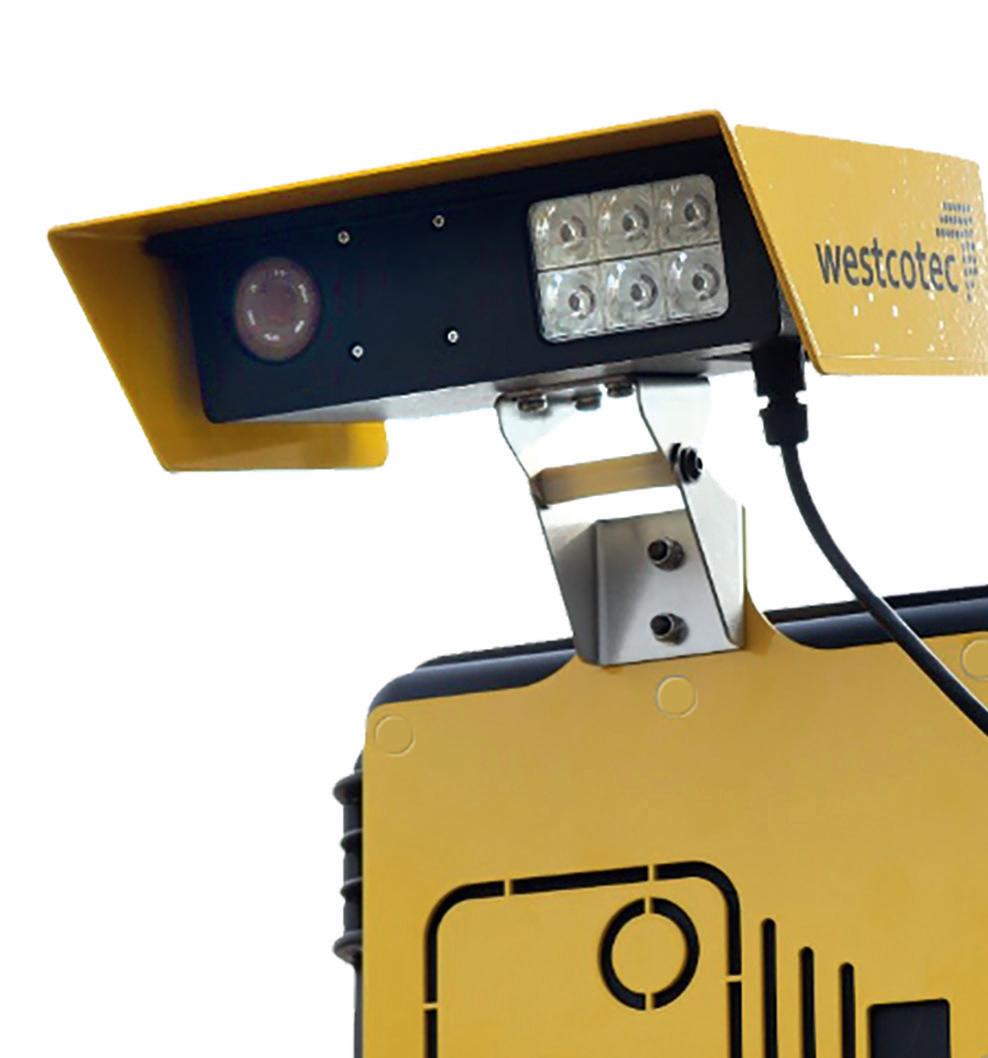









According to the London’s main police force, the Metropolitan Police, the installation of the matrix speed signs and ANPR cameras has led to a 3% reduction in average tra c speeds on the Perimeter Road, with an impressive 70% reduction in collisions.

Another bene t of the installation is that high levels of compliance encouraged by the signs have allowed a single 50kph limit to be introduced along the entire length of the Perimeter Road.


Chris Spinks, Westcotec managing director, said the average speed has dropped to between 50kph and 55kph. “Repeated speed
road can lead to sustained speed reductions as drivers become more aware of their speed,” said Spinks.
“Dynamic speed display signs that show drivers their current speed have been shown to increase compliance with speed limits. The presence of speed enforcement


warnings makes drivers more likely to stay within the speed they perceive as unlikely to result in a penalty,” he said.





Westcotec, based in Dereham, in county Norfolk, specialises in vehicle-activated signs, xed and portable and in standard or bespoke designs. The company says that all its products are accredited with CE marks and all other mandatory relevant speci cations have been met or exceeded.
Westcotec www.westcotec.co.uk


In the US, Causeway one. network has released Route Manager, what it says is a “transit route disruption communications tool” for road agencies.
Route Manager is a collaborative communications tool that provides road authorities and transit operators with a shared view of road construction and work zones. The aim is to prevent disruptions to planned transit routes.
The programme has been in use on UK roads since 2019 and has now been adapted to recognise and accommodate the nuances of traf c management in the US.
Causeway one.network, a digital work zone and road management platform provider, said the platform delivers clear and detailed information on planned and current construction and work zones.

Route Manager can be the difference between free owing traf c and gridlock, said
Kieran Holloway, Causeway one. network’s US market leader. “We know that delivering reliable transit routes to agencies is critical for rider adoption,” he
said. “Route manager gives highlevel situational awareness to the right people in an intuitive platform. Because it operates throughout the road construction


life cycle, this platform is the perfect planning tool to reduce and prevent transit delays.”
New plans are immediately shared on the platform’s map. At the same time, Route Manager delivers a shared, real-time view of the road network allowing transit operators to make adjustments in the moment.
“While it’s brand new in the US, the fact that it has been so successful in the UK reduces the new-product risk for American agencies,” said Holloway. “This is a market-ready solution with
Since entering the US market three years ago, Causeway one.network has secured multiple long-term statewide and regional contracts. The company’s Livelink, Plan Share and Traf c Management solutions are in use throughout Florida, Texas and southern Nevada including Las Vegas.
Causeway one.network https://us.one.network







Swarco’s highly exible Prism signs can be designed to suit any customer requirements for urban or interurban applications

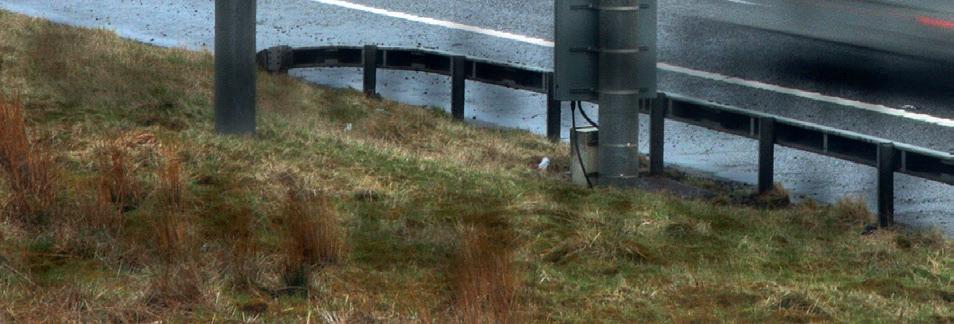
Swarco UK & Ireland says it is the rst UK manufacturer to achieve Traf c Open Products and Speci cations (TOPAS) 2517C standard for its Prism signs.
Regulation 2517C is the “Performance Speci cation for Electromechanical Message Signs”. Following technical submission and assessment, Swarco’s variable message Prism signs achieved full TOPAS 2517C approval, meeting all necessary criteria.
Swarco’s Prism signs, already deployed at thousands of sites across the world, display multiple limited messages. The highly exible signs, available with multiple control options and interfaces, can be designed to suit any customer requirements for urban or interurban applications, such as warning of diversion routes or road closures, semi-permanent pedestrian zones or where pre-set messages are needed to alternate.
The robust signs are speci cally
designed to withstand harsh or adverse weather conditions and can be equipped with a de-icing feature that prevents them from seizing during winter months. The technology is particularly suited to off-grid use as they require minimal power. They can also be supplied without motors and control equipment for manual-only applications.
“While TOPAS is not legally mandated, its adoption is increasingly widespread across both local authorities and national bodies, such as the Department for Transport (DfT) and National Highways,” said John Pickworth, managing director at Swarco UK & Ireland. We’re proud to be the rst UK manufacturer to achieve the latest 2517C performance standard for our robust, reliable and highly versatile Prism signs.”
Swarco UK & Ireland www.swarco.com

Systra has received a €52,000 grant to develop an arti cial intelligence application for classifying the physical environment where road collisions occur.
The money, from the UK’s Transport Research and Innovation Grant programme, will help Systra investigate how it can use data from OS MasterMap, Earth Observation and CAD drawings to classify the physical environment.
The solution will allow the identi cation of where risks of serious and fatal collisions exist on the road network and what type, quantity and severity of incidents are associated with di erent physical environments. It will also help road designers understand what changes need to be made to reduce the risk of collisions.
This will be especially useful in with preliminary road design work before work actually starts onsite, explained Malcolm Calvert, Systra’s digital director and whose team lead on the bid. “AI technology forms a crucial part of analysis and implementing this type of technology maintains Systra at the cutting edge of safety work for highways and other transport infrastructure. This project forms part of our wider vision to develop a range of digital and AI solutions to the many challenges we face in the transportation sector.”
The project from Systra was one of 32 to receive a share of nearly €1.7 million from the UK’s Department for Transport fund that focuses on driving innovation in the transport sector.
Systra www.systra.com/uk







Aisin RoadTrace launched its Vision Zero tool, for road safety and asset management prioritisation, at the ITS World Congress in Dubai in September.
The RoadTrace Vision Zero tool uses harsh-braking data from connected vehicles to identify high-risk areas, so that authorities can address potential hazards before crashes happen. It is proven to be three times more effective at identifying potential collision sites than traditional methods alone.
Traditional methods rely heavily on
casualty data. This means that action is only taken after people are killed or seriously injured - which has led to stagnating road casualty gures for over a decade. One of the key strengths of Aisin’s Roadtrace connected car insights combined with high-de nition imagery from Gaist is the ability to complement forensic road condition data with the actual impact on drivers in a real-world context.
RoadTrace Vision Zero has been tested and pioneered in the UK with the support of local and county authority members of the UK’s
Local Council Roads Innovation Group (LCRIG). The tool uses data insights from connected vehicles for highway authorities to identify and mitigate collision risks before they occur.
The company, based in Belgium, also said it has published a technical paper that explains how its predictive analysis can improve the ef ciency of anticipating collisions by a factor of three. By harnessing this data, highways professionals can make better, more informed decisions, heralding what Aisin calls “Road Management 4.0”.
Wesley Bateson, the lead for Aisin RoadTrace in the UK and Ireland, said the company has worked with LCRIG, the UK’s Department for Transport DFT and many local and county highways teams over the past three years. “Together, we’ve transformed early pilots with industry partners into a world-class capability that’s now helping our clients make smarter, data-driven decisions to improve road safety and asset management,” he said.
The UK wants to achieve what it calls Vision Zero - the elimination of road deaths and serious injuries by 2040. In 2023 alone, 1,695 were killed and 139,267 people were reported injured in collisions on the UK’s roads.
Aisin www.aisin-mobility.eu
Gaist
www.gaist.co.uk

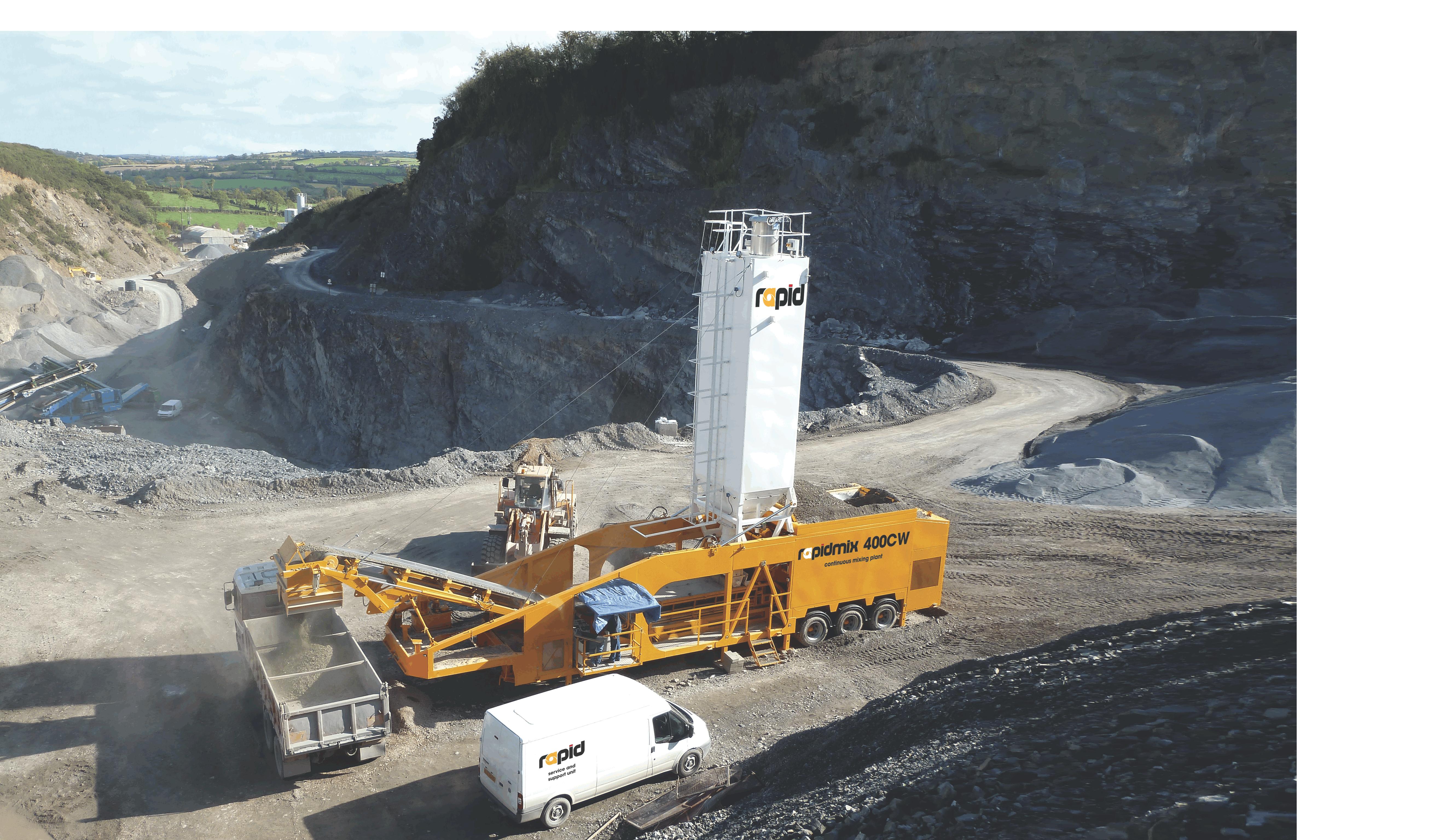
The Rapidmix is a fully mobile, high capacity continuous mixing plant for semi-dry mixes. With outputs of up to 600 tons per hour, the Rapidmix is well suited to roller compacted concrete, concrete paving and environmental remediation.
Tel: 028 3884 0671
E: info@rapid international.com
website: www.rapidinternational.com


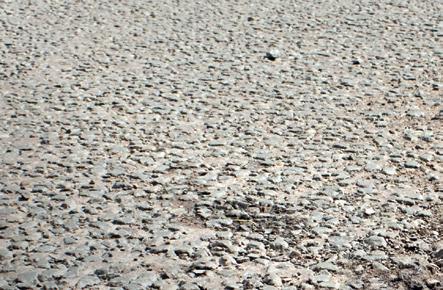
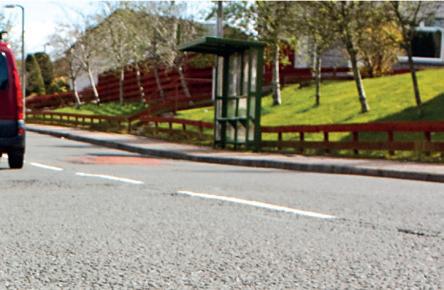
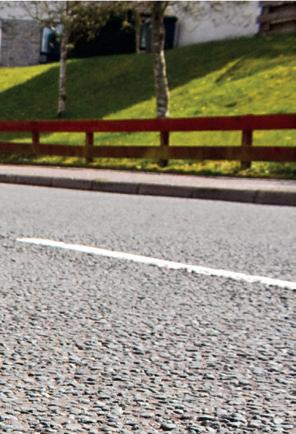
Precise location of road damage is guaranteed using GPS tagging from ScanwAi’s AI-powered digital monitoring system. Its system captures high-resolution images and automatically tags them with precise GPS coordinates.
To further boost maintenance ef ciency, it can detect various types of road surface damage, including longitudinal cracks, transverse cracks, alligator cracks and potholes. This automated detection allows for timely maintenance and reduces the risk of accidents.
ScanwAi’s solution - new on the market this year - offers neutral, independent survey and video data embedded with timestamps and GPS coordinates. This improves the quality and reliability of roadworks and road conditions by ensuring precise and veri able documentation of these conditions.
Meanwhile, an automatic infrabalance feature continuously monitors and adjusts the balance

ScanwAi’s solution - new on the market this year - o ers neutral, independent survey and video data embedded with timestamps and GPS coordinates


of infrastructure elements including inventory of traf c signs. This ensures optimal performance and longevity of road surfaces, reducing maintenance costs and improving safety.
The overall result, says the company based in Tampere, Finland, is maximum road safety, ef ciency and sustainability.
ScanwAi’s customers already


include Finland’s Transport Infrastructure Agency as well as city road agencies and private maintenance contractors.
ScanwAi has also been selected to join Urban Tech Helsinki, a high-tech incubator programme in Finland, managed by Aalto University, one of the country’s leading technology universities.
Founded in 2023 in Parkano, Finland, ScanwAi is an urban
ScanwAi www.scanwai.com



tech startup specialising in AI-powered digital monitoring services for road networks and infrastructure maintenance. The company is led Juha Rytkönen as chief executive, chief technical of cer is Olli Tannerkoski and Martti Lielahti is chief operations of cer.
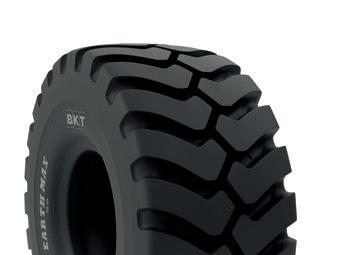
Experience unparalleled tyre performance with BKT’S EARTHMAX SR 49. Designed to equip your fleet of loaders, dozers, low profile dump trucks (LPDT), and load haul dumps (LHD), this tyre is engineered for excellence. With its All Steel radial construction and block pattern structure, EARTHMAX SR 49 delivers unmatched reliability and efficiency, whether on construction sites or in severe mining operations. Say goodbye to downtime—the tyre’s cut and chip-resistant design ensures durability even in the toughest conditions. Trust BKT to fuel your business growth and choose EARTHMAX SR 49 for unbeatable performance and reliability.















For info: europe@bkt-tires.com
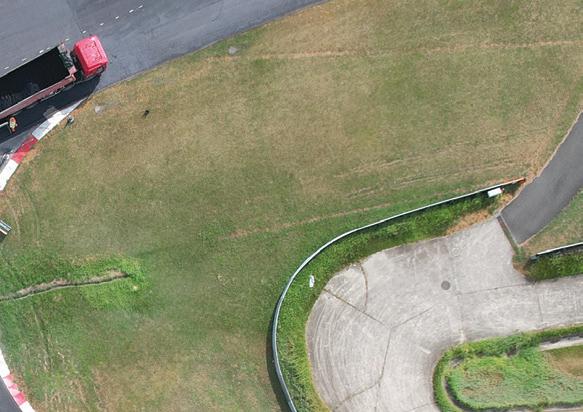

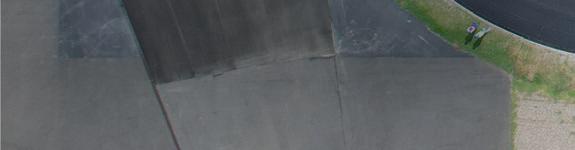
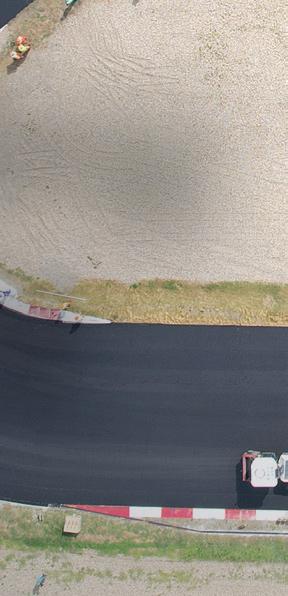

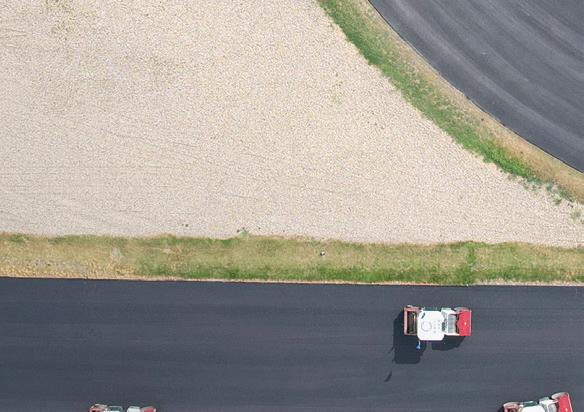
The refurbishment of the
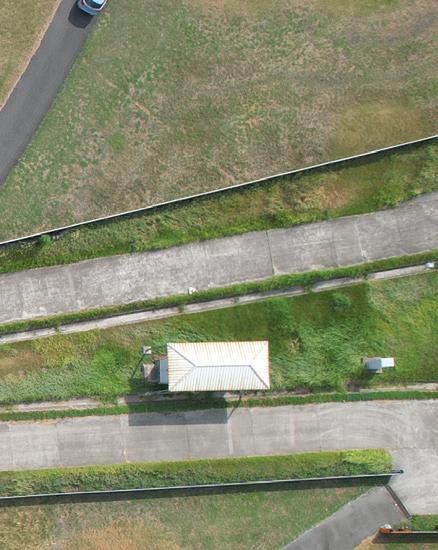

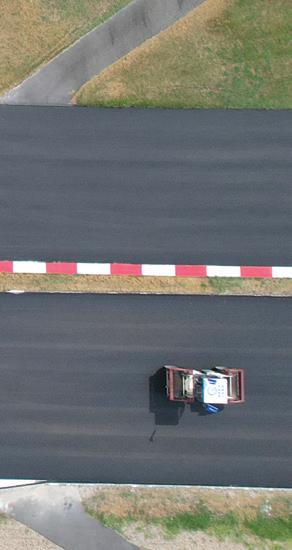
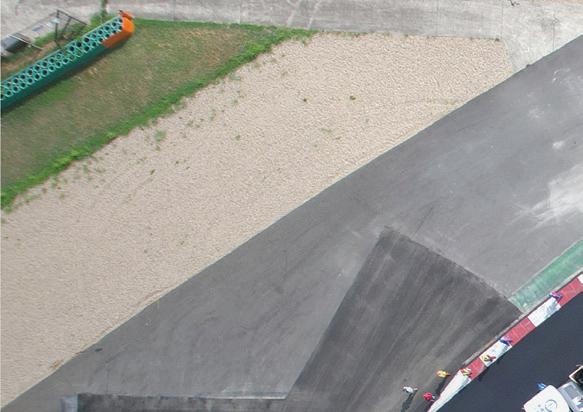
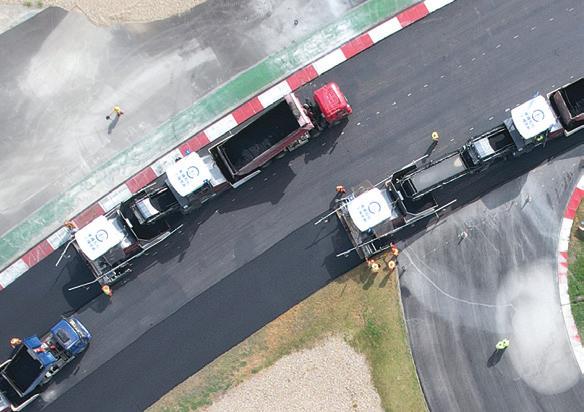
The Shanghai F1 circuit consists of the main track, buffer zone, short connecting track and working car lanes. The main track is 5,450m long and 14-15m wide,with 16 corners and nine straights of varying lengths. This was the rst refurbishment project since Shanghai F1 was rst built in 2004.
Machines from Dynapac were used for all the paving and compaction works on the track. The 20-strong eet included SD Pavers, CC4200/6200 double drum vibratory rollers, CC1200 small tandem rollers and also three mobile feeders.
The use of high-precision equipment and modern construction solutions have delivered optimum results for the track's

base, middle and surface layers, which meet stringent international track pavement standards after careful testing by a team of experts from Germany's HART CONSULTANT, the internationally renowned construction supervisory organisation for F1.
At the beginning of the project, Annie Bo, managing director of Dynapac China, said: “We are very honoured to be able to participate in the Shanghai International Circuit project again. This is not only a recognition of Dynapac's products and technology, but also an af rmation of our 20 years of intensive work in the Chinese market. Dynapac will do its best to provide the best equipment and services to ensure the project is completed on time and with quality.”
Dynapac also set up an international service support team, which was stationed at the jobsite to support for the contractor, Shanghai Highway and Bridge (Group). The Dynapac team worked

with Shanghai Road & Bridge to ensure that the equipment delivered maximum quality and performance for the operation.
The refurbishment of the Shanghai International F1 began at the end of July 2024 and was completed on 4th September, almost a week ahead of schedule. After the completion of the project, F1 will have a new look and upgraded performance for international races in the future.
The application of Dynapac paving and compaction equipment has played a crucial role in improving the work ef ciency of the whole project. The use of the latest techniques and the new equipment have played important roles, delivering a quality circuit for Shanghai F1 in the global racing world.
Dynapac www.dynapac.com
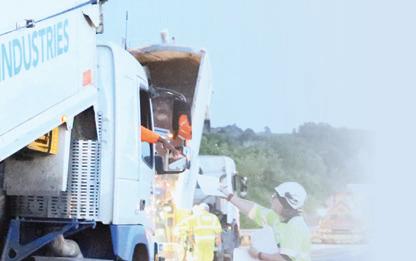
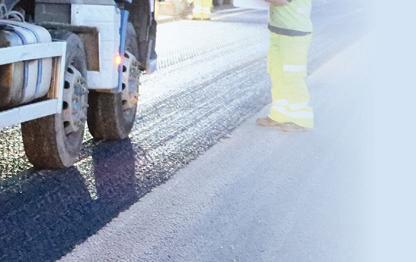
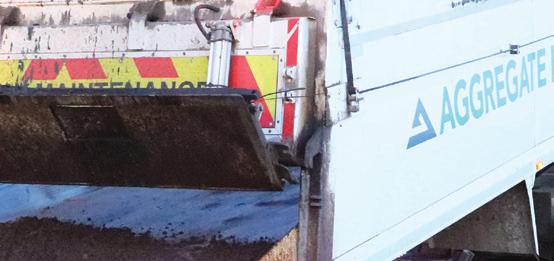
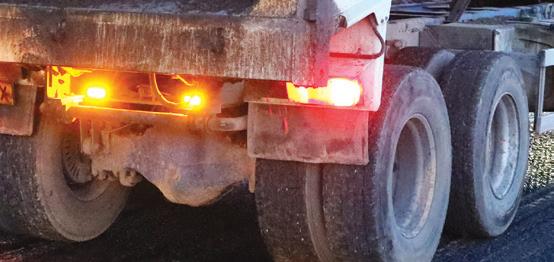
Aggregate Industries is moving closer towards achieving 100% recycled asphalt. New circular economy records have been set within the rm’s Asphalt division to repurpose recycled aggregate materials into a new surfacing material for roads and pavements. Despite the use of recycled materials, the rm claims this o ers zero compromise on quality and product performance.
The team is now working with nonhazardous, contaminated waste material to produce binder course made up of >95% recycled materials. The waste material is rst carefully studied to gain an understanding of its qualities, before it is cleaned, crushed and regraded into recognised asphalt aggregate constituents.

Starting with 20mm all-in aggregates, the recycled material is fed into the asphalt plant process with a 40% recycled content, 5% of which is recycled bitumen. The mix was designed so only the only non-recycled component left was the residual bitumen, aiding the company’s mission of achieving 100% recycled asphalt.
Michelle Addison, Midlands Key Account Manager for Asphalt at Aggregate Industries, said: “Throughout our entire business we place circularity at our core and in line with this, year on year, the proportion of recycled asphalt we use has increased."
Aggregate Industries www.aggregate.com
















Mark your calendar for Intertraffic events around the globe, the premier gatherings for traffic and mobility professionals worldwide. Whether you’re a visitor seeking cutting-edge solutions or an exhibitor aiming to showcase innovations, Intertraffic offers unparalleled






opportunities to network, learn, and grow your business. Don’t miss the chance to make your mark in achieving smart, safe, and sustainable mobility for all. This is where the future happens! Get in touch with our team on intertraffic@rai.nl or check out www.intertraffic.com.



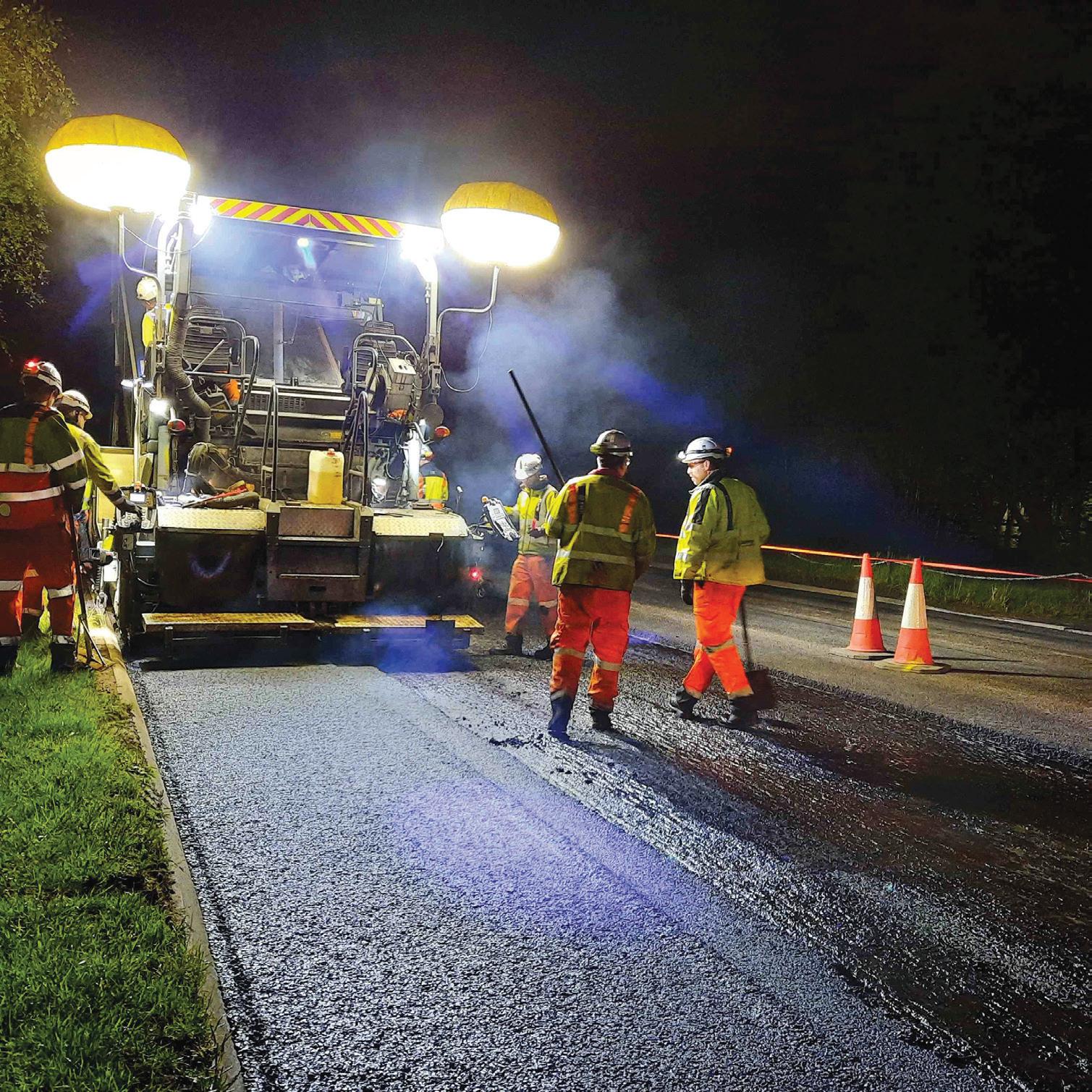
Using hydrated lime in asphalt mixes could boost road surface life according to European research. Adding hydrated lime can bene t the asphalt in numerous ways, helping to improve the climate resilience of asphalt infrastructure according to research from the EU and the US.
Hydrated lime acts as an ‘anti-stripping’ additive, helping the bitumen binder to adhere to the aggregate. It also helps reducing bitumen hardening with age and increasing moisture resistance. At the same time it stiffens the bitumen to reduce rutting, and improves resistance to fracture growth at low temperatures.
Research suggests that adding less than 2% of hydrated lime in the mix could boost asphalt life by up to 25%. This would reduce road wear and extend maintenance intervals, leading to fewer potholes and roadworks.
Hydrated lime has been speci ed widely particularly in the US for many years as an anti-stripping additive and there, and elsewhere, to increase moisture resistance of asphalts. There’s also proven evidence that it can reduce asphalt ageing by lowering the oxidation of the bitumen binder.
Hydrated lime has been used in the asphalts designed for UK and international airport runways for decades and it is already a permitted, multifunctional additive in the UK’s National Highways asphalt speci cations and
is in the register of durability improvement options towards achieving their zero carbon target. Across Europe and the US hydrated lime is used frequently in asphalt and, in some locations, is compulsory because of the durability and performance improvement delivering resilient roads.
Research by the University of Nottingham shows how hydrated lime additions absorb unwanted carbonyls and asphaltenes within bitumen. Adding hydrated lime means that, with ageing, there are fewer oxidative reactions that cause bitumen to become
Chinese construction equipment manufacturers SANY has been carrying out road construction works using autonomous machines since 2019. The rst pilot trial of the equipment was on a section of Zhujian Road in Shanghai in December 2019, using an autonomous paver and two autonomous compactors.
Digital control technology based on algorithms ensured effective scheduling of operations for the equipment. Laser controls with 3D systems allow millimetre accuracy for surfaces. The equipment was operated in a restricted, geofenced area to maximise safety, with an automatic obstacle detection and avoidance system to reduce the risk of collisions. To further boost safety, the machines were tted with remote controls to pause or stop operations in the case of an emergency.
Since the rst trial, the equipment has been used on a number of road works,

paving a total of 200km autonomously, according to SANY. These have included municipal roads as well as highways, in tunnels and on bridge decks and working during daylight and also at night. Two major projects carried out in 2022 were for the Sichuan-Luyong Highway and the Zhejiang-Jiaotou-Lilou Highway.

Tests carried out on the surface following the use of the machines have shown a high-quality nish according to SANY. While the cost of the equipment is higher, the rm claims that this is offset by reductions in material costs and fuel savings. Over a ve-year period, SANY’s gures suggest that the material, fuel and labour savings would be three times that of the increased cost of the machines.
SANY says that having carried out trials of the machines, it is now able to offer the units on the market.
SANY
www.sanyglobal.com

stiffer, more brittle and lead to cracking and deterioration of roads, and development of potholes.
The study compared the performance of mastics containing hydrated lime to those made with granite or limestone llers alone, and found that in all cases the hydrated lime made the asphalt softer after ageing – or less stiff – than its counterparts with standard ller alone. Other researchers are now observing a long-term case study on asphalt that was laid on a stretch of the A38 near Burlescombe in Devon in 2021.

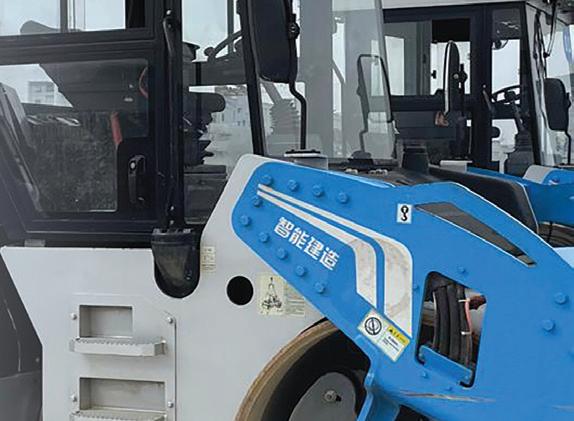
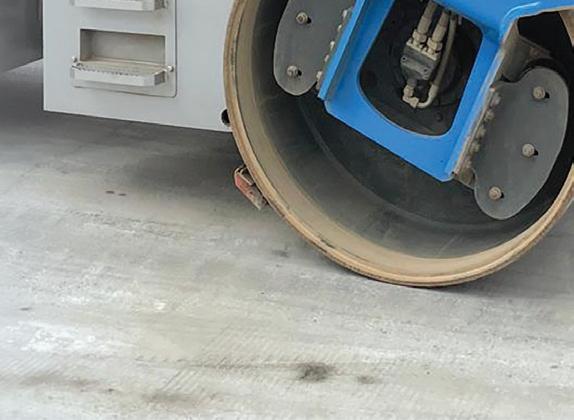


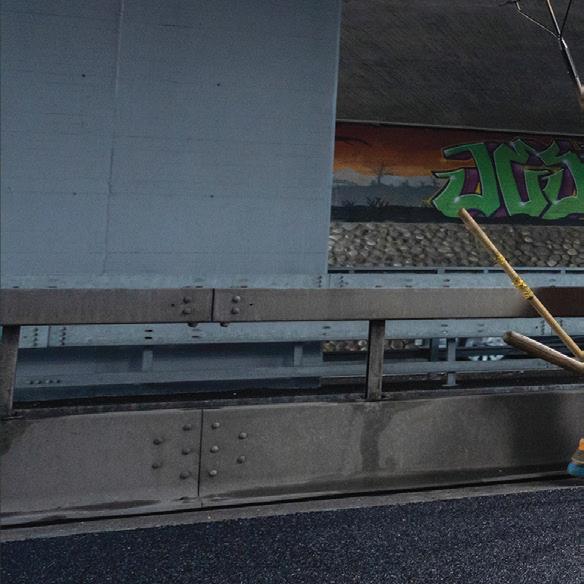
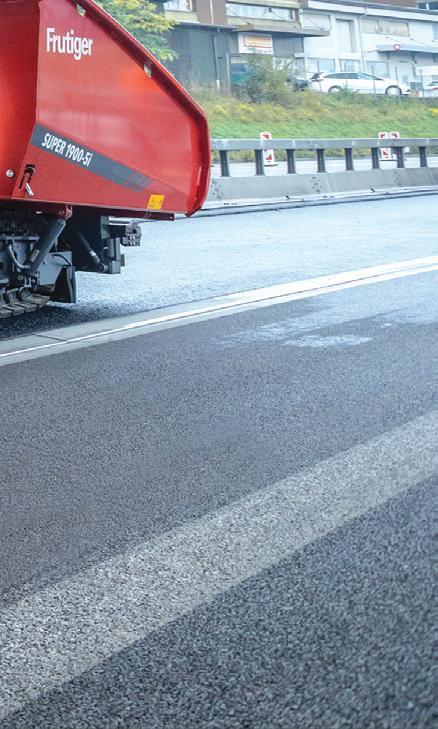
A Dash 5 Vögele paver has been used in Switzerland to resurface a section of the A6 near Bern in Switzerland. The work was carried out in several part-sections, paving a noise-absorbing surface course over a total length of 6km and a width of 20m.
On the A6 near Bern, tra c jams are common. To improve tra c ow and to reduce noise and pollution in this highly populated area, the road is being upgraded to a smart motorway. This allows vehicles to use the hard shoulder as a running lane, boosting capacity and reducing noise levels at the same time. The work is being carried out by a partnership comprising contractors Frutiger and Marti. The partners used several measures to reduce environmental impact, extending noise barriers, renovating bridges and resurfacing hard shoulders. Part of the project was also to pave a noise-reducing asphalt surface course on every lane of this section, which extends to approximately 6km.
Low-noise operations with quieter machinery and a short time window were required in order to minimise disturbance to local residents and motorway users during the construction period. Tra c ow also had to be maintained in both directions, further complicating the work.
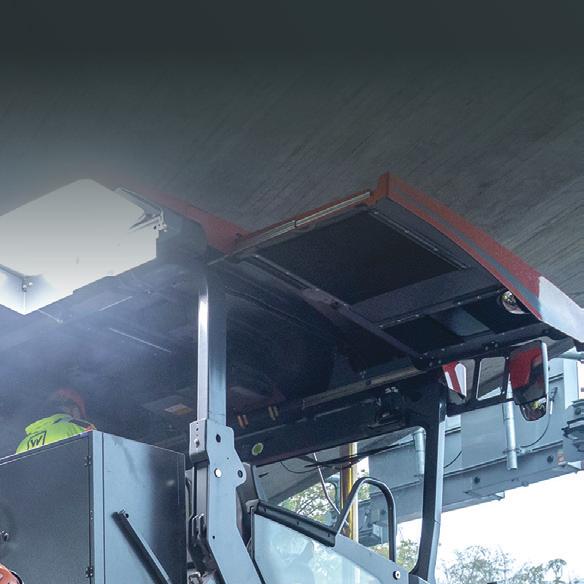
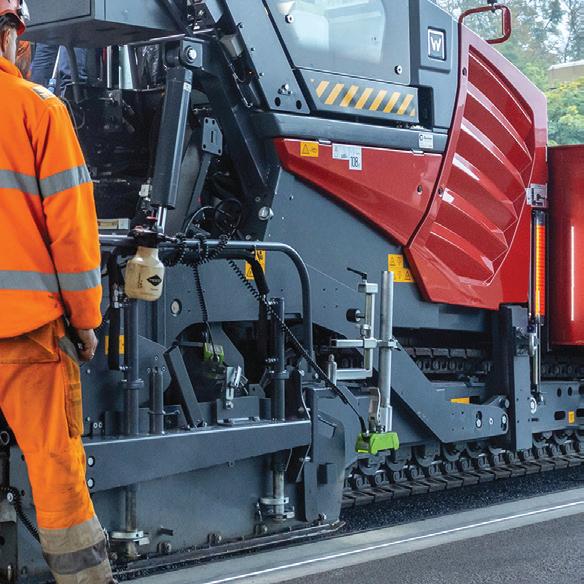
The contractor opted to use one of the latest-generation Vögele pavers, the SUPER 1900-5i featuring the AB 500 TV Extending Screed. Despite its powerful engine, the paver o ers quiet operation with low fuel

consumption. Vögele has optimised the EcoPlus low emissions package to ensure that the machine is quieter than its predecessor. The latest generation screed also makes less noise. In addition, the latest ErgoPlus 5 control system o ers new assistance and automatic functions, as well as optimised material management.
The Highway Class paver paved the 3cm-thick surface course in several part-sections, each 3.2m wide. “The stringent quality requirements meant it was important for us to pave e ciently with minimal interruptions,” said Matthias Baumann, road construction manager at Frutiger. “In that respect, the ability to adapt pave speed conveniently, the large material hopper with a capacity of 14tonnes and the material management of the SUPER 1900-5i were all convincing features.” Vögele has improved the material handling control system compared to that of the Dash 3 generation: the auger and conveyors now communicate with one another, ensuring that material feed is more consistent and coordinated. This avoids load peaks, saves fuel and optimises the head of material in front of the screed allowing uninterrupted paving.
The new AB 500 TV Extending Screed also delivered high quality and economy: higheroutput heating rods mean the paver is ready for operation even more quickly. Hydraulic tamper stroke adjustment is another particularly time-saving, practical feature: “Instead of adjusting each cam individually by hand, the operator uses the Dual Power Shift Tamper function to set the appropriate tamper stroke of
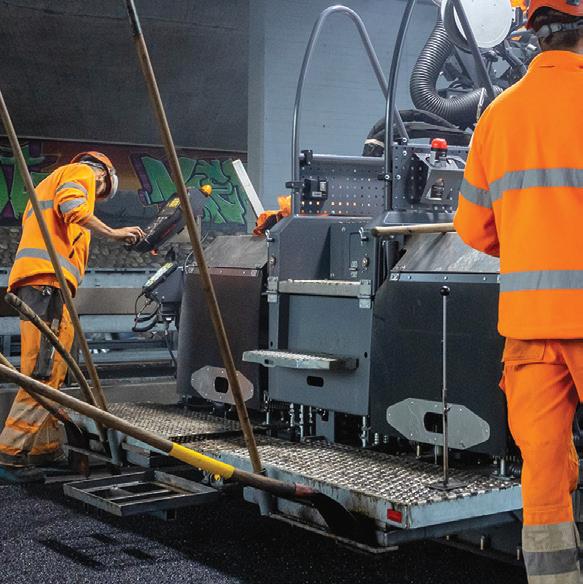
2mm at the touch of a button, achieving optimum compaction,” said paver operator Ste en Horn.
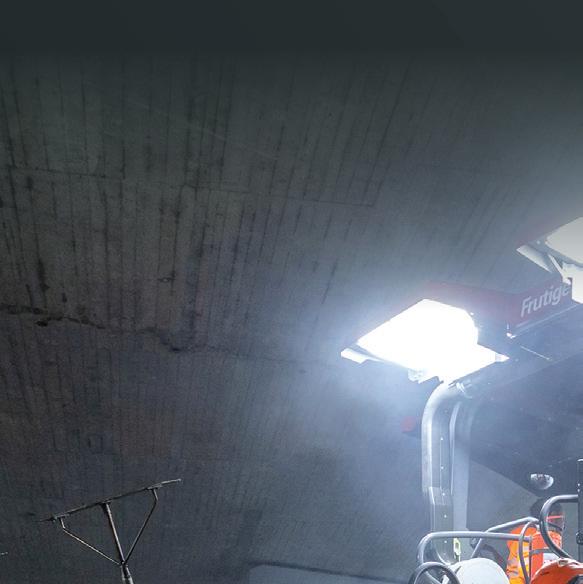
The paving team said that the ErgoPlus 5 operating concept o ered further bene ts. “As we were paving in several part-sections, the ‘Save function in AutoSet Plus was very useful,” said Horn. It allows paving programs to be saved and then called back up for the next part-section at the touch of a button. Process automation prevents faults and also speeds up paving. As the paving team used the paver under bridges, in tunnels and at night, operators furthermore made use of the new Light Package Plus. The LED beamers are integrated in the hardtop of the SUPER 1900-5i and illuminate the paving width in the area of both paver and screed. This means not having to transport or t additional lamps or light balloons. Baumann said, “We were able to use the lighting without any extra e ort and in speci c situations, for example in the case of poor visibility under bridges or in tunnels.”
The technical developments and features of the Vögele paver made a key contribution to the success of its deployment on the A6: taken together, the quiet, powerful drive, optimised material management, assistance/automatic functions and new lighting concept signi cantly increased noise mitigation, economy and safety on the jobsite.
Vögele www.voegele.info


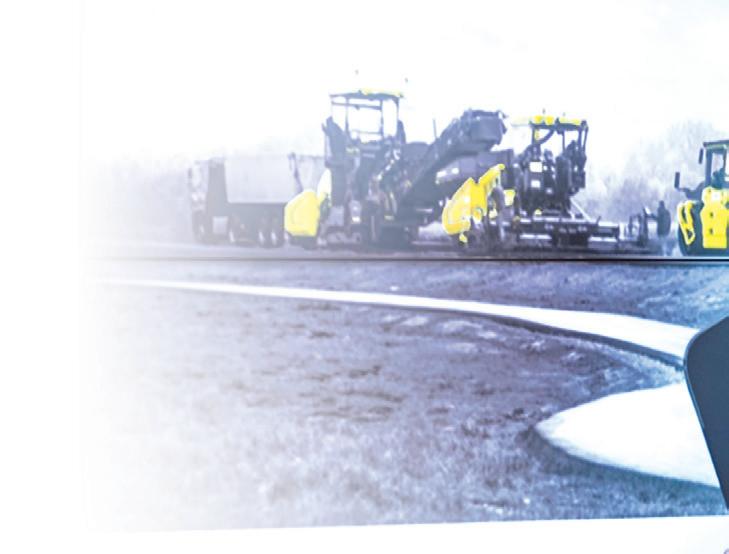



BOMAG is developing innovative solutions for paving and compaction, with several of these technologies coming to market. Other advanced solutions remain in the future with regard to adoption however.
One of the rm’s most radical developments is for the compaction segment with autonomous machine technology. The company has been carrying out extensive trials with its autonomous compaction system and is very con dent in the potential for the technology. President of BOMAG, Dr Ingo Ettischer said, “It is working and it is a system we could sell at

this point in time.”
However, he is well aware that there is still some reluctance for its use on working sites. He commented, “If we speak to the customers, they are still a bit hesitant.”
He explained that the technology is costly at present and that legislation still has to be determined to allow its use. There may be some large sites that can be access controlled where the autonomous compaction technology could be utilised. But in Europe at least, the legislation covering road projects means that use of autonomous compaction equipment will

remain in the future for the time being. He said that there will be opportunities for autonomous compaction but these will be in certain applications only.
Coming rather sooner will be platooning, with an operator-controlled machine being followed closely by one or two autonomous machines. This technology has already been used on some projects, such as for the construction of Istanbul’s new airport.
Available now however are a series of advanced technology options for BOMAG’s paving and compaction equipment. The proven

Asphalt Pro system is said to deliver a fullyconnected jobsite that minimises waste and allows real-time process management. This cuts out the issue of trucks waiting to unload, making it easier to use warm asphalt mix as it addresses the risk of material cooling before compaction.
Similarly, the Bomap compaction system is also proven and the rm claims that this continuous compaction control system can deliver 40% savings. The system optimises pass counts, eliminating the risk of over- or undercompaction and ensures a more consistent mat quality, while reducing the time needed for working.
The latest addition to the tools available is the Bomap Pave system, which can monitor the heat map of the mat also. This is a key issue as it allows the compactor operators to prioritise areas of the mat for working rst. This is a key tool to ensure the quality of working, particularly with warm asphalt types where ensuring compaction is carried out before the layers cool is more of an issue.
Material consumption can be monitored in real time also, so that the paver operator can ensure mat thickness is optimised, adjusting the screed where necessary. The tool allows for remote management of paving work, with paving data being collated for archiving and analysis purposes.
BOMAG
www.bomag.com
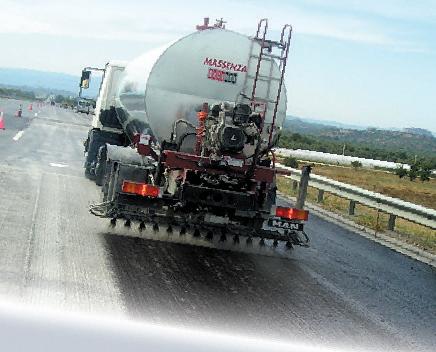



Italian crushing and screening specialist Cams has expanded its operations with the acquisition of Malavasi G, which makes road construction equipment. In addition, Cams has introduced its Centauro 100.32 recycling unit for the road sector.
Malavasi G’s notable products include hydraulic wideners, telescopic screeds for pavers, and the Pavijet mini pavers, considered the smallest in the world. With this acquisition, Cams intends to develop Malavasi G, maintaining its focus on quality and continuous improvement in road construction.
One of the key Malvasi G products is the Pavijet MG7 Super paver attachment, designed for use in areas where space is a premium
and suited for asphalting cycle paths, pavements, car parks, forecourts, trenches, asphalt repairs and roadsides. The Pavijet MG7 Super is a fully hydraulic paver that can be attached to any skid steer loader with at least 15kW. The attachment is mechanical, and the hydraulic connection is made via quick couplers. Its compact size makes the Pavijet MG7 Super easy to transport and operate. Key features include fully hydraulic functions, a retractable hydraulic screed for versatile operation around obstacles, and the ability to operate both from onboard controls or via remote radio control. Other benefits include variable paving widths from 30-200cm, high paving speeds, and the ability to
pave with a wide range of materials, including asphalt, cement, sand, and aggregates.
The Centauro 100.32 from Cams is a novel crushing plant that combines a shredder, a screen, and a magnetic separator into a single unit. It is said to feature innovative patented technology allowing it to shred material efficiently and with low power requirements. The Centauro 100.32 can recover 100% of asphalt, as well as aggregates and rubble. It is said to offer a maximum output of 120tonnes/hour and options include hydraulic tail lifts, hydraulic pushers, GPS, a weighing system, and a loading pump. Cams eu.camsrecycling.com





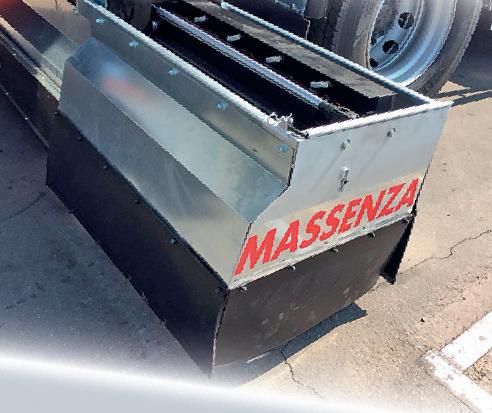






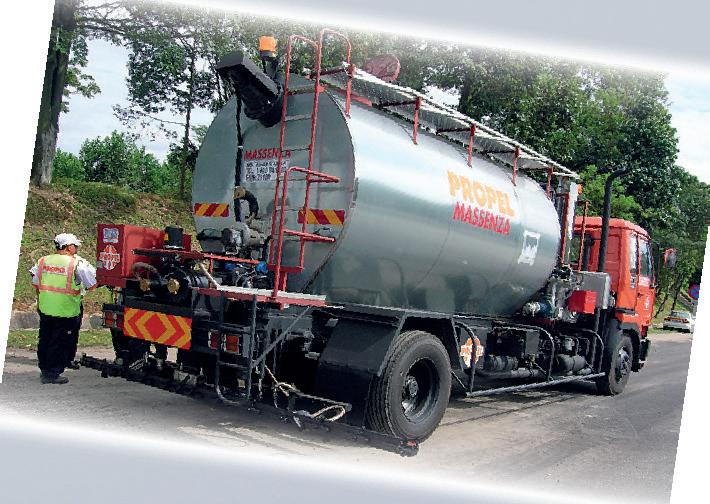

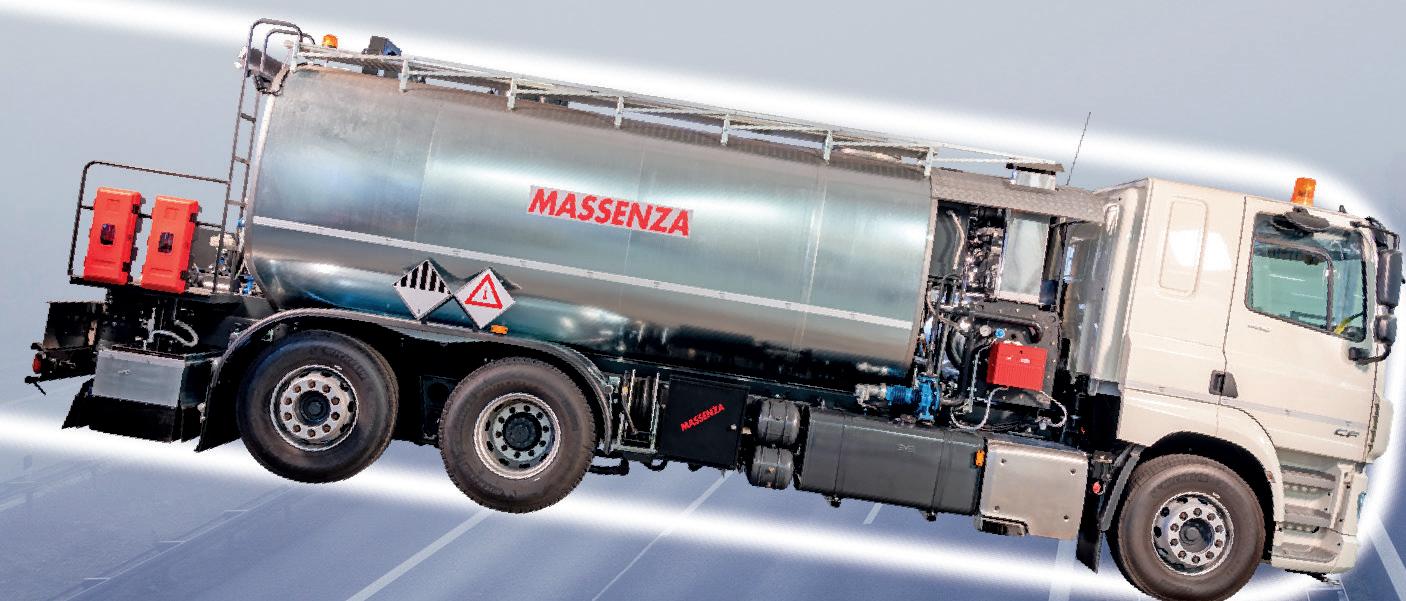
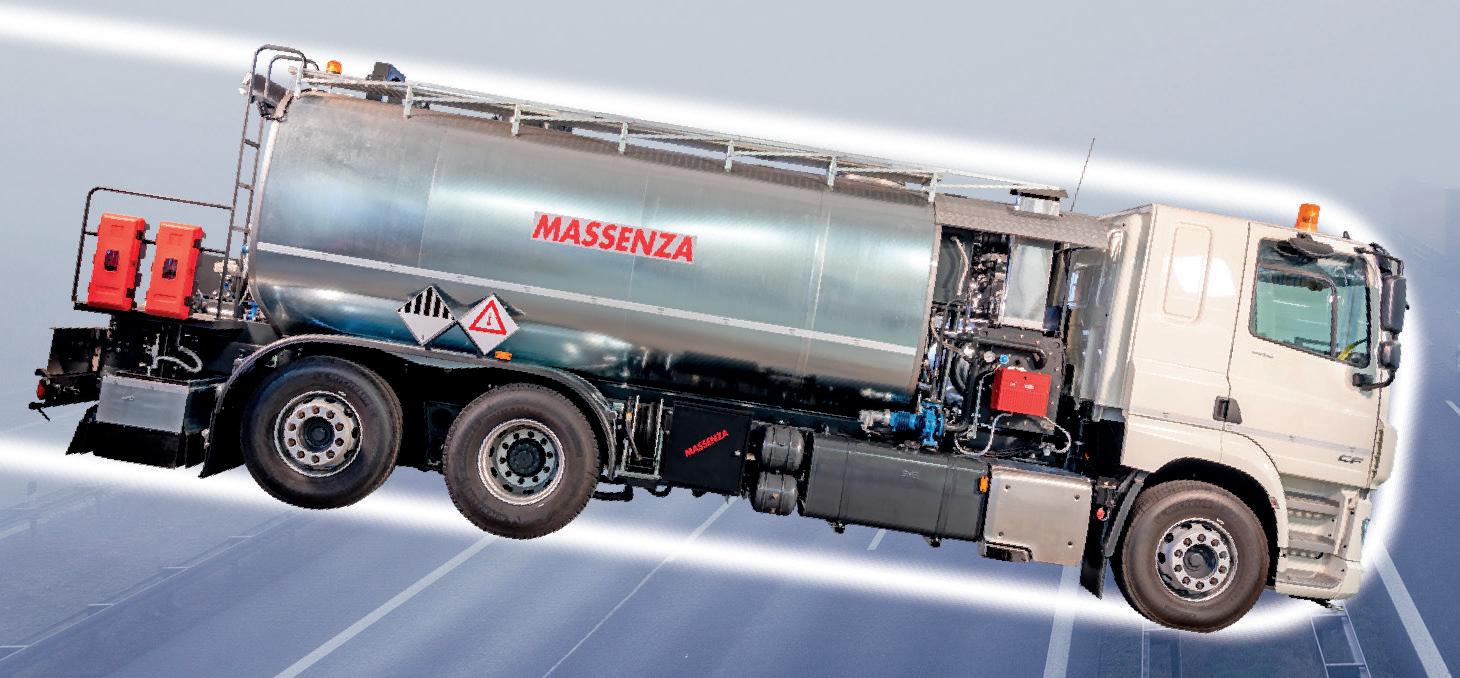
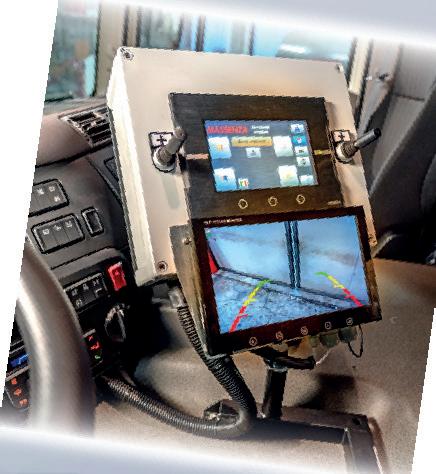







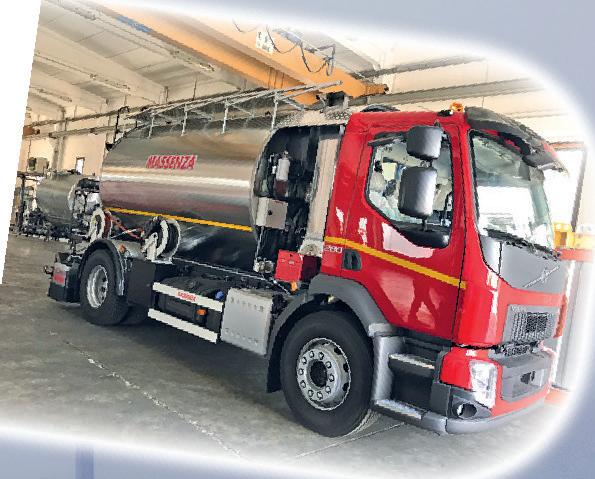







Adel Abu Sal & Sons Contracting Company, a leading road construction contractor in Jordan, has recently purchased a
The plant has been supplied by Lintec & Linnhoff’s dealer, Jordan Tractor and Equipment Company. The installation and commissioning process of the Lintec CSD2500B plant was completed in just one month, including delivery, testing, and full operational setup, allowing the plant to begin production swiftly. Jordan Tractor is also responsible for plant maintenance to ensure productivity and machine uptime are maintained to the highest possible levels.
The Lintec CSD2500B is being used for three major road construction projects run by the company, with more lined up. The first project started in May 2024 in collaboration with the Greater Amman Municipality and involves the construction of 500,000m2 of roads across the outskirts of Amman. The second project, also with Greater Amman Municipality, began in July 2024 and focuses on 800,000m2 of main road development, with ongoing night shifts to expedite completion. The third project, set to begin in April 2025 for Mafraq Municipality, will cover 250,000m2 of main roads, with completion planned 30 working days after the start.
Transport infrastructure in Jordan is undergoing a huge transformation, with investment opportunities emerging in every sector. These projects are geared towards making the most of Jordan’s growing potential and its prime geographical location as a central transport and logistics corridor for the region.
Installation and commissioning took just one month and, operational since January 2024, the Lintec CSD2500B has produced 80,000tonnes of asphalt to date. This asphalt has been used on a mix of new build and refurbishment highway projects.
Transport remains the lifeblood of the economy in Jordan, connecting the main port in the south with the capital and larger cities in the north. The Lintec CSD2500B has already had a significant impact on this, improving infrastructure and facilitating better connectivity to boost economic activity and enhance the quality of life for the local population.
Tareq Asa’d, Construction Machines sales manager, Jordan Tractor said: “The Lintec CSD2500B asphalt plant offers high productivity, low fuel consumption, and efficient containerised design. These
features make it a perfect choice for our road construction projects in Jordan. We’ve been really impressed with it and are considering further purchases as our workload continues to grow.”
The modular design of the Lintec CSD2500B, built in standard containers, lends itself to efficient, economical transportation, and makes the plants ideal for short- and long-term projects. Their flat, rigid design also speeds up installation by eliminating the need
main access point for improved onsite security. This containerised concept also means reduced dust and noise emissions.
In addition, Lintec’s novel double screen drum technology eliminates the need for a hot elevator and vibrating screens which in turn reduces maintenance requirements. Combining the heating and screening of the minerals in a single process unit offers significant energy savings.
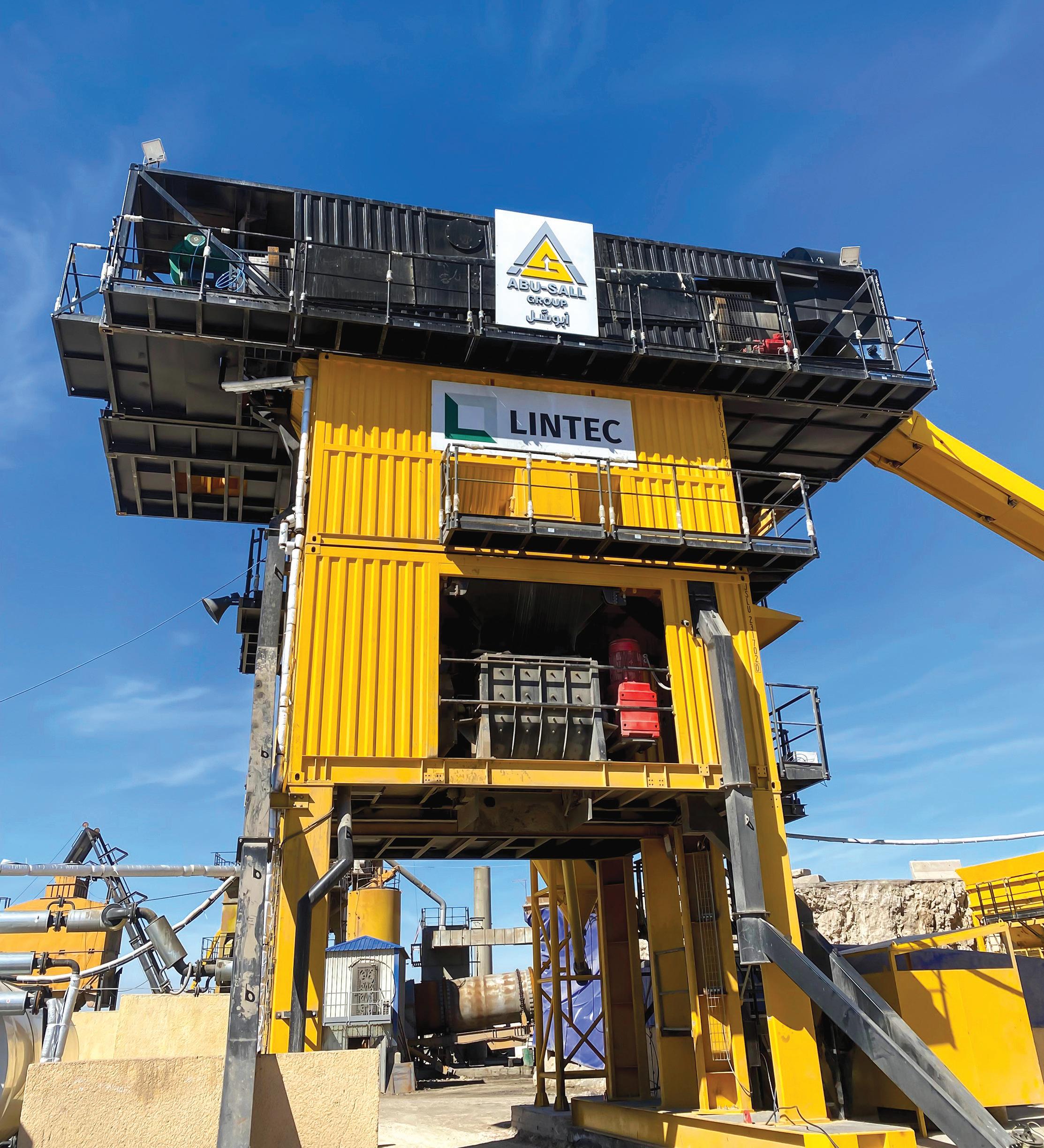
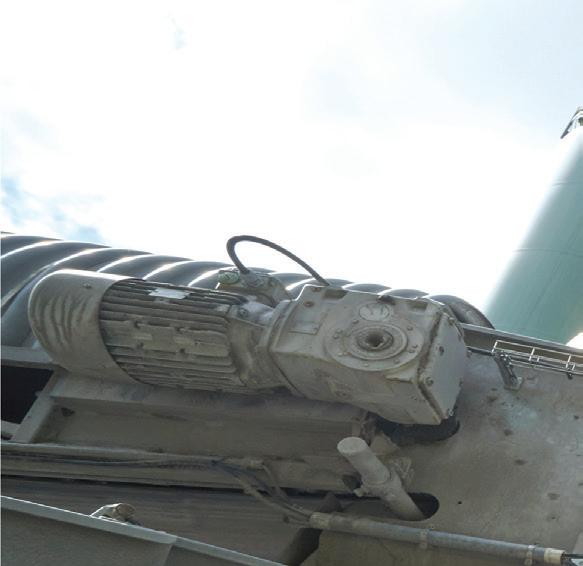
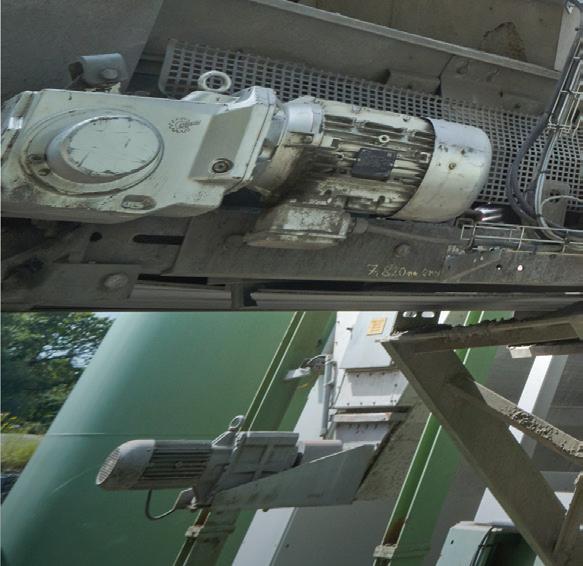
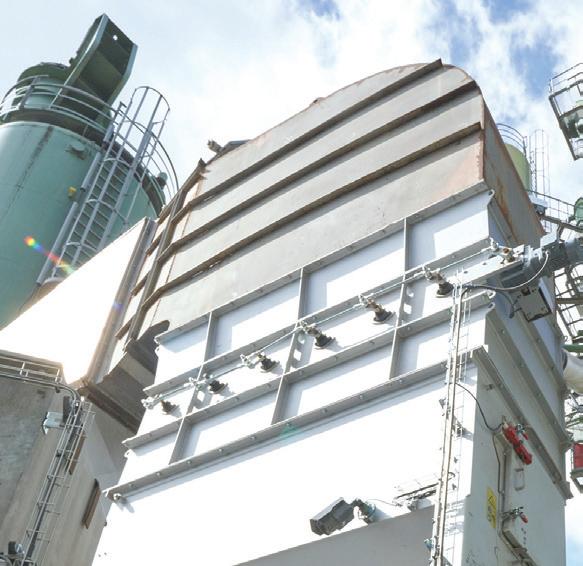
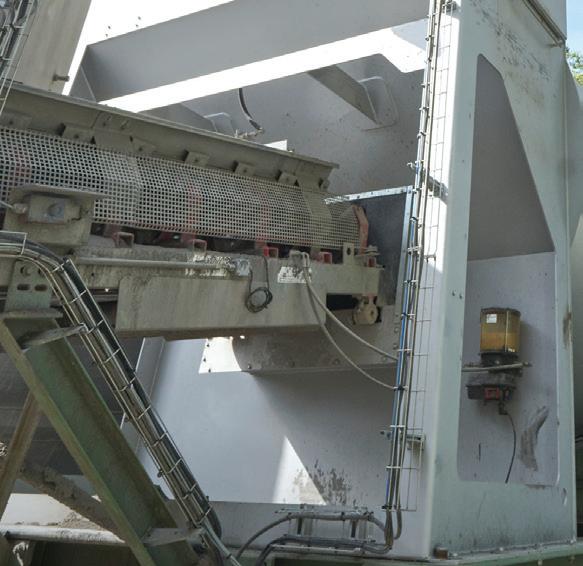

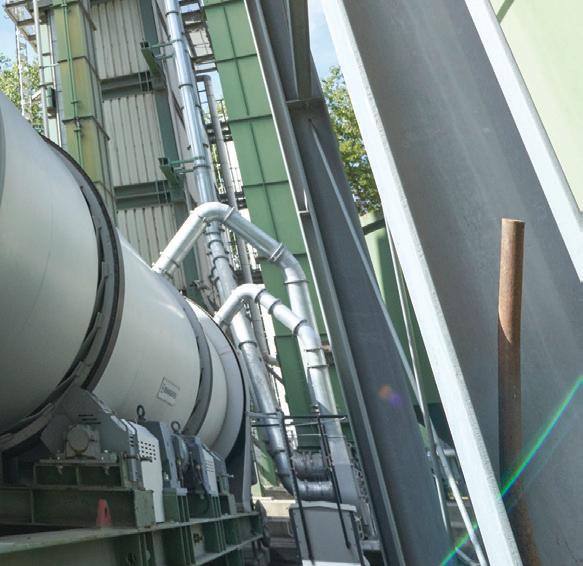



A retro t solution has been installed at an existing asphalt mixing plant in Nentershausen in Germany. The REVOC system is an innovative technology developed by Benninghoven delivering more sustainable asphalt production.
The TBA plant from Benninghoven, built in 2007, is located on the site of a basalt quarry and produces 80,000-100,000tonnes of asphalt/ year for motorways, roads, and infrastructure projects. To enable more sustainable asphalt production in the future, the plant operator opted to retro t the existing plant with an emissions control package.
“We chose the REVOC system because it enables us to comply with total carbon (Ctot) emission standards, even with the addition of a high proportion of reclaimed asphalt pavement,” explained Peter Bach, CEO of WWA Westerwald Asphalt.
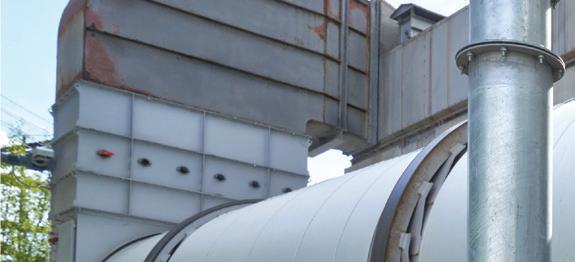
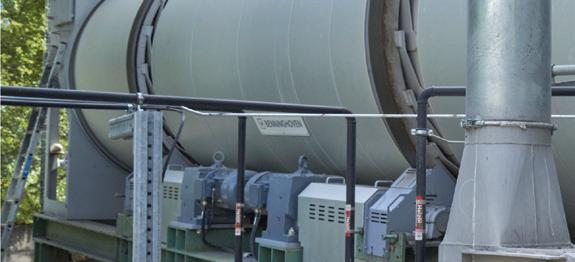
The patented technology has allowed the plant operator to increase the maximum feed rate of reclaimed asphalt pavement (RAP) from the previous 30-40% to 50%, while reducing Ctot emissions by more than 50%. Initial experience with the retro tted plant is positive and the use of this system also safeguards the long-term viability of the plant.
Sustainability in asphalt production is determined by two key factors: the ability to increase the RAP feed rate; and reusing reclaimed material in a constructive way. The higher the RAP feed rate, the less fresh bitumen is needed, which cuts the carbon footprint. However, it is essential that the strict Ctot threshold values of <50 mg/m³ stipulated in Germany’s of cial regulations on air quality, ‘TA-Luft’, are ful lled.
Although reclaimed asphalt pavement (RAP) can already be fed into the production
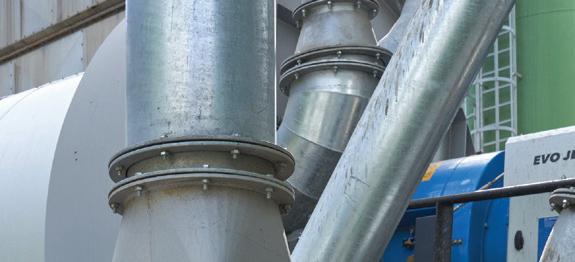
process using established cold or hot recycling technologies, the total carbon emissions are higher. When reclaimed asphalt is heated, part of the Ctot concentration evaporates out of the bitumen contained in the recycling material. Ctot possesses a higher greenhouse gas potential than CO2, and is a hazard to health in higher concentrations.
In the past, the resolution of the con ict between high RAP feed rates and assuring sustainability in the production process was dif cult. Using technology like the REVOC system, these two aspects can now be reconciled: reducing Ctot emissions by up to 50% and realising higher RAP feed rates of up to 60%.
Fumes generated in the mixer of the asphalt mixing plant are extracted at source and passed to the REVOC system for thermal processing. This allows the plant operator to add a higher proportion of RAP to the mixing process without exceeding stipulated threshold values. The method conserves primary resources and also cuts production costs.
The entire project was closely monitored from the start - onsite, by telephone, or by telemaintenance. This included, above all, regular measurement of the emissions values and ne tuning of the plant on the basis of the results. The results exceeded expectations with respect to emissions reduction and were corroborated by independent measurements.
Improved plant performance, high RAP feed rates and reduced emissions mean that existing plants with technology such as the REVOC system can meet future challenges when tougher legislation is introduced. And emissions control equipment such as this can also be tted to existing plants from other manufacturers.
Benninghoven www.wirtgen-group.com/benninghoven
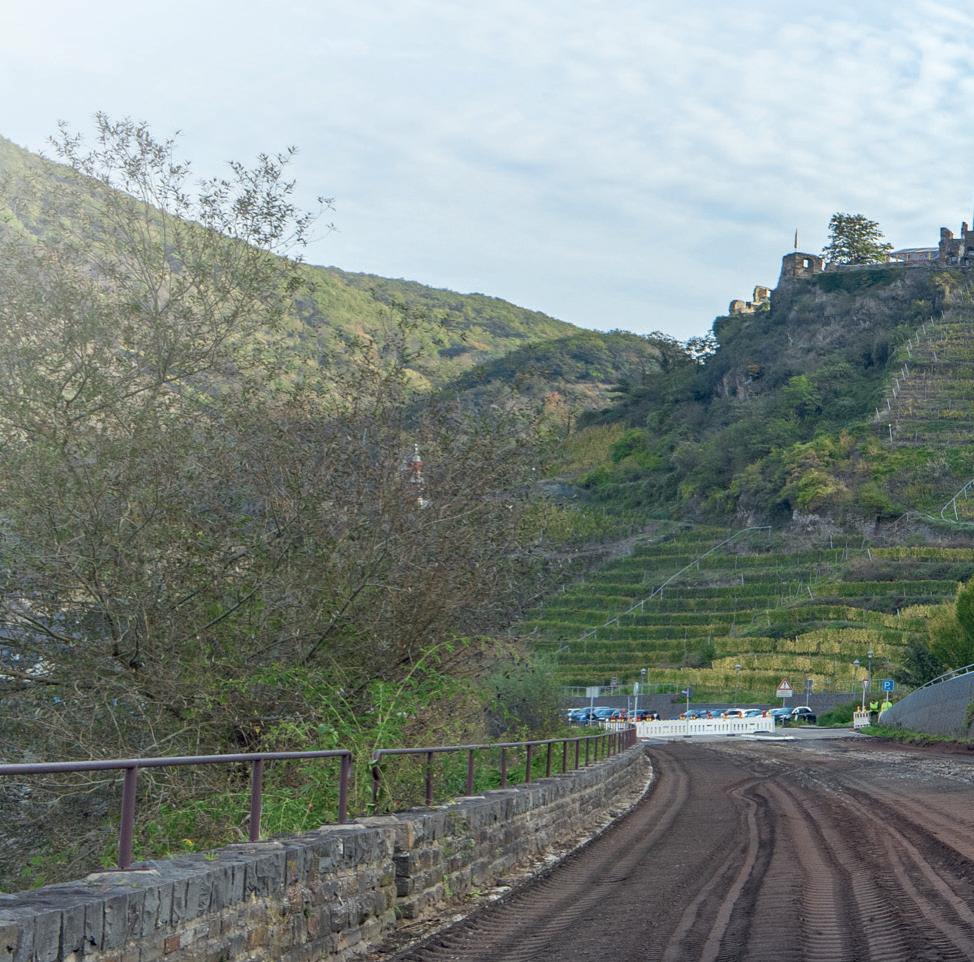
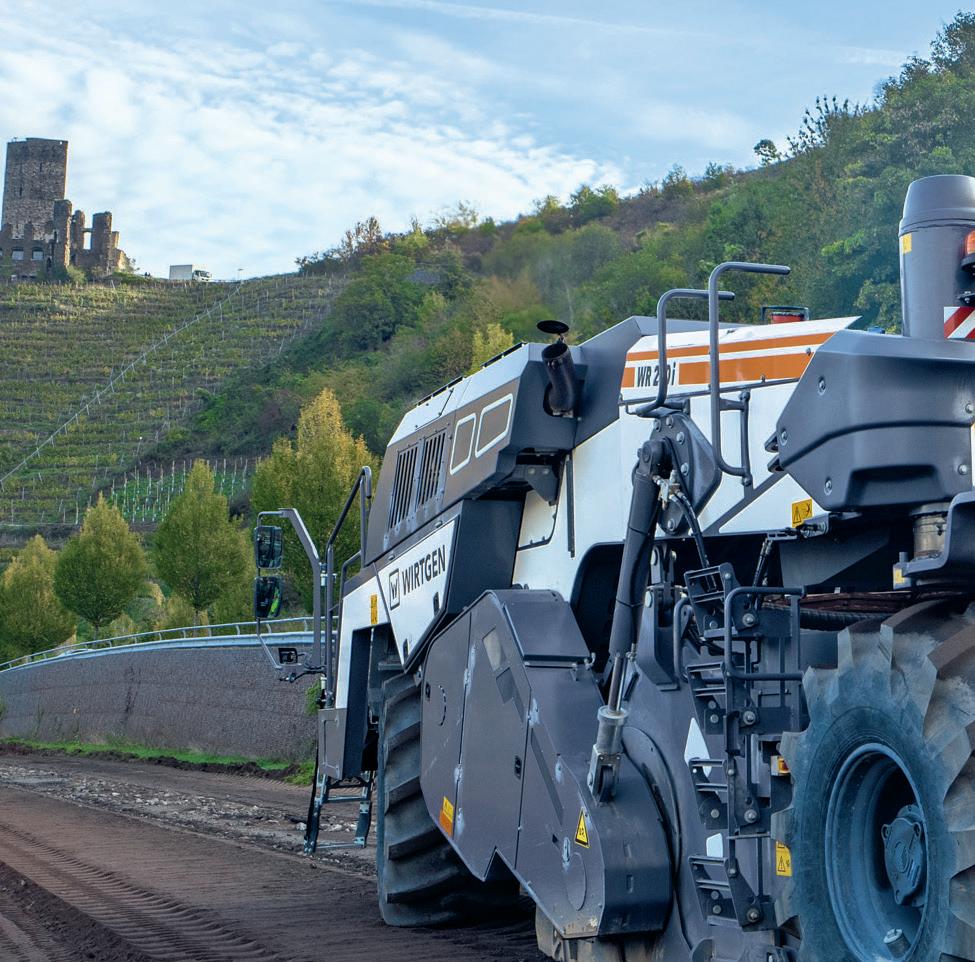
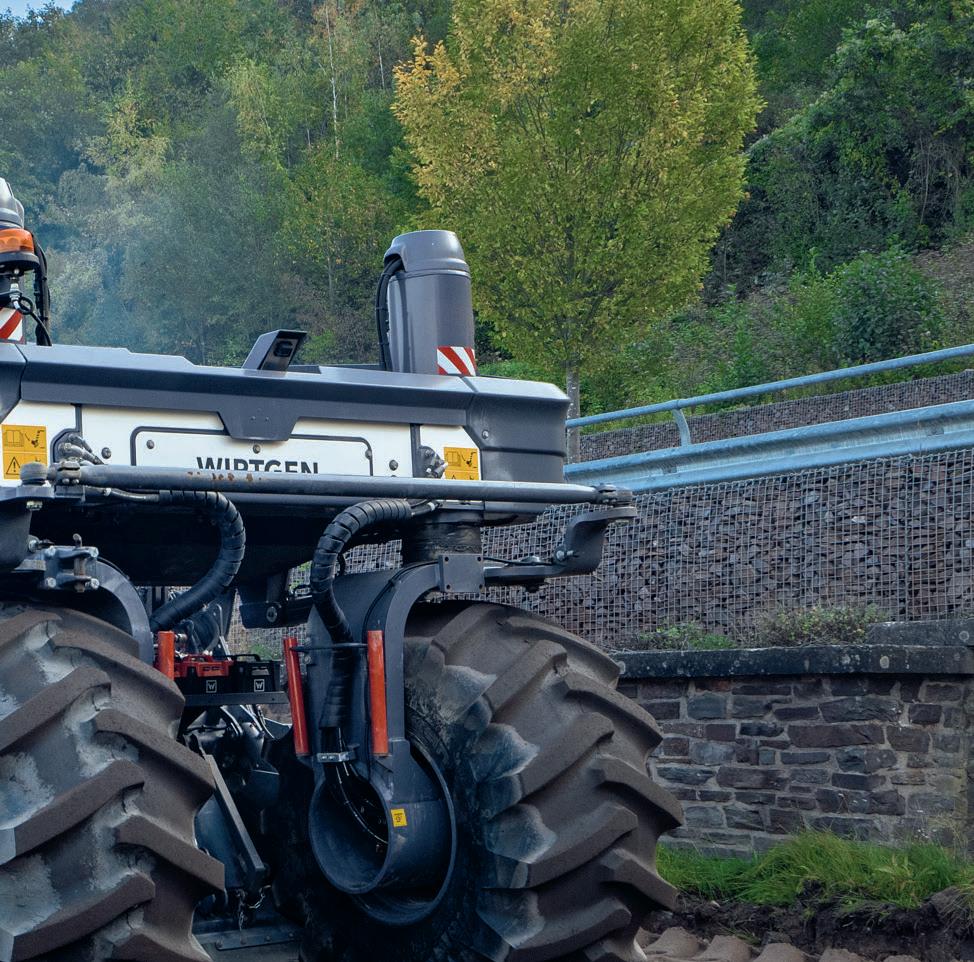
Equipment from Wirtgen has been used to help recycle a stretch of the L98 road that runs alongside part of the Moselle River in Germany

Around 3km of the road in the area close to Beilstein was in need of structural rehabilitation. After milling off the asphalt surface layer, the remainder of the asphalt binder course
and the underlying hand-packed stone layer were crushed and processed in situ in a single pass using a WRC 240i Rock Crusher from Wirtgen. The aim was to construct a new, homogeneous base layer that would provide enduring resistance to the axle loads of future heavy traf c.
Hand-packed stone layers such as on
the L98, or base layers containing large pieces of stone, as often used in the past, mean that traditional rehabilitation can be labourious. Conventional processing can be time-consuming and costly. Above all, the transportation of material takes time and is expensive. With its WRC 240i Rock Crusher, Wirtgen said it can provide a more economical


Built
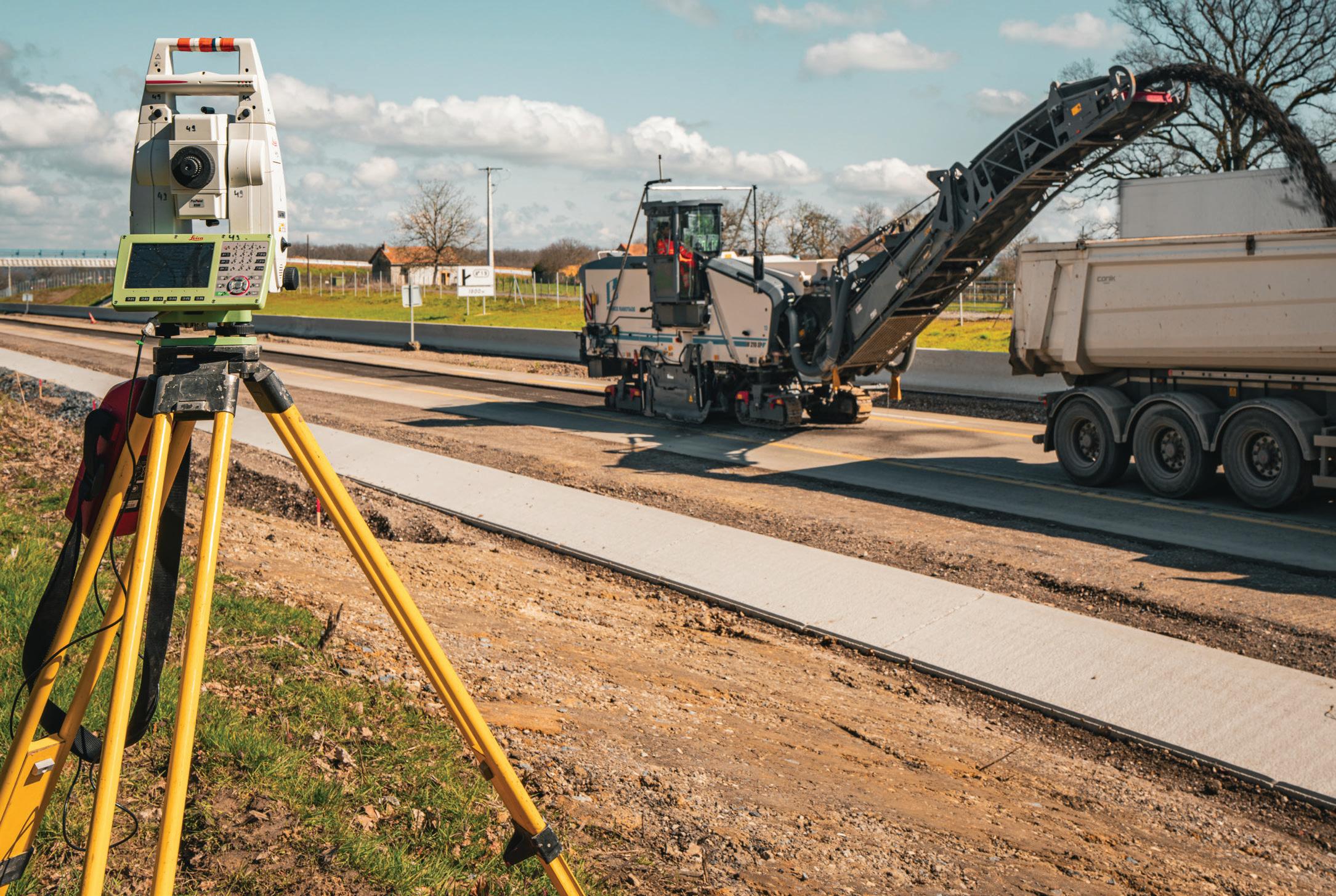

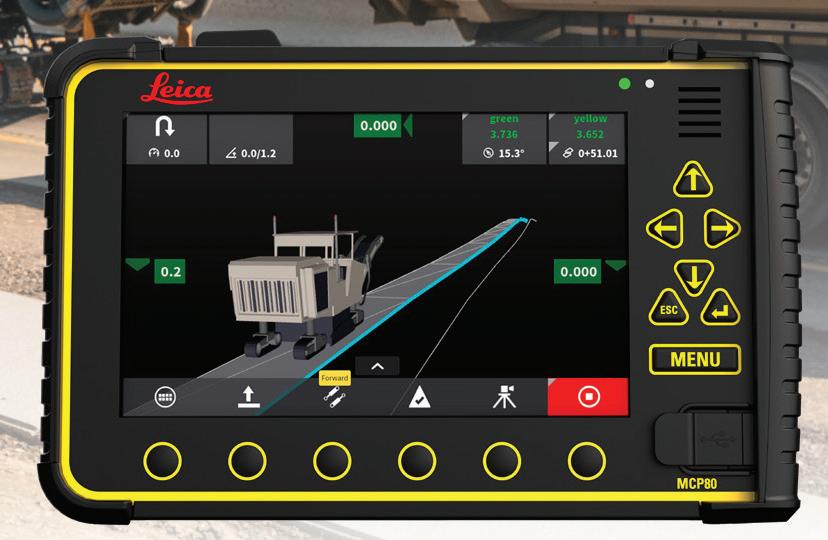






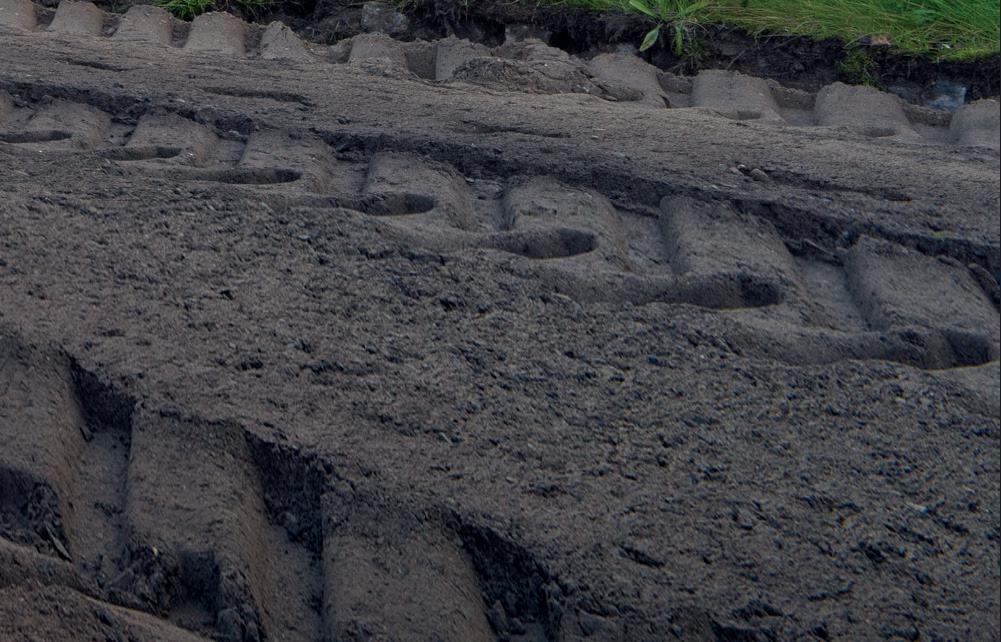
solution for this task.
The crushing and mixing rotor of the WRC 240i processed the existing binder course and the underlying hand-packed stone layer with its HT18 crushing tool to a depth of 35cm. In the crushing process, the variable and xed crushing stages ensured that the pieces of stone were fragmented to the required size by impact crushing. The screen unit with a mesh size of 45mm in the rear part of the crushing and mixing chamber determined the fragment size of the crushed material. The equipment meant that a new, high-quality homogeneously mixed base layer was constructed in situ to meet the project speci cations to a working depth of 35cm.
With a working width of 2.32m and an advance rate of around 7m/min, the machine achieved a crushing rate of 600tonnes of material/hour. On the project site, the total volume of material produced in situ by the Wirtgen Rock Crusher amounted to around 11,900tonnes and eliminated the need for transporting approximately 1,200 truckloads of processed or new material to and from the construction site. After compaction, the new crushed stone base layer was ready for the placement of the overlying asphalt binder course and the paving of the asphalt surface layer.
The use of the Wirtgen Rock Crusher reduced not only the transport costs, but also the overall CO2 emissions. In this case, the emissions were able to be reduced by 66%. The construction costs for the creation of an unbound, homogeneous base layer were reduced by 75% and the project completion time was shortened by 55%. This meant that the section of the L98 was ready for asphalt paving within only two days and was then able to be opened to traf c
Wirtgen Group
www.wirtgen-group.com
CCC Waste is using the latest wet processing technology from CDE at its new waste recycling plant.
This equipment is helping the rm achieve its target of sending zero waste to land ll and is being used to process construction and demolition waste in the Liverpool area.
With large waste volumes readily available, the company recognised than a modern technological solution was needed in order to close the loop on construction waste.
“We wanted to reduce the volume of material being sent to land ll, provide effective
circular economy solutions for our customers, and increase our production volumes,” explained CCC Waste director, Sean Munro.
“In particular, recycled aggregates are a large part of our business and an area where we see great potential for further development in pursuit of our zero waste ambitions.”
Operating a dry crushing and screening plant, the company faced challenges when processing damp materials during the wet months of the year, which resulted in more frequent downtime and lower product yield as a proportion of the hard to process material
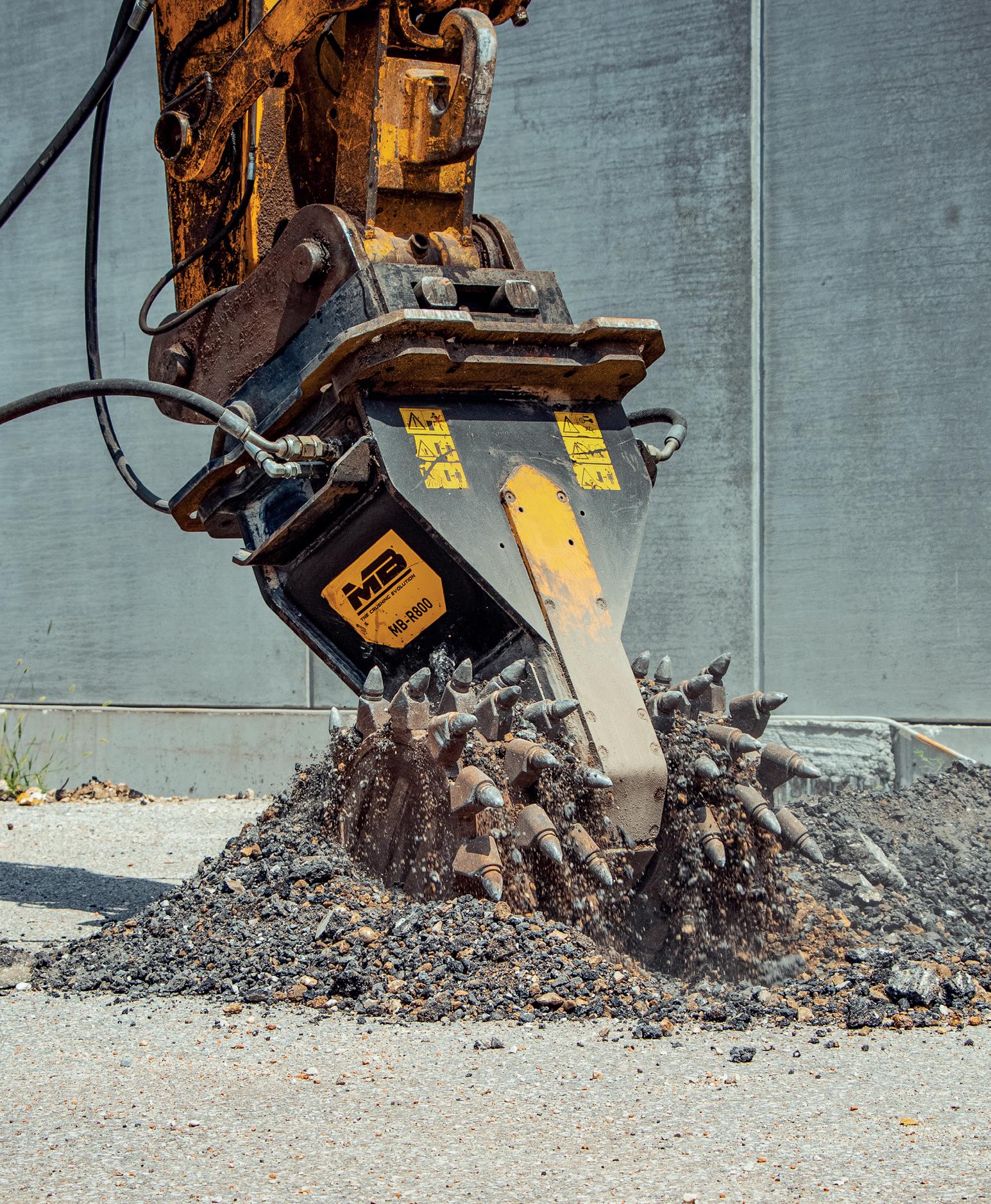

would be sent to land ll.
“When we were dry processing we couldn’t extract any sand; it was all mixed up with soils and we couldn’t get any of the sand out. Anything –50mm down was going to land ll,” Munro said.
CDE business development manager Mike Bibby said a full technical solution was required to support CCC Waste to gain momentum in its mission to achieve 100% land ll diversion.
“It was evident that many of the downstream challenges around product quality were stemming from inef ciencies in the dry crushing and screening process.”
A wet processing solution, he said, would “maximise the recovery of washed recycled materials, which can be marketed at a premium, while eliminating associated disposal charges and delivering signi cantly for the business, both environmentally and commercially.”
Working in partnership, CDE and CCC Waste set out to nd a solution. Munro said, “We visited several CDE sites in England and Scotland and those visits were hugely valuable to us. The plants were operating with great ef ciency. We came away with ideas about how we could maximise the footprint of our own site, too. They helped us see the synergies between our two businesses.”
Guiding CCC Waste as it took its rst steps into the wet processing of materials, CDE proposed a solution comprising its R4500 primary scalping unit, which can handle the company’s incoming C&D waste streams from
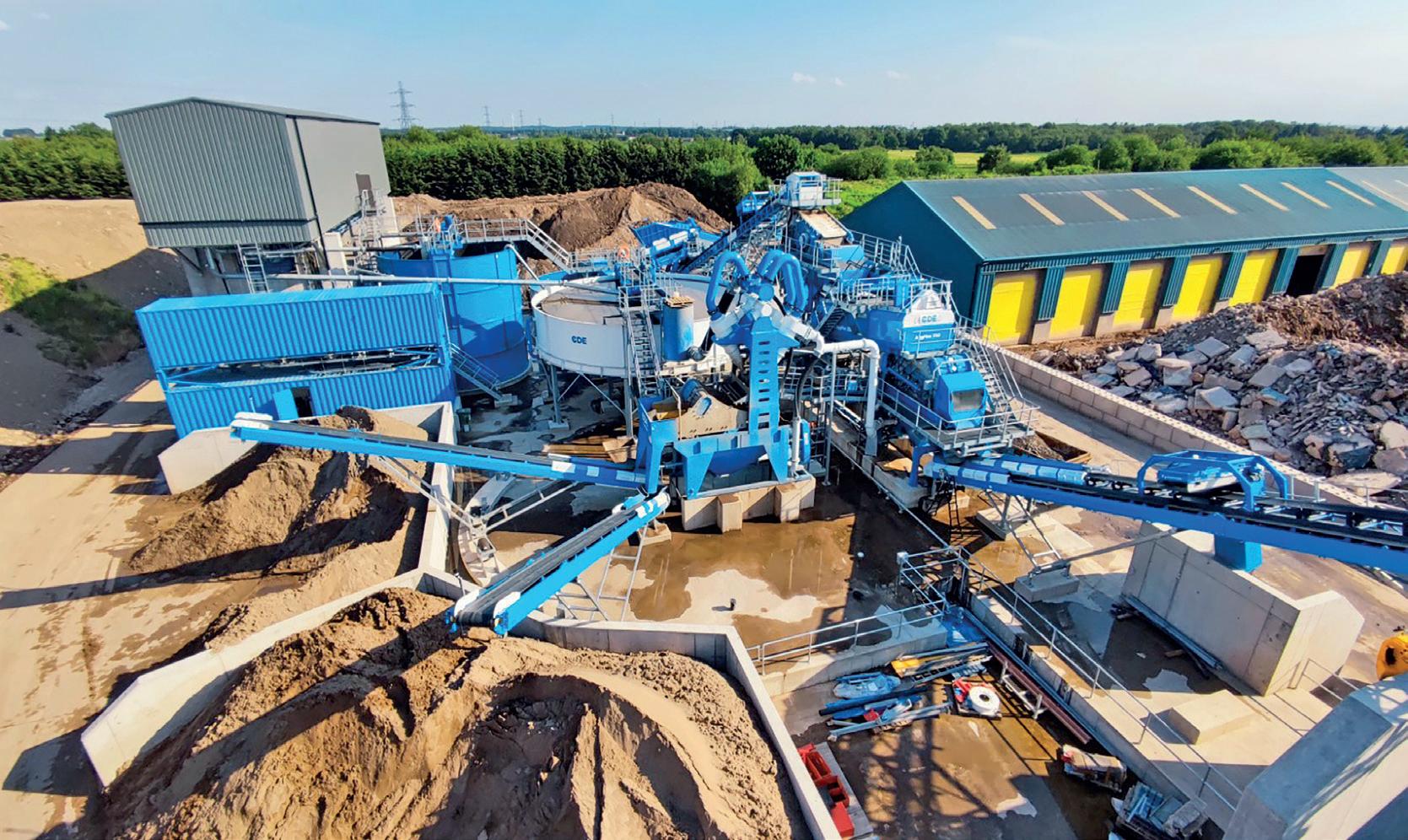
a range of industries.
A versatile plant that can cope with a wide variety of feed material, the solution features CDE’s AggMax scrubbing and classi cation system, which allows for the effective removal of organic material and other contaminants. The EvoWash sandwash system meanwhile offers control of silt cut points to ensure high-value, in-spec sand products.
The inclusion of the AquaCycle thickener for primary stage water management and a Filter Press ensures CCC Waste can recycle up to 95% of the process water for immediate




recirculation and reuse, while producing a lter cake by-product.
The new CDE plant has doubled sand and aggregate output for CCC Waste, with the rm now producing up 30,000tonnes/week of washed recycled construction materials.
The plant is currently processing up to 200 tonnes per hour and producing nine graded products, including sand and aggregates ranging from 0-2mm up to +80mm oversized as well as a lter cake. CDE
www.CDEGroup.com












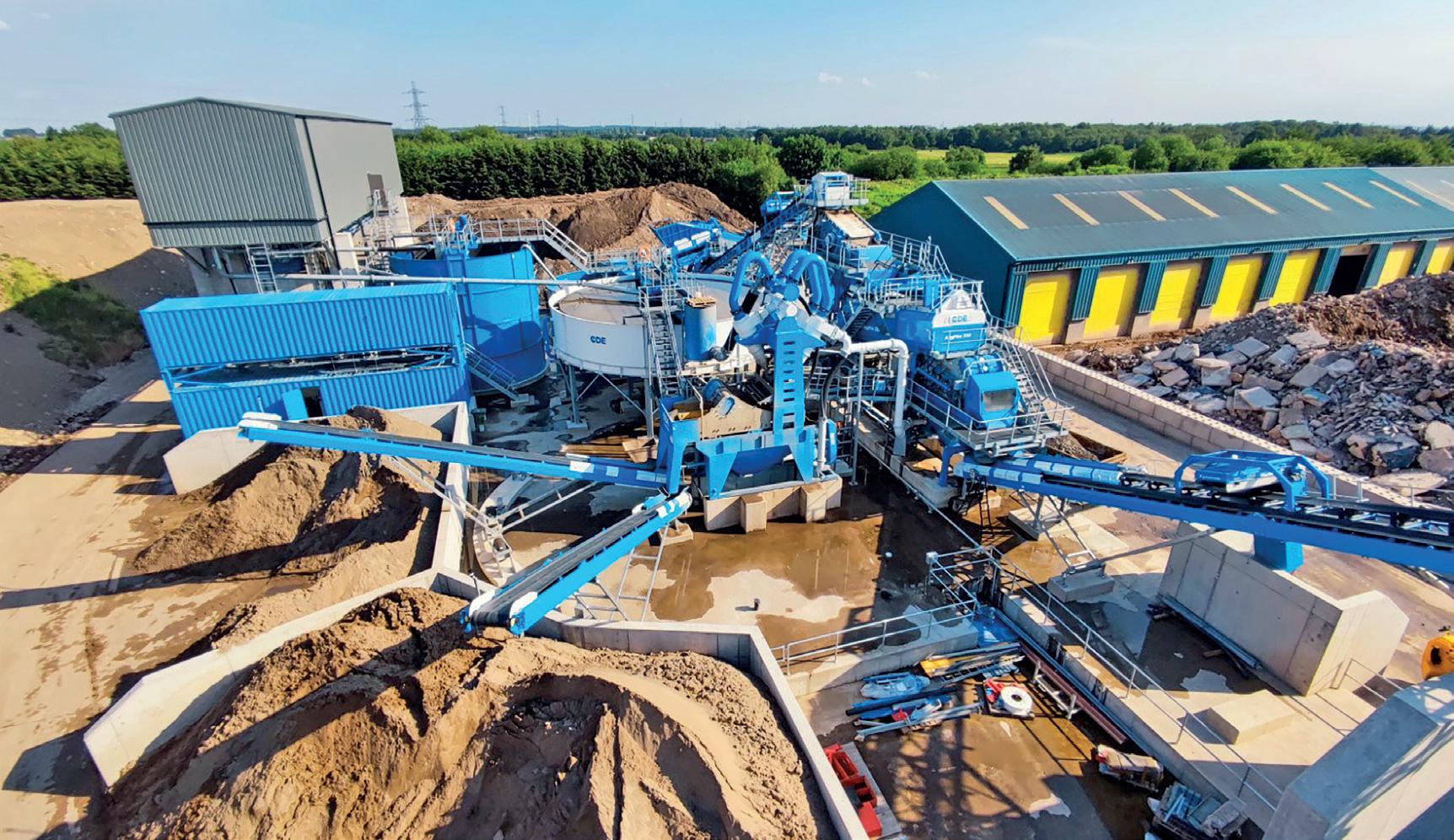

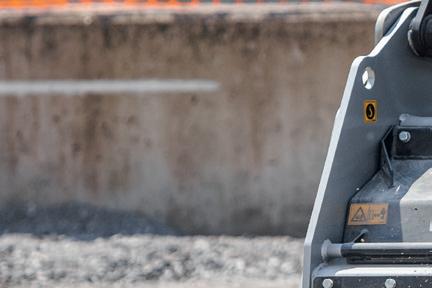
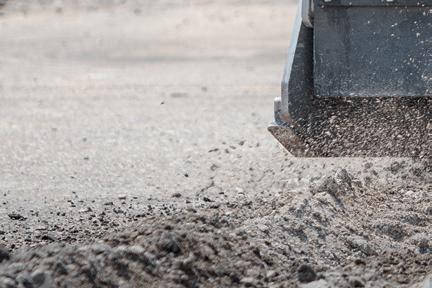

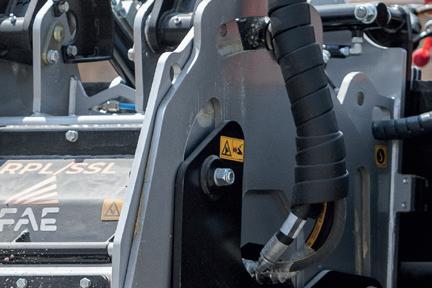
designed plates to connect the two different types of attachments: the SAE attachment of the road planer and the custom-designed attachment for the RCU.


FAE is now offering a new asphalt shredder and remote-controlled RCU tracked carrier variant. Now, with a special installation kit, the RCU75 can be equipped with an RPL/SSL-45 asphalt shredder.
Davide Baratta, FAE's sales director said: “We aim to make a highly capable remote-controlled tracked carrier like the RCU75 even more versatile. This way, the customer can perform various tasks by changing the attachment. In the future, we will expand the range of compatible tools. Additionally, using a remote-controlled tracked carrier for road work enables precise operation. The operator, standing next to the machine rather than in the cab of a skid steer, has an optimal view
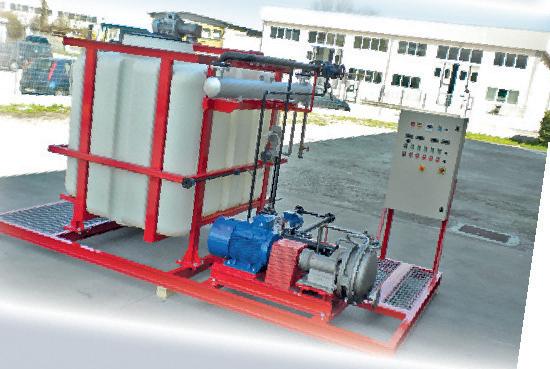







of the work area. The operator can work independently, without the need for a colleague to assist.”
The RPL/SSL-45 can mill up to 170mm deep and has a working width of 450mm. The head comes with advanced features. The combination of self-levelling skids and tilt ensures optimal results on uneven surfaces. Operational precision is ensured by the hydraulic drive system, which allows working up against a wall on the right or left side, as well as depth and cutting indicators. The water spray system with an integrated tank eliminates dust and helps cool teeth, which is designed for use on asphalt and concrete roads.
The RPL/SSL-45 connects to the RCU75 through FAE’s installation kit. The rm
The company designed a wiring system that connects the solenoid valves of the road planer (which control the movement of the skids, translator, and inclination of the oating tilt) to the control unit and to the RCU's remote control. The hydraulic system transfers power to the road planer and bene ts from dedicated cooling valves.
The RPL/SSL-45 has a specially designed tooth layout to increase performance and reduce vibration, allowing it to prepare roads for resurfacing or to simplify excavation operations.
At the onsite test, impressions were positive. According to the operator, the RCU75 tted with the RPL/SSL-45 was easy to manoeuvre, even in con ned spaces. It proved effective for precision work along road edges, walls, and manholes due to the visibility over the work area. The machine handled an 80mm layer of asphalt and sections of concrete, consistently performing at the maximum depth speci ed in the data sheet. The ability to control the water spray system directly from the console was also found to be convenient. FAE
www.fae-group.com
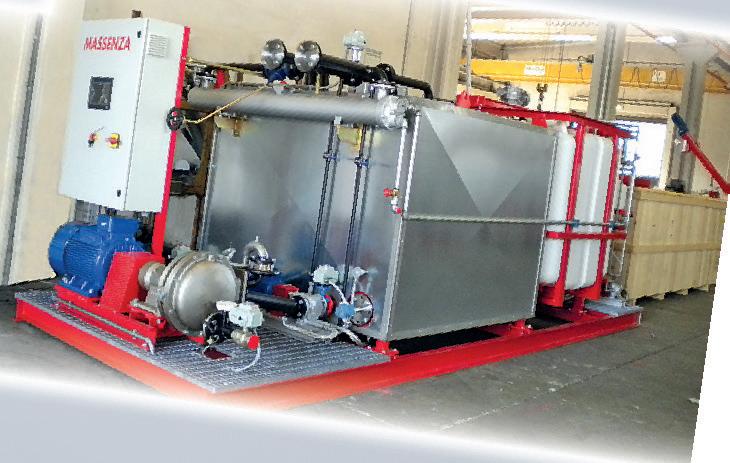




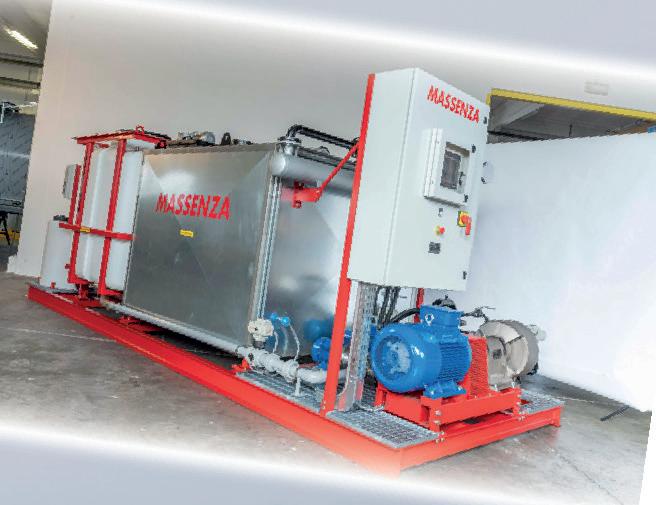






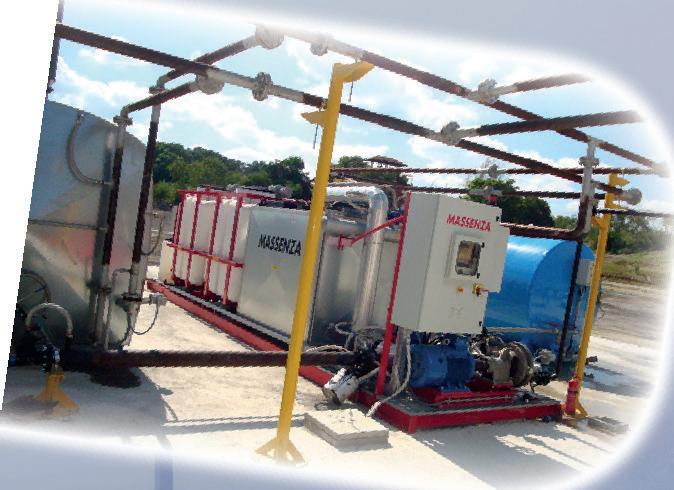







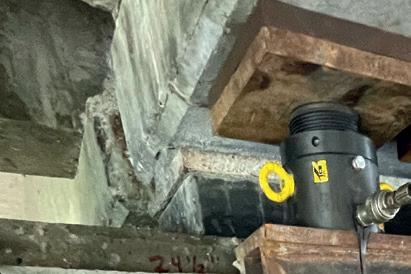
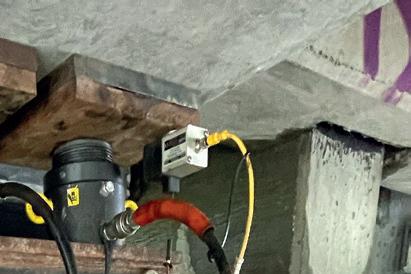
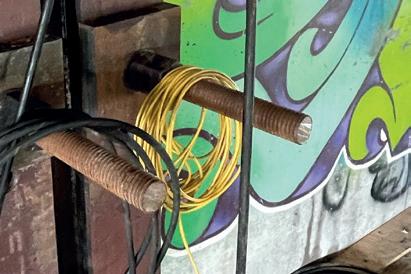
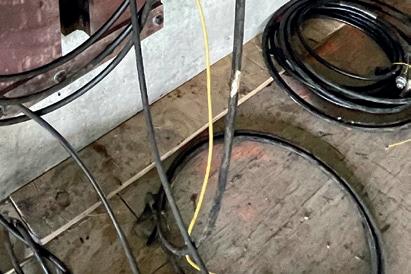




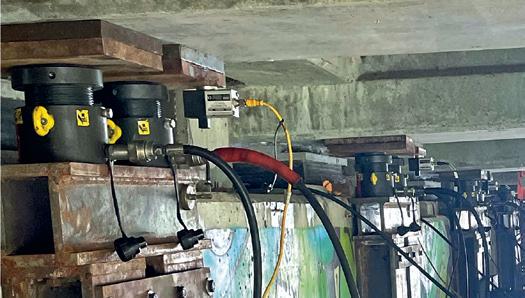
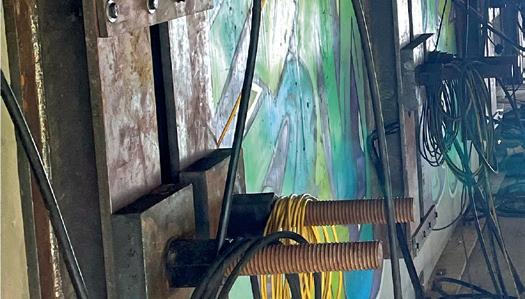
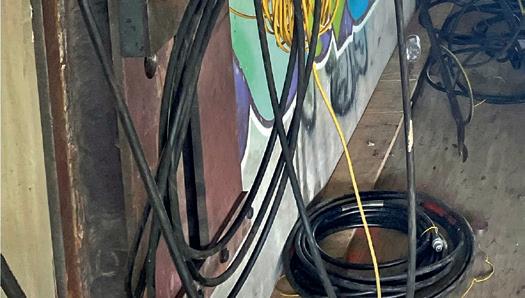

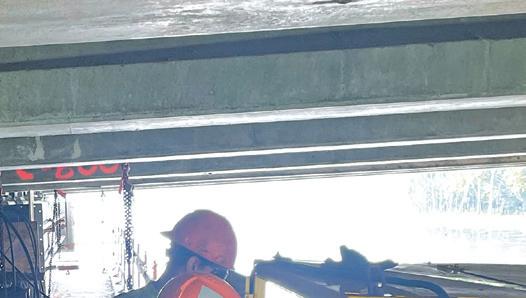
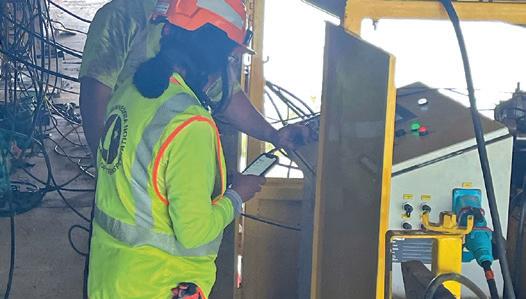
Structural maintenance to the I-494 Minnesota River Bridge is being undertaken by Lunda Construction using an Enerpac EVO synchronous lifting system for bridge bearing reconstruction
The 43-year-old bridge, directly southeast of the Minneapolis-Saint Paul International Airport, links the cities of Bloomington, Eagan and Mendota Heights. The bridge spans the Minnesota River in Bloomington, Minnesota.
In April 2023, the Minnesota Department of Transportation awarded Lunda Construction, a subsidiary of civil, building and specialty construction company Tutor Perini Corporation, a US$62 million contract for structural repairs to the I-494 Bridge. Lunda's business consists of four operating divisions: bridges; railroad; pipeline; and specialty services.
Scope of work on the I-494 Bridge includes: pavement repair on I-494; reconstruction of the regional trail; replacement of bridge joints; repair of the bridge deck, beam ends and railings; reconstruction of bearings; replacement of highway lighting; and repair/ replacement of drainage systems. Work on other repairs to the bridge are anticipated to be nished by the summer of 2026.
Bridge bearings are positioned on each pier where the bridge decks meet. They transfer the load on the bridge decks to the bridge piers, thereby reducing the effect of stresses on the
decks themselves. The Minnesota River Bridge is 1,374m long with 34 piers supporting the bridge decks that make up the bridge. The bridge bearings are replaced one pier at a time. The bridge decks are 18m wide with a typical concrete girder span of 35m long and 61m steel span, with the longest span being 79m.
To enable access to the bearings, 12 pairs of Enerpac LPL-602 hydraulic cylinders were arranged in two rows of 12 lifting points on top of the pier. The typical lift at each beam end reaction is a dead load of 70tonnes. The cylinders are then connected to the Enerpac EVO system.
By con guring the EVO system with two LPL-602 cylinders per control point, engineers are able to control the pressure in each jacking cylinder to ensure a synchronous lift of the two bridge decks.
The Enerpac LPL cylinders were then jacked up a half inch (12.7mm). However, for certain repairs - such as rocker bearing replacements - the bridge was lifted higher to allow for more room in which to work. When fully jacked, the Enerpac LPL cylinders were locked. This was in order to disconnect the EVO system during the actual bearing replacement, to concrete surface repairs on the pedestals and to paint the bearing and sole plates.
“The Enerpac EVO system has been
extremely bene cial for this project,” said Max Byzewski, project engineer, Lunda Construction. “The deck does not have much exural capacity, so it is critical that each girder on a given beam line is lifted in-sync. The EVO system also can tell us how much load each jack in a line is experiencing, which shows which girders are seeing more load. This in turn helps better understand why certain girders aren’t coming up as easily as others, namely fascia and centre girders.”
In July this year, Lunda Construction was selected by the Missouri department of transportation for the design and construction of the new I-70 Missouri River Bridge near Rocheport, Missouri. Lunda’s design team is comprised of Parsons Corporation, Dan Brown & Associates and HZ United. The project consists of the design and construction of two Missouri River bridges, one in each direction of travel, each with three lanes. This will allow for construction to take place with a limited impact to traf c. Lunda is also replacing the County Road BB Bridge over I-70.
Enerpac www.enerpac.com
Lunda Construction www.lundaconstruction.com
Temporary works specialist
Altrad RMD Kwikform - Altrad RMDK - is helping realign the A452 road over a new rail line for England’s future highspeed trains.
Altrad RMDK is working with HS2’s construction partner for the Midlands region, Balfour Beatty VINCI (BBV), and civil engineering and groundworks contractor Galldris,
The A452 Kenilworth Road Overbridge is a fully integral box structure with in situ concrete base, abutments and wingwalls, spanning more than 76m. The project is part of the vast HS2 landscape realignment of the trunk A452 road over the new high-speed rail line.
The structure was one of the highest concrete pours undertaken by Altrad RMDK in Europe to date with a pouring height of 13.5m to one of the main wingwalls. The project’s success was critical in maintaining the momentum of the HS2 timeline, highlighting the collaborative efforts of all involved.
The project presented a multitude of challenges due to the complex shape and weight of the bridge. One of the main challenges was overcoming the complex geometric patterns used for the wingwalls. These wingwalls tapered in height along their length and also along their width across the base. Not only this, but the external shutters lean into the internal face to taper in width across the height.
Where the wingwalls met the abutment walls, there was a complex movement joint that was required to allow for the expansion of the respective elements while still retaining the back ll that would eventually
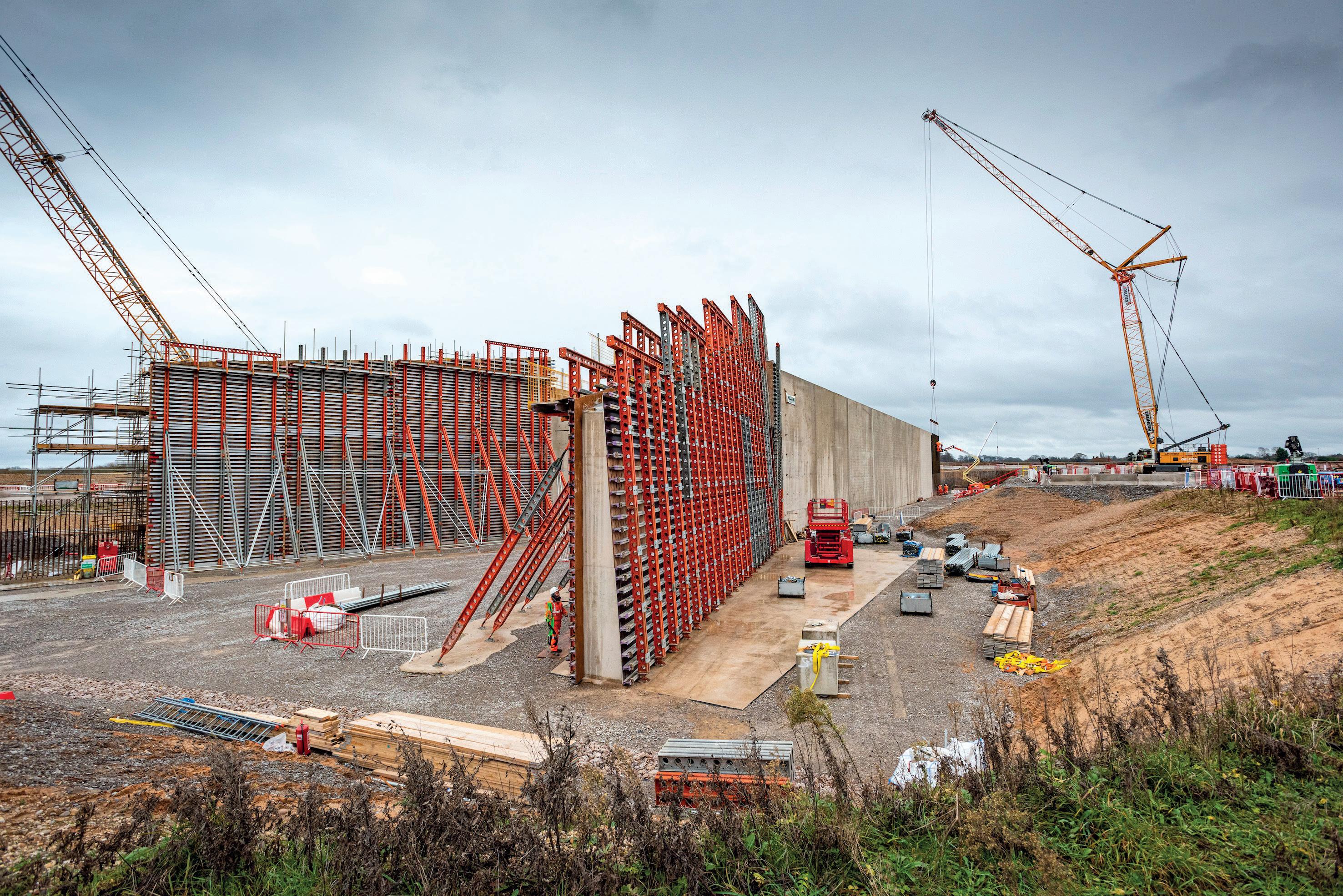
execution, with the additional pressure of adhering to a tight schedule.
Altrad RMDK and Galldris worked in partnership, bringing together expertise and resources from both organisations, which proved instrumental in overcoming the complex challenges posed by the project’s scope.
The contractor needed a solution that could be con gured into various shapes and sizes. The solution was a custom speci cation to be engineered using Superslim Soldiers and Alform Aluminium Beams to meet the complex requirements.

Superslim Soldiers are designed to handle high loads, making them an ideal solution for a pour of this stature; they ensured that the formwork would remain stable under the pressure of the concrete. The beams helped maintain the structure’s shape and integrity during the entire pouring
The Alform Beams provided a quick, durable and lightweight solution, allowing for simple installation, which was particularly advantageous on this high pour as moving and positioning formwork can be time and labour intensive.
Despite being lightweight, Alform Beams withstood the substantial pressure from the concrete. They worked alongside Superslim Soldiers to ensure that formwork remained intact and stable throughout the pour. This was important as it was essential that the solutions maintained the tapering shapes and dimensions of the wingwalls throughout the pouring process.
“The A452 Kenilworth Overbridge project highlights Altrad RMD Kwikform’s engineering capabilities and innovative solutions,” said Stuart Grant, senior sales representative at Altrad RMD Kwikform. “Through partnerships, careful planning and the use of
infrastructure development.”
Altrad RMD Kwikform provides of formwork, falsework/ shoring, heavy-duty support, ground shoring and safety and access systems, specialising in temporary structure needed to deliver major infrastructure and building projects. The company designs, hires and sells formwork, falsework/shoring, heavy-duty support, ground shoring as well as safety and access systems.

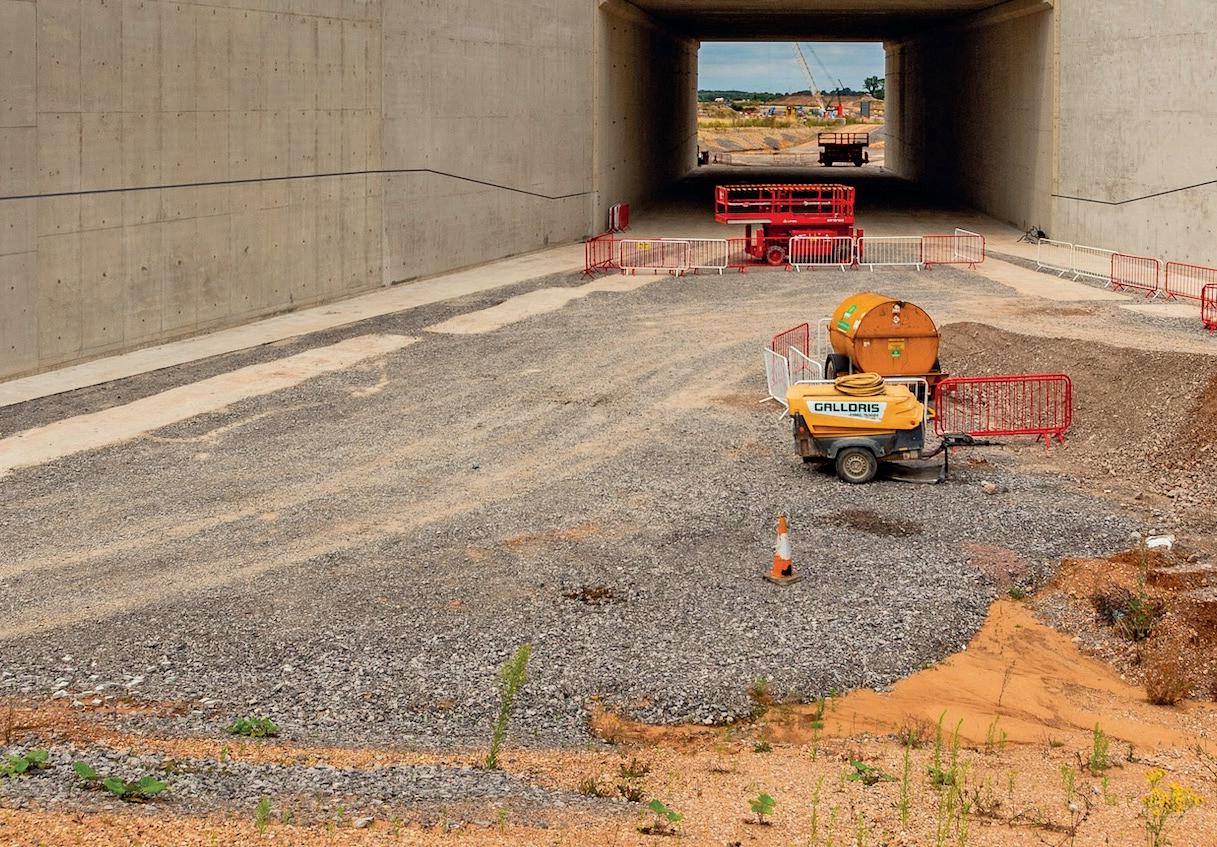
Key sectors include civil engineering and infrastructure, ground works, energy and industrial, commercial and multistorey residential buildings. The company works in 3D designs and BIM (building information modelling)-compliant models through its visualisation software LocusEye.
Altrad RMD Kwikform www.rmdkwikform.com
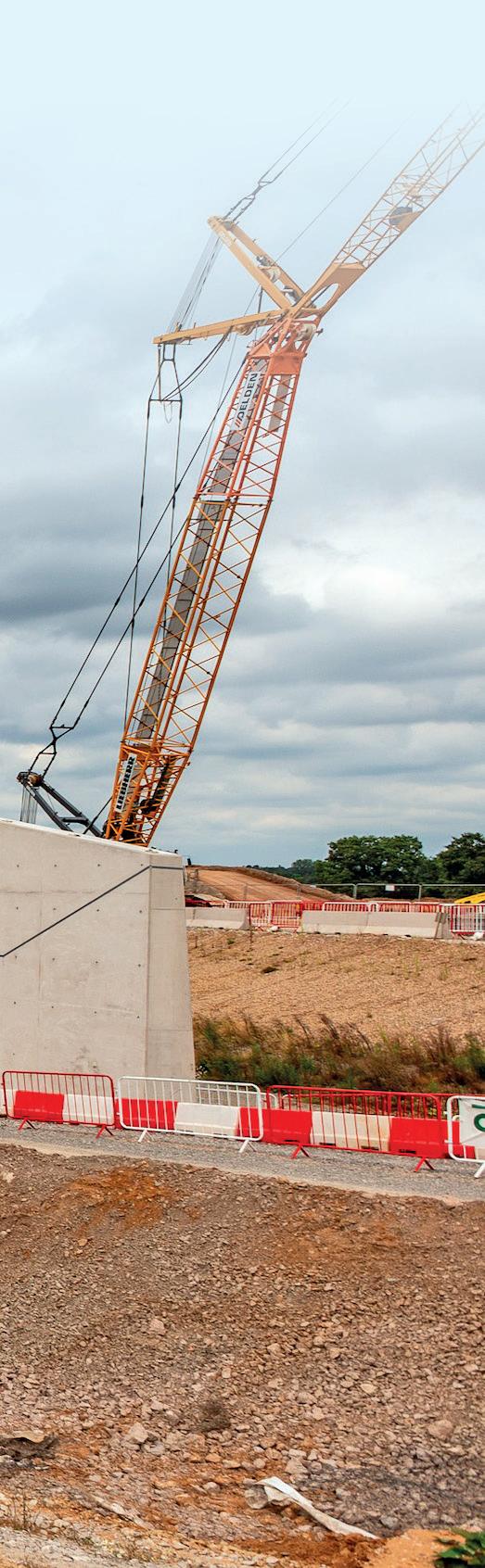
Acrow has supplied a modular steel bridge to maintain vehicular traf c and enable marine vessel access following demolition of a bascule bridge in Kingston, Canada.
Acrow, an international bridge engineering and supply company, designed the bridge according to the needs of the client, Public Services and Procurement Canada, the causeway’s owner and operator. The federal government agency manages purchasing, real property, payments, payroll, pensions and other services across the country. Its Infrastructure Asset Management business oversees key national assets such as bridges, docks, highways and dams.
In the province of Ontario, the La Salle Causeway separates the city of Kingston's inner and outer harbours. It carries Highway 2 over the Cataraqui River - the southern entrance of the Rideau Canal - at Kingston. Construction of the causeway was completed in 1917 and around 23,000 vehicles use the crossing daily.
Three bridges were incorporated into the causeway, the centre one being the Strauss trunnion bascule lift bridge which was designed by Joseph Strauss, who designed the Golden Gate Bridge in the US city of San Francisco. The other two bridges were originally steel structures but were replaced decades ago with concrete bridges.
Earlier this year, while strengthening work was being done on Strauss’s bascule bridge, a diagonal steel truss element supporting the structure’s counterweight was damaged. Soon after, Public Services and Procurement Canada decided to close the structure and it was demolished in June. The agency said it is preparing preliminary design work for a replacement bridge.
Meanwhile, the client agency wanted a temporary modular bridge to accommodate vehicles, pedestrians and cyclists. Acrow said that its bridge was selected because the design and durability of the structure would also allow for its periodic removal and reinstallation to open the navigation channel.
Acrow provided the bridge to Priestly Demolition for installation. The single-span two-lane structure is nearly 49m long and has a width of 7.3m. A cantilevered pedestrian

walkway, 1.5m wide, separates pedestrians from vehicular traf c.
Components began arriving at the site in mid-August and the bridge was assembled on rollers while the existing abutments were modi ed to suit the modular structure. The bridge was launched with the assistance of a crane on September 20 and opened to traf c on October 3.
Then, on October 15, the rst removal of the new Acrow bridge and its reinstallation sequence took place and provided a window for vessels to access the city’s inner harbour. This approach was accomplished by jacking the bridge off its bearings onto a barge, which was then moved away from the navigation channel. To reinstall the structure, the process was reversed and the crossing reopened for vehicles, pedestrians and cyclists.
Acrow said that the strength and versatility of its Acrow 700XS panel bridge system, combined with a highly experienced engineering team, enabled a swift resolution of this emergency. “Acrow’s rugged modular steel bridge proved an ideal solution for this


interesting project,” said Betul Oliver, Acrow Canada’s business development manager for eastern Canada.
“The bridge was easily adapted for this unique and innovative application, which safely maintains the route for vehicles while providing scheduled accommodation for marine vessels,” said Oliver.
Available for rent or purchase, Acrow’s solutions are quickly and easily built and installed, and easily disassembled to facilitate safe, rapid redeployment. The company has been serving the transportation and construction industries for more than 70 years with a wide range of modular steel bridging solutions for permanent, temporary, military and emergency use. Acrow’s extensive international presence includes leadership in the development and implementation of bridge infrastructure projects in over 150 countries across Africa, Asia, the Americas, Europe and the Middle East.
Acrow
www.acrow.com



Develon has launched the DX235RTF-7 tunnelling excavator, an extension to the company’s line-up of special application machines.
The DX235RTF-7 is based on Develon’s well-established DX235LCR-7 reduced radius crawler excavator and is powered by a DL06V Stage V engine, providing 141kW of power. The DX235RTF-7 uses the successful compact design and minimum swing radius of the DX235LCR-7. However, the key part of the machine is the heavy-duty tunnelling front, offering a new arm and boom design with special kinematics and a tilting function.
“The new DX235RTF-7 tunnelling machine is designed for superior performance in challenging underground environments,” explained Jan Breburda, special applications product manager for Develon Europe. “Complementing the safety and comfort of its operation, the advanced hydraulics and robust construction
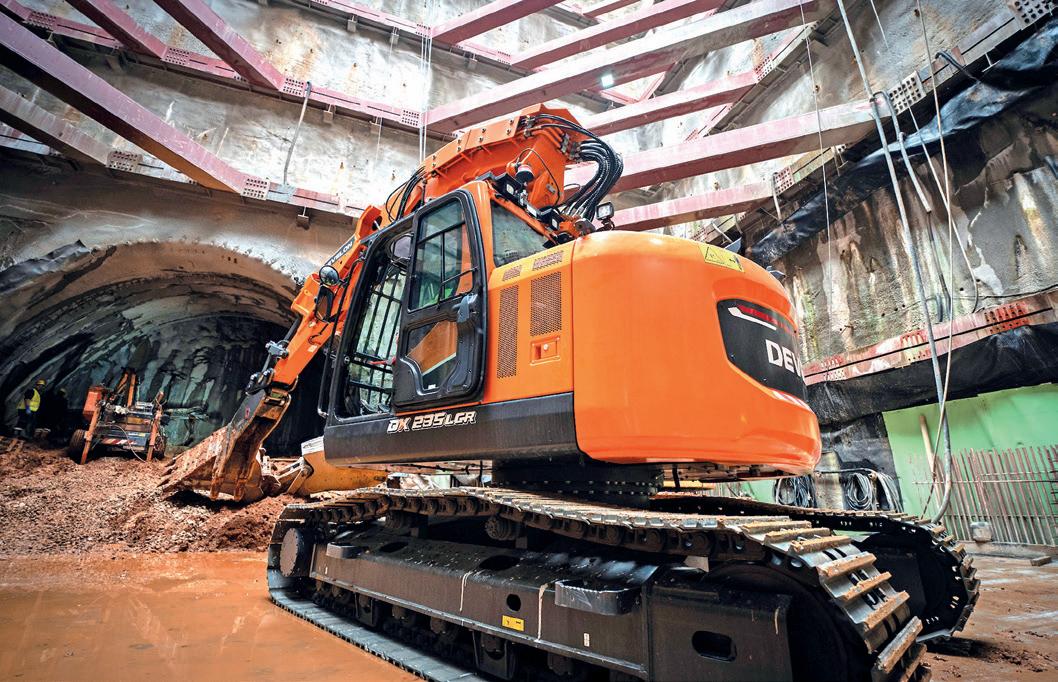
Tunnelling applications often require the transportation of the machine to areas with limited access, so the DX235RTF-7 is designed to be simple to lift and manoeuvre into place
of the DX235RTF-7 ensure optimal power and durability, while its compact design allows for easy navigation in tight spaces.”
The DX235RTF-7 has a total operating weight of 25,689kg and offers a maximum reach of 9260mm. The kinematics of the tunnelling front on the DX235RTF-7 excavator are designed to prioritise horizontal reach and precision over vertical
movement. The special kinematics are based around a boom tilting function, providing a 45°/45° tilt in two directions, the movement of which can be operated via a pedal in the operator’s cab.
The boom and arm configuration is specifically designed for operation in narrow areas, with ranges of movement slightly limited compared to the standard front on the

DX235LCR-7. The DX235RTF-7 is specifically suited to work in restricted environments, without using the swing movement in narrow areas. This allows the DX235RTF-7 to work efficiently in narrow tunnels with the ability to reach the tunnel face and walls, while maintaining a low profile to navigate tight spaces.
For work in confined spaces, the DX235RTF-7 features protective equipment to safeguard it against falling debris or contact of the arm with the tunnel ceiling and walls. As a result, the DX235RTF-7 has a level 2 FOG system combined with more heavy duty covers and hydraulic piping protection.
The protection also includes covers over hydraulic hoses and arm work lights, as well as enclosing the bucket cylinder and links in a dedicated protective compartment and hiding the arm cylinder under the arm.
Develon
https://eu.develon-ce.com/en
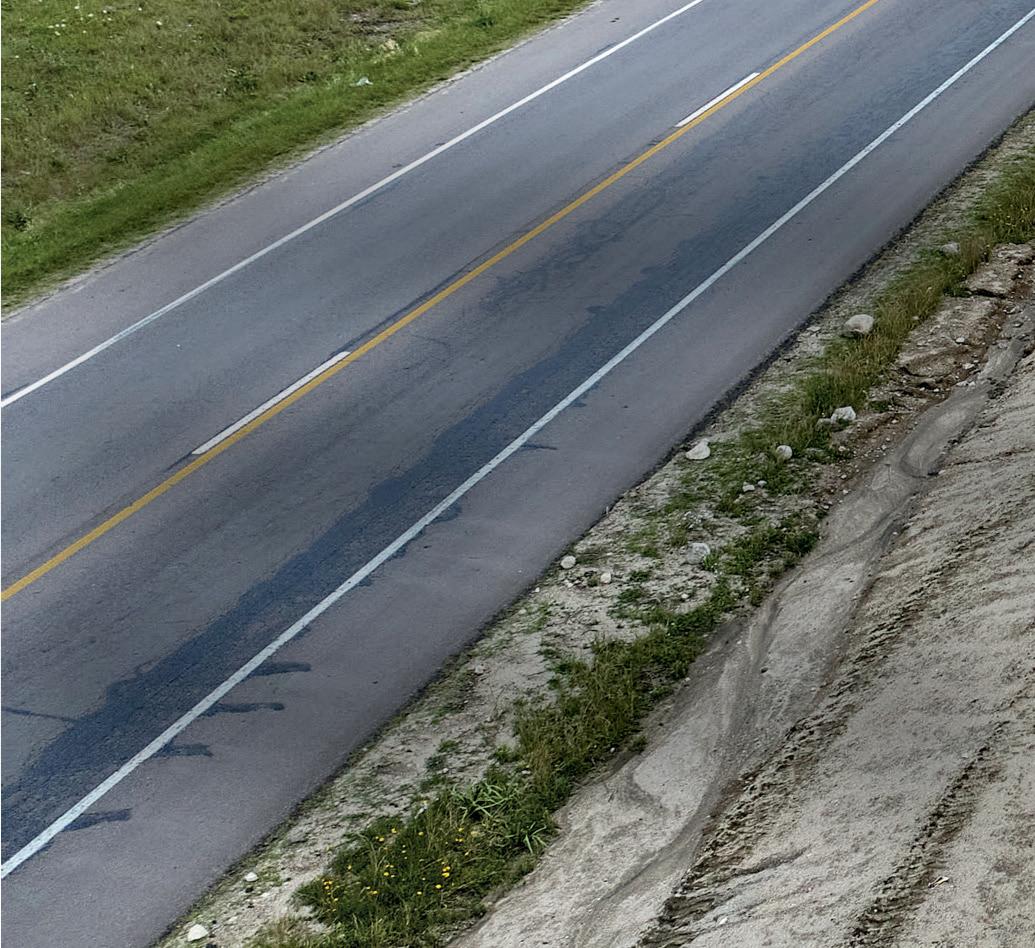
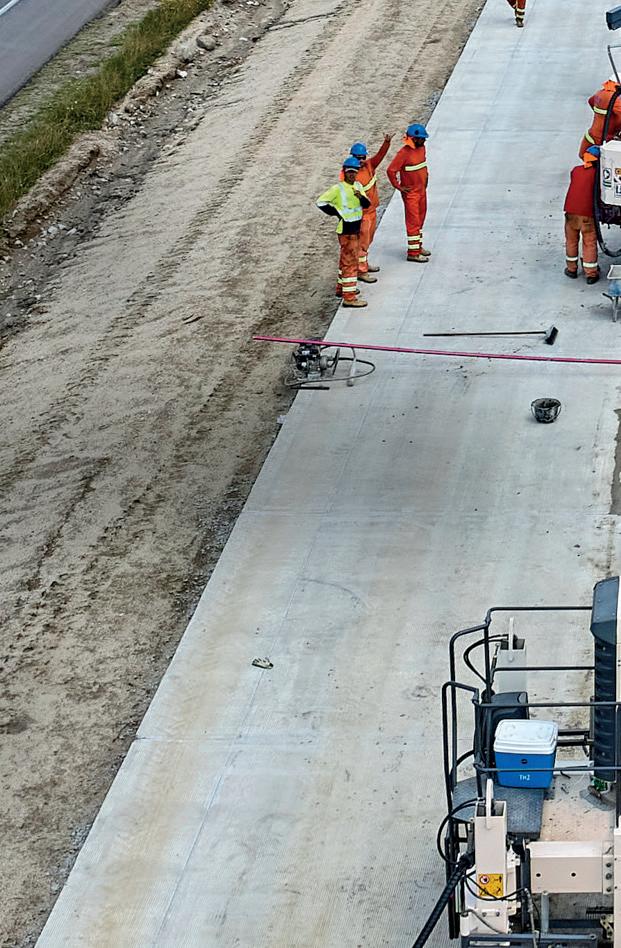
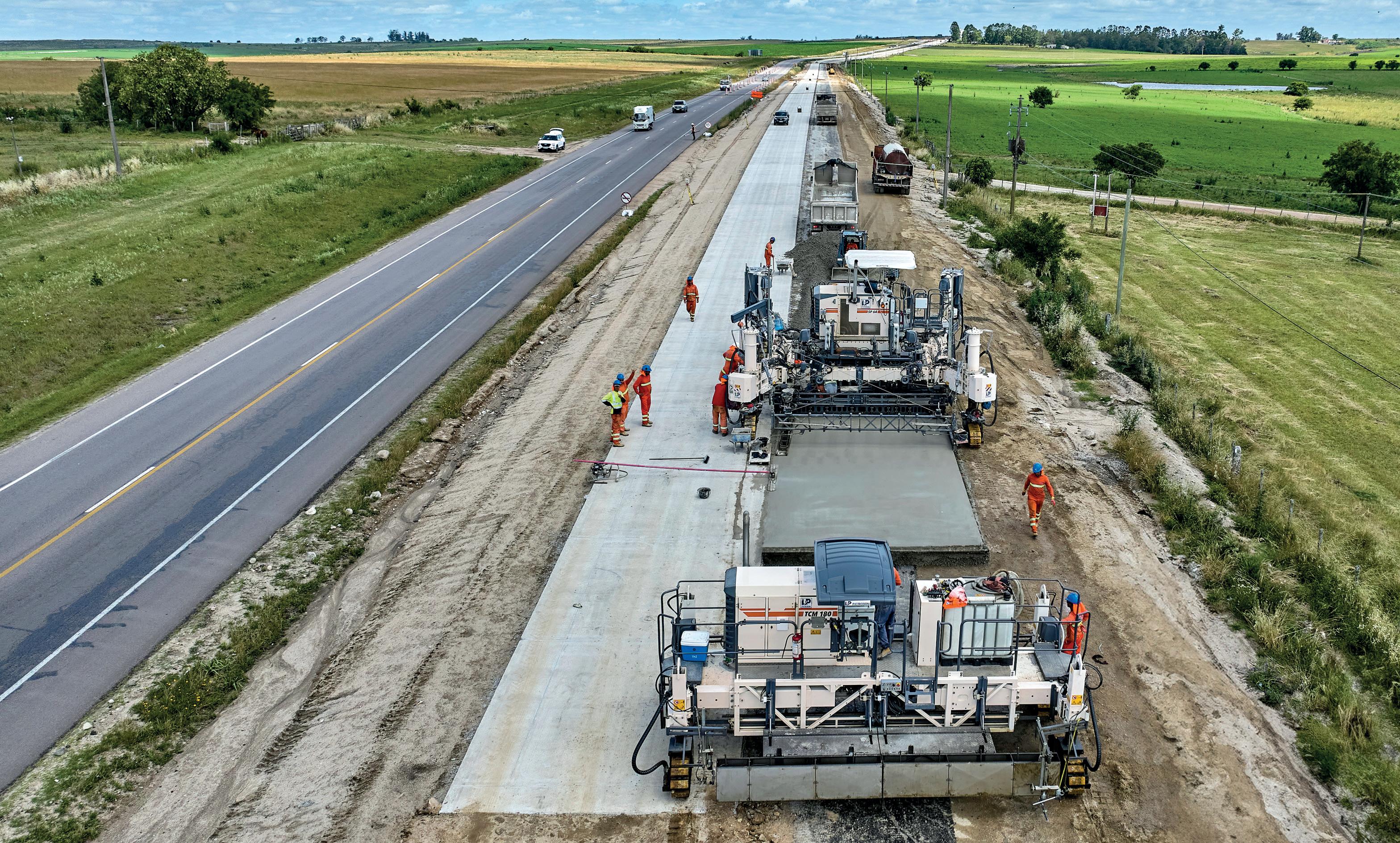

Concrete has been selected as the material of choice for use on the upgrading of major stretch of the Ruta 5 highway in Uruguay
Sandwiched between Argentina and Brazil, Uruguay relies heavily on trade and transport with its larger neighbours. Road transport is vital to the country’s economy so the upgrading of the Ruta 5 highway that runs from capital Montevideo to the border with Brazil will provide a major boost to Uruguay’s nancial security.
Ruta 5 is one of the ve most important Uruguayan national highways connecting to the heartland. These ve roads connect Uruguay’s larger cities to the capital and are the most important arterial routes in the country.
Capacity has previously been restricted on Ruta 5 however, with just a single lane in either direction. But the new widening project is delivering twin lanes in either direction, along with a string of other upgrades that include resurfacing of the existing roadway. This work will boost safety and capacity on Ruta 5 along a 75km stretch of the highway, as well as reducing delays for drivers.
The project involved four main contractors, with machines from the Wirtgen Group being employed for the resurfacing portion of the work. Three SP 64 slipform pavers and two TCM 18 texture curing machines from Wirtgen were employed.
Instead of using reinforcement from dowel baskets or steel rebar mats preplace ahead of the slipform pavers, dowel bar inserters (DBIs) were employed. Using the pre-
placement process limits the space available on the construction site and hinders the manoeuvring of construction vehicles on the site. When reinforcement is in place, concrete supplied for paving can only be delivered from the side. Given some of the terrain, this would have added to the challenges of the project.
However, the use of the integrated dowel bar inserter (DBI) on the SP 64 brings numerous advantages. Both the dowel bars and the longitudinal joint tie bars are placed automatically across the paving width. This increases process reliability, as they can be inserted at precisely the right locations.
The concrete can be of oaded and evenly spread immediately in front of the machine. Construction vehicles such as the tipper
trucks supplying the concrete also have more space to manoeuvre. “With this machine, we can achieve a much higher overall level of productivity than with our earlier method of concrete paving with vibrating screeds,” said Sebastián Trujillo, machine operator from R&K – Berkes, summing up the advantages of the SP 64.
Other modern techniques were also used for the concrete paving process. For conventional working, slipform pavers are controlled by mechanical scanning of previously installed stringlines. But when using a virtual stringline for 3D control, the height and positioning data for the line to be paved are contained in a digital terrain model. Two prisms tted on the slipform paver allow line of sight contact with a total
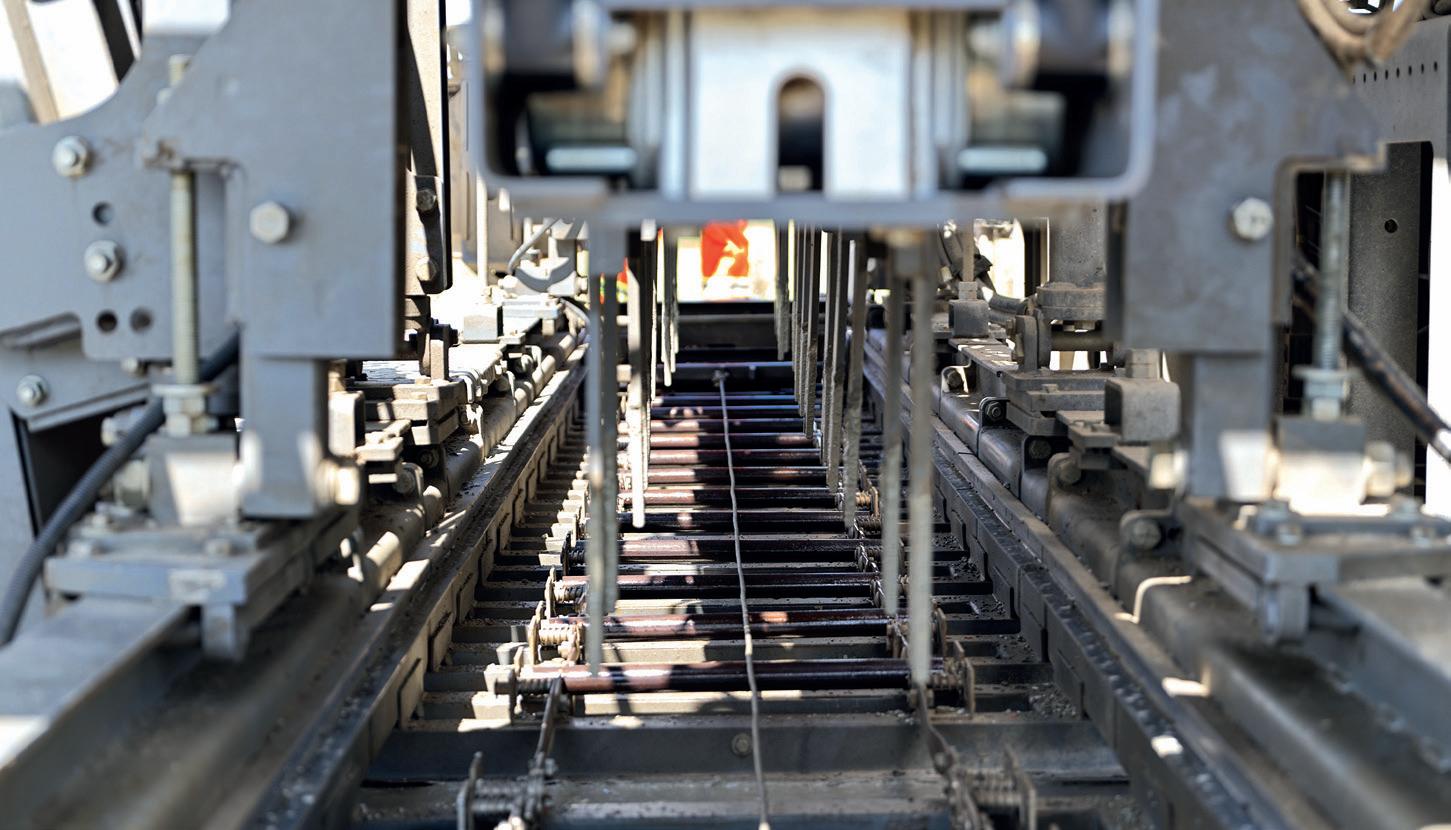

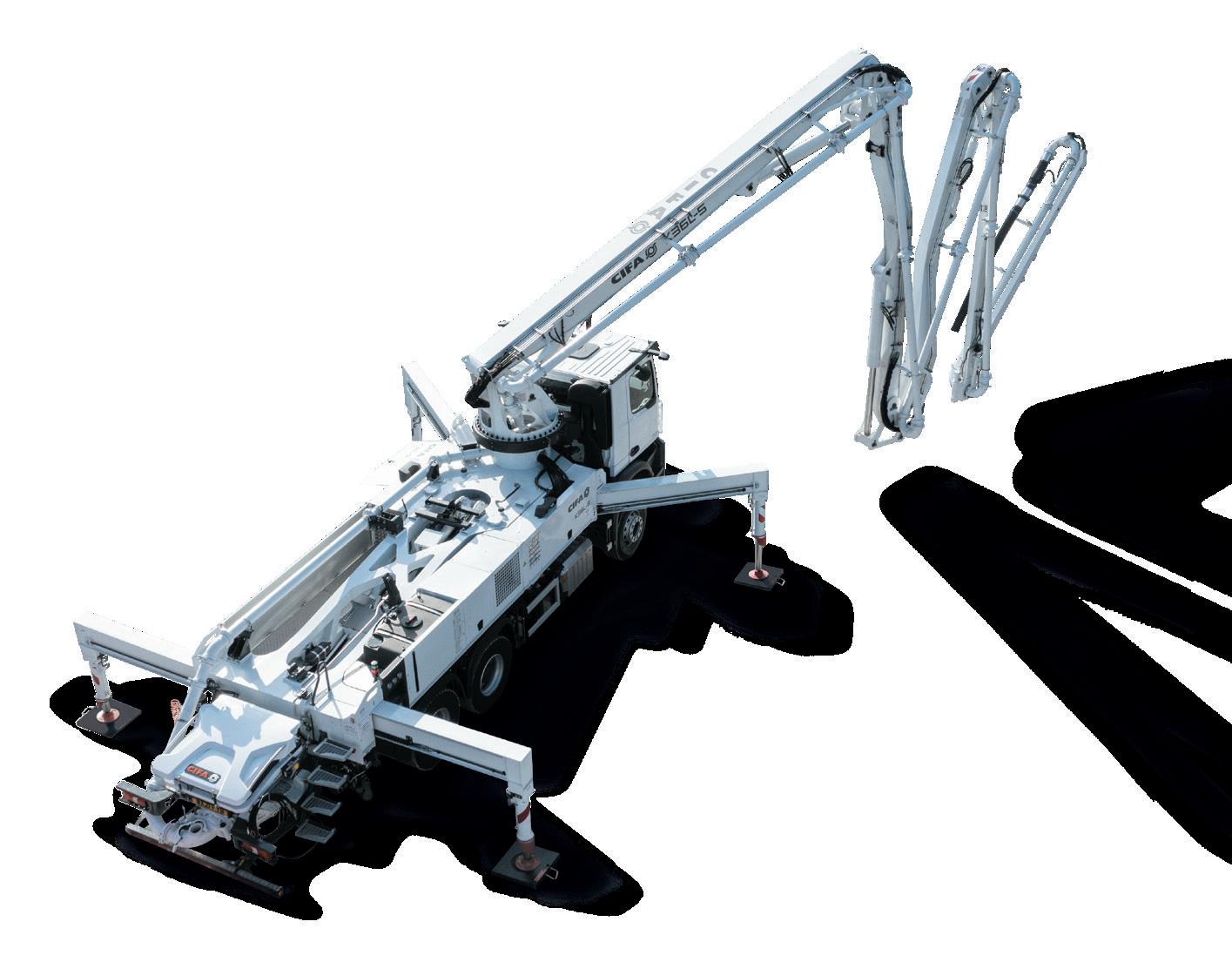
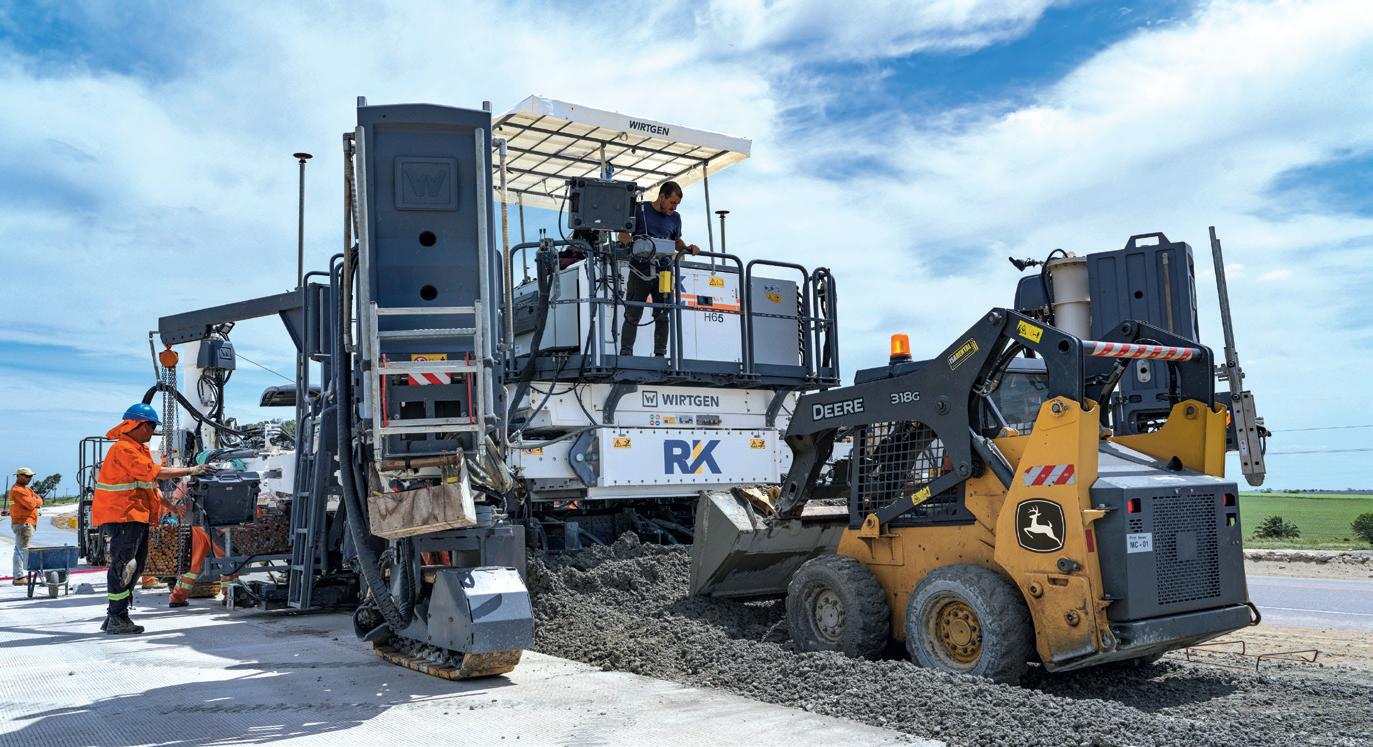
station and re ect its laser beam. The total station determines the position of the prism in three dimensions and transmits it to the machine’s control system. In combination with the inclination sensors on the machine, this enables extremely high precision control of the paver’s height and position.
In comparison to control by a physical stringline, the virtual stringline offers several key bene ts. The paving crew on the Ruta 5 highway was able to move freely around the construction site without having to
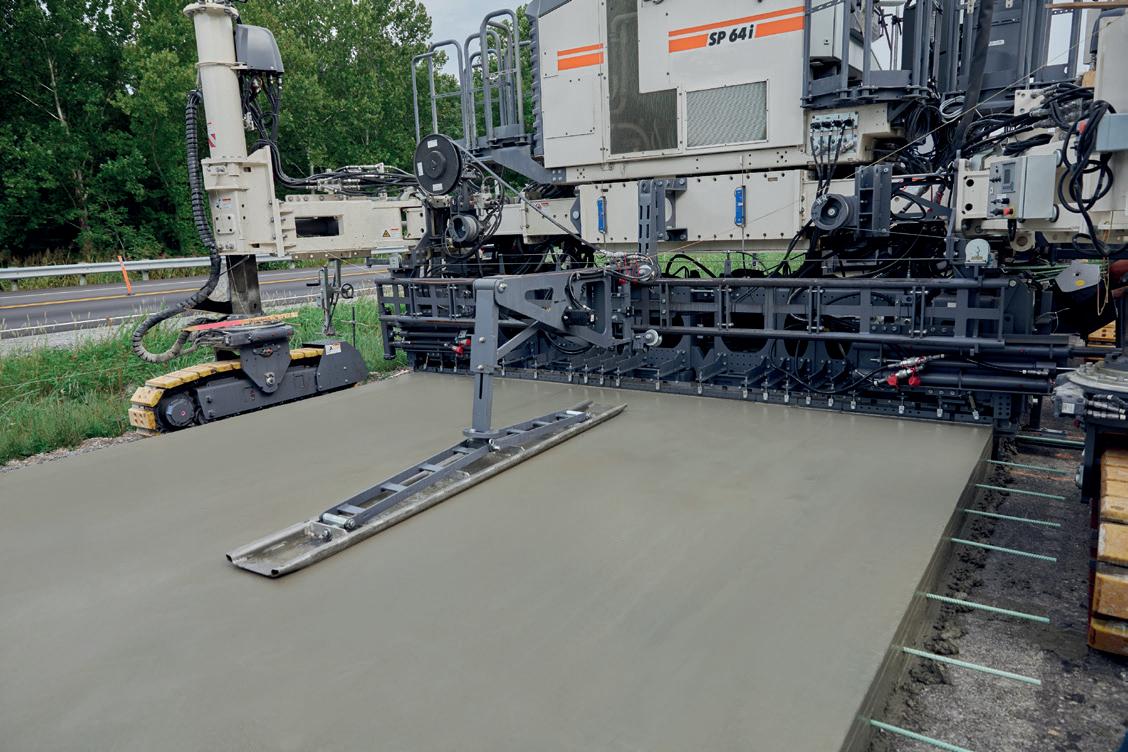
take care not to damage the stringlines. This meant that there was more room to manoeuvre the machines and vehicles. The drivers of the tipper trucks delivering the concrete did not need to concern themselves over a stringline being in the way. They were able to drive right up to the slipform paver to of oad the concrete anywhere on the site. Time consuming detours to avoid the stringlines when leaving the site were no longer necessary. Apart from the better site logistics, the project managers also managed
to achieve a high quality International Roughness Index (IRI) with the system.
The work was carried out in two separate sections, one of 30km from Peaje Mendoza – City of Florida and one of 45km from City of Florida - Sarandí Grande. The road was surfaced to a depth of 220mm with an overall paving width of 15.6m, while the lane widths varied from 3.9-5m.
Wirtgen Group
www.wirtgen-group.com
Electric slipforming has been carried out with machine control technology from Leica Geosystems.
Leica Geosystems, part of Hexagon, and Roos Groep, a specialist in road construction are trialling the use of a fully electric slipform paver, guided by Leica Geosystems’ 3D machine control solution.
Roos Groep has collaborated with several partners to deliver an emission-free slipform paver that integrates cutting-edge technologies. This machine enables fossil fuel-free operations while prioritising safety and
ergonomics.
Roos Groep decided to boost the productivity of the electric slipform paver by integrating Leica Geosystems’ MC1 3D machine control solution. The system features which include dual GNSS for heading and a total station for precise height control, ensure millimetre accuracy and simpli ed installation. Utilising machine control on top of a zero-emission slipform paver reduces operational downtime and optimises energy ef ciency, maximising its environmental and performance bene ts.
In addition to Leica
Geosystems providing a 3D machine control system, key collaborators included Statec for design and drafting, StaadFusion for batteries, Hightide for hydraulic components, Hydrocan Engineering for automation and Degra for electro-hydraulic components. Structural elements were provided by TJP Bladel and Van de Brand Metaal, with Ingenieursbureau Van Asseldonk offering advisory services and CE certi cation. The rst job for this innovative slipform paver was to lay a bicycle path in the municipality of Reusel. The electric slipform paver is
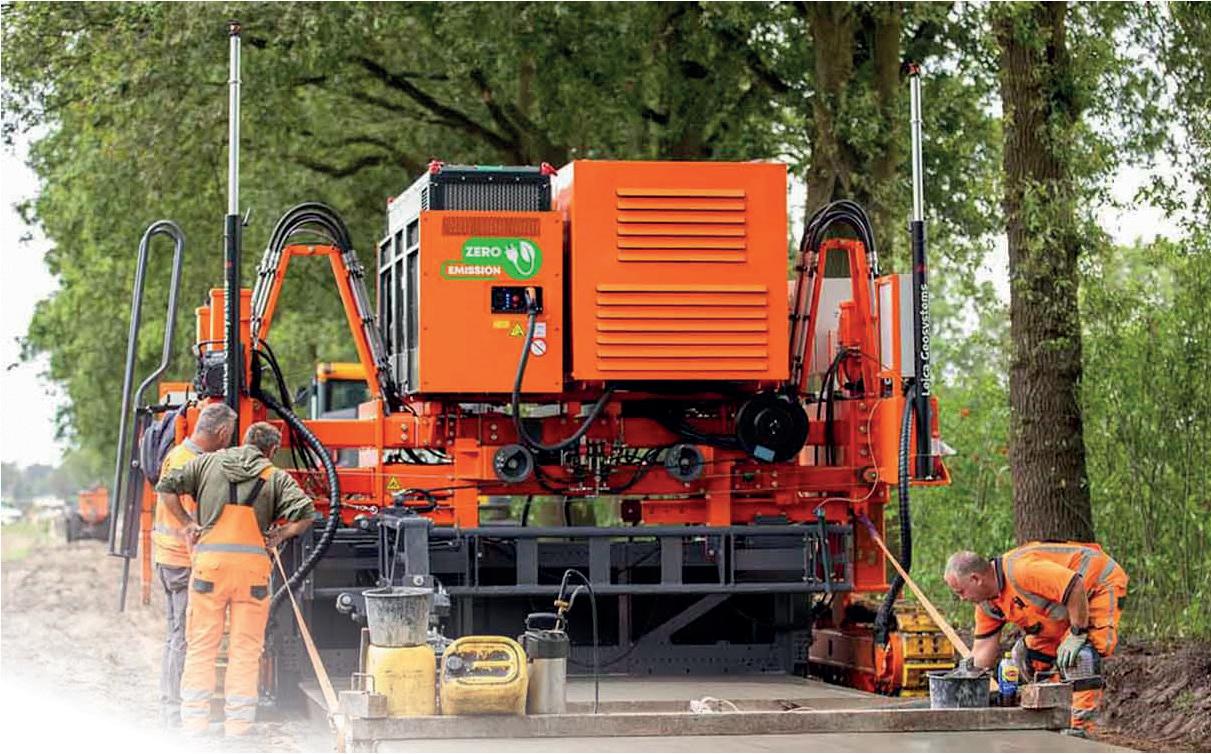
equipped with a rechargeable or swappable 400kW battery pack, allowing approximately 10 hours of production of concrete to be laid on a single charge. This is signi cant for projects such as bicycle paths, bus lanes, and roads up to 5m wide. Roos Groep maintains a long-term relationship with Leica Geosystems, not only due to its advanced 3D machine control technology but also because of the excellent collaboration with the local support team. Additionally, the system's exibility and adaptability make it easily integrated with any heavy machinery. Installing

Roos Groep and Leica Geosystems have come together to deliver electric slipforming with machine control technology

the Leica MC1 3D machine control solution with the 1UP con guration, combining dual GNSS for heading and total station for precise height control, enables the machine to follow the design with millimetre accuracy. This setup simpli es installation, reduces set-up time, and lowers costs by requiring fewer total stations and eliminating the need for RTK corrections. Roos Groep selected the Leica MC1 solution not only for its exibility but also for its seamless integration with various construction machines. Whether used in earthmoving applications or concrete paving, the hardware (panel and the GNSS) is interchangeable between different types of machinery, thereby fully utilising the investment. Besides, the system allows a smooth work ow between the of ce and the eld. Design models can be created using CAD software with 3D modules like Bricscad or iCON Of ce. Roos Groep expects that in the future, nearly all concrete pavement jobs will be executed electrically. The next step in their sustainability vision is ensuring that their employees can also travel to project sites in the most sustainable manner. The launch of the zero-emission slipform paver by Roos Groep marks a signi cant advancement toward a sustainable future in the construction industry. Through innovation, collaboration, and a commitment to environmental friendliness, Roos Groep has set a new standard for infrastructure projects. The successful deployment of this groundbreaking machine in Reusel is just the beginning of a green revolution in construction.
Leica Geosystems
www.leica-geosystems.com
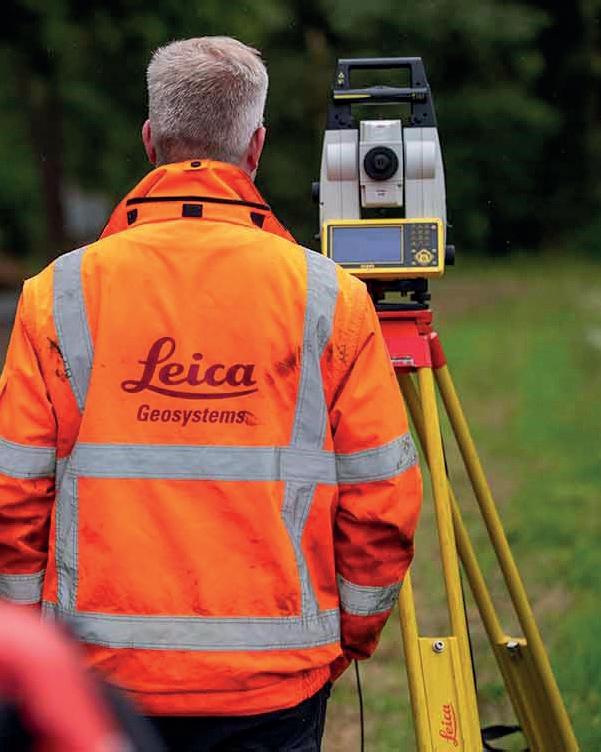
Cemex is expanding its truck mixer eet in Mexico with the addition of electric mixers. The machines have been bought as part of the rm’s strategy to decarbonise its global eet.
This initiative is a key component of the company’s Future in Action program, which aims to achieve net-zero CO2 emissions by 2050.
The electric concrete mixers o er full-load capacity and can operate for a full day without needing to recharge. Cemex has already introduced similar mixers in Germany and Dubai and plans to expand into France, Spain, Poland, and the Czech Republic.
Committed to sustainable transportation, the company has also invested in more than 1,000 heavyduty trucks powered by renewable diesel and natural gas. These key transitional technologies will reduce carbon emissions in the short term as heavy-duty electric vehicles become viable on an industrial scale.
Cemex is a founding member of the First Movers Coalition (FMC), which brings together business leaders

with global footprints to create market demand for zero-carbon solutions in this decade and jump-start the scaling of these emerging technologies. The FMC is working with its members so that approximately 30% of their heavy-duty on-highway transport purchases are zero-emission by 2030. Cemex
www.cemex.com

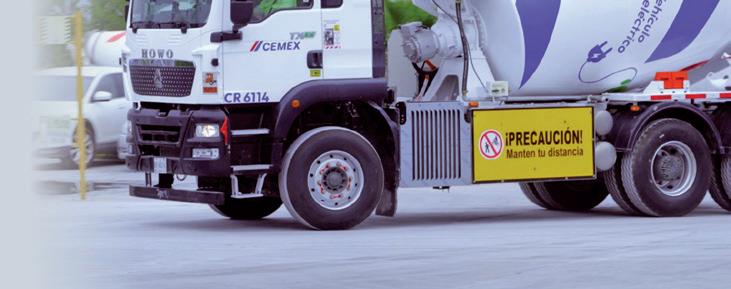
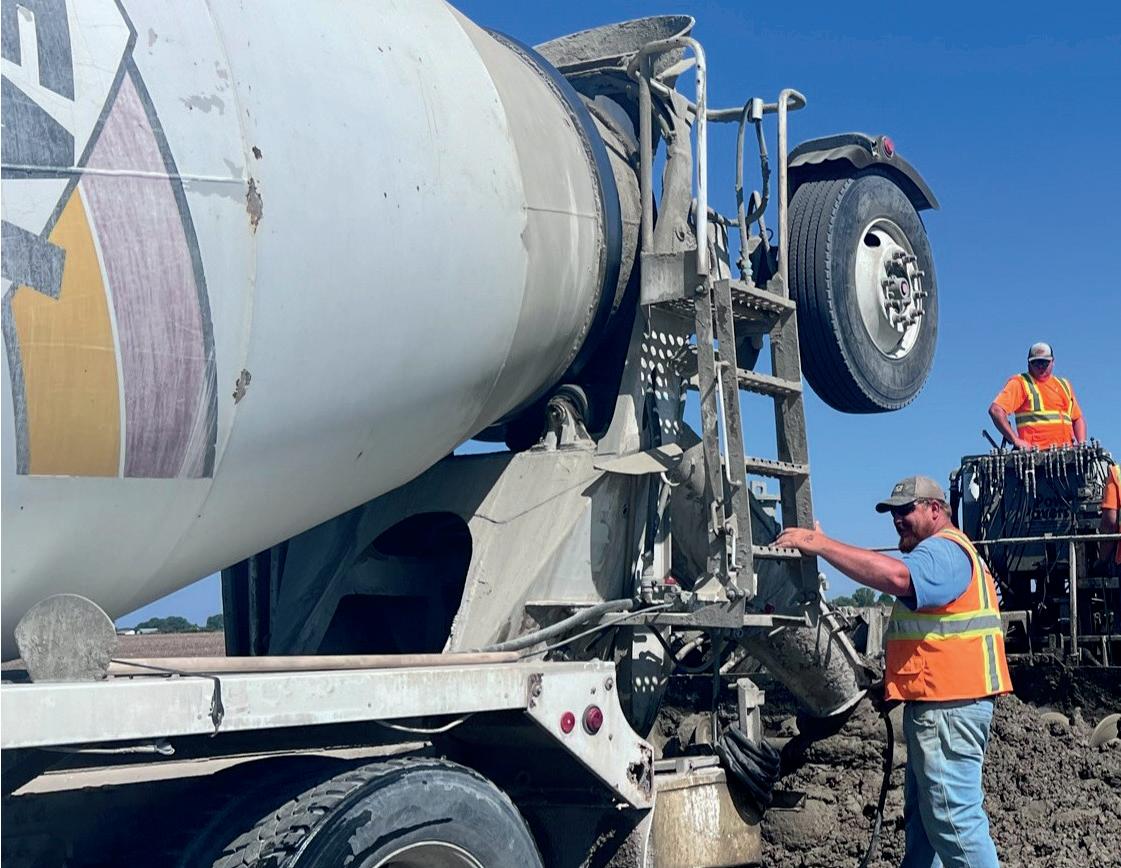
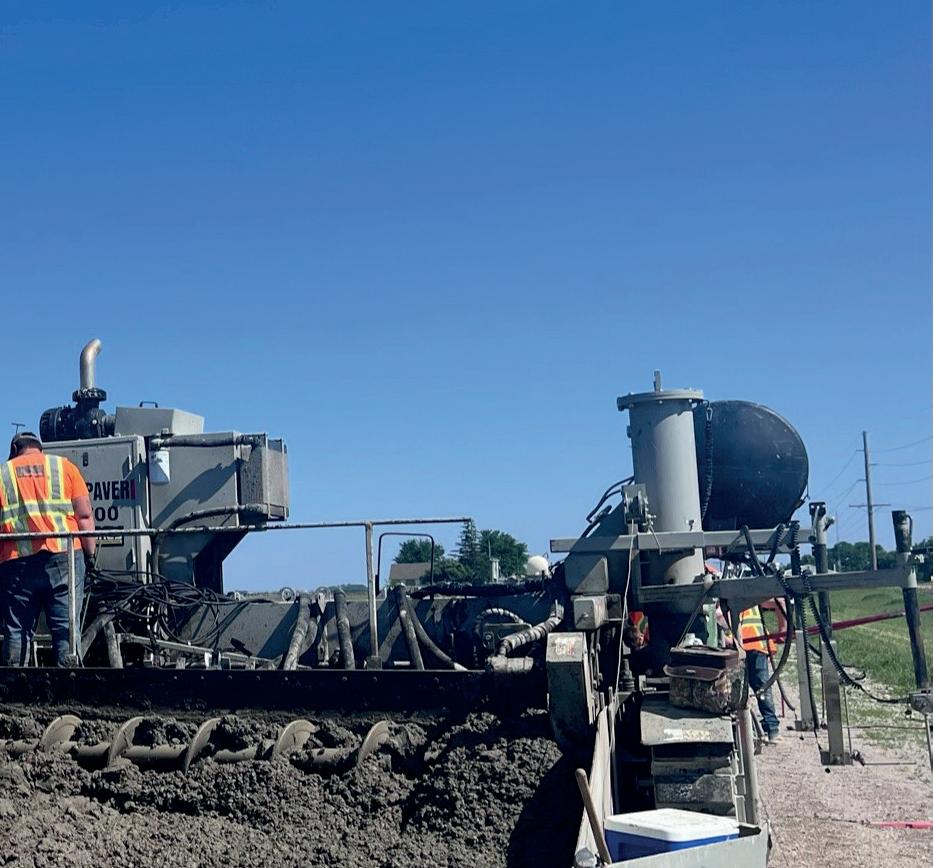

Specialist rm Jones Contracting Corporation won the contract for paving nearly 4km of county road adjacent to the Lee County Fairgrounds in Iowa earlier this year. The rm knew meeting the schedule would be critical as the road would be a crucial link for the upcoming county fair. Some 15,000 people were expected to attend the fair.
The project schedule established by Lee County was for the work to be completed in 35 working days. However, Jones Contracting completed it in just 25 ½ days.
The project, along the Business Route of County Road 218, ran from just north of the town of Donnellson to the county fairgrounds, then jumped to the south of the town. Overall, it included 3.8km of 102mm concrete overlay on top of the existing asphalt roadway, as well as 10 driveways and installation of new shoulders. The work was done in May, ahead of the heaviest heat of summer when the heated asphalt of the existing pavement might
be problematic.
For the Lee County Overlay Project, both of the company’s Power Paver SF-1700 and SF-2700 slipform pavers were used. The company also has a TC-2700 texture/curing machine and a Power Curber 5700-D curb and gutter machine.
Upon completion of the job, Jones Contracting only had to grind the concrete at three headers, indicating that the concrete was smooth and required minimal reworking.
The company has been in business for ten years, and Patrick selected Power Pavers for his choice of machinery early on. “We’re extremely happy with Power Pavers. They are really great people to work with. They are located just up the road in Cedar Falls, so getting parts is easy,” said Patrick, adding, “And the machines they build are reliable and built to last.”
Power Curbers & Power Pavers www.powercurbers.com



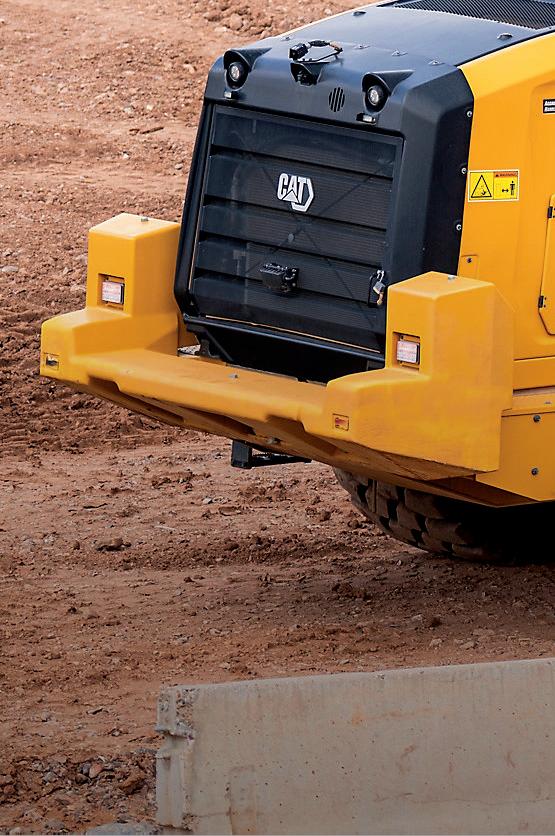
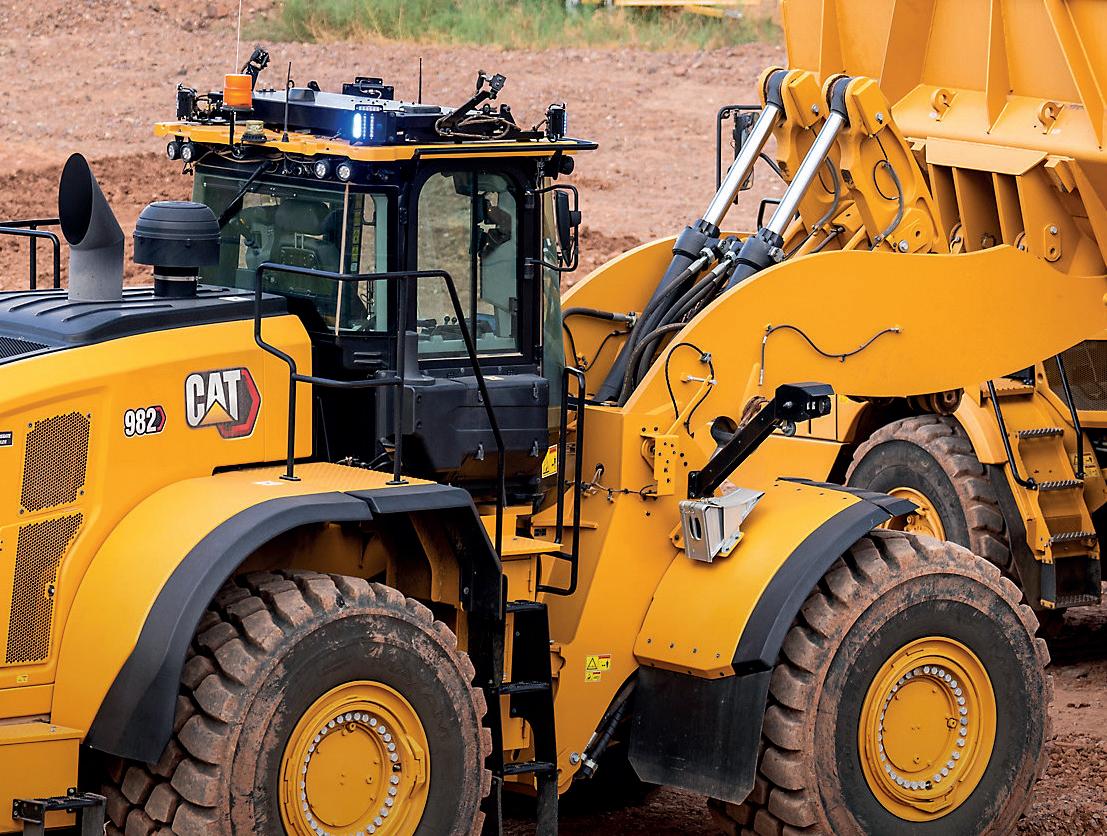

A

Caterpillar and Komatsu are introducing innovations and new models for the wheeled loader market. From Caterpillar comes the availability of its sophisticated Cat Command for Loading system for the rm’s medium wheeled loaders.
This advanced remote control package allows for the removal of the operator from the machine, meaning that the equipment can be used in extreme environments without risk to personnel.
The system allows semi-autonomous remote control of the company’s next generation mid-size loaders, although not on the GC variants. Cat Command for Loading can now be used with the Cat 950, 962, 966, 966 XE, 972, 972 XE, 980, 980 XE, 982 and 982 XE next-generation wheeled loaders.
con gurations.
Allowing the user to control the machine from a safe location, Command maintains high machine productivity in operating environments. The package is fully integrated with the loader’s electronic and hydraulic systems for quick response and smooth control.
Highly versatile, the control system allows easy switching between remote and manual incab operation. The hardware comes complete in a dealer-installed package that includes a low-pro le design on the roof of the loader, requiring no welding or wire splicing for ease of tting.
The ergonomic console features basic machine controls such as wheeled loader startup/shutdown, bucket rack/dump and lift/lower are easily accessed through the ergonomic console control layout. Operator inputs are sent directly to the machine’s electronics from the console. Integrated
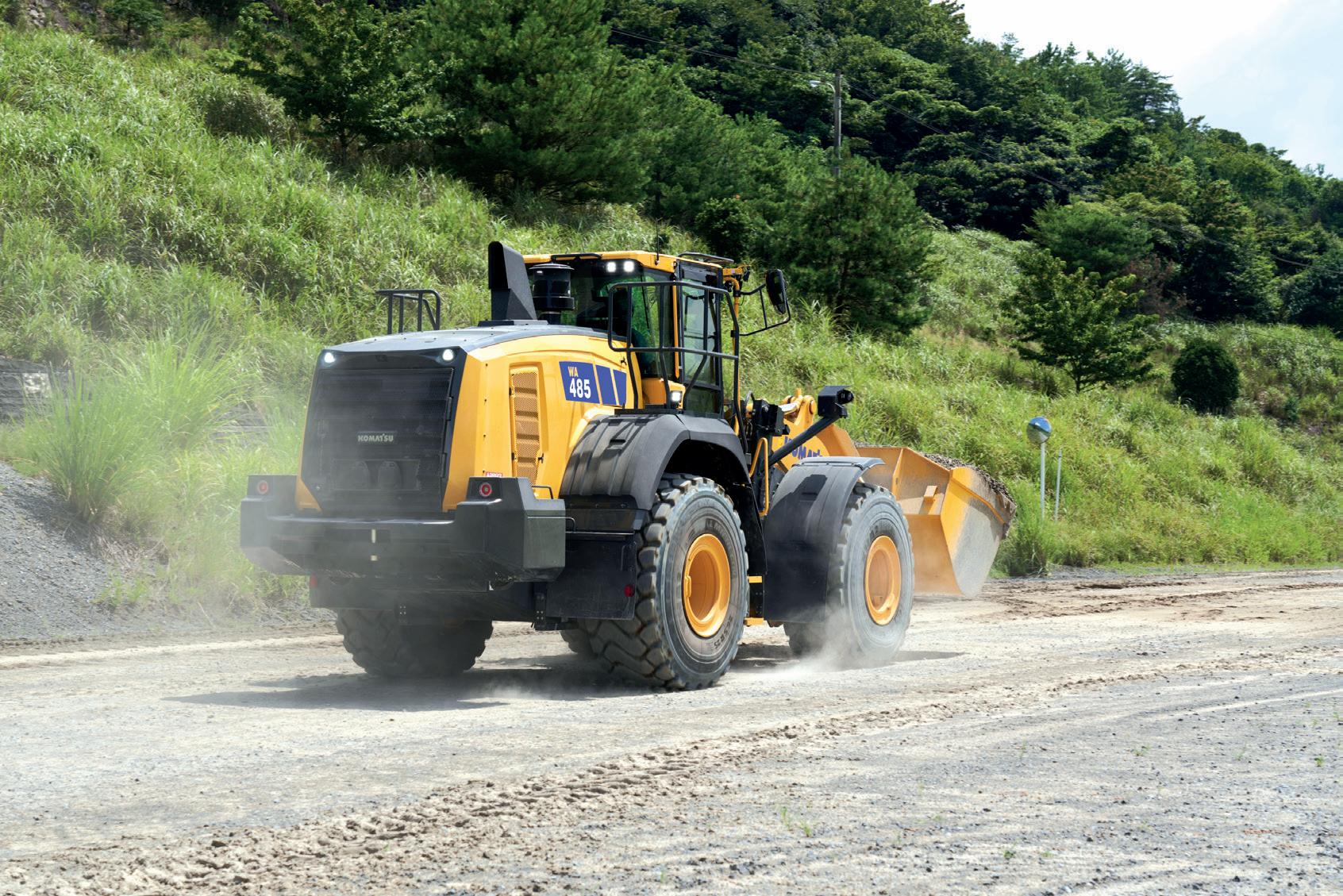
detected, or the console is tilted more than 45˚ from normal operating position.
For non-line of sight operation, the Command for Loading station connects to multiple machines at the same jobsite or different sites. The user can operate one machine at a time either onsite or from miles away. It is compatible with other Command offerings for Cat equipment, including excavators and dozers.
Komatsu meanwhile is introducing the WA475-11 and WA485-11 wheeled loaders to its mid-sized range and the new WA700-8 to its array of large models.
The WA475-11 and WA485-11 models bene t from advanced technology and offer high performance, ef ciency, and operator comfort. The newly developed Komatsu diesel engine delivers high torque in the low speed range. This is combined with a Komatsudesigned hydro-mechanical transmission (HMT), delivering high performance, fuel ef ciency and ease of operation for all transport and loading tasks.
The WA475-11 offers a 14% improvement in fuel ef ciency over the Dash 10 predecessor, while the WA485-11 delivers a 29% gain in fuel ef ciency compared to the earlier WA480-8.
The constant variable gear ratio ensures that the engine works ef ciently. Variable speed control allows the operator to adapt maximum speed to the requirements of the jobsite, while limiting wheel spin in dif cult conditions.
Compared to its predecessor WA480-8, the WA485-11 offers a gain in payload and bucket capacity. All machine components have been adapted to a permanent payload of 8.8tonnes and can be increased to 9.3tonnes in an aggregate handling variant.
The new emissions control systems meets Tier 4 Final/Stage V standards, while the proven exhaust system includes a diesel
particulate lter (KDPF). Together with the Selective Catalyst Reduction (SCR) system, this further reduces NOx emissions.
The new variable power control system enables the lifting speed to be controlled independently of the accelerator pedal, while the optimised Z-bar linkage offers up to 20% more lifting power and higher production.
The new cab offers better visibility and has an interior noise level of just 70 dB(A). The seatmounted electronic pilot control levers have a new ergonomic design and improve operating comfort.
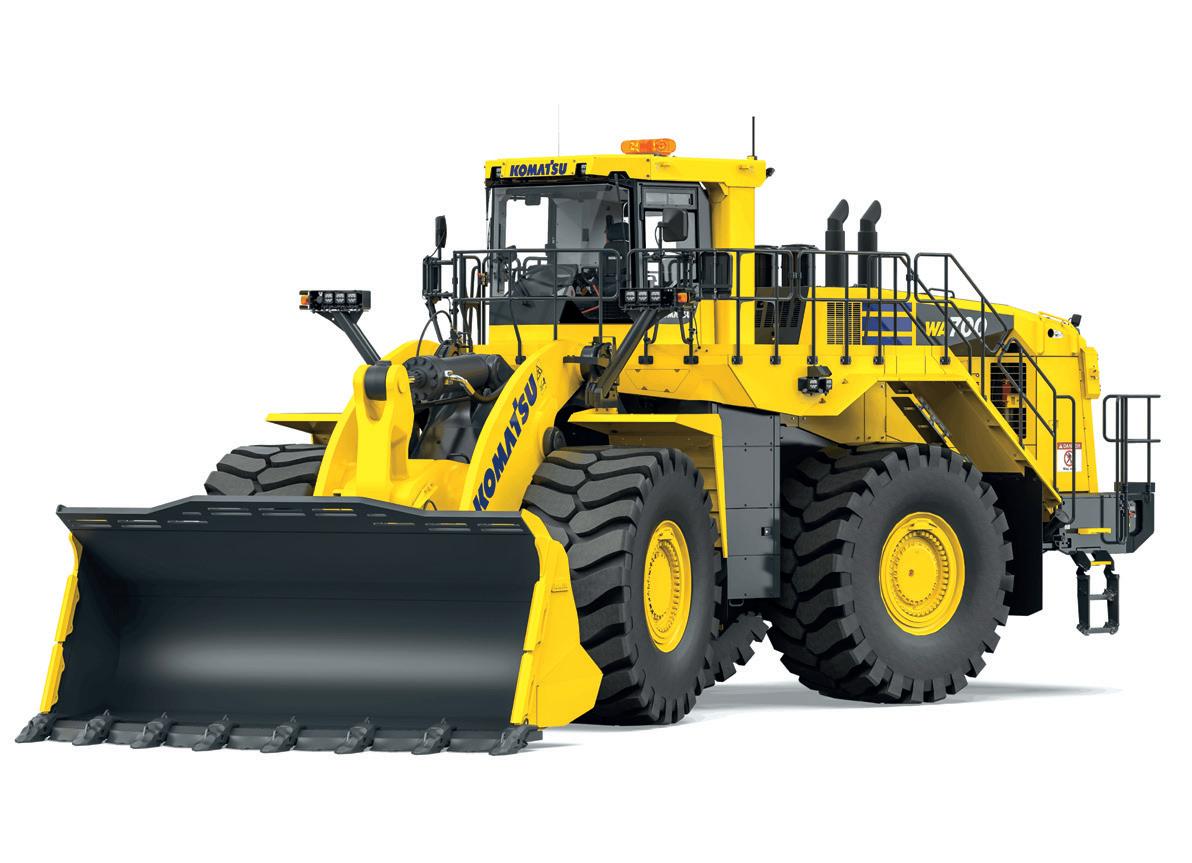
A digital driver information system provides important machine measurements, including KDPF status, AdBlue levels and fuel consumption. Messages from the ECO control system are displayed in real time during operation and on the exit screen when the ignition is turned off.
Another key innovation is the newly developed Angle-Feedback-Joystick-Steering (AFJS) without a steering wheel, which gives the driver feedback on the steering angle achieved at any time via the position of the steering lever.
The programmable engine management
system automatically switches the engine off when idling. KOMTRAX telematics and the Komatsu Care customer maintenance program ensure effective eet management and support, protecting the machine from misuse and maximising ef ciency and uptime.
The new Komatsu WA700-8 wheeled loader optimises productivity and fuel ef ciency for heavy-duty operations. Equipped with advanced engine technology and a redesigned Komatsu bucket, it bene ts from increased lifting force and a large-capacity torque
Rokbak claims increased uptime for its ADTs due to sophisticated telematics.
The simple, user-friendly telematics package is said to help customers make data-led decisions about the maintenance of their machines for increased availability, lower repair costs and a longer lifespan.
Using Haul Track telematics, site managers keep track of data from a Rokbak RA30 ADT in real time.
According to Garry Moore, a customer support manager for Rokbak, “More and more customers have been engaging with our Haul Track telematics system over the last few years. Some even have full ‘command centres’ lled with screens as they monitor data from their eets in real time.”
The Rokbak Haul Track telematics system comes as standard on the RA30 and RA40 ADTs. Its simplicity and userfriendly interface are what set it apart, enabling customers to access actionable insights and make data-driven decisions about their eet management.
For example, online portal includes tools such as Fleet
Manager and Fleet Tracker allow users to customise dashboards according to their priorities and targets, set maintenance parameters and receive automated reports and email alerts. The online Haul Track portal includes a dedicated maintenance section with a list of all machines due for attention and their service requirements. This allows eet managers to stay on top of regular maintenance requirements and address minor issues before they turn into serious and expensive problems. This proactive maintenance approach leads to greater equipment uptime and

converter with standard lock-up for enhanced performance.
Weighing just over 97tonnes, the WA700-8 wheeled loader is powered by an emissions compliant engine rated at 570kW and has a bucket capacity of 9.2m³. The rm says that the machine bene ts from a redesigned bucket that helps boost productivity and durability. The increased radius and oor inclination make the bucket easier to ll and helps material retention. The new spill guard design gives improved visibility to the pile, while sweeper wings on either side help to protect the front tyres. The WA700-8 is equipped with Komatsu SmartLoader Logic, an engine control system ensuring the correct torque is delivered for each work phase. For example, torque needs are higher for digging in V-shape loading, but less when driving with an empty bucket. This system optimises torque for all applications and minimises fuel consumption. Komatsu SmartLoader Logic functions automatically without affecting operation, saving fuel while maintaining performance.
Caterpillar www.cat.com
a longer lifespan, as well as a reduced total cost of ownership (TCO).
Besides service reminders, Haul Track can also be con gured to directly alert eet managers via email to fault codes that signal potential issues before they escalate. This capability not only protects key components but also helps maintain effective operation and minimise downtime.
Recognising that many customers operate mixed-brand eets, Rokbak has integrated the Haul Track telematics system with the AEMP 2.0 API, the industrywide standard that enables management of telematics
data across various equipment brands.
Rokbak also offers an OnBoard Weigh load system that comes with a separate human machine interface screen connecting to Haul Track to provide live payload data. When combined with the On-Board Weigh system, Haul Track helps operators to maintain the optimum payload, promoting ef cient operation, protecting key components and supporting the long-term health and reliability of the equipment.
Rokbak www.rokbak.com


A new telematics package makes maintenance easier for owners of Rokbak ADTs





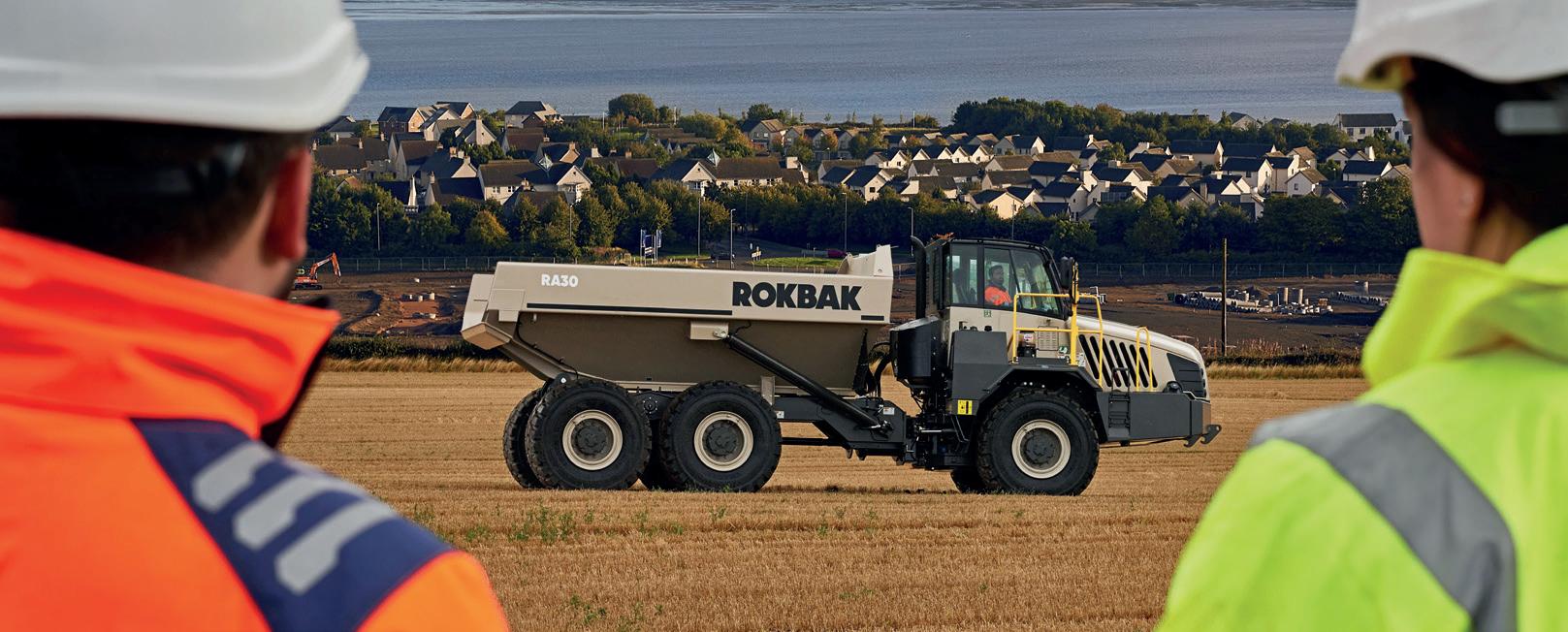
is investing in research into clean power technologies for the future

Cummins is working with Holtex and the University of Manchester on Project Unity. This will see the development of an advanced digital tool aimed at improving the design and durability of components used in hydrogen-fuelled powertrains
With £2.4 million in funding from the UK Government, Cummins will head Project Unity from its Huddersfield, UK facility. This project is using machine learning driven digital tools to accelerate speed to market by predicting long-term failure modes in critical powertrain components.
By reducing the need for physical testing, this approach will speed the development process through to market availability. The approach will also improve reliability and development efficiency.
The project focuses on collecting real-world data on components such as turbomachine turbines, compressors, and bearings used in hydrogen-powered systems. This allows the generation of advanced simulations for robust, data-informed design improvements.
The UK Government funding package will be leveraged by Cummins and its partners to deliver the project. The award is provided through the Advanced Propulsion Centre UK(APC)’s Collaborative Research
and Development funding round (APC25) and delivered in partnership with Innovate UK, a part of UK Research & Innovation.
Project Unity is one of the eight projects sharing £29.6 million of the UK Government grant. APC collaborates with the UK government, the automotive industry and academia to accelerate the industrialisation of technologies, supporting the transition to green transport.
With its expertise in net-zero technologies, APC’s role in building and advising project consortia helps projects start more quickly and deliver increased value.
Innovate UK is the UK’s national innovation agency. It drives productivity and economic growth by supporting businesses to develop and realise the potential of new ideas, including those from the UK’s research base.
“Building on previous successful APC projects, Cummins is excited to announce APC 25 Project Unity,” said Laith Al-Kazaz, director of Advanced Engineering at Cummins. “This project will support Cummins Destination Zero strategy by enabling the accelerated product development of reliable lower carbon emission powertrains. We have a proven track record with our UK-based partners and look forward to advancing our capabilities in these novel technologies.”
Typically, Original Equipment Manufacturers (OEMs) ensure component reliability through extensive physical testing. However, Project Unity introduces a mixed-fidelity machine learning approach to predict key failure modes, including hydrogen effects, water droplet erosion, and structural integrity. The tool will be applied to fuel cell (FC) e-turbo and hydrogen ICE (Internal Combustion Engine) turbocharger components, supported by advanced simulations to accelerate the design process.
With support from the APC, Project Unity not only integrates digital transformation strategies but also supports the transition from diesel ICE to hydrogen powertrains in both on-highway and offhighway applications. This initiative aligns with the Automotive Council's roadmap towards decarbonisation and contributes to Cummins' broader efforts to reduce greenhouse gas emissions.
As the consortium continues its work on this innovative digital analysis tool, it remains committed to supporting the global shift towards energy transition. Cummins www.cummins.com

Volvo Penta said it has completed “a follow-on investment” in UtilityInnovation Group which specialises in resilient utility systems and decentralised energy solutions.
UIG specialises in utility protection and controls engineering, substation and distribution development, microgrid development and grid resiliency.
Volvo Penta, part of the Volvo Group, is a global manufacturer of engines and power systems for boats, vessels and industrial applications, with nearly 3,500 dealers in 130 countries.
Volvo Penta initially invested in UIG, based in the US and Ireland, in 2023. A written statement from Volvo Penta said that the latest investment “marks a continued commitment to driving the energy transition” and it “underlines Volvo Penta’s role in the growing global market for energy infrastructure as an independent supplier of energy-dense battery energy storage (BESS) subsystems.”
The exponential demand for data centre power and the complexity of grid evolution can be met by UIG’s skillset and ability to integrate Volvo Penta’s energy-dense and robust BESS subsystems. “This follow-on investment in UtilityInnovation Group re ects our commitment to advancing reliable and ef cient electri ed power solutions as part of our broader net zero ambitions,” said Anna Müller, president of Volvo Penta.
The investment will support the development and commercialisation of UIG’s energy storage for resiliency (ESR) platform. ESR is intended to enhance power stability, alleviate the load challenges of energy-intense arti cial intelligence or machine learning data



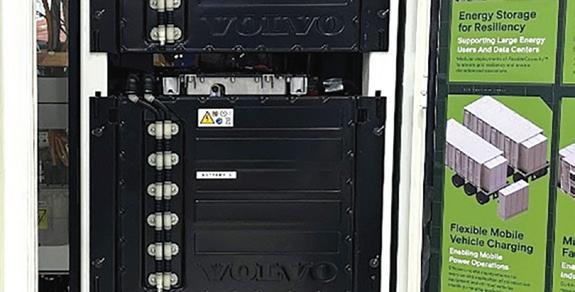
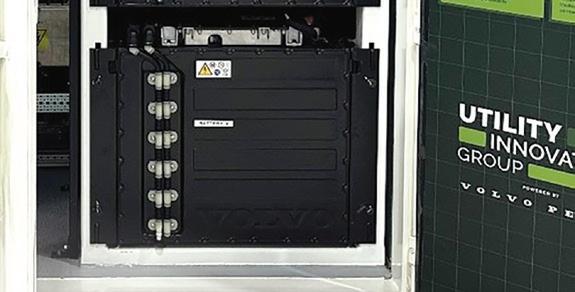

centres and optimise large microgrids. UIG’s integrated controls and asset management platform, GridSure, leverages data-driven insights and cyber-secure AnywhereEngineering tools to manage grid capacity, improve overall system resilience and monitor infrastructure.
“The investment in UtilityInnovation Group highlights the potential we see in our BESS subsystems for high energy demand sectors,” said Hannes Norrgren, president of Volvo Penta’s industrial business. "Entrepreneurial companies like them bring specialised expertise that enhances our


capabilities to meet future demands and accelerate time-to-market with pioneering solutions.”
“[Volvo Penta’s] global reach and commitment to sustainability make them an ideal partner as we work to address the critical challenges facing the energy sector today,” said Sidney Hinton, founder and chief of UIG. The transaction has no signi cant impact on the Volvo Group’s earnings or nancial position.
Volvo Penta www.volvopenta.com
Versatility is claimed by FPT Industrial for its new XCURSOR 13 internal combustion engine.
The XCURSOR 13 is FPT Industrial’s rst multi-fuel single base engine designed to run fuels ranging from diesel and natural gas – including biomethane to provide net zero emissions – to hydrogen and renewable fuels. The engine offers compatibility with a wide range of market requirements and different vehicle installations. The XCURSOR 13 is a primary contributor to achieving CO2 emissions targets, and one of the most signi cant parts of FPT Industrial’s decarbonisation program. This is based on a multiple energy approach and driven by the end goal of providing its customers with the best ready-to-install products.
Starting from a common core, the engine is based on an improved 13litre engine architecture to meet current CO2 reduction targets and be ready for future regulations. The latest versions of the XCURSOR 13 cover multiple segments and on- and off-road missions, combining high performance with reduced weight and fuel consumption, as well as extended durability and reduced TCO.
FPT Industrial www.fptindustrial.com
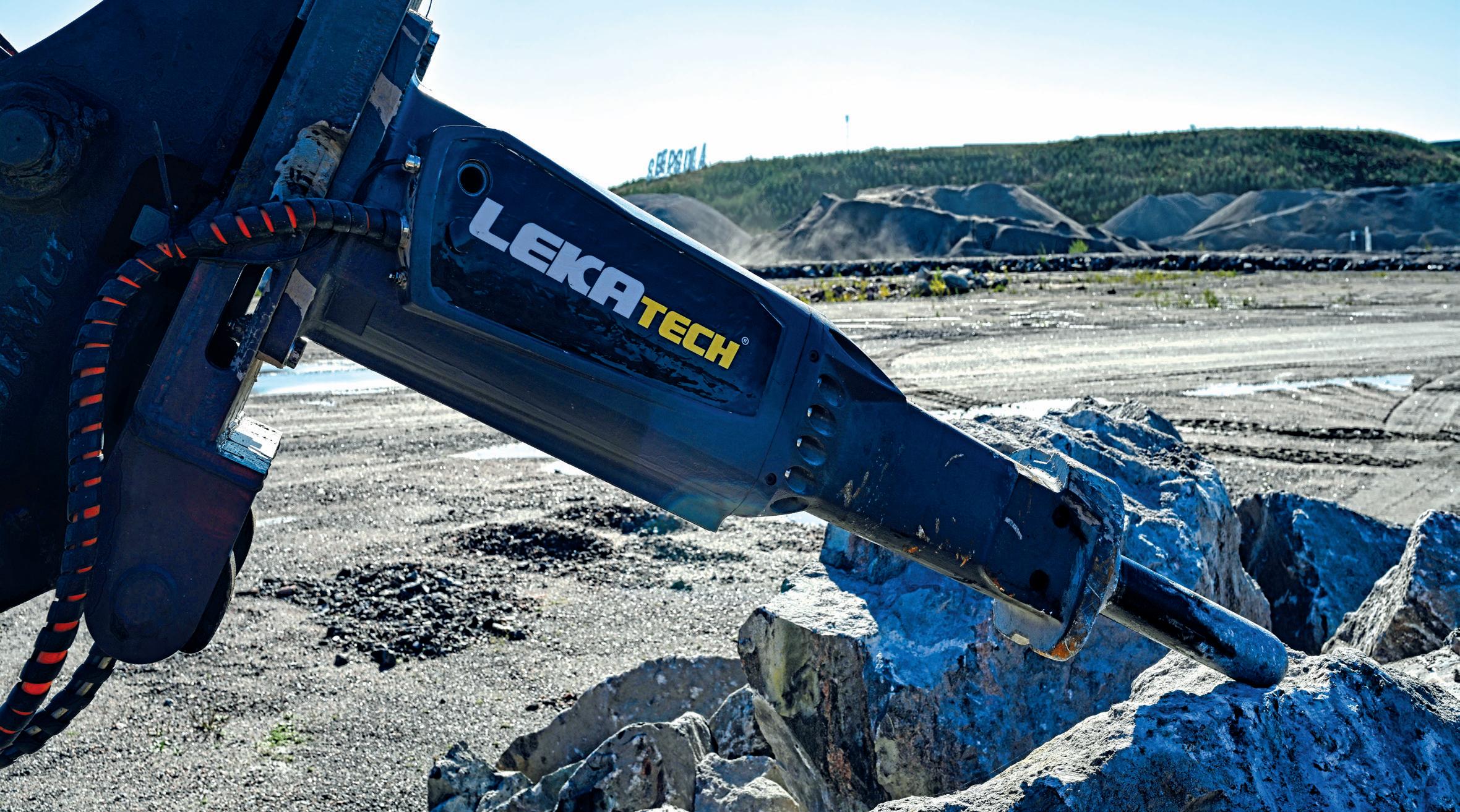



The Lekatech Electric Hammer has been used successfully for eld trials at the Seepsula quarry in Finland using the services of two of Finland’s most experienced hammer operators.
The Lekatech unit features a new and patented linear electric motor technology. The rm claims that this o ers a power to weight ratio superior to similar conventional hydraulic hammers. Coming to market at the same time as electric excavators, the unit meets a growing market demand for electric powered equipment and suits duties in zero or low emission areas. Lekatech chose the Seepsula quarry, located close to the Helsinki-Vantaa Airport, and


two experienced operators to test the new unit. The large quarry is the leading aggregate supplier in Southern Finland, with extensive experience in the use of a variety of equipment used in aggregate production.
During the eld tests the two operators used the Lekatech Electric Hammer to break approximately 1m3 granite boulders, which would then be fed into the quarry’s crushing equipment. Tatu Lehmuskoski of Laitilan Linnee said: “In the beginning, I was surprised because the operator comfort was better than I expected. There was a lot of power, even though it was a rather small hammer." Tatu added, “The noise and vibration levels
Oevermann, a German construction company, has been seeking to improve its use of digital solutions across sites to cut costs and boost productivity.
Based in Meschenich, Cologne, one of Oevermann’s most recent projects was to deliver a core new transport system - the B51N. This road route was built to improve safety and reduce the amount of tra c for local residents.
Oevermann needed to consider the impact of its work across the countryside, with daily deliveries between 500m3 and 900m3 of ll material arriving at the site for distribution by the team.
By utilising the Dashboard functionality from Komatsu Smart Construction, the Oevermann team was able to assess the amount of material being pushed by the eet into position, while lling the cut space through the collection of as-built data that was used to create a digital twin.
The collected as-built data was also able to di erentiate between the materials being used onsite, enabling the site managers to have full
were lower than with traditional hammers.”
Likewise, Jasper Kultanen of Suomen Räjäytyslouhinta was impressed with the Electric Hammer: “The hammer starts quicker and there is full power immediately, unlike with traditional hammers.” He also commented, “The hammer controllability is really good. You can operate the excavator engine with low idling. The power of the hammer is not dependent on the engine revolutions. This is very good for non-experienced operators.”
Kultanen continued, “The hammer is not kicking back to the excavator; I think the idle blow preventing system helps. The
tracking capability of the supply throughout construction. Through the use of Dashboard, contractors could also analyse the cost of the cut and ll process, allowing teams to ensure quoting and budgeting was accurate, improving pro tability informed by data. A digital twin also o ers the site manager the ability to compare the most recent as-built terrain surface with the intended design le, making it easier to understand how far the project has progressed.
In the case of the construction of the B51N, the Oevermann team was able to unlock a system that managed sta requirements onsite more e ciently and informed the team that a smaller dozer was required to move materials, reducing costs.
starting of the electric hammer is like starting an electric car, no delays with starting and full power available immediately. Low noise and vibration levels were positive surprises when trying out the hammer. The power seemed to be quite good considering the size of the hammer.”
Lekatech claims that its unit is designed with operator comfort in mind, delivering 70% better e ciency than hydraulic hammers, double the impact energy and 98% lower oil consumption. The rm says that these bene ts were shown during eld testing.
Lekatech www.lekatech.
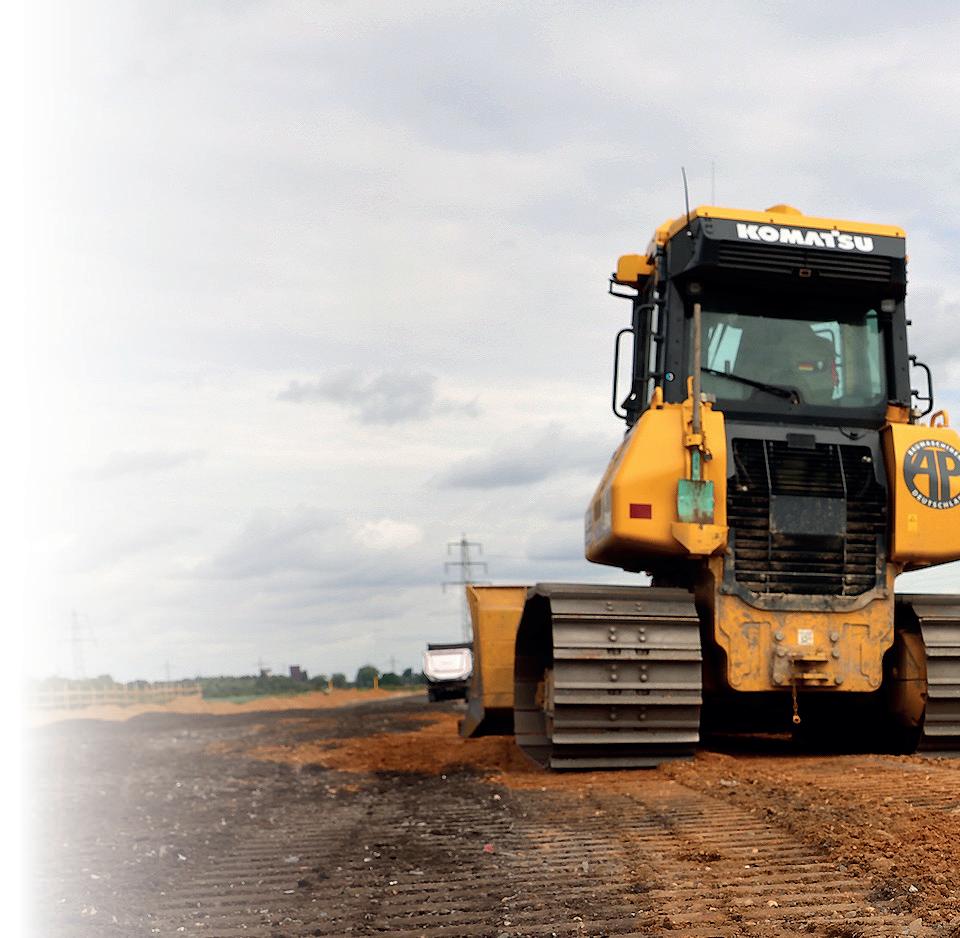
Surveying costs were largely eliminated as drone data enabled teams to avoid the need for surveyors to monitor the site, providing extensive savings over the 18-month project.
Smart Construction Smartconstruction.io

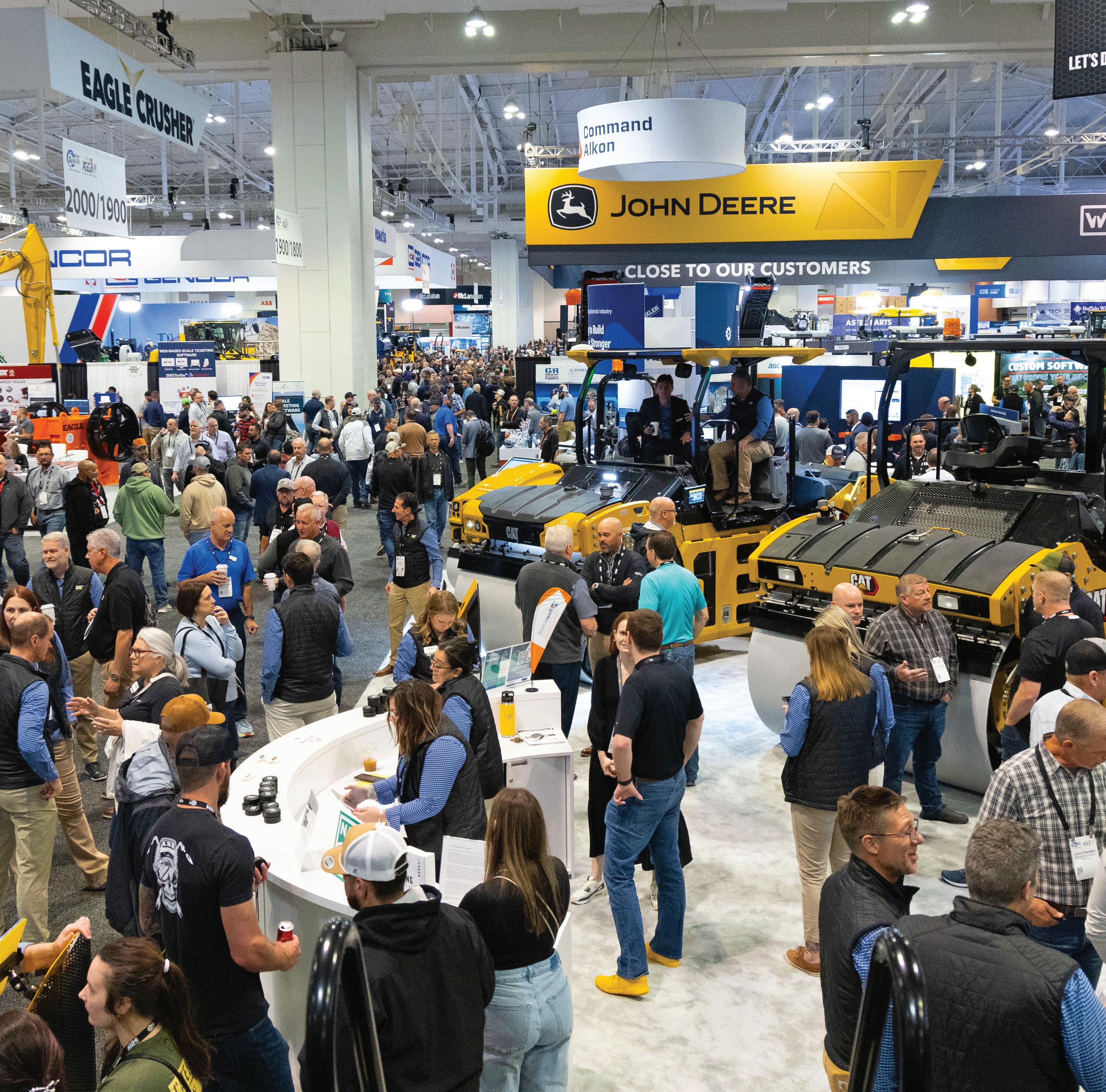
• See the Latest Equipment
• Learn Best Practices and Techniques
• Improve your Jobsite and Business March 25-27, 2025 | St. Louis, MO Use SAVE20 to Receive 20% Off your Admission to World of Asphalt