






















Key bridge and tunnel advances p40

























































Vol. 33 Issue No.1 JANUARY/FEBRUARY 2024
5. Contra ow
Lower speed limits mean fewer crashes and casualties: it’s physics
6. News
Strong results at Volvo CE; Mumbai Harbour link open; new roads for Morocco; Texas highway project

10. Construction technology
Sophisticated systems can deliver ef cient construction from Komatsu, Hexagon, Topcon Positioning and Trimble
16. IRF
IRF World Congress – call for abstracts; advancing traf c management at TRB 2024; GRA winner Xingyi Ring Expressway
20. Highway managemnet and safety


AI innovation; road data; dynamic charging; Kapsch in Latvia; Vaisala weather station; Wavetronix; Ride ag tracking














26. Intermat preview
Key innovations for the upcoming Intermat construction machinery exhibition in Paris in April 2024, which will be a major technology launch platform for the industry
29. Asphalt paving and milling
New advances in asphalt paving and milling equipment offer ef cient road building
33. Asphalt plants
New low emission asphalt plant technologies are coming to market
36. Road recycling
Wirtgen expands its milling line-up
37. Bitumen technology
Carbon counting; price conscious bio-binder; increasing recycled content
40. Bridges & tunnels
Faroe Islands tunnel; Peri purchase; Elbe Bridge project; Czech bridge upgrade; Gordie Howe update; Kapsch tunnel system; LA Bridge wire theft; Nantes bridge
44. Engines
Sophisticated battery systems are coming to market, while major engine makers are developing new units that can use hydrogen as fuel
48. Equipment
Kobelco’s versatile mini excavator; Mecalac’s electric loader; Komatsu offers electric excavator option
49. Onsite
Hitachi machine for Swiss Alpine road job; Teleo remote controls on John Deere machines deliver safety for John Aarts
50. Skidmarks
Further humorous roadrelated stories from around the world
Between pages 10 and 11
eu1-eu5
CECE’s new president; disruptive road works; Komatsu’s electric offering; Unicontrol system on Volvo CE machine. Kleemann equipment in Greece; Bobcat system for Europe and Israel
em1-em9
Loan for Honduras road works; Road building in Ivory Coast; Volvo CE loader for emerging market; Framma crane for emergent territories; Partha Basistha reports on India’s Excon construction machinery exhibition
DE1-DE5. Key project
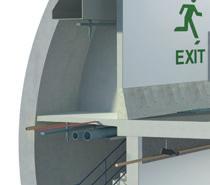
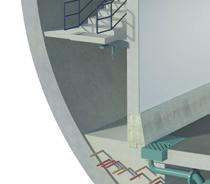
A second view at Seattle’s Alaskan Way Viaduct replacement tunnel, David Arminas reports



































Editor: Mike Woof
Deputy Editor: David Arminas
Sub-Editor: Kevin O'Shea
Contributing Editor: Guy Woodford
Editorial Contributors:
Shem Oirere, Kristina Smith, Mauro Nogarin, Eugene Gerden, Partha Basistha, Lucio Garofolo
Designers: Simon Ward, Andy Taylder
Production Manager: Nick Bond
O ce Manager: Kelly Thompson
Internet, IT and Data Services Director: James Howard
Web Manager: Sarah Biswell
Social Media Manager: Tatyana Mechkarova
Managing Director: Andrew Barriball
Chairman: Roger Adshead
Publishing Director: Geo Hadwick
ADDRESS: Route One Publishing Limited, Second oor, West Hill House, West Hill, Dartford Kent DA1 2EU, UK
Tel: +44 1322 612055 Fax: +44 1322 788063
Email: [initialsurname]@ropl.com
(eg: radshead@ropl.com)
ADVERTISEMENT SALES
Head of Construction Sales: Graeme McQueen
Tel: +44 1322 612069 Email: gmcqueen@ropl.com
Sales Director: Philip Woodgate
Tel: +44 1322 612067 Email: pwoodgate@ropl.com
Sales Director: Dan Emmerson
Tel: +44 1322 612068 Email: demmerson@ropl.com
UK / CLASSIFIED, NORTH AMERICA: Dan Emmerson
Tel: +44 1322 612068 Email: demmerson@ropl.com
ITALY: Fulvio Bon glietti
Tel: +39 339 1010833 Fax: +39 02 700446321 Email: bon glietti@tiscali.it
JAPAN: Akiyoshi Ojima
Tel: +81 3 3263 5065 Fax: +81 3 3234 2064
Email: ojima@echo-Japan.co.jp
ASIA / AUSTRALASIA: Roger Adshead
Tel: +44 7768 178163 Email: radshead@ropl.com
SUBSCRIPTION RATES & ENQUIRIES: World Highways/Routes
du Monde is available on subscription at the rate of: £142/US$246/€186 per annum. Single copies £20 / US$35 / €26
Subscription enquiries to: Tel: +44 1322 612061 Fax: +44 1322 788063 Email: subs@ropl.com

No part of this publication may be reproduced in any form whatsoever without the express written permission of the publisher. Contributors are encouraged to express their personal and professional opinions in this publication, and accordingly views expressed herein are not necessarily the views of Route One Publishing Ltd, or the International Road Federation. From time to time statements and claims are made by the manufacturers and their representatives in respect of their products and services. While reasonable steps are taken to check their accuracy at the time of going to press, the publisher cannot be held liable for their validity and accuracy WORLD HIGHWAYS/ROUTES DU MONDE, USPS 8757, is published 6 times a year by Route One Publishing Limited, Second oor, West Hill House, West Hill, Dartford Kent DA1 2EU, UK.
The US annual subscription price is US$246.00 Airfreight and mailing in the USA by agent named World Container Inc, 150-15, 183rd Street, Jamaica, NY 11413, USA.
Periodicals postage paid at: Brooklyn, NY 11256
US Postmaster: Send address changes to WORLD HIGHWAYS/ ROUTES DU MONDE, Air Business Ltd, c/o World Container INC 150-15, 183rd St, Jamaica, NY 11413, USA. Subscription records are maintained at Route One Publishing Limited, Second oor, West Hill House, West Hill, Dartford Kent DA1 2EU, UK. Air Business Ltd is acting as our mailing agent. Printed by: Warners Midlands PLC’



The bene ts of lower speed limits for safety should be clear to anyone who understands basic physics
Mike Woof, EDITOR mwoof@ropl.com
A number of countries are now taking steps to reduce speed limits in urban areas in a bid to improve road safety. New speed limits of 30km/h (20mph) are being proposed and even introduced to reduce risks for road users.
Research carried out in areas of the UK capital London that have had the new lower speed limits for some time show clearly that road safety is improved. Both crash incidence and severity is reduced. Vulnerable road users such as pedestrians and cyclists stand to gain in particular from the lower speed limits. And with active travel being promoted in many cities in Europe such as Barcelona, Berlin, London and Paris (and already well established in Amsterdam and Copenhagen), the lower limits make sense.
Such lower urban speed limits are not being restricted to Europe though and are being suggested for cities in the likes of the US or Australia as well.
The bene ts of lower speed limits for safety should be clear to anyone who understands basic physics. However, the changes are proving surprisingly unpopular with many. There has been a signi cant backlash from people claiming lower speed limits will not improve safety and will also increase journey times.
Some of the excuses against the new 30km/h limits are simply nonsensical. A number of drivers
have claimed that these lower speed limits are actually more dangerous as they will have to keep looking at the speedometer to determine how fast they are going. Why a driver needs to view a speedometer every few seconds when travelling at 30km/h and not when travelling at 50km/h is not clear.
However, the opinions of those who do not understand physics do not bear examination. The facts are the facts. Should a vehicle collide with a a pedestrian while driving 24km/h (15mph), the pedestrian is likely to escape with minor injuries and few will be killed.
Even slight gains in speed will have major increases for crash severity however. Should a vehicle travelling at 40km/h (25mph) collide with a pedestrian, this is likely to result in either severe injuries or a fatality in around 50% of cases. Increasing the collision speed to 64km/h (40mph) means that up to 90% of crashes will result in a fatality.
As for increasing journey times, many of the cities where the lower limits are being proposed are already so congested that drivers are only able to drive at 50km/h (30mph) for short periods in any case and much of the time drivers spend behind the wheel is passed waiting in queues at traf c lights.
MW





















Volvo Construction Equipment (Volvo CE) reports improved earnings and stable sales in Europe and North America for Q4, 2023 – as softer industry demand shows its in uence on the global market.
For the full year 2023, Volvo CE has achieved an increase in annual net sales from 2022, despite a drop in sales for the last quarter, impacted as it has been by a weaker market landscape across many regions in the world. While global machine sales are slowing across the industry, service sales for Volvo CE have risen – once more demonstrating their increasing relevance. Europe, North America, Africa and Oceania are reporting steady but softening sales, while Asia and South America are seeing the biggest decline due to slower economic activity.
In Q4, 2023, global net sales dropped by 4% to SEK 26,578 M (27,596), net sales of machines decreased by 6%, while service sales increased by 6%. Adjusted operating income amounted to SEK 3,320 M (3,093), corresponding to an adjusted operating margin of 12.5% (11.2). For 2023, net sales rose to SEK 104,981 M (100,261). Adjusted operating income amounted to SEK 16,993 M (13,244) with an adjusted operating margin of 16.2% (13.2).


Despite increased orders in North and South America – largely due to the low order intake from Q4 2022 driven by unpredictable supply chains – overall global net order intake has remained low, declining by 26%.
This has been primarily caused by lower demand in China and cautiousness among European customers and dealers.
In 2023, Volvo CE took further signi cant steps to decarbonise construction by establishing net zero partnerships with customers such as CRH and Heidelberg Materials to help them reduce their operational emissions.
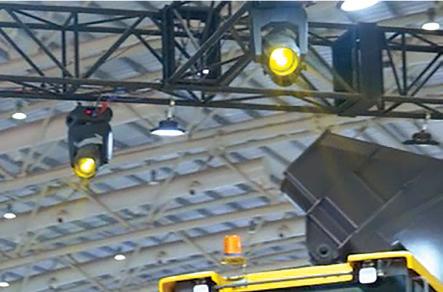
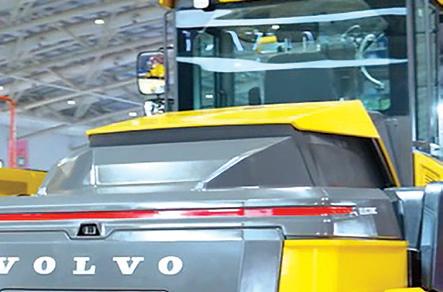
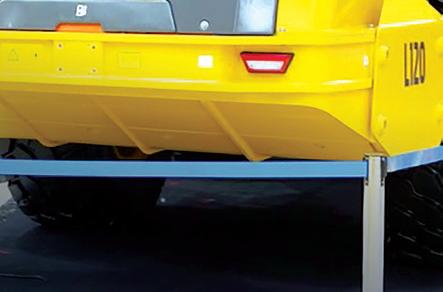
The company has also continued its rollout of electric construction solutions and introduced zero emission machines to new regions, including Australia and the UAE. In December, an agreement was reached for the Ammann Group to acquire Volvo CE’s global ABG Paver Business, including ABG in Hameln, Germany.
In Q4, most regions' total market was at or negative, with North America and Asia outside China reporting only slight increases. The North American market softened in the nal part of the year, reporting only a 7%

increase due to a deferral of eet replacement as interest rates and in ation remain high, while in Europe, the market fell by 1% from a high level driven by cautiousness among end customers.
South America dropped by 24% in market development following low investment levels in Brazil, while China saw the largest fall of 40% due largely to slower economic activity. Other Asian markets remained at at 4%, thanks to a slowdown in markets such as South Korea and Indonesia, despite an increase in demand in India, Japan and the Middle East.
New road projects are planned for Morocco’s Casablanca region in 2024. Work will start on a new highway linking Berrechid and Tit Mellil as well as the Casablanca bypass, while work will commence on the nal stretches of the highway linking Berrechid with Casablanca.
A steady increase in the numbers of vehicles on Morocco’s roads has seen existing links suffer heavy congestion.
The area to the south of Casablanca does suffer heavy traf c volumes at peak periods, particularly around the international airport, with these road works helping to lower congestion. The Casablanca region is one of the most economically active areas for Morocco. In addition, plans are being drawn up for the US$494 million highway to connect Casablanca and Rabat. The 60km highway should be complete by 2026 and the work is being managed



jointly by the Ministry of the Interior and the country’s road rm, Autoroutes du Maroc (ADM). The new highway will pass close to the new stadium at Benslimane, which will be one of the six being used for the 2025 African Cup of Nations and for co-hosting the 2030 World Cup. These projects are being managed by ADM. An increase of 3% to $375.4 million is being seen for ADM’s 2024 budget compared with 2023.











www.wirtgen-group.com/sustainability




The opening of the US$2.2 billion Mumbai Trans Harbour Link in India will help address the city’s chronic congestion problems.
The project has been managed by the Mumbai Metropolitan Region Development Authority. The new route will provide a major boost for the Mumbai Metropolitan Region.
The 29km link has four lanes in either direction and has been designed to carry 130,000 vehicles/day. Measuring just over 29km, the route links South Mumbai with the city’s western suburbs, reducing journey times for drivers to just 40 minutes, compared with two hours previously. It also connects with the new Navi Mumbai airport and Mumbai-Pune Expressway. One of the most complex components of the projects was for the 7.8kmlong bridge section across the Mumbai Bay. The toll rates, speed limits and permitted vehicle types have also been announced for the bridge. Meanwhile, India aims to develop a network of








electric highways. The 6,000km network is planned for India’s Golden Quadrilateral. The Indian Government intends for this network to be ready over the next seven years.
Sustainable energy will provide the electrical power for the charging network being installed. Solar power will be utilised to supply much of the power required. As part of the programme, up to 800,000 electric buses will be phased in by 2030 to replace the diesel buses still in use in many areas.
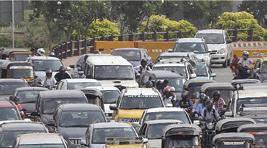







And India’s $6.9 billion Balavali-Navghar highway project is now open for bids. The project will be split into several stages. The route will feature four lanes in either direction while there will also be provision for rail traf c as well as a BRT system.
The project is being managed by the Maharashtra State Road Development Corporation Limited (MSRDC), which is also handling the tender process. The 126km route will be the latest project intended to improve transport for the Mumbai Metropolitan Region.
Kiewit Infrastructure South will hand the contract to modify the Eugene Talmadge Memorial Bridge in the US state of Georgia. The contract was awarded by the Georgia Department of Transportation (DOT). The bridge connects Georgia and South Carolina and spans the Savannah River, while raising it will allow passage for larger vessels.
The Port of Savannah is the fourth busiest cargo port in the US and allowing larger vessels to reach the facility will deliver and important increase in its capacity. The project is expected to cost US$189 million and the work is due to commence in early 2025.















Construction work is now underway on the US$414 million North Tarrant Express Capacity Improvement Project in Texas. The work is being carried out by Cintra, a subsidiary of Ferrovial.
The route links Fort Worth and Dallas. The work includes The Capacity Improvement Project that will add a (free) general-purpose lane in each direction along the North Loop of I-820 and a (tolled) managed lane in each direction along Airport Freeway (SH 183). The project will also adjust some of the ramps and connectors, as well as the pedestrian bridge in Hurst.
Project costs will be funded entirely by toll revenue according to Texas Department of Transportation (TxDOT). No TxDOT funds or public money will be used for the construction. Early activities, including installing

construction barriers and striping lanes, was scheduled to begin in late 2023 with full construction underway in mid-2024.
Most of the construction activities will be undertaken overnight to minimise disruption to users. The project is scheduled to take 42 months, with completion anticipated in early 2027.
As with the original corridor, the North Tarrant Express is owned by TxDOT, but NTE Mobility Partners provides 24/7 operations and maintenance for the corridor (general purpose and managed lanes) including all ramps and bridges. The contract between the Texas Department of Transportation (TxDOT) and Cintra called for capacity improvements
to be made to the NTE corridor once traf c activity reached a certain level. The Average Daily Traf c (ADT) has exceeded traf c projections eight years sooner than anticipated and now TxDOT has approved the beginning of construction to expand the corridor.
The original NTE project began in 2010 after being the rst transportation Public-Private Partnership (P3) approved by the Texas Legislature in 2009. The NTE is a major east-west corridor that crosses Northeast Tarrant County and connects all cities between Fort Worth and Irving on I-820 (North Loop) and SH 183 (Airport Freeway).
When it opened fully in 2014, the NTE project almost doubled capacity in the corridor and added contiguous frontage roads and a new bridge across I-820 at Riverside Drive.







The arti cial intelligence (AI) surge combined with the growing demand for ef ciency and sustainability has ignited renewed interest among heavy construction rms for adopting innovative technology
It is clear why: digital transformation presents avenues to develop synergies while bolstering ef ciency, reducing emissions and waste, lowering costs, and offering opportunities to attract talent. Hexagon’s 2023 Autonomous Construction Tech Outlook, a survey of over 1,000 contractor rms in Australia, the UK and North America, revealed the substantial investment in cutting-edge technology and its projected growth. There is a strategic shift among progressive companies towards the integration of autonomous solutions into traditional processes. Firms believe that such investments will deliver competitive advantages, resolve key painpoints and ensure longer-term success.
Technology will “skill” jobs, not kill them. The heavy construction sector grapples with a persistent lack of skilled workers, impacting schedules, project budgets, and bid submissions. To counter this, industry will need to include talent attraction as well as retention. Contrary to concerns about job losses, technological advancements are “skilling" jobs. Automating tasks leaves time for work requiring skills and reduces repetitive tasks and exposure to risks.
According to the Autonomous Construction Tech Outlook, 83.5% of construction rms already incorporate autonomy in some operations. These solutions allow construction rms to harness increasing amounts of data, putting it to work to boost ef ciency, productivity, quality and safety. With the majority of rms implementing technology in processes, it will be essential to focus on building technical skills to create a workforce that is adept at new technology.
Effortlessness is required to foster workforce acceptance and compatibility with existing processes. Reducing complexity for stakeholders means faster deployment and running of projects.
It can impact on the jobsite and in the of ce, getting the job done in less time, achieving higher quality, meeting client speci cations and reducing costly rework. Impact is also felt in risk reduction for all parties, including an individual’s safety, nancial implications and reputational impact.
AI advancement will drive workforce development. AI has transformed construction,

propelling the industry towards greater automation and ef ciency.
As automation and smart digital realities advance, construction rms adopting autonomous solutions will reap the rewards of safer, more sustainable, and pro table operations.
To keep pace, construction companies must future-proof workforces. Providing training and empowering employees to utilise AI solutions will be prioritised. Over the past year, spending on training and development has increased as rms attract talent through training. Investments will continue into workforce digital skills and capabilities, with demand from both rms and jobseekers.
Pressure is also being applied from customers who require seamless integration of technologies between their platforms and those of contractors. Technology providers will need more industry expertise, and construction rms need more technical understanding. Pairing technology leadership with domain expertise is key, as are partnerships and staff with crossover expertise.
Machine control, cloud connectivity and AI top the investment forecast. Investments in construction technology will rise. According to the Autonomous Construction Tech Outlook, 79% of rms intend to invest an average of $7.1 million in autonomous solutions over the next three years.
Investments for 2024 will focus on solutions enabling progress in AI and automation for boosting productivity and sustainability. Priority technologies include general software automation, machine controls, cloud-connected systems, real-time analytics and feedback loops, and AI-powered software that speed processes by removing low-value manual tasks.
Solutions that bridge data across platforms will be favoured, as insular digital systems lead to inef ciency. Already the most popular use of autonomous technologies according to the survey, cloud-connected project management software will remain a key priority in 2024, as this stands to reap the greatest productivity gains.
Productivity and pro tability go hand in hand with sustainability. As revealed by Hexagon’s Tech Outlook survey, sustainability jumps to the top priority for rms over the next 3-5 years. According to the UN’s Global Status Report for Buildings and Construction, the industry contributes around 37% of global CO2 emissions.
Sustainability has in the past been regarded as a hindrance to pro t but embracing greener practices can reduce expenses for rms. The importance of pro tability and sustainability means that it is essential that technology solutions improve cost, quality and ef ciency.
Digitisation and automation are driving sustainable construction practices. Accurately capturing initial measurements and optimising design engineering cuts material waste, equipment usage, and fuel wastage. Precise progress tracking and regular status updates allow for replanning over shorter time frames, minimising rework and overprocessing. Productivity, pro tability and sustainability are interdependent. Integrating digital solutions that reinforce these objectives will become necessary for companies in 2024.
Hexagon www.hexagon.com







CECE’s new president; disruptive road works; ASECAP president; Bosnia Corridor 5; Irish cycling routes; Denmark tunnel, noise reduction
Komatsu’s electric offering; Unicontrol system on Volvo CE machine
eu5 ONSITE
Kleemann equipment in Greece; Bobcat system for Europe and Israel
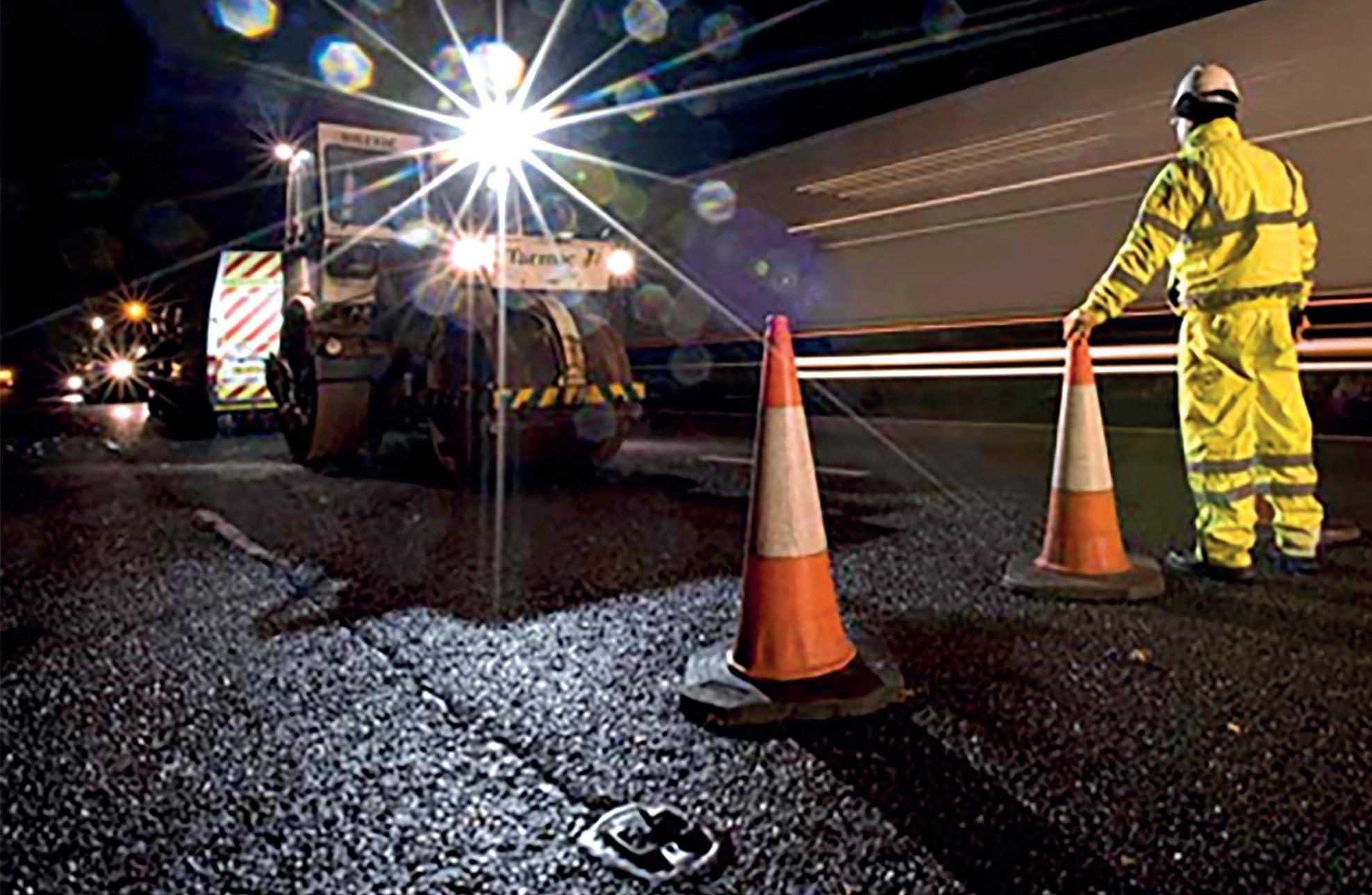
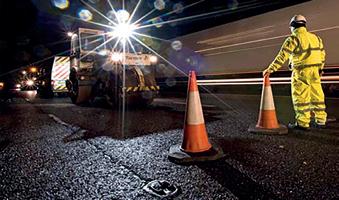
The UK government has launched a consultation today on further proposals to prevent utility companies from letting roadworks overrun and create traf c jams.
There is already a €11,650 per day ne for companies whose street works overrun on weekdays. The proposals would extend this from weekdays into weekends and national holidays.
The announcement concerning “disruptive roadworks” came on the UK’s annual so-called National Pothole Day. The consultation is part of a series of measures from the government’s Plan for Drivers, a 30-point plan to support people’s freedoms to use their cars and curb overzealous enforcement measures meant to curtail vehicle use.
The government said that the two million street works carried out in England by gas, water and other utility companies during 2022-23 have cost the economy around €4.65 billion through severe road congestion and disrupted journeys.
“Too often traf c jams are caused by overrunning street works,” said Guy Opperman, the roads minister. “This government is backing drivers, with a robust approach to utility companies and others, who dig up our streets. We will seek to massively increase nes for companies that breach conditions and ne works that overrun into weekends and bank
holidays, while making the rental for such works help generate up to an extra €116 million to improve local roads.”
The consultation comes after the government introduced a performance-based “street works regime” to ensure utility companies resurface roads to the best possible standard and new lane rental schemes where utility companies can be charged up to €2,905 per day for street works.
The measures can also help boost active travel by preventing street works from disrupting walking, wheeling and cycling, while also providing opportunities to improve pavements and pedestrian crossings and make repairs to pavements and cycle lanes.
The proposals could also double nes from €580 up to a maximum of €11,160 for companies which breach conditions of the job, such as working without a permit.
The government plans would also direct at least half the money from lane rental schemes towards improving roads and repairing potholes. Lane rental schemes allow local highway authorities to charge companies for the time that street and road works occupy the road.
As a result, the measures could generate up to €116 million extra over 10 years to resurface roads.
Jose Antonio Nieto, chief executive of Putzmeister Iberica is the new president of the CECE, Committee for European Construction Equipment.
After serving as vicepresident for the past two years, he now takes over the president’s role for two years, to the end of 2025.
CECE represents the interests of 1,200 construction equipment manufacturers through national trade associations in Europe. Putzmeister Iberica is a member company of the Spanish industry association ANMOPYC.
His professional career in construction machinery began in after-sales service, joining Putzmeister as head of service in 1999 and progressing to technical director and chief operations o cer. He has been chief executive since 2007.






The Irish government has released its National Cycle Network plan outlining how 3,500km of cycle routes will crisscross the country, serving around 2.8 million people.
Almost 90% of jobs and 80% of households in more than 200 villages, towns and cities as far north as Buncrana in County Donegal and as far south as Kinsale in County Cork are expected to be located within 5km of the network. There are 85 corridors of routes designed to integrate future and existing greenways and other cycling infrastructure, such as the Eurovelo routes.
According to the plan, released by Eamon Ryan, Ireland's minister of transport, the routes will also link to other transport hubs to ensure more comprehensive mobility for as many people as possible. The network will act as a "core spine" for Ireland’s towns and cities. He also said that cycling infrastructure will be separate from motor traf c wherever possible.




The basic plan designates the urban network’s destinations as either primary, secondary or 'other' nodes. Primary nodes are cities and large towns with populations of more than 20,000. These include Cork,







Galway, Limerick, Bray, Portlaoise, Wicklow, Wexford, Letterkenny and Tralee.
Secondary nodes are towns with populations of 10,000 to 20,000, as well as major tourist attractions outside urban areas.
The ‘other’ nodes include small towns and settlements of fewer than 5,000 people, as well as educational and employment centres and transport hubs.
Around 400km of the network’s 3,500km are already in use while 900km of it are part of planned regional and national greenway programmes. The remaining 2,200km will be new routes.
Delivery of the plan will be in three phases; the rst is already underway. The second phase consisting of around 660km will be rolled out between 2026 and 2030, while the nal 2,510km should be open between 2031 and 2040.

ASECAP, the European Association of Operators of Toll Road Infrastructures, has appointed Julián Núñez as president for 2024.
Núñez has been president of SEOPAN, the Spanish Association of Infrastructure Contractors and Concessionaires, since 2013.
He takes over as president in the run-up to the 51st ASECAP Study and Information Days set for May 13-15 in Milan.

The government is hoping the cycling network will help it achieve its target of reducing transport emissions by 51% by 2030.

Ireland is already home to part of a Eurovelo route, the 11,000km EV1. It route runs from North Cape in northern Norway and hugs the North Sea and Atlantic Ocean coastlines of western Europe going as far south as Spain and Portugal.









The EBRD will provide a €110 million loan to Bosnia and Herzegovina for construction of the Mostar North-Mostar South section of pan-European Corridor 5c.
The project will include the construction of an interchange and a 15km dual carriageway motorway section, the European Bank for Reconstruction and Development (EBRD) said in a press release.
Also, the European Union will provide a €150 million grant through the Western Balkans Investment Framework (WBIF) and up to €150 million will be secured from local commercial banks for the project.
The WBIF is a joint initiative
of the European Union, nancial institutions, bilateral donors and the governments of the western Balkans. It provides nancing and technical assistance to strategic investments in the energy. environment, social, transport and digital infrastructure sectors. It also supports private sector development initiatives.
The 700km Corridor 5c starts in the Hungarian capital Budapest, runs via northern Osijek in Croatia, through Bosnia and Herzegovina via Doboj, Zenica, Sarajevo and Mostar to end in the Croatian Adriatric port of Ploce.
According to the WBIF, Corridor 5c is the backbone of Bosnia’s connectivity – it stretches to around 340km of the route –


and is strategically vital for its economic development, making it a top priority for the Western Balkans regional development.
Bosnia’s Corridor 5c section is the rst major motorway and the largest ever infrastructure project in the country´s history. More than 68km of motorway, including one cross-border bridge, have been supported by EU grants, combined with loans by the EBRD as well as the European Investment Bank (EIB).
When work is done, the WBIF says that a typical journey from Sarajevo to the Adriatic Sea that now takes three and a half hours will be reduced to two hours.
“Julián’ skills and expertise will bring great value to ASECAP and the toll road infrastructure companies” said Malika Seddi, ASECAP secretary general and chief executive.
Infrastructure has a major role to play in reaching the European Union's goal to be carbon neutral by 2050, said Núñez, a civil engineer. Green issues will be a major focus during Núñez's year-long tenure.
"More than ever today, there is a need to invest in transport decarbonisation which will be only e ective if road transport is decarbonised," he said. "There is also an important priority to maintain road infrastructure to keep them resilient and compliant with all the environmental issues."
Núñez is also vice president and a member of the board of directors at the Spanish Confederation of Business Organisations, vice president of the National Confederation of Construction, council member of the Labor Foundation of Construction and a member of the Spanish Road Association board of directors.






Preparation work started last May on the 1.4km-long Nordhavn Tunnel which will be an extension of a 620m-long cut-and-cover tunnel

The BESIX-MTH joint venture has appointed Bravida Denmark for installation work on the Nordhavn Tunnel project in Copenhagen.
The project, worth more €26.7 million, includes a new stage from Svanemøllen to Nordhavn. Design and planning work is already underway, with production set to start in this year with its expected
completion in summer 2027.
Bravida's work includes installation of plumbing, electricity, ventilation, road lighting and light signals, said Nikolaj Bøhmer Jensen, a regional director at Bravida Denmark.
Bravida is a subcontractor to the joint-venture partnership BESIX-MTH and has worked in close collaboration since the

The Danish road authorities are considering using a noise reducing pavement, similar types in Germany and the Netherlands, on Copenhagen’s busy Motorring 3.
The Danish parliament has said it will considering improving the noise reduction systems along Motorring 3 rather than spending money on widening the busy motorway from four to six lanes.
The 19km-long Motorring 3, west of the capital, connects the Helsingør motorway with the Køge Bugt motorway and is part of the European roads E47 and E55. Around 48,000 vehicles used the highway daily in 1990, rising to about 130,000 in recent years, according to data from Vejdirektoratet, Denmark’s national road directorate.
Around €48 million was set aside for
urban development areas in both outer and inner Nordhavn. It will also improve access to harbour activities in the area and divert a signi cant portion of heavy traf c from Østerbro's road network.


project’s start, noted Michael Benedict Thulstrup, deputy project director at BESIX-MTH. The joint venture also is working closely with one of Denmark’s largest infrastructure contractors, MT Højgaard Danmark, and together have worked on Stockholm’s E4 tunnel.
The Nordhavn Tunnel will offer more direct access to the
Vejdirektoratet, the Danish Road Directorate, in collaboration with the city of Copenhagen and By & Havn, is overseeing the construction of the Nordhavn Tunnel. By & Havn is tasked with developing Ørestad and the port of Copenhagen and runs the daily operations of the port through its subsidiary, Copenhagen Malmö Port. Preparation work started last May on the 1.4km-long Nordhavn Tunnel which will be an extension of a 620m-long cutand-cover tunnel that is part of the Nordhavnsvej project.
The Nordhavnsvej – or Northern Harbour Link - is a 3kmlong four-lane two-tube bypass being built between Nordhavn and Helsingørmotorvejen (Elsinore Highway) in northern Copenhagen, Denmark. At €323 million, the project is Copenhagen’s largest road infrastructure project in the past 50 years. The road runs through the heavily populated downtown district and improves the connection between the Helsingør motorway and the northern port area of the capital city.
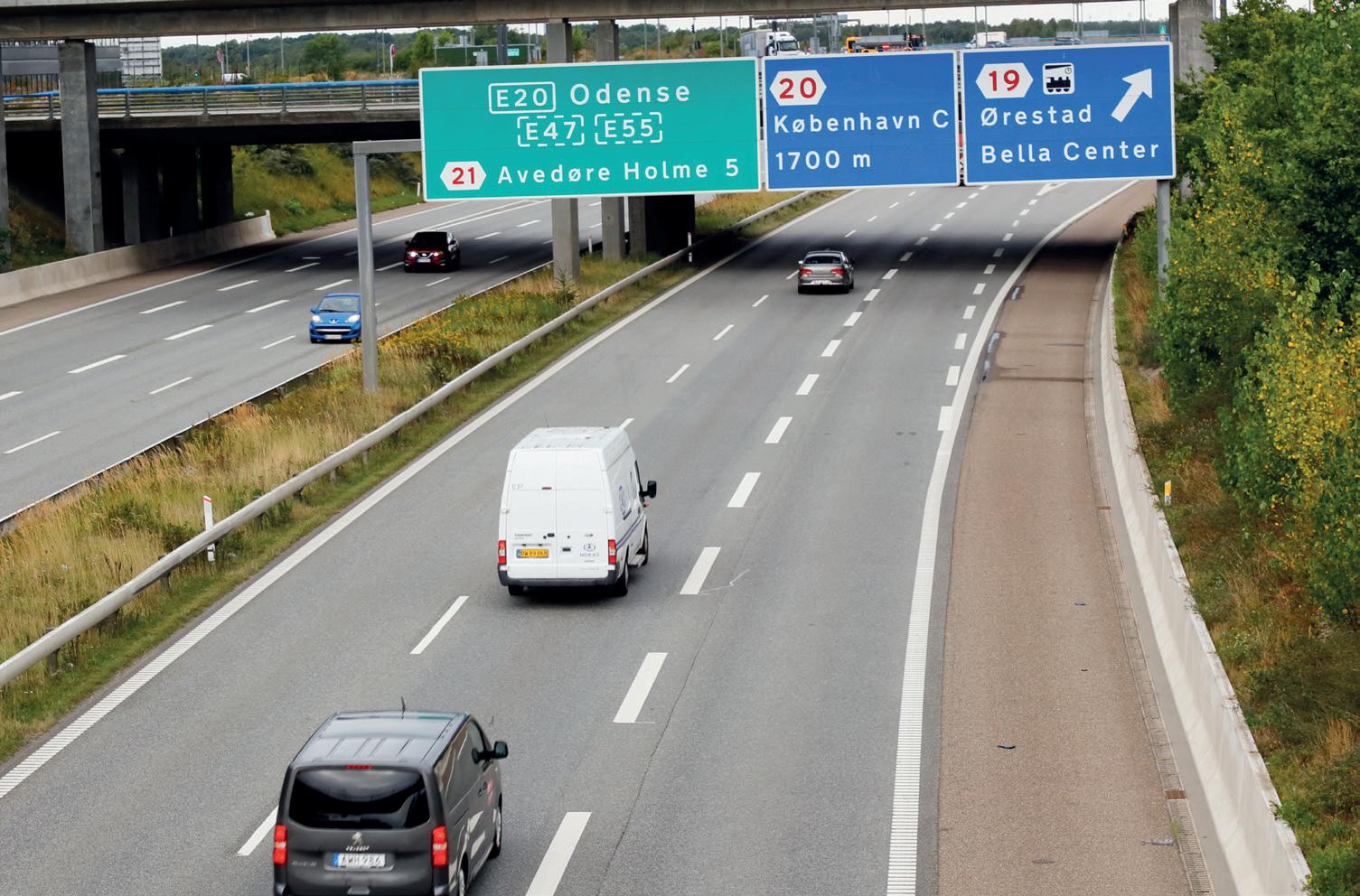
extending the Motorring 3, a project that has now been put on hold, according to a report in the Danish engineering newspaper Ingenioren. The idea was to make the hard shoulder, or emergency lane, into a live running lane, as well as a reduction in speed from 110kph to 90kph, the newspaper noted.
Instead, three noise reduction methods will be studied: extension of the existing noise
barriers; an updated more modern physical noise barrier to be built in the middle section of the motorway; and a type of new noise reducing asphalt already used in Germany and the Netherlands.
The noise reduction study must be completed by mid-2024, and then a nal decision will be made on what the earmarked money will be used.





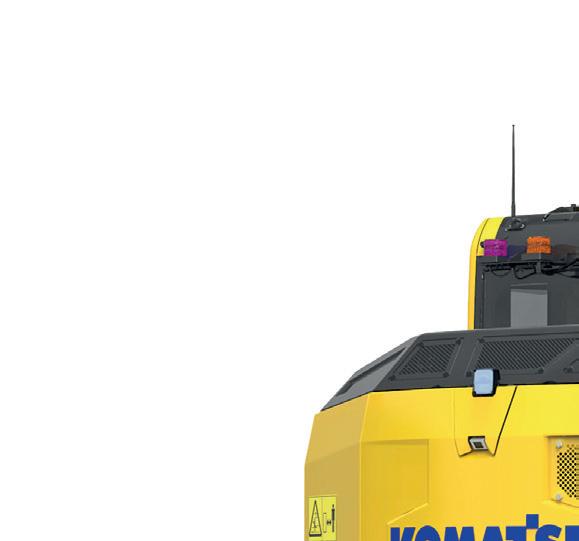




Komatsu is widening its range of electric excavators with the introduction of the 13tonne class PC138E-11 and 21tonne class PC210LCE-11 models. Both are powered by lithium-ion batteries.
The company is working to develop a presence in the new market for electric construction machines with an eye to achieving carbon neutrality by 2050 by expanding its product lineup and meeting customers’ needs.






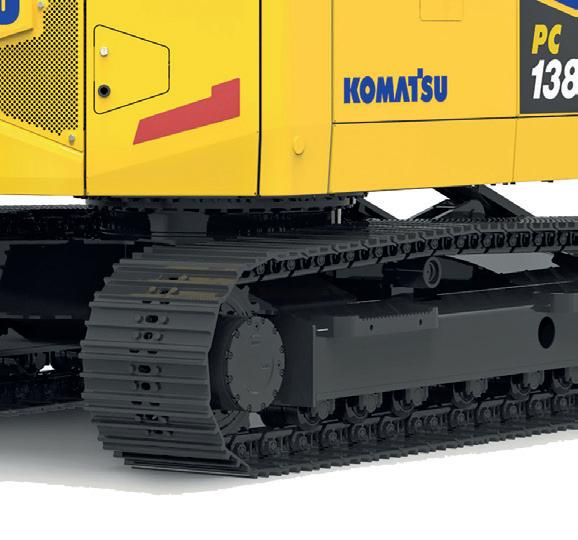
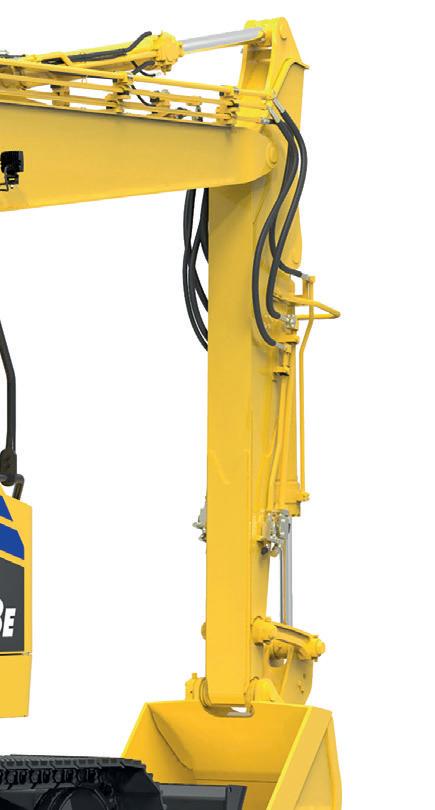



By tting a high-capacity, 225kWh lithiumion battery to the PC138E-11 and integrating the cooling system, Komatsu says the unit o ers a long operating time and reduced rear-end swing radius. In regions where the market for electric construction equipment is expected to develop, Komatsu will o er this machine to the rental market to generate customer feedback.
The rm will be o ering the PC138E-11 excavator with a Smart Construction 3D Machine Guidance kit, a simple and versatile package now available for a broad range of Komatsu machines. The kit provides an accessible way to add 2D and 3D machine guidance and can be customised with various options that allow the kit to better accommodate each customer's machine con gurations and operating conditions.
Bucket capacity is 0.5m3, while it has a tail swing radius of 1.83m, weighs in at 15.3tonnes and has a 72.5kW motor, as well as a 225.6kWh battery. The PC210LCE-11 model shares many features with the more compact model. Komatsu had been jointly developing this electric model since January 2021 and is now ready to introduce it to the rental market. By using it under various operating conditions and with di erent power supply environments in regions where the electri ed market is expected to be formed in the future, customers will be able to experience its environmental friendliness and safety, while
Komatsu will compile feedback, opinions, and knowledge to lead to the formation of the electri ed market.
Hydraulic excavators are the most versatile type of construction equipment, being used for a wide range of jobsites and applications, centring on excavating and loading earth and sand. By launching the PC210LCE-11 in Europe, Komatsu is working to create an electri ed machine market for medium-sized class construction equipment.
Komatsu www.komatsu.com
Bryan Contractors is one of the rst in the UK to t a Unicontrol3D machine control system onto a Volvo EC140E excavator.
Supplied by SMT GB, the control system is working on an excavator equipped with a Steelwrist tiltrotator. The Unicontrol3D system has greatly enhanced the autonomy and versatility of operators working for Bryan Contractors based in Perthshire, Scotland.
Operator Mark Anderson said that normally a contractor’s rst job is to take everything down to grade, which the Unicontrol system makes so much easier. “You’re checking your datum and heights just to make sure everything’s right. You’re walking around with a laser for maybe half a day, but as soon as you turn the system on, you’ve got your datum and you’re away – it’s unbelievable how much time it saves.”
“Making use of a cost-e ective and easy-to-use 3D machine control system will certainly alleviate some of the pressure that companies are facing,” said John Lawrence, SMT GB product manager.
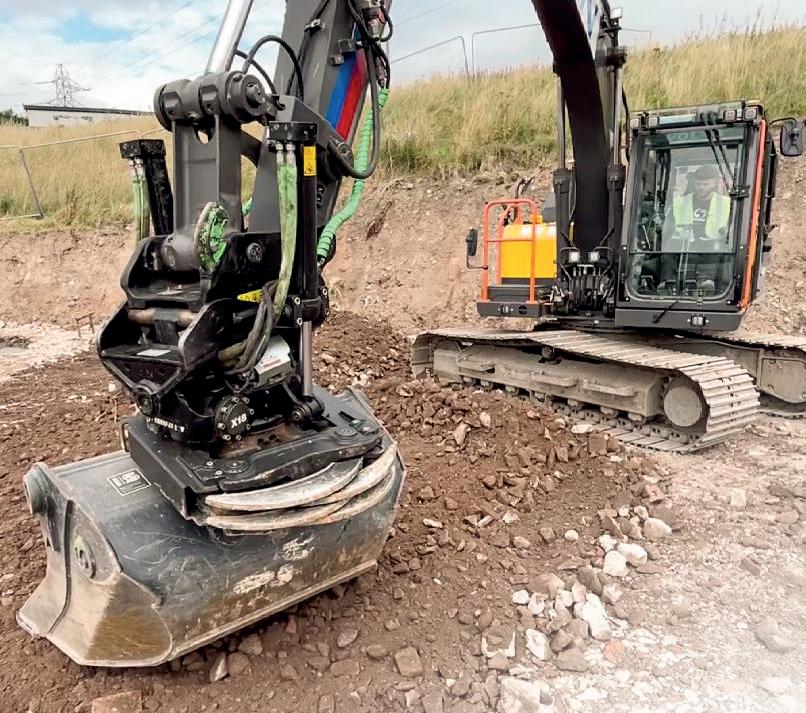
The Unicontrol3D machine control system is designed to be interchangeable with any manufacturer’s machines. Customers can digitally create an entire project and assign speci c machines tted with Unicontrol3D from their eet to

Unicontrol3D says that its system is the only one that provides full support of the swing boom to guarantee the best functionality and exibility for smaller excavators
the project. Additionally, Unicontrol also provides insight data from the machines working on the project and, if required, even allow for a customer to make adjustments to the project as it progresses.
only system on the market that provides full support of the swing boom, helping to guarantee the best functionality and exibility for smaller excavators. Unicontrol3D helps to save time and resources by delivering exact data for excavation, making machine control simple.
Unicontrol3D, founded based in Denmark in 2018, markets 3D machine control systems for excavators, wheeled loaders and backhoes. It operates in 20 countries with around 800 3D systems in use worldwide. Late last year Unicontrol3D released Unicontrol3D Automatic Grading Control for dozers.

Unicontrol
https://unicontrol.io/en/homepage
Volvo Construction Equipment Europe
www.volvoce.com/europe/en
SMT GB
www.smt.network/gb
Steelwrist
Moreover, Unicontrol3D is the
https://steelwrist.com/en
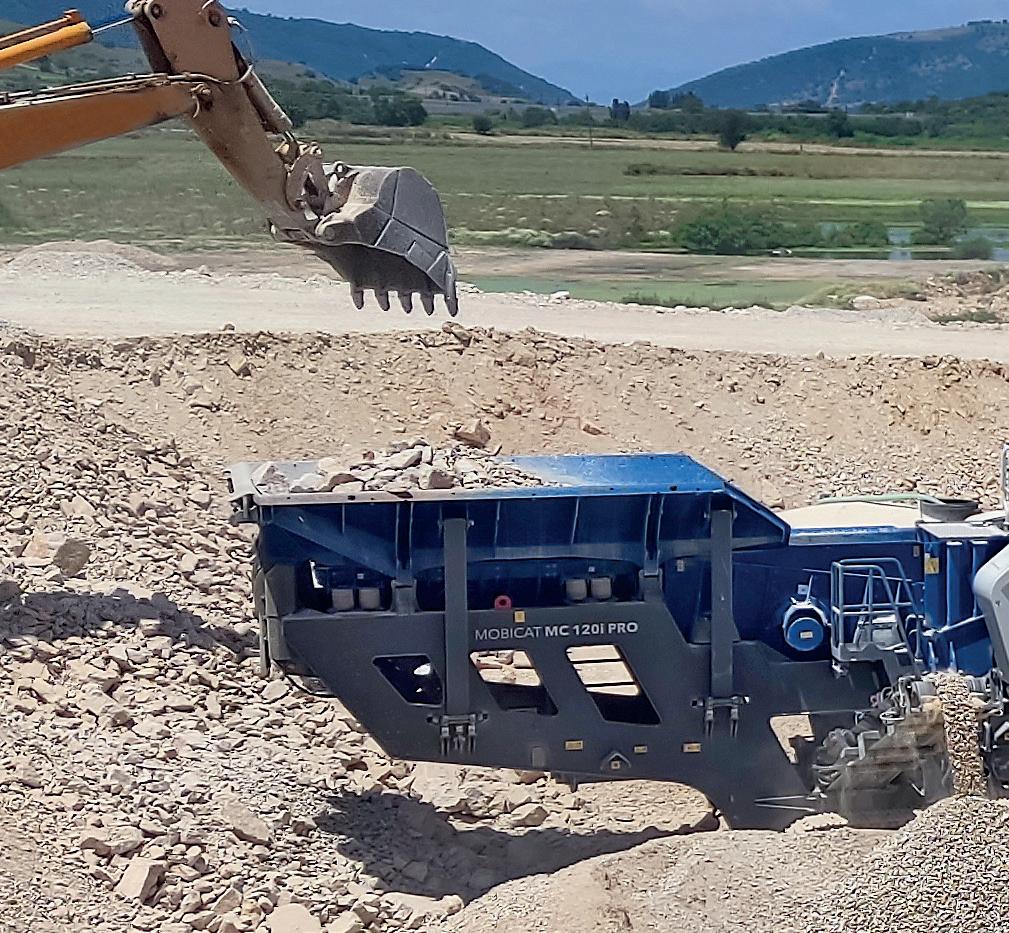

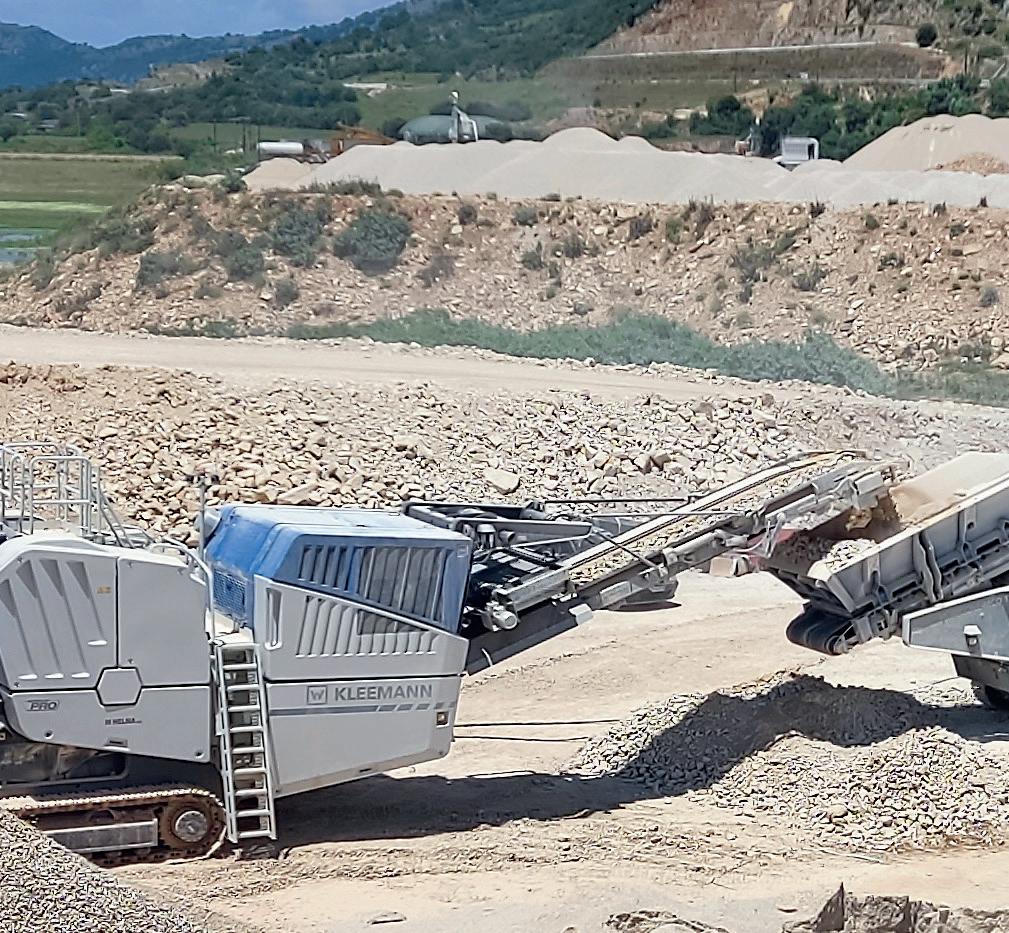
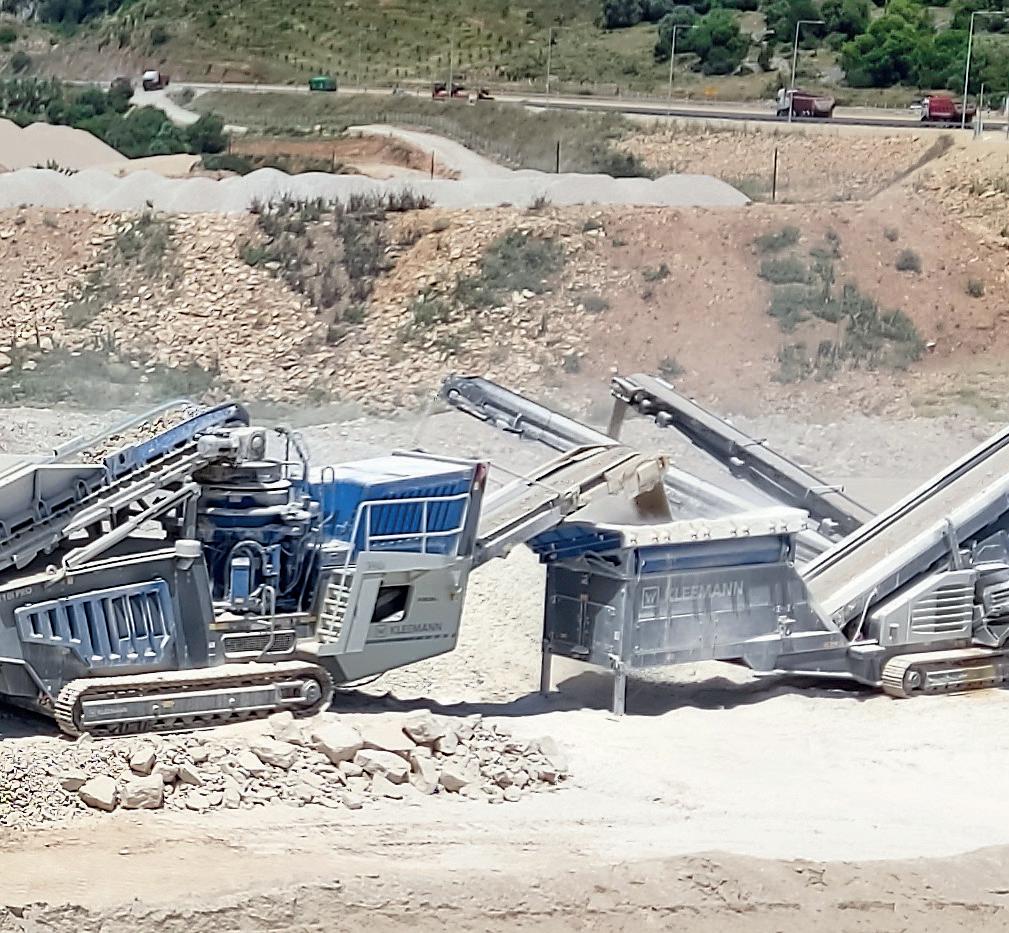
It was recently ‘all aboard’ at the start of a mobile Kleemann plant train for the Amvrakia Odos project in Amphilochia on the Greek mainland.
Construction of the 48.5km-long highway, which will play an important role for the Ambracian Gulf’s tourist region in north-west Greece, requires a large amount of highquality processed rock material.
During project planning, AIGISTOS, the contractor, decided on a Kleemann plant train from the PRO line series: MOBICAT MC 120i PRO and MOBICONE MCO 110i PRO. The two power packs are complemented by the classifying screen MOBISCREEN MSC 953i EVO. Kleeman is part of the Wirtgen Group.

proportion of soil in addition to the quartz. This is a perfect application area for the jaw crusher MOBICAT MC 120i PRO; with its e cient double-deck pre-screen, it is used as a primary crusher in the plant train.
The jaw crusher loads the downstream cone crusher MOBICONE MCO 110i PRO.
Meanwhile, the Kleemann screening plant delivers the four nal products prescribed for road construction: 0-4, 4-16, 16-32 and 0-32.
Importantly, the three plants are intelligently linked to ensure automatic control. Each machine works on its own but sends signals to the upstream and downstream machines in the event of malfunctions or over lling.

The intelligent connection also guarantees safety. If an emergency stop is pressed anywhere, all machines are safely halted to prevent damage or an overload situation.
The Kleemann plant train has a material preparation of up to 372tonnes per hour and the ability to supply large feed material of up to 600mm. "We are very satis ed with the output and expect to process 1.5 million tons (1.36tonnes) during the 18 months of operation," said Aris Svolos, owner of contractor AIGISTOS.
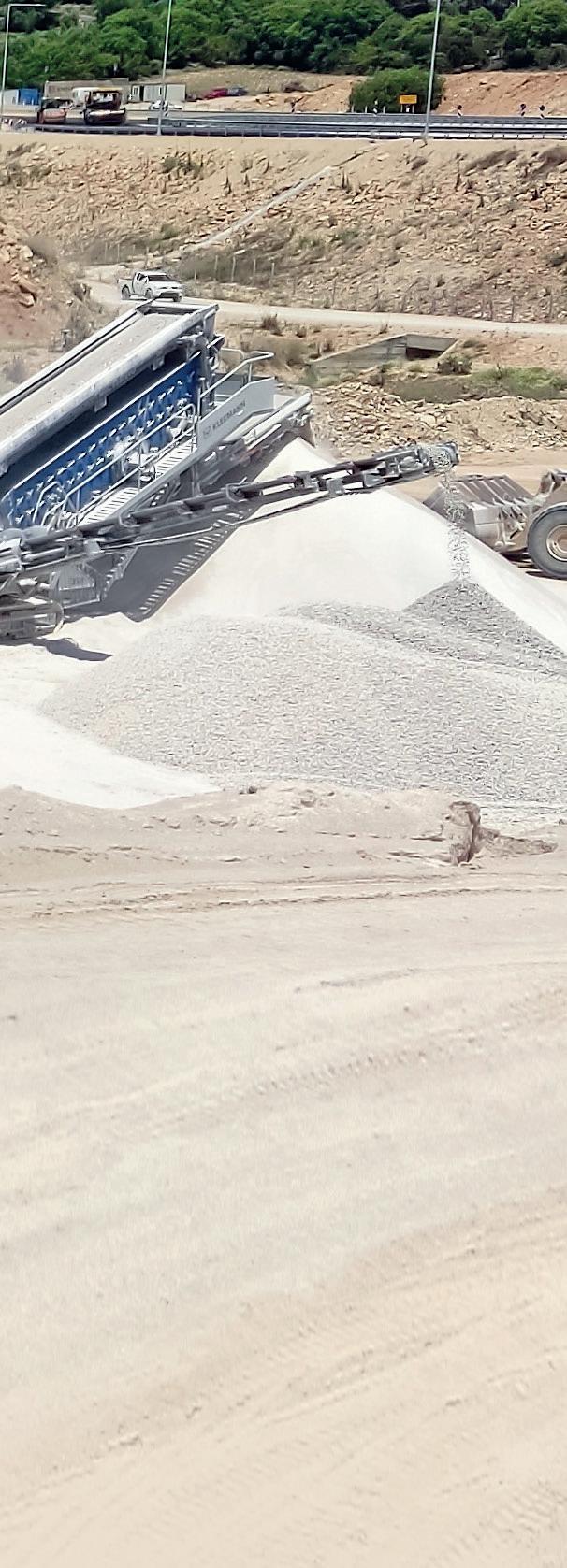

The crushing plants are equipped with powerful E-DRIVE diesel-electric drives. Fuel consumption is low and it is possible to retro t the plants with an external power supply option to make the machines future-proof.
The limestone onsite has a high quartz content. The feed material (feed size 0-600mm) is very sticky and contains a high
The continuous feed system also guarantees optimum use of the crusher. All components are thus loaded evenly.
Bobcat’s Machine IQ telematics is now available as a subscription service in Europe and Israel.
The service connects customers to machine information at anytime and anywhere by way of a smartphone or a computer. It is available in two packages for both customers and dealers with standard or premium options.
Equipped with this information, customers can optimise machine use and plan jobs for maximum pro tability by keeping idle times to a minimum and tracking fuel consumption. Service planning is made easy with maintenance noti cations, saving operators time and money by allowing them to e ciently schedule machine maintenance and manage jobsites during planned downtime.
Kleeman www.wirtgen-group.com

Users can create geo-fences and machine curfews, providing the assurance that their investment is protected. Meanwhile, dealers can anticipate and prepare for service needs before customers need to pick up the phone.
Dealers and customers can choose from two options: a Standard package with basic telematics; and a Premium package with additional advanced features, explained Tomas Plechaty, machine IQ senior programme manager at Bobcat EMEA.
The Machine IQ Standard subscription package is free for the rst two years from the original equipment delivery date. Customers can track key information points,
including GPS location and history, operating hours and last recorded fuel levels. They can create names to quickly identify machines in a eet. There is also maintenance interval tracking. The Premium package gives maintenance reminder e-mail alerts when machines are approaching regular maintenance. Customers can access the regular maintenance tracker to see what planned maintenance is coming up. Fault code noti cations and
troubleshooting alerts provide a clear description of what to do if the machine reports a fault code. Geo-fence creation and breach noti cation provides customers with the ability to set up custom boundaries and receive e-mail noti cations the moment the machine leaves the speci ed operation footprint.
Bobcat www.bobcat.com


















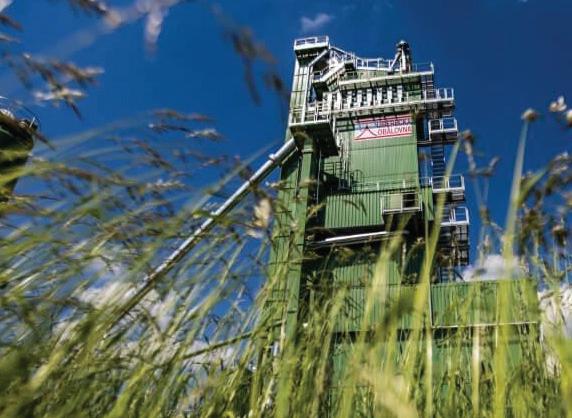


Sustainability is the common thread that runs through all road-related transport infrastructure projects from now and forever more. Clients and road users require it to justify investment of public funds, and contractors and suppliers are required to prove their credentials in order to play
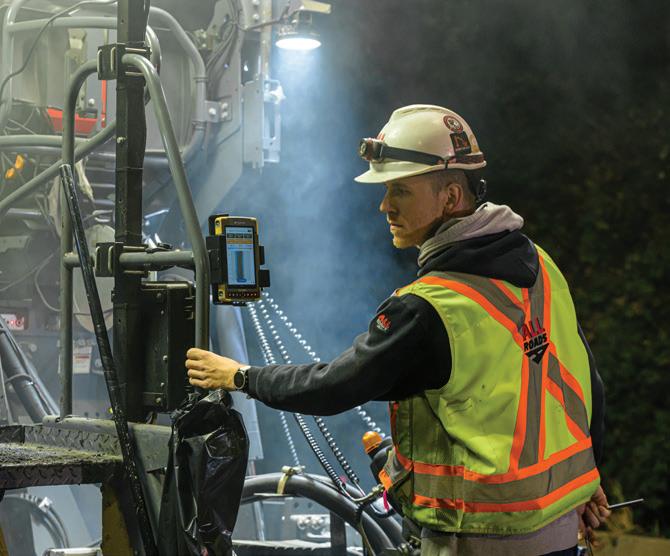
Being able to demonstrate sustainable credentials is a must, and all players need to be able to present credentials that will stand scrutiny by both public and private sector engineers.
Sustainable practices need to be able to be clearly demonstrated across all facets of a project, from inception, through design, material choices, execution, use, and maintenance: The whole project needs to be sustainable in the short, medium, and longer terms.


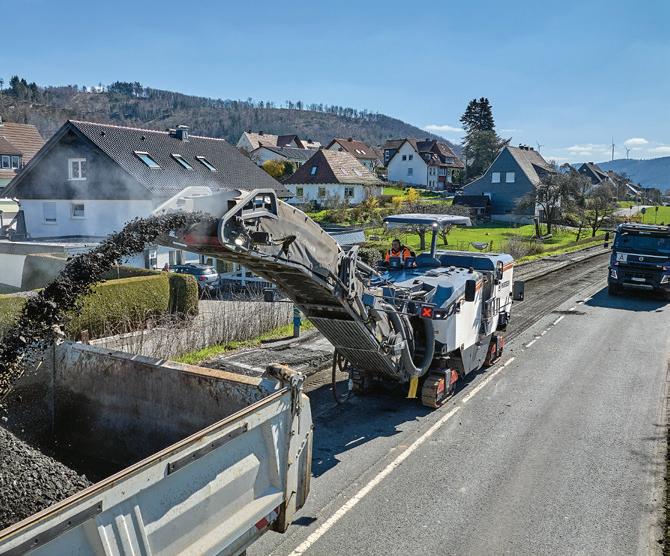
Route One Publishing, with its four leading titles (World Highways, ITS International, Aggregates Business and EV Charging & Infrastructure), is ideally placed to report on all aspects of sustainability, utilising its combined global audience across print, digital, video and social channels, and the expertise of its seven senior staff journalists and its worldwide network of expert reporters.
A series of Sustainability Round Tables will provide thoughtleadership discussions around many of the topics that will be shared across all platforms.

















Loan for Honduras road works; Road building in Ivory Coast; Oran’s new port road
Volvo CE loader for emerging market; Framma crane for emergent territories
Partha Basistha reports on India’s Excon construction machinery exhibition

Road improvement works will be carried out in Honduras, helped by a US$607 million loan. Being provided by the Central American Bank for Economic Integration (CABEI), the 20-year loan will pay for the construction of a new highway connecting La Ceiba and El Progreso. Building the new highway will reduce journey times between the two cities. The port city of La Ceiba is in the north of the country and sits on the coast of the Caribbean Sea while El Progreso is in
Western Honduras, close to the border with Guatemala. Meanwhile, a Japanese funding package worth US$112 million will help pay for infrastructure improvement works in Honduras. The package includes US$20 million that will be used to build a bridge in the city of Danlí. Located in El Paraíso Department, the city of Danlí lies close to the border with Nicaragua and around 92km to the south-west from the capital, Tegucigalpa.
Groundbreaking has commenced for a new tolled highway connecting Suchitepequez and Retalhuleu in Guatemala.
The route will extend 31km and should be ready for traf c in late 2025. By the end of 2024, the stretch linking San Antonio Suchitepequez with Santo Domingo should be ready for traf c.
The project is costing US$154
million. The work is being carried out by contractor Fondo BPS. This project is one of several road infrastructure works in Guatemala as the country has major plans to develop its network.
A funding package worth US$7 billion from China will improve infrastructure in the Democratic Republic of the Congo (DR Congo). The package is being supplied by the Chinese rm SICOMINES, with most of the funds being used for road improvements and highway construction. The package is part of an agreement SICOMINES and the DR Congo Government made in 2008. This deal exchanged the mining rights for certain copper and cobalt deposits in DR Congo for investment in infrastructure.

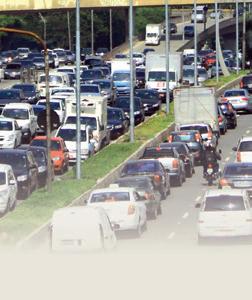


Sao Paulo road revamp
Improvement works worth US$337 million are planned for São Paulo’s Pinheiros Marginal road in Brazil. Approval has been given for environmental licensing for the work by the state environmental company Cetesb. The widening work will boost capacity and includes building a number of new viaducts and bridges. The work will improve transport and cut congestion in the Santo Amaro region and around the Interlagos race track.
An important road development programme in South Sudan is bene ting with backing from the World Bank. The South Sudan

desperately needs. A number of road connections will be placed as a priority for maintenance and improvement works. These include the 193km route between capital Juba and Nimule, the 350km route linking Malakal with Nasir and Jikao and the 360km route connecting Wau with Raja, Boro and Medina.
Transport in India’s Ladakh region will bene t from nearly US$143 million worth of funding. The package is being provided via the Ministry for Road Transport and Highways of India. The funding will be used to pay for 29 road projects in the Union Territory of Ladakh. An additional budget of $22.2 million is being provided for work to eight bridges during the 2023/2024 nancial year. Although Ladakh is India’s largest Union Territory, it has the second lowest population of any in the country. Located in Northern India, Ladakh borders several countries and is mountainous. The new road infrastructure will help to further boost tourism in the region.

A loan package worth US$195.3 million will pay for construction work on two road links in Ivory Coast. The loan is being provided by the Islamic Development Bank (IDB).
The funding will be used to build a new road linking Guiglo with Tai, a distance of around 84km at present on the existing routes. Another new road will link Man with Kouibly. Improving these road links will make journeys quicker and in the rainy season, will ensure that the routes are passable. A report by France 24 in 2021 criticised the road link between Guiglo and Tai for being impassable due to heavy rains.
The loan package has been approved by the country’s government. Improving road links will help develop the Ivory Coast Economy. This follows on from news that new road is planned to improve transport connections between Ivory Coast and Nigeria. Much of the funding needed for the project is being supplied by the African Development Bank (AfDB). The 1,081km road will connect key ports and cities through Nigeria, Benin, Togo, Ghana and Ivory Coast. The route will be designed to cope with the heavy rainfall that occurs during the rainy season as well as climate change.
Additional funding worth US$45 million is being made available for the Heroes del Chaco bridge project in Paraguay. The work had stalled on the project due to a shortage of funds. However, the Ministry of Public Works and Communications (MOPC) has now paid this sum to the Union consortium building the bridge, which comprises CDD Construcciones and Constructora


Heisecke. Construction work has now restarted as a result. The bridge was supposed to have been complete in July 2023. The 450m bridge was expected to cost $115 million originally but will now cost considerably more.
When complete, the cablestayed bridge will provide a more direct connection between Paraguay’s capital Asunción and the town of Chaco'I, carrying an




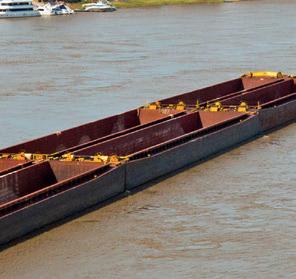

expected 10,000 vehicles/day. The opening of the bridge will help to reduce congestion on an existing bridge that lies around 8km to the north. This new bridge is a key infrastructure project for Paraguay, improving road connections with Argentina and Brazil, linking Puerto Falcón to the Botanical Road Corridor, Ñu Guasu Highway, Luque – San Bernardino Route and Route 2.







Construction work is nearing completion for the new road connecting Algeria’s port city of Oran to the EastWest Highway. The project is costing US$369 million.
The new road will provide a link between the East-West Highway and the Oran Slip Road.
Construction of the new link will provide an important transport connection for heavy vehicles travelling to and from the port, the second largest in Algeria.
The project is being carried out by the contractor MAYKOL while the client for the project is Agence des Autoroutes (ADA).
Building this new link will help reduce congestion and will cut journey times. The work has involved building viaducts as well as tunnel stretches and Italian contractor Trevi’s local subsidiary has been carrying out the piling work for the viaducts using rigs from Soilmec.

Chinese construction firm China First Highway Engineering Corporation (CFHEC) will carry out the second stage of Cameroon’s YaoundéDouala Highway project.
The project was awarded to the Chinese contractor by Cameroon's Ministry of Public Works. The 200km highway will provide an improved transport connection between Cameroon’s two largest cities and is expected to cost in the region of US$540 million in total.
A new six-lane link road will help cut congestion around Thailand’s capital, Bangkok. The 6.5km route will link the Phutthamonthon Sai 4 Road and Bang YaiKanchanaburi Motorway. The US$180 million project is being planned by Thailand's Department of Highways. The route will connect Nonthaburi and Nakhon Pathom to the North East of Bangkok. The project will

help lower congestion and cut journey times for drivers around as well as in Bangkok. Increasing urbanisation of the surrounding areas coupled with improving public transport will help reduce the problems Bangkok’s dwellers face on a day-to-day basis.
Construction work will commence during 2024. The first 60km section of the highway opened to traffic in 2022. However, progress has been slow with the project, with work having started back in 2019. The project is one of several in Cameroon intended to speed road transport in the country. Reducing travel time between Douala and Cameroon’s capital, Yaoundé, is expected to deliver a major economic boost to the country.
The Chinese firm Sichuan Road & Bridge will handle a US$195 million road contract for the Ministry of Equipment of Tunisia. The work is for a bridge linking the port city of Bizerte with the A4 highway. Construction work is expected to commence shortly The improved link between the city and the highway will boost transport for the area. This will make transport for heavy vehicles to and from the port, located in the north of the country, easier and deliver an economic boost to the area.
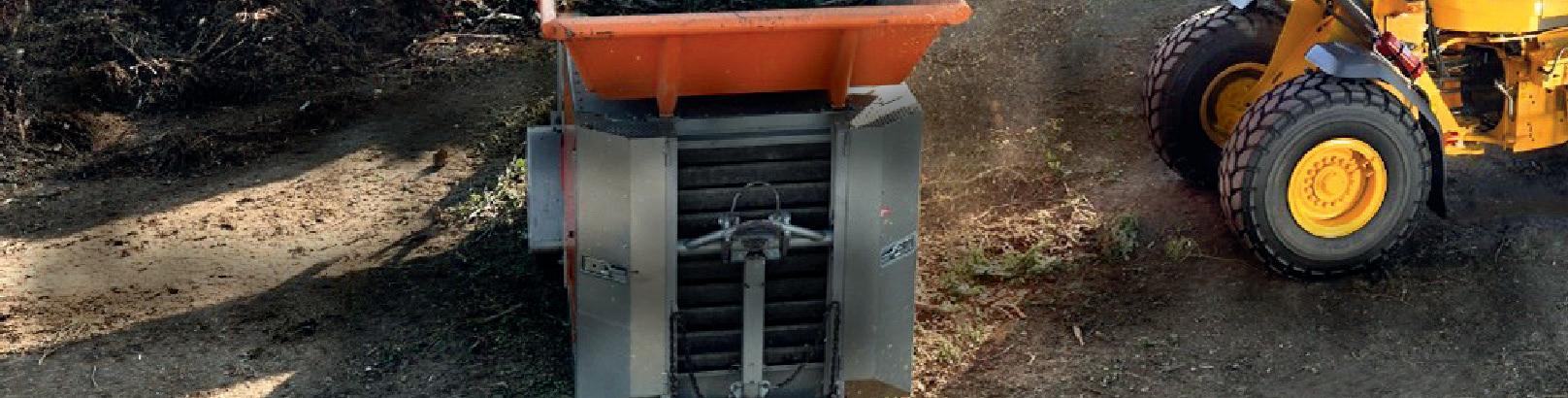


Volvo CE is o ering upgraded wheeled loader models for developing markets, with key features delivering improved uptime. The new Tier 3 compliant L60, L70 and L90 wheeled loaders are said to o er increased comfort, productivity and fuel savings for customers in the Middle East and Africa.
The Volvo L60F-L90F wheeled loaders are being upgraded to the H-Series generation with Tier 3 engines this year, ensuring customers get the same powerful and reliable operation as before but with a number of additional bene ts. The new models ensure increased operator comfort, lifting capacity and fuel e ciency, while reducing service costs and wear and tear.
The H-Series wheeled loaders boast a brand-new look and feel, as well as a number of performance-enhancing upgrades that can be boosted further when paired with a wide range of optional equipment.
The new models are said to be more comfortable and productive and bene t from new features such as Rimpull Control, which allows operators to adjust the wheeled loaders’ rimpull to match slippery ground conditions,
reducing wheel spin and wear and tear, resulting in better fuel e ciency.
The H-Series’ Smart Control also balances the energy ow between the hydraulic and the drivetrain systems, providing the right amount of power where and when needed. In addition, the upgraded wheeled loaders come with an electrically opened engine hood, slideout coolers and quick oil change connectors, providing better access to service points and making maintenance routines more simple.
Meanwhile, a new optional lock-up torque converter helps to increase productivity and fuel e ciency in load and carry applications, while resulting in reduced fatigue for operators and greater productivity.
Another fuel saving feature is the Eco pedal. When pressing down on the gas pedal, operators will sense a light pushback indicating that they are at the top limit of the economic working range for the engine rpm. Operators have a choice to stay in this range – and operate in the most economical way – or push beyond this limit if required. All of these new functions allow operators to work smarter while ensuring
the maximum uptime for site productivity and greater fuel e ciency.
Any customers looking for further uptime, can choose from a range of Volvo Services such as Onboard Weighing and Volvo Co-Pilot.
The upgraded wheeled loaders can be tted to customers’ varying needs with to a complete range of options and attachment coverage.
The L60H has a static tipping load at full turn of 7.63tonnes, bucket capacities of 1.5-5m³ and operating weights from 11-13tonnes, with power from a Volvo Penta T3 engine rated at 122kW.
The L70H has a static tipping load at full turn of 8.5tonnes and has bucket capacities from 1.8-6.4m³, with operating weights from 12.7-15.5tonnes and power from a Volvo Penta T3 engine rated at 127kW.
The L90H has a static tipping load at full turn of 9.7tonnes and has bucket capacities from 2.1-7m³, with operating weights from 14.5-17.3tonnes and power from a Volvo Penta T3 engine rated at 137kW.
Volvo CE www.volvoce.com

dealerships and customers across the globe, we have seen tremendous growth and increased demand for our products,” said Scott Park, Doosan Bobcat CEO.
“We are excited to continue growing our footprint to meet demand for Bobcat solutions worldwide.”

Bobcat is expanding its global manufacturing footprint with the construction of a new facility in Monterrey, Mexico. This US$304.6 million facility will help to boost production capacity and support customer demand.
Production at the new manufacturing plant is expected to commence in early 2026.
The investment will deliver additional production capacity and manufacturing capabilities for selected compact track and skid-steer loader models. The new facility is expected to create an additional 600-800 jobs in the region.
“As a global company with manufacturing facilities, o ces,
The 65,000m2 manufacturing facility is expected to increase Bobcat’s North American compact loader production capacity by 20%. The facility will feature areas for welding, painting and assembly, as well as an onsite warehouse and o ce space. Bobcat will implement state-of-the-art technology with an emphasis on quality, precision and energy e ciency. The Monterrey location will manufacture compact loaders for North American distribution. Bobcat has additional locations across its global footprint that also produce compact loaders.
“Adding the Monterrey, Mexico facility allows North America to meet growing customer demand and enables our Bobcat European production facilities in Dobříš, Czech Republic to focus on manufacturing products for the EMEA region, in the EMEA region, meeting growing demand here. Globally, Bobcat will better serve customers by expanding our manufacturing facilities and shortening lead times,” said Gary Hornbacher, Doosan Bobcat president for the Europe, Middle East and Africa (EMEA) region. This new location was selected after extensive review and consideration of expansions at existing Bobcat locations, along with the potential for new developments at locations across the globe.
Bobcat www.bobcat.com
Fabian Stuart is now the head of mineral processing and mining for Haver & Boecker Niagara’s Southern Africa operation Haver & Boecker Niagara. The rm is a leading provider in screening, pelletising and mineral processing plants and systems for the mining, aggregate and industrial mineral industries.
He will help to boost the rm’s presence in the majority of the African continent by increasing the productivity of operations.










“My goal is to build relationships with clients and show them how Haver & Boecker Niagara can help maintain and optimise their equipment,” Stuart said. “While providing our clients with top-tier solutions for their processing needs is a priority, we also want to demonstrate how we can be a collaborative partner and consultant rst with our PROcheck service program.”
Stuart brings more than 30 years of industry experience to his position, starting his career as an electrical apprentice for PPC Cement and working his way into management. Next, Stuart worked 13 years with BME Group, a partner with Haver & Boecker Niagara, rst as a client liaison and then as a leader in the parts and service department. Following this role, Stuart served 10 years as the head of operations for Haver & Boecker Niagara’s Southern Africa team, bringing his total years of experience in the machinery division to 23.
Haver & Boecker Niagara www.haverniagara.com
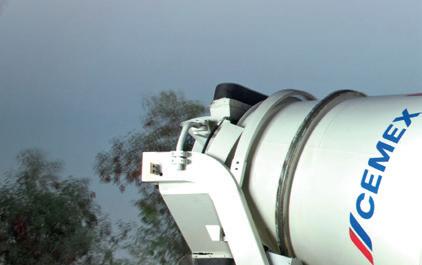
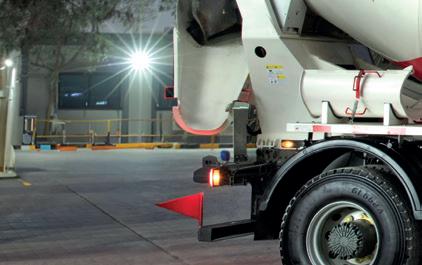
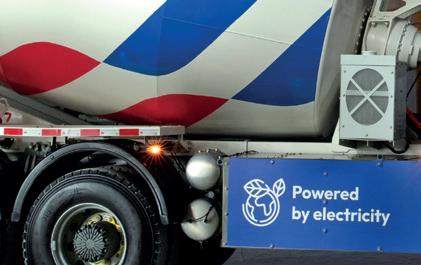
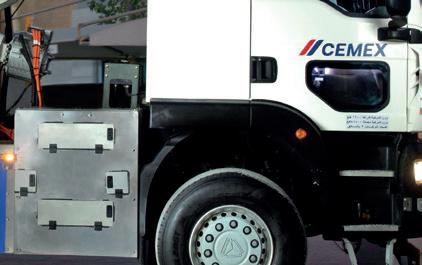
During the recent COP28 event in Dubai Cemex unveiled the rst fully electric, zero emissions readymix truck in the Middle East.
The truck is fully operational and has the capacity to transport a full load of concrete. It is equipped with a state-of-the-art 350kWh battery which allows it to complete an average full workday with a single recharge.

Cemex is actively collaborating with partners and manufacturers to discover, pilot, learn, and scale the long-term solutions needed for hybrid and zero



emission vehicles to be available at scale. At the same time, Cemex is adding trucks powered by renewable diesel and natural gas which have a carbon footprint that is 70% and 25% lower than regular diesel, respectively. These critical transitional technologies will enable a reduction in carbon emissions in the short term as heavy-duty electric vehicles become viable at scale.





The Australian pick and carry crane rm Franna is now launching its FR17 C model to Africa, UAE, and Latin America markets. This cost-e ective, compact pick and carry crane has a short turning radius of 6.77m and is said to be the ideal entrylevel crane for construction and logistics as well as city, yard and industrial applications where space is limited.
The rm says that its pick and carry cranes can replace the work usually completed by smaller truck cranes, since they have no stabiliser legs or outriggers, meaning set-up time is much quicker. They are designed to lift the load and carry it to its destination within a small radius. Coupled with a dedicated product support team, 24/7 support and a complementary range of digital tools including the Terex Lift Plan app, Franna pick and carry cranes have the support to keep moving—safely and e ciently.
The FR17 C is said to o er a combination of safety, comfort, and smooth steering exibility. The model has been
engineered to provide maximum productivity with advanced safety measures, latest technology, and robust structural design.
O ering a lifting capacity of 17tonnes, the FR17 C has a compact design for manoeuvrability in con ned spaces. It features an intuitive control system that enables precise and smooth operation, ensuring that operators can handle complex lifting tasks with ease. Advanced safety features include overload protection, anti-tipping technology, and a comprehensive safety monitoring system, providing operators with peace of mind, and enhancing overall jobsite safety.


Driver fatigue is reduced since there is no clutch pedal to operate, and this, along with the full-width, two-person cabin, provides good visibility and driving comfort.
One of the key highlights of the FR17 C is its Cummins engine, renowned for its reliability and widespread availability of spare parts, ensuring easy maintenance and servicing across any region and contributing to minimal downtime, increased productivity and reduced operational costs. Franna
www.terex.com/franna/en-au/

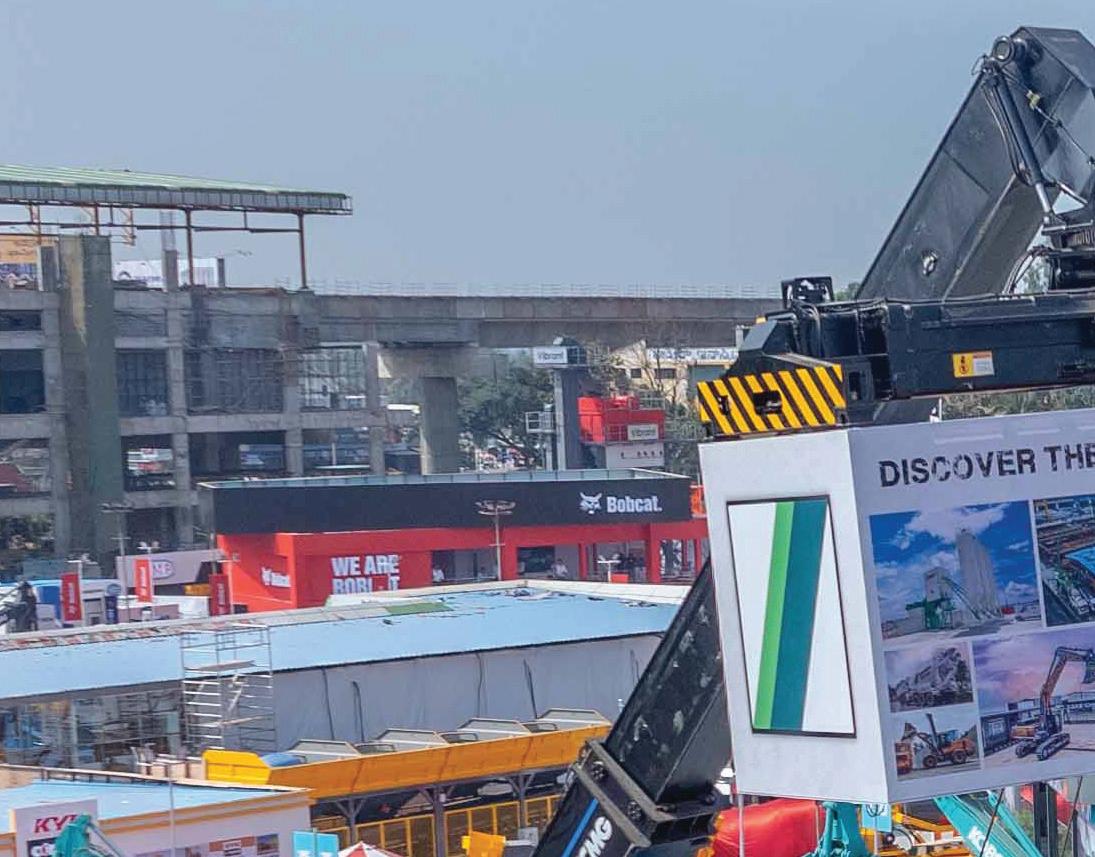
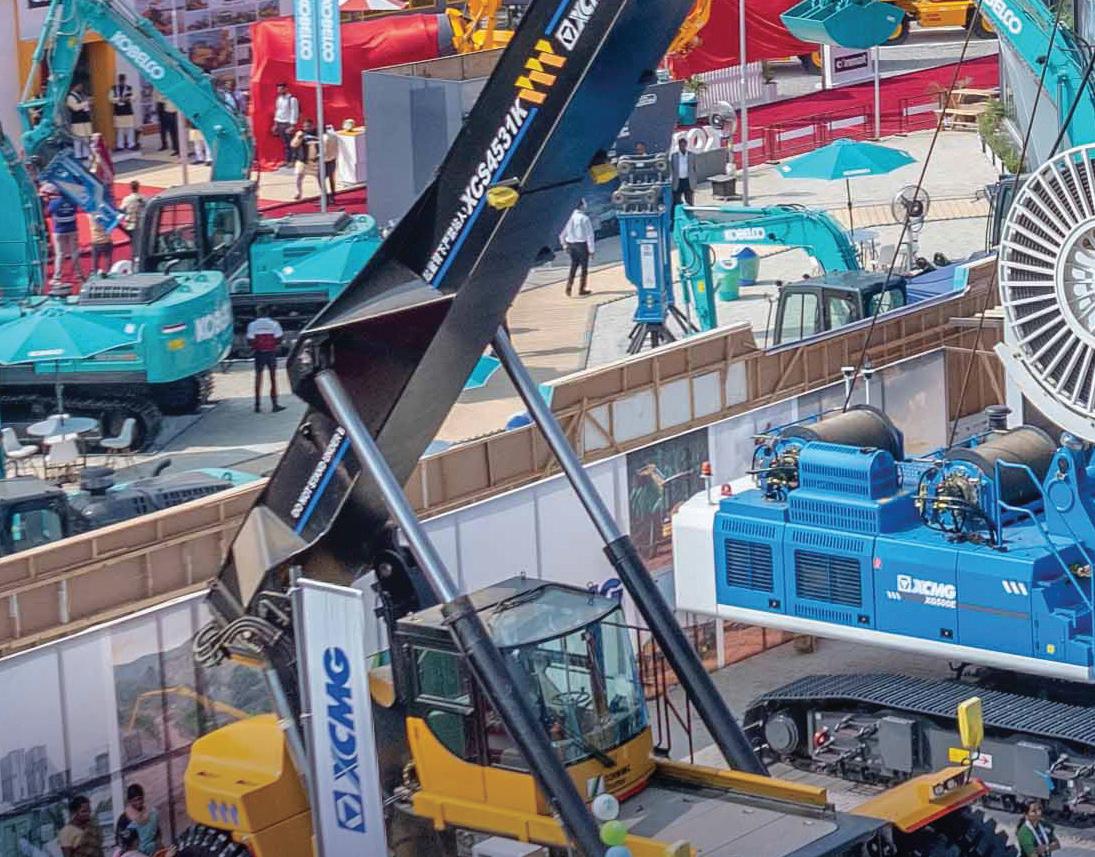
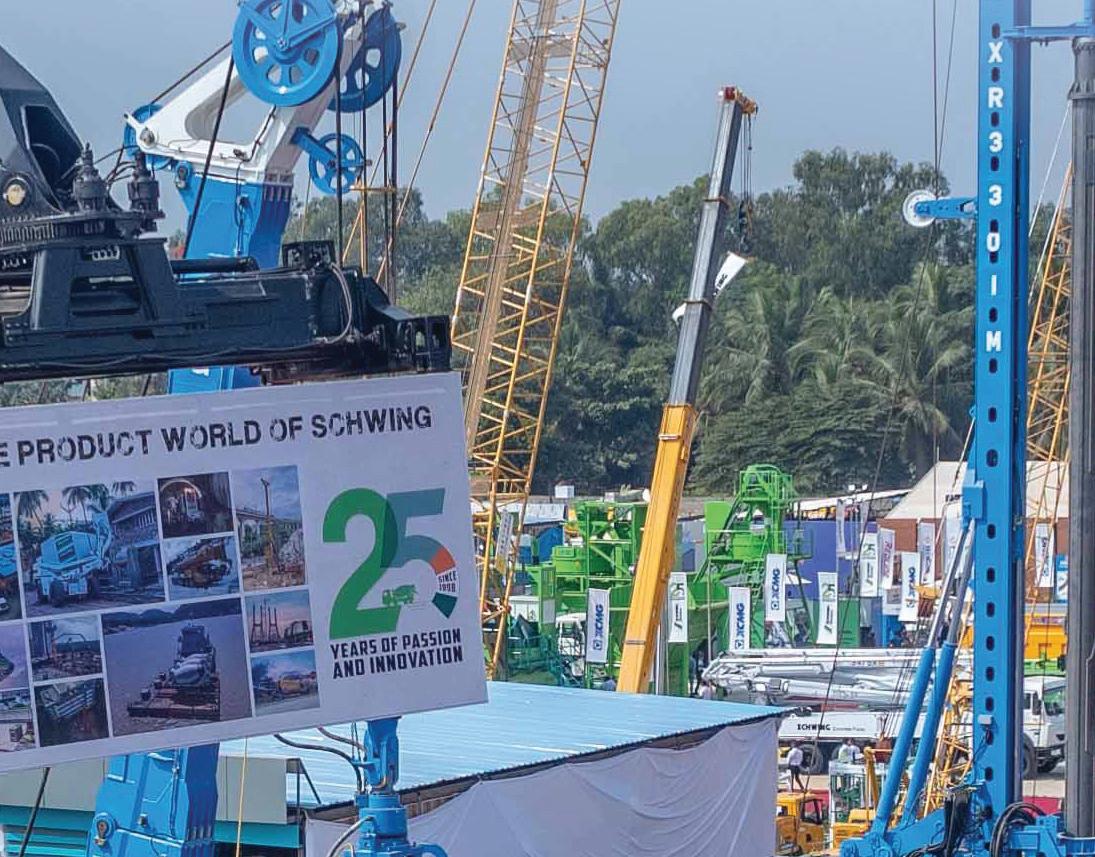
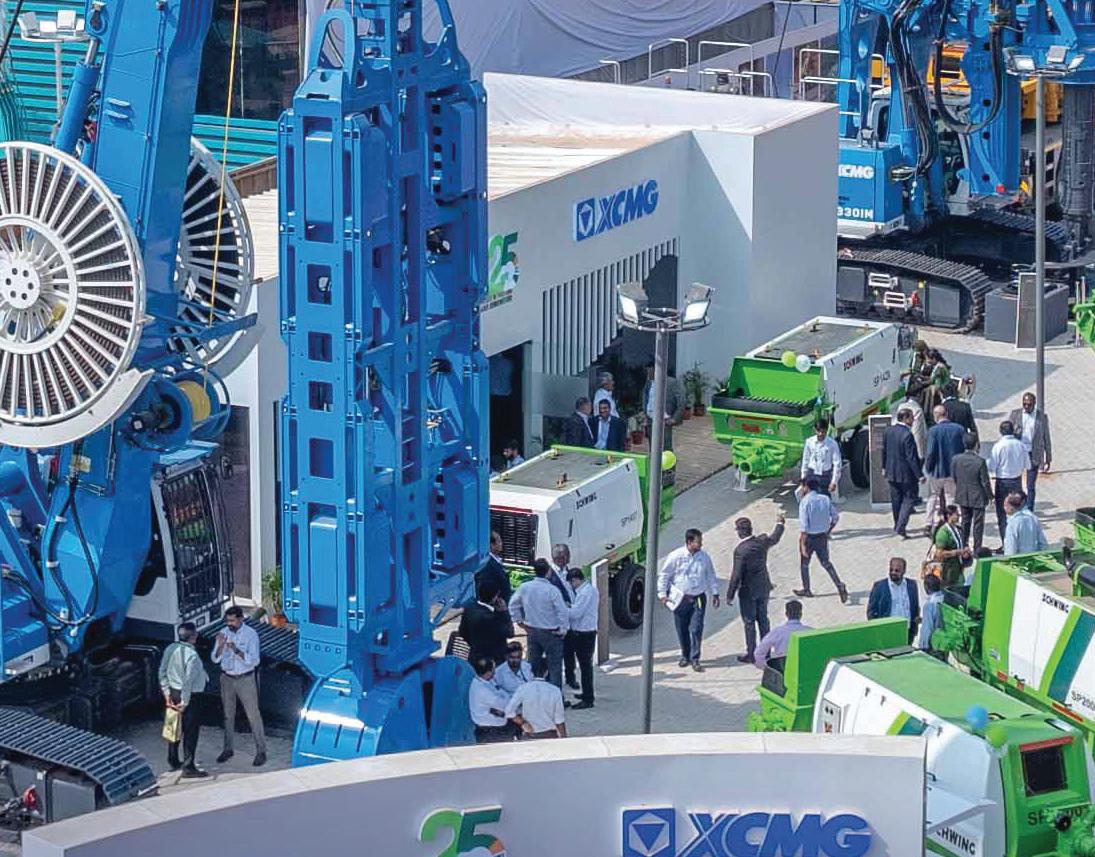
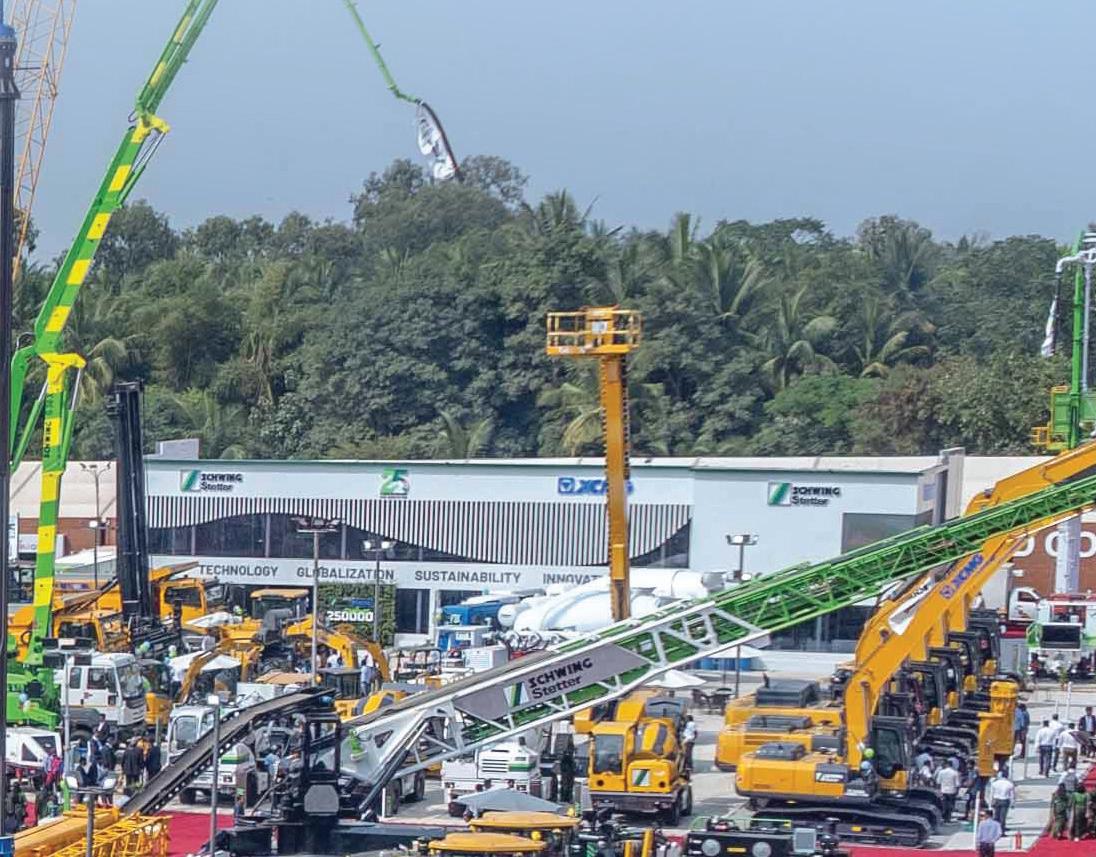
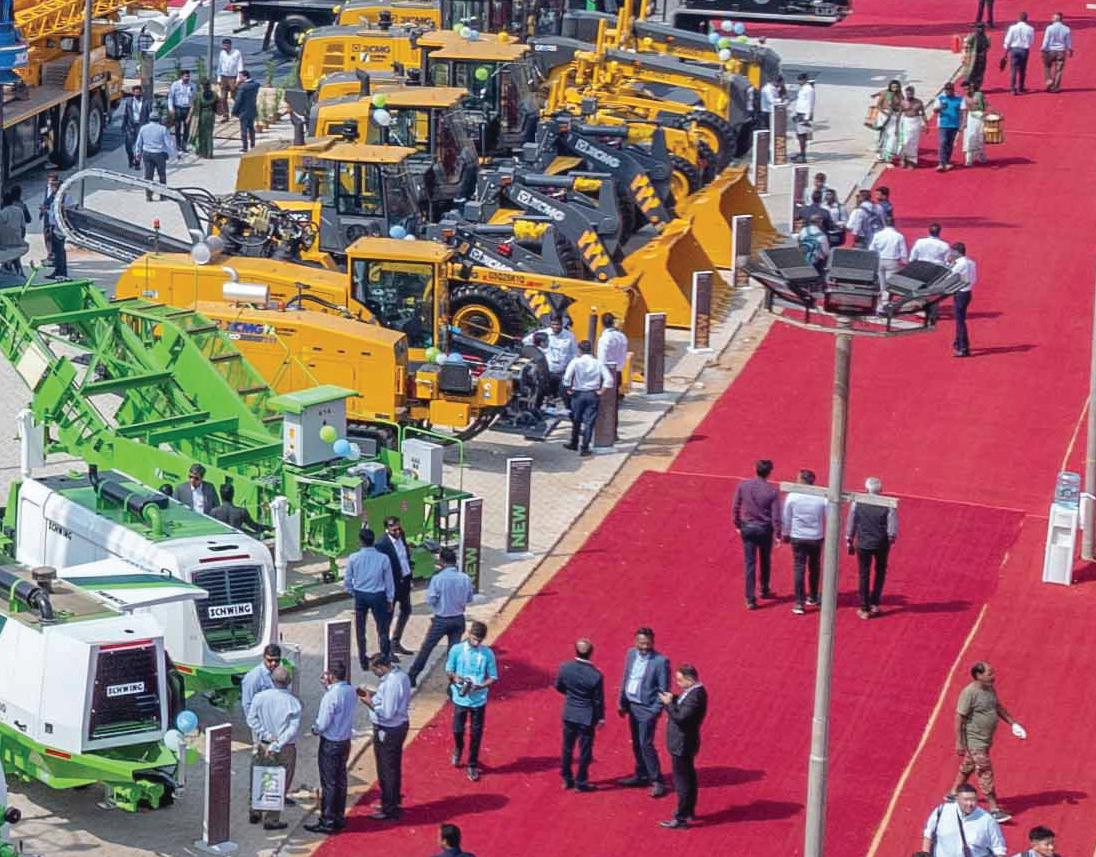
In line with the Indian Government’s thrust to bring in sustainability in road construction, the 12th edition of Excon 2023 witnessed newer product launches from road equipment manufacturers

oad Construction equipment manufacturers in India showed heightened levels of business con dence as they displayed innovative products at Excon 2023, South Asia’s largest construction equipment event, organised by the Confederation of Indian Industry (CII). The bullish business sentiment was on the back of the Indian Government’s continuing robust investments to develop road infrastructure. The event ran between 12-16 December 2023 at Bangalore, Karnakata, South India, spread over 3,20,000 =m2 of exhibition display area. The show witnessed the participation of fteen countries, ve country pavilions and 1000+ exhibitors.


Addressing the infrastructure construction seminar coinciding with the exhibition, which was attended by World Highways, Nitin Gadkari, Minister of Road Transport and Highways for the Government of India, emphasised the pivotal role of green initiatives in the road construction domain. A fundamental aspect of this vision involves addressing India’s environmental challenges through innovative approaches and harnessing technological advancements to attain sustainable growth. He said, “We plan to utilise urban solid waste in highway construction, aiming to convert this challenge into an opportunity. This is while continuing our thrust to develop India’s road infrastructure with the aim of making India a global leader in construction equipment manufacturing by 2028.”
The positivity on the government’s commitment to continue with its investments for developing India’s road infrastructure was evident among exhibitors as they reported very good business enquiries.
VG Saktikumar, MD, Schwing Stetter India said, “The 2023 Excon was a phenomenal success for us. This was in many respects. First, the timing of the mega event, post monsoon, has been highly opportune. This is because Indian contractors and other stakeholders make their purchase decisions in this period. We could demonstrate good interest among the customers to buy the equipment. Secondly, with banks and nancial institutions making borrowing easier for nancially sound contractors, who form our major customer’s base, we had a good deal of enquiries. This also allowed us to book fresh orders.”






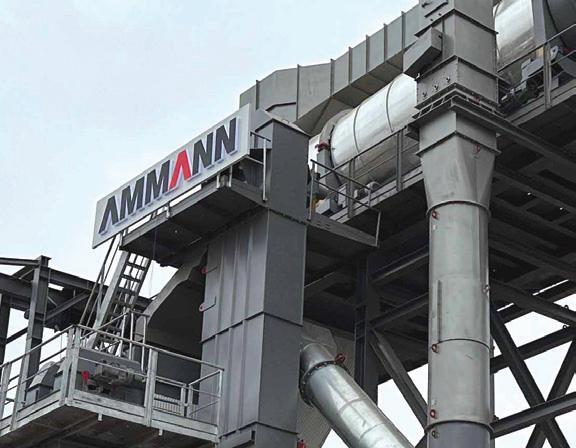
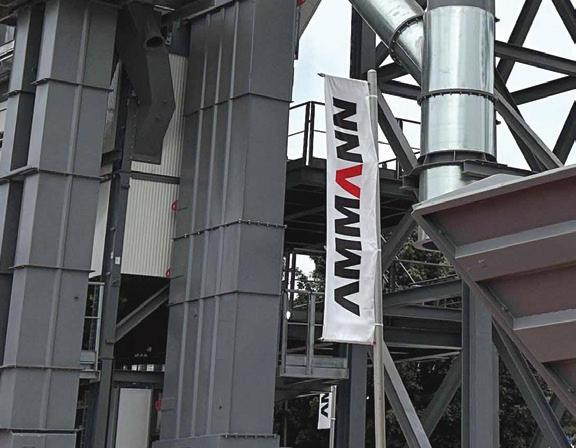
Ammann India launched 7m and 9m class pavers at Excon 2023. The pavers have been made at its plant in Ahmadabad, Gujarat Western India. It also showed a battery operated 2tonne tandem roller and 5tonne soil compactor. Anand Sunderesan- Managing Director, Ammann India said, “We are the only company in India making smaller-capacity soil compactors, whereas most competitors in the market rely on tandem rollers for soil compaction.”
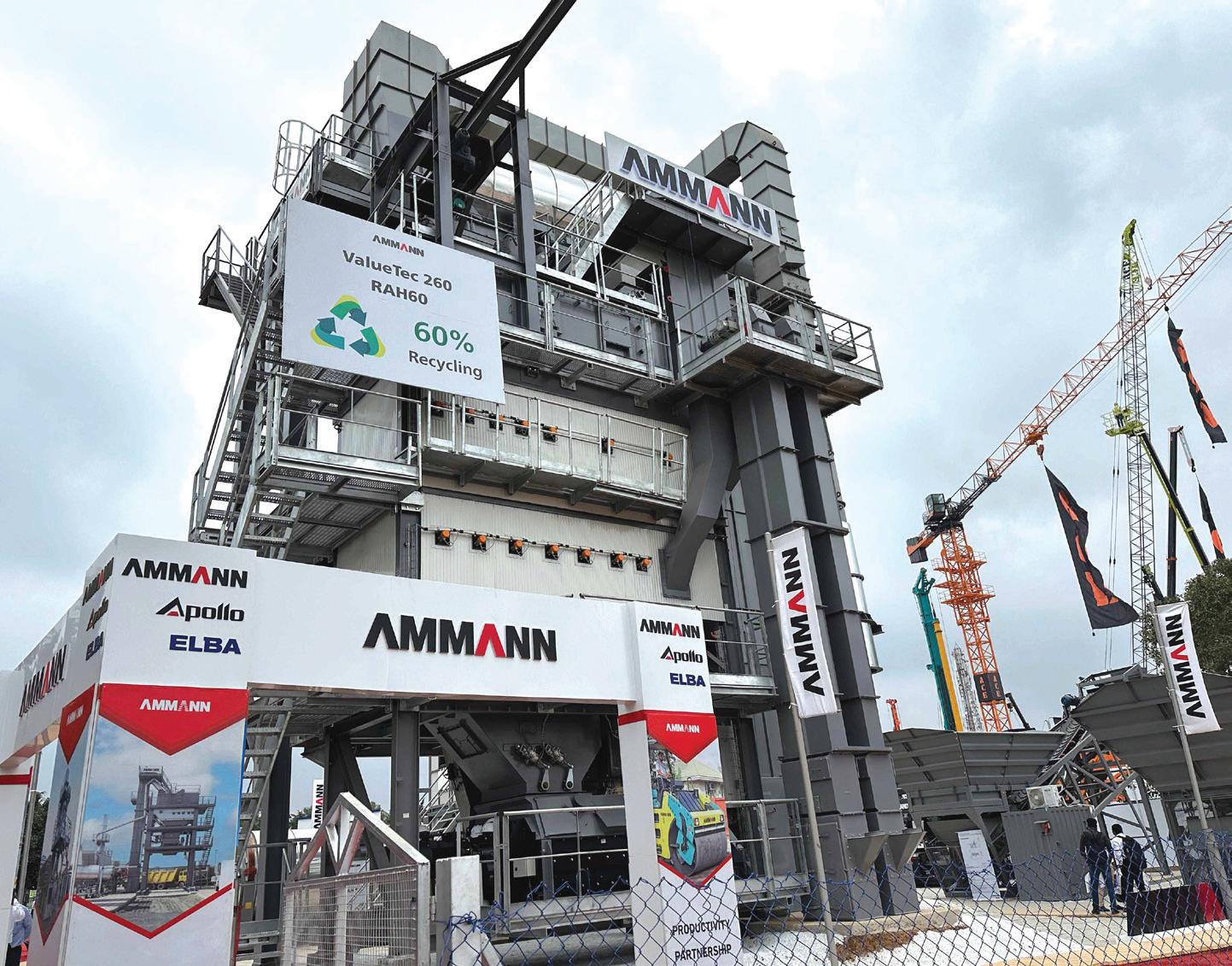
The company showed its advanced asphalt batch mix plant with the environmental control bene ts of its ability to recycle up to 60% of materials.”
“In contrast to our competitors our technology ensures perfect mix without the risk of bitumen burnout. This results in higher road quality.” He added, “The rst plant in India has been supplied to Indian Road construction

major, GR Infra with over 100,000tonnes of asphalt produced and laid.”


He said, “Recycling is gaining popularity in India. This is being driven by the initiatives of the Indian Government for environmental conservation. We have the technology to achieve up to 100% recycling , leveraging our parent company’s extensive experience as a 155-year-old entity in asphalt plants.”
“ Ammann India has made substantial investments in enhancing its in-house production capabilities to cater for the rising demand of asphalt batch mix plants. This comprises in-house fabrication and advanced technologies such as robotics. Despite COVID-19, investments of INR Rs 250 crores have been made as part of our preparedness to meet the future demand.”
Explaining about the new business venture into the asphalt batch mix plants segment,
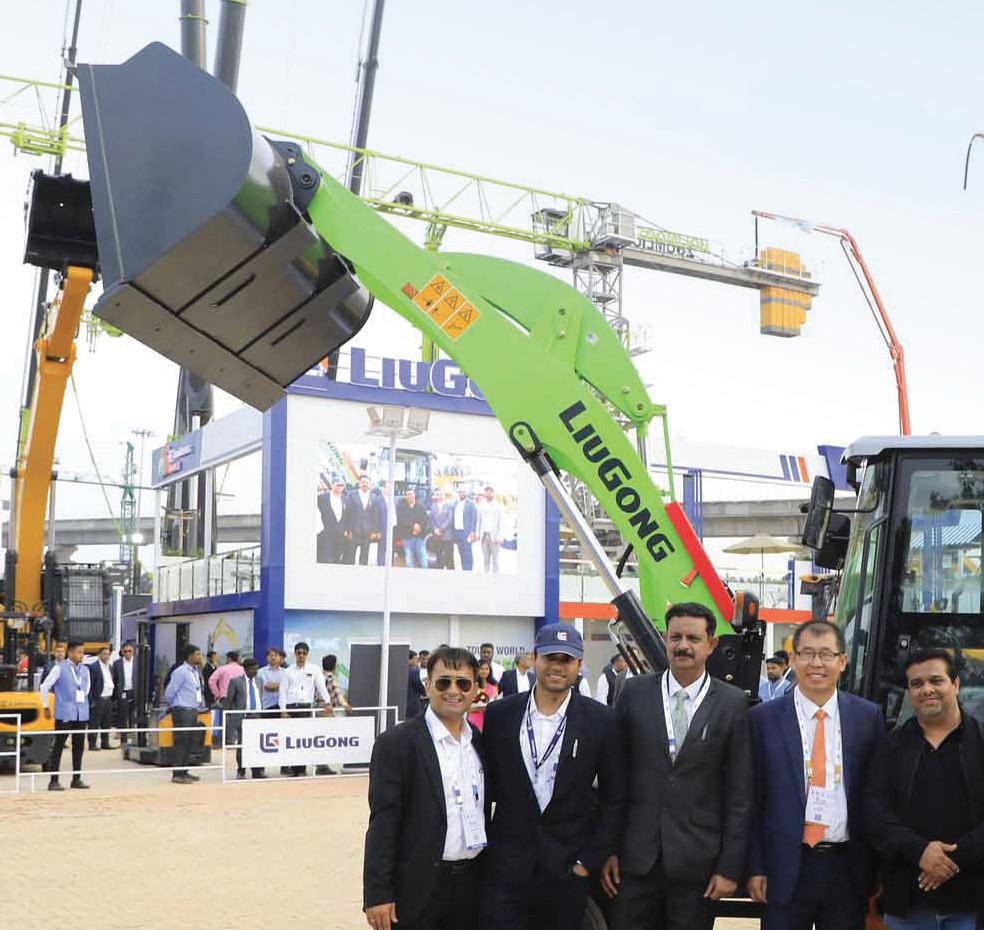
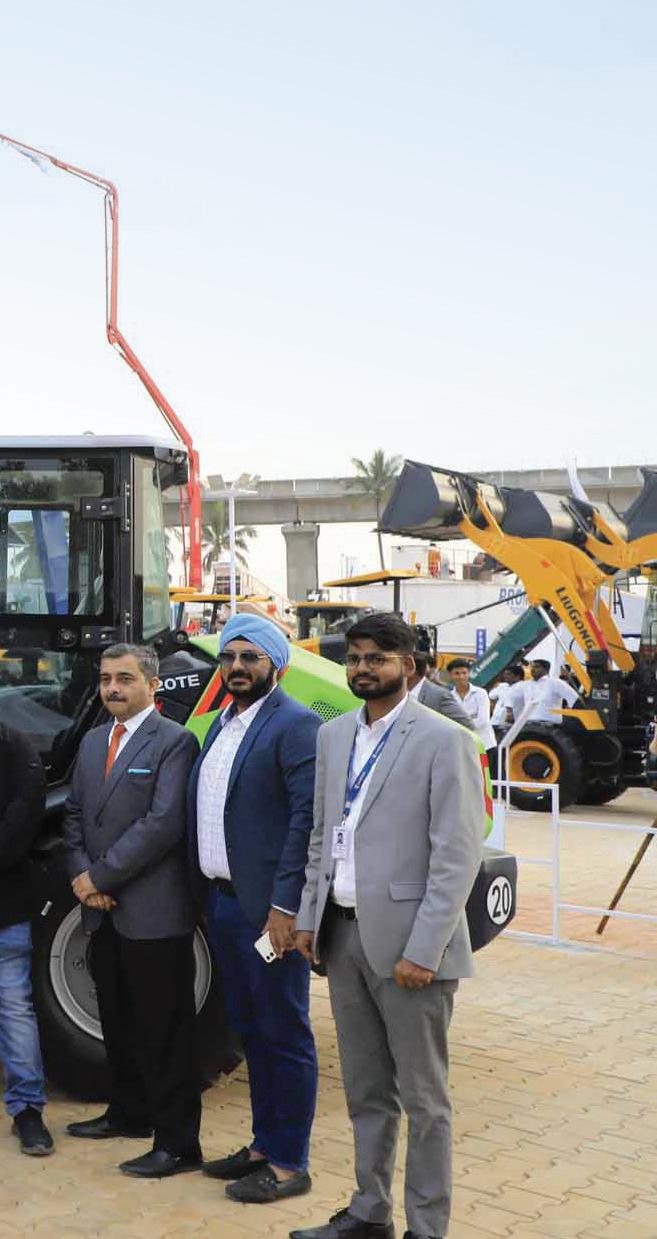
Nischal Mehrotra, Director Sales, LiuGong India said, “Globally, LiuGong has recently completed the acquisition of R&D Machinery. Through this acquisition, LiuGong India will be now promoting the asphalt batch mix plants in India as well. We will also support the existing population of the R&D Machinery plants in India.”
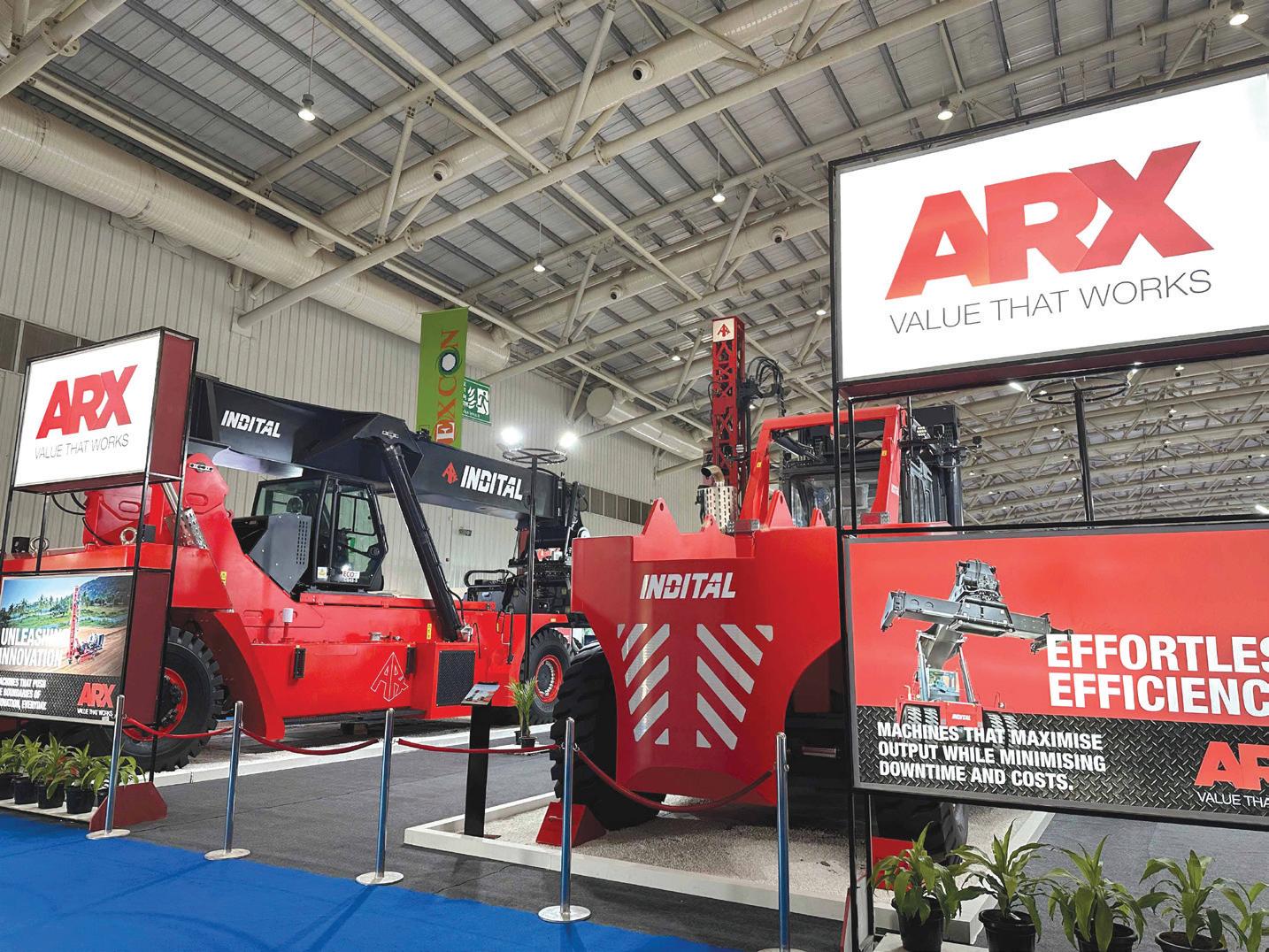
ARX displayed its range of motor graders and other products. The graders displayed comprised the G3200, G2100 and G1200 at Excon.
Sharing details of the product offerings Amarnath Ramchandran-MD ARX Mining and Construction Equipment India Pvt said, “There are established players in the market offering motor grader solutions in India. However, we have positioned our graders featuring simple operational mechanism, delivering higher reliability in operations and productivity. This is through our offerings of diesel, hybrid and hydrogen fuel version. The ARX Graders come with the latest drivelines from Germany in conjunction with high levels of product structural rigidity, and articulated blades with appropriate width. The machines have been built, so as to deliver optimum levels of productivity, total costs of operations, ef ciency and higher levels of savings.” He said, “Optimum levels of performance of the ARX Graders for road construction applications come with Trimble mapping systems.”
“Reliability of the graders is delivered through its heavy-duty steel box construction for all structures to withstand all kinds of heavy-duty cycles. The machines come with low noise emission hydraulic system with exceptional life expectancy to power hydraulic operations. The axial piston hydraulic variable volume pumps with electronic controller and control valves for superior controls and precision in hydraulic operations. For maximisation of controls systems utilisation, the cab has been designed for exceptional allround visibility, the operator’s cabin is designed to reduce fatigue and offer a comfortable place for the operator to easily spend a productive day with all controls and levers within convenient reach."
Volvo CE India showed its 5.5tonne electric wheeled loader with side arm discharge bucket at the event. Dimitrov Krishnan, MD, Volvo CE India Pvt Ltd said, “These electric wheeled loaders will be highly suitable to work in tunnel construction projects. This is because there are issues of inadequate ventilation of fumes in tunnels. Besides, with the side discharge buckets, the Volvo loader will be able to work for muck removal on highly constricted site areas and also tunnel construction jobs.”
Dimitrov said, “ The loaders will be offered as ‘Service Business Models’. The reason for going through the ‘Service Business Model’ to promote our range of both SDLG and Volvo wheeled loaders is to make the customers well informed about the functioning of the units. is because there are certain operational risks associated with electric charging of the machines, which requires highly skilled
handling. With this model, we will be able to operate the machines safely. This is until the owners/operators of the machines become fully conversant with the function and operation of the equipment.”
CASE Construction Equipment launched its BS (CEV) V compliant Backhoe Loader 770 NX Plus and Soil Compactor 1107 NX-PD at Excon 2023. It also marked their debut in two new categories in India with the unveiling of an all-new Skid Steer Loader SSL 175 and compact mini Excavator CX 35D. It also exhibited 10 new and upgraded products and services, including electric mini excavators and vibratory compactors, excavators and motor graders with a host of attachments and the all new FLEETPRO, a value line parts offering.
Shalabh Chaturvedi, managing director, CASE Construction Equipment, India and SAARC Region, said, “Showcasing our preparedness towards adapting the upcoming Stage V emissions norms as well as upgrading our entire Loader Backhoe range with the safest operator cabin. Our new offering comprising the skid steer loaders and mini excavators will be key enablers for us to widen our product portfolio for the Indian Infrastructure segment. Our new FLEETPRO parts offerings services will allow us to offer strengthened product support to our customers.
German Concrete Curing specialist, Kraft Curing, displayed its highly innovative Concrete Match Curing System at Excon 2023. Targeted for Indian precast concreting systems, the Concrete Match Curing System is expected to deliver higher levels of quality in precast concrete bridge girders, to be used for transportation infrastructure.
According to Daniel Rafter, Sales/ Engineering, Kraft Curing Systems GMBH, “With the pace of infrastructure construction
attaining higher levels in India, there are requirements for testing solutions that can provide accurate in situ levels of concrete testing. This is while the concrete is being molded. The in situ ‘Match Cure’ laboratory based testing will leave negligible scope for inaccuracies in the precast segment while it is being prepared.”
Sharing details on the working of the ‘Match Cure Systems’ Rafter said, “ The quality control device featuring a chamber can analyse the duration and temperature for the required levels of water that will be needed in the concrete mix in the segment that is being prepared. This is in accordance with the speci cations covering the required hardness levels and the other factors. In accordance

with the output given by the Match Cure System, the inputs can be incorporated while the casting and curing is being done. It is to be noted that the Match Cure System is a completely separate laboratory based analysis system. While our curing systems, based in containers, solely aids in concrete curing. It can be said, the ‘Match Curing Systems will complement the functioning of the curing systems, in attaining the desired product quality .”
Gujarat based, asphalt batch mix plant manufacturer, bitumen decanter, bitumen micro surfacing and allied products company Alltech, displayed its new 120tonne/hour mobile asphalt batch mix plant at Excon 2023.
Discussing the product, Gurdeep Singh Matharu, Vice-President Alltech Industries (I) Pvt Ltd said, “ The 120tonne/hour asphalt batch mix plant has been completely designed and manufactured by our in-house Mehsana Ahmadabad facility, complete with the chassis, bins, burners and the hopper and the screens. The product will he highly suitable for carrying out maintenance for long road stretches at shorter durations. The prime advantage of the plant is being completely mobile, it can be towed between sites by prime movers with ease and faster mobility. Further, the mobile asphalt batch mix plant can be set up and commissioned delivering throughput within one week, facilitated by the hydraulic jacking arrangement. This is in contrast to the one-month period taken by conventional stationery asphalt batch mix plants for set up and commissioning.”
Hyderabad, South India-based, asphalt batch mix plant manufacturer Vibrant has carried out recent advancements in its entire range of asphalt batch mix plants for their optimum usage.
Kranthi Kumar Ravuri, CEO Vibrant said, “We offer plants within capacity range
of 100-260tonnes/hour. In order to make the plants have higher levels of availability, enabling the owners to hedge the initial costs across their life cycle, we have made some major advancements. This comprises of making our plants process hot and cold recycled materials.”
He mentioned, “Further, we have upgraded the design of our entire range of plants. In accordance with this, we have made our plants more modular, through changing the design of the bins. The plants now have their own burners for right heat dissipation and higher levels of energy efficiency. Most importantly, we have made our plants more robust in design with ease of assembly and disassembly. Given the demand for longer stretches of road construction in India, we will continue to carry out design and functional improvisations in our asphalt batch mix plants.”
Gujarat-based asphalt batch mix plant and allied products manufacturer Ashitech is working towards upgrading the working functionalities of its asphalt batch mix plants and other products. The product advancements are being done to ensure the optimum usage of its plants. Ashitech manufacturers asphalt batch mix plants at its Gujarat facility between the capacity ranges of 80-260tonnes/hour. The plant was recently launched by the company for deployment at National Highway Authority of India projects.
Vatsal Patel, Director Asitech said, “ We have in place a full range of asphalt batch mix plants, suited for all kind of road projects construction needs in India and SAARC export markets. Now moving further, we are in the process of making our plants adaptable to the usage of both hot and cold recycled materials. With the advancements being done, the plants will be able to utilise close to 40% hot recycled material and 30% cold materials. Our plants have been made RAP enabled earlier as well.”
“In conjunction with making the plants enabled for using recycled materials, we are also working towards enhancing their efficiency. In accordance with this, we are now equipping the plants with our own burners, and with the design changes of the bins, improving the processing of the asphalt.
Light towers manufacturer Aska Equipment foresees rising demand for its light towers. This follows increasing activity in the infrastructure sector, particularly road construction and mining.
Speaking about the light towers offerings to suit the demand, Rom Prakash Bhagat, National Head Sales & Marketing, International Business at Aska Equipments Pvt Ltd said, “ We have a wide range of offerings, suiting the varied nature of construction site requirements. The very easily-towable machines come with diesel engines and solar-powered batteries, as hybrid models.” The diesel engine-operated light
towers comes with the option of Yanmar and Kohler Engines.
He said, “The hybrid based light towers to be introduced by us will be compact and require less maintenance. This will be suitable for construction sites.”
Doosan Bobcat India exhibited its range of light towers for road and general infrastructure construction and mining sites applications at Excon 2023. Doosan acquired Ingersoll Rand light towers and compressors in 2007, and the products are now branded as Doosan Bobcat.
Talking about the light towers, BS Srinivas, director Portable Power, and Ramarao Dasika, general manager PP Sales and Marketing, Doosan Bobcat India Pvt Ltd said, “Our Bobcat branded light towers can illuminate sites between 1 and 60m. The towers are compact in their design and sturdy as well. The high levels of robust design makes the equipment withstand wind speeds of almost 60km/h. This makes them suitable for all construction site needs. Being fitted with an option of Yanmar, Kubota and Mitsubishi Diesel Engines, makes the towers further reliable.” The officials said, “We are marketing our light towers not as an item that is required for construction sites as being done by our competion. Rather, we are offering the product as a complete solution, backed by requisite levels of technical support comprising the demonstration of the units for the contractors.”
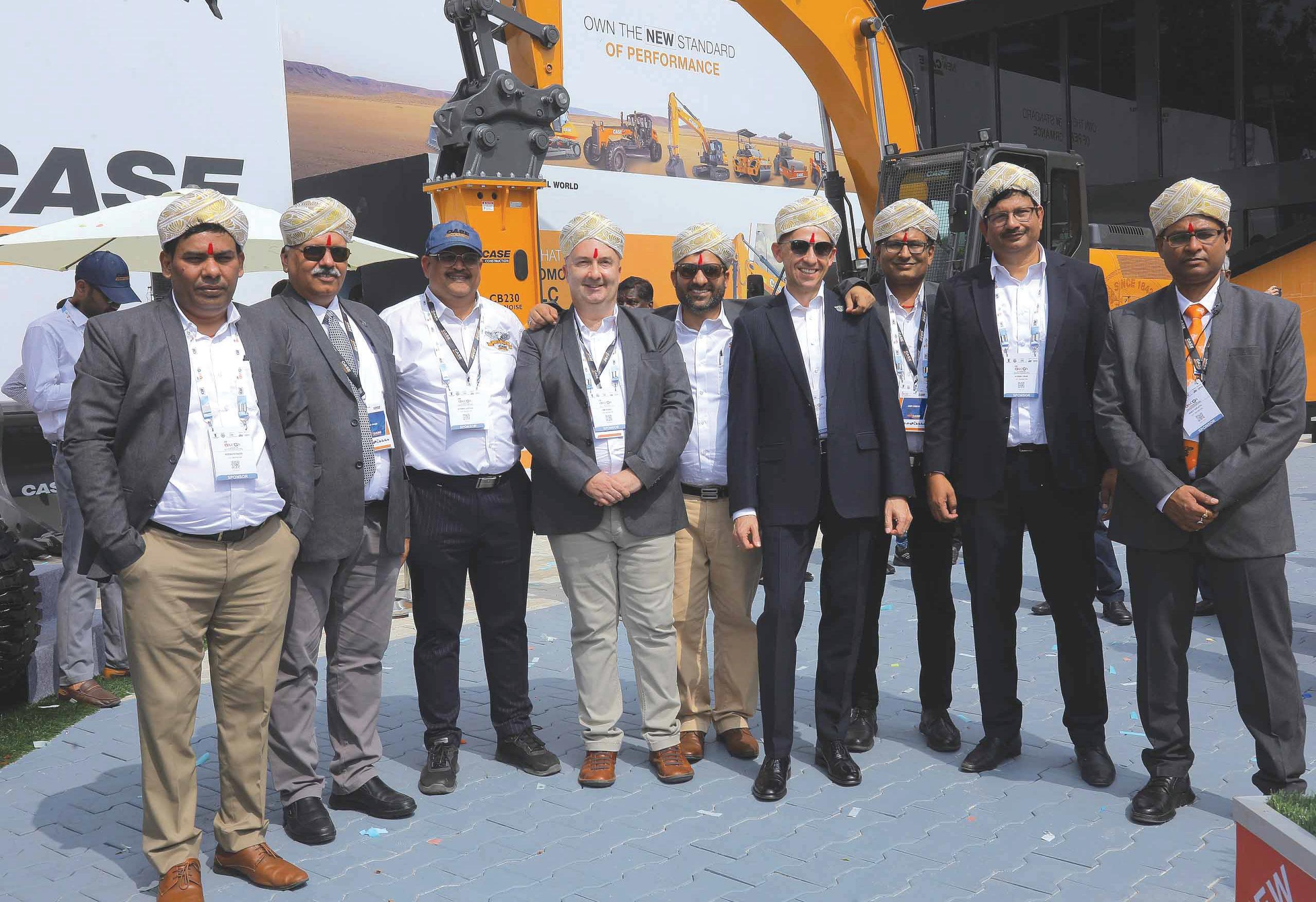
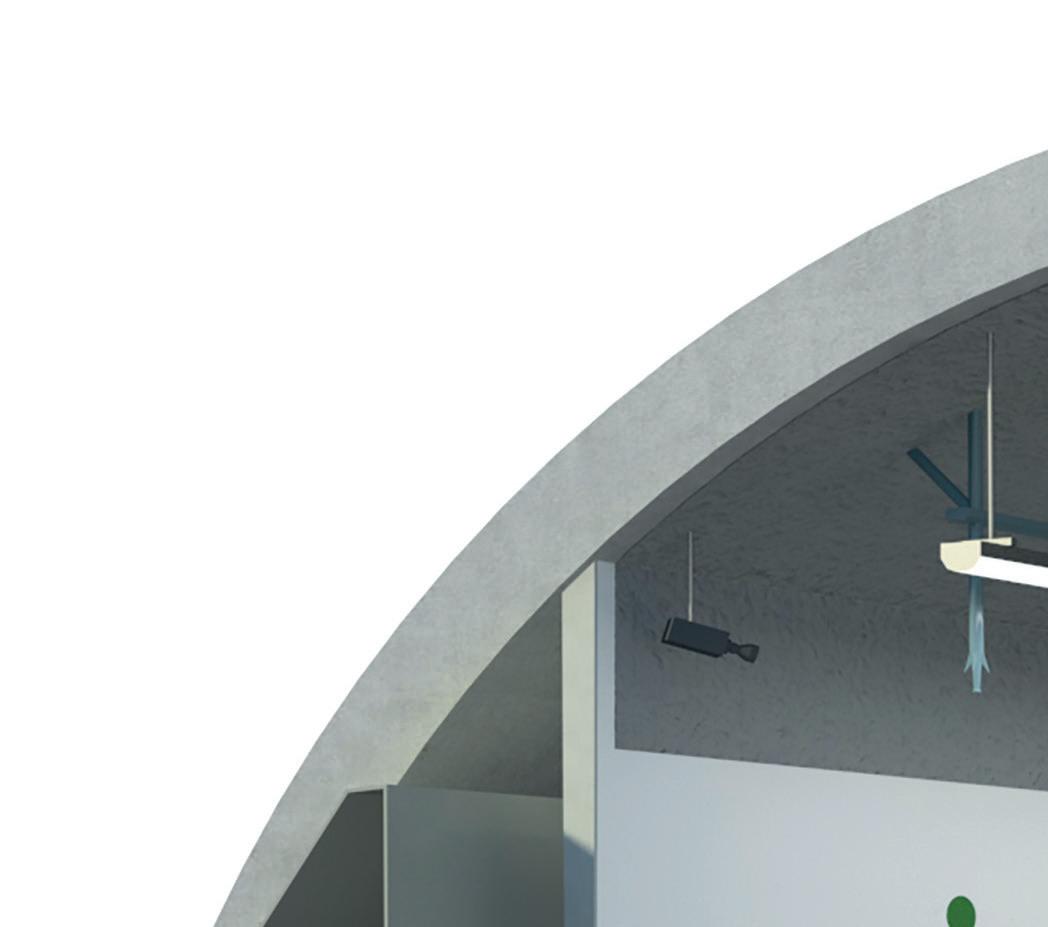
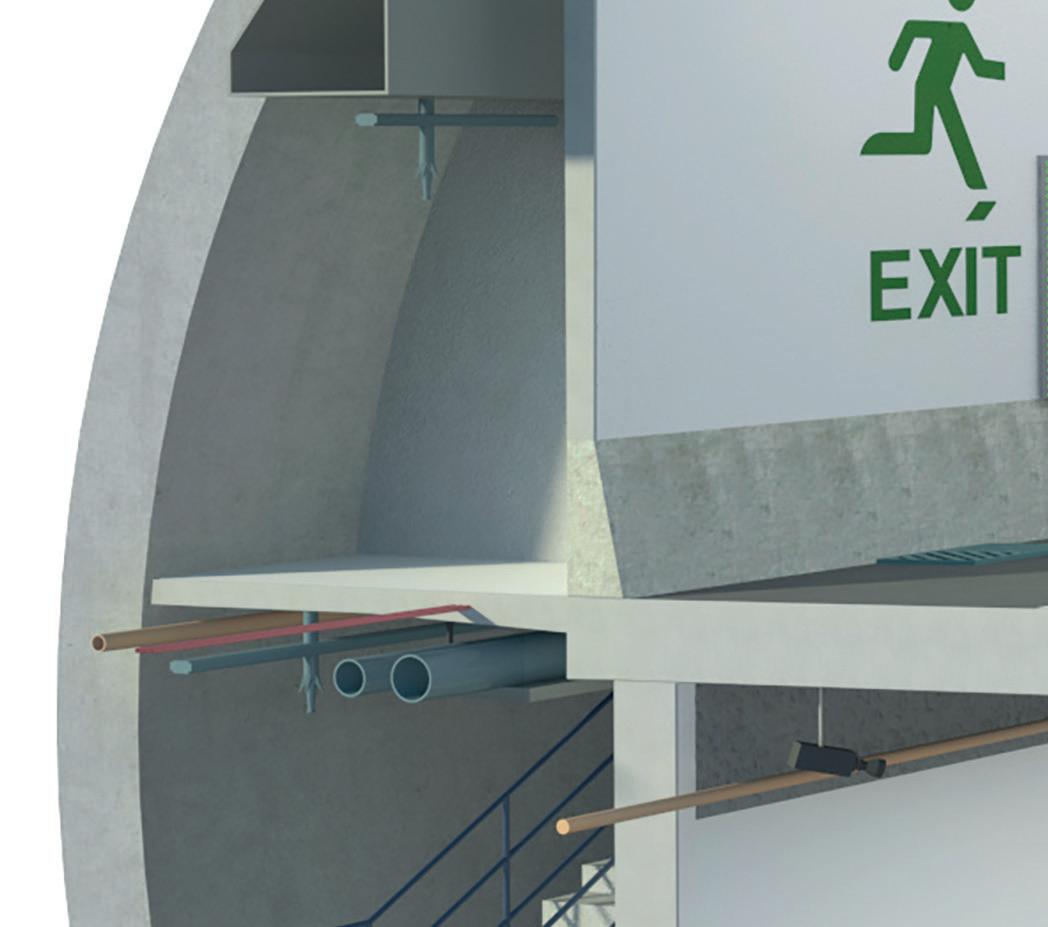
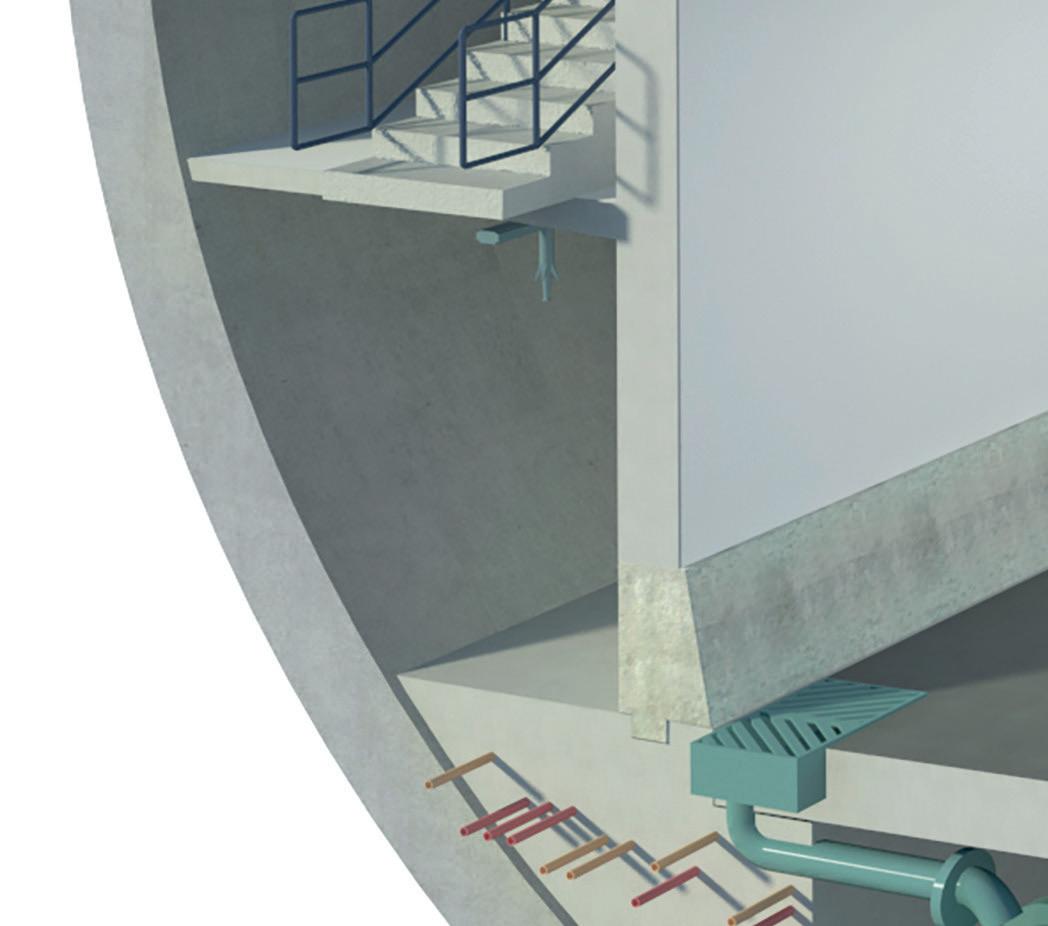
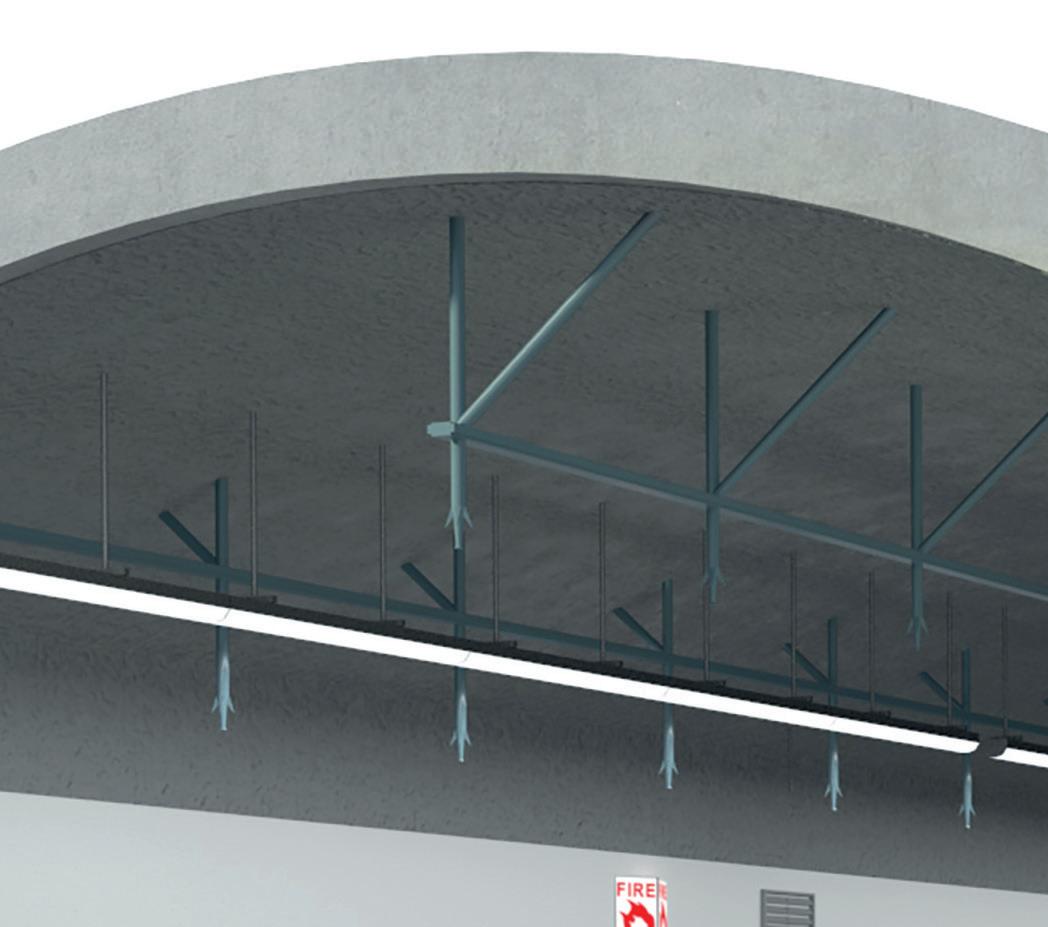



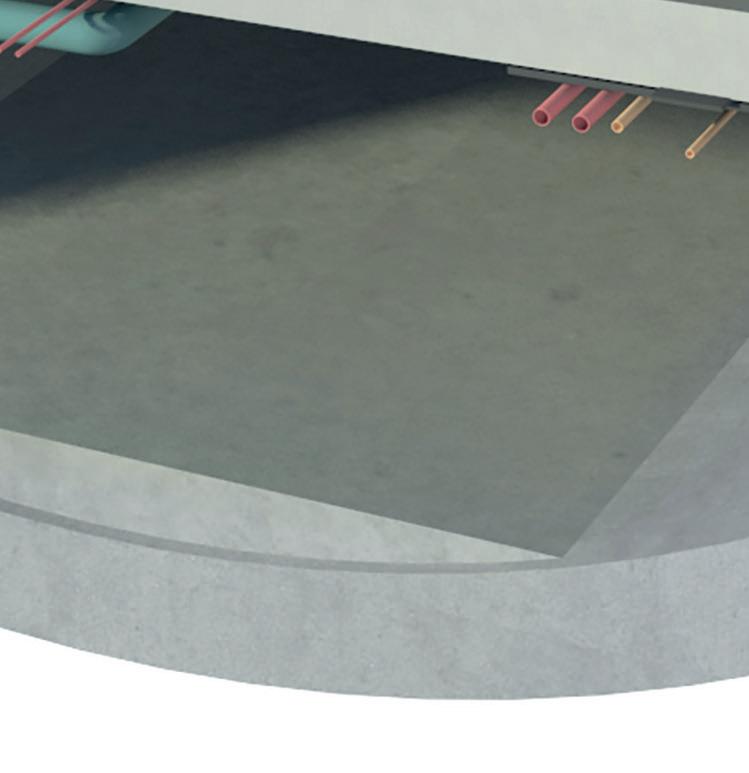

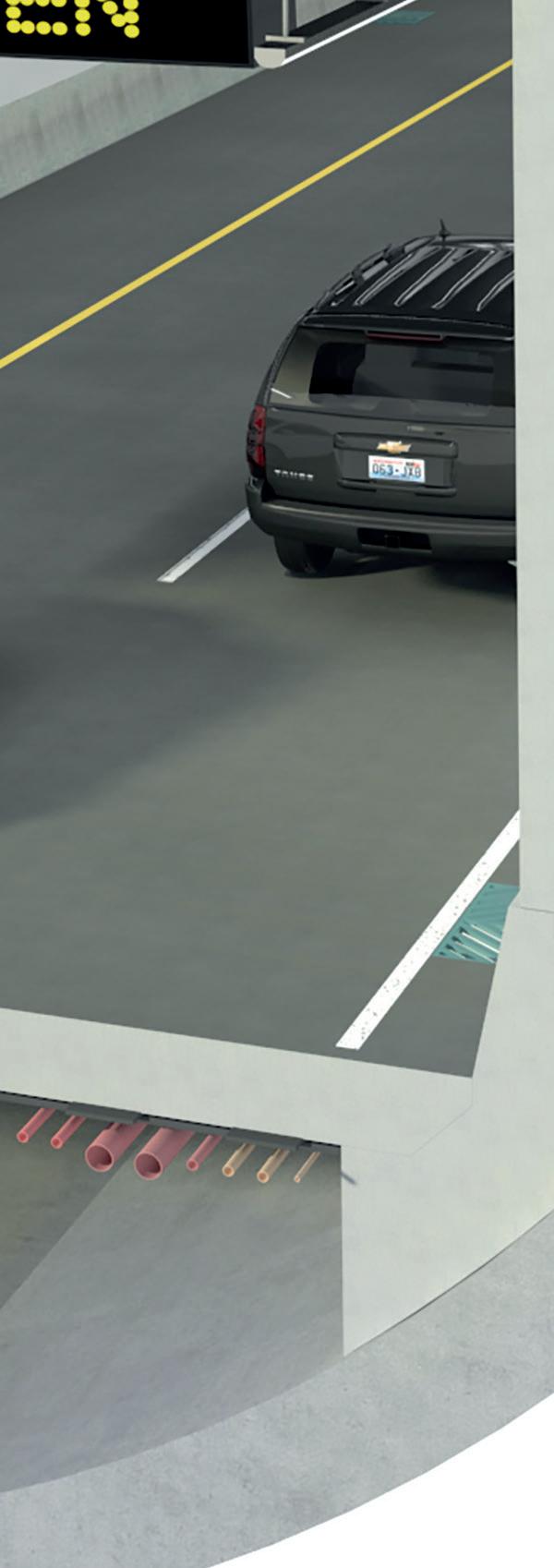






David Arminas recently returned to Seattle for an inside look at some
of the features of the
now-complete SR99 tunnel that was a World Highways key project report in November 2017
At the recent IBTTA – International Bridge, Tunnel and Turnpike Association – meeting in the US city of Seattle, World Highways toured the State Route 99 tunnel. Also called the Alaskan Way Viaduct replacement
The double-deck Alaskan Way viaduct – it ran above a surface street of the same name - was built between 1949 and 1959 with the rst section opening in 1953. In 2001, the Nisqually Earthquake damaged part of the ageing viaduct, prompting serious consideration of replacing it with a more earthquake-resistant structure. By the time it was demolished in 2016, it was carrying between 91,000 and 110,000 vehicles daily.

tunnel, SR99 is in the centre of the Paci c coast port city in the north-west state of Washington.
The 3.2km-long double-deck bored tunnel carries a section of SR 99 , under the city centre, following closely the old Alaskan Way viaduct alignment that used to carry SR99 and which ran close to the city’s waterfront.
The tunnel opened in 2019 and for a brief period was not tolled. But when tolling was introduced, usage dropped and then COVID-19 hit, further depressing tolling revenue. The tunnel is structurally a masterful piece of engineering, being an ef cient mover of vehicles in a safe fashion.
Imagine the inside of the tunnel where sits two concrete boxes, one atop the other, and their bottom surfaces – their floors - are the road surfaces. The lower box’s floor carries northbound traffic, while the top box’s floor carries southbound traffic.
To support the two stacked boxes, the lower box sits upon concrete corbels (edges) built into the sides of the circular tunnel. This creates, underneath the floor of the bottom box, the invert, the lowest section of a tunnel that acts as the tunnel’s floor running the length of the structure. In this case, the invert is for maintenance and holds such systems as those for drainage and power.
Running beside each concrete box is an escape section of the tunnel. There are doors running the length of each box for entry into the escape section should an emergency arise. In the event of an emergency, fans in the escape section automatically kick in to increase the section’s air pressure to that just above the adjoining road section. This gives the escape section a positive air pressure, greater than that of the road tunnel. Smoke-filled air from the road tunnel cannot then enter the escape section as the flow of air will be directed into the main road tunnel.

Replacement options included a cut-and-cover tunnel, a bored tunnel or another elevated highway along with major modi cations to nearby surface streets. In 2009, the bored tunnel option was chosen and construction began in 2013 using "Bertha", at the time the world's largest-diameter tunnel boring machine. Bertha Knight Landes was Seattle's only female mayor, in of ce between 1926-28.
The contractor Seattle Tunnel Partners had Bertha designed and manufactured at a cost of US$80 million by Hitachi Zosen in Osaka, Japan. The cutterhead diameter of 17.5m held 122 disc cutters and 255 replaceable knife bit cutters. Rotational speed was up to 1.8 revolutions per minute. At 99m long, she weighed 6,100tonnes and was shipped in 41 sections to Seattle, arriving in 2013 and was fully assembled by June to begin work.
After several delays, tunnel boring was completed in April 2017 and the tunnel opened to traf c in February 2019. The nal tunnel construction bill came to $2 billion, out of the overall project’s $3.3 billion.
The SR 99 tunnel has variable-rate tolling that varies based on time of the day, number of vehicle axles and payment method. Tolls are collected electronically, with a lower rate for holders of a Good to Go pass and a higher rate for other drivers where the tunnel system scans their vehicle licence plates and they are sent an invoice in the mail.
According to the Washington state Department of Transportation, tolling the SR 99 tunnel helps repay $200 million borrowed to build the structure. It also pays for the ongoing cost of operating and maintaining a safe facility. This funding is part of the $3.3 billion construction cost to replace the aging Alaskan Way Viaduct and rebuild SR 99 through Seattle.
Then came the COVID pandemic with shutdowns and lockdowns. The lack of travellers hit most major US transportation facilities hard and traffic-level recovery has been slow for some, including the SR 99 tunnel.
The recently published 2023 Annual Tolling Report from the Washington State Transportation Commission highlighted the issues facing infrastructure construction repayment and the financing of maintenance and operation. As Washington state’s tolling authority, the commission is responsible for setting toll rates and polices for all tolled facilities statewide. It noted that it must take action to close the projected SR 99 tunnel funding gap.
Total revenues for all five tolled facilities for which the commission is responsible dropped 22.8% below the pre-COVID forecast. Revenue for the SR 99 tunnel has been among the slowest to recover, the commission noted. “The disparity between traffic and revenue recovery… can largely be attributed to a flattening out of traffic levels throughout the day, with fewer peak-period transactions observed than preCOVID. The length of time these travel behaviour changes and related impacts will persist remains unknown.”
The number of downtown Seattle office workers in October 2022 was only about 40% of that in October 2019, which has contributed to lower traffic volumes and revenues for the tunnel, according to the commission. “For example, the SR 99 tunnel is expected to generate nearly $49.7 million in revenues in the 2021-23, which is about $9.1 million, or 15.4%, below pre-COVID forecasted levels from November 2019…. Looking ahead revenues are expected to rise in the 2023-25 to about $53.5 million, however this is still about $7.2 million, or 11.8%, below the pre-COVID forecast.”
The result is that the state government will have to consider a financial injection to operate and maintain the tunnel. According to a report in the Seattle Times newspaper in October 2022, a bailout was on the cards earlier that year.
Part of the problem, the Times said, is that construction of a giant Alaskan Way surface street, when completed, will give drivers more leeway to pass downtown Seattle without paying tolls. “Already, the tunnel is $29 million in the red, despite an urgent 15% toll-rate increase to catch up last year (2021). Tolls range from $1.20 to $2.70 in each direction for Good to Go passholders, varying by time of day.”
Jason Richter, deputy state treasurer, warned the state’s transportation commission to expect reduced demand because telework will continue for decades.
Soon after opening with no tolls in early 2019, the tunnel attracted 75,000 trips on weekdays, nearly the same as 80,000 who would take the old Alaskan Way viaduct.
By comparison, to be fiscally sustainable with minor diversion, it was estimated that 53,000 daily tunnel trips were needed in 2020,

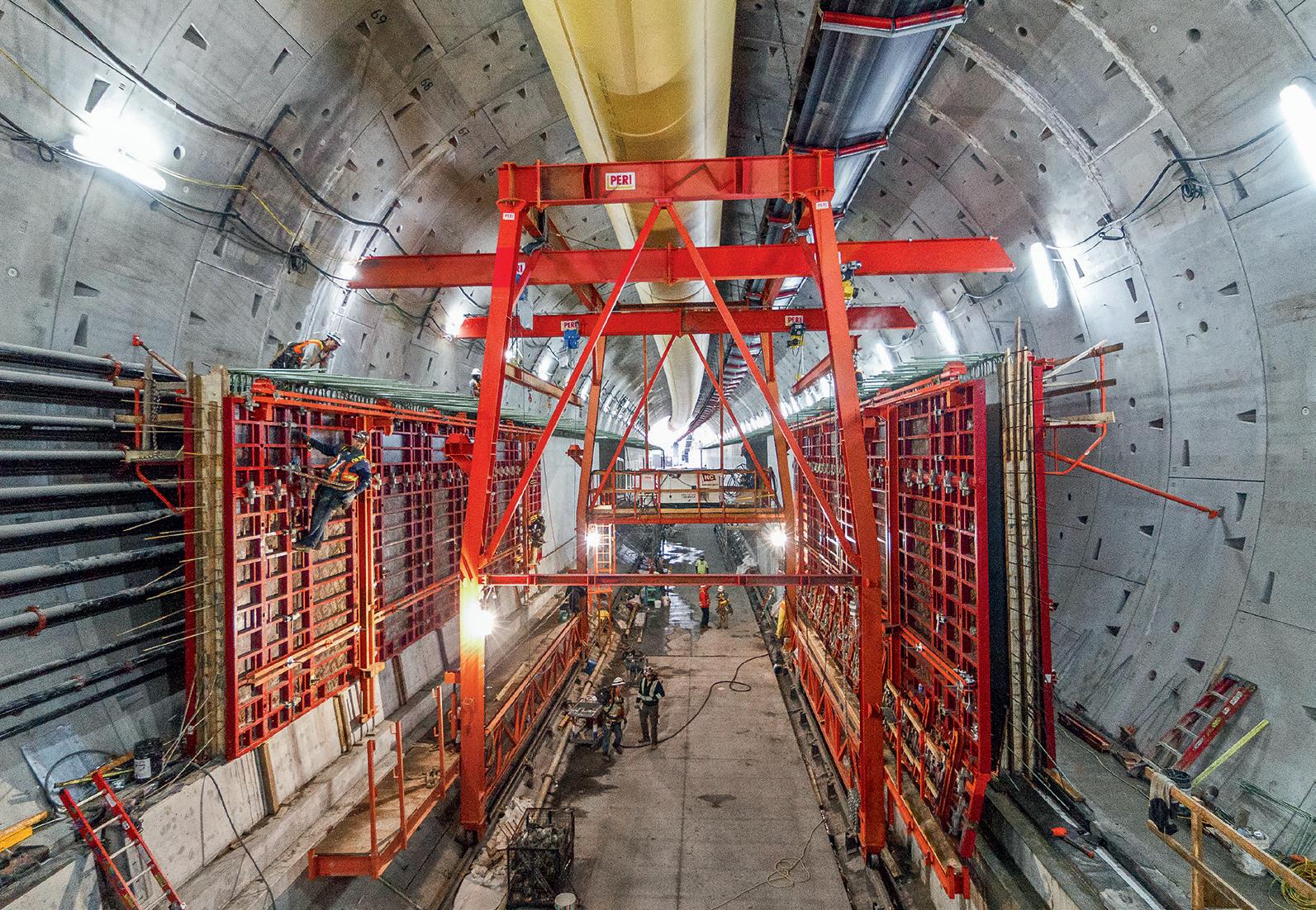
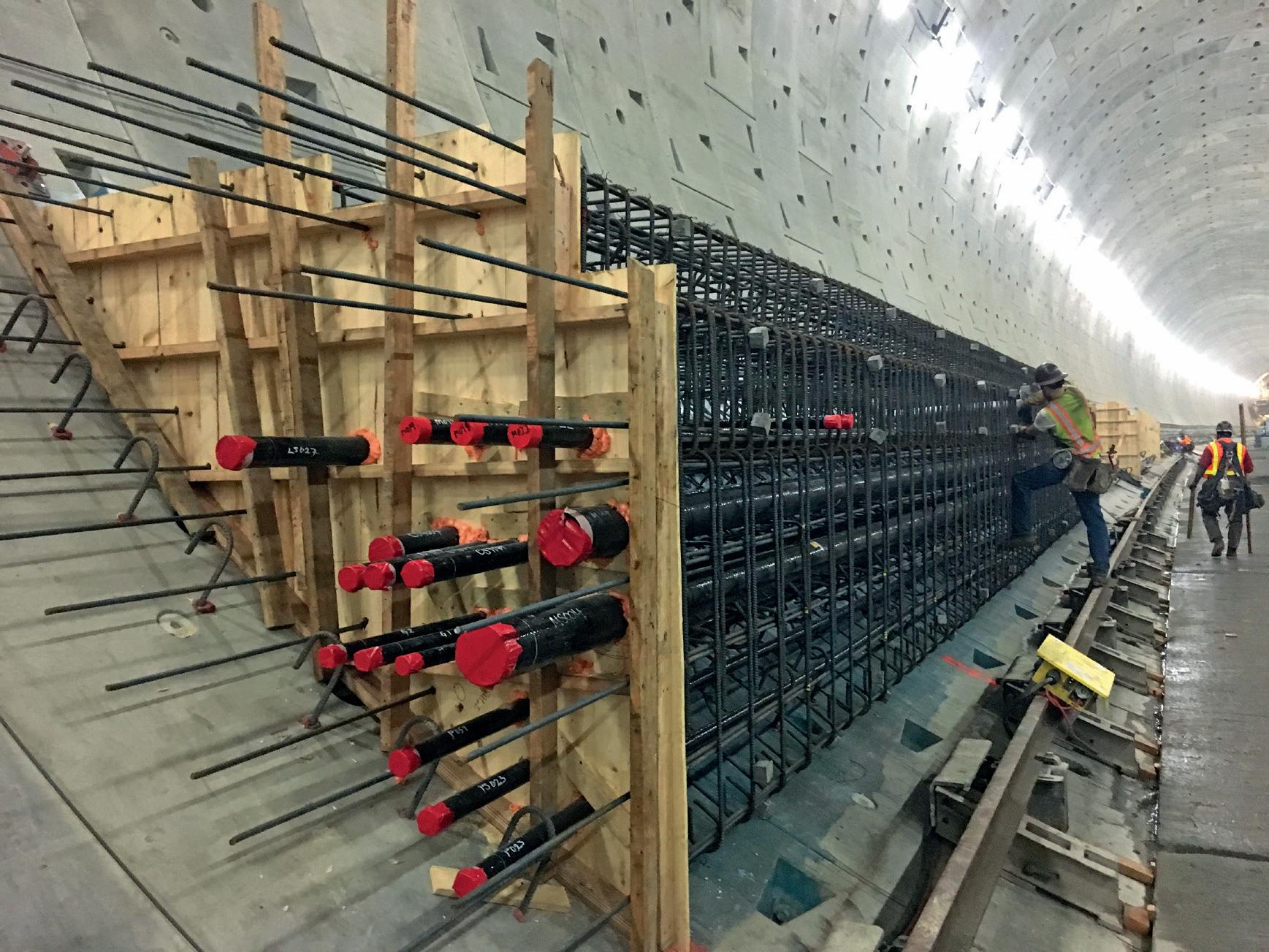
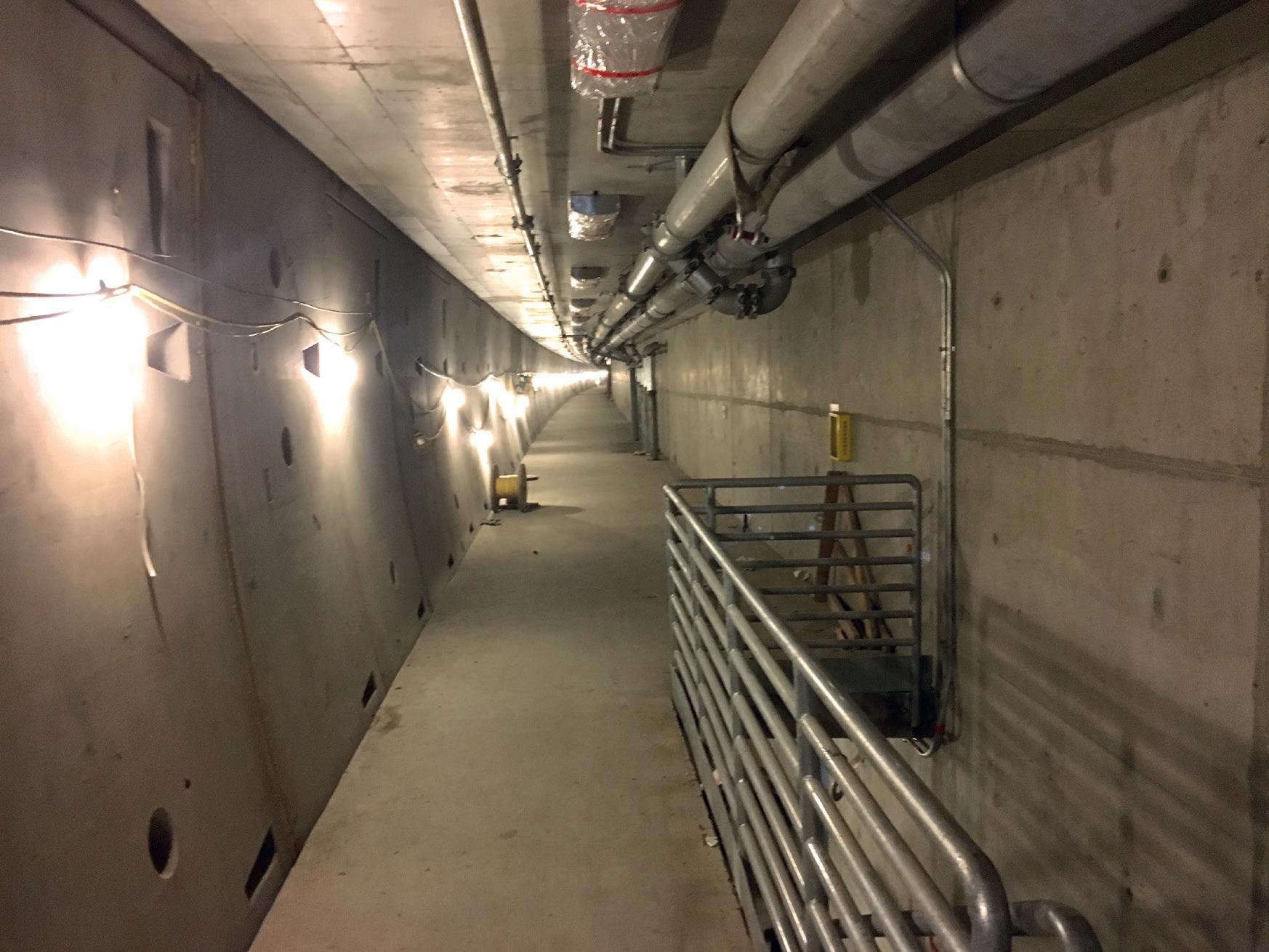
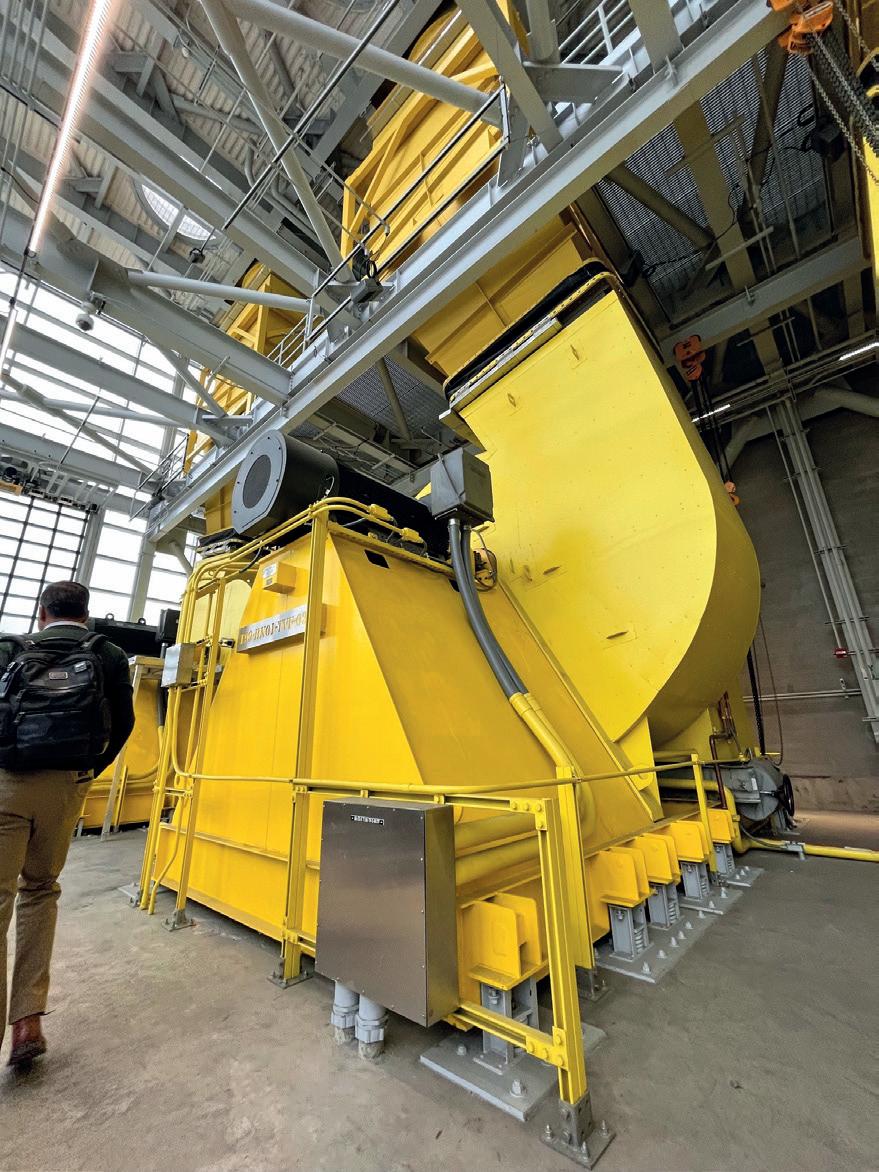

rising to 67,400 by 2040. But several events shredded the projected gures.
When tolling was installed the department of transportation lost 20,000 daily trips, dropping to 55,000 per weekday. Of the 20,000 lost trips, it was estimated that about 10,000 began using Interstate 5 (I-5), city streets and transit. The rest of the lost trips perhaps were because of more home teleworking, bicycling to work, side street use or simply cancelled personal drives; still within the projections.
But volumes sank further when the COVID pandemic struck, to an average 25,655, including weekends, for 2020, and generated $14 million - half the target. The projection for 2022 was $22.9 million, still short of the $35.4 million benchmark.
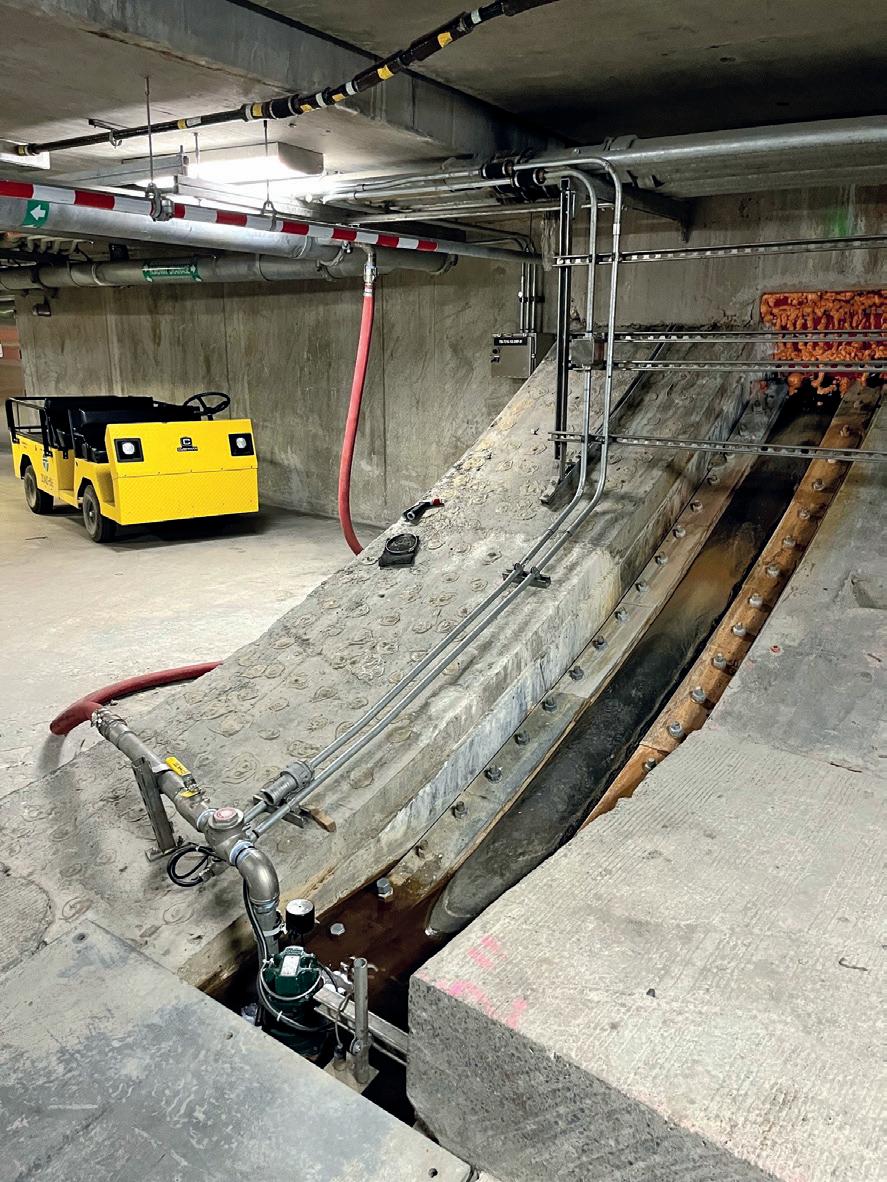
Despite the issues surrounding toll revenue, removal of the old viaduct has opened the way for major waterfront development, although this is a long-term project for Seattle. Development includes a more user-friendly Alaskan Way with wide cycle lanes and more pedestrian traf c, creating a leisure atmosphere for city dwellers and tourists.
Within each of the north and south main ventilation buildings sit four immense fastextraction ventilation fans, side by side in a glass enclosure for passersby to view. These bright yellow giants are so big that the building was actually built around them.
The fans kick in only during emergencies: if a re breaks out or during vehicle incidents as a precaution against res starting. Because they otherwise sit idle, each extraction fan is tested and maintained once a month.
They sit on large coil-spring dampers to absorb vibrations because the units shudder when they rst start up. Their 373kW motors shift 135,000m³ of air per minute. However, since opening, there has never been an emergency that requires all four fans in either building to operate at the same time.

















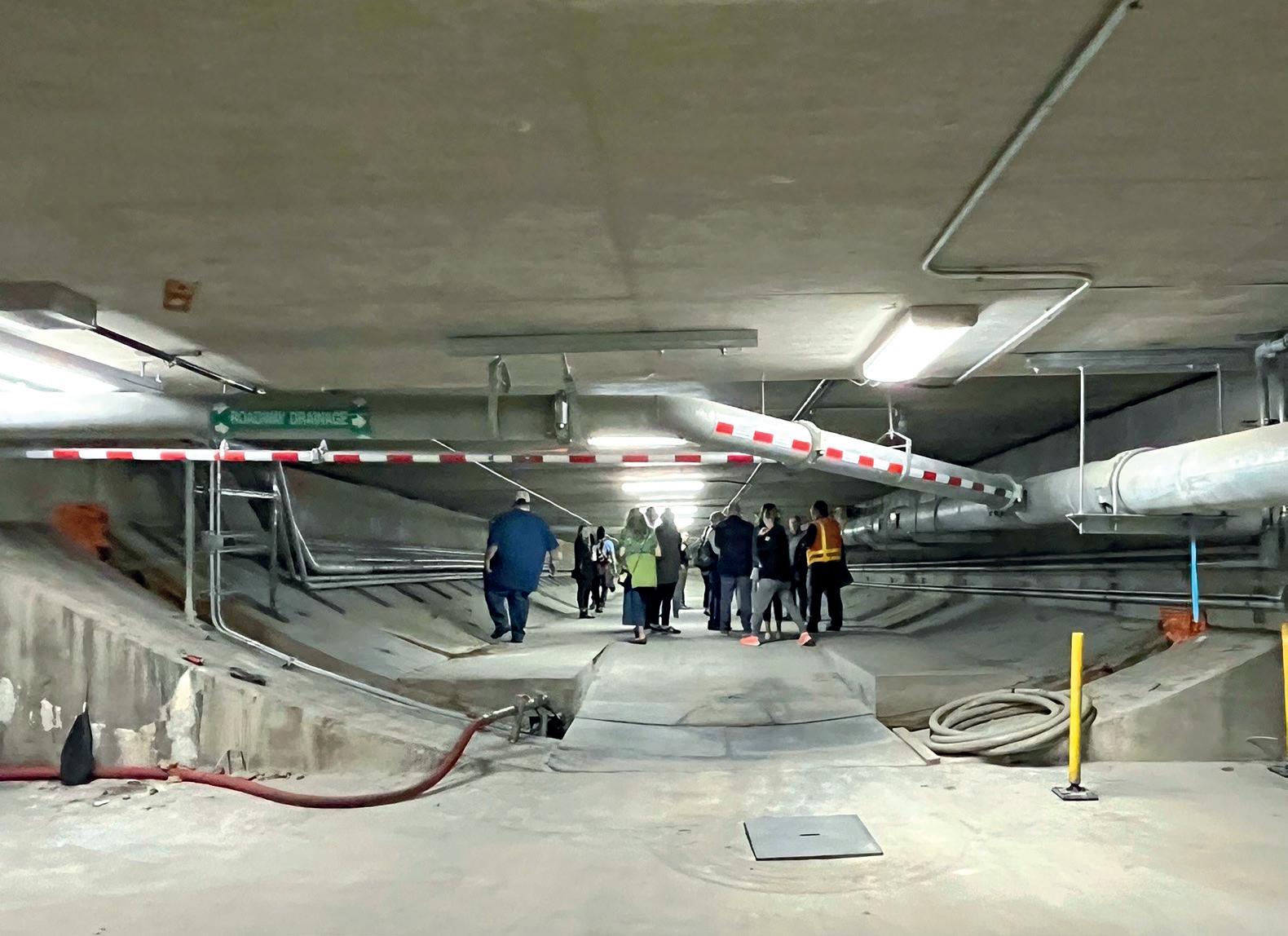
Smaller jet fans situated along each tunnel level continually circulate the air as needed on a daily basis. Hundreds of “sniffers” – sensors – line the tunnel and react to any hint of gasoline or diesel spillage as well as smoke. If the sniffers detect something, video cameras along the tunnel can zoom in on the suspected or actual incident. Dampers close to the incident will automatically open for greater air extraction.
Next stop on the tour is the tunnel’s invert –being the lowest section of a tunnel that acts as the tunnel oor (see box, Squares in a Round). On a circular con guration, it is approximately the bottom 900 of the arc of the tunnel. For the Alaskan Way, the oor is between 36.5m and 42.6m below ground. The ambient temperature within the invert is around 630F. But it can gradually get colder in winter, although never falling below freezing, given the mild west coast climate.
Drainage pipe systems and electrical cables are suspended along the walls of the divert and stretch off into the distance along the tunnel’s
full 2 miles. General maintenance openings to the road sections above are located along the invert. Deluge valves open and the drainage pipes have to efficiently handle the 3,200 gallons of water that can be dumped each minute onto a fire zone during an emergency.
There is a constant low-level rumbling of the traffic above. As one employee said, “it’s the sound of a cash register for us”, meaning the vehicles are paying their tolls. The very slight vibrations of the traffic used to cause the bolts on the holding racks for the water drainage pipes to come loose on a regular basis. The original specifications for construction did not include washers, so staff were continuously tightening the bolts – at least until they installed washers.
Additionally, the nature of a tunnel invert means that the ceiling will be low. In the Alaskan Way’s case, the invert’s clearance became even lower when cross-pipes were installed to connect with the main drainage piping. To move equipment and people around on the fleet of Cushman utility vehicles staff had to create “divets”, or small dips, in the concrete floors underneath any cross-piping.
The tunnel floor is kept spotless and there are no rodents because, simply, there is no food. There is, though, from time to time, an errant human found in the tunnel. Staff are often sent on a tour down the tunnel first thing in the morning to see if anybody has crept inside overnight.
Despite being made of 1,400 concrete rings, the bored tunnel is very much watertight, except for small leakages around the start at both ends. This is where the Omega joint is located which connects the cutand-cover entry and exit sections with the beginning of the bored tunnel structure and its connecting rings (see box, Trelleborg). Light pumping duties keep the omega joints dry enough.
Meanwhile, inside the main electrical room, it’s “please don't touch any buttons”. The supplying local power company may consider its customer only a “medium voltage” client, but there is still 26,000v running into the system. This is stepped down onsite at each of the two main buildings (where the fastextraction fans are located) to 480v for general use. The two buildings share the tunnel's power needs. If one site goes down, the other site can supply the stricken one with power within five seconds.
Strangely, the 5,700 lights for the tunnel are not LED. They remain fluorescent and highpressure because at the time of design back around 2010 LED lighting was not as common as it is today. To replace them now would be a major technical challenge and financial outlay, although this is not ruled out. Nonetheless, the lights operate on five levels of brightness to ease the adaptation to lighting coming into the tunnel and daylight when leaving. n
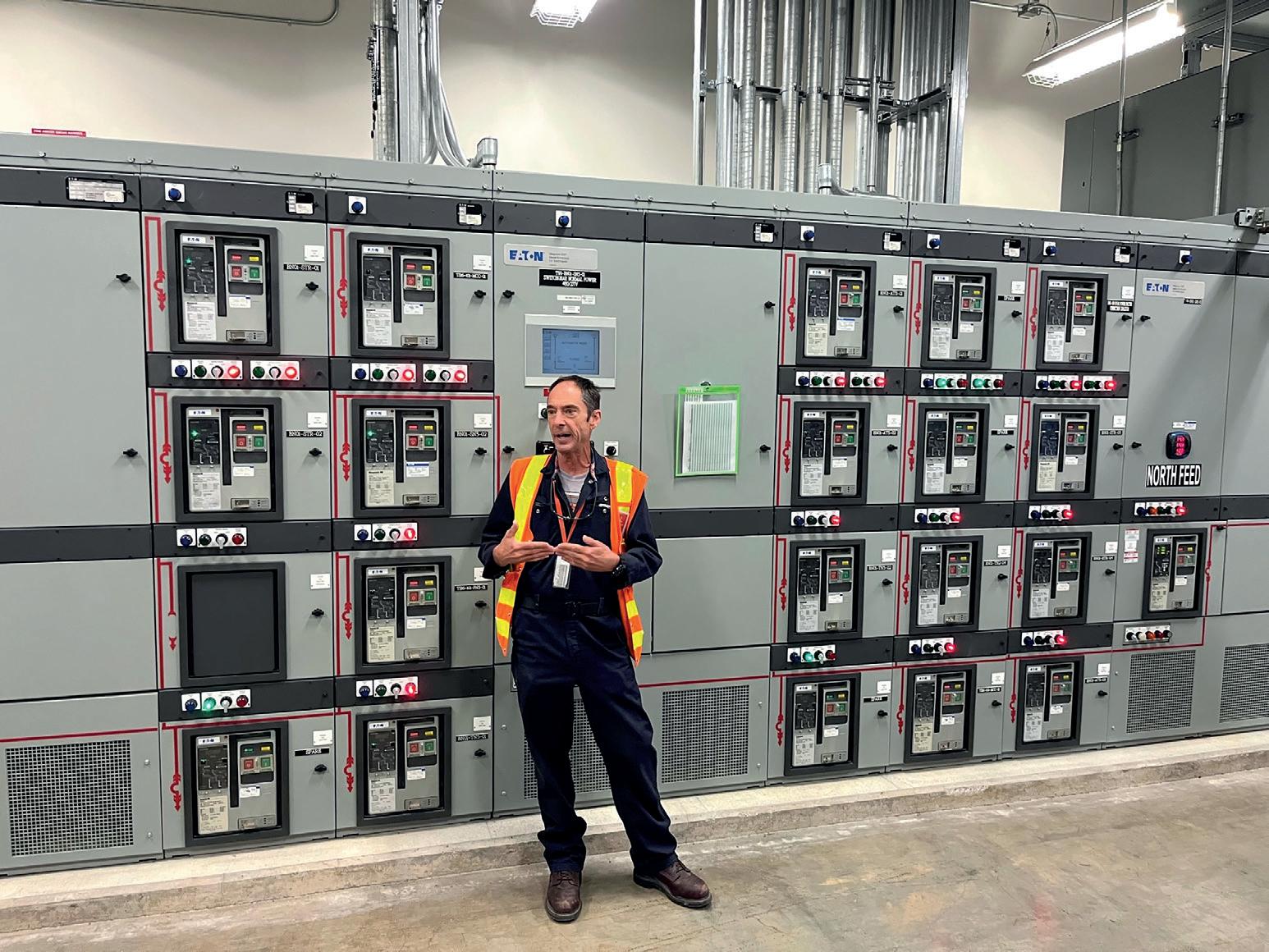
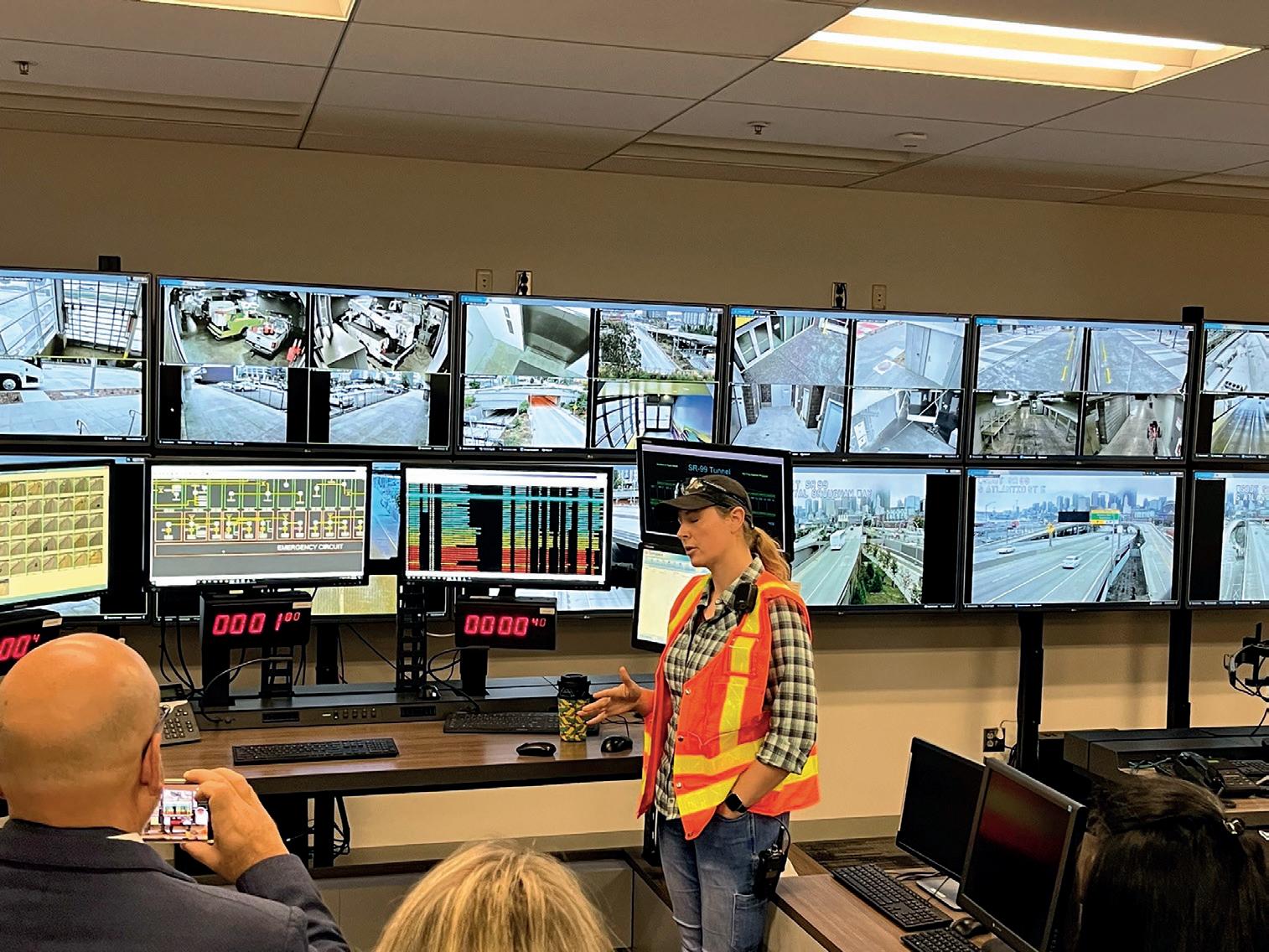
The Omega seal from Trelleborg - a global designer, manufacturer and supplier of sealing systems for tunnels – was originally designed as a secondary seal for immersed tunnels in combination with the company’s Gina gasket/ seal as the primary seal. Applications for the Omega seal have now expanded to bored tunnels, aqueducts and ship lifts.
The Omega seal withstands high water pressure in combination with large movements in all directions. The company, based in the Netherlands, says the seal is an ideal solution for joints where large gap movements are expected as a result of temperature effects and/or settlement.
The construction of the standard Omega seal consists of two nylon plies with SBR (Styrene-butadiene rubber) cover on inside and outside. SBR has excellent abrasion resistance, crack endurance and positive ageing characteristics. It also delivers good compression set and water resistance, as well as favourable bonding and heat-ageing properties.
The allowed movement of the Omega
depends upon the pressure differential across the seal and the strength of the plies. In general, the Omega is designed to allow axial and radial movements and/or rotation of the two bridged structures. Trelleborg is able to calculate the force-compression curves and elongation limits at various water pressures.
Trelleborg recently reported that it is working with Daewoo Engineering & Construction to deliver sealing systems for the Khor Al Zubair Immersed Tunnel project in Iraq - the largest immersed tunnel under construction in the Middle East. Trelleborg's systems will include the Gina gasket and Omega seal, including the new W29U-I Waterstop series with a new double flexible injection system.
The 2.5km, six-lane tunnel at Khor Al-Zubair Port in Basra is an integral part of the larger Al Faw Grand Port project in southern Iraq which includes construction of one of the world's largest container terminals.
Trelleborg Infrastructure www.trelleborg.com




A Trimble factory-ready option is now available for new Mincon piling and drilling attachments.
Customers for Mincon Drill Mast Attachments for skid steers and excavators now have an option for the installation of the Trimble Groundworks Machine Control System. This can reduce the cost and complexity of the installation for the contractor.
Mincon Solar Installation Drills and Pile Drivers can predrill through rock, install ground screws and drive piles. Trimble Groundworks is a machine control solution that boosts the speed and accuracy of drilling and piling operations. Fitting Trimble Groundworks systems to Mincon drilling units provides
Trimble says that its new IonoGuard system is a next-generation technology designed to mitigate ionospheric disruptions in positioning and navigation. It can help to minimise performance impacts caused by scintillation or signal noise.
Referred to as solar activity, ionospheric disturbances peak every 11 years. The next major disruption, Solar Cycle 25, is expected to peak between 2024 and 2026. Ionospheric activity can impact the quality of GNSS signals, leading to the degradation of position accuracy. This type of disturbance can impact on high-precision GNSS users in equatorial and high latitude

regions and global disruptions can happen at the height of the solar cycle. Available as a downloadable rmware update on Trimble GNSS receivers using Trimble ProPoint GNSS positioning, IonoGuard features the latest developments in Trimble’s precision receiver hardware design and signal tracking, improving positioning performance in challenging environments. This will minimise the risk of a complete loss of GNSS signals and boost signal accuracy and integrity.
Trimble www.trimble.com
stakeless navigation, positioning accuracy and as-built data so that contractors can boost installation ef ciency.
The integration of Trimble Business Center software design capabilities in the of ce and Trimble Groundworks machine control in the eld increases the ef ciency and productivity of drilling and piling. Trimble WorksManager software also enables the syncing of data from of ce to eld, reducing site visits and providing a single source of information.
Mincon www.mincon.com
Trimble www.trimble.com


Trimble has updated its Viewpoint Spectrum and Viewpoint Vista construction enterprise resource planning (ERP) software, which now includes automatic invoicing capability.
The integration of Azure AI Document Intelligence delivers ef cient automatic invoicing, helping turn paper and PDF invoices into validated, unapproved invoice entries within Spectrum and Vista automatically. This allows for faster, more accurate work ows and can save time and money for users.
"In an industry where projects operate on tight schedules and margins, every second and every dollar counts," said Lawrence Smith, vice president and general manager of Construction Management Solutions at Trimble. "Trimble's automatic invoicing/ document intelligence integration was created to take the manual burden of data entry and veri cation off the accounting department
and automate it using arti cial intelligence. The result is a more accurate process and a higher level of productivity, while also freeing accounting departments to focus on more strategic tasks."
One signi cant advantage of the integration is the reduction in errors. Construction projects involve intricate nancial processes, and even minor inaccuracies in invoices can lead to major setbacks. Trimble's automatic invoicing/ document intelligence integration automates data extraction, delivering greater accuracy, improved nancial work ows, and streamlined project management overall.
Eric Boyd, corporate vice president, AI Platform, Microsoft said, "By integrating Microsoft's AI capabilities into their solution, Trimble is helping troubleshoot unique challenges faced by the construction company, further demonstrating the power


of AI to rede ne and elevate essential business processes."
"We know that accounting teams spend an inordinate amount of time inputting, approving and paying invoices," said Smith. "Additional steps are then added if mistakes are made, which happens about 10% of the time and takes an average of 15 minutes to correct, according to a recent poll in our customer community, The Network. If a contractor processes 200 invoices a week and 10% of them have errors, that equates to ve hours/week spent correcting invoices - if the errors are caught - which could be the difference between a project being pro table or not."
Microsoft www.microsoft.com
Trimble www.trimble.com
Topcon Positioning Systems says that its new Aptix package is an integrationplatform-as-a-service (iPaaS) that optimises the management of heavy civil construction projects.
Aptix integrates Topcon solutions with third-party applications, providing automatic data connections between the of ce and jobsite. This streamlines processes and generates insights for construction teams within a single platform, ensuring that the as-built is as-planned.
Aptix automates the distribution of data, including machine control les, constructable models, project schedules and reports. It shows in near real-time the location of machines, allowing aggregation of as-built data from mixed eet telematics. The package provides real-time reports on people, materials, machines, and
carbon dioxide emissions, giving visibility for carbon footprint and sustainability initiatives.
A key feature of Aptix is its automatic distribution of constructable models and scheduled task changes. With conventional systems, frequent changes can make it dif cult to keep management teams, operators and other stakeholders updated with current information. But Aptix integrates with industry-standard applications, including Autodesk Construction Cloud and Microsoft OneDrive. Through such integrations, Aptix monitors le updates within Autodesk Build, Autodesk Docs, BIM 360 and Microsoft OneDrive. As soon as a constructable model or schedule change occurs, Aptix distributes these updates to key stakeholders, ensuring that operators have access to up-todate models and scheduled tasks and that project managers have up-to-date reports.
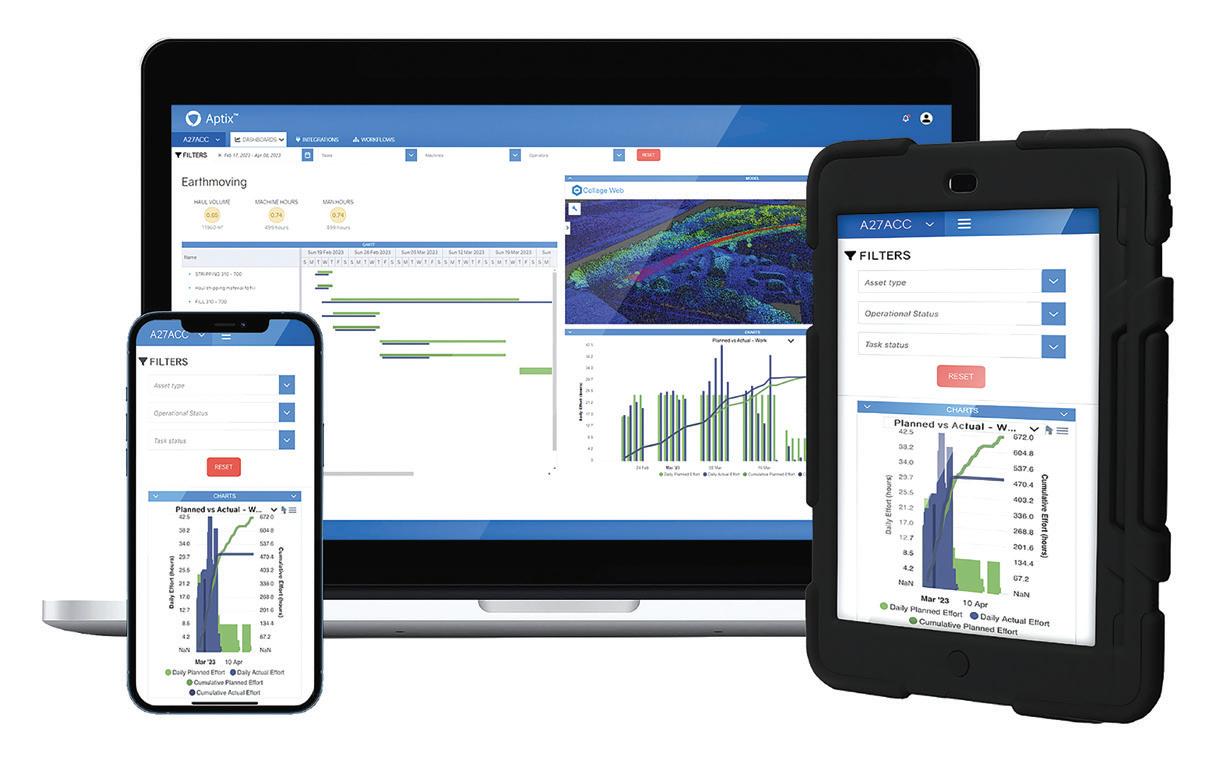
“Without up-to-date, accessible, and actionable information, construction teams will always struggle to communicate and collaborate,” said James Cook, director, partner integrations at Autodesk Construction Solutions. “With Aptix’s integration of Autodesk Construction Cloud, teams can ensure critical information is accessible to all the stakeholders that need it, helping companies more easily build and collaborate.”
Jason Hallett, vice president and general manager, Topcon Integration Services, said, “By automating previously manual processes, Aptix eliminates time-consuming and errorprone data entry, allowing construction professionals to
The new Hybrid Positioning system from Topcon is said to perform faster in the eld than standalone robotic systems and is more versatile than RTK-only solutions.

focus on more strategic tasks. Project managers can make better decisions by having visibility into project progress and potential roadblocks. We are con dent that Aptix will optimise how construction projects are managed, providing a powerful new tool for construction professionals looking to improve their project management processes.”
Murray Lodge, executive vice president and general manager, Topcon, said, “Aptix integrates Topcon’s heavy civil construction solutions with third-party solutions to share data, automate work ows, and facilitate built actuals reporting.”
Topcon topconpositioning.com

The latest Hybrid Positioning technology combines GNSS positioning and optical robotic measurements on one rover pole.The unit offers a robotic total station and a lightweight GNSS receiver in a single package and is said to allow faster eld work than standalone robotic or GNSS solutions. The system has a hybrid lock for rapid prism acquisition in dense areas and a hybrid switch for bouncing between optical measurements and GNSS positioning, as well as a hybrid resection to start set-up at a safe and convenient location.


The system is compatible with all Topcon robotic total stations and allows the user to reacquire targets even in challenging conditions. A user can can select safe, convenient locations and de ne the unknown point of the instrument from GNSS measurements. The rm says that for maximum ef ciency, users can pair the Hybrid Positioning technology with MAGNET Field data collection software.

Topcon Positioning Systems www.topcon.com
Topcon Positioning Systems is providing specialised monitoring technology to SOCOTEC within Europe, for infrastructure projects in France, the Netherlands, Spain, and in the UK.
SOCOTEC will employ Topcon robotic total stations from the MS Measuring Station series and several additional geopositioning portfolio resources. Topcon monitoring technology will be used on high-pro le European projects to survey construction sites and infrastructure for stability and risk. The integrated products comprise total stations, GNSS, and third-party geotechnical sensors, which are powered via Delta Link hardware and monitored, managed, and evaluated via Delta Link software.
“The turnkey solution Topcon provides will o er SOCOTEC complete control and reliability when it comes to surveying projects,” said Ian Stilgoe, vice president of Emerging Business at Topcon.










Your all-new dozer will boost productivity and accuracy with second generation Intelligent Machine Control that continuously scans the job site to plan the next pass. Its 179 kW/240 HP hydrostatic drive (HST) combines with class-leading pushing power, utmost precision and lightweight consumption. You can work in automation modes almost continuously, from rough cut to finish grade.






It is now 10 years since Komatsu introduced its intelligent machine control technology intended to help customers achieve more work in less time and with higher quality.
During the development stage of intelligent machine control, Komatsu leveraged machine operational data from sources like their telematics system, Komtrax, and combined this with the jobsite and application expertise of eld and distributor staff. This constant learning did not stop after the launch, and a huge quantity of experience and feedback was gained in the early years of market introduction, as customers deployed iMC on jobsites, supported by Komatsu and its distributors. This resulted in constant re nements of the machine/operator, technology, product support functions and interfaces. Looking back over the last 10 years, this activity has paid off according to Komatsu, delivering an experienced support network extending from the distributor Technology Solutions Experts right through the rm’s whole service and technical organisation. This is said to be well-placed to assist customers new to machine control and to ensure they experience the iMC bene ts, and return on their investment, quickly and seamlessly.
This continual development also delivered on the product side, with the introduction of intelligent Machine Control 2.0 (iMC 2.0) and an expanded range of excavators and dozers in 2020 and 2021.
The new iMC 2.0 features provide more assistance for the operator, by controlling tilt bucket adjustment to match grade on the excavator, or automating the spreading of prede ned layers of material by the dozer blade, for example. This can help inexperienced operators gain con dence and deliver high productivity quickly. The technology is also
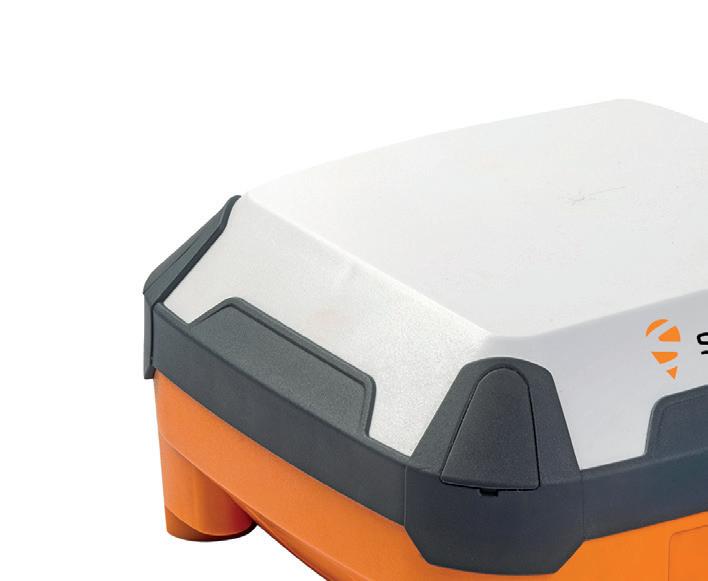



said to complement the skills of highly experienced operators by allowing them to concentrate on moving material, rather than being focused on avoiding mistakes inherent in guidance-only systems.
Komatsu’s continuous development of the technology has delivered hardware advancements as well as signi cant improvements in software capabilities. Among these is the introduction of an automated data capture feature to the iMC technology. Regardless of the machine's model or age, all units can now collate location and elevation data from dozer tracks and bucket edges autonomously. The collected data can then be consolidated and visualised on Smart Construction Dashboard, a 3D visualisation tool introduced by Komatsu, enabling customers to monitor volume-based work progress at their jobsites directly from their desks, with updates available on a daily basis.

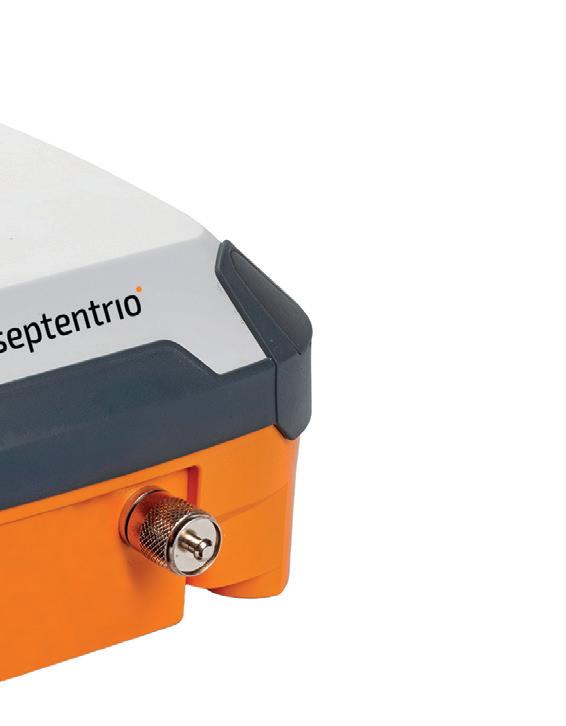
Septentrio is introducing its AntaRx GNSS smart antenna for machine automation applications in construction.



Over the last decade, customers’ adoption of iMC technology has changed the conventional way of working on construction jobsites. Recognising the growing need for swift and reliable support for 3D technology, Komatsu introduced Smart Construction Remote, a software that is designed to bridge the gap between the eld and the of ce. With Remote, design changes can be executed instantly on machinery in the eld, and operators can receive rapid expert support from Komatsu-trained professionals by simply sharing the screen. Today, Smart Construction Remote connects over 700 machines on jobsites to of ces, saving thousands of hours previously spent by jobsite managers, surveyors and engineers commuting from of ces to jobsites.
Komatsu www.komatsu.com

Combining a high-performance GPS/ GNSS receiver and an antenna in a single ruggedised housing, AntaRx is said to be easy to install and offers multiple communications options. The durable housing allows the unit to handle high levels of shocks and vibrations. Built on Septentrio’s long-standing GNSS experience, this multifrequency receiver delivers high-accuracy RTK positioning down to the centimetre level. Equipment manufacturers and system integrators can bene t from the versatile offering including INS (Inertial Navigation System) integration, dual antenna
mode, and 4G cellular communication. Silviu Taujan, product manager at Septentrio said, “AntaRx is available in several con gurations, either as a GNSS smart antenna or as a GNSS/INS smart antenna system, integrating an industry leading IMU (Inertial Measurement Unit).”
This receiver technology integrates Septentrio’s GNSS+ algorithms, including advanced multipath mitigation, which allows uninterrupted operation in challenging conditions such as nearby high structures or machinery. High update rate and low latency ensure accurate plan execution during fast movement or rotation.
Septentrio www.septentrio.com
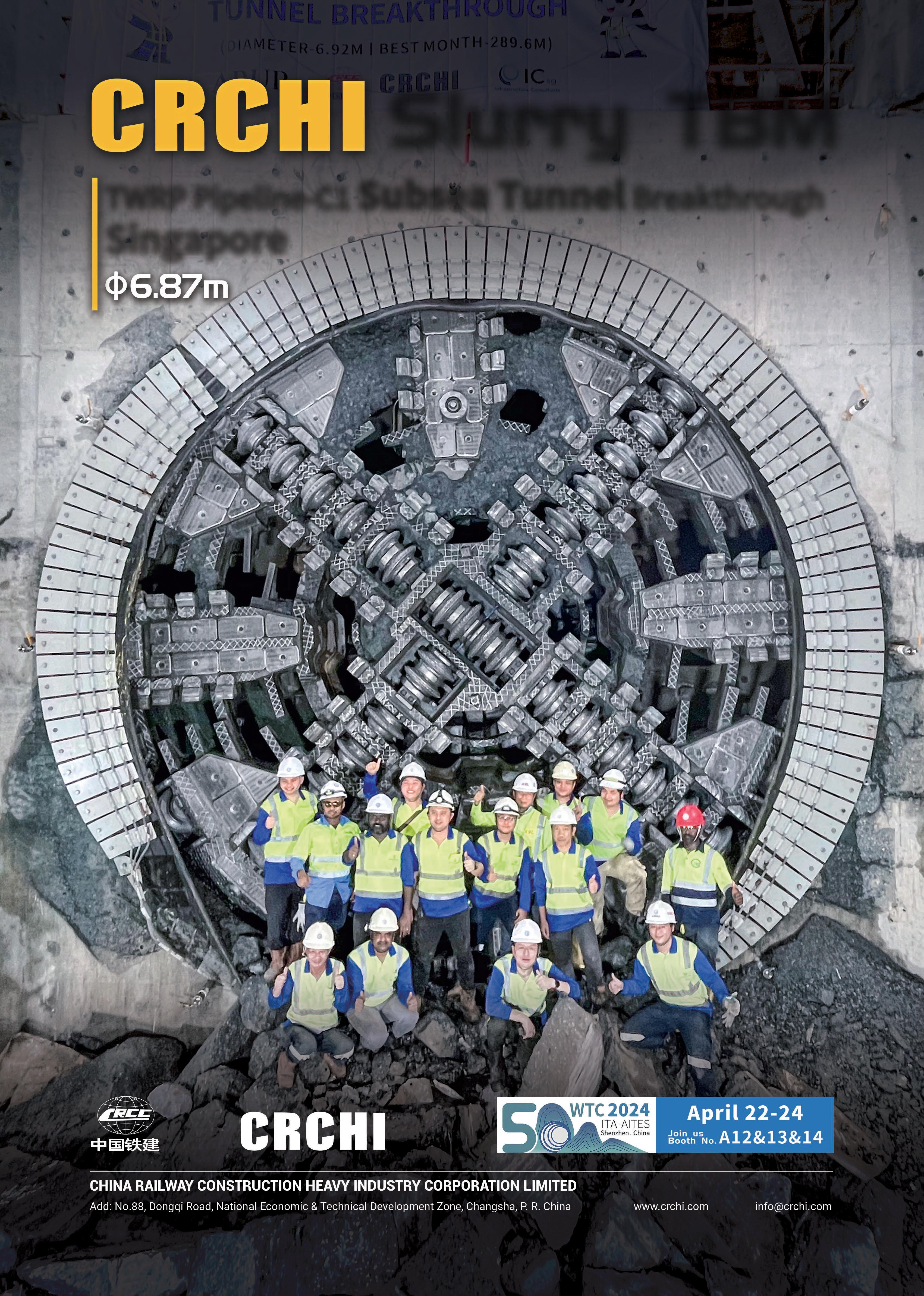

The future of roadways: green, equitable, intelligent and integrated


Xingyi


This 62.5km-long expressway wraps around the south of Xingyi City, a notable mountainous tourism city, traversing through distinctive karst peak forest regions. It links several renowned geological sites, including the Maling River Canyon, Wanfenglin (Forest of Ten Thousand Peaks), Xingyi National Geological Park, and Louna Village, home to the traditional Bouyei ethnic minority.
With a deep commitment to environmental and cultural preservation, the expressway incorporated over 20 cutting-edge technologies in its design, construction, and operation, serving as a model for environmental and cultural conservation. The route was meticulously planned with ecological, cultural, geological, and environmental considerations in mind. Utilising BIM+GIS simulation design and life cycle analysis, a tunnel route costing an
additional US$7.70 million was chosen to prevent disruption to Louna Village and the farmland cultivated by the Bouyei minority for generations. Remarkably, 91.2% of the entire route achieved zero earthwork disposal, conserving 612,000m² of land. Innovative construction techniques including prefabricated bridge structures and high pile caps minimised excavation by 54,000m³. The tunnel designs, featuring at entrances, reduced vegetation damage by 47,000m² and further excavation by 89,000 m³.
In the construction phase, 310,000m³ of excavated topsoil was repurposed for landscaping; 1.77 million m³ of tunnel debris was recycled for concrete and roadbed material. Additionally, 70 pipelines were installed to transport bridge construction waste, minimising ecological disruption. Arti cial intelligence expedited the tunnel support parameter selection. Postconstruction, 61km of access roads were upgraded for local community use.
Operationally, local ora is used for
landscaping, supplemented by a drip irrigation system that cuts water usage by 80% annually, addressing the water scarcity for expressway greenery in karst regions. The expressway also features 85 culverts and six runoff collection ponds to safeguard surface water. Energy-ef cient measures include distributed smart solar systems in tunnels, service areas, parking lots, and toll stations, generating 15.2 million kWh of clean electricity yearly. Noise pollution is mitigated through 69 sound barrier sections. These initiatives have collectively reduced carbon emissions by 124,300tonnes and brought tangible ecological bene ts.
The expressway’s completion has halved traf c congestion in Xingyi, boosted tourism by 65.5%, and signi cantly contributed to the economic uplift of around 301,500 locals. By enhancing transit, connecting cities, and promoting tourism and rural development, the expressway stands as a testament to harmonising engineering with the natural and cultural milieu.



The IRF Global R2T Conference, a pinnacle event for global leaders in roads and mobility, offers a vibrant forum for innovators, decision-makers, and industry professionals. Discover cutting-edge advancements and forge pivotal connections in an environment dedicated to shaping the future of transportation.
April 10 – Abstract Submission Deadline
April 22 – Abstract Acceptance Notification
July 29 - Paper Submission Deadline (Optional to be published in a Scopus indexed IRF Publication) September 2 – Paper Acceptance Notification


The Scientific & Technical Committee of IRF has selected 8 tracks for inclusion in the international call for Papers:
1. Asset Management Innovations
2. Vision Zero: A Commitment to Road Safety
3. ITS & Smart Mobility: Shaping the Future
4. Innovations in Pavements and Materials
5 Environmental Management & Climate Resilience in Transportation
6. Road User Charging & Travel Demand Management
7. Advances in Structural Design for Roads and Bridges
8. Freight Transport and Logistics: Emerging Trends
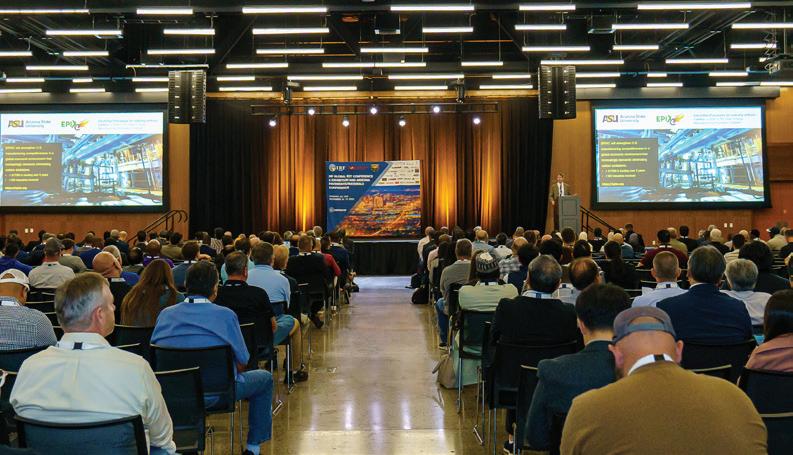
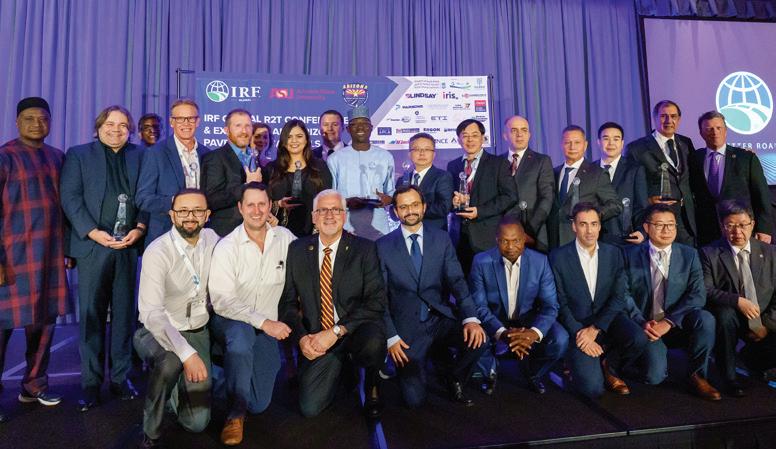
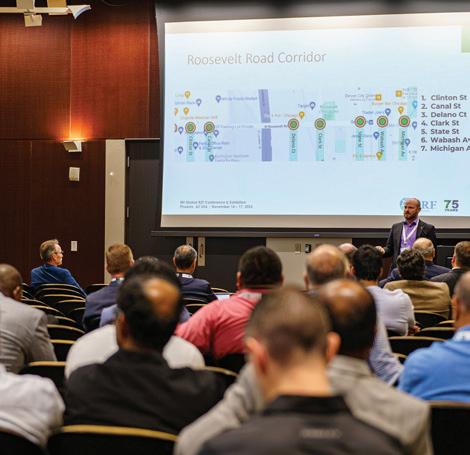
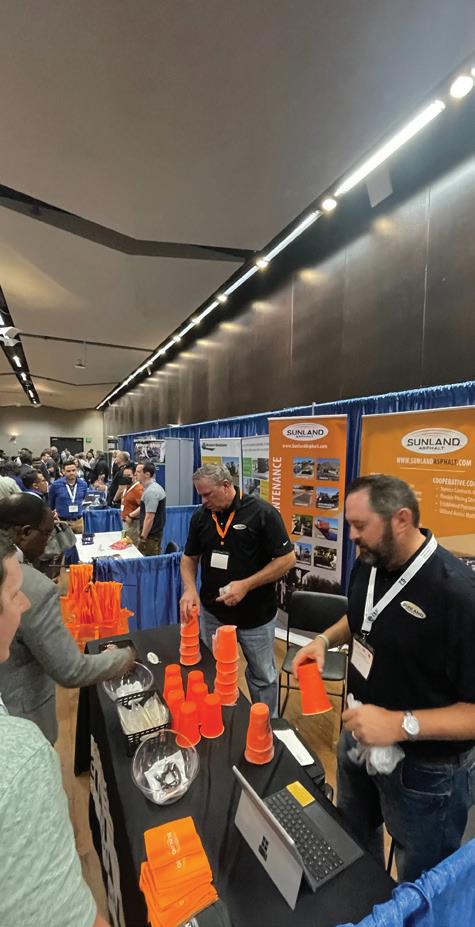




Scheduled to take place in the vibrant city of Istanbul on 15-18 October, the Congress aims to bring together thought leaders, experts, and professionals from around the world under the overarching theme "Connecting to Empower Mobility: Roads as Facilitators of a Sustainable Future for All."
For almost seven decades, the IRF World Congress has been a beacon celebrating the road and mobility sectors as instrumental forces for global growth and development. The chosen theme for this 2024 edition re ects a profound commitment to shaping a future where roads serve as pathways to empower mobility in all its forms.
“The chosen theme re ects our dedication to envisioning a future where roads serve as pathways to empower mobility in all its forms – whether on foot, on a bicycle, on public transport or a motor vehicle, in urban or rural areas – thus connecting communities and fostering sustainable development on a global scale.”
“The IRF World Congress 2024 will be an inspiring journey on how to pave the way for a future where roads are part of a transportation system that unites, empowers, and provides access to opportunities to all,” he added.
• Please contact the International Road Federation (IRF) at info@irfnet.ch for exhibition and sponsorship opportunities. 2024 kicks off with
Mobility, Digitalisation and Asset Management, Decarbonisation and Energy Transition, Regulatory Frameworks for Sustainable Transport, Road Safety, Traf c Management and much more.
The call for abstracts is open to individuals, organisations, and institutions eager to present innovative ideas, research ndings, new techniques, new products and projects’ results. The deadline for abstract submissions is set for 10 March 2024. Detailed guidelines and the portal for submission are available on ww.irfnet.ch.
In announcing the theme for the congress, IRF president Anouar Benazzouz stated,
Among the topics that the congress aims to address are Sustainable Transport Solutions, Intelligent Mobility and Technological Innovation, Inclusive and Accessible Transportation, Urban and Rural Mobility and the Climate Resilience of Infrastructure. They also include Public-Private Partnerships for
The programme of the Congress is accompanied by a large exhibition and technical visits.









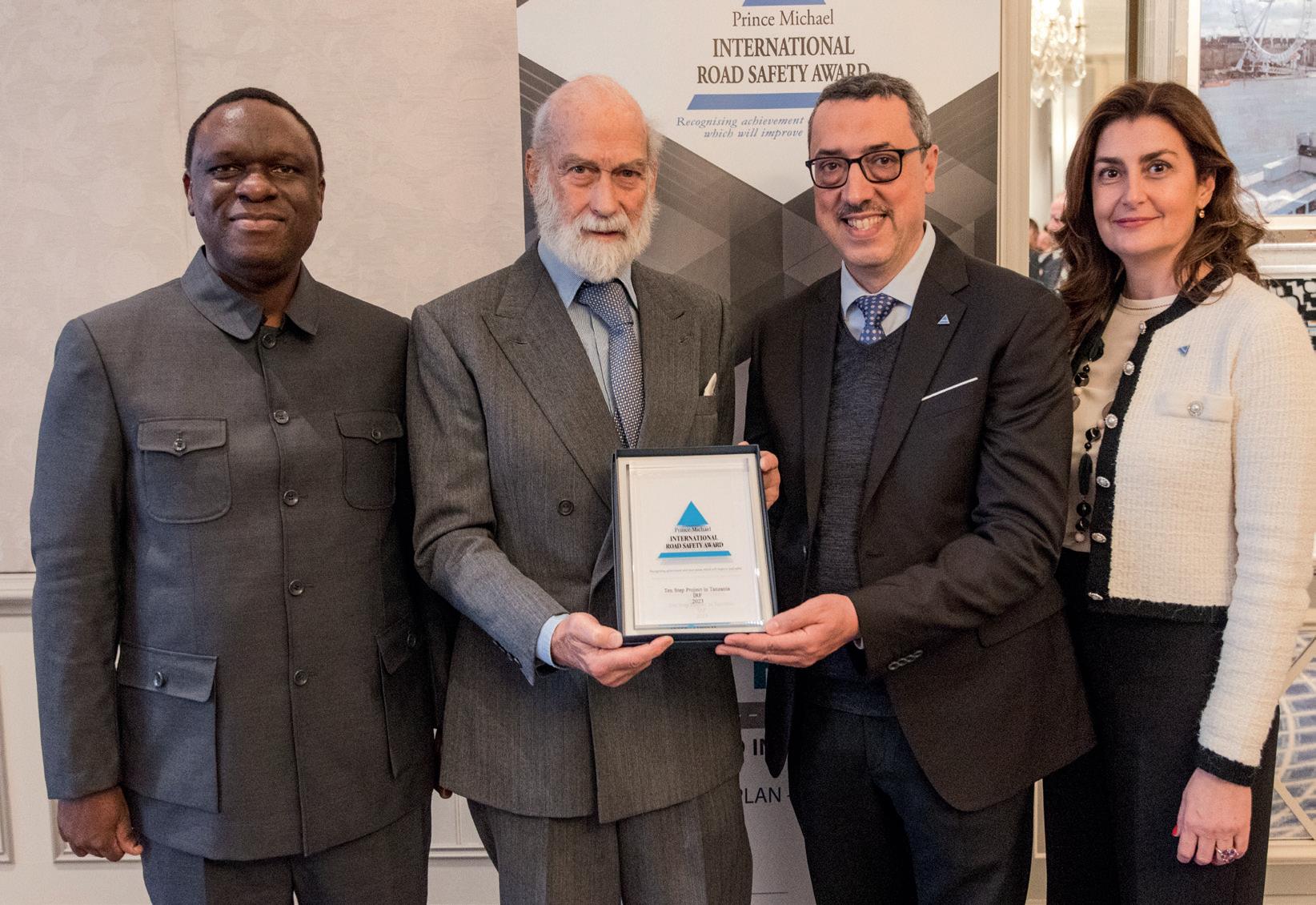

The world- rst Ten Step Tanzania Project, which has built sustainable institutional capacity, impact, and partnerships to eliminate high-risk roads in Tanzania, has been honoured with a Prince Michael International Road Safety Award.
Jointly funded by the United Nations Road Safety Fund (UNRSF) and the Foreign Commonwealth and Development Of ce (UKAid), through the Global Road Safety Facility (GRSF) of the World Bank, the 30-month pilot project aimed to curb the more than 16,000 people (estimated) who die on Tanzania’s roads each year.
Under the guidance of the United Nations Economic Commission for Africa (UNECA), the project was implemented by a consortium led by the International Road Federation (IRF) headquartered in Geneva, Switzerland and which included iRAP, PIARC and Tanzania Road Association. The project brought together the Government of Tanzania through the Ministry of Works and and Transport (MoWT), as well as other leading institutions, road safety NGOs and industry stakeholders in Tanzania.
The project led to the shaping of a National


Training, Accreditation and Certi cation Scheme to build local capacity for the assessment, audit and design of safer roads beside training over 500 road safety stakeholders.
Among key milestones delivered by the project were recommendations for a National Road Infrastructure Safety Strategy and Action Plan, and for the revision of the Tanzania Road Geometric Design Manual prioritising the safety of all road users.
Present in London at the award ceremony, Anouar Benazzouz, president of the International Road Federation (IRF) said, “We are delighted to accept this award on behalf of all the project partners. Tanzania made history as the rst country in the world to implement the United Nations Road Safety Collaboration (UNRSC) Ten Step Approach. We take immense pride in the project’s achievements and applaud the determination and enthusiasm of the Tanzanian authorities and stakeholders who embraced this opportunity to make Tanzania’s roads safer.”
• The full press release is available on www.irfnet.ch.

The International Road Federation (IRF) contributed to a very successful 103rd edition of the Transportation Research Board (TRB) Annual Meeting, held on 7 – 11 January 2024, in Washington, DC. A global gathering that every year brings together transportation leaders and researchers to address critical issues in transport. The IRF was pleased to contribute to a number of sessions among which two were speci cally dedicated to tra c management systems.
Enhancing Tra c Management Systems (TMS)
This workshop organised by several TRB Standing Committees - and under the leadership of the Federal Highway Administration (FHWA) - saw the participation of IRF director general, Susanna Zammataro and had as its objective to gather insights and practices to enhance Transportation Management System (TMS) capabilities and performance.
The workshop aimed in particular to assist agencies in aligning TMSs with their objectives, performance expectations, and desired functions. Through interactive breakout sessions, participants explored key processes, including preparing for and conducting TMS assessments, assessing TMS capabilities and performance, and identifying opportunities for improvement.
On 9 January, a session moderated by AustriaTech provided a global platform for industry leaders and researchers to spotlight the pivotal conclusions derived from the 4th TRB International Symposium on Freeway and Tollway Operations (ISFO) held on 26-30 June 2023 in Vienna. Presenting on the symposium’s plenary session “Visioning Tra c Management's Future”, IRF DG, Zammataro, reported that the session focused on anticipating changes and identifying opportunities for e ective tra c management. Key highlights included: leveraging digitalisation for optimised asset use and safety; revising procurement frameworks for widespread deployment of solutions; and repurposing existing road networks to reduce emissions and congestion.
This session also served as a platform to announce the 5th TRB International Symposium on Freeway and Tollway Operations (ISFO), to be organised for the end of June 2025 in Marrakech as a collaborative e ort among several partners including IRF, and with the National Motorway Company of Morocco (ADM) as the lead local host. Info soon available on www.irfnet.ch
• Resources on TSMO available on https:// transportationops.org/



BrainCreators, a creator of digital inspection solutions, has introduced the “go pro for less” functionality for its digital road inspection system, INSPECH.
The functionality enables the use of a GoPro camera for data collection anytime and anywhere. This means that INSPECH can digitally conduct road inspections in the UK at a substantially reduced cost compared to traditional methods.
BrainCreators said that the use of a GoPro increases the exibility of when and how a highways agency can collect data. For example, large vehicles are impractical and probably prohibited on sidewalks, whereas smaller vehicles - with a GoPromight be allowed on sidewalks.
INSPECH can be used by local governments, road owners and operators, civil engineering rms, public-private partnerships and road management organisations. There are also two subscription options: IN-Assessment; and INInsights.
INSPECH Assessment is engineered to streamline the inspection process. It automates work ows, slashing the time it takes to transform inspector










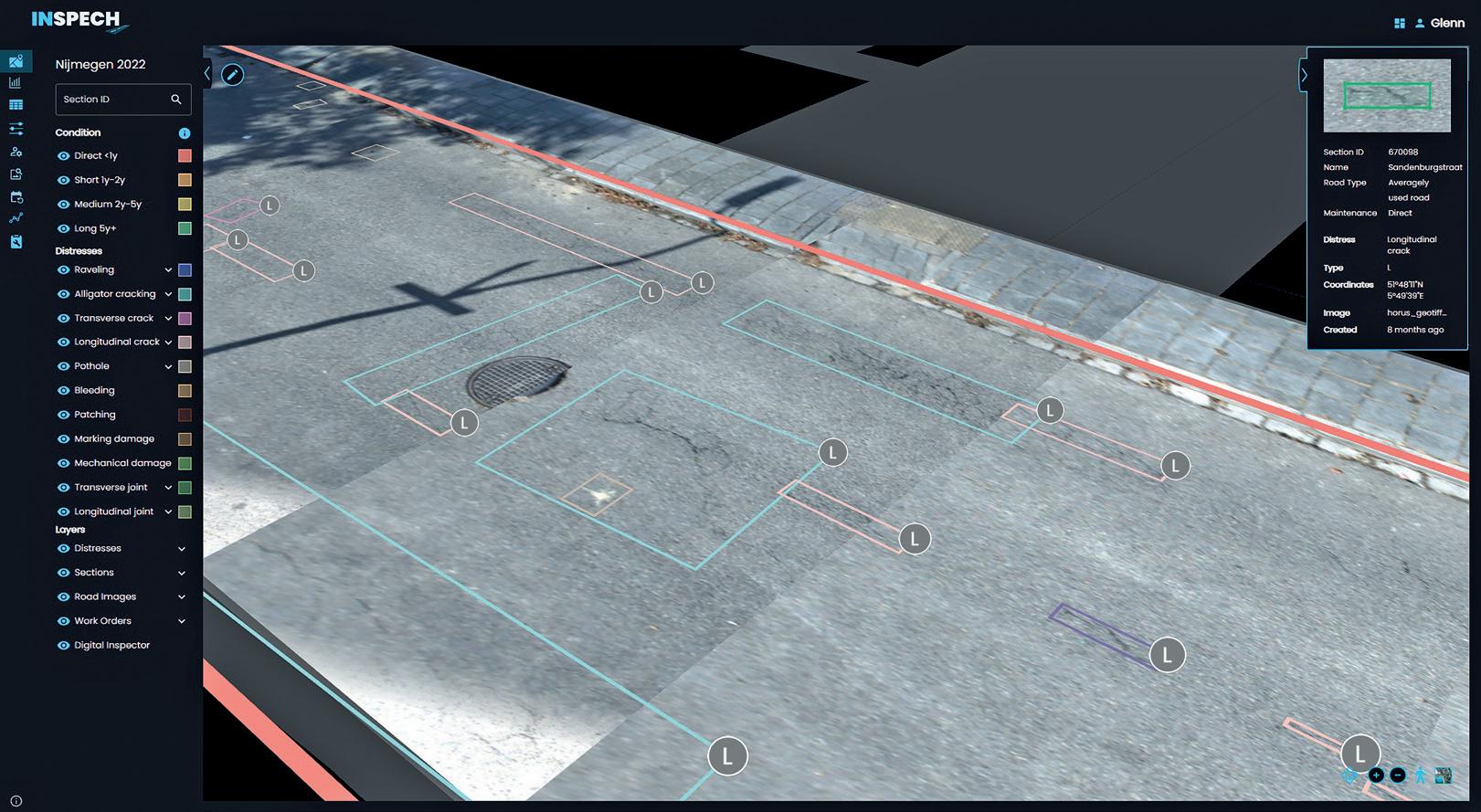

insights into tangible results. Road data, collected with professional camera equipment or a simple GoPro, is uploaded to INSPECH Assessment, which swiftly generates an interactive digital twin on a dynamic map. This advanced map is more than a visual representation; it's an editable canvas, enhancing and speeding up inspection capabilities.
Meanwhile, INSPECH Insights


provides a comprehensive understanding of asset reliability and availability. It has the ability to self-collect data using GoPro cameras and create interactive digital twins. Road owners have tools, such as inspection comparisons and repair costings, at their ngertips.
Road data generated by both subscriptions can be collected by professional equipment or a simple GoPro camera. Customers who

don’t have professional equipment to get more detailed road inspections, can work with various INSPECH partners who handle end-to-end road inspections, said Glenn Brouwer, co-founder at BrainCreators.
Inspech https://inspech.com
BrainCreators https://www.braincreators.com
A French start-up company, SequoIA Analytics, plans to use information from roadside bre optic cables to measure vibrations that will indicate traf c congestion in near real-time.
SequoIA Analytics is part of the Inria Startup Studio programme hosted by InriaNational Research Institute for Digital Science and Technology. The company says it has successfully used DAS technology – Distributed Acoustic Sensing – in a small test project along the Voie Pierre Mathis bypass around Nice, southern France.
According to a recent report in the French newspaper Nice-Matin, SequoIA Analytics tapped into the roadside bre optic cable to gather data over two months. Back in the lab, the information was analysed of ine.
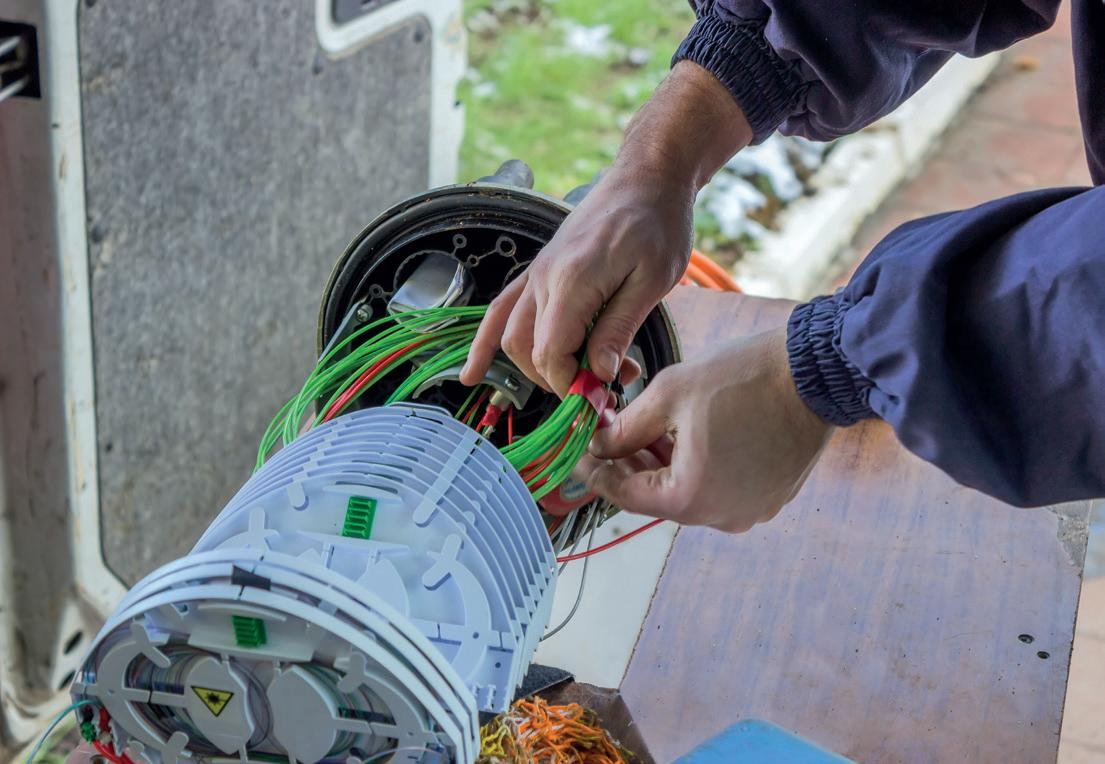
"This experiment has proven that it works,” said Daniel Mata Flores, project leader with SequoIA Analytics. “We use a recent optical technique, DAS, which makes it possible to transform these cables into thousands of acoustic sensors. We are thus able to measure vibrations produced by road traf c.”
SequoIA Analytics is now in the process of constructing software for a much larger project, he said. The software, developed
in collaboration with the Nice Côte d'Azur Metropolis, should be ready at the end of this year or early 2025.
DAS uses bre optics to provide distributed strain sensing. In DAS, the optical bre cable becomes the sensing element. The measurements are made and, in part,
processed using an attached opto-electronic device. Such a system allows acoustic frequency strain signals to be detected over large distances and in harsh environments.
The company has said that its innovation could revolutionise road traf c management because it brings an unprecedented level of detailed information to road authorities. It is more precise than existing devices as it can provide measurements every 10m along an axis of up to 100km.
The Nice-Matin report noted that the company will use arti cial intelligence algorithms to process the masses of data to determine traf c indicators such as speed, direction and anomalies such as accidents. Flores maintains that, unlike video surveillance cameras installed along arteries, generally spaced every 5-10km, the SequoIA Analytics system will provide unprecedented detailed information. “This allows us to say every two minutes what is happening along the roads or highways. Two minutes is the time it takes to analyse and provide the indicators,” he said.
SequoIA Analytics www.inria.fr/en

The Athens-Patras highway is the first in Greece to have a smart lighting system that automatically adapts the road lighting to the level of traffic
The system, along a trial section of the tolled 218kmlong highway - also known as Motorway 8 - adjusts the lighting to best suit the driving conditions,

according to VINCI Highways, operator of the highway.
The initiative is a step forward to a commitment by VINCI Highways to achieve operational net-zero emissions on its network by 2050.
The system uses artificial intelligence and machine learning to determine the optimal lighting level by processing live data including traffic, weather and road incidents from multiple sources.
Constant monitoring of the vehicle traffic at each interchange of the highway allows the system to calculate the total traffic and make forecasts for the next hour. When traffic decreases and predictive traffic remains low, the system progressively reduces the intensity of lighting. The system also includes real-time data from the highway’s weather stations and cameras to immediately increase lighting in case of a change in driving conditions. The system has been set up in a trial along the Elefsina to Corinth section of the highway and will be progressively implemented along the entire length of the highway.
VINCI Highways says the

adaptive lighting system, combined with the energy performance of the LED lights already set up along the complete length of the Athens-Patras highway, will reduce annual energy consumption for night lighting by up to 75%. It also reduces light pollution for people living close to the motorway.
The adaptive lighting system has been developed in collaboration with the National Technical University of Athens and specialised start-ups including Extrabit, Athens-based predictive weather forecasting company Ex Machina and Invision AI, based in Toronto, Canada which provides video-based AI solutions for transit and public safety applications.
Vinci Highways
https://www.vinci-concessions.com/en/vincihighways
EXTRABIT
https://www.extrabit.gr
Ex Machina
https://exm.gr
Invision AI
https://invision.ai
No matter how challenging your needs, BKT is with you offering an extensive product portfolio for every field such as agriculture, OTR and industrial applications.
BKT provides concrete, reliable and high-quality solutions to your requests and working needs.
Wherever you are, BKT is with you.
For info: europe@bkt-tires.com




•S ee the latest equipment
•Learn best practices and techniques
•Improve your jobsite and business
March 25-27, 2024 | Nashville, Tennessee
Use promo code PARTNER20 to save 20% off admission







Electreon reports that its wireless EV charging road in Detroit – the rst such public “station” in the US - has been completed as a testbed.
The technology enables EVs to charge while driving, using chargers that are embedded in the pavement. Detroit’s 14th Street is now equipped with inductivecharging coils between Marantette Street and Dalzelle Street that will charge vehicles equipped with Electreon receivers as they drive along. The road will be used to test and perfect the wireless charging technology ahead of making it available to the public in the next few years.
Extensive testing of the inductive charging technology will start early next year using a Ford E-Transit electric commercial van provided by vehicle manufacturer Ford and equipped with an Electreon receiver. Staff will test the ef ciency and operation of the vehicle and study potential long-term public transportation opportunities.
Electreon’s wireless charging technology is based on inductive coupling between copper coils installed below the road surface and receivers installed on electric vehicles. When a vehicle with a receiver nears the in-road charging segments, the road transfers electricity wirelessly through a magnetic eld. This electricity is then transferred as energy to the vehicle’s battery. These charging segments can
transfer wireless electricity to the receiver either when the vehicle is parked (static charging) or is driving (dynamic charging).
The electric road is safe for drivers, pedestrians and wildlife because each coil in the road is activated only when a vehicle with an approved receiver passes over it. This ensures that energy transfer is controlled and provided only to vehicles that require it.
Michigan’s department of transportation and Electreon have entered into a ve-year commitment to develop the electric road system by piloting the technology on the US state’s roads. Also next year, the DoT will seek bids to rebuild part of US 12, called Michigan Avenue, which will see additional inductive charging installed. Electreon has also installed two static inductive charging stations in front of Michigan Central Station, which will be able to charge Electreonequipped vehicles while they are parked.
“Michigan has always been at the forefront of innovation in mobility and that forwardthinking is on display with the latest advances in inductive charging from Electreon, the rst deployment of this electric vehicle charging technology in the United States,” said Justine Johnson, chief mobility of cer of the Of ce of Future Mobility and Electri cation.
Electreon
https://electreon.com
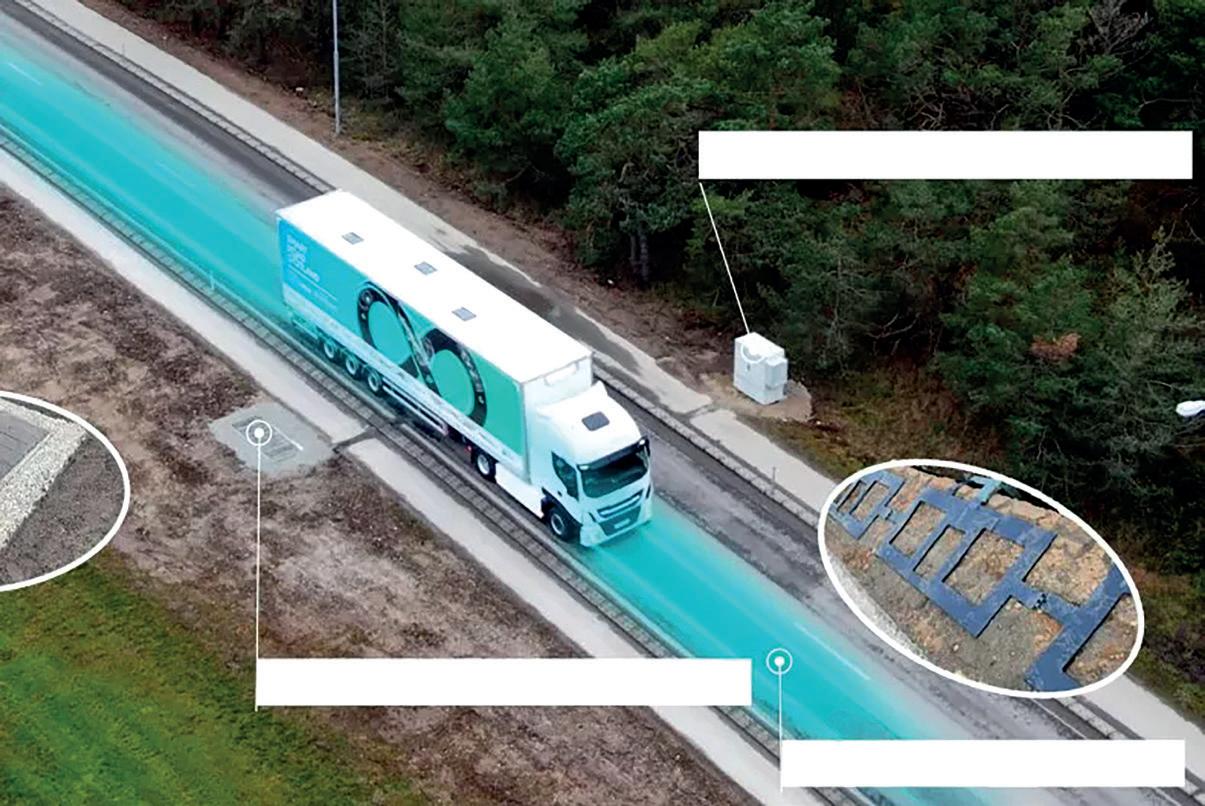









The Kekava Bypass - Latvia's rst "highspeed road - opened in October and also began operation of a traf c management system from Kapsch Traf cCom.
The bypass is providing an ef cient alternative for motorists travelling between the Latvian capital Riga, on the Baltic Sea, and neighbouring Lithuania to the south. Traf c in the small town of Kekava is now being reduced.
Meanwhile, Kapsch Traf cCom's cameras, sensors and radar systems, as well as a modern and exible traf c management software platform are contributing signi cantly to safety and sustainability along the bypass. "The Kekava project is not only a milestone for road PPPs [public-private partnerships] and traf c in Latvia, but a testament to the positive in uence
of state-of-the-art technology on road safety," said Marko Frank, mobility expert and regional sales director at Kapsch Traf cCom.
The nearly 18km-long bypass is part of the A7 Bauska Highway, one of Latvia’s busiest roads with an average daily traf c volume of 17,000 vehicles, and up to more than 25,000 at peak periods. The bypass is also designated part of the pan-European TEN-T network called route E67 - the Via Baltica (Helsinki – Tallinn–Riga–Panevežys–Kaunas–Warsaw–Prague).
Construction of the €250 million bypass started in 2021 on what is the rst highway in Latvia designated as a high-speed road; pedestrians, cyclists and slow-moving agricultural vehicles are prohibited. However, pedestrians and cyclists are allowed on the
parallel roads.
Kapsch Traf cCom technologies will ensure safe and ef cient operation of the Kekava Bypass for the next 20 years, noted Juris Fridmanis, general manager of the private partner consortium Kekava ABT. It is monitored 24 hours per day thanks to more than 20 video surveillance cameras, two weather stations, traf c counting sensors, as well as a data system analysing the traf c ow. Maximum driving speed on the bypass during the summer has been set at 120km/h but reduced to 90km/h during winter - October 16 to April 15.
According to the client, the state-owned road management agency Latvian State Roads (LVC, Latvijas Valsts Celi), there are 900 lighting xtures, 40km of steel and 4km of concrete safety barriers. Noise mitigation solutions such as noise barriers and soil embankments have been implemented along 7.5km of the road as well as 27km of animal fencing.
Innovative materials and technologies have been used in the construction of the bypass. For example, culverts, water drainage pipes and lighting poles made of glass bre have been used, recycled PET bottles have been used in the production of bridge barriers and sound absorbers made of wood bre are used in noise barriers.
The consortium Kekava ABT consists of the Luxembourg-based infrastructure fund TIIC 2 S.C.A. SICAR as well as Latvian construction rms AS A.C.B. and CBR SIA Binders. Kekava Bypass is the rst major PPP project in road construction in the Baltics to be implemented according to the design-build- nance-operate model.
Kapsch www.kapsch.net/ktc
Vaisala has launched the compact Beam Weather Station –BWS500 – for weather and environmental monitoring by cities, road agencies and industrial zone authorities.
Beam Station is designed as a turnkey monitoring station that provides access to reliable information on air pollutants, solar radiation, ooding, snow depth, water level, visibility, road conditions, pavement temperature and current weather conditions.
Due to its small size and affordability, says Vaisala, Beam Station can be deployed virtually anywhere to deploy effectively denser observation networks which support the need for increasing capabilities to understand weather and ooptimise processes accordingly.
It allows for easy installation in all locations, even busy urban areas, including existing infrastructure such as street poles, traf c lights and bridges.
Beam, available as a standalone station or as a network of stations, aggregates insights and delivers them directly to the customer’s backend system. Select measurements can also be viewed via Vaisala’s cloud services.
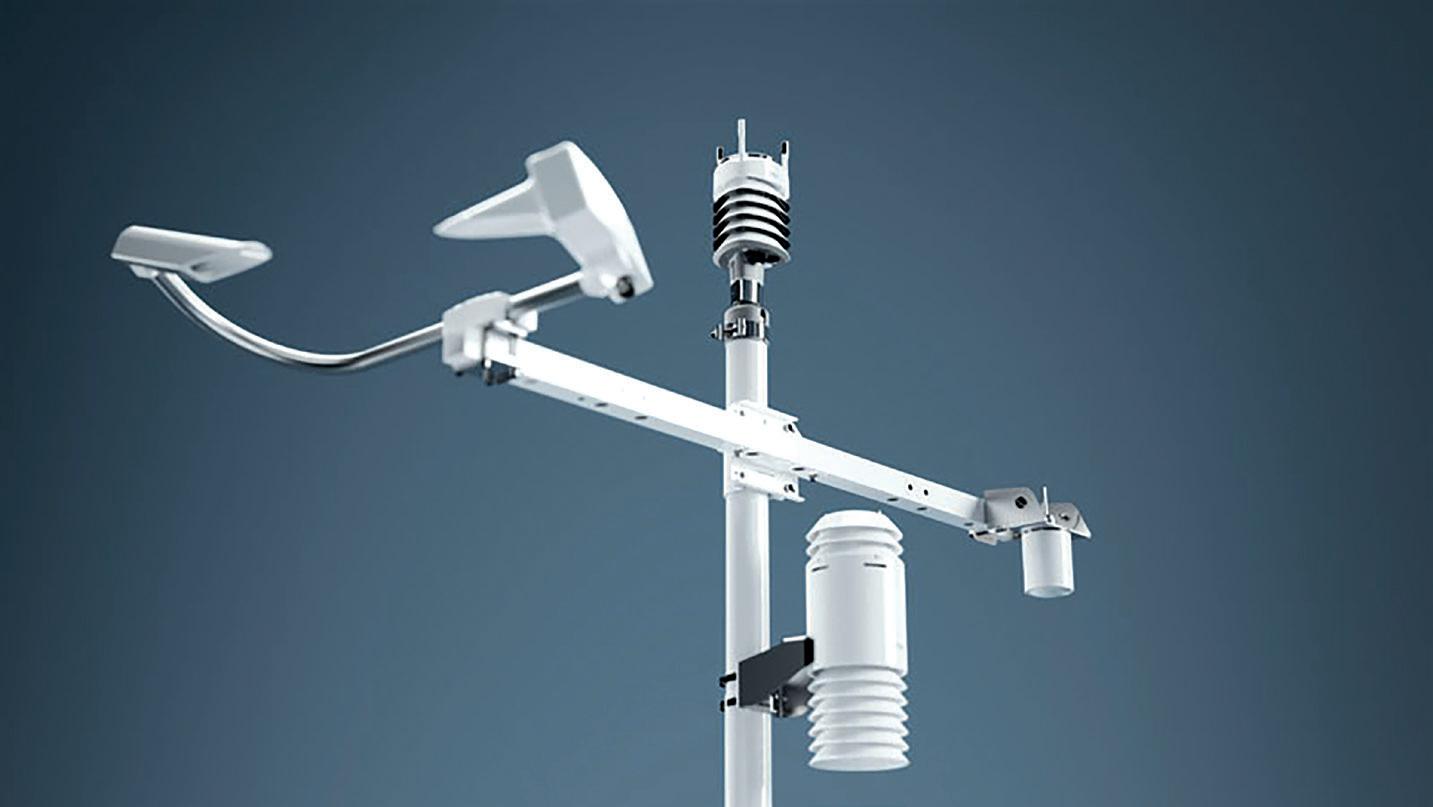
“Our customers require more exibility in the parameters they monitor and how the information is distributed, and we answered with the best-in-class Beam Weather Station,” said Paras Chopra, product manager. “Beam has been co-developed with input from some of the leading system integrators to improve the sustainability of our communities.”
Headquartered in Finland, Vaisala employs over 2,000 people worldwide and is listed on the Nasdaq Helsinki stock exchange.
Vaisala www.vaisala.com

A pilot project in the US state of Georgia has reportedly reduced left-turn car crashes by a quarter along a busy fourlane highway.
The project is using a system developed Applied Information in partnership with Wavetronix to enhance safety at unprotected left turns in the town of Peachtree Corners.
“One of the pilot locations, on Peachtree Industrial Boulevard,
saw upwards of six car crashes annually,” said Brandon Branham, assistant city manager of Peachtree Corners. “Since piloting this technology, police reports have shown a 25% decrease in accidents at this left turn location.”
Crossing lanes of traf c is a leading cause of crashes, with unprotected left turns accounting for more than half of all crashes when crossing the pathway of other vehicles, according to
a federal study. Additionally, more than one-third of all fatal motorcycle accidents involve another vehicle making a left-hand turn in front of a motorcycle. Bryan Mulligan, chief executive of Applied Information, said the challenge of the unprotected left turn is a signi cant one in the traf c industry. Quincy Guerra, the Wavetronix technical manager in Georgia, noted that Wavetronix’s mission is, through new
Ride ag Technologies is working with the San Francisco Bay Area Metropolitan Transportation Commission (MTC) on a multi-phased deployment of its HOV veri cation tool.
The Canadian company, based in the province of Ontario, recently showcased its occupancy detection smartphone app at the IBTTA meeting and exhibition in Seattle in the US.
The Bay Area Express Lanes are a local network of managed lanes that are currently being implemented across the interstate highway through close coordination among regional agencies.
Ride ag says that the applicability of its technology is particularly relevant for MTC as the agency is planning to deploy the tool on one of the largest Express Lane networks in the world, in addition to San Francisco’s Golden Gate and Oakland Bay bridges. MTC has around 125 lane-miles of operating Express Lanes in an overall planned regional network of 737 lane-miles.
Ride ag’s VOD camera technology (vehicle occupancy detection) accurately counts and veri es vehicle occupants. Using only one smartphone, carpoolers can declare and verify


technology, to improve the safety and ef ciency of the world’s roads.
Applied Information's Intelligent Left Turn Solution alerts motorists when it is unsafe to make a left turn. Using radar detection, cloud computing and an advanced algorithm, it monitors the speed and trajectory of oncoming traf c, triggering warnings when it is potentially unsafe to turn.
Using this technology is especially crucial in areas with obstructed views or where highspeed oncoming vehicles might cause misjudgment of traf c gaps. Compatible with C-V2Xconnected vehicle to everything - technology, the solution marks a signi cant advancement in the potential to reduce the occurrence of unsafe left turns.
Based on the pilot project’s success, Wavetronix and Applied Information said they are now working with their distributors to make the solution commercially available in 2024.
Applied Information
https://appinfoinc.com
Wavetronix
www.wavetronix.com
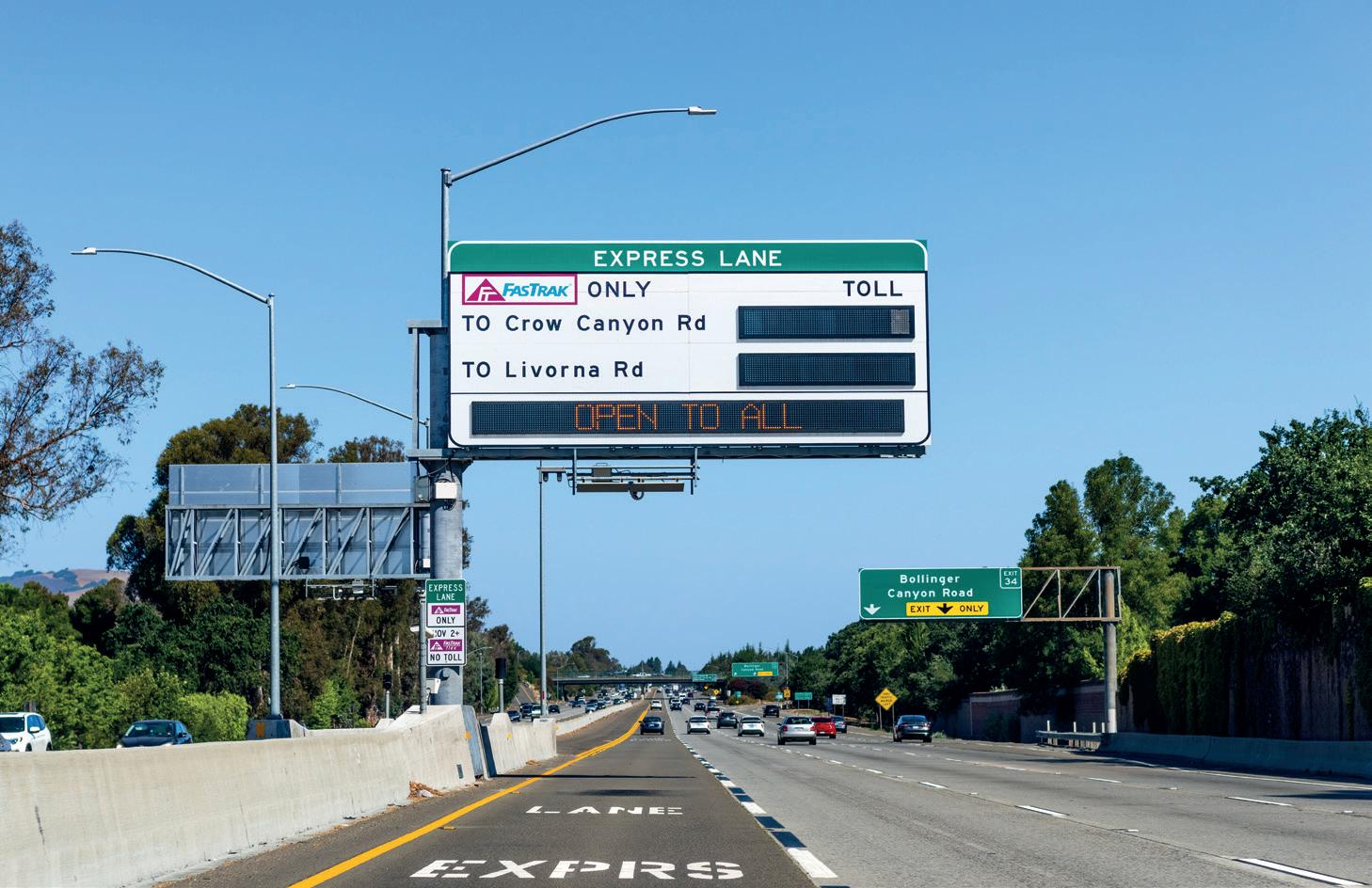
their occupancy in around ve second or less. Veri cation can be completed with a face mask, sunglasses, in all lighting conditions and with children.
As well, the technology can be integrated with an agency back-of ce system through an API call or can directly connect with transponder readers. The app can also fully integrate with advanced agency customer relationship management tools.
Importantly, says Ride ag, while the
technology counts the number of occupants within a vehicle and determines whether they are real, it cannot determine occupant identity. The technology also does not continuously track a user’s location. It looks only at their route on the highway. The location data is gathered only in order to grant the correct HOV bene ts to carpoolers.
Ride ag Technologies www.ride ag.com
Ammann’s new light tandem roller is petrol-powered and features side-free drums that enable compaction in tight jobsites. The Ammann ARX 10.1 StV features the Honda GX630 petrol engine rated at 15.5kW. This reduces ownership costs and meets the latest Stage V/EPA Phase III emissions regulations.
The engine is more compact than its diesel counterpart. The smaller size enables positioning that allows cooling from all sides, helping the machine to perform in hot ambient temperatures.
Beyond size, the use of petrol brings other advantages. Petrol is generally less expensive, so there is likely a cost advantage with every lling of the tank. There is no need for a diesel particulate lter (DPF) and maintenance of a
petrol engine is less costly than for a diesel engine. Petrol is often more convenient for smaller construction companies and rental customers.
The Ammann ARX10.1 StV is the only machine on the market with drum consoles installed from a single side. The drums are support-free on the right side. This allows compaction work on the tightest of jobsites. Drum working widths are 900mm and drums are installed in-line.
A powerful hydraulic system is the core of the powertrain structure. Both drums are equipped with robust drive motors that bring high traction, gradeability and speed. The motors are equipped with a negative parking brake mechanism that ensures safe parking when the engine is switched off.
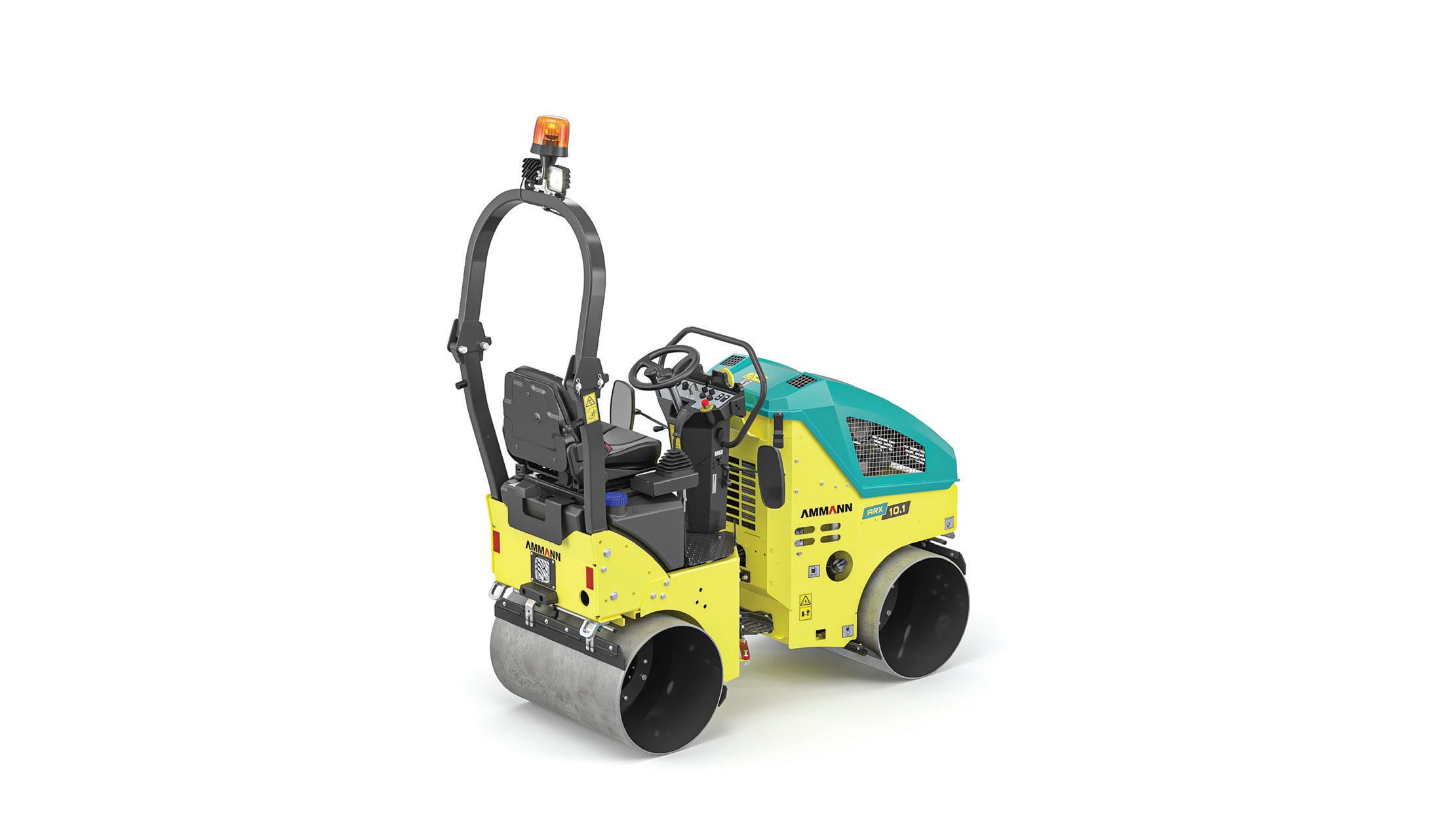
To meet the growing demand for 40tonne-class machines in Europe, capable of boosting productivity and ef ciency on heavy-duty applications and demolition jobsites,Hitachi Construction Machinery (Europe) is presenting the ZX390TC-7.
Based on a Hitachi ZX350LC-7 standard excavator, with Zaxis-7 technology and a Stage V-compliant engine, the new tool carrier model has been specially adapted to work with larger working tools.

Larger boom and bucket cylinders and a one-class-higher reinforced linkage enable the ZX390TC-7 to carry 5tonne tools, such as hydraulic shears for crushing normally used by larger machines. It is equipped with a full hydraulic control system, suitable for use with all attachments, which
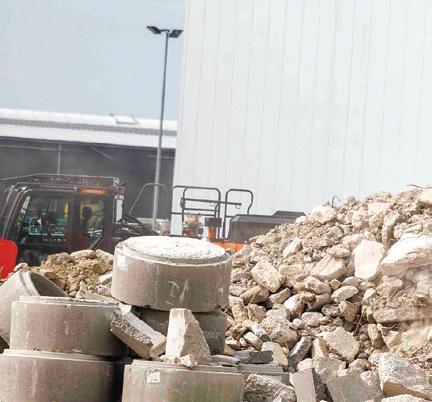
can be changed within seconds from the operator’s seat.
For added stability, the ZX390TC-7 has a robust 25cm-longer undercarriage than the standard ZX350LC-7 and is supplied with an additional 1.4tonne counterweight.
To ensure the safety of operators, the machine has side impact protection and a demolition-speci cation cab with FOPS guard level 2 and high speci cation P5A safety glass.
Safety is also enhanced by the exceptional visibility from the cab, particularly from the 270o bird’s-eye view provided by the Aerial Angle camera system.

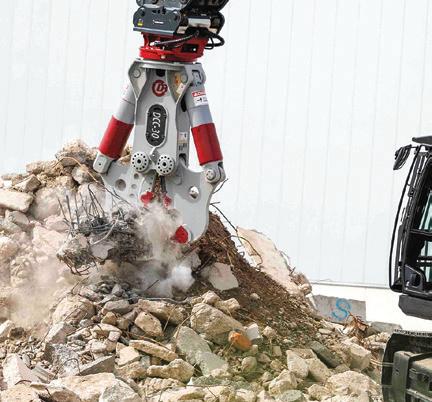
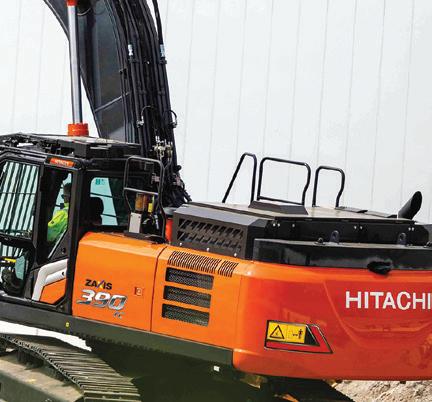

Secmair is o ering a zero emissions solution for emulsions spraying. A spokesperson for the rm said, “It’s 100% electric.”
Instead of being modi ed from a diesel model, the machine has been designed from the ground up to run from electric power. The machine also features extra heat insulation compared to the rm’s conventional models and the spokesperson said, “Particular attention has been made to double the thermal e ciency.”
The spraying system does not take power from the truck motor and instead runs from a battery pack. There is su cient battery power for the machine to complete a working shift and a fast charging system is tted. In addition, solar panels on the roof can double the working time on sunny days.
Using electric power, the machine can work during the day without causing a disturbance and the spokesperson commented, “It can operate silently.”
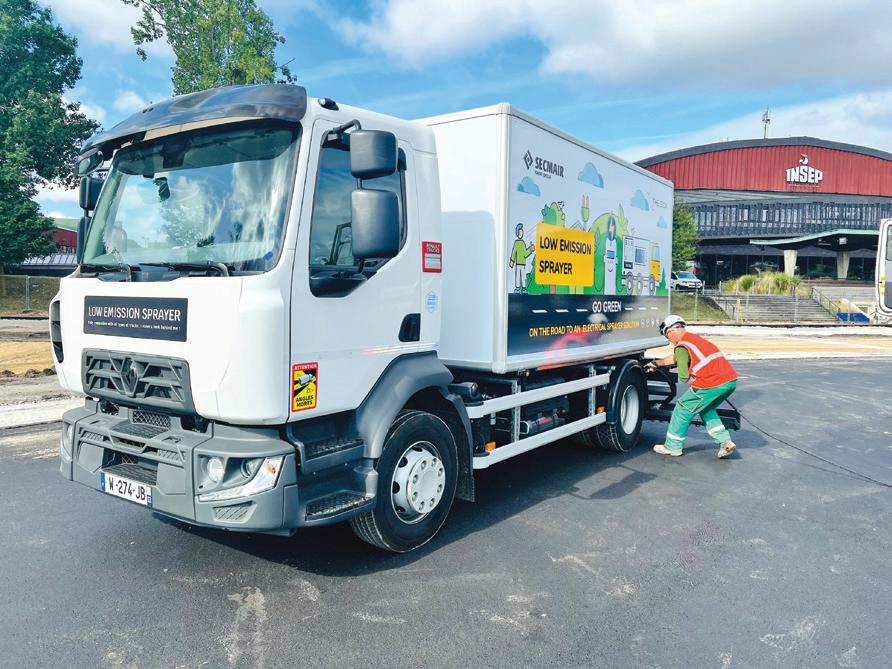




Drawing on a decade of experience and a deep understanding of the intelligent Machine Control system, Komatsu now o ers a Smart Construction 3D Machine Guidance kit as a simple and exible technological enhancement for a broad range of standard Komatsu machines and mixed eets.
The 3D Machine Guidance kit provides an accessible way to add 2D and 3D machine guidance to any crawler or wheeled excavator from 13tonnes up to 120tonnes.


Cummins is unveiling a new fuel agnostic version of its 6.7litre engine that is able to run on hydrogen. Laurent Divito from the rm said, “It’s still a combustion engine so there’s a lot of commonality with components.”





to
be fuel agnostic. This could be available for off-highway use.”


The B6.7H marks a signi cant development project for Cummins. Divito commented, “This new engine is part of our destination zero policy. Our agnostic engine will be available in 2030.”

Another key innovation from Cummins is the partnership with NPROXX to provide an ef cient fuel delivery system as well as high pressure fuel storage for hydrogen. The latest tank design now stores hydrogen at up to 700bars, which Divito said is becoming standard in markets such as the transport sector, where this fuel is beginning to be used. The increase in pressure allows for a signi cant gain in capacity, boosting running time. He added, “The engine is running at 10bars.”


is a key development for the future and use



He said that the hydrogen engine is a key development for the future and commented, “It can be seen as a transition to the fuel cell because it will use the same tank and infrastructure.”


Fuel types will be important and he added, “The next generation of Stage 6 engines will

The new tank is only part of the answer to fuelling however, and Divito said that there is still a long way to go in developing the infrastructure for hydrogen-fuelled machines. “We need more hydrogen powered equipment in the market. You need to have the availability of fuel.”

The kit can be customised with various optional additions such as a tilt bucket and couplers kit, a two-piece boom kit, a super long front kit, and a SATEL radio kit. These options allow the kit to better accommodate each customer's machine con gurations and operating conditions.
components provide customers with guaranteed reliable quality and performance.

Developed by Komatsu for Smart Construction to the same strict standards as their renowned yellow machines, the 3D Machine Guidance kit hardware


Consistent with Komatsu's ongoing dedication to improving jobsite safety, a 3D safety zone feature has been integrated into the system. This allows customers to create and import avoidance zones. The feature serves as a preventive strategy, sending alerts to operators when they are near hazards such as powerlines, underground utilities, walkways, or public roads.


Hamm’s latest asphalt compactors now offer both vibration and oscillation capabilities for effective compaction.
The HD+ 120i V-VIO 12tonne tandem roller is equipped with a vibration drum at the front and a VIO drum delivering oscillation forces at the rear. High compaction forces are claimed, along with reliability, durability, productivity and ease of maintenance.
The roller is powered by a 115kW Deutz engine that meets Tier 4 Final/Stage 5 emissions requirements and features the rm’s ef cient Easy Drive operating concept.
A key feature is the versatility as it offers static compaction, oscillation and vibration. The operator can switch easily between vibration and oscillation, removing
the need to switch machines or deploy an additional machine and another operator on the construction site. This versatility means that the same machine can be used for different types of asphalt mixture as well as applications. The combination of vibration and oscillation delivers fast compaction in fewer double passes, suiting it to nal compaction. High compaction quality is claimed even at increased working speeds.
The machine has the latest Hamm cab, offering good all-round visibility as well as various interfaces to connect telematics systems, eet management systems and digital applications for controlling and documenting compaction.
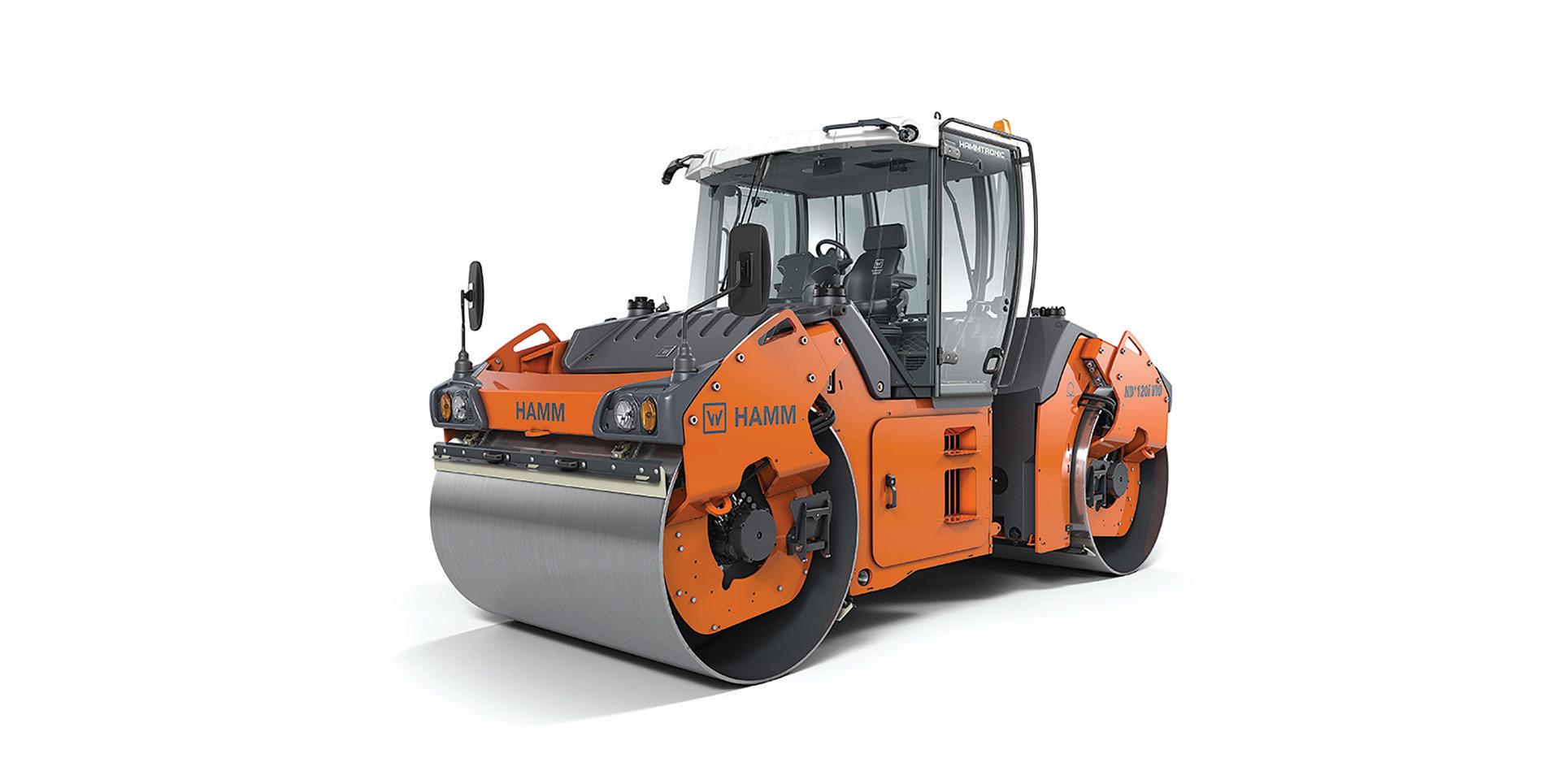
Develon unveiled Concept-X in 2019 as the world’s rst automated construction solution. At a demonstration of Concept-X in South Korea in the same year, attendees witnessed autonomous construction equipment performing everyday jobsite tasks. Now, Develon is presenting the latest developments in technology-based solutions in an updated version called Concept-X 2.0. The Concept-X 2.0 autonomous construction equipment involved in these developments include the



DD100 CX dozer and DX225-CX crawler excavator. Both machines feature a new cabinless design and a linear core design language. Among the new updates being demonstrated to the market are autonomous driving and blade control based on global navigation satellite system (GNSS), automated 3D grading with tiltrotator accessory, enhanced machine learning-based auto digging and loading, integrated work planning algorithm applied, and advanced E-Stop safety technology.


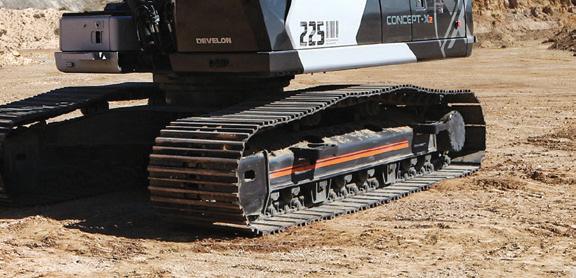

A new package from Leica Geosystems is said to help boost safety for personnel on construction sites.
The PA10 system is intended to highlight the location of construction personnel on working sites to machine operators, as well as alerting workers as to where equipment is in use.
“It’s a personal awareness system,” said Thomas Bonvalot of Leica Geosystems. “Everybody onsite will know where a machine is working and the machine operator will know there is a pedestrian.”





Telematics data can be a powerful way of improving the availability of a customer's eet, but data overload can prevent access to the really important information.





That's where Volvo Construction Equipment’s (Volvo CE) ActiveCare comes in. Combining 24/7 machine monitoring with eet utilisation reports, this comprehensive service is designed to keep machines running smoothly, reduce unplanned downtime and minimise repair costs.

Volvo CE says it understands the importance of uptime to the success of customer operations, which is why it has invested in the creation of Volvo Uptime Centres around the world. Volvo machine experts work in these centres, using the most advanced diagnostic tools and systems, to help maintain maximum uptime. With ActiveCare, Volvo monitors the condition of machines remotely and immediately alerts the customer if machine intervention is required. This proactive approach helps prevent breakdowns, reduce unscheduled downtime and minimise unforeseen costs, while leaving more time for maintenance.


The news that the Ammann Group and Volvo Construction Equipment (Volvo CE) have reached an agreement over the ABG Paver Business is of key signi cance for the road construction machinery segment. Under the agreement, Ammann will acquire Volvo CE’s global ABG Paver Business including ABG in Hameln, Germany
The deal will bene t both companies. This will strengthen the road construction machinery portfolio and distribution network for the Ammann Group. At the same time the move will allow Volvo CE to focus on developing sustainable solutions and future technologies and services, in line with its strategic direction.
The transaction is expected to be completed within the rst half of 2024 and includes the transfer of Volvo CE´s ABG facility in Hameln (Germany) as well as Volvo CE’s paving businesses in Linyi (China) and Bangalore (India).
“This strategic acquisition completes the depth of our product offerings and makes the solutions we offer customers more comprehensive,” said Hans-Christian Schneider, CEO of the Ammann Group. “The acquisition will also position Ammann with a suite of solutions, covering everything from asphalt plants to paving and compaction,” he added.
The Ammann Group will use this move to expand its business and invest in the ABG Paver range. The divestment includes the ABG Paver production and technology centre in Hameln, Germany. Ammann says the move will allow the rm to leverage its industry knowledge to further develop the pavers, with ABG in Hameln (Germany) becoming its Centre of Excellence for paving technology.
Ammann previously had only a limited range of pavers but the acquisition of the ABG models will expand the line-up, matching the rm’s existing, extensive array of asphalt compactors.
At the same time, the move will ensure the availability of the range and full support through the Ammann Group distribution channels and selected Volvo CE dealers. Meanwhile, production of Volvo CE compaction equipment in Hameln will be phased out gradually. The transaction is subject to regulatory approvals and works council consultations.
The move follows on from the introduction of improved models for the ABG range, with upgrades to the compact P2820D and P2870D
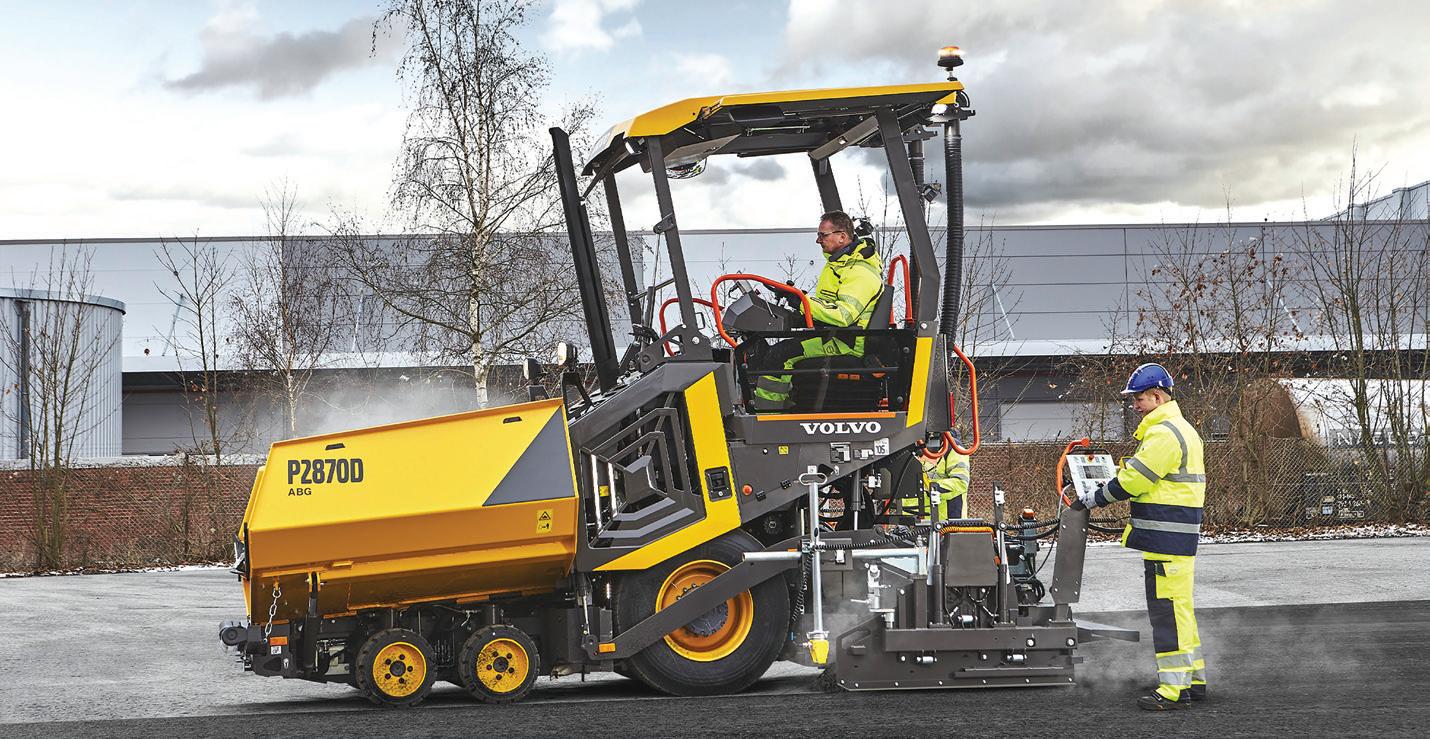
pavers boosting their performance to become more productive.
The updates come as standard on the P2870D and P2820D models, which are available in markets across Asia, China, Europe and international regions. The improvements meet demand for better traction in poor ground conditions, increasing agility when paving and improved feeding capacity.
Three features improve traction for the P2870D paver. A new rear tyre with an optimised pro le delivers high traction in soft ground conditions. This replaces a tyre which offered good traction on hard surfaces, but had limited performance on softer ground. The new front axle load distribution is achieved due to a combination of patented ride levellers and a novel clever hydraulic setting, allowing for a load increase of 500kg over the previous model. The sophisticated Screed Assist system also helps to boost traction. It allows a smooth start by maximising traction automatically during the critical start phase. This function is intended only for use on dif cult ground conditions and can be activated by a parameter setting.
The Volvo P2870D and P2820D pavers are commonly used on jobsites that require versatility. To meet requirements, the machines bene t from faster screed width changes as well as hopper operation.
The new cylinder circuit pump provides







45% more ow and a 50% improvement to the speed of screed extensions and hopper operation, due to valve block settings.
The new Smart Shift light function also helps to increase speed as it automates auger height, screed lift and oating mode in one sequence. This combines three actions into just one, when starting, paving, or stopping, and manoeuvring to another paving spot.
The single conveyor capacity and throughput have been boosted with higher scraper bars. In addition, the cleaning blocks on the outer side of the chain have been increased to reduce wear. Also helping to boost feeding capacity is the shape of the auger box, which has been optimised to improve material ow and reduce wear in the conveyor tunnel.
Ammann www.ammann.com
Volvo CE www.volvoce.com

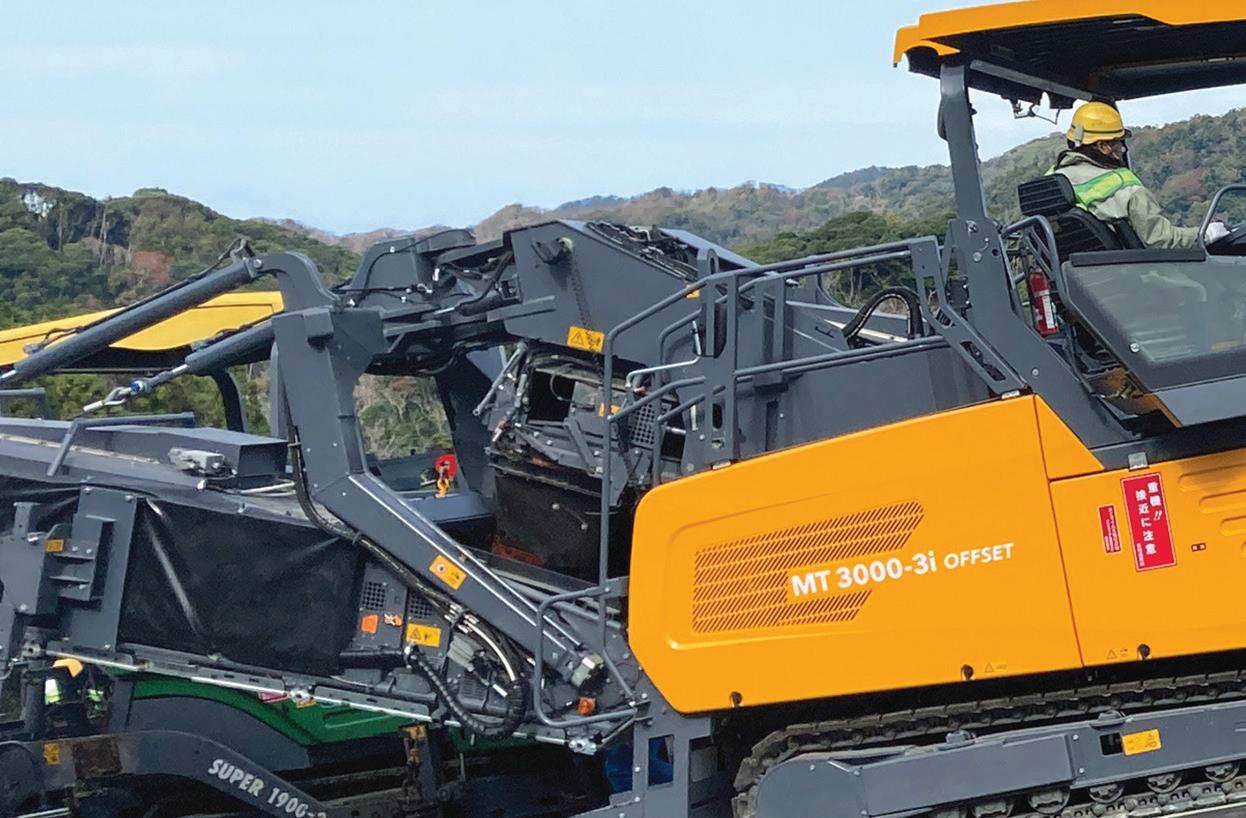


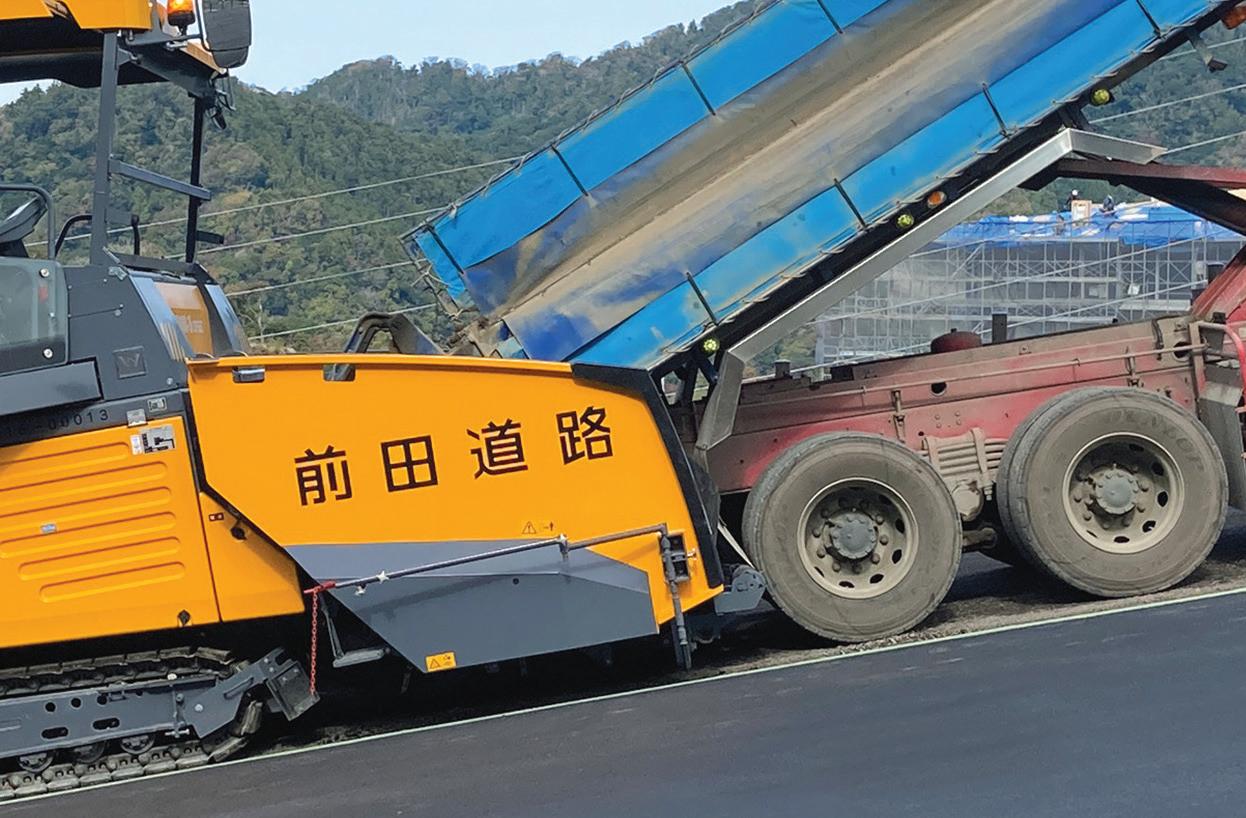
Road construction machines from the Wirtgen Group have been used to build a new race track in Japan. Four Vögele asphalt pavers worked on the project to build a demanding circuit in a mountainous area in Japan.
Tight corners and uphill gradients of up to 19% are features of the private racing circuit. Three Vögele pavers, a SUPER 1800-3i, a SUPER 1803-3i and a SUPER 1900-2, paved almost 100,000m2 in four layers, while a MT 3000-3i offset material feeder was also used to ensure ef ciency and quality.
The race track was commissioned by CORNS & Company and is located around 70km from Tokyo, close to the town of Minamiboso. The facility has been constructed for use by sports car enthusiasts and is Japan’s rst race track for customers with their own vehicles.
The 3.5km circuit features steep downhill gradients of up to 16% and uphill gradients of as much as 19%. The longest straights extend for 800m, allowing for high speeds. The track also features chicanes as well as tight bends with a 14m radius.
Maeda Road Construction used the four Vögele machines to manage the challenging new build. The three pavers paved four layers totalling just under 100,000m²: an 180mm non-bonded base course; a 120mm bonded base course; a 60mm binder course; and a 40mm surface course. In addition to the racing circuit covering an area of 36,000m², paving work involved another 60,000m² of run-off zones, as well as the pit lane and service roads. The main paving works on those secondary areas, as well as the base courses, were handled by the SUPER 1900-2 paver, which the general contractor has been using for many years.
The pavers worked mainly hot to hot, using two machines in echelon at a slight offset to produce an asphalt surface without

joints and measuring 8-12m across the full width of the carriageway. This ensures that the carriageway has both high resistance to deformation and a long service life. The paving team also bene ted from the different undercarriage concepts. The SUPER 1800-3i tracked paver provides high traction, and maintains consistent straight-line travel, while the SUPER 1803-3i wheeled paver can be used to pave corners with a tight radius, as its undercarriage enables it to steer smoothly. The paving team took advantage of these bene ts and primarily deployed the SUPER 1803-3i on the insides of bends.
The MT 3000-3i offset material feeder also played a key role in ensuring highquality paving. The machine decouples the transfer of material from the truck to the paver to ensure a constant, ef cient paving process. Conical augers in the receiving hopper of the material feeder convey the material crosswise to render it thermally
homogeneous. With an effective heating system that heats the conveyor and the transfer points, the use of a material feeder counteracts cooling and segregation of the mix.
The offset feature of the machine was also of bene t for the job, with the heightadjustable conveyor able to pivot 55° to the left and right. The discharge point into the extra material hopper of the SUPER paver is at a height of up to 3.6m as standard, and optionally up to 3.9m. Despite the extreme grade and slope, the pivoting conveyor meant that on the race track jobsite the MT 3000-3i offset could continuously feed two pavers with material alternately, without having to manoeuvre constantly. This increased ef ciency, as well as paving quality.

Vögele
www.wirtgen-group.com/ocs/en-us/voegele/voegele-products94-c/
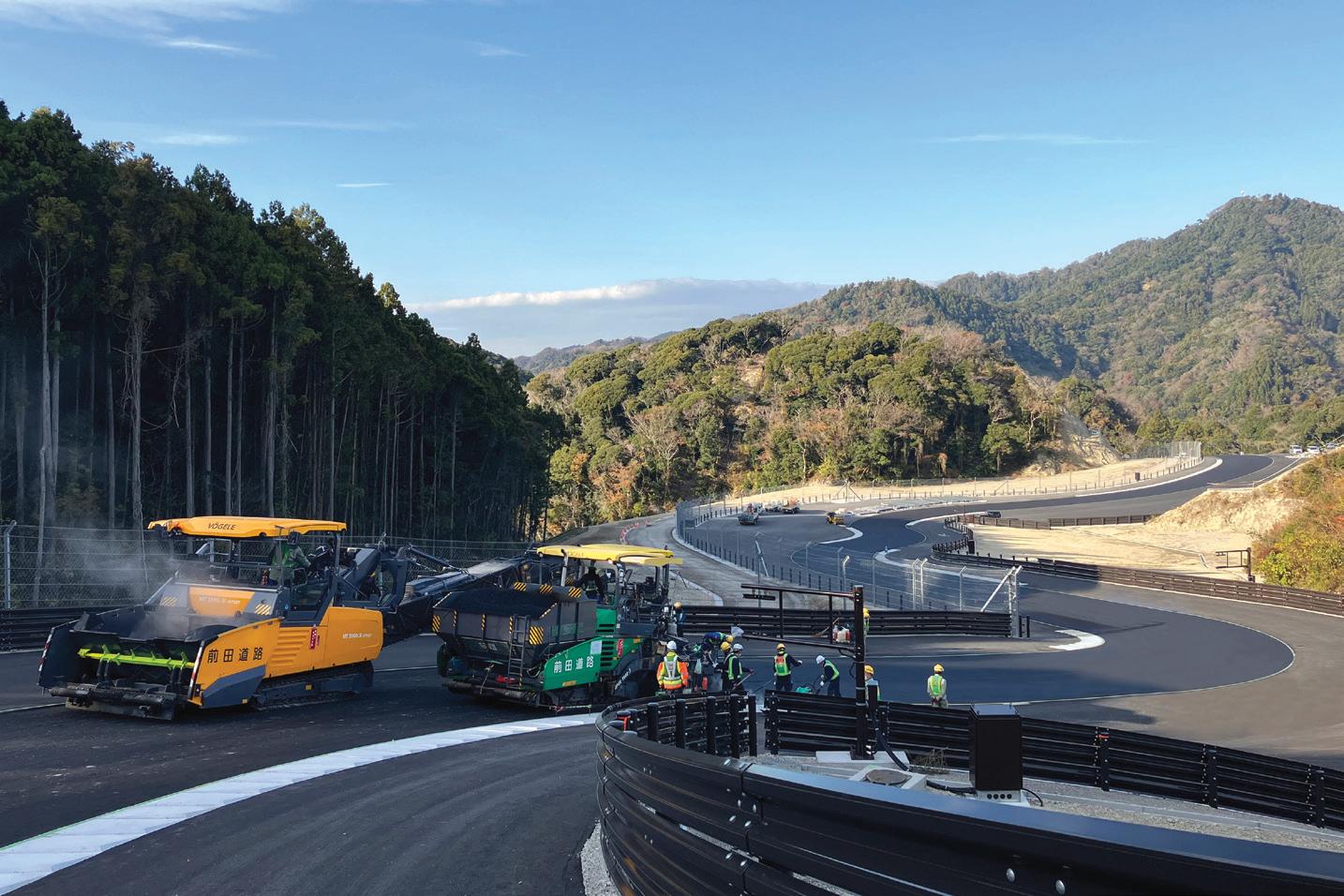
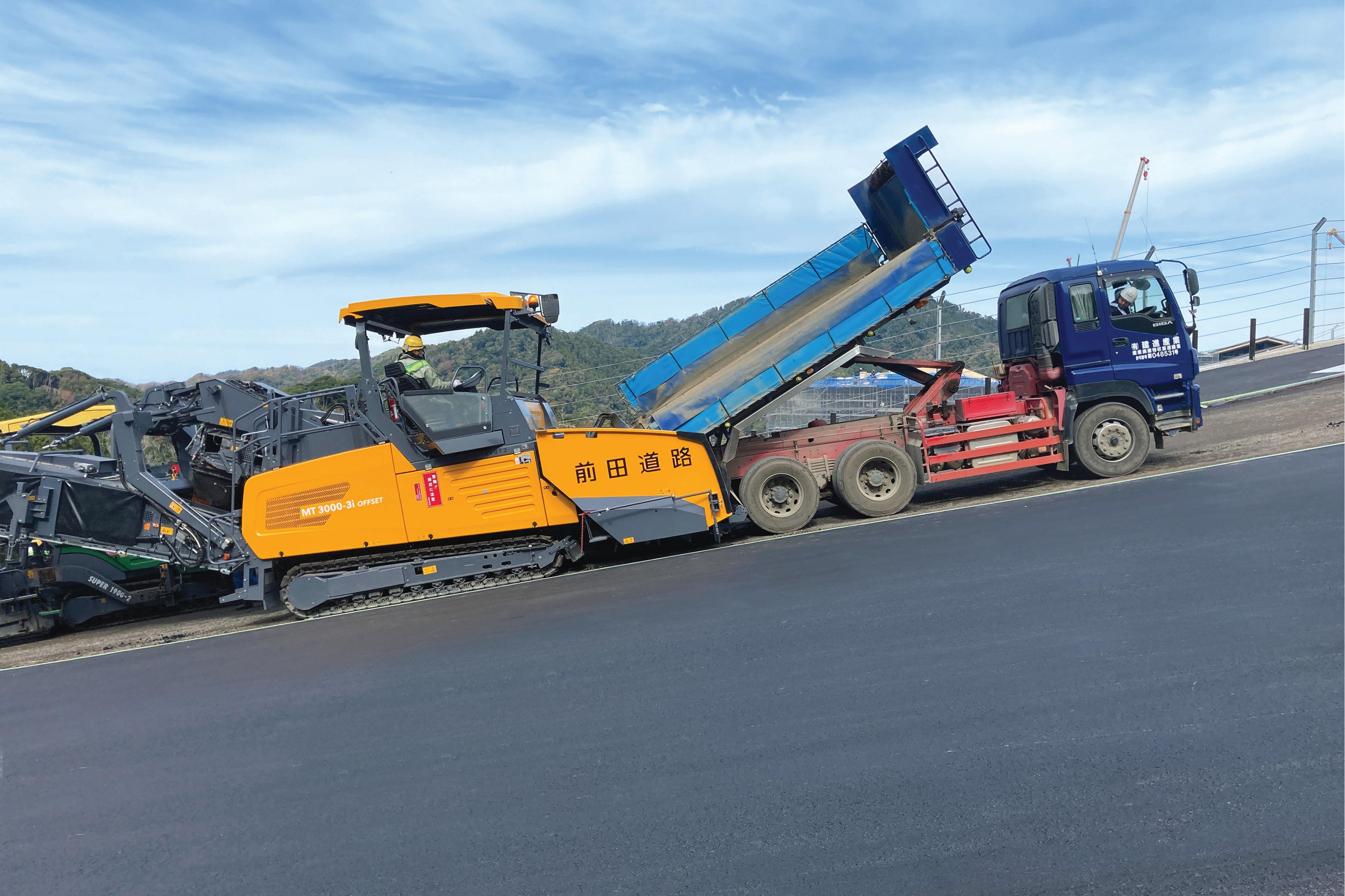
A mid-sized German contractor has boosted its equipment fleet with the purchase of three asphalt pavers from Dynapac. The three pavers, two SD2500CS models with V6000TVE screeds and a F1250CS model, were handed over recently in an order with a value of around €1 million
This represented a major investment for the company, which is based in northern Germany and has been a customer of Dynapac equipment for some years. Dallmann has bought equipment from the supplier for over 40 years. "Over the last few years, many suggestions have been incorporated into the development of new products at Dynapac. Innovative digital solutions such as the MatTracker, where we have been able to test the equipment with Dynapac, enable highquality results and work can be made more efficient," said Ralf Hafner, managing director of Dallmann.
However, Dallmann's paving crews also had an influence on the choice of supplier according to Michael Brake, site manager at Dallmann. "The SD2500CS is only half as loud on the screed as on comparable machines from other suppliers. Thanks to the low screed, the employees can see the material
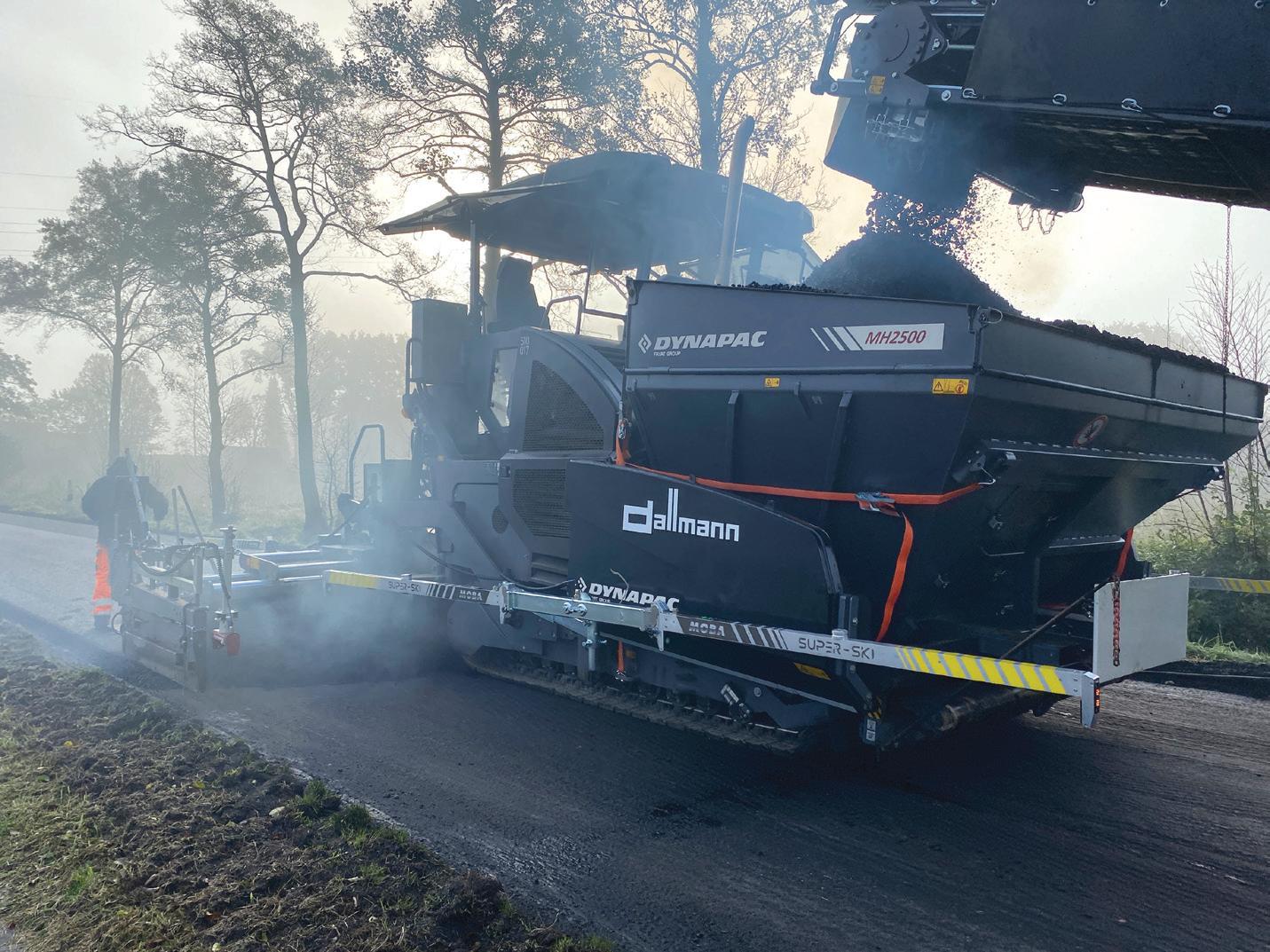
feed in the auger chamber. Deep screed plates ensure good pre-compaction and optimum paving quality. Narrow side plates make it possible to work directly against the wall, even without manual work,"

Anyone who sits on a paver in colder weather knows how uncomfortable that can be. But a stable windshield, adjustable seat heating and a high-efficiency extraction system for the bitumen fumes makes working
Patented graphene-enhanced polymeric supermodifier containing recycled plastics for recyclable, safe and sustainable roads roads towards sustainability www.iterchimica.it
gipave® is a polymeric supermodifier composed of graphene, specific additives and hard plastics, which are reinserted into the production cycle through a new patented selection and recycling process. Thanks to the properties of graphene, gipave® modifies and improves the mechanical performance of all types of bituminous mixes, decreases the deformations due to the repetition of loads and improves the fatigue behaviour. This solution contributes to a substantial increase in the service life of the asphalt pavement compared to both traditional PmB technology (Polymer-modified Bitumen) and PmA technologies with “dry” method.
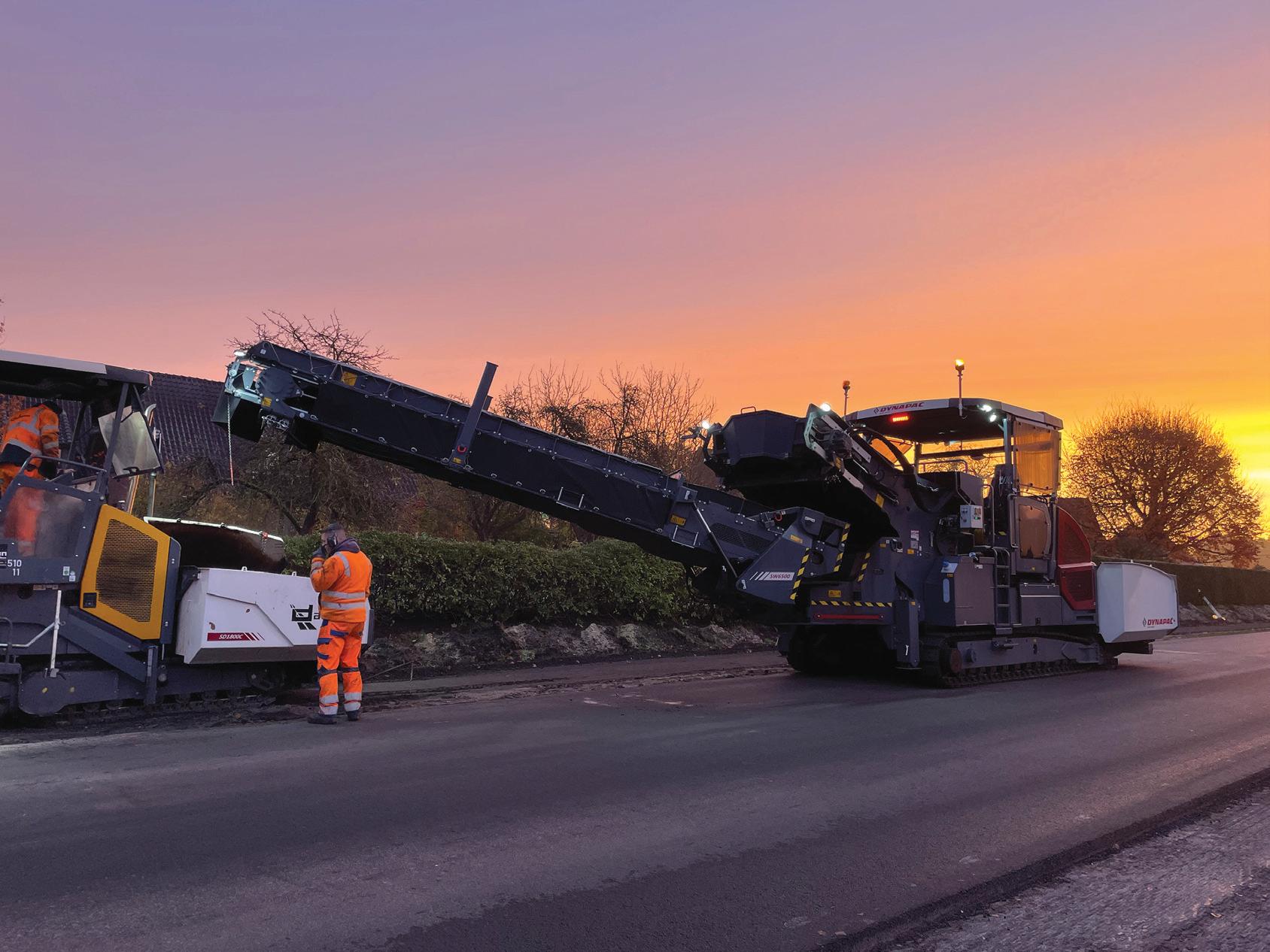
easier. There are also 14 LED headlights for ef cient night working and there is even a coming home/leaving home light that allows the driver to get on and off the machine safely when it is dark outside.
"However, the team also appreciated the numerous add-ons that characterise Dynapac. USB charging sockets directly on the screed, magnetic cup holders and, last but not least, the custom- t refrigerator," said Michael Heid, Dynapac engineer.
A notable recent project for the contractor
right on the doorstep of the Dynapac paver production site in Wardenburg. To be able to work here without interruptions Dallmann relied on the use of a MF2500CS feeder tted with the SW6500 swing function.
The use of a material feeder offers several advantages. It allows more continuous operation, as there is no downtime when changing trucks. The use of a feeder also permits an increased hourly output as the paving equipment runs at a constant speed. Unevenness in the road surface is minimised, which helps to deliver
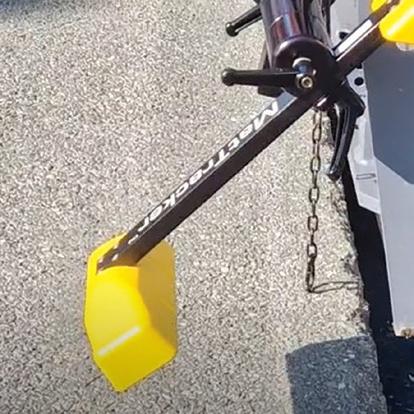

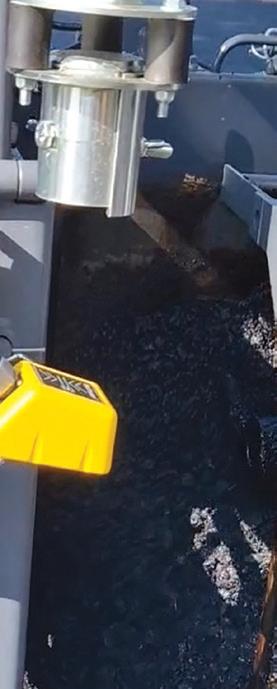

to a more even result overall. When paving the cycle path running parallel with the new road surface, the use of the feeder with the swing conveyor came in useful. It meant that the truck did not have to drive along the narrow path to supply the paver with asphalt. The paving train passed by the Dynapac factory. The whole day was spent talking and monitoring and evaluating the construction site.
Dynapac www.dynapac.com
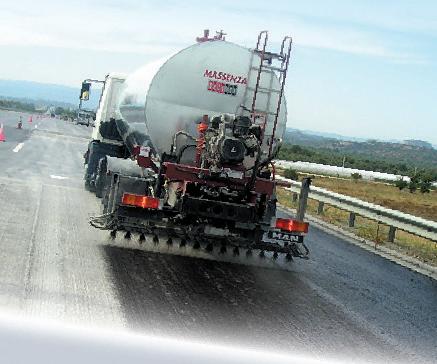










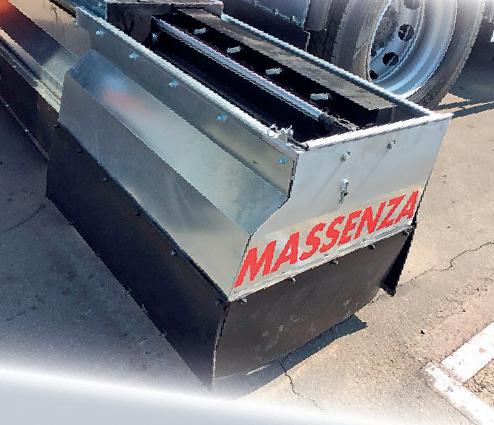






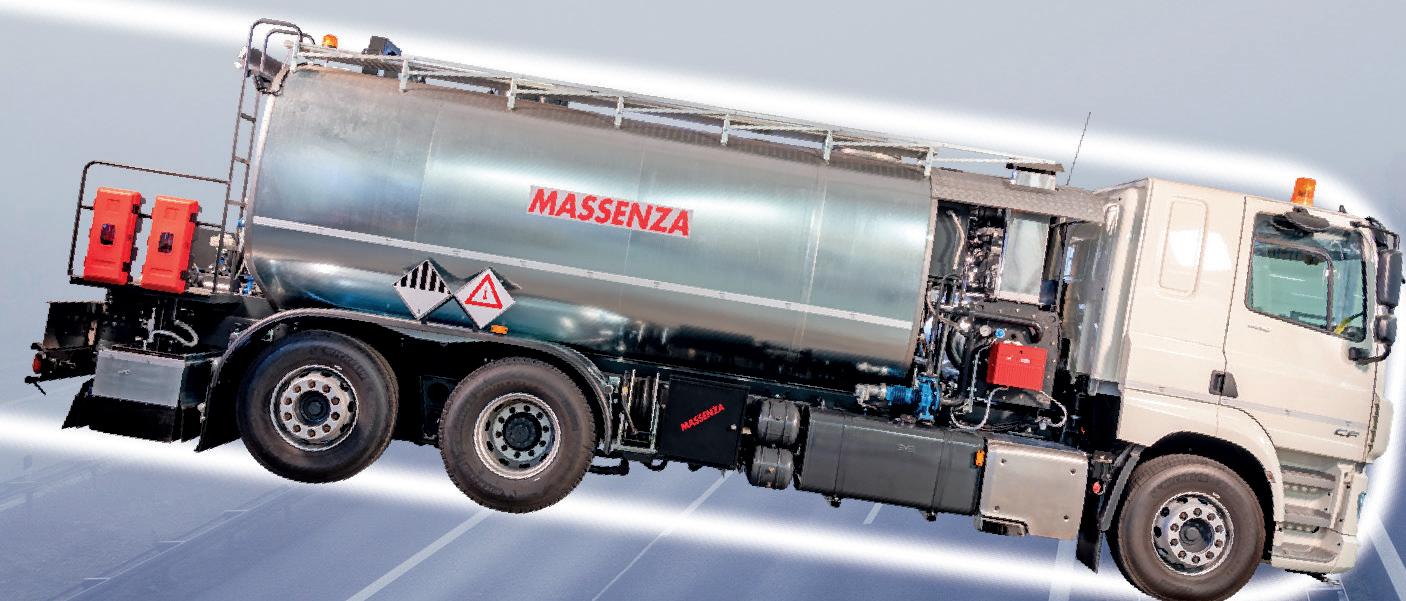
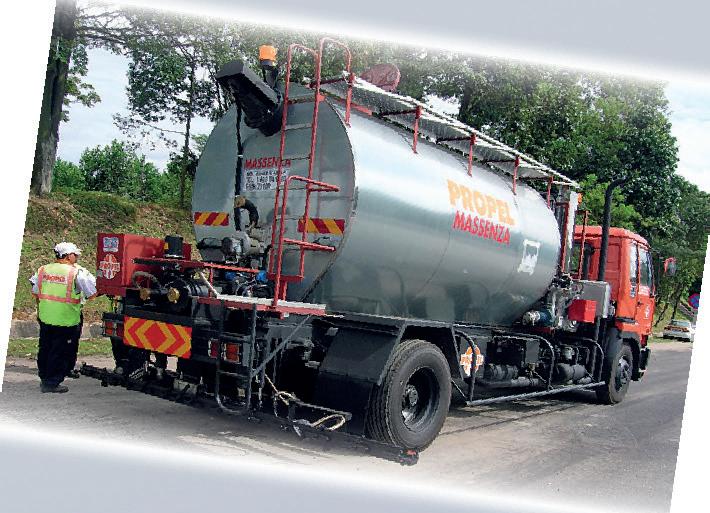
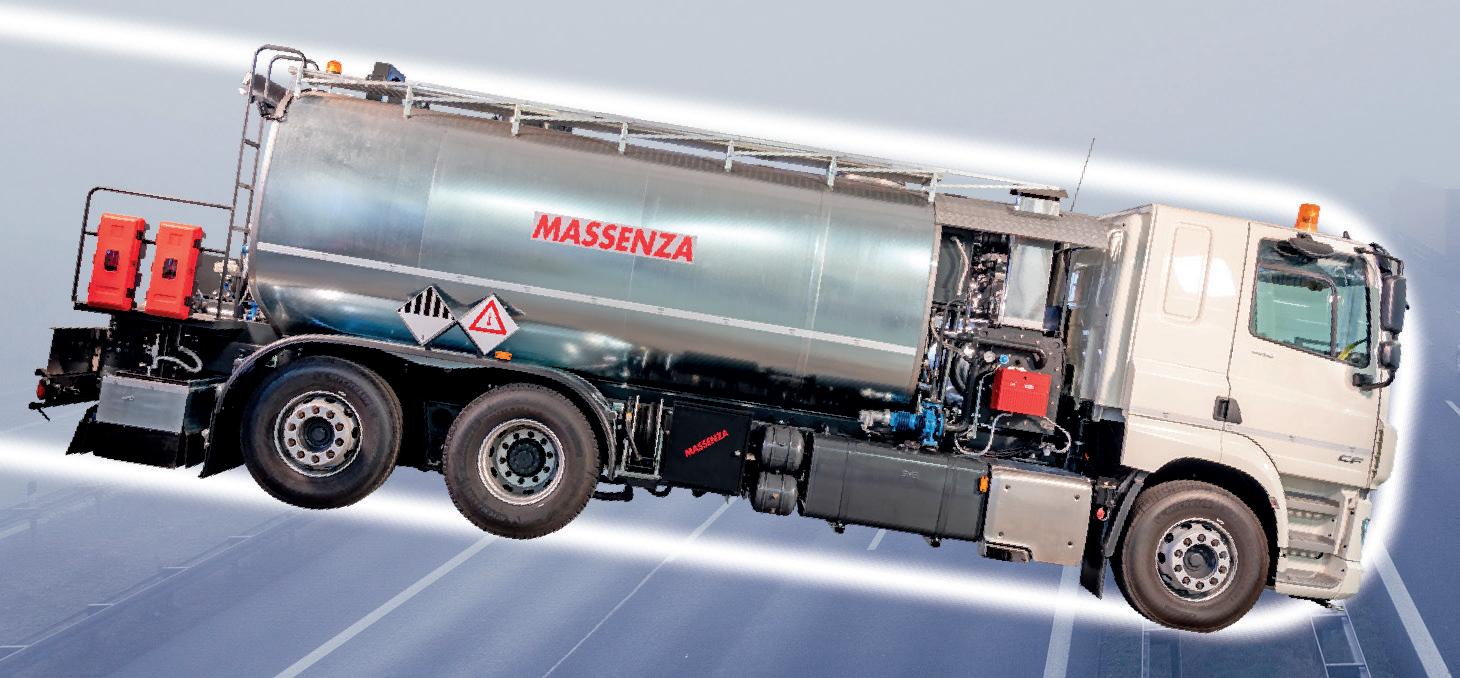
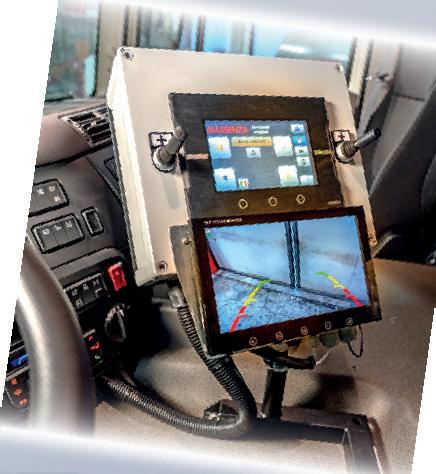



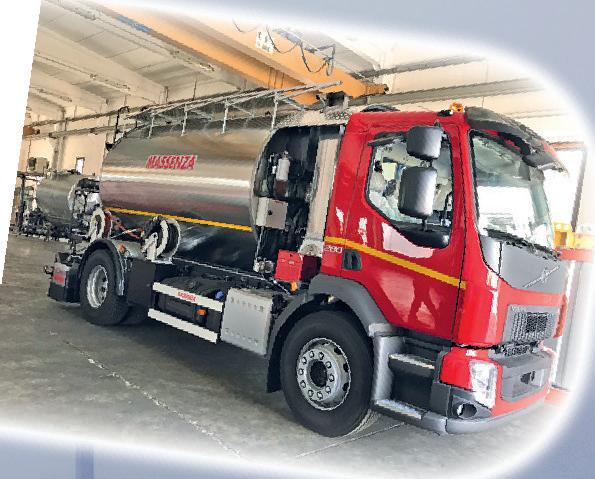










Many of the new systems can be retro tted to existing plants while the rm is also offering its latest generation asphalt plants with key green bene ts. These developments come in addition to the rm’s previously-announced innovative hydrogen burner.
Massimo Mezzofanti, Global Marketing Communications Director at the rm said, “Ammann is not new to sustainability but we have made some signi cant advances.”
At the heart of many of the new plant developments is the improved AS1 control system, which is said to optimise the use of material quantities and energy consumption, as well as the close monitoring of maintenance requirements.
The new systems from Ammann will reduce emissions from conventional asphalt plants. The rm is now offering its blue smoke treatment (BST) and visual reduction device (VRD), which will cut asphalt plant emissions signi cantly. The BST system address the visible smoke emissions from an asphalt plant, allowing these to meet tougher environmental legislation now being introduced in some countries.
Systems to address emissions include increased ltration of the air from the truck loading area. Smoke is captured, rerouted and reused in the combustion chamber. Filters remove oily particles at several stages. The oil is then condensed and reused. Marzio Ferrini of Ammann added, “All the oil that is captured can be recycled.”
The BST system allows for a more steady ow from the chimney and also helps to boost the ef ciency of the plant overall as hot air is recycled within the system rather than escaping through the chimney.
Meanwhile, the VRD system can remove up to 70% of the dust emissions from a plant and can be retro tted to existing plants.
Ferrini commented, “We are working to reduce the environmental impact of an asphalt plant to zero in terms of dust and smoke emissions.”
The rm recently introduced its latest ABA Uni Batch models, which feature environmental solutions throughout, reducing emissions. These models allow for a high percentage of
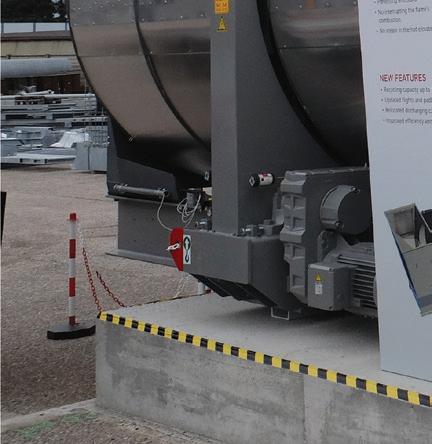
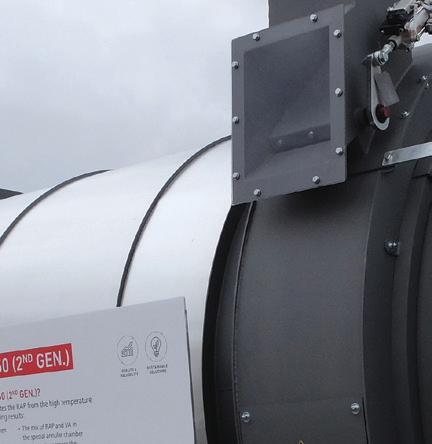
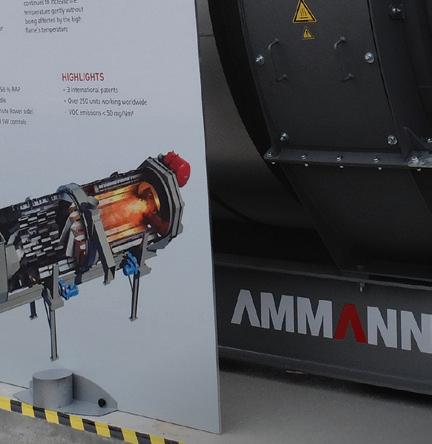

hour, the SOB T2 with an output of up to 260tonnes/hour and the SOB T3 with an output of up to 340tonnes/hour. These plants can be offered in tailor-made versions to suit customer needs while a high degree of component standardisation allows for short delivery and installation times. The units can use up to 40% RAP in the feed.
The smallest of these plants can be transported in just two standard sized shipping containers, allowing it to be delivered to site quickly and also helping to reduce the time needed for commissioning.
Customers also have the choice of the new RAH 50, RAH 60 or RAH 100 mixers, depending on the output required. Separate heating and mixing silos can be added to suit customer needs.
ef ciency, while also being simple in design and
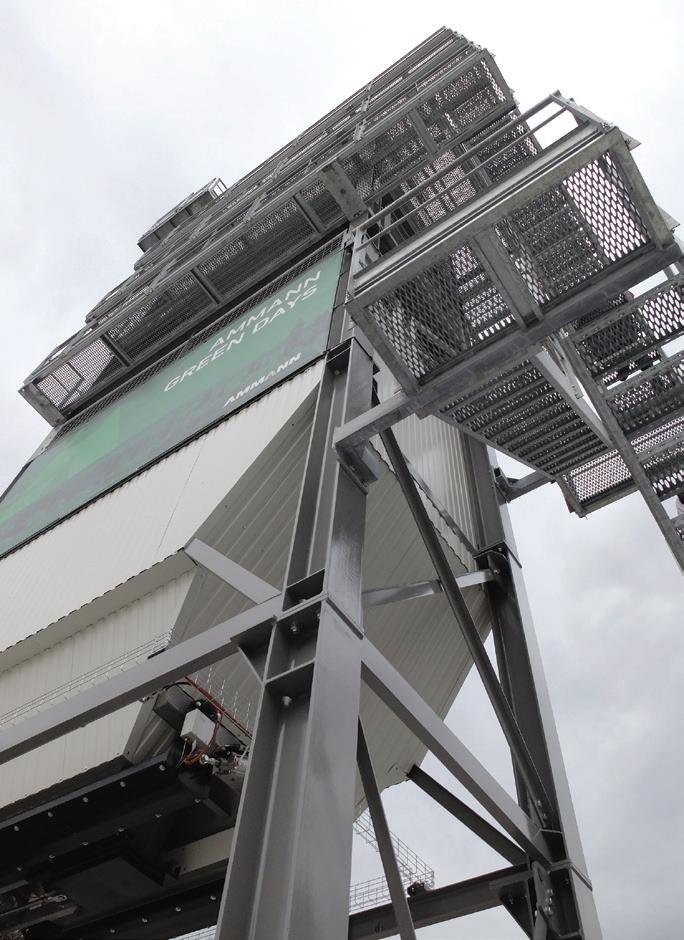
The plants bene t from the rm’s latest AS1 control system, with the UB T0 version producing up to 140tonnes/hour and the larger UB T4 producing from 340-400tonnes/hour.
The rm’s ABC Solid Batch plant is a simpler version of the Uni Batch, but it is still able to handle up to 40% of RAP in the feed.
Ammann is also expanding its range of mobile SOB plants, which initially featured the T1 model only with a capacity of up to 180tonnes/hour. The range now includes the SOB T0 with an output of up to 100tonnes/
The second generation RAH 50 mixer is now being offered, allowing the use of up to 50% RAP in the mix for suitable plant installations. Better maintenance access means that the new generation RAH 50 will be easier to service. Three international patents apply to the improved design and the mixer bene ts from new ights and drum, as well as reduced emissions and a more ef cient heat transfer to the material. There is no contact between the material and ame and Ferrini commented, “We are not overheating the virgin aggregates.”
Ammann
www.ammann.com
A customer in Bulgaria is achieving good results using an asphalt plant supplied by Benninghoven. The ECO 4000 asphalt mixing plant is said to be delivering high performance. The plant has proven itself capable of fast installation and a high daily production output in a wide range of road construction projects.
With the Benninghoven machines being supplied and supported in the country by Wirtgen Bulgaria, the rm has its own sales and service support network. The company has been successful in Bulgaria and a number of mixing plants are currently in use throughout the country, as well as a number of polymer and emulsion plants.
With the addition of the ECO 4000 from Benninghoven, infrastructure company Groma Hold added another asphalt mixing plant to its equipment eet. This also includes milling machines,
cold recyclers and slipform pavers from Wirtgen as well as Vögele pavers, Hamm rollers and Kleemann crushing and screening machinery.
The fast installation and high production output of 2,600-3,000tonnes/ day of asphalt of the rst two ECO 4000 plants were key factors in the construction company deciding to purchase another, identical plant. Other criteria were the option for retro tting optional modules in the future and the range of services available from the local Wirtgen Group subsidiary.
The Benninghoven mixing plants are being used in a number of different infrastructure projects in southern, north-western, north-eastern and central Bulgaria. Annual production and installation quantities of 1,140,000tonnes of asphalt (2021) document the demand for this material in the southern European

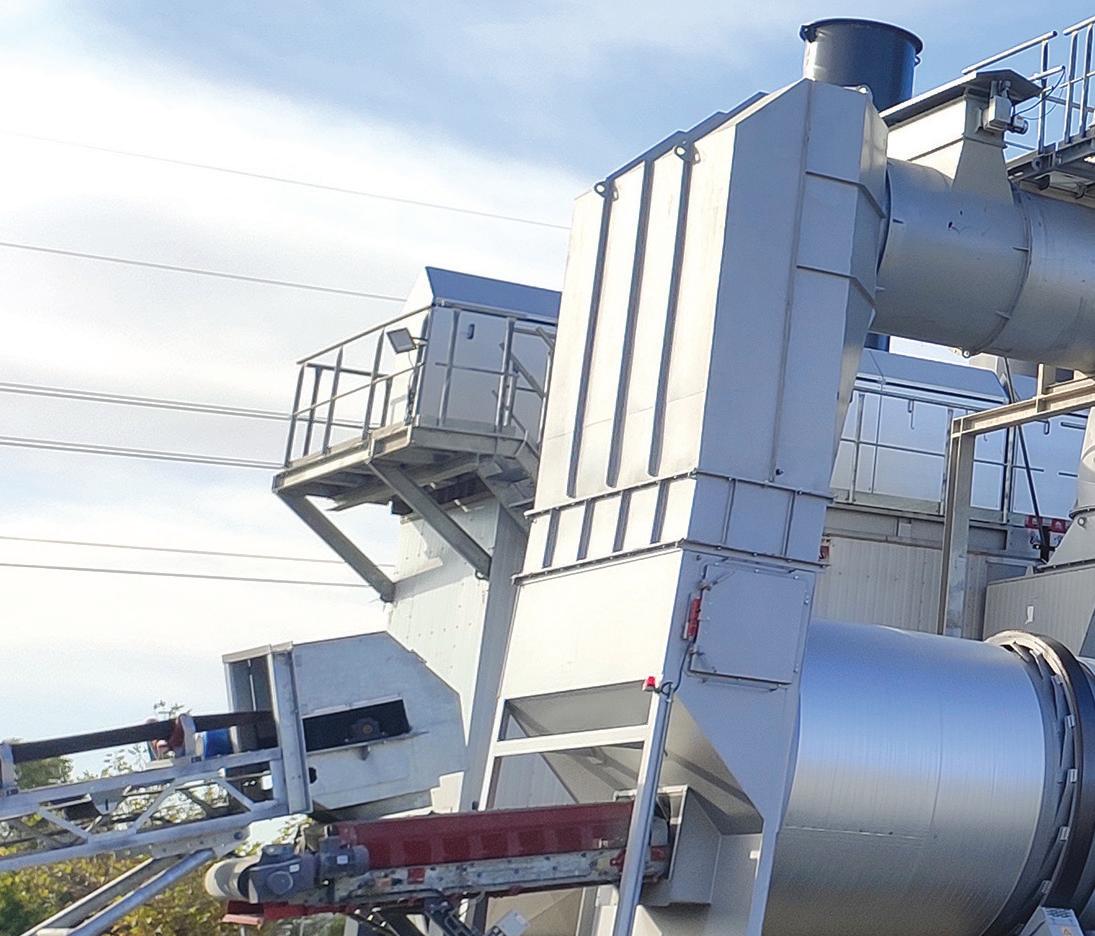
country. Examples include the completion of the Struma motorway from So a to the Greek border and the Botevgrad –Vidin motorway section at the Romanian border.
To integrate the national road network into the European transport system, various road construction projects are receiving nancial support from EU development programmes.
To ensure that asphalt production in the Benninghoven mixing plants could start as soon as possible, prompt installation had already been a priority for the rst two ECO 4000 plants at the Stara Zagora and Mezdra sites. Despite great logistical challenges, the plants were installed and commissioned within just 45 days.
Benninghoven

www. wirtgen-group.com/en-us/company/benninghoven/
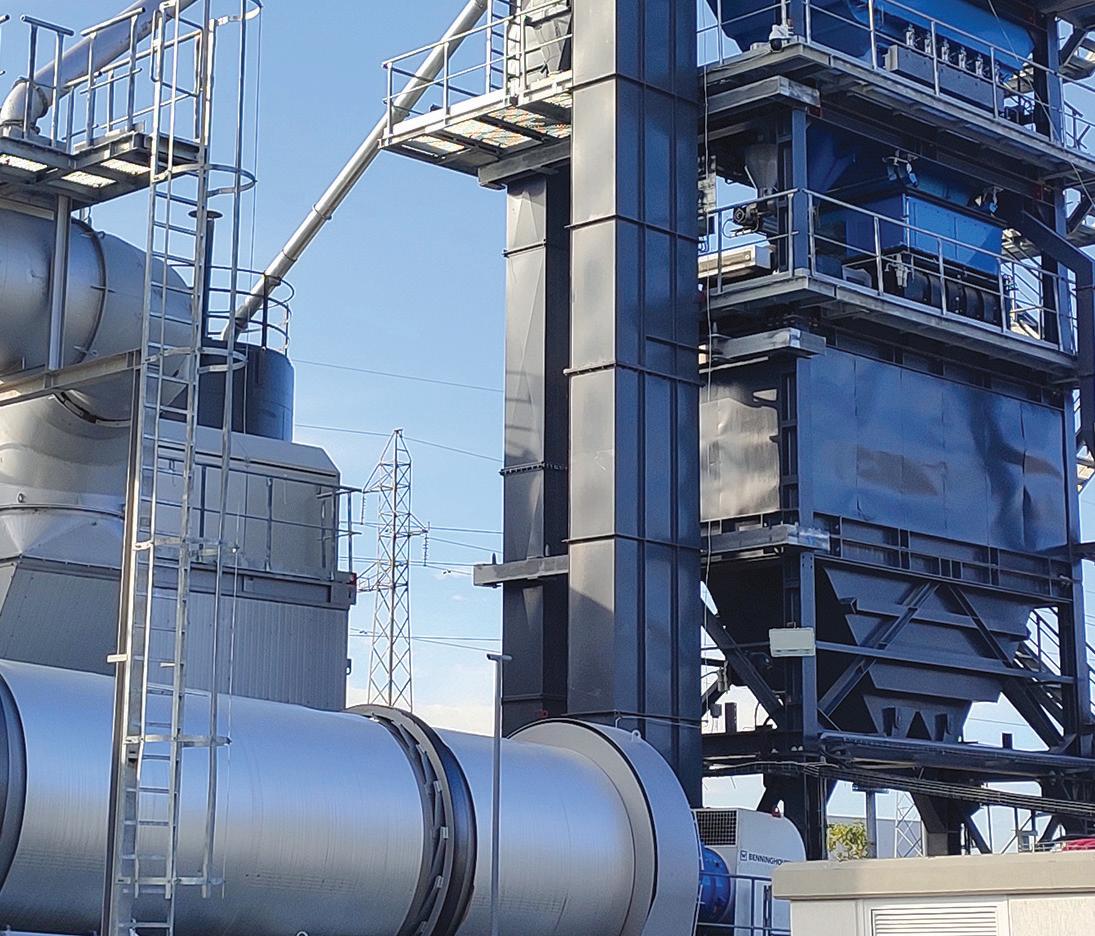
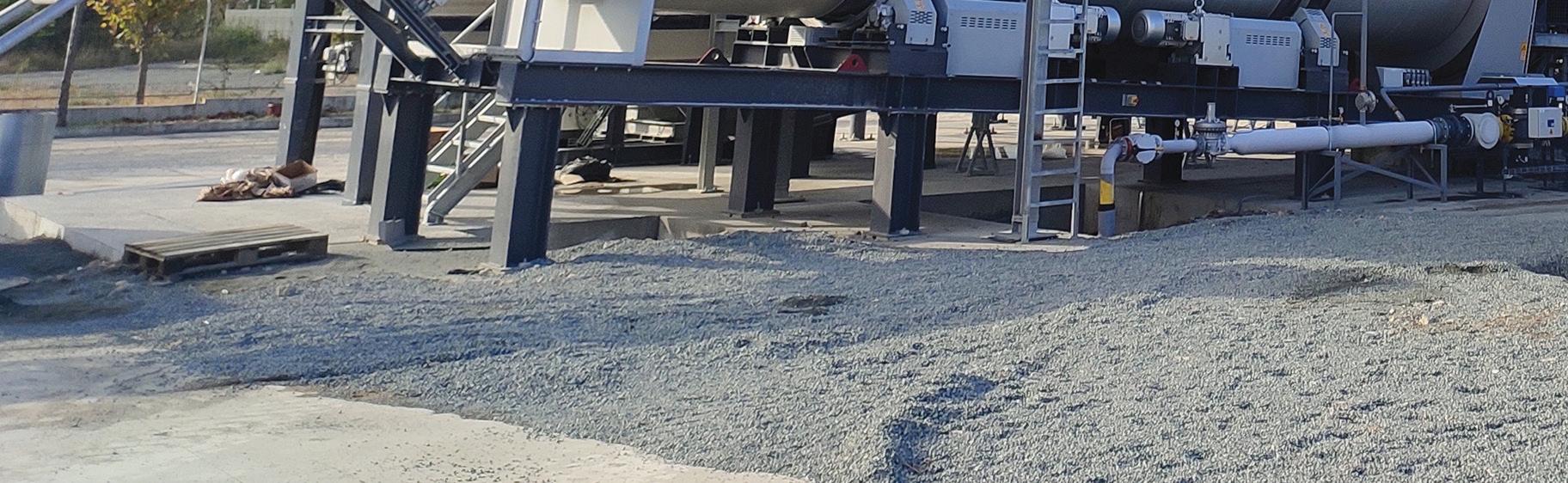






Wirtgen is expanding its milling machine line with the introduction of its new W 220 XFi model, which is claimed to offer a broader range of performance
Power comes from a high performing, low emissions John Deere diesel, while key features help to reduce the machine’s environmental impact when in operation. When is use, carbon emissions are low and milling performance is high. The automatic Mill Assist system is said to optimise working parameters to ensure an ef cient balance between milling performance and operating costs.

The machine is equipped with Wirtgen’s novel Multiple Cutting System that allows milling widths from 2.2-3.8m. The standard milling width is 2.2m but the user can switch milling drums and milling drum assemblies quickly to suit the needs of the operation.
The machines are available in countries that follow the Stage 5/Tier 4 Final exhaust emissions standards. The 18litre John Deere JD18L engine provides its maximum power of 627kW even at low engine speeds of just 1,500rpm. The power system has been specially adapted to meet the requirements of
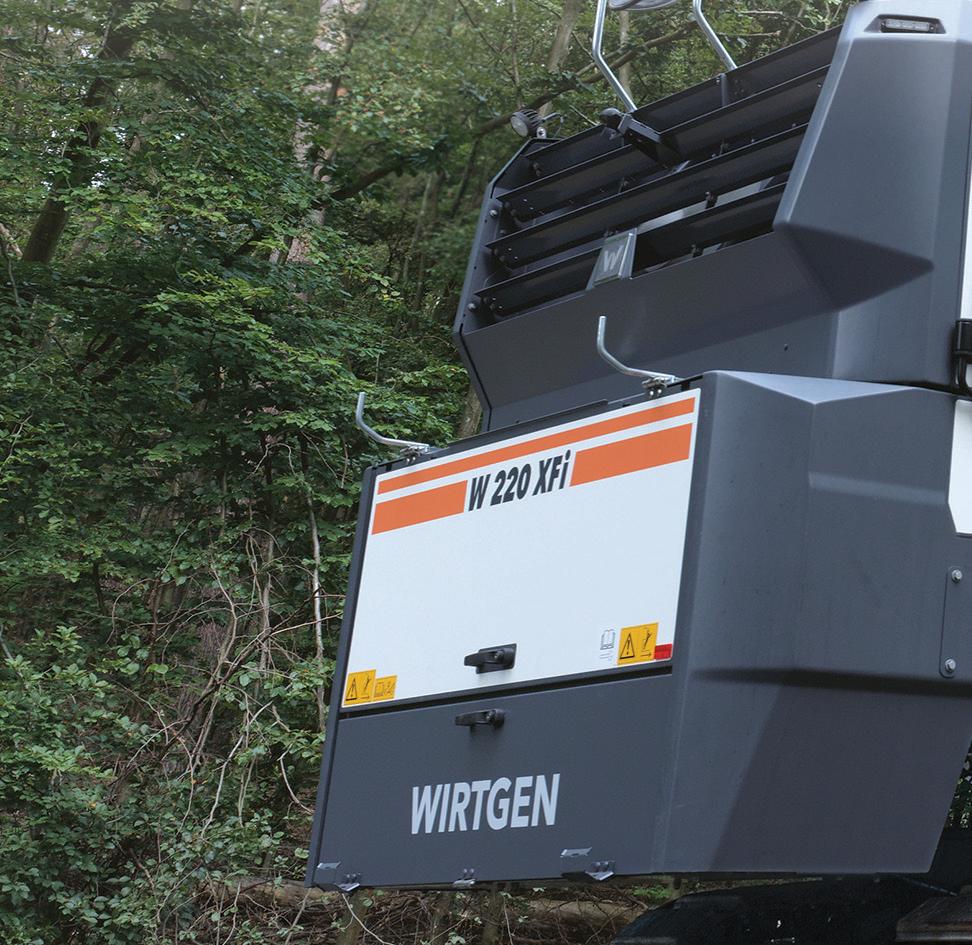

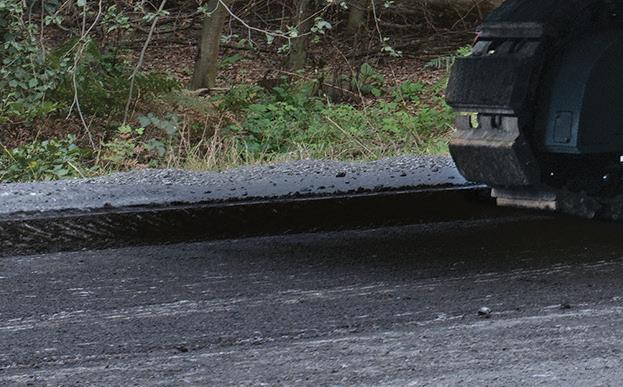

cold milling, delivering high torque under all load conditions. The Dual-Shift (powershift) transmission ensures that high torque can be used at low rpm for optimal milling performance. Even at low engine speeds, high milling drum rotation speeds are possible. In addition, the low emissions engine meets exhaust standards without the need for diesel exhaust uid.
The Mill Assist machine control system increases milling performance while reducing diesel and water consumption as well as pick wear. The system controls engine speed automatically according to the needs of the operation. The extensive operating speed range combined with the Dual-Shift powershift transmission allows a wide range of applications. At lower speed ranges, fuel consumption, noise emissions, and pick wear can be reduced. At the upper speed range, an optimum milling pattern can be achieved even over large areas.

The operator can also select one of three operating strategies: ‘ECO’, ‘performanceoptimised’, or ‘milling pattern quality’. The operator can select the required milling
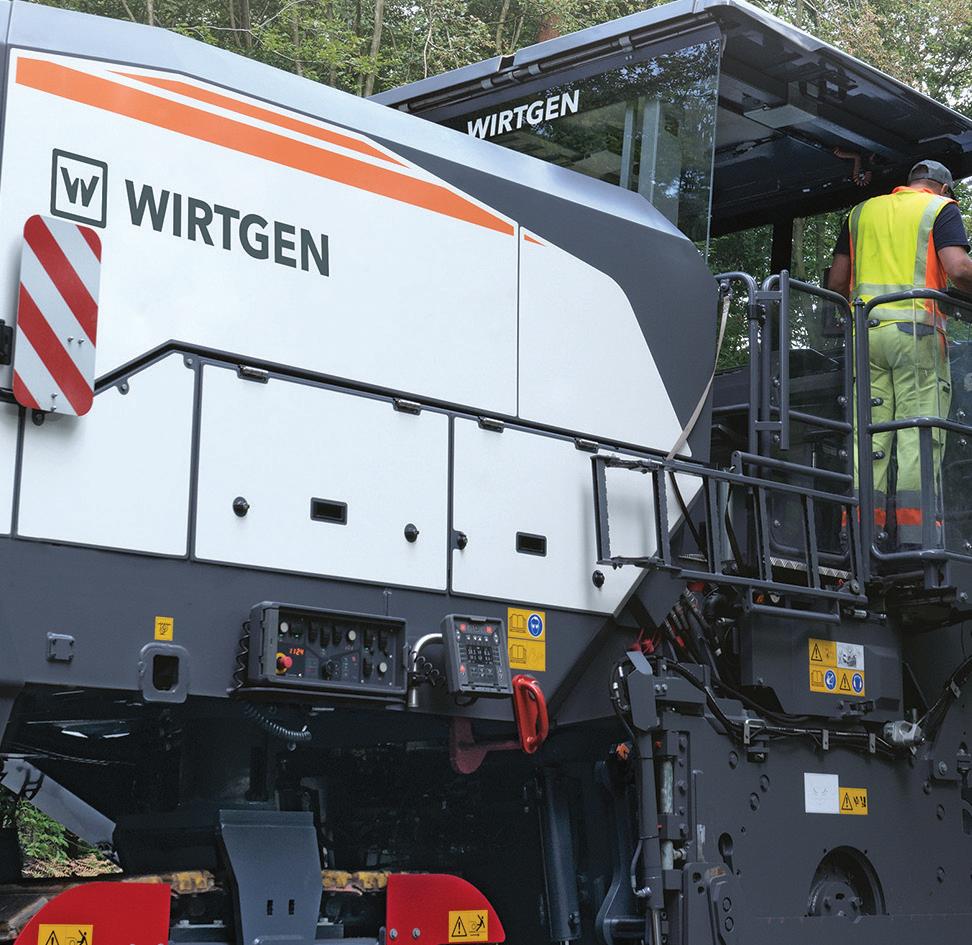
pattern quality incrementally, from coarse to very ne, at the press of a button.
The Mill Assist machine control system and the Wirtgen Group Performance Tracker Milling (WPT Milling) assist operating personnel and increase milling ef ciency. These proven systems have already been used successfully in other F-Series cold milling machines. With the W 220 XFi, these systems have been further developed to include a CO2 emissions display. Both the current emissions and the speci c carbon emissions in relation to milling mass can be viewed on the control screen. The automatically-generated WPT report can also include the CO2 emissions of the entire project in addition to other constructionrelevant data. This provides more data that can be used in jobsite analysis and documentation. Different construction projects can now be compared in terms of carbon emissions, allowing conclusions to be drawn for optimising the next project.
Wirtgen www.wirtgen-group.com

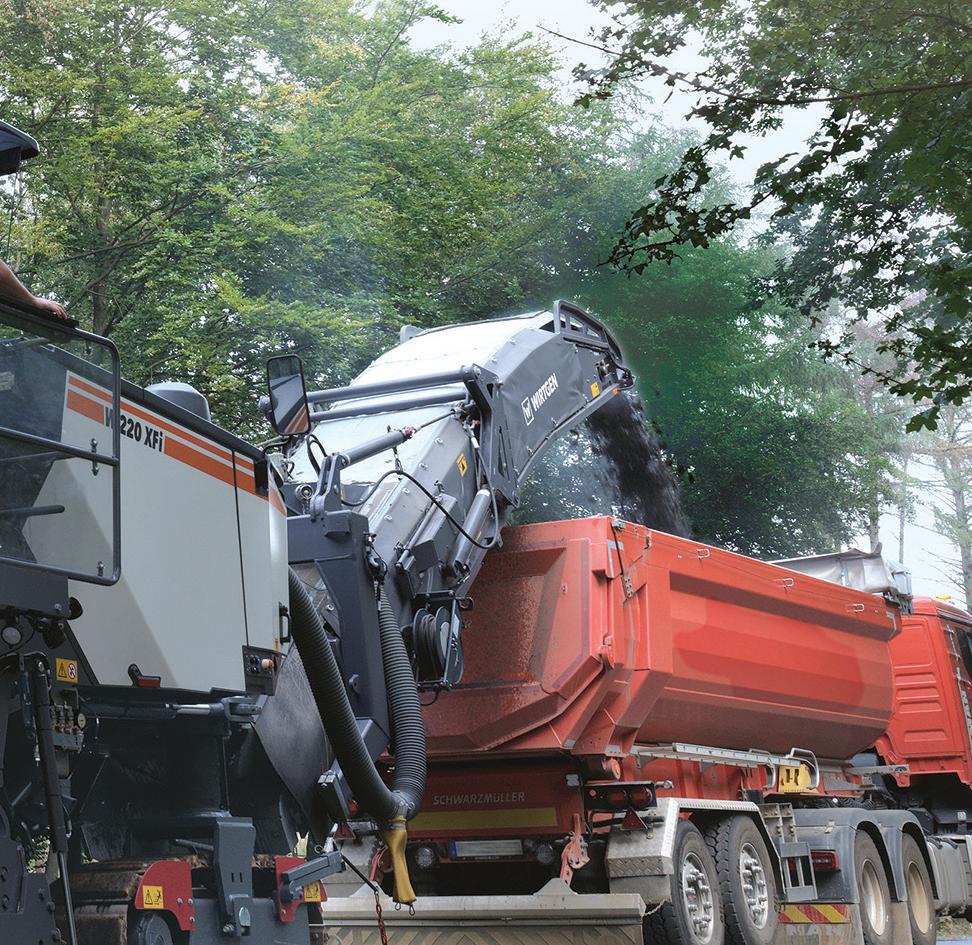






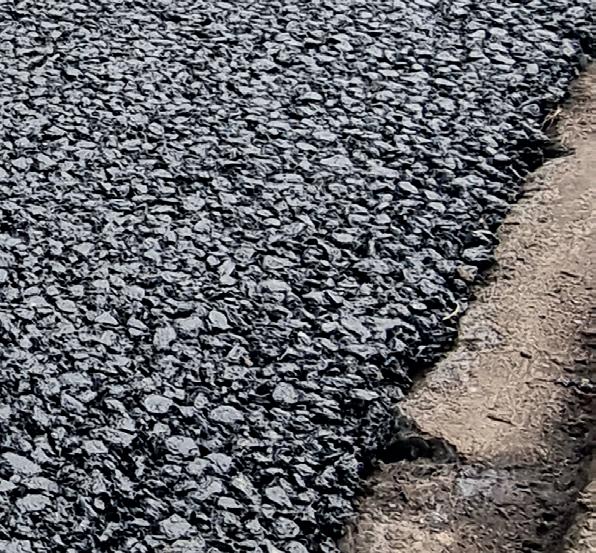


Asphalt-IQ’s smart tags were initially invented to record information such as the composition of the asphalt and when it was laid, but in the UK and Europe they are proving useful for recording the carbon footprints of road surfaces
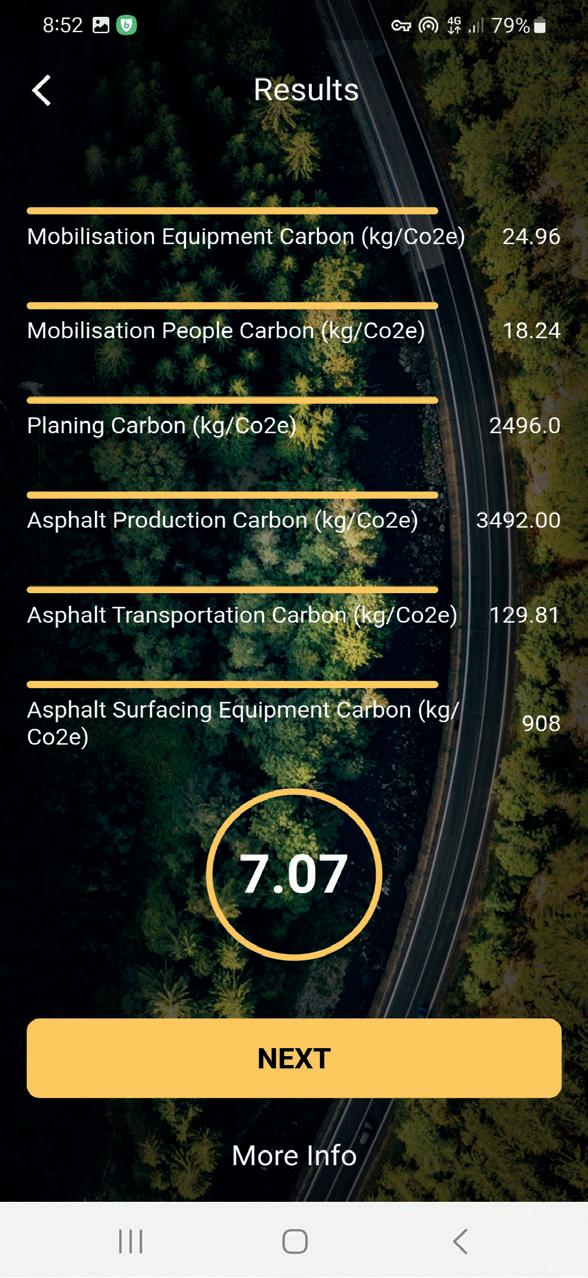
This month we look at accurate carbon counting, a biobinder that does not come at a premium and efforts to increase recycled content - Kristina Smith reports
Contractors can now count carbon for every road surfacing and maintenance activity, thanks to a tech startup called Asphalt-IQ. Its Carbon-IQ app, which operates on a smartphone, can calculate the carbon emissions for road surface, pothole repair and now for planing too.
The difference compared to most carbon calculations tools is the accuracy. AsphaltIQ sets up the system for each user so that speci c details including the mix used, the asphalt plant it came from, the type of plant and equipment used onsite and even individual crew members and their travel distances are all included.
“Our rst carbon management tool used generic numbers, but we quickly realised that it does not matter how accurate you are on the other elements if you're using the wrong numbers for the materials,” said Asphalt-IQ managing director Gary Cook. “It makes the whole thing meaningless.”
For instance, National Highways provides generic carbon emission gures for asphalt mixes of 55kg/tonne for hot mix and 53kg/ tonne for warm mix. However, Asphalt-IQ has analysed a variety of mixes from UK asphalt
manufacturers and emissions range from 28kg/tonne to 79kg/tonne.
Cook’s inspiration for the system came from the US, where some States used coloured plastic discs which are embedded into the road surface when it is laid. The tags used for the various Asphalt-IQ systems are smart tags in that they are geolocated and will reveal the information connected to them simply by waving a smartphone over them.
Asphalt-IQ still intends to launch its Smart-A-Tags and RoadVault-IQ data storage system, which records pavement composition, thickness and laying details, in the US. However, its priority changed to target the UK market with the publication of carbon management standard PAS 2080:2023. This effectively makes carbon measurement reporting mandatory and National Highways has said that all its suppliers should be working to PAS 2080:2023 by the end of 2025.
Knowsley Borough Council in the northwest of England has been using Carbon-IQ for 12 months. As part of its development work with the council, Asphalt-IQ created a system to record the carbon emissions for pothole repair activities. Rather than using a smart tag embedded into the road, the pothole system works with a smart card which keeps a tally of emissions from the start to the end of the day.
In Germany, contractor Strabag has just nished a three-month trial of the system while resurfacing Autobahn A67. It is now moving onto a second trial on secondary roads including pothole repairs and hand laying.
Small rms are also nding Carbon-IQ very useful, with ve specialist UK contractors about to start using it. “At the moment, the whole carbon management process can be intimidating and confusing, especially for small companies,” says Cook. “But we have solved the problem. Carbon does not have to be this monstrous headache. And our solution will cost far less than employing a carbon accountant or consultant.”
Asphalt-IQ’s most recent launch is Planing IQ, developed with UK contractor Power Plane. Together they wanted to create something that not only recorded carbon emissions but also made the crew’s life easier. So now, rather than having to complete paperwork for permits to dig and labour returns, the foreman can do it all through the app.
“They have a tick list for the employees and the equipment and, with the smart card, you have the geolocation and the date and therefore a full digital record. We kept the time for inputting all the data to between 1.5 to 2 minutes onsite otherwise you would have resistance from the crews,” he says. The app also allows notes to be made via speech-to-
text and photos can be uploaded if required as part of the record.
In February, Asphalt-IQ was due to sign a deal with Infrastest Digital Solutions to distribute Carbon-IQ in German-speaking European countries. Australia and New Zealand are also in Asphalt-IQ’s sights. “Although each country is at a different stage in its carbon accounting journey, everyone will eventually realise that accuracy and practicality are the keys to driving reductions in carbon emissions,” said Cook.
Having launched its CarbonBind biobinder in Australia, Puma Energy Bitumen is now rolling it out in the UK, APAC, Latin America and Africa. CarbonBind is a blend of conventional bitumen and plant-based material which Puma says sequesters around 150kg of carbon for every tonne of material laid, although that gure varies.
The big difference between CarbonBind and similar products from competitors is its cost, says Puma global technical manager Erik Denneman. “We know that we can offer it cost competitively which opens the door to do it at high volumes,” he said. “There are products on the market that have a larger carbon offset but we did not shoot for the stars. We went for what we could offer at a commercial rate and at high volumes. It’s not just a gimmick.”
While many binders containing bio-
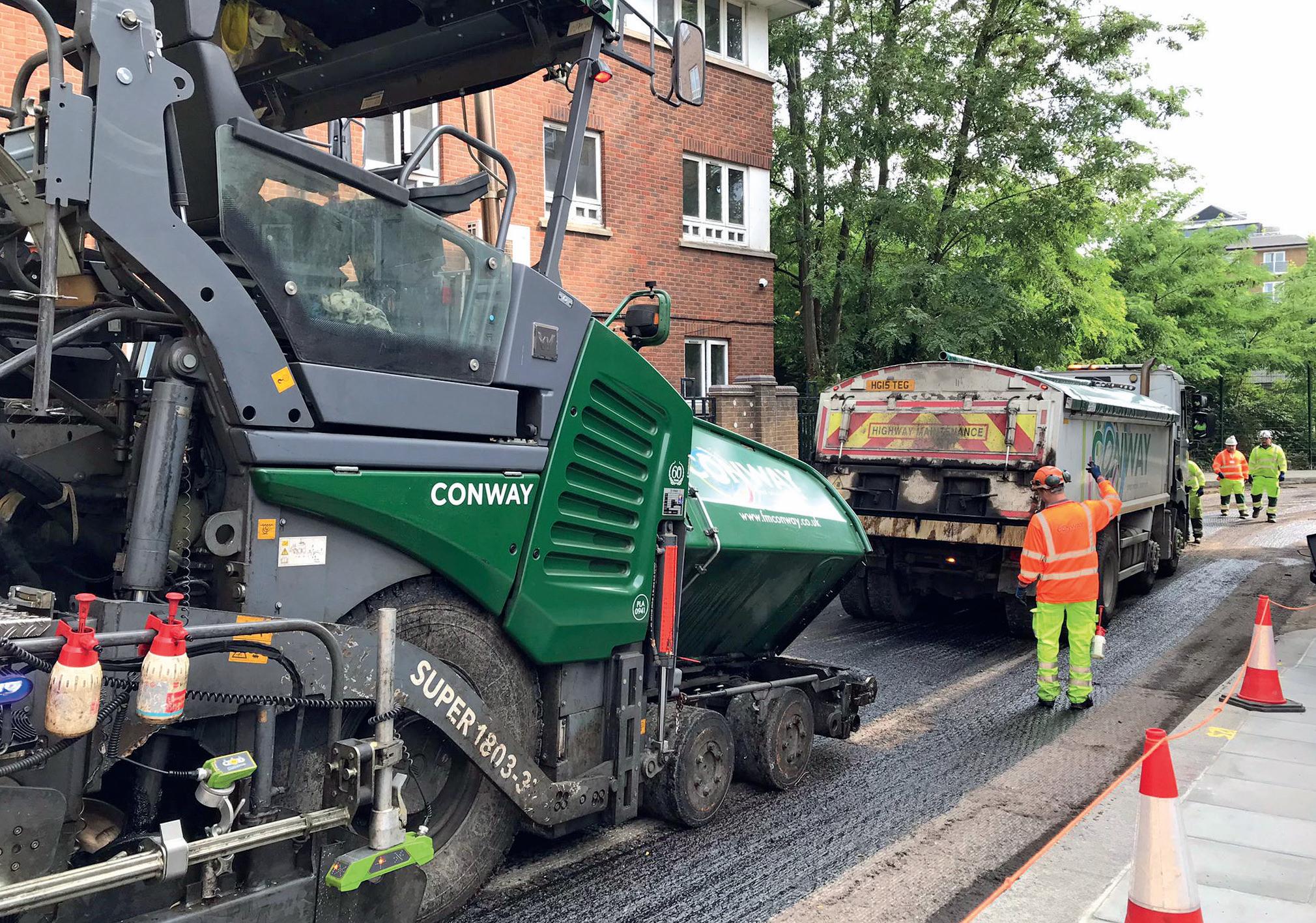
from pine trees, Puma’s product comes from agricultural waste that would otherwise have been burned. Denneman won’t say what the waste is or where it is grown, but it isn’t in Australia or Europe. The bio-binder element is manufactured where the waste material is sourced and processed before being transported to where it is needed via parent company Tra gura’s shipping eet.
“The bene t of being part of Tra gura is that our biofuels trading desk has access to a lot of different feed stock materials we could
assess,” said Denneman. “With this material, there is a signi cant carbon reduction but it does not cost an arm and a leg.”
Puma carried out the rst trial of CarbonBind in December 2022 in Australia with many more roads being laid there since. In November last year Puma won the Australian Flexible Pavement Association’s (AFPA) National Innovation Award for CarbonBind, having won AFPA’s regional awards in Victoria and New South Wales earlier in the year. In October 2023, it laid its


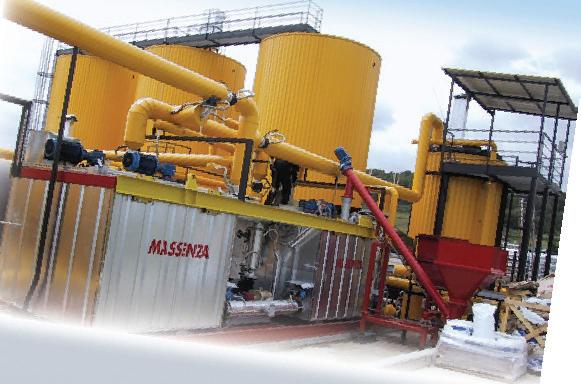


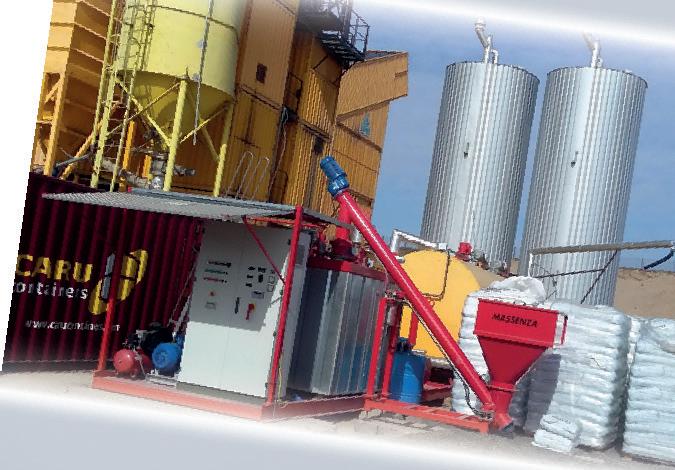

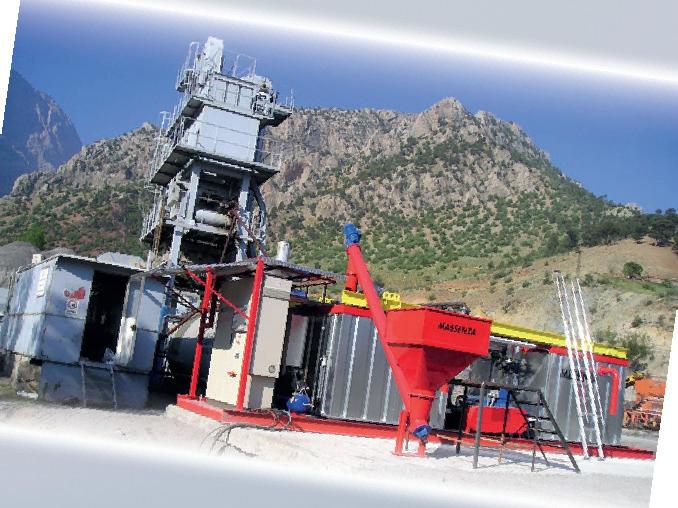



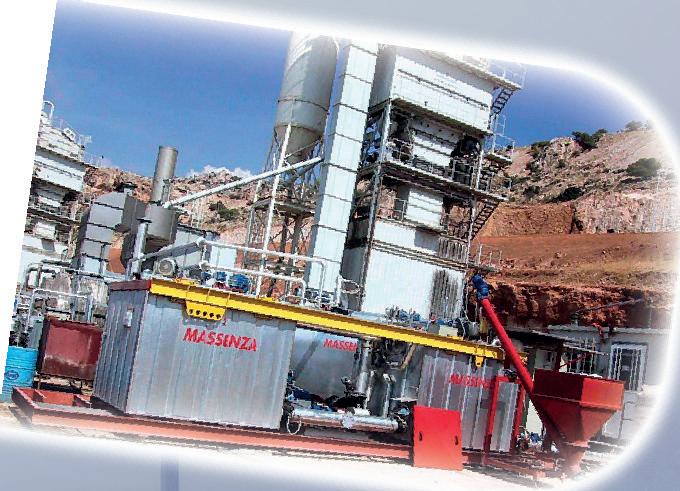


first trial stretch in the UK with Tarmac.
CarbonBind can be combined with other technologies. So, it can and has been combined with polymer modified bitumen (PMB), Puma’s Olexocrumb product which uses crumbed rubber to modify the bitumen, or both.
Ensuring that materials are long-lasting is crucial for reducing carbon emissions, said Denneman: “The first thing we should be doing is making things last longer,” he said. “That’s the quickest way to reduce the carbon footprint.”
FM Conway reports that it has used an asphalt mix containing 92% recycled asphalt planings in a road surface for Westminster Council in London, which it says it is the highest recycled content ever for a UK road. FM Conway produced and laid 280tonnes of warm mix asphalt, containing polymer modified bitumen, in a single layer over 1,600m2 of carriageway.
By using recycled material, reducing the heat at which the asphalt was produced and using hydrotreated vegetable oil (HVO) and electricity-powered plant and equipment, FM Conway says that it reduced the carbon emissions by 78% compared to a standard specification for such a road. The residual carbon was offset through Verified Carbon Standard (VCS) units, certified by Verra, to make it a carbon-neutral scheme.
Westminster City Council’s head of





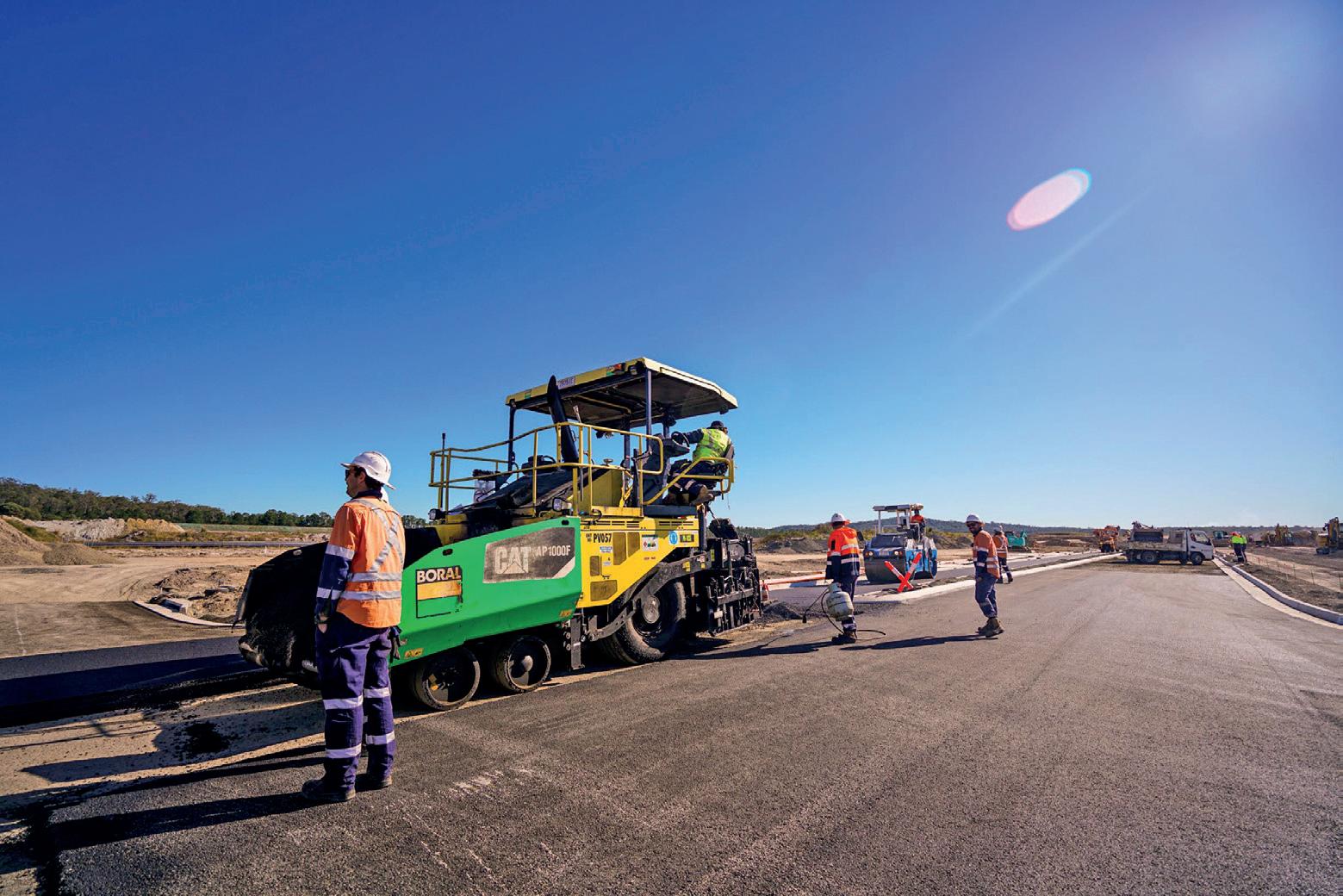
operations (highways), Phil Robson, said: “It is a really interesting time to be working in highways with partners, and adapting services to achieve climate resilience and low carbon emissions. The transition requires the use of offsets at this time, but we expect to see lower reliance on them over time.”
FM Conway and Westminster Council have been working on several low carbon trials, including projects to increase the percentage of RAP in mixes. In 2019, they laid a mix with 80% RAP and in 2021, a mix with 85%.















Meanwhile, a 1.8ha (4.5acre) parking lot at Iowa State University in the US has been repaved using 100% RAP. The difference here is the technology: cold recycling using a soybean-based product called Invigorate Plus from Colorbiotics.
Contractor Elder Corporation milled off the asphalt to a depth of between 100 and 150mm, spread it out across the car park and graded it. The milled material was then sprayed with the Invigorate Plus cold mix solution and compacted with a roller.

















The Kern Group has around 80 employees at three locations and is a major provider of secondary lining solutions for tunnelling projects. It produces in-situ concrete inner shells for the construction of tunnels using the mining method.
The Kern Group's main markets are in the DACH region - Germany, Austria and Switzerland – the UK and the US. In addition to the construction of special machines, Kern offers complete logistics solutions and engineering services for more complex construction projects with a high degree of engineering expertise.
A statement from Peri said that Kern will continue to operate as an independent unit within the Peri Group under its current management, brand and company name. All Kern employees will be taken over and all company locations will be retained.
“For many years, Peri has been one of the technical leader companies for formwork solutions in the eld of standard and special tunnel projects. Both companies share the goal of rationalising customers' construction

The Sandoy Tunnel crosses the Skopunar ørður – the strait between Sandoy and Streymoy islands – connecting the port of Gamlarætt on Streymoy to Traðardalur in central Sandoy, south of Streymoy Island (image courtesy Ministry of Fisheries and Infrastructure)

Complete pre-assembly of a secondary lining system, with detailed planning transportation and launch work method statement for complex projects (image courtesy Kern/Peri)
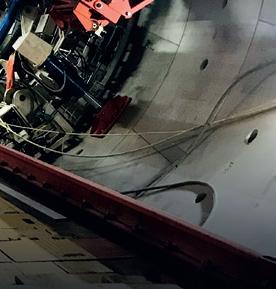
processes and thus making construction safer and more economical.”
Peri is purchasing the shares from the WALO Group, based in Zurich, Switzerland. “Kern and WALO will continue their successful cooperation in the eld of further and new developments of construction and logistics machines with a strategic partnership in the future,” said Reiner Kern, chief executive of Kern Tunneltechnik.
"The acquisition of Kern Tunneltechnik

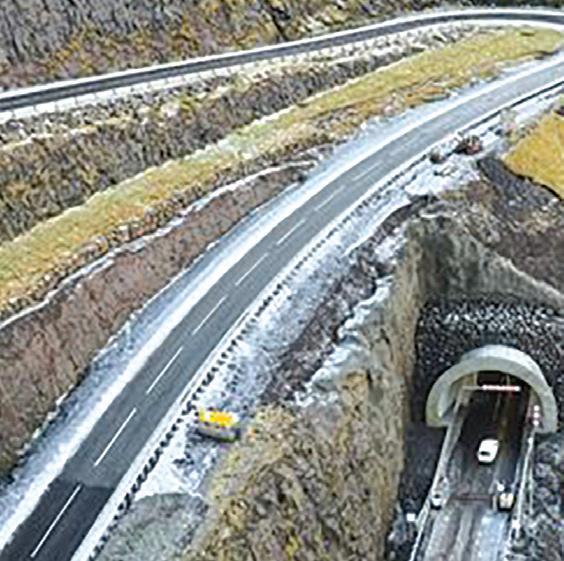
is an important step in broadening our engineering expertise in infrastructure construction," says Christian Schwörer, chief executive of Peri. "This brings together two strong partners who complement each other perfectly. With this merger, we are creating an international solution provider in tunnelling technology."
Kern recently announced that it had completed initial work on the Gubrist Tunnel project near Zurich in Switzerland. The 3.2km tunnel is the third tunnel being built alongside the original tunnel that was completed in 1985. The A1 motorway is a northern bypass of the city.
Kern said it has nished installation and launch of all its machines which include a logistics bridge for casting the invert and installing Welk segments, two turntable bogies, two multi-service gantries for segments and deck formwork transport, reinforcement gantries, corbel formwork and 112m of formwork for the deck.
Peri
www.peri.com
Kern
www.kern-tunneltechnik.com
Drivers in the Faroe Islands were exempt from paying tolls during the rst 23 days of operation of the Sandoy Tunnel which opened in December.
The 10.8km-long tunnel connecting the islands of Streymoy and Sandoy is the longest subsea tunnel in the Faroe Islands and one of the longest in the world, according to the island group’s ministry of transport. The contractor, Swedish infra group NCC, notes that the tunnel is 9.5m wide and has a lowest point at 147m with a gradient of 5%,
The Sandoy Tunnel crosses the Skopunar ørður – the strait between Sandoy and Streymoy islands – connecting the port of Gamlarætt on Streymoy to Traðardalur in central Sandoy, south of Streymoy Island. The ferry service between Gamlarætt on Streymoy and Skopun on Sandoy has now been cancelled.

Construction began on both sides of the project in June 2019 and the two teams met in February 2022. The cost of
Sandoyartunnilin has been around US$127 million.
"The tunnel o ers the best of both worlds,” said the Faroe Islands prime minister Aksel Johannesen during the opening ceremony. “Access to the vibrancy of city life and the tranquillity of small village communities.”
Some nancing for construction and operation of the Sandoy Tunnel will come from toll revenues from the 11.4km-long Eysturoyartunnilin that opened in December 2019. It links Streymoy and Eysturoy islands and has 10 times the estimated tra c that is likely to use Sandoy Tunnel.
The Faroes government tunnel operator P/F Tunnil has estimated that 300–400 vehicles per day will use the Sandoy Tunnel. Average daily ridership of the ferry route was 195 vehicles.
Even when a major new bridge over the River Elbe is open in 2026, it will be two years before traf c is allowed to cross. The bridge will be part of an ambitious project to extend the A14 motorway in north-east Germany by 155km and with its opening scheduled for 2028.
One end of the bridge will be near the town of Wittenberge, with a population of around 18,000 in the state of Brandenburg. The other end will be near Seehausen, a smaller town of around 5,000 people in the state of SaxonyAnhalt.
The A14 motorway currently ends at Magdeburg and starts again at Schwerin. As part of the northern extension of the A14 motorway, traf c will cross the Elbe on a 1.1km-long bridge.
The challenge at the construction site in Wittenberge is that the landscape surrounding the bridge is a nature reserve. Everything has to take place in as little space as possible which calls for an approach not seen before in Germany. The separate bridge sections are made up of individual 20m-long components that are manufactured in the state of Saxony.
A Liebherr at-top 125 EC-B 6 tower crane has been in Wittenberge since last September to help with preparations and is scheduled to be onsite for a full year.
The crane has been contracted by Swiss construction services provider Implenia and supplied by Hüffermann Krandienst, based in Wildeshausen near the city of Bremen. It is mounted on a platform attached to the side of the new bridge. It stands on a moveable unit that


The Libeň Bridge - Libeňský Most - in the Czech capital, Prague, is to be reconstructed for around €88.9 million.
advances with the bridge as construction progresses.
The 125 EC-B 6 tower crane needn’t be at its maximum size for the job: a hook height of 16.5m and a jib length of 42.5m are enough. The at-top crane can actually reach a hook height of up to 59m and a radius of up to 58m. But for this project, the crane is mounted at around the same height as the top edge of the bridge; extending 16m upwards above the bridge is suf cient.
The tower crane is supported by three Liebherr 81 K.1 fast-erecting cranes being used for general work onsite and can lift up to 6tonnes. These cranes achieve a maximum radius of 48m and a maximum hook height of 40.4m. An additional Liebherr crane, such as a mobile unit from the LTM series, may join them as construction progresses.
Because the river landscape surrounding the bridge is a nature conservation area, extra care had to be taken with construction methods and equipment. A moveable scaffolding system was employed due to the need for the construction site to operate in as little space as possible.
The bridge is being divided into four segments, which will be assembled on land. The individual sections will then be pushed across the Elbe one by one to their respective support piers, a process that is expected to start early this year. The nal bridge section will be transported across the Elbe on a oating pontoon.

Liebherr www.liebherr.com

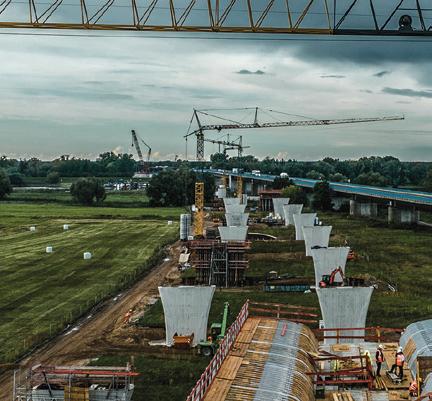
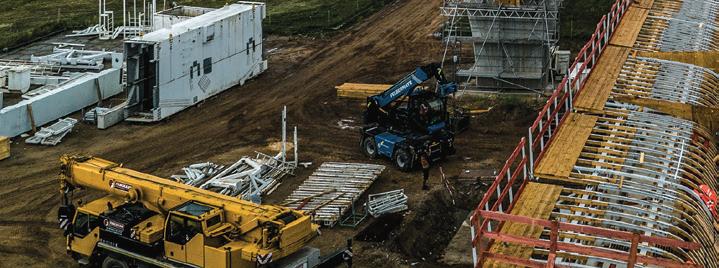

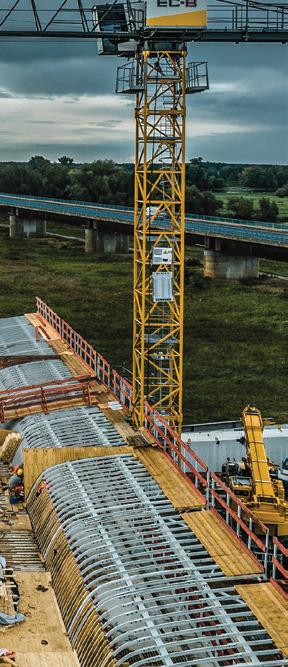


The contract has gone to Metrostav TBR, the bridge division of parent Czech company Metrostav Group, as well as design companies SATRA and SHP. Architectural design imaging has been done by Dousek-Zaborsky, a Prague-based engineering architectural rm.
The 370m-long Libeň Bridge over the river Vltava was opened in 1928 and connects the city quarters of Holešovice and Libeň. The complete structure, including elevated sections on land is close to 780m long and it’s the longest bridge in the Czech capital city. Being 21m wide, it carries two road lanes and two tram lines with wide pedestrian ways on each side of the deck.



Restoration will be done in keeping with the bridge’s original Cubist design by the architect Pavel Janák (image courtesy Dousek-Zaborsky)





It su ered damage during ooding in 2002 and has been periodically closed to tra c since then over safety concerns. City authorities have said the concrete bridge has deteriorated to the point that little of the structure can be renovated, except for some of the pile works. It has ve spans between 28m and 43m wide.
Restoration will be done in keeping with the bridge’s original design by the architect Pavel Janák. The Cubist-style pillars will remain while a completely new upper structure will closely resemble Janák’s work. The bridge is reportedly the only Cubist bridge in the world and little restoration work has ever taken place, according to media reports. More detailed design work will be done next year and onsite work will start in 2025.
The design engineering consultancy SATRA was spun out of the Military Project Institute in Prague in 1991. It specialises in underground structures and bridges.
SHP, also based in Prague, is an independent engineering consultancy specialising in designing bridges with extensive experience in Europe, the US, South America and Asia.
Metrostav www.metrostav.cz/en



The Gordie Howe International Bridge between the US and Canada is now expected to open in September 2025, a delay of 10 months.
The bridge was originally set to open in November 2024, but disruptions due to the COVID-19 pandemic has pushed back the date and increased the costs. The international border crossing will now cost US$4.72 billion, up from around $4.3 billion. The increase in cost will, however, be covered by the Canadian government, according to the Windsor-Detroit Bridge Authority, a not-for-pro t Canadian Crown – meaning government – corporation. The authority was created to deliver the project through a public-private partnership.
Bridging North America (BNA), the private-sector partner, would only absorb costs such as uctuations in the exchange rate or construction increases that are not caused by an unplanned event like the
courtesy Windsor-Detroit Bridge Authority)


pandemic, noted the authority.
WDBA is responsible for overseeing and managing the construction and operation of the new crossing. Meanwhile, BNA is the main joint venture contractor - Fluor, ACS Infrastructure Canada and Aecon Groupfor the design, build, nance, operation and maintenance of the project.
Early work for the bridge started in summer 2018 and when completed it will be the longest cable-stayed bridge in North America. The longest span stretches 853m completely over the river and clearance above water will be 42m. The Canadian government will receive all toll revenues, the project being totally Canadian with no US funding.
The bridge is named after the Canadian ice hockey player Gordie Howe who spent most of his professional years with the Detroit Red Wings. There is also a Gordie Howe Bridge, a four-lane motorway


steel girder structure across the South Saskatchewan River in Saskatoon, in the Canadian province of Saskatchewan, where Howe spend his youth.

Last November, the project was honoured with the inaugural National Environmental, Social and Governance Award from the Canadian Council for Public-Private Partnerships. The award recognised the project’s commitment to sustainability and community prosperity in the Windsor-Detroit region.
The award, presented at the P3 National Awards Gala Luncheon in Toronto, recognises a P3 project that contributes to environmental protection or enhancement, wildlife protection, climate and greenhouse gas impact, natural infrastructure attributes and engagement with local communities.
Bridging North America, BNA www.gordiehoweinternationalbridge.com
Kapsch Traf cCom has won a US$9 million tunnel management contract for the tolled Parallel Thimble Shoal Tunnel now under construction in Chesapeake Bay, Virginia.
The parallel tunnel is part of the Chesapeake Bay BridgeTunnel, a 28.3km-long (17.6mi) bridge and tunnel complex that runs across the lower Chesapeake Bay that was opened in 1964 to connect Virginia state’s Eastern Shore.
When complete, the new $755 million parallel tunnel will carry two lanes of traf c southbound and the existing tunnel will carry two lanes northbound.
The technology provided by Kapsch Traf cCom will ensure continued safety in the existing tunnel as well as the new tunnel,




with a SCADA - supervisory control and data acquisition - system, an electrical power control system and safety features such as re alarms, generators, CCTV, deluge and re pumps and other critical hardware and software.


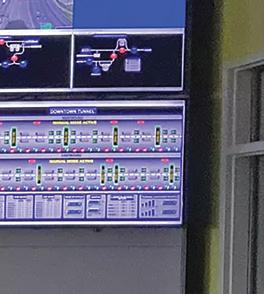
Boring started in February last year. But late last summer, Chessie, the tunnel-boring machine, found a ship’s anchor in the way. The pause to remove the anchor could last until February and means completion of the project could move from
December 2026 to May 2027.
The design-build project is being done by the Chesapeake Tunnel Joint Venture that includes Dragados US, Schiavone Construction as lead contractor and Hatch Mott MacDonald as lead designer. Construction manager is HNTB.
The client is the Chesapeake Bay Bridge and Tunnel District - what is called a “political subdivision” of the Commonwealth (state) of Virginia. In an update to the work published this autumn, Chessie had installed more than 100 rings and advanced more than 213m (700ft) from the boring machine’s launch pit.
Kapsch Tra cCom www.kapsch.net/en
Heavy lift specialist Sarens reports that it successfully manoeuvered a 740tonne bridge deck into place as part of A11 autoroute upgrade work near Nantes, France.
The 343km-long A11 autoroute – also called L'Océane - connects Paris with Nantes via Le Mans and Angers. Sarens Technical Solutions and Engineering conducted the lift on behalf of customer Bouygues Travaux Publics Régions France and owner VINCI Autoroutes. The Sarens team successfully jacked up, transported and installed the 110m-long curved steel structure at the A11’s Portes de Gesvres interchange.
Equipment involved four Kamag SPMTs –self-propelled modular transporters - with six axle lines each. There were four CS450 towers with 12 elements on one side and another four CS450 towers with 10 elements on the other side.
The CS450, in particular, was chosen for its higher elements that allow the crew to jack

from the actual lift, there were other onsite challenges. First, because the jobsite was located along the highway, it meant there would be limited space and access for vehicles and equipment. For example, only one truck was allowed to enter the work site at a time. This meant that the crew had to meticulously follow a precise transport schedule.


down faster. This was especially important due to the project’s exacting time constraints. The A11 would be closed for only six hours during the night, giving the crew limited time to drive the SPMTs the 70m from where the bridge deck was constructed and successfully jack down the structure into place, over the four lanes of the A11. Sarens notes that apart
Meanwhile, the road itself was a challenge. The crew would have to drive 70m across the A11 that was angled in two directions, with up to 4.5% in one direction, requiring maximum SPMT stroke.
The necessary equipment arrived via 13 trucks from various locations around Europe. The crew assembled the SPMTs and their transport structure within one day, thanks to a well-coordinated pre-assembly effort at Sarens headquarters in Wolvertem, near Brussels in Belgium.
Sarens www.sarens.com
Thieves have been stealing copper wire from the lighting system of LA’s 6th Street Viaduct, casting sections of the steel and concrete structure into darkness.
The award-winning 1.1km long and 14m wide bridge –often called The Ribbon of Light because of the lighting - spans Los Angeles’ historic Boyle Heights. It opened in July 2022 as a replacement for a 1932 bridge. It features 10 pairs of 9.1m and 18.2m concrete canted arches that are illuminated with different colours.

The four-lane viaduct has wide pedestrian paths on both sides. Since its opening, the bridge – the longest in Los Angeles City - has become the backdrop for

thousands of people who pose or play on the structure for their social media sites, according to a report in the Los Angeles Daily News newspaper. This included drivers who would take over the bridge to perform illegal manoeuvres.
Thieves have pulled the copper wiring out of dozens of electrical boxes and sold it for scrap, prompting local police to report that “The Grinch stole all the Christmas lights”, the newspaper said. However, the problem of thieves stealing copper wiring from many infrastructure projects across the US at all times of year is unfortunately common.


The newspaper noted that for the opening of the bridge in 2022 – after six years of construction -
thousands of locals came out to celebrate on the structure noted for its unusual arch design.
But police have had to periodically close the bridge because of drivers doing stunts, people climbing on the arch loops and skateboarders riding them like ramps. There was even a barber cutting a client’s hair in the middle of traf c, said the newspaper. Last May, a 17-yearold slipped to his death while attempting to scale part of the bridge.


The earlier viaduct on this site, built in 1932, was closed for demolition in January 2016 and demolished due to serious structural issues, including several large cracks, resulting from the high alkaline content of
the concrete composition, due to architectural unsophistication. As a result, concerns over the structure's seismic instability outweighed its historical status, leading to its closure.
The new bridge spans the LA River and the 101 Freeway, local surface roads as well as 18 railroad tracks operated by ve different railroad agencies including Union Paci c and Metrolink. It was designed by HNTB which led an international competition decided by public vote. The viaduct accommodates vehicles and pedestrians, as did the original bridge, and provides dedicated lanes for bikes.

HNTB


www.hntb.com



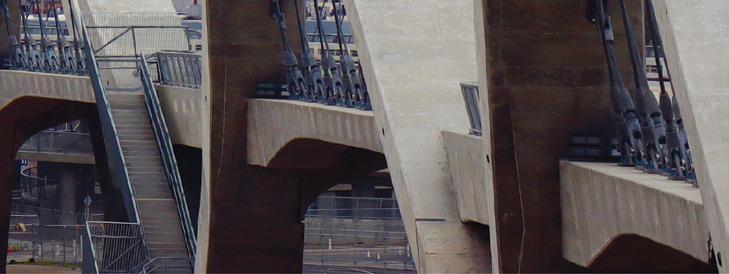




Beau Lintereur, business














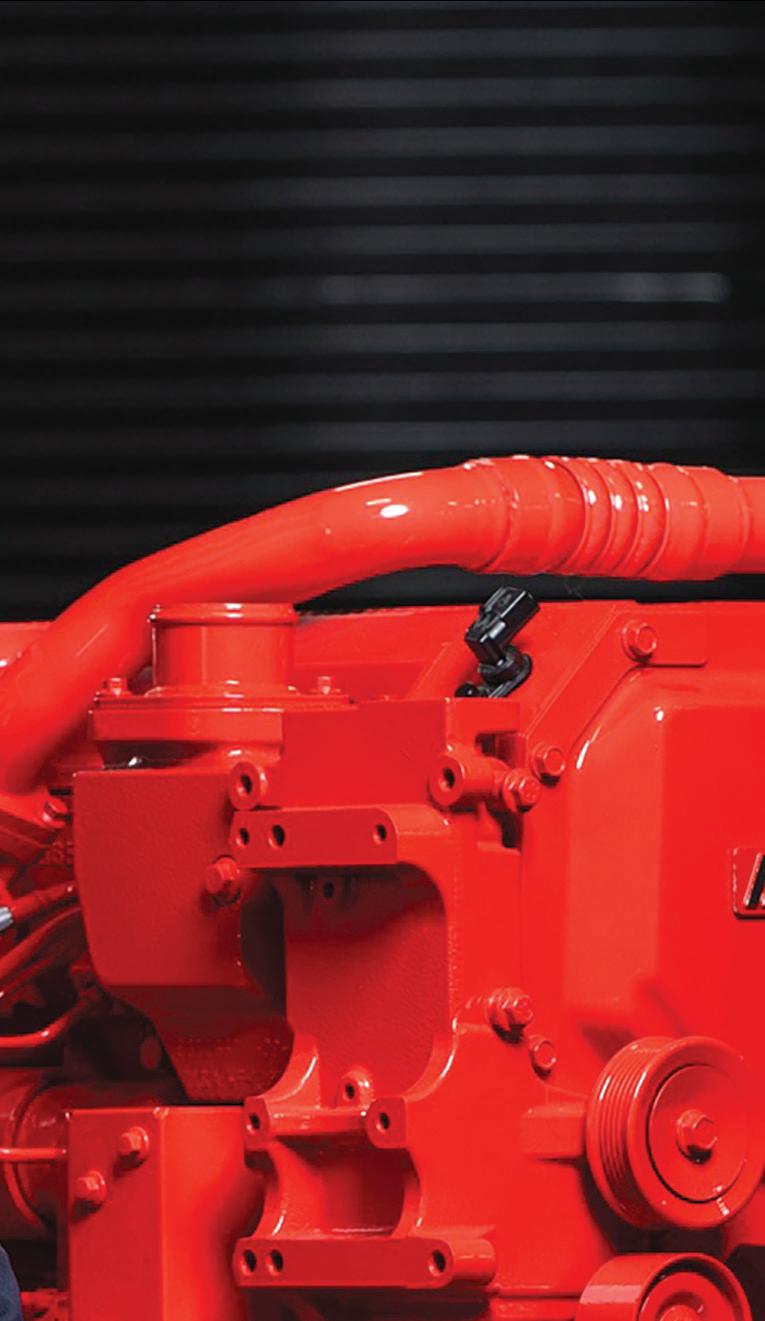
C"The facility is already leading in Cummins off-highway
ummins is continuing its commitment to helping customers navigate their energy transitions under the leadership of Beau Lintereur (pictured), its recently appointed offhighway engine business executive director. He spoke about the company’s progress towards Destination Zero: its strategy to reduce greenhouse gas and air quality impacts further and faster. He also highlighted what quarrying and heavy construction customers can expect to see from the US-headquartered off-highway power solutions giant in 2024 and beyond.


Quarries will feature hydrogen fuel cell- and internal combustion enginepowered machines before 2030, according to Lintereur. "I don't think quarries will be the lead market on this, but that timescale is very realistic. It will happen rst in the larger markets, like the US, Japan and Korea, with larger companies that will attract investment to make the technology cost-effective, with the infrastructure to support it."
Lintereur explained that Cummins is focused on advancing its internal combustion engine technology while reducing carbon emissions without impacting operations, weight, or uptime as part of its Destination Zero strategy. Simultaneously, Accelera, Cummins' zero emission technology brand, is focused on developing battery-electric and fuel-cell powertrain solutions and electrolysers for green hydrogen production.
"We're trying to create a bridge from where we are today to lower emissions globally. We're taking our existing knowledge, technology and history with the internal combustion engine and double

downing on that," explained Lintereur. "We are doing that as we know there are more traditional emissions [regulations] coming, and it gives us a bridge to alternative fuels like natural gas and hydrogen internal combustion. We feel we need, essentially, a clean sheet engine design to do all those things. We are making the biggest investment I've seen in my career in new engine designs that cover the range we're talking about."
Lintereur said that the rm’s variety of 'bridge' power solution options emphasises how the company intends to be with customers "every step of the way", helping them navigate the energy transition. "I think [power solution] technology will fork and be based on application, fuel availability, infrastructure availability, and government policy and incentives. There won't be a one-size- ts-all technology. Cummins is not saying, 'This is the answer; it has to be this'."
The UK government-backed Brunel Project, named after another pioneer of the modern industrial age, Isambard Kingdom Brunel, has received funding of £14.6 million through the UK's Advanced Propulsion Centre's Collaborative R&D competition, which backs businesses developing innovative automotive technology.
Tests are underway on a medium-duty Cummins 6.7litre engine and a heavyduty 15litre engine to help decarbonise commercial vehicles and construction equipment. The Brunel Project dovetails with plans to turn the Tees Valley into a Transport Hydrogen Hub, the rst of its kind in the UK.
Lintereur noted that Cummins has been an integral part of Darlington and the northeast of England for almost 60 years, with the site home to around 1,800 employees and servicing over 200 customers across more
than 40 countries. "The international reach of the site is set to continue in 2024, with the launch of a new Powertrain Test Facility, which will help accelerate the move towards cleaner power energies focused on reducing greenhouse gas emissions and improving air

of the site is set to continue in 2024, with cleaner power energies focused on reducing quality.
"The facility is already leading in advancements in hydrogen internal combustion engine (ICE) technology, with the development of Cummins engines as part of the fuel-agnostic engine range. Cummins is evolving its capabilities and pushing innovation in hydrogen technology more widely with signi cant research and development. As part of this, Cummins' European Technical Centre in Darlington continues to oversee a consortium of leading sub-system manufacturers in the UK to achieve commercial viability for hydrogen internal combustion engines."
Lintereur stressed the need to commit resources to further developing technologies like hydrogen combustion in Darlington, which can support industries' essential decarbonisation whilst creating valuable employment in engineering.
In 2023, Cummins showcased its new fuel-agnostic 15litre engine platform with hydrogen, natural gas and advanced diesel engines. It offers OEMs the opportunity to accelerate the decarbonisation of heavyduty off-highway applications.
This new platform, designed for the next level of emissions, is said by Cummins to signi cantly increase power density with a more compact installation envelope, enabling OEMs to increase machine capability and productivity without impacting running costs.
The fuel-agnostic architecture of the 15litre next-generation engine utilises a common base engine with cylinder heads
and fuel systems speci cally tailored for hydrogen, natural gas, diesel and biofuels, including HVO (hydrotreated vegetable oil).
The 15litre hydrogen engine will be available with ratings from 298-395kW and a peak torque of 2600Nm. For applications powered by renewable biogas, this engine will offer ratings from 298-380kW with a peak torque of 2500Nm available. The advanced diesel version features a broad power range of 335-485kW with an impressive 3200Nm peak torque.
"The platform appeals to OEMs who want to work with a technology provider that can allow them to engineer a solution for customers wanting different power solutions for their applications, be it diesel, natural gas, or hydrogen. It exempli es how Cummins has adopted the right strategy," said Lintereur.
In 2023 the company’s Accelera division also unveiled its next-generation fuel cell engine, which suits heavy-duty off-highway applications' duty cycle, performance, and packaging requirements. Available in 150kW and 300kW fuel-cell engine con gurations, it incorporates variable pressure technology, which provides improved power density, ef ciency and durability, all while delivering a lower total cost of ownership.
During 2023, Cummins also announced that in addition to recent investments in its operation in Fridley, Minnesota, the company is investing more than $1 billion across its US engine manufacturing network in Indiana, North Carolina and New York.
In October 2022, Cummins announced it would begin manufacturing electrolysers in the US for the rst time at its Fridley location. A large area will be dedicated to Accelera electrolyser manufacturing.
Electrolysers help produce clean hydrogen essential for reducing emissions and creating good-paying jobs in manufacturing and industrial sectors. At the same time, they play a critical role in clean energy supply chains that, until now, have largely been produced overseas.
"We are actively harnessing (US government, green energy) incentives," said Lintereur. "Our pipeline of projects on the electrolyser side is the biggest and most exciting piece on Accelera's current work, as you need green hydrogen to power anything like a fuel cell power solution or hydrogen internal combustion engine."
Lintereur said that from an off-highway perspective, its quarrying and construction machine customers, especially larger company
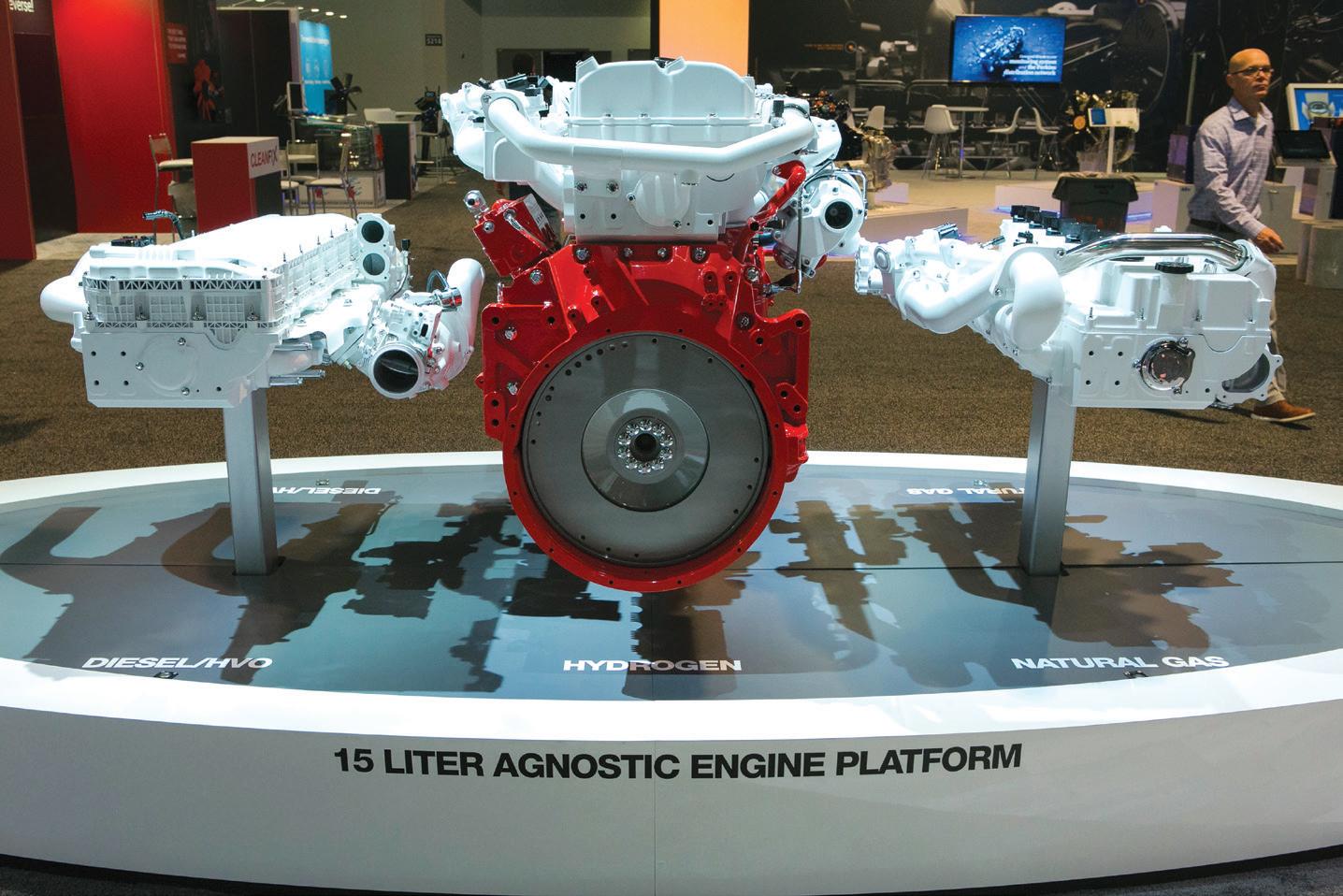
or group customers, who have ambitious ESG (Environmental, Social and Corporate Governance) agendas that are increasingly keen on adopting alternative power solutions, rather than being new government legislation and incentives-led.
In September 2023, Accelera revealed it was partnering with Daimler Trucks & Buses US and PACCAR to start battery cell production and a battery supply chain in the US.
Accelera, Daimler Truck, and PACCAR will each own and control 30% of the joint venture.
Chinese battery maker EVE Energy, set up in 2021, will have a 10% ownership and contribute its battery cell design and manufacturing know-how. EVE Energy is a major manufacturer of LFP battery cells for the vehicle industry and is publicly traded on the Shenzhen stock exchange in China.
The transaction is subject to customary closing conditions and receipt of applicable merger control and regulatory approvals, including submitting a voluntary notice to the Committee on Foreign Investment in the US.
The planned joint venture will manufacture battery cells for electric commercial vehicles and industrial applications, creating attractive US manufacturing jobs in the growing clean technology sector. Total investment is expected to be between US$2-3 billion for the plant, which will have an annual production capacity of 21GWh. It will focus initially on the LFP battery technology family for commercial battery-electric trucks.
"This is a massive investment by Cummins and its partners, around $1 billion each," stressed Lintereur. "The rst applications involving the US-manufactured battery cells will be in the on-highway space. Creating the infrastructure to support battery cell-powered vehicles, like battery charging stations, will be huge.
"With hydrogen fuel cell and internal combustion engines, we have to get the manufacturing and supply chain scale right for the on-highway industry before replicating it in the off-highway industry."
Turning to electric-powered off-highway machines, including diesel-electric hybrid and fully-electric crushing, screening, loading and hauling models found in quarries, Lintereur says: "You will see more Cummins' investments in the untethered, electric mobility side of things for both on- and off-highway, including electric drivetrains, alternative power, battery storage, and battery management systems.
"From a quarrying perspective, you may have one excavator at the quarry face feeding multiple haul trucks. You can't put an electric cable on all those trucks, so they're untethered. However, given the power requirement and the long duty cycle of those trucks, there are no batteries that wouldn't increase your payload to such an extent that it made economic sense
Komatsu has agreed to acquire American Battery Solutions (ABS), through its wholly-owned subsidiary in the US, Komatsu America Corporation. ABS is a battery manufacturer headquartered in Detroit, Michigan and develops and manufactures various heavy-duty and industrial battery packs, using lithium-ion batteries for commercial vehicles, transit buses and on- and off-road vehicles.
The company provides standard and custom battery systems optimised for customer's needs. ABS technology, combined with the advanced product development knowledge and expertise of its people, enables the company to develop and manufacture battery packs designed to deliver high performance and product life and boost safety.

plans in the commercial vehicle segments. The construction opportunities provided through Komatsu will enable ABS to position itself as one of the world's leading providers of battery systems in both on-highway and off-highway markets.
Komatsu positioned FY2023 as the rst year to introduce electric construction equipment to the market, and the acquisition of ABS will accelerate its electri cation activities.
The acquisition of ABS will enable Komatsu to develop and produce its own battery-operated construction equipment through the integration of battery technology from ABS with Komatsu's knowledge and network. The rst solution featuring ABS batteries will power heavy-duty extraction industry equipment in North and South
America, where demand for electri cation has increased. In the future, Komatsu will aim to expand the use of batteries in construction equipment and to establish a global supply system. Komatsu will continue to support the battery business to develop the electri cation business further after the acquisition.
ABS will operate as a standalone business entity within Komatsu and continue its growth
Through the acquisition, Komatsu will advance the development of battery-powered electric vehicles by using battery-related technology from ABS, along with other initiatives that it is pursuing with partners to further contribute to the electri cation of construction equipment. These efforts will help Komatsu achieve its management target of a 50% reduction of CO2 emissions from using its products by 2030 (compared to 2010 levels) and its challenge target of achieving carbon neutrality by 2050.
Komatsu www.komatsu.com
Rolls-Royce has reached an agreement-inprinciple with Deutz for the lower-powerrange engines business.
The two rms are in discussions for the sale of the off-highway engines business in the lower power range up to 480kW. These will be sold to Deutz and the deal relates to diesel engines and engine systems using Daimler technology. These are developed and manufactured by Daimler Truck for RollsRoyce Power Systems to its speci cations and used mainly in sectors such as construction machinery. In the Power Systems division, the focus for Rolls Royce will be on the strategic growth areas of power generation, governmental, marine, service and the future eld of battery energy storage systems.
Tufan Erginbilgic, CEO, Rolls-Royce explained that its Power Systems business has a strong brand and is a major player in segments such as power generation, where the rm sees a healthy demand and an opportunity for strong returns from its powerdense solutions. Dr Jörg Stratmann, CEO of Rolls-Royce's Power Systems, said: “As we evolve our strategy, we are also constantly analysing our product portfolio. As a result, we will be concentrating largely on higherpowered systems in the off-highway engine sector, primarily from our in-house production. We have therefore decided to transfer our successful lower-power range engines business, which uses Daimler technology, to a partner.”
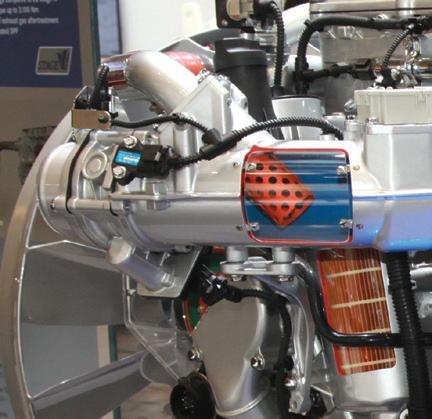
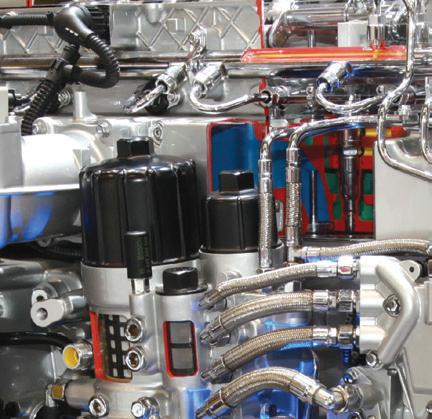
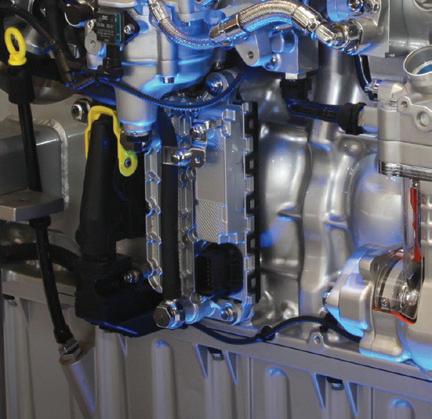
Until the transfer of the business is complete, Rolls-Royce's Power Systems division will continue its activities in this business segment unchanged in such a way that customer relationships, delivery and service obligations remain unaffected. Following a nal agreement, the closing –subject to regulatory approvals – is expected from mid-2024.
Rolls-Royce Power Systems currently has exclusive rights to the global distribution of off-highway engines using Daimler technology (MDEG, HDEP and Classic engine platforms),
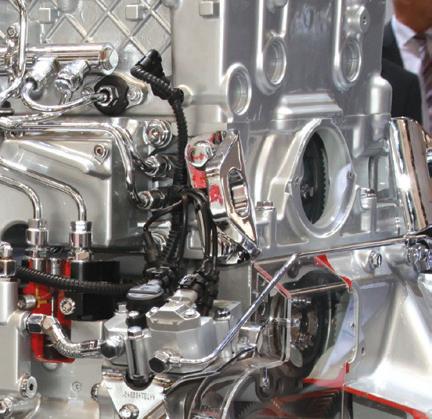
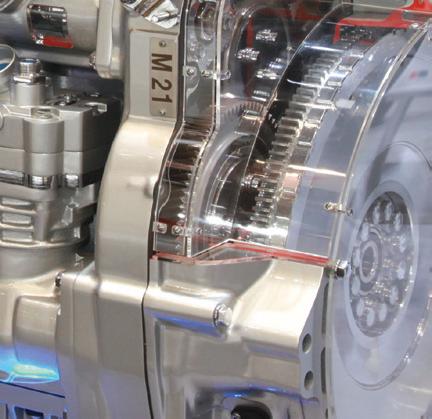

with the original contract term set to expire in April 2028.
The products under negotiation are the Series 1000, 1100, 1300 and 1500 engines and the Classic Series OM900 and OM460 in the 75-480kW power range.
Deutz
www.deutz.com
Rolls Royce Power Systems
www.rolls-royce.com
/products-and-services/power-systems.aspx
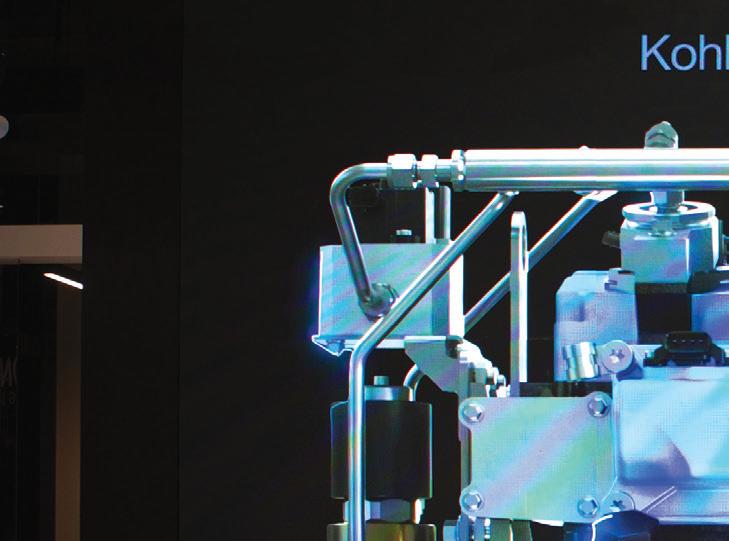

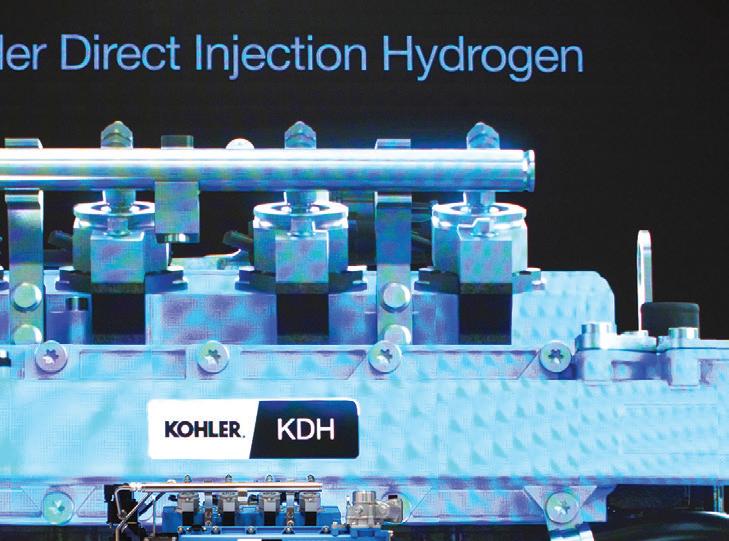


Kohler’s new hydrogen engines will o er clean power and comparable performance with conventional diesel units
Kohler Engines is unveiling its new Kohler Direct Injection Hydrogen (KDH) engine, an internal combustion engine that can run on hydrogen.
The new hydrogen engine technology is being used in the KDI 2504 TCR unit. This takes advantage of conventional combustion engine architecture and maintains the same dimensions, PTOs and performance as conventional diesel engines, while using zero carbon hydrogen as fuel.
Kohler Engines is investing in a range of innovative technologies to meet diverse machinery requirements. Hydrogen has emerged as a versatile fuel with rapidly evolving technology. Renowned for its wide ammability range, high ame speed, low ignition energy, and high diffusivity,
hydrogen holds promise as a cleaner alternate fuel for internal combustion engines.
Using direct injection (DI) technology, as opposed to port fuel injection (PFI), ensures performance, by avoiding back ring. The hydrogen unit aims to provide the same performance as the diesel engine, such as maximum power, peak and low-end torque, as well as transient response and driveability.
Hydrogen plays a pivotal role in emissions and GHG reduction as it offers clean and ef cient energy, without generating carbon dioxide (CO2).
The combustion of a hydrogen engine is cleaner than a standard diesel engine and with an aftertreatment system (ATS), the environmental bene ts of
Volvo Penta will collaborate with TecnoGen on its battery energy storage system (BESS) to support charging infrastructure for electric heavy-duty vehicles.
Battery energy storage bridges the gap between critical energy needs and backup power with renewable energy sources. Robust charging is essential for the widespread adoption of electric vehicles and industrial applications, ultimately contributing to a more sustainable future. This aligns with Volvo Penta’s multi-tenet industrial net zero strategy, which spans the adoption of alternative fuels, electri cation of off-highway applications, battery energy storage subsystems and fuel cell technology development.
Volvo Penta will collaborate with TecnoGen on its BESS to support charging infrastructure for electric heavy-duty vehicles. Renato Bruno, CEO BGG said, “Our combined expertise will complement charging infrastructure, a critical step towards industrial electri cation and bolstering clean energy integration in the long run.”
Volvo Penta www.volvopenta.com
using hydrogen are increased. Using the ATS ensures the reduction of exhaust emissions to low values, making the engine near zero emissions.
The ATS reduces particulate matter (PM), nitrogen oxides (NOx) and hydrocarbons (HC) to minimal levels.
The hydrogen internal combustion engine is designed to be a drop-in solution, and no major changes to the engine compartment will be required. The engine platform of the machine will keep the same cooling circuit, power take-off and ywheel, engine mounting points, and intake line; in addition, the exhaust line does not need ATS in Stage 5.
Kohler Engines www.engines.kohlerenergy.com
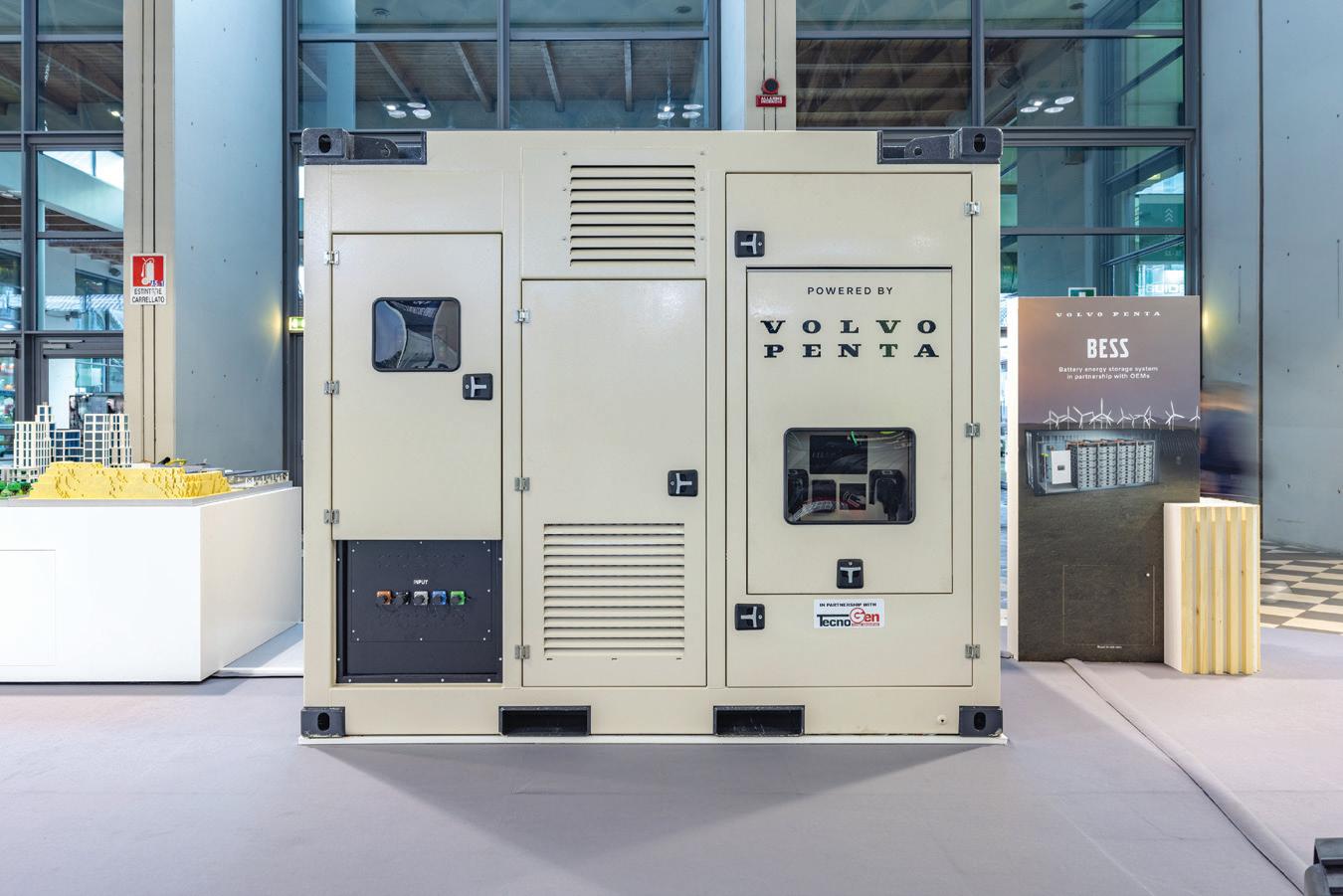
Kobelco is strengthening its mini excavator range with the introduction of its new SK26SR-7 and updated SK28SR-7 models.
These machines are aimed at the 2.5tonne class and are said to o er high productivity as well as versatility, with the capability of handling a number of working attachments. The next generation SK28SR-7 features a number of important improvements.
The two new models use Kobelco’s Performance x Design concept, which boosts
performance, provides a comfortable cabin and better working environment.
Suited for use in jobsites where space is restricted, the Kobelco SK26SR-7 and SK28SR-7 have short radius designs. The short tail swing design ensures accessibility when working next to walls or digging close to ditches and o ers a smaller operating footprint.
Kobelco Construction Machinery Europe www.kobelco-europe.com
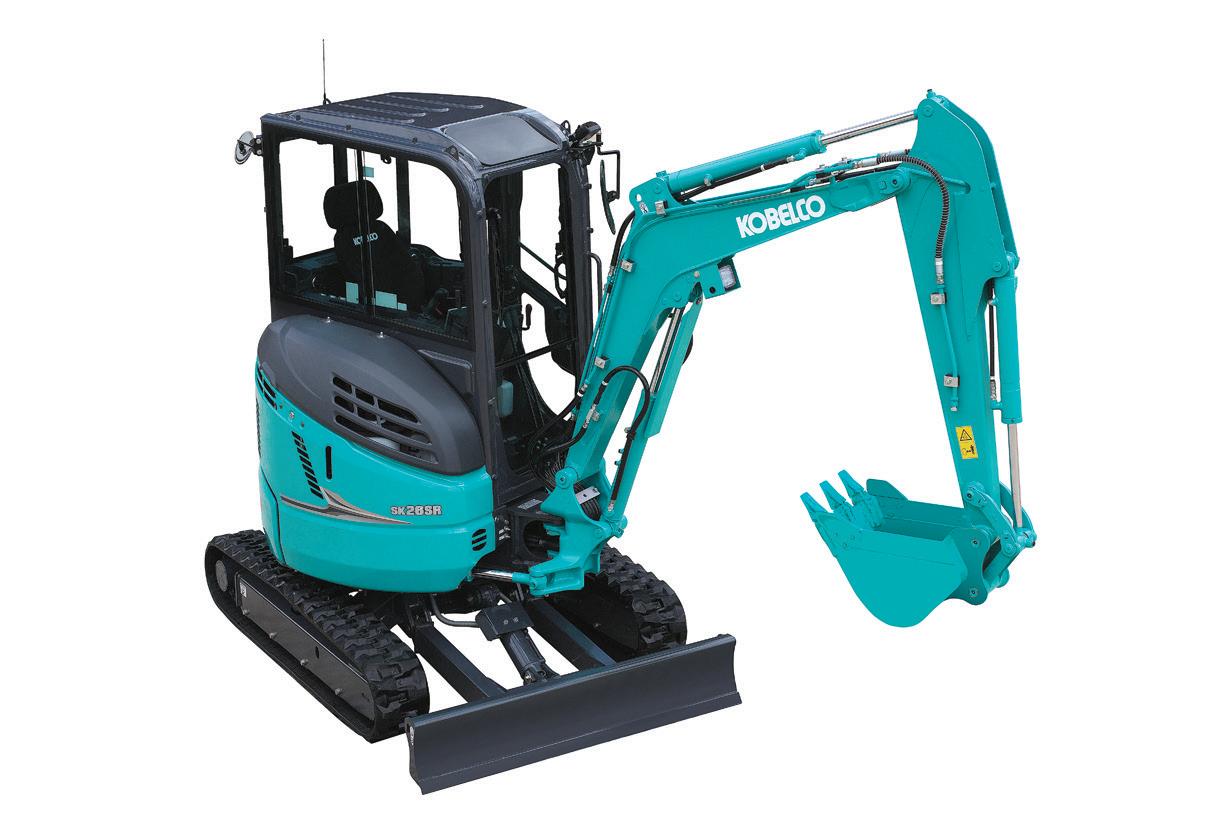
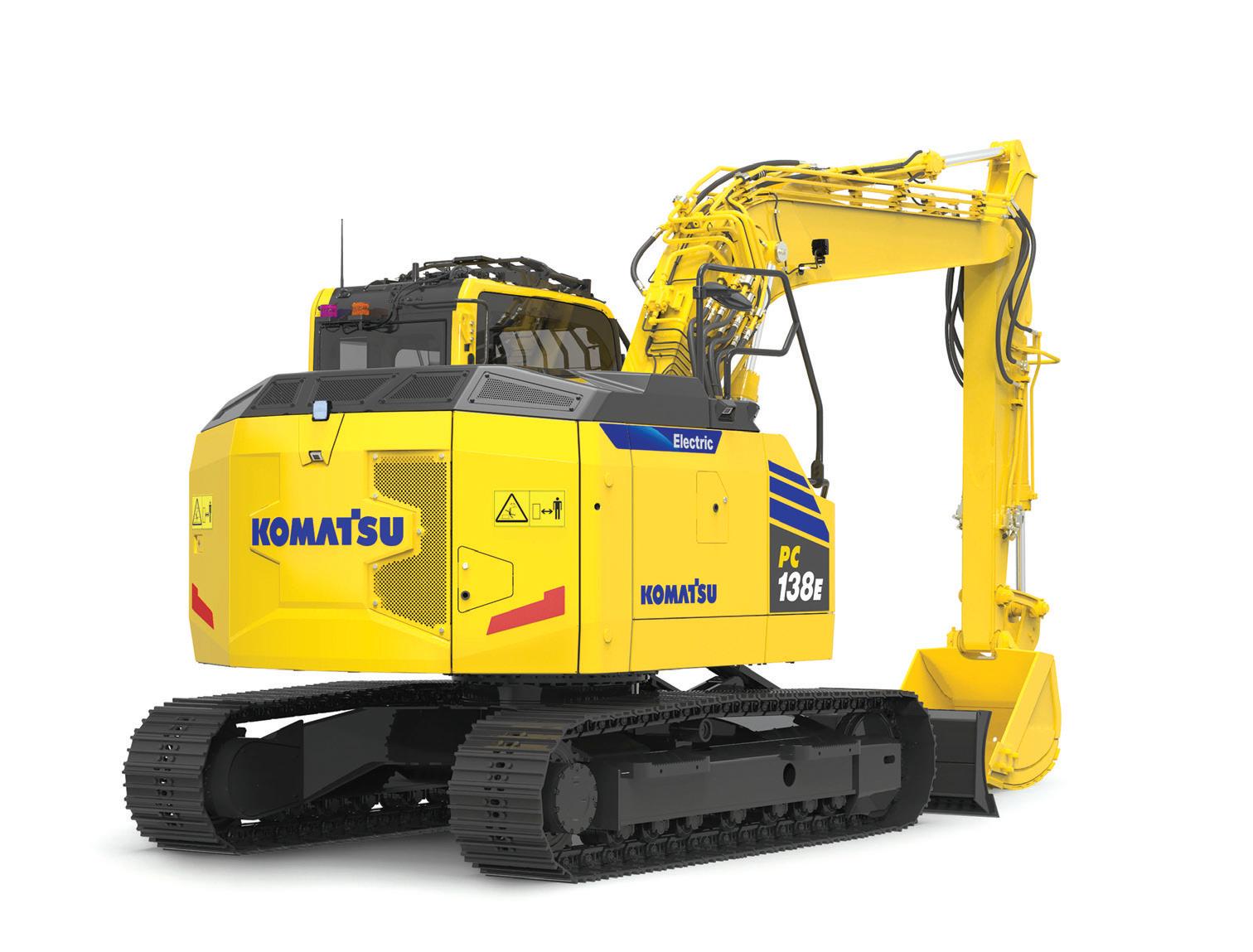
Komatsu plans to introduce a 15tonne class PC138E-11 electric excavator powered by a lithiumion battery to the domestic market as a rental machine.
The rm also plans to introduce it to European markets, following Japan. The company is working to develop a presence in the new market for electric construction machines with an eye to achieving carbon neutrality by 2050 by expanding its product lineup and meeting customers’ needs.
By tting a high-capacity, 225kWh lithium-ion battery and integrating the cooling system, Komatsu says the unit o ers a long operating time and reduced rearend swing radius. In regions where the market for electric construction equipment is expected to develop, Komatsu will o er this machine
to the rental market to generate customer feedback.
The rm will be o ering the PC138E-11 excavator with a Smart Construction 3D Machine Guidance kit, a simple and versatile package now available for a broad range of Komatsu machines. The kit provides an accessible way to add 2D and 3D machine guidance and can be customised with various options that allow the kit to better accommodate each customer's machine con gurations and operating conditions.
Bucket capacity is 0.5m3, while it has a tail swing radius of 1.83m, weighs in at 15.3tonnes and has a 72.5kW motor, as well as a 225.6kWh battery.
Komatsu www.komatsu.com
Mecalac is introducing its 1000litre electric swing loader. Based on the design of the proven Mecalac AS1000, the allnew eS1000 has been developed to achieve zero tailpipe emissions.


For operators and the general public, comfort, noise and vibration have been minimised, making it possible to use the machine both indoors and in sensitive environments.


The swing loader design is said to be e cient and allows reduced cycle times, noise and visual nuisance, maintenance costs and risks of crashes. The electric eS1000 loader version is said to optimise energy use for an unprecedented 8-hour battery life.



Once the rear axle is locked, a full bucket load can be turned through 180° without any loss of stability, even with the wheels at

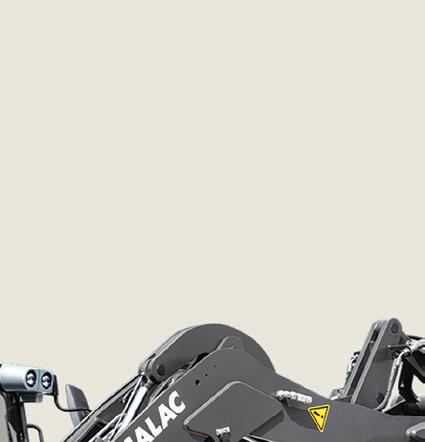
full lock. The stability in all positions and on all terrain ensures that the machine is able to operate on a range of applications. Cycle times








are said to be fast for use in urban construction sites and places with limited space and time to work due to the swing loader concept, which eliminates the need to move the whole machine for loading and unloading.








The rm claims that using three of its electric machines on the same urban site will save an average of 64 tons of CO²/annum, compared to the same models tted with diesel engines. In addition, Mecalac's zero emission solutions limit noise pollution, o er the possibility to work indoors, and lower overall maintenance and operational costs (with fuel replaced by electricity).



Mecalac www.mecalac.com


A wheeled excavator from Hitachi has been put to good use on a road upgrade project in Switzerland.
Opened in 1955, the A2 is one of the busiest motorways in the country, crossing the Alps and forming the main north-south axis from Basel to Chiasso.
On a 3km stretch near the village of Rodi in Ticino, a ZX155W-7 wheeled excavator owned by Otto Scerri has been employed on a project to replace the central reservation with asphalt, as well as renew the drainage between the two lanes of the highway.

Otto Scerri’s Ticino director Fabrizio Bellini said that the rm has extensive experience with construction machines from Hitachi. “We have
worked with around 20 Hitachi excavators over the past three decades and have never had any issues,” he says. “As well as being reliable, they have a strong resale value.”
The company’s eet of HCM machines has included: the ZX17U-2 and ZX65USB-5 – and a wide range of other mini excavators; as well as the ZX225USLC-3 and -6, the ZX280LCN-3 and ZX300LCN-6; and ZX350LCN-7 medium excavators.
The ZX155W-7 wheeled excavator is Otto Scerri’s latest acquisition, supplied by the Swiss dealer Probst Maveg. The new model was purchased with a one-year, 2,000-hour, full service contract.
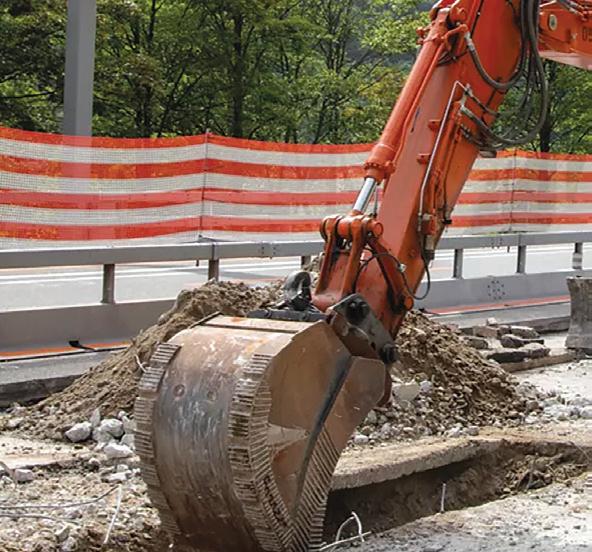
Hitachi Construction Machinery Europe www.hitachicm.com/eu/en
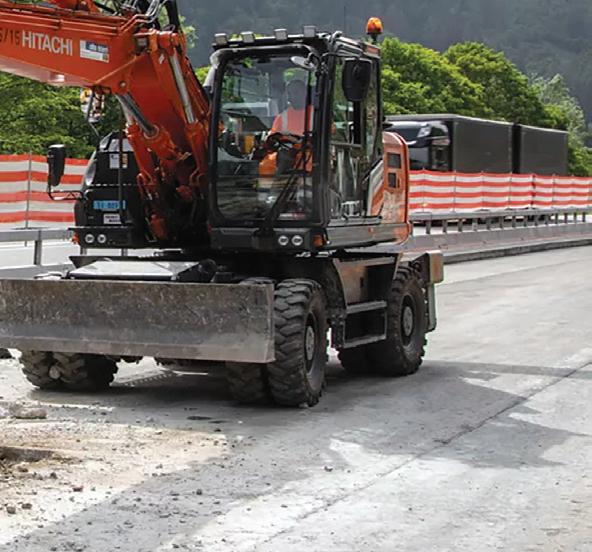

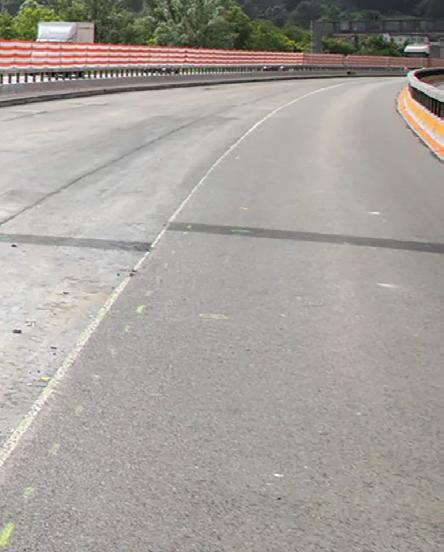
The John Aarts Group is leveraging innovations in technology to bridge the gap in nding su cient machine operators. When searching for ways to future-proof operations, the John Aarts Group turned to Teleo.
The rm saw Teleo’s technology as a key to unlocking new opportunities for their business. The technology allows heavy equipment to be operated both remotely and autonomously. This takes the operator out of the cab, placing them in a safe and comfortable working environment. The enhanced working
environment closely resembles a gaming station, appealing to new audiences: both a younger generation and those who don’t see themselves climbing into a cab for eight to ten hours a day.
Working together, Teleo and The John Aarts Group were able to retro t a John Deere 624K wheeled loader, introducing the rst remote plant loading operation in Tillsonburg, Ontario.
By remote loading the hopper, the machine operator is able to switch to other tasks rather than spend unnecessary idle time in the loader. In addition to increasing productivity, working with Teleo
Heavy-duty tyres from BKT are proving their worth on a quarrying operation in Ireland. Loughnane Concrete provides a wide range of products such as block- and ready-mix concrete, sand, gravel, and quarry stone aggregates as well as urban paving and construction materials to the Irish market and operates a quarry and concrete plant at Birr in County O aly. The site is faced with complex challenges, including di cult weather and surface conditions on a daily basis.
"We mainly use three loaders and four dumpers for our operations, but this is an environment that puts a strain on our equipment in all aspects,"said Christy Loughnane, managing director at Loughnane Concrete. "So, on the suggestion of our distributor, we decided to rely on speci c BKT tyres. Today, we can say that we are extremely satis ed with their performance and the high quality of the BKT products."
Loughnane Concrete has chosen tyres from the EARTHMAX range. The EARTHMAX SR 50 is made of a cut-resistant compound that reduces wear while ensuring increased durability. The EARTHMAX SR 30 o ers traction, stability, and durability thanks to multi-ply steel belts and a rigid block design; and nally, for transport, loading and grading applications. The EARTHMAX SR 41 provides long hours of operation as well as puncture resistance, and comfort.
www.bkt-tires.com
gives the John Aarts Group a leg up in attracting new personnel when the current operator retires. While this industry rst is already rede ning operational norms, Ryan Aarts, CEO of the John Aarts Group said that this application is just the rst step. He commented, “The next step is having one batch plant operator and one loader operator operating multiple plants, where they’re just teleporting over the internet to di erent machines and batch seats to make the concrete.”
John Deere www.deere.com



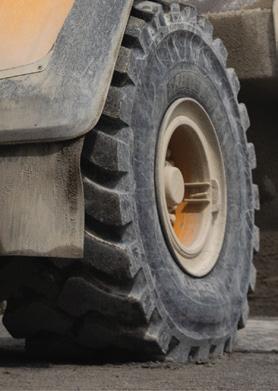

Our Skidmarks page is highly rated by readers. Your input could help make this page even more entertaining. If you come across any amusing road-related stories or pictures email me at mwoof@ropl.com
Police in a small Swiss town were alerted recently to a vehicle being driven at high speed during the night. Tra c cameras spotted the car being driven at 125km/h along a stretch of road with a speed limit of just 60km/h. Some investigation work managed to identify the driver, an 18-year-old. The Swiss authorities are known to be tough on driving o enders and the teenager is likely to regret his inclination to press the pedal to the metal.
A new special Construction Monopoly version is now available of the long-popular game. Unlike previous versions, this comes with counters that include a backhoe loader, a rigid chassis dump truck, an o -highway tyre, a mini excavator and a tiltrotator. Instead of buying houses and hotels, players are encouraged to grow construction businesses, although the rules remain broadly the same.
A recent re in the short-stay car park at Luton Airport in the UK resulted in many vehicles going up in smoke, as well as the temporary closure of the airport. Around 15 vehicles were damaged in the re, caused by faulty electrics in a diesel Land Rover. However, one woman was horri ed to discover that when she contacted her insurance rm to claim for the loss of her car, she was told it was her fault and that she would not receive any payment. The claim was resolved eventually but the woman was less than impressed as the poor service from the insurance rm.
A driver in Moscow was performing stunts in his vehicle in an attempt to impress bystanders when it caught alight. He then reversed the car, hoping that doing so would somehow put out the ames. Instead, the re took hold quickly and the car su ered extensive damage.
A number of homeowners in the UK have been campaigning for one of their neighbours to remove two caravans parked on private land. The residents say that the caravans are unsightly and also attract pests. However, another resident has commented that the complainants are simply guilty of snobbery and that the caravan owners have not caused any problems in the area.
A woman in the UK took matters into her own hands when her son’s mountain bike was stolen and the local police took no action. Having identi ed the thief and worked out where he lived, she sat outside his home with a hand-written sign asking where the bike was now. Police nally took action and the man was arrested for a series of o ences, including multiple bicycle thefts, and was later sent to prison. The bicycle was not recovered however and the woman has now had to buy a new one for her son. Meanwhile, a UK man who had both of his cars stolen in one night has managed to retrieve one using Google Earth. His VW and Seat were taken in the same night. However, a friend spotted the Seat for sale on an internet platform. Looking at the posted images of the car and using Google Earth, the man was able to determine its location and called the local police to say he had found his stolen car. Within 15 minutes they had recovered the vehicle, although the VW is still missing.
A driver in Savannah, Georgia realised he had been spotted speeding in his car and was not surprised when he later received a ne. He had been driving at 90mph in a 55mph limit. What shocked him however was the size of the ne: US$1.4 million. When he contacted the o cials who had sent him the ne, he was



told he should either pay up the sum requested or go to court. He opted to go to court, quite understandably, and was instead ned just $1,000. The o cials explained that the initial sum had been generated by a computer error.
An obscure old law meant that when maintenance work was carried out on the Millenium Bridge in London recently, hay bales had to be hung from it. The law requires that the hay bales be hung from any bridge spanning the River Thames while work is underway. This ensures that the crew of vessels passing underneath Thames bridges are warned of the presence of maintenance crews who may be working on the structure at any one time.
The owner of a motorhome became extremely embarrassed after following the directions given by his satnav system. The German man drove his vehicle down a very narrow road in Cornwall and became stuck. He was able to retrieve his rented vehicle eventually but not without it having sustained some damage in the process. Similar issues with drivers being too trusting in their satnav systems have occurred elsewhere. In the US, rescuers had to help people from their car after it had been driven into a dock. The vehicle occupants were unharmed,
if a little wet. The vehicle was damaged however. They explained that they had been following the guidance from their satnav and had assumed that the ramp down to the water led to a ford across a river.
A couple in the UK had a long wait in their car as they queued to use a car wash. They were horri ed to receive a letter from the rm operating the car parking facility where the car wash was located saying that they were being ned for overstaying the time period for free parking at the facility. They sent a letter to the rm, including a receipt showing that they had been waiting to use the car wash. The rm responded saying that they would still have to pay the parking ne. Only when the couple contacted a national newspaper, which then contacted the parking rm, was the ne cancelled and an apology given.
A truck driver in the UK was lmed with his hands o the steering wheel of his vehicle while driving along the busy M6 motorway. Instead of holding the wheel, he was holding a cup containing a hot beverage, using both hands to do so. Tra c o cers in an unmarked vehicle recorded the incident on video and the trucker was later ned for the o ence.

Enjoy a knowledge programme of over 120 sessions, from debates to demonstrations. 200+ speakers will cover the hottest topics touching on policy support, best practices, user cases, trends and more.
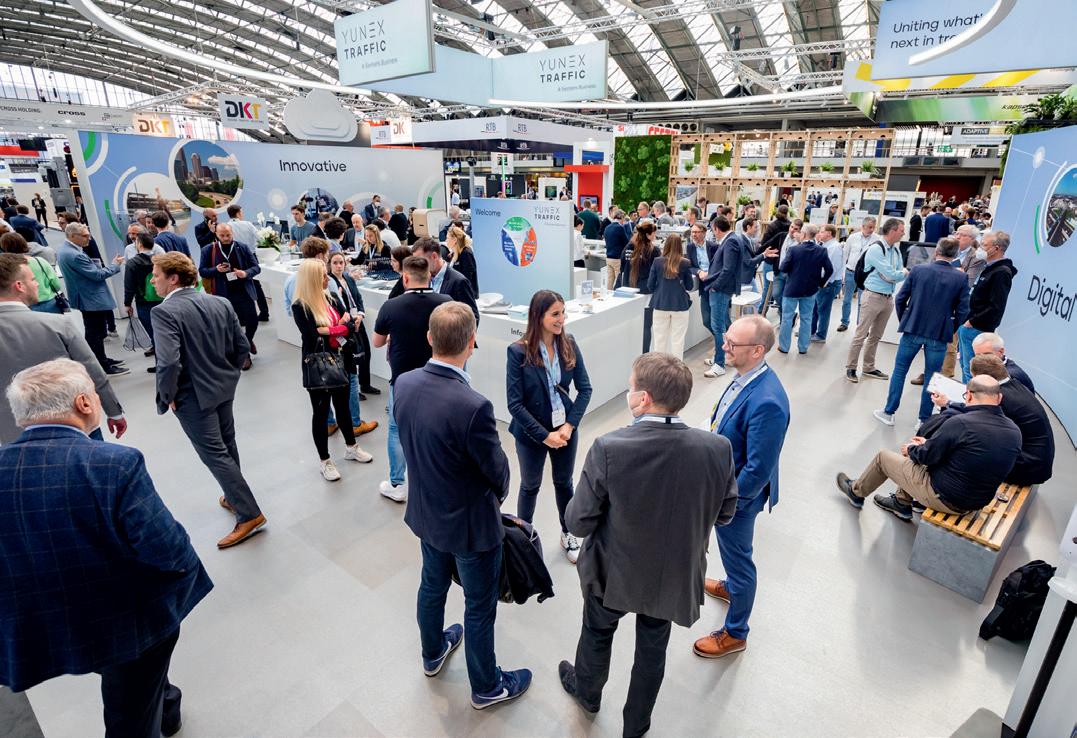

900+ public and private organisations spread over 12 halls will present the latest solutions and developments in mobility and traffic technology. From road safety to parking solutions, intelligent infrastructure, traffic management, smart mobility, and everything in between.










The 18 compactors range from 3 tonnes to 22 tonnes. They offer all the benefits Ammann customers have come to love.
• The use of hydrostatic drive and the Ammann “no-rear-axle” concept for traction and visibility
• ECOdrop, a sustainability initiative focused on reducing emissions, fuel usage and required fluids
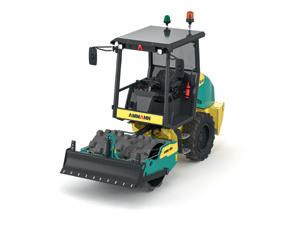
• Ammann’s proprietary compaction systems, ACEforce and ACEpro, that help eliminate unnecessary passes and the costs that go with them