WASTE MANAGEMENT REVIEW
ISSUE 112 n NOVEMBER 2026
Rules for recovery
2026 | NOVEMBER | ISSUE 112
Craig Barker on why clarity and consistency matter
wastemanagementreview.com.au
INSIDE A smarter sort Circling back to care Waste-to-energy’s next phase Why soft plastic stewardship makes sense PROUDLY SUPPORTED BY:
PMS 380 PMS 376 PMS 355
CONTENTS
COVER STORY
10
Clarity first
6
What the industry needs next. “We seem to be getting so much right, and yet, we’ve still got different rules across LGAs.”
Circling back to care
Craig Barker, CEO and Managing Director, Veolia Australia and New Zealand
Features
8
15 19 22 24 26 29
Challenging long-held assumptions about single-use medical devices.
A NEW CHAPTER
32
SECOND LIFE
GRINDING GREEN WASTE
34
WASTE TAKES NEW ROUTE
36
BREAKING THE LANDFILL CYCLE
Leadership transition at Komatsu Forest. 2710D puts runs on the board.
SMARTER COLLECTIONS
Clearer picture of what happens at the kerb.
A SMARTER SORT
New tech for cleaner material.
ON THE CUTTING EDGE
New era for textile recycling.
SOLUTION FOR NOW
e role of landfill biodegradable plastics.
HARD NUMBERS
e case for so plastics product stewardship.
38 40 42
New phase for waste-toenergy sector. Five councils unite for red-bin waste plan.
44 47 50
Investing in smarter separation.
SECOND WIND A look at Hitachi’s Reman Program.
CLIMATE CHALLENGE
2026 finalists rethink biosolids.
KEEPING LITTER AT BAY
Queensland’s plan to protect waterways.
RECOVERING WHAT MATTERS
A different perspective on recycling technology.
QUALITY COMPONENT
Multi Waste Buckets have hit the Australian market.
PICKING A WINNER
Mobile stations for smaller enterprises.
wastemanagementreview.com.au
3
Regulars
54 57
PRODUCT SPOTLIGHT LAST WORD
Waste Management Review
FROM THE EDITOR
Making the system work
I
t was a pleasure to speak with Craig Barker for this edition’s cover story. What struck me most was how practical his vision for Veolia is. A er almost two decades in resource recovery, he keeps coming back to two things the industry needs more of: clarity and consistency. For Craig, that means clearer rules about what goes into our bins, greater certainty around planning and regulation, and increasing confidence to invest in infrastructure for the long term. It also means looking beyond diversion targets to what happens to recovered material once it leaves the bin. e end market matters just as much as the collection system. at idea runs through much of this edition: resource recovery works best when all the pieces of the system work together. Our feature on so plastics looks at the economic case for nationally aligned packaging and recycling rules. An analysis commissioned by So Plastics Stewardship Australia estimates consistent national settings could deliver significant productivity gains and investment. We also look at an area of circularity that may be less familiar: medical device reprocessing. As Australia develops its regulatory approach, there is potential to keep devices and valuable materials in circulation for longer, while reducing waste and reliance on new products. Of course, better recovery also relies on what happens on the ground. At Visy’s Smithfield facility, modular upgrades and
CEO
artificial intelligence are helping deliver a cleaner, more consistent paper stream. Elsewhere, Dump It Bins is using new separation equipment to recover more from mixed waste, while TRY Green Waste Recycling shows the importance of reliable equipment and support when processing growing volumes of green waste. For smaller operators, the pathway to better recovery can look different again. Our plant and equipment coverage explores how semi-mobile picking stations can offer an alternative for businesses that do not have the scale or budget for highly automated sorting systems. And in our Last Word, Damion Tucci brings the discussion back to people. His first priority in his role with the Victorian Waste Management Association is simple: listen. He says that better outcomes depend on drawing on the practical knowledge of those working across the industry and ensuring it helps inform policy and decision-making.
Christine Clancy christine.clancy@primecreative.com.au
PUBLISHER
Sarah Baker sarah.baker@primecreative.com.au
MANAGING EDITOR
Lisa Korycki lisa.korycki@primecreative.com.au
JOURNALIST
Sean Gustini sean.gustini@primecreative.com.au
HEAD OF DESIGN
Clayton Hawley clayton.hawley@primecreative.com.au
ART DIRECTOR/DESIGN
Daz Woolley, Laura Drinkwater
BRAND MANAGER
Chelsea Daniel chelsea.daniel@primecreative.com.au P: +61 425 699 878
CLIENT SUCCESS MANAGER
Ben Sammartino ben.sammartino@primecreative.com.au
HEAD OFFICE
Happy reading!
Prime Creative Pty Ltd 379 Docklands Drive Docklands VIC 3008 Australia P: +61 3 9690 8766 info@primecreative.com.au www.wastemanagementreview.com.au
SUBSCRIPTIONS
Lisa Korycki, Managing Editor
+61 3 9690 8766 subscriptions@primecreative.com.au Waste Management Review is available by subscription from the publisher. The rights of refusal are reserved by the publisher
ARTICLES
All articles submitted for publication become the property of the publisher. The Editor reserves the right to adjust any article to conform with the magazine format.
COPYRIGHT
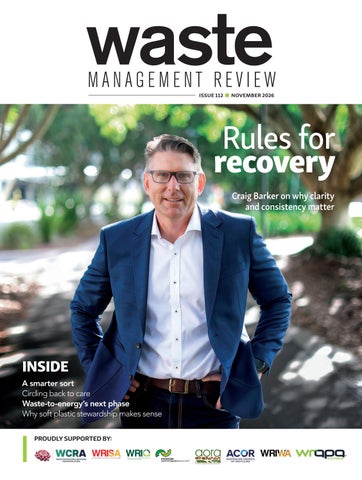
On the cover Veolia Chief Executive Officer and Managing Director Craig Barker. Image: Veolia
Waste Management Review
4
November 2026
Waste Management Review is owned by Prime Creative Media and published by John Murphy. All material in Waste Management Review is copyright and no part may be reproduced or copied in any form or by any means (graphic, electronic or mechanical including information and retrieval systems) without written permission of the publisher. The Editor welcomes contributions but reserves the right to accept or reject any material. While every effort has been made to ensure the accuracy of information, Prime Creative Media will not accept responsibility for errors or omissions or for any consequences arising from reliance on information published. The opinions expressed in Waste Management Review are not necessarily the opinions of, or endorsed by the publisher unless otherwise stated.
FEATURE
Circling back to care Medical reprocessing is challenging long-held assumptions about single-use devices, offering healthcare providers a pathway to reduce waste, cut costs and support circular economy goals.
A
pulse oximeter sensor may spend only a short time with a patient before being discarded. Yet the device can contain materials and components with years of useful life still ahead of them. As Australia develops rules for medical device reprocessing, those products could soon be treated as assets rather than waste. Daniel Vukelich, President and Chief Executive Officer of the Association of Medical Device Reprocessors, was in Sydney recently for the RegConnect Summit 2026, a two-day regulatory affairs event for the medical technology sector, presented by the Medical Technology Association of Australia. Daniel joined a panel examining the shi from single to circular use in medical technology. He says the prevalence of single-use devices contributes to healthcare’s waste and emissions, while leaving hospitals exposed to global supply chain disruptions. “ e data shows that about 4.4 per cent of all global emissions are coming from healthcare, and there’s been a number of studies showing that about 70 to 80 per cent of that is coming from scope three, which includes all the stuff that hospitals buy,” he says. “So not just medical devices and supplies, but pharmaceuticals, food, all of that. It’s really the supply chain that we need to focus on if we’re going to reduce the amount of carbon emissions coming out of healthcare.” While infection control drove the shi towards single-use devices, Daniel says the approach has exposed healthcare systems to a different set of risks. “Hospitals went towards single use because of infection control reasons, but we really never contemplated what happens if there’s a respiratory plague? What happens if the supply chain is disrupted? What happens if the price of oil maxes out and it suddenly becomes very expensive to be tapping into a global supply chain?” He says remanufacturing offers another option. It involves recovering used
Daniel Vukelich, President and Chief Executive Officer of the Association of Medical Device Reprocessors.
medical devices, processing them to the required standard and returning them to service, reducing the need to buy newly manufactured products. “What can we do to mitigate against supply chain shortages or risks? How do we reduce waste and emissions?” Daniel says. “Recapturing these medical devices and remanufacturing them, putting them back into service, is a perfect example of a circular solution to these problems.” Founded in 1999, the Association of Medical Device Reprocessors (AMDR) is the global trade association for the regulated, commercial “single-use” medical device reprocessing industry (known as “remanufacturing” in Europe). Reprocessing refers to the cleaning, testing, and repackaging of single-use medical devices that are regulated by the Food and Drug Administration (FDA) or similar national regulatory authorities so they can be returned for reuse by hospitals and clinics. More than 11,400 hospitals and surgical centres worldwide (including the Mayo Clinic, Cleveland Clinic, and most German teaching hospitals) are working with AMDR-member regulated, commercial reprocessing companies. AMDR estimates 5,727,453 kilograms of medical waste was diverted from landfills in 2025 and hospitals and surgical centres
Waste Management Review
6
helped to eliminate 56,707,926 kilograms of carbon dioxide equivalent by using reprocessed single-use medical devices. Australia is now working through the regulatory settings needed to establish that capability locally. Daniel says the aim is to ensure reprocessed products meet the same medical device manufacturing standards as new products. “We want to make sure that any medical device, whether it is brand new or it’s reprocessed, meets the same medical device manufacturer standards,” Daniel says. “It has to be safe and effective. “I can’t ask clinicians to flip the switch on this today. But I think within months we’ll have reprocessed or remanufactured product available on the Australian market, and then we’ll be asking our healthcare professionals to use those first, maximise the medical device assets they already have. “ at then minimises the number of new devices they need to buy, which in turn lowers costs, lowers emissions, lowers waste, and lowers the impact of carbon into healthcare.” He says the initial opportunity is in lower-risk patient care products that touch a patient but are non-invasive. ese include pulse oximeter sensors, blood pressure and tourniquet cuffs, and lateral transfer mattresses. More complex products could follow. Daniel points to laparoscopic surgical instruments used in minimally invasive procedures. eir small and intricate design can make them difficult for hospitals to clean, but specialist reprocessors can disassemble, clean and remanufacture them. Cardiology presents another opportunity. Electrophysiology and diagnostic cardiac catheters can cost between $2000 and $3000 each and may contain rare earth metals, gold and platinum, despite being labelled for single use. “If we, under a regulated environment, can put those back into service, that’s good news for healthcare,” Daniel says.
November 2026
All cleaning processes for reprocessing medical equipment is validated and reported. Images: Association of Medical Device Reprocessors
Achieving that outcome depends on confidence in the reprocessing system. Daniel says members of the AMDR agree to test or inspect every device, rather than relying on batch testing. Clear labelling is also part of that commitment. A remanufactured device would identify the company responsible for refurbishing it, while reprocessors would provide regulators with technical files explaining how their cleaning processes have been validated. “We agree as an industry to go to the regulator and share our technical files on how we validate the process for these products, so that the regulator feels confident that the products at the end of our cleaning cycles are as safe and as effective as original equipment,” Daniel says. e erapeutic Goods Administration is considering the requirements for reprocessing in Australia, including understanding the cleaning validations used to ensure components are clean, sterile and function as intended. e regulatory work coincides with the beginnings of a local industry. Daniel says medical technology companies Arjo and Cardinal Health have established operations in Australia for some Class One patient care devices (simple tools used to help with basic health care needs such as stethoscopes or examination gloves). He expects the regulatory guidance to encourage companies handling more expensive and complex devices to consider Australian operations. at could support more than waste reduction. It could help Australia retain medical technology resources, build manufacturing capability and reduce its dependence on imports. Australia currently sources most of its healthcare requirements from elsewhere. Daniel says recovering medical devices and their components locally could provide another source of supply when international markets are disrupted. “Recapturing these spent assets and using components in the manufacture of new devices is a surefire way, just from a national sovereignty perspective, to make sure we have the necessary medical devices here at home without having to tap into a global supply chain,” he says. “ is is good for Australia, but let’s make
Australia the epicentre for sustainable medical device manufacture for all of Asia, and then let’s export these products, which we remanufacture, to Singapore, to Korea, to Japan. “ e world needs the solution that we’re offering, and it’s better that these jobs – green jobs – be here in Australia.” Building that industry will require enough collected material to support local processing. Daniel says products may initially need to be sent to the United States until Australian operations achieve the necessary scale. Collection is already beginning, with spent pulse oximeter sensors and compression sleeves being stored in anticipation of processing and returning them to market. Local collection partners can help reprocessors work with hospitals and capture as many eligible devices as possible. Geography adds another challenge. Metropolitan areas such as Sydney offer relatively short distances between hospitals and processing operations. Regional and remote healthcare facilities may need local contractors or additional training so staff can package and ship devices themselves. Reverse logistics, Daniel says, is one of the reprocessing industry’s strengths, although it requires ongoing education. “It’s hard work, but it’s worth it because of the benefits that this brings to the hospital and obviously to the reprocessing company,” he says. Circularity could also change how hospitals purchase medical technology. Instead of selling a device that becomes
wastemanagementreview.com.au
7
the hospital’s responsibility at the end of a set number of uses, manufacturers could provide equipment as a service and remain responsible for recovering, cleaning and maintaining it. Daniel uses endoscopes and robot arms as examples. Both can be difficult for hospitals to clean, and robot arms used in surgical systems can become waste once they reach the manufacturer’s nominated number of uses. A service model would give manufacturers an incentive to design products that last and allow hospitals to pay for access rather than continued consumption. Reprocessors do not regard returned medical products as waste, Daniel says, but as assets that can be cleaned, disinfected and used to make medical devices. Treating products carefully at the point of collection can extend their lives, reduce demand for new equipment and keep valuable materials in circulation. “We really urge hospitals not to treat this as waste, but to treat it as an asset,” he says. “ e better they treat it, the longer these products last, and they stay in circulation. “Discarding devices containing platinum, gold and palladium is difficult to justify when healthcare must compete with other industries for those materials. For Australia, recovering them locally could reduce waste while building a more resilient medical technology supply chain. “We better start recapturing everything we can because we could run into trouble if the tap gets shut off. Circularity is the future.” WMR
Waste Management Review
BUSINESS
Changing of the guard A new chapter begins for Komatsu Forest Australia.
A
leadership transition is underway at Komatsu Forest Pty Ltd, with Dean O’Connor appointed Managing Director, effective 1 October 2026. Dean succeeds Brett Jones, who will retire from the position following an extensive career with Komatsu Forest and a significant contribution to the development and growth of the business in Australia and the broader Asia-Pacific region. Ref lecting on his time with the company, Brett says he is deeply proud of what has been achieved since Komatsu Forest Australia was formed 36 years ago. His time with the company and within the industry has been a meaningful and rewarding part of his working life, marked by many achievements, challenges and lasting relationships. “Over the years, there have been many tough periods, but also many rewarding moments, and I am incredibly grateful for the relationships we have built and the achievements we have shared along the way,” Brett says. “It has been a privilege to work with you all. I sincerely thank you for your continued support, trust and partnership throughout my time with KF, and I wish everyone continued success for the future.” Brett will continue to work parttime for the next six months, assisting Dean and his team where needed to ensure a seamless handover and provide ongoing support during the transition period. For Dean, the appointment marks the latest chapter in a career spanning more than three decades across the forestry and forest equipment industries. He brings more than 30 years of experience across
Newly appointed Managing Director Dean O’Connor with Brett Jones. Image: Komatsu Forest
the industries, including more than two decades in senior roles within the Komatsu Forest Group. His career spans Australia, New Zealand, Southeast Asia and North America, providing extensive international experience and a strong understanding of the markets in which the company operates. Dean began his career in New Zealand in 1994 with the local Timberjack dealer, before joining Timberjack Asia Pacific in 1997 and becoming General Manager of Waratah Forestry Attachments Australia in 2001. He joined Komatsu Forest in 2004 as International Business Manager, with responsibility for markets across New Zealand, Asia and Southern Africa. He went on to hold senior management roles in North America from 2006-09 and New Zealand as General Manager of Komatsu Forest New Zealand from 2009-15. After serving as General Manager of EMS Limited in New Zealand
Waste Management Review
8
from 2015-18, Dean returned to the Komatsu Group as Managing Director of Southstar Equipment New Zealand in 2022. Later that year he became National Sales Manager for Australia and Business Manager for the New Zealand branch, positions he held until his new appointment. Komatsu Forest said the appointment provides a strong and experienced leadership transition for the company, combining extensive industry knowledge, international experience and a long association with the Komatsu Forest Group. Komatsu Forest Pty Ltd is part of the Komatsu Forest Group, a global manufacturer and supplier of forestry machinery and solutions. The company supports professional forestry operations through a comprehensive range of forest machines, equipment, technology and services, backed by an established network of employees, dealers and service partners. WMR
November 2026
Turning waste into value – from Dubai to Down Under
From initial planning to long-term operation, Kanadevia Inova delivers complete thermal and biological Waste to Energy plants. As an experienced EPC contractor, we handle every step – develop, design, build, operate, maintain. Our track record of more than 1,600 plants worldwide speaks for itself – including one of the world’s largest WtE facilities in Dubai. Check our references.
Discover more
COVER STORY
Clarity first After two decades in resource recovery, Veolia Australia and New Zealand Chief Executive and Managing Director Craig Barker has a clear view of what he believes the industry needs next.
S
ix months into the top job at Veolia Australia and New Zealand, Craig Barker keeps returning to the same two words: clarity and consistency. ey come up when he talks about food organics, energy-from-waste, product stewardship, planning approvals and public education. ey are principles that have shaped nearly two decades in resource recovery and
now underpin his vision for one of the country’s largest environmental services companies. Craig took on the role of Chief Executive Officer and Managing Director in April, succeeding Richard Kirkman who returned to the United Kingdom to lead Veolia’s Northern Europe operations. Having spent most of his career in operations, Craig
Craig Barker, Veolia Australia and New Zealand Chief Executive and Managing Director. Images: Veolia
Waste Management Review
10
approaches the role with a practical mindset. His focus is on improving systems, building confidence in infrastructure and finding ways to recover more value from materials. He says there is one thing that will unlock more potential. “We need ongoing consistency and clarity,” he says. “I’ve spent almost two decades in resource recovery. Over that time, I’ve been through every part of organics processing, from open windrow and in-vessel systems through to anaerobic digestion and MBTs (mechanical biological treatment). I’ve optimised material recovery facilities; I’ve been part of teams to maximise recovery from landfills. And now we’re making headways with energy-fromwaste technology. “We seem to be getting so much right, and yet, we’ve still got different rules across LGAs (local government areas) for what we can put in all our various bins, from recycling to organics. I’d love to see consistency and clarity so that no matter where you live, no matter where you visit, you know what you’re doing when it comes to each of the bins.” Craig’s previous role as Chief Operating Officer of Resource Recovery for Veolia has given him a front-row seat to the industry’s evolution. It has also reinforced a belief that circular economy outcomes depend on feedstock quality at the front end of the system. He is increasingly optimistic about the direction Australia is moving on that front. He sees significant progress in diverting organics from landfill through food organics and garden organics (FOGO), growing investment, increasing policy support and a broader recognition that organic material represents a resource rather than a waste stream. “I love seeing clear mandates that are coming out, making sure we recover
November 2026
Craig Barker with the team from Industrial and Environmental Services in Pyrmont.
more than ever before,” Craig says. “It’s sort of a no-brainer, isn’t it? Why would we put organics into landfill to let that generate gas over decades, when we can do something better?” However, success cannot just be measured by diversion rates alone. Craig’s concern is what happens a er collection. In his mind, the markets for the products coming out of diversion is equally important. “We must do the right thing by the end product,” he says. “We shouldn’t be promoting diversion for the sake of diversion.” at philosophy was reinforced during a recent visit to Veolia’s Woodlawn facility in New South Wales, where the company is converting a mechanical biological treatment operation towards increased FOGO processing. Top of mind wasn’t tonnes diverted, Craig recalls, but a very different measure of success. “I was really encouraged to hear how we had customers complaining because they couldn’t get enough of our FOGO product,” he says. “ ey were wanting a quality recycled product, because it’s just as good, if not better than virgin material. at’s what we need to strive for, right? Creating sustainable end markets. “To do that we need to make the whole system better, in the case of this, it’s about giving greater clarity to
people about what goes in or stays out of peoples bins in the first place.” e cleaner the product comes in, the easier it is to process, and the better the product is at the back end. at approach to FOGO reflects the broader direction Craig wants Veolia to pursue with resource recovery of all kinds. In his view, resource recovery works best when recovered materials have genuine market demand. e only way to get there is to place a premium on education and contamination reduction. at’s why Veolia works closely with customers before material even enters its facilities. “We are obviously quite prescriptive around what we will and won’t process when it comes to the organics that we receive,” Craig says. “We work hand-in-hand with our customers to better educate the public and we’ve seen that effort expand across our customer base. Local governments take it very seriously. Our customers take that advice very seriously, and consequently contamination levels have declined.” Inevitably, when the conversation is about contamination, the conversation returns to consistency. Craig argues that because households continue to face different rules depending on where they live, it creates confusion across recycling and organics systems. He recognises it as his personal soapbox.
wastemanagementreview.com.au
11
e same thinking extends into all other parts of the business. Consistent national regulations for every part of the waste industry are desperately needed, especially for established technologies just entering Australia’s waste sector, such as energy-from-waste. Craig sees energy-from-waste technologies as an important part of Australia’s future waste infrastructure mix, and reiterates the importance of certainty, clear pathways and informed decision-making if it is to get a proper foothold. “We absolutely believe in energyfrom-waste. It is a better solution than a landfill,” he says. Just as importantly, he believes international experience provides evidence that energy-fromwaste can co-exist with strong recycling outcomes. “If you look at international best practice, some of the countries that have had energy-from-waste in place for decades, their recycling rates remain high,” Craig says. While support for energy-fromwaste in Australia exists within government and industry, Craig says broader public understanding remains essential. He advocates for fact-based discussions and points to Veolia’s efforts to provide educational resources around major projects.
Waste Management Review
COVER STORY
“We do see a lot of negativity around this technology, but we know it’s been successfully operating for decades. We’re the second largest operator around the globe. We know this technology extremely well,” Craig says. “So fundamentally, we’ve got to continue to apply what we know. is is a technology that’s evolved over many decades. It is fit for purpose. “But we also know that social licence is absolutely part of the picture, and we need to continue to present the facts and the science around this technology.” Craig says uncertainty around approval pathways continues to be one of the biggest barriers to developing new infrastructure across the board. While Veolia remains committed to investing in Australia, he believes greater clarity about planning requirements would give companies
more confidence to progress major projects and make long-term investment decisions. Long-term visibility on levies and regulatory settings would also support investment decisions. “If we had clarity around what the levy was going to do over an extended period, it would make our investment decisions a whole lot easier around not just energy-from-waste, but all recycling infrastructure,” he says. e focus on environmental infrastructure reflects the increasingly integrated nature of Veolia’s operations, which includes every part of the waste sector but also extends into the water and energy industries.
Australia and New Zealand remain an important growth market for the global company, with continued investment expected across the region. One area receiving particular attention is hazardous waste management and remediation. Over recent years, Veolia has invested in facilities that expand treatment options beyond disposal alone. Craig points to developments at the company’s Taylors Road precinct in Melbourne’s south-east, where different technologies, including a soil wash facility, are being brought
Machinery on the compost rows at the Bulla site.
Waste Management Review
12
November 2026
together within a broader resource recovery framework. “I’m proud of the precinct we’ve created in Taylors Road,” he says. “It’s becoming a resource recovery hub as opposed to just pure hazardous waste landfill.” at integrated approach aligns with Craig’s belief that complementary technologies can deliver stronger outcomes when located together. It also reflects Veolia’s wider ambition to offer integrated environmental solutions. He describes this as “selling the one Veolia solution” – combining capabilities to help customers address multiple challenges through a single relationship. “I think where we’ve got the ability to have technology that is complementary, these resource recovery hubs work very well,” Craig says. “Veolia is uniquely placed to be able to sell water, waste and energy solutions across our customer base. So, where there are opportunities to do that, we’ll absolutely look at prioritising investment there.” Innovation also plays a role in that vision. While Veolia globally continues to invest heavily in research, development and new technologies, Craig stresses the importance of demonstrated performance. “We are continuing to look at various innovations. We also like to see those operate at reasonable scale, and we want to make sure that they’re proven before we introduce them.” For all the strategic business priorities, Craig’s personal vision begins elsewhere. When asked what he wants to achieve as chief executive, his first answer is not growth, investment or acquisitions. It is safety. “My first priority is always safety,” he says. “I’ve been involved in significant safety incidents, so I know it personally. I’ve seen the impact that it can have. “So, we will continue to be relentless when it comes to our safety drive, our continued improvement of our systems, our safety culture, and making sure that everyone goes home safe.” Alongside safety, he points to operational excellence, customer focus and continuing the momentum
The sorting line of Veolia’s Bulla organics faciilty.
An aerial picture of EarthSure, a stateof-the-art, 24/7 soil decontamination and remediation facility located at Veolia’s Taylors Road Resource Recovery Precinct.
established through Veolia’s GreenUp 2027 strategy, designed to accelerate ecological transformation through decarbonisation, depollution, and resource regeneration. “What I want to focus on is operational excellence, and continuing to improve our processes, putting the customer at the heart of everything that we do, and then consistency around what we’re doing and what we’ve been developing through our GreenUp strategy,” Craig says. e priorities reveal a chief executive focused less on reinvention and more
wastemanagementreview.com.au
13
on execution – better outcomes require clear rules, informed communities, dependable infrastructure and a long-term commitment to resource recovery. As Australia grapples with landfill constraints, battery fires, organics recovery and the transition to a more circular economy, Craig believes the path forward is becoming increasingly obvious. e challenge now, he says, is ensuring everyone is working to the same playbook. WMR For more information, visit: www.anz.veolia.com
Waste Management Review
ORGANICS
Grinding green waste From council transfer stations to regional recycling operations, TRY Green Waste Recycling needs equipment that can handle long hours, tough conditions and growing volumes.
T
RY Green Waste Recycling processes more than 450,000 cubic metres of green waste each year. For owner Richard Harrington, keeping that material moving comes down to two Peterson 2710D grinders. Working alongside e Rock Yard (TRY) business in Albury, TRY Green Waste Recycling processes green waste at council facilities across southern New South Wales and northern Victoria, reducing stockpiles and preparing material for reuse.
e operation has grown steadily over more than a decade and now forms a major part of the family’s business. e Rock Yard has been operating for about 50 years, supplying landscape materials and building products throughout the region. Richard has worked in the business since 2001 and now runs it with his wife, Kristy. “It’s a retail business that provides landscape materials and building supplies to southern Riverina and northern Victoria,” Richard says.
“We also have a large wholesale side of the business and are heavily involved in recycling.” That recycling work includes green waste and timber pallets, as well as council contracts focused on reducing material destined for landfill. Richard says demand has continued to increase as Albury’s population grows and more green waste enters the system. Rather than transporting the material elsewhere, TRY Green Waste
The 2710D has been integral in TRY Green Waste Recycling’s mobile green waste and timber grinding operation. Image: TRY Green Waste Recycling
wastemanagementreview.com.au
15
Waste Management Review
ORGANICS
Recycling takes its equipment directly to customers. “We turn up to a site with our machines and process the green waste that people have brought, then leave it on site for the council to use,” Richard says. “ e population growth has been huge in Albury, so there’s a lot more gardening, which generates a lot more waste. ings grow. ings overgrow. People need to clean them up. at material ends up at a council site or our facility at e Rock Yard, and we process it and make something out of it.” To keep pace with growing demand, TRY Green Waste Recycling relies on two Peterson 2710D grinders purchased second-hand in 2022 and 2024. Richard says the machines suited the company’s mobile operating model. Purchasing second-hand also made commercial sense.
The 2710D • Weighs about 30,900 kilograms and operates on 49.53 centimetre-wide triple-grouser steel tracks with dualspeed travel. • Powered by a Caterpillar C15 Tier IV (580 hp / 433 kW) or an optional Caterpillar C18 Tier II (765 hp / 570 kW) engine (with the C18 570 kW setup standard for Australian models). • Feed opening measures 153 x 81 centimetres, with a hydraulic high-lift feed roll that extends maximum lift up to 112 centimetres. • Uses Peterson’s three-stage upturn grinding process with a large grate area for uniform sizing of mulch, compost, or biomass. • Equipped with a patented Impact Release System using airbags, alongside urethane cushions and shear pins to protect the mill from uncrushable or contaminated feedstock.
“Cubes [cubic metres] on the ground is the end goal, and Komatsu Forest has the parts and support to make that happen.” Richard Harrington, Owner, TRY Green Waste Recycling “ ey’re a good all-round machine. ey’re high horsepower and not oversized, meaning they’re easy to move around, and we do a lot of that,” he says. “You’re also looking at an $800,000 machine compared to a one-anda-half-million-dollar machine. ey still do the same job and if you keep the maintenance up, they’ll keep delivering. “Effectively, you’ve got two machines for the price of one, and you get twice as much work done.” Fuel consumption has also been a positive surprise. One of the biggest operating costs for the business is fuel, and Richard says the Peterson package has delivered strong results in the field. “ e Peterson value for what it produces to how much fuel it burns is pretty good,” he says. “It’s a good, wellbundled machine.” TRY Green Waste Recycling operates separately from the retail side of the company, but the two businesses work hand in hand. Material processed through the grinders can ultimately be sold through e Rock Yard. For Richard, however, the decision to invest in Peterson grinders was about more than production capacity. Reliable a er-sales support was just as important and with a Komatsu Forest branch in nearby Wodonga, help is readily available when it is needed. “ e backup service, that was a major thing for me,” Richard says. “Everything on the machine has a part number, so that rectifies the guessing side of things when something breaks down. “ ey’re well stocked with parts on the shelf, and if they haven’t got it, they can get it pretty quickly.”
Waste Management Review
16
In a business where machine downtime directly impacts productivity, that support can make a significant difference. “When you have downtime, you need parts there to keep the machine going,” Richard says. “Cubes [cubic metres] on the ground is the end goal, and Komatsu Forest has the parts and support to make that happen.” e support extends beyond parts supply. Richard says Komatsu Forest has consistently helped keep the machines operating when unexpected issues arise in the field. “You pick the phone up. You ask the question. ey go above and beyond to get the result to get the machine working,” he says. “Whether it’s a sensor that you’ve needed freighted somewhere so you can drive and pick it up, or they’ll be forthcoming with information to help you get the part that you need to keep the machine going.” e importance of that support becomes clearer when considering the role the grinders play in the business. Operating five days a week on 10-hour shi s, the machines are rarely idle. At that scale, any unexpected downtime can quickly affect productivity, making reliable parts availability and technical support critical to keeping material moving. For Richard, the Peterson grinders have proven themselves not only in terms of production but also operating costs. “ ey do everything we ask of them,” he says. “It’s a very good machine.” WMR For more information, visit: www.komatsuforest.com.au
November 2026
YOUR PROVEN SOLUTION Invest in the Best
for Maximum Recovery Eriez patented the world’s first Eddy Current Separator in 1969. Today, our full range of recycling equipment can be found all over the globe, increasing recovery and maximising revenues.
Eriez. Always the Right Choice. Eddy Current Separators from Eriez effectively remove nonferrous from automobile shredder residue (ASR), municipal solid waste (MSW), plastics, glass cullet, electronic scrap, and more.
GLOBAL LEADER IN SEPARATION TECHNOLOGIES
w w w.e riez .co m
Onetrak
TECHNOLOGY
Smarter kerbside collections Smarter use of RFID, mapping and video is giving councils a clearer picture of what happens at the kerb and helping turn everyday collection data into useful information.
RFID alerts drivers not to collect specific bins. Images: Step Global
A
missed bin can look like a small problem. But for a council, determining whether that bin was presented on time and potentially sending a truck back to collect it can turn a simple complaint into a costly exercise. Step Global Managing Director David Lloyd believes the solution lies in contextual visual evidence. By combining event-driven video evidence with RadioFrequency Identification (RFID), mapping, and vehicle data, councils are given the proof they need to manage these situations instantly and efficiently. Melbourne-based engineering and technology company Step Global entered the waste collection sector around 2016, developing an on-truck application for a leading waste management company that integrated directly with its collection systems. Today, that platform is the Asgard Intelligent Video System, which has been expanded and deployed to multiple customers. e technology now goes far beyond simply identifying an individual bin.
“We don’t just use what I call a ‘dumb’ RFID tag,” David says. “We actually have a method of being able to write specific information to the tags, and this can be from the truck itself.” e system links the bin with information about the property, bin type and waste stream, giving councils a more detailed view of what is happening at the kerb. is includes identifying bins moved between properties, households presenting more bins than their service allows, damaged bins, and whether a bin was presented when the collection vehicle passed. For David, two issues stand out for creating additional work and cost for councils: bin presentation and contamination. Both can be directly addressed with Asgard. “If a resident doesn’t put their bin out in time and then calls the council saying the truck didn’t pick it up, unless there’s some sort of evidence, the council is obliged to go back and collect that bin,” he says. “And that’s very expensive. Very expensive.”
wastemanagementreview.com.au
19
With Asgard, the vehicle’s cameras automatically capture images or video of the property. When a resident calls, the council officer can immediately search the address, bring up the event-driven footage, and provide definitive proof of what happened. David notes this visual search capability also helps rapidly investigate other complex incidents, such as claims that a collection vehicle damaged a resident’s property. e same data-led approach is highly effective for managing contamination. Rather than treating incidents in isolation, councils can use collection records to identify repeated contamination at an address or clusters along a route. Asgard’s reporting dashboard displays those patterns on a map, allowing councils to distinguish between an isolated incident and an area where a broader response may be needed. at information can also support the way contamination is managed at individual properties. David says councils can use records to flag an address, alert the driver in the cab and, where a service has been stopped, prevent the bin from being inadvertently collected. “We get an enormous amount of data, but then you’ve got to turn it into sensible reports that the council can interpret,” David says. “ e drivers are very good at driving, picking up the bin and moving on. at’s their job, and that’s what they get paid to do. So, if there is a bin that’s placed out in the kerb, their automatic reaction is to pick up that bin. ey need to be told ‘do not service that bin’.” RFID and video are only part of the system. David says Step Global integrates Asgard with council systems through Application Programming Interfaces (APIs), including platforms such as Salesforce, Geographic Information System (GIS) systems and
Waste Management Review
TECHNOLOGY
Technology One. is allows activities such as bin maintenance to move seamlessly between the council’s existing customer relationship management (CRM) and crews in the field. As an example, a damaged-bin request can begin with a resident contacting council or with damage being identified from a passing collection vehicle. A service ticket then flows through to the maintenance team, which records the replacement bin and its location before that information is instantly returned to the council system. e system operates with limited driver interaction, although drivers can record exceptions when required. If a road is blocked, for example, a driver can confirm the event, capture an image and have the information sent to the cloud. “It’s a very simple operation for the driver,” David says. What councils want from collection data has also evolved. ey were initially focused purely on proof of service, before seeking ways to record contamination and gather more information about collection performance. For councils looking more closely at collection efficiency, David says the conversation is now moving beyond individual incidents towards the combined integration of mapping, routing, video, and RFID management. e value lies in joining those pieces together so the information gathered can be turned into something councils can act on. “ ere’s a lot of efficiencies that can be gained.” WMR
The Asgard Intelligent Video System is easily installed in waste vehicles and is integrated with existing council systems.
For more information, visit: www.stepglobal.com
Routine events can be tracked using the Asgard Intelligent Video System. An example of a contamination report.
Waste Management Review
20
November 2026
to Scan ore! m learn
HIGH QUALITY RECYCLING EQUIPMENT TYRE • CABLE • E-WASTE • ALUMINIUM www.eldan-recycling.com • info@eldan-recycling.com
TECHNOLOGY
A smarter sort
At Visy’s Smithfield facility, modular upgrades and artificial intelligence are delivering a cleaner, more consistent paper stream thanks to Pellenc ST’s technology. The upgrade was designed to improve the ability to distinguish contaminants from paper. Image: Visy
U
pgrading a materials recovery facility does not have to mean rebuilding it. At Visy’s Smithfield Materials Recovery Facility (MRF), a staged upgrade of optical sorting machines is showing how existing equipment can be improved. Visy’s Smithfield MRF, recognised as the largest in the country, sorts household recycling from across Greater Sydney. e facility was already equipped with a number of Pellenc ST optical sorters. Pellenc ST designs and manufactures sorting equipment for the waste and recycling industries, using technologies including spectroscopy and artificial intelligence (AI) to identify and separate materials. Its relationship with Visy began in 2019. e latest project opens a new chapter in that relationship. Pellenc ST replaced older spectrometers in four machines with its FLOW ™ technology and added the CNS BRAIN ™ artificial intelligence classifier. e changes were designed to improve the ability to distinguish contaminants from paper, particularly materials that can
be difficult for conventional optical sorting technology to separate. For Charlie Page, Pellenc ST Country Manager ANZ, the project demonstrates the value of equipment that can evolve as sorting requirements change. “e modular design of the optics means we can upgrade them in a fairly straightforward process without it being a big interruption to the plant,” Charlie says. Importantly for Visy, the staged approach meant work could be completed around production. Vijay Zala, Operations Engineering Manager Visy Recycling,
Waste Management Review
says the system allowed Visy to choose which areas and in what order the works were completed. A central aim of the project was to improve the plant’s ability to identify and remove contaminants from its paper stream, because the cleaner the stream, the better the re-manufacturing outcome. “Having quality paper at the end of our process is essential for our co-located 100 per cent recycled paper mill to turn more material into new paper,” Vijay says. “Every contaminant that makes it to the mill is ejected from the process as AI sorting helps identify different material types. Image: Pellenc ST
22
November 2026
reject material, and that reject o en takes with it valuable water and fibre that could otherwise be used to make new paper.” Charlie says natural fibres present a particular sorting challenge. Materials such as cotton, paper and wood have similar chemical compositions, making them difficult for older spectrometers to distinguish. Combining FLOW with CNS BRAIN gives the system another level of classification. “CNS BRAIN is the AI classifier and the decision-making neural network,” he says. “We teach the brain through feeding it a number of good samples, a number of bad samples, and it learns through this neural network how to reclassify very, very quickly. “e key is being able to quickly determine whether something is a target product or a contaminant. “We’ve found CNS BRAIN particularly useful for decontamination, especially because Australian material streams tend to be more contaminated than those in Europe. ” Detection, however, is only half the job. Visy also wanted to make sure larger and heavier contaminants could be removed once identified where machines are configured to eject contamination. As part of the project, nozzle bars were upgraded to provide greater ejection force. Vijay says this was particularly important for materials such as textiles and wood. “If the product has been identified, but the material cannot sort it out, there’s no point in it being identified,” he says. e combination of improved detection, classification and ejection is now producing a more consistent result. Visy regularly audits its paper stream, although Vijay cautions that contaminants such as blankets can make purity difficult to measure through snapshots alone – one weekly audit might capture it, while a subsequent audit might not. He says the more telling change has been the reduction in fluctuations over time. “We’ve seen a big difference in quality in just the first three months,” Vijay says. For Pellenc ST, the project also illustrates why modularity matters as installed equipment ages and sorting demands change. Rather than considering the work as a one-off milestone, Charlie
“The key is being able to quickly determine whether something is a target product or a contaminant.” Charlie Page, Pellenc ST Country Manager ANZ
Nozzle bars were upgraded to provide greater ejection force. Image: Pellenc ST
sees it as another chapter, with scope to progressively upgrade more of the fleet. “e CNS BRAIN, the artificial intelligence module, is a key part of our program for the next while,” he says. “e modular approach means there is less impact on customers’ budgets and on their time.” Keeping the plant running remains central to that approach. As Charlie notes, incoming material does not stop when sorting equipment is offline. “e waste keeps coming in, whether or not the plant is running,” he says. “We’re very conscious of doing our service
wastemanagementreview.com.au
23
work without slowing down customers’ production plants. “We’re also very strongly focused on actual sorting performance, producing good material and trying to make the circular economy economically viable. e reality is that if it’s not economically viable, it’s probably not going to be sustainable. “We want to help our customers produce a cleaner, higher-purity product that can improve re-manufacturing outcomes.” WMR For more information, visit: www.pellencst.com
Waste Management Review
TECHNOLOGY
Rolling up your sleeves Salvos Stores’ Textile Recovery Facility is leveraging advanced technology to prepare 5000 tonnes of textiles per year for downstream recycling.
T
he Salvation Army is deeply embedded in Australian consumer culture. e charity – affectionately referred to as ‘Salvos’ – has been delivering social services for those less fortunate around the country since 1880. More recently, it has doubled as physical retailer ‘Salvos Stores’, selling donated clothing, among other goods, across 400 locations. Sales from these stores directly fund the charity’s
community programs, while extending the life of used items and keeping them out of landfill. In Queensland, Salvos Stores has taken these capabilities to a new level with the opening of the Carole Park Textile Recovery Facility six months ago. Commissioned by the Queensland Government and developed in partnership with Queensland University of Technology’s (QUT) Advanced Robotics
for Manufacturing Hub, the facility sorts and processes large volumes of unsellable garments, providing downstream textile recyclers with consistent feedstock. Meriel Chamberlin, Business Development Manager of Salvos Stores’ Textile Recovery Facility, says the site’s large-scale capabilities are crucial in a time when clothing waste is rampant. She believes the amount of clothing waste, and society’s overall
Meriel Chamberlin, Business Development Manager of Salvos Stores’ Textile Recovery Facility. Images: The Salvation Army Australia
Waste Management Review
24
November 2026
attitude towards it, is a result of three key events. “Clothing waste has always been around, but the issue has accelerated tremendously since about 2005,” Meriel says. “ at is a er the World Trade Organisation (WTO) phased out the Multifibre Arrangement (MFA), which imposed quotas on the volume of textiles that developing markets could export to more developed markets. is unleashed a ‘volume kraken’ of textiles as a result, so there were more products for people to buy. “ at coincided with polyester becoming much cheaper in the scaled-up production of textiles, so cheaper raw materials meant low-quality, low-price products were being made in droves. “ e advent of the internet connecting global supply chains and enabling online purchases added fuel to the fire, because suddenly consumers could find what they wanted when they wanted it, and were encouraged to keep buying.” Salvos Stores’ textile recovery facility addresses this waste stream with innovative technologies, split across a four-step procedure to prepare 5000 tonnes of textiles for recycling annually. “ e first step is called ‘Simple Sort’,” Meriel says. “ is is where we take donated textiles and sort what is sellable – which goes into our store network – from what is unsellable, which can be recycled. “ is waste stream is getting fuller and fuller, so there are massive amounts of textiles to wade through, but our facility employs a conveyor-assisted setup which allows manual sorting to be completed much faster.” e second stage – ‘Fibersort™’ – introduces more advanced technology. Whole garments are robotically placed on another conveyor and are scanned with both near-infrared to record their fibre contents, and an optical system to determine their colour. Meriel explains that this information enables more detailed material sorting. “ e information of these garments is provided to us as data points, and from there the materials are separated by specific makeup and colour,” she says. “We’ll have textiles of a certain dark
Salvos Stores’ Textile Recovery Facility provides downstream textile recyclers with consistent feedback.
colour put into one bucket, polyester stretch textiles put into another, et cetera. “At this stage, the textiles still have buttons and zips, which are considered contaminants to the recycling process.” is is addressed in the third sorting stage called ‘Trimclean’. Textiles are cut into six-by-six-centimetre pieces of cloth, which are then separated via metal detectors if they contain contaminants. Artificial Intelligence (AI) sensors scan each piece of cloth individually to catch remaining quality discrepancies. Meriel says the technology employed at this stage of textile processing is cutting-edge. “ e Salvos facility is one of the first in the world with this combination of technology,” she says. “We’ve learned about these capabilities from our Salvation Army colleagues and textile recyclers in the United Kingdom and the Netherlands.” e facility’s last stage consolidates the textiles by using a large baler, for efficient shipping to next stage processors and textile recyclers. In the first six months of the facility’s operations, Meriel believes Salvos Stores has become a leader in activating textile recycling. “While post-industrial textile recycling is a relatively established sector, post-consumer textile recycling is still emerging,” she says. “ ere is a lot of talk globally about achieving textile circularity, but most of what is going on is just reducing waste in a ‘linear
wastemanagementreview.com.au
25
system’ – not addressing the pathway for post-consumer textiles. So, material still ends up needing to go somewhere at the end of its life, even if it’s been re-sold or repaired. “A er being in the thick of this project, I’ve realised just how much we’re on the forefront with what we’re doing.” While Salvos Stores’ Textile Recovery Facility continues to make strides and carve a new path in textile processing, Meriel emphasises that a circular economy in any sector cannot work without customers and end markets. “In our sector, that is both next-stage processors that create new products from our facility’s outputs, and those that can buy and use what is made,” she says. “ is can range from new yarns and fabrics to insulation.” Meriel urges more operators to help ‘close the loop’, as she says more can always be done. “ ere are a lot of cheerleaders in the circular economy but far fewer athletes – we have to enter this field and give it a go,” she says. “Until more textile users and operators engage with textile recovery and remanufacture at this scale, there is so much we will never know about the processes and practical opportunities to reduce waste, drive change, and create new and prosperous industries. “Having the courage to jump in this space, learn, and collaborate is critical if we actually want to move the circular economy from a conversation to action.” WMR
Waste Management Review
PLASTICS
A solution for now With large volumes of plastic still destined for landfill, Biogone Co-Founder Dr Ross Headifen considers how landfill-biodegradable plastics could play a role while Australia builds its recycling and recovery capacity.
I
t is inspirational to read about different methods and plans to recover plastic waste in Australia. A wide range of options are being discussed, including increasing recycling rates, transitioning to a circular economy, implementing extended producer responsibility (EPR) schemes, sending offshore, pyrolysis and other advanced recycling technologies. ere are some committed and bold people bringing about changes. Considerable funding is being granted and spent in trying to bring about these changes, as the scale of the problem is very large. However, the change is incremental. Some methods and facilities have been abandoned because they are uneconomical compared with virgin plastic. As a result, it will take many
years for Australia to make meaningful progress in reducing the amount of plastic waste sent to landfill. Previous research on this by Biogone produced graphs like the one pictured right, showing a time scale for change. is graph includes an optimistic 20 per cent increase in recycling year on year which we are currently a long way from achieving. is leaves us with a problem that, for the next 20-plus years, we will be sending a lot of plastic to landfills that will take centuries to break down. While this may not come as a surprise to many, what is not well understood is that the term ‘centuries to break down’ means the plastic waste in a landfill will be very slowly biodegrading all that time, releasing landfill gas to the atmosphere. is will be a mix of carbon dioxide (CO₂)
and methane (CH₄). Because methane has a higher global warming potential than CO₂, landfill operators can capture it and recover its energy for power generation, converting the methane to CO₂ in the process. In Australia, landfill gas is recognised as a renewable energy source, with electricity generated from it contributing to renewable energy targets and the creation of large-scale renewable energy certificates (LRECs). e problem is trying to get energy out of plastic waste while it is breaking down ever so slowly. e gas is released so slow that capturing it is very inefficient. is is where plastics that are intentionally made to be landfill biodegradable show a big advantage. e addition of a biodegradable polyester additive makes the plastic
Gas evolvement from landfill biodegradable plastic compared to the same gas evolved from a conventional plastic.
Waste Management Review
26
November 2026
Plastics can take thousands of years to break down in landfill. Image: RomaMCS/ shutterstock.com
material attractive to microbes in a landfill, causing them to colonise and digest the plastic at a greatly accelerated rate compared to the centuries-long biodegradation rate. With the biodegradation rate compressed from hundreds of years to just decades, it is more commercially viable to capture and process the gas. Landfills operate from 30-50 years and continue to recover gas a er they close which is ideally suited to the biodegradation rate of these landfill biodegradable plastics. Across Australia, about 87.5 per cent of plastic waste ends up in landfill. While the national resource recovery rate is 66 per cent, plastics have the lowest recovery rate at about 12 per cent. Plastics that biodegrade more quickly can contribute to this recovery and potentially displace energy derived from fossil fuels. Making a landfill biodegradable plastic requires the addition of the polyester mentioned above at a small rate. It does not require any other manufacturing equipment or process changes to make the same final product. e product is essentially 99 per cent the same parent material with the same strength, colour, and appearance. It has the same shelf life as any conventional
Three per cent plastic use growth per annum. Recycling increasing by 20 per cent per annum.
plastic – it can sit on a warehouse shelf for years with no property deterioration (i.e. no microplastics). However once sent to a modern landfill, a landfill biodegradable plastic will biodegrade at an accelerated rate, yielding its embodied energy. Importantly, the management of landfill biodegradable plastic waste does not require any different infrastructure to what we have now. No separate collections are needed, no special facilities need to be set up. EPR programs would run the same. It is important to note that since landfill biodegradable plastics contain a small amount of this polyester plastic added to the conventional parent plastic, that the recyclability has not changed. If the conventional product
wastemanagementreview.com.au
27
could be recycled, then the landfill biodegradable version of it could be recycled just the same. We are still facing many years of disposing plastic waste to landfill, where it will sit slowly releasing biogas for hundreds of years. Making it into a landfill biodegradable version will allow a valuable energy source to be recovered and avoid the persistence of plastic waste. e biodegradation rate fits the life of a landfill to recover the usable gas while not compromising the recyclability of the plastic should it come to a viable reality. WMR For more information, visit: www.biogone.com.au
Waste Management Review
FROM APRIL 2027
HITACHI BECOMES LANDCROS
Zaxis-7
YOU’RE IN CONTROL.
Be in control with the 7 Series excavators and wheel loaders. hcma.com.au
PLASTICS
Soft plastics, hard numbers
A new economic analysis puts a price on Australia’s fragmented approach to recycling and makes the case for regulated product stewardship for soft plastics.
Soft Plastics Stewardship Australia estimates 20,000 tonnes of soft plastic could be collected annually if stewardship was regulated. Image: fotomova/ shutterstock.com
A
ustralia’s fragmented approach to packaging and recycling could be costing more than the waste sector or government realises. A new economic analysis commissioned by So Plastics Stewardship Australia (SPSA) estimates that nationally aligned packaging and recycling rules could deliver between $115 million and $277 million in annual productivity gains and stimulate about $1.6 billion to $2.6 billion in capital investment each year. Prepared by economist Stephen Koukoulas, Efficiency Productivity and Resilience: Further integrating recycling into the broader manufacturing supply chains examines recycling as part of a much larger manufacturing and supply chain system. It puts the combined value of Australia’s packaging, food and grocery, retail and recycling supply chain at $644 billion.
For Barry Cosier, Chief Executive Officer of SPSA, that broader economic picture is important. Too o en, he says, discussions about packaging and recycling focus on what happens at the end of a product’s life, rather than the businesses and investment affected across the entire supply chain. e report follows the Federal Government’s decision not to introduce a new mandatory Commonwealth packaging scheme during this term, with cost-of-living pressures cited as a consideration. SPSA wanted to put figures around that concern and examine the wider economic effects of packaging and recycling reform. “EPR (Extended Producer Responsibility) is not a silver bullet. You need full supply chain reform. It’s not just packaging reform,” Barry says. “I’d gleaned that no one had done a cost-
wastemanagementreview.com.au
29
benefit analysis. So, we thought, you know what? Let’s engage an economist and provide a set of numbers showing where there can be efficiency gains.” Stephen was brought in to test SPSA’s thinking and analyse the numbers. e first question was simple: how big is the market affected by packaging and recycling policy? Barry says figures cited by the Australian Council of Recycling (ACOR) and the Australian Local Government Association (ALGA) put the recycling sector at about $22 billion. But packaging passes through retailers, packaging manufacturers and food and grocery businesses before it reaches the waste and recycling sector. When the report considered those industries together, the figure reached $644 billion. “We talk about the circular economy, so this report aims to consider and value the entire circular economy, not just one part of it, providing government with somewhere to start when assessing whole of supply chain cost benefits and impacts,” Barry says. “We knew the government was working on the national competition policy and looking at waste and recycling. So, we thought, ‘Well, we’ll put something together and give them a starting point.’” e report identifies inconsistent rules across states, territories and 537 councils as creating unnecessary costs across the supply chain. It recommends two priority reforms: nationally consistent packaging design, labelling, kerbside collection and recycling standards; and the phased introduction of regulated, producerfunded stewardship for priority materials, including so plastics. So plastics present an immediate test. e report finds 94 per cent are sent to landfill, representing an estimated $900 million in lost material value and $154 million in landfill costs each year.
Waste Management Review
PLASTICS
But the report finds the cost of that failure extends beyond recycling, with packaging decisions affecting businesses across the supply chain. Barry says his experience working across food and grocery procurement, waste and recycling has shown him how decisions in one part of the supply chain affect another. Food manufacturing is one example. Manufacturing plants are highly capital intensive, while automated retailer warehouses depend on packaging that performs consistently as products move through them. A change intended to improve recyclability therefore also has to work for the manufacturing and logistics systems handling the product. “ ere are so many standards in those sectors for food safety and food security. Hence, they’re very capital intensive. A lot of robotics,” Barry says. “ e pallets come in the front door and are unloaded by a forkli . From there,
it’s all robotics, so your packaging has to be perfect. “You can’t just increase the recycled content too much if it’s going to bow your packaging. It could jam up the plant. So, there are established specifications that drive productivity and efficiency.” e economics of product stewardship form another part of the analysis. Barry says SPSA compared the cost of schemes covering products on the Minister’s Priority List with container deposit schemes. Using annual reports, the analysis calculated that the container deposit schemes that were examined cost about $1.6 billion, or $2.64 per household each week. e calculation excluded the Northern Territory, South Australia and Tasmania due to the period examined. SPSA also spoke with product stewardship schemes, including those covering batteries, clothing and bedding, to estimate their costs if they reached break-even.
The Efficiency Productivity and Resilience: Further integrating recycling into the broader manufacturing supply chains report was launched in Canberra in September. Image: Soft Plastics Stewardship Australia
Waste Management Review
30
“If all of those schemes reached their break-even points, in many cases doubling or trebling their current costs… it would cost nine cents per household per week,” Barry says. He says the comparison supports SPSA’s case that product stewardship should be considered on economic as well as environmental grounds. “Regulated product stewardship is in most developed countries and throughout Europe, and in those countries, it’s viewed as an economic lever, not a waste initiative,” Barry says. “So yes, it has environmental benefits, but it also delivers economic benefits.” SPSA grew from earlier work by the Australian Food and Grocery Council (AFGC). Barry, who was working at AFGC at the time, says its members wanted a way to take greater responsibility for so plastics. A grant application was made following the introduction of the Product Stewardship Investment Fund, with work beginning in 2021. e so plastic recycling program REDcycle was still operating at the time. Barry says it was collecting about 8000 tonnes from approximately 250,000 tonnes of so plastics placed on the market, and the original aim was to find an economic way of scaling that collection system. A er REDcycle collapsed, AFGC and retailers worked together to establish an independent not-for-profit organisation. SPSA was formed in 2024 and gained an eight-year ACCC authorisation in 2025. SPSA now has 37 members, but Barry says they represent only about 15 per cent of the so plastics placed on the market. at leaves about 85 per cent of the market outside the scheme, limiting how much material SPSA can collect and send to recyclers. “ ere are more than 20,000 tonnes of active processing capacity each year, but we’re funded to collect and process about 1500 tonnes. If there was regulation, we would be collecting 20,000 tonnes,” he says. “Without regulation, we’re reliant on the goodwill of industry. We’ve got to give our 37 members full credit. ey’re rusted on and they’re funding us, but we need to double the membership very quickly.”
November 2026
For Barry, fixing that problem requires different parts of the recycling system to work together. Improving the recyclability of packaging achieves little if there is nowhere to recycle it. Collection alone will not work if recycling facilities cannot process the material. “If we can get to national approach to kerbside and aligned standards in the supply chain, from packaging design and kerbside collection to minimum materials recovery facility (MRF) standards, that’s the trigger for all the productivity gains,” he says. at is reflected in the report’s two proposed reforms. Nationally aligned packaging, labelling, kerbside and recycling standards would address materials that can move through existing systems, while regulated producer-funded stewardship would provide a pathway for
“It’s broader than us. As someone told me, ‘everyone benefits on a rising tide’. That’s what we want.” Barry Cosier, CEO, Soft Plastics Stewardship Australia priority materials where the market is not delivering one. ere has been some movement. Barry says the Environment Ministers Meeting identified so plastics as a priority packaging format and indicated a regulatory pathway through the National Environment Protection Measure (NEPM) with stronger enforcement. NEPMs are a special set of national objectives designed to assist in protecting or managing particular aspects of the environment. For SPSA, the next step is regulatory certainty. e report provides the economic
argument. Barry wants policy to provide the conditions for investment and collection at scale. “A product stewardship organisation can get the economy of scale, but only if government regulates,” he says. “Hence the two recommendations in the report: better aligned standards and kerbside and regulate product stewardship schemes that are addressing market failure. “ e report is an SPSA report, but it’s broader than us. As someone told me, ‘everyone benefits on a rising tide’. at’s what we want.” WMR
WASTE-TO-ENERGY
Second life
The Dynamic Pulley Separator removes weakly magnetic fine ferrous material.
Eriez offers recycling equipment designed to recover metals in bottom ash from waste-to-energy facilities.
A
ustralia’s waste-to-energy (WtE) sector is entering a new phase of development. While much of the public discussion has focused on new facilities and social licence, operators are now looking at how to recover more value from the waste they process. Jonathan Schulberg, Business Development Manager – Heavy Industry for global recycling equipment manufacturer Eriez-Australia, says one area attracting increasing
attention is the material le behind a er combustion. Jonathan says WtE facilities are looking beyond power generation and investing in technologies that can extract recoverable metals from incinerator bottom ash. “Metals in bottom ash represent a significant resource offering operators a way to divert recyclable material from landfill and support broader circular economy goals,” he says.
Material extracted from bottom ash. Images: Eriez
Waste Management Review
32
“As operators seek more productive uses for combustion residues, ferrous and nonferrous recovery is becoming an increasingly important stage in bottom ash processing.” Bottom ash is the heavy, noncombustible residue le behind a er municipal solid waste or industrial waste is burned in a WtE facility. Extracting metal from bottom ash is a demanding task because it can contain a mix of particle sizes and contaminants. Jonathan says that some of the world’s largest WtE facilities have turned to Eriez separation technologies to recover as much material as possible. Eriez has drawn on its recycling and resource recovery expertise to develop a range of equipment that can be installed at different stages of bottom ash’s processing journey. e Dynamic Pulley Separator is one of the newer additions to the range. “ is separator greets bottom ash as it leaves WtE combustion chambers on a conveyor and uses a high-strength rare earth permanent magnet pulley, rotating at a different speed from the belt, to create an agitating magnetic field,” Jonathan says. “ is recovers fine ferrous material in the bottom ash – such as steel and iron scraps – while allowing nonferrous material to the next processing stage.” Eddy Current Separators can be implemented further down the conveyor. ese machines recover
November 2026
nonferrous metal, non-iron or steelbased metals such as aluminium, copper, and brass from waste steams by changing magnetic fields to induce eddy currents, which separate the materials from their own running conveyor belt. e RevX-E Eddy Current Separator range is the latest evolution of the company’s eddy current technology, combining the separation capabilities of earlier models with maintenancefocused enhancements. Its cantilever frame design enables changes to the machine’s own belt in as little as 10 minutes. “ e RevX-E uses an eccentricallymounted magnetic rotor inside a large-diameter, non-conductive shell,” Jonathan says. “ is configuration concentrates eddy-current forces in a separation zone at the belt discharge, directing
the field away from ferrous material in the flow and reducing longterm wear associated with heated ferrous build-up.” e RevX-E range consists of two models, matched to either fine or coarse waste feeds. Jonathan says the ST22 model is suitable for fine nonferrous materials typically measuring less than 25 millimetres. It uses a high-frequency rotor configuration that concentrates eddy currents closer to the belt surface, helping separate the difficult fine fraction commonly encountered in bottom ash applications. For materials greater than 25 millimetres, the LT2 uses a deep-field rotor to produce maximum trajectory. Across both options, the eccentric configuration helps protect the machines from potential damage caused by some of the materials
while maintaining performance. For operations targeting even smaller materials, the Eriez Ultra HighFrequency (UHF) Eddy Current Separator can recover nonferrous particles as small as two to three millimetres that traditional machines may miss. Jonathan encourages WtE operators to employ a wide range of material separation equipment capable of recovering all sizes of material, to achieve the greatest resource recovery. He says: “As bottom ash is becoming a source of recoverable value, operators can strengthen the overall resource recovery abilities of their facilities by combining technologies suited to different particle sizes and positions in the process line.” WMR For more information, visit: www.eriez.com
Eddy Current Separators can extract valuable nonferrous metals from the bottom ash of waste-to-energy facilities.
wastemanagementreview.com.au
33
Waste Management Review
WASTE-TO-ENERGY
Waste takes a new route The first delivery of household waste from Mindarie Regional Council to Kwinana Energy Recovery marked the start of a new approach to managing residual waste across parts of metropolitan Perth.
A
truck carrying household waste from Perth has marked the beginning of a significant change in how five metropolitan councils manage their red-bin waste. Mindarie Regional Council (MRC) has made its first delivery to Kwinana Energy Recovery, south of Perth, beginning a gradual transition away from landfill disposal for household waste that cannot otherwise be reused or recycled.
More than 160,000 Perth homes are set to be involved under an agreement covering the City of Stirling, City of Perth, Town of Cambridge, Town of Victoria Park and City of Vincent. e City of Stirling is the first of the five councils to begin deliveries, with the other local authorities transitioning progressively. Waste volumes sent to Kwinana will increase gradually over the coming months as the new arrangements are implemented.
For MRC, the first delivery marks an important step in its transition towards more sustainable waste management. Councillor Gary Mack, Chair of MRC, was at Kwinana to watch the first delivery arrive and says the agreement was the culmination of five years of work by MRC and its member councils. “Since 1987, we’ve had the job of delivering sustainable waste management options for our members and keeping pace with new and
Councillor Gary Mack was on hand for the first delivery of waste from the Mindarie Regional Council. Images: Mindarie Regional Council
Waste Management Review
34
November 2026
Vitor Martins (CEO of Mindarie Regional Council), Cr Gary Mack (Chair of Mindarie Regional Council), Jodie Berry (Commercial Manager, Kwinana Energy Recovery), and Scott Reynolds (General Manager, Kwinana Energy Recovery).
emerging technologies to deliver the best possible services and value for ratepayers,” he says. “ is is a landmark moment which underlines our commitment to circular economy goals. Most importantly, it ensures that household bins across Perth will continue to be collected, emptied and managed well into the future.” MRC is one of Western Australia’s largest waste management authorities and is responsible for the disposal of household waste from nearly 850,000 people, representing more than a third of Perth’s population. e move to Kwinana provides an alternative destination for some of that waste, reducing the amount sent to landfill while enabling energy and recoverable materials to be extracted from waste that cannot otherwise be reused or recycled. Owned and operated by Acciona, Kwinana Energy Recovery is Australia’s first operational waste-to-energy facility, using thermal treatment to process non-recyclable waste. e facility has the capacity to generate enough electricity to power more than 55,000 homes, while also recovering useful materials that would otherwise be lost to landfill. e transition also supports the Western Australian Waste Avoidance and Resource Recovery Strategy 2030. e strategy seeks to move the state
towards a sustainable, low-waste circular economy through waste avoidance, greater resource recovery and reduced reliance on landfill. While five MRC member councils begin moving their household waste to Kwinana, the cities of Joondalup and Wanneroo, which are also MRC members, will continue delivering household waste to MRC’s Tamala Park Waste Management Facility. ose deliveries will enable the landfill to reach the final capacity required ahead of capping and closure. MRC provides waste disposal services to local government authorities and residents across the Perth metropolitan area, making long-term arrangements for household waste a significant part of its role.
e Kwinana agreement provides another pathway for residual household waste that cannot otherwise be reused or recycled. e City of Perth, Town of Cambridge, Town of Victoria Park and City of Vincent will transition progressively. Waste volumes will increase gradually over the coming months as the new arrangements are implemented. e agreement also continues MRC’s long-standing role in finding waste management options for its member councils. Gary says, most importantly, it ensures that household bins across Perth will continue to be collected, emptied and managed well into the future. WMR
The Kwinana Energy Recovery facility is Australia’s first operational energy-from-waste facility.
wastemanagementreview.com.au
35
Waste Management Review
PLANT AND EQUIPMENT
Breaking the landfill cycle Dump It Bins is investing in smarter separation technology to recover more material from mixed waste and reduce the amount sent to landfill. containing a combination of recyclable commodities, reusable materials and residual waste – making efficient separation difficult. Without the right processing infrastructure, valuable resources can be lost in the residual fraction and sent to landfill. Recognising the opportunity to improve material recovery, Dump It Bins invested in an EDGE Innovate MPS48 Modular Picking Station and an M&K AS150M Air Density Separator, installed by FOCUS Enviro engineers in May 2026. The equipment is designed for multiple-sized separation of mixed waste or single stream recyclable materials. Images: FOCUS Enviro
T
he New South Wales Government’s Waste and Sustainable Materials Strategy 2041 aims to achieve an 80 per cent resource recovery rate across all waste streams by 2030. is increasing government expectation around landfill diversion and recycling performance is making effective resource recovery critical to the future of Australia’s waste management industry. Dump It Bins is responding with a proactive approach. e New South Wales-based business is transitioning to smarter, more sustainable waste recovery by embracing innovative recycling technology. Founded in 2006 by Matt Calleija, Dump It Bins is a family with generations of experience in waste management. A er 20 years in operation, the business has grown from a single truck to one of Sydney’s largest familyowned skip-bin businesses, with a fleet of more than 40 trucks and over 2500 bins.
Director Matt Calleija, says the company’s growth across residential, commercial and construction waste services is down to one core operating principle that was established early on – a commitment to keeping recovered materials in circulation. He also highlights the company’s ability to provide waste reporting to support customer environmental compliance requirements. “All of the waste collected at our Environment Protection Authority (EPA)-licensed facility in Arndell Park is processed onsite, and any material not processed onsite is sent to our recycling partners,” Matt says. “We take a selective approach to every load that enters our facility, with strict quality checks and transparent reporting to our customers. It’s this attention to detail that sets us apart.”
THE RECOVERY CHALLENGE
For skip-bin and waste management businesses like Dump It Bins, the challenge is familiar – loads arrive
Waste Management Review
36
SMARTER SEPARATION
e installation brings together two complementary separation methods: manual picking to identify and remove recoverable materials, and air-based separation to distinguish lighter contaminants from heavier material fractions. Fitted with heating and air conditioning modules, the EDGE MPS48 picking station provides a safe and comfortable working environment for the picking team. It’s designed specifically for multiplesized separation of mixed waste or single stream recyclable materials. Screened skip bin material is delivered into the heavy-duty feed hopper. Moving along a 1200-millimetre (48-inch) conveyor belt that increases material presentation for pickers, the material is then conveyed to a four-bay double-sided picking station which can accommodate up to 16 people. e pickers sort and drop different materials into the relevant bays below. Clean aggregate material then passes under a high-powered over-band magnet ensuring maximum recovery of ferrous metal. e final step is the M&K AS150M air density separator. Engineered for high-performance waste and recycling operations, the AS150M uses advanced air
November 2026
classification technology to accurately separate light and heavy materials – improving recovery rates while reducing contamination. It’s compact, modular design makes it easy to integrate into existing commercial waste operation systems, while maintaining low energy consumption and minimal maintenance requirements.
DELIVERING RESULTS
John McGuinness, Product Specialist for FOCUS Enviro, says together the EDGE MPS48 and M&K AS150M are quickly becoming a blueprint for Australia’s forward-thinking commercial waste operators. “From FOCUS Enviro’s perspective, we’re responding to the growing demand of customers wanting to take their waste recovery operations to the next level,” John says. “We’re providing a smarter, turn-key material separation package, with guaranteed greater recovery, at a significantly lower power consumption. “ e solution is leading the charge in FOCUS Enviro’s waste recovery portfolio.”
“We’re responding to the growing demand of customers wanting to take their waste recovery operations to the next level.” John McGuinness, Product Specialist for FOCUS Enviro
For Dump It Bins, the installation is already delivering measurable improvements. Material recovery rates have increased due to better visibility and ergonomics for the picking team. Plastics, wood, cardboard and metals are now being more effectively separated before reaching downstream shredding or disposal. Reducing landfill volumes has also brought financial and environmental benefits. With less residual waste to transport and dispose of, Dump It Bins is lowering its operational costs while strengthening its sustainability credentials. Matt reflects on the strong partnership developed with the FOCUS Enviro team. “John and the team have been great from project consultation to install, and
there really hasn’t been a finish point with this project,” he says. “ e opportunity to visit multiple FOCUS reference sites relevant to our operation gave our team valuable hands-on experience with the equipment before making a decision. “ e expertise and product training provided by the FOCUS service engineers throughout installation has been excellent, and having confidence in their 24/7 a er sales support gives us real peace of mind moving forward.” For FOCUS Enviro, the project is another example of how collaboration and tailored equipment solutions can drive real impact in the waste sector. WMR For more information, visit: www.focusenviro.com.au New South Wales-based Dump It Bins installed an EDGE Innovate MPS48 Modular Picking Station and an M&K AS150M Air Density Separator, to improve material recovery.
wastemanagementreview.com.au
37
Waste Management Review
PLANT AND EQUIPMENT
ELDAN’s Multi Purpose Sorter (MPS). Image: ELDAN Recycling
Recovering what matters As waste streams become more complex and demand for critical raw materials grows, the recycling industry’s focus is shifting from simply processing waste to recovering high-quality resources. Carsten Nielsen of ELDAN Recycling explains.
F
or many years, the recycling industry has measured success through tonnes processed, landfill diversion and emissions reductions. ose metrics remain important. But a different question is becoming increasingly important for recyclers around the world: how much valuable material are we still failing to recover? e world is consuming more resources than ever before, while access to many critical raw materials is becoming increasingly uncertain. At the same time, enormous quantities of valuable materials already exist within products that are being discarded every day. Electronic waste is one of the clearest examples. It is among the fastest-growing waste streams globally, yet much of it is still not effectively recycled. Meanwhile, materials such as copper, aluminium and critical minerals continue to grow in importance as industries invest in new technologies and infrastructure. ere is also another challenge: complexity. Modern products contain more materials, more components and, increasingly, batteries. As recyclers know, lithium-ion batteries can create significant fire risks when they end up in the wrong waste stream. As waste streams become more complex, recovering valuable materials safely becomes just as important as recovering them efficiently.
at changes the conversation. e challenge is no longer simply asking: How do we process more waste? Instead, the question becomes: How do we recover more of what matters safely, efficiently and at a quality that can genuinely replace virgin materials? Answering that question requires a different perspective on recycling technology. roughput will always matter. But increasingly, the value of a recycling system is also determined by its ability to separate, recover and upgrade materials into highquality secondary raw materials. e goal is not simply to reduce waste volumes but to maximise resource recovery. is thinking has guided the approach at ELDAN Recycling for decades. For more than 70 years, the company has developed mechanical recycling solutions for complex material streams including cables, electronic waste, aluminium and end-oflife tyres. e focus has always been on helping recyclers recover valuable secondary raw materials from products that have reached the end of their useful life. As products become more advanced and demand for raw materials continues to rise, the ability to recover resources already circulating within the economy will become increasingly valuable.
Waste Management Review
38
Materials once viewed primarily as waste are now being recognised as an important source of future supply. To support this shi , ELDAN has invested in optical sorting technology, expanding the range of materials that can be identified and recovered beyond what was previously possible. ELDAN Optical Sorters combine several key technologies designed for different material streams. ese include nearinfrared (NIR) technology for identifying and sorting polymers, as well as ELDAN’s APT Learner, which uses advanced deep-learning algorithms to identify and separate complex materials from waste streams efficiently. is positions ELDAN among the few suppliers able to combine mechanical size reduction and separation with advanced optical sorting. By bringing these technologies together, ELDAN can deliver the complete process through a single supplier as an integrated turnkey solution. Ultimately, the next chapter of recycling is about securing resources. e materials we need tomorrow may already exist within the waste streams we generate today. For recyclers, that means success will increasingly be measured not just by how much material moves through a plant, but by how much value can be recovered. WMR For more information, visit: www.eldan-recycling.com
November 2026
EarthPower: transforming your food waste into green energy
Visit us
Photo credits: © Veolia Australia & New Zealand
The newly upgraded and expanded EarthPower facility is what happens when state-of-the-art technology meets deep operational knowledge in the heart of Sydney. Australia's first food waste to energy facility is upgraded and ready to power the future.
PLANT AND EQUIPMENT
A quality component Tana’s Multi Waste Buckets have hit the Australian market, bringing key benefits to waste processing systems.
F
or many operators, pre-shredding is a fundamental step in efficient waste processing. It is also commonly the first step – reducing bulky, mixed, or unsorted materials into smaller and more manageable pieces makes it easier to complete sorting, screening, recycling, and energy recovery downstream. But this step is only as effective as the equipment that executes it. at’s where the choice of attachment becomes important. Andrew Browne, Sales Manager at Tana Australia, says the company is excited to introduce its latest innovation – Multi Waste Buckets (MWB) – to the Australian market.
“We are excited to show customers how the TANA Multi Waste Bucket can make pre-shredding simpler, more flexible, and more efficient,” Andrew says. e buckets bring pre-shredding directly to the loading stage of waste processing by connecting to wheel loaders, material handlers, and hydraulic excavators. Here, the equipment’s technical capabilities create great efficiency. “ e Multi Waste Buckets use three axles to create a controlled cutting pattern and maintain continuous material flow,” Andrew says. “ e middle axle runs faster, while the
The MWB17 MWB23 models perform across different operational scales. Images: Tana
upper and lower axles deliver high torque.” As a result, the buckets produce a consistent particle size of approximately 300 to 400 millimetres and can process up to 90 cubic metres of waste per hour. “By pulling waste through the bucket efficiently, the work of these axles increases throughput, improves material recovery, and reduces wear on secondary processing equipment while enhancing safety by limiting manual handling,” Andrew says. e buckets boast Tana’s patented bearing protection and unique axeshaped blades, ensuring reliability and durability. e self-cleaning structure also allows for easy maintenance, helping operators minimise downtime and extend component lifetime. ese technical capabilities and benefits are spread across two bucket models, with bucket sizes to match different wheel loader classes and capacity requirements. e MWB 17 is suited to 10 to 15-tonne
Multi Waste Buckets offer a cost-effective, entrylevel shredding solution for pre-shredding and size reduction.
Waste Management Review
40
November 2026
The ability to pre-process waste on the spot changes how efficiently a site can operate.
loaders, while the MWB targets 12 to 22-tonne machines. “ ese options ensure optimal performance across different operational scales,” Andrew says. Beyond waste processing efficiency, the buckets provide cost savings for operators. Andrew says that by bringing pre-shredding to the loading stage, the buckets combine shredding and actions such as bag opening into a single step – eliminating the need for separate shredders. “Lowering the number of machines required on-site and removing the need to power, maintain, and feed separate equipment can reduce operating costs,” he says. “Integrating pre-shredding into the loader attachment of waste processing can also reduce fuel and service consumption, wear-part management, unplanned downtime, and internal material handling.” e buckets’ plug-and-play installation allows them to fit seamlessly into existing operations.
is is complemented by a fast setup time on chosen wheel loaders, excavators and material handlers – allowing operators to pre-shred waste exactly where needed. “For operators handling changing waste streams, the TANA Multi Waste Buckets provide a flexible way to prepare material at this point of loading while making better use of existing equipment,” Andrew says. e multi-waste buckets are the latest in a range of customer-focused waste management and recycling solutions distributed by Tana Australia on behalf of original equipment manufacturer (OEM) Tana Oy. Tana’s ‘H Series’ landfill compactors, varying in size, power, and capacity, are being operated across 50 markets worldwide and provide safe and efficient material compaction. e TANA Shark, a heavy-duty shredder, is widely used and popular in Australian waste management, particularly for tough, high-capacity,
wastemanagementreview.com.au
41
and multi-material operations. Much of TANA’s new equipment is united by TanaConnect®, an online system that links machinery and allows managers to remotely diagnose problems. e platform also enables operators to track key information such as run times, fuel consumption and shredder output, in addition to remote so ware updating and maintenance scheduling. Andrew is new to positioning Tana’s products on the market and says he’s excited to see the impact the multi-waste buckets will have on the domestic waste sector. “With durable serviceable components and the option to replace or complement traditional preshredders, the TANA Multi Waste Buckets offer a practical first step toward more efficient, profitable, and sustainable waste processing,” he says. “We deliver measurable results by turning waste into value.” WMR For more information, visit: www.tana.com.au
Waste Management Review
PLANT AND EQUIPMENT
Picking a winner In a market where larger operators are increasingly turning to automation, semi-mobile picking stations are attracting attention from small- and medium-sized recycling outfits.
W
aste management equipment distributor CSS Recycling Solutions spent the past five years gaining insight into the market for semi-mobile picking stations. Neil Coyle, CSS Recycling Solutions Founder and Director, believed it was only a matter of time before demand for the products boomed. e company sold its first semi-mobile picking station – a portable unit where operators manually sort materials from a waste stream on a moving conveyor belt – in 2020, when the machines were emerging in Australia’s waste management sector. “Back then, we felt the semi-mobile picking station market had the potential to be big,” Neil says. “ e technology had only really come to Australia from
Europe in the 2010s and offered some great operator benefits. Unlike fully stationery picking stations, which were mainly used by large waste managers, the semi-mobile versions provide waste managers with the flexibility to separate material across various locations.” When CSS Recycling Solutions was absorbed by national heavy equipment distributor Onetrak in 2024, the two suppliers agreed to continue investing in semi-mobile picking stations. Neil says that decision has proved fortuitous. “As sorting and separation technology has rapidly advanced in the past few years, the manual picking of recyclables has become something many large-scale operators are trying to avoid, in favour of
Waste Management Review
42
automated solutions such as optical sorting or Artificial Intelligence (AI) sorting,” he says. “But smaller operators can’t afford these alternatives, so many of them are turning to semi-mobile picking stations.” Neil says the picking stations strike a balance between versatility and affordability. “Semi-mobile picking stations can be used to sort and separate general waste, construction and demolition waste, industrial waste, and organics – and for relatively cheap,” he says. “Many small operators tackling waste sorting may have to spend somewhere between $600,000 and $800,000 for a semi-mobile picking station and another product like a screen.
November 2026
EcoHog’s EQS-1200SM-2 semi-mobile picking station.Image: Onetrak
“ is cost pales in comparison to that of fully stationary picking stations or recycling facilities or automated counterparts, which could cost millions.” Onetrak and CSS Recycling Solutions distribute two semi-mobile picking station models – the EQS-1200SM-2 and EQS1200SM-3 – from Northern Ireland-based manufacturer EcoHog. e two models are designed for differently-sized operations. “ e EQS-1200SM-2 is a four-person semi-mobile picking station,” Neil says. “It weighs about 10 tonnes and is built with four chutes – two on each side of the conveyor belt. With this station, operators can sort up to six distinct materials from a waste stream. “On the other hand, the EQS-1200SM-3, weighing about 17 tonnes, is a six-person picking station with three chutes on each side of its conveyor belt. It can sort up to eight distinct materials.” Both models boast a 1200-millimetrewide conveyor belt which allows high volumes of incoming waste to be spread out
into a single layer for easier processing. It also gives operators a better visual of the waste stream. ey also have an AirKnife system which blows a uniform sheet of smooth and continuous air onto the conveyor belt to separate light and heavy fraction waste material in the feed area. Over-belt magnets are standard features, separating and recovering metals from the waste stream. ese features can be removed or customised at the operator’s discretion, but Neil says it’s the picking stations’ hydraulic telescopic legs that are a gamechanger. e hydraulic legs li¡ the stations into the air to unload from a standard flat-top semitrailer, or to reload on the same trailer. e hydraulic legs li¡ the stations into the air and allow bogies – detachable wheeled chassis axle systems – to connect to one end of the structure. A separate hookup system on the other end of the station can be attached to a separate vehicle, from which the structure can be towed to a new location with ease.
wastemanagementreview.com.au
43
“No other semi-mobile picking station on the market offers this convenience,” Neil says. “If a customer buys the semi-mobile picking station with the intention of moving it around their site or multiple sites, but it takes a day to be set up, moved and packed up, that poses a massive efficiency problem. But EcoHog’s telescopic legs make this process very quick – the stations can be operating within half an hour of delivery and packed up in the same amount of time.” Neil says the benefits these stations provide for small- and medium-sized recycling operations is especially important as the wider waste management sector continues to grow. “With so much happening in the industry right now EcoHog’s semi-mobile picking stations provide smaller operators with the perfect opportunity,” he says. “ is equipment keeps waste managers competitive and efficient without breaking the bank.” WMR For more information, visit www.onetrak.com.au
Waste Management Review
PLANT AND EQUIPMENT
The ‘Reman Program’ is key to Hitachi Construction Machinery Australia’s operations. Image: Hitachi Construction Machinery Australia
Second wind Hitachi Construction Machinery Australia’s ‘Reman Program’ is extending the life of machinery components while recovering valuable materials that might otherwise go to waste.
T
he ‘Reman Program’ is a circular economy initiative created by global Original Equipment Manufacturer (OEM) Hitachi as part of its commitment to sustainable operations. Since the 1960s, the program has overseen the refurbishment of used machinery parts from customers around the world, returning them to service through Hitachi’s global network. For Hitachi’s Australian subsidiary, Hitachi Construction Machinery Australia (HCA), the Reman Program is central to its value proposition. “We’ve offered this service to customers for more than 25 years with great success,” says Andrew Harvey, Remanufacturing Project Manager.
“In 2012, there was a big push to expand the program with new, dedicated remanufacturing facilities. “We now run these sites in Brisbane, Perth, and Muswellbrook.” e Reman process begins with the collection of ‘cores’ – components of Hitachi equipment that have been damaged or have reached the end of their operational service life. ese are sent to a remanufacturing facility where they are dismantled and cleaned to remove contaminants such as grease. “At every stage of our remanufacturing operations, we try to only use sustainable cleaning processes and solutions that are controlled through environmentallyfriendly waste management systems,” Andrew says.
Waste Management Review
44
en, the cores are inspected to see if they can be viably reused. “If fit for reuse, the cores go through careful re-assembly followed by an extensive testing process, which ensures they operate to the Hitachi standards they were originally built to,” Andrew says. “Any cores deemed unreusable go through a separate process of reclamation, in which they are sorted by alloy and material composition, melted down and processed into ingots. “ e reclaimed materials are then re-introduced into the supply chain to create new industrial components.” e remanufactured cores are distributed through HCA’s nationwide branch network, where customers can purchase them to
November 2026
replace worn-out components. ose components can then be returned to HCA for remanufacturing, continuing the cycle. “At any given time, HCA reports anywhere from a 72 per cent to an 85 per cent reuse rate for the componentry we sell,” Andrew says. “While this statistic can change as it is subject to market demand for our products, it gives us a clear picture of the materials we divert from landfill and give another life. “We save scrap metals – such as steel, cast iron, and aluminium – copper, and precious metals from being thrown away when we remanufacture excavator parts, transmission parts, and hydraulic cylinders.” e Australian subsidiary is one of the key remanufacturing hubs in Hitachi’s international network – contributing to the combined 2900 tonnes of waste reduction per year achieved globally. Andrew says the Reman Program is well supported by Australia’s mining sector, delivering a range of circular economy benefits. It also delivers considerable cost-savings for customers, with remanufactured cores sold at a fraction of the new component price. “If operators tried to purchase some of these parts new, they would be substantially more expensive,” Andrew says. “Operators appreciate our Reman Program because it enables us to support them through the life cycles of their machines, and because of the value they enjoy. “We also use the opportunity to give feedback to customers on how they are using the cores. We tell them how they can use the products to make them last longer and present any other findings from our inspections. “It is a critical aspect of the Reman Program.” Parts remanufactured through the program carry the same warranty as new products, protecting customers from replacement costs and incentivising them to engage in the circular economy initiative. Andrew says HCA’s commitment to
its customers will continue as the company transitions to its new brand, LANDCROS, in early 2027. “ e incoming rebrand communicates our direction to the market,” he says. “‘LAND’ refers to the prosperous land we want to help create, which will foster sustainable societies into the future. “‘CROS’ combines four principles – a Customer-centric focus, Reliable partnerships, Open technology and co-creation, and Solutions beyond traditional machinery.” He says the Reman Program is critical to executing this vision.
“All of the solutions we aim to give customers as part of our rebrand strongly align with the Reman Program,” Andrew says. “ e circular economy will remain key to our operations, providing solutions beyond traditional machinery, while the economic benefits for operators support our customer-centric focus. “We are very excited to continue our commitment to sustainability and our customers under a new banner.” WMR For more information, visit: www.hitachicm.com.au
The Reman Program delivers both circular economy benefits and operator savings.
wastemanagementreview.com.au
45
Waste Management Review
LEAVE BIN SCAVENGING TO THE BIRDS Flag contaminated bins from the driver’s seat, not the street REAL-TIME PROOF OF SERVICE INTEGRATED FLEET ANALYTICS IDENTIFY REPEAT OFFENDERS SMARTER RFID APPLICATIONS
BOOK A DEMO
Learn more at stepglobal.com/asgard/
WATER
Finalists and project partners at the 2026 Water Minister’s Climate Innovation Challenge. Images: Intelligent Water Networks
Rethinking biosolids Victoria’s water sector is testing new ways to turn biosolids into useful products, from biochar and fertiliser to compost, nursery pots and water treatment materials.
B
iosolids management is becoming a more complex question for water utilities. Emerging contaminants, emissions targets, transport costs and changing regulatory expectations are increasing pressure on established pathways, while research is opening opportunities to recover carbon, nutrients and other value. At the 2026 Water Minister’s Climate Innovation Challenge, seven finalists presented different approaches to managing and reusing biosolids. e annual Victorian Government competition funds collaborative, forward-thinking projects to help the state’s water sector adapt to climate change. e winning Biochar for Dja project, led by Barwon Water with Wadawurrung Traditional Owners Aboriginal Corporation and Federation University, will explore how biosolidsderived biochar could support native plants and climate-resilient landscapes
on Wadawurrung Country. e other finalists proposed uses ranging from fertiliser and compost to manufactured products and water treatment. Royal Melbourne Institute of Technology’s (RMIT) Dr Ganesh Veluswamy, presenting a separate proposal led by Central Highlands Water, says the properties of the material itself will help determine how it can be used. “All biosolids are not the same, and therefore all biochars will not be the same,” Ganesh says.
RETURNING VALUE TO COUNTRY
Biochar for Dja builds on Barwon Water’s Regional Renewable Organics Network, which is intended to transform 60,000 tonnes of biosolids blended with council garden organics into about 8000 tonnes of biochar each year by 2031. e project will investigate how that material could be used in native plant production before moving into landscape restoration.
wastemanagementreview.com.au
47
Wadawurrung man and Gobata Dja Manager Samuel Smits said the work would explore which native species benefit most from biochar and whether it can improve plant health and survival a er planting. “Better survival rates means more successful revegetation, healthier habitats, stronger biodiversity and more resilient ecosystems,” Samuel says. Federation University will co-fund a three-year Doctor of Philosophy (PhD), with work progressing from laboratory and greenhouse trials into nursery testing and planting on Country. e research will examine water and nutrient efficiency and regulatory requirements for biosolidsderived biochar. e partnership will combine scientific research with Wadawurrung knowledge of local plants, soils and landscapes, while retaining ownership of that knowledge with Wadawurrung.
Waste Management Review
WATER
CREATING NEW PRODUCTS
Other finalists are investigating different uses for biosolids-derived materials. Central Highlands Water, RMIT, Greater Western Water, Barwon Water and Saunders Aqua Metro proposed using biochar in High-Density Polyethylene (HDPE) components for non-pressure water assets, watertreatment monoliths and fire-resistant cladding and lining. Ganesh says eight years of work has already produced formulations, scalable manufacturing approaches and prototypes. e next step is validating different Victorian biochars, understanding variability and developing the standards, economics and markets needed for adoption. e team estimated that converting half of Victoria’s biosolids to biochar for durable products could reduce emissions by about 75,000 tonnes each year. Barwon Water and RMIT are also looking at fertiliser. eir Future Fertilisers proposal combines struvite (a phosphate mineral) with biosolidsderived biochar to create a slow-release fertiliser while investigating whether desalination brine could replace commercial magnesium salts. Barwon Water Research and Development team member Aaron Green says the project is looking at resources already passing through treatment plants. “Let’s stop paying to destroy what we’re paying to import,” Green says. e project estimated that 50 per cent uptake across Victorian biosolids could avoid about 21,500 tonnes of carbon dioxide emissions. WasteNotPot proposes another use for biochar. Barwon Water, Deakin University and genU Community Nursery will test biodegradable nursery pots containing biosolidsderived biochar. Seedlings and pots could be planted together, with the pot eventually breaking down in the soil.
MATCHING PLACE AND PATHWAY
For East Gippsland Water, distance from existing processing facilities is part of the biosolids management problem.
The Biochar for Dja team won the 2026 Water Minister’s Climate Innovation Challenge.
Its 11 lagoon-based wastewater treatment plants generate about 1000 dry tonnes of biosolids each year, while the nearest commercial composting facility is more than 100 kilometres away. Working with East Gippsland Shire Council and Gippsland Agricultural Group, the utility plans to combine nutrient-rich biosolids with carbon-rich green waste and agricultural soils. e project estimated composting could cut biosolids-management emissions by 80 to 90 per cent. Keeping material within the region could also save up to $250,000 annually in transport and gate fees. Wannon Water and AtkinsRéalis are looking at opportunities before material reaches the treatment plant. eir industrial ecology project will map nutrients, carbon and contaminants across five sewerage systems. “What if some of our biggest opportunities exist before everything gets there?” Wannon Water’s Linton Hall says. e aim is to identify where resources can be recovered, and contaminants better managed
Waste Management Review
48
before mixed wastewater limits the available options.
MOVING INTO IMPLEMENTATION
Goulburn Valley Water, Monash University and Barwon Water are developing BioSorb Mobile, a transportable treatment unit combining engineered biosolids-derived biochar with ozone nanobubbles. e system is intended to target algal cells, taste and odour compounds and emerging contaminants while reducing reliance on virgin activated carbon. e seven projects cover restoration, manufacturing, nutrient recovery, composting, source management and treatment, with potential uses for biosolids depending on factors including feedstock, technology, market and location. Intelligent Water Networks Program Director Jason Cotton says the Challenge was ultimately about putting ideas into practice. He says: “It’s great to run trials and it’s great to have submissions, but we add value when we implement, and we have impact on our climate when we implement.” WMR
November 2026
Endeavour Manufacturing Awards 2027
MAY 2027
MELBOURNE
NOMINATE
NOW
LET’S RECOGNISE AUSTRALIA’S BEST MANUFACTURERS
endeavourawards.com.au AWARDS PARTNERS
WATER
Keeping litter at bay Queensland’s Zero Litter to the Bay initiative aims to protect a major natural landmark from contamination and degradation.
M
oreton Bay is one of Queensland’s most important coastal and cultural resources. For City of Moreton Bay – formed in 2008 from the amalgamation of the Caboolture Shire, Pine Rivers Shire and Redcliffe City councils and officially named a city in 2023 – the bay is a major hub for diverse wildlife, tourism, and industries such as fishing and aquaculture. Elissa McConaghy, Manager of the City of Moreton Bay’s Drainage, Waterways and Coastal Planning Department, says the bay has been a major contributor to the city’s growth. “ e close proximity to the bay itself, cool climatic conditions, and culture bring people from all over the state and beyond.”
Elissa says the local community is environmentally conscious as a result, and has supported initiatives to manage waste and protect the bay from pollution or degradation. “Back in the 1990s, Pine Rivers introduced some cutting-edge infrastructure standards to manage waste that would otherwise flow into the bay from the local river systems,” Elissa says. “ ese standards included the widespread contamination of pollutant traps on catchment areas of a certain size, bio-retainment basins and more – all to prevent harm such as the effects of algal bloom to the bay’s delicate environment.” e most recent of these waste management efforts is the Zero Litter to the
Bay initiative, a State Government-funded program to increase the prevention of litter greater than five millimetres in size from reaching the bay. e Queensland Government has committed to stopping all plastics and litter from reaching the bay by 2030 through the installation and renewal of at least 100 stormwater filtration devices across local government areas (LGAs) in the state’s southeast. “ e initiative has defined litter as a ‘gross pollutant’, which is essentially any foreign contaminant that meets the program’s size criterion,” Elissa says. “So, in addition to plastics, the initiative aims to collect waste items such as rocks, metals, and other materials. ey get into
Moreton Bay is a natural, economic, and community hub in Queensland. Images: City of Moreton Bay
Waste Management Review
50
November 2026
local waterways through the act of littering, washing off construction sites, and even by falling out of tipped bins.” Peter Flannery, City of Moreton Bay Mayor, says keeping the bay’s waters clean and healthy is a priority for the council. “Moreton Bay is such an asset for our fastgrowing city, so we are excited about this initiative, which will contribute to a cleaner, healthier marine environment,” he says. “ e bay is such a drawcard for residents and tourists, and this funding will ultimately prevent gross pollutants from entering these pristine waters and support the council’s efforts to ‘Go Green as we Grow’, which is all about safeguarding our environment as our population booms.” e government is investing $35 million into the program, which is being equitably split across LGAs based on their proximity to the bay. e City of Moreton Bay, one of three councils receiving $9.5 million, began mapping out its own approach in June.
Efforts to protect the bay from contamination include stormwater filtration devices, pollutant traps, and bio-retainment basins.
“Our plan takes the previous waste management efforts from Pine Rivers into consideration,” Elissa says, “and we’ve agreed on a main target to renew 15 of the stormwater filtration devices that were implemented throughout the area in the 1990s. “Our team has also investigated where the highest pollutant-generation areas are within our city. We’ve identified various commercial and industrial areas and are looking at the catchments near these areas that don’t have stormwater filtration systems installed. We’ll assess their size to see if devices in these spots would yield a good return on investment.”
wastemanagementreview.com.au
51
e plan is pending approval from the State Government, and Elissa hopes implementation can begin by early 2027. While there hasn’t been an opportunity for the local community to provide feedback on the team’s efforts, Elissa believes the non-invasive nature of the plan, coupled with the active environmental conscience of residents, will likely result in strong support. “ ese stormwater filtration devices are the kinds of civil infrastructure that people never really see,” she says. “Many of them sit in hidden-away places, like under manhole lids, and don’t encroach on people’s routines or lifestyles. “ e Zero Litter to the Bay Initiative was also a promise made by the incumbent government during the state elections, so I think it’s safe to say residents generally support new efforts to keep the bay and its surroundings clean.” As a fringe benefit, Elissa says the potential implementation of new stormwater filtration devices can complement the work of existing community river and canal cleanup efforts, keeping waterways uncontaminated while reducing the need for physical work. She and her team view the initiative as a sign of the increasing importance of sustainability across the country. “It’s great that our work to protect the environment is being so vigorously supported,” Elissa says. “It speaks to a growing concern to protect our habitats and nature, which Australia has so much of. I believe this program can make a great difference for the bay and the wider community. “Some of our project’s early modelling work suggests that through our implementation and renewal of stormwater filtration devices, we could remove up to 25 tonnes of plastic and litter from the bay per year. So we can’t wait to see how all the local projects come together.” WMR
Waste Management Review
The place to buy waste trucks
www.tradetrucks.com.au
Start your online search now
refuse trucks Suggested Trucks › Refuse Truck Trucks › Refuse Truck › IVECO Trucks › Refuse Truck › IVECO › IVECO ACCO 2350 Trucks › Refuse Truck › IVECO › IVECO ACCO Trucks › Refuse Truck › HINO Trucks › Refuse Truck › ISUZU Trucks › Refuse Truck › HINO › HINO 500 SERIES Trucks › Refuse Truck › VOLVO
www.tradetrucks.com.au
PRODUCT SPOTLIGHT
FOCUS Enviro – Rotochopper FP-66 Horizontal Grinder The Rotochopper FP-66 horizontal grinder is engineered to bridge the gap between mid-volume operations and highcapacity performance. Designed specifically for pallet recyclers, mulch producers, and forestry biomass operations, the FP-66 brings the features of larger grinders into a more streamlined, fuel-efficient package. At the heart of the FP-66 is Rotochopper’s “Perfect in one pass” philosophy. This is achieved through a 66-inch-wide rotor featuring a specialised tooth arrangement and tip speed, paired with optimised screen geometry. Together, they maximise production capacity while maintaining strict control over the end product size. The unit features a steel slat infeed conveyor that reduces spillage and wear
compared to traditional belts, alongside a patented adjustable slab ramp infeed plate. This allows operators to hydraulically adjust the feed angle to suit varied materials. Maintenance is simplified through a screen cradle system that allows for rapid
changes and a digital operator interface for real-time monitoring. For operations looking to scale their output without the overhead of a larger machine, the FP-66 delivers industrial-grade results at a significantly lower operating cost.
FOCUS ENVIRO 02 4365 4247 info@focusenviro.com.au www.focusenviro.com.au
The FP-66 delivers industrial-grade results. Image: FOCUS Enviro
FOCUS Enviro – Edge Innnovate FTS65 Mulch Master The EDGE FTS Mulch Master is a portable feed stockpiler specifically designed for the stockpiling of lower-density, bulky materials such as mulch, compost and soils. It combines traditional flipping and rotation with constant material flow to provide blockage-free stockpiling while also preventing compaction, contamination and risk of combustion. It can accept material directly fed from wheel loaders, wood grinders, shredders, screeners or trommel screens. The FTS Mulch Master has a 25 per cent additional buffer capacity over the standard EDGE FTS units, with a bespoke hopper design to prevent material bridging. Steep hopper sides and variable high speed feeder conveyor allows unrestricted flow of material that is further regulated via a double screwed forward/reverse auger. The auger fulfills two roles; it conditions material by flipping and rotation allowing the material to separate, aerate and untangle, as well as regulating the flow of material and preventing material bridging at the transfer point.
Available with various discharge conveyor lengths from 50 to 75 feet with operators having the
choice of traditional track mounted or 360 degree slew track chassis formats.
The EDGE Innovate FTS65 Mulch Master is suitable for biomass, compost, mulch and topsoil. Image: FOCUS Enviro
Waste Management Review
FOCUS ENVIRO 02 4365 4247 info@focusenviro.com.au www.focusenviro.com.au
54
November 2026
Finlay Waste & Recycling – Phoenix 2100T Trommel Screen The Terex Ecotec Phoenix 2100T is a highly efficient trommel screen engineered to meet the demands of medium and largesized recycling companies. The trommel is fitted with a 1.94-metre by 6.45-metre screening drum, which is available with both heavy-duty mesh or punch plate options to suit a variety of waste specifications and materials.
Its independent track subframe and adjustable drum screening angle can also be modified from zero to seven degrees during operation to accommodate various material types. Built into the machine is a 180-degree radial fines conveyor with a variable discharge height of up to 5.3 metres which can be operated remotely while in motion – allowing for increased
stockpile capacity and on-site operational flexibility. An intelligent and user-friendly control system simplifies operation while continuously monitoring and adjusting the screen’s feeder speed to optimise performance. Rapid set-up capabilities allow operators to get the screen up and running within minutes without the need for any tooling.
FINLAY 1800 777 300 info@finlay.com.au www.finlay.com.au
The Terex Ecotec Phoenix 2100T is a powerful asset. Image: Finlay
FOCUS Enviro – Edge Innnovate VS420 The Edge VS420 is a high-capacity, high-torque twin shaft shredder suitable for the processing of a large array of materials including; green waste, municipal solid waste, construction and demolition waste,
biomass and end-of-life tyres. EDGE’s next generation shredder has been developed for versatility and high resistance to contaminants with several customisable shredding programs and chamber configurations available.
An intelligent operating system, which incorporates tramp metal protection, provides protection from contaminants and prevents asset damage. At the heart of the VS420 are twin synchronised, high-torque shredder shafts which can be customised to suit a customer’s exact application and desired product piece size. EDGE’s twin shaft design provides exceptional material intake, ensures less wear, promotes self-cleaning and prevents material wrapping. With a range of both rapid volume reduction and intricate piece sizing chambers available, the EDGE VS420 series can be customised to be deployed as either a primary or secondary shredder.
The 31.5 tonne EDGE INNOVATE VS420 is suitable for green waste, MSW, C&D biomass and end of life tyres. Image: FOCUS Enviro
wastemanagementreview.com.au
55
Waste Management Review
FOCUS ENVIRO 02 4365 4247 info@focusenviro.com.au www.focusenviro.com.au
Beyond the Bin
FE ATURED GUESTS
Mike Wheeler Host and Editor, Inside Waste
Lisa Korycki Host and Editor, Waste Management Review
Gavin Shapiro Partner, Hones Lawyers
Beyond the Bin, powered by Inside Waste and Waste Management Review is dedicated to all things involving waste and resource recovery – from EPA requirements and licensing through to infrastructure, landfills, product stewardship and all peripheral issues. Powered by
Inside Waste & Waste Management Review
Trevor Evans Interim CEO, COEX
Listen Now
SEARCH
“BEYOND THE BIN’
LAST WORD
Listening first. Acting together
The Victorian Waste Management Association brings together members from across the waste and resource recovery industry. Image: 4K-Production/ shutterstock.com
Introducing Damion Tucci, Industry Services Manager for Victorian Waste Management Association.
S
tarting a new role is always an interesting experience. You arrive with ideas and experience, but the real learning begins when you start listening. You meet people, hear their stories and gain a deeper understanding of the challenges they face every day. at has certainly been my experience since joining the Victorian Waste Management Association (VWMA) as Industry Services Manager. A er eight years working across the waste and resource recovery sector, I have been fortunate to work alongside a wide range of commercial and government stakeholders. ose experiences reinforced the critical role our industry plays in supporting communities, protecting the environment and driving economic activity. Since joining the VWMA, I have been reminded just how diverse and interconnected our sector truly is. Our members operate collection fleets, transfer stations, landfills, recycling facilities and resource recovery infrastructure. Alongside them are
councils, contractors, consultants, manufacturers, technology providers and regulators, all working together to keep Victoria’s waste and resource recovery system functioning effectively. Despite that diversity, a common theme continues to emerge.
Damion Tucci, Industry Services Manager, Victorian Waste Management Association. Image: VWMA
wastemanagementreview.com.au
57
Operators are navigating an increasingly complex environment. Regulatory expectations continue to evolve. Community expectations are rising. Infrastructure must keep pace with population growth and changing waste streams. Businesses are being asked to recover more resources, reduce reliance on landfill, improve safety outcomes and contribute to broader circular economy goals. ese are significant challenges, and they cannot be solved by any one organisation acting alone. at’s why my first priority in this role is straightforward: listen. I want to spend time with members, understand what is happening on the ground and identify the issues that matter most to their businesses. Not just the headline issues, but the practical challenges that can sometimes get lost between policy development and day-today operations. For an industry association, that connection is essential. Members should feel confident that VWMA understands
Waste Management Review
LAST WORD
their operating environment and is prepared to advocate effectively on their behalf. Effective advocacy isn’t about agreeing with every position. It’s about representing industry perspectives honestly, constructively and credibly while building productive relationships with government, regulators and other stakeholders. Good outcomes depend on good engagement. e waste and resource recovery industry is rich with expertise and practical knowledge. e people managing facilities, operating fleets and delivering services every day understand firsthand what works, what doesn’t and where improvements can be made. One of VWMA’s greatest opportunities is to ensure that expertise helps inform policy discussions as early as possible. Good policy is built on good industry input. e same principle applies to education and knowledge sharing. One of the most encouraging things I have observed since joining VWMA is the willingness of people across the sector
“One of VWMA’s greatest opportunities is to ensure that expertise helps inform policy discussions as early as possible.” Damion Tucci, Industry Services Manager, VWMA to share their knowledge and learn from one another. Our industry has decades of experience solving operational, environmental, engineering and commercial challenges. at knowledge is one of our greatest assets. Whether through training, forums, workshops or member events, creating opportunities to share expertise is one of the most practical ways we can strengthen industry capability and improve outcomes. Looking ahead, there is no shortage of important work to do. Victoria’s waste infrastructure continues to face increasing pressure. While the transition towards greater resource recovery is well underway, we must also ensure there are reliable and
Victoria’s waste infrastructure continues to face pressure. Image: aapsky/shutterstock.com
economically sustainable solutions for managing residual waste. Infrastructure, planning, regulation, investment and community expectations all need to work together. ere is no single technology, facility or policy that will provide all the answers. Success will require an integrated system and a sector willing to work collaboratively to shape it. What has impressed me most in my first weeks with VWMA is the willingness across the industry to do exactly that. ere is a genuine commitment to finding solutions, sharing ideas and contributing to better outcomes. at gives me confidence about the future. I certainly don’t come into this role believing I have all the answers. Quite the opposite. My priority is to ask the right questions, listen carefully and understand where VWMA can make the greatest difference for its members and for the broader sector. In the short time I have spent meeting members, I have been struck by their professionalism, resilience and passion for what they do. People care deeply about their businesses, their employees, their communities and the environment. ose are strong foundations on which to build. ere will undoubtedly be challenges ahead, but there is also tremendous opportunity for VWMA to continue strengthening its role as a trusted bridge between industry, government and the community through consultation, education, engagement and advocacy. For me, this new chapter begins with listening. e next step is making sure what we hear translates into action. WMR For more information, visit: www.vwma.com.au
Waste Management Review
58
November 2026
WASTE MANAGEMENT REVIEW 2026 | NOVEMBER | ISSUE 112
wastemanagementreview.com.au
AUSTRALIA