WASTE MANAGEMENT REVIEW
ISSUE 109 n AUGUST 2026
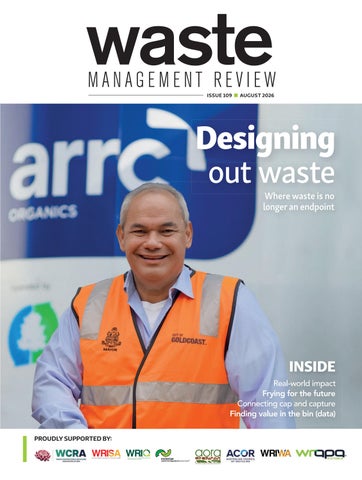
Designing out waste Where waste is no longer an endpoint
2026 | AUGUST | ISSUE 109
wastemanagementreview.com.au
INSIDE Real-world impact Frying for the future Connecting cap and capture Finding value in the bin (data) PROUDLY SUPPORTED BY:
PMS 380 PMS 376 PMS 355
WORKING TOGETHER WITH COUNCILS TO SUPPORT A SEAMLESS TRANSITION TO GLASS-OUT Regardless of what stage your municipality is at in the roll-out of the purple-lidded glass recycling bin, APR Kerbside has proven solutions and alternative options that can assist Councils whilst they prepare to make the switch. For Municipal Councils that have partnered with APR Kerbside in the Glass-out program, their recyclables are now being received with less than 1% glass. These remarkable results have directly contributed to reducing contamination levels and further diverting waste from landfill. Improving the separation of household recyclables and having no glass in the kerbside commingled stream has led to a significant improvement in the quality of all recyclables. Key learnings gained throughout the program well positions APR Kerbside to best support the needs of Municipal Councils who are preparing to implement glass out' of the commingled stream, transition smoothly and re-educate residents.
Such benefits include: Eliminate the issue of glass shards that get into all the other recyclables and resources such as paper, cardboard, plastic and aluminium Significantly recover more recyclable materials Reduce contamination levels and further divert waste from landfill Address and combat the limitations presented to approachable end market outlets for recyclable products due to glass shards Increase the value of recyclables and quality of end product
The value-added sorting facility site has the capability to process: Recyclables from Metropolitan Melbourne and Regional councils that have removed glass out of their yellow-lidded recycling bins Paper and Cardboard Plastics such as HDPE, PET, PP and Soft Plastics The APR team are strongly focused on circularity and working in collaboration with industry partners to explore and seize opportunities that will maximise resource recovery and further divert waste from landfill. After glass, soft plastics was identified as the biggest contaminant of kerbside, yellow-lidded bins in Victoria. As an innovative company, the APR Group continuously looks for different ways to achieve and support zero waste strategy goals and give the end user a quality material with minimal contaminants. APR Plastics has brought to market, an advanced recycling solution for the soft plastics stream with the Soft Plastics to Oil initiative. Robotics will also be utilised to pick off Tetra Pak cartons from the Kerbside MRF line for use in saveBOARD.
APR Kerbside Pty Ltd 9 Felstead Drive Truganina VIC 3029
1800 277 800 www.aprkerbside.com enquiry@aprkerbside.com.au
CONTENTS
COVER STORY
Designing out waste
6
43
A new system designed to reshape what comes next. ““It’s like a drought in reverse – instead of seeing dams dwindle, right now we’re watching landfills reach overflowing.”
Rewriting social license
Grant Gabriel, ARRC Chief Executive Officer
Features
11
START YOUR ENGINES
15
AUSTRALIAN GROWTH
16
SPREADING THE LOVE
18 20 23 26 28
Scania’s new family of truck engines and power components. JCB strengthens support for customers. New entry in the waste management market.
BUILT FOR LONG HAUL
Complete customer solutions.
THE SORTING ADVANTAGE
APR Recycling’s new facility.
FRYING FOR THE FUTURE
Adelaide Oval’s sustainable move.
LAW OF ATTRACTION
Magnets protecting recycling equipment.
CAP AND CAPTURE
A holistic approach to landfill capping.
Local voices leading the charge.
30 32 35 36 38 40 43 46
BALANCING ACT
Built to traverse uneven terrain.
NEW CHAPTER
EcoCycle Group assembles new leadership team.
HIDDEN GEMS
Preparing for solar waste.
DOING GOOD
Comic-book inspiration, realworld impact.
48 51 52 54
HIDDEN COSTS
Finding value in the bin (data).
WASTE AWARDS
Innovation front and centre.
WASTE EXPO
Building lasting partnerships.
AUSJET
Liquid waste rising.
THE RIGHT FIT
Mobile equipment keeps production flowing.
UNLOCKING METAL VALUE
Recovering more value from scrap.
REWRITING SOCIAL LICENSE
Local voices leading the charge.
GROUNDED IN REALITY
Tackling the sector’s toughest issues.
wastemanagementreview.com.au
3
Regulars
57
LAST WORD
Waste Management Review
FROM THE EDITOR
From waste to readiness
W
aste has long been spoken about as something to manage after the fact. Something collected, sorted, treated or buried once it has reached the end of its useful life. But the waste and recycling sector is no longer just responding to what arrives at the gate. It is designing systems that look further ahead – systems that recover more value, reduce risk, improve transparency and give operators greater control over increasingly complex material streams. That is clear in this edition’s cover story on ARRC Gold Coast, where waste is being treated not as an endpoint, but as part of a broader ecosystem. Organics, recovery, energy and community engagement are being brought together in a long-term model designed to reshape how a city thinks about what it throws away. It is also ref lected in stories about soft plastics, solar panels, metals and used cooking oil. These are waste streams that require investment, planning and the right technology before they can become reliable inputs for new products, fuels or materials. In each case, there’s opportunity in understanding the material, separating it properly and building the
CEO
infrastructure needed to keep it in use for longer. The same thinking applies at landfill. As regulatory expectations increase and methane emissions come under greater scrutiny, landfill capping and gas capture can no longer be treated as separate jobs. The best outcomes come when they are planned together from the start. Technology is another common thread. Artificial intelligence, optical sorting, magnetic separation, telematics, efficient engines and advanced processing lines all appear in this issue. It’s clear the sector is preparing for the challenges already arriving – more solar panels, more batteries, more organics, more complex plastics, and higher expectations from the communities it serves. Happy reading!
Christine Clancy christine.clancy@primecreative.com.au
PUBLISHER
Sarah Baker sarah.baker@primecreative.com.au
MANAGING EDITOR
Lisa Korycki lisa.korycki@primecreative.com.au
JOURNALIST
Sean Gustini sean.gustini@primecreative.com.au
HEAD OF DESIGN
Clayton Hawley clayton.hawley@primecreative.com.au
ART DIRECTOR/DESIGN
Daz Woolley, Laura Drinkwater
BRAND MANAGER
Chelsea Daniel chelsea.daniel@primecreative.com.au P: +61 425 699 878
CLIENT SUCCESS MANAGER
Ben Sammartino ben.sammartino@primecreative.com.au
HEAD OFFICE
Prime Creative Pty Ltd 379 Docklands Drive Docklands VIC 3008 Australia P: +61 3 9690 8766 info@primecreative.com.au www.wastemanagementreview.com.au
SUBSCRIPTIONS
Lisa Korycki, Managing Editor
+61 3 9690 8766 subscriptions@primecreative.com.au Waste Management Review is available by subscription from the publisher. The rights of refusal are reserved by the publisher
ARTICLES
All articles submitted for publication become the property of the publisher. The Editor reserves the right to adjust any article to conform with the magazine format.
COPYRIGHT
On the cover Tom Tate, City of Gold Coast Mayor and ARRC board chair. Image: ARRC
Waste Management Review
4
August 2026
Waste Management Review is owned by Prime Creative Media and published by John Murphy. All material in Waste Management Review is copyright and no part may be reproduced or copied in any form or by any means (graphic, electronic or mechanical including information and retrieval systems) without written permission of the publisher. The Editor welcomes contributions but reserves the right to accept or reject any material. While every effort has been made to ensure the accuracy of information, Prime Creative Media will not accept responsibility for errors or omissions or for any consequences arising from reliance on information published. The opinions expressed in Waste Management Review are not necessarily the opinions of, or endorsed by the publisher unless otherwise stated.
ON THE COVER
Designing out waste On the Gold Coast, waste is no longer an endpoint, but part of a system designed to reshape what comes next.
T
ucked away in an industrial estate at the northern end of the Gold Coast, a rubbish revolution is quietly gaining momentum. It’s reshaping not only how the city manages its waste, but how local residents think about what they throw away. If it succeeds, it will provide a blueprint for cities across Australia – and potentially around the world – to better manage the mountains of waste modern life generates. Trucks arrive carrying material that, until recently, would have gone straight to landfill. ink lawn clippings, leaf litter, palm fronds. Inside a controlled system of tunnels, microbiology and time begin to transform what households and businesses have discarded. e process is technical, careful and exacting. Its success, however, depends just as much on people as it does on engineering. is work sits within what will become the Advanced Resource Recovery Centre (ARRC) – a planned precinct designed to rethink how an entire city manages waste. What is emerging through ARRC and its first operational arm, ARRC Organics, is a shi in how a city understands what waste is, where it goes, and what it can become.
Backed by the City of Gold Coast and Mayor Tom Tate (who now also chairs the ARRC board), the $1.6 billion project is designed to bring the full waste hierarchy into a single, cohesive ecosystem. Rather than relying on a single facility, the model brings together multiple technologies, each targeting a different part of the waste stream. Different materials, once treated separately or discarded entirely, are instead processed as part of an interconnected system with material recovery, energy generation and organics working in parallel. At the centre of that system is ARRC Organics at Yatala, an operational facility already reframing what “waste management” looks like in Queensland.
Waste Management Review
Since joining as Head of Assets at ARRC Gold Coast earlier this year, Sarah Collins has seen the impact of this infrastructure firsthand. “Working at a universal composting facility like ARRC Organics is amazing because it is the first in Queensland to feature an operational tunnel composting setup,” Sarah says. “While much of the existing technology in Queensland relies on windrow composting, the ARRC Organics process uses invessel composting. is tunnel composting setup allows for complete environmental control over the maturation of the green and food organics we collect.
ARRC Organics has purchased specialised machinery for the compost process. Images: ARRC Gold Coast
6
August 2026
“We introduce microbiomes within the tunnels to help break down these organic materials and support the pasteurisation process during the first 14 days, before the material is transferred out into windrows for the remainder of the process.” at first stage – 10-14 days in a sealed, managed system – changes the timeline and the outcome. It reduces variability, accelerates breakdown and produces a more consistent input for the rest of the composting cycle. “ ere’s absolutely a benefit in making the process more efficient and significantly quicker,” Sarah says. “It also has an environmental benefit when you compare it to landfilling those green organic materials. You’re saving more than 50 per cent of the carbon dioxide that would be produced in landfilling that same material. “By using in-vessel composting, you contain potential noxious odours from entering the surrounding community, control temperature and moisture, and that is what helps break down the material more quickly.” Odour control is also central to how waste infrastructure coexists with the community around it. Sarah says that in facilities like this, technical design decisions o en double as social ones. e process, however controlled, is only part of the outcome. What matters just as much is what comes out the other side. “ ere’s three main product streams – soils, mulches and composts,” Sarah says. “You can take a compost product and mix it with other soil bases to create a variety of soil conditioning products used in landscaping, development or gardens. “We’re able to create different grades of product by processing and screening material at different stages. By having good quality product at the front end, you get a better-quality product at the back end.” at quality still depends heavily on behaviour outside the facility. Contamination, says Sarah, is one of the biggest issues in green waste and food organics garden organics (FOGO) collections. “O en, it’s because people just don’t know what they should be putting in their bins. We’re seeing things like plastic as a really big issue, sometimes metals, and
ARRC Gold Coast has engaged directly with a community reference group since the project’s beginning.
packaging o en confuses people. Paper in particular – people think it came from trees so it must be okay, but it has glues and resins that can cause problems. “We try to remove contamination as early as possible, both manually and mechanically, because the further it goes through the process, the harder it is to remove.” at interaction between household behaviour and industrial outcome is built into the logic of the broader precinct strategy. ARRC Organics may be the first operational asset, but it is part of a much larger system now taking shape. Grant Gabriel, ARRC Chief Executive Officer, frames it as both urgency and opportunity. “We deliberately put effort into explaining to the community what we’re doing and why we’re doing it, particularly the ‘why’,” Grant says. “ e uncomfortable truth is Australia has become exceedingly reliant on landfill. It’s like a drought in reverse – instead of seeing dams dwindle, right now we’re watching landfills reach overflowing. “If we don’t intervene early, we’re going to get to the point where we have to go find a different hole in the ground further away, and that leads to transport issues, costs, and poor environmental outcomes. “ e Gold Coast recognised that a single facility would fail, and that we needed a full ecosystem working together, targeting different parts of the waste sector.”
wastemanagementreview.com.au
7
at ecosystem moves beyond single solutions and instead layers multiple processes, each responding to a different waste type. Organics is the logical starting point. “When it comes to landfill diversion, organic waste and eventually food waste is a huge part of meeting national diversion targets moving forward,” Sarah says. “ ere is a huge percentage of green waste and food waste that remains in pretty much every red bin that, if you divert into a facility like ARRC Organics, would get us a lot closer to those targets. “And we’re not just diverting – we’re creating a product that goes back into gardens, parks and the local environment instead of being lost as waste.” e National Waste Policy Action Plan aims to achieve an average resource recovery rate of 80 per cent from all waste streams and halve the amount of organic waste sent to landfill by 2030. In Queensland, the Less Landfill, More Recycling 2035 plan aims to achieve an overall 65 per cent recycling rate and reduce waste sent to landfill by 2.6 million tonnes by 2035. ARRC Organics is already having an impact. e facility processes about 50,000 tonnes of organic waste a year, alongside liquid food waste that supports the composting process. Planned growth could double that. e longer-term ambition is to divert the vast majority of household waste away from landfill altogether.
Waste Management Review
ON THE COVER
To help ARRC realise this vision, the Queensland Government recently awarded an $8.6 million grant to the Gold Coast-based operator which will assist to significantly ramp up capacity. “We’re looking to double the capacity of the plant over the next few years, which would double the workforce,” Sarah says. “Whenever we increase what comes through the gate, that increases the number of staff we have. You grow as the material grows. We’re pushing forward with growing this facility on a constant basis, and we’re adding staff regularly.” But infrastructure alone is not enough. e precinct’s success relies on sustained community engagement and a growing understanding of waste as a shared responsibility. “People genuinely want to do the right thing, but there’s still that misunderstanding as to how they do it,” Sarah says. “We’re running workshops with universities and schools, and we’re finding that most people approach us with genuine curiosity. “Once they understand what’s happening, it becomes a no brainer. We’ve had strong support, and the level of engagement from the community has been incredibly high.”
Grant Gabriel, ARRC Chief Executive Officer, leads a site tour.
Grant says that engagement is not optional. “ e focus for me with social licence is you lose it very quickly and it takes a long time to build,” he says. “We’ve invested in that engagement, that education and that connection with the community, and it’s ongoing. What the city is trying to do here is really change people’s relationship with waste. “We have to start local, and we have to bring the community with us.” He says that relationship shi is what elevates the ARRC precinct beyond individual facilities to a model that links behaviour, infrastructure and longterm planning.
Grant Gabriel, ARRC Chief Executive Officer.
e vision extends well past what is currently visible on site. “ e idea that we want people in Europe jumping on a plane and coming here to see what we’re doing is one of our guiding principles,” Grant says. “Are they doing it today? No, it’s a big paddock full of trees. “But the way we’re planning, the way we’re working with the city and with industry to build out this system – that’s the journey we’re on. We’re looking at a 10-to-15-year horizon, and we’re not just solving today’s problems. We’re building something that can respond to tomorrow’s challenges as well.” In that sense, the transformation happening on the Gold Coast is both immediate and long-term. It is visible in the daily operation of a composting tunnel, and in the slower shi in how people think about what they throw away. Inside the facility, the process continues with precision. Outside it, the conversation continues to evolve. For Sarah, the connection between the two is clear. “We’re working towards a scenario where we can send a lot of what’s in the red bin now towards organics facilities like ARRC Organics, increase recycling, and eventually look at other technologies as well,” she says. “To divert up to 97 per cent of what’s in that red bin away from landfill altogether – that’s really exciting. I find that really heartening moving forward, and that’s part of why I was so excited to join ARRC.” WMR For more information, visit: www.arccgoldcoast.com
Waste Management Review
8
August 2026
VERTECH SORTING SOLUTIONS MOBILE AND FIXED SYSTEMS DESIGNED FOR AUSTRALIAN CONDITIONS
MOBILE PICKING STATIONS
The Vertech Sorting Range delivers flexible, high-performance recovery across a wide range of waste streams. Available in mobile and fixed configurations, systems are designed for everything from
temporary and regional operations to permanent facilities and largescale processing plants. Built for Australian conditions, the range features enclosed cabins, wide picking belts and integrated separation for safe, efficient recovery.
Contact us today on 1800 673 002 or info@wasteinitiatives.com
Discover more at wasteinitiatives.com.au
TRACKED TROMMEL SCREENS
STATIC SORTING SYSTEMS
Mobile units offer fast setup and easy relocation, while fixed systems provide scalable, longterm processing with customised integration.
Sorting Components Available • • •
Mobile Picking Stations Fixed Picking Stations Trommels & Scalping Screens
Recover valuable commodities, reduce landfill volumes and
• • •
Eddy Current Separators Air Separation Systems Conveyors & Feed Systems
improve downstream performance across C&D, C&I, FOGO and commingled waste streams. Backed by local engineering, project management and nationwide service support.
•
•
Overbelt Magnets
Custom Sorting Solutions
WASTE COLLECTION AND TRANSPORT
Start your engines Scania’s new family of truck engines and power components brings benefits to waste operators looking for high-performance with reduced environmental impact.
S
cania has provided waste management industries around the world with heavy-duty commercial vehicle solutions for more than 60 years. ese solutions reflect the industries’ needs which, like many other sectors, evolve with economic conditions, environmental concerns, and other factors. Amid such change, Australian waste operators have looked to Scania for new equipment. Benjamin Nye, Director of Truck Sales at Scania Australia, says waste company executives are focused on fuel burn costs like never before. In response, Scania has developed the new Super 11-litre five-cylinder engine family, designed to increase efficiency and reduce carbon emissions while remaining cost-effective.
Much of this efficiency is achieved through the engine family’s choice of three power outputs – 350 horsepower (hp), 390hp, and 430hp – all of which offer a seven per cent fuel burn reduction, compared to Scania’s previous nine-litre five-cylinder engines. e engine family is compact, lightweight, and delivers high torque – a twisting force generated to help a truck move or carry heavy loads of waste. e new 350hp engine produces 1800 Newtonmetres (Nm) of torque from as low as 950 revolutions per minute. e 390hp engine and 430hp engine deliver 2000 Nm and 2200 Nm, respectively. Scania’s patented turbo dosing also ensures the efficient use of AdBlue – a diesel exhaust fluid – within the engines and enables them to emit cleaner exhaust
gases, feeding urea into the exhaust system before and a er the turbocharger. e engine family has also been built to support Scania’s new 14-speed manual Opticruise gearbox with a wide spread of ratios and new robust axles. is gives greater control in tight and challenging access points. Other features include Scania’s own cam phaser technology for variable valve timing, enabling real-time engine thermal management and improved combustion performance. is is paired with new engine so ware and balance sha s for reduced vibration and a robust engine brake, which offers up to 344 kilowatts of power through Scania’s innovative Variable Valve Brake system. Benjamin says these combined factors allow the Super 11-litre engines to deliver
The Super 11-litre five-cylinder engine family allows greater payload for operators. Images: Scania Australia
wastemanagementreview.com.au
11
Waste Management Review
WASTE COLLECTION AND TRANSPORT
Scania’s waste management trucks are complemented by the full suite of Scania Advanced Driver Assistance Systems.
Scania’s new Super 11-litre engine family has been designed to increase efficiency and reduce carbon emissions.
increased productivity, as well as smooth and comfortable driving experiences. “You can have the efficiency of our 14-Speed Opticruise with the ability to approach bins at a crawling pace,” he says. “We have excellent manoeuvrability for picking up bins in tight spaces. “Many customers have found the fuel consumption achieved with this gearbox is superior to that of their older trucks. However, we will continue to offer the Allison six-speed as an option.” Scania’s Super 11-litre engine family has also been manufactured with environmental impact in mind. e engines are both frugal on diesel and compatible with Hydrotreated Vegetable
Oil, while also supporting B100 biodiesel. Benjamin says that running the 390hp and 430hp engines with these fuel sources leads to an 85 per cent carbon emissions, reduction depending on operating conditions. e engines have also been designed to have a 25 per cent longer working life than Scania’s nine-litre engines, and are expected to clock up two million kilometres subject to applications. Maintenance intervals are up to 30 per cent longer than previous iterations, which increases uptime and reduces overall servicing costs. “ is new engine family allows greater payload for operators with lower operating
Waste Management Review
12
August 2026
costs, leading to greater operational profitability,” Benjamin says. “For fleets with significant numbers of vehicles on the road all day, every day, these savings will make their presence felt in the profit and loss reports.” Scania’s five-cylinder engine is commonly included in its P-series waste collection trucks, which are built for driver safety and comfort. “We see our low-entry cabin as providing Occupational Health and Safety benefits,” Benjamin says. “With only two steps up into the cabin, I believe we are the last of the two-step entry trucks available. And we’re one of the last trucks to be comfortably made with a front li , having the bin li ing tines park above the windscreen so they don’t obstruct the driver’s vision. “ e low cab position doesn’t cause over-height issues either, and our low dashboard enhances the driver’s vision from behind the wheel, while the driver’s seat is positioned forward and close to the door to give excellent visibility.” Benjamin explains that Scania’s trucks are complemented by the full suite of Scania Advanced Driver Assistance Systems – including Advanced Emergency Braking with pedestrian collision warnings. Moreover, Scania’s tailored solution concept allows operators to personalise the configuration of their vehicle, selecting engine, gearbox and axle specification, along with air suspension in the Scania built-in weighing system. e air suspension gives operators the ability to raise and lower the truck, which can be advantageous for accessing sites with awkward entry points. “We can elevate the chassis for greater ground clearance, or we can lower it to get into a tight spot to pick up a bin in an urban area or a car park,” Benjamin says. “Of course, air suspension also offers a magic carpet ride. We’ve had many people comment that they’ve never driven a more relaxing twin-steer.” e new engine family is touring Australia as part of the Scania Super 11 Roadshow. WMR For more information, visit www.scania.com
HMMM
XLFRY
WASTE COLLECTION AND TRANSPORT
JCB backs Australian growth
The showroom floor at the new JCB flagship dealership. Image: Prime Creative Media
A new flagship JCB dealership in Victoria marks a milestone for the company and strengthens support for customers in Australia.
J
CB is ramping up its national presence, backing its commitment to Australian customers with new investments in both metropolitan hubs and regional operations. As one of the world’s largest privately owned equipment manufacturers, JCB produces more than 300 products across more than 20 categories. Today, the company’s product lineup is larger than at any point in its 80-year history. is expanded range offers growth opportunities across key sectors, including backhoe loaders, telescopic handlers, excavators, wheeled loaders, and compaction equipment. New machinery, such as the Fastrac 6000 Series tractor, is also preparing to enter the market. To bring this expanding range closer to buyers, JCB has taken direct control of importation in Australia, shortening the supply chain from the factory straight to the customer. A central part of this national momentum is the opening of a purpose-built Adaptali JCB facility in Truganina, Victoria. e site recently welcomed its first customers, industry leaders, and partners to experience the latest machinery and connect with product specialists.
Adaptali has created the model dealership to showcase the growing JCB range and customer support across several rural, regional and metropolitan areas of key states and territories. George Bamford, JCB’s Deputy Chairman, says Australia remains one of the company’s most important global markets across construction and agriculture. “JCB is a family business, and we really want to give our customers the best and finest support, and we have that with Adaptali , which is also a family business,” George says. “ is next chapter is going to be really exciting for JCB, Adaptali JCB and our regional dealership network. I’m really pleased about where we’re going in Australia.” at commitment extends well beyond major cities. Alongside the metropolitan expansion, JCB recently gathered regional dealers from across the country in Sydney for its regional dealer conference. e event launched a strategy designed to support all 20 regional dealerships across Australia and get the brand closer to end-users. Speaking at the conference, Managing Director for JCB Agriculture, John Smith
wastemanagementreview.com.au
15
said the opportunities for the JCB brand in both agriculture and construction across Australia are vast. “JCB is well established in agricultural materials handling, and many Australian customers are already operating JCB telescopic handlers and wheeled loaders. With Adaptali JCB coming on board now alongside our 20 regional dealerships, many customers will come to experience the JCB difference on our products and industry-leading service support,” John said. “Our new Fastrac 6000 Series tractor is about to be launched in Australia, and it will shortly take the industry by storm. We’re excited for what lies ahead.” JCB’s executive leadership remains focused on long-term acceleration and unlocking fresh opportunities across the entire Australian footprint. Reflecting on the company’s national direction, JCB Chief Executive Officer Graeme Macdonald says: “With the opening of Adaptali JCB, we’re now moving at pace to grow our presence in Australia and unlock many new opportunities.” WMR For more information, visit: www.jcb.com
Waste Management Review
WASTE COLLECTION AND TRANSPORT
Spreading the love Brett Styles is spearheading CustomQuip’s distribution of JOST and HYVA waste management equipment in Western Australia.
W
estern Australia’s Waste Avoidance and Resource Recovery Strategy 2030 outlines the state’s plan to build a sustainable and lowwaste circular economy. e framework encourages environmental protection and resource recovery while discouraging waste generation across local communities and private industries. Brett Styles, Sales and Technical Manager at local Original Equipment Manufacturer (OEM) and distributor CustomQuip, says the strategy’s implementation has created new demand for waste management product. “ e government is strongly pushing for the adoption of sustainable operations and more recycling,” he says. “Shires and companies are having to comply with new waste management standards, and the shires who go above and beyond are getting more funding.” In response, CustomQuip has recently entered the waste management market with the acquisition of PNG Transport –
previously the official state distributor of hookloaders, skiploaders, skip bins, and other waste management equipment made by JOST and HYVA – and recruiting Brett to the team. “More than two decades ago, I ran a company that was the main HYVA distributor in Western Australia before the acquisition of HYVA by JOST,” Brett says. “We handled all their products until they brought in more and then split the distributorship between other companies. at’s when PNG got the rights to the hookloaders and skiploaders. “Since CustomQuip bought PNG and hired me, I’m back with all these products. Waste management is now one of CustomQuip’s main focuses and I’m here to direct this expansion.” CustomQuip is renowned for designing and building heavy road transport and agricultural equipment. e transition into waste management is a strong fit, and the company is excited to bolster the brand.
Hyva’s 8x4 twin-steer models are among the most popular choices in the market. Image: CustomQuip
Waste Management Review
16
August 2026
“As our waste management strategy continues to evolve, so too will our vehicle range. However, our focus remains on a core lineup of three to four base models,” says Brett. “ is approach aligns with the direction the Australian market is taking and allows us to provide proven, reliable solutions while maintaining consistency across our product range. “ e 8x4 twin-steer models are currently the most popular choice in the market. Our hookloaders are equally capable, but the right model ultimately depends on the customer’s application and range requirements. “We offer solutions from 8-tonne units right through to 28-tonne models, ensuring we can meet the needs of a wide variety of operators.” CustomQuip’s distribution network is supported by a wide range of spare parts and replacements, making serviceability easier for waste managers across Western Australia.
Brett Styles, Sales and Technical Manager, CustomQuip
centres quite comfortably,” he says. “Waste management operations, especially over distances such as these, can be tough on the gear.” Because of this, Brett emphasises the importance of pairing the right operator with the right equipment. He believes this personal attention is one of the reasons customers are welcoming CustomQuip’s presence in the waste management sector.
“HYVA is extremely focused on quality and customer satisfaction, that mantra aligns with CustomQuip’s customerfirst mentality. “ ey understand what the waste market requires. We will continue to distribute the HYVA products and watch the industry grow in Western Australia.” WMR For more information, visit: www.jostaustralia.com.au
We ’ ve been in your shoes..
That’s why our advice works - it’s practical, regional & real.
GATEHOUSE SUPPORT | REMOTE ADMINISTRATION | WASTE LEVY
“A real strength of HYVA is that it keeps a lot of parts on the shelf for us, along with a range of upgrade options like remote controls, pneumatic latch and tarp systems,” Brett says. “And they offer backup services, too, because the reality of this industry is that things break. We can get replacement parts to operators if needed, meaning we can help get their operations back on the road and reduce operational downtime.” Brett’s waste management acumen is also key to CustomQuip’s distribution strategy. He knows the products’ strengths and limits, which is imperative in a unique market such as Western Australia. “Our market has one key difference which separates it from those of the eastern states, Western Australia is very spread out. Here, we’ll have guys do 200 or 300 kilometres a day to landfills and recycling
“Waste management is now one of CustomQuip’s main focuses and I’m here to direct this expansion.”
CITY-BASED, REGION-BRED. DELIVERING REAL RESULTS ACROSS AUSTRALIA.
WASTE COLLECTION AND TRANSPORT
The BOB Italev hooklift range has been designed for Australian conditions. Image: Easyquip
Built for the long haul Easyquip builds complete customer solutions.
A
s Australian manufacturer Easyquip continues to expand its waste handling equipment division, the company is strengthening both its in-house capabilities and its national support network as it grows the Australian presence of BOB Italev hookloaders. Easyquip now offers customers a complete in-house solution, from equipment specification and installation through to commissioning, servicing and ongoing technical support. Backed by more than 35 years of experience supplying equipment to the Australian waste industry, the company understands that selecting the right equipment is only the beginning. Jack Hocking, who leads Easyquip’s truck-mounted equipment expansion, says customers are increasingly looking for a supplier that can support them throughout the entire life of their equipment. “Anyone can supply a machine, but customers want confidence they’ll have support long a er delivery,” Jack says. “We
can specify the right equipment for the application, complete the installation inhouse, provide technical advice and service the equipment throughout its life.” To support its growing customer base, Easyquip has expanded its spare parts holdings in Australia and increased warehouse capacity in both Queensland and Victoria. Jack says that holding genuine BOB Italev parts locally helps minimise downtime and reduces reliance on overseas shipments, allowing customers to get back to work sooner. While Easyquip carries out equipment installations and servicing from its own facilities, the company is also continuing to grow a network of authorised dealers and service partners across Australia. is ensures customers in regional areas have access to qualified local support for servicing, repairs and installations where required. “Our aim is to provide the best of both worlds,” Jack says. “Customers have the confidence of dealing directly with
Waste Management Review
18
August 2026
the Australian importer and product specialists, while also having access to trusted local service partners when they’re operating further afield.” Easyquip’s in-house technical capability also allows the company to work closely with customers and body builders to ensure each unit is correctly specified and installed for its intended application. Combined with local parts availability and nationwide service support, the company aims to provide a complete ownership experience rather than simply supplying equipment. As the BOB Italev range continues to grow in Australia, Jack believes a combination of product knowledge, in-house capability, genuine spare parts and a developing national dealer network will provide customers with the longterm support they expect from their equipment supplier. WMR For more information, visit www.easyquip.com.au
AI VISION INTELLIGENCE FOR MATERIAL RECOVERY
VISION
OS
·
SEE
WHERE
VALUE
IS
LOST
materials-intelligence.oscorpenergy.com.au
MATERIALS INTELLIGENCE — LIVE MATERIAL FLOW
LIVE
CENTRAL PORTAL
E
ani@oscorpenergy.com.au P
W
0452 561 726
www.oscorpenergy.com.au
RECYCLING
The sorting advantage APR Recycling’s new facility is playing a much larger role in shaping what comes next for recycling in Australia. The sorting facility at APR Recycling’s Dandenong site is designed to take the guesswork out of recycling. Images: APR Recycling
T
he sorting facility at APR Recycling’s Dandenong site was never intended to carry so much weight, so early in the project. It was originally a supporting step – preparing feedstock ahead of a plastics-tooil pyrolysis plant designed to convert so plastics into reusable fuel. However, it has quickly become the immediate focus for the Victorian-based resource recovery company as it pushes ahead with building a new recycling system in Australia. APR Managing Director Darren orpe is direct about why the sorting facility is now central to the operation. “It’s one of the major learnings from our pilot pyrolysis plant,” he says. “ ere are so many different types of polymers, and not everyone – even experts – can identify them by sight or feel. “ at creates risk. If you’re relying on incoming material already being sorted correctly, you can’t guarantee a safe process.” Some of those risks are highly technical. PET (polyethylene terephthalate), for example, cannot enter the reactor. “If you put PET into a 500-degree chamber, it’s going to combust,” Darren
says. “Other materials, such as PVC (polyvinyl chloride), present different challenges. It contains chloride, and under heat, it corrodes. “ ese are all learning curves we’ve worked through. at’s why the sorting step is critical. “If you’re relying on incoming material to already be right, you’re taking a risk. We’ve learned you have to control that yourself.” e multi-million-dollar facility is designed to take the guesswork out of recycling. It uses debagging systems, magnets, shredders and optical sorters to A model of APR Recycling’s film sorting plant.
Waste Management Review
20
August 2026
isolate the specific polyolefins required for chemical recycling. e system is operational but still being refined. Artificial intelligence (AI) tools are being trained to better identify polymer types and colours, while equipment suppliers work alongside APR to fine-tune performance and improve accuracy. “AI is where the industry is heading, but it takes time,” Darren says. “You have to train the system to do what it’s supposed to do. We’ve got the manufacturer working with us to train the AI – teaching it what to look for in both polymer type and colour, so it rejects poor material and keeps the best.”
2 SHOWS UNDER ONE ROOF
Incoming material is mixed and highly variable. A debagging shredder opens it up, followed by a wind si er that separates light and heavy fractions. From there, material is metered through a buffer system before reaching the optical sorters, where sensors and cameras identify composition and colour. roughput, however, is tightly controlled. “ e sorting facility can only process about one tonne an hour at the segregation stage,” Darren says. “So, we have to meter the flow to match that and maintain quality. If you push too much or the wrong type of material through, you get the wrong outcome. “It’s not just a matter of turning it on. You have to control what goes in, otherwise you compromise what comes out.” While the pyrolysis plant – designed to chemically process harder-to-recycle plastics – is still being rolled out, the sorting facility is already supplying material to traditional mechanical recycling, keeping the site active. “Because we’re not sending material through the full process yet, we’ve adapted so the sorting line can supply mechanical recyclers as well,” Darren says. “It allows us to keep refining the system.” e sorting facility is both a filter and a foundation – removing problematic materials, improving feedstock quality and establishing operational stability before higher-temperature processing is scaled. By October, phase two will add additional optical sorters and li capacity to about three tonnes an hour. Darren says those volumes are important. e better and more consistent the material going in, the better everything works downstream, and the easier it is to scale up. And when it comes to scale, he has ambitious plans – a seven- to ten-year rollout that will see APR establish processing infrastructure across every major state and territory. His focus remains firmly on the “circular outcome”, ensuring that 175,000 tonnes of so plastics nationwide are eventually processed through pyrolysis each year, helping close the loop. “We’re very excited to be at the forefront of this, and we want to see it all the way through,” Darren says. “Someone has to go first. You learn as you go, and you keep improving.” WMR is project is supported by the Victorian Circular Economy Recycling Modernisation Fund. e Fund is delivered by the Victorian Government under its circular economy plan, Recycling Victoria: a new economy, and the Australian Government’s Recycling Modernisation Fund. For more information, visit: www.aprrecycling.com.au
OCTOBER 28 – 29, 2026 Sydney Showground
Discover the Technology. Meet the Experts. Shape the Future. Australia’s only dedicated liquid and environmental waste exhibition, bringing together the wastewater, drainage and environmental services sectors.
What You’ll See • Connect with industry leaders, suppliers and operators. • Access expert insights at the Education Hub. • Explore innovations.
See Technology in Action! | Vacuum Trucks | Water Jetting | Drones | Pumps | CCTV & Robotics | Pipe Rehabilitation | Safety & Environmental Technology | Wastewater Technology
TWO INDUSTRY-LEADING EXHIBITIONS. ONE REGISTRATION. FREE TO ATTEND. IN CONJUNCTION WITH
REGISTER HERE Educational Hub Sponsor
LEW Support and Endorsement
BC773RB-5
Built for Maximum Landfill Performance
Provided by Tutt Bryant Equipment, the BOMAG BC773RB-5 is designed to deliver outstanding landfill compaction performance while keeping operating costs under control. Its powerful diesel engine provides the traction and compaction force needed for demanding waste applications, while fuel-efficient operation and a low-maintenance design help maximise productivity and uptime. With easy service access and proven versatility across a wide range of landfill environments, the BC773RB-5 is built to perform where it matters most.
Brisbane | Sydney | Melbourne Adelaide | Perth tuttbryant.com.au
Waste Management Review - 2026 July.indd 1
Follow us on:
1300 658 888
24/06/2026 10:14:39 AM
14:39 AM
RECYCLING
Frying for the future How Adelaide Oval is leading in sustainable waste management.
A
delaide Oval is renowned for hosting world-class sporting events and large-scale entertainment, regularly attracting thousands of visitors. Behind the scenes, the venue is also making strides in sustainability, particularly in how it manages one of its most valued kitchen ingredients: cooking oil. Adelaide Oval has transformed its waste oil management process, reducing environmental impact, cutting costs, and supporting its broader sustainability goals, all with innovative solutions from Cookers.
MANAGING LARGE VENUE WASTE
Managing fryers and waste oil is a complex task at a busy venue such as Adelaide Oval. With numerous food outlets serving tens of thousands of spectators, the volume of oil used – and subsequently discarded – is substantial. Chef Philip Pope says the venue has many fryers that require fresh oil weekly. “Managing that used oil was a logistical challenge, costly and environmentally concerning,” he says. Initially, the venue relied on traditional oil tins and drums to dispose of used oil. is resulted
Daniel Pudney, Cookers Business Development Manager, and chef Philip Pope at Adelaide Oval. Images: Cookers
in thousands of containers ending up in landfills, contributing to environmental degradation. Philip says the collection and disposal process was time-consuming and expensive and did little to align with the venue’s sustainability commitments.
PARTNERING WITH COOKERS
Adelaide Oval partnered with Cookers, a company specialising in responsible waste oil management and closed-loop oil solutions. e partnership introduced a comprehensive system that streamlined oil handling and reduced waste. Key to the system was the installation of an on-site fresh oil filling station, as well as used oil storage tanks. “ anks to Cookers, we’ve removed more than 30,000 drums of oil from landfills in the past decade,” Philip says. “ is is a major step forward in our environmental efforts.” At the core of the system is Cookers’ XLFRY product, which extends the life of frying oil while maintaining food quality and consistency. is innovation reduces the frequency of oil changes, thereby decreasing waste and operational costs. “ e XLFRY is exceptional,” says Philip. “We don’t need to change the oil as o en, and the quality remains excellent.”
SMALL DROP, BIG CHANGE
Hari Srinivas, Cookers National Quality and Safety Manager, says Adelaide Oval’s commitment to sustainability aligns directly with Cookers’ mission to provide environmentally responsible waste management solutions. By adopting on-site oil management systems, the venue minimises its waste footprint while optimising operational efficiency. “Eliminating traditional oil tins and packaging also saves money, as there’s no need to store, transport, or dispose of bulky containers,” Hari says. “Furthermore, because no residual oil remains in the packaging, all used oil can be directed into specialised streams for recycling, meaning nothing goes to waste.
wastemanagementreview.com.au
23
Waste Management Review
RECYCLING
Adelaide Oval chef Philip Pope says the partnership with Cookers has removed more than 30,000 drums of oil from landfills in the past decade.
“Once oil contaminates packaging, recycling becomes impossible. e tiny amount of residual oil in containers makes the entire item non-recyclable.”
FROM WASTE TO RESOURCE
Used cooking oil collected by Cookers is processed into various valuable products, including biofuel (a renewable energy source for transportation and industry), stock feed, chemicals used in manufacturing industrial products, road materials and plastics used to produce packaging and other items. Hari says this multi-stream recycling process exemplifies the circular economy, transforming used cooking oil into valuable resources and reducing reliance on raw materials.
CERTIFIED TO BE THE BEST
Cookers’ commitment to responsible waste management is reinforced by several industry certifications and memberships. These include SQF (Safe Quality Food), ISCC (International Sustainability & Carbon Certification) Cookers’ Daniel Pudney, chef Philip Pope and driver Peter Georgaras.
for responsible sourcing and sustainable practices in biofuel and chemical production, and CORSIA (Carbon Offsetting and Reduction Scheme for International Aviation). Cookers is also a member of the Australian Renderers Association, which supports sustainable rendering practices. Hari says sustainability and safety are integral to every process at Cookers. Certifications ref lect the company’s commitment to high standards and responsible operations, building confidence with clients. “Certifications verify adherence to strict standards across food safety, environmental responsibility, and resource management while the company’s approach ensures that used oil is recovered, recycled, and repurposed in ways that benefit both industry and the environment,” he says. He says Adelaide Oval’s partnership with Cookers demonstrates that large venues can effectively manage used oil in a sustainable manner. “This partnership highlights an important lesson: small adjustments in waste management practices can have a big impact,” Hari says. “It shows that sustainability and hospitality go hand-in-hand. Through innovative solutions and responsible practices, venues can reduce their environmental footprint while maintaining operational excellence.” WMR For more information, visit: www.cookers.com.au
Waste Management Review
24
August 2026
From waste to worth ARRC Organics is the only in-vessel FOGO (Food Organics Green Organics) processing facility in South East Queensland and marks the first operational element of the Advanced Resource Recovery Centre. ARRC GOLD COAST CEO, GRANT GABRIEL
ˮ Owned by the City of Gold Coast, ARRC Organics is part of the Advanced Resource Recovery Centre (ARRC) Gold Coast, delivering reliable, large-scale organics processing for South East Queensland. Based in Yatala, ARRC Organics accepts a broad range of liquid and solid organic waste streams and transforms them into high-quality composts, mulches and soil products – diverting material from landfill and returning value to the community. For enquiries Email arrc@arrcgoldcoast.com or visit arrcgoldcoast.com
RECYCLING
Law of attraction Eriez’s suspended permanent magnets protect recycling equipment against ferrous materials in waste streams.
M
aterials Recovery Facilities (MRFs) process mixed waste from households and businesses, containing a wide range of materials. Among these are ferrous materials – iron-based items that can pose serious risks to recycling equipment if not effectively managed. Jonathan Schulberg, Heavy Industry Business Development Manager at global recycling equipment manufacturer Eriez, says these materials are strong and dense, and can be damaging to waste processing equipment. “MRFs deal with general ferrous waste all the time – items such as pet food tins, tin lids, knives and forks,” he says. “If even one piece of processing equipment goes down because it’s been cut by a ferrous material, recyclers experience a major productivity loss. “ e waste they process keeps coming, but they are less equipped to deal with it. e downtime and resulting pileup, especially over a few days, can be catastrophic.” Eriez has been helping waste operators mitigate this risk for decades through its suspended permanent magnets. ese magnets are assembled and housed inside stainless-steel enclosures, or ‘boxes’, which are mounted over MRF conveyor belts. From there, they create a continuous magnetic field that pulls ferrous materials out and up, removing them from the waste stream before they can damage equipment. “Permanent magnets are used in low- to medium-duty applications,” Jonathan says. “ is means a low or medium material burden depth – or thickness – of a waste stream is present, which would flow on conveyor belts that aren’t overly wide. In most cases, suspended permanent magnets are quite light, so don’t require as much infrastructure. “ ey are also power efficient, as the only thing that needs to be powered is the conveyor belt it hangs above.”
Eriez offers suspended permanent magnets in various models, strengths, and suspension heights. e company’s CP series has a centre pole magnet and can be used in a MRF, as well as mobile crusher, screener, picking belt, and quarry applications. e TP series is built with a twin pole for waste wood, mobile shredder, picking belt and tyre recycling. Both models are available in manualcleaning and self-cleaning options – meaning the magnet boxes are built with a stripper plate to remove ferrous material a er capture, or with a heavy-duty vulcanised belt and pulley which discharges iron parts from the magnet.
The magnets are effective when placed above the discharge trajectory of a waste conveyor belt’s head pulley. Images: Eriez
Waste Management Review
26
August 2026
Jonathan says the magnets are most effective at recovering ferrous materials when positioned directly over the discharge trajectory of the conveyor belt’s head pulley – known as ‘Position One’. “Like any tool, these permanent magnets yield the best results if used properly,” he says. “Position One is the best spot because it allows operators to get the magnet close to the ferrous materials as they are leaving the conveyor belt. “ e magnetic field used to take the material out and up is being assisted by the waste’s momentum as it is being discharged, so it avoids getting caught in downstream equipment.”
While the magnet’s primary role is to protect material sorting machinery, its recovery of ferrous materials also provides extra value to operators, as the recovered commodities can be sold or repurposed. Jonathan says the magnets’ protection and resource recovery capabilities, as well as their relatively compact size and affordability, make them ideal for smaller material recovery operators. “ e permanent magnet is like an operator’s first stepping stone into magnetic separation equipment,” he says. “Rather than spending upwards of $50,000 on an electromagnet, operators can spend half of that on a permanent magnet and begin to see the benefits to equipment maintenance and waste sorting efficiency.
The magnets are compact and cost-effective, making them well-suited to smaller material recovery operations.
“ e permanent magnet is a really good entry point.” Eriez’s suspended permanent magnets are constantly being upgraded for the needs of the market and are available globally. “Our Eriez Europe team has just released a new compact series of permanent magnets designed for mobile plant operators,” Jonathan says. “We keep
each niche industry need in mind when we change these products, and this is just one example. “Across every industry we manufacture for, our products are discrete, robust and cost-effective.” WMR For more information, visit: www.eriez.com
SG Advanced Composting™ Technology Simple Design. Low Energy. SG ADVANCED COMPOSTING™ Technology with Gore® Cover delivers high-performance composting with less than 2 kWh/ton energy use. That’s a fraction of what’s required for energy-hungry tunnel systems. No massive buildings. No round-the-clock blowers. Just smart, scalable, easy-to-operate composting that cuts CAPEX and OPEX—without cutting corners.
SG BUNKER™ SYSTEM AT THE DEPARTMENT OF SANITATION NEW YORK CITY - STATEN ISLAND COMPOST FACILITY
SG ADVANCED COMPOSTING™ TECHNOLOGY OPERATES AT UNDER 2 kWh/TON — A LOW-ENERGY ALTERNATIVE TO COSTLY, HIGH-INTENSITY TUNNEL SYSTEMS sustainable-generation.com
LANDFILL MANAGEMENT
Connecting cap and capture How a holistic approach to landfill capping and gas infrastructure can improve performance, reduce risk and maximise gas capture.
A
s landfill operators continue to focus on methane emissions reduction, renewable energy generation and regulatory compliance, the relationship between landfill capping works and landfill gas (LFG) extraction infrastructure has never been more important. Ennovo, an Australian engineering, construction and operations company specialising in landfill gas and environmental infrastructure solutions,
is encouraging operators to take a more integrated approach to these critical systems. Operations Manager, Caleb Wood says too oen, cap construction and gas field development are treated as separate projects, delivered by different contractors with different objectives. e result can be unnecessary downtime, damaged infrastructure, compromised cap integrity and reduced gas collection efficiency.
Gas collection requirements should be incorporated into cap design from the earliest stages of project development. Images: Ennovo
Waste Management Review
28
August 2026
He says a more effective approach is to view landfill capping and gas collection as an integrated system, with both elements designed and constructed together from the outset. By adopting this partnership-based approach, operators can reduce risk, maximise gas capture performance and avoid costly rework.
INDEPENDENT PROJECT DELIVERY
Landfill caps and gas extraction systems are inherently interconnected. e cap, a permanent, multi-layered protective cover placed over a closed landfill cell, acts as a barrier that minimises air ingress, controls water infiltration and creates the conditions necessary for efficient gas extraction. At the same time, the gas collection network must penetrate and interact with the cap through wells, trenches, pipework and condensate management systems. When these works are designed and delivered independently, conflicts frequently emerge. Gas wells may need to be extended aer cap levels are finalised. Gas pipes may require relocation to manage condensate and avoid blockages. Construction activities may also damage existing gas infrastructure, while late-stage changes to well locations can compromise capping schedules. “Unfortunately, we experience this quite oen, where capping works impact and sometimes damage the existing gas infrastructure, and so we are called out to undertake repairs,” says Caleb. “ e damage not only impacts collection efficiency but also can create a hazardous environment, so rectification is time critical.” In many cases, operators are le managing multiple contractors and addressing unforeseen conflicts during construction, resulting in project delays, increased costs and interruptions to gas extraction.
LONG-TERM PERFORMANCE
Caleb says the key to avoiding these challenges is early planning. Rather than treating gas infrastructure as an aerthought, gas collection requirements should be incorporated into cap design from the earliest stages of project development. is starts with understanding how the landfill will continue to settle over time. Future well extensions, access requirements and pipework movements should be considered before construction begins. Similarly, capping profiles should be developed with an understanding of current and future gas extraction requirements. Well locations, collector trench alignments and header routes can then be optimised to minimise conflicts and avoid the need for future modifications. “By planning the complete system in advance, operators can reduce the likelihood of returning to completed cap areas to undertake additional drilling, excavation or infrastructure upgrades,” Caleb says. “ is not only reduces costs but also protects the integrity of the final capping system.”
MINIMISING DOWNTIME
One of the biggest risks during capping projects is disruption to landfill gas capture. Temporary shutdowns are oen necessary when modifying wells or relocating pipework. However, extended outages can result in increased emissions, odour impacts and reduced gas-to-energy generation. Caleb says when cap construction teams and gas infrastructure crews operate under a unified project plan, activities can be sequenced to maintain gas extraction wherever possible. For example, new gas wells can be installed and commissioned before existing infrastructure is decommissioned. Temporary bypass systems can be incorporated into the construction methodology, allowing gas flow to continue while permanent works are completed. Pipe relocations can be planned in conjunction with capping progress rather than undertaken as reactive modifications.
A PARTNERSHIP MODEL
While collaboration between multiple contractors is possible, advantages
Pipework movements should be considered before construction begins.
can be achieved when a partnership approach is employed so there is a shared responsibility for both capping and gas infrastructure works. “An integrated delivery partnership provides unified accountability for design, construction sequencing and overall project outcomes,” Caleb says. “Potential conflicts are identified earlier because the same team is responsible for both workstreams. Communication is also simplified. Site operators interact with one point of contact instead of managing numerous interfaces, reducing administrative burden and improving decision-making efficiency. “Most importantly, an integrated delivery partnership can focus on achieving the best overall outcome for the landfill rather than optimising individual project elements independently.”
PROTECTING CAP INTEGRITY
e effectiveness of a landfill cap depends on maintaining its integrity throughout the operational and post-closure phases of the landfill. Every penetration through the cap represents a potential pathway for air ingress or water infiltration if not properly designed and constructed. When gas infrastructure is considered as part of the overall capping solution, penetrations can be minimised, detailing can be standardised and quality assurance processes can be strengthened. Gas wells can be constructed with appropriate sealing arrangements, and interfaces between wells and cap materials can be verified during installation. Equally important is avoiding future disturbances to completed cap areas. Repeated excavation and retrofitting of gas infrastructure increase the risk of damaging low-permeability layers and creating preferential pathways through the cap. Ennovo’s Engineering Manager Sam Willacy, who has designed gas collection
wastemanagementreview.com.au
29
systems across Australia and the United Kingdom, says the importance of an effective cap cannot be understated. “Spending time at the design stage for both the gas infrastructure and the cap is vitally important,” Sam says. “ ere are many options available to us to ensure that capping works can integrate with gas infrastructure to maximise gas collection efficiency and not impede works. Getting this right is critical so we can apply maximum vacuum and reduce downtime”.
MAXIMISING COLLECTION EFFICIENCY
Ultimately, the goal of any landfill gas collection system is to maximise capture efficiency while minimising environmental impacts. Sam says achieving this outcome depends not only on the extraction infrastructure itself but also on the quality and integrity of the capping system surrounding it. A well-designed cap reduces oxygen intrusion, limits leachate generation and creates more stable conditions for gas extraction. When combined with strategically-planned and properly integrated gas infrastructure, operators can maintain stronger vacuum control, improve methane capture rates and enhance long-term gas field performance. He says that as regulatory expectations around methane emissions continue to increase, landfill owners are recognising that gas collection and capping cannot be managed as separate disciplines. “ ey are two components of the same environmental control system,” Sam says. “Successful landfill closure is not simply about building a cap, it is about creating a fully integrated system that protects cap integrity and delivers optimal landfill gas performance from day one.” WMR For more information, visit: www.ennovo.com.au
Waste Management Review
LANDFILL MANAGEMENT
A key feature of the compactor is its polygonal compaction wheel design with positioned teeth. Images: Tutt Bryant Equipment
Balancing act Tutt Bryant is distributing the BOMAG BC-773-RB-5 landfill compactor, built to traverse uneven terrain in large landfills.
B
OMAG’s BC-773-RB-5 landfill compactor is one of the most recent machines to join the German Original Equipment Manufacturer’s (OEM) extensive compaction portfolio. It is also one of the most popular, according to Ryan Pavia, National Business Development Manager of BOMAG products for machinery supplier Tutt Bryant Equipment. “ e compactor has been very wellreceived since it came onto the market a few years ago,” Ryan says. “It is a standout piece of equipment in the OEM’s lineup, which includes a variety of waste management solutions for all client needs.” As the exclusive distributor of BOMAG equipment in Australia, Tutt Bryant is supplying the BC-773-RB-5 landfill compactor to a mix of public and private operators – local councils and nationwide private waste management contractors specifically. Both oversee big landfills with uneven ground and mounds of waste, and have turned to BOMAG for machinery that is up for the challenge.
“BOMAG’s landfill compactor is very much at home in uphill, downhill and uneven applications,” Ryan says. “It has been built with unique features which allow it to excel in these environments.” Chief among these features is the compactor’s 15 degrees of oscillation, which ensures that all four wheels maintain contact with the ground for strong traction while moving over waste. “Four wheels on the ground at all times means better balance for the compactor, which means more landfill waste can be taken on at a time,” Ryan says. “ is bolstered performance gives an operator more confidence when using the machine, because they know what it can take.” Adding to this confidence is the machine’s polygonal compaction wheel design, which is unique to the BOMAG brand. Ryan explains that these wheels are built with staggered polygonal rings and positioned teeth, which allow the compactor to knead the waste instead of rolling across it.
Waste Management Review
30
August 2026
“By kneading the waste, the compactor achieves higher compaction, creating higher waste densities and freeing up airspace,” he says. “ is airspace is imperative for landfills, as it gives them more space for more waste. “ e wheels are heavily protected in order to perform to these standards. Each individual wheel runs wire cutters and strike bars to keep them free of entanglement or debris buildup.” Other BOMAG-standard features on the compactor include a total hydraulic quad-pump system, hydrostatic drive, cruise control functions with separate forward and reverse speeds, and an ‘eco mode’ engine speed management function which matches the engine’s output to the machine’s demand, to manage fuel. Operator safety and comfort is ensured through the compactor’s emergency exits, ergonomic designs and reverse camera granting more visibility. “Operators sit in high-back crested seats to keep them comfortable during long shi s,” Ryan says. “ e high intake
BOMAG’s BC-773-RB-5 landfill compactor.
of the compactor also pulls cooler air into the machine and expels hotter air from its back. is makes it well-suited to high ambient temperatures.” Additionally, the compactor is connected to BOMAG’s in-house telematics platform, which gives landfill management teams a more comprehensive understanding of their fleet. “With the telematics platform, waste managers can monitor the status of their machines, their working hours, idle time, landfill position and location, and any other key information they need,” Ryan says. “ is knowledge helps them make their work more efficient. Managers can plan shi s, direct workers and access specific machine diagnostics if servicing is required.” With the high-impact nature of waste management on equipment in mind, Tutt Bryant’s national service team is ready to offer quick and accurate assistance to customers. “Routine maintenance, serviceability, and ensuring uptime is something we can directly provide to operators,” Ryan says. “Waste is a seven-day-a-week business. We know that customers need to be constantly equipped with the correct and working equipment to take on these large streams in some of the toughest
environments. Our service helps them stay on top of it.” Ryan says that part of the BOMAG compactor’s success in Australia is a result of the company’s strong synergy with Tutt Bryant. ey have partnered to deliver waste management solutions across the country for decades with similar goals for the market. “Tutt Bryant and BOMAG both prioritise innovation in this space,” Ryan
wastemanagementreview.com.au
says. “We are always proud to represent a brand that is so trusted by its consumers and cares about the quality of the product it makes. “While this compactor continues to assist the Australian market, we will keep looking at other ways we can make waste management easier for operators.” WMR For more information, visit www.tuttbryant.com.au The compactor kneads waste to create higher waste densities and more airspace.
31
Waste Management Review
BUSINESS PROFILE
New chapter for EcoCycle Group EcoCycle Group has assembled a leadership team with different experiences, perspectives and a shared commitment to where this business is heading.
F
or decades, success in the recycling industry was measured by tonnes collected, materials recovered and facilities built. Today, those metrics tell only part of the story. Australia’s recycling and resource recovery sector has evolved dramatically over the past decade. New waste streams have emerged, environmental regulation has become increasingly complex, and investment in advanced recycling technologies continues to accelerate. Customers are also looking for more than collection and processing services; they want trusted partners who can help them navigate product stewardship, sustainability obligations and responsible resource recovery.
For EcoCycle Group, these changes have reinforced an important lesson –investing in infrastructure remains essential, but investing in people is what transforms infrastructure into long-term capability. Today, the Group operates across Australia and New Zealand, employing more than 250 people across multiple specialised resource recovery businesses and managing one of the region’s most diverse resource recovery portfolios. On 1 July 2026, EcoCycle Group introduced a new executive leadership structure designed to support the organisation’s continued growth while providing dedicated leadership across both the group and its operating businesses.
For Group Managing Director Doug Rowe, the evolution is the next chapter in a journey that began almost 45 years ago. Doug first entered the recycling industry in 1982, working in his family’s recycling business before establishing several successful resource recovery companies of his own. Over almost five decades, he has witnessed the industry evolve from collecting and processing traditional recoverable materials to managing complex waste streams, recovering critical materials and developing advanced recycling infrastructure capable of safely processing metals, batteries and e-waste to mercurybearing materials and more.
EcoCycle Group’s new executive. Andrew Atkinson, Nick Dodd, Spyro Kalos, Doug Rowe, Tom Susen and Prue Rowe. Image: EcoCycle Group
Waste Management Review
32
August 2026
“ e recycling industry today is almost unrecognisable from when I first started,” Doug says. “We’re handling increasingly complex materials, operating under much greater regulatory frameworks and investing in technologies that simply didn’t exist a decade ago. As the industry changes, businesses have to change with it.” at philosophy has shaped EcoCycle Group’s growth. What began as a specialist recycling business has grown into a diversified group of companies operating across battery recycling, e-waste recycling, mercury recovery, metals recycling, foundry manufacturing and specialist resource recovery. Today, EcoCycle Group’s portfolio includes EcoCycle, EcoBatt, Eco E-Waste, Recycal, Castings Tasmania and ACL Metal Powders, with operations spanning Australia and New Zealand. But Doug believes the future direction isn’t simply about investing in new facilities. “ e best equipment in the world only takes you so far,” he says. “Long-term success comes down to people, at every level of the business. As we’ve continued to grow, it became clear that we needed a leadership structure that gives experienced people the opportunity to focus on what they do best while ensuring we’re all working towards the same vision.” at thinking has led to a clear distinction between the strategic leadership of EcoCycle Group and the operational leadership of EcoCycle Pty Ltd. Doug will continue leading EcoCycle Group as Group Managing Director, focusing on long-term strategy, investment, governance and the strategic expansion of the Group’s portfolio. Working alongside him are Andrew Atkinson as Group Chief Financial Officer, Tom Susen as Group Chief Risk and Compliance Officer and Prue Rowe as Chief Marketing Officer. e day-to-day leadership of EcoCycle Pty Ltd, which trades as EcoCycle, EcoBatt and Eco E-Waste, will be led by newly-appointed Chief Executive Officer Spyro Kalos, supported by Chief Operating Officer Nick Dodd. Doug says the new structure will ensure the organisation has the leadership required for its long-term capability. Spyro believes the industry is entering one of its most significant periods of change.
“As the industry changes, businesses have to change with it” Doug Rowe, EcoCycle Group Managing Director “ e expectations placed on recyclers today are very different to what they were even five years ago,” Spyro says. “Customers are looking for partners who can help them recover more materials, manage increasingly complex waste streams and support their Scope 3 emissions reporting, while delivering solutions that create long-term environmental and commercial value. at’s where we see opportunity.” Spyro joined EcoCycle in 2024, bringing extensive leadership experience across national product stewardship schemes, along with a strong background in telecommunications and government engagement. Having worked closely with industry, government and brand owners, he is well positioned to lead EcoCycle through its continued expansion, with a focus on customers and market expansion. Working alongside Spyro is Nick Dodd, who has played a significant role in shaping EcoCycle’s operations over more than a decade. Since joining the business in 2013, Nick has helped modernise the organisation through technology, operational innovation and continuous improvement and was instrumental in establishing the Group’s battery recycling division EcoBatt. Nick was part of designing Australia’s national battery collection network and developing so¤ware platforms that now monitor and manage thousands of collection assets across Australia and New Zealand. As Chief Operating Officer, Nick will continue leading operational performance across EcoCycle, EcoBatt and Eco E-Waste, with a focus on safety, technology, customer service and continuous improvement. As the organisation has expanded, so too has the importance of dedicated executive leadership across finance, governance and communications. As Group Chief Risk and Compliance Officer, Tom Susen brings extensive executive experience in governance, enterprise risk, regulatory compliance and organisational transformation across highly
wastemanagementreview.com.au
33
regulated industries including banking, healthcare, gaming and financial services. Tom will lead the Group’s enterprise governance framework, regulatory strategy, compliance systems and risk management capability. Andrew Atkinson will lead the Group’s financial strategy. Bringing more than two decades of experience in senior finance roles across manufacturing, retail and distribution, Andrew is responsible for capital strategy, financial governance and supporting investment decisions across EcoCycle Group’s expanding portfolio of businesses. Completing the executive team is Chief Marketing Officer Prue Rowe, whose appointment reflects the growing importance of reputation, stakeholder confidence and strategic communication in an increasingly scrutinised industry. As EcoCycle Group continues to expand, her focus is on positioning the organisation as a leader in shaping the future of Australia’s resource recovery sector, and not just a provider of recycling services. Doug says although each executive brings a different background and area of expertise, together they represent the breadth of leadership increasingly required to guide a modern resource recovery organisation. “Success is no longer measured solely by what comes through the front gate, but by an organisation’s ability to adapt to changing markets, changing regulation and changing customer expectations,” he says. “We’ve always believed in investing ahead of the market, whether that’s infrastructure, technology or our people. is isn’t about changing job titles, it’s about building the capability our business needs for the future. “We’ve assembled a leadership team with different experiences, different perspectives and a shared commitment to where this business is heading. at’s what gives me confidence about the next chapter of EcoCycle Group.” WMR For more information, visit: www.ecocycle.com
Waste Management Review
PLANT AND EQUIPMENT
Hidden gems Applied Machinery can help Australian recyclers prepare for the emerging wave of end-of-life solar panels with an advanced resource recovery solution.
S
olar panel waste is a looming problem for Australia. According to the Department of Climate Change, Energy, the Environment and Water one in three Australian households now has roo op solar. With panels typically lasting 20 to 30 years, many systems are approaching the end of their operational life. Yet logistical barriers, high recycling costs and limited processing capacity mean only a small proportion of discarded panels are recycled. As a result, Australia is expected to generate about one million tonnes of solar panel waste by 2035. While the incoming volume of solar panel waste brings challenges for waste operators, it also offers opportunity, says Peter Koueik, Sales Manager of Recycling at national equipment distributor Applied Machinery. “Photovoltaic waste holds a significant stock of recoverable materials, including glass, aluminium, copper, and silicon,” says Peter. “Without the recycling pathway, valuable materials can be lost to landfill, stockpiling or low-value recovery. “We have a solution that can separate these materials and return them to established industrial supply chains.”
The YVO recovery system consists of shredding and eddy current separation.
Applied Machinery can supply a solar panel recovery system manufactured by YVO. “Together with Applied Machinery, YVO can have the systems designed for the needs of the local Australian market,” says Yao Qiong, Founder of YVO. Yao explains that the YVO system is delicate and staged, using various methods to keep the resources within solar panels pure. “A modern solar panel recycling line must do more than break panels apart,” he says. “It needs to progressively liberate, screen and separate the different material streams while preserving enough quality for downstream reuse.” YVO’s system begins with the primary and secondary size reduction of solar panels through a shredder to liberate their frames, glass, cells, conductors and polymer layers before they can be sorted into usable streams. ese liberated materials are then screened by particle size, before the aluminium is extracted by eddy current separators. Air classifiers and vibration screens are employed in series to separate fractions before milling and then once again, to separate smaller fractions, a er milling. One of the key final steps is to use electrostatic separation to target EthyleneVinyl Acetate (EVA) and ermoplastic Elastomer (TPE), further purifying other valuable resources.
e YVO system can process between 60 and 80 panels per hour, with a maximum input panel size of 2400 millimetres by 1200 millimetres. Peter says that each stage of recovery improves resource quality for the next stage. Applied Machinery’s distribution of the YVO system coincides with shi ing policy. e Federal Government will roll out a $24.7 million National Solar Panel Recycling Pilot this year, with the intent to inform future product stewardship. Peter says that waste operators shouldn’t wait until solar panel waste volumes peak before building their resource recovery capability. “ e strongest circular economy outcomes will come from early investment in collection networks, preprocessing capacity, advanced separation and verified downstream markets,” he says. “ is is particularly important in a region where transport distance can be a major cost, and where small, remote or regional communities may have fewer disposal options. “ e renewable energy transition should not end at installation. It should include the full lifecycle: design, deployment, operation, decommissioning, and responsible recovery.” WMR For more information, email recycling@appliedmachinery.com.au
Silicon and aluminium can be extracted from solar panels. Images: Applied Machinery
wastemanagementreview.com.au
35
Waste Management Review
PLANT AND EQUIPMENT
Doing good Inspired by a comic-book villain but driven by real-world impact, Oscorp Energy’s Vision OS can help recyclers improve safety, transparency and recovery rates.
A visual representation of how Oscorp Energy’s Vision OS can fit within a waste and recycling facility. Images: Oscorp Energy
T
he name Oscorp might raise an eyebrow among comic book fans. In the Spider-Man universe, Oscorp is the powerful corporation o en cast as the villain. But for Ani Goswami, the founder of Australian start-up Oscorp Energy, the inspiration came with a twist.
“We are not an evil corporation, we exist in a parallel universe where we do good for the world,” Ani says. at ambition to do good is shaping the company’s latest focus: Vision OS, an artificial intelligence-driven operating system designed to give waste and recycling facilities a level of Vision OS can offer three levels of intelligence – vision across one conveyor, at facility level as a ‘digital twin’, and as a multi-facility network.
Waste Management Review
36
August 2026
visibility that has traditionally been difficult to achieve. Rather than physically sorting material, Vision OS acts as the eyes and intelligence of a facility. “ is vision product is essentially installed with sensors, lights, and computers with a graphics processing unit (GPU),” Ani says. “It will track and trace all materials on your conveyor belt.” Facilities can deploy a single vision node at a key process point or multiple nodes throughout a site. “You could pretty much track and trace what material is coming in, what material is going out, your recovery rate, your contamination rates and whether there’s any inefficiencies,” Ani says. “It’s pretty much a digital twin of your facility.” For an industry under increasing pressure to improve transparency and reporting, that visibility could become more important than ever.
“One of the Australian standards says a recycling facility shall have in place systems and procedures to monitor, record, and report the flow of materials in and out,” Ani says. “ is is a perfect fit for tracking and tracing materials in and out of a facility in a completely autonomous manner.” He says the system has implications beyond compliance, including contamination and revenue leakage. Contamination varies by waste stream, suburb, season, and customer behaviour, making consistent quality of resource recovery difficult. Vision OS helps identify contamination streams, pinpoint equipment issues affecting recovery, or uses verified material data during customer audits and contract negotiations. For recyclers, plastics, metals, cardboard, and other valuable materials can dri into residual or landfill streams with no one seeing the loss in real time and impacting margins. Vision OS helps identify revenue leakage and improvements. Safety is another key driver. Battery fires caused by improper
disposal continue to challenge the sector, and Ani believes Vision OS can provide an additional layer of protection. e technology combines conventional vision systems with X-ray capability, allowing it to identify items hidden beneath other materials. “It will penetrate within 50 to 70 centimetre thickness of waste, and it will keep an eye on all things flammable or hazardous,” he says. “As soon as a hazard is detected, the system can trigger the response best suited to the facility’s risk profile and operating requirements. For facilities with a low risk appetite, this may involve automatically stopping the conveyor to allow safe manual removal. Alternatively, the system can activate a robotic picker, air-jet ejection system or another mechanical separation mechanism to remove the hazardous or flammable item before it travels further downstream. “A human cannot see what’s underneath the cardboard or plastic on a sorting belt. ere
might be a very risky battery under that waste that humans can’t see, but X-ray can.” Interestingly, the waste sector was not Ani’s original target market. His background is in battery research, and Oscorp initially focused on battery recycling applications. “But then we uncovered this problem that the waste industry was facing, which was a much larger problem to solve,” Ani says. “ ere was a logical technology fit.” As Vision OS moves closer to commercial deployment, the company is now proving the technology can deliver on its promise and is inviting potential partners to its Queensland robotics facility to see the system in action. For a company named a er a fictional corporation, the goal is firmly grounded in the real world. “We want to show the industry that this technology is not too good to be true,” Ani says. “It’s reality.” WMR For more information, visit: www.oscorpenergy.com.au
Vision OS provides complete end-to-end material tracking and traceability.
wastemanagementreview.com.au
37
Waste Management Review
PLANT AND EQUIPMENT
Keeping production flowing High-capacity mobile equipment is helping one New South Wales family business keep production moving, even when conditions are at their toughest.
The EDGE FTS65 maximises the quarry’s available footprint. Images: FOCUS Enviro
M
anaging a rapidly growing quarry operation demands robust infrastructure and dependable machinery. For Greener Valley Sands, a supplier of sand and soil products operating along the Hawkesbury River in New South Wales, keeping up with rising construction demand meant completely upgrading its quarry material processing capabilities. e family-owned business expanded from a multi-generational turf farming operation into supplying customers with quarry materials a er securing extraction approvals in 2021. To process the high volumes of dense alluvial material found along the river, it needed a screening solution capable of delivering consistent throughput in demanding conditions. Rather than relying on conventional incline screens, which can struggle with wet material, Greener Valley Sands invested in a heavy-duty mobile solution supplied by FOCUS Enviro: the EDGE TRT622 tracked trommel and EDGE FTS65 hopper feeder.
Before committing to the purchase, the business hired an identical EDGE TRT622 for six months, allowing the team to test the machine on its own riverbank material under real operating conditions. Nick Muscat, Director of Greener Valley Sands, says that a er evaluating several competing brands the trial confirmed the EDGE trommel was the right fit. Purchasing the TRT622 through FOCUS Enviro also established a strong working relationship backed by responsive local support. “Working with FOCUS Enviro has been seamless; whenever spare parts are required, a quick call ensures they are dispatched within a day or two, keeping downtime to an absolute minimum,” Nick says. He says the TRT622 and FTS65 have transformed the company’s material handling operation. For Greener Valley Sands, the investment was not just about increasing capacity but also ensuring the business continues meeting growing demand while maintaining the quality, consistency and reliability customers expect.
Waste Management Review
38
August 2026
“Providing our customers with a highquality product and dependable service is something we take seriously,” Nick says. “We needed machinery that could help us keep up with demand while continuing to deliver on that promise.” Operating eight to ten hours a day in ideal operating conditions, the mobile setup processes raw material directly from the excavation area at rates of 400 to 500 tonnes per hour. e TRT622 is built for heavy-duty production featuring a 6.7-metre (22foot) screening drum and an extra-wide 153-centimetre (60-inch) collection conveyor that helps prevent material bridging and spillage. Intelligent load-sensing controls protect the drum from overloading, while an adjustable screening angle allows operators to fine-tune performance for changing material conditions. Although the trial machine was fitted with a 12-millimetre mesh, Greener Valley Sands selected a finer screen specification to produce a cleaner, more consistent finished product. e tracked trommel processes topsoil into premium turf underlay. e company also produces screened sand and washed river sand products, supplied to customers across landscaping, construction, sports turf and civil infrastructure projects. Nick says the trommel has proven particularly effective in handling dense alluvial material. “Our soil here is very dense and once it gets moisture in it, it takes a while to dry out. We can normally put it straight through the TRT622 because it tumbles the material, really breaking it up,” he says. “It will just fly through it.” e TRT622s performance was put to the test following severe flooding across the region in 2024. While conventional incline screens would typically block
when processing saturated material, the TRT622 continued operating by tumbling and separating the material, allowing production to continue with minimal interruption. e machine has also proven straightforward to operate and maintain. Open-guard access provides easy reach to all service points, simplifying routine cleaning and reducing maintenance time. Nick says new operators can quickly become productive thanks to the intuitive remote-control system, requiring only minimal training before operating independently. Downstream, the EDGE FTS65 works alongside the site’s wash plant to maximise the quarry’s available footprint. e high-capacity, track-mounted hopper feeder stacker accepts material directly from excavators, wheel loaders,
The TRT622 is built for heavy-duty production, featuring a 6.7-metre screening drum and an extra-wide 153-centimetre collection conveyor.
crushers or screens, eliminating the need for additional handling equipment. By stacking material higher in all quarry operation areas, including concrete pads, the FTS65 enables Greener Valley Sands to maintain larger inventories while making more efficient use of available storage space. For Greener Valley Sands, maintaining consistent quality and dependable supply has always been central to its reputation.
Contact your local dealer today www.jcb.com/en-AU
Nick says that together, the TRT622 and FTS65 have positioned the business to continue meeting growing demand across New South Wales without compromising on product quality or customer service. “It’s just an all-around good machine,” he says. “It never misses a beat.” WMR For more information, visit: www.focusenviro.com.au
PLANT AND EQUIPMENT
Unlocking metal value Waste Initiatives is helping Australian recyclers recover more value from scrap through advanced processing and separation technologies.
A
ustralia’s scrap metal sector is under increasing pressure to recover more value from the materials it collects. Rising commodity prices, growing demand for processed metals and emerging waste streams are prompting operators to rethink traditional collection and export models. Waste Initiatives believes the answer lies in better processing technology. e equipment supplier has expanded its scrap metal recycling offering, bringing solar panel recycling, cable processing and metal separation technologies to the Australian market, helping recyclers extract greater value from existing material streams while preparing for future recycling challenges. One of those challenges is the growing number of solar panels reaching the end of their serviceable life. Sales Manager Shannon Sangster says Waste Initiatives began investigating the sector a er recognising the scale of the opportunity emerging in Australia. “One thing that has definitely caught our attention is solar panels,” Shannon says. “Around 300,000 new systems are
installed across Australia every year, and those panels will eventually reach the end of their 10 to 15-year lifespan and need to be recycled. “Australia has to start finding a solution for that. As recycling pilots begin to take shape, we’re getting ready by partnering with a European supplier that can provide a proven, high-quality solution under our Vertech brand.” Waste Initiatives has partnered with Italian manufacturer Stokkermill a er an extensive review of available technologies. Shannon says a key advantage of the Stokkermill system is its ability to process whole panels. “ ere’s no need for disassembly before you put a solar panel into the system,” he says. “A lot of systems, you’ve got to take the frames off, you’ve got to take the junction boxes off. “Stokkermill solar recycling plants reduce and separate panels in a completely mechanical way, eliminating the need for costly chemical/thermal treatments and drastically reducing the environmental footprint.
The Stokkermill solar panel recycling line. Images: Waste Initiatives
Waste Management Review
40
August 2026
“Automating how operators can put a panel into the system means less people need to be on site, increasing the return on investment.” e recycling process itself is complex. Solar panels move through multiple stages, including shredding, delamination and separation, allowing materials such as glass, aluminium and silicon-based components to be recovered. Shannon says that complexity reinforced the need to partner with a supplier that already had proven operating plants and established expertise. Waste Initiatives’ expansion is not limited to solar panels. e company has also identified growing demand from scrap metal recyclers looking to improve the value of their outputs through better material separation. Rather than exporting mixed materials, operators are increasingly seeking equipment that can produce cleaner and more valuable commodity streams. Shannon says the value difference between mixed and separated metals is changing the economics of recycling operations. “ e difference in value between mixed scrap and separated ferrous and nonferrous metals has increased significantly, and we’re seeing more clients invest in equipment that can do that separation for them,” he says. “Simply by separating materials, some operators can triple the value of what they’re producing. at’s a powerful way to improve margins and support business growth. “With copper and other non-ferrous metals continuing to hold strong value, the opportunity to recover more material and produce cleaner outputs is becoming increasingly important.” e technology can be applied across several material streams, including copper cable, car looms, radiators and mixed
Waste Initiaitives’ first Panizzolo system is due to be installed in 2027.
scrap metals. Processing and separating these materials creates higher-purity outputs, which attract stronger prices than unprocessed scrap. To support that market, Waste Initiatives partnered with Italian manufacturer Panizzolo Recycling Systems, which has more then 30 years’ experience in the field of grinding and refining of metal scrap. “ ey’re an Italian company who’ve been in industry for many decades, and they are very experienced in small to medium-size plants,” Shannon says. “We see a lot of family-owned businesses and family-owned scrap yards where this equipment fits the size of their yards, the throughputs they’re processing and the capex (capital expenditure) they want to invest. “It’s very much focused on low operating costs and turnkey plants designed to suit their needs.” While identifying changing market needs, Waste Initiatives spent more than a year assessing manufacturers, visiting operating facilities and speaking directly with equipment users before making its decision on new partnerships. For Equipment Specialist Brenton Sargeant, proven technology means more than a product brochure or a successful sales pitch. “We want to see that they’ve got a number of plants in operation, and have done for a number of years, and the outputs are of the quality that we need,” Brenton says.
“I went to Europe and visited some of the plants. What I like about that is you talk to the operators. Not every install goes perfectly, but if the plant’s been there for 10 years, you can start to put the pressure on and ask the operators: What’s it like to operate? What’s it like to run? What’s the ongoing cost like? “We want to be able to deliver a project where we not only install it smoothly the first time, but ongoing, the customers are going to be happy and keep coming back.” e company is already supporting plants operating in Australia and can deliver complete turnkey facilities or individual equipment packages, depending on a customer’s needs.
wastemanagementreview.com.au
Operators can start with a single piece of equipment and expand over time as volumes grow. For Brenton, the objective is helping recyclers capture more value from materials they already handle daily. “We’ve brought in quality European equipment that caters to this sector. As we see the market grow, we want to be ready,” he says. “We want to help existing recyclers, or clients, uncover and then maximise the value that they can get from their current processes.” WMR For more information, visit: www.wasteinitiatives.com.au Ethylene-Vinyl Acetate (EVA) plastic after being processed.
41
Waste Management Review
NSW, ACT & WA Tony Miller 0429 444 451 tony@garwoodinternational.com.au
VIC, TAS & SA Ian Pinney 0409 905 451 ian@garwoodinternational.com.au
www.garwoodinternational.com.au
QLD & NT Peter VanHeiden 0414 757 563 info@garwoodinternational.com.au
CIRCULAR ECONOMY
Rewriting social license Why the future of regional New South Wales relies on the local voices leading the charge.
T
he waste and recycling sector is facing pressure to meet state netzero targets and upcoming Federal alternative fuel strategies. Aiming to address the challenge, Australian-owned company Cenagen is proposing to develop an Advanced Methanol Production and Greenhouse facility on the former Kandos Cement Works site in regional New South Wales.
Recently shortlisted as a finalist for the AFR (Australian Financial Review) Sustainability Awards, the company’s closed-loop facility uses real-world technology that has already been tested and proven to work around the world. By integrating globally verified gasification systems, it will turn nonrecyclable residual waste into low-carbon transport methanol and agricultural assets.
But bringing a major development like this to life requires more than just steel and permits; it requires real community alignment. Chief Executive Officer Jason O’Sullivan says while discussions over new infrastructure o en get bogged down in debates, Cenagen is rewriting the script on true social license. “True social license is built collaboratively on the ground,” Jason says.
Cenagen CEO Jason O’Sullivan and board member Danny Conlon at the Kandos site. Images: Data Sense Technology
wastemanagementreview.com.au
43
Waste Management Review
CIRCULAR ECONOMY
“When locals pack out three consecutive nights of consultation to talk about their town’s future, you listen. We took their feedback on water security, and our engineering teams modified the design. at’s genuine engagement.” Jason believes that for a project to be truly innovative, it must support the local community. He adds that in regional towns, protecting the environment only works if you also protect local jobs and the economy. Since the historic Kandos cement works closed, the local school population plummeted from 240 to fewer than 100 students. e Cenagen project will bring up to 350 jobs to the community. “ e loudest opposition isn’t coming from the people living across the street from our visitor centre. It’s coming from a mobile activist base that bears zero consequences if this town fades away,” Jason says. “While it is natural for outside interest groups to raise questions, our focus remains firmly on the local community members who live, shop, and work in Kandos, and who will directly benefit from the long-term economic stability this project brings.” Jason says that meeting the state’s recycling targets requires regional towns and city leaders to work together. He views the old Kandos site as a perfect example for politicians to see how a modern facility can successfully fit into a country town.
A model of the facility at Cenagen’s Kandos office and information centre.
“When evaluating a major investment that brings up to 350 jobs to a regional community, it is vital to experience the local context firsthand,” Jason says. “We want to work collaboratively with parliamentary leaders to show how this project aligns with state goals. I am issuing a warm, open invitation to our politicians and parliamentary colleagues: come visit us in Kandos. “Step onto the old cement works site, look at our scale model, talk to the locals, and see how we can work together to deliver real regional revitalisation and help New South Wales achieve its sustainability targets.” Proving this model to regional leaders ultimately depends on the engineering underneath it. e project is backed by waste industry titans such as Danny Conlon, former Chief Executive Officer of Veolia Australasia, and Tony Khoury, longtime chair of the Waste Contractors and Recyclers Association of New South Wales. Jason says this support gives investors and governments assurance that the facility is mature, reliable, and ready for large-scale operations. The 50-hectare former cement works site in Kandos.
“ ere’s understandable scepticism of new and advanced technologies in the waste sector, which is why transparency is so important,” he says. “ e world is under pressure to decarbonise, and Australia has a role to play. Methanol is in growing demand as a clean fuel for the global shipping industry, and in other industries, as they move away from fossil fuels. “Cenagen’s facility will help supply that demand, positioning New South Wales as a world leader in a growing global market. We didn’t reinvent the wheel here; we simply integrated tried, tested, and globally operational systems into a closedloop framework.” Unlike conventional methanol production, which relies on fossil fuels, the Advanced Methanol Production Facility uses Processed Engineered Fuel (PEF), a material made from waste that would otherwise go to landfill. e facility will bring PEF from Sydney as well as using its own on-site recycling operation to directly convert metropolitan and regional waste into methanol. Cenagen aims to operate a net-zero facility. Carbon dioxide captured during processing will support an on-site greenhouse, growing fresh produce and flowers for the Australian market. is cuts emissions and helps supply communities with fresh, local produce. “ e technology isn’t the risk, the real risk to Australia’s net-zero mandates is the potential for delay on critical infrastructure due to a lack of shared alignment,” Jason says. “By working together with government, we can ensure New South Wales doesn’t miss out on this world-class sustainability opportunity.” WMR For more information, visit: www.cenagen.com.au
Waste Management Review
44
August 2026
BUILT fOr waste collection
HYVA hookloaders, skiploaders and hydraulics are built for the daily grind of waste collection. From bin collection to site clean-up, JOST Australia supplies tough, practical equipment for waste operators who need reliability shift after shift.
SCAN HERE TO GET MORE INFORMATION
jostaustralia.com.au
CIRCULAR ECONOMY
Grounded in reality From farming roots to global infrastructure experience, Scott Woods is focused on advancing organics recycling by tackling the sector’s toughest issues head-on.
F
or Scott Woods, the transition to a circular economy is not a corporate objective. It is a generational responsibility. He grew up on a homestead in Montana in the United States that has been in his family since 1911. at perspective has stayed with him. Today, as Founder and Chief Executive Officer of Sustainable Generation, it continues to shape how he approaches the waste sector, particularly organics. “Composting brings me back to the roots, and it’s all about healthy soil for farming,” Scott says. “We have to take
care of our soil to get that longevity out of it. Healthy soil is key to farming and composting closes that organic loop. Compost delivers nutrients back to the soil, retains water, suppresses disease, and sequesters carbon.” Before entering the waste industry in 2008, Scott spent decades working through two major infrastructure shi s: the telecommunications digital switch in the 1980s and the emergence of the internet in the 1990s. With a background in electrical engineering and a Master of Business Administration, he worked at Bell Labs
Waste Management Review
46
August 2026
and Sun Microsystems, learning how to connect technical systems with real-world application. By the mid-2000s, that work had run its course. A er a period of burnout, he began looking for the next infrastructure challenge. He found it in organics – not as a niche, but as a system still being built. at lens shapes how he views the Australian market today. ere is opportunity, but also a tendency to sidestep harder conversations. “ e first uncomfortable truth is contamination and how to deal with it, and I like to look at Europe because
they have a more mature organics infrastructure,” Scott says. “ eir whole philosophy was to eliminate organics at the source with very high source separation, whereas we seem to be more consumer-friendly focused, which means making it easy for the consumer to dispose of all waste in the one bin. “Now we are putting in expensive contamination removal infrastructure because we are so focused on convenience rather than doing the right thing. I think that is probably the biggest issue and it comes down to consumer behaviours.” He says systems designed around convenience tend to push complexity downstream leaving processing facilities to carry the burden – technically and financially.
The Gore cover system is designed as a pollution control measure and a way to avoid the energy demands of fully enclosed facilities. Image: Sustainable Generation
“We always talk about it as a three-legged stool – technology, process, and people. If one of those isn’t working, the whole thing doesn’t work.” Scott Woods, Founder and Chief Executive Officer, Sustainable Generation
at leads to the second issue, which Scott is equally direct about: cost. “Recycling infrastructure is not free, and there’s a significant cost to build it,” he says. “I first heard Mike Ritchie (MRA Consulting Group Managing Director) talking about the landfill levy as a way to fund that four years ago. “I really hope that Australia is able to do that, because the build-out of your infrastructure will happen a lot faster if you get something like that. “We have to cover the cost if we’re going to make an organics circular economy happen.” For Scott, funding is not a secondary consideration. It dictates how quickly systems can move from concept to delivery. Without it, progress slows or stalls. at thinking carries through to how Sustainable Generation develops and deploys its technology. e company’s Gore cover system is designed as a pollution control measure, but also as a way to avoid the energy demands of fully enclosed facilities. It works by responding to biological activity rather than running at full capacity. Oxygen probes monitor what microorganisms need, with energy applied only when it is required. It is a controlled system, but not a heavy one. Scott o en frames it in terms he understands well – not overbuilding or over correcting, but letting the process do its job. He is quick to point out that technology alone does not solve the problem. “Technology is only one part of it,” Scott says. “We always talk about it as a three-legged stool – technology, process, and people.
wastemanagementreview.com.au
47
“If one of those isn’t working, the whole thing doesn’t work. You can have the best system in the world, but if the process around it isn’t right, or if people aren’t engaged properly, it falls over. “It has to be balanced.” at balance extends beyond individual projects. It also informs how he is structuring the business itself. Sustainable Generation has implemented a formal succession plan, aimed at ensuring continuity for councils and private operators that rely on its systems. For Scott, it is a practical necessity. “Our clients and our customers have made investments with our technology, and the company has to be there to support them,” he says. “To that point, my business partner and I have put in a succession plan, and we’ve actually trained our future leaders. “We have to be a part of that sustainable generation.” It is a continuation of the same thinking that started on a Montana farm – systems that last, decisions that hold, and an understanding that infrastructure does not exist in isolation. e waste sector, particularly organics, is still working through that shi . It is no longer just about collection or diversion, but about building systems that are technically sound, financially viable and supported by behaviour. For Scott, that means accepting tradeoffs and being honest about them. “We have to take care of the systems we’re putting in place,” he says. “Because if we don’t get it right now, we’re just pushing the problem further down the line.” WMR For more information, visit: www.sustainable-generation.com
Waste Management Review
LOCAL GOVERNMENT
Finding value in the bin (data) Councils are uncovering significant savings and revenue opportunities through bin audits, with data discrepancies often revealing thousands of unaccounted-for services and assets.
A
waste bin audit is not the sort of project that grabs headlines. Most residents never know it is happening. Yet for councils facing rising service costs and growing pressure on budgets, understanding exactly what waste services exist, what assets are in the market, what is being collected and what is being paid for can reveal significant opportunities.
Resource Hub Founder and Chief Executive Officer Lacey Webb says audits are increasingly uncovering gaps between what councils believe is happening and what is actually occurring on the ground. Although founded in Queensland, Resource Hub has quietly been supporting councils across other states, especially New South Wales, for years. e opening of a Sydney office reflects the company’s
Resource Hub’s Allard Bernhofen and Oscar Gallagher at a site audit. Images: Resource Hub
Waste Management Review
48
August 2026
growing footprint across the state and places the team closer to the clients and facilities they already support. Lacey describes Resource Hub as the industry’s “hidden helping hands” – working behind the scenes to help councils make sense of their data, maintain compliance and improve decision-making. “We spend a lot of time flying through Sydney to regional ports and servicing some of the largest landfills in the country, which are around Sydney, so it made strategic sense,” Lacey says. “It’s been a really great move to diversify our access to clients we were already speaking with every day.” While Resource Hub started with a focus on weighbridge data and waste levy returns, its work has diversified into statutory reporting, full front of facility support, and a broad cross-section of audits. Lacey says rateable bin audits have become one of the most common ways councils can quickly gain visibility over their assets and spending. “We’re not auditing bins – we’re auditing the data behind waste services. We compare the number and type of bins in the market against council asset registers, rates records, contractor li data and collection contracts,” she says. “Once those datasets line up, councils can quickly see whether they’re charging for the right services, paying contractors for the right assets, or missing revenue altogether.” Rather than looking inside people’s bins, the audit compares multiple datasets to identify inconsistencies that have real financial impacts. “More o en than not, we find a significant variation between the services being delivered and what councils expect to see in their financial records,” Lacey says.
Councils often discover what appears accurate on paper is not always reflected on collection routes. Image: Daria Nipot/shutterstock.com
e discrepancies are o en the result of years of incremental change rather than a single failure. New developments are approved, additional services are added and property records evolve. Meanwhile, different teams are responsible for billing, asset management and service delivery. Over time, those datasets can dri apart. Lacey says councils o en discover what appears accurate on paper is not always reflected on collection routes. “In some areas, people put extra bins out on the street, the trucks li them, but the residents aren’t actually paying for all those bin types,” she says. “ e property team, rates team, contractor and service delivery teams o en all hold different pieces of the puzzle, but nobody is looking across the whole picture. “A er years of subdivisions, property realignments and new services, those datasets naturally dri apart. We’ve seen that disconnect in multiple councils.” She says that as many collection contracts approach renewal, it’s the perfect time for local governments to pause and ask: Are we referencing the right number and type of assets and li s for our contracts? Some audits reveal opportunities that extend beyond asset counts. Resource Hub worked with one regional
council to better understand how waste services should be rated across different property types. Lacey says the exercise highlighted how complex local government legislation can be and how important it is to understand exemptions correctly. “Religious entities can get exemptions for certain types of assets – like church buildings and committee halls – but not for others, such as schools or childcare centres, depending on the state,” she says. “Day care centres, for instance, may not be exempt from rates. ose nuances, buried in local government legislation, really matter. Understanding what you can and can’t exempt, and where you could be charging or rating differently, can uncover a lot of money.” In other cases, the financial impact can be substantial. Lacey recalls one council where an audit revealed potential revenue losses of $700,000 a year. “Bins were coming in from multiple regions that looked like theirs, and drivers were li ing them because they didn’t know any better,” she says. “ e property team wasn’t consistently communicating subdivisions and new bins in the market. When you piece all of that together, the gap is huge.” Another project involved Resource Hub monitoring collections in a tourist
wastemanagementreview.com.au
49
strip across a two-week period. What they found highlighted the difference between recorded services and actual activity – li s that actually occurred across a fortnight were about 35 per cent higher than the number of bins being paid for. For Lacey, these projects reflect exactly why Resource Hub describes itself as one of the industry’s hidden helping hands. e company may not be the visible face of waste operations, but she says helping councils understand their data is o en where meaningful improvements begin. “Audit isn’t a dirty word. Every area you can audit – a process, a financial metric, a dataset with revenue or cost attached – is an opportunity,” Lacey says. “It’s an opportunity to find money you can save or additional revenue you can generate. “ at’s my favourite part of the job: helping councils find more money or use their money more wisely so they can reinvest in community programs, recycling initiatives, diversion from landfill, or improvements to their landfills if that’s what they need.” WMR For more information, visit: www.resourcehub.com.au
Waste Management Review
In partnership with
THE EASYQUIP HOOKLOADER Product Range 3 Tonne - 30 Tonne Dino and Universal designs Telescopic and articulated Multi hook height Multi rail width Double rear locking Modular design Local service and support
WWW.EASYQUIP.COM.AU
1300 797 534
SALES@EASYQUIP.COM.AU
EVENTS
Innovation front and centre From breakthrough technologies to transformative leadership and sustainability initiatives, the Waste Innovation and Recycling Awards add six new categories to the 2026 program.
A
ustralia’s waste and resource recovery sector will come together on 29 October for the 2026 Waste, Recycling and Innovation Awards, recognising the people, projects and organisations driving progress across the industry. Held at Evoque Events in Melbourne, the annual awards continue to highlight excellence in waste management, resource recovery, recycling and circular economy initiatives, while creating valuable opportunities for industry connection and collaboration. Building on the success of the 2025 program, this year’s awards feature 10 returning categories alongside six new categories designed to reflect the changing priorities of the sector. Returning categories include the Operational Excellence Award, Innovation Award, Outstanding Facility of the Year, Community Engagement Award, Leader of the Year and Young Professional of the Year. Industry diversity and workplace
culture will again be celebrated through the Outstanding Woman in Waste Award and WIAR Workplace of the Year Award. New categories for 2026 include Start-up Company Award, Marketer of the Year, Waste/Recycling Employee of the Year, Recycled Product of the Year, Safety Excellence Award and Lifetime Contribution Achievement Award. At the heart of this year’s program is principal sponsor Bucher Municipal, a company with a long-standing connection to the waste and resource recovery sector both in Australia and internationally. Suzannah Garner, General Manager Sales and Marketing, says sponsoring the awards aligns with Bucher Municipal’s commitment to supporting industry advancement and recognising the people behind it. “Bucher Municipal has been part of the waste industry around the world for generations, working alongside the people and organisations responsible for delivering essential services to communities every
Resource Hub’s Lacey Webb and Oscar Gallagher celebrate the team’s award. Image: Prime Creative Media
wastemanagementreview.com.au
day,” she says. “ at gives us a firsthand view of the efforts required to keep the industry moving forward. “As principal sponsor of the Waste Innovation and Recycling Awards, we are proud to help recognise the people and organisations turning ideas into practical outcomes and shaping the future of the sector.” For Bucher Municipal, the awards represent more than a sponsorship opportunity, they provide a platform for acknowledging o en unseen achievements within an industry that underpins the daily functioning of communities across Australia. “Waste and resource recovery is fundamental to how our cities and communities function, yet much of the expertise and innovation behind it happens outside the public eye,” Suzannah says. e awards also align closely with Bucher Municipal’s broader philosophy of supporting customers throughout the lifecycle of their operations. “Our relationship with the industry extends well beyond the delivery of a vehicle or piece of equipment,” she says. “ e awards reflect that same commitment to progress, a platform for new thinking, practical innovation and industry leadership to be recognised and shared. “Some of the most important advances in our industry begin with a simple question: Is there a better way to do this? “Sharing success allows the whole sector to learn, improve and progress. e ideas being developed today will help set the standard for the waste and resource recovery industry of tomorrow.” Finalists for the 2026 awards will be announced on 7 September ahead of the awards night on 29 October. WMR Get your tickets at: www.wasteawards.com.au
51
Waste Management Review
EVENTS
Making Waste Expo work harder Industry experts share how physical displays, cross-department teams, and free entry build lasting partnerships at Australia’s premier resource recovery event. For many exhibitors, the event is a chance to put new technology in front of the sector. Images: RX Global
F
or exhibitors, Waste Expo Australia is a chance to meet the people working across resource recovery and circular economy, and to show how their technology is being used in practice. Held from 28-29 October 2026 at the Melbourne Convention and Exhibition Centre, the free-to-attend event is colocated with the Greener Infrastructure Conference and All-Energy Australia. It will bring together more than 140 exhibitors, 110-plus expert speakers and thousands of attendees from across the waste, recycling and resource recovery sectors. For many exhibitors, the event is a chance to put new technology in front of the sector, strengthen existing relationships and start conversations that can continue well beyond the show floor. E-waste recycler ReSource relies on the annual event as a launchpad for its newest technical developments, and this year is no different. e company is set to demonstrate its battery-to-fertiliser capabilities publicly for the first time outside of its processing facility.
“It’s the best place to showcase your work,” says Conor Mackey, Business Development Manager at ReSource. “We attend every single year because it’s a direct audience of key people and professionals within the industry. “Whether you do direct business or simply gain new information from conversations, it’s always worth it.” To engage this expanding audience, exhibitors tailor their displays with physical samples, video streams, and diverse technical teams. Resource recovery specialist Repurpose It has exhibited at the expo for the past five years. Senior Brand and Marketing Manager Erin Ford says representatives from across the business, including organics and construction and demolition, are on hand to answer specific delegate questions. “We always have samples on display because you need to be able to touch it and feel it,” Erin says. Video screens showcasing Repurpose It’s 230-acre facility in Epping also help walk visitors through the full production
Waste Management Review
52
August 2026
journey on site. Erin says over time, this consistent presence builds strong recognition, with return visitors actively seeking out familiar stands to discuss ongoing projects. Waste Expo attracts a broad audience from commercial operators to institutional visitors. Erin has seen an increasing presence of council representatives across various departments, including infrastructure and parks, seeking sustainable practices. She says that the free admission model plays a key role in attracting local governments, students, and universities to learn about circular economy principles without cost barriers. “It doesn’t feel like a free event. It actually feels like a paid conference,” she says, adding that university students benefit from attending early in their studies “so they can start embedding circular economy principles and sustainability principles in their work as soon as they graduate”. For exhibitors such as ReSource and Repurpose It, the value of Waste Expo is not only in the number of people through the doors, but in the quality of conversations that happen once they arrive. WMR For more information, visit: www.wasteexpoaustralia.com.au
More than 110 expert speakers will attend Waste Expo Australia 2026.
2026
Principal Partner
RECOGNISING EXCELLENCE ACROSS THE WASTE AND RESOURCE RECOVERY SECTOR The 2026 Waste Innovation and Recycling Awards will bring the industry together in Melbourne this October to recognise the bold ideas, breakthrough technologies and outstanding achievements shaping the future of Australia’s waste and resource recovery sector.
Nominate now 29 OCTOBER 2026 EVOQE EVENTS MELBOURNE
EVENTS
Liquid waste rising As liquid waste grows in scale and complexity, a new focus at AUSJET 2026 is shining a spotlight on a sector often overlooked in the broader waste and recycling conversation.
F
or decades, the waste and recycling conversation has largely been dominated by what we can see – cardboard, plastics, timber, organics and construction materials. Yet beneath streets, industrial sites, commercial kitchens and stormwater systems sits another waste stream that is just as critical, and far less visible. It’s this ‘invisible’ waste stream that is a new focus at this year’s AUSJET event, where a dedicated Liquid and Environmental Waste (LEW) section will sit alongside the established water blasting and industrial cleaning showcase. Event organiser Gary Fitz-Roy says the addition reflects a growing need to recognise the scale and complexity of liquid waste management. “If you think about it from a waste and recycling point of view, liquid is actually probably far bigger than hard waste,” Gary says. “Across businesses ranging from local shops with grease traps to large commercial and industrial facilities, liquid waste represents a significant share of waste management activity and, in many sectors, accounts for larger waste volumes than solid waste. “ at’s where AUSJET and Liquid and Environmental Waste 2026 are focused: how do we deal with that?” While solid waste streams are highly visible and o en easier for the public to understand, liquid waste demands specialised collection, transport, treatment and recovery processes. From grease trap waste and contaminated water to industrial byproducts and sewer infrastructure, the sector operates largely out of sight. Gary says the co-location of AUSJET, and LEW reflects the increasingly interconnected nature of the water jetting, liquid waste and environmental management industries. e event is built around three core elements: an exhibition floor, an education program and live equipment demonstrations.
One of the standout features of AUSJET 2026 and LEW Expo 2026 is an outdoor exhibition space. Image: Expertise Events
Education will be a major feature. A three-stage presentation area, sponsored by Cleanaway, will be free for attendees and will combine liquid waste and AUSJET content. e aim is to provide practical information without the cost barrier o en associated with conference programs. e event’s most distinctive attraction, however, may be its demonstration arena, where visitors can see water blasting and vacuum recovery equipment operating under real conditions. Gary says seeing the technology in action o en changes people’s perception of the industry. “ e fact that they actually start these trucks up and you can see them in action is brilliant,” he says. “ e water pressure can cut through concrete and steel. It’s used for everything from cleaning the sides of ships to tunnelling applications. en you’ve got the high-pressure vacuum side of the truck, which can handle both solid and liquid material. “Seeing it all operating live is what makes the demonstrations so engaging.” AUSJET itself has experienced steady growth since launching at Melbourne Showgrounds several years ago. What began with about 25 exhibitors has expanded, with this year’s Sydney event expected to attract close to 50 exhibitors. Gary says the addition of LEW expo reflects both industry demand and a
Waste Management Review
54
August 2026
broader shi toward examining less-visible waste challenges. “I think we take liquid waste for granted,” he says. “Whether it’s washing your hands, doing the dishes or running a dishwasher, you’re putting water and chemicals into the system. It all has to go somewhere, and it all has to be treated. “Every part of our lives is connected to liquid in some way.” He says that as industries pursue circular economy initiatives and new resource recovery opportunities, liquid waste is likely to become more important. But the challenge for liquid waste operators is o en more complex than traditional recycling, requiring separation, treatment and compliance processes that vary depending on material type. He’s hoping that the LEW expo will showcase fresh ideas and products and ignite discussion. “First and foremost, from the liquid waste point of view, I’d like people to realise its importance,” Gary says. “And for all the people within the sector to say, ‘ is is what we deal with daily, isn’t it great there’s a spotlight on it now?’” AUSJET 2026 – Liquid and Environmental Waste Expo 2026 will be held at the Sydney Showgrounds, Sydney Olympic Park, from 28-29 October. WMR For more information, visit: www.ausjetconnect.com.au
IMPROVING THE PROCESS
Invest in the Best for Maximum Recovery Eriez Suspended Permanent Magnets provide powerful and reliable tramp metal removal, with easy installation and low operating costs.
Eriez. Always the Right Choice. With more than 80 years of magnetic expertise, Eriez’ circuit design creates a uniform magnetic field across the feed belt for optimal separation efficiency.
GLOBAL LEADER IN SEPARATION TECHNOLOGIES
w w w.e riez .c o m
Innovative Environmental Solutions
Landfill Services
Landfill Products
Gas collection system (GCS) design and construct
Mobile flare hire
Carbon credit reporting and management
Lo-cal flare range
Civil earthworks
High temperature flare range
Data management, QA/QC and reporting
Aerial photogrammetry drones
Monitoring and maintenance
Gasflux continuous gas analysers
Leachate system installation and servicing
Leachate telemetry systems
Advisory and strategy
Leachate pumps and controllers
Power generator servicing and maintenance
Power and heat generation systems
ennovo.com.au
LAST WORD
Fixing Australia’s broken EPR system Helen Millicer, Churchill Fellow and Chief Executive Officer of One Planet Consulting, says proven extended producer responsibility solutions are readily available and operating successfully around the world.
F
rom packaging to batteries, mattresses and solar PV, each of these product types are in dire straits. Consumption is growing, collection and recycling are inadequate and cannot scale up to meet the demands of a growing nation. e most impactful and equitable measure available to Australia – Extended Producer Responsibility (EPR) national regulations – remains foggy and unscheduled. As I outline in my new independent report, e Future of Producer Responsibility in Australia: International Solutions at Will Fix a Broken System, Australia is an outlier among nations when it comes to EPR. I thank both Professor John waites AM and Joachim Quoden from Europe for their encouragement and echo their call to governments to announce actions at the September Environment Ministers Meeting.
INDUSTRIES AT RISK
Since the 1980s, more than 80 nations have developed national mandatory, wellgoverned EPR frameworks that require producers to help fund and coordinate the collection and recycling of the products and packaging they place on the market. From Belgium to Brazil, from Canada to California, regulated mandatory national EPR is common around the world. Brazil introduced national mandatory packaging EPR in 2010. In 2025 it went further, introducing mandatory measures for reusable packaging for industry and agriculture specifically to improve selfreliance, and stronger manufacturing for its vast nation and vital industry sectors. It recognised industries require packaging EPR as a coordination shield and investment vehicle. Belgium’s packaging scheme collects and returns nearly 80 per cent of material back into its local economy enabling
over the next decade and add more than $9 billion to household costs. I counted that Australia has 10 regulators at state and national levels when one national regulator is the norm around the world. National EPR is an easy solution to some of the state-federal confusion and fragmentation. ese numbers are a red flag: our system is structurally broken, financially unfair and wasteful.
EPR SOLUTIONS
Helen Millicer, Churchill Fellow and Chief Executive Officer of One Planet Consulting. Image: Helen Millicer
strong manufacturing, industries and viable trade. British Columbia’s Tire Stewardship Council has 87 per cent local mechanical reprocessing of tyres resulting in vibrant industry. By comparison, recent analysis for the Australian Council of Recyclers found Australia’s plastics recycling facilities are operating at around 53 per cent capacity, which could drop to unviable 32 per cent by 2030 resulting in recycling supply chain collapse in coming years. e longer Australia’s indecision on EPR continues, the higher the likelihood of collapse of voluntary schemes, resignation of more exhausted leaders, closure of recycling facilities, continued high cost upon households, businesses and councils and continued reliance upon imported virgin materials in an increasingly volatile world. In my report, I highlight modelling by the Australian Retail Council showing that Australia’s current regulatory fragmentation could wipe $26 billion from national gross domestic product (GDP)
wastemanagementreview.com.au
57
e report summarises findings from more than 20 countries, their schemes, regulators, failures and results. It shows how Australia’s fragmented approach is holding Australia back and methodically lays out the solutions. Australian Minister for Environment, Murray Watt does not need to delay with new legislation, he has the authority under the Recycling and Waste Reduction Act 2020 (RAWR Act). ese are some of 15 recommendations for his immediate attention: 1. Announce in 2026 the timeframe and scope for forthcoming mandatory EPR schemes. 2. Rule for national EPR for producers of priority products to come into effect by 2028. 3. Designate the National EPA (Environment Protection Authority) as the national Regulator for EPR schemes and producers. 4. Establish a Bridging Loan program to enable appointed fledgling schemes to scale up for national action ready for the date regulation comes into effect. To remove doubt and clarify what works overseas and why, and therefore policy decisions required for Australia’s path forward, I have covered each of the three essential features for effective EPR, namely, national legislation and regulations,
Waste Management Review
LAST WORD
The French textile EPR scheme ReFashion collects more than 244,000 tonnes, with 57 per cent for reuse and 35 per cent recycled. Image: Massimo Todaro/ shutterstock.com
producer responsibility organisations and national regulator. For example, I identified that: • No other country expects voluntary schemes to succeed. Mandatory national EPR is the only way to manage hundreds or thousands of obliged producers such as for packaging, clothing, batteries, electronics. • Most national governments appoint industry-led PROs (Producer Responsibility Organisations) to manage a scheme within 2-5 years of formation. Australia’s Tyre Stewardship has been voluntary for 13 years, and none of the schemes funded by the Australian Government in 2020 have been regulated, even a¦er obtaining Australian Competition and Consumer Commission (ACCC) authorisation. • Voluntary EPR cannot scale and invest. Only three to 45 per cent of liable companies pay levies in Australia compared with 85 to 100 per cent in regulated schemes overseas. • EPR is a proven tool for effective economic, environmental and productivity reform. It is increasingly seen as an industry policy and contributor to national resilience and social equity. All schemes are
different and fit the local national context and needs. • In conducting a review of packaging EPR in ~30 nations, 87 per cent require the PROs be not-for-profit, they do not allow for-profit PROs. Indeed, four nations fed up with fraud and opaque operations in 2023-25 changed their laws from multiple competing for-profit PROs to NFP singular systems. • Recycled content targets are only mandated by countries when they have mandatory national EPR. ere is a direct correlation, and the report explains how and why this occurs and the few instances where it succeeds. e report is rich with many global case studies on priority products to inspire us to urgently move forward and on the core policy principles we must adopt for successful results for households, businesses, governments and industry growth.
ONLY EPR DELIVERS REPAIR AND RECYCLED CONTENT AT SCALE
Taking one of many examples, the report describes the regulated French PRO ReFashion and how it is stimulating industry and innovation
Waste Management Review
58
August 2026
in a socially equitable way. e French government regulated clothing EPR in 2007, and the NFP ReFashion now has 42 full-time equivalent (FTE) staff, a budget of AUD$240M equivalent and counts 95 per cent of 14,900 liable companies as members. It is a stable engine in the French economy. By comparison, Australian voluntary PRO Seamless, part-funded in 2020 by an Australian Government grant, by 2023-24 had only three FTE staff and 56 members – three per cent of the market. With its budget and expert staff ReFashion’s accredited systems collected more than 244,000 tonnes, with 57 per cent for reuse (domestic and export), 35 per cent recycled into insulation and wiping cloth, and only six per cent landfilled or incinerated. It supports 67 reprocessors in France. In addition, ReFashion is required by regulations and agreement with the government to subsidise repair. It has an ambitious 2028 target of 35 per cent of items repaired (13 per cent of eco-fee allocated to the Repair Fund), meaning a strong SME sector and economy for clothing/shoe/tailor production, repair and refurbishing throughout France. ReFashion is not the only mandatory PRO required to support repair of products or actions high on the resource hierarchy. is is the kind of healthy social and economic coordination and investment Australia should have too.
WHAT’S REQUIRED NEXT
is research has opened my eyes even wider to the mad situation in Australia. e report and practical recommendations aim to inform and give confidence to all decision makers to act in September 2026. e Australian Government has a responsibility to improve the products that Australians will use for decades to come, and the most cost-effective way is with EPR. WMR To endorse the report’s recommendations for the attention of the Australian Government, contact helen@helenmillicer.com
WASTE MANAGEMENT REVIEW
pt m c mpacti n Maximum landfill capacity
2026 | AUGUST | ISSUE 109
wastemanagementreview.com.au
TANA.COM.AU sales@tana.com.au +61 2 9457 9399