Issue 54
September 2026
Water Electricity
Gas Connectivity
A new infrastructure frontier
How data centres are reshaping Australia’s utility networks
The human advantage Why relationships still matter in the utility sector
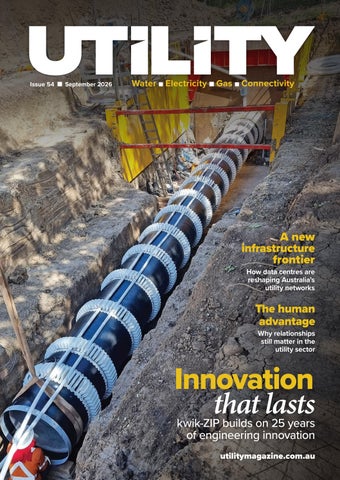
Innovation that lasts
kwik-ZIP builds on 25 years of engineering innovation utilitymagazine.com.au
Keep your drivers and fleets safe with AI-powered video telematics
Act on the most urgent risks in seconds. Geotab’s all-in-one AI-powered video telematics solution provides the ultimate safety net for your team. Our smart detection identifies risks like tailgating or drowsiness in near real time, delivering instant in-cab alerts that help drivers stay sharp and get home safely. For managers, the guesswork is over. Our connected workflow prioritises the highest risks first, turning hours of video into actionable coaching moments. Protect your drivers, exonerate your fleet, and elevate your safety standards with the power of AI.
Ready to transform your fleet? Visit geotab.com/au/ to learn how our video telematics solution can drive your business forward.
Prevent accidents Move from reviewing accidents after they’ve happened, to preventing them via near real-time alerts to mitigate distracted driving, tailgating and drowsiness
Unified Safety Access both video and vehicle data in one integrated platform through MyGeotab. Plus, hand-pick the best tools to reach your operational goals through the Geotab Marketplace.
Video Evidence Turn uncertainty into proof. Secure the visual evidence needed to shield your drivers from wrongful liability and reduce insurance premiums.
CONTENTS
6 REGULARS 4 32 75
Welcome from the editor A word from ENA A word from WSAA
ASSET PERFORMANCE 35
55
Chesterton targets improved pump reliability and service life Battery design life depends on more than the numbers Detectronic explores how earlier insight helps utilities tackle wastewater issues
DATA CENTRES
60
14
FLEET OPERATIONS
8
17
How data centres are reshaping Australia’s energy demand Delivering complex infrastructure for Australia’s growing data centres Managing environmental challenges across data centre projects
PROJECT DELIVERY 25 58 62
How to plan around existing infrastructure Service Stream acquires RiE Group Global Pipeline Equipment talks smarter equipment design
EVENTS 26 70 72
WIOA celebrates NSW water industry excellence APAC’s largest B2B renewable energy conference Utility Awards announce finalists
14
38 49
64
Geotab explores AI’s next fleet management frontier How reducing unnecessary travel supports safer field operations How simpler procurement streamlines fleet delivery and fit-outs
NETWORK RESILIENCE 29 36
Vocus explores resilience through network diversity How bushfire-resistant poles strengthen critical power infrastructure
INDUSTRY INSIGHTS 78
Industry movements
46
67 MAGAZINE www.utilitymagazine.com.au
3
WELCOME FROM THE EDITOR
Data, data everywhere
T
here’s something about spring that makes everything feel like it’s picking up speed. The days get longer, projects get moving and, suddenly, there seems to be a lot more happening at once. That feeling certainly rings true across Australia’s utility sector. From major infrastructure projects and network upgrades to new technologies and changing approaches to asset management, the industry continues to evolve at pace. But among all the developments shaping the sector, one of the most interesting is coming from an increasingly digital corner of the infrastructure landscape: data centres. This edition takes a closer look at the rapid growth of Australia’s data centre sector and what this means for utilities. While the services they support may exist largely in the digital world, data centres have very physical demands – particularly when it comes to electricity, water, connectivity and supporting infrastructure. As demand for data continues to grow, utilities are being asked to accommodate increasingly large loads while maintaining reliability for existing customers and supporting the broader transition taking place across Australia’s energy system. Delivering this infrastructure also brings its own challenges, from environmental compliance and emissions to complex underground installations and project planning. It’s a topic that highlights just how closely the digital and physical sides of infrastructure are now connected. That connection can be seen throughout this edition, too. This edition of Utility explores the importance of
EDITOR
ART DIRECTOR/DESIGN
MANAGING EDITOR
NATIONAL MEDIA EXECUTIVE
CEO
rima.munafo@primecreative.com.au 0413 475 078
Hayley Ralph Eugene Duffy Published by
PRIME CREATIVE MEDIA ABN: 51 127 239 212
379 Docklands Drive Melbourne VIC 3008 Australia 03 9690 8766 primecreativemedia.com.au enquiries@primecreative.com.au ISSN: 2203-2797
4
MAGAZINE SEPTEMBER 2026
understanding existing infrastructure and drawing on experience to deliver projects effectively. We also look at how better monitoring, maintenance and equipment choices can improve reliability and extend the life of critical assets. In this issue, we also examine how technology and smarter processes are helping field teams work more safely and efficiently, while network resilience looks at the ways infrastructure providers are preparing for increasingly complex threats and disruptions. Across each of these areas, there is a common challenge: how do we keep pace with growing demands while building infrastructure that is reliable, efficient and resilient for the long term? For the data centre sector, that question is becoming particularly important. The decisions being made now will help determine how Australia accommodates the next wave of digital growth – and how effectively that growth can coexist with the infrastructure already serving our communities and businesses. As always, I hope you enjoy this edition of Utility and find plenty of ideas, insights and inspiration across its pages.
Christine Clancy CHAIRMAN
John Murphy PUBLISHER
Sarah Baker
Cover image: kwik-ZIP
Hayley Ralph, Editor
hayley.ralph@primecreative.com.au Don’t forget to follow Utility on social media – find us on LinkedIn, Facebook, X and YouTube.
Alejandro Molano Rima Munafo
CLIENT SUCCESS OFFICER
Cait Pillay
Scan to subscribe to Utility’s weekly newsletter – delivered to your inbox every Thursday morning.
B R E AT H E
LISTEN
In the past three years, we have
Through our proprietary
designed, manufactured and
designs and demonstrated
commissioned more SCR systems
expertise, we are leaders in
than anyone else in the world ...
providing proven noise solutions
all with a 100% success rate of
and site-wide guarantees
hitting performance targets.
around the world.
RECOGNIZED LEADERS IN AIR EMISSIONS AND NOISE CONTROL SOLUTIONS. EnergyLinkInternational.com 1-855-660-LINK (5465)
Air Emissions Reduction | Noise Control | Retrofit Services | Turnkey Buildings
COVER STORY
Built for what’s next
After 25 years of engineering innovation, kwik-ZIP is drawing on decades of product development and project experience to help support the delivery of the next generation of critical utility infrastructure.
F
The kwik-ZIP team in action.
6
MAGAZINE SEPTEMBER 2026
Image: kwik-ZIP
or more than two decades, kwik-ZIP has built its reputation on solving one of the pipeline construction industry’s most fundamental challenges: protecting and supporting pipeline infrastructure through effective centralisation. What began as an innovative approach to pipeline spacers has evolved into a globally recognised product range trusted across water, wastewater, energy, mining and civil infrastructure projects. Today, as the demands on Australia’s utility networks continue to grow, the company believes the same principles that have underpinned its success for the past 25 years will be just as important in the decades ahead. Celebrating its 25th anniversary last year provided an opportunity to reflect on the milestones that have shaped the business, from securing multiple international patents to supplying millions of spacer and centraliser units for projects around the world. But rather than viewing the milestone as the culmination of its journey, kwik-ZIP sees it as a foundation for continued innovation. That journey began with a practical problem faced by contractors in the field. In the early 2000s, there was limited availability of purpose-designed spacer and centraliser solutions, leaving contractors to develop their own systems using materials such as steel and timber.
“In kwik-ZIP’s early days, there wasn’t really a spacer or centraliser solution, so contractors made their own with steel or wood,” said kwik-ZIP General Manager Paul Jeff reys. “This slowed them down and also increased the risk of damage to carrier pipes during installation, as well as potential corrosion issues over the lifetime of the pipeline when steel was used.” For kwik-ZIP, addressing that problem became the foundation for its growth. “kwik-ZIP’s success was based on removing that issue by providing an off-the-shelf, customisable solution that worked,” Jeff reys said.
Innovation through experience
The origins of the kwik-ZIP system can be traced back to the requirements of its sister company, Bunbury Drilling, a waterwell drilling contractor working for Tier 1 companies in the Pilbara. “The company’s requirement for a practical and simple solution to enable centralisation during drilling and commissioning of water bores was the catalyst for the early kwik-ZIP models,” Jeff reys said. Rather than being developed solely in a workshop, the early products were refined through use in realworld drilling environments. Over time, new models were developed and adopted for different applications, including horizontal markets such as trenchless and pipeline construction. “They were refined and developed using real-world drilling environments, and over time new models were developed and adopted for different markets, including the horizontal markets such as trenchless and pipeline,” Jeff reys said. That field-driven approach to product development remains central to kwik-ZIP’s philosophy today. Over 25 years, the company has continually refined its product range in response to changing industry needs and increasingly complex infrastructure projects. Its spacer and centraliser systems are designed to provide consistent centralisation while reducing installation time and minimising the risk of damage to carrier pipes during and after installation. Unlike traditional metallic alternatives, kwik-ZIP’s products are manufactured from engineered thermoplastic materials that resist corrosion, chemical exposure and abrasion while providing high strength and low friction characteristics. These material properties have become increasingly important as utilities invest in longer-lasting assets and contractors work across more challenging installation environments. The company’s commitment to ongoing research and development has also resulted in an extensive intellectual property portfolio, including ten patents and two design
“ registrations worldwide, demonstrating a long-term commitment to engineering innovation rather than incremental product changes. Rather than innovating for innovation’s sake, kwik-ZIP’s approach has remained firmly focused on delivering practical benefits on site. Its range now supports applications from smalldiameter monitoring wells through to large-scale pipeline installations exceeding 3.5m in diameter, providing solutions for projects of almost every scale, and across a wide range of critical industry sectors, from drilling to civil construction and ground engineering.
Supporting critical infrastructure
The success of underground infrastructure is determined by more than the pipe itself. Installation methods, materials and supporting components all play a role in protecting assets over their operational life. Whether installing new pipelines beneath busy transport corridors, rehabilitating ageing assets through sliplining or protecting carrier pipes within casing installations, centralisation plays a critical role in reducing wear, maintaining pipe alignment and extending asset life. kwik-ZIP’s spacer systems have become a trusted solution across these applications, helping contractors achieve consistent installations while complying with utility specifications. The company’s products have been specified on major infrastructure projects throughout Australia and internationally, with approvals from organisations including Sydney Water, Water Corporation in Western Australia, Melbourne Retail Water Association and South East Queensland utilities. Its products are also certified for use in contact with drinking water through the Australian Water Quality Centre. This level of industry acceptance reflects years of technical validation and collaboration with utilities, engineers and contractors. “kwik-ZIP has evolved to become an industry leader, by developing a simple and practical solution which is applicable over many different worldwide industries , and then improving and expanding its offerings over time with feedback from industry collaboration,” said Jeff reys. As utilities increasingly prioritise whole-of-life asset performance, selecting components that contribute to pipeline longevity is becoming just as important as achieving efficient installation.
Partnerships that drive progress
While product innovation has been central to kwikZIP’s growth, the company credits its long-standing relationships with customers, suppliers and industry partners as equally important to its success.
In kwik-ZIP’s early days, there wasn’t really a spacer or centraliser solution, so contractors made their own with steel or wood”
Over the past 25 years, feedback from contractors working in the field has continually informed new product development, ensuring solutions address realworld installation challenges rather than theoretical ones. That approach has enabled kwik-ZIP to support projects ranging from water transmission pipelines and sewer infrastructure through to renewable energy developments and ground engineering installations. The company’s ability to respond to changing project requirements has also allowed it to expand internationally while maintaining the technical support and customer service that have become hallmarks of the business. As noted during the company’s 25-year milestone, the partnerships built throughout its history remain one of its greatest strengths. Customers have continually challenged the business to improve, while trusted suppliers have helped deliver consistent quality and reliability. Australia’s infrastructure pipeline shows no signs of slowing. Growing populations, ageing assets, water security projects and the energy transition are driving unprecedented investment in underground infrastructure, creating new opportunities for innovation in pipeline construction. At the same time, contractors face increasing pressure to improve productivity, minimise project risk and deliver infrastructure with longer operational lives.
Future focused
For kwik-ZIP, these industry trends reinforce the importance of continuing to invest in engineering, product development and customer collaboration. The company believes its 25 years of experience provide a strong platform for meeting the challenges ahead, combining proven products with a commitment to continual improvement. Rather than resting on past achievements, the company remains focused on developing practical solutions that help utilities and contractors deliver reliable infrastructure more efficiently and with greater confidence. With a proven history of innovation, a growing portfolio of technically validated products and strong partnerships across the utility sector, kwik-ZIP believes its next chapter will be defined not only by the projects it supports, but by the role it plays in helping build more resilient infrastructure for the future. U
For more information, visit kwikzip.com MAGAZINE www.utilitymagazine.com.au
7
DATA CENTRES
Image: GoAerials/stock.adobe.com
Data centre electricity consumption is forecast to rise from 5TWh to 34TWh by 2035–36.
The data demand
Australia’s data centre expansion is creating a new class of electricity demand, putting pressure on generation, networks and planning frameworks as the digital economy grows.
A
ustralia’s electricity demand is entering a period of critical change. Homes, transport and industry are increasingly electrifying, while new manufacturing and mining loads are adding to the system. At the same time, a less traditional electricity customer is emerging at a remarkable pace: the data centre. Driven by cloud computing, artificial intelligence and growing digital services, data centres are becoming some of the largest new electricity loads in the National Electricity Market (NEM). The Australian Energy Market Operator’s (AEMO) 2026 Electricity Statement of Opportunities (ESOO) forecasts electricity consumption from data centres will rise from about 5TWh in 2025–26 to 34TWh by 2035–36. That would increase their share of NEM electricity consumption from around 3 per cent to approximately 13 per cent over the decade. It is a significant shift, but it is also one that comes with considerable uncertainty. AEMO’s 2026 forecast considered 225 known data centre projects progressing through the connection process, representing around 67GW of proposed connection capacity. However, proposed capacity does not necessarily translate into actual demand. More than 40 per cent of projects had either dropped out or moved backwards in connection status since the previous year’s forecast. AEMO has consequently adjusted its methodology to account for project attrition, the difference between connection capacity and actual consumption, and the time required for facilities to reach full operation. For network businesses, this makes forecasting particularly important.
8
MAGAZINE SEPTEMBER 2026
A new kind of load
Data centres are not simply another source of incremental electricity demand. Large facilities can require hundreds of megawatts of capacity and may be concentrated in particular geographic areas. Their connection can therefore have implications well beyond the immediate site, potentially requiring investment in transmission and distribution infrastructure. In the first quarter of 2026, 11 large-scale data centre projects representing 5.4GW of maximum demand were progressing through the transmission connection process. Around 60 per cent of this capacity was located in NSW, with the remainder in Victoria. The scale of these connections means network planning needs to consider not only whether sufficient capacity exists today, but how quickly it can be expanded as projects are built out. There is also a timing challenge. A data centre may connect with an initial load before gradually increasing towards its ultimate capacity, creating a different demand profi le from a conventional large industrial customer. This uncertainty makes it difficult to predict precisely when and where investment will be required.
A bigger demand picture
Data centres are also only one part of Australia’s changing electricity landscape. AEMO expects overall NEM electricity consumption to increase by more than 40 per cent over the next decade. Electrification of transport, heating and industrial processes will contribute to this growth, alongside new mining, manufacturing and other industrial loads. At the same time, around 15GW of coal and gas generation is scheduled to retire.
Image: Shuo/stock.adobe.com
Large data centre connections are creating new challenges for generation and network planning.
The challenge for the electricity sector is therefore twofold: accommodate substantial new demand while replacing ageing generation and maintaining system reliability. There has been progress on the supply side. AEMO reports that 9.1GW of new generation and storage capacity connected during 2025–26, while around 40GW of committed and anticipated projects are expected to be delivered by the early 2030s. The latest ESOO also indicates an improved reliability outlook, with no forecast reliability gaps before 2030. That does not remove the need for continued investment, however. As demand grows and the generation mix changes, the system will need sufficient renewable generation, storage, transmission and other firming resources to meet demand when and where it occurs.
The power question
For data centre operators, reliability is a fundamental consideration. Facilities are generally designed to operate continuously, meaning their electricity requirements cannot simply be treated in the same way as flexible residential or commercial loads. That raises a broader question for Australia’s energy transition: how should new, energy-intensive industries be powered as the electricity system moves towards a greater share of renewable generation? The issue has increasingly become a policy question as well as an infrastructure one. At the National Cabinet meeting on August 26, the federal government softened its position on requiring new data centres to be powered by additional renewable generation backed by firming. The resulting agreement provides greater flexibility for Queensland and the Northern Territory, including allowing coal and gas to supply energy-hungry data centres under the emerging national framework. The change highlights the competing considerations surrounding data centre development, including the
speed of investment, energy reliability, electricity costs and emissions. The national standards are still being developed, meaning the precise requirements for future projects will continue to evolve.
Planning for growth
For utilities, the implications extend across the electricity supply chain. Generation and storage capacity will need to grow alongside demand. Transmission networks will need to connect new sources of generation with emerging load centres, while distribution networks will face their own connection and capacity challenges. There are also questions around how the cost of infrastructure required for major new loads should be allocated, particularly where investment is driven by a small number of very large customers. AEMO has recognised this challenge, with its forecasting work intended to provide greater visibility of emerging demand and support timely investment decisions. How much of the projected data centre demand ultimately materialises will depend on factors including AI adoption, project financing, construction timelines and connection outcomes. But the direction of travel is clear. Data centres are no longer a niche electricity customer. Their growth is becoming a material factor in Australia’s demand outlook and, in turn, in decisions about generation, networks and system planning. For an industry already managing the simultaneous challenges of electrification, ageing generation and the renewable energy transition, the data boom adds another layer of complexity. The question is no longer simply how Australia will power its homes and traditional industries. Increasingly, the electricity sector must also consider how it will power the infrastructure underpinning the country’s rapidly expanding digital economy. U
MAGAZINE www.utilitymagazine.com.au
9
/ interflow.com.au
We’re Creating the Future of Water with innovative solutions to complex infrastructure problems
DATA CENTRES
Cooling under control
Image: Esther/stock.adobe.com
MATelec Australia explains how intelligent control can support reliable, responsive and adaptable data centre cooling systems.
Cooling infrastructure relies on pumps, pipework and control systems to maintain reliable conditions in data centres.
Image: MATelec Australia
A
MATelec Australia’s control panels are made for data centres.
s data centres grow in scale and complexity, reliable cooling becomes increasingly important. Pumps and cooling equipment provide the capacity, and intelligent control keeps the system responsive, adaptable and performing when it matters. Every data centre generates heat, and removing it reliably is essential to keeping critical infrastructure operating and valuable data protected. Water-based cooling systems play a key role, from conventional chilledwater systems to closed-loop water and glycol circuits. While designs vary, they share one challenge: cooling demand is constantly changing. IT loads fluctuate. Ambient conditions shift. Equipment comes online and offline. Pumps must adjust accordingly, while the system needs to respond quickly and
MAGAZINE www.utilitymagazine.com.au
11
Image: xiaoliangge/stock.adobe.com
DATA CENTRES
predictably when something goes wrong. With decades of Australian pump-control and automation experience, and an extensive track record supporting data centre projects, MATelec Australia understands why control is an integral part of coolingsystem design, rather than simply an addition to it.
Control that responds to demand
Modern pump control allows cooling systems to respond to changing conditions rather than operating continuously at maximum capacity. Variable-speed operation, pump sequencing and intelligent control logic help deliver the required flow and pressure as demand shifts. For designers, consultants and equipment suppliers, the focus should extend beyond maximum pump duty to consider how the entire pumping system performs across its operating range. MATelec Australia’s qualified consultants and engineers work with a nationwide network of channel partners to consider these factors from the beginning of the project brief.
Designing reliability into the system
In a critical environment such as a data centre, redundancy is essential. Adding another pump provides capacity, but true resilience depends on how the entire system responds when something fails. What happens if a pump stops, a sensor loses communication or conditions move outside set limits? Well-designed control systems can automatically sequence available equipment, generate alarms and give operators the information they need to respond. The goal is not simply to detect a fault, but to ensure the system can respond appropriately when one occurs. Onshore design and manufacturing can also play an important role in reliability. MATelec Australia is an Australian Made-accredited designer and manufacturer,
designing and building its complete control and automation range in regional Victoria.
Visibility matters
Monitoring gives operators clear visibility into how cooling infrastructure is performing. Flow, pressure, temperature, pump status, operating hours and alarms can help identify developing issues before they become larger problems. For consultants and system designers, that visibility also helps verify that the system is performing as intended, not just as designed. MATelec Australia has introduced its proprietary IoT platform, Propitect, which connects control panels and the infrastructure they control to the cloud. The platform provides visibility and data analysis, functional control and alerts and alarms when a connected system faults.
Looking at the complete cooling system
As data centres evolve, so too will their cooling requirements. Water use, energy efficiency, increasing computing density and the growth of liquid cooling will continue to shape system design. Regardless of the cooling architecture, however, the principle remains the same. Pumps and cooling equipment create capacity. Control, automation and monitoring turn that capacity into a responsive and resilient system. MATelec Australia’s experience in Australian-made pump control and automation, combined with its work in data centre infrastructure and nationwide channel partner network, provides a foundation for supporting critical cooling infrastructure. From application-specific control and automation through to monitoring, alarms and system integration, MATelec Australia works with customers to develop solutions around how their systems need to operate and the visibility operators need to manage performance with confidence. Because reliable cooling starts with reliable control. U
Learn more about MATelec Australia’s Australian-made data centre capabilities on page 28.
12
MAGAZINE SEPTEMBER 2026
Essential work. Extraordinary impact. Join an organisation at the heart of our communities, where your skills help maintain the critical infrastructure networks we all depend on. Browse available roles and apply now!
DATA CENTRES
Tackling demanding data centre installs
With data centre projects underway across Australia, Edge Underground is using AdaptX vacuum microtunnelling to install the underground electrical infrastructure these facilities depend on. AdaptX simplifies installation by accommodating multiple power conduits within a single bore.
conduits, which will eventually accommodate the data centre’s high-capacity cables. Edge Underground Founder and OptionX Group Chief Executive Officer Stuart Harrison said the company was often approached when a project had stalled or was considered too difficult. “We often get the phone call after another approach has not worked or the risks have become too high,” Harrison said. “The first thing we do is work out why the original method struggled. It is not necessarily about putting a bigger machine on the job. You need to consider the pipe, the ground, the tooling and the installation method together.”
Images: OptionX Group
Starting with an accurate pilot
D
ata centres require an extensive network of underground services. Water, cooling, drainage, communications and high-capacity electrical infrastructure must all fit within sites that are often congested and operating to tightly coordinated construction programs. This work has opened a new market for Edge Underground, part of the OptionX Group. The company has taken on data centre projects around Australia, applying its experience in complex trenchless installations to a sector where delays and service conflicts can have significant consequences. On one current project involving Victorian electrical infrastructure contractor DirectBor, Edge Underground was called in after earlier approaches had been unable to deliver the required trenchless installation. The project involved a single drive of approximately 90m and an SN 128 glass-reinforced plastic jacking pipe with an outside diameter of 718mm. The pipe will act as a carrier for multiple electrical
14
MAGAZINE SEPTEMBER 2026
The installation began with a laser-guided 350mm pilot bore. Once the line has been established, the bore is reamed to the diameter required to accommodate the carrier pipe. For the DirectBor project, this was a 718mm outsidediameter carrier pipe. Completing the smaller pilot first allows the team to confirm the alignment and assess the ground before committing to the larger excavation. Accuracy is particularly important because the carrier pipe is not simply a sleeve beneath an obstacle. Its final position affects conduit spacing, connections with electrical pits and the ability to pull high-capacity cables through the completed network. AdaptX uses continuous laser guidance to control line, level and grade. The technology is capable of approximately ±5 to 10mm grade accuracy, including in mixed ground and hard rock. Harrison said accuracy needed to be managed throughout the drive rather than checked only once the pipe reached the reception shaft. “If the pilot is not right at the start, the problem becomes harder to correct as you add more pipe,” he said. “That is why we monitor the installation as it progresses and make small corrections early. On a data centre project, the pipe needs to arrive where the electrical design says it will.” AdaptX’s hydraulic steering provides additional control through changing conditions, while its pilot tooling can be retracted for inspection or replacement if an obstruction is encountered.
Keeping jacking forces under control
The project has required careful consideration of anticipated jacking forces and the capacity of the selected pipe. Preliminary calculations put the expected thrust for the
Edge Underground works on gravity sewer, water and utility pipelines across Australia.
90m drive at approximately 20 to 36t, subject to conditions encountered during installation. The loads generated are typically significantly lower when vacuum extraction is used. These forces have been assessed against the allowable jacking capacity of the proposed GRP pipe. A jacking machine with up to 150t of capacity may be available, but maximum capacity is not the operating target. Jacking pressures can be monitored throughout the drive. If the required thrust begins to increase unexpectedly, the crew can investigate and adjust the operation before the force approaches the accepted project limit. “A calculation gives you a starting point, but you still need to watch what the pipe and the ground are doing,” Harrison said. “If the load changes, there is a reason for it. The operator needs the information and the ability to respond before it becomes a larger problem.”
Large diameter under shallow cover
Microtunnelling is commonly associated with deep sewer installations and major crossings, but Edge Underground can also use AdaptX for larger-diameter pipes with relatively shallow cover. These installations present a different set of risks. There is less ground above the bore to absorb disturbance, so over-excavation or excessive pressure at the cutting face can lead to ground movement or surface heave. The pilot-first approach allows Edge Underground to establish an accurate path before enlarging the excavation. The cutting configuration and operating parameters can then be adapted to suit conditions encountered during reaming.
Reducing frac-out risk
Vacuum extraction is central to the AdaptX system and is particularly valuable in shallow ground. Some trenchless methods use pressurised drilling fluid to carry excavated material from the bore. In shallow, fractured or permeable ground, that fluid can escape through a pathway to the surface or into adjacent services. This is commonly known as an inadvertent return or frac-out. AdaptX mechanically cuts the ground and uses highcapacity vacuum extraction to draw spoil away from the excavation face. The system operates under controlled negative pressure rather than depending on a pressurised slurry annulus to transport material. This reduces the mechanism that can lead to frac-out and limits the pressure applied to surrounding ground, reducing the risk of heave or surface movement where cover is limited. These risks are particularly important on a data centre site, where a frac-out or ground movement could affect
pavements, foundations, underground services or other construction activities. Continuous spoil removal also gives the operator immediate information about the material being excavated. If the ground changes, the crew can adjust the tooling and operating parameters rather than continuing with a configuration that no longer suits the conditions.
Capability for bigger pipe
While the current project involves a 718mm outsidediameter pipe, Edge Underground’s capability extends to substantially larger installations. AdaptX uses the same 350mm pilot-first approach before reaming the bore for the required pipe. Depending on ground conditions and project design, the system can install pipes up to 1,800mm and beyond. Higher-torque, lower-speed reaming configurations are available for larger diameters, mixed ground and hard rock. The final pipe can then be pulled or jacked into position depending on its material and the installation design. This allows Edge Underground to deliver everything from smaller conduit installations to large carrier pipes containing multiple electrical services.
A growing national market
Trenchless installation confines most surface activity to launch and reception areas, avoiding excavation along the full alignment. This can reduce spoil, truck movements and reinstatement while allowing other contractors to continue working nearby. Those benefits are particularly relevant to data centre construction, where multiple trades are working to an interdependent program. By taking on data centre projects around Australia, including work where previous installation approaches have proved unsuccessful, Edge Underground is transferring its established microtunnelling capability into a growing infrastructure market. “These sites need a lot of infrastructure below ground, and it all has to be installed in the right place and at the right time,” Harrison said. “If a job has a larger pipe, limited cover or an alignment that has to be delivered accurately, that is the sort of challenge our equipment and our crews have been developed to handle.” U
For more information, visit edgeunderground.com.au MAGAZINE www.utilitymagazine.com.au
15
DATA CENTRES
Environmental compliance for data centres As data centres scale up across Australia, early planning for noise and emissions can help developers meet environmental requirements and reduce project risk.
A
ustralia’s data centre market is growing rapidly, driven by cloud computing, artificial intelligence, digital services and rising demand for high-performance computing. As facilities become larger and more power-intensive, developers face environmental challenges that go beyond reliable power and cooling. Noise from cooling systems, generators and other mechanical equipment, along with air emissions from on-site power generation, can be important considerations during planning, environmental assessment, development approvals and community engagement. EnergyLink Australia brings together acoustic and emissions expertise, specialised engineering and construction know-how to help data centre developers address these requirements from design through to construction and commissioning.
An integrated approach to noise and air emissions
Image: EnergyLink International
Noise and air emissions are closely connected. Equipment selection, ventilation, pressure drop, acoustic treatment
and emissions control systems must work together without compromising facility performance or reliability. EnergyLink provides integrated solutions including acoustic enclosures, barriers, silencers, acoustic and nonacoustic buildings, quiet HVAC systems and emissions control technologies. Its services include regulatory analysis, acoustic modelling and design, engineering, and the supply and installation of acoustic and air emissions solutions. By considering these requirements together from the outset, EnergyLink helps project teams develop solutions around overall site performance rather than addressing individual environmental issues after equipment and layouts have been finalised.
Managing data centre noise at the source Large data centres have numerous potential noise sources, including chillers, cooling towers, fans, generators, gas turbines, engines and ventilation systems. Effective noise control starts with understanding the characteristics of each source. Broadband noise can often
EnergyLink’s integrated solutions address noise and emissions requirements across data centre infrastructure.
MAGAZINE www.utilitymagazine.com.au
17
DATA CENTRES
Image: Tom/stock.adobe.com
Large-scale cooling infrastructure is a key consideration in managing data centre noise.
be addressed with conventional acoustic treatments, while low-frequency noise can propagate over long distances, and tonal noise can remain noticeable even when the overall environmental noise level (or dBA) target is achieved. EnergyLink designs acoustic solutions using octaveband and one-third octave-band source data to match treatment to the equipment’s actual characteristics. Solutions can include purpose-designed acoustic enclosures, barriers, silencers, ventilation silencing systems and acoustic building structures. This site-wide approach helps ensure that individual noise-control measures work together to meet overall project requirements. EnergyLink also offers a site-wide noise guarantee to help meet regulatory and contractual commitments. With data centre experience across Europe, Canada and the United States, EnergyLink brings proven acoustic engineering expertise to Australian projects.
Emissions control cannot be considered in isolation. Back pressure, ventilation, acoustic performance, equipment layout and operating conditions can all affect system performance. EnergyLink’s engineering approach balances these factors to integrate emissions control with the overall power-generation and acoustic design.
Reducing air emissions from on-site generation
Design it right from the start
Reliable backup and prime power are essential for uninterrupted data centre operations. Depending on the facility, this can involve large numbers of generators, gas turbines or other on-site generation systems. These systems can also create emissions-control requirements that should be addressed early in the design process. EnergyLink provides emissions solutions including selective catalytic reduction (SCR) and carbon monoxide (CO) control systems for data centre applications. Depending on the application and system design, its SCR systems can achieve more than 95 per cent NOx removal.
Designed for Australian requirements
Environmental requirements vary across Australia, making early understanding of applicable planning and environmental requirements essential. Developers need to identify nearby sensitive areas, assess potential impacts and incorporate appropriate mitigation measures before equipment and site layouts are finalised. With more than 30 years of experience in Australia, EnergyLink can support developers and engineering teams with regulatory guidance, acoustic modelling and engineered mitigation solutions throughout the project lifecycle. Environmental performance should not be an afterthought on a major data centre project. Engaging EnergyLink early allows developers and EPC teams to integrate noise and emissions requirements into equipment selection, site layout, ventilation and powergeneration planning -helping reduce project risk, support regulatory approvals and avoid costly retrofits. With more than 30 years of experience, EnergyLink International provides specialised emissions, noise and engineering solutions from initial design through to commissioning. Its team has delivered more than 500 SCR and CO emissions control systems and more than 2300 noise control projects. U
For more information, contact Damien Bell at Damien.Bell@EnergyLinkCorp.com, Gustavo Elgueta at Gustavo.Elgueta@EnergyLinkCorp.com, or visit energylinkinternational.com
18
MAGAZINE SEPTEMBER 2026
Keep your plant, pipe and valve infrastructure strong with 1300 368 368
www.fmt.com.au
Established in 1995, Field Machine Tools has thrived as a privately owned Australian company supplying portable maintenance machines and engineering solutions to clients across Australia.
The business aims to flatten production downtime by providing operators with the most complete scope of products and accessories for industries across Australia and beyond.
MELBOURNE A 1, 53-57 Rimfire Drive, Hallam VIC 3803 P (03) 9703 2250 E sales@fmt.com.au
BRISBANE A 8, 60-62 Kremzow Road, Brendale QLD 4500 P (07) 3889 7622 E sales@fmt.com.au
PERTH A 3, 48 Hardey Road, Belmont WA 6104 P (08) 9470 6088 E sales@fmt.com.au
DATA CENTRES
Power play
Daly’s Constructions is navigating the complex demands of data centre infrastructure, delivering critical high-voltage connections while working around live networks, major transport routes and accelerated project programs.
A
ustralia’s data centre sector is expanding rapidly, bringing with it a growing demand for reliable, high-capacity electricity infrastructure. Behind the servers and digital services is a complex network of power infrastructure that must be delivered safely, efficiently and, increasingly, to accelerated construction programs. For Daly’s Constructions, this is an area where 55 years of experience in underground electrical infrastructure is being applied to a new generation of major projects. Daly’s Constructions Director Mark Daly said the growing demand for data centre infrastructure demonstrates the level of planning required when highvoltage infrastructure must be delivered alongside major transport infrastructure and active electricity networks. “Data centre projects have very demanding programs, so there is a real need to identify constructability risks early and have detailed planning and coordination in place before works commence,” he said. Daly’s Constructions was engaged by Taihan Electric Australia and AusNet to deliver critical high-voltage infrastructure for a large-scale data centre project in Yarraville. Daly’s scope centred on the connection between AusNet’s Brooklyn Terminal Station and the data centre’s 66kV substation. The project included 1.2km of trenching and conduit installation, horizontal directional drilling (HDD), joint bay, link box and communications pit construction, cable installation, jointing and terminating
20
MAGAZINE SEPTEMBER 2026
Daly’s Constructions installing high-voltage infrastructure within AusNet’s Brooklyn Terminal Station.
support, traffic management and final road reinstatement. At its core was a dual 66kV, 120MVA underground cable system designed to provide N-1 redundancy. The project presented several challenges. Daly’s Constructions’ crews were required to undertake trenching works within Brooklyn Terminal Station, an active 220kV terminal station, and, with their subcontractor Jelmac Directional Drilling, complete drilling from Brooklyn Terminal Station beneath the West Gate Freeway – a major transport route carrying more than 200,000 vehicles each day. The works also had to be coordinated with the West Gate Tunnel Project, while maintaining access for businesses operating around the construction area and managing traffic across Department of Transport and council roads. Daly’s Constructions’ approach involved close coordination with AusNet’s project and stakeholder management teams. Daly’s in-house traffic management business, Daly’s Traffic, was also utilised to manage the complex road environment. Daly’s Constructions’ experience in working within live electrical environments was another important factor. Personnel working inside the terminal station were experienced, accredited and authorised by AusNet, supported by detailed planning and risk management. “On a project like this, you have to be able to manage multiple work fronts and interfaces at the same time,” Mark Daly said. “The electrical, civil, traffic and drilling components all have to work together, while still meeting
develop, the infrastructure supporting these facilities will increasingly need to be delivered within compressed timeframes and alongside existing networks, roads, businesses and communities. For contractors, this places greater emphasis on detailed coordination, specialist technical capability and the ability to mobilise multiple work fronts while meeting the stringent reliability and safety requirements associated with data centre facilities. These are areas where Daly’s Constructions brings valuable experience and proven capability. U
Underground conduits installed as part of the high-voltage connection supporting data centre infrastructure.
Images: Daly’s Constructions
the requirements of the network owner, authorities and surrounding stakeholders.” Daly’s Constructions also drew on purpose-built equipment to support the cable installation. The company used an in-house designed prime mover and semi-trailer cable float, along with caterpushers to manage hauling tensions during installation. The result was an accelerated delivery program, with trenching and drilling, conduit installation, cable hauling, jointing, terminating and commissioning completed in just 150 days. Daly’s Constructions is now applying this experience to another major data centre power project on Leakes Road in Truganina, Victoria. This project will provide a 220kV power supply to the proposed data centre development site via a 3.2km underground route from AusNet’s Altona Terminal Station, travelling through Cherry Lane, Fitzgerald Road and Leakes Road. The power supply comprises a dual-feeder 220kV underground cable system capable of delivering 253MVA, with N-1 redundancy. Daly’s Constructions is the design and construct contractor, with detailed design completed in April 2026 and construction commencing in July 2026. Completion is planned for 2027. The scope encompasses detailed civil and electrical design, cable and accessories supply, trenching and conduit installation, authority approvals support, traffic management, HDD, joint bay construction, a microtunnel beneath Leakes Road, 220kV cable installation, jointing and termination, pre-commissioning testing and pavement, road barriers and bus stop reinstatement works. Running through Melbourne’s busy inner-west industrial area, the project has placed a strong focus on route selection and constructability. Daly’s Constructions investigated multiple route options during the early design stage, with an aim to minimise disruption to the road network. The project includes a HDD bore to avoid trenching in Fitzgerald Road and Leakes Road, while microtunnelling is being used to install conduits across Leakes Road where site constraints demand this construction methodology. Up to three trenching crews and an HDD crew will be operating simultaneously to meet the project program. The works will also involve a combined trench for new electricity infrastructure, with four 220kV cable circuits running for approximately 200m along Leakes Road. The work requires close coordination between the client, authorities, utilities, councils, consultants and suppliers. For Daly’s Constructions, these projects reinforce the value of bringing their construction expertise into the design and planning process early. “Fift y-five years of experience gives you the ability to work through constructability issues before you get to site and identify opportunities to improve the delivery,” Mark Daly said. As Australia’s data centre pipeline continues to
For more information, visit dalysconstructions.com.au MAGAZINE www.utilitymagazine.com.au
21
PROJECT DELIVERY Connected data could help utilities identify emerging risks and make faster infrastructure investment decisions.
The digital future of water As water utilities face multiple and mounting challenges, Autodesk’s Chris Ryan explores how digital transformation can help the industry make better decisions, faster.
A
ustralia’s water industry is facing a growing set of pressures. Ageing infrastructure, climate change, population growth and a shrinking pool of experienced workers are forcing utilities to make increasingly complex decisions about where and how to invest. For Autodesk Head of Water Infrastructure APJC, Chris Ryan, digital transformation has an important role to play in tackling this future – but it is not simply about adopting new technology. “There’s lots of things that are affecting utilities at the moment,” Chris Ryan said. “We’ve got climate change and climate adaptation. We’ve got resilience associated with that. We have reduced resources, so we have people leaving the industry. We have reduced costs that they can spend to do things, as well as an increased population.” These pressures are also changing the way utilities need to think about infrastructure investment. Rather than relying solely on routine replacement programs, utilities increasingly need to understand where risk is greatest and where investment can deliver the greatest benefit. That requires better access to information. For Chris Ryan, this is where digital transformation begins to move beyond individual soft ware tools
22
MAGAZINE SEPTEMBER 2026
and towards a more connected approach to managing infrastructure. “In the past, it used to be just introducing new technology,” he said. “It’s getting less about the actual tool. It’s about a connected environment. How do I get things out of this particular part of technology and make it all work together?” The ability to connect information across an organisation can become particularly valuable as utilities deal with ageing assets and increasingly complex operating environments. Infrastructure such as water and sewer networks can remain in service for decades, meaning decisions made today need to account for conditions that may not emerge for years. At the same time, utilities need to balance immediate operational demands with longer-term resilience. “We have to look that far forward, because the infrastructure goes in the ground for 50 to 80 years,” Chris Ryan said. This long-term perspective is one reason digital tools can become more than a way of visualising existing information. When data from different parts of an organisation can be connected, it can help utilities develop
“
Image: reewungjunerr/stock.adobe.com
Communicate, build it, and have one place where everything is captured, and then everybody can access it.”
a clearer understanding of how assets are performing, where risks are emerging and what decisions may need to be made next. Chris Ryan said utilities with higher levels of digital transformation are often better positioned to respond quickly because they can bring more information into the decision-making process. “It’s getting less about the actual tool. It’s about a connected environment,” he said. “Because they can make decisions quickly. And when you can make a decision quickly, you can act.” That shift also has implications for the way utilities manage knowledge. As experienced workers leave the industry, organisations risk losing decades of operational and engineering knowledge. Capturing that knowledge and making it accessible to others is becoming increasingly important, particularly as utilities look to bring new generations of workers into increasingly digital environments. “The old adage that knowledge is power is still very true, but it’s not knowledge is power for the individual, it’s knowledge is power for the organisation,” Chris Ryan said. Rather than treating digital transformation as a purely technological exercise, he believes utilities need to involve
their people in developing new ways of working and ensure knowledge is captured as part of those processes. “Communicate, build it, and have one place where everything is captured, and then everybody can access it,” he said. “I may be 20 years in the industry, someone else may be three years in the industry, but we’re seeing the same thing and can learn faster together.” This becomes particularly relevant as utilities face the broader challenge of doing more with constrained resources. Digital transformation can help shift people away from repetitive, process-heavy tasks and towards work that relies on their experience and judgement. Chris Ryan points to the growing role of artificial intelligence as one example, particularly where technology can process large volumes of information while allowing experienced workers to retain oversight. “AI is not perfect,” he said. “Having the ability to override it with human knowledge is really powerful, because what we’re doing is we’re taking people from doing process-type work to actually doing it as a knowledge worker.” For Chris Ryan, the objective is not to remove human expertise from infrastructure decision-making, but to give people better information and more time to apply that expertise. “How do you connect with what’s happening in the future without actually having a crystal ball?” he asked. That question sits at the centre of Autodesk’s vision for the future of water infrastructure. “Our vision is basically predictive digital twins, based on full risk analysis, driven by AI, to help streamline decision making, to make acting either repair or to build much easier, much faster, with fully connected data across the whole asset life cycle,” Chris Ryan said. For an industry responsible for infrastructure that must perform for generations, the value of that approach may ultimately come down to making better decisions earlier – using the information already available to understand risk, preserve institutional knowledge and plan for an increasingly uncertain future. The full conversation with Chris Ryan will explore this evolving digital landscape in greater detail in an upcoming episode of the Utility Magazine podcast. U
For more information, visit www.autodesk.com/au/industry/water MAGAZINE www.utilitymagazine.com.au
23
PROJECT DELIVERY
Finding common ground
Delivering new infrastructure rarely means starting with a clean slate. Lanco Group discusses the challenges of building around existing water, sewer, road and utility assets – and why accurate information and early planning can make all the difference.
A
ustralia’s infrastructure networks are becoming increasingly interconnected, but delivering new assets within established environments can present a complex set of challenges. For designers and contractors, one of the first hurdles is often understanding exactly what is already in the ground. Existing plans provide an important starting point, but discrepancies between recorded and actual asset locations can create significant challenges once construction begins. According to Lanco Group Lead Engineer Brycen Wang, accurately locating existing assets is critical to determining where new infrastructure can be safely and practically installed. “One of the biggest challenges is locating the actual assets shown on the Before You Dig Australia plans and confirming their position, so we can determine the most appropriate alignment for the new infrastructure,” Wang said. Where information is inaccurate or incomplete, the consequences can extend well beyond the initial design phase. Unexpected asset locations can trigger redesigns, variations and delays, while also creating additional approval and constructability challenges. “Unknown or inaccurate information can have a significant impact on a project, from redesigns and variations through to delays in obtaining authority approvals and constructing the works,” Wang said. Service clashes are a particular concern. Electricity, telecommunications and drainage infrastructure can all intersect with proposed alignments, making a clear understanding of existing services essential before work gets underway. Wang said more accurate as-constructed records from asset owners would help project teams plan with greater confidence. “The more accurate the as-constructed records are
Image: Lanco Group
Accurate asset information helps project teams plan new infrastructure around existing services and avoid costly clashes.
when an asset is installed, the better. Having reliable information about where existing services are located helps us plan new infrastructure around them and avoid unnecessary clashes,” he said. Where records cannot provide sufficient certainty, preliminary investigations such as non-destructive investigation and scanning can help establish the location of existing assets before construction. Early planning is equally important when an existing asset needs to be relocated to accommodate a new one. Identifying these requirements before construction begins gives asset owners and project teams more time to coordinate the necessary changes and maintain the proposed project program. “Early planning is very important,” Wang said. “If we identify issues with existing authority assets early, we can engage with the relevant authorities and, where required, arrange for those assets to be relocated so the new utility infrastructure can be constructed on the planned alignment.” The challenges become even more pronounced on constrained sites, where access is limited and construction activities must be carefully coordinated around existing infrastructure. For Wang, effective time management is central to keeping these projects moving. “It mostly comes down to time management and coordinating closely with the contractor, so they are able to construct what has been designed,” he said. A project in Cremorne, an inner suburb in Melbourne, demonstrated how quickly plans can diverge from conditions on the ground. In that case, an authority’s asset plan indicated that an existing service was in one location, while subsequent service locating identified it elsewhere. When the contractor commenced work, the asset was found to differ again from the previously identified position. The project team then had to develop a solution that met the authority’s requirements while maintaining the necessary horizontal clearances from other existing assets. “It came down to communicating with the contractor and our engineers on site to determine the best way to complete the works without impacting the timeframe or creating variations to the contract,” Wang said. Ultimately, working around existing infrastructure requires more than simply following plans. It requires project teams to recognise the limitations of available information, investigate where necessary and maintain communication between designers, contractors and asset owners throughout the process. For Wang, collaboration is the key lesson. “It’s all about communication and collaboration with the authorities. It is also important to engage authorities early and provide feasibility or concept plans for their review and comment.” U
For more information, visit www.lancogroup.com.au MAGAZINE www.utilitymagazine.com.au
25
Strengthening the operations sector
Image: WIOA
EVENTS
The WIOA conferences bring together operators, utilities, councils, contractors, suppliers and other industry professionals.
WIOA’s 2026 NSW Conference brought the state’s water operations community together in Newcastle, highlighting the value of knowledge sharing, industry recognition and a connected professional network.
T
he water industry relies on more than pipes, pumps and treatment plants. Behind every essential water and wastewater service is a workforce with the practical knowledge and operational expertise to keep those systems running safely and reliably. That workforce was in focus at the Water Industry Operations Association of Australia’s (WIOA) 2026 NSW Water Industry Operations Conference and Exhibition, held at Newcastle Racecourse from September 9 to 10. The conference brought together operators, utilities, councils, contractors, suppliers and other industry professionals to exchange practical knowledge, explore new technologies and recognise the people working across the operations sector. For WIOA CEO Dean Barnett, the conference is part of a much broader role the organisation plays in connecting and strengthening the industry. “For more than five decades, WIOA have been connecting operators, utilities, councils, contractors, suppliers, and industry professionals through a shared commitment to strengthening the water and wastewater operations sector,” Barnett said. Today, WIOA has more than 6000 members, forming a community where operational professionals can connect, share experiences, learn from one another and celebrate industry achievements. While conferences are an important part of that community, members can also participate in Interest Days and networking events, present their knowledge, take part in industry competitions, join advisory committees, volunteer or nominate colleagues through WIOA’s awards programs. These opportunities support professional development while helping capture and share the practical knowledge that exists across the sector. “Whether you’re new to the sector or long serving in the operations sector, WIOA provides opportunities to build professional networks, develop new skills, and contribute
26
MAGAZINE SEPTEMBER 2026
to the future of sustainable water operations,” Barnett said. The NSW conference provided a practical example of this approach, bringing the sector together to learn while recognising operational expertise. WIOA’s competitions are a longstanding feature of its conference program, putting technical skills to the test while shining a light on the people behind essential water services. Rous County Council’s Nightcap Water Treatment Plant took out the title in the NSW IXOM Best Tasting Tap Water competition, which celebrates drinking water quality across the state. Rous County Council will now compete for the Australian title in Adelaide, South Australia, on September 24. Meanwhile, MidCoast Council’s Dean Lewin and Mark Summerville won the 2026 NSW Reece Civil + Viadux Main Tapping Competition. The competition recreates a critical operational task: connecting new services to a live water main without interrupting supply. Teams of two must safely complete a live tap on a pressurised 100mm pipe, installing fittings to industry standards while working within strict safety requirements. Accuracy is as important as speed, with penalties applied for leaks, faults or incomplete installations. Beyond the competitions, WIOA’s recognition programs form part of its broader role in advocating for the operations sector and raising awareness of the contribution made by operational professionals. Barnett said recognition programs, industry engagement, training opportunities and awareness initiatives help raise the profi le of the sector and highlight the critical work carried out every day to deliver safe and reliable water and wastewater services. For award recipients, opportunities can extend to interstate and international study tours, providing professional development and knowledge exchange while strengthening the visibility of the operations sector.
“ “Membership is more than access to events and networking. It is an opportunity to be part of a connected industry community that values practical knowledge, supports career growth, and recognises excellence,” Barnett said. WIOA membership provides further opportunities for professionals to participate in the sector, with access to industry connections, career development opportunities, practical guides and resources. Members can stay informed through WIOA’s newsletters, explore employment opportunities through the Jobs Board and Position Vacant listings, participate in the STEP Program, and share their experiences through WIOA publications and editorials. They can also become more involved through volunteering, committees, competitions, presentations and awards. This participation is particularly important in an industry where much of the expertise is built through practical experience and passed between people working in the field. By creating opportunities for that knowledge to be
Whether you’re new to the sector or long serving in the operations sector, WIOA provides opportunities to build professional networks”
shared and recognised, WIOA is helping ensure the operational experience of today’s workforce contributes to the development of tomorrow’s sector. The NSW conference reflected that broader purpose. While the event provided two days for the industry to connect, learn and celebrate, its value extends beyond the conference venue. For WIOA, building a stronger operations sector means creating an ongoing community where professionals can advocate for their work, develop their careers, share what they know and support the next generation entering the industry. “Together, WIOA members are helping build a stronger, more visible, and more resilient water operations sector for the future,” Barnett said. U
For more information, visit www.wioa.org.au
Glass Fibre Reinforced Cement Titan Poles and Pylons
Lowest cost, whole of life network power pole.
P: +61 3 5248 1661 E: enquiries@dulhuntypoles.com W: dulhuntypoles.com A: 35 Buckley Grove, Moolap VIC 3224 Australia
The engineered Titan Pole & Pylon are manufactured in Australia by Dulhunty Poles. The Titan is Australian Bushfire Proof, invulnerable to UV exposure, fungal decay, termites and saline foundations. It is non-conductive and claims the lowest carbon emission footprint and more!
MAGAZINE www.utilitymagazine.com.au
27
#0
8303
INTELLIGENT CONTROL FOR CRITICAL DATA CENTRE INFRASTRUCTURE
SCAN ME Explore MATelec Australia Data Centre Solutions
CONTROL & AUTOMATION SOLUTIONS ENGINEERED FOR CRITICAL DATA CENTRE INFRASTRUCTURE With extensive experience across data centre projects, MATelec Australia delivers intelligent control and automation solutions for cooling, water management, pressure boosting, drainage, monitoring, alarms, BMS integration and other critical infrastructure.
CONTROL SOLUTIONS FOR CRITICAL INFRASTRUCTURE
NETWORK RESILIENCE
Images: Vocus
ASD guidance is urging critical infrastructure operators to test their ability to operate independently of external networks.
Three months offline
New ASD guidance is challenging critical infrastructure operators to rethink hidden dependencies, with Vocus highlighting how network diversity and private connectivity can strengthen resilience.
I
n July, the Australian Signals Directorate released revised CI Fortify guidance, setting a target most operators have never tested: three months running essential services fully disconnected from other networks and the internet. The guidance draws on lessons from recent nationalscale outages, naming factors that can quietly defeat operational technology (OT) and information technology (IT) segmentation even when an operator believes the two are fully separated. These include shared routing and switching, common virtualisation, shared Active Directory, shared domain name and certificate servers – and one only recently widely recognised: shared network time servers. Utilities carry a lot of this hidden exposure. Control systems are built for reliability and safety, but then rely entirely on the network paths connecting them. ASD is not asking anyone to fi ll the moat and pull up the drawbridge immediately. ASD Assistant Director-General for Cyber Uplift Heidi Hutchison told iTnews full isolation is the last measure of resilience, not the first response.
The next fault may also be unmodelled
No technology is infallible, and the next major outage may have a cause nobody saw coming. That is the argument against depending on one provider, one link, one
technology type – or, as ASD points out, one shared server – whatever assurances sit around it. Buying services from several different providers is not enough on its own. “You can hold two contracts with two different providers and when you dig into it, still find one cable, one line card or one data centre joining both,” said Vocus General Manager Technology Operations Jonathon Gleeson. “Every network has an outage eventually. Utility people know that better than anyone. What matters is what else fails at the same time.” For operators covered by the Security of Critical Infrastructure Act, much of this mapping will already sit inside a risk management program. Donald Rumsfeld’s famous ‘unknown unknowns’ can only be managed through engineered diversity: disciplined cataloguing of dependencies and careful separation of services on all physical and logical levels.
Building to be resilient to outage
Vocus helps critical infrastructure providers design communications systems that survive failure. Its national network is laid out as a ‘figure of eight’ across Australia – a western and eastern loop intersecting in the middle. When a core cable is cut, most traffic can be rerouted the other way around the loop.
MAGAZINE www.utilitymagazine.com.au
29
NETWORK RESILIENCE
Vocus uses diverse network paths and private connectivity to strengthen communications resilience.
It is also building a new generation of infrastructure alongside its existing network. In June it announced an initial $500M investment in its Australian Digital Infrastructure Platform, which will run fibre through longhaul deep-buried ducts. “Ducted long-haul fibre networks are more demanding and costly to build but will allow us to add capacity in the future without breaking ground again or interfering with Private satellite connectivity can help keep remote utility sites connected without relying on the public internet.
customers’ active networks. The approach also offers greater resilience and protection against cable cuts,” said Vocus Chief Technology Officer Nikos Katinakis. It will be the first network of its kind in Australia – all other long-haul routes are fibre buried directly in the ground.
ASD data highlights inherent internet risk
According to ASD, the first sign of a coming cyber-attack is usually threat actors sweeping an organisation’s internet protocol (IP) addresses to see what answers back. Across 1200 incidents in FY25, that sort of sweep preceded a successful attack 41 per cent of the time. Denial of service attacks, which flood a target address with traffic, were the first sign 31 per cent of the time. Both need a front door reachable from the internet. A connection with no internet address gives an attacker nothing to knock on. Taking critical workloads off the internet may be the single most effective move any organisation can make. That doesn’t mean air-gapping them; it means keeping them on a private network addressing scheme away from the internet. In July, US water utilities in seven states found threat actors had seized control of their programmable logic controllers and degraded operations. The FBI now advises taking OT off the public internet. Vocus recently launched the ability to run traffic over Starlink satellites from remote sites to data centres without it ever crossing the internet. “A pump station on the Murray can have the same private network route to compute that a city office gets over fibre,” said Vocus Satellite Development Manager Ashley Grove. Utilities can start improving resilience now, Grove said, by tracing the physical paths behind critical sites, getting advice on engineered diversity and considering private connectivity over satellite. U
For more information, visit www.vocus.com.au
30
MAGAZINE SEPTEMBER 2026
Don’t just specify the battery. Engineer the system.
Battery safety and compliance start at the design stage. Battery selection is only one part of a reliable DC power system. Operating temperature, hydrogen gas risk, ventilation and room or enclosure requirements all need to be considered from the outset. Century Yuasa designs and manufactures integrated DC power systems engineered around the operating conditions and compliance requirements of critical infrastructure environments.
Engineer the complete system from the outset.
Designed for safety. Engineered for compliance. Built for long-term performance. Battery and charger system design Ventilation and hydrogen gas risk management Room and enclosure planning Compliance aligned with Australian Standards
Speak to our team for more information
Image: Phillip Wittke/stock.adobe.com
A WORD FROM ENA
ENA is the national industry body representing Australia’s electricity transmission and distribution and gas distribution networks.
Unlocking commercial rooftop solar
Energy Networks Australia Chief Operations Officer Dominic Adams discusses the expansion of the Small-scale Renewable Energy Scheme.
A
ccording to Energy Networks Australia (ENA), Australia has become a global leader in rooftop solar, with around one in three homes now equipped with panels and about 22GW of distributed generation installed across residential rooftops. However, commercial and industrial rooftops remain comparatively underutilised. Distribution centres, cold stores, factories and other large facilities often have extensive, flat and unshaded roof space, yet commercial rooftop solar capacity sits at around 5.6GW. Factors contributing to this disparity include installation economics, technical requirements and split incentives where commercial properties are leased and the benefits of lower electricity costs do not necessarily accrue to the party funding the installation.
What the cap changed
The Small-scale Renewable Energy Scheme (SRES) has supported Australia’s rooftop solar market since 2011, when the original Renewable Energy Target was divided into large- and small-scale schemes. Under the SRES, eligible systems generate Smallscale Technology Certificates (STCs), based on the renewable energy they are expected to produce over their eligibility period. Electricity retailers and other liable entities are required to purchase and surrender a set number of certificates each year, creating a market for STCs. The value of the certificates is generally factored into the upfront cost of an eligible solar installation, reducing the amount paid by the customer. Until now, the scheme’s eligibility threshold has been 100kW. Systems above this threshold have instead been treated under the large-scale renewable energy framework, creating different requirements and economics for commercial and industrial customers. For businesses considering systems larger than 100kW,
32
MAGAZINE SEPTEMBER 2026
this distinction can significantly affect upfront costs and project complexity. In August, Climate Change and Energy Minister Chris Bowen announced that the SRES capacity threshold would increase tenfold, from 100kW to 1MW. The change is intended to bring more commercial, industrial and agricultural solar installations within the scheme. The change is targeted to commence on October 1, 2026, subject to the required regulatory processes. Government estimates indicate the expanded eligibility could reduce upfront costs by around 20 per cent, equating to approximately $68,000 for a 250kW system, $136,000 for a 500kW system and more than $230,000 for an 850kW system. For businesses with significant electricity consumption, the change could materially alter the economics of installing rooftop solar.
Managing the network impact
Reducing the financial barriers to commercial solar does not remove the technical requirements associated with connecting larger systems to distribution networks. A 750kW rooftop system represents a significant generation asset from a distribution network perspective. Connection assessments need to consider voltage impacts, thermal capacity on feeders and transformers, protection settings and reverse power flows. As more commercial and industrial systems connect, network operators will need to assess how individual projects interact with existing infrastructure, generation and load. The government’s announcement also includes plans to ask the Australian Energy Market Commission (AEMC) to consider measures to accelerate network approvals for commercial and industrial solar connections. For the policy to translate into increased deployment, the financial incentive and connection process will need
to work together. If projects can access SRES support but face lengthy or uncertain connection processes, deployment could be constrained by network capacity and connection requirements.
An existing focus for networks
Energy Networks Australia’s 2024 report, The Time is Now: Getting smarter with the grid, examined ways to make greater use of existing network capacity while supporting changing customer needs. The report took an ‘all levers’ approach, focusing on customer outcomes and the potential to make better use of existing infrastructure. Its recommendations included Local Energy Hubs, intended to improve the use of available capacity at the subtransmission level, as well as measures to support faster and more predictable connection processes. These issues have continued to feature in ENA’s work, including its rule change proposal to the AEMC relating to EV charging infrastructure and broader advocacy around network connections. The expansion of the SRES provides a practical test of how
these approaches can work as more mid-scale generation connects to distribution networks. Commercial and industrial solar systems are typically located close to significant electricity demand, but their generation profi le is concentrated during daylight hours. In some industrial precincts, this could coincide with existing network constraints or high levels of distributed generation. Managing this growth will require visibility of where new generation is connecting, appropriate generator performance requirements, proportionate connection processes and the ability for systems to operate within network limits. For customers, the connection process will also require early consideration of their energy requirements, proposed system characteristics and the information needed for a complete application. The SRES expansion removes one significant barrier to commercial and industrial rooftop solar. The next challenge will be ensuring distribution networks and connection processes can accommodate additional generation while maintaining reliable and safe network operation. U
For more information, visit www.energynetworks.com.au
Alarm2 The next generation of remote alarm monitoring.
Monitor deeper.
Alarm your way.
20m measurement range.
Configurable alarms and reporting.
Stay deployed longer.
Communicate your way.
10+ year battery life.*
Install almost anywhere.
IECEx and ATEX Zone 0 certified.
Cellular or LoRaWAN.
Adapt remotely.
Over-the-air configuration.
*Actual battery life depends on configuration, communication frequency and site conditions.
MAGAZINE www.utilitymagazine.com.au
33
A Delivery Partner Utilities Can Rely On. Water infrastructure upgrades don’t happen in isolation — they affect live networks, customers, regulators, and communities. The Lanco Group partners with utilities to deliver complex water infrastructure projects safely, efficiently, and with minimal operational disruption. When reliability matters, choose a partner who understands your network.
Level 2, Suite 26/20 Enterprise Drive, Bundoora, Victoria, 3083
1300 1 LANCO (52626) / info@lancogroup.com.au
lancogroup.com.au
Image: Chesterton
ASSET PERFORMANCE
Chesterton’s engineered sealing and wear protection technologies aim to help mining operators improve equipment reliability.
Pump reliability under pressure Chesterton explores how advanced sealing and wear protection technologies can help mining operators improve pump reliability, reduce maintenance and extend asset life.
M
ining operations place massive demands on pumps and process equipment. Abrasive slurries, corrosive process fluids and continuous operation create some of the harshest conditions for pumping and process equipment. These environments can accelerate wear on seals, sleeves, impellers and liners, contributing to reduced equipment efficiency, unplanned downtime and increased maintenance costs. A.W. Chesterton Company has developed engineered sealing and wear protection technologies aimed at helping mining operators improve equipment reliability and manage lifecycle costs. The company recently showcased these technologies at the Queensland Mining & Engineering Exhibition, where pump reliability and asset performance were among the key areas of focus.
Engineered for harsh slurry applications
One of the solutions featured was the 170L Slurry Single Cartridge Seal, developed for demanding slurry pump applications. The 170L is designed to handle abrasive, highsolids slurries while reducing maintenance requirements and supporting reliable pump operation. Its cartridge design is intended to simplify installation and maintenance, while a non-clog stationary spring arrangement keeps critical components out of the process fluid. By limiting solids accumulation around the springs, the seal is designed to maintain consistent face loading and sealing performance in severe operating environments. For operations using packed pumps, DualPac 2211 Slurry Packing provides another approach to improving reliability in abrasive slurry applications. Using Chesterton’s patented DualPac braiding technology, the packing combines graphite-fi lled ePTFE against the shaft for sealing performance and low friction with high-strength aramid on the stuffing box side to resist consolidation and extrusion. Designed for applications including ore slurries, mineral handling, dewatering pumps and tailings, DualPac 2211
requires fewer gland adjustments than conventional packing. This can help extend packing life while reducing shaft wear and associated maintenance requirements.
Protecting critical components
Sealing is one part of maintaining pump reliability, but protecting equipment from abrasion, erosion and particle impact is also critical in demanding slurry applications. ARC MX1 is a ceramic-reinforced wear compound developed to protect equipment exposed to severe abrasion, erosion and particle impact. It can be applied to slurry pumps, casings, impellers, piping, cyclones, chutes and other process equipment. The compound can be used to restore worn components while providing a protective barrier against further wear. For asset-intensive operations, this approach can help extend component service life, reduce the frequency of replacements and limit maintenance requirements.
A broader reliability approach
Pump reliability depends on more than an individual component. For operators managing demanding process environments, an integrated approach to sealing, wear protection and maintenance can help improve equipment availability and control lifecycle costs. Combining sealing and wear protection technologies with application engineering can provide a way to address multiple sources of equipment degradation, particularly where abrasive materials and continuous operation place additional demands on pumps. As mining and other asset-intensive industries continue to focus on efficiency, reliability and lifecycle performance, equipment protection will remain an important part of maintenance strategies. Technologies designed to manage wear and sealing performance can help operators extend asset life, reduce intervention requirements and keep critical pumping equipment operating reliably. U
For more information, visit chesterton.com MAGAZINE www.utilitymagazine.com.au
35
NETWORK RESILIENCE
Assured resilience for power poles
As bushfire risk continues to challenge Australia’s electricity networks, resilient infrastructure is becoming an increasingly important consideration in the design, construction and renewal of overhead distribution systems.
W
typical Australian bushfire and can also withstand the detrimental heat flux that usually precedes such intense fires. The design is also intended to eliminate distribution pole-top fire dangers. Beyond bushfire resilience, Titan Poles are designed to address a range of other challenges faced by overhead electricity infrastructure. Dulhunty Poles describes the product as being proven against fungal decay, corrosion, marine saline environments and insect infestation. The poles are also described as lightning proof and ultraviolet proof, while being considered electrically nonconductive for safe ESI work. These characteristics are particularly relevant for electricity networks operating across diverse Australian environments, where poles can be exposed to extreme weather, coastal conditions, insects and other sources of deterioration over their service life. Dulhunty Poles also states that Titan has a low carbon footprint and an expected in-service life of 100 years, with the potential for an even longer service life. For network operators, the ability to consider resilience at the initial construction stage, rather than responding to failures after they occur, can form an important part of long-term infrastructure planning. As Australia’s electricity networks continue to face the combined challenges of ageing infrastructure, extreme weather and bushfire risk, the materials used in network construction and renewal will remain an important consideration. U Image: AdobeStock_665472573
ithin the Australian Electricity Supply Industry (ESI), network resilience means building proven, long-term resilience into the network at the initial construction stage, as well as through upgrading and supplementary replacement of failed or inferior poles. For Dulhunty Poles, this is achieved through the use of the engineered Titan Bushfire Proof Power Pole, manufactured in Australia. The annual threat of bushfires throughout Australia is gaining prominence again as a predicted hot summer approaches. Dulhunty Poles understands how typical Australian bushfires can influence the safe and resilient operation of overhead ESI distribution systems. Designed with the lowest whole-of-life costs in mind, Titan Poles are manufactured using an elite cement powder and metakaolin – the most reactive pozzolan – and reinforced with special alkaline-resistant roving glass fibre. The poles contain no sand, stone or metal and will not rust or spall. As a result, Dulhunty Poles said Titan products are not concrete. The poles also do not contain meltable plastic substances. According to Dulhunty Poles, more than 30,000 Titan poles have now been supplied to ESI networks across Australasia, with no reported failures from normal inservice use or bushfire damage. When Dulhunty Poles describes Titan as having Australian Bushfire Proof status, this refers to more than its ability to withstand direct flame. The company says the poles will not burn or sustain a flame in a
Titan poles are designed to withstand bushfire exposure and other harsh environmental conditions.
For more information, visit dulhuntypoles.com
36
MAGAZINE SEPTEMBER 2026
We Bring the Pump Room to You.
Prevent. Diagnose. Solve. Because downtime isn't an option! Book your on-site training now. Session topics include: •
Wastewater Pump Setup & Servicing
•
Multi-Pump Booster Commissioning
•
Digital Dosing Pump Setup & Servicing
For more information, visit grundfos.com/au/campaign/customer-training-centre
FLEET OPERATIONS
Driving change
Geotab’s inaugural Australian fleet management report has found safety remains the top priority for fleet managers, with data-driven tools increasingly helping utilities build safer and more efficient fleets.
W
“A lot of utilities businesses are regional and remote, so they can be in and out of coverage a lot. Connected vehicle technology gives organisations visibility over their fleet, while also helping ensure their workers are safe.” For utility operators, that visibility extends well beyond knowing where vehicles are located. Modern telematics solutions provide greater insight into driver behaviour, vehicle performance and operational risks, helping organisations make better-informed decisions across their fleets. Traditional telematics might identify that a driver braked suddenly, but without additional context it can be difficult to determine whether the event reflects poor driving behaviour or a driver successfully avoiding a collision. Video telematics changes that equation. By combining vehicle data with video footage and AI-powered analysis, fleet managers gain a clearer understanding of what actually occurred, allowing organisations to distinguish between risky behaviour and good defensive driving. “If someone steps out in front of the vehicle and the driver brakes suddenly, that’s actually good driving,” Brown said. “Rather than penalising the driver, you can recognise they’ve prevented an incident.” The report suggests this more proactive approach to fleet safety is already delivering measurable results. Among organisations using video telematics, Images: Geotab
hether responding to storm outages, travelling hundreds of kilometres to remote infrastructure or carrying out routine maintenance, utility vehicles are some of the hardest-working assets in Australia. Ensuring those vehicles – and the people behind the wheel – operate safely and efficiently has never been more important. New research from Geotab suggests fleet operators are increasingly recognising the value of connected technologies, with organisations investing in telematics, video safety solutions and artificial intelligence to improve safety while reducing operational risk. Geotab’s inaugural Connected Fleets in Australia Report 2026, based on a survey of 517 Australian fleet managers, executives and mobility professionals, found that safety remains the industry’s top priority. Driver fatigue and drowsiness were identified as the leading concerns for fleet managers, followed by meeting customer expectations, fuel costs and operational efficiency. For utilities, where employees often travel long distances through regional and remote areas, those challenges are particularly acute. Geotab Associate Vice President of Sales, APAC, David Brown, said the utilities sector has long been one of the company’s strongest markets because of the unique operating environments fleets encounter every day. “We’ve always had a lot of success in the utilities sector,” Brown said.
Geotab’s report found that safety remains a top priority for the industry.
38
MAGAZINE SEPTEMBER 2026
“ respondents reported a 65 per cent improvement in driver safety, a 61 per cent reduction in false insurance claims, a 49 per cent reduction in safety incident costs and a 39 per cent reduction in insurance costs. For utility organisations, where vehicles often operate as mobile workplaces, those benefits extend beyond reducing accidents. Employers have significant obligations under workplace health and safety legislation and chain of responsibility requirements, particularly when employees spend much of their working day behind the wheel. “As a duty of care and chain of responsibility, a work vehicle is essentially a workplace,” Brown said. “Employers need to ensure their drivers are safe and that they’re doing everything they can to make sure they get home safely every night.” As utilities continue to digitise their operations, AI is also emerging as a valuable tool for improving fleet performance. Rather than simply reporting historical data, AI is enabling predictive insights that help organisations identify risks before incidents occur while improving the reliability of vehicles operating across widespread service areas. Predictive driver coaching can identify unsafe behaviours such as harsh acceleration or excessive braking while highlighting opportunities to improve both safety and vehicle longevity. Predictive maintenance is also becoming increasingly valuable. By analysing vehicle data, AI can identify components that are likely to require attention before failures occur, reducing costly downtime and helping keep utility vehicles available when they’re needed most. “You don’t want a vehicle out on a job and then the battery not starting,” Brown said. “Our AI can notify operators when components like batteries are reaching the point where they should be replaced before they fail.” Another significant development is making fleet data easier for organisations to interpret. Historically, telematics systems generated enormous volumes of information, but translating that data into meaningful operational decisions often proved difficult. New AI assistants can now answer natural-language questions, identify trends and even recommend actions based on fleet performance, allowing utilities to make faster, more informed decisions about vehicle utilisation, maintenance and resourcing. “It’s always been a grey area in telematics,” Brown said. “You get a lot of information, but how do you make quick decisions from that? AI helps provide not just the information, but also the context behind it.” Reliable connectivity is another critical consideration for utility fleets.
We’ve always had a lot of success in the utilities sector”
David Brown is Geotab’s Associate Vice President of Sales, APAC.
Unlike metropolitan delivery vehicles, crews regularly travel beyond reliable mobile coverage while responding to faults, inspecting assets or restoring services after severe weather events. “Australia is a very big place, so there are a lot of areas without cellular coverage,” Brown said. “We connect through satellite as well, so organisations can monitor vehicles even when they’re out of coverage to ensure workers remain safe.” That capability becomes particularly valuable during natural disasters or major outages, when rapid deployment and real-time visibility can help utilities restore essential services more efficiently while maintaining communication with field crews. Beyond safety, digital fleet management is also supporting broader operational improvements. According to the report, 75 per cent of organisations using GPS fleet tracking reported the technology was highly beneficial, while 70 per cent reduced fleet costs, 57 per cent improved productivity and more than half achieved a positive return on investment within 12 months. “A lot of people see telematics as a cost,” Brown said. “But if it’s introduced and managed in the right way, it’s actually an investment. It benefits finance, fleet management, HR and workplace safety. It helps reduce operational costs while improving safety and productivity.” U
For more information, visit www.geotab.com/au MAGAZINE www.utilitymagazine.com.au
39
ASSET PERFORMANCE
Conveying what matters SAVECO Australia is combining proven solids-handling technology with local manufacturing capability to deliver customised conveying and screening solutions for increasingly specialised applications.
A
s wastewater treatment plants become more complex, the equipment supporting screening, conveying and solids handling needs to perform across an increasingly broad range of applications. For SAVECO Australia, that means combining established wastewater technologies with locally manufactured, application-specific equipment. At the centre of the range are SAVECO’s SSX shaft less screw conveyors, designed to handle screenings, floating matter and dewatered, thickened or conditioned sludge. The shaft less design eliminates the need for an end bearing within the conveying trough, while options including wear bars, HDPE and UHMW-PE liners allow the equipment to be configured for different operating conditions. The range can handle throughput of up to 45m³/h. While standardised equipment can address many wastewater applications, some processes demand a more
Image: WAMGROUP
The WASTECOM CPS screw conveyor compactor is designed to dewater and compact screened solids.
specialised approach. SAVECO is expanding its local production capabilities to manufacture customised conveyors for applications where standard equipment may not be suitable – including high-temperature biochar conveying. Biochar presents a particular conveying challenge, with material characteristics being highly abrasive and elevated temperatures placing additional demands on equipment selection and design. Local manufacturing provides scope to tailor conveyor configuration and materials to the application, while giving Australian operators access to engineering and manufacturing support with a quick turnaround time closer to site. The broader SAVECO portfolio also covers several stages of wastewater solid-liquid separation. The WASTECOM CPS screw conveyor compactor, for example, is designed to dewater and compact screened solids. Its shaft less screw and high-density, lowfriction HDPE trough liner support the conveying and compaction process, with the outlet diaphragm helping to maintain counter pressure and improve dewatering. The system is designed for municipal and industrial wastewater applications, with reported throughput of up to 8m³/h. For screening where water consumption is a consideration, the WASTEMASTER CT/CTC miniscrew screens provide a compact option for solids-liquid separation. Their self-cleaning design removes the need for a separate screen-washing water system, potentially simplifying the installation and reducing water use. The equipment forms part of SAVECO’s wider mechanical pre-treatment range for wastewater applications with lower flow rates of up to 13 l/sec. At the other end of the screening process, the SGR externally fed drum screen is designed for fine screening, combining solids separation with conveying of the captured screenings. SAVECO has also demonstrated the SGR alongside its SSX shaft less screw conveyor as part of an integrated approach to pumping, screening and conveying, highlighting how individual pieces of equipment can be coordinated within a broader treatment process. For utilities, the value of this approach lies not simply in the individual machine, but in the ability to match equipment to the process. From conventional screenings handling through to high-temperature biochar applications, customised conveying and local manufacturing can give operators greater flexibility when designing, upgrading or maintaining treatment infrastructure. With its combination of established SAVECO technologies and growing Australian manufacturing capability, the focus is increasingly on solving the specific conveying and screening challenges presented by each application. U
For more information, visit saveco-water.com.au
40
MAGAZINE SEPTEMBER 2026
Is your pipe spacer compliant?
HD, HDX and HDXT kwik-ZIP casing spacers successfully appraised by WSAA
KWIK-ZIP’S HD, HDX & HDXT CASING SPACERS COMPLY WITH WSAA PRODUCT SPEC #324 CASING SPACERS; REFER WSAA PRODUCT APPRAISAL REPORT #1523
Call us for details on ordering P (08) 9725 4678 sales@kwikzip.com
www.kwikzip.com
ENVIRONMENTAL MANAGEMENT
Pre-emergent herbicides in focus
Envu explores how pre-emergent herbicides can deliver effective weed control while balancing performance with environmental protection.
V
egetation managers responsible for roadsides, rail corridors, utility networks, substations, airports, industrial sites and other critical infrastructure face a growing range of challenges. One important consideration is understanding how a herbicide will behave after application and whether it is suitable for the site being managed. All herbicides go through a rigorous registration process regulated by the Australian Pesticides and Veterinary Medicines Authority (APVMA). As part of this assessment, potential risks to the environment are considered. The product label then sets out how the herbicide must be used to manage these risks. When assessing a herbicide, a useful starting point is to check the product label for guidance on spray nozzles and droplet sizes, buffer zones and protection of native plants. The user should also check spray application weather condition restraints, soil moisture conditions and water application rates. Labels that include this information have been assessed and registered by the APVMA. Following the label
directions is an important part of ensuring the herbicide is used safely, effectively and in accordance with its registration.
Understanding key herbicide characteristics
Pre-emergent, or residual, herbicides are becoming increasingly important tools for effective and economical control of unwanted vegetation. Rather than simply controlling weeds that are already present, they prevent weeds from establishing after application. Differences in how these herbicides behave in the environment can be better understood by looking at several key measurable characteristics.
Volatilisation
Herbicides can be classified as volatile or non-volatile. Volatilisation occurs when a herbicide changes from a liquid to a gas after application. Once in gas form, the herbicide can move away from the treated area and potentially cause off-target damage. Images: Envu
Pre-emergent herbicides help control weeds before they establish.
MAGAZINE www.utilitymagazine.com.au
43
ENVIRONMENTAL MANAGEMENT
Herbicide characteristics influence how products behave in the soil.
Binding
Herbicides that bind tightly to soil and organic matter are less likely to move from where they are applied, unless the soil itself moves. Tight binding is an important characteristic for pre-emergent herbicides. Where binding is weak, there is greater potential for the herbicide to move during rainfall and cause off-target damage.
Persistence
Persistence refers to how long a herbicide remains active in the soil. A herbicide with a longer half-life generally remains active for longer, providing longer-term weed control.
Solubility
Solubility refers to how easily a herbicide dissolves in water. Herbicides with high solubility have greater potential to move through the soil with water, which can increase the risk of off-target damage to surrounding vegetation or aquatic areas. Together, these characteristics help determine where a preemergent herbicide sits in the soil, how it moves and how long it remains active – all important considerations when selecting a product for long-term vegetation management.
Applying these principles in practice
Looking at these characteristics together can help vegetation managers understand how a product is likely to behave in a particular environment. This is where Esplanade Herbicide stands out. It is nonvolatile, has low solubility and binds well in the soil where germinating weed seeds sit. When applied according to label directions, these characteristics can help minimise the potential for off-target movement. The label also provides detailed directions covering areas such as spray nozzles, application conditions, water rates and buffer zones. Esplanade is registered for pre- and post-planting weed control in certain forestry plantations, including nominated
tolerant species. Before application, always refer to the Tolerant Species table and Directions for Use on the product label to confirm the situations and species relevant to your site. As a broad-spectrum residual herbicide, Esplanade controls weeds before they establish. By preventing new weeds from emerging, maturing and producing seed, an effective residual program can help reduce replenishment of the soil seed bank over time. For vegetation managers, this can mean fewer weeds establishing between treatments and less time spent repeatedly managing new growth.
Supporting resistance management
Esplanade introduces an alternative mode of action for many traditional vegetation management programs. Incorporating different modes of action into weed control programs is a key principle of resistance management, helping reduce reliance on existing chemistry and supporting the long-term sustainability of herbicide tools.
Partnering for better outcomes
Effective vegetation management is more than choosing a herbicide. It requires the right product, applied in the right situation, as part of a well-planned long-term vegetation management program. Drawing on expertise in herbicide technology and integrated vegetation management (IVM), Envu works closely with vegetation managers to address changing operational requirements, regulatory considerations and asset management objectives. Whether reviewing existing vegetation management practices, identifying opportunities to improve maintenance programs, or considering the longerterm economic impact of vegetation control decisions, Envu is committed to sharing knowledge and helping organisations achieve effective, sustainable vegetation management outcomes. U
For more information, visit www.au.envu.com
44
MAGAZINE SEPTEMBER 2026
Trusted electricity network expertise. Proven grid connection capability. When it comes to electricity infrastructure, experience matters. Yurika combines deep electricity network expertise with proven delivery capability to support customers across grid connections, network infrastructure, battery energy storage systems and microgrids. As part of the Energy Queensland Group, we bring the expertise, scale, and capability to deliver.
yurika.com.au
|
hello@yurika.com.au
Images: Grundfos
PEOPLE & INDUSTRY
Grundfos Sales Rep Josie Chhour would love to see more female representation in the water sector.
The value of showing up After finding her way into the water industry almost by accident, Grundfos Sales Representative Josie Chhour has built her career around something that remains at the heart of the sector: relationships.
C
hhour did not always have her sights set on a career in water. She first entered the industry through a recruitment agency, starting out as a temporary receptionist before moving into internal sales and eventually taking on a sales role with Grundfos. What began as an unexpected career path has since developed into a role built around connecting with customers, understanding their challenges and helping them find solutions. “Once you’re in the water industry, the customers really don’t change. The relationships just get better,” Chhour said. It is a sentiment that speaks to the long-term nature of the water sector, where projects can take years to progress and professional relationships often span entire careers. For Chhour, those relationships are built through a willingness to be present – whether that means answering a customer’s call, helping to solve a problem or simply getting in the car and turning up. She regularly attends tender meetings where water authorities, contractors and other project stakeholders come together to discuss upcoming work. Rather than approaching these meetings as a straightforward sales opportunity, Chhour sees them as a chance to meet people face-to-face, listen to what they are working on and
46
MAGAZINE SEPTEMBER 2026
understand where Grundfos may be able to help. “We usually get emails saying, ‘Yep, there’s a tender on this day at a particular site with these particular water authorities.’ One thing I’ve noticed is that not a lot of suppliers actually go to these tender meetings,” she said. For Chhour, the conversation during these meetings is deliberately casual. The groundwork happens behind the scenes, but the relationship begins with being willing to show up. That approach reflects a broader reality across the water sector. With utilities and their partners navigating ageing infrastructure, increasing demand and resource constraints, the challenges facing the industry are becoming more complex – and increasingly difficult for any one organisation to solve alone. Collaboration is essential, but effective collaboration relies on trust. For Chhour, that trust starts with being honest and reliable, even when the answer may not be what a customer wants to hear. “Not to beat around the bush or anything like that – it’s about speaking to the customer openly and honestly, and not making false promises,” she said. “So, if something’s going to be late in regards to a quotation, or you don’t have a product available, be straightforward with them. They’re usually quite open to your honesty, and that’s the key thing you need when you
have relationships with consultants, contractors and plant operators. Trust is a massive thing.” Being accessible is another important part of that equation. Chhour said she makes a point of being available when customers need support, whether that means answering a question herself or finding someone within Grundfos who can. “I’m pretty much on my phone 24/7 anyway. As soon as that phone rings, I usually pick it up, and the customer will say, ‘Hey Jo, I have this issue. Do you know who I could speak to? Can you solve this problem for me, or can you put me in touch with someone who can?’,” she said. “If I don’t know the answer myself, I’ll try to contact people within Grundfos and ask, ‘Hey, do you think you can help find a solution for this customer and their application?’ Usually, we can have a turnaround time of a couple of days, but ideally, you want to get back to the customer the same day.” That responsiveness can be critical in a sector where the consequences of delays or equipment issues can extend well beyond an individual project. But the value of a trusted relationship is not always found in a single interaction. Chhour said taking the time to listen and maintain regular contact with customers can help create the conditions for more open conversations about the challenges they are facing. “Listening is very important. If you don’t listen to the customer, you don’t know how to provide a solution for them,” she said. For Chhour, those conversations do not always need to be about business. Checking in with customers, asking how they are doing or chatting about their weekend can help build relationships that eventually lead to more meaningful discussions about upcoming projects, servicing requirements or problems that need to be addressed. In an industry where sales cycles can stretch from months to several years, those relationships matter. “The sales call cycles are not quick, especially for our sector. They can last six months, a year, two years or even five years,” Chhour said. “It’s about persistence, patience and relationship building.” That same focus on connection is increasingly relevant beyond customer relationships, as the water sector looks to strengthen its workforce and attract more people – including women – into the industry. For Tatiana Delendik, Grundfos’ Head of Marketing in APAC and China, initiatives such as Women in Water Connect are helping raise the profi le of women in the industry and strengthen professional networks across the sector. “There aren’t that many women currently in the industry, and although things are changing, I still feel
The first face-to-face Women in Water Connect event took place last year.
like we’re not as visible as some of our male colleagues,” Delendik said. “So, the importance of networks cannot be underestimated. That was the thinking behind Women in Water Connect: creating a down-to-earth environment where women across the industry can build connections, share experiences and learn from one another.” For Delendik, one of the most valuable outcomes has been seeing how willing people are to share their knowledge when given the chance. “When we met for our first face-to-face Women in Water Connect event last year, I was really blown away by how open people were to share their experience,” she said. “People are very willing to support one another. It’s just that sometimes we don’t really have the space because we’re busy. These initiatives create that opportunity for us. They bring us together, physically or virtually, and create a space for reflection and getting to know each other.” For Chhour, that opportunity to connect is particularly meaningful. As the only female sales representative working on the ground within her team, she said it is easy to overlook the lack of female representation until you have the opportunity to connect with others in similar positions. “You don’t realise it until you have these opportunities through Women in Water Connect to unite with others,” she said. For an industry facing increasingly complex challenges, attracting and retaining people with the skills, experience and perspectives to meet those challenges will be critical. And while technical expertise will always be essential, the human connections behind the industry are just as important. For Chhour, that means picking up the phone, getting in the car and showing up. For Delendik, it means creating spaces where people can connect, share knowledge and support one another. Both approaches point to the same lesson: in an industry built on long-term relationships, trust is not something that can be delivered overnight. It is built through consistency, honesty and a willingness to be there when it matters. U
For more information, visit www.grundfos.com/au MAGAZINE www.utilitymagazine.com.au
47
FLEET OPERATIONS
Less time on the road
Droppoint is helping field service businesses support technician wellbeing by reducing unnecessary travel through its 24/7 pick-up and drop-off network. Reducing unnecessary travel can help improve technician wellbeing and productivity.
F
or technicians working across dispersed sites, time spent behind the wheel is often accepted as part of the job. But with fatigue, road safety and worker wellbeing increasingly central to how businesses manage mobile workforces, there is growing value in looking at what travel can be taken out of the working day. For field technicians, unnecessary travel can add a significant physical and mental load, particularly when multiple site visits are combined with trips to depots to collect parts or return materials. “Field technicians often lose hours of their day to driving rather than doing the job they’re trained for,” said Droppoint CEO Jason Flanagan. “Long stretches behind the wheel between sites increase fatigue, and fatigue is one of the biggest drivers of workplace incidents in field service roles. It also compounds over a week: a technician doing four or five site visits a day, each with a detour to collect parts or drop off returns, is accumulating drive time that adds up to real physical and mental load.”
48
MAGAZINE SEPTEMBER 2026
Reducing that travel can therefore serve more than one purpose. Fewer kilometres means less exposure to road risk, while also giving technicians more time and capacity for the work that requires their technical skills and judgement. “Reducing unnecessary drive time addresses this at the source. Every kilometre a technician doesn’t have to drive is time back in their day and one less exposure to road risk,” Flanagan said. “It also means less time in a static seated position, less decision fatigue navigating unfamiliar routes, and more capacity left for the technical work that actually requires their attention and judgement.”
Making parts more accessible
One practical way businesses can reduce unnecessary travel is by changing how technicians access the parts and materials they need. Droppoint’s 24/7 pick-up and drop-off (PUDO) network allows technicians to collect parts, return materials or
Images: Droppoint Reducing travel can help minimise road exposure and fatigue-related safety risks.
exchange items without making a separate trip to a depot. Around-the-clock access also gives technicians greater flexibility to fit collections around their working day. “Droppoint’s PUDO network gives technicians a place to collect parts, drop off returns or exchange materials without detouring back to a depot or waiting on a delivery window,” Flanagan said. “Because the network operates 24/7, technicians can plan pickups around their own schedule rather than around a depot’s opening hours.” The same change that removes a potential fatigue and safety risk can also create additional productive capacity. “A technician who no longer needs to drive 40 minutes out of their way to a depot can fit in another job, start earlier, or finish on time,” Flanagan said. “Multiplied across a team of technicians and a full week, that’s a measurable productivity gain, not just a convenience. It also means the parts show up where and when they’re needed, so technicians spend their time fi xing things rather than chasing materials.”
Wellbeing by design
Reducing travel is only one part of a broader approach to technician wellbeing. Businesses can also consider how jobs are scheduled, how much information technicians have before arriving on site and how supervisors identify emerging fatigue. “Rosters and job allocation should account for realistic drive times and job complexity, not just headcount availability,” Flanagan said. Greater visibility can also reduce some of the uncertainty associated with field work. “Real-time job and parts visibility reduces the stress of not knowing whether the right materials will be on site, which is a quiet but constant source of pressure,” he said. For supervisors, wellbeing also means looking beyond hours worked. “Hours-based fatigue rules miss a technician who’s had a bad night’s sleep or three tough jobs in a row,” Flanagan said. “Supervisors who check in personally catch what a roster can’t.” U
For more information, visit www.droppoint.com.au MAGAZINE www.utilitymagazine.com.au
49
ASSET PERFORMANCE
Machining on the move FMT explores three key challenges of field machining, from working in difficult locations to maintaining precision and keeping downtime to a minimum.
M
Image: FMT
FMT’s portable machining equipment, such as SJP Portable Milling Machines, are designed for rugged in-situ and on-site applications.
achining is difficult enough in a controlled workshop environment. Taking that work into the field introduces another layer of challenges, particularly when the asset being repaired is large, difficult to access or critical to ongoing operations. For utilities and infrastructure operators, the ability to carry out machining work on site can provide an alternative to removing components, transporting them to a workshop and waiting for them to be returned. But field machining is not simply a matter of taking workshop equipment outside. Three factors in particular can make the work significantly more complex.
1. Working around the problem
One of the biggest challenges is access. Large infrastructure assets are rarely designed with machining equipment in mind. Pipes, flanges, valves and other components may be installed in confined spaces, at height or in locations where bringing conventional workshop machinery to the job is impractical. That means equipment needs to be capable of being transported to the asset, positioned correctly and secured in place before work can begin. Portable machining equipment is designed around this constraint. Rather than moving a large component to a workshop, the machining system is brought to the component. For maintenance teams, this can change what is possible during a repair. Instead of dismantling and transporting an asset, work can potentially be completed where it sits, reducing the logistical requirements associated with major components. The challenge, however, is ensuring that the equipment can be installed safely and accurately within the available workspace.
2. Precision without the workshop
A workshop provides a controlled environment for machining. The equipment is fi xed in position, components can be carefully aligned, and operators have access to the tooling and measuring equipment they need. Field machining removes some of those advantages. The machine may need to be mounted directly onto the asset, with alignment taking place in less-than-ideal conditions. The surface being machined may also be worn, damaged or difficult to reach. Precision therefore starts with setup. Correct alignment, secure mounting and accurate measurement are critical to achieving the required result. Depending on the application, even relatively small inaccuracies can affect how components fit together or how an asset performs once it is returned to service. This makes the equipment itself only part of the equation. The process of setting up and operating portable machinery requires an understanding of both the machining task and the infrastructure being worked on.
3. Every minute counts
The third challenge is time. Maintenance work on essential infrastructure often takes place within carefully planned shutdowns, meaning there can be considerable pressure to complete repairs before an asset needs to return to operation. For unplanned failures, the pressure can be even greater. Transporting a large component to a workshop adds time and logistics to the repair process. Depending on the asset, removing the component may itself require significant disassembly, lift ing and transport. Field machining can provide another option by allowing certain repairs to take place in situ. Portability is therefore about more than convenience. Equipment needs to be practical to transport, install and operate within the constraints of the site. The faster a machine can be positioned and the work completed without compromising accuracy or safety, the greater its potential value during a critical maintenance window.
Bringing the workshop to the asset
Field machining is ultimately about adapting the maintenance process to the infrastructure, rather than expecting the infrastructure to fit the workshop. As utility networks become larger, more interconnected and increasingly important to daily operations, maintenance teams are under pressure to minimise disruption while keeping critical assets operating. For Field Machine Tools (FMT), this is where portable machining equipment can provide an alternative to removing components and transporting them to a workshop. Its range of portable equipment is designed to support machining, cutting, flange maintenance and other repair work in field environments. U
For more information, visit www.fmt.com.au
50
MAGAZINE SEPTEMBER 2026
The PL1500 is a gamechanger for pipeline construction.
with the host excavator, using the main controls and
The unique, quick-hitch, vacuum lifter attaches to your
hydraulics to operate the vacuum lifter. Plus, built-in
existing excavator, reducing your machine hire cost and
smart tech ensures it’ll only pick up or put down a pipe
getting things moving fast. Capable of safely lifting
on a solid surface. That’s safer than many other vacuum
15,000kg, the heavy-duty, self-contained unit can handle
lifters on the market. To find out more, speak to the
all types and lengths of pipe. It integrates seamlessly
Pipeline Plant Hire team today.
ONE CALL - PROBLEM SOLVED 1300 367 046
PIPELINEPLANTHIRE.COM.AU
EVENTS
Image: WILL PHOTOGRAPHY/stock.adobe.com
Data centre development requires the integration of construction, power, cooling and other critical infrastructure.
Building Australia’s data future New event Data Centre Build Expo will bring the businesses delivering Australia’s physical data centre infrastructure together, with Bürkert Australia announced as its inaugural Silver Sponsor.
A
ustralia’s data centre boom is creating demand for more than computing power and digital technologies. Behind every new facility is a complex construction and infrastructure project, requiring specialist expertise across power, cooling, water, connectivity, fire protection, engineering and building systems. It is this physical side of the data centre industry that a new event, Data Centre Build Expo, will put in the spotlight when it launches in Melbourne in September 2027. Taking place at the Melbourne Convention and Exhibition Centre from September 15 to 16, 2027 and colocated with Converge Expo, the event will bring together the contractors, engineers, developers, operators, suppliers and infrastructure specialists responsible for turning data centre projects from plans into operational facilities. The inaugural event has also secured its first sponsor, with Bürkert Australia joining as a Silver Sponsor. For Bürkert Australia, the decision to support the event reflects the increasingly complex infrastructure requirements of modern data centres and the growing role of fluid management in critical cooling and utility systems. Bürkert Australia National Engineering Manager Nelson Chymiak said the event’s focus aligns closely with the company’s work across valves, flow measurement, pressure monitoring and water-quality management.
52
MAGAZINE SEPTEMBER 2026
“Bürkert Australia decided to sponsor Data Centre Build Expo because the event brings together the organisations responsible for delivering the physical infrastructure behind Australia’s digital future,” Chymiak said. “This closely aligns with our expertise in intelligent fluid control, including valves, flow measurement, pressure monitoring and water-quality management for critical cooling and utility systems.”
Building the infrastructure behind the boom
Data Centre Build Expo has been developed in response to a gap in the events landscape, with many existing conversations around data centres centred on artificial intelligence, cloud computing, soft ware and digital technologies. While these technologies are driving demand for data centre capacity, the facilities themselves still require significant physical infrastructure to operate. The event will cover areas ranging from structural construction and specialist building materials through to HVAC, precision cooling, power systems, fibre infrastructure, fire protection and specialist engineering. Prime Creative Media Head of Marketing – Events Molly Hancock said the event is intended to create a dedicated meeting place for the businesses delivering this infrastructure.
“
A connected approach
That systems-level approach is central to the thinking behind Data Centre Build Expo, which will bring together businesses working across different parts of the construction and infrastructure supply chain. The event will welcome data centre owners, operators and developers alongside contractors, subcontractors, engineering and consultancy firms, facilities and maintenance teams, utilities and infrastructure providers. Its co-location with Converge Expo is also intended to connect data centre specialists with a broader construction and infrastructure audience. The 2025 Converge Expo attracted 5927 attendees, with 65.4 per cent holding purchasing power and 45.1 per cent working as contractors or subcontractors. Hancock said the opportunity is not simply to showcase products, but to facilitate practical conversations between the people responsible for delivering projects. “The industry is moving quickly, and there is a real opportunity to bring together the people who are solving these challenges every day,” Hancock said.
Image: Maham/stock.adobe.com
“There is a huge amount of conversation happening around AI and the digital technologies driving demand for data centres, but someone still has to physically build these facilities,” Hancock said. “Data Centre Build Expo is about the people and solutions making that happen.” The event will also feature a two-day Data Centre Build Conference, examining the practical challenges involved across the project lifecycle, from planning and design through to construction, commissioning and facility operations. For Chymiak, one of the key areas of change will be the way data centre cooling systems are designed as rack densities increase and liquid cooling becomes more prevalent. “As rack densities increase and liquid cooling becomes more important, precise fluid control and monitoring will be essential to maintaining performance, efficiency and uptime,” he said. Chymiak identified cooling-water management, liquid-cooling applications, coolant distribution units, water-quality monitoring, digital connectivity and the integration of control systems with broader building and data centre management platforms as areas of growing importance. The shift towards more complex cooling arrangements also highlights the interdependence of the systems within a data centre. “A data centre is much more than the IT equipment it houses. Its performance depends on the successful integration of power, cooling, water, fire protection, safety, building systems and control infrastructure,” Chymiak said.
Bürkert Australia decided to sponsor Data Centre Build Expo because the event brings together the organisations responsible for delivering the physical infrastructure behind Australia’s digital future”
Fluid control and cooling systems will play an increasingly important role as data centre rack densities rise.
“We want Data Centre Build Expo to be a place where those conversations can happen openly, with practical insights that can translate into better project outcomes.” For Bürkert Australia, that exchange will be an important part of its involvement as the event takes shape. “We hope to build stronger relationships across the data centre supply chain and increase awareness of the role that intelligent fluid control can play in improving facility performance,” Chymiak said. The company will also use the event to share its experience across cooling, water and process-control applications while gaining a better understanding of the challenges facing data centre developers, operators, contractors and engineering teams. As Australia’s data centre pipeline continues to expand, the focus is increasingly shift ing beyond the technology housed inside these facilities to the infrastructure required to build and operate them. Data Centre Build Expo aims to provide a dedicated forum for that conversation – bringing the physical delivery of Australia’s digital infrastructure to the centre of the discussion. Data Centre Build Expo will take place at the Melbourne Convention and Exhibition Centre on September 15 to 16, 2027, co-located with Converge Expo. U
For more information, visit datacentrebuildexpo.com.au MAGAZINE www.utilitymagazine.com.au
53
Connect beyond the network Wherever your business operates, stay connected with Vocus and Starlink. From remote worksites to regional locations and beyond, Starlink delivers high-speed, low-latency connectivity where you need it. Combined with Vocus’ network, expertise and business support, you have the connectivity you need to keep your people, sites and operations moving.
One trusted partner. More ways to connect. Discover more at vocus.com.au/starlink
Image: Century Yuasa
ASSET PERFORMANCE
Century Yuasa highlights the importance of considering temperature when specifying stationary batteries.
20 years may not mean 20 years
A battery specified with a 20-year design life sounds straightforward. But Century Yuasa explains there is another figure engineers and asset owners should be looking for: the temperature at which that design life has been specified.
A
20-year design life at 20°C is not the same as a 20year design life at 25°C. For critical infrastructure operators, that distinction matters. A battery specified for 20 years at 20°C may provide only about 13 years of design life at 25°C. That is potentially seven years of expected design life lost simply because two specifications that appear equivalent on paper are based on different temperatures. It is also a reminder of a broader principle: battery performance cannot be considered independently of the environment in which the system will operate.
Look beyond the headline specification
When comparing stationary batteries, design-life figures can appear equivalent. Two batteries may both carry a ‘20-year design life’ specification while being rated at different reference temperatures. The difference is substantial. Australian Standards mandate batteries designed for 25°C. A battery with a 20-year design life specified at 20°C may equate to only 13 years at 25°C. For infrastructure expected to remain operational for decades, that seven-year difference has significant implications for replacement cycles, lifecycle costs and
long-term asset planning. When reviewing battery specifications, look carefully for design-life figures stated at 20°C. A 20-year figure at 20°C should not be compared directly with a 20-year design life specified at 25°C. This is why the temperature attached to the design-life specification deserves as much attention as the number of years itself. Before accepting a 20-year battery specification, ask one more question: 20 years at what temperature?
Temperature is only part of the equation
Temperature is one example of why the operating environment needs to be engineered alongside the battery system. Ventilation is another, and from a safety perspective, it is critical. Lead-acid batteries can generate hydrogen during charging. While valve-regulated lead-acid batteries are designed to recombine gases internally during normal operation, gas can still be released under particular charging or fault conditions. Hydrogen is highly flammable and, if allowed to accumulate within a battery room or enclosure, can create a significant safety risk.
MAGAZINE www.utilitymagazine.com.au
55
ASSET PERFORMANCE
Century Yuasa’s 20-year design-life battery is designed for stationary applications under specified operating conditions.
That makes ventilation an integral part of stationary battery system design. Australian Standards establish requirements around the installation of stationary battery systems, including battery location, layout and ventilation. The objective is not simply to provide airflow, but to ensure hydrogen produced by the battery cannot accumulate to hazardous concentrations.
Ventilation needs to be calculated in accordance with AS2676.2
Adequate ventilation is not simply a matter of adding a vent or fan to a battery room. Ventilation requirements need to be calculated according to the battery installation and charging system. Battery type, number of cells, charging conditions and the potential rate of hydrogen generation all need to be considered. The physical layout matters too. Hydrogen is lighter than air and rises, making the location of ventilation openings important in allowing gas to escape effectively. Where natural ventilation cannot provide the required airflow, mechanical ventilation may need to be incorporated into the design. Most importantly, the design and use of ‘Ventilation Tubes’ are non-compliant with AS2676.2 and introduce a significant Safety Risk and Explosion Hazard. These considerations become considerably more difficult when addressed after equipment has been selected and the room, cabinet or enclosure has already been constructed.
Design the room around the system
Battery rooms and enclosures can sometimes be treated as a space to accommodate the battery once the broader electrical system has been designed. The better approach is to consider the complete system from the outset. Battery capacity, charger characteristics, expected operating temperature, ventilation requirements, access,
56
MAGAZINE SEPTEMBER 2026
clearances and future maintenance should all inform the physical environment. This allows engineers to determine whether natural ventilation is sufficient, whether mechanical ventilation is required and how the battery system should be positioned to support safe operation and maintenance throughout its life. It can also prevent costly changes later, such as modifying enclosures, adding ventilation equipment or reconsidering equipment layouts after installation.
Engineer for the conditions that exist
Battery safety, compliance and lifecycle performance are closely connected. A system designed around the wrong temperature may not achieve the battery life anticipated in the original specification. A battery room designed without properly considering hydrogen generation may require modification before it can provide an appropriate operating environment. Both problems begin in the same place: treating an individual specification as a substitute for whole-ofsystem engineering. For critical infrastructure, the objective should not simply be to select a compliant battery or achieve a nominated design life on paper. It should be to engineer a complete DC power system around the conditions it will actually encounter throughout its operational life. Because when a battery says 20 years, the most important information may be what comes immediately after it. U Learn more about safety, compliance and reliability in battery chargers for stationary applications. Scan the QR code to access the whitepaper.
Longer Control. Fewer Applications. Esplanade® Herbicide delivers exceptional long-lasting residual weed control, helping utilities and infrastructure managers reduce maintenance cycles, lower operational costs and keep critical assets weed free for longer. UP TO 8 MONTHS CONTROL Long residual performance keeps sites weed free for longer. REDUCE SPRAY FREQUENCY Fewer applications can reduce labour, fuel and maintenance costs. CONTROLS 30+ TOUGH WEEDS Pre-emergent control stops weeds before they emerge. WHOLE-OF-LIFE COST SAVINGS Reduce the total cost of vegetation management programs. IDEAL FOR INFRASTRUCTURE Roads, rail, utilities, substations, fence lines and industrial sites. UNIQUE GROUP 29 MODE OF ACTION An important tool for resistance management programs.
ALWAYS READ THE LABEL BEFORE USE 2022 Environmental Science AU Pty Ltd Suite 2.06, Level 2, 737 Burwood Rd, Hawthorn East, VIC. 3123 Technical Enquiries: 1800 024 209 technicalsupport.australia@envu.com Envu, the Envu logo and Esplanade ® are trademarks owned by Environmental Science U.S. LLC or one of its affiliates. ©2026 Environmental Science U.S. LLC
Learn More →
PROJECT DELIVERY Service Stream’s acquisition of RiE Group expands its capabilities across Queensland’s energy and industrial markets.
Growing stronger together Service Stream’s acquisition of RiE Group is combining specialist electrical and instrumentation expertise with a larger national platform, creating new opportunities for capability, collaboration and career growth.
G
rowth in Australia’s energy and infrastructure sectors is creating demand not only for new projects and technical capability, but for businesses that can bring the right people, experience and services together. For Service Stream, the acquisition of Queensland-based electrical and instrumentation contractor RiE Group is an opportunity to do just that. Completed in July 2026, the acquisition brings RiE into Service Stream’s operations, expanding its industrial services offering across electrical and instrumentation services, maintenance, project delivery and shutdowns. But while the transaction strengthens Service Stream’s capabilities, its value extends beyond what the combined business can deliver to customers. For RiE’s existing team, becoming part of a larger organisation also creates a broader platform for professional development, new experiences and career progression. RiE has built its business around specialist technical expertise and a strong presence across Queensland’s energy and industrial markets. Operating across the Surat Basin and South East Queensland, the company provides electrical, instrumentation and calibration services, as well as minor capital works, equipment hire and labour hire. Its calibration capabilities are similarly broad, spanning electrical, pressure, torque, gas detection, temperature, dimensional, high-voltage and low-voltage equipment
58
MAGAZINE SEPTEMBER 2026
through laboratory, onsite and mobile services. These capabilities complement Service Stream’s existing operations and strengthen its ability to support customers across more stages of the asset lifecycle. Service Stream Managing Director Leigh Mackender said the acquisition would support the company’s expansion into industrial services and energy markets. “The acquisition reflects a strategic addition to our growing utility operations at a time when the energy transition is providing increasing opportunities,” Mackender said. For Service Stream, the opportunity is to build on RiE’s expertise and local relationships while extending its reach into adjacent markets, including oil and gas, renewable construction and Queensland power generation. RiE has already delivered work across many of these sectors, with recent projects including electrical and instrumentation construction for the Kogan Creek Hydrogen Demonstration Plant and electrical and highvoltage works for the Blue Grass Battery Energy Storage System in regional Queensland. The acquisition therefore brings with it more than a list of services. It brings experience of working in complex energy and industrial environments – knowledge that can be shared across a larger organisation and applied to a broader range of projects.
“
being part of Service Stream will bring for the future,” said RiE Contract and Stakeholder Manager and former owner Elena Short. Service Stream Executive Director Utilities David Zropf said RiE’s technical expertise and local presence would complement the company’s existing capabilities. “The acquisition of RiE represents an exciting step forward for our utilities business,” Zropf said. “Their expertise, local knowledge and proven track record strengthen our ability to support customers across a broader range of services, and we are excited by the opportunities this creates.” As the two businesses move towards full integration, the opportunity will be to combine their strengths without losing the specialist knowledge and local connections that have helped RiE establish itself in Queensland. Ultimately, the acquisition is about more than Service Stream adding another capability to its portfolio. It creates a larger platform from which RiE’s expertise can grow – and, importantly, gives the people behind that expertise more room to grow with it. U
Images: Service Stream
That exchange of capability can also work in the other direction. For RiE employees, joining Service Stream provides access to the resources, scale and diversity of a larger infrastructure services business. This people dimension is an important part of the acquisition. While growth is often measured in contracts, revenue or market share, the ability to retain and develop skilled people is increasingly critical in sectors facing sustained demand for specialist technical expertise. For RiE’s existing workforce, being part of Service Stream could mean greater exposure to different projects, technologies and customers, as well as opportunities to develop skills beyond their existing roles. It also creates the potential to pursue career pathways across a wider business without having to leave the organisation that already understands their experience and capabilities. For Service Stream, meanwhile, retaining RiE’s local knowledge and technical expertise provides continuity while adding another layer of capability to its broader Utilities business. That continuity is also reflected in RiE leaders Elena and Jamie Short remaining with the business. Both are excited about the opportunities ahead as part of Service Stream, while remaining focused on ensuring it is business as usual for RiE teams and, importantly, continuity of service and relationships for their clients. “Our focus remains on our people and our clients. The RiE team and relationships they know and trust remain in place. We are really excited about the opportunities that
The acquisition reflects a strategic addition to our growing utility operations at a time when the energy transition is providing increasing opportunities”
The acquisition gives RiE employees access to broader career pathways, projects and opportunities.
For more information, visit www.servicestream.com.au MAGAZINE www.utilitymagazine.com.au
59
ASSET PERFORMANCE
The value of early insight Continuous monitoring is giving utilities greater visibility of wastewater networks, helping operators respond to emerging issues and make more targeted infrastructure decisions.
U
tilities are continually looking for ways to improve network performance, strengthen resilience and make the most of limited operational resources. As networks grow older, larger and more complex, and demand on capacity increases, continuous monitoring is helping utilities gain the visibility needed to support faster, more informed decisions. For wastewater networks in particular, having a clear view of what is happening underground can be difficult. Unlike road infrastructure, where issues such as potholes can often be identified through visual inspections or public reports, problems developing within a sewer network can remain unseen until they become more serious. Detectronic Business Development Manager, Australasia, Jonah Petrie, said continuous monitoring
provides utilities with a way to build a clearer picture of network behaviour. “The visibility into the wastewater system is something that continuous monitoring enables,” Petrie said. That visibility can also support a more data-led approach to infrastructure planning. With councils and utilities facing constraints on both capital and operational expenditure, Petrie said monitoring can help organisations move away from broad asset management approaches based primarily on factors such as asset age or pipe type. Instead, continuous data can help identify specific areas where problems are developing, allowing resources to be directed towards assets that are demonstrating a genuine need for intervention. “Councils and utilities are being squeezed for both capital and operational expenditure,” Petrie said.
Images: Detectronic
Alarm1 provides configurable alerts when levels rise above a defined threshold.
60
MAGAZINE SEPTEMBER 2026
“Monitoring allows you to get a more specific footprint as to the problem areas, and then direct your capital or operational expenditure to those smaller areas that are actually causing problems.” By providing real-time information from critical wastewater and stormwater assets, continuous monitoring gives operators a clearer picture of network performance and changing conditions. Emerging trends become visible, asset health can be assessed, and remote locations can stay in view without the need for constant site visits. The value also shows up in how teams work. When crews are dispatched based on live network conditions rather than routine inspection schedules, their time can be directed towards assets that require attention. Proactive maintenance can replace reactive callouts, while developing issues can potentially be identified before they escalate. Over time, that same data does more than guide dayto-day operations. A continuous record of how a network behaves – including changes in levels, asset performance and responses to rainfall – can become an evidence base for longer-term decisions. Instead of planning renewals and upgrades primarily on age and assumption, utilities can use monitoring data to identify where networks are genuinely under pressure. “We often talk about monitoring as a source of data, but its real value is in the decisions it enables,” Petrie said. This need for better information is particularly relevant as utilities manage ageing networks, increasing regulatory requirements and limited workforce resources. Petrie said there is also growing demand for evidence-based capital planning and better evidence around network events such as overflows. For regulators and environmental authorities, having a record of what occurred during an overflow can help utilities demonstrate what happened and what action was taken. Against this backdrop, Detectronic has developed Alarm2, its newest level monitoring device, building on the established Alarm1 technology. Alarm2 is a radar-based, all-in-one telemetry device that mounts at the top of the maintenance hole and is designed to monitor levels within wastewater systems to a depth of up to 20 metres. It provides continuous monitoring at configurable intervals of the level in the system, allowing operators to establish a picture of normal operating conditions. Alarm2 also provides configurable alerts when levels rise above a defined threshold, with customisable hysteresis and persistence settings to reduce nuisance alarms. The aim is to give operators an earlier indication that conditions are changing, providing an opportunity
Alarm2 is designed to support operational response and longerterm network management
to investigate and intervene before an overflow or spill occurs. By combining continuous level data with intelligent alarming, Alarm2 is designed to support both operational response and longer-term network management. The new device also introduces several changes from Alarm1. The radar technology has been refined to more than double the monitoring depth, while the device itself has a smaller footprint. Alarm2 can also connect to LoRaWAN networks, providing an alternative to relying solely on cellular connectivity. For councils and utilities that operate their own LoRaWAN infrastructure, this can provide connectivity without an ongoing cellular subscription. The device also features a user-replaceable SIM card and battery, giving utilities greater flexibility if they need to change connectivity providers or replace components. While Alarm2 is designed as a high-volume monitoring solution, its development is also aimed at reducing the time and cost associated with deploying monitoring across wastewater networks. “It’s really designed for high-volume deployment, low install time per site, and comes at a lower cost per monitoring site” Petrie said. Alarm1, meanwhile, has already been deployed across Australia and the UK, with case studies demonstrating how continuous level monitoring and alarms can help identify issues such as blockages within wastewater networks. For Petrie, the value of monitoring ultimately comes down to giving utilities better evidence on which to base their decisions – from responding to an emerging issue today to determining where investment should be directed in the future. “When operators have visibility of what’s happening across their network, they can act sooner day to day, and plan their investment with far more confidence over the long term,” Petrie said. Together, continuous monitoring and intelligent alarming provide the foundation for a more connected, responsive and resilient network – one where the information used to guide today’s response can also help shape tomorrow’s infrastructure investment. U
For more information, visit detectronic.org MAGAZINE www.utilitymagazine.com.au
61
PROJECT DELIVERY
Driven by experience
Global Pipeline Equipment is taking an ongoing and evolving approach to product development, using customer feedback and in-field observations to refine pipeline handling equipment for safer, simpler and more productive utility work.
F
or Global Pipeline Equipment, innovation does not necessarily mean making equipment more complex. Instead, the company’s approach to development is grounded in what customers and operators encounter on site, with safety, productivity, reliability and simplicity informing how equipment evolves. Global Pipeline Equipment Managing Director Matt Dridan said direct engagement with customers and operators provides an important feedback loop for identifying opportunities to improve equipment. “Customer feedback is always important to us, particularly when it comes to improving safety and productivity,” Dridan said. Global Pipeline Equipment’s development process has been shaped by its team’s own experience working in the pipeline industry, as well as ongoing conversations with customers. The company also engages directly with operators on site to understand how equipment is being used in practice. This practical approach can reveal issues that are difficult to identify during the design process alone. Dridan said feedback from the field has helped shape not only equipment, but also the way operators are supported through training, instructions and videos. “We don’t want to be overly complex, while still incorporating all the necessary safety features,” Dridan said. Equipment may be deployed anywhere across Australia, meaning it needs to be capable of operating reliably without necessarily having a technician
Image: Global Pipeline Equipment
Global Pipeline Equipment’s pipeline handling machinery is designed with field conditions, operator feedback and practical site requirements in mind.
nearby. This makes simplicity, ruggedness and reliability important considerations throughout the development process. The company’s vacuum lift ing equipment provides one example of how operator feedback can influence design. During development of a prototype, the equipment initially featured multiple lights indicating different operating states. Feedback showed that the interface was providing too much information, so the number of indicators was reduced. “It was rationalised down to just a couple of indicators,” Dridan said. A similar philosophy has been applied to equipment designed to fit different excavator models. While flexibility was important, too many adjustment options could make the equipment unnecessarily difficult to set up. The solution was to retain adjustability while simplifying the number of settings. “Again, that makes it easier for sites to use,” Dridan said. Safety remains a significant driver behind this development process. Dridan said vacuum lift ing technology can reduce the need for workers to directly handle large pipes, removing people from the immediate vicinity of the load while also improving efficiency. As equipment becomes more capable, technology is also creating opportunities to capture information about its use. Smart systems can monitor multiple inputs, provide additional safety functions and record information such as the number of lifts and operating hours. “It also gives you an indication of how many lifts we completed that day, how long the equipment was utilised and how much duty it has experienced over its lifetime,” Dridan said. This data can provide a picture of the equipment’s duty cycle and condition, while keeping the system sufficiently robust for demanding field environments. Dridan said the technology can also be programmed to incorporate additional features while limiting the ability for operators to interfere with the system in the field. Dridan expects the relationship between pipeline handling equipment and its host machinery to become increasingly automated. Machine control, collision avoidance and autonomous equipment are already developing in other sectors, and he sees potential for these technologies to eventually be integrated with pipeline handling systems. “You’d have to consider that, in the future, there may not be someone sitting in the cab of the main excavator,” Dridan said. While the timeline for widespread autonomous equipment remains uncertain, Dridan expects machine intelligence and AI to play an increasing role in largescale applications. U
For more information, visit www.globalpipelineequipment.com
62
MAGAZINE SEPTEMBER 2026
Extends Seal and Gasket Life, Reduces Maintenance Costs. Chesterton 442C
DualPac® 2212
SpiralTrac®
(Environmental Controller)
When used with Chesterton mechanical seals, SpiralTrac® Environmental Controllers enhance seal reliability by removing solids and improving cooling. Paired with Chesterton DualPac® packing, this combination reduces leakage and extends equipment life. •
Extends seal reliability in most rotating equipment applications
•
Reduces cost of flushing in abrasive applications
•
Fits all rotating equipment
chesterton.com chestertoncustomseal.com.au
Scan here to learn more!
FLEET OPERATIONS
Less is more
Enviroline explains how an integrated project partner can simplify procurement, improve consistency and give fleet teams greater confidence from specification through to delivery.
F
reducing the number of moving parts that fleet managers need to oversee. The benefit is not simply convenience. An integrated supply chain can also help create greater consistency between components and stages of a project. With responsibility concentrated within one project partner, communication can be more direct, specifications can be carried through from design to delivery, and quality control can be managed more consistently. For fleet operators, this can translate into a more predictable experience. Instead of spending time coordinating separate contractors, teams can work with one partner that understands the broader requirements of the vehicle and its intended application. There can also be benefits beyond the initial build. A supplier with an understanding of the fleet’s wider requirements is better positioned to provide continuity as vehicles are added, modified or replaced, helping operators establish repeatable processes rather than starting from scratch with every project. The one-stop-shop model does not mean specialist expertise is no longer important. Rather, it changes how that expertise is coordinated. By bringing complementary capabilities together, an integrated partner can take on more of the project management burden while allowing fleet managers to focus on keeping their operations moving. The choice between multiple suppliers and a single project partner will depend on the complexity, scale and requirements of each fleet. But as fleet managers face increasing pressure to improve efficiency without compromising quality or uptime, reducing unnecessary coordination may be one of the simplest ways to make the process work harder. U
Image: Enviroline
or fleet managers, keeping vehicles and equipment operational often means coordinating a long list of suppliers. One company may provide vehicle procurement, another for vehicle fit-outs, another for branding, another for accessories and another for drain cleaning while additional contractors are brought in for installation, servicing or repairs. There are clear advantages to this approach. Engaging specialists can provide access to specific expertise and technologies, while competitive procurement across different suppliers can also help organisations manage costs. For larger fleets with established procurement and project management teams, coordinating multiple providers may be a practical way to deliver highly specialised requirements. But the trade-off is coordination. Every additional supplier introduces another relationship to manage, another schedule to align and another potential handover where information can be lost or requirements misunderstood. If one component changes, the implications can flow across the entire project, requiring communication between multiple parties. For fleet managers and their teams, this can add administrative workload at a time when they are already balancing vehicle availability, compliance, maintenance, safety and operational demands. This is where an integrated approach can offer an alternative. Rather than requiring fleet operators to coordinate a network of individual suppliers, Enviroline brings multiple capabilities together under one roof. Its onestop-shop model is designed to streamline the process, providing a single point of contact across the project and
Enviroline’s integrated approach brings vehicle procurement, fit-out and equipment supply together under one project partner.
For more information, visit www.enviroline.net.au
64
MAGAZINE SEPTEMBER 2026
THE BEST TRENCH IS THE ONE YOU NEVER DIG Edge Underground delivers precise, practical trenchless pipeline installations that help minimise surface disruption, protect existing assets and keep roads, rail corridors and communities moving. From planning through to delivery, our experienced team provides the safest approach to infrastructure delivery in and around critical assets, setting a new standard as conventional methods become increasingly outdated.
edgeunderground.com.au / 1300 522 533 PART OF THE
Edge Underground has exclusive access to AdaptX Technology in Australia. Scan qr code to see how it works:
PEOPLE & INDUSTRY
Images: Interflow
Interflow has embedded fair pay practices across its workforce to support greater equity and inclusion.
Closing the gap
Interflow has eliminated its gender pay gap by embedding fair pay practices into every part of the way the business operates.
I
n past years in construction and engineering, gender pay gaps have often been explained away as an unavoidable by-product of workforce composition. After all, the greater number of field roles tend to be held by men. But at Interflow, leaders decided that explanation simply didn’t work. Over the past few years, Interflow has implemented a series of structural and process changes to ensure people are paid fairly for their specific role, experience and contribution, regardless of gender. The result? Interflow now has no gender pay gap. For a business operating in the heavily male construction, utilities and water infrastructure sectors, that outcome means a great deal. Internally, however, it was never considered a headline initiative. It instead came from a broader conscious focus on fairness and organisational culture. Chief Financial Officer Tracy Black said the company’s approach was really about ensuring everyone was paid appropriately and fairly, as opposed to gender, specifically. “If I think back to the foundation of all of this, we weren’t trying to get to gender pay equality,” she said. “It was instead centred around diversity and inclusion, and about doing the right thing and attracting the right people by paying proper market rates. “We pay superannuation while people are on parental leave, for example. So, we took a big-picture view of what
fairness really means when it comes to pay.” One of the first parts of the process was undertaking market assessments of salary ranges, hand in hand with an independent market analysis body, ensuring current internal roles aligned with benchmarks. Since those first standards were established, updates continue to be made to the data to ensure salaries always sit within correct salary bands no matter the person’s gender. And so the outcome – the elimination of the gender pay gap – was a natural result of fair and consistent pay practices across Interflow. But that’s not the only positive result.
Embedding fairness in Interflow culture
In any business, positive cultures are only reinforced at an operational level when systems and processes support and constantly encourage new ways of doing things, as well as new behaviours. Once the original work was done around salaries at Interflow, it was embedded into the company’s processes and policies around the setting, reviewing and communication of future salaries. Most importantly, pay would never be influenced by gender, race, faith or any other personal characteristic. Anne-Marie Vella, Interflow’s People Experience Manager, said a vital part of the process was the
MAGAZINE www.utilitymagazine.com.au
67
PEOPLE & INDUSTRY
Three of eight Interflow executives are female.
establishment of a clear policy and supporting salary framework for every role. “It’s actually fairly simple in practice,” Vella said. “We’ve got a role and a salary range. And no matter what, the people in that role need to be within that range. None of it has anything to do with gender.” Each role has a defined salary band that aligns with current market data. People are positioned within the range based on performance, experience, capability and responsibility. “We also look at things like parental leave,” Vella said. “When someone re-enters the workplace, we test their salary against current data because the market may have shifted while they were away.” Importantly, that framework does not then gather dust. Twice a year, or when someone is promoted or returns after a long absence, the ranges are revisited to ensure they are still good and fair. That’s just the starting point. Of equal importance is how those standards are communicated across Interflow. Around the time of annual salary reviews, leaders host sessions where they explain the framework and the principles that reinforce it. This is important, as it communicates the fact that the standards are not simply set by HR, but instead are understood and supported by the Executive Leadership Team and senior leaders across the business. “That was a big thing for me – I didn’t want it to come from HR,” Vella said. “It has to come from the leaders, otherwise it’s not going to be embedded in the way we do business.”
Equality is part of Interflow’s purpose
For the Interflow leadership team, the motivation behind the concept of greater equality across the business connects to the organisation’s broader purpose. “It’s actually all about our purpose,” Black said. “Our purpose is to improve the lives of the people we work with,
the communities we serve and the environment we work in. More simply, it’s just not right to have it any other way.” While the elimination of the gender pay gap at Interflow was a notable achievement in itself, and in fact earned the WORK180 award for Outstanding Achievements in Pay Equity in 2025, Black said the biggest challenge facing the organisation is stronger gender representation across the industry more broadly. It’s no secret that construction and infrastructure related sectors have male-dominated workforces. “I think our real challenge now is around attracting and retaining an equal female representation,” Black said. “We have a focus on this in recruitment, from leadership appointments all the way through our workforce.” In fact, leadership representation has leapt forward at Interflow in recent years. When Black joined Interflow three years ago, she was the second of two women in the executive group. Now, three of eight Interflow executives are female. For Black, those changes matter not just symbolically, but practically. “When you’re looking at a new role, the last thing that gets you over the line is your sense of how you’re going to fit in,” she said. “If it’s just a bunch of blokes sitting at the table, there’s no way a woman can feel like she’s going to fit in.” Greater gender diversity at the highest level within a business naturally, and often dramatically, expands the organisation’s potential talent pool, Black said. That offers a critical advantage, culturally and commercially, as engineering and infrastructure firms across Australia face skills shortages. “For us, this is now simply the way we work,” Vella said. “It’s embedded into the way we do things.” In removing the gender pay gap, Interflow has demonstrated that even in male-dominated sectors, structural fairness is not just a nice-to-have, it’s also a powerful competitive advantage. U
For more information, visit www.interflow.com.au
68
MAGAZINE SEPTEMBER 2026
Utilities | Councils | Engineers | Contractors | Suppliers
The global stage for trenchless innovation Bringing the latest trenchless advancements and industry knowledge to Auckland New Zealand International Convention Centre, Auckland 28 – 29 October 2026
Hosted in partnership with
GET TICKETS
EVENTS
The grid takes centre stage All Energy Australia 2026 will put the infrastructure, technologies and expertise needed to support Australia’s evolving energy system in the spotlight.
Image: RX Global
All Energy Australia 2026 will take place at the Melbourne Convention and Exhibition Centre from October 28 to 29.
A
ustralia’s energy transition is entering a new phase, with the focus shift ing from simply building more renewable generation to ensuring the electricity system can connect, manage and deliver that power reliably. The grid is at the centre of this challenge. As more renewable generation, battery storage and distributed energy resources come online, networks must become more flexible, resilient and digitally connected – while continuing to provide reliable electricity to homes and businesses. These issues will be in focus at All Energy Australia 2026, returning to the Melbourne Convention and Exhibition Centre from October 28 to 29. Among the event’s dedicated exhibition areas, the Grid & Network Zone will bring together technologies and solutions aimed at supporting the transformation of Australia’s energy networks. The zone comes at a time of significant investment and change across the electricity sector, with governments and industry working to expand transmission infrastructure, increase storage capacity and modernise networks to support the integration of renewable energy. For network operators and utilities, the challenge is not simply building more infrastructure. The energy system is becoming increasingly decentralised and complex, creating new demands around grid stability, system visibility, digitalisation and the ability to respond to changing patterns of electricity generation and consumption. The Grid & Network Zone will provide a dedicated
space to explore the technologies helping address these challenges, with the event expected to attract transmission and distribution network operators, utilities and retailers, grid engineers, consultants, project developers, government representatives and energy storage developers. The focus also reflects the broader evolution of the clean energy sector. While renewable generation remains fundamental to the transition, the infrastructure connecting these assets to the wider energy system is becoming just as important. From transmission upgrades and smart grid technologies to storage and digital solutions, the next phase of Australia’s energy transition will depend on how effectively these elements work together. The Grid & Network Zone is one of several dedicated areas at this year’s All Energy Australia, alongside zones focused on EV technology and infrastructure and energy management. Together, they reflect the growing convergence between generation, networks, storage, electrification and energy use. Across the broader event, more than 500 expert speakers and over 490 global suppliers are expected to participate, building on more than 16,500 unique visitors recorded in 2025. For an industry navigating rapid technological change and major infrastructure investment, All Energy Australia provides an opportunity to look beyond individual projects and consider the bigger picture: how Australia can build an energy system that is not only cleaner, but smarter, more resilient and capable of meeting the demands of the future. U
For more information, visit www.all-energy.com.au
70
MAGAZINE SEPTEMBER 2026
28-29 October 2026 | MCEC, Melbourne
APAC’s Largest Clean Energy Exhibition & Conference: Your gateway to a clean energy future 16,500+
490+
500+
30+
Industry Connections
Global Suppliers
Industry Speakers
Tracks
REGISTER NOW
all-energy.com.au
Image: Shutterstock AI/www.shutterstock.com
EVENTS
The inaugural Utility Awards will take place on October 27 at Evoqe Events, Melbourne.
Celebrating the sector’s best Discover the finalists for the inaugural Utility Awards 2026.
A
ustralia’s utility sector is home to some of the country’s most innovative, dedicated and forward-thinking professionals and organisations. The finalists for the inaugural Utility Awards 2026 showcase just how much talent is driving the industry forward. From individual achievements and rising stars to major projects, partnerships and organisational excellence, this year’s finalists represent the people and businesses making a meaningful contribution to Australia’s utility sector. The finalist list highlights the breadth of expertise across the industry, recognising achievements spanning customer experience, safety, diversity, digital transformation, decarbonisation, network innovation and project delivery. “Congratulations to all the 2026 Utility Awards finalists. Reaching the finalist stage is a significant achievement and reflects the high calibre of work being delivered across the sector,” said Caitlyn Douglas, Prime Creative Media’s Head of Awards and Conferences.
The 2026 Utility Awards Finalists:
Customer Experience Person of the Year • Daniel Vasek, James Cumming | Carbon Since 1909 • Simone Bridge, Unitywater • Christopher Koulianos, Utilizer Rising Star in Utilities (30 years and under) • Nicholas Assaf, Downer • Lachlan Corne, TradeIL Australia • Eon French, Green Lab Energy and MGT Australia • Abby Ries, Unitywater • Bharath Kartha, Programmed Facility Management • Paddy Mack, Mac Waste • Cohen Robinson, Utilizer • Maddison Sedgwick, Sydney Water • Paige Sedgwick, Jemena Pty Ltd
72
MAGAZINE SEPTEMBER 2026
Utility Person of the Year • Adem Ali, Utilizer • Santosh Dhakal, TasNetworks • Aaron Mulhall, Specialised Energy Solutions • Sheeza Shakeel, DXC Technologies • Ash Walsh, South East Water Field Excellence Award • CleanPeak Energy, CleanPeak Energy Delivery Team • Unitywater, Unitywater Mutual Aid Team • CivEng Consulting, CivEng Consulting’s field delivery team • TasWater, Selfs Point Sewer Transformation Team • SUEZ – Production & Treatment Alliance, Wastewater Pump Station Team • Sydney Water, Prospect Pre-Treatment Plant Operations Team • Genus, Genus Reeves Plains Delivery Team • Tradetech Services Australia, TSA Utilities Pole-to-Pit Field Team • TasNetworks, Dolphin Sands Response Team Diversity & Inclusion Program of the Year • Grundfos Women in Water Connect • Hydrocarbon Manufacturers Association ANZ Limited • Jemena and Zinfra • Saunders Aqua Metro • Transgrid • Unitywater Project Delivery Team of the Year • CleanPeak Energy • Downer • Genus • Gladstone Area Water Board & McConnell Dowell BMD Joint Venture
• Rohlig Logistics • SEC Victoria • Sydney Water • Tradetech Services Australia • Unique Drilling Services • Veris
• Wannon Water for Brierly Basin Floating Solar • Yarra Valley Water for Net Zero Operational Emissions Initiative Digital Transformation Project of the Year • 1Spatial (by VertiGIS) for Transforming Asset Data Quality Through the GDV Hub • Before You Dig Australia for BYDA digital utility portal • LGI Limited for DACS • Mangoesmapping for GEM • qldwater for SWIM™ • SA Power Networks for Advanced Mobility Platform • South East Water for AI-enabled transformation: Scaling digital delivery at South East Water • Unitywater for Digital Metering Program • Ventia for The Square Kilometre Array Observatory
Safety Excellence Award • SA Water • Saunders Aqua Metro • SUEZ – Production & Treatment Alliance • Tradetech Services Australia • Unitywater • V-TOL Aerospace Pty Limited • Zinfra Utility of the Year • Endeavour Energy • Epic Energy • Sydney Water • TasNetworks • Unitywater
Network Innovation Award • CleanPeak Energy for Western Sydney International Airport • Endeavour Energy for Self-Healing • Genus for Battery Energy Storage System • Iota for South East Water – Sotto® Network Leak Detection • Magellan Power for The Hybrid Power Booster • SEC Victoria for Long-Duration Energy Storage Project • Sydney Water for Prospect Pre-Treatment Plant • Western Power for Dynamic Transformer Rating • Western Power for The Lab
Utility-Supplier Partnership of the Year • Hyosung Heavy Industries Corporation • LGI Limited • Mangoesmapping • MISCO Australia • Seqwater • SUEZ – Production & Treatment Alliance • TasWater • Utilities Regulation Advisory • Water Corporation • Zinfra and AusNet Cross-Utility Collaboration of the Year • Before You Dig Australia for BYDA digital utility portal • CutlerMerz for Transmission System Operations Capability • Melbourne Water for Collaborating for Reliability: The Cardinia Valve Renewal Project • National Energy PKI for Establishing the National Energy PKI (NEPKI). • VIDA Roads for Utilities Collaboration & Engagement Initiative • Wide Bay Burnett Urban Water Alliance for Regional Sewer Relining & Manhole Refurbishment Program Decarbonisation Initiative of the Year • ActewAGL for Electrify • Ironbark Joint Venture for Hornleigh Pipeline Duplication Project’s BONNA Pipe initiative • SA Water Corporation for Reservoirs for Nature • Saunders Aqua Metro for Waverley Spillway • VoltX Energy for Live Every Day Fully Charged with VoltX Energy
Utility Project of the Year • Edge Underground and Fulton Hogan for The SA Water Metro Growth North Program • Endeavour Energy for The Western Sydney Airport Transmission Substation • Gladstone Area Water Board for The Fitzroy to Gladstone Pipeline • LGI Limited for The Bunya Renewable Hybrid Facility • Melbourne Water for The Greater Melbourne Flood Information Program • SA Power Networks for Advanced Mobility Platform • TasWater for Selfs Point Sewer Transformation • Transgrid for EnergyConnect • Wannon Water for Brierly Basin Floating Solar • Zinfra for The Waratah Super Battery Network Augmentation With judging now underway, the countdown to the gala dinner on October 27 at Evoqe Events, Melbourne is officially on. Industry professionals are encouraged to secure their tickets for an evening that will bring together the utility sector to connect, celebrate industry achievements and recognise the individuals and organisations making a difference across the sector. U
To purchase tickets, visit utilityawards.com.au/attend MAGAZINE www.utilitymagazine.com.au
73
Don’t miss an issue – subscribe today
Combining the resources of our respected editorial team with the knowledge and insights of some of the best and brightest minds in the sector, Utility is the title of choice for decision makers at all levels of water and energy utilities.
@UtilityMag
UtilityMagazine
@Utility-Magazine
SCAN TO SUBSCRIBE
www.utilitymagazine.com.au
A WORD FROM WSAA Image: Taras Vyshnya/stock.adobe.com
WSAA represents urban water utilities across Australia and New Zealand.
Advocacy in action
WSAA is stepping up advocacy across national water reform, data centres, First Nations water, climate risk and regulation to ensure the sector’s priorities shape Australia’s future.
W
ater Services Association of Australia’s (WSAA) advocacy on behalf of the water sector and its members has continued to strengthen this year. Over the past 12 months the water industry body has provided over 30 submissions to key state and national inquiries, engaged with governments, stakeholders, and the media to advocate on the issues important to the water sector, and released reports and resources to support its positions. This sustained advocacy effort ensures the voice of the water sector is heard clearly by decision makers at a time when the sector faces significant challenges and opportunities in areas including national water policy, pricing regulation, climate risk, data centres and national security.
Water in transition
In WSAA’s submission to the Productivity Commission’s Public Inquiry into National Water Reform 2026, it has called for a fundamental reset given the water sector is undergoing a structural ‘water transition’ comparable in scale to the energy transition. The 1994/2004-era national water reform settings are outdated for the scale of change and the challenges now facing the sector. WSAA is advocating for a modernised National Water Agreement that addresses asset management, customer value, critical infrastructure resilience and integrated water management, reflecting its commitment to ensuring utilities have the policy settings, investment certainty and governance frameworks needed to serve growing populations in a changing climate.
Data centres and water
The potential impact and opportunities of Australia’s data centre growth on water resources has kept WSAA especially active lately. The organisation has been talking with governments, its members and data centre developers for the past 18 months on ways to improve water efficiency and recycling in new data centres. In December 2025, WSAA
released the paper, Data Centres and Water in Australia, along with a call for water efficiency standards to give the sector planning certainty while protecting water resources. This year, it has made submissions, addressed media and industry forums and worked with governments and stakeholders on adopting robust measures to sustainably manage water use in new data centres. WSAA welcomes the NSW Government’s new Data Centre Guidelines as a positive step for investment and protection of water sources.
First Nations Water
WSAA has continued to progress its First Nations Water Program which has included direct engagement with the First Nations Caucus in Parliament House, listening to First Nations communities and WSAA members, facilitating the First Nations Clean Water and Sanitation Network and launching its first Innovate Reconciliation Action Plan. The peak industry body is working on projects that quantify the cost-benefit of investing in aesthetic qualities of water and models to increase First Nations employment in service delivery. Later this year WSAA will launch the report, Measuring the Gap: Water and First Nations Communities, detailing the water sector’s pivotal work on Closing the Gap Target 9b and broader First Nations water program performance.
A critical role in the economy
For many years WSAA has argued that water plays a critical role in the economy and needs to be recognised as a partner in Australia’s growth and the wellbeing of communities. WSAA’s advocacy this year, across national water reform, data centres, First Nations water, pricing, climate, and national security positions it as such, and calls for sound regulation and investment certainty to support it. With several reviews due to report later in 2026, WSAA will build on its existing advocacy efforts to ensure the water sector’s voice is heard. All WSAA submissions can be found in the Resources library on the WSAA website. U
MAGAZINE www.utilitymagazine.com.au
75
EVENTS
The exhibition showcases the latest equipment, technologies and solutions for underground infrastructure.
Auckland’s trenchless agenda International No-Dig Auckland will bring two days of technical insight, industry discussion, training and networking to the New Zealand International Convention Centre this October.
T
wo days, three technical streams, a packed speaker program and some of the biggest names in trenchless technology – International No-Dig Auckland is shaping up as a must-attend event for anyone working beneath the surface. Taking place from October 28 to 29 at the New Zealand International Convention Centre, International No-Dig Auckland features a packed program covering the latest developments, applications and challenges across the trenchless sector. The event will bring together utilities, councils, contractors, engineers, technology providers and other infrastructure professionals from New Zealand and overseas, providing a forum for examining how underground infrastructure can be delivered, renewed and maintained with less disruption. For attendees looking to make the most of the twoday program, there will be plenty to choose from, with the schedule combining technical presentations, keynote sessions, panel discussions, training and networking opportunities. The event opens with a series of pre-conference training courses, designed to provide practical knowledge across key areas of trenchless delivery. Courses include Horizontal Directional Drilling,
76
MAGAZINE SEPTEMBER 2026
Renovation of Pipes by Lining and New Installation Methods. The sessions are aimed at professionals across the project lifecycle, from consultants and contractors to asset owners, engineers and project managers. The training program provides an opportunity for attendees to build their understanding of trenchless techniques before the main conference gets underway, with each course focused on practical application and real-world project considerations. The main conference program will then turn its attention to the future of the sector. Following the opening address, Lorraine Kendrick, Business Director – Water at Beca, will deliver a keynote examining the opportunities and challenges facing New Zealand’s water sector following recent reforms. Water will remain a major focus throughout the program, reflecting the scale of investment and reform occurring across New Zealand’s water infrastructure. One of the key sessions will be The Road Ahead: Trenchless Technology in New Zealand’s Water Future, a panel discussion exploring how trenchless methods could support the next generation of water infrastructure. The session will bring together representatives from Selwyn Water, Veolia New Zealand, Auckland Council and Watercare to consider upcoming projects, ageing
Images: Prime Creative Media Attendees connect with exhibitors and fellow trenchless professionals on the show floor.
asset renewal and the need for more efficient and resilient networks. Rather than focusing solely on the technology itself, the discussion is set to examine where trenchless methods can make the greatest practical impact – and how asset owners and infrastructure organisations are approaching the challenges ahead. For those looking to delve deeper into specific technologies and applications, the technical program will run across three streams: Rehabilitation, New Installation and Other. The rehabilitation stream will explore methods and case studies focused on inspecting, repairing and restoring existing underground assets, while the new installation stream will examine techniques, materials and projects associated with installing new pipelines and infrastructure without traditional open-cut construction. The other stream will cover broader and crossdisciplinary topics. Across the day, attendees will be able to move between the streams, with technical paper sessions scheduled throughout the morning and afternoon. The program is particularly relevant at a time when infrastructure owners are under increasing pressure to extend the life of existing assets while limiting disruption to communities and maintaining service continuity. Trenchless technologies can offer a different approach to these challenges, allowing infrastructure to be renewed or installed while reducing the need for extensive excavation. The technical program will provide an opportunity to examine how those approaches are being applied in practice, rather than simply considering them in theory.
The exhibition will run alongside the conference, bringing technology providers, manufacturers, contractors and service providers together with the professionals responsible for delivering underground infrastructure. It will provide an opportunity to see equipment and technologies firsthand while connecting with organisations working across the sector. Networking will also feature prominently throughout the event, beginning with welcome drinks and continuing through dedicated networking events. The program includes a networking night at Auckland Town Hall, while the ISTT Awards Gala will provide another opportunity for the international trenchless community to come together. The event also coincides with the 40th anniversary of the International Society for Trenchless Technology, giving the Auckland gathering an opportunity to reflect on four decades of development while looking towards the next generation of underground infrastructure. For Australian utilities, contractors, consultants and infrastructure professionals, the proximity of Auckland makes the event particularly accessible, while its international program offers a chance to compare approaches and learn from projects being delivered across different markets. With the event now just weeks away, the full program provides a clear picture of what attendees can expect: practical training, technical knowledge, discussions with asset owners, access to the latest technologies and plenty of opportunities to connect with the people shaping the future of underground infrastructure. International No-Dig Auckland will be held from October 28 to 29, 2026 at the New Zealand International Convention Centre in Auckland. U
To view the full International No-Dig Auckland event schedule, visit no-dignz.com MAGAZINE www.utilitymagazine.com.au
77
Image: fizkes/shutterstock.com
INDUSTRY INSIGHTS
People on the move City of Gold Coast
Tim Baker → Retiring as CEO City of Gold Coast CEO Tim Baker announced that he will not seek renewal of his contract as CEO and will conclude his tenure with the City of Gold Coast in December 2026. Mayor Tate said Baker had advised him of his intention not to seek a further term as CEO. The Mayor said that over the coming months the council’s focus will be on ensuring continuity for the organisation, employees and the community as it undertakes the process of appointing the next CEO. While Baker will continue to serve as CEO until December 2026, he will take a period of leave. During this period an Acting CEO will be appointed. Council will commence a recruitment process for Baker’s successor in due course.
Clean Energy Finance Corporation
Paul McCartney → CEO The Clean Energy Finance Corporation (CEFC) has appointed current Chief Investment Officer Paul McCartney as its new Chief Executive Officer, effective September 18. McCartney will replace Ian Learmonth, who has held the role since 2017 and will support the transition. During Learmonth’s tenure, the CEFC increased its available capital from $10 billion to more than $33 billion and surpassed $24 billion in lifetime investment commitments across around 430 transactions, with a combined project value of more than $98 billion as of March 31, 2026. The CEFC also established new funding programs covering household energy upgrades, grid modernisation, power technology and hydrogen, while expanding its investment activities across climate technology, natural capital and alternative fuels. McCartney has more than 12 years’ experience with the CEFC and more than 35 years’ experience in finance, investment and commercial leadership.
North East Water
Jo Murdoch → Managing Director North East Water Managing Director Jo Murdoch will remain in the role until January 2032 after the organisation’s Board extended her contract for a further five years.
78
MAGAZINE SEPTEMBER 2026
The extension comes as North East Water prepares to deliver its largest-ever capital investment program, with $280 million to be invested over the next five years. The capital program will include infrastructure to support an estimated 9000 new home connections and around 500 planning and construction jobs across the region.
WaterNSW
Hon. Craig Knowles AM → Board Chair The NSW Government has appointed the Hon. Craig Knowles AM as Chair of the WaterNSW Board of Directors. Knowles brings extensive water governance experience to the role, having served as founding Chair of the Natural Resources Access Regulator Board since 2017. He has also chaired the Murray-Darling Basin Authority and represented Australia at the 2014 United Nations Forum on Water and Energy. Knowles served as a NSW Government minister for 11 years, including responsibility for the Sydney and Hunter Water Corporations. In 2015, Knowles was appointed a Member of the Order of Australia for his service to local government, the NSW Parliament and the community.
Urban Utilities
David Ryan → CEO Urban Utilities Chair Paul Vincent announced the appointment of David Ryan as the organisation’s next Chief Executive Officer following a comprehensive national recruitment process. Ryan is currently Chief Executive of SA Water and will join Urban Utilities on January 12, 2027. Ryan made the decision to resign from SA Water to pursue a new interstate leadership opportunity, with his tenure at the South Australian water utility expected to conclude in early December. Ryan brings more than two decades of experience across Australia’s water industry, having held senior leadership positions with SA Water, Melbourne Water and City West Water. His experience spans utility operations, infrastructure planning and delivery, regulation, customer outcomes, and government relations. Current CEO Paul Arnold will continue to lead the organisation until the conclusion of his tenure on October 30, 2026, with interim arrangements to be confirmed. U
Accelerate digital maturity across your water lifecycle Download the eBook
Water Infrastructure
2026
Let’s celebrate
Get tickets
27 October 2026 Evoqe Events
Principal Partner
Gold Partners