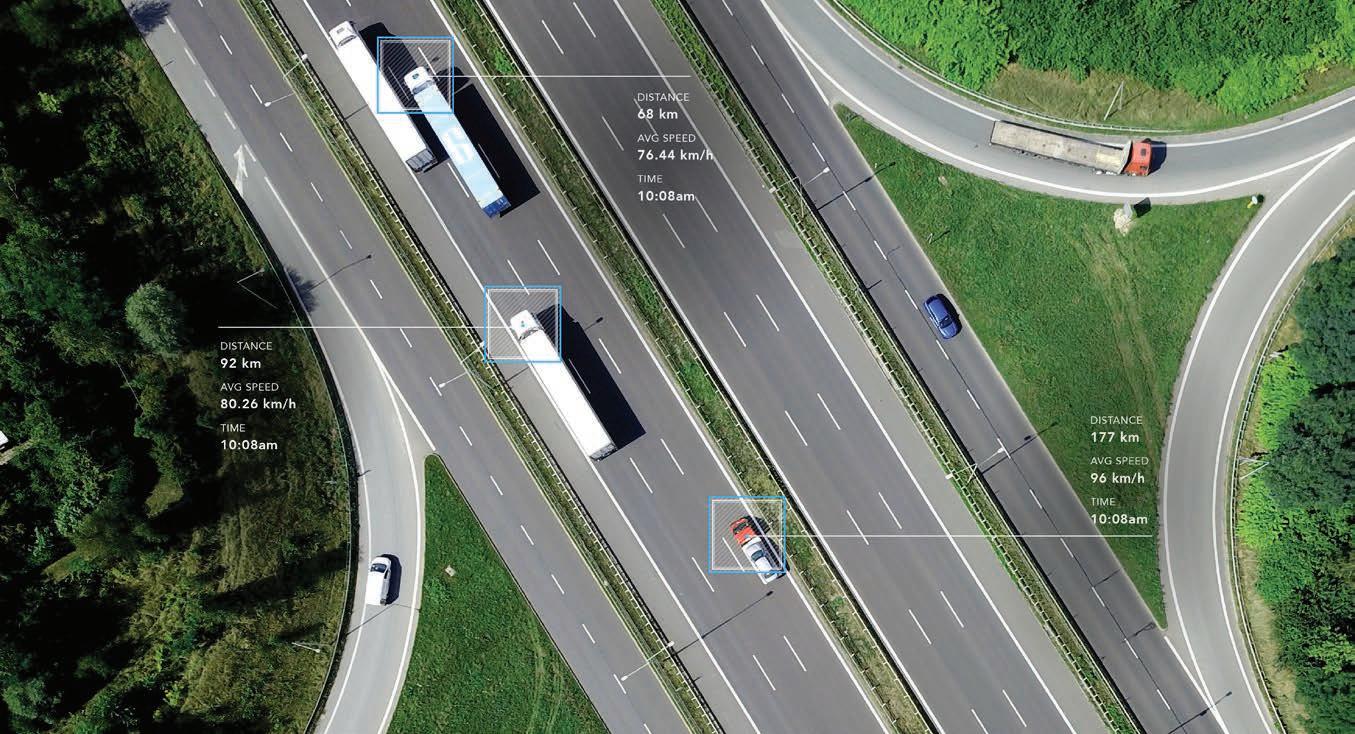
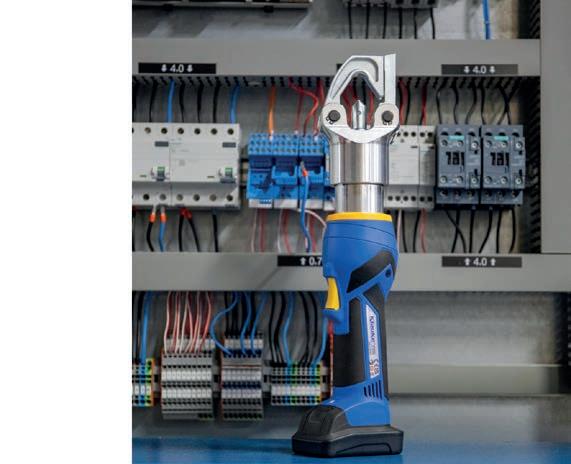
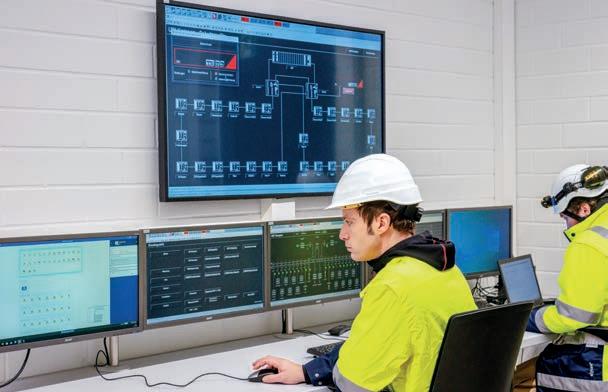
Geotab’s new all-in-one video telematics solution, the GO Focus Plus, automatically flags distracted driving, tailgating, hard braking and other serious events immediately, delivering instant in-cab voice feedback to enhance driver safety. For managers, patterns and urgent cases rise to the top for fast review and targeted coaching, all in one workflow that tracks follow-up and results. Spend less time searching and more time supporting every driver, addressing risk, encouraging improvement and recognising safer habits.
Ready to transform your fleet?
Visit www.geotab.com/au/ to learn how our telematics solutions can drive your business forward.
REGULARS
4 Welcome from the editor
22 A word from AWA
26 A word from SA Water
64 A word from WSAA
WATER MANAGEMENT
6 Autodesk talks real-time network modelling
40 True Water scales wastewater solutions
44 Discover Enviroline’s trailer-mounted water jetters
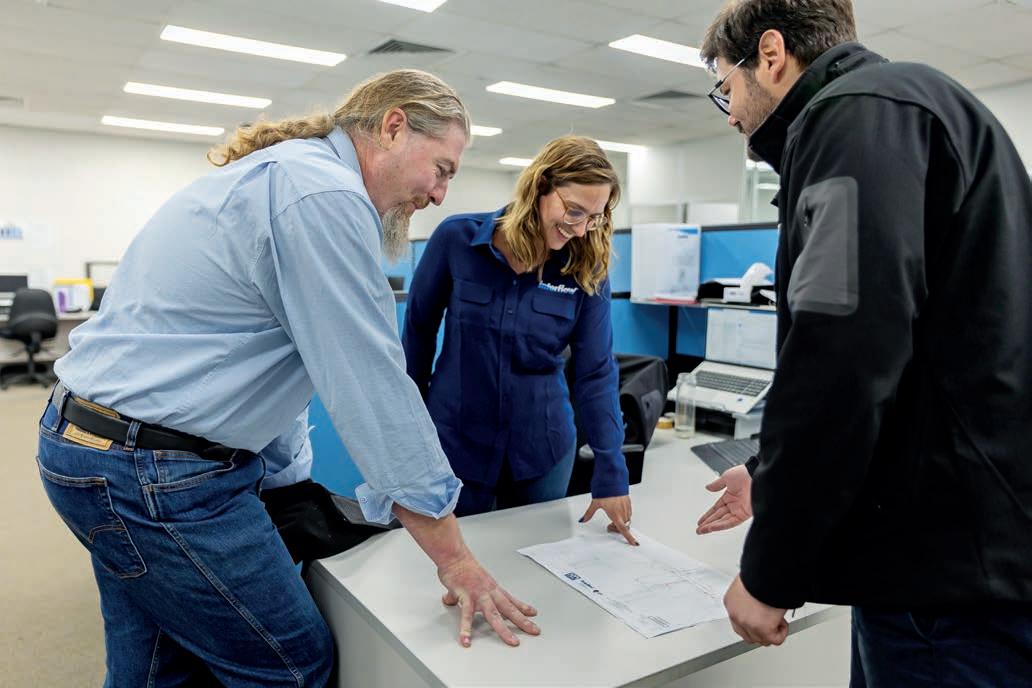
56 How Interflow utilises Finite Element Analysis
EVENTS
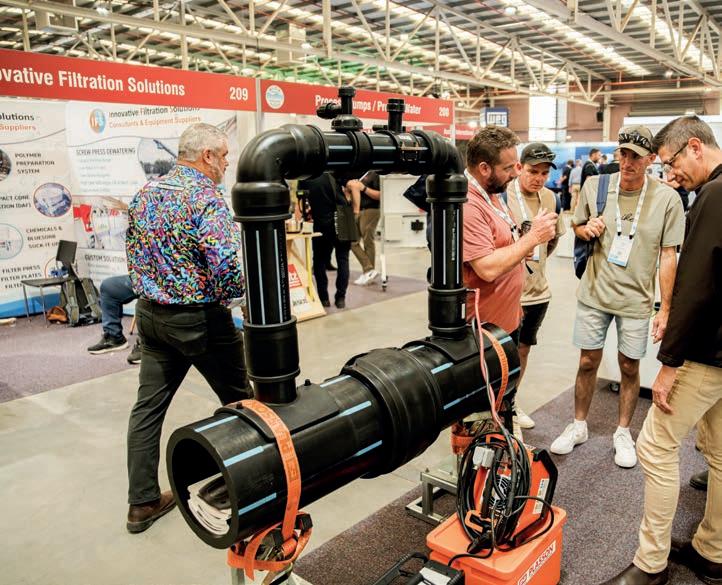
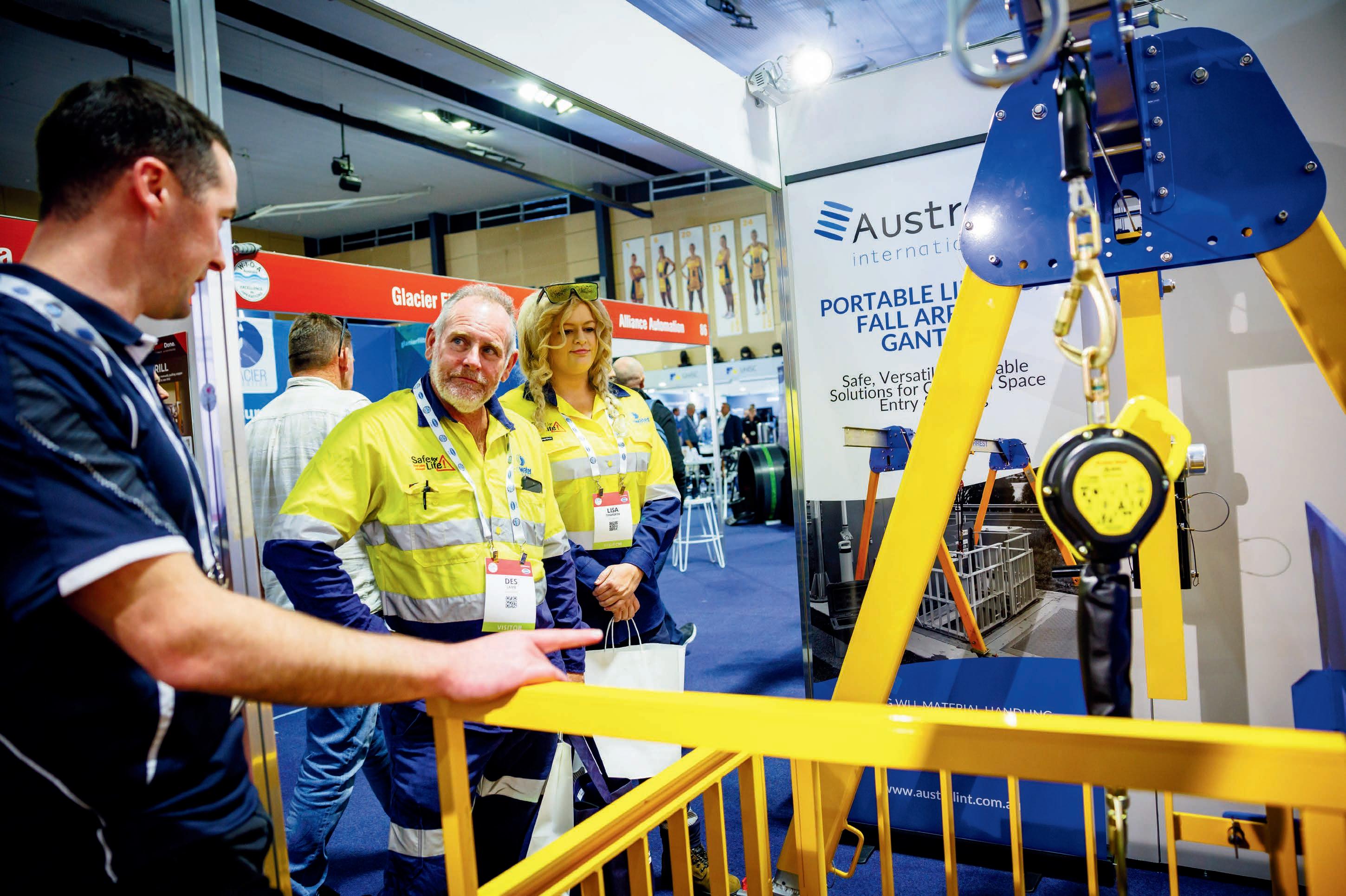
12 A recap of WIOA Bendigo
62 Innovations in trenchless installation
ENERGY EFFICIENCY
8 Geotab on driving down fuel costs
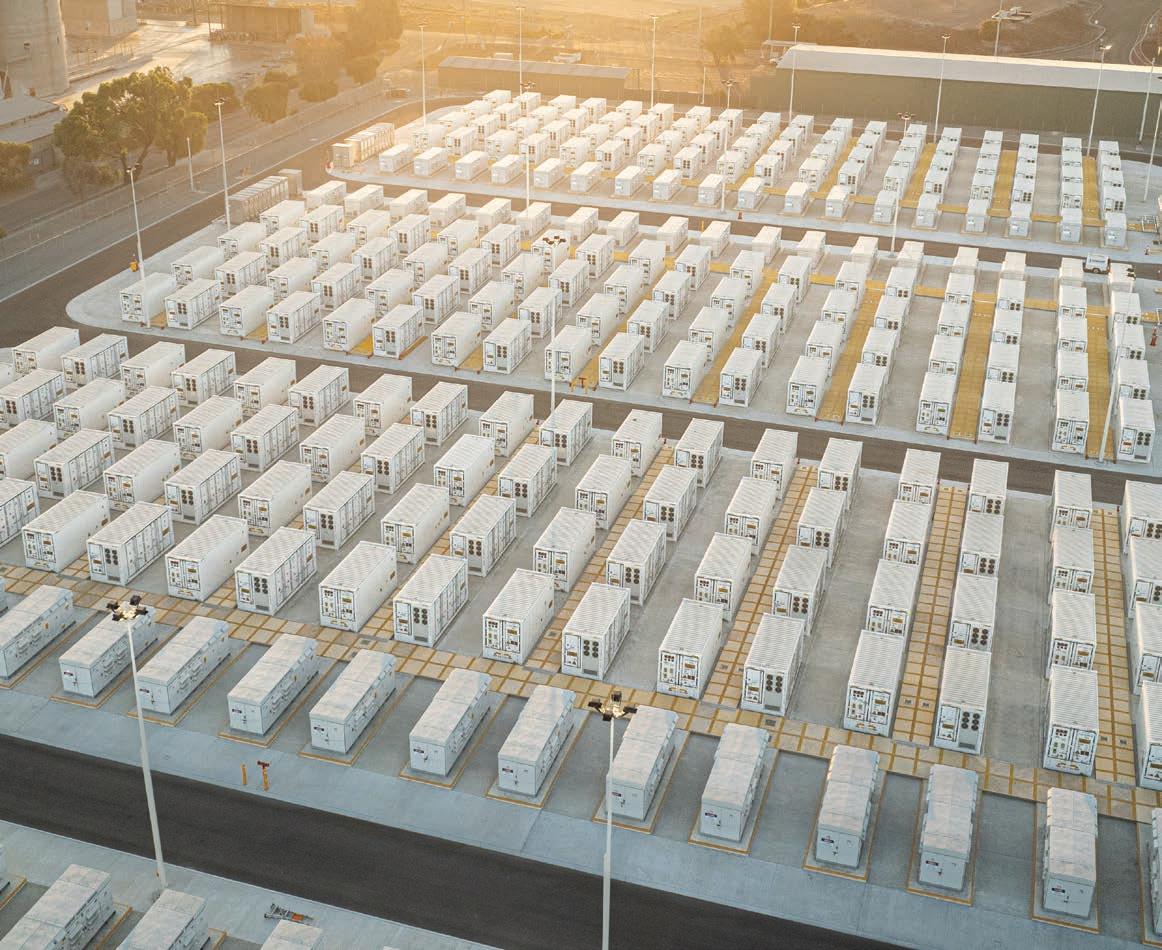
36 Genus designs risk out of infrastructure delivery
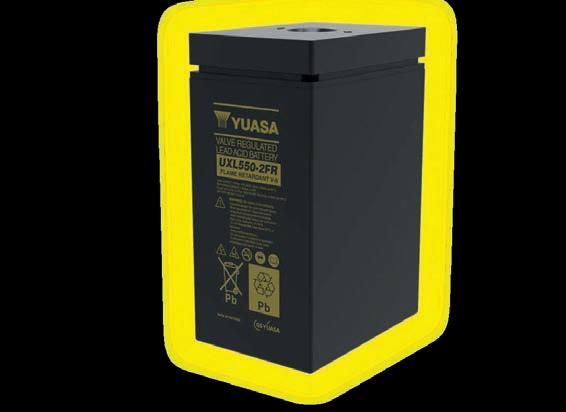
39 Century Yuasa sets a new standard for VRLA performance
ASSET MANAGEMENT
16 Chesterton boosts pump reliability
18 MASS unifies asset safety data
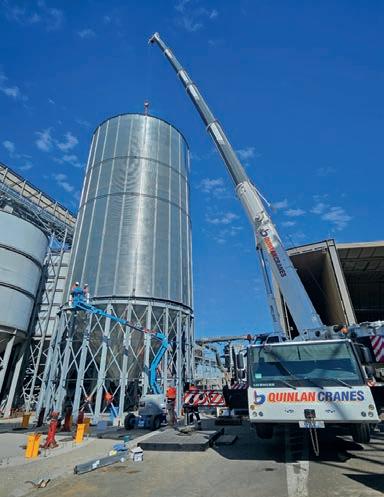
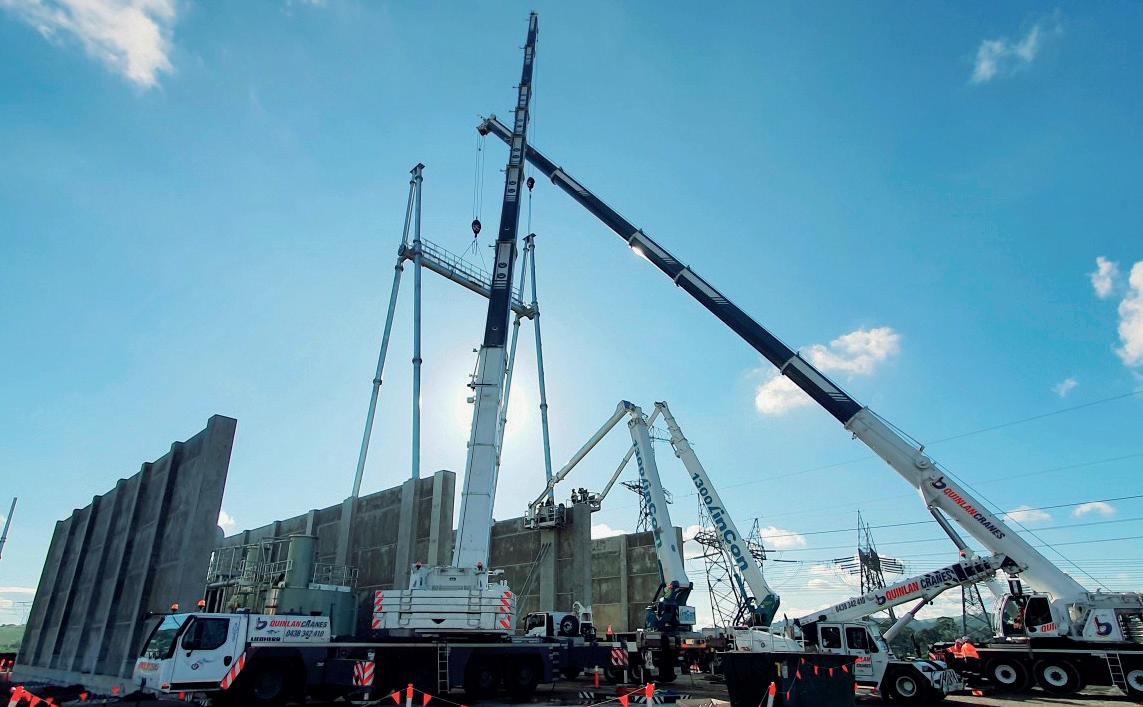
35 Quinlan Cranes on the real cost of downtime
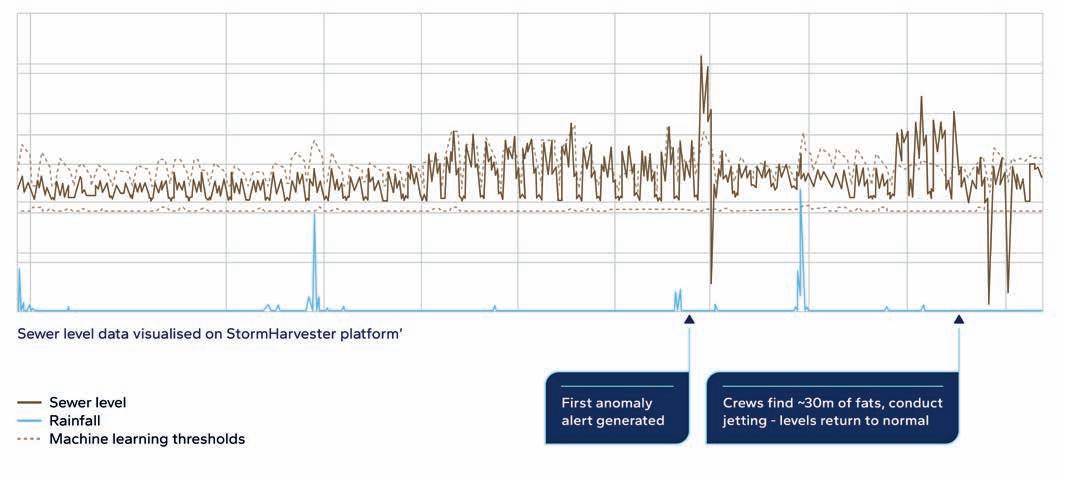
42 StormHarvester sees predictive sewer monitoring in action
FIELD SOLUTIONS
10 How FMT helps assets stay online
29 Bucher on raising pipe inspection standards
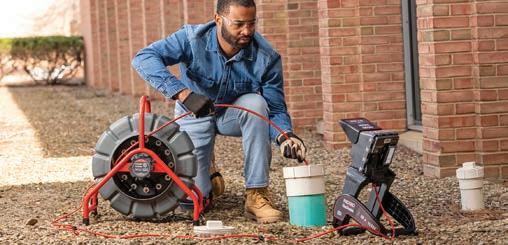
55 RIDGID’s 30-year triumph
DIGITAL UTILITIES
47 How Lanco Group is powering the data boom
50 OMICRON explains its OT cybersecurity solutions
60 Vocus debuts new end-to-end private network
INDUSTRY INSIGHTS
70 Industry movements
Powering the next chapter of utilities
With winter just around the corner, it’s hard to believe we’re almost halfway through 2026, a year that’s shaping up to be a de ning one for Australia’s essential services.
Across the country, the systems that keep our communities running are in the middle of a period of real change. It’s not one thing driving it, but a combination: rapid electri cation, shi ing demand patterns, climate variability, and the accelerating digitalisation of infrastructure. Each brings its own complexity, but together they are reshaping how utilities think about design, investment, operations and long-term resilience. is edition of Utility looks at how the sector is responding to those pressures and opportunities. What stands out is not just the scale of change, but the way it’s being met, with adaptation, innovation, and a growing focus on what ‘ t for the future’ really looks like in practice.
Nowhere is this more visible than in the energy sector. Electricity networks are navigating a fundamental shi in how power is generated, stored and used. Large-scale battery storage is increasingly shaping the grid, bringing more exibility and helping to stabilise systems that are now heavily in uenced by renewable generation. At the same time, new forms of demand – particularly from data centres – are emerging quickly, forcing utilities to rethink traditional approaches to network planning and capacity.
Over in the water sector, the story is one of steady renewal and resilience under pressure. Ageing assets, population growth and climate impacts are all driving sustained investment in upgrades and system hardening. From treatment plants through to reservoirs, the focus is on ensuring essential infrastructure can continue to deliver safe, reliable services in conditions that are becoming more
demanding and less predictable. ese projects are about more than maintenance; they’re about setting systems up for the decades ahead.
Running through both sectors is a growing reliance on digital infrastructure. As operational systems become more connected and cloud-based platforms extend further into eld operations, secure and reliable communications are becoming central to how utilities operate day to day. is shi is unlocking better visibility and e ciency across assets, while also raising the bar around cybersecurity, connectivity and operational risk.
Across these themes, what stands out most is a sector in motion, not just reacting to change, but actively shaping it. is edition highlights not only the pressures the sector is navigating, but the progress being made in response. It re ects an industry investing in its future, building capability, and embracing innovation to deliver better outcomes for customers and communities alike.
We hope it o ers a clear view of where the sector is heading, and con dence in the strength it is building along the way. As I step into a new role within the Utility team, I look forward to helping share the stories of the people and organisations working every day to build a more secure and sustainable future.
Hayley Ralph, Journalist
hayley.ralph@primecreative.com.au
Don’t forget to follow Utility on social media – find us on LinkedIn, Facebook, X and YouTube.
Scan to subscribe to Utility’s weekly newsletter –delivered to your inbox every Thursday morning. JOURNALIST
NATIONAL
Rima Munafo rima.munafo@primecreative.com.au 0413 475 078
CLIENT
“Please watch the road”
on the most urgent in seconds.
Geotab’s new all-in-one video telematics solution, the Focus Plus, automatically flags distracted driving, tailgating, hard braking and other serious events immediately, delivering instant in-cab voice feedback enhance driver safety. For managers, patterns and cases rise to the top for fast review and targeted coaching, all in one workflow that tracks follow-up results. Spend less time searching and more time supporting every driver, addressing risk, encouraging improvement and recognising safer habits.
Ready to transform your fleet?
solutions can drive your business forward.
Accelerate digital maturity
across shows up, starts.
Bridging the gap
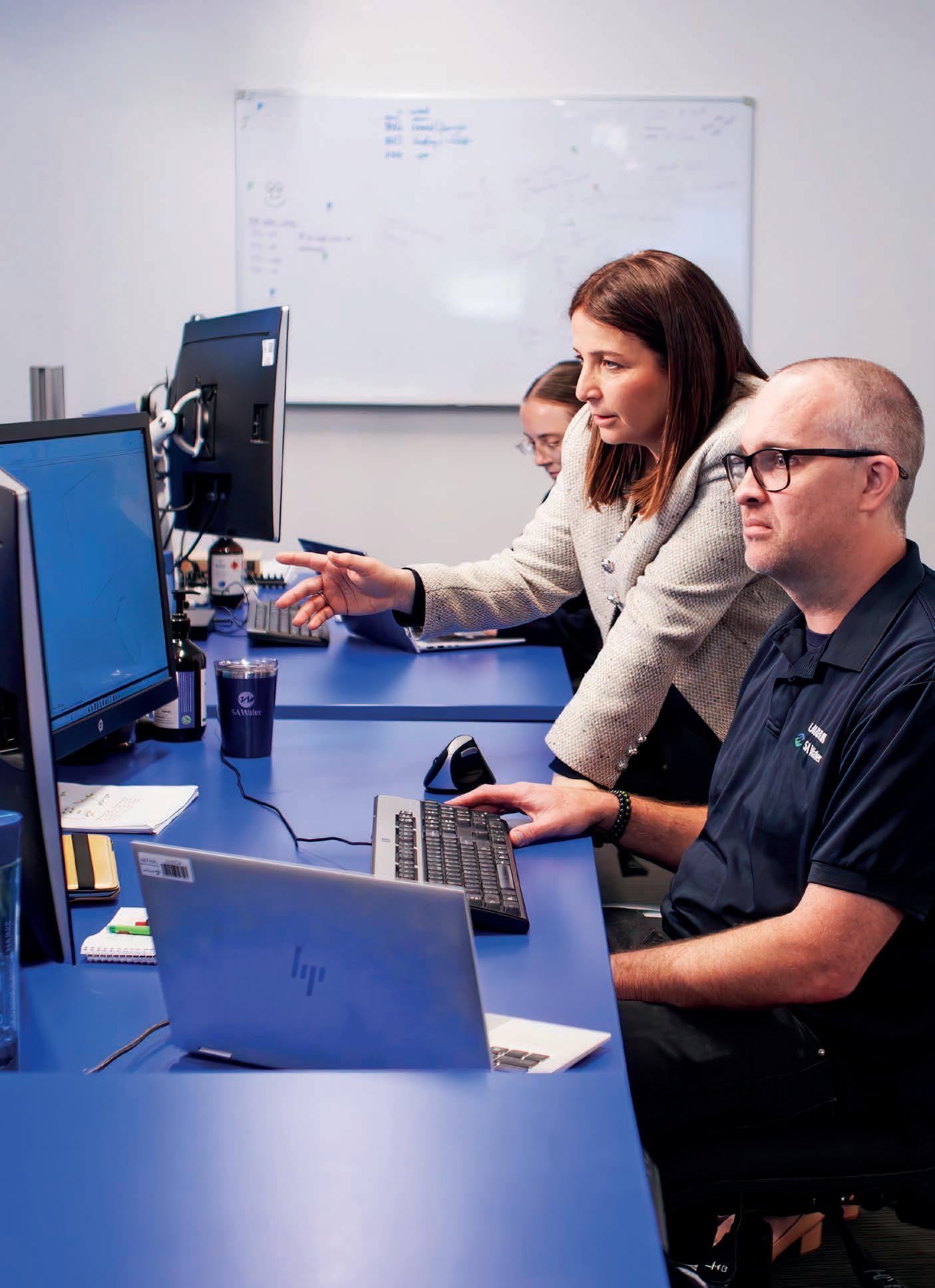
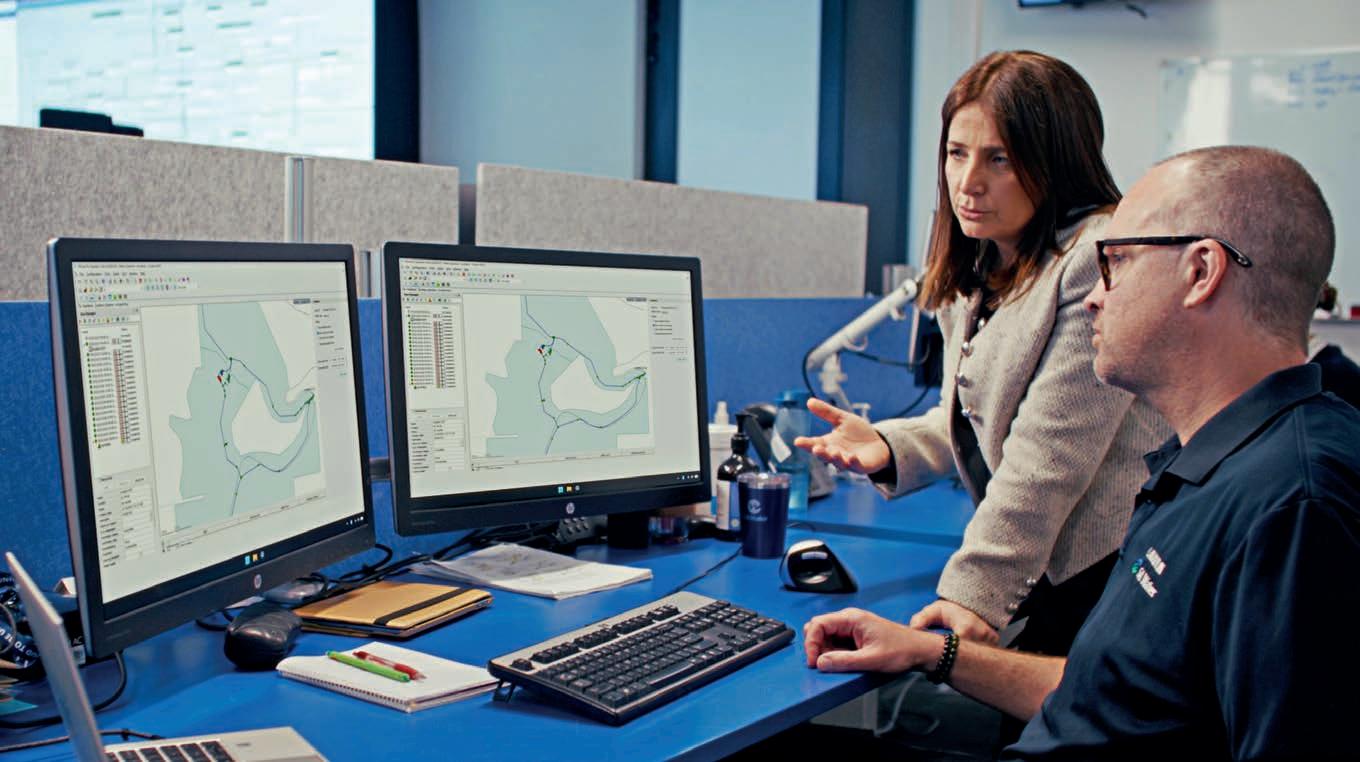
There is the continual push for system digitisation and then there is the reality of utility system behaviour. Autodesk explains how real-time network modelling has overcome the gap and helped a major water supplier improve decision making and reliability.
Water utilities today face increasing complexity: growing demand, climate variability, expanding infrastructure, and rising expectations for reliability.
For SA Water, which delivers essential water and wastewater services to more than 1.8 million South Australians, managing that complexity requires more than traditional planning tools.
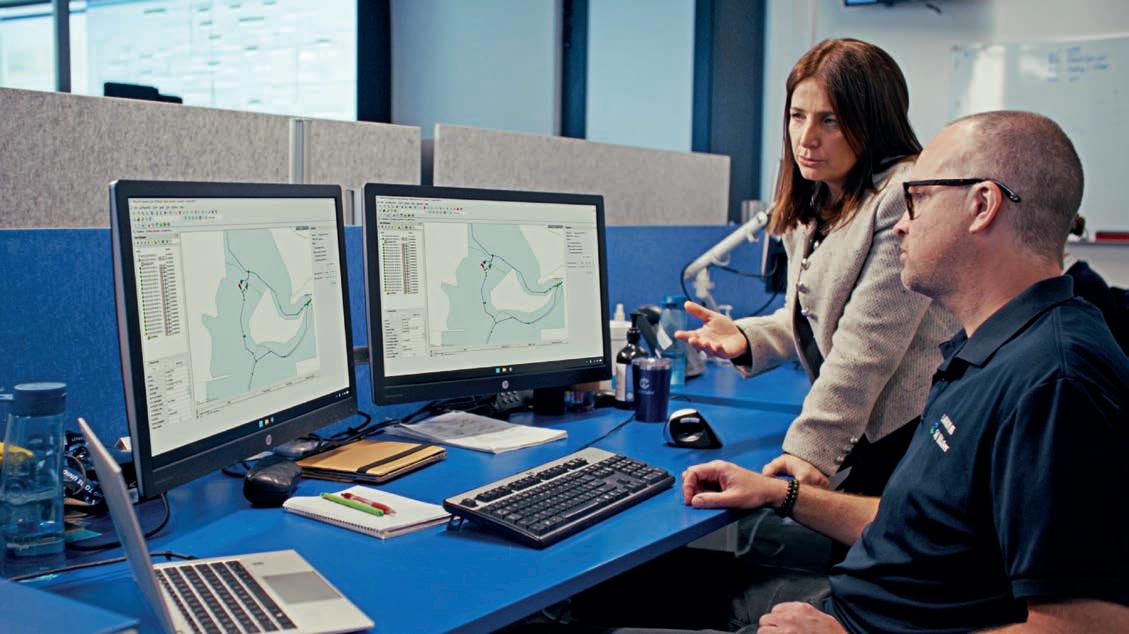
At the centre of their digital transformation, which SA Water began pursuing more than a decade ago, is the Operational Control Centre (OCC) – and at the heart of the OCC is live hydraulic modelling powered by Autodesk Water Infrastructure solutions.
“ e OCC is the central hub that oversees daily operations of the water network,” said SA Water Network Operations Modeling Engineer Oras Abbas.
“ e operators monitor key assets, manage ows, pressures, handle faults and alarms, and coordinate responses to keep water owing to customers.” is is where digital maturity moves from concept to operational reality.
The OCC: Where complexity meets intelligence
SA Water’s network spans vast geographic areas and serves a diverse customer base. As its infrastructure has expanded and the OCC becomes a big part of the water authority’s work, so does operational complexity and customer service needs.
“ e new infrastructure gives us more exibility and
transfer options across the network, but added more complexity, which meant we needed smarter tools to support operational decisions,” said Abbas.
Traditional planning models are designed for de ned scenarios.
ey play a critical role in long-term strategy, but they don’t always capture real-time system behaviour.
“Planning models are usually built for speci c scenarios, so they don’t re ect the automatic changes in the network,” Abbas said.
To bridge that gap, SA Water implemented a live hydraulic model using IWLive Pro.
From static planning models to live operational intelligence
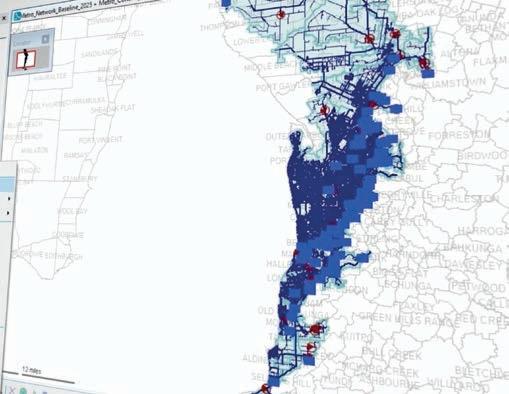
With IWLive Pro, SA Water established a live hydraulic model that integrates real-time operational data directly into its network model, forming part of Autodesk’s broader shi toward uni ed simulation, asset, and operational intelligence across its portfolio. is enables the OCC to monitor how the system behaves under actual conditions – not just theoretical ones.
“ e live model from IWLive Pro helps to have a live view on the network behaviour and understand how the system behaves during incidents, shutdowns, or outages, and supports fast, informed decisions,” said Abbas.
is shi from static modelling to real-time hydraulic modelling allows operators to anticipate system impacts before implementing operational changes.
SA Water uses live hydraulic modelling powered by Autodesk Water Infrastructure solutions.
Running what-if scenarios safely
In addition to monitoring live system conditions, SA Water leverages advanced modelling capabilities to test scenarios without risking live operations.
“ e so ware lets us take a copy of a live network from IWLive Pro into InfoWorks WS Pro to run multi what-if scenarios safely o ine,” Abbas said. is approach enables the utility to assess operational risk during outages, test shutdown strategies, evaluate alternative supply routes and protect overall water distribution system performance. By combining real-time monitoring with o ine hydraulic analysis, SA Water strengthens both operational agility and planning rigor.
Building trust through realworld performance
Technology adoption only succeeds when users trust it.
“Trust came from consistent validation, but the biggest driver was using the model during real outages and incidents,” said Abbas.
“Operators and eld crews saw how closely the model matches actual behaviour and how it helped them prevent risk and test di erent scenarios.”
is alignment between digital tools and operational reality has accelerated adoption and strengthened collaboration across teams. at collaboration between planning and operations teams is one of the most powerful aspects of SA Water’s case study.
“ e model succeeded because operations and planning worked together. Planning teams ensured long-term structure and demand forecasting while operations brought in real-time eld insights,” Abbas said. is integration re ects a higher level of digital maturity, where silos are reduced and shared models support both long-term strategy and day-to-day operations.
Real-world impact during drought conditions
e true test of digital resilience comes during high-pressure situations. During unusually dry conditions, SA Water was
asked to help the government identify temporary water ll points for properties not connected to the network. e live model plays a crucial role in this task.
“ e IWLive Pro model helped us choose locations with adequate pressure, safe physical access, and minimal impact on pumps and storage operations,” said Abbas.
By using real-time modelling, SA Water can respond quickly while protecting overall network performance.
Measurable operational improvements
From the OCC perspective, the results are tangible.
“We have seen faster and clearer decision-making, fewer supply interruptions, and stronger coordination between eld operators and OCC teams,” said Abbas. ese outcomes represent a meaningful shi in how the organisation operates.
“We are advancing digital maturity by strengthening the tools that support real-time decision-making. Real-time modelling can truly transform how we understand and operate your network,” Abbas said.
Advancing toward intelligent water infrastructure
SA Water’s journey illustrates how utilities can evolve along the digital maturity curve. Since it began the digital transformation, SA Water has gone from isolated planning models to integrated, real-time operational intelligence to proactive, risk-informed decision-making.
By embedding live hydraulic modelling into its OCC, SA Water has built a foundation for resilient, data-driven water management.
As climate pressures, infrastructure complexity, and customer expectations continue to grow, the ability to understand and operate water networks in real time will de ne the next generation of intelligent utilities. For SA Water, that future is taking shape inside the OCC. U
For more information, visit www.autodesk.com
Images: Autodesk
SA Water delivers essential water and wastewater services to more than 1.8 million South Australians.
Driving down fuel costs
Rising fuel costs are pushing utilities to look beyond the price at the pump and address ine ciencies within their fleets. Telematics and data-driven insights from Geotab are helping operators uncover hidden savings in driver behaviour, routing and vehicle performance.
Fuel has always been a major operational cost for utilities, but recent volatility has placed renewed pressure on eet managers to control spending.
While many organisations focus on uctuating fuel prices, eet management so ware company Geotab believes the real opportunity for savings o en lies in addressing ineciencies within day-to-day eet operations.
“More o en than not, eet operators underestimate the hidden costs of ine cient driving behaviour,” said Andrew Hintz, Geotab’s Associate Vice President – Heavy Transport APAC. “It really depends on their level of maturity and where they are in their telematics journey.”
Hintz noted that large enterprise eets o en have had several generations of telematics systems in place and a strong understanding of where e ciencies can be found. Smaller operators, however, may only be scratching the surface.
“You might have telematics installed but only be using 20 to 30 per cent of the functionality available. Without analysing the data properly, eets are missing major opportunities to reduce costs,” he said.
Regardless of eet size, Hintz said driver behaviour remains one of the most signi cant in uences on fuel consumption and vehicle performance.
The hidden cost of ine cient driving
According to Hintz, driver behaviour can quietly in uence everything from fuel consumption to maintenance costs. In eet operations where margins are already tight, these ine ciencies can quickly accumulate.
“Harsh acceleration, braking and cornering all have a direct correlation with increased fuel consumption,” Hintz said.
ese behaviours also place additional stress on vehicle components.
“Beyond fuel, they accelerate wear on things like brake pads and tyres, which increases maintenance costs across the eet,” he said.
Excessive idling is another major contributor to fuel waste, particularly for vehicles operating in urban areas or hot climates.
“For heavy vehicles, it’s easy to burn around four litres of fuel per hour just sitting idle,” Hintz said. “Across a eet, excessive idling alone can add around 10 per cent to total fuel spend.”
Idle time also contributes to unnecessary engine hours, bringing forward maintenance intervals and potentially shortening engine life.
Associate Vice President –Heavy Transport APAC.
The biggest fuel-wasting behaviours
Beyond driving style, ine cient routing is another major source of fuel waste, particularly for utilities operating across large service areas.
“ e last thing you want is vehicles crossing back and forth across town all day. Routes should be logical, so drivers move from point A to B to C without unnecessary kilometres,” Hintz explained.
He added that poor route planning, tra c congestion and unnecessary backtracking can quickly in ate fuel consumption.
“Tra c congestion and ine cient routing can easily add another ve to 10 per cent to fuel costs,” said Hintz.
Even small operational details can have measurable impacts. Tyre pressure, for example, is o en overlooked but can directly a ect fuel e ciency.
“If tyre pressure drops by just 10 psi, fuel consumption can increase by around 1.5 per cent. Across a large eet, small increases like this can translate into thousands of dollars in additional fuel costs each year.”
Turning data into fuel savings
Hintz believes one of the biggest barriers preventing organisations from addressing these ine ciencies is a lack of visibility.
“ e number one challenge is what I call ‘data blindness’,” he said. “Many operators focus on the price at the pump but don’t actually have visibility into what’s happening across their eet.”
Without reliable operational data, eet managers have little ability to identify ine ciencies or prioritise improvements.
Telematics platforms such as those provided by Geotab are helping to close that gap by providing realtime insights into vehicle performance, fuel usage and driver behaviour.
“ ink of the telematics device as a digital assistant. It reads data directly from the vehicle and provides realtime insights into fuel usage, driver behaviour and vehicle performance,” he said.
“Instead of waiting for monthly fuel reports or maintenance issues to appear, operators can identify ine ciencies immediately and respond accordingly.”
Some platforms can even provide real-time coaching to drivers when ine cient behaviour occurs.
“ e technology can alert drivers if they’re accelerating too harshly or operating the vehicle ine ciently,” Hintz added.
Small improvements, big operational savings
When applied across an entire eet, even modest improvements in e ciency can deliver signi cant nancial bene ts.
Hintz recently worked with a fuel transport operator in Perth whose trucks typically travel around 200,000 kilometres per year.
“A typical heavy vehicle operating in that environment could burn more than 130,000 litres of fuel annually,” he said.
With current fuel prices, that represents a substantial operational cost.
“For a single truck, the annual fuel bill can reach around $250,000,” he said.
However, relatively small improvements in e ciency can quickly o set those costs.
“If you can improve fuel e ciency by just 10 per cent through better routing, reduced idling and improved driver behaviour, you could save around $35,000 per truck each year,” Hintz said.
For example, when Dubbo Regional Council implemented Geotab’s telematics across more than 800 vehicles and pieces of equipment, the organisation quickly uncovered signi cant savings.
“Almost immediately they identi ed around $180,000 in fuel savings,” Hintz said.
A major contributor was excessive idle time.
“At one point, around 28 per cent of the time those vehicles were in operation, they were actually idling,” he said.
By identifying and addressing that behaviour, the council was able to reduce fuel consumption while improving equipment utilisation and long-term asset value.
Hintz said improved eet e ciency can also support broader organisational goals, such as emissions reduction and sustainability reporting.
“If you have carbon reduction targets or ESG reporting requirements, you need accurate data to measure fuel usage and emissions,” he said.
As fuel volatility continues and operational pressures increase, data-driven eet management is becoming an essential tool for utilities seeking to improve e ciency.
“When there’s nancial pressure in the market, organisations tend to adopt telematics faster,” Hintz said. “Once they see the insights available from the data, adoption usually happens very quickly.” U
For more information, visit www.geotab.com/au
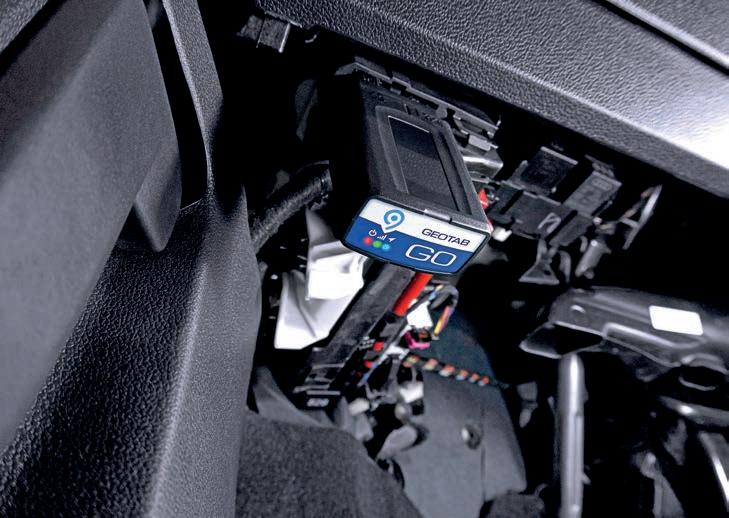
Geotab’s hardware helps track, protect and manage assets across any fl eet size.
Where assets stay online
When a single critical asset fails in a utility network, the challenge is no longer just repair, it’s how to restore precision, performance, and service continuity without taking an entire system o ine.
In utility operations, downtime is rarely isolated. A failed pump station, misaligned turbine, or compromised pipeline component can ripple through an entire network, a ecting supply reliability, safety margins, and downstream customers. As infrastructure becomes more interconnected and demand continues to rise, the tolerance for extended outages is steadily shrinking.
At the same time, much of Australia’s utility infrastructure is ageing, large-scale, and physically di cult to remove for traditional workshop repair. Components are o en embedded deep within operational systems, located in remote environments, or simply too large to transport without signi cant disruption. In many cases, taking assets o ine for disassembly, transport, and o -site machining is no longer a practical default option. is operational reality has driven increased attention toward eld-based engineering solutions that can be deployed directly to the asset. Among these, Field Machine Tools (FMT) provides portable precision machining equipment and on-site support services that allow critical maintenance work to be completed without full asset removal.
“Field machining is centred on bringing workshop-level accuracy into operational environments. Using specialised portable systems, technicians can carry out processes such as line boring, ange facing, on-site milling, sha machining, and valve repairs directly on installed infrastructure,” said FMT Director Kim Mills.
“ e objective is not to bypass engineering standards, but to maintain them in environments where traditional repair pathways are constrained.”
In the water sector, this capability is particularly relevant for pump stations, treatment facilities, and distribution networks where continuous supply is essential. Rather than shutting down entire systems to remove worn or misaligned components, eld machining enables targeted repairs that restore performance while keeping broader systems operational.
In electricity generation and transmission, similar constraints exist. Turbines, generators, and associated structural components require high-precision tolerances, but are o en located in xed installations where removal is complex and costly. On-site machining allows engineers to address wear, alignment issues, and surface damage without lengthy disassembly and recommissioning cycles.
Gas infrastructure operators also rely on similar approaches, particularly for pipeline systems, valve
assemblies, and pressure-critical components. In these environments, maintaining seal integrity and dimensional accuracy is essential, and the ability to perform machining on site reduces both downtime and handling risk.
Across all applications, the value proposition is fundamentally operational. Reduced outage duration is o en the most immediate bene t, particularly in critical infrastructure where even short interruptions can have cascading e ects. By eliminating transport and workshop scheduling constraints, eld machining compresses maintenance timelines and simpli es shutdown planning.
“ ere are also technical advantages. Performing machining in place can improve alignment outcomes by removing reassembly variability that occurs when components are dismantled and reinstalled,” Mills said.
“It can also reduce the risk of damage during transport and handling of large or sensitive assets. From a safety perspective, reducing heavy li s and long-distance transport movements also lowers exposure to high-risk activities on site.”
For engineers and contractors, portable machining capability adds another layer of exibility to maintenance strategy. It enables faster response to unexpected failures while also supporting planned shutdown work where time windows are increasingly constrained. In remote or regional infrastructure settings, where access to specialist workshops may be limited, the ability to bring machining capability directly to site can signi cantly improve project feasibility.
As Australia continues to invest in the energy transition, water security, and transmission expansion, FMT is extending the precision engineering capability beyond xed facilities and into operational environments where assets cannot a ord to be o ine for long.
“ e result is a more adaptive maintenance model, one that prioritises continuity, reduces logistical friction, and allows utilities to address mechanical issues where they occur.” U
Making waves
From record crowds to high-stakes competitions, WIOA’s 2026 Victorian conference put the water industry’s expertise and camaraderie on full display.
If there’s one place where the water industry’s quiet achievers become headline acts, it’s the WIOA conference oor – and in 2026, Bendigo delivered.
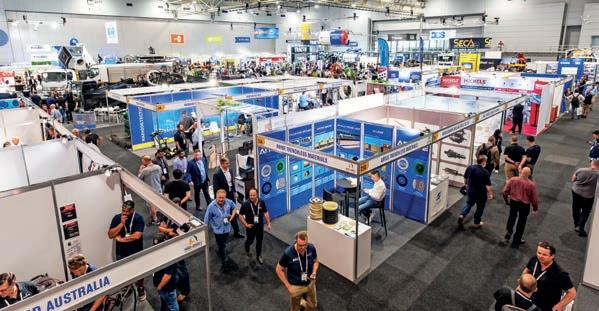
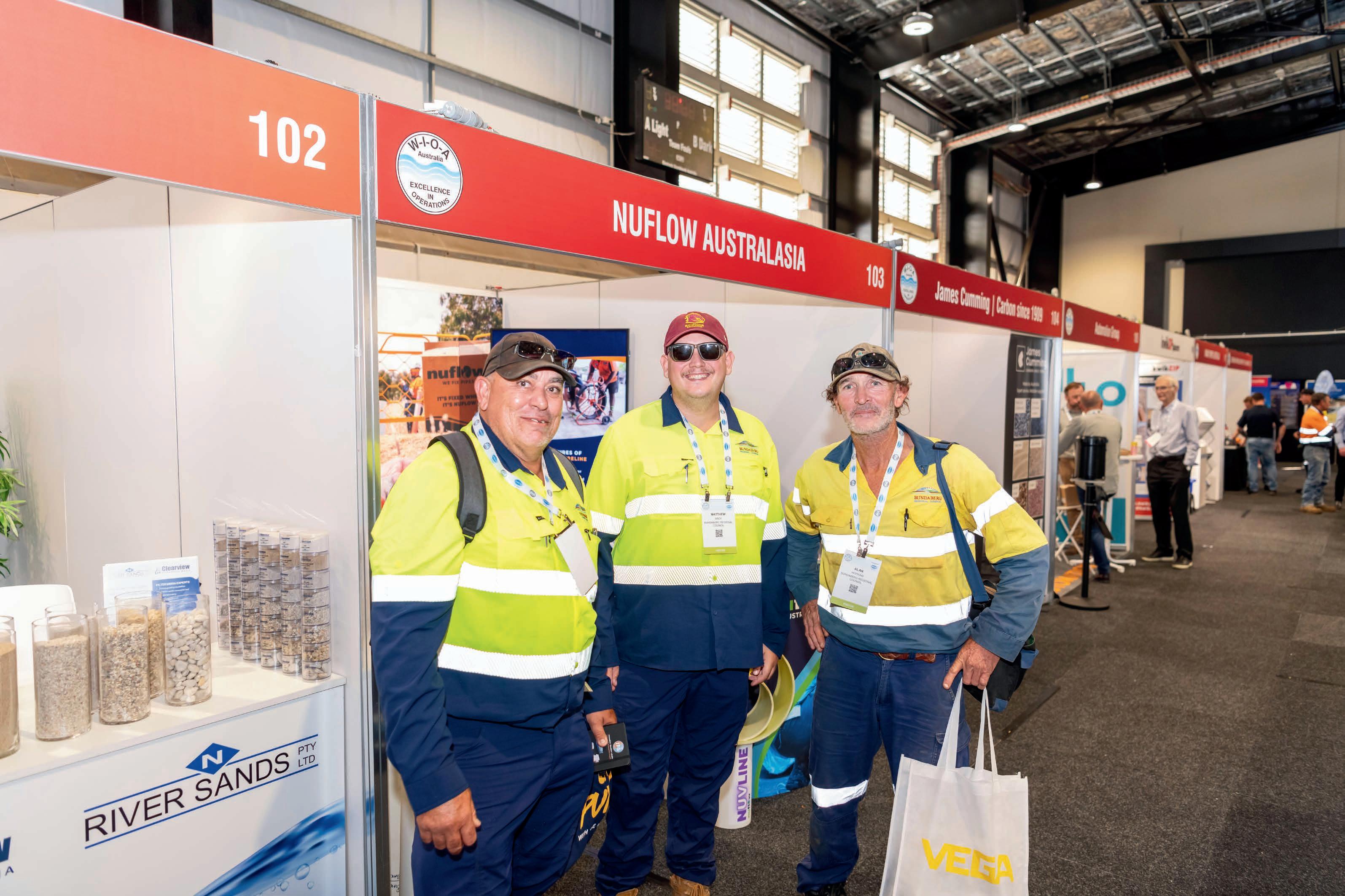
e Water Industry Operations Association of Australia (WIOA) returned to the Bendigo Showgrounds from March 25 to 26, drawing water professionals from across the country for the 87th Victorian Water Industry Operations Conference and Exhibition. And the numbers told their own story: more than 1490 attendees, a 9.5 per cent increase on last year, making this the largest Victorian event to date and reinforcing Bendigo as a rm xture on the calendar.
“With our membership at almost 6000 – the highest in our more than 50-year history – the attendance at this year’s conference has been truly powerful and it re ects the vital role our association continues to play with the meaningful di erence we are making across the industry,” said WIOA CEO Dean Barnett.
“It has been incredibly rewarding to see the connections forming and to hear the experience and knowledge being openly shared by our members.”
Beyond attendance, it was the energy on the ground that stood out. Across two days, operators, engineers and industry partners moved between technical sessions, exhibition stands and live demonstrations, all centred on a shared goal: improving the way water networks are run, maintained and future-proofed.
at focus carried through to the conference program, where practical, frontline experience took priority. Presentations from North East Water, SA Water and SUEZ, and Greater Western Water explored real operational challenges, sparking discussions that continued well beyond the session rooms and into the exhibition oor.
Of course, no WIOA event is complete without a bit of
friendly competition – and this year, the stakes felt higher than ever.
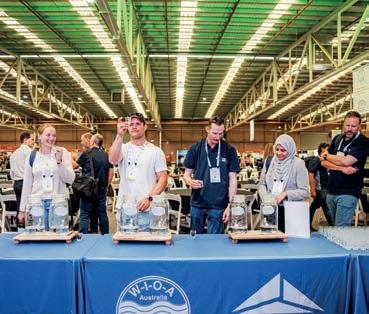
e Reece Civil + Viadux Main Tapping Competition, the debut Trans-Tasman Main Tapping event, and the crowd-favourite IXOM Best Tasting Tap Water contest brought a buzz of anticipation, turning everyday operational skills into centre-stage moments.
Cameron and Curtis from North East Water powered their way to victory in an impressive performance under pressure in the main tapping competition.
On their second attempt, the duo delivered a clean, nonpenalty completion with an impressive time of 3 minutes 2.23 seconds.
Taking things a step further, the introduction of a Trans-Tasman format elevated the event onto the international stage.
Tasmania has claimed national honours at one of the water industry’s most technically demanding competitions, with TasWater taking out the rst-ever 2026 WIOA Tran-Tasman Water Main Tapping Competition.
Cameron Lusk and Lynden urston secured the win in a tightly contested nal, completing the task in 1 minute and 20.72 seconds to edge out New Zealand’s Kūmānu team from Nelson.
e result places Tasmania at the top of a competition that tests the core operational skills required to maintain and expand live water networks.
Water main tapping is a critical operational task that enables new connections to existing pipelines without interrupting the water supply.
For utilities, this capability underpins service continuity, particularly in growing communities where new connections are required without disrupting existing customers.
e competition replicates these real-world conditions,
requiring teams to perform a live tap on a pressurised 100mm pipe under strict safety and technical standards.
Speed is only one part of the challenge.
Accuracy is equally important, with penalties applied for leaks, faults or incomplete installations.
is re ects the reality crews face on live networks, where errors can have immediate consequences for safety and service delivery.
e WIOA Water Main Tapping Competition has evolved from a national event into an international benchmark for operational excellence.
Teams compete in pairs, demonstrating not only individual skill but coordination, communication and adherence to safety protocols.
TasWater General Manager Operations, Brendan Windmeyer, said the result re ects the broader capability of the organisation’s workforce.
“ is is an outstanding achievement and a real credit to Cameron and Lynden, as well as the broader TasWater operations team,” Windmeyer said.
“Water main tapping is highly technical, safety-critical work carried out live on our network, and this result demonstrates the expertise, precision and pride our people bring to their roles every day.”
e competitive spirit didn’t stop at the pipe. Another long-standing favourite was drawing a crowd for very di erent reasons.
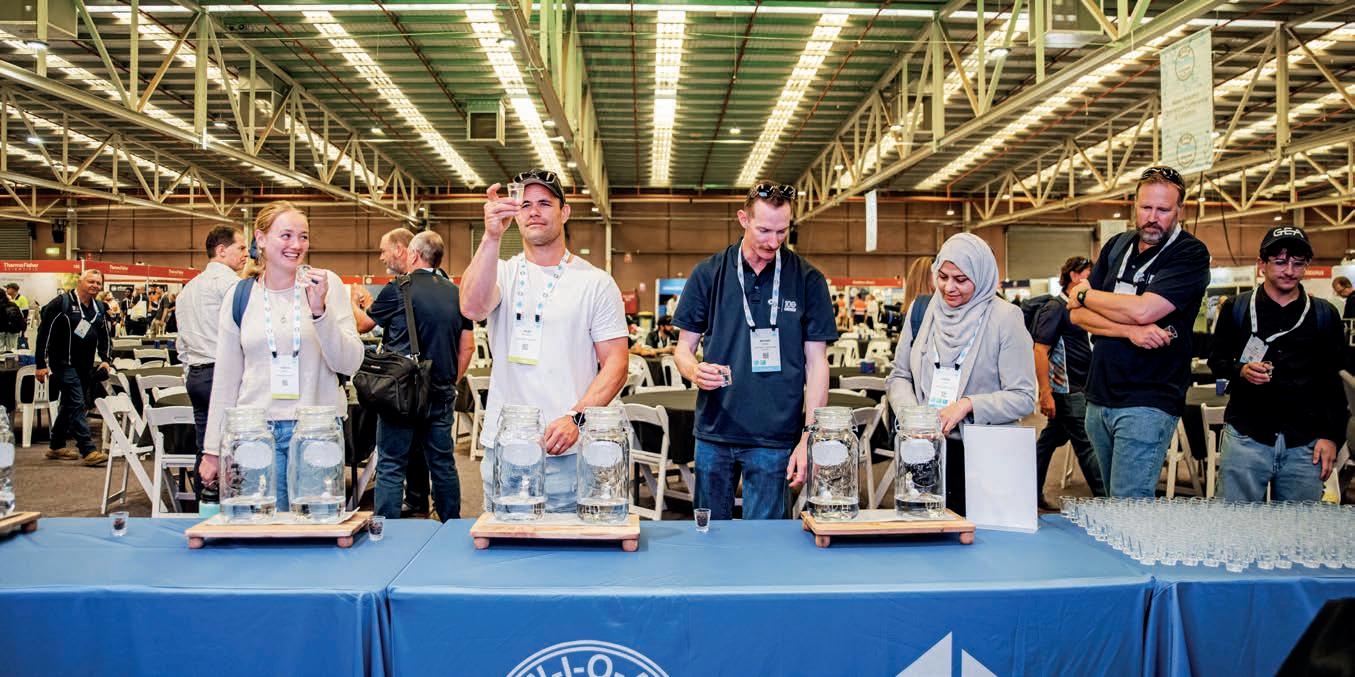
at same competitive energy carried across to water quality, with suppliers going head-to-head at the 2026 IXOM Best Tasting Tap Water competition.
Utilities from across the state submitted samples of their nest drinking water, re ecting treatment processes, network management and operational discipline. While the competition is light-hearted on the surface, it re ects a serious benchmark for water quality across Victoria.
e title of the state’s Best Tasting Tap Water for 2026 was awarded to Coliban Water’s Bendigo Water Treatment Plant, earning a place on the national stage later this year.
e water utility defeated Barwon Water’s Colac WTP and Grampians Wimmera Mallee Water’s Hopetoun Water Treatment Plant.
Entries were assessed for clarity, odour, and taste, with judges blind-testing samples to determine the standout provider.
For Coliban Water, the recognition highlights the consistency of its treatment processes and the performance of its operational teams.
“ is is recognition for the amazing e ort that the team and our contracting partners, Veolia and ServiceStream, have put into producing and providing great-tasting tap water for our community,” Angus Bowles, Manager of Catchment and Treatment Operations at Coliban Water, said.
e annual IXOM Best Tasting Tap Water competition has become a xture of the WIOA conference calendar.
It provides a rare opportunity to celebrate an essential service that customers o en take for granted.
Behind each entry is a combination of source water management, treatment optimisation and distribution system performance. Operators must balance these factors daily to ensure compliance while maintaining a high standard of drinking water quality.
e competition o ers a snapshot of that work, bringing together utilities of all sizes to showcase what they deliver to their communities.
While safety and compliance remain the primary drivers of water treatment, taste plays an important role in public con dence. Competitions such as this reinforce the link between operational excellence and customer experience. Beyond the competition oor, the event also created space for conversations shaping the future of the sector.
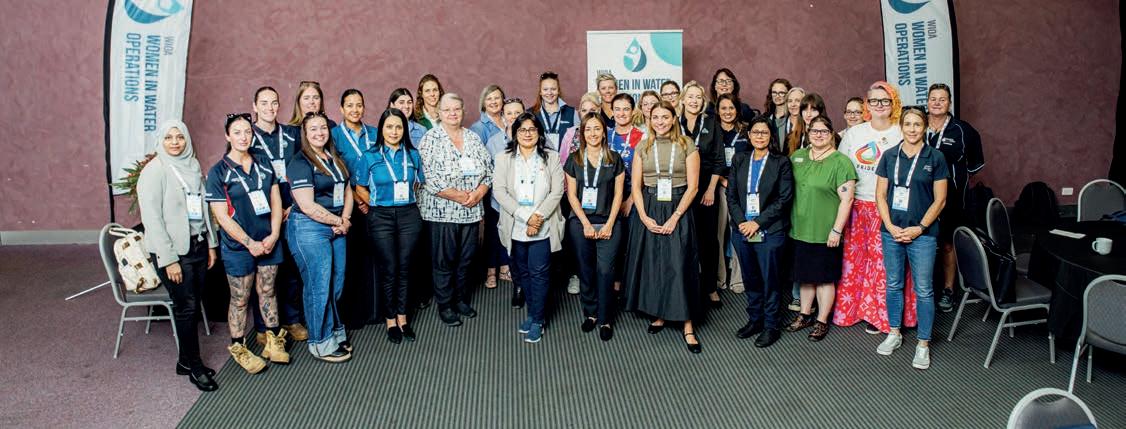
e rst o cial Women in Water Operations Breakfast welcomed more than 40 attendees for a dedicated networking session focused on inclusion and advocating industry connections.
e Awards Dinner further highlighted connection, talent, innovation, member recognition and emerging leadership across the sector. Winners include:
• New Operator of the Year: Holly WestBrook of Goulburn Murray Water
• Network Operator of the Year: Ethan Mans eld of South East Water
• Best Paper by an Operator: Liam Tothill and Andrew Sawiilski of SA Water and Suez
• Hepburn Award for Best Paper Overall: Rita Meijer of SA Water
• Best Poster by an Operator: Vincent Encena of Greater Western Water
• Ron Bergmeier Award for Best Exhibition Site: NovoLabs
• IXOM Best Tasting Tap Water in Victoria: Coliban Water
• Main Tapping Competition: Cameron and Curtis of North East Water
WIOA’s Victorian conference returned to the Bendigo Showgrounds from March 25 to 26.
at focus on shared learning carried through to the technical program, where real-world insights remained front and centre.
North East Water, presenting Clear Water Storages – Critical Learnings for the Application of Protective Coatings, o ering valuable insights into asset protection and long-term infrastructure performance.
SA Water and SUEZ, who shared Sludgy Solutions: Dealing with Excessive Sludge at Barossa WTP, addressing a common challenge through innovative and practical approaches.
Greater Western Water, presenting on the RePurposing Soil Hydro Project, showcasing adaptation
and optimisation of existing assets to deliver operational e ciencies.
ese sessions generated strong discussion and knowledge exchange, reinforcing the conference’s reputation for delivering relevant, frontline-focused content.
With momentum continuing to build, attention now turns north. e 2026 Queensland Water Industry Operations Conference and Exhibition will take place from June 24 to 25 at the Gold Coast Sports and Leisure Centre – the next stop in a calendar that continues to bring the industry together on the issues that matter most. U
The fi rst o cial Women in Water Operations Breakfast focused on inclusion and advocating industry connections.
In an era of constrained resources and rising costs, utilities are shi ing to reliability-centred and predictive maintenance models, emphasising technologies that extend asset life, reduce manual intervention, and minimise invasive maintenance.
is is where engineering design is playing a more strategic role. Global sealing specialist Chesterton is focusing on solutions that directly address the operational pressures facing utilities.
“ e notion of doing more with less is widespread across the water and wastewater industry,” said Jorge Mellado, Chesterton’s Sales and Business Development Manager – ANZ.
“Less resources and engineering capacity means organisations don’t have the manpower to take a step back and rethink their maintenance strategies. at’s when they turn to suppliers like us to ll the gap and be the experts they can rely on.”
A key piece of equipment for industries seeking to reduce downtime, simplify maintenance, and enhance sealing reliability is Chesterton’s split mechanical seals.
“Unlike traditional seals, which o en require full pump disassembly for installation or replacement, split seals are designed to be installed in place. is eliminates the need to remove large rotating equipment, signi cantly reducing labour hours and downtime while also lowering the safety risks associated with dismantling heavy assets,” Mellado said.
Interventions that once required extended outages and multiple personnel can now be completed faster and with fewer resources, changing maintenance economics. Maintaining pumps without dismantling them provides utilities managing critical infrastructure an operational advantage.
According to Chesterton, split seals also improve reliability in demanding wastewater applications by reducing leakage and accommodating sha movement and misalignment. is not only protects equipment from damage but also helps utilities meet environmental
and compliance obligations by minimising the risk of uid loss.
e e ciency gains from improved sealing technology are complemented by advances in asset protection. Many utilities are dealing with ageing pumps that have experienced years of erosion, corrosion and declining performance. Rather than replacing these assets outright, there is growing interest in restoring and protecting them to extend their operational life.
Protective coatings have emerged as a practical solution in this space.
“Chesterton’s ARC industrial coatings are designed to rebuild worn surfaces and provide a barrier against further damage, particularly in aggressive wastewater environments,” said Mellado.
By restoring internal pump surfaces to a smoother pro le, they can improve hydraulic e ciency, reducing energy consumption and operating costs. At the same time, extending the life of existing equipment reduces capital expenditure and supports broader sustainability objectives by minimising waste and resource use.
ese concepts are being applied through large-scale programs such as Sydney Water’s Partnering for Success (P4S) delivery model, launched in 2020, which represents a shi in how major works are procured and delivered.
Designed to simplify procurement and optimise value across the supply chain, the program is set to deliver approximately $4 billion in construction works and services between 2020 and 2030. A core objective of P4S is to foster closer collaboration between the utility and its delivery partners, encouraging innovation and more e cient outcomes over the long term.
Within this framework, FITT Resources, a distributor of Chesterton sealing products, has played a role in supporting maintenance and reliability improvements across Sydney Water’s asset base.
“FITT Resources has been involved in the repair and overhaul of various pump types, including submersible, centrifugal and positive displacement units. A key
focus has been upgrading sealing systems to improve performance and reduce maintenance demands,” Mellado said.
“In several applications, legacy packing and traditional sealing arrangements were replaced with split mechanical seals, enabling faster installation and signi cantly reducing the need for pump disassembly.” is approach has helped minimise downtime and labour requirements while improving overall reliability.
“ARC industrial coatings have also been applied to restore pump components and protect them from ongoing wear. e combination of improved sealing and surface protection has enhanced e ciency, extended equipment life and a reduction in total cost of ownership,” said Mellado.
is particularly valuable in a resource-constrained environment, where optimising each intervention is critical.
e work undertaken through the P4S program also highlights the importance of adaptability in maintenance strategies. Water utilities operate a diverse range of assets under varying conditions, meaning that no single solution is universally applicable. e ability to draw on a suite of technologies, from advanced packing systems to split seals and protective coatings, allows operators to tailor their approach to speci c challenges. is exibility
“Chesterton is the only company that manufactures packing systems, split seals and protective coatings. Together, these technologies address the three biggest pain points in pump maintenance: downtime, safety, and e ciency,” said Mellado.
“By adopting smarter sealing and coating solutions, utilities can return pumps to service faster, minimise exposure to hazards, cut water and energy waste as well as extend asset life and defer costly replacements.” U
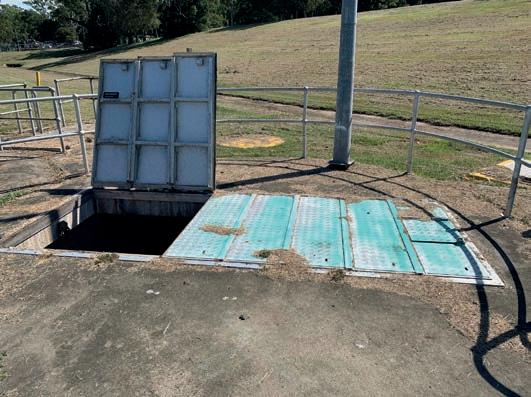
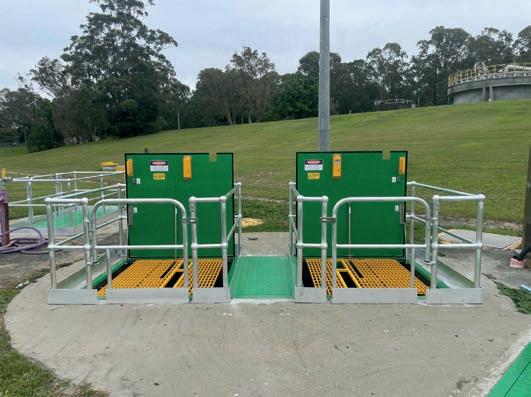
While the water industry values safety, asset safety data is often fragmented. To address this, MASS’ Audili provides an AI-powered platform that transforms how asset safety and maintenance information is documented.
Oen, information about the condition of assets, how safe they are to get into or work on, or when maintenance and upgrades are due, is located in asset registers and siloed systems.
is leaves asset operators vulnerable. If it’s impossible to instantly verify whether an asset is safe, injuries and fatalities can occur. At the very least, maintaining and accessing assets safely is slow and costly.
With innovation in mind, MASS developed the AIpowered platform Audili, which transforms how asset safety and maintenance information is captured, accessed and shared.
Launching in June 2026, MASS believes Audili is the rst platform of its kind in the Australian market.
Audili consolidates asset registers, condition reports, safe access audits, maintenance logs, upgrade needs and budgets. Access is quick and easy via mobile app or desktop, and crews can check an asset’s condition and access issues before travelling to site. is avoids unintended exposure to known hazards.
If an asset is no longer safe or requires maintenance, an action can be triggered.
For leaders, detailed safety reports are available, while maintenance and renewals are simpli ed by linking scopes of work with supplier rates.
MASS has completed safe access audits for thousands of water assets around Australia since 2014. Most were built before the 1970s and are ageing, underground and hazardous to work on.
Common issues documented by MASS include dated infrastructure designs that contribute to manual handling risks and potential falls into voids, structural design failures, heavy covers, a lack of grates or permanent handrails over openings, missing restraining systems, and access systems that cannot be safely operated by one person.
ese issues have a direct correlation with worker injuries and deaths. Safe Work Australia’s Key Work Health and Safety Statistics Australia shows that falling from heights was the second highest contributor to worker deaths in 2024, while falls, trips and slips were the top two contributors to serious work-related injury claims.
Management of asset safety data is an underlying contributor. At many utilities, information on asset condition and access is scattered, making it impossible to gain a holistic view of asset safety.
MASS’ business is about achieving the highest level of safety risk control at its customers’ water assets. is is Level 1, as described in WorkSafe Queensland’s risk management process, and it aims to eliminate hazards altogether.
e main way the company achieves this is by standardising how workers access infrastructure. For MASS, standardisation means auditing asset condition and access arrangements and designing safe access upgrades using MASS’ standard designs. It also means prioritising improvements and developing budgets, as well as manufacturing and installing standard safe covers, grates, rails and lids.
Audili is a vital part of this. It’s a platform for centralising and sharing reliable asset information among work crews and with leadership teams, enabling audit reports, checking maintenance records and planning safety upgrades.
It gives organisations better visibility of safety issues across an asset class or region, and a clear picture of legislative compliance and liability.
Based on data in Audili, decisions can be made about standardising access to assets and making them safe. As this occurs, the need for tailored administrative controls for each asset (such as procedures and permits to access them) falls away. Only one set of controls is needed for each asset class. For example, many pump station sites become one work site.
Ultimately, Audili is expected to integrate with building information models and other design and virtual reality so ware to enable users to ‘walk through’ assets and view their condition and maintenance records, safety hazards, upgrade priorities and budgets.
MASS CEO Paul Harazim believes Audili has huge potential.
“It’s disruptive technology and we are very proud of that,” said Harazim.
“Ultimately, it helps prevent deaths and injuries at our nation’s water assets, which is our goal.” U
YouTube video about Audili by MASS.
MASS provides modern, safe and e cient access solutions for the water and wastewater industries.
Image: Mass Products
We’re Creating the Future of Water with innovative solutions to complex renewal problems
Mobility meets pumping power
Utilities can be called to fix problems in remote, high-risk and emergency environments at short notice. Boerger Pumps Asia Managing Director Dominik Straetling explains how their mobile pumping systems are the ideal partner under pressure.
Utility magazine: How do Boerger’s portable pumps help crews respond quickly when access is limited or conditions are unpredictable?
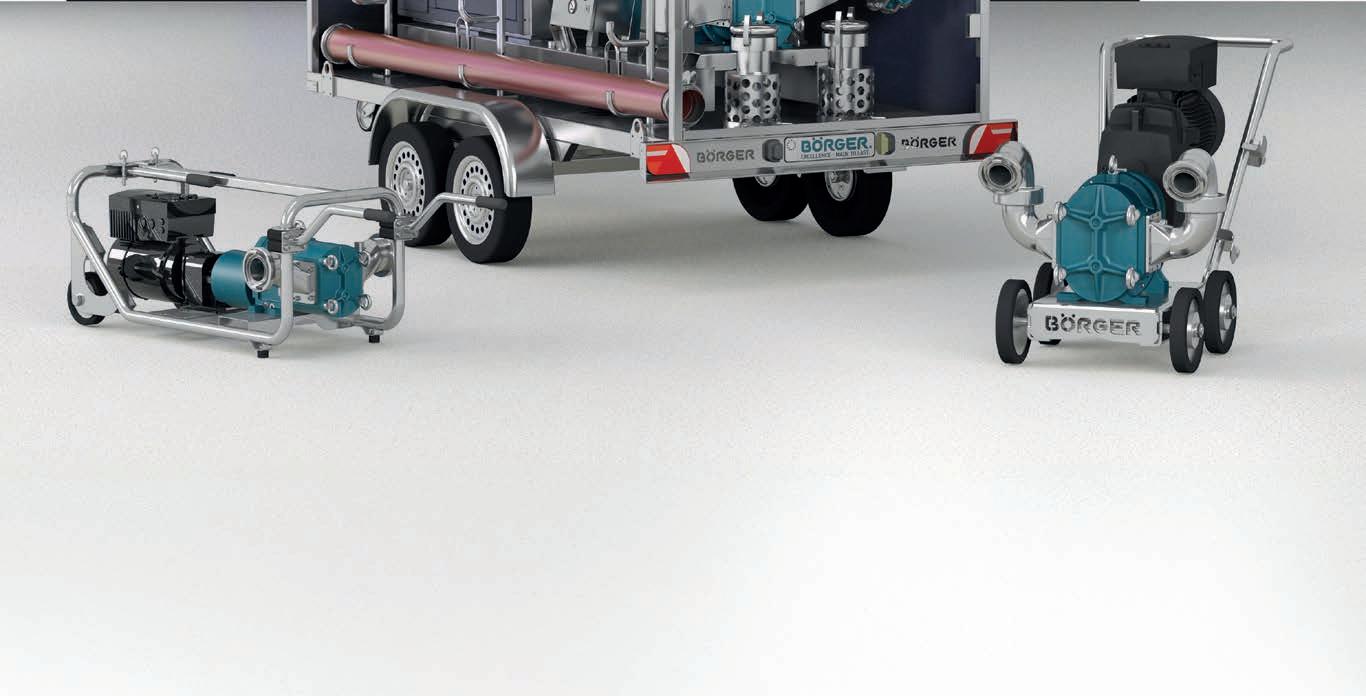
Dominik Straetling: Our portable and trolley-mounted pumps are designed so that one or two people can take them anywhere with limited access where pumping is required. Even our larger trailer-mounted units are designed so the pump skid itself can be detached and own by helicopter to remote and basically inaccessible areas. ey generate the vacuum themselves.
U: What design features allow Boerger’s mobile pumps to be ready for use as soon as they arrive on site?
DS: For both electric and diesel-driven units, the principle is the same. You bring the pump as close as possible to the uid source, attach the hoses, and give it a go.
U: How does Boerger balance portability with the power and performance utilities expect from a pump system?
DS: For smaller units, we use lightweight materials such as aluminium to reduce weight. All units are tted with wheels so they can be moved easily by one person on paved ground. For rough terrain, we have specialised solutions available.
U: How are Boerger’s mobile pumps engineered to handle sludge and chemically aggressive fluids safely and reliably?
DS: It basically makes no di erence for our pump if it is used for water, oodwater, sewage, sludge or even chemicals. It is the same pump design.
U: How does Boerger work with customers to customise mobile pump solutions for specific applications?
DS: We try to standardise supply, especially for smaller portable units. But even there we can customise. Larger trailer-mounted units can be tailor-made for individual requirements. e pump itself remains the same, but accessories and controls can be adjusted.
U: How does Boerger’s Maintenance-in-Place (MIP) design help operators service pumps quickly in the field?
DS: All our pumps are designed with Maintenance-inPlace. By undoing four eyebolts or nuts, you can access the pump body and replace the wet end. ere is no need to remove the pump from the trailer, trolley or skid.
U: What options does Boerger provide to ensure mobile pumps can operate safely in hazardous or explosive atmospheres?
DS: In hazardous or explosive atmospheres, we primarily use electrically driven units. Diesel-driven units are generally not suitable for direct use in these environments.
Our pumps have been tested and approved for use in environments up to Zone 1, ensuring safe operation in hazardous and explosive atmospheres.
For specialised applications where electrical power is not available, we can use a hydraulic drive system. In this setup, the pump operates within the hazardous zone, while a diesel-driven hydraulic power pack is positioned in a safe area.
U: As utilities look to reduce lifecycle costs, how do Boerger mobile pumps deliver reliability, durability and long-term value?
DS: Lifecycle cost should not be the only consideration, as ideally an emergency pump is rarely needed.
However, one of the key advantages of our pumps is their versatility. ey can be used across a wide range of applications, including ood protection, re ghting, sewer bypassing, and emptying sumps, tanks and ponds. ey are also capable of handling more demanding media, such as sludge and other viscous materials.
Our pumps are also designed for easy maintenance and low power consumption, which helps reduce ongoing operational costs.
U: Can you share an example of how a Boerger mobile pump solution has helped a utility overcome a challenging pumping application?
DS: A couple of years ago, very heavy rainfall near our factory in Germany caused ash oods. Rivers burst their banks and basements started to ll. We received a call from the city council asking if we could assist with large pumps.
We had trailer-mounted units ready for delivery to a customer. We coordinated with them to use those units temporarily. Our own sta helped operate the pumps to empty basements and clear oodwater in the a ected area. U
For more information, visit www.boerger.com
Image: Boerger
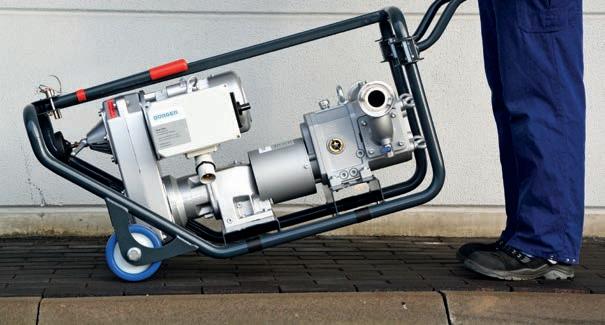
Boerger’s Hand Cart Pump is a compact, manually transportable pumping solution.
Water reform back in focus
AWA brought sector leaders together to examine how Australia can capitalise on a rare window of opportunity to reset national water policy.
Australia’s evolving water policy settings, community expectations and a newly launched national inquiry were key discussion points at the Australian Water Association’s (AWA) National Policy Forum.
Held in Canberra on March 27, sector leaders examined how the next era of water reform should take shape.
Bringing together government, industry and community voices, the forum focused on whether current policy frameworks remain t for purpose amid climate pressures, competing priorities and shi ing expectations about how water is valued and used.
Facilitated by Matthew Coulton, Associate Director at Ricardo (a member of WSP), the event underscored the importance of sustained, proactive reform rather than waiting for the next crisis to drive change.
“When it comes to prioritising water policy, we tend to go through cycles. You can map these cycles back to preFederation days. We have a big drought, governments say we need to manage water better, the drought breaks and water reform gets deprioritised,” Coulton said.
“ ere is broad agreement that a crisis is not a good time to make long-term policy, but without the crisis the mandate for policy reform goes away.”
A critical window for reform
e forum comes at a pivotal moment for the sector, as the Federal Government is progressing work with states and territories on a new National Water Agreement.
At the same time, a new inquiry led by the Productivity Commission signalled a renewed national focus on water reform, with the review set to examine how Australia can maintain water security and a ordability while improving
long-term productivity and sustainability. e inquiry is expected to play a de ning role in shaping the next generation of policy settings and informing a refreshed national framework, reinforcing the urgency of reform.
For Coulton, the alignment of these processes creates a rare opportunity to revisit fundamental policy questions.
“ e lack of sustained focus is not a criticism of governments. Juggling competing priorities with political mandate and funding availability is a wicked problem,” he said.
“But there is a lot that can be done in water policy that doesn’t necessarily involve large expenditure and if we don’t have the substantive conversations now, we will be back into crisis management before we know it.”
From e ciency to broader value
Broadening the way water is valued is becoming a central focus across policy frameworks.
Australia’s current approach has been shaped by decades of reform, particularly through the 1994 Council of Australian Governments water reform framework and the National Water Initiative, which focused heavily on economic e ciency and sustainable extraction limits. is model has delivered strong outcomes, with Australia widely recognised for highly e cient water use and strong economic returns from water resources.
“It’s been really successful at a high level. We have very e cient water use in Australia. e economic return from water use is very high. But expectations have evolved,” Coulton said.
ese expectations are now extending well beyond
productivity, re ecting a more complex and multidimensional view of water.
“More and more, we’re starting to see communities and governments talk about the many other values of water – cultural purposes, for cooling cities and liveability, recreation – and we have emerging industries that use water in a di erent way, such as pumped hydro, hydrogen production and data centres,” Coulton said. is shi , he noted, has created “a more common voice that says: this is important, we need to do something about it, we need to take action.”
From strategy to delivery
WSP Water Director Dean Toomey said regulatory cycles are creating peaks and troughs across the sector, with regulatory tension o en slowing utilities’ ability to deliver on community expectations.
“In recent years, most utilities around the country have been agging signi cant increases in spend to cater for asset renewal, keeping up with growing demand and responding to climate risks,” Toomey said.
“In many instances, when they’ve gone through the
regulatory review, the regulator has said they don’t necessarily agree with those plans and a lot of important work stalls.
“While the role of regulators in ensuring cost e ective outcomes for customers is critical, it’s also important to note that this uncertainty ows through the whole industry resulting in less e cient investment.”
Toomey said this highlights the importance of stronger alignment between policy intent, regulatory settings and delivery realities.
“Strategic infrastructure and investment planning over longer time horizons could help the sector with some of these peaks and troughs. It would create bene ts for utilities, which ow through to their customers,” he said.
“Ultimately, decisions made at the policy and regulatory level need to translate into infrastructure that is constructable, resilient and grounded in community need.”
Following WSP’s acquisition of Ricardo, Toomey said the integration brings upstream policy, regulatory and economic reform capability alongside design, engineering and construction expertise.
“Our work is o en here and now, putting something in the street today. Ricardo brings a much broader, holistic perspective around policy, governance, regulation and economics,” he said.
“ ere’s a lot of power in bringing those perspectives together, particularly in terms of helping clients move from business case through to delivery with greater con dence and coherence.”
Towards a new policy framework
Australia’s water system is facing increasing pressure from population growth, climate variability, emerging industries and changing community expectations, all of which demand a more exible and adaptive policy framework.
At the same time, there is a need to preserve the strengths of the existing system, particularly its focus on e ciency and sustainability.
Balancing these objectives will be central to the next phase of reform, with the outcomes of the Productivity Commission inquiry and the development of a new National Water Agreement set to play a de ning role.
For the sector, the opportunity to shape the future of water policy is clear, but it will require sustained focus, collaboration and a willingness to act before the next crisis hits.
e months ahead will be critical for aligning policy ambition with community expectations, and ensuring Australia’s water framework remains resilient, equitable and t for the future.
e AWA and WSP will produce a synthesis paper in the coming months, outlining the key takeaways from the National Policy Forum. U
For more information, visit www.awa.asn.au/advocacy
Images: AWA
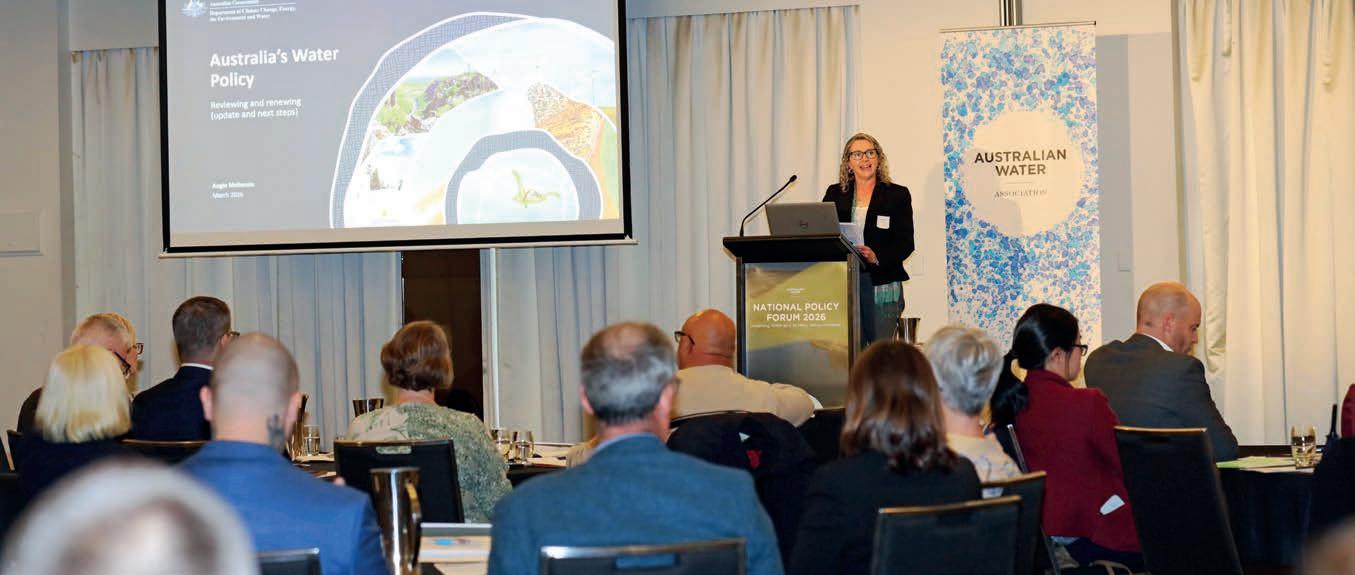
The forum bought together government, industry and community voices.
Fuel for thought
With fuel costs rising, Droppoint’s decentralised delivery networks are helping utilities cut unnecessary travel, boost productivity and reduce emissions in last-mile field operations.
F“ ey are built into the day, so few stop to question the cost. But when you add it up across a eld workforce, it becomes a major source of ine ciency.”
As fuel costs climb, that ine ciency is no longer sustainable. e traditional model – where technicians repeatedly travel back to central depots for parts – is being challenged by a more distributed approach that prioritises proximity and accessibility.
Decentralised delivery networks, such as those enabled by Droppoint, are designed to eliminate unnecessary travel by repositioning inventory closer to where it is actually needed. Rather than sending technicians on timeconsuming detours, parts are staged strategically across a network of accessible locations.
“A decentralised network ips the model,” Flanagan said. “Instead of sending the technician to the part, it brings the part closer to the technician. at could mean stock staged closer to home, near the job, or at a secure collection point on route.”
is shi has immediate and measurable impacts. With fewer trips to depots, technicians spend more time on the tools and less time behind the wheel. e result is not only reduced fuel consumption, but also faster response times and increased job completion rates.
“ e result is less travel, less downtime and more time on the tools,” Flanagan said. “For utilities, that means faster response, more jobs completed per day and a eld operation that is built around service delivery, not depot dependency.”
Crucially, the bene ts extend beyond cost savings. In an era where utilities are under growing pressure to meet sustainability targets, reducing unnecessary travel also delivers a clear environmental upside.
uel volatility has become a de ning pressure point for utilities, forcing operators to scrutinise every kilometre travelled and every dollar spent in the eld. While much of the focus has been on eet e ciency and route optimisation, a more ingrained and o en overlooked ine ciency continues to drive up costs: technicians leaving the eld to collect parts. is routine movement, long accepted as part of daily operations, is increasingly at odds with the realities of rising fuel prices and tightening budgets. As utilities search for meaningful ways to reduce expenditure without compromising service delivery, last-mile logistics is emerging as a critical frontier for change.
Droppoint CEO Jason Flanagan believes the industry has underestimated just how much these legacy practices are costing.
“A signi cant share of avoidable eld cost sits in technician movement that is not directly tied to completing work,” Flanagan said.
“ e true cost is not just fuel. It is technician time, lost job capacity, vehicle wear, delayed response times and lower productivity. Every time a technician leaves the eld to collect parts, a highly skilled resource is doing logistics instead of completing work.”
e issue, he said, is not new, but it has been largely ignored because it is so deeply embedded in operational routines.
“It is o en overlooked because depot runs have become normalised,” said Flanagan.
“Environmentally, reducing unnecessary travel cuts fuel use and emissions. Operationally, it improves responsiveness, supports uptime and removes friction from the eld,” said Flanagan.
is dual bene t – lowering both costs and emissions – positions decentralised logistics as more than just an e ciency upgrade. It represents a structural shi in how utilities approach eld operations, moving away from rigid, centralised systems towards more agile, demanddriven networks.
Flanagan sees this as a necessary evolution rather than an optional improvement.
“ at is why distributed parts logistics is not just a cost play. It is a smarter way to run utility operations,” he said.
As the fuel crunch continues to reshape the economics of eld service, Droppoint believes utilities that embrace decentralised delivery networks are not only insulating themselves from fuel volatility, but also unlocking new levels of productivity and service performance.
In a sector where every minute and every kilometre counts, bringing parts closer to the point of work may prove to be one of the most e ective ways to stay ahead. U
Droppoint identifies lastmile delivery as the most critical stage of fulfi lment.
Image: Droppoint
SA Water announces the renewal of South Australia’s longest drinking water pipeline has reached a major milestone.
Amajor upgrade of the Morgan to Whyalla Pipeline is underway, strengthening long-term water security for regional communities across South Australia.
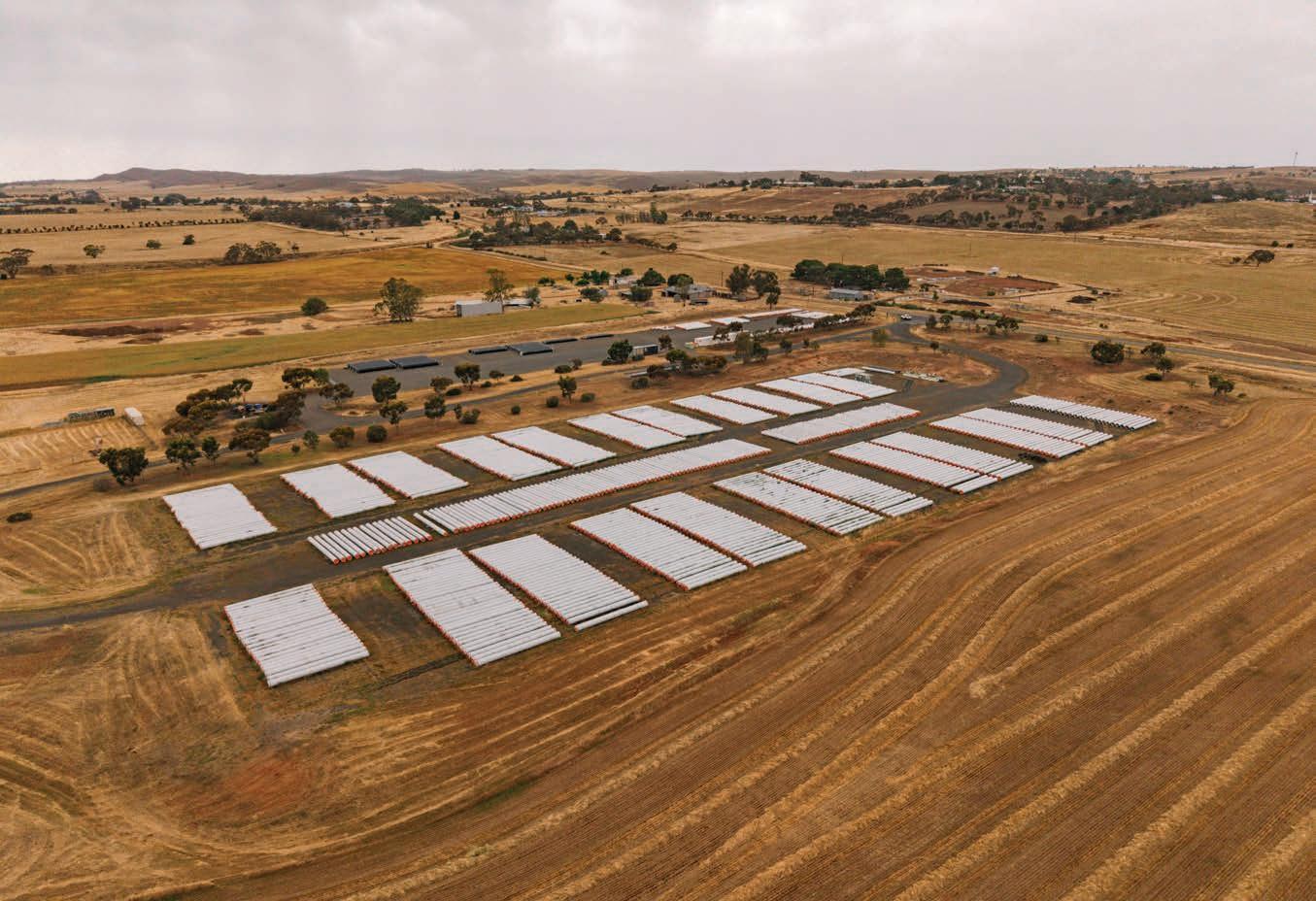
SA Water, in partnership with major framework partner, McConnell Dowell SRG Global Joint Venture, is renewing sections of the 358-kilometre Morgan to Whyalla Pipeline, which supplies safe, clean drinking water to more than 130,000 homes and businesses across many regional parts of the state.
e $61.8 million project involves the replacement of 9.3 kilometres of pipeline across three sites north-west of Morgan, in the Riverland region.
An 80-year-old lifeline
Constructed in the 1940s by the Engineering and Water Supply Department, – an early iteration of SA Water – the above-ground pipeline has been a vital part of the state’s drinking water network for around 80 years.
e original Morgan to Whyalla Pipeline was constructed to support World War II e orts and the growth of Whyalla. As demand increased, a second pipeline was later added, helping to secure water supply for more communities.
Today, the system supplies around 40 per cent of SA Water’s regional water supply. Water is sourced from the River Murray, treated at SA Water’s Morgan Water Treatment Plant, and delivered to communities across the Mid North, Yorke Peninsula and Eyre Peninsula, including major towns like Port Augusta and Port Pirie, and as far west as Ceduna and north as Woomera.
Building for the future
SA Water’s General Manager of Sustainable Infrastructure Peter Seltsikas said sections of the pipeline have been prioritised for renewal based on condition assessments and performance.
“ e current upgrades form part of a decades-long program to maintain reliability and support population and business growth in regional areas,” he said.
“To date, around 30 per cent of the new 813-millimetrediameter mild steel cement-lined pipe has been delivered and installed.”
e pipe also features a modern, specialised external coating to ensure its durability.
“Preparation works began in the second half of 2025 and have included extensive excavation, the installation of 729 concrete supports – known as pipe chairs – and anchor block concrete structures to provide secure and durable above-ground support for the pipework,” said Seltsikas.
Excavation and concrete works are expected to continue until mid-2026, with pipe sections to be progressively delivered, installed and welded across the remaining work zones.
In total, the upgrade will involve 770 pipe lengths, each measuring 12.2 metres, connected using a socket and weld arrangement.
To minimise interruption to customer water supply, new sections of pipeline are being constructed parallel to the existing infrastructure.
A pause for a cause
Work on the renewal was paused in 2022 following consultations with the Department of Climate Change, Energy, the Environment and Water (DCCEEW), allowing for additional environmental investigations along the pipeline route.
e investigations focused on threatened and endangered animal and plant species and communities, including the Mallee Bird Community, Iron-grass Natural Temperate Grassland, and potential habitat for the Pygmy Blue-tongue lizard.
e Mallee Bird Community includes 20 bird species, among them the nationally endangered Malleefowl, Black-eared Miner and South-Eastern Hooded Robin, and the nationally vulnerable Southern Whiteface. ese species rely on large areas of intact Mallee vegetation, with habitat loss a major contributor to their status.
Following a multi-year program of environmental assessments, research and consultation, SA Water received approval from DCCEEW in November 2024 to resume works under the Environmental Protection and Biodiversity Conservation Act 1999.
Environmental responsibility in action
Approval to resume works was also granted based on evidence that there would be no impacts to the Pygmy Blue-tongue lizard and the Iron-grass Natural Temperate Grassland community.
“We engaged specialist contractors to undertake pre-clearance habitat assessments, fauna relocation and design input to ensure full compliance with environmental requirements,” Seltsikas said.
“Construction schedules have been adjusted to avoid vegetation clearance during the July to November bird breeding season, with further restrictions placed on machinery use in sensitive breeding habitat areas.”
Other mitigation measures include reducing the construction corridor – a temporary work zone along the pipeline – avoiding hollow-bearing trees where possible and supporting vegetation regeneration. Felled trees have been repurposed into new wildlife habitats, while seed-bearing material has been retained and redistributed on site. Temporary fencing will remain in place a er construction to protect regrowth areas.
Seltsikas said the added measures re ect SA Water’s commitment to delivering essential infrastructure while upholding environmental responsibility.
“ is essential two-year upgrade is the rst stage of a long-term renewal program that will replace the pipeline section by section over the next few decades, ensuring a resilient and reliable drinking water supply for regional South Australians for generations to come,” he said.
e project is expected to be completed in late 2027.
A long-term commitment
For Mark Marschall, SA Water’s Construction Lead for Water in Capital Delivery, the Morgan to Whyalla Pipeline is more than critical infrastructure, it is a core part of his family history.
Mark Marschall is the fourth generation of the Marschall family to be closely connected with this major pipeline system, following in the steps of his father Allan, grandfather Dave, and great-grandfather Ben.
Collectively, they have worked at SA Water for almost 120 years, with their link to the pipeline ranging from maintaining the nearby public garden to painting the pump stations to being administrator of the Morgan Water Treatment Plant.
Soon, a h generation of Marschall will join SA Water, with Mark Marschall’s 17-year-old nephew set to be the new work experience kid later this year.
“He’s a country kid at heart, and he’ll be completing work experience in Adelaide while staying with his uncle,” Marschall said.
“With such a strong family history at SA Water, it will be great to see him learn about how di erent teams work across many of our projects.”
Many other Marschall family members were also involved in operating and maintaining pipelines, tanks, and pump stations along the Morgan to Whyalla and Swan Reach to Stockwell systems, including Mark Marschall’s mum Val, who worked as a part-time contractor in support roles including arranging the tennis and badminton teams.
A er 12 years in the automotive manufacturing industry, Mark Marschall joined SA Water 22 years ago as Operations Area Manager at Morgan. In that role, he looked a er key assets including the Morgan to Whyalla Pipeline and the Morgan Water Treatment Plant, a facility he remembers being built in the 1980s.
“Honestly, I still remember where some of the pipes are buried from childhood,” Marschall said.
Mark Marschall has taken on several roles across SA Water and throughout the state, while continuing to contribute to major projects along the Morgan to Whyalla system, including the current pipeline replacement program, where he now supports construction services.
“A lot has changed since riding around in the old department V8 Dodge ute,” he said.
“Bench seats, no seatbelts, no radios or phones, just a water bag on the front, heading out with Grandpa Dave for pipeline, tank, and pump station inspections during the school holidays. But what hasn’t changed is how important this pipeline is to South Australia.” U
For more information, visit www.sawater.com.au
Images: SA Water
Built in the 1940s, the pipeline has long been a critical part of South Australia’s water network.
Raising the standard
Across Australia, expectations around pipe inspection are changing.
Higher standards, increased compliance, and greater scrutiny are driving a shi toward more accurate, higher-quality inspection data.
As a provider of end-to-end sewer maintenance solutions, Bucher Municipal integrates cleaning and inspection capabilities through its Spoutvac business. Across the wider market, however, the company says the installed base of inspection equipment has not always kept pace with evolving expectations.
“Many organisations still operate CCTV systems that now fall short of requirements for image clarity and data reliability, creating a gap between expectations and what equipment can deliver,” said Spoutvac Technical Sales Manager, Andrew Gladman.
The challenge
Transitioning to high-de nition inspection has, until recently, presented a clear challenge.
Full system replacement requires signi cant capital investment, introduces operational disruption, and o en requires training. For organisations managing multiple crews or dispersed assets, this becomes increasingly complex.
As a result, Bucher Municipal says many operators have been forced to rethink their operations and only bid for work that allows standard de nition systems – however, this market is shrinking day by day. is is the gap that new retro t solutions are beginning to address.
A practical shift
e recently released High-De nition upgrade platform from Minicam represents a di erent approach to capability upli .
Rather than full replacement, the upgrade integrates with existing Minicam Next Generation control units and compatible crawler and camera systems. is allows organisations to introduce high-de nition inspection capability into current eets.
“From an operational perspective, this approach addresses several long-standing constraints, including capital e ciency and existing equipment that can be retained and enhanced, reducing the need for largescale reinvestment,” said Gladman.
“It also includes operational continuity, as crews continue working with familiar systems, minimising disruption and retraining requirements.”
For organisations operating mixed eets or managing contractor-delivered services, this exibility is particularly relevant.
Improving inspection outcomes
Beyond the commercial and operational bene ts, the primary impact of the upgrade is on inspection quality. Higher-de nition imaging improves defect identi cation, condition grading and reporting clarity. is has implications across the asset lifecycle.
For water authorities, clearer data supports con dent prioritisation of maintenance and renewal programs.
For councils, it provides stronger evidence for compliance and reduces uncertainty in asset condition. For contractors, it reduces the likelihood of rework and enables more e cient delivery against speci cation requirements.
Reducing rework and improving consistency
One of the less visible challenges in pipe inspection is inconsistency.
Variations in equipment capability can lead to di erences in inspection quality between crews, regions, or contractors. is can result in repeat inspections where data is insu cient, disputes around defect identi cation, and delays in progressing from inspection to intervention.
“By li ing the baseline capability of existing systems, retro t HD upgrades help to reduce this variability,” Gladman said.
Supporting evolving compliance expectations
As industry standards continue to evolve, Bucher Municipal believes the ability to demonstrate compliance through clear, high-quality inspection data is becoming increasingly important.
Whether driven by regulatory requirements, contractual speci cations, or internal governance, organisations are being asked to provide greater transparency around asset condition.
“Upgrading inspection capability without the barrier of full system replacement provides a practical pathway to meeting these expectations,” said Gladman.
A step forward
rough its role in bringing together inspection technologies such as Minicam, rehabilitation solutions, and municipal maintenance equipment, Bucher Municipal is helping utilities move toward a more integrated and sustainable model of pipe infrastructure management. U
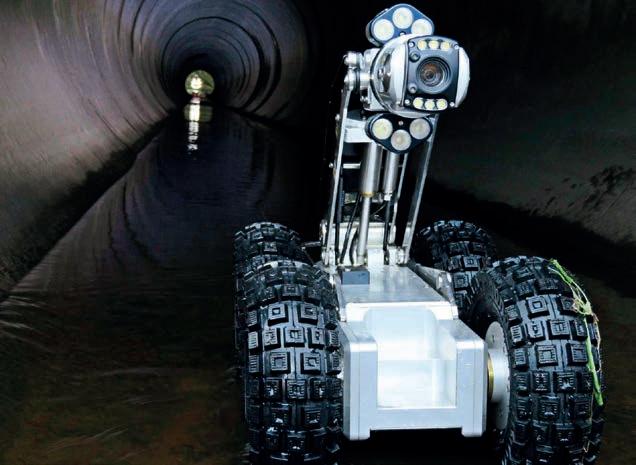
Bucher Municipal explains the Minicam HD upgrade for pipe inspection.
Minicam’s equipment o ers highdefi nition pipe inspection.
Image:
Bucher Municipal
As drought cycles return, solutions from Abberfield are helping regional communities improve water access and be prepared.
Australia is de ned by extremes – ‘of drought and ooding rains’ – and with that comes a clear reality: dry periods are not a question of if, but when.
In August 2025, New South Wales and Queensland recorded heavy rainfall, yet both are already trending back toward drier conditions. Across the country, regions move through these cycles with regularity, with drought returning to many areas every 7 to 10 years.
e 2017 to 2019 Tinderbox Drought in southeastern Australia remains a stark example of how severe these periods can become, and why preparation cannot be le too late.
Even between major events, localised dry conditions continue to a ect communities, reinforcing the need for consistent and dependable access to water.
Forecasting tools such as the NSW Combined Drought Indicator are already signalling expanding drought conditions into 2026, o ering a crucial window for communities to act early and plan ahead.
Wider impacts
Regional Australia is evolving. More people are choosing to live, work and travel in country areas, bringing new energy to local economies, but also increasing demand on essential infrastructure.
e surge in domestic travel means more people relying on accessible water as they move through these communities.
As demand grows, so too does the importance of systems that can keep pace, ensuring water remains available for residents, agriculture and visitors alike.
Be prepared
Preparation remains the most e ective response to drought, and water security sits rmly at its centre. Communities that invest in practical, scalable solutions are better placed to support households, agriculture and local industry when conditions tighten. is includes not only securing supply, but ensuring water can be accessed where and when it is needed.
Government funding plays an important role, but equally important are on-the-ground systems that provide reliable, day-to-day access and exibility during periods of pressure.
The cost
e risks of being underprepared are well known. Water shortages can disrupt local economies, place strain on households and force di cult decisions for farmers and businesses.
Increasingly, however, the focus is shi ing toward the value of getting ahead. Investment in water infrastructure reduces long-term economic strain, supports community stability and helps regional areas remain productive through dry periods.
Water security defined
Water security is o en framed in terms of supply – dams, pumps and treatment plants.
But supply is only part of the story. Distribution, particularly for those beyond town water networks, is just as critical and o en overlooked.
Without reliable access points, even well-managed supply systems can fall short. Ensuring water can be delivered e ciently to end users is a key part of building resilience.
Water distribution
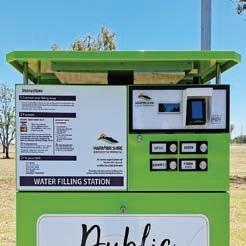
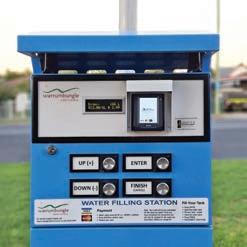
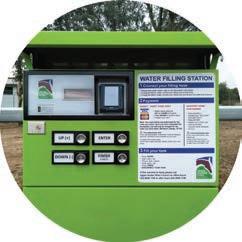
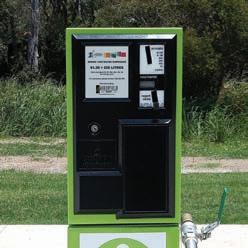
is is where Abber eld is carving out a practical role. e company’s Australian-made water lling stations are designed to make water more accessible across regional and rural communities, not just in theory, but in everyday use.
From large tanker access to smaller needs such as 1000-litre pods and caravans, the systems are built to serve a wide mix of users, from farmers to travellers passing through.
Installed at locations such as information centres and service points, they extend water access beyond traditional networks and support growing demand in regional areas.
Just as importantly, they introduce greater control.
rough an online portal, operators can adjust pricing, manage usage and set limits as conditions change, helping to balance supply with demand.
Features such as tiered pricing, capped volumes and controlled free-access options ensure water remains accessible, even during more challenging periods.
Drought card
at exibility extends further through accountbased systems.
Drought cards allow councils and operators to o er discounted or free water to eligible users, with pricing and restrictions easily adjusted as conditions evolve.
Commitment
Companies such as Abber eld are increasingly part of a broader shi toward practical, locally delivered water solutions.
Australian owned and operated, the company designs and manufactures water lling stations tailored to regional conditions, working with councils and operators to improve access, control and reliability.
As climate variability continues, infrastructure like this is set to play a growing role, helping communities move beyond reacting to drought, and instead stay ready for it. U
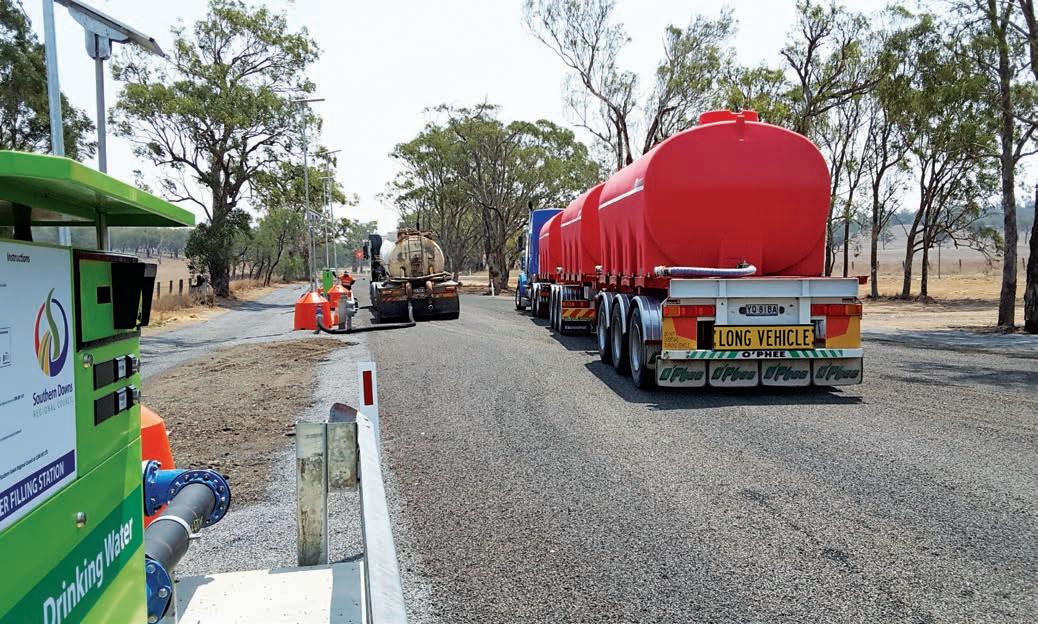
Abberfield water fi lling stations supply tankers carting water from Warwick to Stanthorpe, Queensland in drought.
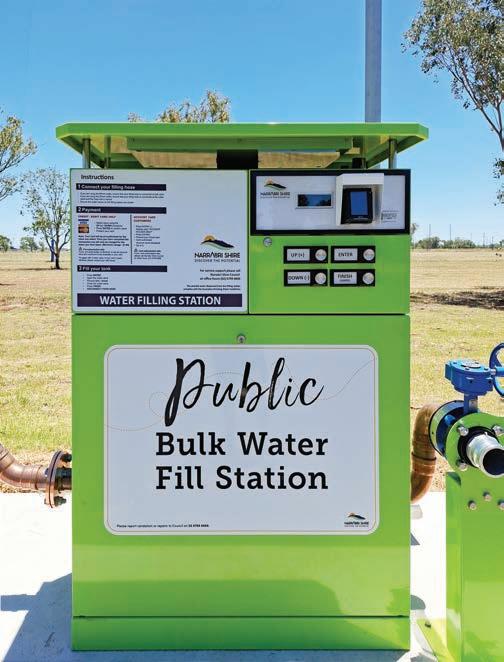
Abberfield water fi lling stations give councils, water utilities and commercial operators a dependable way to control access, recover costs and manage water distribution.
Images: Abberfi eld
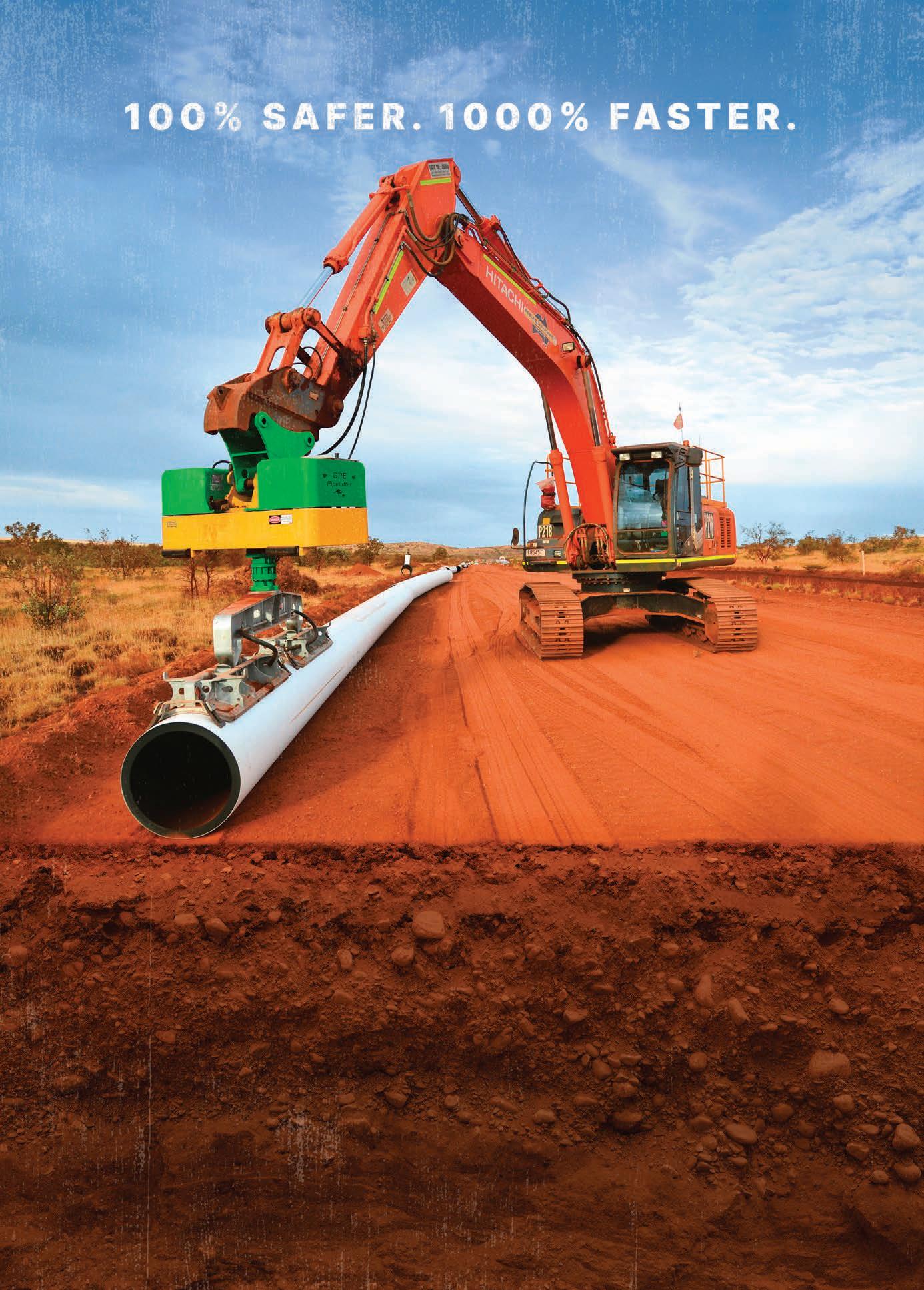
The PL1500 is a gamechanger for pipeline construction. The unique, quick-hitch, vacuum lifter attaches to your existing excavator, reducing your machine hire cost and getting things moving fast. Capable of safely lifting 15,000kg, the heavy-duty, self-contained unit can handle all types and lengths of pipe. It integrates seamlessly with the host excavator, using the main controls and hydraulics to operate the vacuum lifter. Plus, built-in smart tech ensures it’ll only pick up or put down a pipe on a solid surface. That’s safer than many other vacuum lifters on the market. To find out more, speak to the Pipeline Plant Hire team today.
Where waste meets opportunity
SAVECO’s specialised equipment is helping utilities improve sludge management, resource recovery and energy e ciency across wastewater and environmental applications.
In modern treatment plants, some of the most important processes happen out of sight. Behind the tanks and treatment stages that de ne a facility are mechanical systems quietly transporting sludge, separating solids and capturing value from waste streams. When these systems perform reliably, the entire plant runs more e ciently. But when they fail, operations can quickly grind to a halt. is is where purpose-built solids handling and separation technology becomes critical. SAVECO, part of the WAMGROUP family, o ers a range of engineered solutions designed to support utilities, agricultural operations and environmental facilities in managing di cult materials and recovering valuable resources.
Handling tough materials
Moving sludge and screenings reliably through a treatment plant can be challenging. Materials such as dewatered sludge, screenings and organic waste are o en sticky, heterogeneous and prone to clogging.
SAVECO’s SSC Sha less Spiral Conveyors are designed speci cally to transport these di cult materials e ciently. Unlike traditional screw conveyors, the sha less design eliminates intermediate bearings and allows the spiral to move materials through an enclosed trough with fewer obstructions. is con guration enables higher ll rates and the ability to handle materials that may otherwise tangle or block conventional conveying systems.
e heavy-duty spiral slides on a low-friction liner inside the trough, delivering reliable conveying while reducing wear and maintenance requirements. With capacities of up to 45 cubic metres per hour for sludge and robust stainless-steel construction, the conveyors are suited to demanding wastewater and industrial environments.
Because the conveyor system is fully enclosed with bolted covers, it also helps contain odours and prevent
material leakage – important considerations for treatment facilities located near urban areas.
Energy from water
Beyond solids handling and separation, utilities are also exploring ways to recover energy from existing water infrastructure.
SAVECO’s PAE Hydrodynamic Screws provide a solution for generating electricity from low-head water ows. e system converts the energy of naturally owing water into electrical power.
Unlike many conventional turbines, hydrodynamic screws operate e ciently with relatively small drops in water level and moderate ow rates. ey automatically adapt to variations in water ow without requiring complex adjustments, maintaining consistent performance even under changing conditions.
For utilities managing weirs, channels or treatment plant out ows, this approach o ers an opportunity to generate renewable energy while making use of existing infrastructure.
Waste to energy
PLS (Polyless) Dynamic Sludge ickening Systems, SEPCOM separators, submersible agitators, and chopper pumps also play a key role in improving e ciency in waste-to-energy recovery plants.
PLS increases sludge concentration before digestion without continuous polymer dosing, reducing operating costs and improving biogas yield. SEPCOM e ciently separates solids from liquid streams, improving feedstock quality and reducing downstream treatment load.
Submersible agitators maintain proper mixing in digesters and sludge tanks, preventing sedimentation and ensuring stable anaerobic digestion for maximum methane production. Chopper pumps handle brous and solids-laden sludge by macerating waste and preventing blockages, ensuring reliable transfer and protecting downstream equipment.
Together, these solutions optimise sludge handling, improve digestion performance, reduce maintenance, and maximise renewable energy recovery.
Integrated solutions
As utilities and environmental operators seek to improve resilience, e ciency and sustainability, the importance of integrated process equipment continues to grow.
From conveying and ltration to renewable energy generation, SAVECO’s equipment portfolio demonstrates how targeted mechanical technologies can support multiple stages of the water and waste management cycle. By combining reliable solids handling with innovative separation and energy solutions, operators can optimise performance while unlocking new value from their processes. U
SAVECO’s PAE Hydrodynamic Screws generate electricity from low-head water fl ows.
Controller)
When used with Chesterton mechanical seals, SpiralTrac® Environmental Controllers enhance seal reliability by removing solids and improving cooling. Paired with Chesterton DualPac® packing, this combination reduces leakage and extends equipment life.
• Extends seal reliability in most rotating equipment applications
• Reduces cost of flushing in abrasive applications
• Fits all rotating equipment Scan
The real cost of downtime
When critical lifts are delayed on a utility project, the impact extends far beyond the crane itself. Quinlan Cranes explains why lifting operations are often the commercial linchpin of outage works, and how the right planning and reliability can protect project timelines and budgets.
In the utilities sector, time rarely represents just time – it is cost, risk and operational pressure all rolled into one.
Whether installing major electrical infrastructure, li ing pipe sections into place, or positioning transformers during a scheduled outage, crane operations o en sit at the centre of the project schedule.
When those li s are delayed, the commercial consequences can ripple across the entire job.
For utilities and contractors working within tightly de ned outage windows, the cost of downtime can escalate quickly. Crews, equipment and subcontractors are o en already mobilised on site, meaning every lost hour carries a direct nancial impact.
According to Quinlan Cranes, recognising li ing as a critical path activity rather than simply another line item is essential to protecting both budgets and schedules.
“Crane activities play a critical role in project scheduling and commercial outcomes, especially when they’re engaged in the early planning phase,” said Quinlan Cranes Managing Director Sacha Sikka.
“At Quinlan Cranes, we like to o er a full service to our customers, including helping them with planning the work incorporating site, transport and labour requirements, and then selecting the right crane. We get involved early and work with our customers to nd the right li ing solution.”
The cost of a delayed lift
Utility projects frequently involve carefully coordinated shutdown periods to allow installation, maintenance or upgrades to occur safely. ese outages are o en planned months in advance and involve multiple contractors working within a tightly sequenced schedule.
If a crane is delayed or unavailable during this window, the consequences can be signi cant.
“It’s not just the dollars you see burning, everything is impacted. Construction crews may be le idle while waiting for li ing operations to resume, and sometimes safety requirements can be ignored just to get the job done,” Sikka said.
e result can be a cascade of commercial impacts, including extended project timelines, increased labour costs and potential penalties tied to project milestones or service restoration targets.
For utilities delivering essential services, these delays can also a ect operational planning and customer expectations.
Reliability as a commercial safeguard
Given the stakes, utilities and contractors are increasingly prioritising reliability and detailed li planning when selecting li ing partners.
Beyond simply supplying equipment, experienced crane providers play a critical role in ensuring li s are executed safely, e ciently and on schedule.
is involves detailed pre-planning, li engineering, site assessments and coordination with other contractors to minimise risk and ensure li ing operations run smoothly within the outage window.
By identifying potential constraints early, such as site access, ground conditions or transport logistics, li ing specialists can help avoid costly lastminute complications.
For utilities, this proactive approach can mean the di erence between a smooth installation and a costly schedule blowout.
“A common mistake we see is when people view cranes as simply a li with an associated hourly rate. If we aren’t engaged early during the planning stage, it can make or break a job,” said Sikka.
More than the equipment
From complex installations to large-scale infrastructure li s, Quinlan Cranes focuses on delivering reliable, carefully planned operations that keep projects moving.
“We’re very hands on, and an open book. When you work with us, there’s no hidden costs involved,” Sikka said.
“We buy quality machines from leading manufacturers. While that comes with a premium price, it pays for itself with the equipment’s quality and reliability.” U
Quinlan Cranes takes pride in ensuring they have the right machine for the job.
Image: Quinlan Cranes
Designing risk out of infrastructure delivery
By bringing Genus into the project early, Alinta Energy is showing how front-end collaboration can reduce risk, cost and complexity in large-scale energy infrastructure.
At Reeves Plains in South Australia, a major battery energy storage system (BESS) project is highlighting an important lesson for the energy transition: the biggest gains in infrastructure delivery are made long before construction begins.
Developed by Alinta Energy, the project is a 250-megawatt battery with four hours of storage, capable of powering around 300,000 households. It is a nationally signi cant piece of infrastructure, designed to strengthen the state’s grid and support the transition to a more renewable energy system.
To bring the project to life, Alinta Energy engaged Genus as its delivery partner, initially through an Early Contractor Involvement (ECI) phase, and subsequently as the engineering, procurement and construction contractor.
e role places Genus at the centre of the project, spanning early design development through to commissioning. Rather than executing a prede ned scope, Genus has been embedded from the outset, contributing to how it has been designed and is now being delivered. For Alinta Energy, that early involvement was a deliberate choice.
“Genus had all the necessary experience, having built a number of battery projects previously, and we believe that experience being brought to Reeves Plains was extremely important and made things move a lot smoother,” said Andres Maasing, Chief Development O cer at Alinta Energy.
Construction has now commenced, but while activity on site is ramping up, those closest to the project point to a di erent part of the timeline as being critical to its success. e most important work happened before construction began.
A complex project with little margin for error
Battery storage is o en described in simple terms; store energy when supply is high and release it when demand rises. But delivering that capability at scale requires complex electrical systems, detailed civil design and multiple stakeholder requirements.
Reeves Plains is shaped by site constraints, grid integration requirements and strict performance expectations, leaving little margin for error. ese are the types of conditions where early decisions carry disproportionate weight.
Bringing delivery thinking in early
Rather than progressing a xed design into construction, Alinta Energy brought Genus into the project early through an ECI phase. at shi ed the dynamic immediately.
“Genus took their time in assessing the issue step by step, and worked with us to come up with the best outcome for our project,” Maasing said. at early engagement created the conditions for a collaborative process, where both teams worked towards a shared outcome, rather than progressing a prede ned design.
In many infrastructure projects, standardised requirements are applied as a baseline. At Reeves Plains, those assumptions were worked through early, ensuring the design was aligned to the site, the conditions and Alinta Energy’s outcomes.
Engineering the outcome before construction begins
Working closely with Alinta Energy, Genus helped progress the design to a buildable level, ensuring it was both technically sound and commercially e cient.
According to Genus, the process contributed to an approximate 8 per cent saving in total project cost.
ese savings were not driven by a single decision, but by practical changes across layout, civil works and electrical design.
Amish Sheth, Engineering Manager and CECAccredited Designer at Genus, said a key part of this was optimising the overall site layout.
“One of the key outcomes of the ECI was to optimise the layout of the site. We were able to lock in a general arrangement which stood the test of time,” he said. is work extended into civil and electrical design, where early decisions helped simplify delivery and remove unnecessary complexity.
“I think one key saving was during the ECI, we could optimise our bulk earthworks and also go through the
Stage 1 of the project will deliver a 250-megawatt battery with four hours of storage.
principal project requirements and identify elements that may not have been required,” Sheth added. is was not about reducing scope in a way that increased risk. It was about ensuring that every element of the project was necessary, t for purpose and aligned to the realities of the site.
A collaborative process that builds trust
While the technical outcomes were signi cant, the way the teams worked together was equally important.
Rather than solely relying on documentation and formal communication channels, much of the work during the ECI phase was done face to face, creating space for more open and constructive conversations.
“We did not deliver the ECI from a contract perspective, we delivered the ECI from a customer perspective,” said Sheth.
From Alinta Energy’s perspective, that approach created a di erent type of working relationship.
“We nd that working with Genus is always a very collaborative approach. We feel like we’re both part of the same family in delivering the projects,” Maasing said.
“ is is our second project together, and we believe there will be more opportunities to work together.” at sense of shared ownership enabled more open conversations and ultimately led to better decisions.
Setting
the project up for delivery
e impact of this early work is now being seen as the project progresses through construction. e strength of the front-end process has helped create clarity around what is being built and how it will be delivered. From Alinta Energy’s perspective, this early clarity has been critical in providing con dence as the project moves through delivery.
As Daniel Green, Project Manager at Genus explained, getting the early design right signi cantly reduces uncertainty.
“I think that’s testament to that work that we do during that 30 per cent design phase. If you get that right, then the surprises aren’t there and you get a pretty good understanding of what you set out to do,” he said.
A more integrated model of delivery
Reeves Plains also re ects a broader evolution in how Genus is approaching project delivery. On this project, Genus is taking on a more integrated role across the lifecycle.
Damon Olufson, GM Projects at Genus, said this provides a clear bene t to clients.
“It’s about being that one point of contact for them all the way through,” he said.
In complex infrastructure projects, that clarity reduces interface risk and simpli es delivery.
The Genus way: a culture that drives delivery
Reeves Plains also shows how the project team approaches delivery, with a strong focus on accountability and shared ownership of outcomes.
For Olufson, that starts with ownership and solutions.
“We’re not focused on just identifying problems, we provide solutions. We never go to our clients with issues alone, we come with options to solve the problem,” he said. is philosophy extends into how Genus works with clients. Rather than operating in silos, the focus is on working as one team, bringing clients into the process early, maintaining open communication and being transparent about risks from the outset.
“We just get on with it. We know what we’re there to achieve, and we work with our clients to just get it built,” Green said.
A project still in motion
Reeves Plains is not yet complete. But even at this stage, there is a clear takeaway. e decisions made early, through a rigorous and collaborative ECI process, have set a strong foundation for delivery.
A model for what comes next
As Australia’s energy transition accelerates, infrastructure projects will only become more complex.
At Reeves Plains, early engagement has enabled a more integrated approach to design and delivery, reducing risk before construction began.
As the project progresses, collaboration between client and contractor is shaping better outcomes across the sector. U
Alinta Energy and Genus are working together to build the Reeves Plains Energy Hub.
Images: Genus
Cyber‑harden remote utility infrastructure
Extend your private network to remote assets — without exposure to the public internet.
No public internet exposure
Private, Ethernet connectivity
Designed for remote and harsh environments
Remote utility assets are increasingly connected — and increasingly exposed.
Vocus Satellite – Starlink Ethernet Access enables private connectivity that keeps critical infrastructure off the public internet while delivering resilient performance in remote and harsh environments.
Supports cyber hardening strategies
• Gas well heads and pipelines
• Electricity poles, transmission & substation
• Generation sites
• Water storage and transmission
Extend enterprise grade security beyond metro — without compromise. Cyber‑harden
New standard for VRLA performance
Modern infrastructure demands more from standby power systems.
Yuasa UXL GEN2 has been engineered to deliver predictable, reliable performance across real-world operating conditions.
Across transmission, distribution and essential infrastructure networks, DC power systems underpin protection, control, communications and operational safety. ese systems must perform predictably during fault conditions, outages and abnormal events, o en a er years of continuous oat operation.
As infrastructure environments become more demanding, traditional assumptions around battery performance are being challenged. Elevated ambient temperatures, nonair-conditioned installations and extended service life expectations are accelerating degradation in long-life VRLA batteries, introducing variability into systems where reliability is critical.
In response, asset owners are increasingly focused on technologies that deliver measurable lifecycle performance under real operating conditions. Predictability, thermal resilience and long-term reliability are now fundamental requirements for infrastructure systems supporting critical operations.
Yuasa UXL GEN2 has been developed as an engineeringled evolution to meet these requirements. Designed for critical DC power applications, it focuses on improving how VRLA batteries perform over extended service life, particularly in environments where temperature, access and maintenance constraints in uence asset reliability.
Lifecycle performance is a key consideration in modern infrastructure. For many operators, total cost of ownership is driven not by upfront cost, but by reliability, replacement frequency and intervention risk. Systems requiring frequent maintenance or premature replacement introduce operational disruption and increased lifecycle cost.
GEN2 addresses these challenges through targeted advances in VRLA battery design, delivering extended service life and more predictable electrical performance across long-duration oat applications. With a 20year design life at 25°C and a 10-year design life at 35°C, it is engineered for both controlled and non-airconditioned environments.
is extended design life supports alignment between battery replacement cycles and broader power system lifecycles, reducing interventions and improving long-term asset planning. Improvements in material stability and internal design also help mitigate thermal stress, corrosion and resistance growth, ensuring consistent performance over time.
ermal performance remains critical in Australian and New Zealand operating environments, where elevated temperatures place sustained stress on standby power systems. Engineering for these conditions requires a focus beyond laboratory performance, ensuring systems maintain stability under real-world constraints.
GEN2 is designed to deliver reliable performance in these environments, supporting operation across remote and unmanned installations where maintenance access is limited and system failure is not an option.
Compliance and lifecycle assurance are also key considerations. According to Century Yuasa, as infrastructure systems are increasingly governed by regulatory frameworks, operators require con dence not only in performance, but in how that performance is supported over time.
GEN2 incorporates a warranty structure aligned to operating temperature, supporting greater transparency and con dence in long-term lifecycle planning. By linking performance expectations to environmental conditions, asset owners are better equipped to manage risk and ensure compliance.
From a commercial perspective, these improvements translate into measurable lifecycle bene ts. By extending service life and reducing degradation, GEN2 delivers up to a 33 per cent improvement in total cost of ownership compared to previous platforms.
As infrastructure networks continue to evolve, the role of standby power systems in maintaining stability and resilience will increase. Yuasa UXL GEN2 represents a step forward in how VRLA battery performance is engineered for real operating conditions, supporting reliable, compliant and long-term DC power solutions. U
Yuasa UXL GEN2 is designed for critical DC power applications.
Image: Century Yuasa
Beyond the network
For rural towns, remote communities and suburbs growing faster than the pipes beneath them, the answer to wastewater provision lies in a model that is scalable, adaptable and proven.
Wastewater infrastructure is traditionally built to accommodate population growth 20 to 30 years into the future. While this is a sensible planning principle, it sits in uncomfortable tension with a housing industry working urgently to solve the 2026 housing crisis. Systems designed for the population of 2050 or 2060 require funding and construction timelines that bear little relationship to the communities that need homes today.
Australia’s water utilities are world-class operators.
e treatment networks servicing the country’s capital cities rank among the most advanced in the world. But expertise concentrated in major urban centres does not automatically translate into infrastructure in a regional town whose sewage treatment plant was sized for a population it surpassed a decade ago, or in a masterplanned community rising on the suburban fringe that has waited years for municipal connection.
e gap between where sewerage infrastructure exists and where communities need it is not new. Population growth, housing demand, and climate-driven migration toward coastal-fringe communities are making it more urgent.
e central question is no longer whether conventional municipal expansion can keep pace, but what the genuine alternative is.
The challenges of distance
Rural and remote communities face infrastructure challenges that well-funded urban utilities rarely encounter at scale.
Population dispersal makes the economics of traditional reticulated sewerage di cult to justify. Capital cost per connection rises sharply as density falls, and operating a
centralised treatment system for a town of 800 demands the same regulatory compliance and mechanical rigour as a system serving 80,000.
For low density communities connected to antiquated sewers or ageing septic systems, the consequences are tangible.
Environmental contamination, groundwater risk and the public health burden of failing systems represent real costs borne quietly by local governments, with little to no capital budget to address them. Government-owned water corporations deliver genuine expertise, but their mandates and funding are not always able to reach the communities that need them most.
e urban fringe presents a related problem. Development in outer-suburban growth corridors routinely outpaces the infrastructure intended to service it. Treatment plants at capacity, upgrade programs with timelines measured in decades, and housing developments that cannot commence construction. ese are the symptoms of a sector where demand management has become a de ning challenge of the decade.
Scalability as the answer to demand
roughout the world, population growth is outpacing wastewater system capacity. Australia and New Zealand are no di erent.
e conventional response is to expand the municipal system, upgrade the treatment plant, and extend the reticulation network. is response assumes a scale of investment and a delivery timeline that is simply not available in many communities.
Rather than waiting for large-scale infrastructure to arrive, systems can be deployed, with capacity added incrementally as the community grows.
True Water commissioning a utilityquality wastewater system in QLD.
Images: True Water
is is where scalability becomes both an engineering feature and a nancial instrument. By futureproo ng through scalability, utilities can reduce upfront investment and control the timing of capital investment.
True Water, in exclusive partnership with Kubota, specialise in scalable, utility-quality sewage treatment plants designed to service communities from 500 to 10,000 equivalent persons.
e engineering logic is straightforward: a conventional sewer collects wastewater and conveys it to a compact, modular Kubota treatment plant. Capacity is added in modules aligned with actual development delivery, avoiding the capital ine ciency of building for peak demand before the rst home is occupied.
A global technology foundation
e technology underpinning True Water’s systems is drawn from Kubota Corporation, with more than 130 years of water industry expertise.
Kubota’s biological and membrane bioreactor systems operate at scale throughout the world.
“ e Kubota Group’s corporate philosophy is to support the future of the earth and humanity through superior products, technologies and services in the elds of food, water and the environment,” said Aki Imanaka, Assistant Manager, Overseas Sales Department, Kubota Johkasou System.
Kubota’s approach to product development is shaped by necessity. Japan’s geography exposes its infrastructure to an exceptional range of climate stresses including seismic activity, tsunamis, typhoons, sub-zero mountain winters, and coastal ooding. And Kubota engineers for all of them.
e result is systems built for operational continuity under conditions that would disable conventional
“
Kubota’s biological and membrane bioreactor systems operate at scale throughout the world.
treatment infrastructure. Systems are designed to be recommissioned rapidly following extended power outages or inundation, with modular components that can be isolated, replaced, and restored without taking an entire scheme o ine.
A performance speci cation tested against some of the most demanding environmental conditions on earth. at durability has driven adoption well beyond Japan. Kubota systems now operate across the world, servicing a range of applications.
Designing for climate resilience
Globally, natural disasters place signi cant burden on economies and have far reaching impacts on communities and the utilities that service them.
e severity of recent weather events across Australia, New Zealand, and the Paci c continues to highlight the growing need for climate resilience.
e physical e ects of climate change, including higher temperatures, more extreme re weather, and extended rainfall events, have the capacity to impact essential infrastructure across energy, water, transport, and telecommunications. Governing bodies across the region have climate resilience and adaptation strategies in place. For these strategies to be delivered, utilities and infrastructure providers must ensure the systems they build can continually respond to unpredictable climate disruptions.
“It is important Australian utilities have access to globally applied wastewater technology that is speci cally designed to service regional communities, and deliver adaptability and climate resilience,” said James Mahoney, Managing Director of True Water.
A broader challenge for the sector
e opportunity for infrastructure providers lies in recognising that small and medium-scale independent utilities are not a fallback option.
ey are the real solution. For the communities they serve, and for a sector-wide infrastructure challenge that will only grow larger if the industry continues to wait for conventional models to catch up with communities that cannot a ord to wait.
“Modular treatment has been let down in the past by short-life packaged solutions,” Mahoney said.
“Utility-grade is a di erent category - engineered for decades, manufactured to international standard, and backed by a partner with the longevity to support it. Together, those elements deliver the service continuity these communities depend on.” U
For more information, visit www.truewater.com.au
Kubota recently installed a community wastewater system for 500 homes in the USA.
Predictive sewer monitoring in action
StormHarvester’s AI-powered sewer monitoring is helping Barwon Water detect blockages early, enabling proactive intervention and reducing the risk of overflows.
Barwon Water and StormHarvester
StormHarvester and Barwon Water began working together in 2025 as part of a transition from reactive to proactive wastewater network management. e project focused on using a network of sewer level sensors, and machinelearning analysis, to generate proactive blockage alerts. rough accurate early blockage detection, Barwon Water aimed to resolve issues before they resulted in environmental impact, customer complaints, or costly asset replacement. StormHarvester also provides in ow and in ltration analysis across the monitored network to help target investigations and reduce excess ows.
The challenge
Sewer blockages are a major cause of pollution and over ow incidents, o en only detected once damage has occurred. Barwon Water needed a way to detect developing blockages early, before they escalate into incidents, and prioritise high-risk and high-consequence areas across the network, such as known pollution or ooding hotspots. e broader project covered multiple locations across Barwon Water’s wastewater network. is case study focuses on Lorne, a coastal town in Victoria, located on the Great Ocean Road, known for its beautiful beaches and is a popular holiday destination. During holiday periods, Lorne experiences high wastewater ows and has been prone to sewer blockages and over ows. ese conditions heighten the consequences of over ows, whilst also being challenging to manage during holiday periods.
The solution
StormHarvester’s AI-powered machine learning alerting and Barwon Water’s rapid response enabled the team to
identify and proactively address early forming blockages. “Insights from wastewater analytics platforms, such as StormHarvester, have helped us detect and respond to potential sewer blockages earlier, allowing us to investigate and mitigate issues that could have impacted our customers and the environment,” said David Snadden, Barwon Water’s General Manager, Smart & Sustainable Infrastructure.
Protecting the coastal town of Lorne
Early detection
e StormHarvester platform detected unexpectedly high sewer levels at a manhole in Lorne, Victoria. An alert was generated for the Barwon Water smart networks team that the asset was operating above normal capacity.
e StormHarvester alert enabled the Barwon Water team to proactively schedule a line clean ahead of a busy holiday weekend.
Investigation and resolution
Crews were mobilised and an investigation identi ed a fat accumulation about the size of a soccer ball, approximately 30 metres from the maintenance hole, along with additional obstructions including tree roots and wet wipes. Jetting teams cleared the obstruction, investigating both upstream and downstream sections, removal of additional obstructions including tree roots and wipes.
e early intervention prevented what could have become a major environmental and customer impacting spill. A positive case study in how proactive wastewater network management can bene t communities. U
For more information, visit stormharvester.com
Pressure meets practicality
Enviroline’s Ranger 50 series of trailer-mounted water jetters o ers a range of performance options suited to di erent pipeline sizes and operational requirements.
Maintaining pipelines requires a combination of pressure, ow and manoeuvrability. Blockages, root intrusion and sediment build-up can cause service disruptions if not addressed promptly.
For regional councils in particular, equipment needs to be reliable, transportable and easy to operate across dispersed networks.
Enviroline’s Ranger 50 series of Australian-made trailer-mounted water jetters – available in R50D and R50T models – can be towed by standard utility vehicles or light trucks, enabling crews to access urban sites as well as remote or di cult-to-reach locations. e units are designed to deliver the water pressure and ow necessary for e ective cleaning while keeping operational controls accessible to the operator.
e R50D and R50T versions are di erentiated by control and safety features. e R50D uses a conventional
diesel engine and control system, focusing on consistent performance and straightforward operation.
“ e R50T Turbo integrates a smart jetting system that monitors operating conditions, including hose pressure and ow, and can trigger an automatic shutdown if unsafe conditions arise,” said Enviroline Sales Representative Peter Sinclair.
e system provides additional monitoring and control, particularly useful for crews managing multiple jobs or operating in remote areas.
“ e Turbo models’ E Jett Smart system features remote control of the hydraulic hose reel functions, meaning the operator can sit back from the machine and operate at a safe distance from both the sewer hole and machine,” Sinclair said.
“Our D models, which we call the ‘mechanical models’, are still quite popular, and we sell a lot of them, as they’re a lot simpler.”
Within the Ranger 50 series, three performance variants are o ered: 70, 100 and 120.
“ e R50-70 delivers 75 litres per minute at 4000 psi. e R50-100 delivers 100 litres per minute at 3000 psi, and the R50-120 increases water ow to about 120 litres per minute at 2300 psi,” said Sinclair.
e R50-70 models are suitable for clearing tough blockages and root intrusion in pipes up to 600mm, while the R50-100 balances ow and pressure, providing versatility for general sewer and stormwater maintenance in pipes up to 800mm. e R50-120 is optimised for ushing larger-diameter pipes or moving bulk debris over longer sections, also capable of clearing lines of up to 800mm.
is variety of performance options allows operators to select a model suited to the speci c maintenance task.
“Our R50-70 models are de nitely the most popular, because most operators are cleaning smaller-diameter pipes from 150 to 300mm, where you’d normally get blockages,” Sinclair said.
e trailer-mounted design incorporates practical features such as hydraulic hose reels, telescopic layering arms and accessible controls. ese features reduce manual handling and allow operators to manage cleaning tasks e ciently. Heavy-duty chassis and weatherproof engine enclosures support durability under the variable conditions o en encountered in regional or remote areas. By o ering multiple performance con gurations in a compact, transportable platform, the Ranger 50 series allows councils and contractors to plan and execute routine maintenance more e ectively.
e combination of pressure, ow, mobility and operational controls addresses the practical demands of pipeline cleaning, while the di erentiation between R50D and R50T models and the 70/100/120 variants provides exibility to match the equipment to network requirements. U
Image: Enviroline
Enviroline’s Ranger 50 series of trailer-mounted water jetters are Australian-made.
Ageing, compromised, or operationally dangerous assets across your
Site-by-site condition audits across your entire network, aligned to current standards.
Expert safe access design for Australia's water infrastructure assets.
Staged, budget-aligned upgrades for manhole covers, grates & guarding.
Manhole lifting equipment, fold-out grates and safe access solutions.
We simplify all the steps involved in accessing and maintaining assets across the network into a single streamlined process, ensuring operation is simple, safe, and efficient.
Powering the data boom
As Australia’s data centre sector expands rapidly, utilities and infrastructure providers are under increasing pressure to deliver coordinated power, water and digital networks capable of supporting long-term digital growth.
From around 37MW in 2005 to approximately 1.3GW in 2025, Australia’s data centre sector has expanded more than forty-fold, with capacity forecast to exceed 3100MW by 2030.
According to a report, Data Centre Growth in Australia, M3 Property said this rapid expansion is reshaping how utilities plan and deliver essential infrastructure across power, water and telecommunications networks.
For infrastructure specialist Lanco Group, this acceleration is reinforcing the need for earlier engagement in project planning and more integrated delivery models across utility sectors.
Managing Director Tony Georgiadis said the challenge is ensuring supporting infrastructure is designed not only for immediate build requirements, but also for long-term operational demand.
“We provide that service with our professional sta , an understanding of the requirements of the water utilities and the infrastructure needed to supply data centres,” he said.
Across Victoria, Lanco Group is currently involved in several projects supporting new data centre developments in both metropolitan and regional areas. ese projects require the delivery of high-capacity water and sewer infrastructure designed to support cooling systems and ongoing operational demand.
Many of these developments are located along major transport corridors, adding complexity around approvals, sequencing and coordination with multiple authorities.
“A lot of these sites are on major roads within the Department of Transport corridors, so there’s quite a bit of planning involved,” Georgiadis said.
While demand for data centre capacity continues to
accelerate, Georgiadis noted that infrastructure delivery is o en challenged by compressed timelines and the involvement of multiple stakeholders across utilities, authorities and consulting teams.
“ e process is long, dealing with water authorities and the clients’ demands and requirements,” he said. “It takes time to get answers from everyone involved so we can start planning and commence the design of the infrastructure.”
Tony said the urgency to bring facilities online can sometimes lead to ine ciencies if infrastructure planning is not aligned across the full project lifecycle. To address this, early engagement is becoming increasingly important, with developers and utilities seeking to better understand infrastructure capacity and constraints before construction begins.
“One of our clients is getting us involved earlier by doing due diligence on the site,” he said. “We look at where the infrastructure is, what the cost will be and whether the supply can meet the demand.” is approach also enables infrastructure to be designed with long-term scalability in mind, particularly for multistage data centre developments.
“We work together so it’s not just about the rst stage. We look at the overall supply they’ll require for the complete project,” said Georgiadis. “If there are multiple stages, you don’t want to put infrastructure in and then realise later that the supply isn’t big enough.”
Georgiadis said there is also growing interest in alternative approaches to reduce reliance on potable water for cooling systems.
“If recycled water is available in the area, it can be used to cool the towers instead.” U
WHEN DE-RISKING BESS PROJECTS MATTERS, TRUST GENUS
Grid constraints, challenging site conditions, and stakeholder demands: every BESS project comes with pressure. Solve problems early, and you don’t carry them into delivery.
At Genus, we work alongside our clients from day one through early contractor involvement (ECI), shaping design, challenging assumptions, and engineering smarter outcomes before construction begins. We reduce risk, remove unnecessary cost, and create solutions that actually work in the real world, all through a hands-on, collaborative approach that turns complexity into clarity.
If you need a BESS partner who delivers with certainty, trust Genus.
genus.com.au
Built for the job
As fuel costs place increasing pressure on utility construction budgets, e ciency has become a critical focus for contractors. Global Pipeline Equipment is delivering pipe handling solutions that improve productivity while maintaining high safety standards.
In today’s fast-moving utilities and civil infrastructure sector, the pressure is on to deliver projects on time, on budget, and without incident.
At the heart of successful pipeline projects is not just skilled teams and meticulous planning, but the equipment that moves, li s, and installs pipes safely and e ciently. is is where Global Pipeline Equipment is making its mark.
For more than a decade, the pipeline equipment provider has supplied equipment for pipeline construction and maintenance. Its Australian-designed and built pipe handling systems have been used across a wide range of projects, from urban water networks to large-scale civil works.
“Our modern equipment is t for purpose, allowing maximum productivity,” said Matt Driden, Director of Global Pipeline Equipment.
“We always match our equipment to each project’s needs, providing maximum bene ts to the customer.”
What sets Global Pipeline Equipment apart is not only the rugged reliability of its machinery but also the intelligent engineering behind each design. Every loader, cradle, and handling unit has been designed to reduce risk on-site, improve work ow, and maximise return on investment for contractors and councils alike.
E ciency is another cornerstone of Global Pipeline Equipment’s o ering. Australian pipeline projects o en face tight timelines, and the ability to move large-diameter pipes quickly and safely can be a game-changer.
At the same time, rising fuel costs are placing increasing pressure on construction budgets, making equipment e ciency more important than ever. Driden said Global Pipeline Equipment’s engineering approach focuses on delivering strong li ing performance while keeping machines compact and economical to operate.
“Our vacuum li ing technology allows us to do more with less by maximising the li ing capacity of the equipment while minimising the size of the machine. is makes the equipment easier to transport and reduces its fuel usage,” Driden said.
e company’s equipment is designed to streamline
every stage of the pipeline process. Global Pipeline Equipment’s vacuum li s, for example, allow crews to load, unload, and position pipe far safer and faster than chains and slings can. is speed becomes essential on large projects where hundreds of trucks may arrive each week.
By integrating Global Pipeline Equipment’s systems into pipeline works, teams can improve labour e ciency, reduce resource waste and keep projects moving even under tight schedules.
Safety remains central to the company’s design philosophy. Global Pipeline Equipment’s pipe handling systems are engineered with the principle of “zero harm” at the forefront.
“By removing ground crews from the li ing area and limiting exposure to dust and suspended loads, this signi cantly reduces risks and allows the operator to be more productive,” Driden said.
From automated li ing mechanisms to stabilised transport solutions, the equipment minimises manual handling, reduces exposure to workplace hazards, and ensures compliance with the strictest safety standards. For engineers and project managers, this translates into fewer incidents, less downtime, and greater con dence that every operation can proceed without compromise.
Driden believes the combination of Australian engineering, practical design, and operational reliability makes GPE a trusted partner for public sector infrastructure programs, where accountability and transparency are paramount.
“Our equipment is built for Australian conditions and locally manufactured, meaning we always have components available. Our systems are also strategically built and not overtly complex, so they’re easy to use in remote areas,” he said.
Driden said Global Pipeline Equipment delivers more than machines, it delivers peace of mind.
“With Australian-designed innovation at its core, Global Pipeline Equipment is setting the standard for what the best available pipe handling equipment should be: reliable, safe, and built to perform.” U
Global Pipeline Equipment’s vacuum lifts ensure pipes are lifted and placed without compromising the asset.
Behind the power play
Cyber and operational risks to power system OT environments are an increasingly prevalent challenge. OMICRON bases its solutions on the lessons gained from real-world assessments carried out in live operational networks.
In substations, power plants and control centres, cybersecurity is now rmly on the agenda.
But from OMICRON’s experience working with utilities across live operational technology (OT) environments, focusing on cyber threats alone o en overlooks a more immediate challenge – how these systems actually behave in day-to-day operation.
What the electrical testing and diagnostics specialist consistently observes is that the most signi cant risks are not always advanced cyberattacks. More o en, they are hidden operational issues – miscon gurations, inconsistencies, and visibility gaps – that build up over time and only surface under stress.
Across multiple deployments in substations and control networks, a clear pattern emerges. Cyber risk and operational performance are tightly linked and treating them separately creates blind spots.
“In our experience, the most critical risks in power system OT environments are rarely the ones you are actively looking for, but the ones you cannot yet see,” said Amro Mohamed, OMICRON’s Cybersecurity Lead.
The unseen risk
Most OT systems are well engineered and validated during commissioning. Architectures are de ned, communication ows are documented, and con gurations are tested against the intended design.
However, once systems are in operation, they evolve. Devices are replaced, settings are adjusted, remote access is introduced, and multiple teams interact with the same network over time.
is is not unusual, but it is rarely reassessed, o en because nothing appears obviously wrong.
When utilities gain better visibility into network behaviour, the ndings are o en unexpected, particularly during post-incident reviews or routine validation exercises. Not necessarily cyber incidents, but gaps; devices communicating in unexpected ways, undocumented connections, and con gurations that no longer re ect engineering intent.
Hiding in plain sight
Many of the most impactful risks encountered are operational rather than purely cyber, and are o en revealed when utilities gain better visibility into how OT communications behave in practice.
Inconsistent VLAN con gurations can a ect the delivery of critical messages across the network. Mismatches between RTUs and IEDs can result in missing or unreliable data at
SCADA level. Di erences between system con guration les and live systems can lead to communication failures that are di cult to trace.
Time synchronisation is another recurring issue. Even small deviations can complicate event analysis and delay fault investigations when precise timing is essential.
Individually, these issues may appear manageable. Together, they create a fragile operating environment –one that performs under normal conditions but becomes unpredictable during disturbances.
Operational discipline
While external threats o en dominate the discussion, many vulnerabilities originate within the network itself.
Untracked devices, undocumented external connections, and unnecessary services all increase exposure. Insu cient network segmentation further ampli es risk, allowing issues to propagate more easily across systems.
In OMICRON’s experience, these conditions are rarely the result of poor design, but of gradual change without continuous validation. is is where operational discipline and cybersecurity become inseparable. is is especially true where IT and OT responsibilities overlap but are not fully aligned.
From visibility to resilience
e turning point for many utilities is gaining visibility into real system behaviour.
With that visibility, the approach shi s from reactive troubleshooting to proactive improvement. Instead of addressing isolated issues, teams can identify and resolve systemic weaknesses before they impact operations.
Many of the most e ective improvements are straightforward: removing unnecessary services, validating con gurations, tightening access, and maintaining accurate asset visibility.
ese actions improve not only cybersecurity posture, but also operational reliability and con dence in system performance.
Resilience requires both perspectives
e key takeaway is simple: in modern power system OT environments, cyber and operational risks cannot be separated.
Utilities that continue to treat them independently will face increasing challenges as systems become more complex. ose that integrate both perspectives will be better positioned to maintain reliability, manage risk, and meet evolving expectations.
Ultimately, resilience is not de ned by system design alone. It is de ned by how systems perform in the real world, especially under pressure.
For utilities looking to better understand their current OT risk exposure, starting with visibility into real network behaviour is o en the most e ective rst step. U
New Standard for VRLA Performance in Critical Infrastructure
Introducing Yuasa UXL GEN2. Engineered for critical infrastructure. Designed for decades of service.
DC power systems are critical to protection, control and safety across infrastructure networks.
Increasing temperatures and extended service life are accelerating VRLA battery degradation. Asset owners are seeking solutions that deliver predictable, reliable performance in real operating environments.
Yuasa UXL GEN2 has been developed to address these challenges.
Engineered as an evolution in long-life VRLA technology, GEN2 delivers improved lifecycle performance and reliability under real operating conditions.
GEN2 is engineered to deliver:
E xtended service life across critical infrastructure applications
Stable performance at elevated operating temperatures
Reduced lifecycle cost pressures through improved efficiency
Long-term reliability in regulated and high-demand environments
Built for Australian operating conditions. Supported nationally. *Design life based on specified operating conditions
Speak to our team for more information visit www.intelepower.com.au or call: 1300 364 877
Powering air without pause
CAPS Australia combines global compressor technology with local service, engineering and rental support to help the industry maintain reliable, e cient compressed air operations.
Since introducing its rst oil-free centrifugal compressor in 1912, Ingersoll Rand has helped shape modern compressor technology.
As part of the Ingersoll Rand family, CAPS Australia delivers multiple ways to achieve operational outcomes that boost compressed air utilisation.
“Compressed air is a critical aspect of manufacturing operations. Ensuring reliable and cost-e ective solutions requires both performance and dependable service support,” said CAPS Centrifugal Compressors National Product Manager Juan Kotze.
CAPS has supported Australian industry since 1980 and has expanded its service o ering through Ingersoll Rand, with 10 branches nationwide providing technical expertise and a ermarket support.
Integrally geared centrifugal compressors represent the latest technology, o ering advantages over older designs. Ingersoll Rand has more than 40,000 installations worldwide across industries including manufacturing, food and beverage, oil and gas, and electronics.
MSG Turbo-Air NX
e result of experienced design teams, ISO certi ed management systems and comprehensive product testing for aerodynamic and mechanical performance, the Ingersoll Rand MSG TURBO-AIR NX centrifugal compressors provide performance and quality.
Spanning a nominal power range from 600kW to 4200kW, delivering ows from 125 m3/min to 560 m3/ min, at discharge pressures of 2.5 bar g to 40 bar g, the MSG TURBO-AIR NX range comes completely packaged on a common base to reduce footprint and are available in several con gurations.
“Class leading, highly e cient aerodynamic components (inlets, impellers, scrolls and di users) combine with low mechanical losses and power conserving inlet throttle control to provide up to 5 per cent better speci c power than competitive models,” said Kotze.
Operational flexibility
With a turndown range that typically exceeds 30 per cent, MSG Turbo-Air NX compressors can be used in a wider variety of demand scenarios without the need to unload or shut down during periods of low compressed air demand.
e standard inlet guide vane allows the compressor to be cost-e ectively throttled down to match the demand ow anywhere along the curve.
Less downtime
MSG Turbo-Air NX compressors are designed to simplify installation, inspection and maintenance, including a single-point electrical connection, a horizontally split gearbox, cleanable in-place cooler bundles, duplex oil lters and long-life compression elements that do not require replacement.
Low total cost of ownership
Over time, the energy required to power a compressed air system is the largest cost associated with a compressor, particularly in uctuating energy markets. To accurately determine the return on investment, it is important to consider the total life-cycle cost of operating the compressor, including the initial investment, energy consumption and maintenance costs.
MSG Centac centrifugal compressors
Ine ciencies, contaminants and breakdowns can result in costly downtime. MSG Centac centrifugal compressors help eliminate these problems while reducing lifecycle costs.
E ciency
e impeller design of the MSG Centac’s Multi-stage compressor provides maximum pressure control over the widest operating range, while the high-performance, low-pressure cooling system minimises any losses. is performance maximises the compressor’s e ciency and combines with the turndown range, directly resulting in energy savings.
Reliability
Fewer non-wearing moving parts ensure consistent performance, long operational life and ultimately less downtime. Dynamically balanced rotor assemblies ensure extremely low vibration, while e cient hydrodynamic non-contact bearings o er a virtually unlimited life.
Local
support with global knowledge
roughout the operational life of equipment, CAPS provides clients with ongoing warranty, parts and service plans, ensuring the greatest value for managing assets. Scheduled maintenance also aligns with a range of diagnostic and maintenance programs that are available to maximise the operational performance of the air compressors.
Remanufacturing to original OEM specification
Replacing compressed air equipment can signi cantly impact a company’s bottom line. Ingersoll Rand’s remanufactured products can reduce that impact with an economic and environmentally sustainable alternative to new equipment.
“CAPS’ quali ed technicians have extensive knowledge and experience in parts restoration and remanufacturing of centrifugal air compressors, including compressor overhaul and airend remanufacturing, complete rotor assembly assessment and refurbishing, as well as clean and dynamic balance of all rotating assemblies,” Kotze said.
Engineered to suit
Ensuring the air and power outputs and management are matched to clients’ requirements are key elements in CAPS’ custom-built systems. Complete solutions are designed and developed by CAPS in-house engineering team, with project con guration and delivery supported through its Australian ISO9001 accredited manufacturing facility.
e CAPS engineering team manages the design, development and manufacturing of specialised compressor, generator and blower packages. is capability includes calibration and testing, helping to fast-track site installation so users can simply plug and play. e custom-built systems, including containerised and acoustic enclosures, are bespoke to each clients’ requirements.
Rental equipment that keeps operating CAPS can also get clients operational without big capital costs with its competitively priced, turnkey air and power rental solutions.
“Keeping operations running smoothly all year round,
CAPS o ers short and long-term rental of compressors and generators across Australia,” Kotze said.
Global tech for local conditions
e national footprint of CAPS means the team are working in the same time zones as clients. ey are on hand to support customers through the entire process, from understanding their requirements, o ering suggestions and providing advice, to ultimately delivering the solutions they need.
“CAPS’ range of industrial equipment features partner brands providing customers with access to the best technologies in rotary screw and centrifugal air compressors, portable diesel air compressors, power generators, and industrial ltration,” said Kotze.
“CAPS delivers global solutions, suited to Australian conditions and backed by local service.” U
Get in touch with the CAPS team on 1800 800 878 or visit www.caps.com.au
Image: CAPS Australia
Industrial compressed air systems support manufacturing and production environments.
RIDGID’s 30-year triumph
A rugged long-living snake that can see underground? It was the mid-nineties when RIDGID launched its first groundbreaking idea for non-invasive pipeline inspections. Now 30 years on, the company is still leading the hunt for advanced diagnostic solutions.
RIDGID, a part of global technology solutions provider Emerson’s professional tools portfolio, is celebrating its 30th anniversary in diagnostics. e company commemorates three decades of innovation in inspection, locating and diagnostic technology for plumbing, drain and utility professionals.
Since entering the diagnostics category in 1996, RIDGID has played a key role in transforming how professionals inspect pipelines, locate underground utilities and diagnose infrastructure issues. By combining rugged design with advanced imaging, locating accuracy and intuitive digital work ows, RIDGID diagnostic solutions have become an essential part of jobsites around the world. Designed to work seamlessly together, RIDGID diagnostic reels, pipe inspection cameras, monitors, locators and recording systems enable faster setup, reliable compatibility and enhanced e ciency.
non-invasive pipe inspections.
jobsite-ready video inspection tools. Engineered for durability, pushability and ease of use, these systems integrated camera reels, optical heads, push cables and monitors to deliver reliable, real-time video from inside plumbing and drain lines.
2010s: Integration of digital monitors and connected recording tools
RIDGID advanced SeeSnake diagnostics with digital monitors featuring Wi-Fi and Bluetooth connectivity. ese enhancements enabled live streaming, on-screen capture and simpli ed recording work ows, improving reporting accuracy, client communication and long-term documentation, while introducing more exible viewing and remote-diagnostic capabilities.
Late 2010s–2020s: Introduction of TruSense technology
TruSense marked a leap in diagnostic innovation. is data-enabled camera technology enhanced visibility and situational awareness inside pipes, going beyond traditional video to deliver smarter, more insightful inspection capabilities.
2023: Digital self-leveling debuts
RIDGID’s latest breakthrough, digital self-leveling, eliminates the mechanical leveling components that traditionally wear over time.
RIDGID has been a trusted name in the industry for over 100 years, since 1923. e company introduced pipe inspection solutions 30 years ago, helping to pioneer the category and set the standard for the industry. RIDGID holds a strong position in the minds of tradespeople when they think of pipe inspection. is enduring brand recognition is a testament to the company’s long-standing reputation for reliability, innovation and quality.
“For 30 years, RIDGID diagnostics have helped trade professionals see problems clearly, make informed decisions, and work with con dence,” said Kyle Schutz, Product Manager of RIDGID for Emerson.
“ is milestone re ects our long-standing commitment to innovation and to the skilled trades who rely on our diagnostic tools every day to help them nd, see and pinpoint exactly where a problem lies.”
RIDGID diagnostic innovation milestones
1996: First RIDGID SeeSnake inspection camera launches
RIDGID introduced its rst SeeSnake inspection camera, giving trade professionals a way to perform non-invasive pipe inspections. Using push-cable camera technology, the system provided clear in-pipe visuals, enabling faster, more accurate diagnostics without dismantling plumbing infrastructure.
Early 2000s: Expansion into SeeSnake video inspection systems
e SeeSnake platform evolved into a full suite of rugged,
e result is reduced maintenance, increased uptime and longer-lasting camera performance.
2025: Digital self-leveling expands to additional camera reels
RIDGID expands digital self-leveling across its SeeSnake reel lineup, bringing enhanced imaging to more inspection scenarios than ever before. Now available on standard, mini and compact reels.
What’s next for RIDGID
RIDGID plans to continue investing in diagnostic technology innovation, with a focus on digital integration, improved data visibility and next-generation inspection and locating solutions that help professionals work smarter and more e ciently.
“Our success in diagnostics has always been driven by listening to trade professionals,” Schutz said.
“By understanding real-world jobsite challenges, we’re able to develop diagnostic, inspection and locating solutions that not only solve today’s problems but help prepare our customers for the future.”
Emerson’s professional tools business, which includes RIDGID, as well as the Greenlee and Klauke brands, provides one of the industry’s broadest portfolios of advanced, reliable tools and technologies for the mechanical, electrical and plumbing trade professionals globally. U
For more information, visit RIDGID.com.au or call 1800 743 443.
When pipes aren’t round
Many sewers, drains and culverts are not perfectly circular, which can lead to over-design in renewal. Finite Element Analysis is enabling Interflow to o er solutions that are more fit for purpose, sustainable and lower cost.
For many non-circular pipes running below the ground across Australia, the reality of their renewal is imperfect.
If a pipe is perfectly circular, then standards, speci cations and renewal methods are well documented and accepted. e same can be said for pipes that have deformed to a uniform oval shape within a limited range.
However, as soon as a pipe’s internal shape de ects outside strict parameters, the most e cient and sustainable solutions have been more di cult to design –until now.
At Inter ow, there is an innate drive to nd world-class solutions to the most complex customer problems. A great deal of thought and research has been put into the e ective use of Finite Element Analysis (FEA), a computer-based method that has been used in other engineering sectors, including aerospace and automative, to understand the way complex objects behave under various types of loading conditions.
What is FEA in engineering?
“Fundamentally, FEA is based on mechanics and mathematics,” said Dr Weigang Wang CP Eng, Design Manager at Inter ow. “ e computer does the calculation and gives us the very best solution.”
e method works by dividing a complex structure into
many small, interconnected components or elements. Engineers can then use computer simulations to evaluate how each element responds to applied loads, and how all the elements interact to represent the behaviour of the complete structure under di erent loading conditions.
In the 1970s, airplane manufacturer Boeing made extensive use of FEA during the development of the 747. rough FEA simulations, engineers were able to assess the aircra ’s structural integrity, predict stress distributions, and re ne the design to enhance both safety and e ciency.
In these virtual environments, designers can examine how each component responds to di erent loads and conditions. In the Boeing case, this means things like weight, aerodynamic forces, and material stresses. e digital model closely replicates real-world behaviour, allowing engineers to modify and test the design repeatedly until the structure performs as intended.
Once the con guration and material properties have been optimised through the simulation, the nal design can be produced with con dence that it will meet performance and safety requirements.
“At Inter ow, we see FEA as the next evolution in the design approach for complex pipeline rehabilitation,” said Ervin Hung, Inter ow’s Strategic Solutions Operations Manager.
Interfl ow uses Finite Element Analysis to engineer trenchless pipeline rehabilitation solutions for non-circular or deformed pipes.
“What transformed the safety and e ciency of aircra and automotive industries can now rede ne how we strengthen and renew pipeline infrastructures.”
Hung said FEA delivers a new level of clarity, allowing them to see precisely how a structural liner of any shape responds to real-world loads and conditions.
“When we apply this to non-circular pipelines, we can design with greater e ciency, reduce material use, and ensure performance with measurable con dence for the asset owners,” he said.
When modelling meets the delivery application
e FEA modelling process brings enormous value when it drives decisions in the eld.
Take grouting or void lling of liners as an example.
“When grout is pumped into the void around a exible liner, the intention is to ll that void. is can involve the build-up of a great amount of pressure. Over-pressuring the liner can deform it beyond design limits, or in the extreme case, burst the liner, which can have unintended environmental consequences,” said Hung.
“When the lined pipe is circular, we know the exact forces it can withstand. However, when it is a noncircular shape, the risks are much higher. Using FEA, we can use the grout’s properties and model the buoyancy loads on the liner to generate the most e cient grouting methodology with no risk of overpressure.”
The benefits of FEA-driven certainty
If an FEA model reveals a liner can be 20 per cent thinner for the same level of performance and e ciency, there is an automatic saving of material, fuel, handling e ort and time throughout the supply chain and installation process. It can mean fewer people are underground or on site and are there for less time. is introduces a safety dividend and a community bene t.
When designers use FEA to quantify limits, eld teams can be con dent in their de ned procedures. As a result, risk drops and less resources are required.
Inter ow isn’t suggesting that FEA is used on every renewal project. e sweet spot for the technology, Wang said, is in complex edge cases, including non-circular sections, asymmetric deterioration, unusual load paths or where unique pressures, such as staged grouting, couple with structural response.
“In these instances, the traditional methods are not very accurate. As a result, people might apply conservative inputs to be safe. is will cost more, take longer, require more resources and, from a construction point of view, might create more challenges,” Wang said.
“As we have been making use of this tool on real projects, we have found it produces a more sustainable design solution that carries less risk. It also delivers greater value for asset owners.”
e nal challenge is a cultural one, ensuring project teams and customers know when to tap this expertise, particularly during bid and design as opposed to a er methods have been locked in.
A centralised design centre of excellence, available to everyone at Inter ow, helps to route complex projects through the right channels, improving visibility and sharpening knowledge around innovative tools such as FEA.
“We’re involving our design and engineering team earlier in the process,” Hung said.
“ is early collaboration ensures right-sized, t-forpurpose solutions become the norm for complex, noncircular renewals.”
How does FEA help onsite?
• Clear limits: FEA models quantify de ection or pressure outcomes, giving crews clear rules to follow.
• Handling is lighter and safer: Right-sized solutions lead to fewer heavy li s and less time on site.
• Fewer surprises: When non-circular and weaker areas are identi ed in advance, sequencing of tasks and bracing is more logical and re-work is dramatically reduced.
• Schedule certainty: Lighter components and fewer midproject changes mean shorter install times.
• Improve sustainability: Good, robust design drives sustainability across all areas of the supply chain and installation process. U
For more information, visit www.interflow.com.au
FEA helps determine the optimal shape for liners in non-circular sewers, preventing failure and optimising hydraulic capacity.
Putting pipeline performance first
kwik-ZIP explains why spacer systems help support pipeline longevity.
Spacer systems may be one of the least visible components in a pipeline project, but their role is anything but minor. At a time when utilities are under pressure to deliver long-lasting, cost-e ective infrastructure, the importance of proper pipe centralisation is coming into sharper focus.
Across trenchless construction and slip-lining applications, ensuring consistent annular spacing between the carrier pipe and the host pipe is fundamental. Without it, pipelines are exposed to a range of risks – from point loading and uneven grout distribution to premature wear and long-term structural failure. Spacer systems are designed to eliminate these risks, maintaining alignment and protecting both the pipe and its coatings throughout installation and operation. However, not all spacer systems are created equal.
Traditional metallic spacers, once widely used across the industry, present inherent challenges. Corrosion is a primary concern, particularly in aggressive soil conditions or water and wastewater environments. Over time, degradation of these components can compromise not just the spacer itself, but the integrity of the pipeline. Abrasion during installation is another issue, with high-friction materials increasing the risk of coating damage or pipe wall stress before the asset is even commissioned.
Mechanical performance is equally critical. Poorly designed spacers can create excessive insertion forces, requiring larger equipment and increasing installation costs. Uneven load distribution may lead to stress concentrations, while vibration from surrounding infrastructure – such as road or rail crossings – can accelerate wear if not properly managed.
Modern spacer systems are addressing these longstanding challenges through smarter design and material innovation. kwik-ZIP, an established manufacturer of thermoplastic spacer and centraliser systems, has focused on eliminating many of the common pitfalls associated with older technologies. is evolution in design is exempli ed by the HDX/ HDXT spacer system series from kwik-ZIP, which demonstrates how targeted engineering can address realworld installation challenges. Designed for use across both smooth and corrugated pipe applications, the system o ers a high degree of adaptability. In corrugated carrier pipes, at-based runners bridge the pitch of the corrugations, enabling e ective load transfer along the full length of the runner. Where the host pipe itself is corrugated, integrated wear pads support smoother slip-lining along the invert, reducing friction during installation.
Available in multiple runner heights, the HDX/HDXT series allows contractors to accommodate a wide range of carrier pipe outer diameters and casing inner diameters, while maintaining precise centring and grade control. is exibility is particularly valuable in trenchless and cased crossing applications, where conditions can vary signi cantly along the alignment. e system is also compatible with a broad range of pipe materials, including steel, ductile iron, HDPE and concrete, reinforcing its suitability across diverse utility environments.
Like other modern thermoplastic spacer systems, the HDX/HDXT range is designed with installation e ciency in mind. Lightweight, modular components can be assembled quickly on site without specialised tools, helping to reduce labour time, minimise handling risks and improve overall project productivity. Low-friction performance further reduces insertion forces, supporting smoother installs while protecting pipe coatings and structural integrity.
Beyond performance, compliance remains a critical consideration for utilities and contractors alike. Spacer systems must meet stringent standards across water, wastewater and civil construction projects. kwik-ZIP’s products have been appraised against the Water Services Association of Australia’s casing spacer speci cations and are approved for use across multiple Australian utility networks, providing con dence in both quality and regulatory alignment.
Spacer systems are about more than just keeping pipes centred. ey are about protecting long-term asset performance, reducing lifecycle costs and ensuring that infrastructure continues to operate as intended for decades to come.
In a sector where even small oversights can lead to signi cant consequences, choosing the right spacer system – and the right partner – is a decision that carries lasting impact. U
kwik-ZIP HDXT-43 in action
Image: kwik-ZIP.
Australia’s Pre-eminent Symposium Dedicated to PAC tech for Modern Power Systems
Register with Early Bird Discount
MOBILITY WITHOUT LIMITS
Boerger Mobile Pumps are engineered for fast, reliable pumping wherever the job demands it, whether in confined spaces, remote locations or emergency response situations.
From compact hand cart pumps that are lightweight and instantly deployable, to versatile portable units designed for quick transport and flexible use, and fully integrated trailermounted systems delivering high-capacity performance of up to 1,500 m³/h, Boerger offers a complete mobile solution.
Built on a self-priming principle and designed for gentle, lowshear pumping, each unit ensures efficient operation while protecting sensitive media. Robust, dependable and made in Germany, Boerger Mobile Pumps give utilities the confidence to respond quickly and keep operations running smoothlyanytime, anywhere.
Trailer Units Portable pumps Hand cart pumps
Trenchless
McConnell Dowell has backed International No-Dig Auckland as a Silver Sponsor, highlighting the growing role trenchless construction is playing in delivering underground infrastructure across New Zealand.
International No-Dig Auckland has welcomed McConnell Dowell as a Silver Sponsor, strengthening the event’s connection with organisations delivering major underground infrastructure.
A leading engineering, construction and maintenance contractor, McConnell Dowell delivers complex infrastructure projects across the transport, water and energy sectors.
“Trenchless renewal of ageing infrastructure provides clients with a signi cantly less disruptive alternative to traditional open-cut construction, particularly in congested urban areas, deep installations or unstable ground conditions,” said McConnell Dowell Trenchless Lead – NZ and PI, Paul Cooper.
“Compared to open cut, trenchless techniques reduce impacts on communities and surrounding networks while improving certainty in challenging ground conditions.
Technologies such as Direct Pipe and E-Power also expand client choice, enabling solutions that balance capital cost, whole-of-life value and project risk.”
e company’s involvement aligns closely with the focus of International No-Dig Auckland, which brings together contractors, utilities, engineers and suppliers to explore the latest developments shaping the trenchless sector.
“ is event provides a high visibility platform for McConnell Dowell to showcase proven trenchless delivery capability and a New Zealand contractor that can successfully deliver complex, low disruption outcomes in local environments,” Cooper said.
“It creates an opportunity to introduce and normalise innovative trenchless approaches that are already relevant locally, such as Direct Pipe, while clearly articulating where these methods best t within the New Zealand market.”
With signi cant investment underway in water and underground infrastructure across New Zealand, trenchless construction methods are becoming increasingly important for delivering upgrades and new assets in dense urban environments. Companies like McConnell Dowell play a key role in this transition, applying advanced engineering and delivery expertise to
24 & 25 June, Gold Coast
org au
Just like energy, water is in transition
The Water Services Association of Australia says the water industry is in a fundamental transition, as declining natural ‘free’ environmental services and ageing assets combine to increase long-term investment pressures.
The global water industry is undergoing a major transition akin to the energy transition. Water and wastewater ‘services’ that the environment has long provided to the global water industry for free are in decline and need to be replaced by paid-for alternatives.
is fundamental shi underpins recent increases in water investment and means water consumers need to prepare for higher water bills for the long-term.
e immediate drivers of the global water transition are well understood and widely discussed. ey include population and economic growth; climate change, requiring mitigation and adaptation; higher public and regulatory expectations; and the need to renew ageing infrastructure. In some geographies, there is also historic under-investment to catch up. However, there is also a more fundamental driver that underpins all of the above except for ageing assets and helps account for the scale of the forward investment requirements. is is best understood as a reduction in the ‘free’ environmental services that are a core input to the production of water and the management of wastewater. e industry has relied on these inputs for centuries but can no longer do so to the same extent. Articulating this clearly is important. First, because customers deserve an accurate explanation about why their bills have risen and will continue to do so. Second, because policy makers need to understand the detail and dimensions of the transition, if they are to
set policy and regulation that is in the long-term interests of society.
While the reduced availability of free environmental inputs underpins most of the drivers traditionally used to explain water’s new hunger for investment, it is important to recognise that it is not the whole story. Ageing pipes and plants are a feature of the water industries of both Australia and England and Wales. e need to maintain, repair or replace them is a clear driver of higher future investment need, and this cannot be linked to our main argument about rising costs deriving from the decline of free natural services. Hence it is the water transition coinciding with an ageing asset base that creates the truly perfect storm for water prices.
Drawing on evidence from Australia, New Zealand, England and Wales, WSAA together with e UK Water Report (a specialist publication focusing on UK water policy, regulation and nance) contend that water systems are changing to become sustainable, e cient and circular, as the fossil-based energy system is giving way to renewable, low carbon sources. As the air environment can no longer be used as a free disposal route for greenhouse gas emissions, the water environment can no longer be used to draw free resources from or to discharge waste to at minimal cost. While the Water in transition report focuses on the situation in Australia and the UK, it is a common theme throughout the world. U
WSAA says declining natural environmental services and infrastructure renewal are driving a global transition in water systems. Image:
The hidden operational burden
As data centres, electrification and climate pressures drive more concentrated demand, utilities are facing the growing operational challenge of keeping ageing grid infrastructure reliable. Professor Alan Wong investigates.
Data centres are rapidly becoming one of the most signi cant new sources of demand on Australia’s electricity networks.
Across several states, utilities are already seeing clusters of high-density, always-on loads emerging in speci c parts of the grid. ese facilities are critical to the digital economy but from a network perspective, they introduce a new kind of pressure – one that is highly concentrated, continuous and less exible than traditional demand. At the same time, this new demand is landing on infrastructure that, in many cases, was not designed for it.
is is where a quieter challenge is emerging. Beyond the headlines about capacity and connection, utilities are dealing with the day-to-day reality of operating an ageing network under increasingly uneven and sustained stress. It is an operational burden that is growing and not always visible.
A system under uneven pressure
e Australian grid has always had to manage variability. However, what is di erent now is the way that pressure is distributed.
Rather than being spread relatively evenly across the network, new demand, especially from data centres, is o en concentrated in speci c locations. is creates localised stress, where certain feeders, substations or network segments are required to carry signi cantly higher and more constant loads than originally anticipated.
Electri cation is adding to this e ect, increasing baseline demand across transport, buildings and industry. At the same time, extreme weather events are placing additional strain on assets already operating closer to their limits. e result is not simply a busier grid, but a more uneven one where some parts of the network are carrying far greater operational load than others.
For utilities, ageing infrastructure has always been part of the equation. Assets designed for lower, more predictable loads are now being pushed harder and more o en. Higher ambient temperatures, stronger winds and longer dry periods are accelerating wear and degradation. Equipment that may once have operated comfortably within tolerance is now closer to its limits for extended periods. is does not always result in immediate failure. But it does change how assets behave over time, and how much e ort is required to keep them operating safely.
Small vulnerabilities and growing operational burden
One of the more challenging aspects of this shi is that the greatest operational risks are not always associated with the largest assets. In many cases, they sit within smaller components, such as connectors, insulators and spans of line, that are less visible in planning models but absolutely critical in operation.
Under increased load and environmental stress, these elements can become points of vulnerability. Minor degradation that might once have been manageable can
evolve into more serious issues when combined with higher utilisation and more extreme conditions.
For eld teams and network operators, this translates into more frequent interventions, more targeted maintenance and greater e ort required to manage emerging issues before they escalate.
Over time, this accumulation of small, evolving risks places increasing pressure on operational teams. It is not always captured in capital programs or long-term planning frameworks, but it is felt in day-to-day decision-making, workload and system management.
Traditional maintenance approaches, built around predictable patterns of asset ageing, are being stretched in this environment.
Inspection cycles and replacement programs assume relatively stable rates of deterioration. However, asset condition is now more dynamic. A component assessed as performing adequately today may be subject to very di erent stresses tomorrow. A piece of equipment operating within tolerance may behave di erently under sustained high load or during extreme weather.
As a result, utilities are o en required to adapt in real time by increasing monitoring, reprioritising work and responding to issues as they emerge. While necessary, this reactive approach adds to operational burden without always reducing the underlying drivers of risk.
Targeting e ort where it matters most
Signi cant investment is already being directed into Australia’s electricity networks, particularly to support growth and resilience, but the e ectiveness of that investment depends on where it is applied.
When pressure is concentrated in speci c parts of the network, broad, system-wide approaches can miss the areas where operational strain is highest. Resources may be spread evenly, while the same segments continue to carry disproportionate load and risk.
A more e ective approach focuses on precision by identifying where load, asset condition and environmental exposure combine to create sustained pressure.
Targeting these areas allows utilities to direct both investment and operational e ort where it will have the
greatest impact. In many cases, this means focusing on the parts of the network that are already under strain, rather than applying uniform solutions across the system.
Many network issues develop progressively through movement, wear or interaction with surrounding conditions. e earlier these changes are identi ed, the greater the opportunity to intervene before they escalate.
Advances in monitoring and sensing, including early fault detection technologies, are making it possible to detect these early signals and respond more proactively. eir value is greatest when applied selectively, focusing on the parts of the network where stress is highest and consequences are most signi cant.
Reducing the hidden burden
e cumulative e ect of these changes is a shi in how utilities experience and manage their networks. e challenge is no longer con ned to long-term asset replacement or capital programs. It is increasingly re ected in day-to-day operations, especially in how o en crews are deployed, how priorities are set, and how much e ort is required to keep the system operating reliably. is is the hidden operational burden of an ageing grid. It is shaped not just by the age of assets, but by how they are being used, where demand is concentrated, and how external conditions are evolving.
As Australia’s energy system continues to change, this burden will only become more pronounced. Data centres, electri cation and climate variability are structural shi s that will continue to reshape how networks are loaded and how assets perform.
For utilities, the opportunity lies in responding with greater precision by recognising where pressure is building, focusing e ort where it will have the greatest impact, and addressing the underlying drivers of operational strain.
In a system where some parts of the network are carrying far more than others, improving performance ultimately depends on how e ectively that pressure is managed.
Prof. Alan Wong is Founder and CEO of IND Technology and Honorary Professor at RMIT University. U
Professor Alan Wong is Founder and CEO of IND Technology.
Broken primary conductor strands on both transmission and distribution lines.
The global stage for trenchless innovation
Bringing the latest trenchless advancements and industry knowledge to Auckland
New Zealand International Convention Centre, Auckland 28 – 29 October 2026
GET TICKETS
Hosted in partnership with
2026 Women in Industry Awards Finalists revealed
Bringing together industry leaders, accomplished women and organisations driving meaningful change across industrial sectors, the Women in Industry Awards has announced its o cial finalist list for 2026.
More than a celebration of achievement, the gala dinner held at Doltone House Darling Island Wharf, Sydney on June 18 o ers a unique opportunity for connection, uniting industry professionals, senior leaders, and emerging talent in a dynamic and engaging setting where the usual barriers drop away. e event will create rare opportunities for conversations you would not get in day-to-day business, turning introductions into real connections over the course of the evening.
“ is year’s nalists represent the strength, innovation and leadership driving Australia’s industrial sectors forward,” said Molly Hancock, Head of Events Marketing.
“ e Women in Industry Awards not only recognise these outstanding achievements but also create a space where leaders at every stage of their career can come together, share ideas, and build connections that have a lasting impact on both individuals and the industry as a whole.”
The 2026 Women in Industry Awards Finalists:
Excellence in Energy
• Louise Bishop - Zinfra
• Ilaria Giovannetti - Rohlig Australia
• Shamime Hussein - Liion Energy
• Sunny Rutherford - Potentia Energy
• Stephanie Salinas - Yarra Valley Water
• Jessica Schmidt - EnSol Environmental Solutions
• Sheeza Shakeel - DXC Technology
Tradeswoman of the Year
• Shanica Banham - Acorp Construction
• Olivia Entwistle - Newmont
• Elijha Fortescue - Essential Energy
• Ana Gamero - Bucher Municipal
• Samantha Hall - Drake Trailers
• Shannen Je ery - Newmont
• Clarisse Orchard - Callidus Group
• Felicity Pettiford - Sydney Builder Chick
• Jennifer Revell - Master Electricians Australia
• Jasmyn Smith, Logan Barnett - e GO Company
Industry Advocacy Award
• Tatiana Delendik - Grundfos
• Lauren Fahey - NexGen
• Becky Felstead - e Resource
• Haura Hussaini - Chevron Australia
• Julie Jupp - University of Technology Sydney
• Narissa Kinghorne - Newmont
• Vicky Pellowe - e FIFO Family Project
• Julia Szymanski - Yokogawa Australia
• Jessica Tuck-lee - Mudgee Cranes
• Karlie Zec - Tiny Tins
Marketer of the Year
• Maria Astakhova - Rohlig Logistics
• Liz Bingham - Metso
• Maria Deferia - Grundfos
• Lauren Hamilton - Smart Commercial Energy
• Renata Hjelmstrom - Lincom Group
• Melissa Johnson - Primary Comms Group
• Edie Lada - Croire
• Caroline Luczynski - SMEC
• Louise Tilley - SAGE Group, A Tetra Tech Company
• Anastasia Zimsen - Weir Women in Leadership Award
• Belinda Battaglia - MEDLOG
• Laura Canning - Komatsu
• Samantha Cleaver - Potentia Energy
• Sandra Kemp - Evolution Mining and Civil
• Dr Judith Ong - Elevate Dental
• Dr Priya Subramanian - Dulux Australia
• Cassia Sutton - earth gear
• Rachel omas - Grace Insurance
• Karlie Zec - Tiny Tins
Rising Star of the Year - 30 years and under
• Caitlin Barlow - JATEC Transport
• Alex Callinan - Grundfos Pumps
• Courtney Dobson - Newmont
• Alesha Henare - Select Logistics and Transport
• Sophie Jackson - Argon & Co
• Angela Julianto - Fulton Hogan
• Jasmine Obermuller - SMEC
• Jasmine Palmer - Fire+Rescue NSW and Polymetals
• Aya Salih - Bajwa EnviroConsult (BEC)
• Servarna Waterman - Asahi Beverages
Businesses from across Australia are invited to attend the awards gala for an inspiring evening dedicated to celebrating trailblazing women who are breaking barriers and rede ning what’s possible. U
For the full list of 2026 Women in Industry Awards Finalists, visit womeninindustry.com.au
Tammy O’Connor of KingKira Group was named the 2025 Woman of the Year.
Image: Prime Creative Media
People on the move
Origin Energy
Aleta Nicoll → Executive General Manager, Integrated Gas
Origin Energy has announced the appointment of Aleta Nicoll as Executive General Manager, Integrated Gas, e ective July 1, 2026.
Nicoll is currently the General Manager, Technical, Planning and Performance for Integrated Gas, with responsibility for operations excellence, performance and portfolio planning and optimisation. She has worked across a variety of operational and leadership roles since joining Origin in 2012.
Nicoll succeeds Andrew ornton, who moves to the role of Executive General Manager, Energy Supply and Operations from July 1, following Greg Jarvis’ retirement.
Veolia
Craig Barker → CEO & Managing Director, ANZ
A er almost six years leading the region, Richard Kirkman will step down as CEO and Managing Director of Veolia ANZ. He will be succeeded by Craig Barker, previously Chief Operating O cer Resource Recovery.
Barker has been with Veolia for more than 17 years and is widely recognised for his leadership in resource recovery, recycling and energy-from-waste initiatives. He has overseen major projects across Australia and played a key role in expanding the company’s municipal and commercial waste operations.
Barker said he was honoured to take on the leadership role as the region’s circular economy continues to grow, creating new opportunities for Veolia to support customers across Australia and New Zealand.
Hunter Water
Jennifer Hayes → Managing Director
e NSW Government has appointed Jennifer Hayes as Hunter Water’s new Managing Director following a comprehensive recruitment process. According to Hunter Water, Hayes brings a wealth of experience to the role, having previously held leadership positions with global fast-moving consumer goods company, Mars, Incorporated, as well as Non-Executive Director positions in primary health, education and regional development.
Hayes has held the role of Executive Manager and Chief Financial O cer at Hunter Water for seven years and is now the rst woman to lead Hunter Water as Managing Director in its 134-year history.
Goulburn-Murray Water
Dr Steve Capewell → Managing Director
Goulburn-Murray Water has announced the appointment of Steve Capewell as its next Managing Director.
Dr Capewell will commence with the utility on July 6. According to Goulburn-Murray Water, he brings extensive executive leadership experience across the water sector and a strong focus on delivering sustainable outcomes in partnership with customers, communities and stakeholders.
Dr Capewell, who has served as Managing Director of Goulburn Valley Water for the past ve and a half years, said he was pleased to be remaining in the region as he takes on the new role.
His start in early July will enable a seamless transition ahead of the departure of current Managing Director Charmaine Quick at the end of July, ensuring continuity and a thorough handover process.
Envu
Dave Ross → Head of Commercial Operations – ANZ
Envu ANZ has announced Dave Ross has been appointed Head of Commercial Operations – ANZ, e ective April 1, 2026, based in Melbourne.
Having previously held both global and regional marketing leadership roles within Envu, Ross has played a key role in shaping strategic initiatives and building strong relationships across the business and industry. His deep understanding of the portfolio and established network position him well to lead the ANZ team into its next phase of growth.
Phil Logan → National Key Account Manager – IVM Envu also appointed Phil Logan as National Key Account Manager – IVM, e ective April 7, 2026, also based in Melbourne.
Logan brings over 20 years of experience across vegetation management, turf and ornamental. A rst-class graduate in Turfgrass Science, he began his career as a greenkeeper at leading venues including St Andrews Links and Wentworth, before moving into research with STRI in the UK, focusing on the development and evaluation of new chemistry. ese appointments re ect Envu’s continued investment in experienced leadership and capability to strengthen customer partnerships, support market development and deliver practical, long-term solutions across ANZ. U
Accelerate digital maturity across your water lifecycle
Scan to explore resources, real customer stories, and talk to our experts.