
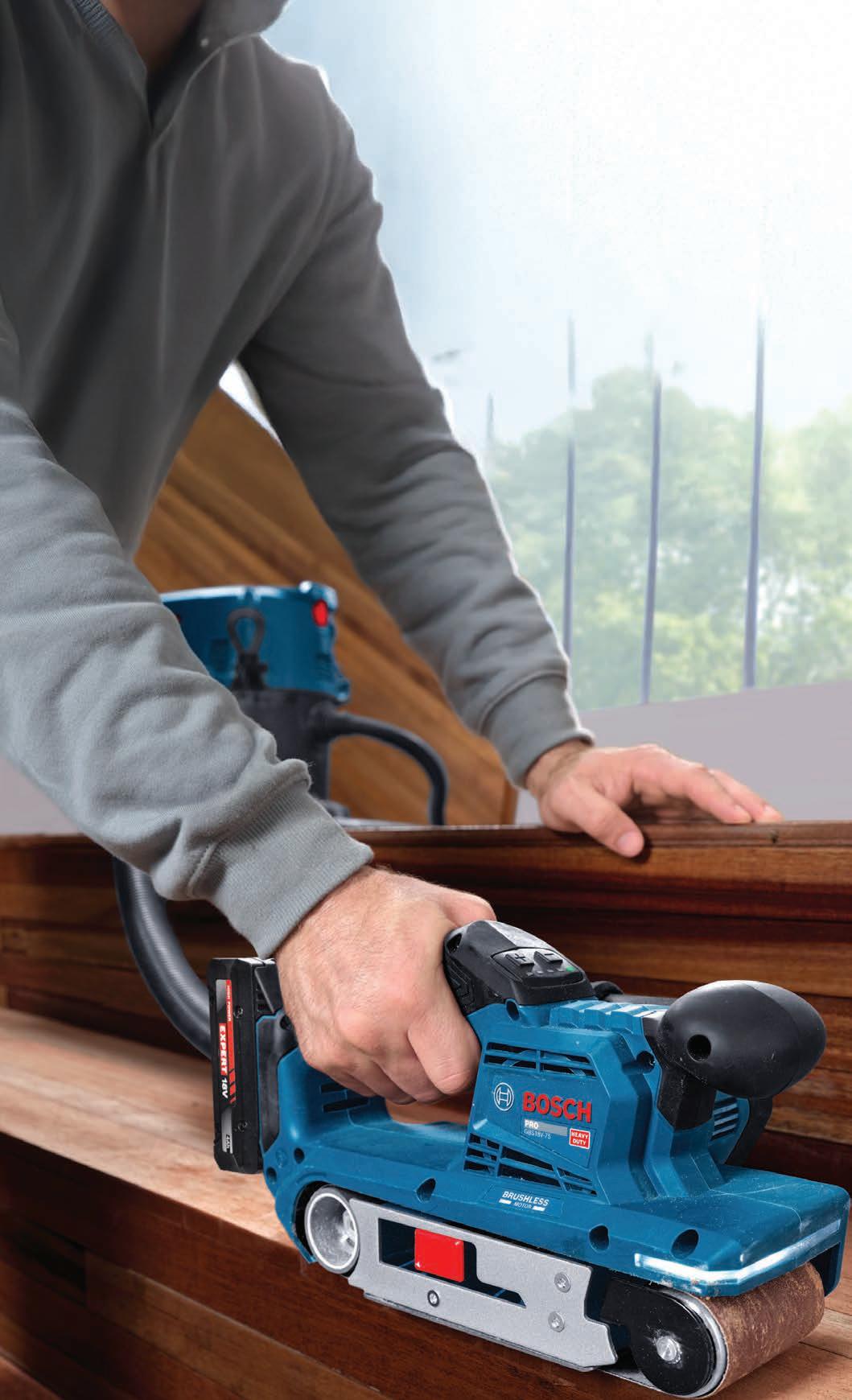

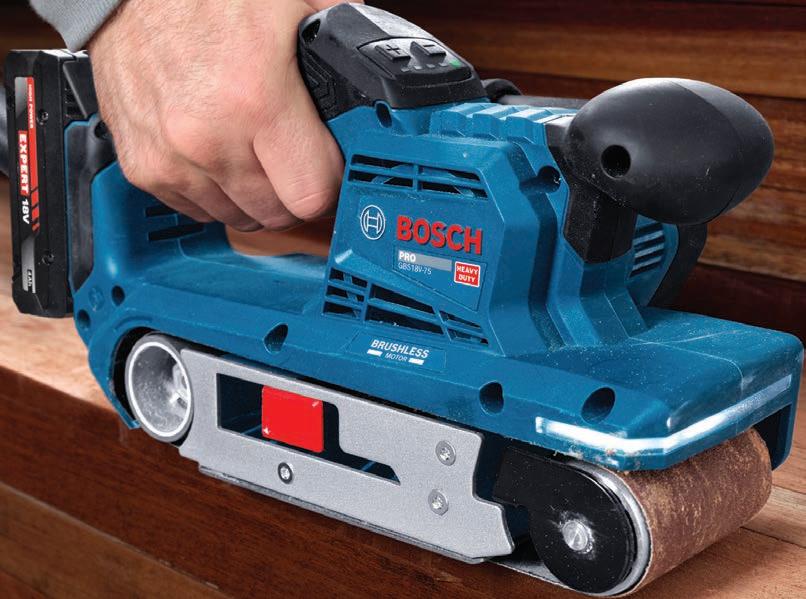
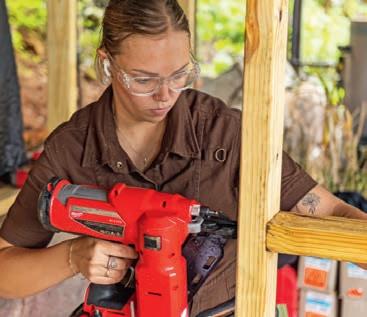
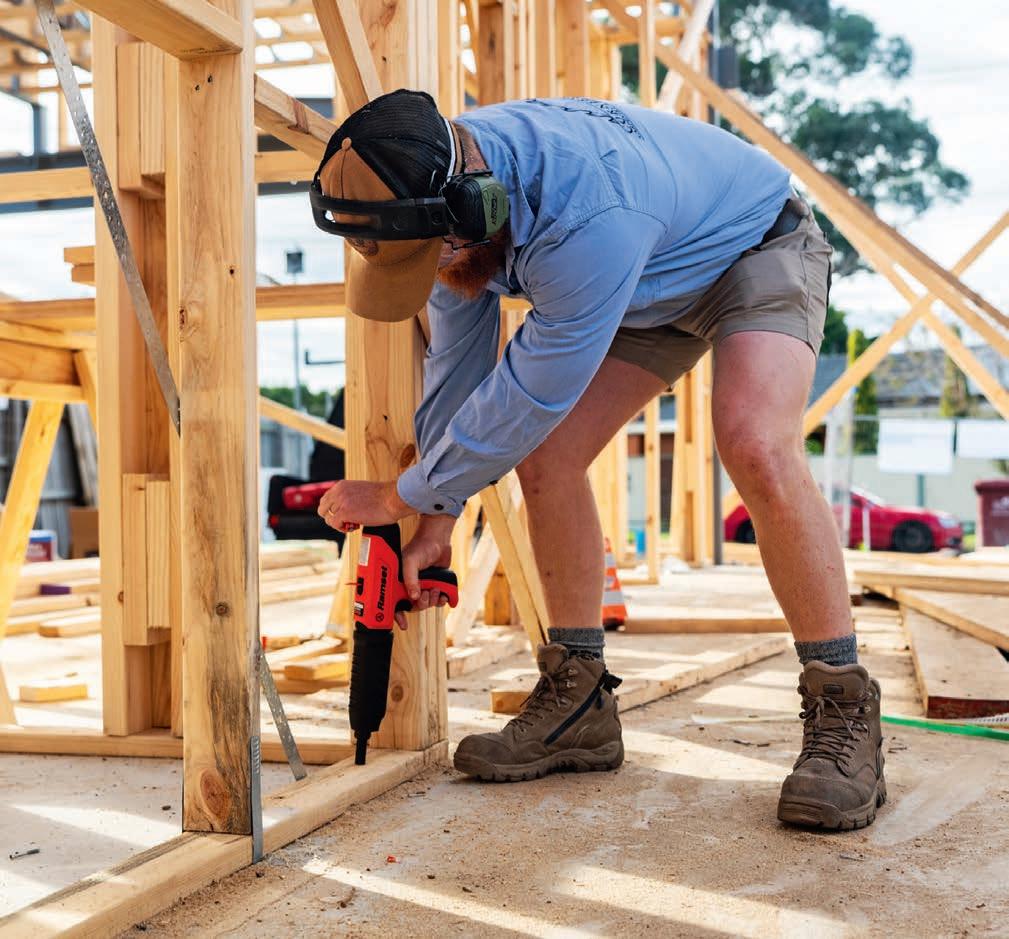
Compact, light weight, ergonomic design for one- or two-handed use
Driven by a high-power brushless motor
Built-in impact and drop protection.




WINTER HAS arrived.
Which means alarm clocks suddenly feel more offensive than usual, ute windscreens take on the structural integrity of Antarctic ice sheets, and every tradie in Australia collectively starts negotiating with themselves about whether the hoodie alone will cut it on-site. (Spoiler alert: it won’t.)
There’s something uniquely Australian about working through winter.
The mornings are brutal, the afternoons somehow still manage to surprise with a burst of sunshine, and everyone becomes an amateur meteorologist overnight.
‘Nah, reckon it’ll clear up by smoko.’
Usually followed by rain fi ve minutes later.
Still, work rolls on… maybe.
Non-stop rain, ice-cold ground and even snow can stall works, but deadlines
don’t care if the weather app says ‘feels like two degrees’.
If anything, winter has a funny way of separating the commi ed from the comfortably indoors.
Of course, winter also brings one of the great seasonal traditions: footy.
Whether it’s AFL, NRL or — in my case — ice hockey; yelling at the TV because your multi collapsed fi ve minutes into the final quarter, there’s comfort in knowing weekends are sorted.
Pub feeds taste be er when your team wins, and mysteriously more expensive when they lose.
Then there’s the absolute thrill — and that word is doing some heavy lifting here — of the financial new year.
Nothing gets the pulse racing quite like receipts, reconciliations and trying to remember whether that tool purchase in November was technically
for work or because it looked too good to leave on the shelf. EOFY might not carry the glamour of summer holidays or grand finals, but it ma ers.
For tradies and business owners, it’s one of the most important times of the year to get things in order. Reviewing cash flow, chasing invoices, speaking to accountants and planning ahead can make a genuine difference to how the next 12 months play out.

Exciting? Not exactly. Important? Absolutely. Because while nobody dreams of spreadsheets, strong businesses aren’t built on guesswork alone. A li le planning now can save plenty of headaches later — and leave more room for the things everyone actually enjoys, like knocking off on Friday and se ling in for a weekend of footy.
So, as winter se les in, stay warm, stay safe, keep the coffee strong and remember: spring will eventually arrive. Probably right around the time everyone finally figures out where they put those tax receipts.


EDITOR
Harry Murtough




IF THE FIFA World Cup in July feels a tad too polished, too expensive, or simply too far away, there was another football fi x quietly building momentum in May — and it came with fewer prima donnas, no diving controversies (hopefully) and a lot more chaos.
Enter Red Bull Four 2 Score — the energy drink titan’s rapid-fire spin on football that strips the game back to its essentials: four players a side, no goalkeeper, ten-minute matches and absolute mayhem.
Oh, and goals scored in the first and final minute count double, because apparently regular stress wasn’t enough.
The 2026 edition returned globally this year, with Kazakhstan hosting a string of qualifying rounds through May as local sides ba led for a shot at the world finals later this year in Toronto.
For those unfamiliar, imagine futsal after three espresso shots.
Tight spaces, constant pressure and nowhere to hide if your first touch resembles a clearance into row Z. It is football boiled down to instinct and effort — less tactical chess match, more organised madness.
And yes, Kazakhstan might still trigger memories of a certain moustachioed fictional journalist declaring it ‘very nice!’.
But if Borat taught the world anything — beyond questionable swimwear choices — it is that Kazakhstan knows how to surprise people.

This time, it is with football.
For tradies nursing the winter blues and counting down the days until proper international football rolls around in July, Four 2 Score offers a more casual, backyard-style alternative. Less billiondollar spectacle, more ‘grab your mates and have a crack’.
Because not every football fi x needs stadium-sized drama.
Sometimes all you need is ten minutes, a ball and someone yelling ‘shoot’ from entirely too far away.




TRADIES LOVE their phones being within reach on site — but what if that same device could double as a powerful diagnostic tool?
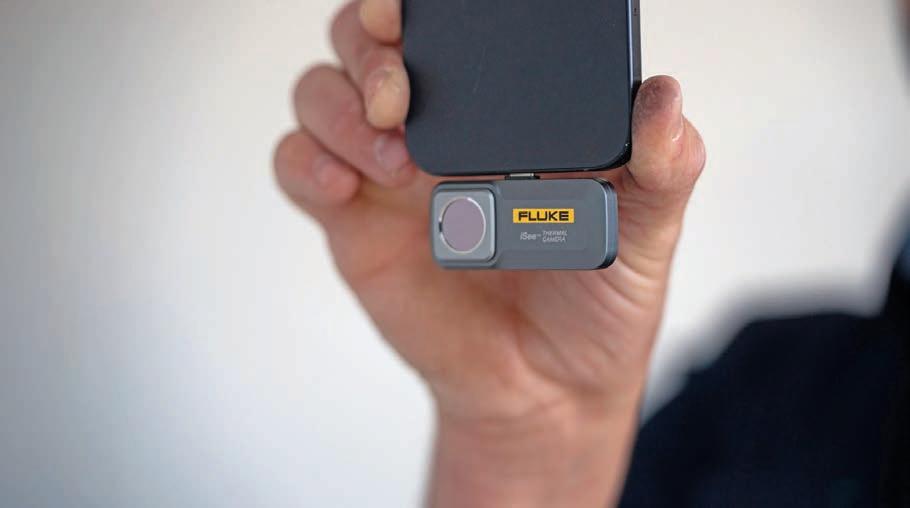
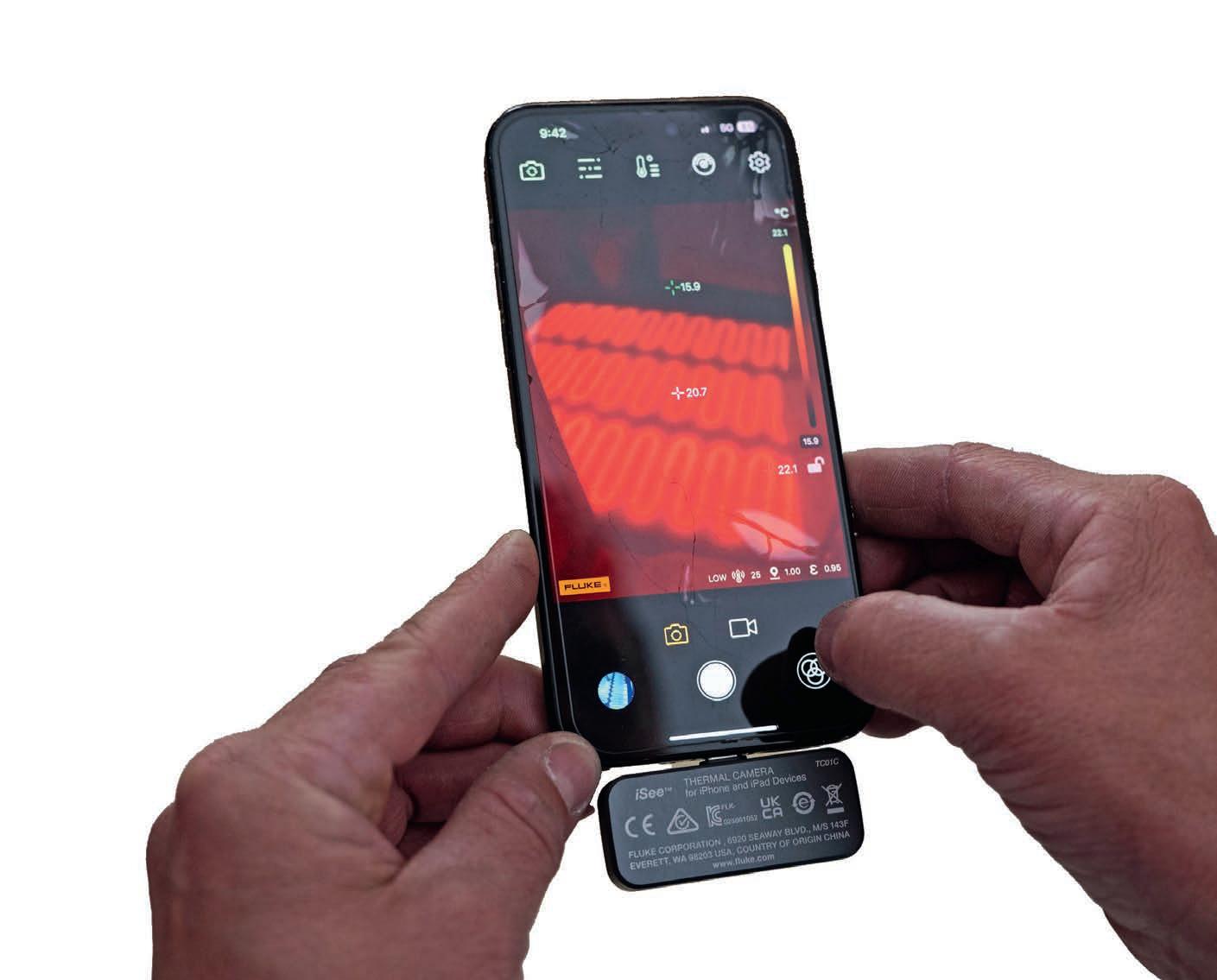
That’s the thinking behind Fluke’s new iSee Mobile Thermal Camera range — compact plug-in devices that turn a smartphone into a portable thermal imaging system.
Designed to make fault finding faster, simpler and more accessible, the iSee range gives tradies a lightweight alternative to traditional thermal cameras without sacrificing functionality.
Sparky and Director of TTS Electrical Tammy Voss said the release of the iSee range completely changed how thermal imaging could be used on site.
“When Fluke released the iSee, it really changed how thermal cameras can be
used,” the Geelong-based electrician said.
“Traditionally, thermal cameras have been bulky equipment, but this one is so simple — you just plug it into your phone and get the information right there in front of you.”
Instead of carrying standalone thermal imaging equipment, tradies can now plug a lightweight a achment into their phone, open an app and begin identifying temperature anomalies in real time.
The result is a portable diagnostic solution that fi ts naturally into the way modern tradies already work.
The range includes multiple connection types:
• TC01C for USB-C devices
• TC01A for Android
USB-C phones
• TC01B for Lightningbased iPhones
This compatibility allows the devices to integrate easily across most on-site setups.
Tammy said the portability also changes how thermal imaging can be used in front of customers. “It’s amazing especially if you’re with a client or homeowner,” she said.
“You can offer a service
that’s traditionally been diffi cult because of the size and cost of thermal imaging equipment.”
“Plus, because it’s connected to your phone, you can send reports almost immediately, which makes things really effi cient.”
Thermal imaging through iSee helps tradies quickly identify hidden heat differences and potential faults
ISEE EXPANDS BEYOND SPARKIES
While electricians are a natural fi t for thermal
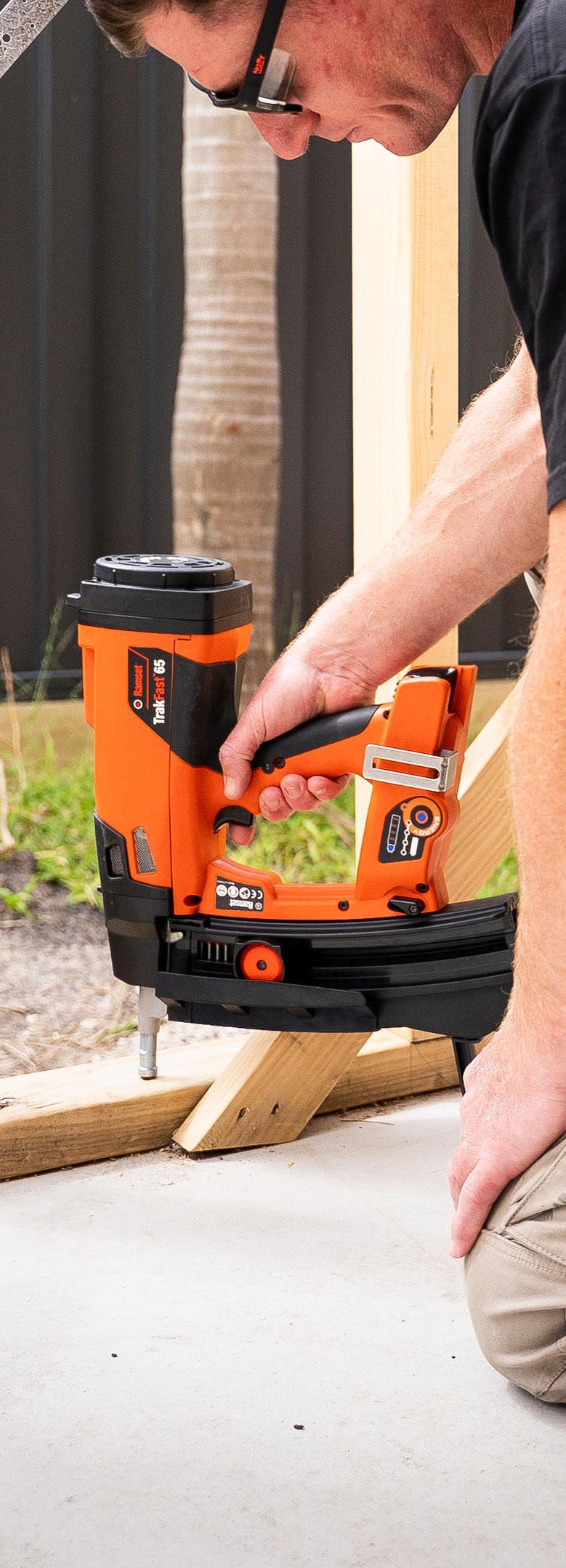
Built for track and bracket installation, the Ramset TrakFast C Plus combines 95J of power with a lightweight, well-balanced design for comfortable all-day use on site
“Traditionally, thermal cameras have been bulky equipment, but this one is so simple,” Tammy said

imaging, the iSee range is finding traction well beyond the electrical trade.
According to Fluke, one of the biggest advantages of the platform is its accessibility.
“You don’t need specialised training to get value from it — you’re simply reading heat
differences,” Fluke Sr Marketing Manager Ben Browning said.
“Builders can spot insulation gaps, plasterers can identify moisture issues, and HVAC or maintenance trades can quickly check for leaks or heat loss.”
Tradie Jared Leiner said the TC01C quickly became
Three models covering USB-C iPhones, USB-C Androids and lightning-based iPhones

a tool he now regularly reaches for on site.
“I’d use this to detect water leaks, box gu er leaks or missing insulation ba s — especially when people have been moving things around in the roof and you can’t tell what’s
been disturbed,” he said.
“We’d also use it for underfloor heating and bathroom leaks — you can find them all with this.”
Despite its compact size, the device delivers up to a 550°C temperature range, 256×192 resolution
and a 25Hz refresh rate — providing enough clarity for accurate fault finding on site.
“It’s very easy to see if there are any faults — everything it shows you is very detailed,” Jared said.
“For us, it’s a proactive approach. You’re finding issues before they turn into something bigger — ideally before the homeowner even knows there’s a problem.”
In leak detection scenarios, that visibility can save significant time and unnecessary damage.
“With box gu ers, you often don’t find the issue until it’s already coming through the ceiling,” he said. “This shows you exactly where it’s coming from, so you’re not cu ing holes in the wrong places.”
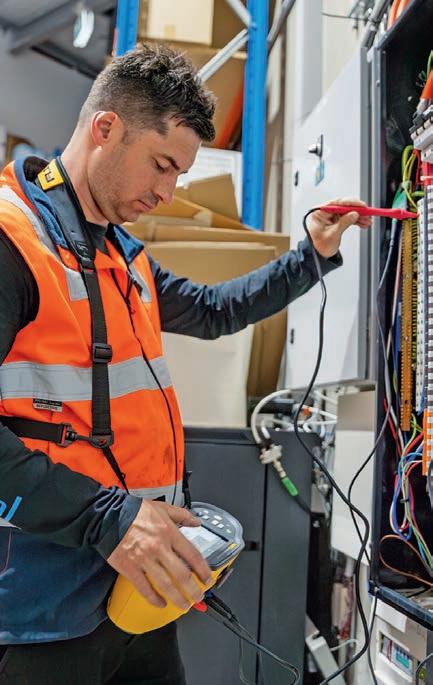
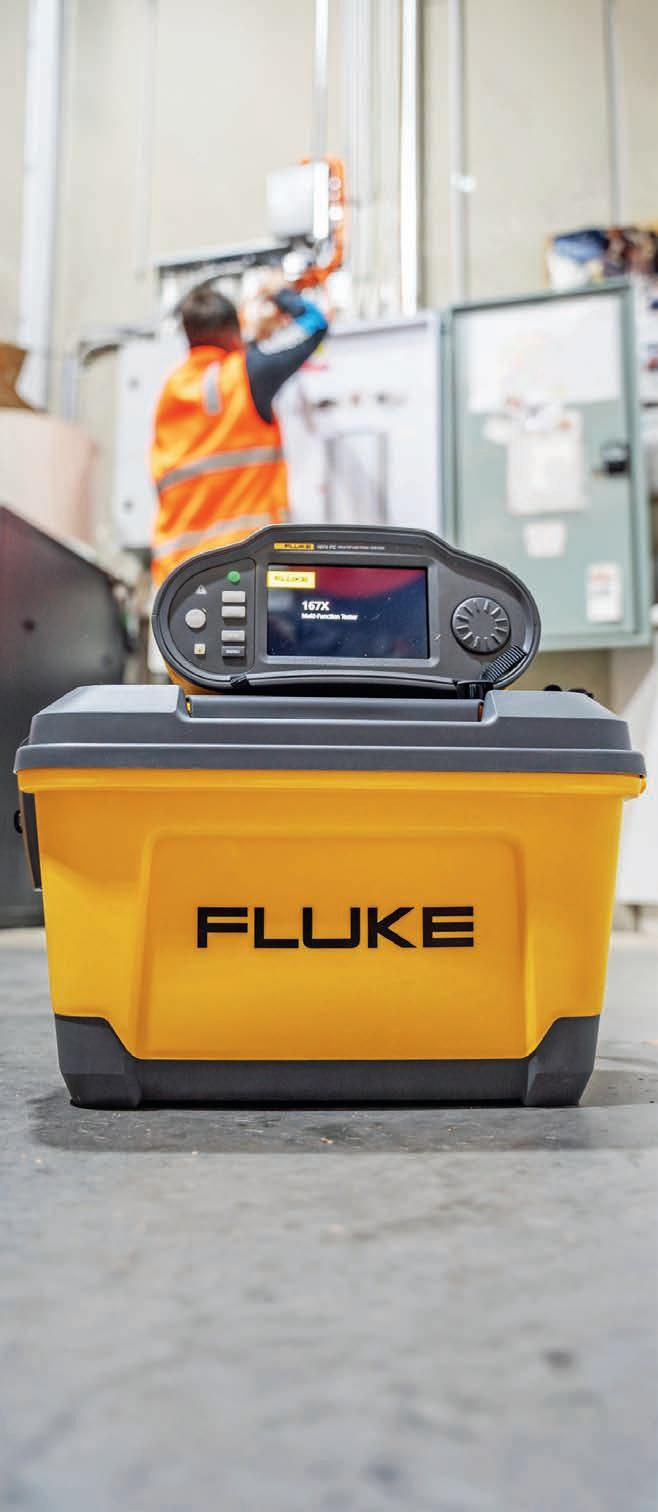
The Fluke 1670 Series Multifunction Installation
Testers streamline electrical testing and reporting on-site
The accessibility of tools like the iSee reflects a broader focus from Fluke — making professionalgrade diagnostic tools more approachable across every level of the industry, from experienced tradies through to apprentices and training institutions. Supporting apprentices remains a key focus as Australia continues facing ongoing trade skills shortages.
“Apprentices are the future of the industry,
Intuitive touchscreen interface
Faster testing sequences (up to 30 per cent quicker)
Automated pass/fail measurement validation
Reduced documentation time by up to 50 per cent
Integration with Fluke Connect and TruTest software
especially with the skills shortage we’re seeing across trades in Australia,” Ben said.
“There’s a growing need to bring more people into the industry and make sure they’re set up properly from day one.”
Fluke said early exposure to professional-grade tools helps shape long-
term habits around safety, accuracy and confidence on site.
“At the end of the day, it’s about making sure people go home safely, and that’s something Fluke has always been built around,” Ben said. Tammy was one of those apprentices who first experienced Fluke tools early in her career.
“It’s really great that apprentices can access quality equipment early on,” she said.
APPRENTICESHIP SUPPORT PROGRAMS Fluke currently supports apprentices and training organisations through: • 25 per cent discount on one tool or kit annually
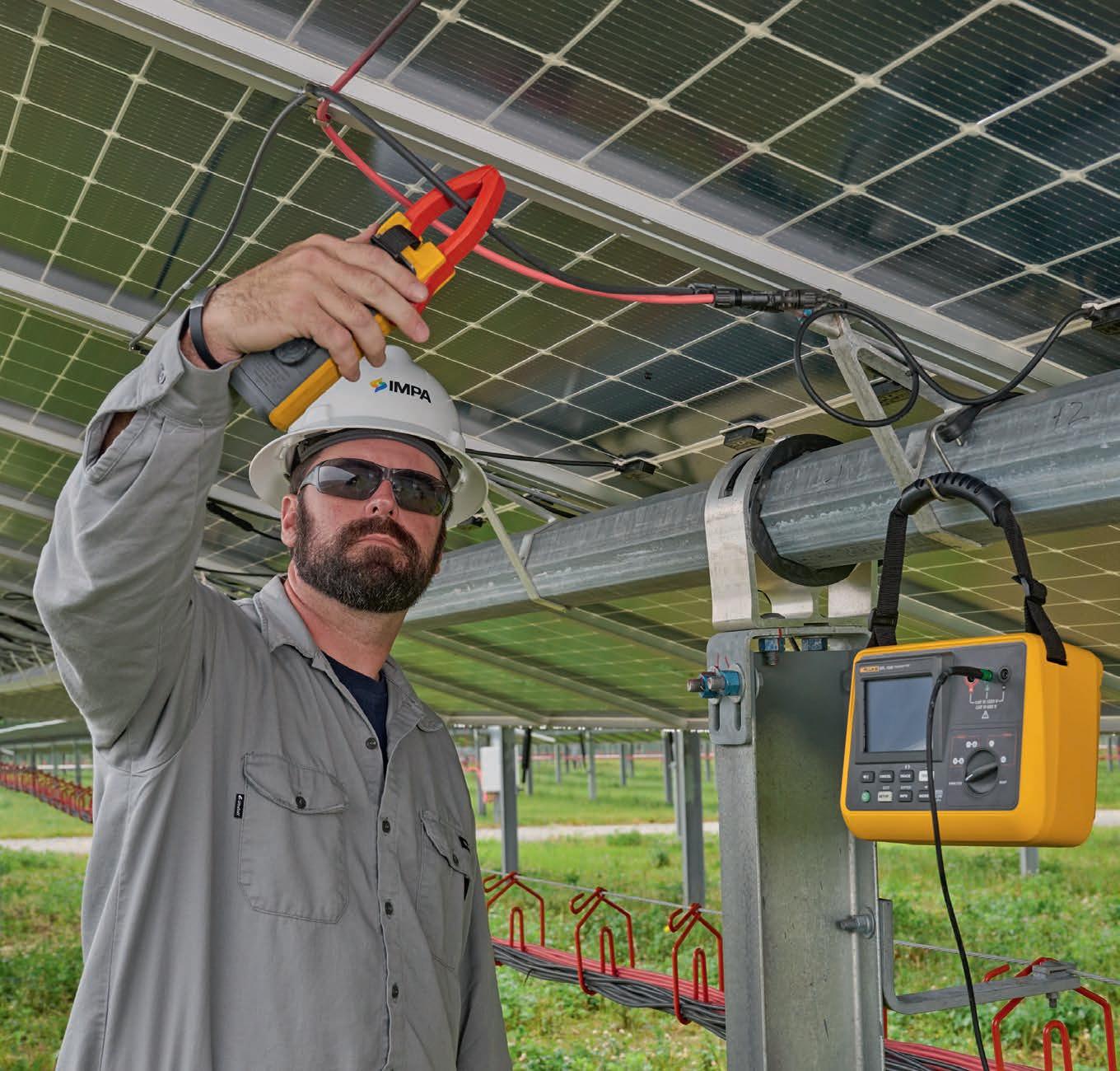
The Fluke GFL-1500 helps technicians quickly trace and locate ground faults in solar PV systems
• Product donations to training institutions
• Sponsorship of apprentice award nights
While the iSee range is one of Fluke’s latest mobilefocused innovations, the company’s broader ecosystem of test and measurement tools
continues expanding across multiple specialist fields.
1670 SERIES MULTIFUNCTION INSTALLATION TESTERS
Designed to streamline installation testing, the Fluke 1670 Series improves workflow speed while simplifying reporting and compliance documentation.
The system supports compliance with IEC 60364 and AS 3000 standards while helping reduce administrative workload on site.
The Fluke GFL-1500 is designed for solar PV diagnostics, helping technicians trace and locate ground faults across large arrays more effi ciently.
By sending a signal through the system, the tool reduces the need for time-consuming manual fault testing.
The FEV350 allows electricians to test EV charging infrastructure, including:
• Voltage and load performance
• Protective earth continuity
• RCD operation
• Functional safety checks
This consolidates multiple tests into a single portable device.
Fluke is expected to continue expanding its mobile-first diagnostics ecosystem throughout 2026, with future developments focused on smartphone-integrated tools and streamlined field testing solutions.
The broader goal remains simple: make advanced diagnostics faster, easier and more practical for tradies on site.
As digital integration continues across the industry, tools like the iSee range reflect a wider shift in how diagnostics are performed — moving away from bulky standalone equipment and towards tools that integrate into devices tradies already carry every day.
As Tammy puts it: “This time, you’re allowed to be on your phone for the right reasons.”
Choosing SHEETROCK PLUS simplifies specs while upgrading wet areas with acoustics and impact resistance. Quiet bathrooms, calm home offices, tough hallways – get noticeable benefits to the rooms that matter without complicating the build. © 2026 Knauf




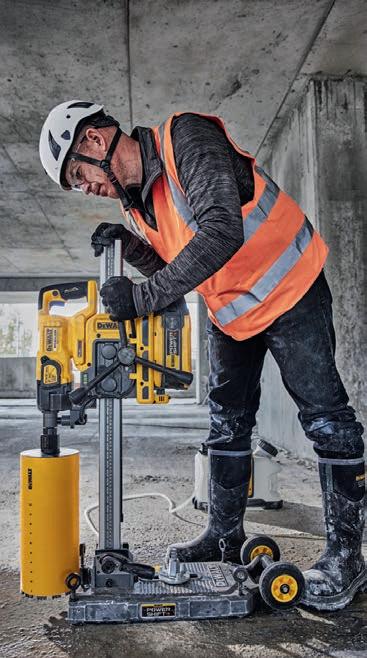
CORDLESS TECHNOLOGY has been edging into heavier-duty applications for years, but limitations with the tech have often held it back.
DEWALT POWERSHIFT is aiming to change the
conversation — focusing not just on tools, but on the ba ery systems that power them. Positioned as a cordless equipment system engineered for high performance
and extended runtime, POWERSHIFT tackles one of the biggest pain points on site: downtime. Waiting to refuel, managing petrol equipment, and dealing with inconsistent power
delivery are all issues tradies know all too well.
RUNTIME THAT MATTERS
The crux of DEWALT’s high-output ba ery platform is delivering sustained power for demanding applications. It’s not just about peak performance, it’s about maintaining that output
across longer working periods without drop-off.
For jobs like repeated wet core drilling, where consistency is critical, ba ery reliability becomes just as important as raw power.
The ability to run longer without interruption directly impacts productivity, particularly

on jobs where stopping and starting costs time and precision.
MOVING AWAY FROM PETROL
The shift away from petrol-powered equipment is just as much about control as it’s about convenience.
Ba ery systems like POWERSHIFT remove the need for fuel storage, reduce maintenance requirements, and eliminate emissions on site.
For workshops and contractors alike, this
creates a cleaner, more predictable working environment.
There’s no warm-up time, no refuelling delays, and fewer variables affecting performance. The result is a system that’s ready to go when the job starts — and keeps going.
It also means no harmful emissions, less noise and a lower cost of ownership; all factors that ma er now more than ever.
BUILT FOR DEMAND
Heavy-duty cordless systems have historically
struggled to match petrol equivalents in sustained applications.
The new generation of ba eries is designed to close that gap, offering the kind of runtime needed for repetitive, high-load tasks without constant swapping or charging interruptions.
This is where the broader POWERSHIFT approach stands out.
It’s not just about a single ba ery or tool — it’s about creating a system that supports continuous workflow across demanding jobsite conditions.
THE BIG PICTURE
As ba ery technology improves, the expectations of cordless equipment are shifting. It’s no longer enough for tools to be portable — they need to be reliable over the long haul.
POWERSHIFT reflects that evolution. By prioritising runtime, consistency and jobsite
DEWALT POWERSHIFT is redefining heavy-duty cordless performance, delivering sustained runtime and reliable power for demanding jobsite applications
effi ciency, it signals a move toward cordless systems that can genuinely replace petrol in more applications.
CUTTING THE CORD, LITERALLY
For tradies and technicians, the real value of systems like POWERSHIFT isn’t just power — it’s uptime.
Check it out! Check it out!
In an industry where time is money, ba eries that can keep pace with the job are quickly becoming one of the most important tools on site. Head to dewalt.com.au to find out more

The ATO is back in aggressive collection mode, and tradies are squarely in its sights.
Director Penalty Notices (DPNs) make you personally liable for the company’s unpaid PAYG withholding, GST and superannuation guarantee charge.
A standard DPN gives you 21 days to pay, appoint a voluntary administrator, appoint a small business restructuring practitioner, or place the company into liquidation.
A lockdown DPN gives you nothing — personal liability is already locked in and cannot be remi ed by appointing an external administrator.
The trigger for lockdown is failing to lodge BAS, IAS or SGC statements within the statutory window.
The lesson: lodge on time, every time, even if you can’t pay the liability.
Winding-up applications are the ATO’s next escalation. Once an application is filed in the Federal Court, your bank lines freeze, finance dries up, and the ma er becomes public on ASIC.
Defending the application typically costs more than dealing with the debt early.
If you’re behind on tax, act now. The earlier you engage — through a payment plan, voluntary administration, or small business restructuring — the more options remain on the table.
If you subcontract to a head builder, your cash flow is only as good as theirs.
Watching for early warning signs is the difference between ge ing paid and joining the creditor queue.
Red flags worth taking seriously: payments slowing or arriving in odd part-amounts; requests to ‘hold off invoicing until next month’; retention monies overdue; suppliers walking off site; key office staff resigning; site shutdowns blamed on ‘bank delays’; and excuses that change every fortnight.
One of these may mean nothing — two or more are a serious warning.
Use the tools available. Run an ASIC search for recent changes in directors or registered office.
Run a PPSR search to see who already holds security over the builder’s assets. Check court records for any winding-up applications on foot. Consider a paid creditor-watch service for material exposures.
Most importantly, use your state’s Security of Payment legislation properly.
Issue payment claims on time, in the prescribed form, and follow up with adjudication if a payment schedule isn’t received.
Those rights expire quickly.
Once a builder enters administration, your statutory entitlements are often the strongest position you have.

Small Business
Restructuring (SBR), introduced under Part 5.3B of the Corporations Act in January 2021, was designed for businesses exactly like a tradie’s company — viable in normal trading, but weighed down by tax debt or a bad job that won’t clear.
The headline features: directors stay in control of the business, you appoint a Restructuring Practitioner to oversee the process, you have 20 business days to put a plan to creditors, and creditors then have 15 business days to vote.
If accepted, the plan binds all unsecured creditors — including the ATO — and the company trades on.
Eligibility is strict.
Total liabilities must not exceed $1 million.
Employee entitlements (including superannuation) must be paid up to date. Tax lodgements must be current.
The directors must not have used the SBR or simplified liquidation process in the previous seven years.
SBR is a powerful tool for the right business.
It is not suitable where the underlying trade is unviable, where liabilities exceed $1 million, or where employee or super obligations remain unpaid. Used at the right time, it can save the business.
Atlee Carter specialises in plain English advice for Australian businesses and individuals navigating restructuring, insolvency and financial distress. No jargon. No pressure. Just clear options.
Directors Penalty Notice from ATO (DPN)
ATO payment plan
Unable to obtain Financing
Statutory Demand from Creditors
Winding up proceedings on foot



MOST
wouldn’t think twice about replacing worn-out gear or checking over tools before a big job.
But business insurance?
That’s often shoved into the ‘sort it later’ pile.
The problem is, what worked for the business 12 months ago might not make sense now.
Maybe the jobs are bigger, the ute’s packed with newer gear, or there are more people on site than before. Even changes in regulations can quietly shift what cover is needed.
Insurance might not be the most exciting item on the to-do list, but a quick review could be
the difference between being properly covered or ge ing caught short when something goes wrong.
WHEN THE BUSINESS EVOLVES, COVER SHOULD TOO
A lot can shift in a year on the tools.
Maybe the business has started offering new services, investing in updated technology, or taking on more specialised work. These changes can alter risk profiles and may mean existing cover no longer fi ts the job. Likewise, growth ma ers.
Hiring contractors, bringing on staff, or
stepping into larger contracts can expose tradies to new liabilities and bigger financial risks. What worked for a sole operator tackling smaller residential jobs may not be enough once the workload scales up.
As the business changes, insurance should change with it.
DON’T ‘TOOLS DOWN’
Legal requirements also change, and failing to keep up can create major headaches.
A timely example is New South Wales’ incoming Professional Indemnity requirements for registered building practitioners, due to take effect from 1 July 2026. Changes like these can mean certain types of cover move from ‘nice to have’ to mandatory overnight.
For busy tradies, staying on top of those updates can be diffi cult, which makes regular policy reviews even more important.
For many tradies, tools and equipment are the business. Yet upgraded gear is often purchased without updating insurance.
New diagnostic equipment, cordless systems, laser tools, or expensive specialist gear can quickly add up.
Portable Equipment and Theft cover may help protect the tools that keep money coming in particularly for gear stored and locked in utes, trailers, or sheds. And if cover already
exists, it’s worth checking whether new purchases have actually been added to the policy.
Because there’s no worse feeling than discovering a stolen tool wasn’t covered.
Reviewing insurance isn’t just about avoiding gaps in cover — it could also save money.
Different insurers assess risk differently, meaning tradies may be paying more than necessary without realising it. Comparing quotes periodically could uncover be er value or more suitable cover for the way the business operates today.
ISN’T ‘SET AND FORGET’
Business insurance should move with the business.
Whether it’s new services, bigger jobs, changing regulations, or upgraded gear, reviewing policies regularly helps ensure cover keeps pace. Because just like anything else on site, a quick check-up now could save a much bigger headache later.

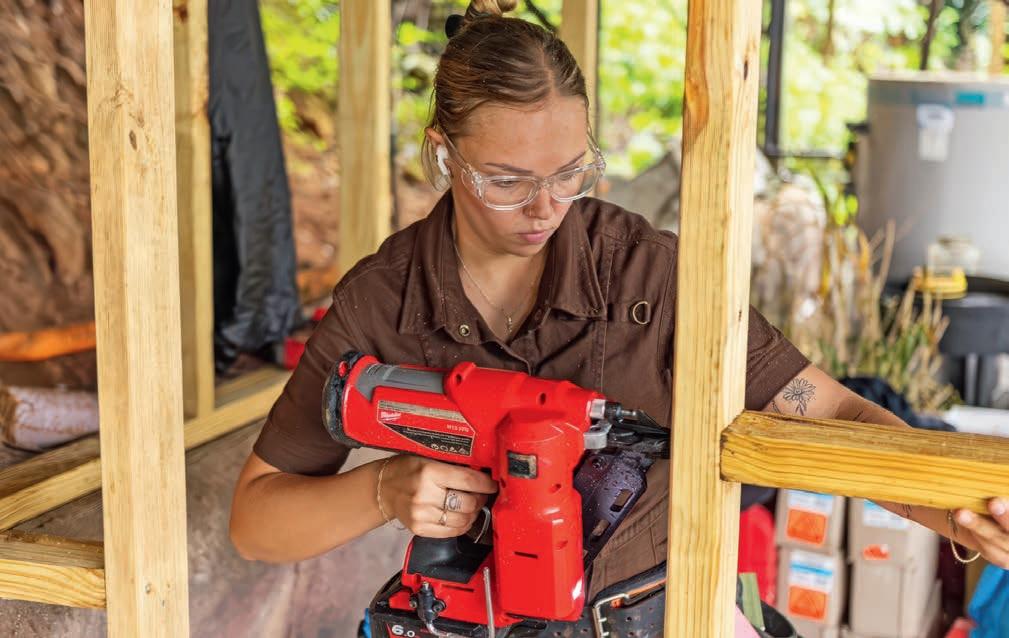
FOR MANY tradies, a full workload means juggling site deadlines, quoting jobs and trying to switch off at the end of the day.
For carpenter and content creator Felicity Pe iford aka the Sydney Builder Chick — that balancing act has expanded dramatically in 2026.
While continuing to work on the tools four days a week, Felicity has taken on a new challenge: helping shape the next generation of tradies through construction teaching.
It’s the kind of industry contribution that saw her recognised as a nominee for Tradeswoman of the Year at this year’s Women in Industry Awards — but for Felicity, the focus has
remained firmly on making a practical difference.
One of Felicity’s biggest shifts this year has been stepping into teaching through a private college program at Hunters Hill High School.
Working as the program’s experienced carpenter, she helps students build a tiny home across the school term — an immersive, hands-on way to introduce young people to construction.
“A massive change this year has been teaching,” Felicity said.
“Across eight Thursdays, they managed to complete an entire tiny home in just eight days overall, which
then gets sold off.”
The outcomes have already been significant.
Of the 12 students in the class, six secured apprenticeships afterwards, including two young women.
“It’s been a really great outcome for the students,” she said.
Teaching wasn’t originally part of the plan.
Felicity said the opportunity came after the college reached out because of her social media content, which focuses heavily on practical tutorials and helping people build confidence with tools.
“My videos are very hands-on — tutorials and
‘get handy’ type content showing people how to do basic things themselves if they can’t afford to get someone in,” she said.
While initially nervous about teaching, she quickly found herself enjoying the role — and it has since evolved into something much bigger.
Felicity is now helping develop micro-credential workshops aimed at creating alternative pathways into trades for people of all ages, including mature-aged students and those who may have missed out through traditional schooling.
Between mentoring, ge ing qualified and carpentry work … Felicity’s workload has been hectic to say the least
“The workshops can count towards apprenticeship units, so they give people a proper insight into the trade and a head start if they want to pursue it,” she said.
Alongside site work, teaching and content creation, Felicity is also preparing to complete her Training and Assessment qualification — allowing her to formally train and sign off students.
Recognition through programs like the Women in Industry Awards has reinforced that the work is resonating.
“Ge ing recognised through awards like this means so much,” Felicity added.
“You can be making big industry changes, but when someone takes the time to nominate you for an award, it really reinforces that what you’re doing is making an impact.”
For an industry constantly talking about skills shortages and workforce pipelines, Felicity’s work offers a reminder that change often starts with someone simply willing to teach the next person coming through.
A hundred years ago, we created the first chainsaw. Since then we have become synonymous with tools that make working in nature easier. Built with legendary performance and enduring quality, our roots in professional forestry have evolved into a broad range of tools that have been designed for those who demand the best. LEGENDARY PERFORMANCE AND QUALITY.
DISCOVER MORE AT STIHL.COM.AU




THOUSANDS OF construction workers across New South Wales and the country are set to benefi t from new training opportunities aimed at boosting housing supply, following an $11 million joint investment from the Federal and NSW Governments into a new Construction TAFE Centre of Excellence in Western Sydney.
The existing Institute of Applied Technology –Construction at the TAFE NSW Kingswood campus will be upgraded as part of the initiative, with a focus on helping tradies and supervisors gain practical, industry-led skills to
meet growing demand across the housing and infrastructure sectors.
A major part of the investment includes two new fee-free microskills — short, practical online courses designed to help tradies upskill quickly and fl exibly.
The first courses will focus on leadership and workplace culture, joining a growing list of fee-free training options covering digital capability, sustainability, project management and Building Information Modelling (BIM).
Over the next two years, the Centre is expected to deliver more than 20,000 enrolments through microskills and microcredentials, available both online and face-to-face.
The Centre will also work alongside industry and universities to develop what is being described as a firstof-its-kind Higher Apprenticeship in construction, creating a pathway that combines hands-on experience with higher-level qualifications.
Federal Minister for Skills and Training Andrew Giles said growing the
construction workforce is critical to meeting housing demand.
“We can’t build more homes without more construction workers. That’s why we’re improving training capability to support growing the workforce,” he said.
“This TAFE Centre of Excellence will offer students and apprentices cu ing-edge skills, and align with industry needs for workers to more easily access opportunities to upskill.”
The Centre will focus on practical construction training across quality, compliance, project management and digital skills, while also supporting sustainable building practices and modern methods of construction.
NSW Minister for Skills, TAFE and Tertiary Education Steve Whan said training needed to evolve alongside industry.
“The construction industry is changing rapidly, and training needs to keep pace with new technology, new building methods, and the workforce needed to help deliver more homes and infrastructure across Western Sydney and beyond,” he said.
“These new fee-free microskills will help tradies and supervisors build practical skills in areas like leadership, workplace culture and digital capability, with flexible online training they can complete wherever they are.”
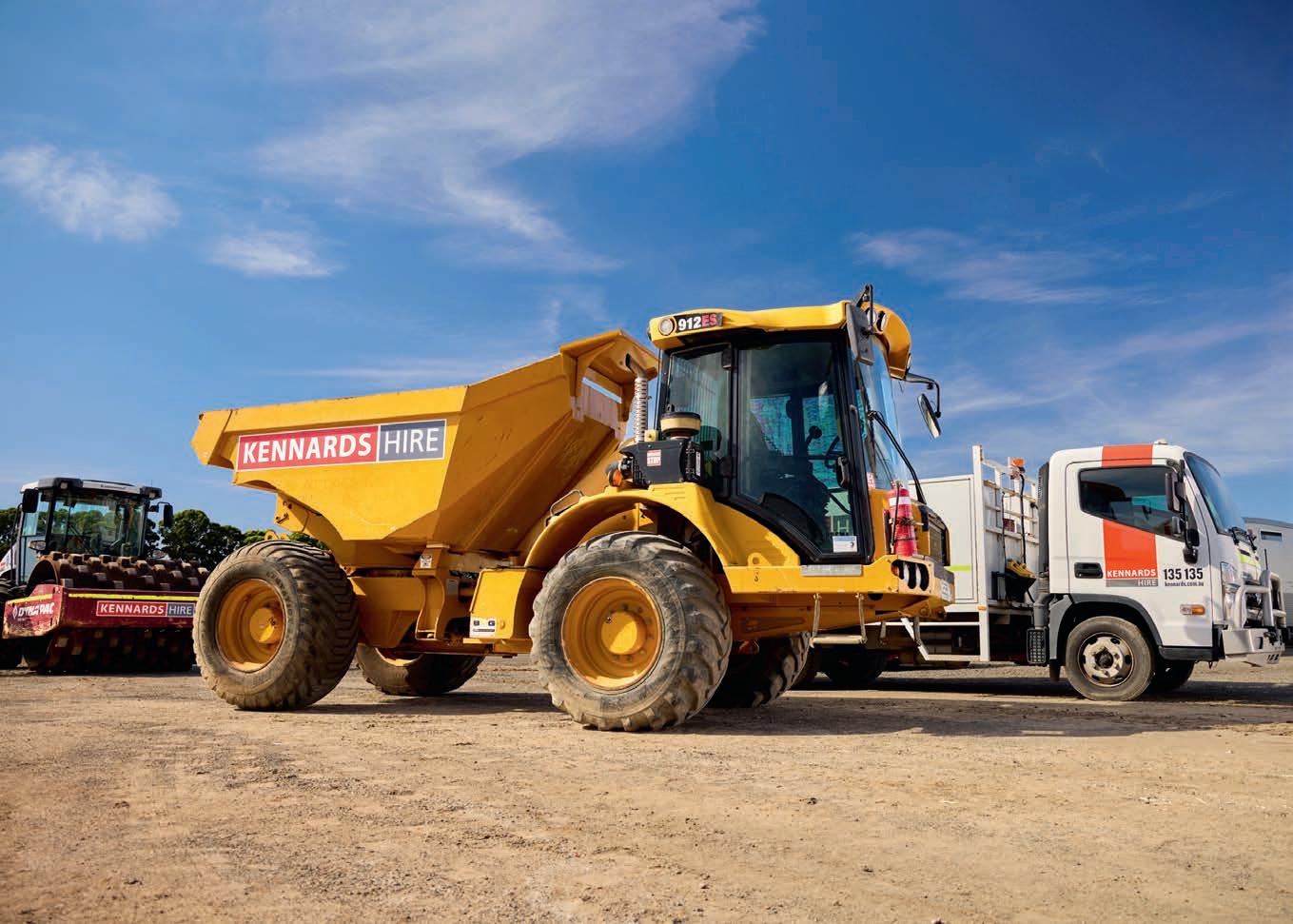
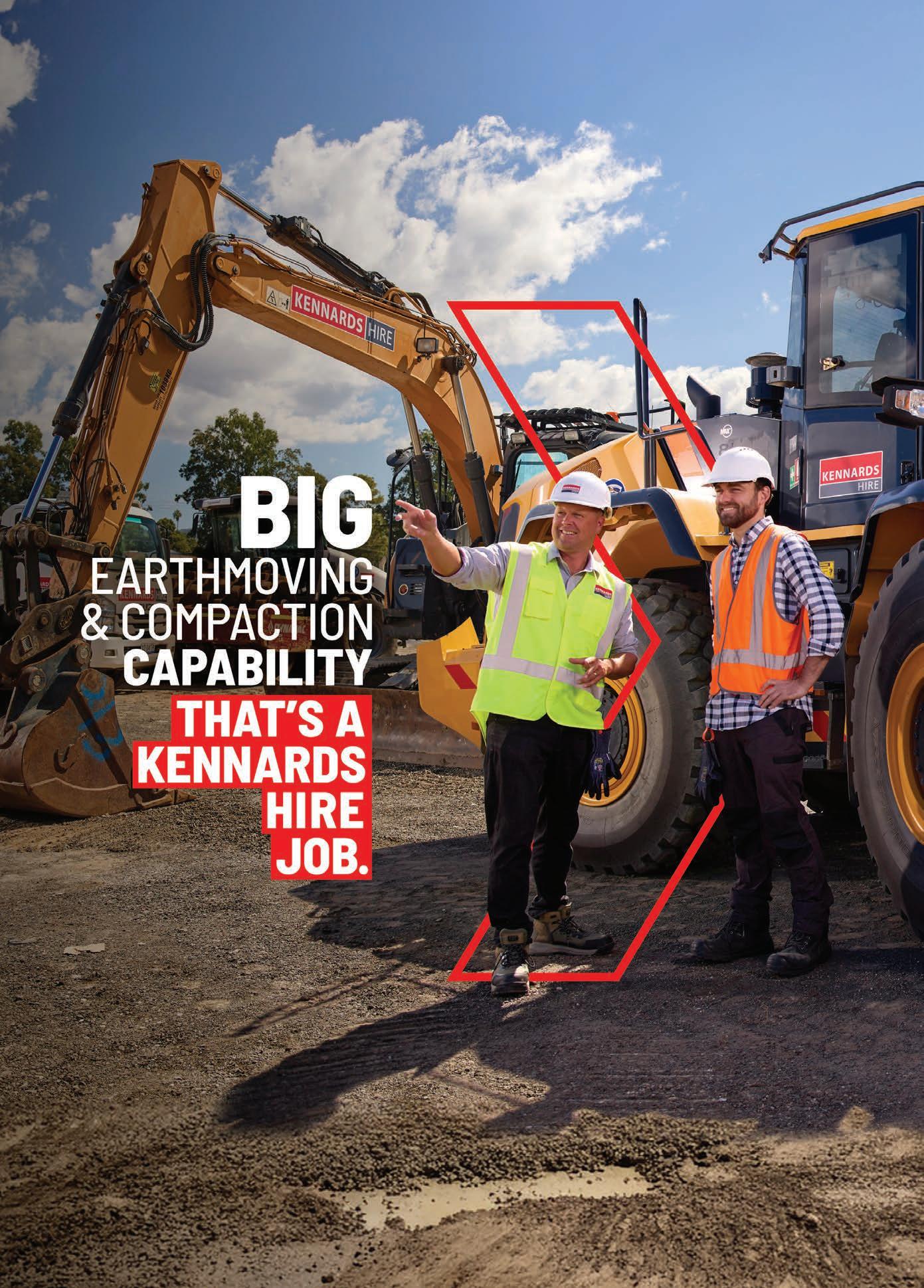
KENNARDS HIRE has long built its reputation on supporting tradies with the tools and equipment needed to get the job done — no ma er the size or scope.
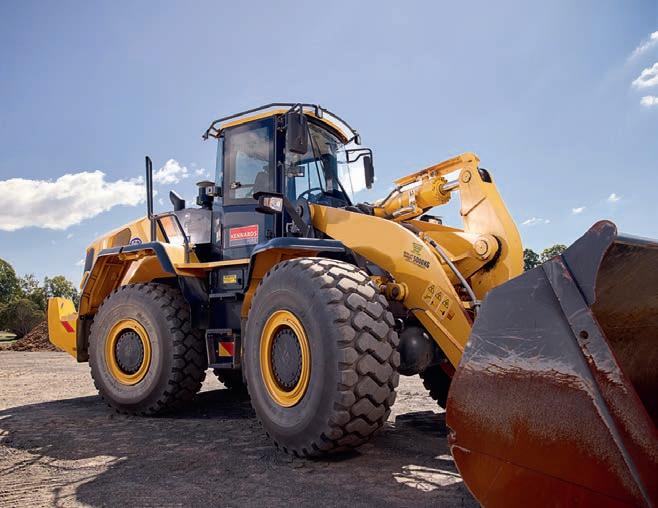
Now, with the acquisition of Solution Plant Hire (SPH), that capability has expanded even further, giving tradies access to a broader range of earthmoving and compaction gear typically reserved for larger civil works.
From tighter-access jobs to more demanding site requirements, the expanded range means tradies can now tap into higher-capacity equipment when the job calls for it — all through a familiar hire partner.
Kennards Hire
Earthmoving & Compaction General
Manager Craig McMahon said the move was driven by growing demand across the board, including from customers taking on larger or more complex work.
“Our customers in that space were asking us to supply more of that product and provide a true one-stop-shop hire solution,” he said.
“So it was really an evolution of the business, driven by customer demand.
“When the opportunity came up, we moved on it.”
With experience across fast-growing regions like NSW’s Central Coast,
Craig has seen the shift firsthand — with tradies increasingly requiring equipment that can bridge the gap between everyday jobs and larger-scale site work.
At the same time, the expansion strengthens Kennards Hire’s ability to support major projects across sectors like renewables, infrastructure and civil construction.
• 12–35 tonne excavators
• 9T 4WD swivel tip dumpers
• Skid steers and forklift a achments
• Hydraulic breakers and specialist excavator a achments
• Large mud buckets
and compaction a achments
• Additional dozer capability
“We now go up to 35-tonne excavators. Previously, we generally capped out around eight tonnes, with some 14-tonne machines,” Craig explained.
“So it’s essentially larger equipment, which gives us access to bigger jobs and more specialised work.”
For tradies, that means more flexibility on site — whether it’s tackling heavier groundwork, moving more material, or taking on projects that previously required outsourcing or additional contractors.
“That’s one of the most exciting parts,” he said.
“We’re seeing crossover both ways — customers from the acquired business accessing our Kennards’ broader range, and existing Kennards Hire
Kennards Hire has expanded its earthmoving and compaction capabilities, giving tradies access to larger specialist equipment
customers stepping into larger equipment.”
The result is a more seamless experience, where tradies can scale up their equipment needs without changing suppliers — maintaining a single point of contact across every stage of the job.
Tradies can still access a large portion of the range through their local Kennards Hire branch, while bigger, specialist equipment can be organised ahead of time and delivered directly to site.
“Bookings are usually handled through project managers, business
development managers, or existing relationships, and then delivered directly to site,” Craig said.
SPH’s locations in Brisbane, Sydney and Melbourne are now integrated into the Kennards Hire network, with a new site also set to open in Tomago, in the Hunter region — further strengthening coverage and availability.
Beyond the machinery, Craig said the addition of SPH’s experienced team has been a major advantage.
“One of the biggest gains wasn’t just the machines
— it was bringing across the people and their specialist knowledge,” he said.
“We didn’t just buy the gear — we gained valuable people who understand those markets, which helps us be er support customers.”
For tradies, that translates to be er advice, stronger support and confidence in choosing the right equipment for the job.
As infrastructure investment continues to grow across Australia, Kennards Hire is well positioned to support
major projects — but the real win is how that capability flows down to everyday customers.
Tradies now have access to a deeper pool of equipment and expertise, making it easier to take on bigger, more complex jobs without added hassle.
“It’s a big step forward,” Craig said. “Customers not only get access to bigger and more specialised gear, but also the expertise that comes with it.
“At the end of the day, we’re not just in the hire business — we’re in the customer service business. It’s about providing the right solution for the job, and that one-stop-shop approach makes things much more effi cient for customers.”
From excavators to rollers and dumpers, Kennards Hire is helping tradies scale up with expanded access to heavy-duty equipment and specialist expertise

HOUSING WAS the theme of this year’s Budget, addressing the construction industry’s demands for a stronger workforce, financial relief, and builds to work on.
Treasurer Jim Chalmers delivered the Federal Budget on Tuesday May 13, which highlighted the government’s first priority: helping young Australians become home-owners.
One key step is building new homes, so here’s a look at what this year’s Budget offers the workers and companies who’ll be building them.
The cost of living crisis has bled into small tradie businesses which make up 98 per cent of all construction firms in Australia.
93 per cent of these businesses, which employ and train apprentices, experienced ‘moderate to high financial pressure’, according to a recent cost of living survey*.
A further 72 per cent said conditions have worsened over the past 12 months.
The government has commi ed a total of $2.3 billion over the next fi ve years in an overall package to help up to 85,000 small and medium-sized enterprises (SMEs).
The eye-catching $20,000 instant asset write-off policy was made permanent for SMEs, as well as some tax relief for
Skilled migration, apprentice funding and housing reform were all central to the government’s plan to tackle Australia’s building shortage
companies with up to $1 billion in turnover starting July 1. Dimpat site manager Morgan Ferguson said the biggest issue the industry faces is cash flow for builders and tradies.
But, like many tradespeople, he’s waiting to see how the next 12
months will unfold.
He added that the instant asset write off is good for him, but Morgan highlighted the biggest relief from the package was the red-tape cuts.
“Red tapes a killer, it’s just so slow,” he said.
“Obviously money will speed things up which will make a difference, but yeah, it is pre y ridiculous how long it takes for
Housing dominated this year’s Federal Budget, with new measures aimed at boosting supply, easing business pressure and strengthening the construction workforce
approvals and permits.”
Construction firms can also expect lower red tape costs and reform in Environment Protection and Biodiversity Conservation (EDPC) guidelines.
The government projects government regulation compliance will be cut by $10 billion a year so builders can start more projects quicker and for cheaper.
Finally, companies will be able to report lower profi ts from the last two years regarding their recent losses, making them eligible for refunds on their lowered tax bills.
The government sprinkled some bonuses into the Budget for Australian workers.
Australians who earn income in the form of a wage will receive a $250 tax off set, though it won’t be until July 2028 that this cash shows up in their bank accounts.
The government linked
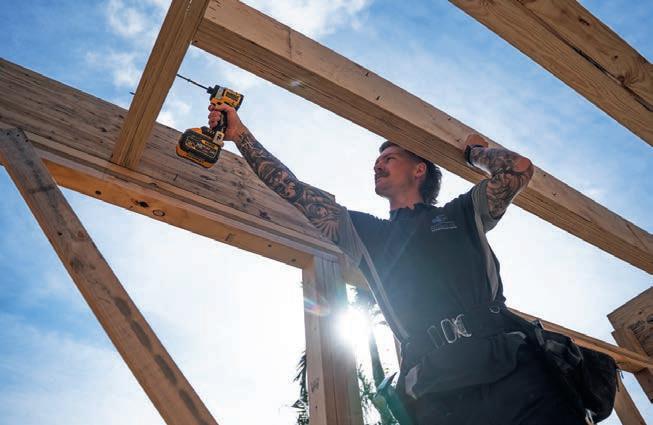
The Budget’s housing push could create more work for tradies — but industry leaders say workforce shortages remain the biggest hurdle
this delay to warnings that it could fuel infl ation if it’s made effective straight away.
A new $1,000 instant tax deduction on work related expenses means around 6.2 million workers won’t need to claim individual items, with expected average savings of $205. These policies are aimed at lifting financial pressure off the Aussie worker, costing the government $6.4 billion across the coming four years.
Francis Lemaire, a third year carpentry apprentice from Melbourne, isn’t complaining about the perks, but hoped this money could have gone to something more productive.
He said finding an extra $250 on the floor would be awesome, but the overall impact over 12 months is minimal considering apprentice wages.
“I mean a six-and-a-half billion dollar cookie being broken up into these li le crumbs,” he said.
“I would prefer they just

pay apprentices more so more people would want to be one.”
The Budget reforms revolve around the new-home market, but the Housing Industry Association (HIA) warned the workforce won’t be able to keep up.
HIA Chief Executive of Industry and Policy
Simon Croft said the single biggest challenge
in building more homes is a lack of access to skilled workers and apprentices.
“HIA’s Federal Budget submission highlights that demand for skilled trades has consistently outstripped supply, with acute shortages in carpentry, bricklaying, plumbing, electrical trades and other critical residential construction occupations,” Croft said.
“At the same time governments are seeking to dramatically increase
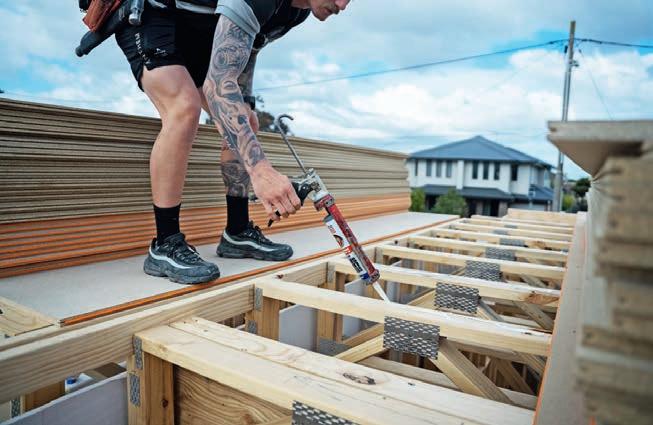
housing supply, the industry is grappling with an ageing workforce, falling apprentice commencements and growing competition for skilled labour across multiple sectors.”
Mr Chalmers announced in the Budget that migrant acceptance tests will be reformed, admi ing younger, be er educated, and higher skilled candidates.
The recognition of foreign qualifications is time and resource consuming, and with one million more skilled migrants expected by 2029, pressure is high to reinforce the workforce.
This Budget pledged to expedite this process, as
From apprentice incentives to infrastructure funding, the Budget outlined how the government plans to get more homes built
well as a $722.8 million boost for apprenticeship commencements and completion.
The package covered support payments and living-away-from-home allowances for young tradies, as well as incentives and subsidies for employers.
Building More Homes
The biggest changes in the Budget was lowering the Capital Gains Tax (CGT) discount, and placing restrictions on negative gearing, with hopes to unclog the existing housing market.
Carpentry Australia Head of Development
Nathan Quinn said while many of these measures help bolster the skills pipeline, they don’t necessarily tackle the costs a business takes on when training apprentices.
“Many carpentry businesses are continuing to face challenging conditions, with rising interest rates, fuel costs,
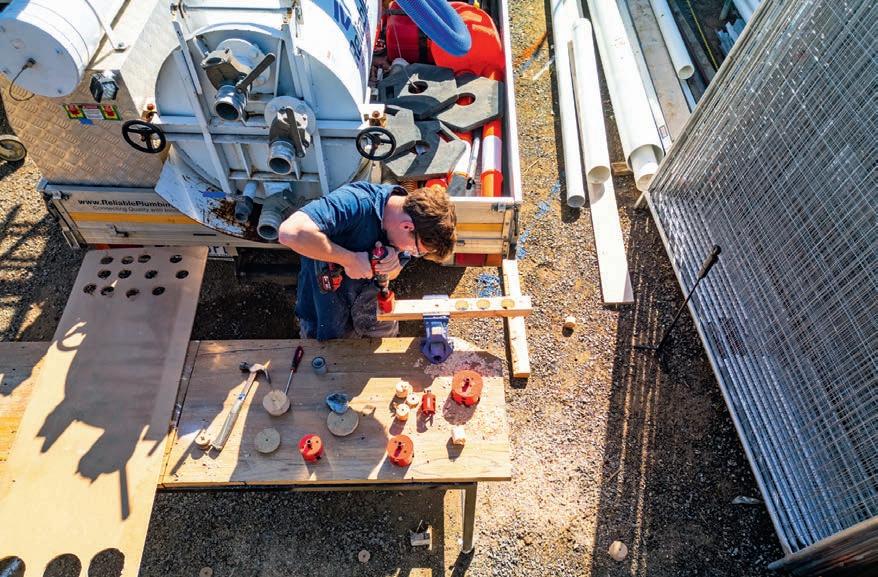
insurance premiums and broader cost-of-living pressures affecting consumer confidence and investment across the building sector,” he said.
“Small business operators have also raised concerns around the growing financial and taxation pressures associated with running, sustaining and eventually selling a business, particularly after years of reinvesting into staff, apprentices and business growth.
“While the Budget included positive measures such as continued investment in housing and skills initiatives, along with the permanent extension of the $20,000 instant asset write-off, many businesses remain concerned about the increasing cost of employing and training apprentices following recent changes to employer incentive programs.”
Australians who have held on to assets — be it investment properties, shares, or crypto — for longer than 12 months
claim capital gains when they decide to sell, which is taxed under the CGT.
Prior to the Budget reforms, the CGT was discounted by 50 per cent, initially intended to encourage Australians to invest, but led to investors holding on to their assets until retirement for the cash boost.
Labor has cut the discount to 30 per cent, where investors will now only be taxed on ‘real’ capital gains relative to infl ation.
Why would this mean
new homes?
Because Labor has placed an exemption on investors who buy new properties, so if they want the extra 20 per cent tax discount, Labor says they can get it by contributing to the housing market.
Negative gearing has helped property investment become a sustainable source of passive income for many Australians, where the rental losses on investment properties
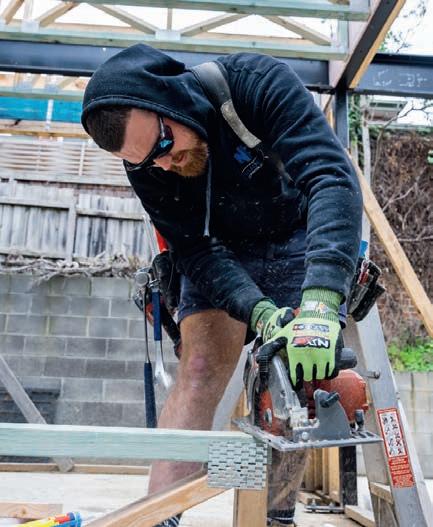
could be calculated and taken off their income taxes come the new financial year.
However, negative gearing may have made it so profi table that some investors began collecting properties in excess, clogging up the housing market.
In the Budget Jim Chalmers made the bold decision to reform negative gearing — thus breaking an election promise not to touch it — in order to discourage investors from purchasing existing homes for income purposes.
The government doesn’t believe investors will stop buying altogether, because landlords will be exempt from the changes to negative gearing — once again — if they buy a new home.
The CGT and negative gearing reforms are
Construction firms can also expect lower red tape costs and reform in Environmental Protection and Biodiversity and Conservation guidelines
The Budget aimed to tackle many of the material/ workforce shortages, but doubts still linger around the industry
expected to help 75,000 Australians buy their own home over the coming decade, the government explained.
This figure includes the existing properties that will be freed up on the market.
Instead, the government anticipates 30,000 new homes to be constructed across the next decade.
CEO of Master Builders Australia Denita Wawn thought these policies fell short against the numbers they were promised.
“The Government’s broken promises on CGT and Negative Gearing dilutes many of the positive features of tonight’s federal Budget.
“The opportunity that exists to turbocharge housing supply has been lost,” she said.
“Leading into tonight [Budget night], the National Housing Accord is forecast to be over 200,000 homes short of target and building a new detached house is now 48.6 per cent more expensive than it was right before the pandemic.”
The Budget pledged $2 billion to building residential infrastructure the government’s help speed up the construction of new homes,
Councils and utility companies will share this money over the next four years for roads, pipes, power, and sewerage, laying the foundation for suburban building.
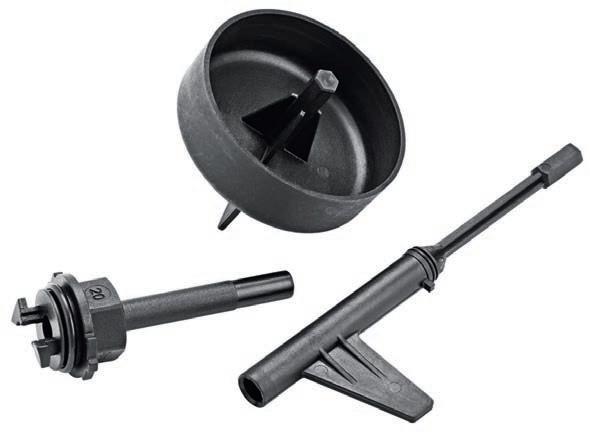
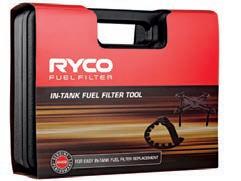
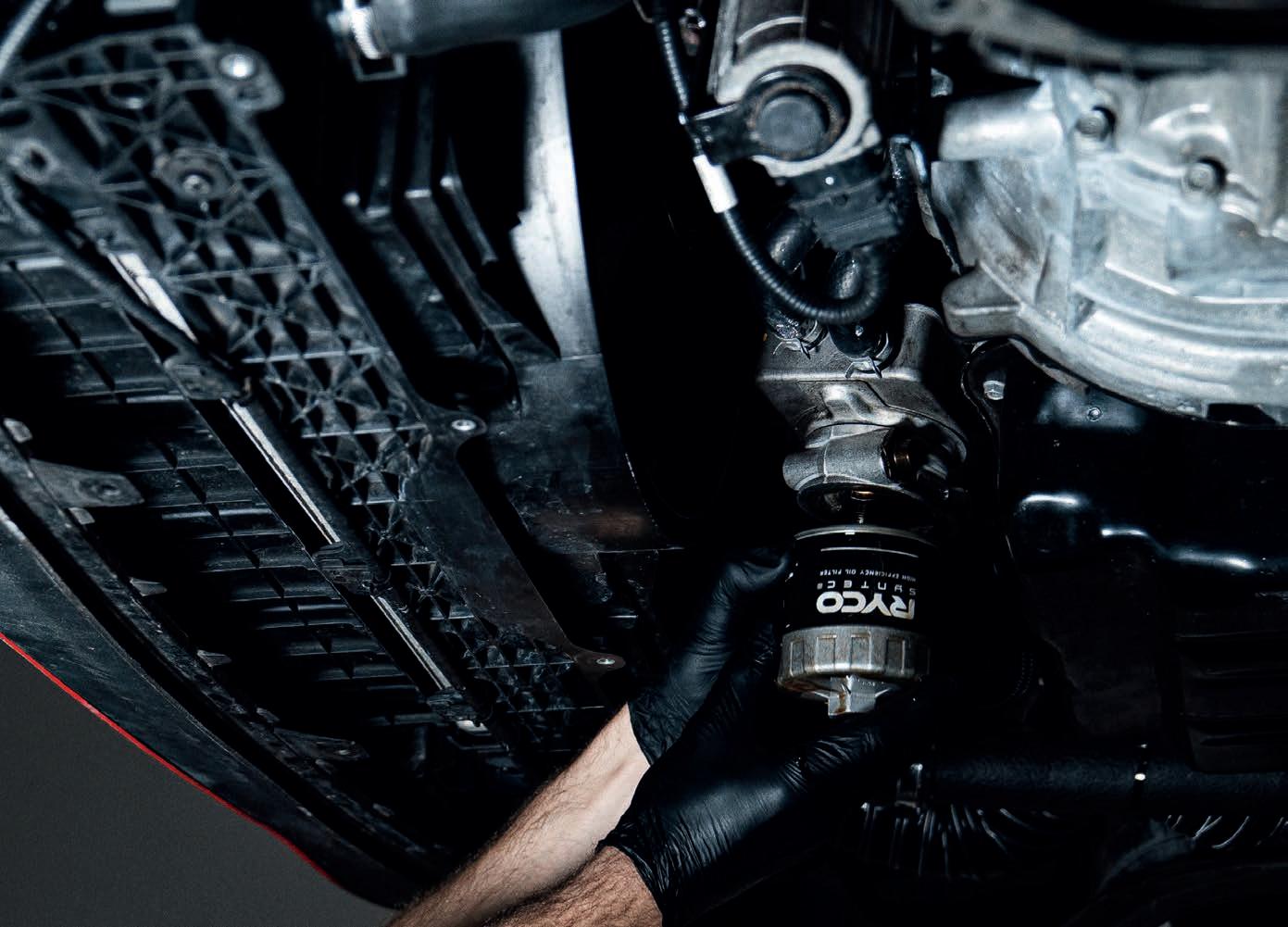
SERVICING A MercedesBenz 9G-Tronic transmission just got easier, with a new family of transmission kits from Ryco designed specifically to suit the popular ninespeed platform.
each version of MercedesBenz’s 9G-Tronic transmission, the firstto-market range aims to deliver greater protection, convenience and confidence when carrying out transmission servicing
vehicles — from a C-Class sedan right through to the rugged G-Wagon.
Transmission servicing can be a complex task, but Ryco has focused on making the process more straightforward for workshops and technicians.
The kits are designed for easy installation, helping streamline servicing without unnecessary complications.
A key part of the package is the specially engineered
available separately and purpose-built to support proper transmission maintenance.
Designed specifically for Mercedes 9G-Tronic transmissions, the tool assists with both draining and refuelling the transmission correctly — helping technicians complete the job accurately and effi ciently.
As modern transmissions become increasingly sophisticated, using components tailored to exact specifications
becomes more important than ever.
Ryco’s dedicated transmission kits are built to match the requirements of Mercedes’ nine-speed systems, helping maintain smooth operation and long-term performance.
The new range gives workshops a purposebuilt solution designed to take the guesswork out of transmission maintenance.
From the workshop floor to everyday reliability on the road, Ryco’s latest offering is all about being ready for the job — and staying Ryco Ready.






Why Ramset’s JobMaster will
is designed to make day-today fi xing faster, simpler and more controlled.
Built as a semiautomatic, single-shot solution, the JobMaster is aimed at tradies working across residential framing, partitioning, formwork and general timber-to-concrete or steel applications.
It’s a straightforward “point-and-shoot” system, but one that’s built with site versatility in mind. That balance between simplicity and performance is exactly what stands out, according to Ramset Product Manager Simon Babcock.
“If you want a tool that delivers solid performance at a more accessible price point, the JobMaster is the way to go,” Simon said.
“It’s capable of firing up to 75mm nails and uses our LDU and LWU range, which includes standard singleshot nails and washered nails.
“In terms of applications, it’s very versatile.”
On busy jobsites, speed and reliability ma er just as much as power. The JobMaster is designed to deliver consistent fastening into both concrete and steel, with Simon noting its ability to handle a wide range of typical site conditions.
“It can be used across residential work, MEP installations, track and partition work, as well as fi xing into concrete and steel,” he said.
That broad application
range means tradies can rely on a single tool for multiple stages of a build, reducing downtime and tool swapping across different tasks.
One of the key features of the JobMaster is its adjustable load strength, allowing users to tailor power output depending on substrate.
“If you go from shooting timber through concrete to shooting through steel — that impacts how you set the power,” Simon said.
The ability to fine-tune performance helps reduce overdriving or underperformance, improving consistency across varied materials — something that becomes especially important on mixed-material jobs.
Beyond raw performance, the JobMaster has been designed with ease of handling in mind. Its lighter weight and ergonomic grip make it easier to use over longer periods, particularly in tighter positions where larger tools can become cumbersome.
Simon also pointed to its straightforward operation.
“It really is easy to use,” he said.
“You just needed to be shown how to use it one time, and you’re all over it.”
That simplicity also extends to maintenance and workflow, with quick
reloads helping tradies stay productive on repetitive fi xing tasks.
A
Another underrated feature is its silencer a achment, which helps reduce noise output on site — particularly useful during early starts or in built-up residential areas.
“It helps reduce noise levels on site,” Simon said.
“Obviously, you still need to follow PPE and safety requirements, but it helps address OHS concerns around noise.”
On sites where managing disruption ma ers, that reduction in noise can make a noticeable diff erence.
The JobMaster sits firmly in the category of practical, no-fuss tools that prioritise usability without sacrificing capability.
For tradies working across framing, fi t-out and structural fi xing, it delivers a reliable balance of power, control and simplicity.
As Simon summed it up, the appeal is clear: solid performance, versatile applications, and a tool that just gets on with the job.

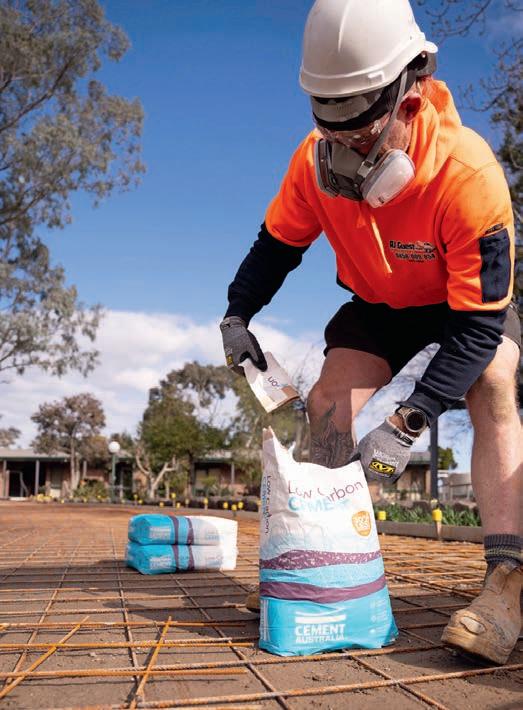

CEMENT AUSTRALIA’S range of packaged cement products is built to match different job demands on site, with each formulation offering its own strengths while maintaining consistent performance across Australian conditions.
From everyday bricklaying through to specialised blends and lower-carbon alternatives, the GP, Builders and Low Carbon Cement products are designed to give tradies the right tool for the job every time.
LOW CARBON CEMENT: PERFORMANCE WITH LOWER EMISSIONS
Low Carbon Cement delivers approximately 30 per cent lower embodied carbon than GP Cement, while maintaining equivalent performance on site. Using Cement Australia’s GreenCem™ technology, it achieves
GP-level strength with improved workability and enhanced long-term performance.
Tradies have been quick to recognise its ease of use and environmental benefi t. Bricklayer Ryan Smith from Whips Bricks described it as “a great alternative to GP Cement,” adding that “it’s been really good to work with,” across multiple high-end residential projects.
“Anytime you can get the same results while helping the environment, the team really gets behind it,” he added.
Low Carbon Cement also performs seamlessly in practice, with users reinforcing its straightforward handling: “It just works like any good cement should.”
GP CEMENT: RELIABLE ALL-ROUNDER
General Purpose (GP) Cement is the dependable
go-to across a wide range of construction applications. Used in bricklaying, blockwork, rendering and general building tasks, it delivers consistent performance where versatility is key. Manufactured in Australia for Australian conditions, GP Cement is tried and tested across residential and commercial projects nationwide. On site feedback highlights its balanced handling and dependable finish.
Blake Cooper from Northern Beaches Stone told The Tradie that “the Cement Australia product has come up great… it’s fl uff y and has a really nice level of stick to it without being hard to work with.”
Its strength lies in its reliability — a straightforward, no-fuss cement that performs across standard applications where

consistency and familiarity ma er most.
BUILDERS CEMENT: WORKABILITY IN HOT
Builders Cement is a blended cement incorporating fl y ash, designed to enhance site performance, particularly in mortarbased applications. It improves workability, delivering a smoother mix and extended pot life — a major advantage in hot Australian conditions.
Its practical benefi ts are especially clear in realworld use. As Queenslandbased plumbing contractor Chad Bradley from Reactive Plumbing explained while working on a sewer renewal project in Brisbane.
“This is the ideal environment for Builders Cement… the rate that it sets allows us to move a bit slower,” he said.
“It allows us to work it in properly and get it into all the li le crevices, so it’s a really good product.” While early strength development is lower than GP Cement, Builders Cement achieves superior 28-day strength and improved durability, including be er resistance to sulfate a ack and chloride penetration.
MADE FOR AUSTRALIAN CONDITIONS
Across the full grey cement range, products are mined, milled, manufactured and Made Right Here in Australia.
Backed by Cement Australia, the range is engineered specifically for local environments, ensuring tradies get consistent performance whether they’re working in extreme heat, coastal conditions or everyday builds.
Tite-Reach Micro Extension Clamp (P/N: 385107)
A compact, ultra narrow extension clamp designed for precision work in tigh, hard to reach spaces.
Tite-Reach Retro-Flex Extension Clamps (P/N: 385108)
A flexible extension clamp with a memory-style body, designed to reach. hold, and place fasteners in hard-toaccess and acround-the-corner applications.
Tite-Reach Flash-Flex Extension Clamps (P/N: 385109)
A flexible extension clamp with a non-memory body that returns to shape, designed for retrieving and positioning fasteners in tight and hard-to-reach spaces.
Perfect for workshops, heavy machinery, automotive, fabrication, and maintenance applications, the Tite-Reach Extension Clamp range helps reduce frustration, save time, and improve access where it matters most.
Flexible & precision-controlled access
• Secure grip on nuts, bolts & fasteners
• Ideal for tubes, frames & compact compartments
• Built tough for professional use


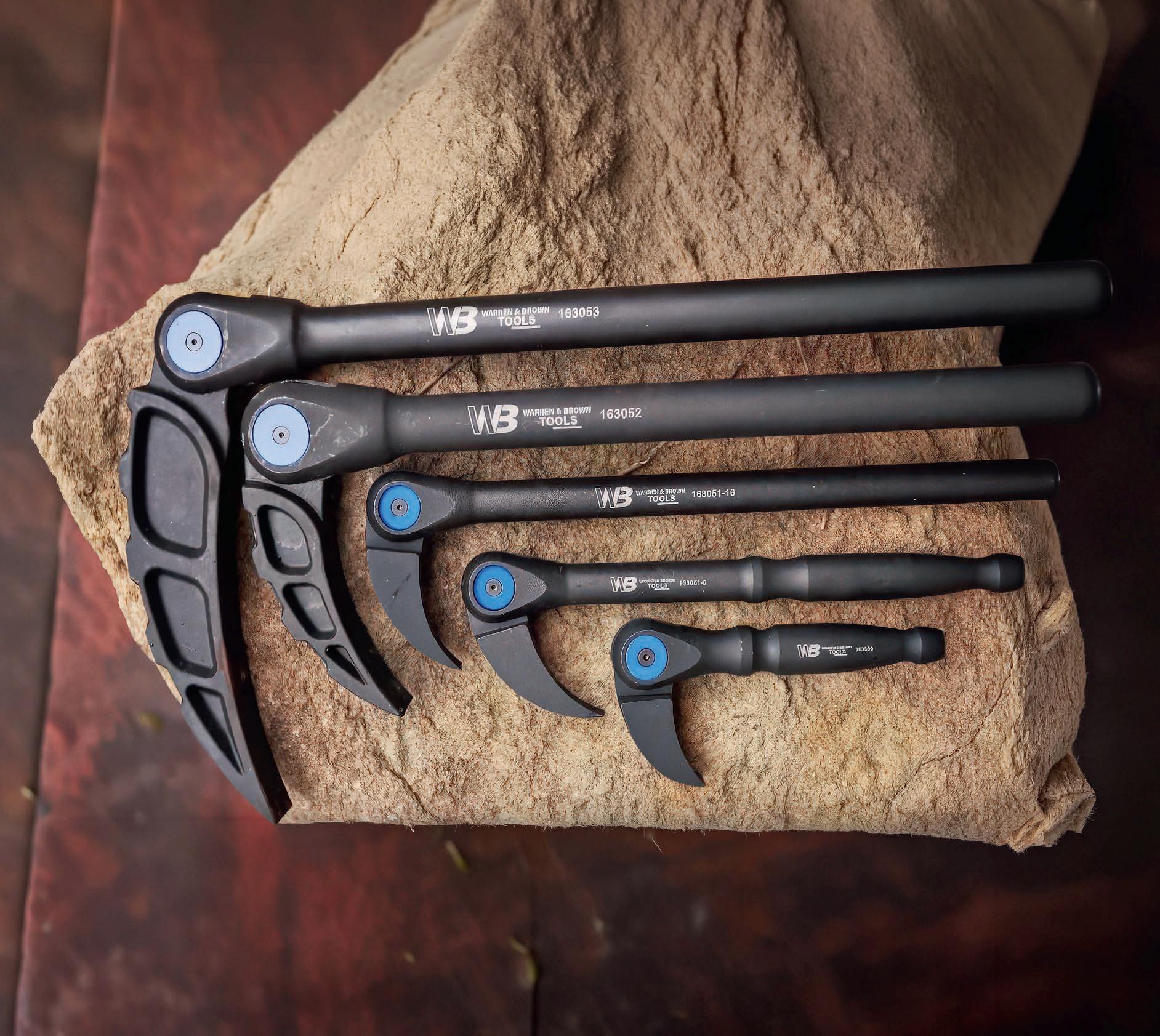
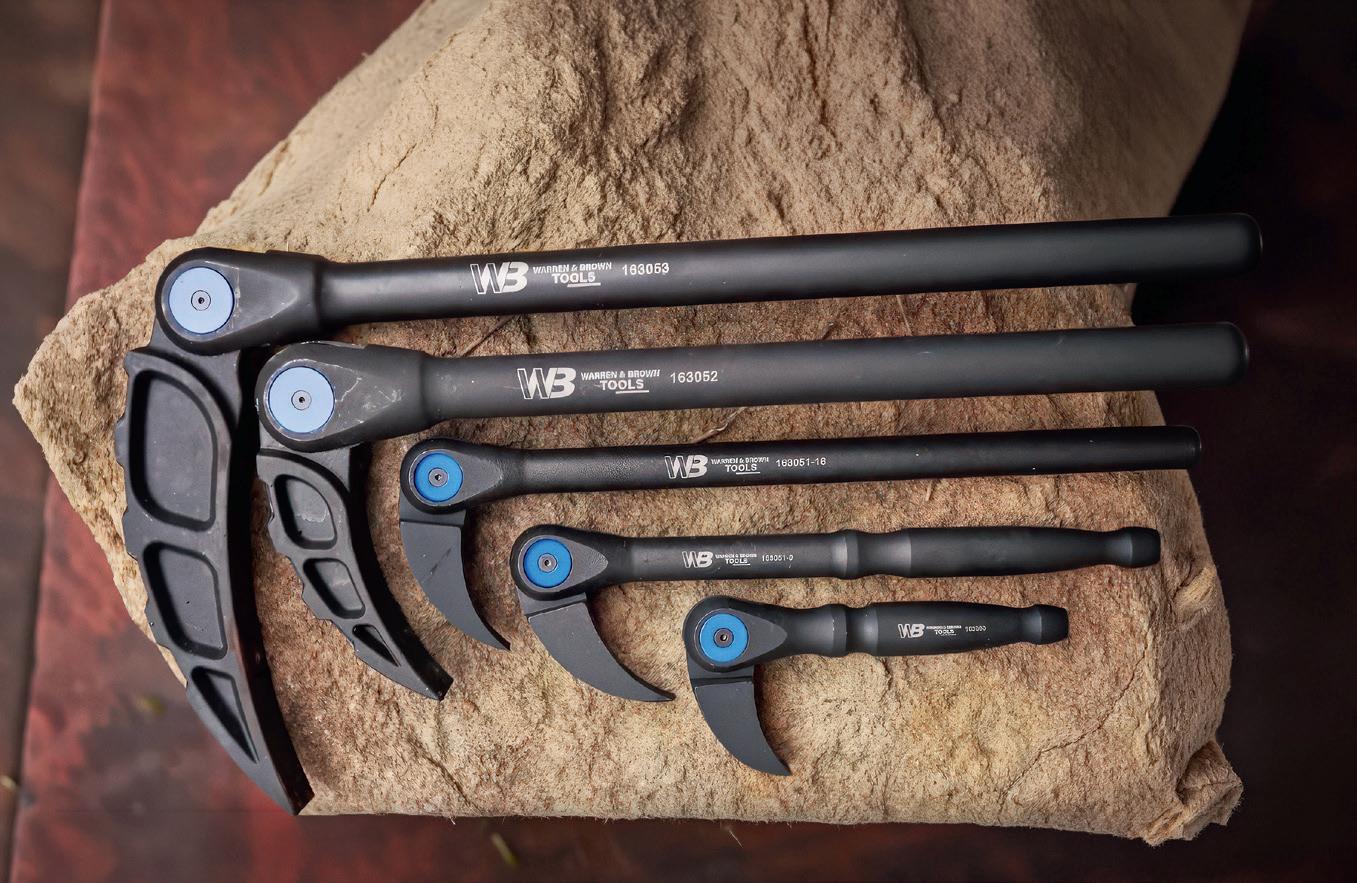
NOT ALL pry bars are built equal — and once you’ve used an indexing bar, you’ll wonder how you ever got by without one. Here’s your no-nonsense guide to picking the right one for the job.
Every tradie has a pry bar kicking around the bo om of their kit. The question is whether it’s actually doing the job properly — or whether you’re making do with a tool that was never quite right to begin with. Because here’s the thing: the humble pry bar has had a serious glow-up, and if you haven’t looked at what Warren & Brown have been pu ing out, you’re overdue. Warren & Brown Tools have been part of
Australian workshops since 1921.
That’s over a century of making tools that actually work for tradies on Australian job sites — not just ones that look good in a catalogue.
Their pry bar range is the product of that accumulated know-how, and it shows in every detail.
The biggest leap forward in pry bar design in years is the indexing claw — and Warren & Brown have built their heavy-duty range around it. Traditional pry bars gave you two options: chisel end or forked end. Useful enough, but the
moment your working angle changed, you were either compromising or reaching for a second tool. The indexing design solves that problem. The claw adjusts and locks through 12 positions across a 180° sweep, so whether you’re pulling nails, working frames or tackling tight engine bays, you can set the angle and lock it in.
The materials back up the design too. Handles are CR-V steel for strength and flexibility, while the heads are CR-MO for high-impact durability. These are the same alloys used in professionalgrade spanners and
2pc: 8" & 16 – Best All-Rounder
Two versatile sizes with full 12-position locking heads, covering most everyday trade tasks
Indexing Stubby
4" – Tight Access Compact design with full strength for confined spaces
Mini Pry Bar Set
3pc – Detail Work Lightweight set designed for trim and precision tasks
Indexing Pry Bar
24" – Heavy Duty Full leverage for demolition, flooring and structural work
Indexing Pry Bar
33"– Maximum Leverage Built for serious demolition and high-force applications
breaker bars, chosen to handle repeated heavy use without failing under stress.
“The moment your working angle changes, you’re either compromising — or reaching for a second tool.
The indexing design kills that problem stone dead.”
From compact 4-inch stubby bars for tight access to the 33-inch heavy demolition bar, the range covers just about every scenario on site.
For most tradies, the 8” & 16” indexing set hits the sweet spot, covering
everyday prying, lifting and leverage tasks without overcomplicating the kit.
Cheap pry bars bend, slip and wear out fast. A quality indexing bar from Warren & Brown is built for long-term use, offering reliability job after job. It’s the kind of tool that earns its place in the kit and stays there.
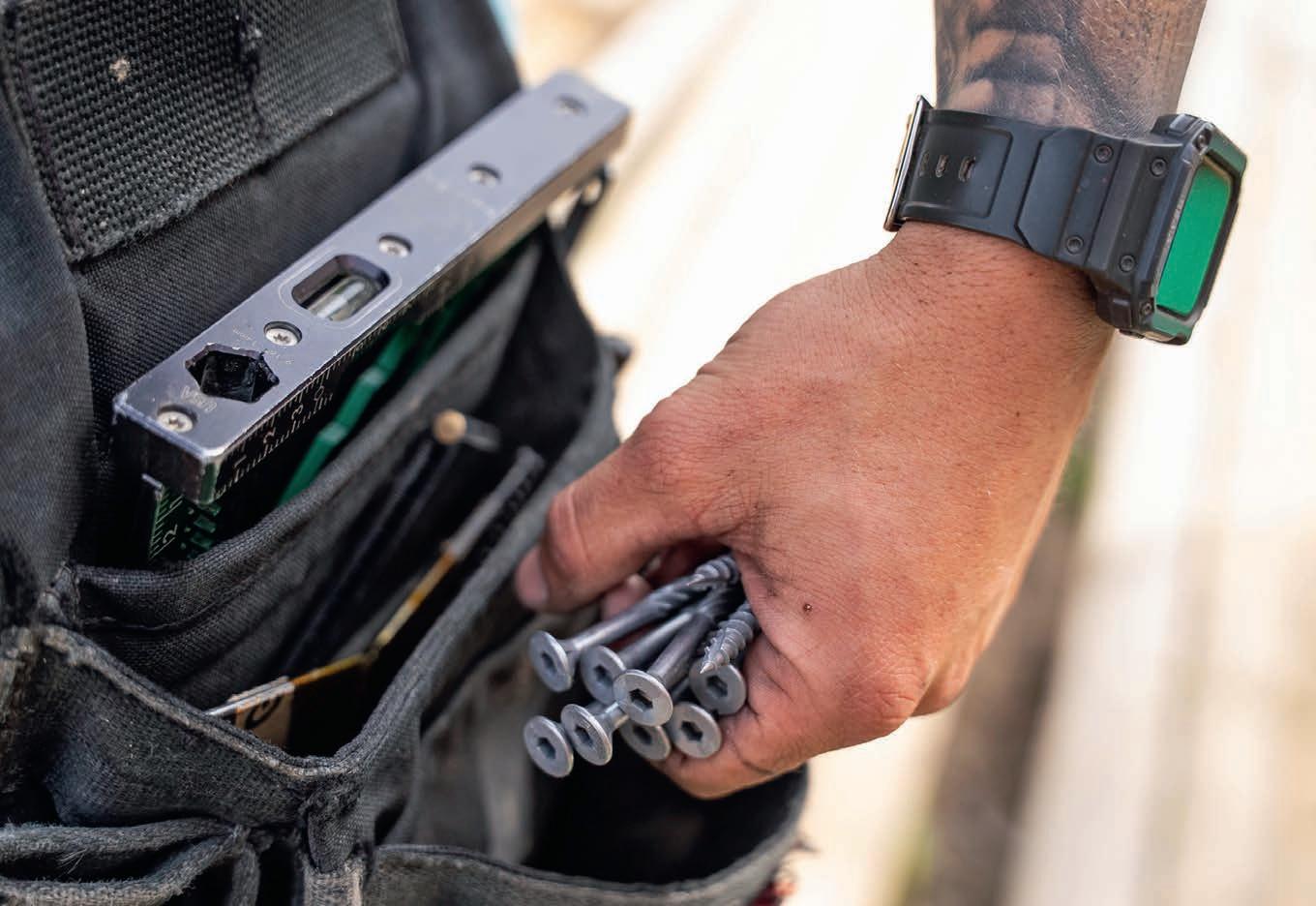
game
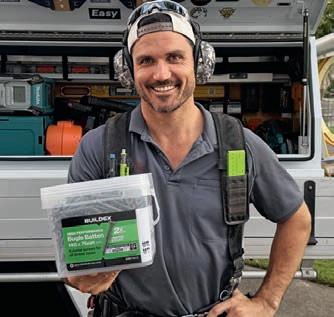
BE HONEST tradies, it’s hard to get excited about screws … until a bad one ruins your day.
That’s the view of Queensland carpenter Simon Mee, who reckons the right ba en screw can quietly become one of the biggest game changers on site.
“I was saying to Hannah, it’s hard to get excited about screws,” Simon laughed.
“A bad screw will ruin your day, but when you find a good one — especially a ba en screw, where you’re using so many of them and they’re so critical — it genuinely makes life easier.
“You actually stop and think, ‘Holy crap, that’s a game changer. I’ll buy them again.’”
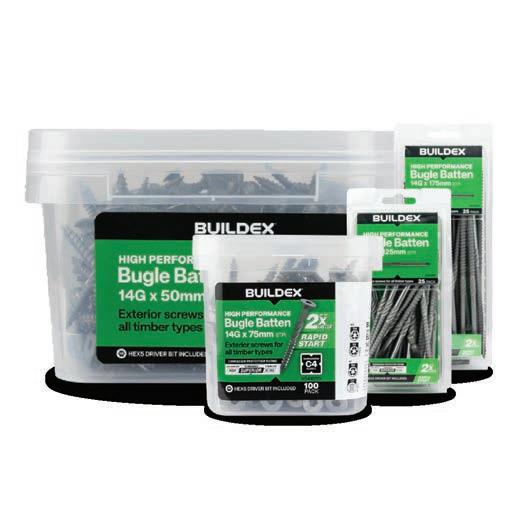
After using Buildex Bugle Ba ens Screws across residential renovation projects, particularly old hardwood Queensland homes, Simon has developed a pre y clear view on what makes them stand out. Here are his fi ve underrated features.
1. THE INSTANT START
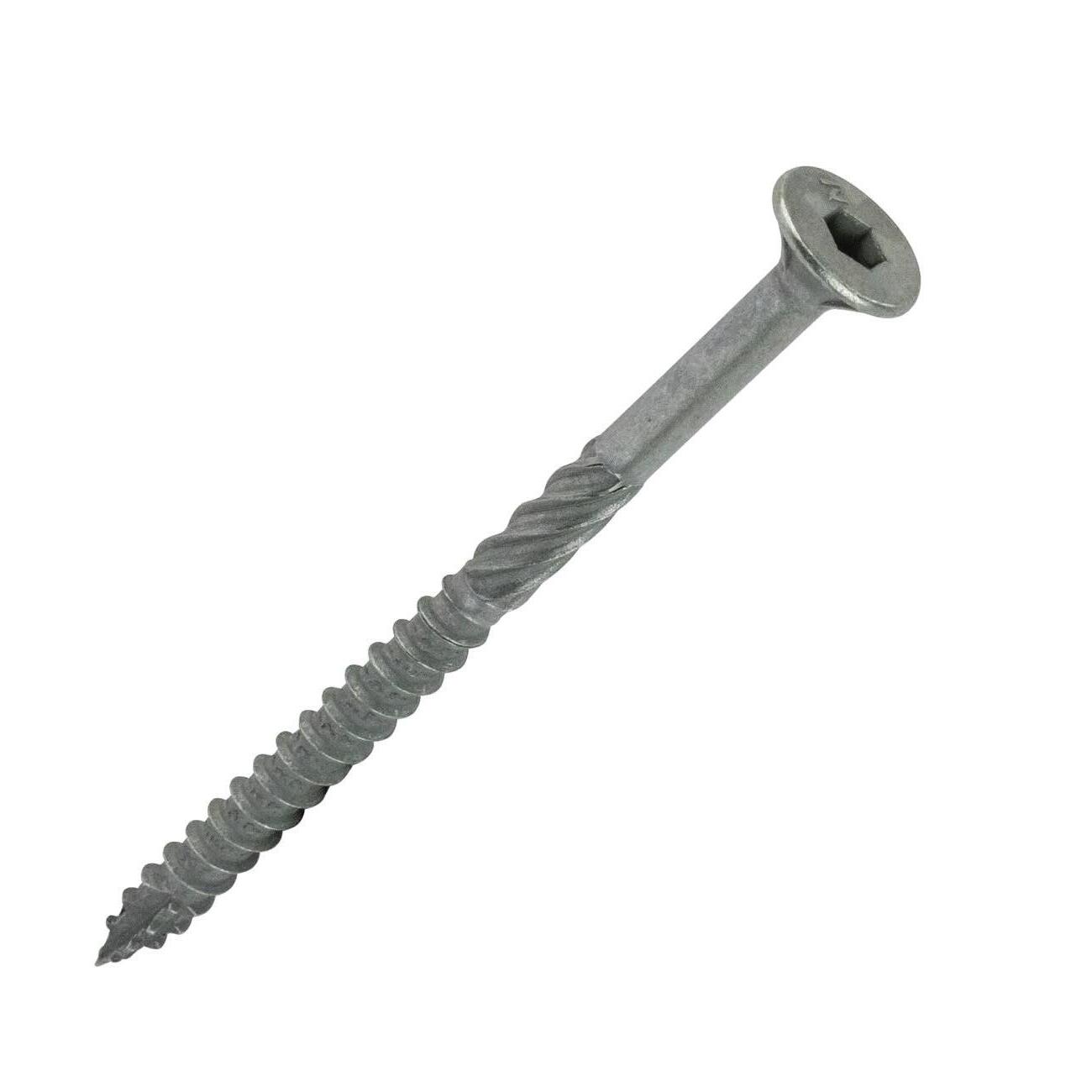
If there’s one thing Simon noticed straight away, it’s the patented Dual Type 17 tip.
“The biggest thing is the two-times faster start,” he said.
“It’s got a really defined needle point on it, so as soon as you pull the trigger it starts ripping straight into the wood and goes exactly where you point it.”
The Dual Type 17 tip is designed to pierce timber up to twice as fast as conventional bugle ba en screws while reducing timber spli ing.
On repetitive framing and renovation work, that quicker bite adds up.
Simon noticed it work best when drilling in awkward positions.
“There are so many times where you’re in an awkward spot, you’ve got an LVL on your shoulder, and you’re trying to lock
it into position while the ba en screw is hanging off the end of the impact driver,” he said.
“There’s absolutely none of that with these. The screw sits in position and doesn’t fall off the end of the driver, and as soon as you pull the trigger it grabs and goes in.”
2. HEX ON THE BEACH Simon is unapologetically pro-hex head.
“It’s just really good to see hex heads becoming popular again,” he said.
“Over the last few years, so many ba en screw companies have been trying out star heads, but I’ll always be a fan of hex heads.”
The 5mm internal hex drive is designed for stronger engagement under load, improving
torque transfer while reducing cam-out.
“You get a be er fi x, and it’s great when you can move your impact driver around without the screw falling off the end of the drill,” Simon explained.
3. FASTER JOBS, LESS MUCKING AROUND
On a busy site, speed ma ers — and Simon said the quicker start is something you genuinely notice.
“When you pull the trigger, the screw starts driving straight away instead of buzzing around for a second before it bites and grips.”
For crews chasing deadlines, shaving seconds off every fastening job becomes meaningful pre y quickly.
4. CLEANER TIMBER, LESS SPLITTING
Working with old hardwood homes means split timber can quickly
Simon said the right ba en screw can be a “genuine game changer” on site, with Buildex Bugle Ba ens Screws delivering faster starts and less frustration
become a headache. The Dual Type 17 tip is designed to reduce spli ing, helping tradies avoid rework and wasted material.
“A framing nail is never going to achieve the same thing through that old wood,” Simon said. “But you know how much be er the fi x — and the result — is when you’re using a decent ba en screw.”
5. ONCE YOU SWITCH, IT’S HARD TO GO BACK
Perhaps the biggest endorsement? Simon said normal ba en screws

just don’t feel the same anymore.
“Exactly. Once you’ve used them, you can’t go back,” he said. “You use a normal ba en screw again and think, ‘This just isn’t the same.’ It ruins it for you.”
Beyond Simon’s
favourites, features like the W-Cut thread help reduce driving torque, serrated cu ing ribs deliver a cleaner fl ush finish, and Climashield Class 4 corrosion protection improves durability in harsh outdoor conditions—particularly
valuable for fencing, pergolas and exposed timber builds.
For Simon, though, the verdict is simple: “It’s a no-brainer.”
Head to buildex.com.au to learn more Check it out! Check it out!

GETTING THE job done right the first time ma ers on any worksite, where time, reliability and precision impact the result.
Whether in a workshop, on-site or maintaining equipment over time, having the right products on hand helps keep jobs moving and reduces unnecessary downtime.
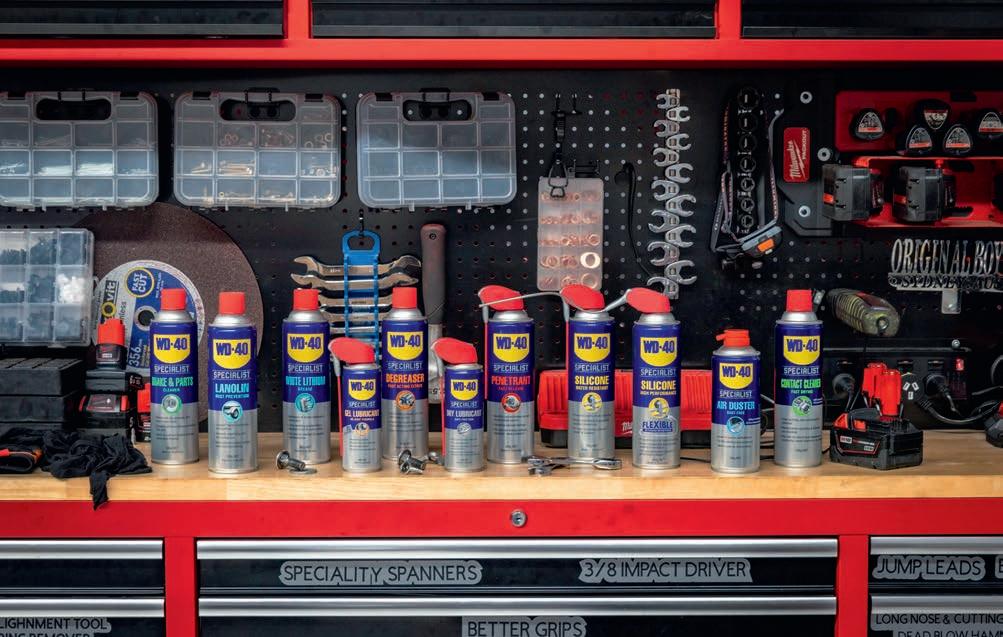
The WD-40 Specialist® range is built to support these demands, offering a portfolio of professionalgrade lubricants, greases and cleaners designed for
specific applications and consistent performance.
The WD-40 Specialist range focuses on using the right product for the right job.
For clearing dust and debris from tight or sensitive areas, WD-40 Specialist® Air Duster (pictured below) provides a convenient solution for keeping equipment, tools and workspaces clean. It’s suitable for use across workshops and
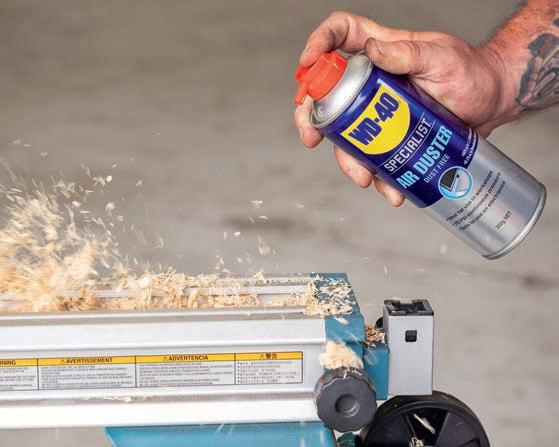
electronics, delivering 70psi of continuous air pressure to remove dust, dirt, wood shavings, saw dust, metal scrapings, crumbs and cobwebs from hard-to-reach spaces without the need for direct contact.
For electrical maintenance and precision cleaning, WD-40 Specialist® Contact Cleaner delivers a fastdrying, non-conductive solution designed to remove dirt, dust and residue from electrical components. It penetrates into tight spaces and dries quickly and leaves no residue, making it suitable for use on connections, switches, circuit boards and other sensitive equipment where consistent performance is critical.
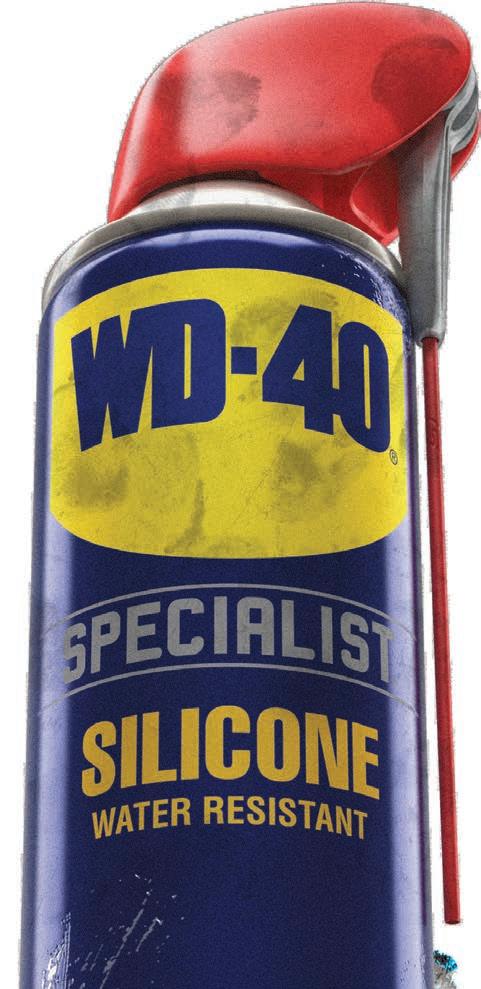
Where lubrication and protection are required, WD-40 Specialist® Silicone Lubricant is designed to perform in environments
exposed to moisture. It helps lubricate and protect moving parts, prevent sticking and binding, and does not a ract dust or dirt, making it suitable for use across metal, plastic and rubber surfaces and can work in extreme temperatures of -40°C to +200°C. With the Smart Straw applicator, you’ve got two ways to spray – flip up the straw up for hard-toreach areas, such as inside chains, locks or rollers; flip it down to use the wide angle spray for wider coverage on surfaces.
In day-to-day trade environments, these products support a range of common tasks — from clearing dust out of power tools and electrical panels before servicing, to restoring clean contact on switches and connectors, and keeping moving parts operating smoothly in damp or exposed conditions.
From electrical cleaning to moisture-resistant lubrication, WD-40 Specialist® products are built to help keep tools and equipment performing at their best
Having purpose-built solutions on hand helps ensure equipment is maintained correctly the first time, reducing the need to revisit jobs due to contamination, sticking components or performance issues.
BUILT FOR RELIABILITY
Across these everyday maintenance tasks — from cleaning precision components to protecting moving parts — the WD-40 Specialist range is designed to support effi ciency and consistency on the job.
By focusing on specific applications and job requirements, it helps reduce rework, minimise downtime and keep equipment performing as expected. When the right product is used for the right task, jobs can be completed with greater confidence the first time, helping avoid delays, reduce rework and keep work moving. The WD-40 Specialist range is built to support trade professionals who need reliable performance every day — helping ensure every job is done right the first time.

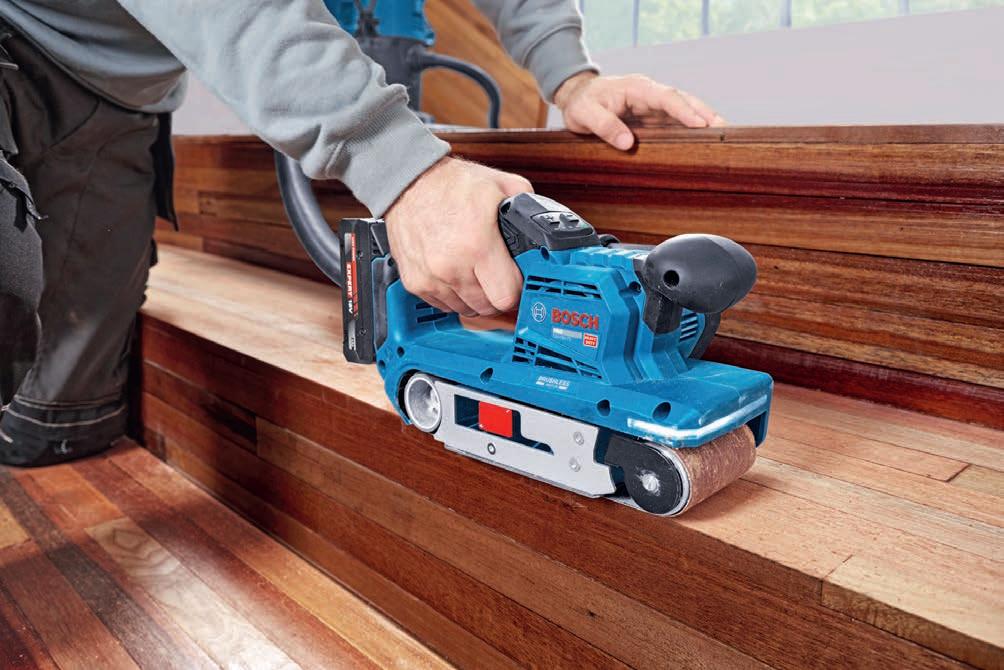
sanding isn’t just the final touches. Whether it’s smoothing structural timber, refining cabinetry or preparing surfaces on site, having a sander that’s powerful, portable and comfortable to use makes a major difference.
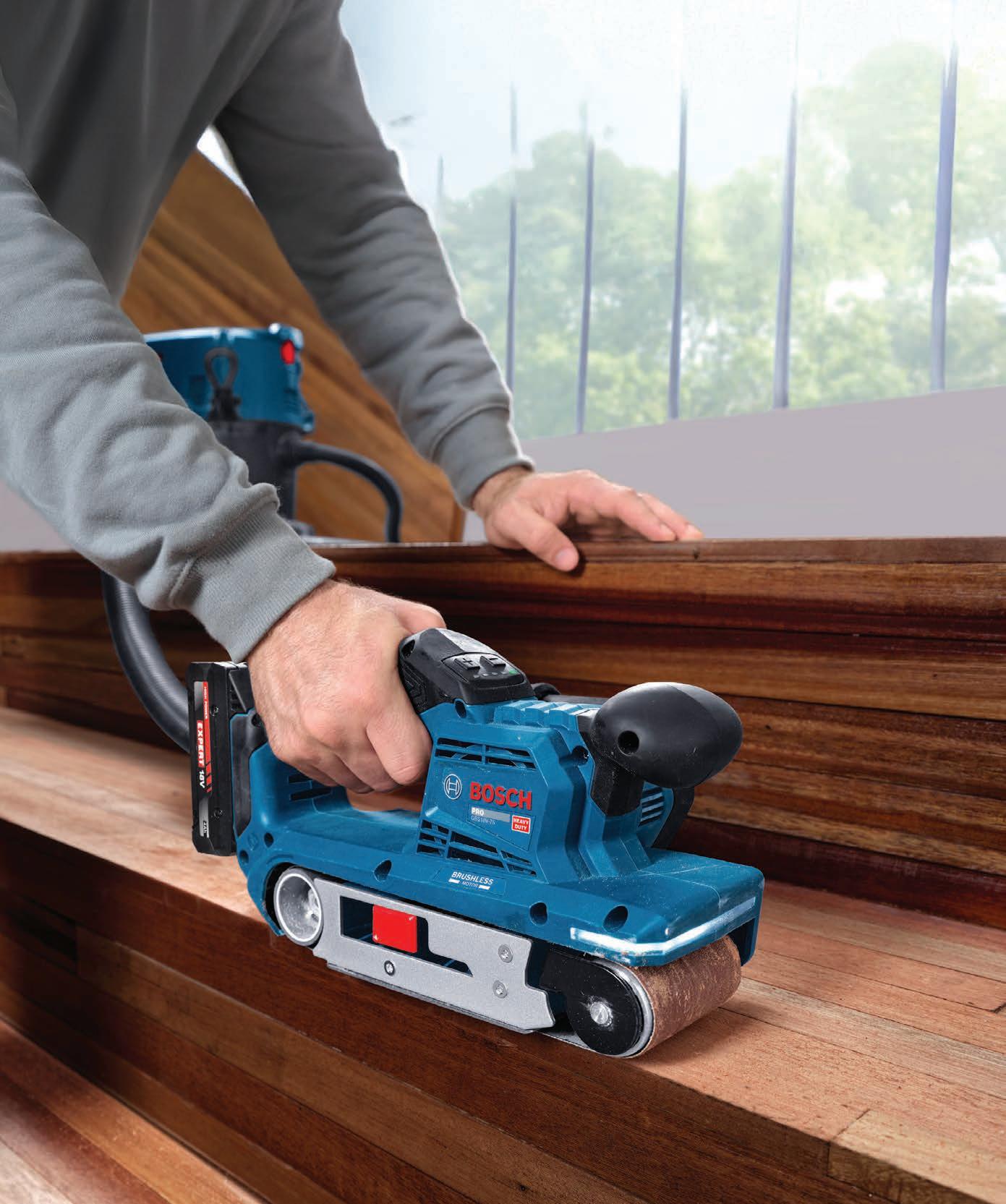
Compact, lightweight, smart features such as drop and impact protections, and low vibration – all packed into the new Bosch PRO GBS18V-75 Cordless Belt Sander. Designed with effi ciency in mind for chippies, the compact cordless unit combines mobility with the kind of performance needed for demanding timber applications.
One of the biggest advantages for carpenters
with the GBS18V-75 is it’s lightweight, ergonomic design.
Only 2.7kg (without the ba ery), it’s a piece of cake to manoeuvre across large surfaces, overhead sections and hard-to-reach angles — particularly during framing, roofing and cabinetry installs.
For tradies constantly moving around site, weight ma ers.
A lighter tool reduces fatigue during long sanding sessions while also improving precision and control.
The ability to comfortably operate the sander with one or two hands gives carpenters more flexibility depending on the application.
With low vibration, tradies can achieve peak control during detailed finishing work where
consistency can make or break the final result.
CORDLESS
Cordless capability continues to reshape carpentry workflows, particularly on active building sites where power access isn’t always convenient.
Removing cords means fewer trip hazards, faster setup and easier movement between tasks.
For carpenters working across framing, decking or roofing projects, that portability translates directly into productivity. Instead of dragging leads around site or searching for power outlets, the tool is ready to move wherever the job goes.
BRUSHLESS PERFORMANCE
Underneath the compact design is a high-power
brushless motor engineered to deliver consistent sanding performance across heavy timber applications.
For carpenters, brushless technology offers several advantages: improved effi ciency, longer runtime and reduced maintenance compared to traditional brushed motors.
That means less downtime and more reliable performance during repetitive sanding tasks.
Whether roughing down timber framing or refining cabinetry edges, maintaining consistent power under load is critical to achieving a clean finish.
The lightweight cordless Bosch PRO GBS18V-75 Belt Sander is ideal for vertical curve sanding, removing paints and cladding, or even to remove rust and wire drawing
READY FOR WORK
Building sites are tough environments, and tools need to handle more than just the task itself.
Features like drop and impact protection help the PRO GBS18V-75 stand up to everyday knocks and accidental falls on site.
Dust management has also been prioritised, with a durable dust bag and compatibility with the Bosch Click & Clean system helping keep work areas cleaner which is especially important for indoor fi t-outs and cabinetry work.
For carpenters, the latest generation of cordless sanders is about more than convenience.
Lightweight handling, strong runtime, effi cient dust management and reliable performance all contribute to smoother workflows and be er finishes.
The PRO GBS18V-75 reflects that shift — bringing portability and professional-grade sanding performance together in a package built for modern timber trades.
ASK MOST chippies and they’ll tell you the same thing — sanding is one of those jobs that can either go smoothly or become a complete headache.
Heavy tools, awkward cords and dust everywhere can quickly slow down a job, especially during detailed fi t-out or finishing work.
That’s why comfort and control while sanding have become a bigger part of the job.
For carpenters moving between framing, cabinetry, trim installs and final touch-ups, having something lightweight, easy to manoeuvre and quick to grab off the bench can make life a whole lot easier on site.
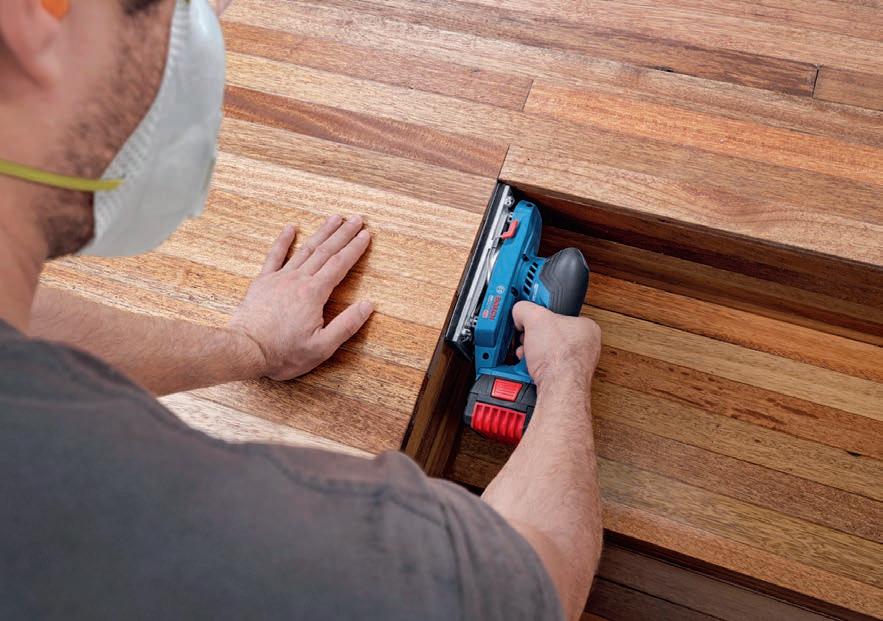
Bosch’ PRO GSS 18V-18 Orbital Sander is aimed squarely at that style of work, focusing on portability, control and practical day-to-day usability rather than sheer
size and bulk. This sander is ideal for sanding large surfaces, sanding plaster & drywall, sanding edges and joints as well as sanding in preparation for the painting process.
For many carpenters, sanding work rarely happens on large open surfaces.
More often, it involves corners, edges, overhead sections and confined installation areas where bulky tools become diffi cult to manage. Compact, lightweight designs help solve that issue by improving manoeuvrability and reducing strain during extended use.
The ability to comfortably operate the sander with either one or two hands also gives tradies more flexibility when working on
ladders, inside cabinetry or around installed joinery. That control becomes particularly important during finishing stages, where uneven pressure or awkward handling can quickly ruin a surface.
Dust management is becoming a bigger consideration across residential and commercial building sites, especially during indoor work.
Fine timber dust can impact visibility, cleanup time and overall site presentation. Integrated dust collection and compatibility with extraction systems help keep sanding areas more manageable and cleaner.
For carpenters working in occupied homes or completed interiors, that cleaner operation can make a major difference
to effi ciency and professionalism. It also cuts down time spent cleaning up after the job is done.
One of the biggest shifts in carpentry these days has been the move toward fully cordless workflows. Removing power leads allows tradies to work more freely around scaffolding, staircases, roof spaces and unfinished interiors without constantly repositioning extension cords.
Combined with brushless motor effi ciency, cordless sanding tools are increasingly capable of handling demanding applications while maintaining strong
runtime and consistent performance.
For carpenters juggling multiple tasks across a jobsite, that means less downtime and smoother transitions between jobs.
Modern worksites are hard on tools, so durability is no longer optional. Impact and drop protection features help improve reliability in rough site conditions, while updated interfaces and LED lighting improve usability in low-light or high-pressure environments. These additions may seem minor individually, but together they contribute to a tool that be er suits real-world trade demands.
For tradies including carpenters, cabinet installers, wood-based framers, roofers or painters, Bosch’s GSS18V-18 Orbital Sander is an ideal tool. Be er control, cleaner operation and improved mobility all contribute to faster workflows and higher-quality results — particularly in detailed timber applications where precision ma ers most.
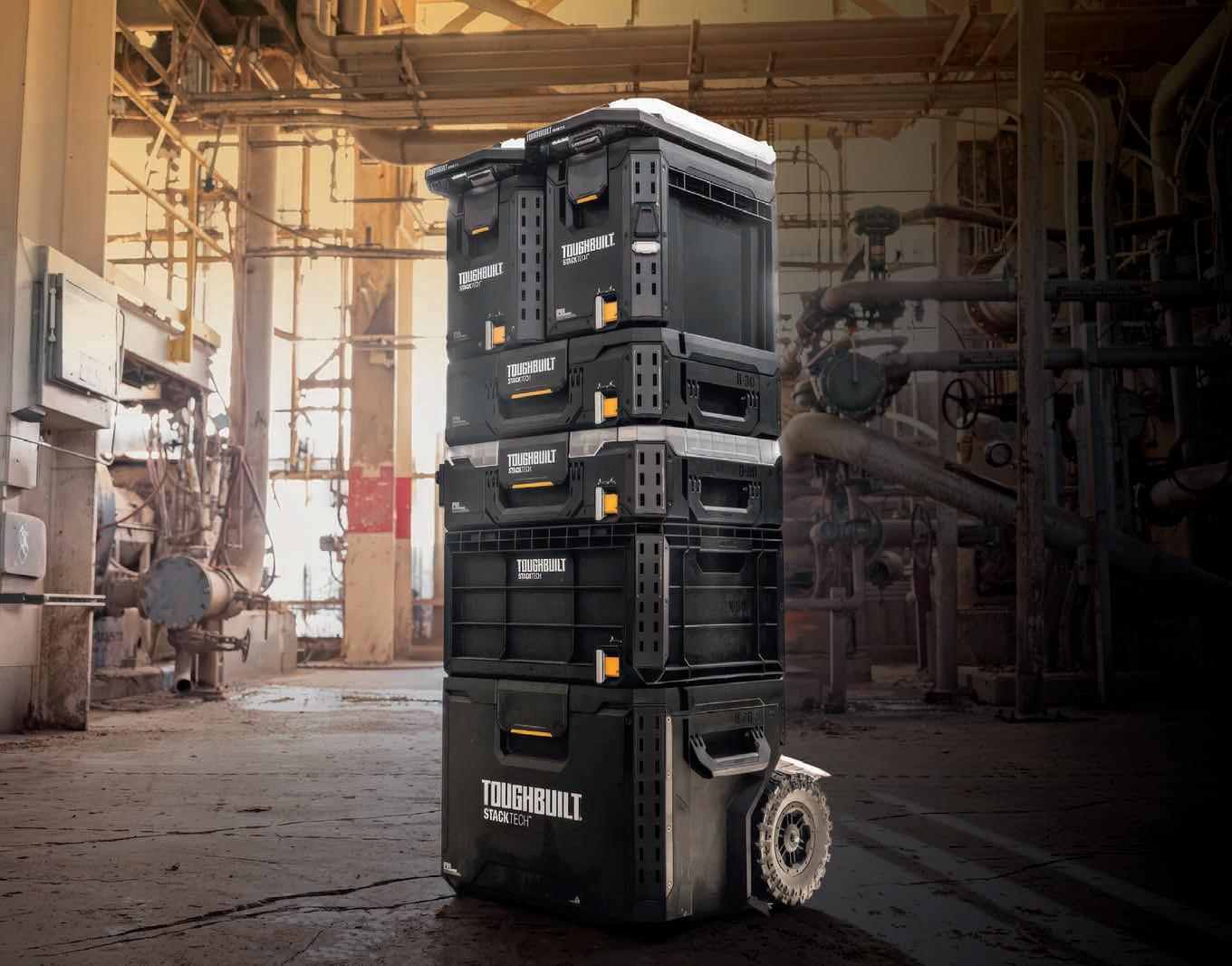
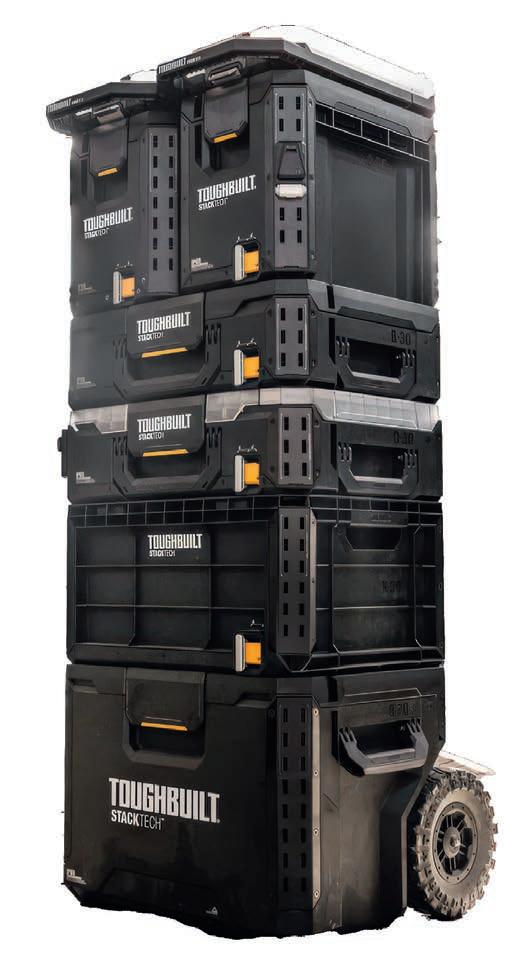
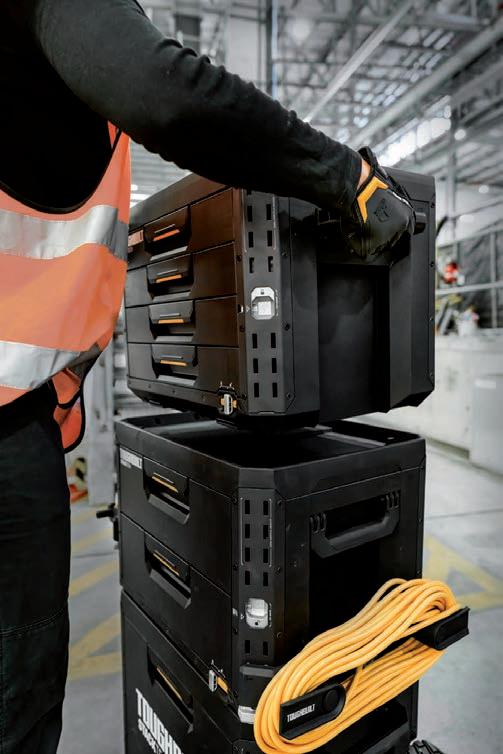
Why didn’t we think of StackTech sooner?
SOMETIMES, A lightbulb goes off when tradies try something new and they think: How have I got so far without this?
That’s been the reaction to a lot of the features built into ToughBuilt StackTech.
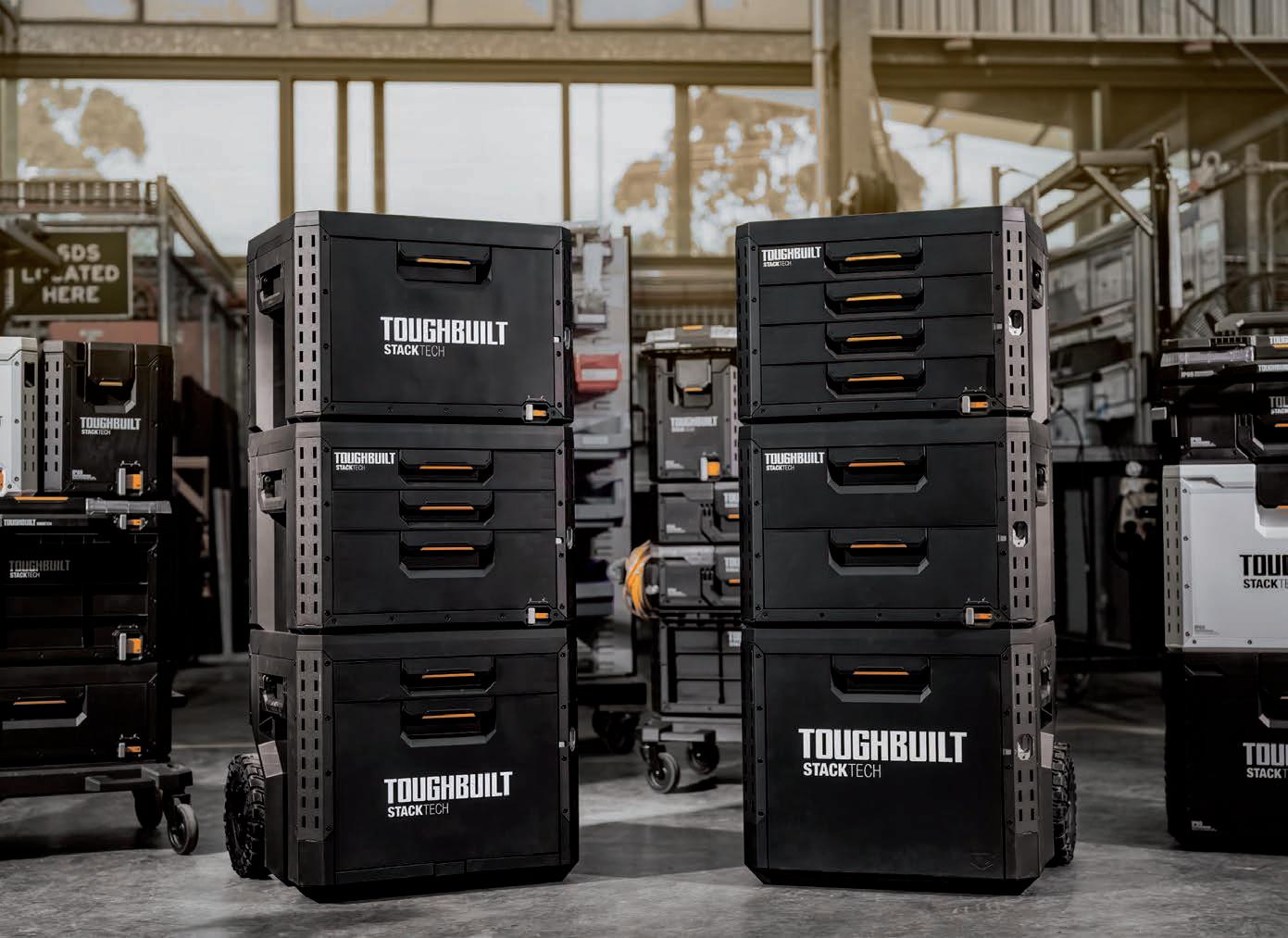
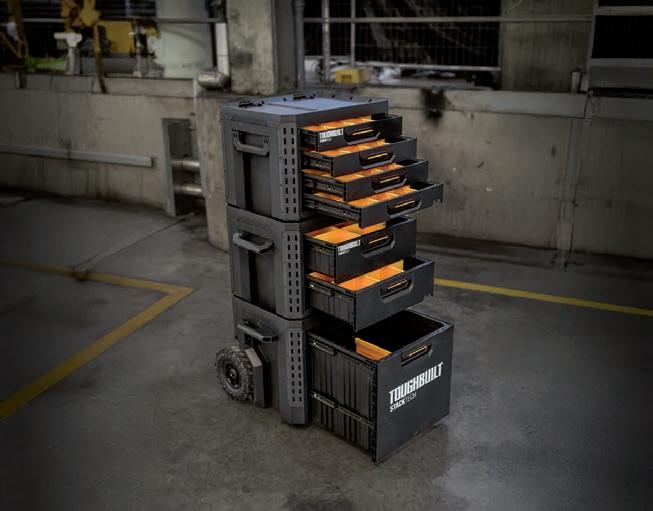
From self-aligning boxes that practically stack themselves to one-handed locks and quick-access storage, ToughBuilt Category Manager John Nesbi said StackTech is packed with the sort of commonsense touches tradies quickly come to appreciate.
“When innovations like that come out, you almost think, ‘why aren’t they all like this?’” John said.
“It’s super simple, makes perfect sense, and resonates straight away.”
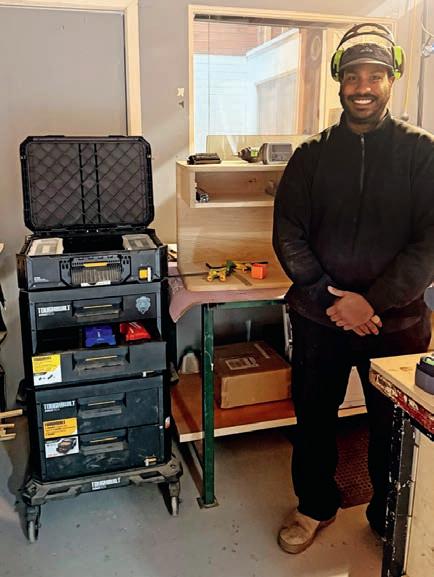
For furniture builder and fabricator Joe Fernando, those small improvements have added up quickly.
What started as another storage solution has become his everyday workshop setup and a mobile workstation for installs.
“Honestly, it’s become my main storage system,” Joe said. “I use it every day — it’s not just si ing in a corner collecting dust.”
STORAGE THAT ACTUALLY WORKS
While modular storage isn’t new, John said the
real difference with StackTech was how broad the system had become and how easily tradies could tailor it to suit the work in front of them.
“Modular storage has been around for a long time,” he said.
“But this has really taken it to the next level.”
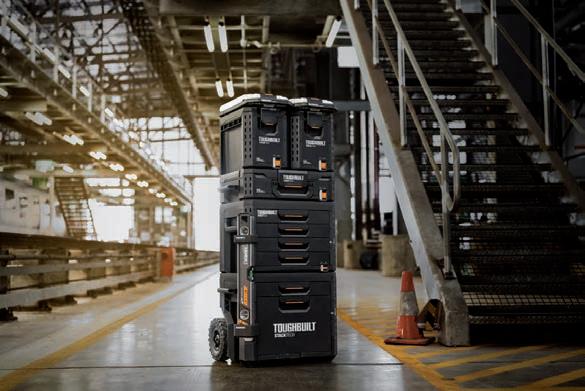
Rather than forcing tradies into a one-sizefi ts-all arrangement, the StackTech range allows users to build job-specific setups using different drawer units, rolling boxes, organisers and accessories.
That means loading up exactly what’s needed for the task at hand without
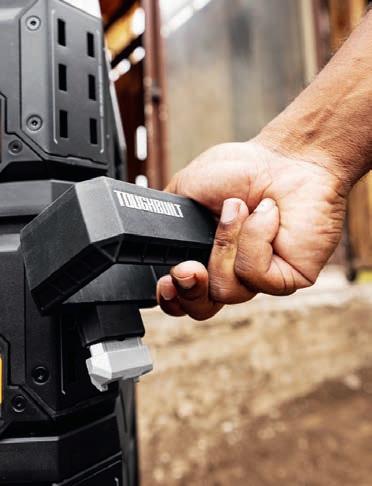
• Compatible with ToughBuilt ClipTech pouches and accessories
• Quick-connect side rails for external storage options
• Swap setups between jobs without rebuilding your entire system
• Flexible platform with near-endless combinations
making constant trips back to the ute or van.
“The innovation they’ve brought in around modularity, stackability and jobsite portability has really taken it up a notch,” John said.
Six new drawer storage options expanded the range in 2025, including two rolling drawers.
This expanded the range further, giving tradies even more ways to configure gear around how they work.
For Joe, that flexibility had been a major advantage both in the workshop and on installs.
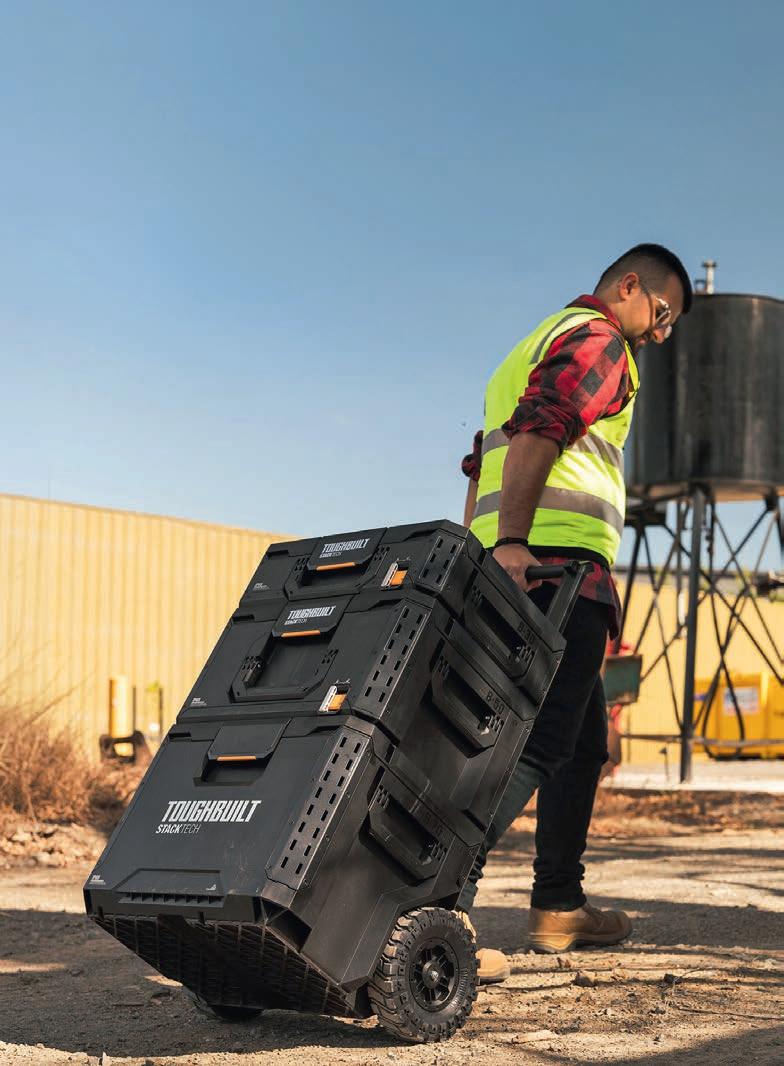
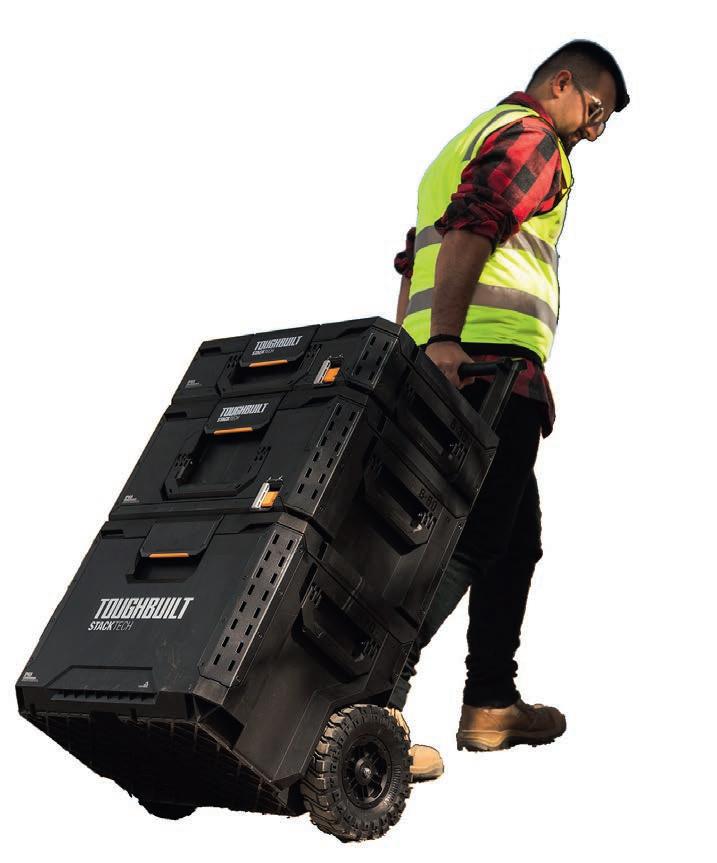
“I mostly use it as storage,” he said, “but when I’m out on-site for installs, I use the StackTech setup with the dolly and drawers as a mobile workstation.”
“That’s where I keep all
my hand tools, measuring and marking tools, PPE — basically everything I need quick access to.”
He said the ability to create job-specific loadouts made a noticeable difference when moving between projects.
“I also use it for packing out tools and materials — just stacking extra items on top and wheeling everything back to the vehicle.”
Based out of Well Fed Workshop in Melbourne’s north, Joe uses StackTech both in the workshop and out on installs.
One of the standout features for him has been the drawer system itself and how easily it adapted to different tools and materials.
• Armoured steel corners for extra drop protection
• High-impact tested to handle tough site conditions
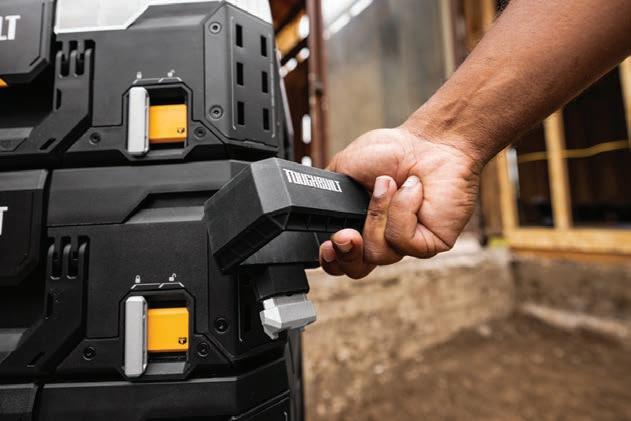
• Dual locking points for added security
• Quick-detach telescopic handles on rolling units for easier vehicle storage
“The drawer separation system is really good,” he said.
“Being able to organise larger items in one section and smaller items in another makes a huge diff erence.”
“The customisation is what stands out most. I don’t even need to label the drawers anymore because I instinctively know where everything is based on how often I use it.”
Instead of fi xed compartments that never quite fi t what tradies carry, StackTech’s configurable storage means frequently used gear stays within reach while less-used tools can sit lower down.
For smaller workshops, Joe said it had also become a smart space saver.
“It’s been a really effi cient way to save space
without having to build permanent cupboards or joinery,” he said.
KEEPS TOOLS CLOSE
Another underrated feature is how StackTech integrates with ToughBuilt’s ClipTech ecosystem, allowing tradies to connect tool pouches and accessories directly into the system.
According to John, it’s all about making transitions between tasks easier.
“ClipTech is the modular tool belt system, and ToughBuilt have tried to integrate that into the StackTech ecosystem as well,” he said.
“Say you’ve got all the weight in your tool belt and the job’s done — you can clip it onto your StackTech and take the weight off your hips.”
pre y much does it itself,” he said.
“It self-latches, selfconnects, and makes everything super simple.”
“You’re not secondguessing whether something is connected or whether it’s going to fall off.”
For tradies moving between different tasks, the ability to hot-swap pouches depending on the job can also help cut down unnecessary gear.
“They’ve really thought about the whole system from the start,” John added.
Just as important as setup is how quickly tradies can pack down and move on.
John said StackTech had been designed to reduce the usual mess around at the end of the job, helping users load up and get moving faster.
One of the key features is the self-aligning interface, which helps boxes guide themselves into place and automatically lock when stacked.
“It’s self-centring, so it
Joe agreed the process became second nature quickly.
“The clipping and unclipping itself is really straightforward,” he said.
“Once you’ve done it a few times, you don’t even need to look at the connection points anymore — it all just clicks into place naturally.”
For tradies trying to get to the next job (or simply get home sooner) that ease of pack down can make a genuine difference.
One of StackTech’s bigger selling points is that it
Joe moves between a number of stations whether he’s woodworking or fabricating. StackTech helps him get his bulky tools/ materials around with ease
doesn’t force tradies into a specific power tool ecosystem.
John said many tradies feel stuck buying storage from the same brand as their tools even if it’s not their favourite option.
“If you’re a diehard Milwaukee or Makita user but don’t love their storage system, we’ve got a solution that won’t clash with your tools,” he said.
“We’re not competing with anyone’s power tool ecosystem.”
For tradies weighing up a drawer system, that could be one of StackTech’s most underrated features: the freedom to pick storage based on function — not brand loyalty.
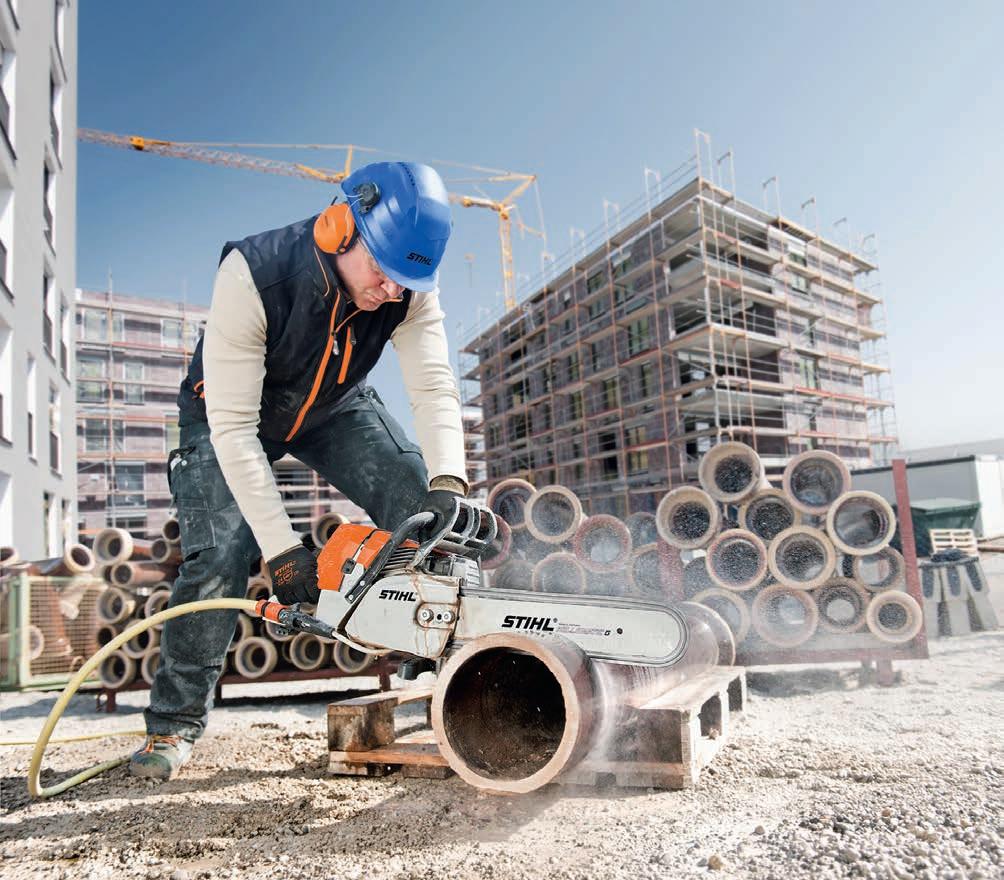
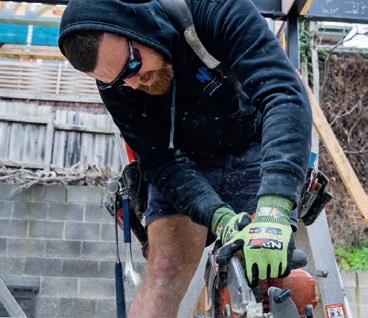
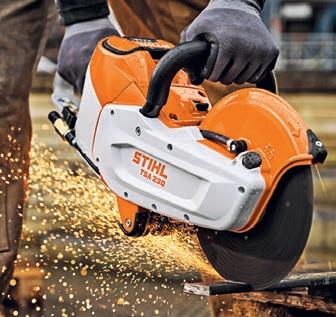
WHEN IT comes to cut-off machines, tradies want gear that’s tough, reliable and doesn’t muck around on site.
That’s exactly what STIHL’s latest cut-off machine range is built for, combining serious German engineering with smarter technology to make cu ing concrete, steel and asphalt easier — whether it’s on a major civil project or a tight indoor job.
The lineup covers two ends of the spectrum: heavy-duty fuel-injected petrol models for big workloads, and ba erypowered options for quieter, emission-free cu ing in confined spaces.
PETROL POWER:
TS 710I & TS 910I
For demanding jobs where cu ing performance ma ers most, the STIHL
TS 710i and STIHL TS 910i are built to handle the pressure.
These machines ditch
traditional carbure ors in favour of STIHL’s electronic fuel injection technology, which constantly measures things like temperature and pressure to deliver the right fuel mix at the right time.
In simple terms: smoother running, consistent power and less fuss on site.
The TS 910i sits at the top of the range as STIHL’s most powerful cut-off machine globally, built for deep cuts and heavy-duty materials.
The TS 710i — meanwhile — is designed to hit that sweet spot between power and weight, making it easier to handle over long days.
Starting them is simple too — no choke required.
Just purge, hit the decompression valve and pull the cord.
STIHL has also packed in a cyclone air filtration system that removes up to 80 per cent of dust
before it even reaches the main filter, meaning less maintenance downtime. Add in anti-vibration tech to reduce fatigue and a lightweight magnesium guard built to take a beating, and these saws are made for serious hours on site.
BATTERY RANGE:
TSA 230 & TSA 300
Need something for indoors or noise-sensitive jobs? That’s where the ba ery-powered STIHL
TSA 230 and STIHL TSA 300 come in.
Running on STIHL’s 36V AP Ba ery System, they deliver solid cu ing performance without exhaust fumes ideal for indoor construction, trenches or enclosed spaces where petrol gear isn’t an option.
The compact TSA 230 suits brickies, roofers and
STIHL cut-off machines deliver serious cu ing power for demanding jobs
quick on-site adjustments, while the TSA 300 brings extra grunt and deeper cuts for concrete and steel. No pull cords, no warmup: just pull the trigger and get to work.
Across the range, STIHL has focused on practical features tradies actually care about. Integrated water systems help keep silica dust down and cool blades during cu ing, spindle locks make wheel changes quicker, and petrol models feature automatic belt tensioning to keep power delivery consistent.
Compatible with STIHL’s range of cu ing wheels for concrete, asphalt, iron and steel, the lineup is built to handle whatever gets thrown at it — and keep going.
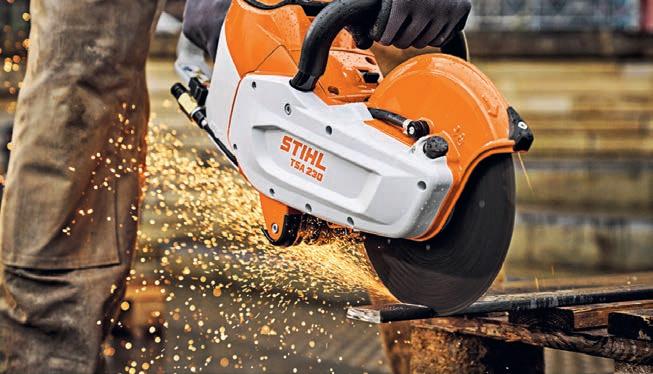





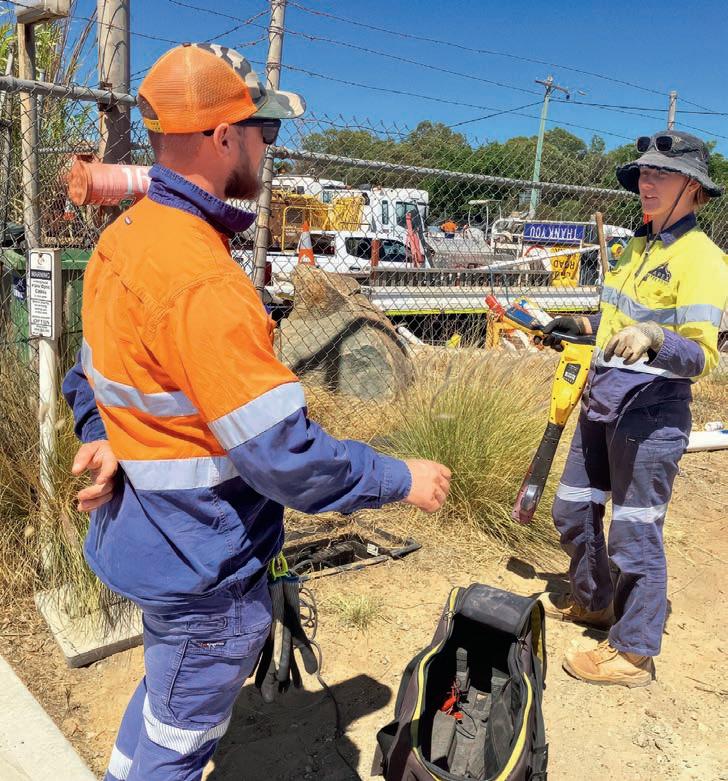
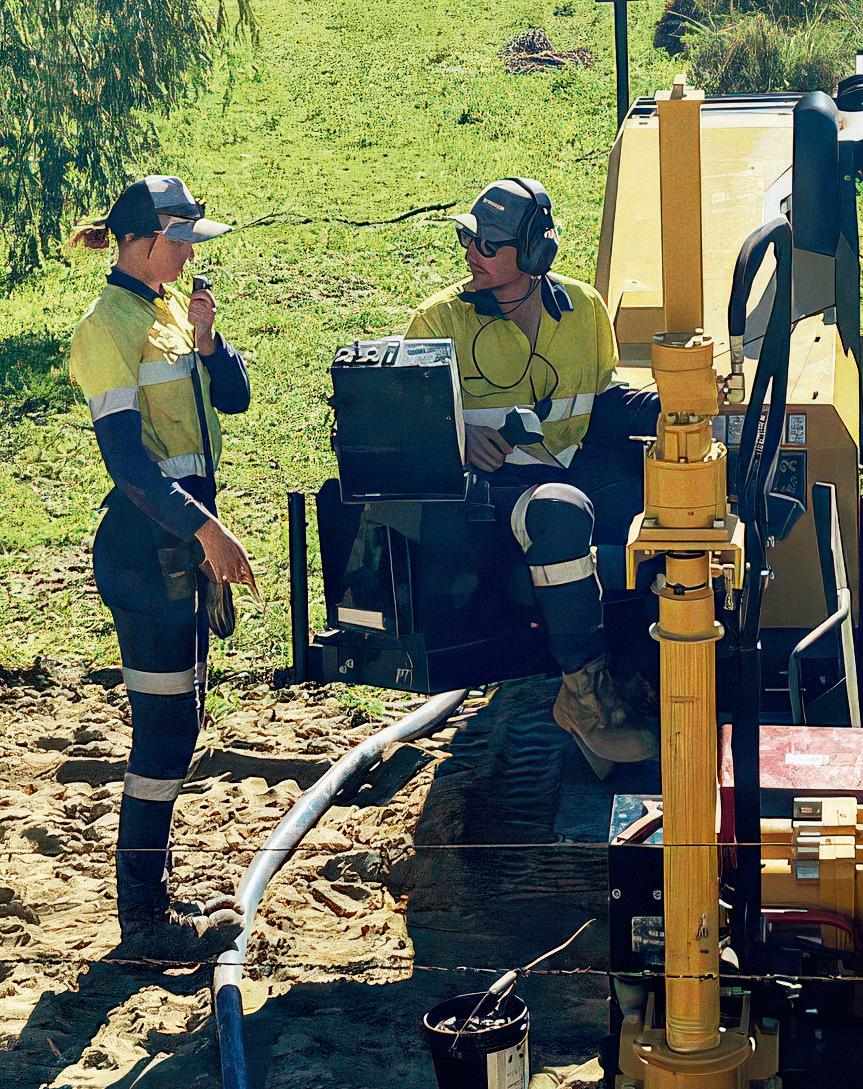
A WESTERN Australian
drilling business is quietly reshaping how the utilities sector thinks about skills, training and workforce diversity, with a strong focus on developing new talent from the ground up.
Apex Utilities has grown rapidly since launching in 2022, building a reputation in horizontal directional drilling and underground utilities installation across water, gas, power and communications projects.
From a small founding team to a workforce of around 13–14 staff, the business has steadily expanded its footprint
across WA while maintaining a tight-knit culture and a strong commitment to training.
Co-founder Bre Tedman explained the business began with a small group of experienced drillers who saw an opportunity to build something of their own after working together previously.
“We specialise in horizontal directional drilling. If it’s utilities — water, gas, power or communications — we
pre y much put it in the ground,” Bre said. “We install the conduit, and if it’s an end-to-end project, we also assist with pulling cable through for Western Power.”
Originally focused on gas projects, the company has since diversified into power and communications, expanding its capability and workload across the state.
While based in Perth, Apex Utilities operates far beyond the metro area, with projects stretching through the southwest, up past Geraldton and into
major regional hubs such as Kalgoorlie.
“We’ve pre y much covered most of the coastline,” Bre said. “At the end of the day, utilities are needed everywhere.”
A major part of Apex Utilities’ growth strategy has been its commitment to apprenticeships and training.
The business currently supports around 10 apprentices, all working toward Certificate III qualifications in trenchless technology.
Apprentices at Apex Utilities gain hands-on trenchless technology experience across metro and regional job sites.
Operations Lead Tracey Daly said the company made a deliberate shift to focus on developing talent internally rather than relying on alreadyqualified workers.
“We stopped looking for licences and experience and started looking for good people — quality people,” Tracey said.
“Then we commi ed to investing the time, mentoring and money into training them properly.”
That approach has already produced standout results, including Australia’s first female Certificate III-qualified trenchless technology operator, Abby-Lee Johnson.
“She saw us working on site and thought, ‘Wow,
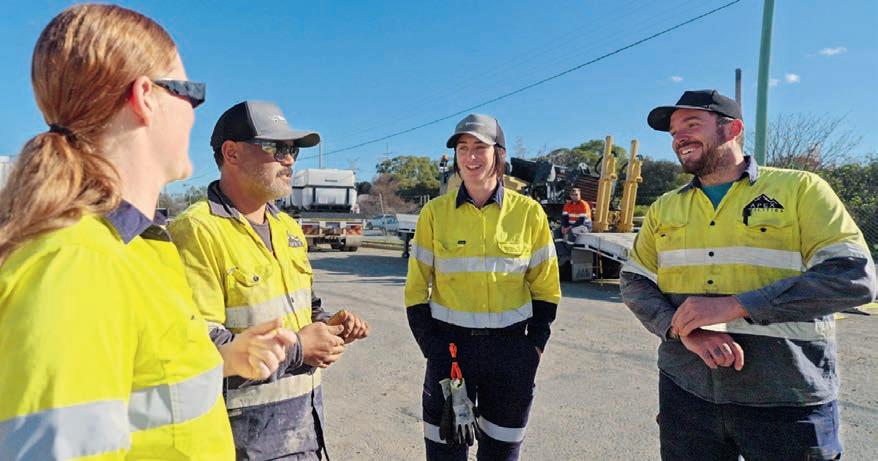
I’d love to do that,’” Tracey said. “She gave it a go and hasn’t looked back.”
Abby has since progressed from entrylevel roles to operating drill rigs and driving heavy vehicles, with her success inspiring further participation from new recruits.
The company’s apprenticeship focus has also translated into industry recognition, with multiple staff recently receiving awards and
nominations at a major industry ceremony.
“We had six apprentices nominated for Apprentice of the Year — six out of seven nominees,” Tracey said.
“So the odds were definitely in our favour!”
One employee is also working toward becoming the company’s first dual-qualified worker, combining plant operations with trenchless technology expertise.
Despite strong growth, the business operates in a sector facing ongoing labour shortages and competition from FIFO mining roles.
“The second someone gets a licence or enough experience to head north, they chase the FIFO dream,” Bre said.
“We had to make a choice: either do this ourselves forever, or invest in developing the next generation.”
That decision has led Apex Utilities to rethink recruitment entirely, focusing on a itude and potential rather than prior experience.
“We hire good people and train them right,” Bre said.
The company is also working closely with training providers, including TAFE, and is moving toward establishing its own Registered Training
Organisation to improve industry pathways and reduce delays in qualification delivery.
DRIVING INCLUSION IN A TRADITIONALLY MALE INDUSTRY
Apex Utilities is also actively reshaping workforce diversity in a sector where female participation has historically been extremely low.
“In utilities, female participation is around 0.1 per cent,” Bre said.
“But when you become a father of daughters, your perspective changes.”
The company has already reached almost 28 per cent female participation — well ahead of industry averages — with a focus

Apprentices and experienced drillers work side-by-side delivering essential underground utility infrastructure statewide
on capability rather than background.
“We don’t hire based on stereotypes,” Bre said. “We hire based on whether someone is a good person.”
Tracey added that the business is commi ed to building a strong, closeknit team while continuing to grow.
“We really love our li le team,” she said. “We want to grow, but not too big — we still want to keep that close-knit culture.”
For Apex Utilities, the goal is not just completing projects, but building longterm capability in a sector under pressure to deliver more infrastructure and services.
From apprentices stepping onto their first job site to experienced drillers mentoring the next generation, the business is focused on creating opportunity through training, inclusion and hands-on experience.
As Bre put it: “If we can take someone with no experience and turn them into a qualified driller, we can do it with anyone.”




THERE ARE a dedicated bunch of fi shos around the country who live and breath the opportunity to chase fi sh in remote locations.
A more passionate bunch again love to do it on foot, using google earth and every conceivable modern tool to explore new ground.
In this world of super keen anglers willing to take a boat to the ends of the Earth, hikers are still given the chance to discover the odd fi sh-filled Nivana.
In this piece, let’s take a look at the dynamics of these remote ventures and how they might come together.
You’ll read a firsthand account from someone waking up to a day filled with remote exploration and discuss some of the systems used to link man, wild and fi sh.
There is something truly primal about walking through the bush scrub, beach, around the marsh or through the mangrove forest.
Anything to reach that isolated pool, billabong or backwater.
That landlocked creek locked off from the rest of the system due to being too far upstream.
Catching a fi sh where lures have never touched down is the dream for those fi shing obsessed. Without any intention of
keeping fi sh for the table, simply walking off into the yonder, experiencing the raw nature in exploration and releasing every fi sh that’s caught.
For some, the true essence of sport fi shing.
These days, plenty of apps exists that cover both satellite imagery, accurate river heights and water levels plus weather conditions.
Some of the newer imagery services such as Capernicus browser even show up very recent aerial imagery captured by satellites. This all allows some of the guesswork to be taken out.
Queensland Globe, Navionics and all sorts of bushwalking apps can now be used to help plan your trail.
Those addicted to Google Earth will understand that once you really begin unearthing the possibilities of remote walks for Australian fi sh species — the sky is the limit. Hundreds and thousands of kilometres of meandering creeks and rives criss crossing the outer edge of this huge continent.
The further the walk and tougher the terrain, the be er the chance of finding fish that rarely see a lure
From Murray Cod in the south, to bass and sooties in the east and barra right across the top, there are endless trails to trapse.
Remember that walking across earth is often quite different from picturing it in your fi shing dreams. Conditions can be harsher, the bugs thicker, the terrain more undulating, the grass higher and any manner of factors different from expectations going in.
Sometime you need to be hardy and most importantly try never to get frustrated or overcooked. Mistakes quickly follow the mentally weak.
Keeping safe is also easier than it ever was before. Between GPS, EPIRB, Telstra coverage and now Starlink provided satellite
texting, hazards such as ge ing lost, bushed or broken down without being able to notify someone is trimmed. Snakes and other hazards are ever present in the Australian bush, so a first aid kit, long pants and some decent footwear are great additions to a trekking kit.
Longs help with that feeling of comfort walking through long grass, vines and the inevitable abrasive nature of the Australian bush. Always err on the side of caution with drinking water, the length of walk, heat and opportunity to replenish must all be considered.
The alarm pierced the dark — but it need not have bothered since I was already awake and had been since 3:30am.
From barra in upstream rapids to trout in remote creeks, Australia’s wildest fishing rewards anglers willing to explore
Counting down the minutes until my phone let me know that it was finally time.
We’d been fi shing the river for a few days now and the barra had been on — multiple fi sh over 80cm had come over the side, a few in the nineties and even a couple over the magic meter mark.
But today promised something different, something we’d been waiting for all year: a chance to walk the rapids upstream.
The rapids where no one ever fi shed.
The rapids where the big fi sh lived.
Our gear was ready and our lures tested — we


Remote fishing demands more than luck — smart planning, solid gear and a willingness to chase the unknown
all had our favourites, Squirrells, Classics, Barra Baits and of course the ever-reliable Gold Bomber — but we weren’t ready for what we were about to encounter. How could we have been?
We boarded the boat with backpacks stuffed with gear — Boga grips, leader line, lure packs, big bo les of water and sensible pants and shoes. We needed it all, because when we got to our spot and started fi shing the barra were ready for us.
The challenge of figuring out how to cast between two river gums with overhanging branches
into snaggy rapids quickly turned into a challenge landing a 95cm barra from the same spot.
And then again, and again and again.
Nearly every cast was smashed by a big hungry fi sh. Even bad casts — casts that started in the trees, only to be shaken loose to plop in the water three meters in front of us — were sucked into waiting bucket mouths. It was mayhem – beautiful, violent, soul nourishing mayhem.
Eight hours later — when it was all over — and we climbed back into the boat with arms stretched and legs covered in razor grass cuts and green ant bites, we looked in each others eyes and knew we had just done something special.
Use mapping and satellite tools to scout access, terrain and waterways before you go
Fish dawn and dusk for the most consistent bite windows
Carry light but essential gear: water, lures, leader, tools and sun protection
Bring navigation and emergency comms like GPS, EPIRB or satellite messaging
Use stronger leader and reliable tackle for structureheavy, remote environments
Expect rough terrain, heat, insects and tougher-than-expected walking conditions
Something we’d never forget, and something we’d spend the rest of our lives trying to do again.
Now we had a new purpose in life: to come back for a do over.
Something you come to grips with trying to push your boat to the upper limits in most Australian riverine environments is this. The fi sh don’t stop at the farthest upstream rock bar of sand spit.
Except for a fan or jet boat, most vessels can’t keep going past the incredibly skinny water at the top of almost every system.
That’s where the old foot falcon comes in and takes angers above the upper limits. Over the rockbar, around the
scrub and all the way to that secret landlocked billabong full of hungry cri ers. For whatever reason, many fi sh love the seclusion of being locked off in perennial places that receive a recharge of water annually.
A bunch of iconic Australian species exist in these places.
A quick fl y through a few of them might be in order. Starting with brown and rainbow trout.
As many know the life and times of these most loved introduced species is completely dictated by the rainfall, creek and river heights of the amount of recharge and discharge of their local impoundment.
Their migration and populations follow the boom bust cycles of the Australian climate, in
sickness and in health.
Murray Cod are a bit the same, spreading out during the good time and eeking out an existence in much less water during the tough times.
Most Aussie species are resilient cri ers and the Murray Cod is no exception, adapting their diet and nourishment to suit their surroundings.
Fish such as sleepy cod, silver perch and yellowbelly will live remarkably resilient lives in creeks and rivers that long since flowed.
Awaiting the first storms in many a moon to move between pools or to travel afar. Both species of Saratoga are experts at making use of a situation. They utilise floods to scamper, slither and slide to impossibly hard to reach lagoons and billiabongs in the norther interior.
The further you walk and harder the place it to reach, the be er the fi shing for Saratoga.
A more prehistoric and enchanted fi sh doesn’t exist in the Australian context if catching a challenging fi sh is up your ally. Hard bony mouths and tricky temperament are just some of the diffi culties in catching them.
Barramundi are an iconic Aussie sportfi sh. What they should be best known for is the versatility and range of different niche and habitat they occupy. They are known to reach ever further upstream sections then the ferocious saltwater crocodile.
They can follow a wet season trickle for miles to reach tiny bodies of water diffi cult to imagine
during the dry season.
Sooty grunter, Australian bass and jungle perch might be thought of in similar context. They inhabit far upstream reaches of many of the east coast Australian systems. Sooties of various forms seem to exist right across the top end which is a truly remarkable feat. All these fi sh love to eat surface lures and can be effectively targeted from the bank.
If it swims in either the intertidal, upstream or coastal extremes of the Australian continent, then it can be caught
by someone on foot. As they say, two feet and heartbeat can get you almost anywhere. Put your step tracker on and get out and amongst it.
These days there are also apps and technology that help align fi shing times with bite windows. There is day ratings and time slots within the Almanac that certainly seem to align nicely with red hot fi shing or a lack thereof.
Generally, dawn through early morning and late afternoon into dusk are
the more productive times.
Regardless of how remote your location is, this general theme will ring true. Most inland waterways will experience a bite lull through the middle part of the day, regardless of altitude, water temperate or any other factor you care to throw around.
It just seems to work out that way.
When deciding on what fi shing gear to take on your next walking adventure, keep a few things in mind.
Some anglers are more versatile casters on light
spin gear whilst others are far more accurate and inventive with overhead or baitcast tackle.
Depending on the scenario, it is often best to use slightly heavier than normal leader for your target species.
Dragging your quarry up a steep bank or over structure is nearly always required. Being too sporting will leave you with constant disappointment, and losing those trophy fi sh you were out there chasing to begin with.
It’s great to have a kit set aside purely for the task of remote walks and
trekking. Try and wear a belt with pliers and scissors or a multi tool.
Good quality sunnies and the lightest fabric long sleeve shirt you can afford for the job. Shoes are a broad topic but something that can get wet without damaging your feet are the two most basic requirements.
Spare leader, spare lures and an endless drive to get off the beaten track will round off the requirements.
For diehard fishos, the dream is simple: hike further, fish harder and find water untouched by the crowds



Protection for your truck that fits your cashflow
FOR MANY tradies, their truck is the backbone of the business. Whether you’re a builder, a landscaper, or a carpenter, if your truck stops, your workday usually stops with it.
That’s why many tradies invest in roadside assistance and insurance designed specifically for trucks.
You probably don’t think of yourself as a truck driver, but specialist roadside assistance and truck insurance can make a big difference, right when it ma ers most.
If you’re considering making the switch to a specialist insurance
provider around end of financial year, you might be asking yourself how do you manage the cost of protecting your assets while keeping cash flow healthy in the current economic climate?
FEELING THE SQUEEZE?
YOU’RE NOT ALONE
End of financial year is a busy time for most tradies. Between tax planning, equipment purchases, BAS obligations and preparing for the next financial year, there can be a lot of pressure on cash flow. And you’re not imagining it. According to the Australian Small Business and Family Enterprise
Ombudsman, almost half of small businesses experience cash flow issues each year, often linked to irregular income or large upfront expenses.
Tradies typically operate job to job, meaning income isn’t always predictable.
That’s why spreading out expenses can potentially make a real difference, especially when also juggling the fl uctuating costs of things like fuel and building materials.
Paying annually for insurance and roadside assistance has traditionally been the
norm. But that approach isn’t always a one size fi ts all, and a large one-off cost at renewal time can be a burden.
Craig Carmody, NTI’s National Development Manager says time and time again they typically see tradies making the switch to Truck Assist and taking up the monthly payment options because it can help make business expenses more predictable and be er aligned with incoming revenue.
“In practical terms, flexibility ma ers,” Craig said.
“End of financial year can be a good time to review
the tools, equipment and vehicles that keep your business running. Truck Assist offers the option to pay by the month to help tradies manage protection for their trucks without a big upfront hit to the budget.”
DESIGNED TO BE MANAGED EASILY Craig added the Truck Assist offering is built around the realities of tradie life.
“It’s also designed to be easily managed. Specialist truck insurance and 24/7 national roadside assistance, with support available wherever the job takes you – available directly, online,” he said.
“You can even lodge claims, make changes to your policy and update details without needing to spend too long on the phone.
“But if the phone is what you prefer you can also contact our inhouse customer care team and speak directly to a person.”
If you’re a small business juggling multiple costs, flexibility can make a diff erence.

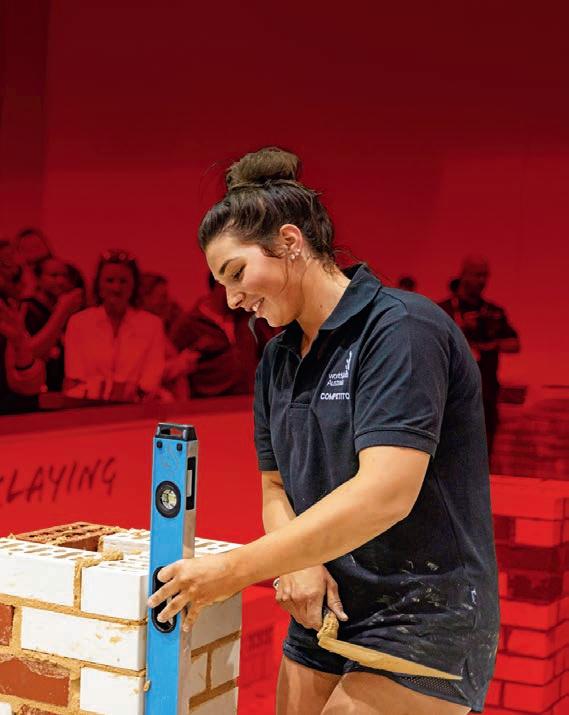


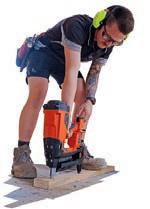

GARETH JONES knows more than most riders about testing motorcycle tyres. A few years back the former Aussie superbike racer – and qualified carpenterspent days at a French race track jumping from one bike to another fi ed with different Dunlops with the aim of finding the ultimate race-winning compound.
He cut hundreds of laps riding bikes fi ed with every imaginable sensor
to measure the bike’s reaction in all parts of the track.
And after each session, Jones gave the tyre techs the most valuable input of all – his own opinion.
BACK ON TRACK AT SYDNEY MOTORSPORT PARK
Fast forward 12 years and Jones found himself once again testing tyres – but this time as a moto journalist at Sydney Motorsport Park
on behalf of Dunlop’s Australian Importer, Ficeda Accessories. And this time there were only three tyres to test - aimed at tack day punters, fast road riders and weekday commuters, as opposed to world superbike racers. Jones, who has won superbike titles in both NZ and Germany before earning his cert four in building, joined another 100-odd participants for the launch of Dunlop’s new Sportmax Q5 range

on a variety of road bikes supplied by Aussie distributors.
The event was supported by Yamaha, CFMoto, Kawasaki, KTM and Bimota and run by MotoSchool.
A range of sports bikes were fi ed with all three tyres from the Q5 range with fairing stickers indicating which model tyre each bike was running.
The Q5 is aimed at racers, the Q5S for track days and sports riding and the Q5A for daily use on sports bikes.
After a short presentation from the Dunlop team –including from Japanese tyre technicians from Dunlop’s parent company Sumito Rubber Industries, the assorted media and dealers were split into groups and let loose on SMSP’s twisting South Circuit track.
Former superbike racer
Gareth Jones puts Dunlop’s new Q5 tyre range through its paces at Sydney Motorsport Park
Dunlop’s Q5 range was put through real-world testing, balancing grip, durability and rider confidence across track and street use
Jones selected Yamaha’s new XSR900GP in Yamaha’s retro Kenny Roberts colour scheme and fi ed with Q5A tyres first. The Queenslander also got the opportunity of riding the same set up on local roads, accounting for 95 per cent of the intended use of the tyres: “The Dunlops gave a very secure feeling on both road and track. High grip levels gave a lot of confidence when tipping and offered good traction on corner exit. To be honest, I would not have ridden much faster on pure race tyres,” he said.
“I also noticed that the tyres were still performing at the same high level at the end of the day, which is not something you can say about race tyres,” he added.
Those black rubber hoops are arguably the most
• Former racer on test duty – Gareth Jones, a former Australian superbike champion and qualified carpenter, returned to tyre testing at Sydney Motorsport Park for the Dunlop Q5 launch.
• Three-tyre performance range – The new Q5 lineup includes the Q5 (racers), Q5S (track day and sports riding) and Q5A (daily sports bike use).
• Real-world + track testing – Riders tested the tyres at SMSP’s South Circuit and also on public roads, reflecting real-world usage scenarios.
• Dual compound technology – Dunlop’s design uses a silica-infused centre for durability, with grippier edges for cornering performance and improved wear characteristics.
• 100+ participants on site – The launch event brought together more than 100 riders, media and dealers, supported by manufacturers including Yamaha, Kawasaki, KTM and CFMoto.
important feature on a motorcycle.
There are only two of them and they are a rider’s sole connection with the road – via a pair of small, but critical contact patches.
All tyres are measured on grip and longevity and generally the higher the grip, the faster a tyre will wear.
From track to road, the Dunlop Q5 range is engineered to balance grip, longevity and real-world riding confidence
To address this, Dunlop has developed a dual compound approach where the middle of the tyre is silica-infused for a longer lasting compound than the grippier edges — where more grip is needed.
The fine carbon technology tread compound also improves wear characteristics on the Q5S.



But to notice each feature of a new tyre would take a superhuman level of perception. And testing tyre wear – one of the Q5’s big selling points – is not practical at such an event.
However, Gareth notes that the Q5 target customer is clear: “It was really interesting to feel the differences in the tyres in the Q5 range, you can tell at which customer each tyre is aimed,” he said, adding that back-to-back testing on the same model with different tyres is the only way to do this.
MotoSchool had set up their fleet of Yamaha YZF-
R9s so that riders could do exactly this - focus more on the tyre and less on the bike.
“Dunlop is onto a great thing with the Q5 range,” says Jones.
“Testing the production tyre was fun and very different to testing race tyres where each one is a prototype worth thousands of dollars and wear life is measured in hours as opposed to months.”
TYRE CARE AND PERFORMANCE
The next time you’re in the garage, check out the tyres on your bike. Yes, they are black and round, but what condition are they in?
Tyres harden with age, they can crack and
Gareth Jones returned to the track at Sydney Motorsport Park to evaluate Dunlop’s new Q5 tyre range across road and performance conditions
then grip goes out of the window.
One part of the tyre may look full of tread, but tyres can wear unevenly.
Tyres lose air and they go off. A tyre that isn’t at the top of its game will negatively affect the handling of your bike.
Now consider how important those two small contact patches are on a motorcycle. This isn’t just about safety, it’s about enjoying your bike to the max. Because a fresh set of Dunlop hoops can make the difference between a white-knuckle ride and a fun day out in the twisties.

Powder-actuated tools and Ramset go hand-inhand. The JobMaster is the latest tool in this arsenal, delivering a simple point-and-shoot single-shot tool
SERIOUS FRAMEWORK requires a serious PA tool, and the JobMaster stands up to the test.
Built for timber to steel or concrete applications across residential, partition jobs, formwork or MEP, this tool covers a bunch of jobs tradies work on.
This includes Nyall Pierpoint from Cornerstone Carpentry.
He put the JobMaster to the test on a residential framing job on the Mornington Peninsula.
TEST #1: POWER PERFORMER
From an ease-of-use point of view, you’d be hardpressed to find anything be er than the JobMaster.
It’s semi-automatic and single-shot nature make it easy for tradies like Nyall to get through work quickly and accurately.
“The tool was definitely made with productivity in mind,” he said.
“The quick reloads, dependable firing – we were able to really put it through the test, and it shot through loads of frame and into concrete, which I consider to be a diffi cult application.
“It did a great job.”
The JobMaster can shoot nails up to 75mm and use Ramset’s LDU and LWU range which features singleshot and washered nails.
“I don’t think there was a single misfire,” Nyall added.
BRAND:
“For us, that’s the dependability we need. Any misfire is going to cost you time, and time is money.
“As far as reloading, we were going through a shot every seven seconds, and that can really work in your favour in ge ing the frame down.”

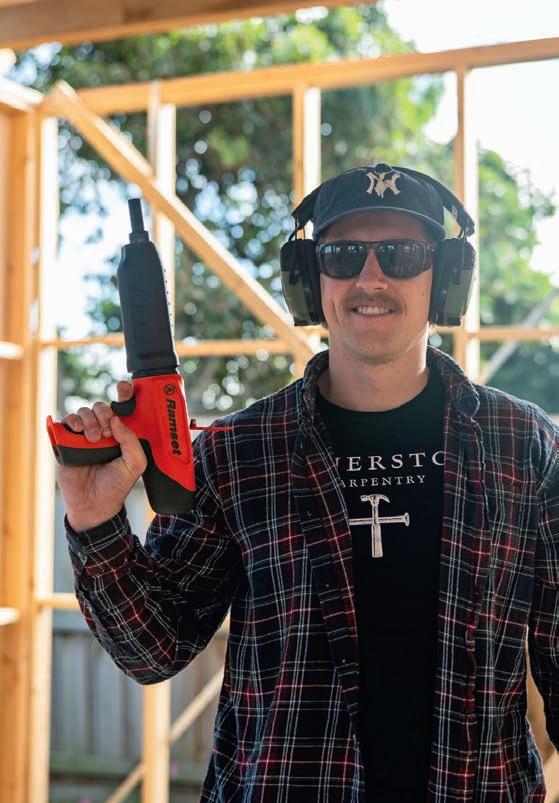
I could hand this to an apprentice and he could go all day
Being smaller than bigger multi-shot PA tools has its advantages when it comes to handling.
It’s lighter weight, combined with ergonomic grip with padded handle, meant Nyall and hit team could use it comfortably at tight angles for prolonged use.
“Ramset have really considered everything – it’s really comfortable in my hand and the recoil is manageable,” Nyall said.
“I could hand this to an apprentice and he could go all day – I don’t think anyone’s gonna have an issue with it.”
A simple power adjustment dial above the trigger also makes it easy to adjust on-the-go.
“We gave that a good test on site, and it just allows for multi applications you encounter during the day,” Nyall said. “If you go from shooting timber through concrete to shooting through steel — that impacts how you set the power.”
A seriously underrated feature of the JobMaster is its silencer a achment.
That means if you’re on-site early or need to be conscious of neighbours, you can still do crucial framing stages of a build.
“Noise reduction allows the site to be quieter; sometimes noise can create more stress than it needs to,” Nyall said.
“This silencer takes away from that aspect.”
Simple to use, easy to handle — the JobMaster was a major upgrade to Nyall’s toolkit.
Despite its straightforward interface, Nyall loved just how many uses the tool had across a bunch of different materials/sites.
“It really is easy to use,” Nyall said.
“You just needed to be shown how to use it one time, and you’re all over it.”
CHECK IT OUT
Jump over to ramset.com.au to learn more about the JobMaster
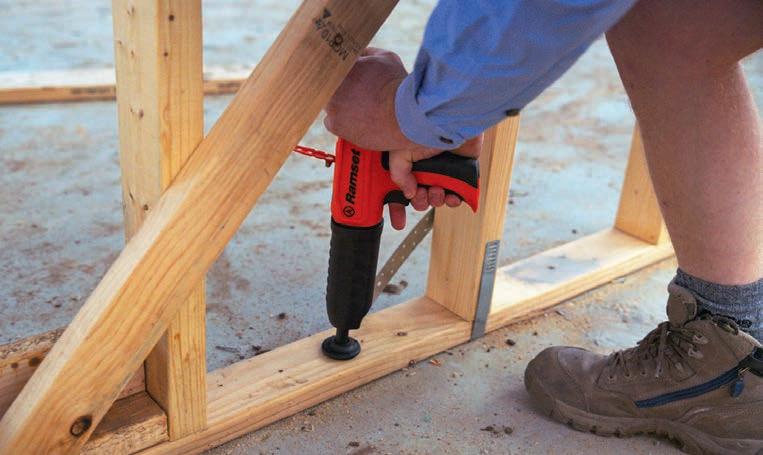
Noise reduction allows the site to be quieter
With adjustable power se ings, the JobMaster easily transitions between timber, steel and concrete applications
A built-in silencer helps reduce noise on site, making early starts and urban work environments more manageable
Ramset’s JobMaster delivers fast, dependable powderactuated performance for framing into timber, steel and concrete
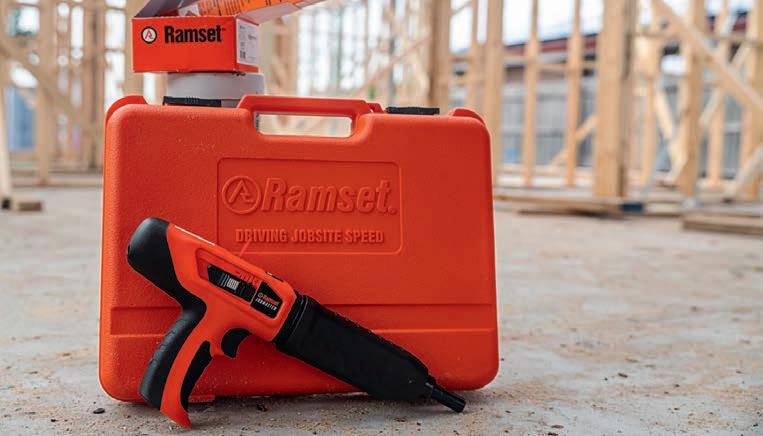
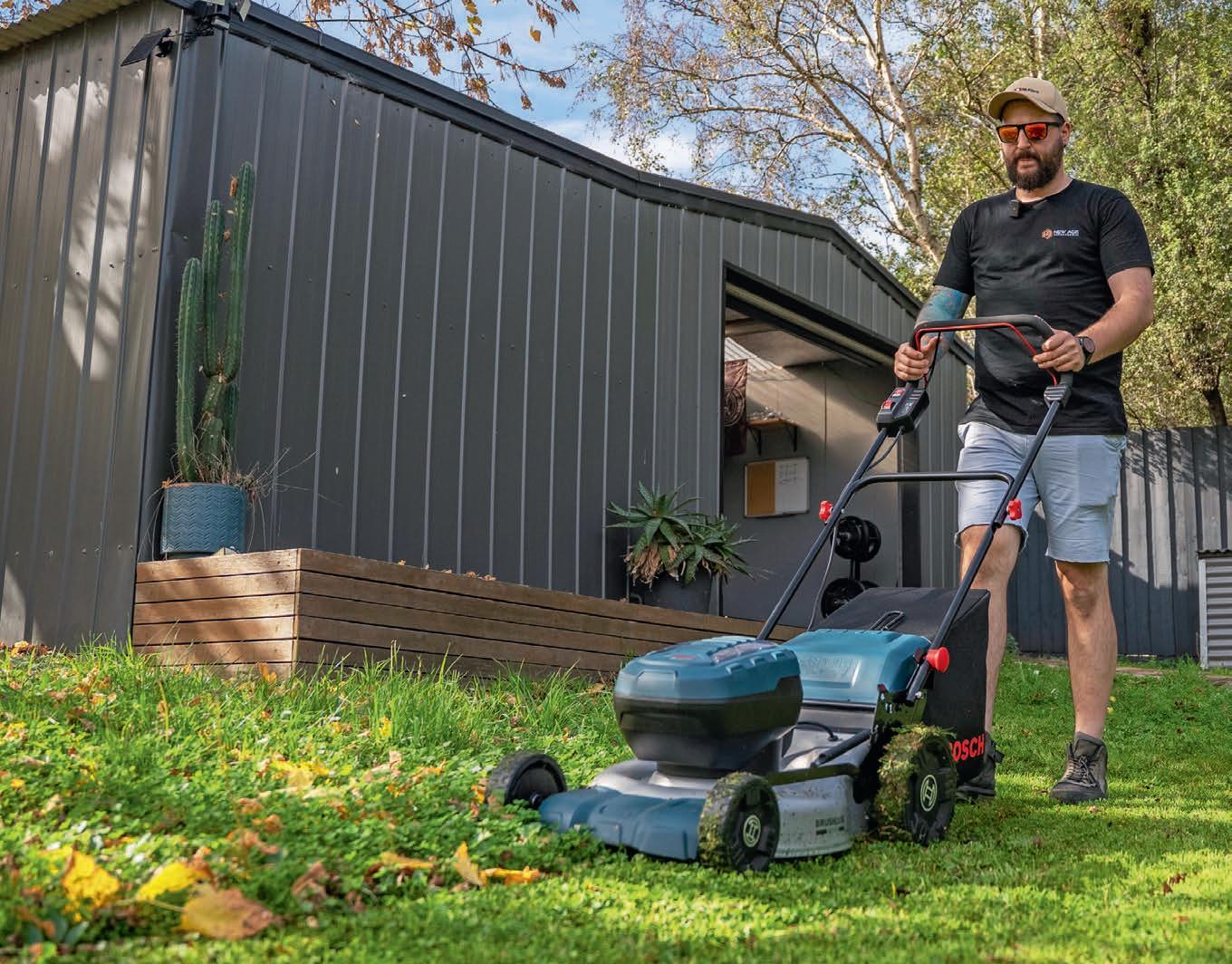
Tackle larger lawns with ba erypowered precision thanks to Bosch’s PRO GRA18V2-46SP Cordless Lawnmower. Unleashing the latest in 18V power, this mower shows just how capable ba ery OPE has become
FOR TRADIES who dabble in lawncare, picking the right lawnmower mightn’t seem that important.
But just like a reliable nail gun, having an effective mower — like Bosch’s PRO GRA18V2-46SP — can be a big difference maker.
Bosch superfan Kevin ‘Kev’ Rad from New Age Facades took this cordless lawnmower for a test drive on a lawn at a site in Mooroolbark in Melbourne’s far east.
No stranger to Bosch’s 18V ba ery ranges, he couldn’t wait to see how they performed when combined with a lawnmower.
“I’m not a huge fan of petrol mowers, I prefer ba erypowered ones,” Kev said.
“[But] I’ve tried some ba ery mowers before and haven’t had any luck.”
The PRO GRA18V2-46SP uses any two ba eries from Bosch’s Professional 18V System or AMPShare multibrand alliance.
These ba eries deliver big-time power and longevity; a must when it comes mowing uninterrupted by charging breaks.


“I’m impressed by Bosch’s mower — this backyard would usually take a long time to get through, this mower’s been cu ing through it with ease,” Kev said. Sporting a 46cm cu ing diameter and six cu ing levels between 30-60mm allowed Kev to cut through a hefty width and depth of lawn quickly.
“I had it on the second-lowest se ing and cut it short
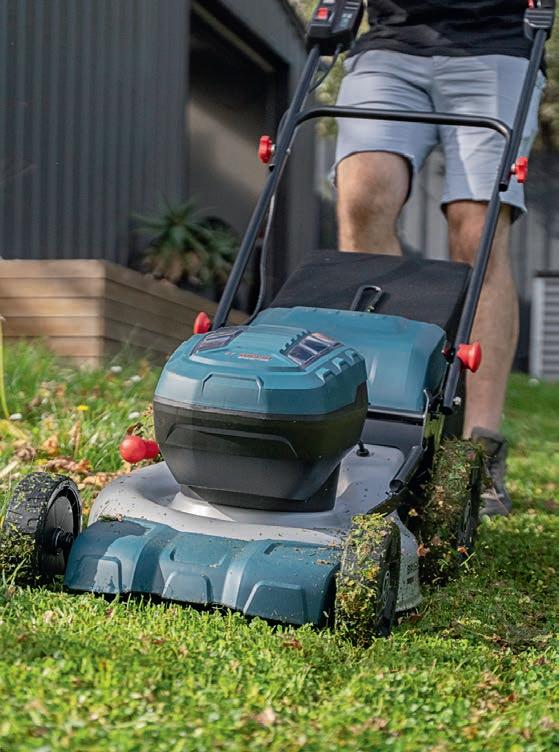
This thing’s going to get used every time I need to mow lawns
in one go — where normally I have to do a couple of rounds to get it to the right length.”
Kev also loved the mower’s self-propulsion which meant he could move it forward with very li le effort.
“The self-propulsion is a game-changer,” he said.
“I could use it with one hand, it moved forward at a steady pace — it’s a great product.”
The self-propulsion doesn’t compromise comfort, with a soft-start function resulting in a smoother experience.
Should Kev need to move the mower between sites, it features a collapsible handle that folds down making for compact storage and easy transport, even vertically to save space.
An ergonomic soft-grip handle and simple two-level height adjustment help users maintain a healthier posture while mowing, improving comfort during longer jobs.
Built for durability, the mower’s tough metal deck is built to withstand tougher workloads while supporting a longer service life.
A generous 60-litre fabric grass catcher provides ample capacity for collecting clippings, but also the included mulch plug offers the flexibility to return nutrients to the lawn by turning cut grass into fertiliser.
Bosch’s GRA 18V2-46SP gives petrol mower fans serious cause to reconsider, offering a durable and powerful addition to a tradie’s lawncare kit.
Kev loved being able to seamlessly use his Bosch 18V ba eries with a mower that delivered immense power comparable to his 18V tool range.
“I’m throwing my old mower out, effective immediately,” he said.
“This thing’s going to get used every time I need to mow lawns.”
CHECK IT OUT
Head to bosch-pt.com.au/au/en/products /gra18v2-46sp-06008C8200 to find out more
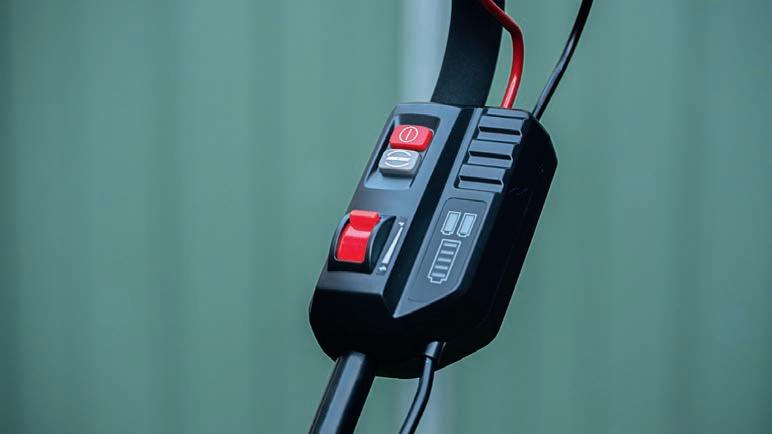
Powered by dual Bosch 18V ba eries, the mower delivers strong runtime and consistent cu ing performance across large lawns
Bosch’s PRO GRA18V246SP Cordless Lawnmower brings 18V ba ery power and cordless convenience to larger lawn maintenance jobs
46cm cu ing deck and six height se ings allow fast, precise mowing with fewer passes required
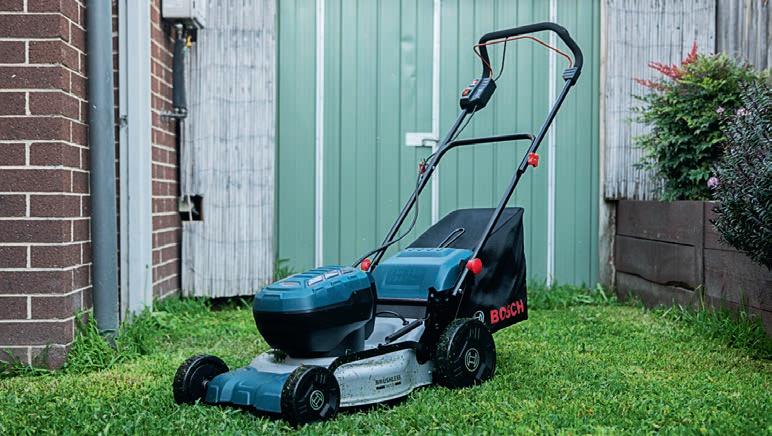
HAVE YOUR SAY!

NAWIC’S VISION is to build an equitable construction industry for all and we still need


a significant amount of change in the sector to achieve that.
Progress is being made, and I believe we are on the cusp of a real cultural shift in construction –one where workplaces genuinely accommodate the needs of all workers, regardless of background.
Our National Awards for Excellence provide the opportunity to recognise the outstanding achievements of the visionaries, the collaborators, and the trailblazers who working on the ground to drive this
cultural change.
The awards celebrate the achievements and innovation of women, organisations and male allies across four categories – the Crystal Vision Award, the Business Award, the Presidents’ Choice Award and the Male Ally Award.
Crystal Vision Award winners from chapter awards are finalists in the national category, chapter presidents select a standout individual from their respective awards to be entered into the National Presidents’
Choice Award category, and winners in the remaining two categories are selected from public nominations. Congratulations to the winners selected from an outstanding field of 55 nominees and 24 finalists. The award winners announced on 13 April are:
The GO Company (Tasmania - Jasmyn Smith and Logan Barne ). This award recognises advocacy, empowerment and championing of women in the construction industry. Co-founded by electricians Jasmyn and Logan, The GO Company is dedicated to supporting women in
underserved industries by providing essential sanitary solutions. Throughout their careers, Jasmyn and Logan have experienced firsthand the barriers women face on worksites, from lack of representation and mentorship to practical challenges such as access to appropriate facilities and hygiene products. Rather than accepting these issues as “part of the job”, they chose to turn lived experience into meaningful action. They are also advocates
for stronger regulation and enforcement around access to toilets on worksites and promote the concept that women’s hygiene facilities should be treated as essential safety infrastructure. They are driving real change to unblock barriers for women in the construction industry.
Diana Quiceno (BLD Engineers Victoria). This award recognises overall outstanding achievement in the construction industry. As Founder and Director of BLD Engineers, Diana has built a commercially sustainable consultancy delivering project management and engineering services across energy, rail, transport, road, and airport infrastructure. She leads by example, creating a workplace culture based on respect, capability, and opportunity where she actively mentors women and migrant engineers, providing guidance, confidence-building, and practical support to help them succeed.
Laing O’Rourke (NSW). This award recognises businesses driving positive change to foster and support greater gender balance and equity in the construction industry. Laing O’Rourke is commi ed to accelerating gender equality through

targeted, measurable and industry leading initiatives that directly address the persistent gender imbalance faced by the construction sector. Over the past six years, this transformation has been supported by robust data, transparent reporting, and a shift from isolated initiatives to systemic reform embedded within business strategy –resulting in increased representation of women, promotions, and senior leadership participation, supported by industryleading policies such as gender-neutral parental
leave and investment in early talent through the Inspiring STEM+ program.
Jack Ba y (ACT). This award recognises men in the construction industry who actively champion gender equity and diversity by taking meaningful actions that foster inclusivity. Jack is a proactive ally and mentor. He champions inclusivity not as an aspiration but as a daily practice in his role with John Holland and with NAWIC. For Jack, being a male ally means using
his position and infl uence to actively support, advocate for, and create opportunities for women in construction. He also recognises that diversity extends beyond gender and is a vocal advocate for intersectionality, championing initiatives that support First Nations people, LGBTQIA+
colleagues, and other underrepresented groups in construction.
The achievements of our winners demonstrate the amazing results that come from prioritising a culture of fairness, inclusion and respect to create environments where everyone feels valued and able to succeed.
ONE OF the most common barriers to people exploring career options is not necessarily capability. It is visibility. For many people, particularly women and young people, industries

like construction, manufacturing, infrastructure, energy and transport still feel hidden behind fences, gates and assumptions. If you have never stepped onto a site, met someone in the role or seen yourself reflected in the workforce, it can be incredibly diffi cult to imagine a future there.
That is exactly why EWIT’s Talk & Tours are building momentum across the country. Talk & Tours have been delivered in Victoria, New South Wales, Queensland and Western Australia with more planned in the second half of 2026 including also delivering in South Australia. We have been to places like Komatsu, Nestle, Coca Cola Europacific Partners, Alstom and BlueScope Steel as part of the series.
EWIT has delivered Talk & Tours with organisations across the manufacturing sector as part of the AMWU Breaking Barriers Project funded by the Department of Employment and Workplace Relations Building Women’s Careers funding. We have walked participants through advanced manufacturing facilities, energy sites, training academies and workplaces many people have driven past daily but had no idea what happened beyond the gate.
At their core, Talk & Tours are simple. We bring people into workplaces to see industry firsthand. Participants hear from employees, tour facilities, ask honest questions and gain insight into what a
career in that environment could look like.
But the impact goes far beyond a site visit.
What we are seeing through these experiences is the power of exposure.
Once people physically step into a workplace, touch the equipment, hear the stories and connect with the humans behind the industry, something shifts. The unknown becomes accessible. The intimidating becomes achievable.
Every single time, we hear the same thing:
‘I didn’t realise opportunities like this existed.’
‘I never thought I could see myself here.’
‘I wish someone had shown me this earlier.’
That is why these experiences ma er. Importantly, they also allow employers to
EWIT’s Talk & Tours are opening gates to real workplaces, helping people see firsthand what careers in construction, manufacturing and infrastructure actually look like
showcase something that is becoming increasingly valuable to future workers: culture.
Today’s workforcve wants more than a pay cheque. People want to know: What does this workplace feel like? Will I be supported here? Can I see people like me succeeding?
Do I belong?
Talk & Tours provide organisations with an opportunity to answer those questions authentically.
Some of the most impactful moments during these tours are not the machinery or operations, they are the conversations. The apprentice sharing how nervous she was on her
first day. The supervisor talking openly about creating a more inclusive team culture. The mature-
age worker explaining why they changed careers. These are the moments that create connection.
We have also seen the impact flow both ways.
By bringing participants behind the scenes, Talk & Tours are breaking down barriers and reshaping how future workers see opportunity in the trades
While participants leave inspired and informed, employers and the team involved also walk away empowered. They shared their skills and knowledge with people who wanted to learn and they gained a deeper understanding of the importance of visibility, language and representation within their own workplaces. As industries across Australia continue facing critical workforce shortages, the solution
cannot simply be louder recruitment campaigns or posting the same jobs to the same audiences. We need to create genuine connection points between industry and people who may never have previously considered these pathways possible. That is where Talk & Tours are making an impact. Because sometimes changing someone’s future is not about a major intervention. Sometimes it is as simple as opening the gate, welcoming people in and allowing them to see what is possible for themselves.
And once people can see it, they will know they can be it.
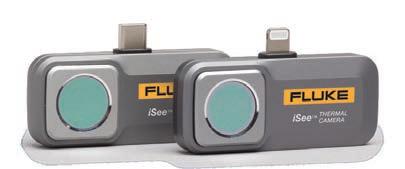
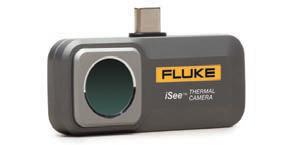



recently had the opportunity to be part of the Sydney Build Expo, and the energy across the two days was a clear reflection of the momentum currently building within our industry.
Following Day One of the expo, we were proud to host a networking event


at the Piermont Hotel, bringing together builders, apprentices, educators, suppliers, government representatives and industry leaders for an evening of collaboration and conversation. With 64 in a endance, the event highlighted the growing appetite for stronger connections across the carpentry sector.
SAFETY FRONT AND CENTRE
During the expo, Carpentry Australia hosted two important industry panels focused on topics that continue to shape the future of our trade.
Our first panel centred around safety; an issue that remains front and centre across every worksite in Australia. We were fortunate to be joined by Chris Ou en
from TAFE NSW, Charbel Rahme from ARIA Carpentry, and Felicity Pe iford, be er known as the Sydney Builder Chick. The discussion explored the importance of building stronger safety cultures, improving education pathways, and ensuring the next generation of tradies enter the industry with the right mindset around workplace wellbeing and responsibility.
The second panel focused on sustainability and the role our industry must play in driving smarter, more sustainable building practices. We were joined by James Wang from AUSWOOD, Dr. Ulrike Dankermann from the University of New South Wales, and Nick Abraham
from HA Build. The panel examined emerging sustainable materials, innovation in construction, and the importance of industry collaboration as we move toward a more environmentally conscious future.
One of the standout takeaways from the expo was the overwhelming level of interest from both industry and government representatives wanting to explore how we can work together more collaboratively. It was encouraging to see so many organisations
Carpentry Australia brought industry leaders, tradies and educators together at Sydney Build Expo to drive conversations around safety, sustainability and the future of the trade
recognising the importance of supporting tradespeople, strengthening pathways, and investing in initiatives across the sector.
With all the momentum Carpentry Australia continues to build, we are excited about what lies ahead. In the coming months, we look forward to sharing some exciting news around several major projects that Carpentry Australia will be leading across multiple states.
We are incredibly grateful for the ongoing support we continue to receive from industry partners, government, and the broader community. That support allows us to continue creating meaningful opportunities, driving positive change, and ensuring the carpentry industry remains strong for future generations. The future is bright, and we’re only just ge ing started.
THIS JUNE, the 12-months countdown is on for the WorldSkills 2027 National Championships and Skills Show - Australia’s biggest vocational education and skills excellence competition.
Held every two years, in 2027 the event will be hosted by the South Australia Government at the Adelaide Showgrounds from 3 to 5 June.

Trevor Schwenke CEO, WorldSkills Australia
THE ROAD TO NATIONALS
Over three days, highachieving competitors from across the country will showcase and benchmark their skills on the national stage, competing against their industry peers with the chance to represent Australia internationally in 2028.
Qualifying for the event is already underway, with regional competitions running in every state and territory throughout 2026.
The National Championships are the focal point of the WorldSkills Australia twoyear cycle and represent the biggest stage on which to celebrate skills excellence among the next generation of
apprentices, trainees and students.
A MASSIVE
The scale of the National Championships is hard to describe without actually witnessing it.
The Adelaide Showgrounds floorspace is 17,000m2 and we are expecting 700-plus competitors across 67 skills in front of more than 25,000 spectators. Online, social media and streaming should achieve in excess of 20,000 views. With skills ranging from those valued by established sectors such as bricklaying and automative mechanics, through to those coming to the fore in IT and additive manufacturing, the full breadth of Australian vocational education and
training (VET) will be on display.
POWERED BY SUPPORT
But what’s almost more impressive is the amount of support we receive to make the event happen. We rely on around 250 volunteers as judges, experts, and general event support. Plus, we also need hairdressing models, restaurant patrons, even volunteers to have their beard trimmed or receive a massage!
Similarly, we have dozens of companies and businesses providing support via the supply of equipment and materials for the competitors to utilise as they put their skills to the test.
HVAC&R Skillaroos recently competed at ARBs 2026
BY THE NUMBERS
Amongst the long and varied list of requirements, we have partners providing us with 12 tonnes of bricks, 500 eggs and 50 welding machines. The range of support we receive from across the VET sector and all parts of the broader business community is testament to the shared recognition of the value of the National Championships in developing skills excellence and the benefi t it delivers for the whole Australian economy.
HEAD TO TOE

• Sherpa-lined
• Showerproof
• Layering
• Thermal
• Trade-ready
Bisley Workwear’s Winter range is built to keep tradies warm, visible and protected through cold, wet and demanding worksite conditions

Bisley rolls out range to keep tradies warm
OPERATING ON-SITE during the colder months demands apparel that performs under pressure. As our temperatures drop and daylight hours shorten, the right gear becomes essential not just for comfort, but for maintaining safety, productivity and focus throughout the workday.
BUILT FOR THE SEASON
Bisley Workwear’s latest Winter range delivers Hi
Vis essentials, Sherpalined jackets, reversible showerproof puffer vests, weather-ready rainwear, and essential layering tees; everything you need to work through the season.
DESIGNED FOR TRADE CONDITIONS
Engineered with premium materials and designed specifically for the rigorous demands of the trade industry, this collection ensures you
remain fully protected against the elements without compromising on mobility.
READY FOR CHANGING WEATHER
For superior insulation when the weather shifts, the range introduces heavy-duty outerwear designed to offer thermal retention alongside durable exterior built for tough environments. For changing conditions,
these versatile pieces allow workers to adapt their level of protection on the fl y.
LAYERED PROTECTION
From the first layer to the final outer shell, Bisley Workwear provides the ultimate seasonal defence
for the modern trade professional.
Upgrade Your Seasonal Uniform: Discover the complete Winter range today at your local authorised Bisley stockist or visit the website to view the latest highperformance workwear solutions. Visit bisleyworkwear.com.au to learn more Check it out!


POWERFUL
105J of force with up to 10,000 shots per battery charge.
STRONG
Drives pins from 15 to 65mm into concrete and steel substrates.
VERSATILE
Built for a variety of applications including metal track, bottom plate, post control mesh and more.
FOR A LIMITED TIME, SAVE UP TO $397 AT PARTICIPATING RETAILERS