THE AUSTRALIAN PIPELINER
Official Publication of the Australian Pipelines and Gas Association
ISSUE 217 | Sep 2026
ISOLATION
Innovators SEPTEMBER 2026
ADVANCING PIPELINE PERFORMANCE
Swift pipe support solutions
28
NDT Global broadens its horizon
44
YPF Celebrates 20 years
56
www.pipetek.com.au
Our Exclusive Global Partner
AUSTRALIA'S STRONGEST PIPELINE INTEGRITY PARTNERSHIP Pipe Tek's exclusive partnership with Enduro Pipeline Services brings the world's best integrity solutions to Australia, including the company’s latest DSC 2.0 and DfL-UHR inspection technology which has changed the game.
WE KNOW PRESSURE ® 1300 PIPE TEK
YOUR SEARCH FOR
PREMIUM PIPELINE EQUIPMENT ENDS HERE
SCAN TO FIND OUT MORE
26 Culya St, Pinkenba Qld 4008 1300 952610 sales@austrackequipment.com.au www.austrackequipment.com.au
CONTENTS
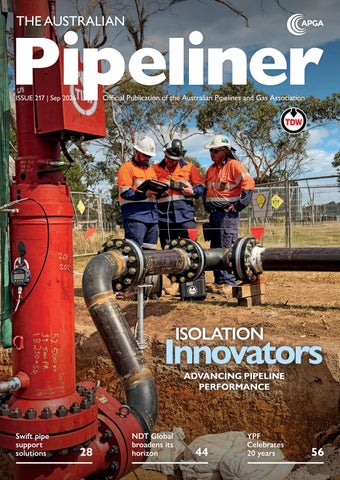
TDW field techs activate and monitor the new SHiiELD™ double independent isolation and bleed system in a 12-inch natural gas high pressure pipeline in Melbourne, Australia.
10
Executive reports
State of the industry
APGA CEO message...................................................................................... 8
APGA news.......................................................................................................38
Integrity and maintenance
Cover story Ramping up in Australia...............................................................................10
Infrastructure expansion Experience built in the field.......................................................................14 Ready for what’s next...................................................................................16
Improving data quality and operational efficiency in high-flow gas pipelines........................................................................... 40 NDT Global broadens its horizon......................................................... 44 From data to decisions................................................................................ 46 Combating rust in industrial shipments.............................................. 48
Austrack Equipment builds on five years of momentum.............18
Plastic pipe
Aviation’s expanding role in infrastructure delivery.......................20
Making connections above and below ground..................................50
Supporting Australia’s pipeline future.................................................. 22
Emissions management
Tesmec: Take on the tough........................................................................24 Built on Australian expertise....................................................................26
How Australia is raising the bar for methane management.......52
Swift pipe support solutions.....................................................................28
Community
Build it on Pack Tuff bags........................................................................... 30
Driving hope across the outback........................................................... 54
Strengthening pipeline networks.............................................................32
YPF Celebrates 20 years.............................................................................56
The industry beneath our feet.................................................................34
HDD
Flow without a pause....................................................................................36
Prime Drilling pushes HDD technology forward............................58
28
24 4
The Australian Pipeliner | SEPTEMBER 2026
54
PIPELINE PROJECT AVIATION SOLUTIONS Fleet Helicopters delivers client focused aviation solutions across every stage of your pipeline project. From aerial easement surveys and construction support through to operational fugitive methane detection, we help you stop leaks before they impact the environment. Specialising in Australia's hardest to reach places, we cover every aviation need.
For over 41 years Fleet Helicopters has delivered trusted aviation services to private and Government sectors. Fleet Helicopters thrives in remote, challenging environments, with an unmatched record for safety, reliability and environmental responsibility. Fleet Helicopters operates a versatile fleet of 19 aircraft, from single engine aeroplanes through to multiengine, heavy lift, transport category helicopters.
With over 30 years supporting Australia's gas industry, Fleet Helicopters delivers charter, aerial survey, external load and emissions focused gas leak detection operations nationwide.
Fleet Helicopters is Australasia's sole operator of the Boreal GasFinderAB laser based aerial gas leak detection system. Clients including SANTOS, Shell, the APA Group, QGC and Origin Energy trust us to locate fugitive methane, a greenhouse gas with over 80 times the short term warming impact of carbon dioxide. Detecting concentrations as low as 0.5ppm, surveys cover up to 1000km per day, reducing emissions.
Call Mike to discuss how we can tailor make aviation solutions for you P 02 6772 2348 | E mwatson@fleethelicopters.com.au | W www.fleethelicopters.com.au
,yrt
ka ,ll o sa
PUBLISHER
Chairman John Murphy CEO Christine Clancy christine.clancy@primecreative.com.au
Managing Editor Eugene Duffy eugene.duffy@primecreative.com.au
Editor Timothy Bond tim.bond@primecreative.com.au
Business Development Manager Jake Niehus
Maximise brand awareness by connecting with thousands of industry professionals The Australian Pipeliner brand comprises: six editions a year, a news website, a weekly e-newsletter, multiple social media platforms, an annual industry directory and an annual pipelines wallchart. Book an advertising and editorial package to gain access to our exclusive audience.
jacob.niehus@primecreative.com.au
3,300+
20,000+
Head of Design Clayton Hawley
magazine subscribers
website views each month
Designer Deborah Pilarinos
16,500+
13,700+
Front Cover Image TDW
e-newsletter subscribers
social media followers
clayton.hawley@primecreative.com.au
Copyright The Australian Pipeliner is owned by Prime Creative Media and published by John Murphy. All material in The Australian Pipeliner is copyright and no part may be reproduced or copied in any form or by any means (graphic, electronic or mechanical including information and retrieval systems) without written permission of the publisher. The Editor welcomes contributions but reserves the right to accept or reject any material. While every effort has been made to ensure the accuracy of information, Prime Creative Media will not accept responsibility for errors or omissions or for any consequences arising from reliance on information published. The opinions expressed in The Australian Pipeliner are not necessarily the opinions of, or endorsed by the publisher unless otherwise stated.
Want to find out more? Contact our business development team to discuss how you can grow your business with The Australian Pipeliner. Call 0466 929 675 or email jacob.niehus@primecreative.com.au
© Copyright Prime Creative Media, 2021
Articles
G
W o
All articles submitted for publication become the property of the publisher. The Editor reserves the right to adjust any article to conform with the magazine format.
Printed by: The Precision Group 83-89 Freight Drive, Somerton VIC 3062 Ph: (03) 9490 1500
T
Head Office
Sydney Office
379 Docklands Drive, Docklands VIC 3008 Ph: (03) 9690 8766
Suite 11.01, Level 11, 201 Miller St, North Sydney NSW 2060
T th h
enquiries@primecreative.com.au www.primecreative.com.au
The Australian Pipelines and Gas Association’s (APGA) vision is to lead the sustainable growth in pipeline infrastructure for Australasia’s energy. APGA is a non-profit organisation formed to represent the interests of its members involved in: the ownership, operation, maintenance, design, engineering, supply and construction of pipelines, platforms and all other structures used in or in connection with the drilling for, extraction and transmission of hydrocarbons, solids, slurries and similar substances both onshore and offshore. As a single voice representing the collective interests of its members, APGA is dedicated to encouraging the extension and development of the industry. The Australian Pipeliner is the official journal of the Australian Pipelines and Gas Association (APGA) and is distributed to members without charge and circulated to interested organisations throughout Australia and overseas. It is also available on subscription. The publishers welcome editorial contributions from interested parties. However, neither the publishers nor APGA accept responsibility for the content of these contributions and the views contained therein are not necessarily the views of the publishers or APGA. Neither the publishers nor APGA accept responsibility for any claims made by advertisers. All communications should be directed to the publishers.
6
The Australian Pipeliner | SEPTEMBER 2026
2026-Prin
Test Critical Welds Faster GripTight® Hydrostatic Test & Isolation Plugs Whether you’re testing open end pipe, systems terminating in long radius elbows, flange welds or isolating lines... count on the GripTight Family of Test & Isolation Plugs from Curtiss-Wright to perform above expectations, test after test. Their patented gripper designs, hardened components and uninterrupted unibody seals provide field performance that’s second to none. When safety and reliability matter most, plants around the world trust GripTight Plugs for their hydrostatic testing & pipe isolation needs! Patented gripper designs for increased safety in high-pressure applications Save time by eliminating welded end caps to test pipe spools & piping systems Test flange-to-pipe welds without pressurizing entire systems Isolate & monitor upstream pressure and vapors during hot work Standard pressure ratings up to 15,000 PsiG (1034 BarG) ASME PCC-2 Type I, III & IV Testing Devices available
Call, Click or Scan to Learn About Our Full Line of Test & Isolation Equipment +1.800.355.7044 est-sales@curtisswright.com curtisswright.com valves.curtisswright.com/EST 2026-Print-Ad_TAP-FP_sept-oct.indd 1
8/25/2026 11:18:41 AM
Image: industrieblick/stock.adobe.com
EXECUTIVE REPORTS
From the CEO We have just completed another outstanding Convention and Exhibition in Darwin.
T
o say the event exceeded my expectations is an understatement. Back in March when we were doing the final budget, the price of diesel was around $3.50/L. That did a lot to lower my expectations of what was achievable in terms of attendance for our biggest event of the year. Fortunately, the event really didn’t experience any noticeable impact and delivered just as big a crowd as we had in Darwin in 2018 for the 50th anniversary. Thank you to everyone who made the time and went to the expense and effort of getting to Darwin and being part of the event, I am sure you all agree it was well worth attending. I’d especially like to single out our exhibitors this year – it takes a lot to get all the gear to Darwin and the exhibition hall was a real standout. The war in the Middle East is certainly a good reminder of the importance of hoping for the best but planning for the worst. Over the last six months the impacts have not been nearly as dramatic as they might have been. This is not to say there haven’t been damaging impacts and there won’t be anything dramatic – certainly throughout August we have seen fuel prices creeping back up and it’s not all due to the lifting of the fuel excise relief. The Federal Government’s Domestic Gas Reservation Scheme is one area where hoping for the best but planning for the worst would be prudent. If it all goes well, cheaper gas will be available across the country for the next couple of decades, driving investment in gas infrastructure, power generation and manufacturing, putting downward pressure on both gas and electricity prices and supporting faster emission reduction through the accelerated phase-out of coal power stations. That is certainly something to hope for. A lot has to go right for this scenario to come to pass. We are expecting the draft legislation to be released any day now (noting that I have to write this a couple of weeks early so it may have just been released by the time you read this). APGA and members will be reviewing the
APGA Secretariat Registered Office:
2nd Floor, NFF House, 14-16 Brisbane Avenue, Barton, ACT 2600 (PO Box 5416, Kingston ACT 2604) T: +61 2 6273 0577 E: apga@apga.org.au W: www.apga.org.au ABN: 29 098 754 324
8
The Australian Pipeliner | SEPTEMBER 2026
draft legislation and the regulations that follow closely to add our thoughts on the best way to implement this transformative scheme in a manner that increases the likelihood of the best case scenario being the one we all experience in the 2030s. This edition of the magazine sees us celebrate 20 years of the Young Pipeliners Forum. From its beginnings as a seminar in Canberra in May 2006 to talk about young people in the industry (back then ‘Gen Y’) was the terminology used, skills transfer, attraction and retention, the YPF was established and has taken on an impressive life of its own, with chapters running independently of the Secretariat in most States, bringing together young professionals in our industry to learn, network and socialise. We have several Board members who are alumni of the committees that run these Chapters and the YPF has featured in the careers of our many industry leaders. We’ll be holding a special celebration in Brisbane in October to mark the 20th anniversary of the YPF and it would be great to see you there. All the best as we head into the back end of the year.
STEVE DAVIES APGA CEO
Chief Executive Officer
Head of Engagement
Head of Corporate Services
Accounts & Membership Officer
Head of Advocacy
Head of Policy
Head of Operations & Communications
Technical Advisor
Steve Davies
Dhammith Abeysuriya Matt Williams
Lawrence Shelton
Gayle Bower Katy Spence
Catriona Rafael Craig Bonar
Supporting Australia's Energy Growth Trusted emissions measurement across the full natural gas value chain.
WHY OPERATORS CHOOSE BRIDGER
Built for large, remote infrastructure
Measured data– not estimated emissions
Survey pipeline networks, production assets, LNG facilities, and offshore operations efficiently from the air.
Direct methane measurements with quantified emission rates and georeferenced results.
Prioritise high-impact repairs
Proven with leading operators
Equipment-level attribution helps teams focus resources where emissions matter most.
Supporting methane measurement programs across Australian energy infrastructure.
SEE EMISSIONS CLEARLY. ACT CONFIDENTLY. Learn How Bridger Can Help Streamline Your Emissions Monitoring
COVER STORY
The TDW technology demonstration day which took place in Melbourne earlier this year.
Ramping up in Australia TDW is expanding its Australian capability as pipeline operators seek integrated asset management solutions.
TDW Director of Sales – APAC, Solomon Uadiale.
A
ustralia’s pipeline sector is entering a period of increased focus on asset management as operators manage ageing infrastructure, new investment and growing expectations around safety, reliability and operational continuity. Pipeline owners are seeking solutions that allow them to maintain critical assets while limiting disruption to supply. This is driving demand for a broader range of pipeline services, including valve replacement, hot
10
The Australian Pipeliner | SEPTEMBER 2026
tapping, line isolation, bypass solutions, inline inspection (ILI), cleaning, pigging and repair solutions. According to TDW Director of Sales – APAC, Solomon Uadiale, three connected themes are shaping the Australian market: ageing infrastructure, investment in transmission and distribution networks, and the regulatory requirement to keep critical assets operational. “Customers are not looking only for equipment and technicians – they are looking for certainty,” he said. “That means safe execution, fast mobilisation, proven technology and a partner who understands the local operating environment.” TDW has expanded its Australian capability to support this changing environment, combining local service capability with the company’s global portfolio of pipeline maintenance, isolation and integrity technologies. The company’s recent acquisition and integration of Pro Pipe Services has been a key part of that expansion. Pro Pipe is a wellknown provider of hot tapping, line isolation and pipeline maintenance services in Australia, and its integration into TDW has strengthened the company’s ability to provide local support backed by global resources. “We have evolved from supporting
Australia at a distance, and now we’re building a stronger local platform – local people, local response, with that global TDW capability behind it,” Solomon said. The company is also expanding its presence in Western Australia, with Perth becoming a strategic location alongside its Melbourne foothold. “Melbourne gives us continuity and capability; Perth gives us proximity to one of the most important growth regions in the Australian pipeline market,” Solomon said.
Evolving pipeline isolation requirements TDW provides one of the industry’s broadest portfolios of pipeline isolation solutions, supporting transmission and distribution systems across onshore and offshore applications. Pipeline isolation has traditionally allowed operators to complete maintenance, modification and repair activities while minimising disruption to supply. However, customer expectations around isolation technology have evolved. “Customers now expect more than a technically correct isolation,” TDW Business Development Manager Joe Buttigieg said. “They expect a solution that reduces downtime, limits emissions, provides stronger verification and supports business continuity.”
STOPPLE Train demonstration.
TDW’s SmartPlug.
TDW pipeline isolation solutions TDW has a spectrum of isolation technologies designed to address different pipeline configurations, operating conditions and project requirements. The company’s portfolio includes both non-intrusive and intrusive solutions. Non-intrusive isolation allows operators to deploy isolation technology through existing pipeline infrastructure, such as launcher and receiver facilities, without hot tapping or intrusive modifications to the pipeline. TDW’s SmartPlug® is one such tool in this realm. Using existing pig traps for deployment and retrieval, the tool travels inside the pipeline to the required location, where isolation is established remotely. The technology was developed to provide temporary isolation of a specific pipeline section while the remainder of the system remains pressurised and operational. Once positioned, the isolation tool establishes a tested double-block barrier. Each sealing module is independently capable of withstanding full pipeline pressure, providing redundancy during intervention activities. While SmartPlug was initially developed for offshore applications, the technology can also support selected onshore applications where operators require isolation without additional modifications to the pipeline. Not every pipeline can accommodate a non-intrusive isolation solution. Many transmission and distribution networks include legacy assets, operational constraints or configurations that require direct access to the pipeline. For these applications, TDW provides a range of intrusive isolation technologies. Within distribution networks, solutions including POLYSTOPP® Quick Connect, ProStopp® DS and SHORTSTOPP® Plugging Machines support a variety of customer requirements. For transmission pipelines, TDW’s isolation portfolio covers applications from 2-inch through to 56-inch. This includes STOPPLE®, which provides a single isolation solution; STOPPLE Train®, which provides double block and bleed isolation; and SHiiELD™, TDW’s latest development in intrusive isolation technology. STOPPLE is TDW’s tried-and-true intrusive isolation solution that has been around for 60 years.
“It has proven to be a very reliable tool over the years, and it’s just as relevant today as it was 60 years ago,” Joe said. STOPPLE Train expanded this capability by introducing double block and bleed functionality. Engineered for high-pressure applications, STOPPLE Train allows two independent plugging heads to be inserted into a line through a single fitting, eliminating the need for multiple taps. This unique design creates a zone of zero energy so repairs and maintenance can be performed while the pipeline remains in service while also cutting fitting costs in half and reducing welding time. The company’s latest creation is the TDW SHiiELD System, which it describes as a new class of pipeline isolation tool – one built around true redundancy, higher throughput and digitally enabled control. SHiiELD utilises double independent isolation and bleed technology (DiiB), which is a shift away from conventional double block and bleed systems that rely on shared pressure in the tool. Instead, SHiiELD provides fully redundant isolation. Both the primary and secondary modules of the tool anchor and seal independently, creating a verified, leak-proof barrier designed to exceed existing safety expectations. It is engineered for remote activation and monitoring, allowing the tool to be activated and monitored from outside of the ditch, minimising personnel exposure. SHiiELD was developed for technically demanding projects, in response to increasing customer requirements for higher isolation assurance, reduced emissions and greater operational visibility. The technology has already been deployed in Australia, including a recent 12-inch gas transmission pipeline project in Melbourne. The operation involved a double SHiiELD isolation with an integrated bypass and was completed in under a week. The project provided a fully verified isolation solution while allowing the customer to complete the required work without an extended shutdown.
TDW’s STOPPLE.
From data to decisions As pipeline assets age, operators are seeking greater understanding of specific integrity threats and increasingly adopting risk-based inspection strategies. SEPTEMBER 2026 | The Australian Pipeliner
11
COVER STORY
Images: TDW
directly beside the equipment throughout the operation. TDW is also in the process of expanding its pigging services in support of its ILI capabilities. “Regulators are seeking greater visibility of asset condition and challenging whether assets can be made suitable for inspection,” Matt said. “A line being declared unpiggable is no longer carte blanche to not pig it. The question coming from regulators now is: why is it not piggable, and what can you do to make it piggable? “Seeing this trend in the industry, TDW has made a concerted effort to expand its pigging business to help our customers.” As TDW’s Australian activity grows, the company is also planning to expand its local ILI capability. The company currently supports Australian ILI projects through its global network, with additional resources expected to transition into Australia as demand scales. “As we get more work and reach that critical mass, we’ll transition our ILI resources in country and certainly leverage our footprint in Melbourne and Perth,” Matt said.
SHiiELD being installed in a gas transmission line.
This shift is contributing to greater use of targeted inspection strategies. Different integrity threats require different datasets, with operators selecting inspection approaches based on the risks present on each pipeline. Stress corrosion cracking, for example, requires specialised detection capability because it does not present in the same way as traditional metal loss. MDS™ Pro is TDW’s cutting-edge in-line inspection (ILI) tool that combines multiple advanced sensors to provide a comprehensive survey of pipelines in a single inspection run. This approach reduces the need for separate inspection campaigns, limiting additional mobilisation, site activity and HSE exposure. Capturing multiple data sets (geometry, IDP discrimination, low-field MFL, high-field axial MFL, SpirALL® Magnetic Flux Leakage (SMFL), and mapping) under the same pipeline operating conditions also removes variables that can occur between separate inspection runs, such as changes in pressure or velocity. TDW APAC Regional Manager of Pipeline Integrity Matt Runchey said that reliable data
and increased digitalisation is more important in the pipeline industry than ever, and that TDW’s technology is evolving to keep pace. “As pipelines age and our knowledge of conditions and risks evolve, we can start looking for different data sets that might give us insight into credible threats to a pipeline,” he said. “As a society, the amount of data we collect and have available to process is incredible, and it’s only expanding. “Taking that data, digitalising field observations, and being able to put these into data pools that can be used to quantify specific threats to a pipeline is certainly the direction that the industry is heading.” SHiiELD and SmartPlug also demonstrate this approach through digital monitoring capabilities that provide operators with visibility of operating conditions during isolation activities. Traditional isolation operations relied heavily on manual measurements and field observations. But these digital systems allow teams to monitor equipment performance remotely, reducing the need to remain
Building a long-term Australian presence For anyone paying attention, a key theme is emerging at TDW. As Australia’s pipeline sector continues to evolve, TDW is expanding its local presence around an integrated approach that connects pigging, inspection, isolation, repair and response capabilities. The company’s focus is on supporting operators throughout the full asset lifecycle while providing the technical capability required to maintain safe and reliable pipeline networks. “We want TDW to be the partner customers call when the work is critical, complex or time-sensitive,” Solomon said. “Our goal is to be the team customers trust when failure is not an option.” Emergency response capability forms part of that strategy. TDW is working with customers to establish preparedness before incidents occur, combining local resources with global support networks. “Emergency response is not built during an emergency. It is built through preparation,” Solomon said. “In the event of a pipeline emergency, we’re ready to come in and support our customers. And what’s important is we now have the platform in Australia to do that. “We have the resources, people, and machinery to support all of the pipeline sizes that are currently in Australia.”
For more information, visit tdwilliamson.com 12
The Australian Pipeliner | SEPTEMBER 2026
WE CAN DO THIS THE EASY WAY, OR WE CAN DO THIS THE EASY WAY.
Need a pipe handling system to make your job faster, safer and easier? At Pipeline Plant Hire we have two flexible solutions ready to go. Hire and attach a PL1500 to your machine, or hire a fully-equipped VL machine as an efficient, all-in-one solution. All our vacuum lifter are capable of safely lifting 15 tonne. Our PL1500 integrates seamlessly with your host excavator using the main controls and hydraulics to operate the vacuum lifter. This system makes your life easier, more productive, and the whole site safer. Talk to us about a solution today.
INFRASTRUCTURE EXPANSION
A mainline coating rig in Peru.
Experience built in the field Craig Hobson has spent almost three decades working on pipeline projects around the world, building the practical experience that now underpins Coating Specialist Services.
O
ver almost three decades, pipeline coating specialist Craig Hobson has worked on oil and gas developments across Australia, the Middle East, Africa, Asia, Europe and the Americas. His experience spans major offshore developments for operators including Woodside, INPEX, Chevron and Shell, Australian onshore pipeline projects, and remote international construction programs where conditions presented challenges well beyond those encountered on a typical jobsite. Craig recently caught up with The Australian Pipeliner and recalled one particularly memorable project in the Peruvian Andes. “It was part of the Antamina mine project, at around 4300m above sea level,” he said. “Of course, it was incredibly difficult to breathe, but the altitude also affected most of our equipment.” 14
The Australian Pipeliner | SEPTEMBER 2026
The conditions required the project team to adapt quickly. “Compressors, welding machines and vehicles also had to be adjusted to account for the reduced air density and lower oxygen levels at altitude,” he said. “We had oxygen bottles available for the workers, and in the end, we were even using oxygen to help start some of the trucks and compressors by feeding it into the air intake.” It is one of many unusual experiences Craig has encountered during his career. In North Africa, field work required round-the-clock armed security. On another project at a spoolbase in Mobile, Alabama, local sheriff’s deputies were brought onsite after shots were fired in the direction of the coating crew over a few weeks. At the other end of the environmental spectrum, working in temperatures approaching –20°C in Türkiye presented an entirely different set of challenges for both personnel and coating
operations – challenges compounded by a magnitude 5.1 earthquake during the project. Experiences such as these have helped shape Craig’s approach to pipeline coating work, particularly in challenging and unpredictable environments. Today, Craig brings his wealth of experience to Coating Specialist Services (CSS), the independent coating inspection and consultancy business he established in Australia. “I’ve worked on a lot of projects over the years,” he said. “CSS is built on that experience.” Pipeline coatings play a critical role in long-term asset integrity, but their performance depends on much more than selecting the right product. Surface preparation, environmental conditions, application techniques, inspection and testing all influence how a coating system will perform once the pipeline enters service.
A high-performance coating cannot compensate for poor preparation or inadequate application, which is why CSS takes a holistic approach to quality assurance and quality control. The company works alongside pipeline owners, principal contractors and coating applicators, providing independent inspection and technical support across new construction and rehabilitation projects. That work includes monitoring surface preparation, verifying coating application, witnessing inspection and testing activities, and confirming compliance with project specifications, approved procedures and relevant industry standards. Maintaining a disciplined approach, Australia’s pipeline sector continues to evolve, with new-build, expansion and rehabilitation projects creating different challenges for owners, contractors and coating specialists. Despite the range of challenges, Craig says there is no need to reinvent the wheel when it comes to coating and pipeline integrity. “From a coating perspective, whether it’s a new-build or rehabilitation work, the procedures don’t really change,” he said. “As long as you get the fundamentals right, the coating system will perform as intended, regardless of the project.” While the fundamentals remain constant, coating technology continues to develop. One area attracting Craig’s attention is the growing use of automated field-joint coating equipment. Internationally, automated and semiautomated spray systems have been used on pipeline projects for many years, offering the potential for greater application consistency, repeatability and production efficiency. The technology is well established in some overseas markets, Craig said Australia has been slower to adopt the technology. “There are companies in Australia using these types of systems, and doing it very well,” he said. “It’s interesting to see where that side of the industry is heading.” Industry insights like this help Craig steer CSS, but they also reflect the approach he has developed over decades in the field: stay curious, keep learning and never lose sight of the fundamentals. The projects may span continents and the technology may continue to evolve, but Craig’s focus remains much the same today as it was at the beginning of his career – helping ensure pipeline coating systems are applied correctly and perform as they were designed to.
Coating works underway.
Images: Craig Hobson
Craig Hobson spraying a tie-in.
For more information, visit coatingspecialistservices.com.au SEPTEMBER 2026 | The Australian Pipeliner
15
INFRASTRUCTURE EXPANSION
Image: Vermeer Australia
The Vermeer T755.
Ready for what’s next Versatility matters on modern infrastructure projects, and the Vermeer T755 delivers.
A
s Australia’s infrastructure sector continues to evolve, contractors are being asked to deliver more complex projects, across more varied ground conditions, while maintaining productivity, safety and project certainty. From water and sewer networks to energy, communications and renewable infrastructure, trenching requirements can vary significantly from one project to the next. Equipment that can adapt to these changing demands has become increasingly valuable for contractors looking to maximise utilisation and maintain efficiency across their fleet. The Vermeer T755III Track Trencher responds to the challenge. No two trenching projects are identical. A contractor installing a water pipeline in regional Australia may require a very different trench profile to one constructing electrical infrastructure for a renewable energy project or communications network. Having equipment that can adapt to different specifications can help reduce fleet complexity and improve equipment utilisation. With configurable boom options offering trench depths from 1.5m to 3.0m and cutting widths ranging from 356mm to 914mm, the T755III can be tailored to suit a wide range of infrastructure applications, allowing contractors to tackle diverse projects without compromising trench quality or productivity.
Productivity in challenging conditions Infrastructure projects rarely take place on perfectly flat ground. Uneven terrain, varying soil conditions and long project corridors can create challenges for maintaining
consistent trench quality and achieving production targets. The T755III features an oscillating tilttrack system with Auto Level capability, helping maintain trench alignment and profile even when working across undulating landscapes and side slopes. For contractors, this means greater confidence in achieving specification requirements while reducing the potential for costly rework. Efficient spoil handling is another factor that can have a significant impact on overall project productivity. The T755III’s conveyor system can discharge spoil to either side of the machine, while the optional loading conveyor enables spoil to be transferred directly to haul trucks. By streamlining material handling and reducing additional support requirements, contractors can improve workflow efficiency and keep crews focused on progress rather than material management.
Delivering consistent results Modern infrastructure projects demand consistency. The Vermeer SmartTEC® electronic control system provides real-time machine performance information and operational guidance, helping operators optimise machine settings while supporting proactive maintenance planning. The result is improved operational visibility, helping contractors maximise uptime and maintain productivity throughout the project lifecycle. Long days in dusty Australian conditions can place significant demands on operators. The T755III features a pressurised, filtered cab environment designed to improve operator
comfort while reducing dust ingress. An elevated cab position provides excellent visibility of the trenching operation, conveyor and work area. By improving visibility and operator comfort, contractors can help reduce fatigue and support safe, productive work practices across extended operating periods. Contractors also continue to place increasing emphasis on whole-of-life costs and return on investment. The T755III's configurable design allows owners to adapt the machine to changing project requirements, while features designed to minimise vibration and support efficient ground penetration can help optimise component life and maintenance outcomes. As Australia’s investment in water, energy, communications and utility infrastructure continues, contractors need equipment capable of adapting to changing project requirements without compromising productivity. The Vermeer T755III has been developed to help contractors achieve exactly that, combining configurable trenching performance, efficient spoil management, advanced machine technology and operatorfocused design in a single platform. For contractors looking to maximise productivity across a broad range of infrastructure projects, it offers a compelling combination of flexibility, efficiency and longterm value. Combined with Vermeer Australia’s national service, support network and available extended care programs, contractors can invest knowing support is available throughout the life of the machine.
For more information, visit vermeeraustralia.com.au 16
The Australian Pipeliner | SEPTEMBER 2026
Future Proofing Critical Infrastructure with Data-Driven Solutions Partner with us to enhance asset safety, lifetime, and performance www.rosen-group.com/datadriven
www.rosen-group.com
INFRASTRUCTURE EXPANSION
Austrack Equipment keeps building momentum
Image: Austrack Equipment
From trade shows and international contracts, Austrack Equipment is keeping busy.
Austrack Operations Support Manager Kate Jones.
F
rom its inception in 2011, Austrack Equipment has grown significantly. This is particularly the case in the last few years, with the company undergoing a remarkable transformation. What began as a specialist supplier of pipeline construction equipment has evolved into a nationally recognised equipment provider and Australian manufacturer, with innovation, investment and people driving the company's continued expansion. A key catalyst for that growth has been the development of Austrack’s SafeVac Lifting Systems Vacuum Lifting Attachment (VLA), an Australian-designed solution that has redefined expectations around pipe handling on pipeline projects. 18
The Australian Pipeliner | SEPTEMBER 2026
Rather than relying on conventional hydraulic systems alone, Austrack invested heavily in developing a sophisticated electronically controlled hydraulic platform, delivering improvements in speed, operational efficiency and, importantly, safety. The technology has opened new opportunities across the pipeline sector, attracting new customers while strengthening relationships with longstanding contractors. Austrack has increased its fleet of machines and specialist attachments almost fourfold over the past five years, while experiencing substantial growth across its customer base, equipment hire operations and project involvement nationwide.
Its physical footprint has expanded just as dramatically. Since 2015, Austrack’s headquarters has grown from an original 2000-square-metre site to 4,000 square metres before expanding again to its current 12,000-square-metre facility. Planning is already underway for the next stage of growth, with a move to a 20,000-square-metre operation on the horizon. The company’s reach now extends beyond its Queensland base, with satellite yards established across regional Queensland and Perth, supporting customers throughout Australia. Its workforce has grown at a similar pace, with staff numbers now approximately four times larger than they were immediately prior to the COVID-19 pandemic, while
Australian Made certification reinforces the company's commitment to local design, engineering and manufacturing. Expanding capabilities at Austrack Equipment is also opening doors internationally. The company is currently preparing equipment for a major supply contract in Papua New Guinea, involving a broad range of machinery including dump trucks, excavators, dozers and loaders. In another international milestone, the business has also recently completed the sale of five specialised pipeline machines to Argentina following an extended process that began earlier this year. The equipment is now awaiting shipment. These international projects reflect the confidence customers are placing in Austrack Equipment and demonstrate how the company has expanded from supporting Australian pipeline contractors to supplying projects further afield. As the business has grown, so too have the opportunities for its people. One employee whose career reflects that journey is Operations Support Manager Kate Jones.
Jones joined Austrack in an office administration role as the finishing touches were being applied to the first SafeVac model before its introduction to the pipeline industry. Today, she has been appointed to the newly created position of Operations Support Manager, reflecting both her contribution to the business and Austrack’s continued organisational growth. Her expanded role now spans sales support, operations, merchandise and coordinating the company’s growing trade show program. “No two days are the same,” Jones said. “I look after a bit of everything really. It keeps you busy, but it’s great because there is such a variety of work.” Jones also brings a lifelong connection to the pipeline industry. Her father worked across oil, gas and water pipeline projects long before FIFO became an industry term, while her son recently completed his diesel fitting apprenticeship with Austrack. An important part of Jones’ role is helping to strengthen the company’s profile through industry events. “At Austrack, we’re passionate about getting
it out there in the industry,” Jones said. “We’re anchored by our yearly appearance at the APGA Convention. We’re also preparing for our third appearance at Ozwater 2027, which will support our strong tradition of supplying major water pipelines. “We have recently featured in a new trade show called Tactic at Port Augusta, South Australia. We are extending our coverage into the state, as there are several major water infrastructure projects on the horizon.” The strategy is already generating new opportunities. South Australia has become an increasingly active market for the company, with growing numbers of enquiries and tenders for pipeline equipment supporting projects across the state. For Jones, the pace and diversity of her new role reflect Austrack’s broader evolution. From a specialist pipeline equipment supplier to an Australian manufacturer with a budding international presence, the company’s continued momentum is being driven by innovation, investment and a team committed to supporting the industries it serves.
For more information, visit austrackequipment.com.au
PROTECT YOUR ASSETS. ENSURE COMPLIANCE. LINE PIPE AND FIELD JOINT COATING INSPECTION PQT/PPT WITNESSING AND COMPLIANCE VERIFICATION COATING FACILITY SURVEILLANCE, ONSHORE & OFFSHORE PROJECTS COATING AUDITS AND TECHNICAL SUPPORT PUT 28 YEARS OF GLOBAL PIPELINE EXPERTISE ON YOUR SITE. PARTNER WITH CSS FOR INDEPENDENT QA/QC YOU CAN TRUST. CRAIG HOBSON 0460 720 927 | craig@coatingss.com.au | coatingspecialistservices.com.au Services available across Australia and overseas.
SYSTEMS EXPERIENCE FBE | 2LPP | 2LPE | 3LPE | 3LPP | MLPP | IMPP | IMPU | HSS | HBE | TAPE WRAP SYSTEMS | REHABILITATION COATINGS
FINAL _ Australian Pipeliner Magazine Ad 297 x 210mm - 20260824.pdf 1 2026-08-24 11:55:58 AM
Smarter Inspections, Fewer Digs, Lower Costs. Ultrasonic Crack Inspection for Dry Gas Pipelines Confident Crack Detection Lamb wave technology for precise detection and sizing. Smarter Integrity Decisions Reduce uncertainty, optimize resources, and lower costs. www.ndt-global.com
Discover CIGMA-x™
INFRASTRUCTURE EXPANSION
Aviation’s expanding role in infrastructure delivery As Australia’s pipeline network continues to expand, the conversation is often centred on construction and engineering. But behind many of these projects is a critical capability operating from above.
F
rom transporting personnel into remote construction corridors to supporting methane emissions monitoring and highresolution aerial surveys, helicopters have become an indispensable tool throughout the pipeline lifecycle. For operators such as Fleet Helicopters, the growing demand for pipeline infrastructure is driving a corresponding need for specialised aviation services that combine transport capability with technical expertise. While helicopters have long been associated with inspection work, their role begins well before a pipeline is commissioned. During planning and construction, they provide rapid, flexible transport for engineers, environmental specialists, surveyors and project managers working across vast and often inaccessible regions. Australia’s pipeline developments frequently span hundreds of kilometres through challenging terrain where road access is limited or non-existent, making aviation the safest and most efficient means of moving people and equipment. This logistical capability is underpinned by deep aviation expertise. Operating in remote environments requires far more than simply flying from point A to point B. Flight planning, fuel management, changing weather conditions and coordination with multiple stakeholders all influence operational success. Professional helicopter operators understand that every flight must balance
efficiency with safety while integrating seamlessly into the broader construction schedule. This expertise allows pipeline projects to maintain momentum, minimise delays and reduce the risks associated with remote operations. As construction progresses into operations, Fleet Helicopter’s role evolves from transportation to airborne asset management in the form of ground surveys and methane detection. As operators work to improve environmental performance and meet increasingly stringent reporting requirements, airborne methane detection has become a valuable complement to traditional ground inspections. Helicopters equipped with advanced sensing technology can rapidly assess long sections of pipeline, identifying leaks with speed and accuracy while significantly reducing the time required compared to ground-based surveys. This capability is particularly valuable across Australia’s expansive transmission network, where early detection enables operators to prioritise maintenance, reduce product loss and support emissions reduction objectives. Rather than replacing existing inspection methods, airborne monitoring provides another layer of intelligence, helping operators make faster and more informed maintenance decisions.
The same principle applies to aerial surveying. Fleet Helicopters can conduct aerial inspections such as easement identifications and flora and fauna surveys, expediting tedious work that would otherwise have to be done on foot. Importantly, helicopters also offer flexibility that fixed-wing aircraft or unmanned systems cannot always match. They can operate at lower speeds, hover when required and access confined locations, making them particularly well suited to detailed infrastructure inspections and targeted survey work. For Fleet Helicopters, this combination of transportation capability and technical aviation expertise reflects a broader trend within the industry. Clients are increasingly seeking integrated aviation partners that can support multiple stages of a project rather than simply providing aircraft on demand. As Australia’s energy infrastructure continues to expand, aviation will remain a critical enabler of project delivery. In an industry where time, safety and information are increasingly valuable, the partnership between pipeline operators and specialist aviation providers like Fleet Helicopters is becoming stronger than ever. The result is not simply better flying, but better infrastructure outcomes from planning through to long-term operations.
Image: Fleet Helicopters
Fleet Helicopters helps pipeline operators at every stage of a project’s life.
For more information, contact Mike on 0404 922 763 or mwatson@fleethelicopters.com.au SEPTEMBER 2026 | The Australian Pipeliner
21
FUSIBLE PVC. DAMOS FPVC - Revolutionary weldable PVC with a fully restrained joint, eliminating traditional bell-and-spigot connections. Fully welded joints using McElroy technology DN100 to DN900 Utilises existing DI fittings 6m, 12m and 20m lengths Proven Globally for 30+ years
DAV I D M O S S . C O M . AU
SALES@DAVIDMOSS.COM.AU | PH: 08 9306 3344 VISIT US AT IMARC 2026! BOOTH #U31
INFRASTRUCTURE EXPANSION
Supporting Australia’s pipeline future Whether it’s water, wastewater or gas, kwik-ZIP is helping protect pipeline assets across Australia.
Image: kwik-ZIP
A
s Australia’s pipeline network continues to grow, so too does the demand for reliable infrastructure solutions. From expanding water and sewer networks to new gas transmission infrastructure, pipelines remain essential to keeping communities and industries connected. Across these diverse applications, one thing remains consistent: kwik-ZIP. Whether it’s water, gas or sewer infrastructure, kwik-ZIP offers a comprehensive range of casing spacers and centralisers designed to suit almost any pipeline installation. The company’s proven spacer systems are engineered to facilitate the smooth slip-lining of carrier pipes by maintaining a consistent separation between the carrier and casing pipes. This helps minimise the risk of installation damage, keeps the carrier pipe correctly aligned within the casing or borehole, and creates a uniform annular space for effective grouting. By preventing contact between the carrier pipe and the casing wall, kwik-ZIP spacers also help protect pipe coatings and reduce the risk of corrosion. The products are suitable for a broad range of pipe materials, including HDPE, PVC, steel, ductile iron and concrete. Manufactured from a specially engineered thermoplastic blend, kwik-ZIP spacers contain no metal components, making them corrosion resistant, highly durable and low friction for long-term performance.
Spacers in action on a pipeline project in Perth.
Industry approval Supplying products to the water industry means meeting some of the highest performance and compliance standards in infrastructure. kwik-ZIP’s HD, HDX and HDXT spacer ranges have been successfully appraised against the Water Services Association of Australia’s casing spacer specification (WSA PS-324), recognising their suitability for protecting carrier pipes installed inside encasement pipes. In addition, all kwik-ZIP products are certified by the Australian Water Quality Centre (AWQC) for use in contact with drinking water and are approved for use by major utilities, including Melbourne Retail Water Association, South-East Queensland’s Infrastructure and Materials list, Sydney Water and the WA Water Corporation. One recent example of kwik-ZIP’s
versatility is the Cairns Water Security Stage One project, where the company supplied multiple spacer models for a series of pipeline crossings. Once complete, the project will provide approximately 6.4 gigalitres of additional drinking water each year, helping secure the region's long-term water supply as Cairns continues to grow. With several crossings presenting different installation requirements, the project called for a flexible approach. Thanks to kwik-ZIP’s extensive product range and variety of runner heights, the company was able to provide spacer solutions tailored to each application while ensuring the carrier pipes were properly supported and protected during installation. Engineered from a high-performance thermoplastic blend, kwik-ZIP spacers offer excellent resistance to corrosion and abrasion, while integrated rubber grip pads prevent
slippage and remove the need for pipe prewrapping. Combined with their low-friction design, the spacers enable longer installation runs and lower insertion forces, helping improve efficiency on site. Add to that the fact that kwik-ZIP products can be installed quickly without specialised tools, and it’s easy to understand why the company continues to be a trusted supplier on major infrastructure projects such as the Cairns Water Security Stage One project. With an extensive range of spacer systems to suit a wide variety of carrier and casing pipe combinations, kwik-ZIP offers the flexibility to meet the demands of water, gas, wastewater and civil infrastructure projects alike. Whatever the application, the company has a solution designed to keep pipeline installations moving safely and efficiently.
For more information, contact sales@kwikzip.com SEPTEMBER 2026 | The Australian Pipeliner
23
INFRASTRUCTURE EXPANSION
The M5 is oriented toward trenching requirements in highly abrasive and extreme rock conditions.
Tesmec: Take on the tough The Australian Pipeliner speaks with Sunstate Pipelines about how the company is putting its Tesmec M5 trencher to the test.
F
or more than 45 years, Sunstate Pipelines has earned a reputation as one of Queensland’s most dependable pipeline construction contractors, delivering complex infrastructure projects across the oil and gas, water and renewable energy sectors. Founded in Queensland in 1979, the company has steadily expanded its capabilities and geographic reach, building a business known for tackling challenging projects with the right combination of experience, people and equipment. Since coming under new ownership in 2020, Sunstate Pipelines has continued to invest heavily in its fleet and specialist capabilities. Rather than following the market, the company has focused on bringing new technology to Australia that gives clients greater productivity, reliability and certainty on site. Recognising an opportunity to further differentiate the business, Sunstate Pipelines made the decision to invest in Tesmec’s flagship M5 chainsaw trencher. The investment has significantly expanded the company’s trenching capability, allowing it to tackle some of Australia’s most demanding 24
The Australian Pipeliner | SEPTEMBER 2026
trenching applications with confidence. “When we brought the machine into Australia, not many people really knew us as a trenching contractor for larger-scale projects,” Sunstate Pipelines Managing Director Steve Kelly told The Australian Pipeliner. “Once the major contractors saw how we operate and what the machine was capable of in tough conditions, it hardly had a day off.” Today, the M5 rarely returns to the yard, with demand continuing to grow across major pipeline projects.
Built for harsh terrain Capable of trenching to depths of up to 6.1m and widths of 1070mm, the Tesmec M5 trencher is designed for large-diameter pipeline installation and deep utility work. While the machine can handle a broad range of pipeline projects, Sunstate Pipelines has found its greatest strength lies in its ability to maintain production through extremely hard, abrasive rock. “In highly abrasive conditions, where other hydrostatically driven trenchers are burning pockets and wearing teeth very quickly, the M5 simply walks through it,” Kelly said.
“In some ground we’re seeing two to three times the production of a traditional hydrostatically driven machines that are a higher weight class than the M5. Our clients are getting a more manoeuvrable machine with greater capabilities in extreme conditions.” Sunstate Pipelines recently demonstrated the M5’s capabilities while working on the Giroween Linear Infrastructure Corridor, supporting Arrow Energy’s gas gathering network development. Similarly, the machine was put to the test by a contractor in the Miles and Dalby areas. “When our partners come across tough ground, they throw the M5 at it every time,” Kelly said. While raw cutting performance remains one of the M5’s defining characteristics, the machine’s onboard technology is equally important to its success. At the heart of the system is TrenchIntel, Tesmec’s high-precision 3D GPS guidance platform. Working alongside TrenchIntel is TrenchTronic 5.0, Tesmec’s electronic machine control system. Together, these features automatically manage the trenching
Tesmec trenchers feature TrenchIntel, a high-precision 3D GPS guidance platform.
A partnership beyond the machine
we’re supported and staying productive.” Looking back, Sunstate Pipelines believes its decision to invest in the Tesmec M5 has significantly changed the business. “We took the risk by backing Tesmec when we hadn’t experienced its machines before,” Kelly said. “Now that’s paying dividends. From the moment you step into the cab until the end of the day, you know you’re operating something that’s years ahead of the rest of the market. “That’s given Sunstate Pipelines a real edge.”
Kelly also credits Tesmec’s support throughout the purchase and commissioning process as an important part of the investment’s success. The manufacturer worked closely with the company during importation and commissioning before continuing to provide ongoing after-sales support. “They were excellent through the whole process,” Kelly said. “For a specialised machine in a niche market, they’ve done a great job making sure
Images: Sunstate Pipelines
process, including digging pressure, while providing advanced diagnostics to maximise productivity and reduce dependence on operator experience. “Everything is computer driven and very easy to operate efficiently,” Kelly said. “The technology gives you maximum efficiency while reducing operator error, and it’s one of the reasons we’ve experienced very little downtime.” The machine’s remote monitoring platform complements these systems by providing fleet managers with real-time visibility of machine location, operating conditions, productivity and diagnostic information. “You can see exactly what’s happening on site every day,” Kelly said. “You know the ground conditions, production rates and if there are any issues before they become major problems. “At the end of a full day trenching, you can really appreciate how far ahead the machine is compared to what's traditionally been available.” One of the biggest surprises for Kelly since introducing the M5 has been its minimal maintenance requirements despite operating in some of Australia’s harshest trenching environments. “The machine is running nine-and-a-half to ten hours every day with very minimal downtime,” he said. “That’s what our clients appreciate most. It’s productive, it’s reliable, and it just keeps working.”
Tesmec specialises in the design and manufacturing of advanced ground engaging equipment for challenging environments.
For more information, visit tesmec.com SEPTEMBER 2026 | The Australian Pipeliner
25
The Remote Tecno Plug® provides fail-safe double block and monitored isolation of pressurised pipelines while the system remains live and at operating pressure.
Isolated Pipeline Taper Lock Grips Dual Leak-Tight Seals Double Block & Monitor Isolation
Pipeline Pressure
Monitored Zero-Energy Zone
size range:
10” - 56”
max pressure:
200bar / 2900psi
nace compliant
INFRASTRUCTURE EXPANSION
The KCGM Fimiston TSF expansion project took place in Kalgoorlie-Boulder.
Delivering KCGM’s major expansion When major resource developments demand extreme manufacturing scale and flawless execution, few can match David Moss Group. • Thermal performance engineering: Extreme Goldfields temperatures required custom material performance. For aboveground applications, DAMOS manufactured specialised multi-layer COEX pipe specifically designed for hightemperature environments to mitigate heat absorption and control thermal expansion. COEX and HDPE pipe diameters ranged from 25mm to 710mm. • Precision scheduling and tracking: Managing real-time site adjustments across multiple contractors required absolute operational visibility. A dedicated DAMOS project manager unified internal sales, production, and dispatch functions into a single responsive team. Utilising a biweekly production tracker, DAMOS provided transparent updates and continuously adjusted factory schedules to match evolving installation priorities on site. • Offsite prefabrication: DAMOS prewelded stubs and backing rings onto a large proportion of straight pipe lengths in the factory. This offsite prefabrication allowed site installation teams to run an efficient,
rapid bolt-up process rather than conducting time-consuming field welding in remote conditions. DAMOS played its part in the Fimiston Tailings Storage Facility (TSF) expansion project, drawing on its breadth of capabilities and its almost 90 years of expertise. Beyond the Fimiston expansion, DAMOS powers major infrastructure and resources developments across Australia with an annual production capacity exceeding 38,000 tonnes, spanning pipe diameters from 20mm up to 1200mm. The company integrates comprehensive machine hire services, extensive custom fabrication capabilities, and an active inventory exceeding 500,000 fitting SKUs. Strategic national sales teams in Sydney and Adelaide back up the primary manufacturing plants in Perth and Brisbane, giving clients immediate support anywhere in the country. For nearly nine decades, DAMOS has proven that true manufacturing strength lies in total operational delivery. DAMOS manufactures the product, solves the logistics, and provides the ultimate reliability that major Australian developments depend on.
DAMOS is a manufacturer and supplier of PE and PVC pipes and fittings.
Images: Northern Star Resources
A
s Australia’s oldest independent HDPE and PVC pipe manufacturer, the thirdgeneration, 100 per cent privately owned David Moss Group (DAMOS) has spent nearly 90 years solving complex piping challenges for the nation’s infrastructure and resource sectors. That capability was put to the test on a recent project in Kalgoorlie-Boulder for mining company Northern Star Resources. The company sought to expand its KCGM Fimiston Tailings Storage Facility (TSF), with the project requiring the expansion of the existing Fimiston II TSF alongside constructing a new Fimiston III TSF to accommodate increased tailings from the upgraded processing mill. Faced with supply requirements and complex site logistics, project management lead Neuplan and primary contractors Adenco, Jagcor, IMC and QH&M Birt needed a manufacturing partner capable of keeping pace with timelines across a dynamic, multi-contractor site. DAMOS answered the call. Between July 2025 and July 2026, DAMOS manufactured and delivered a large volume of pipe and custom fittings to the project, all of which were delivered in 362 semi-trailer loads. This effort required far more than off-theshelf production. DAMOS engineered an end-to-end logistics and manufacturing strategy bespoke to the project, which was centred on reliability and installation efficiency. Here’s how the company pulled it off: • Dedicated production capacity: DAMOS allocated specific extrusion lines across its primary manufacturing hubs in Perth and Brisbane (which feature eight extrusion lines each) to guarantee uninterrupted output.
For more information, visit davidmoss.com.au SEPTEMBER 2026 | The Australian Pipeliner
27
INFRASTRUCTURE EXPANSION
Swift pipe support solutions Whether it’s local manufacturing or pipe support expertise, Swift Metal has a lot to offer the Australian pipeline industry.
P
ipe supports can be easy to overlook in the design of major infrastructure. Yet when a project reaches construction, a support that has been poorly specified, cannot be sourced in time or does not suit the application can quickly become a significant problem. Swift Metal’s pipe supports business is comprised of two main arms: Anchorage, which serves the civil and water infrastructure market, and Binder, which focuses on oil, gas and mining. Collectively, Swift’s technical team brings more than 400 years of manufacturing and pipe support experience to the discipline. Over the past 25 years, Swift has put this expertise to the test all over the world, with its pipe support solutions used across projects including Chevron’s Gorgon LNG development on Barrow Island, the Western Sydney Airport Rail project and offshore oil and gas developments for Qatar Energy. The specialist knowledge required to design and manufacture pipe supports extends beyond selecting a suitable component. Pipe movement, temperature, loading, material selection, installation requirements and applicable standards all need to be considered, particularly where a project falls outside standard operating conditions. Swift Metal CEO Dan Lindsay said the company’s manufacturing background and familiarity with Australian and international standards allows its team to develop custom solutions while ensuring they remain compliant. “We know the standards inside out,” he said. “There aren’t too many curveballs that we haven’t seen previously.” That experience has shown Swift that many pipe support problems can be avoided before they reach the construction site. “It’s essential to plan for appropriate support right from the beginning of the project because changes after the drawings have all been approved are expensive and fraught with risk and delay,” Lindsay said. “Manufacturing pipe supports is highly technical, detailed work. You can’t price it as part of a package of metalwork on a price per tonne basis. “We see contractors getting caught out by this when pipe supports are not specifically called out as a separate line item on a tender. I’d love them to talk to us before they submit the tender, to avoid unwelcome surprises.”
28
The Australian Pipeliner | SEPTEMBER 2026
Why early engagement matters Early discussions allow the company to work through technical questions, material selection, long-lead items and installation constraints before a solution is locked into the design. A custom manufactured clamp, for example, can be considerably more expensive than an existing standard product when thousands of supports are required. Relatively minor modifications can sometimes make a standard product suitable, dramatically reducing cost and simplifying future maintenance. “Our manufacturing background lets us work alongside engineers and contractors on complex problems – when pipe
Swift Metal serves the oil, gas, mining, water and civil pipeline industries.
movement, temperature, or placement fall outside normal conditions,” Swift Metal Technical Director Roger Shemilt said. “We help design solutions that are compliant, meet lead time constraints, and are efficient to install. “And when a standard product won’t cut it, we build one that will.” The value of this early involvement was demonstrated on a recent offshore oil and gas project. The existing supports needed to be replaced in a marine environment, where material selection was critical because the component needed to provide both insulation and structural support. A like-for-like replacement had a 28-week lead time, which would have jeopardised project delivery.
“Using our global network of exotic material suppliers, we were able to work quickly at the design stage to source a compliant substitution, which meant that delivery could be achieved within the very tight deadline,” Shemilt said. That technical expertise isn’t limited to customers. The company provides design engineers with free access to technical white papers, FAQs and downloadable product files in formats including BIM, CAD and STP. They also provide free consultation to encourage design engineers to reach out early in a project. Shemilt said the objective is to make it easier for engineers to incorporate appropriate supports into project designs from the outset. “It is part of our contribution back to the industry,” he said.
Australian manufacturing When Swift acquired Binder in 2024, the company also made the decision to bring Binder’s manufacturing on shore. Manufacturing in Australia allows Swift to control more of the process from material procurement through to finished product. Most importantly, the move supports Australian industry and jobs, which Swift’s executive team is deeply passionate about. For Swift Metal Supply Chain Manager Luke Berger, who spent 23 years with Binder before joining Swift, the difference is particularly relevant to oil, gas and mining customers operating around tight shutdown and construction schedules. “If we’re sourcing product from overseas, they’re exposed to lengthy lead times, shipping delays, port congestion, customs delays, currency fluctuations,” Berger said. “Manufacturing locally, and sourcing as much product as possible from within Australia, means that we’re able to control lead times and the whole supply chain.” Swift manufactures in Griffith, NSW and has warehouses on the east and west coasts of Australia, allowing the business to
Images: Swift Metal
Swift Metal CEO Dan Lindsay.
respond to requirements across the country. The technical demands of the oil and gas sector also influence how Swift approaches quality and compliance. Major operators impose detailed requirements around engineering approval, quality documentation, material certification and traceability. For Swift, meeting those requirements is part and parcel of its standard technical capabilities. Berger said major customers require every stage of a project to be documented and approved, with material traceability extending back to mill certification. The approach has helped the company maintain long-standing relationships with major operators for engineering, procurement and construction contracts. Berger said customers have returned years after completing projects to retrieve previous engineering information and work through requirements for subsequent stages.
Purpose-built solutions Swift’s technical capability is also being applied to newer challenges in pipeline infrastructure. Its AeroX® pipe support system was developed in response to the growing use of aerogel insulation on piping for both hot and cold service temperatures. Aerogel can provide high-performance insulation at a lower profile than traditional polyurethane foam, but its non-load-bearing characteristics create challenges in supporting pipe work. In response to this unique industry challenge, Swift developed the AeroX range of supports. This is a game-changer for the industry, as it means asset owners can now use a world-leading insulation technology projectwide in piping systems. Compared with traditional rigid foam-based supports, AeroX pipe supports enable a much smaller support profile while maintaining structural load capacity. This reduces space requirements, weight and installation time, while also addressing AeroX (L) next to a much larger conventional cryogenic support (R).
The Swift Metal team has more than 400 years of manufacturing and pipe support experience between them.
considerations such as wind loading and topside weight on offshore facilities. The company has also developed products specifically around reducing installation time. Preassembled pipe hanger sets can eliminate field assembly and reduce the risk of components being incorrectly matched on site, while height-adjustable pipe stands can accommodate height variations of up to 120mm, reducing the need for precisely measured supports and minimising both lead times and installation expense. Together, the products reflect Swift’s focus on solving practical engineering and installation challenges for design engineers and the project teams they work with. The company’s technical team brings specialist knowledge of pipe behaviour, manufacturing and standards; its Australian manufacturing capability provides greater control over quality assurance, traceability and lead times; and its experience with major operators has embedded a high standard of execution into the way projects are delivered. For Swift, those capabilities are most effective when they are brought together early. “We’re just a small cog in a big wheel,” Lindsay said. “But I think our little cog helps that big wheel go a lot faster.”
For more information, visit swiftmetal.com.au SEPTEMBER 2026 | The Australian Pipeliner
29
Innovative isolation technology with remote monitoring that protects what matters. TDW SmartPlug®
TDW SHiiELD™
Non-intrusive pipeline isolation through existing pig traps with double independent isolation modules, enabling reliable maintenance without full pipeline depressurization.
Patented next-generation DiiB system combining dual independent barriers, energized sealing and real-time monitoring for leak-proof pipeline isolation.
Explore TDW’s complete isolation portfolio.
.
Image: Pollard’s Sawdust Supplies
INFRASTRUCTURE EXPANSION
Pipe lengths resting on Pack Tuff bags before installation.
Build it on Pack Tuff bags Building Australia’s next generation of pipelines starts with the smaller details.
A
ustralia’s infrastructure pipeline continues to grow. New gas transmission lines, water security projects and energy developments will connect industries, strengthen regional communities and support the nation’s transition to a more sustainable energy future. While these projects often attract attention for their scale, their success depends just as much on the practical decisions made on the ground every day. Every length of pipe, every lift and every stage of storage or transport presents an opportunity to either protect valuable assets or create unnecessary risk. For contractors working to tight schedules, choosing reliable site materials can make a measurable difference to productivity, safety and project outcomes. That philosophy has guided Pollard’s Sawdust Supplies for almost 60 years. The Australian company’s Pack Tuff bags have become a familiar sight on pipeline projects across the country because they provide a simple solution to a complex problem: protecting coated pipe before it enters the ground. Pipeline coatings represent a significant investment and play an essential role in maintaining long-term asset integrity. Even minor damage during storage or handling can result in costly repairs, additional inspections and unwanted project delays. Pack Tuff bags create a stable support between the pipe and the ground, helping contractors protect coatings throughout construction without introducing unnecessary complexity into their workflow.
As Australia’s infrastructure program accelerates, that reliability becomes increasingly valuable. Large pipeline projects involve thousands of individual pipe sections moving through multiple stages before installation. Materials often travel long distances before arriving on site, where they may remain in storage before crews begin construction. Products that simplify handling while consistently protecting assets help keep work progressing according to schedule. Pack Tuff bags address both requirements. Their lightweight design makes them easier to position than conventional alternatives, while their robust construction allows them to withstand repeated use throughout a project's lifecycle. Rather than replacing bags after limited use, contractors can continue repositioning them as work advances along the pipeline corridor, delivering both operational and environmental benefits. At the core of Pack Tuff bags is sustainably sourced timber, obtained in cooperation with the Forest Stewardship Council. Importantly, the wood used in production comes from managed plantations rather than native forests, ensuring responsible forestry practices and long-term resource sustainability. It is chemical-free virgin timber that is kiln-dried or air-dried to precise standards. Pollard’s manufacturing process avoids treated timber fibres and engineered wood materials such as MDF, ensuring the contents remain clean, chemical-free and suitable for a range of industrial applications. Equally important is supply certainty. Infrastructure expansion depends on
dependable supply chains, particularly for products that support day-to-day construction activities. Pollard's manufactures its Pack Tuff bags in Australia and delivers them nationwide, helping contractors receive materials ready for immediate use regardless of project location. The company’s long history in the sector demonstrates that practicality often delivers the greatest value. Pack Tuff bags have supported major Australian infrastructure projects including the Victorian Desalination Plant, the Northern Gas Pipeline, the Victorian North–South Pipeline, the Wentworth to Broken Hill Pipeline, the Fitzroy to Gladstone Pipeline, and many more. Their continued use across diverse projects reflects the confidence contractors place in products that consistently perform under demanding site conditions. Looking ahead, Australia’s infrastructure ambitions show no signs of slowing. These new developments will require thousands of kilometres of new pipeline infrastructure over the coming years. Meeting those ambitions will depend on more than advanced engineering or sophisticated construction equipment. It will also rely on dependable products that help crews work safely, efficiently and consistently every day. Pollard’s Sawdust Supplies understands that lasting project success begins with the fundamentals. By developing durable, Australian-made solutions that protect critical pipeline assets from the moment they arrive on site, the company plays an important supporting role in the infrastructure projects that will shape Australia’s future.
For more information, visit sawdust.com.au SEPTEMBER 2026 | The Australian Pipeliner
31
INFRASTRUCTURE EXPANSION
Inductabend’s upgraded Cojafex bending machine.
Strengthening pipeline networks Whether it’s production field in remote Australia, or a major national transmission line, gas operations need pipelines, and pipelines need bends.
A
Images: xxx
s Australia develops domestic gas resources from regions such as the Surat and Beetaloo Basins, the pipeline network supporting these projects will continue to expand. New gathering systems, transmission pipelines and connections to existing infrastructure will require a steady supply of engineered components. For procurement teams, long lead times and complex supply chains can create challenges before construction even begins. The same issue applies to existing assets, where operators need replacement components quickly when inspection programs identify integrity concerns. Inductabend has supported the pipeline industry since 1992, manufacturing induction
32
bends from its Australian facilities. The company’s local production model provides operators with an alternative to overseas supply chains, reducing the logistics, scheduling and coordination challenges often associated with imported bends. The company’s pre-qualified stock program further streamlines the process by completing key qualification activities before customer orders are placed. In a conventional induction bending project, a qualification bend must be produced from the mother pipe intended for use. Samples are then removed from the bend and tested to confirm the material meets the required mechanical and metallurgical requirements.
Rapid induction bends help operators build new pipelines quickly.
The Australian Pipeliner | SEPTEMBER 2026
Inductabend completes this process in advance, allowing customers to access qualified pipe without repeating the same process for every project. “We stock a range of X52 PSL2 pipe from reputable Korean mills,” Inductabend Business Development Manager Nathan Crouch told The Australian Pipeliner. “We purchase a full heat of pipe at a time so each pipe for that size has the same chemistry. “This way, we’re able to qualify the pipe by making just one qualification bend for an entire batch. “Inductabend performs and pays for the qualification up front, and then any customer is free to utilise that pipe to make bends customised to their specific project needs.” Inductabend currently holds pre-qualified stock of standard X52 PSL2 HFW pipe in diameter nominals 100, 150, 200 and 300, suitable for 5D–10D radii bends. Additional pipe sizes can also be added to suit specific customer requirements. The approach also extends into quality management. Inductabend works with repeat customers to establish generic inspection test plans (ITPs), allowing future bends to be manufactured against agreed requirements without recreating documentation for each individual order. “This way, customers don’t have to go through quality and assurance checks every time they make a small order,” Crouch said. “When they order bends from our prequalified stock program, we can make bends to their generic ITP, without having to recreate the ITP each time.” The ability to manufacture quickly is also a major boon when it comes to pipeline repairs.
In one instance, Inductabend manufactured an urgent bend for a customer within 48 hours of the initial inquiry, drastically reducing the duration of an unplanned shutdown. A similar requirement recently emerged during remediation work on New Zealand’s DN750 Maui natural gas transmission pipeline. After a routine inline inspection identified a developing wrinkle on an existing field bend, the pipeline operator required a replacement component that matched the existing pipeline geometry while meeting long-term integrity requirements. The operator initially considered a reinforcement sleeve before deciding that a cut-out replacement provided the best longterm solution. However, replacing a DN750 field bend presented several challenges. Access to suitable field bending equipment was limited, and engineers wanted to avoid introducing further imperfections through cold forming in an area where ground movement was already present. To solve this problem, Inductabend produced three long-radius DN750 induction bends at 14°, 16° and 18° angles
using 15.9 mm X60 PSL2 SAW pipe. The bends were manufactured using a continuous hot induction process that formed the tangent sections and bend body without stops or starts. This process produced transition-free bends across the full 11.5 m processed length, creating a more uniform structural profile between the straight sections and the bend body. To execute this project, Inductabend modified its existing long-radius bending equipment to process DN750 pipe for the first time, producing the required bends through a continuous induction process. “This was the first time DN750 pipe had been processed on this machine, so our engineering team redesigned the framework to manage the higher forming loads,” Crouch said. “The long-radius machine was then used in tandem with our heavily modified and upgraded Cojafex PB850SE, allowing us to induction bend the full length of each component from end to end.” In the end, a suitable bend profile was selected from the three options and installed,
and the pipeline is once again operational. The demand for responsive induction bending services is expected to increase as pipeline networks continue to evolve. New infrastructure projects require predictable supply chains, while existing assets require rapid access to specialised components when maintenance programs identify emerging issues. “The large companies we work with operate in a dynamic environment,” Crouch said. “They regularly add new assets to their networks and perform maintenance. “Our customers appreciate the consistency we provide. They get their high-quality pipe bends quickly and economically, every time.” For pipeline operators, the ability to access qualified materials, local manufacturing expertise and responsive induction bends provides another way to reduce project delays and maintain asset reliability. While Inductabend brings a lot to the table, it’s adaptability, speed and cost-effectiveness, as well as the satisfaction that comes with supporting Australian business, that keeps clients coming back.
For more information, visit inductabend.com
Built for safety, sourced for the future.
Since 1968, Pollard’s has supported Australia’s infrastructure projects with PACK TUFF. We turn FSC-certified plantation timber by-products into high performance solutions, helping contractors meet strict environmental targets while ensuring maximum site safety and reduced manual handling risks.
Our pipeline bedding PACK TUFF bags are: FSC-Sourced: Chemical-free plantation timber reduces landfill waste. Stable & Secure: Supports 15 tonnes without bursting under pressure. Lighter Handling: Reduces worker injury risks compared to sandbags. Efficient Logistics: Lower weight cuts transport costs and emissions. Rugged & Reusable: High durability reduces waste and project costs.
(03)9435 6167
U
I
A
130 Yan Yean Road, Plenty, Victoria 3090
ADE
A
DELIVERY AUSTRALIA WIDE
M
N
www.sawdust.com.au
S T
R A
L
I
INFRASTRUCTURE EXPANSION
The industry beneath our feet PIPA discusses how plastic pipe systems are contributing to Australia’s expanding infrastructure.
Image: PIPA
Plastic pipeline systems provide the durability, reliability and long service life needed to support communities for generations.
W
hen Australia’s infrastructure pipeline is discussed, the conversation usually centres on the projects themselves – new housing developments, transport corridors, renewable energy, water security and the communities they will support. Yet before the first road is sealed or the first slab is poured, another network has already been built. Beneath every development lies the
34
The Australian Pipeliner | SEPTEMBER 2026
infrastructure that quietly delivers essential services. Drinking water, wastewater, stormwater, gas, electrical and telecommunications networks all depend on high-performing pipeline systems that most Australians never see but couldn’t live without. Plastic pipes have become an integral part of this network. Across Australia, polyethylene (PE), polyvinyl chloride (PVC) and
polypropylene (PP) pipeline systems provide the durability, reliability and long service life needed to support modern communities for generations. Behind every product installed is an industry built on decades of Australian expertise, engineering, innovation and collaboration. Australia’s plastic pipe sector has a significant domestic manufacturing footprint, with production exceeding 300,000 tonnes each year and supporting thousands of skilled jobs across the country. Alongside manufacturers are specialist suppliers, material developers and technology partners who contribute engineering expertise, technical support and innovation. Together, these organisations invest in research and development, manufacturing capability, material science, product testing, engineering support and customer education to ensure infrastructure continues to perform for decades. Much of this work happens behind the scenes. Australian manufacturers, suppliers and industry experts work together through PIPA to develop technical guidelines, recommended practices and technical notes that help engineers, utilities, contractors and asset owners design, install and operate pipeline systems with confidence. These resources capture decades of practical experience and provide consistent guidance that supports better infrastructure outcomes. The same collaborative approach extends to the development of Australian and New Zealand Standards and participation in International Standards through ISO. This voluntary work is undertaken by technical specialists who contribute their expertise because robust standards underpin safe, reliable and resilient infrastructure. “The pipe is only one part of the story,” PIPA Executive General Manager Cindy Bray said. “Behind every product is decades of engineering, research, technical expertise and collaboration. That's what gives asset owners confidence in the infrastructure they’re installing.” PIPA also ensures Australia’s industry remains connected to the global pipeline community. Through relationships with organisations such as TEPPFA in Europe, the Plastics Pipe Institute (PPI) and the PVC Pipe Association in North America, PIPA facilitates the exchange of research, technical knowledge and industry experience. This collaboration allows Australian expertise to contribute to international
Va sta co in cle an fu an co inf
discussions while ensuring local industry benefits from emerging technologies, research and best practice. Closer to home, PIPA works alongside water authorities, local government, engineers, contractors, regulators, research organisations and standards bodies to ensure pipeline systems continue to evolve alongside Australia’s infrastructure needs. Whether supporting specifications, contributing to policy, undertaking research or providing technical guidance, these partnerships help deliver better outcomes for communities. What distinguishes Australia’s established plastic pipe industry is not simply the products it supplies, but the capability it continues to build. Across the sector, organisations invest in local engineering teams, technical specialists, research, product development, training and customer support. They participate in standards committees, contribute to technical publications, assist infrastructure owners and share decades of experience with designers, consultants and contractors. Australia’s plastic pipe industry has been doing this for more than seventy years.
Throughout that time, it has evolved through advances in materials, manufacturing technologies and engineering knowledge, helping establish Australia as a respected contributor to the global pipeline industry while supporting critical infrastructure projects at home. At the heart of this capability are people – engineers, technicians, manufacturing teams, researchers, customer service, marketing, distribution teams and industry volunteers who contribute their expertise every day. Much of this work happens behind the scenes, yet it is these people who continue to strengthen Australia’s pipeline industry and ensure infrastructure delivered today performs for decades to come. As governments continue to invest in housing, water security, energy, telecommunications and major infrastructure, supporting this capability has never been more important. A resilient pipeline industry delivers far more than products. It provides Australian manufacturing capability, local engineering expertise, technical leadership,
research, standards development, innovation and highly skilled people committed to improving infrastructure outcomes. These investments cannot be measured by the cost of a pipe alone, yet they play a fundamental role in the long-term performance, resilience and sustainability of Australia’s essential infrastructure. “When we support organisations that invest in Australian manufacturing, specialist suppliers, engineering and technical leadership we're investing in far more than today’s projects,” Bray said. “We’re building the capability that will deliver Australia's infrastructure for generations to come.” As Australia embarks on the next generation of infrastructure investment, the conversation should extend beyond what is installed underground to the capability built above it. Supporting organisations that invest in Australian manufacturing, engineering, knowledge and technical leadership is ultimately an investment in the resilience of infrastructure networks, sovereign capability and the communities they will continue to serve for generations to come.
For more information, visit pipa.com.au
Surprisingly
Vault™ ID tags from McElroy give every stakeholder instant access to a comprehensive report for every fusion joint in your piping system. Now anyone can clearly identify a physical joint in the field and review the digital record of that fusion. Vault ID tags’ open access allows anyone, including the pipeline owner, contractor, or inspector, to view pertinent information with a quick QR scan.
SCAN THE QR CODE TO LEARN MORE OR VISIT MCELROY.COM/AUSID
2026 McElroy Manufacturing, Inc. MMI block is a registered trademark of McElroy Manufacturing, Inc. Vault is a trademark of of McElroy Manufacturing, Inc. All Rights Reserved.
INFRASTRUCTURE EXPANSION
Images: STATS
28-inch subsea BISEPs awaiting deployment.
Flow without a pause STATS has delivered a significant live subsea pipeline intervention project using an integrated BISEP Bypass System.
S
TATS Group has successfully completed a major subsea pipeline intervention project using its BISEP® isolation technology with an integrated bypass system, enabling a new offshore gas development to be tied into an existing export pipeline without shutting down production. The project marks a significant advancement in live subsea pipeline intervention, demonstrating how operators can modify critical offshore infrastructure while maintaining flow, safeguarding revenues and avoiding disruption to downstream energy supply. As offshore assets mature and operators seek to maximise the value of existing SureTap being deployed.
infrastructure, the ability to connect new developments into live export systems has become increasingly important. Traditional pipeline modifications typically require production shutdowns, resulting in lost revenue, operational complexity and potential impacts on energy security. STATS' latest project highlights a different approach. Working on a 28-inch subsea gas export pipeline operating at 82 bar, STATS enabled the connection of a new offshore platform into an existing transportation network. With the pipeline serving as a critical export route, taking the asset offline was not considered an option. To overcome the challenge, STATS deployed its SureTap® subsea hot tapping equipment to create full bore access to the pipeline, allowing its proprietary BISEP® (Branch Installed Self-Energised Plug) technology to be deployed, creating a fully verified double block and bleed (DBB) isolation while maintaining uninterrupted gas flow through an integrated bypass arrangement. Two BISEP isolation tools were installed 74m apart, establishing a secure isolation zone that allowed the pipeline to be safely depressurised, cut and new infrastructure tied in. Crucially, the integrated bypass system enabled product to continue flowing around the isolated section throughout the operation. By incorporating the bypass within the launcher arrangement, STATS reduced the number of additional hot tap connections required, simplifying offshore activities and minimising diver intervention compared with conventional methods. The achievement further strengthens the reputation of BISEP as a leading solution for
complex subsea interventions. Unlike traditional isolation methods, BISEP provides dual independent seals separated by a monitored zero-energy zone, allowing the integrity of both sealing barriers to be fully verified before breaking containment. The technology is also the only hot tapinstalled isolation tool to achieve DNV Type Approval for Pipeline Isolation Plugs, confirming compliance with internationally recognised offshore pipeline standards. Its verified DBB isolation capability aligns with IMCA diver safety requirements, which mandate dual isolation barriers for subsea breaking of containment activities. Dale Millward, Regional Director APAC at STATS Group, said: "The successful completion of this project demonstrates the significant operational and commercial benefits that advanced isolation technologies can deliver to the offshore sector. "Following 28 days of leak-tight isolation, the BISEP tools were safely recovered, the bypass system was removed, and the pipeline was returned to its permanent operating configuration exactly as planned. Importantly, the work was delivered with zero safety incidents, no interruption to production and no schedule delays, highlighting the reliability of the isolation solution and the expertise of the teams involved." As operators continue to focus on extending asset life, unlocking new developments and maintaining production from existing infrastructure, STATS' latest success demonstrates how live subsea intervention technologies are expanding the possibilities for offshore energy projects while supporting long-term asset integrity and energy security.
For more information, visit statsgroup.com 36
The Australian Pipeliner | SEPTEMBER 2026
C
M
Y
CM
MY
CY
CMY
K
pipeliner A4 ad Swift Metal for print.pdf 1 25/08/2026 11:03:22 AM
C
M
Y
CM
MY
CY
CMY
K
APGA NEWS
Image: mr.zanis.stock.adobe.com
Gas continues to be supported by Australians
EnergyShift data reveals high levels of public support for gas.
Since 2024, APGA has engaged research firm RedBridge to undertake EnergyShift: a national tracking study examining how Australian voters think about energy, cost of living, reliability, emissions reduction, renewable energy and the role of gas in the energy transition. The latest EnergyShift research from July show that gas continues to receive a high level of public support, especially in relation to playing a role in the energy transition, with 74 per cent of voters supporting.
Other high results of support for gas include 85 per cent net support for requiring gas producers to set aside supply for Australian households and businesses before exporting. A net 70 per cent also support for new gas projects if focused on domestic use and job creation. With data centres attracting a lot of attention including demand for electricity and water, it is also noteworthy that 53 per cent support gas as a back-up energy supply for data centres, and only 18 per cent oppose.
Interestingly, with the Victorian Government’s energy and gas policies in the spotlight with a new Victorian Premier and Energy Minister as the Victorian election nears, there is little support for state government policies to phase out gas connections – 25 per cent support compared to 56 per cent opposing. Energy affordability and reliability remain central to how Australians evaluate the transition to renewable energy. The full report is available on the APGA website under Energyshift.
Domestic Gas Reservation Scheme progresses The Domestic Gas Reservation Scheme will likely be the most fundamental reform to the gas market this decade, with far-reaching impacts on gas supply and infrastructure investment. With officials from the Resources and
Energy Departments continuing to progress the design of the scheme, APGA has continued to engage on behalf of the gas transmission industry to ensure our perspectives are taken into account. APGA understands that legislation will be introduced
in September, which will present the final two opportunities to comment on the legislated design: on the exposure draft, and in a Senate Inquiry into the legislation. Commencement of the Scheme is still expected in January 2027.
National Renewable Gas Policy focus The Commonwealth Government has recently released the long-awaited National Renewable Gas Policy consultation paper, which has been under development since March 2025. 38
The Australian Pipeliner | SEPTEMBER 2026
This paper seeks broad stakeholder perspectives on possible objectives of a national renewable gas policy, the barriers facing the industry, and the actions needed to support its growth.
APGA will be working with members on to develop a cohesive industry position to ensure a solid and supportive policy foundation for the renewable gas industry.
APGA NEWS
Building careers that last Image: APGA
APGA Head of Operations and Communications Lawrence Shelton reflects on the YPF’s 20th anniversary.
The YPF brings young pipeliners together for technical, social and networking events.
O
ne of the defining characteristics of the Australian pipeline industry is the longevity of the people within it. Across APGA’s membership are people who have spent 20, 30 and even 40 years building careers in pipelines. They have delivered projects, developed businesses, solved technical challenges, mentored colleagues and helped shape the industry we know today. The Pipeline Industry Legends of Australia captures the stories of many of the people who helped build our industry. APGA’s Life Membership tells a similar story. It is one of the Association’s highest honours, recognising those who have demonstrated an outstanding and sustained contribution to the pipeline industry. In 2024, Kevin Lester and Mark Dayman joined that group when they were awarded Life Membership. These people develop expertise, relationships and an understanding of the industry that can only be accumulated over time. That depth of experience is an enormous asset, but it also presents us with a challenge. If we want the next generation of pipeliners to be talking about 20-, 30- and 40-year careers in the future, what are we doing today to give them the same opportunity? This year provides an appropriate moment to ask that question as we celebrate 20 years of the Young Pipeliners Forum.
For two decades, the YPF has provided a place for people early in their careers to meet colleagues, build networks, learn about the broader industry and find opportunities beyond their immediate workplace. Twenty years is enough time for people who first became involved with the YPF as young professionals to now be established leaders across the industry. Some have progressed into senior technical positions, management and executive roles. Others have become mentors, committee members and active contributors to APGA and the broader pipeline community. Over the past two years, I have had responsibility within the APGA Secretariat for supporting the YPF. What continually stands out is the commitment of the people involved. Volunteers give their time to organise events, build networks, create opportunities for their peers and introduce new people to the industry. People who are no longer eligible to participate continue to support the Forum because they recognise what it gave them. That should give us confidence about the future, but it should not make us complacent. Retention does not happen by accident. The long careers we celebrate today were built in an industry where knowledge was passed between generations, where relationships were built over many years and
where people were given opportunities to develop. We need to be equally deliberate about creating those conditions for the people entering our industry now. That responsibility cannot sit solely with the YPF. The Forum can create networks, but the broader industry needs to provide the environment in which early-career professionals can build meaningful careers. That means mentoring. It means explaining not only what we do, but why we do it. It means exposing younger professionals to different parts of projects, rather than limiting them to one narrow area. It means giving people opportunities to attend industry events, present their work, visit sites and learn from people outside their own organisations. Sometimes it means allowing someone to take on a responsibility before they have done it before. Our future capability depends in part on whether the people beginning their careers today can see a future for themselves in this industry. Twenty years of the Young Pipeliners Forum is an achievement worth celebrating. The people entering our industry today could be its future Life Members, technical leaders, business owners, project directors and mentors. Our job is to give them every opportunity to get there. SEPTEMBER 2026 | The Australian Pipeliner
39
INTEGRITY & MAINTENANCE
Enduro’s range of pipeline equipment, including ILI tools equipped with DSC 2.0 and DfL-UHR, are available in Australia exclusively through Pipe Tek.
Improving data quality and operational efficiency in high-flow gas pipelines In this article, presented at this year’s Pipeline Pigging and Integrity Management Conference, Bryan Varnell of Enduro Pipeline Services discusses how the company’s technology is helping improve inspection performance in high flow gas pipelines.
I
nline inspection (ILI) remains one of the most critical components of pipeline integrity management, but the quality of any inspection is ultimately dependent on the operating conditions experienced during the run. Although advancements in sensor technology have significantly improved anomaly detection capabilities, gas pipeline conditions continue to introduce challenges that directly impact data quality. One of the most influential variables affecting ILI performance is tool velocity.
40
The Australian Pipeliner | SEPTEMBER 2026
In high-flow gas systems, maintaining a stable inspection speed can be difficult and variations in tool speed directly affect the ability to detect, size, and characterise anomalies consistently. The integration of Dynamic Speed Control (DSC 2.0) with Ultra High Resolution DfL (DfL-UHR) technology provides a solution to these challenges. By regulating tool velocity and improving flow conditions through the inspection assembly, operators can create a more controlled inspection environment
capable of producing consistent, repeatable and higher-quality data without introducing significant operational complexity.
Reality of ILI Gas pipeline systems are inherently dynamic. Flow rates fluctuate, delivery demands change and varying offtakes influence internal pipeline conditions throughout an inspection run. Unlike liquid systems, where flow conditions can often be controlled more
Impact of tool velocity on data quality Tool velocity directly affects the performance of magnetic flux leakage (MFL) inspection technologies. As outlined within Enduro’s performance specifications, the ability to detect small anomalies such as pinhole corrosion depends heavily on the amount of time a sensor is exposed to the feature. As inspection speed increases, the effective exposure window decreases, reducing the likelihood of capturing a complete and accurate signal response. This relationship becomes especially important when evaluating small volume or steep sided anomalies that naturally produce weaker magnetic signatures. At elevated velocities, these features
systems where throughput requirements and delivery obligations limit the ability to significantly reduce flow. Even when flow reductions are possible, maintaining a consistent inspection velocity throughout the run can still be challenging. Gas pipelines are dynamic systems, and variations in elevation, flow demand, compressor activity and offtakes can all influence tool behavior. In some situations, inspections are ultimately performed under less than ideal operating conditions with the expectation that post processing or analysis techniques can compensate for velocity variability. Although usable data may still be obtained, inconsistent operating conditions can increase uncertainty within the inspection results and create additional challenges during validation, integrity assessment and repair activities.
A combined approach
As pipeline operators continue to maximise the performance of existing infrastructure, ensuring the accuracy and reliability of ILI data is more important than ever.
directly, gas pipelines frequently expose ILI tools to changing velocities and unstable operating environments. These variations can create inconsistent inspection conditions that ultimately affect data collection quality and tool performance. In many cases, inconsistencies in tool behaviour are not immediately apparent during the inspection itself but instead become evident during data analysis or field validation activities. Variations between reported results and excavation findings are frequently traced back to unstable tool velocity, inconsistent sensor contact, or debris interference during the inspection. The challenge is not simply moving an inspection tool through the pipeline, but ensuring that the system operates under conditions that allow it to perform as designed.
become more susceptible to under sizing or mischaracterisation. Even with increased sensor density and high resolution inspection technology, the fundamental physics associated with signal acquisition remain unchanged. Excessive or inconsistent velocity ultimately leads to inconsistent data quality, which directly impacts integrity decision making, repair prioritisation and overall confidence in the inspection results.
Limitations of traditional inspection One of the most common approaches to manage tool velocity involves reducing pipeline flow rates to bring inspection speeds within an acceptable operating range. While this can be effective, it is often difficult to implement in high demand gas transmission
The integration of DSC 2.0 with DfL-UHR represents a more direct and operationally efficient approach to managing inspection conditions in high flow gas pipelines. DSC 2.0 is specifically designed to regulate tool velocity in challenging gas environments by reducing speed where necessary and maintaining a more stable inspection profile throughout the run. Depending on operating conditions, the system is capable of reducing tool velocity by approximately 50-70 per cent. At the same time, the DfL-UHR platform provides high resolution axial MFL data through increased sensor density and advanced signal capabilities. With hundreds of sensors dedicated to metal loss detection and anomaly characterisation, the system is designed to identify both generalised corrosion and smaller, more complex features. When integrated together, DSC 2.0 and DfL-UHR create a more controlled inspection environment that improves data consistency while reducing operational variability.
Flow dynamics, bypass and debris management While velocity control remains a critical aspect of successful ILI, gas flow behavior through and around the inspection assembly also plays a major role in overall tool SEPTEMBER 2026 | The Australian Pipeliner
41
INTEGRITY & MAINTENANCE
execution risk and overall project cost. This approach simplifies scheduling, reduces time spent occupying the pipeline and minimises operational disruption during inspection activities. Additionally, because DSC 2.0 actively manages tool velocity internally, operators can often avoid significant flow reductions during the inspection process. This allows inspections to be completed while maintaining higher system throughput. The overall result is a more efficient inspection strategy with fewer operational variables and more predictable outcomes.
Images: Enduro Pipeline Services
Alignment standards
Bryan Varnell from Enduro Pipeline Services.
Venturi effect to influence localised gas flow behavior through the tool. As gas accelerates through bypass sections, localised changes in velocity and pressure generate a more energetic and turbulent flow ahead of the inspection assembly. In high flow gas pipelines, this turbulence helps keep debris moving ahead of the tool rather than allowing material to settle, fall back, or repeatedly cycle through the inspection system. By promoting continuous debris movement and preserving flow efficiency, DSC 2.0 supports a cleaner sensor environment and contributes to more stable and reliable inspection data.
performance. In gas pipelines, debris can behave unpredictably due to fluctuating flow conditions. Even after cleaning operations, residual debris may remain suspended within the pipeline and intermittently cycle through the inspection assembly depending on localised pressure and velocity changes. When debris repeatedly cycles through the inspection tool, it can introduce signal noise, distortions and inconsistent sensor responses that negatively impact data quality. Rather than creating a highly restrictive tool train, DSC 2.0 maintains bypass flow across multiple sections of the inspection assembly, allowing gas to move more efficiently through and around the tool. This approach helps maintain a more stable differential pressure profile while reducing the tendency for the inspection assembly to behave as a significant restriction point within the pipeline. The bypass-driven design also leverages the
Impact and efficiency gains From an operational perspective, integrating velocity control and ILI into a single inspection system provides several practical advantages. By combining these functions into one deployment, operators can reduce the need for multiple tool runs, lowering both
The DSC 2.0 and DfL-UHR platform is designed to align with established industry standards governing ILI performance and data quality. Metal loss detection and sizing capabilities are consistent with the requirements outlined in API 1163, including performance expectations for probability of detection, anomaly sizing accuracy and reporting consistency. For geometric inspections, dent and ovality measurement capabilities support the assessment methodologies described within API RP 1183 for strain-based integrity evaluations. A critical aspect of meeting these industry standards involves maintaining the operating conditions under which inspection system performance has been validated. By controlling velocity and improving gas flow behavior, DSC 2.0 helps maintain the inspection system within its intended performance envelope, supporting the collection of consistent and repeatable integrity data. As gas transmission systems continue operating at higher flow rates, many of the challenges associated with ILI are increasingly tied to operating conditions rather than tool capability alone. High resolution inspection technologies can only deliver accurate results when operating within conditions that support stable tool performance and reliable signal acquisition. The combination of DSC 2.0 and DfLUHR technology directly addresses one of the most significant variables affecting ILI performance: tool velocity. At the same time, the system improves gas flow behavior and debris management around the inspection assembly, creating a more controlled and stable inspection environment. By improving operating consistency throughout the run, operators can increase data quality, reduce operational complexity and make more confident integrity management decisions based on the inspection results.
For more information, visit pipetek.com.au 42
The Australian Pipeliner | SEPTEMBER 2026
RELIABLE TRENCHING IN ANY CONDITION Tesmec chainsaw trenchers are engineered to perform in the most demanding conditions, from steep slopes and hard rock to extreme heat or freezing cold. Trusted worldwide, they deliver unmatched reliability, efficiency, and safety, making them your ideal solution for trenching wherever pipeline projects push the limits. Contact us to optimise your next pipeline project.
Contact us
INTEGRITY & MAINTENANCE
NDT Global broadens its horizon After 25 years as devotees and pioneers in ultrasonic inspection, NDT Global was keen to broaden its capabilities and expertise as it enters the Australian market.
C
ontinuous investment in ultrasonic testing (UT) inspection has improved the resolution, reliability, and sizing accuracy of NDT Global’s UT solutions for both corrosion and crack inspection and this shows in its track record. The company has worked on inspection projects all over the world, including major LNG facilities in Australia and the Asia Pacific region. NDT Global’s track record also includes some highly complex inspection conditions, including Equinor’s 482km Polarled gas pipeline in the Norwegian Sea. This required ultrasonic inspection of a heavy-wall pipeline operating at depths of up to 1260m and pressures of around 170 bar. Normally, ILI tools are certified to 120 bar, so this required a robust redesign, additional testing and assurance to meet these enhanced reqiurements. To put this kind of experience in perspective, NDT Global has inspected a total length of pipelines roughly equal to one and a half times the distance between the Moon and the Earth. Now, with the acquisition of Entegra and the commercial launch of CIGMA-x, NDT Global is now bringing a broader inspection capability to Australia and the wider Australasia region. “We are the world leaders in ultrasonic inspection of pipelines for both wall
measurement and crack detection,” NDT Global Sales Director, MEAA Region, Ron James, told The Australian Pipeliner. “Now, we’ve acquired what we think is one of the strongest magnetic flux leakage (MFL) companies in the world, Entegra.” NDT Global acquired Entegra in July 2025, bringing its ultra-high-resolution MFL technology into a business that had spent decades concentrating on ultrasonics. With Entegra, NDT Global now combines its ultrasonic and acoustic-resonance technologies with high-resolution MFL capability. “There is a case for MFL and there is a case for ultrasonics,” Ron said. “Sometimes the answer is to run both.” The value of that combination comes from the different information each technology can provide. MFL technology is highly effective for many metal-loss applications, while ultrasonic technologies can provide additional measurement capabilities and tighter tolerances, but both technologies have operational boundaries. In reality, they are complementary technologies with different strengths, limitations, and ideal applications. Rather than asking whether UT or MFL is better, the more important question is: “What threats are you trying to manage, and which combination of technologies will give you the
highest confidence in the integrity of the pipeline?” For NDT Global, having both UT and MFL available means operators can select the technology according to the integrity question rather than trying to make one technology fit every application.
The NDT Global difference While having multiple inspection solutions available is important, not all technologies are created equal. Just like NDT’s UT technology has been honed over the past 25 years, Entegra is similarly impressive. “The inspection data produced by Entegra is the best I’ve ever seen,” Ron said. “It’s unbelievably accurate.” “The tool has incredibly high resolution, helping produce accurate inspection results.” And perhaps most notably, the tool combines three separate inspection metrics: metal loss, mapping, and caliper measurements. This allows operators to examine different characteristics of the same section of pipeline against one another. If those measurements come from separate inspections, the operator needs to align the datasets afterwards. Capturing them together preserves that relationship. The inspection does not end when the tool leaves the pipeline. The data still needs to be interpreted, assessed and turned into information that an operator can use.
NDT Global’s Ultrasonic Gas ILI System: CIGMA-x.
44
The Australian Pipeliner | SEPTEMBER 2026
And that’s where NDT Global’s many years of expertise come into play. “Our people have been working in analysis for 30 years, and to get people trained up to that level takes a long time.”
Solving unique industry challenges
The acquisition of Entegra brings ultra-highresolution MFL technology to NDT Global’s already comprehensive inspection toolkit.
NDT Global is currently strengthening its position in Australia, establishing a presence in Perth, and locating ultra-high resolution tools in the country. The move gives Australian and wider Australasian operators access to a portfolio spanning ultrasonic, MFL, and external inspection technologies, alongside the company's existing analysis and integrity expertise. For an industry managing ageing assets alongside increasingly demanding new pipeline developments, NDT Global’s proposition is ultimately about having more than one way to investigate a difficult integrity question.
operator questioned an earlier inspection result from another contractor. NDT Global conducted its own inspection using acousticresonance technology, then TSC Subsea examined the same section externally when the results differed. The external inspection provided an independent measurement and verified NDT Global’s findings. In that case, the value came not from selecting a single inspection technology, but from using several methods to resolve one difficult integrity question. For NDT Global, the example illustrates the value of having multiple inspection options available when the integrity question becomes particularly difficult.
One of TSC Subsea’s TRITON bi-directional tethered robotic crawlers, which is designed to overcome challenges associated with unpiggable pipelines.
Images: NDT Global
While the Entegra acquisition broadens NDT Global’s technology portfolio, the company continues to invest heavily in ultrasonic inspection, particularly for applications where conventional inspection presents unique challenges. The company operates specialist ultrasonic technologies for gas pipelines, where conventional inspection methods present additional challenges. One of those technologies is ART Scan, NDT Global’s acoustic-resonance inspection system. It allows the company to perform ultrasonic inspection in gas pipelines, including heavy-wall applications where conventional approaches can reach their operational limits. That development work is also moving into another difficult area: crack detection in gas pipelines. “Historically, cracking in gas pipelines has been one of the most challenging threats for the industry to manage because available technologies often generated significant uncertainty, leading operators to excavate features that ultimately proved non-injurious,” NDT Global Commercial Account Executive Craig Hall said. “NDT Global’s CIGMA-x technology represents a major step forward in addressing this challenge. By providing a more reliable approach to crack detection and characterisation in gas pipelines, operators can make more informed integrity decisions and focus resources on the anomalies that genuinely require attention.” CIGMA-x uses ultrasonic lamb wave technology to detect and characterise crack and stress corrosion cracking in gas pipelines without the need for liquid coupling. “Ultimately, innovation is only meaningful if it delivers results,” Craig said. “Our goal is not simply to collect more data, but to provide operators with validated, higher-confidence information that improves decision-making, reduces uncertainty, and helps them manage pipeline integrity more effectively throughout the life of their assets.” The same principle extends beyond the ILI tool itself. NDT Global’s sister company TSC Subsea can examine features from outside the pipe, providing an additional means of verification when an ILI result requires further investigation. Craig described an offshore case where an
For more information, visit ndt-global.com SEPTEMBER 2026 | The Australian Pipeliner
45
INTEGRITY & MAINTENANCE
Considering datasets together can provide a broader understanding of the condition of a pipeline.
From data to decisions
Images: ROSEN
Edmund Bennett, Head of R&D for the Engineering & Consultancy business at ROSEN, discusses how connected data and predictive analytics are changing pipeline integrity management.
ROSEN Head of R&D for the Engineering & Consultancy business, Edmund Bennett.
P
ipeline operators have more information about their assets than ever before. The challenge, according to Edmund, is extracting maximum value from incomplete and fragmented data and using it to make better integrity decisions. “Operators must make pragmatic choices about where to invest limited capital for pipeline integrity management,” Edmund said. “Realistically, the ideal of a complete picture of asset condition cannot be achieved, but with the right strategies an operator can maximise the value of what they do have.” The challenge becomes particularly significant for ageing pipelines, where historical records may sit across different systems, contain gaps or lack a digital format. “The right frameworks, systems and
46
processes, defined through a Pipeline Integrity Management System, can help overcome these challenges,” Edmund said.
coatings, where no single dataset provides a sufficiently reliable picture,” Edmund said.
The value of combining data
Predictive analytics does not change the fundamental integrity questions. Operators still need to decide where to inspect, investigate and intervene. What changes is the accuracy, speed and scale with which they can make those decisions. “Operators have long sought a solution to the problem of decision-making in a datasparse context and various tools and approaches have been developed to help prioritise activities,” Edmund said. “What is offered by predictive analytics is nothing new, in terms of output, but the level of accuracy, speed and scale of what is offered by predictive analytics can be made far superior.” Artificial intelligence can extend this capability by allowing operators to analyse large datasets at a scale that would prove difficult through manual processes. “AI helps provide scale by supporting with manual processes and can be used in automated real-time systems,” Edmund said. “For geohazards, a real time system can be hugely beneficial and multiple datasets can be reviewed in a manner that simply isn’t possible for a human.” AI can also support threat detection and risk ranking, but ROSEN does not see it replacing the integrity engineer. AI models may lack contextual information that an experienced engineer would recognise immediately, making careful system design essential.
Considering datasets together can provide a broader and more useful understanding of pipeline condition. “The value of combining data is huge, but there is still an industry challenge in clearly explaining the tangible benefits to operators,” Edmund said. Multiple in-line inspections can reveal how features change over time and provide a stronger basis for calculating corrosion growth. “Multiple in-line inspections can be brought together, allowing corrosion growth rates to be calculated more accurately using ROSEN’s Automated Signal Comparison and Normalization (AutoSCAN) technology, a signal-to-signal comparison approach for identifying and quantifying changes in metalloss features between inspections,” Edmund said. The same principle applies when operators combine inspection technologies. ROSEN’s MFL Data Fusion combines axial and circumferential magnetic flux leakage signals using a neural-network-based approach to produce detailed three-dimensional corrosion profiles. For unpiggable pipelines, ROSEN’s NonIntrusive Pipeline Assessment (NIPA) service combines multiple survey results with predictive analytics. “This has delivered a step change in the ability to detect corrosion under shielding
From prediction to prioritisation
T
The Australian Pipeliner | SEPTEMBER 2026
PD-Anz_
ROSEN also sees traceability as important in AI-enabled integrity management. “There should be a clear audit trail from an action back to the decision and the context of that decision, including the data that was available at the time,” Edmund said.
Building capability Predictive integrity management requires sufficient data, appropriate systems, defined processes and people with the skills to integrate the technology into normal operations. “A useful place to start is an assessment of data volumes, to determine whether they are, or likely to be in future, sufficient to use as the basis of a predictive approach to integrity management,” Edmund said. Operators then need to collate the information and establish processes that keep it centralised as new data becomes available. “Systems must be put in place to enable this, processes defined and training provided so that the process can be followed,” Edmund said. Developing a predictive model represents only part of the challenge; integrating it into
business as usual can prove more difficult. “Many small teams struggle with deployment and integration of a solution into business as usual, long after an initial predictive model has been developed,” Edmund said. That intersection between technology and engineering is where ROSEN sees its broader capabilities as important. “ROSEN has an incredible history in the development of new in-line inspection services, which for many is the reason that ROSEN is so well-known,” Edmund said. “ROSEN offers such a wide range of consultancy services, covering topics like integrity assessments, pigging feasibility, challenging diagnostics, bespoke software, data management, analytics – the list goes on. We bring together the capabilities of a software house with those of an integrity partner, so we can build the right things and allow operators to efficiently deliver safe oil and gas infrastructure.” ROSEN expects larger operators to increasingly adopt predictive analytics over the next decade. “I believe that in five to ten years a tipping
point will be reached where the majority of large operators have a more-or-less successful predictive analytics program,” Edmund said. “This could reduce both risk and maintenance costs by limiting unnecessary field activities and repairs, while directing inspection and maintenance resources towards the assets and threats that matter most.” For smaller operators, collaboration may provide another route forward. “I also expect to see far more data-sharing initiatives between smaller operators as they seek to build the critical mass of data necessary to develop successful capabilities,” Edmund said. The emerging model of pipeline integrity management centres less on collecting evergreater volumes of information and more on making existing information work harder. For ROSEN, that means connecting datasets, applying predictive analytics and AI where they provide practical value, and keeping engineering judgement at the centre of decision-making. The result is a shift from recording what has happened to using data to understand what may happen next – and to plan accordingly.
For more information, visit rosen-group.com/en
The whole world of HDD Technology We are distributed in Australia by: TRACTO-TECHNIK Australia Pty Ltd 10 Aliciajay Circuit, Yatala QLD 4207 Tel. +61 7 3420 5455 www.TRACTO-TECHNIK.com.au
PD-Anz_TRN210x140_12Aug26.indd 1
12.08.26 11:53
INTEGRITY & MAINTENANCE
Combating rust in industrial shipments Cortec’s Advanced Vapor phase Corrosion Inhibitors (VpCI) offer an active molecular shield for sensitive machined metals during peak transit temperature swings.
Image: Cortec
A
s summer temperatures climb across the Northern Hemisphere, manufacturers face a severe threat to metal integrity: atmospheric corrosion. Dubbed rust season by industry specialists, the combination of high ambient heat and spiking humidity accelerates electrochemical oxidation, placing freshly machined metal components at extreme risk during storage and transit. The primary vulnerability occurs during microclimate shifts. For example, precision components like brake discs moving from temperature-controlled quality control environments into humid warehouses or transport lorries experience rapid surface condensation. This moisture acts as a catalyst for oxidation. Long-distance haulage compounds this risk, exposing goods to aggressive day-and-night thermal cycles that trap moisture inside packaging. Traditional moisture mitigation relies on passive desiccants to lower relative humidity. However, static absorption fails to protect metal surfaces from moisture already present before encapsulation, or if the desiccant reaches saturation during transit. To bridge this critical protection gap, advanced dual-action systems like Cortec’s Desicorr® VpCI® Pouches combine premium desiccant properties with Vapor phase Corrosion Inhibitors. Rather than merely drying the air, these specialised pouches release protective conditioning vapours that diffuse through a
Cortec’s Desicorr® VpCI® Pouch.
breathable membrane, filling the enclosed packaging space. This vaporised compound deposits a microscopic, monomolecular protective layer across all exposed metal surfaces—including intricate recesses and hard-to-reach cavities. This active shield effectively interrupts the electrochemical current required for rust to form, functioning reliably even within saturated, high-humidity environments. Optimising protection requires precise
volumetric dosing. The technology is structured around enclosure volume to ensure adequate vapour saturation: To meet rigorous transit demands, upgraded high-strength seals prevent structural pouch failure, eliminating the risk of bead leakage onto sensitive mechanical components. This product is available through Savcor Products Australia in Australia and New Zealand.
For more contact 1800 SAVCOR or visit savcorproducts.com.au
Products for the Pipeline Industry www.savcorproducts.com.au Call: 1800 SAVCOR
Cathodic Protection Materials: Cortec VpCI Preservation Materials
Surge Protectors
Sacrificial anodes (Zn, Mg, Al)
Borin Permanent & Portable electrodes
Corrosometer resistance probes
Loresco Coke Backfill
Gypsum bentonite backfill
APS Flange Insulation Kits
Dehn & Sohne IEC Certified Spark Gap Arresters
Radolid Nuts Protectors
Pipeline Fittings & Equipment: Pipeline pigs and equipment including: Foam, Poly Coated & Wire Brush Pigs Monolithic Insulating Joints Hot Tapping Equipment
Wachs Pipe Cutting and Beveling Pipe Seals, Pipe Clamps, Leak Repair APS Casing Spacers Impressed Current & Sacrificial Anodes
Trusted Supplier of Cathodic Protection & Prevention materials in Australia. Melbourne
T: 03 9764 2651 E: melbourne@savcor.com.au
48
Sydney
T: 02 9807 4542 E: sydney@savcor.com.au
The Australian Pipeliner | SEPTEMBER 2026
Brisbane
T: 07 5549 2248 E: brisbane@savcor.com.au
Perth
T: 08 6240 3900 E: perth@savcor.com.au
Utilities | Councils | Engineers | Contractors | Suppliers
The global stage for trenchless innovation Bringing the latest trenchless advancements and industry knowledge to Auckland New Zealand International Convention Centre, Auckland 28 – 29 October 2026
Hosted in partnership with
GET TICKETS
PLASTIC PIPE
Making connections above and below ground
Images: MCELROY
Building confidence and ensuring quality with McElroy’s digital ecosystem.
The Tritan 560 is controlled wirelessly via the DataLogger for an added level of operator safety.
F
or decades, the pipe fusion industry has relied on a straightforward recipe for success: qualified operators, proven procedures, dependable equipment and quality materials. These fundamentals remain the foundation of every successful fusion project, and when all four work together, they create confidence that thermoplastic piping systems will perform reliably for decades. What has evolved, however, is the ability to connect every part of that process into a single digital ecosystem that strengthens quality assurance, improves productivity and provides greater visibility from the jobsite to project stakeholders. At McElroy, the vision for digital innovation hinges on designing and manufacturing tools that help skilled operators work more efficiently while providing contractors, engineers, inspectors and asset owners with greater confidence in every fusion joint. The result is an interconnected system – an ecosystem – where training, equipment, data collection, documentation and analytics work together to support better project outcomes. Rather than functioning as standalone tools, each component of the ecosystem contributes to an interconnected workflow that helps organisations document quality, improve decision-making and maintain accountability throughout the lifecycle of a project.
Actionable data The need for enhanced traceability and accountability continues to grow as infrastructure owners seek greater assurance that fusion work is performed correctly. 50
The Australian Pipeliner | SEPTEMBER 2026
The DataLogger® 7 was developed to meet those demands through the collection of pertinent fusion parameters. The system’s guided workflow streamlines data entry while FusionGuide™ technology provides real-time analysis of the fusion process, helping operators identify potential issues before a joint is placed into service. Over the years, the DataLogger has evolved from a recordkeeping tool into a comprehensive jobsite companion. Operators can now monitor key stages of the fusion process and capture critical information such as GPS location, operator identification and machine performance data. These records create a detailed history of each joint, supporting both quality assurance and long-term traceability. Capturing data, however, is only part of the equation, and that is where McElroy’s Vault™ plays an increasingly important role. Serving as a cloud-based platform for fusion records, the Vault provides a secure and permanent home for joint reports, machine data, operator information and project documentation. By keeping all fusion records in one location, organisations gain immediate access to the information needed to verify quality, demonstrate compliance and maintain comprehensive records for future reference. Engineers can review completed work, inspectors can verify documentation, and owners can preserve a long-term record of their infrastructure investments. Recent advancements have expanded the Vault beyond storage and reporting. That includes new functions like Vault Insights, which provide organisations with a powerful
way to analyse the information they already collect every day. Rather than reviewing individual reports one at a time, users can evaluate trends across operators, machines, jobsites and pipe types. Interactive dashboards enable organisations to visualise performance, compare key metrics and identify opportunities for improvement. Another recent addition, the Operator Performance section, helps organisations evaluate metrics such as average fusion time and mean time between fusions. These measurements can reveal opportunities to improve workflow efficiency, identify training needs and better understand how crews are performing in the field. Similar analytics are available for equipment, allowing managers to examine machine utilisation and performance trends across their fleet. Job and pipe analysis tools add another layer of insight, helping organisations understand production rates, project activity and operational performance on a larger scale.
Simplifying collaboration As projects become larger and involve multiple contractors, inspectors, and owners, collaboration can be just as important as data collection. To address that challenge, McElroy recently introduced enhanced account administration capabilities within the Vault. The new Linked Account Administration feature simplifies how organisations share information while maintaining appropriate levels of control. Instead of manually sharing individual projects as they are created, users can establish ongoing account relationships with approved partners. Organisations can grant either View Only or Full Control access depending on the needs of the relationship. An inspector may require visibility into reports without editing privileges, while a project manager overseeing multiple contractors may need broader administrative capabilities. For companies managing numerous jobs simultaneously, this approach eliminates repetitive sharing tasks and reduces the risk of critical information being overlooked. More importantly, it creates a collaborative framework that reflects the interconnected nature of modern infrastructure projects and reinforces the ecosystem's goal of keeping stakeholders connected through a common source of project information.
I
S
Smarter machines The evolution of McElroy's equipment has followed a similar philosophy. Today’s integrated fusion machines do far more than join pipe. Machines like the TracStar® iSeries, Tritan® 560 and Acrobat™ iSeries are designed to work seamlessly with the DataLogger and FusionGuide Control System. Guided workflows help operators navigate every stage of the fusion process, while varying levels of automation allow organisations to choose the level of assistance that best fits their experience, applications and project. These technologies help reduce variability, improve consistency and make it easier for new operators to become productive more quickly. Many McElroy machines are also designed to maximise efficiency while minimising manpower requirements, further supporting productivity on increasingly demanding jobsites. Training remains a critical component of the ecosystem as well. Through McElroy University, operators gain the knowledge and qualifications necessary to perform fusion work correctly. McElroy University offers
training and qualification programs covering a wide range of fusion applications and equipment, helping ensure operators are prepared before they arrive on the jobsite. New developments connecting operator training records, machine experience and fusion history into digital operator profiles further strengthen the relationship between education and field performance. By linking training achievements to documented project experience, operators can carry a verifiable record of their capabilities throughout their careers.
Connectivity Together, these innovations have created a connected framework that helps organisations document quality, improve efficiency, develop personnel and make better decisions. McElroy’s Product Ecosystem demonstrates that successful fusion projects depend on more than a single machine or software platform. They depend on connecting qualified operators, proven procedures, reliable equipment, quality materials and robust quality control into a single integrated
McElroy’s FusionGuide Control System provides real-time analysis of the fusion process.
workflow. When those elements work together, organisations gain greater confidence that every fusion joint is completed correctly and documented thoroughly. As infrastructure projects continue to grow in scale and complexity, success increasingly depends on the ability to connect information across every stage of construction. By bringing people, equipment, and data together, organisations can move beyond simply collecting information and begin using it to drive performance across the entire lifecycle of a project.
For more information, visit mcelroy.com/ecosystem
INDUCTABEND Shaping Australia for over 30 years
FORMED. TESTED. TRUSTED. enquiries@inductabend.com.au +61 (03) 9315 1244 inductabend.com
32 Frederick Rd Tottenham VIC 3012
The official magazine of the Australian Pipelines and Gas Association (APGA) and the leading media brand for the sector.
The publication covers everything from upstream gas exploration and facilities, to construction and maintenance of hydrocarbon transmission pipelines and water pipelines. With mature readership lists developed over several decades, excellent brand recognition in the industry and a strong reputation for producing high-quality original content, The Australian Pipeliner has unparalleled access to key decision-makers in the upstream and midstream sectors.
WORK SMA NOT HARDRTER, ER. | Mar ISSUE 208
2025
ISSUE 209 | May
2025
INER
RALIAN PIPEL
THE AUST
N PIPELINER
THE AUSTRALIA
READY FOR HEAVY-DUTOYN EXCAVATI
Revoluti
nising METHAoN E DETEC TION
EXPLOR ING THE LATE IN STAT E-OF-THE ST -ART EMISSIO NS REDU CTION TECHNO LOGY
Go with the K PACKAGES
FLOW
TECHNOLOGY SOLUTIONS FOR AUSTRA SmartTEC
THE MASTERING IES OF COMPLEXIT TRUCTION NS MARINE CO
MARCH 2025
EERAUSTRALIA
ALIA.COM.AU
VERMEERAUSTR
.COM.AU |
EER
| 1300 VERM
s. other countrie d. States and /or ). All Rights Reserve y in the United turing Compan as Vermeer Australia of Vermeer Manufac Equipment Pty Ltd (trading are trademarks RDO OEM. ©2025 the Vermeer logo to change by Vermeer and tions are subject Product specifica
Aus your back EER got
1300 VERM
12
Calling in s the big gun
Vermeer and the Product speci Vermeer logo are trade mark fications are subject to chang s of Vermeer Manufactu ring Company e by OEM. ©202 in the Unite 5 RDO Equip d States and ment Pty Ltd /or other count (trading as ries. Vermeer Austr alia). All Right s Reserved.
Pigging with a purpose
22
42
MAY 2025
LIA’S PIPELINE Performance ultimate job- with adju Software help INSTALLATION package. The stments to s maximise . and Isuzu truck 00-1600 machine cont ulic boom, this performan machine perfo m Excavator VERMEER VSK1 rols during telescoping hydra ce, which can rmance by 0-1600 Vacuu sizes in operation, and ance blower and assisting oper got all machine be analysed the Vermeer VSK10 Verm monitoring day one. We’ve ators ring a high-perform today. eer Australia team by operational with and recording readiness from eer Australia Get instantly excavation. Featu to learn how the machine owner or alists at Verm machine diate operational for high-volume speci n we imme ator and solutio can support your fleet manager. Contact ready efficiency, vacuum excav your local ntees quality, project. ct your local Conta go. package guara to trucks and ready stock, fitted to VERM track has
VATOR TRUC VACUUM EXCA
Maintaining Australia’s lifelines
14
Building a future-proo pipeline ind f ust
ry 32
Australian gas at a crossroad s
42
Subscribe to The Australian Pipeliner to stay up to date with the latest news
www.pipeliner.com.au
EMISSIONS MANAGEMENT
How Australia is raising the bar for methane management Bridger Photonics shares its insights on methane management in the Australian pipeline sector.
1. Methane management is becoming part of long-term operational strategy:
across its transmission infrastructure. The result is greater confidence in reported emissions, and better information to guide future operational decisions.
2. Scale demands measurement approaches that can keep up: Infrastructure in Australia spans enormous distances across diverse operating environments. From remote transmission pipelines and compressor stations, to major LNG export facilities, maintaining visibility across these assets requires measurement approaches capable of covering large areas efficiently, all while still providing actionable information. For infrastructure to effectively support growing energy demand, operators need consistent emissions intelligence across increasingly diverse asset portfolios to prioritise the actions needed to keep more gas in the pipes. This challenge reinforces the importance of measurement technologies that provide both efficient coverage and equipment-level insight, allowing organisations to prioritise maintenance activities while building comparable datasets across their operations.
3. Credible data builds confidence for the future:
Australian operators increasingly view methane measurement as more than a reporting requirement. Organisations are investing in better data because they recognise that understanding emissions supports better operational decisions, stronger asset management, and more effective emissions reduction planning over time. This commitment is reflected across the industry. APA Group, for example, has incorporated independent aerial methane measurements into its enhanced methane reporting methodology to improve the accuracy and completeness of emissions data while strengthening abatement planning. Rather than relying on a single measurement approach, APA combines aerial measurements with engineering calculations and ground-based data to build a more complete understanding of methane emissions
Bridger’s UAV deployments are ideal for offshore and complex industrial sites.
Another consistent theme noted through ongoing work and discussions with Australian oil and natural gas operators is the importance of confidence and auditability in emissions data. Operators today face growing expectations from regulators, customers, investors, and other stakeholders. Meeting those expectations requires more than estimates alone. Increasingly, organisations are looking for measurement-informed datasets that can support transparent reporting while helping identify opportunities for operational improvement. Independent measurement also provides an auditable foundation that can evolve alongside future reporting frameworks and market expectations. Woodside Energy demonstrates this approach at its Pluto and North West Shelf LNG facilities, using quantified aerial methane measurements to build a more
Image: Bridger Photonics
F
or the Bridger Photonics team, returning to the APGA Annual Convention for the third time offered more than an opportunity to reconnect with industry partners. It also provided a chance to reflect more broadly on what the company has learned through its work across Australia and the APAC region, and how approaches to methane management continue to evolve. Across conversations over the past few years with producers, pipeline operators, infrastructure owners, and industry leaders, one theme stood out: methane management has become an operational priority supported by credible measurement, long-term planning, and continuous improvement. Australia’s operators oversee some of the largest and most geographically dispersed infrastructure networks in the world, in some of the most extreme environments. Balancing operational reliability, safety, and emissions performance across thousands of kilometres of assets presents unique challenges. Yet despite that complexity, Australian operators demonstrate a strong commitment to advancing methane management. Here are three observations that have stood out across the company’s work in the region.
complete picture of facility emissions performance. As Australia’s natural gas industry continues to evolve, credible methane data is becoming an increasingly important component of both operational excellence and long-term infrastructure planning. Rather than viewing emissions measurement as a standalone activity, operators are integrating better data into broader operational decision-making, infrastructure management, and long-term emissions reduction strategies. For Bridger, it has been rewarding to support this progress through partnerships with operators such as APA Group and Woodside, while continuing to learn alongside an industry that is setting a high standard globally for measurement-informed methane management.
For more information, visit bridgerphotonics.com SEPTEMBER 2026 | The Australian Pipeliner
53
MACHINE HIRE
Driving hope across the outback Pipeline Plant Hire has rolled up its sleeves to support the Queensland Outback Cattle Drive, raising funds for BeefBank to provide meat to people experiencing food insecurity.
A
s dawn breaks over the Queensland outback, the camp is already stirring. There’s the smell of campfire coffee, the quiet clatter of horses being saddled and the distant lowing of more than a thousand head of cattle waiting to move. Before long, riders fall into position, support vehicles roll out and another day begins along one of Australia’s historic stock routes. For Pipeline Plant Hire Commercial Manager Craig Carson, it’s become a date in the calendar that’s close to his heart. As a senior member of the Rotary Club of Brisbane Centenary and one of the organisers behind the Great Australian Charity Cattle Drive, Carson swaps the office for the outback each year, helping move camps, shift equipment and keep a travelling community on the move. The 2026 event saw around 1300 head of cattle travel from Longreach to Blackall via Muttaburra, Aramac, Ilfracombe and Barcaldine between 28 May and 10 July. It brought together approximately 90
This year 1300 head of cattle travelled from Longreach to Blackall.
54
The Australian Pipeliner | SEPTEMBER 2026
companion drovers and support crew members for a journey through Queensland’s outback. In addition to Craig’s efforts, Pipeline Plant Hire also supported the event financially, sponsored a number of steers, provided fuel, and helped get an ISUZU truck fitted and out to site. If you ask Carson what he enjoys most about the experience he’ll tell you it’s hard to nail down. “The camaraderie, the conversations around the campfire, the terrific food and the magnificent skies and vistas – it’s difficult to pick just one thing,” he said. “You’ve got people from all over Australia, and even overseas, who didn’t know each other a few days earlier. By the time you’re sitting around the campfire under an enormous outback sky, sharing stories, it feels like you’ve known them for years.” That sense of camaraderie sits at the heart of the Great Australian Charity Cattle Drive. Organised by the Rotary Club of Brisbane
Centenary, the event celebrates Australia's droving heritage while raising awareness and support for BeefBank, an initiative supplying donated beef to charities feeding Australians experiencing food insecurity. The idea is simple: while many food relief organisations receive donated pantry items, protein is often in short supply. BeefBank helps fill that gap, ensuring families have access to nutritious meals when they need them most. The initiative currently provides the equivalent of around 100,000 meals each year, with plans to increase that to 300,000 before ultimately reaching one million meal portions annually. “Food insecurity is a big issue,” Carson said. “There are a lot of families doing it tough. A bill comes in and they've got to choose between paying the mortgage and putting food on the table. “The charities distributing the meat are all telling us demand is higher than they've ever seen.”
The event concluded with a dinner and charity auction.
grow support for BeefBank and the regional communities that host the drive. For Pipeline Plant Hire, supporting the event is another way of giving back to the communities where its people live and work. For Carson, however, the reason he keeps coming back is simple. “At the end of it, it's going to make a difference,” he said. “It makes a difference to the communities we've travelled through, and it makes a difference to the people who'll have meat on their tables because of what we’ve done.”
Good food was a common theme of the event.
Images: Machine Hire
For everyone involved, that knowledge gives every kilometre of the drive a greater sense of purpose. The event also leaves a lasting impact on the regional communities it passes through. Each town along the route hosts community events, while local butchers, suppliers and businesses help feed and support the travelling crew. “You’ve got riders, cooks, horse handlers and support crews,” Carson said. “That’s 20 to 30 people who need meals every day, and wherever possible we buy locally. The communities really get behind it.” The drive concluded in Blackall with a soldout community celebration at the historic Blackall Woolscour, where around 150 people gathered for a barbecue and charity auction that raised a further $10,000. “It was a great event,” Carson said. “We had a good Australian barbecue, beer and wine, and the whole thing was sold out.” The event's profile continues to grow. Media coverage across television and social media helped introduce the drive to a much wider audience this year, and the momentum is already building for the next event. “We had about 90 guest drovers participate this year,” Carson said. “For next year, we’ve already got 280 people expressing their interest.” Organisers are now planning ways to make participation even easier while continuing to
For more information, visit pipelineplanthire.com.au and beefbank.org SEPTEMBER 2026 | The Australian Pipeliner
55
COMMUNITY
Twenty years of the Young Pipeliners Forum For 20 years, the Young Pipeliners Forum (YPF) has brought together young professionals to shape the future of Australia’s pipeline industry.
From technical seminars to site visits, the YPF has a lot to offer its members.
E
stablished in 2006 as part of the Australian Pipelines and Gas Association, the YPF connects young professionals across Australia and New Zealand. What began as a forum for earlycareer pipeliners has grown into a national network, with technical presentations, site tours, networking and social events helping members build industry knowledge, confidence and lasting relationships. For those involved over the years, the relationships are often the most enduring part of the experience. Denise Reimann, Senior Technical Consultant at Worley and Chair of the Queensland YPF Committee, joined in 2022, not long after migrating from Germany to Australia. “The YPF has had a significant influence on my career by helping me build early connections in the pipeline industry,” she said. “When I first started attending events, I met other graduates and early-career professionals. Only a few years later, many of those same people are now in more senior positions, and in some cases, I am working with them on a client basis.” The relationships can also create opportunities beyond networking. At a startof-year event in 2025, Reimann met a 56
The Australian Pipeliner | SEPTEMBER 2026
university student struggling to secure work experience. “I introduced them to a few people I know from different companies. A few days later, they messaged me to say thank you and let me know they had secured a placement. For me, that is the best possible outcome from a YPF event.” That sense of connection sits alongside technical learning, another defining feature of the YPF. Megan Le Bourdonnec, Senior Consultant in Engineering Survey at Veris and a former Chair of the WA YPF, first attended an event in 2012 before joining the committee in 2017. “Because my day-to-day role is primarily office-bound, I always love the site tours,” she said. Her highlight was a 2024 visit to the CS9 Compressor Station, but she also values the way social events bring people together. “They do a wonderful job of bringing together both YPF and broader APGA members in a relaxed (although somewhat competitive at times) social setting.” For Nathan Crouch, Manager at Inductabend and Chair of the Victorian YPF, a site tour provided his introduction to the forum. He attended the APA Western Outer Ring Main (WORM) Compressor Station
and pipeline construction tour in 2023, where Inductabend had supplied induction bends. “That event really opened my eyes to the value of the YPF,” he said. “It gave me an opportunity to see a major project firsthand, learn from the people involved and better understand where the work we do as a supplier fits into the broader pipeline industry.” Crouch has since gained a broader understanding of the industry through YPF events. “Through the different technical events, site tours and conversations I have had with people across the industry, I have been able to learn about areas well outside my own role.” Austin Bennett, Business Development Manager at Universal Corrosion Coatings and former Chair of the Victorian YPF, also found the forum provided a way into the wider industry. “It can be very daunting as a young member of the APGA to walk into a dinner of 300 people and start networking,” he said. “The YPF gave me the opportunity to develop my networking skills and was a gentle introduction into the world of the APGA.” Bennett became involved in 2021, before Victoria had its own committee. With APGA support, he helped reinvigorate the state’s YPF presence.
“I have formed too many lasting friendships to count. I am still very close with committee members who have since left the industry and have gained many strong connections with those still in it.” For some former members, the YPF has had a direct influence on their careers. Jordan McCollum, Chief Executive Officer of Gas Energy Australia and a former Chair of the Queensland YPF, joined after attending a lawn bowls event around 2012. He later joined the committee and became Chair in 2014. “I quite simply would not have had the career I’ve had without the YPF,” he said. McCollum credits the forum with connecting him to mentors, colleagues and friends, while exposing him to the broader role an industry association can play. “YPF helped connect me with an amazing community of passionate pipeline industry experts to learn from, be mentored by, then mentor in return, many of whom I now call my friends.” His experience also illustrates how YPF involvement can develop skills beyond technical knowledge. At one of the first events he sponsored, McCollum found himself speaking publicly for the first time. “I got thrown in the deep end by my now good mate Liam Hatchell to say a few words as sponsor, starting me on a path towards a career built on public speaking – a true turning point in my career and my life as I know it.” Susan Jaques, CEO at Sage Consulting Solutions, has been involved since the YPF’s inception. She attended the original meeting in Canberra in 2006 and has continued supporting the forum throughout her career. “I’d like to say I’ve influenced YPF more than it influenced me,” she said. “That’s only because I was already 36 when the YPF started up.
YPF WA quiz night in 2024.
“So in effect I aged out quickly but rather turned my attention to supporting the creation of technical tours, speaking sessions, and networking events for the young members of the industry.” Her advice is simple. “Why wouldn’t you get involved? There’s something for everyone – technical events, networking, and education speaker sessions.” The people who have helped build the YPF also point to the role of volunteers and the broader industry in keeping it going. Bennett said the forum needs new people to step forward. “The YPF is a volunteer-run committee and requires a tremendous amount of effort to put events together.” McCollum encourages those already attending events to take the next step. “The only thing more rewarding than being part of the YPF community is helping run the YPF community.” Le Bourdonnec sees the forum’s 20-year
history as a connection between generations. “Looking back over the last two decades, the YPF has evolved into something much larger; it serves as a bridge between the foundations of our industry and its future.” For Crouch, that bridge rests on three things the pipeline industry has always relied upon: people, knowledge and experience. “The pipeline industry relies heavily on relationships, knowledge sharing and experience. YPF provides an environment where the next generation can start building all three from very early in their careers.” Twenty years on, the YPF continues to create those opportunities: a site visit that opens up new technical knowledge, a social event that turns introductions into friendships, or a committee role that gives a young professional the confidence to step into the wider industry. The forum’s 20th anniversary marks two decades of those connections and the people who have carried them forward.
Images: YPF and APGA
A YPF cruise along the Yarra River in Melbourne.
A technical event for Victoria’s YPF.
SEPTEMBER 2026 | The Australian Pipeliner
57
Image: Prime Drilling
HDD
Prime Drilling pushes HDD technology forward
Prime Drilling’s PD150 rig.
Prime Drilling is advancing HDD technology with higher-capacity rigs, intelligent drilling systems and electric power options designed for increasingly demanding projects.
T
he expansion of pipeline and utility infrastructure is creating new demands for horizontal directional drilling (HDD), with equipment manufacturers developing greater capacity, smarter controls and lower-emission power systems to meet increasingly complex projects. German manufacturer Prime Drilling has more than 250 HDD rigs operating around the world. Its equipment supports the installation of large-diameter pipelines and other infrastructure where contractors need to navigate roads, waterways, rail corridors and developed areas without open excavation. Prime Drilling’s 45-tonne PD 45/19 MCU remains one of its most popular machines. The company also manufactures rigs across the 50, 80 and 150-tonne classes, with a significant proportion of its engineering workforce focused on designing machines around individual customer requirements. That approach allows contractors to specify equipment according to their current operations while accounting for future requirements. Prime Drilling’s manufacturing model incorporates developments from each new machine into subsequent designs, creating a continuous cycle of refinement. Software now forms an increasingly important part of that development. Prime Drilling’s intelligent drilling platform captures machine data and provides the driller with information including torque values, power consumption, reaming steps and pilothole progress. The system can also record more detailed information about bore
distances, torque requirements and changes in ground conditions. Remote diagnostics extend that capability beyond the job site. Prime Drilling technicians can access a rig’s dashboard remotely to identify faults and assist with troubleshooting, regardless of where in the world the machine operates. The technology also supports preventative maintenance and parts management. By providing greater visibility over machine condition and operating data, the system can help contractors identify maintenance requirements before they develop into costly downtime. The push towards greater machine intelligence comes alongside an ongoing shortage of skilled personnel across construction and infrastructure. More intuitive controls, better access to machine information and increasingly automated functions can support operators as HDD becomes part of larger and more demanding infrastructure programs. Prime Drilling expects artificial intelligence to take that development further, with AI potentially enabling HDD rigs to make greater use of operational data and provide more sophisticated assistance to operators. Electrification represents another major development in the company’s product range. Prime Drilling built its first electric HDD rig in 2018 after a customer required an alternative to combustion engines. The company now offers both hybrid-electric and all-electric machines.
Electric models range from 30 tonnes through to 450 tonnes, while Prime Drilling retains the capacity to develop larger machines where market demand supports them. The company estimates that electric rigs accounted for half of its sales during the four years covered by its recent market assessment. The first all-electric Prime Drilling PD 200e operates in the Netherlands, while other electric machines work across Poland, Scandinavia, Switzerland and Germany. Australia and New Zealand form part of the company’s international footprint through distributor TRACTO. Prime Drilling machines already operate in Australia’s mining sector, where the rigs have accumulated more than 50,000 working hours while operating around the clock. Long service life remains a central consideration in Prime Drilling’s equipment development. The company designs its machines around robust construction, maintainability and reliability, with the objective of keeping equipment productive over decades of operation. As Australia expands pipeline and utility infrastructure, HDD provides contractors with a means of installing new assets while navigating increasingly constrained corridors. Prime Drilling’s development of highercapacity, digitally connected and electrically powered rigs reflects the changing requirements of that work, from the physical demands of large-scale crossings to the operational requirements of modern infrastructure projects.
For more information, visit prime-drilling.de/en 58
The Australian Pipeliner | SEPTEMBER 2026
Is your pipe spacer compliant?
HD, HDX and HDXT kwik-ZIP casing spacers successfully appraised by WSAA
KWIK-ZIP’S HD, HDX & HDXT CASING SPACERS COMPLY WITH WSAA PRODUCT SPEC #324 CASING SPACERS; REFER WSAA PRODUCT APPRAISAL REPORT #1523
Call us for details on ordering P (08) 9725 4678 sales@kwikzip.com
www.kwikzip.com
VERMEERAUSTRALIA.COM.AU | 1300 VERMEER
Vermeer and the Vermeer logo are trademarks of Vermeer Manufacturing Company in the United States and /or other countries. Product specifications are subject to change by OEM. ©2026 RDO Equipment Pty Ltd (trading as Vermeer Australia). All Rights Reserved.
SEPTEMBER 2026
The Vermeer T755III Track Trencher is built to tackle a wide range of infrastructure projects, from pipelines and utilities to energy and communications networks. With configurable trenching options, advanced machine technology and efficient spoil management, it delivers the versatility and productivity needed to keep projects moving. Units in stock and ready for your next project contact the Vermeer Australia team today.
THE AUSTRALIAN PIPELINER
ONE MACHINE, MULTIPLE APPLICATIONS.