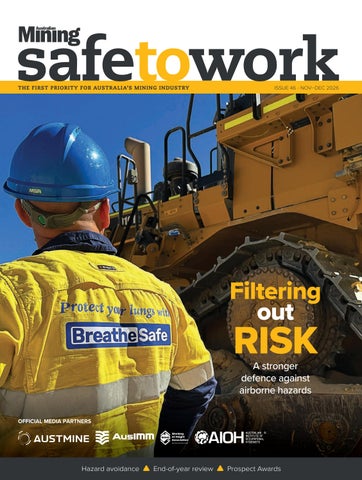
THE FIRST PRIORITY FOR AUSTRALIA’S MINING INDUSTRY
ISSUE 46 - NOV–DEC 2026
2026 | NOV-DEC | ISSUE 46
Filtering out
RISK
SAFETOWORK.COM.AU
A stronger defence against airborne hazards
OFFICIAL MEDIA PARTNERS
Hazard avoidance
End-of-year review
Prospect Awards
Breathe AGILE The world’s first lightweight PAPR with patented AirSensit® technology. Built for movement. Designed for comfort. Engineered to protect everyone on site1.
AS/NZS and ISO loose-fitting certification - No fit testing required ●
●
●
●
●
AirSensit® breath-responsive airflow — adjusts to workload, reducing fatigue all shift Loose-fitting half facepiece — no hoods, belts or hoses. Fits every face, every site1 AGILE Power Unit <425g (excl. facepiece and filter) — light enough to forget, lasts the whole shift Compatible with helmets, eyewear & earmuffs — works with your existing PPE, easy to don and doff Insights Reporting — monitor usage, compliance and filter life across your workforce 1. Refer to certification details for suitability at your site.
PC10269
AS/NZS 17420.2:2021
AS/NZS 17420.2:2021.
Scan for product information & trial
PC4 W2 bL F5
sales@cleanspacetechnology.com | +61 2 8436 4000 CLEANSPACETECHNOLOGY.COM
MK-176AU MCN5017 AUG26 REV2
CMI ProdCert
Comment
Safety, in foresight Prealene Khera
H
From airborne contaminants to dangerous tasks, hazard avoidance starts with identifying where exposure can be eliminated before harm occurs.
MANAGING EDITOR Paul Hayes T: (03) 9690 8766 E: paul.hayes@primecreative.com.au EDITOR Prealene Khera T: (03) 9690 8766 E: prealene.khera@primecreative.com.au
Prealene Khera Editor
JOURNALIST Jackson Haddad E: jackson.haddad@primecreative.com.au CLIENT SUCCESS MANAGER Janine Clements T: (02) 9439 7227 E: janine.clements@primecreative.com.au RESOURCES GROUP LEAD Jonathan Duckett M: 0498 091 027 E: jonathan.duckett@primecreative.com.au
THE FIRST PRIORITY FOR AUSTRALIA’S MINING INDUSTRY
ISSUE 46 - NOV–DEC 2026
Filtering out
RISK
SAFETOWORK.COM.AU
CEO Christine Clancy
for one situation may not suit another. The important thing is to keep asking whether there is a better way to do the job, rather than relying on established practices simply because they are familiar. This edition of Safe to Work will be a handy guide as you navigate the range of hazards facing your workforce, and I hope this edition gives you a few fresh ideas to take back to site and put into practice. Hindsight might make the answer obvious after something goes wrong, but the real achievement is recognising the opportunity beforehand. A little foresight can go a long way, and there is no better outcome than looking back and knowing the right decisions were made before they were needed.
2026 | NOV-DEC | ISSUE 46
indsight can be a wonderful thing … but it can also leave you fraught with ‘what-ifs’. Looking back at a workplace incident, it is often easy to spot where a different decision or an extra precaution might have changed the outcome. The real challenge – or should I say, opportunity – is applying those lessons before something goes wrong. That is the thinking behind hazard avoidance, and it has plenty of applications across mining. Air quality, especially, is one area where the right controls can make a difference long after workers have clocked off. Dust suppression and filtration systems help keep contaminants out of the air, while monitoring and detection give sites a clearer picture of what workers are breathing and where exposure may be occurring. Add respiratory protection to the mix, and you’ve got most of it covered. Elsewhere on site, a rethink of equipment access or maintenance procedures can spare workers an unnecessary brush with danger. Of course, not every hazard can be eliminated, and the controls that work
A stronger defence against airborne hazards
OFFICIAL MEDIA PARTNERS
Hazard avoidance
End-of-year review
Prospect Awards
Front cover:
Founded on the principle of zero harm through zero exposure, BreatheSafe develops customised air pressurisation and purification systems to protect workers from harmful dust and contaminants in challenging environments. Working alongside original equipment manufacturers, mining operators and contractors, the company designs and manufactures high-performance air filtration and cabin pressurisation systems tailored to realworld conditions. It delivers integrated air quality solutions designed to support worker protection. Image: BreatheSafe
BUSINESS DEVELOPMENT MANAGER Jake Niehus M: 0466 929 675 E: jacob.niehus@primecreative.com.au ART DIRECTOR Michelle Weston SUBSCRIPTION RATES Australia (surface mail) $140.00 (incl GST) New Zealand A$148.00 Overseas A$156.00 For subscriptions enquiries please call 03 9690 8766
SAFETOWORK.COM.AU 3 NOV–DEC 2026
PRIME CREATIVE MEDIA 379 Docklands Drive Docklands, VIC 3008 Australia www.primecreative.com.au © Copyright Prime Creative Media, 2016 All rights reserved. No part of the publication may be reproduced or copied in any form or by any means without the written permission of the publisher.
In this issue
Features 8
Driving a safer transition BreatheSafe is creating safer cabins for mobile equipment operators as new exposure limits for airborne contaminants come into effect.
14
A second set of eyes Aptella is reinforcing mine site safety with technology that enables operators to identify potential risks well before they occur.
19
Stepping on the brakes BHP’s Olympic Dam is using Strata Worldwide’s electromagnetic proximity technology to reduce and limit interactions between underground mobile equipment and workers.
14 25
When protection meets the task CleanSpace examines how respiratory protection minimises dust exposure without adding unnecessary complexity for workers.
28
Being sun smart Force360’s HeatWave sunscreen is designed to make sun protection practical, accessible and easy to incorporate into everyday safety routines.
38
Eyeing safety gains Artificial intelligence and advanced automation are giving miners new ways to anticipate hazards, reduce exposure to risk and strengthen safety.
42
42
Year in review As 2026 draws to a close, the industry reflects on the safety advances turning preventative thinking into fewer incidents and safer shifts.
46
The safety foundation At Newmont’s Cadia operations, a commitment to safety, collaboration and inclusion has transformed Australia’s only molybdenum plant into a highperforming operation.
50
Celebrating safety champions The 2026 Australian Mining Prospect Awards celebrated key safety initiatives.
Regulars
3 6
Comment Safety snapshot
25 SAFETOWORK.COM.AU 4 NOV–DEC 2026
BENEFITS Improve Hydration Efficiency Boosts Daily Energy Levels Enhance Mental Clarity Muscle Function & Recovery
Want samples? Contact us here
Safety snapshot
Image: Adobe Firefly/stock.adobe.com
Safety in focus New guidance and operational lessons are helping shape safer work practices across Australia’s mining industry.
R
egulators, mine operators and industry bodies continued to share guidance, data and practical lessons to support safer work practices across the sector over the last few months. Safe to Work rounds up the latest developments and initiatives helping the industry strengthen its approach to risk management.
Safety insights
National work health and safety prosecutions declined to 308 in 2025, down from 321 in 2024, with mining accounting for six per cent of cases recorded by Safe Work Australia. Airborne exposure remained a priority ahead of the December 1 introduction of new Workplace Exposure Limits (WELs), with SafeWork SA encouraging mine operators to prepare for the changes and the NSW Environment Protection Authority updating its air pollutant assessment methods. Safe Work Australia’s 2026 Australian Worker Exposure Survey provided new national data on workers’ exposure to physical, chemical and psychosocial hazards, helping identify areas where prevention efforts may be needed. Psychological wellbeing also received attention during National Safe Work Month and Mental Health Awareness Month, with the Australian
Institute of Health and Safety urging employers to give psychosocial hazards the same priority as physical risks. Resources Safety and Health Queensland (RSHQ) warned of the dangers posed by contraband entering underground coal mines after receiving six reports in five months involving items including vapes, smoking materials, unauthorised watches and mobile phones.
Safety incidents
Ground conditions proved hazardous at an underground New South Wales metals mine, where a forklift rolled into a drain after its front wheel encountered a soft section of haul road shoulder, while an articulated water truck overturned during a U-turn at an open-cut coal mine. Traffic management in focus after a dozer reversed into a haul truck during clean-up work, and an investigation into a separate haul truck and light vehicle collision identified shortcomings in traffic controls and risk assessments. Pre-start inspections and vehicle separation were central to two further alerts, following a haul truck tyre blowout and a near miss in which a light vehicle entered an intersection as a haul truck indicated a right turn. Fire risks emerged underground when hydraulic fluid escaping a load
haul dump machine contacted hot engine parts, while a failed bearing caused a conveyor tail pulley to spark at a coal mine. Uncontrolled energy featured in several serious incidents, including an agitator that shifted during modification work at a NSW opal mine and a pressurised compressed-air pipeline that released air uncontrollably during maintenance at Gregory Crinum coal mine, critically injuring a worker. Maintenance tasks brought further risks when a fitter was injured while changing a die in a hydraulic hose crimping press, an operator was sprayed with hydraulic fluid while installing roof support on a continuous miner, and a worker sustained a serious hand injury from a highpressure grease injection. Moving machinery and inadequate safeguards were central to separate cases involving a worker who injured their hand while clearing build-up from a surface conveyor and Young Mining Company, which was sentenced over a serious chute incident at Thuddungra Mine in 2021. Safe lifting and load security were questioned after four workers spent several hours stranded in a suspended man-basket while removing redundant polypipe from a shaft at an underground NSW metals mine.
SAFETOWORK.COM.AU 6 NOV–DEC 2026
Hazard avoidance
BreatheSafe specialises in cabin air-filtration and pressurisation solutions.
Driving a safer transition BreatheSafe is helping create safer cabins for mobile equipment operators as new exposure limits for airborne contaminants come into effect.
T
he Workplace Exposure Standards (WES) have long provided a simple compliance guideline for companies and operators, but for BreatheSafe, meeting the bare minimum has never been the end goal. Rather than treating a prescribed number as the finish line, the cabin air-filtration specialist’s goal is to help move the mining industry towards zero airborne contaminant exposure, and it believes the transition to the Workplace Exposure Limits (WELs) is an important step towards that objective. Taking effect nationally from December 1, mining operations must be able to identify contaminants present in their workplaces and ensure workers are not exposed above the applicable limits.
With some individual values changing and new contaminants being added to the list, BreatheSafe is using its experience to help operations understand what the transition means for them, review their mobile equipment fleets and address potential gaps before the deadline. “Cleaner cabin air has been a 20– year pursuit for BreatheSafe,” product and technical solutions engineer Jonathon Holmes told Safe to Work. “We are encouraged to see legislation and industry awareness reinforcing what we have understood for decades: airborne contaminants need to be taken seriously and operators require effective, engineered protection.” BreatheSafe has been designing, engineering, installing and refining
cabin air-filtration and pressurisation solutions since 2004, to strengthen operator protection. While dust suppression systems and personal protective equipment remain important parts of the broader approach to WEL compliance, for BreatheSafe, the air inside equipment cabins deserves equal attention. However, Holmes said one of the biggest misconceptions surrounding mobile equipment is that a closed cabin is automatically safe and that fitting a filter solves potential problems. In reality, the cabin working environment can change throughout a shift. Doors open, seals can deteriorate, and heating, ventilation and air conditioning (HVAC) performance varies.
SAFETOWORK.COM.AU 8 NOV–DEC 2026
BreatheSafe has created a WEL guide and mobile equipment cabin review checklist.
Images: BreatheSafe
That means dust can be carried into the space through clothing and footwear, and other airborne contaminants can enter through damaged door and window seals or poorly positioned air intakes, without the operator ever realising. “A cabin can look clean and still contain fine respirable particles that cannot be seen,” Holmes said. “That is why conducting a visual inspection alone is not enough to demonstrate protection.” Holmes said the effectiveness of cabin protection depends on how its individual elements work together, including cabin sealing, fresh-air intake positioning, positive pressure, highefficiency filtration and recirculation, which all work together to create a safe breathing environment. “A filter can only clean the air that actually passes through it,” Holmes said. “If contaminated air bypasses the filter through gaps, leaking seals or an open door, the efficiency printed on the filter label becomes largely irrelevant.” For BreatheSafe, this means mining operations need to consider the cabin as a complete system rather than treating filtration as a standalone control. Monitoring is another important part of that system, indicating whether controls are performing as intended, while alarms can warn operators when protection is compromised. Maintenance also forms part of the puzzle, with filter condition, replacement schedules, commissioning and service records helping operations demonstrate that controls remain effective. As December 1 approaches, Holmes said businesses should not wait for the WELs to take effect before examining their fleets. A proper review can take time, and he said it should involve identifying the contaminants present on site, determining which new limits apply, recognising equipment operating in dusty or diesel-heavy environments
BreatheSafe is committed to strengthening operator protection.
and assessing cabin condition as well as performance. Operations may also need to undertake air monitoring or engage an occupational hygienist to establish exposure levels and verify existing controls. “Starting now gives businesses time to establish a baseline, prioritise the highest-risk machines and make controlled, evidence-based improvements rather than reacting at the last minute,” Holmes said. “Waiting until the transition date risks discovering that equipment, technical support or installation capacity is not immediately available. “It also misses the more important point: operators are working in those cabins today.” To help adjust to the required changes, mining operations can use BreatheSafe’s practical WEL guide and mobile equipment cabin review checklist as a tool to prepare
themselves, with the tool reinforcing the company’s commitment to stronger operator protection. In the wake of the transition, Holmes hopes the industry shifts to make cabin air quality a measurable safety control rather than an assumption based on the presence of a filter. Looking to the future, he believes cabins should be designed with airborne contamination controls from the outset, with effective sealing and filtration, automatic pressure management and real-time monitoring to identify changes in performance. “We want every operator to begin their shift knowing that the air inside their cabin is being continuously protected and that the system’s performance can be demonstrated,” Holmes said. “A filter is important, but protection comes from the performance of the complete cabin system.”
SAFETOWORK.COM.AU 9 NOV–DEC 2026
TOWARDS ZERO HARM COLLISION MANAGEMENT SOLUTIONS
Talk to our team about enhancing your safety portfolio across the site, from in-pit machines to infrastructure & services Learn more and get in touch today
aptella.com Safe To Work Full Page November 2026.indd 1
15/10/2026 11:12:35 AM
12:35 AM
Hazard avoidance
Image: Kings Access/stock.adobe.com
The ability to identify danger represents only one part of a broader safety equation.
The science of staying safe Staying one step ahead of danger is a major priority for operations as mining embraces smarter approaches to hazard identification and prevention.
T
he modern mine site is an environment of constant movement, where heavy machinery, personnel and complex operational processes interact in ways that demand an equally sophisticated approach to workplace safety. This environment contains myriad hazards, some immediately recognisable and others concealed within the very processes that keep an operation running. As the mining industry evolves, so too does its approach to risk management, with hazard avoidance encompassing both protecting workers from dangerous situations and preventing those situations from arising in the first place. Achieving this requires more than recognising the hazards already present. It also involves understanding how working conditions, equipment and operational processes interact to create new risks, and identifying opportunities to address them before they cause harm.
Modern safety technologies have become instrumental in transforming previously difficult-to-detect hazards into actionable information, allowing operators to anticipate danger and intervene before it escalates. This capability continues to grow in relevance as operations introduce new machinery, processes and working environments that challenge conventional approaches to workplace safety. Where hazard identification once relied on physical inspections, worker observations and retrospective investigations, emerging technologies are now helping operators develop a more comprehensive understanding of their surroundings. From proximity detection systems to autonomous equipment and environmental monitoring technologies, modern mines are increasingly equipped with tools capable of identifying hazardous conditions before they develop into potentially serious incidents.
However, the ability to identify danger represents only one part of a much broader safety equation. Understanding how a hazard arises, how it interacts with its surroundings and what measures can effectively prevent it remains equally important. One of the significant challenges facing mine operators is the unpredictable nature of the environments in which they work. A March 2025 WorkSafe WA report examined a collision between a haul truck and a light vehicle in a controlled mining area. The investigation identified gaps in communication, traffic management and the implementation of procedures governing access to the area. The incident showed how effective hazard avoidance relies on more than identifying potential dangers. Clear communication, well-designed traffic management systems and properly implemented procedures all play a role in preventing interactions between heavy equipment and light vehicles.
SAFETOWORK.COM.AU 11 NOV–DEC 2026
It also highlighted the need for comprehensive safety management systems in which hazard identification, risk assessment and control verification operate as interconnected processes rather than isolated responsibilities. This is particularly important because mining activities continually change the physical landscape, whether underground or at the surface. As working conditions evolve, previously established safety controls may no longer adequately address emerging hazards. Vehicle interactions remain a concern, with heavy mobile equipment operating alongside light vehicles and people in environments characterised by restricted visibility, confined spaces and changing traffic conditions. In its guidance on road and traffic management, WorkSafe WA identifies collision avoidance systems, proximitydetection technologies and in-vehicle monitoring as measures that can assist operators in reducing these risks. Such technologies provide additional awareness of surrounding equipment and personnel, extending the information available to operators beyond what they can observe directly. This is particularly relevant for haul trucks and other large machinery, where substantial blind spots can prevent operators from identifying nearby vehicles or workers. While technological awareness is valuable in managing immediate collision risks, other mining hazards develop gradually and can remain undetected for extended periods. Airborne contaminants, particularly respirable crystalline silica, demonstrate the importance of understanding hazards that are not necessarily visible to workers. Generated through activities such as drilling, crushing and material handling, these microscopic particles can enter the lungs and contribute to serious occupational diseases. Unlike an approaching vehicle or an unstable rock face, hazardous concentrations of respirable dust cannot reliably be identified through observation alone.
Image: Michael Evans/stock.adobe.com
Hazard avoidance
Effective hazard avoidance combines awareness of surrounding vehicles with controls that help keep workers safe.
Exposure monitoring therefore provides another means of transforming a difficult-to-detect hazard into measurable information. In July, WorkSafe WA published an updated checklist addressing respirable crystalline silica and other mine dusts, reinforcing the importance of identifying exposure risks and assessing the effectiveness of existing controls. Such measures can inform decisions about ventilation, dust suppression, equipment design and worker exposure, shifting the emphasis from responding to occupational illness towards preventing the conditions that cause it. This preventive approach also creates opportunities for the industry to improve how work is planned and carried out. By combining exposure data with effective engineering controls and ongoing monitoring, operators can make better-informed decisions that support worker health and operational performance. The same preventive philosophy extends to the growing adoption of automation and remote operations. By allowing certain activities to be undertaken without workers physically entering hazardous environments, autonomous and remotely operated technologies can reduce exposure to risks associated with unstable ground, moving machinery and other operational dangers. However, removing workers from one hazard does not necessarily eliminate every associated risk. Another WorkSafe WA report, published in March 2025, described a near miss involving autonomous haul trucks that unexpectedly resumed movement during recovery
operations. The incident highlighted the importance of understanding equipment operating modes, communication systems and the limitations of automated safety controls. Technology must be accompanied by an equally sophisticated understanding of how it behaves under both expected and unexpected circumstances. As these technologies continue to develop, collaboration between mine operators, equipment manufacturers and safety professionals will be important in identifying emerging risks and refining the controls designed to manage them. Sharing knowledge and applying lessons can help the industry build on existing safety practices while making better use of new capabilities. Effective hazard avoidance ultimately requires a safety culture in which information is continuously gathered, questioned and translated into meaningful preventive action. This means looking beyond individual hazards to understand the conditions that allow them to arise, while ensuring safety systems evolve alongside the operations they are designed to protect. In mining, this translates into a distinction between identifying hazards and preventing harm. By combining sound risk management, workforce knowledge and technological innovation, the industry can continue to improve safety outcomes while supporting more productive and sustainable operations. After all, the safest hazard is not necessarily the one a worker can see coming, but the one that never reaches them in the first place.
SAFETOWORK.COM.AU 12 NOV–DEC 2026
Clear Visibility. Smarter Efficiency. Everyone Home Safe.
D ct nte a ti e patial nsig ts
T
t
ti n an e a et M nit ing
i
t t ess t mati n
at
et
i
Dispatch Optimising Fleet Management
a
t ipment ealt
OOD OO S I E
eal i e silica an P isi ili orker e os re racea ili o a e aler s an no i ica ions igi al co liance an a i rea onnec e oni oring across si es Proac i e e os re anage en e er ecisions sa er ork laces
ilica P oni oring
n elligen
on rol
Personnel Tracking
n iron en al ensors
ROTECT OUR EO E
it
IM ROVE O ER TIO S
EMEA
ROVE COM I CE
DRIVE BETTER OUTCOMES
APAC
o
liance
e or ing
www.mstglobal.com
in o
AMERICAS
ore
ASIA
Hazard avoidance
Images: Aptella
Blindsight is a vision safety system that installs on any vehicle or fixed infrastructure.
A second set of eyes Aptella is helping reinforce site safety with technology that enables miners to identify potential risks before they occur.
F
ollowing a bulldozer collision last year at a New South Wales open-cut coal mine, the NSW Resources Regulator put out a series of recommendations to help curb similar incidents. Its safety alert outlined that mine operators should continually review the suitability of collision avoidance technology as it evolves and new products become available. This view has been continually emphasised by automation and positioning specialist Aptella, which believes the technology can serve as an additional safeguard against potential collisions. “We know operators are doing their best and while at times it can be accepted that it’s a dangerous environment, it cannot be accepted that we’re not doing anything about it,” Aptella mining executive manager Andrew Granger told Safe to Work. That is the gap Aptella’s safety portfolio is built to close. The company
approaches the problem from two directions: what happens in the pit and what happens elsewhere on site. For in-pit machinery such as shovels, excavators, dozers, draglines and haul trucks, Aptella distributes the Torsa Collision Avoidance System (CAS), a technology developed with mining conditions
in mind rather than adapted from another industry. Torsa combines an artificial intelligence (AI) camera, light detection and ranging (LiDAR), a global navigation satellite system (GNSS) and vehicle-to-vehicle communication into a single, continuously updated picture of everything moving or standing near a machine.
SAFETOWORK.COM.AU 14 NOV–DEC 2026
Torsa provides a continuously updated picture of everything happening near a machine.
The Torsa system can slow or brake a machine itself if needed.
Aptella said the system provides detection accuracy of plus or minus 10 millimetres for shovel operations. The system is also certified up to Level 9 on the Earth Moving Equipment Safety Round Table (EMESRT) framework, an industry benchmark for vehicle interaction controls. This means Torsa does not stop at warning an operator, according to Aptella. Instead, the system can intervene directly, slowing or braking the machine itself where a verified risk is imminent and the operator has not responded. According to Aptella, Torsa is only the second collision avoidance system in the world to pass independent validation testing for this. The company said the twophase independent process covered simulation testing against strict international response time standards and field testing of real vehicles in scenarios including blind corner crossings, geofenced speed limiting and right of way management at intersections. Torsa’s intelligent risk prioritisation only sends out alerts for genuine, verified threats, filtering out the noise that can lead to alarm fatigue and possible ignored warnings. Aptella product manager Denzil Khan said Torsa’s multi-sensor design is a key differentiator from other technology. “Being able to harmonise such a rich set of data and not tire or frustrate
Blindsight is pre-trained to detect people, vehicles and traffic cones.
the operator with false alarms is key,” Khan said. “When procedures fail, technology should not. “If something is going wrong, you don’t just want to be warned, you want a system that’s already working to protect you.”
Beyond the pit
Not every high-risk interaction involves heavy mobile equipment. Many occur around non-process infrastructure, including workshops, warehouses and wash bays. However, these everyday, lower-speed interactions tend to be overlooked by legacy safety technology, according to Aptella. This is where the company’s Blindsight solution is built to operate. Developed by Presien and distributed by Aptella, Blindsight is an AI-vision safety system that can be installed on any vehicle or fixed infrastructure. Unlike radar, infrared or physical tag-based systems, Blindsight does not need tags, transponders or special markers on the people and objects it is protecting. It is pre-trained to detect people, vehicles and traffic cones, alerting only when a vehicle is in a dangerous configuration and the object is in an active zone. It also captures video before, during and after every detection so teams can understand why a near miss happened, not just that it did. Aptella said that idea is what turns Blindsight
from an alert system into a safety intelligence platform. Its critical index, a lead metric built on near misses per machine danger hour, does not require an accident to have occurred to flag risk. It can also be compared across machine types, sites and companies. What ties Torsa and Blindsight together, according to Aptella, is a shared premise – procedures and communication protocols are necessary but not sufficient. Both systems are engineered controls that remain active continuously rather than relying on a checklist being followed correctly. Both are also designed to work alongside operators rather than replace them. “We’re not trying to replace people, we’re backing them up,” Khan said. “In the moments where things break down, you want a system already working to hold the line.” For Granger, it comes back to something simpler than frameworks and certifications. “Our aim is always to get everyone safely home to their families each night,” he said. “Our technology systems give our customers another set of eyes for people working on the ground and around sites. “That combination of delivering awareness in the pit and awareness across every non-process space around it is what a genuinely proactive approach looks like.”
SAFETOWORK.COM.AU 15 NOV–DEC 2026
Hazard avoidance
The changing face of safety As Australian mine sites are set to face new Workplace Exposure Limits, Mine Site Technology breaks down what this means for operations going forward.
F
numbers in a compliance table. Operations must understand when hazardous conditions arise, who may be affected, what contributed to the event and whether the response was effective. That requires more than a standalone detector – something MST Global, an underground mining technology specialist, is already putting into practice through integrated DPM monitors with its HELIX enterprise software platform. By connecting environmental monitoring, personnel and asset tracking, operational data, alerts and historical reporting, the platform helps close the gaps in safety reporting to keep operations on top of everything that’s going on. This approach, MST Global told Safe to Work, supports more informed, proactive safety practices rather than relying on retrospective analysis. “Traditional occupational hygiene programs remain essential,
particularly where recognised sampling and laboratory analysis are required, but lack real-time insight for in-shift response and correction, transparency of when concentrations increased, who was exposed, and what activity/equipment was utilised,” the company said. “A worker may carry a sampling device throughout a shift before its filter is sent for analysis. “By the time results return, the task has finished, equipment has moved and the personnel involved may be elsewhere. Results establish that exposure occurred, but may not show precisely when concentrations increased, what activity was underway or which control did not perform as expected.”
Two forms of information
MST Global’s monitoring solution generates two complementary data streams. Images: MST Global
rom December, Australian mine sites will transition to new Workplace Exposure Limits (WEL) for airborne contaminants. Once these new WELs are implemented, operators must ensure that no person is exposed to an airborne contaminant above its applicable limit. This means Australia’s approach to airborne contaminants is entering a significant new phase. A significant change for underground mining is a new national exposure limit of 0.01 milligrams per cubic metre (mg/m³) for diesel particulate matter (DPM), measured as elemental carbon. Exposure to diesel engine emissions is associated with serious health impacts. Respirable crystalline silica (RCS) also remains a critical concern. Its exposure level will remain at 0.05 mg/ m³ as an eight-hour time-weighted average when the WEL system begins. For mines, however, preparation cannot be reduced to checking
HELIX provides real-time information that overlays environmental information with the location and movement of personnel.
SAFETOWORK.COM.AU 16 NOV–DEC 2026
The first is a continuous, near-realtime particulate reading. This gives operational and occupational hygiene teams immediate visibility of changing conditions, helping identify peaks and evaluate ventilation, dust suppression and other controls. The second, based on the device itself, is a physical filter sample that can be retained and submitted for laboratory analysis when required. For DPM, the sampling arrangement is designed around NIOSH Method 5040, an internationally recognised method that determines organic and elemental carbon collected on a filter. Elemental carbon is used as the more selective indicator of workplace diesel particulate exposure. “This distinction matters because DPM is particulate matter, not a gas,” MST said. “Conventional gas detectors may measure combustion gases such as carbon monoxide or nitrogen dioxide, but they do not directly measure the elemental-carbon particulate used to assess DPM exposure.” The selected DPM technology combines real-time optical measurement with filter-based sampling and can support respirable, inhalable, thoracic, PM10 and PM2.5 particulate configurations. A similar approach can support silica and respirable dust monitoring, with immediate particulate trend information paired with a filter for gravimetric and crystalline silica analysis, supporting immediacy in ensuring new WELs are met. A concentration reading becomes more valuable when its operational context is known. Through MST Global’s tracking technologies, HELIX provides real-time information that overlays environmental information with the location and movement of personnel, vehicles and other assets, providing greater operational context and making the reading more valuable. With HELIX, mines can investigate a number of factors, such as where the reading occurred, which personnel
The HELIX ecosystem moves exposure management beyond detection, helping mines recognise changing conditions earlier.
entered or moved through the area, and how long they were there. “A DPM increase could therefore be assessed alongside the arrival of a diesel vehicle, changing engine load or restricted ventilation,” MST’s product team said. “A dust increase could be linked to drilling, cutting, crushing, loading or vehicle movement.” HELIX’s mine visualisation provides a geographical view of this information, helping identify exposure hotspots and connect them with personnel and asset movements. Through HELIX Intelligent Control and MST tracking it’s directly monitored and helps operations understand how to respond to incidents. Sites can configure rules according to their risk assessments, operating procedures and occupational hygiene advice. As conditions approach a nominated threshold, HELIX can generate alerts, notify responsible personnel and display the event through operational dashboards. Where compatible field equipment is integrated, the platform can also support responses such as increasing ventilation, activating local controls, restricting access or escalating alarms. This creates a continuous feedback loop: sensors monitor environmental conditions, tracking identifies nearby personnel and assets, HELIX combines and visualises the data, configured rules trigger alerts or operational responses and the event and subsequent actions are recorded.
Complete monitoring
The HELIX system can integrate a number of data points, depending on the selected sensor package, including RCS and respirable dust, DPM and elemental-carbon-related trends, temperature, relative humidity and barometric pressure and gases such as oxygen, carbon monoxide, methane, nitrogen dioxide, hydrogen sulphide and carbon dioxide. “These measurements often require appropriate individual sensors; however the MST DPM solution utilises a selected verified monitor with HELIX, combining diesel particulate indicators, supporting gas channels, and ambient-condition measurements into one monitor,” MST said. HELIX can retain environmental readings, personnel and asset movements, alarm histories and responses according to each mine’s data-retention policies. This allows operations to identify recurring hotspots, compare conditions before and after control changes and investigate events through a connected timeline. It also creates a stronger digital record for reporting, audits and ongoing exposure management. By combining real-time monitoring, filter-based sampling, tracking, intelligent control and long-term reporting, MST Global’s HELIX ecosystem moves exposure management beyond detection, helping mines recognise changing conditions earlier and act before exposure becomes an incident.
SAFETOWORK.COM.AU 17 NOV–DEC 2026
Safety lockout equipment designed and manufactured
• Brand New Design. • Heavy Duty construction. • Can only be locked in the “OFF” position reducing isolation breaches. • Made of forged stainless steel. • Powder Coated for durability and easy identification.
WWW.LOCKSAFE.COM.AU
Hazard avoidance
Stepping on the brakes Olympic Dam is using Strata Worldwide’s electromagnetic proximity technology to reduce interactions between underground mobile equipment and workers.
Strata’s HazardAVERT system has been installed on around 800 underground vehicles at Olympic Dam.
C
ompared to working on the surface, operating mobile equipment underground is an entirely different challenge. Solid rock walls, blind corners and confined workings can make it difficult for operators to see what or who is approaching, increasing the risk of interactions between mobile equipment and workers. BHP has been working proactively to address this challenge at Olympic Dam in South Australia, with assistance from safety technology provider Strata Worldwide. Following a three-year implementation project, the mining giant rolled out a major deployment of Strata’s HazardAVERT electromagnetic proximity detection system (PDS) and collision avoidance system (CAS) at the mine, with around 800 underground vehicles now equipped with the technology.
Strata Worldwide Asia-Pacific managing director Tony Napier said the installation of HazardAVERT has made a significant difference to the mine’s operations. “We’re seeing a significant reduction in the number of mobile equipment and worker interactions,” Napier told Safe to Work. “It has also become a very useful tool for Olympic Dam to educate their workers about the importance of maintaining safe distance and slowing down.” Essentially, HazardAVERT uses electromagnetic technology to detect and alert operators of tagged workers, vehicles and other assets in the proximity, without relying on line-of-sight. This is particularly useful underground, where obstructions can limit or block an operator’s view of potential hazards.
For Olympic Dam, the system was configured around the site’s specific risk profile, with vehicle-to-vehicle interactions a key focus. A 30m detection distance was selected to give operators time to respond to an alert and create separation from the hazard. The system was also configured to provide operators with more insightful information about an interaction. Rather than simply triggering an alarm, it can identify the vehicle involved. Napier said this allows operators to communicate with each other when a vehicle has entered the proximity zone, reducing the chance of a potential collision. “In this project, it was important to ensure the operator wasn’t bombarded with a plethora of information that may have overwhelmed them,” Napier said.
SAFETOWORK.COM.AU 19 NOV–DEC 2026
“With BHP’s input, the system focused on providing the basics needed to quickly respond to alert and they’re very satisfied with its performance.” All HazardAVERT deployments at Olympic Dam satisfy level seven requirements of the Earth Moving Equipment Safety Round Table (EMESRT). This means the technology provides audible and visual alarms to increase the operator’s awareness of a potential hazard. The technology can also be configured for level nine EMESRT requirement, where the system can automatically intervene to slow or stop a machine when an operator has not responded to an alert. A key reason Olympic Dam landed on HazardAVERT, according to Napier, was the repeatability and reliability of the system. Napier said this comes down to the electromagnetic technology, which produces a predictable signal that can travel through different underground environments, unlike radio frequency signals that can bounce off walls and other surfaces. “We don’t claim HazardAVERT to be the flashiest or the newest system on the market,” Napier said. “However, what we do push is that it is the most
HazardAVERT can be installed on any size, make or model of vehicle.
Images: Strata Worldwide
Hazard avoidance The HazardAVERT display screen provides audible and visual warnings.
repeatable and reliable system on the market.” Its reliability was tested during the original proof-of-concept trial, where Olympic Dam selected the Strata technology after a demonstration proved that HazardAVERT performed consistently and could be installed, commissioned and tested within one day. The system has also provided Olympic Dam with information beyond the immediate alert. Interactions are recorded and stored on a server, allowing the mine to track trends
and identify changes in operator behaviour. Napier said this has created another layer of safety awareness. Beyond the technology, Napier said an important consideration for Olympic Dam was helping their workers understand why the system was being introduced and how it could be used to improve safety. “The technology is intended to reduce the risk of interactions, but in Olympic Dam’s view, the training and education was equally important,” Napier said. “Since then, they have done an exceptional job of using the system to create a safer environment for their workforce.” HazardAVERT is just one part of Strata’s safety solutions portfolio, which includes communication networks, monitoring systems and refuge chambers. At a mine in Queensland, Strata will soon deploy its condition monitoring solution into approximately 25 of its refuge chambers, allowing the safety department to monitor critical safety levels in real time. It also demonstrates Strata’s focus on building greater integration between its products. “We’re aiming to get better integration between our safety technologies as opposed to being individual products,” Napier said.
SAFETOWORK.COM.AU 20 NOV–DEC 2026
Hazard avoidance
Keeping hazards at arm’s length Nivek Industries is designing maintenance equipment that allows operators to control hazardous tasks from a safer position.
T
he safest place to be during a maintenance task is often well away from the load. Nivek Industries has built that principle into the way heavy load maintenance tasks are carried out, giving operators greater distance from the potential hazards they’re working with. Heavy vehicle maintenance routinely brings people into close contact with large, cumbersome components. Access can be restricted, the ground may be uneven, and equipment can obstruct the worker’s view. When controls are fixed on the machine, the operator may have little choice over where they stand as the
component is supported, lowered or moved. Nivek Industries has made operator position a central consideration in its equipment design. For the company, remote operation is not about handing decision-making to the machine. Instead, it’s allowing the person controlling the task to move away from an immediate hazard while continuing to assess the load and surrounding work area. Nivek Industries marketing coordinator and work health and safety officer Rosey Holland said a safer operating position depended on the task and conditions rather than a predetermined distance.
Nivek Industries has made operator position a central consideration in its equipment design.
“A ‘safer place’ is not always one specific spot,” she said. “It is wherever the operator can get better separation from moving equipment, heavy suspended loads, pinch points and other line-of-fire hazards, while still having clear visibility and full control of the task.
Feedback from operator and maintenance teams plays an important role in Nivek’s product development.
SAFETOWORK.COM.AU 22 NOV–DEC 2026
“We are not trying to replace the experience and judgement of the operator. We are trying to give them a better position to use that experience from”
Images: Nivek
– Nivek Industries marketing coordinator and work health and safety officer Rosey Holland
“Sometimes that simply means being able to take a few steps back. Other times it means moving to a completely different position where the operator has a better view of what is happening around them.” Belly-guard removal traditionally requires operators to work in close proximity to these large, heavy components as they are being removed. Mud and other material accumulated on the guard can add weight, making its balance harder to judge during removal. Traditional approaches have involved chains and lifting equipment, with workers positioned close to the guard while it is lowered and moved. Offering a different alternative, Nivek’s Tracked Elevating Device (TED) uses a low-profile tracked base and a scissor lift to support the guard while the operator controls its movement remotely. The worker can step back from the belly guard and choose a position that provides a clearer view of the load, its clearances and activity in the surrounding area. If the conditions change, the operator can reposition without surrendering control of the machine. TED has an 800kg safe working load and can travel beneath
dozers, graders and dump trucks where access is limited. Its attachments are designed to cradle different components, so the load remains supported through removal, transport and replacement. Load-lock valves, emergency stops and a deadman switch on the remote are incorporated into the machine to enhance operator safety and reduce the risk of uncontrolled movement during operation. “It is not just about distance for the sake of distance. It is about giving the operator a better overall view of the task and more freedom to respond to the environment around them,” Holland said. While TED is remotely operated, it is not an autonomous machine. The operator maintains full control of the equipment, determining how and when the load moves, while continuously monitoring the operation and responding to changing conditions. “We are not trying to replace the experience and judgement of the operator. We are trying to give them a better position to use that experience from,” Holland said. “The operator stays in control. We just give them more freedom to choose where that control happens.” Nivek applies the same taskled thinking to risks that are better addressed through mechanical support than remote operation. Its LA40 and LA80 articulated liftassist arms support heavy tooling, including HYTORC equipment, reducing the physical load placed on maintenance workers.
The LA80 extends the concept to tools and components weighing up to 80kg. Independent actuators and multiple articulation points allow the supported item to be positioned, while a universal mounting point accepts purpose-built cradles and tool holders. Supporting that weight mechanically reduces the need for workers to hold or manoeuvre a heavy tool while trying to position it accurately. The operator can instead concentrate on alignment and completing the maintenance task. Remote operation creates separation from a moving load, while lift assistance reduces physical strain. Both address specific hazards encountered during maintenance tasks, with solutions developed around the practical challenges operators face in the field. This is why operator and maintenance-team feedback plays such an important role in Nivek’s product development. The people performing the work understand where access becomes awkward, or visibility is compromised. Their experience can also reveal tasks that have remained unchanged despite unnecessarily placing workers close to hazards. “You can design something on paper, but the reality of how a maintenance task is carried out on site can be very different,” Holland said. “A lot of it comes back to asking, ‘why are we still doing it this way?’ and seeing whether the equipment can take some of that exposure out of the job.”
SAFETOWORK.COM.AU 23 NOV–DEC 2026
STRATA DELIVERS CONNECTED SAFETY Turning real-time data into actionable insights.
STRATAPROTECT™ Technologies for accident prevention, increased awareness and emergency preparedness.
STRATACONNECT™ Reliable underground networking that connects people, equipment, systems and operations
Strata’s integrated technologies help mining operations reduce risk, maintain reliable communications, track assets, and monitor underground conditions in real time. By connecting people, equipment, and critical systems, Strata delivers greater visibility and control to strengthen safety and improve operational productivity.
INTEGRATED UNDERGROUND TECHNOLOGIES FOR WORKER SAFETY AND OPERATIONAL CONNECTIVITY
VOICE & DATA COMMUNICATIONS
PERSONNEL & ASSET TRACKING
REFUGE CHAMBERS
ENVIRONMENTAL MONITORING
Tel: +61 1 300 054 469 • info.au@strataworldwide.com
Strata-AUS-Safe-to-Work-Ad-full-page.indd 1
PROXIMITY DETECTION
OPERATIONAL INSIGHTS
www.strataworldwide.com
10/13/26 3:16 PM
6 3:16 PM
Hazard avoidance
When protection meets the task CleanSpace is examining how respiratory protection minimises dust exposure without adding unnecessary complexity for workers operating at height or maintaining mining equipment.
An On Ropes technician wore CleanSpace AGILE while demonstrating rope-access equipment at New Zealand’s National Safety Show.
external hose, belt-mounted blower and separate battery pack associated with conventional PAPR arrangements. For people working at height, the absence of an external hose removes one potential snag point. It also leaves the waist clearer for a harness and tools, while reducing the number of components a worker must manage when moving between levels or through steelwork.
Images: CleanSpace and OnRopes
W
hen working at heights, a loose hose is at best an inconvenience and at worst, a serious hazard. Around scaffolding, ladders and processing equipment, anything that catches, shifts or demands a worker’s attention can become part of the hazard. Which means the consideration when purchasing a powered airpurifying respirator (PAPR) is not just about handling airborne contaminants but also about whether its design meets the task being performed. In mining, that balance is evident as maintenance workers spend their days climbing, entering restricted areas or reaching around complex plant while already managing a hard hat, eye and hearing protection, gloves and a harness. Adding a hood, hose and waist-mounted blower, like those attached to traditional PAPRs, could introduce another cumbersome piece of equipment for workers. CleanSpace global technical product director Jon Imms said respiratory protection should work with the wearer rather than become another complication. “With what we do, the bottom line is protection, and good compliance leads to protection,” Imms said. CleanSpace PAPRs use a compact power unit positioned around the wearer’s neck. This removes the
“If someone is climbing or working around plant, they already have enough to think about,” Imms said. “The respirator is required to provide certified protection, but it should also let that person move and concentrate on the job in front of them.” Some conventional PAPR hoods and headtops can affect peripheral vision, depending on
SAFETOWORK.COM.AU 25 NOV–DEC 2026
Hazard avoidance their configuration. The effect becomes more significant when a worker is judging ladder placement, navigating a platform or monitoring movement around machinery. With the introduction of AGILE, its first loose-fitting PAPR, CleanSpace has expanded its innovative neckmounted respirator range. The unit is certified to AS/NZS 17420.2:2021 and uses a transparent
half facepiece that sits over the nose and mouth. It is compatible with helmets, protective eyewear and earmuffs. Its transparent half facepiece also supports face-to-face communication, an operational consideration for maintenance teams coordinating work in noisy or complex environments. “Comfort is important for any user,” Imms said.
The demonstration showed how the PAPR integrates with working-at-height equipment without an external hose or a belt-mounted blower.
“Workers need to be able to wear their respiratory protection for the task, communicate with the people around them and use the other PPE the job requires.” AGILE pairs this with CleanSpace’s belt-free, hose-free design. The power unit and filter sit around the neck, leaving nothing at the waist to compete with a harness, lanyards or tool belt. That matters when a worker is clipping on, moving between anchor points or working on rope, where every extra component is something else to check, adjust or keep clear of the system. The configuration was demonstrated at New Zealand’s National Safety Show, where Auckland rope-access contractor On Ropes had one of its technicians wear AGILE while presenting working-at-height equipment. With the technician’s harness and rope system in place, the absence of an external hose and belt-mounted components showed how the respirator could fit around the equipment already required for the task. AGILE’s power unit weighs less than 425g, excluding the half facepiece and filter. Patented AirSensit technology adjusts airflow to the wearer’s breathing, which helps reduce fatigue over a full shift. The AGILE particulate filter provides 99.99 per cent filtration efficiency, and the battery runs for up to seven hours. Through Insights Reporting, sites can also monitor usage, compliance and filter life across their workforce. A worker may move between access points and different items of plant during the same shift. A compact configuration can reduce the need to reposition equipment as the location changes, while keeping respiratory protection available. “When maintenance or an unplanned intervention is required, that worker may be entering one of the most demanding parts of the job,” Imms said. “Their respiratory protection needs to be ready for that reality.”
SAFETOWORK.COM.AU 26 NOV–DEC 2026
AIMEX RELAUNCHED GET INVOLVED, EXHIBIT NOW
MINING A SMARTER FUTURE
Hazard avoidance
Being sun smart Force360’s HeatWave SPF 50-plus sunscreen is designed to make sun protection practical, accessible and easy to incorporate into everyday safety routines.
S
lip, slop, slap. For countless Australians, the familiar threeword reminder has been synonymous with beach days, swimming pools and summer holidays. While the message may be less obvious on a mine site, its significance is equally important to its workers. The challenge is ensuring that sunscreen is correctly applied throughout a shift. If it does not feel hot on site, it can be easy for workers to forget to protect themselves from the sun. However, heat and ultraviolet (UV) radiation present two completely different risks, and a cloudy or cooler day does not remove the potential for harmful exposure.
That is why, according to personal protective equipment (PPE) provider Force360, its HeatWave sunscreen range should be treated as an essential safety product for mining workers spending long periods outdoors. Force360 national category manager for wellness Danielle Allen said workers can experience significant UV exposure during long shifts, even when moving between outdoor and indoor tasks. Limited shade and reflective surfaces such as metal and concrete can add to the challenge, according to Allen, particularly for workers who may spend extended periods
outside mobile plant cabins or in exposed areas. “When UV exposure is part of the job, it needs to be managed as a workplace safety risk,” Allen told Safe to Work. “Mining companies can reduce that risk by providing shade and protective clothing, but most of all, making sunscreen readily available.” The HeatWave sunscreen range offers sun protection factor (SPF) 50-plus broad-spectrum UVA and UVB protection across several formats, including 1L and 500mL pump bottles, a 250mL flip-top lotion, 50mL carabiner bottle, 250mL spray and a lip balm.
Images: Force360
Force360’s HeatWave sunscreen range offers SPF 50-plus broad-spectrum UVA and UVB protection across several formats.
SAFETOWORK.COM.AU 28 NOV–DEC 2026
However, Allen said that there may be practical barriers that make consistent sunscreen use difficult on mine sites. Workers may leave sunscreen behind, have no convenient supply near their work area or struggle to find a suitable moment to reapply it during tightly scheduled tasks and PPE changes. Some may also avoid products they find greasy or uncomfortable in hot, dusty environments. Allen said the HeatWave range – made locally, and compliant with the joint Australian and New Zealand sunscreen standards – aims to address some of these issues. “HeatWave’s light, non-greasy lotion, shared pump bottles and portable sizes give companies ways to make sunscreen both more comfortable and easier to access,” Allen said. “This is important because a product that workers are willing to use consistently is much more useful than one left in a cupboard. “Placing it at sign-on points and break areas, and building reapplication into the workday, can help reinforce consistent use.” The range is also dermatologically tested, and the formulas contain aloe vera and vitamin E, making the products suitable for workers with sensitive skin and for prolonged use during long shifts. HeatWave is designed with workplace requirements in mind, combining high-level UV protection with practical formats that support regular use across demanding work environments. “HeatWave’s SPF 50-plus broadspectrum protection and the lotion’s four-hour water resistance make the range particularly relevant to outdoor work, provided workers follow the application directions and use sunscreen alongside other appropriate sun protection measures,” Allen said. One of the biggest misconceptions around sunscreen use on mine sites, according to Allen, is that a single
The HeatWave range complies with AS/NZS 2604 standards.
application of a high SPF or a four-hour water resistance sunscreen will last the entire shift. Instead, Allen recommends applying sunscreen generously before exposure and reapplying it every two hours, or sooner after heavy sweating. Allen believes the effectiveness of the HeatWave range also depends on the workforce’s willingness to use it. To encourage consistent sunscreen use, Allen suggests that mining operations incorporate pre-start sun safety messages, instructions on how much sunscreen to apply, scheduled opportunities for reapplication and
up-to-date UV Index information. Adequate breaks also provide workers with an opportunity to hydrate and reapply sunscreen. Supervisors can help by keeping supplies stocked and incorporating sunscreen into broader site UV safety controls. Allen said Force360’s approach to UV protection is not about relying on sunscreen alone but making it a practical part of a mine’s broader safety system. That means the slip, slop, slap message needs to extend beyond the traditional environments and into mining sites.
SAFETOWORK.COM.AU 29 NOV–DEC 2026
Hazard avoidance
A live read on exposure
Images: Becker Mining
Becker Mining Australia’s real-time diesel particulate and silica monitoring can help mines investigate changing conditions and assess their controls.
Becker Mining Australia’s DPM50 and D53s provide real-time indications of diesel particulate matter and respirable crystalline silica conditions.
A
dvances in technology are giving mining teams more opportunities to identify changing conditions and respond before problems escalate. For mining teams managing diesel emissions and silica-bearing dust, knowing what happened during a shift is only part of the picture. Becker Mining Australia’s lead technology sales, Chris McCabe, wants sites to see changing conditions while there is still time to investigate. Take established occupationalhygiene sampling. It remains essential for assessing worker exposure, but its results may only become available after a sample has been collected and analysed. By then, reconstructing the circumstances surrounding an elevated result can be difficult. McCabe said this delay shaped the development of Becker’s DPM50 diesel particulate matter (DPM) monitor and D53s dust and respirable crystalline silica (RCS) monitor, which help address that information gap.
“Laboratory-based personal sampling provides retrospective results. You may only find out three or four days later whether someone was exposed,” he told Safe to Work. “Then you have to go back and ask what the ventilation was doing, what equipment was operating and what the person was doing at the time. “Our monitors are built to change that.” The two monitors are designed to add continuous area information between established exposuremonitoring activities, including local indications and transmit readings to site systems, allowing changing conditions to be investigated as they occur. “What we want to give sites is information they can use while the work is happening,” McCabe said. “If conditions change, they can investigate what equipment is operating, what the ventilation is doing and whether their controls need attention.
“It also gives them a record to review after the shift.” McCabe said this was not a substitute for personal monitoring or an occupational hygienist’s assessment, but it provided additional insights that can help link an airborne event to activity in the area. The DPM50 focuses on DPM using elemental carbon as its principal practical indicator. It combines particulate measurements with supporting combustion-related gas and environmental data to identify the signature of diesel emissions. The D53s applies a similar multisensor approach to respirable crystalline silica. Particulate fractions, optical information, gas profiles and environmental conditions are assessed together to differentiate likely silica-bearing dust from other airborne sources. McCabe said bringing those inputs together was necessary because neither hazard could be understood reliably from a basic dust reading alone.
SAFETOWORK.COM.AU 30 NOV–DEC 2026
“Silica dust and DPM are not like a gas where the answer is simply yes or no,” he said. “Several components make up the signature, so the system analyses those readings together and puts the result into a form the site can use.” Both units use embedded artificial intelligence and machine learning to analyse sensor inputs locally. Readings are logged every four seconds, giving teams a clear timeline to compare with equipment activity and changes to ventilation or dust suppression. McCabe said that history helps teams investigate brief or repeated events alongside equipment movements and operating decisions. Local screens, coloured LED indicators and audible alarms provide information near the work area, with thresholds configurable to site response procedures. The compact IP65-rated units, 3.24kg, 300mm, support RS485 and Modbus integration with site systems. Ethernet, power over Ethernet and gateway access depend on the selected configuration. McCabe said the compact format had enabled Becker to support more
than just permanent underground installations, such as major infrastructure projects in South Australia, where temporary work areas can contain both cut rock and diesel-powered equipment. He said the format also opens up applications in temporary work areas and smaller operations, including tunnelling where diesel equipment and rock-cutting activities operate nearby. “Previously, real-time monitors could involve a large cabinet and a more complex installation,” he said. “A compact monitor makes the technology more accessible for a temporary tunnel project or a smaller operation that does not have a full supervisory control and data acquisition (SCADA) system.” Becker Mining Australia supplies and integrates the monitors into site infrastructure. McCabe said this includes compatible existing SCADA systems, or Becker’s SmartFlow platform for viewing monitor locations, readings, alarms and trends. He said SmartFlow was a way to turn streams of site data into a more navigable operational view.
“The data may already be available through SCADA, but SmartFlow visualises where the monitor is in the mine,” McCabe said. “A user can select that location, see the readings and then move to the next monitor. It helps them find and investigate a change more quickly.” The same architecture supports Becker’s S53 early smoke and fire monitor, which assesses changes associated with overheating or smouldering around conveyors, stockpiles and plant infrastructure. McCabe said the value of the DPM50 and D53s lies in linking measurement to action. He explained that while a reading does not control the hazard by itself, it can indicate when to investigate and provide evidence on whether a mine’s response has worked across shifts and from one task to another. “It gives sites feedback on whether their current methods for reducing silica dust or DPM are actually working,” he said. “They can adjust ventilation, review the amount of diesel equipment in an area and see what happens to the conditions in real time.”
Local status indicators and remote data access enable investigation of changing airborne conditions while work is underway.
SAFETOWORK.COM.AU 31 NOV–DEC 2026
TAP PNG
into
Turn connections into business
26-27 May 2027
The Sheraton Port Moresby Stanley Hotel & Suites
BOOK YOUR STAND!
Hazard avoidance
Beyond the mask
Respiratory protective equipment is a vital safety tool.
As Australia prepares to introduce new Workplace Exposure Limits, a connected respiratory system can support equipment tracking, inspection records and emergency readiness.
Images: Industree
D
ust, fumes, gases, vapours, and mists are byproducts of many tasks in mining, industrial and construction industries, making effective personal protective equipment (PPE) a vital part of daily operations. However, there is also a need to identify hazards, assess exposures and apply the hierarchy of controls. This obligation is taking on a renewed significance as Australian workplaces prepare for the transition to Workplace Exposure Limits (WEL) on December 1. The change is intended to make clear that the listed exposure levels must not be exceeded. Respiratory protective equipment (RPE) can form an important part of that response where exposure cannot be adequately controlled through higher-order measures, but its effectiveness depends on whether the equipment is suitable for the hazard, correctly used and kept in good working order. This creates an assurance challenge for companies managing large workforces, multiple sites and inventories of safety equipment, which involves the question: once a respirator has been issued, how readily can the operation establish that it has been inspected, maintained and remains ready for use? TRIDENT, Industree Group’s hazard-protection brand, is seeking
to address this question through a new digital integration across its HEXHALE powered air-purifying respirator (PAPR) helmet range and the new ZENYTH all-in-one PAPR. These systems incorporate nearfield communication technology from Swedish safety technology company Twiceme Technology, linking each unit with digital safety and equipment information that can be accessed using a smartphone. Twiceme chief executive officer (CEO) Christian Connolly said the pairing brings the platform into a critical category of industrial PPE. “Partnering with Industree Group and the TRIDENT brand enables wider adoption of the Twiceme digital safety standard by bringing our technology to one of the most important categories of jobsite PPE,” Connolly said.
“PAPR systems are critical for protecting workers from dangerous airborne hazards, and integrating Twiceme helps ensure important safety information is always accessible while supporting safety teams with inventory and inspection management.” In the eyes of safety teams, the integration is designed to provide greater visibility over the condition and administration of their PAPR fleet. Scans and maintenance findings can be logged against a respirator’s digital record, creating an inspection history that follows the unit. Worker certifications and training documents can also be stored through the Twiceme app, helping site teams retrieve relevant information without relying on a separate paper trail.
SAFETOWORK.COM.AU 33 NOV–DEC 2026
Hazard avoidance At a fleet level, the Twiceme Safety Management Portal provides a central view of inventory and inspection information recorded in the field. It can show equipment status and issue reminders when units are due for replacement, helping turn routine PPE checks into a more visible and traceable process. This level of visibility reinforces the notion that respiratory protection is not a set-and-forget control, and that filters, components and complete units may require inspection, cleaning, maintenance or replacement, while workers need appropriate instruction and training. Depending on the RPE being used, fit testing may also be required. These digital capabilities can strengthen the management of respiratory protective equipment, helping organisations maintain oversight of the equipment and supporting information workers rely on in the field. It is important to distinguish this role from the broader task of controlling respiratory hazards. The technology does not assess airborne exposure, determine whether a respirator is suitable for a specific contaminant, or demonstrate compliance with an exposure limit. Nor does it replace controls that address a hazard at its source.
These systems incorporate nearfield communication technology, linking each unit to digital safety and equipment information.
Rather, it is designed to support the administration and assurance surrounding PPE once respiratory protection has been selected as part of a wider control strategy. The PAPR systems combine powered filtered airflow with integrated head and face protection for demanding industrial environments, and the near-field communication integration adds a second function for emergency response. Workers can choose to store information such as medical conditions, allergies, medications and emergency contacts. In the event of an incident, a first responder can tap the Twiceme symbol on the helmet with a smartphone to access the selected information, even without having the Twiceme app installed.
Effective PPE plays a vital role in daily operations.
Industree Group CEO Jon Fleming said the integration connects physical protection with greater preparedness in the field. “Our Twiceme-integrated PAPR systems are designed to support professionals working in challenging field environments,” Fleming said. “By incorporating Twiceme technology, we’re combining physical protection with digital preparedness, providing employers and workers with another powerful tool to enhance emergency response and overall workforce safety.” For mine operators reviewing respiratory-protection strategies ahead of the WEL transition, connected PAPR systems offer a way to strengthen the management of this final layer of protection. By improving visibility of equipment condition, maintenance and inspection records, they can help ensure respirators remain ready for use as part of a wider respiratory riskmanagement program. Engineering controls, isolation, ventilation and other higher-order measures remain central to controlling airborne contaminants. Where RPE is also required, digital records can help close the gap between a control described in a safety system and the condition of the equipment being worn in the field. In respiratory hazard management, issuing the equipment is only the beginning. Knowing that it is suitable, maintained and ready when a worker needs it is what turns PPE from an inventory item into a dependable part of the control framework.
SAFETOWORK.COM.AU 34 NOV–DEC 2026
HUNTER VALLEY MINING EXPO
Be there from the beginning
Register for the inaugural Hunter Valley Mining Expo
REGISTER
FOR FREE
Brought to you by the organisers of
Newcastle Entertainment Centre, Broadmeadow, NSW 19-20 May 2027
Hazard avoidance
Safety in isolation Backed by more than two decades of industry experience, LockSafe is helping improve safety compliance through practical lockout and isolation solutions.
E
ffective isolation is a critical step in preventing stored energy being released during minesite maintenance activities. Lockout equipment is designed to ensure machinery, electrical systems and other energy sources remain safely deactivated while work is undertaken. LockSafe has developed a new isolation bracket, the LS11068, that is designed to address the ability for a switch to be secured without being fully isolated, a common issue identified with existing lockout methods. The Australian-engineered solution reflects decades of practical experience in the mining, earthmoving, heavy transport and marine industries.
LockSafe designs and manufactures lockable isolation products for fixed and mobile equipment. The company’s in-house design and manufacturing capability allows it to develop solutions around specific requirements, including custom designs and small-batch production. It also provides supporting services such as on-site audits and energy isolation system development, with products used by customers including Rio Tinto, BHP, Glencore, Fortescue, Hitachi and Komatsu. LockSafe manager Bruce May told Safe to Work the new bracket was developed after feedback from mine sites highlighted vulnerabilities in existing designs.
“The problem we found with some of the brackets on the market is that they allowed the switch to move slightly even when it appeared to be locked out,” May said. “The switch could still activate because it did not need to be fully on or fully off for current to flow, which defeats the purpose of the isolation.” Representing what the company describes as a significant advancement in lockout safety, the LS11068 isolation bracket is designed to secure electrical components used in vehicles, machinery and industrial systems. It locks a switch securely in place while allowing the bracket to be installed without removing connected cables or equipment.
Images: LockSafe
LockSafe’s new LS11068 isolation bracket can help reduce the risk of equipment appearing to be isolated when it is not.
SAFETOWORK.COM.AU 36 NOV–DEC 2026
The bracket is engineered to withstand harsh industrial environments.
Clear visual identification is provided in the field through its high-visibility finish.
Forged from stainless steel and featuring a powder-coated finish, the bracket is engineered to withstand harsh industrial environments while providing clear visual identification in the field through its high-visibility finish. “Our brackets are built to last the lifetime of the vehicle,” May said. “The switches themselves will generally fail before the brackets do, and we rarely see warranty issues with the products because they are designed for those conditions. “It removes those extra steps where someone can lift the bracket, turn the switch off, close it and then lock it out. With this design, it is simply turn it off and lock it out.” While a seemingly simple design innovation, LockSafe’s isolation bracket represents what May described as an “alarming” gap in the market. “We found that some of the existing lockout brackets could still allow the switch to activate,” he said. “You could have a padlock on there, but if the switch could still move enough to allow current to flow, then you have not actually isolated the equipment.” The change also aims to address more person-centred challenges that can occur during isolation procedures, where shortcuts or misunderstandings can compromise safety. “A lot of the issues we see come down to human behaviour,” May said. “The isolation process is there for a reason. The first step is turning the
equipment off and then locking it out, and this bracket ensures that is the only way it can happen.” By preventing the switch from moving while locked out, the bracket is designed to reduce the risk of equipment appearing to be safely isolated when it is not. “With a dump truck, for example, you cannot always tell if someone is working on that vehicle because the machines are so large,” May said. “If someone gets into the cab and tries to start it while another person
is in the engine bay or underneath the machine, the outcome can be catastrophic.” Feedback from mining customers has been positive, with the new bracket also delivering practical benefits beyond its primary safety function. May believes the bracket reflects LockSafe’s focus on developing practical solutions that address realworld challenges. “Our motto is simple: ‘Think safe, Work safe, LockSafe’,” May said. “Our team live and breathe this and our solutions solve these problems, not just making workplaces safer but encouraging, and pushing for a greater culture of compliance and accountability.” By combining practical engineering with decades of industry knowledge, the LS11068 isolation bracket has been designed to make correct isolation procedures easier to follow. In doing so, LockSafe aims to help mining operations strengthen workplace safety and long-term compliance across their sites.
The product was developed with feedback from mine sites.
SAFETOWORK.COM.AU 37 NOV–DEC 2026
Industry insight
Image: Mishainik/stock.adobe.com
Artificial intelligence and next-generation automation are helping set new standards for safety.
Eyeing safety gains Image: Accenture
Artificial intelligence and advanced automation are giving mining companies new ways to anticipate hazards, reduce exposure to risk and strengthen safety across operations. By Accenture ANZ managing director and mining and metals lead APAC Eric Croeser
M
ining has always been complex, physically demanding, and essential to Australia’s economy. The sector operates in remote regions, extreme environments and at a significant scale. Over the past two decades, safety has improved markedly through the combination of both behaviour-based safety initiatives and the successful application of automation and robotics – yet serious incidents still occur, and risks remain inherent. As the challenge to access more remote and complex ore bodies increases and mining operations evolve, our approaches to safety
should evolve as well, with artificial intelligence (AI) and next-generation automation helping set new standards for safety. Rather than being reactive to events, these technologies enable mining companies to better anticipate hazards, model, simulate and evaluate risk and make decisions with real-time insights, minimising the exposure of people to risky situations. The most direct way to improve safety is to reduce risk exposure, something automation is already helping to solve. With automation commonplace across mining – autonomous haulage systems, dozing operations,
Accenture ANZ managing director and mining and metals lead APAC Eric Croeser.
drilling and underground tele-remote handling – enabled by remote operation centres, talent in these areas is being attracted to the industry more than ever before to help work across leading-edge technologies. This shift has clear safety benefits. Fewer people in high-risk areas means lower exposure to vehicle
SAFETOWORK.COM.AU 38 NOV–DEC 2026
From reactive to predictive safety
Traditional safety systems have often been reactive: an incident occurs, it is investigated, controls are strengthened. AI, however, enables a move towards data-driven, predictive safety. By integrating data from various sources – equipment sensors, maintenance systems, environmental monitors and workforce inputs – operators can identify leading indicators of risk before an incident takes place. Machine learning (ML) models can analyse equipment data, such as temperature and maintenance logs, to predict failure, and the introduction of AI agents allows for the continuous analysis and rapid evaluation of risk processes. Instead of waiting for a catastrophic breakdown that could endanger workers, maintenance can be scheduled proactively. According to Accenture’s research on AI across asset-intensive industries, connecting operational technology with enterprise systems can significantly improve safety and performance outcomes. Accenture has also found companies that scale AI across core operations can improve operational resilience, reduce unplanned downtime and strengthen compliance performance.
Advancing real-time hazard detection
Whilst computer vision is not new, the change has been seen in the capability and reliability of AI-powered perception systems now being deployed in mining environments. Earlier vision systems relied on fixed rules and struggled in variable conditions. Today’s deep learning
models are trained on large datasets and can adapt to changing light, dust, terrain and movement. Now, cameras installed on heavy equipment and across sites can be paired with AI models that identify unsafe actions in real time. These systems can detect when a person enters an exclusion zone, when personal protective equipment is missing, or when ground conditions are shifting in ways that increase risk. The shift is from basic monitoring to intelligent, context-aware safety support where human supervision remains central. The challenge is how an abundance of data can be used to support judgement. As mining becomes more digitised, new risks emerge as cybersecurity is now intertwined with operational safety. Accenture’s research has shown AI-driven threat detection systems can identify anomalous network behaviour and flag risks early. Embedding cyber–resilience into operational strategy is therefore an essential component of modern safety management. At the same time, workforce transition must be managed
carefully, as automation changes roles and responsibilities. Clear communication, reskilling initiatives and inclusive design are critical to maintaining engagement and ensuring technology adoption enhances safety rather than undermines morale. Australia has long been a leader in mining innovation. Our operational scale, technical capability and regulatory maturity position us to lead again in AI-enabled safety. Importantly, these technologies are becoming more accessible. Cloud-based analytics platforms and modular AI solutions allow not only large operators, but also midtier and emerging miners to improve safety performance. The use of AI agents has broadened miners’ ability to fundamentally transform their approach to risk mitigation. Mining will always involve complex physical processes. However, by embedding AI and automation into the digital core of operations, Australian miners can move closer to a future where serious incidents are rare rather than recurring.
Image: Jason Bennee/stock.adobe.com
interactions, fatigue-related incidents and environmental extremes such as heat stress. In Australia, where distances are vast and conditions can be severe, this is particularly important.
SAFETOWORK.COM.AU 39 NOV–DEC 2026
AI systems can detect when a person enters an exclusion zone.
Heat management
Armoured against heat Body Armour combines education, hydration and wearable technology to help workers understand and manage the effects of heat stress. It is an approach that recognises how dehydration, fatigue and heat can compromise a worker’s ability to remain alert, coordinated and capable of performing tasks safely, particularly when working in harsh Australian conditions while wearing heavy personal protective equipment (PPE). To address these risks, Body Armour has developed a three-tiered approach to heat management, combining education, hydration solutions and wearable technology. The first tier focuses on education, helping workers understand how heat affects the body and what they can do to manage its effects. Through its Human Factor Toolbox Program, Body Armour explains the relationship between heat, core body temperature, muscle efficiency
and mental clarity. The program also challenges common misconceptions about hydration and the early signs of dehydration. For example, thirst can be a delayed indicator of dehydration. By the time a worker feels thirsty, Body Armour said fluid loss may already be underway. Sweating also depletes essential electrolytes, including sodium, potassium, magnesium and calcium. These minerals support muscle function, nerve activity and fluid balance, making their replenishment an important consideration during sustained physical activity in hot conditions. The effects are also not limited to physical performance. Body Armour said changes in core body
Images: Body Armour
M
ining companies invest millions in maintaining the performance and reliability of their equipment, but what about the people operating it? For Australian workforce health and performance company Body Armour, the human body is the most important piece of equipment on any mine site, as it is responsible for keeping workers alert, coordinated and capable of performing physically demanding tasks throughout a shift. The company’s philosophy is built around the concept of the industrial athlete: recognising that workers performing physically and mentally demanding tasks over long shifts deserve the same attention to hydration, recovery and physiological performance as professional athletes.
Body Armour offers electrolyte formulations in sachet, concentrate and icy pole formats.
SAFETOWORK.COM.AU 40 NOV–DEC 2026
temperature can affect concentration, coordination and reaction time, potentially compromising a worker’s ability to carry out tasks safely. The company’s education program aims to help workers recognise these changes and understand how their physiological condition can influence performance throughout a shift. Body Armour has reached more than 30,000 workers since launching its Human Factor Toolbox Program. The company was also recognised in the Health Innovation category at the 2026 Queensland Mining Industry Health and Safety Conference. This education provides the foundation for the company’s broader strategy, helping workers make informed decisions about hydration and recognise when they may need to intervene. Understanding what the body loses through sweating is one part of heat management; however, replenishing those losses is another. Body Armour’s second tier addresses this need, focusing on clean, effective hydration products designed for industrial environments. The company supplies electrolyte formulations in sachet, concentrate and icy pole formats, offering options for different workplace requirements. Rather than focusing solely on replacing electrolytes, Body Armour provides clean, science-led and purpose-built hydration solutions that workers can incorporate into their daily routines without unnecessary sugar or artificial ingredients. Body Armour said high-sugar products can cause spikes and crashes, contribute to fatigue and increase gastrointestinal strain, the opposite of what is needed to stay safe and alert. By pairing education with practical product options, Body Armour aims to make hydration easier to understand and incorporate into everyday work practices. The company’s third tier focuses on wearable technology, adding real-time insight to help workers monitor how their body responds to heat.
The company has developed a three-tiered approach to heat management.
While recognising heat-related symptoms is important, changes in the body’s condition are not always immediately obvious. Body Armour’s Core Alert watch monitors core body temperature and physiological stress in real time. The device alerts workers before their temperature reaches unsafe thresholds, prompting them to rest, hydrate or cool down. Body Armour said the watch has been trialled successfully on Australian mine sites, giving workers greater visibility over their physical condition and supporting earlier intervention, rather than relying exclusively on workers recognising the symptoms. The technology is designed to complement established workplace controls and safety procedures, adding another layer to heat management rather than replacing existing measures. Education, hydration and technology each have a distinct role and Body Armour’s approach brings
them together as complementary parts of heat management. The company has reported that workers participating in its programs have experienced fewer cramps, improved concentration and greater consistency throughout their shifts. It has also reported reductions in fatigue-related absences and more stable productivity at participating sites. The strategy centres on giving workers the knowledge and tools to better understand their individual responses to heat, supported by practical solutions and realtime monitoring. Body Armour director Toni McQuinn said the company’s philosophy is simple. “We believe the industrial workforce deserves the same attention to health, hydration and recovery as professional athletes,” McQuinn said. “When you invest in the people behind the equipment, you create the conditions for safer, healthier and higher-performing teams.”
SAFETOWORK.COM.AU 41 NOV–DEC 2026
Year in review
Image: poco_bw/stock.adobe.com
This year has brought a shift in mine safety, according to Federation University Australia’s Manoj Khandelwal.
On the front foot As 2026 draws to a close, the resources industry reflects on the safety advances turning preventive thinking into fewer incidents and safer shifts.
E
very year brings new developments in mine safety, but the measure of progress often lies in how effectively they translate into fewer risks and incidents on site. Throughout 2026, the industry has continued to explore ways to anticipate hazards, reduce exposure and improve the controls protecting workers, while confronting persistent challenges across maintenance, fatigue management, air quality and machinery interactions. This reflects a broader shift in how the industry approaches risk, according to Federation University Australia associate professor and postgraduate coordinator of mining engineering Manoj Khandelwal. “In 2026, mining safety continued to shift from reactive incident management towards a more proactive, predictive and data-driven approach,” Khandelwal told Safe to Work.
“Advances in artificial intelligence [AI], machine learning [ML], automation, autonomous equipment and real-time monitoring are creating opportunities to identify hazards earlier, improve risk assessment and reduce workers’ exposure to high-risk environments.” However, Khandelwal said safety, geotechnical, operational and environmental monitoring systems often operate in isolation, limiting the industry’s ability to understand interconnected risks. Ground instability, dust exposure, fatigue and mobile equipment interactions remain significant challenges, compounded by the relationships between people, machinery and environmental conditions. AI and ML can help integrate these information sources, but their effectiveness, Khandelwal said, depends on reliable data, model validation, workforce training and
incorporating predictive insights into everyday decisions. Looking towards 2027, Khandelwal sees opportunities in combining digital twins, automation, geotechnical monitoring and real-time environmental sensing. “The greatest opportunity lies in developing integrated, intelligent and sustainable mining systems that move beyond responding to incidents towards predicting and preventing hazards,” he said. “Technology must complement, rather than replace, engineering judgement and human expertise.”
Fighting fatigue
Just as equipment monitoring helps identify faults before they lead to failures, Body Armour director Toni McQuinn believes the same preventive approach should be applied to workforce health and safety.
SAFETOWORK.COM.AU 42 NOV–DEC 2026
According to McQuinn, 2026 saw hydration, heat stress, sleep and fatigue become more often recognised as interconnected safety risks rather than separate wellbeing initiatives. The next challenge, however, is translating that awareness into consistent behaviour. Simply providing water, McQuinn said, does not ensure appropriate hydration, while fatigue-management procedures cannot address every factor affecting alertness, including sleep quality, nutrition and recovery between shifts. “Hydration is not how much you drink; it’s how much you absorb and hold. Electrolytes decide that,” he said. “That is why education and practical routines are so important. The opportunity is to move beyond awareness and give workers simple protocols they can actually apply during a shift.” McQuinn sees potential in combining education with objective data, including rapid hydration testing, wearable heat-stress technology and sleep monitoring to help move the conversation beyond general wellbeing towards measurable workforce risk management.
In 2027, he hopes mining operations identify human-factor risks earlier and turn useful physiological information into practical actions.
Maintaining safe distance
For Nivek Industries marketing coordinator and safety officer Rosey Holland, improving safety isn’t just about managing hazards. It’s about looking at how tasks are performed and whether there’s a safer way to get the job done. Heavy equipment maintenance comes with its fair share of risks, from suspended loads and heavy tooling to awkward lifting and line-of-fire hazards. When these tasks become routine, it’s easy for those risks to become normalised. While procedures, training and personal protective equipment (PPE) are important, Holland believes safety shouldn’t stop there. “Just because we’ve always done something a certain way doesn’t mean it’s the safest way to do it,” she said. “If we can reduce manual handling, improve someone’s working position or move them further away from a hazard, why wouldn’t we? Sometimes it’s about asking whether someone
needs to be that close to the danger in the first place.” Throughout 2026, Nivek has seen growing recognition of remote operation and purpose-built maintenance equipment. Holland believes involving the people doing the work is equally important, as their firsthand experience can highlight hazards and challenges that might otherwise be overlooked. Looking ahead to 2027, that practical, people-first approach will continue to guide Nivek’s focus on making maintenance tasks safer, easier and more efficient.
Clearing the air
Respiratory protection remains another priority, as the consequences of dust exposure may not become apparent until long after exposure. BreatheSafe marketing coordinator Gemma Dalton said the transition from Workplace Exposure Standards (WES) to Workplace Exposure Limits (WEL) has provided an opportunity for mining operations to review exposure risks, controls and monitoring practices. But effective protection requires more than installing a filter or keeping a cabin door closed.
Image: Rick/stock.adobe.com
BreatheSafe’s Gemma Dalton believes new Workplace Exposure Limits will be a chance to review risks, controls and monitoring practices.
SAFETOWORK.COM.AU 43 NOV–DEC 2026
Year in review
Image: poco_bw/stock.adobe.com
Body Armour’s Toni McQuinn said hydration, heat stress, sleep and fatigue were better recognised as interconnected safety risks in 2026.
Damaged seals, incorrect filter installation, inadequate airflow and missed maintenance can compromise cabin protection. Dust levels, working conditions and equipment performance also change over time. Dalton said real-time information and data-logging capabilities, including cabin pressure, particulate and CO₂ levels, could help teams identify deteriorating conditions and investigate recurring problems. CleanSpace Asia Pacific regional vice president Malina Fontaine identified a complementary challenge: ensuring respiratory PPE works in practice.
A respirator may meet the required standard, but its effectiveness can be compromised if workers find it uncomfortable, remove it during tasks or struggle to wear it alongside other PPE. Heat, physical exertion and communication difficulties can all affect consistent use. Fontaine said lightweight powered respiratory protection, including loosefitting solutions that eliminate fit-testing and accommodate workers with facial hair, can remove practical barriers, particularly at remote operations. “Engineering controls should always be the priority for reducing exposure at the source, but where residual risks remain, respiratory protection needs to
Image: Parilov/stock.adobe.com
Nivek’s Rosey Holland has seen growing recognition of remote operation and purpose-built maintenance equipment.
be practical enough for workers to use consistently,” Fontaine said. “The industry has an opportunity to become more proactive in how it measures respiratory protection effectiveness. Rather than waiting for an incident, failed audit or health surveillance finding to prompt a review, we should be using available data, worker feedback and advances in technology to continually improve protection.”
Machines in motion
As mining operations introduce more automation and autonomous equipment, the interactions between people and machinery continue to change. SICK safety solutions manager George Peretiatko said there has been a positive safety shift this year, with operations taking a proactive approach to preventing incidents rather than being reactive. “More operations are involving safety specialists earlier in project development, particularly for autonomous systems, conveyors, mobile equipment interactions and plant upgrades,” Peretiatko said. But ageing infrastructure remains a challenge. Equipment repeatedly modified throughout its operating life can have inconsistent safeguarding,
SAFETOWORK.COM.AU 44 NOV–DEC 2026
undocumented changes and safety functions that are difficult to verify. Peretiatko believes machine safety needs to be treated as a lifecycle responsibility, with risk assessments, validation and management of change continuing beyond design and commissioning. Advanced sensing and intelligent safety systems can improve detection and monitoring around automated machinery, while integrated systems provide greater visibility of faults and degraded safety functions. A key opportunity for 2027, Peretiatko said, is to apply these principles consistently across entire sites, ensuring safety systems evolve alongside equipment, processes and operational requirements.
EZI-ON, EZI-OFF EZI-GUARD Moving parts and pinch points pose a serious danger to people who work around machinery. While most machinery guards eliminate incidents around moving parts, it is often heavy and cumbersome enough to become a manual handling hazard.
Intervention before impact
Vehicle interactions have traditionally been one of the industry’s most serious hazards, according to Aptella executive manager for mining Andrew Granger. In 2026, Granger saw more mining operations working to change this situation, particularly by considering safety technology during budgeting and fleet planning rather investing in it after an incident. Manual controls such as exclusion zones, physical separation and procedures remain fundamental; however, Granger pointed to an issue in the fact they rely heavily on people making the right decision every time. Long shifts, heat, dust and darkness can contribute to mistakes, while mixed fleets of different ages and manufacturers can create inconsistencies in protection. Granger said one significant development this year has been the move from warning operators about potential collisions to intervening when they do not respond. “Collision avoidance technology can now prevent an incident rather than simply predict one, bringing a machine to a safe stop,” he said. “This gives operations the confidence to set intervention as the expectation when they specify new controls rather than treating it as a future aspiration.” Granger said operations have also been making better use of near-miss data to identify patterns by machine, shift and location before someone was injured. Looking ahead, he sees opportunities to extend collision avoidance to draglines, dozers, excavators and other machinery, as well as workshops, warehouses and access roads where people and vehicles interact. Successful implementation, according to Granger, will depend on involving operators early, establishing consistent standards across site and contractor fleets, and using system data to continually improve performance. The challenge for 2027 will be to turn these advances into consistent practice, ensuring that better data, smarter technology and safer work methods translate into meaningful improvements for the people working throughout the mining industry.
The patented ESS EZI-GUARD system comprises of a range of versatile, easy-to-install brackets, lightweight panels and standard structural tubing which forms an ‘off the shelf’ system that can be adapted to almost any application. The EZI-GUARD System has been developed to exceed the guard design requirements of AS4024.3610:2015. The patented ESS EZI-GUARD is;
•
Quick and easy to retrofit
•
Easy to remove for maintenance
•
Modular ‘off the shelf’ design
•
Corrosion Resistant
•
Strong but lightweight panels
•
Easily handled
•
Available in a variety of materials
•
Available in barricade form
•
Coloured Safety Yellow or black as standard
Industry insight Brooke Adamson spoke at the 2026 WA Mining conference.
Images: Prime Creative Media
The safety foundation for performance At Newmont’s Cadia operations, a commitment to safety, collaboration and inclusion has transformed Australia’s only molybdenum plant into a high-performing operation.
O
perational performance is often measured through production figures, recovery rates and equipment availability; but the workhorse behind these tangible results is a less visible measure of success – the people. At Newmont’s Cadia operations in New South Wales, the relationship between workplace culture and the site’s output has played a defining role in transforming Australia’s only molybdenum processing plant. Located near the town of Orange, the plant was constructed and commissioned during the COVID-19 pandemic, encountering numerous technical, operational and resourcing hurdles that initially prevented it from reaching its design capacity. Speaking at the WA Mining Conference and Exhibition, Newmont manager of process operations Brooke Adamson dove into how the operation overcame these obstacles through an approach that placed safety, inclusion and collaboration at the centre of its improvement strategy. What followed was a two-year transformation that
saw molybdenum recovery improve from approximately 20–30 per cent to its 90 per cent design target. However, achieving this milestone required adjusting to the plant’s processing circuit, but it also demanded a fundamental rethink of how its people worked together. When Adamson joined Cadia approximately eight months after the plant began commissioning, she inherited an operation she said was struggling with poor recoveries, inconsistent production and significant workforce challenges. Recognising that technical improvements alone would not resolve these issues, Adamson identified workforce structure and supervision as immediate priorities. “The first thing we needed to start with was making sure that we resourced our plant appropriately,” Adamson said. The operation subsequently established a workforce model comprising four operators per crew across day and night shifts, supported by supervisors,
technical specialists and around-theclock instrumentation assistance. Central to this structure was a non-negotiable safety requirement which ensured at least two operators must be present whenever the plant is operating, with one overseeing process control and another working in the field. “If we didn’t have two operators, we would shut the plant down,” Adamson said. “And we still do that to this day.” Beyond workforce numbers, Adamson recognised the importance of bringing together employees with different backgrounds, experiences and perspectives. Rather than recruiting solely for technical capability, she sought individuals who could contribute to a collaborative and inclusive workplace. “What I knew that we needed to achieve where we needed to be was diversity in thought and making sure that we had different experiences and backgrounds in the room to help solve this,” she said. This approach fostered a working environment where operators and
SAFETOWORK.COM.AU 46 NOV–DEC 2026
technical specialists could openly discuss challenges, share their experiences and collectively develop solutions. “It has really been an all-in inclusive process of sitting down and working through solutions together,” Adamson said. The resulting culture has helped make the molybdenum plant one of Cadia’s most desirable workplaces, according to Adamson, while establishing the foundations for sustained operational improvement. Both the importance and impact of this culture were observable, Adamson said, when considering the technical complexities in molybdenum processing. Unlike conventional coppergold concentrators, molybdenum plants require additional chemical processing that introduces significant safety considerations. At Cadia, sodium hydrosulfide is used during flotation to separate molybdenum from copper and gold. However, under certain conditions, the reagent can generate highly toxic hydrogen sulfide gas. Managing this risk requires extensive monitoring, enclosed flotation cells, ventilation and gas scrubbing systems, and, for Adamson, maintaining these safeguards was essential to improving the plant’s performance responsibly. One of the operation’s most consequential decisions involved introducing carbon dioxide to improve flotation performance through tighter pH control. Although the change offered considerable metallurgical benefits, it also introduced additional safety risks associated with hydrogen sulfide generation. Rather than proceeding immediately, Adamson delayed commissioning until the necessary safety assessments, documentation and verification processes were completed. “When we added CO2, I actually delayed the commissioning for nearly a year and a half,” she said.
“And I did that because we didn’t have our functional safety assessment and our safety instrumented system documentation where it needed to be.” Adamson said that ultimately, it was a decision which demonstrated that production improvements could not come at the expense of worker safety. Once the required safeguards were established, the introduction of carbon dioxide delivered a 12 per cent increase in molybdenum recovery, which Adamson described as statistically significant, making it a practical representation of how investing time in safety assurance could unlock improvements in operational performance. Alongside these technical advancements, establishing consistency across the workforce proved equally important. With limited molybdenum processing expertise available in Australia, Adamson recounted that the plant’s operators initially approached production challenges in different ways, creating inconsistencies across the circuit. She then sought to address this by introducing common operating parameters, clearly defined responses to processing issues and shared accountability for improvement initiatives. “The first thing we focused on in the plan was operational consistency and really making sure that all of our
Adamson identified workforce structure and supervision as immediate priorities at Cadia.
operators were rowing in the same direction,” she said. Rather than allowing technical and operational teams to address problems independently, employees worked collectively to identify priorities, allocate responsibilities and develop practical solutions. “So it wasn’t just the metallurgists working separately from the [operations] team,” Adamson said. “It was a big collaborative effort where we would sit together and problem-solve.” This coordinated approach helped the workforce identify and address challenges ranging from complex recirculating loads to limited visibility within enclosed flotation cells. Additional cameras were then subsequently installed and connected to process control systems, improving operators’ ability to monitor conditions without relying on physical inspections that required breathing apparatus and gas monitoring equipment. The improvements supported both safer working practices and greater process stability, contributing to the plant reaching its 90 per cent recovery target in December 2024. Adamson, however, said the transformation remains an ongoing, continuous process. With further work underway to improve shutdown recovery times and investigate alternative reagents, the focus remains on maintaining consistency and continuing to learn. At Cadia, the journey from underperformance to operational excellence has demonstrated that safety, inclusion and productivity need not be competing priorities. Instead, a workforce empowered to collaborate, challenge existing practices and uphold safety standards can easily become one of the most valuable drivers of operational success. “To this day, the team continues to drive excellence,” Adamson said. “Moving forward from here, our biggest advantage is consistency.”
SAFETOWORK.COM.AU 47 NOV–DEC 2026
Industry events
A powerhouse of opportunity
Industry leaders converged at WA Mining 2026 to explore the technologies, investment opportunities and growth prospects shaping Western Australia’s resources future.
A
cross Western Australia’s mining industry, technological advancement continues to shape how operations approach workplace safety. From automation that reduces workers’ exposure to hazardous environments to digital systems that improve operational visibility and decision-making, innovation is creating opportunities to make mine sites safer, more efficient and productive. As the industry looks to continue its growth, perhaps the next opportunity lies in ensuring that safety and technological progress continue to advance together; a topic that was explored over two days at the Perth Convention and Exhibition Centre, as the WA Mining Conference and
Exhibition (WA Mining 2026) delivered a clear message about the state’s economic future. After sold-out editions in 2024 and 2025, WA Mining 2026 brought the sector together around automation, decarbonisation and digital innovation. Dedicated Decarbonisation and Transformative Tech zones demonstrated how emissions reduction, automation and data-led tools are moving into operational use. More than 5500 mining professionals attended the September 16–17 event, which featured over 150 exhibitors, 39 speakers and 18 conference sessions. The conference brought together mining companies, government representatives, researchers and
technology specialists to explore the investment, workforce and technological challenges shaping the industry’s future. The scale of the opportunity emerged quickly. Opening the event on September 16, WA member of the Legislative Assembly David Scaife said the state’s mineral and petroleum industries generated about $225 billion in sales during the previous year, directly supporting around 136,000 full-time equivalent jobs and returning $10.6 billion in royalties and related revenue to the state. Mining and petroleum investment reached $34 billion, equivalent to 62 per cent of Australian investment across the two sectors, while decades of activity have established an
Images: Prime Creative Media
Equipment manufacturers, suppliers and emerging technology providers demonstrated that much of mining’s value sits beyond extraction.
SAFETOWORK.COM.AU 48 NOV–DEC 2026
experienced workforce, engineering and mining-services businesses, ports, railways, energy networks and industrial land. Scaife said that this base could potentially support further development in areas such as downstream processing and defence. “A lot of our best opportunities grow out of the mining industry,” he said. The next step involved converting existing strength into new investment. Scaife said a shortage of available industrial land remains one significant constraint, while approvals must be delivered within reasonable and predictable timeframes. The state is looking to process approvals in parallel and reduce duplication between state and federal systems while retaining environmental and heritage standards. He said that geology alone will not secure the next generation of projects. WA competes internationally for capital, and investors will also assess infrastructure, regulation, skills and the speed at which projects can move from proposal to development. An industry outlook from Chamber of Minerals and Energy WA head of economics Aaron Walker placed the prize at $8.1 trillion, with analysis commissioned from EY-Parthenon estimating WA has that value in saleable mineral and energy products remaining across 27 commodities. The estimate includes approximately 48.8 billion tonnes of known iron ore expected to be commercially extractable; about 17 billion tonnes have been extracted during the past 125 years. The $8.1 trillion figure was also based on conservative assumptions where only 80 per cent of identified resources would be developed, no further resources would be discovered, and processing would create no additional value. The analysis reinforced how deeply resources are embedded in Western Australia, with the sector accounting for approximately 40 per cent of the state economy, 90 per cent of
The technologies on display reinforced the industry’s changing operational priorities.
The September event featured more than 150 exhibitors, 39 speakers and 18 conference sessions.
exports and about one-quarter of WA Government general revenue. Walker traced WA’s economic development from early gold production to iron ore, liquefied natural gas, nickel, bauxite, lithium and other commodities, a progression he said showed diversification has been occurring within the state’s resources industry for decades. That diversification was reflected throughout the wider conference program, with representatives from Fortescue, Hancock Iron Ore, Bellevue Gold, Gold Fields, Newmont and CSIRO examining the technologies, investment priorities and operational strategies influencing the sector’s next chapter. The event’s exhibition floor offered a practical extension of those discussions, with equipment manufacturers, suppliers and
emerging technology providers demonstrating that much of mining’s value sits beyond extraction. The Mining Pavilion also provided opportunities for attendees to engage directly with major resources companies, while dedicated technology zones showcased solutions aimed at improving productivity, safety and environmental performance. From automation and digitisation to electrification and lower-emission energy systems, the technologies on display reinforced the industry’s changing operational priorities. Ultimately, WA Mining 2026 highlighted the opportunity facing Western Australia’s resources sector of turning its established industrial strengths, mineral wealth and technological expertise into another generation of investment, innovation and economic growth.
SAFETOWORK.COM.AU 49 NOV–DEC 2026
Prospect Awards
Celebrating safety champions
The 2026 Australian Mining Prospect Awards recognised the people and innovations making mining operations safer, smarter and more resilient.
T
“You are so innovative, resilient, practical and always evolving.” Clancy said the awards provided an opportunity to recognise the contributions that often take place behind closed doors. “Tonight is all about recognising excellence,” she said. “It’s about celebrating the individuals and organisations that are making a real contribution to mining, and taking a moment to acknowledge the hard work that happens behind the scenes.” For more than a decade, the Prospect Awards have provided a national platform for recognising excellence across mining and minerals processing. The 2026 program built on that tradition, introducing new and expanded categories reflecting the industry’s evolving priorities, including digital transformation,
decarbonisation, workforce wellbeing and environmental responsibility. Categories such as Excellence in Mine Site Rehabilitation and Closure, Sustainability Innovation and Community Engagement highlighted the industry’s commitment to stronger environmental and social outcomes. Meanwhile, Excellence in Digital Transformation and Excellence in Autonomous Operations recognised advancements in technology, data and automation supporting safer and more productive mining operations. Individual awards, including Mining Leader of the Year and the Rising Star Award, celebrated the people shaping the sector’s future. As these awards celebrated excellence across the broader mining industry, safety remained a central focus of the evening, recognising those working to make mining operations safer for everyone involved.
Images: Prime Creative Media
he winners of the 2026 Australian Mining Prospect Awards were celebrated at a black-tie gala at Fraser’s Kings Park in Perth on September 16, with the event recognising the people and organisations driving progress across the country’s mining industry. The annual ceremony brought together industry leaders, emerging professionals, contractors and mine operators to celebrate achievements spanning leadership, safety, technology, sustainability, workforce development and operational performance. Opening the event, Prime Creative Media chief executive officer (CEO) Christine Clancy acknowledged the innovation and resilience underpinning the sector. “One of the things I love most about mining is that it’s full of people who get things done,” Clancy said.
The industry gathered at Fraser’s Kings Park in Perth to celebrate mining’s best.
SAFETOWORK.COM.AU 50 NOV–DEC 2026
The night recognised the people, projects and organisations advancing Australian mining safely.
Jim Linehan’s work in the Baffle Door Project led to him winning the Safety Advocate of the Year award.
Two standout achievements came from Geographe and Jim Linehan of IGO, whose respective contributions demonstrated how innovation, leadership and a commitment to continuous improvement can deliver meaningful safety outcomes across Australian mining operations.
Safety Advocate of the Year: Jim Linehan at IGO’s Nova Nickel Operation
Jim Linehan’s work at IGO’s Nova Nickel Operation has shown how much safety leadership can come from someone whose title does not contain the word “safety”. As a mining engineer, he has used ventilation data, operational knowledge and careful questioning to identify gaps and turn them into practical controls for underground workers. His most significant contribution has been the Baffle Door Project. Drawing on detailed ventilation and gas-clearance information, Linehan helped rewrite the Trigger Action Response Plan for a primary ventilation fan failure. The revised plan gives the operation a stronger, evidence-based framework for decision-making during an event with potentially serious consequences below ground. That project forms part of a wider focus on occupational health.
Linehan has improved dust and diesel-particulate monitoring, fanperformance testing and exposure controls, helping Nova understand and manage hazards that are not always immediately visible. Colleagues value his ability to interrogate data without losing sight of the people exposed to the risk. The recognition came from those working around him. Five colleagues independently nominated Linehan for IGO’s 2026 internal awards, highlighting his eye for safety gaps, collaborative approach and persistence in carrying solutions through. He went on to receive the award. As Nova prepares for its transition towards the end of mine life, improvements such as these also preserve knowledge that can be transferred across IGO’s future assets. Linehan’s example is a reminder that meaningful safety change often begins close to the work, with evidence, teamwork and care.
Excellence in Mine Safety, OH&S: Geographe
A stubborn maintenance task on Caterpillar haul trucks has been redesigned around a simple principle: the safest method should be built into the tool. Geographe’s Ball Stud Bearing Installation and Removal Tool, or BSBIRT, replaces hammering, heating and improvised jacking with a
purpose-built hydraulic system for CAT 785, 789 and 793 steering assemblies. The tool combines removal, setting and installation in one guided process. Its containment capsule and controlled alignment reduce dependence on individual technique while limiting exposure to manual force, noise, projectiles and component damage. It also shortens the time technicians spend within a vehicle’s footprint. Field trials demonstrated the operational value. All four steering arms on a CAT 7-series truck could be serviced in a single 12-hour shift rather than the two shifts previously required. When paired with Geographe’s earlier Ball Stud Removal Tool, ball-stud removal fell from as much as 12 hours per truck to about one hour. Bearing removal and replacement recorded time savings of more than 90 per cent, helping return equipment to service sooner while reducing permit delays and maintenance intervention. What distinguishes BSBIRT is its specificity. It is not a generic workshop press adapted to a difficult job, but a site-ready system that makes a repeatable process out of a hazardous task. Geographe plans to build on the development through a wider range of enhanced-performance wear parts and specialised tooling, extending its presence from Australia into Africa, the Americas, Canada and the Middle East.
SAFETOWORK.COM.AU 51 NOV–DEC 2026
Industry events
Strengthening the Pacific link PNG Expo looks to build on its strongest year on record in 2027, putting collaboration at the centre of proceedings. Images: Prime Creative Media
T
he PNG Mining and Industrial Exhibition and Conference (PNG Expo) is set to return to Port Moresby on May 26–27, 2027, bringing together mining companies, government representatives, suppliers, contractors, technology providers and industry leaders for two days of business engagement, knowledge sharing and networking. Following a record-breaking 2026 edition, PNG Expo will again be held at the Sheraton Port Moresby Stanley Hotel & Suites, providing a central location where the exhibition, conference and networking activities will take place. The event is focused on supporting the growth of Papua New Guinea’s (PNG) mining and resources industries and supporting infrastructure sectors by creating opportunities for industry participants to build partnerships, explore solutions and discuss the challenges shaping the sector. “We have been blown away by the industry’s response to PNG Expo in 2026 and are so happy with its success,” Prime Creative Media head of events marketing Molly Hancock told Safe to Work. “Delegates from across the industrial landscape in PNG were in attendance, highlighting the importance of the country’s interconnected industry.” The expanded 2026 exhibition floorplan will remain in place for 2027, following strong demand and yearon-year growth. The larger exhibition
PNG Expo saw its highest attendance in 2026.
environment will provide exhibitors with increased space to showcase equipment, technology, products and services while allowing visitors greater opportunity to connect with suppliers and industry participants. “The show floor provides opportunities to network, connect and begin doing business, which is more important than ever in PNG,” Hancock said. “An expanded setting has just exemplified the event’s offering – more space to talk, more space to do business, more space to connect, and more space to celebrate the industry’s continued growth.” Networking remains a key component of PNG Expo, with opportunities extending beyond the exhibition floor. The program includes dedicated events such as an official networking event and dinner, alongside informal discussions throughout the conference and exhibition program. “Conversations begin on the show floor but evolve often in informal, more relaxed settings,” Hancock said. “Our networking function and event dinner give relationships time to develop.”
The conference program will continue to provide a platform for industry discussion and insight, curated in collaboration with the editorial team at PNG Mining. It will bring together industry experts and thought leaders to explore issues, opportunities and challenges affecting PNG’s mining, resources and supporting industries. “The conference was a stand-out part of this year’s expo, getting to the heart of the current issues and opportunities facing the industry and it was a real pleasure to see these thought-provoking sessions play out,” Hancock said. “Next year’s event looks to bring the same abundance of value, putting critical conversations, industry insight and decision-maker presentations in front of those that need to see them.” The 2026 conference covered a broad range of topics, including investment, critical minerals, sustainability, infrastructure, connectivity, procurement and logistics, workforce development, safety and community engagement.
SAFETOWORK.COM.AU 52 NOV–DEC 2026
Nivek H
PNG Expo 2027 will build on that platform, providing further opportunities for industry participants and stakeholders to share knowledge and discuss the future direction of PNG’s resources sector. By hosting the exhibition, conference and networking activities at the Sheraton Port Moresby Stanley Hotel & Suites, PNG Expo provides attendees with a single location to engage across the full event program without the need to travel between venues. PNG Expo 2026 achieved the highest attendance level in the event’s history, demonstrating growing demand for a dedicated meeting place for PNG’s industrial, mining and resources sectors. The 2027 iteration of the event will build on that momentum, continuing to bring together the individuals and organisations supporting greater collaboration, insight and development across the country.
PNG Expo’s extended floorplan returns for 2027 following strong demand.
CONTROL HAZARDOUS TASKS FROM A SAFER POSITION TED
Nivek Industries designs mining maintenance equipment that allows operators to control hazardous tasks from a safer position, increasing their distance from potential hazards.
TED-ASY-000-00
Remote operation separates the operator from a moving load, while lift assistance reduces physical strain. Both address a defined source of exposure within existing maintenance work.
BIG TED BTD-ASY-000-00
THE OPERATOR STAYS IN CONTROL.
Call (02) 6571 3703 nivekindustries.com.au
Nivek Half Page Ad TED 2610 STW-01_03.indd 1
16/10/2026 11:20 am
Industry events
Image: John/stock.adobe.com
The Hunter Valley Mining Expo will be a key meeting point for the region’s mining industry.
Hunting for growth
A new mining expo will unite Hunter Valley operators, suppliers and innovators as the region’s coal sector navigates sweeping transformations.
A
legacy landscape known for its open-cut thermal and semi-soft metallurgical coal production, New South Wales’ Hunter Valley will be the crux of a new, regionally focused industry event launching in May 2027. The Hunter Valley Mining Expo (HVME) will be held at the Newcastle Entertainment Centre from May 19–20, and developed by the team at Prime Creative Media behind leading mining events including the Queensland Mining and Engineering Exhibition (QME), WA Mining Conference and Exhibition, Asia-Pacific’s International Mining Expo (AIMEX), and PNG Mining and Industrial Conference and Expo, is positioned as a key meeting point for the region’s mining community. With the floorplan already sold out, the event will bring together
industry leaders, suppliers and innovators to address the Hunter’s unique operational challenges while supporting the ongoing transformation of the coal sector. A central feature of the event is the Mining Pavilion, a dedicated space highlighting local businesses and industry associations, with crucial players such as Hunter Valley Operations (HVO), Glencore and Thiess already part of the mix. This pavilion is designed to showcase the strength and capability of the Hunter’s supply chain while facilitating engagement between local operators and mining professionals. “The event has been designed to deliver practical, solutions-driven outcomes,” relationship manager of mining events at Prime Creative Media Rebecca Todesco said.
“A curated exhibition spanning six key industry verticals will showcase a strong mix of suppliers across the full mining value chain, including exploration and drilling, extraction and processing, technology and software, engineering and maintenance services, energy solutions and specialised consumables.” Todesco also said that this targeted approach ensures a highly relevant and efficient experience for attendees, connecting them directly with the products, services and innovations that can improve on-site performance. Bolstering the exhibition stalls, mining equipment and technology to be showcased during the event, HVME will also feature a conference delving into the topics most relevant to the Hunter.
SAFETOWORK.COM.AU 54 NOV–DEC 2026
meeting point within the exhibition and designed as a relaxed and functional space that will allow attendees to recharge, hold informal meetings and continue conversations without leaving the event environment. “The Hunter Valley Mining Expo is positioned as a highly focused, highvalue industry platform that connects the right audience with the right solutions,” Todesco said.
“By combining a curated exhibition, practical conference content and strong networking opportunities, the event will play a key role in supporting the future growth, innovation and transformation of mining in the Hunter Valley.” To see what the expo has to offer, visit: www.huntervalleyminingexpo. com.au The event will showcase the capability of the region’s supply chain.
Image: TarasVyshnya/stock.adobe.com
“The conference will cover topics such as operational efficiency, innovation and the transition of the coal sector, ensuring the content is both relevant and actionable for attendees,” Todesco said. Taking a small peek at those presenting, Penny Woodward from Malabar Resources will be touching on the importance of integrated infrastructure and connecting rail, ports and power; University of New South Wales professor Ismet Canbulat will be speaking on the next chapter of coal; and Aaron McGuigan from Yancoal Australia, as well as Justin Page from the Hunter Jobs Alliance, will talk about what a workforce built for the future looks like for the Hunter. Welcoming both attendees and exhibitors to the event will be a dedicated Networking Drinks session on day one, providing an informal setting for industry professionals to build relationships, explore partnerships and generate new opportunities, while maintaining strong engagement beyond the exhibition floor. Building on this platform will be the Mining Pavilion Lounge – sponsored by Global Soils, acting as a central
Image: markrhiggins/stock.adobe.com
HVME will bring together crucial players to address the Hunter’s unique operational challenges.
SAFETOWORK.COM.AU 55 NOV–DEC 2026
Industry events
Redefining the future Returning to Adelaide in 2027, AIMEX is set to redefine the future of mining with a clear focus on technology, innovation and what’s next for the industry.
A
maintenance, cybersecurity and environmental, social and governance (ESG) technologies. It’s this focus on the future that separates the event from others. “Ideas are best when they’re shared with others, especially face-to-face,” Prime Creative Media head of events marketing Molly Hancock told Safe to Work. “As mining sees unprecedented development in the way work is done, managed and overseen thanks to the introduction of more integrated and autonomous workflows, sharing these ideas on an international scale helps accelerate growth. “AIMEX puts all of these issues – and opportunities – at the heart of its offering, bringing together those that dare to think differently.” AIMEX 2027 will also feature a dedicated conference program bringing together mining leaders,
operators, technology innovators and business strategists to discuss operational performance, workforce development, critical minerals, energy integration, investment and the emerging technologies. The program will run alongside the exhibition, providing a platform for discussions focused on practical solutions and industry challenges. As platinum sponsor for the upcoming event, cable manufacturer TriCab understands the importance of shows like AIMEX in bringing the industry together. “AIMEX is a great chance to get everyone in one place. Operators, contractors, suppliers and safety specialists all turn up with the same aim of making mining better,” TriCab state manager for South Australia and Northern Territory Neil O’Loughlin told Safe to Work. “Conversations that would normally
Images: Prime Creative Media
sia-Pacific’s International Mining Exhibition (AIMEX) will return in 2027, bringing together mining operators, suppliers, technology providers and investors at the Adelaide Showground from September 28–30. Positioned as a major mining industry event for the Asia-Pacific region, AIMEX 2027 will focus on the technologies, partnerships and operational approaches that are shaping the future of mining, including the sector’s role in supporting critical minerals supply chains and the global energy transition. The event will connect participants across the whole mining value chain, with an exhibition covering various areas including automation, robotics and artificial intelligence (AI), digital mine systems, critical minerals processing, electrification, net-zero solutions, engineering and
Cable manufacturer TriCab is the platinum sponsor for the event.
SAFETOWORK.COM.AU 56 NOV–DEC 2026
AIMEX 2027 will feature a comprehensive conference program.
take a few months of emails and meetings can happen over a few days, and it’s a good way to find out what the industry needs and what solutions are available.” Networking will also form a key part of the event, with dedicated VIP spaces, networking functions and opportunities for mining leaders, decision makers, investors, suppliers and innovators from across Australia and the Asia-Pacific to connect. “AIMEX sees delegates, companies and decision makers from every corner of the world head to Adelaide, and that’s one of the things we’re most excited about going into the 2027 event,” Hancock said. “We can’t wait to witness the relationships being developed and strengthened across the event’s show floor and during networking sessions. Who knows, the future of the industry could begin with just one conversation.”
A key feature of the event will be highlighting South Australia’s position as a hub for engagement by bringing the country’s resources sector together in Adelaide – from energy and mining to innovation and new ways of working. “South Australia is a flagbearer for the future, with deep investment in critical minerals and energy infrastructure supporting the clean energy transition,” Hancock said. “We want to put the state in the spotlight.” AIMEX attracts a broad audience of mining professionals, including operators, engineers, executives, investors and developers. The 2025 event included participation from major companies including BHP, Rio Tinto, Fortescue and Glencore, alongside international attendees from more than 30 countries. For O’Loughlin, the event coincides with TriCab’s strong position in supporting mine operations.
“We’ve been part of the Australian industry for nearly 50 years, and supporting AIMEX is a good way to stay close to the people we work for,” O’Loughlin said. “Cable isn’t the most visible part of a mine, but it’s a critical backbone. Our OneCircuit and OneDrum offerings were both designed with that in mind, and AIMEX is a good place to explain the thinking and hear how they perform in the field.” The 2027 event comes as the mining sector continues to adapt to changing requirements around productivity, technology adoption and the development of critical minerals projects – providing an opportunity for industry participants to examine new ways of working and best practice at a time the sector deals with its next phase of development. Exhibit at AIMEX: www.aimex.com.au/ exhibitor-enquiries/
SAFETOWORK.COM.AU 57 NOV–DEC 2026
Industry events
Detection to prevention
From connected systems to autonomous equipment, the 2026 Workplace Health & Safety Show series examined practical ways to identify hazards earlier and reduce risk.
A
cross mining and other high-risk industries, hazard avoidance is moving beyond signs, procedures and reactive controls. Connected systems, artificial intelligence, wearable technology and increasingly autonomous equipment are helping organisations identify danger earlier and reduce workers’ exposure to risk. This shift was evident throughout the 2026 Workplace Health & Safety Show series, which brought safety professionals, regulators, suppliers and industry leaders together in Brisbane, Melbourne and Sydney. The Queensland event marked the show’s return to Brisbane after three years. More than 130 suppliers demonstrated solutions spanning wearable technology, real-time monitoring, fatigue management, site safety systems and compliance platforms. For mining operators, the focus reflected a wider change in safety management: using better information to anticipate risk rather than responding only after an incident or near miss. The Melbourne show continued that conversation, delivering the largest
Victorian edition to date. More than 200 exhibitors presented products and services addressing physical hazards, workforce wellbeing, connected safety systems and emerging technology. Sydney brought the series to a close with the largest New South Wales edition to date, attracting more than 6000 visitors and 200 exhibitors. With new duties to comply with approved codes of practice taking effect, and mobile plant, vehicles, and fixed machinery identified as regulatory priorities, the event gave mining and safety professionals a timely opportunity to understand changing requirements, hear directly from regulators and compare the technologies and practical controls available to support compliance.
Implementing smarter controls Autonomous and semi-autonomous equipment can remove people from hazardous tasks, improve consistency and reduce exposure in high-risk environments. However, it can also change the nature of risk. Interactions between workers, mobile plant and automated systems require careful planning. Visibility, exclusion zones,
Image: WHSS
The Workplace Health & Safety Show will return in 2027, beginning in Queensland in March.
fatigue, communication and work design remain critical, particularly where conventional and autonomous equipment operate together. Across the three Workplace Health & Safety Show events, visitors examined technologies designed to improve situational awareness, detect proximity risks, monitor changing conditions and provide earlier warnings when people or equipment entered hazardous areas. The programs placed these technologies in a wider operational context. Rather than simply presenting products or policies, sessions focused on answers safety teams could take back to work – from managing highrisk activities and changing regulations to strengthening safety culture and responding to psychosocial risk. Direct access to regulators, industry leaders and experienced practitioners also allowed visitors to test ideas, ask questions and better understand both the risks and the rules. The Workplace Health & Safety Show returns in 2027, beginning in Queensland (March 17–18) before continuing to Victoria (June 23–24) and New South Wales (September 29–30). The program will include dedicated high-risk safety, psychosocial safety and wellbeing, and people, culture and safety leadership summits. Across the 2026 series, the message was clear: safer operations depend on knowing what is changing, comparing what works and turning insight into action. As hazard-avoidance technology and autonomous equipment continue to evolve, the strongest results will come from combining smarter systems with capable people, practical controls and informed decision-making. For more information on the 2027 series, visit whsshow.com.au
SAFETOWORK.COM.AU 58 NOV–DEC 2026
MK-176AU MCN5017 AUG26 REV2
2026 | NOV-DEC | ISSUE 46
Integrated with Twiceme®, a NFC chip that enables safety in seconds.
IMPACT RESISTANCE
AS/NZS 1716:2012 Lic. SMK41827
ANTI-SPLASH
INTELLIGENT POWER
EASE OF USE
Compliance to AS/NZS 1337.1:2010 High Impact Compliance to AS/NZS 1801:2024
SAFETOWORK.COM.AU
HIGH STRENGTH