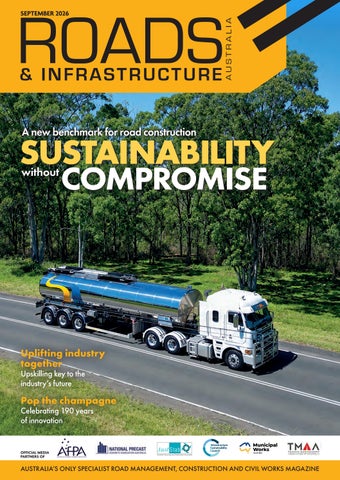
ROADS & INFRASTRUCTURE AUSTRALIA SEPTEMBER 2026
:14 pm
SEPTEMBER 2026
A new benchmark for road construction
SUSTAINABILITY without
COMPROMISE
Uplifting industry together Upskilling key to the industry’s future
Pop the champagne
Celebrating 190 years of innovation
A JOHN DEERE COMPANY
Why waste something that‘s valuable? www.wirtgen-group.com/sustainability
CLOSE TO OUR CUSTOMERS
In many countries, including Australia more roads are rehabilitated than new ones built. But what happens to the old road materials? We re-use them as a resource of ever increasing value. Take advantage of innovative solutions from the market leader. www.wirtgen-group.com/australia
SEPTEMBER 2026 CONTENTS 46 The upper hand A new machine control system has been designed to answer the growing call for versatility and quality from contractors and councils.
EVENTS COVER STORY
MACHINERY & EQUIPMENT
6 A sustainable achievement A recent collaboration has set a new benchmark for sustainable spray seal outcomes and a greener future for road construction.
32 On the radar A manufacturer and distributor have come together to provide top-of-the-line fleet management solutions.
ROADS REVIEW 10 This month, we asked the industry’s decision-makers, ‘What advances in asset management technology or methods have excited you the most in 2026?’
TRAINING 12 Watch and learn A recent industry workshop has highlighted the critical role organisations like Matthews Brothers Engineering can play in supporting the development of best practice projects and personnel. 15 By the sector, for the sector Two key industry contributors have partnered to develop a bespoke and modern approach to training and auditing.
STRONGER THROUGH PARTNERSHIP 18 Built for growth Read how a 13-year partnership with Credeq has helped the civil contractor giant diversify guarantee capacity, preserve banking lines and support an expanding project pipeline.
34 The full set A suite of technologies is helping operators achieve the best possible project outcomes by taking the guesswork and rework out of soil compaction. 36 Reaching a milestone Vögele, part of the global Wirtgen machinery group, is celebrating its 190th anniversary. 38 No stone unturned A key New South Wales quarry has turned to a fleet of Komatsu trucks to support the next phase of its growth. 40 On a roll A national distributor is bringing in overseas compaction rollers, boosting the productivity and safety of infrastructure works all over Australia. 42 A step ahead ARMD Australia has introduced a brandnew infrastructure component to its product offering. 44 A cut above Powerful and precise rotary cutters are helping to create new possibilities for a range of construction applications.
48 Inside Roads & Traffic AU 2026 Australia’s roads and transport sector is entering a new era of investment and innovation, and this October the people driving that change will gather in Sydney for Roads & Traffic AU 2026. 50 The conference returns The Australian Capital Territory’s Chief Minister and another long-serving minister will deliver keynote addresses at the sixth ACT Major Projects Conference. 52 Converge 2027: Not one to miss Read why the event presents the ideal conditions to exchange solutions and ideas for the industry’s benefit.
ASSOCIATION SECTION 54 Manufacturing certainty National Precast talks Australia’s first extradosed bridge.
56 Built to last With resurfacing funding falling short of the minimum seven per cent benchmarking in many Australian regions, asset owners have a second lever.
CONTRACTS & TENDERS
58 Roads & Infrastructure provides an update on some of the contracts and tenders recently awarded or put to market across the Australian infrastructure sector.
Below: Highly anticipated industry events take centre stage, in this edition of Roads & Infrastructure magazine.
ASSET MANAGEMENT 21 A missing layer Why the next step in road asset management is better connected operational intelligence.
INNOVATION 24 Covering all bases A new system has been designed to answer the growing call for modular retaining wall solutions.
29 Hitting it off A portfolio of international partnership programs is developing resilient transport infrastructure throughout the Pacific.
Image: Expotrade
27 More than a name This contractor is providing solutions across a myriad of asphalt-laying projects.
roadsonline.com.au
3
CEO Christine Clancy christine.clancy@primecreative.com.au
PUBLISHER Sarah Baker sarah.baker@primecreative.com.au
MANAGING EDITOR Lisa Korycki lisa.korycki@primecreative.com.au
EDITOR Tom O’Keane tom.okeane@primecreative.com.au
TOM O’KEANE – EDITOR
JOURNALIST Sean Gustini sean.gustini@primecreative.com.au
HEAD OF DESIGN Clayton Hawley
ART DIRECTOR Bea Barthelson
BUSINESS DEVELOPMENT MANAGER Loren Katie Logan lorenkatie.logan@primecreative.com.au
CLIENT SUCCESS MANAGER Sabrina Zor sabrina.zor@primecreative.com.au
HEAD OFFICE Prime Creative Pty Ltd 379 Docklands Drive, Docklands VIC 3008 Australia p: +61 3 9690 8766 info@primecreative.com.au www.roadsonline.com.au
SUBSCRIPTIONS +61 3 9690 8766 subscriptions@primecreative.com.au Roads & Infrastructure Australia is available by subscription from the publisher. The rights of refusal are reserved by the publisher.
ARTICLES All articles submitted for publication become the property of the publisher. The Editor reserves the right to adjust any article to conform with the magazine format.
COVER IMAGE SAMI
COPYRIGHT Roads & Infrastructure Australia is owned and published by Prime Creative Media. All material in Roads & Infrastructure Australia is copyright and no part may be reproduced or copied in any form or by any means (graphic, electronic or mechanical including information and retrieval systems) without the written permission of the publisher. The Editor welcomes contributions but reserves the right to accept or reject any material. While every effort has been made to ensure the accuracy of information, Prime Creative Media will not accept responsibility for errors or omissions or for any consequences arising from reliance on information published. The opinions expressed in Roads & Infrastructure Australia are not necessarily the opinions of, or endorsed by the publisher unless otherwise stated.
4
ROADS SEPTEMBER 2026
THE POWER OF KNOWLEDGE TRAINING, ACCREDITATION AND AUDITING may not be the sexiest industry terms, but when it comes to the future of our industry, they’re absolutely essential. Infrastructure Australia’s latest Market Capacity Report, released in November of 2025, outlined that the industry faces a predicted worker shortage of 300,000 individuals by 2027, with the current estimate sitting at a shortage of about 141,000 workers today. This alarming statistic has highlighted the greater need for industry to not only attract skilled personnel, but also to upskill those who already call the sector home. Only an inclusive and modern approach to training and retention will enable the industry to efficiently tackle the ever-growing infrastructure pipeline nationally. Not to mention the additional pressure that new projects, such as data centres, will have in terms of increased demand on infrastructure and construction specialists. That’s why the National Transport Research Organisation, as well as Australian Pavement Recycling and Stabilisation Association (AustStab) are doing their upmost to deliver a modern approach to personnel development. This means not only creating training that addresses modern challenges and opportunities, but also accommodating flexible and modern training requirements, including short and sharp sessions combined with online learning. In the cover story for this edition, we sat down with SAMI Bitumen Technologies to learn more about the company’s ever-growing portfolio of sustainable project outcomes. The reputation of the SAMIGreen sustainable bitumen additive component continues to grow, with one of its latest trials again proving the product’s effectiveness in lowering carbon emissions associated with road construction. For such a carbon-intensive practice and industry, sourcing solutions to reduce the environmental impact of road construction and maintenance is vital, reflected by renewed interest and development in more environmentally friendly solutions. Industry giants BMD also make an appearance in this edition. Pressure on banking lines and working capital – particularly when project pipelines are active and guarantee requirements increase – prompted the company to evaluate how it could strengthen and diversify its approach to guarantee capacity. This journey has led BMD to global surety and credit risk specialists Credeq, a partnership which has now spanned more than 13 years. The events season has also well and truly kicked off, with a number of major industry events having occurred or coming up soon. We’ve spotlighted several that look to unite private and public segments under the same roof to discuss the future of the sector. Happy reading!
Real productivity starts with the right machine. Built to help operators get more done, every day. From compact excavators to large construction equipment, Komatsu machines are designed to deliver the performance, reliability and efficiency businesses depend on, because real productivity starts with equipment built for the job. Explore the Komatsu Construction & Utility range today.
1300 566 287 | komatsu.com.au
SUSTAINABILITY WITHOUT COMPROMISE
A recent collaboration has delivered an Australian-first achievement, setting a new benchmark for sustainable spray seal outcomes and a greener future for road construction.
N
ational sustainable procurement guidelines have helped to influence behavioural and tangible changes to infrastructure delivery across Australia, with a recent industry report highlighting the advances made in the space. According to the Infrastructure Sustainability Council’s (ISC) 2025 Impact Report, a combined emission reduction of close to 3.5 million tonnes of carbon dioxide, as well as a $1.27 billion saving in avoided costs was reported across 29 ISCcertified projects. While procurement guidelines help to light a path forward, innovation by suppliers and providers has emerged as a pressing priority, specifically the creation of alternative sustainable materials that perform as well or better than their conventional counterparts, while also remaining competitively priced. Such innovation was best highlighted earlier this year in South East Queensland. More than a year ago, the Department
The strong partnership between Colas, SAMI Bitumen Technologies and Hutchinson Quarry was essential to the project’s delivery.
6
ROADS SEPTEMBER 2026
of Transport and Main Roads (TMR) Queensland was tasked with delivering a project that required a standard S15E spray seal binder, in the rural town of Warwick. The road in question would be tasked with supporting high volumes of heavy vehicle traffic, including mining and heavy industrial vehicles. As Hamidreza Sahebzamani, Research & Development and Technical Support Manager – SAMI Bitumen Technologies explains, the project parameters presented the ideal conditions to trial SAMI Bitumen Technologies’ SAMIGreen biogenic modified binder. “SAMIGreen is a biogenic modified binder that’s based on a technology that’s been used in Europe, and we’ve had it in Australia for three to four years now,” he says. “The carbon footprint can be up to 70 per cent lower than conventional binder. One of the big benefits is that with SAMIGreen, you don’t need to change anything – not the design,
logistics, temperature, application rate, or construction method.” SAMIGreen contains a biogenic material that helps to reduce the carbon footprint of asphalt and seals. Biogenic components in the binder act as a carbon sink, allowing its life-cycle carbon footprint to be significantly lower, compared to conventional petroleum-based binders. The core project scope for the Warwick works was to construct a two-layer sprayed seal pavement: each ‘double’ consisting of spraying a binder and then applying aggregate, repeated twice to form the full surface. This project also served as the first-ever use of the SAMIGreen biogenic modified binder in a spray seal application anywhere in the world, a key achievement in Australia, where Polymer Modified Bitumen (PMB)based spray seals are still common. To deliver such a complex and innovative world-first, the project brought together three contributors.
COVER STORY
Images: SAMI
The recent trials in Warwick, Queensland have re-affirmed SAMIGreen’s sustainability and performance potential.
“QUALITY ASSURANCE WAS CRITICAL. AS THIS WAS A TRIAL, WE WANTED TO BE SURE THAT EVERY ASPECT OF THE PROJECT WAS PERFORMING TO THE LEVEL THAT WE EXPECTED.” SAMI Bitumen Technologies acted as the binder technology provider, responsible for formulating a new grade suitable for spray seal. Colas, the parent company of SAMI Bitumen Technologies, acted as the spray seal contractor, handling design, construction, and on-site application. Hutchinson Quarry, a local aggregate supplier, provided the precoated aggregate. For Stephen Palmero, Quarry Manager – Hutchinson Quarries, the project provided a unique opportunity to see the full process, from “rock to road”, while also adding to the company’s portfolio of TMR projects. “As soon as I heard about the project, I thought it was great that the three companies were coming together. With Colas covering the spray seal, SAMI the binder and Hutchison the aggregate, you’ve got all the components that you’d need to deliver a high-quality project,” he says. “We were really lucky to be involved in a project that had three strong partners.”
FIRST STEPS Once chosen by TMR to cater for the works – about a year preceding completion – SAMI Bitumen Technologies began designing a specific SAMIGreen mixture that would satisfy the department’s requirements for a S15E-grade binder. This formulation was then run through a suite of laboratory tests to check performance at both low and high temperatures, including tests such as bleeding-related assessments and stripping plate tests. At the same time, SAMI Bitumen Technologies sought the publication of an Environmental Product Declaration (EPD) for the new SAMIGreen grade. This formal EPD quantified the carbon footprint reduction, which for this grade was about 30 per cent lower than conventional formulations. Once the SAMIGreen design was formulated, tested, and backed by an EPD, SAMI Bitumen Technologies went back to TMR with a complete package: the product design, lab test results, material properties, and the official environmental data. But the binder is only as strong as the aggregate provided, which is why the appointment of Hutchinson Quarries was roadsonline.com.au
7
COVER STORY
J R
C
V C
Feedback on the project has been very positive and has opened the door for additional applications of SAMIGreen.
so essential to the project’s successful delivery, as Sahebzamani explains. “Quality assurance was critical. As this was a trial, we wanted to be sure that every aspect of the project was performing to the level that we expected,” he says. “From past experience, we knew Hutchinson’s rock quality is very good, and their production and quality control processes are strong. Those were all the reasons that we wanted to continue with Hutchinson for this project.” Hutchinson Quarries had worked on a number of TMR projects, one of the reasons why the use of the company’s aggregate was already outlined in the initial design and requirements for the Warwick project. The Warwick location also made sense from an environmental and logistical perspective. Hutchinson Quarry’s proximity to the job site helped to reduce transport distances for aggregate, supporting the broader goal of cutting the project’s carbon footprint. Furthermore, Hutchinson Quarry primarily services the local area of Darling Downs. This familiarity with local infrastructure, industry needs, and climatic factors reinforced the company as the natural choice. ON SITE APPLICATION Due to SAMIGreen’s ability to be a more sustainable substitute to conventional S15E formulations, Colas could proceed with the spray seal application just like a 8
ROADS SEPTEMBER 2026
conventional PMB spray seal, using the same equipment, construction sequence, temperatures and application rates. As planned, one of SAMI Bitumen Technologies key roles on site was to observe real-world behaviours that couldn’t be fully captured in the lab. After all, while the testing regime was thorough, there’s still some aspects that are best observed during application, as Sahebzamani explains. “One of the things I really wanted to see was what happens when you spray the binder at high temperature. How are the fumes, the smoke and the odour for the
“The feedback has been really positive,” Sahebzamani says. “TMR has agreed to keep monitoring the project and has also left the door open to do more projects with SAMIGreen. “We’ve done post-project monitoring and evaluation, and because the trial section was completed right next to a section with conventional binder, we can directly compare both segments. There’s no visible difference between the two and they’re both performing the same.” With this project as a test-case, SAMI Bitumen Technologies is eyeing ambitious growth for its SAMIGreen developments,
“OUR MAIN AIM IS TO MAKE SAMIGREEN PART OF OUR STANDARD OFFERING FOR ALL ROAD CUSTOMERS – WHETHER IT’S HIGHWAYS, MAIN ROADS, RURAL ROADS, OR OTHER APPLICATIONS LIKE EMULSIONS AND DUST SUPPRESSANTS FOR MINE ROADS.” crews on site? I was already confident in the technical performance, but this was important,” he says. “On site, everyone we asked if the crews had no issues or concerns. If we hadn’t told them that it was a bio-binder, they probably wouldn’t have noticed anything different. That was one of the key learnings – the behaviour on site is completely the same.” Ultimately, no issues were reported throughout production, transport, handling or spraying, with the project estimated to have reduced emissions by approximately 1.7 tonnes of carbon dioxide per lane-kilometre.
having already proven its effectiveness in trials across airport surfaces, highways, local roads and heavy vehicle access roads of varying sizes. “Our main aim is to make SAMIGreen part of our standard offering for all road customers – whether it’s highways, main roads, rural roads, or other applications like emulsions and dust suppressants for mine roads,” Sahebzamani says. “In all of these applications, SAMIGreen can be used as a biogenic modified binder that is as safe and technically sound as conventional binders, and in many cases performs better, with a reduced impact on the environment.”
Y
YOU’RE NOT JUST BUILDING ROADS CS13 GC
VIBRATORY SOIL COMPACTOR
YOU’RE BUILDING A REPUTATION CONSISTENT COMPACTION
PROVEN PERFORMANCE
EASY TO OPERATE
Speak to your Cat® dealer or scan the code to find out more. © 2026 Caterpillar. All Rights Reserved. CAT, CATERPILLAR, LET’S DO THE WORK, their respective logos, “Caterpillar Corporate Yellow”, the “Power Edge” and Cat “Modern Hex” trade dress as well as corporate and product identity used herein, are trademarks of Caterpillar and may not be used without permission.
LOWER COSTS
ROADS REVIEW
ROADS REVIEW
This month, we asked the industry’s decision-makers, ‘What advances in asset management technology or methods have excited you the most in 2026?’ CADELL TAYE, CHIEF EXECUTIVE OFFICER – NATIONAL PRECAST CONCRETE ASSOCIATION AUSTRALIA
The most encouraging development in 2026 has been the growing integration of digital asset information across the entire infrastructure lifecycle. Asset management is no longer just about maintaining infrastructure, it is increasingly informing better design, procurement and construction decisions from the outset. Combining accurate asset data with condition monitoring, predictive maintenance and embodied carbon information is helping owners make more informed, whole of life decisions. This shift creates opportunities for higher quality manufactured solutions, such as precast concrete, that deliver durability, consistency and long term value while supporting more sustainable infrastructure outcomes. Image: National Precast
GEOFF ALLAN, CHIEF EXECUTIVE – AUSTROADS
One of the developments that has excited me most in 2026 is the growing maturity of asset management practices, with greater integration of customer outcomes, risk, sustainability and data-driven decision-making into infrastructure planning and investment decisions. This is being reflected in Austroads’ current review of the Guide to Asset Management, which is examining how emerging practices, technologies and changing operating environments are influencing the way road agencies manage infrastructure assets. As road networks become more complex and datarich, there is growing opportunity to use better information to support investment decisions, improve resilience and maximise value across the asset lifecycle. The review will help ensure the guidance continues to support road agencies in applying contemporary asset management practices and responding to future challenges and opportunities. Image: Austroads
TANJA CONNERS, CHIEF EXECUTIVE OFFICER – AUSTSTAB
In 2026, the most exciting advances in asset management have been those turning better data into earlier, smarter intervention. Artificial intelligence, digital twins, mobile condition assessment and improved performance modelling are giving asset owners a clearer understanding of how pavements deteriorate and where investment will deliver greatest whole-of-life value. For the pavement recycling and stabilisation industry, this is particularly significant. Better forecasting supports a shift from reactive repair to planned rehabilitation, allowing existing materials to be strengthened and reused before failure occurs. The result is longer-lasting roads, lower emissions, reduced demand for virgin materials and better value for Australian communities. Image: AustStab
CHRIS WIGNALL, HEAD OF EMERGING MARKETS – ASSET VISION
What excites me most is seeing technology make asset management safer and easier for the people doing the work. AI can capture and interpret road imagery, helping teams find issues earlier while spending less time inspecting assets beside live traffic. Natural language tools also make complex data easier to use. People can ask questions in everyday language and quickly find the information they need. This helps teams make practical decisions sooner, address risks before they become bigger problems and create safer roads for both field crews and the communities they serve. Image: Asset Vision
CHRIS CLEATON, REGIONAL MANAGER – STABILISED PAVEMENTS OF AUSTRALIA
Australia has always faced the challenge of maintaining one of the world’s largest road networks with a relatively small population and finite budgets. As labour, fuel and bitumen costs continue to rise, we’re rehabilitating fewer kilometres of road for the same investment. The introduction and growing acceptance of Cold In-Place Asphalt Recycling (CIPAR) has been the most exciting development of 2026. Using the Wirtgen WR380 paver-laid process, we can recycle 100 per cent of the existing asphalt and pavement in situ, eliminating unnecessary haulage, reducing carbon emissions and heavy vehicle movements, and delivering a high-quality engineered pavement. It’s a technology that allows us to renew existing assets rather than replace them, stretching infrastructure budgets further while improving sustainability and network resilience. Image: SPA
If you or someone at your organisation is an industry leader and would like to be a part of this monthly column in 2026, please get in touch with Editor, Tom O’Keane: tom.okeane@primecreative.com.au 10
ROADS SEPTEMBER 2026
LEARNING FROM THE BEST
F
A recent ‘spray seal essentials’ workshop has highlighted the essential role that organisations like Matthews Brothers Engineering can play in supporting the development of best practice projects and personnel.
or organisations like Matthews Brothers Engineering – which is fully embedded within the industry it serves – understanding the needs of the sector is one thing, finding the solutions to deliver, is another. For some time, individuals like Paul Matthews have recognised the importance of knowledge exchange between experienced personnel and those who are fresh to the industry. “It’s the knowledge you’ve got to give to the young ones coming up. Once the old fellas are gone, artificial intelligence is not going to cut it,” he says. “For the next generation of leaders – the industry needs to be sustainable, now and into the future. The current generation 12
ROADS SEPTEMBER 2026
are the ones that will need to impart that knowledge to make this sustainable future a reality.” Industry associations such as the Australian Flexible Pavement Association (AfPA) have also identified the need for more robust and modern approaches to training, which is why the association has looked to its members for guidance. Matthews Brothers Engineering was recently invited to a ‘spray sealing essentials workshop’, hosted by AfPA in Melbourne. Held from July 28-30, the workshop aimed to highlight the solutions, techniques and processes required to execute best practice for spray sealing applications.
Among the points stressed was the importance of pre-construction planning. In a session presented by Fulton Hogan, participants learnt the critical factors that can significantly impact spray sealing jobs including weather windows, proper risk assessments, timely site management and the use of effective traffic management plans. Another consistent theme throughout the workshop was safety. The program aimed to reinforce safe operating practices around sprayers and tankers, such as exclusion zones around operating sprayers, the importance of awareness around fatigue and long operating hours, as well as the operational risks of heating and handling binders and rubberised products.
Matthews Brothers Engineering recently participated in industry training, helping to upskill key members of the sector.
Despite some topics covering the fundamentals, Matthews says that each session was valuable for industry stakeholders, both young and old. “Some of the people attending were ‘green’ – you could tell by their shiny boots and light‑coloured pants!,” He jokes. Additional topics covered priming and pre-treatments for reseals, construction process control, common causes of seal failure, information around high stress applications, and much more. As Matthews explains, hitting the right balance between technical and practical knowledge is essential for a segment like spray sealing. “For me, it’s about keeping up with what’s happening in the real world,” he says. “I don’t get out on site as much as I used to, and that’s where you really learn how the machine and crews can work together as a team. “The effort to do the training is great, but being out there actually doing it is where you really learn. Unfortunately, sometimes the hard way, but you never forget it.”
This passion for practical examples led to Matthews Brothers Engineering volunteering its site and equipment to host a demonstration as part of the spray sealing essentials workshop, using water in place of a conventional spray seal. A feature of Matthews Brothers Engineering’s portion of the workshop was identifying the potential for ‘train tracking’, and how the cause of the issue could be identified and prevented. ‘Train tracks’ represent the visible lines or stripes left in the sprayed surface when the bitumen isn’t applied evenly across the full width of the spray bar, a clear visual sign that application hasn’t been applied correctly. This may include factors such as not being hot enough, a lack of cutter being included, pump revolutions per minute (RPM) being too slow or fast, as well as other additional factors. While focusing on specifics like this, which helped to establish the pathways to optimal spray sealing outcomes, the workshop also provided an environment where operators young and old could ask questions around the common problems encountered on site. Importantly, it also enabled Matthews Brothers Engineering to make the industry aware of the new systems that it’s been developing, while hearing real-time feedback and insights from existing and potential customers. One such example is the company’s proportional control system, where engine speed, road speed, and pump speed are linked so that the application stays consistent, even if site conditions change. Matthews says it’s a far cry from conventional systems. “There’s an opportunity now that we never had years ago,” he says. “We’ve got sensors that can measure just about anything. Whether its air temperature or ground temperature, humidity, wind chill, that’s all just environment sensors alone. But it’s got to be tried and tested in the field, it might work on paper, but we need to make sure its viable on-site. Consistency is critical to access actual performance reflected in data “We’re going to take a greater look at data collection while our machines are running. That may include redesigns and upgrades to our original system to make it even more user-friendly, allowing us to have more access to that data for our clients.”
Images: Matthews Brothers Engineering
TRAINING
Matthews Brothers Engineering Managing Director, Paul Matthews.
STRONG SUPPORT As Matthews explains, training and development is all about repetition and consistency. “I’ve been at Matthews Brothers Engineering for 42 years,” he says. “Being a perpetual student and having an open mind makes it easy to see potential opportunities and challenges in the bitumen spraying sector.” Matthews says that the participation of industry associations and peak bodies helps to broaden the impact of training programs, encouraging leaders from companies that could be considered competitors to exchange ideas for the industry’s benefit. He adds that issues like safety are improved when addressed by all. Once identified they can ether be engineered out or minimised. “An association like AfPA has heaps of reference material and lots of historical knowledge,” Matthews says. “For example, you might receive a safety data sheet, but that doesn’t tell you how to use a product, or the context that it should be used in. “AfPA’s work tips – like the WT33 nozzle configuration – actually show you how you can use this data or a product, as well as the best and safest way to use it. They represent a wealth of information if you’re going to be doing anything with elevated temperature product all the way to cold emulsion .” roadsonline.com.au
13
BOMAG BW213D-5SL From road construction and civil works to council maintenance and hire fleets
Reliable compaction is essential for achieving consistent results across different projects. The BOMAG BW213D-5SL, supplied by Tutt Bryant Equipment, delivers the power, efficiency and reliability required for demanding civil applications. Powered by a fuel-efficient Deutz diesel engine and featuring BOMAG’s proven vibration technology, the BW213D-5SL provides consistent compaction across various soil conditions, helping operators achieve excellent density with fewer passes and lower operating costs. Designed for Australian conditions, the machine offers a comfortable cab, intuitive controls, excellent visibility and easy service access to maximise productivity and uptime. Backed by Tutt Bryant Equipment’s nationwide sales, parts and service network, the BOMAG BW213D-5SL is a dependable compaction solution for contractors, councils and equipment hire businesses.
Brisbane | Sydney | Melbourne Adelaide | Perth
tuttbryant.com.au
Roads and Infrastructure - 2026 Aug.indd 1
Follow us on:
1300 658 888
7/08/2026 12:14:23 PM
14:23 PM
TRAINING
UPLIFTING INDUSTRY TOGETHER nfrastructure Australia’s latest Market Capacity Report, released in November of 2025, re-emphasised what is a well-known challenge within the infrastructure sector. The report outlined that the industry faces a predicted worker shortage of 300,000 individuals by 2027, with the current estimate sitting at a shortage of about 141,000 workers today. These factors have placed heightened importance on the integration of new personnel, as well as the upskilling of those already in the sector, helping to arm the industry with the knowledge and expertise required to tackle what is an ever-growing infrastructure pipeline. It’s also a challenge that the Australian Pavement Recycling and Stabilisation Association (AustStab) and the National Transport Research Organisation (NTRO) have worked to address for decades. Primarily in isolation, both organisations have established programs, resources and schemes that have helped to ensure the continued development of personnel sector-wide. A brand-new initiative has seen the two partner up, combining what is recognised nationally as one of the most rigorous training and accreditation platforms available, with the unique expertise and reach of an association that’s fully embedded in the stabilisation segment. At the helm of this partnership are Tanja Conners, Chief Executive Officer – AustStab, and Alan Hay, Executive Director International & Leader, Certification & Events – NTRO. As Conners explains, collaboration has long been a key tenet to making meaningful impacts and change within the sector. “Partnerships across the industry are absolutely essential to the breaking down of siloed thinking,” she says. “The knowledge across these two
Images: AustStab
I
Two key industry contributors have partnered to develop a bespoke and modern approach to training and auditing – built by the sector, for the sector.
Above: Tanja Conners, Chief Executive Officer – AustStab.
organisations, when brought together for stabilisation and recycling, can only be beneficiary for the industry. NTRO is the leading roads research organisation in Australia – the go-to. It’s a great opportunity for industry that they’re happy to work with this niche, but very important, part of the sector.”
and other industry stakeholders. It was these training and accreditation needs that naturally pointed AustStab towards a potential partnership with the NTRO. Conners and Hay already had a long professional relationship, with the NTRO also having extensive experience in certification, accreditation, and governance across the transport sector, along with a high degree of trust from both government and industry. As Hay explains, the main goal was to design a framework that was “more rigorous, but not more onerous.” “AustStab is already recognised as a leader and a go-to in stabilisation and recycling, so it was inevitable that we were going to talk at some point,” he says. “The bones were already there – the conversation was really about how our two organisations could collaborate to enhance rigour in accreditation. “We wanted to provide knowledge, learning, and fit-for-purpose solutions, embedded in best practice, so that everyone in the sector could benefit.” Among the biggest considerations was how such a scheme could entice
“PARTNERSHIPS ACROSS THE INDUSTRY ARE ABSOLUTELY ESSENTIAL TO THE BREAKING DOWN OF SILOED THINKING.” A NEW SCHEME A little while ago, AustStab’s leadership recognised that its previous accreditation and training schemes needed a step change. While its services were still delivering successful outcomes for participants, AustStab wanted to establish a program that was more robust, transparent and fit for the future. It also wanted to develop a platform that would appeal to the needs and requirements of state road authorities, tier one contractors, asset owners
industry participation. “We needed industry to know that the accreditation actually means something,” Conners says. “If you bring in an accredited company, it shows they’ve got the right systems, competent people, suitable equipment, and proven processes to consistently deliver quality stabilisation and recycling work. “We’ve designed this scheme so that it deserves to be part of state road authorities’ prequalification. It holds companies accountable for the work roadsonline.com.au
15
TRAINING
Above: Alan Hay, Executive Director International & Leader, Certification & Events – NTRO.
they’re producing.” This training has not only been designed to cater for current industry trends and requirements, but it’s also been developed around modern habits when it comes to education and information. “Training appetite has changed significantly,” Hay says. “People want it whenever, wherever, in small, easily ingested modules. They can go back and revisit those modules, and they’re systematically broken down into chunks of knowledge that lead to an overall certification and accreditation.” This approach also resulted in the condensing and increased digestibility of technical information. “The training takes the stabilisation fundamentals and construction guideline booklets and turns them into microtraining,” Conners says. “Instead of flicking through books, you can do short, sharp modules and be tested on them. “Adult learning now is all about no more than 20 minutes at a time, and we’ve really tried to hone into that new e-learning methodology.” This approach has led to the establishment of a training program focused on giving industry a practical, accessible understanding of stabilisation and pavement recycling fundamentals. These cover core topics such as what lime stabilisation is and how it works, 16
ROADS SEPTEMBER 2026
cement stabilisation, foam bitumen, key considerations in stabilisation, issues to watch out for on road pavement rehabilitation jobs, and much more. The program is built around self‑paced e‑learning, delivered through NTRO’s learning management system (LMS), with each module containing an assessment, allowing participants to demonstrate their understanding. Successful completion then contributes to the awarding of a certificate. “The partnership really drives all those cogs,” Conners says. “AustStab brings the industry knowledge and practical stabilisation experience, and NTRO provides independent assurance, governance, capability, and now – with the training – an established national platform.” This training is further supported by the NTRO’s MG Lay Library, a rich source of industry knowledge around successful and unsuccessful project outcomes, helping key learnings to be passed from project to project. The MG Lay Library will also soon welcome entries from AustStab, helping to provide additional resources to guide the successful the development of stabilisation projects in the future. ANOTHER WAY TO AUDIT Another important aspect of this program has been the development of the AustStab – NTRO Accredited
environmental and safety controls that a business may have in place, such as managing lime dust in windy conditions. Their findings are captured in a structured auditor’s report, which is then submitted to NTRO for independent review. “It will be surrounded by the same ethical walls that NTRO applies to all our accreditation schemes. It’s independent and it can be trusted, which is what the sector should expect,” Hay says. The NTRO reviews the auditor’s report to confirm that all governance, process and documentation requirements have been met, and that the audit has been carried out consistently with the scheme’s standards. Once this review is complete, NTRO issues an accreditation certificate to the contractor. This certificate demonstrates that the organisation has appropriate systems, people and equipment, giving extra confidence to asset owners and procurers. “We didn’t want to create more paperwork,” Conners says. “A lot of companies already get audited on International Organisation for Standardisation (ISO) systems, so we’ve built this scheme to avoid duplicating those audits and to focus on what really matters for stabilisation and recycling.”
“AUSTSTAB BRINGS THE INDUSTRY KNOWLEDGE AND PRACTICAL STABILISATION EXPERIENCE, AND NTRO PROVIDES INDEPENDENT ASSURANCE, GOVERNANCE, CAPABILITY, AND NOW – WITH THE TRAINING – AN ESTABLISHED NATIONAL PLATFORM.” Contractors Register. This accreditation features a pool of trained auditors, a standardised audit process, and a clear governance and review layer, all managed by the NTRO. Auditors conduct on-site assessments of contractors’ stabilisation and recycling activities, looking at how they plan and execute their work. This may include examinations of their mix designs and mix rates, depth of treatment, number of passes, equipment condition and how frequently an operation ensures that sprayers are properly calibrated. This process will also examine the
For Conners and Hay, the delivery of the revised training and auditing schemes is just the first step. The next is continued improvement and updates to stay one step ahead of the industry’s requirements. “What I’m most proud of is that AustStab is a very specific industry association,” Conners says. “For the NTRO to partner with us for some of these things shows that there’s credibility in what we do. “It’s a great opportunity for industry to be working with someone like the NTRO – and for NTRO to go, ‘Yeah, we’re happy to work with you’.”
For more information or pricing on our Aggregate Spreader Options: CALL: +61 (3) 9391 1226 EMAIL: sales@matthewsbrothers.com.au
A PARTNERSHIP BUILT FOR GROWTH Scott Power, Chief Executive Officer of BMD explains how a 13-year partnership with Credeq has helped the civil contractor giant diversify guarantee capacity, preserve banking lines and support an expanding project pipeline.
A
s Australia’s largest privately-owned civil contractor, BMD delivers infrastructure domestically and internationally for a diverse portfolio of government and private-sector clients. Its expertise and capability have seen the company deliver works for some of Australia’s largest infrastructure projects, such as Inland Rail, the New Fitzroy River Bridge and the $1.5 billion Legacy Way Tunnel projects, just to name a few. Operating across multiple sectors, regions and project types means BMD’s guarantee requirements can vary considerably in value, timing and contractual complexity. As such, the company is frequently required to balance strong project delivery capability with disciplined capital management. 18
ROADS SEPTEMBER 2026
As BMD Chief Executive Officer Scott Power explains, pressure on banking lines and working capital – particularly when project pipelines are active and guarantee requirements increase – prompted the company to evaluate how it could strengthen and diversify its approach to guarantee capacity. “We were looking for a solution that gave us greater flexibility and complemented our existing banking arrangements,” he says. “The key challenge was ensuring we had sufficient guarantee capacity available when needed, without unnecessarily tying up liquidity that could otherwise support delivery, growth and day-to-day operational flexibility.” This search led to a partnership with global surety and credit risk specialists Credeq in 2013.
While Credeq’s understanding of the construction and infrastructure sectors, as well as the depth of experience behind its local team, were certainly factors in BMD’s decision, just as important was the provider’s personal approach and genuine commitment to understanding BMD’s business, project profile and approach to risk. “Credeq took the time to understand our business, our project profile and the way we manage risk,” Power says. “Their combination of technical expertise, responsiveness, and genuine commitment to supporting our business makes them a trusted and valued partner.” PROJECT TO PROJECT Through Credeq’s support, BMD has gained an additional source of guarantee
obligations, counterparty requirements and guarantee exposure. Beyond this, Credeq often helps to provide BMD’s project and commercial teams with confidence that security requirements can be met efficiently, allowing them to instead focus on project delivery and execution. “Their support helps keep projects moving and ensures we stay on top of our bonding requirements,” Power says. “While each project is assessed on its own merits, having Credeq as part of our broader capital management toolkit gives us greater confidence when responding to new opportunities, planning for future pipeline demands and pursuing BMD’s growth ambitions.” Surety is now considered earlier in BMD’s tender planning and contract negotiations as part of its broader commercial strategy,
The New Fitzroy River Bridge, delivered by BMD in Western Australia in 2023.
capacity that supports liquidity and balance sheet efficiency. A good example is when projects require security support within tight tender or contract award timeframes. In these situations, Credeq’s responsiveness, practical approach, and willingness to engage directly with both BMD and its clients can make a significant difference. Its team works quickly to understand requirements, navigate complex issues such as assignability provisions, and facilitate productive discussions that balance commercial objectives with surety requirements. “Credeq has helped broaden the tools available to us when managing capital and guarantee requirements,” Power says. “By using surety as part of our overall funding and risk management mix, we can preserve bank capacity for other business needs while maintaining the ability to support tenders and active projects. “That additional flexibility is valuable in a market where project values are significant and the ability to move confidently can make a real difference.” From a risk perspective, the process also provides an additional layer of review and discipline around project
Images: Credeq
STRONGER THROUGH PARTNERSHIP
Scott Power, Chief Executive Officer – BMD.
“WHILE EACH PROJECT IS ASSESSED ON ITS OWN MERITS, HAVING CREDEQ AS PART OF OUR BROADER CAPITAL MANAGEMENT TOOLKIT GIVES US GREATER CONFIDENCE WHEN RESPONDING TO NEW OPPORTUNITIES, PLANNING FOR FUTURE PIPELINE DEMANDS AND PURSUING BMD’S GROWTH AMBITIONS.” enabling its finance, commercial and delivery teams to assess the most appropriate form of security before capacity is committed. “This supports more informed and efficient decision-making, improves coordination between teams and provides greater flexibility in how guarantee requirements are managed across the business,” Power says. The trust developed between the two organisations has also enabled Credeq to engage directly with BMD’s clients where needed, helping streamline conversations around security requirements. “By helping clients understand the rationale behind surety clauses and addressing concerns early, Credeq often helps streamline negotiations, reduce delays, and achieve positive bonding outcomes,” Power says. When reflecting on the partnership, Power says that despite project challenges and requirements evolving, Credeq’s “seamless, responsive, and highly professional” approach has remained a constant. “During our 13-year relationship with Credeq, the most tangible result has been
increased flexibility and greater acceptance of insurance bonds as an alternative to bank guarantees across a growing number of major projects,” he says. Credeq has played an important role in this by educating BMD’s clients about surety, addressing concerns and helping to achieve acceptance in situations where bonds may not have otherwise been considered, further reducing reliance on bank facilities and improving liquidity. “They understand our business, project requirements, and the pace of the construction industry. They provide practical and tailored solutions and are always available to provide guidance, no matter how complex or unfamiliar the issue. “They also go above and beyond by engaging directly with our clients where needed, helping navigate approval processes, resolve concerns, and achieve positive outcomes more efficiently. That consistency and understanding have made Credeq a trusted partner as our business and project pipeline have continued to grow.”
Right: Through Credeq’s support, BMD has gained an additional source of guarantee capacity that supports liquidity and balance sheet efficiency.
roadsonline.com.au
19
ASSET MANAGEMENT
THE MISSING LAYER IN ROAD ASSET MANAGEMENT As road authorities face rising expectations, tighter funding and pressure to improve delivery productivity, Asset Vision explores why the next step in road asset management is better connected operational intelligence.
R
oad authorities, service providers and self-delivery teams are under pressure to deliver safer, smoother and more reliable roads with limited funding. As networks age and community expectations rise, the systems supporting road maintenance need to do more than store information. They need to improve productivity, support better prioritisation and help every maintenance dollar go further. For Ritchie Taylor, Head of Transport at Asset Vision, this is one of the defining challenges facing the sector. “Road authorities and service providers are not short of systems,” Taylor says. “The challenge is making sure the right information flows between the field, the network, the contractor, the asset manager and the enterprise systems that support planning and investment decisions. “That is where measurable value is created. When teams can see condition clearly, reduce duplication, track defects, understand ride quality and connect works back to asset evidence, they are in a much stronger position to improve productivity and make constrained budgets go further.” Most road authorities already operate
within complex technology environments. These may include enterprise platforms such as SAP, Oracle and TechnologyOne, Geographic Information System (GIS) environments, pavement management systems such as dTIMS, finance tools, reporting platforms, customer request systems and contractor systems. Each has an important role to play. Enterprise systems support finance, procurement and governance. GIS provides spatial context. Pavement systems support long-term modelling and treatment planning. Reporting platforms help executives understand performance. Contractor systems may manage specific delivery obligations. The challenge is that many road asset decisions sit between these systems. A finance system may show what has been spent, but not always the field evidence behind why the work was needed. A pavement system may model long-term deterioration, but not always capture the operational reality of inspections, defects, customer requests, safety risks and completed maintenance. GIS may show where assets are located, but not necessarily the condition, risk, history
and activity connected to those assets. This is where authorities and service providers can lose time, confidence and value. When information is fragmented, teams spend more time reconciling records, checking spreadsheets, searching for photos and interpreting inconsistent inspection notes. Decisions become harder to defend. Reporting becomes more manual, and maintenance can become reactive, even when organisations have invested heavily in systems. Asset Vision is designed to sit within this broader ecosystem as an operational asset intelligence layer for road authorities and infrastructure contractors. Rather than replacing every system around it, Asset Vision helps to make those systems more useful by improving the quality, consistency and timeliness of the operational evidence. Asset Vision connects the practical work of managing roads, including inspections, defects, asset registers, condition data, maintenance activities, photos, contractor workflows, claims, compliance and reporting, with the wider systems organisations rely on for finance, planning, procurement, GIS and executive visibility.
Images: Asset Vision
Connected operational intelligence gives road authorities and service providers clearer visibility across the networks that they manage.
roadsonline.com.au
21
ASSET MANAGEMENT
Asset Vision’s AutoPilot brings together network-scale road imagery, AI-powered defect detection and ride-quality insights to support better maintenance decisions.
THE OPERATIONAL LAYER Its transport pedigree has been built across real road maintenance environments, from local government networks to state road maintenance programs and major contractor delivery models. This includes use in large-scale road maintenance contract environments, where field and office teams need reliable visibility across inspections, defects, works, evidence, reporting and operational decision-making. For service providers and self-delivery teams, this is also a productivity challenge. Every duplicated inspection, manual handover, disconnected spreadsheet or delayed evidence check consumes time that could be spent planning, delivering or verifying work. When field teams can capture consistent evidence once, connect it to the right asset and defect, and make it visible to planners, supervisors and asset managers, maintenance delivery becomes more efficient. That matters when budgets are constrained. Not every road can be renewed at once. Not every defect can be treated with the highest-cost intervention. The challenge is to understand where action will deliver the greatest value, and where a lower-cost treatment, staged response or monitoring approach may be more appropriate. AutoPilot, Asset Vision’s artificial intelligence (AI)-powered network intelligence product, extends this capability by bringing road imagery, defect detection and ride quality insights into the road management environment. Using network-scale visual evidence and AI analysis, AutoPilot helps authorities move beyond isolated inspections and build a more consistent view of 22
condition across the network. For Taylor, AI in road maintenance is not about replacing engineering judgement, it is about improving the evidence available to support it. “AI only creates value when it is connected to real decisions,” he says. “Defect detection, road imagery and ride quality data are powerful, but they need to sit inside a workflow that helps teams prioritise, act, report and learn from the work being delivered.” MAKING BUDGETS GO FURTHER That practical connection is essential. A dataset sitting outside the day-to-day
asset management environment may be interesting, but it will not necessarily improve outcomes. The value comes when AI-generated insights are linked to inspections, defects, asset records, works, reporting and long-term planning. Asset Vision supports transport asset management across road authorities, local government networks and major contractor delivery environments. Its capability spans inspections, defects, works management, asset registers, imagery, condition data, contractor workflows, reporting and field-to-office visibility. Through AutoPilot, Asset Vision extends this with AI-powered network intelligence, road imagery, defect detection and ride quality insights at scale. Damian Smith, Founder and Chief Executive Officer of Asset Vision, says this connected approach is increasingly important as infrastructure organisations seek greater confidence from their data. “Asset Vision’s role is to help infrastructure organisations turn operational asset data into clearer decisions,” he says. “Enterprise systems, GIS and pavement tools all play important roles, but road authorities also need a practical layer that connects what is happening on the network with the actions, reports and investment decisions that follow.”
“DEFECT DETECTION, ROAD IMAGERY AND RIDE QUALITY DATA ARE POWERFUL, BUT THEY NEED TO SIT INSIDE A WORKFLOW THAT HELPS TEAMS PRIORITISE, ACT, REPORT AND LEARN FROM THE WORK BEING DELIVERED.”
Ritchie Taylor, Head of Transport at Asset Vision, says connected operational intelligence can help optimise productivity and budgets.
For road authorities, service providers and self-delivery teams, measurable value is not created by technology alone. It is created when technology helps people make better decisions, deliver work more efficiently and explain those decisions with confidence. The future of road asset management will not be defined by one platform replacing every other tool. It will be defined by how well organisations connect the systems they already rely on with the operational intelligence needed to manage the network in real time. Smith adds that for teams under pressure, the question is whether existing systems are connected in a way that helps them act with confidence, improve productivity, prioritise limited funding and demonstrate value to the communities that they serve.
Z R
A c i
A
> > > > >
ROADS SEPTEMBER 2026
Roads an
ZERO SPEED - ROAD ROUGHNESS PROFILING Aptella’s road roughness testing focuses on layer compliance using a laser profiler that is capable of identifying various issues present on a road surface. Aptella uses a zero speed system inertial profiler, providing the following benefits.
> The zero speed system does not require run-in or run-out data > No traffic control required including major intersections or high traffic areas > Additional accuracy with using four gocator lasers and high accuracy INS sensors > Speed operating zones include 0 - 100km/hr allowing for complete stops if necessary > NATA Accredited to TMRQ708B and TfNSWT188 standards
LEARN MORE
aptella.com | 1300 867 266
Roads and Infrastructure June 2026 Issue.indd 1
18/05/2026 12:03:52 PM
TerraStack is an innovative modular retaining wall solution engineered specifically for Australian and New Zealand conditions.
COVERING ALL BASES Geoquest Australia, backed by global innovation and decades of expertise, has developed a brandnew system that directly answers the growing call for modular retaining wall solutions, engineered for local conditions.
24
ROADS SEPTEMBER 2026
W
hether it’s contributions on the Cross River Rail, the West Gate Tunnel, or the Sydney Gateway, Geoquest Australia has provided innovative and engineered solutions to some of the largest infrastructure projects in the country. Its capability and appetite for major infrastructure works continues to grow, as does its ability to identify emerging trends and requirements within the industry. After hearing feedback regarding its suite of products tailored for councils, residential and commercial developers, and contractors, Geoquest Australia identified a growing demand for projects requiring smaller and modular wall facing systems. As Riccardo Musella, Managing Director – Geoquest Australia explains, it wasn’t long before the company got to work on what would become its latest innovation. “Our core business has always been major infrastructure – big retaining walls for bridges and abutments – using a
premium system that isn’t always needed for lower loads or shorter walls,” he says. “For that reason, there was a gap in our offering for the commercial space, so we asked, ‘how can we develop a system that works for those markets and that we can manufacture efficiently in our own precast yards?’” Subsequent research and development laid the foundation for TerraStack, an innovative modular retaining wall solution engineered specifically for Australian and New Zealand conditions. HISTORY OF EXCELLENCE The TerraStack system represents the evolution of what has long been a staple of Geoquest Australia’s offering – that is, Mechanically Stabilised Earth (MSE) walls. TerraStack bridges the gap between traditional heavy block wall systems, small and labour intensive solutions, as well as large-scale MSE structures, providing an efficient build and versatile retaining solution for urban developments, public open spaces, utilities infrastructure and community facilities. But how? Well, it starts with the design. TerraStack was developed to combine engineering performance with practical manual-handling constructability. It’s
INNOVATION
TerraStack is small enough to be economical and easy to transport, but large and efficient enough to install quickly.
“Their feedback was important in shaping TerraStack,” Musella says. “We regularly went back to them asking, ‘What do you think about this? What would you change?’” The flexibility and customisability of the system have potential to open doors to a range of markets, such as streetscape projects, commercial and residential developments, community facilities and for hard landscaping in public open spaces. It’s these new possibilities that excite Musella the most, simultaneously providing a sense of pride for the work of his team, as well as Geoquest’s celebrated six-decades of excellence in MSE wall production. “The excitement comes from having developed something ourselves. We started about 18 months ago, visited different plants, looked at different systems, played around with three dimensional‑printed samples, then refined, and refined again,” he says. Just as exciting is the opportunity to support Australian’s growing commercial construction pipeline. As governments continue investing in urban growth and community infrastructure, solutions that improve constructability, reduce material
The solution was developed to combine engineering performance with practical manualhandling constructability.
consumption and deliver long-term asset performance will play an increasingly important role. “There’s a big housing shortage and a push to build more homes,” Musella says. “Before you build a house, you have to release land – and that means more retaining walls for residential and commercial developments. That demand is growing strongly, and TerraStack is designed to help meet that need. roadsonline.com.au
25
Images: Geoquest Australia
designed to simplify installation by using lightweight precast panels that can be manually handled on site, eliminating the need for cranes or heavy lifting equipment while reducing concrete volumes compared with traditional large block retaining wall systems. But these design changes don’t alter the basic principles of what is still – at its core – an MSE wall system. For retaining structures under two metres in height, TerraStack can operate as a gravity wall without geogrid reinforcement. For larger applications, Geoquest’s geogrid reinforcement enables wall heights of up to six metres while maintaining long-term structural performance. This is thanks to a lightweight design, with modular precast concrete panels weighing less than 25 kilograms each. “Traditionally, two types of systems have been used,” Musella says. “The first are small dry blocks, which are economical to supply but fiddly and inefficient to install. The other conventional solution is very large concrete blocks, which are quicker to install but expensive and carbon intensive. “TerraStack sits in between – small enough to be economical and easy to transport, but large and efficient enough to install quickly. “That’s why we believe it offers the best of both worlds.” As Musella highlights, the carbon intensity required to produce conventional components was front of mind for Geoquest’s Australian and New Zealand teams, who closely collaborated for the design and testing of the TerraStack. The result: a system that requires significantly less material than many traditional modular retaining wall solutions, reducing embodied carbon while also lowering transport impacts and installation costs. Beyond engineering performance, TerraStack delivers a contemporary architectural finish. The smaller modular panels create clean horizontal lines and a consistent visual appearance, with a range of textures and finishes able to be implemented. Panels are also easily paintable. These possibilities have been inspired by the insights and preferences of key industry contacts, whose thoughts led to the development of TerraStack in the first place.
INNOVATION
MORE THAN THE NAME Hot Driveways QLD is proving its ability to cater for a wide range of small to mediumscale projects, moving beyond the conventional driveway works that the company’s name suggests. As Lincoln Bernstein, Project Manager – Hot Driveways explains.
H
ot Driveways QLD (HDQ) services what is a very niche area of the industry. But despite what the name may suggest, HDQ focuses on a lot more than just driveways, with the company housing deep industry experience in asphalt laying, maintenance, and major road projects for the public and private segments of the industry. For Lincoln Bernstein, Project Manager – Hot Driveways, the business is much more than just an occupation. It’s family. Bernstein’s father founded the organisation in 2002, with the company remaining a family-run business ever since. He says a simple but effective ethos has helped the company to establish meaningful relationships within the industry, across both commercial opportunities, as well as peak bodies and associations. “Our whole approach has just been: do a good job, go over and above for people, and don’t say no. That little bit of extra effort for a customer doesn’t really cost you anything,” Bernstein says. Its capability includes temporary and permanent pavement reinstatement, deep-lift asphalt construction, EME2, wearing courses, profiling and pavement preparation, trench reinstatement, shape correction, asphalt patching, paving, reactive maintenance and complex live-traffic switch works. Importantly, HDQ has structured its crews, plant and equipment around works that can often be difficult for larger contractors to efficiently service – particularly small and medium asphalt packages, restricted-access works, night works and works undertaken within live-traffic environments where roads need to be safely reopened within strict timeframes. “We’ve built the business around being able to fill the gaps on major projects,” Bernstein says. “A lot of our work is undertaken in live-traffic
environments, where you might only have a matter of hours to get onto the road, complete the work, meet the required specification and get everything safely reopened before the morning peak. “That could mean mobilising a crew for a small reinstatement one night, carrying out deep-lift trench works the next, profiling and preparing another section, or putting multiple crews and specialised plant across different work fronts at the same time,” Bernstein says. “Our strength is having the experienced people, supervision, plant and equipment to adapt to those changing conditions while keeping the project moving.” For HDQ, its key differentiator is its approach, Bernstein adds. This approach sees the company treat smaller works with the same focus on quality and detail as major projects. The company’s growth recently
at 9pm so the crews could keep going. Our flexibility on that job probably saved the project eight to ten months, just by keeping things moving.” Its successful project outcomes and strict focus on standards has resulted in HDQ receiving TMR (Transport Main Roads) accreditation, opening new doors to projects where the company works best – complex environments where responsiveness and flexibility are key. Bernstein says committing to the “here and now”, including investment during down-periods in the industry, has seen the business grow significantly since its foundation more than two decades ago. “Over the past few years, we’ve reinvested a huge amount back into the business – especially into specialised plant and equipment – so we can be more versatile and more effective on reactive and smaller works,” he says.
“A LOT OF OUR WORK IS UNDERTAKEN IN LIVE-TRAFFIC ENVIRONMENTS, WHERE YOU MIGHT ONLY HAVE A MATTER OF HOURS TO GET ONTO THE ROAD, COMPLETE THE WORK, MEET THE REQUIRED SPECIFICATION AND GET EVERYTHING SAFELY REOPENED BEFORE THE MORNING PEAK.” culminated in HDQ winning works to contribute to the $2.7 billion Gold Coast Light Rail project, which will deliver a new, high-capacity and mass transit transport system, connecting growing regions such as Surfers Paradise, Southport, Broadbeach and more. “Before the rail could go in, they had to relocate every service out of the median – water, sewer, stormwater on both sides of the road, every power line under the road. There was about 59 kilometres of trenching on that job,” Bernstein says. “Each night we’d put in temporary reinstatement so people could use the footpaths during the day, then everything would be ripped out again
“A big focus for us is training our people. We’ve been putting a lot into getting everyone ticketed – Cert ‘IIIs’, Cert ‘IVs’ – and building a place that encourages growth. Whether they stay with us or move on, we want them heading in the right direction. “That helps to lift the standard of the whole industry.” With a strong foundation already in place, Bernstein says he’s excited to see what the future has in store. “The most satisfying part is watching the team grow and being able to give people real opportunities,” he says. “If we can keep doing that while building a reputation as the go‑to contractor on these projects, that’s what success looks like for me.” roadsonline.com.au
27
C
M
Y
CM
MY
CY
CMY
K
INNOVATION
FROM PARTNERSHIP TO FRIENDSHIP Images: NTRO
The National Transport Research Organisation’s expanding portfolio of international partnership programs is helping to provide more robust and resilient outcomes to transport infrastructure throughout the Pacific.
The strength of the partnership and friendship between the NTRO and various Pacific nations continues to grow.
G
lobal networking and partnership have long been key pillars of the National Transport Research Organisation’s (NTRO) purpose, helping to convert best practice and lessons learned overseas into tangible outcomes for Australian projects – and vice-versa. The NTRO’s recent activity in the region (now extending across three Pacific nations) as part of its ‘NTRO-Pacific’ program best exemplifies the delivery of this promise. As Jason Sprott – NTRO’s Executive General Manager (Strategic Partnerships & Growth) explains, a fortuitous conversation was the first domino that’s allowed a partnership to flourish into genuine friendship. “The Pacific work for us started in early 2024 with a program of work in the Kingdom of Tonga,” he says. “I was fortunate enough to meet the Minister of Infrastructure at a conference in Brisbane. We were just engaging as two people at the conference having a good chat. “I didn’t know who he was; he didn’t know where I worked. We were just standing in
the corner of a function room having a conversation, and it was really nice how that relationship started. “From that very moment, we developed this really strong sense of trust and friendship. He said he’d go back and talk to the Cabinet and the Prime Minister about possibly doing a program of work and getting the NTRO to help out.” Following subsequent discussions, delegates from the Tongan Government visited the NTRO’s Melbourne headquarters, learning more about the organisation’s capabilities, as well as how the NTRO could support Tonga’s infrastructure needs, ultimately leading to the finalisation of a significant infrastructure advisory program. The NTRO’s overarching scope was to establish a clear baseline understanding of the country’s transport and related infrastructure, then use that evidence to guide future planning and investment. The work was framed as a multi‑year program reflecting Tonga’s desire for a long‑term partner to support its infrastructure needs
across roads, aviation and, increasingly, maritime assets. “One of the biggest things the minister said to me early on was, ‘I’m a little bit tired of people coming over and doing projects and then leaving. I want a genuine long-term partner’. That’s how we approached this program from day one. “We don’t view these types of opportunities just as projects. They represent a partnership and a program that also serves the national interest. Any work that we’re doing in the Pacific is absolutely aligned with our foreign policy.” NTRO’s team was tasked with examining approximately 450 kilometres (km) of roads across two of the main islands with NTRO’s Network Survey Vehicles (NSVs). This included determining the existing condition of the network, understanding how roads were being constructed and maintained, and reviewing the types and sources of materials being used. The objective was to identify where the network was most vulnerable, an aspect that was particularly important due to roadsonline.com.au
29
INNOVATION
The NTRO’s Network Survey Vehicle – now permanently based in the region – identifies where road and aviation pavements are most vulnerable.
“What we’re trying to do is help them build-in resilience, rather than lock-in continued vulnerability,” he says. “At the moment, they’re going through the same pattern every year or two. If we can help them get better materials and improve standards of construction in the first place, they won’t be stuck in that cycle of repeated, short-term maintenance.” Beyond roads, the program aimed to address Tonga’s aviation infrastructure. NTRO was responsible for assessing six airfields (two international and four domestic) across six islands to better understand their condition, performance
Sprott says that seeing the positive outcomes derived from the program up close has been “incredibly rewarding”, adding that the ongoing experiences and friendships will likely last long in the memories of the NTRO’s wider team. “I just feel really privileged to be working in the Pacific,” he says. “I’ve had a 30‑plus year career and worked on some amazing projects, but nothing really compares to the sense of purpose and the positive impact that we can make in the Pacific nations. It has also been amazing to see the benefits to our NTRO-Pacific team who are gaining an incredible professional experience.” The NTRO signed a program extension with Tonga in early August, marking a major milestone for the partnership. Word has also travelled quickly across other regions of the Pacific, which has led to the recent signing of a major partnership program between the NTRO and the Fijian Roads Authority (FRA) named the ‘Road Network Improvement Program’ including four streams of work examining 1500km of the road network across two islands. This is in addition to other significant partnerships in New Zealand and Vanuatu,
“IN TONGA YOU VERY CLEARLY AND QUICKLY GET TO KNOW THAT TRANSPORT INFRASTRUCTURE IS CRITICAL TO LIFE. IN TIMES OF NATURAL DISASTERS – ROADS PROVIDE SAFE PASSAGE FOR COMMUNITIES AND AIRPORTS AND PORTS PROVIDE CONNECTIONS SO VERY IMPORTANT FOR RECOVERY.” Jason Sprott – NTRO’s Executive General Manager (Strategic Partnerships & Growth) pictured with the Tongan Prime Minister, Lord Fakafānua.
Tonga’s frequent exposure to severe weather and natural disasters. “We found the subgrades were quite solid and sound. The big issues were in the top layers of the pavement and the durability of spray seals, which was primarily related to the quality of the materials used, as well as the way they were managing bitumen application rates to those surfaces,” Sprott says. “They do a remarkable job with the materials they’ve got, but the reality is that they don’t last. They’re not climate‑resilient. They break down and allow water into the road surface, which we know is the enemy of roads, so they’re constantly spending money maintaining their assets.” As Sprott adds, such assessments also aimed to provide an evidence base for prioritising upgrades and maintenance. 30
ROADS SEPTEMBER 2026
and future infrastructure needs. The program also included initial examination of Tonga’s maritime infrastructure. As part of this, the NTRO-Pacific team recently co-developed a ‘GreenPort Framework’ for the Port Authority of Tonga’s international and domestic port precincts in the capital, Nuku′alofa. “In Tonga you very clearly and quickly get to know that transport infrastructure is critical to life. In times of natural disasters – roads provide safe passage for communities, and airports and ports provide connections so very important for recovery,” Sprott says. “In terms of their domestic and international connections, transport infrastructure means everything. You cannot get to certain parts of the Kingdom of Tonga – which is 176 islands – without safe and reliable airfield infrastructure. And you can’t move around those islands on the roads if they’re not up to standard.”
with additional opportunities being identified across the region. With an NTRO NSV now permanently based in the region, the organisation is well placed to continue the programs. The permanent vehicle presence also demonstrates NTRO’s commitment to the region – moving from individual projects toward an enduring Pacific capability that can support governments and road agencies across multiple nations. Speaking broadly to the future, Sprott says the NTRO’s goal is to establish practices and systems that enable participating countries to be self-reliant. “Ultimately, I just hope their capacity, capabilities and skills are all lifted up to the point where, to be honest, we’re not really needed in the region,” he says. “We’d always be there as a ‘critical-friend’, but our core responsibility must be to lift in-country capabilities to a standard where greater infrastructure outcomes and resilience can be achieved independently.”
TRAINING DEVELOPED AND TRUSTED BY INDUSTRY
Get asphalt paving right every time SCAN TO REGISTER AFPA.ASN.AU/TRAINING
18
CPD HOURS
AfPA’s Asphalt Paving Essentials Workshop continues its 2026 national tour. Don’t miss the benchmark capability program for supervisors, engineers and government officers. Bridge the gap between specification, production & onsite performance. A nationally recognised program for those who specify, supervise and assure asphalt works, grounded in Austroads Guides and state specifications, and taught by industry practitioners. What you’ll learn. Gain strategies to reduce paving faults and optimise pavement life. Master Austroads Guides and state specifications. Apply knowledge with a guided asphalt plant and laboratory visit, and recieve your AfPA Digital Badge and up to 18 CPD hours.
YOUR INDUSTRY. YOUR NETWORK. YOUR ADVANTAGE.
Preston
8-10 Sept
Perth
22-24 Sept
Victoria
Western Australia
Boondall
13-15 Oct
Queensland
AfPA MEMBER
$990
NON-MEMBER
$1,320
AFPA.ASN.AU
BOMAG’s telematics data is essential to ensuring productivity and safety for councils and contractors alike.
ON THE RADAR
I
Tutt Bryant helps road builders control operations by connecting them with BOMAG equipment and their corresponding fleet management platforms.
n the Australian road construction market, BOMAG is a respected and well-established brand. The German Original Equipment Manufacturer enjoys a reputation for quality, durability, and innovation across a range of compaction machinery. Equipment distributor Tutt Bryant has helped build and maintain this reputation in Australia through more than 40 years of supplying BOMAG machinery to road construction operations across the country. “BOMAG’s product range covers most areas of compaction and road construction,” says Ryan Pavia, National Business Development Manager for BOMAG at Tutt Bryant. “That includes rollers, light compaction equipment, asphalt pavers, cold planers, soil stabilisers and recyclers, and specialist landfill compactors.
32
ROADS SEPTEMBER 2026
“This variety means that the brand can support everything from small civil and council works to highways, airports, major earthworks, and landfill operators. Demand for BOMAG is driven by infrastructure spending and major projects. Operators want machines that perform in these settings, and that’s where BOMAG and Tutt Bryant come together to provide a strong offering.” Integral to this offering is the fleet management system built into this equipment, and the telematics data it collects. Pavia explains that this data is essential to ensuring productivity and safety for councils and contractors overseeing large fleets of machinery. “It can be difficult for fleet managers to keep track of all their equipment through manual records alone,” he says. “Telematics gives them much clearer
visibility, bringing important information together and offering a clearer picture of how their equipment is being used and what may need attention. “It helps managers understand where a machine is, how many hours it has completed, how it is being used, its fuel consumption, and when its next service is due. The use of telematics changes fleet management from reactive to proactive.” Robust telematics hardware installed on every BOMAG machine collects this data, before it is loaded onto a secure platform known as BOMAG Fleet Management, or BOMAG TELEMATIC. The type of telematic data recorded is contingent on the type of machine, with most units being able to collect data related to location, operating hours, fuel consumption, maintenance status, service information, utilisation, and machine irregularities.
“Operating hours and utilisation data quickly show which machines are working consistently and which may be sitting idle,” Pavia says. “Maintenance can also be planned using accurate operating hours rather than estimates. This helps avoid services being missed or brought forward simply because the fleet records are unclear. “The system can also highlight irregularities before they become larger problems – it does not replace the manufacturer’s maintenance schedule, but it supports accurate and up-todate information, helping reduce unnecessary downtime.” BOMAG Global Positioning System (GPS) can also be utilised to create geofencing – a virtual boundary – for its machinery, preventing them from leaving a set working space without notifying other operators. Fleet managers can access the BOMAG telematics platform and data remotely through a computer or mobile device, allowing for real-time fleet decisions to be made based on updated and comprehensive equipment information. Pavia says BOMAG telematics hardware has been designed to service operators in specific road-building settings. “One of the major strengths of BOMAG’s platform is that it has been made specifically for construction equipment,” he says. “The hardware needs to operate reliably in environments involving heat, vibration, dust, and demanding site conditions. “The information provided is
Images: Tutt Bryant Equipment
MACHINERY & EQUIPMENT
Most BOMAG equipment fitted with telematics hardware can record data related to location, operating hours, service information, and more.
“TELEMATICS GIVES MUCH CLEARER VISIBILITY, BRINGING IMPORTANT INFORMATION TOGETHER AND OFFERING A CLEARER PICTURE OF HOW THEIR EQUIPMENT IS BEING USED AND WHAT MAY NEED ATTENTION.” important and practical.” As BOMAG’s telematics offering continues to improve, more consumers are recognising its value, Pavia says. “It is certainly becoming a stronger selling point,” he says, “particularly for councils, rental companies, and larger contractors managing machines across multiple locations. “Operators may initially focus on the
machine’s purchase price, performance, and comfort, however, when they look at the whole-of-life cost of a fleet, they realise that information around the fuel, utilisation, maintenance, and downtime become extremely valuable. “Therefore, being able to monitor and control these aspects of one’s equipment becomes imperative.” In addition to its utility for fleet
managers, telematics data can act as a crucial aid to newer equipment operators with limited experience, bridging any gaps in knowledge with realtime information. Pavia emphasises that the role of the data is always to bolster the skills of the trained professional controlling the equipment. “Telematics does not replace a good operator, an experienced technician, or strong local support,” he says. “What it does is give those people better information. “A machine may be performing well, but if it is sitting in the wrong location, misses a service, or is unavailable when a project needs it, that has a real cost to the consumer.” roadsonline.com.au
33
A HELPING HAND Caterpillar’s suite of technologies is helping operators achieve the best possible project outcomes by taking the guesswork and rework out of soil compaction. Jonathan Powell, Paving Products Territory Manager, ANZ – Caterpillar Customer Solutions explains.
Cat’s advanced soil compaction technology ensures that operators can maximise their time on site, regardless of the project size.
W
ith new technology comes new possibilities – and for some – a sense of hesitancy. Caterpillar takes great pride in not only its variety of construction machinery technologies, but also its unique design and philosophy – that machinery performs at its best when the operator is given the best tools possible. This understanding or belief that technology and manual operation are stronger when paired together has ensured that the inputs of human operators has remained central to project delivery. As Jonathan Powell, Paving Products Territory Manager, ANZ – Caterpillar Customer Solutions explains, this push and pull is best exemplified by the soil compaction market. “The biggest challenge with rollers at the moment is achieving compaction and getting consistent results across the whole job site,” he says. “That’s why a major focus has been placed on being able to measure, improve 34
ROADS SEPTEMBER 2026
productivity, and achieve the desired result, while taking the guesswork out of compaction.” In the past, operators have often had to rely heavily on experience, feel, and limited spot testing to judge whether an area has been compacted to specification. This approach can often result in sections that are either under or over‑compacted. On large or complex sites, the issue is exasperated. Maintaining a level of consistency from edge to edge can be extremely difficult without some form of quantified feedback, leading to inconsistent compaction, as well as the need for unnecessary rework, placing greater strain on fuel use and time. That’s where Cat® Compaction technology comes in. QUALITY FIRST Among Cat’s “global leading” technology solutions is Cat Compaction with Machine Drive Power (MDP), a compaction technology that measures rolling resistance through the
machines and provides a compaction value that indicates soil stiffness. MDP continually assesses how much power the machine needs to move across the surface and converts that reading into a compaction value. Operators set the target value, then work the area until the live MDP reading shows that the desired compaction level has been achieved, giving operators a clear indication of when the ground has reached the required stiffness. “Because operators can see exactly when the target value has been reached, they avoid unnecessary extra passes, which saves time, fuel and reduces wear on the machine,” Powell says. “For contractors, that means more predictable results, better quality control and a clearer record of how the job was compacted.” Because MDP provides a recordable measure of soil stiffness, it also supports better quality assurance and can be integrated with other technologies to document that compaction standards have been met. Such potential integrations can be made with VisionLink™, a cloud-based software application that links each machine on-site back to a central system. Through built‑in telematics hardware, VisionLink continuously records data such as machine location, operating hours, idle time, fuel consumption, and key health indicators – including fault codes and maintenance schedules – all through a single resource. As Powell explains, for a fleet owner, project manager or dispatcher – VisionLink can become a single source of truth for machinery management. “We have Cat Mapping technology, which gives a bird’s‑eye view of the job site. Using Mapping Basic or Mapping Advanced with high-accuracy RTK GNSS (Global Navigation Satellite System), it shows the machine’s location within a few centimetres, and in the cab you see pass counts, machine speed and compaction,” he says.
Controls are conveniently placed with the cab, offering an ergonomic and comfortable platform for operators.
“At the start of the job, the map will appear red. As you compact, the display provides colour-coded coverage and compaction information helping operators identify the areas that need further compaction. “All of that mapping and compaction data flows back into VisionLink. Someone in a back office can log in and see the progress of the job. If that data is needed for future reference, users can refer back to that compaction record to review the outcome.” Through VisionLink, fleets of all sizes can benefit from identifying under‑used assets and plan maintenance based on real‑world data, rather than assumptions. “For medium to larger fleets, VisionLink provides massive benefits through its ability Cat’s range of vibratory soil compactor equipment and technologies have been designed to optimise compaction performance and productivity.
to pull more data. And it’s not just rollers – it incorporates all Cat products,” Powell says. A COMBINED PACKAGE Just like MDP, Cat Compaction with Compaction Metre Value (CMV) is another technology that’s capable of being integrated into the VisionLink platform. CMV uses the roller’s vibratory feedback to measure how stiff or compact the material is beneath the drum. This vibratory acceleration feedback, referred to as ‘drum bounce‑back’, enables the CMV feature to evaluate how stiff or compact the surface is. “CMV adds another layer of real, data‑driven results and records that improve productivity and the overall result of the job or project,” Powell says. He adds, that these individual solutions – when used in tandem – can produce significant productivity and efficiency gains for operators. “Technologies such as MDP, CMV, GPS mapping and VisionLink give operators and project teams real‑time information that helps validate compaction results, optimise machine performance and improve overall job‑site efficiency, rather than relying on the operator alone,” Powell says. These tools also help to bridge the knowledge gap between inexperienced and experienced operators, a key benefit for operations that may be suffering from high operator turnover, or may have an influx of
operators new to the sector. “It’s very easy to use and very intuitive – just a couple of button clicks in the cab and you’re on your way,” Powell says. Alongside the built‑in, in‑cab training features that guide operators through using systems like MDP, CMV and GPS mapping, Caterpillar leans heavily on its expansive dealer network. Across Australia and New Zealand, dealers have product experts who are specifically trained in these technologies, capable of walking customers through how the systems operate, what the different values and colour‑coded maps mean, as well as how to apply them on real jobs. And Caterpillar considers its work in the space to be far from done, with the global machinery manufacturer actively looking to update and improve its technologies wherever possible. Each potential innovation undergoes the same thorough and robust testing to ensure that it delivers beneficial outcomes for all operators. “When a new product or technology is introduced, we do field follow‑on testing globally across a variety of countries so it can be proven in different conditions and with different customers,” Powell says. “We work closely with our teams in the US, Europe and Japan. Their machine populations are massive, especially in the US, so they’ve usually experienced similar situations that we can each learn from.” roadsonline.com.au
35
Images: Caterpillar
MACHINERY & EQUIPMENT
CELEBRATING 190 YEARS Vögele, part of the global Wirtgen machinery group, is celebrating its 190th anniversary. Chris Adams, Service Manager Australia and New Zealand – Wirtgen Australia reflects on the milestone and the impact the company has had on shaping the world of road construction.
Dr Michael Kulok, CEO – Vögele AG.
F
ew businesses can say that they’ve played a genuine role in influencing the very way that roads are constructed and maintained. But Vögele is one of them. The machinery manufacturer’s roots can be traced back to 1836 in Mannheim, Germany. Originally founded as a forge (a furnace or metal workshop used to heat and shape metal), the Vögele name slowly emerged as a fast-growing provider of road construction equipment. Among its early milestones shines the development of Vögele’s first ever towed spreader, which was released just shy of a century ago. This design is known as the ancestor for the conventional road paver design that’s widely used today. And this was the first of many, with Vögele being responsible for introducing the world’s first floating paving screed, electric screed heating system, and spray paver in subsequent years. Long-term influence on how roads 36
ROADS SEPTEMBER 2026
are paved globally is also translated into long-term influence at a local level. Chris Adams, Service Manager Australia and New Zealand – Wirtgen Australia says Vögele’s influence on the road construction landscape that we see today cannot be understated. “Beyond the machines themselves our Australian and New Zealand businesses possess a similarly long term and focused view on supporting those machines whilst they’re in service with customers,” Adams says. “We’ve got an average of over ten years’ tenure per person in our national team,” he says. “That long tenure and experience across all product lines, particularly asphalt, has been a big part of our success.” “Wirtgen Australia is a directly owned extension of the Wirtgen Group brands Wirtgen, Vögele, Hamm, Kleemann, Benninghoven and Ciber. We do nothing but specialise in the sales and aftersales support of that equipment”. “This enables us to build and maintain
over a combined two hundred and fifty years of experience and specialised knowledge amongst the Wirtgen Australia team. And that experience ultimately translates into improved machine availability and lower lifecycle costs for our customers.” This year also marks the 30th anniversary of Vögele joining the wider Wirtgen machinery group, further strengthening its presence globally, as well as its ongoing history of developing new solutions for the market. Among these new innovations has been the development of electrically powered machinery, answering a growing call and requirement for sustainable project delivery from the industry. “We already have some fully electric machines in the range with our smaller pavers and rollers. Full electrification across the board isn’t the reality today, but it’s definitely heading in that direction.” Further development is focusing on exploring new possibilities provided through automation, helping to optimise accuracy, safety and efficiency, while also reducing operational emissions. “Our customers are looking for more efficient ways to carry out the same tasks. We’re not at full automation yet, but we’re definitely working toward it with products like AutoTrac on stabilisers and pavers, which gives semi-automation for steering,” Adams says. “Over the next five years, digital and automation will be the biggest
MACHINERY & EQUIPMENT
Vögele has been shaping the world of road construction since its early days.
helping to pass that knowledge through to customers and ultimately optimise their project outcomes. Adams says this ethos can be traced back to the businesses very beginnings. “Passion is what drives our training. We want to teach our customers how to use the equipment correctly so they can get the most out of it,” Adams says. “We have dedicated personnel to support application, especially in the Vögele space. Alongside the formal
programs, our service technicians in each region provide ad-hoc training, making sure customers are using the machines as effectively as possible. “Biennially we take a group of customers to Germany for hands-on training at the Vögele facility. That’s been really successful in instilling that knowledge.” A smooth and efficient end to end approach from manufacturing all the way through to equipment operation. That’s part of the Wirtgen way.
Wirtgen and its Vögele brand have forged a path to becoming one of the world’s most modern manufacturers for road pavers.
roadsonline.com.au
37
Images: Wirtgen
themes: using data to analyse machine performance, make on-the-fly changes, and bringing in more automation to reduce the level of operator knowledge required.” Understanding these emerging industry needs was on full show during a recent internal training program housed across Wirtgen’s national divisions, including Vögele. Its internal training and development initiatives that have helped Vögele’s team stay updated with the latest technology,
SET IN STONE
Gunlake Quarries has turned to a fleet of Komatsu dump trucks to support the next phase of its growth in New South Wales.
I
n 2007, five generations of the O’Neil family’s quarrying and concrete expertise was poured into the establishment of the Gunlake Group and its two subsidiaries, Gunlake Concrete and Gunlake Quarries. At the time, the New South Walesbased company consisted of a single concrete plant, but behind it was the ambition to build something more. As years passed, this ambition turned to action – Gunlake Quarries’ Marulan quarry opened in 2010, and the business became one of Australia’s largest independent quarry and concrete producers. In 2026, with the help of around 80 full-time staff, The rigid dump trucks represent a significant technological upgrade for the quarry.
38
ROADS SEPTEMBER 2026
the Marulan operation now supplies aggregates, road base, drainage materials and civil construction products to both its own concrete batching plants and external customers across Greater Sydney and regional New South Wales. The quarry has played a vital role in several major infrastructure projects, and continues to expand its capabilities to meet growing demand. Sam Ramsay, Manager at Gunlake Quarries, says the key to maintaining productivity at a quarry of Marulan’s scale lies in using reliable equipment. “With capacity to produce up to 4.2 million tonnes of materials per year, we need machines that can perform
MACHINERY & EQUIPMENT
Images: Gunlake Quarries
Gunlake Quarries has taken delivery of seven Komatsu HD605 rigid dump trucks to support its growing operations.
safely and reliably every day, while giving operators confidence when they’re behind the controls,” he says. Gunlake Quarries has long ensured this consistent performance and growth through a partnership with Komatsu and its machinery, recently investing in seven Komatsu HD605 rigid dump trucks. “We already had a PC450LC-8 and a PC200LC-8M0 excavator, which kicked off our relationship with the brand,” Ramsay says. “Then we were looking to refresh our ageing haul fleet, and the HD605s were very competitive in the market.” The rigid dump trucks represent a significant technological upgrade for the quarry. Boasting increased power, payload capacity and advanced transmissions compared to other series, the trucks ensure optimum traction and safe operation in all conditions. Unique features include the ‘Auto Retard Speed Control’ system, which allows the trucks to set a constant downhill travel speed with ease, letting the operator concentrate more on steering. The system’s intuitive control lever also allows the vehicle’s speed to be appropriately adjusted to the slope grade, at an increment of one kilometre per hour. Meanwhile, the trucks’ MacPherson strut-type front suspension allows for
a tight turning radius, allowing them to navigate sharp corners, tight turns, and restrictive loading areas without getting stuck, and while carting heavy material. For Gunlake Quarries, moving from older equipment to new-generation machines has delivered improvements in operator comfort, machine monitoring, and fleet management – a result of the Komtrax remote monitoring and location system. “The comfort levels are much better for operators,” Ramsay says, “and systems such as Komtrax have given us greater visibility across the fleet, particularly around fuel monitoring and machine utilisation – which is particularly important in the current environment.” The practical design of the vehicles has also been well-received by Gunlake Quarries’ maintenance team. “We get good feedback from our fitters around accessibility to filters, hoses, and service points,” Ramsay says. “It’s clear the machines have been designed with serviceability in mind, which makes a real difference when it comes to maintenance.” Ramsay explains that the combination of these factors has made Komatsu the clear choice to support Gunlake Quarries amid its rapid expansion.
“The quality of the build, the serviceability of the machines and the feedback from both operators and fitters all played a role in the decision to add more Komatsu units to our fleet,” he says. While equipment performance remains important, Ramsay adds that the support behind the machines is equally valuable. “The Komatsu team has been open, honest and easy to work with,” Ramsay says. “Our fleet is still relatively young, so we haven’t had to lean heavily on support yet, but any minor issues we’ve had have been dealt with quickly and professionally.” With the Marulan quarry continuing to expand, Ramsay expects additional fleet investment will be required in the years ahead. “The business is consistently growing, and machinery always has a lifecycle,” he says. “At some point, equipment needs to be upgraded or replaced, and based on our experience so far, Komatsu will definitely be in the mix for future acquisitions. “Overall, these machines are helping us position for the future. We’re focused on running a safe, efficient and reliable quarry operation, and Komatsu has been a good partner in helping us achieve that.” roadsonline.com.au
39
MACHINERY & EQUIPMENT
ROLLING ALONG
G
lobal machinery manufacturer SANY and Australian capital equipment supplier CEA entered a distribution partnership at the start of 2026, which has grown to now include excavators, telehandlers, material handlers, forklifts, reach stackers and most recently roads and compaction equipment. This collaboration has bolstered the supplier’s extensive product portfolio, while allowing the business to service the large number of infrastructure projects throughout the country with a wider variety of equipment options. “CEA has supplied and supported Australian construction equipment for more than four decades, with a long history of providing machinery used in earthmoving, road construction, compaction, and infrastructure development,” says Daniel Axiak, General Manager Roads. “The addition of SANY’s equipment further strengthens our offering to customers operating in these sectors.” A strong addition to CEA’s line of available SANY products is the manufacturer’s compaction rollers. These machines are vital to road construction and civil infrastructure work – compacting soil, aggregates, and asphalt layers to achieve specific densities and structural integrity. SANY’s compaction roller lineup in the Australian market currently consists of the SSR80C-8H, SSR120C-10C, SSR160C-10S, and SSR200C-10 models. “Proper compaction reduces air voids, improves load-bearing capacity, enhances surface uniformity, and helps prevent premature failures,” Axiak says. “Without effective compaction, roads can deteriorate significantly faster, resulting in higher maintenance costs and reduced service life.” SANY’s compaction rollers have been designed to deliver a balance of productivity, durability, operator comfort, and low operating costs. Axiak explains that these aspects have become increasingly important to the Australian market. “Continued investment in major infrastructure projects is driving demand for road construction and earthworks
40
ROADS SEPTEMBER 2026
Images: CEA
CEA is now offeriong SANY’s compaction rollers to operators all over the country, boosting productivity, efficiency, and safety in the process.
CEA is distributing a variety of SANY compaction roller models to operators all over Australia.
equipment,” he says. “Contractors are increasingly focused on qualities such as fuel efficiency, performance with simplified maintenance, operator comfort and safety, and reducing the total cost of ownership.” Key features of SANY’s compaction rollers include high-performance vibratory systems, built to deliver strong compaction force and efficient site productivity. This power is sustained by a reinforced chassis, as well as robust drums, making the equipment durable and well-suited to a variety of demanding work environments. Consistent compaction performance is also ensured through precise machine stability and balanced weight distribution. Meanwhile, the compaction rollers have also been designed with spacious and ergonomic stations for operators, which include intuitive controls and strong visibility for safety and efficiency on work sites. All of these design qualities are paired with quick and easy servicing capabilities. “What makes SANY particularly attractive is its ability to provide premium-level features and performance while delivering strong value for money to contractors and fleet owners,” Axiak says. “The machines feature simplified access to reduce servicing time and improve
uptime, in addition to competitive wholeof-life operating costs, backed by CEA’s national support network.” Axiak says that customers are increasingly recognising SANY as a genuine alternative to premium brands, “particularly when evaluating total cost of ownership and return on investment.” “The operators have embraced every aspect of the compaction rollers that separates them from their competitors,” he says. Axiak adds that this tangible difference across local heavy industries is the most exciting aspect of being involved with SANY and CEA’s partnership – something that transcends the manufacturer’s compaction roller offering. “Being able to provide Australian contractors and infrastructure customers with a highly capable compaction solution that combines performance, modern technology, operator-focused design, and exceptional value is the best part of this whole process,” he says. “As infrastructure activity continues across Australia, SANY’s equipment continues to offer contractors a productive and cost-effective solution for road building, civil construction, and earthworks projects.”
15–16 SEPTEMBER 2027 Melbourne Convention & Exhibition Centre
A civil and commercial construction event Building Australia’s future, together The must-attend event where decisionmakers, innovators, and suppliers connect to shape the future of construction
Book your stand
convergeexpo.com.au
STEP AHEAD OF EVOLVING DEMANDS ARMD Australia has introduced a brand-new infrastructure component to its product offering which aims to improve and expand on conventional temporary works solutions. Introducing the new R800 Footbridge system.
A
cross roads, railways, waterways and more, temporary works play an essential role in delivering new or upgraded infrastructure while also reducing disruptions for local communities and commerce. Managing load limits, safety parameters and ensuring structural designs are just some of the primary concerns when conducting such works, which is why ARMD’s product development team has worked hard to develop systems that guarantee safe and efficient project delivery. Operating across 11 branches Australiawide, ARMD Australia has close to 75 years’ of engineering and market experience. And it shows, with the company emerging as a preferred provider of formwork, falsework and shoring, heavy-duty support, ground shoring, as well as safety and access systems across a wide range of industries. The company’s global footprint, which features subsidiaries located in more than 14 countries, provides global expertise The new R800 system can be engineered for pedestrian, cycle and service access.
42
ROADS SEPTEMBER 2026
and best practice to overcome the unique challenges presented by Australian projects and applications. It’s this global presence, expertise and reputation that has led to the adoption of ARMD’s R800 system into the Australian market. NEW POSSIBILITIES ARMD’s R800 Footbridge system is a proven high-capacity modular bridging solution, designed specifically to satisfy and surpass the evolving demands of temporary works across construction and infrastructure projects. The R800 system can be engineered for pedestrian, cycle and service access, promising more than 60 metres of clear span, making it suitable to a broad range of applications. Among these are pedestrian crossings, utility and service bridges located over live assets, as well as access during bridge refurbishments. The system has also been designed to cater for demolition works, overheard routing of mechanical and
routing services, and is capable of supporting material conveyors, among other applications. Paul Williams, Managing Director – Altrad RMD Australia says the R800’s compatibility with some of the company’s other systems further enhances its adaptability to complex site conditions. “The launch of the R800 Footbridge in Australia represents an important step forward in how we support our customers with complex temporary access requirements,” he says. “We’ve combined high load capacity and long-span capability with modular flexibility, creating a solution for challenging live environments quickly and safely.” The R800 Footbridge is designed to meet temporary works live load requirements of five kilo-newtons per square metre (kN/m²) and provide compliant headroom, making it suitable for high-footfall public environments and operational site use. Dynamic behaviour due to wind and pedestrian loading is carefully considered during engineering, ensuring user comfort and structural stability across longer spans. The R800’s adjustable knee braces and integrated plan-bracing combine to enhance lateral restraint and wind resistance in challenging environments. The system comprises paired R800 girders, available in plain or reinforced configurations, to suit varying span and load requirements. For more demanding applications, such as higher loads or extended spans, four or six girder arrangements can be used. The R800 system offers adjustable internal widths from 1830 millimetres (mm) to 3630mm, allowing it to be configured for narrow service routes or wider combined pedestrian and cycle access. Optional cantilever extensions provide segregated walkways
MACHINERY & EQUIPMENT
A visual render of the R800 Footbridge system’s deployment on site.
best possible design, while also adhering to the most stringent of health and safety standards. As Ian Fryer, Divisional Product Innovation Director at Altrad RMD Kwikform explains, the company’s “world-class” engineering capabilities, knowledge and experience, supported by a network of global and local suppliers, helps to bring even the most complex of structures to life. “I’m proud of the strength, versatility and fatigue credentials that the product development team has been able to incorporate into this system,” he says. “Our application engineers are looking forward to working with our customers to solve very demanding structural and geometric challenges. “Our R800 system addresses many gaps in the market.”
Above: The R800 Footbridge is suitable for high-footfall public environments and operational site use. The R800 Footbridge system is easier to transport than conventional solutions.
Images: ARMD Australia
or dedicated service zones without impacting the main span. As Williams explains, bridges can be pre-assembled off-site and craned into position in as little as 15 minutes, significantly reducing time spent working at height and disruption to existing services. “The R800 has been engineered to give our customers confidence from design and compliance through to installation and on-site performance,” he says. Single-bolt node connections simplify erection, with nylon-insert nuts helping to maintain fastener security throughout the bridge’s service life, reducing inspection and maintenance requirements. The Altrad RMD team has also designed the R800 to minimise potential risks for installers and the public, with a non-slip and whole sheet ply deck reducing the volume of trip hazards, while also helping to support a faster install time. Additional options, such as enclosed edge protection for fence panels and hoarding systems, provide even greater safety for public-facing and secure site applications. All these options and more are backed by Altrad RMD’s digital engineering expertise. Its teams and tools, such as Building Information Modelling (BIM)-compliant modelling and threedimensional designs, help to ensure the
roadsonline.com.au
43
GroundTec Equipment distributes SIMEX rotary cutters to construction operators across New South Wales.
CUTTING TO THE CHASE SIMEX’s powerful and precise rotary cutters are helping to create new possibilities for a range of construction applications.
44
ROADS SEPTEMBER 2026
R
otary cutters are integral to infrastructure and heavy construction operations. The tools serve as strong attachments for hydraulic excavators, built with two drums and reinforced cutting edges – or ‘teeth’ – to break and mill various hard construction materials. Due to the high-torque rotations of its drums, the rotary cutters can deliver controlled and progressive impact against material, making them well-suited to precise activities such as trench cutting. Meanwhile, this configuration can be changed, making the attachments equally ideal for aggressive projects, including rock and concrete shaping. As a sturdy and versatile attachment, rotary cutters can be found in the product portfolios of many heavy equipment distributors throughout Australia. In New South Wales, one such
distributor is GroundTec Equipment. “We specialise in hydraulic attachments for excavators and skid steer loaders, which we supply across the state from our branches in Sydney and Heatherbrae,” says Garth Morrah, Sydney Sales Manager. “We have a wide range of equipment from rock breakers all the way to diamond saws, which are suited to small and big products – anything from 1.2 or 1.5-tonne tools to 60-tonne machines. “Our distribution supports the civil engineering, demolition, mining, quarry, and infrastructure industries. Across these capabilities, one of our best-performing product types is the rotary cutter.” These rotary cutters are supplied by Italian earthmoving manufacturer SIMEX, who has partnered with GroundTec –and its own supplier, Queensland Rock Breakers – to distribute a range of select products for the past 17 years.
MACHINERY & EQUIPMENT
“OUR DISTRIBUTION SUPPORTS THE CIVIL ENGINEERING, DEMOLITION, MINING, QUARRY, AND INFRASTRUCTURE INDUSTRIES. ACROSS THESE CAPABILITIES, ONE OF OUR BEST-PERFORMING PRODUCT TYPES IS THE ROTARY CUTTER.”
to use hammers against. It needed more delicate, controlled power. Four of GroundTec’s SIMEX cutters worked on that project. “Additionally, we’ve seen the rotary cutters used as part of the process for excavating new landfill cells. After the cells are cut out with rock hammers and cut into the right general shape, operators will use the rotary cutters to mill out protruding bumps around the cell wall, so that a fitted cell wall liner can be placed on it. The attachments are The unique design of SIMEX’s rotary cutters makes the attachments ideal for operators spanning a variety of heavy-duty applications.
Images: SIMEX
SIMEX’s rotary cutters stand out in the market due to their unique and pragmatic designs. For example, SIMEX rotary cutters use a patented design that integrates a high displacement, direct drive hydraulic piston motor instead of a typical gear reduced motor. This means the rotating drums and cutting teeth attach directly to the motor shaft, achieving the desired operating pressure and flow without any geared system. As a result, the design yields the additional benefits of fewer parts required for the rotary cutter, and fewer opportunities for these parts to fail. “The less parts used, the lower the maintenance cost will be,” Morrah says. The rotary cutter’s direct-drive motor works in tandem with the precise cutting-edge placement chosen by SIMEX to create maximum torque per tooth, making the breakdown of materials much more effective. According to Morrah, this cutting-edge technology is present across SIMEX’s entire range of products. “Much of these benefits can be attributed to the sheer amount of research and development that SIMEX completes across its product portfolio,” he says. “Some companies in the space simply don’t go the extra mile to allocate the money or resources to improve their versions of the same product – or won’t – and it shows when they compare to SIMEX. “The brand is in a league of its own.” Operators have already put these rotary cutters to the test in a variety of applications. “We’ve supplied these attachments to such an impressive variety of projects and locations,” Morrah says. “We distributed the cutters to drainage works around nursing homes because they give off less vibration than rock hammers. We also gained a lot of exposure when providing SIMEX rotary cutters to the infrastructure work on the M2 motorway, since the existing batters were too fragile for operators
essential to this kind of work.” Morrah further explains that the usability of these attachments has made a lasting impression on the market. Throughout GroundTec’s history carrying SIMEX’s rotary cutters, operators have kept coming back for more. “The special qualities of SIMEX’s rotary cutters are why customers respond so well to them,” Morrah says, “the attachments tend to speak for themselves. “I think it’s an important lesson in reaching out to the right brands to get the job done. I’ve seen many operators try to cut corners by going around Tier One products and companies, only to lose time and money. But the best results come from groups you can trust. This is where SIMEX and GroundTec shine.”
roadsonline.com.au
45
THE COMPETITIVE EDGE
The solution has been built to cater for the changing requirements of the market.
Topcon’s new machine control system has been designed to answer the growing call for versatility and quality from contractors and councils.
BUILT FOR EVERY BLADE Most machine control conversations start with excavators and graders. Edge starts somewhere else entirely: with blade-driven machines across the board. Dozers of any make and model, including six-way, pusher and power pitch blades, scrapers, and compactors are the core of the job, and Edge is designed to work across every one of them as a genuine, standard fit, not a workaround. Where it goes further is at the edges of a fleet list. Bowl and elevating scrapers, Articulated Dump Trucks (ADTs) and tractor tow behind scraper,s along with mid-mount blades, and compact track 46
ROADS SEPTEMBER 2026
loaders running box blades or other grading attachments can sometimes be afterthoughts. That’s why Edge covers those too. Whether a business is fitting out its everyday dozers and scrapers or the one machine that never quite matched a standard package, the same system applies. A lot of contractors carry a fleet that mixes common machines with one or two that do not fit the usual mould. Edge is built to handle both without asking the business to choose. “We kept hearing the same thing from contractors and councils: they had a scraper or a compactor or an odd dozer sitting outside every standard package on the market, and nobody was building for it,” says Harry Katsanevas, Executive Business Manager for Civil at Aptella. “Edge was built to answer that directly, one system that moves with the fleet and gives the client more options to suit the machine, application, and evolving needs of the business.” START SIMPLE THEN GROW Another key aspect is the system’s upgrade path. Edge begins as indicate guidance, meaning the operator sees blade position against design in real Topcon’s designs help to reduce the costs and impacts of fragmentation.
time on a wireless GX-10W touchscreen display, with plan, profile and section views, and can be upgraded later to the larger GX-90. From there, businesses can step up to full automatic control on some machine types depending on the project scope. Underneath the display sits a control unit doing the processing, a TS-i4 inertial sensor fitted to the blade itself for pitch and slope, and a URS-1 UHF radio keeping the machine in touch with others on site. Images: Aptella
A
sk a civil contractor running mixed machine control what actually slows a job down and the answer is rarely the technology itself. It is often the fact that no two machines in the yard speak the same language. One dozer runs one brand’s display, the scraper next to it runs another, and every time an operator swaps machines they are relearning a system instead of doing the job. Many businesses that benefit from machine control are already running some version of it. The harder question now is whether that fleet is running one system or five, and what all that fragmentation could quietly cost. Topcon’s answer, distributed exclusively in Australia through Aptella, is 3D-MC Edge. It is a new configuration inside Topcon’s established 3D-MC machine control environment, built specifically for any blade-driven machines. Instead of a different system bolted to every machine, or no system at all, one streamlined kit moves with the fleet and gives every operator the same display, the same workflow, and the same accuracy, whichever machine they are sitting in.
MACHINERY & EQUIPMENT
“Topcon has engineered a lot of smarts into the Edge solution, merging Global Positioning System (GPS) and single-sensor technology to calculate and correct the blade position for improved speed and performance,” Katsanevas says. “Systems that use multiple sensors to measure the blade’s roll, pitch, tilt and elevation, can have issues with blade ‘hopping’ when working on steep grades, or at higher speeds, because the sensors aren’t syncing fast enough. With a simple, single-sensor solution, Edge eliminates these issues to give great performance where it counts, at the cutting edge.” Positioning is not locked to one method either. Edge can be configured around GPS, total station, laser level or sonic tracker sensors, allowing operators to match the technology to the application, rather than the other way around. SAVING MONEY Edge is built on Topcon’s MC-X platform and is explicitly designed to be swapped between machines. Fewer components and simpler wiring mean a faster install
and less to maintain, and because the same streamlined kit can move from a dozer on one site to a scraper on another, a business is not buying hardware for a machine. It is buying capability for a fleet. A single, cost-effective Edge system stretched across several machines, upgraded only when the job demands, is a far cry from permanent installations that may sit idle on site. SUPPORT BUILT FOR THE JOB Tokara gives businesses remote setup, technical support and design file management. AllDayRTK supplies network Real-Time Kinematic (RTK) positioning corrections for accurate, reliable positioning without the cost of running a personal base station, useful for operators covering vast amounts of ground. Australia’s roads and infrastructure sector is under pressure to lift accuracy and productivity without inflating costs, and that pressure sits hardest on the earthworks stage, Katsanevas argues, where getting grade wrong early is expensive to fix later.
He adds that Edge does not try to be everything. It focuses on one job, positioning the cutting edge accurately on the machines that move material first, then passing on those benefits to every blade-driven machine run by a business. This allows the system to shift with the user’s business as its fleet, its sites and its ambitions change. Katsanevas says that for a business standardising a mixed fleet, or wondering what to do with the odd machine that never fit anyone’s standard package, that flexibility might be the whole argument. One system, one display, one workflow, no matter what is on the ground doing the digging that day. “Margins are tighter and specifications are stricter than they have been in years, so the businesses doing well are the ones treating technology as something that scales with them, not something they have to scale around,” he says. “Edge gives contractors a real way to lift accuracy on the machines that set the foundation for every project, without asking them to justify a huge capital spend just to get started.” roadsonline.com.au
47
DESIGN. PROCURE. DELIVER: INSIDE ROADS & TRAFFIC AU 2026 Australia’s roads and transport sector is entering a new era of investment and innovation, and this October the people driving that change will gather in Sydney for Roads & Traffic AU 2026. The event’s conference program spans seven dedicated tracks, each addressing a different pressure point facing the sector.
T
aking place on 14 and 15 October at the International Convention Centre, Roads & Traffic AU brings together government, engineers, contractors and technology providers to collaborate on the future of the nation’s transport infrastructure. This year’s event is expected to draw more than 3000 attendees, 150 exhibitors, 150 speakers and 40 startups across two days, part of the wider Global Highways series running across multiple markets. For 2026, Roads & Traffic AU is colocated with MOVE AU, connecting the roads community with adjacent mobility, energy and construction audiences under one roof. For attendees, that means the same registration now opens the door to a wider ecosystem of technology, investment and ideas shaping how Australia moves, not just how it builds and maintains its roads. At the centre of Roads & Traffic AU is a conference program built across seven dedicated tracks, each addressing 48
ROADS SEPTEMBER 2026
a different pressure point facing the sector. ‘Connected Roads’ looks at intelligent Transport Systems (ITS) and data-driven operations, digital twins, smart asset management, and cyber resilience. ‘Construction’ covers workforce productivity, collaborative procurement and digital operating systems for largescale infrastructure projects. ‘Asset Maintenance’ addresses predictive and preventative maintenance strategies, lifecycle costings and contractor management, while Parking explores smart systems, dynamic pricing, tolling and enforcement. ‘Local Government’ focuses on funding, smart roads for councils and the challenges facing regional and remote networks. ‘Sustainability & Resilience’ examines low carbon materials, asset performance analysis and circular economy integration within heavy construction, while ‘Innovation’ showcases emerging solutions in transport, including
the event’s ‘Pitch Fest’, where startups present live to industry leaders and investors. Each track is designed to speak directly to a different part of the value chain, from the engineers and asset managers responsible for keeping networks running, through to the contractors, materials suppliers and technology providers delivering the next generation of projects. NAMES ON THE AGENDA The 2026 speaker line-up reflects the breadth of the program. Nicole Rosie, Chief Executive Officer of the National Heavy Vehicle Regulator, and Christian Christodoulou, acting Executive Director of Prioritisation and Asset Management at Transport for NSW, headline a roster that also includes Dr Monica Hanus-Smith, Material Decarbonisation Innovation Lead at Laing O’Rourke, and Distinguished Professor Vivian Tam of Western Sydney University. They are joined by representatives from Fulton Hogan, Downer, Arcadis, AECOM and John Holland, alongside a strong contingent of local government voices from councils across New South Wales, and peak bodies including the Australian Flexible Pavement Association, the Civil Contractors Federation and the Australian Constructors Association. MORE THAN A CONFERENCE Alongside the conference program, the free to attend exhibition will feature more than 150 exhibitors showcasing the latest technology, equipment and live product demonstrations, supported by multiple seminar theatres running throughout both days. Exhibitors already confirmed for 2026 span asset management platforms, security and monitoring systems, traffic data specialists and road safety technology providers. The ‘Start-Up Zone’ and ‘Pitch Fest’ gives emerging companies a platform to present their solutions directly to industry leaders and investors, while the ‘Local Motion Hub’ brings councils and
government together to focus on the challenges facing regional and remote road networks. A dedicated networking app also helps attendees arrange meetings and connect with peers across the two days. WHY IT MATTERS With major public investment continuing to drive upgrades in infrastructure, safety and digital technology across the country, Roads & Traffic AU has become a key fixture for the industry. It is a chance to see new technology in action, hear directly from the agencies and organisations shaping policy, and build relationships that carry through the rest of the year. For readers across construction, materials, asset management and local government, the event offers a rare chance to see the whole supply chain in one room, from the regulators and agencies setting the agenda through to the contractors and suppliers delivering on it. Past attendees have described the event as bringing together “a
The free to attend exhibition is expected to feature more than 150 exhibitors.
good selection of enthusiastic driven people with innovative solutions of high quality”, while others have pointed to the strength of its networking as a genuine business development tool, with a well structured conference and exhibitor area. Safety and sustainability run through the event as much as any single track. Roads & Traffic AU works closely with the Australian Road Safety Foundation, with the program placing a strong emphasis on translating policy and research into practical safety improvements for road users and workers alike. That focus extends to how the industry builds and maintains its assets, with
Images: Terrapinn
EVENTS
the ‘Sustainability & Resilience’ track and dedicated ‘Sustainable Practice’ initiatives giving attendees a clear view of how low carbon materials, circular economy thinking and smarter asset performance analysis are being put into practice. GET INVOLVED Roads & Traffic AU 2026 takes place on 14 and 15 October at the International Convention Centre, Sydney. Registration for the exhibition and conference is free, with more information, the full speaker list and sponsorship and exhibition opportunities available at terrapinn.com/ exhibition/roads-traffic-au
ART1000
GEN II
The new SIMEX ART1000 Gen II revolutionises asphalt maintenance by regenerating road surfaces without removing milled material or adding new materials.
Find SIMEX dealer
Using patented technology, it mills, injects rejuvenators, grinds and mixes in one pass - reusing 100% of existing material and leaving the road ready for immediate compaction.
ZERO WASTE
ASPHALT REPAIR
Key Benefits: • Fast, long-lasting road repairs • Zero waste, zero new materials • Minimal crew and traffic disruption • Ideal for potholes, cracking, dips & patching • up to 100mm depth
EVENTS
MAJOR PROJECTS CONFERENCE RETURNS TO CANBERRA
T
50
ROADS SEPTEMBER 2026
The sixth ACT Major Projects Conference will welcome speakers from private and public segments of the industry.
Images: Expotrade
he Australian Capital Territory’s Chief Minister and Deputy Chief Minister will deliver keynote addresses at the sixth ACT Major Projects Conference. This two-day event brings leaders and decision makers from government, industry and infrastructure organisations together to discuss projects shaping the territory’s future. The sixth ACT Major Projects Conference, organised by Expotrade, will take place at the Hyatt Hotel Canberra on 11-12 November 2026. “We are pleased by the strong show of government support for the sixth ACT Major Projects Conference,” says Swathy Rajasekaran, Head of Production and Marketing at Expotrade. “Chief Minister Andrew Barr will provide a keynote address on day one. And Rachel Stephen-Smith, Deputy Chief Minister will open day two of the conference with a ministerial address.” The conference program has been tailored to address key government priorities for the capital’s future: expanding housing supply, reaching net zero emissions, driving knowledge-based economic growth and upgrading major health and transport infrastructure. The government is investing in the ACT’s economy, which remains strong, growing faster than any other Australian jurisdiction. During the two-day ACT Major Projects conference, more than 25 senior-level speakers will provide insights into major projects in store for the territory. In addition to ministerial addresses, key agenda items include Craig Gillman, Chief Executive Officer, City Renewal Authority, who will discuss the Acton Waterfront and City Walk revitalisation projects. Stephen Harding, Development Director, Ginninderry, will discuss the Ginninderry residential development. While Joe Agius, Director and Project Design Lead, Cox Architecture, will share designs for the new lyric theatre and the Canberra Theatre Centre redevelopment. Anna Neelagama, Chief Executive Officer, Master Builders ACT; Ashlee Berry, ACT &
Capital Region Executive Director, Property Council of Australia; and Sam Pedram, Chair, Australian Institute of Project Management, will participate in a panel discussion on housing supply and affordability in the ACT. David Allt-Graham, Head of Development, Assemble, will discuss the Belconnen project and the affordable housing delivery model. While Kevin Lloyd, Principal/ Head of Design, Architecture, Hassell, will share plans and designs for the UNSW Canberra city campus expansion project. Tony Pan, Founder & Managing Director, TP Dynamics, will provide an overview of the Denman Prospect suburb development. Sam Tindal, Project Manager, BMD Group, will discuss the Molonglo River bridge construction, and Michael O’Grady, Managing Director, Valmond & Gibson, will discuss the ACT Government’s Cladding Rectification program and compliant cladding replacement options. WHY ATTEND? The sixth ACT Major Projects Conference provides an opportunity to network with over 150 senior-level attendees from government, industry and infrastructure organisations. The conference will equip attendees with insights into the ACT’s key infrastructure Right: The two-day event will provide insight into the future direction of the ACT’s infrastructure landscape.
projects and what it takes to realise them. The two-day event is also a gateway to understanding the future direction of the ACT’s infrastructure landscape. Gain valuable insights, inspiration, and connections that empower the industry to actively contribute to the ACT’s future. REGISTRATION DETAILS Whether you are a policy maker, project manager, engineer, architect, or investor, the sixth ACT Major Projects Conference is an unmissable event for shaping the future of infrastructure in the region. Secure attendance to be part of the discussions and innovations driving the ACT forward. Visit the official ACT Major Projects website www.actconference.com.au for more details and to register. For information on global event organiser Expotrade and forthcoming conferences, visit www.expotradeglobal.com. Expotrade organises conferences in every state and territory in Australia.
EVENTS
CONVERGE 2027: NOT ONE TO MISS Cement Concrete and Aggregates Australia, an association member of the upcoming and highly anticipated Converge Expo, explains why the event presents the ideal conditions to exchange solutions and ideas for the industry’s benefit.
A
ustralia’s cement, concrete and aggregates industry sits at the foundation of the nation’s built environment, supplying the essential heavy construction materials needed for housing, transport infrastructure, defence facilities, hospitals, schools and renewable energy projects. The scale of that role is significant. In FY2024–25, the industry contributed $20.7 billion to Australia’s gross domestic product (GDP), supported almost 113,000 jobs and generated $6.8 billion in direct value added (Consult Australia’s 2026 Market Conditions Report). It forms the foundation of Australia’s $175 billion construction sector and directly enables delivery of the nation’s $242 billion public infrastructure pipeline. Delivering that contribution involves a complex and highly interconnected supply chain. Cement, concrete and aggregates are high-volume, timesensitive, location-specific and logistically intensive, meaning their availability and proximity to where Australia is growing can directly influence construction costs, project timelines and national productivity. For organisations like Cement Concrete and Aggregates Australia (CCAA), industry shows such as Converge 2027 present a unique opportunity to pull private and public industry segments under the same roof, helping to fuel discussions and advances that make a difference. As Michael Kilgariff, Chief Executive Officer – CCAA explains, the event also provides essential platforms for all phases of project delivery. “Our industry segment lies at the start of the construction supply chain. Without our members, and what they produce in terms of heavy construction materials, a lot of the infrastructure development that’s delivered every day wouldn’t be possible,” he says. “The more often we can get in the same room with 52
ROADS SEPTEMBER 2026
the people who are the next step in the supply chain and work collaboratively with them, the better. “These forums are invaluable for coordinating pipelines, understanding pressure points, and helping our members make meaningful industry connections.” Taking place on September 15-16, 2027, at the Melbourne Convention and Exhibition Centre, Converge 2027 builds on the event’s debut in 2025, providing practical solutions for every stage of project delivery. Among the issues of particular importance to CCAA and its members are the productivity and efficiency challenges associated with delivering Australia’s growing housing and infrastructure pipeline. A key strength of Converge is its ability to bridge the gap between government ambitions and the reality it takes to
of such discussions will lead to meaningful outcomes that benefit a wide range of industry stakeholders. “Being in the room to have conversations not only about the supply we can bring to market, but also the regulatory settings needed to do so, and where we can find productivity uplifts, is critical. Productivity and aligning supply and demand are big things for us,” Kilgariff says. “Everything from worker safety to environmental protection to fuel security is core business for us, and it’s also core business for a lot of our partner associations. “Depending on the issue, we form alliances when we’re on the same page. It’s about improving industry productivity and helping government achieve its goals.” For an organisation like the CCAA, Converge will also provide a platform
“OUR INDUSTRY SEGMENT LIES AT THE START OF THE CONSTRUCTION SUPPLY CHAIN. WITHOUT OUR MEMBERS, AND WHAT THEY PRODUCE IN TERMS OF HEAVY CONSTRUCTION MATERIALS, A LOT OF THE INFRASTRUCTURE DEVELOPMENT THAT’S DELIVERED EVERY DAY WOULDN’T BE POSSIBLE.” achieve them. It’s CCAA’s belief that major projects and infrastructure pipelines are announced often without fully considering whether the materials, logistics, and regulatory settings are in place. It’s a chance to understand the realities for many project stakeholders, demonstrate value, and form the relationships that lead to longterm partnerships. For newer or smaller players, it’s also an efficient way to meet many of the key figures in the construction and infrastructure ecosystem. It’s Kilgariff’s hope that the facilitation
to promote industry initiatives, as Kilgariff explains. “We’re about to launch our ‘Foundations for Australia’ campaign, a 12 month effort engaging members of parliament and stakeholders across the construction industry,” he says. “At its core, it’s an education piece: while we’re at the start of the supply chain, we’re often not factored into decision‑making. “We want government to understand how big our industry is, how critical it is to housing targets and major infrastructure pipelines, and why we need to be in the room when decisions are made.”
Turn road evidence into confident decisions, stronger outcomes and safer teams.
SCAN HERE TO DISCOVER MORE www.assetvision.com.au
CONNECTED EVIDENCE. BETTER OUTCOMES.
TRUSTED ACROSS AUSTRALIA’S ROADS
AutoPilot captures time-stamped road evidence as teams drive. Connected with inspections, condition and completed works, it helps prove delivery, support claims and keeps teams safer.
Major contractors and state road authorities rely on Asset Vision for dependable evidence across real-world road maintenance and operating conditions
ASSURE
CONTRACT DELIVERY
Verify inspections, completed works and performance against contract with time-stamped field evidence
RECOVER
DRFA CLAIMS
Connect pre-event condition and post-event damage evidence to support timely, defensible recovery claims.
DEFEND
PUBLIC LIABILITY
Use geo-located inspection and works history to strengthen responses and resolve claims on the facts.
PROTECT
PEOPLE
Capture evidence at traffic speed, reducing roadside inspections and live-traffic exposure.
WITH YOU THROUGH THE UPS AND DOWNS
MANUFACTURING CERTAINTY FOR AUSTRALIA’S FIRST EXTRADOSED BRIDGE
W
hen replacing the ageing Fremantle Traffic Bridge, the Swan River Crossings project represented a significant milestone in Australian bridge engineering. It also reflected a broader shift across the nation’s transport infrastructure sector, where increasingly ambitious designs and tighter delivery programs are placing new expectations on precast manufacturers. The project delivered Australia’s first extradosed bridge, combining the structural efficiency of a cantilever bridge with the visual appeal of a cable-stayed bridge. Success relied on delivering highly engineered precast elements while maintaining installation precision and delivery certainty across one of Western Australia’s most significant transport infrastructure projects. For National Precast member Permacast, this meant considering how every element would be manufactured, transported and installed long before construction began. “On projects like this, manufacturing becomes part of the engineering solution,” says Everson Ribeiro, Civil Engineer – Permacast. “Every production decision, from curing to transport preparation, was made with the final bridge construction in mind. Success depended on understanding not just how to manufacture each component, but how it would perform throughout delivery and installation.” MANUFACTURING BEYOND THE CONVENTIONAL Permacast manufactured 46 transverse T-Roff beams and 193 structural and architectural parapets for the bridge’s permanent works. Some beams exceeded 110 tonnes and measured 2.6 metres deep, placing significant demands on casting, lifting, storage and transport. Rather than treating production and construction as separate activities, the team developed an integrated approach that anticipated installation requirements from the outset, ensuring factory operations supported efficient site delivery.
54
ROADS SEPTEMBER 2026
How every element would be manufactured and installed was considered long before delivery.
ENGINEERING PRODUCTION AROUND MILLIMETRES One of the project’s greatest technical challenges involved maintaining exceptionally tight post-tensioning duct tolerances. Individual ducts were required to remain within plus or minus (±) three millimetres (mm), while the complete duct group was limited to ± six mm. Recognising that full steam curing would influence beam hogging and alter final duct positions, engineers predicted this movement in advance. Laser-cut end shutters, internal duct stiffeners and adjusted duct positions compensated for the anticipated movement before casting commenced. By accounting for beam behaviour during production, the required installation tolerances were consistently achieved without corrective work on site. RETHINKING PRODUCTION METHODOLOGY The project also challenged conventional steam-curing practices as it required continuous full steam curing until each beam achieved the specified seven-day compressive strength, while complying with strict heating, holding and cooling requirements. Rather than simply adding equipment, Permacast undertook full-scale curing trials to understand how the concrete would perform under controlled steam conditions. Remote-
controlled vapour generation, continuous temperature monitoring and repeatable curing cycles were incorporated into the production system, creating a reliable process that consistently met specification and improved delivery certainty. The result was a repeatable manufacturing approach that reduced production uncertainty and increased confidence throughout construction. DESIGNING FOR TRANSPORT BEFORE LEAVING THE FACTORY Production did not end once each beam reached strength. Every element required detailed preparation for transport and installation before leaving the factory. Because the architectural soffit could not be penetrated for transport tie-downs, Permacast developed dedicated transport beams that securely restrained each unit without
Every element required detailed preparation for transport and installation before leaving the factory.
SUPPORTING COMPLEX INFRASTRUCTURE DELIVERY The Swan River Crossings project demonstrates how the role of precast manufacturers continues to evolve. Major infrastructure projects increasingly rely on manufacturers to contribute engineering expertise, production planning, logistics and constructability alongside high-quality precast elements. Factory operations have become an integral part of project delivery, helping reduce risk and improve construction certainty. As Australia’s transport projects continue to grow in scale and technical complexity,
National Precast believes the Swan River Crossings project demonstrates how the role of precast manufacturers continues to evolve.
Images: Daniel Carson, DCimages Photography
compromising finished surfaces. Temporary hanging brackets, condeck fixings and transport protection were also incorporated during fabrication, allowing the beams to arrive on site ready for efficient handling and installation. The same disciplined approach extended to the bridge’s structural and architectural parapets, where evolving design revisions, congested block-outs and irregular lifting requirements were addressed during production rather than on site, reducing construction risk and improving efficiency.
producing concrete components,” says Cadell Taye, CEO, National Precast Concrete Association Australia. “Success increasingly depends on integrating engineering, manufacturing, logistics and construction planning from the earliest stages of a project.”
many of the decisions that determine project success are made long before work begins on site. Increasingly, they begin on the factory floor. “Projects like the Swan River Crossings demonstrate how modern precast manufacturing has evolved beyond simply
SANY TELEHANDLERS EFFICIENCY AT THE HIGHEST LEVEL SANY telehandlers are powerful all-rounders that stand out for their agility and speed while being the ideal solution for demanding jobs and precision work. Thanks to their compact design and a selection of three different steering modes, they can be perfectly positioned in even the tightest of spaces and can bring heavy loads up to a lifting height of between 7-18 metres. Whether it’s loading, moving or stacking SANY telehandlers offer increased versatility with their ability to use a wide variety of attachments. Backed by a 3-year warranty your guaranteed peace of mind and maximum uptime.
LIFTING CAPACITY
The highly efficient and powerful hydraulics allow operators to work with precision in short cycle times.
SAFETY
The load management system monitors the load of the machine to prevent instability when carrying loads, and limits speeds for safety and improved load retention.
EFFICIENCY
The Deutz electronic engine control (EMR) ensures optimum engine performance and low fuel consumption, while the Dana hydrostatic transmission offers precision and manoeuvrability for improved material handling applications.
1300 788 757 www.cea.net.au/sany
BRISBANE - MACKAY - ROCKHAMPTON- MELBOURNE SYDNEY - NEWCASTLE - ADELAIDE - PERTH
A BUILT TO LAST APPROACH With resurfacing funding falling short of the minimum seven per cent benchmarking in many Australian regions, asset owners have a second lever; building longer-lived pavements from the outset. The Australian Flexible Pavement Association presents five ways to achieving this.
A
ustralia’s surfaced road network is the largest fixed asset held by government, and keeping it in good condition depends on sustained, timely investment. Throughout 2026, the Australian Flexible Pavement Association (AfPA) has championed the ‘stitch in time’ principle, the idea that a network resurfacing rate of around seven per cent annually is the most cost-effective way to keep pavements in good condition. That principle remains sound. But across much of the network, funding at that level simply isn’t
materialising, and asset owners are having to manage deterioration under sustained resourcing pressure. This article sets out a complementary strategy for that reality: rather than treating design and construction as fixed and maintenance as the only lever, asset owners can extend the underlying service life of pavements and surfacings through the materials and techniques used to build them in the first place. Built well, a pavement needs less maintenance to stay in good condition, which matters most precisely
FIGURE ONE: Binder hardening rate, single seal, Western Cape Province of South Africa. Source: AfPA
FIGURE TWO: Change of binder penetration with a change in the in-situ air voids of asphalt. Source: The Shell Bitumen Handbook, 6th ed., Hunter, Self & Read, 2015
56
ROADS SEPTEMBER 2026
when maintenance funding is constrained and long-term maintenance funding programs are uncertain. WHAT DETERMINES SURFACING LIFE A flexible pavement is typically designed for a 25-year structural life, while the bituminous surfacing itself has a functional life of 8-15 years and requires routine maintenance, resealing or replacement well before then to protect the pavement layers underneath from water damage. Three factors govern how long a surfacing lasts: first, the materials and design used, second, the quality of construction, and third, the traffic and environmental conditions the pavement is exposed to. Asset owners have direct control over only the first two, but used well, they can meaningfully extend service life, and that gives owners a genuine lever independent of the budget cycle. Rising traffic volumes, higher road surface temperatures and more frequent extreme wet weather events are compounding the pressure on surfacings and shortening effective service life. The technical responses below are ways to build in resilience against exactly that pressure. HIGHER-PERFORMANCE BINDERS Modified binders extend surfacing life well beyond what conventional bitumen achieves. Crumb rubber modified bitumen, for example, can extend the life of a sprayed seal or asphalt surfacing by up to double compared with conventional bitumen, particularly under heavy traffic and high pavement temperatures. This comes from several compounding effects: the performance properties the crumb rubber imparts to the base bitumen, a higher achievable binder film thickness without increasing the risk of bleeding or rutting, and the antioxidant effect of the carbon black in the crumb rubber. Figure one shows the rate of hardening of different binder types over time for a single-seal case study from a network in South Africa’s Western Cape Province. The recorded crumb rubber binder (CRB) outlasts conventional bitumen (C170) by six years, a difference that comfortably offsets the modest increase in initial material cost.
Image: AfPA
FIGURE THREE: Road before and after a surface enrichment treatment.
LOWER MIXING AND COMPACTION TEMPERATURES Binder hardens rapidly during hot mix asphalt manufacture, as it’s exposed to heated aggregate in thin films, though the rate slows once the asphalt is paved and compacted. Warm mix asphalt technologies (foaming, Fischer-Tropsch (FT) wax, or surfactant-based) lower the mixing temperature and reduce this hardening, extending in-service life. In lower-trafficked environments, compacting to lower in-situ air voids delivers a further gain: it reduces asphalt permeability, which slows oxidation and further retards binder ageing, thereby extending the life of the surfacing. Figure two shows how binder hardening falls as the compacted asphalt’s insitu air voids are reduced. ENRICHMENT TREATMENTS FOR AGEING SURFACES Where sprayed seals or asphalt surfacings are ageing but still structurally sound, cost-effective emulsion-based enrichment treatments can extend their functional life before deterioration sets in. They seal microcracks and replenish binder to hold surface aggregate in place before it can be dislodged by ageing and traffic, delaying the need for a more expensive reseal or asphalt overlay. Many New South Wales councils have applied this approach to residential roads for
decades, freeing up scarce funds for other priority maintenance and keeping a larger share of the network in good condition for the same spend. The impact of enrichment treatments can be seen in figure three. WATERPROOFING THE PAVEMENT STRUCTURE Surfacing performance depends heavily on the structural support beneath it. In granular pavements, water ingress weakens unbound material and manifests as potholes. A sprayed seal on a primed granular base, sealed under an asphalt surfacing, helps waterproof a new base course from surface moisture, though bituminous surfacing alone is not a complete safeguard against potholes. Modifying granular material with bitumen emulsion or foamed bitumen provides additional waterproofing, and the added construction cost is generally offset by reduced life cycle maintenance costs. HIGH MODULUS ASPHALT FOR STRUCTURAL LONGEVITY In high-traffic environments, EME2 high modulus asphalt offers a further structural lever: it can extend pavement life by up to three times that of conventional asphalt at the same asphalt layer thickness, reducing the need for structural maintenance to periodic surfacing replacement only. Alternatively, EME2 allows a reduction in asphalt pavement
FIGURE FOUR: Comparison in the asphalt pavement design thickness for the same traffic. Source: AfPA
thickness of up to 25 per cent for the same traffic loading (figure four). It has also been used successfully with up to 40 per cent reclaimed asphalt pavement (RAP), further reducing material cost. Queensland introduced EME2 in 2014 and has since made it a mainstay of its heavy-duty structural asphalt, a track record that supports its case as a proven approach rather than an emerging one. A COMPLEMENTARY STRATEGY, NOT A SUBSTITUTE None of this displaces the case for consistent, adequately funded maintenance. A minimum seven per cent resurfacing benchmark across a jurisdiction’s network remains the most cost-effective pathway where funding allows, and AfPA continues to press for the sustained, multi-year investment the network needs. But where that certainty can’t be guaranteed, asset owners are not limited to reactive maintenance as their only lever. Investing in higher-performance materials and design at the point of construction is a legitimate, technically grounded way to extend asset life and manage whole-of-life cost, with a genuine co-benefit: less frequent renewal means lower demand for non-renewable materials and a smaller carbon and waste footprint across the life of the asset. In practice, the lever is procurement. Specifying for whole-of-life performance, rather than lowest initial cost, is what turns these techniques from options into standard practice, and that decision sits squarely with asset owners. As the peak body whose members sit on the technical committees that shape Australia’s pavement specifications, AfPA is placed to help asset owners build that thinking into their standards and tenders. Building to last isn’t a workaround for constrained budgets; it’s how a network the size of Australia’s is kept in good condition for the long term. roadsonline.com.au
57
CONTRACTS & TENDERS
CONTRACTS IN BRIEF
Roads & Infrastructure provides an update on some of the contracts and tenders recently awarded or put to market across the Australian infrastructure sector. QUEENSLAND Program to deliver key intersection improvements Key intersection improvements are underway to deliver safer and more efficient roads as part of the Brisbane Valley Highway Upgrade Program in Queensland. A contract has been awarded for specific works at Forest HillFernvale Road and Quarry Access Road – also known as Batten Road. These improvements include installing dedicated right-turn lanes at both intersections, a new left-turn lane into Forest Hill-Fernvale Road, pavement widening to accommodate the new turning treatments, and line-marking improvements at the Fernvale State School pedestrian crossing. A new footpath will also be installed, linking Fernvale State School and the Lady Gowrie Fernvale Community Kindergarten. Works will take approximately four months to complete, subject to weather and construction conditions. Meanwhile, the design for Dingyara Street and Mount Beppo Road intersections in Toogoolawah is underway, and the design for the Wivenhoe Pocket Road North intersection is now complete. Works are also progressing at Ottaba near Toogoolawah as part of the State Government’s investment in strengthening pavement along priority sections of the Brisbane Valley Highway between Ipswich and Harlin.
Brisbane Stadium early works awarded The Games Independent Infrastructure and Coordination Authority has awarded the contract for early works on the new Brisbane Stadium to BMD. The package marks an important phase in the delivery of Brisbane Stadium ahead of the Brisbane 2032 Olympic and Paralympic Games, with the project scope to entail bulk earthworks, erosion and sediment controls, semi-permanent fencing, stormwater drains, as well as retaining walls. The package will also comprise of the establishment of a logistics plaza to prepare the precinct for the next stage of works under
58
ROADS SEPTEMBER 2026
a design and construct contract with design partner GHD. BMD has engaged long-term partner, Indigenous-owned Bajara Plant Hire, to support delivery. The partnership will also create pathways for Indigenous trainees into civil construction and plant operations, with participants gaining hands-on experience, mentoring and transferable skills to support long-term employment opportunities across Queensland’s infrastructure pipeline. Works are expected to commence later this year. The GIICA undertook a comprehensive twophase open market procurement process to select the early works contractor, including an Invitation for Prequalification (IFP) which received 22 responses, followed by an Invitation to Offer (ITO) in accordance with an approved Procurement and Evaluation Plan. The Early Contractor Involvement process is in full swing to identify the final builder of the project.
Georgiou appointed for The Wave Civil and building construction company Georgiou has been appointed to construct both the Greenfield and Brownfield packages for Stage One of The Wave, one of Queensland’s largest rail infrastructure projects on the Sunshine Coast. Georgiou’s delivery is part of the CoastalTraX consortium and the Stage One Brownfield package through the Beerwah Coast Connect consortium – both including a plethora of other builders. The CoastalTrax consortium will be delivering the Stage One Greenfield contract for the new rail line between Beerwah and Caloundra. The project will deliver 19 kilometres of dual-track passenger rail, two new stations at Bells Creek and Caloundra, along with approximately seven kilometres of elevated viaduct designed to minimise impacts to environmentally sensitive areas. Leveraging experience in complex brownfield rail delivery, the Beerwah Coast Connect consortium will form an alliance with the Queensland Government and Queensland Rail, to deliver this critical infrastructure – part of a broader Wave program – ahead of
the Brisbane 2032 Olympic and Paralympic Games. The project aims to create lasting benefits for surrounding communities through a combination of innovative and sustainable engineering solutions, support for local people and businesses, and social inclusion. Early design and preconstruction activities are now underway, and major construction is expected to commence in 2027.
NORTHERN TERRITORY $21M contract for NT road upgrades The Northern Territory and Federal governments are progressing significant upgrades to Central Arnhem Road. Central Arnhem Road is a 645-kilometre highway connecting the regional centre of Nhulunbuy to the Stuart Highway, which services many Aboriginal communities and forms a key tourism drive and freight route for the mining and pastoral industries. A $21 million contract has been awarded to Allan King and Sons to fully upgrade and seal a 14-kilometre section of the road, improving essential access for remote communities and strengthening critical road infrastructure. Specifically, the works will upgrade the road’s existing narrow seal to a two-lane seal, extending from the Manyallaluk turnoff to the Barunga power station. Other works will include bolstering the passage’s flood immunity to ensure year-round access, realignment of key sections to improve safety for motorists, and upgrading drainage, bridges and culverts. These works will build on the 25 kilometres of completed upgrades to Central Arnhem Road and the other 18 kilometres currently under construction. The 14-kilometre section of works forms part of the $350 million Central Arnhem Road Upgrade program, jointly funded by the Australian and Northern Territory governments, with the Australian Government contributing $280 million and the NT Government contributing $70 million.
Tom O’Keane Host & Editor, Roads & Infrastructure Podcast
LISTEN NOW
SE A R C H “ROADS AND INFRASTRUCTURE”
Tony Aloisio, Chief Executive Officer, Australian Flexible Pavement Association
Michael Caltabiano, Chief Executive Officer, National Transport Research Organisation
The Roads & Infrastructure Podcast features the brightest minds in the sector, tackling key issues such as the growing infrastructure pipeline, the role of technology and autonomy in the sector’s future, the increasing need for sustainable solutions and much more. We feature guests from both the public and private sector and provide actionable and tangible insights for listeners, all in an entertaining and casual fashion.
ROADS & INFRASTRUCTURE AUSTRALIA
Blended for smoothness
SEPTEMBER 2026
Our binders are uniquely formulated from high grade materials, then thoroughly tested in our NATA accredited research facility to ensure smooth surfaces in the roasting heat and bitter cold. You’d be a mug to deal with anyone else.
Learn more at sami.com.au FFAU1438 SAMI_Back Covers_V3.indd 1
13/5/2026 5:14 pm