ROADS & INFRASTRUCTURE AUSTRALIA NOVEMBER 2026
:14 pm
NOVEMBER 2026
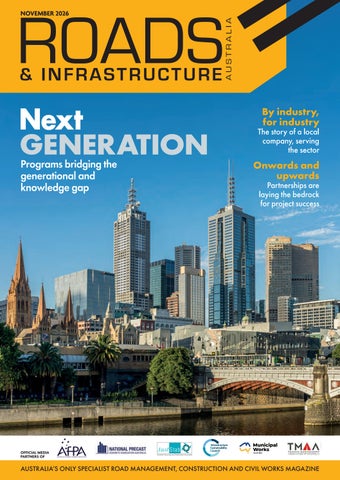
Next
GENERATION Programs bridging the generational and knowledge gap
By industry, for industry
The story of a local company, serving the sector
Onwards and upwards
Partnerships are laying the bedrock for project success
A WIRTGEN GROUP COMPANY
INTELLIGENT COMPACTION FOR SENSITIVE ASPHALT MIXES IN HIGH RISK LOCATIONS
CLOSE TO OUR CUSTOMERS. For decades, HAMM oscillation has been the go-to compaction method for quality results on sensitive asphalt mixes like SMA and EME-2, especially around vibration sensitive assets like pipelines, bridge decks and buildings. Now HAMM has introduced Smart Compact Pro - another breakthrough in compaction efficiency that incorporates real-time density on the fly. Do you want to be known for producing quality pavements, quickly and with less re-work? Let Hamm help. www.wirtgen-group.com/hamm optionxgroup.com.au Wirtgen Australia · Lot 2, Great Eastern Highway · South Guildford WA 6055 · Call: 1300 978 858
NOVEMBER 2026 CONTENTS 42 Hungry for more A growing capability fuelled by genuine partnership. 44 Rising to the occasion Moving materials safely and efficiently. 46 New to the team Exploring newfound road resurfacing and rehabilitation abilities.
COVER STORY 6 Step right up A program to attract, develop, and retain the next generation of skilled industry professionals.
ROADS REVIEW 8 This month, we asked the industry’s decision-makers, ‘As we near the end of 2026, what do you see as being some of the industry’s biggest achievements this year?’
PROJECT REPORT 10 A dynamic duo The enduring partnership of two organisations has channelled efforts to innovate in the name of greener infrastructure outcomes.
COMMUNITY SUPPORT 13 Noble causes Philanthropy is embedded in the DNA of this major Original Equipment Manufacturer.
INNOVATION 16 Nexus point How innovation is set to accelerate the development of automated transport systems.
THOUGHT LEADERSHIP 25 Chain of command Construction and infrastructure businesses will soon again face fuel cost passthrough claims. 28 Beyond measure A new leader explains the vital roles that certain technologies play in supporting material production.
COMPANY PROFILE 31 Step change Get to know the industry specialist looking to shake things up. 34 Quick and nimble A winning approach for this growing game changer.
ASSET MANAGEMENT 37 Looking ahead Proactive management is helping asset managers keep unwanted vegetation under control.
48 To the drawing board A unique design has revitalised key road solutions.
EVENTS 50 National Precast joins Converge 2027 Supporting and promoting the use of precast concrete across construction and infrastructure. 51 The NT Major Projects Conference Industry leaders and decision-makers will return to the Darwin Convention Centre this November.
ASSOCIATION SECTION 54 Road resilience Municipal Works Australia is supporting the delivery and upkeep of Australia’s road network by enabling councils to achieve more, with less.
CONTRACTS & TENDERS 58 Roads & Infrastructure provides an update on some of the contracts and tenders recently awarded or put to market across the Australian infrastructure sector.
MACHINERY & EQUIPMENT 40 Breaking it down A new attachment range for demolition equipment.
Below: Dive into this edition of Roads & Infrastructure magazine.
Image: Municipal Works Australia
19 New directions An industry executive breaks down alternative trenchless construction methods and their benefits.
22 On the grid An advanced system to support domestic electrical infrastructure operations.
roadsonline.com.au
3
CEO Christine Clancy christine.clancy@primecreative.com.au
PUBLISHER Sarah Baker sarah.baker@primecreative.com.au
MANAGING EDITOR Lisa Korycki lisa.korycki@primecreative.com.au
EDITOR Tom O’Keane tom.okeane@primecreative.com.au
TOM O’KEANE – EDITOR
JOURNALIST Sean Gustini sean.gustini@primecreative.com.au
HEAD OF DESIGN Clayton Hawley
ART DIRECTOR Bea Barthelson
BUSINESS DEVELOPMENT MANAGER Loren Katie Logan lorenkatie.logan@primecreative.com.au
CLIENT SUCCESS MANAGER Sabrina Zor sabrina.zor@primecreative.com.au
HEAD OFFICE Prime Creative Pty Ltd 379 Docklands Drive, Docklands VIC 3008 Australia p: +61 3 9690 8766 info@primecreative.com.au www.roadsonline.com.au
SUBSCRIPTIONS +61 3 9690 8766 subscriptions@primecreative.com.au Roads & Infrastructure Australia is available by subscription from the publisher. The rights of refusal are reserved by the publisher.
ARTICLES All articles submitted for publication become the property of the publisher. The Editor reserves the right to adjust any article to conform with the magazine format.
COVER IMAGE Image: stock.adobe.com/Marvin
COPYRIGHT Roads & Infrastructure Australia is owned and published by Prime Creative Media. All material in Roads & Infrastructure Australia is copyright and no part may be reproduced or copied in any form or by any means (graphic, electronic or mechanical including information and retrieval systems) without the written permission of the publisher. The Editor welcomes contributions but reserves the right to accept or reject any material. While every effort has been made to ensure the accuracy of information, Prime Creative Media will not accept responsibility for errors or omissions or for any consequences arising from reliance on information published. The opinions expressed in Roads & Infrastructure Australia are not necessarily the opinions of, or endorsed by the publisher unless otherwise stated.
4
ROADS NOVEMBER 2026
COMMUNITY FIRST EVERYWHERE WE LOOK, community plays an integral role in the infrastructure sector. Not only are the majority of projects delivered for the community, but community helps to drive, support and mould infrastructure design and delivery. It’s an often-understated area of the industry, which lacks the attention and plaudits. Which is why the November edition of Roads & Infrastructure magazine is dedicated to the communities that help make the sector what it is today. Widening the sector’s employment pool to a broader cross section of the community has been earmarked as a solution to tackling the ongoing skilled personnel shortage facing the industry. The Octave NextGen Builders Program is just one example of an initiative that’s helping the construction and infrastructure sectors to attract, develop and retain the next generation of skilled professionals. The program gives participants experience and insight into how data and intelligence are applied across real construction and infrastructure projects before they graduate, providing a pathway for them to enter and remain within the industry. To support the future of community oriented transport systems, the National Transport Research Organisation has acquired Australia’s first fully autonomous bus, which will be used to evaluate how the nation’s transport sector can best accelerate autonomy. Maintaining essential community connection is also placed under the microscope in this edition. Municipal Works Australia explains how its upcoming events and initiatives are supporting council efforts to upkeep road maintenance and condition, despite many municipalities being challenged to do more, with less. Such developments are also highlighted through the lens of Brisbane City Council, which is prioritising sustainable alternatives as part of road construction, where possible. This forms part of a wider strategy that’s helping to deliver the infrastructure needed to support the upcoming 2032 Brisbane Olympic and Paralympic Games. Finally, we touch base with some of the industry’s biggest figures to answer the question, ‘As we near the end of 2026, what do you see as being some of the industry’s biggest achievements this year?’ Happy reading!
W K p
H
Reliability starts with the right machine. Because every project depends on it.
Explore the Komatsu Construction & Utility range.
When deadlines matter, reliability matters. Komatsu construction and utility equipment is designed to deliver the performance, durability and dependability businesses rely on every day. Helping operators stay productive and projects stay on track.
1300 566 287 | komatsu.com.au 0800 566 2878 | komatsu.co.nz
PATHWAY FOR FUTURE GENERATIONS Image: Curtin University
The Octave NextGen Builders Program is helping the construction and infrastructure sectors attract, develop and retain the next generation of skilled professionals. Representatives from the program’s inaugural partner explain.
Dr Vasilios Papastamoulis, School of Design and the Built Environment, Faculty of Humanities – Curtin University.
I
nfrastructure Australia’s latest Market Capacity report puts the public infrastructure pipeline at $242 billion, up 14 per cent year on year. That same report expects the worker shortage to peak at around 300,000 by 2027. With about 204,000 people in the infrastructure workforce right now, unprecedented pressures are being placed on the current volume of industry experts. It’s for this reason that there’s a focus on developing a professional pipeline for future generations, ensuring that projects can be delivered and supported for decades to come. Dr Vasilios Papastamoulis, School of Design and the Built Environment, Faculty of Humanities – Curtin University says a combination of factors has exacerbated demand for skilled personnel. “People may leave the construction industry because it can be highly demanding. Drawing on my 18 years of industry experience, I recall working long hours, often in challenging weather conditions, travelling frequently between project sites, and dealing with the uncertainty of project6
ROADS NOVEMBER 2026
based employment, associated with harsh site environments, including mud, dust, excessive noise, and exposure to fly ash during major infrastructure projects, such as the construction of a power plant,” he says. “The workforce is also ageing and lacks diversity, with women making up about 13 per cent of the workforce and only four per cent of trades. “So, the challenge is not just attracting people, but also giving them reasons to stay by showing construction as a safe and modern high-tech industry.” To assist in this education and pathway creation, Curtin University became the inaugural partner of the NextGen Builders Program, an initiative developed by global software provider Octave. As Dr Papastamoulis explains, the program gives participants experience and insight on how data and intelligence are applied across real construction and infrastructure projects before they graduate. “Our program gives students hands-on experience with industry-standard software before they graduate, so that they can enter their first industry role already familiar with
how the work is done,” Dr Papastamoulis says. “It gives our students in-demand digital skills and real-world experience, while showing why these careers are so important to Australia’s future. “The industry gains job-ready graduates, and students gain a genuine head start.” In the program, students learn to turn complex Building Information Management (BIM) data into construction-ready plans, and to bring different models together to spot and prevent design clashes before they become expensive problems on site. Students use Octave’s OnSite Visualise software, the same professional-grade digital construction tools used on major infrastructure and construction projects across industry. This is in addition to other industry standard software such as Revizto, Navisworks, Revit, Fuzor and more. Dr Papastamoulis says the people who understand how something gets built and the data behind it are the ones who’ll be most in demand over the next ten years. “Within the unit, students work directly with industry software on true projectbased tasks, much as a graduate would in a real project team,” he says. “In practice that means combining and reviewing federated BIM models, running clash detection to identify and resolve conflicts between different disciplines’ models, and producing
Image: stock.adobe.com/Marvin
COVER STORY
Initiatives like the NextGen Builders Program aim to ease pressure on the current and emerging construction industry workforce.
Image: Curtin University
coordinated, construction-ready outputs. In one of their main assessments, for example, they take a real-world construction project and work right through it: simulating the construction schedule to test whether it’s realistic and where resources are stretched, running cost estimates and procurement analysis, and carrying out clash detection to find and fix conflicts in the model before they’d ever hit site.” Participants also look at how these tools improve safety and quality across the life of a project and weigh up the sustainability side through a life cycle assessment. Then they pull it all together and present their findings as a team, mirroring the real process
on a real project. Such environments can also be assessed via virtual reality headsets, allowing students to train in site safety and get a feel for managing a build overall, turning complex three-dimensional models into immersive walkthroughs they can explore before anyone sets foot on site. Dr Papastamoulis adds that students learn by doing the work, using professional software, on projects that look and feel like the real thing. “What excites me most is seeing our students use professional tools, grow in confidence, and strengthen their employability through real industry experience,” he says.
Dr Vasilios Papastamoulis (middle) with students (l-r) Ray Zhang, Eireann Robertson, Ikramjit Bhalla, Jennifer Rose and Liam Greyling.
“This is the most rewarding part of the partnership, because it directly supports their transition from university into practice. “The program is also building a national pipeline of digitally skilled graduates, positioning Western Australia and Curtin University as leaders in this field.” While the program is still in its early days, having launched in July, Papastamoulis says the general feedback from students has been overwhelmingly supportive. A claim further backed by a host of anonymous surveys, with this direct feedback helping to mould the program to the future aspirations of participants. “Two things stand out,” he says. “First, they really value the hands on, industry-relevant units. ‘Virtual Design and Construction’, the very unit this program runs through, is one they single out for building practical, realworld skills. “Second, students told us that roughly 90 per cent of their coursework maps directly to what they do in the workplace, which is exactly the gap this program is built to close. They’ve also asked for more industrystyle tasks over generic academic ones, and more real tools and software, so bringing professional software into the classroom is a direct response to what students have been telling us they need.” roadsonline.com.au
7
ROADS REVIEW
ROADS REVIEW
This month, we asked the industry’s decision-makers, ‘As we near the end of 2026, what do you see as being some of the industry’s biggest achievements this year?’ CADELL TAYE, CHIEF EXECUTIVE OFFICER – NATIONAL PRECAST CONCRETE ASSOCIATION AUSTRALIA
One of 2026’s most significant achievements has been strengthening workforce capability. For precast, this includes a dedicated Certificate III pathway and growing uptake of National Precast Association’s microcredentials, with more than 1000 workers enrolled nationally. These developments give precast workers formal recognition and clearer career pathways, while supporting safer manufacturing, consistent quality and less rework. Recognising the specialist skills behind precast production also helps position manufacturing as a valued career choice, supporting recruitment and retention. Investing in people is fundamental to delivering productive, sustainable infrastructure and building the workforce needed for Australia’s future projects. Image: National Precast
MATTHEW BERENI, CHIEF EXECUTIVE OFFICER – TRAFFIC MANAGEMENT ASSOCIATION OF AUSTRALIA (TMAA)
For traffic management, 2026 was the year our industry was properly counted. New workforce research put our sector at around 30,000 workers and a $2 billion economic footprint, giving governments and clients clear evidence of the value this workforce delivers on every road project. The release of Austroads Guide to Temporary Traffic Management (AGTTM) Edition 1.2 was another step towards nationally consistent practice, and we’ve seen a sharper focus on safe speeds through roadworks, supported among other things by our road safety campaigns. Above all, TMAA continues to recognise the traffic controllers who keep road users and work crews safe, often in tough conditions, every day of the year. Image: Traffic Management Association of Australia
TANJA CONNERS, CHIEF EXECUTIVE OFFICER – AUSTSTAB
From AustStab’s perspective, a major achievement in 2026 has been demonstrating how pavement recycling and stabilisation can deliver resilience, sustainability and whole-of-life value together. Evidence shared through our national conference, from Lismore’s flood recovery to Queensland’s expansive-soil projects, showed the benefits of treating underlying problems while retaining existing materials. Research into working time, binder behaviour and testing consistency has also strengthened the evidence informing practice. The achievement is not simply new technology; it is connecting researchers, road owners and industry to make better decisions and build confidence in appropriate recycling solutions. Image: AustStab
SAM MENDOZA, NATIONAL DIRECTOR AND NATIONAL INFRASTRUCTURE SECTOR LEAD – WT AUSTRALIA One of the industry’s biggest achievements in 2026 has been the shift towards more disciplined, outcome-focused infrastructure investment. As the era of mega-projects gives way to more targeted programs, particularly in regional Australia, there is greater focus on selecting and shaping projects around the value they deliver. At the same time, embodied carbon is becoming a more influential factor in design and investment decisions. More consistent measurement is helping project teams consider carbon alongside cost, risk and performance, supporting infrastructure that delivers stronger economic, environmental and community outcomes. Image: WT
If you or someone at your organisation is an industry leader and would like to be a part of this monthly column in 2026, please get in touch with Editor, Tom O’Keane: tom.okeane@primecreative.com.au 8
ROADS NOVEMBER 2026
A GREENER ROAD AHEAD Brisbane City Council has replaced 100 per cent of its conventional A15E binder with SAMIGreen, marking a significant step towards lower-carbon road construction.
Image: SAMI Bitumen Technologies
The wide adoption of SAMIGreen by Brisbane City Council followed thorough testing and trialling of the product.
S
ustainability is a council-wide priority at Brisbane City Council, reflected in its broader ‘Clean, Green City’ and Brisbane vision. The council maintains certified carbonneutral status, using offsets, while continuing to pursue direct emissions reductions where possible. Just one of the ways in which council is progressing this goal is reviewing its operations, particularly when it comes to road construction. A recent collaboration has centred on SAMIGreen, SAMI Bitumen Technologies’ range of bio-modified asphalt binders, developed as a lower-carbon alternative to conventional binders. Brisbane City Council has become the first organisation or authority to completely switch to a bio version binder, having fully adopted SAMIGreen for its road construction projects, where applicable. The decision follows laboratory testing and approximately 16 months of field monitoring, which found the bio-modified binder performed comparably with conventional asphalt while offering a substantially lower carbon footprint. For Brisbane City Council, the move shows 10
ROADS NOVEMBER 2026
how sustainability targets can be translated into practical changes on the road network. Every tonne of A15E polymer-modified binder replaced with its SAMIGreen equivalent saves approximately 322 kilograms of carbon dioxide equivalent (CO₂e), with the product delivering around a 37 per cent reduction in the binder’s carbon footprint. Just as importantly for a road authority responsible for long-lived assets, the transition has not required a fundamental change to asphalt production or paving practices. The decision grew from a long-standing relationship between Council and SAMI Bitumen Technologies. SAMI became Council’s principal supplier of bituminous products in 2010, and the partnership has since extended beyond supply to include collaborative work on products such as multigrade and EME binders. That history created a foundation for the two organisations to investigate whether lower-carbon materials could meet the performance requirements of the city’s road network. “We’ve worked with SAMI Bitumen Technologies for a long time and have a good relationship with their current and previous state managers. The technical team has always been great to work with,” says Andrew Kidd,
Manager, Asphalt Operations at Brisbane City Council. Kidd adds that the organisations have collaborated on a range of projects, with SAMI providing in-kind assistance such as binder testing and binder recovery when required. For Council, the relationship has meant having a supplier willing to understand the needs of its network and support research and development. That cooperation became important when SAMI initially introduced SAMIGreen, its range of bio-modified asphalt binders developed to reduce reliance on conventional fossil-derived components. The range can be formulated to meet different project requirements and carbon-reduction goals, giving customers flexibility over the level of reduction they pursue. “The customer can set the level of reduction they’re aiming for, and we can work out a formulation to match,” says Hamidreza Sahebzamani, R&D and Technical Support Manager at SAMI Bitumen Technologies. The SAMIGreen range includes lower-carbon alternatives for different binder grades, supported by an independently-verified Environmental Product Declaration (EPD) that provides transparent emissions data. Before committing to wider use, Council
PROJECT REPORT
needed evidence that the alternative binder could deliver the same engineering performance, durability and expected service life as conventional material. The program began with laboratory testing by SAMI and Council. After the initial results were positive, the organisations progressed to a controlled field trial in February 2025, designed to compare SAMIGreen and conventional asphalt under real operating and service conditions. Four different SAMIGreen binder grades were placed alongside conventional reference asphalt sections, including on a heavily trafficked road. The side-by-side approach allowed the team to assess both laboratory results and how the materials behaved in service. The evaluation considered more than initial carbon savings: durability, longevity and future recyclability were also important, because a pavement with a shorter life could undermine the environmental benefit of a lower-carbon material. The laboratory results were strong, and field monitoring over approximately 16 months found the SAMIGreen sections were performing comparably with the conventional reference sections. According to the program’s findings, the trial delivered favourable results without identifying a performance trade-off that would prevent broader implementation. The results gave Council confidence to move beyond a demonstration and incorporate the lower-carbon binder into routine asphalt production. Phil Stevens, Queensland State Manager at SAMI Bitumen Technologies, says field trials are also valuable because they provide
Image: Brisbane City Council
Recent applications in Queensland have re-affirmed SAMIGreen’s sustainability and performance potential.
real-time feedback from customers and other stakeholders. “We’re always keen to understand what their needs are. That helps us improve our products and take those improvements to the wider market,” he says. For Troy Akers, Technical Manager at Brisbane City Council, the combination of performance results and verified carbon data helped make the case internally. “We were happy with the performance, and we got some latitude internally to look at alternative carbon-reduction strategies,” he says. After presenting the values and the potential reductions to Council’s branch manager, Akers says the response was to make SAMIGreen the standard product. “We’ve swapped out 100 per cent of our conventional A15E binder for SAMIGreen A15E as a result,” Akers says. “Any pavement product we produce that requires A15E will be bio-based, which means all the moderate to heavy-duty traffic sections of our roads will be surfaced using the SAMIGreen A15E product.” The transition has also been designed to work within established operations. Kidd says the new binder has been a like-for-like replacement in production and compactability, with no significant impacts
observed in production, storage temperature or maintenance. That practical outcome is central to the approach: lower embodied carbon can be achieved without requiring a new pavement system, specialised paving equipment or a wholesale change to familiar construction processes. Council and SAMI have also considered what happens at the end of a pavement’s service life. Asphalt is widely reclaimed and reused, so the recyclability of the SAMIGreen mixes formed part of the evaluation. The aim is for lower-carbon pavements to remain suitable for recovery and incorporation into future asphalt production, supporting a circular approach rather than shifting environmental impacts further down the line. The use of biogenic materials also offers a way to diversify the raw materials used in road binders and reduce dependence on petroleum-derived resources. It does not remove the need for conventional bitumen, but it can reduce the share of fossil-derived material required. In a sector exposed to fluctuations in refinery capacity, global markets and supply-chain disruption, that diversification may provide an additional resilience benefit alongside carbon reduction. The change comes as Brisbane prepares infrastructure for the 2032 Olympic and
“ANY PAVEMENT PRODUCT WE PRODUCE THAT REQUIRES A15E WILL BE BIO-BASED, WHICH MEANS ALL THE MODERATE TO HEAVY-DUTY TRAFFIC SECTIONS OF OUR ROADS WILL BE SURFACED USING THE SAMIGREEN A15E PRODUCT.” Paralympic Games and continues to consider the long-term performance of its road assets. For Council, adopting SAMIGreen offers a way to pursue environmental goals while maintaining the durability and service expected from roads carrying moderate to heavy traffic. It also demonstrates a pathway for other asset owners: test the material, compare it with established products in service, monitor performance and scale up only when the evidence supports the decision. Akers says the partnership with SAMI remains important as Council plans for future demand and material availability. “We’ve developed a really good relationship from a supply perspective,” he says. “For a product with the benefits of SAMIGreen, it’s a no-brainer: it’s not a huge cost, but it delivers a huge benefit.” roadsonline.com.au
11
Komatsu enabled Diana Marin Hernandez (second from the left) to donate $10,000 to Adopt Change’s MyPack initiative..
DREAMING BIG
Komatsu supports its workforce and the communities they are embedded in through the Live Your Dream program, donating money to a wide variety of charities and organisations.
K
omatsu is no stranger to community engagement. The global Original Equipment Manufacturer’s (OEM) corporate identity has long been entrenched in empowering its own clients of all sizes, while developing the communities that surround them. Its wide range of equipment is key to delivering civil infrastructure projects, which inherently serve communities by encouraging social cohesion and enabling transport, connection, and economic activity. But Komatsu also knows that its equipment and the projects they assist are only as strong as the people behind them. To ensure this quality, the OEM equally invests in supporting its large workforce worldwide. The altruistic desires and ambitions of Komatsu’s near-5000 workers across
Australia, New Zealand, Papua New Guinea and New Caledonia are supported through the company’s ‘Live Your Dream’ program. Each year since 2017, the program has given select Komatsu employees a $10,000 grant to donate to a charity or not-for-profit organisation of their choice. “Live Your Dream is popular because it gives our people a meaningful way to contribute beyond their day-to-day roles,” says Zara Carey, General Manager of People Experience at Komatsu Australia. “We’re always looking at how we can make Komatsu a great place to work, and Live Your Dream is one way we do this. It supports our people and the causes that matter to them.” Throughout its nine-year history, the program has supported 62 charities, organisations and initiatives – including mental health support group Beyond Blue, bullying and youth suicide prevention
organisation Dolly’s Dream, as well as the Royal Flying Doctor Service. Komatsu has contributed over $460,000 to charities such as these in direct funding since the commencement of the program. Carey explains that employee donations often start a chain reaction of volunteers supporting causes. “The funding is often just the start, with participants raising thousands of additional dollars for their chosen causes and colleagues and peers volunteering to help them as well,” she says. “That support brings more of our people into each initiative and extends the contribution we can make together.” As a well-established aspect of Komatsu’s community engagement and support efforts, the Live Your Dream program continues to grow both in participation and scope. roadsonline.com.au
13
Images: Komatsu
COMMUNITY SUPPORT
COMMUNITY SUPPORT
Employee Grant Morgan donated his grant to the Scarborough Surf Live Saving Club in Western Australia, where he and his family are active members.
S B
Tr h su
A re
Bio res it r ✓ ✓
“Each new group of participants brings different interests and connections to the program,” Carey says, “broadening its reach and creating opportunities for more organisations to receive support.” Such is the case with employee Grant Morgan, who is part of Komatsu’s team in Welshpool, Western Australia. Morgan’s Live Your Dream donation has supported the next generation of volunteers at the Scarborough Surf Live Saving Club, where he has spent more than a decade helping young people develop the required skills to become surf lifesavers. The club relies on volunteers to patrol Scarborough Beach throughout summer, respond to water rescues, and support community events such as the Rottnest Channel Swim. Retaining young members and encouraging them to become active lifesavers remains a priority for Morgan – his funding has supported training camps and development activities that engage young members, building their skills and confidence as they progress towards qualified patrol roles. 14
ROADS NOVEMBER 2026
His long-standing involvement gives the grant a personal significance, supporting a club that has become an important part of his family’s life, as his two sons hold leadership roles in the club’s Inflatable Rescue Boat Program. Meanwhile, Komatsu employee Diana Martin used her Live Your Dream grant to support children entering out-of-home care, directing $10,000 to Adopt Change’s
handmade knitted blankets, colouring books, coloured pencils and toys. These items provide practical support and reassurance for children who may arrive in care with little more than the clothes they are wearing. The donation also helped Adopt Change purchase materials and prepare additional backpacks beyond those assembled on the day.
“EACH NEW GROUP OF PARTICIPANTS BRINGS DIFFERENT INTERESTS AND CONNECTIONS TO THE PROGRAM, BROADENING ITS REACH AND CREATING OPPORTUNITIES FOR MORE ORGANISATIONS TO RECEIVE SUPPORT.” MyPack initiative and bringing colleagues together to help assemble backpacks. MyPack provides children with everyday essentials and comfort items during uncertain and traumatic times. Komatsu’s donation funded supplies for a volunteer packing day, where Martin and other employees assembled 75 backpacks, each matched to a child’s age and gender. The packs included pyjamas, underwear, toothbrushes and toothpaste, alongside
As Live Your Dream approaches a decade of community support, Komatsu continues to give its employees the resources and abilities to act on causes they care about. “Supporting our people means recognising what matters to them outside their roles as well,” Carey says. “Live Your Dream gives us a practical way to do that, while working together to contribute to the communities that we’re a part of.”
GHS02
SAFER ROADS. SAFER CREWS. BETTER ENVIRONMENTAL OUTCOMES. Tri-Tech Chemical Company delivers industry-leading alternatives that help reduce workplace exposure risks while improving sustainability and asphalt performance.
An innovative black pigment asphalt rejuvenator made from wood waste. BioBlack AR penetrates deep into aging asphalt and restores the compounds that keep asphalt flexible. By mimicking the binder's molecular structure, it reverses aging and helps prevent the cracking and potholes which follow. ✓ 98.9% bio-based formulation
✓ Deep penetration into asphalt binder structure
✓ Binder restoration + deep black finish
✓ No PAHs, VOCs or PFAS
✓ Extends pavement life by up to 7 years
✓ Lower carbon footprint alternative
wood waste becomes pigment becomes dispersion
TRISOL BC
Low L o tox bitumen cleaner/asphalt Slip Agent Trisol BC can be used to prevent sticking or build-up of bitumen when applied to tools and equipment such as truck trays or hoppers, allowing for safe and efficient clean-up. Made in Australia from local vegetable oil derivatives, the product is non-hazardous and fully biodegradable. It does not contain petrochemicals or caustic materials.
Reduce worker exposure without compromising productivity • Non-hazardous and fully biodegradable • Non-toxic, low odour, low VOC formulation • No Dangerous Goods classification • Excellent bitumen solvency and cleaning performance • High flash point for improved safety • Supports workplace safety and Zero Harm objectives
GHS02 Flammable GHS05 Corrosive
GHS06 Toxic
GHS08 Health Hazard GHS07 Harmful
BETTER ROADS.
BETTER ENVIRONMENTAL ALTERNATIVES. BETTER WORKPLACE EXPOSURE OUTCOMES.
0412 611 415
johnk@ttcc.com.au
ttcc.com.au
CHEMICAL COMPANY responsible solutions for a better tomorrow
A PRECEDENT FOR TRANSPORT’S FUTURE Australia’s first mid-sized autonomous bus is set to accelerate the nation’s progress towards the establishment and implementation of automated transport systems.
A
ustralia is still at an early stage in its journey towards transport automation. According to National Transport Research Organisation (NTRO) Chief Executive Officer Michael Caltabiano, Australia is estimated to be lagging about 15 years behind other parts of the world. While there have been promising trials, including work in Melbourne and Ipswich, initiatives have remained isolated pilots rather than part of a broader national move to embrace autonomous transport. In November 2015, the NTRO undertook Australia’s first automated vehicle demonstration with Volvo XC 90s in Adelaide. Caltabiano says Australia’s adoption and embracing of automated transport technology throughout the subsequent years could be described as being “tentative”, while international counterparts took significant leaps in terms of its development and implementation. He points to countries such as Japan and the United States, that have progressed automation through testing and learning about real-world scenarios, 16
ROADS NOVEMBER 2026
helping to accelerate implementation. Australia, in his view, has yet to build that same depth of experience. Caltabiano describes autonomous transport as a long-term effort, saying Australia needs time to learn how the technology performs in local conditions before it can be widely implemented. “You can’t just say, ‘tomorrow we’ll have Level Four autonomy in Australia.’ It’s a 10-year period of learning,” he says. Level Four autonomy refers to a vehicle that can perform the entire driving task without a human driver needing to take over. If the vehicle reaches the limits of those conditions, it must be able to manage the situation safely, such as by pulling over or stopping. Dr Charles Karl, National Discipline Leader, Mobility Futures – NTRO says that preparation for the optimal use of automated systems depends on the satisfaction of a key criterion. “The four pillars for change are the vehicle, the infrastructure, the people, and the regulatory and operational
framework,” he says. “The important thing about connected and automated vehicles is to look across the land domain – not just roads, but agriculture, mining, supply chains, defence, ports and airports.” AUSTRALIAN-FIRST TEST CASE To support greater learning around the future of automated transport, NTRO has acquired a 17-seat electric BYD bus, expandable to 23 seats, equipped with Level Four autonomous technology. The bus was sourced from Japan through a partnership with TIER IV, which supplies autonomousvehicle technology, including sensors and software. NTRO owns the vehicle and its technology, giving the organisation a platform to develop and test potential uses for autonomous transport in Australia. The bus is named after Rita Excell, who was previously the Executive Director of the Australian Driverless Vehicle Initiative (ADVI), which partnered with the NTRO to deliver
INNOVATION
Images: NTRO
‘Rita’ marks an Australian first for national autonomous technology adoption.
the aforementioned Volvo XC 90s trials. ‘Rita’, otherwise known as the Robobus, helps NTRO investigate how autonomous systems respond to real-world situations, from pedestrians crossing in front of the bus to heavy rain and other situations that can affect sensor performance. And that’s just one small aspect of the bus and program’s full potential. The bus and subsequent programs are also expected to support the industry’s efforts to address growing challenges around staffing. According to Caltabiano, about 27,000 vacancies across transport-driving roles, as well as an ageing workforce, with many drivers approaching retirement, will place further pressure in the current workforce. In his view, autonomy could help maintain essential transport services as those pressures grow. “We can’t naturally move people into those jobs,” he says. “We can’t import people into those jobs fast enough, and we’re going to retire them out. Autonomy is one of the pathways that will help us.” The intended scope of the project
will also give transport jurisdictions, bus operators and councils a chance to see and experience the technology, then assess how it performs in local conditions. Another aim is to help agencies become more informed for future zero-emission bus procurement. “We just have to be ready, understand the issues and give good advice,” Karl says. “The essential core of our existing infrastructure isn’t going to change, just as our roads aren’t going to change. “What can change is how a system uses that existing infrastructure. That’s what we’re wanting to learn more about.” The NTRO is now consulting local governments about potential use cases, with a myriad of programs slated for commencement. “We’re reaching out to local governments to ask: What are your use cases? Can we bring the bus to your community? Where are the opportunities for moving people?” “’Rita’ will be the watershed moment that allows local communities to access safe, secure and reliable journeys in their local communities,” Caltabiano says. For more information on Rita, visit https://www.ntro.org.au/fleet/rita
It’s expected that ‘Rita’ will help to accelerate the adoption of autonomous technology across Australia.
roadsonline.com.au
17
MORE THAN ACCESS. YOUR TOTAL SOLUTIONS PROVIDER.
4008
D601AHG
METROHYBRID
One Partner. Total Site Solutions. At JLG, we deliver more than access equipment. We provide end-to-end site solutions designed to keep your projects moving, safely and efficiently. From material handling to lighting and access, our range is built to meet the demanding conditions of civil construction, transport corridors, and major infrastructure works. Whether you’re building, upgrading, or maintaining Australia’s road networks, JLG is ready to support your site from the ground up.
SALES | SERVICE | PARTS
Discover the full range now Australia 131 JLG www.jlg.com.au
www.ausa.com/en-au/
INNOVATION
BEYOND THE BORE Recent projects highlight the short and long-term benefits of alternative trenchless construction methods. OptionX Group Chief Executive Officer Stuart Harrison outlines the key takeaways that could prove beneficial to road and asset management authorities.
W
PROTECTING THE ASSET ABOVE For road users, one of the most significant consequences of open excavation can continue long after construction is complete. Natural ground develops over time as a continuous structure. Once a trench is excavated, that structure is disturbed and subsequently replaced with compacted fill. Even where reinstatement is completed correctly and to specification, Harrison says the reconstructed section behaves differently from the surrounding undisturbed ground. “When natural ground expands and contracts, it does so in harmony,” he says. “A
OptionX’s AdaptX technology enabled canopy tube installation beneath a busy Sydney road and alongside active rail infrastructure.
Images: OptionX
hen an underground pipeline is installed beneath a road, project success is usually measured below ground. Was the pipe installed accurately? Was the project delivered safely, on time and within budget? But OptionX Group Chief Executive Officer Stuart Harrison believes there is another question infrastructure owners should be asking: ‘what happened above it?’ Every section of roadway excavated to install underground infrastructure creates another area requiring traffic management, bitumen removal, reinstatement and ongoing interaction between workers, plant and live traffic. It also changes the structure of the ground supporting the road. For Harrison, this means the comparison between trenching and trenchless construction should extend well beyond the cost of installing the pipe. “Trenching is the open-heart surgery option. Trenchless is the keyhole option,” he says. That philosophy underpins OptionX Group’s approach to underground infrastructure. Its contracting arm, Edge Underground, applies the Group’s AdaptX microtunnelling technology in the field in Australia, while the broader Group provides engineering, manufacturing and technology development capability. The objective is not simply to install a pipeline without digging a continuous trench. It is to reduce the wider impact of construction wherever possible.
backfilled trench behaves differently, and that’s when you can begin to see potholes, subsidence and, in the worst cases, sinkholes.” Avoiding the trench therefore has benefits beyond reducing construction activity. It can reduce the amount of bitumen requiring demolition and reinstatement, limit disturbance to the ground beneath the road and reduce the number and duration of traffic management zones required during construction. These benefits are particularly significant in congested urban environments, where underground infrastructure must compete for space with existing utilities, while roads and surrounding services remain operational. BEYOND CONVENTIONAL INSTALLATION A project completed by Edge Underground in Sydney demonstrated how that philosophy can be applied well beyond a conventional water or sewer installation. As part of Sydney’s GreenWay project, Edge Underground was engaged to help facilitate construction of a future tunnel beneath Longport Street. Rather than installing a pipeline, the team installed 19 steel canopy tubes, each 21 metres long and 508 millimetres in outside diameter. The tubes were installed beneath the roadway and subsequently filled with grout, creating a structural arch through the
ground before excavation of the larger tunnel beneath it. The project presented an unusual combination of constraints. Above the works was a busy road. Alongside them was active rail infrastructure. The existing brick-built embankment contained variable and unpredictable material, including soft ground, voids, old rail backfill and man-made structures. Access was also restricted, with much of the work needing to be completed from one end of the site. Settlement was not considered an acceptable outcome. Edge Underground deployed an enhanced Axis machine incorporating AdaptX technology, but the solution required considerably more than simply taking an existing machine to site. OptionX Group developed a custom casing advancement system in-house, allowing the team to retract and make realtime adjustments to drilling parameters as ground conditions changed. A purpose-built adjustable platform was also developed to accommodate six-metre casing lengths and reduce the number of casing joints required. The result was a completed canopy tube arch with zero impact on the road infrastructure above and no disruption to the major rail service operating beside the site. roadsonline.com.au
19
INNOVATION
excavation. As trenches become deeper, requirements around excavation volume, shoring, access, spoil removal, plant, labour, traffic management and reinstatement increase significantly. A trenchless methodology does not eliminate every project cost, but it can prevent many of those costs from increasing at the same rate.
OptionX has been influential in delivering innovative trenchless works that minimise impacts on the environment.
Stuart Harrison, Chief Executive Officer – OptionX Group.
For Harrison, the project demonstrated an important point about trenchless technology. Its value is not limited to replacing a trench with a bore. The same precision, adaptability and ability to work within constrained environments can allow engineers to rethink how difficult infrastructure problems are solved in the first place. COMPARISON INTO NUMBERS While the Sydney project demonstrated what is possible in a highly constrained environment, work undertaken by Edge Underground in Adelaide has provided an opportunity to compare trenchless construction more directly with conventional excavation. On the SA Water project at Munno Para, Edge Underground used AdaptX technology to install underground infrastructure through an area containing extensive existing services. 20
ROADS NOVEMBER 2026
The project provided OptionX Group with a practical basis for comparing the trenchless methodology with the labour, fuel, excavation and associated activities that would have been required using conventional construction. The resulting figures were significant. Labour requirements were reduced by approximately 35 per cent, with the trenchless methodology requiring around 540 hours compared with an estimated 840 hours for the conventional approach. Fuel use was approximately 45.5 litres per metre, compared with 58.47 litres per metre for the conventional methodology, representing a reduction of around 22 per cent. The analysis also estimated that approximately 3000 tonnes of Carbon dioxide equivalent emissions was avoided across construction activities, material production and quarrying operations. Importantly, the project dramatically reduced the need to expose and work around existing underground services. The Adelaide works passed 179 critical infrastructure assets without the need to excavate around them, substantially reducing the potential exposure to service strikes associated with open excavation. The comparison also demonstrated how project depth can alter the economics. At around four metres deep, the trenchless approach produced a relatively modest cost saving of approximately three per cent. At seven metres, the saving increased to around 30 per cent. That difference reflects one of the limitations of looking only at the cost of making the initial
THE COST OF WHAT DOES NOT HAPPEN For Harrison, this is where traditional comparisons between trenching and trenchless construction can become misleading. A simple cost-per-metre comparison does not necessarily account for the full effect of the construction method on the surrounding asset. Traffic management has a cost. Bitumen demolition and reinstatement have a cost. Excavating around existing services introduces both cost and risk. Transporting and disposing of excavated material has a cost. And if disturbed ground contributes to produce maintenance problems later in the life of the roadway, that cost may ultimately sit with the road owner rather than the contractor that installed the pipeline. Trenchless construction cannot remove every construction impact, but by concentrating works around relatively small launch and retrieval areas it can substantially reduce the surface footprint of underground works. That means fewer interactions between construction crews and live traffic, less bitumen requiring reinstatement and less disruption to surrounding businesses, residents and road users. Sydney showed how the technology could be adapted to solve an unconventional engineering challenge while allowing critical road and rail infrastructure to remain unaffected. Adelaide demonstrated that when trenchless construction is compared with conventional excavation across labour, fuel, existing-service interactions and project cost, the benefits can be measured as well as observed. For road authorities, the broader lesson is that underground construction should not be assessed solely by what happens to the pipe. The road above it matters too. “The pipe is only one part of the project,” Harrison says. “You need to look at everything that happens around it.”
The Most Versatile FORWARD MOVING SPREADER YET
CIVIL WATER CART TRUCKS
Engineered for the toughest Australian worksites. Official TTi Authorised Fitter.
LEARN MORE
qualityfab.com.au • 1800 97 97 08 • workshop@qualityfab.com.au
QFEAUS
Left: The VX25 Ri4Power is a complete solution for assembling type-tested low-voltage switchgear with internal form separation.
SWITCHING GEARS APS Industrial is supplying Rittal’s VX25 Ri4Power modular switchgear and power distribution system to support industrial electrical infrastructure operations.
E
lectrical infrastructure plays the paramount role of powering modern society. From energy facilities and electric lines to transmission towers, traffic signals and beyond, these utilities operate day and night to keep homes powered, people connected, and transport systems safe. Organisation is key to ensuring electrical infrastructure does its job. Many of these structures come with ‘enclosures’: protective boxes designed to contain critical electrical components including switchboards, busbars, and the internal separation concept – the separation of low-voltage switchgear into distinct partitions – between them. These enclosures are meticulously designed to fit all the necessary parts in a safe and efficient manner – but as demand for electrical infrastructure continues to rise, immense pressure is put on the organisation of these enclosures, and their safety and efficiency is strained as a result. “As electrical infrastructure projects grow in scale and complexity, switchboard builders are being asked to deliver more
22
ROADS NOVEMBER 2026
boards, to tighter programs, with complete design verification attached,” says Dulmina Jayathilake, Modular Switchboard Product Manager at APS Industrial. “Much of that pressure lands on the relationship between the enclosure, the busbar system, and the internal separation concept. Where those three elements are specified separately, time is lost reconciling them on the shop floor. Where they are supplied as one tested system, that effort moves back into the build.” Electrical enclosure manufacturer Rittal is combating these efficiency and safety issues through the distribution of the VX25 Ri4Power, a modular low-voltage switchgear and power distribution built on Rittal’s own VX25 enclosure platform. APS Industrial is amplifying this equipment across Australia. Designed for applications up to 6300 Amperes, the VX25 Ri4Power switchgear system combines the VX25 enclosure system and the tested switchgear system into a complete solution for assembling typetested low-voltage switchboards. Jayathilake explains that the system is
backed by worldwide accreditation. “The system is continuously type-tested to international switchgear standard IEC 61439-1, offers protection categories up to IP 54, and provides tested accidental arcing protection to international standard IEC 61641.” Chief among the benefits of the VX25 Ri4Power solution is the flexibility it provides to electrical infrastructure operators. Sections of the switchgear system can be compiled to suit different jobs. These include Air Circuit Breaker (ACB) sections for the infeed and output of large currents, outgoing sections that unite switchgear, fused outgoing feeders and control units under one roof, coupling sections for connecting or disconnecting busbar systems, and fuse-switch disconnector sections with integral cable chambers for compact distribution. The main busbar systems can also be configured for a short-circuit rating of up to 100 kiloamperes for one second, and cable entry is available from above, below, or both. Additionally, Jayathilake says that the VX25 Ri4Power’s modular design allows form separation to be handled within the same tested system. “The continuous modular design allows each enclosure tier to be subdivided into individually configurable busbar compartments, functional units, and connection areas across a variety of internal separation levels,” Jayathilake says. The VX25 Ri4Power solution is also efficient. The system delivers time savings of more than 50 per cent, supported by design decisions that remove components and steps from key processes. Compartment side panels matching the enclosure height shield all functional spaces at once, replacing individual vertical partitions from section to section. The 25-millimetre enclosure section pitch pattern allows height-flexible assembly of horizontal compartment dividers, which slide into position with ease. Meanwhile, pre-punched knock-outs in the enclosure’s dividers are removed for flexible cablerouting. The maximum main busbar size is achieved by combining multiple 50 × 10-millimetre copper bars, making them easier to handle. The optimised arrangement of the individual busbars enables efficient panel assembly, reducing installation time. Project planning is handled through the
Images: APS Industrial
INNOVATION
separate RiPower planning tool, which helps to configure low-voltage switchgear, and prepare the associated design information. “Depending on the selected configuration, the tool supports the preparation of parts lists, busbar details and designverification documentation, helping connect engineering decisions with assembly.,” Jayathilake says. “These outputs support the design and verification process by ensuring that only tested configurations can be selected.”
Above: Rittal’s VX25 Ri4Power modular switchgear and power distribution system, supplied by APS Industrial.
Importantly, the VX25 Ri4 power solution improves energy storage. Its VX ESS energy storage enclosure system provides a standardised, modular solution built on top of the VX bayed enclosure system, designed for batteries and other storage modules. It is also built to handle hydrogen and supercapacitor applications, with a robust frame rated for a total load capacity of 1500 kilograms. Jayathilake believes the VX25 Ri4Power’s versatile capability makes it an asset for
electrical infrastructure operations. “From switchboards to energy storage infrastructure, VX25 Ri4Power gives switchboard builders a scalable, typetested platform that shortens assembly, simplifies verification, and keeps planning, documentation, and ordering connected,” he says.
SANY TELEHANDLERS EFFICIENCY AT THE HIGHEST LEVEL SANY telehandlers are powerful all-rounders that stand out for their agility, speed and versatlity while being the ideal solution for demanding jobs and precision work. Thanks to their compact design and a selection of three different steering modes, they can be perfectly positioned in even the tightest of spaces and can bring heavy loads up to a lifting height of between 6-18 metres.
LIFTING CAPACITY
The highly efficient and powerful hydraulics allow operators to work with precision in short cycle times.
ANTY
WARR
SAFETY
The load management system monitors the load of the machine to prevent instability when carrying loads, and limits speeds for safety and improved load retention.
EFFICIENCY
The Deutz electronic engine control (EMR) ensures optimum engine performance and low fuel consumption, while the Dana hydrostatic transmission offers precision and manoeuvrability for improved material handling applications.
1300 788 757 www.cea.net.au/sany
BRISBANE - MACKAY - ROCKHAMPTON- MELBOURNE SYDNEY - NEWCASTLE - ADELAIDE - PERTH
MORE MACHINE. GREAT RATE. Do more with ZX135US-7H.
RELIABILITY FOCUS
JAPANESE ENGINEERING
ADVANCED SAFETY TECHNOLOGY
270° AERIAL ANGLE® CAMERA SYSTEM
PREMIUM OPERATOR COMFORT
SPACIOUS CABIN WITH HEATED AIR SEAT & CLIMATE CONTROL MORE REACH & DEPTH
8.85M REACH 5.98M DIG DEPTH
INDUSTRY-LEADING WARRANTY
5YR/10K HRS POWERTRAIN WARRANTY
Now available with
1.99% Finance or a Free Tilt Hitch. T&Cs apply.
Offer ends 31st March 2027 Contact us to find out more.
THOUGHT LEADERSHIP
The Road Transport Contractual Chain Order was first introduced in April when diesel prices surged.
Image: pixarno/stock.adobe.com
CHAIN OF COMMAND
Construction and infrastructure businesses could soon again face fuel cost pass-through claims, if the Road Transport Contractual Chain Order is revived.
I
n April 2026, the Fair Work Commission (FWC) implemented a Road Transport Contractual Chain Order (RTCCO) in response to rising fuel prices as a result of shipping disruption through the Strait of Hormuz and the consequential supply impacts. The RTCCO required parties in road transport contractual chains to adjust their payment rates, so that smaller businesses wouldn’t bear the entire financial burden of the diesel price surge. RTCCO obligations ceased in early June after the price of diesel fell below the stipulated threshold of $2. As fuel prices surged again in the months following, the Transport Workers’ Union (TWU) and Australian Trucking Association (ATA) sought to have the operative obligations re-enlivened in September. A hearing on the matter then took place before the Expert Panel at the FWC in October, where parties including the TWU and affected businesses argued for the
RTCCO’s return – rejecting arguments that the present fuel price situation no longer constitutes ‘emergency circumstances’ that warrant special action. On 16 October the FWC handed down its decision to re-enliven the order on a date to be confirmed. This was not a surprise to those following the case closely. Helena Golovanoff, Partner at commercial and government law firm Holding Redlich, points out that “The context that led to the RTCCO’s introduction in April remains, including elevated fuel prices – now without fuel excise relief – and continued disruption to fuel supply chains”. “At the October hearing the FWC continued to show considerable concern for the position of road transport workers and businesses, going so far as to say half way through the day they were ‘inclined to re-enliven the order in some way’”. The Commission was unconvinced by arguments from the business sector that the ‘emergency circumstances’ that led to
the order had ceased. At the time of writing, the precise wording of the re-enlivened RTCCO was not confirmed. Golovanoff explains that the FWC proposed a modified version, seeking feedback from the parties by 23 October. Notably, despite agreeing that the emergency circumstances justifying the order remained, the FWC took much longer than the one day it took to issue the initial order in April, possibly indicating an acceptance that some of the difficulties in implementing the original order might have been a product of the swiftness with which it was made. The modifications the FWC made include reducing the frequency of adjustments from every fortnight to monthly, broadening the exclusion from the operation of the order of small or non-transport businesses and adjusting the mechanism for cessation. Assuming these remain the only changes after public consultation, it remains roadsonline.com.au
25
Image: Federico/stock.adobe.com
THOUGHT LEADERSHIP
Construction and infrastructure businesses will soon again face fuel cost pass-through claims.
26
ROADS NOVEMBER 2026
the FWC seem likely to make it any easier for parties involved in delivering a project to identify where the road transport contractual chain commences and ceases,” Golovanoff says. “Parties may also face practical difficulty identifying fuel cost increases where they do not have visibility over routes, vehicles, subcontracting arrangements, mixed loads, or the relevant transport work. “Some parties are seeking to apply fuel levies or surcharges, but the basis for those calculations from what we have seen are not clear or consistent. This is especially difficult for project owners, however the FWC expressly rejected a submission to exclude the ‘first primary party’ from the order on the basis that doing so would unreasonably burden downstream parties with the fuel price increases instead of spreading the cost Helena Golovanoff, Partner at Holding Redlich.
Image: Lumitas
difficult to predict which parts of the construction and infrastructure supply chains will be most affected when the RTCCO comes back into effect. “In view of the limited amendments to the order, the complexities of applying it in the construction industry will persist,” Golovanoff says. “Transport costs are generally embedded within composite construction pricing, deliveries involve mixed loads, and principals and contractors have limited visibility over downstream transport arrangements.” For contractors, the RTCCO may provide a pathway to recover qualifying fuel-related increases in transport costs, easing pressure on already tight margins. “Haulage of large prefabricated items, subject to the pricing structure of the relevant contract, is an obvious likely beneficiary of a re-enlivened RTCCO,” Golovanoff says. “However, the relief available under the RTCCO will be limited, as it applies only to fuel used in the performance of road transport work. “The effect is intended to spread the costs throughout the community, but typical contract structures used in the industry likely mean that the ultimate costs will be borne by the larger parties in the chains who may not be able to pass the cost on.” However, certain challenges can also arise when fuel cost increases need to be passed through multiple levels of a contractual chain. “None of the modifications made by
throughout the economy.” With the RTCCO being re-enlivened, Golovanoff recommends that industry stakeholders check to see if they are actually principals within the contractual chain. She also urges operators and contractors to distinguish between fuel cost increases attributable to road transport work and those arising from general construction activities, and substantiate any claims they lodge with appropriate evidence. “Given the limited scope of the RTCCO, contractors must keep contemporaneous records, including by managing downstream claims, so that any claims under the head contract can be substantiated,” Golovanoff says. “Likely claim recipients should consider what would assist them to assess such claims, and communicate to downstream parties that any claimed adjustment must be supported by reasonable evidence.” Additionally, Golovanoff suggests that principals obtain their own legal advice on whether the RTCCO applies to their projects – and if so, how compliance should be managed – while also reviewing procurement structures to determine whether they may form part of a road transport contractual chain. “Affected parties should also clarify if any applicable state or territory industrial instruments, contractual rise-and-fall mechanisms, cost models, or benchmarking methodologists may satisfy the RTCCO,” she says. “Parties will still need to comply with their contractual obligations, which may overlap with the RTCCO obligations, particularly if the mechanisms giving effect to those obligations were recorded in private agreements without a cessation mechanism. “Finally, any agreed relief should be formally documented to protect against any claims that contractual rights have been inadvertently waived or varied.” As the situation surrounding fuel availability and price continues to change, Golovanoff believes that parties should also consider the impact of fuel price volatility on project delivery as a whole. “Parties who get ahead of these issues now will be better placed to avoid disputes and protect margins and project delivery as fuel price uncertainty persists,” she says. Disclaimer: The information above is accurate as of 20 October.
Longer Control. Fewer Applications. Esplanade® Herbicide delivers exceptional long-lasting residual weed control, helping road and infrastructure managers reduce maintenance cycles and lower operational costs, keeping roads and critical assets weed free for longer. UP TO 8 MONTHS CONTROL Long residual performance keeps roads and sites weed free for longer. REDUCE SPRAY FREQUENCY Fewer applications can reduce labour, fuel and maintenance costs. CONTROLS 30+ TOUGH WEEDS Pre-emergent control stops weeds before they emerge. WHOLE-OF-LIFE COST SAVINGS Reduce the total cost of vegetation management programs. IDEAL FOR ROADS AND INFRASTRUCTURE Roads, rail, utilities, substations, fence lines and industrial sites. UNIQUE GROUP 29 MODE OF ACTION An important tool for resistance management programs.
ALWAYS READ THE LABEL BEFORE USE 2022 Environmental Science AU Pty Ltd Suite 2.06, Level 2, 737 Burwood Rd, Hawthorn East, VIC. 3123 Technical Enquiries: 1800 024 209 technicalsupport.australia@envu.com Envu, the Envu logo and Esplanade ® are trademarks owned by Environmental Science U.S. LLC or one of its affiliates. ©2026 Environmental Science U.S. LLC
Learn More →
Montanwerke Brixlegg copper-silver smelter’s preference for VEGA radar technology is an extension of a rich history of innovation and excellence.
COPPER IS THE NEW GOLD The processing of copper scrap involves many precisely coordinated processes. When it comes to level instrumentation, Montanwerke Brixlegg relies on radar technology from VEGA.
28
ROADS NOVEMBER 2026
V
ery few companies can look back on over 550 years of company history. The Brixlegg copper-silver smelter appeared in documents for the first time in 1463. Copper and silver ores were mined there and refined into pure metals up until the 20th century. Since 1890, secondary materials containing copper have been increasingly used as raw materials instead of ores. “While the challenges back then were for the most part exclusively mining problems, today they are much broader. We are now responsible for maintaining
a positive interplay between people, the environment and the economy,” says Patrick Oberladstätter, Head of Electrical Engineering at Montanwerke Brixlegg in Tyrol. Today, Montanwerke Brixlegg AG is a 100 per cent upcycling company with more than 350 employees, making it one of the most important industrial operations in western Austria. The plant in Brixlegg is considered a specialist in copper recycling and associated copper refinement. The Tyrolean company is also rushing ahead in the area of climate protection – the world’s most climate-friendly copper is produced here. The plant generates the lowest carbon dioxide (CO2) emissions of any comparable industry, and uses 100 per cent recycled raw materials as well as 100 per cent renewable energy for electricity requirements. “In this way, we are not only doing pioneering work for today’s needs, but as the first in the value chain, we are laying the groundwork for absolutely climateneutral manufacturing in the future,” says Oberladstätter. The raw materials used are copper-bearing dust, ash, shredded materials, sludge and return slag with a copper content of between 15 and 60 per cent, as well as alloy scrap such as brass, bronze and gunmetal with a copper content of between 60 and 80 per cent. Refined materials and chopped and sorted electrical cables have a copper content of around 80 to 99 per cent. High-purity scrap retrieved from semi-finished product manufacturing, on the other hand, is used directly in the foundry without refining. Beside these solid raw materials, copper chloride solutions from the electronics industry are also processed. In addition to copper, numerous other metals such as nickel, zinc, tin and precious metals are extracted from the raw materials. The copper cathodes, round billets, rolled plates and precious metals produced in this way become valuable raw materials for various applications in the electrical and construction industries, in mechanical and plant engineering, in the high-tech sector, as well as in electroplating and agriculture. WITHSTANDING HARSH CONDITIONS Without reliable and robust measurement technology, the finely tuned production processes would not be possible. VEGA instruments have been in use here for a long time already; however, collaboration between the two companies has intensified greatly since 2016.
“Since the market launch of the VEGAPULS 21 compact sensor series in 2020, we’ve installed almost 50 of the units,” says Oberladstätter. These are used in various sensitive chemical applications, like the measurement of acids, alkalis, milk of lime, etc. One example is the continuous measurement of acidic liquids in the electrolysis sector, which is of utmost importance for optimal use and control of the pumps. Numerous VEGASWING 61 and 63 level switches have also been installed as overfill protection. Recently, more NAMUR versions have been installed, as the periodic function test using the test key on VEGATOR makes things significantly easier. With NAMUR electronics, not only is very simple wiring possible, but also the test of the sensor via the test key on VEGATOR in the control cabinet. It is therefore no longer necessary to climb up to the top of the vessel; dismounting the instruments for testing is also a thing of the past. This in turn saves a lot of time and increases the safety of personnel. VEGASWING detects limit levels in the vessel and forwards them to the VEGATOR controller. The measured value is adapted to the specific conditions of the measuring point through an adjustment in the controller. Readings are shown on the display and
and because of the ever-present danger of the radiation source, the company wanted to replace it with an improved system. “We have to monitor the level precisely, in order to maintain the optimal filling volume,” says Oberladstätter. A steady inflow of product mix is extremely important for the entire process. The special situation: There must always be product in the combustion chamber, otherwise the fire could flash back and cause great damage. Here, continuous measurement with VEGA sensors makes it possible to feed in the scrap packages evenly. “Before this measuring system was installed, the shaft furnace was repeatedly emptied too much and it was damaged as a result of the excessive temperatures,” Oberladstätter says. Now, the VEGAPULS radar sensor keeps the level in the shaft furnace exactly at the optimal point. With the help of a 45 degree (°) mirror, the level inside the shaft furnace is measured by the externally mounted, and thus well protected VEGAPULS system. The sensor was installed and commissioned by Oberladstätter and his team at the end of December 2021, with fine adjustment being made by a VEGA engineer. VEGAPULS is hardly affected by the harsh conditions. Even the deposits on the shaft
“IN MY OPINION, VEGA’S SPECIALISATION IN PRESSURE AND LEVEL MEASUREMENT HAS BROUGHT HUGE BENEFITS. WE’RE ABSOLUTELY THRILLED WITH THE QUALITY AND HANDLING OF THE SENSORS, WHICH IS WHY WE RELY ON VEGAPULS FOR CONTINUOUS LEVEL MEASUREMENT.” outputted via the integrated current outputs. This means the point level signals can also be used for simple control tasks, with the signal circuit monitored for line interruption and short-circuit. MONITORING THE LEVEL A very special place of application for continuous level measurement is the shaft furnace. Packages of scrap are fed into this furnace via a conveyor. Beside the high ambient temperatures, the process heat itself, as well as dust and vibration, constantly create new challenges for the deployed measurement technology. Until December 2021, a radiometric measuring system for min/ max monitoring was used at this site, but it did not deliver reliable readings. And this method was very limited in scope – it only allowed point level detection. For this reason,
walls do not interfere with the measurement. This is due to the sensor’s very small beam angle of four degrees. As a result, the sensor can be used reliably even in narrow shafts with internal installations or build-up on the walls, because the measuring beam simply travels right past such obstacles. ELIMINATING FALSE SIGNALS Two aspects played a role in selecting the sensor. The first: VEGAPULS can cope with extremely high temperatures. The process temperature inside the furnace is approximately 200 degrees Celsius (°C), while the ambient temperature outside the furnace, about 50 °C, is still quite hot. VEGAPULS is also optimised for measurement at close range. Special processing of the reflections in the close range makes it possible to reduce the
Images: VEGA
THOUGHT LEADERSHIP
Above: Montanwerke has installed around 50 VEGAPULS 21 compact sensor series units since they launched in 2020.
influence of interference signals directly in front of the antenna system. The tight focusing of the transmitted signal offers further advantages. The most important is that the actual measurement signal can be separated quite well from interference signals, allowing even the smallest reflected signals to be picked up. Lastly, the sensor is non-sensitive to buildup on its own surfaces – extremely important in the harsh environment of the furnace. Beside the advantages in the process and the high measurement accuracy, there were also very practical considerations that convinced Oberladstätter and his engineering team that VEGA technology was the right choice. These included the simple installation and maintenance, the price and the customer service. VEGA sensors can also be conveniently adjusted via a smartphone with Bluetooth, which makes them ideal for harsh environments, Ex areas, or measuring points that are difficult to access. Thanks to Bluetooth and the intuitive adjustment structure, Oberladstätter’s team was able to install VEGAPULS in the shaft furnace and get it up and running in no time. “In my opinion, VEGA’s specialisation in pressure and level measurement has brought huge benefits,” says Oberladstätter. “We’re absolutely thrilled with the quality and handling of the sensors, which is why we rely on VEGAPULS for continuous level measurement.” roadsonline.com.au
29
VX25 RI4POWER
POWER DISTRIBUTION SYSTEM
FASTER ASSEMBLY
COMPLETE SYSTEM
OPTIMISED EFFICIENCY
Images: Tri-Tech
COMPANY PROFILE
Tri-Tech has a proud history of working with local suppliers to support its innovation.
BY INDUSTRY, FOR INDUSTRY Through innovation, as well as determination and commitment to Australian industries, Tri-Tech is helping to influence a step change in the way the roads and infrastructure sector delivers and maintains essential infrastructure. CEO Fiona Holland explains.
F
rom its earliest beginnings in the garage of founder Frank Weston, to servicing some of Australia’s largest national industries, Tri-Tech has undergone a significant journey in the past four decades. It all began during Frank’s tenure at the Altona Petrochemical Complex. As a young engineer, Frank quickly identified an industry opportunity – large manufacturers and mining companies increasingly needed tailored chemical solutions that did not fit the scale or priorities of major producers. This led to the foundation of the Tri-Tech Chemical Company, a business that very early established key tenets that laid the foundation for further growth. Among these was the prioritisation of a solutionsled approach, ensuring that the company would work closely with customers to understand their needs and determine whether its chemical expertise could solve a specific problem, rather than pushing a fixed product. Fiona Holland, Chief Executive Officer – Tri-Tech says this approach remains consistent to this day, with the company’s manufacturing processes and formulations evolving as a result. “We start with organic chemistry often based on naturally occurring fatty acids, like canola and oleic acid. In that respect, we start green, rather than with fossil fuels,” Holland says. “We’re not only providing a great base chemical
made from locally produced canola; we’re also providing a supply chain that’s agile and tailored to what our customers need. “You can only have those conversations when you’re part of what’s important to your customers.” From its Melbourne headquarters, TriTech develops and manufactures tailored chemical solutions for customers in agriculture, mining, infrastructure, coatings and construction.
As aforementioned, a number of Tri-Tech’s solutions draw on organic chemistry and renewable fatty acids, including canolabased ingredients. One example is Trisol BC. Developed in partnership with the Downer Group for road construction, Trisol BC offers an alternative to diesel and high-flash kerosene in applications such as cleaning roadwork equipment, with the aim of reducing worker exposure to hazardous materials while delivering consistent performance.
Fiona Holland, Chief Executive Officer – Tri-Tech.
roadsonline.com.au
31
COMPANY PROFILE
successfully in mining for dust suppression, and they’re just as successful when you’re producing roads,” she says. “A slight addition of a sulfosuccinate can really improve dust suppression. It improves the efficiency of your water use and the health and safety of the people working on the roads.” Tri-Tech’s reliance on canola as a renewable feedstock not only acts as a local point of difference in a market where many chemical products are imported, but it also ensures that the company is giving back to the local industries that it serves. It’s an aspect that Holland and the wider Tri-Tech team take particular pride in. In her view, maintaining that capability matters not only to Tri-Tech, but also to the resilience of Australia’s broader chemical and agricultural supply chains. “Australia grows a lot of canola. It’s local, it’s here, and it’s readily available, which gives us a slight advantage,” Holland says. “I think it’s really important that we continue to support a local chemical manufacturing industry. If we lose that sovereign capability, it might seem small at the time, but it has a long trailing effect.” Tri-Tech believes its service is not only essential to the infrastructure sector, but also pivotal to maintaining and strengthening Australia’s chemicalmanufacturing capability. Identifying and growing capability in emerging markets
Tri-Tech’s formulations are developed and produced on-site, ensuring close oversight and quality assurance.
As Holland explains, Trisol BC exemplifies Tri-Tech’s innovative approach; listening to the industry, understanding its concerns, then finding a solution to suit. “Downer was using diesel and high-flash kerosene, but with workplace exposure limits changing, people need to think carefully about the materials their workers are exposed to,” she says. “They needed something that would get them away from diesel, improve toxicity, but still work well and consistently. That partnership created a product they’re absolutely ecstatic about, and that has solved a lot of their problems.” Another innovation inspired by industry feedback and requirements is BioBlack AR. This asphalt rejuvenator is derived from wood waste, with the innovative black pigment the end result of what is a state-ofthe-art compound. BioBlack AR restores the compounds that keep asphalt flexible, reversing ageing and preventing cracking and potholes as a 32
ROADS NOVEMBER 2026
“A SLIGHT ADDITION OF A SULFOSUCCINATE CAN REALLY IMPROVE DUST SUPPRESSION. IT IMPROVES THE EFFICIENCY OF YOUR WATER USE AND THE HEALTH AND SAFETY OF THE PEOPLE WORKING ON THE ROADS.” result. Tri-Tech estimates that BioBlack AR is capable of extending pavement life by up to seven years, with the nearly fully (98.9 per cent) bio-based formulation producing the deep black finish the product is increasingly becoming known for. To further understand the changing desires of the market, and to ensure BioBlack’s effectiveness, Tri-Tech has partnered with industry associations such as the Australian Flexible Pavement Association, helping to increase awareness around innovative solutions for member organisations. In addition to the likes of Trisol BC and BioBlack, Tri-Tech provides a variety of dust-suppression and road-conditioning solutions, as Holland explains. “We’ve used sulfosuccinates very
forms part of this objective. “If I was to look back in the next ten years, I’d hope that we’d made a real impact on fossil-fuel substitution,” Holland says. “We have some promising products in development using canola in an energy efficient manufacturing process; applications include the use as a feedstock for mineral processing applications such as lithium flotation. “Data centres and artificial intelligence are other real growth areas. We’re actively identifying chemicals used in that space, including transformer fluids. Many are imported, but we believe we can add value with products based on naturally occurring fatty acids. “I’m really excited about what the next decade could have in store.”
OCTOBER 2027 Gold Coast, Australia
TIP-TOEING TO SUCCESS Reynolds Soil Technologies’ nimble approach to dust and erosion control, as well as road stabilisation, has enabled substantial growth in its capabilities around the world. Now the organisation is playing a pivotal role in educating and driving the sector forward. David Handel, Director & Dust Suppression Specialist – Reynolds Soil Technologies (RST).
T
he finest of details are often the ones that can cause the biggest headaches. Take fine particles for example. For decades, the interactions of fine particles with water have been a challenge for the performance and longevity of key transport links. In roads, it can mean material that swells or shrinks won’t compact or bind properly, or is likely to unravel over time. When the same particles dry out, they create dust; when they wash away, they can contribute to sediment and erosion issues. As David Handel, Director & Dust Suppression Specialist – Reynolds Soil Technologies (RST) recalls, developing solutions to these challenges is one thing. Educating and passing on that knowledge to potential users is another. “It’s good to have a hammer, but you’ve got to know how and what to hit with it,” he says. RST Solutions has been in operation since 1993, with an early focus on helping materials perform better by managing how fine particles interact with water. This was, and still is, a challenge of particular importance for road construction, where fine particles can affect compaction and contribute to 34
ROADS NOVEMBER 2026
problems such as dust, swelling, shrinkage and erosion. After working predominantly in the civil and municipality sectors, conducting road stabilisation jobs of varying scale and difficulty, RST reached what Handel considers to be one of the company’s most foundational milestones. This took place at one of the world’s largest open-pit iron ore mines located in Western Australia. “I was about 28 and basically begging them to give me a chance. The mine manager agreed to buy 1000 litres of our solution and said, ‘Show me what you can do with it’,” he says. With those 1000 litres, RST helped one of the client’s large Cat 789 water carts go from watering six kilometres to nine kilometres over the course of a week. “They then bought 12,000 litres and gave us a month-long trial. We demonstrated what we could achieve in haul-road dust control and water efficiency, and after a further trial, they gave us a contract that we held over 11 years,” Handel says. “That was the turning point for us. We became the first contractor to be invited into their International Operational Program, and the ball started rolling from there.”
This also coincided with greater global exposure for RST and its innovations, with the International Operational Program, as well as the growing business relationship leading to unique opportunities to present and attend conferences in places such as Chile, South Africa, and more. This cleared a path for the establishment of RST’s international network, which now comprises a presence of projects completed in nations such as Kazakhstan, Brazil, Colombia, the Philippines, Mongolia, Peru, Argentina, Malaysia, India, Indonesia, and Vietnam. Handel says this international expansion has played a pivotal role in the continued development and improvement of RST’s services. GLOBAL LEARNINGS With an offering that now encompasses chemical road stabilisation, dust suppression, sediment control and
RST’s solutions have proven to be equally effective across the globe, with worldwide learnings helping to drive innovation and development.
erosion control for mining, quarrying and infrastructure projects, RST’s approach focuses on ensuring that every project is assessed on an individual basis. And this extends far beyond the given parameters of the project itself. “The product is one thing, but the systems, strategies and implementation matter just as much. Even the way you package a product can make it suitable for a particular application,” Handel says. “We don’t start with an idea in the lab and then look for somewhere to use it. We listen to clients. For example, if liquids are difficult or a product doesn’t suit their needs, we develop a solution around that problem. “We’re a service provider as well as a product supplier. We help make sure products are applied properly and deliver the best results.” Just one example is RST’s dissolvable, effervescent dust-suppressant bag. After hearing feedback around the challenges faced with liquid products and dosing systems, particularly in cold conditions where liquids can be difficult to store and handle, RST developed a 500-gram bag that can be added directly to a water cart as it fills, without requiring liquid dosing equipment. The product was trialled in Kazakhstan, where freezing conditions made liquid handling challenging. These
Images: RST
COMPANY PROFILE
Sediment and erosion control and prevention are front of mind for RST’s team and development.
trials achieved about a 50 per cent reduction in water use while improving dust suppression. The same format has also been tested on a civil project in Australia and is now being used in quarries, reflecting what Handel believes is a clear connection between international and domestic project innovation. “Working in places with very different conditions – from freezing environments
to the Andes (South America) – forces you to think beyond the product,” he says. “Innovation comes from listening to clients. They tell us what isn’t working, and we’ll develop a solution around that. It’s these learnings that we can take back to Australia.” CONNECTED SERVICE For Handel, one of the most satisfying aspects of RST’s global growth has been the development of the organisation’s team. He says that people working as one is among the defining facets of the business. “The business itself becomes a family, where everyone shares the same goal and mindset.” This mindset underpins RST’s support and servicing, with an experienced team that value hands-on support helping to ensure that the best possible results can be achieved on every project. From helping crews understand compaction and application through to managing dosing systems, Handel says RST’s team values opportunities to break down potential barriers around project materials, conditions and other practical challenges. “We don’t just hand distributors a product list and tell them to sell. We visit their clients with them, explain the technology, and help them learn by working through the hard questions together,” Handel says. roadsonline.com.au
35
YOU’RE NOT JUST BUILDING ROADS CS13 GC VIBRATORY SOIL COMPACTOR
YOU’RE BUILDING A REPUTATION CONSISTENT COMPACTION
PROVEN PERFORMANCE
EASY TO OPERATE
Speak to your Cat® dealer or scan the code to find out more. © 2026 Caterpillar. All Rights Reserved. CAT, CATERPILLAR, LET’S DO THE WORK, their respective logos, “Caterpillar Corporate Yellow”, the “Power Edge” and Cat “Modern Hex” trade dress as well as corporate and product identity used herein, are trademarks of Caterpillar and may not be used without permission.
LOWER COSTS
N
ASSET MANAGEMENT
Images: Envu
Reducing repeated vegetation management interventions can increase efficiency for maintenance crews.
MANAGING TODAY’S VEGETATION FOR THE SEASON AHEAD As fire season approaches, proactive vegetation management is helping infrastructure managers keep unwanted vegetation under control before summer conditions increase the challenge.
F
or those responsible for roadsides, rail corridors, utility networks, substations, airports and other critical infrastructure, vegetation management is a year-round responsibility. But as the warmer months approach, the condition of vegetation surrounding critical assets takes on added importance. Unmanaged weeds and vegetation can contribute to fuel loads as they grow, mature and dry out. Around roads, utilities and other infrastructure, excessive vegetation can also create access and visibility challenges and increase the amount of maintenance required at a time when resources may already be under pressure. The lead-up to fire season therefore provides an important opportunity to review vegetation management programs and ask a simple question: ‘is the industry managing vegetation early enough?’
BEFORE THE PROBLEM PEAKS Vegetation management can sometimes become reactive – weeds emerge, vegetation grows and control measures are implemented in response. While controlling existing vegetation remains an important part of any program, preventing new weeds from establishing can provide another layer of control. Pre-emergent, or residual herbicides work differently from herbicides that only target weeds that are already growing. They create a residual zone in the soil, controlling susceptible weeds as they germinate and helping prevent new vegetation from establishing. For infrastructure managers, this can help extend the period between vegetation management interventions and reduce the cycle of new weeds emerging after existing vegetation has been controlled. This is particularly relevant in areas where maintaining clear ground for longer can
support broader operational objectives – including roadsides, guardrails, rail ballast, utility infrastructure, substations, industrial sites and other difficult-to-maintain areas. UNDER CONTROL FOR LONGER Timing is also an important consideration. Waiting until vegetation is already established can mean dealing with greater biomass, potentially requiring repeated maintenance throughout the season. An integrated vegetation management program that combines control of existing vegetation with residual weed control can take a more preventative approach. By preventing weeds from emerging, maturing and producing seed, an effective residual program can also help reduce replenishment of the soil seed bank over time. For asset managers responsible for extensive infrastructure networks, the benefit is not just simply fewer weeds. roadsonline.com.au
37
ASSET MANAGEMENT
soil moisture and protection of non-target vegetation are there to support safe and effective use.
The latest vegetation management methods are helping to prevent the scale of potential impacts.
Longer-lasting vegetation control can mean fewer maintenance cycles, less repeated application and more efficient use of crews, equipment and budgets. It shifts the focus from repeatedly responding to vegetation growth towards keeping priority areas under control for longer. THE RIGHT HERBICIDE Long-term vegetation control needs to be balanced with responsible herbicide use. Roadsides and infrastructure corridors can exist alongside native vegetation, waterways, agricultural land and other sensitive environments. Understanding how a herbicide behaves after application is therefore an important part of product selection. All herbicides registered for use in Australia are assessed by the Australian Pesticides and Veterinary Medicines Authority (APVMA), with product labels setting out how they must be used. For pre-emergent herbicides in particular, vegetation managers should consider characteristics including volatility, soil binding, persistence and water solubility. These characteristics influence where a herbicide sits in the soil, how readily it may move and how long it remains active. The product label must always be the starting point. Directions relating to application conditions, spray nozzles and droplet sizes, water rates, buffer zones, 38
ROADS NOVEMBER 2026
A RESIDUAL APPROACH For vegetation managers seeking longer-lasting control across roadsides and critical infrastructure, Esplanade® Herbicide provides residual weed control that helps prevent susceptible weeds from establishing. Esplanade® is a broad-spectrum preemergent herbicide. It is non-volatile, has low water solubility and binds strongly to soil, helping it remain in the zone where germinating weed seeds are present when applied according to label directions. Used as part of an integrated vegetation management program, Esplanade® can help keep treated areas free from susceptible weeds for longer, reducing repeated vegetation management interventions, providing the aforementioned efficiency benefits. PREPARE EARLY There is no single solution to managing vegetation around roads and critical infrastructure. Different sites bring different environmental, operational and regulatory considerations, and vegetation management programs need to reflect those conditions. But one principle remains consistent: preparation matters. Taking action before vegetation becomes How a herbicide behaves after application is a key consideration.
established can help infrastructure managers enter the higher-risk summer period with priority areas already under control. That means assessing roadsides and sites early, understanding where vegetation presents an ongoing maintenance challenge, selecting appropriate control measures and considering how residual weed control can complement existing vegetation management practices. For organisations managing large or complex road and infrastructure networks, effective vegetation management means looking beyond the weeds present today and planning ahead to prevent new growth from becoming tomorrow’s challenge. A proactive, integrated approach can help maintain clearer roadsides and critical assets, reduce repeated maintenance requirements and support better preparedness as fire season approaches. Envu works with vegetation managers across roads, rail, utilities and other critical infrastructure to develop integrated vegetation management programs that balance effective weed control with responsible product stewardship. To learn more about incorporating Esplanade® Herbicide into infrastructure vegetation management programs, contact Phil Logan, Envu National Key Account Manager – IVM on 0402 777 664 or philip.logan@envu.com For more information visit www.au.envu.com
Tom O’Keane Host & Editor, Roads & Infrastructure Podcast
LISTEN NOW
SE A R C H “ROADS AND INFRASTRUCTURE”
Tony Aloisio, Chief Executive Officer, Australian Flexible Pavement Association
Michael Caltabiano, Chief Executive Officer, National Transport Research Organisation
The Roads & Infrastructure Podcast features the brightest minds in the sector, tackling key issues such as the growing infrastructure pipeline, the role of technology and autonomy in the sector’s future, the increasing need for sustainable solutions and much more. We feature guests from both the public and private sector and provide actionable and tangible insights for listeners, all in an entertaining and casual fashion.
Rammer’s new range of demolition tools gives contractors a broader selection of attachments across applications.
BRINGING DOWN THE HOUSE Rammer has enhanced its demolition equipment offering with a new attachment range.
F
innish manufacturer Rammer has launched a new range of demolition tools designed to give contractors a broader selection of attachments across various applications. The first release of this range – consisting of rotating pulverisers, static pulverisers, scrap shears, grapples, and a multi-processor – covers applications from primary and secondary demolition through to recycling and material handling. “Rammer is recognised worldwide for its hydraulic breakers,” says Milan Ilmavirta, Rammer Global Sales Director. “But with the introduction of Rammer demolition tools and our own manufacturing, we are strengthening our position in the demolition and recycling market, and offering our customers a broader portfolio of highquality attachment solutions – all built the Rammer way.” Integral to the ‘Rammer Way’ is productivity within its machinery – the new Rammer range reflects this, and has been
Right: The Rotating Pulveriser in Rammer’s new demolition attachments range.
40
ROADS NOVEMBER 2026
developed with efficient material processing and productive working cycles in mind. “For demolition contractors, attachment performance ultimately comes down to the level of productivity during a shift,” Ilmavirta says. On applicable models within the new range, such as the pulverisers and scrap shears, faster opening and closing cycles help reduce time between operations. Meanwhile, the attachments’ hydraulic rotation enables greater positional accuracy
MACHINERY & EQUIPMENT
as important as achieving high production rates,” Ristimäki says. These many qualities of the new demolition attachment range converge to assist operators in material recovery, which Ristimäki explains is playing an increasingly important role in modern demolition projects. “Separating valuable materials can improve both environmental outcomes and project economics,” he says. “Concrete, for example, can be processed and separated from reinforcing steel, allowing the materials to be directed into their respective streams. The ability to combine demolition with effective material separation can help contractors improve processing efficiency while maximising the recoverable value of material leaving the site.” On the maintenance side of the new attachment range, serviceability and wholeof-life product cost are equally crucial when contractors assess product investments.
the need for premature replacement of major components.” The quality of the new range is guaranteed globally by Rammer through its in-house manufacturing capabilities, completed at a facility in Molfetta, Italy. Ristimäki considers this in-house process a key advantage for the tools. “This gives us control over the entire production process, from material selection and machining to assembly and final quality checks. “By keeping most manufacturing operations under one roof, we can maintain consistent quality standards while also reacting quickly to improvement opportunities.” The new demolition tools are available in Australia through Rammer’s established dealer network – Groundtec supplies the new range to operators in New South Wales, while Walkers Hammers distributes them to Victoria, South Australia, and Tasmania. QLD
“REPLACEABLE WEAR PARTS ON SELECT PRODUCTS SUCH AS TEETH, BLADES, AND WEAR PLATES ALLOW CUSTOMERS TO EXTEND THE SERVICE LIFE OF THE ATTACHMENT, MINIMISE DOWNTIME, AND MAXIMISE THE VALUE OF THE ORIGINAL INVESTMENT.” In addition to purchase price, wear component life, serviceability, maintenance requirements, spare parts availability and downtime can have a considerable impact on the overall cost of owning and operating an attachment. “Replaceable wear parts on select products such as teeth, blades, and wear plates allow customers to extend the service life of the attachment, minimise downtime, and maximise the value of the original investment,” Ristimäki says. “Extending product life is not only beneficial for productivity and operating costs, but also supports resource efficiency by reducing
Rock Breakers deals them to Queensland, the Northern Territory and Papua New Guinea, and Total Rockbreaking Solutions supplies operators in Western Australia. Customers will have access to product documentation, spare parts, technical support and service to keep attachments operating at their peak throughout their working life. “For contractors assessing long-term equipment value, this support can be significant,” Ristimäki says. “Reliable parts availability and service capability help reduce uncertainty around ownership and minimise the risk of extended downtime.”
Images: Rammer
without the need to repeatedly reposition the carrier, meaning more material can be processed faster. Rammer’s new demolition attachment range has also been designed to be extremely versatile. Many contractors work across a variety of demolition and recycling projects. As a result, some of the attachments can perform several roles. The rotating pulverisers, for example, can be used for concrete processing in addition to primary and secondary demolition, allowing the same attachment to remain productive across several stages of demolition. Meanwhile, the new multi-processor provides an even broader level of flexibility, while interchangeable jaws allow the attachment to be configured for crushing, pulverising, cutting, and sorting. For contractors, this versatility can increase attachment utilisation while potentially reducing the number of tools needed in certain applications, making projects simpler and cheaper in the long run. Additionally, durability is key to Rammer’s new attachment range due to the intense nature of demolition work. “Demolition tools operate in extremely demanding conditions – abrasive material, high loads, impact, and debris are all part of normal operation,” says Matias Ristimäki, Rammer Product Manager. “Rather than designing our products to be replaced, we design them to be maintained.” The Rammer range incorporates durable HARDOX steel construction and protection for critical components to support reliable operation in these conditions. This lengthens the attachment’s working life, which can have a direct effect on project profitability and peak output. “On tightly scheduled demolition projects, avoiding unplanned interruptions can be just
roadsonline.com.au
41
ONWARDS AND UPWARDS Genuine partnership, as well as sustained growth, have culminated in structural landscaping specialists Designer Image housing a complete fleet of Hitachi excavators. Two new additions to this growing capability are set to broaden the company’s project expertise.
42
ROADS NOVEMBER 2026
such a service is equipping crews with suitable equipment. As the company’s scope expanded, it began taking on more earthworks and larger residential projects, increasing the demand and need for bigger equipment. Designer Image had been hiring 13-tonne excavators and decided it made sense to buy one of its own, opening the door for Hitachi’s Long Arm ZX135-7H. BIGGER AND BETTER Designer Image and Hitachi’s relationship kick-started in 2018. That initial purchase has grown into a broader partnership with the former’s entire excavator fleet of 16 comprised entirely of Hitachi units.
Hitachi’s Long Arm ZX1357H is helping Designer Image complete larger projects more efficiently.
Images: Designer Image
D
esigner Image was established in 2002 in Southeast Queensland. When Baden Fallon joined the business in 2008, the operation consisted of a 1.5-tonne excavator, a bobcat and a small truck. Since then, it has grown into a structural landscaping business serving residential clients and builders across Brisbane, the Sunshine Coast, the Gold Coast and Toowoomba. Fallon, now an Owner and the Manager of Designer Image, says steady and deliberate growth, rather than sudden investment, has ensured that the businesses’ high-quality service and duty of care have remained intact, regardless of its size. “It’s been quite steady, routine growth year-on-year. We slowly acquired more machines, and each time, we seemed to find the work for them,” Fallon says. “I’d attribute our growth to relationships with our key clients and the quality of our staff on site. They maintain those relationships and deliver the service we promise. “We have a good team and really good clients. At least half of our work comes from repeat clients.” Designer Image has built its reputation on offering a broad range of services, including retaining walls and earthworks, alongside a variety of outdoor structural landscaping work. Designer Image supports projects from initial design and engineering approvals through to construction, helping clients manage the process from planning to delivery. “There’s not much outside someone’s home that we won’t do when it comes to structural landscaping or earthworks.” An essential aspect of delivering
MACHINERY & EQUIPMENT
Hitachi’s Long Arm ZX135-7H is best suited to medium-tolargescale works.
Fallon says the initial attraction was the opportunity to deal directly with the manufacturer, along with confidence that parts would be available locally when needed. “They go above and beyond to look after us. Whether I’m buying a machine or not, they make an effort to spend time with us, support our crew and help us out. I’ve never had that level of service. That’s the number one reason we stay with Hitachi, along with the quality of the machines,” he says. “Generally, they’ve always got what we need, ready to go.” Designer Image had traditionally operated machines from 1.7 to 8 tonnes, hiring larger excavators when jobs called for them. As its projects and earthworks scope grew, investing in its own ZX135-7H meant the team could bring that capability in-house. Hitachi’s ZX135-7H is a compact, tracked hydraulic excavator designed for demanding construction, civil engineering, earthmoving and site preparation applications. Its ultra-short-tail-swing configuration
allows the machine to operate in confined work areas where space is limited, including urban construction sites, roadworks, drainage projects and residential developments. Combining a compact footprint with substantial digging capability, the ZX135-7H is suited to work requiring manoeuvrability, precision and reliable performance, aspects that make the unit particularly effective for Designer Image’s typical projects. Fallon says the ZX135-7H helps Designer Image’s crews move material faster, work efficiently across larger areas, and drill substantial pier holes using larger augers. Its height and reach also allow the team to lift significant beams where needed. “I was a little nervous about buying it because it’s a big investment. I could buy two moderately smaller machines for the same price, but this machine hasn’t stopped since we bought it,” he says. Such was the positive feedback from the crew around the performance of
the ZX135-7H, Designer Image will soon welcome a second machine to further bolster capability. “The crew aren’t pushing the smaller machines to their absolute limits to get these jobs done thanks to these new units,” Fallon says. “They love it. It makes their jobs and their lives easier.” For Designer Image, Hitachi’s relationship extends beyond supplying machinery like the ZX135-7H and includes guidance on managing fleet cost and turnover. Rather than running machines until high hours’ drive up maintenance costs and reduce resale value, Designer Image typically turns them over after about two and a half to three and a half years, while they are still under warranty. Fallon says Hitachi’s representatives have helped guide that approach and secure better trade-in value, making it easier to keep the fleet newer and control the costs of ownership. “That’s probably the number one reason why we stay with Hitachi,” he says. roadsonline.com.au
43
JLG offers articulated dumpers produced by all-terrain industrial vehicle manufacturer AUSA.
UP TO THE CHALLENGE AUSA articulated dumpers, offered by JLG, are built to move materials safely and efficiently across a variety of job sites and terrains.
44
ROADS NOVEMBER 2026
A
ustralia’s environment has always presented logistical challenges for roads and infrastructure projects. The country’s vast land and extreme climates can lead to the physical degradation of assets, the stretching of supply chains, and rising costs, causing operations to be spread thin. Among these issues is that of the terrain itself – much of the country’s road networks run through regional
and rural areas, where the land is rough and uneven. Even the country’s urban terrain can pose operational risks, as tight metropolitan spaces and extended outer suburbs – due to urban sprawl – can make transport and excavation difficult. In the face of these terrain challenges, articulated dumpers are some of the most essential pieces of equipment to roads and infrastructure projects. These heavy-duty off-road vehicles are used to haul bulk materials across these exact conditions. Articulated dumpers are key to the value proposition of compact all-terrain industrial vehicle manufacturer AUSA, part of access equipment brand JLG. According to Arron Cooper – Product Manager (Australia & New Zealand) from JLG, the design of AUSA’s dumpers allows operators to place and distribute material accurately while minimising repositioning, helping to optimise productivity with every load. “AUSA articulated dumpers are versatile yet compact, and purpose-built – designed for demanding environments,” Cooper says. “From small construction projects to large-scale site development and golf course construction, JLG and AUSA have the right dumper for the job.” AUSA’s articulated dumpers come in five ranges, each separated by weight class, special features, and application. The 1.5-tonne range – consisting of the D150AHA and D150AHG models – is the manufacturer’s most compact range of dumpers. This equipment is available with three different payloads and configurable with a high-tipping skip or swing skip. Key features of these vehicles include an ergonomic joystick that allows for easy control of the skip and transmission movements, as well as axles with final epicyclic gearing that provides improved traction. “These models are perfect for municipal works, landscaping projects or small demolitions – situations that require highly manoeuvrable vehicles that are extremely compact in size,” Cooper says. “Thanks to their permanent four-wheeldrive, they can handle narrow terrain and steep slopes.” Next is AUSA’s 3.5-tonne range. It currently consists of the D350AHG model
Images: JLG
MACHINERY & EQUIPMENT
Articulated dumpers are critical pieces of equipment for roads and infrastructure projects.
and is designed for major earthworks in urban and intercity settings, in addition to private projects. Cooper says this range features an ideal power-to-weight ratio, making the vehicles manoeuvrable and allowing them to cope well with steep slopes. He explains that this dumper’s components have all been designed for quick and simple maintenance in mind, in addition to minimal downtime. “This dumper features a seatbelt with a buckle sensor, and a seat with a presence sensor that prevents the machine from being used without the operator sat down and buckled in,” Cooper says. “Negative braking is also built into the vehicle, and is automatically engaged when the engine is turned off.” AUSA’s 4.0-tonne dumper range, comprising the D450AHG, further focuses on versatility, flexibility, and compaction. This dumper is an all-terrain vehicle that meets the most demanding payload requirements. Cooper says it offers one of the most competitive payload-to-price ratios on the market, and is defined by features of strength and productivity. “This dumper’s 4.5-tonne payload
and 180-degree swing skip allow it to transport up to 2670 litres of material with ease,” he says. AUSA’s 6.0-tonne DR601AHG and 10.0-tonne DR1001AHG dumpers boast some of the highest payload of the manufacturer’s entire dumper offering. “Both the 6.0-tonne and 10.0-tonne models are among the most powerful and robust,” Cooper says, “equipped with the latest technology to reduce fuel consumption.” Each model features a digital display in the driver’s cab that provides all the machine’s real-time information, and allows operators to perform selfdiagnostics without the need for any external tools. Other features include easy-to-access internal components to reduce maintenance costs, and limited slip differential on both axles for offroad drive capabilities. “These dumpers are designed for largescale earthworks, especially on intercity construction sites and in open civil work spaces,” Cooper says. These same vehicles also come in a ‘reversible’ dumper range, which allows the entire driver’s cab to turn 180 degrees during material transport. This
provides operators with a clear view of their surroundings, ensuring safe and efficient transport. “AUSA’s reversible dumpers are equipped with the latest technology to reduce fuel consumption and increase operator awareness,” Cooper says. Other features are critical to bolstering this awareness, such as access to the vehicle’s driving positions on both of its sides, and a digital dashboard for easy access to machine information and self-diagnostic features. An ‘ECO’ mode also automatically regulates the revolutions per minute of each dumper to ensure low consumption and reduced maintenance costs. With the addition of AUSA’s articulated dumpsters to its portfolio, JLG has further reinforced its ability to play an integral role in the entire construction cycle – from ground-breaking earthworks and site preparation through to materials handling, access works, and finished builds. Cooper says all AUSA articulated dumpers are backed up by JLG’s local service, parts, and finance solutions. “No matter what business you need, JLG makes every load count.” roadsonline.com.au
45
GRIST TO THE MILL CEA is now distributing SANY’s SCM20000C-10R milling machine, suitable for a range of road resurfacing and rehabilitation projects across Australia.
T
he milling machine is an essential component of modern road paving. It is a heavy-duty tool which has been used by operators to grind and remove top layers of asphalt and concrete from paved surfaces for decades, in order to achieve a number of critical works. “To avoid rebuilding an entire road, contractors can mill off the required depth of existing pavement and replace it with fresh asphalt – helping maintain existing kerb heights, drainage levels, and road geometry,” says Daniel Axiak, General Manager of Roads for national equipment supplier CEA. “It can also remove road material to specified depth, helping contractors achieve the required profile and provide a consistent base for subsequent paving operations.” Milling machines are also equally integral to CEA’s product portfolio, which underwent a major revamp when the distributor partnered with machinery manufacturer SANY at the start of 2026.
The global manufacturer has quickly built an expansive product portfolio of road machinery, concrete machinery, cranes and more – and is synonymous with quality around the world. One of SANY’s products that’s been available to local operators through CEA’s network as of this July is its SCM20000C10R milling machine. “The addition of this milling machine is crucial to our broader range of road products,” Axiak says. “Being able to now offer rollers, pavers, and milling machines allows us to provide comprehensive support to our customer base.” The SCM20000C-10R is a cold milling machine designed to complete road resurfacing and rehabilitation projects in demanding conditions. It boasts a 2000-millimetre milling width capability and a 330-millimetre maximum milling depth, powered by a 563-kilowattrated engine. Its 850-millimetre extra wide conveyor belt lifts, moves, and unloads ground-up asphalt and concrete debris away from its cutting
drum – guaranteeing high-speed and high-quality working ability under big quantity conveying. These features are complemented by intelligent controls and operatorfocused technology to keep productivity and efficiency up. The machine’s cab, for example, is equipped with a 360-degree panoramic view, enabling operators to see all around the machine while eliminating their blind areas, and allowing for work to be completed safely. Greater efficiency is added by the machine’s dual 10inch touchscreens on either side of the cab, which removes the need for operators to reposition screens when changing sides. Meanwhile, a water-level indicator light allows the operator to self-monitor the milling machine’s water level, freeing up other manpower elsewhere during a road project. Axiak says these road paving projects are also greatly assisted by a number of the milling’s self-operating functions. “The SCM20000C-10R is programmed to complete a number of automated operating functions, including onetouch milling, automatic cutting, and assisted driving, all designed to simplify machine operation,” he says. “Internally, automatic lubrication takes care of key moving components, reducing the manual effort associated Market feedback for the milling machine has been overwhelmingly positive.
46
ROADS NOVEMBER 2026
MACHINERY & EQUIPMENT
Images: CEA
SANY’s SCM20000C-10R milling machine combines performance with comfort and user-friendliness.
“THE SCM20000C-10R IS PROGRAMMED TO COMPLETE A NUMBER OF AUTOMATED OPERATING FUNCTIONS, INCLUDING ONE-TOUCH MILLING, AUTOMATIC CUTTING, AND ASSISTED DRIVING, ALL DESIGNED TO SIMPLIFY MACHINE OPERATION.” with routine lubrication. Automatic water adjustments also vary water quantity according to load, reducing the amount of manual intervention there too.” The milling machine also presents a number of safety benefits to operators and worksites at large. Axial explains that the equipment’s controllers enjoy an ergonomically-designed operation station with intuitive controls, which help reduce fatigue during extended shifts. On the machine side, the SCM20000C10R’s dust suppression mechanism combines an independent dust-removal channel with multi-point water spraying, reducing dust load by 98 per cent. Furthermore, low-nose cooling fans are rated as low as 80 decibels, reducing disturbance when the machine is working in residential areas. The machine’s big open aperture for
its engine cover and radiator provides operators greater access to the engine room when maintenance and cleaning services are required. Convenience is also prioritised with the machine’s storage rooms, which can hold spare parts and tools. Axiak says all these elements of the SCM20000C-10R have generated positive market feedback. “Although the machine is still a recent addition to our product range, it has been praised for everything it offers operators,” he says. “We have one of them out on demo in Sydney at the moment, and the comments we’re getting from operators around its ease of use, comfort, and productivity has been great.” Axiak explains that the new distributorship benefits not only operators, but SANY as well, as it is represented by a trusted equipment
supplier in the heavy equipment space. “The industry knowledge across the CEA business, combined with our team’s wealth of experience, ensures that we have the skill set to professionally support customers and the ongoing maintenance requirements of the machines straight away,” Axiak says. Customers purchasing the milling machine are backed by CEA’s nationwide network of highly trained technicians and mobile support, as well as an extensive range of spare parts from its distribution centre in Sydney, and satellite sites in Brisbane and Perth. Axiak says this is crucial to the machine’s performance. “A milling machine is only as productive as the support behind it,” he says. “CEA backs SANY customers with an established Australian aftermarket network, which helps them maximise machine uptime and keep their road projects moving.” roadsonline.com.au
47
Quality Road Solutions is building new truck bodies for Quality Fabrication & Engineering.
NEW AND IMPROVED
QFEAUS continues to innovate with a new and upgraded rigid body and belt design.
V
ictoria-based Quality Fabrication & Engineering (QFEAUS) has serviced the needs of national road and infrastructure operators for close to 10 years. For much of this time, the delivery of its innovative solutions to the market – such as the patented Q-FE Road Ant forward-moving aggregate spreader, super sweep road broom, and water carts – have been engineered for the toughest Australian worksites. In 2024, QFEAUS began looking for other rigid body suppliers after a key local supplier was bought out, then moved its operations to Ballarat in Victoria, whilst reducing its experienced workforce. The move forced QFEAUS to consider if there was a better engineering design possible to overcome weaknesses that existed in the historic rigid belt-driven bodies available in the Australian market. The decision was made to innovate, 48
ROADS NOVEMBER 2026
design and manufacture its own rigid bodies. Soon, Quality Road Solutions (QRS) was founded – a sister company operationally independent from QFEAUS, but located on the same site to collaborate on builds and control quality. In late 2025, QRS recruited former Trout River personnel who knew QFEAUS’ products well, such as the manufacturer’s former General Manager, Rodney Wells, as well as several key engineers. “We challenged ourselves to design and improve the belt-driven body so that the manufacturing throughput would be less complicated, providing less problems and weaknesses, while also redesigning the belt-driven system to improve longevity and servicing” Wells says. QRS’ new body design for QFEAUS built on the old body design with four key upgrades, the first of which was QRS’ design of its belt. “We’ve implemented a larger drum diameter at both the front and rear, where the belt wraps around,” Wells says.
“We’ve also made a wider belt than what is currently on most other belt-driven bodies. Additionally, we’ve changed the body’s outer seal plate design, so operators can unbolt them from the outside, rather than trying to unscrew them from inside the body. “With this design, replacing the wearing
component (the belt’s sealing rubber) is significantly easier than on other beltdriven bodies.” QRS’ second upgrade is the allowance of the side and front walls to bolt onto the body’s belt drive cartridge system. “If operators need to replace a wall sheet that’s worn out, or even an entire side wall due to accident, that can be done by unbolting the existing wall and ordering a new one,” Wells says. “Once that turns up, you can simply replace the new wall with the old wall by bolting the new one in place.” Wells explains that this element immediately distinguishes QRS’ new body from other belt-drive cartridge bodies on the market. “Currently, there are only completely welded and fabricated body solutions on the market,” he says. “Replacing a wall sheet or entire wall with these bodies requires operators to physically cut them out, which requires much more downtime and effort. By comparison, we can supply a complete side wall in a reasonably quick timeframe, and they can be swapped with ease. With our new body, a complete wall can be unbolted, and a new one put up, in less than half a day.” QRS also upgraded the body’s tarp system, removing any chance of it becoming displaced, or flying off. Wells says the new tarp design differs greatly from others in the market, whose system aren’t prepared for high winds
Images: QFEAUS
MACHINERY & EQUIPMENT
The new bodies feature an array of design changes, improving efficiency and safety for operators.
that could pull the tarp away. “Our body’s new coaming-rail shape enables the attachment of a ‘lock return’ underneath on each tarp block, fastening them to the rail along the body,” he says. “This way, the tarp cannot physically fly off. It’s a big safety feature that customers have been wanting to see.” Finally, QRS has spent a significant amount of money and design effort on fatigue analysis. Specifically, Finite Element Analysis (FEA) – a prediction of how a structure handles real-world physical conditions – to ensure the new body’s structure can withstand real load applications.
“IF OPERATORS NEED TO REPLACE A WALL SHEET THAT’S WORN OUT, OR EVEN AN ENTIRE SIDE WALL DUE TO ACCIDENT, THAT CAN BE DONE BY UNBOLTING THE EXISTING WALL AND ORDERING A NEW ONE.” “This aspect of the body’s design was quite challenging,” Wells says. “We had some very talented engineers working on it, each with over 25 years of experience in the field. We had to go through 20 different iterations of testing to get it right, since there are so many loading configurations and general road conditions across various trailer types (testing was conducted on the longest trailer we intend to produce to simulate worst case scenario). “Our hard work has paid off, and I Left: Quality Road Solutions’ new body was launched in October.
genuinely believe we are the first and only belt-driven body that is completely designed to pass the stringent FEA calculations.” The culmination of these design improvements, along with particular aesthetic measurements, has resulted in a unique and practical belt-drive cartridge truck body for QFEAUS, which will then be passed onto operators in the form of QFEAUS’ Road Ant. Despite QRS’ body only being launched in October 2026, the equipment received a number of preorders based on its design alone. “That’s a testament to the quality of work and collaboration that has gone into making this body,” Wells says. “QRS and QFEAUS have been very strong as a team. Even though we’re two companies, we’re aligned in what purpose we want the body to serve and how we want operators to respond to it.” On top of the success of the new body, QFEAUS is expanding its market solutions in the wake of growing road maintenance needs across Victoria, and the new-found engineering synergy with QRS. “We now build and supply truckmounted water carts for road maintenance and more broadly dust suppression, which is just one example,” says Glenn Hardiman, QFEAUS General Manager. “Our aim with our solutions is to provide as many road maintenance solutions as we can, to service the greatest number of operators and customers. We feel very well-positioned to do this.” roadsonline.com.au
49
Image: Prime Creative Media
Converge brings professionals together to explore new ideas, technologies and industry opportunities.
NATIONAL PRECAST JOINS CONVERGE 2027
ts partnership with Converge will provide members with opportunities to connect with professionals across construction, engineering, infrastructure and manufacturing, while showcasing the role precast can play in the future of project delivery. Held at Melbourne Convention and Exhibition Centre on 15-16 September 2027, Converge Expo will bring together the people, projects and suppliers driving Australia’s construction industry. Cadell Taye, Chief Executive Officer of National Precast, says the partnership is a natural fit given the breadth of industries represented. “Converge brings together people from across construction, infrastructure, engineering and manufacturing,” Taye says. “The partnership gives our members a stronger platform to showcase the capability, innovation and value of precast concrete while connecting with the wider industry.” For National Precast, the value of an event such as Converge extends beyond showcasing products and services. Taye says face-to-face engagement provides an opportunity for industry participants to exchange practical knowledge, explore emerging technologies and discuss shared challenges. “These events give our members the chance to exchange practical knowledge, see emerging technologies and build relationships with clients, contractors and 50
ROADS NOVEMBER 2026
industry peers,” she says. Those conversations will take place alongside a broader program designed to connect suppliers with the people delivering major projects. The Contractor Hub will bring leading contractors onto the exhibition floor, with McConnell Dowell and Webuild among the contractors already involved, creating opportunities to build relationships with project teams. Converge will also be co-located with Data Centre Build Expo, Australia’s dedicated exhibition for data centre infrastructure. The combined event provides exhibitors with access to a broader audience, including data centre decision makers as demand for new digital infrastructure continues to grow. The event’s conference program will address issues across procurement, project delivery, market trends and upcoming opportunities, while networking events such Cadell Taye, Chief Executive Officer of National Precast.
Image: National Precast
I
Representing Australia’s precast concrete industry, National Precast supports the sector and promotes the use of precast concrete across construction and infrastructure. as the Welcome Drinks will provide more informal opportunities to connect. Molly Hancock, Head of Marketing – Events at Prime Creative Media, says National Precast’s involvement will add another perspective to industry conversations. “Construction is changing quickly, and the way we design, manufacture and deliver projects is a huge part of that conversation,” Hancock says. “Having National Precast involved gives attendees another opportunity to see how manufacturing can support smarter project delivery and where new approaches are already making a difference.” Taye says the sector is looking forward to engaging with a wider audience of clients, designers and contractors seeking practical solutions for their projects. “The industry is navigating growing pressure to deliver infrastructure and buildings faster, more safely and with lower environmental impacts, while managing workforce shortages, rising costs and productivity challenges,” she says. “We look forward to discussing how precast, advanced manufacturing, design for manufacture and assembly, digital technology and lower-carbon materials can help the industry respond.” Converge 2027 will be held on 15-16 September 2027. National Precast Association members have the chance to benefit from a 10 per cent discount on exhibition stands at the event.
EVENTS
SHAPING THE TERRITORY’S FUTURE Industry leaders and decision-makers will gather in Darwin this November for the 15th Annual NT Major Projects Conference, returning to the Darwin Convention Centre this November.
W
AGENDA HIGHLIGHTS The two-day conference will cover a diverse range of infrastructure topics, giving attendees the opportunity to engage with the projects shaping the NT’s future. Key speakers include the Darwin Port General Manager who will provide the latest updates on Darwin Port’s 30-Year Masterplan, which sets a strategic framework to expand container, bulk mineral, and cruise operations at East Arm Wharf and Fort Hill Wharf. This is in addition to the Territory Energy Link. The Infrastructure NT General Manager will provide updates and insights into the multi-user infrastructure corridor which will connect major energy projects in the Beetaloo Sub Basin with Middle Arm and
The 15th Annual NT Major Projects Conference will give attendees the opportunity to engage with the projects shaping the Territory’s future.
Image: Expotrade
ith the Northern Territory’s 2026-27 infrastructure program outlining a $4.25 billion investment pipeline, the Territory is continuing to invest in transport, housing, community infrastructure, energy and economic development to improve connectivity, support population growth, and strengthen its long-term economic productivity. “With more than 20 expert speakers sharing practical insights, this conference offers a unique opportunity to hear directly from the organisations planning, funding and delivering the Northern Territory’s most significant projects, while gaining valuable perspectives on the opportunities shaping the future of the Territory’s infrastructure sector,” says Swathy Rajasekaran, Head of Production & Marketing at Expotrade Australia. Recognised as one of the Northern Territory’s leading infrastructure events, the conference is expected to attract more than 180 delegates from across the infrastructure, construction, engineering, planning and development sectors, providing valuable opportunities for discussion, business, and networking.
other strategic infrastructure in Darwin. Arafura Rare Earths executive will also discuss the Nolans Rare Earths Project, which will be the country’s first fully integrated ore-to-oxide mine and refinery. The NT Suncable Regional Director will provide updates on the project, which integrates solar generation, battery storage, and high voltage direct current transmission to provide multi-gigawatt, off-grid power. While the NT Government Territory Coordinator will discuss the Northern
is more than just an event; it is a gateway to understanding the future direction of the NT’s infrastructure landscape. Attendees will leave with actionable insights, inspiration, and connections that empower them to actively contribute to the Territory’s long-term growth. REGISTRATION DETAILS Whether you are a policy-maker, project manager, engineer, architect, or investor, the NT Major Projects Conference 2026 has been positioned as an unmissable event
“WITH MORE THAN 20 EXPERT SPEAKERS SHARING PRACTICAL INSIGHTS, THIS CONFERENCE OFFERS A UNIQUE OPPORTUNITY TO HEAR DIRECTLY FROM THE ORGANISATIONS PLANNING, FUNDING AND DELIVERING THE NORTHERN TERRITORY’S MOST SIGNIFICANT PROJECTS, WHILE GAINING VALUABLE PERSPECTIVES ON THE OPPORTUNITIES SHAPING THE FUTURE OF THE TERRITORY’S INFRASTRUCTURE SECTOR” Marine Complex (NMC), which will establish Darwin as the only full-service maritime maintenance and sustainment hub between Cairns and Perth, positioned at Australia’s northern gateway and closest port to Asia. WHY ATTEND? For professionals in the infrastructure and construction sector, this conference
to gain insights into the NT’s upcoming infrastructure projects. Secure your place today to be part of the discussions and innovations shaping the Territory’s future. Visit the official NT Major Projects Conference 2026 website for more details and to register: https://www.ntconference. com.au/ roadsonline.com.au
51
TURNING EVIDENCE INTO EVERYDAY PRACTICE AustStab’s 2026 conference connected technical evidence with the decisions that shape resilient infrastructure. The challenge now is to turn those lessons into more consistent practice and a sharper agenda for 2027.
B
etter roads require more than better materials. They also depend on the decisions that determine what is investigated, specified, funded, constructed and accepted. That connection ran through the 2026 AustStab Pavement Recycling and Stabilisation Conference, held at Novotel Sydney Parramatta on 15-16 September. Under the theme ‘Rebuilding Australia From Beneath the Surface – Resilience Pays’, the program brought technical practice, asset management and implementation into the same conversation. TESTING ASSUMPTIONS Tuesday’s Applied Practice & Performance Technical Forum, supported by Stabilised Pavements of Australia, examined the relationship between design intent and field performance. The Augusta Highway presentation explored how investigation and construction evidence informed South Australia’s stabilisation specification. Queensland’s Bowenville
– Norwin and Evanslea case studies demonstrated why recurring distress on expansive soils required attention to the underlying failure mechanism, rather than another surface repair. Research into foamed-bitumen rework, working time for lightly bound materials, as well as the transition from C170 to C240 bitumen and Unconfined Compressive Strength (UCS) curing methods raised a connected issue: test results need context. Moisture, compaction, binder behaviour and curing conditions influence what a result means and the decisions it can then support. The ‘Innovation Showcase’ extended that thinking to intelligent compaction, alternative binders, powder spreading technology, coal-derived by-products and low-carbon bitumen materials. It placed promising developments alongside the verification and implementation questions still requiring attention. The practical takeaway was not to set compliance aside, but to ensure testing, specifications and field verification work together.
AUSTSTAB AWARDS OF EXCELLENCE 2026 The eight category winners were: AWARD
WINNER
Excellence in Work Health and Safety
Stabilised Pavements of Australia — Critical Risk Management and Critical Control Field Verification Framework
Excellence in Consulting, Research or Education
SPA / AECOM — Same Material, Different Strength? The Role of Curing in UCS Testing
Excellence in Sustainability and Innovation
SPA / ACT Government / Woden Contractors — ACT State Government Heavy Duty Pavement Recycling Program of Works
Excellence in Local Government Leadership
Central Coast Council
Emerging Field Leader of the Year
Cleaveland Ngawaka — Fulton Hogan
Emerging Professional of the Year
Francois Davel — HIWAY
Project of the Year — Pavement Recycling and Stabilisation
Redland City Council / SPA — Transforming Arterial Metropolitan Road Renewal with Paver Laid Insitu Recycling
Industry Leadership Award
Jan Weinert — HIWAY
52
ROADS NOVEMBER 2026
RECOVERY TO LASTING VALUE The Main Conference, supported by Downer, widened the discussion. Contributions from Transport and Main Roads (TMR), the National Transport Research Organisation (NTRO) and Western Australian Local Government Association (WALGA) connected workforce capability, research and the practical guidance needed by local government. The question was where knowledge becomes difficult to translate into consistent project delivery. The Lismore flood-recovery case study gave resilience a tangible setting. Presented by Scott Young from Stabilised Pavements of Australia (SPA), and developed with Fiona Keneally of Lismore City Council, it connected road-by-road investigation, treatment selection, material reuse and recovery funding. The accompanying Resilience & Whole-of-Life Value panel put a difficult question at the centre of the program: ‘how can the pressure to restore access quickly be balanced with the opportunity to improve an asset’s future performance?’ International perspectives added another dimension. Cleto Regis de Carvalho Filho’s Brazilian PE-009 case study, NTRO’s international outlook and Trevor Distin’s presentation on bitumen-stabilised materials encouraged examination of overseas experience without assuming every approach could be transferred unchanged. The ‘From Innovation to Adoption’ session then connected Critical Infrastructure Performance and Reliability (CIPAR) development and the Theodore Street exsitu foamed-bitumen project with questions of evidence, procurement, risk allocation and client confidence. Importantly, the CIPAR research distinguished encouraging laboratory results from the controlled field validation still required. Taken together, the sessions point towards
• • • • •
Image: AustStab
ASSOCIATION
three practical priorities, including the need to: investigate and verify performance more consistently; strengthen capability across the whole delivery chain; and make the pathway from credible evidence to appropriate adoption clearer. RECOGNISING THE PEOPLE AND PROJECTS The Industry Awards and Gala Dinner,
The AustStab Awards of Excellence recognised achievement across eight categories, including the new Project of the Year and Industry Leadership awards.
supported by Fulton Hogan, recognised achievement across eight categories, with Transport for NSW supporting the Work Health and Safety Award. Two categories were introduced in 2026: Project of the Year and Industry Leadership. Both aimed to broaden recognition of the teams delivering outstanding projects and the individuals whose contribution extends
beyond their own organisation. Redland City Council and SPA received Project of the Year for their paver-laid in-situ recycling project, while HIWAY’s Jan Weinert received the Industry Leadership Award. The full winners’ list reflects the breadth of contribution from frontline leadership and research to safety, sustainability and localgovernment practice. With Melbourne the focus of planning for 2027, the opportunity is to move beyond showcasing individual successes and examine how better outcomes become repeatable across networks. The next conference can ask what changed after the evidence was presented: which practices improved, which barriers were removed, and what helped an asset owner make a different decision. It can also broaden the conversation across roads, airports, ports, rail and mining, while keeping pavement recycling and stabilisation at its core. That means considering the people responsible for change, alongside the materials and methods, and how they build confidence, exercise judgement and work across organisational boundaries.
• Rotating Pulverisers • Static Pulverisers • Scrap Shears • Grapples • Multiprocessor
BUILT FOR DEMOLITION BACKED BY RAMMER Rammer has introduced a new range of demolition attachments for demanding demolition, recycling and material handling applications.
Rammer Quality from the Ground Up Manufactured in-house and built around proven demolition technology, the range combines durability, productivity and serviceability with the quality and support associated with the Rammer name. Built with durable HARDOX® steel and designed for efficient performance, long service life and application versatility, Rammer Demolition Attachments are made to keep working in tough conditions.
Find a dealer
REPRESENTING ROAD RESILIENCY Through advocacy and knowledge transfer, Municipal Works Australia (MWA) is supporting the delivery and upkeep of Australia’s road network by enabling councils to achieve more, with less. Chief Executive Officer, Peter Ali clarifies MWA’s position and perspective.
54
ROADS NOVEMBER 2026
M
unicipalities play a vital role in maintaining the local roads that connect neighbourhoods and support everyday community life. Councils are responsible for managing these roads, deciding how to prioritise maintenance and making the best use of the resources available to keep road assets in service. The challenges associated have been heavily under the microscope in the past few months, particularly in regions across Victoria. Peter Ali, Chief Executive Officer – Municipal Works Australia (MWA) has led a fundamental change to how the organisation supports and advocates for the sustained operation of local road networks. He says that not getting bogged down in the political argument is key in ensuring that steps are taken quickly and effectively to continue this support for municipalities, who face growing pressures daily to satisfy community demand for services. Ali adds that a core aspect is transparency with local communities, beginning with quashing misconceptions when it comes to infrastructure responsibility. “There’s a misunderstanding in the community about who’s responsible for
managing roads: the state looks after main roads, while local roads are the responsibility of councils,” he says. “Our goal is to raise awareness of what people in municipal works do, how they do it, and how important they are to the functioning of communities.” But road management involves much more than just repairing the road surface. Councils may also need to consider drainage, shoulders and roadside vegetation, with responsibilities sometimes shared across different teams within a council. Ali says that in this current working environment the value of sharing technical knowledge and approaches is paramount, enabling councils to work efficiently and make their available resources go further. It’s why MWA has been developing events and initiatives that foster such conversations. “We’re focusing on knowledge, so councils can achieve more with the money they have,” Ali says. “We’re giving members with expertise – whether that’s local government or service providers – the opportunity to get up and talk about the issues and approaches they’re working on.” Among these initiatives is the ‘Roads of the East’ program, a working group
Images: Municipal Works Australia
ASSOCIATION
of local government staff with a responsibility in road maintenance. The participating council officers formed the group to share information and experience, helping councils learn from one another about road maintenance and practical approaches to their work. MWA partnered with the group to bring one of its sessions to the Knox Field Day (held September 9 in Scoresby, Victoria), where attendees could exchange knowledge alongside presentations, equipment and service providers relevant to road maintenance. Such has been the success of the initiative, MWA is looking to expand its potential and establish a broader forum for its next National Conference in Bendigo, taking place 17-18 March 2027.
The Knox Field Day represents Municipal Works Australia’s growing repertoire of industry events.
Peter Ali, Chief Executive Officer – Municipal Works Australia.
“The strong support for these events shows there’s a real need for professional development opportunities in the municipal works space,” Ali says. “Nothing beats seeing things for real. You can read about it in a pamphlet or look at a webpage, but the benefit of face-to-face events is that people can see things in the flesh. “Ultimately, they’re a great learning spot. Councils can send a lot of staff to get up to speed and network with their peers.” Beyond broadening existing events, MWA is also working to establish new programs to target what it believes are under-advocated regions. Just one example is LoGov Queensland 2026, MWA’s Queensland operations-
first local government expo, which took place on October 21, 2026. Ali says it’s events like this that will help to encourage the adoption of best practice for councils across the state. Regardless of the event’s location or scope, a common and underlining theme of MWA’s initiatives is the mixing of practical learning with networking, giving councils the opportunity to bring staff together for professional development. “What really excites me is seeing the numbers grow at our events, talking with people, and seeing the pride they take in their work,” Ali says. “Industry associations can help people feel more supported and confident and we’re constantly expanding our scale so that we can do that more effectively.”
Participants engaging as part of the Roads of the East program, at the Knox Field Day.
roadsonline.com.au
55
The place to buy earthmoving equipment
Earthmovers
www.tradeearthmovers.com.au
Start your online search now
excavator Suggested Excavators Excavators › Excavator Parts Excavators › Excavator Parts › HITACHI Machinery Attachments › Buckets › ROO ATTACHMENTS Excavators › Excavator Parts › KOMATSU Machinery Attachments › Grabs › ROO ATTACHMENTS Excavators › 0-7 tonnes Excavators › Excavator Parts › CATERPILLAR
Earthmovers
www.tradeearthmovers.com.au
CONTRACTS & TENDERS
CONTRACTS IN BRIEF
Roads & Infrastructure provides an update on some of the contracts and tenders recently awarded or put to market across the Australian infrastructure sector. NEW SOUTH WALES Contracts awarded for $3B road works in NSW
Contracts have been awarded on five major projects to deliver nearly $3 billion in road upgrades across Western Sydney. These projects – jointly funded by the Federal and New South Wales governments – aim to unlock capacity on the area’s road network, upgrade key intersections, improve local connections, and support access to Western Sydney International Airport. The Gamuda BMD Joint Venture (Gamuda BMD JV) has been awarded a $1 billion contract to upgrade 6.1 kilometres of Mamre Road, converting the existing single lane road into two lanes between Erskine Park Road and Kerrs Road, Kemps Creek. These works will include upgrading key intersections and active transport links to support the growing employment area. Gamuda BMD JV has also been awarded a $1 billion contract to widen Elizabeth Drive to two lanes in each direction between Devonshire Road and Badgerys Creek Road, improving access to Western Sydney International Airport and local connectivity. Fulton Hogan has been awarded a $440 million contract to widen Garfield Road East to two lanes in each direction between Piccadilly Street, Riverstone, and Windsor Road, Box Hill. BMD Constructions has been awarded a $247 million contract to deliver around 1.8 kilometres of dual carriageway between Auld Avenue, Milperra, and the M5 Motorway. Finally, Ward Civil & Environmental Engineering has been awarded a $190 million contract to widen 650 metres of Horsley Drive to two lanes in each direction between the M7 Motorway and Wallgrove Road at Horsley Park, improving one of Western Sydney’s important road connections. Construction on these projects is expected to start later this year. Other significant Western Sydney road projects are also starting to take shape, with consultation now open on Spring Farm Parkway Stage 2, while designs for the Windsor Road Upgrade at Rouse Hill and Picton Bypass will be placed on public display in the coming months. The $200 million upgrade of the Homebush Bay Drive, Australia Avenue and Underwood Road intersection at Sydney Olympic Park and Homebush is also progressing, with planning approval now in place and construction expected to start in 2027.
58
ROADS NOVEMBER 2026
Joint venture awarded $624M works
A joint venture consisting of two of Australia’s largest infrastructure contractors has been awarded the $624 million Elizabeth Drive Upgrade and Mamre Road Upgrade Stage Two design and construct contract by Transport for NSW. The joint venture will undertake integrated civil, structural and utility works across two key road corridors in Western Sydney, spanning 4.5 kilometres of Elizabeth Drive and three kilometres of Mamre Road. BMD and Gamuda Engineering Australia, who make up the 50/50 joint venture, have been awarded the works. Situated directly adjacent to the Western Sydney International Airport, the upgraded road network is engineered to absorb the anticipated surge in commercial and commuter traffic. By improving arterial capacity ahead of the aviation hub’s opening later this year, the project ensures the region can comfortably sustain long-term commercial development and investment. The project forms part of a broader Western Sydney infrastructure investment valued at approximately $2 billion. Completion of the project is targeted for 2030.
Historic $319M contract awarded
A contract for the largest Essential Public Asset Restoration project ever undertaken in New South Wales has been awarded. Armidale Regional Council has awarded the major contract for the $319 million reconstruction of Kempsey-Armidale Road, which will include extensive restoration works between Big Hill and Blackbird Flat – a stretch severely impacted by landslips and natural disasters since the 2019 bushfires and subsequent floods. Bielby Holdings Pty Ltd has been appointed to deliver the works, which will restore 43 kilometres of Kempsey-Armidale Road alongside a five-kilometre section of Lower Creek Road, ensuring greater resilience and reliability for local residents, freight, agriculture, and tourism. Site mobilisation and early works are scheduled to begin in the coming months, with major construction launching in 2027. The project is targeted for completion in late 2029. This announcement comes on the back of $4.6 billion in funding for asset restorations and emergency works across NSW in the wake of natural disasters.
NORTHERN TERRITORY NT road upgrade contract open
A construction tender to upgrade Alice Spring’s Stuart Highway and Schwarz Crescent intersection in the Northern Territory is now open. The upgrade will seek to improve pedestrian safety at the key intersection connecting Alice Springs’ eastern suburbs with the town centre, while supporting access to local schools and businesses. Specifically, road works will realign Schwarz Crescent further north to create a new four-way signalised intersection with Smith Street and the Stuart Highway, install controlled pedestrian crossings in all directions at the new traffic lights to provide a safer crossing point, and close the existing section of Schwarz Crescent adjacent to the Stuart Highway.
NT Gov releases tender for key highway upgrades
The Northern Territory Government has released a tender to upgrade and seal another 12 kilometres of the Sandover Highway. The 561-kilometre Sandover Highway forms a strategic connection from the Plenty Highway towards Camooweal Across the Queensland border. It acts as a lifeline for a number of communities and cattle stations to get supplies in, livestock out, and families to essential services. The NT Government’s new project will transform an unsealed section between the 170-kilometre and 182-kilometre marks of the highway into a nine-metre-wide, two-lane sealed road. Specific works will include the installation of a new culvert, five spray-sealed floodways, upgrades to two intersections, and replacement of an existing cattle grid and its approaches. This sealing project builds on a separate program of flood recovery and restoration works underway along the highway. A $12.95 million contract was awarded in July to Tennant Creek business Remote Industries Australia to restore sections damaged during the 2024 flood event to pre-flood conditions. The works form part of the Northern Territory Government’s significant investment in roads, with its 2026–27 Budget delivering more than $2 billion in key transport infrastructure projects to improve safety, reliability, and access across the territory.
THE BEST TRENCH IS THE ONE YOU NEVER DIG Edge Underground delivers precise, practical trenchless pipeline installations that help minimise surface disruption, protect existing assets and keep roads, rail corridors and communities moving. From planning through to delivery, our experienced team provides the safest approach to infrastructure delivery in and around critical assets, setting a new standard as conventional methods become increasingly outdated.
edgeunderground.com.au / 1300 522 533 PART OF THE
Edge Underground has exclusive access to AdaptX Technology in Australia. Scan qr code to see how it works:
Learn more at sami.com.au FFAU1438 SAMI_Back Covers_V3.indd 3
13/5/2026 5:14 pm
NOVEMBER 2026
If you suspect a binder may not be purebred, our advanced NATA accredited laboratory can test it and walk you through the results.
ROADS & INFRASTRUCTURE AUSTRALIA
We find mongrels