ROADS & INFRASTRUCTURE AUSTRALIA AUGUST 2026
:14 pm
AUGUST 2026
Future is now
Advanced robotics relieving pipeline pressures
Change for industry stalwart
A major shakeup in machinery manufacturing
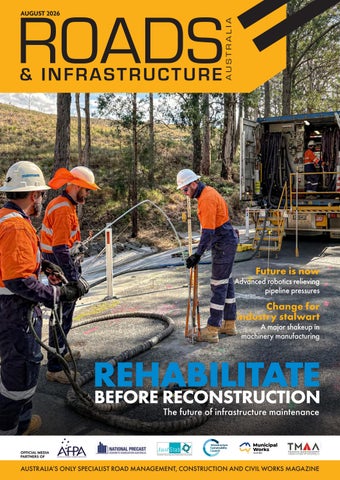
REHABILITATE BEFORE RECONSTRUCTION The future of infrastructure maintenance
A JOHN DEERE COMPANY
Why waste something that‘s valuable? www.wirtgen-group.com/sustainability
CLOSE TO OUR CUSTOMERS
In many countries, including Australia more roads are rehabilitated than new ones built. But what happens to the old road materials? We re-use them as a resource of ever increasing value. Take advantage of innovative solutions from the market leader. www.wirtgen-group.com/australia
AUGUST 2026 CONTENTS
EVENTS
48 Show and tell A multi-day discussion on key infrastructure plans is expected to bring the industry together.
ASSOCIATION SECTION COVER STORY 14 Unlocking proactivity Mainmark is opening the door to new possibilities, as well as a whole other way of thinking when it comes to infrastructure maintenance.
ROADS REVIEW 18 This month, we asked the industry’s decision-makers, ‘What are some alternative road construction or maintenance methods that have caught your eye in 2026?’
PROJECT REPORT
36 Savings all round Introducing a new approach to traditional pavement construction works. 38 Breaking the mould A simple, efficient and safe machinery platform that’s achieving the best possible outcomes on road maintenance jobs. 40 New home for industry stalwart A major shift has been announced in Australia’s machinery market. 42 Same brand, new possibilities These elevated work platforms continue to turn heads.
20 Maximising dust control How dust suppression and road management services have helped to optimise project outcomes.
44 Reliability key to partnership How reliability, support and trust have laid the foundation for a longstanding relationship.
SAFETY
46 Keeping you moving Learn how machinery owners can have the backup needed to ensure that unexpected breakdowns won’t cause endless delays.
22 An industry coming of age The positive signs that point towards a brighter future in traffic management.
50 By industry, for industry AfPA sheds light on its recent initiatives, aimed at improving the sector overall. 52 Supporting and delivering Spotlighting an association member that’s grown to work on some of the largest projects in the country. 54 Rethinking road construction This highly anticipated event aims to improve how infrastructure is planned, delivered and maintained. 56 Municipal operations on centre stage Municipal Works Australia is preparing to bring councils, contractors and suppliers together.
CONTRACTS & TENDERS
58 Roads & Infrastructure provides an update on some of the contracts and tenders recently awarded or put to market across the Australian infrastructure sector. Below: Maintaining the performance of Australia’s road network takes centre stage in this edition of Roads & Infrastructure magazine.
THOUGHT LEADERSHIP 24 Unlocking financial flexibility The tailored deployment of capital is enabling contractors of all sizes to punch above their weight.
COMMUNITY FIRST 26 Evolving alongside industry The journeys of two employees highlight the growth that this manufacturer has undergone in recent years.
RESEARCH 29 The elephant in the room The resilience and robustness of Australia’s infrastructure have come into question.
MACHINERY & EQUIPMENT 34 Not just a phase A global machinery manufacturer is doubling down on its belief and innovation of sustainable equipment solutions.
Image: City of Holdfast Bay
32 In the pipeline New research is transforming the efficiency and safety of one of Australia’s largest infrastructure pipelines.
roadsonline.com.au
3
CEO Christine Clancy christine.clancy@primecreative.com.au
PUBLISHER Sarah Baker sarah.baker@primecreative.com.au
MANAGING EDITOR Lisa Korycki lisa.korycki@primecreative.com.au
EDITOR Tom O’Keane tom.okeane@primecreative.com.au
TOM O’KEANE – EDITOR
JOURNALIST Sean Gustini sean.gustini@primecreative.com.au
HEAD OF DESIGN Clayton Hawley
ART DIRECTOR Bea Barthelson
BUSINESS DEVELOPMENT MANAGER Loren Katie Logan lorenkatie.logan@primecreative.com.au
CLIENT SUCCESS MANAGER Sabrina Zor sabrina.zor@primecreative.com.au
HEAD OFFICE Prime Creative Pty Ltd 379 Docklands Drive, Docklands VIC 3008 Australia p: +61 3 9690 8766 info@primecreative.com.au www.roadsonline.com.au
SUBSCRIPTIONS +61 3 9690 8766 subscriptions@primecreative.com.au Roads & Infrastructure Australia is available by subscription from the publisher. The rights of refusal are reserved by the publisher.
ARTICLES All articles submitted for publication become the property of the publisher. The Editor reserves the right to adjust any article to conform with the magazine format.
COVER IMAGE Mainmark
COPYRIGHT Roads & Infrastructure Australia is owned and published by Prime Creative Media. All material in Roads & Infrastructure Australia is copyright and no part may be reproduced or copied in any form or by any means (graphic, electronic or mechanical including information and retrieval systems) without the written permission of the publisher. The Editor welcomes contributions but reserves the right to accept or reject any material. While every effort has been made to ensure the accuracy of information, Prime Creative Media will not accept responsibility for errors or omissions or for any consequences arising from reliance on information published. The opinions expressed in Roads & Infrastructure Australia are not necessarily the opinions of, or endorsed by the publisher unless otherwise stated.
4
ROADS AUGUST 2026
HOW CAN WE DO MORE, BUT WITH LESS? THE METHODS AND INVESTMENT NEEDED to keep our roads operating at a serviceable level are thrust into the limelight in this edition. Shifting funding priorities, extreme weather events, and an increase in heavy vehicle traffic are all taking a toll on the robustness and quality of Australia’s road network (pardon the pun!) Road stabilisation is one potential solution. Proactive asset management is another. And there’s many other methods that are just as viable. Which begs the question, ‘what are the industry’s main barriers to benefitting from these techniques?’ That’s what we endeavour to find out, in this August edition of Roads & Infrastructure magazine. For our cover story, we spoke with asset remediation experts Mainmark, to learn more about the fascinating work the company has been doing in the space. Now equipped with a global network of expertise, as well as technology that’s right at the forefront, Mainmark is hoping to make non-invasive and highly innovative remediation methods the ‘norm’. We also hear from the Australian Pavement Recycling and Stabilisation Association, better known as AustStab. The association’s upcoming national conference will provide a unique chance for all the aforementioned challenges and opportunities to be centre stage, with both industry and government set to come together for critical conversations. Researchers from Adelaide University also make an appearance in this edition, outlining essential lessons that all of industry can benefit from, particularly when it comes to the future of asset management amongst frequent and severe weather events. Its Dr Babak Zolghadr-Asli’s belief that unless industry, government and academia can come together, no meaningful progress can be made in improving the environmental resiliency of transport infrastructure. Maybe automation can play a role? So argues an expert from the Advanced Robot Manufacturing Hub in Brisbane. This site is facilitating some truly incredible research into how collaborative robotics could play a role in easing the pressure presented by Australia’s massive project pipeline. In other news, the team is extremely excited to announce that the first ever Roads & Infrastructure podcast episode has gone live, with future episodes set to feature some of the brightest minds in the sector. Happy reading!
Real productivity starts with the right machine. Built to help operators get more done, every day. From compact excavators to large construction equipment, Komatsu machines are designed to deliver the performance, reliability and efficiency businesses depend on, because real productivity starts with equipment built for the job. Explore the Komatsu Construction & Utility range today.
1300 566 287 | komatsu.com.au
NEWS
SOUTH AUSTRALIA’S T2D PROJECT COMMENCES South Australia’s $15.4 billion Torrens to Darlington (T2D) Project has commenced in Adelaide after months of planning and machine assembly. Tunnel Boring Machine (TBM) Mary is beginning to excavate T2D’s first 4.5-kilometre Southern Tunnel from the Southern Precinct at Clovelly Park to Glandore, marking a major milestone for the state’s largest infrastructure project. TBM Mary will operate 24/7, and is expected to progress approximately eight to 10 metres per day, with up to 20 specialised workers inside at any one time. Mary’s first components arrived in Adelaide in October 2025, and were lifted into the launch box by a 500-tonne gantry crane before being assembled. Measuring approximately 100 metres in length, 15 metres in diameter and weighing 3500 tonnes, Mary is one of three large-scale TBMs being used on the T2D project. The project’s second TBM, Catherine, has launched from the Southern Precinct to excavate the second parallel 4.5-kilometre Southern Tunnel. Further north, the third TBM, Elizabeth, has launched from the project’s Central
The project is underway after months of planning. Image: South Australian Government
North Precinct at Hilton to construct the 2.2-kilometre Northern Tunnels. Named after pioneering South Australian suffragists Mary Lee, Catherine Helen Spence and Elizabeth Webb Nicholls, the project’s three TBMs recognise the trailblazers who helped shape South Australia. The use of three TBMs allows both the Northern and Southern Tunnels to be
constructed concurrently, helping deliver a non-stop South Road by 2031. The T2D project is the final 10.5-kilometre section of the North-South Corridor, and will complete 78 kilometres of non-stop, traffic light-free motorway between Gawler and Old Noarlunga. The Federal and South Australian governments have each committed $7.7 billion towards the project.
QUEENSLAND ANNOUNCES $55 BILLION TRANSPORT PLAN The Queensland Government has announced a new $55.9 billion transport plan to be rolled out as part of the 2026-27 State Budget. Over the next four years, the Safer Roads, Better Transport plan will target and upgrade
a number of key road infrastructure and transport projects across the state. Among them is a record $55 billion roads and rail pipeline, which will progress tasks such as the Caloundra Congestion Busting
The new transport plan will target and upgrade road infrastructure and transport projects across the state. Image: Queensland Government
6
ROADS AUGUST 2026
Plan, the Mooloolah River Interchange Upgrade, the Bribe Island Bridge and the Barron River Bridge. Meanwhile, critical safety works will be delivered on the Bruce Highway under a jointly-funded $9 billion program between the Federal and State governments, under a restored 80:20 funding ratio. The $100 million Country Roads Connect program will also continue to deliver upgrades to unsealed regional roads, boosting safety and flood resilience throughout Queensland. Other projects were directed towards bolstering public transport ahead of the 2032 Brisbane Olympic and Paralympic Games, including new rail plans throughout the Gold Coast, an initiative to secure up to 630 buses for South East Queensland, and Stage One of The Wave multimodal transport plan on the Sunshine Coast. The 2026-27 State Budget also introduced the Permanent 50 Cent Fare plan for all public transport in the state.
For more information or pricing on our Aggregate Spreader Options: CALL: +61 (3) 9391 1226 EMAIL: sales@matthewsbrothers.com.au
Keeping Critical Transport Infrastructure Moving
MOO440_Print_ R&I Ad August 2026.indd 1
13/07/2026 12:06:22 PM
2:06:22 PM
NEWS
$600 MILLION BOOST FOR KEY SYDNEY ROAD PROJECTS The New South Wales Government is investing an additional $300 million in the 2026-27 NSW Budget to fast-track upgrades to Fifteenth Avenue and Elizabeth Drive, two critical road projects for Western Sydney. The State Government’s investment will be matched by the Federal Government, delivering a combined $600 million boost to accelerate progress. The major investment will expand the scope of the projects and bring construction forward, with work on both projects set to begin in late 2026, a year earlier than planned. The projects aims to ease congestion, improve safety and strengthen connections to the new Western Sydney International Airport. Additional funding for the Fifteenth Avenue upgrade will enable key design improvements in response to community and council feedback, such as improved and integrated bus infrastructure,
and enhanced road connections with access to surrounding residential and industrial estates. The upgrade between Cowpasture Road and Devonshire Road will deliver two lanes in each direction, improve connections to surrounding local roads, enhance access to Western Sydney Parklands and provide safer crossings for local wildlife. Planning will also continue for a future dedicated bus corridor along Fifteenth Below: The major investment will expand the scope of key projects and bring construction forward. Image: stock.adobe.com/kyrychukvitaliy
Avenue, supporting the region’s long-term public transport needs. Meanwhile, additional funding for the Elizabeth Drive upgrade will deliver 1.5 kilometres of additional road duplication from South Creek to the M12 interchange with Western Sydney International Airport. It will also deliver a major upgrade of the Elizabeth Drive and Martin Road intersection, supporting surrounding industrial estates and the growing ‘aerotropolis’. The project has also been refined to deliver safer and more efficient intersections at key locations along the corridor including a new, signalised intersection at Clifton Avenue, improved bridge connections across Badgerys Creek and South Creek and reduce impacts on local business and community facilities. These investments build on more than $7.4 billion that the State Government has funded for Western Sydney roads since 2023.
$30 MILLION FOR REGIONAL ROADS IN NEW SOUTH WALES The New South Wales Government is investing $15 million in the 2026-27 State Budget to progress planning for upgrades along the M1 Pacific Motorway corridor between Tweed Heads and Byron Bay. This investment matches the $15 million contributed by the Federal Government, creating a $30 million package that will deliver modelling concept designs and economic analysis for future upgrades to key intersections of the corridor. According to the State Government, the North Coast is one of the fastest-growing regions in Australia, placing increasing pressure on the M1 Pacific Motorway. The corridor plays a critical role in supporting freight, tourism and crossborder travel between New South Wales and Queensland. The upgrade project will undertake essential planning and design works that will ultimately lead to safer journeys, reduced congestion and a plan for the future, specifically ahead of the 2032 Brisbane Olympic and Paralympic Games. Short-term improvements will be delivered across key locations, including:
• Kennedy Drive, Tweed Heads; • Minjungbal Drive, Tweed Heads; • Darlington Drive, Banora Point, and; • Tweed Coast Road, Chinderah. The investment will also support planning work at Ewingsdale Road to address traffic congestion at this key gateway to Byron Bay. Additionally, the funding will investigate public transport and bus priority
infrastructure upgrades across the North Coast, as well as improvements to support more efficient freight movements between New South Wales and Queensland. Future investigations will also consider additional upgrades at Kennedy Drive and Minjungbal Drive, improvements at Tweed Coast Road in Chinderah, and upgrades to the Kirkwood Road and Gold Coast Highway interchanges. Short-term improvements will be delivered across key locations. Image: New South Wales
roadsonline.com.au
9
NEWS
GOVERNMENTS TO DELIVER BRUCE HIGHWAY UPGRADE The Federal and Queensland governments will soon deliver important upgrades to the Bruce Highway and Buxton Road intersection at Isis River. Improvements for this project will include dedicated right and left-turn lanes into Buxton Road, the local service station and fruit orchard, as well as improved access for nearby property owners. The upgrade will also improve freight efficiency through the busy corridor in the Wide-Bay Burnett region, while helping maintain traffic flow along the Bruce Highway. The Bruce Highway is fundamental to Queensland’s economy and residents, connecting communities and supporting industries across the state. These road upgrades follow frequent local feedback, which has long
These road upgrades follow frequent local feedback. Image: stock. adobe.com/Lubo Ivanko
called for safer and more efficient passage at the key intersection. Construction is on track to commence
from July 2026, and is anticipated to take around 12 months to complete, weather permitting.
STATE GOVERNMENT ROLLS OUT RECORD $2.1B PLAN FOR SYDNEY TRAINS The New South Wales Government has announced a record $2.1 billion investment into maintaining and improving reliability and incident response on the Sydney Trains network. Delivered under the 2026-27 State Budget, the investment will target incident management, use of technology, and passenger communications. The funding is being packaged as a new Rail Reliability Plan, and builds on findings from the Independent Rail Review into the overhead wire failure at Homebush in May 2025. The review called for better infrastructure maintenance in “critical zones” such as the HomebushStrathfield corridor. The State Government responded with a four-year, $425 million asset renewal program that is upgrading track, signals, overhead wiring and drainage in floodprone areas. Additionally, a $35 million reliability program has fast-tracked repairs in high-priority areas where infrastructure failures have the greatest flow-on impact across multiple train lines. 10
ROADS AUGUST 2026
S y b
The investment will target incident management, use of technology, and passenger communications. Image: Transport for NSW
Furthermore, a $150 million investment into the Rail Operations Centre over four years will improve incident response and customer communication. This is also funding a new passenger care and support team, whose focus is on passenger welfare during major disruptions. The team is being deployed dynamically based on the size and complexity of incidents, supporting customers onboard trains, at impacted stations, and at key
B
interchanges during recovery. It will provide face-to-face communication, deliver basic welfare support, assist vulnerable passengers, and help people continue their journeys via alternative transport options. The State Government has also introduced the first new intercity trains in almost 20 years, with the Mariyung now in service on the Central Coast and Newcastle Line, Blue Mountains Line and South Coast Line.
BEAT THE QUEUES! Sick of waiting years for your new bitumen sprayer?
SRE’s telescopic bitumen sprayers or our newly developed 8m fixed wing bitumen sprayers are available for mid 2027 delivery. Fully compliant with all Australian regulations our sprayers meet all Austroads performance requirements for bitumen sprayers and are ready to go straight to work.
BEAT THE QUEUES Contact us for a spec sheet and pricing. www.specialisedroadingequipment.com Email info@specialisedroadingequipment.com Ph 02 808 92290
NEWS
EXTRA $190 MILLION FOR ROAD UPGRADE Left: This investment builds on more than $7.4 billion in State Government funding for Western Sydney roads since 2023. Image: stock.adobe.com/jdoms
The New South Wales Government has committed an additional $190 million in the State Budget to upgrading Windsor Road in the suburb of Rouse Hill. The road is critical to traffic movements in Western Sydney, enabling transport for more than 30,000 Western Sydney motorists each day.
The Windsor Road upgrade at Rouse Hill plans to ease traffic pressures on local roads, improve safety and ensure quicker and more reliable journeys for local families, workers and business. It will also deliver access to the new Rouse Hill Hospital, ensuring local families have better access to healthcare.
These specific works are part of the overall Windsor Road upgrade project, funded by a combined $400 million from the State and Federal governments. The larger project will improve road capacity, traffic flow, safety and reduce congestion, while improving public transport connections in and around North West Sydney. This will be achieved through intersection improvements including at Windsor Road and Commercial Road; widening Windsor Road between Mile End Road and Commercial Road to three lanes plus a bus lane in each direction. Improvements will also include a new shared path along the eastern side of Windsor Road, as well as new and upgraded bus infrastructure, including dedicated bus lanes connecting the ‘T Way’ to Mile End Road. This investment builds on more than $7.4 billion that the NSW Government has funded for Western Sydney roads since 2023.
TASMANIA LAUNCHES CENTRAL AGENCY The agency’s establishment comes as infrastructure continues to drive economic growth in the state. Image: Taras Vyshnya/stock.adobe.com
The Tasmanian Government has launched Building Tasmania, a new central agency to supercharge infrastructure delivery across the state. The agency combines infrastructure governance, delivery, and project 12
ROADS AUGUST 2026
management expertise together in order to streamline the completion of roads, transport, housing and other projects. The agency’s establishment comes as infrastructure continues to drive
economic growth in the state, supporting local jobs while also building confidence for consumers and investors alike. The agency has been created primarily with the state’s residents in mind.
REHABILITATE BEFORE RECONSTRUCTION With Australia’s road networks facing heavier freight loads, severe weather and growing maintenance pressure, road authorities need more than just another temporary patch. Mainmark’s Chief Growth Officer Amy Williams and Group Technical and Innovation Manager Theo Hnat discuss how earlier, targeted intervention could preserve existing pavements, extend asset life and reshape the future of road rehabilitation.
A
ustralia’s road authorities must maintain ageing, increasingly trafficked networks while managing constrained budgets and rising expectations around safety, sustainability and availability. The scale of the challenge is significant. The National Freight Data Hub forecasts that Australia’s road freight task will increase by 77 per cent between 2020 and 2050, while the Australian Local Government Association reports that councils are responsible for approximately 75 per cent of the nation’s road network. For councils and transport authorities, repeated patching and reactive repairs are becoming increasingly difficult to sustain. According to Mainmark’s Chief Growth Officer Amy Williams, the industry needs to look beyond the immediate repair and consider when targeted intervention could deliver a better whole-of-life outcome. “Road authorities are being asked to maintain more infrastructure, accommodate increasing traffic volumes and improve network resilience, often without a corresponding increase in available resources,” Williams says. “The question is no longer simply how quickly a damaged section of road can be
Mainmark’s Australian team is part of a global network, with international experts collaborating to deliver best practice.
14
ROADS AUGUST 2026
repaired. Asset owners are looking more closely at when they should intervene, how much of the existing pavement can be retained and what will deliver the best longterm value.” Rather than waiting until a road requires extensive excavation, realignment or reconstruction, Mainmark is exploring another intervention point: when the pavement remains serviceable, but its supporting layers are just beginning to deteriorate. LOOKING BEYOND THE SURFACE Potholes, rutting, depressions and recurring patch failures are often treated as surfacelevel issues. However, visible deterioration can indicate a deeper problem within the pavement structure. Moisture ingress, inadequate compaction, loss of support, variable pavement materials and repeated heavy vehicle loading can weaken the upper pavement layers. In these circumstances, resurfacing may improve the road temporarily without resolving the condition, contributing to failure. Mainmark’s Group Technical and Innovation Manager Theo Hnat says understanding the cause of deterioration is critical to selecting
Theo Hnat, Group Technical and Innovation Manager – Mainmark.
the right rehabilitation method. “Road maintenance is often driven by what can be seen at the surface, but the surface defect may only be part of the problem,” Hnat says. “If the supporting subgrade has weakened or lost stiffness, resurfacing may not prevent the same deformation from returning. Effective rehabilitation starts with understanding what is happening below the pavement structure and whether the underlying condition can be treated.” Historically focused on concrete pavements, slabs and large structures, Mainmark has expanded its capabilities into flexible asphalt and bitumen road networks. The objective is not to replace conventional rehabilitation or stabilisation. It is to give asset managers another treatment option between routine surface maintenance and major reconstruction. “By the time significant rutting, deformation or repeated patch failure is visible, the available treatment options may already be more extensive and disruptive,” Hnat says. “We see an opportunity to identify sections that are deteriorating but still serviceable, then determine whether targeted ground improvement can address the affected zones before the road reaches a more advanced stage of failure.”
COVER STORY
Images: Mainmark
Mainmark continues to expand its horizons, with new asset and project types being constantly added to the company’s project portfolio.
INTERVENING EARLIER Mainmark’s road rehabilitation approach focuses on targeted improvement within the upper pavement structure. Following investigation and engineering assessment, purpose-developed materials can be introduced through small injection points to improve identified areas within approximately the upper half-metre of the pavement. The treatment is designed around the pavement condition, composition, deterioration mechanism, traffic loading and required engineering outcome. Instead of removing and reconstructing an entire section, work can be directed towards localised zones where support has deteriorated. Hnat says the approach builds on more than a decade of research into resin-based ground improvement, adapted for the shallower zones often critical to flexible pavement performance. “Approximately ten years ago, Mainmark undertook a major research and development program focused on improving ground conditions at greater depths,” he says. “For flexible roads, the critical treatment zone can be much shallower. We have taken that technical knowledge and developed new materials and injection methods suited to the upper pavement layers. “The methodology has also been developed alongside key road-sector clients. Field development under real pavement conditions and operational loading has been an essential part of the process.” The process begins by establishing whether targeted treatment is appropriate. Investigation findings inform the design, while
injection locations and sequencing are tailored to the project. During delivery, the pavement response is monitored against agreed criteria. A DIFFERENT REHABILITATION METHODOLOGY Traditional pavement stabilisation remains an important rehabilitation method. It generally involves reworking existing pavement materials, introducing a binder and recompacting the material to create an improved base. Mainmark’s targeted injection methodology addresses a different stage of the rehabilitation cycle. Where conditions are suitable, it may enable an asset owner to improve localised deterioration while retaining more of the existing pavement and avoiding broader excavation. “It is not a case of one method replacing another,” Hnat says. “Some roads will require conventional repair or reconstruction. Others may have localised deterioration that can be treated more selectively. Giving asset managers another option allows rehabilitation programs to become more proportionate to the condition of the road.” Williams says this matters because road authorities are increasingly assessing projects through the lens of lifecycle performance rather than immediate repair cost alone. “Road authorities also need to consider remaining service life, recurring maintenance, traffic disruption, material movements and the cost of future intervention,” she says. “An option that retains more of the existing road and delays more extensive reconstruction could create value well beyond the initial works.”
Mainmark Chief Growth Officer Amy Williams.
PRESERVING THE ASSET Road rehabilitation can be highly disruptive. Excavation, heavy vehicle movements and extended traffic controls affect road users, communities and businesses, particularly on freight routes where prolonged closures may not be practical. Where site and pavement conditions allow, treatment through small injection locations can reduce excavation, material handling and the work-zone footprint. “The direct construction cost is only one part of the impact,” Williams says. “There is also the disruption caused by lane closures, detours, restricted access and interruptions to freight or public transport. Methods that can reduce the extent or duration of those impacts deserve consideration as part of a broader asset preservation strategy.” Retaining existing pavement materials may also support better sustainability outcomes. Reducing excavation, disposal, the use of materials and truck movements can lower the resource intensity of rehabilitation. roadsonline.com.au
15
COVER STORY
performance criteria,” Hnat says. “The next step is continuing to work with road authorities, consultants and research partners to build the evidence base and establish where the methodology provides the greatest value.” Williams says wider adoption also depends on translating technical results into information that asset owners can confidently use. “That means demonstrating not only that the treatment can improve the pavement condition, but how it fits within maintenance planning, procurement, risk frameworks and long-term capital programs,” she says. “Innovation becomes meaningful when asset owners understand where it should, and should not, be applied.”
Dynamic Cone Penetrometer (DCP) testing for ground improvement.
“Sustainability is not only about the materials selected,” Williams says. “It is also about how much of the existing asset can be retained and how long its serviceable life can be extended.” EARLIER COLLABORATION Mainmark is seeking earlier involvement, working with road authorities, asset managers, consultants and contractors to determine where specialist ground improvement could support a wider rehabilitation program. Williams brings nearly two decades of experience across infrastructure, rail, utilities and property sectors. Her background has given her a strong understanding of the commercial, operational and strategic pressures facing asset owners, as well as the importance of aligning technical solutions with long-term infrastructure priorities. “The greatest value can often be created before a treatment method has been locked in,” Williams says. “Bringing the asset owner, designer, delivery contractor and specialist provider together earlier allows the team to assess the condition and develop an approach around the actual deterioration mechanism.” Mainmark’s role is not to replace civil contractors, designers or pavement 16
ROADS AUGUST 2026
specialists. Instead, it aims to contribute specialist investigation, design input, ground improvement and implementation as part of the wider project team. Hnat says this improves the transition from technical assessment to delivery. “When the engineering and operational teams are closely connected, information can move more efficiently from investigation through to design and implementation,” he says. “That continuity is valuable when working with variable ground and pavement conditions, where the treatment may need to respond to what is identified during delivery.” BUILDING CONFIDENCE THROUGH EVIDENCE Alternative rehabilitation methods require evidence that they can be designed, delivered, monitored and incorporated into established asset management processes. Mainmark’s continuing research and development program is focused on building that evidence while refining materials and injection methodologies for different pavement conditions. “Innovation needs to be supported by testing, monitoring and transparent
RETHINKING THE POINT OF INTERVENTION No single material, technology or delivery model will solve Australia’s road rehabilitation challenge. Routine maintenance, stabilisation, resurfacing and reconstruction will all remain essential. The opportunity is to create a broader range of interventions and apply each one at the right point in the asset lifecycle. “The aim is not to intervene unnecessarily,” Hnat says. “It is to understand the pavement condition and act at the point where a targeted treatment can produce a meaningful engineering benefit, and increase the overall resilience of the network.” Williams believes this more proactive approach could help road authorities make constrained rehabilitation budgets work harder while improving long-term network outcomes. “We need to move beyond measuring success by how quickly a visible defect has been covered,” she says. “The better question is whether the underlying cause has been addressed, how much of the existing asset has been preserved and when the road is likely to require intervention again.” As freight demand increases and road networks face more challenging operating conditions, the ability to intervene earlier will become increasingly important. Not every deteriorating road needs to progress directly from patching to reconstruction. With the right investigation, engineering assessment and treatment methodology, road authorities can rehabilitate weakened pavement layers, retain more of the existing asset and extend its serviceable life. The next evolution in road rehabilitation is not simply repairing failure, but engineering longer pavement performance.
B
O Ta
E co
Le
W
NEED A LIFT? ©Tadano Ltd. 2026. Tadano is a registered trademark of Tadano Ltd. or its subsidiaries.
Tadano’s got you covered.
AERIAL WORK PLATFORMS
STRAIGHT BOOM CRANES KNUCKLE BOOM CRANES
Built for the Realities of the Job Site. On tough sites and tight schedules, you need equipment that performs safely, reliably, and without compromise. Tadano lifting and access solutions are built to keep your jobs moving and your crews protected. Aerial Work Platforms offer safe, stable access so operators can work efficiently at height. Knuckle Boom Cranes provide the reach, capacity, and muscle required for heavy lifts. Straight (Telescopic) Boom Cranes deliver manoeuvrability and precise control where space is tight. Every Tadano machine is engineered with robust safety systems, proven durability, and the uptime reliability contractors depend on. Less downtime. More productivity. Safer operations.
WWW.TADANO.COM.AU I 1300 823 266
ROADS REVIEW
ROADS REVIEW
This month, we asked the industry’s decision-makers, ‘What are some alternative road construction or maintenance methods that have caught your eye in 2026?’ TANJA CONNERS, CHIEF EXECUTIVE OFFICER – AUSTSTAB
In 2026, the methods that have really caught my eye are those that extend pavement life while reducing cost, disruption and waste. In-situ stabilisation and pavement recycling continue to stand out, particularly where existing materials can be reused rather than removed and replaced. I’m also interested in low-carbon binders, improved moisture management, smarter asset maintenance planning and better use of field testing to support performance-based decisions. Image: AustStab
CADELL TAYE, CHIEF EXECUTIVE OFFICER – NATIONAL PRECAST CONCRETE ASSOCIATION AUSTRALIA
One of the biggest shifts has been towards accelerated construction methods that minimise disruption to road users. Greater use of factory manufactured precast concrete bridge components, modular drainage systems and precast retaining walls is reducing construction time while improving quality and safety. We’re also seeing increased adoption of lower carbon concrete mixes and digital carbon measurement, allowing asset owners to make more informed procurement decisions. Together, these approaches are helping deliver infrastructure faster, with less disruption and a lower environmental footprint. Image: National Precast
JOHN WILLIAMS, NATIONAL SALES MANAGER – AUSROAD
There is a genuine shift occurring in how road agencies approach asset management. The focus is increasingly on preserving pavements earlier in their lifecycle. To maximise the benefits of these innovative maintenance techniques, the industry needs continued support to build a strong network of skilled contractors and suppliers capable of delivering cost-effective, long-term outcomes for road owners and their communities. Image: AUSROAD
RITCHIE TAYLOR, HEAD OF TRANSPORT – ASSET VISION
One innovation that has caught my eye in 2026 is the use of network-scale ride quality data, through tools such as AutoPilot’s Ride Quality Index. It shifts the conversation from simply identifying defects to understanding the road user experience and selecting the most appropriate treatment. Some visibly cracked roads may still provide a good ride, meaning a lower-cost surface treatment could be more appropriate than full rehabilitation. With budgets under pressure, combining ride quality with asset condition helps road authorities better balance customer outcomes, asset life and investment, while applying the right treatment at the right time. Image: Asset Vision
MELISSA LYONS - EXECUTIVE DIRECTOR TECHNOLOGY – AFPA
Compaction is the invisible half of pavement quality – get it wrong and no binder, mix design, or sealing schedule saves the road. What’s caught my eye in 2026 is intelligent compaction moving from pilot to standard practice – real-time data that means fewer under-compacted sections quietly shortening pavement life before a single vehicle drives on it. In the long run, this means fewer potholes. Once you have a quality pavement, a consistent preventive maintenance regime is far easier to follow, which is exactly what sits behind AfPA’s seven per cent resurfacing benchmark. Image: AfPA
If you or someone at your organisation is an industry leader and would like to be a part of this monthly column in 2026, please get in touch with Editor, Tom O’Keane: tom.okeane@primecreative.com.au 18
ROADS AUGUST 2026
Dust-A-Side Australia works with customers to determine the most appropriate solution for their environment.
POOR ROAD CONDITIONS, DUST AND LOST PRODUCTIVITY For decades, Dust-A-Side Australia, part of the Colas Group, has been helping clients across the resources and mining sectors improve unsealed road performance through road management and surface treatment solutions while also delivering effective dust control.
W
orking closely with customers to understand their operational challenges, the company develops site-specific solutions that improve productivity, reduce water consumption, lower maintenance requirements, support safer and more efficient operations, and help achieve environmental compliance. Every operation has different road materials, traffic volumes, climate and production objectives, requiring a tailored approach rather than a standard solution. As Russell Haack, Regional Manager at Dust-A-Side Australia, explains, it starts with understanding the operating environment. “Others sell products. We believe it’s how the product is applied that delivers the real benefit,” he says. “We work closely with our customers, their people and their processes to make sure the solution delivers the right outcome on site.” In some applications, Dust-A-Side Australia’s solutions have been proven 20
ROADS AUGUST 2026
to reduce dust by more than 90 per cent, helping minimise airborne particles, improve safety and reduce occupational exposure. The company’s portfolio includes bitumen and polymer-based emulsions, organic binders, surfactant technologies and blended products. Beyond product selection, Dust-ASide Australia combines application methodology, technical support and ongoing optimisation to deliver road management solutions that improve operational efficiency and road condition. “Some sites might be water-restricted, so by using these products you can reduce water consumption on haul roads by 60 to 80 per cent. This is really beneficial for sites that are chasing asset utilisation improvements,” Jialin Chi, Operations Manager – Dust-A-Side Australia explains. He says these outcomes are a far cry from those achieved through conventional watering alone.
“If you’re using straight water, you spray it, it evaporates, and then you’ve got to respray it again,” Chi says. “By reducing the frequency of watering, sites can control dust more effectively while cutting labour, fuel, equipment use and water demand, freeing up water carts and operators
PROJECT REPORT
JOB BY JOB Dust-A-Side Australia’s team works with each operation to assess factors including water availability, road conditions, production targets, traffic volumes, equipment fleets and environmental requirements before recommending the most appropriate solution. From there, tailored application programs are developed, specifying application methods, dosage rates, treatment frequency and supporting operational processes. “We might have two operations for the same company, 100 kilometres apart, but they’re using completely different solutions,” Haack says. “Road materials, climate, traffic volumes and water availability can vary significantly between sites, so our role is to understand those differences and develop the right solution for each operation. “Our job is to identify those oneper cent improvements and work alongside our customers to help embed them into their operations.” DAS emulsion technology is one example of the company’s road management solutions. It binds road materials together to improve surface integrity while controlling dust and supporting heavy vehicle traffic. Depending on the application, treatments can be incorporated into the road’s wearing course or applied as a surface treatment to improve durability.
Images: SAMI
to focus on other critical areas of the operation.”
DAS emulsion technology binds road materials together to improve surface integrity, while also controlling dust.
“THE REAL ADVANTAGE WE’VE GOT AS A SOLUTIONS PROVIDER IS THAT WE USE COLAS’ INTELLIGENCE, BRAINS AND INTELLECTUAL PROPERTY IN THE BACK END TO MAKE REALLY SPECIFIC PRODUCTS FOR APPLICATIONS.” It can therefore extend road life and reduce ongoing maintenance requirements. Dust-A-Side Australia also works
Better road performance results in smoother operations, reduced downtime, improved equipment utilisation and lower maintenance costs.
with customers on broader road management practices, including drainage, road camber and maintenance strategies. Combined with the right treatment, these factors help improve road performance. Better roads contribute to smoother operations, reduced downtime, improved equipment utilisation, lower maintenance costs and more consistent productivity over time. “The real advantage we’ve got as a solutions provider is that we use Colas’ intelligence, brains and intellectual property in the back end to make really specific products for applications,” Haack says. “Others in the market might house a system that’s from someone else and sell that product. We can be more technical and more focused on what we think could work, rather than just what’s available.” roadsonline.com.au
21
AN INDUSTRY COMING OF AGE Matthew Bereni, Chief Executive Officer, Traffic Management Association of Australia writes on the current challenges being faced by the traffic management sector, as well as the positive signs that point towards a brighter future.
A
sk most people what traffic management looks like and they will describe the equipment. Cones, signs, barriers, a stop bat. What they rarely see is the industry behind it. And right now, that industry is growing up faster than at any point in its history. The clearest sign of that came in March, when nearly 400 people gathered at the Adelaide Convention Centre for START26, the inaugural Safe Traffic and Roadworks Technology National Conference. The event was formerly known as the TMAA (Traffic Management Association of Australia) National Conference, and the new name was deliberate. It reflects an industry reality that now stretches well beyond traffic management companies to road authorities, regulators, contractors, suppliers, technology providers, training organisations and, most importantly, the workers on the road. START26, the inaugural Safe Traffic and Roadworks Technology National Conference, was a resounding success.
22
ROADS AUGUST 2026
What struck me most across those two days was not the technology on display, although there was plenty of it. It was the people. Take Mike Brooks, named 2026 National Traffic Controller of the Year. Brooks came into the industry 13 years ago following the suggestion of a friend. Today, he is a team leader on the biggest infrastructure project ever undertaken in South Australia, and has trained, guided and assessed the next generation of workers along the way. His advice to anyone thinking about the job is refreshingly simple: put in the hard work, take feedback, ask questions when you are unsure, and own your mistakes. Or take Tyra Webb-Cooper, our 2026 Indigenous Traffic Controller of the Year. After eight years as a hairdresser and a brief stint in office work, she had her first shift on the road in May 2024. Less than two years later she is a team leader running jobs in the
Northern Territory, focused on keeping her crews safe and being someone that others in the industry can look up to. Stories like these put to rest an old assumption: that traffic management is a job people pass through on the way to something else. It is a career. Entry level roles give new and transitioning workers a foot in the door, and the pathways run all the way through to team leadership, operations management, training and traffic management design. The industry is maturing in other ways too. At our March 2026 Annual General Meeting, Britt O’Dwyer became TMAA’s first female President. It is a milestone worth marking, not only for the progress it represents, but for the doors it opens for those who follow. We’re also rapidly embracing the latest safety technologies, too. Barely five years ago, much of what we now treat as standard practice was manual, paper-based, or simply unavailable. Take portable traffic control devices (PTCDs), which only became mandatory in New South Wales with the release of Traffic Control at Work Sites (TCAWS) Issue Six, which took effect from May 2021. Fast forward to today, and wearable proximity alerts, artificial intelligence-driven worksite monitoring, and digital traffic management platforms are appearing on Australian worksites. Connected safety technologies are beginning to shift our work from reactive protection to predictive risk prevention. Safety innovation rarely arrives overnight, but when it lands, it changes everything. Consider the seatbelt. Invented in 1959, it took more than a decade (December 1970 precisely) before Victoria became the first jurisdiction in the world to make wearing one compulsory, before global adoption followed. Today, it is credited with saving more than a million lives. Within the next decade, connected safety systems may be as standard on roadworks sites as seatbelts are in vehicles. Technology is only half the equation, though. The other half is driver behaviour, and here too there is genuine momentum. In February, TMAA launched The Nod, a 60-day road safety campaign in Tasmania funded by the Tasmanian Government’s Community Road Safety Grants Program, and aimed at drivers aged 18 to 25. The original targets were 500,000 impressions and 5000 engagements. The campaign delivered 2.17 million impressions and 1.16 million video views. Notably, the creative
C
M
Y
CM
MY
CY
CMY
K
The TMAA says industry is “rapidly embracing the latest safety technologies”.
that performed best showed traffic controllers as people, not just hi-vis figures holding a bat. Drivers respond to faces, not ‘fluoro’. So, what does all this mean if you employ people in or around this industry? Three things. First, the sector you rely on is evolving quickly, so treat traffic management
C
M
Y
CM
MY
CY
CMY
K
as a safety-critical partner in your projects rather than a line item at the bottom of a tender. Second, this is now an industry with genuine careers to offer, which matters enormously in a tight labour market. And third, the strength of this sector lies in its people. Our Vice President, Stuart Wickens, put it well after START26: “We came
together in Adelaide not as competitors, but as peers with a common purpose”. The conversation we started in Adelaide is continuing across every state and territory, and it will pick up again at START27. Wherever you sit in the road infrastructure supply chain, there’s a seat at the table for you.
Images: TMAA
SAFETY
UNLOCKING BONDING CAPACITY Specialist guarantee capacity can help contractors bid, grow and strengthen their business without tying up assets. A surety expert explains why such financial flexibility is no longer a pipe dream.
F
or many contractors, growth is not limited by ambition, technical capability or the availability of work: it is limited by capacity to provide performance security. The concept of surety bonds was born out of a necessity to solve a structural challenge in how major projects were secured and then funded. For decades, if a contractor needed performance security, they obtained a bank guarantee, backed by property, cash, and broad security over the business. This model was effective for a time, but as private sector and government infrastructure spending ramped up and contract values grew, so too did the need for a more efficient bonding solution, says Andrew Calvert, Executive General Manager, Surety at Credeq. “When large international companies started bidding on major projects in Australia, they discovered that the Australian market was highly dependent on bank guarantee facilities. The international contractors were used to surety, especially those coming from the United States and Europe,” he says. “The Global Financial Crisis was a turning point. Many international banks withdrew from the Australian market and the Australian Banks struggled to meet the demand with their limited capital. The Australian banks experienced aggregation issues with tier one and two contractors and bonding capacity
was simply in short supply. There was an absolute crisis in the market, even though governments and the private sector were still awarding projects.” Calvert was one of the few who recognised an opportunity to address a glaring gap in the finance sector. The main criteria was for a bonding product that could be accepted in precisely the same way as a bank guarantee: it needed to be approved by the Australian regulator (APRA), have a strong external credit rating (S&P/Moody’s), and be structurally equivalent in both legal obligation and format in the eyes of principals and financiers. It was this opportunity that laid the foundation for specialist guarantee providers like Credeq. Today, that need for additional guarantee capacity is again becoming more pronounced. With investment accelerating across sectors such as transmission infrastructure, renewable energy, health, education, resources, defence, and data centres, contractors are being asked to deliver larger and more complex projects while financiers manage their own exposure limits. In this environment, a specialist guarantee provider adds another source of project bonding capacity, helping contractors achieve capital efficiency and pursue work with greater confidence. THE KEY DIFFERENCE Calvert stresses that contract performance Andrew Calvert, Executive General Manager, Surety at Credeq.
24
ROADS AUGUST 2026
guarantees (or surety bonds as they’re better known in markets like the US and Europe) do not replace bank facilities. Instead, Credeq’s services can enable contractors to access an additional, specialist source of guarantee capacity, which can work alongside a contractor’s existing banking relationships. “Surety is complementary to bank facilities, not a replacement,” Calvert says. “Bank guarantee capacity is often provided as part of a broader banking relationship, in many cases requiring cash or property collateral. For contractors, that can create a practical challenge: the same bank appetite needed to issue guarantees may also be needed to fund working capital, equipment finance, acquisitions or day-to-day liquidity. Generally, our key point of difference is that we don’t take security and provide these facilities on an unsecured basis. We’re not asking for your cash or your property. We’re assessing the quality of your management, the strength of your balance sheet, profitability, cash flow, the sectors you operate in and the types of contract you enter into.” But what does that look like in practice? Take a mid-sized contractor for example: A civil infrastructure contractor turning over $50 million annually might be looking to bid on a new $20 million road and bridge package. The client might require performance and defect liability guarantees equal to $1 million or five per cent of the contract value. If the contractor was wholly reliant on bank guarantees, they would likely have to pledge $1 million in cash as security for the duration of the bank guarantee’s term, which might be 730 days. In this scenario, an unsecured specialist surety facility could revolutionise what’s possible for the contractor in question. The first feature – increased bonding capacity – might enable the contractor to work on additional work packages that they otherwise would not be able to bond under their bank guarantee limit alone. The second feature – unsecured bonding capacity – unlocks substantial financial flexibility. The contractor can bond upcoming
THOUGHT LEADERSHIP
projects without locking away cash which is then free to be used as working capital, to fund growth, or kept for a rainy day. Similarly, property can be kept free to borrow against, develop or sell. Calvert says this combination of freeing up assets, reduced reliance on a single financier and greater financial flexibility can give contractors confidence to tender for larger contracts while continuing to grow sustainably. “We’re passionate about finding practical solutions for contractors, making their lives easier and seeing them succeed. Our strength is that we understand construction. We understand the sector’s nuances, the pressures contractors face, and the commercial realities that sit behind project delivery. That allows us to speak the same language as our clients and make more-informed decisions when assessing how best to support them through each stage of the cycle. That’s ultimately what this product and the Credeq team is about,” he says. “Often times the work we’re supporting is at the front end of innovation. To be a part of these stories is incredibly motivating.” ADVICE FOR CONTRACTORS For contractors considering surety for the first time, Calvert says the starting point is to map current and forecast guarantee requirements, understand what bank capacity is already committed, and identify where upcoming tenders may place pressure on existing facilities. From there, his team supports contractors through a tailored and transparent evaluation process.
Images: Credeq
Unsecured guarantee capacity can help preserve liquidity by avoiding the need to tie up cash as security.
Reduced dependence on a single source of financing can increase strategic flexibility.
“When someone approaches us, we have a dedicated origination team who will sit down and run through some simple questions on their financial position, profitability, cash flow, sectors, workbook and track record,” he says. “Within 15 to 20 minutes you can often tell whether they’re likely to be a good fit. If they are, we’ll request financial information and then work through how much capacity they need and how best to structure a facility. “If a client doesn’t quite meet our criteria, we’ll tell them exactly what they need to do, what milestones to hit, and invite them to come back at an agreed time. I’m very passionate about this approach and believe in open and transparent communication.” With long-standing industry experience, Credeq is well placed to act as an advisor, especially for businesses that are moving into new segments of the industry, such as renewables, defence projects, or even
infrastructure required for the implementation of artificial intelligence. “Contractors can sometimes struggle with more than just financing – they don’t know the planning and consent processes, the subcontractor market or the local supply chain. Through our strong local presence, we can help them navigate that,” Calvert says. “We can connect you to the right people, help you understand the nuances of government and contracting requirements, and provide the capacity that you need.” For contractors navigating a complex project pipeline, the flexibility of contract performance guarantees can make the difference between standing still and stepping confidently into the next opportunity. By freeing up assets and diversifying guarantee capacity, they are better placed to manage disruption, invest in growth and deliver the infrastructure Australia needs. roadsonline.com.au
25
EVOLVING ALONGSIDE INDUSTRY The journeys of two employees highlight the growth that Specialised Roading Equipment has undergone in recent years, with the road maintenance machinery manufacturer evolving from a provider to a key industry contributor and representative.
26
ROADS AUGUST 2026
“E
volving people with the business,” has long been the belief that’s guided Specialised Roading Equipment’s (SRE) astronomical rise in the road maintenance machinery industry. Those words, by Managing Director, Mark Wansbrough are more than just words. They’re the values that underpin how the company aims to service its customers, as well as the wider sector. SRE manufactures domestically in New Zealand, with the Australian market now an extension of that local footprint. SRE’s emphasis on local support is a reflection of what the business and its people stand for. One key aspect that forms part of this mantra is the development of its people, best exemplified through individuals such as Dion Tarrant and Francois Ruellan. For Tarrant and Ruellan, working at SRE isn’t just a ‘nine-to-five’ – it’s a chance to contribute to the local community and industry that they themselves have grown with. Take Tarrant for example. After beginning his career at SRE in 2017 as a welder–fabricator, his growth and potential was identified by the
company’s senior leadership, leading to his appointment as the Technical Support Manager. “When I started here, I think there were eight people in the whole company. We’d build one truck a year and everyone would be working on that one truck,” Tarrant says. “Now it’s much more like a production line with 18 sprayers being produced this year alone. We’ve got a welding shop with all the team doing the welding and making parts, another shop where they do the fit-up, and a separate service team. It’s all far more structured and specialised. “As the business has grown, you get more people involved and more specific roles.” Tarrant is one of several SRE employees who live close to the manufacturing site, which is also located close to several clients and projects. This gives the company a unique understanding of local requirements and industry needs. And as the company has grown, so too has its ability to respond more effectively to customer needs. As the Engineering Manager at SRE, Francois Ruellan leads a team of
Specialised Roading Equipment is staffed by people from the local community, who understand local project requirements and value long-term relationships.
production engineers who are normally the first point of contact for customer enquiries and requests. “Before, if it was planning, you spoke to one person, if it was technical, it was someone else, and if it was about the quote, it was another person again. Now the customer just talks to their dedicated production engineer who manages the entire job,” he says. “What I really like is seeing the project from start to finish. In big companies, your scope is very limited – you get input from someone, you do your bit, and then it disappears into a void. Here you’re with the customer at the beginning of a project to finalise the spec, organise suppliers and timeframes, and you see it right through to delivery and handover.” A key contributor to SRE’s growing capability has been its new manufacturing facility and warehouse in Hamilton, New Zealand. This new site is over three times the size of SRE’s original facility and was the result of increasing demand from both local and Australian customers. A larger team, to service this growing demand, means that downtime is reduced, jobs keep moving, and local projects stay on track as a result. “For a lot of customers, we know the local suppliers who can help them, and we understand the local conditions and regulations,” Ruellan says. “It’s not just selling a sprayer and forgetting about
it – we help them navigate changes and stay compliant, and if they have a breakdown, we try to be as reactive as possible.” Many of SRE’s New Zealand customers are repeat clients who have grown with the business over time. The establishment of these long-term relationships, as well as repeat touch points with contacts like Tarrant and Ruellan, helps to build trust and reliability among customers. SRE’s team members are also encouraged to suggest improvements based on what they’re seeing from local customers. Above all, it’s these relationships that help SRE to innovate and invest in the long-term health and growth of the industry, not just in individual transactions. “Most of our customers are long-term,” Tarrant says. “I’ve gotten to know a lot of the operators over the years, as they tend to be the same core group running the trucks. “I think it’s good for them to have a regular contact. They know there’s a number they can call, and most of the time we can sort the problem out pretty fast.” On a micro level, Ruellan says he’s “extremely thankful” for the unique opportunities that have been provided with SRE’s support, as well as the chance to make a difference in the sector.
Images: SRE
COMMUNITY SUPPORT
Francois Ruellan, Engineering Manager – SRE.
Dion Tarrant, Technical Support Manager – SRE.
“IT’S NOT JUST SELLING A SPRAYER AND FORGETTING ABOUT IT – WE HELP THEM NAVIGATE CHANGES AND STAY COMPLIANT, AND IF THEY HAVE A BREAKDOWN, WE TRY TO BE AS REACTIVE AS POSSIBLE.” “This was a brand new industry for me – I’d never worked with bitumen sprayer or bulk trailers before, I came from more of a railway background – so I really appreciate that they gave me a shot,” he says. “In Europe, I mainly worked for big companies where your job is a very small part of a big picture. You don’t really have any impact on anything else. “Here, it’s completely different. People listen, they value feedback, and the progression within the company is real. In Europe, I don’t think I would have had the same opportunities, especially without prior truck and trailer experience.”
For Tarrant, it’s the dynamic nature of the sector, as well as its potential growth, that excites him the most. “Our customers are all over New Zealand, across the North Island and South Island. The job’s taken me pretty much all around the country helping out with technical issues,” he says. “I think working more with Australian customers is pretty exciting – it’s something new. The logistics and regulations are different, but the mechanical side of the trucks is much the same. “I like troubleshooting. I love the thought process, finding out what’s gone wrong and how to fix it.” roadsonline.com.au
27
NEXT-DAY PARTS. TWO-DAY REPAIR . GETTING YOU BACK TO WORK .
ASK YOUR DEALER ABOUT THE SERVICES COMMITMENT EXCLUSIVE TO CAT ® CUSTOMER VALUE AGREEMENTS.
BECAUSE EVERY MINUTE MATTERS
YOU DESERVE A PLAN TO PROTECT THEM ALL. NSW/ACT WesTrac 1300 881 064 VIC/TAS William Adams 1300 923 267
QLD/NT Hastings Deering 1300 952 701 WA WesTrac 1300 881 064
SA Cavpower 08 8343 1600
*Applies to maintenance, wear and common parts and repairs. Available from participating Cat dealers, which may not be all Cat dealers in Australia. Contact your dealer for details. © 2026 Caterpillar. All Rights Reserved. CAT, CATERPILLAR, LET’S DO THE WORK, their respective logos, “Caterpillar Corporate Yellow”, the “Power Edge” and Cat “Modern Hex” trade dress as well as corporate and product identity used herein, are trademarks of Caterpillar and may not be used without permission.
CAU0995 CVA 2.0 R&I_Cat_01.indd 1
25/6/2026 4:40 pm
6 4:40 pm
RESEARCH PROJECTS
THE ELEPHANT IN THE ROOM The resilience and robustness of Australia’s infrastructure have come into question, with university researchers evaluating the impact that severe and extreme weather will continue to have on the nation’s essential transport connections. This unique intersection of computer science and environmental and civil engineering has led him on a path towards infrastructure resiliency, identifying what the biggest challenges are, as well as where the opportunities lie for industry. “Things are evolving and changing, and we don’t necessarily understand exactly how because of uncertainty, but we know business as usual is no longer applicable. We have to make a change,” Zolghadr-Asli says. One of the biggest challenges that Zolghadr-Asli and his team identified immediately was the natural siloing of key information and expertise amongst industry stakeholders. “We draw boundaries around what we’re responsible for, we build up knowledge and resources, and we go from there. The issue is that nature and the real world don’t abide by these boundaries,” he says. “Because of these silos, we often don’t have the knowledge, resources or legal capacity to act in the best way possible. “That’s where more unorthodox, out-ofthe-box solutions become possible.” This work is best highlighted in the municipality space, where Zolghadr-Asli uses trees as an example.
In some councils, trees are treated as a formal asset; in others they’re just something that happens to be there. But when you look at them through the lens of climate risk, engineering and long-term asset management, trees become critical infrastructure components. By modelling how roads perform under different climate scenarios, Zolghadr-Asli and his team can quantify the impact of tree selection and placement. For example, certain tree species are better suited to temperature and rainfall patterns in particular locations, while some may provide more effective shade over both the footpath and the road surface. That shading reduces pavement temperatures, which in turn slows down the rate at which the road deteriorates under traffic and heat stress. Over a 30-year period, the right tree in the right place can extend the life of the road, at the same time enhancing the local environment. On paper, trees might sit with parks, environment, or urban design teams, while roads may sit with engineering or infrastructure teams separately. Each team has its own set of budgets and priorities. Image: City of Holdfast Bay
L
ast year, the Federal Government released Australia’s first ever National Climate Risk Assessment (NCRA), with states and now councils following suit. This NCRA laid out 63 major climate risks that the nation is facing, helping to inform structured planning and adaption. Infrastructure and the built environment were among 11 priority risks in this assessment, highlighting a widely known fact – that climate change, and the increased frequency of severe weather events pose a significant challenge to the future planning, delivery and performance of infrastructure. It’s why many universities across the country have taken an interest in evaluating the current state of infrastructure resiliency. Among these is Adelaide University, where a talented team of individuals are helping to deliver tangible solutions and findings for the infrastructure sectors’ benefit. Dr Babak Zolghadr-Asli, Associate Lecturer, School of Civil Engineering and Construction Management, is a key member of this research group. Zolghadr-Asli specialises in hydroinformatics, which is essentially data science combined with environmental and civil engineering.
Adelaide University’s research is helping the industry to break through the barriers preventing greater environmental resiliency across infrastructure.
roadsonline.com.au
29
Trees are just one of hundreds of transport assets which can influence the longevity and performance of transport infrastructure.
“If we accept that we have to break down these silos, we suddenly see that things are interconnected in ways we hadn’t recognised or had the capacity to address,” Zolghadr-Asli says. Removing this ‘siloed’ approach to encourage innovation and coordination is just one step. Another is application. “In this case we had to do modelling with five or six thousand lines of code to work out what would happen in road corridors: how much rutting would occur over a 30‑year timeframe under different climate scenarios, considering daily and hourly traffic, shading from trees, air temperature, pavement temperature, and so on,” Zolghadr-Asli says. “That’s the part we do, but it’s only one step in a much bigger process. “It’s one thing for us to build the model. It’s another to secure the funding to do that work. And it’s another again for someone in a council to look at the results and say, ‘Okay, this is something we can actually apply here’.” Once a climate risk model has been developed and delivered, the resources required to implement action can often present another set of challenges to councils. “If we tell a council that a particular part of their area is going to be affected by heatwaves, and that roads there are more vulnerable because of traffic and the current landscape, they then have to have an internal conversation about how to channel funds to address that. That’s a major challenge in itself,” Zolghadr-Asli says. 30
ROADS AUGUST 2026
“The next challenge is political: maybe last year they promised the community a new park. Now they have to say, ‘We don’t have the money because we need to invest in infrastructure resiliency instead.’ They have to convince the public that this is urgent and that it’s for their long‑ and medium‑term benefit. “Everything goes hand-in-hand. Experts, policymakers and communities need to reach a shared understanding of what the issue is.” Zolghadr-Asli says that without that shared understanding, climate risk modelling can often remain on the shelf, rather than an active tool that informs strategy. Despite these challenges, there are positive signs. Councils are actively seeking out researchers, commissioning projects, and sitting down to understand what climate risk really means for their infrastructure and communities. In his experience, Zolghadr-Asli says a lot of these councils have been very open to such conversations, as well as the prospect of tackling legacy issues in a new way. But again, as he explains, developing a structure or model is just one step. Change isn’t possible without action. “It’s one thing for me to say, ‘You need to spend this much money on your roads to make them resilient,’ but if I don’t appreciate the limits that you’re working under, I’m not really helping,” Zolghadr-Asli says. “Trust isn’t built overnight. It’s something we build together gradually over time, and the fact that we’re even having these
conversations gives me hope. “Problems will always be there. That’s inherent in how the world works. But the fact that people are connecting, trying to communicate and coming together to solve problems is very positive.” Moving forward, the research team is further evaluating the role that integrated large language models – knows as LLMs – and artificial intelligence will play in climate risk modelling and assessments. Specifically, how these tools can enhance analysis, while also reducing the barriers to implementation for councils and organisations that receive modelling, and are unable to execute on the next steps. The team is also continuing its support of essential industry publications for future use. Researchers from Adelaide University recently contributed to the risk-assessment component of the Enhanced Resilient Asset Delivery (ERAD) project, in collaboration with project partners including CSIRO, Swinburne University of Technology, Value Advisory Partners, and the City of Holdfast Bay. It’s examples like this that Zolghadr-Asli hopes will shed light on relatable test cases and influence other projects and contracts to support continual improvement. “We also have to be compassionate and patient with people who are averse to change,” he says. “It’s easy to criticise how things have always been done, but if you listen long enough to understand why they hold that view, you can move towards a compromise that benefits everyone.” Dr Babak ZolghadrAsli, Associate Lecturer, School of Civil Engineering and Construction Management – Adelaide University.
Image: Babak Zolghadr-Asli
Image: City of Holdfast Bay
RESEARCH PROJECTS
M
W
T
J d m
W
U • •
F
A P T
B
T
E
E
a E a
ERSHI
P
IT
P
TN
H
IN
R
W
A
LOGOV
Queensland
2026
Wednesday, 21 October 2026 | 9:00 AM to 3:00 PM Meakin Park, QLD
MUNICIPAL WORKS EXPO
Where Council Operations Meet Real-World Solutions!
THE EVENT THE SECTOR HAS BEEN MISSING
Join MWA’s first Queensland-based operations-first local government expo – designed specifically for the people who deliver, maintain, and manage municipal services every day. This is not another policy conference. This is where decisions are made, suppliers are compared, and solutions are implemented.
WHAT MAKES THIS DIFFERENT
Unlike traditional conferences, this event is built around: • Trade Exhibition First – A curated marketplace of trusted suppliers • Operational Case Studies – Real-world insights from councils
• • •
Live Demonstrations – See products and solutions in action Buyer-Focused Design – Built for decision-makers, not just attendees This fills a critical gap in the market – an operations-led platform focused on delivery, not just discussion
FOR EXHIBITORS & PARTNERS
Access a high-quality council buyer audience actively seeking solutions across: Plant & Fleet | Roads & Drainage | Parks & Sportsfields | Smart Assets | Safety & Compliance | Waste & Cleansing | and more. This is a buying environment, not just a branding exercise.
BE PART OF THE NEW INDUSTRY PLATFORM
This is your opportunity to engage with the people who specify, approve, and deliver municipal work across Queensland.
EXHIBITION SPACE INFORMATION
Exhibitors at the Field Day event will be provided with a designated outdoor exhibition space within the main event precinct, offering direct
access to attendees, industry professionals, producers, contractors, and community members throughout the event. Exhibitors are responsible for supplying their own marquees, tables, chairs, power generation and extension leads, signage, and display materials. Exhibitors can choose to hire these items from the event's exhibition service provider.
REGISTER YOUR INTEREST TODAY https://municipalworks.com.au/mwa_events/logov-queensland-2026/
ENQUIRIES: Peter Ali, Municipal Works Australia M: 0408-129-394 EMAIL: ceo@municipalworks.com.au
Key research and innovations from the Queensland University of Technology are transforming the efficiency and safety of the state’s infrastructure pipeline.
L
Image: Queensland University of Technology
ast November, the Queensland Major Contractors Association (QMCA) released the Queensland Major Projects Pipeline Report 2025, outlining data and providing analysis of construction in the state for the next five years. The report revealed that a record $127 billion of works will be delivered in the state’s infrastructure pipeline over this period – a figure largely driven by the construction required for the 2032 Olympic and Paralympic Games in Brisbane, in addition to projects for other sectors. However, in the face of this rising demand for infrastructure, the QMCA reported that the industry is facing some crucial challenges – namely productivity issues and skilled worker shortages. These challenges have been the subject of extensive research conducted by Müge Fialho Leandro Alves Teixeira, Associate Professor at Queensland University of Technology’s (QUT) School of Architecture and Built Environment. Her work lies at the intersection of construction and cutting-edge technology, integrating the two to create efficient working environments. “I wear many hats as part of my research,”
Teixeira says. “I’m a design lead at the Advanced Robot Manufacturing Hub in Brisbane, and I also co-lead a new research program at QUT – the Construction and Architectural Robotics Lab – which looks at how robotics can be employed in those two industries. “I also represent the Australian Cobotics Centre, a program which looks at how collaborative robotics can be adopted in manufacturing settings. The knowledge we gain from the manufacturing industry can be easily brought into the construction sector.” Over the years, Teixeira’s research of Queensland’s infrastructure pipeline has been conducted through a grant given by ‘Building 4.0 CRC’, a major research initiative. Co-funded by the Federal Government, the initiative utilises digital technologies and advanced manufacturing to create new tools and solutions. It is through this grant that Teixeira has actively developed solutions to productivity issues and worker shortages. One of Teixeira’s main efforts in this space is her collaboration with major brick manufacturer BrickWorks, and the application of human-robot collaborative bricklaying. She explains that over decades, the practice of this discipline has been in steep decline, negatively impacting construction in Queensland as a result. “Bricklaying is a specialised crafts-based skill,” she says, “but we don’t have many bricklayers left. There are massive labour shortages which are putting the whole profession at risk.” Teixeira and her team have robustly interrogated why this is, interviewing 38 bricklayers to discover the barriers they face in their work. Many of these productivity failures are rooted in physicality – processes such as brick stacking and mortar placement are extremely physically demanding, which – in many cases – has led to workers facing physical and medical-related challenges in their middle age. From these insights, Teixeira’s team identified six key bricklaying
Left: Müge Fialho Leandro Alves Teixeira, Associate Professor at Queensland University of Technology’s School of Architecture and Built Environment.
32
ROADS AUGUST 2026
Image: Reuben Nutt
IN THE PIPELINE
Queensland’s infrastructure pipeline is facing two crucial challenges, according to the Queensland Major Contractors Association.
challenges that could be overcome by human-robot collaboration. “We developed a digital manufacturing workflow program which connects humans to working robots via an augmented reality headset,” she says, “so humans can oversee robots completing the manual labour which has proven physically intense. Through this digital workflow program, humans can create three-dimensional (3D) wall patterns, and the robots will start packing bricks based on the model. “For example, the robots can’t place a brick if it’s out of alignment, and the human can correct this positioning with their headset. The two work together to build complex walls much faster.” Furthermore, Teixeira argues that incorporating this technology into bricklaying will not only attract young workers to the profession, but challenge preconceived notions about what a typical bricklayer looks like, and ultimately who the workforce can be made of. “Younger generations are much more agile with this technology,” she says. “They want to engage with it and see its applications. Using this technology is a genderless process, too. While bricklaying is traditionally thought of as a male profession, directing the program and the connected robot can be done by any kind of worker. “There will be less worker shortages in the space if these cultural barriers are removed.”
Teixeira has also collaborated with plumbing and drainage manufacturer Everhard Industries, working to increase productivity through a more efficient model for making custom pipe applications. Teixeira and her team have applied digital fabrication here, too – creating another digital platform that simplifies the creation of 3D designs for infrastructure. “Digital fabrication allows for a seamless integration between the design and production of these technologies for the infrastructure space,” Teixeira says. “Immense efficiencies are created this way.” This collaboration has also emphasised sustainability, as Everhard Industries is passionate about reducing its carbon footprint to provide its services through a more environmentally friendly method. 3D printing has been key to achieving this, as designers and printers can use material that is less environmentally harmful when creating equipment. “Sustainabillity is a big challenge for the infrastructure space right now,” Teixeira says. “Our carbon footprint is high because of the materials we use and the processes we use them in, and we need to invest more in alternatives. “Using 3D printing technologies to develop pipes and drainage infrastructure allows us to create mixtures that are less harmful to the environment. We can use different types of waste, and less carbon-heavy material to be printed, which still comply with Australian
standards. I believe we have a responsibility to push these alternative technologies forward if we’re able to.” Teixeira’s research into providing technological solutions for Queensland’s infrastructure pipeline extends beyond specific partnerships. Her team has developed another user interface capable of creating customised designs for breeze blocks – common architectural prototypes in Queensland. The blocks used with these digital designs, called ‘RoboBlox’, can assist with creating functional and comfortable builds within larger infrastructure. “The designs of RoboBlox can yield functions up to the user,” Teixeira says. “The blocks can be designed to bring daylight into structures, or bring in certain wind patterns. And, much like our work with Everhard Industries, designers can use different materials in the mix when printing as well, which can result in more sustainable construction. There are a lot of possibilities.” Despite Teixeira’s progress in modernising Queensland’s infrastructure pipeline with her research, the innovations in this space have so far been met with some resistance. “One of the biggest barriers that I see within the construction sector is resistance,” Teixeira says. “Some operators are afraid of change, or don’t see the value in it, and are comfortable building how they’ve always built. That’s one of the biggest threats to the efficiency of this pipeline that we need to work with. We need to create opportunities where we can show
Image: tong2530/stock.adobe.com
RESEARCH PROJECTS
Above: Much of Teixeira’s research looks to improve productivity and attract workers to bricklaying by working with robots.
people the value of these developments, so they can be understood and adopted.” Teixeira and QUT are pushing for this understanding through demonstration days, showcases, and presentations to architectural firms and construction companies. Teixeira is frequently engaging in a variety of stakeholders, and thinks a change in perception is on the horizon. “I think the fear of ‘robots taking jobs’ is slowly disappearing, because people are beginning to realise that it won’t happen,” she says. “We’ll just be better and stronger with the utilisation of these technologies. “Something we’ve found is that humans will always want to be involved in these processes. They’ll never stop building and making things. And, with the technologies we’re developing, this building can be facilitated in a way that’s safer and more efficient for us all.” roadsonline.com.au
33
NOT JUST A PHASE As Phil Withell, Product Manager, Excavators – CEA explains, electric machinery is here to stay, with the global machinery manufacturer doubling down on its belief and innovation of sustainable equipment solutions.
The SY19E mini excavator is ideal for works in tight spaces, such as urban or underground projects.
34
ROADS AUGUST 2026
C
EA becoming the distributor of the SANY electric excavator range across Queensland, New South Wales, South Australia and Western Australia – as part of the broader agreement signed in December last year – signified a clear message to the market, as Phil Withell, Product Manager, Excavators – CEA explains. “The technology is here to stay,” he says. “CEA is committed to providing sustainable equipment solutions to our customer base. “Electric equipment is the sustainable and efficient solution of the future.” As Withell adds, the deployment of electric machinery, including excavators has moved from a ‘nice-to-have’ to a practical alternative. “As Federal, state, and local governments push for net-zero construction pipelines, project tenders are increasingly including strict Environmental, Social, and Governance scoring metrics,” he says. “By having electric machinery, contractors have a competitive edge when bidding on major public infrastructure, green star-rated building developments, or council-led civic upgrades that mandate low- or zeroemission site footprints.” SANY’s electric excavators, the compact SY19E (about two tonne), SY35E (about four tonne) and the mid-sized SY215E (23-tonne) have been engineered to match standard diesel performance criteria, while introducing massive reductions in emissions, technology, and operating costs.
This is thanks in part to SANY’s progressive push into the electric machine space to provide better outcomes for customers wanting advanced battery technology. These machines feature high-capacity Lithium Iron Phosphate (LFP) batteries, which are more environmentally stable and less toxic. These LFP batteries, while being 100 per cent cobalt-free, also feature builtin thermal management, ensuring stable performance across even the harshest of Australian temperatures. Its technology and output like this that’s led to an increase in demand for SANY’s electric offerings. “We are seeing greater enquiry around the electric range with customers and operators alike embracing the technology,” Withell says. “Our SANY electric products offer the latest in electric technology at a competitive price, making them an economical but smart addition to any customers fleet.” For industry operators looking for smaller units that can punch well above their weight, the SY19E mini excavator quickly emerges as a preferred option. This unit leverages high-torque Permanent Magnet Synchronous Motors (PMSM) coupled with premium, industry-standard hydraulic components. Because electric motors deliver instantaneous torque, the response times are crisper, with the bucket’s digging force matching, or exceeding, traditional diesel equivalents. Because there is no diesel internal combustion engine, the machine’s overall complexity drops significantly. There are no engine filters, no drive belts, no fuel pumps, and no emission systems like AdBLUE to service or replace. Across the entire SANY range, cabs include high-resolution touchscreen displays, keyless push-start security, and ergonomic layouts. The machine also comes standard with integrated Electric Vehicle Information telematics, giving fleet managers real-time cloud tracking of battery health, precise state-of-charge data, power consumption metrics, and exact Global Positioning System positioning. For those suffering from ‘range or charging anxiety’: “One of the common questions we get is ‘What if there is no power infrastructure to plug the charger into?’,” Withell says. Enter CEA’s Range Extender, a mobile concept
MACHINERY & EQUIPMENT
Images: SANY
The SY215E is on the medium side of the excavator range, offering larger output for more demanding projects.
that assists customers to achieve the outcomes of lower emissions and lower operating costs. UPSCALING ELECTRIC For those looking to upscale their electric capabilities, the SANY SY35E brings allelectric innovation to the popular 3.5-to4.3-tonne class. While it inherits the reliable geometry and digging stability of its popular diesel counterpart (the SY35U), several defining features are unique to this specific electric model. While many sub-four-tonne electric excavators on the market rely on smaller 40–50 kilowatt hour (kWh) battery packs, the SY35E is equipped with a high-capacity 70 kWh LFP battery. Because it is entirely cobalt-free, it provides better thermal stability on rugged Australian worksites while packing enough raw energy storage to deliver an impressive five-to-seven hours of continuous runtime, effectively covering a standard operational day. To maximise the mileage of its battery pack, the SY35E features a unique builtin energy recovery system integrated directly into its advanced electric drive and hydraulic controls. When the operator decelerates, pauses, or controls certain boom-down operations, the system captures the kinetic energy and feeds it back into the LFP battery as electricity. This smart hydraulic coordination reduces parasitic power drain during passive operational moments. While small diesel excavators typically output high external and internal noise levels, the SY35E features a uniquely quiet acoustic profile, as Withell explains. “The machine registers a noise level of
Units like the SY35E are equipped with SANY’s advanced battery technology.
just 68 decibels during operation,” he says. “Because the electric motor makes virtually no noise when the machine is idling or resting between movements, it eliminates the constant background drone of a standard urban job site, dramatically improving ground-crew communication and safety. “In order to continue winning and delivering tenders, it’s important that we provide better alternatives for our customers.” He says options that seemed viable not too long ago may already be the tools of the past. But when equipped with electric equipment, contractors are using the tools of the future. “Previously, where machines were working in enclosed environments, customers would invest in fume extraction or clean air breathing apparatus. Not only does the electric machine eliminate the need for these devices, it reduces on site set-up costs and reduces the noise factor over the diesel-powered machine,” he says. “One of our Territory Managers recently
delivered a SANY SY19E with DC charger to a contractor who is renovating underneath a working café. He won the contract because of his smart approach to a solution that enables the café to remain open while his team is carrying out the works. Fumes and noise contamination were critical issues to deal with. “The SANY SY19E electric excavator provided the point of difference, resolving both those issues. The contractor purchased a DC charger that enables the machine to return to full charge in under an hour. Just enough time to duck upstairs for a coffee and sandwich.” Withell adds that this is just one example of an application that greatly benefits from the “electric switch”. “Zero emissions, instant full power and electric-powered vehicles are the talk of the town,” he says. “CEA is selling electric excavators. Less noise, less maintenance, and it’ll do a full shift. They’re not a gimmick, electric excavators are a genuine option that saves you money and headaches.” roadsonline.com.au
35
SAVINGS ALL ROUND A brand-new entry in Wirtgen’s growing fleet of road construction and maintenance machinery is set to create an entirely new approach to traditional pavement construction works.
W
hat’s known as the ‘Fourth Power Law’ is increasingly coming into effect on a
daily basis. This law prescribes that road wear escalates exponentially as axle weight increases, and states that if you double the axle weight of a vehicle, the road damage produced doesn’t just double, it compounds by a factor of 16. This increasing trend points to a potentially challenging future for the longterm performance and maintenance costs required to keep Australia’s national road network functioning effectively. Increasingly, industry is looking at smarter, cheaper and more sustainable ways to build, maintain and repair roads. Stabilisation has long been a potential solution, and its viability as a technique has never been higher. But there’s shortcomings in stabilising that can impact it’s use, such as the presence of large oversized and unbound rocks. Up to now, if these obstacles are found, the material has required extraction usually via
excavator for processing through a mobile or fixed crusher. This situation has proved problematic, time-consuming and expensive. To support industry in overcoming these challenges, global road construction machinery manufacturers Wirtgen has been hard at work, seeing how it can play a role. And it has delivered a solution, with the WRC 240 X – Wirtgen Rock Crusher being the latest example. This unit, alongside another of Wirtgen’s big additions – the WR 240 X Cold Recycler – was recently put on show as part of an industry demonstration in Queensland. While they may look similar, the WR and WRC units feature vastly different elements, geared for very different disciplines. As Brett Ferris, Product Support Manager – Wirtgen Australia explains. “While the chassis and bones may be similar between the two, there’s quite a few aspects that have been changed specifically for the WRC,” he says. “Everything around the milling drum housing is different. It’s armoured, it has a completely different drum and gearbox, additional cooling, and chassis reinforcements. It really is its own machine.”
Ferris says one of the biggest benefits of the WRC is its ability to turn in-situ or windrowed rock into road base in one machine pass. Instead of profiling a road, excavating large boulders, hauling them to a fixed crusher, stockpiling, and hauling material back, the WRC can drive over the material, crush it in place, and leave a graded base behind. The WRC’s design has initially been inspired by European locations, where large detritus, such as tephra rock is prevalent. Ferris says that a number of regions and applications across Australia pose similar challenges, with large boulders, volcanic rock and more making conventional road construction and maintenance works difficult. “The idea comes from those European, Roman-style roads with big stone underneath,” he says. “Traditionally you’d remove the top with a profiler, then bring in an excavator to pull out the big boulders. Now with the WRC, we can go down to full depth, crush that, then stabilise it and put in a good road in one process. “The WRC is going to be particularly effective for works on old concrete roads Wirtgen’s WRC takes the best of the WR range, delivering a unit specifically designed to tackle the toughest of works.
36
ROADS AUGUST 2026
MACHINERY & EQUIPMENT
The Wirtgen team and industry put the WRC 240 X – Wirtgen Rock Crusher through its paces as part of a recent demonstration.
without reinforcement, cracked and failed pavements, and wind farm projects in green fields where there are boulders and rock in the alignment. Instead of bringing in an impact crusher, trucks, and excavators, this one machine can come in, do the crushing on the road, while you’re producing road base behind you.” Another key benefit of the WRC is its material control. At the rear, the WRC has two doors and an adjustable screening mesh that controls the maximum exit size, which is typically around 45, 65, or 85 millimetres. Material must be broken down to, or below, the selected size before it is allowed to leave the machine, delivering a consistent, specifiable product. On the front, the door is configured more like an impact crusher with an adjustable gap, further controlling the crushing process. Ferris says the ability to deliver multiple steps in the process from just one machine can also grant significant financial savings.
Specifically, savings in fuel, trucking, mobilisation costs, and time. He believes the WRC will support a whole new approach to conventional rock crushing and road construction projects. “When a customer is thinking of using a conventional crusher, I want them to step back and ask, ‘Is that just because we’ve always done it that way, or could this be a better option?’,” Ferris says. While it does represent the next evolution of the WR class, the similarities between the WR and WRC units allows operators familiar with the platform to make the switch effortlessly. Operators of the WRC don’t need to relearn the basics of machine setup, controls, or daily checks. This also enables
a smoother handover and machinery initiation, meaning operators can reap the benefits of the unit from day one. Regardless, Wirtgen’s renowned training and support is there to lend a hand. “Any machine we ‘demo’ or sell will come with extensive local support. This offer of support is no different from what we offer on any Wirtgen Group machine,” Ferris says. “Whilst it’s not usually necessary, there may even be a chance for us to bring a German specialist over once the WRC is up and running, just to help our customers get the most out of the unit, and give our factory specialists a first-hand exposure to Australian specific conditions that our customers encounter every day.”
“TRADITIONALLY YOU’D REMOVE THE TOP WITH A PROFILER, THEN BRING IN AN EXCAVATOR TO PULL OUT THE BIG BOULDERS. NOW WITH THE WRC, WE CAN GO DOWN TO FULL DEPTH, CRUSH THAT, THEN STABILISE IT AND PUT IN A GOOD ROAD IN ONE PROCESS.”
Images: Wirtgen
(L-R) Before and after: The WRC 240 X – Wirtgen Rock Crusher is capable of crushing up to 600 tonne per hour.
roadsonline.com.au
37
AUSROAD’s Powder Spreader represents the next evolution in road remediation technology.
BREAKING THE MOULD AUSROAD’s Powder Spreader is giving operators a simple, efficient and safe machinery platform to achieve the best possible accuracy and performance on road maintenance jobs.
38
ROADS AUGUST 2026
A
USROAD’s Powder Spreader was derived by industry, for industry. After identifying a growing need within the sector, Tim Campbell – an industry operator – began experimenting with an alternative method of discharging ‘powder’, materials such as cement or hydrated lime, which are essential for soil stabilisation and reclamation. While he wasn’t a manufacturer by trade, Campbell was a ‘tinkerer’ who had previously developed his own trailer and truck designs for powder discharge. AUSROAD’s Powder Spreader, inspired by aspects of Campbell’s design, centres on the utilisation of air to fluidise the material so that, once aerated, it behaves more like a liquid and naturally runs downhill, rather than relying on mechanical conveyors. John Williams, National Sales Manager at AUSROAD says this machine directly solves the challenges typically associated with powder spreading. “We took a great idea from within the industry and put our engineers to work to turn it into a polished, well-rounded machine,” he says.
FROM DRAWING TO DESIGN A major focus for AUSROAD’s wider range of equipment – which encompasses road maintenance equipment such as Multipatcher™ trucks, Horizontal Discharge (Asphalt Repair) trucks, emulsion units and more – is servicing a growing need nationally. With the frequency of severe weather events capable of damaging infrastructure increasing, so has the need for road stabilisation and rehabilitation. This is due to stabilisation being a durable method of improving the sub-layers of roads affected by flow and egress of storm water. “Australia does a lot of stabilisation in rural roads,” Williams says. “While our sealed road network is very big; our unsealed network is massive. With rainfall and flooding events, that network gets impacted by water a lot, so for our population, we benefit greatly from doing more and more road stabilisation. “What we’re interested in is developing tools for contractors, councils and other groups responsible for maintaining roads – helping them do that work safely and productively.” One of the biggest ways that the Powder Spreader helps to optimise these works is through a high level of precision. Thanks in part to its adjustable vanes as well as the flexible design and the unique use of air power to discharge powder
from the hopper, the AUSROAD Powder Spreader can deliver even and accurate material distribution onto the ground. “When you’re putting powder into the ground, designers are very specific and precision matters, there is limited opportunities to redo things especially given the size of our road network,“ Williams says. Instead of relying on a single, one‑size‑fits‑all discharge setup, AUSROAD also developed two different discharge sizes and three different vane profiles, which can be tuned to different coverage bands. Within this setup, one vane caters for a low-rate of output, another for midrange applications, with the last capable of supporting high-end coverage, the largest of which can exceed 35 kilograms per square metre. These vanes have also been designed to be field replaceable ‘cassettes’, meaning that they’re interchangeable and able to be swapped out on site as job requirements and parameters change. This flexibility and customisation are further bolstered by a smart and ergonomic operating platform. Using a touchscreen interface, AUSROAD’s system can automatically make adjustments on the fly, as Williams explains. “One of the critical things in controlling coverage is speed over ground,” he says. “Our Nexus control system talks directly to the truck’s transmission. The operator simply enters the designed spread rate – ‘say two kilos per square metre’ – and the computer handles the output telling the truck exactly how fast it needs to travel to deliver that coverage.
“The vanes at the back can output in a limited range of powder volumes. If you want more powder on the ground, you go slower; if you want less, you go faster. The computer does the maths, so the operator doesn’t have to. “At each refill, the operator takes a small sample of powder, weighs it, and inputs that bulk density into the system. From there, once the truck knows the density, the operator simply updates the spread rate required. The Nexus system then manages the vane discharge rate and ground speed to hit the target coverage on the ground.” CLEANER USE While precision and delivery were major focuses of the Powder Spreader design, so too was ensuring that operators could prepare for the next job with ease. The AUSROAD Powder Spreader design, which strips back the need for mechanical conveyors and complex drive systems (that can easily get packed with powder during travel), uses air power instead of moving parts. This change reduces the amount of wear points, as well as the time spent on maintenance and repair. The truck is also capable of conducting its own ‘housekeeping’. Because the truck has its own air system, it can self-fill from ISO tanks or from powder delivery trucks. This eliminates the need for trailer mounted air-blowers, which have a tendency of going missing, especially in remote areas. As the hopper empties, operators can selectively switch off sections of the air bed that are no longer covered by material, AUSROAD’s Powder Spreader features a design developed specifically for industry.
John Williams, National Sales Manager at AUSROAD.
rather than running the whole system continuously. The extended cleaning cycle, using controlled air jets and slow vane movement, is designed to properly clear residual powder before the truck gets back on the road, or is needed for other works. “Customers don’t want powder sprinkling out on the road when they’re heading home,” Williams says. “Even if it’s harmless, they don’t want that phone call saying, ‘You’re dropping powder on the road.’ “By being able to turn off the sections of the air bed that aren’t covered by material, we keep the flow where it needs to be and stop stray product from leaking through. It’s about control, both on the job and when you’re off it.” It’s a simple premise, but one that often has been unable to be achieved. That is, getting what operators want and need, done, down to the millimetre and gram. “We built the system around accurate, repeatable coverage – from the way we control the airflow in the bed, to the vane designs, as well as the speed control. The whole platform is about making sure the design on paper is what ends up in the ground,” Williams says. A design that’s been directly influenced, not only through the innovation and initial concept by Tim, but also by implementing ongoing feedback from operators moving forward. “One of our key strengths is that we’re Australian based, making products for the Australian market, and we stay close to our customers,” Williams says. “We take their feedback on board and iterate the product each time – that’s how we’ve developed all our trucks over the years, and we’ll keep doing it with the Powder Spreader.” roadsonline.com.au
39
Images: AUSROAD
MACHINERY & EQUIPMENT
This new agreement will see the expertise of both Adaptalift and JCB combine, strengthening product support and performance.
NEW HOME FOR INDUSTRY STALWART A major shift has been announced in Australia’s machinery market, with Adaptalift becoming the new home for JCB machinery across several rural, regional and metropolitan areas of key states and territories.
40
ROADS AUGUST 2026
F
rom its first tipping trailer in 1945, to a growing network of 750 dealers globally, it goes without saying that machinery manufacturer JCB has come a long way. Its successes echo those of Adaptalift, a proudly family-owned company to this day and one that shares a common passion with JCB for innovation and evolving with customer needs. It’s this alignment that’s contributed to one of the machinery manufacturing sector’s biggest team-ups, following Adaptalift’s announcement as the new and exclusive dealer for JCB machinery for its designated territories. If there’s anyone who knows JCB in and out, it’s National Municipality Manager Glenn McLeod. McLeod is a well-known name in the construction and lifting machinery industry, having serviced these sectors for more than four decades. He says that Adaptalift becoming a dealer for JCB’s vast range of telehandlers, loaders, compaction units, access equipment and more signals a new era for the manufacturer and its customers. “With JCB, I always say ‘they’re the
innovator, not the imitator’. The whole mantra of the company is built on innovation,” McLeod says. “Adaptalift is a well‑respected and massive company, with nearly 800 people across Australia and New Zealand. Materials handling has been the heart of the company, and now they’re venturing further into construction equipment, which is really exciting.” Dave Brunt, General Manager – Adaptalift JCB echoes McLeod’s sentiment, explaining that the merger represents a step-change for machinery solutions nationally. “This is a transformational milestone for Adaptalift Group,” Brunt says. “For over 45 years, we have built our reputation as a powerhouse in materials handling and fleet management. “The appointment as a JCB dealer signifies our strategic evolution into the broader heavy equipment, construction, and earthmoving sectors.” This new partnership took centre stage during a launch event held on 15 July, 2026. Featuring a choreographed, synchronised machinery performance
MACHINERY & EQUIPMENT
known as the ‘dancing diggers’ and much more, the event united industry and team members from the partnership to formally introduce the new-look Adaptalift JCB.
Senior leadership, including Dave Brunt (second from the left) from both Adaptalift and JCB.
A recent launch event cemented the new partnership, with team members and industry present.
dedicated team of technicians, parts and sales personnel to support the product and ultimately the customer,” Brunt says. “We are heavily investing in specialised tooling, dedicated technical training for our mechanics, and scaling our parts holdings to ensure we hit the ground running.” Maintaining confidence across service and long-term support is one of the key
Images: Adaptalift
BIGGER AND BETTER FOR CUSTOMERS For existing JCB customers, McLeod is adamant that JCB’s service will not only remain unaltered, but it will improve. Just like JCB, Adaptalift’s key expertise lies in industries where 24/7 reliability is non-negotiable. That’s why the latter operates a network of 15 branches and additional 26 service locations, across every state and territory, backed by over 170 field service technicians. Pair that with JCB’s existing network, and you’ve got a vast net of support specialists sitting on stand-by, says McLeod. “JCB has maintained most of the regional and agricultural dealer network that had been established. Where there isn’t an Adaptalift location, there’s more than likely a JCB regional dealer. Between Adaptalift and the JCB regional network, there aren’t many places in the country that won’t be supported,” he says. “We’ll have factory-trained technical advisors in-house in Australia and Adaptalift will have their own technical advisory team.” Still, the new-look Adaptalift JCB isn’t just resting on its laurels. “As well as leveraging the capability of our existing team, we are establishing a
bedrocks of the new-look Adaptalift JCB. Another is continuing to deliver on what the partnership “thrives” on, manufacturing what it believes are bestin-class machinery. “JCB is a globally iconic, privately-owned family business, just like Adaptalift,” Brunt says. “We share the same values of innovation, hard work, and loyalty to our customers. Bringing those two cultures together is incredibly exciting. “These products are tried, tested and proven. The differentiator is the dealer. We will establish ourselves by proving to contractors that dealing with Adaptalift JCB lowers their total cost of ownership (TCO) and maximises their productivity.” Inevitably, with change, comes apprehension. But for McLeod, any sense of nervousness is grossly outweighed by his sense of excitement. “What excites me personally is the new people, new faces, and the massive thirst for knowledge,” McLeod says. “Customers these days are very savvy about what they need in their fleet. They’ll do their research online, but there’s still no replacement for a personal relationship. People buy from people they trust. “JCB and Adaptalift see eye-to-eye on that.” roadsonline.com.au
41
SAME BRAND, NEW POSSIBILITIES Tadano’s development of safe and innovative lifting solutions continues to turn heads. An in-depth support and training offering for the infrastructure and transport sectors – as well as a brand-new product line – is set to bolster this offering.
T
adano’s values of safety, quality, and efficiency based on compliance can be traced back to the company’s inception in 1919. For Founder Masuo Tadano, these guiding principles were non-negotiables, a belief that’s helped to sustain the company’s growth worldwide. Now a pioneer in the global lifting industry, Tadano leverages more than a century of experience to deliver a versatile range of mobile crane solutions to projects of all sizes. Tadano’s product range continues to expand in response to the evolving lifting requirements of both current and prospective customers. Recognising the value of partnering with a single, trusted supplier, they have taken the opportunity to broaden their portfolio beyond their traditional product lines and into a range of complementary lifting solutions, including knuckle boom cranes. This expansion reflects their commitment to providing a more
comprehensive lifting offering, delivering greater convenience, efficiency, and support while meeting the diverse needs of their customers across multiple applications and industries. The new range of knuckle boom cranes offer the versatility, precision and reach needed for modern logistics operations, while still being compact and manoeuvrable enough to work safely in constrained environments such as busy depots, ports, and urban job sites. For transport operators, this means faster, safer loading and unloading of freight, improved utilisation of truck fleets, and reduced reliance on external lifting equipment at delivery points. Whether it’s road and bridge works, rail projects, utilities installations, or industrial upgrades, Tadano’s extensive range of knuckle boom cranes can be configured to carry out tasks such as placing barriers, lifting formwork, handling reinforcement, positioning pre cast elements, and supporting installation crews with tools and materials at height.
Tadano’s support team is always happy to lend a hand.
42
ROADS AUGUST 2026
For Tadano, the crane itself is viewed as only a slice of the total package. The remainder consists of the company’s widely renowned technical support and training offerings. This is Joe Arena’s bread and butter. As the Capability Manager at Tadano, Arena sits at the intersection of technical expertise, training, and customer support. As he explains, service and support has never been considered as an ‘addon’, instead it’s an integrated part of Tadano’s promise and slogan: “Reaching new heights”. “We don’t walk into a customer and just throw the Tadano name at them,” Arena says. “We want to understand their business: what they do, their strengths, and where there might be gaps. Then we ask, ‘can Tadano provide a solution to help them grow and develop?’ We see ourselves as a partner, not just a supplier. “For customers, performance is one thing, but the big question is ‘what happens if there’s a problem? How quickly can I get service, parts, and my investment back up and running?’ It’s critical that we give clear answers to those questions and back them up in practice.” Tadano runs dedicated training for dealers and customers, developing specific training modules covering installation, operation, maintenance, and troubleshooting. Working closely with Arena is David Lillistone, Technical Support Manager – Tadano. Lillistone’s dedicated team features individuals who have actually worked on the machines they advise, with this knowledge base backed by 24/7, around-the-clock support for customers. They provide support directly to crane operators, dealers, and technicians, with the ultimate goal of getting cranes back up and running as quickly as possible
MACHINERY & EQUIPMENT
and always back to specification, reducing downtime and protecting the customer’s investment. “Because we travel to commission the machines from day one, that’s where we really build the relationship with the operators,” Lillistone says. “Over a 10-15-year period, we’ve been talking to the same companies across different generations of machines, so we have a very strong relationship with the majority of our customers. “We could be servicing a brand-new machine or a 20‑year‑old machine and anything in between. It’s a mix of scheduled servicing, breakdown repairs, crane preparation and pre‑delivery inspections.” Establishing and nurturing these relationships is viewed as being paramount to ensure support throughout the whole life of the unit. It also enables the Tadano team members to embed themselves within the industry, helping to learn about customer requirements as they evolve, before sharing that feedback internally. That’s how – beyond its product lines – Tadano is constantly looking to update and improve its support offering, with only one goal in sight – establishing its technical support and servicing as best practice in the industry. Safety is also a significant focus, with the company’s adaptable and customisable offering built to adhere to industry requirements as they develop.
Images: Tadano
For Tadano, the crane itself is viewed as only a slice of the total package, with strong servicing and training aimed at supporting the entire lifespan of a machine.
“We personalise our training to the customer’s needs, and as more product goes into the industry, we fine-tune the material based on how the industry is actually using the equipment,” Arena says. “When we understand how a customer is using the crane – whether it’s frequent light lifting or heavy, slow lifts – we tailor the operator training to make sure they’re getting the best out of the crane, in the safest possible way.” And the customisation doesn’t stop there. Drawing on in‑house engineering capability, Tadano can match knuckle boom and other crane models to different truck platforms and
site requirements. This includes configuring for off‑road access in remote infrastructure projects, integrating additional safety systems to meet project or regulatory standards, or optimising set‑ups for urban deliveries. No matter the size of the customer’s crane or scale of investment, Tadano’s service offering remains consistent. “We apply the exact same principles, from our largest crane models, all the way through to our knuckle booms,” Lillistone says. “We also work closely as a collective with Joe (Arena) to make sure we’ve got the proper technical training internally on our products. That’s backed by the key contacts that we have at our overseas headquarters. “It’s always ongoing. We’re never finished.” Another aspect currently under consideration is further strengthening the breadth of electric crane options that are emerging within the market. “When electrification first started being discussed, Tadano was straight onto it and among the leaders,” Lillistone says. “They’re very keen on progressing and keeping up with what’s coming in the future, and that will apply across all products, including knuckle booms. “There’s no chance of ‘Groundhog Day’. We’re learning more every day and dealing with more variety, and as technology advances, Tadano has shown that it’s serious about being on the front foot of emerging technologies.”
Tadano is fully embedded into the industries it serves, allowing the company to stay ahead of requirements and industry trends.
roadsonline.com.au
43
MACHINERY & EQUIPMENT
RELIABILITY KEY TO PARTNERSHIP From their first Komatsu excavator to a fleet of 75 machines, Divalls Earthmoving has built a long-standing partnership with Komatsu based on reliability, support and trust.
T
he Goulburn-based family business has always been an early adopter of Komatsu’s tech solutions and new machinery, including most recently adding the new PC220LCi-12 excavator with intelligent Machine Control 3.0 (iMC 3.0) to its fleet, and immediately noticing a difference in performance. Managing Director Andy Divall says the partnership with Komatsu began in the early 1990s with a single PC220-6 excavator that proved itself from day one. “We bought that first machine and Komatsu gave us no reason to change. The reliability, the warranty and the support all spoke for themselves,” he says. “People often ask why we keep buying Komatsu and the answer is simple – when something works, you stick with it.” Divalls was established more than 55 years ago and has grown into one of regional New South Wales’ largest civil contractors. Today, it employs 350 people and delivers civil construction, renewable energy, quarrying, farming and mining projects across the state, all backed by a strong fleet of Komatsu excavators, wheel loaders and dump trucks. That confidence has seen Divalls continue to invest in Komatsu equipment, with
machines working across everything from local civil works and quarry operations through to major renewable energy developments, including wind farms and the Snowy Hydro 2.0. Divalls’ new PC220LCi-12 is a welcome addition to its fleet, designed to be the most comfortable, technologically advanced and efficient working environment in a Komatsu excavator. “The new PC220LCi-12 is a significant step up for us in terms of the technology. It’s faster, more intuitive and much more operator friendly, especially when it comes to training new operators; they can learn on the machine a lot quicker,” Divall says. The partnership with Komatsu also extends to the next generation. Divalls’ associated businesses, Advanced Civil and Rail, led by Andy’s son Jack, and Waugh Brothers, led by Jake Waugh, have also invested in Komatsu equipment. “When you’re working on remote projects, reliability is everything. Our machines need to perform day in, day out and we know our Komatsu equipment can do that,” (Jack) Divall says. “We recently added one of the new WA475-10 wheel loaders and were so impressed with the technology and
Image: Komatsu
Strong support and machinery performance have formed the bedrock of Divalls and Komatsu’s growing partnership.
44
ROADS AUGUST 2026
fuel efficiency that we now have two in our fleet.” That reliability is supported by Komtrax, Komatsu’s remote monitoring and fleet management system, which Divalls uses to manage machines working across multiple sites. “Komtrax gives us a clear picture of what’s happening across our fleet, no matter where the machines are working. We can see how they’re being used, monitor machine health and stay on top of maintenance before issues become major problems. With so many machines working across different sites, having that visibility helps us keep the fleet productive and make better day-today decisions,” (Jack) Divall says. (Andy) Divall says it’s more than just the machines and technology that have kept Divalls with Komatsu for decades. “The sales team, service team and Smart Construction team genuinely care about our business and are always there when we need them. We know if we pick up the phone, someone will be there to help,” he says. Sustainability is another area where Divalls has been quick to embrace innovation. Driven by (Andy) Divall’s passion for building a more sustainable future, the business has trialled the Komatsu PC210LCE-11 electric excavator and continues to invest in an expanding fleet of hybrid excavators. “I’m always looking at ways we can work smarter and cleaner, and partnering with Komatsu has allowed us to explore new technologies that support that,” (Andy) Divall says. “The hybrid excavators were a natural fit, particularly in crushing applications where they deliver significant fuel savings. A standard excavator might burn around 16 litres of fuel an hour, while the hybrid can do the same work on around eight litres. That’s about a 50 per cent reduction in fuel burn in the right application.” Having visited Komatsu’s manufacturing facilities in Japan, (Andy) Divall says seeing the quality processes firsthand reinforced what he’d experienced over decades of ownership. “When you’ve seen how they’re built and then watched them perform on site year after year, it gives you even more confidence,” he says. “We’ve been buying Komatsu for a long time because they’ve never given us a reason to change. That’s the kind of relationship you don’t walk away from.”
LOOKINGSTOP FOR GUESSING. TRUSTED TRAFFIC LOOKINGMANAGEMENT? FOR TRUSTED GUESSING. TRAFFIC STOP MANAGEMENT? SEARCH SMARTER. TRUST TMAA. Your first stop for quality Traffic Management services. Search tmaa.asn.au/member-directory
MACHINERY & EQUIPMENT
KEEPING YOU MOVING n an industry where every hour of downtime carries a cost, predictability isn’t a luxury, it’s non-negotiable. Caterpillar describes Customer Value Agreements (CVAs) as an open door to easy ownership. A flexible way to manage equipment and maintenance needs, this service gives operators the confidence that their equipment will perform at its best on every job. Whether they’ve bought a Cat® machine from a dealer or reseller, operate a single unit or a full fleet, and prefer to handle their own maintenance or leave it to their dealers, there’s a Cat CVA designed to match the way each operator works. Every new Cat CVA includes a Services Commitment, giving operators confidence with promised next day availability on maintenance, wear and common repair parts¹, so they can keep their equipment working without delay. For CVAs that include dealer-performed repairs, this commitment extends to common repairs being completed within two days or when scheduled². If either applicable commitment isn’t met, owners will earn Cat Credits*, giving them greater certainty on parts, repairs and uptime. FOR OWNERS WHO MAINTAIN THEIR OWN EQUIPMENT For operators who prefer to handle servicing in-house, this option is built for them. They’ll receive planned maintenance parts timed to their service intervals, complete with stepby-step instructions tailored to specific equipment and schedules. Add an annual inspection, an Equipment Protection Plan (EPP) on new machines, and ongoing fluid health monitoring, and operators can benefit from a complete self-service package backed by Caterpillar’s expertise. FOR COMPLETE, END-TO-END SUPPORT Owners can also add dealer labour to their CVA and let expert Cat technicians take care of everything. From inspections and Scheduled Oil Sampling (S•O•SSM) Fluid Analysis to ongoing Condition Monitoring and routine maintenance. It’s full peace of mind, delivered by 46
ROADS AUGUST 2026
Cat® Customer Value Agreements can be tailored to fit the requirements and preferences of operators.
Image: Caterpillar
I
With Cat® Customer Value Agreements, machinery owners have the backup on hand to ensure machinery can remain productive and efficient onsite.
the Cat dealer network that knows its equipment best. TRUST AND RELIABILITY Every CVA is backed by expert Cat dealer support and genuine Cat parts. VisionLink™ delivers real-time equipment insights; from operating hours, location, fuel usage and maintenance alerts – straight to the operators’ fingertips. Fluid health analysis tracks the condition of a machine’s oil, fuel and coolant to flag potential issues before they lead to unplanned downtime on site. If an operator already owns Cat equipment and wants to safeguard critical components, CVAs for Ground Engaging Tools and Undercarriage gives users targeted options to extend component life and reduce repair costs. A PROACTIVE APPROACH TO OWNERSHIP Cat CVAs help owners take a proactive approach to maintenance, with a long-term plan that absorbs unforeseen hiccups and reduces total cost of ownership across the machine’s lifespan. Backed by Caterpillar’s expertise and genuine Cat parts, machinery holds its value for longer and stays more productive for an operator’s business. CVAs bring parts
delivery, inspections and highly responsive service together to help maximise uptime and the bottom line. FIND THE CAT CVA THAT FITS No two operations are the same, which means that a CVA shouldn’t be either. Operators can talk to their local Cat dealer to build a CVA around their equipment, their workload and the way they like to work. Discover why more owners are choosing the certainty of a CVA to keep their business moving. For more information, visit: http://www. cat.com/en_AU/support/maintenance/ customer-value-agreements/constructioncvas/services-commitment.html
1. N ext Day response is by the end of the next business day after initial contact or the customer’s requested Order Need-By-Date. 2. Second Day response is provided by the end of the second business day from initial customer contact, with calls outside dealer business hours considered received at the start of the next business day. *All Cat Customer Value Agreements (CVAs) include a maintenance parts availability commitment. CVAs with dealer labour include technician response and repair parts commitment. There can only be an unmet parts availability commitment or an unmet service commitment under a CVA, not both. Dealer participation may vary. Subject to restrictions and availability. See your participating Cat dealer for details.
Get sprayed sealing right, every time A practical three-day workshop covering seal design and construction, defect diagnosis, and field application — from AfPA, Australia’s flexible pavement authority.
SCAN TO REGISTER AFPA.ASN.AU/TRAINING
YOUR INDUSTRY. YOUR NETWORK. YOUR ADVANTAGE.
18
CPD HOURS
AFPA.ASN.AU
SHOW AND TELL Expotrade is bringing industry together for Tasmania’s Sixth Major Projects Conference – a multi-day discussion on key infrastructure plans and what it will take to realise them.
T
asmania is in the middle of an infrastructure boom. According to the State Government, its 10-Year Infrastructure Pipeline has jumped in value from $13 billion at its inception in 2018 to $40 billion as of earlier this year. This growth has been fuelled by consistent consumer and investor confidence, and has resulted in the completion of various projects across the energy, transport, health, and community sectors. This expansion has been examined by several industry events in the state, such as the Tasmanian Major Projects Conference. The perennial infrastructure and development forum brings together senior government officials, industry leaders, and key decision-makers in the private sector to discuss the projects shaping the state’s future. The two-day event has long been hosted by global business-to-business event organiser Expotrade, whose expertise creates platforms for industry collaboration. “We are driven by a passion for
48
ROADS AUGUST 2026
excellence and a commitment to creating events that are meaningful and memorable,” says Swathy Rajasekaran, Head of Production and Marketing at Expotrade. “Our partners trust us because we deliver with professionalism, precision, and an unwavering focus on quality. “Our track record of delivering some of the most respected and well-attended events is built on deep research and meticulous planning.” This year, Expotrade will be hosting the sixth Tasmanian Major Projects Conference, combining familiar staples with an updated agenda to address the latest developments in the state’s infrastructure pipeline. From September 16 to 17, the event will once again be hosted at the Wrest Point Convention Centre in Hobart, and is expected to attract about 150 attendees. Topics on the event’s agenda will highlight infrastructure projects such as the Macquarie Wharf Six Redevelopment Project, Hobart
Airport’s terminal expansion project, the Tasmanian Freight Rail Revitalisation Program, and more. Rajasekaran explains that much of the event will focus on infrastructure within Tasmania’s growing energy sector. “The energy sector is the largest driver of Tasmania’s infrastructure pipeline,” she says. “With a planned $20.3 billion investment across 75 projects, this level of activity reflects growing confidence in Tasmania’s emergence as a renewable energy powerhouse.” Speakers from across the renewable energy and infrastructure spaces will deliver presentations on these investments, as well as the challenges and opportunities they provide Tasmania. Marc White, Principal Consultant and Chief Operating Officer at Goanna Energy Consulting, is among the event’s speakers. He says the organisation is deeply embedded in the development of the state’s energy infrastructure. “Goanna Energy Consulting provides independent commercial and economic advice to large energy consumers,”
Images: Expotrade
EVENTS
This year’s event will focus on a range of projects, issues and opportunities within Tasmania’s infrastructure pipeline.
White says. “Our work with energy consumers assists developers in getting their projects up, as the developers need offtake agreements to make their projects bankable. We assess the commercial terms of these power purchase agreements for commercial and industrial users, explain the risks and
rewards and make recommendations.” A key aspect of White’s work is his assistance with TasNetworks’ connection agreements, establishing infrastructure that will link solar farms, wind farms and other renewable energy sources to new and increased customer loads. His position in the space has made him
step of the process to get infrastructure projects off the ground. “This exchange of ideas and sharing of circumstances is so valuable, and is necessary for us to progress with any of these projects.” White will specifically discuss the advent of Artificial Intelligence data
“THE RENEWABLES SPACE IS KEY TO DRIVING THE NEXT DECADE OF GROWTH AND OPPORTUNITY FOR THE STATE. BUT IT WILL NOT KEEP MOMENTUM WITHOUT THE INFRASTRUCTURE AROUND IT.”
The Tasmanian Major Projects Conference brings together senior government officials, industry leaders, and key decision-makers in the private sector to discuss the projects shaping the state’s future.
extremely relevant to the upcoming event’s discussions. “I presented at last year’s conference and am coming back this year,” White says. “I provide a different perspective to a lot of the other speakers, as I’m explaining what energy consumers need in order to develop the relevant infrastructure.” White is excited to return to the event to collaborate with stakeholders from across the industry. “Many attendants come to the conference to bring their own opportunities and challenges to the overall infrastructure conversation,” he says. “Sharing these perspectives from both sides of the fence allows us to understand what is needed across every
centres in Tasmania, and how they fit in the development of major infrastructure projects in the state. Twenty-four other expert speakers will discuss a range of community infrastructure investments and plans, which will be bolstered by more than seven hours of networking across the event’s two days. Rajasekaran believes there will be much to be discussed. “Tasmania’s record infrastructure pipeline sends a clear signal boost about the state’s trajectory,” she says. “The renewables space is key to driving the next decade of growth and opportunity for the state. But it will not keep momentum without the infrastructure around it.” roadsonline.com.au
49
BUILDING CAPACITY, STATE BY STATE
The flexible pavement industry continues to invest in new plant, regional reach and production capability to meet Australia’s growing road demands. As the Australian Flexible Pavement Association writes.
F
or a stretch of March 2026, the bitumen that binds Australia’s roads together was at genuine risk of running short. Shipping disruption had squeezed a supply chain the country meets almost entirely through imports; suppliers invoked force majeure and diesel costs climbed. The industry did not stop. It prioritised works, sourced alternative supply, and delivered programs at significant cost. What carried it through wasn’t luck, it was capacity: plant, people, storage and technical capability built up over years, and still growing. State road authorities, both as government partners and as AfPA members, were part of that response too – working with industry through mechanisms like rise-and-fall provisions to help absorb the cost shock. That capacity underpins a transport sector worth $137.2 billion a year, carrying more than 260 billion vehicle-kilometres from capital-city arterials to the country’s most remote corridors, and the work of closing an estimated $13.6 billion maintenance backlog. NEW CAPACITY, STATE BY STATE Tasmania. The state’s infrastructure pipeline has grown to almost $40 billion over the next decade, the private sector now its larger share. Family-owned construction and resources group Hazell Bros has answered with a new asphalt and reclaimed-asphalt-pavement
(RAP) plant at Bridgewater, north of Hobart, approved to produce up to 50,000 tonnes of asphalt and process up to 5000 tonnes of RAP a year. It’s built to fold in up to 30 per cent RAP, against a state average of 10. Victoria. January’s opening of Asphaltech’s new Werribee plant in Melbourne’s southwest, attended by AfPA, added 160 tonnes an hour servicing Wyndham, Geelong and beyond. Downer’s $15 million Shepparton plant, opened late 2025, brings lower-emission production and local jobs to the state’s north. On the Western Roads Upgrade, Ventia became the first contractor to place EME2 high-modulus asphalt with 15 per cent reclaimed pavement on Victorian roads, for the Netflow consortium. On a local scale, innovation in compact plant technology, such as Wirtgen Group’s VÖGELE Super 1303-3, has proven highly capable for tight-access residential work, winning it a place on some of Victoria’s largest projects. Fulton Hogan has made a significant investment in regional communities, establishing new depots and offices in Bendigo, Kyneton, Echuca, Swan Hill, Donald, Red Cliffs and Ouyen to support the state’s growing routine and planned maintenance activities. New South Wales. Western Sydney International Airport, opening late 2026, and AfPA members have helped to stabilise and maintain industry output, according to the association.
more than $28 billion of investment in the surrounding Aerotropolis continue to reshape demand across Sydney’s west. Nearby, SAMI Bitumen Technologies has opened its purposebuilt technical centre at Seven Hills, replacing its long-standing Camellia laboratory. The facility runs its research, development and quality control – part of a broader shift in which testing capability is becoming as critical to capacity as production tonnage. On the Central Coast, Newpave Asphalt has commissioned a fixed plant at Warnervale to feed the Sydney - Newcastle corridor. On the public side, Transport for New South Wales’ FY26 pavement program spans more than 430 flexible pavement, asphalt and spray sealing projects statewide, with resurfacing and rehabilitation volumes forecast to trend upward through to 2029-30. Western Australia. A resurgent resources sector – $55 billion in mining and petroleum projects under construction or committed at March 2026 – is driving demand for haul-road and regional capacity. WA runs more mobile asphalt plant than any state, with regional coverage from many providers including Roadform, Fulton Hogan, and Roads 2000 who collectively operate a service network capable of servicing goldfields mine sites and remote locations from Broome to Albany. KEE Group, provider of plant hire and road surfacing services across the state, will soon open its new state-of-the-art Kewdale facility, with additional equipment, increased capacity, and enhanced operational capability. Northern Territory. The same need for capability in hard-to-reach places is acute here, where a defence build-out around Darwin and Tindal – tied to US Force Posture Initiatives – is driving fresh bitumen demand. SAMI Bitumen Technologies has answered with its first dedicated Darwin container facility, holding around 3500 tonnes with daily dispatch of roughly 300 – a local supply point where contractors once managed their own import and heating.
50
ROADS AUGUST 2026
Images: AfPA.
South Australia. The state’s objective is set by the $15.4 billion River Torrens to Darlington (T2D) project – the largest in its history and centrepiece of a $27.3 billion pipeline. Much of the pavement investment clusters around Wingfield, the city’s asphalt heartland, where Downer has opened an Environment Protection Authority (EPA)-approved recycling facility producing fully circular lines such as Reconobase and Reconophalt Low Volume Roads (LVR)75 (75 per cent reclaimed content), cutting reliance on quarried materials and imported bitumen. Wingfield is also home to Topcoat, a major independent producer now within the Colas-backed VSA Roads group. And for the first time, the Department for Infrastructure and Transport is trialling EME2 high-modulus asphalt with AfPA members. Queensland. The state’s pipeline is at record levels: the 2026–27 budget commits $55.9 billion over four years. Two forces dominate: the $9 billion Bruce Highway upgrade from Gympie to Cairns, and the generational build for the Brisbane 2032 Games. Local government is contributing to that demand too. AfPA member Brisbane City Council in its 2026-27 budget, handed down in June, committed $110 million to its ‘Operation Smooth’ resurfacing program as part of roads and transport spending exceeding $400 million, with Lord Mayor Schrinner continuing to press for greater Federal infrastructure funding to local government. The year’s biggest capital move came in February, when Heidelberg Materials Australia – parent of asphalt and recycling business Alex Fraser – agreed to acquire Maas Group’s construction materials business for around $1.7 billion, adding 40 quarries and more asphalt and recycling capacity along the Eastern Seaboard. On the ground, Alex Fraser’s Narangba plant produces Green Roads mixes with up to 20 per cent recycled content, while its Archerfield and Nudgee sites have fed tens of thousands of tonnes of recycled material into Cross River Rail. Capacity is also moving regional: Brisbanefounded MR Roads is investing $20 million in a recycled-asphalt plant at Maryborough, producing mixes with up to 30 per cent recycled bitumen and lifting its workforce from around 100 to more than 150. And with Sunshine Coast Council, AfPA and Tyre Stewardship Australia, Boral has delivered what is understood to be Australia’s first crumbrubber asphalt made from off-the-road mining and quarry tyres – laid at three sites through
AfPA has provided a unique overlook on Australia’s supply and logistical capacity concerning essential materials for road construction.
its Allens Asphalt business and reported to roughly double pavement life – a template for a hard-to-recycle waste stream. THE SUPPLY BACKBONE When national stocks tightened in March, the import terminals moved first. Viva Energy, Puma and SAMI – the suppliers feeding bitumen to both coasts – bought expensive replacement shipments to shore up supply, on their own balance sheets, with no government guarantee they would be underwritten if prices later fell. That commercial risk kept the national program moving. Behind them sits the plant and paving technology supplied by members including Wirtgen Australia, Ammann Group and Astec Industries. CAPACITY IS ALSO A WORKFORCE MEASURE New plant delivers no value without skilled people to run it, and members have invested accordingly. Visible in AfPA’s own national training program, investment in workforce skills
and safety training has expanded through 2026, while face-to-face industry events have seen strong turnouts in every state. Additionally, National Proficiency Testing reached record participation across Australia and New Zealand. A NATIONAL VANTAGE POINT As the peak body for the industry’s full supply chain – from bitumen suppliers and asphalt producers to spray-seal contractors and every state road authority – AfPA’s vantage point is national. The investments here sample a much broader pattern across our entire membership – a reminder of what “The Voice of Industry” represents: not any single company’s story, but the collective capacity of an industry working to keep Australia connected. “Speaking with members this year, what’s stood out is the scale and intent behind their investment,” says Tony Aloisio, AfPA Chief Executive Officer. “Our industry isn’t just keeping pace with demand – it’s investing heavily to meet whatever comes next.” roadsonline.com.au
51
SUPPORTING AND DELIVERING FOR INDUSTRY National Precast association member Bianco Precast represents the increasing innovation and capability emerging across the sector. The company’s expertise – supported by the association – is helping to deliver major works such as the Torrens to Darlington project.
B
ianco Precast is playing a pivotal role in some of Australia’s most significant infrastructure projects. The South Australian provider consists of four business units and now offers much more than just conventional precast services, as Dino Pietrobon, Chief Executive Officer – Bianco Precast explains. “We have BubbleDeck, a flooring system that we’re the exclusive supplier for in South Australia. Then we have our civil and drainage division supplying pits, side-entry pits, lids, sumps and custom pits and culverts,” Pietrobon says. “Our structural division handles super tees and other heavy road infrastructure elements like stressed planks, bridge columns and headstocks. Then our architectural division is known around Australia for high-end, complex-shape architectural precast with a wide range of finishes.” This increasing capacity has led to Bianco Precast being awarded contracts
to deliver works with increasing complexity and scale, best exemplified by the company’s recent contributions on the Torrens to Darlington (T2D) project in Adelaide. Bianco Precast’s first package on the $15.4 billion T2D project was a Y‑column bridge structure, which also included associated panels and stairwells. Those structural Y‑columns have been completed, with stair works still being finished. Following that, Bianco Precast was awarded a major ‘Super Tee’ and plank package. The initial structural package comprised approximately 200 Super Tee girders and about 200 precast planks. This was then expanded, with a structural package for about 1200 stressed planks being requested, with additional works on the horizon. “There’s nearly 70 years of precast expertise in this business – Bianco Precast dates back to 1957 – and that experience really shows,” Pietrobon says. Bianco Precast has grown to become one of the largest precast providers in South Australia.
52
ROADS AUGUST 2026
Dino Pietrobon, Chief Executive Officer – Bianco Precast.
“One of our real strengths is the unification of our company. We’re all on the same ship, with the rudder steering in one direction, and every person on deck working towards that direction.” Bianco Precast is also a proud member of the National Precast Concrete Association of Australia – best known as National Precast. National Precast is well known across the concrete industry segment for its role as an advocate and representative for the sector. Pietrobon says that on a technical and regulatory level, the association provides a strong voice when Australian Standards affecting precast are being drafted or revised. He adds that this advocacy has helped to ensure that the regulatory environment remains workable for producers, allowing Bianco Precast to continue innovating and delivering complex works while facing fewer challenges. Through the association, Bianco Precast also has the opportunity to connect with suppliers, engineers, architects, consultants, and fellow precasters from across the country. “What excites me is the continuous evolution of new ideas and new products. The supplier side of the industry is quite competitive about who’s got the next idea coming through,”
A
GE
“THERE’S NEARLY 70 YEARS OF PRECAST EXPERTISE IN THIS BUSINESS – BIANCO PRECAST DATES BACK TO 1957 – AND THAT EXPERIENCE REALLY SHOWS.” National Precast is a very good way to do that.” Looking forward, Bianco Precast is eyeing more potential work on the T2D project, while also looking to further grow each of its internal business units. Another key point of excitement has been the development and growth of Adelaide itself. Pietrobon says that the local infrastructure pipeline has grown significantly, presenting a lot of opportunities for local suppliers. “Adelaide is on the up,” he says. “There’s a very promising pipeline of work – defence projects, T2D, the new Women’s and Children’s Hospital, and a lot of private investment. Relative to Adelaide, it’s a really strong outlook.”
Images: Bianco Precast
Pietrobon says. “The camaraderie and the ability to rely on other precasters for potential solutions is important. If we get enquiries on jobs that don’t make sense for us logistically, we’ll often just refer them on to others – it’s good for the industry. “There’s also a lot of sharing, especially when it comes to safety. Through National Precast, there’s a lot of chat about lifting, rotating, transporting and anchoring elements. There is a lot of support and a real focus on finding better, safer ways of doing things.” Site visits – some even taking place at Bianco Precast’s biggest competitors – also help to establish a unified approach to tackling challenges, and optimising opportunities. “We work closely with other precasters interstate. We help each other with advice and solutions, and we host site visits so others can see our yard and we can see theirs. You might pick up just one good idea, but it can really help your business,” Pietrobon says. “If you’re in the industry and you need to know who’s who, being a part of
Above: Bianco Precast’s ability to deliver complex and large-scale works has seen it win tenders to contribute to the likes of the Torrens to Darlington project.
ATLAS COPCO
GENERATORS - LIGHT TOWERS- COMPRESSORS RELIABLE POWER WHEN
RUGGED, PORTABLE,
DESIGNED FOR TOUGH ENVIRONMENTS
IT MATTERS MOST.
AND JOB-READY
& DEMANDING WORKLOADS.
Atlas Copco’s extensive range of generators, light towers and compressors are engineered for maximum uptime while providing uncompromising efficiency in the toughest environments. Whether you need reliable onsite power, precision-engineered air flow, or high-intensity illumination, our equipment delivers the sustainable performance and rugged durability your project demands.
PH: 1800 733 782 www.atlascea.com.au
RETHINKING ROAD CONSTRUCTION Roads & Infrastructure magazine previews the AustStab Pavement Recycling and Stabilisation Conference, a highly anticipated event that aims to influence improvements in the way that infrastructure is planned, delivered and maintained by industry.
T
Images: AustStab
he AustStab Pavement Recycling and Stabilisation Conference is an annual gathering of the road and pavement stabilisation industry in Australia, bringing together contractors, consultants, engineers, suppliers, clients, and government stakeholders from across the country, as well as the globe. The event, to be held in Parramatta, from 15-16 September 2026, serves as a focused forum for anyone involved in pavements; to explore how modern stabilisation techniques can deliver stronger, more sustainable and cost‑effective infrastructure. Christopher Cleaton, Regional Manager – Stabilised Pavements of Australia is the Vice President of AustStab. He says the conference offers the unique opportunity to unite industry competitors to work together towards a common and widely-held goal. “Each year the AustStab conference really builds on itself,” he says. “A lot of that is driven by the industry’s growing
Tanja Conners, Chief Executive Officer of AustStab.
54
ROADS AUGUST 2026
awareness that we need to be more environmentally responsible, track our carbon emissions, and stretch the dollar further. “Everyone knows you can dig the whole road out and build a brand new one, but that takes a lot of time, energy, and virgin materials. The conference is about finding smarter solutions to the problem. “Over the past decade we’ve seen a new wave of engineers who are looking for different solutions. They know that just continuing down the path we’ve always taken isn’t sustainable in the long term. There’s a much stronger focus now on recycling materials and using new technologies to get the same result without relying on the traditional ways of building roads.” The main theme of this year’s conference is ‘Rebuilding Australia from Beneath the Surface’, which will highlight three key areas: resilience, sustainability, and cost-effectiveness.
Christopher Cleaton, Regional Manager – Stabilised Pavements of Australia.
Tanja Conners, Chief Executive Officer of AustStab, says the theme is a deliberate reflection of the pressures being felt across Australia’s road networks, including ageing assets, constrained budgets, material costs and the need for more resilient, lowercarbon outcomes. “For AustStab, this conference is about turning good intent into practical, evidence-based action,” Conners says. “Pavement recycling and stabilisation are not fringe alternatives; they are proven, immediate and scalable solutions that help asset owners extend the life of existing pavements, reduce
Jim Appleby, Chief Operating Officer – HIWAY.
Image: stock.adobe.com/bilanol
The AustStab Pavement Recycling and Stabilisation Conference will tackle the pressing issues around road performance and maintenance.
reliance on virgin materials and deliver stronger outcomes for communities. “The value of bringing road authorities, councils, consultants, contractors, suppliers and researchers together is that we can move the conversation from whether these methods work, to how we apply them consistently, safely and with confidence across the network.” The program blends in‑depth technical sessions that dive into detailed design, materials behaviour, and performance, alongside practical content, which looks at how these solutions are actually delivered on site. Just one example is the ‘Applied Practice & Performance Forum: Ground, Materials and Stabilisation Outcomes Beneath the Surface’. This evidence-led presentation will highlight practical and technical measurable performance outcomes. More specifically, this forum will tackle; technical delivery and construction methodologies; performance data and validation; material behaviour and treatment selection, as well as the lessons learned from stabilisation, recycling and ground improvement projects. Beyond these formal sessions, the conference also acts as a major networking hub for the
stabilisation community. This includes associated social events, such as a joint golf day with the Australian Flexible Pavement Association and Traffic Management Association of Australia. Occurring the day after the conference, the golf day will raise money for the Safer Australian Roads and Highways (SARAH) Group. This collaborative spirit reflects AustStab’s broader role as an industry association, says Jim Appleby, Chief Operating Officer – HIWAY and President of AustStab. “It gives us the chance to meet numerous people with like-minded approaches to construction, all from a variety of backgrounds,” he says. “Whether they’re clients, state government, councils, consultants, engineers, contractors, when you get all of those personalities and that knowledge in one room, it’s just fascinating to be part of.” Appleby adds that the conference will equip industry leaders with the knowledge required to tackle what is a growing project pipeline, a further reflection of stabilisation becoming an increasingly popular road construction and maintenance method. “Clients are now exploring different solutions rather than the ones that have
historically sat in front of them. They’re starting to understand that stabilisation isn’t a single subject – it’s a category of solutions,” he says. “As we push into lower‑carbon environments and cost pressures, clients want to challenge the status quo. The dollar only goes so far, but if you want it to go further you’ve got to think differently. “It’s not about compromise; it’s about keeping the structural integrity of every pavement we build, but approaching it in a different way.” The event will also help to increase awareness around the key role that AustStab plays in the sector, such as advocating for better standards and specifications, supporting research and education, and working alongside other industry bodies. “If you’re involved in pavements in any way, shape or form, you have my guarantee that you’ll get to hear and see things you don’t normally get to see, no matter where you sit in the industry,” Appleby says. The 2026 AustStab Pavement Recycling and Stabilisation Conference will take place on 15-16 September 2026, at Novotel – Parramatta, New South Wales. To learn more, visit: auststab.com.au roadsonline.com.au
55
MUNICIPAL OPERATIONS ON CENTRE STAGE Municipal Works Australia is preparing to bring councils, contractors and suppliers together for LoGov 2026, a new Queensland event focused on the practical realities of maintaining and delivering local infrastructure.
56
ROADS AUGUST 2026
M
unicipal Works Australia’s LoGov 2026 event will provide a dedicated meeting place for the people responsible for keeping Queensland’s local government infrastructure and community services operating. Scheduled for Wednesday, 21 October 2026 in Logan, the event is being developed as an operations-first local government expo that brings together council works teams, asset managers, fleet and procurement personnel, supervisors, contractors, and industry suppliers. Rather than concentrating primarily on policy, governance or high-level strategy, LoGov will focus on the decisions made every day across council depots, works programs and operational teams. These decisions include selecting plant and equipment, maintaining roads and drainage assets, managing parks and public spaces, improving workforce safety, adopting digital systems and delivering better value through procurement. Municipal Works Australia Chief Executive Officer Peter Ali says the event has been designed around the way councils deliver services. “Local government operations teams are responsible for an enormous range of
essential infrastructure and community services,” Ali says. “They maintain roads, drainage systems, parks, streetscapes, fleet, public spaces and community assets, often while managing rising costs, skills shortages and increasing community expectations. “LoGov will give these teams an opportunity to compare practical solutions, learn from other councils and speak directly with the companies developing the products, equipment and services they use.” A PRACTICAL MARKETPLACE Municipal Works Australia’s research identified a clear opportunity for a Queensland event focused on field delivery, maintenance, procurement, and realworld performance. While the local government events market is well served by policy forums, leadership conferences, and engineering programs, there are fewer large-scale events specifically designed for council operations personnel. The LoGov model is intended to fill that gap by combining a curated exhibition with practical presentations, council case studies and opportunities for direct engagement between suppliers and local government buyers.
ASSOCIATION
Images: MWA
The LoGov 2026 event is expected to join Municipal Works Australia’s growing list of successful industry events.
The event’s proposed audience includes works managers, asset teams, fleet and procurement leaders, parks and infrastructure personnel, supervisors, coordinators and technical practitioners. These are the people who frequently influence specifications, assess new products, approve trials and determine how infrastructure and maintenance programs are delivered. The planned exhibition will span categories including plant and fleet, road construction and maintenance, drainage, parks and sports field operations, signs and line marking, vegetation management, workplace safety, asset systems, depot equipment, and specialist contracting services.
The event will aim to unite the municipal works sector, to discuss and find solutions to ongoing barriers across the industry.
The event strategy describes the concept as a municipal operations marketplace where suppliers can meet genuine council buyers and councils can compare real solutions in a concentrated environment. LEARNING FROM REAL PROJECTS A central feature of LoGov will be its emphasis on practical, transferable information. Presentations will be designed to answer three straightforward questions: What works? What does it cost? How can it be delivered? Council-led case studies are expected to play an important role, allowing operational teams to hear directly from their peers about projects, trials and servicedelivery improvements. This may include examples of new road maintenance practices, fleet technologies, drainage solutions, safety systems, digital asset tools and alternative approaches to maintaining public infrastructure. Ali says the program will be structured to ensure that delegates returned to their workplaces with information they can use. “The most valuable industry events are the ones where people leave with a clearer idea of how to solve a problem,” he says. “That may involve seeing a product demonstrated, hearing how another council implemented a new system or discussing an operational issue with someone who has already dealt with it. “Our intention is to make LoGov relevant to the people delivering the work, not simply those discussing it at a strategic level.” CONNECTING COUNCILS AND INDUSTRY The event will also provide an important
commercial platform for companies supplying the municipal works sector. Suppliers increasingly seek more than general exhibition traffic. They want access to relevant decision-makers, meaningful conversations and opportunities to demonstrate how their products perform in real operational environments. LoGov is therefore being developed around buyer quality rather than attendance numbers alone. Municipal Works Australia’s market analysis recommends that the exhibition remain central to the event, with practical content, networking and demonstrations arranged to encourage interaction between councils and suppliers. The research also identifies strong potential for the event to grow into a major Queensland platform, with an indicative pathway of 450 to 650 delegates in its initial stage and more than 1000 participants as the event becomes established. SUPPORTING BETTER INFRASTRUCTURE OUTCOMES For Municipal Works Australia, LoGov also supports a broader objective: strengthening the professional networks available to the local government operations workforce. Operational staff are often required to manage complex assets and substantial programs while working with limited resources. Access to peer knowledge, supplier expertise and practical professional development can improve both efficiency and infrastructure outcomes. By bringing these groups together, LoGov aims to help councils make more informed decisions, identify innovations earlier and build stronger relationships across the industry. “Queensland councils are delivering essential services across some of Australia’s fastest-growing urban areas and most geographically dispersed regional communities,” Ali says. “The challenges may vary, but the need for reliable equipment, capable people and practical solutions is universal. “LoGov will celebrate the work of council operations teams while creating a forum that helps them deliver safer, more efficient and more sustainable services.” LoGov 2026 will be held in Logan, Queensland, on Wednesday, 21 October 2026. Further information regarding registration and participation can be found on the MWA website: www.municpalworks.com.au roadsonline.com.au
57
CONTRACTS & TENDERS
CONTRACTS IN BRIEF
Roads & Infrastructure provides an update on some of the contracts and tenders recently awarded or put to market across the Australian infrastructure sector. QUEENSLAND The Queensland Government has awarded a contract to begin the next stage of early works for the Mooloolah River Interchange (MRI). McIlwain Civil Engineering and SEE Civil Joint Venture will deliver the works, including major earthworks and embankment construction to prepare the site for the full interchange upgrade. The MRI has been planned to connect the Sunshine Motorway, Nicklin Way, and Brisbane Road, alleviating a significant bottleneck for the region. Works on the project first began in late 2025. This most recent early works package will see tens of thousands of tonnes of material moved to build a strong foundation for the new interchange infrastructure, which is a critical step in unlocking the next phase of transport investment on the Sunshine Coast. The works will reshape the interchange in preparation for The Wave (Stage Three) bus rapid transit system, and will plan to support the future metro corridor and improve traffic flow through one of the Sunshine Coast’s busiest areas. Progress also continues on The Wave (Stage Three) with new maps released, showing where The Wave will run between the Sunshine Coast University Hospital and Mountain Creek, including confirmed corridor alignment and station locations.
NEW SOUTH WALES Contract awarded for Great Western Highway upgrade The New South Wales Government has announced a contractor to deliver a new, durable crossing for Mitchells Causeway on the Great Western Highway at Victoria Pass. Seymour Whyte has been selected to construct the crossing and restore the connection between the Blue Mountains and Central West, after being shortlisted for the project. The highway was closed in March after a defect in the road over Mitchells
58
ROADS AUGUST 2026
Causeway was discovered, in addition to further stress fractures forming on westbound lanes. Extensive geotechnical investigations carried out throughout April and May were critical to the procurement process, providing the evidence needed to develop a proposal for the safest and fastest reopening of the highway. The investigations confirmed the bedrock beneath Mitchells Causeway remains stable, enabling a design that builds on the existing crossing rather than replacing it quickly. The new crossing will see a bridge structure built over the existing Mitchells Causeway, supported by deep piles anchored into the stable bedrock below. The new structure will sit above, but independently of the convictbuilt causeway, which will be stabilised as part of the work. Specialist engineering and construction teams will undertake drilling, grouting and heavy piling activities to establish the deep foundations that will support a new, reliable and resilient crossing. The State Government has also announced an additional $20 million funding package, which will increase the financial support available to small businesses most acutely affected and expand the number of businesses eligible for this financial assistance.
Contractor awarded key bridge project A principal contractor has been appointed by Blacktown City Council to deliver the Pelican Road Bridge Project in Schofields, New South Wales. Georgiou will deliver the $11.6 million project, which will include a new 36-metrelong road bridge over Eastern Creek, forming an important new transport link within one of Western Sydney’s fastest-growing residential areas. The Pelican Road Bridge will improve connectivity between emerging residential developments and key local destinations, including Jerralong Drive, Schofields Train Station and the nearby shopping precinct. Once complete, the new bridge and associated
road upgrades will support safer, more efficient travel for motorists, pedestrians and cyclists, while helping unlock future housing growth in the area. The project scope includes enabling works and utility upgrades, construction of a prestressed concrete (PSC) spaced plank bridge over Eastern Creek, and associated road approaches. Additional works include retaining walls, road safety barriers, kerb and gutter and line marking works, a pedestrian refuge island and shared path for pedestrians and cyclists, and landscaping to support the completed corridor. The project is scheduled for delivery by November 2026.
NORTHERN TERRITORY $7.3M road work contract awarded in the NT The Federal and Northern Territory governments have awarded a contract to upgrade a four-way intersection on the Stuart Highway north of Tennant Creek, as part of their continued investment into the region. The $7.3 million contract has been awarded to local construction company DAC Enterprises. The project will upgrade the intersection of Warrego and Kaczinski roads and the Stuart Highway by constructing two staggered T-intersections. These road works specifically include a dedicated right-turning lane from the Stuart Highway into each road; right turns from Warrego and Kaczinski roads onto the Stuart Highway; left-turn slip lanes from the Stuart Highway into each road, and; a formalised access into the Tennant Creek Speedway from Kaczinsky Road. The works will bolster motorist safety at the intersection, while also futureproofing it for heavy vehicle activity in the Barkly region.
LISTEN NOW! SCAN QR CODE NOW!
For more information, contact: tom.okeane@primecreative.com.au
ROADS & INFRASTRUCTURE AUSTRALIA
They all crack eventually.
AUGUST 2026
We can interrogate your project’s materials to breaking point at our NATA accredited specialist facility so you’ll know how they’ll perform under the most tortuous conditions.
Learn more at sami.com.au FFAU1438 SAMI_Back Covers_V3.indd 4
13/5/2026 5:14 pm