I S S U E 9 | O C T 2026
W W W. R A I L E X P R E S S . C O M . A U
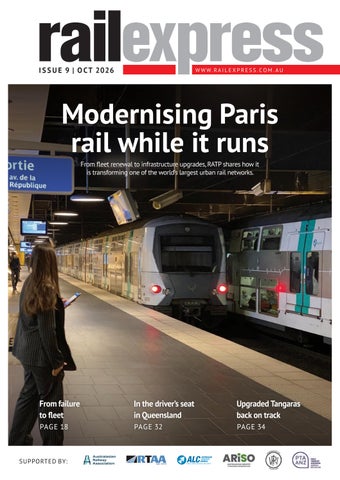
Modernising Paris rail while it runs From fleet renewal to infrastructure upgrades, RATP shares how it is transforming one of the world’s largest urban rail networks.
.
From failure to fleet
In the driver’s seat in Queensland
Upgraded Tangaras back on track
PAGE 18
PAGE 32
PAGE 34
SUPPORTED BY:
T R
T re a
It H d b
N
E
REDEFINING RAIL INFRASTRUCTURE Martinus is an Australian-owned leader in full-service rail infrastructure. Built on an integrated Develop-BuildOperate-Maintain model and 21 years of cross-disciplinary expertise, we deliver turnkey rail and intermodal solutions across Australia, New Zealand, and internationally.
martinus.com.au
20260831_Rail Express Martinus FP.indd 1
Global Operations
Principal Contractor
1500+ Employees
Civil Works
Railway Systems
Dedicated Plant & Equipment
1/09/2026 1:00:06 PM
D Y w g A
Contents 4
From the Editor
6
Industry News
30
Rail Review
50
Latest Contract Updates
COV E R S TO RY
10
14
RATP: Modernising Paris rail while it runs
I N N O VAT I O N
14
Downer: Bringing AI into real-world delivery
MAINTENANCE
18
Alstom: From fault to fleet
23
Loram: The intelligence behind the grind
34
A new lease on life for the Tangara trains
T E C H N O LO G Y
20 BAI Communications: Connecting rail from metros to mines
32
M A N U F ACT U R I N G
26
Amokabel: Cables tailored to the task
P LA N T A N D E Q U I P M E N T
28
Liebherr: Spoilt for choice
WORKFORCE
34
16
Training harmonisation: From policy to practice
32
In the driver’s seat for Queensland Rail
38
Young Professionals
F R E I G H T RA I L
I S S U E 9 | O C T 2026
W W W. R A I L E X P R E S S . C O M . A U
Modernising Paris rail while it runs
ia’s Rollingstock ering Powerhouse ur Service
From fleet renewal to infrastructure upgrades, RATP shares how it is transforming one of the world’s largest urban rail networks.
neering excellence into value.
werhouse behind Australia’s largest is available to deliver smart, valueailored to your needs.
.
skilled engineers, Downer’s Engineering hed expertise in all aspects of freight gstock design, delivery, and through-life
ering Consulting Services apart?
dedicated rollingstock engineering team.
e technical expertise across all rail governments and operators.
n complex integration and upgrade
h-life-support with proven track record.
COVER STORY From fleet renewal and infrastructure upgrades to the automation of existing lines, RATP discusses the long-term planning behind the transformation of one of the world's largest urban rail networks.
ited for safety and quality.
onships and access to global insights.
pability, delivering nce.
From failure to fleet
In the driver’s seat in Queensland
Upgraded Tangaras back on track
PAGE 18
PAGE 32
PAGE 34
36
Sharing the load
I N D U S T R Y O R G A N I S AT I O N S
40
PTAANZ: Beyond the farebox
42
A Q&A with ARISO’s Alan Fedda
44
ARISO: Modernising braking standards
46
PWI NSW: Connecting the rail industry
48
ARA: Building Victoria’s rail future
downergroup.com/ecs SUPPORTED BY:
Image: RATP
WWW.RAILEXPRESS.COM.AU | 3
From the Editor Published by:
379 Docklands Drive Docklands, VIC 3008 T: 03 9690 8766 www.primecreativemedia.com.au
Chairman John Murphy E: john.murphy@primecreative.com.au CEO Christine Clancy E: christine.clancy@primecreative.com.au Managing Editor Lisa Korycki E: lisa.korycki@primecreative.com.au Editor Kayla Walsh E: kayla.walsh@primecreative.com.au Business Development Managers Claire Waters M: 0466 545 664 E: claire.waters@primecreative.com.au Emily Schlegel M: 0466 317 555 E: emily.schlegel@primecreative.com.au Client Success Manager Ben Sammartino E: ben.sammartino@primecreative.com.au Head of Design Clayton Hawley E: clayton.hawley@primecreative.com.au Designer Apostolos Topatsis Subscriptions subscriptions@primecreative.com.au
www.RailExpress.com.au The Publisher reserves the right to alter or omit any article or advertisement submitted and requires indemnity from the advertisers and contributors against damages or liabilities that may arise from material published. © Copyright – No part of this publication may be reproduced, stored in a retrieval system or transmitted in any means electronic, mechanical, photocopying, recording or otherwise without the permission of the Publisher.
4 | ISSUE 9 – OCTOBER 2026 | RAIL EXPRESS
Kayla Walsh Editor - Rail Express
Welcome to the October edition of Rail Express It’s hard to believe there’s just over a month to go until AusRAIL, the biggest rail conference in the southern hemisphere. We’re coming into the busiest time of year for the industry – but before the madness really kicks off, we invite you to enjoy our October issue. Our cover star this month is RATP Group, which has spent the past half a century modernising Paris’ heritage rail network. We find out how it has upgraded everything from rolling stock to signalling to stations through careful planning and close collaboration with the public transport authority. Meanwhile, Downer tells us how its digital business XDNA is using artificial intelligence and robotics to tackle some of rail’s biggest challenges. Alstom takes us behind the scenes of its Repair and Overhaul Centre in Sydney, and Jesica Baptista shares some insights into the work of Loram’s track performance engineering team. Mathew Wegener, BAI Communications’ new National Manager for Growth and Strategy – Transport, also gives us a better understanding of the business’s expertise in delivering mission-critical communications. We hear more about Amokabel’s custom and composite cables, and Liebherr highlights the benefits of its range of railroad excavators. We’re also launching a new regular feature, Rail Review, where we ask highprofile people in the industry for their thoughts on a topical issue. This month, we’re homing in on safety. Plus, we’ve got some interesting interviews with Laurina Neumann – a cabin
manager-turned-train-driver – and Asma Kazimi, a young refugee from Afghanistan who has built a fulfilling career in rail. We also bring you some insightful studies on the benefits of rail vs road freight, and how public transport authorities can generate revenue outside of passenger fares. And of course, we’ve got our regular updates from the Australasian Railway Association, the Australian Rail Industry Standards Organisation, and the Permanent Way Institution of New South Wales. Happy reading!
kayla.walsh@primecreative.com.au
News
Tunnelling kicks off on SRL Major construction is also underway at all station sites at Cheltenham, Clayton, Monash, Glen Waverley, Burwood and Box Hill. Minister for Public Transport Vicki Ward said: “Tunnelling is powering ahead on this important project for Victoria, as Labor gets on with building our much-needed orbital rail."
Tunnel boring machine Alice has launched from Burwood.
When completed, SRL is intended to be a 90-kilometre underground rail loop that will connect every major radial train line from the Frankston Line to the Werribee Line. The first stage of the project, SRL East, will run from Cheltenham to Box Hill via 26 kilometres of twin tunnels. Passenger services are expected to begin in 2035.
Image: Victorian Government
Tunnelling has started on Melbourne’s Suburban Rail Loop (SRL), with tunnel boring machine (TBM) Alice setting off from Burwood towards Glen Waverley. A second TBM, named Hacia, is also in the ground at Burwood, ready to begin excavating the second of the rail line’s twin tunnels. In a first for Victoria, the massive machines are being launched using an “umbilical method”. Due to limited space onsite, the front part of the TBM is beginning the tunnelling process and the rest of the machine will be progressively added behind it. Meanwhile at Clarinda, TBM Aayushi is being assembled and will begin tunnelling towards Glen Waverley later in 2026. In 2027, additional TBMs will dig from Burwood towards Box Hill and from Heatherton to Cheltenham.
Inland Rail makes progress
6 | ISSUE 9 – OCTOBER 2026 | RAIL EXPRESS
The Hume Freeway Seymour site is the fifth to be completed in the overall B2A section.
Image: Inland Rail
Inland Rail has made progress with the first site in the Beveridge to Albury (B2A) Tranche 2 section finished under the Hume Freeway in Seymour, Victoria. Two Australian Rail Track Corporation (ARTC) standard gauge tracks and one V/Line broad gauge track were realigned and lowered below the Hume Freeway to provide enough clearance for doublestacked freight trains. A 1.6-kilometre section of the tracks was removed, lowered by 1.5 metres, realigned by 2.9 metres, and then rebuilt. Works also involved excavating more than 30,000 tonnes of material and ballast, upgrading drainage, widening embankments, and removing vegetation to enhance the stability of the rail corridor. An 80-metre deflection wall was also built to protect the existing Hume Freeway bridge piers. In total, Inland Rail is modifying 12 sites between Beveridge and Albury to allow double-stacked freight trains to pass through. The Hume Freeway Seymour site is the fifth to be completed in the overall B2A section, joining Tranche 1 sites Barnawartha North, Wangaratta, Seymour-Avenel Road and Glenrowan. An Inland Rail spokesperson said: “Completing the first site on B2A Tranche
2 marks an important milestone for the project. “The crews did a terrific job to complete the work on the critical railway line and under the main freeway between
Melbourne and Sydney, ahead of schedule. The B2A Tranche 2 project in Victoria is progressing well with the remaining seven sites expected to be completed early next year.”
News
More than 700 people gathered in Sydney in September 2026 to celebrate excellence at the Rail Industry Awards, Australia and New Zealand. The awards recognised outstanding achievements in the rail sector in 2025 and 2026, with winners announced across 16 individual and organisational categories. Awards Judging Chair and Australasian Railway Association (ARA) Chief Executive Officer Caroline Wilkie said this year’s winners and finalists showcased the high standard of excellence and innovation shaping the rail industry. “This year’s awards have recognised the incredible talents of our industry, including leading infrastructure delivery, customer-focused operations, innovative technical solutions and inclusive workplace practices,” she said. The event recognised success in the areas of diversity and inclusion, sustainability, passenger, infrastructure, innovation, supply, customer experience, freight, signalling and systems engineering and safety. Metro Trains Melbourne stole the show with three awards – Keeping Communities Safe on and Around Rail Award, Diversity and Inclusion Excellence Award and the Passenger Operations Excellence Award. Peter Wilkinson from the Suburban Rail Loop Authority was honoured with the Career Achievement Award, celebrating his significant contributions to the industry. The awards are delivered in partnership with the ARA, the Rail Track Association
Images: ARA
Rail award winners announced
The awards recognised achievements in the rail industry in 2025 and 2026.
Australia (RTAA), the Rail Technical Society Australasia (RTSA), the Permanent Way Institution (PWI), the Institution of Railway Signal Engineers (IRSE) and the Australian Rail Industry Standards Organisation (ARISO). See the full list of winners below.
Rail Network Alliance and Metro Trains Melbourne – Metro Tunnel Project SAFETY EXCELLENCE AWARD Vossloh Switch Systems – Vossloh Turnouts Business
SIGNALLING AND SYSTEMS ENGINEERING EXCELLENCE AWARD Bin Zhu – Hitachi Rail Australia
EMPLOYEE ENGAGEMENT EXCELLENCE AWARD Rail First – Track to Thrive – Employee Engagement Uplift
EMERGING RAIL SPECIALIST AWARD Nichelle Naluz – North Western Program Alliance
SUSTAINABILITY EXCELLENCE AWARD Unity Alliance – Cross River Rail – RIS project
YOUNG RAIL PROFESSIONAL AWARD Devy Rimba – North Western Program Alliance
CUSTOMER SERVICE EXCELLENCE AWARD Metro Trains Sydney
YOUNG ACHIEVER AWARD Bryan Law – Queensland Rail INFRASTRUCTURE PROJECT EXCELLENCE AWARD VIDA Metro, Cross Yarra Partnership,
KEEPING COMMUNITIES SAFE ON & AROUND RAIL AWARD – TRACKSAFE MTM – Trespasser Insights Report and Network Wide Trespasser Safety Strategy RAIL INNOVATION OF THE YEAR AWARD Downer Rail & Transit Systems and Future Maintenance Technologies Robotics – On Track to Revolutionise Rail Operations DIVERSITY AND INCLUSION EXCELLENCE AWARD Metro Trains Melbourne – Women@Metro SUPPLIER EXCELLENCE AWARD Alstom – VLocity Train RAIL FREIGHT EXCELLENCE AWARD Rail First – Redefining Rail through Safety, Innovation, Growth and Excellence PASSENGER OPERATIONS EXCELLENCE AWARD Metro Trains Melbourne – Operationalising the Metro Tunnel
Winners were celebrated in the areas of infrastucture, innovation and more.
CAREER ACHIEVEMENT AWARD Peter Wilkinson – Suburban Rail Loop Authority. WWW.RAILEXPRESS.COM.AU | 7
News
Big day for Auckland
A total of 61,000 passengers travelled on the CRL on the first day of operations.
8 | ISSUE 9 – OCTOBER 2026 | RAIL EXPRESS
Opening day had more trains than usual operating.
Images: City Rail Link
Auckland’s City Rail Link (CRL) is officially open, with hundreds of excited locals clamouring to be on board the first train on September 13, 2026. CRL said the first service – from Ōtāhuhu Station at 4.57am on the South City line – was greeted by applause and cheers. In total, 61,000 passengers boarded a train on Day 1 of operations – three times higher than the previous Sunday. Opening day had more trains than usual operating, with extra staff on hand across the network to answer questions, give directions and help people navigate the new stations and services. The NZ$5.493 billion CRL is New Zealand’s largest ever transport infrastructure project. Twin 3.45-kilometre underground tunnels now connect Waitematā Station, Maungawhau Station and two new city centre train stations: Karanga-a-Hape Station and Te Waihorotiu Station. With the CRL, commuters can travel from Maungawhau to Waitematā in under 10 minutes (roughly half the previous journey time) and from Henderson to Te Waihorotiu in 35 minutes (24 minutes faster than the previous time).
Chief Executive of the Public Transport Association Australia and New Zealand (PTAANZ), Lauren Streifer, celebrated the milestone. “CRL is much more than a technical achievement,” she said. “Around the world, cities that invest in public
The CRL is New Zealand’s largest ever transport infrastructure project.
transport grow more sustainably, are more productive, and become better places to live. “More public transport means more access to more opportunities. In this way, the City Rail Link will keep Auckland moving for decades.”
News
Image: Victorian Government
Melbourne’s newest train station
Passengers board a V/ Line train at the new West Tarneit Station.
Melbourne’s newest station, West Tarneit, is now open to passengers. The station is intended to relieve pressure on the existing Tarneit Station by providing better access to public transport. The new station has 400 car spaces, a four-bay bus
interchange, and cycling and pedestrian links to the local community, as well as a 26-space Parkiteer and 30 bicycle hoops for cyclists. Landscaping works will continue across the station precinct over the coming
months, which will include planting more than 65,000 native trees, plants and grasses. More seating will be installed and separated walking and cycling pathways will also be built. West Tarneit Station can be accessed via a new access road off Leakes Road, or paths connecting to Modern Crescent to the south and Ceremony Drive to the north. More than 1100 services were added to the local Tarneit bus network in August. A new Route 186 bus will run between Tarneit Station and West Tarneit Station via Dohertys Road. The existing Route 182 from Tarneit to Werribee stations will run more frequently and will also travel via the new West Tarneit Station. The station opening comes after the roll-out of additional nine-car V/Line trains to Wyndham Vale, increasing capacity by 50 per cent on peak services.
Australian Railway and Custom Cables Manufacturer Amokabel Australia excels in the design and manufacture of many unique and highly specialised cables. The company is based in Sydney and supplies products across Australia and overseas. Priding itself on being able to provide both custom and standard cables that are manufactured at our facility in Western Sydney. We can manufacture a wide range of products, many of which are custom designed and made to meet our clients’ requirements.
All your Railway Sector Cabling requirements, locally manufactured, such as OHLE cables, Trackside Power cabling, Points Systems, Level Crossing Infrastructure cabling, Contact Wire, Catenary & Bonding cables, Axle Counter cabling, Signalling cables, Train Control System cables, Telecommunications wires, Rolling Stock, Passenger Information Systems, SCADA & Station Building cables. Extrusion Processes utilising: Low Density Polyethylene, High Density Polyethylene & Cellular Foam Polyethylene, Polyurethane, Polypropylene, PVC, LSZH Megolon, Blue Intrinsically Safe coloured sheaths & Steel Wire Armouring, Termite and Rodent protection cable solutions. Quality and Compliance are at the heart of mitigating the risk of unplanned maintenance and downtime. Amokabel will work hard to ensure we supply high quality, high performance. The strictest quality assurance processes are backed by compliant cable testing processes.
8 Epic Place Villawood NSW 2163 Australia P. +61 2 9645 5444 E. enquiries.au@amokabel.com www.amokabel.com
Amokabel has excelled in the design and manufacture of many unique Custom cables, specifically designed to suit customer requirements. We can combine several of your or ourWWW.RAILEXPRESS.COM.AU supplied cables to make an easy| 9to install Composite cable.
Image: RATP/Hamdi Chref
Cover Story
The arrival of the first next-generation MF19 metro train on Line 10.
Modernising Paris rail while it runs From fleet renewal and infrastructure upgrades to the automation of existing lines, RATP discusses the long-term planning behind the transformation of one of the world's largest urban rail networks. Modernising a 125-year old metro and regional rail network while keeping millions of daily journeys running smoothly is not an easy task. In Paris, getting trains, lines, infrastructure and maintenance facilities fit for the future is a round-the-clock occupation for transport operator and maintainer RATP Group (which operates in Australia as RATP Dev Australia). This requires careful planning and close collaboration with the city’s public transport authority (PTA), Île de France Mobilités (IDFM), to ensure the heritage network can support the demands of today while also preparing for the future. Rail Express caught up with Denis Masure, Managing Director of RATP Dev Australia, along with two experts from RATP – Railway Rolling Stock Director Côme Berbain and Group Project Management Director Mathieu Leroy – to find out more about multifaceted network-wide upgrades. As Leroy observed: "Every decision will make life easier or more difficult at a later stage.” CONTINUOUS MODERNISATION RATP Group operates and maintains a highly complex, multi-modal transport network in the Île-de-France (Paris) region, overseeing more than 3.3 billion journeys per year. The
network includes 256 kilometres of metro lines, 320 metro stations, 116 kilometres of regional RER train lines and 66 RER stations, in addition to 112.8 kilometres of tram network and approximately 4000 buses. For the past 50 years, RATP has been continuously modernising and upgrading the network to improve its efficiency, safety, capacity and passenger comfort. On the metro network, a major focus at the moment is the MF19 program, which will introduce up to 410 nextgeneration metro trains across eight lines by 2033, supported by upgrades to tracks, stations, signalling, transport systems and maintenance facilities. These steel-wheeled trains will progressively replace several ageing metro fleets that currently account for around half of the Paris Metro's rolling stock. Commissioning began on metro Line 10 at the end of 2025, and will continue until 2033. Elsewhere, Paris’s new rubber-tyred metro trains, the MP14s, are now enabling passengers to travel in comfort on the extensions of lines 11 and 14 – lines which have doubled in distance since they were initially commissioned. But work on the wider rail network began long before the latest metro fleet renewal program. By way of example, the renovation
10 | ISSUE 9 – OCTOBER 2026 | RAIL EXPRESS
Côme Berbain, Railway Rolling Stock Director for RATP. Image: RATP
of track on the five different branches of the RER A – Europe's busiest regional express rail line since the first branch opened in 1969 – has been ongoing since the early 1990s. RATP has also been a leader in rail line automation, equipping the central trunk of RER A with its automated pilot system, a world first for a line that transports more than a million passengers a day. This steering system has allowed the operator to improve the line’s capacity and reliability thanks to optimised speeds and constant intervals between trains. Further upgrades to the RER A include a transition to a 100 per cent doubledeck fleet to boost capacity, a new single control centre inaugurated in 2024 to speed up incident response times, the installation of new-generation passenger information screens and the upgrading of heavy maintenance workshops with
And that’s just a small fraction of the work RATP has done in recent years, powered by the ambition to provide reliable, sustainable and innovative transport solutions.
Mathieu Leroy, Group Project Management Director for RATP. Image: RATP
Image: RATP/Estelle Revesche-Pucharski
the deployment of flow maintenance lines for bogies and a modern, innovative maintenance line for axles. The RER B, the second busiest rail line in Europe, is also entering a period of modernisation, with new trains soon set to enhance capacity and improve passenger journeys.
RER A has been Europe's busiest regional express rail line since the first branch opened in 1969.
PLANNING DECADES AHEAD RATP works with the local transport authority, IDFM, to design strategic modernisation plans that span decades. “We do all the preliminary studies to bring IDFM a modernisation strategy for a line,” explained RATP’s Group Project Management Director Mathieu Leroy. “We discuss what is required to execute projects – but in the early stages, it’s more about strategic planning.” Leroy said there are many different factors to consider, from projected growth in
Denis Masure, Managing Director of RATP Dev Australia. Image: RATP
passenger numbers to the environment. “We ask things like – are the technical systems at the end of their life span, or do we still have 20 or 30 years left in the rolling stock or the signalling? “What are the new technologies and services that we want to offer passengers? “We bring all of those elements together, develop different scenarios and recommend a pathway forward.” When it comes to modernisation in a brownfield environment, Leroy emphasised that it’s very important to get it right from the start. He shared the example of Line 14, which was recently extended to Saint-Denis Pleyel in the north and Aéroport d’Orly in the south. “We knew we had existing rolling stock and an existing system, and we needed to improve the frequency of the trains in the city centre area. “The path we decided to take in the mid2010s was the extension of a legacy system, which was 20 years old. This delivered the service which was required at a lower cost. “We then designed an extension of the existing system to take place in 10 years’ time.” Later, Leroy said, RATP initiated a new phase, as the six-car rolling stock needed to be replaced by longer eight-car vehicles. “We need new rolling stock, which means new technologies and an opportunity to bring in new digital systems. We went to the PTA and suggested a new era with new services for the whole line. “It’s really about how you design the path of modernisation, and which step you want to take at which time, taking into account what you have on the field and the lifespan to optimise services and costs.” He added that of course, it’s up to the PTA to make the final decision on the way forward based on RATP’s analysis and recommendations. “After that point, we organise the financing and design specific projects one by one that can deliver this strategic planning.” MANAGING ASSETS FOR THE LONG TERM In relation to rolling stock, RATP acts as WWW.RAILEXPRESS.COM.AU | 11
Cover Story
a delegated asset manager for the PTA. This means that it manages the trains that belong to the PTA, including the technical aspects as well as the financial and tender process. RATP’s Railway Rolling Stock Director Côme Berbain said: “We will communicate with the PTA about the condition of the fleet, what needs to be improved, whether we need to refurbish or replace a train. “And then we create a long-term, coherent vision that takes all these things into account.” When the PTA wants new trains, Berbain said RATP will integrate any design specifications and functional specifications for passengers from the PTA. “If the PTA asks for USB ports, or certain colours, we integrate those requests into the technical specifications,” he said. RATP will go through the tender process, choose the supplier, and manage the supplier throughout the design and manufacturing process. Then when it receives the trains, it will validate them, put them online and perform maintenance on the trains until the end of their life. BUILDING TRUST THROUGH DELIVERY Berbain said that RATP maintains constant, transparent communication with the PTA. “They place a lot of trust in us when it comes to the technical and safety aspects of the trains, because we are experts in those areas,” he said. “Part of how we have built that trust is by maintaining the trains every day. The PTA knows that the trains are running well and whenever there is an issue, we know how to manage it. “We know that we will do everything necessary to get 800 trains – that’s 6000 cars – out on the lines every single morning.” Another way Berbain said RATP has earned the confidence of the PTA is by keeping projects within budget and timelines. “With any rail project, there are going to be issues that couldn’t be anticipated,” he said. “The PTA knows that we will find solutions and keep our promises. “We said we would introduce the MF19 on Line 10 in October 2025, and we did it. We promised to have the MP14 on Line 14 in time for the Paris Olympics, and we did it.” Berbain said the team at RATP takes its commitments very seriously, going above and beyond to meet targets. “No matter how many questions the PTA has, we take the time to answer all of them in detail.
Concrete being poured to prepare for MF19 trains at Porte de Versailles.
All of these things help to build that trust.” Speaking about the countdown to the Paris Olympics in June 2024, he recalled: “I was monitoring the number of trains we had on Line 14 every morning. Then I would call the manufacturer to resolve any issues which could potentially impact operational efficiency during the games.” MODERNISING A LIVE NETWORK Millions of Parisians rely on the city’s public transport network to get to work and school every day, to access vital services and socialise. That means RATP must carry out extensive modernisation projects while keeping the network running. “The trains still need to operate every day, and this creates specific challenges,” said
12 | ISSUE 9 – OCTOBER 2026 | RAIL EXPRESS
Leroy. “To do this, you need to understand all the aspects of the project and have specialist technical expertise. “In a greenfield environment, if there is a technical glitch you might have a couple of weeks to fix it. In a live railway, it requires immediate action. There is no room for hesitation when millions of passenger journeys depend on the system every day.” Leroy said that when a transport authority sets an objective, such as increasing capacity ahead of a major event, RATP's role is to identify the most effective and practical way to achieve it. "Sometimes the solution that looks best on paper may be too costly, too risky or too complex to deliver within the required timeframe," he said. "That's why we bring together specialists from across the business, including
Images: RATP/Virginie Valdois
Works underway on lines 3bis and 7bis ahead of the arrival of the MF19s.
operations and maintenance, to develop a solution that balances performance, risk, cost and long-term value." THE LINE 14 CHALLENGE Ahead of the Olympic Games, RATP developed a long-term strategy to modernise Line 14 and prepare it for a sharp increase in passenger demand. This included extending the line, introducing larger trains and progressively migrating to a new generation of digital signalling technology, all while keeping the railway in service. "We needed to extend the line and introduce larger trains to increase capacity, which ultimately required a new signalling system," Leroy said. "However, replacing everything at once would have introduced significant operational risks. The existing system still had the capacity to support the first phase of the extension, so we decided to keep it in place initially and migrate to the new system in stages." "We also designed the new trains so they could operate with both the old and new systems. That gave us the flexibility to continue running services while carrying out the transition, rather than forcing passengers to live through a major disruption." KEEPING PASSENGERS MOVING RATP has also innovated by installing pre-built infrastructure overnight, which minimises disruption for passengers. “For example, we design platform screen doors in a modular way, so we could bring one door into service each morning,” Leroy added. Leroy said RATP will adapt to the PTA’s priorities: “We could close a train station for a month to do the job, which
would be cheaper, or we can maintain service and update the system one bit at a time. It’s all about what the PTA wants.” Again, RATP’s technical expertise comes into play when it comes to carrying out progressive upgrades. “Some of these systems are 40 years old, some of them are 10 years. So you need to understand how the Communications-based Train Control (CBTC) communicates with the rolling stock in accordance with the track profile and so on. “You need to ensure that when you unplug something, the whole system remains functional and safe. “A thorough integration process and technical interface management are key in this kind of modernisation project.” Berbain shared how RATP manages the gradual introduction of new rolling stock. “You can’t just introduce a new fleet all at once,” he said. “You need to create a process where you introduce trains gradually over a process of one or two years and remove the old ones. “This gives you time to train your staff, because some of the drivers have worked for years on metros from the 1960s, and you’re introducing them to a brand-new metro with computers everywhere, with cybersecurity and other digital elements. “You also have to train the operations staff and maintenance staff. It’s a big challenge and it needs to be done progressively.” RENEWAL BEHIND THE SCENES The introduction of new fleets has also necessitated upgrades to maintenance facilities. Because these sites are usually connected to metro lines and located in densely
developed areas of Paris, they cannot easily be replaced by building a new facility nearby. For the maintenance facility for Line 12 in Vaugirard, nine tracks had to be replaced by just five tracks. “We took a step-by-step approach,” Berbain explained. “We created a new track, cut the workshop in half, and the maintenance team reorganised their activities to continue the work they were previously doing with nine tracks to just four tracks. “Then we demolished half the workshop, built a new half, shifted the staff and the activities to the new half, then demolished the old half.” Doing this without any loss of activity on the line was quite a challenge, Berbain said. “It required a huge amount of planning, a lot of local agility and co-operation between everyone involved – from the engineering teams to the maintenance operators in the field. “To do something like this, you need your teams to have a lot of autonomy to solve small problems themselves, and you need strong communication.” Passenger disruption cannot be completely avoided, but RATP minimises it by carefully selecting when work takes place. “For example, August is a time when many Parisians go on holidays, so passenger demand is lower and can be redirected to alternative routes or substituted by buses, so it’s a good time to complete works,” said Leroy. “Sunday mornings are also a quieter time on the network, so we make the most of that.” LESSONS FOR AUSTRALIA While every network is different, Denis Masure, Managing Director of RATP Dev Australia, said many mature rail systems face similar challenges: ageing assets, growing demand and the need to modernise while maintaining service. "Modernising a rail network is never about a single project or technology. It requires a long-term approach that brings together operations, infrastructure, rolling stock and people." Masure said the experience developed in Paris has reinforced the importance of careful sequencing, collaboration and maintaining a strong focus on passengers during periods of change. "Successful transformation comes from understanding how all the parts of a railway work together and planning for the long term while continuing to deliver a safe and reliable service every day." WWW.RAILEXPRESS.COM.AU | 13
Innovation
Bringing AI into real-world rail delivery
The Train Examination System (TRES) – an autonomous robot that carries out inspections of the exterior and underside of rolling stock.
As the rail industry faces growing complexity, changing workforce dynamics and higher productivity demands, Downer’s digital business XDNA is reshaping what a modern network looks like. Rather than providing conventional information technology services, XDNA was created to deliver tangible outcomes, fast. It focuses on specific areas it believes will substantially change the rail industry and adjacent critical industries such as utilities and mining, with four primary market offerings: Integrated Asset Management, Operational Intelligence, Industrial Artificial Intelligence (AI) and Future Work. Darren Hungerford, Executive General Manager of XDNA, explained: “Integrated Asset Management is about how you use technology to better manage all of the physical assets that you have in an organisation. “Operational Intelligence is how you draw data from all the different assets, processes and sources and consolidate it for better decision-making. “Industrial AI is the way we think about AI, which is AI for a purpose. It ensures
The Rail Facility Drone (RFD) uses infrared and visual technology to identify the condition of a maintenance facility.
everything we do can be delivered into an operational environment and deliver real value.” Hungerford said operational intelligence allows teams to move beyond siloed processes and static reporting. “It all starts with building a smart, connected environment, before moving to predictive and closed-loop outcomes. “Through the Internet of Things (IoT), we push data back into the field – be that through a person or directly to the asset through industrial artificial intelligence (AI). “These insights drive actions that improve the management of physical assets, boost productivity, reduce risk and unlock value across the entire asset lifecycle.” The last piece of the puzzle is XDNA’s Future Work solutions. “Future Work is about evolving how frontline work operations are using technology to be safer and more efficient. “Forecasts globally show that there will be a significant human skill shortage as the rail industry grows. One of the ways we can ensure we can handle all the work that’s in
14 | ISSUE 9 – OCTOBER 2026 | RAIL EXPRESS
the pipeline is through technology – be that software automation or robotics.” LEADERS IN ROBOTICS Downer is proud to have been recognised at the 2026 Rail Industry Awards, winning the Rail Innovation of the Year Award for its work with Future Maintenance Technologies (FMT). Hungerford said Downer was FMT’s first business partner, co-funding the development of two key robotic solutions of relevance to the rail industry. One of these is the Train Examination System (TRES) – an autonomous robot that carries out inspections of the exterior and underside of rolling stock. This speeds up inspections, increases accuracy and keeps humans out of harm’s way. “We are not replacing humans,” said Hungerford. “Train inspections require a lot of different activities to occur, and humans are an essential part of that. “It’s more about keeping people out of the danger zone – such as underneath trains or away from hazardous zones. ”
Images: Downer
Downer’s digital business XDNA is using AI and robotics to tackle some of rail’s biggest challenges.
Image: City Rail Link/Downer
Hungerford believes robots will play an important role in meeting the rail industry’s growing needs in the future. “There are a lot of high-volume, low-value tasks that exist today that certain types of automation can handle, freeing up time for humans to do those high-value tasks,” he said. The other automated solution that has come from Downer’s partnership with FMT is a Rail Facility Drone (RFD), which uses infrared and visual technology to identify the condition of a facility and alert crews of any defects. The drone is currently in use at a major rail depot in Victoria, with a particular focus on overhead wire inspections. “This is quite a complicated use case,” said Hungerford. “There are thousands and thousands of components that it must individually assess, measuring their condition." RFD uses trained data sets across machine learning to accurately identify when defects fall outside of the acceptable range, and uses AI to predict whether any of those components or assets will need a fault rectification in the near future. The RFD is integrated in a closed loop back into the works asset management system. “We’ll raise work orders for anything that needs to be done, so that the maintenance team can go out and execute those works.” Hungerford said that like the TRES, the RFD is both safer and more efficient than only using humans for inspections, especially when it comes to working at height. “Anything that is either difficult, unsafe or inefficient for a human to access is the sweet spot for this solution,” he said. “With a range of sensors and a highresolution camera, its readings are extremely accurate.” Another benefit of these solutions is reducing the need for maintenance facilities to be re-engineered. “Re-engineering a facility for maintenance tasks can be very expensive,” Hungerford continued. “It’s much more affordable and agile to bring in a robot or drone. “For example, we’re working with an operator in the United Kingdom at the moment and they need to do roof inspections of trains, but they don’t have the infrastructure to get people on or over the roofs. “Their options are either extremely expensive capital works to install gantries over the trains, or a drone – which is much more cost-effective.”
One of Downer’s key points of difference is that it has the facilities to test new products in a real-world environment. “We offer one-stop solutions – no matter where our customers are in their trajectory. We are able to test these products in actual rail facilities, get them right, and prove the tangible benefits before we go out to the market.” THE IMPORTANCE OF PARTNERSHIP Strategic partnerships are at the core of XDNA’s strategy. “We don’t believe in rebuilding bestof-breed that’s already out there,” said Hungerford. “When it comes to solving business problems for customers on the ground, sometimes an entirely new solution needs to be developed. “Our value is in innovating in novel areas – in the gaps, as well as implementing the solution into the DNA of the organisation, its processes and operations.” Hungerford said XDNA is selective with its partners, ensuring that they align with the delivery of the four key areas he outlined. “We have a number of strong partnerships with Microsoft, Databricks, IBM and several augmented reality partners. “There is a mix of large platform organisations and niche solution partners. “These partnerships enable us to spend our time on where we bring the most value to the client.” DELIVERY DNA Hungerford said AI is central to what XDNA does – from connecting with assets to gathering data to providing insights back to the front line. “We believe we’re one of the organisations that really understands AI in an operational sense,” he said. “We focus on everything from machine learning to agentic AI, and we make sure that when we’re solving a problem, we’re using the right solution.” XDNA has an AI trust framework that it uses from the inception of a project through to delivery and beyond, taking into account security and ethics, and cost-benefit.
XDNA recently assisted the City Rail Link team with enhancing productivity within assurance activities.
Hungerford believes organisations will employ AI through their already existing application suite. “We have a proprietary platform called Neuroverse that allows us to tailor agents or assistants to support a particular problem, persona or discipline into a critical infrastructure organisation to generate value. “We can deliver the technology we need in less than a day, and then start producing a solution for the client against the problem they are trying to solve. “We can leverage open-source models, pick and choose the ones that will drive the best outcomes, and even combine them together.” XDNA recently finished working on a major infrastructure project – City Rail Link in Auckland, New Zealand – assisting in driving productivity and efficiency within assurance activities. “The client needed traceability from requirements through to design artefacts, quality reviews and testing. "We used Neuroverse Cognition, the generative AI component of our platform, to draw together all of the information and provide a set of tools that the project, the operator/verifier and the client could use to ensure that they all had a very clear understanding of all the artefacts of the project across that assurance lifecycle. “The payback period for the project was measured in days, in terms of the productivity and efficiency improvements they saw when getting the project ready to open. Thousands of person-days were saved by having the right solution enable the highly skilled engineers on the project.” Neuroverse has been built by Downer, which creates sovereignty and security. “It’s robust and it’s practical, and the fact that it’s a subscription platform creates a lot of flexibility for our customers. With City Rail Link, it was about our digital engineers and subject matter experts going in there and working with our technical engineering team and the client’s team – collectively enabling them and skilling them up to use the platform on an ongoing basis.” WWW.RAILEXPRESS.COM.AU | 15
Workforce
Training harmonisation: from policy to practice The Australasian Railway Association shares how a new course is providing nationally recognised training – reducing unnecessary duplication and facilitating greater workforce mobility. Image: APchanel/stock.adobe.com
stakeholders and training organisations to develop a model capable of broader national adoption. Our delivery partners are central to that approach. They provide the capacity needed to make nationally consistent training available more widely, which the ARA anticipates will speed up its adoption across the industry.
SARC gives workers the foundational knowledge and skills they need to safely access the rail corridor under supervision.
The launch of the Australasian Railway Association’s (ARA) Safely Access the Rail Corridor (SARC) training represents an important step forward in harmonising safety training across Australia. SARC provides workers with the foundational knowledge and skills they need to safely enter and work in the rail corridor under supervision. The online, self-paced course takes about two hours to complete and uses interactive content, scenarios, animations, knowledge checks and immersive 360-degree simulations to bring the rail environment to life. Learners complete simulated and practical activities, supported by assessment and verification. Successful completion provides the nationally recognised TLIF0020 Safely Access the Rail Corridor competency. But the significance of SARC goes beyond the course itself. It is well known that unnecessary duplication adds cost, limits workforce mobility and makes it harder for skilled people to move to where they are needed. SARC helps address those challenges by providing a practical model where the common national competency is completed once, with only the genuine networkspecific knowledge required for individual rail networks added locally.
A CONSISTENT APPROACH Rail networks come with different infrastructure, operating environments, procedures and risks – but many of the foundational requirements for safely accessing a rail corridor are common across Australia. SARC brings those common requirements together in a nationally consistent competency. Where that competency is recognised by a Rail Infrastructure Manager, workers do not need to repeat equivalent SARC training simply because they move between participating networks. The worker can then complete any local induction or network-specific requirements relevant to their operating environment. It is a straightforward approach, but one that can make a meaningful difference to the way our industry works. DEVELOPED BY INDUSTRY, FOR INDUSTRY SARC was a logical place to start when considering harmonised training because it is an entry-level competency that provides a common foundation for people working across rail. The work builds on earlier collaboration in Western Australia’s Pilbara, which demonstrated the benefits of greater mutual recognition. The ARA has taken those lessons and worked with industry
16 | ISSUE 9 – OCTOBER 2026 | RAIL EXPRESS
A MODEL FOR BROADER HARMONISATION SARC also provides a model that could be applied to other areas of rail training. The approach is to identify what can genuinely be standardised nationally, separate that from network-specific requirements, develop a common training and assessment approach and secure recognition from the organisations responsible for network access. Not every requirement can or should be identical across every rail network. Harmonisation is about removing unnecessary differences while retaining local requirements where there is a real operational or safety reason for them. That distinction is critical if rail is to reduce duplicated training without compromising safety. The ARA’s industry-wide perspective puts it in a strong position to support this work. We bring together passenger and freight operators, infrastructure managers, manufacturers, suppliers, contractors, consultants and training organisations from across Australia and New Zealand. That allows us to identify shared capability needs, and work with industry to turn areas of common ground into practical national approaches. SARC gives the industry a model we can build on: agree the common requirement, separate national competence from genuine local knowledge, develop highquality training, establish delivery capacity and embed mutual recognition across the industry. Rail has been talking about harmonisation for many years. With SARC, we are taking another important step from policy to practice, while helping build a safer, more mobile and more capable rail workforce.
Innovation
Transport sector unites behind national innovation push The Australasian Railway Association shares why transport needs to be prioritised in Australia’s future research and innovation framework.
Image: Inland Rail
Transport represents $129 billion, or 53 per cent, of Australia’s five-year Major Public Infrastructure Pipeline.
The Australasian Railway Association (ARA) is leading a broad coalition of transport, freight, logistics, engineering and research organisations calling on the Federal Government to recognise transport as a national innovation pillar. The proposal brings together more than 20 organisations from across Australia’s transport ecosystem, reflecting a shared view that stronger national coordination of transport research, development and innovation is essential to improving productivity and maximising the value of Australia’s infrastructure investment. The coalition is calling for transport to become a seventh national innovation pillar as the government responds to the recent Ambitious Australia: Strategic Examination of Research and Development report. The report, commissioned by the Federal Government, proposes a new national architecture for research and innovation, built around long-term national goals and supported by targeted strategic initiatives. While the proposed pillars cover several important areas of the economy, transport is not currently identified as a standalone priority. The ARA believes this represents a significant gap and has brought together organisations spanning rail, road, heavy vehicles, freight, logistics, engineering, infrastructure, research and supply chains to make the case for change. The breadth of support reflects the need to build a strong innovation culture within
the Australian transport sector. Transport is an interconnected national system. Rail does not operate in isolation from ports, roads, intermodal terminals, energy networks or digital systems. Freight efficiency often depends on how effectively these different parts of the network work together. The same is true for passenger transport, where better integration, technology and planning can improve accessibility, productivity and the experience of people moving through our cities and regions. A multi-modal approach to transport research and development is therefore essential. The ARA has advocated for a national framework that can support innovation across road, rail, ports, shipping, aviation and intermodal networks, while also recognising the increasingly important role of energy, data and digital technology. This is particularly important given the scale of the opportunity. Transport directly accounts for about 4.5 per cent of Australia’s Gross Domestic Product (GDP) and employs approximately 726,000 people. When transport activity embedded in sectors such as construction, wholesale, retail and mining is considered, its economic footprint is substantially larger. At the same time, Australia is making an unprecedented investment in transport infrastructure. Transport represents $129 billion, or 53 per cent, of Australia’s five-year Major Public Infrastructure Pipeline.
That investment creates a significant opportunity to improve productivity, and research and innovation will be crucial to this effort. There are opportunities across interoperability, construction productivity, automation, digitalisation, asset management, sustainable fuels, electrification and network resilience. For rail, many of these issues are already familiar. The ARA has consistently advocated for greater harmonisation across Australia’s rail system, including more consistent standards, procurement approaches and operating requirements. Fragmentation increases costs, makes it harder to scale innovation and creates barriers for suppliers seeking to operate across different jurisdictions. A stronger national approach to research and innovation can support this broader harmonisation agenda by ensuring new technologies and solutions are developed with national implementation in mind. This would also support improved productivity as Australia realises the benefits that can come from systematically identifying, testing and deploying better ways of working across the network. The coalition, led by the ARA, is therefore seeking a coordinated approach to build on the already significant transport research capability that exists across universities, industry organisations, research bodies, operators and government agencies. This would bring their expertise together around clearly defined national priorities and create stronger pathways from research through to commercialisation and implementation. By bringing the transport sector together behind a common position, the ARA is seeking to ensure transport has a clear place in Australia’s future research and innovation framework. A coordinated national approach would provide the foundation to turn Australia’s existing transport expertise into stronger productivity, more resilient networks and a more competitive transport sector. WWW.RAILEXPRESS.COM.AU | 17
Maintenance
From fault to fleet: the repair hub powering rail reliability Alstom’s Repair and Overhaul Centre (ROC) in Sydney is supporting safer, more reliable rail operations, extending asset life and strengthening local capability.
A SPECIALISED TEAM Founded in 2022, the ROC brings advanced technical expertise, diagnostics, repair and testing capability together under one roof. Specialising in electronics, it services 12 depots and locations across Australia, including Sydney, Perth, Adelaide, Melbourne, Brisbane and the Gold Coast. The team of 15 certified technicians and engineers supports multiple Alstom fleets operating across Australia including metro, suburban and regional trains as well as light rail vehicles. In total, more than 3000 repairs have been carried out since the ROC was set up. The facility’s Manager, Rodrigo Perez Flores, explained the role of the team. “We look after repairs of most of the electronics onboard rolling stock, including the train control units, traction control units and passenger information systems, to name a few,” he said. “Our speciality is Alstom-designed electronics, but we also take care of electronics that were not designed by us, but which are onboard trains that Alstom has manufactured.” The ROC’s technicians and engineers use their extensive knowledge and advanced tools to diagnose failures, develop solutions, validate repairs and improve product performance and reliability. “Before repair, we need to check if a failure is actually present or not,” Perez said. “We use rigorous testing to diagnose a failure, and then after repair, to confirm that
functionality is restored and the system is working properly and safely. “We can also simulate real-world conditions to validate behaviour and system integration and carry out burn in and stress testing.” The team can also carry out deep technical investigations to uncover circuit behaviour and generate repair-critical information as and when needed. “This helps us to understand complex failures and deliver technical solutions,” Perez added. The ROC can repair everything from multilayer printed circuit boards to throughhole and surface mount device (SMD) components, as well as damaged tracks and burned assemblies.
18 | ISSUE 9 – OCTOBER 2026 | RAIL EXPRESS
A team of 15 technicians and engineers supports multiple Alstom fleets operating across Australia.
“We prioritise repair rather than replacement when it is safe and practical to do so,” said Perez. In addition, the team can identify obsolete and hard-to-find components and find suitable alternative parts, make design improvements, and restore non-functional or legacy boards to keep systems running for longer. “We know that obsolescence doesn’t have to mean end-of-life. We help to extend the life of assets – saving our customers money and improving the availability of equipment and rolling stock.” THE RIGHT TOOLS FOR THE TASK The facility contains a portfolio of advanced equipment for precision fault diagnosis,
Images: Alstom
Behind the scenes at the Sydney Metro depot in Rouse Hill, a team of highly skilled electronic technicians and engineers are keeping Australia’s trains and trams moving. Alstom’s Repair and Overhaul Centre (ROC) is an important hub for the specialised repair, refurbishment and overhaul of critical rail components, helping operators maximise fleet performance, improve reliability, reduce turnaround times and extend asset life. We caught up with Tanmay Bozawar and Rodrigo Perez Flores from Alstom to find out more.
The team repairs a wide range of electronics, from train control units to passenger information systems.
including microscopes for inspection, a logic analyser and oscilloscope. Perez said the custom-designed multiproduct functional bench tester is the most important machine at the ROC. “With this machine, we can test 30 or 40 different components simply by changing the mechanical interface,” he explained. Tanmay Bozawar, a Product Introduction Manager at Alstom whose work also spans repairs and overhauls at the ROC, added: “The test bench is a bespoke intelligent tester that integrates design knowledge as well as test requirements to help us pinpoint the reason for a potential failure. “That’s a key point of difference between us and a repair centre not owned by an original equipment manufacturer (OEM).” Both Perez and Bozawar are excited about the upcoming delivery of a new bench which will double the ROC’s testing capabilities. “The new bench is being built by Alstom’s design authority in France and Sweden and will arrive in 15 months. Then we will be able to test all of the large family of products we have in the company.” THE LOCAL ADVANTAGE The ROC enables complex rail component repairs to be carried out in Australia, rather than having to ship components to Europe to be fixed by the OEMs. Bozawar explained: “When we were analysing the need for the ROC, we found that the minimum lead time for sending components overseas was between five and six months. “Now, our target for lead times is around one month, which is a huge improvement. “We can also prioritise based on urgency. If a component is needed tomorrow, for
example, we can drop everything else and get that part out in less than a day.” This shorter lead time means less downtime for equipment and critical assets, but also saves money on spare parts. Perez said: “If you consider a situation where you have to send components overseas for repair, you need to be able to rely on spare parts for six months. “That means your inventory costs can get really high. If you have a local partner like Alstom who can turn repairs around very quickly, you will be able to reduce the
number of spare parts in your inventory because you won’t need them.” By keeping components in Australia rather than having to send them overseas by sea or air, the ROC has also led to better sustainability outcomes. “Since 2024, the ROC has eliminated nearly 200 tonnes of carbon dioxide emissions by reducing travel and transport,” said Bozawar. “In July 2026 alone, we avoided nearly nine tonnes. “On top of that, 35 per cent of the total cost of a repair was the cost of freight. That was another major motivator to go local instead.” In addition, the ROC has helped to build essential rail workforce capability in Australia. “We are training up local technicians and engineers rather than outsourcing that experience to Europe,” said Perez. “More and more knowledge is being accumulated over time, which is so valuable to the local rail industry going forward.” In the 2025-26 financial year, the ROC repaired almost 1000 components, and the team has ambitions to grow. “Over the next four years, we’re hoping to increase our output to complete as many as 1800 repairs a year,” Perez said. “When the new test bench arrives, we will also be expanding the size of the facility, and hopefully the team. Watch this space!”
The ROC enables complex rail component repairs to be carried out in Australia rather than having to ship components overseas.
WWW.RAILEXPRESS.COM.AU | 19
Technology
Connecting rail from metros to mines BAI Communications is drawing on decades of experience delivering mission-critical communications to support Australia’s evolving rail networks.
A TRUSTED PARTNER BAI Communications has been part of Australia’s critical infrastructure for more than a century. It designs, builds, owns and operates the networks that power the nation’s most important operations – and it’s expanding fast, from mining and ports to passenger and heavy haul rail. The company operates one of the most extensive broadcast networks globally, delivering television and radio services to 99 per cent of Australians. It also operates the New South Wales Telco Authority’s Public Safety Network, one of the world’s largest public safety radio networks, at 99.995 per cent availability – connecting police, fire, ambulance and other emergency services. “The network has stayed live through extreme tests – from floods and fires to cyclones – without frontline agencies losing service,” said Wegener. Before BAI separated into two businesses in 2023, with Boldyn Networks now covering the northern hemisphere, it delivered largescale communications systems throughout rail corridors in major cities around the world. It built all of the communication systems for public cellular connectivity in the New York City Subway stations, as well as the communications networks for the London Underground. “For the New York Subway and London Underground, we delivered communications across mission-critical emergency services and mobile network operator (MNO) coverage solutions,” said Wegener. “We’re
Image: Nina Abrevaya/stock.adobe.com
Earlier this year, BAI Communications landed a major contract to deliver critical radio communications systems for Sydney Metro West. This was an important win for the telecommunications company, attracting significant media coverage – but there is a much bigger story behind the headlines. We found out more from Mathew Wegener, BAI’s new National Growth Manager for Rail.
BAI Communications has delivered large-scale communications systems throughout rail corridors in major cities around the world.
talking about 300 or 400 stations and hundreds of kilometres of track and tunnels. “These are very large-scale, complex, multi-technology solutions that needed to be integrated together in a live railway environment. “Following the corporate restructure, BAI still draws on that experience and retains that capability.” Wegener said risk is always a big concern for transport authorities and rail operators, both commercially and operationally, but they can rest assured that their networks are in safe hands with BAI. “What the task will be in Australia is the same as it was for London and New York, and we have shown we have the ability to deliver it,” he said. “It's very easy to roll out communications on a greenfield network, but what BAI brings to the table is that expertise in a brownfield environment. “You’ve got a lot more operational complexities and more legacy equipment in a live environment where you’re trying to install new equipment. BAI has raised the bar in finding solutions to those challenges.”
20 | ISSUE 9 – OCTOBER 2026 | RAIL EXPRESS
Many of the skilled team who have worked on BAI’s international rail projects like the London and New York systems are from Australia, and are now applying their experience to Australian projects. Their skills will prove invaluable on Sydney Metro West and other local rail projects, Wegener noted. “We understand the efficiency and planning required on projects like these, but we also know that no matter how well you plan, there will always be challenges. It’s about being able to lean on the technical skill set of our team, so we can pivot when we need to and get the job done.” FROM LEGACY TO CUTTING EDGE From a systems integrator perspective, Wegener said BAI has the experience and skills to work with and maintain legacy infrastructure until the next generation of technology is deployed. He explained that the communications spectrum for rail is still being finalised by the Australian Communications and Media Authority (ACMA) and as such, spectrum uncertainty is causing project delays.
“You can’t just bring experts to the table very quickly or run down the street and buy a new piece of hardware,” he explained. “Again, that’s where our planning expertise and understanding come in handy.” Mathew Wegener, National Growth Manager for Rail at BAI Communications. Image: Mathew Wegener
There has also been a delay finalising the FRMCS standards. This evolving global standard is designed to replace ageing systems over the next decade and revolutionise rail systems. “We’ve had these rail operators relying on legacy infrastructure, and they know it’s legacy, but they’ve been forced into a situation beyond their control to extend the life of the existing infrastructure,” Wegener said. “They’ve had to maintain older infrastructure longer than they thought they would, and we have been able to help them with that.” At the same time, BAI has the expertise to support rail networks as they embrace new technologies such as the European Train Control System (ETCS). For Sydney Metro West, it will deliver a private 5G (fifth generation) network that will enable operational radio systems, train communications, and rail signalling, as well as ensuring seamless 4G/5G coverage for passengers. “It’s Australia’s first 5G Mission-Critical Services (MCX)-based radio communication system, with a clear pathway to FRMCS,” Wegener added. CONNECTING HEAV Y HAUL BAI is working with mines and ports on private 5G, particularly in Western Australia’s Pilbara. The company has recently grown its capabilities in the mining space with its acquisition of Titan ICT, an advanced engineering firm. BAI can now offer an end-to-end service from spectrum licensing and network design through to deployment and ongoing managed support. “A mine site can rely on BAI because we understand the end-to-end infrastructure and all the pieces of the puzzle,” said Wegener. “This allows fault resolution times to be reduced, uptime to be maintained, and costs for maintenance to be reduced because you’ve got synergies and you’ve got scale.” Wegener said BAI’s depth of knowledge is necessary in remote heavy haul environments.
THE PILLARS OF A NETWORK Wegener said BAI has the ability to build, maintain and operate the three key pillars of any communications network – that is the mission-critical communications that run the signalling and the MCX voice; the emergency services; and the mobile network operators. “BAI can deliver all of these pillars under one contract, and the business is also recognised as a DAS Infrastructure Operator by the MNOs,” he added. “What is different here is that BAI can go and build DAS infrastructure for these communications environments, whether it be a tunnel or a train station, and make it available to the mobile network operators. “Our existing connection agreement with Telstra provides a streamlined lead carrier approval process and facilitates multioperator connectivity. “It’s not very common to find an integrator with spectrum to support rail use cases and be recognised by the MNOs as a DAS Infrastructure Operator.” The updated Australian design guideline for Distributed Antenna Systems (DAS), MCF2025, has recently changed things for the rail industry. A DAS is a network of separated antenna nodes connected to a common source that boosts mobile and
“BAI has a 24/7 NOC in Sydney, monitoring millions of messages and alarms every year, making sure that downtime is minimised because there is that local presence." Mathew Wegener, National Growth Manager for Rail at BAI Communications
wireless network signals inside places like train stations and tunnels, where signals normally drop. Wegener said BAI will make any necessary transitions easy for its customers. “We do this every day of the week,” he said. “We also understand how the supplier ecosystem will evolve with the new standards coming in. “There’s not as much plug and play with suppliers as one would like. We know the best of breed within these vendor ecosystems, and we know how to put them all together.” BAI holds licensed spectrum in Australia to deploy and run private mobile networks, as well as the capacity to own or coown infrastructure. “If an organisation has challenges around capital expenditure, we can come to the table with a turnkey, end-to-end solution, and we can co-fund or primarily fund that,” Wegener said. “This drives confidence that the networks that are being deployed will have that resilience, uptime and availability for users to enjoy.” LOCAL SUPPORT AROUND THE CLOCK BAI’s networks are underpinned by a 24/7 Network Operations Centre (NOC) based in Australia. “A lot of global Original Equipment Manufacturers (OEMs) will centralise overseas in terms of their operations, but when you look at the requirements of the Security of Critical Infrastructure Act (SOCI) from the Federal Government, there are a lot of restraints around offshoring those types of activities,” said Wegener. “BAI has a 24/7 NOC in Sydney, monitoring millions of messages and alarms every year, making sure that downtime is minimised because there is that local presence that understands the environment, as opposed to it being a large international operations centre. “With this operational approach, reactiveness and certainty of action can be streamlined.” Wegener emphasised that the role of communications in rail will continue to grow, making its reliability even more critical. “With everything from autonomous trains to predictive maintenance programs driven by artificial intelligence, the benefits come from having the communication solution available to rolling stock and to the overall operational environment. “Getting it right from the start is crucial, and that’s where BAI comes in.” WWW.RAILEXPRESS.COM.AU | 21
The Rail Express The A 922 Rail Litronic railroad excavator A perfectly tuned hydraulic concept combined with the Liebherr LIKUFIX coupling system turn this railroad excavator into a flexible and steady top performer on any construction site. www.liebherr.com
Railroad excavator
Liebherr Australia Pty Ltd • Phone: 1800 033 300 • em-sales.las@liebherr.com www.linkedin.com/company/liebherranz • www.facebook.com/LiebherrAustralia • www.instagram.com/LiebherrAustralia
14064-2009_LHB_129_A922_Rail_2023_06-ENG-Australia-210x297-v01.indd 1
28.08.2026 16:55
026 16:55
Maintenance
The intelligence behind the grind Loram's Jesica Baptista explains how data, advanced technology and insight gained from experience are helping operators make smarter asset management decisions and get more from their rail networks. From Queensland’s passenger, freight and heavy haul networks to the tight metro windows of Auckland in New Zealand, the remote mining networks of Western Australia and the heavy haul corridors of North America, Jesica Baptista has built a career on understanding how railways behave. Now a Senior Track Performance Engineer at Loram Australia, she sits at the intersection of data, machines and human judgement – translating information into practical maintenance strategies. For Baptista and the track performance engineering team, effective rail grinding is not just about achieving the right profile, but about understanding how the rail is behaving, identifying what may be contributing to recurring defects and tailoring the grinding strategy to each customer’s priorities – whether that’s extending rail life, managing safety risks, maintaining network availability or improving productivity. Baptista sat down with Rail Express to explain what goes into an effective rail grinding strategy, and how data and engineering expertise are helping to shape the future of rail maintenance. THE TRACK PERFORMANCE ENGINEERING TEAM Loram Australia has a wide portfolio of advanced rail grinding machines, which use
Jesica Baptista, Senior Track Performance Engineer at Loram Australia.
abrasive stones to remove a tiny layer of metal and restore the optimal profile of a railway track’s head. They work on railways throughout Australia, from metropolitan passenger networks to major freight and heavy haul operations across Queensland, New South Wales, South Australia, Victoria, the Australian Capital Territory and Western Australia. The track performance engineering team oversees the performance of these machines on the track, assessing rail condition after grinding to determine whether the strategy is delivering the intended result and maintaining that performance between cycles. But their role extends beyond assessing the finished grind, with the team continually looking at how maintenance strategies can be optimised for each network. “Each customer has their own KPIs (key performance indicators) and
specifications,” said Baptista. “They also have their own priorities.” For some operators, maximising rail life and reducing replacement requirements is critical. For others, maintaining network availability and avoiding speed restrictions is the overriding priority. “We help our customers understand their network and how they can make the most of our contract services, engineering expertise and machines.” Loram uses track inspection vehicles to collect data that helps the team develop optimised grind plans. The track performance engineers review these plans to ensure customer specifications and special instructions are incorporated, including requirements for additional grinding passes based on factors such as MGT (million gross tonnes). The team also works closely with customers on network requirements, grinding strategies and track possessions. Where a different approach may deliver better outcomes, engineers can conduct specialist trials and explore ways to maximise the capabilities of Loram’s machines. TURNING DATA INTO DECISIONS Loram’s track inspection fleet collects information ranging from imagery and rail profiles to grinding passes and operating speeds, helping engineers assess the
Images: Loram
Loram combines advanced technology, data and engineering expertise to help operators make more informed rail maintenance decisions.
WWW.RAILEXPRESS.COM.AU | 23
Maintenance
The AIVR platform brings multiple sources of network data together in one place, making information easier to access, review and compare.
effectiveness of different grinding strategies and develop future plans. “The images give the operator of the inspection vehicles the ability to detect the rail surface condition and prescribe the most appropriate grind plan for that section of track.” That information feeds into Loram’s proprietary RailPro system, an integrated suite of software tools designed specifically for rail grinding. RailPro analyses rail profile data collected using laser measurement technology and helps determine the grinding patterns, metal removal allocation and operating speeds required to achieve the optimised rail profile. Together, inspection, planning and machine execution create an ongoing feedback loop, allowing engineers to assess results and refine future grinding cycles. Historical data is particularly valuable when investigating recurring defects. “If something happens, like a defect comes back after we’ve ground the rail, it’s really useful to be able to go back over the database and pull the images and profiles,” Baptista said. “Sometimes the rail has a tendency to move back towards the shape it had previously. Having that historical data helps us understand what has happened and work with the customer to determine what else may be influencing the condition.” SEEING MORE OF THE RAILWAY Loram is expanding its digital inspection and monitoring capabilities through its strategic partnership with United Kingdombased rail technology company One Big Circle, creator of the Automated Intelligent Video Review (AIVR) platform.
The partnership brings Loram’s global rail maintenance and engineering expertise together with One Big Circle’s intelligent video technology, helping operators build a more connected view of the condition and performance of their networks. AIVR uses high-definition cameras and analysis assisted by artificial intelligence (AI) to capture, review and interpret railway imagery remotely. The platform can bring multiple sources of network data together in one place, making information easier to access, review and compare, and helping engineers and operators identify trends, investigate conditions and make more informed maintenance decisions. Baptista said Loram is running three trials across Australian customer networks and has seen some promising results so far. “The platform allows us to integrate multiple sources of data, from track geometry to ultrasonics, so we can optimise maintenance,” she said. “It’s pretty exciting – we’re already seeing a lot of interest in this technology from our customers.” Baptista said the technology is relevant to much more than grinding. AI-assisted analysis can help identify and flag potential rail and infrastructure conditions across large volumes of imagery, directing attention to areas that may require further investigation with optimal efficiency. “The technology gives us another source of information that can help operators understand what is happening across their network,” Baptista said. Combined with rail profiles, track geometry, ultrasonic information and historical maintenance data, this visual monitoring gives engineers a more complete picture of the network and the factors influencing rail performance,
24 | ISSUE 9 – OCTOBER 2026 | RAIL EXPRESS
fully leveraging machine learning and AI capabilities. FINDING THE ROOT CAUSE Baptista’s extensive rail maintenance experience and physics knowledge also bring an important layer of engineering judgement to the decision-making process. Understanding what the data is showing often requires understanding the railway as a complete system. Even where grinding achieves the required rail profile, other conditions can continue to influence how the rail behaves. “We could do corrective grinding and remove the whole layer of defect, but because there is something else at play – a geometry issue, a dip, unstable subgrade, a change in the stiffness of the track assembly – that’s always going to create more stresses on the rail that are going to show up as surface defects,” Baptista said. First-hand knowledge of the track and maintenance experience can help engineers recognise when the root cause of a recurring defect lies beyond the grinding strategy or rail profile. In some cases, underlying conditions such as inadequate subgrade support need to be addressed to prevent the issue from reappearing. Baptista said this highlights the importance of viewing the track holistically and addressing problems at their root cause rather than simply treating the symptoms. A SPIRIT OF COLLABORATION Baptista and her team draw on Loram’s global network of engineers, technical specialists and industry relationships to strengthen their approach to rail grinding and track performance. “Decades of experience across different rail environments, and more than 260,000 kilometres of track maintenance per year, allow Loram’s teams to share technical knowledge, research, field data and lessons learned across regions, giving the Australian team access to expertise spanning machine design, software, rail inspection and track performance,” said Baptista. “Loram also works with customers, research organisations, technology providers and industry partners globally. Combining this global expertise with local network knowledge helps the team apply lessons from around the world to the specific conditions and priorities of Australian rail networks.”
From Parramatta to the Pilbara, we build Australia’s most critical communications networks. Where mission-critical communications are hardest to deliver, BAI Communications has the experience to get it done. From FRMCS-ready rail systems built on private 5G-MCX, to comprehensive communications solutions for remote mine sites, we bring global expertise to Australia’s most demanding and complex connectivity challenges.
Delivering Australia’s first 5G-MCX metro rail network
Private mobile Private 5G for networks for Australia’s most Australia’s most challenging challenging environments environments
99% of Australians. The nation’s largest broadcast network. network
Operating one of the world’s largest public safety networks network. network
Scan to discover the future-ready capabilities BAI brings to rail
Manufacturing
Cables tailored to the task Amokabel Australia specialises in unique, highly specialised cables – and has been exploring some innovations to better serve its customers. When it comes to cables, the rail industry often has special requirements. A cable may need to withstand high temperatures, resist rodents and termites, or remain flexible for fast, easy installation. Sometimes, there’s a need for composite cables, or cables for applications that have never been seen before in Australia. That’s where Amokabel Australia comes in, according to Mark Foster, the company’s General Manager and Sales Director. Foster said Amokabel prides itself on its ability to produce highly specialised cables at its Western Sydney facility, with quick turnaround times. “We received a custom order from a Melbourne customer recently – we gave them a written specification and manufactured and delivered the cable within two-and-a-half weeks,” Foster said. Low minimum order quantities also offer flexibility to customers. “We run cable manufacturing processes with production lines that can be up to 70 metres in length,” Foster explained. “We can make a bespoke 20-metre cable by using lead in cable in the construction – in essence, a tow rope. If a 20-metre sample is required for evaluation, we would make 100 metres and put 80 of that aside and give just 20 metres to the
customer. We won’t restrict them, whereas the big production houses often won’t look at an order if it’s less than a kilometre.” He said that alongside its standard offerings (across axle counter cables, signalling cables, traction power cables, communication cables, supply cables, bonding cables, overhead line equipment cables and contact wire), Amokabel goes above and beyond to tailor cables to a customer’s needs. This includes producing outer sheaths in a variety of colours, as well as the option for the sheaths to include different information such as the customer’s website and phone number, or metre marking. Other customisations include steel wire armouring, mechanical protection, and the addition of outer sacrificial sheaths to protect against water and rough use, as well as insect and rodent-proofing. “We can customise for a wide variety of extreme environmental conditions and hazardous environments,” said Foster. “We use different plastics and sheaths for oil resistance, chemical resistance, UV stability and more.” Foster said Amokabel being based in Sydney brings additional advantages. “When a customer wants to partner with us, we can respond quickly. We can be on a plane and meet the customer on-site or at their offices, or they can visit our factory and see their cables being manufactured and tested.”
A single-stranded copper core doubleinsulated cable with additional sacrificial PVC outer sheath.
26 | ISSUE 9 – OCTOBER 2026 | RAIL EXPRESS
INNOVATION IN PRACTICE For the past decade, Amokabel has partnered with TrackIQ, now owned by the Wabtec Corporation. Foster pointed to Amokabel’s role in Wabtec’s Rail Bearing Acoustic Monitoring (RailBAM) system, an innovative wayside condition monitoring system, as an example of the company’s agility and commitment to innovation. RailBAM monitors the acoustic signature of each axle bearing on passing trains, accurately identifying the presence of defects in bearings. Operators are alerted of any detected issues, ranked by severity and fault type, which enables preventative rather than reactive maintenance – reducing disruptions and boosting efficiency. Amokabel locally designed the cable that TrackIQ needed for the trackside installation of RailBAM across the national rail network. “RailBAM was totally new – this was an innovative solution offering true predictive maintenance results for operators,” said Foster. “TrackIQ approached us and we worked with them to manufacture custom cables, applying the standard criteria to design. “The dimensions of the finished cable can be critical to meet cable glanding specifications, so it was essential that we did not exceed those dimensions whilst maintaining the cables’ electrical characteristics.” Foster said Amokabel collaborated successfully with TrackIQ on the project, with clear communication from start to finish. “TrackIQ appreciated our personal visits and engagement throughout the process, from prototyping to product approval, design and installation,” he added.
HIGH-TEMPERATURE CABLES Amokabel is currently developing new cables capable of withstanding high temperatures. “We are working with different insulating materials (plastics) to meet the temperature requirements of 160 degrees Celsius,” Foster said. “Then we will do an in-house flammability test to make sure the cable meets flammability standards, and that it’s not emitting halogens or toxic fumes.” These high-temperature cables are being designed for a customer in the nuclear
power industry. However, Foster said this innovation could also prove useful within the rail industry. “We are getting a lot more requests for low smoke, zero halogen (LSZH) cables – they are going to come into many more specifications in the future,” he said. “Many run-of-the-mill cables that use plastics like PVC have an operating temperature of maximum 90 degrees Celsius. “More and more, we’re seeing requirements for operating temperatures of 110 degrees, to retain the integrity of circuits during fire conditions for a longer period of time. That way, rail systems can stay running for as long as possible.” A NEW WAY TO PROTECT AGAINST TERMITES Australian standard AS/NZS 5000.1 specifies that termite protection for cables can be achieved via the application of a nylon 12 protection layer, a stainless-steel tape layer, or a brass tape layer. Foster said nylon jacketing is the most common method used, but it uses a lot of plastic. Nylon jacketing also means cables become much thicker and less flexible, which makes installation and maintenance more difficult. Amokabel has developed a new way of protecting cables against insects and rodents by using an additive. “This requires half the amount of plastic and fossil fuels to be used, and it’s a onesheath operation for both insect and rodent protection,” said Foster. “Cable flexibility is also not compromised from the base cable construction with our additive method.” Amokabel is currently using an antirodent and anti-insect additive developed by
Images: Amokabel
COMPOSITE CABLES Amokabel can also produce custom composite cables – combinations of different types of cable incorporated into one constructed cable. “We do a lot for the mines in North Queensland,” Foster said. “Two Category 6 Local Area Network (LAN) cables are laid up with a data cable and a nylon tube. Steel wire armour is then wrapped around all the cables, with an outer sacrificial sheath.” Foster also shared a recent example of a custom cable Amokabel produced for a customer in Western Australia. “This was a communication cable for a sensor that required custom power cores, paired with two data cores in one cable. We also offered the inclusion of a terminated M12 connector to provide a turnkey solution,” he said. “The customer, TEKSAL Safety, wanted the sheath to be a yellow PVC (polyvinyl chloride), as per their system requirements. “We designed that cable and outsourced the connector to be fitted to it, and had one of our partner cable loom assemblers complete the job.”
A single-stranded copper core doubleinsulated cable.
Above: A polyurethane (PUR)sheathed cable, suitable for harsh environments.
Aversion Technologies, which has been approved and certified for use in the United States and Asia. “We have a heavy haul customer in Western Australia who wanted to maintain flexibility in their cables, so they have tested our additive method,” said Foster. “When cables are not flexible, it triples the time and manpower needed for installation. “The additive method has been approved for some of their communication cables so far, and we are working with Australian Standards to have it included in the next round of relevant revisions to AS/NZS 5000.1.” Amokabel has been working with a local supplier, Townsend Chemicals, to develop and test this solution. Townsend Chemicals has committed to manufacturing the raw material, including the additive, in its Melbourne plant. Foster said the additive method is significantly faster and more affordable than the alternatives. “If you need to put a nylon jacket plus a sacrificial sheath on a cable, it’s a twoto-three-week process,” Foster said. “Contractor teams are delayed while they are waiting on the cables, which disrupts passenger services and freight, and costs time and money. “With the additive method, that time is reduced by half.” WWW.RAILEXPRESS.COM.AU | 27
Image: Liebherr Europe
Plant and Equipment
Liebherr’s rail excavators give flexibility to operators.
Spoilt for choice Liebherr’s range of rail-road excavators and wheel loaders balance power, performance, and efficiency for operators across the industry. “At Liebherr, we know that rail work in Australia is rarely straightforward,” said Lucas Ortlieb, Divisional Director of Liebherr-Australia’s Earthmoving and Material handling division. “Tight track possession windows, long distances, workforce shortages and a range of other factors put pressure on contractors to get more work done, both quickly and safely. A purpose-built rail-road excavator can make all the difference.” Ortlieb explained the design principle behind Liebherr’s rail-road excavators. “The machine needs to perform as an excavator but also move efficiently on rail and road and handle the specialist attachments used across rail construction and maintenance,” he said. This combination is present throughout Liebherr’s Australian rail-road excavator range, including the A 922 Rail Litronic and A 924 Rail Litronic, with the recently released RE 25 M Litronic coming soon. THE ALL-ROUNDER Ortlieb said Liebherr’s A 922 Rail Litronic is an “all-rounder” – the one that best
represents the manufacturer’s “one machine, many jobs” approach. Sitting at around 20 to 23 tonnes with a 120-kilowatt engine, Ortlieb said the machine has enough size and power for demanding rail maintenance and construction work while remaining agile enough to manoeuvre efficiently around the worksite. Integral to the machine is its hydraulic system, composed of two variabledisplacement pumps which provide up to 2 X 220 litres per minute, with independent hydraulic circuits. This allows the machine to run demanding attachments while maintaining smooth excavator and travel functions. According to Ortlieb, this flexibility matters to contractors. “A rail excavator may be digging one day, handling sleepers or ballast the next, then working with a grab, breaker, or other specialist attachment,” he said. “The A 992 Rail is designed for these multi-purpose needs.” Additionally, the A 922 Rail can travel on rail as well as road, which is crucial
28 | ISSUE 9 – OCTOBER 2026 | RAIL EXPRESS
for projects where access between work areas is not always simple. Depending on the application, various rail wheel and undercarriage configurations can also be specified, which makes it possible to use on different types of track across Australia. Other features include the excavator’s redesigned heavy counterweight and improved weight distribution, which help with stability and performance. The compact 2000-millimetre tail swing radius is another plus for close-up infrastructure work, as well as work in restricted areas. Ortlieb said the spacious double cab, which comes with modern interior design and roll over protective structure (ROPS) offers the best conditions for comfortable, safe and productive work. “Entry lighting makes it easier to access both seats, and the generous use of glass, as well as rear and side cameras, give operators a better view of the working area and surrounding environment. “The cab’s touchscreen colour display, controls and seat are also ergonomically
THE NEXT SIZE UP Also in Liebherr’s rail excavator range is the A 924 Rail Litronic, boasting an operating weight of around 21.8 to 25 tonnes. While the machine shares the same engine and road rail concept as the A 922, it provides contractors with an alternative where greater operating weight and lifting capacity are useful, while also incorporating the flexibility of a friction drive system, enabling the machine to clear train stops with ease. Central to this capability is the A 924 Rail's bucket capacities, which range from 0.24 to 0.95 cubic metres. Grab capacity goes up to 0.70 cubic metres. “For heavier lifting, material handling, and excavation work, that extra capacity can be important,” said Ortlieb. “The A 924 Rail gives contractors another step up in capacity without moving into a much larger machine class.” The A 924 Rail can be configured for applications including trackside
The A 922 Rail Litronic is powerful enough for demanding rail construction work, while remaining agile.
construction, lifting, and maintenance, in addition to material handling and more traditional excavation work. THE NEWCOMER Liebherr has recently updated its rail excavator range with the release of the new RE 25 M Litronic, soon to hit the Australian market. The machine sits in the 25-tonne class, with an operating weight of approximately 24.4 to 25.7 tonnes and a 120-kilowatt engine. “The RE 25 M brings a new generation of technology to our equipment portfolio,” said Ortlieb. The excavator features a new undercarriage concept, a redesigned upper carriage, and a new operator cab – design using Liebherr’s signature intuitive user interface approach. This design concept standardises control systems across Liebherr’s material handlers and earthmoving machines. The machine’s hydrostatic rail wheel drive is another key feature, aimed at providing traction and controlled movement on the track. The new cab and controls also bring increased visibility, ergonomics, and straightforward machine control to demanding rail work. In addition, the RE 25 M has been developed with a relatively compact tail radius of around 1570 millimetres, which is useful when working in confined Image: Liebherr
designed to create a comfortable experience for the operator.” For Australian contractors, the attraction is not just digging performance, Ortlieb added. “It is having a machine that can move, lift, excavate, and handle different attachments without needing a different machine for every task.”
rail corridors. Ortlieb highlighted the impact this machine will have when it arrives in Australia. “This isn’t another version of the machines we already have on the market – this is something new,” he said. THE COMMON THREAD All three of these Liebherr rail excavators give flexibility to operators. Ortlieb said this is essential on Australian rail projects, which often involve excavation, drainage, sleeper handling, lifting, ballast, vegetation work, infrastructure installation, and general construction within the same track possession. “The A 922 Rail, A 924 Rail, and RE 25 M bring versatility, capacity, and innovation to rail projects, supporting operators facing a variety of challenges in the field,” he said. “For contractors, the question is not simply how much a machine can dig. It is how much work it can do between possessions, how quickly it can get where it needs to be, and how many different jobs it can take on once it arrives. That is where the Liebherr railroad excavator range excels.” THE SUPPORT Liebherr’s rail excavator range is supported by its XPower wheel loaders, which tackle the material handling tasks necessary for worksite progress across four size classes. “The machines are built for high performance and maneuverability, with the ability to load and move ballast around work sites, stockpile and feed materials into other equipment, and rapidly load trucks to remove excavated material,” said Ortlieb. “The XPower wheel loaders are also built with exceptional fuel efficiency – the machines’ travel drive with Liebherr Power efficiency (LPE) provides a fuel reduction of up to 30 per cent, optimising the interaction of the diesel engine, transmission, and working hydraulics.” These functions, combined with ergonomic design and ease of maintenance, make the wheel loaders well-suited to assisting rail excavating projects, and a major player in Liebherr’s product mix. Ortlieb added: “The combination of the A 922 Rail, A 924 Rail and RE 25 M Rail with the XPower wheel loader is a winning formula. While the rail excavators perform the heavy lifting on site, the XPower wheel loaders ensure materials are moved efficiently, helping maintain productivity and workflow.” WWW.RAILEXPRESS.COM.AU | 29
Safety
Rail Review IF YOU COULD MAKE JUST ONE CHANGE TO IMPROVE SAFETY IN THE RAIL INDUSTRY IN AUSTRALIA, WHAT WOULD IT BE?
Angie Doll, Managing Director of Rail at Go-Ahead Australia and New Zealand. Image: Go-Ahead
Drawing from my experience in rail operations in the United Kingdom and broader global networks, if I could make one change to improve rail safety across Australia, it would be driving a culture of shared accountability, where safety is owned by everyone, not just a dedicated safety department. Systems, processes and compliance frameworks are vital, but lasting safety outcomes are ultimately driven by culture. Safety is not something done to people, nor is it the sole responsibility of a safety team. It is an active, daily commitment made by every individual for their colleagues, customers and communities. In strong safety cultures, the focus shifts away from blame, finger-pointing and defensive behaviours and moves toward openness, learning and honest conversations about risk. When incidents or near-misses occur, the objective shouldn’t be finding someone to fault, but understanding why it happened, so the entire network can learn and prevent recurrence. When frontline teams feel supported rather than exposed, trust can build rapidly across the organisation. This leads to more mature discussions, transparent reporting and far more constructive outcomes when things don’t go to plan. Ultimately, safety is not an add-on activity or trade-off against 30 | ISSUE 9 – OCTOBER 2026 | RAIL EXPRESS
operational demands. The organisations achieving world-class safety performance are those where every person understands that safety is a core part of how they work, lead and make decisions every day.
Sean Bonham, Executive General Manager, Specialist Business at ACCIONA. Image: ACCIONA
If I could make one change to improve rail safety, it would be to shift the industry’s mindset from “that’s how we’ve always done it” to become more curious – “how can we do it better?” Safety will always be fundamental, but we should not be afraid to reach out and embrace what the future could be.
Shigeaki Adachi, Senior Manager, International Business Department at Tokyo Metro. Image: Tokyo Metro
If I were to identify one area where Australia could make a change to improve rail safety, I would emphasise enhancing the safety skills and capabilities of railway employees. This is not to say safety practices in Australian railways are inadequate. Rather, I believe there is always an opportunity to learn from diverse approaches and experiences.
In recent years, the industry has pursued operational efficiency through automation and workforce reduction, including the introduction of driverless and unattended operations. Nevertheless, wherever staff are involved in operations, their ability to respond appropriately to unexpected situations remains critically important. In 2016, Tokyo Metro established a large-scale railway training centre to enhance the safety awareness and practical skills of our employees. The centre is equipped with full-scale station mock-ups and real railway vehicles, enabling employees to undertake realistic training for major accidents and emergencies. Japan is frequently affected by natural disasters such as earthquakes and typhoons. Through repeated practical exercises, our employees are trained to remain calm and respond appropriately when such events occur. We place particular emphasis on protecting the safety of our customers, including evacuation procedures and ensuring safe customer movement during emergencies. We also focus on collaboration across different functions. Customer service, railway operations and technical teams undertake joint exercises so that they can work together effectively during an emergency. We believe that safety is not achieved by any single department or individual, but through the collective capabilities of the entire organisation. By further strengthening practical safety training, cross-functional collaboration and safety culture, I believe Australian railways can continue to create a world-class environment of safety.
Would you like to share your thoughts on a topic that’s important to the rail industry? Email kayla.walsh@ primecreative.com.au to get involved.
Above image: Tom Richards/stock.adobe.com
In the first instalment of a new series for Rail Express, we asked some high-profile figures in the rail industry one important question.
Don’t miss an issue, subscribe today.
railexpress.com.au/subscribe
RAIL EXPRESS is compulsory reading and a vital tool for all people working in and around the rail sector. Rail Express is Australia’s authoritative business to business rail publication. Combining the resources of our respected journalism team and our unparalleled industry contacts and affiliations, Rail Express provides extensive, comprehensive and balanced coverage of breaking news and trends in key areas like infrastructure, investment, government policy, regulatory issues and technical innovation. Published both in print and digitally every month, Rail Express is the only publication to have both the official endorsement and active participation of the main railway associations in Australia and the broad support of the rail industry. The only way to ensure you get every copy of Rail Express is to subscribe today. Visit railexpress.com.au/subscribe.
A US T RA L IA’S L E A D IN G BUSIN E SS TO BUSIN E SS RA IL P UBLICATION
Workforce
In the driver’s seat From teaching to aviation, Laurina Neumann had a varied career before embracing a new challenge – becoming a train driver. into smaller sections as we learn it, which makes it much more manageable.” Her advice for anyone else undergoing training is to take it one step at a time. “My mentor was a wealth of knowledge,” she said. “Don’t be afraid to ask questions if you feel confused or overwhelmed. “Everyone has to start somewhere, so trust the process and remember safety comes first.” She said she was slightly apprehensive the first time she drove a locomotive on her own, but the training was rigorous enough to prepare her for the unexpected. “I’m still learning at work every day, because each day is different,” she said. “But I’ve gained a huge amount of confidence in my abilities.” One of the most challenging situations for a driver is dealing with traumatic incidents. “It’s spoken about quite a bit, and we go through situations in the simulator, so we are prepared to handle emergencies when they happen,” Neumann shared. “I’m lucky that I haven’t experienced anything like this yet.” Neumann is now qualified to drive a number of routes across the South East Queensland Network. “All these routes are very different,” she said. “We can drive at speeds up to 140 kilometres an hour on the Varsity route, whereas you might have a slower route to Shorncliffe. “The drivers all have different favourite routes depending on their own preferences.” Neumann drives Queensland Rail’s Interurban Multiple Unit and Suburban Multiple Unit fleet, including some of the newer New Generation Rollingstock trains that entered service between 2017 and 2020. “Every train unit has its own characteristics,” she said. “They are unique in how they handle, the braking characteristics, and how they power. “You need to understand the train you’re driving and its features, so you can handle every situation.” Neumann thinks that outside of the rail industry, there isn’t much awareness of what being a driver entails. “Some people think that you just power up and you brake and that’s it,” she laughed.
32 | ISSUE 9 – OCTOBER 2026 | RAIL EXPRESS
Neumann admitted she also had some preconceived ideas about rail, worrying that being a train driver would be lonely or the industry would be too macho. “Coming from a job where I had to wear heels on the plane, I wasn’t sure if rail was for me,” she said. “Thankfully, all my preconceptions were wrong. Rail is actually quite social, and there’s a wonderful working environment where I’ve always felt supported as a female driver.” Neumann would love to see more female train drivers across Australia. “I think it helps to show other women what the role is really like,” she said. “There are a lot more women in rail than I realised, and I would encourage any woman who is interested in the sector to go for it. "The training is fantastic, the teamwork is great, and it’s a role where you can make a real difference every day. I love it.”
Neumann worked in the aviation industry before switching to rail.
Images: Queensland Rail
Laurina Neumann hasn’t looked back since she swapped high heels for steel-toed boots and a plane cabin for a train cab. Now, Neumann is loving her job behind the controls of Queensland Rail’s south sector trains. “I was a teacher for eight years, and then I moved across to the aviation industry, where I was a cabin manager for Virgin Australia,” she said. “During Covid, so many aviation crew members left to work in rail, and I heard amazing things about it. “I’m so glad I ended up making the change.” Neumann applied to become a train driver about two years ago. To get onto the driver training program, she had to pass a series of psychomotor and psychometric tests, assessing things such as her reaction time, situational awareness, and concentration. She also had to undergo a group interview and assessment, medical tests, police checks, and drug and alcohol tests. “It’s a pretty in-depth process,” she explained. “But for such a safety-critical role, it has to be. “I was so excited when I finally got my acceptance letter – but nervous too, because I knew it was going to be a big change.” Neumann started her training program in June 2025, as part of a cohort of 67 trainees. “Training lasts about nine months,” she said. “The first three months are classroombased, where you learn all the rules, signalling systems, and train operations. “Then you move on to using the driver simulator, where you practice things like emergency procedures and fault-finding.” Once trainees have passed these initial stages of the process, they go out in the cab with a tutor. “We learn our routes for six months, and that is very intense,” said Neumann. “Before you can drive a route yourself, you need to be able to visualise it in your head. You need to be able to call every speed board, every curve, every gradient, every landmark, every bridge, every road name. “There’s a lot to it, and it’s quite difficult when you need to call from, say, Bowen Hills all the way down to Varsity Lakes and back. But we’re able to break the route down
Laurina Neumann is qualified to drive trains on the South East Queensland network.
WWW.RAILEXPRESS.COM.AU | 33
Maintenance
A new lease on life Sydney’s Tangara trains are getting a major upgrade, 40 years after they rolled out of the factory.
The upgrades are intended to extend the life of the trains by a decade.
The first refurbished Tangara train has reentered passenger service, marking a major milestone for the $447 million Tangara Life Extension program. It comes four decades after the first Tangara trains were built by UGL, then known as Goninan, in Newcastle in New South Wales. In total, 55 eight-car Tangaras will be revamped. This is intended to extend the
life span of the trains by more than a decade and increase reliability across the Sydney Trains network. Upgrades made to the trains include updating interiors and fittings; upgrading the onboard operating system; installing internal destination displays and CCTV and upgrading public address systems, including digital voice announcements. Transport for NSW said the new security features will
Images: Transport for NSW
In total, 55 eightcar Tangaras are being refurbished.
34 | ISSUE 9 – OCTOBER 2026 | RAIL EXPRESS
make the fleet less vulnerable to vandalism and reduce the number of breakdowns and service interruptions. New safety and accessibility features are being introduced, such as flip-up seating for priority wheelchair spaces, as well as improved passenger emergency help points. An internal emergency door release system is also being installed. Tangaras, which are in service predominantly on the T4 Line, account for almost 30 per cent of Sydney Trains’ suburban passenger fleet. The first refreshed Tangara returned to service in September 2026 on the T4 Eastern Suburbs and Illawarra Line between Hurstville and Waterfall via Sutherland. Three more refurbished Tangaras will enter service early in 2027, with production ramping up thereafter. The upgrades are being completed at the Cardiff Maintenance Centre in Newcastle, as well as the Auburn Maintenance Centre and Flemington Maintenance Centre in Sydney. An additional production line will be added in Cardiff next year.
The first Tangara refurbishment was carried out at the Cardiff Maintenance Centre in Newcastle.
see more refurbished trains progressively return to the network.” In July 2026, the New South Wales Government announced $12 billion in funding to create a state-owned train manufacturing facility in the Hunter. Two potential sites for the facility have been identified near Newcastle. One is the Broadmeadow Locomotive Depot near where the original Tangara train fleet was built between 1986 and 1998, while the other is a former coal mine in Teralba. The government said the selection of the site will be subject to due diligence and stakeholder consultation. In the case of Teralba, further engagement would be
needed with Glencore and partners over potential acquisition of the site. The new hub will employ up to 780 workers during construction, and support 550 ongoing jobs in the facility and supply chains when up and running. Although owned by the state, the factory will be operated by a private manufacturer. The government said there is already a pipeline of manufacturing projects stretching 30 years into the future. After the new Tangara fleet is manufactured, the Millennium and OSCAR fleets will be replaced in the 2040s, followed by the Waratah fleet in the 2050s.
© ALSTOM SA 2023. RailGallery
Minister for Transport John Graham said the refreshed Tangaras will look better, feel better, be more accessible and more reliable. “Passengers on the all-important T4 line will spot them straight away,” he said. “They are refreshed both inside and out and will be more reliable now they have been modernised with the latest security features. “Seeing these trains serve the people of New South Wales for yet another decade will be a daily reminder of the strength of train manufacturing in our state and the reason we’re bringing it back.” Sydney Trains Chief Executive Matt Longland added: “Seeing the first refurbished Tangara back in service is a significant moment for our crews and the many teams delivering this program. “These upgrades will improve reliability, safety and the overall experience for passengers who rely on these trains every day. “With work now underway across Auburn, Flemington and the Cardiff Maintenance Centre, we are building momentum and will
Australia’s only end-to-end manufacturer of trams and trains, delivering sustainable rail solutions for over 100 years. WWW.RAILEXPRESS.COM.AU | 35
Image: mino21/stock.adobe.com
Freight Rail
Capturing 30 per cent of Australia’s future freight growth on rail would take 6000 long-haul trucks off Australia’s highways.
Sharing the load A new report shows that shifting more freight from road to rail could deliver major economic, environmental and safety benefits in the coming decades. Australia’s freight task is growing rapidly, with national freight volumes expected to increase by 26 per cent over the next 30 years. Unless a major mode shift takes place, almost all that growth will default to road transport. That’s according to a new report, which has found that shifting more freight to rail could save taxpayers hundreds of millions every year. The study, titled Sharing the Load, claims that capturing just 30 per cent of Australia’s future freight growth on rail would deliver a $640 million annual dividend to the national economy, while also taking 6000 long-haul trucks off Australia’s highways, saving 400 million litres of diesel and reducing carbon emissions by 1.1 million tonnes. In addition, the research shows an average of 18 fatal road accidents a year could be prevented by the mode shift. CHEAPER, CLEANER AND SAFER The report has been carried out by the McKell Institute – which describes itself as an independent research institute dedicated to advancing practical policy solutions to contemporary issues – and commissioned by the Rail, Tram and Bus Union (RTBU). Both the McKell Institute and the RTBU are calling for greater investment to ensure rail can carry a fair share of the growth
and make supply chains “cheaper, cleaner and safer” – while recognising that road freight should continue to play an essential role, particularly for first- and last-mile movements, regional connections and timesensitive deliveries. The report states that the growth of Australia’s freight task will increase congestion, carbon emissions and safety pressures on the national road network. According to the New South Wales Environmental Protection Authority, rail freight is three-to-four times more fuel efficient compared to road and generates up to 16 times fewer greenhouse gas emissions on a tonne-kilometre basis. It is also “significantly less exposed to fuel price shocks”, the report claims – providing a form of “economic insurance” against global disruptions. When diesel prices increase, road freight costs have been found to rise more than twice as fast as rail freight costs. Despite these advantages, long-term forecasts show stronger growth in road freight relative to rail, indicating limited mode shift across critical east-coast freight markets. The report states that successive governments have “under invested” in freight rail, partly because of significant upfront costs for infrastructure. The benefits are also often dispersed across portfolios and over time.
36 | ISSUE 9 – OCTOBER 2026 | RAIL EXPRESS
“Further adding to the reluctance of governments to invest, freight-to-rail investments have often been evaluated using cost–benefit frameworks that benchmark rail against the relatively low upfront cost of road freight, while undervaluing broader logistics network benefits such as reduced congestion, avoided road maintenance, improved safety and emissions abatement,” it adds. “Support for increased freight on rail reflects both sound economic theory and real-world Australian experience, spanning government-owned rail operations and commercially driven private-sector freight providers.” RECOMMENDATIONS The report sets five key recommendations: ESTABLISH A NATIONAL FREIGHT LOGISTICS TASKFORCE AND DELIVER A 10YEAR FREIGHT ON RAIL ACTION PLAN The report calls for the Australian Government to establish a National Freight Logistics Taskforce, bringing together the Commonwealth, state governments, rail operators, ports, freight customers and industry representatives to oversee implementation of a ten-year Freight on Rail Action Plan. “The action plan should include measurable national modal shift targets; annual reporting on freight rail
CREATE STRONGER COMMERCIAL INCENTIVES TO SHIFT FREIGHT TO RAIL Governments to implement a coordinated package of measures to make rail freight more commercially attractive for freight customers and rail operators. The report states the package should include: 1. A national intermodal incentive scheme, with payments directed to freight customers or distributors rather than rail operators. 2. Redistribution of rail access charges for intermodal freight to improve network efficiency and reduce operating costs. 3. Streamlined planning, approval and regulatory processes for new rail services, terminals and intermodal facilities to accelerate project delivery. 4. A reduction of unnecessary regulatory and administrative burdens on rail operators, while improving interoperability and consistency across jurisdictions to support a more efficient national rail network. 5. A review of Commonwealth climate and industrial policy settings, including the Safeguard Mechanism where appropriate, to ensure emissions reduction policies recognise the benefits of freight modal shift and “do not create unintended barriers to greater use of rail freight”. SUPPORT FUEL TRANSITION AND DECARBONISATION ACROSS THE RAIL FREIGHT SECTOR The report states the government should develop a national strategy to accelerate the transition of freight rail towards lower-emissions energy sources while maintaining Australia’s freight resilience and fuel security. “This strategy should support deployment of alternative fuel technologies, including battery-electric, hydrogen, and renewable diesel where appropriate; investment in enabling refuelling and charging infrastructure; removal of regulatory barriers slowing adoption of new technologies; and demonstration projects that accelerate commercial deployment across the national network,” it adds.
transportation of dangerous goods along major freight corridors. It also asks that investment be made into storage, handling and transfer facilities adjacent to rail terminals. The authors want planning and regulatory barriers that limit dangerous goods storage near rail infrastructure to be reviewed. INVEST IN NATIONAL INTERMODAL INFRASTRUCTURE AND FREIGHT RAIL CAPACITY “Governments should prioritise infrastructure investments that improve the efficiency and competitiveness of freight rail through better network integration,” the report continues. “Priority investments should include the expansion of strategically located intermodal terminals; development of infrastructure capable of supporting nationally consistent double-stacked freight operations; separation of freight and passenger rail where this delivers significant efficiency improvements; continued investment in nationally significant projects such as Inland Rail; and improved first- and last-mile freight connections.” ROAD AND RAIL WORKING TOGETHER Queensland Executive Director of the McKell Institute Sarah Mawhinney said the future of Australian freight will be a collaboration between road and rail. “It is unrealistic and damaging to expect the road transport sector to shoulder the entire burden of a 26 per cent freight
Image: Doublelee/stock.adobe.com
performance; prioritisation of high-volume freight corridors; a coordinated pipeline of infrastructure investment; and reforms to improve reliability, productivity and network capacity,” the report states.
boom,” she said. “This is not a marginal call. Governments have spent years measuring rail against the cost of a truck, without counting what it costs the country in congestion, road maintenance and lives lost when nearly all this freight growth is left to default to roads.” She said putting millions of tonnes of extra freight onto Australia’s major highways will cause congestion and put lives at risk. “By allowing rail to carry the heavy, long-distance loads we take the pressure off the highways and support a safer and more sustainable trucking industry, making freight cheaper, cleaner and safer for all.” RTBU National Secretary Alex Claassens said freight is critical for building fuel resilience and ensuring the burden doesn’t fall entirely on truck drivers and roads. “Moving long-haul freight to rail is a strategic shield,” he said. “With Australia importing more than 90 per cent of our liquid fuel, any global conflicts that arise, we expose our road-dependent supply chains to severe shortages. “Rail is 2.5 times more fuel-efficient than road, so shifting more freight onto rail helps the country maintain resilience and keep moving when fuel supply lines come under threat. “We saw during Covid just how reliable the rail freight network can be when the rest of the supply chain was under stress. That reliability is the product of the infrastructure behind it, and it needs further investment if rail is going to carry its share.”
The national freight task is expected to increase by 26 per cent over the next 30 years.
EXPAND THE USE OF RAIL FOR DANGEROUS GOODS FREIGHT The report recommends that industry work with government to expand the WWW.RAILEXPRESS.COM.AU | 37
Young Professionals
Chasing her dreams
Images: Suburban Rail Loop
Asma Kazimi, a Safety and Mobilisation Administrator for the Suburban Rail Loop, has overcome many obstacles to get where she is today.
Kazimi’s role with the SRL involves supporting employees.
Asma Kazimi’s journey to construction has taken her across three countries, multiple languages and major life changes, into a career path she hopes other women will follow. What began as an introduction to Victoria’s construction industry led to a career in health and safety, and a role working with tunnelling contractor Suburban Connect, helping deliver the Suburban Rail Loop (SRL) in Melbourne. Born in Afghanistan, Kazimi spent her early childhood years there before moving to Malaysia with her mother and siblings. As a refugee, she had to adapt quickly to a new environment, while learning English and advocating for her family’s relocation to Australia. “It was very hard,” she said. “You feel invisible to people as a refugee – and there’s a feeling you should stay invisible.” Arriving in Australia as a teenager marked the beginning of a new chapter. As she settled into life in a new country, Kazimi began navigating a different education system, building friendships and planning for her future, all while balancing her
studies with two part-time jobs. Despite these challenges, Kazimi remained focused on creating a better future for herself and her family. “I’m the first woman in my family to study and to work,” she said. “Women in Afghanistan have goals and dreams that they never get to pursue. “Every day, I get to chase mine, and I’m deeply grateful for it.” FINDING A FUTURE IN CONSTRUCTION While she was at secondary school, Kazimi worked in the hospitality, retail and childcare sectors, but like many other young people, she didn’t know what profession she wanted to pursue. That all changed at a school careers’ day. There, Kazimi discovered the diverse range of careers available in construction and infrastructure, and the role major projects play in shaping communities for future generations. “Hearing about the industry, the people, and the impact it has on our society was eye-opening,” she explained. “Something just clicked. I knew it was the career for me.”
Kazimi also took part in a school-based apprenticeship program, which provided hands-on experience, as well as a pathway into the industry. She loved it and was offered a full-time role as a result. BECOMING A HEALTH AND SAFETY CHAMPION Kazimi’s role as a Safety and Mobilisation Administrator for the SRL involves supporting employees – from onboarding new team members to helping maintain processes that keep the workplace safe and supported. “Health and safety are about so much more than people think,” she said. “It’s someone putting their life in your hands. Knowing people trust me is a responsibility I take very seriously. “Physical and mental health are so important to a safe workplace and the success of a major project.” CREATING OPPORTUNITIES FOR WOMEN As the first woman in her family to study and work professionally, Kazimi understands how important access to
38 | ISSUE 9 – OCTOBER 2026 | RAIL EXPRESS
AusRA
Kazimi said her partner and family are proud of the career she has built.
opportunity can be. She is committed to encouraging more women to choose a career in construction. “Most people say this is a maledominated industry. There is truth to this, but it’s also true that this is changing. Construction is for everyone, and women can do everything. SRL shows how the industry is changing.
"There are women in every part of the project – administration, project management, engineering, tunnel boring machine operators. We’re proof that women can and will thrive in construction.” BUILDING THE FUTURE Kazimi sees SRL as an investment that will benefit Victorians for decades to come.
She said her partner and family are proud of the career she has built, and she is grateful for the opportunities she has been given. “Australia is a beautiful country,” she said. “The SRL is going to make it easier and more exciting for Victorians to study, work, and thrive in their community. I’m honored to be a part of that.”
Monday 23 - Wednesday 25 November | Brisbane Convention & Exhibition Centre
AusRAIL: A program built for you AusRAIL 2026 gives you the flexibility to tailor your experience to your role, interests and priorities. On day two, explore how the industry is building the network of tomorrow, putting digital rail in motion, powering the future workforce and advancing technical practice.
| 39 Register by Friday 23 October to secure standard registrationWWW.RAILEXPRESS.COM.AU rates // ausrail.com
AusRAIL_Rail Express_ 210mmx150mm_V1_01042026.indd 8
1/09/2026 1:42:02 PM
Industry Organisations
Beyond the farebox A new report looks at ways to generate revenue for public transport in Australia and New Zealand – without raising fares for passengers. Each week, about 12 million Australians use public transport. Adults typically pay between 50 cents and about $11 per trip. These fares are capped to ensure that buses, trains, trams and ferries remain “financially accessible” for passengers. However, for every $5 paid in fares, the public transport authority spends about $50 to operate services. In Australia’s eastern states, operating costs have increased by approximately six per cent over the past five years. At the same time, cost-of-living pressures have led to price reductions for passengers – with Queensland introducing 50 cent fares in 2024 and Victoria capping daily regional rail fares in 2023, for example. While this has made it more affordable for people to get to work and school and access services and amenities, it has created a bigger gap between revenue and operating costs. A new report from the Public Transport Association Australia New Zealand (PTAANZ), Thinking Outside the Farebox, explores how driving an increase in revenue outside of fares could be part of the solution. Prepared in collaboration with L.E.K Consulting, it takes inspiration from other countries to identify practical solutions that could be adapted for Australia. THE CHALLENGE Australia funds public transport through fare collection, direct government investment and non-farebox revenue sources. Examples of non-farebox revenue include advertising, naming rights, issuance fees
for transport cards, and levies (such as the Parking Space Levy in Sydney). Non-farebox income plays a smaller role in Australia than it does in other countries around the world, making up three to five per cent of total revenue (compared to five to 10 per cent globally). The bigger the gulf between total income and expenditure, the less money there is to fund the transport services and infrastructure needed to serve communities now and into the future. To some extent, governments have tried to recover rising operating costs through fare price increases. However, this alone has not been enough to bridge the gap. Pressure from the public also makes it difficult to introduce further hikes. Meanwhile, cost-saving measures such as freezing hires and pay increase limits can cause tension between trade unions and transport authorities – leading to industrial action, a strain on services, and lower patronage. EXPLORING NON-FAREBOX REVENUE The report states that historically, public transport authorities have looked to boost farebox revenue by making public transport more attractive – through more frequent services, for example. However, when this isn’t possible, there are five core non-farebox revenue generation avenues available: 1. In-station productivity: Raising rent and concession fees from concessionaires within stations, advertising and station naming rights.
2. Value capture initiatives: Charging rates to businesses that benefit from specific segments of public transport infrastructure. 3. Share-of-wallet products: Introducing products that increase share of customer wallet, for example travel cards that can be used as debit cards, premium travel products, or tourism partnerships. 4. Real estate development: Partnering with real estate developers to incorporate mixeduse properties into stations. 5. Infrastructure monetisation: Enabling railways (particularly tunnels) to be used as routes through cities for other infrastructure (e.g. electricity, gas or internet connections) and charging access rents. Advertising on trains, trams, and buses and at bus shelters and train stations is a common way to supplement public transport revenue in Australia. Value capture initiatives have previously been used to fund the construction of new transport infrastructure in Australia. In Melbourne, businesses in the central business district (CBD) were charged a special rate to help fund the City Loop. A similar levy on ratepayers partly funded the development of the Gold Coast light rail line. Sydney uses parking levies in Sydney CBD, North Sydney, Bondi Junction, Chatswood and Parramatta to fund public transport services. These levies, which have raised approximately $100 million every year since their implementation in 2012, are also used to deter the use of cars and encourage the community to take public transport in congested areas. Transit-oriented ‘activity centres’ – commercial, residential and retail spaces
Image: JCDecaux
Advertising is a common ‘non-farebox’ way to generate revenue for public transport.
40 | ISSUE 9 – OCTOBER 2026 | RAIL EXPRESS
Image: Terence/stock.adobe.com
located at or within walking distance of transport hubs – have also gained traction in recent years, the report states. Victoria has announced 25 planned ‘activity centres’ surrounding major transport hubs to capture this gain. INNOVATION AROUND THE WORLD IN-STATION CONCESSIONS IN PARIS Paris Gare du Nord is an example of how train stations can optimise retail and food offerings to drive non-farebox revenue. The Gare du Nord has collaborated with travel retailer Lagardère to create a “world-class” retail and dining experience for passengers and the local community, the report states. STATION NAMING RIGHTS IN NEW YORK In 2009, the New York Metropolitan Transportation Authority signed a $4 million (USD) 20-year deal with Barclays, offering the brand station-naming rights to its Brooklyn Metro Station, now named the Atlantic Avenue-Barclays Center station. RAILWAY DEBIT CARD HYBRIDS IN TOKYO Commuters on the Tokyo subway network in Japan can use their Suica smart card both as a public transport ticket and to make purchases at vending machines, convenience stores and other retailers. Operator JR East charges participating merchants a small transaction fee for accepting Suica as payment. RENEWABLE ENERGY GENERATION IN NEW DELHI Since 2014, New Delhi’s Metro Rail Corporation in India has installed solar panels at stations, pushing operating costs down and earning carbon credits.
In Tokyo, passengers can use their Suica travel card to pay for purchases at vending machines, convenience stores and other retailers.
The network can also sell any surplus energy to the grid as a source of revenue. PT-ADJACENT PROPERTY DEVELOPMENT IN HONG KONG In Hong Kong, MTR’s Rail plus Property model combines railway development with property projects to fund transit infrastructure. The government grants MTR development rights to land at stations and depots, which it converts into residential and commercial properties by partnering with property developers. At completion, MTR receives a share of profits from the developers, which goes directly towards funding the city’s transit network. IMPLEMENTATION IN AUSTRALIA PTAANZ and L.E.K. Consulting evaluated non-farebox revenue streams based on their revenue potential, the difficulty of implementation, the anticipated level of public acceptance, and their longterm viability. They found that in-station productivity measures, in particular in-station concession stores, are the most feasible non-farebox revenue generation activities for public transport in Australia. They require minimal organisational change due to the current presence of concessions within major public transport hubs. However, the report flags that Australian public transport networks are not set up to maximise in-station productivity. “Railway station concessions are typically dated, sub-optimally located and limited to non-premium fast-food offerings,” it states. “To increase the productivity of concessions, public transport authorities may need to invest in expanded and aesthetically improved food courts that
can serve customers pre- and postticket gates.” According to the report, value capture could also be a successful way to generate revenue in Australia, with businesses that benefit from public transport required to pay an additional rates levy. The report also claims there is a role for governments to use “direct and facilitated” real estate development aligned with the enhancement of public transport networks. “Public transport agencies should seek to partner with private sector developers to capture the value of land developed around public transport corridors,” it states. However, the report found that the potential to monetise infrastructure is limited in Australia, as the country already has a functional utilities network and surplus solar power. Share-of-wallet products were also deemed unlikely to produce significant non-farebox revenue as public transport systems move towards accepting debit card payments. THINKING STRATEGICALLY Mark Streeting, Senior Partner at L.E.K. Consulting and co-author of the report, said public transport agencies have opportunities to think more strategically about how they generate revenue. ”Public transport creates significant economic value for cities and communities, yet much of that value is not currently captured by the transport system,” Streeting said. ”International examples show that retail, property development and commercial partnerships can provide meaningful additional revenue streams while also improving the customer experience.” PTAANZ Chief Executive Lauren Streifer said that railway stations are some of the most connected and heavily visited places in Australia’s cities, yet many remain underused as commercial and community destinations. ”Imagine a future where Central Station in Sydney, Melbourne’s Flinders Street or Brisbane’s Roma Street are not simply places to pass through, but places that people actively choose to visit for dining, for high-end retail, or even co-working spaces,” she said. “Reinvesting money raised from those tenancies into public transport services would be a win/win for commuters. ”We know transport infrastructure already connects our communities and creates enormous economic value. The challenge is finding smarter ways to capture a portion of that value to reinvest it into better public transport outcomes for everyone.” WWW.RAILEXPRESS.COM.AU | 41
Industry Organisations
A game changer for productivity Rail Express sat down with Alan Fedda, Chief Executive Officer of the Australian Rail Industry Standards Organisation (ARISO), to find out more about a landmark new agreement with the government. Australia’s rail networks are plagued by unnecessary differences – from the colour of hi-vis vests to the way new rolling stock is accepted across multiple networks. This leads to lower productivity, wasted resources, safety issues and a host of other problems. However, a new agreement between Australia’s transport and infrastructure ministers and the Australian Rail Industry Standards Organisation (ARISO) could be a game changer for how rail operates across the country. ARISO will now be tasked with reforming national rail standards and developing best practice approaches in partnership with the rail industry, to remove fragmentation across network borders. We spoke to Alan Fedda, Chief Executive Officer of ARISO, who talked us through the planned work program, how ARISO itself is set to change, and what it means for the future of rail. HOW HAS ARISO EVOLVED FROM WHEN IT WAS THE RAIL INDUSTRY SAFETY AND STANDARDS BOARD (RISSB)? When I joined RISSB 16 months ago, it was for a reason. It was clear that a genuine pathway needed to be created that brought industry and government together, and that took rail standards seriously. We have been working closely with all the jurisdictions across Australia to get their support for the reforms that are required to deliver on the agenda that infrastructure ministers have for interoperability and greater productivity. It’s not a criticism of RISSB. It had a lot of goodwill, but it operated in a different world – where membership, participation, and applying or considering the standards are voluntary. Even the people who work on the development working group are volunteers. The model was never really set up to drive a genuine agenda for adoption, consistency and interoperability.
ARISO was created in 2025 to pivot into the new era, where harmonisation is essential to realising national benefits from the $150 billion of rail projects in the pipeline. What we’ve just landed with the government is a five-year agreement where we have every single jurisdiction committing to help establish a capable, technically-led and industry-led standards body for Australia. The role differs from RISSB's role because ARISO must be the technical leader, not the facilitator. ARISO IS RECEIVING $11 MILLION IN GOVERNMENT FUNDING – HOW WILL YOU USE THIS TO SET THE ORGANISATION UP FOR SUCCESS? This is huge for us – we’re actually doubling the size of ARISO. We’re going to market for a number of roles which will bring in capability around everything from signalling to rolling stock to national coordination. For the first time, we’re bringing in a full-time economist who will solely be accountable for understanding the economic benefits of delivering and implementing these standards. So it’s not harmonisation for harmonisation’s sake; it’s harmonisation to drive genuine productivity, and for us to be able to demonstrate to industry the benefits of delivering harmonised standards. Supporting industry implementation is a big change in our new organisational structure. You will see significant functions focused on understanding industry perspectives and implementation experience, so we can test what is and is not working and adapt. There will also be support for implementation planning, which we have not previously had the resources to provide. Our role will not finish when a standard is published; we will continue supporting industry to understand the change, adopt it consistently and access any learning tools required as a result of our standards and rules.
42 | ISSUE 9 – OCTOBER 2026 | RAIL EXPRESS
Alan Fedda, Chief Executive Officer of ARISO. Image: ARISO
TELL US MORE ABOUT ARISO’S FIVE-YEAR WORK PROGRAM? Our five-year work program is built around three areas: a new national approach to standards development that is modern, fitfor-purpose and supported by more robust assurance arrangements; leadership of the national harmonisation efforts for Tier 2 standards; and a stronger focus for industry adoption and implementation. In the first year, our focus will be on: • Establishing technical assurance and derogation processes; • Expanding our systems engineering capability and engagement team; • Implementing our standards management repository; • Formalising international connections; • Harmonising the one rule book with the first three rules; • Starting European Train Control System (ETCS) support suites; • Developing adoption guidance templates and e-learning foundations. Within two years, we will have built the capability in the organisation to support a cost-effective engine room that produces 16 to 18 standards and rules a year, with implementation plans and more one-on-one support for industry. By year three we are a full engine room, and that year will be about consolidation. We'll continue to deliver 16 to 18 standards a year, and we'll really start to see industry adopting the standards that have been implemented. Year 4 will be when we scale and integrate, and Year 5 will be about optimisation. We will then prepare the next five-year plan. WHAT ARE YOUR PRIORITIES WHEN SETTING STANDARDS FOR ETCS? The national decision by ministers to align on ETCS technology requires a common set of operating rules that are consistently applied. And they have to work across the whole system – so this is a significant
managers dedicated to the standardisation of interfaces and elements within railway signalling systems) on behalf of Australia, so we can represent our interests and bring the lessons back. WHAT OTHER RULES WILL BE IN YOUR WORK PLAN THIS YEAR? We have identified these rules that will be in our work plan this year as a starting point. • Walking in the Danger Zone; • Communication; • Conditions affecting the Network of CAN rule and associated forms; • Hand signals and verbal commands; • Planning works in the rail corridor. ARISO HAS SAID IT WILL WORK WITH INDUSTRY TO BUILD CONFIDENCE IN THE NEW NATIONAL STANDARDS DEVELOPMENT PROCESS. HOW WILL YOU DO THIS? Industry will continue to play a big part in contributing their operational and technical expertise as they experience the challenges first-hand. Industry's involvement will ensure the standards and rules we develop are implementable and adopted and benefit
from the productivity uplift. Our new approach to Standards is reflected in our new operating model and underpinned by a new philosophy. We want to build on the good work from the RISSB/ARISO legacy, and do a lot more work upfront. Through the application of the national prioritisation methodology, we will be committing a lot more effort to carefully consider and prioritise our standards pipeline so that it consistently addresses industry and network pain points. We will also do a lot more work at the ‘back end’. Our approach will take post-publishing whole of life care of our standards to a whole new level. We will support standards launches with an enhanced suite of implementation and adoption supports to genuinely help industry meet the challenge of compliance. Confidence comes from how industry and governments experience working with us, and our success will be measured when our standards, rules and guidance are adopted. Industry is crying out for implementation planning and support. We now have a fully supported plan and the resources to turn policy goals into change on the ground.
Image: Australian Rail Track Corporation
task that we’re now focused on. It’s worth remembering that the development of national standards in the digital age has not been done before in Australia. There is a lot to navigate, and it is a 30-plus year generational change. Our priority is supporting industry to consistently adopt the standards, and to measure the impact to ensure national benefits are realised as early as possible. The initial tranche of ETCS Tier 2 standards will be in the priority areas of rail cybersecurity, signalling principles, interface standards, configuration management, radio interfaces, train performance and operations. Through forging international partnerships, our strategy is to make full use of and contextualise Europe’s Technical Specifications for Interoperability (TSIs) for Australian operations, eliminating unnecessary local customisation while ensuring global alignment and seamless national cross-border operation. We are becoming members of the European users’ groups and standards organisations including EULYNX (a collective of railway infrastructure
The agreement includes a five-year work program to reduce differences across Australia’s rail networks.
WWW.RAILEXPRESS.COM.AU | 43
Industry Organisations
Modernising braking standards The Australian Rail Industry Standards Board (ARISO) has updated two standards around braking for safer and more consistent rail operations. Braking is one of the most fundamental safety functions on any train. It ensures a train can stop safely, but it’s about more than the performance of individual vehicles. It requires confidence that the whole train, operating in its actual environment, can be safely controlled and secured. That principle is at the heart of updates to two key Australian rail braking standards, AS 7510.3 Braking Systems – Multiple Unit Passenger, and AS 7510.6 Braking Systems – Train. Both standards were due for review, with their updates reflecting changes in technology and industry practice. These standards also now provide clearer, more contemporary requirements for assuring braking performance.
Together, the updates demonstrate standards that respond to industry needs, reflect contemporary technology and address real-world safety risks. BRINGING MULTIPLE-UNIT BRAKING STANDARDS UP TO DATE AS 7510.3 sets minimum requirements for the performance, features and compatibility of braking systems on multiple-unit passenger rolling stock. Since the standard was last revised, braking technology has continued to evolve. Modern multiple unit designs no longer utilise traditional air brake systems, with contemporary systems using blended electro-pneumatic (EP) braking, wheel slide protection and disc brakes.
AS 7510.3 sets minimum requirements for the performance, features and compatibility of braking systems on multiple-unit passenger rolling stock.
44 | ISSUE 9 – OCTOBER 2026 | RAIL EXPRESS
The updated standard recognises these technologies and removes legacy requirements more relevant to locomotivehauled passenger trains. It also provides greater allowance for equipment manufactured to international standards. For operators, this means a standard that better reflects the trains they operate today. For suppliers, it provides greater clarity about braking system requirements. Importantly, the standard provides assurance that multiple-unit braking performance will meet required stopping distances, supporting safer passenger operations. The standard was developed with input from industry experts from organisations including Queensland Rail (QR), Metro
Trains Melbourne, Transport for NSW, Knorr-Bremse, Wabtec Corporation, Central Queensland University, Downer and Jacobs. FROM INDIVIDUAL VEHICLES TO THE WHOLE TRAIN AS 7510.6 addresses a broader challenge: how to demonstrate that a complete train consist has adequate braking performance and securement capability. The standard creates a consistent framework for assessing train braking performance that can be applied across rail operations in Australia. “A key addition is the introduction of a reference train and specific measurable parameters that allow Rolling Stock Operators (RSOs) to undertake calculations and, where necessary, testing to confirm acceptable operation of train braking systems,” said Paul Draper, Standards Development Manager at the Australian Rail Industry Standards Board (ARISO). This is particularly important on long, steep gradients, where uncontrolled movements can present a safety risk. The incline between Unanderra and Moss Vale in New South Wales is one example. With gradients of up to 3.3 per cent (1:30), it presents demanding operating conditions for freight trains. AS 7510.6 provides a stronger framework for demonstrating that braking and securement systems are appropriate for such conditions, including addressing the risk of
Images: ARISO
AS 7510.6 provides a stronger framework for demonstrating braking and securement systems are sufficient for steep inclines.
insufficient air pressure to control or stop a train. The development group for the standard included experts from Queensland Rail, the Australian Rail Track Corporation (ARTC), Transport for NSW, Wabtec Corporation, Pacific National, Aurizon, Qube, UGL Rail and ESR Consulting. Development Group member and ARTC’s Rolling Stock Interface Engineer, Carolyne Southern, explained that AS 7510.6 has taken a more holistic, risk-based approach to reviewing the whole of train braking performance that can be applied to ensure that the train will operate safely in every environment. “The review and update of AS 7510.6 was particularly important because the gaps in the individual AS 7510 rail vehicle standards allowed an individual rail vehicle to technically meet an individual design requirement while potentially the resulting train consist may not have adequate braking or securement capability for the actual operating environment.” The work also responds to actions arising from recent derailment investigations, helping address the gap between vehicle design requirements and whole-of-train operational management. A STRONGER FOUNDATION FOR AUSTRALIAN RAIL The benefits of these updates extend across the industry. Clear, nationally
applicable requirements support safety, interoperability and harmonisation, while providing operators, suppliers and RSOs with greater confidence in braking system performance. Together, these updates strengthen the technical foundation on which Australia’s rail industry operates. They bring the standards closer to contemporary technology and practice, while providing greater consistency in how braking performance is understood, assessed and assured. The result is a clearer line between design, testing and real-world operation, giving industry greater confidence that a train’s braking capability is appropriate not only for the vehicle itself, but for the train and the environment in which it operates. It is this practical connection between technical standards and operational outcomes that will continue to support a safer, more productive and increasingly harmonised Australian rail network. For organisations considering the adoption or implementation of the updated braking standards, ARISO can provide guidance on the changes and how they can be applied internally.
Contact ARISO at info@ariso.org.au to discuss adoption and implementation.
WWW.RAILEXPRESS.COM.AU | 45
Industry Organisations
Connecting the rail industry The Permanent Way Institution of New South Wales (PWI NSW) shares some of the recent events that have brought its members together, as well as a look ahead at what’s to come. PWI NSW would like to extend sincere thanks to Justin Bagge, Tim Hoare and Pat Mahony for generously sharing their knowledge and showcasing their impressive manufacturing capability.
PWI NSW members got a look behind the scenes at Pandrol Australia’s manufacturing facility in Sydney.
including automated rail alignment, selfsealing moulds and simplified pre-heating processes, are helping to reduce human error while improving weld consistency and reliability.
PWI members learned about the manufacture of injectionmoulded rail pads and insulators and the steel fabrication of e-clips and fast clips.
Images: PWI NSW
The Permanent Way Institution of New South Wales (PWI NSW) recently sponsored a group of 11 members to visit Pandrol Australia’s manufacturing facility in Blacktown, Western Sydney. There, they got a behind-the-scenes look at the production of critical rail fastening and maintenance products. The visit was hosted by Pandrol’s Justin Bagge (Head of Engineering, Quality & Fastening Systems Asia Pacific), Tim Hoare (Managing Director Asia Pacific) and Pat Mahony (Manufacturing Manager Asia Pacific), Managing Director Asia Pacific. It began with an overview of Pandrol’s evolution from rail fastening systems through to the innovative equipment and technologies now supporting Australia’s heavy haul, passenger, metro and light rail networks. Members toured key areas of the facility, learning about the manufacture of injectionmoulded rail pads and insulators and the steel fabrication of e-clips and fast clips. What stood out throughout the tour was the strong emphasis on quality, consistency and minimising waste. From careful control of raw materials through to continuous dimensional and mechanical testing, each stage of production is designed to meet the demanding requirements of modern railways. The group also witnessed a demonstration of Pandrol’s aluminothermic rail welding technology. Developments,
RECOGNISING EXCELLENCE The PWI South Australia Awards Dinner was held on 6 August 2026, bringing the rail community together to recognise individuals and teams making an outstanding contribution to the industry. Congratulations to this year’s award recipients: • Track Welder Award – Liam McDonald, Night Shift Supervisor, Keolis • Trackwork Achievement Award and Burt Rex Shield – Phanindra Mallipalli, Project Engineer, Australian Rail Track Corporation (ARTC) • Safety/Environment Award – Matthew Allen, Acciona Rail Minor Works Team • John Dring OAM Young Engineer Award – Jack Mitchard, Product Engineer, Acciona Rail.
46 | ISSUE 9 – OCTOBER 2026 | RAIL EXPRESS
AusRAIL
The awards provide an important opportunity to recognise technical excellence, professional development and the people whose commitment continues to strengthen the rail sector. POWERED BY OUR VOLUNTEERS PWI held its Annual General Meeting on 13 August 2026, confirming another full volunteer committee for the year ahead. We congratulate our Executive Committee and General Committee members and sincerely thank them for volunteering their time, knowledge and energy to support the continued growth of PWI. Their contribution is fundamental to creating opportunities for professional development, knowledge sharing, industry engagement and connection across the rail community. RAIL REIMAGINED Our next major event is the PWI Annual Convention on 16 October 2026, to be held at the Sheridan Hyde Park in Sydney. This year’s theme is Rail Reimagined – Digital Innovation for a Sustainable Future.
Phillip Campbell, Mandar Shivalkar, Liam McDonald (Track Welder Award Winner), Steven Harkness and Anthony Gildea.
Keynote speaker James Liscia – a futurist and strategist who helps leaders navigate disruption, artificial intelligence, sustainability and more – will bring the future of transport to life as we explore the technology, ideas and innovation reshaping
how rail will be designed, delivered and experienced. We cannot wait to welcome the industry and provide a platform for engagement, connection and a shared focus on the future of rail.
Monday 23 - Wednesday 25 November | Brisbane Convention & Exhibition Centre
Standard registration ends 23 October Join rail leaders, decision-makers and professionals from across Australia, New Zealand and beyond at AusRAIL 2026.
Register today AusRAIL_Rail Express_ 210mmx150mm_V1_01042026.indd 7
WWW.RAILEXPRESS.COM.AU | 47
1/09/2026 1:36:19 PM
Industry Organisations
Building Victoria’s rail future The Australasian Railway Association (ARA) has outlined a series of priorities for Victoria’s next government – from sustained rail investment to supporting local manufacturing.
Caroline Wilkie, CEO of the ARA.
As Victorians prepare to head to the polls in November, the state faces a defining choice about the kind of economy, transport network and communities it wants to build for the decades ahead. The next Victorian Government will confront significant fiscal pressures, rising population demands and rising expectations around productivity, housing and sustainability. As it balances these competing priorities, it will be crucial to maximise the state’s infrastructure investment and the economic and community benefits it can deliver. Victoria has already benefited from investment in rail in recent years, from the opening of Melbourne’s Metro Tunnel
to regional funding to increase network capacity and better connect the state. As Melbourne is Australia’s fastestgrowing city, it is key that this investment in Melbourne and its surrounds continues to enable new housing, support economic growth and connect people to jobs, education and essential services. The Australasian Railway Association (ARA) has set out a series of recommendations to support Victoria’s future expansion and ensure the rail industry can continue to support its development over time. A MA JOR ECONOMIC CONTRIBUTOR Rail’s economic contribution to Victoria is significant. In 2024, the rail industry provided $4.3 billion to the Victorian economy and supported more than 20,000 jobs. Passenger rail, freight operations, manufacturing, supply chain businesses and construction activity all play critical roles in sustaining that contribution. The state is home to an extensive metropolitan and regional rail network, including the world’s largest tram network.
Tunnel boring machines Hacia and Alice at the Burwood launch site ahead of tunnelling starting on the Suburban Rail Loop.
48 | ISSUE 9 – OCTOBER 2026 | RAIL EXPRESS
This is supported by a strong manufacturing capability that not only creates jobs in city areas but also provides regional employment hubs in centres such as Ballarat and Bendigo. As the state grows, the rail industry’s contribution is also set to grow. SUSTAINED INVESTMENT IS KEY TO VICTORIA’S FUTURE A strong rail network is fundamental to Victoria’s future prosperity. This means we must continue to invest in improving passenger capacity – both in terms of new projects to enhance access to rail for more people and upgrades that will increase the capacity of the existing network. The ARA welcomed the Victorian Government’s confirmation in August 2026 that existing works being delivered as part of the Suburban Rail Loop will continue. The project already employs thousands of people to support its construction, and this announcement provided muchneeded certainty. While this project has been the subject of debate over the years, it is important not
Melbourne’s Metro Tunnel has reshaped the way people travel around the city.
to underestimate its transformative impact. The Suburban Rail Loop will enable up to 70,000 more homes and provide access to up to 100,000 additional jobs within a onehour public transport journey. The orbital line will also allow regional and outer-city residents to access essential services such as health and education via public transport, without needing to travel into the city and back out again. These substantial benefits highlight why the Suburban Rail Loop must proceed, and why any future review must be completed promptly. Whatever the outcome of future reviews, Victoria must be focused on maintaining momentum, preserving the project’s core functionality and ensuring decisions are made quickly and transparently. Melbourne Airport Rail Link will also deliver significant benefits, enabling 1000 train services to operate through Sunshine each day and creating a much-needed airport connection. It will also support new development and job opportunities in Melbourne’s west and north west as the city continues to grow. A clear and funded delivery plan is therefore necessary to ensure the project can deliver on these benefits. SUPPORTING A STRONG MANUFACTURING SECTOR While these new projects are critical, future investment must go beyond the infrastructure itself. Victoria also needs
to protect and strengthen the industrial capability that supports the rail industry. The state’s rolling stock manufacturing and maintenance capability is one of its strategic strengths. Victoria has a proud history of building trains, maintaining fleets and developing specialist expertise within the rail industry. Maintaining that capability requires a predictable and transparent pipeline of work. Without it, businesses struggle to invest, skilled workers leave the sector and valuable expertise is lost. The ARA is therefore advocating for a long-term rolling stock pipeline, earlier industry engagement and greater alignment with national standards. This approach would support Australian businesses while also improving efficiency and helping suppliers participate more effectively in the opportunities this investment creates. A long-term, coordinated focus on digital rail and signalling is also vital. Parts of Melbourne’s signalling network are ageing, maintenance demands are increasing and critical communications infrastructure is approaching the end of its operational life. Meanwhile, uncertainty in the project pipeline is already contributing to the loss of specialist signalling expertise. Digital rail may not generate the same public attention as a major new line, but it is often one of the most cost-effective ways to improve safety, reliability and network capacity. A secure pipeline of signalling and telecommunications upgrades would help modernise the network while preserving the
specialist workforce needed to deliver future projects. VICTORIA NEEDS MORE FREIGHT ON RAIL The State Government’s Victorian Freight Plan recognised the importance of rail freight, with the development of a railspecific plan being completed in 2026. Increasing rail’s share of the contestable freight task would reduce pressure on roads, improve supply chain resilience and support the state’s emissions reduction objectives. Measurable targets and clear policy commitments to support them will be needed to enable modal shift. The ARA has advocated for a target of moving 30 per cent of Victoria’s freight on rail, supported by an implementation plan and annual public reporting. Achieving this will require a coordinated investment strategy including maintenance, renewals, resilience and targeted capacity improvements across the network. This will ensure that rail can continue to support Victoria’s regional industries and export markets, while also delivering congestion, safety and environmental benefits on key freight routes. Rail will continue to be an essential part of Victoria’s future, just as it has been a core part of the state’s history and identity. The ARA will continue to advocate for a long-term focus to support a strong future of rail and improved outcomes for Victoria. WWW.RAILEXPRESS.COM.AU | 49
Contracts, Tenders, EOIs
Latest contract updates
The first new X'Trapolis 2.0 entered passenger service in May 2026.
NEWCASTLE TO SYDNEY HIGH SPEED RAIL CONTR ACT: TR AINS, SYSTEMS AND SYSTEM INTEGR ATION PACK AGE STATUS: SHORTLIST ANNOUNCED A group of global rail manufacturers and suppliers have been chosen to take part in the Development Phase of the Newcastle to Sydney High Speed Rail project. The proponents which have been shortlisted for the High Speed Rail Authority’s (HSRA) Early Contractor Involvement (ECI) process include: • Alstom/UGL Joint Venture: Alstom Transport Australia, UGL Engineering; • ARC Joint Venture: Siemens Mobility, Siemens Mobility GmbH, Mott MacDonald Australia; • Hitachi Rail STS Australia. These proponents will compete to develop and design Australia’s first high-speed trains and systems. A media release from the office of Federal Minister for Transport Catherine King said having a competitive approach delivers the best outcome on construction costs and program timeframes. The HSRA’s ECI process involves finalising the cost, scope, design and approvals for high-speed rail. This will get the project ready for an investment decision from the Australian Government. When the government’s decision-making process is complete, this will enable major construction contracts to be awarded. 50 | ISSUE 9 – OCTOBER 2026 | RAIL EXPRESS
Image: High Speed Rail Authority
service that transforms the way people travel between Newcastle, the Central Coast and Sydney. “Bringing the train and systems partners into the project now means we can design the railway around the customer experience from the start.”
The Trains, Systems and System Integration contract package will include the supply of Australia’s first high-speed trains, the design and delivery of rail systems, the depot and operations control centre and the integration, testing and commissioning of the Newcastle to Sydney high-speed rail system. The new high-speed trains will run at speeds up to 320 kilometres an hour, traveling between Sydney and Newcastle in about one hour on a dedicated new rail network. Rather than creating a bespoke system from scratch, the ECI process will “refine and integrate mature, proven train and rail technologies”. It will also explore opportunities for Australian manufacturing, industry participation and workforce development as part of adapting the proposed solutions to Australian conditions. Tim Parker, Chief Executive Officer of the HSRA, said the Alstom/UGL Joint Venture, ARC Joint Venture and Hitachi Rail STS Australia will base their work on trains and systems already operating successfully in other countries. “Our partners will work with us to adapt proven technology for Australian conditions, Australian safety requirements and the needs of Australian passengers,” he said. “High Speed Rail is about much more than speed. We want a reliable, accessible, comfortable and digitally connected
NEWCASTLE TO SYDNEY HIGH SPEED RAIL CONTR ACT: AREA PACK AGE 1 CONSTRUCTION STATUS: SHORTLIST ANNOUNCED Three construction consortia have been shortlisted for an Early Contractor Involvement (ECI) process in the Newcastle to Sydney High Speed Rail Project. The groups are: • Acciona John Holland Joint Venture • Advanced Alliance Joint Venture: Gamuda Engineering, FCC Construction Australia, Samsung C&T Corporation • GoFar Joint Venture: CPB Contractors, Ferrovial Construction (Australia), VINCI Construction Grands Projects Australia These consortia will develop plans for Area Package 1, the section of the Newcastle to Sydney line between Berowra and Ourimbah. The package includes: • About 35 kilometres of twin tunnels between Berowra and Ourimbah, delivered using tunnel boring machines • Construction of the Central Coast High Speed Rail Station at Gosford. • Installation of all rail and station systems and other structural and surface infrastructure works across the Berowra to Ourimbah section of the corridor. The consortia will integrate advanced manufacturing into project delivery, with an Advanced Manufacturing Facility using automation, robotics and precision manufacturing. Tim Parker said the consortia will look at things like the diameter of the tunnels, what kind of tunnel boring machines are needed and how the first high-speed rail station will be built at Gosford. “Over the past 15 years, Australia has developed a world-class tunnelling industry with hundreds of kilometres of tunnels built here – now we’ll be working with some of the best of the best on Australia’s High Speed Rail,” he said. “This is the critical next step of the Development Phase for the Newcastle to Sydney High Speed Rail project.”
RAIL DIRECTORY THE AUS TRA LAS IAN
ASSOCIATION PARTNER
ISSU E 15 - 202 6
RAIL INDUSTRY TO THE AUSTRALASIAN YOUR COMPLETE GUIDE
The Australasian Rail Directory is an essential SHOWCASE resource for purchasing managers, project leaders, YOUR INNOVATION and decision-makers in the rail industry. LY
AT AUSTRALIA’S ON T BULK HANDLING EVEN
It is launched every year at the Southern Hemisphere’s largest rail event, AusRAIL. Copies are distributed to all delegates at the event, as well as being sent to all Rail Express subscribers.
Melbourne Convention
and Exhibition Centre
6
16-17 September 202
EXHIBIT IN 2026. BE SEEN. BE HEARD. BE CHOSEN.
SUPPLIERS A-Z
P 1800 626 261
W mancorailhire.com.au
MATISA Australia Pty Ltd
Email kayla.walsh@primecreative.com.au
P +61 2 9062 9760 W matisa.ch
Melvelle Equipment Corp Pty Ltd P +61 2 4951 5244 W melvelle.com.au
WITH
2026
IN CONJUNCTION
Scan now to download theMercedes-Benz Special Trucks 2026 Prospectus! P 1800 033 557 W daimlertruck.com.au
MET OPTIX
MHD Supply Chain Solutions
MEDIA PARTNERS
Did you miss out on this year’s directory? You can still update your free listing on the Rail Express website – or if you want to stand out from the crowd, get in touch with our Business Development Manager Arron Reed (arron.reed@primecreative.com.au)
P 1300 363 409 W metoptix.com.au
Metcalf Crane Services P +61 411 591 870 W metcalfcranes.com.au
Mettler Toledo P 1300 659 761 W mt.comau/en/home.html
Milspec Manufacturing Pty Ltd P +61 2 8488 3086 W milspecmanufacturing.com
Mining Industrial Trade Suppliers Pty Ltd t/as Safety Mits P +61 2 9838 8887 W safetymits.com
Monitor Industries Pty Ltd P 1800 025 024 W monitor.net.au
38
P IERS SUPPL
se A cross-sector showca ovation of bulk handling inn
Manco Rail Hire
Need a copy for your office?
15 - 2026
1:00:06 PM
The 2026 Australasian Rail Directory – out now! RAIL DIRECTO RY ISSUE
t
RAIL DIRECTORY THE AUSTRA LASIAN
E
THE AUSTRALASIAN
Motovated Design & Analysis Ltd. P +64 3 982 5283 W motovated.co.nz
W piaverefrigeration.com.au
MPower Products Pty Ltd
P +61 459 380 051 W pilbara-rm.com.au
Pilbara Rail Maintenance
P 1300 733 004 W mpower.com.au
Pinnacle Hire
Mr Lift It
P 1300 447 392 W pinnaclehire.com.au
P +61 2 9755 2225 W mrliftit.com.au
PowerRail Australia Pty Ltd
Nayla Pty Limited
P +1 570 883 7005 W epowerrail.com.au
P +61 2 9678 9200 W nayla.com
Predator ed by:Trailers Nitto Kohki Australia PtyPublish Ltd P +44 0 28 3754 8889
P +61 7 3340 4600 W nitto-australia.com.au
W predator100.com
O’Halloran Management Services
P 1300 058 194 W ptronik.com
PTronik Pty Ltd
P +61 2 9648 2244 W ohms.net.au
Railquip Pty Ltd
Olympus Australia
P +61 2 4577 8788 W railquip.com.au
P 1300 132 992 W olympus.com.au
ROV Railway Industry Inc. P 1 305 299 8264 W rovrailwayindustry.com
OnSiteCameras Pty Ltd P 1300 592 556 W onsitecameras.com
Royal Wolf Trading Australia Pty Limited
Pacific Hoists Pty Ltd
P 1300 651 700
P +61 2 8825 6900
W royalwolf.com.au
W pacifichoists.com.au
Sammode Lighting Australasia Pty Ltd
Performance iN Lighting Australasia Pty Ltd P +61 7 3335 3555 W performanceinlighting.com.au/en
A-Z
Piave Refridgeration Systems P +61 419 011 992
P +61 7 3335 3504 W sammode.com.au
Screenmasters P 1800 571 464 W screenmasters.com.au
THE AUSTRALASIAN RAIL DIRECTORY 2026
ra
Pilba
0 092 P 130 m.au bbair.co W we
West
408 P +61 .au vlin.com W sho
Pty SICK
Crane
Se
Port Au Wales
Port of
Willia
267 0 923 .au P 130 ms.com iamada W will
alia Austr
ray 137 7 3 9315 P +61 m.au aray.co W son
ce enan Maint o Rail Ltd Spen alia Pty 0 Austr 500
Starke
alia Austr Zitron 15101
8 P +61 .com.au cisemfg W pre
The RS
Group
Port of
Ltd ING Pty HART 081
3555
0 8 943 .au P +61 orts.com antlep W frem
3 9318 P +61 om blaze.c W trak
Pty stralia up Au rt Gro 0 Unipa 7 590
Ltd
2 878 P +61 m.au part.co W uni
5 7 495 P +61 u p.com.a W nqb
rts
rts
lk Po
Bu sland Queen North ration Corpo 8147
Po NSW
Group
y 5 0 851 2 494 P +61 p.com leygrou W var
d
459 u P +61 il.com.a rackra W allt
e Ports
Ltd laze Pty 7 Trakb 927
Limite
il ck Ra Alltra 575 798
Ports
ntl Frema
ille Townsv
1 1500 7 478 m.au P +61 port.co nsvilleW tow T REMEN PROCU
rs 7 0611 8 844 .au P +61 rts.com derspo W flin
Flinde
astle Newc
0 8 820 2 490 com.au P +61 castle. tofnew W por
Ltd
PORTS
al ation Intern
6 8 508 .au 7 387 al.com P +61 rnation ta-inte W the
Varle
alia Pty Austr
382 451 922 P +61 m.au llner.co W zoe
7900 1 3 784 P +97 p.com -rsgrou W the
Theta
Port of
8 952 P +61 .au on.com W zitr
LNER ZOEL
8 8241 088
ns
0 857 com P 130 ourne. tofmelb W por
139 P +86 com group. W zcl-
-AMG
Pty Ltd
tio Opera urne Melbo Port of Port of ATF the st Pty Ltd e Unit Tru urn Melbo 662
Motor ctric . ZCL Ele gy Co., Ltd olo 7 Techn 3119 200
1 8 947 P +61 .au no.com W spe
ne Brisba
8 8 488 7 325 P +61 m.au tbris.co W por
t ams Ca m Ad
Ltd
w South of Ne
thority
9 6 499 2 929 .com.au P +61 ritynsw tautho W por
rvices
9 1154 3 936 .au P +61 es.com stcran W we
802 0 334 P 180 .com.au W sick
Sona
772 0 100 .au P 130 ts.com arapor W pilb
lec air Pro Webb 995
) stralia e (Au nt Hir in Pla Shovl 5 Pty Ltd 273 901
Ports
524 0 922 P 130 om.au ports.c W nsw
0 201 P 180 .com RTING W HA
Syste
Pty matiq
Ltd
812 0 093 P 130 .com.au tematiq W sys
P The AP
Group
7 6211 9 995 P +61 .com.au W app 39
g r Liftin 8 Vecto 912
8 9417 u P +61 g.com.a torliftin W vec IAN TRALAS THE AUS
RAIL
6 ORY 202 DIRECT
www.rail-directory.com.au
Robotics revolutionising rail operations Rail Facility Drone (RFD) The Rail Facility Drone (RFD) is an autonomous inspection robot for rail assets, facilities and infrastructure. This autonomous system is unique to the industry through its autonomy and capability. It is supported by automated analysis pipeline that leverages Machine Learning and Artificial Intelligence to classify asset conditions and identify defects.
Train Examination System (TRES) The Train Examination System (TRES) is an autonomous inspection robot designed for rollingstock assets. It leverages advanced sensor technology, including LiDAR, Laser and Optical sensors to precisely identify condition and defects of rollingstock components, providing unprecedented accuracy and efficiency.
.
Solution benefits in a snapshot
Innovative Pioneering solution
Our robotics solution is novel to the rail industry. The autonomy, inspection capabiloity and ability o seamlessly integrate with the customer’s maintenance strategy is a standpoint amongst current practices.
Operational Efficiency
Optimising Operations
Streamlining Maintenance
Data-driven decision making
Our robotics solution works alongside the workforce to boost operational efficiency. Through the technology within our solution, inspections are precise, repeatable and scalable
By streamlining maintenance tasks and reducing downtime, our solution empowers rail operators and facility managers to optimise resource allocation, minimise disruptions and make data-driven decisions.
Contact Us | Email: hello@xdna.com.au | Website: www.xdna.com.au Delighted to be part of the World Innovation Tour and AI Innovation Tour @Innotrans2026.
Safety& Compliance
Removing workforce from line of fire Our autonomous solution reduces the need for manual inspection in hazardous environments.