I S S U E 10 | N O V 2026
W W W. R A I L E X P R E S S . C O M . A U
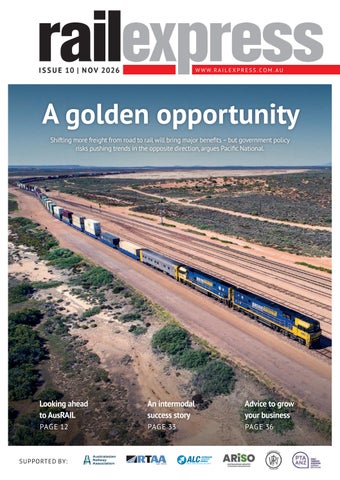
A golden opportunity Shifting more freight from road to rail will bring major benefits – but government policy risks pushing trends in the opposite direction, argues Pacific National.
.
Looking ahead to AusRAIL
An intermodal success story
Advice to grow your business
PAGE 12
PAGE 33
PAGE 36
SUPPORTED BY:
REDEFINING RAIL INFRASTRUCTURE Martinus is an Australian-owned leader in full-service rail infrastructure. Built on an integrated Develop-BuildOperate-Maintain model and 21 years of cross-disciplinary expertise, we deliver turnkey rail and intermodal solutions across Australia, New Zealand, and internationally.
martinus.com.au
Global Operations
Principal Contractor
1500+ Employees
Civil Works
Railway Systems
Dedicated Plant & Equipment
Contents 22 14 4
76 From the Editor
M A N U F ACT U R I N G
COV E R S TO RY
30
6
INTERMODAL
Pacific National: Australia’s missed decarbonisation opportunity
Amokabel: The local advantage
33
ITC: Freight flows into Australia’s largest intermodal terminal
T E C H N O LO G Y
10 27 41 45 48 78
L2iQ: Connecting the tech behind rail Siemens Mobility: The next dimension of rail technology Zelra: Proven in freight, ready for Australia KeTech: Is ETCS essential for transforming information? BAI Communications: Modernising on the move Honeywell: Smarter, safer, more sustainable
EVENTS
12 22 82
AusRAIL: Be part of the conversation Alstom: A jam-packed schedule Endeavour Awards return
M A J O R P ROJ E CT S
14 36
Martinus: Smart engineering and zero corridor disruptions Sam Wilko Advisory: Breaking through the steel ceiling
SIGNALLING
50
JMDR: Building capability for the future
C O N S U LT I N G
53 64 70
LENEXX: From complexity to certainty Ingenium: From planning to possibility IPEX: Local capability meets global expertise
P LA N T A N D E Q U I P M E N T
54 59 61 73 80
Liebherr: Possession power Enerpac: Lighter kit, longer stroke LAPP: Harnessing certainty in rail Hitachi: Top of the range Allworks: More than hire
I N D U S T R Y O R G A N I S AT I O N S
83 84 86
ARISO: Don’t digitalise the fragmentation ARA: Why a strong pipeline is key SEMMA: Procurement must support local manufacturers
MAINTENANCE
16 38 76
UGL: A partner across the asset lifecycle SKF: A hybrid solution Loop Technologies: EF electronics revived
I S S U E 10 | N O V 2026
W W W. R A I L E X P R E S S . C O M . A U
A golden opportunity Shifting more freight from road to rail will bring major benefits – but government policy risks pushing trends in the opposite direction, argues Pacific National.
ENGINEERING
19
GM Rail: Leaders in technical excellence .
PA S S E N G E R R A I L
24 56 67
Keolis: A new chapter Knorr Bremse: Breathing new life into rail MTR: Building the next generation of railways
Looking ahead to AusRAIL
An intermodal success story
Advice to grow your business
PAGE 12
PAGE 33
PAGE 36
SUPPORTED BY:
COVER STORY Shifting more freight from road to rail will bring major benefits – but current government policy risks pushing trends in the opposite direction, argues Brett Grehan, Chief Executive Officer at Pacific National.
Image: Pacific National
WWW.RAILEXPRESS.COM.AU | 3
From the Editor Published by:
379 Docklands Drive Docklands, VIC 3008 T: 03 9690 8766
Kayla Walsh
www.primecreativemedia.com.au
Chairman John Murphy E: john.murphy@primecreative.com.au CEO Christine Clancy E: christine.clancy@primecreative.com.au Managing Editor Lisa Korycki E: lisa.korycki@primecreative.com.au Editor Kayla Walsh E: kayla.walsh@primecreative.com.au Business Development Managers Claire Waters M: 0466 545 664 E: claire.waters@primecreative.com.au Emily Schlegel M: 0466 317 555 E: emily.schlegel@primecreative.com.au Client Success Manager Ben Sammartino E: ben.sammartino@primecreative.com.au Head of Design Clayton Hawley E: clayton.hawley@primecreative.com.au Designer Apostolos Topatsis & Breanna Agent Subscriptions subscriptions@primecreative.com.au
www.RailExpress.com.au The Publisher reserves the right to alter or omit any article or advertisement submitted and requires indemnity from the advertisers and contributors against damages or liabilities that may arise from material published. © Copyright – No part of this publication may be reproduced, stored in a retrieval system or transmitted in any means electronic, mechanical, photocopying, recording or otherwise without the permission of the Publisher.
Editor - Rail Express
Welcome to the November edition of Rail Express The biggest issue of the year is officially here – and we’re especially proud of this one. This edition is an AusRAIL special, as we look ahead to the highlight of the Australian rail industry calendar. We’ve got previews of what some of the major players, such as Alstom, will be bringing to the event, as well as some insightful thought leadership that we hope will spark conversations. For our cover story, Brett Grehan (Chief Executive Officer of Pacific National) looks at how Australian governments are missing an opportunity when it comes to decarbonisation. Meanwhile, Raphaelle Guerineau, Siemens Mobility’s Managing Director for Australia and New Zealand, reflects on why the future of rail lies in data, artificial intelligence and digitalisation. Sydney cable manufacturer Amokabel Australia tells us about the benefits of supporting local manufacturing, and Peter Wilkinson shares some business advice from his book, The Steel Ceiling. KeTech explains how passengers and operators can start feeling the benefits of a digital railway now. Loop Technologies highlights an interesting case study with KiwiRail, JMDR speaks about how it is developing rail skills for the future, and Martinus gives us an overview of how it delivered and installed the new Mothers Bridge in Wagga Wagga as part of the Inland Rail project. Honeywell expands on its rail capabilities and an exciting new offering, and GM
4 | ISSUE 10 – NOVEMBER 2026 | RAIL EXPRESS
Rail dives into its technical excellence and leadership. David Franks, CEO of Keolis, looks ahead to the operator’s next chapter in Australia after its acquisition of Downer’s shares in the business. Meanwhile Brian Downie, MTR's CEO – Australian Business, shares the company’s priorities – including progressing Parramatta Metro Station and its integrated development, advancing the Sydney Metro West project and more. UGL tells us how it excels when it comes to maintenance and whole-of-asset stewardship, and the Intermodal Terminal Company opens up about the success it has had since operations started at the Melbourne Intermodal Terminal in late 2025. BAI Communications updates us on a new partnership with Nokia, and Allworks shares what it has to offer when it comes to providing wet and dry hire equipment. We also spotlight some excellent products from Liebherr, Hitachi Construction Machinery Australia, Zelra, SKF, Knorr Bremse, Enerpac and LAPP. And we hear what consultancies Ingenium, IPEX, and LENEXX have to offer the industry. Plus, we’ve got our usual columns from the Australasian Railway Association, South East Melbourne Manufacturers Alliance, and the Australasian Industry Standards Organisation. Looking forward to seeing you all at AusRAIL!
kayla.walsh@primecreative.com.au
OPTIMISED CUSTOMER EXPERIENCE
Transform maintenance to optimize rail services We have the technology and expertise to deliver dedicated maintenance and customer service solutions designed to proactively prevent issues and provide rapid support to ensure fleets operate flawlessly every day.
Cover Story
Pacific National is Australia's largest private rail freight operator.
Australia’s missed decarbonisation opportunity Shifting more freight from road to rail will bring major benefits – but current government policy risks pushing trends in the opposite direction, argues Brett Grehan, Chief Executive Officer at Pacific National.
Brett Grehan, Chief Executive Officer at Pacific National.
Australia does not need to wait for a breakthrough technology to cut freight emissions. It can start now, by moving more freight on the existing rail network. The numbers reveal the scale of the opportunity. Rail carries only 11 per cent of inter-capital freight on the eastern seaboard. Its share falls to just two per cent between Melbourne and Sydney – Australia’s busiest freight corridor – and only 28 per cent between Melbourne and Brisbane, according to the Australasian Railway Association and Freight on Rail Group’s Rail Freight Productivity Review (2023). On comparable long-distance corridors overseas, the mix is more balanced. In Canada, for example, rail moves about 70 per cent of intercity freight traffic.
Even a modest shift to rail on Australia’s north/south corridors would cut emissions materially. Analysis from the Australasian Railway Association (ARA) estimates that for every percentage point shifted nationally from road to rail, 330,150 tonnes of carbon dioxide equivalent are avoided each year. This is not an argument against road freight. Australia’s growing freight task needs both modes. Road is indispensable for collection, distribution and shorter journeys. Rail should do more of the long-distance heavy lifting where it is more efficient. The objective is simple: use each mode where it delivers the best system-wide outcome. THE POLICY CONTRADICTION Current government policy does not consistently support that optimal outcome. In fact, it risks making lower-emissions rail less competitive than higher-emissions road freight. The result is higher costs for rail, weaker incentives to use rail, and more transport emissions. The current Safeguard Mechanism – Australia’s principal policy for reducing greenhouse gas emissions from the country’s largest industrial facilities – is getting freight decarbonisation wrong. It imposes carbon
6 | ISSUE 10 – NOVEMBER 2026 | RAIL EXPRESS
costs on rail while leaving 99 per cent of road freight emissions outside equivalent coverage. Pacific National and other major rail operators therefore face mandatory annual emissions reductions and are being forced to spend millions of dollars to buy carbon credits. Most trucking competitors do not face an equivalent carbon constraint. That is a structural distortion, not a technicality. Freight on rail has 75 to 85 per cent lower emissions than road per tonnekilometre, yet the policy increases rail’s costs relative to road. As a result, customers have a commercial incentive to move freight in a more carbon-intensive way. Perversely, Australia is reducing its reported emissions while increasing actual freight emissions. That is precisely the outcome climate policy should be preventing. Safeguard reform must deal with this problem head on. Government should reward emissions reductions that occur when freight moves from road to rail and ensure compliance settings do not penalise operators for carrying additional freight that lowers national emissions. The test should be total freight emissions – not whether emissions sit inside or outside a regulated facility boundary.
POLICY MUST WORK ACROSS THE WHOLE MARKET No battery locomotive today is pulling a 1800-metre interstate freight train across the Nullarbor, and there is no commercially proven zero-emissions technology ready to haul Australia’s longest and heaviest interstate services at scale. Certified lowcarbon liquid fuels that meet the required fuel-quality specifications can reduce emissions from the fleet we have while battery and other technologies mature. The design of any demand measure matters. Low-carbon fuels currently carry a substantial premium over conventional diesel. If an obligation applies unevenly across diesel users, it could raise rail’s costs relative to competing modes and push freight towards higher-emissions road transport. The objective should be to create a dependable market signal without creating another distortion between freight modes. A demand-side signal should therefore apply consistently across all diesel users and be administered through fuel suppliers rather than individual fuel users. This would create a broader, more efficient demand base while avoiding separate compliance obligations for thousands of businesses. Any demand measure should start modestly, reflecting limited fuel availability and the current cost premium. Setting targets too high, too early will increase freight costs and put upward pressure on grocery prices. Policy settings should also prioritise dropin renewable diesel (hydrotreated vegetable oil/HVO) over conventional biodiesel blends
because it can be used in the existing locomotive fleet without equivalent operational and infrastructure limitations. The aim should be practical emissions reductions from the fleet currently operating without a significant cost burden, while supply expands and zero-emissions technologies mature. A PRACTICAL DECARBONISATION STRATEGY Australia needs one integrated strategy, not disconnected policies. In my view, the nation should do four things. First, continue to invest in rail networks to help rail ‘win’ freight. Continue targeted investment in the interstate network and nationally significant corridors, including Queensland’s North Coast Line and Western Australia’s freight network. Second, support mode shift where it delivers lower emissions, safer roads, less congestion and lower diesel use (material externality benefits to society). The Federal Government’s Transport Resilience and Capacity Kickstart (TRACK) program is a positive start, but it remains underfunded, administratively complex and too limited in duration to drive lasting mode shift. A revised TRACK program should be simplified along the lines of Western Australia’s port railshuttle subsidy, providing a clear payment for verified freight moved by rail instead of road on contestable long-distance corridors. Third, fix the Safeguard Mechanism so
it recognises system-wide abatement and does not punish rail for growing in place of higher-emissions road freight. This should include a lower transitional baseline decline rate for road-exposed rail, an investmentbased compliance pathway that recognises approved rail decarbonisation spend before full emissions reductions are realised, and practical Australian Carbon Credit Unit (ACCU) settings that do not divert capital away from fleet, fuel and technology investment. Fourth, establish a modest, supplieradministered demand signal for low-carbon liquid fuels that applies across all diesel users and prioritises drop-in renewable diesel, while re-purposing existing government funding programs to support the development and commercial-scale deployment of lower-emissions freight rail technologies. These actions reinforce each other. Better infrastructure makes rail more reliable. Mode shift cuts emissions and diesel use immediately. A well-designed low-carbon fuel demand measure lowers emissions from the locomotives operating today. Technology development and deployment support prepares the network for deeper reductions tomorrow. Australia already has one of the lowestcost freight decarbonisation opportunities available anywhere in the economy. We do not need to invent it. We simply need to stop putting barriers in its way.
Pacific National transports millions of tonnes of freight around Australia every day.
Images: Pacific National
AN ENERGYSECURITY MEASURE Moving freight to rail does more than cut carbon. It reduces Australia’s reliance on imported diesel and strengthens the resilience of the national supply chain. Rail’s higher fuel efficiency means every tonne shifted from road saves diesel across the national freight task. This reduces Australia’s reliance on imports. Unlike a future technology pathway, where the benefits will take time to come into effect, this fuel saving starts as soon as a customer transfers suitable freight to an existing rail service. This is not just an emissions issue, but a fuel security issue. Australia remains heavily reliant on imported liquid fuels and exposed to global supply disruptions beyond its control. Mode shift is one of the few measures available now that can reduce diesel demand without reducing freight volumes or economic activity. The freight still moves. It simply moves with less fuel.
WWW.RAILEXPRESS.COM.AU | 7
Cover Story
Drivers honoured in naming ceremony Two Pacific National locomotives have been renamed in tribute to the late Mick Warren and Kevin Baker. More than 150 family members, friends, colleagues, first responders and rail industry representatives gathered in Port Augusta, South Australia recently to honour the lives and service of train drivers Mick Warren and Kevin Baker. Two Pacific National locomotives, 9416 and 9417, were officially named in
“It is important to remember those who have contributed so much to Australia’s rail industry.” Pacific National spokesperson
memory of the respected drivers, who lost their lives in an accident at a level crossing near the South Australia/New South Wales border in 2023. The ceremony was attended by Pacific National board member Colin Mugglestone, Group Executive Intermodal Cramer Ball, Head of Intermodal Nick Macauley and Regional Manager Josh Kirkham, alongside depot leaders, train crew, family and friends. The professionalism and dedication both men brought to the rail industry were recognised on the day, as well as their lasting impact on colleagues, families and the wider Port Augusta community. A spokesperson for Pacific National said a particularly moving moment came when Petrea Ellis, Kevin Baker’s partner of 29 years, gave a speech on behalf of the drivers’ families, reflecting on the enduring connection created by the tribute. “Wherever these locos now travel, a little part of you will travel with them,” she said.
Family members were invited aboard the newly named locomotives, which have been fi tted with commemorative plaques. Several teams and industry partners helped to make the ceremony possible. Progress Rail donated time and resources to clean and polish the locomotives at its Port Augusta facility and assisted with preparations for the day. UGL fast-tracked maintenance on the two locomotives, installed the commemorative plaques and worked closely with Pacific National to ensure both units were ready for the ceremony. “Their support helped create a fi tting tribute to Mick, Kevin and their families,” a spokesperson for Pacific National said. “It is important to remember those who have contributed so much to Australia’s rail industry. “The locomotives will serve as visible and lasting reminders of two train drivers whose legacy remains deeply respected by those who knew them.”
Image: Pacific National
Pacific National leaders, train crew, and family and friends of Mick Warren and Kevin Baker attended the locomotive naming ceremony.
8 | ISSUE 10 – NOVEMBER 2026 | RAIL EXPRESS
The Rail Express The A 922 Rail Litronic railroad excavator A perfectly tuned hydraulic concept combined with the Liebherr LIKUFIX coupling system turn this railroad excavator into a flexible and steady top performer on any construction site. www.liebherr.com.au
Railroad excavator
Liebherr Australia Pty Ltd • Phone: 1800 033 300 • em-sales.las@liebherr.com www.linkedin.com/company/liebherranz • www.facebook.com/LiebherrAustralia • www.instagram.com/LiebherrAustralia
Technology
Connecting the tech behind rail L2iQ is helping operators and project teams navigate the growing complexity of operational technology, integration and cybersecurity. As rail networks across Australia and New Zealand become increasingly digital and interconnected, the operational technology sitting behind the network is becoming more important for delivering safe, reliable and efficient rail services. From train control and communications to passenger information, ticketing, radio, Supervisory Control and Data Acquisition and security systems, operational technology (OT) underpins many of the services passengers and operators rely on every day. It also brings new challenges for industry as networks generate and exchange more data, systems become more integrated and the importance of cybersecurity continues to grow. Australian-owned OT specialist Layer 2 Intelligence (L2iQ) has spent more than a decade working in this complex environment. With teams across New South Wales, Victoria, Queensland and the Australian Capital Territory, L2iQ has delivered more than 200 projects for more than 50 clients. The company is also accredited by Transport for NSW as a Technically Assured Organisation for Operational Technology and Cybersecurity throughout the asset lifecycle.
L2iQ has delivered more than 200 projects for more than 50 clients.
L2iQ Head of Strategy and Growth Rahul Bahl said successful technology integration is becoming increasingly important as rail networks evolve. “In a modern railway, these technologies cannot be considered in isolation,” he said. “The same network can be supporting train control, CCTV, customer information and ticketing, so we need to think about
Images: L2iQ
L2iQ worked with ALTRAC on journey time optimisation for Sydney Light Rail.
10 | ISSUE 10 – NOVEMBER 2026 | RAIL EXPRESS
how all those systems work together from the outset. “Getting that integration right ultimately supports a safer, more reliable and productive railway, and a better experience for customers.” L2iQ has applied that approach across major Australian rail projects. On Canberra Light Rail, the company delivered a light rail priority system, managed directly through the Sydney Coordinated Adaptive Traffic System (SCATS) road traffic control system. It is now providing specialist input into the Stage 2 extensions. In Sydney, L2iQ worked with ALTRAC on journey time optimisation for Sydney Light Rail, helping reduce timetabled end-to-end journeys from more than 50 minutes to less than 35 minutes. The company has also developed OT asset strategies for rail operators in Victoria, delivered core network upgrades in live train control environments, and supported global vendors and tier one contractors with specialist OT expertise. “OT has traditionally been considered too late in some major infrastructure programs, but that is starting to change,” Bahl said. “The earlier we consider communications, security, data and control systems and how they need to integrate, the greater the opportunity to manage interfaces,
reduce risk and deliver better outcomes across the life of the asset.” As networks become increasingly connected, cybersecurity is also becoming a greater focus. “Rail is critical infrastructure, and protecting it requires more than applying traditional information technology (IT) security thinking to an operational environment,” Bahl said. “You need to understand both the cyber threat and what a disruption actually means for an operating railway. Security, resilience and operational performance all need to be considered together.” L2iQ entered its next phase of growth in October 2026 with the appointment of Pascal Dupond as its Chief Executive Officer. Working with the company's established technical leaders, Dupond will focus on building L2iQ's capacity to integrate and deliver complex technology programs across rail, roads, energy, utilities and other critical infrastructure. At the same time, the company is investing in the specialist workforce
needed to support increasingly complex rail technology. “There simply aren't enough people in Australia with the specialist skills required to design, integrate, test and commission complex rail systems, and major projects are often competing for the same talent,” Bahl said. “As an industry, we need to help grow that capability ourselves and give young engineers opportunities to build their experience on real projects.” L2iQ is putting that approach into practice through its graduate and internship programs. L2iQ intern Amy Jiang has earned a scholarship to attend AusRAIL 2026 in Brisbane this November, giving her an opportunity to experience Australia's largest rail industry event and connect with people from across the sector. “Our graduates and interns work alongside experienced engineers on live projects from the beginning,” Bahl said. “Rail offers young engineers the chance to work on technology that millions of people
rely on every day. We want to help tell that story and work alongside the Australasian Railway Association (ARA) and the wider industry to encourage more people to see rail as a rewarding long-term career.” Following the team's participation in the ARA Rail People and Culture Conference in Melbourne in August 2026, L2iQ is also seeking greater involvement in ARA initiatives supporting future rail skills and capability. Bahl said greater harmonisation across the industry could further support the development of Australian capability. “More consistent requirements for areas such as train control, communications and cybersecurity would help reduce unnecessary cost and risk, while allowing specialist Australian capability to be applied more effectively across networks,” he said. “Rail is becoming more digital, connected and data driven. “That creates challenges, but it also creates enormous opportunities to develop the local skills and capability we will need for the next generation of rail.”
Your Partner in Rail GM Rail provides expert technical and project management services to support the rail industry in Australia and around the world. Large enough to design and manage rail infrastructure projects, but small enough to be agile, accountable and personable – that’s the GM Rail difference.
Find out more at www.gm-rail.com
WWW.RAILEXPRESS.COM.AU | 11
Events
Be part of the conversation AusRAIL has been revamped – with more participation from delegates, more choice, and more opportunities to build connections. The Yellow Dinner is one of the biggest highlights of AusRAIL.
Images: ARA
AusRAIL returns to Brisbane in November 2026 with a completely redesigned conference experience, giving delegates more opportunities to participate, connect and shape the conversations that matter to rail. Taking place from 24–25 November, the rail conference will bring the industry together to explore the challenges and opportunities shaping rail's future. But this year, the conversation will look different. Day one has been redesigned around participation. Fast-paced executive briefings, live polling, audience-led discussions, question and answer (Q&A) sessions and debate will replace the traditional presentations, giving delegates the opportunity to hear from industry leaders and contribute their own perspectives in real time. Sessions such as “Rail reality check” will put some of the industry's biggest questions directly to the audience, exploring issues including project delivery, workforce pressures, readiness for artificial intelligence, customer expectations and investment priorities. In the “Ask industry leaders” session, the prepared speeches disappear, with delegates setting the agenda and asking senior rail leaders exactly what they want to know. Delegates are in control of their experience again on day two, with four
concurrent streams allowing people to move between sessions and build a program around their own areas of interest and priorities. The program will span the infrastructure, technology, workforce and technical issues shaping rail, with streams including “Building the Network of Tomorrow”, “Digital Rail in Motion”, “Powering the Future Workforce” and a dedicated Technical Society Stream developed
in partnership with the Rail Track Association Australia (RTAA), the Railway Technical Society of Australasia (RTSA), the Permanent Way Institution (PWI) and the Institution of Railway Signal Engineers (IRSE). Beyond the conference program, AusRAIL will once again provide opportunities to build connections across the industry, with a refreshed Women in Rail Forum, social events, a new lounge for conference delegates and post-conference site tours across Brisbane and the Gold Coast. This overhaul of the AusRAIL conference programming creates a different experience with more choice, more interaction and more opportunities to connect with the people and ideas shaping the future of rail. PARTNERS ACROSS THE INDUSTRY AusRAIL 2026 is supported by partners from across the rail industry, including Headline and Yellow Dinner Partner Alstom and Platinum and Innovation Partner Hitachi Rail, as well as the event's broader group of sponsors and partners.
AusRAIL 2026 will take place in Brisbane from 24–25 November.
12 | ISSUE 10 – NOVEMBER 2026 | RAIL EXPRESS
Explore the program and register at ausrail.com
We move cities forward. Every day, RATP Dev teams in 16 countries work hand-in-hand with transport authorities and transfer skills to local workforces to make mass transit solutions the right move for safe, smart and sustainable journeys. Our expertise spans seamless network takeovers, new service launches, improving passenger experience and major upgrades to multimodal networks. We help fast-growing cities and regions turn public transport ambitions into everyday performance. lines lines 17 railway 30 metro lines 41 tramway (incl. 15 fully automated)
The right move ratpdev.com
Major Projects
Images: Martinus
Lifting the new bridge into place with a 400-tonne mobile crane in a single, one-hour operation.
Smart engineering and zero corridor disruptions How the transportation and installation of the 60-tonne Mothers Bridge for Inland Rail optimised efficiency, reduced construction risk, and minimised disruption to both rail operations and the community. It’s not every day that a 52-metre steel bridge rolls down the main streets of Wagga Wagga in New South Wales. Close collaboration between Inland Rail, Martinus and key stakeholders enabled the new 60-tonne Mothers Bridge to be moved through Wagga Wagga’s urban environment without a track possession. SMART ENGINEERING OFF THE CRITICAL PATH The Albury to Illabo section of Inland Rail involves upgrading approximately 185 kilometres of existing rail corridor and constructing new track between the Victoria/New South Wales border and Illabo in the New South Wales Riverina. As part of the project, the new Mothers Bridge pedestrian structure replaces an old footbridge to give taller, doublestacked freight trains the clearance they need, while delivering full Disability Discrimination Act (DDA) accessibility. Fabricated in Tomago, near Newcastle, the bridge was originally intended to be delivered in two sections and welded together on site. However, a change to the original methodology saw the entire 52-metre truss – itself a rare feature in
modern rail infrastructure – transported and installed as a single unit. “Working together with Inland Rail, the decision to transport the bridge in one piece removed weeks of on-site welding, reducing construction risk and improving site safety,” said Andy Williams, Martinus Group Project Director for the Albury to Illabo and Stockinbingal to Parkes sections of the Inland Rail Project. “It shows how early engineering decisions solve site problems long before the asset arrives on the ground.” To move the new Mothers Bridge safely through Wagga Wagga’s regional streets, a specialised jinker truck was used, designed to manoeuvre oversized loads through towns and cities. KEEPING THE RAIL LINE OPEN The new bridge was lifted into place next to an existing footbridge with a 400-tonne mobile crane in a single, one-hour operation. This was all done without the need for a track possession – eliminating supply chain dependencies and access delays. “Rail corridor access is too valuable to spend on works that can be delivered off- track,” explained Treaven Martinus,
14 | ISSUE 10 – NOVEMBER 2026 | RAIL EXPRESS
founder and Chief Executive Officer of Martinus. “By avoiding a track possession, we removed reliance on limited shutdown windows, avoided network delays, and preserved corridor capacity for the Australian Rail Track Corporation (ARTC).” The bridge installation was managed through an integrated delivery model, uniting structural engineering, detailed design, concrete construction, and lift supervision under one team. By maintaining direct control over project execution, daily site activities were aligned with local community expectations. “Working close to schools, local businesses, and active roads meant every vehicle movement had to be carefully managed to keep the project moving while respecting the community,” Williams said. HONOURING LOCAL HERITAGE The new Mothers Bridge, built in the heart of Wagga Wagga, honours the 1936 heritage precinct in its design. The “River Red Gum” warm orangebrown finish complements the heritage station and acknowledges local Wiradjuri cultural connections to nearby waterways. Because Mothers Bridge was designated
MAINTAINING PEDESTRIAN CONNECTIVITY For Inland Rail and Martinus, maintaining pedestrian connectivity remained a core priority, with a firm commitment to keep at least two of the precinct’s three pedestrian bridges (Mothers, Edmondson Street, and Cassidy) open at all times. When temporary closures of Mothers Bridge were necessary, alternate pedestrian routes were established alongside a commitment to reopen
Images: Martinus
a State Significant Project, the design was reviewed and approved by an independent State Design Review Panel (SDRP) made up of eight architects. “Achieving full sign-off through the State Design Review Panel validates the technical and visual quality of the design,” said Nichole Darke, Martinus’ Senior Design Manager. “It demonstrates how complex infrastructure can meet modern engineering standards while honouring local heritage and public domain expectations.”
Transporting the 52-metre truss through the streets of Wagga Wagga as a single unit.
the existing structure within one hour. Temporary Railway Street closures provided designated public viewing areas and organised detour routes to maintain community mobility during the operation. “Carefully planning heavy vehicle movements and detours around local schools and businesses protects regional community goodwill while keeping day-today disruption to a minimum,” said Williams. The new Mothers Bridge structure delivers long-term community benefits,
featuring DDA-compliant pedestrian ramps, anti-throw safety screens, and upgraded handrails. Delivered in stages, Inland Rail will increase freight capacity across the network, with works along active rail corridors also creating regional opportunities. Williams added: “Delivering this milestone for Inland Rail shows that complex brownfield infrastructure can be completed safely, on schedule, and without disrupting the broader transport network.”
VISIT THE AUSRAIL 2026 EXHIBITION Explore products, services and solutions from exhibitors across the rail industry. Discover new solutions, speak directly with suppliers and connect with organisations from the rail industry, all in one place.
Find out more and register at ausrail.com
Monday 23 - WWW.RAILEXPRESS.COM.AU Wednesday 25 November | 15 Brisbane Convention & Exhibition Centre
Maintenance
A partner across the asset lifecycle It’s the whole-of-life approach that UGL Transport takes to rail asset stewardship, combining infrastructure maintenance, network operations, rolling stock and specialist capabilities, that delivers long-term value for customers. When it comes to rail infrastructure maintenance, UGL Transport is unique. Rather than treating maintenance as a standalone job, the business’s approach is to look after rail assets across the entire life cycle. Bart Matthews, Project Director – Assets at UGL Transport, explained: “I see UGL Transport’s role as being the custodian of the railway. “We’re not just a contractor that comes in, does maintenance as a core and then walks away. We provide that stewardship capability right through the asset life cycle – from concept and design through to construction, testing, commissioning, operations, maintenance, renewals and eventual asset decommissioning.” Matthews said that UGL Transport’s legacy and expertise as one of Australia’s leading rolling stock manufacturers and maintainers provides a rare degree of depth to the business’s strong rail infrastructure capabilities. “That rolling stock element is critical when we’re talking about that whole-of-rail asset stewardship capability,” he said. This whole-of-life asset stewardship approach means UGL Transport is focused
Bart Matthews, Project Director – Assets at UGL Transport.
on partnering with clients in their longterm investment decisions that might see the asset life extended, reduce costs and ultimately improve overall safety and reliability. UGL Transport does this thanks to an in-house and multi-disciplinary team of engineers and experts with extensive experience working across Australian railways. “This investment advice is becoming more and more important to our customers,” Matthews said. “Our subject matter experts can provide information to clients about the condition of the railway, what futureproofing looks like in terms of technology innovations and what operational requirements are likely to be in future years – all of this is invaluable.”
Images: UGL Transport
UGL Transport manages all operations and maintenance on the Country Regional Network in New South Wales.
16 | ISSUE 10 – NOVEMBER 2026 | RAIL EXPRESS
UGL REGIONAL LINX Through UGL Regional Linx, UGL Transport manages all operations and maintenance on the Country Regional Network (CRN) in New South Wales, which includes both passenger and freight rail. This expansive network encompasses 2400 kilometres of operational rail lines and about 1300 crossings, plus hundreds of assets including bridges, train stations, structures, and property assets. “It’s a complex network, which requires a substantial maintenance and renewals program,” said Matthews. Through UGL Regional Linx, UGL Transport has carried out major track renewals, culvert renewals, level crossing upgrades, and bridge replacements across the CRN, as well as delivering new sidings and loops that all improve reliability and safety. The business also works closely with freight operators to optimise how freight is moved from terminals through the network to the ports. “We meet regularly with our freight partners,” Matthews said. “We go out to sites, understand the challenges they are facing and try to resolve those challenges through our network operations. “The ability to deliver these projects in such complex operational environments while maintaining safety and minimising disruption to our customers provides real value to the client.” In 2024, the CRN’s network controls centre was co-located to the UGL Regional Linx headquarters in Orange, embedding network operations alongside the maintenance, engineering and operations teams. “This move created a local and integrated approach to how we manage the network,” Matthews explained. Bringing these teams closer together has improved communication, increased network awareness, and ensured a proactive approach to deliver freight and passenger services, which has resulted in better responses to disruption events across CRN. “This is one of many examples across UGL Regional Linx of delivering for the longterm success of the CRN,” Matthews said.
“That’s the full asset lifecycle stewardship umbrella that we are working under.” TRACTION POWER SPECIALISTS UGL Transport has a dedicated electrical business that specialises in providing complete overhead wiring (OHW) solutions, from design through to construction and maintenance of traction civil infrastructure. Phil Goddard, Senior Bid Manager at UGL Transport, explained: “Our specialist team has gained wide-ranging experience delivering traction power services across these assets throughout Australia. “Our expertise includes traction power design, delivery, assurance, construction, testing, commissioning and disposal across a range of areas like feeder and substations, high voltage distribution, and OHW.” In addition to manufacturing rolling stock, UGL Transport can locally design, assemble and manufacture 1500-volt direct current (DC) traction power equipment, demountable substation buildings, and other electrical equipment through its obsolescence management services. UGL Transport has invested in its people and its plant, with specialised and bespoke OHW rail equipment managed through the company’s internal plant team. Continuous improvement is provided for UGL Transport’s people through ongoing training, competency management and upskilling of its in-house Traction Linesman. “Planning is everything when you’re working on an operational railway,” he said. “Making significant changes to the infrastructure that need to be completed, tested and accepted before train services can resume requires nothing being left to chance. “We’re always challenging ourselves to constantly look at ways we can become more efficient all while ensuring we invest in our people, capabilities, and equipment.”
UGL Transport has delivered major rail maintenance renewals and traction power programs across Australia.
reliability and overall network performance. “The teams do a lot of development with the product,” Matthews said, “and it was one of the innovations that drew me to UGL Transport in the first place.” In addition, UGL Transport operates major public transport businesses across Australia and New Zealand. “These public transport businesses give UGL Transport unique insights into the operational and asset management side of different railway networks,” Matthews said. UGL Transport also has strong capabilities in the facilities management space, from fleet depots to train stations and underground rail networks. “We carry out facilities management at multiple sites across Australia, with a strategic and collaborative approach to how we manage those assets.” THE UGL TRANSPORT ADVANTAGE Matthews said that customers are increasingly seeking an accountable partner for railway operations, who has
the in-house expertise and depth to understand the entire asset as if it were their own. “It’s genuinely rare to find the combination of capabilities that UGL Transport has within one company,” Matthews said. “We can deliver almost everything for a railway – from rolling stock to rail and electrical infrastructure to network operations and train control.” As networks become more complex, UGL Transport’s combination of capabilities, along with the opportunities the Sojitz Corporation's 50 per cent acquisition brings, will only become more important. Matthews added: “Moving to a more data-driven environment will only see more demand for whole-of-lifecycle asset stewardship and the desire of railway owners to partner with companies that can help them make informed, longterm investment decisions that benefit their assets.
UGL Transport is focused on partnering with clients in their long-term investment decisions.
TRAIN CONTROL AND MORE UGL Transport’s capabilities don’t stop at rail infrastructure and rolling stock. The business has its own train control product, SigView – which Matthews said is an Australian-designed and made train control system. “The system is built to meet the evolving needs of rail operations around Australia,” he said. SigView’s capabilities include streamlining operational processes and incorporating features like timetable integration, automated routing, and realtime alarm management all in effort to support rail operators to improve service WWW.RAILEXPRESS.COM.AU | 17
From Parramatta to the Pilbara, we build Australia’s most critical communications networks. Where mission-critical communications are hardest to deliver, BAI Communications has the experience to get it done. From FRMCS-ready rail systems built on private 5G-MCX, to comprehensive communications solutions for remote mine sites, we bring global expertise to Australia’s most demanding and complex connectivity challenges.
Delivering Australia’s first 5G-MCX metro rail network
Private mobile Private 5G for networks for Australia’s most Australia’s most challenging challenging environments environments
99% of Australians. The nation’s largest broadcast network. network
Operating one of the world’s largest public safety networks network. network
Scan to discover the future-ready capabilities BAI brings to rail
Engineering
Leaders in technical excellence For GM Rail, technical excellence is about smart engineering solutions, delivered on time, accurately and with integrity. But it’s also about early engagement, strong leadership, and growing the next generation of rail specialists who are making an impact on rail projects across Australia. Founded in Western Australia in 2014, the professional services company has delivered work for the Public Transport Authority of Western Australia, BHP, Fortescue, Rio Tinto, Acciona, UGL, CPB Contractors, Rhomberg Sersa, AECOM, McConnell Dowell, DT Infrastructure and Arc Infrastructure, amongst others. For Dan Green, Operations Manager at GM Rail, the business’s technical expertise is a key factor in clients choosing to partner with them. “Our clients know that when they work with us, they’ll get a service that goes above and beyond,” he said. “There can be a lot of distraction and white noise on projects. Sometimes, you just need to cut through all of that and solve a problem.” Green said excellence in project delivery is about not making assumptions unless you have to. “Yes, as an engineering company you need to make key assumptions when there are 100 unknowns, and you need to be able to work in a timely and accurate manner to get an answer,” he said. “But you need to test those assumptions through the engineering process.” He highlighted that attention to detail is key. “During a tender, we will pre-read the technical documents and every single addendum that comes in from a client,” he said. “We are always across the detail. “If a company is not diligent and hasn’t done this reading, and then they go on and win the work, clients could be faced with variations, and the deliverables that end up being executed aren’t what was proposed at tender stage.” Other strengths of GM Rail include situational awareness and anticipating a client’s needs. “Being told what to do is easy – we think about how our client will respond,” he said.
Images: GM Rail
From sharing insights at CORE and supporting the Permanent Way Institution to sponsoring employees to take part in leadership training, GM Rail is taking technical excellence seriously.
Grant Mete, Dan Green and Trong Nguyen from GM Rail at CORE 2026 in Adelaide.
“We ensure we manage our time properly and are prepared going into meetings. “We always stay true to our word, and finish what we start.” STANDING OUT AT CORE Several members of the GM Rail team attended the 2026 Conference of Railway Excellence (CORE) in Adelaide, hosted by the Railway Technical Society of Australasia (RTSA). GM Rail was the only rail company selected to display posters at this year’s event, sharing some of its latest innovations and insights. “It was a great opportunity for us to demonstrate the technical excellence of the team and the projects they’ve been working on,” said Green. GM Rail showcased three posters, each compiled by a different employee. Thermal stress and longitudinal force management in welded crane rails This poster, put together by Senior Engineer Jared Atwood, examined a recurring issue with crane rail systems.
“There are railways in remote areas that don’t have heavy haul or passenger trains running on them – conveyors or mining assets, for example,” explained Green. “The standards used for conveyors typically fall under structuring mining specifications, whereas really, there should be links back to Australian railway standards. “Jared highlighted how railway fundamentals still apply in these cases and the importance of continuous improvement for standards.” Green shared some more context about the inspiration for the paper, emphasising the positive impact GM Rail’s early involvement – and technical excellence – had on a project. In 2024, GM Rail was engaged by a craneage and structural company in Western Australia to carry out a jointed track upgrade. The project involved working on a small railway, 20 metres up in the air – a conveyor structure where iron ore is taken from the ground, stockpiled, and goes through a screening building to sort the particles. WWW.RAILEXPRESS.COM.AU | 19
Engineering
Dan Green speaking to members of the Permanent Way Institution.
The scope was to upgrade the whole truss, which required renewing the track structure, but this scope had to expand after considerable wear was found on the system. “GM Rail was required to fabricate some transition rails to blend into the existing head wear we were tying into, which our Lead Engineer Jared Atwood decided to do off-site to ensure the highest quality and avoid errors being introduced. “Engaging us at an early stage saved the client so much in the long run. If the client hadn’t engaged GM Rail early in the piece, the new truss system wouldn't have lined up properly during installation. “They wouldn’t have been able to open the system, and the asset wouldn’t have been able to be commissioned.” Concrete canvas as a solution for railway drainage, erosion control and culvert ditch lining Senior Engineer Sam Onayli tackled the topic of culverts and drainage management. “Instead of spending a significant amount upgrading a culvert and removing the track structure above, the case study showed how a concrete canvas layer placed where the water typically pools from below can extend the usable life of the existing asset,” Green said. “This innovation got quite a bit of attention from the American Railway Engineering and Maintenance-of-Way Association (AREMA).”
“Trong is Queensland-based, and at CORE he shared with the rail industry in South Australia what he had learned in New South Wales,” Green said. “So, you’ve got three different states there. “There is a lot of good work happening around harmonisation at the moment, but Trong highlighted that some companies around the country are still using legacy techniques for new construction, which could potentially be improved. “It’s all about sharing that knowledge and making the rail industry more efficient as a result.” HOW EXPERIENCE BUILDS EXCELLENCE The GM Rail team has worked on projects in multiple states across Australia as well as
Michael Lee and Grant Mete working on a diamond crossover installation at Western Sydney Airport in 2025.
Challenges of steel and timber sleepers for new track construction This poster, compiled by Project Engineer Trong Nguyen, shared insights he gained from track construction work in New South Wales. Nguyen also spoke to CORE delegates about his findings during a session at the conference. 20 | ISSUE 10 – NOVEMBER 2026 | RAIL EXPRESS
in other countries, which Green said gives them a competitive advantage. “Sam previously worked in Saudi Arabia, Jared was in the Pilbara, and Trong started in Queensland, while our staff members Phil Smith, Charlie Tate and I also worked in the United Kingdom for a number of years. “We are bringing learnings from those projects and applying them to every project we work on. “Having a few railways under your belt is important – because then you really know what excellence looks like.” GM Rail has also supported its staff to gain experience and contacts through various programs. For example, Atwood recently took part in the Australasian Railway Association’s Future Leaders program, while Onayli participated in the Horizons program, a professional development and leadership initiative run by the Australian Rail Industry Standards Organisation (ARISO). INSPIRING THE NEXT GENERATION Grant Mete, the founder and Managing Director of GM Rail, is passionate about educating the next generation of rail engineers. He has taught at several higher education institutions, including the University of Tasmania (UTAS), Edith Cowan University and the University of Wollongong. “For a number of years, Grant taught the Rail Infrastructure Diploma at UTAS,” said Green.
“Many of those students didn’t come to rail via an academic route when they were younger – they were blue collar workers, for example, who realised during their career that they wanted to develop their learning in a specific area of rail. Maybe they wanted to gain some more experience getting into a management role. “Because it wasn’t a bachelor’s degree or master’s degree, it was a more accessible way to build technical excellence in the industry.” INDUSTRY PARTICIPATION In addition to being an active member of the RTSA, GM Rail is also a member of several chapters of the Permanent Way Institution (PWI), a technical institution which aims to provide technical knowledge, advice and support to the rail industry. GM Rail sponsors PWI events and sits on the committee in Western Australia. Green said being part of the PWI is a great way to share knowledge, build connections and remain at the forefront of rail technology. “There are two presentations at every technical evening hosted by the PWI,
Jared Atwood working on a conveyor replacement project in Western Australia in 2024.
which are really valuable,” he said. “It’s also an opportunity to connect with our clients and contractors in a more informal way and build rapport.” SUPPORTING CHARTERSHIP GM Rail supports and encourages its staff to complete engineering chartership – a globally recognised professional credential that proves an engineer has high-level technical competence, leadership skills and ethical accountability. “There is huge value in completing your chartership,” said Green. “I remember doing it when I was in my 20s, and I almost didn’t finish it because I had a lot on my plate, but I’m so glad I stuck with it.
“Because you need evidence for the reports you submit, you learn to keep hold of information and pictures from projects you work on – information that can then be used to teach others. You also learn to work in a timely and accurate manner and answer questions concisely.” Green said there is also a big focus on ethics when completing a chartership. “As an engineer, you’re asked to sign off on things and you’re under all sorts of pressures – cost pressures, time pressures, even personal pressures. “You need to keep a balance and know when to say no. It’s hard for a lot of people to do that. “With chartership, you learn to look at things holistically and not just technically.”
Australian Railway and Custom Cables Manufacturer Amokabel Australia excels in the design and manufacture of many unique and highly specialised cables. The company is based in Sydney and supplies products across Australia and overseas. Priding itself on being able to provide both custom and standard cables that are manufactured at our facility in Western Sydney. We can manufacture a wide range of products, many of which are custom designed and made to meet our clients’ requirements.
8 Epic Place Villawood NSW 2163 Australia P. +61 2 9645 5444 E. enquiries.au@amokabel.com www.amokabel.com
COMMUNICATIONS
INFRASTRUCTURE
TRACKSIDE POWER
SIGNALLING
ROLLING STOCK
OVERHEAD CABLES
AusRAIL
A jam-packed schedule
Alstom is the headline sponsor of this year’s AusRAIL.
From thought leadership to headline sponsorship, Alstom will be front and centre at AusRAIL 2026. Alstom has had a huge year. The global pure rail leader has celebrated several major milestones in Australia so far in 2026 – from rolling out the new X’Trapolis 2.0 trains and Next Generation Trams in Melbourne, to releasing the first new diesel multiple unit (DMU) for Perth’s Australind service. Meanwhile in Queensland, Alstom has delivered the core railway, signalling, and telecommunications systems for Stage 3 of the Gold Coast Light Rail project. “We’ve had what is probably the busiest year on record in terms of ‘firsts’ for us,” said Robert Gunning, Director of Communications and Corporate Social Responsibility (Australia and New Zealand) at Alstom. “We’ve had four first-passenger services this year, which is very rare in this industry.” On the back of this success, Alstom is looking forward to AusRAIL 2026 in Brisbane, where the team will further demonstrate the business’s capabilities, start new conversations, and build connections. A STRONG PARTNERSHIP AusRAIL is the largest rail conference in the southern hemisphere, and has been one of the biggest highlights in the rail industry calendar for more than two decades.
In 2026, it will take place at the Brisbane Convention and Exhibition Centre from 23-25 November, bringing together thousands of delegates from across the sector. Alstom is once again a Headline Partner for the event, collaborating with conference organisers, the Australasian Railway Association (ARA). “Our main priority is to support the event’s important role of creating connections for the industry and its partners,” said Gunning. “That’s always our goal with AusRAIL – we want to listen to the industry and understand where it’s moving so we can adapt to it. That allows us to strengthen our customer relationships, both in Queensland and the broader Australian market.” A REFRESHED APPROACH AusRAIL 2026 will cover key topics of interest such as workforce development, artificial intelligence (AI), sustainability, and digital innovation. These topics will first be explored as part of the event’s plenary program, which Gunning said has been refreshed to engage and excite the audience. “We’ve had the opportunity to collaborate quite closely with the ARA to make sure the plenary program sets the right tone for the event,” Gunning said.
22 | ISSUE 10 – NOVEMBER 2026 | RAIL EXPRESS
“This year the plenary will be more interactive than previous years, which we’re really excited about.” Guillaume Tritter, who took over the role of Managing Director of Alstom Australia and New Zealand in May 2026, will be one of four speakers in an “Ask Industry Leaders” panel. “Guillaume has impressive global experience,” Gunning said. “He has worked his way up the business over the course of nearly 20 years. “He was also born in the town where Alstom was founded, so he has an interesting perspective on the history of the business. He also managed multiple clusters of Alstom’s business in the Middle East, which gives him unique experience he can share with the audience.” On Day 2 of AusRAIL, Sandra Veli, Alstom’s Environmental Health and Safety (EHS) and Rail Safety Director, will be presenting the company’s experiences with curating safety personnel, in addition to upcoming innovations. “Our piece on safety will be very valuable,” Gunning said. “Getting qualified safety workers into rail is a constant challenge for the industry, as it’s such a competitive space, and so many other sectors want these people. Our EHS team’s creation of a pipeline to develop skilled safety workers is unique.”
physically see and understand the work we are delivering.”
Images: Alstom
Alstom is also the official partner of AusRAIL’s Yellow Dinner, a major networking gala.
Pallavi Venkatesh, Digital Services Project Manager at Alstom, will also present on enhancing the availability of urban signalling systems. Meanwhile Carla Garvie, Commercial Director at Alstom, will be one of six speakers in “The Great Debate – Are Rail Projects Getting Harder to Deliver?” “This is a big topic at the moment, and we expect there’ll be a lot of interest in that session,” Gunning said.
Alstom is also leveraging its resources and expertise to offer other interactive experiences to attendees – including site tours to the Gold Coast Light Rail Depot to be hosted by Keolis Gold Coast, and a trip to the Wulkuraka Maintenance Facility. Gunning added: “It’s important to get people out and about in person as well as in the conference sessions, so they can
WHAT IT’S ALL ABOUT In addition to AusRAIL 2026’s conferences and exhibitions, Alstom is the official partner of AusRAIL’s Yellow Dinner, a major networking gala. “Being able to sponsor this function is special, because I think it’s the number one event in the rail sector – where the greatest number of people are together in one room,” Gunning said. “This sponsorship is a way for us to demonstrate our commitment to the industry.” To Gunning, this commitment to helping foster connection and growth in the sector is AusRAIL’s greatest strength. “That’s the whole point of this all,” he said. “AusRAIL provides attendees with the opportunity to meet with everybody across the continent in one place at one time, and talk about the challenges we face and the solutions we’re developing to move forward.”
DON’T MISS AUSRAIL 2026 Join rail leaders, decision-makers, technical experts and professionals from across Australia, New Zealand and beyond in Brisbane this month.
Register today
Monday 23 - Wednesday 25 November Brisbane Convention & Exhibition Centre WWW.RAILEXPRESS.COM.AU | 23
Passenger Rail
A new chapter A year into his second term as Chief Executive Officer of Keolis Australia and New Zealand, David Franks explained how full ownership, stronger links to Keolis' global network and almost two decades of local experience are shaping the company's next stage of growth.
David Franks, Chief Executive Officer of Keolis Australia and New Zealand.
Keolis has entered a new phase in Australia. The transport operator completed its acquisition of Downer's shares in the Keolis Downer joint venture in December 2025 and now operates under the Keolis name, bringing the former two-shareholder structure under full Keolis ownership. The change builds on a partnership that helped establish Keolis in Australia in 2009 and supported its expansion across rail, light rail, bus and ferry operations. The move comes as major public transport projects continue to be delivered across Australia, giving Keolis Australia and New Zealand greater access to the expertise and capabilities of the global Keolis Group. It also comes as David Franks completes the first year of his second term as Chief Executive Officer of Keolis Australia and New Zealand. Franks previously led Keolis Downer from 2018 to 2023. After moving from Australia back to the United Kingdom (UK), he supported Keolis' successful Docklands Light Railway bid before moving to Dubai, where he led recovery work on the city's metro and tram networks following severe
flooding. He returned to Australia in September 2025 with more than 45 years of public transport experience across the UK, Europe, the Middle East and Australia. Franks said the end of Keolis Downer’s joint venture carried mixed emotions because the two companies had achieved so much together. Keolis and Downer remain in contact and continue to work together in some areas. At the same time, full ownership has given Keolis a clearer platform for its next stage. "Completing our acquisition of Downer’s shares is a powerful statement of intent," Franks said. "Keolis has real ambition in Australia and New Zealand, and it has given us an opportunity to refresh, have a new start and build on what has already been achieved." Franks said having a single shareholder has simplified decision-making and made it easier to assess opportunities, including potential acquisitions and new partnerships. The new structure has also encouraged the Australian business to connect more directly with expertise across the Keolis Group. "We ensure we are completely integrated into the Keolis global network and leverage every opportunity from that network," Franks said. “Access to the broader Keolis Group enables the Australian business to draw on international experience in areas such as operational performance, customer experience, mobility innovation and sustainability. "That gives us access to capability and experience from around the world, while our
In Adelaide, Keolis has shifted towards a more maintenance-focused role.
24 | ISSUE 10 – NOVEMBER 2026 | RAIL EXPRESS
local teams bring strong understanding of how transport is effectively delivered in Australia." A TRUSTED ADVISOR That combination is evident in Keolis' appointment as Business, Operations and Maintenance Advisor (BOMA) to the Australian Government’s High Speed Rail Authority for the Newcastle to Sydney High Speed Rail project. Keolis leads a partnership with SNCF and railway safety and certification specialist CERTIFER during the project's development phase. The consortium will act as a shadow operator and maintainer, bringing operational, maintenance, safety and customer considerations into planning and design. Its role is advisory, helping the Authority develop the project so that future operational requirements and whole-oflife performance are considered before construction begins. Franks said the immediate task is to support the development phase for this first section of a wider high-speed rail network. "The most important thing is helping to get it construction-ready," he said. "We have to help the High Speed Rail Authority demonstrate the case for high-speed rail in Australia during this development phase." He said the work extends beyond determining whether a railway can be designed and operated. It must also test whether the proposal meets passenger and community needs and creates value for the country. "The exciting part is helping to get the project into the best position possible at the end of the development phase to allow the Australian Government to make a positive financial decision," Franks said. "It cannot be just an exercise." The assignment brings together Keolis' local knowledge and the SNCF Group's experience of more than 40 years of highspeed rail operations. The partnership can draw on established networks including France's TGV (Train à Grande Vitesse/highspeed train) and international services, as well as current advisory and development work on high-speed rail programs in Canada
and California. Keolis has established links between those teams so lessons can be shared in both directions as the Australian project develops. A STABLE PARTNERSHIP Keolis' Australian operations provide the other half of that proposition. G:link on the Gold Coast is one of its longest-running local partnerships. Keolis operates and maintains the light rail network, working with GoldlinQ and Alstom, which supports rolling stock maintenance. Stage 3 of the project, running to Burleigh Heads, opened in August 2026 – extending a system that has continued to grow since passenger services began in 2014. Franks said G:link's performance reflects a stable partnership, disciplined asset management and a team able to address issues early. "We have a very good team running the business and they are highly motivated to get it right for passengers," he said.
Images: Keolis
AN INTEGRATED NETWORK Newcastle offers a different example of Keolis' multimodal capability. Under Newcastle Transport, the company operates buses, the Stockton ferry and light rail services as one integrated network. Franks said the model provides a practical example of Keolis' ability to partner with the transport authority to integrate multiple transport modes under a single customerfocused operating framework. In partnership with Transport for NSW, this creates opportunities to coordinate timetables,
provide a consistent point of contact for passengers and develop broader skills across the workforce. "We have bus drivers who now drive trams, tram drivers who work in control and controllers who also drive trams," Franks said. "It starts with the timetable, but it also creates opportunities for staff and gives customers one organisation to deal with across the network." MOVING BEYOND ROUTINE MAINTENANCE In Adelaide, the business is developing another area of capability. As operations returned to the control of the South Australian Government, Keolis shifted towards a maintenance-focused role covering rail assets and infrastructure, alongside customer service functions during the transition. The company is now examining how that experience can support growth in maintenance, renewals and upgrades elsewhere. Franks said: “Our Adelaide engineering team is already positioned to support maintenance, renewals and upgrade programs beyond routine asset management, and Keolis has invested in a new rail tamper and regulator to strengthen that capability." He said the model broadens a business that has traditionally delivered maintenance as part of combined operations and maintenance contracts. Safety remains the constant across the growth agenda. Franks said systems, training and disciplined implementation must develop alongside assets. In Adelaide,
Keolis committed to lift signalling managers and technicians from Certificate III to Certificate IV as one example. Regular safety tours, toolbox talks and management discussions reinforce that framework. For Franks, the value lies not only in setting standards but in ensuring people are properly qualified and supported to apply them consistently. PRIORITIES FOR GROWTH Franks' priorities during his first year back have included reconnecting with public transport authorities and other industry partners, renewing relationships across the workforce, supporting local teams’ focus on operational performance and establishing the Keolis brand. The next phase will focus on improving existing services while pursuing opportunities in rail maintenance, light rail, bus operations and the New Zealand market. He sees long-term partnerships as central to that growth. Consistent management teams and open communication have helped relationships such as G:link mature over many years. The same approach will guide new opportunities under the Keolis name. "This industry is about relationships, and you have to work at them," Franks said. "Australia is continuing to invest in railways and transport infrastructure. "We understand the local market and we’re able to combine that knowledge with experience from some of the world’s leading public transport networks. That places us in a strong position to support the next generation of transport projects."
Keolis has been appointed as Business, Operations and Maintenance Advisor (BOMA) to the High Speed Rail Authority.
WWW.RAILEXPRESS.COM.AU | 25
MELBOURNE’S LARGEST INTERMODAL TERMINAL HAS ARRIVED UNLOCKING THE FUTURE OF RAIL FREIGHT FOR ALL Australian owned and operated — 100% owned by Aware Super
Helping supply chain customers to decarbonise freight operations
Located in the heart of Melbourne’s northern industrial and logistics zone
Multi-purpose terminal — regional, port shuttle and interstate rail freight services
Central to Melbourne’s largest integrated freight and logistics precinct: the Melbourne Intermodal & Industrial Exchange (MIIX)
Direct access to Victorian (broad-gauge) and national (standard-gauge) rail networks and Hume Highway
Avoid traffic congestion and city road tolls to and from Port of Melbourne
Lower the cost of your supply chain operations using the safety and efficiency advantages of rail
Enlisted by Port of Melbourne in Port Rail Shuttle Network Start-up Incentive Program
One stop shop for customers – customs bonded storage and empty container park areas, on-hiring and de-hiring services, and facilities to wash, fumigate and repair containers
To register your interest in Melbourne’s newest intermodal terminal, please contact info@intermodal-terminal.com
intermodal-terminal.com/mit
Technology
Siemens is turning data into decisions across service, maintenance, rolling stock and mobility software.
The next dimension of rail technology Siemens Mobility’s Managing Director for Australia and New Zealand, Raphaelle Guerineau, shares why the future of rail lies in data, artificial intelligence and digitalisation across the entire rail system. Siemens is turning data into decisions across service, maintenance, rolling stock and mobility software.
Raphaelle Guerineau, Managing Director of Siemens Mobility for Australia and New Zealand.
According to the International Transport Forum, passenger and freight transport volumes are expected to double by 2050. But is the rail sector ready to handle the increase in demand? Siemens Mobility believes the answer lies in leveraging software, data and artificial intelligence across the complete rail system, including rolling stock, infrastructure, services, maintenance and operations. Digitally connected solutions help rail operators increase capacity, improve availability, strengthen cybersecurity and optimise lifecycle costs, while also enhancing the passenger experience. Through its Siemens Xcelerator portfolio,
WHAT IS SIEMENS XCELERATOR? At the core of these digital advancements is Siemens Xcelerator, an open digital business platform designed to address one of the rail industry's primary constraints: data fragmentation. While enormous volumes of data are generated across modern railways, the algorithms and operational teams often remain siloed, preventing rail operators from realising the full potential of their digital assets. Siemens Xcelerator offers a unified solution to these inefficiencies by targeting three critical areas. First, it ensures interoperability via open application programming interfaces (APIs), allowing disparate systems to communicate seamlessly across the network. Second, it promotes open systems that eliminate vendor lock-in, giving operators the flexibility to build future-proof networks without being tied to a single provider.
Finally, it facilitates continuous innovation through a Software-as-a-Service (SaaS) model, ensuring that rail organisations can adapt and evolve at the speed of digital change, turning the promise of a connected railway into a sustainable reality. TURNING DATA INTO AVAILABILITY Rail organisations are facing similar pressures: growing demand for transport capacity, higher passenger expectations, limited resources, and sustainability targets. While every modern train and infrastructure asset now generates vast streams of condition data, the challenge is converting the raw data into actionable insights. Siemens’ Railigent X brings operational and condition data from rolling stock, signalling systems and track infrastructure together into a single digital ecosystem. By applying AI-driven analytics, the central operational question shifts from a reactive “what failed?” to a proactive “what is likely to fail and when, and what should we do about it?” WWW.RAILEXPRESS.COM.AU | 27
Technology
This enables operators, maintainers, and asset owners to transition from static, calendar-based schedules to condition-driven maintenance. By identifying early signs of emerging failures before they lead to service disruptions, rail systems become more transparent, predictable and efficient. The impact of this shift is significant, with Railigent X already delivering measurable value in major hubs like India, Munich in Germany, and other cities across Europe, resulting in up to 15 per cent lower maintenance costs through optimised resource planning and up to a 40 per cent reduction in delay-related costs. These results are achieved by planning maintenance around actual asset usage and condition rather than fixed intervals, fundamentally changing the economics of the railway. The impact of Railigent X extends far beyond a single fleet or geography; it is helping the global rail industry transform raw data into higher availability, greater reliability, and more efficient lifecycle management. MAXIMISING NETWORK CAPACITY Modernising signalling infrastructure has traditionally involved complex migration programs and significant infrastructure investments. Signaling X is Siemens Mobility’s integrated technology foundation for the digital transformation of rail infrastructure. It brings together a unified portfolio of non-safety and safety-critical applications, open interfaces and services. To make it even easier to implement, it is built on modular, standardised software and commercial off-the-shelf (COTS) hardware. Instead of forcing a network to conform to disconnected tools, Signaling X is designed to evolve with rail operations, connecting proven rail technologies with
a new generation of digital capabilities. By effectively decoupling software from proprietary hardware, Signaling X supports deployment models ranging from decentralised architectures to centralised Signaling Data Centers. This gives operators the flexibility to modernise rail networks at their own pace while maintaining the highest safety standards. The results are transformative, offering up to a 20 per cent improvement in operational efficiency, a 30 per cent increase in capacity, and a 30 per cent improvement in energy efficiency all while achieving up to an 80 per cent reduction in the physical hardware footprint. Signaling X is not a single product. It’s the digital backbone that connects and enhances the whole rail ecosystem – bringing cities and countries into the next generation of rail, while supporting continuous evolution. A CONNECTED ECOSYSTEM Mobility Software Suite X connects the digital capabilities that make mobility smarter, spanning the entire journey from the passenger interface to the control room and infrastructure. For passengers, this ensures journeys feel seamless and effortless, providing intuitive access to reliable transport information and real-time updates from the moment of planning to the final booking. As the passenger experience improves, manual efforts for operators decrease. Meanwhile, smart inventory, reservation, and revenue management tools support operators in increasing occupancy and growing revenue. Simultaneously, for infrastructure managers, the suite provides intelligent timetabling and real-time dispatching that turns operational data into faster, AI-supported decisions. This holistic approach helps increase track capacity,
Images: Siemens Mobility
Signaling X is Siemens Mobility’s integrated technology foundation for the digital transformation of rail infrastructure.
strengthen network performance, and improve punctuality across increasingly complex rail systems.
THE SOFTWAREDEFINED LOCOMOTIVE For decades, locomotive value was measured primarily in traction power, mechanical reliability, and availability. Vectron X introduces a new softwaredefined dimension that enables the vehicle to evolve throughout its entire operational lifecycle. By combining the market-leading Vectron platform with near real-time cloud connectivity, Vectron X unlocks unprecedented operational efficiencies through integrated data. Equipped with standard in-cab digital screens, open APIs, and secure over-the-air (OTA) update capabilities, the platform allows operators to deploy new digital applications without the need for costly workshop retrofits. This connected approach provides continuous operational transparency and automated driver assistance, while built-in energy optimisation tools, such as Vectron Eco Cruise, and the seamless integration of third-party applications via an open vehicle app store ensure the locomotive remains a high-performing asset in a rapidly changing digital landscape. A NEW ERA Across Australia and New Zealand, rail networks often span vast distances and support both critical heavy haul freight and rapidly growing urban centres, which has led to an increased need for digital resilience. The Siemens Xcelerator portfolio provides the modularity and interoperability required to modernise legacy systems while futureproofing new infrastructure. By transitioning from reactive maintenance to data-driven, predictive operations, operators can maximise the availability of their fleets and infrastructure, even in the most challenging environments. Whether it is optimising track capacity or enhancing the efficiency of critical freight corridors, these software-defined solutions offer a pathway to a more sustainable and reliable rail future. Ultimately, by turning data into decisions, Siemens is helping rail operators meet the demands of tomorrow while delivering a world-class experience today.
Visit Booth 211 at AusRAIL to speak to the Siemens Mobility team and find out more.
28 | ISSUE 10 – NOVEMBER 2026 | RAIL EXPRESS
The commercial engineering rolling stock experts We’re global rail and transport experts. Trust us to deliver your transport vision, whatever the brief, wherever in the world. IPEX provides specialist rolling stock and commercial engineering. Our values drive us: integrity, professionalism, ethics, and excellence. We empower our clients to achieve their goals. We are leaders, worked across 22 countries, and added value to $15bn of projects and transactions. We are committed to sustainability. We are agile and can pivot quickly to solve your challenges. We will work with you, not for you. We specialise in rolling stock and depots, and decarbonisation strategies; experiencebased market analysis; rolling stock, depots, and maintenance procurement; technical and commercial transaction advisory; fair market asset valuations; and reliability and depot modelling operational excellence.
Please get in touch to see how we can help you. www.ipexconsulting.com info@ipexconsulting.com
Manufacturing
The local advantage From better collaboration to faster lead times, Amokabel Australia shares the benefits of partnering with local manufacturers. STRONG PARTNERSHIPS Amokabel Australia manufactures a range of high-quality custom and standard cables at its Western Sydney facility, with plans to expand its operations in 2027. Turnbull shared some of the many benefits of this strong local presence. “When Australian customers partner with us, communication is instant and efficient,” he said. “We’re in the same or a similar time zone, so we can easily pick up the phone.” This streamlined communication is useful for navigating the bureaucracy that comes with the rail industry. “Designs and approvals are big aspects of rail projects and require lots of back and forth with data, drawings, requirements etc,” said Turnbull. “Working with a local partner like Amokabel speeds up this process, so designs can be approved and projects can move forward within a much shorter timeframe. Prototypes can be modified and improved ‘same day’ if required.” He shared a very recent example: “We had a discussion with a rolling stock
manufacturer about the make-up of the cable drums, and the quantities and lengths of cable required for them to make their rail vehicle. “Within an hour of having that initial conversation with them on the phone, the customer was able to come to our factory, go through everything on the floor and make decisions there and then. “They will be taking delivery of our cables at their local assembly plant within two or three days.” FASTER DELIVERIES Turnbull said that for Amokabel Australia’s customers, the time between placing an order and delivery is much shorter than with imported products. “In the cable business you’re dealing with heavy articles – it’s very rare that you would import heavy items from off shore original equipment manufacturers (OEMs) by air,” he explained. “So you have to send orders by sea freight, which takes a long time. Images: Amokabel Australia
In recent years, the vulnerabilities of global supply chains have been increasingly exposed. The COVID-19 pandemic at the start of the 2020s created unprecedented manufacturing and shipping disruption around the world. Today, conflict in the Middle East continues to infl ate fuel prices and put pressure on many industries, including the rail sector. These challenges have highlighted the need to build up Australia’s sovereign supply chains. Tim Turnbull, Engineering Support Manager at New South Wales-based cable manufacturer Amokabel Australia, said: “These crises have really been eye-opening for Australian businesses and governments. “We’ve seen sea freight en route from Europe to Australia stopped in its tracks, insurance for freight voided, and massive costs imposed. “It’s time to stop relying on off shore products and raw materials, and start supporting local.”
Amokabel is looking to expand its footprint in Australia.
30 | ISSUE 10 – NOVEMBER 2026 | RAIL EXPRESS
Australia, which is helping with logistics and a route to market for major projects in the region. André Vermey, National Sales Manager at Electcables, said Amokabel is a highly responsive and agile partner. “Amokabel has been providing us with customised short-run and long-run cables since January 2025,” he said. “They can provide different sheathing specific to our requirements, or to the requirements of the end user. “Whenever we need fast turnarounds, they get it done. They’ve been able to turn things around in less than four weeks, which gives us a competitive advantage in the market as it allows our customers to get on with urgent jobs very quickly. “We’re very big on supporting local manufacturers like Amokabel, not just because of benefits like this, but because it supports local jobs as well as local skills and training.”
Amokabel manufactures a range of high-quality custom and standard cables at its Western Sydney facility.
“At Amokabel we have a turnaround time of just three to four weeks from order to completion, tested and certified. You’re saving 12 to 16 weeks of lead time, and time is of the essence in the rail industry.” If a client needs a sample of a new cable, Amokabel can put this together within just two to three days. “We can have that sample with the customer by the end of that week, for evaluation with their own eyes. "That is unheard of if you’re dealing with an overseas OEM. “Specifications and improvements can also be done very quickly.” Part of the reason Amokabel can turn these products around so rapidly is because it can draw on local suppliers when needed.
“We’ve concentrated on a mix of suppliers for our raw materials, from copper to plastics,” said Turnbull. “If a job or a project is time critical, we can source tinned copper and plain copper locally, as well as polyvinyl chloride (PVC), polyurethanes, polyethylenes and polypropylenes for the plastics (insulation and sheathing).” One of Amokabel’s key local supply chain partners is Victoria-based Townsend Chemicals. Amokabel has been working with the business to develop and test an innovative new solution to protect cables from insects and rodents by using an additive. Meanwhile, Amokabel has also partnered with Electcables in Lonsdale, South
LIFTING UP COMMUNITIES Turnbull said the benefits of local partnerships also lie in strengthening and uplifting communities. “At Amokabel, we adhere to a philosophy of employing workers local to the region we operate in whenever possible,” he said. “We believe it’s important to build and maintain strong local manufacturing skills for the future.” Amokabel has also established a regional office in Kadina on the Copper Coast in South Australia, an hour and a half outside Adelaide. “This presence helps us support current contracts for BAE Systems Australia as part of the navy’s $35 billion Hunter Class Frigate Program, as well as broader partners in South Australia’s growing infrastructure programs that need cables designed and manufactured. “Amokabel Australia is investing time and money to identify future stakeholders that will benefit from investing in South Australia, including regional areas.” With Amokabel looking to expand its manufacturing footprint in Australia, Turnbull reflected on the advantages of bringing industry to regional areas. “There are areas that were once epicentres of manufacturing but have become ghost towns since factories were shut down,” he said. “Bringing manufacturing back to these towns would stimulate the local economy and reinvigorate the community, while also giving Amokabel more room to grow. It’s a win-win.” WWW.RAILEXPRESS.COM.AU | 31
JMDR
CONCEPT
TO
COMPLETION X
Specialists in Railway Engineering
Run by Engineering People for Engineering Works
Design & Construction
Testing & Commissioning
Training & Competency
Safety Assurance
CONTACT US
JMDR - JMD Railtech Group mail@jmdr.com www.jmdr.com https://au.linkedin.com/company/jmdr
Capable to Deliver - One Stop Service Provider
Intermodal
Freight flows into Australia’s largest intermodal terminal The Melbourne Intermodal Terminal began operating in late 2025 and has already secured a range of major importers, exporters, shipping lines and freight forwarders as customers.
Images: ITC
A bird's eye view of the Inner Terminal of the MIT, which features 15 hectares of concrete hardstand and four 350-tonne rail-mounted gantry cranes.
Australia is increasingly focused on enhancing the safety and resilience of regional and national supply chains, as well as reducing emissions in hard-to-abate transport networks. Numerous federal and state government policies, plans and strategies have been introduced to support these goals. With this in mind, Chair of the Intermodal Terminal Company (ITC), John Fullerton, said the ITC has commenced freight operations at the largest facility of its type in the nation – the Melbourne Intermodal Terminal (MIT) – at an opportune time. “Delivering strategically positioned intermodal terminals, which enable the seamless consolidation, storage, processing and transfer of container freight between rail, road and shipping, is a smart way to enhance supply chain productivity and help boost the environmental and community credentials of beneficial freight owners,” Fullerton said.
“It was therefore pleasing to see that an updated goal in the Australian Government’s 2025 National Freight and Supply Chain Strategy is the increased use of fully integrated intermodal precincts to help lift Australia’s supply chain efficiency and international competitiveness. “Similarly, the recently released Freight on Track: Victorian Rail Freight Plan 2026-36 states that intermodal terminals are critical to the success of intercity rail supply chains, to provide key gateways between rail linehaul and road-based pick-up and delivery to end customers.” Over a period of just two years, the ITC worked closely with company shareholder Aware Super, government transport and planning agencies, rail infrastructure managers such as the Australian Rail Track Corporation (ARTC), lead construction contractor Acciona, and industrial equipment suppliers Konecranes and Kalmar to deliver the $400 million MIT in the centre
of Melbourne’s busy northern freight and logistics demand zone. “The facility is in a ‘Goldilocks’ freight and logistics zone in the Victorian supply chain – not too far, not too close,” said Fullerton. “It’s located at the heart of the city’s busy northern industrial area, only 20 kilometres by rail to the Port of Melbourne, adjacent to the Hume Highway and with access to both Victorian (broad-gauge) and interstate (standard-gauge) rail networks.” With a footprint of more than 45 hectares, the MIT features combined interstate and import-export terminals, 30 hectares of concrete terminal hardstands which are approved to stack full containers five-high (seven-high for empty boxes), dual-gauge rail sidings, and seven 350-tonne semi-automated rail-mounted gantry cranes, which can each load/unload up to 40 containers per hour. Initially, the MIT is planned to have a total annual capacity of one million twenty-foot equivalent units (TEUs), with approximately WWW.RAILEXPRESS.COM.AU | 33
Intermodal
An SSR port shuttle service passes beneath a rail-mounted gantry crane at the MIT. Each 600-metre port shuttle train hauls about 80 TEUs.
650,000 and 350,000 TEUs for interstate and port shuttle (import/export) operations, respectively. “With the volume of container freight on rail forecast to steadily grow between now and 2050, notably along the MelbourneAdelaide-Perth east-west corridor, the MIT is perfectly positioned to unlock the many and varied benefits of rail to a diverse and sophisticated range of customers in the supply chain,” said Fullerton. “Prime industrial land in a major capital city like Melbourne – available for development into a large-scale intermodal terminal, close to a deep-water port, existing warehouse precinct and key rail and road networks – offers supply chain customers unique opportunities to enhance their daily freight and logistics services.” The MIT is central to a broader $1.6 billion investment, backed by Aware Real Estate and Barings, called the Melbourne Intermodal and Industrial Exchange (MIIX) – the further development of a 99-hectare industrial and logistics estate in Somerton. Internal roads in the MIT-MIIX precinct allow handling of containers above weights permitted on public roads, significantly reducing the cost of transferring boxes between terminal facilities and co-located warehouses. As described by ITC Acting Chief Executive Officer (CEO) Brendon Gibson: “The MIT acts as a ‘one-stop shop’ for customers by providing customs-bonded storage and empty container park areas, on-hiring and de-hiring services, and on-site facilities to wash, fumigate and repair containers. “Combined, these integrated MIT features help ITC customers achieve a raft of advantages over their competitors, including the capacity to rapidly ramp up container storage at scale, as well as access to rural tailgate inspections.”
Direct rail access to the MIT also enables customers to avoid heavy traffic congestion and motorway tolls in and around the Dynon port precinct, allowing trucks to remain in the industrial north without having to travel across the city. “Over the decades, there have been numerous proposals for the development of major world-class intermodal terminals in Melbourne to create rail capacity and replace existing outdated facilities, but most have not progressed beyond the design phase, have been significantly descoped in scale, or delayed indefinitely,” said Gibson. “I’m therefore delighted to report the MIT commenced freight operations in late 2025 and has subsequently secured a diverse range of major importers, exporters, shipping lines and freight forwarders as early adopters of the terminal, including COSCO Shipping, Harders Global Logistics, Plasdene Glass-Pak and O’Brien Logistics Group.” Gibson said customers are not only drawn to the state-of-the-art facilities and technologies on offer at the MIT, but also the critical commercial component of having access to co-located warehousing and integrated logistical services. Within a short radius of the MIT is approximately 20 per cent of Victoria’s containerised freight volumes and three-anda-half million square metres of warehousing. “For the first time, large volumes of freight can now avoid traffic congestion and utilise rail to Melbourne’s industrial north and port via a world-class intermodal facility. “The MIT has enabled the Port of Melbourne to have a bi-modal solution for imports as well as exports, reducing the reliance on road connections and associated motorway tolls.” The MIT has also been enlisted by the Port of Melbourne in the Port Rail Shuttle Network Start-up Incentive Program, which offers financial support for importers moving container freight by rail to the MIT.
34 | ISSUE 10 – NOVEMBER 2026 | RAIL EXPRESS
A spokesperson for COSCO Shipping said: “The MIT is now receiving COSCO containers direct to Somerton under a single through bill of lading which allows end customers in the supply chain to avoid port pickups – and associated congestion – and the need to book landside slots. “The use of the ITC-MIT has provided COSCO Shipping with greater scope and flexibility to handle ocean and inland transportation under a single streamlined agreement.” The MIT provides COSCO Shipping customers the ability to access daily rail shuttle services between the port and Somerton. In another major boost, Australian freight forwarder and global logistics provider Harders Global Logistics, specialising in beverage supply chain operations, will be processing products in Victoria through the new terminal. A spokesperson for Harders Global Logistics said: “The MIT allows major global brands to access the many and varied benefits of rail freight, including lower emissions and enhanced safety outcomes in supply chain operations.” The ITC-MIT is also delighted to service Plasdene Glass-Pak, an Australian-owned and family-operated major packaging supplier and distributor, Gibson said. O'Brien Logistics Group, which provides linehaul transport, distribution, warehousing, and integrated logistics services across the east coast of Australia, will also be accessing the MIT. Since operations began, the ITC has delivered more than 400 rail freight services for customers between the MIT and Port of Melbourne. As such, the ITCMIT underpins and provides the bulk of TEU volumes to the Victorian Port Rail Shuttle Network freight initiative. On average, each 600-metre port shuttle freight train hauls about 80 TEUs per trip.
confidEncE bEtwEEn sErvicEs with skf hybrid cEramic bEarings
Passengers expect trains in service. Operators expect assets that deliver value. SKF Hybrid Bearings help maximise traction motor reliability through electrical insulation, longer grease life and increased robustness under demanding operating conditions. Today: Greater confidence between scheduled services. Tomorrow: The potential for longer maintenance intervals. Meeting operator and passengers expectations with SKF Hybrid Ceramic bearings. Explore the solution, meet the experts, and discover more at Stand #0088, AUSRAIL Brisbane 2026.
® SKF is a registered trademark of AB SKF (publ). | © SKF Group 2026
Major Projects
Breaking through the steel ceiling
Peter Wilkinson has more than 30 years’ experience helping business leaders and senior managers implement new strategies to better manage time, revenue, and improve return on equity.
The book gives you a strategic plan for breaking through the “steel ceiling” holding your business back.
Technical capability can build a successful railway business, but Peter Wilkinson argues it can only take an organisation so far. That premise sits at the centre of his book, The Steel Ceiling: Achieving Sustainable Growth in Engineering and Construction. The book examines the barriers engineering and construction businesses encounter as they grow and provides
a framework for breaking through the “steel ceiling” holding them back. “I had a lot of information that I collected over time about how to grow a better business,” Wilkinson explained. “I wanted to put that all together to help Australian businesses grow.” In The Steel Ceiling, Wilkinson considers four interconnected areas: whether a
36 | ISSUE 10 – NOVEMBER 2026 | RAIL EXPRESS
business has the right capability and market fit; how it generates revenue and wins work; the operational functions required to deliver that work; and the people, systems and resources needed to sustain growth. For businesses in the railway industry, Wilkinson argues that technical expertise needs to be supported by strong leadership, commercial discipline and long-term investment in organisational capability. His perspective is shaped by more than 30 years of experience across engineering, construction and infrastructure, including holding executive management positions at UGL (owned by CIMIC), the New South Wales State Rail Authority (now Sydney Trains), Serco Asia Pacific, GHD and Transfield Services (ultimately acquired by Ventia). Wilkinson’s connection to the rail, engineering and construction industries stretches back two generations. His mother worked as a typist at Transport House in Sydney, while his Welsh miner grandfather worked at the Eveleigh Railway Workshops in Redfern. Wilkinson later followed his grandfather into the railway industry, beginning his own career as a mechanical engineering cadet at Eveleigh. “You could say my passion for the railway industry runs in my blood,” he said. As Wilkinson progressed from project delivery into bids, executive management,
Images: Peter Wilkinson
Drawing on three decades of experience across rail, engineering and construction, Peter Wilkinson outlines what Australian businesses need to do to achieve sustainable growth.
and whether the projects they pursue provide the returns needed to invest in future capability. “If you’re not making margin on a project, you have no money to invest into the technology needed to deliver on that project successfully, as well as landing future contracts – so you’re not moving forwards,” Wilkinson said. The same long-term thinking applies to workforce capability, according to Wilkinson. As experienced railway professionals leave the industry, he argued that businesses need to develop people and transfer practical knowledge, rather than allowing decades of expertise to remain concentrated among a small number of hard-to-reach individuals. “Technology can support this transition, but it cannot replace the practical understanding required to deliver complex infrastructure,” he said. This reinforces the central premise of The Steel Ceiling: that sustainable growth is not simply about winning more or larger projects. Businesses in the railway industry need the leadership, commercial capability,
systems and people to continue performing as projects, technology and industry regulations change. “The book is all about building better leadership in the industry,” Wilkinson said. “It contains lots of tips and frameworks for thinking about how our industry operates. “I’m glad I could leave behind my most important lessons to help build the future of rail in Australia.”
Peter Wilkinson is founder and director of SamWilko Advisory, where he works with small- and medium-sized enterprises, corporate and government agencies in transport, construction, and consulting services. The Steel Ceiling: Achieving Sustainable Growth in Engineering and Construction is available in paperback through Booktopia. Copies will also be available for sale at AusRAIL.
© ALSTOM SA 2023. RailGallery
advisory work and the boardroom, his attention increasingly shifted from individual projects to the businesses responsible for delivering them. For Wilkinson, one of the clearest signs that a business has reached its ‘steel ceiling’ is when its owner remains indispensable to day-to-day delivery. “The owner’s job is to break through that steel ceiling and stop doing all the work that everybody else needs to do,” he shared. “That means hiring somebody better than yourself into the business. “Rather than leaders personally demonstrating how work should be completed to their employees, they need to communicate expectations and give others responsibility for meeting them. That requires good delegation.” For small and medium-sized enterprises (SMEs) in the rail industry, stronger leadership needs to be accompanied by commercial discipline. Wilkinson said businesses need to understand their market position, what differentiates them,
Australia’s only end-to-end manufacturer of trams and trains, delivering sustainable rail solutions for over 100 years. WWW.RAILEXPRESS.COM.AU | 37
Maintenance
A hybrid solution Specialising in technology for almost all industrial sectors, SKF has carved a reputation for establishing systems and designs that either influence or become best practice methodology. Just one example is its hybrid ceramic bearings for the rail sector. Ralph Horchheimer, SKF’s Global Railway Manager for Product Line Drives, said that although hybrid bearing technology has been available for close to two decades, growing industry challenges are driving renewed interest. “For SKF, this provides an ideal platform to play an influential role in improving the rail sector,” he said. “Fleet operators and service providers are actively looking for ways to improve the availability, cost-effectiveness and performance of rail assets.” Horchheimer said that SKF already has a lot of experience with hybrid ceramic bearings, but what’s changing now is that hybrid bearings are coming into focus for operators and service providers. “Fleets are coming off 15- to 20-year service contracts, and operators are looking for solutions to increase the availability of their fleets,” he said. “The operating environment is becoming more demanding, both mechanically through ageing infrastructure and harsher weather conditions, and electrically with the introduction of next-generation frequency converters. “As these challenges evolve, our solutions have to evolve as well.” Bearings are essential components in traction motors and gearboxes, enabling smooth rotation while carrying the mechanical loads generated during operation. The rings and rolling elements of a conventional bearing are made from bearing steel, a high-carbon, chromium-alloyed steel specifically engineered to withstand continuous mechanical stress, and heavy loads in ball and roller bearings. That works well in many applications, but it also means the bearing could be sensitive to certain operating conditions. Steel-on-steel contact is more prone to electrical erosion from “parasitic currents” (effectively unintended flows of charge), is less forgiving to contamination such as
Images: SKF
SKF’s range of hybrid ceramic bearings is helping the rail industry address the barriers to optimised asset performance.
Hybrid ceramic bearings are used in railway drive applications such as traction motors and gearboxes.
abrasive dust, and generates more heat at high speed. Because of this, grease life and bearing life can be affected, especially in demanding environments such as traction motors and other railway applications. It was these legacy design drawbacks that encouraged SKF to evaluate how the core bearing concept could be improved, leading the company to develop the HC5 Hybrid Ceramic Bearings range, Horchheimer said. “In a normal bearing you have an outer ring, inner ring, and rolling elements – all
SKF’s hybrid ceramic bearings improve performance and reliability under extreme application conditions.
38 | ISSUE 10 – NOVEMBER 2026 | RAIL EXPRESS
made of steel,” he explained. “With a hybrid bearing, we replace the steel balls with ceramic balls made from silicon nitride, a very high-performance technical ceramic. “The big advantage is electrical insulation. The ceramic rolling elements are insulators, so all parasitic electric current is kept away from the bearing –
there’s no chance of current going through the bearing.” Those currents can lead to fluting, pitting, and even the premature failure of standard steel bearings. HC5 Hybrid Ceramic Bearings break that current path, preventing this damage without needing separate insulating coatings at bearing level. They redirect stray electrical currents away from the rotating shaft into the grounded equipment. They have been designed for electric and hybrid rail vehicles – from metros and light rail through to high-speed and heavy-haul trains – in applications such as traction motors, gearboxes, generators, HVAC (heating, ventilation and air conditioning) fans, doors, and pantographs. “Electrical insulation was one of the immediate benefits of our design, but we’ve since seen many more,” Horchheimer said. “There’s longer grease life, higher reliability in contaminated environments, lower operating temperatures and more.” Long-term performance is supported by reduced maintenance requirements and lower operating costs.
“We’re now designing entire drivelines around the advantages provided by the HC5 Ceramic Bearings range, and that’s where the real energy and cost advantage comes. With hybrid bearings you can go to higher speeds. “For the same motor size, you get higher power density and higher power output – or you can downsize the motor and keep the same power. “That means less mass and the potential for real cost savings at the system level.” Keeping trains on the track longer, reducing unplanned bearing-related downtime, and improving total cost of ownership over the life of a fleet were all common objectives from industry. They are goals the HC5 Hybrid Ceramic Bearings range sets out to satisfy, said Mal Exton, SKF’s Rail and Defence Manager for Australia and New Zealand. “After having tested and trialled the solution, we’re very comfortable saying that the HC5 Hybrid range can double the serviceable life of the bearing,” he said. “On comparable test rigs and in customer
applications, we’ve even seen situations where it’s capable of providing three to four times the service life. “The market is pushing us to look at total cost of energy and life-cycle costs – and the hybrid is a perfect solution for that.” Horchheimer recalled a previous conversation with a maintenance manager that neatly summarised the benefits of hybrid ceramic bearings. “He told me: 'Every day I have more topics competing for my attention than I have time available. If traction motor bearings simply keep doing their job, I can focus on improving the rest of the fleet’.”
SKF will be exhibiting at AusRAIL at Stand 88, showcasing its Hybrid Deep Groove Ball Bearings and other solutions for the rail industry. SKF’s rail specialists will also be on hand to answer questions, discuss application challenges, and share insights into SKF's broader rail offering.
ON TRACK, ON TIME Allworks delivers consistent efficient and quality results owing to a long history of providing reliable plant and personnel for the rail industry throughout Australia. Our end-to-end capabilities enable us to keep your project, On Track, On Time
Port Hedland
Morayfield
Karratha
Brisbane
Perth
Narrabri
Busselton
Kalgoorlie
Burramine
Hirail Excavators IT Loaders Rail Vehicles & Attachments Transport Experienced Personnel
08 9303 4368 info@allworks.com.au www.allworks.com.au WWW.RAILEXPRESS.COM.AU | 39 Australia Wide
ZC-SERIES BATTERY-POWERED PUMPS Cordless Convenience and Portability l
Battery Driven 700 bar Hydraulic Power Pumps
l
Improved Ergonomic Features, weight 29.7 kg
l
High Performance - Zero Emission
l
Noise Level below 80 dBA
RAIL MAINTENANCE EQUIPMENT Work site solutions for tensioning, lifting and surfacing
Mechanical Track Jacks
www.enerpac.com
Hydraulic Track Jacks
Battery Tensor Pumps
Hydraulic Rail Tensors
Technology
Proven in freight, ready for Australia Zelra's Managing Director explains what a Driver Advisory System (DAS) could deliver from day one for Australian freight operators.
KiwiRail's DAS-enabled trains crossing at Arthur's Pass.
an ongoing 30-year collaboration between the business’s research and development team and train performance research academics at Adelaide University. Zink told us more about what DAS delivers for KiwiRail and how it could work for freight operators in Australia. GUIDANCE IN THE C AB Zelra’s Driver Advisory System, or DAS, acts as a real-time decision-support tool for train drivers. It uses route data, train performance characteristics, timetable information, speed restrictions, and onboard positioning data to continuously calculate energyefficient driving advice. This guidance is shared with the driver throughout the journey via an in-cab tablet or screen. “The objective is not to control the train,” said Zink. “It is decision support, helping drivers to achieve their planned schedule while using less fuel and reducing unnecessary braking and acceleration.” For KiwiRail, DAS runs as a standalone platform. It takes information about the train and the railway it is travelling over and combines it into driving advice for that specific journey.
“Behind the in-cab unit sits our back-office system,” Zink continued. “That holds the route, timetable, train, driver, and speed restriction data the platform works from. It also collects the journey logs that feed reporting and analysis. “In practical terms, DAS helps translate complex operating conditions into actionable guidance that supports more consistent driving, improved fuel efficiency, and safer speed management.” DESIGNED FOR REMOTE RUNNING Interstate freight spends many hours in regional areas where mobile coverage comes and goes. Zink said this raises a question about what happens to the driving advice when the signal drops. “DAS advice is calculated on the train,” he explained. “Route, timetable, train performance, and speed restriction data are all held on the device within the train, and position comes from global positioning systems (GPS). None of that requires a connection. “Connectivity does two other jobs. It carries updated data down to the train, and it carries the journey logs back for analysis. Data transfer is event-driven, so the system
Image: Dmitry Naumov/stock.adobe.com
Vast distances, remote locations, and extensive single-track sections combine to pose significant challenges for rail operators on Australia’s interstate freight network. But what is also becoming more of a challenge is the growing cost of fuel. “Fuel sits near the top of the cost sheet on every journey, making technology that supports burn reduction an attractive proposition,” explained Michael Zink, Managing Director of Brisbane-based rail software company Zelra. “Another appealing idea is improving the in-cab information available to drivers as they work, however isolated their location may be.” Australian freight operators do not need to look far to see what could be achieved by using Driver Advisory System (DAS) technology. Across the Tasman, KiwiRail introduced Zelra’s DAS in 2015 and operates the system across 180 locomotives with 350 drivers. KiwiRail’s data shows DAS helps deliver an ongoing fuel reduction of 13.5 per cent, saving 17 million litres of diesel over a fiveyear period. The physics-based algorithm at the core of Zelra’s DAS guidance was developed through
WWW.RAILEXPRESS.COM.AU | 41
Technology
HOW DRIVER S USE DA S Crossing loops are a standard feature of Australia’s interstate rail freight network, because much of the network is single track. So how does DAS work with train control instructions to enter crossing loops? “I’ll explain the process that KiwiRail drivers routinely follow, since crossing loops are common in New Zealand and the DAS handling of these scenarios is well proven,” Zink said. “Crossing loops are shown and named on the DAS screen, so KiwiRail drivers can see the loop they are being directed into. When train control instructs a train into a loop, the driver uses the on-screen menu to set that loop as the target location. The advice profile is then automatically recalculated. “On departure from the loop, the driver selects the route’s onward target, and the journey continues with updated advice. The profile also recalculates by itself whenever the train stops and starts again.” If waiting in the loop creates a delay, the driver can record the cause using onscreen menus to capture the exact location and time for later analysis. Where a delay is significant, DAS aims for the most efficient achievable arrival rather than insisting on the original plan to reach the destination. “This is important because advice that assumes a schedule you can no longer achieve is advice a driver will soon stop trusting,” Zink added. Drivers are not compelled to follow the
Zelra's DAS helps KiwiRail achieve a 13.5 per cent ongoing fuel reduction.
advisory guidance, so acceptance in the cab is what turns the technology into measurable fuel savings and network performance improvements. “DAS is a driver aid, so the driver retains complete authority over the train. It doesn’t automate train handling, and it doesn’t replace each driver’s skill, route knowledge, or professional judgement. “KiwiRail’s DAS driver champion was himself initially sceptical about the technology. “He recently told our team that negative sentiment among his fellow drivers has largely disappeared, with utilisation of DAS being around 96 to 97 per cent.” Zink’s advice is to engage with driver representatives early, and be straight with them. “Explain the advisory nature of the system, and how the performance data will and won’t be used,” he said. “This is one of the highest-value things an operator can do.” PROVING THE FUEL SAVINGS After using DAS across New Zealand’s freight network for more than a decade, Zink said KiwiRail’s proven fuel reduction benefits are clear. “For Australian operators who might be considering the technology, knowing
Image: Gary/stock.adobe.com
42 | ISSUE 10 – NOVEMBER 2026 | RAIL EXPRESS
KiwiRail uses Zelra's DAS across 180 locomotives with 350 drivers.
Image: Zelra
synchronises when it finds a connection, queues what it can’t send, and picks up again when coverage returns.” Zink added that importantly, the driver doesn’t have to take any action as the switch happens automatically. “Journey logs are held on the device and sent later, and pending updates are applied as soon as the train reconnects. “Losing coverage affects how current your most recent update is. The driver will still receive advice calculated from the data the train is already holding. That distinction matters on a long regional run.”
how these fuel savings are measured and validated is important,” he said. “Energy consumption baselines are initially established from the operator’s pre-deployment journey data where this is available, so future performance can be assessed against real operating history. “Then for every journey, DAS calculates a baseline representing what would have been consumed without advisory guidance, for the same train, over the same route, against the same schedule. Actual consumption is then compared against that baseline.” Zelra provides reporting at journey, driver, route, depot, and fleet level. This covers energy or fuel per kilometre, advisory compliance, and performance metrics such as on-time running. The gap between the profile achieved and the optimal profile calculated is recorded in the journey log. “That last measure is particularly useful in a business case, because it quantifies the additional savings that can be achieved through improved compliance with DAS driving advice. “Carbon is derived from the same consumption data, which matters for operators with emissions reporting requirements. KiwiRail has recorded a 15 per cent carbon emissions reduction as a separate measure alongside its significant ongoing fuel savings.” Zink’s advice to Australian operators is to contact Zelra today via www.zelra.com, or to connect in person at AusRAIL. “This year’s AusRAIL conference is in Brisbane, which is Zelra’s home town. It is the perfect opportunity to meet our team, so I encourage anyone interested in knowing more about DAS deployment to get in touch.”
KONUX SWITCH
The next generation in predictive maintenance for railway switches and crossings
Salix is proud to partner with KONUX to bring this proven, Artificial Intelligence (AI)-powered predictive maintenance system to Australia, giving operators access to world-class rail technology adapted to local conditions.
KONUX Switch is a predictive and prescriptive maintenance solution built for the most failure-prone and costly assets in rail infrastructure. By combining IIoT devices, AI, and deep
ENABLING SOLUTIONS
rail expertise, it enables early failure detection, precise diagnostics, and data-driven planning. The result: fewer disruptions, lower OPEX, and longer asset life.
KONUX Switch continuously analyses the condition of your most critical components including switches, crossings and point machines, providing early alerts and actionable recommendations.
salixproducts.com.au
Scan the QR code to learn more
Technology
Is ETCS essential for transforming information? As Queensland’s European Train Control System (ETCS) arrives line by line over the next decade, Paul Warren, Sales Director at technology company KeTech, explains how passengers and operators can fully leverage the benefits of a digital railway now.
KeTech specialises in real-time journey information, passenger information systems and train management solutions.
Queensland’s digital railway is arriving, one line at a time. In September, Queensland Rail passengers travelled on European Train Control System (ETCS) Level 2 trains for the first time, between Northgate and Shorncliff e. The rest of Southeast Queensland will have to wait, with ETCS switching on progressively over the coming decade. KeTech believes the benefi ts to information provision from ETCS can be delivered from data already available today. WHAT THE DIGITAL RAILWAY PROMISES ETCS will work with the new Traffic Management System to share near realtime train position, direction and speed,
giving customers more timely and accurate information. With Cross River Rail services due by 2029 and the new north–south spine linking Olympic Games venues ahead of the Brisbane Olympics in 2032, visitors will travel across digital and conventional lines alike. They won’t know the diff erence, and they shouldn’t have to. THE GREAT RAILWAY DIVIDE Until ETCS covers the whole network, Queensland's railway will be a combination of old and new signalling, new and existing fleets, a mix of routes and new underground stations alongside century-old ones. These will all have to be presented as one coherent network to passengers and crews.
Paul Warren, Sales Director at KeTech.
The risk is that only the passengers on the lines that have digital signalling get to experience the benefi ts of enhanced information provision, therefore customer experience may be inconsistent across the network. KeTech’s view is that it doesn’t need to be. WWW.RAILEXPRESS.COM.AU | 45
Technology
on platforms receive consistent, dynamic and live information. Business-rule triggers can automatically explain delays or activate public address (PA) announcements, and operators can message a single carriage, a train or a whole fleet in seconds, reducing the need for user intervention, making operations much more efficient. Queensland is investing heavily in a digital railway, and rightly so. But the data to make journeys smarter already exists. Our job is to join it up, so passengers and drivers feel the benefi t now, ahead of the digital rail roll out. EFFICIENCY ADVICE, DIRECTLY TO THE CAB The same data platform supports drivers. KeTech’s Connected Driver Advisory System (C-DAS) connects to live signalling data, train running information and working timetables to advise on optimal driving, cutting energy use, improving punctuality and reducing wear on rolling stock. Where ETCS or European Rail Traffic Management System (ETRMS) isn’t yet available, KeTech’s C-DAS gives drivers live look-ahead advice about what’s coming, bridging the gap. C-DAS is also designed to integrate with ETCS/ETRMS as digital signalling rolls out. The system switches seamlessly between routes with and without traffic management in real time, to create a seamless flow of live information even in pockets of the network that do not have ETCS/ETRMS. KeTech estimates it can save operators up to 20 per cent on rolling stock fuel and energy costs without needing ETCS or a Traffic Management System. Insights from C-DAS also feed back into timetable
KeTech's Passenger Information System (PIS) delivers accurate, real-time journey information to passengers on board trains and across the rail network.
46 | ISSUE 10 – NOVEMBER 2026 | RAIL EXPRESS
and capacity planning, helping operators understand delay patterns across the network: a particularly helpful feature for congested corridors in the run-up to the 2032 Olympics to assist in a smoother running network with fewer conflicts. READY FOR ETCS WHEN IT ARRIVES When ETCS and the Traffic Management System reach each line, KeTech’s systems don’t become redundant. They plug into richer data and become more valuable. Nor does KeTech expect operators to rip out what they have. Its software-led, modular design approach modernises legacy systems at component level, keeping what works and replacing only what’s necessary to cut lifecycle costs and delay obsolescence. Its cloud-hosted core can be monitored remotely around the clock and supported 24/7. With KeTech, Australian operators get the best of both - proven UK innovation and capability, which is backed by AxiaRail, an in-country partner providing local in-depth knowledge and expertise on the ground. SEE IT FOR YOURSELF AT AUSRAIL 2026 Disruption is where passenger trust is won or lost, and where operators feel the pressure most. At AusRAIL 2026, at stand 285, KeTech will demonstrate how its systems support every part of the passenger journey, as well as operators, when an incident occurs on the network. Come and see what joined-up information means. With KeTech, when plans get disrupted, your information doesn’t have to. Come and have a chat with the team!
Images: KeTech
A S I N G L E S O U RC E O F T RU T H At the heart of KeTech’s approach is its Universal Information System (UIS), an overarching integration layer that creates a “single source of truth” by processing and sharing common railway data from right across the network to provide joined-up passenger information. This approach breaks down the traditional silos that operate on the railway. In the United Kingdom (UK), KeTech’s systems draw on signalling data and Darwin – the rail industry’s official train-running information engine in Great Britain – alongside other real-time feeds. The result runs autonomously, with no need for operator intervention to keep information accurate across all passenger-facing touchpoints and operator control rooms. The same principle can apply in Queensland. KeTech’s UIS is designed to be agnostic, working with almost any other system rather than only KeTech products. It can integrate with any available data feed, whether it’s train running, signalling, timetable or disruption data. Instead of pushing large volumes of raw data to every screen, KeTech processes those feeds through its own algorithms and only sends targeted, relevant information to all end point devices. For passengers, that means the same information at the station, on-board, in app and presented in a contextual manner depending on where they are on their journey. It matters most during disruption. Operators often concentrate on station messaging because moving trains are harder to reach, but KeTech connects the train to the wayside so passengers onboard and
Talk to us when you need help with aging rail electronics
Re - engineering Life extension Reliability improvement Risk mitigation
Supporting electronic hardware in Australia and NZ since 1989
Technology
Modernising on the move
Image: anekoho/stock.adobe.com
BAI Communications is helping Australia's rail industry modernise its communications systems.
Image: BAI Communications
BAI Communications’ Mathew Wegener explains how Australian rail operators can build a clear pathway to the communications systems of the future, without disrupting the services commuters rely on. generation, lower-latency global standard that is designed to replace the 2G-based Global System for Mobile Communications – Railway (GSM-R) over the next decade.
Mathew Wegener, National Growth Manager for Rail at BAI Communications.
“Modern railway communications go far beyond passenger connectivity,” said Mathew Wegener, National Growth Manager for Rail at telecommunications company BAI Communications. “They provide the foundation for safer operations, connected workforces, realtime decision-making and future digital rail services.” Yet for many operators, the starting point is a long way from that. “Most Australian rail operators are running narrowband systems designed for voice and basic signalling,” Wegener said. “The hard part is modernising without putting safety-critical communications at risk for a single minute.” The task for operators is to build a clear pathway from the ageing communications systems in use today to FRMCS-ready 5G. FRMCS (Future Railway Mobile Communication System) is the next-
THE CHALLENGES FACING OPERATORS Australian rail operators are entering a period of significant transformation, Wegener said. “Commuter demand is rising rapidly, driven by population growth, urbanisation and increasing expectations for highfrequency, reliable public transport. “That demand is arriving just as operators are under pressure to deliver safer, more efficient and more connected rail services.” Compounding the challenge is the fact that many of the communications networks supporting Australian rail operations are approaching end-of-life. “These older systems often lack the capacity, flexibility and security needed for next-generation rail operations, from digital signalling and video analytics to IoT (Internet of Things) sensors and predictive maintenance,” Wegener said. Modernisation has to happen around live operations, he said, and BAI has met that challenge before. “BAI’s rail heritage runs deep, both locally and globally. Our international expansion two decades ago modernised
48 | ISSUE 10 – NOVEMBER 2026 | RAIL EXPRESS
subway and transit connectivity for rail commuters in Hong Kong, New York and London, and our sister business Boldyn Networks is rolling out a 5G network in Rome. “That experience is now back working on Australian projects.” Earlier this year, BAI Communications was awarded a major contract as part of the landmark Sydney Metro West project, as a partner to the successful Metro Trains West Pty Ltd (MTW) consortium. The contract scope includes delivering a private 5G network enabling operational radio systems, train communications, public safety network connectivity, public mobile connectivity and integrated delivery. BENEFITS BEYOND THE PLATFORM Wegener said FRMCS-ready 5G private wireless will deliver critical benefits to safety and service frequency, as well as enabling proactive infrastructure maintenance programs. “Rail operators, passengers and technicians will feel the benefits,” he said. “Operators can enjoy real-time data, live video from the corridor, remote condition monitoring and the automation that follows. “A track worker who can stream to a control room what they are looking at, or pull up an asset record on the spot, is safer and more productive. Safety and
“BAI’s rail heritage runs deep, both locally and globally.” Mathew Wegener, National Growth Manager for Rail at BAI Communications. operational efficiency improve together.” For passengers, he said, the change will be felt from platform to destination. “Passengers will stay connected throughout their journey, but the real transformation happens in the unseen network behind it.” A SMOOTH TRANSITION So, what does a smooth transition to FRMCS-ready 5G look like in practice, and what should operators prioritise to avoid disruption or budget overruns during the migration process? “The anxiety we hear most often is about disruption mid-transition, and it is well founded,” said Wegener. “With GSM-R reaching end-of-life, operators must weigh the continuity, complexity and cost of sustaining legacy equipment against a staged move toward 5G and FRMCS.” Wegener said a well-managed transition rarely looks like a single cutover. “It looks like extending the life of GSM-R where it still performs reliably, running bearers in parallel through the changeover so trains keep moving, and planning
spectrum early,” he continued. He said rail radio in Australia runs on one set of frequencies today (1800 megahertz), and the industry may need to consider the use of another (1900 to 1910 megahertz). Until those arrangements are settled, operators planning to retire GSM-R are working toward a moving target. “Successful migrations need to be well planned and include extensive use of advanced test environments to fully assess multi-vendor compatibility and reliability. “Successful execution of the testing phase will ultimately underpin the overall success of the project.” He said the best-managed migration is the one no-one can tell is happening. “Rail services continue uninterrupted, while the network quietly becomes ready for FRMCS and 5G-enabled operations.” Wegener said project success will always rely on highly resilient design architectures that achieve at least 99.999 per cent uptime criteria. “In most cases, the foundation of the architecture will include an Active/Active core network, with two cores running at
once so either can take over if the other fails, backed by a test bed to prove changes or updates before they go live. “This foundation, complemented by the correct RF resilience designs to keep radio coverage uninterrupted, delivers on the demands of next-generation rail communications systems. “BAI understands these demands and the associated interdependency requirements of these architectures and how to achieve this complex balance whilst ensuring performance and cost are aligned.” DELIVERING NEXTGEN COMMUNICATIONS With more rail projects needing to carry critical 5G, multiple mobile network operators and emergency services communications on the same infrastructure, Wegener said success depends on an open, scalable and secure platform that supports multiple users without compromising reliability or performance. “Services with very different priority, security and assurance requirements have to coexist on one physical network without contending with each other. “Getting that right requires close collaboration between technology providers, infrastructure partners and rail operators from the earliest stages of project planning. “BAI has managed critical services on shared infrastructure across broadcast, public safety and rail for decades. That is the experience operators need behind them as they modernise.”
Image: sornchai/stock.adobe.com
BAI provides a communications backbone for anything mission-critical.
WWW.RAILEXPRESS.COM.AU | 49
Signalling
Building capability for the future JMDR is delivering critical rail infrastructure, developing skilled people and supporting a stronger, more connected rail future across Australia and New Zealand. For nearly two decades, JMDR has been a trusted partner to the Australian and New Zealand rail industry, providing specialist signalling and rail engineering services across a wide range of projects and operating environments. Today, JMDR continues to build on its signalling heritage while expanding its engineering, project delivery, maintenance, competency, engineering assurance and training capability.
FROM EXPERIENCE TO TRAINING Goyal said training and competency development have long been an important part of JMDR’s commitment to the rail industry. The company supports the development of rail professionals across a range of technical and competency areas, drawing on the practical knowledge and experience of specialists who have worked extensively across the Australian rail sector. “The aim is not simply to deliver theoretical knowledge, but to help participants understand how that knowledge is applied in real rail environments where safety, technical accuracy, competency and compliance
Images: JMDR
GROWTH THROUGH CAPABILITY Rail signalling is at the core of JMDR’s capability across Australia and New Zealand. The company continues to strengthen its skills and experience in both conventional and emerging technologies, including European Train Control System (ETCS) and digital signalling. “JMDR’s success is driven by experienced people, a commitment to safety and a focus on delivering real outcomes for clients and
communities,” said Dilip Goyal, founder and Managing Director of JMDR. “As rail networks evolve, JMDR continues investing in people, systems and solutions to meet tomorrow’s challenges.”
Dilip Goyal, Managing Director of JMDR
are fundamental,” he said. “Training also plays an important role in addressing one of the rail industry’s continuing challenges: developing and maintaining a pipeline of suitably skilled and competent people to support an increasing volume of infrastructure, maintenance and technology programs.” CERTIFICATE IV IN RAIL SIGNALLING A key part of JMDR’s growing training offering is the Certificate IV in Rail Signalling. The qualification focuses on the systems, processes and operational
A key part of JMDR’s growing training offering is the Certificate IV in Rail Signalling.
50 | ISSUE 10 – NOVEMBER 2026 | RAIL EXPRESS
JMDR supports the development of rail professionals across a range of areas.
“We have a responsibility to give something back by developing people, sharing knowledge and creating opportunities for the next generation.” Dilip Goyal, Managing Director of JMDR requirements associated with signalling work, combining formal training with practical industry experience. “By combining structured learning with JMDR’s practical signalling expertise, the program is designed to support participants in developing skills that are relevant to the environments in which they work,” Goyal explained. The Certificate IV creates opportunities for people to progress their careers while strengthening the pool of competent signalling professionals available to the Australian rail industry. “As signalling systems continue to develop and major rail programs increase demand for specialist skills, investing in qualified and
A one-stop service provider JMDR can provide: • Feasibility studies • Concept designs • Signalling management, interface management, project management, contract management • Construction management • Estimating, total outturn cost (TOC) • Automatic Train Protection (ATP) and ETCS • Detailed signalling design, including Advanced Train Running Information Control System (ATRICS) and other control systems • Correlation, signalling construction, wiring, and installation works • Civil and track construction works • Testing and commissioning works • Design Integrity Test (DIT) plans and principles testing • Maintenance and asset management engineering • Safety assurance training, engineering assurance • Training including Certificate IV in Rail Signalling • Competency Management and Institution of Railway Signal Engineers (IRSE) Licensing
capable people will remain essential,” Goyal said. “The rail industry has given JMDR the opportunity to grow over many years, and
we have a responsibility to give something back by developing people, sharing knowledge and creating opportunities for the next generation.” WWW.RAILEXPRESS.COM.AU | 51
Forge the Digital Way Forward in Freight Train Operations Virtual Worlds for Real Life
Built on the 3DEXPERIENCE platform, Dassault Systèmes’ Rail Freight Operations solutions leverage data-driven planning, and simulation to optimise crew, fleet, and yard activities in real time. Operators gain end-toend network visibility, streamlining logistics while cutting delays, costs, and environmental impact. For more information, visit 3DS.com
Engineering
From complexity to certainty - delivered as one Wije Nallathamby has spent more than a quarter of a century in the rail space, having worked at some of the world’s largest rail service providers and contractors. After spending time at a global transport system manufacturer, Nallathamby’s rail engineering and delivery experience grew, along with his exposure to how the sector was evolving. This up-close perspective of how rail projects and the market were changing pointed towards an increased demand for complex systems integration, as well as a greater need for specialist technical skills. Drawing on his delivery experience and industry network, Nallathamby set out to build an agile, engineering-led business that could bring the right specialist capability together under experienced technical leadership, focused on the critical interfaces and the delivery outcomes. This led to the foundation of LENEXX, an engineering-led delivery partner for complex rail systems. “I saw that the market was moving toward more complex rail projects, particularly brownfield upgrades, higher-capacity signalling and systems integration,” he said. “To deliver these types of projects, customers increasingly need specialist partners who can help them work effectively with major original equipment manufacturers (OEMs), contractors, asset owners and operational stakeholders — not simply another major integration contractor or adviser.” Nallathamby, now the Managing Director of LENEXX, said the company isn’t trying to be the country’s biggest rail systems contractor, or an adviser who gives recommendations and then leaves. “We want to be a genuine delivery partner, bringing specialist capability into projects and operations, helping customers deliver projects and manage rail systems assets in the long term.” THE FOUR PILLARS LENEXX’s capability spans rail engineering, rail systems engineering, signalling,
systems engineering, communications, control systems, operational technology, engineering assurance and more, with its services and expertise moulded around four key pillars. The first of these is engineering, the foundation for each project. LENEXX aims to bring the right technical expertise in early to shape the concept, develop the design and do the upfront work needed to set a project up for success. This helps clarify requirements, identify critical interfaces and establish a practical path to delivery. The second key pillar is systems, the specialist capability for the technical areas a project needs. These may include signalling, control systems, cybersecurity, asset management and communications. LENEXX can bring the relevant specialists together around the project’s requirements, rather than taking a one-size-fits-all approach. Integration – the third pillar – is about bringing people, systems, suppliers and partners together around the delivery outcome. LENEXX focuses on managing the critical interfaces between these elements and keeping delivery aligned with the customer’s requirements. This engineeringled approach is intended to reduce integration risk and give customers greater certainty. LENEXX’s last key pillar is lifecycle thinking, which considers the asset beyond design and construction, from its early planning through to its long-term management. By keeping whole-of-life needs in view, LENEXX aims to support solutions that can be delivered, integrated, operated and managed effectively over time. “The individual disciplines still require deep specialist expertise,” Nallathamby said, “but having the disciplines is only part of the challenge. The real value comes from making them work together.” This methodology is particularly effective when applied to examples such as rail modernisation. Brownfield migration – the method by which existing railway signalling systems on existing and operating tracks are
Image: LENEXX
There is a growing appetite for simplifying complexity and bringing certainty to support the efficient delivery of rail systems across Australia and New Zealand. A new engineering and systems integration partner is helping to meet this demand.
Wije Nallathamby, Managing Director of LENEXX.
replaced – brings together engineering, systems engineering, signalling, operational technology, safety, testing, commissioning and operational readiness. “The challenge isn’t simply designing the future railway,” Nallathamby said. “It is moving safely and progressively from the railway we have today to the higher-capacity railway we need tomorrow, while keeping today’s railway operating.” This belief, backed by Nallathamby’s own experience, points towards a reality where the more complex the rail system, the more important the quality of engineering leadership becomes. “Good technical leadership isn’t about filling an organisational chart,” he said. “For LENEXX, that leadership is about bringing the right specialist expertise together, maintaining ownership of the critical interfaces through delivery and giving customers greater certainty in achieving their project outcomes.” As LENEXX grows, its ambition is to build a senior engineering team and specialist network around the complex rail challenges where integrated technical leadership can make the greatest difference. That includes bringing in new skills and talent and helping to make specialist expertise more accessible across projects and locations. It’s Nallathamby’s ambition that the LENEXX name ensures “trust, collaboration and delivery certainty.” “We can’t solve every problem or do everything ourselves,” he added. “But we can partner with customers on the critical interfaces, as well as manage integration and handover risks early, and earn their trust by helping them achieve their desired outcome.” WWW.RAILEXPRESS.COM.AU | 53
Plant and Equipment
Possession power For more than 45 years, Anric Group has built a reputation as a specialist rail and civil contractor, delivering construction and maintenance projects across New South Wales while supplying plant and skilled operators to major infrastructure works. The business has become a familiar presence on some of the state’s largest rail projects, where tight schedules, complex work scopes and limited access windows demand reliable equipment and experienced crews. According to Anric Group Operations Manager, Anthony Spinozzi, providing crews with the right machinery is central to the company’s approach. “A big part of my role is making sure our equipment gives our teams a practical advantage on site, particularly when they have a short possession window and a lot to get done,” Spinozzi said. That philosophy has guided the company’s long-term investment in Liebherr’s road-rail excavator range. Anric Group currently operates eight Liebherr A 922 Rail Litronic excavators, with the first entering the fleet in 2016, alongside 10 A 924 Rail Litronic models that have been progressively added since 2021. “We’ve continued investing in these machines because they suit the lifting, material handling and track work our customers ask us to undertake,” Spinozzi said. “We wanted machines that could do more than one job during a possession. A roadrail excavator might handle excavation, lift materials, position rail components and tow trailers over the course of a shift. “The Liebherr machines gave us the lifting performance and flexibility we were looking for, with the rail equipment and machine systems designed to work together.” DRIVING EFFICIENCY For Anric Group, the ability to perform multiple tasks with a single machine can deliver significant efficiencies. Rather than deploying separate assets for excavation, lifting and material handling tasks, crews can transition between activities using the same machine and a range of attachments.
Images: Anric Group
As rail possession windows tighten across New South Wales, Anric Group is relying on a fleet of Liebherr road-rail excavators to optimise productivity across major rail infrastructure projects. Anric Group currently operates eight Liebherr A 922 Rail Litronic excavators alongside 10 A 924 Rail Litronic models.
“The Liebherr machines gave us the lifting performance and flexibility we were looking for.” Anthony Spinozzi, Anric Group Operations Manager According to Spinozzi, the company’s A 922 Rail fleet has supported major rail infrastructure projects throughout New South Wales during the past decade. “Our A 922s have been used for every major rail infrastructure project in New South Wales over the past 10 years, including work such as track renewals, rail handling, lifting and moving materials, and supporting construction crews within rail possessions,” he said. The larger A 924 Rail machines complement the fleet by providing additional lifting capacity for heavier infrastructure tasks. “The A 924s give us additional lifting capability and are particularly useful for clearing infrastructure,” Spinozzi said. “Across both models, the value is their ability to take on several tasks in a constrained rail environment.” Anric Group’s extensive attachment fleet further expands the versatility of its road-
54 | ISSUE 10 – NOVEMBER 2026 | RAIL EXPRESS
rail excavators. The business has more than 1000 attachments in its fleet, allowing its machines to be configured for a wide range of rail and civil applications. “The machines are fitted with Engcon tilt rotators and integrated grabs, and we have a broad range of attachments available for different rail and civil tasks,” Spinozzi said. “That flexibility matters. A crew can move from excavation to handling or positioning materials without needing a different machine for every activity.” PLANNING FOR POSSESSIONS Effective attachment management is also an important part of possession planning. Rather than allowing attachment changes to disrupt productivity, Anric Group incorporates them into the work sequence before a project begins. “We plan attachment changes into the work sequence, so operators have the right tool ready when they need it,” Spinozzi said.
Rail configuration can operate in high-ride or low-ride mode, which helps it clear certain trackside infrastructure. “It also has a rated capacity indicator, height and slew limits, cameras and air-braked trailer capability. Together, those features make it a useful machine for demanding rail lifting and material movements.”
Anric’s fleet of rail excavators has supported major rail infrastructure projects throughout New South Wales over the past decade.
“On a rail possession, saving time between tasks can make a real difference.” This approach reflects the level of planning and coordination required during rail possessions, when operators, supervisors and ground crews must work to tightly managed schedules. Access constraints, however, remain a significant challenge for rail construction and maintenance – particularly on busy metropolitan and geographically restricted corridors. The ability to travel on both road and rail gives crews greater flexibility when positioning equipment. “Access is often one of the biggest constraints on a rail job,” Spinozzi said. “Being able to move the machine on its tyres to an access point, place it on rail and then work along the track gives our crews more options. “It helps us make better use of the possession and reduces the need to position separate machines for every stage of the work.” The flexibility extends across different rail networks. Anric Group’s A 922 Rail machines have been configured to operate on both standard gauge and broad gauge networks, expanding the range of projects they can service across different rail systems. “That flexibility is valuable as we support work across different networks,” Spinozzi said. “The rail setup has given us the working capability we need, while the ability to configure a machine for the relevant network broadens where we can put it to work.”
seating arrangements for supervisory personnel where required. Spinozzi said technology is most effective when integrated into established work practices and supported by thorough planning. “It supports the way we plan and carry out rail work,” he said. “Rated capacity information assists with lifting decisions, while height and slew restrictions help us establish working limits around infrastructure. “Cameras improve the operator’s view of the surrounding area. Those systems are valuable alongside a properly planned lift, competent operators and clear communication with the ground crew.” The A 924 Rail fleet provides additional capability when projects demand heavier lifting. Its different ride configurations also help crews work around trackside infrastructure where clearance is a consideration. “The extra lifting performance is the main distinction for us,” Spinozzi said. “Our A 924
POSITIVE FEEDBACK Operator feedback has also been positive, according to Spinozzi. Visibility, machine response and operator comfort are important during long shifts. “Our operators value a machine that responds predictably, gives them good visibility and remains comfortable through a long shift,” he said. “The cab layout, camera coverage and control of the Liebherr machines are particularly relevant when they’re working around people, infrastructure and other plant.” As the nation’s rail infrastructure pipeline grows, contractors are being asked to deliver more work within strict safety and access requirements. Rather than focusing solely on lifting capacity, Anric Group evaluates equipment on its ability to reduce delays and improve project efficiency. “We’ve worked with Liebherr for a number of years,” Spinozzi said. “What matters to us is having a relationship that extends beyond the purchase. “These machines work in time-critical environments, so access to technical advice, parts and service support is essential. “We value being able to discuss how a machine performs in real rail conditions and what our operators and customers need from it.”
Providing crews with the right equipment is central to Anric Group’s approach.
A HIGHTECH FLEET The machines also incorporate technologies designed for rail work. The A 922 Rail fleet features rated capacity indication systems, height and slew restrictions, camera systems and additional WWW.RAILEXPRESS.COM.AU | 55
Images: MERAK
Passenger Rail
MERAK HVAC unit with long-life clean air filtration for the Queensland Train Manufacturing Program (QTMP).
Breathing new life into rail Backed by 70 years of rail HVAC expertise, MERAK is rethinking climate control to help operators meet environmental goals while enhancing passenger comfort and reducing maintenance costs. Rail heating, ventilation and airconditioning (HVAC) systems have traditionally only focused on physical passenger comfort. But as budgets tighten for the rail sector, operators are reassessing the value of this legacy approach – not just from a financial perspective, but also when it comes to meeting sustainability targets. For MERAK, addressing this shift is behind the creation of NatuRAIL, a future-ready modernisation approach that brings together lower-impact refrigerants, advanced air filtration and intelligent monitoring to provide solutions to the environmental, operational and product lifecycle challenges facing rail operators. NatuRAIL is designed to address these pressures through three technology areas – Greenair, Cleanair and Smartair – which can be customised individually to suit a rail operator’s fleet and operational requirements. Drawing on three decades of experience in the railway sector, David Chen, Engineering Manager at MERAK, affirms the ongoing challenge for rail operators is balancing federal and state
government regulations with allocated maintenance budgets. “In the railway sector, trains can operate for 30 years or more,” he explained. “A major mid-life overhaul may take place after around 15 years, when key components are refurbished, replaced or upgraded to support the train through the next stage of its operational life. “As operators hit that 15-year mark, it’s a suitable time to consider NatuRAIL
David Chen, Engineering Manager at MERAK.
56 | ISSUE 10 – NOVEMBER 2026 | RAIL EXPRESS
technologies to power greener, safer, budget-conscious HVAC solutions.” A G RE E N E R A PPROACH TO COO LIN G Greenair addresses one of the key environmental considerations associated with HVAC systems: refrigerants. The Kigali Amendment to the Montreal Protocol – a legally binding global agreement to phase down the production and consumption of hydrofluorocarbons (HFCs) – is reducing the use of refrigerants with high global warming potential. For operators managing assets over several decades, Chen said this makes refrigerant selection an important lifecycle decision. “What we’re trying to do is educate our maintainers and operators that we should be going green and moving to new types of refrigerants, such as carbon dioxide and propane,” he said. “These two refrigerants have an extremely low global warming potential.” For Australian operators, this transition in supply chain also carries commercial implications. Australia relies on imported refrigerants, which means that declining global production and tighter controls
on alternatives with high global warming potential can affect the availability and cost of refrigerants for rail operators. “Because of the lack of global supply, the refrigerant MERAK currently uses has become extremely expensive,” Chen added. “Hence, the introduction of Greenair to provide a reliable supply of refrigerants to Australia’s rail sector into the future. “At the same time, Greenair offers a more environmentally sustainable alternative to traditional refrigerants.” CLE A N E R AIR While Greenair focuses on refrigerants and energy efficiency, Cleanair addresses another important aspect of HVAC performance: the quality of air circulating through train passenger carriages. Cleanair technology incorporates longlife filters alongside electronic filtration and
ionisation systems designed to capture fine airborne particles and micro-organisms. “Normally everyone uses a standard type of filter, which you might have to change every couple of weeks, and then you have disposable parts that need to be recycled,” Chen said. “What we’re promoting is a product that has approximately three to four times the extended life of a normal filter. That saves money for the operator, as well as helping reduce the amount of material that needs to be recycled.” In addition, a longer filter life can reduce waste and maintenance requirements, while higher filtration efficiency can improve onboard air quality. “Our filter product has a much higher efficiency rate for filtering bacteria, and you get much finer air quality,” Chen said. “It’s also more cost-effective for operators because they don’t need to spend as much time or money replacing them regularly.” M A KIN G H VAC INTE LLIG E NT Smartair adds digital monitoring and diagnostic capabilities to NatuRAIL, allowing operators to monitor the health of HVAC equipment and identify changes in performance.
This information can support predictive and condition-based maintenance, giving maintainers an opportunity to respond to emerging problems rather than relying solely on predetermined servicing intervals. “We offer software and maintenance products within our design where we can actually do predictive maintenance in advance,” Chen said. “We’re monitoring the HVAC’s health over its operating life through our digital software and then feeding that information back to rail operators so they can ensure any detected faults are dealt with quickly, before they become costly.” However, digital connectivity through this service can also create new cybersecurity considerations. As modern trains incorporate Wi-Fi, charging infrastructure and increasingly interconnected technology systems, individual components require protection against unauthorised remote access and control. “Smartair has security software and protocols to prevent people from hacking into our HVAC and then using that to access the wider train network,” Chen said. “MERAK Naturail technology makes train rides healthier and safer for passengers, while cutting costs for operators in the long run.”
MERAK NatuRAIL modernisation solution for the Intercity Nieuwe Generatie (ICNG) fleet in the Netherlands.
WWW.RAILEXPRESS.COM.AU | 57
Plant and Equipment
Lighter kit, longer stroke A new modular rail stressor aims to cut possession time, ease manual handling and give crews one platform for above-rail and undermount work – including a battery-powered, zero-emission option.
The RP70A2L Rail Stressor is a lightweight, modular system.
stressing – in open track, yards, tunnels and tight sites. BUILT TO MOVE WITH THE CREW Weight and handling sit at the centre of the design. The clamp weighs 32 kilograms – the lightest in its class – and the kit is broken into modular components that one or two people can lift, carry and assemble on site. “That matters on Australian networks, where work locations change through a shift, access is often constrained, and crew numbers are tight,” said Beau Nash, Head of Enterprise Accounts (Asia-Pacific) at Enerpac. “Comparable systems in this class can have component weights from the mid-30s to more than 60 kilograms, which slows movement between zones and increases manual-handling risk.” FORCE WHERE IT IS NEEDED Performance has not been traded for weight, Nash said. “The RP70A2L delivers 70 tonnes of tensile force and 45 tonnes
Image: Enerpac
Track possession time is expensive. Every minute spent hauling a heavy stressor, assembling a one-piece puller or repositioning kit between work fronts is a minute not spent welding, neutralising or handing the track back. Enerpac, a major manufacturer of highpressure hydraulic tools, has designed the new RP70A2L Rail Stressor around that reality. The RP70A2L is a lightweight, modular system that crews can carry, assemble and use above the rail or undermount, with 70-tonne pulling force, 45-tonne pushing force, and the option of quiet, zero-emission battery power. It’s the fl agship product in Enerpac’s new RP70A2 family, and the successor to the widely used RP70A. The standard RP70A2 remains the 205 millimetre-stroke option for conventional stressing. The RP70A2L adds 380-millimetre cylinders and includes undermount components as standard, so one platform can cover rail installation, renewal, neutralisation, thermite welding and
of compressive force, giving crews useful range for pulling rail ends together and for push applications on the same possession,” he added. “Many competing systems sit around 70–71 tonnes on the pull side but drop to roughly 31–41 tonnes on the push side. “For contractors that need both modes, that extra push capacity is a practical advantage rather than a brochure line.” The modular layout is intended to cut the dead time before stressing starts. Nash continued: “Components are designed for fast on-site assembly without turning a short possession into a logistics exercise.” For operators already running the RP70A, the RP70A2 family is the update path: RP70A2 for standard above-rail work; RP70A2L where longer stroke or frequent undermount work is required; and an optional RP70A2UMK undermount kit for crews that only need that capability occasionally. QUIET POWER, NETWORKREADY Paired with Enerpac’s ZC Rail Battery Pump, the RP70A2L becomes a zero-emission stressing package suited to tunnels, metros, depots and urban corridors where exhaust, noise or fuel handling is restricted. The same stressor can still run from conventional power packs where battery operation is not required. The platform is also homologation-ready for major European networks including Network Rail in the United Kingdom – which Nash said is a useful signal for Australian operators and contractors that specify equipment against international practice. “In short, the RP70A2L is aimed at the jobs where heavy kit, long set-up and singlepurpose equipment cost time. “It is built for rail installation and renewal, welding and stressing, tunnel projects and maintenance programs that need crews to move quickly between locations without giving up force or flexibility.” Enerpac will support the new rail stressing range in Australia through its rail partners. For specification support, demonstrations or AusRAIL enquiries, contact Enerpac or your local distributor. WWW.RAILEXPRESS.COM.AU | 59
Plant and Equipment
Harnessing certainty in rail Stuart Fleming from LAPP, a leading supplier of cable and connection solutions, shares how factory-assembled cable harnesses can bring greater consistency and quality control to rail manufacturing. help deliver assemblies that are consistent from one build to the next. Rather than relying on individual installers to cut, terminate, identify and test cables during vehicle assembly, a completed harness can become a standardised component of the manufacturing process. LAPP Australia’s Harnessing Solutions Division provides engineered, pre-assembled cable systems tailored to the demanding requirements of rail applications. The division designs and manufactures complete, application-ready harnesses for rolling stock, rail infrastructure and associated electrical and control equipment, helping customers achieve greater consistency, traceability and control throughout the assembly and installation process. “Where customers are building multiple units or need assemblies to be reproduced over time, being able to manufacture against a documented specification provides a much greater level of consistency,” said Fleming. “It also helps reduce the opportunity for variations or wiring errors that can occur when assembly is carried out manually during installation.”
DESIGNED FOR DEMANDING APPLICATIONS The requirements placed on wiring systems in rail are demanding, with cables and connection components potentially exposed to vibration, temperature variation, mechanical stresses and other harsh operating conditions. LAPP’s rail technology portfolio has been developed specifically for the requirements of railway applications, covering power supply, control functions and data transmission for rolling stock, as well as associated connection and protection systems. LAPP also has wider rail manufacturing credentials, including IRIS/TS 22163
Stuart Fleming, General Manager of LAPP Australia’s Harnessing Solutions Division. Images: LAPP
As rail manufacturers and systems integrators face increasing demands for compliance, traceability and repeatable quality, factory-assembled cable harnesses can offer a more controlled alternative to wiring assemblies on site, according to LAPP Australia. LAPP Australia’s Harnessing Solutions Division General Manager Stuart Fleming said harnessing can particularly provide value in rail applications, where customers need confidence that assemblies are produced consistently and supported by appropriate inspection, testing and documentation. “Factory-assembled and tested harnesses reduce the risk of wiring errors during installation and provide stronger evidence for quality and audit requirements,” Fleming said. The approach moves more of the cable assembly process into a controlled manufacturing environment, where harnesses can be produced to defined specifications before being delivered ready for installation. For rail projects involving multiple vehicles or repeated production, this can
For a recent tram upgrade, Thoreb worked closely with LAPP Australia’s Harnessing Solutions Division to supply cable assemblies rated for rail use.
WWW.RAILEXPRESS.COM.AU | 61
Plant and Equipment
LAPP’s rail technology portfolio has been developed for the requirements of railway applications.
certification at its LAPP Korea and LAPP India production sites. TS 22163 is the international railway industry standard for quality management systems, providing a framework specifically aligned to the requirements of the rail sector. For Australian customers, this provides access to products and expertise developed within a global rail technology portfolio, while LAPP Australia provides local stock, technical support and harnessing capability. LAPP Australia has more than 5000 individual product lines stocked locally, with access to a wider portfolio of about 25,000 products from Germany. Many of these ranges have undergone extensive testing and certification processes to meet global rail industry requirements. “Each cable harnessing solution needs to be designed around the requirements of the application,” Fleming said. “That means considering the cable, connectors, glands, terminations, identification and the way the complete assembly will be installed and maintained, as well as the applicable standards and customer specifications.” BUILDING QUALITY INTO THE ASSEMBLY A key difference between factory harnessing and ad hoc on-site assembly is the ability to incorporate inspection and testing into a defined manufacturing process. LAPP Australia’s Harnessing Solutions operation manufactures cable assemblies and wire harnesses to customer requirements, with testing and documentation available according to customer and industry requirements. Its Australian operation includes 100 per cent testing to customer and industry requirements, with documentation available to support the finished assembly. For rail customers, this can provide a more structured quality record for individual assemblies or production batches. “Having controlled inspection and test records is particularly important in an industry where there is a significant focus on quality and compliance,” Fleming said.
“Depending on the requirements, batch or serial traceability can also be incorporated, giving customers a clearer record of what has been manufactured and tested.” Rail assets can remain in service for many years and may undergo numerous maintenance activities, modifications and component replacements during their operational life. “Being able to identify an assembly and refer back to its specification or production and test information can simplify maintenance and provide useful evidence during future audits,” Fleming added. A PRACTICAL EXAMPLE The benefits of this approach have already been demonstrated in an Australian tram upgrade project involving public transport technology specialist Thoreb. Thoreb was tasked with upgrading a series of trams in Victoria, requiring a range of cable assemblies to connect sensors, modules and other electrical and electronic systems. LAPP Australia supplied the assemblies through its Harnessing Solutions division, with the assemblies labelled, tested and supplied ready for installation. The assemblies included network, power and earth cables for four different classes of tram, with each component labelled at both ends to identify the tram, cable type and function. The assemblies were then packaged into clearly labelled kits. The approach was designed to help ensure installation accuracy while making future troubleshooting easier. The project also required consideration of electromagnetic interference, with the cable assemblies selected to help protect system performance. REDUCING ERRORS Pre-assembled harnesses can also reduce the amount of cable preparation required during vehicle or equipment installation. A completed and tested assembly can be supplied ready to connect, reducing the number of individual installation tasks
62 | ISSUE 10 – NOVEMBER 2026 | RAIL EXPRESS
and, consequently, the opportunities for wiring errors. “Every manual termination or connection made during installation is another point where an error can potentially occur,” Fleming said. “By moving that work into a controlled manufacturing environment, the installer receives an assembly that has already been produced and tested against the required specification.” The benefits can extend into commissioning, where incorrectly terminated or incorrectly identified wiring can create delays in fault-finding and system testing. A repeatable, documented harness configuration can instead give installation and commissioning teams a known starting point. Fleming added: “The Thoreb project provides a practical example, with clearly labelled assemblies and kits helping the team complete installation accurately while allowing specific parts of the system to be identified more quickly if troubleshooting is required.” SUPPORTING THE ASSET LIFECYCLE The combination of repeatable manufacturing, controlled inspection and testing, traceability, labelling and documentation can provide benefits throughout the lifecycle of a rail asset. “The objective isn’t simply to supply a bundle of cables,” Fleming said. “It’s about providing a controlled assembly that meets the customer’s requirements and can be inspected, tested, identified and documented.” For rail manufacturers and integrators, that can translate into more consistent production and reduced installation risk. For quality and compliance teams, it can provide stronger supporting documentation. And for maintenance teams, clear identification and traceability can make future servicing and replacement more straightforward. “As rail projects become increasingly complex and requirements around compliance and whole-of-life asset management continue to grow, the wiring harness is becoming more than a collection of cables and connections,” said Fleming. “For LAPP, it represents an opportunity to bring greater control and repeatability to an important part of the rail manufacturing process.”
For more information about LAPP Australia, contact sales@ lappaustralia.com.au
Keep trains moving. Keep passengers safe. Reduce lifecycle cost. Honeywell Technologies enables rail operators to connect people, facilities, and critical infrastructure. As the OEM to certain software and hardware solutions, Honeywell can help reduce integration risk, simplify project delivery, and provide an end-to-end technology ecosystem across its rail portfolio. Honeywell’s integration platforms enable integration with compatible third-party systems that use industry-standard protocols, helping rail operators address interoperability challenges and reduce deployment complexity. This can help support safer and more secure railway operations while helping improve operational efficiency and network performance. Improve network resilience | Enhance passenger safety | Reduce operating expenditure Lower energy consumption | Improve incident response | Extend infrastructure life Honeywell integrated solutions for rail Systems integration • Single integration platform for all station systems for line-wide control and monitoring
Whole of life asset management • Product lifecycle management
Technology • Surveillance: AI enhanced CCTV cameras and Video Management System (VMS)
• Annual compliance
• Security: Access control and Intrusion Detection System (IDS) • Passenger Information: Passenger Information Display System (PIDS) and Public Address and Voice Alarm (PAVA) system
• Real-time condition monitoring and predictive maintenance • Data visualisation and analytics Support services • 24/7 Hot-line remote support services • 24/7 On-site support services • Full lifecycle management services
• Building Management Control System (BMCS) • Metering: Electrical/water/gas metering
Learn more
• Fire and life safety: Fire Detection Control and Indicating Equipment (FDCIE) including Very Early Smoke Detection (VESDA) • SIL rated SCADA and PLC: Tunnel Ventilation Control System (TVCS) and Power Control Systems (PCS) • Battery Energy Storage System (BESS) • ICT: Communications Network, Servers and Storage Area Network (SAN) • Cybersecurity
Find out more: https://buildings.honeywell.com/ au/en/industries/rail-and-metro
© 2026 Honeywell International Inc.
Consulting
Chris Whetters, Cameron Ritchie, Abbie Thomas, Aiden Do, Charles Hitchen, Sarah-Ann Brennan and Tim Speed.
From planning to possibility Ingenium Advisory has evolved from a rail planning business into a multidisciplinary infrastructure consultancy, carrying the practical experience and people-first philosophy of its founders into its next chapter. In 2009, a group of engineers and superintendents who had connected through major railway projects joined forces to establish a consultancy called Rail Planning Services. Collectively, the five founders brought together decades of experience across signalling, civil works, track, stations, testing and commissioning. They shared a belief they described as “simple but powerful” – that better planning leads to better project outcomes. By bringing practical delivery and constructability experience into the early stages of planning, they sought to help infrastructure projects identify challenges sooner and make betterinformed project decisions. From five people in 2009 to about 70 today, the business has grown considerably while remaining connected to those founding principles. In 2024, Rail Planning Services became Ingenium Advisory, reflecting its broader infrastructure offering. Dan Armstrong, one of the Founding Directors at Ingenium, recalled establishing the business following a series of group conversations about the kind of legacy and impact the advisory wanted to create. “We met a number of times to discuss what we wanted the business to stand for, and we kept coming back to the same principle: work with good people on good projects,” he said.
“We also wanted to build a team of people who shared our values and could contribute to infrastructure that would leave a positive legacy.” That philosophy established the advisory’s niche by bringing practical delivery experience into planning at a time when increasingly complex rail projects were creating greater demand for early constructability expertise. “In the early days of the business, we found a niche bringing critical delivery and planning advice into the early planning phases of projects,” said Armstrong. “We understand vast project risks because we have lived them ourselves. “As we’ve grown, that focus on good people and good projects has remained fundamental to who we are. Honouring our core values has also meant that we have a great culture to support our great people.” THE PRESENT Armstrong said Ingenium’s experience and reputation, developed through rail, has enabled the business to evolve well beyond its initial roots in project planning. “As Ingenium approaches its two-year anniversary, the business has continued to build on this strong foundation, expanding into the broader infrastructure sector,” he added.
64 | ISSUE 10 – NOVEMBER 2026 | RAIL EXPRESS
Today, Ingenium brings together professionals spanning: business case, feasibility and concept development; construction delivery; technical advisory; planning; operations and maintenance; project and design management; communications and stakeholder engagement. Sarah-Ann Brennan, Senior Associate at Ingenium, explained that this expansion has largely been shaped by the changing requirements of clients. “Clients increasingly want people who understand not just the technical problem, but how it will actually be delivered,” she said. Building on its foundations in the rail industry, Ingenium now supports clients across transport, energy, water and social infrastructure. “Although we have expanded our services into other important industries, rail remains core to our business,” she said. “We have deliberately grown our capability rather than simply growing headcount, bringing the right expertise together around complex infrastructure problems.” Brennan said Ingenium has ensured it retains its deep knowledge of the New South Wales heavy rail network, with its team including senior subject matter experts who have contributed to its technical standards and worked across large-scale maintenance and major works programs.
“That experience provides practical insight into the complexities of operational railways, particularly brownfield environments,” she said. Armstrong affirmed that Ingenium’s handson experience across these fields remains fundamental to its ability to identify project risks and builds on its experience across the New South Wales and Queensland networks. “Our decades of experience in the sector allow us to identify risks early, which is what clients need,” he said. “Clients want you to get straight to the point and lay out what can disrupt their project, how it can be addressed, and what proven strategy will deliver an efficient and cost-effective solution.” This practical approach to project planning and problem-solving has been part of Ingenium’s work since its early years. Chris Paras, Director at Ingenium, shared that constructability and staging have become key areas where the advisory could make a significant difference. “Constructability and staging were really what kicked everything off,” he said. “When the business was first established, contractors were starting to take on more large-scale projects, and that’s where we found our niche in helping them deliver.” Paras said these capabilities continue to underpin Ingenium’s work in rail, while also proving valuable across other infrastructure projects. “Now based across New South Wales, Queensland and Victoria, Ingenium continues to evolve and grow, while remaining true to our founding philosophy: understand the challenge, work alongside the client and deliver with confidence. “The name Ingenium, derived from Latin for 'a clever device, talent, innate quality and character', reflects the natural strengths
Images: Ingenium
Ingenium is an independent advisory specialising in integrated solutions across the infrastructure spectrum.
of our people and our drive to strengthen, build confidence and engineer connections that empower the future.” THE FUTURE Ingenium’s next chapter is focused on contributing to the infrastructure that will shape how Australians live, move and connect. With investment across energy, metro networks, high-speed rail, water and social infrastructure, alongside opportunities associated with the Brisbane 2032 Olympic and Paralympic Games, the business sees scope to apply its experience across a broader range of projects. Moving forward, rail will remain core to the company’s DNA, Paras said. “At the same time, our capabilities developed through rail are applicable across the entirety of complex infrastructure projects. “Rail is where we started, it’s where many of our people have built their careers, and we still see significant opportunities across heavy rail, metro and potentially high-speed rail. “Working in live environments, integrating different disciplines, constructability, planning, operations, maintenance and asset management – those challenges aren’t unique to rail.” For Ingenium, its expansion will continue to be about applying practical expertise early to improve long-term project outcomes. “We strive to get involved in the project planning process early to help clients make better long-term decisions,” Paras said. “If you bring practical delivery, operations and maintenance experience into a project early enough, you can influence decisions that ultimately deliver better whole-of-life project outcomes.” However, Ingenium’s business growth also
Ingenium (formerly Rail Planning Services) was founded in 2009.
creates a need to transfer the knowledge accumulated within the business to its next generation, Brennan said. “We have highly technical people who have written standards and delivered major complex infrastructure projects, alongside younger people bringing new ideas and technologies into the business. “That combination of experience and innovation is important to our succession.” Brennan believes that creating opportunities for people to develop is integral to maintaining Ingenium’s culture as the business evolves. “Ingenium accepts people for who they are, harnesses their strengths, values their growth and gives people the opportunity to shine,” she said. Meanwhile Paras said future success will come through Ingenium’s trusted reputation and contribution to Australian infrastructure as well as its people. “I don’t necessarily think about where Ingenium will be in 20 years in terms of how many people we employ or how big the company becomes,” he said. “It’s about continuing to reliably deliver on our niche. “We want our people to be able to look at major infrastructure around Australia and think: I was proud to be part of that project. We consider that a pretty good legacy.” Looking ahead, Ingenium's Chief Executive Officer Peter Whelan is confident the business is well positioned for its next chapter, building on its strong foundations, talented people and growing national presence. “Our focus is on building a business that our people are proud to be part of, that our clients trust, and that makes a lasting contribution to the communities we serve. “We’re ambitious about our future but equally committed to the values that have brought us this far.” WWW.RAILEXPRESS.COM.AU | 65
SPEED. PRODUCTIVITY. MOBILITY.
The new ZXW-7 range moves faster, works harder and covers more ground. Hitachi | LANDCROS wheeled excavators combine improved visibility and safety, redesigned cabins for less fatigue and stronger digging power. Giving operators the flexibility to do more, whenever the job takes them.
hcma.com.au
Building Australia's next generation of railways
Brian Downie, Chief Executive Officer, Australia Business for MTR Corporation.
MTR is now positioning for its next chapter of growth, building on its established operations in Sydney and Melbourne while mobilising for Sydney Metro West and expanding into integrated station and precinct development. Australia is approaching a critical juncture in planning its next generation of transport infrastructure. Population growth and housing demand are placing pressure on existing networks, while governments seek safer, more reliable and accessible transport services. MTR enters this period as an established Australian railway business with capabilities spanning operations, infrastructure delivery, systems integration and integrated station development. For more than a decade, its Australian businesses, teams and partners have helped operate, deliver and transform railways in Sydney and Melbourne, supported the introduction of Australia’s first fully automated metro and contributed to significant investment in the country’s transport infrastructure. Brian Downie is leading the next phase of MTR Australia’s journey. The Chief Executive Officer of Australia Business for MTR Corporation plans to build on the company’s established Australian operations and delivery experience, with his priorities including supporting delivery of the Sydney Metro City & Southwest project, mobilising for the Sydney Metro West Trains, Systems, Maintenance and Operations (TSMO) package, and pursuing opportunities that create long-term value for clients, customers and communities.
“What I have always valued about our Australian business is how deeply embedded we are in the networks and communities we serve,” Downie said. “We are an Australian rail business with established teams, deep local knowledge and enduring relationships with governments, industry and communities. “Being part of the wider MTR Group gives us access to enormous experience and specialist expertise, but success ultimately comes from working closely with our clients, partners and suppliers to deliver outcomes that matter locally.” TR ANSFORMING AN E XISTING R AILWAY MTR’s current work in Sydney builds on its contribution to Sydney Metro Northwest and the City section of the M1 Metro Line, which are operated by Metro Trains Sydney. Southwest Metro presents a different challenge. Rather than delivering an entirely new connection, the program is transforming the 130-year-old T3 Bankstown Line into a modern, fully automated Grade of Automation 4 (GoA4) metro, integrated with Sydney’s existing M1 network. This complex brownfield conversion requires legacy railway infrastructure, stations and systems to be upgraded and integrated to modern metro standards.
Working with Sydney Metro, Metro Trains Sydney completed an intensive five-week trial running program covering more than 130 routine, disrupted and emergency scenarios. Further operational readiness, testing and regulatory activities continue ahead of passenger services commencing between Tallawong and Bankstown. “Sydney Metro has set out to deliver one of the world’s most ambitious rail transformation programs, and it has been a privilege for our team to contribute to that journey,” Downie said. “Converting an existing railway into a fully automated metro demands genuine collaboration among the client, delivery partners, operator and regulators. Projects of this scale only succeed when everyone works towards a shared outcome. “Our Australian teams understand the network, operating environment and local requirements. They can also draw on specialist expertise from across MTR’s international businesses and wider organisation." That support is underpinned by the scale of MTR’s Hong Kong operations. Its approximately 271-kilometre railway network includes 99 heavy rail, Airport Express and high-speed rail stations, together with a light rail system. The network carries more than five million passenger journeys each day while WWW.RAILEXPRESS.COM.AU | 67
Image: MTR
Passenger Rail
Image: Benjamin Crone/stock/adobe.com
Passenger Rail
MTR has helped operate Melbourne’s busy metropolitan network since 2009.
consistently achieving 99.9 per cent ontime performance. Downie said the experience developed through Southwest Metro would strengthen Australian capability in systems integration, testing, commissioning and operational readiness. MOBILISING FOR SYDNE Y METRO WEST At the same time, MTR is continuing to mobilise as part of Metro Trains West for the Sydney Metro West TSMO package. The new 24-kilometre underground railway will connect Greater Parramatta with the Sydney Central Business District through nine new stations, targeting an opening date of 2032. “Sydney Metro West is an opportunity to help deliver a project that will reshape how people move around Sydney,” said Downie. “There is tremendous pride among the people of Western Sydney and genuine excitement about the project. “Our role is to support the client’s vision by bringing together strong local capability, relevant international experience and a clear focus on safety, reliability and longterm performance.” Metro Trains West will deliver Sydney Metro West’s driverless trains and core railway systems, undertake systems integration, testing and commissioning, and operate and maintain the network for 15 years after opening. Downie said that for MTR, TSMO mobilisation represents a continued long-term commitment to Australia, extending from railway systems and operational readiness through to operations, maintenance and lifecycle asset performance. "Our focus is on bringing together the people, systems and partnerships needed for long-term success," he said. "We are fortunate to be able to build on experience gained through earlier metro projects while
also creating opportunities for new people, suppliers and ideas to contribute.” The transition of Wai Lau from Project Director for City & Southwest to leading MTR’s delivery for Sydney Metro West provides continuity and helps retain capability and knowledge developed through MTR’s recent Australian metro programs. Sydney Metro West also provides an opportunity to apply proven international innovation and specialist supplier capability where it can improve safety, reliability, asset performance and passenger experience. MTR intends to work with Australian technology companies, universities, engineers and suppliers to adapt relevant solutions, develop local skills and strengthen the rail industry’s long-term technical capability. “Sydney Metro West is an opportunity to retain and grow the capability Australia has already developed,” Downie said. “We are building an integrated Australian team, strengthening local supplier participation and creating pathways for the next generation of railway professionals. “Our wider Group and supplier network provide access to proven innovation, but our objective is to adapt that knowledge in partnership with local industry and create capability that remains in Australia.” A NEW STEP The Parramatta Integrated Station Development is a significant expansion of MTR Australia's role into locally delivered integrated station and precinct development. MTR is participating in the delivery of the $880 million contract to design and construct the future Parramatta metro station and development above and adjacent to it. Building on the company's role in Sydney Metro West, the project allows MTR to bring together expertise in
68 | ISSUE 10 – NOVEMBER 2026 | RAIL EXPRESS
railway systems, station delivery, precinct development and community integration within a broader delivery partnership. The emerging plans focus on creating a well-connected, mixed-use precinct that integrates the new station with Parramatta’s commercial, residential and civic heart. The project draws on the wider MTR Group’s experience in connecting rail, property and community development. “Parramatta is an important new step for MTR Australia,” Downie said. "What attracted us was the opportunity to help deliver not just a station, but a place that supports the city's long-term growth. "The project is being shaped by Sydney Metro's objectives and the aspirations of Western Sydney. Our role is to contribute experience and capability as part of a broader delivery partnership. “Building communities is an essential part of MTR’s DNA, developed through decades of station and precinct development in Hong Kong. Parramatta allows us to bring that railway, station and precinct-development capability within an Australian delivery partnership.” The precinct is intended to connect the new metro station with Civic Link and improve pedestrian access to rail, light rail, buses, walking and cycling connections. It will support Parramatta’s continued development as an economic and community centre for Western Sydney. Charlie Peck, Property Development Lead for MTR Australia, said successful integration must begin with client and community needs. “Rail and property integration is ultimately about people and place,” Peck said. “MTR can contribute international experience, but the outcome must be authentically Australian and respond to the client’s objectives, Parramatta’s housing and planning needs, market conditions and community identity. “Parramatta provides a practical platform to demonstrate how railway infrastructure, station delivery and property development can be considered together to support sustainable mobility, employment, services and Western Sydney’s continued growth.” WHERE LOC AL MEETS INTERNATIONAL Through Metro Trains Melbourne, MTR has helped operate the city’s metropolitan railway since 2009, working with Victorian employees, suppliers, industry partners and government stakeholders across one of Australia’s largest and most complex rail networks. Over that period, the railway has
accommodated new trains, the Metro Tunnel, level crossing removals, asset renewal and network modernisation, all while maintaining daily passenger services. In August 2026, Metro Trains Melbourne recorded service delivery of 98.71 per cent and punctuality of 94.17 per cent. "Metro Trains Melbourne has achieved a great deal over many years through the commitment of its people and strong partnership with the Victorian Government and delivery partners,” Downie said. "As Victoria considers the next chapter of its railway, we're focused on how we can continue supporting safe, reliable and efficient outcomes for passengers whilst striving for even higher levels of performance and customer experience." Downie said Melbourne’s stations and corridors also demonstrate the wider potential of established railway assets to support urban growth and connected communities. “Melbourne is central to MTR’s Australian identity. Our people understand the network, its customers and its operating
environment,” he said. “We also see real potential to revitalise established stations and corridors, support housing and economic activity, and create greater community value from existing transport infrastructure. “The wider MTR Group provides additional expertise and resources, but the leadership, accountability and outcomes remain local.” A PL ATFORM FOR FUTURE GROW TH MTR Australia is working with Australian and international technology companies, universities and suppliers to explore practical applications for data analytics, digital asset management and predictive maintenance. Solutions will be assessed against Australian operating requirements and client priorities. "Innovation only matters if it helps solve a real operational problem or improves outcomes for our clients and passengers," Downie said. "Whether the idea comes from Australia or elsewhere in the Group, the test is the same: does it make the railway safer, more reliable or easier to operate and maintain?
“This is not about importing an overseas model, but about combining relevant global experience with deep local capability and applying it to the client’s priorities and local conditions.” Together, MTR’s established joint venture partnerships in Sydney and Melbourne, its contribution to Southwest Metro, mobilisation for Sydney Metro West and Parramatta will continue to demonstrate the breadth of MTR Australia's role in the market. Its capabilities from railway operations and systems integration to cityshaping development and long-term industry capability building. "Looking ahead, our ambition is straightforward,” Downie said. “We want to be a trusted long-term partner to our clients, help strengthen Australian rail capability and contribute to projects that deliver lasting benefits for passengers and communities. "If we do those things well, the opportunities for growth will follow. More importantly, we will have helped leave a lasting positive impact on the communities we serve."
Australian rail engineering and systems integration partner specialising in signalling, rail infrastructure, operational technology and lifecycle delivery. Complex rail infrastructure demands more than individual technical disciplines. It requires people who understand how systems interact, how engineering decisions affect operations and how solutions need to perform throughout their lifecycle. We bring together rail engineering, systems engineering and practical delivery capability to solve complex technical challenges across signalling, control systems, communications, cybersecurity, digital, data, asset management and operational technology, including brownfield signalling migration and the transition to high‑capacity rail systems. From requirements definition and rail engineering through systems integration, testing, commissioning and lifecycle support, LENEXX brings the right engineering leadership and specialist expertise together to deliver complex rail systems with greater certainty. info@lenexx.com.au
If you’re working through a complex rail systems challenge, I’d welcome the opportunity to discuss how the right technical leadership and expertise can help you meet that challenge. Wije Nallathamby Managing Director WWW.RAILEXPRESS.COM.AU | 69
lenexx.com.au
Rolling stock
Local capability meets global expertise IPEX Consulting is expanding in Australia and New Zealand while retaining the close-knit, collaborative model that has shaped its work around the world. When Malcolm Wilson founded specialist rail and transport consultancy IPEX in the United Kingdom (UK) in 2003, his ambition was to raise the bar from the traditional consultancy model. “Malcolm started his career as an engineering management trainee with British Rail back in the 1980s,” shared Chris Hoskin, IPEX Consulting's Director and Head of Technical. “He started to realise that as many of his mentors retired, their knowledge was being lost. “He saw IPEX as an opportunity to do something special. To work with clients, as a fully implanted and committed, widely knowledgeable, expert part of their team, and transfer our knowledge over to them so they are able to continue the work once we step away.” WORKING AS A SINGLE TEAM Since its foundation, IPEX has helped to deliver projects in some 22 countries Areas of expertise include rolling stock procurement, decarbonisation, all kinds of due diligence including for litigation, investments and acquisitions, technical advice, operational improvement, depot modelling and more. Having delivered projects there since 2016, the consultancy officially set up shop in Australia/New Zealand in 2024, with an in-country extension of the knowledge and
expertise already established in the UK and the European Union. “Although the Australian and the UK teams are two legal entities, the combined team is a single family, and we really stick to that,” said Hoskin. “Australian staff can work on European projects, while European colleagues support work in Australia and New Zealand. “This allows us to choose the right expertise and availability for a project based on the skills needed, while still combining local presence.” THE IPEX VALUES IPEX is founded on four key values: integrity, professionalism, ethics and excellence. “Our values gave rise to our name, so that whatever it is that we do, we never forget what we stand for,” Hoskin added. “IPEX is also owned by its employees, giving us all a direct stake in the brand, customer perception, and development.” Culture is very important to the company, with recruitment involving an informal conversation with prospective employees as well as a formal interview process. “Culture is a really big thing for us,” Hoskin said. “We need to make sure the candidate’s peers think they are the right fit personality-wise, as well as assessing whether they have the required technical skills. Our people are our culture and it’s an important thing to protect.”
IPEX’s consultants are experienced in depot modelling.
70 | ISSUE 10 – NOVEMBER 2026 | RAIL EXPRESS
Relationships are equally crucial when working with clients. IPEX has a major focus on collaboration and leaving its partners in a strong position once the consultants’ work on a project is completed. Hoskin pointed to IPEX’s work supporting a UK operator through a key rolling stock procurement. “During the whole process, we acted as a single team with the client,” he said. “It was never an ‘us’ and ‘them’ situation. “Part of the reason we won the work was because we promised to help them develop their skills so they need not be reliant on us in the future. “We set up and empowered their procurement team so they could carry on and do it themselves.” PROCUREMENT AND MORE IPEX’s consultants have many decades of experience in rolling stock procurement. They can support business cases, market engagement, specifications, evaluations and contract negotiations, as well as offering technical advice throughout. Hoskin said that when it comes to procurement, some customers fall into a trap of specifying features that aren’t needed. “Rather than just repeating what has been done before, we’ll always ask ‘Why?’ “Sometimes if you’re too prescriptive about what you want, you ruin your chances of getting something that better meets your desired outcomes.” Hoskin said giving original equipment manufacturers room to propose the best solution can have huge cost benefits and reduce the risk of ordering technology that may soon become outdated. “Operators know their railway and what they want on their railway, but they may not run a procurement more than once in their career or be aware of what else is available or what other operators are doing,” he said. “Our benefit as consultants is that we work in so many different places around the world. We get to see the best of everything – and the worst – and we can share that knowledge with our clients.”
Images: IPEX
IPEX can provide rolling stock procurement advice.
IPEX typically has two to five procurements live at any time. “This familiarity means we can structure the requirements and the evaluation and selection process in order to minimise any prospective challenges, as well building in the mechanisms for the procurer to defend themselves, with or without our help.” IPEX also provides technical and commercial advice on rolling stock purchases, sales and financing. It works with buyers, sellers and lenders to assess assets, maintenance arrangements, contracts and other risks that could affect a deal. Improving operations and modelling depot and maintenance activity are also important parts of its work. IPEX can observe a depot’s usual shift pattern and model train movements, servicing and maintenance. This helps to identify problems that limit capacity, such as conflicts on crossing points or wash roads. Sometimes, a different operating sequence or one targeted addition can create capacity that initially appeared to require a much larger expansion, enabling savings in the capital expenditure. DECARBONISING RAIL IPEX recently played a key role in New Zealand’s Lower North Island Rail Integrated Mobility (LNIRIM) program, a NZ$1.06 billion initiative to modernise regional rail services. IPEX contributed the technical aspects of the business case and led parts of the procurement for the new regional trains which will serve Wellington, Palmerston North and Masterton. The client initially said they wanted a bi-mode solution using overhead electricity and diesel. Instead, IPEX recommended basing the specification around the performance required and the goal of reducing emissions.
Manufacturers were given the flexibility to propose how the trains should operate beyond the electrified network. The procurement resulted in a contract for 18 battery-electric multiple units (BEMUs) being awarded to Alstom – the first BEMU commuter trains to operate in New Zealand with no diesel traction being required. “We’re not afraid to say, ‘We understand your thinking, but actually the industry is moving beyond that,’” Hoskin said. “You could be a few years behind – or you could actually be at the forefront of decarbonisation.” Hoskin said the promised performance of the new trains has given IPEX a new benchmark for future consulting work and New Zealand can take the credit for setting the precedent for many other future projects. “The trains are expected to travel up to 86 kilometres beyond the electric wires, recharge for about 15 minutes and then complete the return journey,” Hoskin explained. “Previously, our baseline was 50 kilometres beyond the wires. As these projects develop, we are gaining new baselines for what emerging battery technology can do.” IPEX has also used its battery model to support KiwiRail’s work to decarbonise freight operations on New Zealand’s North Island. The model estimates the battery capacity needed for a particular route and operating pattern, helping clients to compare different traction options. “It’s got to the point where we have so much accumulated knowledge across our team that we’re starting to run courses on battery technology – training up operators and authorities on what the technology looks like, what its capabilities are, what you can use it for, and what are the risks and benefits.”
In Queensland, IPEX also worked on the business case for the Long Distance Passenger Rail program. The work considered how to deliver an updated, environmentally sensitive, and accessible service offering within a mixed business, leisure, and social transport market for future North Coast services. Other recent Australian projects include work connected to New South Wales’ New Intercity (Mariyung) Fleet, as well as supporting a bidder for MR5, the next contract to operate and maintain Melbourne’s metropolitan train network. IPEX now wants to grow its selfsustaining team across Australia and New Zealand while maintaining its international team cohesion. “We know what we are good at; the aim is not to turn IPEX into a large multidisciplinary consultancy,” Hoskin said. “It is to build more local capability to support the region while retaining the culture, shared knowledge and close client relationships that define who we are.”
IPEX has helped to deliver projects in 22 countries.
WWW.RAILEXPRESS.COM.AU | 71
Cable Harnessing Solutions Your trusted partner for customised connectivity for rolling stock applications. LAPP Harnessing Solutions delivers custom cable assemblies, wiring harnesses, and ready-to-install connectivity that helps the rail industry reduce installation time, simplify supply, and keep projects moving.
Plant and Equipment
Top of the range Hitachi Construction Machinery Australia's new Zaxis-7 wheeled excavator range delivers for fleet owners, even in challenging rail conditions.
Images: Hitachi Construction Machinery
Rail maintenance and construction often take place within tight track possession windows, where time is of the essence. Winning competitive tenders and meeting production targets are also common challenges the rail industry faces. For contractors working within these constraints, the efficiency and reliability of the equipment they use is key. This is where Hitachi’s wheeled excavators excel, said Stuart Marriott, National Product Manager – Mid Size Excavators at Hitachi Construction Machinery Australia (HCA). “Rail is a demanding industry that requires a lot of clocked hours in sometimes extreme conditions, putting machines through their paces,” he explained. “HCA’s range of excavators is worldrenowned for being a Japanese premiumbuilt product – they are the toughest excavators around. HCA also offers an
extensive backup service and aftersales support, which is critical for the rail industry.” A V E R SATILE O P TIO N When quick and easy mobility between work areas is required, HCA’s wheeled excavators are a highly flexible alternative to tracked machines. “While our tracked range is a great choice if you need extra stability on uneven ballast, for example, our rubber-tyred machines are extremely versatile and fantastic for getting from one job site to another at speed,” Marriott explained. When configured for road-rail applications using retractable rail wheel assemblies, HCA’s wheeled machines can also move along the railway itself. “The entire wheeled range can travel quickly on tyres, then jump up on the rail lines with the hi-rail and travel along the
rails as well,” Marriott added. “This is very useful during tight track possessions, where machines will often be needed to complete work across multiple sites.” S P OILT FO R CH OICE HCA offers various sizes of wheeled excavators in its new Zaxis-7 range, spanning operating weights from approximately 15.5 tonnes to 25 tonnes. Rail contractors can select the best machine for their requirements, from more constrained trackside activities through to heavier excavation, earthmoving and material handling. The ZX140W-5 is the smallest machine in the range with 90.2 kilowatts of rated power, while the ZX150W-7 and ZX155W-7 provide up to 105 kilowatts. Moving up in capacity, the ZX170W-5 delivers 122 kilowatts, and the ZX220W-7 delivers 128 kilowatts.
HCA’s excavator engineering heritage dates back to 1965.
WWW.RAILEXPRESS.COM.AU | 73
Plant and Equipment
G E T TIN G AT TACH E D The range can be used with a variety of attachments, enabling contractors to complete a wide range of tasks on any construction project. Marriott explained that the machines can be fitted with tilt rotators, allowing compatible attachments to rotate 360 degrees and tilt. “Any rail tool that you pick up, you can spin 360 degrees and tilt the attachment,” he said. “Our machines are set up with hydraulics from the factory to run those tilt rotators as standard, and then the machines get rigged up specifically to run railspecific attachments.” IM PRE SSI V E FU E L SAV IN G S Marriott said HCA’s new HIOS V hydraulic system maintains hydraulic output at lower engine load by using an advanced multipump architecture, resulting in superior operation and reduced fuel consumption. ECO mode settings and the latest engine technology also help contribute to noticeably reduced fuel consumption in the new Zaxis-7 range. “Some of the most common feedback that we get from our customers is that our machines have fantastic fuel efficiency,” said Marriott.
“This is great to hear, especially now with fuel prices getting so high.” R E LIA BILIT Y BACK E D BY SU PP O RT HCA’s excavator engineering heritage dates back to 1965, when the company developed Japan’s first domestically produced hydraulic excavator. “Hitachi’s attention to detail, manufacturing quality and established components continue to underpin the rail sector’s trust in our machines,” said Marriott. “Our excavators are designed to be robust, while their performance, specification and operator comfort all contribute to productivity on site.” A wide range of durable new components have been fitted to the new machines. “The reliable new single-piece undercarriage benefits from greater oscillation of the axles, enhanced outrigger hydraulics, reduced risk of oil leakages, and other improvements. “Now standard on our Zaxis-7 range is a high-performance hydraulic filter to capture any dust in the hydraulic oil and help to reduce running costs.” Marriott said that telematics and machine monitoring are now a standard customer expectation, and HCA offers an extensive suite of solutions.
With the Zaxis-7 range, HCA has focused on increasing operator comfort.
“HCA’s LANDCROS ConSite is a technology-based solution that monitors machine performance, provides reports through apps that can be used on mobile devices, and is linked to our technical support and 24/7 nationwide customer service and support team. “ConSite Oil, ConSite Shot and ConSite Pocket offer equipment tracking, daily maintenance and inspection monitoring, tracking of operating information and equipment health conditions.” HCA’s equipment is supported through more than 20 factory-owned Hitachi locations across Australia, as well as 24/7 after-sales capabilities. “This is critical in rail, as contractors work around the clock,” Marriott added. “Downtime is not an option.” HCA offers a full range of services including routine machine servicing, repairs, major component changes and rebuilds, maintenance and repair contracts, oil analysis and fixed-priced servicing. “These services are available across our company-owned, national branch network of workshops and mobile field service units,” said Marriott. “ConSol Premium Service Agreements are also available and provide increased protection for your equipment investment through superior and flexible maintenance arrangements. “These maintenance plans are tailored to help you save on equipment maintenance and stay operational 24 hours a day, 365 days a year.” CO M FO RTA B LE C A BIN S Marriott said that operator comfort and ergonomics are not just “nice to have”, but essential for reduced operator fatigue and higher productivity. “The updated cabins in the Zaxis-7 range are a major upgrade on the previous models, which were already excellent,” he continued. “The cabins are one of the key selling points for the range. “They are larger, with improved sound isolation, an eight-inch liquid-crystal display (LCD) monitor with an integrated 270 camera, a USB socket, a smartphone holder, Bluetooth hands-free connectivity and an air suspension seat. All these features mean the cabin can rival anything else on the market.” As rail projects continue to demand greater productivity within increasingly tight work windows, contractors need equipment that can adapt to the job at hand. HCA combines machine versatility with efficiency, comfort and ongoing support to help contractors meet those demands.
74 | ISSUE 10 – NOVEMBER 2026 | RAIL EXPRESS
Brisbane Convention & Exhibition Centre 23–25 November 2026 Stand 285
Seamless Journey Information POWERED BY KETECH
Brisbane is building the bones of a world-class transport network. But without real-time, intelligent information, it won’t move like one. Disruption is when passenger information matters most. KeTech provides live and dynamic journey information on station, on train and in cab, so passengers and operators can make better informed decisions. KeTech’s systems improve the passenger journey further, integrating with onward travel modes, such as metro, tram, bus and airport connections to deliver a truly seamless travel experience from end-to-end.
Maintenance
EF electronics revived Loop Technologies combined decades of electronics expertise with bespoke engineering solutions to help KiwiRail overcome one of the most complex reliability challenges facing its EF locomotive fleet.
Image: KiwiRail
KiwiRail’s EF fleet was built by Brush Traction between 1986 and 1988.
When KiwiRail set out to revive its ageing EF electric locomotive fleet, the biggest challenge was the control electronics. The motors, brakes and compressor issues had largely been addressed. The control electronics, however, were the final hurdle to a successful life extension. For Ross Olifent, Director at Loop Technologies, the project was an opportunity to apply decades of electronics expertise to a problem that others had been unable to offer an acceptable solution to. Based in Hamilton, New Zealand, Loop Technologies has spent more than 30 years supporting customers with electronics design, repair, manufacturing, logistics and lifecycle extension services across a range of industries. That capability, combined with extensive experience in fault diagnosis and failure analysis, positioned the company to tackle the challenge. Olifent said versatility has always been central to the business. “New Zealand’s a small country, and our strength is meeting new challenges using our skills and experience built up over a range of industries and many years.” KiwiRail first approached Loop Technologies in February 2020 to investigate whether the 35-year-old control electronics in its EF fleet could be refurbished as part of a broader life extension program. The operator wanted to improve reliability and extend the service life of
the locomotives and had already explored a number of alternative approaches before engaging Loop Technologies. “The control electronics were the last piece of the puzzle, and it was the aspect that was contributing most to the unreliability of the locomotives,” said Stephen Chibnall, Business Manager at Loop Technologies. “KiwiRail couldn’t find a solution for the control electronics until they talked to us. Their two main objectives were making the electronics reliable and extending the life of the locomotives by 10-plus years.” Loop’s first assignment was a detailed engineering investigation. The EF control system comprises more than 25 individual module types, each requiring comprehensive assessment to determine whether it should be refurbished, upgraded or replaced. The resulting report identified equipment suitable for refurbishment, modules requiring reliability improvements, and areas where entirely new designs would be needed. One of the key findings was the need for specialised test equipment capable of replicating real operating conditions. To achieve this, Loop developed two systems specifically for the fleet. “One is the card-level tester, where the individual circuit cards are tested and calibrated,” Olifent said. “The cardlevel tester allowed individual boards
76 | ISSUE 10 – NOVEMBER 2026 | RAIL EXPRESS
to be bench calibrated following refurbishment and any faults quickly identified and remedied. “The other is a system-level tester, which tests the locomotive electronics as a complete system from driver inputs to motor thyristor control including regenerative braking back to the 25-kilovolt traction overhead. “We can see whether we’re getting all of the required inputs and outputs needed to make the traction motors work.” The system-level tester created what was effectively a virtual locomotive environment, enabling technicians to simulate traction system signals and verify the correct operation of the control electronics. Both systems were paired with environmental testing, exposing equipment to temperatures between minus 10 degrees Celsius and plus 60 degrees Celsius to replicate the harsh conditions experienced in service. Chibnall said the testing process helped uncover problems including intermittent faults that might otherwise have remained hidden until locomotives returned to operation. “The combination of individual card and system-level testing is more robust than can be achieved with a simple bench repair,” he said. The refurbishment program also created an opportunity to modernise
Image: Loop Technologies
an exact replacement, meaning the new processor card was capable of running the original software unchanged. Olifent compared the challenge to having a 25-year-old application on your Windows XP computer and running that on a brandnew computer. “It might sound easy, but there were many development steps over an 18-month period, from concept through manufacturing to successful deployment to the fleet. It was a very technical and complex project.” Karen van Driel, Business Manager Enterprise and Logistics at Loop Technologies, said preserving the software was essential because it was never the source of the problem.
Image: Loop Technologies
aspects of locomotive operation. One such improvement involved the alarm annunciator system, which originally informed drivers of fault conditions and operational status through an array of incandescent lamps. With KiwiRail introducing digital driver displays as part of the wider refurbishment, a new interface was required to bridge decades-old control systems with modern display technology. Loop Technologies designed and manufactured a new annunciator system capable of processing alarms and operating data and communicating that information to the new displays. “There was no off-the-shelf solution so we designed and manufactured our own hardware to collect the alarm and operational information,” said Olifent. “We then worked with rail business ZTR to define and develop the messaging protocol between our system and theirs.” The most technically demanding aspect of the entire project centred on the microprocessor and digital interface modules. These had proven unreliable in service and were becoming increasingly difficult to support due to component obsolescence. While the hardware was problematic, the underlying software remained stable and continued to perform as KiwiRail required. To continue using the well-proven software a new hardware platform was required that would exactly replicate the original hardware, but using current high reliability electronic components. The new Loop Technologies solution uses a modern Field Programmable Gate Array (FPGA)-based platform designed inhouse. The original microprocessor board used a Motorola 68000 central processing unit (CPU) and the FPGA was configured as
A Loop Technologies processor board (left) and the original (right).
Loop Technologies has spent more than 30 years supporting customers with electronics design, repair, manufacturing, logistics and lifecycle extension services.
“The faults that had persisted in the locomotives for that entire time in these particular modules were not related to software,” van Driel explained. “If KiwiRail had gone down the track of trying to replace or rework it, it could have introduced a whole host of new issues. Testing, recertification and compliance would also have been required. “It was really important to preserve the software and just focus on where the issues were – the hardware.” That philosophy reflects Loop Technologies’ broader approach to life extension. Van Driel said extending the life of existing assets can avoid many of the costs and complications associated with replacement. “Life extension saves money, time and compliance costs, and the work we do to achieve this also improves reliability.” By 2025, Loop had delivered the final electronic control modules for KiwiRail’s fleet of 15 locomotives. The electronics are now locally supportable, and the company continues to provide ongoing support for the fleet as part of a long-term relationship with the operator. The outcome has earned praise from KiwiRail. “Loop has proven to be an excellent support partner for improving the reliability of our legacy electronics and providing life extension,” said John Ratcliff, Program Manager at KiwiRail. The project has also strengthened Loop’s ambitions beyond New Zealand. While rail remains a growth area for the company, supporting Australian customers is not new. Loop Technologies has supplied electronics services to Australian organisations for decades and believes many rail operators face similar challenges around ageing electronics and unsupported equipment. Olifent believes geography is less of a barrier than many assume. “We’ve been supporting Australian customers for more than 30-years. Different products, different companies,” he said. “It’s no more complex moving electronic hardware across the Tasman than flying something from Sydney to Perth.” Having demonstrated its approach on KiwiRail’s EF fleet, Loop sees opportunities to help Australian rail operators extend the life of critical assets, reduce replacement costs and maintain equipment that might otherwise be considered obsolete. Olifent said the lessons learned in New Zealand are just as valuable across the Tasman. WWW.RAILEXPRESS.COM.AU | 77
Technology
Keeping trains moving Honeywell Technologies is helping rail operators integrate station systems, improve operational visibility and regulatory compliance and use data to support safe and efficient asset management.
IMPROVE OUTCOMES THROUGH ENHANCED SITUATIONAL AWARENESS Within railway stations, building management, fire and life safety, security and video surveillance systems must also interface with the wider rail operations. Honeywell Technologies’ integrated ecosystem can assist with unifying near
Honeywell Technologies supports station systems at Southern Cross Station in Melbourne.
Image: ovannig/stock.adobe.com
Since Honeywell Technologies first established its Australian presence in 1962, it has played an important role in supporting the country’s critical infrastructure. Today, the company has more than 1600 staff operating from approximately 20 locations across Australia and New Zealand. Honeywell Technologies combines its local expertise with global experience, with a goal of making rail operations smarter, safer and more sustainable. The company’s wide range of offerings includes fire detection control and indicating equipment, building management control systems, security, closed-circuit television (CCTV), electronic access control, tunnel ventilation control, power control, and more. Through its service division, Honeywell Technologies provides asset management services that can support customers across multiple stages of the asset lifecycle. Honeywell Technologies supports station systems at one of Australia’s largest railway stations – Southern Cross Station in Melbourne. For many years, the company has helped rail operators manage the lifecycle and regulatory compliance of their stations and tunnels, building successful long-term partnerships. Meanwhile, Honeywell Technologies’ Australian software centre has been developing solutions for Supervisory Control and Data Acquisition (SCADA) and building management for more than three decades. The Sydney-based centre employs over 120 engineers and supports ongoing research and development aimed at continuously improving the company’s products for local and global markets. Honeywell Technologies products and systems are found in more than 10 million buildings worldwide.
real-time data, intelligent alarming and workflow management in a single operational view. These technologies support operators’ situational awareness, help prioritise critical alerts and guide more timely, consistent responses, streamline workflows, and can assist with reducing complexity and supporting safe and efficient facility management. At the centre of this approach is Honeywell Technologies’ Enterprise Buildings Integrator (EBI). The platform can assist in bringing building management, fire and life safety, security and thirdparty systems into a centralised operational environment. Designed to support up to one million points, EBI can assist operators with nearreal-time information, while supporting
78 | ISSUE 10 – NOVEMBER 2026 | RAIL EXPRESS
the extension of various operating models across multiple facilities. NATIVE INTEGRATION As the provider of a range of rail station systems, Honeywell Technologies provides native integration across its software solutions and hardware devices. Native integration across Honeywell Technologies products can connect systems and enable deep data sharing and coordinate workflows through a unified architecture. By enabling rich, contextual data to flow across products, it is designed to support faster deployment, can help with more informed decisionmaking, support consistent operation and a common user experience. It is designed to support interoperability, cybersecurity
objectives and system reliability. Shared diagnostics, coordinated alarms and streamlined maintenance, can help organisations lower lifecycle costs, simplify support and gain greater value from their technology investments.
Image: Honeywell Technologies
FROM ALARMS TO ACTION As more field devices become connected and central systems ingest an increasing volume of data, operators need critical information to be presented in a clear, concise and actionable way. Honeywell Technologies’ Enterprise Buildings Integrator (EBI) ‘Alarm Assist’ helps manage alarm floods with conversational interactions, and contextual operational guidance help operators identify priorities more quickly, understand system conditions more easily, and respond with greater confidence. Instead of asking operators to process more information, the platform helps transform information into actionable insight. Combined with automated workflows that guide predefined response steps, escalate issues and coordinate
actions across teams, EBI supports consistent decision-making – helping with timely response management of incidents and helping to maintain safe and efficient operations. SECURE BY DESIGN Cybersecurity considerations are incorporated into relevant design and development processes, including architecture, product-development practices and operational workflows. Depending on the product and deployment, this approach may include layered controls, configuration hardening, protected communications, access management and vulnerabilitymanagement processes to help reduce risk across connected devices and central systems. By embedding cybersecurity into design, deployment and maintenance, organisations can strengthen resilience, simplify governance and support safer, more reliable operations throughout the system lifecycle.
MANAGING LIFECYCLE RISK Honeywell Technologies’ Total Asset Management (TAM) is designed to help organisations manage lifecycle risk by providing a structured, proactive approach to monitoring, maintaining and modernising critical infrastructure and operational technologies. By supporting asset visibility, lifecycle planning, system health insights and coordinated support, it helps identify obsolescence, performance and cybersecurity risks, which can impact operational disruptions. TAM provides customers with a valuable opportunity to share feedback with Honeywell Technologies, helping inform ongoing product enhancements and development. This can assist with more predictable budgeting and prioritised upgrades and help to inform investment decisions, whilst assisting with extending asset value, and helping to alleviate unplanned downtime to support safe, reliable and efficient operations over the long term.
EBI AI Conversational Assist allows operators to ask questions related to alarms or how the equipment is performing.
WWW.RAILEXPRESS.COM.AU | 79
Plant and Equipment
More than hire Images: Allworks
As Allworks expands across Australia, its rail industry experience, fleet capability and focus on responsiveness are helping it support projects from greenfield works to emergency derailments.
Allworks is a leading provider of dry and wet hire equipment.
Allworks has grown from its Western Australian roots into a national provider of wet and dry hire plant and equipment for the rail industry. Expansion into the eastern states has brought new opportunities and challenges, with equipment now operating across multiple networks, from Weipa in Queensland to the Nullarbor Plain. General Manager Nick McLoughney said the company’s success is built around its people and their understanding of the sector. “The strength of Allworks lies in our team,” he said. “Our management group understands the industry beyond their individual roles. That means we can respond quickly, adapt to project demands, and support customers with the right solutions.” FOUNDED ON RAIL KNOWLEDGE Allworks was founded in 1999 by Angelo and Robin Sarich. Angelo Sarich brought years of rail operations experience in
Western Australia to the business, having started his career with Western Australian Government Railways before moving into contracting. That experience helped establish the practical knowledge that continues to underpin the company today. McLoughney said this understanding is reflected in the way Allworks approaches projects and responds to changing requirements. “We know rail projects don’t always go to plan, from extreme weather to unexpected breakdowns,” he explained. “We always build in contingency and keep resources on standby. “If equipment is needed urgently, we’ll do everything we can to make it happen.” The approach has helped Allworks develop long-term relationships with Tier One contractors and project teams across Australia. “Customers know that when they call Allworks, we’ll make it happen,”
80 | ISSUE 10 – NOVEMBER 2026 | RAIL EXPRESS
McLoughney said. “Even if they’ve moved to a new company, they maintain relationships with us because they know the quality of service is consistent.” FROM GREENFIELD TO EMERGENCIES Allworks has more than 350 assets in its fleet, including hi-rail excavators, IT loaders (integrated tool carriers), civil plant and specialised rail equipment. The fleet supports greenfield, brownfield, maintenance and emergency work across Australia. “By understanding both the technical and operational requirements of different types of projects, we can anticipate problems and deliver practical solutions,” McLoughney said. The fleet is also accredited for use across multiple networks, including the Australian Rail Track Corporation (ARTC), Aurizon, the Public Transport Authority of Western Australia, Arc Infrastructure and operators in the Pilbara.
“Each network has its own standards and requirements. We ensure our machines meet regulations and are ready for immediate deployment.” Allworks’ plant is sourced from suppliers including Volvo, Hitachi, Isuzu and John Deere, with a proactive replacement program helping to keep the fleet up to date. “We often deploy machines on critical shutdowns or emergency derailment works,” McLoughney said. “By refreshing our fleet regularly, we reduce breakdown risks and give customers confidence their project can stay on track.” MOVING EAST As Allworks expanded into the eastern states, managing fleet allocation between established Western Australian projects and new contracts became an important consideration. The company has invested in nationwide backup systems and logistics planning to support its operations across different regions. It also prioritises the rapid redeployment of equipment and staff through its strategic depot locations across the country. “If a client has a short shutdown window or an emergency worksite, our ability to redeploy assets quickly can make all the difference,” McLoughney said.
The company’s fleet is kept up to date through a proactive replacement program.
Allworks’ fleet supports greenfield, brownfield, maintenance and emergency work across Australia.
NOT JUST A HIRE COMPANY Plant and equipment hire remains at the core of Allworks’ offering, but the company also draws on its knowledge of rail projects and equipment requirements. “We don’t just supply machines – we help customers with an end-to-end solution, choosing the right plant and equipment for their job, coupled with our experienced operators and personnel,” McLoughney shared.
This approach applies across the range of projects Allworks supports, from ongoing network maintenance to greenfield project works. “Sometimes that means saying no if we can’t meet expectations,” McLoughney said. “Customers value that honesty because it helps them plan effectively.” The company also focuses on workforce training, ensuring operators and maintenance staff are highly skilled and familiar with the latest equipment. “This not only enhances safety on site but also maximises productivity.” READY FOR THE UNEXPECTED The unpredictable nature of rail work means contractors need to be prepared to respond when circumstances change. “Rail is unpredictable at times,” McLoughney said. “But our job is to make sure customers’ projects are on track and on time – every time.” Allworks’ fleet, backup systems and logistics planning support its ability to respond to critical shutdowns, emergency derailment works and short shutdown windows. “Our reputation comes from being reliable, especially under pressure,” McLoughney said. “We combine the right equipment, the right people, and the right processes to deliver results – no matter what challenges arise.” From its Western Australian origins, Allworks has expanded its operations across Australia while maintaining its focus on rail knowledge, equipment availability, compliance and responsiveness. WWW.RAILEXPRESS.COM.AU | 81
Events
Endeavour Awards return The Endeavour Manufacturing Awards are three new award categories, highlighting the premier celebration of excellence and some of the key priorities and opportunities innovation across Australian manufacturing, facing Australian manufacturing. recognising the individuals and The Apprentice of the Year Award will organisations driving the industry forward. recognise an outstanding apprentice who Presented annually by Manufacturers’ has demonstrated exceptional commitment, Monthly magazine and held in collaboration technical ability, initiative, and contribution with Australian Manufacturing Week, the to the manufacturing industry. 2027 awards will once again bring together The SME of the Year Award will manufacturers, industry leaders, innovators celebrate an Australian small or mediumand emerging talent to celebrate the sized manufacturing enterprise that has achievements helping to shape the future of demonstrated strong business performance, Australian manufacturing. innovation, resilience and commitment to Nominations are now open, providing the industry. businesses and individuals with Meanwhile, the Excellence in Sovereign the opportunity to showcase their Capability Award will spotlight a Orange #E6540C accomplishments and those making a manufacturing business strengthening RGB:signifi 230,cant 84,contribution 12 to the sector. Australia’s sovereign manufacturing This year’s expand with Y 95%, capability through the development, CMYK: 0, 64,program 95, 10will(Calso 0%, M 64%, K 10%)
Peter Wilkinson How to be an Effective Leader
Achieving Sustainable Growth in Engineering and Construction ORDER TODAY
Alex Hansen from NEACH won the Rising Star of the Year Award in 2026.
production or delivery of critical products, technologies, systems or capabilities. The awards will culminate in the Endeavour Manufacturing Awards gala dinner in May 2027.
Start your nomination at endeavourawards.com.au/nominate
Watch video
Image: Prime Creative Media
Australia’s manufacturing industry is being called on to nominate its leading businesses, innovators and professionals.
Industry Organisations
Don’t digitalise the fragmentation The Australian Rail Industry Standards Organisation (ARISO) reflects on the importance of national coordination as the rail industry moves towards interoperable signalling.
NATIONAL COORDINATION While the technology can move trains safely from A to B, the real challenge is aligning operators, infrastructure, rolling stock, signalling, telecommunications, rules, training, assurance and commercial incentives around it. “As Australia begins its own roll-out of ETCS projects, the importance of national coordination is paramount,” said Sandra McKay, Executive Director Transformation of ARISO. “We need to set a national baseline early, control software versions and configurations, and require local departures to prove their value. Otherwise, today’s project solution becomes tomorrow’s national productivity constraint.” Just as important is deciding how the railway will operate before writing an endless technology wish list. “Engineers described early requirements gathering on the East Coast as a ‘sweet shop’: every participant selected desirable features, while no one carried the total cost. Complexity followed – more software, more testing, more assurance, more cost and more delay,” McKay said. “So the advice for Australia is to keep things simple: build the minimum viable railway first
and add sophistication only where it delivers clear operational or economic value.” PARTNERSHIP BENEFITS FOR AUSTRALIAN RAIL ARISO’s new partnerships with rail experts from Europe are already delivering dividends. Associate membership of the United Kingdom’s Rail Safety and Standards Board
Image: ARISO
Australia’s rail industry has spent decades wrestling with the cost of difference. Different rules. Different technical requirements. Different approaches to assurance, operations and investment. Now, a new wave of international partnerships gives the sector the chance to learn from costly mistakes and modernise Australia’s railways without digitalising fragmentation. That is the advice given to the Australian Rail Industry Standards Organisation (ARISO) by its new global partners at InnoTrans (the international trade fair for transport technology), as well as engineers leading Britain’s East Coast Digital Programme (a major digital transformation of the mainline between London King’s Cross and Edinburgh). Britain began with several relatively isolated European Train Control System (ETCS) deployments, introduced at different times and for different purposes. The result is difficult interfaces between projects that are all technically compliant but do not automatically work together.
(RSSB) provides access to mature expertise in standards, safety assurance, operating rules and whole-of-system risk. An agreement with the European Rail Traffic Management System (ERTMS) Users Group brings collective experience in system baselines, migration and operational deployment. EULYNX (a European consortium of railway infrastructure managers dedicated to standardising interfaces and elements in railway signalling systems) focuses on the standard interfaces beneath ETCS – from interlockings to point machines and axle counters – helping reduce supplier lock-in and whole-of-life cost. “Australia does not need to start from scratch,” said McKay. “We can draw on systems already being delivered, but the job is to convert that experience into a nationally consistent railway that works for Australian conditions.”
EARLY COLLABOR ATION People need to be involved early in the digital transformation, McKay said. Drivers and unions need agreed rules for ETCS interventions, including failures that are not the driver’s fault. Maintainers and signallers need confidence in degraded modes. Assurance must be rigorous but proportionate: one sound piece of evidence should be used
Sandra McKay, Executive Director Transformation at ARISO, with Chris Hardy, Systems Engineering Manager at Siemens Mobility.
many times, not repeatedly re-assured by different organisations. The United Kingdom’s freight reforms show why interoperability matters. Britain’s target of at least 40 per cent rail-freight growth by 2040 is being tied to a proposed freight duty in the law, binding governments and operators, to lift capacity and incentivise investment decisions. Freight is not being treated as an aspiration; it is being built into the machinery of the railway. “Interoperability is not an abstract technical goal,” said McKay. “It is how we lower costs, unlock investment and make the national rail network work harder for passengers and freight. “The lesson is that we need to get the national architecture right. The alternative is a digital railway with all the old borders still intact.” WWW.RAILEXPRESS.COM.AU | 83
Industry Organisations
Why a strong pipeline is key Image: Cross River Rail
Caroline Wilkie, Chief Executive Officer of the Australasian Railway Association, shares the importance of long-term, predictable investment for maintaining industry capability.
Caroline Wilkie, Chief Executive Officer of the ARA.
The report indicates a strong baseline of activity planned over the coming decade.
investment in rail infrastructure to meet the nation’s growing needs. LONGTERM INVESTMENT IS ESSENTIAL TO AUSTRALIA’S GROWTH Australia’s population is projected to reach about 31 million over the next decade, leading to increased demand for passenger transport and placing further pressure on our freight networks. Urban growth, the expanding freight task and the need to reduce transport emissions will all require continued investment in rail. While the report highlights that there is a strong baseline of activity planned over the coming decade, a continued, long-term focus on rail investment will be needed to meet future growth and ensure the efficiency of Australia’s transport networks. This means development in new projects must continue to meet increasing demand, while maintenance activity must be appropriately funded to support the productivity of the network. Rail maintenance activity is forecast to increase from around $2.6 billion in 2025-26 to $3 billion by 2035-36 as Australia’s rail asset base grows in size, complexity and age. Images: ARA
Australia’s rail industry has delivered an extraordinary pipeline of investment over the past decade, building new passenger networks, strengthening freight connections and developing significant capability across the rail supply chain. The Australasian Railway Association’s (ARA) latest Australian Rail Procurement Pipeline Annual Report shows there remains plenty of opportunity ahead for the industry. The report forecasts strong rail construction and maintenance activity over the next decade to 2035-36. The report demonstrates the scale of the rail market. About $154 billion in rail construction and maintenance work has been delivered since 201516, with investment supporting major passenger, freight and heavy haul projects across Australia. Construction activity reached $16.8 billion in 2023-24 and, while activity is expected to moderate over the coming years, total rail construction and maintenance is forecast to average $14.2 billion annually over the decade from 2026-27 to 2035-36. The report highlights the need for sustained, transparent and predictable
About $154 billion in rail construction and maintenance work has been delivered in Australia since 2015-16.
84 | ISSUE 10 – NOVEMBER 2026 | RAIL EXPRESS
New passenger networks and rolling stock entering service will add to those requirements, while improving network resilience in the face of extreme weather will remain an important focus. A clear investment pipeline for both new projects and ongoing maintenance will therefore be essential. A CLEAR PIPELINE WILL SUPPORT A THRIVING WORKFORCE Greater visibility and coordination of the national pipeline can also help governments get better value from their investment by giving industry the opportunity to plan resources, develop its workforce and invest with greater certainty. Australia has spent years building the skills, expertise and supply chain capability needed to deliver an unprecedented program of rail investment, and it is essential we maintain this capability to support our future needs. State governments, too, need to recognise the value of retaining a strong domestic skills base. A sustained, long-term pipeline provides businesses with the confidence to invest in their people, technology and capacity and gives the workforce greater certainty about future opportunities in the industry. To harness the opportunities ahead, Australia’s governments must take a longerterm view of the rail pipeline and consider how projects, maintenance programs, rolling stock and other investments can collectively support a sustainable rail industry. Government and industry must work together to ensure the capability Australia has worked so hard to build is retained for the next generation of rail investment.
View the Australian Rail Procurement Pipeline Annual Report at ara.net.au
Local insight Global expertise
Every network is different, every community is unique. Keolis combines deep local knowledge, built through nearly 20 years of experience in Australia, with the global expertise of one of the world’s leading public transport operators. We think like a passenger. It’s how we understand communities. How we partner with transport authorities. And how we create better journeys.
Procurement must support local manufacturers
SEMMA Chief Executive Officer Honi Walker addressing group members at its recent Australian Manufacturing BLUEPRINT forum in Melbourne.
Image: SEMMA
Industry Organisations
Honi Walker, Chief Executive Officer of the South East Melbourne Manufacturers Alliance (SEMMA) shares why government policy needs to take local manufacturing more seriously. It seems to me that local jobs content is just a box-ticking exercise when it comes to navigating government procurement practices. The Local Jobs First – Victorian Industry Participation Policy (VIPP) is supposed to use state purchasing power to promote local employment, business growth and industry development. The policy mandates minimum local content for projects with a value of $1 million or more in regional Victoria, and $3 million or more in metropolitan Melbourne or for state-wide activities. However, the mandatory local content percentages set out by this policy are open to interpretation across rail transport (rolling stock) and construction. The policy can be interpreted to include environmental and sustainability processes, as well as assembly of imported components. I believe it should be about what percentage of products are manufactured in Victoria. Manufacturing is not the same as assembly. According to the financial media website Investopedia, manufacturing is “the conversion of raw materials into finished products through the use of tools, human labour, machinery, and chemical processing.”
Meanwhile “assembly” is defined by the Cambridge Dictionary as simply the “process of putting together the parts of a machine or structure, or the thing produced by this process.” Investopedia states the amount of manufacturing conducted within a country is “generally a sign of its economic health and strength.” The same cannot usually be said for assembly. A STATE WITHOUT A COMMISSIONER We also do not have a permanent Local Jobs First Commissioner (LJFC) in Victoria. At the time of this magazine going to print, this role was still not filled after being vacant since January 2026. The government has beefed up the LJFC’s regulatory powers, but there is no-one in the role to investigate any concerns raised and apply those powers. Indeed, like many government departments, the office has experienced cutbacks. And now with an election looming, what does this mean for small and mediumsized manufacturers? An expression I’ve been hearing a lot is that manufacturing is “lumpy” or unstable. How can manufacturing continue to bear the brunt of policies that do nothing for business confidence?
86 | ISSUE 10 – NOVEMBER 2026 | RAIL EXPRESS
BUILDING SOVEREIGN CAPABILITY Let’s talk about sovereign capability for a moment. This is an obvious but important aspect of strengthening local manufacturing, which was really highlighted during the COVID pandemic. The Future Made in Australia Fund (a $1.5 billion Australian Government grant program administered by the Australian Renewable Energy Agency) and the National Reconstruction Fund (which provides financing through debt, equity and guarantees for projects in priority sectors of the economy) are, in my opinion, a furphy for small and medium-sized enterprises. It’s only the big end of town that benefits. If we don’t manufacture the basics in this country, we are at risk of being held to ransom by other countries. That’s protectionism via globalisation, sure, but we need to be strong and smart about it. Many of the most stable, wealthiest countries in the world – Germany and China, for example – have manufacturing at the centre of their economies. There’s our challenge. Keep our local manufacturers here. Keep our local jobs here. Make it in Australia.
Visit www.semma.com.au to find out more.
Decision support that makes the difference Zelra’s DAS provides in-cab decision support that improves driver safety, speed management, fuel effciency, and network performancee A single technology solution that delivers multiple benefts across complex networks. Enhances driver safety through in-cab decision support Reduces train overspeeding by improving speed management Cuts energy use and costs for battery, electric, or diesel Effective for freight, passenger, and heavy haul operations
Rail journeys reimagined zelra.com