026 13:39
I S S U E 7 | A U G 2026
W W W. R A I L E X P R E S S . C O M . A U
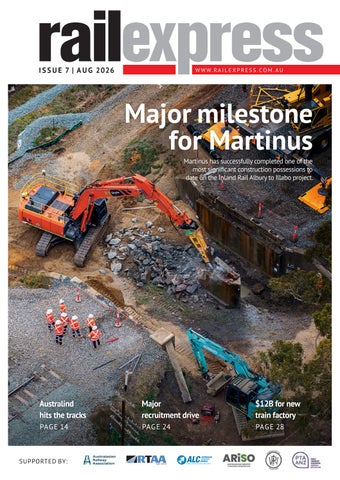
Major milestone for Martinus
Martinus has successfully completed one of the most significant construction possessions to date on the Inland Rail Albury to Illabo project.
Australind hits the tracks
Major recruitment drive
$12B for new train factory
PAGE 14
PAGE 24
PAGE 28
SUPPORTED BY:
Trusted With What Matters The Nation Runs on Freight. Freight Runs on People. Every day, Pacific National connects industries and communities by moving the freight Australia depends on. Behind every train is a team of skilled people trusted to deliver its cargo safely, reliably and efficiently.
T R
Join the team trusted with what matters.
pacificnational.com.au/careers
T re a
It H d b
N
E
D Y w g A
PCN13856_PN_Newspaper-Ad_Full-page_V2_FILM.indd 1
17/7/2026 9:10 am
Contents 4
From the Editor
6
Industry News
34
Young Professionals
50
Contracts, Tenders, EOIs
COV E R S TO RY
10
12
Major milestone for Martinus
M A N U F ACT U R I N G
12
Alstom: Australind hits the tracks
26
Amokabel: Cables you can trust
28
Bringing manufacturing home to the Hunter
D I G I TA L I S AT I O N
16
Digital twins: Reshaping the rail lifecycle
EVENTS
22
20
AusRAIL 2026: More than a conference
36
Women in Industry Awards winners revealed
38
Bulk Expo 2026: Industry experts to take the stage
R E S E A R C H A N D I N N O VAT I O N
22
Getting product approvals on track
WORKFORCE
24
Pacific National: Keeping Australia moving
S A F E TY
24
30
Shining a light on safety
32
Helping rail recover from trauma
I N D U S T R Y O R G A N I S AT I O N S
I S S U E 7 | A U G 2026
W W W. R A I L E X P R E S S . C O M . A U
Major milestone for Martinus
Martinus has successfully completed one of the most significant construction possessions to date on the Inland Rail Albury to Illabo project.
AILABILITY
bine the real digital worlds
al and digital worlds to deliver more reliable, efficient, rail transport solutions designed for everyone.
Australind hits the tracks
Major recruitment drive
$12B for new train factory
PAGE 14
PAGE 24
PAGE 28
COVER STORY Martinus has successfully completed one of the most significant construction possessions undertaken to date on the Albury to Illabo section of Inland Rail.
40 ARISO: Turning route knowledge into a reliable safety tool 42
PWI NSW: Rail reimagined
44
ARA: Progress on practical procurement reform
46
NTC: Getting ETCS right
49
SEMMA: Policy must encourage business, not control it
SUPPORTED BY:
30/6/2026 13:39
Image: Martinus
WWW.RAILEXPRESS.COM.AU | 3
From the Editor Published by:
379 Docklands Drive Docklands, VIC 3008 T: 03 9690 8766 www.primecreativemedia.com.au
Chairman John Murphy E: john.murphy@primecreative.com.au CEO Christine Clancy E: christine.clancy@primecreative.com.au Managing Editor Lisa Korycki E: lisa.korycki@primecreative.com.au Editor Kayla Walsh E: kayla.walsh@primecreative.com.au Business Development Managers Claire Waters M: 0466 545 664 E: claire.waters@primecreative.com.au Emily Schlegel M: 0466 317 555 E: emily.schlegel@primecreative.com.au Client Success Manager Ben Sammartino E: ben.sammartino@primecreative.com.au Head of Design Clayton Hawley E: clayton.hawley@primecreative.com.au Designer Apostolos Topatsis Subscriptions subscriptions@primecreative.com.au
www.RailExpress.com.au The Publisher reserves the right to alter or omit any article or advertisement submitted and requires indemnity from the advertisers and contributors against damages or liabilities that may arise from material published. © Copyright – No part of this publication may be reproduced, stored in a retrieval system or transmitted in any means electronic, mechanical, photocopying, recording or otherwise without the permission of the Publisher.
4 | ISSUE 7 – AUGUST 2026 | RAIL EXPRESS
Kayla Walsh Editor - Rail Express
Welcome to the August edition of Rail Express We’ve got an exciting issue of Rail Express for you this month. Our cover stars, Martinus, take us behind the scenes of one of the largest possessions to date on the Albury to Illabo section of Inland Rail. Despite the high degree of complexity involved and heavy rain impacting the corridor, all planned works were delivered safely. Meanwhile, the first new Australind has hit the tracks in Western Australia. Alstom tells us more about the features of the nextgeneration trains and the importance of local manufacturing. On the topic of supporting local, we also take a look at the New South Wales Government’s recent announcement that it will be investing $12 billion to establish a new train manufacturing facility in the Hunter. Elsewhere in the magazine, Amokabel Australia, which is planning to move to a bigger Sydney factory next year, shares some insights into how it can support the electrification of Australia’s rail networks. Meanwhile, Pacific National fills us in on its ongoing campaign to recruit qualified locomotive drivers – turn to page 24 to find out more. This issue also has a focus on digitalisation, with Siemens Mobility homing in on reshaping the rail lifecycle through digital twins. We’re big champions of health and safety in the rail industry here at Rail Express – both physical and psychosocial. To coincide with Rail Safety Week from August 10-16, 2026, we bring you two different features that focus on this topic. Twenty-six years ago, Lara Jensen lost
her brother Christian when a locomotive hit the car he was travelling in at a level crossing that had no flashing lights or boom gates. We speak to Lara about her tireless campaign for the introduction of mandatory high-visibility lighting on trains. We also hear from clinical psychologist Alexandra Howard, Director of Knowledge Mobilisation at Phoenix Australia. Howard shares some useful insights into trauma management in the rail industry – a highrisk sector where employees are dealing with everything from fatalities to violent antisocial incidents. We’ve also got our regular updates from the Australian Rail Industry Standards Organisation, the Permanent Way Institution of New South Wales, the National Transport Commission, the Australasian Railway Association and more.
kayla.walsh@primecreative.com.au
SOLVE YOUR TOUGHEST PROBLEMS AT AUSTRALIA’S ONLY BULK HANDLING EVENT Melbourne Convention and Exhibition Centre
16-17 September 2026
ASSOCIATION PARTNER
Get Tickets
News
First new Airport Metro train arrives High resolution displays show real-time flight information via a direct feed from the airport. There are multiple seating choices in each carriage, including front and rear-facing seating for groups, as well as traditional sideways seating, designated wheelchair spaces and accessible areas. Each train has four bicycle storage spaces.
Another standout design feature is the seating upholstery, which has been created by Indigenous artists Leanne Watson Redpath, Tina Barahanos and Alexandra Byrne (BBR). The artwork draws on ancient pathways and cultural journeys across Dharug Country and was chosen to reflect the communities along the metro line.
Image: Sydney Metro
The first of 12 new trains for the Sydney Metro – Western Sydney Airport Line has arrived in Sydney. The next-generation trains are being manufactured by Siemens Mobility at its production plant in Vienna, Austria. Each train is built in three separate carriages and will be transported via a specialised cargo ship, with the journey typically taking between 45 to 61 days. The first train recently travelled 23,000 kilometres from Vienna to Port Kembla, before the carriages were individually transported by truck to Sydney Metro’s new stabling and maintenance facility at Orchard Hills. Once there, the train was assembled. The trains come with a range of features which will facilitate the high-volume movement of passengers travelling to and from the airport with luggage, as well as travellers with disabilities. These include accessible centre aisles that are about 30 centimetres wider than those on M1 Line trains, as well as room for luggage storage below seats.
The trains are being built in Australia by Siemens Mobility.
Image: Queensland Rail
Designs unveiled for new bridge
The design was finalised following consultation with locals.
Queensland Rail has unveiled final designs for a new bridge at Herbert Street in Ipswich. The original bridge at Sadliers Crossing was closed to road traffic in 2020 due to its degraded condition. A temporary footbridge was installed by Queensland Rail to connect both sides of the Ipswich rail line. Now, Queensland Rail is building a permanent bridge for pedestrians, cyclists and people with mobility devices, which 6 | ISSUE 7 – AUGUST 2026 | RAIL EXPRESS
also provides a single trafficable lane for vehicle access during an emergency. The design was finalised following engagement with locals, including face-toface community meetings, door knocks and feedback sessions. Works will start on Saturday August 22 with the demolition of the temporary footbridge. Construction of the permanent bridge will continue until 2028. Due to the bridge’s location over an active rail corridor, Queensland Rail said
construction must be carefully staged during already scheduled track closures to ensure the safety of workers and minimise disruption to Ipswich line customers. During construction, there will be no pedestrian access across the rail corridor at Herbert Street. Detours will be in place at the nearby Thomas Street underpass and Burnett Street. Queensland Rail’s Head of South East Queensland Neil Backer thanked the Ipswich community for its ongoing feedback and engagement throughout the design process. “Given the complexities of building over live rail infrastructure, this work is only possible during existing scheduled track closures, so our crews can get the job done safely and efficiently,” he said. “There will be detours in place during the construction phase, and, to assist members of the local community with additional accessibility requirements, Queensland Rail can arrange alternate crossing assistance. “We will continue to keep the community informed and work to minimise disruption wherever possible.”
News
The Queensland Government has outlined a pipeline of rail and transport investment as part of its 2026-27 Budget, combining fare reform with major infrastructure delivery across South East Queensland. Central to the announcement is legislation to make 50 cent public transport fares permanent, alongside continued investment in rail expansion, level crossing removal and network upgrades. The Budget includes a record $55 billion roads and rail infrastructure pipeline, with multiple rail projects progressing across planning and delivery stages. Key rail-related initiatives include the Logan-Gold Coast Faster Rail program, which will deliver capacity and travel time improvements on one of the state’s busiest passenger corridors. Early works are already underway on the Kuraby level crossing removal, a project expected to improve safety and network reliability while supporting increased service frequency. On the Sunshine Coast, the Wave public transport program continues to progress, with Stage 1 to Caloundra now in delivery following contract awards. Planning is ongoing for extensions to Maroochydore and the Sunshine Coast Airport, forming part of
Image: Jerome/stock.adobe.com
Queensland budget backs rail
The Queensland Government is introducing legislation to make 50cent fares permanent.
a longer-term integrated transport corridor. In South East Queensland, the Gold Coast Transport Plan will also shape future rail and rapid transit expansion, including new light rail connections and improved corridor integration with heavy rail services. While rail forms a central component of the pipeline, the Budget emphasises a broader network approach, combining rail investment with supporting modes to increase overall system capacity. This includes fleet expansion in the bus network
and improved interchange opportunities aimed at strengthening first- and lastmile connectivity to rail services across the region. The approach reflects continued demand growth across South East Queensland and the need to deliver a more integrated and resilient transport system. Beyond individual projects, the government has reinforced its commitment to sustained infrastructure delivery through the pipeline, which includes a mix of rail, road and multimodal investments designed to support population growth and network resilience. The program also includes ongoing upgrades to key transport corridors and continued planning for future rail extensions, particularly in highgrowth areas. The decision to legislate permanent 50 cent fares is expected to play a role in supporting public transport patronage growth, including on the rail network, by lowering the cost of travel for commuters. The measure follows a trial period and is intended to provide long-term certainty for passengers while complementing infrastructure investment aimed at increasing service capacity and reliability.
Inland Rail celebrates ‘great achievement’
Image: Inland Rail
Euro Station Precinct works in June 2026.
Inland Rail is making progress, with ten of the 12 enhancement sites on the Beveridge to Albury (B2A) section now able to accommodate double-stacked freight trains. These include the completed B2A Tranche 1 locations – Barnawartha North, Wangaratta, Glenrowan, Seymour-Avenel
Road – and current Tranche 2 projects at Wandong, Hamilton Street and Short Street in Broadford, Seymour (under the Hume Freeway), Euroa and Benalla. By the end of 2026, Broadford’s Marchbanks Road bridge and the Tallarook site under the Hume Freeway will also be
ready for double-stacked trains. Inland Rail highlighted that the B2A Tranche 2 project has spent $181 million with 376 local suppliers, who have provided a range of products and services including plant and equipment, haulage services, traffic management, environmental services, and accommodation. An Inland Rail spokesperson said: “There’s still more work to do on the B2A project but having ten out of 12 work sites ready for double-stacked operation is a great achievement. “Local people, with local expertise, are important to help deliver the project and we’re committed to boosting their skills base and the capability of regional suppliers through delivery of this project. “The Victorian project is on track to be completed in 2027, and we thank all of our local communities for their patience and understanding while these important works are carried out.” WWW.RAILEXPRESS.COM.AU | 7
News
Queensland Rail is trialling new technology aimed at reducing bridge strikes, with a trailer-mounted height detection system being deployed at key sites in Ipswich. The initiative will test a warning system designed to detect over-height vehicles on roads approaching two rail bridges in the area: Dixon Street in Wulkuraka and Layard Street in Goodna. Dixon and Layard street bridges are two of the top 20 most frequently struck bridges on the Queensland Rail network. Using sensors, the new system identifies vehicles exceeding safe height limits and provides real-time warnings to drivers via a Variable Message Sign (VMS), helping to prevent collisions. The trailer will remain at each site for approximately two weeks to collect data before moving on to other bridge strike hot spot locations across the South East Queensland (SEQ) network.
In 2025, there were 427 bridge and beam strikes in SEQ. As of the end of May 2026, 157 had already taken place. Neil Backer, Head of SEQ at Queensland Rail, said bridge strikes are a serious safety concern. “Bridge strikes not only delay rail customers but are potentially very dangerous to the driver and other road users, as well as impacting road traffic,” he said. “While we continue to implement new safety strategies to prevent bridge strikes, we remind drivers that ultimately they play the biggest role: know the height and load of your vehicle and plan your journey so you don’t get your truck or load stuck.” Motorists face fines of $1381 and four demerit points for damaging rail infrastructure. If the matter goes to court, the maximum penalty for causing damage to rail infrastructure is $13,816.
Image: Queensland Rail
New tech to combat bridge strikes
A Variable Message Sign (VMS) being displayed at Dixon Street in Wulkuraka.
Light rail fleet gets upgrade Canberra’s light rail fleet has received upgrades to enable the vehicles to travel without wires. Fourteen existing vehicles have been retrofitted with on-board energy storage systems (OESS), as part of the Light Rail Procurement, Retrofit and Depot Expansion (LPRDE) Project. Five new vehicles have also been added to the fleet, which are already equipped with the new technology. Under Light Rail Stage 2A – an extension to
the light rail network which is currently under construction – vehicles will travel wire-free between the Alinga Street and Commonwealth Park stops. The new OESS technology removes the need for lineside poles and wires, reducing impacts on sensitive national areas and maintaining city views. Other benefits include a narrower track area and less disruption to street space. Each OESS contains batteries, control electronics and a thermal management
system that helps maintain optimum battery temperature in different weather conditions. The OESS charges when the vehicles operate on wired sections of track, then uses that energy to power the vehicle on wire-free sections. Energy is also created through regenerative braking. Each light rail vehicle was taken out of service, fitted with batteries, and tested before returning to operations. Light Rail Stage 2A is targeting completion in early 2028.
Image: ACT Government
Fourteen existing light rail vehicles have been retrofitted with onboard energy storage systems to enable wire-free travel.
8 | ISSUE 7 – AUGUST 2026 | RAIL EXPRESS
News
Images: Transport for NSW
Station turns 150 Yass Junction Station forms an important part of the region's rail history.
Yass Junction Station in New South Wales has celebrated its 150th birthday. Situated approximately four kilometres from the Yass township, the station officially opened in July 1876. The original station building is still intact and heritage listed. Yass Junction Station is an important part of the area’s rail history. In the mid-late 19th century, the South Line played a major role in facilitating pastoral trade between the region and the rest of the state. Today, the station is serviced by at least four trains a day as a stop on the Sydney to Melbourne and Goulburn to Griffith routes. More than 18 coach services also stop there, providing connections with many other towns including Albury, Cootamundra and Young. The station precinct retains significant Victorian-era infrastructure to this day. These elements reflect the late 19thcentury expansion of the rail network and the efforts made at the time to connect Yass following the decision to route the main line away from the town centre. Evidence of this includes a disused bay platform, situated behind the southbound platform. This short, dead-end platform once served as the interchange point for
tramway services and remains visible as a reminder of this former transport link. Roger Weeks, NSW TrainLink Chief Executive, said Yass Junction Station is a lasting reminder of the pivotal role railways played in shaping regional New South Wales. “The development of the network didn’t just connect communities – it supported local economies by enabling the movement
of people and agricultural goods, and by fostering railway settlements, including accommodation for workers and their families,” he said. “Yass Junction is a strong example of how our stations capture and preserve these stories, and as we mark 150 years, we recognise its enduring significance and the role it continues to play in linking regional New South Wales to the broader network.”
What the railway refreshment room used to look like.
WWW.RAILEXPRESS.COM.AU | 9
Cover Story
Martinus delivers Inland Rail super possession 700 people. 11 sites. 96-hour possession. One safe handback. Large-scale brownfield railway possessions are among the most complex activities undertaken on any rail network. Success depends on months of planning, systems integration, and flawless execution. The recent WE44 possession (a major scheduled track access window) on the Albury to Illabo section of Inland Rail put this capability into practice. Over a coordinated 96-hour mid-week shutdown, Martinus showcased how it is redefining delivery, successfully managing one of the most significant construction possessions undertaken on the project. The full-service railway company deployed more than 700 personnel across 11 active work sites between Albury and Illabo in New South Wales, in a highly constrained, live railway environment. Success was secured through months of meticulous planning before the actual possession, which was delivered from Saturday 2 May through Tuesday 5 May. This disciplined preparation was vital as teams operated around the clock across civil, track, signalling, structures, and bridge scopes. It also meant that when 47 millimetres of rainfall impacted the corridor mid-possession, it did not impact project continuity.
The possession represented a major milestone for the project.
10 | ISSUE 7 – AUGUST 2026 | RAIL EXPRESS
Wet weather protocols were activated because the elements had already been planned for, ensuring all works were delivered safely and the network was handed back to operations exactly when promised. The possession represented a major milestone for the project, combining multiple complex brownfield interfaces and disciplines simultaneously across a geographically dispersed corridor. LARGE-SCALE BROWNFIELD RAIL DELIVERY The extended possession sequence compressed a vast, geographically dispersed scope into a single coordinated delivery model. Major work packages successfully executed across the corridor included: • Track lowering and diversion works • Bridge and structures upgrades • Signalling removals and cutovers • Culvert replacement and drainage upgrades • Track slewing and destressing • Piling and foundation works • Station and yard modifications At the Riverina Highway bridge, the team successfully moved the main train line traffic
onto an existing loop track. This created a temporary bypass so crews could work safely on the main bridge structure without stopping train networks. The upgrade of Billy Hughes bridge on Wagga Road, over the railway line at Ettamogah, represented one of the most technically complex scopes of the possession. It required operating continuously across nine shifts with bulk excavation, formation treatment, structural fill placement, track reconstruction and signalling relocation completed under possession conditions. Further north, between Junee and Illabo, the Martinus team delivered a full bridge demolition and culvert replacement sequence using heavy lift crane operations alongside approximately seven kilometres of track slewing and destressing works. At the same time, works at Wagga Wagga included removing old track turnouts (the switches that change a train's path) and cutting over signalling cables, as well as the installation of the first bridge column on the broader Albury to Illabo section. Managing these dense, overlapping work packages across a geographically dispersed corridor required a highly coordinated, multi-disciplinary approach, according
local community initiatives, including ongoing support for Illabo Public School through site-led earn and return fundraising activities. For Andy Williams, Project Director for the Inland Rail Project Team at Martinus Group, the human element was the true driver of the project's success. “What I’m most proud of is the people behind the outcome," Williams said. “More than 700 personnel worked through challenging conditions to safely deliver a complex possession and hand the railway back operationally ready. “That takes skill, resilience and an enormous amount of teamwork.”
Images: Martinus
Works were delivered across 11 sites.
Culverts were replaced as part of the operation.
to Gavin Murphy, General Manager of Major Projects at Martinus Group Holdings. “The scale of this possession was significant, but what made it particularly complex was the number of disciplines, interfaces and live operational constraints being managed simultaneously across the corridor,” he said. “Delivering 11 active sites safely and achieving operational handback despite wet weather conditions is a credit to the planning, capability and culture we've built across Martinus Group.” PREDICTABLE OUTCOMES IN UNPREDICTABLE CONDITIONS While the physical works were delivered over a compressed 96-hour window, the successful outcome was engineered months earlier. A significant rain event mid-possession validated the team’s contingency planning and site coordination capabilities. With open excavations, formation works and concrete activities underway across multiple sites, project teams implemented pre-planned wet weather protocols, including material pre-positioning, pump deployment and staged sequencing adjustments to maintain program continuity. The possession ultimately achieved all operational handbacks. The outcome reinforced the importance of systems-led planning in modern railway delivery, particularly within constrained brownfield operating environments. Martinus Group Chief Operating Officer Ryan Baden noted that this level of
predictability is engineered long before a single high-vis vest is on-site. “Possessions of this scale don’t succeed by accident," said Baden. "They are the result of months of planning, disciplined systems, experienced people and a culture that understands how to operate safely within live rail environments. By the time the possession starts, the outcome should already be predictable.” SPECIALIST RAIL CAPABILITY Brownfield railway possessions require a different capability to traditional construction. Success depends on integrating operations, signalling, civil, structures, utilities, safety, planning and stakeholder management into a single coordinated delivery model. For Martinus, the possession highlighted the increasing importance of specialist rail contractors capable of integrating multiple disciplines within live operational rail corridors. The scale and complexity of the WE44 possession required coordination between track, signalling, civil, structures, safety, environment, quality and operational planning teams, supported by extensive stakeholder and community engagement across the corridor. More than 6900 community notifications and door knocks were completed ahead of the possession, with respite accommodation and community support measures implemented across affected areas. The project also continued its
DELIVERING RAIL INFRASTRUCTURE AT SCALE The successful completion of the WE44 possession adds to the growing body of large-scale brownfield railway delivery capability being developed across Australia’s rail infrastructure sector. As governments continue investing in freight and passenger rail upgrades nationally, the ability to safely deliver complex multi-site possessions while maintaining operational railway performance is becoming increasingly critical. The Albury to Illabo section of Inland Rail continues to provide a strong example of the planning, coordination and specialist delivery capability required to execute major rail infrastructure works within live transport networks. As Treaven Martinus, Chief Executive Officer of Martinus Group, pointed out, the stakes for this kind of specialist capability have never been higher. “Railway possessions are measured in hours rather than days. “Missing one can impact months of program. That's why specialist railway capability matters.” For the teams involved, Martinus said the WE44 possession was more than just a shutdown window – it was a demonstration of what coordinated railway delivery at scale looks like in practice. “As investment in freight and passenger rail continues across Australia, the need for specialist brownfield railway delivery capability will only increase," he said. “Super possessions such as WE44 demonstrate what can be achieved through systems-led planning, experienced railway professionals and coordinated execution.” WWW.RAILEXPRESS.COM.AU | 11
Manufacturing
Australind hits the tracks Built by Alstom at the Bellevue facility in Western Australia, the new Australind fleet is a major upgrade for passengers – and is powering hundreds of local jobs. The iconic Australind rail service between Perth and Bunbury is back – and this time, with a fleet of locally manufactured, nextgeneration trains. Built by Alstom in Bellevue, Western Australia, the three-car X’Trapolis trains bring together modern features, greater accessibility and a strong sense of community pride. Hundreds of members of the public and enthusiastic gunzels gathered to see the first new Australind’s maiden voyage at the end of June 2026, with a celebration taking place at Bunbury Passenger Terminal. The Australind service has been out of action for two-and-a-half years, since the Armadale rail line was shut for major upgrades in 2023. The closure led to the retirement of the 36-year-old Australind
The first new Australind entered service at the end of June 2026.
12 | ISSUE 7 – AUGUST 2026 | RAIL EXPRESS
trains, which were suffering from reliability issues. This new fleet represents the return of a vital service that connects communities and boosts tourism, while providing a more comfortable, accessible and reliable journey for passengers. This project has also had a major positive impact on the Western Australian economy – supporting more than 200 manufacturing jobs at Alstom’s Bellevue site, and hundreds more through local suppliers. We found out more from the team at Alstom. NEXT-GENERATION FEATURES In total, Alstom is producing four Diesel Multiple Unit (DMU) trains for the Australind service. They come with a host of exciting
new design and accessibility features. “These trains are a huge upgrade on the old Australinds, which first started service in 1987,” said Digant Devmurari, Project Director for Perth METRONET. “They all have reversible seats, contemporary interiors, Wi-Fi, airline-style luggage storage, LED lighting and in-seat USB-C charging.” Each Australind can carry 144 seated passengers, with six spaces for wheelchairs and storage for 14 bicycles. There are also three toilets on each train – compared to just one on the previous Australinds – including an accessible toilet. Another big highlight for passengers is the buffet area. “We have world-class buffet facilities on these trains, with top-of-the-range
Rail enthusiast and LEGO builder, Leslie Elverd, who has created a highly accurate, motorised LEGO replica of the Australind train.
Images: Alstom
equipment to keep food hot and cold, as well as excellent coffee machines,” said Devmurari. He added, laughing: “People keep talking about how good the toasties are.” The trains have both spring and air suspension, producing a smoother ride for passengers. Devmurari said the Australind is “built tough” for local conditions. “These trains were purpose-built for Western Australia, drawing on our understanding of local conditions and meeting the highest standards, to deliver trains tailored for local passengers. “For example, air conditioning systems need to perform differently in Victoria and in Western Australia, even if they look identical. That’s why we have factored local climatic conditions into the design, while defining the capacity and performance requirements of these trains.” The names of all four Australinds – Marley, Kwilena, Koombana and Linda – were chosen from suggestions from the public.
Digant Devmurari, Chantell Randall and Matthew Cordeiro from Alstom.
WWW.RAILEXPRESS.COM.AU | 13
Manufacturing
The new trains come with contemporary interiors.
Marley was a local alpine dingo who was beloved by Bunbury residents, while Linda is a popular nickname for the Australind. Kwilena is the Noongar word for dolphin – an important totem for Noongar people and an enduring symbol of Bunbury. Meanwhile, Koombana is named after Koombana Bay, the focal point of the city. All of the Australinds have different Indigenous artwork on the exterior and interiors of the trains, reflecting the distinct identity of south west Western Australia.
SUPPORTING LOCAL The Western Australia Railcar Program brought railcar manufacturing back to the state after 27 years. As part of the program, in 2019 Alstom was awarded a $1.3 billion contract to build 12 railcars for the four Australind DMUs as well as 246 railcars for 41 electric multiple units (EMUs) at its Bellevue facility. Devmurari said: “Only six per cent of the Australian economy is based on
manufacturing, and that’s even lower in Western Australia. “Having the Bellevue facility with more than 200 employees specifically in manufacturing, and so many more across the local supply chain, is absolutely key to the Western Australian economy, its sovereignty and future sustainability.” Devmurari said Alstom is working with a large variety of suppliers in the local region and across Western Australia. “With the help of our sourcing partners, we carry out activities such as steel fabrication, machining components, electrical components, fibreglass components and complex system parts, to name a few,” he said. Devmurari said many of these suppliers really rely on these major government contracts as the base of their business. “These contracts allow local suppliers to invest in extra capability and new machinery, strengthen their skills, and be more competitive against international suppliers. The economic benefits extend well beyond the project itself.” Another advantage of Alstom being locally based is the strong communication with its customer, the Public Transport Authority (PTA) of Western Australia. “We have several PTA staff based at the Bellevue facility with us,” highlighted Devmurari. “They can walk over and inspect the trains and it makes daily collaboration very easy.” Chantell Randall, Training Co-ordinator at Alstom, said building the DMUs and
The Australinds are being manufactured locally at Alstom's Bellevue site.
14 | ISSUE 7 – AUGUST 2026 | RAIL EXPRESS
ARA Mem
EMUs has helped to develop a highly skilled local manufacturing workforce. “We are training people in lots of different competencies, such as high-risk work,” Randall said. “A lot of the training we do is accredited, so it can also be transferred to other work areas if required, or other manufacturing projects around Western Australia.” Alstom welcomes apprentices and trainees, upskilling people with no prior rail experience. “It’s all about getting young local Western Australians in there, training them up and making sure their skills are ready for the future,” Randall added. One example is Matthew Cordeiro, an electrician based at the Bellevue site who has been working on the new fleets for the past four years. “I had no rail experience before I started working with Alstom,” he said. “Now I’ve had the training to bring my skills as an electrician to the next level. “Day to day, I focus on what are called baselines and change requests. All those
niggling things that need to be adjusted on a day-to-day basis, from adjusting the headlights to implementing cabling and harnesses for train door gongs.” Devmurari said Cordeiro makes the role sound straightforward, but the young employee has actually developed very impressive technical skills and capabilities. He explained: “As we test and validate trains, we have to carry out further improvements based on what we learn from those testing and validation cycles. “To do this, you need to understand the environment of the train and how it functions. It’s a very niche and complex skill set.” In addition, Alstom is committed to supporting the Indigenous community, employing young Indigenous talent and working with Indigenous suppliers. “We have a certificate program that focuses on Indigenous engagement, and an Indigenous engagement officer on site,” said Randall. “We just had our first Indigenous apprentice complete his apprenticeship,
which was a great milestone that reflects our investment in local talent.” A PROUD MILESTONE Devmurari, Randall and Cordeiro are all very proud to see the new Australind in service. “Seeing the first train pull into the station and witnessing the excitement it created for the community was incredibly special,” said Randall. “We’ve got some really good feedback. It’s going to make a big difference locally, from bringing more tourism to Bunbury to making it easier for people to get to hospital appointments and that kind of thing.” Devmurari said: “We’re very proud and grateful to the Western Australian Government, Minister for Transport Rita Saffioti and the PTA. Without their support, these programs cannot exist.” Cordeiro added: “It was awesome to see it all come together, from a bare shell to a fully finished train. “Seeing it on the tracks was a really special moment for all of us.”
Join the voice of the rail industry
ARA membership unlocks benefits for your whole team, including advocacy, discounted access to ARA events and courses, and valuable industry connections. Join more than 240 rail organisations across Australia and New Zealand working together to shape the future of rail. ara.net.au/membership
Become a member WWW.RAILEXPRESS.COM.AU | 15
ARA Membership_Rail Express_ 210mmx150mm_August_20062026.indd 1
24/06/2026 11:22:11 AM
Digitalisation
Digital twins: Reshaping the rail lifecycle Standardised data, interoperable APIs (Application Programming Interfaces), cybersecurity, and pragmatic regulation are key to reshaping the rail lifecycle through digital twins, which can be supercharged by the sector's focus on open data and platforms, modular cloud-based software, rapid scaling up, and safe industrial AI use. “Two decades ago, people kept saying one thing: When it comes to digitalisation, the rail industry lags miles behind,” said Dr Frank Hoffmann, Head of Engineering at Siemens Mobility Rolling Stock. “Rail is particularly behind compared with the automotive industry, a sector that developed better and better driver assistant and entertainment systems decade after decade. “Today, we are their equals and have even moved to the forefront in some areas.” One such area is the digital twin. The concept is defined by management consultancy McKinsey as “a virtual replica of a physical object, person or process that can be used to simulate its behaviour to better understand how it works in real life. Digital twins are linked to real data sources from the environment, which means that the twin updates in real time to reflect the original version.” Siemens extends this concept across the 16 | ISSUE 7 – AUGUST 2026 | RAIL EXPRESS
entire lifecycle of rail assets, connecting design, production, operation and maintenance through continuous datadriven optimisation. TOWARDS A RAILWAY DIGITAL TWIN In rail, Original Equipment Manufacturers (OEMs), infrastructure managers, operators and fleet owners are most concerned about optimising the economics of rolling stock and fixed assets through their life. To this end, digitalisation will play an increasingly critical role, not just in enabling the life of a train or lineside component to be modelled at the outset, but also in supporting the ongoing maintenance, overhaul and eventual recycling of the asset in question. But the creation of a ‘railway digital twin’ is arguably an even more complex undertaking that requires a multi-faceted approach, integrating various technologies, data sources and expertise. This goes beyond just rolling stock to encompass the entire railway
ecosystem, including tracks, signalling, power supply and stations. But before the scope of the digital twin can be defined, its purpose needs to be understood. What will it cover, and what problems is it intended to solve? Parameters to address could include: • Asset scope: Will it cover individual trains, an entire fleet, specific components (bogies, pantographs etc), track segments, signalling systems, stations, or the entire network? • Business objectives: What are the key goals? These could cover predictive maintenance, operational efficiency, safety improvements, capacity optimisation, passenger experience enhancement or lifecycle cost reduction. • Level of detail: How granular does the twin need to be? This could be component level, system level or network level, for example. This scoping task ensures that the effort spent in generating and maintaining
Digital twins enable systematic defects such as software bugs to be spotted and fixed at an early stage, improving reliability.
the digital twin relates to the expected business benefit. LAYING THE FOUNDATIONS Today, product digital twins can simulate all components in a train or a wayside asset, such as the stress on mechanical parts such as bogies or the behaviour of the power electronics. Developers can also incorporate important variables, such as the interference currents generated by modern converters that can destabilise a power network. Equally importantly, the software managing the operation of the railway in question can also be modelled. However, for these modelling efforts to be a success, the data going into the digital twin must be of high quality. The digital twin is only as good as the data it receives. This requires a careful selection of sensors and the corresponding connectivity. Success depends on high-quality data collected from operational systems and sensors, supported by secure connectivity and standardised data structures that ensure consistency and interoperability. SUPPORTING A DIGITAL THREAD Building a digital twin for a train or an infrastructure asset is not a one-time
build, but rather an evolving, dynamic representation that involves ongoing learning and adaptation by all the parties involved. The philosophy of the ‘digital thread’ is therefore used to keep abreast of this fluctuating picture as the rail project in question evolves. This embodies the seamless, unbroken flow of data and information that connects all phases of the asset’s lifecycle, ensuring consistency and traceability from concept to retirement. The ‘thread’ is also what connects the physical and digital versions of the asset as it emerges from the design stage through to real-world operations. A prime example is to connect the model of a part during design firstly to a quality assurance step where manufacturing deviations are detected, and subsequently to a service case where the model is used to 3D print a spare part for rapid replacement. BENEFITING FROM A CHANGING MARKET While the benefits of a digital twin in the manufacturing and commissioning process may be clear, the changing nature of the rail market itself is also acting as a catalyst to facilitate their adoption across the full lifecycle. In particular, the increasing prevalence of whole-life asset maintenance
agreements for rolling stock fleets means the OEM can now be involved in the ongoing operation and maintenance of rail assets. In the past, the customer was responsible for maintenance after a train was delivered. This usually meant that operators did not share operational and condition data with a manufacturer such as Siemens. Frequently, the OEM did not learn about a train’s technical problems until long after they had emerged, if they did at all. Today, private train operators in particular have set up service agreements through which the manufacturer assumes responsibility for keeping trains in operation. For the highest levels of reliability and availability, live operational data can be used to improve whole-system performance. For a business such as Siemens Mobility, this data can be captured from fleets around the world improving the data foundation and thus the performance for all customers via a raft of diagnostic and condition monitoring tools, such as the Railigent X suite of services and applications. By integrating data from trains and signalling systems, Railigent X optimises maintenance and service reliability and helps to improve operations and passenger satisfaction. WWW.RAILEXPRESS.COM.AU | 17
Digitalisation
Reality technology to inspect the status of the components without resorting to the classic paper manual. SIMULATING HUMANS Yet however capable the digital twin may be, there will always be a human element to rail operations, either onboard the train or in a control centre. How can this human aspect be incorporated into the ‘digital thread’? Siemens sees the answer in simulators, where drivers, control staff and maintenance specialists can learn about a fleet in a virtual realm. Indeed, simulators today are often a life-sized cab in which drivers can train and tackle challenging, preprogrammed scenarios. This is an initial step towards a much more comprehensive role for simulators. Siemens has developed an automated quality assurance system derived from digital twins
which simulates all the operating procedures in the cab. The ambition is to use a digital twin approach to create a simulation in some cases, before the train itself has even rolled off the production line. ENHANCING INFRASTRUCTURE While the emergence of whole-life fleet maintenance supported by advanced digital tools clearly aligns with Siemens Mobility’s expertise in rolling stock production, the company sees far wider potential for the digital twin, complementing its offering in train control and the infrastructure sector. “The digital twin can become a single source of truth for turnkey rail projects,” said Florian Ramsperger, Principal Expert for System Architecture & Data Ecosystems. Many infrastructure managers and metro authorities still lack a full understanding of the assets they own, but emerging Images: Siemens Mobility
FAREWELL TO THE 'BATHTUB CURVE' In Hoffmann’s view, the emergence of the digital twin offers hope that the infamous ‘bathtub curve’ of rolling stock reliability could start to be flattened out. In the past, it took years to address these issues and cause the curve to sink. “Digital twins enable us to spot and fix systematic defects such as software bugs at an early stage,” he explained. “Particularly at the end of a product’s lifecycle, we can use predictive maintenance to avoid doing unscheduled maintenance work.” Key to achieving this goal will be using digital twins to create what Siemens Mobility sees as a ‘feedback loop’ between fleet operators, asset owners, maintainers and designers. With a digital twin-based approach, it should become possible for a fitter attending to a locomotive to use Augmented
A C
A o
T A b fa p o
Modern digital twins can simulate all components in a train or a wayside asset, from the stress on mechanical parts to the behaviour of the electronics.
18 | ISSUE 7 – AUGUST 2026 | RAIL EXPRESS
8 P w
technologies including Computer Vision and Light Detection and Ranging (LiDAR) scanning mean that the barriers to creating a truly comprehensive digital twin for a given network are steadily being reduced. According to Ramsperger, the creation of an overall network-wide digital twin can bring benefits both for brownfield rail upgrading schemes – such as a large-scale European Train Control System (ETCS) rollout for example – or for a new-build project such as a metro or a high-speed line. “The issue for many infrastructure projects is that what gets built is not the same as what was planned,” he said. The benefit of the digital twin is that it can help the project partners to bridge the gap between the civil works stage and the operational phase of the railway – but to achieve this successfully, a high degree of rail domain knowledge needs to be incorporated into the creation of the model. AI AS THE SUPERCHARGER However, for all the advantages of the digital twin, it is not an easy model
to create. Ramsperger acknowledged: “One of the downsides of a digital twin is that it requires a lot of effort in creation and a lot of effort in verification of the data.” This is where he feels AI tools can make a significant contribution and indeed may become essential to the delivery of digital twins in the future. “Things that were seen as a lot of effort in the past are likely to be more manageable in the future, thanks to AI.” Already emerging is agentic AI, whereby engineers in an industrial context could ask a bot to effectively ‘talk’ to a digital twin. While not a scenario that will be immediately applicable, a member of staff from a train operator could report a defect on a vehicle using a camera and QR (quick response) code scanner linked to a digital twin. This in turn would lead an AI agent to interrogate the digital twin to check the damaged component against the correct design of the given component and then ask a 3D printer to produce the part for fitting by the time the train reaches the depot.
“AI could be the supercharger between the human and the digital twin,” Ramsperger suggested. MAKE USEFUL DECISIONS Nevertheless, Siemens Mobility is adamant that however comprehensive the dataset that supports the digital twin is, the model itself must be useful. “Digital twins of course represent the reality as it comes to us in terms of data,” said Guido Schroeer, Team Lead, Data Analytics & AI. “But it’s not always obvious what to read out of it, or how to make decisions based on it. And in the past, there were classical approaches about how to do that, but I think AI will make these interpretations faster and more accessible. “The value for a business only comes to life when you can make decisions based on your digital twin. It should not be a model that we just look at and think, ‘that’s nice to have’. We must make business-relevant decisions, and with AI this should be faster and easier.”
Australian Railway and Custom Cables Manufacturer Amokabel Australia excels in the design and manufacture of many unique and highly specialised cables. The company is based in Sydney and supplies products across Australia and overseas. Priding itself on being able to provide both custom and standard cables that are manufactured at our facility in Western Sydney. We can manufacture a wide range of products, many of which are custom designed and made to meet our clients’ requirements.
All your Railway Sector Cabling requirements, locally manufactured, such as OHLE cables, Trackside Power cabling, Points Systems, Level Crossing Infrastructure cabling, Contact Wire, Catenary & Bonding cables, Axle Counter cabling, Signalling cables, Train Control System cables, Telecommunications wires, Rolling Stock, Passenger Information Systems, SCADA & Station Building cables. Extrusion Processes utilising: Low Density Polyethylene, High Density Polyethylene & Cellular Foam Polyethylene, Polyurethane, Polypropylene, PVC, LSZH Megolon, Blue Intrinsically Safe coloured sheaths & Steel Wire Armouring, Termite and Rodent protection cable solutions. Quality and Compliance are at the heart of mitigating the risk of unplanned maintenance and downtime. Amokabel will work hard to ensure we supply high quality, high performance. The strictest quality assurance processes are backed by compliant cable testing processes.
8 Epic Place Villawood NSW 2163 Australia P. +61 2 9645 5444 E. enquiries.au@amokabel.com www.amokabel.com
Amokabel has excelled in the design and manufacture of many unique Custom cables, specifically designed to suit customer requirements. We | 19 can combine several of your or ourWWW.RAILEXPRESS.COM.AU supplied cables to make an easy to install Composite cable.
Events
More than a conference Image: ARA
The Australasian Railway Association (ARA) shares why AusRAIL 2026 in Brisbane will be a week that shapes the rail industry.
For decades, AusRAIL has been recognised as the flagship event for the rail industry in Australia and New Zealand. Each year, thousands of professionals gather to hear from industry leaders, explore the latest technologies and discuss the challenges shaping the future of rail. But to think of AusRAIL 2026, taking place in Brisbane from November 23 to 25, as simply a two-day conference and exhibition is to miss the bigger picture. AusRAIL has evolved into a week-long industry experience, bringing together operators, contractors, manufacturers, governments, consultants, researchers and 20 | ISSUE 7 – AUGUST 2026 | RAIL EXPRESS
AusRAIL, the biggest rail conference in the Southern Hemisphere, will return to Brisbane in 2026.
suppliers for a series of events that extend well beyond the conference and exhibition. From leadership forums and social events to site tours and the Women in Rail Forum, the value lies not only in the formal program, but in the conversations, relationships and practical insights that happen throughout the week. The Australasian Railway Association (ARA) has consistently identified workforce capability, diversity and collaboration as critical priorities if the rail industry is to deliver Australia's growing pipeline of rail projects. While technical innovation remains essential, attracting, developing and
retaining skilled people is equally important to the industry's future success. The week begins on Monday November 23 with the Women in Rail Forum, one of the industry's most anticipated networking events. More than a celebration of female leadership, the event provides a platform to discuss practical strategies for creating a more inclusive workforce, sharing experiences across organisations and highlighting initiatives that are helping attract and retain talent. In 2026, the updated format is focused on leadership in action. This year’s event will bring leaders and emerging leaders together
delegates gain practical exposure to the latest developments while engaging directly with the people delivering them. In 2026, the opportunity to learn does not end when the conference closes. On Thursday November 26, site tours give delegates the opportunity to experience major rail projects and operational environments first-hand. Whether exploring new infrastructure, maintenance facilities or operational centres, these visits provide valuable context that complements the conference. Seeing projects in operation often generates a deeper understanding than can be achieved through presentations alone. It also creates opportunities for technical discussions between project teams and visitors, allowing lessons learned to be shared across organisations and jurisdictions. This combination of strategic thinking, practical learning and relationship building reflects the ARA's broader vision for industry capability. Addressing the industry’s future workforce needs will require more than
technical expertise alone. It will depend on strong leadership, knowledge sharing and a culture of collaboration across the entire rail ecosystem. For organisations, that means the value of attending AusRAIL extends well beyond professional development. It is an opportunity to strengthen relationships with customers and suppliers, expose employees to new thinking, support emerging leaders and better understand the trends shaping the industry's future. As Australia's rail industry continues to grow, the importance of collaboration will only increase. Delivering the next generation of rail projects will require skilled people, diverse perspectives and strong partnerships across the supply chain. AusRAIL 2026 in Brisbane brings those elements together in one place. Viewed through that lens, AusRAIL is far more than a conference and exhibition. It is a week that reflects the rail industry's collective ambition – and one that offers a unique opportunity to learn, connect and help shape the future of rail.
© ALSTOM SA 2023. RailGallery
to work through practical challenges and explore tools and approaches that can be applied back in the workplace. The Forum provides an ideal preview to the conference and exhibition, where formal presentations are complemented by countless informal discussions between sessions, on the exhibition floor and during networking functions. While keynote presentations often generate the headlines, many attendees point to these more casual conversations as one of the most valuable aspects of AusRAIL. They provide opportunities to exchange ideas, compare project experiences, discuss emerging challenges and build relationships that support future collaboration. The exhibition itself also serves as a meeting place where suppliers, manufacturers, operators and infrastructure owners can explore new technologies and discuss how innovation can be applied to real-world projects. With hundreds of exhibitors showcasing products and services across every aspect of the rail supply chain,
Australia’s only end-to-end manufacturer of trams and trains, delivering sustainable rail solutions for over 100 years. WWW.RAILEXPRESS.COM.AU | 21
Innovation
Getting approvals on track A new framework is streamlining product approvals across Australian jurisdictions, reducing duplication and making it easier to adopt the latest innovations. A revised framework, new process and application guide were recently made publicly available, sharing insights from the Public Transport Authority in Western Australia (PTA WA) and the Australian Rail and Track Corporation (ARTC). COMPOSITE SLEEPERS AT PTA WA The PTA WA trialled three different composite sleeper products in a live, operational environment represented by moderately deteriorated track conditions, rather than in the pristine condition you might experience in a lab setting. The PTA WA has approximately 3300 timber sleepers and bearers across its network, intended to last 15 years, but usually lasting between five and nine
years. According to the ARA, there is a clear need for a substitute product that won’t deteriorate as quickly and can be manufactured and maintained using existing machinery. The PTA measured the deterioration of the composite sleepers against the timber sleepers and then retroactively applied the NPTA framework to assess how it would have worked differently. The team found that using the NPTA would have significantly reduced the duplication of information required and the inefficiencies that flowed from them. For example, the team used an Australian Rail Industry Standards Organisation (ARISO) standard to perform a conformity assessment of the composite sleepers, then Images: PTA WA
Composite sleepers and accessible level crossings have provided vital lessons and insights to inform the latest step towards a national approach to standardised product approvals. The Australian-first National Product Type Approval (NPTA) initiative aims to provide greater consistency and collaboration through standardised product approvals across Australian jurisdictions. The Australasian Railway Association (ARA) has advocated for the framework for several years, culminating in the signing of a Memorandum of Understanding to implement the new framework last year. The framework is designed to facilitate multi-modal use of products and emerging technologies.
The PTA WA has approximately 3300 timber sleepers and bearers across its network.
22 | ISSUE 7 – AUGUST 2026 | RAIL EXPRESS
The PTA WA trialled three different composite sleeper products in an operational environment.
The ARTC conducted a trial to find a product capable of closing gaps at level crossings that could be dangerous to mobility aid users and cyclists.
structured risk evaluation while preserving jurisdictional autonomy, streamlined design validation for transparent requirements verification and traceability matrix and shared assessment reports, which allows individual jurisdictions to focus on local network suitability rather than repeating already-conducted trials. ACCESSIBLE LEVEL CROSSINGS AT ARTC ARTC conducted a similar trial to identify a product capable of closing gaps at level crossings that present accessibility and safety risks for mobility aid users and
Image: ARTC
progressed through testing and product approval using a single document as the trial delivered more results. Under the NPTA, the process works more like a stage gate approach. When you finish one stage, it gets approved, the door is closed, and you move on to the next stage. The team found this provided more certainty on the suitability of a product without having to constantly move back and forth within the document. The NPTA also allowed for a centralised conformity assessment against a recognised standard, so anyone else within Australia can use those results to assess whether the product is suitable for their needs. The PTA WA found significant efficiency gains from the NPTA, especially with the ability to share technical assessment data across jurisdictions. The NPTA instead facilitates innovation by allowing for scalable assessments and shared approval data, which enables a better life cycle performance. They also found the NPTA allowed for
cyclists. The selected solution needed to enhance safety outcomes while complying with the Disability Standards for Accessible Public Transport (DSAPT). Although the product under consideration was already in use elsewhere in Australia, it still required reassessment under existing ARTC processes to confirm compatibility with ARTC systems. This included ensuring that the product was reliable, easy to maintain, and aligned with ARTC’s environmental, social, and governance (ESG) objectives. Typically, ARTC’s approval process involves defining the problem, finding a product sponsor, completing a comprehensive product approval application, undertaking technical assessments, and securing review and endorsement by a technical panel. This may be followed by additional evaluation and final approval from the relevant business unit. Under the National Product Type Approval (NPTA) framework, however, ARTC leveraged a Memorandum of Understanding with other transport agencies already using the same product. This enabled access to their existing assessments and validation data, as well as direct engagement with their teams to understand operational experiences. As a result, ARTC avoided duplicating significant portions of the technical evaluation, saving both time and resources. Instead, effort was redirected towards assessing the product’s suitability for the specific conditions of the ARTC network. The assessment resulted in imposing speed restrictions for lighter rolling stock and imposing a minimum distance from track lubricators. The ARTC team concluded that the NPTA approach delivered substantial benefits, including improved efficiency, greater transparency and visibility, enhanced consistency and alignment across jurisdictions, and stronger cross-network engineering confidence. It also supported innovation by streamlining the trial and adoption of new products. WWW.RAILEXPRESS.COM.AU | 23
Workforce
Keeping Australia moving Pacific National is currently undertaking one of its largest driver recruitment campaigns in years. We find out more.
THE RIGHT PEOPLE FOR THE JOB Baker said Pacific National is looking for qualified drivers, as well as Drivers Under Instruction and Second Persons, who are passionate about rail and committed to working safely in every moment. “At Pacific National, safety is our first priority and underpins every decision we make – our motto is Safely Every Day! “We're looking for people who take pride in doing the job the right way, who continually learn and improve, and who share our commitment to delivering safely for our customers, colleagues, and communities. “Those qualities are reflected in our Pacific National Approach (PNA), which provides direction about what is important to us, what we stand for and how we behave.” 24 | ISSUE 7 – AUGUST 2026 | RAIL EXPRESS
Pacific National is looking for qualified drivers, as well as Drivers Under Instruction and Second Persons.
Images: Pacific National
In an average week, Pacific National hauls 2.26 million tonnes of coal, 280,000 tonnes of bulk freight, and 12,518 twenty-foot equivalent intermodal containers. As the largest private freight rail operator in Australia, it connects industries ranging from agriculture and manufacturing to mining, energy and consumer goods. With 3400 employees spread across more than 70 locations nationally, it plays a critical role in the country’s economy and supply chains. Now, Pacific National is undertaking one of its largest recruitment campaigns for qualified locomotive drivers in recent years, as it continues to invest in its operations and support growing customer demand. “We're recruiting qualified drivers across multiple locations in Victoria, New South Wales, and Queensland, with other opportunities continuing to emerge across our national network,” said Bronwyn Baker, Chief People and Culture Officer at Pacific National. “As Australia's largest private rail freight operator, we regularly recruit drivers to support both business growth and natural workforce renewal. “Our focus isn't simply on filling vacancies – it's about building long-term careers and creating a valued team of qualified drivers who want to be part of an organisation that keeps Australia's freight moving.”
Baker said technical competence is obviously very important, but Pacific National is equally interested in people who demonstrate teamwork, sound judgement, strong communication skills, and a genuine commitment to continuous improvement. Pacific National encourages applicants from diverse backgrounds and is committed to building an inclusive workforce where everyone feels welcome, respected, and able to contribute. “As a people-powered business operating across more than 70 locations throughout mainland Australia, we know our success comes from the diversity of our people, their experiences, and the perspectives they bring,” Baker emphasised. “Creating an inclusive workplace helps us attract the best talent and better reflect the customers and communities we proudly serve.” While Pacific National’s current campaign is focused on attracting qualified drivers, the operator also regularly recruits across a wide range of operational, maintenance and corporate roles. These include terminal operators, rolling stock maintenance specialists, engineers,
technology professionals, safety specialists, and corporate positions. “As a national business with a diverse customer base across the energy, resources, manufacturing, agriculture, and intermodal sectors, we're always looking for talented people who want to help keep Australia's freight moving,” said Baker. A WIDE RANGE OF BENEFITS Pacific National drivers receive competitive remuneration and a host of other benefits including access to a Fitness Passport (an affordable corporate fitness scheme), discounted health insurance, and an Employee Assistance Program. Baker recognised that flexibility is increasingly important to drivers when they are choosing an employer. “We are continually looking for ways to improve work/life balance while meeting the operational requirements of a business that operates 24 hours a day, seven days a week, 365 days a year.” Pacific National offers a range of leave benefits, including paid parental leave, purchased leave and
A SHARED COMMITMENT Baker said Pacific National’s culture is built on teamwork, accountability, respect, and a shared commitment to keeping Australia moving. “As a people-powered business, we know our success depends on having skilled, engaged, and supported employees who are empowered to do their best work every day. “We're also committed to operational excellence through continuous improvement, innovation, and collaboration. “Whether you're working on the frontline, in maintenance or in a corporate role, everyone plays an important part in helping us safely connect Australia's supply chains and deliver for our customers.” She highlighted that safety isn't simply a priority, but a core value that underpins every decision Pacific National makes. “Maintaining a safe workplace starts with employing great people, providing high-quality training, and ensuring our teams have the right equipment, procedures and support they need to perform their roles safely. “We also foster a culture where people are encouraged to speak up, share ideas, learn from one another, and continuously improve. “Everyone has a role to play in creating a safe working environment, and that shared responsibility is one of the reasons safety remains central to our culture.”
Pacific National has 3400 employees spread across 70 locations nationally.
other flexible arrangements where operationally appropriate. “Our focus is on creating sustainable careers that support both our people and our customers.” In addition, Baker said drivers can expect exciting long-term career opportunities across a growing, national business. “Many of our leaders started their careers on the frontline. Qualified drivers can progress into roles such as driver trainer, operations supervisor, train crew manager, and broader operational leadership positions. “We're committed to investing in our people through ongoing training, leadership development, and internal career opportunities because our people are the driving force behind our success.” According to Baker, Pacific National's qualified drivers receive structured onboarding, operational training, competency assessments, and ongoing development. "This ensures they remain confident, current, and capable throughout their
careers, and above all, are able to do their work safely,” she said. “Learning doesn't stop after induction – it's an ongoing commitment to maintaining high professional standards and continually strengthening safety and operational excellence.” As Pacific National serves a broad customer base, there are opportunities to work across a diverse range of freight operations – from fast-moving consumer goods to multi-national freightforwarding, bulk commodities and more. Pacific National also has many opportunities in regional areas. “We're a major employer in metropolitan, regional, and remote communities across mainland Australia, with 59 per cent of our workforce based outside of metropolitan areas. “We invest in our people, construct and upgrade freight hubs and depots, maintain a significant fleet of locomotives and rolling stock, and partner with local businesses and suppliers to support regional economies.”
THE NEXT STEPS For qualified locomotive drivers interested in applying for a job with Pacific National, Baker said the easiest way is to visit the Pacific National Careers website. “If you're not quite ready to apply today, we'd still encourage you to register your interest by joining our Talent Community or contacting our recruitment team. “That way, we can stay connected and let you know when opportunities arise that match your experience and location.” With a heritage dating back to 1855, Baker said the operator is pleased to continue to play a crucial role in Australia’s economy, supply chains, and rail workforce development. “Pacific National is proud to continue to invest in the future of rail by creating skilled, long-term careers and developing the next generation of rail professionals.”
For more information or to apply for a role, visit pacificnational.com.au/ job-opportunities
WWW.RAILEXPRESS.COM.AU | 25
Manufacturing
Cables you can trust
Images: Amokabel Australia
Amokabel Australia is helping to keep electric trains and light rail moving with overhead line and traction power cables built for safety, reliability and performance.
Mark Foster, General Manager and Sales Director at Amokabel Australia.
As Australia’s rail networks continue to embrace electrification, it’s more important than ever to invest in quality equipment. Products like overhead line cables and traction power supply cables play a critical role in keeping electric trains and light rail vehicles moving safely and reliably. Mark Foster, General Manager and Sales Director at Amokabel Australia, explained why Amokabel is perfectly positioned to support Australia’s electrified networks. Electric trains and light rail vehicles draw power from overhead wires. With the overhead wire system, a pantograph (a spring-loaded arm on the roof of the rolling stock) slides along the contact wire completing the power transfer interface to the rolling stofck. Once the electricity enters the train, it is typically transformed to a manageable level and converted to DC (direct current) power to drive the traction motors on the train’s axles. 26 | ISSUE 7 – AUGUST 2026 | RAIL EXPRESS
Electrified networks in Australia generally have overhead line infrastructure supporting what we call ‘contact wire’ – the cable that connects with the pantograph. There are also power supply cables that feed the contact wire. Foster said different sizes and types of cables are required, depending on the application and voltage systems in use. “We have different traction supply systems, AC (alternating current) and DC, across our country,” he said. Standardisation is in the works, but as a result of the varied supply systems that exist presently, there are different power supply conductor wire sizes, as well as different contact wire CSAs (cross-sectional areas) used. “A metro train network will use contact wire with a very high copper content,” explained Foster. “When you move into high-speed electric trains, you will see different copper alloy ratios. These have
different wear and conductivity properties to suit that application, where you’ve got the pantograph in contact with the copper overhead at high speed.” Amokabel Australia can supply a wide range of OHLE (overhead line equipment) cables, traction power cables and contact wire to fit its customers’ needs. “We’ve got a full portfolio of products,” Foster said. “We can also supply bonding cables and ground return cables for the system.” Many of these cables come through Amokabel’s partners in Europe, where Foster said the company has access to the highest quality copper. This, he stressed, is an area where it’s important not to cut corners. “If your cables aren’t up to spec, they can break or fail in service,” he said. “There are serious risks involved, including fire or injury to passengers. “You don’t want to muck about when you’re dealing with 25,000 volts.”
Amokabel Australia offers a wide portfolio of products.
Each batch of Amokabel cables comes with a test certificate proving it meets electrical and mechanical standards. “If there's a flame test required on insulation, we do that, and certificates of conformance are provided,” he said. “We can do all of that in-house. If other specific tests
Cables can be customised to suit customers’ needs.
are called for by a customer, we can provide any information required to local NATA (National Association of Testing Authorities) registered facilities.” Amokabel can also provide low order quantities and customise its cables depending on requirements.
“We can produce outer sheaths in the customer’s colour of choice, with custom text that could include a business name, part number, or contact details,” said Foster. “The cables can also be constructed to suit certain requirements such as submersion, UV (ultraviolet) protection, mechanical protection or termite proofing, as examples.” Amokabel is also exploring ways to deter copper thieves (by way of copper substitution) – a growing problem across rail networks in Australia and New Zealand. “We're starting to move to a less attractive conductor for thieves – such as aluminium,” he said. “At the moment, we can’t do this for the contact wires because of the spec and what copper gives you. “But aluminium is easier to install, it’s a lighter weight and it doesn’t have the same value as copper.” Amokabel is planning to expand its footprint in 2027, moving to a much larger facility in Western Sydney. “This would bring our factory from 2000 square metres to 4000-6000 square metres, with more space for new, more efficient manufacturing machines,” Foster said. “We currently produce some smallerdiameter traction power wires in Sydney, but the new site will allow us to do much more.” WWW.RAILEXPRESS.COM.AU | 27
Images: NSW Government
Manufacturing
A total of 18 Tangara trains will be refurbished at the Cardiff Maintenance Centre.
Bringing manufacturing home The New South Wales Government has pledged to rebuild the Hunter as a train manufacturing hub, with the Tangara Life Extension Program helping to establish the skilled workforce needed for the future. A $12 billion investment will open a new train manufacturing facility in the Hunter region. The factory will be owned by the New South Wales Government and operated by a private manufacturer. According to the government, the project will be supported by a 30-year pipeline of rolling stock manufacturing. Following the construction of the new Tangara fleet for Sydney Trains, replacement of the Millennium and OSCAR fleets is scheduled for the 2040s, followed by the Waratah fleet in the 2050s. "Rather than buying trains project by project from overseas, this will provide the long-term certainty needed for industry to invest locally, train apprentices, strengthen local supply chains and rebuild train manufacturing in New South Wales," according to a government statement. Two potential locations have been identified for the facility. One is the Broadmeadow Locomotive Depot, where the original Tangara fleet was manufactured by Goninan (now UGL) between 1986 and 1998. The other is a former coal mine at Teralba. 28 | ISSUE 7 – AUGUST 2026 | RAIL EXPRESS
The government said the site will be selected following due diligence and stakeholder consultation. If Teralba is chosen, further discussions will be required with mining company Glencore and its partners regarding the potential acquisition of the site. The Minns Labor Government said the investment delivers on its election commitments to set a minimum local content target of 50 per cent for rolling stock contracts and begin procurement of the new Tangara fleet by the end of its first term. The project is expected to create up to 780 jobs during construction and a further 550 ongoing positions across the facility and its supply chain. "This landmark investment in stable, well-paid manufacturing jobs will address decades of industrial change in the Hunter following the closure of steelworks, changes in the mining industry and the loss of train and bus manufacturing," the government said. A formal Expression of Interest will be issued for contracts to build the facility and
manufacture the new train fleets. Premier Chris Minns said: "The Hunter knows how to build trains. Our job is to make sure it has the opportunity to build them again. "But we're not announcing a one-off order of trains. We're building a long-term pipeline of work that gives industry the confidence to start investing in New South Wales, to employ apprentices in the state and to grow local supply chains. "When the government spends billions of dollars on new trains, I want as much of that investment as possible staying here in New South Wales, creating jobs, supporting local businesses and strengthening regional communities." Meanwhile, work has begun on the first of 18 Tangara trains to be refurbished at the Cardiff Maintenance Centre in Newcastle, with two production lines set up there as part of the $447 million Tangara Life Extension Program. The program will employ 100 skilled workers and 20 apprentices at the Cardiff facility, which is operated by Downer. Across five production lines at Cardiff, Auburn and Flemington, 55 eight-car
The original Tangara fleet was manufactured by Goninan (now UGL) between 1986 and 1998.
“The Hunter knows how to build trains. Our job is to make sure it has the opportunity to build them again.” Chris Minns, New South Wales Premier Matt Longland, Chief Executive of Sydney Trains, said the refurbished trains will be much “more reliable and harder to vandalise”. Currently, Tangara trains are four times less reliable than a new Waratah train. The New South Wales Government said
the Tangara Life Extension Program will help to build up a skilled workforce, as part of the process of bringing large-scale manufacturing capability back to the Hunter region. Minister for Transport John Graham said: “It’s fantastic to see the first old Tangara train roll into the sheds at Cardiff, 40 years after it rolled out of Broadmeadow and began serving the travelling public. “The Hunter has a rich history of building trains, and this refurbishment work is the perfect way to ramp up the workforce as we bring train manufacturing back where it belongs. “We know mining and manufacturing jobs have been hit hard in this community and that’s put pressure on families. That’s why we’re committed to building trains in the Hunter again, so more of the jobs and investment stays here in New South Wales.”
Image: Elias Bitar/stock.adobe.com
Tangara trains will be refurbished over the next three years. The first refurbished Tangara train has been undergoing a rigorous testing program over the past few months and will travel about 6000 kilometres on trial runs before it is allowed to return to passenger service. However, the government said testing is almost complete and Sydney Trains’ T4 Eastern Suburbs & Illawarra Line will be the first line to be served by the upgraded train. The Tangara Life Extension Program is expected to lengthen the lifespan of the fleet by 10 to 15 years. It involves installing new computer operating systems and internal cladding, as well as more accessible emergency help points, emergency door release and passenger visual displays. The passenger address systems and CCTV will also get an upgrade, with approximately 50 CCTV cameras on each train.
WWW.RAILEXPRESS.COM.AU | 29
Safety
Shining a light on level crossing safety Lara Jensen’s brother Christian and two of his friends died when the car they were travelling in collided with an “inadequately lit” grain train. A quarter of a century later, Lara is still fighting for better lighting on trains.
Three crosses and the Give Way sign at the scene of the crash. The Yarramony Road level crossing was upgraded with flashing lights in 2014.
“How many more people need to die?” This is the stark question asked by Lara Jensen, who has spent the past 26 years campaigning for mandatory high-visibility lighting on trains. The tireless rail safety advocate first took up the fight after the tragic loss of her brother Christian in a railway accident near Jennacubbine, a small town in the Wheatbelt region of Western Australia. On July 8, 2000, 20-year-old Christian Jensen and his friends Jess Broad (18) and Hilary Smith (19) were killed when their car collided with a fully loaded grain train at an unlit level crossing. The crossing was passive, marked only by a Give Way sign – no boom gates and no flashing lights. A coronial inquest found that the train was not fitted with any alerting lights, only a conventional locomotive headlight which produced “only very narrow beam width”. “It appears likely that inadequate train lighting was a factor in the crash and resulting deaths,” the inquest report stated. Jensen said trains with a narrow beam headlight are not designed to help road users see the train. “These lights are designed only to 30 | ISSUE 7 – AUGUST 2026 | RAIL EXPRESS
illuminate the track ahead for train drivers,” she said. “In the situation where my brother and his friends were killed, there were conflicting lights in the paddocks around them. “It was difficult for him to estimate the car’s distance from the train or the speed of the train. I believe my brother mistook the light for a tractor in the distance.” There are more than 20,000 level crossings in Australia, about 80 per cent of which are passive (protected only by a Stop or Give Way sign). These passive crossings are heavily concentrated in regional and rural areas. Jensen said the issue of inadequate lighting on trains has been flagged by state coroners, parliamentary committees and inquiries dating as far back as the 1960s. “That first report came out in 1968 recommending beacon lighting on trains,” she said. “Fast-forward 33 years to the year 2000, nothing has been done, and my brother and his friends are killed. "This is a very serious issue that has remained uncorrected by successive governments, for decades. Why is it taking so long? Who else needs to die for this to be legally enforced in the rail industry?”
Although some rolling stock currently operating in Western Australia is fitted with flashing visibility lights and reflective strips, this is not legally mandated. The Australian Rail Industry Standards Board (ARISO) has a standard around rolling stock lighting and visibility, AS 7531. “AS 7531 recommends forward-facing beacon lights be installed on trains, but this is a voluntary standard,” said Jensen. “Forward-facing beacon lighting needs to be mandatory. “We’re talking about the heaviest, longest and slowest-to-stop vehicles on land. I’m tired of the excuses.” In December 2024, the Office of the National Rail Safety Regulator (ONRSR) released a code of practice for train visibility at level crossings. While the code is voluntary, it may be relied upon in legal proceedings under the Rail Safety National Law. “I was told by Jessica Stojkovski, Member for Kingsley, that as a document approved by Australia's Transport and Infrastructure Ministers, the code has legal standing,” said Jensen. “However, that would require rail operators to be taken to court, and
Christian Jensen was 20 years old at the time of the accident.
Images: Lara Jensen
ordinary people like me can’t afford to do that.” Now, it seems there is light at the end of the tunnel for Jensen’s campaign as the Western Australian opposition – The Nationals WA – have announced a new bill to legislate mandatory train lighting. It would insert new rolling stock lighting requirements into Part 3 of the Rail Safety National Law (Western Australia), enforcing
flashing beacons, side lighting and more reflectors on rolling stock operating in regional areas. Leader of The Nationals SW Shane Love said: “For too long, families and rail safety advocates have been calling for one simple change – put lights on trains. “The Nationals WA have taken that fight from advocacy to legislation. “This is a common-sense safety measure that should have been dealt with years ago. We have stronger lighting rules for bicycles than we do for some of the largest and heaviest vehicles in the country, and that simply does not make sense.” The Rail Tram and Bus Union (RTBU) has pushed back against the bill, citing concerns over visibility, distraction, fatigue, cab ergonomics and the practical operation of any additional lighting improvements. “The RTBU is urging the Western Australian Liberal and National parties to consult with rail workers, industry and safety experts before proceeding with any proposed lighting legislation at level crossings,” the union said in a statement. “The RTBU supports improvements to locomotive visibility, and has consistently backed changes through the national Rolling Stock Lighting and Visibility Standard.” RTBU National Secretary Alex Claassens said new changes to level crossings must be “operationally practical” and must not come at the expense of train crews who would work under them every shift. “The RTBU has fought for level crossing
safety for decades but any measures that create new dangers for train crews are fundamentally flawed,” he said. “We have deep respect for the families and advocates who have campaigned for these changes due to horrific and traumatic experiences, and we share in their determination to stop these tragedies from occurring. “Our members are worried about glare, distraction and fatigue – these concerns are the difference between reform that saves lives and one that puts more lives at risk.” Claassens argued that the most effective way to stop deaths at level crossings is to remove the level crossings entirely. “Four out of five of our country’s level crossings have nothing more than a sign to protect road users,” he said. “Elimination remains our ultimate goal to ensure road users and our members are safe. Everyone has a responsibility to stay safe around trains, and instilling this in the community has been a focus of our work for years. "Alongside elimination, there are practical measures worth exploring like expanded driver and community education programs, cameras at crossings, and stronger penalties for motorists who ignore warnings.” For Jensen, the new bill has been a long time coming. “I’ll never get my brother back, but I feel I have a responsibility to make things safer for other people. “That’s the only thing that will honour his life and the lives of his friends.”
Jess Broad (left) and Hilary Smith (right) also died in the accident on July 8, 2000.
Lara Jensen lost her brother Christian in the Yarramony Road Disaster in 2000.
WWW.RAILEXPRESS.COM.AU | 31
Safety
Helping rail recover Rail workers face a higher risk of exposure to traumatic events than most Australians. Clinical psychologist Alexandra Howard shares her insights.
32 | ISSUE 7 – AUGUST 2026 | RAIL EXPRESS
Alexandra Howard, Director of Knowledge Mobilisation at Phoenix Australia – Centre for Post-traumatic Mental Health.
Image: Alexandra Howard
It is a tragic reality that, in the course of their work, many train drivers and other rail workers will be impacted by a potentially traumatic incident. This could involve death, injury, a near miss or violent anti-social behaviour. While more than half of the general public – 50 to 75 per cent – report at least one traumatic event in their lives, with most reporting two or more events, the likelihood of being exposed to these incidents is increased for those who work in the rail sector. Clinical psychologist and public health practitioner Alexandra Howard explained: “For a long time, it was those ‘uniforms and flashing lights’ jobs like paramedics and police that were considered high risk. “Now, rail is increasingly being considered a high-risk industry. It’s about understanding that it’s not just the direct trauma to a train driver when there is a fatality on the tracks. “It’s also the indirect trauma to the other train crew, the passengers, the clean-up crew, the people watching the CCTV. I picture it like a pebble being dropped into a pond, rippling out.” Howard has worked with Phoenix Australia, the national centre of excellence in post-traumatic mental health, for the past 15 years. She is now the organisation’s Director of Knowledge Mobilisation, working with communities and industries who might experience trauma. “Our aim is around understanding trauma and helping to renew the lives of people affected by trauma,” she added. Howard has collaborated with the rail industry since 2012, when Phoenix Australia teamed up with the TrackSAFE Foundation, the rail industry’s harm prevention charity whose mission is to prevent suicides and reduce accidents and injuries on the rail network and improve the wellbeing of rail employees. Together, Phoenix Australia and TrackSAFE developed the first trauma management framework for the rail sector in 2012, which was then updated in 2023. Howard said while there is still work to be done around trauma management, the rail industry is actually ahead of its time. “Different organisations are at different levels in terms of how much they have incorporated from that trauma management
framework, or how much they have taken up of the training that has been developed to help implement the framework,” she said. “But that 2012 framework was actually one of the first industry frameworks developed in Australia. “I think rail has been quite advanced in recognising that this is an issue that needs to be thought about and specifically targeted.” Over the past few years, there has been increased discussion around psychosocial hazards across Australia, with legislation being introduced around organisations’ obligation to minimise and manage exposure to those hazards. Howard explained that while the initial framework focused specifically on train drivers and fatality scenarios the updated framework encompasses a broader range of people within the industry, and is more cognisant of the fact that trauma doesn’t always stem from one or two major incidents. “It could be lots of general aggression from the public, or verbal assault rather than physical assault. People can be impacted by that cumulative build-up.”
She said an important development has been recognising the pivotal role played by peers in supporting others through trauma. “It’s not all about people rushing to see a psychologist like me,” she said. “Most people reach out to their peers, their colleagues, their managers, their families. People who have been through similar things before. “The type, severity and duration of reactions to a potentially traumatic event can vary greatly, depending on the person and the circumstances in which they experienced the event.” Common reactions in the initial days and weeks following exposure can include: • Emotions such as feeling tense, easily startled, anxiety, angry, sad, irritable, fearful, guilt, shock, numb, detached, helpless or hopelessness. • Physical changes such as difficulty sleeping, digestive problems, headaches, teeth grinding, aches and pains. • Changes in thinking: reduced concentration and memory, difficulty making decisions, nightmares.
• Behavioural changes including increased alcohol or drug use, risk-taking behaviour, reduction in work performance, workplace conflict. Howard noted that when faced with a potentially traumatic event, human survival mechanisms will typically kick in. “That fight/flight/freeze response happens, and that will get our heart racing and give us tunnel vision so we can focus on what we need to do to survive and get through that moment. “For most people, over the following hours, days and weeks, by drawing on their usual coping strategies and reaching out to their support network, they can come out of that high alert mode and go back to their usual day to day activities.” A minority of people, however, will continue to struggle after those initial few weeks following an incident. “They might be having nightmares, or memories of the event that they can’t shake,” she said. “Maybe they’ve lost their sense of safety or confidence in doing their job. Maybe they are turning to alcohol or isolating themselves as a coping strategy, which might feel like it’s helping, but it’s creating more problems in the long term.” Others will go on to develop mental health disorders such as post-traumatic stress
disorder, depression, anxiety, or substance use disorders. “Those people will definitely benefit from speaking to someone such as their general practitioner or a psychologist to try and get support,” Howard said. She said it’s very useful to recognise your own warning signs, so you can realise if there’s something wrong. “If you don’t know what your warning signs are, try reaching out and asking someone you know well, or someone you live with – they will know,” she said. “If you’ve tried all your usual healthy coping strategies – talking to friends, exercising, whatever it may be – and it’s not working, it might be time to get help.” The updated Rail Industry Trauma Management Framework provides information and guidance to the rail industry on the best–practice approach to trauma management for all rail employees. “Best practice is what we call psychosocial first aid – developed and recommended by the World Health Organisation and organisations like the Red Cross,” said Howard. “The idea is that anyone can provide that support – a peer, a manager, anyone with the training.” TrackSAFE facilitates Phoenix Australia to deliver two forms of in-person trauma management training – ‘train the trainer’,
and training for rail workers. It has recently developed two free new online courses that can be completed in just 45 minutes. “Working in rail can be rewarding, but it can also have its challenges, including experiencing or witnessing potentially traumatic events, or being exposed to materials detailing traumatic events," said Hope Steele, Stakeholder Engagement and Communications Manager at the TrackSAFE Foundation. “TrackSAFE’s training programs, developed with Phoenix Australia, aim to strengthen resilience, helping employees to be prepared if they experience or are exposed to an incident.” TrackSAFE can facilitate Phoenix Australia to deliver additional training courses to groups of up to 20 people from a workforce. Steele added: “Our new online short courses are ready to complete today and are a very practical resource that is free and available to anyone working in rail.”
Complete the new online trauma management courses at tracksafetraining.com. Find out more and read the updated Rail Industry Trauma Management Framework at tracksafefoundation.com.au.
Image: stock.adobe.com/Rose Makin
Rail employees across many different departments can be affected by traumatic incidents.
WWW.RAILEXPRESS.COM.AU | 33
Young Professionals
Data scientist has big ideas for rail Ava Scott spoke to Darren Tan, who sees exciting further potential in the use of AI to monitor track health. Darren Tan did not always dream of working in the rail industry. A Monash University computer science graduate who went on to complete a Master’s degree in Cybersecurity, one of his main interests was Artificial Intelligence (AI). But his horizons broadened when the Monash Institute of Railway Technology (IRT) recruited him while he was midway through his post-graduate studies. “I didn’t know much about rail until I started working with IRT,” he said. “I realised the rail sector actually presents a great opportunity to apply AI.” Tan started working part-time while finishing his master’s, and is now a senior data scientist with IRT’s innovation team. Day-to-day, his work centres on software development for an AI system that monitors track health across heavy haul networks. The system uses sensors mounted on rolling stock to capture photographic data at high speed as trains move along the track. This assesses the condition of rail components in real time, with AI algorithms flagging any potential issues or defects. This has a host of benefits. The need for manual track inspections is reduced – meaning fewer track possessions, less downtime for trains, and fewer workers needed out on the tracks, which can be a potentially hazardous environment. Tan leads the software side of the operation, while a broader team handles the hardware – the sensors and their installation. When it comes to using AI to boost productivity and safety in rail, he likes to think outside the box. As part of a scholarship application to the 2026 Heavy Haul Rail Conference in Perth, he submitted a new concept, RailMind, which builds on the foundation of what he does at IRT. While IRT’s current system exclusively uses photographic data, RailMind envisions a platform that draws from a range of
different sources, including visual and auditory data, maintenance records, financial reports and inspection logs. It then consolidates all this information into a single source, which the AI uses to produce valuable insights. This saves time and money, as it would otherwise require
analysts to manually bring together data from multiple systems. “For example, you can tell the AI that you are intending to carry out some rail upgrades and ask it which section of the track should be prioritised,” Tan explained.
Darren Tan received a Next Generation Conference Scholarship to attend the Heavy Haul Rail Conference in Perth earlier in 2026.
“The challenge is in building confidence in the technology.” Darren Tan 34 | ISSUE 7 – AUGUST 2026 | RAIL EXPRESS
AusRAIL
Images: Informa Australia and Turbo 360
Tan in attendance at the Heavy Haul Rail Conference.
AI will offer recommendations, but the decision about which upgrades are carried out will be with the track manager. Tan is clear the role of AI is as a decision-support tool, with people still making the final call.
“AI provides recommendations and insights, but it’s still up to humans to analyse the information and justify their decisions,” he said. “RailMind accelerates this process rather than replacing it.”
Tan said there is still some uncertainty in the rail industry around AI and how it can be useful. “The challenge is in building confidence in the technology, demonstrating that AI is a tool that can aid people, and guiding users in its safe and effective application,” he said. “People are still the primary gateway in asking ‘Is this a real defect or not?’ “Safety is always the priority. You can’t use AI to replace track inspections entirely.” The rail industry in Australia is currently suffering from a skills shortage and a retirement cliff. Tan said it’s a great sector to work in but often gets overlooked. “In university, you don’t hear much about the rail industry,” he said. “Most universities don’t offer the option to specialise in rail engineering. “I think companies need to reach out to graduates. Rail has been around for so many years, but it gets forgotten. We need to think about how we market it and show how interesting it can be. “It’s just a matter of getting the right people to bridge this gap.”
Practical insights.
Meaningful connections.
Shaping the future of rail. Explore the program at ausrail.com AusRAIL_Rail Express_ 210mmx150mm_V1_01042026.indd 4
Monday 23 - Wednesday 25 November WWW.RAILEXPRESS.COM.AU | 35
Brisbane Convention & Exhibition Centre
29/06/2026 7:00:17 PM
Events
Award winners revealed
Molly Hancock, Head of Events Marketing for Prime Creative Media.
More than 350 industry leaders gathered in Sydney to celebrate the women making an impact in sectors from transport to construction and more. Trailblazers from companies connected to the rail industry – such as construction business Fulton Hogan and engineering firm SMEC – were recognised at the 2026 Women in Industry Awards. Alysse Reedy, Project Manager at Fulton Hogan, said she was “honoured and shocked” to take home the award for Excellence in Construction. During her speech at the ceremony, which took place at Doltone House Darling Island Wharf in Sydney, she thanked the various mentors and sponsors who have supported her during her career. “They've opened so many doors to me and shown me how I can grow to be a better leader,” she said. “I think that these awards are an incredible showcase of what women out there are doing in our industry. They show that the future is bright.” Meanwhile Caroline Luczynski, Marketing and Communications Manager for Global Transport at SMEC, was named Marketer of the Year. “At SMEC, we are engineering positive change, and so this is part of that journey, particularly for women in the industry,” she told the audience at the awards. “What makes our work powerful is all of you in this room. It's the collaboration, the knowledge, and shared commitment that turn complex challenges in our industry into real impact on the ground. 36 | ISSUE 7 – AUGUST 2026 | RAIL EXPRESS
“Our work [in marketing and communications] is about elevating the remarkable work that you do and the impact, innovation, and stories behind it. So, this recognition is not just for me, it's for the teams and for the people, projects, and communities that we serve.” The 2026 Women in Industry awards honoured women who are breaking barriers, driving innovation and shaping the future of the country’s industrial sectors. Following a record number of nominations and an audience of more than 350 industry professionals, supporters and guests at the gala dinner, the 2026 Awards marked the largest event since the program's inception. Molly Hancock, Head of Events Marketing for Prime Creative Media – the organisers of the event – praised the high standard of this year's nominations and reflected on the growing influence of the awards in celebrating achievement, leadership and innovation. “The quality of nominations received this year has once again been exceptional,” she said. “Every nominee and finalist has demonstrated excellence in their field, a commitment to delivering outstanding results, and a determination to make a positive difference within their organisation, industry and community.” The 2026 Awards featured 15 categories recognising outstanding achievement in
leadership, emerging talent, workplace safety and a range of industrial sectors. Four new categories were introduced this year, including Women in Leadership, Marketer of the Year, Excellence in Health and Medicine, and Tradeswoman of the Year, broadening recognition of women's contributions across these fields. The 2026 Women in Industry Awards winners were: • Tradeswoman of the Year – Shannen Jeffery, Newmont • Women in Leadership – Karlie Zec, Tiny Tins • Mentor of the Year – Laura Canning, Komatsu • Excellence in Transport – True Ross, Ross Transport • Excellence in Mining – Brooke Adamson, Newmont • Industry Advocacy Award – Tatiana Delendik, Grundfos Pumps • Rising Star of the Year – 30 years and under- Caitlin Barlow, JATEC Transport • Business Development Success of the Year – Yuan Yuan, Sykes Group • Excellence in Health and Medicine – Dr Sarah Crowe, OOXii • Marketer of the Year – Caroline Luczynski, SMEC • Excellence in Energy – Louise Bishop, Zinfra Operations • Excellence in Construction – Alysse Reedy, Fulton Hogan
• Excellence in Manufacturing – Charline Siccardi, Argon & Co • Safety Advocacy Award – Sarah Barnbrook, Away from Keyboard Inc. • Excellence in Engineering – Hoda Ehsani, Fortescue The evening closed with the presentation of the program’s top honour, the Woman of the Year Award, which was chosen from the winners of the 15 nominated award categories. Taking home the award this year was Brooke Adamson, Manager Process Operations at Newmont. In her speech, Adamson reflected on the support that has played a pivotal role in her journey. "There are so many phenomenal women and men who play a key role in mining and industry in general, who are supporters of women,” she said. “Without a lot of those sponsors and advocates, giving me the confidence to put my name forward [for the awards], I wouldn’t be here tonight. So, thank you for this. I am incredibly honoured." Adamson also took home the Excellence in Mining Award, highlighting in her acceptance speech that the mining industry has come a long way when it comes to gender equality – but there are still improvements to be made. “I have seen the industry go from ‘Women aren’t strong enough to operate this plant’ to ‘I would hire 10 of her if I could’,” she said. “But we still have work to do. “It is known that women need to check eight of 10 boxes [out of the criteria] when applying for a job, relative to men, who will tick six boxes and still apply. “We need to encourage women to apply, help boost their confidence, call out behaviours that aren't aligned with our values, and stand beside them. We need to be their biggest supporters, and we need encourage everyone in our industry to do the same.” Beyond recognising outstanding achievements, the Women in Industry Awards serve as an important platform for facilitating connection, collaboration and progress across Australia's industrial sectors. The event brings together women from different industries and career stages, creating valuable opportunities to build networks, share experiences and inspire future leaders.
To learn more about the awards and to see the full list of winners, visit womeninindustry.com.au
Images: Prime Creative Media
Alysse Reedy, Project Manager at Fulton Hogan, took home the Excellence in Construction award.
Brooke Adamson, Manager Process Operations at Newmont, was presented with the top honour of the night – Woman of the Year.
WWW.RAILEXPRESS.COM.AU | 37
Events
Industry experts to take the stage The program for the Bulk Handling Technical Conference is packed with a diverse range of presentations.
Image: Prime Creative Media
The Bulk Handling Technical Conference & Expo is Australia’s only dedicated exhibition and conference for the bulk solids handling industry.
100% SYSTEM AVAILABILITY
Combine the real and digital worlds The Bulk Handling Technical Conference is bringing together some of the industry's leading engineers, innovators and technical specialists, offering attendees the opportunity to gain practical insights into the challenges and opportunities shaping bulk materials handling today. Running alongside Bulk Expo from 16-17 September 2026, the conference program will feature a diverse range of presentations covering conveyor technology, wear management, mining innovation, dust control, safety, storage, flow challenges and engineering solutions. Among the expert speakers confirmed for the program is Tiago Cousseau, Consulting Engineer at TUNRA Bulk Solids, who will present the session "Assessing Conveyor Belt Wear Resistance: A Critical Review of Current Test Methods". His presentation will explore the effectiveness of current belt wear testing methodologies and provide valuable insights into improving conveyor performance and longevity. 38 | ISSUE 7 – AUGUST 2026 | RAIL EXPRESS
Bob Dunbabin, Principal Structural Engineer at WGA (Wallbridge Gilbert Aztec), will share his expertise in "Travel System Design for Mobile Ship Loading Conveyor". Drawing on real-world engineering experience, Dunbabin will examine the complexities involved in designing reliable and efficient travel systems for mobile ship loading applications. Attendees will also hear from Luke Bennett, Head of Sales at Koch Solutions, who will present "IBEX – The Future of Deep Mining", while Matthew Bailey, Engineer at BFM Global and BFM Australia, will deliver a practical presentation titled "From Downtime to Uptime: Reducing Dust Leaks and Increasing Productivity with Quality Flexible Connectors". The conference also provides a unique opportunity to connect with peers facing similar challenges, engage directly with technical experts and discover the latest innovations being showcased on the Bulk exhibition floor. Whether you're involved in mining, ports,
manufacturing, processing, agriculture, construction materials or industrial operations, the Bulk Handling Technical Conference delivers valuable knowledge for engineers, plant managers, operators, maintenance professionals and business leaders alike. With increasing pressure on industry to improve efficiency, safety and reliability, the conference offers an invaluable opportunity to stay ahead of emerging trends and learn from some of the sector's most experienced voices. Tickets for the conference are now available. Secure your place to gain access to cutting-edge technical knowledge, practical case studies and the industry connections that can help drive better outcomes for your business.
We combine the real and digital worlds to deliver more reliable, efficient, and cost-effective rail transport solutions designed for everyone.
SIE0505 Siemens A4 Ads_PFO.indd 4
View the full conference program and get your tickets at bulkhandlingexpo.com.au
Don’t miss an issue, subscribe today.
railexpress.com.au/subscribe
RAIL EXPRESS is compulsory reading and a vital tool for all people working in and around the rail sector. Rail Express is Australia’s authoritative business to business rail publication. I S S U E 7 | A U G 2026
W W W. R A I L E X P R E S S . C O M . A U
Major milestone for Martinus
Martinus has successfully completed one of the most significant construction possessions to date on the Inland Rail Albury to Illabo project.
Y
e the real tal worlds
tal worlds to deliver more reliable, efficient, rt solutions designed for everyone.
Australind hits the tracks
Major recruitment drive
$12B for new train factory
PAGE 14
PAGE 24
PAGE 28
SUPPORTED BY:
Combining the resources of our respected journalism team and our unparalleled industry contacts and affiliations, Rail Express provides extensive, comprehensive and balanced coverage of breaking news and trends in key areas like infrastructure, investment, government policy, regulatory issues and technical innovation. Published both in print and digitally every month, Rail Express is the only publication to have both the official endorsement and active participation of the main railway associations in Australia and the broad support of the rail industry. The only way to ensure you get every copy of Rail Express is to subscribe today. Visit railexpress.com.au/subscribe.
30/6/2026 13:39
A US T RA L IA’S L E A D IN G BUSIN E SS TO BUSIN E SS RA IL P UBLICATION
Industry Organisations
Turning route knowledge into a reliable safety tool The Australian Rail Industry Standards Organisation (ARISO) has updated an important standard for managing route competencies. The standard provides a clearer benchmark for safety assurance.
Route knowledge is widely recognised as one of the most important safety tools in rail operations, but the way it has been managed has often varied between operators, networks and local practice. The ‘AS 7454 Management of Network Route Competencies’ standard is a practical, risk-based framework for developing, assessing and maintaining route competence for the rail industry, which also gives regulators and operators a clearer benchmark for safety assurance. The most recently updated version brings that task into a more structured and auditable form by setting out principles for developing, training, assessing and managing route competence for rail traffic crew. Iaen Hodges, Standards Development Manager for the Australian Rail Industry Standards Organisation (ARISO) led the review of the standard with expert industry input and guidance provided by members of the Standard Development Group. “The standard is important because it directly supports operators in meeting Rail Safety National Law obligations for rail safety worker competence and the management of route-related risk,” said Hodges. “Its value lies in doing both jobs at once – strengthening compliance and improving the way route knowledge is learnt, checked and kept current in real operations.” As the industry-led technical standards setting body, ARISO has collaborated with rail managers, regulators and front-line supervisors to support consistent and structured approaches and a common reference point for what good route competence practice should include. A RISK-BASED APPROACH AS 7454 requires route risk assessments for each route as part of a risk-based training needs analysis, drawing on inputs such as incident investigations, signal sighting assessments, experienced crew and trainers to identify what makes a route complex or safety-critical. That means training effort can be directed to the places and tasks that matter most, rather than relying on generic familiarisation
40 | ISSUE 7 – AUGUST 2026 | RAIL EXPRESS
Images: ARISO
The standard gives train drivers greater clarity about what competence looks like.
or time-served assumptions. The standard also strengthens the connection between route competence and human factors. It requires consideration of cognitive demands, crew configuration, fatigue-related risks and other operational influences that affect how well a person can learn, retain and apply route knowledge safely. “This revised Standard ensures rail operators maintain a high level of safety and situational awareness when operating on the rail network,” said Winston Martin, Driver Trainer at freight operator Pacific National. This is significant because safe route working is not just about remembering landmarks – it is also about anticipating what lies ahead under normal, degraded and changing conditions. Another practical gain is the requirement for structured route learning plans. These plans must set out learning objectives, practice opportunities, sequence, assessment points and the conditions that can affect operations, including degraded modes, darkness and environmental factors. For operators, that creates consistency and better evidence of due diligence. For crew, it provides clearer expectations about how competence will be built and judged. MODERN ROUTE LEARNING METHODS AS 7454 also reflects the reality of modern route learning. It recognises methods such as theoretical instruction, simulation, field observation and practical train handling, supported by tools including route maps, signalling plans, route diagrams, recorded route footage, tablets and in-cab aids. For James Lister, Construction Supervisor on the Rail Technology Program at BHP (and a member of the AS 7454 Development Group), route knowledge is key. “Route knowledge competency is a critical safety control, ensuring personnel possess the verified, route-specific operational awareness required to identify hazards, comply with constraints, and maintain safe system performance,” said Lister. By requiring route information to be
current and version-controlled, the standard helps reduce the risk of outdated knowledge being used in safety-critical decisions. “The standard is particularly valuable for non-routine and infrequent movements, which are often harder to manage through conventional route competence arrangements,” added Hodges. It requires additional controls where full route knowledge cannot reasonably be maintained, including route pilots, targeted briefings, up-to-date route diagrams and documented arrangements across network boundaries. Combined, it provides operators a safer way to manage diversions, mobilisation movements and occasional access to unfamiliar routes. CONSISTENCY THAT BUILDS CONFIDENCE AS 7454 requires systems that define assessment conditions, cover identified route risks and apply principles equivalent to fairness, validity, reliability and sufficiency. For front-line staff, that means greater clarity about what competence looks like and how it will be evaluated. For regulators and assurance teams, it means decisions are more transparent and easier to verify. Importantly, the standard treats route competence as something that must be maintained, not simply awarded once and forgotten. It requires operators to define how long a person can go without operating a route before they are considered noncompetent, to generate alerts before that point is reached and to provide refresher training or reassessment where needed. This is especially relevant for multi-route operations, changing rosters and specialist or contracted work where exposure can be irregular. AS 7454 also supports workforce mobility by setting expectations for gap analysis, targeted learning plans and the transfer of competence evidence when crew move between organisations. Together with its alignment to nationally endorsed units of competency, this can reduce unnecessary
retraining while still maintaining safety assurance. In essence, AS 7454 helps shift route competence from a variable local practice to a disciplined safety management process. That is good news for regulators seeking confidence in assurance systems, for operators seeking consistency and defensibility, and for drivers and other rail traffic crew who need practical, current and risk-focused support to operate safely. AS 7454 Development Group member Anne Maddock, who is a Principal Human Factors Specialist at engineering consultancy Jacobs, said the updated standard is aligned to the ongoing work of industry to move towards a more harmonised rail network across Australia. “Application of the updated standard will give rail transport operators the assurance they need that route competency is being consistently managed to enable delivery of safe and efficient operations on their network.” PRACTICAL IMPLEMENTATION TIPS FOR OPERATORS 1. Route learning should be based on the actual risks of the route. 2. Learning plans should be clearer about what has to be learned, how it will be practiced and how competence will be checked. 3. Training can include better tools, such as route diagrams, recorded footage, simulation and tablet-based material, provided the information is current and controlled. 4. High-risk locations, degraded operations and infrequent movements should get more focused attention during training and assessment. 5. For infrequent routes, create defined process for refresher training, reassessment or added controls before returning to independent operation. 6. Drivers operating over unfamiliar or partially known routes should have clearer support arrangements, including targeted briefings or a competent route pilot where required. 7. Assessment decisions should be more consistent and transparent, with feedback provided when further training is needed before reassessment.
For information about implementing this standard, contact ARISO at info@ariso.org.au
WWW.RAILEXPRESS.COM.AU | 41
Industry Organisations
Rail reimagined The Permanent Way Institution of New South Wales looks ahead to its annual convention, which centres on the theme of digital innovation for a sustainable future.
Images: PWI NSW
PWI NSW is inviting expressions of interest from professionals interested in presenting at this year's convention.
42 | ISSUE 7 – AUGUST 2026 | RAIL EXPRESS
Every generation of rail professionals inherits a defining challenge. Previous generations connected communities, electrified networks and built the infrastructure that transformed Australia. Today's challenge is different. It is no longer simply about delivering more rail; it is about reimagining how rail is planned, delivered, operated and sustained in an increasingly digital world. Across the country, governments and industry continue to invest in new passenger networks, freight capacity and critical infrastructure. Yet while investment is essential, the long-term success of our industry will ultimately depend on something far less tangible: our willingness to embrace innovation, collaborate across organisations and challenge the way we have always done things. This thinking aligns closely with the vision outlined by the Australasian Railway Association in its Future of Rail: The Path to 2040 report, which recognises that Australia's future rail network must be smarter, more connected and more sustainable. Delivering that vision will require an industry prepared to share knowledge, adopt new technologies and develop the capability needed to meet tomorrow's challenges. That conversation begins by bringing people together. On Friday, 16 October 2026, the Permanent Way Institution of New South Wales (PWI NSW) will host its annual convention at the Sheraton Grand Sydney Hyde Park. The theme for this year is "Rail Reimagined: Digital Innovation for a Sustainable Future". The convention will explore how emerging technologies are reshaping the rail industry and what this means for the future of infrastructure, operations and asset management. Artificial intelligence, automation, digital engineering, predictive analytics, digital twins and cybersecurity are no longer futuristic concepts; they are becoming practical tools with the potential to improve productivity, enhance safety and support more sustainable investment decisions. Equally important is the question of whether our industry is ready to harness these opportunities.
The annual PWI NSW convention aims to address the challenges facing the rail industry.
Australia's rail sector continues to face familiar challenges: rising construction and maintenance costs, ageing infrastructure, workforce capability, fragmented standards across jurisdictions and the ongoing complexity of delivering major projects while maintaining operational rail networks. Addressing these challenges will require leadership, collaboration and a willingness to think differently. That is precisely what the 2026 PWI Convention seeks to encourage. The convention has long been recognised as one of the industry's leading forums for technical excellence and professional development. More importantly, it provides an opportunity for government, operators,
contractors, consultants, suppliers, technology providers and academics to come together and discuss the issues that will shape the future of Australian rail. The conversations that begin during keynote presentations often continue over coffee, during lunch and throughout the networking sessions. New ideas are shared. Partnerships are formed. Different perspectives are challenged. Often, opportunity begins with a conversation. This year's program will feature respected industry leaders who are driving innovation across the Australian rail sector and beyond. While the full speaker program will be announced in the coming months, delegates can expect practical insights, emerging
thinking and real-world examples that will encourage discussion well beyond the convention itself. CALL FOR TECHNICAL PAPERS PWI NSW is now inviting expressions of interest from professionals interested in presenting at this year's convention. Submissions are welcome from individuals and organisations delivering innovation across engineering, construction, operations, maintenance, digital technology, sustainability, asset management, research or any discipline that contributes to the future of Australia's rail industry. Whether your experience involves implementing new technology, improving operational performance, developing smarter engineering solutions or sharing lessons learned from project delivery, your knowledge has the potential to contribute to an important industry conversation. The strongest industries are those that openly share ideas, challenge accepted thinking and learn from one another. The 2026 PWI Convention aims to provide that platform. Further information regarding paper submissions, sponsorship opportunities and delegate registrations will be released soon. Join us as we explore how digital innovation can help build a smarter, more resilient and more sustainable future for Australian rail. Because the future of rail will not be shaped by technology alone. It will be shaped by the people prepared to imagine what comes next and work together to deliver it.
The PWI NSW's annual convention provides an opportunity for government, operators, contractors, consultants, suppliers, technology providers and academics to come together.
WWW.RAILEXPRESS.COM.AU | 43
Industry Organisations
Progress on practical procurement reform The Australasian Railway Association (ARA) shares the outcomes of a recent survey and workshop it held on the topic of procurement and assurance process reform, and explores what the next steps look like.
Images: ARA
The Australasian Railway Association (ARA) has long been a champion for reforming the rail industry’s inefficient and expensive procurement and assurance processes. With each state, territory and federal jurisdiction requiring different – and yet similar – processes for each stage of procurement, the need for simplification and alignment has been clear since federation. Without reform to improve interoperability and harmonisation in these
44 | ISSUE 7 – AUGUST 2026 | RAIL EXPRESS
processes, the industry cannot realise productivity and operational efficiencies that would improve outcomes for the rail sector and the wider community. SCALE OF THE CHALLENGE The ARA surveyed its members earlier in 2026 to identify potential approaches for a national pre-qualification and assurance framework. Respondents from across the rail supply chain said current procurement
Caroline Wilkie, CEO of the ARA.
practices create duplication, add complexity to completing tenders and restrict the range of procurement processes available. Respondents also reported current assurance processes contributed to redesign and re-work because of late input, unclear requirements and a lack of coordination. More than 88 per cent of respondents said it was “extremely important” or “very important” that rail experience can be transferred between networks.
The top three barriers to transferability were: inconsistent recognition of prior evidence (56 per cent), closed or restricted prequalification panels (54 per cent) and jurisdiction-specific licensing requirements (48 per cent). The survey also highlighted the opportunities that would result from reform. Respondents said the top three benefits of a common baseline prequalification framework would be reduced prequalification time and cost (78 per cent), reduced duplication of evidence (78 per cent) and improved ability to bid directly (53 per cent). These are issues that, if resolved, can significantly shift the needle across the national network. STRAWMAN PROPOSAL The ARA released a draft ‘strawman’ approach for national pre-qualification and assurance in rail in June 2026, drawing on the survey findings to outline ways to improve consistency, reduce duplication,
The ARA hosted a member-only forum at the end of June 2026 to consolidate preliminary feedback and consider next steps around procurement reform.
increase transparency and strengthen productivity in procurement. The model proposed three key elements: • Common baseline prequalification: A single, shared framework of core requirements accepted across all networks, reducing duplication for suppliers. • Risk-tiered assurance: Assurance effort scaled to match the actual risk profile in a proportionate, targeted and riskbased way. • Network-specific overlays: Limited, targeted additions only where operational or safety conditions genuinely require them. Organisations would retain control of genuinely networkspecific requirements. The model would set minimum prequalification requirements for all suppliers, while allowing those with stronger capability or more mature assurance systems to seek additional recognition. BUILDING CONSENSUS The ARA hosted a workshop at the end of June to consolidate preliminary feedback, test the strawman approach and consider next steps. The consultation identified a range of interconnected issues, including procurement, capability, interoperability, delivery coordination and delegated assurance. The original strawman explored what a comprehensive procurement and assurance framework might look like if all issues were addressed together. However, the workshop confirmed they could be considered independently, without the need for a single national framework covering all issues. The workshop identified the need to progress practical opportunities for greater alignment across jurisdictions, reducing duplication and improving interoperability where it delivers value. The ARA was pleased to note that several themes emerged with common support across the participating jurisdictions. The first was the need to reduce duplication by focusing on a common baseline of information. This would reduce the burden on suppliers during prequalification and prevent the need for additional compliance. Participants also recommended that alignment precede mutual recognition, with a focus on building consistency before considering broader national frameworks. They supported risk-based approaches during prequalification and assurance that were appropriately set for the project and supplier, with recognition that many
organisations already apply risk-based approaches internally. The workshop also discussed the importance of making it easier for people to move between networks and jurisdictions, with existing work on national competencies laying the foundations for improved capability portability. The ARA has proposed several potential areas that could be prioritised for industry collaboration. The establishment of a common baseline prequalification framework, including minimum requirements that can be consistently recognised across participating networks, will be a key focus. This will need to be supported by additional measures, including the identification of genuinely networkspecific requirements. Further work will be required to define how these requirements operate to limit the amount of overlay on the common framework. A shared goods and services taxonomy will also be required to improve consistency of supplier classifications, scopes of work and prequalification categories. The ARA’s consultation also identified the need to improve consistency in management plan structures, evidence expectations and review approaches. This should include the adoption of mutual recognition as consistency improves, and the consideration of risk-tiered assurance approaches that appropriately reflect the level of supplier risk and project complexity. The ARA was also heartened to have agreement on several key considerations to guide decision-making going forward. This included building on existing investments where possible and avoiding the creation of additional compliance. Workshop participants emphasised the importance of ensuring small-to-medium enterprises were not disadvantaged by new measures, noting the need for approaches that supported all aspects of the industry. MOVING FORWARD The initial discussion identified broad support for progressing practical, risk-based initiatives that improve consistency across jurisdictions while reducing duplication. The ARA is now seeking feedback from all participating jurisdictions on proposed priority areas for collaboration and any practical constraints or implementation considerations. This will also explore whether there are additional opportunities or priorities that should be considered. Greater consistency today creates the foundation for future interoperability and mutual recognition. WWW.RAILEXPRESS.COM.AU | 45
Images: NTC
Industry Organisations
Establishing common rules for the operation and maintenance of ETCS in Australia is critical.
Getting ETCS right: Lessons from Europe Around the world, governments are investing in digital train control technologies. As Australia embarks on its own digital rail journey, the National Transport Commission (NTC) is working with the rail sector to draw on international experience.
Michael Hopkins, Chief Executive Officer of the NTC
A "jungle of versions" is how Sverre Kjenne, Managing Director of the European Rail Traffic Management System (ERTMS) Users Group, describes one of the key challenges that has complicated the rollout of the European Train Control System (ETCS) across Europe. More than two decades after ETCS was introduced, Europe is still working towards the vision that inspired it: a seamless, interoperable railway network capable of moving trains across national borders without changing signalling systems. While the technology has delivered significant 46 | ISSUE 7 – AUGUST 2026 | RAIL EXPRESS
benefits, progress has been slower, more expensive and more complex than many anticipated. According to Kjenne, differing implementation approaches adopted by individual railways to suit local operating environments and infrastructure have contributed to the slower-than-expected pace of deployment. For Australia, Europe’s experience provides valuable lessons. As ETCS is rolled out across the national rail network, there is an opportunity to capture the benefits of a proven technology while avoiding many of the pitfalls encountered elsewhere. Experience from Europe shows that ETCS delivers its greatest value when supported by a coordinated national approach and a disciplined commitment to avoiding unnecessary complexity and bespoke variations, NTC Chief Executive Officer Michael Hopkins said. “By adopting proven standards, getting industry-wide alignment and configuring
systems to local requirements rather than customising them, Australia can reduce risk, improve safety and performance, and avoid creating a digital equivalent of the historic break of gauge.” Following infrastructure and transport ministers’ agreement last August that all digital signalling introduced on critical interstate rail corridors must meet mandatory ETCS standards, the NTC has been working with governments and industry to develop governance and coordinate the rollout of the new technology. Getting implementation right from the outset will help accelerate the transition to a safer, more connected and more productive railway network for decades to come. STICK TO PROVEN STANDARDS Europe’s Technical Specifications for Interoperability (TSIs) provide a strong foundation as Australia develops its own
“It's about having the talent, having the capability, having the vision, having people collaborate and go into partnership with each other to ensure that we can get the outcomes we need. ” Michael Hopkins, CEO of the NTC standards to support the implementation of ETCS. As the NTC drafts the standards, it is exploring how the TSIs can be applied in the Australian context. The objective is not to modify European standards, but to provide clear implementation parameters that address the specifics of operating environments in Australia, Hopkins said. “The TSIs provide a great deal of flexibility, but in some cases that flexibility can create challenges. We’re narrowing the TSIs by making their application more specific,” he said. “We’re not Australianising them or changing the European standards, but we are providing a framework for how they should be applied in Australia to achieve the optimal balance of technical and operational interoperability.” Anjay Raj, Head of Engineering for the East Coast Digital Programme at Network Rail, said the United Kingdom’s (UK) experience highlighted the importance of getting early agreement on this. “ETCS joins everyone at the hip in a way that conventional signalling never had to,” Raj said. “By its very nature, you have to have common standards, common specifications, common processes and common legislation to force everyone to work together. “It's incredibly important to get all that written down upfront – not just for the technology, but most of all for the ‘people process’ integration.” Maintaining a long-term focus is also critical. Fabio Senesi, Executive Director of Rete Ferroviaria Italiana – the Italian railway infrastructure manager – said standards development should anticipate future technological advancements and be supported by robust governance arrangements. “Governance means establishing a body that manages investment, technology, standardisation, sustainability and funding,” Senesi said, emphasising that “the governance framework has to be enforced.”
STRENGTHENING STANDARDS GOVERNANCE Across Europe and the UK, rail standards are overseen by independent statutory bodies, such as the European Union Agency for Railways (ERA) and the Rail Safety and Standards Board (RSSB), with clear authority to develop, maintain and enforce technical and operational requirements. This provides a consistent framework for decision-making, helping to reduce fragmentation and maintain interoperability as networks evolve. In contrast, Australia's rail standards environment has traditionally relied on industry-led and largely voluntary arrangements, resulting in variations in how standards are interpreted and applied across jurisdictions. As ETCS is deployed nationally, international experience suggests a more coordinated and structured approach will be needed to support interoperability at scale.
"In Australia, moving towards a more structured model, with oversight from bodies such as the Office of the National Rail Safety Regulator (ONRSR) and the Australian Rail Industry Standards Organisations (ARISO), will be critical to achieving interoperability while still supporting innovation," Hopkins said. Momentum is already building in that direction. In 2025, Australia's transport and infrastructure ministers endorsed a strengthened national rail governance model, with ARISO as the industryled body responsible for technical standards development. The NTC is now working with governments and industry to design the governance architecture needed to support a nationally consistent ETCS rollout. “It’s important that governance arrangements enable broad consultation, but also provide clear mechanisms to lock in interoperability,” said ARISO Chair, Dr Gillian Miles. “The challenge is to keep the system simple, avoid unnecessary complexity, and support timely collaborative decision making.” TAKING A CHANGE MANAGEMENT APPROACH Another key lesson from Europe is that ETCS is not just about technology; it’s about operational and organisational transformation, Hopkins said. He noted that
Australia is undergoing a digital signalling transformation.
WWW.RAILEXPRESS.COM.AU | 47
Industry Organisations
it needs to be a staged approach and one that takes all jurisdictions, operators and key stakeholders into consideration. “While people tend to see digitised systems as a technology, the successful implementation of ETCS is all about systems, people and rules. “It's about having the talent, having the capability, having the vision, having people collaborate and go into partnership with each other to ensure that we can get the outcomes we need. “This will require a real change management approach; it’s not just a matter of plugging in and playing the bits of kit.” Senesi agreed: “If there is one lesson that I can tell you for the Australian railway, that is to invest in cultural transformation by people, because it is the key point.” DEVELOPING COMMON OPERATING RULES Establishing common rules for the operation and maintenance of ETCS is critical to delivering a consistent experience for drivers, network controllers and other rail safety workers, Hopkins said. It also provides a uniform framework for implementing ETCS on both rolling stock and infrastructure, reducing complexity and supporting interoperability across the rail network. In the UK, these rules support standardised rulebooks, consistent drivermachine interfaces, harmonised operating procedures and agreed protocols for degraded operations. These arrangements are enabled through national frameworks, including National Technical Specification Notices (NTSNs), compatibility assessments and the Common Safety Method. For Australia, where operating rules and practices often differ between jurisdictions and operators, adopting common rules for ETCS will help create a more consistent and integrated rail system. This will support smoother transitions between networks, improve operational efficiency and provide a stronger foundation for the deployment of ETCS and other interoperable technologies. PRIORITISING A ‘TRAIN FIRST’ APPROACH The fitment of ETCS technologies also needs national consideration. In the UK, Network Rail’s initial ETCS deployment plans were largely based on an “infrastructure-first” approach, with decisions on rolling stock fitment made only after infrastructure deployment strategies had been determined. While this provided a clear pathway for trackside implementation, it limited flexibility and contributed to delivery delays, 48 | ISSUE 7 – AUGUST 2026 | RAIL EXPRESS
The successful implementation of ETCS requires systems, people and rules working together.
particularly where rolling stock design and fitment programs could not commence until infrastructure plans were finalised. To address this, the UK developed a Long-term Deployment Plan that considered both infrastructure and rolling stock requirements. This whole-of-system approach identified priority locomotive classes for early fitment, maximising operational flexibility and supporting a more efficient deployment pathway. Drawing on these lessons, the NTC is working with industry to understand, prioritise and manage ETCS fleet fitment in Australia. This approach – part of a national strategy for the ETCS rollout – aims to maximise early safety and interoperability benefits while providing greater certainty for operators and suppliers, supporting future investment and network expansion. MINIMISING RETROFITTING OF TRAINS ETCS fitment is significantly easier and more cost-effective when integrated into new rolling stock at the design stage, Hopkins said. By contrast, retrofitting existing locomotives and trainsets is more complex. It often requires substantial modification to onboard systems and integration with legacy signalling interfaces, requiring the rolling stock to be out of service for extended periods. International experience demonstrates the risks of underestimating this challenge. In Germany, delays in retrofitting older locomotives slowed the operational readiness of entire corridor sections, even where ETCS infrastructure had already been installed. A similar risk exists in Australia – particularly on corridors where freight and regional passenger services share infrastructure. Effective deployment will therefore depend on careful phasing to minimise
operational disruption and ensure rolling stock and trackside systems are brought into service in a coordinated sequence. Aligning retrofit programs with infrastructure commissioning schedules will be critical to avoiding bottlenecks and realising early network benefits. A nationally coordinated approach can help reduce unnecessary retrofits, improve fleet utilisation during the transition and support a more efficient and consistent rollout across the network. DEVELOP NATIONAL COMPETENCY FRAMEWORKS A coordinated approach is also important for ensuring we have the people to build, operate and maintain ETCS. In Australia, many jurisdictions have developed their own competency frameworks, limiting workforce mobility. To address this, the NTC is learning from the UK, which creates standardised competency templates for each rail safety worker role, accommodating variations in asset types and installations across regions. Getting agreement on a centrally managed national competency framework, mapping roles between jurisdictions and tightening Rail Safety National Laws to limit or remove the possibility of ‘opting out’ will help Australia streamline safety compliance and worker mobility across networks, Hopkins said. THE RIGHT OUTCOME The overarching lesson that we’ve learned from Europe is not that ETCS is difficult to implement, Hopkins said, but that interoperability must remain the guiding principle throughout deployment. “By working with all rail stakeholders and making sure we’re drawing on all the learnings from ETCS overseas, we can make sure we get the right outcome for Australia.”
Industry Organisations
Policy must encourage business, not control it
Image: SEMMA
Honi Walker from the South East Melbourne Manufacturers Alliance (SEMMA) shares her thoughts on the impact government policy is having on local manufacturing.
Our local manufacturers are under attack – and from our very own politicians. The people we’ve elected, who should have our best interests at heart. Victoria is often recognised as the most highly taxed state in Australia for businesses and manufacturers and has been dealt multiple rises in land tax. Some members of the South East Melbourne Manufacturers Alliance (SEMMA) have reported to me that their land tax has increased by 300 per cent in five years. I have the annual statements proving these increases, which I believe are unjustified and unsustainable. In 2025-26, 860 Australian manufacturers entered insolvency. In Victoria, there were 318 manufacturers that became insolvent (according to the Australian and Victorian Manufacturers Insolvent chart 2.4.2, Australian Securities and Investments Commission, accurate as of June 14 2026). That’s 37 per cent of the national total. I believe taxes, red tape, increased
SEMMA Chief Executive Officer Honi Walker with Australian Made Ambassador Andy Lee.
WorkCover premiums and increasing payroll tax are stifling manufacturing growth in Victoria. Manufacturers can’t predict how much these taxes will rise in the future, so they are more hesitant to invest capital in their business. They are less likely to hire apprentices or graduates. They look to reduce overheads. Victoria’s net debt is predicted to reach $194 billion by 2029. This environment is unsustainable for small to medium businesses. Meanwhile on June 23, 2026, the Workplace Relations Legislation Amendment (Building Cooperative Workplaces No. 1) Act 2026 was passed by the Federal Government. According to Member of Parliament Amanda Rishworth, the intention of the amendment is to enable the Fair Work Commission to “more effectively perform its vital functions in the context of increased applications driven by artificial intelligence and paid agents”. However, Part 9 of the bill permits the Federal Government to preference businesses with union-backed enterprise agreements
when awarding contracts, grants and other taxpayer-funded opportunities. SEMMA argues that this legislation was passed without the government following appropriate parliamentary process and is demanding a Senate inquiry. There was limited time for committee review, so we believe the Senate was unable to properly scrutinise the legislation. As the bill means that businesses with Enterprise Bargaining Agreements (EBAs) can be favoured by the government, this squeezes out businesses without EBAs and creates a clear financial incentive to become unionised. We believe this is unfair and creates greater risk of corruption. This also means local production will be under threat. Many unionised sites have higher labour costs because of the wages and conditions negotiated under enterprise agreements. This can encourage Tier One companies to import cheaper products from overseas, to increase their profit margins. We’ve seen this many times, and we are working with these Tier One businesses to bring local content back to our local manufacturers. It should not be about price. It should be about promoting sovereign capability, supporting local jobs and the local economy. Our local jobs content regulations must be about material content, not human content. We’re all for inclusion and sustainability, but not at the cost of local manufacturing. Now, more than ever, we must make our voices heard and reject these policies. As Weld Australia Chief Executive Officer Geoff Crittenden commented in the June 2026 issue of Manufacturers Monthly: “If we want a future made in Australia, then governments must start buying, verifying and backing what is made in Australia.”
SEMMA advocates to government on behalf of local manufacturers. Email honi@semma.com.au for more information.
WWW.RAILEXPRESS.COM.AU | 49
Contracts, Tenders, EOIs
Latest contract announcements
Image: Queensland Government
The Wave is a major transport project that will connect the Sunshine Coast Airport to Maroochydore city centre.
THE WAVE STAGE 1 (BEERBURRUM TO NAMBOUR RAIL UPGRADE) – DESIGN AND PRE-CONSTRUCTION CONTRACTS STATUS: AWARDED Design and pre-construction contracts have been awarded for Stage 1 (Rail) of The Wave, a major infrastructure project in Queensland. The project will deliver 19 kilometres of new dual track between Beerwah and Caloundra through two construction packages and a signalling contract. Beerwah Coast Connect – a consortium of Georgiou, Hatch and Laing O’Rourke – has won the contract for design and pre-construction works across existing sites in Beerwah and surrounding areas (brownfield works). CoastalTraX, a consortium of Acciona and Georgiou, will deliver design and preconstruction works across undeveloped land, connecting with the brownfield package east of Steve Irwin Way through to Caloundra. Alstom and UGL have been awarded the contract to deliver European Train Control System signalling systems. Along with the Beerburrum to Nambour rail upgrade, 50 | ISSUE 7 – AUGUST 2026 | RAIL EXPRESS
The Wave will underpin the largest ever investment in infrastructure on the Sunshine Coast. REGIONAL STATION UPGRADES – QUEENSLAND RAIL STATUS: AWARDED Queensland Rail has awarded the design and construction contracts for works at Rockhampton and Bundaberg stations to DT Infrastructure. The construction and engineering company will carry out major accessibility and station upgrades at the regional rail hubs. John Anderson, Chief Executive Officer at DTI, said the contract award reinforces DTI’s position as a trusted delivery partner for complex rail infrastructure projects. “These upgrades will improve accessibility and the passenger experience while preserving the critical role these regional hubs play in connecting people and communities across the state.” Comprehensive design works for both Rockhampton and Bundaberg stations started in July 2026, with site works to begin in 2027.
HIGH SPEED RAIL – DEVELOPMENT PHASE STATUS: AWARDED Global engineering and construction firm Bechtel has been announced as the delivery partner for the development phase of the project to deliver high-speed rail between Newcastle and Sydney. Over the next two years, Bechtel will help to progress planning, design, procurement, and delivery readiness activities before construction starts on the multi-billiondollar project. Dr Richard Freer, Managing Director of Public Infrastructure, Australia at Bechtel said the company is proud to partner with the High Speed Rail Authority. “This award reflects our deep global rail experience and capabilities, coupled with over 70 years of delivering some of the most impactful projects across Australia,” he said. “We look forward to working closely with the High Speed Rail Authority to help turn the vision of high-speed rail into reality for Australians.” The first phase of high-speed rail in Australia will cutting travel times between Sydney and Newcastle from almost three hours down to one hour.
RAIL DIRECTORY The 2026 Australasian Rail Directory – out now!
RAIL DIRECTORY THE AUS TRA LAS IAN
ASSOCIATION PARTNER
ISSU E 15 - 202 6
RAIL INDUSTRY TO THE AUSTRALASIAN YOUR COMPLETE GUIDE THE AUSTRA LASIAN
The Australasian Rail Directory is an essential SHOWCASE resource for purchasing managers, project leaders, YOUR INNOVATION and decision-makers in the rail industry. LY
RAIL DIRECTO RY ISSUE
AT AUSTRALIA’S ON T BULK HANDLING EVEN
It is launched every year at the Southern Hemisphere’s largest rail event, AusRAIL. Copies are distributed to all delegates at the event, as well as being sent to all Rail Express subscribers.
Melbourne Convention
and Exhibition Centre
6
16-17 September 202
EXHIBIT IN 2026. BE SEEN. BE HEARD. BE CHOSEN.
SUPPLIERS A-Z
P 1800 626 261
W mancorailhire.com.au
MATISA Australia Pty Ltd
Email kayla.walsh@primecreative.com.au
P +61 2 9062 9760 W matisa.ch
Melvelle Equipment Corp Pty Ltd P +61 2 4951 5244 W melvelle.com.au
WITH
2026
IN CONJUNCTION
Scan now to download theMercedes-Benz Special Trucks 2026 Prospectus! P 1800 033 557 W daimlertruck.com.au
MET OPTIX
MHD Supply Chain Solutions
MEDIA PARTNERS
Did you miss out on this year’s directory? You can still update your free listing on the Rail Express website – or if you want to stand out from the crowd, get in touch with our Business Development Manager Arron Reed (arron.reed@primecreative.com.au)
P 1300 363 409 W metoptix.com.au
Metcalf Crane Services P +61 411 591 870 W metcalfcranes.com.au
Mettler Toledo P 1300 659 761 W mt.comau/en/home.html
Milspec Manufacturing Pty Ltd P +61 2 8488 3086 W milspecmanufacturing.com
Mining Industrial Trade Suppliers Pty Ltd t/as Safety Mits P +61 2 9838 8887 W safetymits.com
Monitor Industries Pty Ltd P 1800 025 024 W monitor.net.au
38
P IERS SUPPL
se A cross-sector showca ovation of bulk handling inn
Manco Rail Hire
Need a copy for your office?
15 - 2026
6 9:10 am
THE AUSTRALASIAN
Motovated Design & Analysis Ltd. P +64 3 982 5283 W motovated.co.nz
W piaverefrigeration.com.au
MPower Products Pty Ltd
P +61 459 380 051 W pilbara-rm.com.au
Pilbara Rail Maintenance
P 1300 733 004 W mpower.com.au
Pinnacle Hire
Mr Lift It
P 1300 447 392 W pinnaclehire.com.au
P +61 2 9755 2225 W mrliftit.com.au
PowerRail Australia Pty Ltd
Nayla Pty Limited
P +1 570 883 7005 W epowerrail.com.au
P +61 2 9678 9200 W nayla.com
Predator ed by:Trailers Nitto Kohki Australia PtyPublish Ltd P +44 0 28 3754 8889
P +61 7 3340 4600 W nitto-australia.com.au
W predator100.com
O’Halloran Management Services
P 1300 058 194 W ptronik.com
PTronik Pty Ltd
P +61 2 9648 2244 W ohms.net.au
Railquip Pty Ltd
Olympus Australia
P +61 2 4577 8788 W railquip.com.au
P 1300 132 992 W olympus.com.au
ROV Railway Industry Inc. P 1 305 299 8264 W rovrailwayindustry.com
OnSiteCameras Pty Ltd P 1300 592 556 W onsitecameras.com
Royal Wolf Trading Australia Pty Limited
Pacific Hoists Pty Ltd
P 1300 651 700
P +61 2 8825 6900
W royalwolf.com.au
W pacifichoists.com.au
Sammode Lighting Australasia Pty Ltd
Performance iN Lighting Australasia Pty Ltd P +61 7 3335 3555 W performanceinlighting.com.au/en
A-Z
Piave Refridgeration Systems P +61 419 011 992
P +61 7 3335 3504 W sammode.com.au
Screenmasters P 1800 571 464 W screenmasters.com.au
THE AUSTRALASIAN RAIL DIRECTORY 2026
ra
Pilba
0 092 P 130 m.au bbair.co W we
West
408 P +61 .au vlin.com W sho
Pty SICK
Crane
Se
Port Au Wales
Port of
Willia
267 0 923 .au P 130 ms.com iamada W will
alia Austr
ray 137 7 3 9315 P +61 m.au aray.co W son
ce enan Maint o Rail Ltd Spen alia Pty 0 Austr 500
Starke
alia Austr Zitron 15101
8 P +61 .com.au cisemfg W pre
The RS
Group
Port of
Ltd ING Pty HART 081
3555
0 8 943 .au P +61 orts.com antlep W frem
3 9318 P +61 om blaze.c W trak
Pty stralia up Au rt Gro 0 Unipa 7 590
Ltd
2 878 P +61 m.au part.co W uni
5 7 495 P +61 u p.com.a W nqb
rts
rts
lk Po
Bu sland Queen North ration Corpo 8147
Po NSW
Group
y 5 0 851 2 494 P +61 p.com leygrou W var
d
459 u P +61 il.com.a rackra W allt
e Ports
Ltd laze Pty 7 Trakb 927
Limite
il ck Ra Alltra 575 798
Ports
ntl Frema
ille Townsv
1 1500 7 478 m.au P +61 port.co nsvilleW tow T REMEN PROCU
rs 7 0611 8 844 .au P +61 rts.com derspo W flin
Flinde
astle Newc
0 8 820 2 490 com.au P +61 castle. tofnew W por
Ltd
PORTS
al ation Intern
6 8 508 .au 7 387 al.com P +61 rnation ta-inte W the
Varle
alia Pty Austr
382 451 922 P +61 m.au llner.co W zoe
7900 1 3 784 P +97 p.com -rsgrou W the
Theta
Port of
8 952 P +61 .au on.com W zitr
LNER ZOEL
8 8241 088
ns
0 857 com P 130 ourne. tofmelb W por
139 P +86 com group. W zcl-
-AMG
Pty Ltd
tio Opera urne Melbo Port of Port of ATF the st Pty Ltd e Unit Tru urn Melbo 662
Motor ctric . ZCL Ele gy Co., Ltd olo 7 Techn 3119 200
1 8 947 P +61 .au no.com W spe
ne Brisba
8 8 488 7 325 P +61 m.au tbris.co W por
t ams Ca m Ad
Ltd
w South of Ne
thority
9 6 499 2 929 .com.au P +61 ritynsw tautho W por
rvices
9 1154 3 936 .au P +61 es.com stcran W we
802 0 334 P 180 .com.au W sick
Sona
772 0 100 .au P 130 ts.com arapor W pilb
lec air Pro Webb 995
) stralia e (Au nt Hir in Pla Shovl 5 Pty Ltd 273 901
Ports
524 0 922 P 130 om.au ports.c W nsw
0 201 P 180 .com RTING W HA
Syste
Pty matiq
Ltd
812 0 093 P 130 .com.au tematiq W sys
P The AP
Group
7 6211 9 995 P +61 .com.au W app 39
g r Liftin 8 Vecto 912
8 9417 u P +61 g.com.a torliftin W vec IAN TRALAS THE AUS
RAIL
6 ORY 202 DIRECT
www.rail-directory.com.au
100% SYSTEM AVAILABILITY
Combine the real and digital worlds We combine the real and digital worlds to deliver more reliable, efficient, and cost-effective rail transport solutions designed for everyone.
SIE0505 Siemens A4 Ads_PFO.indd 4
30/6/2026 13:39