OCTOBER 2026
OFFICIAL JOURNAL OF THE INSTITUTE OF QUARRYING AUSTRALIA
OCTOBER 2026
A TRANSFORMATION DOWN UNDER Heidelberg Materials Australia has launched its new Aggregates Remote Optimisation Centre.
38
28
QUARRY
18
www.quarrymagazine.com
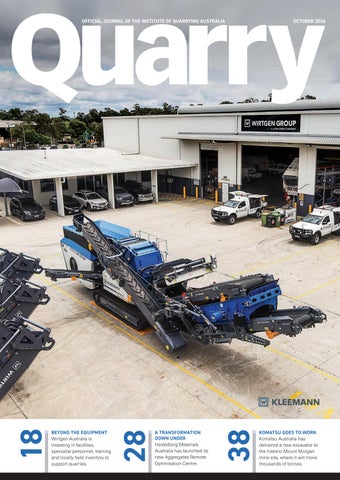
BEYOND THE EQUIPMENT Wirtgen Australia is investing in facilities, specialist personnel, training and locally held inventory to support quarries.
KOMATSU GOES TO WORK Komatsu Australia has delivered a new excavator to the historic Mount Morgan mine site, where it will move thousands of tonnes.
HM460-6
Articulated Dump Truck Haul more with optimal performance and efficiency.
385 kW / 516 HP Net Engine Power
1300 566 287 | komatsu.com.au
Scan the QR code to learn more:
42.0 t
Maximum Payload
25.7 m3
Body Capacity
IN THIS ISSUE
VOLUME 35, ISSUE 10
28
40
FEATURES
30 KEEPING QUARRIES MOVING The often-overlooked role of lubricant in quarrying operations.
20 MEASURED AND MANAGED VRents is helping quarries access Volvo equipment.
32 WHERE EXPERIENCE TAKES SHAPE Ridge is supporting emerging quarry professionals.
44 SHAPING VALUE FROM HARD ROCK Vastum Engineering can help Australian operators produce manufactured sand.
34 A BUCKET FOR BLUE ROCK A purpose-built excavator bucket is delivering improved productivity.
46 THE RIGHT DRIVE The 1150EVO Dynamic Drive is designed to increase efficiency.
36 SUPPORTING THE BULK HANDLING SECTOR Kinder Australia has sponsored the Australian Bulk Handling Awards.
48 DEMAND BOOMS FOR DEBUT A new mining show arriving in the Hunter Valley in 2027.
28 A DIGITAL TRANSFORMATION DOWN UNDER Heidelberg Materials Australia has launched its new Aggregates Remote Optimisation Centre.
38 KOMATSU GOES TO WORK Komatsu Australia has delivered a new excavator to the historic Mount Morgan mine site. 40 BEYOND THE ROCK NAMES How petrography can help explain material behaviour.
EVERY MONTH 04 EDITOR’S LETTER 06 CEO REPORT 08 PRESIDENT’S REPORT 10 IQA NEWS 46 PRODUCT FOCUS 50 GEOLOGY TALK
BEYOND THE EQUIPMENT Wirtgen Australia is investing in facilities, specialist personnel, training and locally held inventory to support quarries.
A TRANSFORMATION DOWN UNDER Heidelberg Materials Australia has launched its new Aggregates Remote Optimisation Centre.
38
QUARRY
26 VALUABLE PARTNERS Richmond Co’s introduced a new brand across three size classes.
OFFICIAL JOURNAL OF THE INSTITUTE OF QUARRYING AUSTRALIA
OCTOBER 2026
www.quarrymagazine.com
24 BENEFITS THAT STACK UP Stacker conveyors are helping reduce the need for wheel loaders.
OCTOBER 2026
22 DUST CONTROL THAT GOES FURTHER Eliminating dust at the source, while saving water.
42 PRODUCT FOCUS
28
38
32
18
OCTOBER 2026
KOMATSU GOES TO WORK Komatsu Australia has delivered a new excavator to the historic Mount Morgan mine site, where it will move thousands of tonnes.
BEYOND THE EQUIPMENT Wirtgen Australia is investing in facilities, specialist personnel, training and locally held inventory to support local quarries.
Quarry October 2026 3
EDITORIAL
SOLID FOUNDATIONS
Q
uarries and the materials that are produced there help lay the foundation for society. Without concrete, we wouldn’t have homes. Without asphalt, we wouldn’t have roads. Without sand, we wouldn’t have glass. But without new quarry workers, the quarry sector faces a serious problem. The sector provides fantastic opportunities for school leavers and supports local communities, but there is an image problem. It’s too common that young people don’t know what a quarry is, or what happens in one. The work is more than just turning big rocks into smaller ones. New technologies are revolutionising the sector, and all manner of new opportunities now exist. The Institute of Quarrying Australia’s (IQA) national campaign That’s Solid has been helping to address the myths. It is sharing stories from quarry workers, highlighting the realities of working in the sector, and raising awareness around the country. By showcasing the careers of quarry workers, the campaign supports the next generation of quarry workers in gaining meaningful employment in a sector critical to the future of Australia’s infrastructure and construction projects. It has also shown how the sector supports local communities,
employs local people, and delivers essential construction materials to the regions. Now, at the IQA National Conference on the Gold Coast, it takes centre stage. As part of the event, high school students have been invited to attend to learn how quarrying could be a part of their future. The That’s Solid Careers Day gives secondary school students the chance to connect with leading employers, hear from industry professionals, and discover where a career in quarrying could take them. By encouraging students to explore exhibitor booths, take part in interactive conversations, and hear from a panel of industry representatives, it gives them a practical and engaging introduction to the sector. The move follows a previously successful event in 2024, which saw around 60 students attending the event, listening to presentations from the IQA Young Member Network and exploring the conference. They were able to get up close and personal with some of the machines, and even got to try out a safety simulator. It’s a welcome sight to see such a wonderful initiative return, and one that will hopefully have long-lasting impacts on the sector as a whole. William Arnott Editor
Published by:
THE INSTITUTE OF QUARRYING AUSTRALIA’S NATIONAL CAMPAIGN THAT’S SOLID HAS BEEN HELPING TO ADDRESS THE MYTHS AROUND THE QUARRY SECTOR.
379 Docklands Drive Melbourne VIC 3008 T: 03 9690 8766 www.primecreativemedia.com.au
Chief Executive Officer Christine Clancy christine.clancy@primecreative.com.au Group Managing Editor Paul Hayes paul.hayes@primecreative.com.au Editor William Arnott william.arnott@primecreative.com.au Assistant Editor Adam Daunt adam.daunt@primecreative.com.au Journalist Daniel Williamson daniel.williamson@primecreative.com.au Business Development Manager Les Ilyefalvy les.ilyefalvy@primecreative.com.au Client Success Co-ordinator Janine Clements janine.clements@primecreative.com.au Head of Design Clayton Hawley Art Director Michelle Weston Subscriptions T: 03 9690 8766 subscriptions@primecreative.com.au The Publisher reserves the right to alter or omit any article or advertisement submitted and requires indemnity from the advertisers and contributors against damages or liabilities that October arise from material published. © Copyright – No part of this publication October be reproduced, stored in a retrieval system or transmitted in any means electronic, mechanical, photocopying, recording or otherwise without the permission of the publisher.
4
Quarry October 2026
Fa
HEAVY DUTY. HIGH OUTPUT. NO COMPROMISE.
A D N O C A N A E TH
536HP CAT ENGINE
R E H S U R C T C A P M I E L I B O M R I14
350-633 RPM CRUSHER SPEED
ha ration wit e p o r u o trol of y uilt for rusher b Take con c t c a p ircuit im closed-c n. roductio serious p oven ines a pr b m o c R 4 conda I1 with a The Ana chamber t c a p im an stem to McLanah lating sy u c ir c e r ut, ciency lity outp a u q h high-effi ig t, h onsisten deliver c r pass. pass afte for capacity H P T 0 50 ation • Up to me oper o -v high lu r screen fo k c e -d le 6’ doub • 14’ x ion ss precis single-pa utes er 10 min d n u in setup • Rapid nding for dema d il u b y t -du • Heavy ions an condit li a r t s u A WIDE HOPPER WINGS FOR REAR LOADING
Fast to setup, easy to maintain. Talk to our team about your crushing requirements.
Onetrak 1300 727 520 contact@onetrak.com.au onetrak.com.au
NSW: VIC: TAS: QLD: QLD: NT/WA/SA:
Joshua Goulding Chris Appleyard Rodney Onions Heiner Guenzel Ben Kelly Clifford Wadge
0405 909 892 0436 669 265 0409 711 117 0438 449 703 0477 317 762 0459 856 839
Sales. Rental. Service. Parts.
LOCAL SERVICE. NATIONAL REACH. GLOBAL PARTNERS. *Terms and conditions apply. For full details, contact Onetrak on 1300 727 520.
CEO’S REPORT
CEO UPDATE
W
hat a month. We have just come home from the Gold Coast, where more than 650 delegates joined us for the 2026 National Conference our biggest yet. A full wrap-up will follow next edition, but thank you to everyone who made the trip, and congratulations to our IQA Award winners and to Scott Whittaker on becoming our 30th President. Our IQA excellence awards drew a record 29 nominations across the categories, with the seven awards presented at the Komatsu conference dinner and the Caterpillar finale dinner. The bench of talent, innovation and leadership in this sector has never been deeper.
THINK TANKS FROM COAST TO COAST Our national quarrying awareness campaign has been criss-crossing the country. Following our Queensland and New South Wales sessions, we held think tanks in Perth on 11 August and Melbourne on 2 September - with around 40 sector leaders in the room at each, giving us frank feedback on what is working and where to take the campaign next. One more think tank is planned for South Australia in the coming months. We are now collating the feedback from all four states, and it will shape the campaign’s next steps. ON TRUCKS, UTES AND SCHOOL OVALS You may have already seen the campaign on the road: Kayasand has wrapped its first ute in That’s Solid branding and Divall’s Earthmoving & Bulk Haulage now has its second wrapped truck on the highway. Every kilometre those vehicles travel takes the story of our sector into communities we could never reach alone.
6
Quarry October 2026
Members are keeping it rolling. Since May, members have been taking That’s Solid material to school careers expos - most recently Adbri and Multotec at Mabel Park State High School in Queensland and Trainsafe at a NSW schools expo - reaching over 500 students, with Noosa Adventist College next on 21 October. Our own Andrew Dutton did the same at the Merrimac State High School careers expo, in front of Years 8-12, and at the conference more than 100 Year 10-12 students joined the That’s Solid Careers Day, Dig Into Your Future, supported by John Deere and Kleemann. And the enquiries are coming back the other way, with parents and school leavers contacting the IQA to ask about career pathways into quarrying. That is the campaign doing exactly what we built it to do.
A RECORDBREAKING PIPELINE The future looked just as strong inside the conference. We received a record 20 submissions for our Young Member Network Conference Scholarships, and the AIQEF responded in the best possible way - funding all seven shortlisted candidates, at $2750 each, to attend the National Conference. Watching those seven young members together on the Gold Coast was, for me, a highlight of the event. That’s Solid was built to tell Australia what we already know: this sector builds the future. Over the last few months, from think tank rooms to school ovals to the conference floor, the country started hearing it. Jane Schmitt Chief Executive Officer Institute of Quarrying Australia
The Institute of Quarrying Australia
Educating and connecting our extractive industry
WE HAVE JUST COME HOME FROM THE GOLD COAST, WHERE MORE THAN 650 DELEGATES JOINED US FOR THE 2026 NATIONAL CONFERENCE OUR BIGGEST YET. THE BENCH OF TALENT, INNOVATION AND LEADERSHIP IN THIS SECTOR HAS NEVER BEEN DEEPER.
www.quarry.com.au The IQA’s Strategic Plan 2023 to 2026 embodies the following vision, values and strategic priorities: Vision: Thriving communities supported by a sustainable industry Operational Priorities: • Deepen industry participation • Sustainable revenue streams • Highly capable team • Technological innovation • Effective engagement • Great governance Strategic Priorities: • Support industry participants with compliance and regulation • Build a diverse and skilled industry workforce • Foster strong industry connectivity
IQA Contacts: For all education, member and branch enquiries: Phone: 02 9484 0577 Email: iqa@quarry.com.au Chief Executive Officer Jane Schmitt President Michael Close Company Secretary David Cowie Follow the IQA on our social media pages: IQAustralia the-australian-institute-of-quarrying/ iqaus
LEADING THE WAY IN QUARRYING SOLUTIONS
Tesmec solutions offer a sustainable and performing alternative to drill-and-blast methods. These all-in-one machines combine excavation and crushing, maximizing productivity and minimizing waste. With reduced emissions, noise, and vibration, and real-time geodata for full traceability, Tesmec delivers precision, efficiency, and performance in every cut. Contact us to optimise your next quarry project. Learn more
PRESIDENT’S REPORT
MEET YOUR 30TH PRESIDENT: IN CONVERSATION WITH SCOTT WHITTAKER
T
he chains of office have changed hands. At the Hitachi Landcros welcome reception on the opening night of the National Conference on the Gold Coast, Michael Close handed over to Scott Whittaker, the IQA’s 30th President, after two years as Deputy President. Before the conference, Close sat down with Whittaker.
Michael Close: Scott, for members who don’t know you yet - where did you start? Scott Whittaker: I started with Hanson at Bass Point Quarry in 2007 as a casual operator (mostly shovelling under conveyors). This was after finishing university and wondering what I was going to do with myself. I was encouraged to enquire about Hanson’s management development program which I joined soon after. Since then, I’ve run concrete plants in Sydney, I was the area manager for west New South Wales and the Project Manager for Bass Point Quarry’s new crushing plant and infrastructure. More recently I was the supply chain manager (or operations manager) for our Sydney metro quarries, during a time when we rebranded to Heidelberg Materials. Earlier this year I moved into my current role as major investments manager to support the recent growth in the company. I’ve been lucky to see the sector from different perspectives and I’ve never stopped learning. MC: You joined the IQA in 2008, a year into your career, and you’ve been an engaged and active member ever since. What kept you in it? SW: I started in the Illawarra area which had an active sub-branch and the whole area was really engaged, including my mentors at the quarry. I enjoyed the technical content but stayed for the people. Every branch dinner and site tour has taught me something I couldn’t have learned at my own operation. And being based in the Illawarra, the IQA connected me to a national sector, not just my patch of it. It’s a network that was always there, even when I was moving around for the different roles.
8
Quarry October 2026
MC: What have two years as deputy president taught you about the role you’re stepping into? SW: That the president’s job is to listen more than talk and to support the IQA team in delivering on what the members are asking for. It’s been great to be part of what has been built these past two years: the That’s Solid campaign, the IQA Connect member app, the mentoring program, an education program shaped around what members actually ask for, and record engagement across the branches. My job is to keep that momentum going. MC: Where do you want to take the IQA? SW: We have to engage with the next generation and stay relevant as a viable industry for them. The young members network scholarships and That’s Solid careers pathways are some of the best investments we make in this space and it’s helping to improve awareness and public perception of our industry. Educating the industry including health and safety stays front and centre. And I want the IQA to be relevant to everyone in the sector the suppliers, engineers, environmental and community specialists who keep operations running, not only those in the pit. MC: The conference theme was Building the Future Today. What does it mean to you? SW: That the future isn’t something we wait for. The 100+ year 10-12 students at the That’s Solid Careers Day, the seven Young Members Network scholarship recipients in the room, the new technologies at our disposal, the pipeline of work heading towards Brisbane 2032; That’s the future, and it’s already here. Our job is to make sure the sector is ready for it and that our industry is well trained and connected. MC: Any advice for a young member reading this? SW: The quarry sector is a serious long-term option for a career. Dive in and take the opportunities to see what it’s all about. Go to the branch events, put your hand up for a committee, ask the questions nobody else is asking. You never know where it might take you.
co
“THE PRESIDENT’S JOB IS TO LISTEN MORE THAN TALK AND TO SUPPORT THE IQA TEAM IN DELIVERING ON WHAT THE MEMBERS ARE ASKING FOR.”
VOLVO THE OPERATORS CHOICE VOLVO EC360F
om a o a o c a ood mac o a d com o co o a d co c o a u .
c ad a
o da
o
| ua
o u a o o cau do m co mo a m . cau ood o a o a o . cau oduc ou ma .
IF YOU KNOW, YOU KNOW mac c o
SAFETY o c o
nou h to ru t
Fuel Efficiency o
u
.
all nou h to Car u m
u
o
o m. o a .
Contact your local branch cjd.com.au | 1300 139 804
ma
m.
om
.
Re-sale value u
o au
SUPPORT
a
u
u
ao
u m o
o ou ca u do .
a a a o a a d 4 c
d cd
a
IQA NEWS
Images: IQA
OUT AND ABOUT WITH THE IQA
Komatsu opened its Welshpool facility to trace the journey of a part, from order to dispatch, planned and breakdown.
Inside the warehouse that keeps WA’s quarries running When a machine goes down, the clock starts. On 12 August, 22 IQA Western Australia members saw what happens next. Komatsu opened its Welshpool facility to trace the journey of a part, from order to dispatch, planned and breakdown. Komatsu’s Henry Ulgen, SMART Construction’s Nic Castle and supply chain team shared real scenarios where fast turnarounds kept sites moving and what site teams can do to speed their own orders up. “Members attending were a mix of operational, technical and emerging professionals, so the tour focused on the real-world impact of what happens behind the scenes, not just the layout of the warehouse,” Komatsu business development manager and IQA WA committee member Shane Ovens said. The tour capped a big August for the WA Branch. It came just a day after the That’s Solid think tank brought over 20 sector leaders together in Perth to shape the campaign’s next phase, and the branch
10 Quarry October 2026
AGM on 26 August confirmed the 2026/27 committee, with a mix of new and returning faces ready to build on the run of activity.
Regional strength on show at Rockhampton If you want a measure of the quarrying sector’s health in regional Queensland, try getting a tee time at the IQA Central Queensland (CQLD) sub-branch golf day. Players filled Rockhampton Golf Club on Friday 14 August, one of the sub-branch’s biggest fields yet, drawing operators, suppliers and contractors from across the region. Nine sponsors backed the day, led by Hastings Deering on the drinks cart and Orica on catering, with Down 2 Earth Equipment, H-E Parts International, SmartTech Australia, Bridgestone Mining Solutions Australia, CJD Equipment and Crusher Spares Australia across the course. A barbecue lunch, a sunny round and clubhouse presentations rounded out the day, coordinated by sub-branch Chair Sam Hill and the CQLD committee.
Queensland women in quarrying set new record Queensland’s Women in Quarrying (WIQ) community turned out in force on Wednesday 5 August, with nearly 50 women and supporters making the WIQ Boral Purga Quarry tour the biggest WIQ event Queensland has held to date. Hosted by the Queensland branch WIQ Committee, the day paired an interactive bus tour of the Boral Purga operation with a networking lunch in a bespoke marquee at The Q, Purga, sponsored by Ausrocks Resource Consultants, with thanks to Carl Morandy for backing the initiative. The tour gave attendees a firsthand look inside a working quarry, from the pit to the plant, with the Boral Purga team on hand throughout to share how the operation runs day to day. The conversations continued over lunch, where members and guests from across the sector connected, compared experiences and built the networks that WIQ exists to grow. RUD Chains national sales manager of tyre chains Ivana Arsenic said the event was
The Institute of Quarrying Australia
More than 100 guests attended the event at the Adelaide Pavilion on Friday 28 August.
a great opportunity to “meet and connect with people across the industry”. “This event made me feel so proud to belong to the IQA and to be a part of WIQ,” said Queensland WIQ coordinator Charlie Eaton. “The turnout was incredible. To see so many women attend was testament to just how many of us are involved in this amazing sector. We couldn’t have had the event without the great team from Boral Purga what a view into their world.” The event was driven by the Queensland WIQ Committee: Charlie Eaton, Sue Rogan, Amy Conway and Riana Kirby, with IQA Queensland engagement and events coordinator Bec Farnes. Planning is already underway for the next WIQ gathering in 2027.
Close takes the chair Michael Close may have handed over the IQA presidency on the Gold Coast, but he’s not slowing down. More than 100 guests at the Adelaide Pavilion on Friday 28 August saw him elected South Australia branch chairperson
at the branch’s annual general meeting (AGM) dinner, which he hosted while still serving as IQA president. Adbri national manager assets Ivan Winter marked the end of an era – the retirement of the MV Accolade II after 44 years and more than 75 million tonnes of limestone moved across South Australia’s supply chain. Its replacement, Yampu, is a batteryelectric diesel hybrid built to lift capacity, cut voyage frequency and support Adbri’s net-zero pathway, a working example of long-term asset planning in the sector. The evening also recognised the branch’s people: Fellowships for Clint Hart (Lincom Group), Vincent Nigro (Boral) and Trevor Smith (Adbri), five new membership certificates, and ten-year acknowledgements for Mark Bevan (BML Ventures), Paul Eimbrodt (Hallett Group), Clint Hart, Tim McDonald (McDonald Earthmovers), Vincent Nigro and Steve Seal (Heidelberg Materials). A 16-strong committee of members and suppliers was elected, with Elijah Thompson (Hallett Group) as deputy chairperson and Lachlan Fricker (Clay
IQA NEWS
& Minerals) as Young Member Network coordinator. The committee thanks its sponsors, members and the employers who support their staff to attend.
Fifty years of safety in one room How do you measure how far quarrying safety has come? Put a 1969 quarry cadet next to a 2023 recruit and ask them both. That was the Victorian branch’s Winter Quarry Night on Thursday 13 August, where 49 members filled the Craigieburn Sporting Club for the branch AGM and a “Safety: Past vs Present” panel. Royden Webb (EB Mawson and Sons), five decades in from cadet to director, and Anita Macartney (Mactown Consulting), formerly WorkSafe Victoria’s Earth Resources lead, traded perspectives with two newer entrants; Finn Poxon (Boral Wollert), a casual operator in 2020 and now Site Coordinator, and multiskilled operator Cat Owen, who joined through the Women in Training program in 2023. The generations compared first memories of “safety” on site, the practices now second nature, and what still needs to shift. The AGM confirmed the branch’s 2026–27 committee, led by Chair Alex Murray.
New faces, full room for southern New South Wales Members and guests filled the room in Mittagong for the southern region New South
Education front and centre: from the conference floor to the course calendar The supervisor line-up keeps growing. Managing Your Team 101 had its first run in September, Fundamentals of Blast Management for Supervisors debuts this month, and Bow Tie Risk Assessments is in design for November. Together they continue the shift the IQA has tracked all year: building leadership capability alongside technical skills, at every level of an operation. The October calendar runs deep on safety and risk. Hazard Identification and Critical Control Management open the week, followed by Managing in the Middle for those leading between the site and the boardroom. Contractor Safety Management and Introduction to Quarrying round out the month, with Fundamentals of Blast Management for Supervisors dates to be confirmed. All run as webinars with Continuous Professional Development (CPD) hours attached, so teams can join from site, the office or home. The schools outreach that has run since May continues, with Noosa Adventist College’s careers expo next on 21 October. Workplaces and schools can find career pathway materials for employers and job seekers, the Student and School Work Experience Toolkit, the jobs board and the Find a Quarry directory for locating local employers at quarry.com.au. If your operation wants to host work experience or appear at a local careers expo, the education team can set you up with everything you need.
Wales sub-branch’s annual Christmas in July AGM dinner, supported by NSW Gold Partner and event sponsor Laidlaw Equipment. The evening opened with a Women in Quarrying pre-dinner networking session, supported by Benedict Industries, where 22 women from across the sector shared experiences and built new connections before the celebrations began.
The 2026/27 AGM followed, welcoming four new committee members alongside a strong team of returning volunteers, a committee already hard at work on the region’s event calendar. Special guest Tahir, of Fat Pizza fame, kept the room laughing through the night, and every attendee went home with a gift thanks to supporting businesses. •
Upcoming courses and events Event
Date
Time
Location
IQA National Conference
Tue 6 – Thu 8 Oct
7:30am – 4:00pm
Gold Coast Convention and Exhibition Centre
That’s Solid careers day
Wed 7 Oct
9:30am – 11:30am
Gold Coast Convention and Exhibition Centre
Far North Queensland sub-branch (Cairns) end of year event
Fri 16 Oct
3:00pm – 5:00pm
TBD
Hazard identification webinar
Tue 20 Oct
10:00am – 11:30am AEDT
Online
Critical control management webinar
Wed 21 Oct
9:00am – 11:00am AEDT
Online
Managing in the middle webinar
Thu 22 Oct
9:00am – 11:00am AEDT
Online
Annual IQA Western Australia golf day
Fri 23 Oct
10:30am – 6:00pm
Joondalup Resort
Contractor safety management webinar
Tue 27 Oct
8:30am – 12:30pm AEDT
Online
Introduction to quarrying webinar
Thu 29 Oct
9:30am – 1:30pm AEDT
Online
Central Queensland sub-branch (Rockhampton) end of year networking event
Fri 30 Oct
4:00pm – 6:00pm
X Golf Rockhampton
Managing conflict and difficult conversations webinar
Wed 4 Nov
9:00am – 11am AEDT
Online
12 Quarry October 2026
T
SANY SY500H POWER THAT MOVES MORE
When power matters, the SANY SY500H delivers. Designed for high-production earthmoving, quarrying and mining applications the SY500H delivers outstanding breakout force, reliability and operator comfort. With impressive digging power, exceptional fuel efficiency and a robust design built for the toughest Australian conditions, the SY500H is engineered to keep your operation moving while maximising your uptime.
WHY CHOOSE THE SY500H: OUTSTANDING POWER HEAVY DUTY PERFORMANCE MAXIMUM PRODUCTIVITY EASY TO OPERATE
Take on the toughest jobs with confidence. Discover the SANY SY500H today.
1300 788 757 www.cea.net.au/sany
BRISBANE - MACKAY - ROCKHAMPTON SYDNEY - NEWCASTLE - ADELAIDE - PERTH
BECOME A LOCAL LEADER The Institute of Quarrying Australia encourages members to serve on branch committees to support events, networks and regional sectors.
A
lex Murray arrived at her first Institute of Quarrying Australia (IQA) event wondering whether her age would leave her on the outside looking in, but one evening changed that expectation. Her mother, Jo Murray, introduced her around the room. Instead of the unfamiliar environment Murray had anticipated, she found a community ready to welcome her. “When I first started in quarrying, I was young, naive and almost convinced I would never make friends in the industry because of my age,” IQA Victorian Branch chair and Victorian Young Members Network coordinator Alex Murray said. “My mother invited me to my first IQA event and introduced me to everyone there. I was warmly welcomed and immediately drawn to the sense of community.” The experience became the starting point for Murray’s own involvement. Having benefited from somebody making the first introduction, she wanted to make entering the industry less daunting for those who followed. “From that moment, I made it my mission to become as involved as possible, particularly with the younger generation of the industry,” she said. The Southern Region NSW Committee • Michael Holz, Benedict Industries (chair) • Brett Jarvis, Benedict Industries (deputy chair) • Amanda Minard, Benedict Industries (treasurer) • Erin Andrew, Boral (YMN coordinator) • Kerry Sheehan, Divall’s Earthmoving & Bulk Haulage (WIQ Coordinator) • Paul Arnold, Benedict Industries • Matthew Hook, Adbri • Vince Matthews, Gunlake Group • Ross Whiting, Benedict Industries • Anthony Rintala, Lima South Quarry • Angela Carini, Boral • Ellie Clarke, Adbri
14 Quarry October 2026
“Entering an unfamiliar industry and trying to make friends can be extremely daunting. I want to make it as easy as possible for people to connect with like-minded individuals.” Across Australia, volunteer committees organise technical evenings, site visits, networking functions and professional development activities shaped around their regional sectors. Branches and sub-branches extend those opportunities beyond the capital cities, connecting quarry professionals who might otherwise miss out on industry events. Regional priorities also differ, and local committees provide a setting where operators, suppliers, contractors and other professionals can focus on the operating, safety and workforce matters most relevant to their area. For IQA Southern Region NSW chair Michael Holz, committee involvement provides a way to contribute knowledge while continuing to learn from the wider network. “Being an IQA member means being part of a network of people who are passionate about supporting and improving the quarrying industry,” he said. “It gives me an opportunity to share my knowledge, learn from others and contribute to the development of industry best practice. “I became involved with my local branch to connect with like-minded people, support professional development and give back to a sector that has provided me with many opportunities throughout my career.” The IQA also runs two specialist networks, Women in Quarrying and the Young Members Network, providing pathways for women and emerging professionals to meet peers, participate in events and become involved in the IQA. Committee members connect the IQA’s national activities with local industry needs. They understand the issues affecting their regions, and their observations help shape technical events, site visits, webinars and educational programs so that professional development reflects the conditions members actually encounter.
The IQA branches and sub-branches plan and host educational and professional networking events for the quarrying sector.
The Victorian Branch Committee • Alex Murray, South East Sands (chair and YMN coordinator) • Jo Murray, South East Sands (deputy chair and WIQ coordinator) • Blair Mather, Boral (treasurer) • Wayne Millsteed, Liebherr-Australia • Jake Van Bergeijk, Boral • Clifford Hutchings, Hitachi Construction Machinery • Tejinderjeet Panesar, TSP Group • Krish Pande, Matec Pacific • Paul Bayne, Bridgestone Mining Solutions Australia • Shane Hickson, Tutt Bryant Equipment • Thomas Phillips, BA Equipment Group • Jayson Burleigh, Vertu Equipment Victoria Committee members give their time and sector knowledge, but they are not expected to work alone. Branch and sub-branch committees generally meet monthly or quarterly, and the IQA team supports them with administration, communications and event coordination so they can concentrate on what will be most valuable to their local members. Members do not need to hold a senior management position or have previous committee experience to participate. They must be IQA members, but an interest in the sector, ideas for activities and a willingness to contribute are the real starting point. For Murray, staying involved is a way to welcome people to the sector that embraced her when she started. “I simply want to become a version of the people who welcomed me at that first IQA event,” she said. “Being involved with the Victorian Branch, the Young Members Network and the wider IQA is helping me become that person.” Prospective volunteers can contact their local branch, speak with the IQA team at iqa@quarry. com.au or explore the committees through the IQA’s website. • For more information, visit quarry.com.au
Image: IQA
IQA
IQA
THAT’S SOLID: AUSTRALIA IS STARTING TO NOTICE That’s Solid, the IQA’s first whole-of-sector public awareness campaign, is showing up across the country.
F
ollowing sessions in Queensland and New South Wales, 40 sector leaders gathered in Perth on 11 August and Melbourne on 2 September to give feedback on where to take the campaign next. A South Australian session follows in the coming months, and the four-state feedback
40 sector leaders gathered in Perth on 11 August September to give feedback on where to take the campaign next.
16 Quarry October 2026
ON THE ROAD WITH FRANK Kayasand has wrapped the first That’s Solid ute, carrying the campaign creative, “I use the latest technology, but I’m not tied to a desk.
I’m a quarry worker. That’s Solid.” It joins Divall’s second wrapped truck. Quarry spoke with Kayasand national sales manager, IQA board director, and That’s Solid ambassador Frank Grech to learn more. Frank, why put That’s Solid on a ute? FG: Because the message travels. That ute visits quarries, construction sites and country towns every week – places a billboard never reaches. And the creative says exactly what we want young people to hear: this is a modern, technology-driven career, not a desk job. Why does this campaign matter to you? FG: For too long we’ve been the invisible sector. Everything Australia builds starts with us, and almost nobody knows it. That’s Solid gives every member and every company a simple way to show what we do. What would you say to companies thinking about getting involved? FG: Just start. A ute, a truck, an email signature, sharing a post, it all adds up. The campaign has done the creative work; we just have to carry it. • To get involved, visit quarry.com.au/thats_solid
Images: IQA
That’s Solid is showing up at school careers expos, and in the feeds of parents, students and quarry workers.
is being collated to shape the campaign’s next phase. From June to August, the paid campaign ran on two fronts: LinkedIn for the quarrying community, and Instagram and Facebook for the wider community - parents and young people weighing up careers. What it delivered: • The sector’s story was seen 6.2 million times by Australians, at a fifth of benchmark ad costs. • More than 29,000 people clicked through to explore quarrying careers, and 25–34s, exactly the generation the sector needs, were the most engaged. • The most-clicked message by far: “I Operate Heavy Machinery, but I’m Not a FIFO Worker”, proof the myth-busting is what lands. • Beyond the ads, more than 48 member organisations have shared content, 1732 schools have been contacted, over 500 students were met at expos, and 180 quarries have been listed on Find a Quarry across every state and territory.
represented in Australia & NZ by:
www.blissandreels.com.au
COVER STORY
BEYOND THE EQUIPMENT Wirtgen Australia is investing in facilities, specialist personnel, training and locally held inventory to support quarries.
A
machine’s capacity, fuel consumption and price quickly diminish when something goes wrong and it can’t operate. Without the right component or knowledge, the machine may be out of operation entirely. Wirtgen Australia’s team works hard to prevent this from happening. The company’s manufacturer-owned structure shortens the distance between Australian customers and the people who design and build the equipment. “Our people can communicate directly with the factories because, ultimately, we are all employed under the same banner being the Wirtgen Group,” Wirtgen Australia national sales manager Ben Lefroy told Quarry. “That provides a different structure from a dealer as the customer is ultimately talking directly with the original equipment manufacturer.” “To support that connection Wirtgen Group is constantly making investments in our
Wirtgen Australia supports Kleemann equipment across Australia.
18 Quarry October 2026
internal systems to streamline process which benefit the end user.” Wirtgen Australia has expanded its Victorian facility, upgraded its Brisbane operation, and is developing a purpose-built facility in Perth, creating additional capacity across its national network. The business also supports South Australia and the Northern Territory via remote networks, extending technical assistance beyond the states where its principal facilities are located. In addition, Wirtgen Australia national parts manager John Richardson estimated that the business holds over $19 million of Kleemann inventory across Australia and New Zealand to support the Kleemann brand alone. Richardson said the total figure mattered less than placing the appropriate components near the machines that are likely to require them. “It can mean the difference between virtually no downtime and potentially waiting
weeks for a machine to return to service,” Richardson said. “A problem with one machine can disrupt three or four parts of the operation.” Parts availability impacts the usage of equipment beyond the machine requiring repair. If a crusher stops, the excavator feeding it may be idled, downstream screening and conveying can be interrupted and the loader handling finished material may have less product to move. Lefroy said the response then depended on finding the most practical route back to production. “Even with that level of inventory, it is impossible to hold every part a customer may require,” he said. “However, we are solution focused. If we do not have a part in stock but can remove it from another machine to improve a customer’s uptime, that is what we will do.” The support model also depends on identifying why a part failed rather
Images: Kleemann Wirtgen Australia has invested significantly in training its staff to support local quarry operators.
than treating replacement as the complete solution. Wirtgen Australia has invested in aftersales support specialists with technical backgrounds and field experience. Their role can encompass inspections, servicing, major repairs, training, and parts requirements. For a new project, Wirtgen Australia can develop simulations and plant footprints before equipment reaches site. This allows the proposed crushing train, material flow and production objective to be examined while changes remain easier to accommodate. A larger quarry train, for example, could combine an MC 120 PRO jaw crusher, MCO 110 PRO cone crushers and an MSC 953 EVO classifying screen. A smaller operation or a more mobile application may be better served by an MC 110 EVO2 jaw crusher, an MCO 90 EVO2 cone crusher, and a classifying screen. Softer stone, such as limestone, can present a different case for impact crushing. Wirtgen Australia application support manager Nico Schiela said that changing geology, site layouts, and commercial requirements meant that machines and settings had to be considered in context. “You cannot treat every customer in the same way. Every application is different and every customer has a different business structure and approach to its operation.” When visiting an existing operation, Schiela initially observes the plant running normally. He then discusses what he has seen, explains possible changes and considers any operating restrictions that prevent the most obvious solution.
The recommendation could involve improving the product’s shape, reducing wear, or altering the wider train. Wirtgen Australia spent the past year progressing technicians from basic instruction into advanced, applicationbased and on-site training. Sales and service personnel are brought together so information gained in one part of the business can strengthen decision making. Customer training completes because, as Schiela said, delivering a machine without helping personnel understand its capabilities left part of its potential unused. “The best tool does not help if you do not know how to use it,” he said.
“It is not only about delivering machines but also delivering solutions.” For Lefroy, the Australian facilities, inventory, specialist knowledge and training are parts of the same commitment: ensuring the relationship continues after a machine enters service. “We do not want to leave customers waiting without considering all available options to improve machine uptime,” he said. “Wirtgen Australia are committed to their existing and new customer base by continuously investing back to support the quarrying industry for years to come.” • For more information, visit wirtgen-group.com
Wirtgen Australia maintains a substantial stockholding of parts to support servicing Kleemann equipment in Australia.
Quarry October 2026 19
EQUIPMENT HIRE
MEASURED AND MANAGED VRents is helping quarries access high-quality without the need for capital expenditure.
W
hen it comes to quarry machinery, few things are more important than uptime. Reliable machines that are easy to service, can withstand tough quarry conditions, and provide dependable productivity will usually be popular among quarry managers. VRents managing director Chris Bradley said these characteristics are why the company specialises in Volvo Construction Equipment excavators, dump trucks, and wheel loaders. “We started off within a Volvo dealership, hiring out equipment to Volvo customers
to give them more options,” he told Quarry. “The fact that we specialise solely in Volvo equipment is our point of difference. We’re not trying to be everything to everyone.” “We have a strong understanding of the product and good working relationships with the teams at CJD and Volvo. “We believe they’re the best equipment available. The quality of the build, the technology included in the machines, their reliability and low cost of maintenance – they’re top-quality machines that keep getting better.” VRents was founded in 2016 in South Australia. Over the past decade, it has
branched out into Victoria and Queensland. Today, the company services clients across Australia with short- and long-term rentals. The company aims to make every step of the process as easy as possible. It can prepare the machine to meet any specific site requirements, arrange transport, supply compliance information, and arrange on-site servicing and maintenance when required. It has also begun to roll out “equipment as a service” (EaaS), which Bradley said is a popular format in North America and Europe.
VRents has built a fully integrated technology platform that provides valuable information for quarry managers. 20 Quarry October 2026
Images: VRents
S S
U
V
VRents is a specialist when it comes to Volvo Construction Equipment.
“Equipment as a service is an innovative equipment management and procurement solution where VRents provides not just the equipment you need, but everything required to keep it compliant, available, and operating at its optimum,” he said. “VRents doesn’t just manage the fleet; it owns it, so you don’t have to. That means you can allocate your capital and resources to the value-added activities that are core to your business.
“With EaaS, you only pay for what you use, including service and maintenance, so there are no unexpected bills or end-of-term risks. You’ll know exactly what your hourly costs are for the life of the agreement.” To support its customers, VRents has built a fully integrated technology platform that provides valuable information for quarry managers. Customers can log in to a portal connected to Volvo’s CareTrack telematics system to view live data. “Not only do we have telematics from the machines coming through to us, but we also have the operator’s observations coming into the platform,” Bradley said. “Everything is captured electronically. Customers can see all the machines they have on hire, ensure they are getting good productivity from them, while we monitor them 24/7 and manage any issues that arise. “If you can measure it, you can manage it. With that information, you can then make decisions and adjustments to haul routes or workflows to make things more efficient.”
The system includes the QR code system, Checklinx, that VRents developed to enable operators to scan and enter their daily checklists, report an issue, check the status of a work order or review the machine’s service history and compliance information. Clients can also view this information from anywhere via the VRents Connect client portal. If there are any issues, this system notifies the VRents team to help triage the incident and respond as soon as possible. VRents can then use the system to find the closest contractor. “Our digital platform provides all the important information that clients need. A lot of our customers think our QR code system should be the industry standard,” he said. “Renting Volvo equipment has never been easier or more cost-effective. Our EaaS solution offers quarries another option.” • For more information, visit vrents.com.au
STOP ROLLER FAILURES. START RUNNING SMARTER. Switch to K-Polymer® Rollers Static End Disc Design Lightweight Construction Corrosion Resistant Available in a range of sizes to suit your application.
REDUCED SEIZURE RISK
UP TO 7DB QUIETER
SAFER HANDLING
CLEANER OPERATION
LOWER MAINTENANCE
Static end disc engineered design.
Compared to steel rollers.
Lightweight, easy to handle and install.
Reduced carryback build-up.
Less downtime. Longer life.
Upgrade your conveyor reliability Visit kinder.com.au
DUST CONTROL
DUST CONTROL THAT GOES FURTHER Rainstorm Dust Control is helping quarries manage dust at the source, while saving water and reducing maintenance costs.
Rainstorm provides a suite of products to mines and quarries.
22 Quarry October 2026
out onto the road? If so, then the problem isn’t a dusty road, it’s stopping dust from clinging to the trucks. “Whenever we go in, we analyse what the actual problem is – not just provide a quick fix at where the dust is noticed but to solve the problem at the root cause.” Rainstorm is a specialist dust-control company that provides a suite of products to mines, civil contractors, local governments, and quarries. Since its inception more than 30 years ago, the company has focused on dust control, soil stabilisation and rehabilitation solutions. As the company grew, it began to develop
its own products, responding to the local Australian environment. One such solution is Dustmag, a hygroscopic liquid applied to unsealed road surfaces. The solution attracts and retains moisture from the air to control dust, requiring no mixing. Dustmag has been tried and tested across more than 10 million square metres of road in the Pilbara, in Western Australia, over the past 20 years. Scott said Rainstorm is proud to be the only dust control provider that manufactures locally in Australia. “DustMag is produced in Karratha, Western Australia using sustainable practices that
Image: Rainstorm
E
liminating dust can require more than just water. In fact, water can exacerbate the problem if it evaporates too quickly. Rainstorm Dust Control sales manager Robert Scott said finding out where the dust is coming from is the first step in solving dust control problems in quarries. “Our team goes out to monitor the area of concern, doing a very quick analysis on what the right solution is,” he told Quarry. “If you have a dusty road, the next step is to find out why. Is it because the trucks are getting loaded up in the pit and bringing dirt
convert bittern streams into effective dustcontrol solutions,” he said. “Surfaces remain dust-free for extended periods of time with no watering required. “However, it’s important we choose the right product for the application. DustMag has helped massively in the Pilbara for light vehicle roads, but if there are heavy vehicles, they can churn it up with their wheels.” “But DustLig, our Ligninsulphonate product, loves to be compacted. The more you drive over it, the more compression there is and the more effective it is.” Using a combination of DustMag and DustLig can provide high-performance dust mitigation and stabilised running road surfaces under extremely heavy haulage. As an organic binder, DustLig holds materials in place and forms a bond, while DustMag retains some moisture, keeping the bonds flexible for a smoother road surface. Scott said machinery moving around the quarry itself can also create dust, which is
where the company’s DustJel can assist. When added to water, DustJel holds a high molecular weight, which leads to significantly slower evaporation rates, saving or extending the water used on dust control by up to 30 per cent. “DustJel is effective in surprisingly small quantities,” Scott said. “It can be applied at a ratio as low as 1 litre per 5000 litres of water to 1:10,000 litres of water. “Our custom-designed dosing system makes mixing very simple. It connects directly to the standpipe for simultaneous water-product loading and is available with solar battery, plug-and-play or hardwired power options. The units can be automated, remote-controlled or manually started on a timed dose rate to suit your water cart capacity. “A more efficient water cart also requires less maintenance, as there is less strain being placed on the cart itself.”
> Articulated Dump Trucks > Wheel Loaders > Excavators
The wind can also pose issues in open areas, especially for stockpiles. To eliminate wind-blown dust, Rainstorm supplies Gluon, a waterborne polymer emulsion that can be sprayed onto soil surfaces to form a “crust”. The product is mixed with water and sprayed onto a surface, where it binds with soil and dust particles. It fixes the soil into place, while preventing water erosion. Scott said Rainstorm’s methods of eliminating dust make quarry sites safer. “Quarries love how our products can eliminate dust at the source,” he said. “It’s done straight away, with maximum protection, efficiency, and profitability. “We can even remotely monitor the performance of our products as we go. If there’s a really hot, windy day coming up, a customer can call us ahead of time and we can help them have everything ready.” • For more information, visit rainstorm.com.au
> Volvo Connect Ready > Flexible rental options > 24/7 fleet monitoring
WA/SA/NT Chris Bradley 0477 477 449 National Service Network
QLD/NSW Simon Hill VIC/TAS
0477 477 493
Glenn Simonis 0438 788 741
View our range vrents.com.au
Anaconda’s range of tracked stacker conveyors are designed for reliable material transfer and stockpiling operations.
BENEFITS THAT STACK UP Onetrak’s range of mobile stacker conveyors is helping quarries reduce the need for wheel loaders in stockpiling.
W
ith global volatility causing chaos when it comes to fuel prices, some quarries are placing even more focus on improving fuel efficiency. One way to reduce fuel consumption is to limit wheel loader use during stockpiling. Onetrak business manager of crushing and screening Heiner Guenzel told Quarry that tracked stacker conveyors can handle moving material from the mobile plant, instead of using a wheel loader. “Usually, on a site with stationary plant, they can make use of permanent infrastructure like conveyors,” he said. “With our tracked conveyor stackers, you maintain the flexibility needed to support other mobile equipment, avoiding the need for more wheel loader traffic.” Onetrak is a supplier of earthmoving and construction equipment, primarily serving the quarry, forestry, construction, and recycling sectors. It has partnered with major brands such as Anaconda to bring these solutions to Australian shores. Anaconda’s range of tracked stacker conveyors is an example of this in action. The portable mobile stacker conveyors are designed for reliable material transfer and stockpiling operations. Built for use directly behind crushers, screens, and trommels, the stacker conveyors efficiently transfer and stockpile
24 Quarry October 2026
materials including soil, aggregates, sand, coal, and overburden. Guenzel said the stackers combine strength and efficiency with low fuel use. “Hydraulic raise-and-lower front and rear legs make setup quick, while the trackmounted undercarriage ensures stable movement across uneven ground,” he said. “The RR7542 model can be fully folded to fit into a shipping container without breakdown, simplifying transport between sites and reducing downtime during relocation. “The Anaconda stacker conveyors are designed to support crushers and screening plants as part of a complete mobile conveyor system, maintaining steady material flow and improving site efficiency. With a compact footprint and fast deployment, it’s ideal for contractors, quarry operators, and recycling facilities needing a durable, portable stacker conveyor that keeps up with production demands.” Onetrak works closely with its customers to help them find the right solution for the job. Its staff visit the quarry to learn more about the specific application, drawing on their extensive knowledge of Onetrak’s product line to achieve the best results. Guenzel said that for quarries looking for a more heavy-duty stacker conveyor, the Anaconda TR100 is ideal. “The Anaconda TR100 Tracked Conveyor is designed for high-output
material handling and large-scale stockpiling,” he said. “Built for strength and long-term performance, the TR100 features a robust lattice-framed conveyor body and a wide 1050mm three-ply belt that supports heavy loads while minimising belt wear. With the ability to form stockpiles up to 13.5m high, the TR100 tracked stacker reduces loader cycles and stacker repositioning, helping operations maximise output and save time on site. “Operator efficiency is a key focus of the TR100 conveyor system’s design. The head and tail sections of the powered conveyor fold hydraulically for rapid set-up and teardown times, while its tracked stacker undercarriage moves easily across uneven ground and large work sites without the need for additional handling equipment.” Onetrak offers new and used machine sales, equipment hire, service, and parts from eight branches across Australia. “Our team has focused on building a portfolio of machines that can support several sectors, including quarries,” Guenzel said. “If you’d like to discuss efficient machine and conveyor systems for your current or future operations, just reach out to our friendly team. We can do full purchase or rental packages to suit your needs.”• For more information, visit onetrak.com.au
Image: Onetrak
CONVEYORS
LOADING
VALUABLE PARTNERS Richmond Co’s experience with SANY equipment gave it the confidence to introduce a new brand across three size classes.
T
he first test of Richmond Co.’s new SANY fleet occurred before any of the machines moved any material. It began in the conversations between the South Australian contractor and CEA. “Richmond Co. began more than three decades ago with Jack Mouhalos’ vision for a construction company built on integrity, hard work and lasting relationships,” Richmond Co. general manager Emmanuel Mouhalos said. “Our values remain central to how we operate. With a new generation of family members involved in daily operations, we continue to grow while staying true to our foundations.” That relationship led Richmond Co. to acquire a 16-tonne SY155U excavator, a
37-tonne SY365H excavator and a 12-tonne SSR1200 smooth-drum roller. Each machine was selected for a distinct role as the Gillman-based contractor prepared for upcoming bulk earthworks packages around Adelaide. Richmond Co. undertakes commercial and industrial civil works, earthworks and contaminated-site remediation across South Australia. Emmanuel now leads the secondgeneration family business. Its fleet comprises around 25 excavators, graders, rollers, loaders, skid steers, bulldozers and trucks. The compact SY155U was acquired to replace an existing excavator. Before Richmond Co. committed to the purchase, CEA demonstrated the machine on a worksite.
“When the CEA team demonstrated the SY155U, we thought it was very well balanced with smooth hydraulic functions,” Mouhalos said. Its reduced-tail-swing design allows the excavator to operate in confined areas while retaining the stability and lifting capacity required for civil construction. The configuration is suited to sites where operators must work near structures, traffic routes or other equipment. CEA product specialist Deon Cope said the machine combined a compact footprint with practical operating performance. “A standout feature of the SY155U is the reduced-tail-swing design, which improves site safety and manoeuvrability without sacrificing stability,” he said.
Richmond Co. added three SANY machines to support its growing pipeline of earthworks projects in South Australia.
26 Quarry October 2026
Images: CEA
LE
c i
A worksite demonstration allowed Richmond Co. to assess the SY155U in real-life conditions.
“Operators also benefit from a spacious, well-appointed cab with excellent visibility, intuitive controls and low noise levels, making it comfortable for long shifts.” Where the SY155U replaces an existing machine, the larger SY365H increases Richmond Co’s excavation and materialhandling capacity. The model will support bulk earthworks projects alongside the SSR1200 roller, providing the contractor with additional capacity during compaction. “These machines will be used in bulk earthworks projects around Adelaide for leading builders and developers,” Mouhalos said. “They will help us complete our scope of works efficiently and maintain the program, which is key in our field.”
Powered by a 212kW Isuzu engine, the SY365H carries a 1.6m³ bucket. Its applications include bulk earthworks, road construction, trenching, drainage, material loading and rock excavation, making it relevant across civil infrastructure and quarryrelated work. Cope said operators were likely to notice the machine’s balance and hydraulic response. “The hydraulic system delivers smooth, precise control while still providing the breakout forces and lifting capability needed for demanding civil construction work,” he said. “Combined with excellent visibility, a quiet cab and intuitive controls, it’s a machine that operators tend to become comfortable with very quickly.”
The excavator also uses rear and side cameras to provide a 270-degree view through a 10-inch touchscreen. Its spacious cab, ergonomic controls and low noise levels are intended to reduce fatigue during repeated digging and loading cycles. For Richmond Co., purchasing modern SANY equipment with CEA’s support has enabled it to uphold its family business’s proud reputation. “We put our clients first, invest in modern plant and technology and champion safe and sustainable practices,” Mouhalos said. “It’s how we’ve earned the trust of government, developers and partners across South Australia.” • For more information, visit cea.net.au
LEADERS IN MODULAR CRUSHING, SCREENING AND MATERIAL HANDLING SOLUTIONS
c usiv i
ust a ian ist i uto of
ou fu ui m nt an vastum.com.au
at
info@vastum.com.au
CONSTRUCTION MATERIALS
A DIGITAL TRANSFORMATION OCCURS DOWN UNDER Heidelberg Materials Australia has launched its new Aggregates Remote Optimisation Centre in Brisbane, marking a milestone achievement for the global company.
H
eidelberg Materials Australia has officially launched its new Aggregates Remote Optimisation Centre (AROC) in Brisbane, marking a significant milestone in the company’s digital transformation journey. Opened on 20 July 2026, AROC is the first centre of its kind established anywhere in the worldwide Heidelberg Materials network. The facility brings together specialist expertise, advanced monitoring technologies and real-time operational data to support quarry performance across Heidelberg’s Australian aggregates network. AROC acts as an extension of on-site teams, providing centralised visibility of operations and enabling faster, more informed decision-making. By consolidating operational intelligence into a single location, the centre is designed to improve equipment reliability, optimise production outcomes and create greater consistency across multiple sites.
Initially supporting eight automated quarry sites across multiple states, AROC has the capability to be expanded as additional sites adopt compatible systems. According to Heidelberg Materials Australia regional general manager for the Western Region Anthony Clarkson the centre represents a natural next step in Heidelberg Materials Australia’s ongoing investment in innovation and operational improvement. “AROC is about combining the expertise of our people with the power of real-time operational data,” Clarkson said. “Rather than replacing local decisionmaking, the centre strengthens it by providing additional visibility, technical support and insights that help teams respond quickly and make better-informed decisions.” The decision to establish the first AROC in Australia was driven by the company’s existing digital capabilities and the maturity of its quarry automation program.
Images: Heidelberg Materials Australia
AROC combines automation and digital capabilities across multiple quarry sites.
28 Quarry October 2026
Unlike other regions that would have required significant investment to develop new digital infrastructure, Heidelberg Materials Australia’s automated quarry sites were already generating standardised live operational data through existing systems. This provided an ideal foundation for the rapid deployment of a remote optimisation model. The company’s existing quarry automation platform already incorporates Industrial Internet of Things (IIoT) capabilities, automatically capturing and reporting critical operational and event data to Heidelberg Materials’ global reporting systems without operator intervention. Because the required data architecture was already in place, Australia was able to implement the new model quickly and efficiently. “Australia was a natural choice because our automated quarry sites were already producing the standardised, live data needed to support centralised monitoring and optimisation,” Clarkson said. Heidelberg Materials Australia national aggregates and remote optimisation manager Burcin Ozturk said a further advantage was the concentration of suitable sites operating under similar systems and processes, creating the scale needed to justify a dedicated optimisation team. “AROC represents the next step in the evolution of quarry operations within Heidelberg Materials Australia,” she said. “The centre creates a scalable platform for future growth, allowing us to leverage data more effectively, standardise best practices across sites and continuously improve performance through a proactive, datadriven approach.” Six employees currently work within AROC, monitoring performance and collaborating with site teams to identify opportunities for improvement. As the first centre of its kind within Heidelberg Materials globally, AROC provides a model for how centralised operational intelligence can enhance
I
W a s Q
quarry performance, strengthen operational consistency and support continuous improvement across multiple sites. The centre leverages a range of advanced technologies and monitoring platforms, including Komatsu’s Smart Quarry Site (SQS), Zenon, AOM Live, AggFlow and video surveillance systems. Together, these platforms provide a comprehensive operational picture, enabling the team to analyse plant performance, identify emerging issues and support proactive decision-making. Improved visibility also supports safer operations by enabling earlier identification of abnormal conditions, reducing the likelihood of unplanned equipment failures and associated operational risks. For example, the centre can identify developing bottlenecks, equipment performance issues or production losses in real time, allowing site teams to intervene sooner and minimise operational disruption. By centralising expertise and creating a dedicated environment for operational analysis, AROC enables knowledge sharing across sites and regions, helping to strengthen capability and support safer, more efficient operations across the business. Heidelberg Materials Australia has targeted a 7 per cent reduction in lost tonnes across the network, supported by improved monitoring, faster issue identification and more consistent operational practices.
While the technology is a key enabler, Heidelberg Materials Australia has said that the real value extends beyond productivity outcomes and comes from the combination of data and people. The successful launch of AROC reflects a strong collaborative effort across Heidelberg Materials Australia. Teams from its operations, supply, technology and communications divisions worked closely together to bring the concept to life and establish a model that aligns with the company’s broader strategic objectives. As the first of its kind in the Heidelberg Materials global network, the Brisbane-based facility provides a model for how centralised operational intelligence can support modern
The centre is the first of its kind in the broader Heidelberg Materials network.
RTO 46070
Is your Quarry compliant? Workshops delivered Australia wide with Online, On-Site and Face to Face training options tailored to individual skill sets and competency. Quarry training facilitated by Quarry people. ertification inc udes i ed
ant and
ac iner
ertificate
in urface
traction
erations
ertificate
in urface
traction
erations
i oma of urface
trainsafe.com.au
erations
ana ement
admin@trainsafe.com.au
quarrying and unlock new opportunities for performance improvement across the industry. The centre has been designed with future expansion in mind, providing a scalable platform that can support additional sites, advanced analytics capabilities and the next generation of digital quarry optimisation initiatives. “AROC represents our commitment to continuous improvement and finding smarter ways to support our operations,” Clarkson said. “By bringing together technology, data and experienced people, we’re building a more connected aggregates network that positions us strongly for the future.” • For more information, visit heidelbergmaterials.com.au
LUBRICATION
KEEPING QUARRIES MOVING Viva Energy Australia spoke with Quarry to discuss the oftenoverlooked role of lubricant in day-to-day quarrying operations.
Shell partners with quarry operators to solve maintenance problems and improve equipment performance.
Images: Viva Energy Australia
I
n quarrying, every stage of production depends on equipment performing reliably. From primary crushers and screening plants to conveyors and stackers, gear-driven equipment works around the clock to keep material moving and operations productive. These applications are exposed to some of the toughest operating conditions. Heavy loads, shock loading, dust contamination, and constant operation place significant demands on gearboxes and bearings. When a gearbox fails unexpectedly, the impact can be detrimental, resulting in lost production, increased maintenance costs, and unplanned downtime. That’s why lubricant selection is more than routine maintenance. The right lubricant can help protect critical equipment from wear, contamination, and premature failure, supporting reliability across the operating chain. With decades of industry experience, Shell works alongside quarry operators to help address maintenance challenges and optimise equipment performance. It develops lubrication technologies to help businesses protect equipment, improve operational efficiency and maximise uptime. Backed by extensive research and development capabilities led by 200 scientists and engineers, Shell’s lubricant solutions are designed to support demanding applications across construction, mining and quarrying environments. Viva Energy Australia, Shell Lubricants’ Australian macro distributor, provides local technical expertise and Shell Lubricant’s global technology to Australian quarries. “Our local technical helpdesk and support service is available to ensure customers match the correct lubricant to their
Using the right lubricant protects vital equipment from wear, dirt, and early failure.
application, including pins and bushes for excavators and the option to book on-site engineers for greasing, fitting and condition monitoring,” Viva Energy technical specialist Silvana Farrugia said. Engineered to meet the needs of the whole machine and its applications, the Shell Lubricants portfolio brings together high performing products that work harder, for longer. The range includes: • Shell Omala: Industrial gear oils. • Shell Morlina: Bearings and circulating oils. • Shell Tellus: Hydraulic fluids. • Shell Gadus: Grease.
SHELL OMALA Crushers and conveyors can experience shock loading and contamination that accelerate wear and place strain on critical components. Over time, these conditions can contribute to micropitting, corrosion and lubricant degradation, potentially shortening equipment life and increasing maintenance requirements. The Shell Omala range has been developed to help address these challenges. Available in conventional and synthetic formulations, the portfolio is designed to help safeguard gears and bearings while supporting efficient
30 Quarry October 2026
ONTRAC
The Shell Omala range has been developed to help address corrosion and lubricant degradation.
operation, extended service life, and reduce the total cost of gearbox ownership. Shell Omala comes in a “G” range suitable for enclosed industrial spur, bevel gear applications as well as a “W” range designed for industrial wormdrive applications. “They are both for standard demanding high-load and extended-duty applications,” Farrugia said.
Shell Omala S2 GX is Shell Omala’s main line product. It exceeds industry and key gearbox manufacturers’ specifications to deliver improved oxidation stability, antiscuffing protection, micropitting resistance, water separation, foam control and seal reliability compared with previous-generation oils.1 These advanced lubricant technologies translate into tangible operational benefits. Shell Omala S2 GX is designed to continue
performing even in the presence of water and particulate contamination, helping to minimise downtime and keep operations running smoothly. Its resistance to oxidation and shear helps extend oil life and maintain protection for longer, reducing oil and filter changes. A low foaming tendency can help reduce sump overflow and lubricant top-ups, saving both product and maintenance time, while its demulsification properties help combat corrosion and keep equipment cleaner. Together, these benefits help lower maintenance and replacement costs. Every hour of production matters in a quarry operation. Protecting gear-driven equipment with the right lubricant can help reduce wear, minimise unplanned maintenance and support long-term equipment reliability. Backed by Shell’s global lubricant expertise and Viva Energy’s local technical support, the Shell Omala range provides quarry operators with a trusted lubrication solution designed to help keep crushers, conveyors and processing equipment operating at their best. • For more information, email technicalhelpdesk@ vivaenergy.com.au or call 1300 134 205 Sources: 1 ASTM D2893 endurance tests – Shell OMALA S2 GX Product leaflet
LEADING PRODUCTION
OPTIMISATION
ONTRAC Group builds excavator buckets for machines 50-tonne and above that drive up productivity without compromising quality and reliability. Our bespoke engineered Quarry/Mining buckets are Australian made to withstand Australia’s harshest conditions, and are renowned for their durability, performance, and increased profitability — load after load, shift after shift.
Ask your dealer for an ONTRAC option.
ONTRACGROUP.COM.AU Providing Innovative and Quality Excavator Attachments ONTRAC Quarry Third page ad_Dec 2025.indd 1 You Can Rely On
Buckets That Add To Your Bottom Line 2/12/2025 4:10 PM
PROJECTS
WHERE EXPERIENCE TAKES SHAPE Ridge is developing emerging quarry professionals by giving them responsibility across the full project lifecycle.
F
or Ridge senior mechanical designer Luke Warby, the best part of working at Ridge is simple. “If you demonstrate that you can do something at Ridge, you are encouraged to pursue it,” he told Quarry. “We are not defined only by our roles; we are encouraged to follow what we are good at.” That freedom reflects Ridge’s willingness to let employees grow beyond the conventional boundaries of the roles they started in. Similar moments have shaped Warby and colleagues Jemma Gatti and Jake Panagiotidis. Coming from different backgrounds, all three have taken on greater responsibility as their roles have developed, gaining experience across design, workshops and project sites alongside Ridge’s experienced team, including founder Ryan Eldridge. Gatti joined Ridge from mining operations in Western Australia, and while she had no specific experience in crushing and screening, she was given an important role in Ridge’s South East Queensland project. As the project administrator, her responsibilities included contracts, onboarding, procurement, logistics, forecasting, and coordinating overseas shipments. “When I began, so much of the work was new to me that I did not fully
Images: Ridge
From L-R: Ridge employees Luke Warby, Jemma Gatti and Jake Panagiotidis.
32 Quarry October 2026
understand what we were putting together,” Gatti said. The significance of the projects has become clearer over time, particularly during an open day at Wolffdene Quarry, when other industry professionals had the opportunity to see Ridge’s work for Heidelberg Materials Australia firsthand. “Hearing experienced industry people speak positively about the plant made the achievement sink in. It felt good to know we had contributed to something the team could be proud of,” Gatti said. Smaller personal milestones were just as important. Gatti had not worked with contracts before joining Ridge. Reaching the point where she understood the material and could contribute confidently during a meeting demonstrated how far that knowledge had developed. Panagiotidis followed another route through the project lifecycle. After joining Ridge in April 2024, he helped close out commissioning and quality documentation for Alex Fraser’s Epping plant before moving into fabrication and planning on the Wolffdene project. He inspected fabrication, coordinated suppliers and worked with project teams on installation and commissioning. On site, he linked construction issues with engineering responses that had to be
documented, resolved and explained to the client and crew. He told Quarry that the installation of a 100-metre conveyor at Wolffdene Quarry made him realise how far the Ridge team had come on the project after months of design discussions, fabrication inspections, delivery planning and construction preparation. “That was a major moment,” he said. “It was rewarding to see everybody’s work come together as structures were installed and conveyors connected to buildings.” Eldridge said that the young professionals brought a different perspective to the business. “They’re hungry for experience, they want to work hard and get good results, and they’re often prepared to question why something is done a certain way rather than just accepting that it’s always been done that way,” he said, “For us, it’s also about the longer term. We want to give young people opportunities now so they can develop into the project managers, engineers, construction leaders and industry leaders of the future. Rather than waiting until we need those people, we want to develop them within the business.” The responsibility and freedom run through all three of Warby’s, Gatti’s and Panagiotidis’s accounts of working at Ridge. They described a culture where questions are welcomed, and experienced colleagues explain the reasoning behind decisions. Gatti said direct exposure to experienced designers, engineers and construction managers helped the younger team understand the reasoning behind the work. “Whether I am working with construction managers, designers or engineers, people will take five minutes to explain why something works in a particular way,” she said. “There is no such thing as a stupid question, and that creates a good culture for growth.” Warby shares the sentiment. Originally from Newcastle, he joined Ridge as a designer, focusing on detailed design and drawing checks; now he has extensive experience in construction and commissioning. He helped coordinate the control room, field personnel, subcontractors and client during load commissioning. Warby told Quarry that Ridge’s culture is one of always
S I Q
1
S
striving to be better and taking practical approaches to solving complex problems. He highlighted the practical challenge of balancing dust containment and maintaining visibility into equipment during the ramp-up phase of commissioning as one example he encountered on a recent project. Enclosing conveyors and chutes can reduce emissions but make it harder to observe material behaviour during commissioning or fault-finding. After discussions with the team, they realised borescope cameras were inserted without leaving the equipment open to understand the inner workings. “It sounds like a small detail that I might not have considered during design, but it matters when you need to understand what the product is doing inside a chute or conveyor,” Warby said. “That lesson can then be applied to the next project. “Everything I learn at each stage feeds back into the next design, construction project and commissioning program.”
Ridge gives its team hands-on experience during projects.
Eldridge said the company has been proud of how its young professionals have performed on its biggest projects. “For me, it’s not necessarily about how many years someone has been in the industry or role. When their engagement is high, we keep feeding them,” he said. “You see them thinking ahead, asking the right questions and coming to the team with solutions. They understand that their decisions have an impact, that they own the outcome, and that they keep things moving forward. “Once the level of engagement is there, we give them more responsibility. We’ll always be there to support them, all whilst giving them the space they need to grow.” For an industry which is facing concerns around its workforce as older workers retire,
SPECIALISTS IN CUSTOM QUARRY SOLLUTIONS
1800 BUCKET
SALMONBUCKETS.COM.AU
EST 1980
Ridge’s commitment to developing the next generation of professionals for the quarrying sector has it well placed for the future. “We need to show young engineers and professionals that quarrying is an industry where they can build an exciting and challenging career. There are complex engineering projects happening in this sector and plenty of opportunities to take on responsibility and progress,” Eldridge said. “The plants we’re designing and building today will be in operation for decades. The younger generation working with us now will eventually be the people responsible for where the industry goes next, so we need to be investing in them now.” • For more information, visit ridgeprojects.com.au
BUCKETS
A BUCKET FOR BLUE ROCK A purpose-built Australian-made excavator bucket from SBA Earthmoving Attachments is delivering improved productivity at Fulton Hogan’s Blue Rock Quarry.
F
ulton Hogan’s Blue Rock Quarry presents a demanding environment for earthmoving equipment. Material comes out of the face in large sizes, with plenty of lumps and oversized rock. Its hardness adds another challenge, placing significant stress on the machines and attachments responsible for keeping production moving. Fulton Hogan quarry manager Robert Hemming said the site’s excavators routinely handle individual rocks weighing eight to 10 tonnes. “It puts a lot of stress on any bucket that needs to lift them out and onto the trucks,” Hemming told Quarry.
When Fulton Hogan invested in a new Komatsu PC950LC-11 excavator to improve efficiency at the southeast Queensland operation, it needed a bucket capable of performing in these conditions while meeting the site’s production requirements. As part of the procurement process, Komatsu worked with SBA Earthmoving Attachments to supply a purpose-built Australian-made bucket for the machine and application. “We agreed that the bucket looked fit for purpose at our site,” Hemming said. “It was the right size and shape and would help us load the dump trucks more efficiently.” For SBA, developing a quarry bucket starts well before steel reaches the workshop floor.
Images: Komatsu Australia
The bucket incorporates SBA’s dualradius profile, eliminating the flat bottom found on conventional bucket designs.
34 Quarry October 2026
Blue Rock Quarry’s excavators routinely handle individual rocks weighing eight to 10 tonnes.
SBA works closely with customers and machine dealers to understand the application, including the material being handled, its density and abrasiveness, the desired bucket capacity, machine specifications and the site’s production requirements. These factors are then used to determine the appropriate bucket profile, capacity, structural design and wear package. Rather than simply adding more steel to create a heavier bucket, SBA aims to achieve the right balance between durability, capacity and machine performance. Too much unnecessary weight can reduce payload and affect machine efficiency, while insufficient wear protection can result in increased maintenance and downtime. The objective is to build the most productive bucket for the application while providing the protection required to achieve a strong service life. At Blue Rock, the bucket incorporates SBA’s dual-radius profile, eliminating the flat bottom found on conventional bucket designs. This reduces heel drag and allows the base of the bucket to follow through behind the teeth, helping the bucket penetrate and fill efficiently while reducing unnecessary drag and wear. More than 2500 operating hours later, that design has been well tested. “It’s robust. It’s a heavy-duty bucket that suits the application,” Hemming said. “It’s managed to withstand everything the quarry can throw at it. “From the experiences I’ve had over the past 18 months, there have been no issues with it. We’ve seen a vast improvement in our load and haul cycle times, which has had flow-on effects like reducing fuel usage.” For a high-production quarry, improvements to each loading cycle can have an impact across the wider operation. Efficient bucket filling helps keep material and trucks moving, while durability and reduced maintenance requirements help maximise machine availability.
KEEP YOUR DUST DOWN Most fugitive material from conveyors like dust and spillage is generated at load zones and transfer points. Spillage and dust in a conveyor system result in accelerated wear of components, belt misalignment and belt damage.
The bucket for Blue Rock draws on more than 45 years of SBA experience designing and manufacturing earthmoving attachments for Australian conditions. Today, SBA is a third-generation Australian family business employing more than 100 staff, with the Salmon family continuing to be actively involved in the business. That experience has given SBA extensive knowledge across heavy-duty and quarry applications, where abrasion, impact loading and high production demands require more than a standard off-theshelf attachment. Australian manufacturing also gives SBA greater control over the design and build process, allowing its engineering and manufacturing teams to develop attachments around specific customer requirements and applications. The result at Blue Rock is a practical example of that approach: a bucket engineered around the machine and material that has now accumulated more than 2500 hours in a demanding hardrock application while delivering measurable improvements to site productivity. SBA’s involvement also continues beyond the initial design and manufacture of an attachment. With operations in Somersby, New South Wales; Molendinar, Queensland; and Landsdale, Western Australia, SBA provides nationwide coverage across manufacturing, repairs, spare parts, technical assistance and aftersales support. SBA’s relationship with Komatsu dates back to 2009, with the two businesses working closely on attachment requirements, stock forecasting and ongoing customer support. Hemming said the support provided throughout the life of the Blue Rock bucket has been another important part of the experience. “I couldn’t recommend them highly enough,” he said. “They have followed up with us to find out how the bucket was performing on site and made sure we were happy with how it was performing. “Thanks to an interchangeable wear part package, if anything gets worn out, we communicate with Komatsu and they’re straight onto it. It’s pretty easy to fit, and there’s not too much downtime when teeth need to be changed in and out.” For SBA, the result demonstrates the value of working with customers and machine dealers from the outset – understanding the machine, material and production requirements, then engineering an Australian-made attachment specifically for the job. At Blue Rock, that approach has delivered exactly what was required: a bucket built for a harsh application, improved load-andhaul productivity and the support to keep it working. • For more information, visit salmonbuckets.com.au
The ESS 2000 Skirting System is a cost-effective solution to spillage issues. The ESS 2000 Series Skirting System is; •
Easy to install
•
Easy to maintain
•
Suitable for high loads
•
Suitable for harsh environments
•
Easily adjustable for a linger sealing life
Installing ESS 2000 Series Skirting Systems can prevent material loss from the conveyor load zone. With ESS Service crews, correct application and maintenance, spillage-free conveyor load zones are a reality.
ENGINEERING SERVICES & SUPPLIES PTY LTD
PH: 1800 074 446 www.esseng.com.au
AWARDS
SUPPORTING THE BULK HANDLING SECTOR
T
he Australian Bulk Handling Awards help to shine a spotlight on an often unrecognised, but vital industry. The event is an opportunity to acknowledge and celebrate the outstanding achievements of companies and individuals in the bulk materials handling sector, including quarries. Kinder Australia has attended the awards for decades, as it allows the team to present its latest innovations and successes to the industry. Kinder Australia chief executive officer Charles Pratt said sponsoring the awards was an exciting opportunity to be further involved with one of the few events that support the Australian bulk handling industry. “The awards are important to Kinder, because it’s a chance to see what everybody else in the industry is doing,” he said. “It’s a great networking event that offers us the opportunity to showcase what we’re working on as a business.”
This year, the awards presentation will take place at ONE23 Rooftop in Melbourne on 16 September, concluding the first day of the biennial Bulk Handling Expo. Kinder Australia’s team prides itself on taking an innovative approach to problemsolving and product development. Pratt said Kinder Australia, which specialises in solutions for transfer points, material flow, and dust protection, is dedicated to solving complex challenges. “We’ve got a powerhouse team of engineers and field application specialists that have industry knowledge and experience solving problems,” he said. “We love a challenge and love hearing from customers when they have a problem, rather than just telling us what they need. “It’s a lot more fun to solve a problem, and we have been able to create innovative products that have spun out of these solutions to customer issues.”
Images: Kinder Australia
Kinder Australia will return as the sponsor of the 2026 Australian Bulk Handling Awards.
Kinder Australia chief executive officer Charles Pratt.
One issue that Kinder Australia focuses on is dust, as it is a common problem for almost all operations involved in bulk materials handling. The consequences of dust containment can be detrimental on
Kinder’s DustScrape helps forms an effective system that combats dust generation.
36 Quarry October 2026
Image: Prime Creative Media
every level, whether it be risk to personal safety, the environment, or the conveyor equipment itself. Identifying the areas where dust is most likely to escape is the key to understanding how to contain it. Kinder’s team often visits sites in person to gain firsthand experience of site conditions and a deeper understanding of the key productivity issues that operators face. It has also designed several innovative solutions to solve this common pain point for its customers. Kinder Australia’s AirScrape is a skirting system suspended above the conveyor belt and uses air to prevent fine dust particles from escaping. When combined with the company’s DustScrape product, it forms an exceptionally effective system that combats dust generation and ensures dust-free conveyor belt operation at a cost-effective rate, eliminating the need for additional energy input. Pratt said there is a gap in the market for dust control, particularly when it comes to conveyors. “There are not enough products available to reduce dust emissions,” he said. “There’s lots of sprays, fogs and dust collectors, but not enough mechanical items. “That’s why we have done a lot of research and created a unique solution.”
This dedication to supporting the industry is part of why Kinder Australia was named the 2022 Supplier of the Year. Pratt said one of his favourite memories of the awards was that moment. “I wasn’t able to make it, but our team was sending me plenty of photos of the trophy – I was very jealous that I wasn’t there to celebrate,” he said. “It’s a fun night. You get to rub shoulders with colleagues that you’re often competing with. It’s great to be able to have a drink with them and enjoy some healthy competition.” More than an awards program, the evening is one of the bulk handling industry’s premier networking events. Attendees will have the opportunity to connect with decision-makers, customers, suppliers and peers from across the supply chain in a relaxed setting, making it an ideal occasion to build new relationships, strengthen existing partnerships and celebrate shared achievements. The event also provides a valuable opportunity to recognise businesses and individuals driving progress across the industry. From operational excellence and technological innovation to safety, sustainability and leadership, the awards highlight the achievements shaping the future of Australia’s bulk handling sector.
Pratt said he was happy to see new awards included in this year’s event, including the Women in Bulk Handling Award and Mentor of the Year. “It’s great to see the industry getting behind women,” he said. “We’ve got a healthy percentage of women within our organisation and in the senior management team of the business, and we’re on board with highlighting their wins. “The Mentor of the Year award also spotlights the people who are passionate about helping the next generation. Mentoring is a big part of the push to continue innovating as a business and as an industry.” Prime Creative Media head of awards and conferences Caitlyn Douglas said Kinder Australia’s involvement highlighted the importance of the awards. “Each year, the Bulk Awards showcase the incredible talent, innovation and commitment that exists across Australia’s bulk handling industry,” she said. “The generosity of Kinder Australia means we can bring the industry together to celebrate this year’s finalists and winners while providing an opportunity for professionals from across the sector to connect and strengthen industry relationships.” • For more information, visit kinder.com.au
The Kinder team celebrates winning the 2022 supplier of the year award.
Quarry October 2026 37
EXCAVATORS
The Komatsu PC950-11 will support tailings reprocessing at the historic Mount Morgan mine.
KOMATSU GOES TO WORK Komatsu Australia has delivered a new excavator to the historic Mount Morgan mine site, where it will move thousands of tonnes of material.
Images: Komatsu Australia
The PC950-11 was assembled on site after being transported from Komatsu’s Mackay branch.
38 Quarry October 2026
T
he Mount Morgan mine, located near Rockhampton, was established in 1882 and became one of the world’s largest and richest gold mines, producing gold, silver and copper for more than a century before operations ceased in 1990. Specialist minerals processing company Heritage Minerals is now re-commercialising the site through a new operation that will reprocess historic tailings to recover gold and copper while supporting the site’s rehabilitation. Komatsu Australia national sales manager Niall Ivory said this is one the most exciting projects Komatsu has been part of. “The PC950 was transported in four oversized loads from our Mackay branch under police escort, then assembled on the site over four days before it was ready to commence work,” Ivory said. “It’s a project with such a big legacy and historical contribution and it’s been amazing for us to be involved.” The PC950-11 is an 89-tonne hydraulic excavator launched in Australia in 2025. Engineered to dig deeper, load faster and move more while reducing fuel consumption and operator fatigue, it delivers up to 48 per
TF
DRUM
CUTTERS
PRECISE CUTTING. LOW VIBRATION. CONSISTENT PRODUCTION.
The PC950-11 combines high-capacity excavation with 3D machine guidance technology.
SMOOTH
OPERATOR
SIMEX TF Drum Cutters deliver controlled, selective excavation in hard material where conventional or percussive methods may be ineffective. Historic tailings at Mount Morgan are being reprocessed to recover gold and copper.
cent greater productivity and uses up to 40 per cent less fuel than its predecessor. Alongside the power and capacity, the PC950 will bring to the operation, the excavator features Komatsu’s 3D machine guidance technology (3DMG), which gives operators access to the project design in real time via an in-cab display, supporting accurate excavation and material movement. By showing the bucket’s position in relation to the design surface, 3DMG helps operators work to the required depth and grade while reducing rework. 3DMG also records machine activity and progress, providing project teams with greater visibility over work completed across the site. The material the PC950 will move is part of a longstanding environmental challenge at Mount Morgan. When exposed to air and rainwater, some of the site’s historic waste rock and tailings can generate acidic runoff that carries dissolved metals into the opencut pit and nearby waterways.
Heritage Minerals maintenance manager John Allery says the project is focused on improving the environment while creating new opportunities for Mount Morgan. “A big part of this project is improving water quality, particularly through the local Dee River, the Fitzroy system and onto the Great Barrier Reef,” Morgan said. At the same time, we’re bringing jobs back into Mount Morgan, creating long-term opportunities and a new future for the town.” Ivory added that Komatsu’s involvement will extend well beyond the arrival of the PC950. “This is bigger than delivering a piece of equipment. Mount Morgan helped shape Australia’s mining story and now we have an opportunity to play a part in what comes next,” he said. “We’ll be there for the long haul, providing the technical and product support the team needs to get the best from the machine.” • For more information, visit komatsu.com.au
The dual-drum design cuts cleanly while helping maintain wall integrity and producing material with minimal need for further reduction. Key Benefits: • Precise, selective cutting • Low noise and vibration • Maintenance-free operation Suits 2.5 – 70 t excavators Calculate Your Production Use the SIMEX online calculator to estimate hourly production and select the right TF model for your excavator and material.
Petrographic analysis can explain how a material’s geological history will impact its behaviour in the built environment.
GEOLOGY
BEYOND THE ROCK NAMES SLR Consulting senior petrographer Dan Franks shares his insights into how petrography can help explain material behaviour.
L
aboratory testing is the cornerstone of material assessment in the quarrying, mining, and construction sectors. Strength, abrasion resistance, density, durability, and chemical analysis all provide valuable information about a material’s suitability for a particular application. Yet experienced engineers, geologists, and quarry managers know that sometimes these numbers fail to tell the whole story. Materials that comfortably meet specification can perform poorly in service. Two products with near-identical test results can behave very differently in the field. Unexpected durability issues can emerge years after construction, despite exhaustive compliance testing. When these situations arise, the question is often no longer what happened but why did it happen? This is where petrographic analysis becomes an invaluable investigative tool. Petrography is not just about naming rocks. It is a failure diagnostic. Petrography is commonly misunderstood as merely the identification of minerals and rock types. While accurate classification remains a core component of the discipline, modern petrographic analysis offers much more than just naming rocks. Through microscopic examination of thin sections, petrographers can identify mineral assemblages, grain relationships, deformation features, alteration products, fabric development, weathering characteristics and potential deleterious constituents. These observations allow us to predict how materials are likely to behave in service. Petrography bridges the gap between geology and engineering performance. Rather than focusing solely on what a material is, petrographic analysis seeks to explain how that material developed and how its geological history influences its engineering behaviour.
40 Quarry October 2026
This distinction is critical. Material performance is rarely controlled by a single property. Instead, it is often governed by interactions among mineralogy, texture, fabric, alteration, and weathering. These characteristics can be invisible to routine physical testing but are often revealed under the microscope. At the heart of petrography lies optical mineralogy. Each mineral interacts with light differently. Inherent properties such as colour, pleochroism, relief, birefringence, cleavage, extinction, twinning, and isotropism provide clues that petrographers can use to identify and characterise geological materials. What makes petrography particularly powerful is that these optical properties can also function as engineering diagnostics. A strained quartz grain may indicate an elevated risk of alkali-silica reactivity. Altered feldspars may point towards weathering processes that reduce durability. Fibrous alteration products may indicate hydrothermal overprinting that can affect material performance. Volcanic glass, despite appearing insignificant at hand specimen scale, can become a critical factor in concrete durability assessments. Under the microscope, geological history becomes visible. We’re not just looking at a static image. The rock is telling us its story. One of the most common challenges faced by producers and users of construction materials is explaining why apparently similar products can perform differently in service. Physical testing provides measurable outputs, but it rarely reveals the mechanisms responsible for those results. Sometimes a source performs reliably for decades while another exhibits premature degradation. Variations in alteration intensity, grain interlocking, mineral proportions or weathering state can profoundly influence long-term performance.
These characteristics may not significantly affect laboratory test results but can have consequences once the material is exposed to service conditions. Similarly, a change in blasting practice, extraction location or processing methodology may introduce previously unseen lithologies into production streams. By examining the material at the mineral scale, petrography provides the missing context needed to understand these discrepancies. Perhaps the greatest strength of petrography lies in its predictive capability. Many material failures begin long before largescale visible deterioration occurs. Weathering, hydrothermal alteration, deformation and mineralogical instability can all create pathways towards future performance issues. A petrographic examination can identify these warning signs during project planning, resource evaluation or quality control programs by observing indicators of geological processes that may influence future performance. Identifying these risks early enables informed decision-making and reduces commercial and reputational exposure.
BEYOND THE MICROSCOPE The perception of petrography is often limited to identifying mineralogy and rock types, yet the discipline contributes to a range of technical investigations. This can extend far beyond rock identification. Mineralogical assessment of abrasiveness, for example, can be used to calculate equivalent quartz content and Schimazek abrasivity values, providing an indication of the wear that a material may impose on excavation or processing equipment. Materials with similar strength characteristics can exhibit vastly different wear behaviours depending on their mineralogical composition. Petrographic techniques also play a role in evaluating friction ignition or incendive sparking potential.
Image: SLR Consulting
Certain mineral assemblages are capable of generating sparks when struck by picks, cutters, or mechanical excavation equipment. Understanding the distribution and abundance of these minerals can help with risk management in underground mining, tunnelling and other hazardous operating environments where exposure to flammable gases may be a concern. For unconsolidated materials, petrographic analysis extends to particle morphology. Shape analysis of sands and proppants, including measurements of roundness and sphericity, can provide insight into depositional history, processing efficiency and likely engineering performance. The geometry of individual grains often controls behaviour in ways that bulk test results alone cannot fully explain. Occupational health and safety are another area where petrographic investigations are playing an increasingly important role. Recent regulatory and industry focus on respirable crystalline silica has created a need not only to quantify silica content, but also to understand how quartz occurs within a material. Petrographic examination can identify silica-bearing phases, particle characteristics and textural relationships that influence dust generation and potential exposure pathways. Similarly, asbestiform minerals are sometimes observed in altered rocks, and we can assess the potential for liberation of asbestos fibres during processing of quarry materials.
Petrographic analysis can be a valuable investigative tool.
Quantitative assessment of secondary minerals and weathering products can provide valuable information regarding resource quality, durability and variability. Weak alteration products, clay minerals and weathered constituents may significantly influence material performance despite being present in relatively small proportions. Petrographic investigations are also routinely used to explain unexpected variability within a resource. Materials extracted from the same quarry may exhibit very different engineering behaviour due to subtle changes in mineralogy, alteration, weathering state or rock fabric. Identifying these variations early can assist with resource modelling, quality control and longterm mine planning. Beyond the quarrying sector, petrography can serve as a forensic investigative tool for analysing fire-damaged concrete. Microscopic examination can identify thermally induced changes within aggregates, cement paste degradation, microcracking and differential thermal expansion effects.
CRUSHER & SCREEN SALES PTY LTD
SEMIX DISTRIBUTOR
for Australia,Papua New Guinea and South EastAsia
Examination of the distribution of these features can estimate the temperatures experienced by different components within a structure, determine the severity of fire damage, assess the integrity of residual materials, and support decisions regarding remediation, repair, or demolition of affected structures. Many of these investigations are strengthened by integrating analytical techniques such as X-ray diffraction and X-ray fluorescence. While these methods provide quantitative mineralogical and chemical data, petrography supplies the geological context needed to understand what the data means in practical terms. For organisations seeking to understand material behaviour, manage risk, and make informed technical decisions, the geology behind a material is often the key to its performance. Petrography provides a direct link between geological processes and engineering outcomes. Laboratory testing can tell us what happened. Petrography tells us why. • For more information, visit slrconsulting.com
To submit new product and equipment releases, email: les.ilyefalvy@primecreative.com.au
Images: SIMEX
PRODUCT FOCUS
MATCHING DRUM CUTTERS TO THE JOB
Selecting a drum cutter for quarrying or excavation work involves more than matching an attachment to the excavator’s operating weight. Material characteristics, rock fracturing, and machine power can all influence cutting performance. Simex’s TF production calculator is designed to bring these variables together when assessing the suitability of its double drum cutter range. The online calculator asks users to enter the degree of fracturing, average material resistance and power of the carrier machine. It then calculates an instantaneous cutting rate and provides an indication of the appropriate TF model. Simex describes the resulting figure as a theoretical hourly production estimate, rather than a guaranteed site production rate. Where geology and site conditions vary considerably, this distinction can be important. The company’s technical material notes that factors including fracturing, weathering, ductility, the prime mover and machine operation can affect actual production. As a result, productivity estimates should be treated as an indication of cutting efficiency rather than a direct prediction of site output. The calculator is particularly relevant when considering the range of TF models, which covers excavators from about 2.5 to 70 tonnes. The current range includes the TF 200, TF 400, TF 600, TF 850, TF 1100, TF 2100 and TF 3100, providing different attachment sizes for varying carrier machines and applications. For quarrying, Simex positions the TF range around selective rock breaking and profiling. The double-drum configuration can be used where controlled excavation is required, including applications where preserving the stability of a rock face is a consideration. The cutter heads are also used for trenching, demolition, tunnelling, wall profiling and underwater work. Their application range means selection can depend as much on the nature of the task as the size of the excavator. The TF design uses a direct-drive hydraulic piston motor, transferring power
42
Quarry October 2026
directly to the drums without mechanical transmission components. Simex claim the arrangement is intended to provide high torque while avoiding routine lubrication requirements associated with the drive system. Different drum and tooth configurations are available for specific applications. The standard HP drum is intended for penetration into harder materials, while GP and WP configurations are aimed at wall profiling and finishing work. Tooth geometries can also be selected according to the material being processed. The calculator provides a starting point for considering attachment selection before production conditions are tested in the field. Its value lies less in producing a single definitive production figure and more in highlighting the relationship between geology, carrier capacity and cutter selection. The most suitable attachment is not necessarily the largest or most powerful option, but the one that is appropriately matched to the material and operating conditions.
For more information, visit simex.it
other manufacturers’ drum pulleys. Where dimensions match, the design can be used as a drop-in replacement without modifications to surrounding equipment. The pulley range is aimed at conveyor applications where component reliability and maintainability are central to keeping material moving.
For more information, visit dodgeindustrial.com
Image: Dodge Industrial
BUILT FOR THE BELT
Dodge Industrial’s DuraPro drum pulley is designed for conveyor systems handling bulk materials in demanding operating environments, with a construction intended to address common sources of pulley wear and failure. The drum pulley uses integral profiled end discs rather than a conventional welded hub-to-end-disc joint. This single-piece approach removes a potential failure point while reducing hub distortion and the stress transferred to the bushing. The design is intended to distribute loads more evenly across the pulley and shaft, an important consideration in quarrying applications where conveyors can operate continuously under harsher conditions. DuraPro is also designed around a simplified pulley selection approach. Rather than separating standard, quarry-duty and mine-duty classifications, the range uses a common heavy-duty construction across applications. The pulleys are available in diameters from 152mm to 1524mm, with face widths ranging from 305mm to 1676mm. XT25 to XT120 hub sizes are available, supporting shaft sizes from approximately 30mm to 292mm. The XT bushing system provides the connection between the pulley and conveyor shaft, with its tapered design intended to provide a concentric fit and torque transfer. DuraPro can be supplied with several lagging configurations, including Dodge’s D-Lag rubber, styrene-butadiene rubber (SBR), ceramic and an unlagged steel surface. D-Lag is formulated for abrasion resistance and has been tested against DIN 53516 abrasion standards. The material provides increased resistance to cuts, gouges and abrasion compared with conventional SBR lagging. Diamond, herringbone and plain surface patterns are available for the rubber lagging options. These profiles provide different approaches to belt traction and the management of water or loose material at the pulley interface. The DuraPro range can also be supplied as a complete pulley assembly incorporating the pulley, shafting and mounted bearings. This approach allows the individual components to be supplied as a single assembly rather than requiring field assembly. DuraPro is dimensionally interchangeable with a range of traditional standard, quarry and mine-duty pulley classifications, as well as
A WIRTGEN GROUP COMPANY
Tough on stone. Big on performance. MOBISCREEN MSS 1102 PRO Powerful, rugged, versatile: The MOBISCREEN MSS 1102 PRO stands out with its exceptionally robust design. It was developed mainly for use in natural stone and for high feed capacities of up to 750 t/h. The coarse screening plant excels with its easy operation – including SPECTIVE CONNECT. For greater sustainability, the MSS 1102 PRO can be operated 100% electrically thanks to its optional dual power drive. The MOBISCREEN MSS 1102 PRO – a genuine powerhouse. www.wirtgen-group.com/mss-1102-pro-kleemann WIRTGEN AUSTRALIA PTY LTD · National Sales 1300 978 858 · Mobile +61 448 030 420 · email - sales.australia@wirtgen-group.com · www.wirtgen-group.com/australia
MODULAR PLANT
Image: Pilot Crushtec
Vastum Engineering distributes Pilot Crushtec’s static and modular plant in Australia.
SHAPING VALUE FROM HARD ROCK Vastum Engineering can help Australian operators produce manufactured sand, generate fines and improve aggregate shape within a flexible tertiary crushing stage.
P
roducing manufactured sand requires more than just reducing rock to the required size. Grading, particle shape, wear rates and energy consumption all influence whether the resulting material is commercially useful and economical to produce. Traditionally, cone crushers been used for manufactured sand production, but they generally require a tight closed-side setting to generate finer material. At this setting, the crusher relies heavily on liner-on-material breakage, which can accelerate wear and affect particle shape. A vertical shaft impact (VSI) operates differently, as the feed material is accelerated at high speed into a rock box formed from material of comparable hardness. This rockon-rock, or material-on-material, crushing action breaks and shapes the stone without
44 Quarry October 2026
depending continuously on contact with metallic liners. Lower speeds can place greater emphasis on aggregate shaping while producing some sand, whereas higher speeds increase the proportion of finer material. Vastum Engineering managing director Amir Tadros said these capabilities allows the Pilot Modular VS100 VSI crusher to address several objectives within the final stages of a quarry circuit. “A VSI allows a quarry to treat its final product as something that can be deliberately shaped and graded rather than simply reduced to size,” Tadros said. “That may involve producing manufactured sand, generating a finer fraction or improving the shape of an aggregate that has already passed through the primary and secondary crushing stages.”
Additionally, a stable feed allows the VSI to maintain more uniform grading, while intermittent material flow can affect the final product. Pilot Crushtec’s VSI range comprises the VS100, VS200 and VS350 base models, with installed power extending from 45kW to 315kW. Across the range, five rotor diameters from 600mm to 1000mm and 14 configurations allow the machines to be matched to different materials and production requirements. The VS100 sits at the lower end of the range and can produce between 10 and 85 tonnes per hour (tph), depending on the feed material, configuration, and application. Its modular layout makes it relevant to smaller and medium-sized quarry circuits, as well as operations seeking a dedicated tertiary or quaternary stage without constructing a conventional fixed installation.
In s
Pilot Crushtec developed the VS100 as the successor to its Pilot Modular AC06, which has served aggregates and mining applications for more than 25 years. Pilot Crushtec sales and marketing director Francois Marais said the newer model retained the established functionality of the AC06 while incorporating updated manufacturing methods, materials and safety features. “Among the features of the new VS100 are elements that make for a safer working environment,” Marais said. “These include a new inclined staircase and a three-sided platform that is both non-slip and chemical resistant.” The VS100’s modular rock chamber can be changed from an autogenous crushing arrangement to an anvil-ring configuration. This gives operators scope to adapt the crushing action to the feed material and required final product. “The modular rock chamber allows you to go from autogenous crushing to an anvil-ring crushing configuration and is designed for efficient rock-box build-up,” Marais said. “The VS100 is also future-proof – with the option of two rotor sizes, five motor sizes, five rotor speeds and a rotor bypass system.” According to Pilot Crushtec, these options allow capacity and power consumption to be matched more closely to the application and a pathway for operators to reconfigure the machine if production requirements change.
The crusher’s ability to improve product shape also widens its role beyond dedicated sand plants. A VSI can be used after a cone crusher to apply further material-on-material breakage, targeting particles that require additional shaping before screening and stockpiling. This can make the VSI100 relevant where a quarry wants to improve the quality of an existing aggregate product without changing the earlier stages of the circuit. Maintenance access has also influenced the module’s design. A hydraulic system opens and rotates the lid to expose the rock chamber and rotor, while an onboard jib crane assists with rotor removal. The discharge chute primarily uses rubber to reduce wear, and the motor position can be adjusted to adjust belt tension. A modular serviceable rotor allows worn components to be replaced before the assembly is balanced using the supplied equipment. The new-generation triple-bearing, greaselubricated cartridge can be fitted with an optional automatic lubrication system. Advanced vibration isolation is designed to limit movement through the module as material enters the omnidirectional feed chute. Marais said the different configurations allowed the machine to be aligned with changing plant requirements.
“These options allow plant capacity requirements to be optimised with economical power consumption, making the unit versatile enough to allow upgrades as plant production requirements increase,” he said. For Australian quarry operators, installation requirements may provide another practical consideration. The installation and commissioning can be shortened compared with a conventionally constructed stationary crushing stage. It also provides greater flexibility if the circuit is modified or the module is later relocated. Vastum Engineering supplies Pilot Crushtec’s modular and static equipment in Australia, providing local input into equipment selection, circuit integration, commissioning and ongoing support. Tadros said the VS100 should be selected as part of the complete processing circuit rather than considered as an isolated machine. “The value of the VS100 is in the range of duties it can perform at the back end of the plant,” he said. “By matching the rotor, speed and chamber configuration to the material and product target, we can help an operator produce sand, generate fines or improve aggregate shape without creating another bottleneck elsewhere in the circuit.” • For more information, visit vastum.com.au
Industry leading solutions Purpose built fleets tailored to quarry site requirements OEM backed support, service and technicians 24/7 service Australia wide
GPS systems hardwired
Expert advice and analysis Late model, low hour fleet 1300 793 071
deltarent.com.au
DRIVES
THE RIGHT DRIVE FOR SOFTER ROCK Tesmec Australia’s 1150EVO Dynamic Drive is designed to increase excavation efficiency and reduce wear costs.
N
ot every quarry requires equipment designed to handle the toughest and most demanding rock. Tesmec Australia general manager Adrien Merceron said Australian quarry deposits vary significantly in strength and composition. “Our first step is to understand the geology, production target and downstream process before recommending a machine configuration,” he said. “The strongest productivity gains come from applying the right cutting technology to the right material.” Tesmec has developed the 1150EVO Dynamic Drive, which gives operators a purpose-built option for deposits that do not require a hard-rock backend.
The model forms part of Tesmec’s surface mining range, which uses two complementary cutting backends – Rock Hawg and Dynamic Drive. Rock Hawg is designed for mediumhard to very hard rock, including material with compressive strength above 120 megapascals (MPa). Its rear-mounted cutting drum can excavate vertical walls and square corners, making it suitable for bulk excavation and demanding quarry applications. Dynamic Drive is optimised for weaker material such as gypsum, bauxite, phosphates, salt, potash, coal and soft or marly limestone. The distinction allows operators to select a cutting system for the material rather than use the same backend across substantially different rock conditions.
“Rock Hawg and Dynamic Drive serve different applications, but both can be installed on the 1150EVO tractor platform. This gives operators a pathway to respond when the geology or project requirements change,” Merceron said. “The value of the platform is that operators are not locked into a single cutting method. They can select the backend that best suits the material.” At the centre of Dynamic Drive is a planetary gearbox integrated directly into the cutting drum. The drum is driven hydraulically without the digging chains, sprockets and baseplates used in a conventional backend. Removing those components changes both power delivery and maintenance requirements.
Tesmec has a range of equipment solutions for local quarry operators to suit their specific applications.
Image: Tesmec Australia
E
46 Quarry October 2026
En
The configuration avoids losses through the chain drive and removes several wear parts from the system. It also allows the drum to operate without the same limitation on maximum cutting speed. The company has estimated that average operating expenditure can be reduced by up to 45 per cent, primarily by eliminating chain and sprocket wear. Results will depend on material characteristics, operating conditions, machine configuration and production requirements. “The result will depend on the material and application, but the design provides a clear advantage where the geology suits the machine,” Merceron said. “By removing chain and sprocket wear, Dynamic Drive can reduce maintenance requirements and operating expenditure. Those savings become more significant as production hours increase.” For quarry operators working with suitable deposits, mechanical excavation can be an alternative to drilling and blasting. Removing explosives from the extraction sequence can simplify planning and reduce the equipment and personnel involved in those activities. The 1150EVO Dynamic Drive cuts and sizes material during excavation, potentially reducing the need for separate primary sizereduction stages in some applications. The resulting particle size and downstream processing requirements will depend on the deposit and selected cutting configuration.
Mechanical excavation also supports selective extraction. Depth control allows individual layers to be removed without mixing as much surrounding material into the product. For deposits with quality variations, this can help operators separate material at the extraction face, reduce waste, and make more effective use of the resource. It can also create a more uniform feed for downstream processing. The 1150EVO Dynamic Drive includes Tesmec’s TrenchTronic 5.0 control system as standard. It provides automatic excavation control, operator-selectable digging pressure and remote diagnostic functions. The system is intended to maintain consistent operating settings and reduce the machine’s dependence on continual manual adjustment. This can assist operators as cutting conditions change across the deposit. Re.M remote monitoring is also standard. It records machine data including diesel and hydraulic parameters, engine hours, digging hours, equipment location and operating conditions. This information can support performance reporting, troubleshooting and maintenance planning. The optional TrenchIntel system adds 3D GPS guidance for steering, trajectory, depth and grade control. “TrenchTronic 5.0 helps maintain consistent excavation settings as conditions change. It supports the operator by automating
adjustments that would otherwise require continual manual input,” Merceron said. “Re.M gives managers access to operating hours, hydraulic and diesel parameters, machine location and performance information. That visibility can support maintenance planning and help identify how effectively the machine is being used. “TrenchIntel adds precise steering, depth and grade control. This is particularly valuable where the operator needs to follow a defined layer or prevent different materials from being mixed.” An optional dust-suppression system is available for operations that require additional dust management. The two backends offer flexibility beyond the initial application, as Dynamic Drive and Rock Hawg are compatible with the same 1150EVO tractor. If geology or project requirements change, the platform can be fitted with the backend suited to the new conditions. Where the deposit falls within the machine’s application range, the direct-drive configuration is designed to convert more of the available power into excavation while reducing wear-part requirements. “Dynamic Drive combines higher cutting performance with fewer wear components and greater control over the material being extracted,” Merceron said. • For more information, tesmec.com.au
Easy Installation and Removal ISN mounted spherical roller bearings are the drop-in replacement solution to traditional SN-dimensioned products and feature a patented tapered adapter for easier, faster installation and removal without damaging the shaft—streamlining maintenance to save you valuable time and money. Scan to learn more or visit dodgeindustrial.com
Enquiries: au-dodge-preorder@dodgeindustrial.com | +0401 860 080
EVENTS
Image: jeayesy/stock.adobe.com
HVME 2027 will bring the region’s operators and suppliers together to talk about what’s next.
DEMAND BOOMS FOR DEBUT HUNTER VALLEY MINING EXPO A new mining show arriving in New South Wales has suppliers booking space fast, with all sponsorships gone and the exhibition floor almost full.
48 Quarry October 2026
“We had to be part of it,” Skroza said. “The Hunter Valley Mining Expo is right in our backyard.” Apollo has built industrial cleaning equipment, including hot tanks and automated spray washers, in Tamworth in regional New South Wales for 30 years. At
Built in Tamworth, the SW2023 spray washer is purpose-built for demanding mining rebuild centres.
its end of cycle, every piece of mobile plant eventually comes off the job to be stripped, cleaned, inspected and rebuilt. “The strip-down and the rebuild is where we add our value,” Skroza said. One recent job shows what that means. At a mining site, technicians were running
Image: ymgerman/stock.adobe.com
S
tarting in May 2027, the Hunter Valley mining industry will have a new event. The Hunter Valley Mining Expo (HVME) opens at the Newcastle Entertainment Centre on May 19–20, 2027, developed by the team behind the Queensland Mining and Engineering Exhibition and WA Mining Conference and Exhibition. “We always knew there was a strong appetite for a dedicated mining event in the Hunter, but the response has still exceeded our expectations,” Prime Creative Media mining events relationship manager Rebecca Todesco said. “Suppliers moved quickly to secure their place, and the level of commitment we have seen shows how important this platform is becoming,” Todesco said. Almost every sponsorship package has sold, with only one silver sponsorship remaining, and the exhibition floor is close to full, with registrations now open less than a year out from the event. One of those sponsors is Apollo Engineering. The company’s business development manager Toma Skroza said as soon as the event was announced, being there was a priority.
Image: Apollo Engineering
haul trucks and cleaning the final drive components by hand. However, a single unit was taking more than a full day before it could move to the next stage. Apollo made the decision to bring in its automated SW2023 spray washer and added a paint-stripping agent to the wash chemical, clearing most of the heavy paint in the same cycle. “We changed that to 60 minutes inside the spray washer, then another 60 minutes of bead blasting,” Skroza said. “A complete unit in two hours, where before it took two days.” Apollo will bring the spray washer to the floor alongside its new BioFeed unit, which tackles the food waste piling up at remote mining camps by macerating organic waste at the source, cutting waste volumes and the cost of trucking it off site. HVME is built to put more of those conversations in one room, a supplier with a fix standing across from an operator who still has the problem.
Built in Tamworth, the SW2023 spray washer is purpose-built for demanding mining rebuild centres.
The exhibition floor will run across the full mining supply chain, from exploration and drilling to engineering services, software, energy solutions and specialised consumables. A dedicated Mining Pavilion
puts local operators and industry associations front and centre, many of them with Hunter operations themselves. Featuring industry experts, the focused conference agenda will deliver practical insights, real-world case studies, and forward-looking perspectives tailored specifically to the Hunter Region. The conference program runs alongside the exhibition, with sessions on mine performance, automation, digital mining and the future of coal in the Hunter. “Hunter Valley Mining Expo links the right audience with useful solutions to solve dayto-day challenges,” Todesco said. “By combining a targeted exhibition, insightful conference sessions and impactful networking, this event is built to drive growth and shape the future of mining in the Hunter.” • Don’t miss out on your chance to attend the inaugural HVME. To secure your tickets, visit huntervalleyminingexpo.com.au/attend
GEOLOGY TALK
Image: Eric Akashi/stock.adobe.com
Sandstone blocks recovered from the Batavia shipwreck have provided researchers with a geological record of their origins.
THE ROCKS OF THE BATAVIA Microscopic mineral analysis of stone recovered from the Batavia wreck has traced its origins to European quarries.
F
or almost 400 years, the sandstone carried aboard the Batavia lay off the coast of Western Australia, its original source obscured by time and the loss of historical records. Now, tiny crystals preserved within those blocks are helping researchers identify the stone’s source and, in doing so, reveal how the Dutch East India Company organised the movement of construction materials across its global trading network. The Batavia was launched in the Netherlands in 1628 and wrecked in the Abrolhos Islands off Western Australia the following year. Among its cargo were prefabricated sandstone blocks, thousands of bricks and other construction materials believed to have been destined for the Dutch East India Company’s headquarters in Jakarta. A study led by researchers from Curtin University has used geochemical analysis to investigate the geological origins of the sandstone. Rather than relying solely on the stone’s appearance, researchers examined microscopic zircon grains within the blocks. The technique, known as detrital zircon U–Pb dating, can provide a geological
50 Quarry October 2026
fingerprint by determining when individual zircon crystals formed. Comparing those signatures with known geological regions allows researchers to narrow down the source region. Curtin University’s School of Earth and Planetary Sciences lead researcher Dr Anthony Clarke said the approach offered a way to answer questions that historical records could not. “Historical records are incomplete, and after nearly 400 years underwater, these stones can look very similar, making them difficult to identify,” he said. “We wanted to know if tiny mineral grains could give us a reliable fingerprint of where the stone formed and help reveal how the Dutch East India Company sourced and transported materials across its global network.” Samples supplied by the Western Australian Museum enabled the researchers to examine the recovered materials and compare their geological signatures with those of European quarry regions. The results showed apparently similar sandstone blocks were not necessarily sourced from the same location.
“By analysing microscopic zircon minerals within the stone, we discovered that blocks which looked almost identical actually came from different quarry regions in what is now Germany,” Clarke said. “We found these stones were sourced from at least two different quarry areas, then brought together into a single shipment before being sent halfway around the world in a highly organised supply chain more than 400 years ago.” In the case of the Batavia, the mineral record has helped connect individual pieces of sandstone to their source regions and, ultimately, to a global network of extraction, logistics, and construction that operated more than four centuries ago. The researchers now plan to extend their analysis to additional Batavia cargo and to materials recovered from other shipwrecks. “Many shipping records have been lost over time, and the ocean can change how materials look,” Clarke said. “By studying these tiny zircon grains, we can uncover hidden details about where materials came from and how they were moved around the world centuries ago.” •
HUNTER VALLEY MINING EXPO
Be there from the beginning
Register for the inaugural Hunter Valley Mining Expo
REGISTER
FOR FREE
Brought to you by the organisers of
Newcastle Entertainment Centre, Broadmeadow, NSW 19-20 May 2027
OCTOBER 2026 www.quarrymagazine.com
QUARRY
*Offer available on selected products and one order only. Offer expires 11:59pm,1 November 2026. Please see full terms and conditions at www.vivaenergy.com.au/shoptandc