NOVEMBER 2026
OFFICIAL JOURNAL OF THE INSTITUTE OF QUARRYING AUSTRALIA
NOVEMBER 2026
BUILDING CERTAINTY Vastum Engineering is bringing Pilot Crushtec’s experience-led approach to crushing and screening to Australian quarry operations.
38
32
QUARRY
18
www.quarrymagazine.com
A PLANT THAT MOVES WITH THE BUSINESS Neilsens has invested in a portable crushing plant that provides flexibility as it expands operations.
PUTTING DOWN ROOTS IN WESTERN AUSTRALIA SLR Consulting is strengthening its presence in WA’s quarrying sector with two specialists.
HM460-6
Articulated Dump Truck Haul more with optimal performance and efficiency.
385 kW / 516 HP Net Engine Power
1300 566 287 | komatsu.com.au
Scan the QR code to learn more:
42.0 t
Maximum Payload
25.7 m3
Body Capacity
IN THIS ISSUE
NOVEMBER 2026
VOLUME 35, ISSUE 11
24
32
48
20 NEW WHEEL LOADER MOVES MORE WITH LESS Komatsu Australia has launched a versatile and efficient wheel loader.
32 BUILDING CERTAINTY Pilot Crushtec is set for Australia.
24 RIGHT ON TRACK The transition to diesel-electric mobile crushers is underway. 26 MASTER OF MOBILE CRUSHING Rubble Master is helping the quarry sector get the most out machines.
36 SMARTER MAINTENANCE Condition monitoring is the future. 38 PUTTING DOWN ROOTS IN WA SLR Consulting expands in WA. 40 OWNING THE OUTCOME Operators trends are changing. 42 FLEXIBLE CRUSHING CONFIGURATIONS Finlay’s crushers are versatile.
NOVEMBER 2026
50 INDUSTRY RETURNS PNG Expo returns to Port Moresby. 52 ENGINEERING KNOWLEDGE HVME is set for Newcastle in May 2027.
EVERY MONTH 6 EDITOR’S LETTER 8 CEO REPORT 10 PRESIDENT’S REPORT 12 IQA NEWS 46 PRODUCT FOCUS 54 GEOLOGY TALK
QUARRY
22 BRIDGING THE GAP IN PRIMARY CRUSHING Metso’s portable jaw crushing station offering.
34 ENGINEERED FOR THE APPLICATION SBA engineers for the application.
48 RECOGNISING EXCELLENCE The 2026 Australian Bulk Handling awards demonstrated greatness.
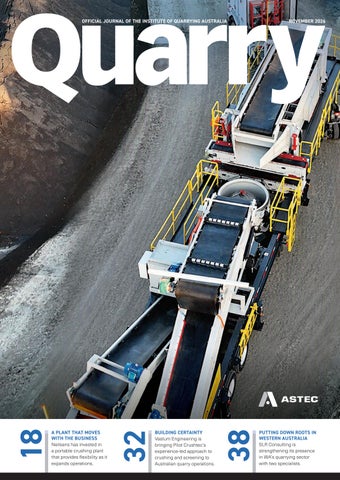
A PLANT THAT MOVES WITH THE BUSINESS Neilsens has invested in a portable crushing plant that provides flexibility as it expands operations.
BUILDING CERTAINTY Vastum Engineering is bringing Pilot Crushtec’s experience-led approach to crushing and screening to Australian quarry operations.
38
31 DUST CONTROL THAT STICKS Rainstorm is helping quarries minimise dust.
OFFICIAL JOURNAL OF THE INSTITUTE OF QUARRYING AUSTRALIA
32
16 PASSING THE TORCH Former IQA president Michael Close chatted with Quarry.
45 GREEN LIGHT FOR GOLDEN BAY CEMENT The New Zealand Government is backing Golden Bay Cement.
www.quarrymagazine.com
29 READY TO ROCK AND ROLL Onetrak’s crusher can work the big jobs.
NOVEMBER 2026
FEATURES
18
38
PUTTING DOWN ROOTS IN WESTERN AUSTRALIA SLR Consulting is strengthening its presence in WA’s quarrying sector with two specialists.
A PLANT THAT MOVES WITH THE BUSINESS Neilsens has brought forward the first stage of a wider processing development to meet the growing demand for 10mm aggregate, with support from Astec.
Quarry November 2026 3
READY FOR A NEW E PERIENCE? Jaw Crusher Impact Crusher Scalping Screens Sizing Screens
Contact our DEALER JAWS CRUSHERS PTY LTD. Call Craig Wills
0417 650 414
Find out more about RUBBLE MASTER, one of the leading manufacturers of compact, mobile crushing and screening solutions for natural rock processing and recycling applications.
RUBBLEMASTER.COM
EDITORIAL
IDENTIFYING THE HAZARDS
A
ccording to The Brady Review in 2019, the causes of safety incidents are typically a combination of everyday factors, such as a failure of controls, a lack of training, or inadequate supervision. Capturing these casual factors is important, because simplifying them to a single cause, such as human error or bad luck has the potential to mask the underlying system failures. In fact, by treating incidents like they are freak accidents can inspire fatalism and reinforce incorrect notions that quarrying is unsafe. At a practical level, a large number of the safety incidents involved a worker in a situation that they were inadequately trained for, with the controls meant to prevent harm being ineffective, unenforced or absent, with no or inadequate supervision to identify and remedy these shortfalls. The review also found that in 36 per cent of serious accidents, the hazard causing the accident had not been identified, meaning no control was in place. This is one of the reasons why the Institute of Quarrying Australia (IQA) runs regular hazard identification webinars.
These webinars examine the processes required to routinely identify hazards in the workplace so they can be effectively assessed and controlled. It helps keep hazard identification current and gives teams a safe space to improve workplace safety. The IQA has a long and proud history of supporting the sector through this kind of professional development and training. The organisation’s purpose is to educate and connect the people working in the sector, to help it thrive. To further support safety within the sector, the IQA also provides safety and health conferences. These important events help drive the sector’s commitment towards zero harm, and include the latest regulatory updates, evidencebased safety research, practical implementation strategies and peer networking. As we reach the end of the year, it’s an opportunity to reflect on what you can be doing on your site to improve the overall safety. It’s everyone’s responsibility to make sure everyone can go home safe at the end of the day. William Arnott Editor
BY TREATING INCIDENTS LIKE THEY ARE FREAK ACCIDENTS CAN INSPIRE FATALISM AND REINFORCE INCORRECT NOTIONS THAT QUARRYING IS UNSAFE.
Published by:
379 Docklands Drive Melbourne VIC 3008 T: 03 9690 8766 www.primecreativemedia.com.au
Chief Executive Officer Christine Clancy christine.clancy@primecreative.com.au Group Managing Editor Paul Hayes paul.hayes@primecreative.com.au Editor William Arnott william.arnott@primecreative.com.au Journalist Daniel Williamson daniel.williamson@primecreative.com.au Business Development Manager Les Ilyefalvy les.ilyefalvy@primecreative.com.au Client Success Co-ordinator Janine Clements janine.clements@primecreative.com.au Head of Design Clayton Hawley Art Director Michelle Weston Subscriptions T: 03 9690 8766 subscriptions@primecreative.com.au The Publisher reserves the right to alter or omit any article or advertisement submitted and requires indemnity from the advertisers and contributors against damages or liabilities that arise from material published. © Copyright – No part of this publication is to be reproduced, stored in a retrieval system or transmitted in any means electronic, mechanical, photocopying, recording or otherwise without the permission of the publisher.
6
Quarry November 2026
CEO’S REPORT
REFLECTIONS ON A RECORD YEAR
M
ore than 735 delegates joined us on the Gold Coast for the 2026 IQA National Conference – the biggest the IQA has ever held. That is 100 more than Adelaide in 2024 and around 80 per cent up on Geelong in 2019. The exhibition filled 94 booths, with 71 exhibitors and 14 sponsors. Thank you to everyone who made it happen, and to Hitachi, Komatsu, and Caterpillar, who hosted our three evening functions. Congratulations to our 2026 IQA Award winners, chosen from 29 nominations: • IQA Gold Hard Hat Site Safety Award – Penrice Quarry, Adbri • IQA Gold Site Environment Award, supported by SLR – McLaren Vale Quarries (Hallett Group) • Quarry Sector Excellence Award – Rachael Quinlan, Heidelberg Materials • Alec Northover Award, supported by the AIQEF – Adam Curran, Mawsons • Quarry Leadership and Contribution Award – Bruce Barry, Boral • IQA President’s Medal – Fred Reid, Fred Reid Consulting At our annual general meeting, I reported on the 12 months to 30 June 2026. Three things stood out: 1. More people learning. We ran 86 education programs, up from 50, with 44 per cent more participants. 2. More people turning up. Branches and sub-branches held more than 60 events for more than 3400 attendees. With education, we reached around 4500 people. 3. More people belonging. Membership reached 1844, up 3.1 per cent, and 100 sponsorships from over 70 companies backed our programs.
8
Quarry November 2026
That’s Solid is getting noticed. Our first national awareness campaign launched on 25 February with the support of the Australian Institute of Quarrying Education Foundation. In three months, it reached more than 93,000 people and 1330 schools, and our paid campaign was then seen more than 6.2 million times. On the Gold Coast, 100 senior school students came to our first That’s Solid Careers Day. Our final think tank is in Adelaide in November. We will then bring all think tank groups together online to share feedback and next steps. In October, members teed off at the WA Annual Golf Day and caught up at end-of-year events in Cairns and Rockhampton. Still to come: • 13 November – The South Australian branch dinner in Adelaide, and the North Queensland sub-branch’s end-ofyear event in Townsville. • 19 November – The Central West NSW sub-branch’s end-of-year event in Wallerawang. • 20-22 November – The Tasmanian branch technical and social weekend in Hobart. • 27 November – The Queensland branch’s end-of-year bowls event in Brisbane, and the Southern NSW sub-branch’s site tours and dinner at Woodlawn. Next comes the 2027-2029 Strategic Plan, which we will finalise with the board. Finally, thank you to Michael Close for two years of thoughtful, generous leadership as president, and welcome to Scott Whittaker. I look forward to what we can achieve together. Jane Schmitt Chief Executive Officer Institute of Quarrying Australia
The Institute of Quarrying Australia
Educating and connecting our extractive industry
MEMBERSHIP REACHED 1844, UP 3.1 PER CENT, AND 100 SPONSORSHIPS FROM MORE THAN 70 COMPANIES BACKED OUR PROGRAMS.
www.quarry.com.au The IQA’s Strategic Plan 2023 to 2026 embodies the following vision, values and strategic priorities: Vision: Thriving communities supported by a sustainable industry Operational Priorities: • Deepen industry participation • Sustainable revenue streams • Highly capable team • Technological innovation • Effective engagement • Great governance Strategic Priorities: • Support industry participants with compliance and regulation • Build a diverse and skilled industry workforce • Foster strong industry connectivity
IQA Contacts: For all education, member and branch enquiries: Phone: 02 9484 0577 Email: iqa@quarry.com.au Chief Executive Officer Jane Schmitt President Scott Whittaker Company Secretary David Cowie Follow the IQA on our social media pages: IQAustralia the-australian-institute-of-quarrying/ iqaus
FROM APRIL 2027
HITACHI BECOMES LANDCROS
ZW-7
YOU’RE IN CONTROL.
Be in control with the 7 Series excavators and wheel loaders. hcma.com.au
PRESIDENT’S REPORT
AN EXCITING NEW ERA AWAITS
L
ast month on the Gold Coast, Michael Close handed me the president’s chain. More than 735 delegates attended the National Conference - the biggest crowd the IQA has ever drawn - and it was a good week to take on the job. Michael deserves the first word. When he became president in Adelaide two years ago, he listed what he wanted the IQA to build: an ambassador program, a public campaign for quarrying, an education hub and a better website. All of it now exists. Thank you, Michael. I’m glad to have you alongside me as the immediate past president. A record conference is a great thing. But we only hold one every two years, and most of what the Institute of Quarrying Australia (IQA) does for members happens in between, close to home. It happens at a branch dinner, on a site tour, in a webinar, or in a conversation between a mentor and someone a few years into their career. As Jane reports in this edition, last year was a record for both education and branch events. Behind those numbers are more than 100 volunteers on committees around the country, who organise it all on top of their day jobs. That is the IQA I joined in 2008, and it is the one I want to grow. The first big item on the board’s table is the 2027–2029 strategic plan, which we will finalise later this year.
We are not starting from a blank page. In this year’s member survey, you told us why you belong: networking, events and education. Responses were up 36 per cent on 2024, so we have a clear picture of what members want, and the plan will be built on it. I set out my own priorities: the next generation, education with health and safety front and centre, and an IQA for everyone who works in this sector, not only those in the pit. Three things you can do before Christmas: • Go to one event. Branches are running end-of-year events across the country in November. If you have never been to one, this is the month to start. • Mentor or be mentored. If you have been in the sector a while, someone starting out needs • what you know. If you are starting out, ask. Take That’s Solid somewhere. A school, a careers expo, the side of a truck. The campaign works best when members carry it. I hope to get to as many branch events as I can over the next two years. If you see me, come and tell me what the IQA should be doing for you.
LAST YEAR WAS A RECORD FOR BOTH EDUCATION AND BRANCH EVENTS. BEHIND THOSE NUMBERS ARE MORE THAN 100 VOLUNTEERS ON COMMITTEES AROUND THE COUNTRY, WHO ORGANISE IT ALL ON TOP OF THEIR DAY JOBS.
co
Scott Whittaker. President Institute of Quarrying Australia
Image: Prime Creative Media
Scott Whittaker was handed the president’s chain at the IQA National Conference in October.
10 Quarry November 2026
Crushing, screening, processing... You don’t stop, and neither can your plant is t e solutio
e u time is t e
o lem
ultotec c ee i olutio s
o tact us
is a e
e castle ac a
e oo is t oo e ou
me al
et
e ma
all us:
mail us: ales
multotec.com.au
Visit us: multotec.com.au
IQA NEWS
Images: IQA
OUT AND ABOUT WITH THE IQA
Almost 100 members toured Heidelberg Materials’ Wolffdene Quarry.
Learning moves beyond the meeting room IQA members gained firsthand insight into two very different material journeys during site visits to Heidelberg Materials’ Wolffdene Quarry and Adbri’s Klein Point operation. September showed the value of the Institute of Quarrying Australia (IQA) branch network in practice. Members stepped inside major quarry operations, heard directly from regulators and strengthened their professional relationships.
Ben Howard shared his experience from the IQA Young Members Network study tour in South Africa.
12 Quarry November 2026
The month’s events spanned Queensland, Victoria, and South Australia, but shared a common purpose: giving quarry professionals access to information, sites, and people that can help them in their work.
An early look at Wolffdene Heidelberg Materials’ Wolffdene Quarry drew 99 registered attendees when the IQA Queensland branch and Central Queensland sub-branch combined a site tour with their annual general meeting (AGM) and dinner
Darren Toth and ToThink Equipment sponsored the Queensland AGM.
meeting on 3 September. The visit gave members an early look at the quarry before it returned to the spotlight as part of the IQA National Conference 2026 program in October. Wolffdene’s new crushing plant was the main attraction. Designed and built by Ridge for Heidelberg Materials, the project had also featured in the previous edition of Quarry, allowing members to connect the engineering story with the operating site. The program continued at Beenleigh Artisan Distillery, where Ajith Dissanayake and Josh Hawley from the Queensland Department of Transport and Main Roads discussed Micro-Deval testing for aggregate durability. The subject remains relevant to producers supplying material for Queensland road projects. Heidelberg Materials’ Jarrod Leech delivered a quarry safety spotlight, while Ben Howard reported on the IQA Young Members Network South Africa Study Tour. David Smith led the AGM proceedings and welcomed the Queensland branch and Central Queensland sub-branch committees for 2026–27. The IQA thanked Chris Wilson and the Heidelberg Materials team for hosting the tour, and Darren Toth of ToThink Equipment for sponsoring the event.
L
M
m
The Institute of Quarrying Australia
Following material from pit to port The SA Young Members Network travelled to Adbri’s Klein Point Quarry on the Yorke Peninsula on 8 September, following the limestone supply chain from extraction through to marine transport. Klein Point supplies Adbri’s Birkenhead cement plant. Three rotating tours took members through the pit, crusher and heavy mobile equipment areas before boarding the newly commissioned Yampu. IQA South Australia sub-branch deputy chairperson Elijah Thomson said the visit demonstrated how each part of the operation contributed to the downstream plant’s supply. “The visit gave young members a unique insight into the end-to-end quarrying process for cement production,” he said. “You could see how extraction, processing, heavy mobile equipment and marine logistics all have to work together to supply downstream operations efficiently.” At the crusher and workshop, a Caterpillar D11 dozer showed the scale of the equipment required to keep material moving.
Attendees learned about important upcoming changes to the state’s quarrying sector.
In the pit, members followed the process from drilling through to hauling. They also saw how the operation monitors the chemistry of different areas and blends material to meet the specifications required
at Birkenhead. The Yampu demonstrated the final connection between quarry and cement plant. Members viewed its docking, loading and material-management technology, as
Large Primary Jaw Crusher Station Metso NW120 Portable Station - Up to 400 mtph primary station Large 7 m2 hopper Pan/Grizzly feeder Famous Nordberg® C120™ jaw (1,200 mm x 870 mm) crusher with hydraulic adjustment system • Versatile setting range 70 – 200 mm • PLC Control System • Metso Metrics remote monitoring
metso.com
IQA NEWS
Fourteen standards are proposed for moderate- and higher-risk sites, covering areas such as dust, noise, water, blasting, geotechnical risk, and quarry-manager qualifications. Lower-risk operations will follow a Code of Compliance. Rehabilitation will also be treated as an ongoing responsibility. Moderate- and higher-risk sites will require an approved rehabilitation plan to be reviewed every three years, while lower-risk sites will review their plans every five years. Palmer and Wellesley encouraged members to review their operations, contribute to consultation on the draft regulations and attend the regional roadshows planned for late 2026 and early 2027. The AGM confirmed Mawsons’ Laura Bennie would return as Victorian sub-branch chair, supported by deputy chair Ashlee Campton and the 2026–27 committee.
Townsville tradition continues
Victorian Sub-Branch chair Laura Bennie speaking at the event.
well as the transfer point linking the quarry infrastructure with the vessel’s loading deck. “All attendees agreed that the innovation and technology used by the Yampu in docking, loading and managing material is an extremely exciting step for the sector,” Thomson said. The tour also showed how rehabilitation sits alongside production, with rehabilitated land near the quarry being used by local landholders for grain crops.
Preparing for regulatory change Regulatory reform was the focus when more than 50 members and guests attended the Victorian sub-branch networking dinner and AGM in Shepparton on 17 September.
Resources Victoria chief inspector Renee Palmer and director regulatory strategy and practice Amanda Wellesley explained the duties-based framework scheduled to begin on 1 July 2027. Under the proposed change, Victorian quarries will no longer be required to submit work plans. Work authorities and planning approvals will remain in place, while operators will have a general duty to eliminate or minimise the risks created by their sites. Operations will be assigned a lower, moderate, or higher risk level, which will influence how they are regulated. Existing sites will have an opportunity to comment on their preliminary classification before it is finalised.
The North Queensland branch brought 96 players together at Rowes Bay Golf Club on 4 September for the 28th Townsville Golf Day. The long-running event connected quarry operators, suppliers and sponsors from across North Queensland in a setting built around conversation as much as competition. More than a dozen organisations supported the golf day through catering, drinks carts, individual holes and novelty prizes. The event will return to Rowes Bay in 2027, continuing a tradition that has connected the North Queensland quarrying community for almost three decades. North Queensland branch chair Paul Hooton said the support surrounding the event remained central to its success. “The Townsville Golf Day is always a highlight for our branch, and this year was no exception,” he said. “The energy on the course, the laughs and the support from our sponsors made it a memorable day.” •
Upcoming courses and events Event
Date
Time
Location
South Australian Branch dinner
Fri 13 Nov
6:30pm – 11:00pm
Adelaide Marriott
North Queensland Sub Branch’s end-of-year event
Fri 13 Nov
6:00pm – 9:00pm
Tiny Mountain Brewery
Central West NSW Sub Branch’s In Her Boots event
Thu 19 Nov
9:30am – 3:00pm
Black Gold Motel, Wallerwang
The Queensland Branch’s end-of-year bowls event
Fri 27 Nov
3:00pm – 7:00pm
Merthyr Bowls Club
The Southern NSW Sub-Branch’s site tour and dinner
Fri 27 Nov
9:30am – 9pm
Goulburn Brewery
14 Quarry November 2026
Quarry -
Lokotrack LT350C Next-Generation Crushing for Modern Quarries
Built for demanding quarry applications, the Metso Lokotrack LT350C™ combines proven crushing technology with nextgeneration diesel-electric power. Featuring the Nordberg HP350e cone crusher and 370 kW engine power, the LT350C is designed to deliver reliable, high-capacity crushing while helping reduce operational costs and CO₂ emissions. With electric process functions, reduced hydraulic oil consumption and a modular design, the LT350C brings efficiency, reliability and easier maintenance to the modern quarry. Available from Tutt Bryant Equipment Australia’s Metso partner.
Follow us on:
Brisbane | Sydney | Melbourne Adelaide | Perth tuttbryant.com.au
Quarry - 2026 October.indd 1
1300 658 888
28/09/2026 3:56:32 PM
IQA
PASSING THE TORCH
Image: IQA
Former IQA president Michael Close spoke with Quarry about his time in the role and how the industry has changed.
Former IQA president Michael Close.
Looking back, what are you proud of during your time as president? I am proud that we have been able to turn member feedback into real outcomes. When I became President, members told us they wanted greater public awareness of our sector, more support for career development and better ways to stay connected. Over the past two years, we have delivered tangible initiatives. The launch of our national campaign, That’s Solid, is a standout achievement. It is helping tell the story of the essential role quarrying plays in building Australia and raising awareness of our industry within the broader community. I am also proud of the growth in member engagement. Initiatives such as the mentoring program, IQA Connect, our conferences and branch events have strengthened connections across the network and provided greater value for members. Importantly, the IQA is in a strong position operationally and financially. We have dedicated volunteers, a capable management team lead by Jane Schmitt and clear strategic direction, providing a strong platform for the future. What have you learnt during your time as president? Personally, I have gained valuable boardlevel experience and a much deeper understanding of how member-based organisations operate. While we all work within the quarrying sector, serving on the board of a professional institute requires a broader perspective and a focus on the long-term interests of members and the organisation. I have learned the importance of governance, strategic thinking and balancing the diverse needs of members across different regions, sectors and stages of their careers. I’ve also developed significantly as a representative of the industry. The opportunity to present at conferences, engage with international quarrying organisations, and speak in front of large
16 Quarry November 2026
audiences has pushed me outside my comfort zone and helped me grow as a leader. How has the sector changed over the past two years? The industry is increasingly focused on people, sustainability and community engagement. There is also a stronger emphasis on attracting talent, building long-term career pathways and developing future leaders. The That’s Solid campaign is helping communities better understand the importance of quarrying while also providing educational resources for schools and universities to introduce young people to career opportunities within our sector. What are some of the challenges the sector is facing? Attracting and retaining skilled people is one of our biggest challenges. The quarry sector is competing for talent against industries such as mining, civil construction and infrastructure. South Australia is a great example, with significant infrastructure projects creating strong demand for skilled workers. Many young people simply are not aware of the opportunities available in quarrying, which is why continued engagement with schools, universities and communities is so important. Maintaining community trust and our social licence to operate is equally important. Major infrastructure projects rely on the essential materials produced by quarries, so we must continue demonstrating the value our industry provides while operating responsibly and engaging openly with communities. What are your plans now? I am not stepping away from the IQA. I will remain on the Board as a Director and, in August 2026, I was elected Chair of the South Australian Branch. These roles will allow me to stay connected with members and continue contributing to the Institute’s future. •
P d
80 ba Lo te mu
SA an ev
rockprocessing.sandvik/smartcrushing
Put more and better data to work for you 800i crushers are ready to be connected to the SAM by Sandvik cloudbased digital assistant, our ever-evolving data capture and analysis service. Look at the status of your connected equipment, communicate across teams, view alerts and notifications, pro-actively order spare parts and much more. SAM is the digital assistant supporting operational excellence in crushing and screening plants, that makes working with your 800i series crusher even more of a pleasure.
COVER STORY
Astec’s crushing and screening equipment has been used around the world in quarrying.
A PLANT THAT MOVES WITH THE BUSINESS Neilsens has invested in a portable crushing plant that can meet its immediate production needs while giving the business flexibility as its processing operations expand.
I
nvesting in a new plant is a big commitment: it must be proven and operators need consistent product quality from it. For that reason, the Neilsens Group (Neilsens) has once again chosen Astec’s Kodiak K350+ cone crusher for a new portable plant. The family-owned company wanted extra capacity to produce 10mm
aggregate for its concrete business. It also wanted to broaden its processing operations, so the plant had to meet immediate needs and fit the Neilsens’ longer-term plans. Working with Astec teams in Australia and the US, the Queensland company brought forward the first stage of its planned investment to secure a portable trailer-mounted plant
Neilsens secured a portable trailer-mounted plant.
18 Quarry November 2026
featuring a Kodiak K350+ crusher and a 6.1x1.8m triple-deck horizontal screen. That meant Neilsens could move the plant across its multiple sites and process the material on-site as required, including recrushing a 40mm-minus drainage material into its desired 10mm aggregate. “Previously, we were transporting some of that material from another site,” Neilsens operations manager Michael Bavdek told Quarry. “The new plant enables us to reprocess other materials and increase the amount of 10mm aggregate available to the concrete business. “It also allows us to obtain greater value from the available feed while responding to demand for that particular product.” The plant is currently part of a three-stage crushing circuit. Neilsens plans to have the portable plant working at its new greenfield development when that is operational. In the meantime, the Queensland operation receives plant equipment that actively supports its key businesses, including its concrete plants across Carole Park, Windsor, Stapylton and Beaudesert.
“Because Neilsens already had experience with the Kodiak K350+ platform, we could build on proven performance rather than introduce an unfamiliar crushing solution.” While Neilsens already runs two other K350+ crushers from Astec at its other sites, Bavdek said the original equipment manufacturer still designs its advice for Neilsens’ newest project. “The support has been tailored to the route Neilsens has chosen for its processing operations,” Bavdek said. “Astec has been prepared to work through our requirements and help configure the plant around them.” The portable crushing plant has been operational a few months, and while it remains early in the plant’s lifespan the initial results have impressed Neilsens.
And now, as the company looks forward to bringing its new greenfield development into operation, its partnership with Astec is set to continue into a bright future. “The performance of the previous K350+ units, the early results from the portable plant and the level of support have given us confidence in the relationship,” Bavdek said. “The results with the portable plant have been positive. The yield and particle shape of the 10mm aggregate have exceeded our expectations. “That relationship with Astec has been important. Its team has worked with us to understand what we require rather than taking a one-size-fits-all approach.” • For more information, visit astecindustries.com
The plant is currently part of a three-stage crushing circuit. .
Astec is well-known for producing high-quality crushing and screening equipment.
Quarry November 2026 19
Images: Astec
“We were not purchasing a plant solely for a short-term requirement; we needed something that could support the long-term development of our processing operations,” Bavdek said. “The greenfield development represents a substantial investment for Neilsens. “Using portable equipment gives us flexibility while the operation is developed. We can relocate the plant and modify the wider circuit as requirements change. “That reduces the risk of locking the business into a fixed configuration before the longer-term processing requirements have been fully established.” A key part of the process was how Astec leveraged its on-the-ground team in Australia, alongside its international expertise in the US, to develop a solution aligned with Neilsens’ requirements. Astec Australia business line manager for material solutions Shaun Quinn said the company considered the application, production requirements including throughput and Neilsens’ broader business plans to develop a tailored solution for the customer rather than offering an off-theshelf solution. “The plant can meet an immediate production requirement at the current site while retaining the flexibility to support future developments,” Quinn said.
WHEEL LOADERS
Image: Komatsu Australia
The WA485-11 wheel loader is designed to suit quarrying and aggregate applications.
NEW WHEEL LOADER MOVES MORE WITH LESS Komatsu Australia has launched a wheel loader that promises improved productivity, fuel efficiency, operator comfort and easier maintenance.
Y
ears of direct customer feedback about what matters to quarries has led Komatsu to design the WA485-11 wheel loader. Suited to quarrying and aggregate applications, including stockpiling, load-andcarry work and truck loading, it delivers a 28 per cent improvement in fuel efficiency compared with its predecessor, the WA480-8. Komatsu Australia national business manager Nick Vrontas said the wheel loader was designed with a focus on reducing customers’ total cost of ownership. “It builds on the proven performance of the WA480-8 while introducing significant design improvements that allow customers to move more material efficiently and productively,” Vrontas said. The WA485-11 features a redesigned bucket and hydraulic mechanical transmission (KHMT) which combines hydrostatic and mechanical transmission technology. This delivers power delivery and improved fuel efficiency.
20 Quarry November 2026
It’s also combined with a 12.5 per cent increase in operating capacity and 20 per cent more breakout force than the WA480-8. This helps operators achieve higher bucket fill rates and move more material with each cycle. “KHMT keeps the engine operating at lower speeds and automatically distributes power between the travel and work equipment systems based on operating conditions. This helps reduce fuel consumption while maintaining the acceleration and performance operators need,” Vrontas said. “What matters on site is how much material a machine can move across the day and how much fuel it takes to do it. The WA485-11 is designed to deliver a better result on both.” It also features a newly designed cab that provides greater visibility and a quieter operating environment. The front and rear glass area of the cab has increased by 21 per cent, with a lower glass section and the removal of the rear pillar improving visibility around the machine.
A five-way adjustable console, angle feedback joystick steering, deluxe seat and automatic air conditioning help create an impressive operating environment. Safety features include an upgraded KomVision monitoring system and a rear object detection system that uses two radars to identify people and objects behind the loader. Maintenance access has also been improved through a powered tiltable engine hood, swing-out cooling fan and easily accessible daily inspection points. Vrontas said the benefits of the new WA48511 for operators are most evident when considered across an entire working day. “For our customers, the real value comes from what these improvements add up to over a full shift. Moving more material in each cycle while using less fuel can make a meaningful difference to both production targets and cost per tonne.” • For more information, visit komatsu.com
A WIRTGEN GROUP COMPANY
Strong. On their own or together. THE MOBICAT MC 110 EVO2 AND MOBICONE MCO 90 EVO2
MCO 90 EVO2
MC 110 EVO2
Team players that work together intelligently and strengthen each other. In linked plant combinations, the MOBICAT MC 110 EVO2 jaw crusher and the MOBICONE MCO 90 EVO2 cone crusher really flex their muscles. SPECTIVE makes both plants easy and intuitive to operate. Also, an advanced drive concept ensures greater efficiency with lower consumption. Maximum throughput is achieved thanks to the material flow concept coordinated via line coupling across both crushing stages. Go for the perfect team!
www.wirtgen-group.com/evo2-line-kleemann
WIRTGEN AUSTRALIA PTY LTD · National Sales 1300 978 858 · Mobile +61 448 030 420 email - sales.australia@wirtgen-group.com · www.wirtgen-group.com/australia
CRUSHING
BRIDGING THE GAP IN PRIMARY CRUSHING Metso’s NW120 portable jaw crushing station offers Australian quarry operators a single-chassis alternative to conventional solutions.
F
or quarry operators, establishing a primary crushing station can involve a significant investment of time, capital, and infrastructure. Permanent installations can require arduous approvals and lengthy implementation, while tracked equipment provides mobility but can come with higher operating costs. Metso’s NW120 portable jaw crushing station is designed to provide an alternative, combining the functionality of a permanent primary station with the flexibility of a portable unit. The single-chassis, electrically powered station is designed to process blasted primary materials and incorporates the major components required for primary crushing in a single package. Metso business development manager John O’Reilly said the NW120 addresses a gap between conventional permanent installations and diesel-powered mobile equipment.
“Many operations facing the challenge of installing or relocating their primary processing station have traditionally had two options. One, build a permanent bespoke station or use a diesel track-mounted unit,” O’Reilly said. “The former at very high cost and longterm approval and implementation timeline, the latter costly to run, inefficient and high operational costs. “Now there is a third option, the Metso NW120 portable primary station. All the benefits of a permanent fixed primary station without the long lead time and approval processes, plus flexibility of a tracked plant to have a very fast installation.” The NW120 is configured as a complete primary crushing station rather than a standalone jaw crusher. Its single chassis incorporates a feed hopper, feed grizzly, jaw crusher, rock breaker, scalping screen, side conveyor, magnetic separator discharge conveyor and electrical centre.
This configuration is intended to simplify the process of establishing a primary crushing circuit, while allowing the unit to be integrated with existing site infrastructure. The station can be equipped with onboard main and side conveyors or connected directly to a plant conveyor system. This provides flexibility for operations with different site layouts and materialhandling arrangements. Material can be fed to the unit using an excavator, wheel loader or dump truck, depending on the quarry’s existing loading and haulage arrangements. The vibrating feeder incorporates a twostage scalping section to remove fines before the material reaches the primary crusher. The separated fines can then be directed to either the main or side conveyor. This approach allows the crushing process to be configured around the characteristics of the feed material and the requirements of the wider plant.
Metso’s NW120 portable jaw crushing station combines primary crushing, feeding, scalping and material handling equipment on a single chassis.
Images: Metso
S I Q
22 Quarry November 2026
1
S
The NW120 features Metso’s Nordberg C120 jaw crusher, which has a 1200 x 870mm feed opening and 160kW electric drive.
At the centre of the NW120 is Metso’s Nordberg C120 jaw crusher, part of the C Series jaw crusher range. The C Series is celebrating 50 years of production in 2026, with the range having established a long operating history across aggregates and other demanding applications. The C120 has a feed opening of 1200mmx870mm and is driven by a 160kW electric motor. The crusher setting determines the size of the material leaving the primary stage, allowing the
output to be matched to downstream processing requirements. The electric drive also reflects the NW120’s broader approach to operating costs. Rather than relying on a diesel engine to power the primary crushing station, the unit is electrically powered, with the crusher and associated equipment designed around integration with an electrical supply. The complete NW120 weighs approximately 51,000kg, placing it within the range expected for a substantial primary crushing installation while retaining the ability to be relocated as site requirements change. The ability to relocate primary processing equipment can become increasingly important as quarry faces develop and extraction areas change. A conventional fixed station can provide a long-term solution, but moving it can involve substantial engineering and construction work. The NW120 is positioned between these models, providing a substantial primary station that can be implemented without
SPECIALISTS IN CUSTOM QUARRY SOLLUTIONS
1800 BUCKET
SALMONBUCKETS.COM.AU
EST 1980
constructing a fully bespoke installation. O’Reilly said the unit is available in stock in Australia, potentially reducing the lead time for sourcing and commissioning a new primary crushing solution from overseas. For operations assessing a new primary station or considering relocating an existing one, the decision ultimately involves more than just crusher capacity. Capital expenditure, installation time, energy use, maintenance, site approvals and future flexibility all form part of the calculation. The NW120 is designed to bring these considerations together in a single portable package. For Australian quarry operators considering their next primary crushing installation, O’Reilly said quarries should assess the unit against their individual operating requirements. “Reach out to Metso Australia for a personalised viewing of our stock and return on investment review for your business,” he said. • For more information, visit metso.com
CRUSHING The LT350C can be transported as a single unit, helping simplify relocation and site setup.
RIGHT ON TRACK The transition to diesel-electric mobile crushers is well underway, with Metso’s updated Lokotrack LT350C the latest example of this continued shift.
T
he transition from legacy combustion powertrains is in full swing across most segments of global industry, including mobile equipment within the quarrying sector. Metso’s Lokotrack EC range is exemplifying this shift. It offers hybrid low-emissions power for high-end aggregate production, and its LT350C is the manufacturer’s most advanced diesel-electric variant to date. Metso’s exclusive Australian distributor, Tutt Bryant, introduced the Lokotrack LT350C to the local market last quarter.
Since the machine was launched a couple of years ago, several improvements have been made, including an enhanced scalping screen. “This is another evolution, and we find a lot of our customers are pretty interested in a cone crusher that has a scalping screen, because if you don’t have to crush something, then you shouldn’t,” Tutt Bryant Equipment national business development manager Paul Doran told Quarry. “The scalping screen facilitates the separation and extraction of finer material.”
There’s no other cone crusher, at least to Doran’s knowledge, that provides as many liner options for so many different applications. “Some of the other suppliers don’t have that range at their disposal,” he said. “So, they might not be able to compete with someone that does have that facility on their machine.” The new HP350e cone design by Metso is one of the Lokotrack LT350C’s chief attractions. Here improvements of up to 250kW in power have been achieved. Doran said the LC350C is a versatile all-rounder and suited to most quarry and mining applications. A pre-screen folds conveniently under the lifting conveyor for enhanced mobility, which affords greater access for maintenance. Having a pre-scalper on a cone crusher makes it a useful tool in a host of scenarios. It might even find a place in concrete recycling for operators who need an alternative to an impact crusher. Crushing contractors, for the most part, will initially reap the most benefits according to Doran. “One of its appealing factors, especially for Australian quarry operators, will be the costeffective use of energy,” he said. “Everybody sees what the cost of fuel is at the moment. In the right application, these machines consume 20 per cent less energy.
Images: Tutt Bryant
The Lokotrack LT350C is designed for highcapacity secondary crushing applications.
24 Quarry November 2026
Aq ma sa at
Q
“If you plug the machine into the mains power in your quarry or mine site, and then it will be even cheaper to run.” In effect, it allows operators to crush rock as cost-effectively as possible by using the least amount of energy. Doran said this is an area where quarries can obtain an edge over their competitors. He anticipates that over the machine’s working life, which should be tens of thousands of hours, there will be tangible cost savings for the customer. “If they’ve got, for instance, diesel electric equipment and it uses 100 litres of fuel an hour and they’ve got a competitor that’s got diesel hydraulic equipment and they use 150L an hour, then they’re 50L an hour in front of the competitor on a cost basis,” Doran said. “You’d have to be an amateur quarry operator or mine owner not to see the reduction in fuel use and associated costs without any drop-off in productivity.”
Many of the larger quarry organisations also like the idea of incorporating a sustainability aspect into their operations. Being able to demonstrate, in their triple bottom line reporting, reduced reliance on fossil fuels through an investment in something like the Lokotrack LT350C looks good for environmental, social, and governance reporting, as well as other sustainability requirements. “There’s lots of environmental measures that have gone into these machines,” Doran said. “They’ve got sprays on the belts, and they’ve got dust encapsulation. I think that’s probably the sweet spot because those bigger guys, those Tier 1 quarry operators, kind of have more focus around that.” Digital integrations and system optimisations have delivered innovations around remote operational control and fleet management. The LT350C comes with Metso Metrics, which lets the customer to monitor the machine’s performance anywhere.
Adaptive feed control optimises the machine’s performance, mitigating operator error and ensuring it runs at peak efficiency. Doran said a quarry customer, ideally, should get up to 30,000 hours serviceable life out of each machine. At present, Iceland has the most Lokotrack LT350C units in operation due to strict mandates on emissions controls. But with an estimated 10,000HP cone crushers currently operating around the world, Doran said the platform is truly tried and tested. “There are a couple of units that have gone into operation in Australia at the moment,” he said “It’s early days, but customer feedback has been overwhelmingly positive. “I genuinely believe this diesel-electric equipment will eventually become the norm for us.” • For more information, visit tuttbryant.com.au
BREATHE EASIER WORK SAFER Truck fill points | Sprinkler systems Evaporation Fans
Aquaflo Hire’s dust control solutions maintain air quality, ensure high levels of safety and help meet regulatory standards at your site. Anywhere in Australia.
1300 455 195 www.aquaflohire.com.au
1526020305
Quick. Smart.
CRUSHING
MASTER OF MOBILE CRUSHING As the popularity of mobile crushing machinery grows, Rubble Master is helping the quarry sector get the most out of its machines.
M
obile equipment offers quarries several benefits that are hard to ignore. Greater flexibility, lower infrastructure costs, and the ability to adapt quickly to changing production environments are vital for businesses throughout the sector. Rubble Master area sales manager Harald Windner told Quarry the processing of natural stone and aggregates is increasingly moving towards these mobile solutions. “Mobile crushing and screening equipment allows operations to be scaled efficiently,” he said.
“It reduces the need for permanent installations and costly material handling.” To meet these demands, Rubble Master offers complete mobile processing trains consisting of jaw crushers, impact crushers, screens, and conveying solutions. The company has spent more than 35 years developing compact mobile impact crushing machines, suited for use in construction, recycling, quarrying, and aggregate projects. Windner said Rubble Master built its reputation in compact mobile crushing in the recycling sector.
“For decades, contractors and recycling companies have relied on Rubble Master equipment to process concrete, asphalt, bricks, and mixed construction debris directly on site,” he said. “The ability to transform waste material into valuable, recycled aggregates has become increasingly important in modern construction. “Our focus on mobility, efficiency and ease of operation has helped countless customers reduce transport costs, minimise environmental impact, and create new revenue streams from recycled materials.”
K m
Ma
dru
un
The RM J110X jaw crusher and the RM 120X impact crusher are a typical combination used in Quarries, like here in a granite quarry.
26 Quarry November 2026
Image: Rubble Master
rel
ex
En
However, Rubble Master is far more than a recycling specialist. The company has significantly expanded its portfolio for the quarrying and aggregate industries, offering powerful mobile solutions capable of processing hard rock and natural stone applications. Mobile equipment enables material to be processed closer to the point of extraction while reducing the need for permanent infrastructure. In these sectors, Rubble Master identified flexibility as a key competitive advantage and its product portfolio provides it without compromising performance. Two Rubble Master machines are particularly important for natural stone and quarry applications: the RM J110X jaw crusher and the RM 120X impact crusher. The RM J110X marks Rubble Master’s entry into the jaw crusher segment and is designed for primary crushing duties. Whether processing granite, basalt, limestone or other hard rock materials, the machine offers high throughput, robust construction and excellent mobility. The RM 120X is one of the flagship machines within the Rubble Master impact crusher portfolio. Combining high production capacity with excellent product quality, it is equally suited to recycling applications and natural stone processing. The machine delivers the flexibility demanded by modern contractors and
quarry operators, producing precisely graded material while maintaining mobility. Windner said the two machines create a powerful combination for aggregate production, enabling operators to cover a wide range of applications from primary crushing through to the production of highquality finished products. “We offer a comprehensive range of equipment for crushing and screening applications, including mobile impact crushers, mobile jaw crushers, mobile screens, and conveyors,” he said. “This broad product portfolio allows us to provide solutions for projects of virtually every size, from urban recycling operations to large-scale quarry and aggregate production environments.” By combining the RM J110X and RM 120X with Rubble Master’s mobile screens, operators can create highly efficient and flexible systems. These integrated solutions optimise material flow, ensure consistent product quality, and maximise equipment usage. Windner said one of the company’s key strengths is its focus on userfriendly operation. “While professional crushing contractors appreciate the productivity and reliability of our machines, companies new to crushing and screening also benefit from intuitive machine controls, efficient setup procedures and strong customer support,” he said.
Keeping you moving Maximize uptime with locally stocked wing and drum pulleys. Available in both lagged and unlagged designs, our XT-bushed pulleys deliver reliable performance. Australian inventory, global expertise, and local support.
Scan to learn more or visit dodgeindustrial.com Enquiries: au-dodge-preorder@dodgeindustrial.com | +0401 860 080
“Purchasing a crusher is a step towards greater independence and profitability. “Rubble Master machines are designed to make that transition as straightforward as possible, helping new operators enter the market with confidence.”
STRONG LOCAL SUPPORT A machine is only as good as the support behind it. In Australia, Rubble Master customers benefit from the expertise of Craig Wills and the team at Jaws Crushers, an experienced dealer with strong industry knowledge and a proven track record in both quarrying and recycling applications. Jaws Crushers has successfully delivered and supported multiple projects across Australia, helping customers identify the right crushing solution. Every project is backed by dedicated local support from selection through to commissioning and beyond. Whether the objective is processing natural stone in a quarry, producing aggregates for infrastructure projects or recycling concrete and asphalt, For companies already active in crushing and screening, as well as businesses considering their first crusher investment, the local expertise provided by Jaws Crushers ensures customers have access to practical advice, service support, and application know-how.• For more information, visit rubblemaster.com
VOLVO THE OPERATORS CHOICE VOLVO EC360F
om a o a o c a ood mac o a d com o co o a d co c o a u .
c ad a
o da
o
| ua
o u a o o cau do m co mo a m . cau ood o a o a o . cau oduc ou ma .
IF YOU KNOW, YOU KNOW mac c o
SAFETY o c o
nou h to ru t
Fuel Efficiency o
u
.
all nou h to Car u m
u
o
o m. o a .
Contact your local branch cjd.com.au | 1300 139 804
ma
m.
om
.
Re-sale value u
o au
SUPPORT
a
u
u
ao
u m o
o ou ca u do .
a a a o a a d 4 c
d cd
a
CRUSHERS
Image: Onetrak
The Anaconda I14 comes with a 14267x1828.8mm double-deck screen.
READY TO ROCK AND ROLL Onetrak’s new mobile impact crusher is designed to take on the big jobs.
C
ontractors looking to take on big jobs need equipment large enough to handle them. For crushing projects, high throughputs and reliable results help contractors stand out from the crowd. That’s why heavy machinery supplier Onetrak is introducing the Anaconda I14 mobile impact crusher. As the official Australian distributor for Anaconda equipment, Onetrak is playing a key role in bringing the manufacturer’s latest crushing technology to the local market. According to Onetrak crushing business manager Heiner Guenzel, big contractors in the quarrying, construction and recycling sectors have been keen to get their hands the new machine. “Many of our customers are looking for something like it,” he said. “The unit can handle up to 500 tonnes per hour, which fits a lot of the requirements for the industry.” The impact crusher is an open-circuit, tracked unit designed for aggregate crushing, asphalt processing, and concrete recycling applications.
The I14R comes with a 14267x1828.8mm double-deck screen – the biggest screen box in Onetrak’s range. Fitted with a standard three-bar rotor or optional four-bar rotor on a McLanahan 1195x1295mm impact chamber, the I14 impact crusher features fully hydraulic folding conveyors, a hydraulic folding hopper and a hydraulic apron setting for simple adjustments. It also comes with telematics as standard and includes guarding fit for Australian conditions. The Anaconda I14 has been a popular product in international markets, especially in North America. Anaconda plans to bring the 14 series crushers to the Australian market over the next 36 months, and Onetrak will be vital in making it happen. Guenzel said reliability has been the key to the machine’s success. “The first thing contractors are looking for is availability,” he said. “Downtime is a very big problem for them. “They get paid by the tonne and are looking to get the most out of their machines per hour.
“The Anaconda I14 was designed to be easy to move from one quarry site to another, without requiring special road transport considerations. “This makes getting to and from sites cheaper and easier.” Supporting the rollout of the new machine is Onetrak’s dedicated service team. The company has spent the year training up its staff across the country and has dedicated service staff in New South Wales, Western Australia, South Australia, the Northern Territory, and Queensland. Guenzel said the team know how to operate mobile units on a quarry site. “We also have three dedicated aftermarket people, plus a new partner for wear parts,” he said. “With this additional manpower, we can provide 24-hour support. We can also get support from the manufacturer in Northern Ireland. “If we can’t fix it over the phone, then someone from one of our eight branches can get to the site and fix any problems.” • For more information, visit onetrak.com.au
Quarry November 2026 29
AUSTRALIA’S #1 SELLING HEAVY EXCAVATORS. AGAIN. When it matters most, Kobelco delivers. Every day, every job, every year. Specialising in excavators since 1930, our Japanese engineering is continuously proven in Australian conditions—delivering machines that work harder, last longer, and keep you productive. Whether working on confined urban sites or in harsh quarry environments, every Kobelco is built with the precision and legendary reliability that have made us Australia’s #1 selling heavy excavator brand. When downtime isn’t an option and performance is everything, choose Kobelco.
kobelco.com.au | 1300 562 352 *PowerStats Construction Equipment Industry Australia sales statistics, full year 2025.
DUST CONTROL
Image: Maria Vitkovska/stock.adobe.com
Rainstorm can advise quarries on how best to suppress dust in their operations.
DUST CONTROL THAT STICKS Rainstorm is helping quarries minimise dust with a polymer and glue-based suppression system.
W
hen wind meets exposed soil, it creates dust. This dust then causes headaches for quarries, raising safety and environmental concerns. Stockpiles in particular are vulnerable to wind erosion and dust generation, which is why dust control specialist Rainstorm has developed a suite of solutions to help quarries tackle this problem. Developed through decades of experience in dust control management, Rainstorm’s Gluon Civil dust suppression systems are engineered to meet the specific needs of quarries. Rainstorm sales manager Rob Scott told Quarry that Gluon Civil dust suppression products provide quarries with a highly efficient, sustainable, and costeffective solution, safeguarding health and meeting the demands of today’s industrial environment. “Gluon Civil is our dedicated polymer and glue-based veneer dust suppression system that creates durable surface crusts, binding exposed soil particles into weather-resistant barriers,” he said. “Unlike conventional approaches, our polymer-based formulations chemically bond with soil particles to create a veneer layer.
“This engineered surface withstands vehicular traffic, pedestrian movement, wind erosion, and rainfall events while maintaining its dust suppression integrity throughout your project’s critical handover phase.” The veneer technique delivers autonomous dust control that remains effective for up to three months without requiring daily maintenance, reapplication, or active site management. This engineered surface withstands vehicular traffic, pedestrian movement, wind erosion, and rainfall events. The technology has been rigorously tested, ensuring compliance with environmental protection requirements and workplace health and safety obligations. Scott said quarries have control over the concentration of Gluon Civil. “Gluon Civil can be applied using onsite equipment such as watercarts,” he said. “It is supplied to you in concentrated form via intermediate bulk containers, making delivery and subsequent storage easy. “Drying times will depend on the ambient temperature, wind speed and humidity, but as an approximate guideline, under Australian conditions, summer drying takes only one to two hours.
“Our team’s deep understanding of dust control methods and regulatory requirements ensures that every application is optimised for maximum efficiency, compliance, and long-term savings.” Unlike water-based treatments that fail during rainfall or evaporate in heat, Gluon Civil applications form water-resistant barriers that maintain effectiveness across Australia’s variable climate conditions. This means fewer reapplications and lower maintenance costs over the life of the site. Eliminating the need for daily water truck mobilisation has flow-on effects throughout the quarry, freeing up equipment and staff for other tasks. Scott said Rainstorm’s methods of eliminating dust make quarry sites safer. “Quarries love how our products can eliminate dust at the source,” he said. “It’s done straight away, with maximum protection, efficiency, and profitability. “We can even remotely monitor the performance of our products as we go. If there’s a really hot, windy day coming up, a customer can call us ahead of time and we can help them have everything ready.” • For more information, visit rainstorm.com.au
Quarry November 2026 31
CRUSHING AND SCREENING
BUILDING CERTAINTY
A
crushing plant can be difficult to change once steel, concrete and material routes are in place. Vastum Engineering is therefore working with Australian operators to resolve process questions before equipment reaches the site. As Pilot Crushtec’s Australian distributor, Vastum uses front-end engineering design (FEED) to examine the feed, required products, existing infrastructure and operating conditions before settling on a plant configuration. “Operators may be working around existing structures, established material flows and specific product requirements,” Vastum Engineering managing director Amir Tadros said.
“Our role is to understand those conditions first and then develop a process that fits the operation.” Pilot Crushtec has drawn on decades of experience across global quarrying operations to develop an approach focused on identifying gaps early, challenging assumptions and developing practical plant configurations. Pilot Crushtec director of technical support Jorge Abelho said getting this stage right can have a significant impact on a project’s long-term performance. “If this is not done, the equipment selection, the plant layout and the process won’t work out correctly and you end up having to do changes later,” he said.
Images: Pilot Crushtec
Vastum Engineering is bringing Pilot Crushtec’s experience-led approach to crushing and screening to Australian quarrying and mining operations.
Pilot Crushtec director of technical support Jorge Abelho.
Modular plant designs deliver scalable and efficient solutions configured around each customer’s specific operational requirements.
I
W a s Q
32 Quarry November 2026
“This can be very costly and difficult.” That principle is particularly relevant to Australian operations, where plant requirements can vary considerably depending on the feed material, production targets, site conditions, and final product specifications. Vastum’s role is to help translate these requirements into an appropriate equipment and processing solution. Vastum’s current Pilot Crushtec range reflects that modular approach, spanning modular and static primary and secondary screening, jaw and impact crushing, roll crushing and associated conveying and feeding equipment. This means Vastum can draw on Pilot Crushtec crushers, screens, feeders and conveyors to configure the required processing stages rather than forcing the application around a predetermined machine. For Australian quarry operators, the principle is straightforward: equipment should be selected around the application rather than the other way around, and the partnership between Pilot Crushtec and Vastum means operators benefit from knowledge of both local and global quarrying markets. “Pilot Crushtec brings extensive crushing and screening experience, but the solution still has to be developed around the Australian customer’s site,” Tadros said. “Vastum provides that local connection.”
Successful plants are built on collaboration, technical expertise and a commitment to achieving the right solution from the outset.
“We work with the operator to understand the material and the existing process, then carry those requirements through equipment selection, integration, commissioning and support.” A modular design philosophy can also simplify installation and maintenance. Pilot Crushtec describes this as being “simple by design”, with its engineering team configuring proven building blocks into practical plant layouts. “The result is a plant that costs less to build, is quicker to commission and can be easily maintained,” Abelho said. “If you have got the wrong process layout and you want to try to change it in an operational plant, that is a major disruption. So, it is a lot more costly down the line.” For Australian quarry operations, where projects can involve significant capital investment and site constraints, identifying these issues before equipment is installed can provide better decision-making.
RTO 46070
Is your Quarry compliant? Workshops delivered Australia wide with Online, On-Site and Face to Face training options tailored to individual skill sets and competency. Quarry training facilitated by Quarry people. ertification inc udes i ed
ant and
ac iner
ertificate
in urface
traction
erations
ertificate
in urface
traction
erations
i oma of urface
trainsafe.com.au
erations
ana ement
admin@trainsafe.com.au
Being based in Australia means Vastum is on hand to provide technical support to customers throughout their operations, with experience supplying Pilot Crushtec equipment for applications including crushing, screening, and materials handling. Pilot Crushtec provides technical documentation, operating guidance, training and ongoing support, while Vastum’s broader offering includes equipment integration and project support. Tadros said the goal of this approach was to resolve as many process questions as possible before fabrication and installation began. “The best time to challenge a flowsheet is before the plant is built,” he said. “If we understand the material, the products and the way the site needs to operate, we can configure equipment around those requirements and give the customer a much stronger starting point.” • For more information, visit vastum.com.au
ATTACHMENTS
Image: SBA Earthmoving Attachments
SBA’s excavator quarry range has been developed to suit a broad range of production applications.
ENGINEERED FOR THE APPLICATION Everything SBA Earthmoving Attachments makes is built with the same philosophy: engineer for the application, not just the machine.
C
onstant abrasion, high-impact loading, and long operating hours put immense pressure onto equipment. It’s something that third-generation family business SBA Earthmoving Attachments (SBA) has the expertise to understand. For more than 45 years, the company has designed and manufactured heavyduty attachment solutions for Australia’s quarrying sector. SBA marketing manager Will Salmon told Quarry that every site operates differently, which is why the company’s approach has never been to offer a one-size-fits-all product. “No two quarries are the same. Material density, abrasiveness, loading methods, and machine specifications all influence how a bucket should be designed,” he said. “Instead, we work closely with customers to develop purpose-built attachment solutions that improve productivity, reduce downtime, and deliver long-term value.” SBA’s excavator quarry range has been developed to suit a range applications.
34 Quarry November 2026
For each bucket, wear packages are carefully selected to provide maximum service life while maintaining the bucket’s intended capacity and machine performance. Every wear component, reinforcement plate, and protection system is specified to ensure the attachment remains productive without unnecessarily increasing weight. Customers can customise every aspect of the bucket, from wear packages and liner configurations through to side protection, heel shrouds, lip systems, ground engagement tool combinations, and bucket profiles. The result is a bucket built around your site, not a standard catalogue option. This allows each attachment to be matched to the quarry’s material characteristics and loading cycle, helping operators achieve optimum productivity while extending component life. “The result is a bucket that delivers the durability required for quarry production,” Salmon said.
WHEEL LOADERS Wheel loaders are the backbone of many quarry operations, making bucket design critical to overall site productivity. SBA manufactures custom wheel loader quarry buckets designed specifically for high-production loading applications. Every bucket is tailored to suit the machine, material, and operating conditions, ensuring the correct balance between capacity, penetration, and durability. Salmon said each bucket is designed with the correct wear package and structural reinforcement to maximise service life while maintaining productivity. “Our engineering team carefully considers material density, machine breakout forces, and desired payload when determining bucket capacity,” he said. “The objective isn’t simply building a stronger bucket. It’s building the most productive bucket for that particular operation. “From custom profiles through to specialised wear packages and optional protection systems, every detail is designed around improving performance where it matters most.”
Not all quarry work involves production loading. Drainage construction, rehabilitation works, haul road maintenance, and batters all require accurate finishing attachments capable of handling large excavators. SBA manufactures tilting mud buckets for machines up to 95 tonnes, providing operators with smooth hydraulic tilt functionality without compromising strength. By integrating the tilt directly into the bucket, operators can accurately shape batters, drains and finishing work while reducing machine repositioning. For many applications, this also eliminates the need for a separate tilt hitch, maintaining greater breakout force and improving machine efficiency. “The result is faster finishing with greater accuracy and reduced operating costs,” Salmon said. Modern quarries increasingly require versatile material handling solutions for processing plants, maintenance work and demolition projects.
SBA supplies the Arden Equipment range of demolition and sorting grabs, available for excavators up to 90 tonnes. Designed for demanding applications, these heavy-duty grabs excel at handling rock, concrete, scrap and oversized material. Available in a range of configurations, they provide quarry operators with a versatile attachment solution capable of tackling everything from demolition and processing plant maintenance through to material sorting and stockpile management. Salmon said attachment performance starts with a reliable connection. This is why the company supplies the complete range of Geith Hydraulic Quick Hitches for excavators up to 95 tonnes. Each one is built for secure, fast attachment changes across the full weight range. “Recognised globally, Geith hitches allow operators to change attachments quickly while maintaining the durability required for heavy quarry applications,” Salmon said.
“Combined with SBA’s ability to customise hitch and bucket combinations, customers receive a complete attachment solution engineered around their machine and application.”
CUSTOM SOLUTIONS Because every quarry presents different challenges, customisation is at the core of SBA’s manufacturing process. Salmon said the company maximises performance by considering bucket geometry and wear packages through to attachment compatibility and machine optimisation. “Supported by manufacturing facilities in New South Wales, Queensland and Western Australia, along with nationwide service and aftersales support, SBA continues to deliver heavy-duty attachment solutions trusted by quarry operators across Australia,” he said. “When production matters, purpose-built attachments make all the difference.” • For more information, visit salmonbuckets.com.au
MAINTENANCE
SMARTER MAINTENANCE FOR BETTER RESULTS Condition monitoring is giving quarry operators more time to identify hidden equipment problems.
36 Quarry November 2026
Images: Multotec
E
quipment failure rarely arrives at a convenient time. A bearing fault, lubrication issue, or damaged components will quickly bring the production line to a halt. For MPI product manager Marc Barraclough, there’s a simple alternative; identify underlying problems while there is still time to act. “It’s about getting to the problem before the problem forces your plant to stop,” Barraclough said. Barraclough manages Multotec’s Predictive Insights (MPI) product range, which uses constant vibration analysis to measure machine health and performance. Changes in equipment behaviour can then be monitored and investigated further to identify potential problems. Rather than relying solely on fixed maintenance intervals performed by external contractors, online condition monitoring allows maintenance decisions to be driven by what equipment is doing day to day. Barraclough compares the approach with modern vehicles, where sensors can determine when servicing is required rather than relying entirely on predetermined intervals. “When you install the sensors on the equipment. If the data is within the targeted tolerances, you don’t have to act. MPI gives you the freedom to focus maintenance efforts on other activities whilst having the peace of mind that there is a watchful eye on your vibrating equipment,” he said. The benefit is more informed maintenance. For example, if a bearing begins showing signs of deterioration, the system will send a caution alert as frequencies increase outside of the set range while the component is still operating. The maintenance team can then plan whether to replace it immediately or schedule the work for a more appropriate window. This window is critical in a quarry environment, where production demands often outweigh maintenance schedules.
Vibration monitoring can provide maintenance teams with information about equipment health while machinery remains in operation.
CREATING TIME TO ACT The distinction between predictive and reactive maintenance becomes particularly important when a component fails completely. An unexpected failure means lost production while the plant is offline, as well as additional delays if replacement parts or specialist labour are not immediately available. “There could be collateral damage,” Barraclough said. “Ask yourself, when was the last time a critical failure cost you just the price of the replacement part?” Predictive maintenance using online monitoring can instead help identify a component that has begun to fail but has not reached the point of a catastrophic failure. That creates an opportunity for the site to complete its production requirements, source the necessary parts and schedule the repair around existing maintenance activities. Barraclough argues that this can make predictive maintenance more economical than both running equipment to failure and relying exclusively on fixed maintenance intervals.
“Run to fail is always the most expensive,” he said. “Understanding equipment as it works, and being able to identify any potential failures early, gives you maximum life out of the part and maximum opportunity to organise its replacement.” One recent example demonstrates how that additional warning can change the response to an emerging equipment problem. During a trial involving a vibrating screen, Barraclough noticed that the vibration data was beginning to indicate a problem. The alarms had not yet been properly configured to notify the site, so he contacted the customer and the issue was escalated to its maintenance team. The site’s vibration analysts inspected the screen’s exciter and found metal in the oil. The oil was replaced, a sample was sent to a laboratory, and the screen was returned to operation while the team monitored its condition through the online platform. Any change in oil condition would be flagged early, and a major shutdown was already scheduled for approximately five days later.
Exciter warning graph.
Barraclough said the increase in vibration had only begun a few hours before he identified it. The team could continue operating the equipment for several days before replacing the entire exciter during the planned shutdown. “If we hadn’t have caught it, they would have had a much larger and costly shutdown,” Barraclough said. The site was able to schedule the exciter replacement during a major shut, avoiding an unscheduled intervention meant the site could incorporate that work into an existing maintenance window rather than dealing with the failure as an emergency.
PLANNING THE SHUTDOWN Condition monitoring does not necessarily eliminate scheduled shutdowns. Instead, Barraclough sees it as another tool for helping maintenance teams understand what needs to be addressed and when.
“The vibration analysing equipment, it’s not to replace the maintenance team or anything like that,” he said. “But it is a tool that allows them to start seeing and capturing issues as they come up.” For sites with established shutdown schedules, monitoring can provide information that helps refine those plans. Rather than automatically carrying out the same maintenance activities at every major shutdown, sites can increasingly use equipment data to determine where attention is most needed. Barraclough said this could mean moving some activities away from major shutdowns and completing them individually as required. “Once the machine’s shut down, it’s no longer vibrating,” Barraclough said. “We can’t tell you if it’s got a bellyache or it needs its oil change, but you should have that information beforehand prior to the shutdown.”
For Multotec, the technology is intended to become part of a broader maintenance relationship. Following installation, Barraclough said Multotec works with site teams to help them become familiar with the equipment, including meetings with maintenance personnel to establish alarm points. “So that it becomes part of their planning system,” he said. Barraclough believes the future value of condition monitoring will extend beyond identifying individual faults. Once machines are generating consistent data, those records can eventually be compared with production and control information to build a broader understanding of how equipment performs under different operating conditions. A site could, for example, begin comparing equipment performance across different materials and production environments and use that history to inform future maintenance decisions. Barraclough believes condition monitoring is already moving towards that role. “Although it hasn’t been implemented everywhere, it is the future, but it’s also the now,” he said. “In the long term, it’s going to save you money and make your maintenance more efficient.” For more information, visit multotec.com.au
Make more from what you already quarry. Sand so good it doesn’t need blending.
Increase quarry yield and meet the demands of modern concrete by transforming crusher dust into engineered sand.
consistent quality
precise grading
engineered particle shape
washing without water
dust-free processing
engineered sand for concrete
Frank Grech | National Sales Manager Mob +61 409 123 364 info@kayasand.com
KAYASAND.COM
OPERATIONS
Donald and Drape are based at SLR Consulting’s Perth office as the company strengthens its local presence in the Western Australian quarrying sector.
PUTTING DOWN ROOTS IN WA SLR Consulting is strengthening its presence in Western Australia’s quarrying sector with two specialists.
M
ajor infrastructure projects and residential development in Western Australia are causing demand to rise for locally sourced construction materials. Against this backdrop, SLR Consulting is strengthening its local quarrying presence, with principal consultant Charlene Donald and senior project consultant Alistair Drape. The pair joined SLR’s Perth operation in October 2025, with Donald relocating from New Zealand to Perth in January. For Donald, the move represents an opportunity to combine operational experience with a strong understanding of health and safety and regulatory requirements. It was a natural next step in her career.
38 Quarry November 2026
Her expereince has included roles with civil construction company Fulton Hogan and Winstone Aggregates in New Zealand, followed by nine years with the country’s High Hazards Unit, which regulates extractive operations including mines, tunnels, and quarries. “I have operational and regulatory backgrounds,” Donald said. “I’ve been with SLR since October last year and relocated to Perth in January.” Drape brings a different technical perspective. A geologist by training, he has worked specifically within the quarrying sector throughout his three years with SLR, following an earlier career as a geotechnical engineer in England.
His experience includes working with large UK quarry operators and undertaking resource investigation and site-based work. “I’m a geologist by training, by education, coming into this from a sort of resources and mine optimisation point of view, which complements Charlene’s operations and health and safety side of view,” Drape said. This complementary expertise is central to SLR’s approach. The company already had relationships with quarrying operators in Western Australia, but Drape said it lacked a dedicated local presence. Establishing a team in Perth is intended to provide operators with access to specialists without relying on personnel travelling from interstate or overseas.
In s
Image: SLR Consulting
“We were always aware that there was this market in Western Australia, but we didn’t have a specific presence there,” Drape said. Drape said having specialists based locally means SLR can respond to issues such as geotechnical concerns, site selection and resource investigations more quickly. “If a client has an urgent geotechnical issue that they need looking at, or if they’re looking to expand quarrying operations and want some help with site selection or resource investigations, it means I can, or Charlene, we can be on site within a day, within 24 hours if there’s a really urgent request,” he said. The Perth base also provides access to a wider pool of technical expertise. SLR’s Perth office is its largest Australian office, with existing capabilities across areas including ecology and planning, while quarrying expertise is already present within some of those teams. Donald said this allows the local quarrying team to draw on SLR’s multidisciplinary structure when projects require expertise beyond their individual disciplines. “We take a very much multidisciplinary approach,” she said. “We have over 45 technical disciplines,” Donald said. “We can help from right from green fields or, you know, brown fields of just, you know, expanding an existing quarry through operational right through to rehabilitation, optimising the resource.”
Infrastructure development is another area where the team sees potential demand. Donald pointed to major infrastructure projects and the residential and road networks required to support them, while Drape noted that opportunities are not limited to traditional high-volume quarry products. Projects such as highways, wind farms and other developments may require locally sourced earthworks materials or aggregates, creating opportunities at different scales. The team’s immediate focus, however, is on establishing relationships and building its presence within the state’s quarrying community. Drape said the longer-term goal is to grow the local team, potentially adding further planning, geological and geotechnical expertise as demand develops. “We’ve already seeing some really great opportunities come through this market,” he said. For Donald, building those relationships is as important as technical capability. “It’s the opportunity to build on a working relationship,” she said, emphasising the value of understanding an operator’s business, local issues, and individual requirements. “We take time to understand what the client needs are and deliver on that.” • For more information, visit slrconsulting.com
Industry leading solutions Purpose built fleets tailored to quarry site requirements OEM backed support, service and technicians 24/7 service Australia wide
GPS systems hardwired
Expert advice and analysis Late model, low hour fleet 1300 793 071
deltarent.com.au
EQUIPMENT HIRE
OWNING THE OUTCOME Forward-thinking Australian operators are moving from capital expenditure to operating expenditure for their heavy equipment requirements.
T
Images: VRents
he traditional logic around acquiring heavy machinery is simple. If there was a need for a machine, the organisation would purchase one. After raising the capital and taking delivery, every breakdown became the owner’s problem to manage. Across Europe and the United States, there has been a move from capital expenditure to operating expenditure in how companies assess the acquisition and running of their equipment.
VRents managing director Chris Bradley told Quarry that companies are looking for better ways of handling heavy equipment, especially if there is a way to remove ownership risk. “People think they are paying for the use of the machine, but they don’t realise it’s a depreciating asset,” he said. “When you buy a fleet outright, you also buy a series of risks that have nothing to do with the work you’re actually trying to get done. “Downtime becomes your problem.”
VRents specialises in Volvo equipment.
40 Quarry November 2026
“This which means building and retaining in-house maintenance expertise for increasingly complex, softwaredriven equipment. “You often end up with more capacity than a seasonal workload justifies. “At the end of it all, you inherit the residualvalue gamble of selling a used asset into an uncertain market.” VRents’ solution to this problem is to provide Equipment-as-a-Service (EaaS). The idea isn’t new. Rolls-Royce introduced “power by the hour” for aero engines in 1962, but the technology to run it at scale has only recently arrived. Industrial telematics, cloud platforms, and connected machinery now make it possible to charge for genuine usage and to guarantee performance rather than merely hand over a machine and hope. Bradley said consulting firm Deloitte found the move towards EaaS was driven by three forces at once: customers demanding flexibility and a way to share risk, the maturing of connected-machine technology, and margin pressure pushing suppliers to compete on service rather than sticker price. “Australia is not immune to any of that,” he said. “Electrification, the energy transition, tighter compliance and emissions expectations, and clients who increasingly value usership over ownership are here too.” “The industry’s own leaders have said it plainly: the hire sector is on a journey with its customers to deliver value by solving their problems, not simply supplying equipment.”
NOT JUST HIRE The conventional hire method provides a quarry with a machine for a certain period. Under the VRents model, quarries only pay for the hours they actually use the machines, with service and maintenance already included. This means sites know the exact cost per hour for the life of the agreement, and because that cost rises and falls with utilisation, the equipment spend stays aligned with production and revenue. Bradley said what separates EaaS from a rental contract is the partnership behind it, and this is where VRents built its offering.
Fo
“It starts with a conversation, not a catalogue. Working alongside the client, VRents defines the application, the machines, the services, the locations, the contract term, and the expected utilisation levels,” he said. “A tailored EaaS solution is then prepared for consideration for the client. Once there’s an agreement, VRents prepares everything and runs the day-to-day equipment management on its VRents Connect platform.” A typical agreement is a fully integrated equipment, technology, and management package. Volvo equipment and attachments are matched to the job, hourly rates set to the client’s scope, and a dedicated EaaS contract manager is responsible for the relationship. VRents Connect combines machine telematics with in-cabin QR-codes that can be used to monitor operator and service technician interactions, giving clients full visibility of machine status, production, fuel use, safety, and compliance data in one easy to use portal. Flexibility is also designed into the offering, allowing for changes in season and shifting workflows. Clients also get the newest Volvo machinery available, so obsolescence becomes VRents’ problem rather than theirs. This is supported by national coverage, with VRents also offering and as one national solution, VRents can deliver consistent service and support almost anywhere in Australia.
VRents clients get the newest Volvo machinery.
Bradley said the most underrated benefit is the one that never appears in a spec sheet: when the incentives point the same way. “When a supplier profits from selling you a machine, its interest ends at the sale,” he said. “When a provider is paid for the hours, you productively run and commits to your uptime, its success is bound to yours.”
“VRents makes that explicit. Its focus on reducing risk and improving results is designed to mirror exactly what the client is trying to achieve. Communication and monitoring aren’t overheads in that model; they’re how both sides win.” • For more information, visit vrents.com.au
CRUSHER & SCREEN SALES PTY LTD
SEMIX DISTRIBUTOR for Australia, Papua New Guinea and South East Asia
Semix mobile fully automated 60m3 batch plant – one day establishment Four feed 6m3 product hoppers
Semix mobile 42m3 silo with load cells option
John Andersen +61(0)424 181 056 | Chris Wong +61(0)424 180 860 info@crusherscreen.com | www.crusherscreen.com | Unit 4, 181 Sandy Creek Road Yatala QLD 4207 Crusher and Screen Sales PTY Ltd | ABN: 55 150 600 418 Gold Coast QLD 4220 | PO Box 144 Southport QLD 4215
Image: Finlay
CRUSHING AND SCREENING
FLEXIBLE CRUSHING CONFIGURATIONS
Finlay’s I-130 impact crusher is designed for applications including quarrying, recycling, asphalt and demolition.
Finlay’s new impact crushers are designed to give quarry and recycling operators greater flexibility in how crushing, screening and material flow are configured.
F
or many quarry and recycling operations, crusher selection is not simply a question of capacity. The way a machine fits into the wider processing circuit can influence transport requirements, material flow, product specifications and the amount of equipment required around it. Finlay has taken this approach with the launch of its I-130 and I-130RS horizontal impact crushers, which sit between the company’s I-120/I-120RS and I-140/I140RS models. The two machines share a mid-range platform but are configured for different processing requirements. The I-130 is designed for operations that don’t require onboard screening and recirculation, while the I-130RS integrates screening and recirculation into the machine. Finlay business line director Matt Dickson said transport and configuration flexibility were key considerations during development. “Building on the market success of the I-120 and I-120RS, the I-130 and I-130RS were developed to meet demand for a more transport-friendly impact crusher with increased configuration flexibility,” Dickson said. “The result is a machine that can be tailored to suit a range of recycling and quarrying applications, while remaining easy to operate and maintain for efficient, low-complexity production on site.” Both models are built around a 1065mm by 1245mm four-bar rotor with twin hydraulic aprons. Rather than relying solely on the crushing chamber, the machines incorporate
a range of options intended to manage material before and after crushing. Feed material enters through a heavy-duty vibrating grizzly feeder, with an independent pre-screen available to remove fines before they reach the crushing chamber. For quarry operators, removing fines ahead of the crusher can help limit the amount of material that requires processing through the chamber, while also reducing the exposure of crushing components to unnecessary wear. The I-130 can also be fitted with an under-pan feeder beneath the crusher. This provides additional protection for the main product conveyor and helps manage materials such as rebar. When combined with an optional overband magnet, the arrangement can also assist in removing ferrous material. The I-130RS further extends the concept by incorporating a two-deck afterscreen and a recirculation system into the crushing plant. Both screen decks can be recirculated for closed-loop production, while the bottomdeck oversize can alternatively be diverted to produce a mid-grade product. This gives operators the ability to alter the material flow through the machine without introducing a separate screening unit for every configuration. The recirculation conveyor measures 500mm wide and can slew through 90 degrees, allowing processed material to be directed towards stockpiles where required. For recycling and construction and demolition applications, a windsifter is available for the afterscreen.
The system is designed to separate light contaminants including wood, paper and plastic from the processed material. One of the more significant differences in the I-130RS is the way its screening section has been designed around transport and changing site requirements. The complete RS section can be detached when onboard screening is not required, reducing the machine’s transport weight. Alternatively, the recirc conveyor can remain in place while the afterscreen is removed. This modular approach allows the same machine to be configured differently depending on the requirements of an individual project. Service access has also been incorporated into the design. Both models feature large platforms, clear walkways and accessible maintenance points. The distinction between the two models ultimately comes down to how much processing capability an operation needs within the crusher itself. The I-130 provides a crushing platform without onboard screening and recirculation, while the I-130RS combines those functions in a single machine. For operators working across changing sites and applications, the ability to configure the plant around material and processing requirements is another consideration when developing a crushing circuit. • For more information, visit terex.com/finlay/en/impact-crushers
Quarry November 2026 43
HUNTER VALLEY MINING EXPO
Be there from the beginning
Register for the inaugural Hunter Valley Mining Expo
REGISTER
FOR FREE
Brought to you by the organisers of
Newcastle Entertainment Centre, Broadmeadow, NSW 19-20 May 2027
INDUSTRY INSIGHTS
GREEN LIGHT FOR GOLDEN BAY CEMENT The New Zealand Government will grant Golden Bay Cement tens of millions of dollars to maintain domestic cement and clinker production at its Northland plant until at least the end of 2040. Under the terms of the agreement, Golden Bay is contributing at least $NZ150 million through to 2040 to keep its Northland plant operational, on top of previous investments at the plant, including upgrades and alternativefuel investments to reduce reliance on fossil fuels. According to the company, its use of tyrederived fuel in its kiln for more than 50 per cent of the waste tyres in New Zealand is a key method for displacing higher-carbon fossil fuels in its manufacturing process. The New Zealand Government considered providing “targeted, time-limited financial support” for Golden Bay Cement but ultimately decided against it following a cabinet meeting in May 2026. Subsequently, the New Zealand Government agreed to enter negotiations over a funding package that includes strict conditions, such as Golden Bay’s ongoing financial and employment commitments, as well as additional auditing and reporting requirements. New Zealand finance minister Nicola Willis said the government had not taken the decision lightly to support Golden Bay Cement.
“Before entering negotiations, we undertook a rigorous supply chain assessment of the role domestically produced cement plays in the economy, analysed the underlying financial factors at play, and gave careful consideration to potential precedent risks. “As part of our deliberations, we commissioned an independent open-book financial assessment of the Golden Bay Cement operation. This concluded that there were binding constraints on the financial viability of domestic cement production, primarily due to emissions costs. “Ultimately, we concluded that this is an exceptional case, which meets the very high bar needed to justify taxpayer support. “While we considered alternative forms of regulatory relief, we were concerned to take a lowest-cost approach that did not undermine the effective operation of the Emissions Trading Scheme (ETS). The agreed approach strikes the right balance, preserving a strategically significant domestic capability without creating a precedent for wider support, or undermining the integrity of the ETS.” • For more information, visit fletcherbuilding.com
Image: Postmodern Studio/stock.adobe.com
G
olden Bay Cement will continue operating New Zealand’s only fully integrated cement manufacturing plant under an agreement designed to prevent the country becoming entirely dependent on imported cement. The New Zealand Government has confirmed it has struck an agreement with Golden Bay Cement, part of Fletcher Building, to maintain domestic cement and clinker production at its Northland plant until at least the end of 2040. It comes after the New Zealand-based cement producer had been openly considering closing its clinker facility in Whangarei and transitioning to an importonly model from 2030 in response to rising operating costs, which affected the viability of its local production facilities. “Domestic cement production matters for New Zealand’s resilience as much as for its economics,” Fletcher Building chief executive officer and managing director Andrew Reding said. “An onshore source reduces exposure to shipping disruption, supply shocks and price volatility, an increasingly important consideration as global supply chains become more unpredictable. “Without government support, increasing costs, including carbon emission costs that our competitors importing cement from overseas do not currently incur at the same level, would likely have required us to close the plant and move to an import-only model from 2030. This agreement removes that risk, providing the certainty to keep investing in domestic manufacturing, operational resilience and lower-carbon production.” Reding said the deal was in the national interest given Golden Bay Cement is the only domestic manufacturer of cement, with nearly 60 per cent of the cement used in New Zealand and approximately 95 per cent of its output sold domestically. The approval is subject to further conditions.
Golden Bay Cement is part of Fletcher Building.
Quarry November 2026 45
To submit new product and equipment releases, email: les.ilyefalvy@primecreative.com.au
Image: Rammer
PRODUCT FOCUS
RAMMER EXPANDS DEMOLITION ATTACHMENT RANGE
Rammer has launched a new range of demolition attachments, , combining proven demolition technology with in-house manufacturing and the quality, reliability and performance customers have come to expect from the Rammer brand. The initial range comprises rotating and static pulverisers, scrap shears, grapples and a multiprocessor, providing solutions for applications spanning primary and secondary demolition, concrete processing, material separation, steel cutting, sorting and scrap handling. While demolition attachments are not a typical quarry application, the range draws on principles familiar to quarry operators: reliable equipment, productive working cycles and the ability to withstand demanding conditions. “Rammer is recognised worldwide for its hydraulic breakers. With the launch of a new range of Rammer demolition tools and our own manufacturing, we are strengthening our position in the demolition and recycling market and offering our customers a broader portfolio of high-quality attachment solutions, all built the Rammer way,” Rammer global sales director Milan Ilmavirta said. Productivity has been a key consideration in the development of the range. On applicable models, faster opening and closing cycles are designed to reduce time between operations, while hydraulic rotation allows operators to accurately position attachments without repeatedly repositioning the carrier. Versatility is another focus. Rotating pulverisers can be used across primary and secondary demolition, concrete processing and material separation, while the multiprocessor can be configured for crushing, pulverising, cutting and sorting through interchangeable jaw kits. The attachments are also designed for demanding working environments, incorporating HARDOX steel construction and protection for critical components. Replaceable wear components, including teeth, blades and pulverising plates, can be changed on site on applicable models, helping minimise maintenance downtime. For contractors, these features can contribute to attachment utilisation and whole-of-life value, particularly where equipment is required to move between applications. The range is supported through Rammer’s established dealer network, providing access to spare parts, technical support, product documentation and service. The five initial product families form the foundation of what Rammer says will be a growing demolition tools portfolio, combining in-house manufacturing with the durability and support associated with the Rammer brand.
For more information, visit rammer.com or contact the local rammer dealer
46
Quarry November 2026
KEEP PRODUCTION MOVING WITH ONTRAC’S XP BUCKET
Digging in extreme conditions while keeping production on track requires equipment that won’t let you down. For quarrying and heavy civil applications where downtime is not an option, the ONTRAC Extreme Premium XP Bucket delivers strength, reliability and performance. Proudly Australian-made, the XP Bucket is purpose-built for high-wear environments, offering extreme durability, low maintenance and a full three-year warranty for peace of mind. Its construction features a complete build from HARDOX 450 and STRENX steel, combined with HARDOX 500 Tuf wear parts in the highest stress areas – ensuring longer service life, reduced maintenance costs, and maximum productivity across even the harshest operating conditions. Whether you require a bespoke solution, a replacement bucket, or repairs and refitments, ONTRAC Group works closely with operators to deliver fit-for-purpose equipment designed to meet the demands of your site. Backed by years of experience and a reputation for quality, ONTRAC Group’s XP Bucket is engineered to perform – keeping your machines moving and your schedules on target.
For more information, visit ontracgroup.com.au or call 1300 910 950.
Image: Ontrac
NEW RAMMER E06 Small in size. Big on innovation.
CONVEYORS BUILT TO KEEP RUNNING
Image: Dodge Industrial
When a conveyor stops, the whole production circuit feels it. Dodge Industrial’s conveyor powertrain range is engineered for the dust, shock loading and difficult access, with a focus on safer, simpler maintenance. Torque-Arm II shaft-mounted gear reducer Developed specifically for belt-driven conveyors, the TA II pairs a compact design with high torque capacity. Heavyduty sealing and backstop technology suit dusty, abrasive conditions, while the patented twin-tapered bushing system simplifies installation and allows removal without cutting the gearbox from the shaft. Safety Mount ISN mounted bearing A patented push-pull adapter simplifies installation and removal and helps avoid shaft damage. Dimensionally interchangeable with SN-style bearings, it offers a practical upgrade path, with sealing options. PT Wizard and System1 PT Wizard’s guided selection and belt conveyor design tools evaluate conveyor length, capacity, speed, lift and operating conditions, documenting key engineering inputs along the way. System1 then brings motors, couplings, gear reducers, pulleys, shafts, bushings, mounted bearings and guarding together as coordinated drive packages, simplifying procurement and reducing field assembly. OPTIFY condition monitoring and Intelli-Lube OPTIFY provides remote monitoring of vibration, temperature and speed, helping maintenance teams prioritise inspections on overland and other hard-to-reach assets. OPTIFY Intelli-Lube automates grease delivery for bearing applications, ensuring consistent lubrication while eliminating repetitive manual tasks. Together, these products let operators treat the conveyor drive as a complete system.
For more information, visit dodgeindustrial.com
Rammer has expanded its next-generation Compact Range with the introduction of the new E06 hydraulic rockbreaker. Engineered to deliver exceptional power-toweight performance, the E06 combines Constant Blow Energy (CBE), Idle Blow Protection (IBP) and a robust unified body structure to maximise productivity while reducing carrier stress, fuel consumption and operating costs.
One Brand. Every Size. Proven Performance. From the new E06 Compact Range to Rammer heavy-duty rockbreakers and boom systems, every model is engineered to maximise productivity, reliability and uptime. Want to know more? Contact your Rammer dealer today!
EVENTS
The event provided excellent networking opportunities.
Leading organisations and individuals have been recognised at the 2026 Australian Bulk Handling awards.
B
ulk handling equipment and technology can be found in industries around the country, especially in quarries. However, the quiet achievers in this space are often overlooked. Most people don’t think about how important a conveyor can be, until something goes wrong. The 2026 Australian Bulk handling Awards are a chance to celebrate this sector, recognising the businesses, projects, and technologies delivering strong outcomes and advancing the industry. Sponsored by Kinder Australia, the event took place at Elará Melbourne and provided attendees the chance to network with peers. Prime Creative Media head of awards and conferences Caitlyn Douglas congratulated the 2026 winners, recognising their achievements and contribution to the industry. “It was fantastic to come together and recognise the people and organisations delivering meaningful results and making a lasting contribution to the sector,” Douglas said. “This year’s Australian Bulk Handling Awards has been a fantastic reflection of how much the program has grown.
48 Quarry November 2026
“After previously being combined with the Mercury Awards, seeing the Bulk Handling Awards stand proudly on their own this year and bring the industry together for such a successful cocktail event is a significant milestone.” Kinder Australia chief executive officer and winner of the Dust and Spillage Control Award Charles Pratt said he was proud of the team at Kinder. “Our founder, Neil Kinder, set up the business with his wife Christine in 1985,” he said. “They were very passionate contributors to the industry. “It’s awesome to be able to continue their legacy of success through wins like these.” Kinder Australia won the award for its Essential Air Seal dust containment combination system. The system was installed at one of Queensland’s largest brick manufacturing facilities. The fully integrated solution eliminated material loss, dramatically reduced airborne dust and transformed operational efficiency and safety. Results were immediate, measurable and exceptional. •
THE 2026 AUSTRALIAN BULK HANDLING AWARDS FINALISTS AND WINNERS ARE: Women in Bulk Handling Award Maria Davoren, Davoren Environmental Trinh Le Jayne O’Shea, TUNRA Bulk Solids Dr Jie Guo, Jenike & Johanson Bulk Handling Training and Development Award Flexco HOSCH Kinder Australia NEPEAN TUNRA Bulk Solids Bulk Storage Solution Award Allied Grain Systems Jenike & Johanson Digital Transformation and Automation Award AutogenAI Belt Wise Metso METTLER TOLEDO REMA TIP TOP Dust and Spillage Control Award Aspec Engineering DSH Systems EnviroMist & AngloGold Ashanti Kinder Australia RAM Lifting Technologies Excellence in Conveying and Material Transport Bonfiglioli ESS Engineering
Image: Prime Creative Media
BULK HANDLING EXCELLENCE RECOGNISED
Facility of the Year (Manufacturing and Processing) Concetti LGPM Ridge
Hawk Measurement Systems Jenike & Johanson Koch Solutions (Australia) Mettler Toledo Pacific Automation
Excellence in Drive Systems and Power Transmission Bonfiglioli TECO
Facility of the Year (Resources and Infrastructure) Ahrens DHHI Jenike & Johanson Koch Solutions (Australia) Kooragang Bulk Facility TUNRA Bulk Solids
Safety Excellence in Bulk Handling EX Engineering Rettar Sync Lift Engineering
Excellence in Reliability and Maintenance Anval International Conveyor Components Company Fenner Koch Solutions Metso METTLER TOLEDO Terra15 Technologies
Innovation in Bulk Handling Award Bonfiglioli – Ontrak Bonfiglioli – Terex® Minerals Processing Systems Crisp Bros Haywards DICE Computing Flexco – FXC Flexco – PXT
Flexco Hawk Measurement Systems Kilic Engineering Ridge Kooragang Bulk Facility Lincom Group RCR Mining Technologies TUNRA Bulk Solids The University of Newcastle, Fluor and First Quantum Minerals
> Articulated Dump Trucks > Wheel Loaders > Excavators
Supplier of the Year Flexco Kinder Australia Lincom Group Mettler Toledo SEW-EURODRIVE Sustainability in Bulk Handling Award Boral Fenner Conveyors Metso
> Volvo Connect Ready > Flexible rental options > 24/7 fleet monitoring
WA/SA/NT Chris Bradley 0477 477 449 National Service Network
QLD/NSW Simon Hill VIC/TAS
0477 477 493
Glenn Simonis 0438 788 741
View our range vrents.com.au
EVENTS
INDUSTRY RETURNS TO PORT MORESBY PNG Expo will return to Port Moresby in May 2027, building on record attendance and an expanded exhibition format.
P
apua New Guinea’s resources industry is spread across projects, communities and supply networks, but for two days in May 2027 its participants will have a common meeting point in Port Moresby. The PNG Industrial and Mining Resources Exhibition and Conference (PNG Expo) will return to the Sheraton Port Moresby Stanley Hotel & Suites on 26–27 May, following the highest-attended edition in the event’s history. The 2026 event attracted 928 attendees, including 181 decision-makers, alongside 100 exhibiting companies and 43 conference speakers. Almost half of its visitors were managers or business leaders. Mining, resources and heavy industry accounted for 40 per cent of attendees, while engineering, technology and industrial solutions represented a further 25 per cent.
Networking is a key part of the PNG Mining Expo.
50 Quarry November 2026
The audience brought together project operators with the suppliers, contractors and technical specialists supporting PNG’s industrial development. That breadth will remain central to the 2027 event. Mining, energy and petroleum companies are expected to participate alongside government, landowners, infrastructure businesses, equipment dealers and service providers from PNG and the wider region. For suppliers entering or expanding within PNG, the concentration of operating companies, government representatives and local partners offers a way to understand project needs, procurement expectations and the relationships required to work in the market. Prime Creative Media relationship manager – mining events Rebecca Todesco said the 2026 iteration demonstrated the value of assembling this community in Port Moresby.
“PNG Expo 2026 demonstrated just how much value there is in bringing the industry together in Port Moresby,” Todesco said. “For 2027, we’re focused on continuing to create a platform where businesses can showcase what they do, meet the people they want to do business with and build relationships across the PNG resources and industrial community.” The expanded floorplan introduced in 2026 will remain in place. It provides additional room for exhibitors to present equipment, technology and services, while giving visitors more space to meet suppliers across the twoday program. The exhibition, conference and networking activities will all be held at the same venue. This arrangement is intended to help attendees move between sessions without travelling between locations.
Networking will extend beyond the exhibition floor through an official dinner, a dedicated networking event and informal discussions between conference sessions. Tricab will return as Platinum Sponsor. The conference will be developed with the editorial team at PNG Mining and will examine the challenges and opportunities affecting the country’s mining, resources and supporting industries. Its 2026 program covered investment, critical minerals, infrastructure, procurement, workforce development and community engagement. Other sessions examined connectivity, logistics, safety, sustainability and the role of technology in improving operations and making them more efficient.
For more information, visit pngexpo.com
Images: Prime Creative Media
The 2026 edition of the PNG Mining Expo was among the most successful to date.
Contributors came from mining companies and organisations including OK Tedi Mining, Geopacific Resources, Kumul Petroleum, Harmony Gold, PanAust, the World Bank, Asian Development Bank, Investment Promotion Authority and the US Embassy. The exhibition attracted a similarly broad industry presence. Representatives from Newmont, K92 Mining, Great Pacific Gold, Komatsu, XCMG, Sandvik, Hastings Deering, Santos, PNG Power and Water PNG were among the attendees in 2026. For Australian quarrying and materialsprocessing suppliers, this combination provides insight into the operating environment of a neighbouring resources market. Crushing, screening, materials handling, and mobile equipment all have applications across PNG’s mine and industrial supply chains. The 2027 conference will build on the previous program, providing another forum for operating companies, technical specialists and public organisations to exchange knowledge about PNG’s next phase of resources development. “The response we saw in 2026 gives us a strong foundation to build on, and we’re excited to welcome the industry back to Port Moresby in May,” Todesco said. •
EVENTS
ENGINEERING KNOWLEDGE TAKES CENTRE STAGE Bulk materials handling will form part of the industry conversation when quarrying, mining, and engineering professionals gather in Newcastle in May 2027.
E
very tonne of material extracted in the Hunter Valley must be moved through an operating system before it can reach its market. The reliability of conveyors, transfer points and storage infrastructure therefore has consequences throughout production. That practical connection will be brought into the conference program at the inaugural Hunter Valley Mining Expo (HVME), with the Australian Society for Bulk Solids Handling (ASBSH) joining as an Association Partner. The event will be held at the Newcastle Entertainment Centre on 19–20 May 2027, bringing together mining companies, engineers, suppliers and technology providers. ASBSH administration and communications coordinator Danielle Harris said the association would connect engineering knowledge with the operating challenges encountered across the mining sector. “ASBSH can bring practical engineering knowledge into conversations around the real challenges facing the mining industry,” Harris said. “We can help bring together expertise from across the industry, including mining, engineering, equipment suppliers, research and bulk-handling operations. “This helps create a forum where problems can be discussed across organisational boundaries, and where emerging technologies and proven engineering practices can be compared.” The focus is relevant wherever extracted material must be conveyed, transferred, processed, or stored. Decisions made across these stages can affect plant availability, maintenance requirements and the consistency of production. Harris said the partnership would involve more than lending ASBSH’s name.
52 Quarry November 2026
It would let the organisation contribute its technical network and expertise. The Hunter Region provides a fitting setting for those conversations. Its established mining industry is supported by engineering, manufacturing, and logistics capabilities, while Newcastle connects the region to port infrastructure and a technical community. “Bulk solids handling is fundamental to mining operations, from conveying and storage through to transfer, processing and transport,” Harris said. “Having the event here makes it easier for mining companies, engineers, technology providers, universities, contractors, suppliers and researchers to meet in one place and work through practical challenges together.” Industry support for the exhibition has grown as the event approaches capacity, with 90 per cent of exhibition space sold. Global Soils has joined Hitachi LANDCROS as a Platinum Sponsor, while HunterNet Co-Operative will participate as an industry partner. SRO Technology, Flexco, PROK and Swivelpole are Gold Sponsors, supported by six Silver Sponsors from across the mining supply chain. The event is being developed by the team behind the Queensland Mining and Engineering Exhibition, WA Mining Conference and Exhibition, Asia-Pacific’s International Mining Exhibition and PNG Industrial and Mining Resources Exhibition and Conference. Prime Creative Media relationship manager for mining events Rebecca Todesco said there was high levels of demand for a regional event. “The commitment from our sponsors, partners and exhibitors shows the importance of bringing the industry together, especially in the heart of one of Australia’s most significant mining regions,” Todesco said.
The Hunter Valley Mining Expo will recognise the sector’s important contribution to the local community.
The exhibition will present mining and engineering equipment, technology and services, while its conference program will examine issues influencing the region’s industry. ASBSH’s involvement adds a technical perspective grounded in the systems that keep materials moving. Harris said the event will also provide an opportunity for the association to hear from people working across the Hunter Valley and to identify where its members’ knowledge can contribute. “For ASBSH, it’s a chance to listen, share knowledge and understand where our expertise can add value,” she said. “We’re particularly excited about creating connections that go beyond the event itself and supporting a stronger, more connected engineering community across the region.” • To get tickets, visit huntervalleyminingexpo.com.au
LE
c i
Image: Parilov/stock.adobe.com
LEADERS IN MODULAR CRUSHING, SCREENING AND MATERIAL HANDLING SOLUTIONS
c usiv i
ust a ian ist i uto of
ou fu ui m nt an vastum.com.au
at
info@vastum.com.au
Image: Danielle/stock.adobe.com
GEOLOGY TALK
THE ICE AGE HIDING IN VICTORIA’S HILLS Sometimes geology has a way of making familiar landscapes look completely different.
W
e might drive past a hill or valley hundreds of times without giving much thought to how it got there. But new research from Resources Victoria suggests some of Victoria’s most recognisable landscapes have a much cooler origin than you might expect. In fact, they were shaped by enormous sheets of moving ice. The discovery comes from pioneering work led by Resources Victoria geologist Ross Cayley and his research team. Victoria is well known for its ancient glacial rocks, dating back about 300 million years. What has been less clear is how the ice that left these rocks behind shaped the landscape itself. The answer came partly from looking somewhere else. There are no active glaciers in Australia today, so the team looked to modern glacial landscapes overseas for clues. At first glance, the comparison might not seem obvious. We tend to associate glaciers with mountains and deep, steep-sided valleys.
54
Quarry November 2026
But glaciers can create very different landscapes when they become thick enough to merge into enormous sheets of ice. Rather than carving sharply defined valleys, a massive ice sheet can spread across the underlying bedrock, eroding it more evenly and producing broad, open landscapes. That was the “aha!” moment. Landforms across central Victoria suddenly started to make more sense. The prominent hills stretching from Mount Macedon and Mount Alexander towards Mount Beckworth and Mount Korong can be compared with isolated hills found in central Sweden. In both cases, their distinctive shapes can be explained by erosion beneath thick ice sheets. The same thinking can be applied to the broad, U-shaped valleys found from Beechworth to Barjarg, Buxton to Benambra, and at Wartook in Gariwerd.
Resources Victoria points out that some of the state’s most famous landscapes actually have a much colder history than you’d think.
Rather than being the result of conventional river erosion, these landscapes can be interpreted as broad valleys carved beneath a vast sheet of ice. And then there are the enormous basinlike landscapes around Mansfield and Benambra. According to the research, these could represent gigantic depressions carved hundreds of metres into the bedrock by the sheer weight of moving ice above them. There is one fairly significant difference between Victoria and the younger glacial landscapes of the Northern Hemisphere: about 300 million years. Victoria’s ancient ice-scoured landscapes were rapidly buried beneath glacial deposits as the Late Palaeozoic Ice Age came to an end. They were later uplifted and exposed to erosion as Australia separated from Antarctica about 90 million years ago. That combination of burial, uplift and erosion helped preserve landscapes that might otherwise have disappeared. It is a good reminder that geology is rarely as straightforward as it first appears. A familiar hill, valley or rocky outcrop can hold a history stretching back hundreds of millions of years, and sometimes the key to understanding it is looking at the landscape in a different way. •
NOVEMBER 2026
SANY EXCAVATORS OFFERING POWER, PERFORMANCE & VALUE
www.quarrymagazine.com
5 YEAR SUBSCRIPTION
There’s never been a better time to invest in a SANY excavator. Combining proven performance, exceptional reliability and outstanding value, SANY delivers more of what your business needs to stay productive and profitable. Backed by a comprehensive 4 Year / 6,000 Hour Warranty, giving you the confidence to keep projects moving with the assurance of long-term support. Plus, a 5 Year EVi subscription provides advanced remote machine management, machine health monitoring and greater visibility of routine maintenance, helping reduce downtime, lower operating costs and maximise productivity from day one.
Take on the toughest jobs with confidence. Discover the SANY range today.
BRISBANE - MACKAY - ROCKHAMPTON SYDNEY - NEWCASTLE - ADELAIDE - PERTH QUARRY
1300 788 757 www.cea.net.au/sany