T H E P E O P L E & P R O D U C T S T H AT M A K E T R A N S P O R T M OV E
®
SEPTEMBER 2026
S E P T E M B E R 2026
Rocky
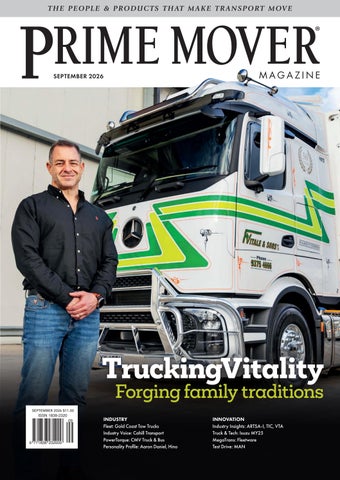
TruckingVitality
Forging family traditions
p rime m over mag . com .a u
SEPTEMBER 2026 $11.00
ISSN 1838-2320
9 771838 232000
09
INDUSTRY Fleet: Gold Coast Tow Trucks Industry Voice: Cahill Transport PowerTorque: CMV Truck & Bus Personality Profile: Aaron Daniel, Hino
INNOVATION Industry Insights: ARTSA-I, TIC, VTA Truck & Tech: Isuzu MY25 MegaTrans: Fleetware Test Drive: MAN
The all-new Isuzu 4x4 range.
4x4 x more. Get more from your 4x4 with Isuzu’s all-new range of off-road trucks. More protection, with a suite of safety features that breaks new ground in the category. More comfort, with an ISRI seat* that turns rough roads into smooth sailing. More performance with Isuzu’s latest turbocharged diesel engine. And more ease in every drive, with a 9-speed dual-clutch transmission on selected models. All backed by the Isuzu reliability you can trust when the going gets rough. It’s off-road trucking redefined. Head to isuzu.com.au or visit your nearest Isuzu Trucks Dealer to find out more.
*ISRI seat only available on F Series models. FSA/ISZS3062
T H E P E O P L E & P R O D U C T S T H AT M A K E T R A N S P O R T M OV E
®
Outback tough. Highway ready. wherever the job takes you
S E P T E M B E R 2026
Shell Rimula keeps you moving
SEPTEMBER 2026
MEET THE TEAM Australia’s leading truck magazine, Prime Mover, continues to invest more in its products and showcases a deep pool of editorial talent with a unique mix of experience and knowledge.
Rocky
TruckingVitality
Forging family traditions
p r im e m o ve r m a g . c o m . a u
Scan here to explore Shell Lubricants or visit: shell.com.au/transport Heavy Duty Diesel Engine Oil
SEPTEMBER 2026 $11.00
ISSN 1838-2320
9 771838 232000
09
INDUSTRY Fleet: Gold Coast Tow Trucks Industry Voice: Cahill Transport PowerTorque: CMV Truck & Bus Personality Profile: Aaron Daniel, Hino
INNOVATION Industry Insights: ARTSA-I, TIC, VTA Truck & Tech: Isuzu MY25 MegaTrans: Fleetware Test Drive: MAN
Christine Clancy | CEO
With more than two decades of experience as a media professional, Christine has worked in newsrooms across Canada, Vietnam and Australia. She joined the Prime Creative Media team 12 years ago, and today oversees more than 43 titles, including a dozen print and digital transportation titles. She continues to lead a team that focuses on continuous improvement to deliver quality insights that helps the commercial road transport industry grow.
Paul Lancaster | Editor
Paul joined Prime Creative Media as an editor in March 2025 and has enjoyed a broad career spanning over 20 years across different sectors, including law, journalism and marketing in Australia and internationally. He gets great satisfaction from creating targeted content that appeals to wide ranging audiences. Paul says this comes from listening to industry members, businesspeople and the broader community.
Peter Shields | Senior Feature Writer A seasoned transport industry professional, Peter has spent two decades in the transport media sector. Starting out as a heavy vehicle mechanic, he managed a fuel tanker fleet and held a range of senior marketing and management positions in the oil and chemicals industry before becoming a nationally acclaimed transport journalist.
CEO Christine Clancy christine.clancy@primecreative.com.au Paul Lancaster Editor paul.lancaster@primecreative.com.au
Managing Editor, Transport Group
Luke Applebee luke.applebee@primecreative.com.au
Senior Feature Writer
Peter Shields peter.shields@primecreative.com.au
Business Development Manager
Ashley Blachford ashley.blachford@primecreative.com.au 0425 699 819
Clayton Hawley Head of Design clayton.hawley@primecreative.com.au
Design Client Success Manager
Jacqueline Buckmaster, Danielle Harris
Ben Sammartino ben sammartino@primecreative.com.au
379 Docklands Drive, Head Office Docklands VIC 3008 info@primecreative.com.au Ashley Blachford | Business Development Manager
Peter White | Contributor
Since completing a Bachelor of Media and Communication degree at La Trobe University in 2021, Peter has obtained valuable newsroom experience, supplemented by direct industry exposure at Prime Creative Media. As the Editor of Trailer, Peter brings a fresh perspective to Prime Mover. He has a strong interest in commercial road transport and in furthering the magazine’s goal of growing the industry.
www.primemovermag.com.au
Subscriptions
03 9690 8766 subscriptions@primecreative.com.au Prime Mover magazine is available by subscription from the publisher. The right of refusal is reserved by the publisher. Annual rates: AUS $110.00 (inc GST). For overseas subscriptions, airmail postage should be added to the subscription rate.
Articles
All articles submitted for publication become the property of the publisher. The Editor reserves the right to adjust any article to conform with the magazine format.
Copyright
XAVIER_HINO41087
Handling placements for Prime Mover magazine, Ashley has a unique perspective on the world of truck building both domestically and internationally. Focused on delivering the best results for advertisers, Ashley works closely with the editorial team to ensure the best integration of brand messaging across both print and digital platforms.
PRIME MOVER magazine is owned and published by Prime Creative Media. All material in PRIME MOVER magazine is copyright and no part may be reproduced or copied in any form or by any means (graphic, electronic or mechanical including information and retrieval systems) without written permission of the publisher. The Editor welcomes contributions but reserves the right to accept or reject any material. While every effort has been made to ensure the accuracy of information Prime Creative Media will not accept responsibility for errors or omissions or for any consequences arising from reliance on information published. The opinions expressed in PRIME MOVER magazine are not necessarily the opinions of, or endorsed by the publisher unless otherwise stated.
HINO410
BUSINESS INTELLIGENCE AT YOUR FINGERTIPS THAT’S ANOTHER HINO
CONNECTIVITY THAT DELIVERS MORE THAN DATA. XAVIER_HINO41087
With Hino-Connect business telematics standard across the 700 Series, operators can optimise performance through
live data insights, remote diagnostics, and proactive fleet support. It provides real-time tracking, fuel efficiency insights,
and driver performance monitoring to help lower running costs through smarter management. Supported by dedicated
Hino-Connect Specialists, it delivers the visibility and confidence businesses need to stay productive and keep their trucks on the road. It’s smarter business management built into every truck. Find out more at hino.com.au
HINO41087 26-700 Series Campaign-HMSA-A4-Hino-Connect.indd 1
5/5/2026 11:42
FROM THE EDITOR
Mind Over Machine Paul Lancaster Editor It’s hard to remember a time before Artificial Intelligence became part of our daily lives. Whether we’re asking an AI assistant to summarise a report, planning a holiday, using voice navigation for the best route or our phones organising our calendars, AI has become so commonplace that many of us barely notice it’s there. It’s no longer a glimpse into the future. It’s a part of the way we live. That naturally raises a bigger question. Is all this technology making life better, or are we slowly handing over too much to machines? The answer probably sits somewhere in the middle. There’s no denying AI has enormous potential. It can process information in seconds, identify patterns humans might miss and take care of repetitive tasks that free us up to focus on what really matters. Used well, it’s a remarkable tool. Australia’s transport industry is already seeing the benefits. Today’s prime movers are smarter than they’ve ever been. Telematics provide real-time insights into vehicle
6
Sept ember 202 6
performance, predictive maintenance helps prevent costly downtime, route optimisation cuts unnecessary kilometres, and advanced safety systems are making Australia’s roads safer for everyone. Behind the scenes, AI is also helping fleets manage maintenance schedules, improve fuel efficiency, and make better business decisions. At the same time, it’s understandable that many people are asking what comes next. Every technological leap seems to arrive with predictions that jobs will disappear. Drivers, technicians, office staff, and even journalists have all found themselves wondering whether AI will eventually replace them. Trucking and transport have never been industries that stands still. We’ve seen enormous change over the decades, from paper maps and handwritten logbooks to satellite navigation, electronic work diaries and sophisticated vehicle diagnostics. Every innovation has changed the way we work, but none has removed the need for skilled, dedicated people, because transport has always been, and always will be, a people business. Freight doesn’t move because software says it should. It moves because someone climbs into a truck before dawn. Someone services the vehicle to keep it safe. Someone coordinates
deliveries when plans change. Someone answers the phone when a customer needs help. And when something unexpected happens—as it often does in transport—it isn’t artificial intelligence that finds the practical solution. It’s experience, judgement and people working together. There’s little doubt AI will continue reshaping our industry in the years ahead. Businesses that embrace the technology sensibly will almost certainly become safer, more efficient and more competitive. Embracing technology doesn’t mean forgetting what matters most. For all the advances in telematics, automation and AI, the transport industry still runs on people. Drivers, mechanics, apprentices, workshop teams, logistics professionals and countless others remain the heartbeat of an industry that keeps Australia supplied. Technology will continue to evolve, but as impressive as AI becomes, it won’t replace the pride of a job done well, the instinct that comes from years behind the wheel, or the satisfaction of solving a problem that no computer saw coming.
LESS DOWNTIME. MORE DRIVE TIME
D46-170
D52-190
RELIABILITY THAT DRIVES YOUR BOTTOM LINE For more information contact Dana on 1300 00 DANA or visit us at www.Dana.com.au
Strength • Power • Endurance
CONTENTS
38
Prime Mover September 2026
32 40
18
8
Sept ember 202 6
56
COVER STORY
“Buying those first few with the Mercedes-Benz service plans and the support we got was the best decision we ever made. So, we just continued to keep buying them.”
OFF-GRID AMBITION
Prime Feature STORIES FLEET FOCUS
24
28
TESTDRIVE
Going Tow to Tow Tow trucks do more than simply attend crash scenes and carry off the damaged vehicles. Gold Coast Tow Trucks Light & Heavy provides a variety of services.
56 Lion haul specs The MAN TGX range delivers a combination of technical innovations, excellent driver ergonomics and impressive road manners.
32 Young Gun Third generation trucker, Rory Cahill is stepping up to lead family-owned Cahill Transport’s Victorian operations.
Regular Run
TRUCK & TECH
38 Tough Torque Fuso is cementing its foothold in Australia’s medium and heavy-duty truck market by expanding its Allison-equipped Euro 6 Fighter model. 40 Mud, wet and gears Isuzu has undertaken a comprehensive technical makeover of its off-road models to cater for Australia’s varied driving conditions.
6
From the Editor
60
PowerTorque Workshop
10 62 64 66
Prime Mover News Bob Woodward
Personality Profile ARTSA-i
68
Truck Industry Council
70
Peter Shields’ Number Crunch
69
Victorian Transport Association p rim e m ove r m a g . c o m . a u
9
PRIME PRIME NEWS
10
Sept ember 2 026
Tim Wedlock.
he was unfailingly generous with his time and energy to those entering it,” the AEI Insurance Broking Group said. He was named NSW Qualified Professional Insurance Broker of the Year in 2004 and again in 2009, and received the ANZIIF Insurance Leader of the Year award in 2018. In 2021 he was presented with the NIBA Lex McKeown Award for exceptional service to NIBA and the insurance profession. He was awarded the 2024 Austbrokers Frank Earl Award, which acknowledges excellence in the insurance broking profession within the Austbroker Partners. Reflecting AEI’s long involvement in the transport and logistics sector, the Australian Trucking Association honoured him with the Don Watson Memorial Award in 2014, the company said. AEI Managing Director and CEO, Noel Kelly said: “Tim was the cornerstone of AEI and a legend of this industry. Thirty-nine years in, he still had more energy than anyone in the room. He gave his time freely, to our people, to NIBA, to anyone who asked. We have
lost a leader and a mentor but most of all we have lost a mate.” The Transport Women Australia Limited said of Wedlock:” He believed in creating opportunities for others and was a strong champion for diversity and inclusion, always encouraging and supporting initiatives that strengthened our industry.His leadership, kindness and willingness to lift others left a lasting impression on everyone who had the privilege of knowing him.” On its publication, Freight News, Road Freight NSW said for the NSW and Australian trucking industries, Wedlock was “much more than a trusted insurance adviser and industry partner; he was a valued friend who was always prepared to help”. Road Freight NSW added: “Those who had the privilege of knowing and working with Tim will remember his integrity, professionalism, warmth and generosity. His contribution extended well beyond insurance broking; he was a genuine advocate for the people and businesses he served.”
Image: AEI Insurance Broking Group.
AEI Insurance Broking Group executive chairman, Tim Wedlock, 58, has been remembered as a “legend” of the insurance industry and a good friend to Australia’s transport sector, following his tragic death in the United States on 1 August. Wedlock died after he and a number of pedestrians were struck by a vehicle in Nashville, Tennessee. The AEI Insurance Broking Group said Wedlock spent almost four decades with AEI, marking his 39th anniversary the week before his death. “Over that time he built AEI into one of Australia’s most respected broking groups and established himself as one of the profession’s most recognisable industry figures,” the company said. Wedlock was a former President and Fellow of the National Insurance Brokers Association (NIBA), where he contributed more than 20 years to NIBA committees and the National Board. He was also a longstanding supporter of the Careers in Insurance initiative. “Advancing the professionalism and integrity of broking was a cause he returned to throughout his career, and
Image:Road Freight NSW.
> Vale Tim Wedlock
Versatility and productivity
Whether you’re on a freeway in peak hour, or on the highway with just the horizon for company, and you need an optimised load, style, comfort and power, the K220 is the smart choice. kenworth.com.au
PRIME PRIME NEWS
> Linfox and Bunnings’ new zero emission electric partnership Linfox’s latest partnership venture with Bunnings has resulted in the delivery of two new zero-emission electric prime movers. The new co-branded Volvo FM electric prime movers were delivered to Bunnings’ Dandenong Distribution Centre and will be used for deliveries to Bunnings’ warehouses around the Melbourne metropolitan area. Linfox said it was building on a shared commitment to reducing our impact on the environment and a more sustainable supply chain, adding that it was part of the companies’ partnership which started in 2008. Linfox Australia and New Zealand CEO, Mark Mazurek, said both organisations are in a very strong position servicing
Two new 100 per cent electric Volvo FM prime movers have been delivered by Linfox to Bunnings in Melbourne. Image: Linfox.
the Australian communities. “The relationship is really strong, and we are both totally committed to providing a more sustainable future, and these vehicles are the start of that presence,” he said.
Bunnings’ Supply Chain Director, Paul Hill, said the delivery of the 100 per cent electric trucks was a “really important milestone for Bunnings” which was very proud of its long relationship with Linfox.
> Freight transport decarbonisation on agenda at Alternative Fuel Summit 2026 The Victorian Transport Association (VTA) will bring together industry leaders, policymakers, vehicle manufacturers and energy providers at the Alternative Fuel Summit 2026: Pathways to Decarbonising Freight Transport on 17 September at the Melbourne Convention & Exhibition Centre. Supported by Viva Energy Australia, CMV Truck & Bus, and Prime Mover Magazine, the Alternative Fuel Summit will provide transport operators with practical insights into fleet decarbonisation while The VTA’s Alternative Fuel Summit 2026 will consider Freight transport decarbonisation. Image: VTA.
12
Sept ember 2 026
complementing the broader transport, logistics and supply chain discussions taking place throughout the MegaTrans 2026 exhibition. VTA Chief Executive Officer, Peter Anderson, said the Summit comes at a critical time for transport businesses evaluating how best to reduce emissions while maintaining operational efficiency and meeting customer expectations. “As part of MegaTrans 2026, the Alternative Fuel Summit provides an important platform for industry leaders, operators and decisionmakers to have informed discussions about the future of freight transport,” he said. “By bringing together vehicle manufacturers, energy providers, government agencies and transport operators, we’re creating opportunities for collaboration and helping businesses make confident decisions about their transition to lower-emission technologies.” A key feature of the Summit’s program will be the Transition Pathways and Support session,
bringing together representatives from Fleet Plant Hire, CMV Truck & Bus, RACV Commercial Energy Solutions and NewVolt. The session will examine technology selection, infrastructure requirements, fleet transition planning and operational considerations. “The freight industry is facing significant change as businesses, governments and customers seek lower-emission transport solutions,” Anderson said. “The Alternative Fuel Summit is designed to provide practical, real-world information that helps operators understand the opportunities, challenges and investments associated with transitioning to alternative fuel technologies.” Attendees will hear directly from organisations already implementing alternative fuel solutions and gain valuable insights into how transport businesses can prepare for future customer expectations, sustainability requirements and regulatory change.
Trusted protection. Proven performance. With a fleet of over 220 trucks and 550+ trailer configurations helping to export millions of tonnes of iron ore to the world MGM Bulk depends on Castrol oils, fluids, greases and advanced analytics to optimise performance and extend engine life, continuing to provide best in class service to their mining company customers - up and down Australia’s western seaboard. Castrol - trusted no matter the challenge.
castrol.com.au
PRIME PRIME NEWS
> Truckie First Aid course notches 4,000-plus finishers More than 4,000 truck drivers across Australia have now completed NatRoad and St John Ambulance Australia’s free Truckie First Aid online training program. The milestone highlights the organisations’ combined efforts to improve road safety and equip trucking and road industry drivers with the confidence to respond in an emergency. Developed through a partnership between NatRoad and St John Ambulance Australia, Truckie First Aid was launched in October 2023 to recognise the unique role truck drivers often play as first responders at the scene of road crashes and other medical emergencies. The free online course provides practical first aid knowledge tailored specifically to heavy vehicle operators and can be completed in around 30 minutes. NatRoad CEO, Warren Clark, said reaching 4,000 trained drivers demonstrated the industry’s strong commitment to improving safety on
Australia’s roads. “Truck drivers travel every corner of Australia, including many remote and regional areas where emergency services can take time to arrive. They’re often among the first people at the scene of a crash, and those first few minutes can make all the difference,” he said. “Every driver who completes Truckie First Aid comes away better equipped and more confident to step in and provide potentially life-saving assistance in the vital minutes before professional help arrives.” The milestone follows the continued expansion of the program over the past year, including the introduction of Punjabi, Mandarin, Hindi and Arabic language versions to make the training more accessible for Australia’s diverse road freight workforce. The translations were supported through funding from the National Heavy Vehicle Regulator’s Heavy Vehicle Safety Initiative supported by the Australian Government.
The Truckie First Aid program covers essential first aid skills, including CPR, how to keep an airway open, managing severe bleeding, operating an automated external defibrillator (AED), and responding to a range of medical emergencies commonly encountered on the road. St John Ambulance Australia’s Director of Partnerships, Fundraising, and Community Impact, Fairlie Tucker, highlighted the importance of these critical first aid skills in the immediate minutes after a road crash. “In an emergency, the first few minutes can mean the difference between life and death. A blocked airway can become fatal in as little as four minutes, and for every minute CPR and defibrillation are delayed during a cardiac arrest, the chance of survival decreases by ten per cent. “By equipping more truck drivers with first aid skills, we can ensure more people are ready to take action when it matters most, and ultimately help save lives.”
Daimler Truck Australia Pacific President and CEO, Daniel Whitehead, has announced he will leave his current role at the end of this year. His departure marks the end of a stellar 30-year career with Daimler Truck and Mercedes-Benz, including 12 years in his current role and a decade in China. The company said Whitehead has overseen record growth of the Daimler Truck, which is currently the number two truck manufacturer in Australia, and which includes the Mercedes-Benz, Fuso and Freightliner brands. Some of Whitehead’s highlights leading Daimler Truck Australia Pacific included him overseeing the introduction of the new generation Actros in 2016, a new heavy-duty Fuso with the Shogun in 2019, an 14
Sept ember 2 026
all-new Freightliner Cascadia in 2020, as well as ushering in a new era of electric trucks from 2021 with the Fuso eCanter, Mercedes-Benz eActros and eEconic models. Under his guidance, Daimler Truck was the was the first manufacturer to introduce an electric truck in Australia, with the Fuso eCanter. Whitehead ensured Daimler Truck built a reputation in Australia and New Zealand of introducing trucks and buses with advanced safety features and low emission engines ahead of its rivals and well before regulations, the company said. Whitehead says his time with Daimler Truck and Mercedes-Benz has been immensely satisfying. “I have enjoyed every minute of my 30-year career with this remarkable company,” he said.
Daimler Truck Australia Pacific President and CEO, Daniel Whitehead, will step down from his role.
“It has provided me with tremendous opportunities both personally and professionally and I couldn’t thank them enough.” Beyond his role at Daimler Truck Australia Pacific, Whitehead continues to serve on the board of the Heavy Vehicle Industry Association (HVIA).
Image: Daimler Truck Australia Pacific.
> Daimler Truck Australia President & CEO to step down
DAF CF450 PRIME MOVER
MEGA DEAL 1%* FINANCE OR 4 YEARS FREE* SERVICING
DAF CF450
$229,900*
We’re clearing all stocks of the DAF CF450 at the low price of $229,900* (ex. GST & Gov’t charges). Plus get 4 years free servicing* (100,000km per year) or 1% finance* (Max. 48 month term). Only while stocks last.
www.daf.com.au/cf450runout *Terms and conditions apply. See daf.com.au/cf450runout
PRIME PRIME NEWS
> Healthy Heads GM moves on Import-export logistics provider, Qube Holdings has celebrated the recent performance of its off-road operations team in Central Queensland. The company revealed that over the past three months, the CQ team has consistently moved more than 1.2 million tonnes of coal per month at the Jellinbah and Yarrabee mines in Blackwater, as part of its haulage contract. For FY26, the team achieved a 10 million tonne milestone, using Mack Trident and Kenworth C509 tri-drive prime movers with Smith and Lusty “C Train” trailer combinations. Qube hauls processed coal from wash plants for both Jellinbah and Yarrabee Mines to the Boonal TLO, and also hauls unprocessed material for Jellinbah Mine from rom locations to wash plants for processing. It operates high-capacity combinations of up to 320 tonnes GCM, following a series of successful payload uplift initiatives as part of its continuous improvement program. With the company operating as a 24/7 operation, 364 days per year, it is a feat that has not been achieved in the 40-plus years the mines have been operating, Qube said. “This accomplishment highlights our commitment to operational excellence and reliability across the business,” the company said on LinkedIn. “Thank you to the team for setting a new benchmark and inspiring us all to aim higher every day.”
The company currently employs 108 personnel across the project, covering operational, maintenance, administrative, safety and compliance, and site management functions. Qube operates a workshop and operational offices at the Jellinbah South mine site, from which services are provided to both the Jellinbah and Yarrabee mines. Qube Projects Manager, Blackwater Region, Joel Eaton said: “Over the past two years, we’ve focused on building a strong, united culture across our workforce, and the results speak for themselves. “We have one of the best employee retention rates in the industry, which reflects the trust, commitment and sense of belonging we’ve worked hard to create. “I firmly believe that business success starts with people. You don’t achieve major milestones without first earning the trust of your team. “At a time when job security remains a concern across many parts of the mining industry, we’re proud to provide stability and opportunity for our people. Their dedication and contribution have played a critical role in the success of our projects, and that success has helped secure a strong future for our workforce. “As a Projects leader, my highest priority is the safety, wellbeing and security of our people. When we get that right, strong business performance naturally follows.”
Melissa Weller is stepping down from her role as General Manager of Healthy Heads. Image: Healthy Heads in Trucks & Sheds.
Qube thanked the management and operations teams across both the Jellinbah and Yarrabee mining operations in Blackwater for their continued partnership and commitment. “Together, we share a common set of values and a strong belief in our people, enabling us to achieve milestones that were once considered beyond reach,” the company said. “FY2026 has established a new benchmark for performance, built on collaboration, trust and a relentless focus on excellence. Most importantly, every achievement was delivered safely – a result that remains our greatest measure of success.”
> Toll to deploy hydrogen prime movers on VIC steel route Toll Group is set to introduce two hydrogen-powered prime movers on a dedicated steel freight route between Hastings and Geelong in the second half of 2026 which is supported by Viva Energy’s hydrogen refuelling infrastructure. The trucks will operate on a 300-kilometre return journey transporting steel, with Viva Energy estimating the vehicles could 16
Sept ember 2 026
prevent around 208 tonnes of CO₂ emissions each year compared with equivalent diesel-powered trucks. The reduction is based on avoiding the combustion of approximately 80,000 litres of diesel annually. The announcement coincides with the first anniversary of Viva Energy’s Geelong hydrogen hub, which opened in 2025 as Australia’s first commercially scaled site to combine
hydrogen refuelling with truck-sized ultra-fast EV charging alongside conventional fuels. Viva Energy said the Toll deployment demonstrates the role hydrogen infrastructure can play in supporting the decarbonisation of heavy vehicle fleets, with the company continuing to invest in new energy solutions for the road transport sector.
COVER STORY
18
Sept ember 20 26
TRUCKING
VITALITY F Vitale & Son has shown how an in-house transport division can develop to provide excellent service to a broader range of clients using the latest truck technology from Mercedes-Benz.
Frank Vitale with the company’s Mercedes-Benz Actros ProCabin. Images: Mercedes-Benz. p rim e m ove r m a g . c o m . a u
19
COVER STORY
I
n 1960 Francesco Vitale, who was a migrant from Italy, purchased a plaster products manufacturing operation in the Melbourne suburb of Essendon with his three sons. He changed the business’s name to F Vitale & Sons and commenced producing sheet and ornamental plaster products. The company is now renowned for its often-bespoke architectural products including cornices and intricate ceiling roses. Over time, the operation expanded and diversified to include a construction division and a transport division.
Today the business is still in the hands of the Vitale family with Francesco’s grandson Frank Vitale at the helm of the transport operation, along with his sister and cousins who all work in different divisions of the business. The truck operation was initially set up to haul the company’s own plaster and building products and has expanded to providing general freight services for a mix of freight including Gyprock plasterboard and other building materials, beverages, timber, general freight such as fastmoving consumer goods. The company
services destinations within Victoria as well as interstate line haul trips to South Australia, New South Wales, Queensland and Western Australia. Up until 2020 the fleet had been dominated by North American-style trucks until Frank Vitale decided to purchase four Mercedes-Benz 2653 Actros 13-litre prime movers, which were followed in 2021 by four more. Others Actros prime movers have since followed and the latest addition is a Mercedes-Benz Actros ProCabin, connected to a Vawdrey B-double trailer set. This is the twentieth
The Mercedes-Benz on the open road. 20
Sept ember 20 26
Mercedes-Benz product to join the F Vitale & Sons fleet which now numbers around 50 prime movers. The decision to move to the MercedesBenz brand was a carefully considered one, but one for which Frank has no regrets and his committed enthusiasm for the Actros prime movers continues to grow. “I was always curious about the European vehicles and their longer service intervals, and their comfort, and the factory backed service plans and impressive warranty packages,” says Frank. As well as fuel savings, driver comfort, and multiple safety features, the service plans and the factory backed warranties available with the Actros models were an important factor in the choice of truck brand. “It’s obviously hard keeping the workshop up to date with all the fleet service and buying those first few with the Mercedes-Benz service plans and the support we got was the best decision we ever made,” he says. “So we just continued to keep buying them.” The standard safety features of the Actros, such as the radar-based Advanced Emergency Braking System, Active Brake Assist, Active Sideguard Assist blind spot monitoring and Adaptive Cruise Control, provide peace of mind for the business. “Safety is number one in our business, so an integrated safety solution truck like the Actros is a big plus for us,” Frank says. Daimler Trucks has introduced a new electronics platform that can process data 20 times faster, enabling the truck’s safety systems to react faster and provide even stronger support for the drivers. The Actros ProCabin has four new radars, in addition to the existing centrally mounted front radar and windscreen-mounted camera. This provides a 270-degree view around the vehicle, allowing engineers to further improve the Active Sideguard Assist system. It monitors both sides of the vehicle and covers an even greater area than previously. It can even stop
Looking good from every angle.
the truck when it is turning (up to 20km/h) if it detects a potential hazard such as a cyclist. The Vitale company graphics suit the latest futuristic looking Actros ProCabin which has already been a hit with Frank’s drivers and has proved to be a surprising step up even from previous Actros models which may only be a couple of years old. The aerodynamic design of the ProCabin Actros aids in achieving its improved fuel consumption rates. Mercedes-Benz claims the ProCabin delivers a three per cent fuel efficiency improvement compared to its predecessor. “It’s a massive step up, even up from the ones that are only a year or so older. I didn’t think it was going to be that big a change. I thought it’s just an aerodynamic look when I went to the launch. I can’t believe the difference between the ProCabin and the other Mercedes,” says Frank. “This truck is amazing. It’s so quiet, so comfortable, and so good to drive. You don’t even know you’re driving a truck.” The fuel efficiency from the ProCabin is already impressing Frank. “We’re towing B-doubles between SA and Victoria and even operating at 68 tonnes both ways, we’re consistently getting the best fuel numbers.” The 13-litre engine in the new ProCabin is rated at 530hp, which Frank doesn’t see as a handicap. Freight such as plasterboard can be heavy, frequently taking the gross
vehicle weights close to the allowable maximums. Initially some of the drivers were sceptical about the abilities of a 13-litre engine compared with 15 litre units, but they very quickly became advocates of the smaller capacity, yet more efficient, MercedesBenz power plants. “I’ve got other Benz’s doing the same job,” Frank says. “I’ve got 630’s, 580’s, and I’ve got 530’s. But this latest generation of 530 engines, which some of my other more recent Actros’s have in them, delivers better fuel numbers. The difference in the power seems negligible and the 530 really pulls well in the B-double configuration.” F Vitali & Sons utilises Guardian fatigue monitoring systems in its trucks and Frank has been impressed with the much lower rate of fatigue alerts detected from the Mercedes-Benz trucks compared with other brands across the fleet, even when comparing the same drivers doing the same routes. His strong belief is that this is the result of the drivers being less stressed when driving an Actros. Frank’s first Actros was a single drive prime mover, purchased 20-odd years ago to suit a particular project for a client. “I’d never had one, but that was the only truck that could do this particular job, and it worked double-shifted seven days a week,” Frank recalls. “It barely ever stopped, only on Christmas Day or if it needed a p rim e m ove r m a g . c o m . a u
21
COVER STORY
service. Other than those few occasions that ‘Benz ran 24/7, and it was clocking up 30,000 kilometres a month, like a line haul truck, but local, which is even harder on the equipment. “This Actros did 1.3 million kilometres with the same engine. We had to replace one clutch and a few little bits and pieces”. That very same truck is still in the Vitale fleet, utilised as a yard tug to move trailers around. The Actros trucks are serviced at the local Daimler Trucks Velocity dealership as well as regional dealers such as TriStar which is important for trucks running interstate. “I’ve got a good relationship with them as well and nobody comes close to the support and how well they back you, whether it’s from the dealer level or even at the head office level,” says Frank. “They are so eager to help you and work with you.” Frank Vitale’s passion for the Mercedes-
The prime mover stands out in the distinctive company livery.
Benz trucks in his fleet continues to grow as more Actros’s are added and the latest ProCabin model underlines the decision commit to the European style of prime mover. “They are a fantastic product and the
people back it so well,” he says. “It’s been the best decision we’ve ever made. The new truck has got some great features and I’m looking forward to putting more into the fleet as we keep replacing them.”
Successful operators focus on the work. TR takes care of the fleet.
The right equipment makes a difference. Quality vehicles help keep businesses moving, drives productivity and keeps customers satisfied. That’s why operators across transport, infrastructure and construction choose TR Group for their heavy commercial rental and leasing solutions.
TR Group. Helping successful businesses stay ahead. 1800 50 40 50
www.trgroupau.com
BRISBANE NEWCASTLE
PERTH
SYDNEY ADELAIDE MELBOURNE
FLEET FOCUS
Owner/Manager, Brock Conway, with some of his company’s fleet. Images: Hino Australia.
GOING
TOW TO TOW Tow trucks do more than simply attend crash scenes and carry off the damaged vehicles. Gold Coast Tow Trucks Light & Heavy provides a variety of services.
I
t could be said that Gold Coast Tow Trucks’ Light & Heavy owner/manager Brock Conway was destined to be a tow truck operator, following on from his grandfather Vince Borelli who was a mechanic and tow truck driver back in the 1940’s and 50’s in Melbourne. Brock’s father Alan was also involved in the towing industry in Melbourne before relocating to Queensland’s Gold Coast. “My dad had moved up here from Melbourne when I was six with an XF Falcon, a car trailer, fifteen hundred bucks, and two kids,” says Brock. “He started a small operation in the southern Gold Coast area. And now we’re here 30 years later with 57 trucks.” The towing fleet is predominantly Hino, sold and serviced by the team 24
at the local Sci Fleet Hino dealership, and the models range from 300 Series 921’s fitted with six metre tilt trays, to 500 Series Standard Cab FD and FE models fitted with nine metre bodies. Applications include under lifts, tilt trays and car carriers. “The only time I haven’t bought a Hino is if I couldn’t get one,” says Brock. “If I had my way, every truck would be a Hino.” The exceptions are nine Ford F350 tow trucks which have the ability to access low ceiling clearance underground car parks. The Hino’s are serviced by Sci Fleet Hino and are covered by factory repair and maintenance contracts. During his teens, Brock had the intention of becoming a lawyer and went to university to study for a Bachelor of Business. While at Uni
Brock also managed to obtain his towing credentials at just 17 years and four months of age because the Queensland regulations allowed for family-based exemptions. “I haven’t lost the lost enjoyment of towing over all these years,” Brock says. “I still get out in the truck occasionally.” Towing is an industry which operates 24/7 which is a major factor in the typically high turnover of employees. There can be challenges in ensuring adequate levels of staff availability due to the unpredictability of demand even on an hour-to-hour basis. While still delivering rapid response service to its clients, Gold Coast Tow Trucks has also earned an enviable reputation for very good staff retention. “Even though we’re a medium to large
Sept ember 20 26
OnHwy A
company, we’re still family run, so when their kids are sick or on school holidays, or whatever, we understand that,” says Brock. The majority of the work is related to insurance, accidents or breakdowns including delivering roadside assistance services. The six and a half tonne rated tilt tray trucks are also capable of transporting machinery, medium duty vehicles and small trucks. Recent additions to the fleet are several trailer-equipped car carriers capable of transporting four or five vehicles at a time, performing most of their services to car dealers. The “half-moon” trailers and double-deck truck mounted frames have been sourced from Panton Hill Welding in Victoria and Anybody Car Carriers north of Brisbane. “We do a lot of work with them out of the Port of Brisbane, moving both imported and exported passenger vehicles,” says Brock. “We have the access cards for our drivers which allows access to the port, so we will get new, or in some instances used, cars purchased from Japan which we’ll take to the dealer to get complied.” The car carriers also transfer vehicles between dealerships and often do jobs for insurance companies moving written off vehicles from the Gold Coast to the auction sites in Brisbane. Relocating rental and new vehicles is another area in which Gold Coast Tow Trucks has achieved a good reputation.
OnHwy Ad_210x90mm_v1.indd 1
Owners of prestige vehicles such as supercars and modified vehicles including hot rods are catered for with the ultra-low approach angle tilt trays provided by the Gold Coast Tow Trucks fleet. The drivers are also experienced in the transport of motorcycles and are trained to treat every vehicle with care and respect, and each driver is serious about being entrusted with a customer’s pride and joy. The innovative ATB super low approach tilt trays with headboard ramps allow the trucks fitted with them to have half a metre extra deck space without having to increase the length of the truck. Due to its location close to the NSW/ Queensland state border and the frequent crossing of it in day-to-day operations, Gold Coast Tow Trucks and many of its drivers hold the relevant
authorities to operate in both states. Currently operating from six premises, Gold Coast Tow Trucks Light & Heavy has opened a new 5,500 square metre factory on the Gold Coast, equipped with state-of-the-art security cameras and modern office facilities and will provide plenty of undercover vehicle storage. “The way vehicles crash is different now,” says Brock. “Everything’s got accident-avoidance systems.” Towing modern passenger vehicles loaded with electronic systems can present challenges. Electric cars, as well as many modern petrol- and dieselpowered models, have features such as electric parking brakes, electric steering, and electric transmission controls which include a lot of expensive components which can be affected if a vehicle is not recovered and towed in
Brock Conway at home in the Hino’s cabin.
8/3/26 12:30 PM
FLEET FOCUS
Brock Conway is all smiles with the business’s progress.
the correct manner. These vehicles are usually not suitable for traditional under-lift or jib towing, and the electronics often require all 26
Sept ember 20 26
four wheels to be mounted on skid dollies prior to being loaded onto a tilt tray truck. Selecting the correct locations to connect a winch cable
is also crucial as components such as suspension control arms are often fitted with sensors and wiring looms which could be damaged. To address this Brock has implemented training programs for his drivers. “Where we are providing roadside assistance, some of the brands offer training,” says Brock. “Tesla, for example, will actually bring a car to us and say, ‘this is how you do this on the new model’. Some of the other brands will give you a bit of training, but predominantly we’re not the first priority of their training schedules.” The tilt trays are equipped with container pins and locking mechanisms, and perform 20 to 30 container movements each week, often for container sales and hire companies. Mostly these operations are smooth going, but occasionally some container clients don’t really understand the dimensions of the space required for a truck to deliver a container. “They get trucks in there all the time’ is a typical saying, and in reality, you
H T S A
P P h
F
h
C
Hino is seen by professionals as the preferred brand for tilt tray work.
An impressive lineup.
couldn’t get a Mini Minor in there,” says Brock. “Or they don’t answer the phone and expect us to be able to decide where they want it placed.” During his time in the industry Brock has noted a lot of changes, most for the better and the industry has moved on from the “cowboy” days of the past.
Hydraulic Tipping Solutions in Australia
“Things are a lot more corporate now,” Brock says. “The old stereotype of the industry is gone. When I started my whole goal was to be able to go to a job and help someone in a time of stress and I always pass this on to my staff to treat our customers the same way.”
Hydraulic Pumps C-Type Tipping Cylinders
Precision engineered Hydraulic Tipping Cylinders, Pumps, valves and complete systems built for heavy-duty Australian applications. For more details visit our website
hidromas.com.au Contact Us Phone +61 3 7033 0704 Email sales@hidromas.com.au Address 40 Taryn Drive, Epping VIC 3076 Australia
H-Type Tipping Cylinders
Oil Tanks
FLEET FOCUS
AMBITION OFF-GRID
Centurion’s electric truck fleet in Perth marks a bold step into heavy‑vehicle decarbonisation. After a year of operation, the project, which leverages a microgrid, has revealed both its promise and its complexity.
W
hen Centurion switched on its electric truck fleet in Perth last year, the move was widely recognised as one of the most ambitious electrification projects attempted in Australian road transport. The company was not simply trialling battery‑electric trucks, it was doing so through a fully off‑grid microgrid built at its Hazelmere site, powered by solar and supported by more than 10MWh of battery storage. The scale of the system, and the decision to operate without reliance on the Western Power network, set the project apart from other early deployments around the country. CFC Group Group Manager – Corporate Affairs & Sustainability, Hamish McHaffie, says the past 12 28
Sept ember 20 26
months have demonstrated both the resilience of the system and the realities of running electric trucks in a commercial freight environment. “Electric truck projects aren’t always easy, especially ones that are off grid,” Hamish says. “What’s so unique about this one is that it’s off grid and we don’t have the luxury of switching back to power supply from the grid whenever we need it.” That off‑grid status influenced every part of the project’s first year. Centurion installed backup generators to ensure continuity, but Hamish says the company’s goal was to minimise using them. “We don’t want to use the backup generation, but that’s what it’s there for. If we’re having issues from a weather perspective and we’re not generating enough solar to charge the
trucks, we’ve got that fallback plan.” Even with that redundancy, the microgrid introduced operational challenges that diesel fleets never face. Hamish says the biggest concern was ensuring drivers arrived each morning to fully charged trucks. “We’ve had the odd close call where that almost has happened,” he says. “Depending on the nuances and faults that can occur in the system, if the backup generation is called upon and a fault occurs, it can result in the system having a shutdown. If no one picks it up, the guys can turn up to work and the trucks aren’t necessarily charged.” Centurion has so far avoided the scenario where diesel trucks had to be substituted for electric units, but there were days where drivers had to return to base early for a top‑up charge before
heading back out. “It’s the ongoing nuance of operating electric trucks,” Hamish says. “There’s nowhere really suitable for them to get a quick top‑up in the areas they’re operating, to the equivalent of pulling into a gas station and putting some more diesel in.” That reality forced Centurion to give due consideration to route planning, freight scheduling and daily duty allocation. The Perth metro operation had previously been subcontracted, meaning Centurion had not directly managed the task before electrification. Bringing it in‑house coincided with the introduction of electric vehicles, creating a dual learning curve. “We always knew the attention required in managing aspects like changing routes or duty,” Hamish says. “The fleet manager has to think about the duty today, and based on that, we’re going to have to bring you back at this particular point. That level of complexity hasn’t been part of that operation in the past.” The company’s project team is built to accommodate the new demands.
A fleet manager oversees drivers and vehicle deployment, while we have other personnel monitoring the microgrid, battery storage and charging infrastructure. Hamish says this is a stark contrast to diesel operations. “Most transport companies have an asset manager who worries about maintenance, servicing and breakdowns,” he says. “With this project, we’ve probably got another handful of people involved because you’ve got to think about all these other elements you don’t normally have to think about.” The microgrid itself is a major focus of maintenance. The Hazelmere site sits next to a asphalt plant, and Hamish says the amount of dust generated by the facility is greater than anticipated. “We didn’t realise how much dust we were going to be dealing with,” he says. “When you get that dust into the microgrid system, it needs regular cleaning and maintenance because it can get into the system and result in shorts and faults.” Local technicians were contracted
to manage the battery and inverter systems. Their responsiveness, Hamish says, was critical to keeping the system running smoothly. “We’re definitely grateful to have local technicians on the ground dealing with issues when they come up,” he says. Despite the challenges, the project delivered strong operational performance and valuable insights for Centurion’s broader decarbonisation strategy. The company is already planning the next phase of electric truck deployment. “When you think about decarbonising heavy transport across Australia, the reality is you’re going to need both on‑grid and off‑grid solutions,” Hamish says. “We know in our network operations we’ll need both.” The Perth site’s oversized solar and battery system gives Centurion spare capacity in summer, and enough resilience through the winter. Hamish sees potential opportunities on the east coast, particularly in Queensland, but says Western Australia remains the priority because the
Images: Centurion.
Running electric trucks requires forward planning and operational oversight.
p rim e m ove r m a g . c o m . a u
29
FLEET FOCUS
An off‑grid microgrid powers Centurion’s electric trucks with 10MWh battery storage to ensure reliable charging.
charging infrastructure is already in place. Any expansion into larger prime movers will still be treated as a pilot, given the lack of public charging infrastructure for heavy vehicles. Customer feedback has been overwhelmingly positive. Some clients have dedicated pickup runs in the Perth metro area, meaning they interact with the electric fleet regularly. “They really love the fact their Perth metro pickups are being looked after by the electric truck, it’s a great outcome,”
Hamish says. “They know their goods will end up on big road trains heading north, and diesel will fuel those trucks, but if part of the journey embraces electrification, the response is always favourable.” The visibility of the trucks has also helped shift perceptions. “When we first put out the project, there was interest, but people couldn’t see it and touch it and experience it,” Hamish says. “Now they can. Everyone gets a lot more excited by it.” A Centurion electric truck plies the roads.
30
Sept ember 20 26
Driver sentiment has followed a similar trajectory. Hamish says early hesitation has given way to enthusiasm, particularly among new entrants to the industry. “We definitely find it’s attractive for people looking for work,” he says. “They like being part of the fleet and driving electric trucks.” The challenge, however, is retention. Many drivers progress their licences and move into Centurion’s long‑haul diesel fleet. “We pick up drivers keen to be part of the fleet and drive electric trucks, and that’s positive,” Hamish says. “But when they progress their licence, they move out of the electric truck fleet onto driving the big diesel trucks.” He sees the introduction of larger electric prime movers as part of the solution. “That’ll be quite attractive to some of the new drivers coming into the industry,” he says. “You still have the traditional truckie who loves getting in a big diesel prime mover and travelling across Australia, but there’s also today’s truck driver who’s going, ‘Hey, driving electric trucks – that’s interesting.’”
FLEET FOCUS
Rory Cahill is a third generation member of Cahill Tranport.
YOUNG
GUN
Third generation trucker, Rory Cahill is stepping up to lead family-owned Cahill Transport’s Victorian operations. 32
Sept ember 20 26
Images: Cahill Transport
A
t just 24 years of age, Rory Cahill is taking on one of the biggest responsibilities of his short career after being appointed State Manager of Victoria at Cahill Transport. While his age may surprise some, his connection to the family enterprise stretches back much further than the past five years he has spent working full time in the business. As the third generation of one of Australia’s best-known transport families, Rory has grown up immersed in the business. From sweeping warehouse floors and washing office windows as a teenager to now overseeing Victorian operations, he represents the next generation charged with guiding a company that has evolved from a single truck into a national transport network with more than 400 trucks and trailers. Despite the weight of history behind the Cahill name, Rory is quick to emphasise that his appointment is driven by passion rather than obligation. “I fell in love with the work,” he says. “If this wasn’t the industry for me, if I didn’t genuinely see a future in it, I wouldn’t be doing it. Nobody handed me a seat and told me to sit in it.” His journey into transport begins long before he joins the company officially. Growing up around both trucking and farming provides an appreciation of Australia’s regional communities and the role transport plays in keeping them connected. Camping, fishing, surfing and spending time on the family’s farms shape his early years, while regular exposure to rural Australia helps develop an understanding of the agricultural supply chain that today supports Cahill Rural’s extensive transport network into some of the country’s most remote locations. “We understand the demand at that end of the supply chain,” Rory says. “Whether it’s delivering to a regional merchandise store or going direct to a farm gate, we’ve lived that environment.” Although he admits he leaves school unsure of his career direction, transport soon becomes the obvious choice.
Cahill Transport is a true family business.
His first official job sees him working on the warehouse floor as a teenager, sweeping floors, loading and unloading trucks with a forklift and tackling whatever jobs need doing around the depot. However, one experience leaves the greatest impression. “The moment I’ll never forget is sitting alongside the operation in an administrative role,” he recalls. At the time, the operation was led by his eldest brother, Joe. “Watching the schedule, hearing the phones and seeing the whole puzzle move in real time was thrilling.” He credits Joe with providing both the guidance and confidence that fuel his enthusiasm for transport management. “Joe played a massive part in my journey,” Rory says. “He gave me the tools that built both my love for this work and whatever success I’ve had since.” Carrying a family legacy For many family businesses, succession brings significant expectations. Rory acknowledges the responsibility of joining a company celebrating its 75th anniversary but says he views the role as an honour rather than a burden. “It genuinely means so much to me,”
he says. “I still have to pinch myself sometimes when I’m driving up the Hume and one of our combinations comes past with our family name on the side.” Family history remains a constant source of inspiration. He regularly spends time with his grandmother listening to stories about the company’s earliest days, when his grandfather, ‘Papa Joe’, started the business with a single truck. His father and uncle purchased the company in 1989 and expanded it into a national operation servicing customers across Australia. Today, Rory works alongside his three brothers as the family prepares to write the next chapter in Cahill Transport’s history. “We push each other, we back each other and we all carry the same name on the same trucks,” he says. The longevity of the business also influences the way he approaches decision-making. “I’m not just running an operation,” Rory says. “I’m one chapter in something that has to reach 100 years and beyond.” That mindset, he believes, encourages decisions that prioritise long-term relationships, consistent service and p rim e m ove r m a g . c o m . a u
33
FLEET FOCUS
high operational standards rather than short-term gains. Support from family and colleagues Stepping into a senior leadership position at 24 inevitably attracts attention, but Rory says the encouragement from both family and friends has been overwhelming. “The support has been unbelievable,” he says. “My family have been behind me every step, and my mates outside the industry have a real admiration for the business and what it stands for.” While proud of the appointment, he remains conscious that leadership is earned through actions rather than titles. Building a stronger Victorian operation As Victorian General Manager, Rory identifies three priorities that underpin everything else: operational excellence, safety and people. The first involves continuous improvement across the business. Transport margins remain tight, making efficiency critical. “For me, it’s about streamlining the operation, reviewing our Victorian network and our freight lanes and building efficient practices that get the absolute most out of our fleet,” he says. “On our margins, there’s no such thing as a little thing. Every improvement counts.” Safety sits firmly above commercial considerations. Rory says Cahill Transport continues investing heavily in safety systems and compliance, with no room for compromise. “It’s non-negotiable. It’s the number one priority,” Rory says.
Equally important is creating a workplace where employees feel genuinely supported. Having worked his way through operational roles himself, he regularly considers how decisions affect those working on the frontline. “I constantly ask myself what I’d want if I was in their shoes,” he says. “This industry gets tough, and looking after your people isn’t a nice-to-have. It’s part of running a proper operation.” He believes the combination of clear operational processes, uncompromising safety standards and strong employee support creates an environment where issues become the exception rather than the norm. “When you get those three things right, everything else starts falling into place.” Learning before leading Although now occupying one of the company’s senior leadership positions, Rory says his immediate priority remains learning. He speaks highly of Cahill Transport’s experienced management team, describing them as some of Australia’s leading transport professionals. “I’m extremely lucky to be mentored by people who’ve been in this industry for decades,” he says. “I think it’s important to never fall into the mindset of believing you know everything, because if you think that way, you’ll never learn anything.” Over the next two years he hopes to absorb as much knowledge as possible before passing those lessons on to his own Victorian team. Longer term, he would like to contribute to the company’s national leadership. “I’d love to be involved in helping shape our national logistics one day,” he says.
ISRI: DEALERS SYDNEY
MELBOURNE BRISBANE
510 Victoria Street, Wetherill Park NSW 2164 DARWIN Ph. 02 9756 6199 email isri@isri.com.au web www.isri.com.au Unit 1/569 Somerville Rd, Sunshine West VIC, 3020 PERTH Ph. 03 9311 5544 email sales@isrisunshine.com.au web www.isri.com.au 3/120 Gardens Drive, Willawong QLD 4110 Ph. 07 3275 2044 email sales@isribrisbane.com.au web www.isribrisbane.com.au MACKAY
BRISBANE NORTH NEWCASTLE/HUNTER VALLEY
“But my focus right now is Victoria.” He describes his team as an extension of family. “We spend a third of our lives with the people we work alongside,” he says. “You look after that first, and the rest takes care of itself.” One national network Although each state operates its own freight task, Cahill rejects the idea of internal competition. Instead, he views every depot as an interconnected part of one national operation. “Freight I send up the freeway tonight becomes somebody else’s morning in Sydney, Brisbane or Adelaide,” he says. “Their success is my success, and mine is theirs.” He maintains regular communication with managers across the country, often speaking with them several times each day. While healthy competition exists, he says the objective is never to outperform another depot but to ensure Victoria delivers consistently for the wider network. “My ambition isn’t to beat the other states,” he says. “It’s to hold up our end of the network every single day.” Industry challenges Looking beyond Cahill Transport, Rory identifies sham contracting as one of the most significant issues confronting the Victorian transport industry. He argues that reputable operators cannot fairly compete with businesses avoiding employee entitlements such as superannuation, annual leave and workers’ compensation. “They’re not competing on service or efficiency. They’re competing on
Mobile Sales and Service Ph. 08 8927 0986 email info@isridarwin.com.au web www.isridarwin.com.au 408 Welshpool Road, Welshpool WA 6106 Ph. 08 9361 7646 email info@mmtisri.com.au web www.mmtisri.com.au 110-120 Maggiolo Drive, Paget QLD 4740 Ph. 07 4952 1844 email admin@isrimky.com.au web www.isriseatsmackay.com.au
1/259 Cullen Av East, Eagle Farm QLD 4009 Ph. 1300 11 4774 email seats@isrinb.com.au web www.isrinb.com.au
Unit 2/13 Hinkler Ave, Rutherford NSW 2320 Ph 02 4932 0600 email sales@hvss.com.au web www.isri.com.au
m.au
y.com.au
avoiding their obligations.” He believes the consequences extend well beyond commercial fairness. According to Rory, businesses that reduce costs through non-compliance often create pressure elsewhere in the operation, potentially affecting maintenance, fatigue management and safety standards. “The race to the bottom on cost always becomes a race to the bottom on safety,” he says. “And everybody shares the road with the result.” He believes stronger enforcement of existing workplace laws, combined with competition based on service quality, reliability and safety, is essential for maintaining industry standards. “Cahill Transport has been here for 75 years because we do it properly,” he says. “We’ll keep competing that way.” Preparing for the future Cahill Transport is among the operators participating in Australia’s growing electric truck trials, something Rory believes reflects the need for transport businesses to continually adapt. He says the decision is driven not only by environmental considerations but also by commercial resilience. Fuel remains one of the industry’s largest operating expenses, making alternative energy sources worthy of serious investigation. “We have to make sure we’re versatile,” he says. “The trial lets us answer the practical questions properly. Does it actually work in a real operation? How far can we go? How does it fit the way we run our fleet?” Equally important, he says, is understanding how drivers respond to the technology.
An overview of Cahill Transport’s headquarters.
“If the people behind the wheel don’t back it, it doesn’t matter what the spec sheet says.” While encouraged by the trial’s early results, Rory believes different freight tasks will Company co-founder, Joe Cahill junior, with his Ford sem require different technologies. i-trailer. Electric trucks already appear well suited to metropolitan technology,” he says. distribution work involving predictable “It’s the right technology for the right daily distances and overnight depot task.” charging. For Rory Cahill, that practical mindset “That equation is getting better every captures both the future of transport year,” he says. and his own leadership philosophy. Long-distance linehaul presents a While proudly carrying one of different challenge. Australia’s most respected transport Range limitations, payload names, his focus remains firmly on considerations and the availability continual improvement, supporting his of charging infrastructure between people and ensuring Cahill Transport Australia’s major capitals remain continues building on the legacy significant hurdles. established 75 years ago. “Anyone who tells you that’s all solved As the company looks towards its isn’t running trucks up the Hume every centenary, the newest generation of night,” he says. the Cahill family is determined that Rather than expecting one technology the business will continue doing what to dominate, Cahill believes it has always done best — delivering Australia’s freight future will involve for customers while adapting to the multiple energy solutions working changing needs of the Australian freight side by side. industry. “The future probably isn’t one
ISRI SEATS
the brand behind the brands
• Supporting drivers for more than 50 years • Seating – on a higher level
02 97566199
isri@isri.com.au
www.isri.com.au
TRUCK & TECH
One of the Corbet Group’s heavy-duty tippers in action.
MAKING
A DIFF
For Queensland’s Corbet Group, reliability is essential when its fleet of more than 200 prime movers is regularly hauling heavy loads across some of the state’s most remote roads.
B
ased in Gympie, the Corbet Group has built its reputation around heavy haulage, earthmoving and quarrying, with the company’s roots stretching back more than five decades. Today, the business operates seven quarries throughout Queensland, supplying material for roadworks and construction projects while also supporting its own earthmoving operations and an extensive external haulage business. General Manager, Andrew Corbet, says the company’s operations have evolved considerably since his father, Alvin, established the business in 1973 with log trucks based out of Gympie. The transition into quarrying comes 36
Sept ember 20 26
through the company’s involvement in earthmoving work around Roma, where it has long operated in the gas fields and mining areas. “We had our earthmoving fleet working in the gas fields around Roma, and they were always looking for rock to use in roadworks, and it went from that,” Andrew says. The opportunity to acquire a quarry arose, and the family business snapped it up eventually developing a network that now extends across much of Western Queensland. The Corbet Group owns and operates seven quarries across the region, servicing roadworks projects from as far south as Stanthorpe to areas including Rockhampton and Emerald. Added to
that mix is cattle haulage and cartage of materials from their quarries for private clients. That geographic footprint places significant demands on its transport operation. The company runs a large fleet of prime movers, side tippers, including AB triples, alongside a heavy haulage fleet of floats used to move machinery and other equipment. Andrew remains closely connected to the operation and spends considerable time behind the wheel himself. “I do a fair bit of driving in the trucks,” he says. “I’m in a truck a fair bit of the time, so I drive one of the floats pretty much all the time.” For someone responsible for a fleet
Images: Corbet Group.
of more than 200 prime movers, that hands-on experience also provides Andrew with a direct understanding of the equipment being used every day. The fleet is predominantly made up of Kenworths, with a handful of Western Stars powered by Cummins engines still working their way through the operation. “We’ll be 100 per cent Kenworth in the next couple of years,” Andrew says. The move towards a predominantly single-make fleet reflects the company’s experience with the Kenworth product in demanding heavy-haulage applications. “The Kenworths are just made for this heavy haulage stuff. They’re just ideal,” Andrew says. A big factor in the passion for Kenworth prime movers is the company’s strong relationship with Kenworth dealer, Brown and Hurley at Caboolture. “We’ve got a really good relationship with Brown and Hurley at Caboolture,” Andrew says. “They look after us well and we deal with Dylan Hurley there who looks after us.” While the prime mover is central to Corbet Group’s heavy-haulage operation, Andrew says the reliability of the driveline is equally important. The company has been using Dana D52-190 differentials in its heavy-duty applications since 2014, with six more D52-190 units recently fitted. “We use the D52-190s because they are really great for heavy haulage,” Andrew says. Dana’s axles are now used throughout Corbet Group’s side-tipper fleet, as well as in applications involving heavy haulage and cattle transport.
The Dana heavy duty D52-190 diff is vital for cattle haulage.
“Any diff for side tippers and heavy haulage and cattle is going to be a D52190 from Dana,” Andrew says. One of the features Andrew particularly values is the ability to specify crosslocks in both axles, which is important when the trucks are operating in demanding conditions and carrying heavy combinations. The Corbet Group takes a straightforward approach to relying on Dana equipment for its heavyduty haulage, relying on its heavy combinations to keep the broader business moving. “They sort of keep us going,” Andrew says. “Our bread and butter is the heavy haulage work, as well as hauling cattle.” Reliability becomes even more important given the distances involved. Much of Corbet Group’s work is undertaken in remote areas, where a mechanical failure is more than an inconvenience. The company’s Roma quarry, in particular, services an enormous area. “Our quarry at Roma was the last bluestone quarry to South Australia,” Andrew says. “It’s nothing for our side tippers to be doing one-way 1,000-kilometre hauls.” For those trucks, driveline durability is therefore critical. “We need that reliability in the drivelines,” Andrew says. It is here that Andrew believes the D52190s have proven their value. Despite the extreme work undertaken by the trucks, the diffs require little intervention. “The Dana diffs just keep going,” Andrew says. “They’re very reliable and they don’t break down.”
The longevity of the units is illustrated by one of the company’s older trucks. “We just replaced our 2014 Dana diff only six months ago,” Andrew says. “That was our oldest diff. That truck’s done 1.7 million kilometres, and we only just put new diffs in it.” For Andrew, the fact that the differentials can accumulate that level of mileage without requiring regular attention is one of their biggest advantages. “We just never have to touch them, never look at them,” he says. “We don’t have any dramas in them. They’re all really good.” That reliability also changes the nature of the relationship between the operator and supplier. While Dana provides after-sales support, Corbet Group has had little reason to call upon it for problems with the differentials. “The Dana people are always in touch with us, but we’ve never had to use them,” Andrew says. “We’ve never had a failure with the diffs, so it’s a pretty good relationship.” For a business that operates hundreds of trucks across long distances and often far from major population centres, that reliability provides something that is difficult to put a price on: peace of mind. “We rely so much on the axles and diffs to work all the time in heavy haulage,” Andrew says. As the Corbet Group continues to expand its quarrying, earthmoving and transport activities across Queensland, the company’s requirements remain firmly grounded in the realities of heavy work: capable trucks, robust equipment and suppliers that can support them. With more than 200 prime movers, seven quarries and a fleet that regularly works hundreds of kilometres from home, there is little room for downtime caused by driveline failures. For Andrew, the measure of a successful axle is therefore not necessarily what it does, but what it does not do. “It’s good that we never have to touch the diffs or worry about them,” he says. p rim e m ove r m a g . c o m . a u
37
TRUCK & TECH
Fuso’s Euro 6 Fighter on the open road.
TOUGH TORQUE
T
Fuso is cementing its foothold in Australia’s heavy and medium duty truck market by expanding its Allison-equipped Euro 6 Fighter model range, while confirming a steady supply of the in-demand workhorses for Australia.
he company’s recent addition of new Allison automatic transmission variants means that customers can buy Allison-equipped Fuso rigid bodies that cover the entire rigid range and which are suitable for 10, 12 and 14 pallet models. The new automatic transmission option is an Allison 2500 series torque convertor type with five gears. It is already proving to be a major hit with operators due to its low-speed crawler function. For truck drivers who enjoy the feel of shifting gears themselves, most Fuso Euro 6 Fighters are available with a durable manual gearbox, fitted with 38
Sept ember 20 26
either six or nine gears depending on the chosen model. Allison Transmission is renowned as the largest global manufacturer of medium-and heavy-duty fully automatic transmissions and is a leading designer and manufacturer of vehicle propulsion solutions for commercial and defence vehicles. Allison products are used in a variety of applications, including onhighway trucks (distribution, refuse, construction, fire and emergency), buses, motorhomes, off-highway vehicles and equipment (energy, mining and construction applications) and defence vehicles. While some medium-duty trucks are in
short supply due to production issues, Fuso has no such issue and has a steady supply of Euro 6 Fighters arriving from Japan. The Euro 6 Fighter has been ahead of the game for some time, having been introduced back in 2021, well ahead of the just introduced ADR 80/04 legislation. As a reliable worker, the Fighter model is well-known for its practicality with 20,000km (or one year) service intervals that ensure customers can get the most out of their trucks. The Fighter has also recently been given an upgrade with a new larger multimedia screen (now eight inches, or 20.32 cm) that features wireless
Apple CarPlay and Android Auto connectivity. The screen displays footage from a rear-view reversing camera that comes standard with every Fighter model. Customers can view footage from up to five additional cameras through the screen to ensure optimum vision. The Fighter also features an upgraded five-inch (12.7 cm) multiinformation display screen as part of the instrument cluster that displays a range of information including fuel consumption. Drivers can also benefit from the Fighter’s unique transom window feature, which is basically an extra window on the passenger door below the regular window. It means the driver has unmatched visibility down to the left side of the truck and is very handy when trying to spot cyclists, pedestrians or even cars sneaking up the inside. The Fighter is equipped with a high level of active safety features, including Advanced Emergency Braking System, or AEBS, that is specifically designed to mitigate collisions by applying brakes in emergencies, in the event the driver fails to react. The Fighter also features Active Side Guard Assist, helping to warn drivers of potential hazards situated along the
FUSO EURO 6 FIGHTER SERIES • • • • •
Heavy-duty and medium-duty trucks. Features advanced safety features and eco-friendly emission tech. Three model series - FK (light-medium), FM (medium), and FN (heavy). Models cover 4x2, 6x2, and 6x4 axle layouts. Fitted with Allison 2500 series torque convertor.
vehicle’s left side, or blind spot, of the truck. A Lane Departure Warning system and Attention Assist fatigue management are also standard on every Euro 6 Fighter. Importantly, Fuso has also considered the needs of truck drivers with the Fighter featuring a spacious cabin with a rear storage area behind the seats, as well as the inclusion of an ISRI air suspension driver seat as a standard feature in the models. Fuso has the important bases covered, with a major advantage of the Fighter being the remarkable versatility that it offers. This is partly due to the sheer amount of different configurations available from the factory in Japan. Customers can choose from 11-tonne GVM models all the way through to a 24-tonne GVM model. There are also 4x2, 6x2 and 6x4 options with many different wheelbases. Power Take Off (PTO) capability allows for specialised
equipment, while the Fighter cab chassis design makes body installation straightforward. Fuso also offers steel suspension or the option of air suspension on particular models to make sure customers can get the right truck for the assigned job. In terms of power, all Fighter models utilise the highly regarded 7.5-litre six-cylinder turbo diesel engine, with up to 199kW at 2,500rpm and 785Nm of torque available all the way from 1,100rpm through to 2,400rpm. Attention to detail and service in the after-market segment is equally important to Fuso, with the manufacturer advising that its customers can benefit from a vast national dealer and service network across Australia. This means that support is always available when customers need it, helping keep their fleet operating efficiently, whether they’re based in the city or in regional areas.
Images: Fuso/Daimler Trucks.
The Fuso’s well-appointed, modern cab.
p rim e m ove r m a g . c o m . a u
39
TRUCK & TECH
Isuzu FTS 4x4 capabilities make it a typical base for bush fire water tankers.
GEARS MUD, WET AND
Isuzu has undertaken a comprehensive technical makeover of its off-road models to cater for Australia’s varied driving conditions.
A
ustralia has some of the harshest operating environments imaginable for trucks, and emergency services such a rural fire brigades along with remote-area activities such as mining, construction and utilities maintenance require vehicles with
40
Sept ember 20 26
exceptional reliability, manoeuvrability, durability and operational superiority. Such vehicles can be driving in metropolitan traffic one day and be seriously off-road the next. The burgeoning recreational and “adventure” markets require similar attributes. Another important factor for emergency
services such as rural fire brigades and the State Emergency Services, the vehicles must be straightforward for volunteers to operate, including situations where they may have had minimal experience of off-road truck activities. Australia has played a pivotal role in
the evolution of Isuzu’s latest off-road truck offerings, with local operating conditions and customer requirements helping shape the development of the MY25 range which represents the most significant advancement yet for Isuzu’s off-road-capable truck line-up. The Isuzu N Series AWD range centres on the NMS model, available in both a car driver licence friendly 4,500 kg Gross Vehicle Mass (GVM) and also a 6,500 kg GVM specification requiring a Light Rigid licence, with both models available in single and crew cab configurations. A major addition to the off-road line-up is an expanded selection of transmissions, with Isuzu’s new MYR9 9-speed Dual Clutch Transmission (DT) now available across both NMS AWD and NQS 4x4 applications. The new NMS AWD models are powered by Isuzu’s 4JZ1-TCS engine producing 150 PS (110kW) and 430 Nm of torque while NPS and NQS 4x4 variants receive the higher-output 4JZ1-TCH engine generating 175 PS (129kW) and 460 Nm. The previous model NPS had a 5-speed manual transmission, while the new model features a 6-speed unit which provides improved ratio spread and smaller gaps between each gear. The NMS AWD range is available with either manual or DT options, while the
new NQS 4x4 comes with the 9-speed DT as standard equipment. The dual clutch 9-speed provides precise, consistent automated shifts designed to minimise drivetrain shock and wear, thus extending clutch life and reducing maintenance costs. This transmission represents a significant leap forward from conventional gearbox designs and by keeping engine RPM low, the MYR9 directly contributes to fuel efficiency and reduces in-cabin noise when on the highway. The additional ratios also provide superior off-road functionality, where the right gear for most situations is available in an instant and vehicle momentum can be maintained with little interruption between gear shifts. The dual-clutch technology enables full-power upshifts taking just milliseconds to complete which significantly reduces torque loss and delivers seamless acceleration. When conditions allow the DT even incorporates intelligent skip-shifting for faster acceleration and improved fuel efficiency. Isuzu has also revised the transfer cases with improved power transfer between axles with more traction and torque multiplication for steep climbs, heavy towing, or negotiating deep muddy ruts. Isuzu continues to place strong emphasis on vocational suitability and application engineering across
• 30 + years in the market place • Clean, grease-free fifth wheel • More cost effective • Easy to fit • Consistent steering characteristics • Environmentally friendly • Australian designed & manufactured • Used by some of the most highly respected companies since 1990
EZI EURO 16B
EZI JGL 37
Images: Isuzu Australia.
WE STOCK AFTER-MARKET REPLACEMENT KITS TO SUIT MOST GREASELESS OR LOW-LUBE FIFTH WHEELS.
Isuzu’soff-road range can handle differing terrain.
IS MANUFACTURED IN AUSTRALIA BY: EZI-PRODUCTS PTY LTD
2 RUTHERFORD ROAD, SEAFORD VICTORIA, 3198 PH: (03) 9775 0766 Email: info@eziturn.com www.eziturn.com
TRUCK & TECH
the F Series 4x4 range through two key models designed to suit a broad spread of medium-duty applications. The FSS 110-210 4x4 is offered at 11,000 kg GVM and 15,500 kg Gross Combination Mass (GCM), powered by Isuzu’s N-4HK1-TCS engine producing 154 kW and 706 Nm of torque through a six-speed manual transmission. Available in both single and crew cab configuration, the FSS is suited to emergency services, local government and field support operations requiring strong payload capacity combined with excellent off-road capabilities. At the top of the Isuzu off-road range sits the FTS 150-260 4x4 truck, offering a substantial 15,000 kg GVM and 21,000 kg GCM capability. Powered by Isuzu’s Euro VI-compliant 6.7-litre DB6A-TCN engine, the FTS produces The Isuzu NPS 4x4 makes driving up slippery slopes look easy.
42
Sept ember 20 26
191 kW of power and 883 Nm of torque and is paired with an Allison LCT2500 Generation 6 fully automatic transmission. Isuzu’s I-Brake engine compression brake provides an advantage when descending steep and slippery slopes by effectively slowing the truck’s progress without the need to use the service brakes. Available in both single and crew cab configurations, the FTS platform is aimed at heavy emergency response, mining support and specialist remote-area operations, delivering strong low-end torque characteristics suited to steep gradients, soft surfaces and heavy payload operations such as fire-fighting water tankers. The fully automatic Allison has a T bar or touch pad control depending upon the model and allows the
driver to concentrate on the driving tasks without worrying about the transmission. Safety technology forms a critical component of the MY25 F Series upgrade, with the introduction of Isuzu’s latest generation Advanced Driver Assistance Systems (ADAS) package across the range providing comprehensive active safety functionality, including autonomous emergency braking, lane departure warning, and electronic stability control. These adaptive safety technologies are designed to support drivers in a wide range of operating conditions. There is a new range of locally-engineered bull bars which don’t interfere with safety systems such as radar and airbags. The F Series also gains a new air-over-
Examples of the Isuzu off-road range. Image: Prime Creative Media
The Isuzu’s off-road capabilities include easy fording of hub deep water.
hydraulic Electronic Braking System (EBS), providing improved brake response, control and overall vehicle stability. Importantly for off-road applications, the range incorporates dedicated ABS and ESC off-road
functionality, allowing operators to tailor vehicle behaviour to low-traction environments where conventional onroad calibrations may not be as effective in maintaining momentum. By simply selecting low range in the transfer box
the ABS and ESC are switched off, providing the driver with additional intervention when negotiating more challenging situations. The off-road testing facility at Anglesea in Victoria features a number of 35 per cent hill climbs with combinations of rutted and slippery surfaces. The centre section of one of the lanes can best be described as “shin-deep slop”, yet during a recent media event at the facility, regardless of the model and despite the marginal traction following heavy overnight rain, each and every Isuzu we point at it makes it to the top with remarkable ease. The driveline and suspension technologies incorporated in this latest Isuzu AWD and 4x4 ranges are the key underlying factors in the trucks’ abilities to venture off the bitumen with confidence, whether to fight a threatening bushfire or seeking a remote camping spot. p rim e m ove r m a g . c o m . a u
43
TRUCK & TECH
Hidromas Sales and Marketing Manager, Siraj Hasan, Galipoğlu Hidromas Chief Executive Officer, Erhan Başoğlu, and Hidromas Pacific Managing Director, Andre Bremmer. Image: Prime Creative Media.
PACIFIC P O W E R P L AY
Global hydraulic manufacturer, Hidromas, has expanded its operations into Australia, strengthening its support for truck builders and fleet workshops.
H
idromas, a long‑standing supplier of hydraulic cylinders and truck‑body lifting systems, has strengthened its presence in the Australian heavy‑vehicle market with the launch of Hidromas Pacific in Melbourne. The move marks a significant step for the Turkish manufacturer, which has spent more than five decades supplying telescopic hoists, underbody tipping cylinders, hydraulic pumps, valves and wet‑kit components to OEMs, trailer builders and fleet workshops across more than 70 countries. Founded in 1975 in Konya, Hidromas has grown from a small hydraulic workshop into a global producer of truck‑mounted tipping solutions and aftermarket hydraulic equipment. Its products have been used in Australia for more than 20 years, traditionally supplied through distributors servicing tipper builders, rigid‑body manufacturers, fleet maintenance operations and hydraulic service centres. The opening of the new 700‑square‑metre facility in Epping, Victoria, gives the brand a dedicated 44
Sept ember 20 26
local base for stockholding, technical support and workshop‑focused services. Managing Director, Andre Bremmer, said the investment reflects the company’s long‑term commitment to a mature and highly competitive truck and trailer market. “Establishing Hidromas Pacific demonstrates how important Australia is to the wider Hidromas group,” he says. “Our cylinders and hydraulic systems have performed reliably here for decades, and having a physical presence allows us to support truck builders, repairers and fleet workshops far more directly.” Hidromas’ product range includes multi‑stage front‑end cylinders for tipper bodies, underbody hoists for agricultural and construction trailers, hydraulic gear pumps, PTO‑driven wet kits, control valves and tank assemblies. These products have built a strong reputation in demanding applications such as quarry transport, bulk haulage, waste collection and mining support vehicles. Sales and Marketing Manager, Siraj Hasan, says the new Australian operation will allow Hidromas to broaden its product and service offering
and improve responsiveness. “Australia has always been one of our most stable export markets,” he says. “Being here gives us the foundation to expand our hydraulic portfolio, increase stock availability and deliver faster turnaround times for workshops and body builders.” Hidromas Pacific plans to strengthen its national distribution network, improve service capabilities and position itself as a one‑stop hydraulic partner for truck OEMs, trailer manufacturers and aftermarket repairers. The Epping location, chosen for its proximity to the Hume Highway and major transport customers, will streamline supply chains and reduce lead times for high‑demand components. With the local operation now established, Hidromas is preparing for further growth. Andre said the company will continue drawing on its global engineering expertise to introduce new hydraulic technologies and expand into additional markets. “We see strong opportunities for Hidromas in Australia and beyond,” he says. “This expansion is just the beginning.”
TRUCK & TECH
MOVING
MOUNTAINS For Hitrak founder and CEO, Johnny Davison, the lessons learned coordinating people, equipment and supplies on some of the world’s highest mountains are now helping transport operators eliminate costly inefficiencies on the road.
L
ong before Johnny Davison was thinking about transport management systems, route optimisation or digital freight workflows, he was thinking about mountains. His journey from the Himalaya 46
Sept ember 20 26
mountains to the cutting edge of freight technology began when he saw with New Zealand’s most famous mountaineer in his childhood neighbourhood. Johnny was eight years old when Sir Edmund Hillary, the first man to climb
Mount Everest, lived near his family home in Auckland. “He would be out on his morning walk and Mum would say, ‘That’s the first man to climb Mount Everest,’” Johnny recalls. For the young Davison, the message was clear. “That’s when I decided that’s
MD Freighting is a very satisfied client of Hitrak. Images: Hitrak.
what I want to do,” he says. Few could have predicted where that childhood ambition would eventually lead. Johnny went on to spend much of his career climbing mountains around the world, including working as a guide on Mount Everest. Expeditions took him to Antarctica and Alaska and across New Zealand’s mountains, including Mount Cook. But while the scenery may have been spectacular, there was little room for romanticism when it came to getting an expedition to the top. Behind every successful climb was an enormous logistical operation.
“Most of expedition mountaineering is sorting out the mountain logistics – coordinating the movement of people, food, fuel and equipment up the mountain at the right place, right time, in the right sequence,” Johnny says. It was a lesson that would eventually prove surprisingly transferable. After retiring from expedition mountaineering in 2010, following an Everest expedition, Johnny found himself facing a very different challenge. He had been invited on an expedition to K2 but, on the verge of becoming a father, decided to stay behind while his expedition mates continued without him. Tragically both were killed. The experience marked a turning point, leading to Johnny taking a job in New Zealand’s freight industry. What might have seemed like an unlikely career change quickly proved to be a natural fit. Working in freight and logistics, Johnny began seeing the limitations of conventional transport systems and manual workflows. He discovered that many of the disciplines that had served him on expeditions – planning, setting goals, managing risk and making sure people and resources were where they needed to be – translated directly into business. He found that operators were investing heavily in a new operating system, but the technology still produced paper in the middle of the workflow, requiring a paper trail to manually complete tasks that the system should have been handling. For someone accustomed to planning expeditions where forgetting an essential piece of equipment could have serious consequences, the inefficiency was difficult to ignore and Johnny eventually decided there had to be a better way. “Whatever system we use, it’s got to be end to end,” he says. His acumen and eye for logistics would ultimately lead to Johnny setting up his own freight company and the creation of Hitrak. Johnny looked at the transport
management systems available on the market, but none met his needs, so he decided to build one, from scratch. The result was a proprietary software platform that could manage the freight operation from beginning to end, one that was tested in the live freight business, where features were rolled out for feedback and developers would build the next version.“We were testing it in a live environment. It was like we were eating our own dog food” he says. That approach eventually produced a freight operation that delivered for major retailers including Bunnings, PB Tech, Noel Leeming and JB Hi-Fi. Along the way, the business accumulated about 50,000 five-star reviews, with an average of around 4.85. The more successful the freight operation became, the more obvious the business’s real competitive advantage became evident - not the trucks, but the software. Customers began asking about the business’s was high service outcomes and the technology behind the operation. In 2023, the freight company was sold to Freightways, while Johnny kept Hitrak. What began as a tool to solve problems inside his freight company evolved into an enterprise transport management platform now facilitating around 2.5 million jobs a year across New Zealand and Fiji. Johnny expects that figure to reach between six and seven million jobs annually over the next 12 months. The distinction he makes between Hitrak and a conventional transport management system is important. Most TMS platforms, he says, are essentially systems of record. They document what happened so a delivery can be recorded and invoiced. Hitrak was designed to do something more ambitious. It was built to enable the operation itself, from start to finish. The system is intended to remove the administrative friction between one stage of a freight movement and the next. And that is where the commercial proposition becomes particularly significant. New Zealand general freight carrier, MD Freighting, is celebrating a onep rim e m ove r m a g . c o m . a u
47
TRUCK & TECH
year collaboration with Hitrak, which has resulted in major benefits; using better data and automation to cut administration costs by 65 per cent and reduce overall operational expenditure by 45 per cent. Based in Blenheim at the top of New Zealand’s South Island, the familyowned company specialises in lastmile freight delivery for nationwide suppliers that do not maintain their own depots, warehouses and trucks in smaller regional centres. Its model is relatively simple: consolidate freight from multiple customers onto the same vehicle and handle the final delivery on their behalf. For MD Freighting Managing Director Brad North, good data is becoming one of the most valuable assets in the transport business. “We were operating a relatively old system for a significant amount of time,” Brad says. “I’m a bit younger, so I’m second generation coming into this business, and I’m big on data and big on accuracy.” Under the previous system, MD Freighting captured around 12 data points per consignment. With Hitrak, that has increased to approximately 300. “That gives you the accuracy you need in terms of planning shipments and how cost-effective they are, and where you can change things,” Brad says. “We’re able to give our customers better information and more accurate information around their freight.” More importantly, accurate data is allowing MD Freighting to automate processes that previously required staff intervention. “We’re able to automate a whole lot of flows because we’ve got accurate data at the foundation,” Brad says. “We’ve been able to wipe out an enormous amount of administration time as a result.” The financial results are significant. Since implementing Hitrak, MD Freighting has achieved a 65 per cent reduction in administration costs, while overall operational expenditure 48
Sept ember 20 26
The Hitrak system has an easyto-use interface.
has fallen by 45 per cent. For a freight business operating in a regional market, Brad says those efficiencies make a substantial difference. A key factor in achieving them is the flexibility of the Hitrak platform, with its configurability allowing the company to develop the system around its own requirements. “They really took the time to understand our business rather than just put a solution in front of us,” Brad says. “They worked alongside us. I always felt like a real priority with their support team.” Johnny Davison said for companies like MD Freighting the savings from Hitrak don’t simply come from replacing one software subscription with another. He says the gains can be found across the operation – from administration and operating expenditure to fleet efficiency, route optimisation and productivity. As Hitrak digitally represents the individual events and processes involved in a freight movement, the platform captures between 300 and 600 data points for every order, depending on whether the freight moves point-to-point or through a hub-and-spoke network. His original vision was relatively straightforward: build technology that could enable a transport team, improve the customer experience and eliminate the low-value manual work that people were otherwise forced to perform.What emerged was something much bigger. Yet for all the sophistication sitting
behind Hitrak, Johnny’s philosophy remains remarkably similar to that which guided him through the world’s highest mountains. On a mountain expedition, everything has to be considered before the climb begins. Every eventuality has to be planned for. And, perhaps most importantly, the people around you have to be trusted to do their jobs. Johnny sees a strong parallel between that journey and climbing a mountain. There is no single technological breakthrough that gets a transport company to the summit, he notes. Instead, there is meticulous planning and preparation, coupled with setbacks, decisions and a succession of small steps. “It’s like mountaineering,” he says. “There’s no magic on a mountain. It’s just people that stick at a goal through adversity, are resilient and keep on going one foot in front of the other.” Hitrak is now expanding its operations into Australia and will be an exhibitor at MegaTrans 2026 from 16-17 September at the Melbourne Convention and Exhibition Centre. It is fitting that Johnny’s fascination with mountains started so close to home. As an eight-year-old in Auckland, he had little idea where the sight of Sir Edmund Hillary on his morning walk would take him. It led him into expedition mountaineering, across some of the most remote and dangerous places on Earth and, eventually, into the freight industry. The landscape has changed. The lesson has not.
*
GET A HEAD START WITH FREIGHTLINER CASCADIA. Get three months on us up to $20,000 when you finance a Freightliner Cascadia with Daimler Truck Financial Services. Experience the benefits of Guaranteed Buy Back and three years of servicing at no extra cost. Talk to your Freightliner dealer today to find out how you can take advantage of Cascadia’s remarkable fuel efficiency, advanced safety and superior comfort - Underestimate At Your Own Cost.
3
WE PAY YOUR FIRST 3 MONTHS, UP TO $20,000.
OF REPAYMENTS ON US, UP TO $20,000*
NOTHING TO SPEND SERVICING FOR 3 YEARS / 450,000KM.
MONTHS
GUARANTEED BUY BACK.
Contact your Freightliner dealer to get a Head Start today.
*Finance offer available on selected new & demo Freightliner trucks ordered between 23 March 2026 to 31 December 2026 (unless extended) and subject to stock and vehicle eligibility. Restricted to approved business customers (excluding fleet, government, or rental buyers) of Daimler Truck Financial Services Pty Ltd (“DTFSAu”) ABN 23 651 056 825 and subject to standard credit assessment and lending criteria, and fees may apply. A $20,000.00 finance contribution payable by Daimler Truck Australia Pacific Pty Ltd ABN 86 618 413 282 is available towards a new finance contract, structured as 3 equal payments for the first 3 months of the finance contract (i.e. exactly $6,666.66 per month). Following the 3 months, the customer returns to making repayments as per the relevant signed finance contract for the remainder of the term. Fast Track is also available in conjunction with this offer. Guaranteed Buy Back (GBB) is subject to vehicle eligibility and excess kilometer charges calculated at $0.15/kilometer in excess of the agreed annual allowance. Fair wear and tear return conditions apply. Full details available at an authorised Daimler Truck dealership.
MEGATRANS
PEOPLE FIRST
SGS Logistics, with Director Luke Sadler at the helm, is changing how transport providers think about service, technology and long‑term customer partnerships.
L
uke Sadler co-founded SGS Logistics in 2015 with a simple idea – to treat drivers and staff better than the industry standard and service outcomes will follow. He and business partner David Gay built SGS around that principle, giving their people a larger share of the pie through stronger remuneration, genuine respect and a meaningful voice in how the business operates. Today, SGS specialises in bespoke contract logistics, dedicated fleet and on‑demand taxi truck solutions across Australia, and despite significant growth remains proudly Australian owned, family operated and committed to the people‑first culture that shaped its early years. “You can make less money today in 50
Sept ember 20 26
order to make more money tomorrow,” Luke says. “We don’t charge customers more in order to pay our drivers and staff more. Dave and I simply pay ourselves less.” That investment, he says, attracts and retains better people, and better people combined with ongoing investment in safety and technology deliver better service outcomes. “Better service outcomes lead to happier customers, longer client retention, sustainable growth and ultimately greater profitability.” Too many businesses still treat transport as a cost to be managed, Luke says, when it should be seen as a competitive advantage waiting to be unlocked. “A good logistics partner should improve efficiency, provide visibility, innovate, reduce risk and help customers make better operational
decisions,” he says. When a provider genuinely understands a customer’s business, they become an extension of that operation rather than simply another supplier. Family values underpin how SGS operates, but Luke says they are not a marketing slogan – they are the foundation of decision‑making. “We’ve always tried to build the sort of company we’d want to work for ourselves,” he says. That attracts like‑minded staff, drivers and customers, strengthening relationships and improving performance. Customers know they can speak directly with decision makers. Drivers know they’re valued partners, not numbers in a system. Staff are encouraged to solve problems rather than hide behind process. As SGS has
Images: SGS Logistics.
grown, Luke says protecting those qualities has been a priority because they are often the first things businesses lose as they become larger. Technology is increasingly central to logistics, but Luke says SGS uses digital tools to strengthen human relationships, not replace them. “Automation is excellent at collecting data, monitoring activity and providing visibility, but it can’t replace experience, judgement or relationships,” he says. “Technology can provide visibility. People build trust.” SGS uses technology to make its people more informed, responsive and proactive. Conversations still happen between people – they’re simply better conversations because everyone has better information. A truly bespoke logistics solution, Luke says, begins with understanding the customer’s operation rather than selling a transport product. “Every customer has different delivery profiles, service expectations, compliance requirements, technology environments and
SGS Logistics Director Luke Sadler.
commercial objectives,” he says. SGS spends time understanding those challenges before recommending a solution. Sometimes that means redesigning a fleet, introducing specialised equipment, integrating technology or a combination of all three. “There isn’t a standard SGS solution because there isn’t a standard customer,” Luke says. Being large enough to manage contracts involving more than 30 vehicles, yet small
SGS puts people first.
enough to remain agile, allows SGS to tailor solutions in ways larger operators often cannot. SGS360 represents a major investment in digital capability. Luke says the platform was developed to give customers genuine visibility into their transport operation – not just access to transport data. “Traditional transport systems often tell you what happened,” he says. “We wanted customers to understand what’s happening now, why it’s happening and where opportunities exist to improve performance.” SGS360 combines operational, financial and service information into a single platform, allowing customers to measure performance in real time and make faster, better‑informed decisions. Visibility is only valuable if it leads to better decisions, and SGS360 consolidates information from driver data units, vehicle telematics, customer production systems and live operational reports into dashboards, reports and proactive alerts that support both SGS and its customers. Drivers remain central to SGS’s identity. Luke says they represent the business every day, and maintaining strong relationships with them is critical. “The reality is we don’t have a business without our drivers,” he says. “If I can’t work today, the business will keep running. If one of our drivers can’t work today, someone has to replace them or the freight simply doesn’t move.” That makes drivers incredibly valuable, and Luke says it’s important to acknowledge that through remuneration, recognition and genuine appreciation – from barbecues and Christmas hampers to simple gestures of thanks. Technology also plays a role, but only when it makes drivers’ jobs easier rather than harder. Many of SGS’s best operational improvements have come from listening to the people doing the work every day. Partnerships, Luke says, are built on trust. SGS measures success not by completing today’s deliveries but by whether a customer’s operation p rim e m ove r m a g . c o m . a u
51
MEGATRANS
is performing better six or twelve months from now. That means continually reviewing performance, identifying opportunities, challenging existing processes and looking for ways to improve efficiency. “When customers see you’re genuinely invested in improving their business, the relationship naturally becomes much stronger,” he says. Trust is built by consistently delivering on promises and by owning mistakes. “Nobody expects perfection. What they do expect is honesty.” Once trust is established, customers are more willing to explore improvement opportunities, even when those opportunities involve changes within their own business. “That’s when you move beyond being a transport provider and become a genuine operational partner.” Luke sees enormous potential for emerging technologies such as AI in logistics to improve safety, planning, forecasting and exception management. But he says the greatest opportunity is not replacing people, it is giving experienced operators better information so they can make better decisions, faster. “We’re not investing in these technologies to replace our people,” he says. “We’re investing in them to help our people reach their potential by removing the repetitive work that
The latest tech enables real-time visibility for SGS to improve decision-making.
holds them back.” Transport will always involve unexpected events. AI can identify patterns and recommend actions, but experienced people still provide the judgement, customer understanding and commercial thinking that technology cannot replicate. Customer expectations around speed, transparency and flexibility continue to rise. SGS has adapted by investing heavily in digital visibility, strengthening reporting capabilities and building operational structures that allow rapid response to changing requirements. At the same time, Luke says SGS has deliberately maintained a high level of personal engagement because technology can provide visibility, but people build trust. At MegaTrans, SGS hopes visitors The fleet delivers bespoke solutions tailored for unique operations.
52
understand that logistics is not simply about moving freight – it is about improving operations. “Your transport operation has the potential to become a competitive advantage rather than simply another cost centre,” Luke says. “Technology is important, but it’s the combination of experienced people, operational expertise and meaningful data that delivers lasting improvements.” For businesses reviewing their logistics providers, Luke encourages broad questions: how will this provider improve our operation over the next five years; what visibility will they provide; how will they measure success; what experience do they have solving problems for businesses like ours; how accessible are their decision makers; and are they genuinely interested in understanding our business before proposing a solution. The best logistics partnerships, he says, are built on understanding, collaboration and continuous improvement. Get those right and the results follow: greater efficiency, lower costs and a stronger business. The transport industry is changing rapidly, but Luke says one thing remains constant: relationships matter. “Technology will continue to evolve, AI will become more sophisticated and customer expectations will continue to rise,” he says. “The businesses that succeed will be those that combine those innovations with genuinely caring about their customers, drivers and people.”
Sept ember 20 26
0071PC_
0071PC_K220_Accessories_A4_Ad_PRIME MOVER_v01.indd 1
12/8/2026 2:24 pm
MEGATRANS
MEGA
CAPABILITY From GPS Tracking to AI safety, Fleetware is turning fleet data into action, as will be showcased at MegaTrans 2026.
W
hen Matt Cooper attended MegaTrans 2024, Fleetware was searching for a TPMS solution capable of handling the demands of Australian heavy transport and road train operations. The objective was not simply to monitor tyre pressure, Fleetware wanted to take live tyre pressure and temperature data and create a cloudbased solution for fleet managers, drivers and transport operators to manage this critical component. At MegaTrans 2024, Cooper happened to meet the team at Zylux. “They ran an in-cab solution for trucks. When I explained what we were doing with needing a web-based solution, they came up with some clever ideas.” That conversation became the starting point. Two years later with Tyre Hero optimising tyre performance and tyre life for fleet operators, both in Australia and overseas, Matt Cooper will return to MegaTrans with Fleetware’s latest in-house development an AI Pedestrian Detection System, designed to provide operators with an additional layer of situational awareness around mobile plant and heavy equipment. The applications are broad: a forklift operating in a busy warehouse. A reach stacker moving containers around a wharf. Earthmoving equipment operating on a construction site as well as heavy machinery working in mining environments. In each case, the fundamental problem is similar: the operator cannot always see pedestrians around the machine. Even with highly trained operators, there are situations where the available reaction time might only be seconds. 54
Sept ember 20 26
Fleetware’s latest in-house development, an AI Pedestrian Detection System, will assist with forklift operations in warehouses. Image: Alistair/stock.adobe.com.
Fleetware’s system combines AIenabled cameras with radar to provide multiple layers of detection. When a pedestrian enters a configured danger zone, the system provides the operator with an immediate visual and audible warning When an event occurs, event-based footage can be captured and uploaded to the Argus Fleet platform. Supervisors can then review incidents and nearmisses, use the information in operator coaching and maintain a record to support investigations and audits. The AI Pedestrian Detection System has now moved beyond development and into commercial deployment and operating at scale. The technology has now been picked up by a major multinational organisation, and is now deployed in WA, Queensland, Tasmania & the Northern Territory. For Cooper, that real-world rollout is
significant. “The challenge with any technology is proving that it works in the environments where people actually operate,” he says. Fleetware started in 2016 with a relatively simple question: Where is my vehicle? Now, 10 years later, Tyre Hero asks ‘what is happening with one of the vehicle’s most critical components?’ Whilst the AI Pedestrian Detection System asks: What is happening around the machine; and is someone at risk? Two years ago, a chance conversation at MegaTrans helped turn a proof of concept into Tyre Hero. This year, Matt Cooper returns to the MegaTrans exhibition in Melbourne with a much broader proposition. That the future of telematics may not be about tracking assets at all. It is about making those assets intelligent enough to help people operate them more safely, efficiently and intelligently.
MEGATRANS
GEEKING OUT Global robotics leader Geek+ joins MegaTrans as a Silver Sponsor, reinforcing the event’s position as a key meeting point for transport, logistics and supply chain decision makers.
G
eek+ joins MegaTrans 2026 as demand accelerates across Australia for scalable automation solutions in warehouse environments, with businesses increasingly looking to robotics to support growth and operational performance. Speaking on the new partnership, Geek+ highlighted the importance of engaging directly with the industry at MegaTrans. “MegaTrans is the meeting point for Australia’s logistics and supply chain community, and that’s exactly where Geek+ should be,” a Geek+ representative said. “Warehouse automation is no longer a future conversation – operators across Australia are actively looking for robotics solutions that work at scale, and MegaTrans gives us the right stage to have those conversations with the people making those decisions.” The company said the strength of the audience was a key factor in its decision to partner with the event, pointing to the depth of experience across attendees. “MegaTrans brings together operators, engineers and decision makers who are dealing with real supply chain pressures every day. As a global leader in AMR solutions, Geek+ is here to show what’s possible – and MegaTrans is where that dialogue happens.” Beyond showcasing technology, Geek+ emphasised the value of practical, in-person engagement with industry professionals working through real operational challenges. “When someone walks off the floor with a concrete idea of how automation could work for their warehouse – not just a brochure – that’s a good day. MegaTrans creates the right environment for those practical,
grounded conversations.” The company also highlighted the ongoing importance of face-to-face engagement in an industry shaped by complex decision-making and multiple stakeholders. “Supply chain decisions are rarely made in isolation – they involve multiple stakeholders, real operational constraints, and a lot of questions that don’t fit neatly into a slide deck,” the company said. “Face-to-face events like MegaTrans give you the space to have those unscripted conversations, meet the people behind the solutions, and walk away with clarity you simply can’t get from a screen.” Prime Creative Media Head of Marketing – Events, Molly Hancock, said the involvement of Geek+ reflects a broader shift across the sector as automation becomes a practical priority rather than a future concept. “Geek+ joining MegaTrans signals the pace of change we are seeing across logistics and warehousing. Operators are no longer asking if automation fits, but how quickly it can be implemented in real environments,” Hancock said. She added that the presence of global leaders helps deepen the quality of
discussion across the event floor. “When leading robotics providers are in the room, the conversations become more focused and more useful. It allows attendees to move beyond ideas and into real application, which is exactly what MegaTrans is designed to support,” she said. GEEK+ specialises in mobile robotics technologies, providing innovative solutions for order fulfilment and logistics automation. Trusted by 800-plus industry leaders including UPS, Adidas, and Walmart Geek+ delivers flexible, reliable, and efficient automation for warehouses and factories. Founded in 2015, Geek+ has 950-plus employees across multiple international offices, spanning the US, Germany, the UK, Japan, South Korea, Mainland China, Hong Kong SAR, and Singapore. Registration is now open for MegaTrans, taking place on 16–17 September at the Melbourne Convention and Exhibition Centre. All interested people are urged to secure their place now and be part of the broader conversations driving the industry forward. Free registration is available on the MegaTrans website.
Anticipation is rising for MegaTrans 2026. Image: Prime Creative Media p rim e m ove r m a g . c o m . a u
55
TEST DRIVE
The MAN TGX range delivers a combination of technical innovations, excellent driver ergonomics and impressive road manners.
LION HAUL
SPECS
D
uring the past 12 months or so we’ve had the opportunity to get behind the wheel of the latest model MAN TGX under a couple of significantly different circumstances. First incidence was a limited session involving a few exploratory laps around the Anglesea proving grounds in Victoria, concentrating mainly 56
Sept ember 20 26
on the down-hill sections. This was followed up by a 328 kilometre run from Brisbane, travelling the new road up the Toowoomba range for our first time, then across to Warwick which then presented the opportunity to tackle one of Australia’s most notorious highway descents from the top of Cunningham’s Gap. Machinenfabrik Ausburg-Nurnberg,
or MAN, features a stylised lion as its logo on the cab’s front panel. The German based truck manufacturer is under the umbrella of the Traton Group which in turn is a subsidiary of the Volkswagen Group and is one of the world’s largest commercial vehicle manufacturers with brands including MAN, Scania, Navistar (International) and Volkswagen Truck and Bus.
The MAN’s blue livery and red trim make a change from the standard stark white. Image: Prime Creative Media.
The engine in our test truck is a 12.4 litre developing 540hp (397kW) at 1900 rpm with its maximum torque of 2,500Nm available between 1050 and 1350rpm. It uses AdBlue Supplementary Catalytic Reduction (SCR) to meet Euro V emission specifications with no need for Exhaust Gas Recirculation. The engine is also available in 480hp (353kW)/ 2,300Nm
specifications. The ZF 12-speed Tipmatic transmission is managed via the wand on the right hand side of the steering column and “efficiency” or “performance” modes can be selected. During our previous limited drive on a closed test track we didn’t get much of an opportunity to sample the transmission’s EfficientRoll feature which contributes to reduced
fuel consumption by disengaging the driveline when coasting is possible. To further assist in reducing fuel consumption the engine’s idle speed is reduced from 600rpm to 550rpm when EfficientRoll is active and the truck is coasting. Fifty RPM may not seem much of a big deal, but with fuel prices at historical highs every little saving counts. We find the distances the MAN p rim e m ove r m a g . c o m . a u
57
PERSONALITY
is able to coast are quite remarkable as we roll along the undulating highways of the Darling Downs. Stopping and then starting off on a hill is managed by the EasyStart function which holds on the service brakes for one second to allow the driver to move their right foot from the brake to the accelerator pedal to facilitate a smooth take off without any hint of a roll back. In the lead up to the release of the current MAN Truck Generation to the European market in 2021, MAN says it dedicated over 167,000 hours into the design of the all-new cab interiors and exteriors which were first seen in Australia in 2023 and all that effort seems to have been very worthwhile. The very roomy TGX cab never fails to impress and although it’s a long way up the three non-slip steps and strategically placed handles make access easy and safe. Standing height from the engine tunnel to the roof is massive, which also facilitates the seemingly endless amount of storage options. Behind the seats is a two metre long A look at the easy to use, driver-centric controls. Image: Penske Australia.
58
Sept ember 20 26
by 800mm wide bunk with a 160mm inner spring mattress and a slide out fridge underneath. The air suspended driver’s seat has a heating function which may be more applicable in the cooler climates of the Northern Hemisphere, but is a welcome feature on local cold mornings. An innovation which we’ve seen on MAN’s before is the EasyControl switch panel located on the driver’s door which can be accessed when standing at ground level to remotely initiate functions such as engine starting, hazard lights operation. It can also be programmable for the operation of other functions such as power take offs, all without having to climb back into the cab. MAN has developed the SmartSelect control for the 12.3 inch colour display screen which is much like using a big computer mouse and is less frustrating than dealing with a touch screen where your hand hides much of the area of the screen while you are trying to enter commands. SmartSelect is a great
A standout performer on the roads. Image: Prime Creative Media.
solution and improves keying accuracy even on rough sections of road as well as helping keep the driver focussed on the driving task. Immediately in front of the driver is another 12.3 inch colour screen which displays an impressive amount of information. The digital dash is
controlled by familiar buttons located on the steering wheel and can be customised to suit the driver’s choices. With a diameter of 480mm the steering wheel is smaller than used in earlier MAN models and is equipped with an airbag. Kerb side radar warns driver if an object or person is in a vulnerable position in a location essentially blind to the driver. The Front detection system works in a similar way when moving off if there is a hazard in the area close to the front bumper. The front suspension has three parabolic leaf springs on each side with a four bag air suspension on the drive axles. The suspension, in combination with MAN’s latest steering developments, delivers a smooth ride coupled with excellent steering performance and driver feel. The MAN ComfortSteering system complements the conventional hydraulic steering with additional torque from an electric motor. The electronic controls provide just the right amount of assistance to suit all driving situations. Numerous sensors evaluate the driver’s manual steering inputs as well as vehicle data such as speed and loading, and instantly adds or subtracts additional steering torque. Low speed manoeuvring becomes more precise with less effort. At higher cruising speeds there is less assistance which enhances vehicle directional
The MAN TGX Individual is a top of the range package. Image: Prime Creative Media.
MAN’s SmartSelect is a great innovation. Image: Penske Australia.
stability. If released, the steering wheel automatically returns to the central position. The Lane Warning feature helps with driver concentration and the Lane Assist keeps the truck between the lines without making the driver feel they are fighting the wheel. The engine has an exhaust brake as well as a rocker-arm activated engine compression brake with MAN’s “BrakeMatic” system using electronic management to co-ordinate the functions of the Electronic Braking System’s service brakes and the engine brakes. Priority activation of engine braking is initiated during the initial free play movement of the brake pedal, which will extend the component life of the disc service brakes. The
brake system takes the vehicle speed into its calculations as well as the pressure being applied through the pedal by the driver and optimises the amount of braking being applied from slowing down for stopped traffic through to full force emergency stops. The MAN Downhill Brake is a further integration of the braking systems with the cruise control and is activated by light foot pressure on the brake pedal for a couple of seconds. The truck will then maintain the particular speed the truck is travelling at for the rest of the descent by using a blend of all of the braking systems. At the top of Cunningham’s Gap we set the speed at 30km/hr and all we have to do is steer and keep an eye on the mirrors. What can be an intimidating section of road was handled by the MAN completely stress free. The driver-friendly spacious and comfortable cabs are loaded with features which will assist in making driving shifts less taxing and the numerous safety systems contribute to a higher level of driver confidence as well as the overall safety for the truck’s occupants and other road users. The MAN range currently available locally has plenty of cab, chassis and driveline options to configure trucks to ideally suit a variety of applications including urban, line haul and liquid haulage. p rim e m ove r m a g . c o m . a u
59
POWERTORQUE TECH
BREAKING BARRIERS
At just 1.52 metres tall, 31-year-old Shayne Holden doesn’t fit the traditional stereotype of a heavy vehicle technician. She’s a mother of two, spent time training in beauty therapy, and once imagined she’d build a career working from home.
T
oday, Shayne Holden is far more likely to be found underneath a truck with a spanner in hand than behind a beauty treatment chair. It is a career change that has transformed her life. Now a heavy diesel technician apprentice with CMV Truck & Bus, Shayne has become one of the industry’s emerging success stories, earning a 2026 Tradeswomen Australia Apprentice Scholarship proudly supported by the Heavy Vehicle Industry Australia (HVIA). The scholarship recognises promising apprentices who demonstrate commitment, enthusiasm and leadership potential in their trade, and for Shayne it came as a complete surprise. “It was awesome,” Shayne says. “It was a nice surprise, to be honest. It’s awesome to be recognised like that.” 60
Sept ember t 2026
The recognition comes just over a year after she began her apprenticeship in February 2025, but the path that brought her to the workshop began much earlier. Mechanical work had always been in the background throughout Shayne’s life. Her stepfather worked as a light vehicle mechanic, giving her an early appreciation for vehicles. Shayne says she was always interested in cars, even if the family wasn’t filled with mechanics. “My brothers try to be mechanically minded, but not so much,” Shayne says. Growing up with three brothers, Shayne jokes that they have someone in the family they can turn to for mechanical advice. Still, like many people, Shayne initially chose a completely different career path. She completed a beauty therapy course after the birth of her first child,
believing it would allow her to work from home while raising a young family. Instead, it confirmed exactly what she didn’t want to do. “I actually did a beauty course a couple of years ago,” Shayne says. “I finished it because I had my first baby and I thought maybe I could work from home. “But after doing it, I absolutely hated it. It just wasn’t for me.” After becoming a mother, she wanted more than simply another job. The experience prompted her to think differently about her future. “I wanted something that I actually enjoy.” That search eventually led her to an apprenticeship advertisement with CMV Truck & Bus. Beginning an apprenticeship can be daunting for anyone, particularly in an industry traditionally dominated by men.
POWERTORQUE
Like many apprentices, Shayne expected her first weeks to involve mostly observing experienced technicians while slowly finding her feet. Instead, she was handed a toolbox and encouraged to get involved from day one. “I expected when I first started maybe I’d just be watching and having a look around,” Shayne says. “But they get you on the tools straight away.” That practical approach immediately appealed to her. From routine servicing through to major repairs, apprentices at CMV Truck & Bus gain exposure to every aspect of heavy vehicle maintenance rather than being confined to a single area. “They give you a different range of jobs, from small jobs to big jobs, right from the get-go,” she says. “They give you experience around the whole truck, not just certain parts, which is really cool.” The variety extends beyond prime movers. “We work on trailers as well,” Shayne says. “So we get to learn all of it, from the front of the truck right to the back.” That breadth of experience is helping her develop into a well-rounded technician capable of understanding complete vehicle systems rather than specialising too early. One of the reasons Shayne has
Images: CMV Truck & Bus
Shayne Holden is a proud recipient of a 2026 Tradeswomen Australia Apprentice Scholarship.
flourished is the support she’s received from CMV Truck & Bus. She says the company removes many of the administrative burdens that apprentices often face, allowing them to concentrate on learning their trade. “They’ve done pretty much everything behind the scenes. All we have to do is show up to work and do our job.” In addition to workplace mentoring and formal TAFE studies, apprentices also benefit from additional manufacturer-supported training through their purpose-built Training Institute located at their CMV Truck & Bus Derrimut dealership. “They have an onsite training centre where we can go for extra training,” Shayne says. “So apart from our normal TAFE work, we also get extra training, and it’s all covered. We’re not out of pocket for anything. They pretty much take care of everything.” The combination of classroom learning, structured technical training and daily workshop experience has accelerated her development. While apprenticeships are designed to develop technical capability, Shayne says many of the biggest lessons happen through working alongside experienced tradespeople. “Everybody has a different way of doing things. So when you’re trying to figure something out, someone will always show you another way to do it.” She says the experience has also taught her patience - an essential quality when diagnosing faults or completing complex repairs. Shayne credits the culture at CMV Truck & Bus for making her feel welcome from the beginning. “There were a lot of things I didn’t know, and I wasn’t scared to ask for help,” she says. “They’re all willing to help. They don’t make you feel dumb for asking questions. I honestly feel like one of them. They’re very inclusive.” Outside the workshop, Shayne’s life is every bit as demanding. As the mother of two young children, balancing work, TAFE studies, additional training and family life requires careful planning
and teamwork. Fortunately, she has strong support at home. Her partner, Matt, adjusts his own schedule whenever possible to help with family responsibilities. When Shayne decided to swap beauty therapy for diesel engines, her family fully supported the decision. “They thought I was in the right spot. Like where I was supposed to be.” That vote of confidence has only grown stronger as she’s progressed through her apprenticeship and now received national recognition through her scholarship. Although she’s only halfway through her four-year apprenticeship, Shayne already knows she’s found the right career. “I’m pretty happy here. I think there’s still a lot for me to learn.” With exposure to engines, driveline components, electrical systems, trailers and every other aspect of heavy vehicle maintenance, she knows there is still plenty to master. The satisfaction of diagnosing faults, repairing vehicles and seeing a finished job continues to motivate her every day. “I definitely love it,” Shayne says. Receiving the Tradeswomen Australia Apprentice Scholarship has reinforced Shayne’s belief that she can encourage other women to consider careers in the transport industry. She especially hopes to inspire one very important person — her five-year-old daughter, Indi. “I’d hope I could be a role model. Not just for other people, but for my daughter as well.” For young people considering mechanics as a trade, Shayne has a simple message - don’t let a lack of experience stop you. “Just give it a crack,” Shayne says. For herself, looking back, her only regret is not making the career change sooner. “I honestly wish I’d started earlier. I don’t think there’s any age where you have to start, but I do wish I’d started sooner.” When it comes to determination, resilience and passion for the trade, Shayne is proving that size has absolutely nothing to do with success. p rim e m ove r m a g . c o m . a u
61
POWERTORQUE TECH
HUMAN THE
TOUCH
Australia’s transport operators are faced with a myriad of issues in order to maintain viable and even profitable businesses – from technology-based changes, the influence of AI to employing and training appropriately qualified workers. Prime Mover contributor, Bob Woodward takes a broad look at these industry issues. Maintenance and Technology Technology has delivered many improvements to the trucking industry. Developments in lubricants, in combination with next generation engineering, has resulted in changes that many now accept as the norm. For example, engine oil drain intervals today that were considered an impossible dream in the late 1990’s are now standard. Today, there is impressive support available from the internet and media platforms at the click of a button. If its mechanical, it can fail and that’s where support from such sources should be acknowledged. History behind a development is often forgotten. Occasionally the engineering outcomes as promised fail to deliver, however with the correct maintenance support the product survives and is developed. What are the resources that provide this support? Its people, not a computer, not the internet, nor the something else. It’s people who have been properly trained and developed focused skills. The latest NAPLAN assessment report is suggesting that maybe it’s time for change, a little more writing and practical maths and a bit less computers. Computers and the internet will have a role into the future, particularly as a reference material source. But there is nothing like disassembling a carburettor or transmission to experience first-hand guts of the component. 62
Sept ember t 2026
Industry needs technicians (tradespeople), to achieve this the broader industry needs to be proactive by encouraging and engaging apprentices to ensure that the next generation of technology is supported. Often diagnostic tools can identify the problem source but to complete the repair you will need a skilled technician. Artificial Intelligence If one believes the propaganda, AI is going to be the fix for everything. There are broad references to trucking, such as, “fleets are using AI to improve maintenance operations, safety, asset performance, and overall efficiency.” If you want to improve maintenance operations, safety, asset utilisation, and efficiency then firstly you need to change the culture. So maybe it’s time for a bit of a rethink. AI is reliant on data bases of accurate information, from experience not all AI information is accurate – beware. AI relies on mega databases, hungry for power Any Safety Management System (SMS) is only as good as the commitment by the people using the system to that system. Using benchmarks and guidelines as a method to achieve minimum standards are only as good as the commitment by the people using these to adopt and then apply discipline to using the standard or guideline. Then there is the situation where other factors change and thus
require regular review of the SMS. How many times have you experienced, or heard complaints, about the reflectivity of roadside signs at night, especially on rural roads and high beam. There are guidelines that have been developed from Australian Standards. The installation of signage on all should be in accordance with Australian Standard 1742 and technical standards for the installation and maintenance for road signs. In many cases (maybe most) road-side reflective signage is not installed in accordance with the Standard. Where the intent is for the sign to reflect the light away from the oncoming traffic signs are often installed to reflect light directly back at the source. It’s easy to blame councils for the problem, but it’s not just limited to local government roads, it is probable that those tasked with installing the signs have never read the guidelines. AI will neither address or correct this problem only commitment and compliance will provide a path to rectification. With the AI boom how many public servants are going to be redundant? It’s of little use if productivity isn’t a major benefactor. Access The PBS has delivered on productivity and there is much that PBS has promised, but to date has failed to deliver. Remember it not how it looks but how it performs.
POWERTORQUE
Will the benefits of AI help regulate and improve Australia’s trucking sector? Image: Jovannig/stock.adobe.com.
Comparing an A-double dynamic performance to that of a B-triple, especially on some of less than optimum highways becomes obvious. The B-triple is generally superior in all aspects, except low speed swept off-tracking (LSOT). Comparing an RAV A-double (up to 36.5 metres) to a PBS Level 2B A-double on these same highways, with similar suspension etc the longer A-double is superior except for LSOT. There continues to be jurisdictions that have twisted ideas as to where some HPFV combinations should not be permitted to operate while across the border on similar road infrastructure the same combination is approved. Why do north bound B-triples need to uncouple (to B-doubles) to proceed north over the NSW/QLD border. Or is this another example of “one State’s different standard” is more demanding than the PBS standard or different interpretation as you cross a border? The rejections provided by the NHVR reads: “the determined vehicle performance on the road may pose significant risks to public safety arising from heavy vehicle use that is incompatible with road infrastructure, road geometry and existing traffic conditions.” History reflects that previously where access was denied
based on Infrastructure (a bridge) along came Intelligent Access Program and suddenly the bridges became stronger, but only for those enrolled in IAP. It’s easy to say no! But in reference to denials, requiring a detailed analysis of which aspect of an item of infrastructure standard is incompatible with the request. From experience, where a bridge was OK for B-doubles at HML but supposedly not A-doubles at HML access was refused. The infrastructure manager didn’t know his bridge wasn’t a bridge but four culverts. It was impossible to get loaded by more than one axle group at any one time. Finally, access was approved. Many resources have been consumed establishing things like route assessment criteria. Route assessments are dragging the chain and AI won’t fix, only feet on the ground with the appropriate route assessment experience can. If your access application results in a negative, you deserve and should demand a detailed reason for the rejected. The application fee is your justification for detailed reasons for the rejection. Adjacent Triaxles In the early 1990’s there was considerable concern raised by road
infrastructure managers regarding the prospect of adjacent triaxle groups and the impact on bridge structures. Back then some of the bridge engineers were mindful that primary to developing acceptable infrastructure position was than the outcome had to be broadly practical for freight vehicle designers, hence the “X” and “Y” rule. Last month we explored technical issues around axle spacing, internal axle groups and extreme axle dimensions. Today, adjacent triaxle groups are common in many high productivity freight vehicle (HPFV) combinations. However, the emerging question is have these rule requirements continued to reflect technology and configurations? Why is there one rule for B-doubles and a less stringent requirement for road trains? B-double trailers used in an AB-triple may not meet the axle spacing requirements in a dedicated B-double at the same axle group masses. Rules, regulations and standards need to be changed with changing times. It’s not OK to simply say no, explain why not! Back to the future In the future (but not in my time) AI just might be able to change wheel on a truck, but in the interim your best option is a competent person with experience and tools. p rim e m ove r m a g . c o m . a u
63
PERSONALITY PROFILE
Aaron Daniel with a Hino Hybrid truck. Images: Hino Australia.
RULES TECHNOLOGY
Aaron Daniel is the Manager - Future Technology and Innovation at Hino Australia and delivers a sales’ perspective on Hino’s technology features. Prime Mover: What’s your background? Aaron Daniel: I’ve been in industry now for about 25 years. I owned a dealership in Orange for 21 years where I had lots of customer engagement as sales manager, dealer principal, and running the workshop. We were multi-franchised, but Hino was the jewel in the crown for me. Prior to that, I was in finance looking after customers with things like equipment finance. I knew a lot of guys in the in the transport sector, and I’d been financing trucks and trailers for them. 64
Sept ember 20 26
PM: After selling your dealership, what brought you to Hino? AD: It was the end of COVID, and there was a shortage of experienced people in our industry. Hino management and I worked out that we both wanted the same thing. Initially it was a business development manager role looking after regional sales in New South Wales and the ACT, and then that expanded into parts of Victoria and South Australia. At the start of 2025 Hino management developed this new role because of the changing technologies and innovations
Hino is involved in. PM: Is it an advantage that you’re a sales guy rather than a technical guy? AD: Coming from the dealer network, I think I understand what they want, so it’s relatable. Sometimes the manufacturer and dealers want the same outcome, but in a different way or via a different delivery. Coming from that side of the fence was part of the attraction to me to understand what happens in the OEM world. PM: How important is the Hino Hybrid to the future direction of transport?
AD: We’ve been doing Hybrids now for 20 years and the technology is reliable and has a proven track record. Australia is a very unique and diverse landscape for transport with our long distances so there isn’t a silver bullet approach to sustainable transport. In the future the B-double type tasks might be hydrogenfueled with some eight wheeler or hybrid type trucks for regional freight, and then the last mile delivery could be EV. At Hino, we already have all those solutions- we’ve got fuel cell trucks and EV’s in the US and in Japan. We’ve got one EV here for trial to see what the market will accept because trialing the technology is valuable. PM: Has the Hino Hybrid met expectations in Australia? AD: We’re selling about 400 units a year, which is below our aspirations and its potential.The price difference between diesel and hybrid electrid has decreased over the past few years. Between this and an increased desire from fleets to cut emissions and fuel costs, we’ve seen interest in the hybrid electric increase. One of my first roles in the new job was organising a Hybrid Electric roadshow which was an opportunity to bring a variety of different applications to Hino dealerships and customers. PM: With your finance background, is the unknown of the residual value of hybrids or EV’s a factor in Australia? AD: I think so, but we’re starting to see the market change a bit. There’s been a swing towards better residual values on hybrid trucks. I think that’s on the back of Toyota’s success, with many parents now driving their kids to school in a RAV 4 hybrid, and many fleet managers at local councils are driving a hybrid HiLux. PM: What are the main advantages of a hybrid commercial vehicle? AD: When we look at the fuel consumption on a Wide Cab model, we’re talking around a 24 per cent fuel saving compared with a diesel, and then a lower service cost because there’s no alternator, no starter motor and less wear and tear on the braking system. I
think that Total Cost of Ownership is definitely the biggest selling point. PM: Is the Hybrid battery life sufficient for a second owner? AD: Definitely. We’ve never replaced a battery, apart from impact damage, and we’ve never had a battery failure in 20 years. PM: Is that the type of factor which needs to be part of sales training? AD: Sometimes it can be the fear of the unknown. Prior to Richard Emery starting at Hino four years ago as President and CEO, we didn’t have enough emphasis on Hybrid Electric, which has flowed into our dealerships. Because the salesperson might not know all the answers, they may have avoided promoting the Hybrid Electric. One of my key roles is to build confidence in the dealer network about the Hybrid Electric. That’s why we ran a comprehensive Dealer Sales Training program in 2025 for our Hybrid Electric range. PM: Are you also promoting Hino’s telematics package? AD: We’re passionate about it, and I’ve had a lot to do with telematics in
my previous life and the benefits it provides for customers. Every Hybrid from June production in 2026 will have Hino-Connect as standard and as we do with the 500 Series and 700 Series, it’s free for the first 12 months with the option to buy further subscriptions year on year. PM: Will that involve a higher level of sales training? AD: Exactly. I see the value in doing it. We continue to invest in training for our dealership teams and we have a strong focus on Hino-Connect and Hybrid Electric. Hino-Connect telematics can give all those little one per cent improvements, and if you don’t have it, you don’t know what you’re missing. The focus has been on the number, not on how it was achieved. We have used the Hino-Connect telematics package to measure all the side-by-side comparison testing between Hybrid Electric and diesel ICE variants. The exercise was about measuring the savings outcomes, and Hino-Connect provided an in-depth analysis of what can be achieved. Aaron Daniel is the Manager-Future Technology and Innovation at Hino Australia.
p rim e m ove r m a g . c o m . a u
65
]
INSIGHT PERSONALITY
Powered by
news
COMMERCIAL ROAD TRANSPORT
PETER HART
C
hanges to the Heavy Vehicle National Law took effect on 1 August 2026. Generally, the changes were necessary and welcome. But there is one significant issue that was again overlooked – efficient approval processes for professionally modified new vehicles. The truck and trailer body building industry in Australia is significant. Let me describe the scale on new heavy vehicles. The graph shows my estimate of the extent of the body-building task that was done on new vehicles last year (2025). The numbers are informed by ARTSAData, which is ARTSA-I’s assessment of the NEVDIS registration database. There were about 8,418 new rigid trucks registered in 2025. About 7,000 of these required a body to be installed after the truck was built. About 10 per cent had a body installed by the first or second manufacturer in the federal system, so the number of rigid trucks that needed a body to be installed in the ‘after-market’, but before registration, was about 6,300. About two thirds of these had GVMs under 12t and the rest over. There were 3,677 new prime movers registered in 2025. About a third of these have Australian VINs. On Australian trucks, it is common practice for the fifth wheel coupling to be fitted at a dealership. I estimate this is true for 23 per cent of ‘Australian’ trucks. 66
Sept ember 20 26
Professional Supplier Modifiers Are Still Forgotten
This means at least 920 get a fifth wheel fitted under order from a dealership. There were 13,515 new heavy trailers registered in 2025. About 95 per cent of these VINs are Australian. The trailer modification task is less common for trailers than rigid trucks. I estimated that 20 per cent of Australian trailers are modified when new. This could involve installation of an agricultural body, specialist machinery equipment, a crane or a tipping body. So, I estimate that about 2,576 are modified. Some of these were done by the second manufacturer in the federal system and about 2,200 new trailers require an AVE engineering certificate. So, I estimate that modifications to the new vehicle fleet require more than 9,000 engineering assessments to be made after original manufacture and before first use.
Considering the engineering assessment schemes that are run by state and territory governments, the number of engineering signatories for each of the jurisdictions is shown in the table. Queensland runs an engineering signatory scheme that is significantly different in format to that in other jurisdictions. Queensland accredits individuals in workshops for specific types of modifications. Setting aside the number of ‘approved persons’ in Queensland, 9,000 new modified vehicles are to be inspected by 237 heavy-vehicle engineering signatories, which is, 40 vehicles per person. Many signatories also do light- and medium-vehicle assessment work. In my opinion there are not enough AVEs available to assess heavy vehicle modifications. The unnecessary
ARTSA- I LIFE ME MBERS
Jurisdiction
Publicly listed number of heavy vehicle ‘engineering signatories’
Comments
ACT
-
The regulator conducts inspections. There are no appointed engineering signatures
NSW
99
Some signatories only accept in-house work
Queensland
Not available. Qld has an ‘approved person scheme’
Queensland has nine appointment levels. Many levels relate to in-house work.
South Australia
24
Tasmania
14
Victoria
83
Western Australia
12
Northern Territory
5
Some signatories only accept in-house work.
NT also accepts AVE certificates issued according to the HVNL
Total 237
outcome of the current modification approval schemes is to create frustration and cost for vehicle purchases. Of course, this assessment effort does not consider the ‘normal load’ of assessment of modified in-service heavy vehicles. There are 132,418 prime movers, 46,843 rigid trucks and 381,324 trailers on the heavy-vehicle registry. If 2 per cent of them undergo common modifications each year, the number of modifications that need an engineering assessment would be 11,203. But this statistic is not publicly released. Many modifications for new vehicles are significant and involve body installation. I looked at the body types on new rigid trucks. About 65 per cent have flat-top or van bodies. About 7 per cent are tip-trucks and 4 per cent are concrete agitators. Another 7 per cent were registered as “chassis-cabs” and have never had their registration status changed to show the final body type. The body type description that is in the national registration database (NEVDIS) can be put in by an accredited truck dealer or at a state registry. I do not know how many vehicles go through the ‘engineering signatory process’ and how many are assigned without certificates. It is worth noting that there are no national standards for bodies that are installed onto trucks and trailers. The
AVE need not ‘check the body’. The body is an item of plant equipment, which is regulated under work, health and safety regulations, not vehicle standards regulations. No one is legally required to certify the body. The recent changes to the Heavy Vehicle National Law (NHVL) ignore the plight of professional supplier modifiers in the in-service space. Professional supplier modifiers (PSMs) manufacture their equipment and install it on heavy vehicles. It could be an agitator body or it could be a fifth wheel coupling. In fact, Australia has a ‘bipolar’ approach to modifications that makes no sense. The recent changes to HVNL could have helped to change this but did not. They could have empowered the NHVR to establish an approval scheme that recognizes professional supplier modifiers. It remains unclear to me whether the NHVR could establish such a scheme. The HVNL does not explain how Approved Vehicle Examiners (AVEs) are to be appointed and no national AVE scheme is described. All ‘common modifications’ of new and in-service vehicles are to be assessed by an ‘engineering signatory’ on a state list, or by a road agency. At the other end of Australia’s ‘bipolar modifications’ structure is the federal approvals system. In the federal vehicle approval scheme, first or second
manufacturers do not have to justify the safety of the body installation,m or any other structure. Manufacturers are assumed to be competent and to apply good engineering practice. No model reports are required. Australia has failed to establish a scheme that allows professional supplier modifiers to certify their installations, despite them being the experts with their equipment. Here is how to solve this glaring gap in our ‘modifications’ framework. The NHVR should accredit professional supplier modifiers (PSMs) under the National Heavy Vehicle Law. Make them lodge their modification plans with the NHVR. Require PSMs to publically state the boundaries of their accreditation so the public can know what modifications are covered by the accreditation. Allow PSMs approve their work done within the scope of the accreditation. The PSM should advise the NHVR what vehicles it modified and the NHVR should record that information in the national federal vehicle register. The NHVR roadside inspectors should inspect some of the trucks and trailers that are modified by the PSM in the normal course of enforcement work. This proposal constitutes a significant micro-economic reform. It could result in most of the new vehicle modifications being approved by professional supplier modifiers. The benefit would be cost and time saving for vehicle owners. The risk of poorquality modifications being done is minimal. The reputation of the PSM is important to business success and PSMs are mostly engaged by new vehicle dealers who must be satisfied before the vehicle is supplied to the owner. Furthermore, the NHVR can inspect the work whenever it inspects a vehicle that was modified by a PSM. This reform recognizes the importance of and the competence of Australia’s professional supplier modifiers. Peter Hart Chair, ARTSA-i p rim e m ove r m a g . c o m . a u
67
INSIGHT | TRUCK INDUSTRY COUNCIL PERSONALITY
France rejects Autonomous Vehicle Driving Technology TONY MCMULLAN
S
ome in Australia, are questioning that our government is moving too slowly with regard to developing vehicle regulations and new road rules, to allow autonomous vehicle driving technology to be deployed on Australian roads. However, with recent news out of France, perhaps the cautious approach being taken by Australian law makers is the most prudent path to take. The Truck Industry Council (TIC) advocates a cautious approach to the deployment of autonomous vehicle technology, particularly for larger heavy vehicles. Now it seems, TIC and the Australian government’s restraint is being echoed by a leading European nation. The French government has publicly opposed the use of Tesla’s Full SelfDriving (FSD) software on European roads in its current form, citing unresolved safety concerns over speeding and driver attention. France’s transport Minister, Philippe Tabarot, said the system offers technological advances but that its safety trade-offs are not yet sufficient to justify wholesale authorised use on public roads. Minister Tabarot added that other European countries shared France’s concerns regarding the systems software, though he did not name them. France is the first European Union government to openly reject a Dutch-led initiative seeking European bloc-wide approval of FSD. Such autonomous vehicle driving technology can accelerate, brake and steer a vehicle, without any driver 68
Sept ember 20 26
inputs, but does require the driver to remain ready to intervene. The Netherland’s road authority provisionally approved the technology for use on Dutch roads in April 2026, prompting Belgium, Denmark, Estonia and Lithuania to follow, ahead of a possible European Union vote in the Northern hemisphere’s Autumn (our Spring). Minister Tabarot has indicated that France is not rejecting the autonomous driving technology permanently but wants stronger safety assurances before supporting its broader European deployment. Detailing that France will continue technical discussions with Dutch authorities and other member states. Earlier this year, Reuters reported that a Swedish transport authority recommended a vote against the Europe-wide rollout of Tesla’s Full Self-Driving software unless the software is revised to disable the vehicle’s ability to exceed legal country speed limits, a regulatory letter shows. A letter dated 30 April 2026, obtained through a freedom of information request, detailed that the Swedish Transport Administration (TRV) said the Full SelfDriving feature should not be approved for European Union roads unless its ability to ignore speed limits is removed. An Estonian transport official said speeding remained a concern but that the country approved FSD because the driver retains ultimate responsibility of the vehicle’s control, under laws. This sentiment was echoed by a spokesperson for Denmark’s road authority, detailing that drivers have full responsibility when using FSD, including adhering to speed limits.
With a European vote fast approaching, whereby European Union approval requires a qualified majority of 15, of the bloc’s 27, member states, representing at least 65 per cent of the Union’s population, Estonia, along with many other countries, has yet to decide how it will vote. Finland and Greece have openly stated that they are undecided on approval of the FSD system. If rejected, the Dutch provisional approval would lapse after six months, and national approvals based on it would also be withdrawn, according to the Danish road authority. I am sure that Australian governments will be watching the European Union vote with interest. Whilst this is only one vehicle manufacturer’s autonomous driving system, the parameters, limits and functionality, programmed into the FSD software are what is being considered by Europe. This will potentially set a base line of what European Union countries consider acceptably safe and what is not, for autonomous vehicle driving technology. There is little doubt that once fully developed, autonomous vehicle driving technology will lead to safer road safety outcomes. However, there is always the risk that early adoption of these autonomous self-driving systems, without sufficient regulatory rigor, may lead to unfavourable safety consequences in the short term. France’s cautious approach and being taken by Australian government’s, Federal, State and Territory should be supported, rather than questioned. Tony McMullan CEO, Truck Industry Council
VICTORIAN TRANSPORT ASSOCIATION | INSIGHT
Powered by
news
COMMERCIAL ROAD TRANSPORT
Sham Contracting is Destroying our Industry
PETER ANDERSON
R
unning a business in Australia has never been easy. Employers are expected to meet tax obligations, pay superannuation, maintain insurance, comply with workplace laws, and provide the protections that Australian workers rightly deserve. These responsibilities come at a cost, but they are fundamental to a fair and sustainable economy. Unfortunately, not everyone is playing by the same rules. Across the road transport industry, sham contracting has become one of the most serious threats to legitimate operators, workers and government revenue. Businesses that deliberately avoid employment obligations by engaging workers as contractors can dramatically reduce their labour costs, gaining an unfair advantage over those who comply with the law. The result is a growing divide between operators who meet their responsibilities and those who do not. For legitimate businesses, labour is one of the largest operating expenses. When competitors reduce costs by avoiding taxes, superannuation, workers compensation premiums and employee entitlements, the pressure on compliant businesses becomes immense. In many cases, transport companies are losing work not because they are inefficient, but because they are competing against business models built on avoiding legal obligations.
The temptation becomes obvious: if others are getting away with it, how long can responsible operators continue to absorb the disadvantage? That is the reality facing our industry today. The issue extends far beyond individual businesses. Sham contracting is costing Australia billions of dollars in lost tax revenue, along with losses in superannuation contributions, workers compensation premiums and other statutory payments. These are funds that support public services, infrastructure and worker protections. At the same time, workers are often left exposed. Many engaged under these arrangements are effectively employees in all but name, performing work under the direction of a business while missing out on the security and entitlements that legitimate employment provides. In road transport alone, there are more than 160,000 single-person transport businesses across Australia. Industry estimates suggest a significant proportion of these arrangements may involve workers operating under an ABN while effectively working as employees. The consequences flow throughout the supply chain. Customers are increasingly presented with contract and tender prices that appear significantly below market rates. While attractive, these savings often reflect labour costs artificially reduced through non-compliant practices. As these low-cost models continue to win work, businesses that follow the law face increasing difficulty remaining competitive. This creates a race to the bottom that threatens the long-term sustainability of the transport sector. Australia already has the legislative tools needed to address it. Tax laws, employment laws, company regulations
and immigration provisions all provide avenues for enforcement. The problem is not a lack of legislation. The problem is a lack of visible and coordinated action. For several years, the road transport industry has repeatedly raised concerns with ministers, regulators and department leaders. Industry associations, transport operators and the Transport Workers’ Union have worked together to highlight the scale of the problem and the damage it is causing. There has been widespread acknowledgement that sham contracting is a serious issue. Yet despite this recognition, meaningful progress remains difficult to identify. There have been few public examples of enforcement outcomes, little evidence of large-scale compliance activity and limited visibility around coordinated investigations. For an issue costing the economy billions and undermining lawful businesses, stronger action should already be underway. The Victorian Transport Association, along with our industry partners, is not seeking special treatment. We are simply asking for the consistent enforcement of existing laws and a level playing field for businesses doing the right thing. Without decisive action, more operators will face an impossible choice: continue competing at a disadvantage or adopt the very practices that are damaging the industry. That is not a choice any responsible business should have to make. The road transport industry wants to remain viable, sustainable and compliant. But unless sham contracting is properly addressed, more businesses will inevitably be pushed toward the same conclusion: If you can’t beat them, then join them. Peter Anderson CEO, VTA p rim e m ove r m a g . c o m . a u
69
PETER SHIELDS’ NUMBER CRUNCH
Riding it out order to move stock. Discounting a truck now for a quick sale can bite twice and affect the residual value for the next owner. Heading into the second half of 2026 we are witnessing too often the folly of dropping prices just to secure transport work, leaving no sufficient margin to cover such business expense factors as insurances, tolls, maintenance, worker entitlements and provision for replacement vehicles. The age of the Australian truck fleet has a median age of 14.8 years according to the Bureau of Infrastructure and Transport, which is substantially older than the USA (9 years), Japan (7.5 years) and Western Europe (8.5 years).
The Truck Industry Council’s statistic for total truck sales during the month of July 2026 of 2,506 units was 565 less than during the previous month of June this year (-18.4 per cent), and 361 less than in July 2025 (-18.4 per cent). The year-to-date total at the end of July was 16,946 units, down 2,984 (-15.0 per cent) compared with the YTD total at the end of July 2025. The Light Duty truck market shows 983 for July, 135 less than the previous July (-12.1 per cent), taking the YTD to 6,656, which represents 1,605 less than for the first seven months of 2025 (-19.4 per cent). Medium Duty truck deliveries numbered 424 for July, 107 less than during July 2025 (-17.0 per cent), taking the YTD accrual to 2,741, down 1,488 on the same period a year ago (-35.2 per cent). Heavy Duty truck sales have continued to be the better performing of the three Gross Vehicle Weight categories, registering 1,099 units during July 2026, just 19 less than for July 2025, (-1.7 per cent) and the YTD total of 8,261 trucks, while still 712 less than for the same period last year, managed to keep the difference to -9.4 per cent. Sales of vans with GVM’s between 3,500kgs and 8,000kgs achieved 850 units during July, 461 less than for July 2025 (-35.2 per cent) but stronger results during the first half of this year helped keep the YTD at 5,936 at the end of July, just 346 less than at the same point last year (-5.5 per cent YTD). At this point, the continued contraction of the Australian market is not likely to be an effect of the cooling global economy fuelled mainly by the crisis in the Middle East, as the typical truck sales process across the timeline of order to delivery, can extend over periods of many months and, frequently, more than one year. This is especially true for the big investment Heavy Duty category where the nature of the market is to “build to order”. Despite the downturn manufacturers and dealers are likely to hold their resolve and ride this out rather than offer fire sale discounts in 70
Sept ember 20 26
June-26
YTD
Change
ISUZU
814
7368
-29.1%
HINO
291
2532
-5.4%
FUSO
284
1981
-1.8%
KENWORTH
217
1914
-22.7%
VOLVO
184
1371
-6.1%
MERCEDES-BENZ
173
707
9.3%
IVECO
91
834
-12.0%
SCANIA
70
644
-1.7%
DAF
55
297
50.5%
UD TRUCKS
70
304
44.1%
FIAT
84
440
-4.5%
MACK
51
405
-12.8%
MAN
22
209
-26.8%
HYUNDAI
23
169
-14.2%
LDV
19
86
30.2%
FREIGHTLINER
13
77
40.3%
WESTERN STAR
14
91
2.2%
FOTON MOBILITY
17
32
118.8%
DENNIS EAGLE
4
58
-20.7%
VOLKSWAGEN
0
37
5.4%
FOTON
7
FORD
3
36
-50.0%
RENAULT
0
338
-95.6%
CAB CHASSIS/PRIME
2506
19930
-15.0%
M-B VANS
276
2126
8.2%
FORD VANS
141
1042
4.2%
RENAULT VANS
48
872
1.4%
VOLKSWAGEN VANS
70
175
2.1%
FIAT VANS
79
390
2.4%
IVECO VANS
18
237
0.5%
PEUGEOT VANS
3
16
0.1%
VANS
850
6282
-5.5%
TOTAL
3356
26212
-12.7%
LDV VANS
215
1424
6.4%
FE AT U R E D G U E S T S
LEIGH SMART Managing Director, Formula Chemicals (NSW)
SIMON O’HARA Chief Executive Officer, Road Freight New South Wales
PETER SHIELDS Host, CRT News Podcast
The CRT News Podcast brings Australia’s commercial road transport industry to the table. Featuring decision-makers and editorial insight from Trailer and Prime Mover, each episode explores the issues shaping trucking, transport and logistics today. From regulatory change and safety to fleet operations, workshop innovation, technology and emerging industry trends, the podcast delivers informed conversations with the people driving the sector forward.
LISTEN NOW
Outback tough. Highway ready. wherever the job takes you
S E P T E M B E R 2026
Shell Rimula keeps you moving
Roc
Shell Lubricants or visit: shell.com.au/transport Heavy Duty Diesel Engine Oil
p rime m over mag . com .a u
Scan here to explore