T H E P E O P L E & P R O D U C T S T H AT M A K E T R A N S P O R T M OV E
®
OCTOBER 2026
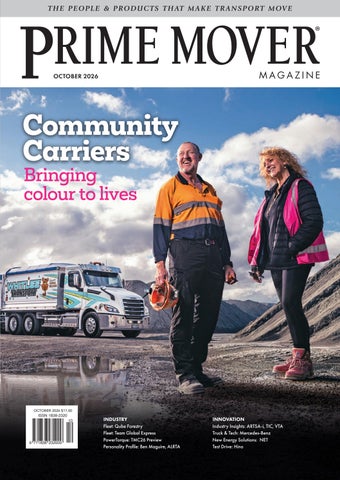
Community Carriers Bringing colour to lives
Rocky
OCTOBER 2026 $11.00
ISSN 1838-2320
9 771838 232000
10
INDUSTRY Fleet: Qube Forestry Fleet: Team Global Express PowerTorque: TMC26 Preview Personality Profile: Ben Maguire, ALRTA
INNOVATION Industry Insights: ARTSA-i, TIC, VTA Truck & Tech: Mercedes-Benz New Energy Solutions: NET Test Drive: Hino
The all-new Tipper range.
Tipper time is here.
Isuzuʼs latest fleet of factory-built tippers have arrived. This Ready-to-Work range, from the compact NKR, through the ingenious Tri-Tipper, to the mighty FRR, all come with a fabulous suite of safety and comfort upgrades. And now, Isuzu have also tipped in 3-yearsʼ free servicing. But only for a strictly limited time. So, donʼt delay, find your nearest Isuzu truck dealer, Iʼll give you the tip.
NKR NKR 62-150 62-150
FRR FRR 110-240 110-240
NMR NMR 65-150 65-150
**The The Isuzu Isuzu Australia Australia Spring Spring Tipper Tipper Promotion Promotion available available on on selected selected new new Ready-to-Work Ready-to-Work Isuzu Isuzu Tipper Tipper Trucks Trucks purchased purchased between between 1 1 September September 2026 2026 and and 31 31 October October 2026 2026 (“Promotion (“Promotion Period”). Period”). Off Offer er not not available available in in conjunction conjunction with with any any other other off offer. er. Fleet Fleet and and Government Government purchasers purchasers are are excluded. excluded. Promotion Promotion includes includes aa 3-year 3-year Isuzu Isuzu Essentials Essentials Service Service Agreement Agreement and and is available only on new selected Ready-to-Work Isuzu Tipper Trucks purchased during the Promotion Period and not transferable, exchangeable or redeemable for cash. is available only on new selected Ready-to-Work Isuzu Tipper Trucks purchased during the Promotion Period and not transferable, exchangeable or redeemable for cash. For For full full details, details, including including eligible eligible truck truck models models and and Isuzu Isuzu Essentials Essentials Service Service Agreement Agreement package package details, details, visit visit isuzu.com.au. isuzu.com.au. Off Offer er available available while while stocks stocks last. last. FSA/ISZS3157 FSA/ISZS3157
Trusted protection. Proven performance. With a fleet of over 160 trucks and 550+ trailer configurations helping to export millions of tonnes of iron ore to the world MGM Bulk depends on Castrol oils, fluids, greases and advanced analytics to optimise performance and extend engine life, continuing to provide best in class service to their mining company customers - up and down Australia’s western seaboard. Castrol - trusted no matter the challenge.
A critical link in Australia’s harshest conditions In the remote reaches of Western Australia where temperatures soar, fine dust grinds through equipment and road trains endure relentless shock loads, the demands on heavy transport are unlike anywhere else on earth. In these conditions, every minute of downtime is costly, and every operator must meet a higher standard. This is the environment MGM Bulk calls home, and where it has earned its reputation as a trusted link in Australia’s mining supply chain. Keeping industries moving for 76 years From a single truck to one of Australia’s largest privately owned bulk haulage fleets, the Giacci family has spent more than seven decades building the people, infrastructure and capability needed to support the mining and resources sector. Today, MGM Bulk continues to build on that foundation, investing in the people, fleet and infrastructure that will help shape the future of bulk haulage in Australia. Established in 2014 by Mario, Giudi and Michael Giacci, and built on a foundation of work ethic and entrepreneurial acumen, MGM Bulk has grown into a powerhouse of Australian bulk haulage with hubs in Perth, Bunbury and the Pilbara. Today, the family-owned business runs more than 220 Kenworth trucks, including over 130 ultra-quad road trains stretching up to 60 metres from cab to tail, along with earthmoving equipment and heavy machinery. CEO Michael Giacci says these giants service inland mine sites and haul loads through to the deep-water port at Port Hedland – 1700 kilometres north of Perth – moving millions of tonnes of iron ore and forming a vital link between remote operations and global markets. Add to that, the 43,000 tonnes iron ore, lithium, spodumene, copper concentrate, activated carbon, methanol, mineral sands, timber, gravel, limestone and sand moved every day to support some of Australia’s most important mining and resource operations, and you begin to see why it’s a business that never sleeps. “The company fleet puts roughly 20,000 wheels on the road at any given time, day or night,” Michael explains. “Every asset up north runs 24/7. The trucks will get turned on, and it won’t get turned off until 10 days later when they have hit roughly 20,000km’s and come in for service.” With 113,000km travelled every day, and customers that depend on them, Michael says it’s a scale and intensity of work that demands absolute reliability. And the Pilbara only amplifies the challenge. “It’s not for everyone,” he says. “The place is extremely hot and humid. It’s testing and challenging. It’s extreme.” In conditions this tough, the MGM Bulk operation is built on uptime, major infrastructure investment and a relentless drive to perform. Central to that capability is MGM Bulk’s state-of-the-art Port Hedland workshop, which operates around the clock and has the capacity to grow as the business expands. Keeping the chain unbroken means expecting more from every supplier and working with partners that match MGM Bulk’s pace, standards and commitment. A relationship built on reliability and performance Castrol plays an important and trusted role within the MGM Bulk fleet, with factory fill products engineered to withstand the Pilbara’s punishing conditions. Workshop Manager Doug Forest says Castrol delivers a real commercial benefit. “By optimising engine performance and extending oil life in conditions that would challenge lesser products, Castrol VECTON directly contributes to MGM Bulk’s bottom line.” This advantage is significant in an operation where every service stop represents both cost and lost productivity. But engine oil is only part of the story. With ultra-quad road trains placing enormous strain on driveline components, Castrol Dynadrive delivers extreme pressure and thermal protection to keep transmissions and final drives performing in punishing terrain and under loads of up to 210 tonnes. Castrol Radicool coolants also help maintain optimal engine temperatures, while Castrol Premium Heavy-Duty Grease protects lubrication points from the relentless onslaught of Pilbara dust. What truly distinguishes the partnership, Forest points out, is the depth of support behind the products. Castrol provides diagnostics, oil analysis, logistics expertise and global engineering insight, identifying wear patterns, informing maintenance regimes, and helping MGM Bulk stay ahead of potential issues. “In a region where supply chain disruptions can cascade rapidly into operational crises, that reliability is non-negotiable,” Forest says. Driving the future of haulage As MGM Bulk looks to grow its fleet and position itself as Australia’s most innovative bulk haulage business, it depends on partners that can support the intensity of daily operations and scale with it over time. Castrol continues to play a quiet but crucial role, providing the support MGM Bulk depends on today and the capability it will need tomorrow, to help keep a vital part of Australia’s economy moving.
castrol.com.au
T H E P E O P L E & P R O D U C T S T H AT M A K E T R A N S P O RT M OV E
®
OCTOBER 2026
O C TO B E R 20 26
Community Carriers Bringing colour to lives
MEET THE TEAM Australia’s leading truck magazine, Prime Mover, continues to invest more in its products and showcases a deep pool of editorial talent with a unique mix of experience and knowledge.
Rocky
OCTOBER 2026 $11.00
ISSN 1838-2320
9 771838 232000
10
INDUSTRY Fleet: Qube Forestry Fleet: Team Global Express PowerTorque: TMC26 Preview Personality Profile: Ben Maguire, ALRTA
INNOVATION Industry Insights: ARTSA-I, TIC, VTA Truck & Tech: Mercedes-Benz New Energy Solutions: NET Test Drive: HINO
Christine Clancy | CEO
With more than two decades of experience as a media professional, Christine has worked in newsrooms across Canada, Vietnam and Australia. She joined the Prime Creative Media team 12 years ago, and today oversees more than 43 titles, including a dozen print and digital transportation titles. She continues to lead a team that focuses on continuous improvement to deliver quality insights that helps the commercial road transport industry grow.
Paul Lancaster | Editor
Paul joined Prime Creative Media as an editor in March 2025 and has enjoyed a broad career spanning over 20 years across different sectors, including law, journalism and marketing in Australia and internationally. He gets great satisfaction from creating targeted content that appeals to wide ranging audiences. Paul says this comes from listening to industry members, businesspeople and the broader community.
CEO
Christine Clancy christine.clancy@primecreative.com.au
Editor
Paul Lancaster paul.lancaster@primecreative.com.au
Managing Editor, Transport Group
Luke Applebee luke.applebee@primecreative.com.au
Senior Feature Writer
Peter Shields peter.shields@primecreative.com.au
Business Development Manager
Ashley Blachford ashley.blachford@primecreative.com.au 0425 699 819
Head of Design
Clayton Hawley clayton.hawley@primecreative.com.au
Design
Jacqueline Buckmaster, Danielle Harris
Peter Shields | Senior Feature Writer A seasoned transport industry professional, Peter has spent two decades in the transport media sector. Starting out as a heavy vehicle mechanic, he managed a fuel tanker fleet and held a range of senior marketing and management positions in the oil and chemicals industry before becoming a nationally acclaimed transport journalist.
Client Success Manager Head Office
Ben Sammartino ben sammartino@primecreative.com.au 379 Docklands Drive, Docklands VIC 3008 info@primecreative.com.au
Ashley Blachford | Business Development Manager
Handling placements for Prime Mover magazine, Ashley has a unique perspective on the world of truck building both domestically and internationally. Focused on delivering the best results for advertisers, Ashley works closely with the editorial team to ensure the best integration of brand messaging across both print and digital platforms.
Peter White | Contributor
Since completing a Bachelor of Media and Communication degree at La Trobe University in 2021, Peter has obtained valuable newsroom experience, supplemented by direct industry exposure at Prime Creative Media. As the Editor of Trailer, Peter brings a fresh perspective to Prime Mover. He has a strong interest in commercial road transport and in furthering the magazine’s goal of growing the industry.
www.primemovermag.com.au
Subscriptions
03 9690 8766 subscriptions@primecreative.com.au Prime Mover magazine is available by subscription from the publisher. The right of refusal is reserved by the publisher. Annual rates: AUS $110.00 (inc GST). For overseas subscriptions, airmail postage should be added to the subscription rate.
Articles
All articles submitted for publication become the property of the publisher. The Editor reserves the right to adjust any article to conform with the magazine format.
Copyright
PRIME MOVER magazine is owned and published by Prime Creative Media. All material in PRIME MOVER magazine is copyright and no part may be reproduced or copied in any form or by any means (graphic, electronic or mechanical including information and retrieval systems) without written permission of the publisher. The Editor welcomes contributions but reserves the right to accept or reject any material. While every effort has been made to ensure the accuracy of information Prime Creative Media will not accept responsibility for errors or omissions or for any consequences arising from reliance on information published. The opinions expressed in PRIME MOVER magazine are not necessarily the opinions of, or endorsed by the publisher unless otherwise stated.
VERSATILITY THAT KEEPS YOUR BUSINESS MOVING THAT’S ANOTHER HINO
TWO ENGINES. THREE TRANSMISSIONS. EXPANDED POSSIBILITIES. XAVIER_HINO41087
The Hino 700 Series offers more than ever before, with more horsepower, more axle configurations, more transmission
options, and more solutions to keep your business moving. The 9-litre A09C engine now joins the proven 13-litre E13C, paired with a choice of three advanced transmissions including the Allison Automatic, M112 AMT, and ZF 16-speed
TraXon AMT. With both leaf spring and airbag suspension choices, the 700 Series delivers unmatched versatility across a variety of applications. Find out more at hino.com.au
FROM THE EDITOR
AA
The Road Ahead
Paul Lancaster Editor There is a point in every technological transition when talk starts giving way to action. In Australia’s heavy vehicle industry, it feels increasingly like that point has arrived. Electric trucks are no longer simply something to be discussed at conferences or demonstrated at industry events. They are beginning to find a place in real-world freight operations, with manufacturers expanding their electric vehicle offerings and operators gaining valuable experience with the technology. The uptake in numbers is still modest compared with the enormous diesel-powered truck fleet operating across Australia, but the trajectory is unmistakable. That makes this issue’s feature on New Energy Transport particularly timely. Co-founder and CEO, Dan Bleakley, provides an enlightening and refreshingly practical perspective on what it takes to establish an electric heavy freight operation in Australia. New Energy Transport is not simply putting electric trucks on the road
8
Oc to ber 2026
and hoping for the best. Its approach encompasses the vehicles, charging infrastructure and energy management required to make electrified freight work as an integrated operation. The company’s plans to deploy 20 electric prime movers, supported by mobile ultra-fast charging units, demonstrate the scale of ambition emerging in this sector. Its electric Sydney-to-Canberra freight operation and growing customer base also provide an important glimpse of what may become increasingly commonplace as the technology matures. There are, of course, plenty of hurdles still to overcome. Vehicle cost, charging infrastructure, electricity supply, payload, range, route suitability and the economics of running electric trucks all need to stack up. And for many transport operators, diesel will remain the most practical solution for years to come. But the important point is that the conversation has changed. The question is increasingly not whether electric heavy trucks have a future in Australia, but where, when and under what operating conditions they make commercial sense. Electrification is only one part of a much bigger technological transformation taking place across trucking. This is why the forthcoming Technical Maintenance Council, convened by the Australian Trucking Association (ATA) in Melbourne, from 13 to 14 October, deserves the attention of operators, OEMs,
technicians and suppliers. The modern heavy vehicle is becoming an extraordinarily sophisticated piece of technology. Advanced driver assistance systems, connected vehicles, electronic diagnostics, cybersecurity, emissions systems and increasingly complex vehicle architectures are fundamentally changing the way trucks are maintained and repaired. Keeping pace with these developments is no longer simply about knowing what technology is available. It is about understanding how it affects reliability, uptime, safety, productivity and ultimately the profitability of a transport business. Events such as the TMC 2026 provide an important forum for that conversation. They bring together the people developing the technology with those who have to operate, maintain and pay for it. The trucking industry has always been remarkably adaptable. It has embraced new engines, transmissions, safety systems, telematics and automation while continuing to do what it does best, that is moving Australia’s freight. The next wave of change is already here. The challenge now is not to resist it, nor to blindly embrace every new technology, but to understand it well enough to make the right decisions. For an industry where keeping the wheels turning is everything, there can be few more important priorities.
LESS DOWNTIME. MORE DRIVE TIME
D46-170
D52-190
RELIABILITY THAT DRIVES YOUR BOTTOM LINE For more information contact Dana on 1300 00 DANA or visit us at www.Dana.com.au
Strength • Power • Endurance
CONTENTS
30
Prime Mover October 2026
24 56
18
COVER STORY 10
O c t o ber 2026
36
“I had some contacts in the industry, and we got one truck started with them, and we must have been doing a good job because they soon asked if we had another truck. So, we bought another Freightliner, and we’ve now had 17 of them over the years.”
HEAVY LIFTERS
Prime Feature STORIES FLEET FOCUS
24
Plantation to Port Qube Forestry provides the end-to-end logistics for the woodchip industry with sustainable products from the forests of Western Australia.
30
TESTDRIVE
56 Verstile Performer The versatility of the Hino 700 Series is highlighted by the FS 2636 6x4 model in a rigid curtainsider configuration.
Moving on Up Melbourne-based Peter Sadler Removals & Logistics has reworked the concept of sticking to what you do best to excel by focusing on what others avoid.
Regular Run
TRUCK & TECH
12 62
8
From the Editor
Quiet Achiever The electric driveline in the Mercedes-Benz eEconic is ideally suited for the urban waste collection task.
60
TMC 2026 Preview
42
66
36
Heavy Lifters Regional heavy haulage operators succeed through the help they receive from their support networks as they keep the nation’s economy on the road.
42
64
Prime Mover News Bob Woodward
Personality Profile ARTSA-i
68
Truck Industry Council
70
Peter Shields’ Number Crunch
69
Victorian Transport Association p rim e m ove rm ag . c o m . a u
11
PRIME PRIME NEWS
> Sterle recognised as industry champion Australia’s freight sector honoured leaders driving safety, innovation and workforce reform at the 36th Australian Freight Industry Awards (AFIAs) in Melbourne. Australia’s freight and logistics industry has celebrated a new generation of operators and innovators at this year’s AFIAs, with Senator Glenn Sterle receiving the night’s highest individual honour – the Industry Champion Award. Held at Crown Palladium and hosted by the Victorian Transport Association (VTA), the event highlighted national progress in safety, sustainability, technology adoption and workforce development. Senator Sterle was recognised for decades of advocacy on behalf of transport operators, regional communities and road safety, cementing his long-standing role as one of the sector’s most influential parliamentary voices. Major category winners reflected the breadth of innovation occurring across freight and logistics. Linfox earned the Greenstart Award for sustainability leadership, Page Tasmanian Freight was recognised for its Australian-developed logistics technology platform, Calleja Group received the Best Practice Safety Award for addressing battery fire risks, and Searoad & Hunterlink were honoured for workplace culture initiatives focused on psychological safety and inclusion. The Women’s Leadership Award went to Anica Di Giacomo of
Direct Couriers, acknowledged for her contribution to leadership development and industry representation. Tiny Tins Waste Management was the recipient of the Waste & Recycling Business of the Year Award. VTA CEO, Peter Anderson, said this year’s winners demonstrated how freight businesses are embracing change while continuing to perform a critical role in the national economy.
He noted the strength of nominations as evidence of the sector’s momentum in sustainability, safety and digital transformation. VTA President, Dennis Ryan, said the AFIAs continue to highlight the people and organisations shaping the next chapter of Australian freight, emphasising the importance of collaboration between operators, suppliers, associations and government.
Western Australia Senator, Glenn Sterle is the 2026 Industry Champion Award recipient. Image: VTA.
> Linfox wins Arnott’s Innovation and Technology Award Linfox has received the Innovation and Technology Award at The Arnott’s Group Annual Supplier Forum in Sydney. Presented at Arnott’s Head Office in North Strathfield on 21 August, the award recognises the delivery of an innovative digital transformation 12
O c t o ber 2026
initiative that is reshaping the way Linfox and the Arnott’s Group collaborate across the supply chain. Linfox Australia and New Zealand CEO, Mark Mazurek, said of the award: “This award reflects what can be achieved when we bring together deep operational expertise, strong
partnerships and innovative thinking. “Working closely with The Arnott’s Group, our teams have created a digital solution that removes manual processes, improves data accuracy and consistency across both organisations and delivers measurable value.”
NEW GENERATION DAF
Powering your Success
OUTSTANDING EFFICIENCY + DRIVER COMFORT + ADVANCED SAFETY
Discover the New Generation DAF. The New Generation DAF range is Powering Your Success with outstanding efficiency, exceptional driver comfort and advanced safety. From the agile 7-litre XB for urban transport, to the lightweight 11-litre XD for distribution, the versatile 13-litre XF for interstate freight and B-double applications, and the flagship 15-litre XG for long-haul operations, DAF offers a complete transport solution for every business. DAF Transport Efficiency. Powering Your Success. DAF.COM.AU
A PACCAR COMPANY DRIVEN BY QUALITY
DISCOVER MORE
PRIME NEWS
> Consortium’s $11.7 billion Qube investment completed Macquarie Asset Management (MAM), together with its managed funds and co-investors, has completed their investment in Qube Holdings Limited (Qube), valuing Qube at approximately $A11.7 billion. Qube is a leading ports and terminals business with an extensive asset footprint spanning terminals, ports, storage, rail and road facilities across Australia, New Zealand and Southeast Asia, providing end to end supply chain infrastructure for customers. The investment, by MAM and including UniSuper and Pontegadea, is underpinned by long-term structural trends including demographics and rising demand for goods and services, as well as a growing focus on sovereign capability. It also reflects Qube’s proven track record in supply chain infrastructure, security and resilience. Under a Scheme of Arrangement, MAM and its co-investors will now work with Qube’s world class team on the next phase of the company’s growth strategy, with a continued focus on investing across Qube’s network and pursuing new opportunities across the Asia Pacific region. Ben Way, Head of Macquarie Asset
The sale of Qube has been completed for $11.7 billion. Image: Qube.
Management, said: “Our investment in Qube highlights MAM’s ability to execute complex transactions and source compelling investment opportunities that create long-term value for our clients and partners. “MAM has a long track record of identifying key thematics early, a capability reflected in the broad group of investors that have chosen to partner with us on this transaction.” Ani Satchcroft, Co-Head of Infrastructure for Asia Pacific at MAM, said: “Qube is well positioned to benefit from an increasing focus on supply chain capability at a time of demographic and GDP growth and increasing activities in the energy sector.
“Our investment in Qube demonstrates our conviction in the role of private capital in supporting logistics infrastructure, security and resilience opportunities across the APAC region.” Paul Digney, Managing Director at Qube, said: “Today marks an exciting new chapter in the growth and evolution of Qube and it underscores the strength of the business, the strong position we have established and the quality of our assets, people and safety culture. “My team and I look forward to working with MAM and its co-investors on the next phase of growth and diversification for Qube, while continuing our strong track record of enhancing supply chains and delivering innovative solutions and outstanding service to our customers.”
> Lindsay Australia secures Woolworths contract Lindsay Australia has deepened its national transport footprint after securing a significant five year secondary freight contract with Woolworths’ Primary Connect division. The deal marks the company’s first large scale entry into mainland secondary freight and one of its most strategically important wins in recent years. The agreement will see Lindsay provide transport services to approximately 40 Woolworths stores between Mackay and Cairns, creating a new North Queensland secondary freight corridor that plugs directly into the group’s expanded national network. The company said the contract is expected to generate $30–36 million in 14
O c t o ber 2026
annual revenue, delivering returns above its internal ROIC hurdle of 15 per cent. “The five-year contract is expected to generate annual revenue of approximately $30 to $36 million,” Lindsay Australia said in a statement. To support the rollout, the fleet will invest $20 million in dedicated capital, including two new greenfield sites in Townsville and Cairns. These facilities will anchor the new secondary freight operation and integrate with Lindsay’s existing long haul and rural supply chains. Operations begin progressively from October 2026, with full implementation scheduled for July 2027. “Entry is supported by $20 million in dedicated capital investment and includes
two new greenfield sites in Townsville and Cairns,” Lindsay Australia said. The deal also represents a strategic extension of capability gained through the SRT Logistics acquisition, giving Lindsay a scalable platform to compete in a market increasingly shaped by smaller order sizes, just in time freight and tighter delivery windows. Lindsay Australia CEO, Clay McDonald, said the contract demonstrates the value of the group’s expanded network and its ability to meet evolving customer requirements. “Our entry into secondary freight is a natural extension of the network and the capability we acquired through SRT Logistics,” he said.
PRIME NEWS
> ATA backs Fed’s $400 million productivity plan The Federal Government’s $400 million plan to boost truck productivity will reduce costs for Australian families and exporters, the Australian Trucking Association (ATA) said. ATA Chair, Mark Parry, made the comments after Federal Treasurer Jim Chalmers’ announcement of the funding injection, which follows the completion of a Productivity Commission inquiry into heavy vehicle reform. The plan is forecast to deliver up to $4.4 billion in economic benefits per year. “The Government’s announcement recognises that increasing productivity is the key to reducing the cost of living for families and reducing transport costs for Australia’s exporters,” Parry said. “The ATA and its members argued strongly for this major and welcome announcement, including in our 2025 election policy statement and our submissions to the Productivity Commission. “I want to thank Treasurer Chalmers and Minister King for listening to
trucking businesses and developing a plan that will result in a step change in productivity for our industry. “We know, for example, that businesses who switch from conventional semitrailers to what are called A-doubles can move the same amount of freight in half the number of trips while using 72 per cent of the fuel. “But trucks like A-doubles can only be used on specific networks or under permits. The National Heavy Vehicle Regulator receives about 197,000 permit applications a year. “The plan will speed the creation of a National Automated Access System based on one developed in Tasmania. It will reduce the number of permits that operators need. “The plan will encourage state governments to expand the road network that can be used by electric trucks. Electric trucks are heavier than conventional trucks. They can’t carry the same freight unless their gross mass is allowed to be higher. “In addition, the plan will encourage
the removal of curfews for electric trucks and increase the availability of electric truck chargers.” The ATA Chair said the plan would speed up important changes to truck driver licensing. “At present, drivers advance to operate larger trucks through a combination of elapsed time, training and competency tests,” Parry said. “For example, you need to hold a medium or heavy rigid truck licence for a year before you can get a semitrailer licence. “This is easy to administer, but just because you’ve had a piece of plastic in your wallet for a year doesn’t mean you’re a good and experienced driver. “Conversely, the long wait delays good drivers from moving up to drive larger trucks, which just makes our truck driver shortage worse. “The plan would encourage the states to enable drivers to advance sooner by recording their hours behind the wheel and more quickly again with a driving coach.” The ATA has welcomed a $400 million plan to boost truck productivity. Image: On-Air/stock.adobe.com.
16
O c t o ber 2026
> Toll launches hydrogen prime movers with Viva Toll Group has celebrated an important milestone in advancing lower-emissions freight solutions in Australia, with the launch of two hydrogen prime movers. The first two Toll hydrogen-powered electric vehicles were delivered in partnership with Viva Energy and BlueScope Steel, as well as receiving support from the Federal Government’s ARENA funding program. Toll said the initiative demonstrated how collaboration and innovation can help accelerate the transition to more sustainable transport. The new hydrogen fuel cell electric prime movers will be run as B-double combinations delivering steel products for BlueScope in the Geelong region. It is expected the prime movers will offer a driving range of approximately
The Toll hydrogen fuel-cell trucks being fuelled at the Viva Energy Australia’s Hydrogen Hub. Image: Toll.
300 kilometres and can be refuelled in around 20 minutes. They will be expected to reduce diesel consumption by approximately 80,000 litres per vehicle annually. Each vehicle is expected to reduce about 208 tonnes of CO2 emissions annually, in comparison to equivalent diesel-powered vehicles.
Fuelling up at the Viva Energy Australia’s Hydrogen Hub. Image: Toll.
“Fuelled at Viva Energy Australia’s Hydrogen Hub, Australia’s first 24/7 public hydrogen refuelling station, these vehicles represent an important step towards building the infrastructure and operational capability needed to support hydrogen-powered freight at scale,” Toll said on LinkedIn. “Initially deployed to support steel deliveries from BlueScope’s Hastings facility, the fleet will help demonstrate the role hydrogen can play in decarbonising heavy haulage operations while providing valuable insights for the future of freight transport. “This milestone reflects our shared commitment to innovation, collaboration and exploring practical pathways to a lower-emissions future.”
Premium Truck. Premium Wheels. If you’re ordering a Kenworth, ask for Alcoa Wheels
$ Increase Profitability
Decrease Maintenance Cost
Confidence in proven engineering
FIND MORE
75 years trusted by Heavy-Duty Fleets
For more information: contact us at
1800 955 191
alcoawheels.sales@howmet.com
www.alcoawheels.com.au
p rim e m ove rm ag . c o m . a u
17
COVER STORY
COMMUNITY
CARRIERS Based in New South Wales’ picturesque Southern Highlands, Whitlee Transport specialises in transporting bulk quarry products using its fleet of Freightliner trucks that feature some unique liveries.
18
O c t o ber 2026
T
he village of Marulan is particularly well-known in the road transport industry for the heavy vehicle checking station located on the Hume Highway and operated by the NHVR, where even minor defects and errant logbook entries can become very expensive. Just a few kilometres away is the base for Whitlee Transport, owned and operated by Leanne and Craig Whittaker. It isn’t just the proximity of the Whittakers’ base to the Marulan checking station that drives Leanne to strive for the highest levels of compliance. Their enviable reputation for strictly adhering to the applicable regulations also leads to additional work with other transport operators during the ebbs and flows of business activity. “They sometimes reach out to us
Whitlee Transport co-owner, Leanne Whittaker, has a real passion for helping others.
because we’re compliant,” Leanne says. “We’ve got accreditation, so they know they’re safe with us.” Each and every heavy vehicle is livetracked using the latest technology. It is a major and necessary industry feat that was completed with the help of Adrian Scott, Managing Director at Elite Compliance Consulting, who helped set up the compliance systems and arranges the annual internal audit. The Whittakers strong belief in record keeping and compliance was reinforced in a very direct and personal way about ten years ago. A fully loaded, and blameless, Whitlee Transport truck and dog trailer combination was rear-ended by another truck on the old Hume Highway, between Marulan and Berrima. The other truck finished up on its side and thankfully no one was injured, but
Leanne remains unimpressed by the other driver’s actions. “He just climbed out the window, and magically lost all of his records,” she says. Maintaining an excellent compliance record is good for the overall health of the business and the drivers take a professional approach to playing by the rules. “We’re only a small crew and at the moment I’ve got a really good group of guys,” says Leanne. “They know what I need and I feel very confident and blessed with them.” In common with many other operators in regional areas, driver recruitment is usually via local ‘word of mouth’. “I’ve never advertised or gone online or anything like that,” says Leanne. “It’s usually a friend of a friend or someone p rim e m ove rm ag . c o m . a u
19
COVER STORY
“We needed to get the specifications right for the trucks to accommodate the weights and to have the right axle spacing to get the best payload. The Freightliners spec’d up the best and we have continued with them ever since. It started with Freightliner and I’m still Freightliner-exclusive with both of our companies.” Whitlee Transport co-owner, Leanne Whittaker.
20
O c t o ber 2026
in the industry. I try to provide a good job. You give me your worth, I give you my worth, and hopefully, we both work away happy”. Around the Southern Highlands, Leanne and Craig Whittaker are renowned as a hardworking and dedicated trucking couple who started out in the early 2000s. They established Sterling Freight in 2004, which continues to primarily undertakes the transportation of containerised bulk refuse, mainly for one of the giants in the global waste industry. From the beginning Freightliner has always been their brand of choice. “We needed to get the specifications right for the trucks to accommodate the weights and to have the right axle spacing to get the best payload. The Freightliners spec’d up the best and we have continued with them ever since,” says Leanne. “It started with Freightliner
and I’m still Freightliner-exclusive with both of our companies.” In early 2010 it was decided to branch out and create another business unit using tipper trucks to carry quarry products. “I had some contacts in the industry and we got one truck started with them, and we must have been doing a good job because they soon asked if we had another truck. So we bought another Freightliner, and we’ve now had 17 of them over the years,” Leanne says. The Whitlee Transport fleet is made up of tippers and dogs hauling quarry materials from the local area around Marulan. A lot of work involves carting out of a nearby limestone quarry through the Southern Highlands corridor to concrete batching plants in places such as Moss Vale, Mittagong and Picton. Limestone products are also delivered to Port Kembla for clients including
cement manufacturers. On the return trip from Port Kembla other products are taken from a quarry located down near the coast, back up to the Berrima and Moss Vale concrete plants. Whitlee trucks also cart out of quarries in Appin and Mittagong, as well as the Bungendore sand quarry to supply sand for concrete plants in Goulburn and Picton. The tipper fleet mostly includes Freightliner Cascadia 116 and 126 models, powered by Detroit Diesel 13 litre and 16 litre engines, respectively. The Cascadia’s are the latest to be adorned with the unique Whitlee Transport liveries and another four Freightliners were recently purchased for the Sterling waste transport operation, as well as another prime mover for Whitlee. Currently there are ten Whitlee tippers and dogs out on the road, while three more are dedicated to in-quarry work. There’s also a five-axle ‘ten-wheeler’ The company’s unmistakeable livery.
p rim e m ove rm ag . c o m . a u
21
Looking smart on the job.
tipper which also does off-road quarry work. Another new Cascadia has recently been purchased which will take the on-road fleet to eleven Freightliners. The tipping bodies and dog trailers are manufactured by long-term collaborator, TEFCO Trailers, in nearby Goulburn. This long-term business relationship between TEFCO and Whitlee goes beyond the provision of transport components. It’s also built on a strong friendship that saw TEFCO bosses, Richard and Sue Brown, driving Leanne and Craig’s wedding car when they tied the knot in 1991. Leanne is a fervent supporter of a number of deserving charities and puts the prime movers to good use to get the word out there. She has devised a clever strategy to use cartoon images on the trucks and trailers to promote awareness of her chosen charities. In the typically tough world of trucking, cartoon characters may seem to be a bit incongruous, but Leanne’s rationale is that the stylised cartoon images on the trucks create attention for the various charities being supported, and the images also give each truck its own personality. The attention-grabbing graphics are designed by Leanne and proofed and applied by Studio 4 Signs & Designs in Goulburn. “When Leanne’s son, Todd, went to primary school, the school would need things, so I’d organise a fundraiser and 22
O c t o ber 2026
raise money,” says Craig. Today, Leanne continues with many charitable works. “A close friend of mine had major health problems and couldn’t work, and had a mortgage and young kids, and so I put a fundraiser together and raised about $80,000 through raffles and an auction and entertainment night,” Leanne says. When she was growing up, Leanne was a lover of the cartoon cat ‘Garfield’ to the point of having a ‘Garfield’ telephone, ‘Garfield’ bath towels plus the usual clothing items and stuffed animals. Now she has a ‘Garfield’ Cascadia. Her favourite dog breed is the Great Dane, so a characterisation looking something like the beloved cartoon ‘Scooby-Doo’, adorns one of the trucks along with the Toy Story character ‘Slinky Dog’ which is a favourite of son Todd. All these characters support animal welfare. On the human perspective, one of the current Cascadias celebrates the good work being done by industry and men’s support organisations, such as Healthy Heads, RUOK?, Grab Life, Black Dog Institute, Beyond Blue and Movember. The latest new Cascadia to join the fleet will be used to promote charities which support people experiencing breast cancer and prostate cancer. Leanne’s cartoon focus also extends to the company’s drivers. One such employee is a volunteer firefighter so the company has incorporated
that organisation’s logo on the trucks to support the important services it provides, especially to regional communities. Time permitting, Leanne occasionally dabbles in another art form - poetry. It just used to be wedding poems, but then it branched into twenty-firsts and funerals. She was at an event in Sydney with Freightliner and was challenged to write a poem about Freightliner trucks. This ultimately led to a trip to the United States to attend the Women in Trucking convention in Dallas, Texas. “I wrote another poem when they launched the Cascadia and when I was at the Women in Trucking convention in Dallas, Texas I was privileged to read it to all the attendees,” Leanne explains. “They took us to the Freightliner factory in Charlotte, North Carolina, and they had the printed out the poem I had written and posted it all around the factory. As we were walking through, the people working in those areas were obviously clued up that I was going to be there and wanted to come and meet and say ‘G’day’ or ‘Hi’. It was really touching.” It may seem unusual in these times for an individual, particularly a business manager, to not have a presence on social media, but Leanne is a colourful exception. “I’m not on socials, I don’t need to be,” she says. “I don’t want for recognition from anyone else, I do it for me and the love of my trucks.”
Images: Daimler Truck Australia.
COVER STORY
Freightliner Cascadias continue to be truck of choice for Whitlee Transport. p rim e m ove rm ag . c o m . a u
23
FLEET FOCUS
PLANTATION TO PORT
24
O c t o ber 2026
Qube Forestry provides the end-to-end logistics for the woodchip industry with sustainable products from the forests of Western Australia.
Q
The Volvo prime movers are in their element in WA’s forests.
ube Forestry is a leader in providing a range of services to the forestry supply chains in Australia and New Zealand, focusing on both domestic and export markets with services including vessel loading and port infrastructure. Using specialised equipment with exotic names such as “fell buncher”, “flailer” and “wheel skidder”, Qube fells the plantation trees, hauls the logs, creates the wood chips and then transports them in bulk by truck to port. Adrian Robinson is the Transport Manager for the Qube Forestry operation based in Albany on the southern coast of Western Australia. Adrian started in the industry 20 years ago and has worked his way through operating the variety of specialised machines required for the forestry industry, before focussing on the truck fleet operations by, as he says, transitioning “from steering wheel to keyboard.” Operations include all steps from harvesting the plantation blue gum trees, to chipping the timber, to delivery of the wood chips to the Albany port from where it is exported to China or Japan to be mainly used in the manufacture of paper products. Native forests are not involved in any of the processes, and the plantation methods undertaken by Qube Forestry result in perpetual sustainability for the industry. In Albany, Qube Forestry operates a fleet of big bin A-doubles and 27.5 metre road trains to transport the wood chip from the forest locations to the port and also to relocate their own forestry equipment from plantation to plantation. The current Albany fleet has 17 prime movers, including one Scania and one Kenworth, with 15 Volvo FH models, most of which have 540hp rated engines, along with several 600 horsepower Volvo models. The trucks operate mostly on day shift during the week within a maximum radius of 180 kilometres from their Albany base p rim e m ove rm ag . c o m . a u
25
FLEET FOCUS
The Volvo prime mover is equally at home on the highway as on forest roads.
and typically return to the depot every night. Mechanical issues with any of the forestry machinery can hold up the wood chip fleet. “We do whatever we need to do to keep the wheels rolling, and to keep everyone earning an income,” says Adrian. “We start anywhere from 4 o’clock in the morning and traditionally it’s a 12-hour day.” The Volvo’s have a minimum 110-tonne and up to 131-tonne GVM ratings. “We normally only cart at around 92 tonnes, so 540 horsepower is more than enough for what we need,” says Adrian. “The 540’s do the job fine, you only need the bigger horsepower if you drive longer distances. “The longest trips we do are only 180 kilometres return, and basically it’s only ten minutes difference in a trip between a 600 and a 540, so for us there’s really no benefit in having additional power.” Volvo is the preferred truck brand with the advantage of having a dealership in the form of Truck Centre WA’s branch located close by in Albany. 26
O c t o ber 2026
“We don’t have to take the trucks anywhere for service or repairs because we’re also in Albany,” says Adrian. “We’re five hours from Perth, four and a half hours from Bunbury so you don’t want to have to be traveling that far to get a truck fixed or have to throw it on a tow truck every time something goes wrong. We’ve had such a great run out of Volvo’s. And the support that we get from the local Truck Centre people is great.” The Volvo trucks each may only cover around 70,000 kilometres annually, which is comparatively low and negates the usual financial advantages which come with factory service and maintenance contracts. The Volvo’s might not do as many road kilometres as line haul operations, but they do engage in a lot of engineon hours because the trucks don’t usually get switched off other than when unloading during a shift. The constant running of the engines is keep air pressure available due to the requirement to have the brakes off when they’re being loaded to enable the onboard scales to operate more accurately.
Ausquip in Bunbury install Air CTI tyre inflation systems are fitted to the drive tyres to enable dropping of pressure on unsealed roads and automatic reinflation when re-joining the bitumen. Ausquip also installs the on-board Pacific Scales which monitor the axle weights. A hydraulic tipping deck at the port is used to transfer wood chip from the trailers to the ship loading conveyors. While unloading the trucks rise all the way to an angle of 60 degrees so the Volvos’ fuel tank fillers are reversed so they’re located at the front instead of the back. If the filler caps were in the standard rear location, there is a chance they could weep fuel while the combination is tilted on the deck and it’s important that contaminants such as diesel are prevented from escaping. The trucks perform a lot of off-highway work, so the fuel tank breathers are relocated up behind the cab instead of being between the tank and the chassis where they may be prone to clogging. A one-way valve is also fitted to the filler of the AdBlue tank so that when the truck is being tipped that fluid is also not spilled.
The fleet based in Albany includes 21 trailer sets, 19 of which are from local Albany manufacturer Evertrans Trailers. The other two sets were built by Coastal Transport Engineering located in Young’s Siding a few kilometres west of Albany. “Evertrans is literally a 60 second walk for me to their yard,” says Adrian. “And the quality of their builds is great.” Some of the trailers have over half a million kilometres which may not seem huge, but the off-highway work magnifies some maintenance factors such as wiring and EBS (Electronic Braking System) cables rubbing through and tow eyes needing replacing. Each truck typically has a permanent dedicated driver and Adrian encourages them to name their trucks, often incorporating a forestry theme, hence “Splinter”, “Bark Buster”, “Spittin’ Chips” but there is also “Southern Comfort”. When a driver moves onto
Taking a well-earned break.
Growing businesses value flexibility and quality support.
Opportunity doesn’t always arrive on schedule. The businesses best positioned to take advantage of it are those with the flexibility to respond. TR Group gives operators access to quality vehicles, tailored rental and leasing solutions, and support that keeps them moving when demand increases.
TR Group. Helping successful businesses stay ahead. 1800 50 40 50
www.trgroupau.com
BRISBANE NEWCASTLE
PERTH
SYDNEY ADELAIDE MELBOURNE
p rim e m ove rm ag . c o m . a u
27
FLEET FOCUS
a new truck, the name stays on the original, and they have the task to suggest another name for the new rig. Adrian is proud of his team who often work in difficult conditions in remote forest areas. “I’ve got a group of guys at the moment that are pretty good. I don’t have any ‘steerers’, and I haven’t had to employ anyone just to fill seats,” he says. “At times we have employed ‘green’ people who we’ve actually assisted to obtain their truck driver’s licenses, and sometimes they’re better than someone who’s got 20 years of experience, because they’ve got no bad habits. You teach them from brand new, and they’re great on the gear and look after it, and they do everything the experienced guys do. Then I’ve also got guys who have been around driving trucks for 30 years, and they’re great too.” In addition to the Western Australian operation Qube Forestry has a presence on the Australian east coast and in Tasmania, as well as in the “Green Triangle” which spans the border between Victoria and South Australia.
Forest work in full swing.
Images: Volvo Trucks Australia.
Qube’s hydraulic tipping deck in action.
28
O c t o ber 2026
Electric Ready Lease
FH ELECTRIC
FH AERO ELECTRIC
FM ELECTRIC
Step into Electric with Confidence. The Electric Ready Lease makes transitioning to Volvo electric trucks simpler and more affordable. Enjoy an interest rate discount of up to 0.5% and residual value support to reduce operating lease costs — all backed by Volvo Financial Services and the CEFC (Clean Energy Finance Corporation).* *
Terms and conditions apply
Interest rate discount of up to
Volvo Trucks. Driving Progress.
0.5%
Scan the QR code to learn more.
FLEET FOCUS
Sadler’s Compliance and Fleet Manager, Chris Walsh, likes the flexibility of the Isuzu FVL model.
MOVING ON UP
T
It’s a common business principal to identify and stick to what you do best. Melbourne-based Peter Sadler Removals & Logistics has reworked that concept to excel by focusing on what others avoid.
he Laverton North business has grown well beyond its formative roots as a home removal operator, to where it now delivers everything from multidrop urban freight and commercial appliances to cold store warehousing and logistics services for some of Australia’s best-known brands. Along the way, the Victorian family business has earned a reputation for taking on the work others won’t, or simply can’t, do. That willingness to tackle the difficult jobs has driven the business since 1997, when Peter Sadler senior and his son, Peter junior, started with a single van bodied truck moving family homes around Melbourne. Nearly three decades later, the 30
O c t o ber 2026
operation spans multiple warehouse sites, a diverse customer base, and an expanding transport fleet - servicing metropolitan, regional and interstate freight requirements. While the company’s growth has been significant, its priorities are unchanged. Family values, customer service and looking after its staff remain central to a well-honed business model, particularly when it comes to the trucks that keep the freight moving. For Transport Manager, Brayden Philpott, that philosophy is truly embedded in the company’s identity. “Whether it’s house moves, 20-route deliveries in the rain or demanding commercial freight work, our people just get the job done,” Brayden says. “We pride ourselves on doing the
work that others won’t or can’t. The other thing that really sets us apart is our culture. We invest a lot into our drivers and our people because we know they’re representing the business every day.” That same philosophy has led Sadlers to its latest fleet investment. Joining the fleet are two new Isuzu FVL 260-300s and five FSDs from the F Series range, purpose-built for the company’s intrastate freight operation, equipped with curtain-side bodies and tail-lift rear loaders. The newly released FVLs fit seamlessly into a fleet bristling with Isuzu prime movers that service everything from beverage distribution and commercial appliance deliveries to warehouse logistics and general freight. Sadlers first introduced the Isuzu
ZF is a leading manufacturer of premium-quality automotive components, supplying major truck, trailer, and bus OEMs worldwide. Through its trusted brands — LEMFÖRDER, SACHS, TRW, and WABCO. It brings the same OE-quality products to the aftermarket.
Cabin dampers and shock absorbers
Brake components
Clutch components Dryer Cartridges
Steering and suspension components
Electric driveline
Transmission oil and service parts Transmissions
Axles TEBS-E
Scan the QR code to find your nearest distributor for ZF products
iEBS
SmartBoard
zf.com/au
FLEET FOCUS
32
O c t o ber 2026
The new MY25 FVL 260-300 in the distinctive Peter Sadler blue.
Images: Isuzu Australia.
brand into the fleet back in 2012 and initially, the appeal was fairly simple. “Value for money was probably what attracted us originally,” Sadler’s Compliance & Fleet Manager, Chris Walsh says. “Since then, Isuzu has become our goto brand. The technology is best-in-class for the price point. The trucks are easy to drive and having one key supplier makes fleet management easier for us.” Chris says selecting the right truck specification was every bit as important as choosing the right brand. “The majority of the fleet is Isuzu because it’s so flexible in its application,” he says. It’s the truck’s flexibility that makes the FVL such a strong fit, according to the logistics company. The 26,000 kg Gross Vehicle Mass (GVM) platform provides the payload capacity required for high-volume metropolitan freight, while remaining manoeuvrable enough to negotiate suburban streets, loading docks and busy hub-and-spoke distribution centres. The curtain-side body and tail-lift configuration further improves loading efficiency, allowing drivers to move everything from palletised freight to oversized consignments quickly and safely. “The Isuzus cover everything for us, from general freight deliveries and house removals through to our beverage distribution work. When we purchase a new vehicle, the guys at Westar Isuzu manage the whole process from start to finish, so it really is a total solution for us,” Chris says. Power comes by way of Isuzu’s newly developed 6.7-litre DB6A-TCC sixcylinder turbo-diesel engine, producing 221 kW and 984 Nm. Matched to the Allison 3500 GEN 6, six-speed fully automatic transmission, the newly improved driveline delivers smooth, uninterrupted power exactly where and when the Sadler team need it most. The Isuzu-Allison combination shines in the metropolitan freight delivery sector, where drivers are repeatedly accelerating, braking, negotiating traffic,
reversing into loading bays and moving between dozens of daily deliveries. Carefully calibrated gear ratios mean smooth changes and reduced driver workload. Consistent torque delivery makes carting varying payloads effortless. The Allison transmission removes much of the fatigue associated with continual stop-start driving, allowing drivers to concentrate on traffic, their customers and the task at hand. Sadler’s fleet strategy has always been closely tied to workplace safety, understanding that comfortable drivers are generally safer, more productive drivers, particularly during long metropolitan shifts. “The additional cabin comfort in these new models means better fatigue management at our end. This was a huge consideration for us. Our on-road staff experience long days, so the more comfortable they can be, the easier those days become,” Chris says. “Everything from the air-suspended ISRI driver’s seat to the climate control, the dash layout and infotainment system makes life easier. Even something as simple as the lower step height on the FVL - getting in and out of the truck makes a genuine difference across a full day.”
Specified for general freight tasks, aligns well to a driver-first approach. Safety features on the FVL 260-300 include Advanced Emergency Braking, Adaptive Cruise Control, Lane Keeping Assist, Lane Departure Warning and Electronic Stability Control. For Chris, another feature of the Isuzu F Series range is the commonality across the fleet, where a driver can go from one truck to another and it’s almost exactly the same, or very similar in its layout. That familiarity reduces the learning curve and ensures drivers leave the depot confident, regardless of which truck they’re assigned. Today, the relationship extends well beyond vehicle purchasing. “We’re in a growth period right now,” Chris says “As we move further interstate, having quality partners and a strong national support network becomes critical to what we’re doing. That support gives us confidence as we continue growing the business.” For a family business built on hard work and tackling the jobs others won’t, the latest incarnation of the Isuzu FVL represents more than just another blue truck on the road - an investment in the people, safety and operational capability.
Keep your truck. Ditch the diesel. Convert your existing truck to electric at a fraction of the cost of buying a new electric truck. Up to 50% lower operating costs
~4-minute battery swaps
Up to 450km range per charge
Options for all combinations
Proven technology
5-year / 1 million km powertrain warranty
750,000km 750,000 km on the road
Built for Australian roads. Built to work.
For more info januselectric.com
FLEET – INDUSTRY VOICE
FREIGHT AGENDA
T
The strength of Team Global Express Freight lies in data-driven decisions, intermodal agility and long-term resilience.
eam Global Express (TGE) Freight CEO, Jim Kafanelis, says the scale of Australia’s freight challenge requires a sharper focus on productivity, technology and network resilience — and a willingness to rethink long-held assumptions. “I look at things from a facts and figures basis, while challenging assumptions,” he says. Jim joined TGE in 2024 as Chief Operating Officer before stepping into the Freight CEO role earlier this year. His 41-year career spans utilities, transport, critical infrastructure and essential services. He says the opportunity to lead TGE Freight was immediately compelling: “Freight and logistics networks are the backbone of the Australian economy,
and what we do every day helps keep the nation’s supply chains moving.” The company’s long history carries significance for him. “TGE, in one form or another, has been a part of the industry for 138 years,” he says. “While respecting this history, I’m not bound by a particular way of thinking or doing things.” With thousands of people working across TGE’s operations, he says the responsibility is real: “The decisions we make ultimately affect not only supply chains, but our people, contractors and broader ecosystem.” Australia’s freight task continues to expand, but so do the pressures on operators. Jim says the challenge is balancing rising operating costs with long-term investment in infrastructure, technology, safety and people.
“Customers rightly expect reliability, visibility and a high-quality service,” he says. “Meeting those expectations while improving productivity is one of the key challenges facing the industry.” For TGE Freight, the opportunity lies in extracting more value from its national network – improving utilisation, deploying the right modes and using data to drive decisions. “Our extensive network and operational capability position us to respond to both the challenges and opportunities ahead,” Jim says – adding that long-standing customer partnerships remain central. “These relationships have helped shape us into the business we are today.” TGE Freight’s intermodal capability is one of its defining strengths. Jim says the ability to switch modes quickly is critical
Team Global Express Freight CEO, Jim Kafanelis.
34
O c t o ber 2026
Images: Team Global Express.
TGE Freight operates one of Australia’s largest heavy electric truck trials with more than 60 BEVs.
in a country where natural events and network disruptions are common. “If an unexpected natural event impacts part of the rail network, we can utilise our road network to help minimise disruption for our customers,” he says. Strategically located depots, extensive linehaul operations and a diverse fleet allow TGE to keep freight within its ecosystem and maintain service continuity. Across the trucking sector, Jim sees a clear shift toward productivity reform, improved access and smarter use of data and analytics. Telematics, according to Jim, is a core part of how we are doing this today. “They give us much greater visibility of how our fleets are performing and play a significant role in supporting driver safety and managing fatigue,” he says. TGE has invested heavily in telematics across most of its owned fleet, generating insights into both safety and
operational performance. Emissions reduction remains a major industry focus, though linehaul electrification is still constrained by range and charging infrastructure. TGE is pushing ahead regardless, conducting one of Australia’s largest heavy electric truck trials, which received funding from the Australian Renewable Energy Agency (ARENA) as part of the Driving the Nation Fund, with more than 60 battery-electric vehicles. Jim sees significant upside in automation, AI and data-driven decision-making. “Data and automation give us greater visibility across our network, helping us identify issues earlier and make faster, more informed decisions,” he says. Automation in depots and logistics facilities, particularly for repetitive tasks, is reducing manual handling, improving safety and lifting consistency. The freight industry’s labour challenge is persistent, and Kafanelis says the sector must rethink how it
KEEP YOUR CONNECTIONS MOVING HEAVY-DUTY & EBS SUZI COILS
attracts and retains talent. “That means understanding what people are looking for in a career, creating clearer pathways into the industry and building stronger connections with education and training organisations,” he says – emphasising diversity, safety and long-term career development as essential pillars. In terms of industry forums, Jim says events like MegaTrans provide a rare opportunity for operators, customers, technology providers, manufacturers and government to openly discuss shared challenges. “They provide an important opportunity to share what is working, challenge existing thinking and have practical discussions about what the industry needs next,” he says. The most valuable conversations, he added, are those that look beyond individual businesses: “Many of the challenges we face are industry-wide and require industry-wide thinking.”
LIGHT THE ROAD. CUT INSTALL TIME.
Built for reliable power between prime mover and trailer. Strong coil retention helps reduce sag and maintain a reliable connection
ULTIMA 215 SPOT BEAM DRIVING LIGHTS Engineered for truck drivers to give 1.4km of beam distance down the road per pair.
82529
Shop the range at
82560
www.narva.com.au
Combine that with a 74409 Truck Harness and the installation of up to 4 lights just become faster, cleaner and more preliable. rim e m ove rm ag . c o m . a u
35
QUIET
TRUCK & TECH
ACHIEVER
The Mercedes-Benz eEconic.
D
The electric driveline in the Mercedes-Benz eEconic is ideally suited for the urban waste collection task.
uring the past couple of years the all-electric Mercedes-Benz eEconic specialised waste truck has been quietly (pun intended) assessed as a practical zero emission vehicle suited to urban waste collection and management. Waste collection is an ideal application for a near-silent electric truck, and multiple units have undergone extensive assessment duties in Australia with an additional truck undertaking similar validation trials in New Zealand. Production versions of the eEconic are now available for sale. The diesel-powered Mercedes-Benz Econic was engineered from the ground up to be a specialist vehicle for the growing waste and recycling space and subsequently has lent itself very well as the basis to provide an electric alternative in a 6x2 configuration. Like its internal combustion engine stablemate, the eEconic is designed to suit waste collection duty in densely populated areas and replicates many of 36
O c t o ber 2026
the Econic’s features including excellent visibility and an extensive suite of active safety systems. The Mercedes-Benz eEconic shares the same electrical architecture as the Mercedes-Benz eActros e300 which has been operating in Europe since 2018 and is now regarded as a proven and mature technology. In this waste collection vehicle application, the eEconic has a claimed range of 100-150 kilometres between battery charges, while also operating the rear body, which should prove practical to suit the average distance travelled during a typical shift on urban waste collection duty. The eEconic uses the same eAxle design as the eActros with two integrated liquid-cooled electric motors and a two-speed automated planetary transmission, all mounted to the same rear axle “banjo” housing but without the mechanicals such as the crown wheel and pinion gears. Maximum power is 536hp (400kW) peak performance and 443hp (330kW)
available as continuous output. This compares more than favorably with the diesel engine’s 272hp (200kW). The hydraulics for the operation of the waste collection and compacting equipment are powered from an “ePTO” which can handle 30kW continuous power and up to 52kW peak power demand such as when the compactor is operating. Three thermally controlled lithiumion battery packs feature a 336kWh capacity. The battery packs are mounted low on the chassis to provide plenty of space for the waste compactor body and also to maintain a low centre of gravity which will enhance vehicle stability in support of the Electronic Vehicle Stability control system. The eEconic rides on air suspension front and rear which provides the ability to adjust ride height from the cab. The battery packs have strong protection panels to minimize damage from any side impacts. Typically the batteries will be conventionally charged overnight, but
Images: Daimler Truck Australia.
should a mid-shift top up be needed, charging from 20-80 per cent takes just 75 minutes with a 160kW charger. The eAxle frees up space at the front of the chassis where the conventional diesel engine is located on the Econic. This space is utilised for the battery thermal management components, power steering, HVAC and compressed air. The electric drivetrain enables a level cab floor to be used, with only two entry steps for access and allowing easy movement through the cab. This is particularly advantageous when the driver wishes to enter or leave the vehicle through the folding concertina door on the kerb side, well out of the way of traffic. In common with many electric commercial vehicles (and the current crop of F1 cars) the eEconic features regenerative braking which harnesses kinetic energy when the truck is slowing to not only act like an engine brake and assist in slowing the vehicle, but also recoup some of the energy and use that to contribute to charging the batteries with the secondary benefit of reducing wear on service brake components. To create the initial local assessment vehicles, Daimler Trucks have worked with several waste compactor builders
and the rear loader has come from Bucher Municipal, with side loader configurations set to follow. With the Bucher Municipal compactor fitted the eEconic has a tare weight of 13.9 tonnes. In addition to sharing much of the eActros’s electro-mechanical components, the eEconic features the same safety technology as the eActros, which is especially important given the urban environments in which it is likely to operate. The low cab and very large windscreen help create a safer situation where the driver is at eye level with pedestrians and cyclists. The eEconic not only produces no local exhaust emissions but also operates in near silence. Mercedes-Benz claim a 10dB noise reduction in the cabin compared to the noise levels encountered by a diesel version, which is an approximate halving of the perceptible in-cabin noise volume. Exterior noise levels are also significantly reduced and in keeping with this very quiet operation of the eEconic, it is equipped with a pedestrian alert feature known as the Acoustic Vehicle Alert System (AVAS – an acronym we’ll be seeing more frequently in the coming years) which
A closer look at the power behind the Mercedes-Benz eEconic.
sounds an electronic alarm when the vehicle travels at speeds up to 20 km/h in order to make other road users aware of the vehicle. The comprehensive list of active safety features includes Active Brake Assist 6 Plus with Pedestrian Detection which can detect potential collisions and, at speeds up to 60 km/h, respond to moving pedestrians and cyclists with an automated full braking response. The system is based on camera technology plus additional radar sensors located on the headlamps and to the side and can issue a three-stage warning when danger is detected. The system uses the radar and camera of the AEBS Advanced Emergency Braking System. The eEconic also features the Side Guard Assist 2 warning system to detect cyclists, moving pedestrians and cars when the truck is making a left turn. Other features include Proximity Control and tyre pressure monitoring. The eEconic’s production is another major step in Daimler Truck’s path to CO2-neutral transport. The group aims to sell only CO2-neutral vehicles in its biggest sales regions of North America, Europe and Japan from 2039 forward.
A driver’s view of the smart, hi-tech cabin. p rim e m ove rm ag . c o m . a u
37
TRUCK & TECH
WORK WIRED FOR
K
The NARVA 74409 12V Heavy-Duty Wiring Harness – the ultimate solution for fast, reliable lighting installs.
eeping trucks on the road and performing at their best depends on equipment that can withstand demanding operating conditions. When it comes to installing and powering driving lights, installation time and electrical reliability are critical considerations. NARVA’s new 74409 12V Heavy-Duty Wiring Harness has been developed specifically for the truck and transport market, providing a faster, more robust way to connect highperformance driving lights.
The harness is designed to simplify installation while delivering the durability required for medium and large trucks operating across Australia. Faster installation One of the key features of the 74409 is its ability to significantly reduce installation time. NARVA says the harness can cut the time required to install a lighting system by more than half compared with a conventional installation. For professional installers, that can translate into greater workshop efficiency, while truck operators and owner-drivers can spend less time working on their vehicles and more time on the road.
The harness is designed as a straightforward solution, minimising the need for additional components and simplifying the process of connecting compatible driving lights. Designed for MK3 The 74409 has been developed to power two or four NARVA MK3 driving lights, making it suited to trucks requiring substantial forward illumination. The MK3 range is designed for high-performance applications, and the heavy-duty harness provides the electrical infrastructure required to support up to four spot-beam lamps. For operators working at night, on regional routes or in areas where additional forward visibility is important, a dependable connection between the vehicle’s electrical system and driving lights is essential. A heavy-duty prime mover lights up with NARVA.
38
O c t o ber 2026
Images: NARVA.
NARVA products light up pathways.
Built for transport On a daily basis, heavy duty prime movers can be continually exposed to vibration, dust, water, temperature extremes, and extended periods of operation. Electrical components therefore need to be capable of handling conditions that can be considerably more demanding than those encountered in everyday automotive applications. The 74409 has been engineered with this environment in mind. Its extremeduty specification incorporates four sealed relays, providing dependable switching performance in challenging conditions and helping protect the system from exposure to the elements. The harness also incorporates MIDI fuses for heavy-duty circuit protection. These provide protection against power surges and overloads, helping safeguard the lighting system and associated wiring. Adding to the durability of the harness are genuine Deutsch connectors. Widely used in demanding automotive and industrial applications, the connectors provide secure, weatherresistant connections designed to remain reliable in harsh operating environments. Together, these components give the 74409 a rugged specification intended to meet the requirements of the Australian transport industry. Simply robust While durability is a major consideration, the harness has also
been designed around installation efficiency. Its configuration allows the wiring system to be integrated with compatible NARVA MK3 driving lights without requiring additional components, helping reduce the complexity normally associated with fitting multiple highpowered lamps. That can be particularly useful on medium and large trucks where installation access can be restricted, while downtime can carry a direct cost for operators. By combining heavy-duty electrical components with a straightforward installation approach, the 74409 is intended to provide both workshop efficiency and long-term reliability. About NARVA The name NARVA is an anagram of the various materials and processes which were originally required to develop a quality globe: N for Nitrogen, AR for NARVA’s 74409 12V Heavy-Duty Wiring Harness.
Argon and VA for Vacuum. The company was established in Australia by Brown & Watson International Pty Ltd, a private company formed in 1957. The company was taken over by the wholly Australian owned GUD Holdings Limited in July 2015. NARVA’s slogan ‘The Vision to Go Further’ represents its passion to deliver the world’s highest quality vehicle lighting products that meet and exceed customer expectations. Through innovation and market development NARVA has been able to carve a niche as a market leader in the field of automotive lighting and electrical equipment, servicing original equipment and aftermarket markets as diverse as automotive, light and heavy transport, 4WD, recreational and emergency vehicles, agriculture, mining and marine. More than 5,000 individual part numbers make up the NARVA range. Transport focus NARVA has a long history in automotive lighting and electrical products and has established a strong presence in Australia’s automotive and transport markets. The company develops lighting, electrical and safety products for applications ranging from passenger vehicles to heavy commercial vehicles and specialised equipment. Quality, innovation and practical performance are central to NARVA’s product development, with its commercial vehicle range designed to address the demanding conditions encountered by transport operators. The 74409 reflects that focus by combining installation speed with components selected for durability and electrical protection. For operators looking to upgrade truck lighting while minimising installation time, the NARVA 74409 12V Heavy-Duty Wiring Harness provides a purpose-built solution for powering two or four MK3 driving lights. www.narva.com.au p rim e m ove rm ag . c o m . a u
39
TRUCK & TECH
ZF Aftermarket ensures workshop operators have the correct components.
AFTERMARKET
ADVANTAGE ZF Aftermarket is drawing on more than a century of original equipment expertise to deliver a broad portfolio of OE-quality commercial vehicle components, systems and support across nine key areas of truck maintenance and operation.
F
or operators, workshops and parts distributors, maintaining commercial vehicles is increasingly about more than replacing individual components. Reliability, safety, efficiency and minimising downtime all depend on how individual systems work together – an area where ZF Aftermarket is leveraging its extensive original equipment (OE) knowledge. As a division of ZF Group, ZF Aftermarket carries that OE expertise into the independent aftermarket, providing access to products developed to the same demanding specifications trusted by vehicle manufacturers around the world. The company’s commercial vehicle aftermarket portfolio spans trucks, trailers and buses and is built around nine key sectors: transmissions, axles, 40
O c t o ber 2026
clutches, shock absorbers and dampers, suspension systems, air management, steering and chassis parts, braking systems, and tools, equipment and liquids. Across the range, ZF Aftermarket draws on its established brands, including ZF, LEMFÖRDER, SACHS, TRW and WABCO, to provide components and systems designed to deliver reliable performance in demanding commercial vehicle applications. Driveline focus Transmission servicing is a major component of the portfolio, with ZF Aftermarket supplying new and exchange transmission units, genuine spare parts, repair kits, components, clutches and transmission oils. The offering is complemented by
axle components and repair solutions, including compatible genuine spare parts for truck and bus axle maintenance. ZF’s OE experience also extends to complete front and rear axle systems incorporating wheel suspensions, suspension components, dampers and brakes. Clutch requirements are addressed through SACHS OE-quality clutches and components, engineered for the demands of heavy-duty operation. The aim is to provide durable and comfortable performance while helping minimise wear, downtime and operating costs. Suspension and control In suspension, ZF Aftermarket offers a range of components produced to stringent OE specifications for trucks, trailers and buses. The portfolio is
designed to provide high-strength performance while supporting vehicle efficiency and handling. SACHS shock absorbers and dampers similarly follow OE specifications and cover a wide range of commercial vehicle applications. Their role extends beyond ride comfort, contributing to vehicle stability, handling and overall operating performance. The LEMFÖRDER range brings the company’s chassis expertise to steering and suspension applications, with components available as direct replacements or as upgrades. These products can help operators optimise vehicle dynamics while supporting payload and fuel-efficiency requirements. TRW adds more than a century of commercial vehicle experience to the portfolio, with steering gear systems alongside braking, linkage and suspension components. Braking and air systems Safety-critical braking and airmanagement applications represent another major part of the ZF Aftermarket offering. WABCO provides a comprehensive range of commercial vehicle braking
and air technologies, including ABS and electronic braking systems (EBS), air dryers, compressors, valves and actuators. These products are engineered to OE standards and designed to support the performance and reliability expected from modern heavy vehicles. Air management extends across components for air supply and processing, including compressors, air processing units, cartridges and air storage equipment. The importance of these systems continues to grow as commercial vehicles become more sophisticated, with increasingly integrated electronic, pneumatic and safety technologies placing greater demands on maintenance expertise. Workshop support The ninth sector, tools, equipment and liquids, reflects another important element of modern commercial vehicle servicing: having the right equipment and technical knowledge to work on increasingly complex vehicles. As new vehicle generations introduce more advanced components and systems, workshops
require not only quality replacement parts but also appropriate tools, equipment and technical support. ZF Aftermarket’s proposition therefore extends beyond individual parts. The company also supports retrofitting, remanufacturing and refurbishment, while its expertise is increasingly relevant to the servicing requirements associated with e-mobility. For the independent aftermarket, the breadth of the portfolio provides access to technology and experience developed through ZF’s close relationships with global commercial vehicle manufacturers. The result is an aftermarket offering designed to maintain the performance characteristics of the original vehicle while helping operators and workshops address the practical demands of keeping trucks, trailers and buses on the road. From driveline and axles to braking, suspension, steering and air management, ZF Aftermarket’s nine-sector strategy provides a comprehensive approach to commercial vehicle maintenance – backed by OE knowledge and a portfolio of established brands.
Images: ZF.
The arrange of ZF Aftermarket OE brands.
p rim e m ove rm ag . c o m . a u
41
TRUCK & TECH
Carter Heavy Haulage & Transport’s sleek fleet.
LIFTERS H E AV Y
For the nation’s regional heavy haulage operators, the challenges go well beyond simply finding the right vehicles and trailers and keeping them on the road. It also comes down to the help they receive from support networks as they keep the nation’s economy on the road.
I
n an uncertain economic environment trucking operators are also managing rising purchase and running costs, tight margins, driver shortages, increasingly complex compliance requirements and the ever-present risk that an unexpected breakdown will leave an incomeproducing vehicle off the road. Each new vehicle also ties up substantial capital, while its true wholeof-life cost can remain uncertain until the day it is sold. Maintenance, downtime, technology changes, and residual values can all shift the economics of ownership. At the same time, project-based operators may need to add capacity at short notice without committing to vehicles that could later sit idle. Those pressures are prompting more businesses to take a closer look at how 42
O c t o ber 2026
their fleets are funded and managed and whether specialist leasing and rental support can provide greater certainty. TR Group was established in 1992 on the principle that customers should be able to concentrate on running their businesses while a specialist manages much of the complexity, investment, and risk associated with heavy commercial vehicles. It has since grown into one of Australasia’s largest heavy commercial vehicle lease and rental providers, managing more than 10,000 trucks and trailers across Australia and New Zealand. TR Group General Manager, Peter Irwin, said the company’s focus on heavy commercial vehicles allowed it to support customers throughout the lifecycle of their fleets. “Many businesses are successful
because they focus on serving their customers, growing their operations and delivering results. Our role is to help take some of the complexity out of fleet management so they can stay focused on what they do best,” Irwin said. Rather than viewing leasing as a transaction that ends when a vehicle is delivered, TR Group combines vehicles with maintenance expertise, asset management and ongoing fleet support. Its “high touch” service model is designed to keep vehicles operating reliably and help customers manage cost volatility over time. “For us and our customers, leasing is about more than just providing vehicles. It’s about having the support, expertise and fleet management capability behind them to help keep their operation running smoothly,” Irwin said. For Carter Heavy Haulage & Transport,
Images: TR Group.
The forging of a great relationship between TR Group and Carter Heavy Haulage & Transport.
based in Rutherford, New South Wales near Maitland, that support has been particularly important, especially when large projects emerge with little warning requiring additional trucks or equipment. Carter Heavy Haulage & Transport was established in 2013 and is a leading provider of cargo, heavy haulage, and logistics services in the Hunter Valley region. Driven by a commitment to honesty and reliability, owners, Josh and Leonnie Carter, combined their business and transport expertise to establish their specialised heavy haulage business. The company is heavily involved in a wide range of industry sectors, from asphalt haulage, to construction, earthmoving, mining, rail, as well as importing and exporting shipping. To
cater for its usual big loads, Carter Heavy Haulage & Transport relies on a fleet comprised of Kenworth big rigs, ranging from the K200, T409SAR, up to the T900 and T909. Leonnie Carter, who is also the company’s Finance Officer, said access to reliable, well-maintained equipment gave the company confidence to pursue new work and expand its capacity quickly without compromising service. “Having TR Group as a trusted partner gives us the confidence that we can respond to these opportunities without compromising on quality or reliability,” Carter said. “Their preventative maintenance programs, responsive workshop support and knowledgeable team help keep our vehicles on the road where they belong. “Importantly, when issues arise, we know they’ll work with us to find a
solution quickly, reducing downtime and helping us continue delivering for our customers.” Carter said TR Group’s personnel are a big part of what sets them apart. She said their team understands the nature of Carter Heavy Haulage and Transport’s business, the commercial impact of having vehicles off the road, and they always take a proactive approach to solving problems. Moreover, she said TR Group’s commitment and deep involvement with the sector, such as participating in truck shows and industry events, also helped present the transport sector positively to local communities and the next generation of workers. “TR Group isn’t just a supplier to our business, they’re a genuine industry partner and that’s what makes the difference,” Carter said. p rim e m ove rm ag . c o m . a u
43
NEW ENERGY SOLUTIONS
THE
ELECTRIC SHIFT
New Energy Transport is betting that the next major transformation in Australian road freight will come from a vertically integrated electric trucking model that combines all-electric trucks, dedicated charging infrastructure and low-cost renewable energy. 44
O c t o ber 2026
Images: NET.
F
NET co-founders, Dan Bleakley and Fredrik Pehrsson, with an electric Volvo truck.
or a company established only in 2024, New Energy Transport (NET) has already set itself an ambitious target: to help make electric heavy trucks commercially competitive with diesel, then build an electric linehaul network stretching across Australia’s major eastern freight corridors. For co-founder and CEO Dan Bleakley, 44, the ambition is considerably more than a business opportunity. He sees the transition as the beginning of a fundamental
reshaping of Australia’s transport and energy systems – one in which trucks are no longer simply consumers of diesel but become part of a much broader electricity ecosystem. “This transition is undeniable and unstoppable now,” Bleakley says. “It’s a real privilege for me personally to have the opportunity to work at the very start of this industry, and watching it play out.” That conviction might seem surprising given Bleakley’s upbringing. He grew up in Clermont in Central Queensland, in a family that was deeply embedded in the diesel economy. His parents established and today, continue to operate a diesel service station and fuel business in the town, servicing farmers, mines and other businesses throughout the region. Bleakley’s family connection with the fuel and transport industries goes back even further. His uncle started Croker’s Fuel and Oil in Mackay, which also operated a Volvo dealership for a period, before Bleakley’s parents moved to Clermont in the early 1980s to establish the local branch. More than 40 years later, the family business is still operating. “I’m from a very diesel-centric family,” Bleakley says. “We had some interesting Christmas lunch discussions over the years with the family, but my parents are fully on board with what we’re doing and really excited with what’s happening.” Bleakley studied engineering at
Queensland University of Technology and spent time working in the mining industry, but his interest in renewable energy and electric vehicles continued to grow. In 2019, he took that interest back to Clermont in an unusual way. He bought a Tesla Model 3 Performance and began taking local coal miners for their first experience in an electric vehicle capable of accelerating from zero to 100km/h in about three seconds. The resulting YouTube series, Coal Miners Driving Teslas, quickly attracted attention. What began as an experiment in his hometown developed into a nationally funded series, with Bleakley travelling around Australia for six months and producing 87 episodes. Among those he took for a drive were 20 federal politicians, including Queensland independent MP Bob Katter. The purpose, Bleakley says, was to cut through what he regarded as an increasingly toxic political debate around electric vehicles and demonstrate that electrification was not necessarily a threat to people working in Australia’s traditional energy industries. The experience also provided a closeup view of the cultural and political barriers confronting the transition. Bleakley subsequently worked in Canberra as a parliamentary adviser before joining EV publication The Driven as its lead reporter. That role gave him an opportunity
A NET All-electric truck on the road.
p rim e m ove rm ag . c o m . a u
45
NEW ENERGY SOLUTIONS
A rendering of a proposed electric truck charging station.
to follow the global electric vehicle industry closely, from Chinese battery and vehicle development to European regulation, charging infrastructure and vehicle-to-grid technology. Increasingly, his attention turned towards heavy vehicles. “I was very fortunate to be exposed through that job to the incredible developments in the electric vehicle space, and that got me really interested,” he says. It was through that work that he met Swedish transport industry specialist Fredrik Pehrsson. Pehrsson had previously been head of innovation for Scania Trucks in Sweden and had been involved in several world-first electric heavy truck pilot programs before moving to Sydney. Together, Bleakley and Pehrsson began consulting to trucking companies and EV charging businesses. Their experience led them to a conclusion that would ultimately become the foundation of New Energy Transport. 46
O c t o ber 2026
The technology, they believed, was already capable of doing the job. The problem was the business model surrounding it. “Although the technology exists for this to happen now, there’s a big challenge that relates to the existing industry value chain or the existing industry business model,” Bleakley says. “We believe it isn’t fit for purpose for electrification.” Rather than simply supplying electric trucks to existing transport operators and leaving them to solve the charging and energy equation themselves, NET has developed a vertically integrated model. The objective is straightforward: reduce the cost of electricity sufficiently to make electric road freight competitive with diesel. “With our model, we own the trucks, and we also develop our own sites, our own charging sites, and that enables us to get the cost of electricity down very low,” Bleakley says. “That means that we can compete
with diesel-based freight and even now undercut diesel-based freight.” It is a proposition that NET believes could become increasingly attractive as Australian transport operators confront both fuel-price volatility and growing pressure from customers to reduce supply-chain emissions. The introduction of mandatory climate-related reporting requirements for large Australian companies is also creating a new source of demand. Large organisations are increasingly required to account for emissions throughout their value chains, including Scope 3 emissions associated with suppliers and third-party logistics providers. For transport buyers seeking to decarbonise those supply chains, an electric freight operator can provide something that conventional trucking companies cannot: a genuinely zerotailpipe-emission transport solution. “We’ve got our foot in the door with some of the largest transport buyers in the country because we’re providing a zero-emission solution to companies that are really looking
for decarbonisation of their supply chains,” Bleakley says. NET also sees another advantage in its model. Its customers are not exposed to the diesel surcharge volatility that has become a familiar feature of road freight contracts. “Part of our offering is also that we don’t have any diesel surcharge, so we don’t have the volatility in pricing that comes with diesel-based road freight,” Bleakley says. That proposition has become particularly relevant as diesel prices have risen in response to global instability. Bleakley argues that recent events have demonstrated just how vulnerable Australia’s transport energy supply chain can be. Electricity offers a fundamentally different model. Instead of transporting fuel across oceans, through refineries and along highways, energy can potentially be generated much closer to where it is consumed. Solar panels, batteries and electric trucks can effectively bring
transport energy production into regional communities. “With electrification, you can actually generate that energy where it’s needed,” Bleakley says. “You can have local farms in the region that have local commercial solar on their farm, supplying that energy where the trucks actually need it.” For Bleakley, that is one of the most significant opportunities presented by electrification. He describes it as “energy democratisation” – a decentralisation of transport energy away from a relatively small number of global petroleum companies and towards businesses, communities and landowners capable of generating their own electricity. “If you’ve got some land or you’ve got some roof space, you can generate electricity that goes into these trucks,” he says. He believes the opportunity could be particularly significant for regional Australia, where large areas of land and abundant renewable resources could
potentially be combined with heavy transport operations. The idea is already attracting interest from regional councils. NET has been talking with Hay Shire Council in New South Wales, where around 600 B-doubles travel through the region every day. The council sees a future opportunity in establishing charging infrastructure and positioning the region as part of an emerging electric freight network. Bleakley and Pehrsson recently spent three weeks in China, visiting five heavy electric truck manufacturers as well as State Grid, the country’s electricity network operator. The scale of the Chinese market provided a powerful insight into where the heavy vehicle industry could be heading. NET visited Sany Trucks, where Bleakley says the company is producing an electric truck approximately every six minutes. At XCMG, the NET team walked through production lines manufacturing around 180 heavy electric trucks each day.
The hi-tech cabin of NET’s electric truck. p rim e m ove rm ag . c o m . a u
47
NEW ENERGY SOLUTIONS
Bleakley says the company told them that only about 10 per cent of its production is now diesel trucks – and those vehicles are destined for export markets. Since 2023, XCMG has sold only electric-drivetrain heavy trucks into the domestic Chinese market. “It really tells you about the direction that China is taking,” Bleakley says. For Australia, the question is no longer whether electric trucks can be built. It is whether the country can build the infrastructure and commercial ecosystem required to deploy them at scale. NET’s answer is to start with the freight operations where electric trucks make the greatest economic sense. The company is developing several sites around New South Wales, with its first significant charging facility scheduled to come online in October. The site will have sufficient power capacity to support approximately 15 trucks in continuous operation. A second major project at Wilton, closer to Picton, has secured a five-megawatt supply agreement with Endeavour Energy and is targeted to become operational in early 2028. That facility is planned to support up to 50 trucks in continuous operation. The company is concentrating initially on longer-distance linehaul work because the greater the distance travelled, the greater the potential benefit from an electric truck’s energy efficiency and lower energy costs.
It’s all smiles with the NET All-electric truck. 48
O c t o ber 2026
NET is looking to commence a daily B-double operation between Sydney and Canberra with its first customer, in the fourth quarter of 2026. It has also commenced operations with consumer goods giant Unilever while further customers are expected to begin operations in the months ahead. NET has one electric truck operating and has 10 trucks ordered, with a further three expected to be on the road within two months. The target is to have 15 electric trucks operating by the end of 2026. The trucks currently operating are Volvo electric models, although NET has additional suppliers coming on board. Its ultimate objective is full electric linehaul between Sydney and Melbourne. “That’s kind of our big ambition, our big goal that we’re working towards,” Bleakley says. Achieving it will require charging sites along the Hume Highway, followed by a network covering the major freight corridors of the eastern seaboard. Within 10 years, NET wants to service Sydney-Brisbane, Sydney-Melbourne, Melbourne-Adelaide and SydneyAdelaide. “We want to have the East Coast covered within 10 years,” Bleakley says. Trucking operations could ultimately be designed around energy availability as much as driver availability, road conditions or freight schedules. “That’s really the opportunity that
we have with the electrification of road freight,” Bleakley says. “We need to view it differently.” He believes countries that embrace a convergence of the transport and electricity sectors could develop an increasingly efficient and resilient energy economy. China, in his view, is already moving towards what he describes as an “Electro State” – an economy increasingly powered by electricity, including an expanding proportion of renewable energy, while its transport system is rapidly electrifying. “If you look at countries like China that are moving towards a lot of their electricity being generated by renewable energy, and now a lot of their transport is powered by electricity, they’re moving to a very low-energy, low-cost transport economy,” he says. For NET, the argument is therefore not simply about replacing one type
The NET Volvo electric truck comes through with flying colours.
of truck with another. It is about redesigning the entire road freight energy model. That does not mean Bleakley expects the transition to happen overnight. He recognises that Australia’s geography, long distances and comparatively small population create genuine infrastructure challenges. The existing trucking industry is also understandably cautious about adopting a technology that represents a significant change to vehicles, depot infrastructure, operating practices and energy supply. But he believes the commercial case will ultimately prove more persuasive than any argument about ideology or environmental policy. “The intention with our first few depots is to really prove that not only can we match diesel-based freight pricing, but we can beat it,” he says.
That is perhaps the most important test facing the fledgling Australian electric heavy truck industry. And there is another group for whom the transition could have an immediate and tangible benefit: drivers. Bleakley says the drivers working with NET have been overwhelmingly positive about the electric trucks. They are quieter, have far less vibration and eliminate exposure to diesel particulate emissions from the vehicle itself. For Bleakley, that human dimension is as important as the economics. He sees quieter roads, cleaner air and less diesel particulate pollution as potential benefits for drivers and communities located along Australia’s major freight corridors. “You know, not only do the economics work for this, but in five, 10, 20 years from now, our cities are going to be much cleaner, much quieter, more peaceful places because of this
technology,” he says. NET has trucks operating, customers coming on board, charging infrastructure under development, and a growing pipeline of sites and vehicles. The company is demonstrating that electrification can work not as a government-funded experiment or a technology showcase, but as a commercial freight business. For more than a century, Australian road freight has been built around diesel. Bleakley grew up surrounded by that industry. Now, from the other side of the transport-energy equation, he is attempting to help build what he believes will replace it. “The transition is undeniable and unstoppable now,” he says. For New Energy Transport, the task is to make sure Australia is ready when it arrives. p rim e m ove rm ag . c o m . a u
49
NEW ENERGY SOLUTIONS
CONVERSION
KINGS
Janus Electric is betting that Australia’s path to electric heavy transport does not necessarily require replacing its existing diesel fleet but converting the trucks operators already know and trust.
A
ustralia’s electric truck transition is gathering momentum, but for Janus Electric CEO Ben Hutt, the answer to decarbonising heavy transport
50
O c t o ber 2026
does not begin with replacing every diesel truck on the road with a brandnew electric vehicle. It starts with the trucks already in the fleet.
With an estimated 125,000 heavy trucks operating across Australia, Hutt sees a vast opportunity to convert existing vehicles to electric power as they reach the point where their diesel
Janus Electric’s Sydney launch of its electric trucks. Images: Prime Creative Media.
engines would traditionally be rebuilt. “The problem that Janus is solving is that there are millions of diesel trucks on the road around the world,” says Hutt. “They’re all very high emissions. They’re expensive to run. They’re dirty and they’re smelly, and it’s much cheaper and cost-effective to do freight tasks in electric trucks – or at least do the right freight tasks in electric trucks.” For Janus, those “right freight tasks” are typically high-utilisation operations where trucks run predictable routes, return regularly to a depot or operate
across closed-loop networks, and where its swappable battery technology overcomes the challenge of charging downtime. That proposition sits at the heart of Janus Electric’s business model. Rather than asking an operator to discard a proven truck and invest in an expensive new electric vehicle, Janus converts the existing truck to electric power, effectively extending its useful life while eliminating its diesel emissions. Heavy trucks can remain on the road for 20 or 30 years, with their engines commonly rebuilt at five-year intervals
and Hutt believes that maintenance milestones represent a significant opportunity. “For the same cost of rebuilding the engine, we can turn that truck into an electric truck,” he says. “And then for the rest of the life of that truck, it’s zero emissions. It’s cheaper to run and more profitable for the operator.” Janus currently prices a typical conversion at around A$150,000– A$175,000, depending on the truck and configuration. In addition, Janus says its operating fleet is already demonstrating costs per kilometre around 30 per cent below diesel, making the case for conversion as much about fleet economics as emissions. For operators, the proposition is about lower running costs without having to replace the truck itself. This is particularly relevant to Australia’s multigenerational trucking businesses, where operators can have decades of experience with particular makes and models. Janus is not asking them to abandon that familiarity. “Keep your Kenworth, but have a zero-emissions Kenworth because it’s better for everyone,” says Hutt. The platform is not limited to Kenworth, with Janus designed to convert suitable prime movers across most major truck platforms, removing the diesel powertrain and replacing it with its electric drivetrain and swappable battery system. The conversion typically takes around six days and is designed to retain the truck’s existing cab, chassis and much of the equipment operators and workshops already know. While the truck itself remains familiar to drivers and workshops, the electric powertrain removes much of the servicing associated with a diesel engine, exhaust system and conventional transmission. Janus says that can materially reduce maintenance requirements and time off the road. The company’s technology has now been developed through several years p rim e m ove rm ag . c o m . a u
51
NEW ENERGY SOLUTIONS
Janus Electric’s launch of its electrified prime movers.
of real-world operation, with Hutt pointing to four years of operational data across applications including cement, food, logging and waste. As at June 2026, 28 Janus-powered trucks have travelled more than 750,000 kilometres and completed more than 4,000 battery swaps, with the fleet achieving approximately 99 per cent uptime. A key part of Janus’ proposition is its battery-swapping technology. The company’s electric trucks can be conventionally plugged in and charged like other electric trucks, but a battery can also be exchanged in about five minutes. For operators running trucks around the clock or double-shifting vehicles, that can provide a major productivity advantage by avoiding lengthy charging stops. The latest JBS650 battery is rated for up to 15,000 charge cycles, with Janus saying it is designed to outlast the working life of the vehicle. The charging model is designed to address another of the industry’s concerns: the availability and cost of electricity infrastructure. Janus uses battery and charging systems housed in 40-foot containers that can be deployed on commercial and industrial sites without requiring the kind of major grid upgrades that might otherwise be necessary. The advantage is that batteries can be 52
O c t o ber 2026
charged while the truck is still working, rather than requiring the vehicle itself to sit idle while it charges. For high-utilisation fleets, that can help preserve productive hours and reduce the pressure to install highpowered charging infrastructure simply to get trucks back on the road quickly. That is important to Hutt’s vision of how Australia’s electric truck network should develop. He rejects the idea that widespread electrification depends on building an extensive chain of high-powered charging infrastructure along the Hume Highway. “There are only 4,000 trucks that go up and down the Hume, and there are 120,000 other big trucks that don’t do that,” he says. “They drive between regional Australia and regional capitals, or they drive between Goulburn and Canberra, or Newcastle and Sydney.” Janus’ strategy is therefore to establish charging and battery infrastructure at customer depots rather than relying solely on highway infrastructure. Hutt likens the concept to a frog crossing a pond by jumping between lily pads. “The lily pads don’t have to be in a straight line to achieve the outcome,” he says. “The frog can zigzag a little bit on its way.” That philosophy is now being
supported by a growing product range. The company’s larger drivetrain is a 16-speed, fully integrated electric motor and automatic gearbox capable of towing combinations of up to 350 tonnes Gross Combination Mass. It has already been used in triple-trailer and road-train applications. For single-trailer applications, however, weight becomes an important consideration and Janus has introduced a new four-speed drivetrain designed to provide a lighter and more costeffective solution. The lighter version of the drivetrain, combined with lighter batteries from its Canadian battery technology partner, keeps steer-axle weight between 5.8 and 6.2 tonnes. That is significant because axle weight and overall vehicle mass remain major considerations for Australian heavy vehicle operators. By reducing drivetrain and battery weight, Janus says the lighter configuration keeps the truck within Australia’s general mass limits, avoiding the need for special permits or route restrictions while preserving more of the truck’s freight-carrying capacity. Hutt argues that electric trucks do not necessarily have to be substantially heavier than their diesel counterparts. The latest configuration is expected to deliver around 450 kilometres of range and is designed for combinations
operating at up to 70-tonnes GCM, while different battery configurations can be used where operators require a different balance between range and weight. Both Janus drivetrains are also backed by a five-year, one million kilometre powertrain warranty. Janus is also developing larger electric powertrain solutions for mining and off-road applications in Queensland and Western Australia, including projects involving heavy combinations such as quads and triples. In those applications, the focus shifts from axle weight towards payload and cost per tonne. Janus is investigating larger versions of its heavy-duty drivetrain, alongside technologies including electric trailers, to increase range and productivity in demanding mining operations and in the heavy vehicle market. Hutt believes Australia’s unique operating environment requires a solution developed specifically around local conditions. “It’s Australian technology that’s been designed for Australia,” he says. That also provides Janus with a point of difference in an increasingly crowded global electric truck market, where Chinese manufacturers and European truck makers are bringing their own products to Australia. Hutt argues that heavy transport
The purpose-built electric engine from Janus electric.
represents critical national infrastructure and believes there is value in retaining Australian ownership and control of the technology, software and energy systems underpinning that infrastructure. The biggest barrier to wider adoption, however, may not be technology. It is confidence. Hutt compares the current attitude towards electric trucks with the scepticism that surrounded electric passenger vehicles several years ago. “There’s a little bit of that in the industry because it’s a new technology and people are afraid of change,” he says. Operators are also facing significant financial pressure, particularly from rising diesel prices. Hutt says the cost of diesel has risen sharply during 2026, placing additional pressure on operators already operating on tight margins. Against that backdrop, he believes electric trucks should increasingly be viewed not simply as an environmental investment, but as a commercial one. “The electric trucks are coming,” says Hutt. “We are literally at that kind of point in the future.” Janus has now moved beyond proving that its technology can work and into scaling its commercial operation. The company is taking orders for vehicle conversions, with
deliveries planned from later this year and into early 2027. For Hutt, the longer-term opportunity is even greater. New electric trucks will undoubtedly become an increasingly important part of the Australian market, but replacing the entire existing fleet will take decades. During that period, thousands of diesel trucks will continue to consume fuel and produce emissions. Converting those vehicles offers another route. “In 10 years’ time, there’ll be 20 or 30 per cent more trucks on the road than there are now,” Hutt says. “To turn a diesel truck into an electric truck is an opportunity to retire a diesel engine that’s polluting the environment and produce a better truck.” The benefits, he argues, extend well beyond emissions. Drivers experience less vibration, heat and noise, while the absence of diesel fumes and conventional engine braking can make the truck more comfortable to operate. Operators benefit from lower running costs, while customers have another way to reduce the carbon intensity of their supply chains. After more than five years of development, Janus believes the technology is now ready for a much larger role. “The order book is strong and continuing to grow ,” says Hutt. “The point now is to get the message out to the community and say we are here, we are growing and we’re ready to put trucks on the road.” For an industry that has spent generations refining the diesel truck, Janus’ proposition is deliberately simple: keep the truck, remove the diesel engine and give it a new electric life. The company believes that approach can make electrification cheaper, more accessible and considerably faster – while preserving the trucks, brands and operating familiarity that Australia’s transport industry has built its business around. “There’s no need to wait. It’s not like this is uncertain anymore. This stuff works. We have the proof,” Hutt says. p rim e m ove rm ag . c o m . a u
53
NEW ENERGY SOLUTIONS
Will Australia’s transport sector be wholly converted to electric trucks?
ELECTRIC DOLLARS AND
A
SENSE
The global race to meet fast-approaching emissions targets is positioning electric trucks as the future for road freight. Will truck electrification make economic sense to Australia’s transport sector?
rguments for transitioning fleets to zero emissions trucks are not just environmental, with sustainable alternatives gaining popularity globally due to their economic benefits. Geopolitical sensitivity is currently the biggest concern for diesel truck operators, with 71 per cent of operators citing fuel price volatility as their biggest operational challenge in 2026 according to a recent report from Shippit. Electric trucks offer operators more controllable and predictable operating costs, and long-term savings that easily justify the higher upfront price, with total cost of ownership typically reaching parity with diesel trucks within the first five years. It is often debated that an electrified road freight industry is the logical path forward for Australia’s economy, running on Australian energy rather 54
O c t o ber 2026
than foreign fuel, with a fully electrified diesel fleet estimated to redirect $22 billion every year from fuel imports to Australia’s energy industry. Electrified freight would also address cost of living pressures through reduced logistics costs and improving economic resilience to geopolitical conflicts. Despite this, Australia is well behind the global trend, with electric trucks making up only 0.7 per cent of heavy vehicle sales in 2025. Compare this to China, where electric truck sales are 40 times higher, dominating the global electric truck market and future proofing their road freight industry. Chinese operators purchased 405,000 electric trucks in 2025, with electric Heavy Freight Trucks (HFTs) making up 28 per cent of HFT sales, more than doubling since 2024. A key driver of China’s electric truck uptake is policy, with Chinese truck owners incentivised to replace older
trucks with trucks that run off cleaner energy sources. The scrappage scheme covers 20-50 per cent of China’s average electric truck price premium, and encourages replacement, rather relying on fleet growth. Another key difference enabling China’s uptake is the way trucks are used, with mostly short, predictable routes suited to battery swapping and making charging infrastructure easier to implement. Much like Australia, China has been dealing with fuel cost pressures, with diesel prices fluctuating by 35 per cent from 2020 to 2022, currently sitting around 25 per cent higher than 2020 prices. While Liquid Natural Gas (LNG) trucks offer a solution with both lower fuel costs than diesel and lower upfront costs than electric alternatives, just like fuel prices, gas prices can be volatile. The cost of fuelling an electric truck
Image: Marco Saracco/Adobe.stock.com.
is more stable, contributing to China seeing electric truck sales overtake LNG trucks in 2025. While Australia does not have the same short distance usage of HFTs, it does have the same volatile diesel prices, and there are electric trucks available that fit the Australian market’s needs. HFTs with a range of 800km per charge and capable of battery swapping to reduce charging time, are already in the market, suited to the journeys of up to 4,000km that Australian trucks make. Australia is expected to see a 40 per cent increase in road freight activity within the next 15 years, and with growing labour shortages, increasing productivity is a key challenge to meeting this demand. With the right policy changes, electrifying can provide a solution, as the noise restrictions created around diesel trucks are obsolete with electric fleets, leaving the potential to significantly increase operating hours. Applying noise restrictions to electric trucks currently loses Australia $100$150 per truck, every day, with the Electric Vehicle Council estimating a loss of up to $4 billion in national GDP every year. “Australia has invested in the cleanest, quietest delivery technology ever built – and then locked it out of the very hours where it would make the biggest difference,” said Electric Vehicle Council CEO, Julie Delvecchio. Revoking these restrictions for electric trucks not only further incentivises electric truck uptake but has the
Image: Zenobē Australia.
This fleet of battery electric trucks ready for deployment by Woolworths could be a common sight in Australia’s transport sector.
potential to increase productivity by 15-25 per cent on every electrified freight route. Currently, to support the uptake of electric trucks in Australia, the Federal Government is investing in charging stations for heavy and medium electric trucks, the Driving the Nation program and local manufacturing of electric trucks. The Australian Renewable Energy Agency (ARENA) is currently providing funding for NewVolt and Mondo Power to build Australia’s first public fast charging stations for electric trucks. “By backing shared charging infrastructure projects like NewVolt, ARENA is lowering the barrier to entry for a broader spectrum of operators and building the foundations of a national electric freight network”, said ARENA CEO, Darren Miller. The Driving the Nation Program, another project by ARENA is targeted at development, demonstration and deployment of zero emissions vehicles, with funding currently focused on integration and charging solutions for heavy battery electric vehicles (BEVs). The Government also invested $70 million in Volvo’s Queensland manufacturing plant, which has seen Australian made electric trucks begin manufacturing in July, already deploying in Australian fleets. The two states with the biggest share of Australia’s truck companies, New South Wales and Victoria, each have schemes to further help businesses transition to electric trucks. New South Wales, home to 32.6 per
cent of Australian trucking companies has two funding schemes set up, targeting both small and large fleets. The kick-start funding scheme offers funding to help purchase of up to 15 EVs, targeting both small operators, and large fleets looking at trialling electric trucks. Funding schemes targeting small operators are especially important in Australia, as 98 per cent of operators are small to medium enterprises, with 70 per cent of businesses operating with only one truck. For bigger fleets, the competitive bid funding scheme offers to partly cover the total cost of ownership gap between BEVs and equivalent diesel trucks, awarding funding to the most costeffective schemes. In Victoria, where 25.3 per cent of Australia’s trucking companies are located, the State Government offers both a two-year trial program and a co contribution program. The Victorian Electric Heavy Vehicle Trial offers companies free access to trial electric trucks, with companies only responsible for charging and driver training costs. Victoria’s co-contribution scheme provides funding of up to $300,000 to businesses transitioning to low or zero emissions vehicles, including funding for purchase, refitting and charging infrastructure. This however leaves a gap, with nearly 60 per cent of Australia’s trucking companies lacking schemes targeted at the needs of each state’s industry, including Queensland, where over 20 per cent of Australia’s trucking companies are based. Australia’s slow uptake of electric trucks shows current policies and infrastructure are below global standards, leaving emissions reductions, cost of living relief and economic gains on the table. “This isn’t a climate cost,” said Delvecchio. “It’s not a transition cost. It’s an economic cost we are choosing to wear, every year, for no good reason.” p rim e m ove rm ag . c o m . a u
55
TEST DRIVE
V E R S AT I L E
PERFORMER The versatility of the Hino 700 Series is highlighted by the FS 2636 6x4 model in a rigid curtainsider configuration.
The Hino 700 curtainsider motoring on the highway. 56
O c t o ber 2026
S
Images: Hino Australia.
ince its Australian launch in 2021, during the Covid restrictions, the Hino 700 Series has undergone a number of changes, including the availability of Hino’s own 12-speed Automated Manual Transmission. This has been a contributing factor in the availability of higher GCM’s for much of the 700 Series range. Along with the 12-speed Hino AMT, an Allison automatic and the 16-speed ZF are also options, depending upon the model. At a time when many truck manufacturers have been rationalising and reducing their model line-ups, Hino has expanded its 700 Series range from 20 to 31 variations. Some of this may be a consequence of the temporary unavailability of the 500 Series, but it also serves to illustrate the flexibility of the bigger trucks. Since the launch, Prime Mover has spent a lot of time at the wheel of Hino 700 Series trucks, including interstate journeys in a 13-litre powered truck and dog combination and in single semi-trailer configuration. We’ve driven them equipped with Allison automatics and 16 speed ZF AMT transmissions. Earlier in 2026 we participated in a Hino 700 Series roadshow involving a variety of Hino 700 applications which took us from the congested traffic of Sydney’s suburbs to the picturesque NSW South Coast, then up
An impressively versatile Hino 700.
the imposing Clyde Mountain to the tablelands around Canberra. More recently, we find ourselves at the wheel of yet another Hino 700 but this time without the complications of sharing multiple test vehicles with other journalists, allowing us to concentrate fully on this FS 2636 model 14 pallet curtainsider. The test truck has three chrome bar grille elements which indicate it is powered by the 9.0-litre engine. Models with the 13-litre engine are distinguished by their similarly designed four bar grilles. For this road test exercise, we take a loop around south-western Sydney, including the environs of the new Western Sydney International Airport which is already being surrounded by new distribution centres and somewhere where a 14-pallet truck will very soon seem at home. Our circuit includes some significant hill pulls, and a couple of steeper descents which bring the 700’s excellent braking systems into play. A 14 pallet 6x4 rigid curtainsider is a common specification for both metro and regional distribution, and the Hino 700 Series cab-chassis lends itself to a much broader spectrum of other tasks including general and refrigerated freight, waste management, and construction applications including tippers. This truck has a six-rod
leaf spring rear suspension and for those requiring airbags Hendrickson electronically controlled road-friendly air suspension is an option. We’ve driven both versions during 2026, and the ride and handling is excellent with both, whether loaded or empty. In addition to being available in wheelbases of 4,300mm, 5,400mm, this test truck uses the longer 6,375mm wheelbase and is fitted with an 8,950mm long Alltruck 14 pallet curtainsider body equipped with “lightning latch” buckle-less curtains which make loading and unloading quicker and easier. Ratcheting load binders are located in a track under the kerbside of the body, keeping the driver out of harm’s way from traffic when using the straps to restrain load items in combination with 1,500mm liftout light weight steel gates. The 5mm chequer plate floor is pallet jack rated. In this 6x4 configuration this big Hino comes with a GVM of 26,000kgs and for those wanting to hitch a trailer to the rear, the 45,000kgs GCM provides a decent payload. The 9.0 litre engine provides 360hp (265kW) of power at 1,800 rpm in combination with the maximum 1,569Nm of torque being on tap from 1,100 rpm through to 1,600rpm. The engine meets the EURO VI emission standard by using a regenerating diesel particulate filter and Supplementary Catalytic Reduction through the use of AdBlue. The test vehicle is fitted with Hino’s 12 speed automated manual transmission which is pretty much “set and forget” for typical driving. The AMT has Eco, Standard and Power settings, but what gets the driver’s attention is the smoothness of the box’s operation. Thanks to a relatively tall 3.9:1 rear axle ratio, on the highway the 100km/hr truck speed limit is easily held at just 1,600rpm in top gear. When we see an incline up ahead it is a simple task to over-ride the electronics and slip back a gear to maintain momentum, but we mostly let the computer determine the shift points. p rim e m ove rm ag . c o m . a u
57
TEST DRIVE
The 12-speed Hino AMT is a key factor in the performance of the Hino 700 Series by providing the right gear ratio in the right circumstances to deliver maximum engine performance and fuel efficiency while taking advantage of the engines’ torque. This 9.0 litre engine has a two-stage engine Jake brake, while the 13.0 litre versions get a three stage which encourages the transmission to down The Hino 700’s cab design.
The Hino 700 Series line up.
58
O c t o ber 2026
shift to maximise engine retardation without over revving. Hino has changed from the usual S-cam braking design to a taper roller set-up to reduce tare and unsprung weights, decrease compressed air requirements, and deliver a smoother brake pedal feel for the driver. The Electronic Braking System features a brake synchronisation system which can be activated by the
“Brake Sync” switch on the dash. When operating, simply depressing the brake pedal very slightly brings on the first stage of the Jake brake with no need for the driver to manually activate the engine brake using the control wand. Push the brake pedal a little further and the truck’s service brakes are activated. In addition to ultra-smooth and effective braking performance, the “Brake Sync” contributes to reduced wear of the brake components. The Adaptive Cruise Control operates down as low as 35 km/hr and it’s worth knowing it won’t operate if the engine brake wand is in an active position. The cab is air suspended and is equipped with an air suspended Isri seat which has plenty of adjustments. Hino’s comprehensive SmartSafe package is standard across the 700 Series and includes such features as the Driver Monitor to detect signs of fatigue, and the Pre-Collision Warning system and Pedestrian Detection which are incorporated into the Autonomous Emergency Braking. Hino’s Safety Eye distance warning system shows the gap between, and the speed of, the
vehicle in front. Should a collision be inevitable, the driver gets crash protection via an air bag and seatbelt pre-tensioner. The steering wheel incorporates numerous fingertip controls for the quality multi-media system, cruise and adaptive cruise controls and smartphone operation which we are able to easily connect through its Bluetooth interface. Both Apple CarPlay and Android Auto are features of the multi-media system which has a high resolution 10.1-inch touchscreen display, as well as inputs for up to six cameras which would be handy when reversing into the tight loading docks at some suburban shopping centres. Diesel fuel is carried in a practical size 390 litre tank, complemented by a 28-litre AdBlue tank. To assist with traction, the bogie drive rear end has a power divider lock plus cross locks for the differentials as well as the electronic anti-slip regulator which uses the electronic braking system and the engine control module to counter wheel spin on slippery surfaces. The Australian 6x4 and 6x2 rigid
truck market is a very populated sector, especially for 14 pallet curtainsiders performing metropolitan and regional tasks. Due to its driveability and proven
underlying engineering and multiple features such as Hino SmartSafe, the three axle 700 Series should be a good seller for Hino in Australia.
Hino’s new 12 speed automated transmission.
p rim e m ove rm ag . c o m . a u
59
TMC 2026 will provide cutting– edge workshop information and expertise.
EDGE TECHNICAL
As trucks become more connected, regulated and technologically complex, TMC26 will put the people responsible for keeping them moving in the spotlight when Australia’s technical and maintenance community gathers in Melbourne.
K
eeping a modern heavy vehicle on the road is no longer simply a matter of servicing an engine, changing filters and fixing what breaks. With increasingly sophisticated drivetrains, electronic systems, connected technology, evolving safety requirements and pressure to reduce emissions, the workshop has become one of the most critical components of a successful transport operation. That makes this year’s Australian Trucking Association Technology and Maintenance Conference (TMC 26) particularly timely. TMC26 will be held at Melbourne Showgrounds on 13-14 October, bringing together hundreds of technical professionals, fleet and workshop managers, operators, mechanics, service technicians and regulators for two days of practical sessions, workshops, technology demonstrations and networking.
60
O c t o ber 2026
The conference has built its reputation on getting beyond the theory and addressing the issues that affect fleets when the trucks are back in the yard. That practical focus remains at the heart of TMC26. And while the conference has plenty to offer fleet managers and industry decision-makers, the emphasis this year is particularly strong on the people who spend their working lives around the tools. The first day, Tuesday 13 October, has been designated Technician Tuesday, with a program of practical workshops aimed at helping technicians develop skills that can be applied directly in the workshop. Among the subjects being covered will be technical topics relevant to the current transport sector, including tow eye coupling use and maintenance, fifth wheel and kingpin disassembly, interpreting EBS faults, setting and maintaining auto slack adjusters and
diesel turbo system diagnostics. The TMC Expo will bring together suppliers covering areas including braking and testing equipment, components, telematics, tyres, suspension, workshop equipment and regulatory technology. That gives delegates the opportunity to compare products, network with suppliers and see how emerging technology might work in the realworld environment of an Australian workshop. The diesel turbo diagnostics session, for example, will examine variable geometry turbo operation and three diagnostic and testing strategies designed to help technicians identify problems before unnecessary component replacement adds to the bill or keeps a truck off the road. The session on auto slack adjusters takes a similarly hands-on approach, covering their function, correct set-up and relationship with braking
Image: Soem/Stock.Adobr.com.
POWERTORQUE TECH
POWERTORQUE
Image: ATA.
performance, EBS operation and compliance. Technicians will examine issues including booster fitment, pushrod lengths, free-play adjustment and reaction brackets. For workshop managers, that practical knowledge has a direct commercial benefit. Every unnecessary component replaced and every hour a truck spends waiting for a diagnosis can add to operating costs. TMC26 is therefore aimed not simply at keeping technicians up to date, but at improving the efficiency and productivity of the entire maintenance operation. The conference will also look at the increasing role of technology in modern maintenance. Sessions include ‘How technology can underpin your maintenance SMS’, while electronic systems, diagnostics and vehicle technology will feature across the broader program. The emphasis reflects the changing nature of heavy vehicle maintenance, where mechanical expertise increasingly has to be matched by an understanding of electronics, data and connected systems. That philosophy has been evident in recent editions of the annual conference, where sessions have ranged across alternative fuels, e-trailers, hydrogen, vehicle productivity, suspension, training and the practical
implications of changing regulation. The interactive TMC Expo will give attendees the opportunity to examine products and services from manufacturers, parts suppliers, workshop equipment specialists and truck technology and telematics providers. The ATA says the event will feature a wide range of industry exhibitors, providing an opportunity for operators and technicians to compare equipment and speak directly with suppliers. With heavy vehicles facing continuing pressure to improve safety, productivity and environmental performance, TMC26 will provide a forum for discussing the broader technical changes affecting the industry. That includes the challenge of supporting innovation while reducing truck emissions, alongside issues surrounding vehicle safety, maintenance systems and the adoption of new technology. For apprentices and people entering the industry, TMC26 also provides a valuable opportunity to see where the technical side of trucking is heading. Certificates summarising workshop attendance will be available for continuing professional development purposes, reinforcing the conference’s emphasis on skills development. TMC26 will again finish with recognition of the people behind the machinery.
The Castrol Awards Dinner on 14 October will see the presentation of the Craig Roseneder Award for Technical and Maintenance Excellence, the TRUCK TECH Training Excellence Award and the new National Sustainability Award, sponsored by Michelin Australia. The Castrol Industry Achievement Award will also recognise technical innovation and achievement that improves safety, efficiency or productivity. The sustainability award acknowledges that environmental performance is becoming another responsibility for the technical side of the industry, alongside safety, reliability, productivity, and cost control. There will also be plenty of opportunity to unwind, with the PACCAR Parts Reception following the first day before the awards bring the conference to a close. Ultimately, TMC26 is aimed at the people who cannot afford to have trucks sitting idle. For fleets, the equation is straightforward: better maintenance means greater uptime, improved safety, and fewer expensive surprises. And as the technology under the bonnet and inside the cab continues to evolve, getting the technical details right will only become more important.
TMC 2026 is expecting another full attendance over its two days. p rim e m ove rm ag . c o m . a u
61
POWERTORQUE TECH
SIMPLE KEEP IT
Prime Mover technical contributor, Bob Woodward delves into history to consider the creation of important processes and equipment, and finds it is human involvement that complicates their usage and efficacy.
W
hen using pneumatic or hydraulic systems we seldom think about history, it’s simply accepted as the norm. The diesel engine was patented in 1892 by Rudolf Diesel as an alternative to the seam engine. For more than one hundred years the diesel has been the default for heavy vehicles. Air brakes (pneumatic) and hydraulic brakes, including air-over hydraulic brakes, are variations to pneumatics and hydraulics, but few people give these systems a second thought. It’s been like that for a very long time. In the case of air or hydraulic vehicle brakes, it’s more than one hundred years. Yes, these systems have been developed with smarter add-ons, anti-skid braking systems, electronic 62
O c t o ber 2026
stability control, and traction control. But the foundation braking system and control remain the heart and soul. Looking at history, an American engineer, Malcolm Loughead, invented the hydraulic brake system, with him filing his patent for the design in 1917. Interestingly, he later changed the spelling of his last name to Lockheed – Lockheed Aviation. The first compressed air brake system for a road vehicle was developed by the German company Knorr-Bremse in 1922, and adaption of the braking system used in railway. Modern designs often incorporate multi-function controls or eliminate manual handling or include some other features such as a safety interlock. In practice, these are generally pneumatic, hydraulic or electric, or a
combination of those. Pneumatics are clean, air leaks don’t contaminate, but pneumatic systems do require clean moisture-free air. Hydraulics offer solutions where considerable energy may be required in restricted spaces; some systems have pressures exceeding 450 bar (6500 psi). Electrics are clean but may have limitations with dangerous goods. Conversely, they do simpler system control with electro/hydraulic or electro/pneumatic. Irrespective, the energy source needs to have adequate storage for the task. The safety considerations always have to be considered, as with high pressures come hazards and risks that need to be managed. That’s why it’s important to always use a safety prop when working under a tipping body and remember to
Image: Marco Saracco/Adobe.stock.com.
POWERTORQUE
A logical and practical approach is needed when operating and maintaining road trains and big rigs.
isolate any potential energy source. This year marks thirty years since the first central tyre inflation was introduced into logging operations in Australia, and what a game changer that was. That first system was supplied by Canadian company, Tire Pressure Control International, and was fitted to all axles of a tri-tri logging B-double. Today, it would be rare to sight a logging configuration that doesn’t have tyre pressure control on at least some axles. Who would have thought of operating a fully loaded B-double with 27 psi (185 kPa) at the drive tyres? The critics said it would slip at the tyre bead – it didn’t! That same year saw the introduction of the nineteen-metre B-double, the first example being a fuel tanker. A couple of years later Australia’s first
on-road B-triple combination made its appearance, operated by Ford Motor Company Australia to move automotive components and parts between their manufacturing plants at Geelong and Broadmeadows in Victoria. Then there was a change, when someone decided that B-triples weren’t good for Victoria! However, more recently B-triples are back, happily plying the Hume and many other major freight routes, creating productivity with safety. But there are some States that have not fully embraced the operational safety and productivity benefits of B-triples, preferring an A-double over the B-triple. In 2006, NSW agreed to allow twenty-six-metre B-doubles, conditional with internal constraints including a maximum kingpin to rear dimension of 20.6 metres. Some people didn’t like the concept of controlling internal dimensions, but PBS has provided an avenue to address internal dimensions with some special configurations. Today few would recall the numerous technical discussions in the lead up to twenty-six metre B-doubles, however a simple outcome was how those internal constraints set a way forward for modular B-triples. Recent changes to MDL (Mass, Dimension and Loading) have been well received by industry. However, in respect of length increases the short B-double has been overlooked. Why is there is no logic? This year marks thirty years of nineteen metre B-doubles, and perhaps the reviewers didn’t want the recent twenty metres OAL to provide a productivity benefit. That could have easily been managed, just as it was with the twenty-metre B-double. Going forward, by limiting the king pin to rear to 14.6 metres, results in the same prime mover reference dimension as twenty-six metre B-double. Too frequently rule makers don’t understand the operational intricacies of real-world operations and the need for flexibility and interchangeability. A recent Facebook post referred to
dropped trailers or more specifically, unintentionally uncoupled. The NHVR suggested the problem as a critical gap in pre-trip checks, where it said: “Following an inspection, early signs suggested that in the incident the coupling/turntable lock wasn’t properly engaged, and no inspection was completed before departure.” Firstly, let’s get the lingo correct! The NHVR Glossary of Common Terms doesn’t describe a kingpin or turntable – it should. These are common technical references contained in AS 4968 definitions, and AS 2213 provides references for pin couplings. The kingpin doesn’t couple to the turntable (or the ball-race); it couples to the fifth wheel. For the record, the kingpin isn’t required to be fitted to the semi-trailer, though that’s the norm. The kingpin could be fitted to the prime mover and an inverted fifth wheel fitted to the semi-trailer. With the coupling check/s, there is little benefit in checking something if you don’t know what you’re looking at/for. The issue of access is always a contentious point. An operator was recently refused an access application for a B-triple. Initially it was indicated that it was because of infrastructure incompatibility, however when queried it was no longer infrastructure it was now a “policy decision”. This is bureaucratic stalling at its best. The operator was advised that road trains are not included in the policy. I recall numerous technical meetings where it’s been stated: “that’s not within the department policy”. What policy? I’ve requested a copy of “the policy” and I’m still waiting. It’s not policy, is just a bureaucrat’s throw-away line to get the heat off. That same route is known to have PBS A-doubles operating. Herein lies a major issue, the Australian Design Rules categories and definitions clearly state: that any combination consisting of at least two trailers, other than a B-double, is a Road Train. An A-double (PBS or not) and a B-triple (PBS or not) are each a Road Train. It’s never easy, but it shouldn’t be this hard. p rim e m ove rm ag . c o m . a u
63
PERSONALITY PROFILE
LEADER LIVESTOCK
Ben Maguire in his role as Corporate Affairs Director at Healthy Heads in Trucks and Sheds.
B
Ben Maguire AM has taken on the role of Executive Director at Australian Livestock and Rural Transporters Association (ALRTA) and just two months into the new role he speaks with Prime Mover.
en was CEO of the Australian Trucking Association (ATA) from January 2017 to September 2020 and joins the ALRTA as the association implements its Strategic Plan and continues to strengthen its advocacy, member and stakeholder engagement across Australia’s livestock and rural transport sectors. He continues his other role as Corporate Affairs Director at Healthy Heads in Trucks and Sheds, a not-forprofit initiative focused on improved mental health and physical well-being of workers in the transport and logistics sector. Prime Mover: As with much of the industry, ALRTA has been facing a few challenges. Is the road ahead defined and looking better? Ben Maguire: What I’ve really heard a lot in the last eight weeks is that the 64
O c t o ber 2026
combination of the history of ALRTA and the current membership of ALRTA has a lot of energy in terms of going forward. I’m not trying to pretend that everything is resolved, but I do know we have a very clear agenda and we’ve got a very clear expectation from our members across every state and territory in Australia, and we’ve just got to get on with it. PM: What are the main challenges that the rural transport industry is going to face in the next four or five years? BM: I think animal welfare and access are the two areas of focus. There’s a long list of other projects, and we need to get better washout facilities, and we need to make yards and loading ramps safer, and all of those are worthy. But I think that the pressure from the community, regulators and government around animal welfare will just get
greater. Everyone’s a news cameraman because they’ve got a phone in their pocket. Every consumer, when they pick up a cryovac pack of steak off the shelf in Woollies, they want to know where it’s farmed, how it was treated, and how it was transported. Every minute of the supply chain is now under scrutiny. So, it’s not just the remit of the animal welfare groups; it’s every consumer who’s going to start to have a say or is already having a say. Our members are already dedicated to upholding the highest level of animal welfare and treatment. People have got good solutions to what they see as a problem and what we need to manage is when things go wrong. If a vehicle turns over, or if an animal is unwell in transport, people think it’s easy to start imposing more cost on the industry, and we need to be really good at articulating better solutions.
PM: Are there enough people in the workforce to meet the needs of rural transport in this country? BM: The heavy vehicle driver shortage is well publicised by all the industry associations. Given the unique lifestyle, it’s a bit different being a livestock operator than it is doing long haul up the eastern seaboard. There are people who are more attracted to it, but that doesn’t make it easier. We do have a challenge finding drivers, and we’ve got to make the industry more accessible, more professional and have recruitment and training pathways formalised, so it’s seen as a career.
Images: Prime Creative Media.
PM: As the industry grows are you encouraged that we can keep young people in rural areas from drifting to the cities? BM: I think Covid caused a correction and since then the industry of agriculture broadly is doing a good job at promoting itself and reinvigorating its brand. There are so many professional young people doing great things in agriculture across the country, and we’re part of a significant element of the economy. We’re operating highly technical heavy vehicles that are the best in the world for safety and productivity, and we need people who
are trained well to operate them and proud of being part of it. And I think that’s coming back in Australia. The livestock industry is probably the last bastion where people do take their kids to work during school holidays. I noticed that in the last eight weeks there’s more stories of kids being involved, or kids who have come through the trucks from a young age. That’s why they’re now operating in the livestock transport sector because that was the pathway when they were growing up. You don’t see that so much in the main freight sector. PM: Is the Australian general public aware of the importance of what rural transport does in relation to food security? BM: I don’t think they are. Modern society has immunised everybody’s connection to the realities of the supply chain for food. I see my role as elevating the livestock transport industry to be seen as a vital link to food security because we’re part of a national resilience; we’re part of national food security. In a way, Covid was a very welcome but short-lived connection between general society and what the freight task does for people, but I think the
broader connection to the fact that we are linked to the production of food is not well acknowledged by general society. PM: Most of your members are operating in remote areas where electricity is not really an option for transport. So, for operating heavy vehicles, they’re still going to be using diesel for the foreseeable decades. Is there any thought being given to reducing the carbon footprint of the industry? BM: Somebody at a forum recently made the great point that if you turn off diesel, you turn off the GDP. It’s that simple. The rural and regional and livestock freight sectors are still a fair way off in terms of getting access to vehicles that will really promote decarbonisation. The options available at the moment are higher productivity vehicles with less internal combustion prime movers pulling more trailers. That is our best current option. There’s a lot of work being done with the new evolution of diesel engines and how clean they can be. But our solution is through productivity. It’s a long way off before the electrification of vehicles on remote and regional roads is a practicality.
Ben Maguire is the new Executive Director at Australian Livestock and Rural Transporters Association. p rim e m ove rm ag . c o m . a u
65
INSIGHT PERSONALITY
Powered by
news
COMMERCIAL ROAD TRANSPORT
Evolution of the Industry – Where We’ve Come From, Where are We Going? MARIO COLOSIMO
I
n the 40 or so years that I have been a part of the Australian transport industry I have seen many changes. It’s interesting to reflect on these changes and wonder whether it is possible to predict what will happen over the next 40 years. When I first started working for a trailer builder as a young engineer in the mid 1980’s, the industry, and indeed society, was quite different to today. It was normal practice for operators to overload and speed, and both truck and trailer equipment were made to suit the needs of operators. The Australian Design Rules (ADR’s) were quite new and were relatively easy to meet as they did not require the latest technology for compliance. That is, anti-lock and load sensing, which was available in Europe and the USA in the early 1980’s. The industry preferred simple equipment that could easily be serviced in-house and be easily repaired on the side of the road, if need be. So, the axles had spider hubs because the rims were lighter than the 10 stud steel wheels that were the alternative at the time. Less studs meant less work to remove and refit. The industry did not want to go the European way with brake control technology as operators felt that anti-lock brakes were just too difficult to set up and maintain. The gain was not considered to be worth the pain. The other European brake control technology was ‘load sensing’, 66
O c t o ber 2026
which was not seriously considered, as back then almost all vehicles had spring suspensions and load sensing brake technology works best with airbag suspensions. One thing that I believe we got right back then was the adoption of the American style emergency/park braking system, utilizing spring brakes. The challenge for local suppliers of equipment to the transport industry, especially trailer builders, has been the balance between building ‘standard’ products – which would be at lower cost – as opposed to ‘bespoke’ products that meet the needs/desires of the customer. In both Europe and America, most trucks and trailers and associated equipment fall into the ‘standard’ category, as mass production drives down prices and makes bespoke products too expensive. Here, our volumes are not enough to drive down costs, so the extra cost of bespoke products is not enough to discourage the uptake. This results in more expensive trucks and trailers, but the upside is a supplier base that can and does innovate to help produce arguably the most productive road transport industry in the world. With trailer builders in particular, whose production lines are, in my opinion, really well-organized jobbing shops, the ability to make highly innovative vehicles for their customers has facilitated the significant changes in regulations governing combination vehicles in the last four decades, e.g. length, mass, B Doubles, A Doubles, quad axle groups, etc. The public resistance to the
introduction of larger vehicle combinations has dramatically reduced over the years. When I first started there were only two B Double combinations in service nationwide, and the industry fought a good battle, albeit with some forward-thinking bureaucrats on side, to unlock the productivity benefits on offer and make the B Double the new standard on many routes. Yes, I did say, “forward thinking bureaucrats”. There are some really good people who have worked, and indeed are working, for the authorities. Equipment has improved. Trucks have more efficient engines and are more comfortable. Telematics has given fleet operators management/efficiency tools that they could not have dreamed of 40 years ago. Some of the significant innovations over this period have been the introduction of LED lights, airbag suspensions, disc brakes, and Electronic Brake Systems (EBS). There is a pain vs gain judgement performed by operators when determining whether to adopt newer technology. My observation is that most operators’ balance economics versus safety advantages. LED lights were a ‘no brainer’. Airbag suspensions and EBS have become standard fit only because of regulation changes. Disc brakes are better at stopping a vehicle under most conditions when compared to drum brakes, and are generally lighter, but most operators choose drum brakes because of real or perceived economic advantages. Performance Based Standards (PBS) was born with the support of the road
ARTSA- I LIFE ME MBERS
authorities. It has taken a long time for PBS to be widely accepted over three decades. It is now the primary driver of productivity growth in the HV transport industry. I have observed that the operators who are the first to invest in PBS are the ones that will reap the rewards. Once everybody needs to have PBS combinations to compete in a certain sector then the rates go down – which is the ultimate goal of the PBS regime, being higher safety and productivity and lower rates. Future trends? In the short term, the future is PBS. Although it has been and will continue to be a battle, route access is and will continue to improve. PBS has its challenges, including compliance. The system may not be perfect, but in my view, it has delivered improved safety as well as the obvious productivity dividend. Autonomous driving is the next big thing. Both America and China have autonomous vehicles (knowingly) operating on public roads, doing the R&D for the technology. When it is widely released, most of the public will
have the same reaction that we did with AI - ‘where did this come from?’. The effect on the industry will be enormous. Will we still have trailers? Probably the only human involvement in the transport chain will be the load restraint function, and even there AI could be used to give a pass/fail on how the load is restrained. An autonomous vehicle can offer a big productivity boost. Imagine an autonomous vehicle, loaded and set up in the same way as it is being done now in a yard in Melbourne for a trip to Brisbane to be unloaded there, without a driver. No need to stop for a rest break. There will be a need to monitor the vehicle remotely, though one person could feasibly monitor multiple combinations. Even that job that may eventually be done by AI. To sum up, the industry is in a good spot. There are a wide range of transport operators of various sizes, with new operators constantly entering the market. Some operators are leaving; that has always happened. Are things perfect? No, they never were and never will be. Compliance seems to be an
issue now. It will be solved, just like speeding and overloading were solved in the past. Can issues be resolved quicker than in the past? They should, as we now have better organised lobby groups. We have a vibrant and innovative supplier sector that will survive against overseas competition because our transport industry typically embraces new ideas to provide improved productivity. A danger is consolidation of the transport task. In my view, bigger companies will be less likely to innovate. Our lobby groups need to be active to preserve the essence of the industry, which I see as a low barrier to entry with sensible regulation that is enforced fairly. Forty years ago, we didn’t have mobile phones or computers in our businesses, just fax machines. Did we imagine what the world would be like now? Can we really imagine what it will be like in 40 years’ time? What I am sure of is that we will have a safer and more productive industry, though with just as many challenges as we do now. Mario Colosimo, ARTSA-I Life Member
The trailer industry faces new challenges in the future. Image: ARTSA-i
p rim e m ove rm ag . c o m . a u
67
INSIGHT | TRUCK INDUSTRY COUNCIL PERSONALITY
Low Carbon Liquid Fuel Demand Side Measures
TONY MCMULLAN
I
n my July 2026 Prime Mover column, I reported that the Australian Government acknowledged the potential for a local Low Carbon Liquid Fuel (LCLF) industry and as announced in late 2025, the government would commit $1.1 billion to a Cleaner Fuels Program, administered by ARENA, to support the production of low carbon liquid fuels in Australia. This is the recognition and commitment that had been long missing from the Australian LCLF decarbonisation pathway. In their announcement, the government detailed that locally produced LCLFs, such as renewable diesel and sustainable aviation fuel, can help reduce emissions in hard to abate industries and sectors such as road freight. When announcing their $1.1 billion funding, the government specifically detailed their target hard to abate industries include, aviation, heavy road freight, rail, shipping and mining. Further, the announcement detailed that LCLFs can be produced sustainably from, waste products such as used cooking oil, agricultural and forest residuals, as well as biomass (garbage) by combining renewable hydrogen with captured carbon dioxide in these waste products. Of course, the global geopolitical landscape has changed somewhat since the Australian government made this announcement last year. We have witnessed first-hand, in recent months, our nation’s vulnerability to liquid fuel prices and supply constraints. The, at 68
O c t o ber 2026
times, more than doubling of fuel prices, has directly and indirectly, driven cost of living pressures for all Australians and is a key driver of inflation in 2026. The conversation is no longer just about decarbonisation of sectors that are currently dependant on liquid fuels, the narrative is more about national fuel security. To this point, the federal government announced, in the 2026–27 Federal Budget, a $14.8 billion Fuel Security and Resilience Package. Actions include increased onshore fuel holdings/storage and in late August 2026 the government announced an industry wide consultation process to review LCLF demand side measures. While the government has already committed supply-side investment, such as the $1.1 billion funding by ARENA, to kick start local LCLF production, feedback from industry stakeholders indicated that supply support alone cannot stimulate the market. A clear demand side signal is required to grant investors the confidence needed to establish long-term domestic LCLF production. Thus reducing our reliance on imported fuels over time. By boosting locally manufactured LCLF uptake, the government aims to: • Enhance fuel security by reducing reliance on imported foreign refined fuels. • Decarbonise hard-to-abate sectors that cannot be easily electrified, including aviation, mining, shipping, agriculture, heavy transport, and defence. • Drive economic growth by utilising Australia’s abundant raw feedstocks (like canola, tallow and forestry waste) locally rather than exporting them. The Consultation Paper, titled: Securing Australia’s Cleaner Fuels Industry: Consultation paper on a demand mechanism, released by the Department of Climate Change, Energy, the Environment and Water (DCCEEW), sought industry feedback
on a conceptual framework to mandate, or incentivise, LCLF use. The mechanism explores market-based design options including: • Volumetric mandates, which would require fuel suppliers to blend a specific minimum volume of cleaner alternatives (such as biodiesel, renewable diesel, or Sustainable Aviation Fuel) into the commercial fuel pool. • Carbon-Intensity Standards, that require implementing limits on the life-cycle greenhouse gas emissions of supplied fuels, which naturally rewards lower-carbon drop-in fuel options. The Truck Industry Council (TIC) has been championing LCLFs as a vital pathway, that is critical for fuel security and to decarbonise Australia’s heavy vehicle fleet, for some time now. Along with the electrification of urban road freight and the use of higher productivity vehicle combinations, collectively these technologies will form the major pathways to decarbonisation of road freight in our country. TIC supports the Albanese government in acknowledging the role LCLFs can play in Australia’s decarbonisation journey and importantly, in these times, decreasing our dependence on imported liquid fuels. In doing so, setting Australia to become a major global player of locally produced LCLFs. The previous announcements of $1.1 billion to develop a LCLF industry in Australia and the government’s $14.8 billion Budget Fuel Security and Resilience Package, will only be furthered strengthened by the recent consultation of demand side measures. Collectively, this will support the production of low carbon liquid fuels onshore. This is a major endorsement by the federal government of this decarbonisation pathway. Tony McMullan CEO, Truck Industry Council
VICTORIAN TRANSPORT ASSOCIATION | INSIGHT
Powered by
news
COMMERCIAL ROAD TRANSPORT
Victoria Must Back Freight to Remain Australia’s Logistics Leader
PETER ANDERSON
A
s Victoria approaches the November 2026 State Election, there is a clear opportunity to focus on one of the state’s most important economic drivers: freight and logistics. The movement of goods supports everyday life, from supermarket supplies and medical equipment to construction materials, manufacturing inputs, and online deliveries. Victoria has long been Australia’s freight leader, supported by the nation’s largest container port, a strong manufacturing sector and an extensive transport and distribution network. However, growing freight demand, population growth, ageing infrastructure, workforce shortages, and increasing regulatory complexity threaten this position. Maintaining Victoria’s leadership will require deliberate, long-term action. The Victorian Transport Association’s (VTA) 2026 State Election Policy Priorities provide a practical roadmap to strengthen supply chains, improve productivity and support economic growth. Central to these priorities is the need for governments to plan beyond election cycles. Freight infrastructure requires decades of investment, and decisions made today about transport corridors, road and rail connectivity, and industrial land use will shape Victoria’s competitiveness for generations. Protecting future freight corridors is one example. The proposed Outer
Melbourne Ring Road corridor highlights the importance of preserving strategic transport routes before urban development limits future options. Planning ahead is significantly more cost-effective than attempting to recover critical freight land later. The condition of Victoria’s road network is equally important. Efficient freight movement relies on reliable roads and bridges that connect producers, manufacturers, ports, distribution centres and consumers. Poor road conditions increase operating costs, reduce productivity, and place additional pressure on transport businesses. Greater investment in maintenance, improved transparency, and stronger accountability for road network performance are essential economic priorities. Rail freight must also play a larger role. An integrated transport system where road and rail complement each other can improve capacity, reduce congestion and strengthen supply chain resilience. Upgrading rail infrastructure, improving intermodal connections, and addressing network bottlenecks will help freight move more efficiently across the state. Addressing workforce shortages is another pressing challenge. The transport industry continues to experience difficulty attracting skilled drivers and other essential workers. Without a sustainable pipeline of talent, supply chains become more vulnerable and freight costs increase. Reforms to driver licensing, enhanced training pathways and stronger engagement with young people are needed to build the next generation of transport professionals. Sustainability must also be approached practically. Reducing freight emissions is an important goal, but businesses need clear policy direction, supporting
infrastructure, and alignment with national reforms. Industry requires certainty and practical pathways that encourage investment while maintaining productivity and operational efficiency. At the same time, Victoria needs a regulatory framework that supports innovation, safety and growth. Reducing unnecessary red tape, modernising transport governance and improving the Heavy Vehicle National Law can deliver significant productivity benefits without compromising safety outcomes. Effective regulation should enable industry success rather than create barriers to investment. The benefits of these reforms extend beyond transport operators. Efficient freight networks lower costs across the economy, improve supply chain reliability, and help keep essential goods affordable. They support business competitiveness, strengthen resilience during disruptions and contribute to higher living standards for all Victorians. The 2026 Victorian State Election presents an opportunity for all political parties to commit to a long-term vision for freight and logistics. The VTA’s policy priorities offer practical solutions to real challenges while recognising that a strong freight sector is fundamental to Victoria’s future prosperity. If Victoria wants to remain Australia’s freight capital, it must move beyond short-term thinking and invest in the infrastructure, workforce and regulatory reforms needed to support future growth. Freight demand will continue to rise. The challenge for policymakers is ensuring the state’s transport networks and supporting systems are ready to meet that demand. Peter Anderson CEO, VTA p rim e m ove rm ag . c o m . a u
69
PETER SHIELDS’ NUMBER CRUNCH
Emerging Forces leaders Ford Ranger and Toyota HiLux utes for the first time in May and June, with the Tesla Model Y achieving 20,396 units in the first half of 2026. TIC estimates that the projected Australian truck fleet will reach 853,000 by 2030 with the disturbing statistic of 272,900 (32 per cent) of them being more than 23 years old in 2030. TIC also says the average age of the Australian truck fleet is currently 14.8 years, which exceeds the average truck age in most developed nations.
The sales of new trucks in Australia continues to be off the pace of 2025, with 2,313 deliveries during August this year, 497 less than in August 2025 (-17.7 per cent) The Year to Date (YTD) accrual of 19,259 units at the end of August shows 3,481 fewer trucks than for the same eight-month period of last year (-15.3 per cent). Sales of “big” vans with Gross Vehicle Mass between 3,500 kgs and 8,000 kgs totalled 676 for August 2026, which was 151 fewer than during the same month last year (-18.2 per cent). The Van category’s YTD total of 7,109 units shows a reduction of 497 units compared to the end of August in 2025 (-7.0 per cent). The Light-Duty truck category recorded 849 units during August, 341 fewer than during August 2025 (-28.7 per cent), taking the YTD to 7,505 which is 1,125 less than at the same point last year (-13.0 per cent). The Medium-Duty category shows 404 new units for August, 135 less than during August 2025 (-25.0 per cent) with the YTD growing to 3,145 units, 1,623 less than for the same period last year (-34.0 per cent). The Heavy-Duty category was the best performer during August with 1,060 units for the month, just 21 less than during August 2025 (-1.9 per cent) and the YTD of 8,609 shows 733 less HD trucks have been sold thus far in 2026 (-7.8 per cent). Local sales by several Chinese truck manufacturers including Sitrak and Sany do not register on the Truck Industry Council’s sales report because the brands are not currently members of TIC. The Australian light vehicle market has been changing significantly over the past couple of years as Chinese brands begin to dominate passenger and light commercial sales. Electric vehicles are also becoming more popular, accounting for twenty percent of light vehicle sales during May 2026 according to VFACTS. The Tesla Model Y outsold perennial 70
O c t o ber 2026
Aug-26
YTD
Change
ISUZU
759
5980
-28.7%
HINO
211
2606
-11.3%
FUSO
245
2190
-5.4%
KENWORTH
210
1690
-22.5%
VOLVO
198
1485
-3.3%
MERCEDES-BENZ
96
869
8.6%
IVECO
84
818
-10.4%
SCANIA
93
726
-2.6%
UD TRUCKS
77
515
51.5%
DAF
51
498
46.0%
FIAT
65
485
-3.6%
MACK
67
420
-9.9%
MAN
21
174
-24.0%
HYUNDAI
13
158
-15.1%
LDV
30
142
46.4%
FREIGHTLINER
23
131
48.9%
WESTERN STAR
11
104
-5.5%
FOTON MOBILITY
21
91
175.8%
DENNIS EAGLE
3
49
-26.9%
VOLKSWAGEN
0
39
-38.1%
FOTON
14
35
RENAULT
15
30
-91.8%
FORD
6
24
-40.0%
CAB CHASSIS/PRIME
2313
19259
-15.3%
M-B VANS
239
1876
-21.9%
FORD VANS
81
993
-16.9%
RENAULT VANS
46
730
-25.9%
VOLKSWAGEN VANS
70
619
151.6%
FIAT VANS
75
530
19.9%
IVECO VANS
15
222
-14.9%
PEUGEOT VANS
2
15
-6.3%
VANS
676
6612
-7.0%
TOTAL
2989
25871
-13.3%
LDV VANS
148
1627
4.2%
FE AT U R E D G U E S T S
LEIGH SMART Managing Director, Formula Chemicals (NSW)
SIMON O’HARA Chief Executive Officer, Road Freight New South Wales
PETER SHIELDS Host, CRT News Podcast
The CRT News Podcast brings Australia’s commercial road transport industry to the table. Featuring decision-makers and editorial insight from Trailer and Prime Mover, each episode explores the issues shaping trucking, transport and logistics today. From regulatory change and safety to fleet operations, workshop innovation, technology and emerging industry trends, the podcast delivers informed conversations with the people driving the sector forward.
LISTEN NOW
Fuels, Lubricants, Equipment and Storage Solutions As the official Shell Lubricants Macro Distributor in Australia, Viva Energy keeps your fleet moving
Heavy Duty Diesel Engine Oil
Scan here to view our range of lubricants, equipment and storage solutions vivaenergy.com.au/shoplubricants