T H E P E O P L E & P R O D U C T S T H AT M A K E T R A N S P O R T M OV E
®
NOVEMBER 2026
Rocky
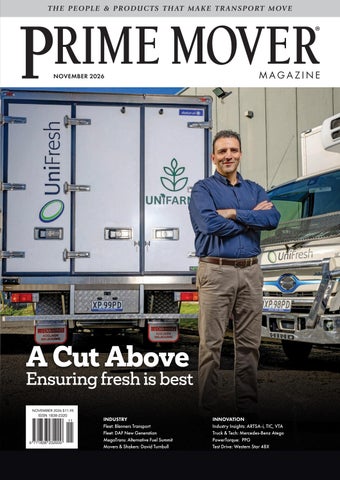
A Cut Above
Ensuring fresh is best NOVEMBER 2026 $11.95
ISSN 1838-2320
9 771838 232000
11
INDUSTRY Fleet: Blenners Transport Fleet: DAF New Generation MegaTrans: Alternative Fuel Summit Movers & Shakers: David Turnbull
INNOVATION Industry Insights: ARTSA-i, TIC, VTA Truck & Tech: Mercedes-Benz Atego PowerTorque: PPG Test Drive: Western Star 48X
The all-new Isuzu 4x4 range.
4x4 x more. Get more from your 4x4 with Isuzu’s all-new range of off-road trucks. More protection, with a suite of safety features that breaks new ground in the category. More comfort, with an ISRI seat* that turns rough roads into smooth sailing. More performance with Isuzu’s latest turbocharged diesel engine. And more ease in every drive, with a 9-speed dual-clutch transmission on selected models. All backed by the Isuzu reliability you can trust when the going gets rough. It’s off-road trucking redefined. Head to isuzu.com.au or visit your nearest Isuzu Trucks Dealer to find out more.
*ISRI seat only available on F Series models. FSA/ISZS3062
T H E P E O P L E & P R O D U C T S T H AT M A K E T R A N S P O RT M OV E
®
NOVEMBER 2026
N OV E M B E R 20 26
MEET THE TEAM Australia’s leading truck magazine, Prime Mover, continues to invest more in its products and showcases a deep pool of editorial talent with a unique mix of experience and knowledge.
Rocky
A Cut Above
Ensuring fresh is best NOVEMBER 2026 $11.00
ISSN 1838-2320
9 771838 232000
11
INDUSTRY Fleet: Blenners Transport Fleet: DAF New Generation MegaTrans: Alternative Fuel Summit Movers & Shakers: David Turnbull
INNOVATION Industry Insights: ARTSA-i, TIC, VTA Truck & Tech: Mercedes-Benz Atego PowerTorque: PPG Test Drive: Western Star 48X
Christine Clancy | CEO
With more than two decades of experience as a media professional, Christine has worked in newsrooms across Canada, Vietnam and Australia. She joined the Prime Creative Media team 12 years ago, and today oversees more than 43 titles, including a dozen print and digital transportation titles. She continues to lead a team that focuses on continuous improvement to deliver quality insights that helps the commercial road transport industry grow.
Paul Lancaster | Editor
Paul joined Prime Creative Media as an editor in March 2025 and has enjoyed a broad career spanning over 20 years across different sectors, including law, journalism and marketing in Australia and internationally. He gets great satisfaction from creating targeted content that appeals to wide ranging audiences. Paul says this comes from listening to industry members, businesspeople and the broader community.
CEO
Christine Clancy christine.clancy@primecreative.com.au
Editor
Paul Lancaster paul.lancaster@primecreative.com.au
Managing Editor, Transport Group
Luke Applebee luke.applebee@primecreative.com.au
Senior Feature Writer
Peter Shields peter.shields@primecreative.com.au
Business Development Manager
Ashley Blachford ashley.blachford@primecreative.com.au 0425 699 819
Head of Design
Clayton Hawley clayton.hawley@primecreative.com.au
Design
Jacqueline Buckmaster, Danielle Harris
Peter Shields | Senior Feature Writer A seasoned transport industry professional, Peter has spent two decades in the transport media sector. Starting out as a heavy vehicle mechanic, he managed a fuel tanker fleet and held a range of senior marketing and management positions in the oil and chemicals industry before becoming a nationally acclaimed transport journalist.
Client Success Manager Head Office
Ben Sammartino ben sammartino@primecreative.com.au 379 Docklands Drive, Docklands VIC 3008 info@primecreative.com.au
Ashley Blachford | Business Development Manager
Handling placements for Prime Mover magazine, Ashley has a unique perspective on the world of truck building both domestically and internationally. Focused on delivering the best results for advertisers, Ashley works closely with the editorial team to ensure the best integration of brand messaging across both print and digital platforms.
Peter White | Contributor
Since completing a Bachelor of Media and Communication degree at La Trobe University in 2021, Peter has obtained valuable newsroom experience, supplemented by direct industry exposure at Prime Creative Media. As the Editor of Trailer, Peter brings a fresh perspective to Prime Mover. He has a strong interest in commercial road transport and in furthering the magazine’s goal of growing the industry.
www.primemovermag.com.au
Subscriptions
03 9690 8766 subscriptions@primecreative.com.au Prime Mover magazine is available by subscription from the publisher. The right of refusal is reserved by the publisher. Annual rates: AUS $110.00 (inc GST). For overseas subscriptions, airmail postage should be added to the subscription rate.
Articles
All articles submitted for publication become the property of the publisher. The Editor reserves the right to adjust any article to conform with the magazine format.
Copyright
PRIME MOVER magazine is owned and published by Prime Creative Media. All material in PRIME MOVER magazine is copyright and no part may be reproduced or copied in any form or by any means (graphic, electronic or mechanical including information and retrieval systems) without written permission of the publisher. The Editor welcomes contributions but reserves the right to accept or reject any material. While every effort has been made to ensure the accuracy of information Prime Creative Media will not accept responsibility for errors or omissions or for any consequences arising from reliance on information published. The opinions expressed in PRIME MOVER magazine are not necessarily the opinions of, or endorsed by the publisher unless otherwise stated.
ENGINEERED TO PERFORM. PROVEN BY EXPERIENCE. THAT’S ANOTHER HINO
XAVIER_HINO41115.1
HINO 500 SERIES. PERFORMANCE AND RELIABILITY, YEARS IN THE MAKING. Engineered for Australian conditions, the Hino 500 Series delivers dependable performance and proven Hino Quality, Durability and Reliability businesses can count on. Backed by years of real-world Australian
experience, and with an Allison True Automatic transmission standard across the range, it delivers less effort, more control and greater commercial certainty. The Hino 500 Series. A proven performer. Visit hino.com.au
FROM THE EDITOR
AA
Keep Freight Moving
Paul Lancaster Editor Victoria is widely recognised as Australia’s freight and logistics capital and with the state heading to the polls on 28 November, transport stakeholders are looking to see what commitments the major parties will make to an industry that keeps the Australian economy moving. The issues facing transport operators extend well beyond one state or one election. Across the country, operators are dealing with rising costs, diesel supply and cost issues, pressure on margins, driver shortages, ageing infrastructure, congestion and increasing demands to improve safety and reduce emissions. For many businesses, simply keeping the wheels turning profitably remains the biggest challenge. Fuel is one of the largest variables for transport operators, making mechanisms for protection against fuel price volatility and the ability to recover legitimate cost increases particularly important. While governments may not be able to control global fuel markets, they can create an environment that gives businesses greater certainty.
6
N ovember 2026
Roads and infrastructure are another perennial concern. Trucks cannot operate efficiently when they are affected by congestion, inefficient routes, damaged road surfaces or inadequate rest areas and parking facilities. Better infrastructure is not simply a transport issue – it is an investment in the productivity of the wider economy. Driver safety also remains fundamental. The people behind the wheel of Australia’s trucks work in an increasingly complex environment and need infrastructure, regulation and road-user behaviour that support them in doing their jobs safely. These challenges will not disappear as the weather heats up. Australia is heading into summer with El Niño conditions expected to persist, bringing the prospect of hotter and drier conditions across many parts of the country. For an industry operating around the clock and across long distances, heat, bushfires and extreme weather can have a direct impact on drivers, vehicles, roads and supply chains. At the same time, another kind of pressure is building. The push to decarbonise transport is gathering pace, with governments, customers and major freight companies increasingly looking at ways to reduce emissions. But the transition needs to recognise the enormous diversity of Australia’s freight task. Battery-electric trucks, hydrogen, renewable fuels and other technologies may all have a role to play. The
right solution will depend on the application, distance, payload, infrastructure and economics involved. That was one of the central themes of the Victorian Transport Association’s Alternative Fuel Summit at MegaTrans, which brought together operators, manufacturers, energy companies, technology providers and policymakers to examine the practical realities of freight decarbonisation. As our coverage of the summit in this issue demonstrates, the conversation is moving from whether transport needs to change to how that change can actually be delivered. That is where governments have an important role. Whether it’s fuel protection, road funding, safety, workforce development or emissions reduction, the industry needs policies and action that recognise the commercial realities of operating a truck and the essential role freight plays in the community. The Victorian election may provide the immediate political backdrop, but these are national issues. Whatever governments are in power, the objective should remain the same - creating the conditions that allow Australia’s transport industry to keep moving safely, sustainably and profitably. As we all know, when freight stops moving, so does much of the economy that depends on it.
LESS DOWNTIME. MORE DRIVE TIME
D46-170
D52-190
RELIABILITY THAT DRIVES YOUR BOTTOM LINE For more information contact Dana on 1300 00 DANA or visit us at www.Dana.com.au
Strength • Power • Endurance
CONTENTS
38
Prime Mover November 2026
24 56
18
8
N ovember 2026
28
COVER STORY
“The drivers love to drive them because they’re new trucks and they’re a good brand and they’re comfortable and have one of the better drivetrains in that category of vehicle.”
NEXT GEN STYLE
Prime Feature STORIES FLEET FOCUS
44
MEGATRANS FEATURE
24
From Farm to Fleet From a banana farmer to a national refrigerated transport operation, Blenners Transport has built a family business that has now taken delivery of its 400th Kenworth.
48 Practical Pathways The VTA 2026 Alternative Fuel Summit examines how operators can make the transition to decarbonisation.
28
Simply the Best From bulk haulage serving the construction industry to creating the products which look great when we watch sport on TV, the Elite Group lives up to its name.
TESTDRIVE
TRUCK & TECH
Regular Run
38
Hauling On From its beginnings as a small Portland operation in 1990, Porthaul has grown into a diversified freight and civil construction business, with DANA rear axles helping its Kenworth fleet handle demanding work.
44
Off-Road Style With the DNA of the famous Mercedes-Benz Unimog military vehicle, the Atego 4x4 delivers refined road manners and impressive off-road capabilities.
56
The X factor Boasting US heritage, the Western Star 48X is a model exclusively built for the Australian and New Zealand markets.
6
From the Editor
62
Bob Woodward
10 64 66
Prime Mover News Movers & Shakers ARTSA-i
68
Truck Industry Council
70
Peter Shields’ Number Crunch
69
Victorian Transport Association p rim e m ove rm a g . c o m . a u
9
PRIME PRIME NEWS
> NTARC report reveals drop in ‘driver error’ serious heavy vehicle crashes The number of major truck crashes involving inattentive or distracted drivers has fallen by 32 per cent in the past 12 months, according to the 2026 National Truck Accident Research Centre (NTARC) Major Incident Investigation Report. The new report found several positive safety trends including “notable reductions” in driver fatigue (56.9 per cent) and in failure to give way (60.8 per cent). “In a positive development, the inattention/distraction incident rate is declining - from 25.4 incidents per 10,000 heavy vehicles in 2023 to 17.0 in 2025, a 33.1 per cent decrease,” the report found. “While the overall rate remains a concern, this downward trend may indicate early signs of progress in addressing this key risk area.” The report, developed in partnership by Australia’s leading specialist transport and insurance provider, NTI, with the National Road Safety Partnership Program (NRSPP), and the Monash University Accident Research Centre (MUARC), also found: • Major loss claims exceeding $50,000 fell 22.3 per cent in 2025. • Human factor-related incidents fell 17.6 per cent in 2025, to 67.6 incidents per 10,000 heavy vehicles. • Inattention/distraction remained the leading human factor, accounting for 13.8 per cent of all major incidents in 2025.
• Nearly two-thirds (63.5 per cent) of inattention/distraction crashes involved a single vehicle. • Geographically, inattention/ distraction crashes were slightly under-represented in major cities (36.8 per cent) relative to their overall crash share (40 per cent) and slightly over-represented in inner regional areas (27.3 per cent). • Articulated combinations had the highest inattention/distraction crash rate at 24.2 per 10,000 vehicles, with crashes most common in outer regional areas and major cities. This reflects their greater exposure to long-haul driving conditions, and in major cities, possibly due to the prevalence of environmental distractions, the high density of vulnerable road users, and frequent stopping, the report found. • Fatigue-related incidents fell 56.9 per cent, from 5.8 to 2.5 per 10,000 vehicles, while failure-to-give-way incidents fell 60.8 per cent and inappropriate vehicle positioning fell 8.9 per cent. NTI Transport Research Manager, Adam Gibson, said that understanding the causes of serious heavy vehicle incidents allowed organisations to focus safety efforts where “they will have the greatest impact”. “The NTARC report is a powerful resource to inform strategies to address safety challenges facing Australia’s heavy vehicle sector,” Gibson said.
Image: NTI.
The 2026 NTARC Major Incident Investigation Report has revealed new heavy vehicle accident figures.
10
N ovember 2026
“The decline in some key human factor risks shows the value of continued focus on these issues, while it remains critical that road safety interventions and initiatives continue to target these hazards, particularly inattention/ distraction, given their continued prevalence and potential for severe consequences.” NTI CEO, Janelle Greene, said the NTARC report helped take the “guesswork” out of improving driver wellbeing and road safety. This vital research provides the transport sector and decisionmakers with the practical insights needed to help save lives,” Greene said. “The 2026 findings show that progress is being made in some areas of human factor risk, while also highlighting where further work is needed. “The sustained focus on human factors in major crash events such as inattentive or distracted drivers demonstrates the importance of the work being done across the industry, from driver training and safety education to systemic and behavioural interventions. “The decrease in heavy vehicle incidents involving inattentive or distracted drivers provides a positive indication that these efforts are making a difference.” Australian Trucking Association CEO, Mathew Munro, said the NTARC report was essential for “driving change” to help the sector reduce heavy vehicle crash frequency and severity. “This important research delivers clear and timely evidence that helps us better understand why major crashes happen, and how they are trending over time,” Munro said. “Developing a strong safety culture right across the industry is critical, and the findings show the importance of continuing the work already being led by industry and government, from tailored education and awareness campaigns to policy and technology innovations.”
NEW GENERATION DAF
Powering your Success
Discover the New Generation DAF. The New Generation DAF range is Powering Your Success with outstanding efficiency, exceptional driver comfort and advanced safety. From the agile 7-litre XB for urban transport, to the lightweight 11-litre XD for distribution, the versatile 13-litre XF for interstate freight and B-double applications, and the flagship 15-litre XG for long-haul operations, DAF offers a complete transport solution for every business. DAF Transport Efficiency. Powering Your Success. DAF.COM.AU
A PACCAR COMPANY DRIVEN BY QUALITY
DISCOVER MORE
PRIME PRIME NEWS
Ampol Limited subsidiary, Ampol Energy Pty Ltd has entered into a share sale agreement to acquire 100 per cent of Evie Networks for $225 million. The business is currently owned by Fast Cities Australia Pty Ltd which operates one of Australia’s leading public electric vehicle (EV) charging networks. The acquisition, which is subject to clearance by the ACCC, is expected to add more than 1,030 EV charging bays to Ampol’s network, creating a combined platform of approximately 1,425 bays nationally, across more than 400 sites. On completion, the combined AmpCharge and Evie network is expected to become one of Australia’s largest public EV charging platforms. Ampol said the acquisition represents a significant step in expanding its public charging network, bringing together an established national footprint of well-located sites, attractive long-term site tenure, grid connectivity, a strong customer base and specialist operating capability. Over the last five months in Australia, electric vehicles have exceeded 20 per cent of new cars sold on average. Ampol Managing Director and CEO, Matt Halliday, said the acquisition of Evie positions Ampol to capture growth as the uptake of EVs and charging demand continues to gather momentum. “For Ampol, EV charging is ultimately a question of disciplined investment at the right time. That means closely monitoring customer behaviour, EV uptake, site economics, grid connections and the broader charging network to ensure our capital is deployed where it can create the greatest value,” Halliday said. “Our job is to be there for customers with what they need, when they need it, as they choose vehicle technology 12
N ovember 2026
Image: Ampol Limited.
> Ampol Energy to buy Evie Networks for $225 million
Ampol Energy is to buy Evie Networks.
that suits their needs. “Evie’s high quality, attractive longterm tenure sites with established grid connections and some with expansion capacity, provides Ampol with an opportunity to grow its charging footprint at scale and at pace. “Evie’s principal shareholder, Trevor St Baker AO, has been a genuine pioneer of Australia’s EV charging industry and his vision and capability have helped build Evie’s national platform and the foundations for broader EV adoption across Australia. “Public charging infrastructure is a precondition for broad electric vehicle adoption. That is particularly acute in a country the size of Australia, where long distances between charging locations can contribute to ‘range anxiety’ and deter motorists from purchasing an EV. “Within the AmpCharge network, utilisation has increased year on year, with charging sessions increasing 116 per cent and energy supplied increasing 120% in the first half of 2026. “This gives us confidence in the strength of the business case that complements our traditional fuels business.
“A substantial portion of Australian households have no practical means of charging at home, while public infrastructure is also critical for commercial fleets, rideshare operators and customers travelling longer distances.” Confirming the sale agreement, Evie Networks said on its LinkedIn page: “In 2017, you had to drive a ‘country mile’ to find a public fast charger. So, founded nine years ago, Evie was betting on a change: that Australians would see the merits and make the shift to electric vehicles. “Everything we’ve built since has been to serve those drivers who have made the transition. Now you can find Evie chargers in every state and territory, but it’s not just about the sites. Our network, app, Evie Mates and Autocharge have been built by a team who genuinely care about giving you “freedom of the open road”.” This acquisition remains subject to regulatory approval and is anticipated for completion in the first half of 2027. Ampol and Evie will continue to operate independently until such time as regulatory approval is obtained, and the acquisition completes.
GET A HEAD START WITH FREIGHTLINER CASCADIA. Get three months on us up to $20,000 when you finance a Freightliner Cascadia with Daimler Truck Financial Services. Experience the benefits of Guaranteed Buy Back and three years of servicing at no extra cost. Talk to your Freightliner dealer today to find out how you can take advantage of Cascadia’s remarkable fuel efficiency, advanced safety and superior comfort - Underestimate At Your Own Cost.
3
WE PAY YOUR FIRST 3 MONTHS, UP TO $20,000.
OF REPAYMENTS ON US, UP TO $20,000*
NOTHING TO SPEND SERVICING FOR 3 YEARS / 450,000KM.
MONTHS
GUARANTEED BUY BACK.
Contact your Freightliner dealer to get a Head Start today.
*Finance offer available on selected new & demo Freightliner trucks ordered between 23 March 2026 to 31 December 2026 (unless extended) and subject to stock and vehicle eligibility. Restricted to approved business customers (excluding fleet, government, or rental buyers) of Daimler Truck Financial Services Pty Ltd (“DTFSAu”) ABN 23 651 056 825 and subject to standard credit assessment and lending criteria, and fees may apply. A $20,000.00 finance contribution payable by Daimler Truck Australia Pacific Pty Ltd ABN 86 618 413 282 is available towards a new finance contract, structured as 3 equal payments for the first 3 months of the finance contract (i.e. exactly $6,666.66 per month). Following the 3 months, the customer returns to making repayments as per the relevant signed finance contract for the remainder of the term. Fast Track is also available in conjunction with this offer. Guaranteed Buy Back (GBB) is subject to vehicle eligibility and excess kilometer charges calculated at $0.15/kilometer in excess of the agreed annual allowance. Fair wear and tear return conditions apply. Full details available at an authorised Daimler Truck dealership.
PRIME PRIME NEWS
REMONDIS Australia’s MercedesBenz eEconic truck.
Image: REMONDIS.
> REMONDIS Australia advances fleet decarbonisation REMONDIS Australia is taking further steps towards fleet decarbonisation by trialling the latest battery-electric zero-exhaust-emission technology from Mercedes-Benz Trucks. The recycling, service and water company put the Mercedes-Benz eEconic 6x2 model truck through commercial waste collection trials in Brisbane during August 2026. The eEconic utilises lithium-ion batteries that power electric motors in the drive axle. The unique “e-axle” design is a significant technological advancement, eliminating the need for a traditional driveshaft, resulting in zero exhaust emissions and nearsilent operation. The eEconic truck also has energy recovery braking that increases efficiency and journey longevity, making it ideal for stop-and-go urban driving. eEconic trucks have been used across Europe in recent years. The Australian trial model has been designed and built to comply with local truck mass and dimension requirements. “REMONDIS, our parent company RETHMANN, and Mercedes-Benz are all iconic German brands, and our long relationships are behind this opportunity coming together,” REMONDIS Australia CEO and Managing Director, Björn Becker, said. “We’ve used Mercedes-Benz trucks globally, including in Australia, for many years. It’s a natural progression that REMONDIS would be first to trial eEconic technology on Australian roads. 14
N ovember 2026
“Modern waste management is all about circular economy outcomes, and fleet operation is a big part of that. “Given that we operate 600 waste collection trucks across Australia, there’s significant scope and appetite for us to cut emissions more broadly, be it through electric, hydrogen or hybrid technology. We’re working with multiple truck suppliers and other stakeholders to progress that journey.” REMONDIS Australia Technical Executive General Manager Conor Flynn said the eEconic trial truck was tailor-made for Australian conditions. “Plenty of effort and cooperation has gone into delivering a bespoke model fit for Australian climates and terrain. Amongst other things, Brisbane was chosen for the trial because of its diverse operational landscape. “The next steps are sharing and analysing information with MercedesBenz and other participants, including Superior Pak, which has overseen the body design.” Mercedes-Benz Trucks Australia Pacific Sales and Marketing Vice President, Andrew Assimo, said he’s been thrilled to see the eEconic hard at work for REMONDIS and the Brisbane community. “The Mercedes-Benz eEconic is the perfect choice for collecting waste and recycling day-in and day-out, delivering practical sustainability. “We know it can allow REMONDIS to deliver its customer-first waste solutions in near silence while producing zero exhaust emissions.
“The track record of these trucks speaks for itself in Europe, and we’ll be working closely with REMONDIS with a view to them succeeding in Australia.” The eEconic evolves from the dieselpowered Econic truck, developed by Mercedes-Benz nearly 30 years ago as a breakthrough custom-made cityfriendly waste vehicle. With drive output of up to 400 kilowatts, speed of up to 100km/h and a range of up to 150 kilometres (with compaction), the eEconic uses three battery packs with 300kWh of usable capacity. The batteries can be recharged in as little as 2.5 hours (using a 120kW charger), typically at fleet owner depots. The truck also has numerous safety features, including Advanced Emergency Braking System, panoramic windows and advanced mirrors and cameras to aid driver visibility, meaning new levels of precaution for pedestrians and other drivers. A low two-step entry point ensures better driver safety, with drivers avoiding repetitive climbs to and from seats that are positioned high in many conventional trucks. The eEconic trial builds on other electric truck trials REMONDIS has undertaken in Australia, and the globally significant introduction of a zero-emission hydrogen powered residential collection truck to its Illawarra, NSW operations in 2023.
JOST World has confirmed a leadership transition in its Asia Pacific operations, with CEO APAC Region and Head of Business Line Hydraulics, Alex Tan, set to depart at the end of 2026. Tan will leave the company on 31 December 2026 after more than 20 years with the business, having joined Hyva in 2003 before its integration into JOST World. During his tenure, he played a key role in establishing Hyva’s operations in China and later held senior leadership positions including Vice President of Hyva Asia and CEO of Hyva Group. Following the Hyva acquisition, Tan helped strengthen JOST’s footprint across the Asia Pacific region while serving as a member of the company’s Global Management Board. To ensure continuity, JOST has appointed Dr Rick Hilchner as CEO
APAC Region effective 1 October 2026. Based in Singapore, Hilchner will work alongside Tan during the fourth quarter of 2026 to oversee a smooth transition before formally assuming the role in January. Hilchner joins JOST with extensive experience across the automotive and industrial sectors in both Europe and Asia. Most recently, he served as Managing Director, Vice President, President and Chairman of the Board of Bosch Automotive Thailand. During a 14-year career with Bosch, he held a variety of senior management positions and led multiple business growth and transformation initiatives across the region. As part of his new responsibilities, Hilchner will also join JOST’s Global Management Board. The leadership change comes as JOST continues to expand its
Hydraulic Tipping Solutions in Australia
Image: Dr. Rick Hilchner.
> JOST names new APAC CEO
Newly appointed JOST APAC Region CEO, Dr Rick Hilchner.
presence in the Asia-Pacific market, which remains strategically important for the global supplier of transport, agricultural and industrial systems. JOST said the transition reflects its ongoing commitment to supporting customers and partners throughout the region while further strengthening its regional capabilities and market position.
Hydraulic Pumps C-Type Tipping Cylinders
Precision engineered Hydraulic Tipping Cylinders, Pumps, valves and complete systems built for heavy-duty Australian applications. For more details visit our website
hidromas.com.au Contact Us Phone +61 3 7033 0704 Email sales@hidromas.com.au Address 40 Taryn Drive, Epping VIC 3076 Australia
H-Type Tipping Cylinders
Oil Tanks
PRIME PRIME NEWS
Image: Toby Zerna/The Photo Pitch.
> Emery takes wheel at TIC Hino Motor Sales Australia President and CEO, Richard Emery, has been elected President of the Truck Industry Council (TIC). He succeeds Isuzu Trucks Australia Managing Director and CEO, Andrew Harbison, at the organisation’s Annual General Meeting in Canberra. Emery will lead the peak body representing Australia’s truck manufacturers, importers and distributors as the industry continues to navigate a changing freight landscape and key policy challenges. Harbison and Volvo Group Australia’s Tom Chapman were elected as Vice Presidents. “I’m pleased to step in to the role and continue building on the approach taken by Andrew over the last years,” said Emery. “The truck industry is dynamic and
continuing to evolve to meet the various challenges of today’s freight task.” TIC has been advancing its National Truck Plan, a policy framework updated late last year that aims to deliver a safer, cleaner, greener and more efficient truck fleet for Australia. According to Emery, the organisation will continue working with governments, regulators and industry stakeholders to progress the plan while contributing to broader policy discussions affecting the heavy vehicle sector. “Beyond the Truck Plan, we will work to provide valuable input to the Government regarding the pressing need for a balanced Road User Charge in the future,” he said. Emery brings more than four decades of automotive industry experience
Hino Motor Sales Australia President and CEO Richard Emery.
across Australia and South East Asia, having held senior leadership roles with a range of vehicle brands and businesses. His industry involvement has also included serving as a Director of the Federal Chamber of Automotive Industries and as Chair of the Importers Group.
Kel Baxter with his Deniliquin & District Transport Industry Wall of Fame award.
Long-time trucking industry advocate, Kel Baxter, has been inducted into the Deniliquin & District Transport Industry Wall of Fame. Baxter started his trucking career in 1968, aged 17, driving his dad’s Bedford tipper during the grain harvests. However, initially he started out farming in the district and recognised opportunities to transport his family’s 16
N ovember 2026
produce, consisting mainly of sheep and grain. Baxter’s understanding of the freight requirements from a primary producer’s perspective meant that the transport operation soon became in demand by other growers. “We started hauling the grain we produced on our own farm,” he said. “That led to taking grain to end users in Melbourne and other areas. I saw an opportunity to increase efficiency with roadtrains, which would help reduce supply chain costs and so, the transport business started heading in that direction.” Subsequently, Kelvin Baxter Transport was founded in 1990, with two second-hand Kenworth trucks. As the business continued to expand Kel acquired additional second-hand trucks, with the first new truck, another Kenworth, joining the fleet in 1997. Today, Kelvin Baxter Transport is a major transport and farming enterprise with a fleet of up to 55 trucks and
around 80 employees. The company, based in the Southern Riverina town of Berrigan, about 30 kilometres north of the Murray River, is acknowledged as a leader in the transport of bulk rural commodities, being highly respected in grain and fertiliser bulk haulage. Baxter’s contribution to the industry extends beyond his own business. He has been on numerous industry bodies and played a key role in securing road train access to rice receival sites, as well as supporting the introduction of B-triples and ABtriples across regional NSW. He was a former ATA Industry Technical Council chair and, in recognition of his long and distinguished service to the council and the transport industry, Baxter was named as one of the first four honorary life members of ITC in 2024. The others honoured were Bob Woodward, Keith Mackinley and Lance Fisher.
Image: Deniliquin & District Transport Industry/Kel Baxter.
> Kel Baxter inducted into Deniliquin Transport Wall of Fame
When the load is critical, driver safety cannot rely on compliance alone. Guardian by Seeing Machines: protecting drivers with precision fatigue and distraction detection. Every fleet operator has policies, procedures and compliance frameworks designed to reduce risk. But fatigue doesn’t recognise regulations. And, distraction doesn’t wait for the next scheduled break. Guardian by Seeing Machines helps organisations identify fatigue and
distraction as they develop, delivering real-time driver intervention and
actionable safety insights that enable risk to be managed before it becomes an incident.
Because when the load is critical, protecting the driver is the most important safety decision you can make.
Discover Guardian by scanning the QR code.
COVER STORY
UniFresh’s Senior Managing Director, Phil Haddad, has full confidence in the Hino 300 Series 916 Hybrid electric truck.
18
November 2026
A CUT ABOVE
Everyday, Australians expect fresh vegetables and salads to be available from their local, quick service outlets. National supplier of prepared fresh vegetables and salads, UniFresh Processors, uses Hino trucks to meet that growing demand.
T
here is an expectation among us that the things we eat are always made with the freshest available ingredients. To ensure that components such as the lettuce and tomato on our burgers are not only fit for consumption but are also fresh and tasty requires consistently meeting a specialised logistical challenge. The UniFresh Processors story began with the Haddad family’s ownership of a retail fruit and vegetable store in suburban Adelaide. An opportunity was identified to become involved in the supply of wholesale fruit and vegetables to various companies in the Adelaide area, and it also became evident there was demand for “processed” vegetables (washed and sliced) so the Haddad family invested in the appropriate equipment. Starting with one truck early in the year 2000, within the first year the company had grown to 16 employees and developed a purpose-built processing plant to cater for the customers across Adelaide and beyond, driven by a genuine desire to provide the best products and service to that expanding customer base. Located at Woodville North, which
is around ten kilometres from Adelaide city, UniFresh specialises in supply of its fresh vegetables and salad products to the quick service restaurant sector, known within the industry by the acronym QSR, which includes wellknown brands such as Subway, KFC, Hungry Jacks, Domino’s, and Oporto. The areas of operation are mainly South Australia, Northern Territory, as well as New South Wales and Western Australia covering clients’ outlets in both metropolitan and regional locations. By the end of 2003 UniFresh was in the position to take over a competitor’s operation to further their expansion. Today UniFresh employs over fifty staff and supplies every state in Australia with fresh cut fruit and vegetable products. UniFresh’s expansion is a result of being able to work with clients, listening and understanding their requirements and being able to nimbly adapt their own processes to deliver the ultimate level of customer satisfaction. By adopting this credo, UniFresh has been able to attract a wide range of clients and has become a leading national supplier of prepared fresh
Images: Hino Australia.
A UniFresh Hino 300 Series 916 Hybrid ready for loading.
fruit, vegetables and salads. With the business’s growth came the need for a reliable and efficient transport solution. The inbound transport of bulk agricultural products into the UniFresh facilities is performed by third party carriers and the store deliveries are performed by UniFresh’s own fleet of refrigerated trucks, 40 of which are Hino’s, including four new 300 Series 916 Hybrid Electrics. The recent acquisition of these four Hino Hybrid Electric trucks represents a significant step in UniFresh’s fleet evolution and demonstrates the company’s commitment to investing in innovative technologies in support of both operational efficiency and environmental responsibility while proving the performance of the lower emission trucks in a refrigerated transport application. The UniFresh delivery fleet currently numbers 55 trucks, the majority being the Hino brand, performing deliveries to fast food restaurants mainly in metropolitan locations and as well as to some regional areas. The reliability of the Hino trucks has been an important factor in the purchasing decisions. “Their quality and the reliability of the product are the main reasons we choose Hino trucks,” says Phil Haddad, UniFresh’s Senior Managing Director. Many of the trucks are travelling considerable kilometres, particularly Sydney-based vehicles delivering every day to Newcastle and Canberra. Trucks based in Perth travel to Busselton every second day. Most trucks within the fleet average around 45,000 kilometres per year, with the ones running from Sydney to Canberra and Newcastle doing 60-70,000 kilometres per year, which is similar to the trucks performing deliveries between Perth and Busselton in Western Australia. When transporting perishable food p rim e m ove rm ag . c o m . a u
19
COVER STORY
A daily run for the UniFresh fleet.
items the reliability of the vehicles performing that task is very important, especially in the remoter areas such as when doing the Busselton deliveries. “If any of these trucks were to break down somewhere along the way, it becomes a recovery mission, so it’s important that we buy the best trucks, and they’re well spec’d for what we ask them to do,” says Phil. “The drivers love to drive them because they’re new 20
November 2026
trucks and they’re a good brand and they’re comfortable, and have one of the better drivetrains in that category of vehicle.” Within the fleet are Hino trucks with 4.5 tonne and 8.5 tonne GVM’s, as well as a 14-tonner, all of which are fitted with refrigerated bodies. The Hino 300 Series 916 Wide Body Hybrid-Electrics are recent additions to the UniFresh fleet and are already
making a contribution to the bottom line as well as to the environment. “So far, we’re seeing a 20 to 25 per cent reduction in fuel,” says Phil. “There was a level of reluctance from some drivers because the Hybrid is something different, but now they look forward to using those trucks.” The Hino Hybrid-Electrics are not just “green dressing” to promote UniFresh’s environmental
commitment. In a commercial sense they are there to do a job and the results so far are encouraging. “Within a year we will look to order more of them if they stack up,” says Phil. The Hino trucks are sourced from the local CMV Hino dealership and typically trucks are kept for about five years before being replaced. Servicing is carried out in-house. Having a fleet
“The drivers love to drive them because they’re new trucks and they’re a good brand and they’re comfortable and have one of the better drivetrains in that category of vehicle.” UniFresh’s Senior Managing Director, Phil Haddad.
p rim e m ove rm ag . c o m . a u
21
COVER STORY
of late model trucks brings with it the benefit of attracting and retaining good drivers. “We had struggled for some time for drivers, and part of the strategy was to buy new trucks to make the driving experience more enjoyable,” says Phil. “An additional benefit of having good trucks is having the right equipment to maintain staffing.” For the drivers, the Hino trucks are akin to working in a state-of-the-art office. In an industry almost obsessed with freshness, UniFresh provides an online ordering facility for its clients, combined with live tracking of their deliveries which provides accurate estimated delivery time information. Orders are typically placed 24 hours before they are delivered and this ‘just in time’ process ensures freshness of the products.
“Because no one wants to carry old products, they’re only ordered at the last minute,” says Phil. UniFresh guarantees 100 per cent usable product and has accreditations for internationally recognised food safety standards such as HACCP (Hazard Analysis and Critical Control Points), SQF (Safe Quality Food) and ISO 9001 – Food Handling and Product development. As the company is moving towards additional vertical integration, during the past two years UniFresh has also been taking on the role of growing its own vegetables at several farms it owns in Virginia just north of Adelaide. The success of UniFresh reflects the pride the Haddad family and staff have in consistently delivering high-quality fresh food items using the latest in truck technology, ensuring Australians’ fast-food items are nutritious and great to eat.
“So far, we’re seeing a 20 to 25 per cent reduction in fuel. There was a level of reluctance from some drivers because the Hybrid is something different, but now they look forward to using those trucks.” UniFresh’s Senior Managing Director, Phil Haddad.
The streamline Hino 300 Hybrid Dashboard. 22
November 2026
Standing tall with the Hino 300 Series 916 Hybrid Electric fleet.
p rim e m ove rm ag . c o m . a u
23
FLEET FOCUS
Les Blennerhassett, Judy Blennerhassett, Ben Blennerhassett, Roger Blennerhassett with the new T909 Kenworth.
FLEET FROM FARM TO
From a banana farmer with one truck and one shed, to a national refrigerated transport operation, Blenners Transport founder Les Blennerhassett has built a family business that has now taken delivery of its 400th Kenworth.
W
hen Les Blennerhassett bought his first Kenworth in 1988, he was still a banana farmer who readily admitted he knew little about trucks. Almost four decades later, the Blenners Transport fleet numbers about 260 trucks across eight depots, its Kenworth linehaul fleet travels to every capital city in Australia, and the family business has just taken delivery of its 400th Kenworth. 24
November 2026
The milestone T909 was handed over in September 2026 by James Meakin of the Brown and Hurley Group at its Garbutt dealership in Townsville. For Les, now 69, the 400th Kenworth represents much more than another new truck. It is a tangible reminder of the journey that began with bananas, a single truck and a willingness to take a chance. “I cut my first banana crop in 1980 when I was 25 and started working for myself as a banana farmer,” Les says. At the time, he operated his own
banana packing shed and transported his crop to market. Other growers soon began asking him to carry their bananas as well. The catalyst for entering transport came when a tow operator carrying his bananas repeatedly broke down. “It was a fortnight turnaround to get the bananas between North Queensland and Sydney,” he says. “When they said, ‘Do you want to buy this van?’, I said, ‘I know nothing about trucks, I’m a farmer.’ But then I
bought my first truck.” The first truck arrived in 1988, a Kenworth T650 powered by a Caterpillar 3406 engine and riding on torsion-bar suspension, which Les says provided a soft ride for transporting fruit. His first customer was effectively himself, working alongside his brother and a friend to fill a van each week. “We were 100 per cent bananas until 2006, when Cyclone Larry hit,” Les recalls. At the time, Blenners Transport was moving about 110 loads of bananas a week. Cyclone Larry devastated the region’s banana industry, reducing that figure to just three loads. The crisis forced Les Blennerhassett to diversify. While in Mareeba, shortly after Larry, he was approached by a mango grower who asked whether Blenners could transport the crop. It proved to be another turning point. “When you provide a good service, they tell their neighbours and then you grow from there,” Les says. Today, Mareeba is Blenners Transport’s biggest produce depot in terms of pallets of fruit moved, with the company transporting bananas, mangoes, citrus and avocados from North Queensland to every capital city in Australia. The business also operates 31 road trains running to Perth, with Les describing Blenners as one of the few road transport operators moving significant volumes of fresh produce into Western Australia. Diversification was only one of several major turning points. Moving from the original banana shed into a purpose-built depot in Tully gave the business highway frontage and helped attract growers following the sale of another local operator. Another important development came when Mark Lindsay joined the company. His contacts in refrigerated transport helped Blenners substantially increase its fleet.
“He had a lot of contacts in the refrigerated transport world, and we doubled our fleet in about five years,” Les says. “He was a great man.” The business continued to evolve as transport technology and equipment changed. The move from single trailers to B-doubles and, more recently, PBS combinations has improved productivity, while electronic tracking has given the company much greater visibility of its fleet. Today, Blenners Transport operates around 260 trucks across eight depots. Its linehaul fleet is made up entirely of
Kenworths, while Isuzu provides the rigid trucks and FTE refrigerated vans form the refrigerated trailer fleet. Les says the equipment choices have been driven by more than the initial purchase price. “We’ve stabilised on the most popular brands and the best reselling value,” he says. “With the workshop and maintenance, and with parts, it makes it easier to stick with one brand.” For linehaul operations, Kenworth has continued to be the preferred choice because of its whole-of-life economics.
The 400th Kenworth up close.
p rim e m ove rm ag . c o m . a u
25
FLEET FOCUS
“I never buy on price alone, it is whole-of-life cost that I work on and nothing has come close to Kenworth,” he says. The company’s linehaul Kenworths typically spend six to seven years in that role before moving into the local fleet, where they remain until about 10 or 11 years old. The distances involved make fleet age particularly important. “From North Queensland, going to Perth is about 5,000 kilometres and 3,000 kilometres to Melbourne, so you don’t want anything too old doing those long runs,” Les says. The scale of the operation has also continued to increase. When Les
was profiled for receiving his 300th Kenworth five years ago, the linehaul fleet numbered about 90 trucks. It now sits at around 110 to 120, with the company averaging about 20 new trucks a year across its operations. The 400th Kenworth is suitably distinctive. The T909 features a 50-inch sleeper, extensive chrome and engraving, leather detailing bearing the 400th Kenworth insignia, and walkways over the chassis. There is also a family tradition attached to the milestone. Every 100th Kenworth is finished in the company’s original green colours. The new T909 will be based at Tully and will work the company’s Perth road train operation.
ISRI: DEALERS SYDNEY
MELBOURNE BRISBANE
510 Victoria Street, Wetherill Park NSW 2164 DARWIN Ph. 02 9756 6199 email isri@isri.com.au web www.isri.com.au Unit 1/569 Somerville Rd, Sunshine West VIC, 3020 PERTH Ph. 03 9311 5544 email sales@isrisunshine.com.au web www.isri.com.au 3/120 Gardens Drive, Willawong QLD 4110 Ph. 07 3275 2044 email sales@isribrisbane.com.au web www.isribrisbane.com.au MACKAY
BRISBANE NORTH NEWCASTLE/HUNTER VALLEY
Behind the wheel will be Blenners’ senior driver, Joe Phillips, who has been with the company for 15 years. The relationship between Blenners and Brown and Hurley is almost as enduring as its relationship with Kenworth. Over 38 years, Les has dealt with just three people at the dealership – Len Roberts, Tony Burton and now James Meakin. “All three came along to the handover,” he says. “We’ve all become good friends over the years. They’re great people to do business with, and a great role model for the Kenworth brand.” Townsville dealer principal, James Meakin, holds a great deal of pride in the milestone.“Over the time since Les
Mobile Sales and Service Ph. 08 8927 0986 email info@isridarwin.com.au web www.isridarwin.com.au 408 Welshpool Road, Welshpool WA 6106 Ph. 08 9361 7646 email info@mmtisri.com.au web www.mmtisri.com.au 110-120 Maggiolo Drive, Paget QLD 4740 Ph. 07 4952 1844 email admin@isrimky.com.au web www.isriseatsmackay.com.au
1/259 Cullen Av East, Eagle Farm QLD 4009 Ph. 1300 11 4774 email seats@isrinb.com.au web www.isrinb.com.au
Unit 2/13 Hinkler Ave, Rutherford NSW 2320 Ph 02 4932 0600 email sales@hvss.com.au web www.isri.com.au
The new T909 Kenworth is ready for action.
“I never buy on price alone, it is whole-of-life cost that I work on and nothing has come close to Kenworth.”
Images: Brown and Hurley.
Blenners Transport founder, Les Blennerhassett.
and Judy began Blenners Transport in El Arish, Brown and Hurley and Blenners have shared a great relationship,” he says. The 400th truck also brings the story back to an earlier Kenworth that remains close to Les’s heart. He was unable to recover his original 1988 T650 after it was wrecked and then sold, but he retained his fifth Kenworth - another T650 purchased in 1993. After working in the company’s linehaul operations, followed by 15 years in local operations, that Kenworth was stripped down and rebuilt to become a show and convoy truck. The restored T650 remains a
reminder of where the fleet came from. “I’ve always owned that one. We never got rid of it,” Les says. While the trucks have remained a passion, Les’s role in the business has changed considerably. Over the past six years, his sons Roger and Ben have progressively taken greater responsibility, taking over the transport operation completely during the past two years. Roger is based in Brisbane and oversees the Brisbane and Rockhampton depots, as well as customers across Perth, Adelaide, Melbourne, Sydney and Brisbane. Ben is in Tully with Les and oversees the other six depots and the company’s
North Queensland customers. For Les and his wife Judy, seeing their sons take over represents another significant achievement. “We had people trying to buy us out over the years,” he says. “I always said it wasn’t up to me, it was up to the boys.” Now, Les can concentrate more on the family’s 1500-acre sugar cane farm and 80 head of cattle, although he still visits the transport depot every day. “I’ve backed off and they’ve stepped up,” he says. “It feels pretty good when I can pass the depot in the morning and go straight to the cane farm, without having to put out any fires.” Judy has been integral in running the business while raising three children and maintaining the home. She has now reduced her involvement in the office, working three days a week. “Judy has supported me throughout this journey. It’s been tough, but she’s been there with me all the way.” The next chapter will involve further expansion, with Blenners acquiring land in Rockhampton and Mackay to provide room for the depots to grow. Beyond that, Les is content to see the business continue doing what it does best. His hope is that Roger and Ben can carry the company forward for another 20 to 40 years. After almost four decades building a business around trucks, fruit and family, there is still an obvious affection for the industry that started it all. “Trucking gets in your blood. There are some great friends out there in trucking I have made good friends with,”Les says. If he could offer advice to his younger self, it would simply be:“Go hard son, you will make it one day.”
ISRI SEATS
the brand behind the brands
• Supporting drivers for more than 50 years • Seating – on a higher level
02 97566199
isri@isri.com.au
www.isri.com.au
FLEET FOCUS
S I M P LY
THE BEST From bulk haulage serving the construction industry to creating the products which look great when we watch sport on TV, the Elite Group lives up to its name.
F
or the past couple of decades, the Western Suburbs region of Sydney has been experiencing rapid growth as new residential suburbs are created from cow paddocks and the supporting infrastructure such as the Metro and shopping malls has also contributed to the demand for building and construction materials. Add the establishment of Western Sydney International Airport and its associated roadworks and it’s been a busy time for material suppliers and tip truck operators such as Elite Haulage. Jason Roberts started in the industry as an allocator for a local sand supplier and worked his way up into management before creating Elite Haulage in 2013 with one tipper and
28
November 2026
dog trailer doing deliveries for local bulk product suppliers. There is a degree of irony in the fact that now, years later, Jason occupies the very same office he started in as an allocator, except that he now owns the business and the property it operates from. After more than 20 years the business is continuing to do well with its own fleet of Volvo Group trucks driven by company drivers. The expansion of the fleet to more than 60 trucks has been driven by Jason’s unwavering commitment to providing his clients with the best possible outcomes “My philosophy is if you start winding back, you go backwards,” says Jason. “We couldn’t go backwards because our customer base just kept growing. And
we never say ‘no’. As long as it’s legal, we’ll find a way to do it.” Elite Haulage is a major component of the Elite Group of companies delivering the products it supplies through associated entities Elite Sand and Soil and Elite Quarry Products. Elite supplies golf courses, sports fields, stadiums, cricket grounds and the racecourse industry with many of their materials. Elite also supplies bowling greens which have yet to convert to artificial grass. “We also do a lot of the golf courses right across New South Wales, and it’s a niche market,” says Jason. “It’s a certain spec material and it’s important for us to supply consistent products. We also supply ‘quicker wicket’ soil for
Elite Haulage is making big ground with its fleet of prime movers.
Images: Elite Haulage
cricket grounds, which you can’t really get anywhere else. We supply different cricket clubs and schools and sporting facilities.”
Rather than relying entirely on the building trade which can be affected by national and international economic situations, the deliberate trend to diversify and have more than one work stream has proved successful. “That’s what’s helped us get through the tough times,” says Jason. “We don’t do a lot of social media advertising, and it’s mostly recurring work from existing clients or people contacting us through others.” At a time when many of the tier one construction companies are experiencing a slow-down, Elite is busy with different projects and has opened a facility in Hexham near Newcastle to service the Hunter and Central Coast regions. Elite is a family operation with around 75 staff including Jason’s wife Kylie and son, Zach, who manages the truck fleet with the assistance of digital products from Allotrac for job allocations and Geotab for vehicle tracking. “We’re now looking to run a full camera system with Geotab and integrate forward facing cameras in the trucks,” says Jason. “I say this to the drivers: ‘if you’ve got nothing to hide, what are you worried about? It’s just a safety issue, and you know it’ll help all of us. Everyone’s got hands-free so you don’t need to be on your phone. I’m not here to listen to your conversations or anything like that’. “ The entire Elite Haulage fleet,
regardless of application, is made up of trucks from the Volvo Group across Volvo, Mack and UD brands, most of which are on factory maintenance contracts. “When we started getting on top of things and buying new vehicles, we were introduced by our sales rep at Mack to the gold agreement, which basically fixed your cost for maintenance for five years and locked that in,” says Jason. “The Volvo workshop at Huntingwood is the best workshop in Australia. They treat our trucks like their own, and rarely is there ever an issue, and if there is they’re always on the phone to contact us. The trailers are serviced in-house, but Volvo still look after our truck side of things and our maintenance agreements.” Trucks are generally replaced after five or six years. Volvo FH models with 700hp drivelines are used for the A-doubles and the B- doubles and a 685hp Mack Super Liner is also on A-double duty contracted to Holcim hauling products used to make concrete. Many of the truck and trailer combinations operate under the PBS scheme which supercharges productivity. The significant rise in the cost of diesel during 2026 has presented challenges for every transport operator yet Elite’s pain has been softened
The sheer scope of the Elite Haulage fleet. p rim e m ove rm ag . c o m . a u
29
FLEET FOCUS
Standing out from the crowd.
slightly due to their own large bulk tanks, plus the ability to pass on a fuel levy in many cases. Jason says he doesn’t like to pass it on, but in the current economic climate there is no choice, particularly as many of their material suppliers themselves have to pass on their increased fuel costs to Elite. With around 75 staff currently depending upon Elite, Jason adopts an attitude of ensuring there is work and income for all of his people. “I’ve created a good team now around me,” he says. “We’ve always had pretty much a full fleet of drivers by being fair with our drivers and looking after them and being part of the family.” Jason has a management succession plan which points toward son Zach. “I’d love to see my son take over the business,” Jason says. “But it’s not a given. He’s got to earn his stripes, which he’s getting now.” But that seems to be a way off yet and Jason exhibits no signs of slowing down. “I’ve only just turned 50, and what else am I going to do?” Jason asks. “Sit at home and go crazy, when I love coming to work and I really enjoy it. I’ve got a good team around me, and I couldn’t do without them. “I don’t stress because some things happen and I’m confident in my own ability to make sure that we’ve got continuous work. You may lose something here, but always, when one door closes, another one opens.” 30
November 2026
Jason Roberts in front of a MACK prime mover.
HYVA TIPPING SOLUTIONS CYLINDERS | WET KITS | VALVES | OIL TANKS | CONTROLS HYVA tipping technology gives operators more precise control over lift and lowering, helping make each tipping cycle smoother, more predictable and easier to manage. Gain greater control throughout the tipping cycle, helping support safer, smoother and more consistent operation.
Explore HYVA tipping solutions
jostaustralia.com.au
FLEET FOCUS
s on the road. A ECS Project Logistic Logistics. Images: ECS Project
READY R E N TA L
Access to flexible fleet solutions helps ECS Project Logistics respond to changing customer and project requirements across Australia.
T
he company’s Chief Operating Officer, Colin Mc Guinness, says that access is an everyday business requirement, with heavy haulage capacity needed to support customers whose work does not always follow a predictable timetable. The company provides specialised transport and logistics services across Australia, particularly from Perth, Adelaide and Brisbane. Its customers operate in infrastructure, construction, mining, energy, and industry, where equipment requirements vary between assignments, and delivery windows can be tight. Those demands make fleet planning a balancing act. Operators need 32
November 2026
enough capacity to take on work and fulfil commitments, while keeping equipment productive between jobs. Buying for every possible requirement can tie up capital in assets that are needed only for specific projects. Mc Guinness says the business contends with fluctuating project requirements, equipment availability and compliance obligations, alongside the constant responsibility to operate safely. “Having access to the right equipment at the right time is critical to maintaining our service levels for customers,” he says. For ECS, trailer and dolly rental through TR Group helps bridge the
difference between its existing capacity and the equipment a particular assignment requires. It can bring in additional assets to meet customer needs without having to invest in additional equipment for every project requirement. “TR Group provides dependable access to quality trailers and dollies that allow us to quickly respond to project demands without the lead times and capital investment associated with purchasing equipment,” Mc Guinness says. Flexibility is important with project work as a purchase commits the operator beyond the immediate job, while the customer’s requirement
may be tied to a specific stage of construction or a defined movement of equipment. Rental gives ECS another way to match its fleet to the work available as equipment can be needed at short notice, schedules can shift and projects must still be delivered safely, reliably and on time. Mc Guinness says the arrangement supports a broader business strategy in which expansion and fleet utilisation are considered together. “TR Group’s rental model gives us the flexibility to scale our fleet as required, supporting growth while maintaining efficient capital allocation,” he says. For a specialist operator, that leaves room to pursue new work without treating every increase in demand as a permanent change to the fleet. It also allows management to consider where investment will best serve the business, with rental available to cover specific equipment requirements. TR Group National Rental Manager, Ryan Robertson, says the supplier’s role extends beyond making an asset available. Understanding how a customer operates is central to providing useful support, particularly
when the original plan changes. “World-class rental service is about more than handing over a vehicle. It’s about understanding a customer’s operation and providing the equipment, back up and support that helps keep their business moving,” he says. For ECS, that service is tested against the practical demands of transport work. A changing schedule needs a response from someone who understands the requirement, can work through the options and recognises the implications for the customer’s operation. “Their team is responsive, easy to deal with and committed to supporting our operational requirements when schedules and customer demands change,” Mc Guinness says. The relationship therefore involves coordination as well as equipment supply. ECS remains focused on organising and delivering the transport task, supported by a rental partner that can help address the fleet requirements behind it. Clear communication becomes particularly valuable when customers need adjustments during a project.
Equipment condition is another consideration. Additional capacity must be dependable if it is to help an operator meet its commitments. For ECS, access to well-maintained trailers and dollies sits alongside the quality of the people supplying them. “TR Group stands out through the quality and reliability of its equipment, strong customer service and willingness to work collaboratively to support our operational needs,” Mc Guinness says. Established in 1992, TR Group has developed its business around specialist heavy commercial vehicle leasing and rental. It now manages more than 10,000 trucks and trailers across Australia and New Zealand, giving it experience across a wide range of transport operations. Its founding proposition was that customers should be able to concentrate on running their businesses while a specialist takes on much of the investment, risk and complexity associated with heavy commercial vehicles. For ECS, the measure of that proposition is straightforward: whether the arrangement helps it deliver the next job.
Ready for the heavy jobs. p rim e m ove rm ag . c o m . a u
33
TRUCK & TECH
LEGACY F A M I LY
Ausway Transport has carried a family passion for trucking from northern India to Australia, building a fleet where reliability, presentation and a long-standing relationship with JOST remain central to the business.
F
or Ausway Transport Managing Director, Bobby Sooch, trucking is much more than a business. It is a family tradition that stretches back more than six decades and across two countries. The story began in 1962 when Bobby’s grandfather left the Indian Army, where he had served as a tank driver, and moved to Mumbai. Having grown up in a farming family, the transition into transport was not an obvious one, but his experience with military vehicles had given him an appreciation for trucks and heavy equipment. He purchased his first truck and began building a transport business that would eventually be carried on by the next generations of the family. The family remained involved in both trucking and farming, with Bobby’s father joining his grandfather at a young age. As the family eventually migrated to Australia in the 1980s, Bobby’s father continued running the Indian operation while family
34
November 2026
An Ausway Transport truck on the move. Image: Ausway Transport.
members established themselves here. In 2003, the Australian chapter of the business began with a single truck. From that modest beginning, Ausway has steadily developed into a national transport operation with a diverse fleet and a strong reputation for the presentation of its equipment. Today, Bobby represents the third generation of the family to work in trucking, while the fourth generation is already showing an interest. “My daughter is only eight, but she’s a fourth generation,” he says. “She loves trucks as well.” That generational continuity is reflected in the way Ausway approaches its suppliers. Rather than continually changing brands, the company prefers to establish relationships with suppliers whose products have proven themselves over time. That philosophy has made JOST a particularly important part of the Ausway fleet. Bobby says the JOST relationship began with the arrival of the company’s
first Volvo truck fitted with JOST equipment. The relationship grew from there and, over the years, we’ve pretty much gone to 100 per cent JOST,” Bobby says. The approach now extends across Ausway’s mixed-brand fleet, which includes predominantly Kenworth and Volvo trucks, along with Scania and DAF vehicles. Regardless of the truck badge, JOST remains the preferred supplier for the coupling equipment. “We’re pretty brand loyal with our suppliers,” Bobby says. “We don’t change them very quickly.” At the heart of the fleet is the JOST JSK 37 greaseless fifth wheel with sensor technology. Ausway uses the system across its prime movers, while JOST turntables are also specified on its trailers. JOST’s heavy duty Modul landing legs and JSK37C turntables are now standard across the entire fleet, as well as Rockinger R0500 coupling in a road train setup.
THE MID-WEIGHT CHAMPION IS HERE TH E M I D - DUT Y TH AT PU N CH E S A BOV E IT’ S W E I G HT
EURO 6 SINCE 2021 6-CYLINDER SIDEGUARD ASSIST^
When you need a job done, it’s the Fighter you need in your corner. Having pulled the Euro 6 punch in 2021, the FUSO Fighter has been fighting the emissions fight for years. Add to that the knockout combo of 6-cylinder pulling power, full Allison Automatic and Sideguard Assist ^ across most models means the Fighter punches above its weight against its rivals in a range of applications. All backed by a 5-year * warranty and 5-year * roadside assistance, the Fighter is set to go the distance.
OR UP TO 350,000KM
Learn more at your authorised FUSO dealer or visit fuso.com.au/fighter
Sideguard Assist (ASA) is not available on Fighter FN models with steel suspension. For further details on operating parameters, please refer to the FUSO Fighter Owner’s Handbook. Fighter FM/ FN offers 5 year/350,000kms vehicle warranty, whichever occurs first, along with 24/7 Roadside Assistance. Excludes bodies. Fighter FK offers 5 year/300,000kms vehicle warranty, whichever occurs first, along with 24/7 Roadside Assistance. Excludes bodies. # Whichever occurs first.
^
* *
OR 12 MONTHS#
TRUCK & TECH
Ausway Transport’s distinctive “Grandpa” prime mover.
The sensor technology has become an important safety feature for the business. On newer trucks, the system is integrated into the vehicle’s dashboard, while older equipment uses a separate indicator to show whether the fifth wheel is correctly locked. Bobby says that visibility provides an important additional safeguard, particularly in situations where a driver may leave the vehicle after coupling. “We found that very crucial, especially when people are pulling their pins and you know the safety concerns if they’re not hooked up properly,” he says. The technology is also evolving. JOST has introduced a system that provides a light and buzzer adjacent to the turntable, giving drivers a more visible indication of the locking status. Ausway is considering rolling the technology out to its trailers as well. Ausway’s commitment to JOST extends beyond fifth wheels, with it using JOST landing legs throughout its trailer fleet, including the heavy-duty Modul series with compensating feet. The compensating foot provides additional contact with the ground, while the heavy-duty construction is suited to the demands of Ausway’s operation. With JOST products now standard 36
November 2026
across virtually the entire fleet, Bobby says reliability is the key reason the relationship has endured. “It’s the reliability. The product is good. We never had a failure with the JOST turntable.” For a transport operator, that reliability also has a direct bearing on total cost of ownership. “The running cost is cheaper,” he says. “You don’t have a constant parts replacement. As long as you look after the product and maintain it to specification all the time, it won’t let you down.” The relationship extends beyond the equipment itself. Bobby says JOST’s sales and management teams have consistently provided support as the Ausway fleet has grown. “Their support is good. The sales reps are always there,” he says. “Even the previous managing director and the current one, they’re always very helpful. They’re always there to promote the product and also tell us what’s new coming.” While the equipment and fleet continue to evolve, Ausway’s strongest connection to its history can be seen in one particular Kenworth. Known throughout the fleet simply as the “Grandpa Truck”, the showstopping Kenworth carries a mural
of Bobby’s grandfather, who died in Australia two years ago at the age of 93. His grandfather had visited the Ausway depot only a week before his death. Despite reaching 93, he had maintained an extraordinary connection with the business and its trucks. Bobby says his grandfather had never spent time in hospital throughout his life until his final week and was still regularly at the depot, often arriving at 6.30am and working six days a week. “He had this passion for the trucks which you could never take away from him,” says Bobby. That passion was shared by many of the Ausway drivers, some of whom had worked with the family for 10 to 15 years. As Bobby watched the Kenworth being transformed, he realised it provided the perfect opportunity to create a lasting tribute. “We should make this truck dedicated to Grandpa because he’s done a lot in his life. He always loved the trucks.’” One of Bobby’s drivers, Charlie, had produced a painting of his grandfather after his death. Bobby received a copy, as did his father and sister. Looking at the painting, Bobby saw the inspiration for the truck.
Image: Ausway Transport.
Image: JOST/Ausway Transport.
A closer look at the JOST fifth wheel.
“I looked at the painting and I was like, you know what, this is the perfect fit for this truck.” The result is a highly detailed tribute that combines the truck’s striking appearance with a deeply personal connection to Ausway’s origins. The Grandpa Truck has already appeared at truck shows, winning the non-working truck category at the Castlemaine Truck Show before it had even entered Ausway’s working fleet. The truck features extensive customisation, including its distinctive mural, metallic finishes, leather flooring, audio equipment and numerous other details. For Bobby, however, its importance goes well beyond the show circuit. “I really feel he’s there with the truck,” he says. “That’s where he was
always around the trucks. You feel like that’s probably his final resting moment there, and he’s back with the truck.” The care put into the Grandpa Truck is representative of a wider philosophy at Ausway. Bobby says his grandfather was always conscious of the image the company presented on the road, something that has become an important part of the business culture. That discipline remains evident across the fleet. “I don’t think I’ve ever seen any Ausway trucks in bad condition on the road,” says Bobby. “These sorts of things are very critical for us.” The fleet continues to grow, with new Kenworths, Volvo trucks and DAF vehicles joining the operation.
Despite a mix of truck brands in its fleet and evolving technology, the approach to component suppliers remains consistent. JOST has become a standard part of that formula. For Ausway, the relationship is ultimately about more than a fifth wheel, landing leg or sensor system. It reflects the same philosophy that has guided the business from Bobby’s grandfather’s first truck in India to the modern Australian fleet: invest in equipment that can be relied upon, look after it properly and build relationships that stand the test of time. After three generations, and with a fourth already showing an interest in trucks, that philosophy looks set to continue down the road.
Successful operators choose quality vehicles and quality support.
The right equipment makes a difference. Quality vehicles help keep businesses moving, drives productivity and keeps customers satisfied. That’s why operators across transport, infrastructure and construction choose TR Group rental and leasing solutions.
TR Group. Helping successful businesses stay ahead. 1800 50 40 50
www.trgroupau.com
BRISBANE NEWCASTLE
PERTH
SYDNEY ADELAIDE MELBOURNE
p rim e m ove rm ag . c o m . a u
37
TRUCK & TECH
HAULING ON
Pride of the Porthaul fleet.
P
orthaul’s origins are firmly rooted in Portland, Victoria, where the business was established in 1990 by Brian and Christina Williamson. Starting with a front-end loader and grain trailer, the pair provided transport and loading services to local customers, drawing on their farming backgrounds and a strong work ethic to gradually build the business. Today, Porthaul operates across Victoria, South Australia, New South Wales and Queensland, with its activities spanning bulk transport, grain, fertiliser, quarry materials, forestry products, machinery transport, oversize freight and containers. According to Porthaul Director Edward Williamson, the business grew in response to customer demand while retaining the family ownership that has been central to its identity. “The business was always involved in transport and machinery, initially providing loading services and some haulage,” Edward says. “As demand grew, we moved further 38
November 2026
into bulk transport, particularly grain and quarry materials, and later into forestry products and various other bulk products. “We expanded the fleet in line with customer demand and developed into a diversified business.” There is also an unusual chapter in Porthaul’s history involving the local pub in Portland. Brian and Christina were running the pub when another local haulage business was preparing to close. Brian approached its owners and arranged to hire the equipment so he could continue servicing its customers, before eventually purchasing his own equipment. “Some of these customers that supported us then, we still work for today,” Edward says. The combination of transport and civil construction has remained an important part of the business, with the two areas complementing each other on projects involving bulk earthworks, road construction and related activities. Edward has been involved in Porthaul
for around 17 years, initially working as a labourer and operator in the civil construction division before moving across compliance, occupational health and safety and operations. His brother Charles has been with the company for around 11 years, beginning as a driver with the forestry team before moving into operations and taking responsibility for fleet maintenance, shipping and special projects. The brothers now form part of the management team helping to guide the next chapter of the family business. “We’ve been able to grow organically while remaining family owned,” Edward says. “We have continued to invest in our people, safety systems, equipment and technology and this has allowed us to take on more complex jobs.” Porthaul currently employs approximately 80 people, with its workforce playing a central role in maintaining the company’s reputation for reliability and safety. “Our drivers and employees are the backbone of the business,” Edward
Image: Porthaul.
From its beginnings as a small Portland operation in 1990, family-owned Porthaul has grown into a diversified freight and civil construction business, with DANA rear axles helping its Kenworth fleet handle some of its most demanding work.
says. “Their commitment to safety, professionalism, reliability and customer service sets them apart.” A significant portion of Porthaul’s fleet operates throughout the Green Triangle, supporting timber mills and field operations across the region. Its tipper operations extend throughout greater Victoria and into New South Wales. Forestry work includes hardwood and softwood woodchips, sawdust and residue, while the wider operation encompasses grain, fertiliser, quarry materials, machinery, oversize freight and containers. The Port of Portland is also an important part of the company’s operating environment. “The continued growth and operation of the Port of Portland is very important to the wider region, not only because of the opportunities it creates but also the contribution it makes to the community,” Edward says. Operating heavy vehicles in regional Australia, however, comes with its challenges. Like operators across the country, Porthaul faces increasing fuel, maintenance, insurance and labour costs, along with the ongoing shortage of drivers. Edward also points to the condition of regional roads as a major concern. “Poor road conditions not only increase wear and tear on equipment and maintenance costs, but also make it more difficult to maintain the highest standards of driver and vehicle safety,” he says. For Porthaul, the equipment needs to be capable of standing up to those conditions. The company operates a diverse fleet of trucks and trailers, with Kenworth representing the majority of its prime movers. Its fleet includes Kenworth T409, T610 and T909 models, as well as T659s and, more recently, T620s. Kenworth’s reliability, durability and extensive support network have made the marque a natural fit for Porthaul, while familiarity with the brand
also helps when it comes to driver preference. The trucks are deployed across a broad range of applications, from heavy rigid work through to AB-Triples, with some vehicles operating for up to 24 hours a day. “A large portion of the fleet are double shifted, so will run for 20-24 hours a day, with some doing 200,000 kilometres a year,” Edward says. “That means long hours under heavy loads. This places sustained pressure on axles and other driveline components.” It is in these conditions that Porthaul has turned to DANA’s D46-170 rear axles. The company has purchased 11 D46-170 axles since 2016, fitting them to Kenworth prime movers including T409s, T610s and T620s. The axles are being used in applications where heavy payloads, long operating hours and challenging road conditions are the norm. “We first specified the DANA D46170 because we needed an axle that suited heavy loads and demanding conditions,” Edward says. “Its performance in our PBS applications has given us the confidence to continue specifying it.” Among the most demanding applications are Porthaul’s PBS A-Double combinations, which operate at heavy weights for extended periods. “Heavy loads, poor regional roads and steep terrain place significant demand on axles and driveline,” Edward says. For Porthaul, the key measure of an axle is not simply its specification on paper but how it performs over time. “The main advantage has been reliability and consistent performance,” Edward says. “The axle has given us minimal issues and downtime, which is important when trying to maximise utilisation of the trucks.” That reliability becomes even more important when a truck is expected to work around the clock. Porthaul’s experience with the D46-170 has been characterised by
what Edward describes as dependable performance in high-productivity applications. “We’ve found them to be reliable and durable, with minimal issues or downtime,” he says. “For us, the fact that they continue to perform day after day in highproductivity applications is a good indication of their reliability.” After-sales support is another important part of the equation. For an operator with heavily utilised equipment, downtime can quickly affect both productivity and customer service, making access to technical support, parts and service an important consideration when specifying components. “After-sales support is a major consideration because downtime directly affects our customers and our operations,” Edward says. “Our experience with DANA has been excellent. With Heath Menhennet bringing strong experience and professionalism to the relationship, we are confident that the level of technical support and customer service will continue.” Looking ahead, Porthaul expects the freight task to continue creating opportunities for growth, although Edward recognises that the industry will continue to face challenges around operating costs, driver availability and changing requirements. The company’s approach is to grow sustainably while continuing to invest in people and equipment without losing the values that have underpinned the business since its establishment. For Edward and Charles, that means protecting a family legacy that began more than 35 years ago in Portland. “Porthaul means a lot to us,” Edward says. “It is something our parents have spent the majority of their life building and we are proud to be a part of that. “We would like to see it continue to grow and remain a business that supports the local community and the people who make it successful.” p rim e m ove rm ag . c o m . a u
39
TRUCK & TECH
ROADS SAFER DRIVERS, SAFER
Seven years into its partnership with AutoSense, Mainfreight Australia is combining driver-monitoring technology, education and data-led intervention to reduce fatigue risk across its national transport operation.
F
or Mainfreight Australia, safety is not simply about monitoring what happens behind the wheel. It is about giving drivers and subcontractors the information, support and tools they need to recognise fatigue and distraction before they become serious risks. That philosophy has underpinned the freight and logistics company’s relationship with Australasian vehicle safety and driver-monitoring platform AutoSense since 2019. What began as an investigation into how emerging fatigue-detection technology could complement Mainfreight’s existing telematics has grown into a seven-year partnership spanning more than 800 vehicles, real-time monitoring and increasingly
40
November 2026
Image: Mainfreight Australia.
AutoSense has worked closely with Mainfreight Australia to monitor driver fatigue.
sophisticated approaches to fatigue management. Mainfreight Australia’s domestic transport operation covers full truckload, metro, dangerous goods and logistics services, with close to 950 branded vehicles operating nationally. With much of the operation based on a subcontractor model, maintaining a consistent approach to safety, wellbeing and driver support across such a large network presents its own challenges. Fleet Safety and Transport Compliance Manager, Brooke Bailey, says technology is only part of the solution. “Our drivers soon realise we’re not sitting there watching them all the time,” she says. “A lot of it comes down to education
and trust. When further intervention is needed, we’ll review the footage with the driver’s sub-contractor so they can have a meaningful conversation together.” According to Bailey, that approach helps turn an alert into an opportunity for education rather than simply another compliance exercise. “It helps drivers understand their own fatigue indicators and reinforces fatigue is normal and manageable,” she says. Mainfreight’s relationship with AutoSense has expanded considerably since its initial implementation. In October 2024, the company had 158 Guardian cameras installed across its Australian fleet. By 2026, that number had grown to 815 AutoSense
highest-risk drivers each month and seeks to identify the underlying causes of fatigue-related events. Developed in partnership with sleep and fatigue specialist Katrina Aubrey, the program is designed to move the conversation beyond simply recording fatigue alerts. Each month, Bailey and Mainfreight National Support representative, Ashley Taylor, review the Fatigue 5 Triage Report before engaging with the relevant subcontractors and drivers. The report identifies drivers and vehicles with the highest verified fatigue risk and provides tailored recommendations aimed at supporting early intervention. That process has helped make conversations around fatigue more constructive, while encouraging drivers to seek further assistance when appropriate. Several drivers have subsequently undertaken health checks and sleep assessments following their involvement in the program. Taylor says the focus ultimately remains broader than the individual driver or the Mainfreight fleet. “We’re always trying to see what we can do better to assist our drivers,” he says. “The main priority is to ensure everyone can go home safely. Not just our own drivers and our own team, but that anyone can feel confident driving down the road, passing a Mainfreight vehicle and knowing they can do that in a safe manner.” Technology has also continued to evolve during the partnership. Taylor says the latest generation of Guardian technology is providing Mainfreight with greater opportunity to intervene before fatigue reaches a critical point. “The Guardian cameras have always provided real-time fatigue and distraction detection, but Gen 3 can now catch a fatigue event before it becomes a microsleep,” he says. “That’s been a game changer because it gives us the opportunity to intervene
Image: AutoSense.
systems, incorporating both Guardian by Seeing Machines cameras and AutoSense Vision cameras. That makes Mainfreight AutoSense’s longest-standing and most engaged customer across Australia. Some Guardian units have also been paired with AutoSense Vision cameras, enabling real-time incident review while providing an additional layer of protection for drivers when incidents occur. The technology operates alongside a comprehensive monitoring and response process. Many Mainfreight drivers begin their shifts at night and spend long periods on the road. To provide additional oversight, Mainfreight combines the Guardian system’s 24/7 monitoring centre with its own dedicated 24/7 monitoring team. When a fatigue or distraction event is detected, it is initially reviewed and verified by the Seeing Machines monitoring centre before being escalated to Mainfreight. Mainfreight’s team can then conduct welfare checks, oversee follow-up actions and provide real-time support where required. For Bailey, the data generated through the system also provides an important longer-term view of performance. “We get the monthly Guardian report, which shows us trends and performance over the previous 12 months,” she says. “It’s really useful for understanding what’s working well, where we can continue to improve and the progress we’re making.” “It’s also something we share with our sub-contractors, because it shows the value of the collaborative approach we’re taking and the results we’re achieving together.” One of the more recent developments in the partnership has been Mainfreight Australia’s adoption of AutoSense’s Fatigue 5 program. Mainfreight became the first AutoSense customer to participate in the initiative, which examines the five
AutoSense CEO, Charles Dawson.
RESULTS AND IMPACT • 95 per cent reduction in fatigue events over seven years. • Fatigue events fell from 15.48 to 0.72 per 10,000km driven. • July 2019: 15.48 fatigue events per 10,000km. • July 2026: 0.72 fatigue events per 10,000km. • 815 AutoSense systems in Mainfreight Australia’s fleet. before it is too late.” The experience has reinforced Mainfreight’s belief that safety improvement is an ongoing process rather than a destination. “You can always do better. You can always do more. We’re constantly reviewing our processes. We’re still learning every day, but that’s the benefit of working with good people and trusted providers like AutoSense,” Taylor said. Seven years after Mainfreight Australia first partnered with AutoSense, the relationship has consequently moved well beyond the installation of cameras. The combination of technology, continuous monitoring, driver education, data analysis and targeted intervention has become part of a broader safety strategy designed to support drivers and subcontractors across a complex national operation. And while the technology continues to develop, the objective remains unchanged: reducing risk and helping ensure every driver makes it home safely. p rim e m ove rm ag . c o m . a u
41
TRUCK & TECH
The IVS team are ready to assist with TPMS solutions.
POINT PRESSURE
I
Integrated Vehicle Solutions is positioning its TireCheck Tyre Pressure Monitoring System as a practical tool for Australian operators ahead of potential regulatory changes that could make TPMS increasingly important across the heavy vehicle sector.
ntegrated Vehicle Solutions Business Development Manager, Robert Bellocchi, says the company first encountered TireCheck at the IAA Transportation show in Hannover, where its use in overseas markets and product quality highlighted its potential for Australia. “We see that the product has been mandated in other countries,” Robert says. “TireCheck is something the Australian market needs to consider because it will eventually become mandatory for new vehicles, even existing vehicles, trailers and prime movers.” TireCheck is a Tyre Pressure 42
November 2026
Monitoring System (TPMS) designed to provide real-time information on tyre pressure and temperature, helping operators identify potential problems before they become costly failures. Robert says the benefits extend beyond safety, with correctly maintained tyre pressures also contributing to tyre life, fuel efficiency and lower operating costs. “TireCheck improves safety,” he says. “It actually extends tyre life, and there’s obviously a cost saving as well. It’s designed for both truck and trailers with any tyre configuration, it also provides peace of mind.” A key feature of TireCheck is its ease of maintenance. The system can be
managed through the INTIRE Workshop app, available on Android or iOS, which provides operators with accurate and real-time information. Robert says this provides an advantage over some systems that can require additional equipment or specialist software to make changes. “You can manage tyre rotation & sensor replacement, all by using the app,” he says. “That’s really useful.” TireCheck uses a communication device known as the CAN bridge, which Robert describes as the “brains” of the system. The system can be configured with either internal or external sensors, although Integrated Vehicle Solutions
The TireCheck workshop App and sensor. Images: Integrated Vehicle Solutions.
recommends the internal option. The internal sensors are mounted inside the tyre and provide greater protection while also improving temperature and accuracy. Robert says the sensors have a battery life of around five to eight years, which is significant given the tyre replacement cycles of many heavy vehicle operators. “When you consider that a lot of these truck drivers are probably doing 70,000 or 100,000 kilometres a year, they’re probably replacing tyres every year,” he says. “Having to replace the sensors eventually is not a problem because they’ve probably changed tyres five or six times before the sensors need to be replaced.” For fleet operators, Robert says the ability to monitor tyre pressure and temperature in real time is one of TireCheck’s most important features. “As tyre pressures gradually drop, that’s when trucks and trailers are most likely to experience blowouts,” he says. “If the issue isn’t identified early, replacing a tyre can be extremely costly, not to mention the inconvenience of an unplanned maintenance event.” TireCheck is designed to alert drivers to abnormal pressure or temperature readings, allowing operators to intervene before a tyre failure leads to a roadside breakdown. Robert says operators can also use the system alongside tyre inspections, with it offering the option of monitoring tread depth by using the Flexigauge tool. The technology has been available in Australia for around 18 months, having already established a presence in the European & American markets. Japan is also among the markets being targeted for further expansion. Robert believes TireCheck’s compliance credentials could become increasingly important as Australia develops its own regulatory framework around vehicle cybersecurity and software. He points to the system’s existing alignment with European requirements, including UN regulations covering cybersecurity and software
Real-time pressure & temperature monitoring.
updates, as a potential advantage as Australian regulations evolve. “If you’re trying to import something which really has no compliance to it at all, you don’t know what the ramifications of implementing these cheaper systems could be,” he says. While Robert expects the Australian market to grow as regulatory requirements develop, he says operators will ultimately need to assess the technology in terms of practical deployment and support. “Fleet operators and transport operators will eventually have no option but to have some kind of TPMS system fitted to their vehicles,” he says. “I think there’ll be a big uptake once those regulations come into force.” Integrated Vehicle Solutions has been operating in the Australian market since 2007, initially developing its LoadSMART truck onboard
weighing system before expanding into other technologies, including tyre monitoring, truck camera systems and vehicle lighting. The company’s long involvement with Australian heavy vehicle operators is one of its key strengths. “We understand what operators need, and we’re always looking at solutions,” Robert says. “Not all customers require the same systems, so there’s always a tweak or two that you need to make in order to satisfy their requirements.” With experience working across trucks, trailers, workshops and large fleet operations, Integrated Vehicle Solutions is focused on making emerging technology practical for the Australian transport industry. “You’ve got to understand how to practically deploy these technologies across different fleet operators,” Robert says. p rim e m ove rm ag . c o m . a u
43
TRUCK & TECH
OFF-ROAD
The Mercedes-Benz Atego going through the trials in tough terrain.
STYLE
With the DNA of the famous Mercedes-Benz Unimog military vehicle, the Atego 4x4 delivers refined road manners and impressive off-road capabilities.
T
he Atego 4x4 is available in a number of guises and during mid-2026 Mercedes-Benz Trucks Australia signalled a definite intention to deliver a European alternative to the Japanese vehicles which dominate the Australian bush fire response trucks. Reliability and capability are not just hackneyed PR slogans in reference to fire fighting vehicles as these factors are crucial to saving life and property, especially during this country’s hot, dry summer months when the risk of bush fires is at its highest. 44
November 2026
Exhibited at the Australian and New Zealand National Council for fire and emergency services (AFAC) exhibition in Melbourne during August, the Atego 4x4 features a proven off-road chassis and powertrain including a low-range transfer box for tackling the more challenging conditions. The six-cylinder engine delivers displaces 7.7 litres and, in this version, delivers 300hp and utilises an easy to operate six-speed Allison 3000 P automatic transmission equipped with a torque convertor, controlled from the familiar push button console mounted
in the cab which is common in most Allison applications where is it used across a number of brands. This type of driveline is particularly useful in bush fire vehicles which may often be operated in rough terrain by volunteers with minimal truck driving experience. The fire-fighting Atego 4x4 truck displayed in Melbourne was the crew cab version with seating for six adults. This Atego’s Gross Combination Mass (GVM) of 16,000kgs permits the 4x4 to carry between 4000kg and 5000kg (4,0005,000 litres) of water in the on-board tank depending on the body specification.
The Atego 4x4 has an option for factory lagging of air and electrical lines to achieve extreme heat protection which could prove very handy in the types of bush fire situations which can be expected to be encountered in the applications envisaged for these trucks. Selected members of the Australian truck media, including Prime Mover, were provided with the opportunity to experience the capabilities of a single cab/chassis Atego 927 AF 4x4 on the off-road section of the Mt Cotton vehicle assessment centre in southeastern Queensland. Although no body was
Images: Daimler Truck Australia.
Tackling steep ascents.
The Allison transmission. p rim e m ove rm ag . c o m . a u
45
TRUCK & TECH
Going up and over.
fitted, the Atego still demonstrated some remarkable agility. This version has a 3260mm wheelbase and with a GVM of 9,500kgs is designed to carry a payload of around 3,000kgs. Towing capability is also impressive with a Gross Combination Mass of 13,900kgs. The absence of a body on the test unit means no rear mudguards, so the mud splatter is kept to a minimum by the type of temporary wood and vinyl apparatus used on new cab-chassis when then are being delivered by road. Powered by a 272hp (200kW) /1100Nm version of the 7.7 litre Mercedes-Benz OM936 engine this truck is also equipped with the sixspeed Alison 3000P fully automatic transmission similar to the fire-fighting version. A six-speed automated manual transmission is also available as an option. The Atego 4x4 meets Euro VI emission standards through the use of Supplementary Catalytic Reduction in conjunction with a Diesel Particulate Filter. AdBlue for the SCR system is drawn from an eight-litre tank, with diesel fuel being carried in a 130-litre tank. The two speed transfer case has a 1.6:1 off-road ratio and a slightly more than direct 0.98:1 overdrive on-highway ratio. Default drive is via the single rear wheels which is fine for on-road travelling, 46
November 2026
and when required four wheel drive is achieved by engaging the front wheels via a dash mounted control switch. The leaf spring suspension allows a good range of articulation and, in combination with the 20-inch diameter Michelin X Force tyres, provides a nominal ground clearance of 271mm. This amount of ground clearance may be great for negotiating rough terrain or fording water courses but the trade-off is that two steps are required to access the cab. To protect the bottom step, which is typically the first point of contact with the ground, Mercedes-Benz have incorporated an innovative hinged step mounting system which allows the bottom strip to ride up without damage.
Mercedes-Benz Atego revels in rough conditions.
Brakes are drum on all four corners, in conjunction with an effective engine brake. The ABS anti-lock braking system can be disengaged by the driver, providing better control of braking in slippery situations. The Atego cab is the 2.3 metre “Classic” version featuring comfortable seating and the good ergonomics expected in a Mercedes-Benz product. The cab is constructed from galvanised steel to resist corrosion. The Allison 3000P 6 speed automatic is what makes the Atego 4x4 such a good truck to drive off-road. The driver is able to keep both hands-on steering wheel and having no clutch means the driver’s feet can be dedicated to one pedal each - brake and accelerator. With the drive line cross locks engaged (again via a dash mounted button) the auto provides constant power delivery to all drive wheels and helps to maintain the allimportant momentum when negotiating slippery and/or steep bush tracks. The Atego 4x4 was born out of military applications, provides an ideal foundation for fire fighting in rugged terrain and is also suited to construction and utilities maintenance where people need to transport sizable loads to locations with difficult access. It could also make the basis for an awesome expedition style motor home.
GOING THE EXTRA MILE FOR OUR CUSTOMERS Time is money. Specifically developed for the commercial vehicle sector, the advanced DELFLEET Evolution® paint system offers a complete range of high productivity solutions that are easy to use and achieve exceptional results. To boost throughput and get vehicles on the road faster, complete with outstanding durability, colour and gloss, Delfleet Evolution is perfect for the long-haul!
Follow us online! PPG Refinish Australia & New Zealand
MEGATRANS SUMMARY
PRACTICAL
PATHWAYS Australia’s freight industry is moving beyond the question of whether it needs to decarbonise, with the VTA 2026 Alternative Fuel Summit examining how operators can make the transition while protecting productivity, profitability and the freight task. The one-day summit brought together transport operators, vehicle manufacturers, energy providers, technology developers, researchers, government representatives and infrastructure specialists to examine the practical realities of moving towards lower- and zero-emission freight. Across 14 presentations and keynote addresses and three panel discussions, delegates considered electric and hydrogen vehicle pathways, alternative fuels, fleet transition economics,
charging and refuelling infrastructure, energy security, emissions management, risk and insurance, policy settings and emerging technologies. VTA Commercial Manager, David Ritchie, who hosted the summit, said the conversation around alternative fuels had shifted from a discussion about future possibilities to one about immediate business decisions. “What was once a discussion about future possibilities has become a discussion about present-day business
The VTA’s display of electric and batterypowered prime movers. 48
November 2026
Images: Prime Creative Media.
T
he momentum behind freight decarbonisation is building, but the pathway for Australia’s transport industry is unlikely to be defined by a single fuel or technology. That was one of the key messages to emerge from the fifth Victorian Transport Association (VTA) Alternative Fuel Summit, held at MegaTrans in Melbourne on 17 September under the theme Pathways to Decarbonising Freight Transport.
VTA Commercial Manager, David Ritchie launches the Alternative Fuel Summit.
decisions,” Ritchie said. He pointed to rising fuel costs, customer expectations and technological advances as factors accelerating interest in alternative fuels and lower-emission technologies. “For many businesses, decarbonisation is no longer simply an environmental discussion. It is increasingly becoming an economic one.” Ritchie said rising diesel prices had highlighted the commercial risk of relying heavily on a single energy source. “Every operator in this room understands the impact that rising diesel prices have on transport business. When fuel prices rise, margins come under pressure almost immediately,” he said. “Transport operators have little ability to absorb sustained increases in fuel without those costs eventually flowing through to the supply chain. “The recent increase in fuel costs has reinforced the important reality: dependence on a single energy source
VTA CEO, Peter Anderson, speaks at the forum.
creates risk, and as a result, many operators are now looking more seriously at alternative fuels, vehicle technologies and energy solutions that can reduce that exposure in the future.” Commercial reality For VTA CEO, Peter Anderson, the transition must be considered alongside the fundamental commercial requirements of the transport industry. “Sustainability only works when it is sustainable in every sense of the word. Good intentions alone do not buy trucks,” Anderson said. “They do not build depots. And
they do not pay wages. Any transition pathway must support a viable and productive freight industry.” Anderson said the VTA was not seeking to promote one particular technology or dictate a single pathway for its members. “Our role is not to promote a single technology or prescribe a particular pathway. Our role is to help members understand their options,” he said. That approach reflected one of the summit’s recurring themes: the freight task is too diverse for one alternative energy source to replace diesel across every application. p rim e m ove rm ag . c o m . a u
49
MEGATRANS SUMMARY
Urban delivery vehicles, long-haul combinations, buses, construction vehicles and specialised freight operations have different payload, range, duty-cycle, refuelling, charging and infrastructure requirements. Ritchie said electric vehicles would play an important role, particularly in urban and short-haul freight, while renewable diesel and biodiesel could provide nearer-term emissions reductions using existing fleets and infrastructure. “The future will likely involve multiple technologies coexisting and evolving over time,” he said. The summit’s program, supported by CMV Truck & Bus and Viva Energy Australia, examined precisely how those different technologies might fit into the Australian freight task. From trials to reality A strong emphasis was placed on the value of real-world experience rather than relying solely on theoretical 50
November 2026
modelling or overseas experience. Ritchie highlighted the Victorian Electric Heavy Vehicle Trial, being delivered by the VTA in partnership with the Victorian Government, as an example of how industry can gain practical experience with electric trucks. “The value of the trial is simple. It moves the conversation from theory to practice,” he said. The importance of trials was reinforced during the summit’s discussions about electric trucks, with delegates noting that factors including driver behaviour, terrain, payload and operating patterns can materially influence vehicle performance and energy consumption. Demonstration vehicles and trials therefore provide a means of determining whether a particular technology works for a specific freight application rather than assuming results from another market or vehicle category will automatically translate to Australia.
That distinction is particularly important given the differences between Australia’s freight environment and those of Europe, China and the United States. Australia has its own road rules, axle-load requirements, vehicle combinations, distances and freight applications, meaning technologies and operating models developed overseas cannot simply be transplanted without adaptation. Government role Freight Victoria outlined Victoria’s freight decarbonisation program during the summit, including initiatives intended to work with industry to support investment, productivity and resilience. This included the VTA electric heavy vehicle trial and an $8 million capital investment program providing grants of up to $300,000 to eligible small and medium-sized businesses. The Victorian Rail Freight Plan was
Mid and heavy-duty prime movers on display attracted plenty of attention.
deployments involving vehicles, fleets, energy supplies and infrastructure. Toyota’s multi-pathway approach was discussed, encompassing hybrid, plugin hybrid, battery-electric, hydrogen and renewable diesel technologies. Delegates also heard about Viva Energy’s Geelong New Energy Hub and CDC Victoria’s experience with hydrogen and battery-electric buses. The discussion highlighted different strengths between technologies. Hydrogen can provide rapid refuelling and range flexibility, while battery-electric vehicles can be particularly suited to base-to-base operations where sufficient charging capacity is available. Rather than identifying a single technology as the solution, panellists viewed renewable diesel, hydrogen dual-fuel systems and electric vehicles as complementary options. They also identified several barriers that will need to be addressed if alternative fuels are to move into mainstream adoption.
These include change management within businesses, workforce training, payment systems, differences in regulation between Australian states and the long lead times required to develop energy and charging infrastructure. There was also a call for clearer segmentation of technologies according to vehicle type and duty cycle, simpler support mechanisms for small and medium-sized operators and stronger national attention to fuel and energy security. Charging challenge Infrastructure emerged as one of the most significant constraints on the pace of the transition. Ritchie said operators could not make substantial capital investments in alternative-fuel vehicles without confidence that the supporting infrastructure would be available when required. “Transport companies cannot make substantial capital investments without
also discussed, with rail positioned as a lower-emission mode supported by port rail shuttles and Commonwealth initiatives. Road freight, however, remains essential to point-to-point delivery and the broader freight task, reinforcing the need for decarbonisation strategies that address road transport as well as other modes. For Ritchie, collaboration between industry, government, energy providers and technology developers will be essential. “The transition to lower-emission freight cannot simply be mandated. It must be supported. It must be practical. And it must recognise the operational realities that transport operators face every day,” he said. Multiple pathways A panel examining the current status of alternative-fuel development found that the market was moving beyond isolated pilot projects towards integrated
One of the Summit’s insightful industry panel discussions. p rim e m ove rm ag . c o m . a u
51
MEGATRANS SUMMARY
confidence that charging networks, grid capacity, fuel supply and supporting services will be available when needed,” he said. A separate summit panel examining the future of decarbonisation considered battery-electric vehicles to be the technology currently closest to meaningful scalability, while stressing that adoption would depend on fit-forpurpose vehicles, reliable infrastructure, policy certainty and proven total cost of ownership. The economics of charging were also examined. Public charging prices were discussed at around 50–55 cents per kilowatthour as a potential parity point for some applications, while depot charging was expected to provide a lower-cost option where suitable infrastructure and electricity supply are available. Vehicle-to-grid technology was another emerging possibility, with the potential for councils and fleet operators to use stored energy in vehicles charged from renewable sources and export it during periods of peak evening demand. But the infrastructure challenge remains substantial. The summit heard that there were only 12 suitable truck-charging sites Viva Energy Australia Carbon Solutions Manager, Rob Cavicchiolo, delivers a presentation.
“The recent increase in fuel costs has reinforced the important reality: dependence on a single energy source creates risk, and as a result, many operators are now looking more seriously at alternative fuels, vehicle technologies and energy solutions that can reduce that exposure in the future.” VTA Commercial Manager, David Ritchie.
across Melbourne’s four major fuel providers, raising questions about whether existing grid capacity will be able to support megawatt charging and whether queues for opportunity charging could constrain vehicle utilisation. For freight operators, charging infrastructure is therefore not simply a question of installing a charger. It involves electricity supply, grid capacity, site design, charging duration, vehicle scheduling, energy costs and the effect of charging on the utilisation of expensive fleet assets. Payload and productivity Vehicle capability was another recurring consideration. Customers are increasingly seeking alternatives to diesel while continuing to demand improvements in efficiency,
safety, reliability, data and payload. Battery weight remains a particular constraint for heavy vehicles because additional mass can reduce available payload and affect the commercial viability of some applications. This means the development of lighter battery systems and other vehicle technologies will be important in determining how widely zeroemission trucks can be deployed. The summit discussions also reinforced the importance of considering the entire operating cycle when assessing alternative-fuel vehicles. A vehicle that performs well in a controlled demonstration may produce different results once it is operating at maximum payload, travelling over different terrain, operating in different temperatures or being driven by different drivers. That is why real-world trials were repeatedly identified as one of the most reliable ways to validate technology. Policy certainty Alongside technology and infrastructure, policy certainty was identified as a critical ingredient for investment. Fleet operators and infrastructure providers face substantial capital costs when transitioning away from established diesel technology. Uncertainty around future regulations, incentives, infrastructure requirements and energy markets can make it more difficult to determine when and where those investments should be made. Panellists called for longer-term policy certainty to provide businesses with greater confidence to invest.
52
November 2026
Some of the electric trucks displayed as part of the VTA Alternative Fuel Summit.
They also cautioned against simply adopting approaches developed in overseas markets. Australia’s freight task, road rules, axle loads, vehicle combinations and operating distances differ significantly from those in Europe, China and the United States. The transition therefore needs to reflect Australian operating conditions rather than assuming that a technology or policy that works elsewhere will automatically produce the same outcome here. Preparing for change Throughout the summit, the message was that decarbonisation is becoming an increasingly practical business issue rather than a distant environmental objective. Manufacturers are investing in alternative powertrains, governments are developing emissions-reduction initiatives and customers are increasingly looking for lower-emission outcomes across their supply chains. At the same time, operators must continue to deliver freight efficiently, maintain margins, manage labour and equipment costs and meet customer expectations. That creates a transition in which
environmental objectives and commercial realities have to be considered together. Ritchie said the summit was designed to provide operators with information rather than prescribe a particular answer. “Whether you’re just aiming to investigate alternative fuels, evaluating electric vehicles, considering renewable fuels, planning infrastructure investment, or looking for ways to reduce emissions while protecting profitability, our objective is that you leave here with a better understanding of the opportunities, challenges and pathways available for your business,” he said. Anderson similarly emphasised the importance of evidence-based decision-making as operators assess an increasingly broad range of technologies. The summit’s discussions demonstrated that the industry is already moving beyond the question of whether change is coming. The more immediate questions concern which technologies are appropriate for particular freight tasks, how infrastructure will be developed, who will fund it, how energy will be supplied and how operators can transition without compromising the productivity on which Australia’s
economy depends. Ritchie said the growing momentum made industry preparedness increasingly important. “The question is no longer whether change is coming. The question is how we prepare for it,” he said. “Today’s Summit was about learning from experts, understanding the opportunities, recognising the challenges, and developing practical pathways that allow businesses to reduce emissions while continuing to deliver the freight task that underpins the Australian economy.” The discussions at the VTA Alternative Fuel Summit suggested that Australia’s freight decarbonisation journey will be neither immediate nor uniform. Instead, it is likely to involve a combination of technologies, fuels and operating models, shaped by the requirements of individual freight tasks and the infrastructure available to support them. For operators, the challenge now is to understand those options, test what works in the real world and make investment decisions that balance emissions reduction with the fundamental requirements of moving freight safely, reliably and commercially. p rim e m ove rm ag . c o m . a u
53
MEGATRANS SUMMARY
The Preparing Freight for the Future: Technology, Data and Workforce Capability panel session at MegaTrans 2026.
FREIGHT D ATA - F U E L L E D
Trusted data, digital technologies and workforce capability are opening new pathways to higher heavy-vehicle productivity while helping road managers make smarter decisions about Australia’s freight network, the 2026 MegaTrans exhibition heard.
T
rusted data is enabling greater access for higherproductivity heavy vehicles while helping road managers make smarter infrastructure decisions according to key representatives from Austroads, Transport Certification Australia and the National Heavy Vehicle Regulator. The message emerged during the Preparing Freight for the Future: Technology, Data and Workforce Capability panel session at MegaTrans 2026 – held at the Melbourne Convention and Exhibition Centre on 16 September. Industry and regulatory leaders outlined how telematics, digital technologies and workforce development are helping drive the next phase of productivity improvements across Australia’s freight network. Moderated by Prime Creative Media Managing Editor - Road Transport Group, Luke Applebee, the session featured Gavin Hill, Austroads General Manager Strategic Engagement and Performance, Dr Geoff Allan, Austroads Chief Executive and Managing Director of Transport Certification Australia (TCA), and Matt d’Abbs, Chief Safety and Productivity Officer at the National Heavy Vehicle Regulator (NHVR). Opening the session, Dr Allan 54
November 2026
outlined Austroads’ role in helping governments develop nationally consistent approaches to road management, infrastructure planning and freight productivity. “Austroads is the association of Australian and New Zealand roads and transport agencies,” he said. “Our job is to try and work with our members to get more consistent approaches nationally.” Allan said the challenge facing governments remains the same as it has been for decades: increasing freight productivity while managing the limitations of road infrastructure. As freight demand grows and road networks age, he argued that trusted data is becoming increasingly important in helping road managers make informed decisions about access, infrastructure investment and vehicle productivity. “You’ve got to make sure that the data is trusted,” said Allan. “Road access is regulated; roads and bridges are potentially fragile with their mass limits. So, you want to make sure that the mass of a vehicle and the more data you can get on road use and vehicle movements is going to be critical.” Building on that theme, Hill explained how TCA is helping create nationally consistent data standards
and assurance frameworks that allow governments and industry to rely on telematics information with confidence. At present, he said, approximately 22,500 heavy vehicles are operating under arrangements that continuously collect standardised vehicle movement data through standardised digital and business framework arrangements. The resulting data is providing unprecedented visibility into freight movements across Australia and changing the way road agencies manage their infrastructure. “The kinds of insights you get when you’re collecting data from that many higher productivity vehicles on a continuous basis is unparalleled,” said Hill. For transport operators, however, the value proposition extends beyond compliance. “Let’s be honest: if you’re going to share your data with government, there better be something in it for you,” said Hill. “The carrot here are productivity opportunities that are otherwise not on the table.” That productivity focus became one of the defining themes of the session, particularly when discussion turned to the Performance-Based Standards (PBS) scheme.
Images: Prime Creative Media.
According to d’Abbs, PBS has been one of the most significant contributors to heavy vehicle productivity gains over the past decade because it directly assesses vehicle performance against safety and infrastructure outcomes rather than relying solely on prescriptive vehicle rules. “The Performance-Based Standards scheme takes a fundamentally different approach,” said d’Abbs. “It directly assesses vehicle performance against 20 defined safety and infrastructure standards and if the vehicle or the combination can demonstrate that it meets those standards, there’s the opportunity to access greater opportunities and more flexibility from a regulatory perspective.” Technology has been fundamental to that process, enabling detailed computer simulation of vehicle performance against PBS standards before vehicles are approved for operation. “PBS doesn’t provide productivity at the expense of safety, or vice versa,” said d’Abbs. “Productivity is unlocked by demonstrating safety directly with computer simulation as the key enabler.” Later in the session, Applebee asked how trusted data is helping governments and regulators make better decisions. Hill said confidence in data is enabling greater access for innovative
The 2026 MegaTrans exhibition attracted thousands of logistics and transport sector stakeholders.
vehicle combinations while simultaneously helping agencies improve their understanding of how roads and bridges are being used. “If you can trust the data then that’s the critical ingredient,” he said. “When you speak to road agencies and bridge engineers, they need to know that the truck that they’ve given access to is going where it’s supposed to be going.” Trust in data is also helping inform long-term infrastructure investment decisions. “If they can trust the data, they can trust the data to tell them things about the utilisation of their infrastructure, which then turns into better maintenance decisions, capital investment decisions and forward programming decisions,” said Hill. “Which in turn drives a cycle of investment, which then in turn drives further improvements in heavy vehicle productivity.” D’Abbs said trusted data is now one of the transport industry’s most important strategic assets. “Overarchingly trusted data and the role that that plays in uplifting capability, people, process, technology and information, I think is the single biggest opportunity that the industry has,” he said. “From a regulatory perspective, I would say that it is the most important enabler of improving safety, productivity and sustainability outcomes across the board.” The NHVR executive also highlighted several technology-focused initiatives currently being supported through the Heavy Vehicle Safety Initiative (HVSI), including AI-based fatigue monitoring systems, connected vehicle technologies and safety projects involving electric trailers and converter dollies. The program has invested more than $45 million across 181 industry-led projects since 2016. Electronic Work Diaries (EWDs) were another focus area discussed by the panel. D’Abbs said the next generation of EWDs, being developed with TCA, will
improve confidence in digital fatigue management systems through stronger assurance and clearer standards. “Crucially, it will remove ambiguity and uncertainty from the system, provide better assurance and perhaps most importantly a centralised authoritative data source to understand how the whole system is performing,” he said. While technology and data dominated much of the discussion, workforce capability was identified as another critical challenge. Allan outlined progress on the National Heavy Vehicle Driver Competency Framework, which aims to establish a nationally consistent, competency-based pathway for heavy vehicle drivers. He said the framework has the potential to improve productivity by accelerating licence progression for drivers who can demonstrate the required competency and experience. “The productivity benefit is that you can go from a rigid class to a multicombination class in potentially as little as six months, whereas at the moment it takes up to a minimum of two years,” said Allan. As the session concluded, Applebee asked each panellist what preparing freight for the future means to them. Hill pointed to the importance of attracting younger people into an increasingly technology-driven industry. “This is an attractive industry for young people to come into,” he said. “I think if we can highlight this is a technology-rich, forward-thinking industry that leads the world ... technology and data and getting young people in the sector is absolutely critical.” Allan emphasised the challenge of carrying more freight with fewer resources while also addressing emissions, while d’Abbs returned to the topic that had underpinned the entire discussion: “It’s cliched but data and technology degrease the whole system from end to end.” p rim e m ove rm ag . c o m . a u
55
TEST DRIVE
X THE
FACTOR Boasting US heritage, the Western Star 48X is a model exclusively built for the Australian and New Zealand markets.
B
uilt in the USA by Daimler Trucks North America (DTNA) the Western Star 48X is an intriguing blend of tough North American heritage and European innovation engineered and designed to meet the unique demands of the Australian and New Zealand road transport industries. The set forward front axle and the crucial Bumper to Back of Cab (BCC) dimensions of 2,865mm (112.8 inches) on day cab models provide the flexibility for an extensive range of applications including the ubiquitous 26
56
November 2026
metre 34 pallet B-double combination. The winner of the prestigious 2024 Australasian Truck of the Year award, the Western Star 48X is manufactured in the USA by Daimler Trucks, and distributed in Australia and New Zealand by Penske ANZ, along with MAN and Dennis Eagle trucks. Australia has a reputation for the extreme demands placed upon its trucks. They typically operate heavier and over longer distances, often in higher ambient temperatures than in Europe or North America.
The Western Star X-Series has been engineered around four key pillars of durability, safety, driver comfort, and weight reduction, all factors which appeal to owners and drivers alike. The Western Star X-Series is available in three models across the 47X, the Australian and New Zealand-only 48X, and the super tough 49X which is capable of GVM ratings up to 200plus tonnes. In addition to the 6x4 configuration, the 48X is available in New Zealand as an 8x4. The chassis of the 48X features cross
and basic maintenance servicing is enhanced and subtle yet smart features include being able to refill the washer bottle from ground level. The standard engine spec in the 48X is the Gen 5 DD13 rated at 450hp and 1,550 lb/ft of torque. Additional optional versions of the 13 litre Detroit are 470hp/1,650 lb-ft and 525hp/1,850 lb-ft. For applications requiring extra grunt, the 16 litre DD16 is available with ratings between 500hp/1,850 lb-ft and 600hp/2,050 lb-ft. The automated manual DT-12 transmission is available to suit each engine output for those wanting to maintain an integrated factory driveline, while the Eaton Road ranger 18-speed manual can be spec’d as an option. This particular road test involves a
48X and a single curtain side trailer grossing around 40 tonnes and is carried out across the same route as covered the next day in another truck from the Penske stable, a MAN TGX. The route involves the long climb up the Toowoomba range, across to the town of Warwick and then the notorious descent known as Cunningham’s Gap. It’s an overcast day with a steel grey sky but fortunately no rain. We’d driven the 48X as a B-double combination some months previously at the Anglesea proving grounds in Victoria and are looking forward to taking the truck out on the highway with a single trailer in tow. The steering is precise and the ride is very smooth, in part due to the airbag rear suspension. The DT-12 AMT in
A Western Star B-Double combination on the road. Image: Penske Australia.
members which are bolted rather than riveted to the frame rails which splay outwards at the front to permit a low mounting of the engine. The engine and radiator share a cradle which permits a very close gap between the fan blades and alloy radiator core because the components move in synch. The bonnet is an easy tilt thanks to some assistance from gas struts. The DD13 models are cooled by a 1,400 square inch radiator, with the DD16 cooled by a larger 1,600 square inch version. Access for daily checks
A Western Star 48X day cab with a single trailer. Image: Penske Australia. p rim e m ove rm ag . c o m . a u
57
TEST DRIVE
our test rig operates seamlessly with the torque characteristics of the 13 litre engine and we eat up the kilometres. The X-Series cabs are manufactured from steel reinforced alloy and the galvanised steel doors are mounted on forged steel hinges and incorporate triple seals worthy of an AUKUS submarine and this level of engineering translates to no rattles and a pleasing “thunk” when the doors are closed. The doors have additional internal reinforcement to reduce vibration of the external mirrors, which adds to the solid feel of the cab. As an example of the ultra-rigorous testing carried out during the development of the X Series, the doors were slam tested to simulate 15 years of use (or abuse). The mirror mounts also have a breakaway mechanism to reduce damage should the mirror inadvertently come into contact with a solid object. The 48X cab is manufactured by light and corrosion resistant aluminium alloy with steel reinforcements. In addition to the day cab, three sleepers are available – 36 inch, 48 inch and the palatial 60 inch. The 48X cab is mounted 100mm higher than other two X-Series models which assists with cooling airflow in deference to Australia’s typically higher ambient heat. The dash is a wrap-around cockpit style with everything within easy reach of the driver. Standard driver accommodation is an Isri air-suspended seat with a three point The Western Star 48X 36in B-double. Image: Penske Australia.
58
November 2026
A Western Star 48X 36in prime mover. Image: Prime Creative Media. .
integral seat belt. There is also the option of a Rolltek Gen 2 seat with its integrated curtain airbag. The HVAC system in the 48X has numerous face and floor level outlets as well as a couple of side window outlets to facilitate demisting. The blower fan has ten speeds so it’s easy to dial in the most comfortable level of air flow and temperature. The one piece windscreen is 28 per cent larger than the Western Star trucks the X-Series replaced and provides the driver with an excellent view ahead. The screen uses “rope-in” flexible mounting channels which makes replacement easier and cheaper than the electrified vulcanisation method.
The familiar multi-function steering wheel is essentially the same as found in other brands of Daimler trucks and the three stage Jake brake operates using the automated transmission selector wand located on the right hand side of steering column. The DT12 automated transmission is packaged with the Detroit Assurance Safety System which includes Active Brake Assist 5, Lane Departure Warning, Adaptive Cruise Control, Electronic Stability Control and automatic lights and wipers. The Active Brake Assist system detects distance and speed of moving and stationary objects in the truck’s path
and will apply the brakes automatically if necessary. The system operates as slow as 8 km/h which is a benefit when driving in congested traffic conditions. The Brake Hold mode keeps the truck stopped when the driver takes their foot off the brake pedal or it inadvertently slips off, only releasing the brakes when the accelerator is applied. A tap on the brake at the beginning of a descent will maintain that instantaneous speed for the entire descent unless the accelerator is applied. The Western Star brand has a strong heritage on both sides of the Pacific Ocean. The 48X endorses the brand’s reputation. p rim e m ove rm ag . c o m . a u
59
POWERTORQUE TECH
A Sloanebuilt trailer gets painted with PPG.
FLEET APPEAL
O
Trailer and rigid body builder, Sloanebuilt, aligns itself with PPG for the supply of quality coatings and paint options.
ver four decades, Sloanebuilt has earned its reputation as a leader in the design and manufacture of custom trailers and truck bodies in Australia. From its early days in a small shed in Camden to a 36,400-square-metre facility in Narellan in Sydney’s southwest, the business has grown alongside the family behind it. Led by Fred and Helen Marano, Sloanebuilt remains firmly in family hands, with the next generation deeply embedded in the operation. Tim, Freddy, Daniel and Kate all play active roles in the business alongside their partners, creating a working environment where leadership is shared. For Sloanebuilt, coatings and paint play a critical role in the durability and protection of its products and how its customers present their business on the road. That’s where the trailer builder’s longstanding relationship with PPG
60
November 2026
comes into play. As a leading global coatings and paint company with local formulation in Melbourne, PPG can support the demands of the large-scale fully in-house operation where every build is different, but consistency remains critical. While Sloanebuilt’s relationship with PPG has been extremely beneficial in terms of product supply, technical support, training, communication and responsiveness have all played a role as well. “We’ve been with PPG for around 25 years now,” says Sloanebuilt Business Development Manager, Tim Marano. “When I came into the family business and did my apprenticeship back in 2000, we had just converted over to PPG because they had the market share of colours with OEM manufacturers. This connection gave us the ability to colour match with all the major brands like Kenworth, Mack, Volvo, Western Star. “From a product point of view, we
need paint systems that can match colours, handle different substrates and applications and stand up to the punishment of Australian transport. PPG paint systems do all of that, and their mixing system is probably the best in the country.” Tim emphasises the importance of longevity and the need for products to last the test of time – often north of 20 years in transport. That is why Sloanebuilt chooses PPG. “Our final product’s appearance reflects the standard of our workmanship, so our coatings and paint must also be of high quality,” he says. “Brand image is an increasingly important factor for our customers, particularly as social media gives fleets, owner-drivers and operators more reason to present their equipment with pride. “With colour matching and custom colours, customers want to know that their truck has the same brand of paint
Images: PPG.
POWERTORQUE
Sloanebuilt’s factory in Smeaton Grange, NSW.
as the trailer so that they look the same and there aren’t two different quality products being used. “The industry is continually changing and evolving, and our relationship with PPG gives us access to timely information because they work with all the major OEMs. When truck manufacturers introduce new production methods, coatings or colour systems, our business needs to quickly understand what has changed so we can meet the requirements. PPG provides that support.” The Sloanebuilt paint department reflects the scale of the operation. Around 10 staff members work across painting, blasting, panel beating and preparation, with two large paint booths, a blast booth and a substantial preparation area at the facility. “I don’t think there’s anything we haven’t painted here,” says Sloanebuilt Paint Shop Foreman, Aaron Faint. “Our facility has everything you would see in a normal smash shop, but supersized for trucks and trailers. “We have one drive-thru paint booth which is 25 metres long and a second booth which is 21 metres long. We have the capability to paint two chassis per day, although no two custom builds are ever the same, so our output varies.” Scale like that does not just show
up in floor space. To keep production moving, Sloanebuilt uses around 11,100 litres of coatings each year, spanning a mix of PPG paint systems including Delfleet, Deltron, Commercial Performance Coatings Polyurethane 625, Autothane and others selected to suit the specific demands of each build, application and protection requirement. “The best thing about being a customer of PPG’s is that they can supply any type of product we need for different jobs, and their staff can provide training to ensure we get the best results,” Tim says. “They’ve got all bases covered.” This flexibility is critical for a manufacturer with a production output the scale of Sloanebuilt’s. Existing customers also bring in trucks, trailers, bobcats, excavators, rollers, profilers and other equipment for repairs and repainting. To support its paint department, Sloanebuilt also draws on a range of PPG allied products including SATA spray guns, SEM products and Mirka tools, all accessed through the same network. “Just as important as the quality of the coatings and paint are the preparation and application tools we use,” Tim says. “We want consistency. We don’t want some trailers turning out with a great
finish while others look second-rate. We use the same tools and the same process throughout production to achieve that.” In 2023, Sloanebuilt was named Australian Business of the Year – a recognition Tim says reflects decades of commitment to local manufacturing and building products designed for unique Australian conditions. “Keeping production local means we’re not relying on global pressures or events that are out of our control. If shipping doesn’t arrive or something goes wrong, you can lose customers pretty quickly,”Tim says. That same thinking extends to Sloanebuilt’s approach to coatings and paints. Working with PPG not only provides access to a broad product range but also local formulation, support and technical expertise within Australia. After 40 years in business, Sloanebuilt remains proudly Australian and family-owned, with a clear focus on quality workmanship and long-term performance. Those same expectations extend to the suppliers it works with. “PPG has been very loyal to us over the years, and we share similar business values and vision,” Tim says. “Their people bring deep expertise, from product knowledge through to training, and that’s built a strong level of trust between us.” p rim e m ove rm ag . c o m . a u
61
POWERTORQUE TECH
ROAD TRANSPORT RESOURCES
In a world of advancing technology, it can be difficult to keep abreast of progress. In this article, Prime Mover contributor, Bob Woodward, provides a broad snapshot of several freely available resources that provide technical advice – from bulletins, codes, definitions, guides and procedures.
Updated trucking reference material helps keep heavy vehicles on the roads. Image: Mino21/Stock.adobe.com. 62
November 2026
POWERTORQUE
T
here are four key resources of technical content available to operators and maintainers - ARTSA-Institute (ARTSA-i), the Australian Trucking Association - Industry Technical Council (ATAITC), the National Heavy Vehicle Regulator (NHVR) and the Department of Infrastructure, Transport, Regional Development, Communications, Sport and the Arts (DITRDCSA). The following references should be used in accordance with the terms, conditions and disclaimers contained within the content of each document. ARTSA-i ARTSA-i has a program for developing guidance material for the road transport industry and provides Codes of Practice for: • Air suspension systems for multi combination vehicles • Performance Based Standards - PBS Explained • Code of Practice - designing vehicles for load restraint compliance • Air Suspension Code • ARTSA Brake Code of Practice Testing Publications like the air suspension systems for multi combinations vehicles (a wall chart checklist), and designing vehicles for load restraint compliance are practical tools. Codes of Practice typically provide plain English references. You can search ARTSA-I’s Codes of Practice. ATA-ITC The Industry Technical Council (ITC) is a working committee of the ATA. The ITC’s role is to enhance the trucking industry’s safety, professionalism, and viability by providing technical input and best practice advice to the ATA and industry via the development of advisory publications. These resources are broad and include the ATA ITC Technical Dictionary. Safety Alerts (SAs) are developed to inform the heavy vehicle industry about key safety issues. SAs aim to boost awareness, limit downtime, and promote safe and compliant practices. Each bulletin outlines a specific risk,
its nature, the effected components or practices, and recommended actions for safer transport operations. Technical Advisory Procedures (TAPs) provide practical, industry-led guidance on complex technical and safety topics where formal regulations or guidelines may need supplementation. TAPs operate as voluntary guides and do not override mandatory Australian Design Rules (ADRs) or local vehicle standards regulations. Technical Bulletins (TBs) are developed by the ITC and are tailored for the trucking industry. The technical bulletins provide a vital source of information, updates, design, operational guidance and technical support for operators, drivers, and maintenance providers. These bulletins are published to keep operators informed about the latest developments, technical improvements, compliance requirements and maintenance recommendations across heavy vehicle systems and components. You can search the ATA-ITC’s Resource Library, Technical Dictionary, Safety Alerts, Technical Advisory Procedures and Technical Bulletins. NHVR The NHVR creates a glossary of common terms, the National Heavy Vehicle Inspection Manual (NHVIM), Vehicle Standards Guides (VSGs) and Common Heavy Freight Vehicle Configurations. There are thirty-eight VSGs, eight have been archived but all are available for reference. The NHVIM provides the benchmark for roadworthiness whilst VSGs are guidance material. The development of VSG 21 (National Roller Brake Testing Procedure) was the result of considerable duress for the industry where vehicles were that complied with the ADRs were being “roadworthy failed” by a roller brake test. There are a few gaps with trailer coupling requirements in VSG31 (Road trains). It has some good content but has missed the opportunity to inform on things like rigid drawbar converter
dollies and by being focused on road trains does not embrace dog trailers that traditionally have similar pin couplings to that of road trains. You can search the NHVR’s Glossary of Common Terms, National Heavy Vehicle Inspection Manual and Vehicle Standards Guides. DITRDCSA - Australian Design Rules (ADRs) 3rd Edition The purpose of the Australian Design Rules (ADRs) is to set national, performance-based technical standards for road vehicle safety. The review/s of Australian Design Rules are too slow. There seems to be a lot of focus on the uptake of European standards and rules, but little on the issues that are unique to the Australian road operational environment. You can search the Australian Design Rules (3rd edition) Vehicle Standards Bulletins. Vehicle Standards Bulletins (VSBs) Currently there are eight current VSB’s, two apply only to light vehicles VSB1 & VSB14 and one applies to Omnibuses with a GVM greater than 3.5 tonnes. Of the remaining VSBs those more likely to impact on heavy vehicle operators and maintainers are VSB6 (Heavy Vehicle Modifications), VSB11 (Road Friendly Suspensions), and VSB12 (Rear Marking Plates). While VSB6 is a DITRDCSA document it is hosted by the NHVR. In conclusion, technical resources, such as these, need to be kept current and up to date. Codes of Practice, Technical Advisory Procedures, Technical Bulletins etc., prepared by industry associations in plain English, are developed as practical tools. If an error is identified or changes are needed the amendment should not be hamstrung by bureaucracy, which can result in weeks or months for the amendment or correction. Whereas Standards and Design Rules often many years in review or development. Therefore, the trucking industry requires a focus on removing unnecessary red tape at all levels, as it will also remove unnecessary costs. p rim e m ove rm ag . c o m . a u
63
MOVERS & SHAKERS
Turnbull Hino is a true family affair, with patriarch, Ian leading the way.
COUNTRY ROADS
T
The Turnbull family has a long history in the automotive industry, spanning 90 years and four generations
he Victorian region of Gippsland is best known for its primary industries such as mining, power generation and farming. The Turnbull family has been a fixture in the motor industry in Eastern Victoria since Allan Turnbull established Independent Motors in the Gippsland town of Yarram in 1936, selling British-made vehicles for the Rootes Group which included Hillman and Humber cars as well as Commer trucks. His son Ian Turnbull joined the business in 1950 and both father and son earned reputations for being able to repair most broken-down vehicles even if they didn’t have access to a factory manual. Diversification into bus services happened when Allan repaired a customer’s very basic bus which eventually led to the acquisition of the bus run. Ultimately, the Turnbull family operated multiple bus and school bus runs around Sale, Yarram and Traralgon, mostly using Hino based buses. This affinity with the Hino brand would have positive implications years later. In 1964 Ian became the agent for then little-known Japanese company called Toyota. The family operation at 64
November 2026
Yarram Toyota celebrates 60 years as a Toyota dealer in 2026, made more notable as it is one of the few familyowned dealerships remaining in the network. David Turnbull became the third-generation owner in 1993 and continues in the role of Dealer Principal at Turnbull Hino in the town of Sale which was acquired in 2006. Joining the business in 2018, David’s son Toby represents the fourth generation of the Turnbull family to be involved. “We’ve got fourth generational customers, too” says David. “Sons of sons of sons still buying cars and trucks off us.” Success of a motor vehicle dealership in a regional area is determined by a different set of parameters than in the cities and long term relationships form a cornerstone. “With cars it’s a bit more about pricing, whereas the trucks are all about service,” says David. “You get back to
them straight away for a quote, whereas we find a lot of other truck dealerships don’t do that, so we always follow up. And then be there when they break down, too. Answer the call after hours and organize something for them. You don’t not answer the calls because after 5:30pm.” Toby echoes that sentiment. “Because we are a multi-generational company we think that this person’s got another four trucks in them. They’ll have children and they’ll keep buying trucks or cars for years”. The Turnbull Gippsland Truck Centre was constructed in 2021 and in addition to Hino trucks, Daimler brands Freightliner, Mercedes-Benz and Fuso have been part of the offerings for the past three years. The modern purpose built facility offers sales, finance, parts and seven well equipped service bays. There seems to be no conflicts between the Japanese brands and, in fact, they tend to complement each
“We’ve got fourth generational customers, too. Sons of sons of sons still buying cars and trucks off us.” Turnbull Hino Dealer Principal, David Turnbull.
Images: Turnbull Hino.
other, with the obvious strengths of each brand influencing buying decisions. Regional customers tend to be brand loyal, to the extent of being prepared to wait for a longer delivery period for their preferred brand. Larger trucking operators often have both brands and will readily substitute a new truck with what’s currently available. “Depending on how they’ve been supported through the network that also makes their mind up,” says David. As Toyota dealers, David and Toby are familiar with hybrid technology and are now watching with interest the development of the Hino Hybrid Electric market. “Hino has done a good job on that hybrid market,” says Toby. “They’ve actually narrowed that price gap and it becomes a viable option.” Attracting, training and retaining technicians in the regional areas has similar challenges to what is being experienced in metropolitan dealerships. “I think it’s hard everywhere, whether you’re in a rural area or in a city,” says David. “We’ve got a core group of guys, some of them come from our car side and left and went to work in mining and decided it wasn’t that much fun living in the middle of nowhere. Then they’ve
come back and gone into the truck side of the business.” “We’ve got some really stable guys there and it’s complemented the dealership having cars as well,” says Toby. “We could have a car apprentice go through their whole time, and they haven’t actually done a full engine rebuild because the dealership hasn’t need to do one. They get to a point where they’re sick of just doing major services, repacking wheel bearings, all that sort of stuff. With few of them, we actually gave them the option of doing a dual trade. The Turnbull operation also extends to a vehicle hire division with around 80 cars and trucks available across seven sites including three airports. Increasing their own truck sales at the expense of the competition has been a by-product of the dealership’s growth and being local played a big part in that. “People would rather buy local than go to Melbourne two and a half hours away,” says David. “They’d even buy another brand rather than go to Melbourne.” An example of the multi-generational business relationships the Turnbull family have forged in their local area is their long-time client Gibson
David Turnbull, dealer principal of Turnbull Hino.
Groundspread, a leading distributor and spreader of agricultural fertiliser products. “Gibson Groundspread is a company in our area and they’ve been around for a long time, again for three generations”, says David. “My grandfather and Bill Gibson, the original guy who started that company, were best friends. Back in the day they traded a Morris Minor for a Commer Knocker truck, and just last week they bought a new Toyota HiLux.” From those rather humble beginnings as Independent Motors in Yarram, the Turnbulls group of businesses are still proudly family owned and operated to this day and there is every expectation that a fifth generation will become involved and continue the good work.
Turnbull Hino’s Sale headquarters. p rim e m ove rm ag . c o m . a u
65
INSIGHT PERSONALITY
Powered by
news
COMMERCIAL ROAD TRANSPORT
Trucks, AI and the Internet of Things ARTSA-i Workshop PETER HART
M
ost complex machines such as trucks incorporate computers that control operations. These computers are on a communication network, which is the multi-level CAN bus. The current-generation truck control network is also likely to have internet access. So, the modern truck is on the ‘Internet of Things (IoT)’. Furthermore, the truck operator is likely to install a telematics system to manage business operations. The telematics system is likely to access the truck ‘public CAN’ via the OBD port and will receive operational information from the truck CAN bus and may send messages to it. The recent ‘ABC 4-Corners’ investigation into remote (internet) access into car computer supervision and control networks highlighted vulnerabilities due to lack of cyber security. These machines are on the IoT and they can be remotely monitored and instructed. The access apparently went directly into the vehicle body controller via intended internet access connections. The ‘ABC 4-Corners’ investigation focused on the possibility that a foreign government might require its vehicle manufacturers to provide private access to an individual vehicle’s control or data systems. Whilst I am not downplaying such risks, there is a more immediate concern, which is that bad actors could ‘hack into’ the vehicle; via a telematics system or via the manufacturer’s access pathway. 66
November 2026
There are international regulations that Australia could adopt to provide basic protections against nefarious access to truck control systems. UN ECE Regulations 155 & 156 are applicable. But Australia is yet to adopt them. UN Regulation 155 is: Cyber security and cyber security management systems. UN Regulation 156 Software update and software update management systems. These regulations require manufacturers of vehicles to provide robust protection against bad actors accessing the vehicle control system. They also require manufacturers to record hardware and software versions on individual vehicles and to regularly update the software and protections. The regulations apply to manufacturers and assume that the manufacturer is a good actor. The US doesn’t have regulations comparable to UN ECE 155 or 156. The US National Highway Traffic Safety Administration has published its Cybersecurity Best Practices for the Safety of Modern Vehicles 2022. It doesn’t mandate ISO/SAE 21434, which is the basis of UN ECE R155. The focus of the US government seems to be on stopping foreign nations from any role in supplying, programming or managing vehicle cyber-security, but seems to be focused on the strategic international level, not on the backyard hacker level. The rights of the vehicle owner to access the data and change the settings on a truck may not be guaranteed and may be excluded by law. For example, the owner of a heavy road truck is not legally or technically able to change the road-speed limited setting above
100 km/h. But the manufacturer could change it remotely. If the vehicle is a heavy truck, changing the road speed limit could be in breach of the supplier’s license agreements with government to supply compliant vehicles in Australia. What is technically possible may be illegal. ADR 65/00 requires vehicle manufacturers to report the security arrangements they have implemented to prevent unauthorized changes to road speed limiter settings. The Australian Cyber Security Act 2024 applies to smart consumer equipment, but truck telematics are probably out of scope. All current generation motor vehicles have multiple computers that communicate data via the multi-level CAN bus. The CAN bus was invented before the internet existed. The CAN protocols lack built-in encryption, authentication and access controls. Whilst the manufacturer’s multilevel CAN bus might be somewhat protected in the vehicle manufacturer’s control system design, the ability of Telematics to access ‘public CAN’ seems unprotected. Furthermore, the ‘braking and stability CAN bus’ on a prime mover is available unprotected at pins 6 and 7 on the seven-pin EBS connector at the rear of the truck. Signals flow unchecked between trucks and trailers. A telematic system installed on a trailer could potentially request truck data. So, what is the cyber security risk? There are three obvious risks which are: remote monitoring, remote instructions and remote messaging. The risk is that a bad actor could interfere with the real-time operation of a heavy vehicle
ARTSA- I LIFE ME MBERS
via internet access. Every other day we read about unauthorized access via the internet to well-known corporate websites. The risk that an individual vehicle, or a class of vehicles could be accessed via the ‘Internet of Things’ seems to be real. Now enter Artificial Intelligence (AI). Access to Artificial Intelligence capability is being offered to humans via the internet using a subscription model. The programs run a Large Language Model (LLM) that attempts to emulate human thinking, but with potential to go further without any moral compass or legal controls. At present AI brains such as Claude, run on data centers owned or controlled by tech companies – the suppliers. AI applications require AI Agents that are written by the developer. AI Agents can be developed to find access vulnerabilities in computer systems of machines on the IoT, such as trucks, which makes the threat greater. The key question seems to be whether the vehicle only accepts authenticated, authorized and integrity-checked commands that come from the vehicle (or telematics) supplier.
All machines need a ‘Safety System’. that makes ‘safety decisions’ when machine operation is outside the ‘redlines’ identified by the machine designer. It is the sub-system that knows about emergency stops and interlocks and abnormal outputs and unsafe operating conditions. It should have veto control over the machine controller. The Safety System should be designed and programmed to prevent the machine crossing any ‘safety red-line, including unathorised access’. The AI code has no necessary Safety System. The AI Agent also does not have Safety System. The human who controls the AI Agent must comply with the law, but the AI Agent probably does not have to. The current debate about safety guardrails needed for AI has not focused on IoT machines such as trucks. But it should. Australia urgently needs to adopt UN Regulations 155 & 156 as new Australian Design Rules. But this will not go far enough because accessibility via telematic systems also requires national standards. The capabilities that exist inside AustRoad’s Transport Certification Australia should be utilized to produce new cyber security standards for
modifications done in the after-market, such as the installation of telematics. ‘Firewall standards’ are probably needed to separate the OBD ‘public CAN’ from the operational multi-level CAN that can be found on all current generation trucks and trailers. ARTSA-Institute is thinking long and hard about cyber-security risks, and about vehicle communication connection standards. Australia has a world-leading heavy vehicle sector, and we should be at the forefront, along with the Europeans in providing cyber protection on OEM and aftermarket systems for heavy vehicles. ARTSAInstitute is working on a ‘white paper’ that identifies the options for national standards relevant to intervehicle communications. It will hold a workshop on electrical connections between heavy vehicles at Life Saving Victoria, Port Melbourne, on the afternoon of 13 November 2026 to get stakeholder input into this project. To attend contact our secretary via the ARTSA-Institute website. Peter Hart Chair, ARTSA-i
Monitoring of trucks and transport with AI and IoT raises significant issues of cyber security. Image: BlueJay/stock.adobe.com.
p rim e m ove rm ag . c o m . a u
67
INSIGHT | TRUCK INDUSTRY COUNCIL PERSONALITY
Using AI in the Automotive Sector is Costly
TONY MCMULLAN
B
ack in July 2025, I discussed the potential roles that Artificial intelligence (AI) would likely have in the development and manufacture of heavy vehicles. Forward approximately twelve months and we are beginning to witness many examples of those AI capabilities. However, the AI revolution does come at a cost. AI has rapidly evolved from an experimental technology into a core strategic priority for the automotive industry. Between 2021 and 2025, automotive companies, cars and trucks, announced more than US$80 billion in AI investments, with a further US$30 billion committed in early 2026, all currently being rolled out now and in coming years. This significant investment reflects a broader shift toward softwaredefined vehicles, where software, data and AI increasingly influence vehicle performance, customer experiences and business operations. A recently released report, on AI uptake in the automotive sector, compiled and published by PwC, in mid-2026 details, the growing importance of AI. The PwC report also details that AI is creating a competitive divide between companies that have integrated AI into their longterm strategies and those that are still exploring where it can provide the most value. The report explains that original equipment manufacturers (OEMs) account for approximately 75 percent of automotive AI investment and are 68
November 2026
applying AI across a large number of use cases, including autonomous driving, connected services, vehicle design and development, virtual testing, supply chains, and even corporate functions. On the other hand, automotive suppliers account for around just 20 percent of AI investment and generally focus on more specialised, componentlevel technologies. These include advanced driver-assistance sensors, AI-enabled control units, manufacturing technologies, and other tools that integrate into OEM vehicle platforms. This creates a layered ecosystem in which OEMs act as broadscale orchestrators while suppliers provide specialised technologies that help make AI capabilities possible. Interestingly, the PwC report highlights that automotive AI investments are generating stronger returns when focused on consumer-facing products and issues, such as potential options, cost of ownership, digital apps, and add-on accessories, rather than internal operations, like development, testing and manufacturing. Product-focused applications deliver returns of 0.7–6 times investment, compared with 0.5–2 times for operational uses. Noting that any return on investment below 1.0, indicates that the AI pathway is less economical than current practices. The PwC report attributes the difference to the greater revenue potential of winning customers and market share compared with reducing existing costs. Connected and automated services attract 35 percent of spending, followed by research and development and engineering at 30 percent and manufacturing at 15 percent. Warranty, recall and safety activities account for 10 percent, as do supply-chain and support functions. Earlier consumer features, including gesture controls, such as, hand movements to manage vehicle functions without touching buttons, or screens and mood-responsive cabin settings, have struggled to gain traction. Potentially because they actually feel like distractions
to drivers who are accustomed to manual control features. However, customers indicate willingness to pay more for useful capabilities such as autonomous features and intuitive navigation systems. PwC expects product-focused AI to account for 75 percent of automotive AI investment between 2031 and 2035. Looking ahead, the automotive industry faces challenges including geopolitical uncertainty, energy costs, supply-chain disruption, and capital constraints. These pressures may actually increase the value of AI by enabling companies to predict disruptions, optimize resources, and create more flexible manufacturing processes. PwC expects the share of AI investment directed toward products to increase from around 60% today to nearly 75% by 2035, with electric vehicles further supporting this shift toward software-defined platforms. Overall, the PwC report emphasises that successful automotive AI strategies will require companies to move beyond isolated pilots and develop integrated programs spanning vehicles, factories, and enterprise functions. OEMs and suppliers should identify their strengths, focus investment on high-value applications, build collaborative ecosystems, and establish strong measurement frameworks. Companies that successfully connect AI investment with measurable business outcomes may be better positioned to improve efficiency, accelerate innovation, enhance customer experiences, and create long-term competitive advantages. The future possibilities of AI in the trucking industry are vast, exciting and potentially endless. There is no doubt that these new trucks will provide better road safety outcomes for all road users and becomes yet again another reason why the industry as a whole should join as one to champion TIC’s call for the modernisation of the Australian Truck Fleet. Tony McMullan CEO, Truck Industry Council
VICTORIAN TRANSPORT ASSOCIATION | INSIGHT
Fuel Security Is Freight Productivity
PETER ANDERSON
A
ustralia’s fuel security discussion is often framed around national security, geopolitical risks and strategic reserves. These are important considerations, but from the perspective of the freight and logistics industry there is another critical dimension that deserves equal attention: productivity. For transport operators, fuel security is not simply about having sufficient fuel available during a crisis. It is about ensuring the nation’s supply chains can operate efficiently every day, supporting economic activity, business investment and the reliable movement of goods across the country. This was a key message in the Victorian Transport Association’s recent submission to the Commonwealth Government’s consultation on strengthening Australia’s fuel security and resilience. The submission highlighted the direct connection between fuel security, supply chain performance and national productivity. The freight industry sits at the centre of the Australian economy. Every sector relies on transport. Manufacturers depend on reliable freight services to move inputs and finished products. Retailers rely on consistent deliveries to keep shelves stocked. Agricultural producers need efficient freight networks to reach domestic and export markets. None of this occurs without fuel. While advances in vehicle technology
and alternative energy sources continue to emerge, diesel remains the backbone of Australia’s heavy vehicle fleet. As a result, the security, availability and affordability of fuel remain fundamental to the industry’s ability to operate efficiently and competitively. For many transport businesses, fuel represents one of the largest operating expenses. Significant price fluctuations can quickly impact operating margins, particularly in a sector where many companies operate under tight commercial conditions and long-term contractual arrangements. When supply disruptions occur, the effects extend well beyond transport businesses themselves. Increased freight costs ultimately flow through supply chains, contributing to higher costs across the broader economy. This is why fuel security should be viewed not only as a strategic national objective but also as an economic and productivity policy. Australia has taken positive steps in recent years to strengthen fuel security through strategic stockholdings and initiatives that support domestic refining capability. These measures are important, but fuel security cannot be measured solely by the volume of fuel stored in reserve. A genuinely resilient fuel system requires a coordinated approach across refining, importing, storage, distribution and transport infrastructure. Fuel must not only be available nationally; it must also be capable of reaching businesses and communities when and where it is needed. Infrastructure therefore plays a central role in fuel security outcomes. Ports, bulk fuel terminals, road networks, rail corridors, pipelines and distribution facilities all contribute to the movement of fuel throughout the economy. Any weakness within these networks can create bottlenecks with significant operational consequences for freight operators and their customers.
Powered by
news
COMMERCIAL ROAD TRANSPORT
The VTA submission also recognised the importance of maintaining domestic fuel production capability. While Australia will continue to participate in global fuel markets, retaining local refining capacity provides an additional level of supply assurance and helps reduce exposure to international disruptions. At the same time, the industry sees growing potential in alternative liquid fuels and emerging energy technologies. Renewable diesel, biodiesel and other low-emission fuel solutions offer opportunities to strengthen energy security while supporting Australia’s environmental objectives. However, the transition to alternative fuels must be practical, affordable and commercially viable. Freight operators need policy certainty, investment confidence and adequate infrastructure if these technologies are to be adopted at scale. As Australia continues to examine its long-term energy security settings, it is essential that the practical needs of the freight and logistics sector remain at the forefront of policy discussions. Transport operators are not merely end users of fuel. They are a critical component of the supply chains that keep the economy functioning. Fuel security is therefore not just about preparing for future disruptions. It is about creating the conditions that allow businesses to invest, supply chains to operate efficiently and freight operators to continue delivering the services on which Australian communities and industries depend. For the transport industry, the equation is simple. Stronger fuel security supports stronger supply chains. Stronger supply chains support greater productivity. And greater productivity ultimately strengthens Australia’s economic competitiveness. Peter Anderson CEO, VTA p rim e m ove rm ag . c o m . a u
69
PETER SHIELDS’ NUMBER CRUNCH
No Springtime Skip “The continued downturn in new truck sales is no doubt affected by the continued high cost of living, that is resulting in less consumer spending on goods, resulting is less freight being moved. “This coupled with significantly increased diesel prices, due to continued global unrest and further interest rate rises here in Australia, has increased operator costs. The direct result of these conditions, is less capital to invest in new trucks.”
New truck and van sales during the month of September continued at a lesser pace than during September 2025. The total truck sales of 2,610 units for the month was 402 units less than the corresponding month of last year (-13.3 per cent) and the YTD accrual at the end of the third quarter reached 21,869 units which is 3,883 less than at the end of September 2025 (-15.1 per cent). The Heavy-Duty sector added 1,124 units during September, 97 less than last year (-7.9 per cent) and the YTD total of 9,733 Heavy Duty trucks was 830 less than at the end of the ninth month of last year (a consistent -7.9 per cent) The Medium Duty segment has suffered a loss of volume during 2026 which relatively improved during September with 457 units which was down 10.0 per cent when compared with September 2025. That was 52 less medium trucks for the month, compared to last year. The YTD accrual of 3,602 trucks still shows a reduction of -31.7 per cent compared with the 5,276 units at the end of the 2025 third quarter (-1,674 units). Light Duty trucks added 1,029 units during September, 254 less than last year (-19.8 per cent). The category’s YTD for the first three quarters of the year shows 8,534 light trucks have been sold, 1,379 less than at the same point in 2025 (-13.9 per cent). The Light Duty van segment, (vans with a GVM between 3,500 kg and 8,000 kg) has been the least affected by the market downturn during the year to date and achieved 752 units during September which was down 13.2 percent (-114 vans), in comparison to the September 2025 result. The Van category’s YTD of 7,364 units is 611 less than for the same period in 2025 (-7.7 per cent). “The new truck market in Australia was already tracking down for much of 2025 and that trend has continued through 2026,” says TIC CEO, Tony McMullen. 70
November 2026
Sep-26
YTD
Change
ISUZU
863
6843
-27.7%
HINO
286
2892
-13.7%
FUSO
260
2450
-3.8%
KENWORTH
248
1938
-22.4%
VOLVO
220
1705
-1.6%
MERCEDES-BENZ
88
957
8.9%
IVECO
118
936
-9.7%
SCANIA
119
845
0.5%
FIAT
102
587
3.3%
UD TRUCKS
64
579
50.4%
DAF
39
537
32.9%
MACK
72
492
-8.7%
MAN
19
193
-25.5%
HYUNDAI
17
175
-15.9%
LDV
9
151
49.5%
FREIGHTLINER
8
139
41.8%
WESTERN STAR
28
132
5.6%
FOTON MOBILITY
30
121
218.4%
DENNIS EAGLE
7
56
-30.9%
FOTON
6
41
VOLKSWAGEN
1
40
-48.0%
RENAULT
4
34
-91.3%
FORD
2
26
-38.1%
CAB CHASSIS/PRIME
2610
21869
-15.1%
M-B VANS
207
2083
-19.3%
LDV VANS
202
1829
5.1%
FORD VANS
111
1104
-23.0%
RENAULT VANS
50
780
-28.5%
VOLKSWAGEN VANS
69
688
119.1%
FIAT VANS
78
608
18.8%
IVECO VANS
32
254
-11.5%
PEUGEOT VANS
3
18
12.5%
VANS
752
7364
-7.7%
TOTAL
3362
29233
-13.3%
FE AT U R E D G U E S T S
LEIGH SMART Managing Director, Formula Chemicals (NSW)
SIMON O’HARA Chief Executive Officer, Road Freight New South Wales
PETER SHIELDS Host, CRT News Podcast
The CRT News Podcast brings Australia’s commercial road transport industry to the table. Featuring decision-makers and editorial insight from Trailer and Prime Mover, each episode explores the issues shaping trucking, transport and logistics today. From regulatory change and safety to fleet operations, workshop innovation, technology and emerging industry trends, the podcast delivers informed conversations with the people driving the sector forward.
LISTEN NOW
Fuels, Lubricants, Equipment and Storage Solutions As the official Shell Lubricants Macro Distributor in Australia, Viva Energy keeps your fleet moving
Heavy Duty Diesel Engine Oil
Scan here to view our range of lubricants, equipment and storage solutions vivaenergy.com.au/shoplubricants