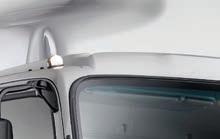
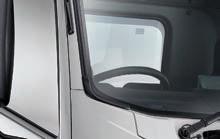
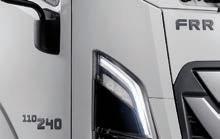
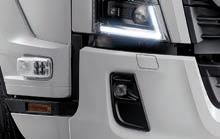
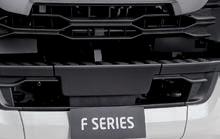
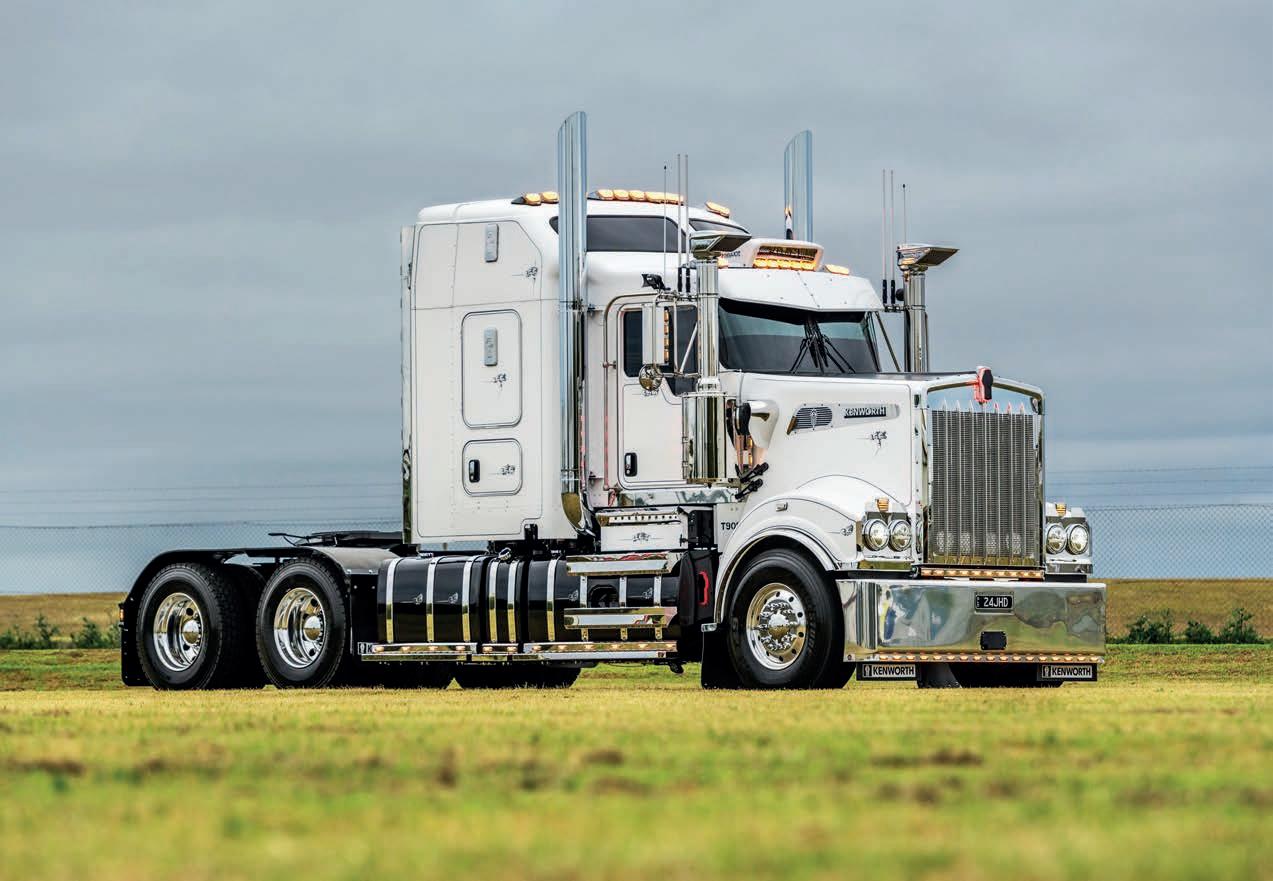
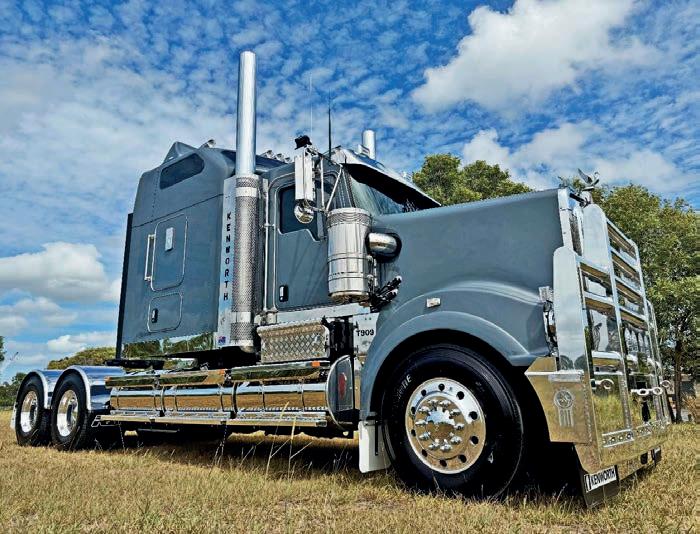
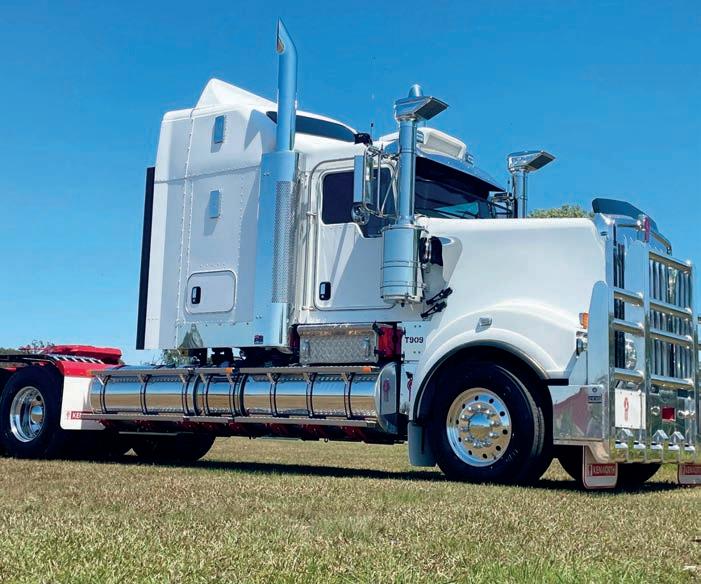
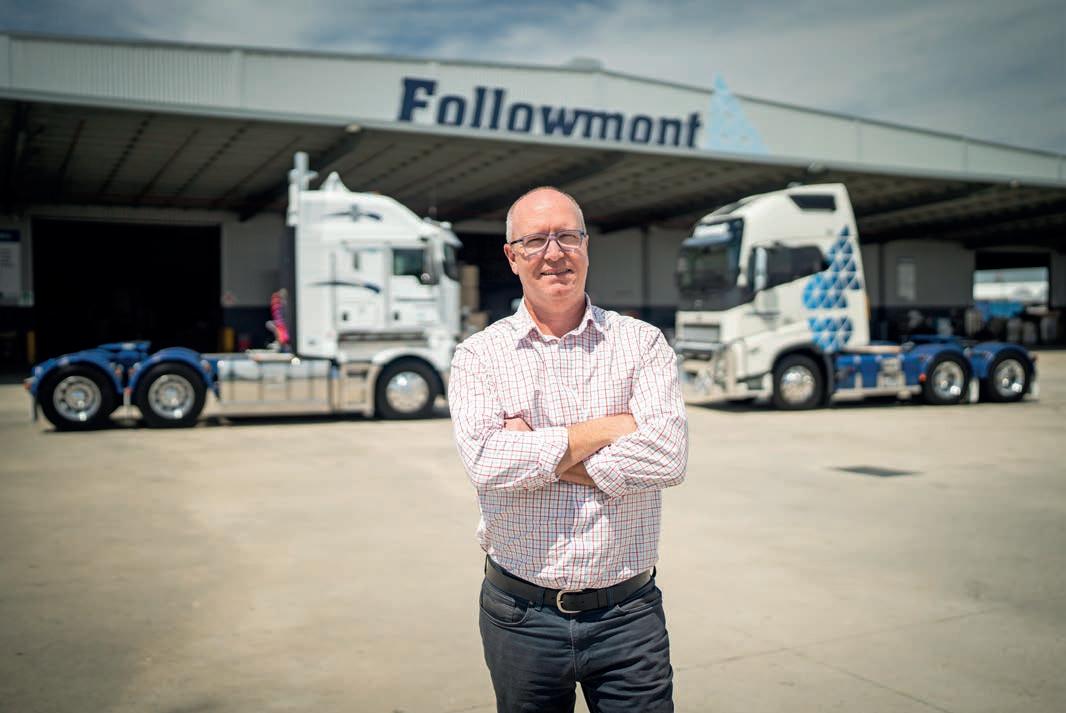
The all-new range of Isuzu trucks has arrived. With a sleek new cab design, more advanced safety features and a smoother, more comfortable drive, the new range will change the way we rely on our trucks. Forever.
To find out more, visit your nearest Isuzu Trucks Dealer or visit isuzu.com.au
MEET THE TEAM
Australia’s leading truck magazine, Prime Mover, continues to invest more in its products and showcases a deep pool of editorial talent with a unique mix of experience and knowledge.
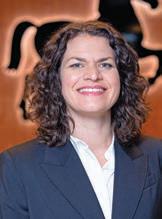
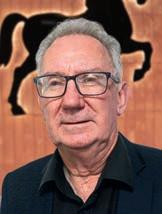
Christine Clancy | CEO
With more than two decades of experience as a media professional, Christine has worked in newsrooms across Canada, Vietnam and Australia. She joined the Prime Creative Media team 12 years ago, and today oversees more than 43 titles, including a dozen print and digital transportation titles. She continues to lead a team that focuses on continuous improvement to deliver quality insights that helps the commercial road transport industry grow.
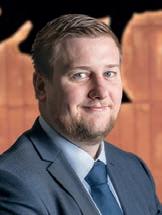
Paul Lancaster | Editor
Paul joined Prime Creative Media as an editor in March 2025 and has enjoyed a broad career spanning over 20 years across different sectors, including law, journalism and marketing in Australia and internationally. He gets great satisfaction from creating targeted content that appeals to wide ranging audiences. Paul says this comes from listening to industry members, businesspeople and the broader community.
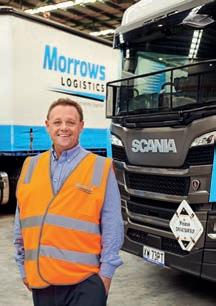
Peter Shields | Senior Feature Writer
A seasoned transport industry professional, Peter has spent two decades in the transport media sector. Starting out as a heavy vehicle mechanic, he managed a fuel tanker eet and held a range of senior marketing and management positions in the oil and chemicals industry before becoming a nationally acclaimed transport journalist.
CEO Christine Clancy christine.clancy@primecreative.com.au
Editor Paul Lancaster
paul.lancaster@primecreative.com.au
Managing Editor, Luke Applebee Transport Group luke.applebee@primecreative.com.au
Senior Feature Peter Shields Writer peter.shields@primecreative.com.au
Business Ashley Blachford Development ashley.blachford@primecreative.com.au Manager 0425 699 819
Head of Design Clayton Hawley clayton.hawley@primecreative.com.au
Design Jacqueline Buckmaster, Danielle Harris
Client Success Ben Sammartino Manager ben sammartino@primecreative.com.au
Head Of ce 379 Docklands Drive, Docklands VIC 3008 info@primecreative.com.au
Ashley Blachford | Business Development Manager
Handling placements for Prime Mover magazine, Ashley has a unique perspective on the world of truck building both domestically and internationally. Focused on delivering the best results for advertisers, Ashley works closely with the editorial team to ensure the best integration of brand messaging across both print and digital platforms.
Peter White | Contributor
Since completing a Bachelor of Media and Communication degree at La Trobe University in 2021, Peter has obtained valuable newsroom experience, supplemented by direct industry exposure at Prime Creative Media. As the Editor of Trailer, Peter brings a fresh perspective to Prime Mover. He has a strong interest in commercial road transport and in furthering the magazine’s goal of growing the industry.
www.primemovermag.com.au
Subscriptions
03 9690 8766 subscriptions@primecreative.com.au
Prime Mover magazine is available by subscription from the publisher. The right of refusal is reserved by the publisher.
Annual rates: AUS $110.00 (inc GST). For overseas subscriptions, airmail postage should be added to the subscription rate.
Articles
All articles submitted for publication become the property of the publisher. The Editor reserves the right to adjust any article to conform with the magazine format.
Copyright PRIME MOVER magazine is owned and published by Prime Creative Media. All material in PRIME MOVER magazine is copyright and no part may be reproduced or copied in any form or by any means (graphic, electronic or mechanical including information and retrieval systems) without written permission of the publisher.
The Editor welcomes contributions but reserves the right to accept or reject any material.
While every effort has been made to ensure the accuracy of information
Prime Creative Media will not accept responsibility for errors or omissions or for any consequences arising from reliance on information published. The opinions expressed in PRIME MOVER magazine are not necessarily the opinions of, or endorsed by the publisher unless otherwise stated.
COVER STORY
“One of the key promises we make to customers is that we help protect their brand. That means safety and reliability must sit at the centre of everything we do, from our marketing to our service model.”
Prime Feature STORIES TURN IT UP TO ELEVEN 52
FLEET FOCUS
28 Numbers Game
With its fleet of prime movers running constantly between terminals, yards and customer sites, reliability and efficiency are essential to keeping freight flowing for Arrow Transport.
32 Fast Cars
A British expat who once worked as a mechanic is now trusted with transporting some of the world’s most valuable cars.
36 Proven Formula
For more than two decades, South-East Queensland operator Wayne Brims has built Brims Coastal Cement around a simple philosophy: invest in proven equipment, and if you’re on a good thing, stick to it.
40 Hybrid Mission
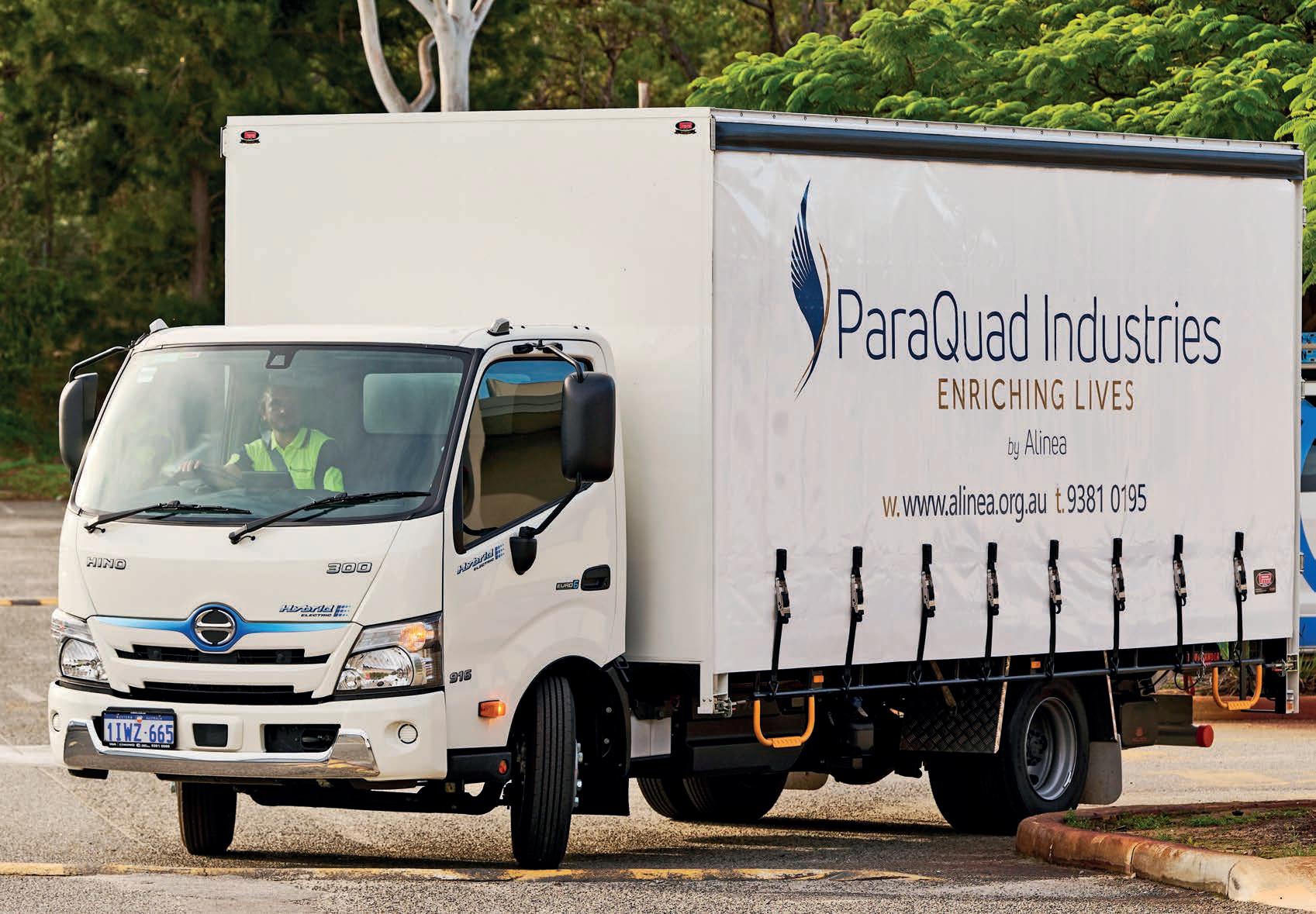
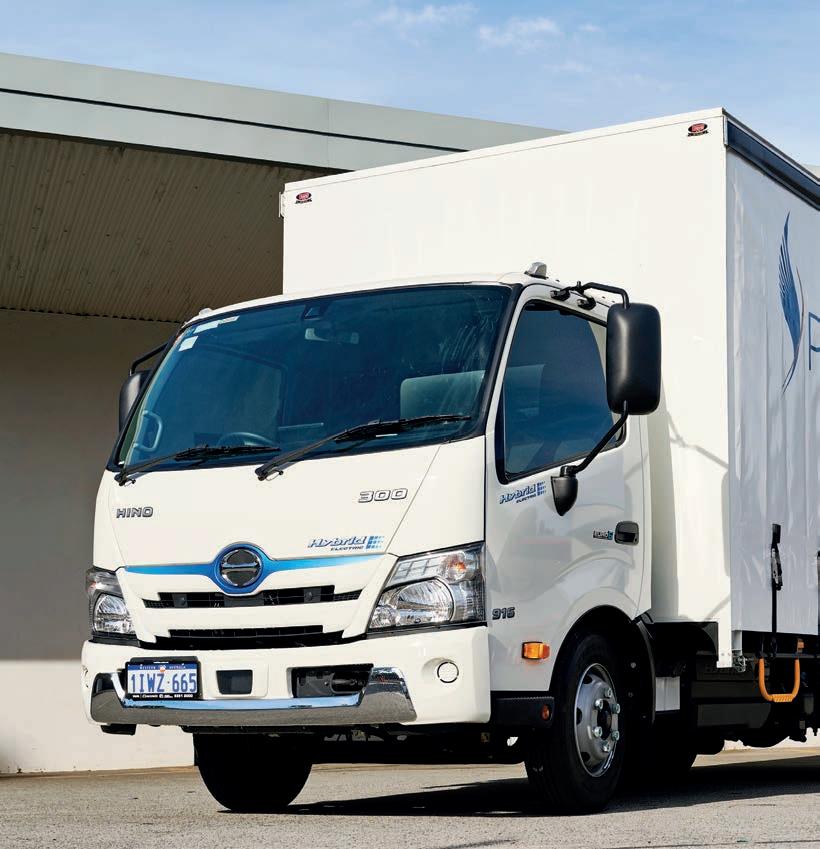
Alinea is a not-for profit organisation dedicated to supporting elderly individuals and people with disabilities in the Western Australian community. Hino Hybrid Electric trucks play a central role in the operations.
TRUCK
& TECH
44 PACCAR Connect
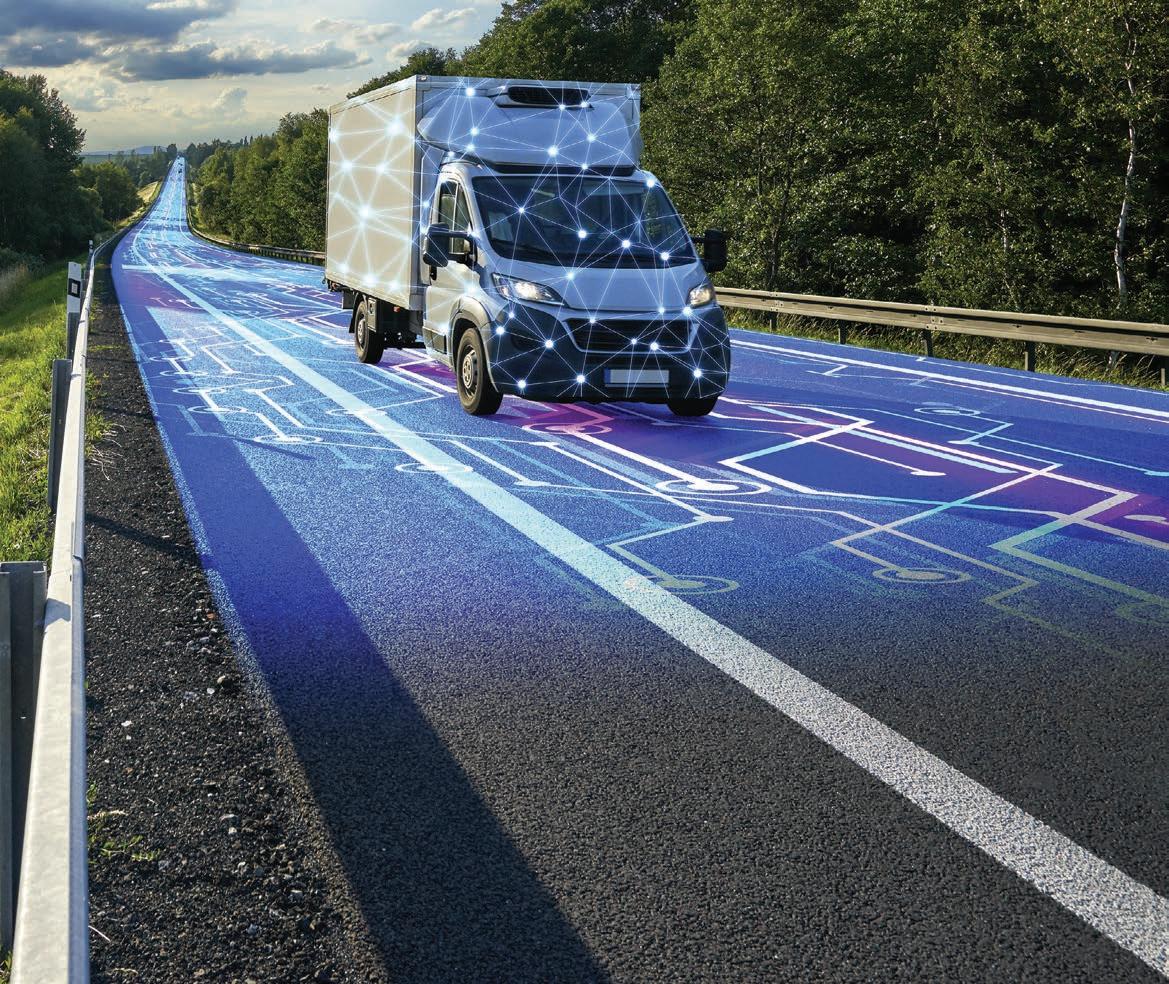
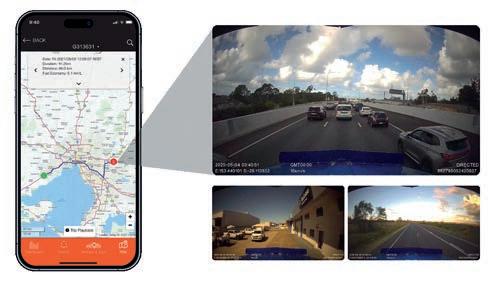
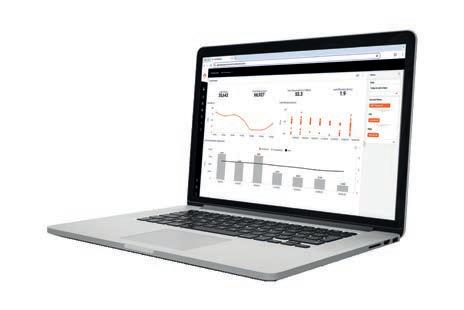
PACCAR Connect is transforming the role of telematics from a vehicle tracking tool into a fully integrated business platform for Australian transport operators.
46 Perfect Partners
In the Australian transport industry, strong combinations make sense - a good driver and a reliable route, or a resilient prime mover fitted with components that are built to handle a multiple of road conditions.
Paul Lancaster Editor
Dear readers, I’m not referring to the ubiquitous Microsoft meeting and planning platform that occupies our every working hour.
Let me be more precise. In every successful business there is one common ingredient that separates the good from the exceptional–- a cohesive, functioning team. When people work together effectively, understand their roles and share a common purpose, the results can be remarkable. Much like a wellmaintained engine, every component performs its function ef ciently, contributing to a larger system that operates smoothly and reliably.
The best teams aren’t built overnight, but are the product of strong leadership, clear communication, mutual respect, and a commitment to shared goals. When these elements combine, individuals stop focusing solely on their own responsibilities and begin to understand how their work contributes to the success of the entire organisation.
A well-functioning team creates momentum. Tasks are completed ef ciently, problems solved quickly,
Power of Teams
and opportunities identi ed more readily. There is a greater sense of growth, generosity, and accountability. Team members instinctively support one another, stepping in when required, and sharing knowledge that helps everyone perform at a higher level.
This brings me to acknowledging the stars of the Prime Mover team, who ensure the magazine is brimming with well-written and interesting industry articles, accompanied by eye-catching designs and layouts.
For this and following editions, our industry veteran features writer, Peter Shields, has been all around the country, covering events, doing test drives in remote country and generally carrying the ag for Prime Mover
There’s also our specialist contributor, Bob Woodward, whose knowledge of the trucking industry and what makes it tick is stuff of legend. Bob’s monthly contributions are always fascinating reads and offer unique insights into the world of trucking.
We also have on our team of stars, our Commercial Transport Managing Editor, Luke Applebee, and the Editor of our sister magazine, Trailer, Peter White. These men are always giving more than 100 per cent to ensure the magazine is at its best every edition. And of course, our editorial team is ably supported by the highly talented design team who always give our magazines that aesthetic boost.
Their combined talent and generosity are awe-inspiring and make this magazine such a great read every month. Undoubtedly, they all make me and the magazine look good! The analogy of a well-oiled engine is very apt. An engine performs at its best when all components are working together harmoniously. If one part fails or operates inef ciently, the whole system suffers. The same principle applies to teams. Every individual has a role to play, and each contribution is important to overall performance. Success is usually the outcome of many people working together towards a common objective.
Importantly, a strong team culture has a positive impact on the members as they feel valued, respected, and connected to their colleagues. There is also a sense of pride in what they are creating. Organisations that invest in building strong relationships, fostering collaboration and encouraging shared responsibility position themselves for long-term success.
At the end of the day, great businesses are powered by great people working together. When a team operates seamlessly, like a nely tuned engine, extraordinary results become possible and inevitable.
GERMAN ENGINEERED. PROVEN IN AUSTRALIA. BACKED BY PENSKE.
MAN’s truck generation boasts great efficiency and economy features, optimised uptime, excellent driver fit, and makes for a strong business partner.
Our efficiency and economy takes you further on every job, while our advanced integrated technology maximises uptime and delivers tangible gains for your business.
Inside the cab, a modern, driver-focused environment sets a new benchmark for comfort and control.
Backed by comprehensive support from roadside assistance to customised repair and maintenance packages, generous warranties, and enterprise-grade telematics, MAN is your business’s strong partner.
MAN Truck & Bus. German engineered. Proven in Australia. Backed by Penske.
> Vale Jim Ramsay
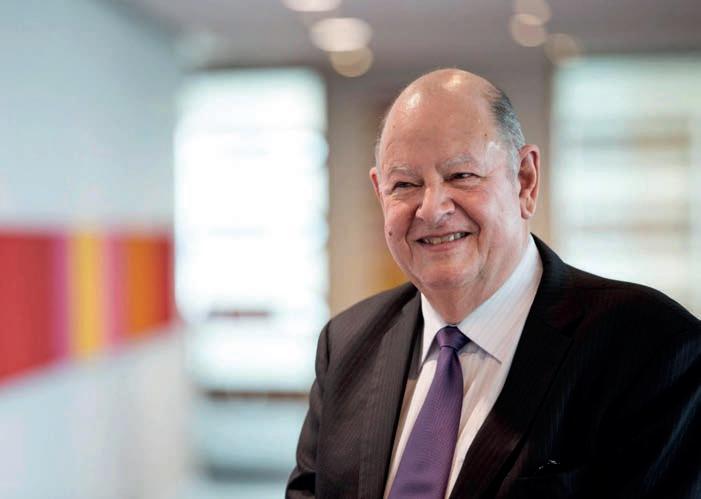
New Zealand transport and logistics stalwart and founder of MOVE Logistics Group, Jim Ramsay, has passed away.
Ramsay was a pioneering figure in the NZ transport and logistics industry across many decades. He began working for New Plymouthbased transport firm, Hookers Bros, in 1968 before forming a partnership to buy the company two years later. Ramsay led the business through significant growth and transformation, evolving it into what is now known as MOVE Logistics Group – one of NZ’s largest logistics companies providing freight, warehousing, specialist haulage, fuel delivery and international freight services.
Ramsay’s contributions extended to the wider transport and logistics industry as well.
He served an executive for his local Road Transport Association NZ branch for many years, including several terms as President.
The branch honoured him with a life membership in 2009.
Further to that, Ramsay’s industry contributions were recognised in 2013 when he was inducted into the
NZ Road Transport Hall of Fame. In 2011, he received the Supreme Mayoral Award for Business Excellence by his hometown of New Plymouth, and was also made a Fellow of the Chartered Institute of Logistics and Transport the same year.
MOVE Logistics Group extended its gratitude to Ramsay in a statement online.
“On behalf of all staff, past and present, directors and shareholders,
> Viva Energy expands SAF certification
Viva Energy has achieved certification to transact under the International Sustainability and Carbon Certification Credit Transfer System for Sustainable Aviation Fuel (SAF).
The certification, which extends Viva Energy’s existing ISCC PLUS accreditation, follows an independent third-party audit by SGS Australia and allows the company to track, transfer or retire the environmental benefits associated with SAF usage.
According to Viva Energy Carbon Solutions Manager Robert Cavicchiolo, the certification provides
customers with an accredited and auditable pathway to claim emissions reductions linked to SAF.
He said the ISCC framework independently verifies feedstock origin, sustainability criteria and lifecycle greenhouse gas performance, helping ensure emissions reduction claims are robust and not duplicated. Under the framework, airline operators can make voluntary Scope 1 emissions reduction claims while downstream customers in the aviation value chain may claim voluntary Scope 3 reductions aligned with ISCC rules and guidance from
we acknowledge Jim’s contributions to our company and the trucking industry in NZ,” the company said.
“His passion for the industry, his dedication to the business, down to earth personality and can-do attitude were essential ingredients in MOVE’s success.
“His legacy lives on across our organisation and in the relationships he built over decades.
“Our thoughts are with his family and friends at this difficult time.”
the Science Based Targets initiative. The development coincides with Viva Energy commissioning a dedicated SAF storage tank at its Pinkenba terminal, supported by funding from the Australian Renewable Energy Agency.
Cavicchiolo said the infrastructure would support ISCC PLUS-certified SAF supply through a Book and Claim framework backed by digital massbalance accounting and the ISCC Credit Transfer System. He added that collaboration between industry, government and technology partners had been critical to progressing Viva Energy’s SAF program.
MOVE Logistics Group founder, Jim Ramsay.
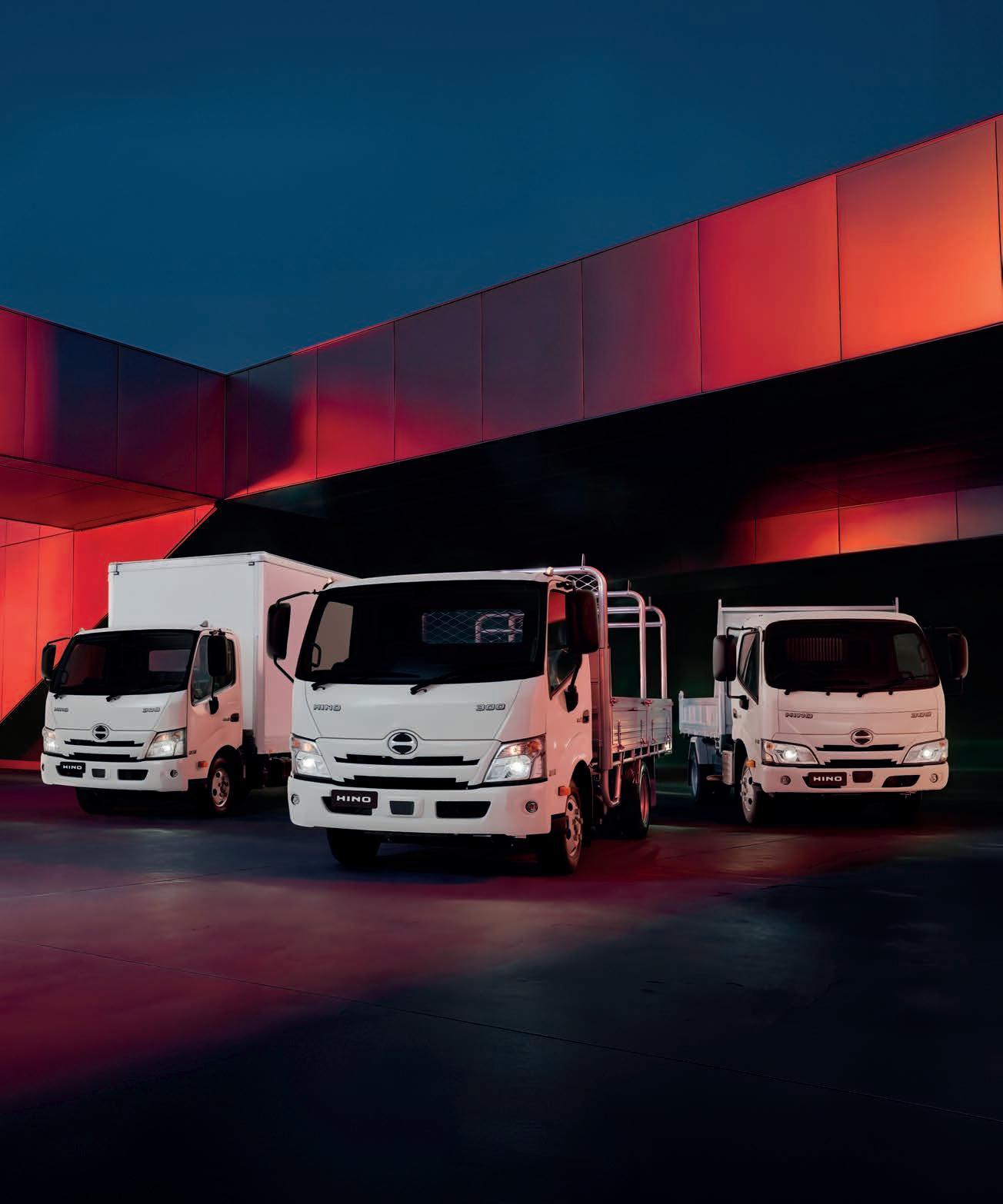
THAT’S ANOTHER HINO
THE 2026 HINO 300 SERIES. ENHANCED CONTROL. ENHANCED VISIBILITY. SAME TRUSTED PERFORMANCE.
Engineered for businesses that demand exceptional performance, dependable reliability and long-term durability. Now with enhanced control and visibility, it delivers a safer, smoother and more confident drive in all conditions. With proven drivelines, a true automatic transmission delivering effortless operation, advanced Hino SmartSafe safety features, and the support of Hino Advantage, the Hino 300 Series is built to handle the toughest workloads, day in and day out. Find out more at hino.com.au
> Budget boosts Healthy Heads initiatives
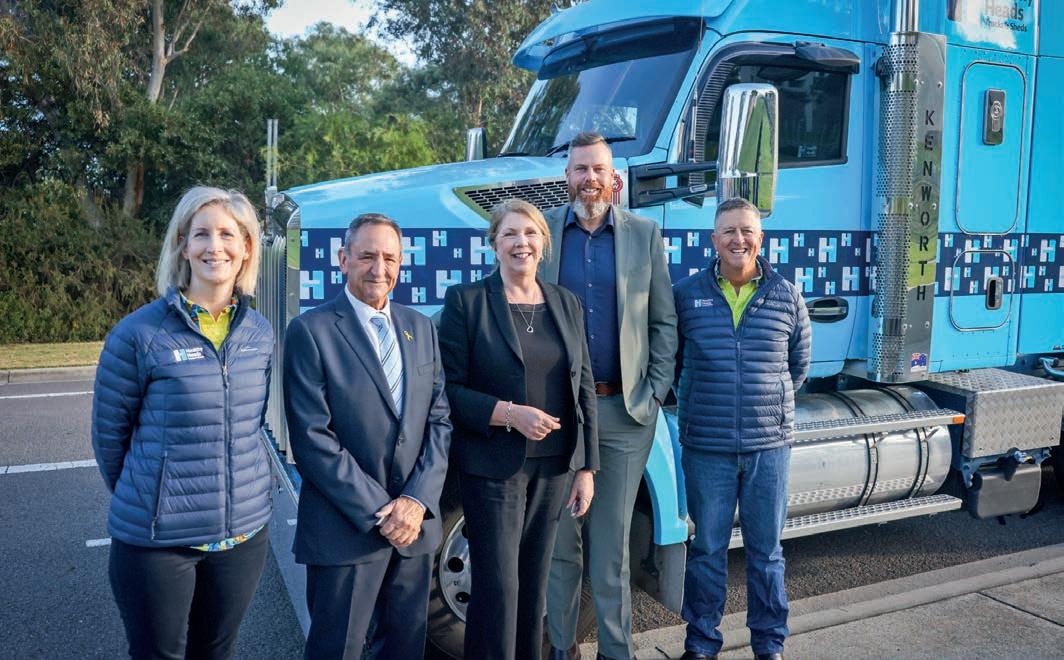
The Federal Government has committed new funding through the Federal Budget to expand mental health and wellbeing support across Australia’s transport and logistics sector, with Healthy Heads in Trucks & Sheds (HHTS) set to significantly scale its frontline programs.
Minister for Infrastructure, Transport, Regional Development and Local Government, Catherine King, said the investment would help deliver practical support to workers across the country.
“The transport and logistics sector plays a vital role in keeping Australia moving, and it is essential that the people who work across it are supported,” she said.
Healthy Heads Chair, Paul Graham, described the funding as a major milestone for the industry.
“This is a sector of more than 745,000 Australians that has ranked last for workplace mental health for years,” he said.
“What matters about this funding is not theory, it’s reach. It allows us to
get out onto the road, into depots and into regional communities and connect people with support in a way that actually works.”
The investment will expand the Healthy Heads Road Show from around 40 events annually to more than 100, reaching more than 10,000 workers each year. Funding will also support a national research project focused on suicide prevention among Australian truck drivers.
The Government funding has been matched by the Goodman Foundation, creating a $5 million initiative aimed at expanding frontline support and suicide prevention programs nationwide.
In related news, South Australian refrigerated transport company, HPS Transport, has joined forces with HHTS. Headquartered in Adelaide, HPS Transport possesses more than 30 years of experience with depots in Regency Park, South Australia, Canningvale, Western Australia, and Perth Market.
By becoming a supporting Corporate Partner of HHTS, HPS Transport has committed to improving mental health and physical wellbeing across the road transport, warehousing and logistics sectors.
“We’re excited to welcome HPS Transport as a Supporting Corporate Partner of Healthy Heads in Trucks & Sheds,” HHTS said.
“A family-owned business operating for more than 30 years, HPS Transport specialises in the transportation of perishable and temperature-sensitive goods across Australia, with depots in SA and WA.
“HPS Transport’s commitment to supporting its people, maintaining a strong safety culture and delivering reliable service aligns closely with our mission to improve mental health and physical wellbeing across the road transport, warehousing and logistics industries.
“We’re proud to be working together to help create healthier, safer workplaces.”
Image: Healthy Heads in Trucks & Sheds.
Landmark Federal Budget investment to take mental health support directly to Australia’s transport workforce.
> Jack Di Losa drives family legacy
Cold Xpress Chief Operating Officer, Jack Di Losa, earned national recognition in Hobart.
Di Losa has been recognised as one of Australia’s leading next-generation family business leaders, taking out the 2026 Emerging Leader in Family Business Award at the Family Business Excellence Awards in Hobart.
Hosted by the Family Business Association during the 2026 Family Business Conference: Asia-Pacific, the awards celebrate outstanding leadership and innovation across Australia and New Zealand’s family business sector.
Di Losa was honoured alongside STRIKER Chief Commercial Officer, Jordan Pedley, after judges highlighted their commitment to leadership, innovation and preserving family business values.
“This award sits close to my heart, because it represents family businesses, and that is who I am at the core,” said Di Losa.
“To my parents and to other generations before us who built businesses through sacrifice, risk and hard work, thank you for creating something worth carrying forward.
“To all the next generation leaders in
the room, we have the privilege and responsibility of not only protecting what is built before us but helping shape what comes next. So, to stand here tonight and receive this award is truly humbling. Thank you.”
The Emerging Leader in Family Business Award recognises individuals successfully navigating the transition to leadership within their family businesses while embracing best practice and maintaining strong family values.
Family Business Association CEO, Catherine Sayer, said the awards acknowledged the vital role family-run businesses continue to play across Australia.
“Family businesses are central to Australia’s economic strength and community identity,” she said.
“These awards honour the vision, resilience and commitment that family business leaders bring to their work every day. Their impact is significant, and deserves recognition.”
According to the Family Business Association, family businesses account for 70 per cent of Australian businesses and employ half the national workforce.
Other winners on the night included New Zealand’s Tranzit Group, which
claimed both the Family Business of the Year and Legacy Family Business awards, while Contemporary Catering (Victoria) secured the Established Family Business Award.
> Economic Resilience Program recipients receive $150 million in loans
About 150 businesses were approved to receive more than $150 million in zero interest loans under the Economic Resilience Program’s first five weeks, the Minister for Industry, Tim Ayres, said.
The program offers zero interest loans to trucking, logistics and manufacturing businesses to help with their increasing fuel costs. The program’s loan applications system opened on 20 April, with the latest figures covering the period to 22 May.
The companies who have received loans include a small transport
operator in northern NSW ($50,000) whose fuel costs had almost doubled overnight. It also had a limited ability to pass on price rises to customers. Medium-sized businesses in the logistics industry in Victoria also received zero-interest loans of more than $1 million to replenish fuel reserves at depots, which were needed to ensure business continuity and keep trucks on the road.
Despite the initial success of the interest-free loan program, the Australian Trucking Association said it was aware of cases where applications were unexpectedly
rejected or payments of funds were delayed.
As a result, it has referred several cases for further investigation with the aim of ensuring the program is fit-for-purpose and properly managed.
The ATA said in addition to the zerointerest loan program, payment relief assistance is available through the ATO’s fuel response payment plan and direct bank support.
The ATO plan can include moving a customer to interest only payments for a period or temporary payment deferrals.
Jack Di Losa wins award.
Simplify your business
> New Penske ANZ on-highway GM appointed
Penske Australia & New Zealand has appointed Gary Bone as the executive general manager of its on-highway division.
Bone’s appointment follows the resignation of Craig Lee, who will depart Penske in June after more than a decade of service.
Joining the business in early 2025 as general manager of eastern operations, Bone has been overseeing Penske’s New South Wales and Queensland operations, including both on- and offhighway services.
He brings comprehensive experience in the on-highway sector, having previously held senior executive roles with Mack Trucks and Volvo Trucks.
“After 11 years with Penske, Craig has decided to step down from his role as executive general manager of on-highway to lead a privately owned
business in the road transport industry,” said Penske Australia & New Zealand Managing Director, Hamish ChristieJohnston.
“During his extensive tenure, Craig has held several senior roles within our organisation, culminating in leading the wholesale and retail truck business.
“He never shied away from the toughest challenges and consistently
> NSW tightens fuel price laws
New legislation passed by the NSW Government will introduce tougher fuel price disclosure laws aimed at improving transparency and preventing motorists from being misled at the bowser.
The Fair Trading (FuelCheck)
Amendment Bill 2026 expands the powers of NSW Fair Trading by making it illegal for service stations and fuel retailers to fail to report fuel prices or notify when a fuel type becomes unavailable.
The changes strengthen the state’s FuelCheck system, which provides real-time fuel pricing and availability information from around 2,400 service stations across New South Wales.
Under the new laws, penalties for non-compliance will increase substantially. On-the-spot fines will double to $1,100 for individuals and rise to $3,300 for companies. Repeat offences within 12 months will attract penalties of up to $5,500
for individuals and $11,000 for companies.
Courts will also be able to impose higher maximum penalties, including fines of up to $55,000 for individuals, while company penalties of up to $110,000 remain in place.
The tougher rules follow an extensive inspection program by NSW Fair Trading, which has carried out almost 5,000 field inspections and re-inspections. More than 290 fines totalling over $315,000 have been issued, with around 80 per cent relating to discrepancies between advertised and pump prices.
The NSW Government said FuelCheck now attracts around 150,000 daily visits across its app and website and forms part of a broader fuel transparency and fuel security strategy, supported by a $2.2 million system upgrade.
Minister for Better Regulation and Fair Trading, Anoulack Chanthivong, said the legislation was designed to
strengthened the areas of the business under his leadership.
“With our sincere thanks and best wishes, Craig will conclude his time with Penske mid-year.
“We are delighted that Gary has accepted the responsibility of succeeding Craig in the role.
“In his time with the business, Gary has made a strong impact and was the natural choice to step into this position. His appointment is a testament to the depth and capability of our senior leadership team.”
In his new role as executive general manager of on-highway, Bone will be responsible for truck and bus retail and fleet sales, OEM relationships, onhighway aftersales, on-highway sales administration, dealer development, and the on-highway vehicle processing centre in Wacol, Queensland.
ensure motorists received accurate pricing information.
“We know that fair pricing starts with fair behaviour at the bowser,” said Chanthivong.
“That’s why the Minns Labor Government has passed tough new laws cracking down on service stations doing the wrong thing.
“Because every motorist, in every corner of the state, deserves confidence that they’re not being ripped off between the price at the pump and the price on FuelCheck.”
NSW Fair Trading Commissioner, Natasha Mann, said the amendments would strengthen the role of FuelCheck across the state.
“FuelCheck is a crucial tool that puts power back in the hands of motorists and allows them to make informed decisions about the price and availability of fuel,” said Mann.
“This is about strengthening FuelCheck to ensure that it works for everyone.”
Image: Penske Australia & New Zealand.
Gary Bone.
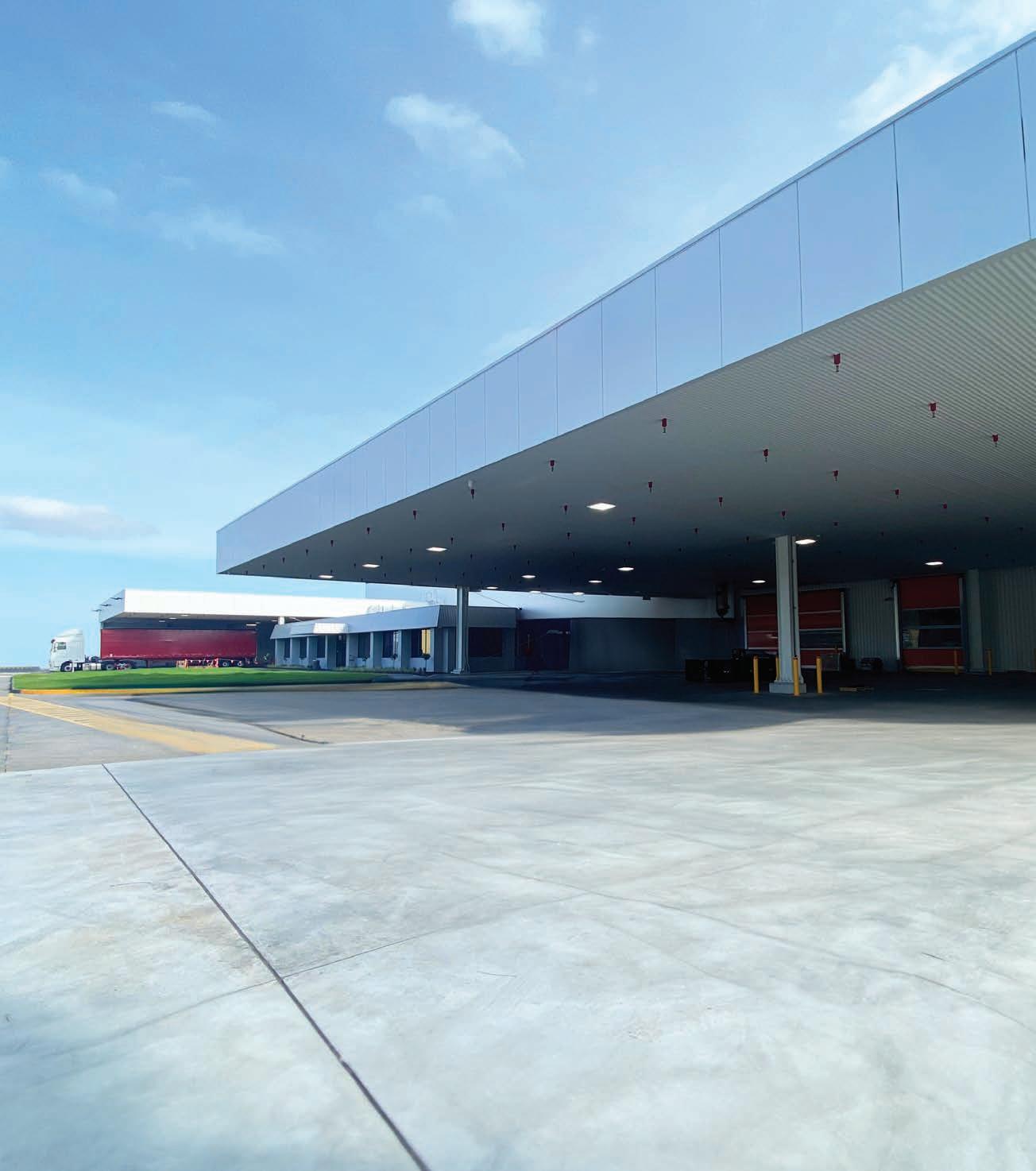
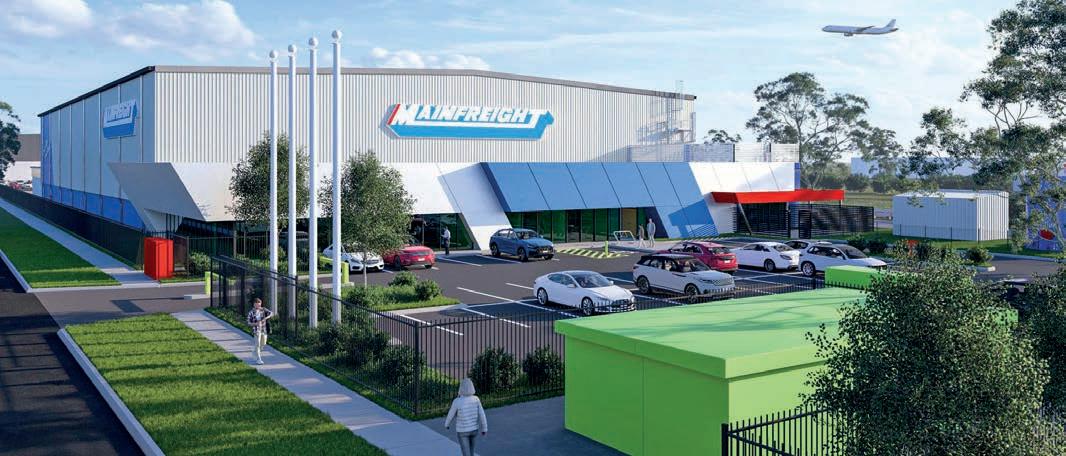
> Mainfreight opens Melbourne Airport facility
Mainfreight has opened a new 24/7 air and perishables facility at Melbourne Airport.
Situated on a 14,000-square-metre site, the development features a 5,200-square-metre facility which was purpose-built for time-sensitive and temperature-controlled freight.
Located within the airport precinct and close to major airfreight terminals, the new facility enables Mainfreight to continue expanding its global international network perishable and cold chain offering while also delivering a number of sustainability initiatives.
“Handling over 25 million kilograms
of freight each year, the new branch marks a significant step forward in supporting Mainfreight’s ongoing growth and increasing its operational capacity,” Mainfreight said.
“The layout of the facility has been designed to simplify the movement of goods from arrival through to departure.
“With space for refrigerated containers and access for road trains, the site allows for more direct and efficient transfers between transport modes.”
The facility also features dedicated loading and unloading areas, electric roller systems for airline
> FWO clamps down on sham contracting
The Fair Work Ombudsman has written to 45 road transport companies notifying them of its interest in addressing sham contracting and misclassification arrangements.
The FWO has also recently conducted site visits and has a number of ongoing investigations, an industry roundtable heard last month.
Senator Glenn Sterle convened the roundtable on 19 May, which proceeds a roundtable he held in November 2025.
The roundtable participants
consisted of industry association representatives, the TWU, state and federal ministers, NHVR CEO Nicole Rosie and senior officials from the Treasury, the tax office, the Australian Border Force and the FWO.
ATA CEO, Mathew Munro, said that Senator Sterle had done an outstanding job of drawing attention to the issue and bringing industry, plus lead agencies and their responsible ministers, together.
“This is resulting in a shared understanding of the problem and
units and sunken docks help reduce congestion and handling delays, advanced temperature-controlled zones and cold chain capability and more.
Supply chain consultancy, TMX Transform, congratulated Mainfreight on the opening.
“TMX are proud to have managed the construction of this facility on time and on budget,” the company said.
“With advanced cold-chain infrastructure, on-site inspection capability and sustainability initiatives including solar and water reuse, the facility sets a new benchmark for operational performance.”
a far more cooperative approach – something that is 100 per cent necessary for addressing the root causes and the clandestine practices associated with the issue,” Munro said.
“It requires policy and regulatory changes, as well as an enhanced, cooperative and visible frontline enforcement effort. There is more to do, but real progress is being made. Those who continue to engage in deliberate illegal sham contracting practices should be worried.”
Image: Melbourne Airport.
Artist impression of the new site.
> Geotab, Swinburne launch innovation hub in Melbourne
Geotab and Swinburne University of Technology have officially opened a new transport innovation hub in Melbourne to accelerate research into connected vehicle technologies.
Located at Swinburne’s Hawthorn campus, the Geotab-Swinburne Transport Innovation Hub brings together researchers, students, industry partners and government stakeholders to explore emerging transport technologies and address key challenges facing the sector. The facility includes an interactive showroom featuring connected vehicle and telematics technologies, an operations centre for transport research and data analysis, and collaborative workspaces designed to support industry-led innovation. The launch marks the next phase of a partnership first announced in 2025 and signals a growing focus on data-driven approaches to improving transport safety, sustainability and operational efficiency.
Several research programs have already been identified as priorities for the hub, including electric vehicle adoption, road safety, transport
decarbonisation and mobility policy development. These initiatives will leverage real-world telematics data and advanced analytics to generate insights for industry and government.
According to Geotab Business Development Manager, Alkan Ciftci, the hub has been established to create a practical environment where industry and academia can work together to develop future transport solutions.
“By combining Swinburne’s research expertise with Geotab’s AI and connected vehicle intelligence, we are creating an environment where new ideas can be tested, insights can be scaled and the future of mobility can be shaped collaboratively,” he said.
The initiative is expected to support applied research projects, student engagement programs and industry partnerships, while also contributing to discussions around transport infrastructure and policy.
Professor Hadi Ghaderi, Professor of Supply Chain Innovation and Decarbonisation at Swinburne University of Technology, said the facility would provide opportunities
for researchers and students to work directly with industry technologies and transport data.
“The hub creates new opportunities for our researchers and students to work directly with industry-leading technology and data, helping to advance research outcomes in sustainability, safety and connected mobility while developing the future workforce needed for Australia’s evolving transport ecosystem,” he said.
The partners say the facility will focus on advancing AI-driven mobility research, supporting collaboration between industry and government, accelerating transport sustainability initiatives and helping develop future transport talent through internships, collaborative projects and hands-on learning opportunities.
The opening also reflects Geotab’s ongoing investment in the Australian market and highlights the increasing role that connected vehicle data and artificial intelligence are expected to play in shaping the future of the nation’s transport sector.
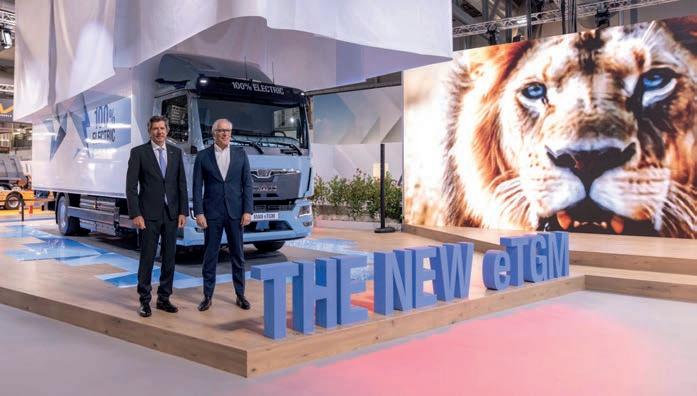
> MAN unveils new eTGM
MAN Truck & Bus has unveiled its new eTGM in a world premiere at Transpotec Logitec 2026 in Milan.
As a result of the 16-tonne truck launch, MAN is expanding its all-electric truck portfolio to cover the mid-range distribution segment.
The eTGM, with a range of up to 480 kilometres, is closing the gap between the lightweight MAN eTGL and the heavy-duty eTGX and eTGS series. MAN therefore sees the addition of the eTGM as enabling it to provide a uniform eTruck portfolio of 12 to 50 tonnes based on a modular, crossseries technology concept. With its permissible gross weight of 16.01 tonnes (optionally 16.5 tonnes) and a chassis payload of up to around 10.6 tonnes, the MAN eTGM offers reserves for a wide range of bodies. As an all-electric truck in the over 16-tonne segment, the new truck will present significant European toll advantages.
The MAN eTGM also offers reductions in fleet emissions and supports transport companies in meeting regulatory requirements such as the EU CO₂ fleet targets for heavy commercial vehicles.
The eTGM has been designed to meet a market sector where rising energy prices, stricter emission regulations and increasing noise restrictions make electrically powered commercial vehicles an economically and ecologically attractive alternative, especially in inner-city use. Its high payload, trailer operation with a gross combination weight of up to 33 tonnes, great operational flexibility
and a particularly efficient electric drive train see the new truck fitting in easily with the market.
“With the MAN eTGM, we are putting the ideal electric solution for inner-city and regional distribution transport on the road right now. It is the logical conclusion to our eTruck portfolio and makes MAN a true full-range supplier of battery-electric commercial vehicles,” said MAN Truck & Bus Member of the Executive Board for Sales & Customer Solutions, Friedrich Baumann.
Like all MAN eTrucks, the eTGM is also based on the standardised, modular BEV modular system of the heavy-duty model series. The central drive unit, battery systems, highvoltage architecture, and thermal management originate from the eTGX and eTGS development and have been adapted for the mid-range segment.
The MAN eCD210 electric drive delivers 210 kW (285 hp) and a maximum torque of 800 Nm in combination with MAN TipMatic 2. Its high recuperation performance ensures very good energy efficiency, especially in stop-and-go operation.
ISRI: DEALERS
A modular battery system, comprising two to four battery packs, offering a total usable battery capacity of up to 320 kWh, allows for a design tailored precisely to the specific application. This avoids unnecessary costs and weight. Depending on the configuration, ranges of up to 480 kilometres are possible – ideal for demanding distribution and regional applications.
Typical fields of application for the MAN eTGM include food and supermarket logistics, municipal applications, construction and waste disposal transport, and regional distribution transport.
At Transpotec Logitec 2026, MAN Truck & Bus showcased a wide-ranging portfolio of applications – from heavyduty long-haul transport, distribution and construction to light commercial vehicles and passenger transport. The company’s focus was on expanding the range of electric vehicles, in particular the MAN eTGX for heavy-duty long-haul transport, supported by a high-performance charging infrastructure featuring MCS technology.
Image: MAN Truck & Bus.
MAN Truck & Bus Italia, Marc Martinez, and MAN Truck & Bus Board Member, Friedrich Baumann.
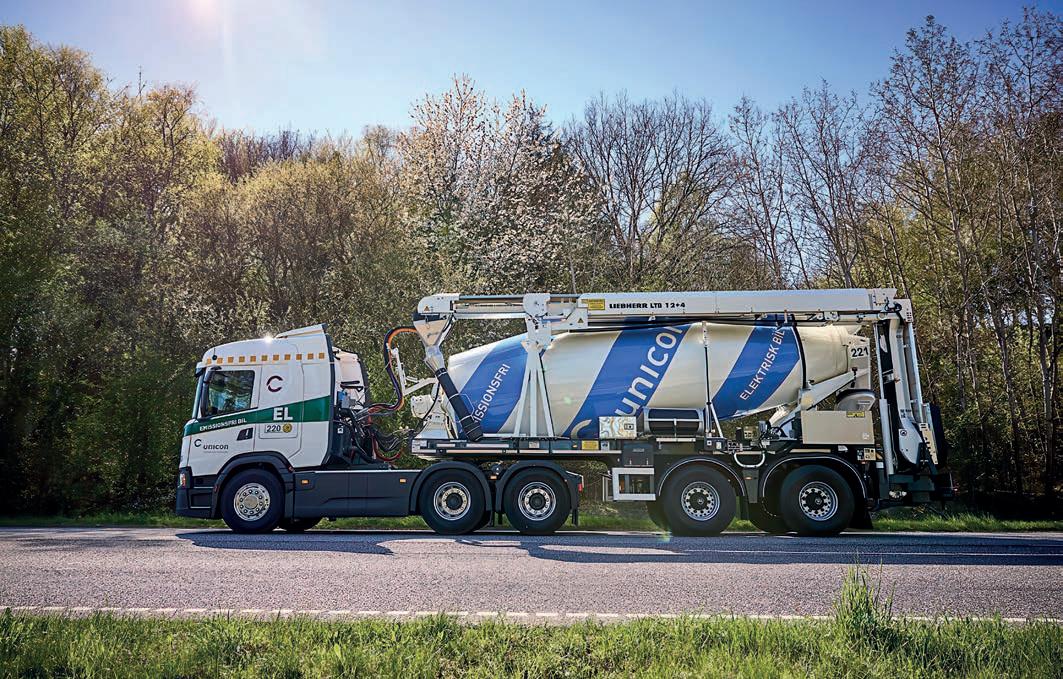
> Unicon expands electric fleet
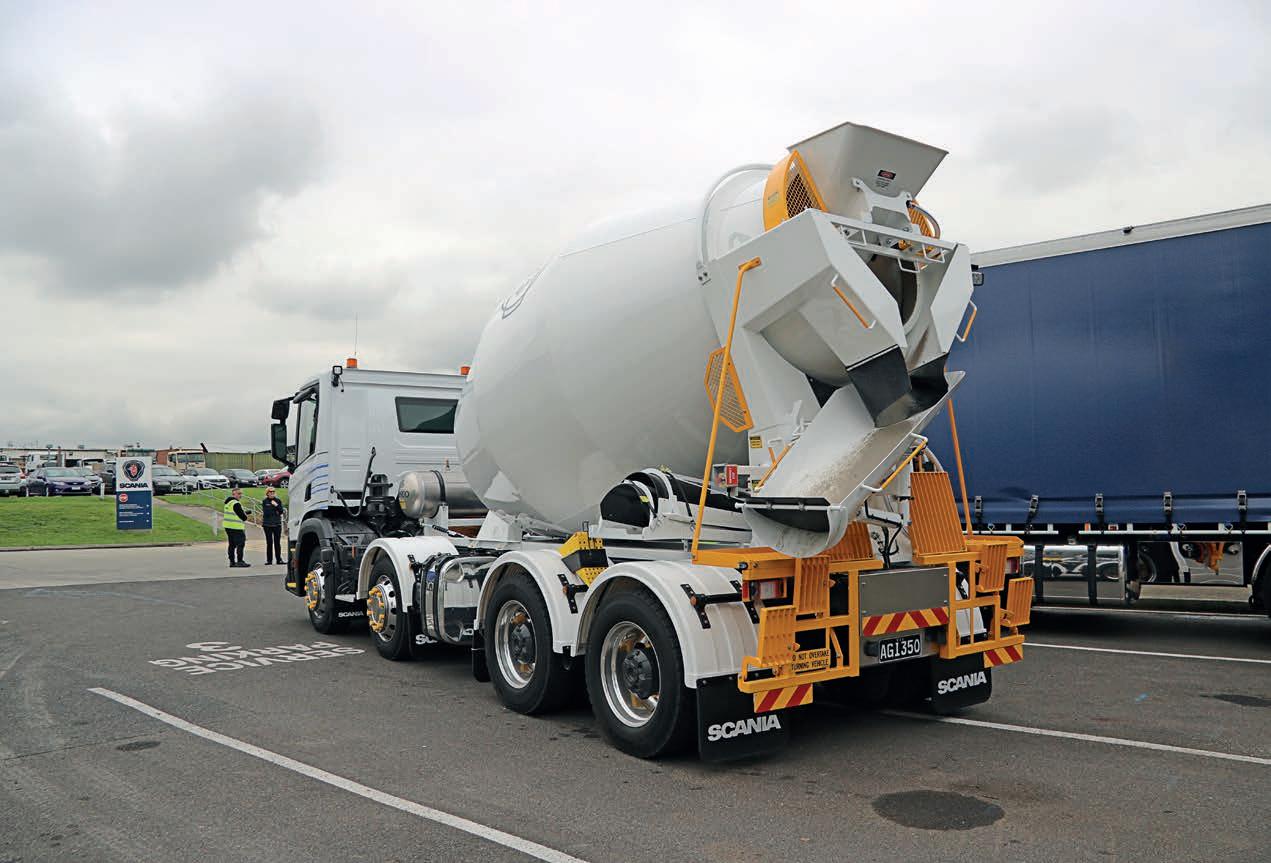
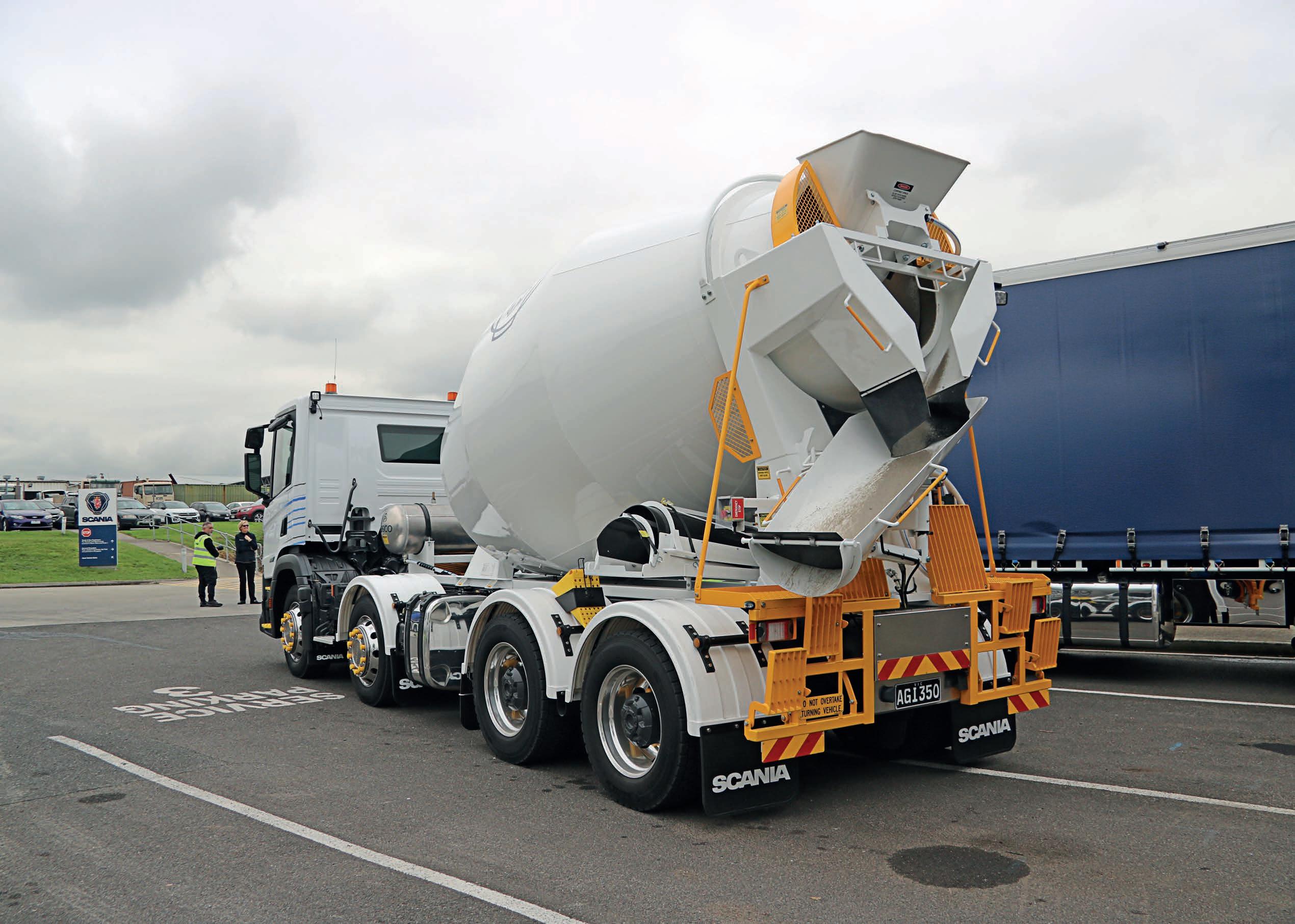
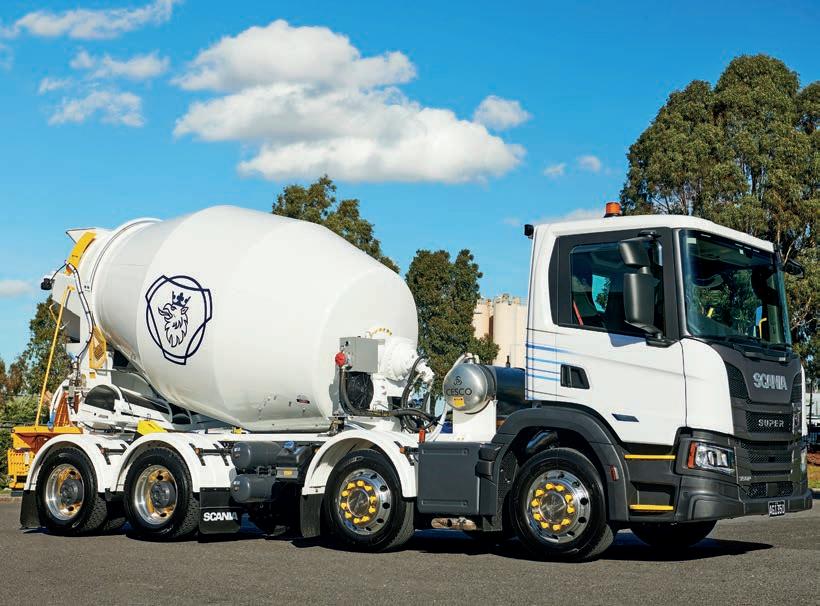
A fully electric concrete transport fleet is now operating in Denmark as construction logistics providers accelerate efforts to cut emissions in heavy duty applications.
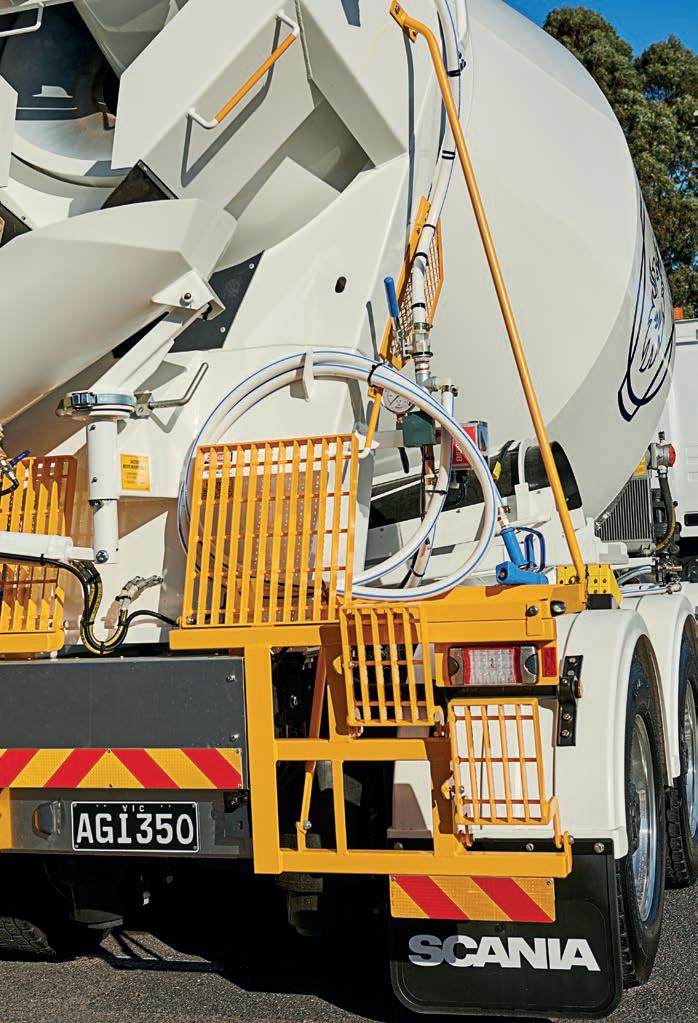
The zero-emission solution combines battery-electric trucks with integrated electric concrete mixer systems, allowing ready-mix concrete deliveries to be completed without tailpipe emissions.
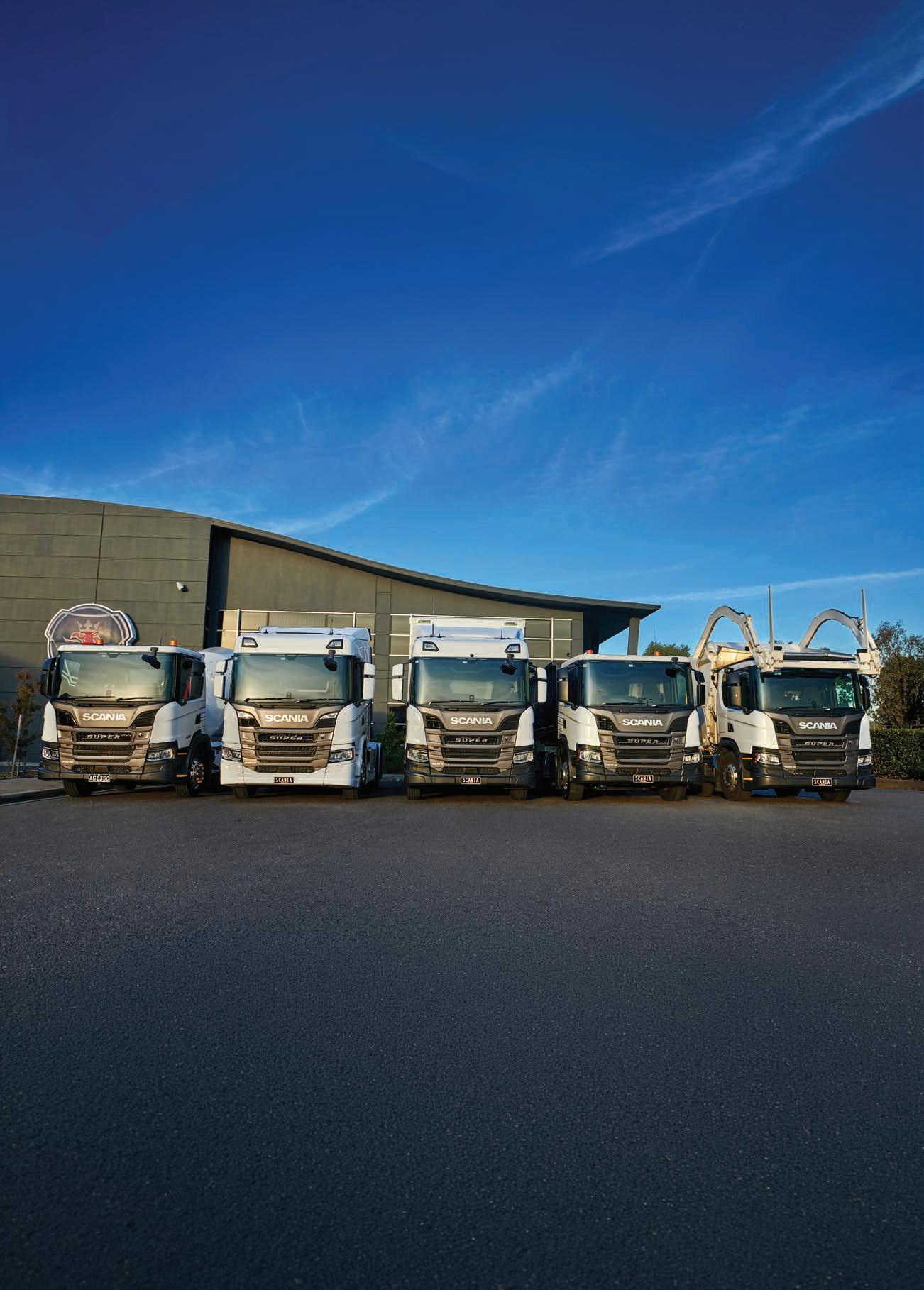
Developed through a collaboration between Unicon, Scania, and Liebherr-Mischtechnik the vehicles are designed for daily fleet operations across demanding construction environments.
Concrete transport has traditionally been considered difficult to electrify due to the high energy requirements of both the truck and the constantly rotating mixer drum.
The new configuration addresses this through an electric power takeoff system which powers the mixer directly from the truck’s battery pack.
The vehicles feature up to 400kWh of installed battery capacity and can operate across typical concrete delivery routes of around 200 kilometres.
Route simulations and energy modelling were used to optimise the
fleet for urban deliveries and off-road construction site conditions.
“This project shows that electrification is not limited to standard applications,” said Scania Global Manager Transformation & New Business, Tobias Ejderhamn. Unicon Supply Chain & Procurement Director, Christian Elleby, said the deployment was intended as a scalable operational solution rather than a pilot program.
Unicon has already ordered an additional 10 electric vehicles as part of its goal to achieve fully emissionfree concrete transport operations by 2035.
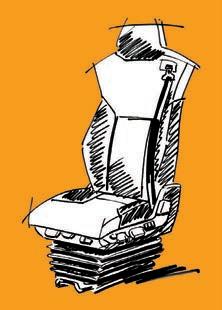
ISRI SEATS
• Supporting drivers for more than 50 years
• Seating – on a higher level
Image: Scania.
Unicon’s electric concrete trucks can travel around 200 kilometres on a single charge while powering the mixer drum entirely from the vehicle’s battery system.
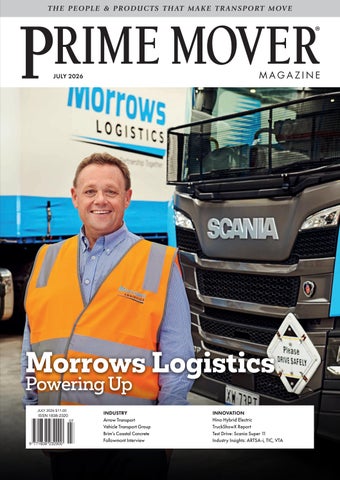
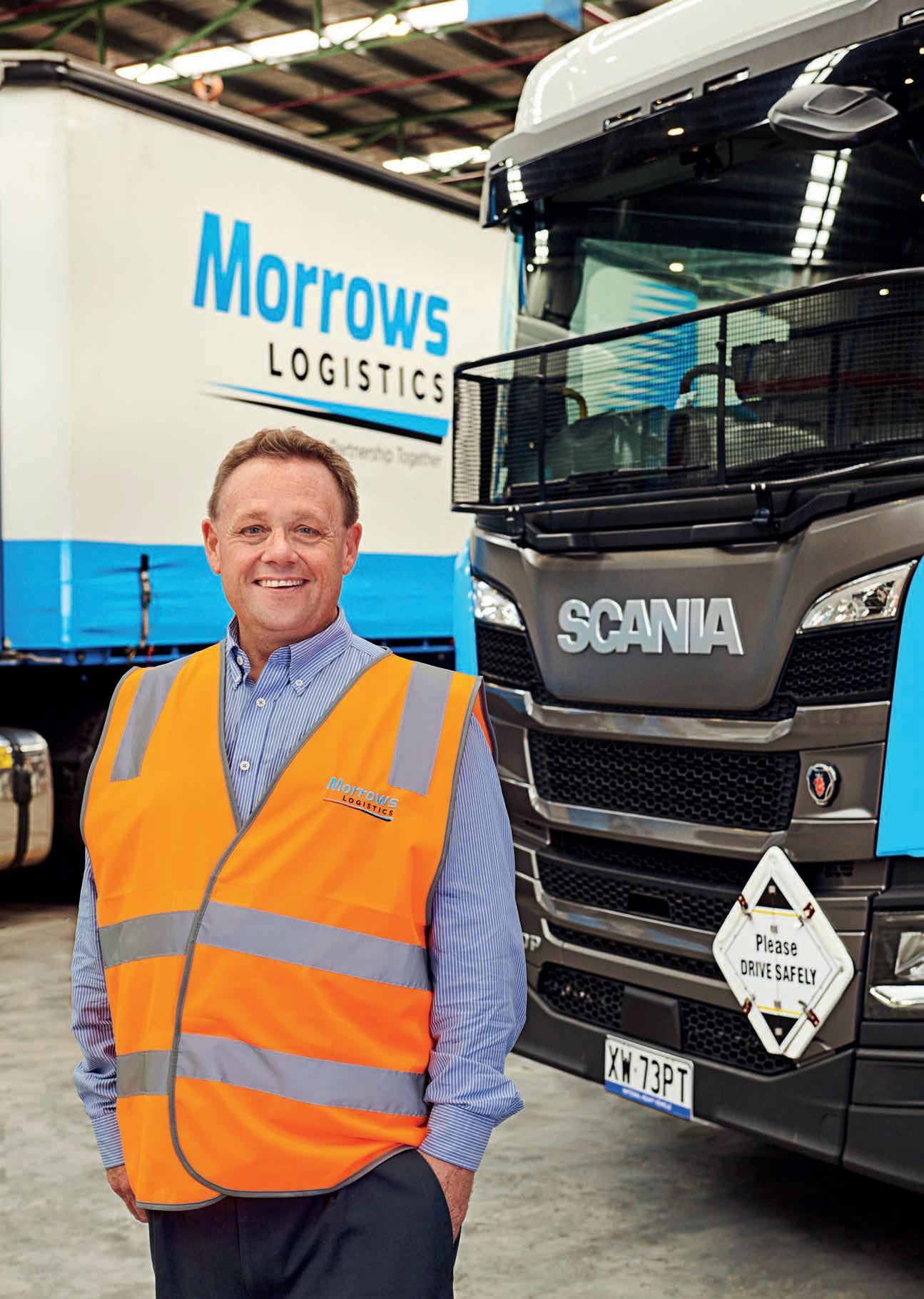
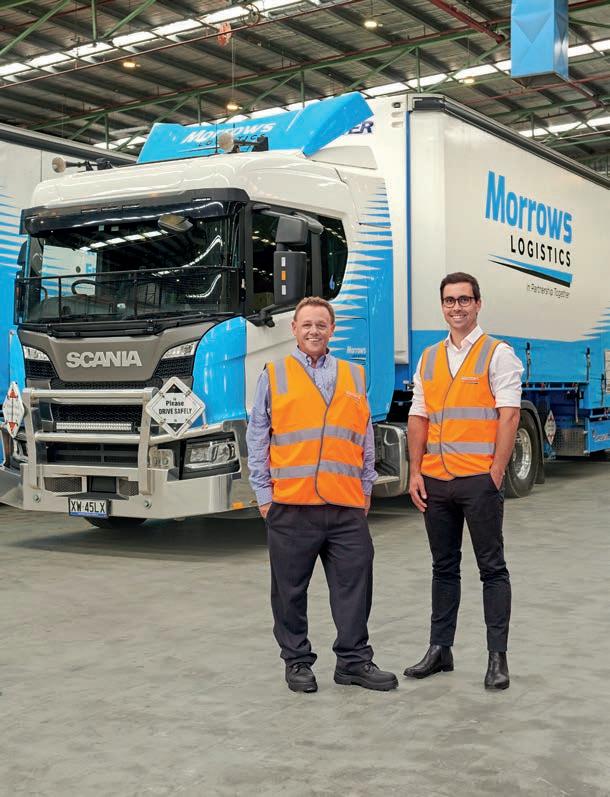
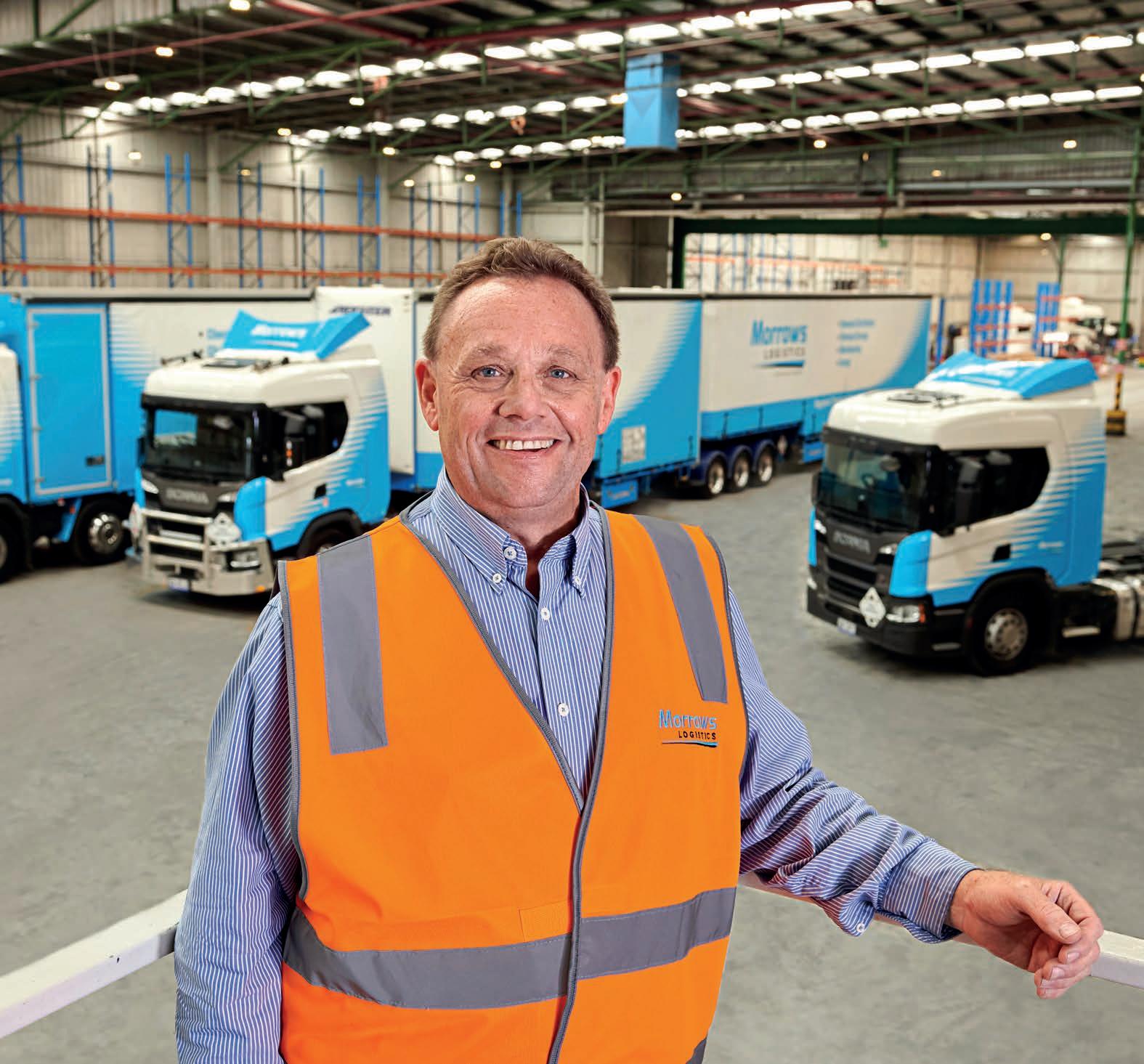
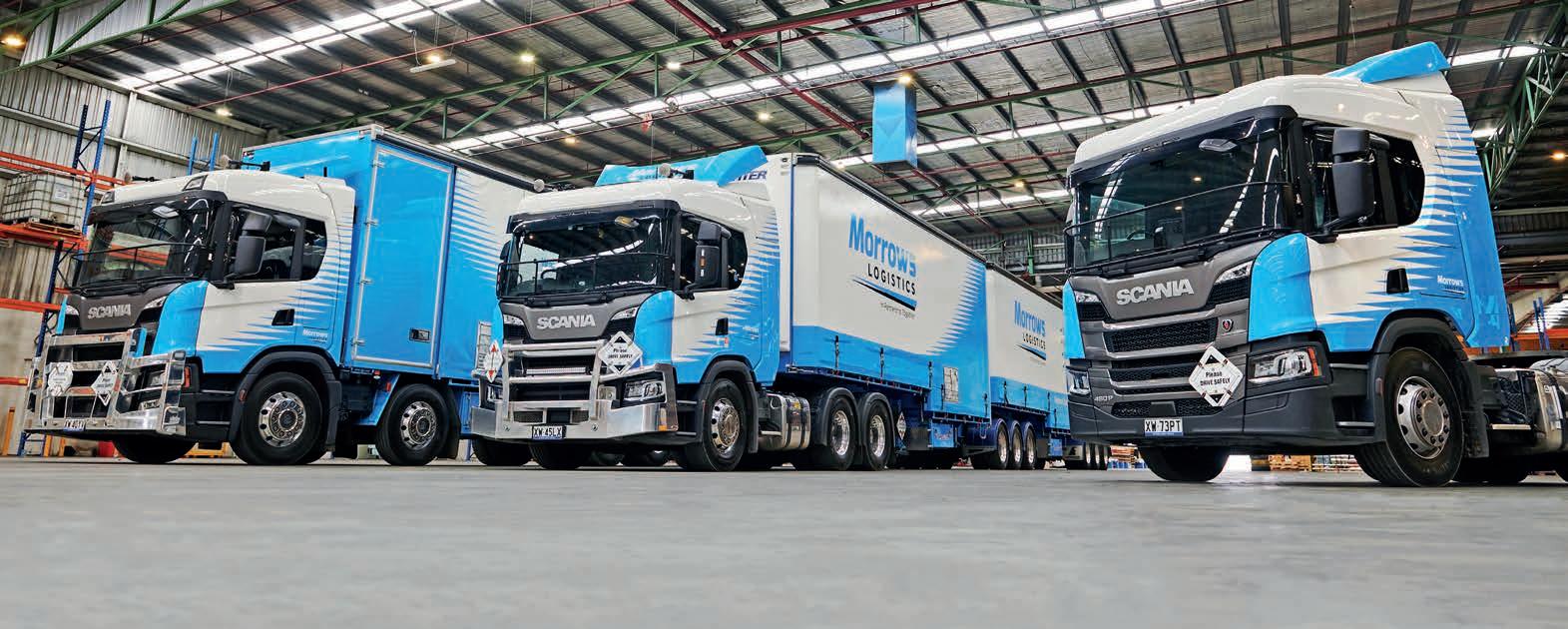
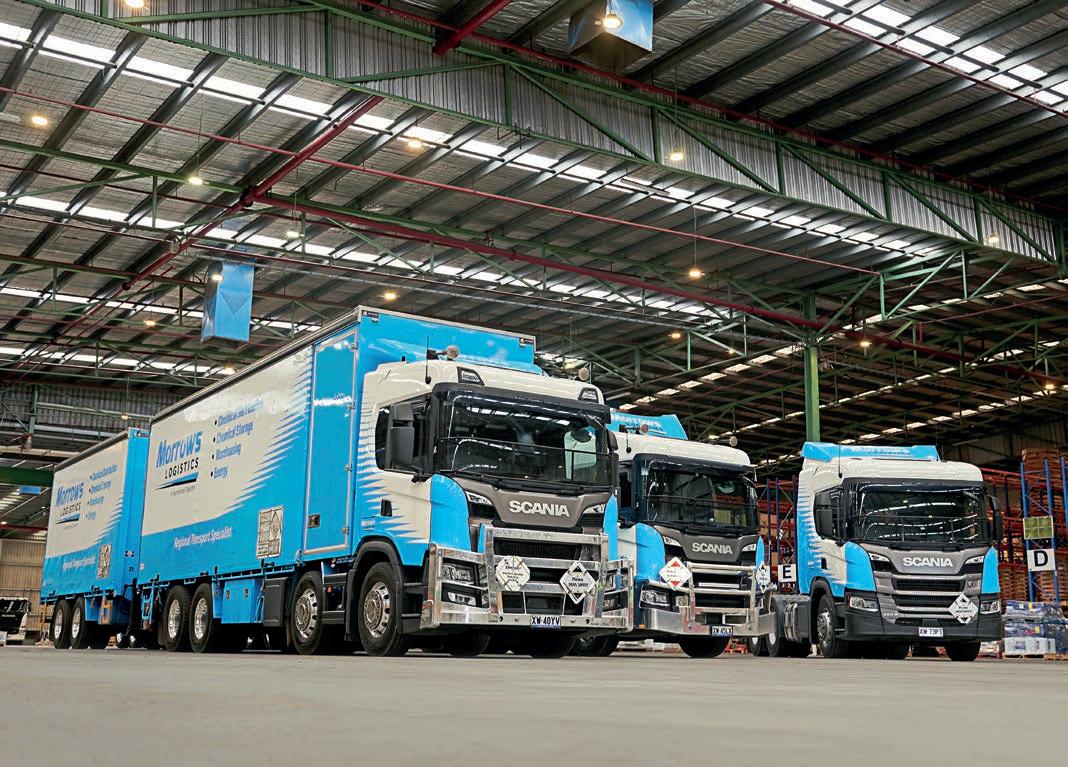
Although specialists in dangerous and hazardous goods transportation, Melbourne-based Morrows Logistics has been transporting a wide variety of general freight, from big to small, for more than 40 years.
Morrows Logistics is a family-operated transport and logistics provider with its headquarters in Keysborough, south-east of Melbourne, with additional branches in the Melbourne suburbs of Noble Park and Ringwood.
Morrows Logistics was established in 1983, and David Morrow has led the family business from its earliest days, having joined the company when he was just 17 years old after his father unfortunately passed away. David’s parents had operated a chemical manufacturing business with David gravitating to the transport aspects of the operation.
The business began humbly - as one man with one truck and a handful of customers under the name Morrow’s Freightlines and has since evolved into a respected and signi cant player in Victoria’s dangerous goods and chemicals transport sector. The company’s trucks also provide regional
transport as far as the eastern side of South Australia to the southern area of New South Wales, often as far as Sydney.
While Morrows originally built its reputation as a dangerous goods specialist, the company has progressively diversi ed.
“Over the past 20 years we have expanded into infrastructure logistics for Victoria’s power network, transporting transformers, cable drums and insulators,” David Morrow says.
“More recently, we have invested in warehousing facilities, allowing us to provide a broader and more integrated service offering. It’s not just the storage we do; it’s also all the ful lment out of warehouses.”
Morrows provides complete logistical service for bulk and packaged chemicals as well as general freight.
“We’ll do a lot of oversized stuff, what some might call the ‘ugly freight’,” says David. “We service a lot of the Victorian energy market, such as power
UP POWERING
ERING
A proud Morrows Logistics Managing Director, David Morrow. Images: Scania Truck Australia.
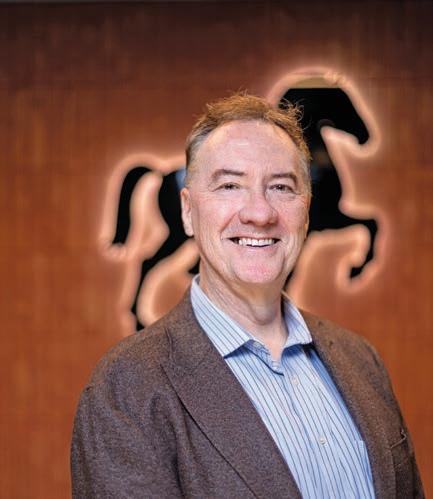
“One of the key promises we make to customers is that we help protect their brand. That means safety and reliability must sit at the centre of everything we do, from our marketing to our service model.”
Morrows Logistics Managing Director, David Morrow.
lines and transformers which can be pretty heavy.”
Morrows Logistics continues to be laser focused on the compliance and safety of the movement of dangerous goods and also has developed a very strong presence in the pump-out industry involving chemicals and oil for its customers.
A consistent factor in the company’s growth has been brand protection through safety and reliability.
“One of the key promises we make to
customers is that we help protect their brand. That means safety and reliability must sit at the centre of everything we do, from our marketing to our service model,” says David.
The Scania truck brand has played a central role in the Morrows journey for more than three decades. David’s longstanding af nity for Saab passenger cars naturally progressed to his rst Scania purchase 34 years ago. The eet’s evolution has followed Scania’s own product journey, from the early 3 series
through to the current NTG and Super series.
The eet includes a mix of prime movers and rigid trucks, many tted with purpose-built bodies made to David’s speci cations. As early as 2002, Morrows commissioned an innovative 8x4 Scania rigid designed for operational ef ciency. The twin-steer vehicle combined a short curtainsider body for palletised freight with an open deck suited to oversized loads such as cable drums and mini-containers.
A tail-lift further improved the truck’s ef ciency. The con guration delivered exceptional exibility, particularly for remote and regional work.
Despite the varied applications across the eet, consistent Scania cab layouts ensure drivers can switch between vehicles with ease.
“It gives our drivers con dence,” David says. “We have developed a standard speci cation template across our Scania eet. We focus on durability, comfort and safety for our drivers.”
Today, 36 Scania trucks operate across the eet, with additional units currently on order as older vehicles, primarily lighter-duty Japanese brands, are
Morrows Logistics continues to invest in safety, reliability and integrated supply chain solutions across Victoria and beyond.
retired. Over the years, Morrows has acquired more than 100 new Scania trucks.
Morrows typically operates its trucks for around seven years, with some vehicles travelling up to 180,000 to 200,000 kilometres annually.
“It is a conservative asset model, but it works,” David says. “We have had many Scanias exceed two to even three million kilometres.”
Most of the vehicle maintenance is handled in-house where there is a critical focus on the workshop’s capability.
“We employ four diesel technicians who manage routine servicing and major mechanical work. If something minor goes wrong, we can x it immediately and return the truck to the road, which keeps drivers productive and customers supported, any time of day or night.”
The team places strong emphasis on preventative maintenance and detailed service records, undertaking everything from routine servicing to turbo replacements and full engine and gearbox rebuilds.
Morrows remains a family-led business.
David’s wife, Robyn, previously served as General Manager and continues to support the business in a leadership capacity, although she no longer holds the formal GM role. Two of the couple’s sons are also involved, one as a fourth-year diesel apprentice and the other within operations.
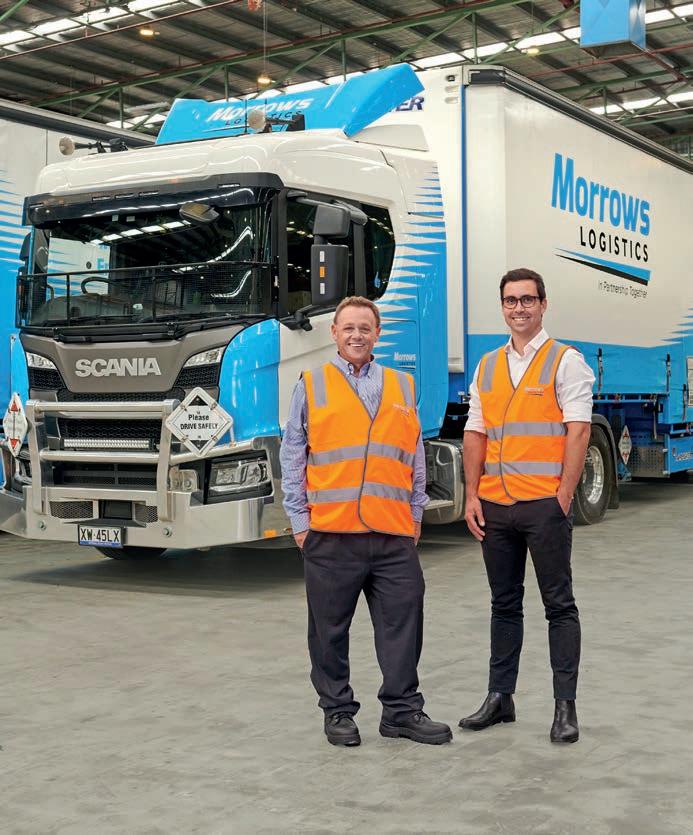
To support the company’s next growth phase, Morrows appointed Valentin Teles as General Manager of Transport and Warehousing.
“Valentin’s appointment allows Robyn and me to step back from day-today management pressures while strengthening our capability to grow,”
David says.
Valentin brings extensive thirdparty logistics experience, including eleven years with Mainfreight and a background in warehouse automation.
“We are expanding our contract logistics and warehousing offering within specialised, safety-critical environments,” Valentin says. “Our focus is professionalism, reliability and delivering exactly what we promise. We are taking that philosophy to a broader market.”
Morrows now provides integrated
supply chain services including transport, distribution, storage, container unloading, picking and packing.
“We have evolved from a transport provider into a full supply chain partner,” David says. “We offer dedicated contract logistics solutions as well as multi-customer 3PL warehousing, while maintaining our dangerous goods specialisation.”
For long-term dangerous goods customers, integration has created meaningful ef ciencies.
“Customers no longer need to coordinate multiple providers. We can dispatch a truck within 30 minutes, which shortens ful lment cycles and improves overall control.”
Dangerous goods transport demands a holistic safety culture. Morrows has consistently adopted Scania’s latest safety innovations, with recent additions to the Scania eet incorporating Advanced Driver Assistance Systems.
“Comfort, safety and reliability are the foundations of our loyalty to Scania,” David says. “Post-Covid, we also adopted Euro VI as our company
Morrows Logistics has expanded from a single-truck operation into a prominent dangerous goods and specialised freight provider.
standard to demonstrate that even heavy transport operators can contribute to emissions reduction.”
Driver engagement is equally important.
“We maintain a stable driving group,” says David. “They value their Scanias and take pride in representing the Morrows brand. We invest heavily in training and recently appointed an inhouse driver trainer.”
The focus is on vehicle optimisation as much as driver skill.
“Our drivers are highly capable, but modern vehicles require deeper system knowledge. Training helps reduce wear and tear while maximising fuel ef ciency and vehicle longevity.”
Morrows also integrates complementary safety technologies including MT Data and Seeing Machines systems, supported by active exception monitoring.
“We have always selected every available Scania safety option. Each new system helps us rest easier,” says David.
Morrows Logistics has purchased more than 100 new Scania trucks over the past three decades, with some vehicles exceeding three million kilometres during their service life.
Continuous improvement drives annual investment decisions, including blind spot monitoring upgrades and eet-wide camera enhancements.
“Features such as Advanced Emergency Braking protect our brand. That value cannot be measured purely in dollars.”
Fuel ef ciency remains a key operational factor.
“Despite fuel price volatility, we have absorbed cost pressures by managing our own fuel supply. However, incoming eet upgrades will eventually require pricing adjustments,” David says. “The latest Scania models have delivered approximately seven percent fuel ef ciency improvement across our eet, which is operationally signi cant.”
Typical operating patterns involve fully loaded outbound trips of up to 40 tonnes, with increasing efforts to secure return loads, particularly power infrastructure equipment and regional freight.
“In some rural areas, we provide the
only viable transport option,” says David. “That responsibility matters.”
Valentin sees further opportunity in disciplined, asset-light growth.
“We operate a lean model” he says. “We do not own the inventory we store or transport. We are exploring a future northern Melbourne transport facility while staying focused on our core capabilities and strengthening customer partnerships.”
With continued investment in renewable energy infrastructure across Victoria, demand for specialised transport and warehousing of poles, cabling and electrical assets is expected to grow, aligning naturally with Morrows’ expertise and regional relationships remain central to Morrows’ identity.
“Growth has never been purely salesdriven,” says David. “It comes from a genuine commitment to supporting local communities and delivering dependable service.”
GAME NUMBERS
With its eet of prime movers running constantly between terminals, yards, and customer sites, reliability and e ciency are essential to keeping freight owing for Arrow Transport.
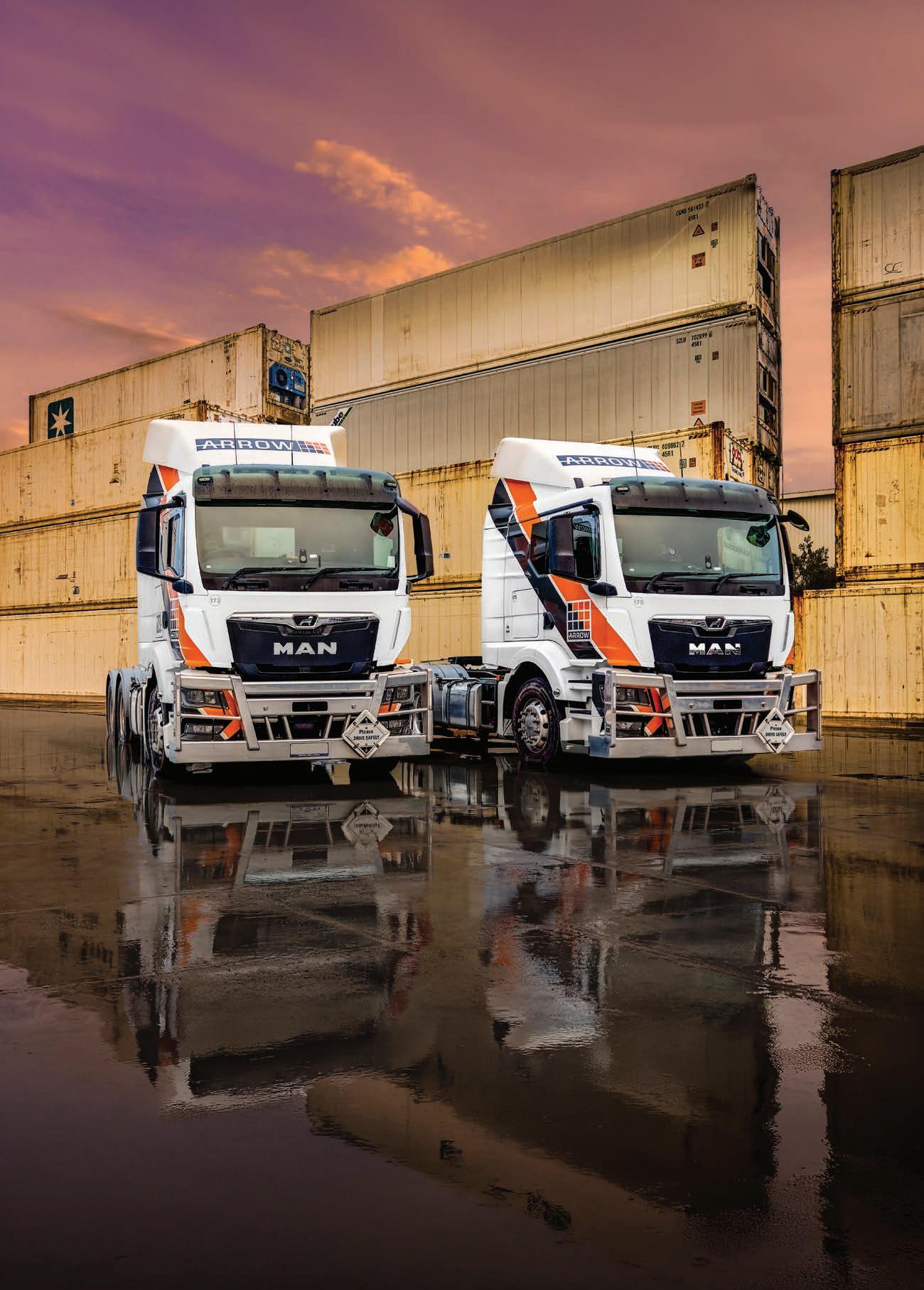
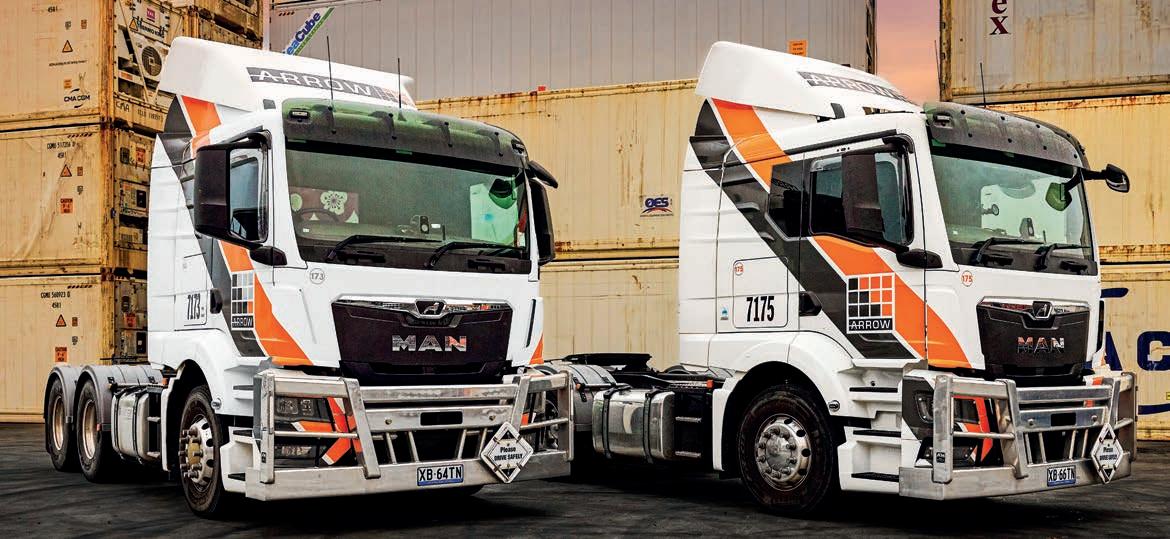
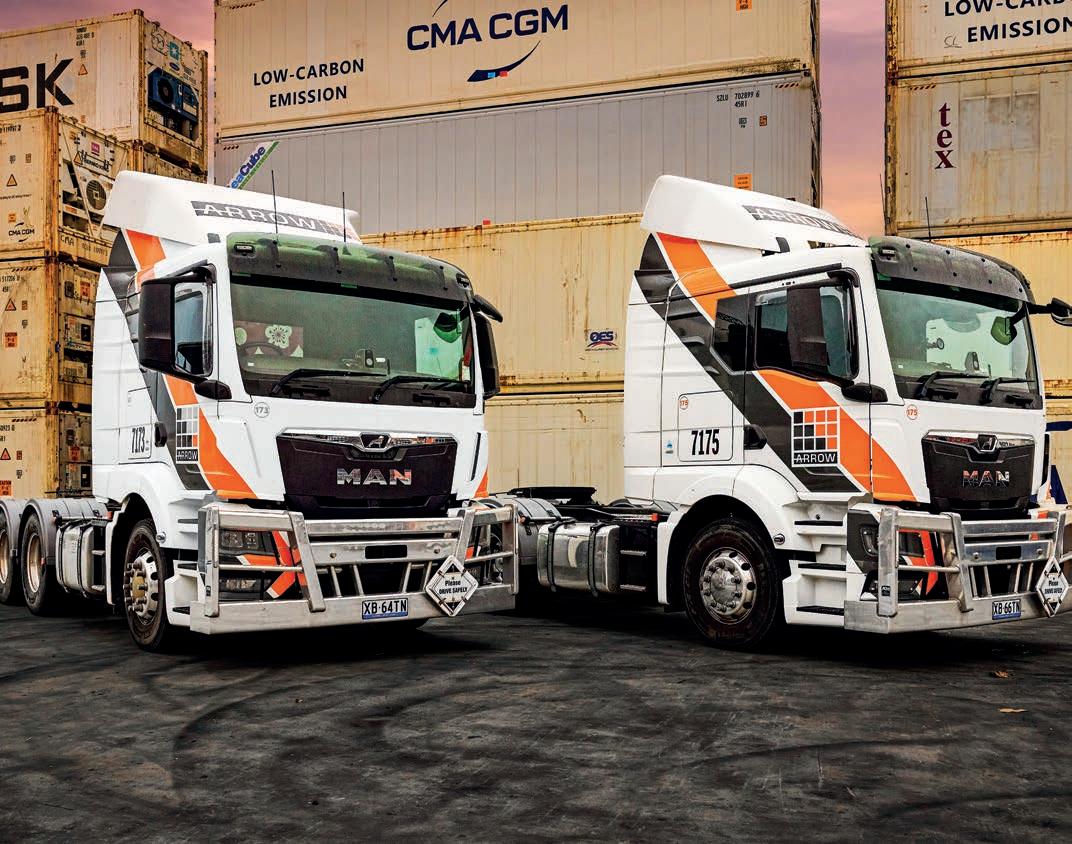
For the national container logistics provider, the introduction of four MAN TGS 26.440 prime movers has helped support its operations as it transports a weekly average of 500 shipping containers through the logistics corridors surrounding Brisbane’s port precinct.
Arrow Transport General Manager of Queensland, Jason Gadd, says the prime movers have quickly proven their value in the company’s fast-paced port logistics environment.
“To get through our volumes, we need all our trucks on the roads day and night,” Jason says.
“We’ve had the MANs now for around six months, and we haven’t had a single breakdown with one of those vehicles
in that time. For us, that’s a strong result.”
As Arrow Transport’s core business is port logistics, Jason acknowledges that they needed capable trucks to be able to quickly and easily move containers in and out of the terminals and further a eld.
With the four MAN TGS prime movers now working throughout Southeast Queensland, the logistics provider says the trucks are delivering the comfort, reliability and technology the company needs to keep containers moving ef ciently.
Founded in 2011, Arrow Transport has grown into one of Australia’s largest national container carriers. While container transport remains at the heart
of the operation, the company has expanded its capabilities signi cantly over the years.
Operationally, Arrow’s Brisbane facility is located adjacent to Brisbane’s busy port terminals, allowing the Arrow team to move containers ef ciently between the wharves and customer sites.
The company operates one of the largest side-loader eets in the region and regularly completes between 90 and 100 container drops per day. With that level of activity, truck performance is critical.
Jason says that while the company’s work is centred around Brisbane, its operations stretch across a wide geographic area.
“The bulk of the work we do is around
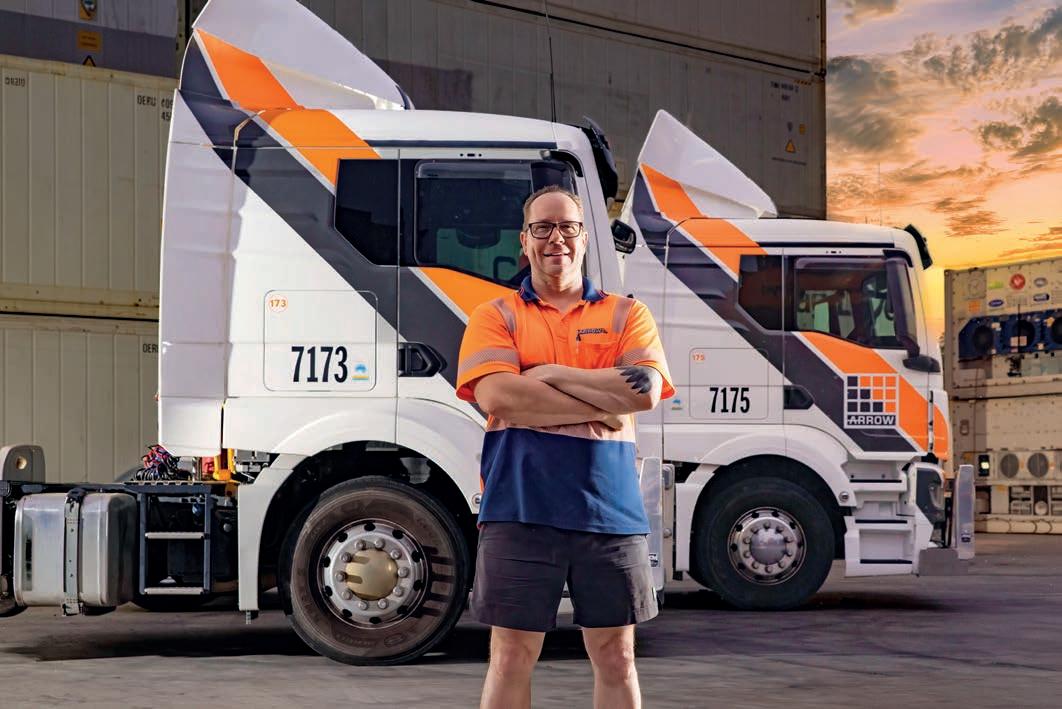
MAN TGS 26.440 prime movers join Arrow Transport’s fleet. Images: Penske Australia & New Zealand.
Brisbane, but we also go down into northern New South Wales, up to Bundaberg, out to Dalby, and we’ve also got a Townsville operation with four prime movers up there now,” he says.
Today, Arrow provides integrated services across transport, warehousing, biosecurity, and customs, giving customers a streamlined solution for complex supply chains.
“We want to be a one-stop shop,” Jason explains.
“It doesn’t matter what the customer needs – transport, inspections, quarantine work, or container handling, we can pretty much do it here.”
Jason says that Arrow Transport has been working closely with Penske Australia & New Zealand and MAN. The early feedback from drivers has been overwhelmingly positive.
“We’ve been with Penske and MAN for about six months or so, and the guys who are driving these prime movers love them,” he says.
“We haven’t had any issues with them,
and they’ve been on the road since day one. We’ve had no concerns at all with the MANs.”
As a result, Jason says the MANs have quickly earned their place in Arrow’s large eet.
“The MANs are good trucks,” he says. Driver comfort has been a standout feature of the TGS models.
“The feedback I’m getting from the drivers on the MAN TGS is de nitely a comfort issue and also the handling and reliability,” Jason says.
“A few of our drivers have said that the steps into the cabin are probably a bit more ergonomic. Wider steps are a bit easier for access and egress, and there are three points of contact, which helps some of the drivers.
“Overall, the feedback has been very good so far.”
Jason says the trucks have the grunt required for heavy container work.
“Because we’re transporting container loads, which are big, heavy shipments, the MANs give us the power we need,” he says.
“They’re good and reliable in that department.”
Driver feedback has also been positive.
“The guys that drive these trucks absolutely love them,” Nick says.
“They’re very accessible, and they’ve got really good visibility of the road, which makes a big difference when you’re operating around busy port environments.”
The MANs are used primarily on short-haul work around Brisbane and Southeast Queensland, but they still rack up signi cant kilometres.
“One has clocked up nearly 100,000 kilometres, one’s on 75,000 kilometres, one is on 91,000 and one’s on 83,000 –all in six months or thereabouts,” Jason explains.
“That’s some considerable distances being done in a short time.”
Jason says the trucks arrived wellprepared and ready for immediate service.
“The trucks come pretty well set up from Penske, with dash mats and all the gear.
The MAN TGS 26.440 is a big hit with the drivers.
“From day one they’ve been on the road and they do look good.”
Technology has also played an important role in supporting the company’s growth.
From its headquarters, Arrow operates its own in-house transport management platform, developed by an in-house IT team, that allows customers to track the progress of their freight in real time.
“Our system gives customers live visibility on each milestone in their container movements,” Jason says.
“They can see where their freight is, when inspections are happening, and when containers are moving through the network.”
Arrow’s Queensland Operations Manager, Nick Tenni, says the decision to bring MAN trucks into the eet was driven by strong operational credentials.
“They’re economical trucks in terms of running costs and fuel,” Nick says.
“The telematics are also really good. We get noti cations for services, and we can track fuel usage, which helps us manage our operating costs.”
The telematics capabilities allow Arrow to monitor vehicle performance and ensure maintenance schedules are managed proactively, helping maximise uptime.
Arrow Transport uses MyGeotab to monitor vehicle performance and compliance.
“With the telematics system for the trucks, we’re using MyGeotab, which is working well and gives me pretty accurate readings,” Jason explains.
“That’s what we need to be able to comply with requirements for driver fatigue.
“It’s all there and I can jump in and double-check rest breaks and everything to make sure we’re compliant.”
Service support has also been an important part of the experience. Arrow works closely with Penske’s service team in Lytton, where trucks are maintained and returned to the road quickly.
“I’ve had a terri c experience with Penske,” Jason says.
“We haven’t had any dramas. They check in with us to see how the vehicles are going, and when the trucks are serviced, the team at Lytton turns them around quickly.”
With a eet that already includes many European trucks, the MAN TGS models have proven to be a strong addition to Arrow’s operation.
And as the company continues to expand its logistics capabilities across Australia, both Jason and Nick are con dent the partnership with Penske and MAN will remain part of that journey.
“We’ve had a supportive and caring experience so far,” Jason says.
“I don’t have any concerns about the relationship going forward.”
Truck maintenance for the MANs is handled by Penske at its nearby Port of Brisbane workshop.
“They’re fully maintained by Penske at their workshop, which isn’t far from our base in the Port of Brisbane,” Jason says.
“We’re very happy with the maintenance work and the skills of the Penske mechanics.”
Jason says Arrow Transport is focused on innovation and reducing emissions, including larger combinations, solar panels and smarter freight movements.
In January 2026, Arrow Transport successfully conducted an A-triple road train combination trial, in conjunction with the NHVR, operating in and around the Port of Brisbane.
The trial focused on moving both full and empty containers between key Port of Brisbane partners in a single movement – six twentyfoot containers, or three forty-foot containers at a time.
As a result of the trial, Arrow Transport was reputed to be the rst operator to use an A-triple road train out of the Port of Brisbane.
“We try to be innovative at Arrow Transport, trying to do things a little bit smarter,” he says.
“Less trucks on the roads, more movements, and improved ef ciencies.”
“We’ve got solar panels on the warehouse roof and we’re always looking to reduce emissions.”
Jason says the MAN TGS ts seamlessly into that strategy, meeting Arrow’s and industry expected high standards for the prime movers.
“We nd that with technology, the MANs are on par with what the industry needs and demands in modern transport ef ciencies, performance and telematics,” he notes.
“For our eet, we have a number of good OEM partners we deal with, and we purchase what we need at the time to meet demands and keep ful lling client orders.
“This is why we went with the MANs –they’re a good truck and are well suited to the needs we have of them.”
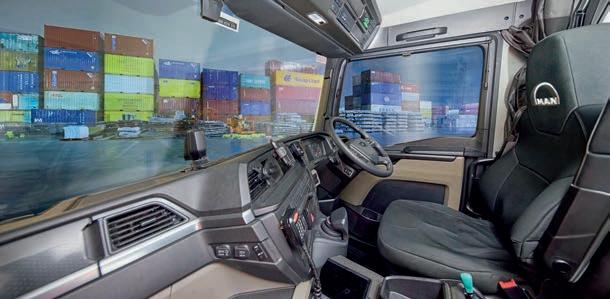
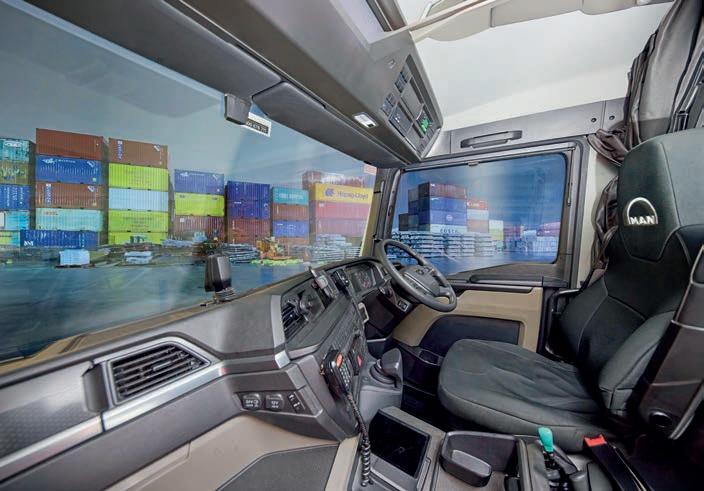
The well-appointed cabin interior of the MAN TGS.
CARS FAST
A British expat who once worked as a mechanic is now trusted with transporting some of the world’s most valuable cars, building a thriving national business from the Gold Coast on little more than instinct and a willingness to take a risk.
Phil Charlton doesn’t come from a transport dynasty. There’s no generational trucking story behind him, no inherited eet or lifelong immersion in logistics. Instead, his journey into the industry begins with something far simpler –curiosity, a love of cars and a readiness to “have a go”.
Now 41, married to Kate with an 11-year-old daughter and based on Queensland’s Gold Coast, Phil is the founder of Vehicle Transport Group, a business specialising in the transport
of high-end luxury and exotic vehicles across Australia. It’s a niche world of precision, trust and eye-watering asset values – one he enters without a traditional roadmap.
“I’m not from a trucking family,” Phil says. “I’m just a bloke having a go and making it work.”
Mechanic to mover
Phil’s story begins in the UK, where he grew up surrounded by cars; albeit not the kind he transports today.
“My dad was car-mad, so we were
always tinkering,” he recalls. “They were usually old Volkswagens rather than anything exotic, but we were always around cars – car shows, rallies, racing. That interest never really left.”
After time working as a mechanic, including four years in New Zealand and a stint in France during a ski season; where he discovers he enjoys driving - Phil eventually makes the move to Australia in 2009. He settles on the Gold Coast and continued working as a mechanic.
But by 2017, something shifted.
“In the end, I had a brand-new car carrier on the road for under $100,000,” he says. “And I just got stuck into it.”
The early days are anything but glamorous. Phil takes on local work across South-East Queensland, building experience and slowly developing a customer base.
“There was plenty of work, but it was competitive,” he says. “I was up against bigger operators with four-car carriers, so I focused on doing the basics right; turning up on time and getting the job done properly.”
One early job still stands out.
“I drove it to Perth,” he says, laughing. “About two days into that trip I de nitely started questioning my life choices.”
The turning point comes when Phil begins targeting a more specialised market - high-end and exotic vehicles.
“I basically sold everything and quit my job,” he says. “I wanted to try something different.”
That “something” started small.
One truck, one idea
Vehicle Transport Group begins with a single vehicle: an Iveco Daily tted with a beavertail tray.
“It all started with that Iveco Daily and a beavertail tray” Phil says. “I’d been to Europe and saw small car carriers moving single vehicles around and thought it could work here.”
“I managed to buy a cheap, new blue manual 7.2-tonne Iveco Daily and had a beaver tray built by a small workshop called Cobra Engineering.
“I’ve always loved cars,” he says. “So, I approached a local exotic dealership and offered to help.”
The response is encouraging … but there was a catch.
“They wanted enclosed transport,” Phil explains. “And at the time, hardly anyone was offering that.”
It sent him down a new path.
“I looked at getting something built locally, but no one could meet the requirements,” he says. “It had to be able to load something like a Lamborghini Aventador backwards without any risk of damage.”
The solution comes from overseas: a Brian James RT6 enclosed trailer imported from the UK.
“At the time, it was one of the rst on the road here,” Phil says. “Once I got comfortable using it, the work really started to grow.”
Building momentum
From there, the business evolved quickly.
“Work took off,” Phil says. “We added more equipment as demand increased.”
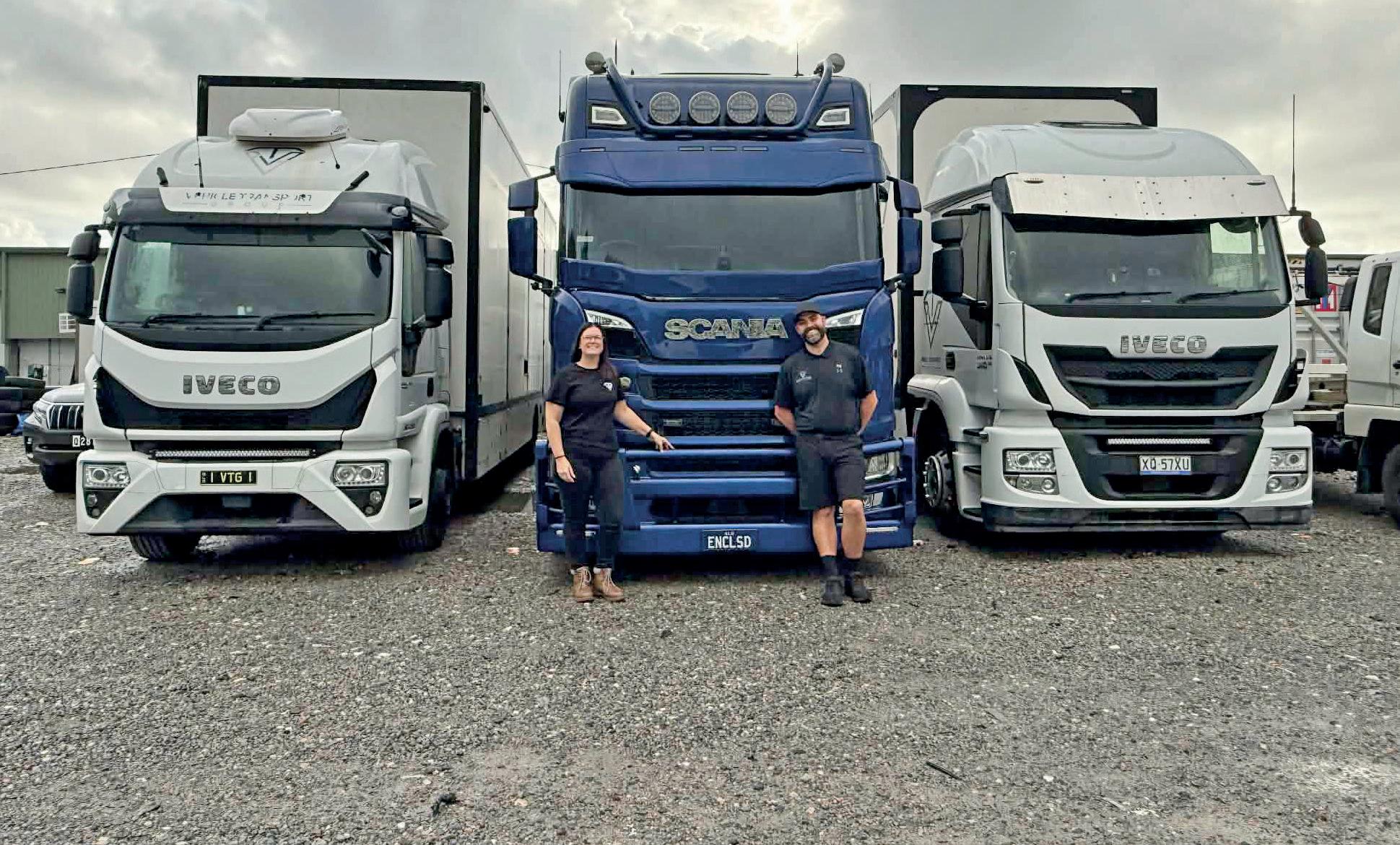
The eet expanded step by step – rst a two-car Iveco Eurocargo, then a two-car
Iveco Stralis, and eventually something much bigger.
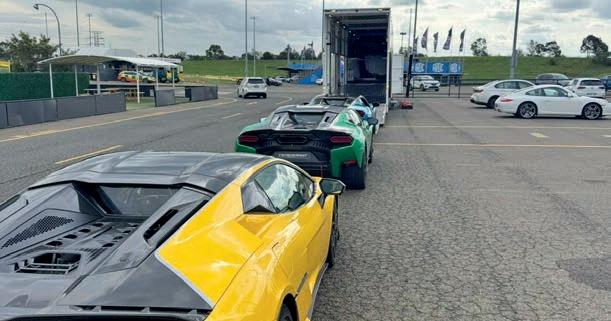
“We added a six-car Scania R560 with a custom Pantech-style enclosed trailer,” he says. “That was a big investment.”
Today, the eet includes two Iveco trucks, a Scania prime mover, and a Ford F150 ute with an enclosed trailer; each purpose-built for transporting high-value vehicles.
“Nothing we run is off-the-shelf,” Phil says. “It’s all designed for the job.”
The newest addition – a Scania sourced through Scania Richlands, re ecting how far the business has come.
“It’s a big cab with a lot of extras imported from overseas,” he says. “And paired with the six-car enclosed trailer, it’s exactly what we need for this level of work.”
Another enclosed carrier is already on the way.
Moving millions
Vehicle Transport Group now operates Australia-wide, with a strong focus on the east coast - regularly running between Brisbane, Sydney and Melbourne.
“We’re based on the Gold Coast, but most of our work comes out of the major capitals,” Phil says. “We’re in Melbourne nearly every week.”
The cargo is anything but ordinary.
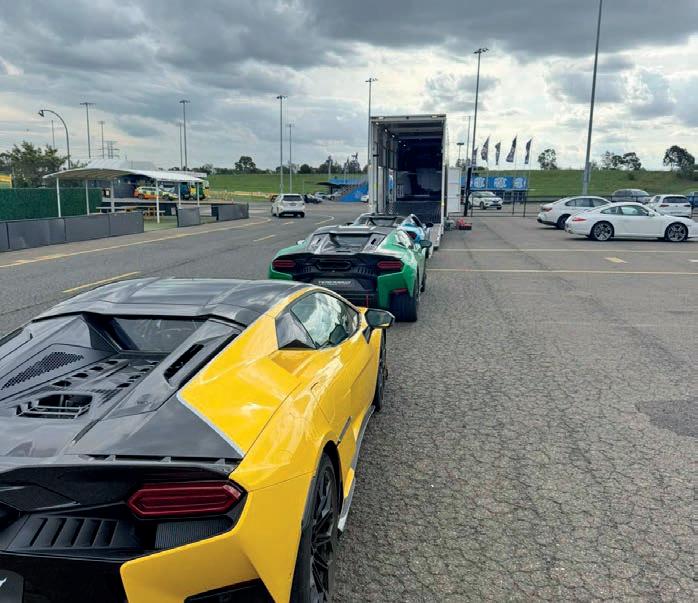
“We specialise in high-end luxury vehicles,” he explains. “Ferraris, Lamborghinis, McLarens; but also classic and historic cars.”
Recent jobs have included everything from a 1910 Rolls-Royce to a Red Bull Formula 1 car.
“We’ve moved an Aston Martin DB4 Zagato, a Delage, a 1919 Hudson,” Phil says. “Even one of only two Koenigsegg Jeskos in Australia – that required a police escort.”
The value of these vehicles quickly adds up.
“Last year we estimated we transported around $250 million worth of cars,” he says. “And it’s growing every year.”
Handling vehicles of that calibre requires more than just the right equipment – it demands a particular mindset.
A family enterprise for Phil and Kate Charlton.
“Early on, it was de nitely stressful,” Phil admits. “But after eight years and a clean record, you learn to manage that pressure.”
His approach is simple: slow down and do it properly.
“We never rush,” he says. “Our drivers are paid hourly, so there’s no incentive to cut corners. It’s just not worth the risk.”
Insurance is another critical piece of the puzzle.
“We carry full marine insurance,” Phil says. “It’s expensive, but it’s essential when you’re dealing with vehicles at this level.”
Clients range from private collectors to dealerships and manufacturers, with roughly a 50/50 split.
“Sometimes it’s a private buyer ying interstate and needing the car brought home,” he says. “Other times it’s manufacturers, events or track days.”
Lifestyle business
Despite operating nationally, the Gold Coast remains home base.
“It’s a great lifestyle,” Phil says. “And it works for the business, even if most of the work is elsewhere.”
The company employs four people, including Phil and his wife Kate, who
plays a key role behind the scenes.
The company employs four people, including Phil and his wife Kate, who is an integral part of the business and plays a vital role behind the scenes.
“Kate actually encouraged me to start the business,” he says. “She loves the operational side and keeps everything running.” Her organisation and ongoing support helps keep the day-to-day operations running smoothly, and her contribution is a big part of the strong relationships and trusted reputation the business has built over the years.
Two drivers handle much of the longhaul work - both long-term employees.
“They’ve been with us nearly four years,” Phil says. “We look after them – hourly pay, full entitlements. That’s important to us.”
Phil himself still gets behind the wheel whenever he can.
“I’m supposed to be in the of ce,” he says with a grin. “But I always nd a reason to jump in a truck.”
Over the years, the job has taken Phil across the country; and into some unique situations.
“We’ve been sent to Perth just to collect a single car,” he says. “Those ‘make it happen’ jobs are always interesting.”
Major events also feature heavily.
“We’ve transported cars to the Formula 1 Grand Prix in Melbourne,” he says. “Owners bring their cars down and make a holiday out of it.”
Other jobs involve rotating vehicles between holiday homes or supporting track days and driving tours.
“Every week is different,” Phil says. “That’s part of what makes it enjoyable.”
Despite the scale of the operation, Phil is determined to keep the business grounded.
“We’re still very hands-on,” he says. “It’s important not to lose that personal touch.”
That extends to family life as well.
“Our daughter gets picked up from school in a Ferrari or Lamborghini for her birthday each year,” he says. “She loves it - the Porsche is her favourite.”
For Phil, it’s a reminder of how far things have come.
Moving forward
With a growing eet and increasing demand, the future looks strong, but Phil remains measured in his ambitions.
“There’s always room to grow,” he says. “If things keep going the way they are, we’ll probably add another semitrailer.”
At the same time, he’s focused on maintaining standards.
“It’s about doing things properly,” he says. “That’s what got us here.”
In an industry often de ned by scale and legacy, Phil Charlton’s story stands out for its simplicity. No grand plan, no inherited advantage - just a willingness to take a chance and back himself.
“I didn’t overthink it,” he says. “I just gave it a go.”
That mindset has taken him from a single Iveco Daily to a national operation transporting some of the world’s most valuable vehicles.
And on the Gold Coast, with the next job already lined up and another truck on the horizon, Phil is still doing exactly what he set out to do – making it work, one car at a time.
Line up of precious cargo. Images: Vehicle Transport Group
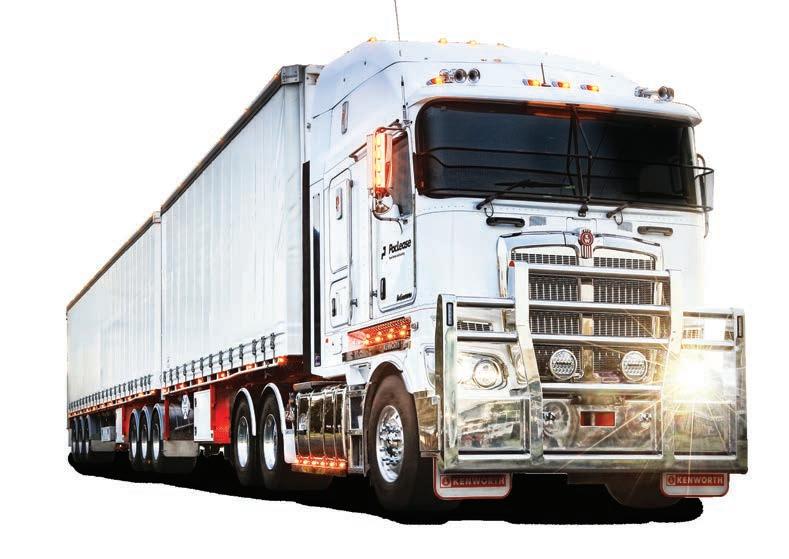
Short and long term rentals available nation-wide to provide relief when you need it the most.
PacLease’s growing footprint of commercial truck rental outlets across Australia means we have the vehicle you need, when you need it, where you need it.
We understand the changing demands on your business during seasonal spikes and can provide flexible rental solutions tailored to your requirements.
PROVEN FORMULA
South-East Queensland operator, Wayne Brims, has built Brims Coastal Cement around a simple philosophy: invest in proven equipment, and if you’re on a good thing, stick to it.
For Wayne Brims, business success has never been about chasing the latest trend or constantly changing suppliers. Instead, it comes down to a simple philosophy that has guided him throughout his career in trucking and earthmoving: when something proves itself over time, stick with it.
That approach has helped shape Brims Coastal Cement into one of
Queensland’s most respected bulk haulage operations, specialising in the transport of raw materials for concrete production. It has also led to a eet comprised entirely of Kenworth prime movers equipped with Dana driveline and axle technology.
Staying with a product that gives you exceptional service and reliability has proven to be a winner with the Brims family. That approach neatly sums up a business philosophy forged through decades of experience behind the wheel and in the workshop.
Wayne’s loyalty to Dana axles and driveline components can be traced back to his earliest days in the transport industry.
Long before establishing Brims’ Coastal Cement Wayne was involved in tipper operations with his father and quickly learned the value of dependable equipment.
“My rst sort of tipper I drove only lasted two days before I blew the diff out of it,” Wayne recalls.
When it was time to look at updating the truck parts, Wayne had already gone through three diffs on one truck. It was time to try something new, which at the time Eaton rear axles. Moving over to Eaton-branded rear axles, Wayne progressed to his rst Dana-branded axle. He’s been a loyal customer of Dana drive lines since then.
That’s how it all started, with the rst lot of diffs,” Wayne explains.
Today, Dana’s commercial vehicle heritage includes the well-known
driveline and axle products that have earned a reputation for durability across heavy-duty applications.
“We started getting them and had a decent run out of them, so we’ve just kept with them,” Waynen says.
Brims Coastal Cement operates throughout South-East Queensland, transporting cement products, slag, y ash and other powdered materials to concrete plants.
The operation runs in demanding conditions where payload, uptime and reliability directly impact pro tability.
“Our focus is to go all around SouthEast Queensland carting the raw materials to the concrete plants – the ash and the powdered materials,” Wayne explains.
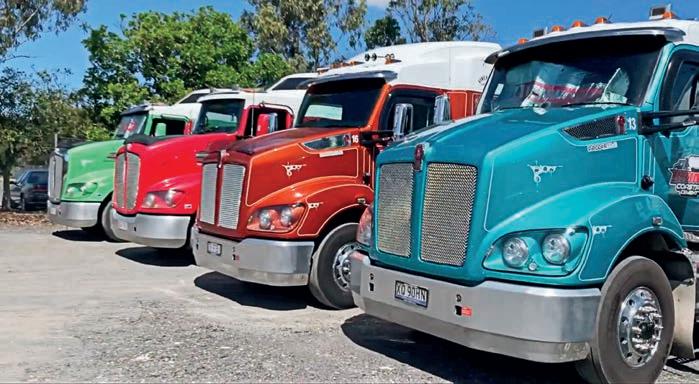
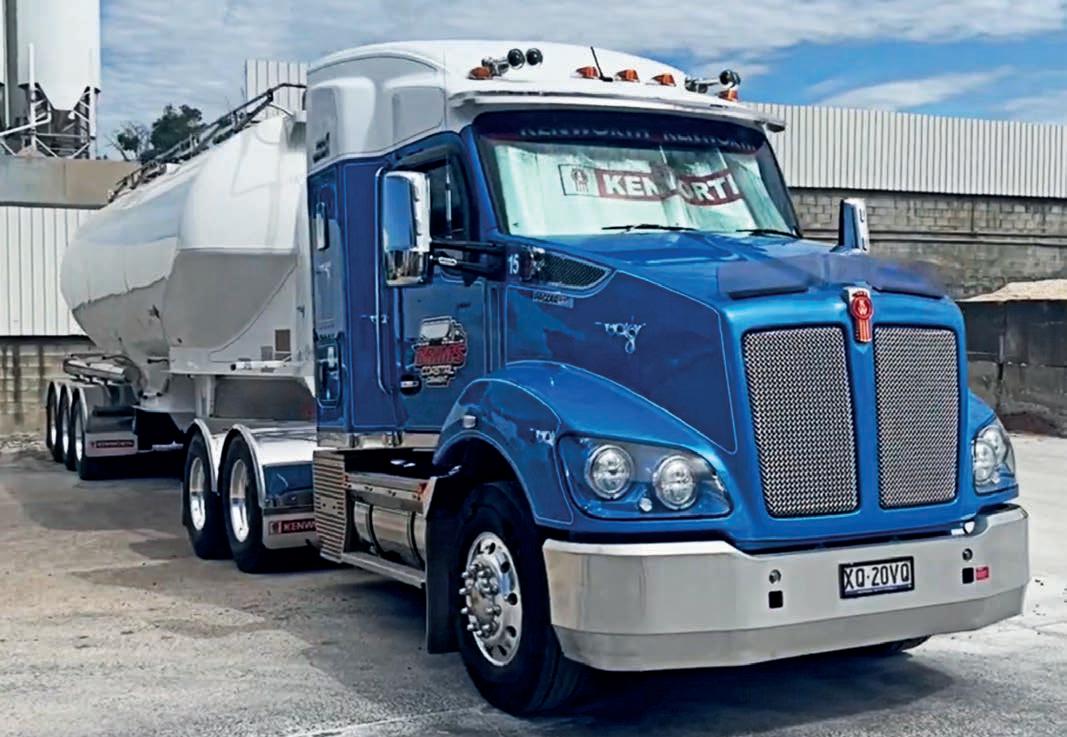
The eet currently consists of nine Kenworth prime movers.
“I’ve got nine Kenworth prime movers now,” he says.
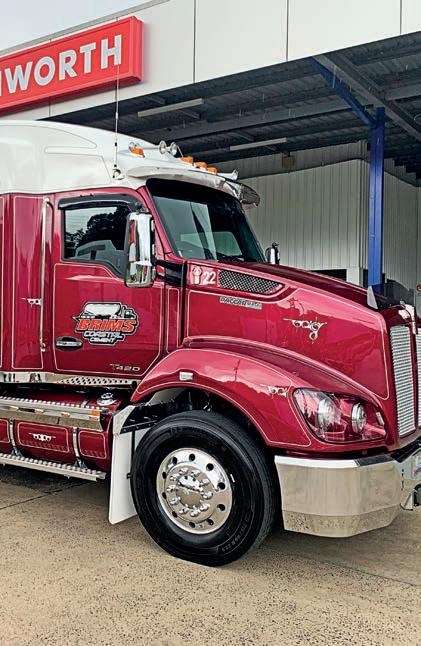
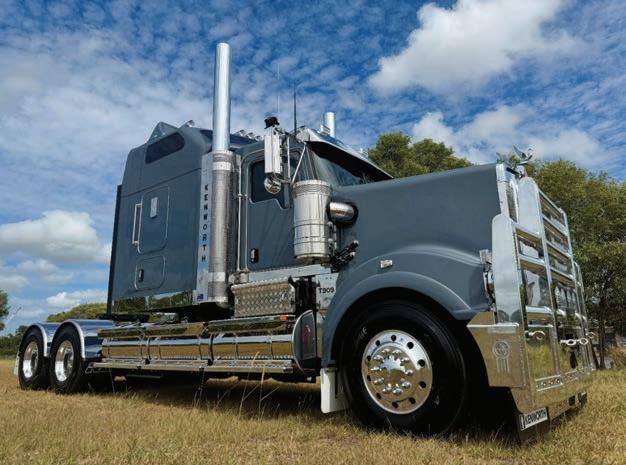
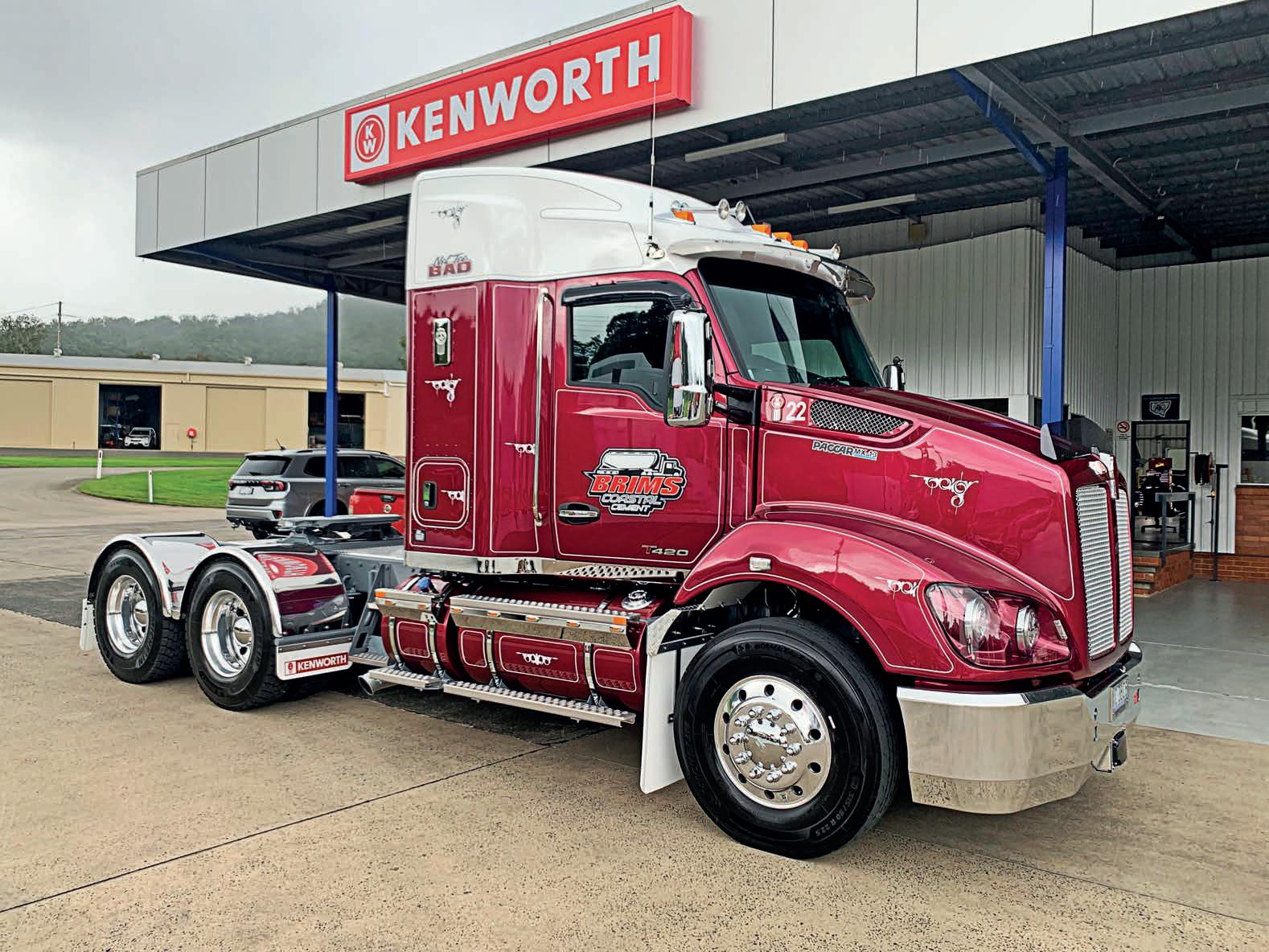
The eet includes six Kenworth T410s, two T610s and now a new T420, decked out in the unmistakable ‘Ron Burgundy Red’ livery.
Notably, every truck in Wayne’s eet carries the same badge.
“They are all we’ve ever bought. Kenworths, nothing else.”
That loyalty stems from a lifetime around the brand.
“I was brought up with them. That’s what we had and that’s what we get. They’re good solid haulers for the heavy loads you’re carrying around.”
Wayne admits he has never seriously considered alternatives.
The new Kenworth T420 in Ron Burgundy Red livery stands out from the crowd. Image: Brown and Hurley.
Brims Coastal Cement is a Kenworth owner through and through. Image: Brims Coastal Cement.
“It’s something I didn’t even ask anybody else about. Since I was a little boy, that’s what my dad and uncles bought, so that’s what I bought,” he says.
“It’s like a family tradition. Just keep it going.”
Trucking has been part of Wayne’s life since the very beginning.
Raised around the family’s earthmoving operation, Brims’ Earthmoving in Murwillumbah, he was immersed in machinery from a remarkably young age.
“I’ve been around trucks all my life,” he says.
“As a six or seven-year-old I was out driving bulldozers and rollers and whatever else they had. Every weekend I’d be driving something.”
The stories sound almost unbelievable by modern standards.
“They’d drop me over at a quarry when I was ten years old. I’d sit there all day waiting for Dad to come back and check on me.”
His connection with machinery started even earlier.
“I’ve been around it since I was days old. I guess it’s in my blood.”
By the time he reached adulthood, Wayne was already operating heavy vehicles regularly.
“I think I was barely 18 and I was driving big trucks on weekends because nobody else wanted to do it,” Wayne says.
That included work at the local sugar mill. “I was carting lter press on Friday and Saturday nights.”
Today, the next generation is following a similar path, with Wayne’s sons all learning to drive trucks from an early age and gaining their truck licences the moment they could.
“They’ve been playing around forklifts and trucks from an early age and knew how to drive by the time they were 10,” Wayne says.
His philosophy remains straightforward. “You learn something early enough and you stick with it.”
The origins of Brims Coastal Cement
can be traced to an unexpected opportunity.
At the time, Wayne and his father operated a successful tipper eet when a local transport operator approached them with a proposition.
“Don Baxter, who ran a small business wanted to retire,” Wayne explains.
“He only had three trucks and he wanted to sell.”
The business specialised in transporting cement-related products and was located only a short distance from the Brims family operation.
“We knew him for years and he offered it to us.”
The acquisition represented a natural expansion. “We would have had about 15 tippers by then and it just blended in with what we were doing.”
Five years later, Wayne purchased his father’s share of the business and took sole ownership.
The company subsequently expanded, at one stage operating 15 trucks and maintaining a presence in Newcastle.
Brims Coastal Cement showcases a range of Kenworth prime movers Image: Brims Coastal Cement.
“I had ve trucks in Newcastle for nearly 10 years.”
However, Wayne eventually decided to focus on his home market.
“I thought it was better to concentrate on the one area – South-East Queensland.”
That decision has helped establish Brims Coastal Cement as a recognised specialist in the region.
“We’ve built up a strong reputation in South-East Queensland. For Wayne, reliability extends beyond engines and chassis to the entire driveline package.
Over the years, Dana axles and drivetrain components have consistently delivered the durability his operation requires.
“With the diffs they just went forever until we sold the trucks,” he says.
The company made a deliberate move to go with Dana speci cations as new trucks entered the eet.
“When we bought new trucks, we stuck with the same truck in Kenworths and the same in the diffs.”
The reason was simple.
“We started out with them and just stuck with them because of their reliability and dependability.”
Wayne points to the longevity of the components as one of their biggest strengths.
“They go forever. We’ll do a million kilometres on a uni, and you don’t have to worry about them.”
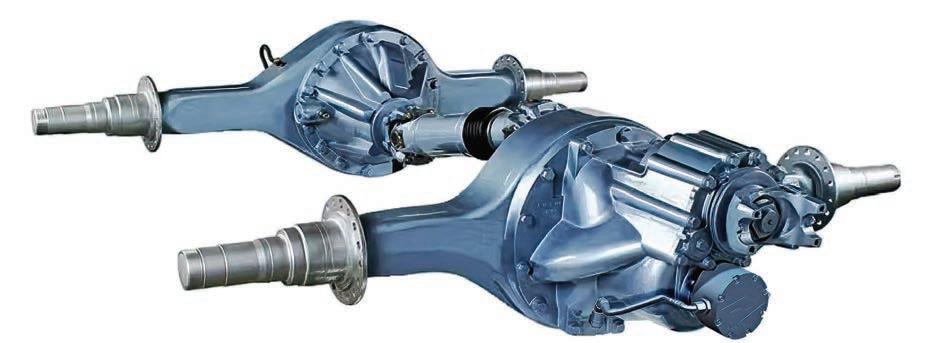
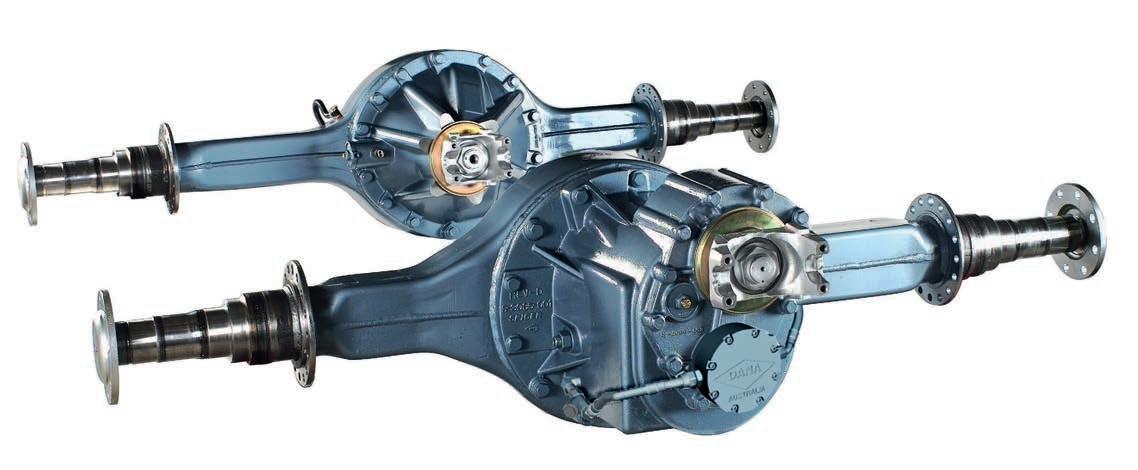
The eet is equipped with Dana DSH40 axles, the company’s signature 50-tonne GCM rated prime move axle, which Wayne uses at a 4:1 ratio. These speci cations suit the company’s single-trailer operation and 46-tonne GCM requirements.
“That’s all I’ve had for about 10 years.”
Another key component of the eet speci cation is disc braking technology. Wayne embraced disc brakes approximately 15 years ago and has no intention of returning to traditional systems.
He cites simplicity and reduced maintenance as major advantages.
“The parts are easy to replace. They’re very low maintenance and they always work.”
Wayne nds the greaseless design particularly attractive for his needs.
“You don’t need to grease them at all. You run them and every three years you just replace the brake pads. That makes your life a lot easier,” he said.
For eet operators seeking lower maintenance costs and less workshop downtime, those bene ts quickly add up.
“The greased versions might last longer, but they need lots of maintenance. You have to grease them, adjust them and all that sort of stuff. You don’t need that at all.”
Wayne also appreciates the cleanliness of the underbody’s components.
“When you look underneath, it’s very clean. You don’t have grease hanging off everything. You don’t have to worry about dust sticking to grease and getting all over everything.”
The result is lower overall maintenance expenditure.
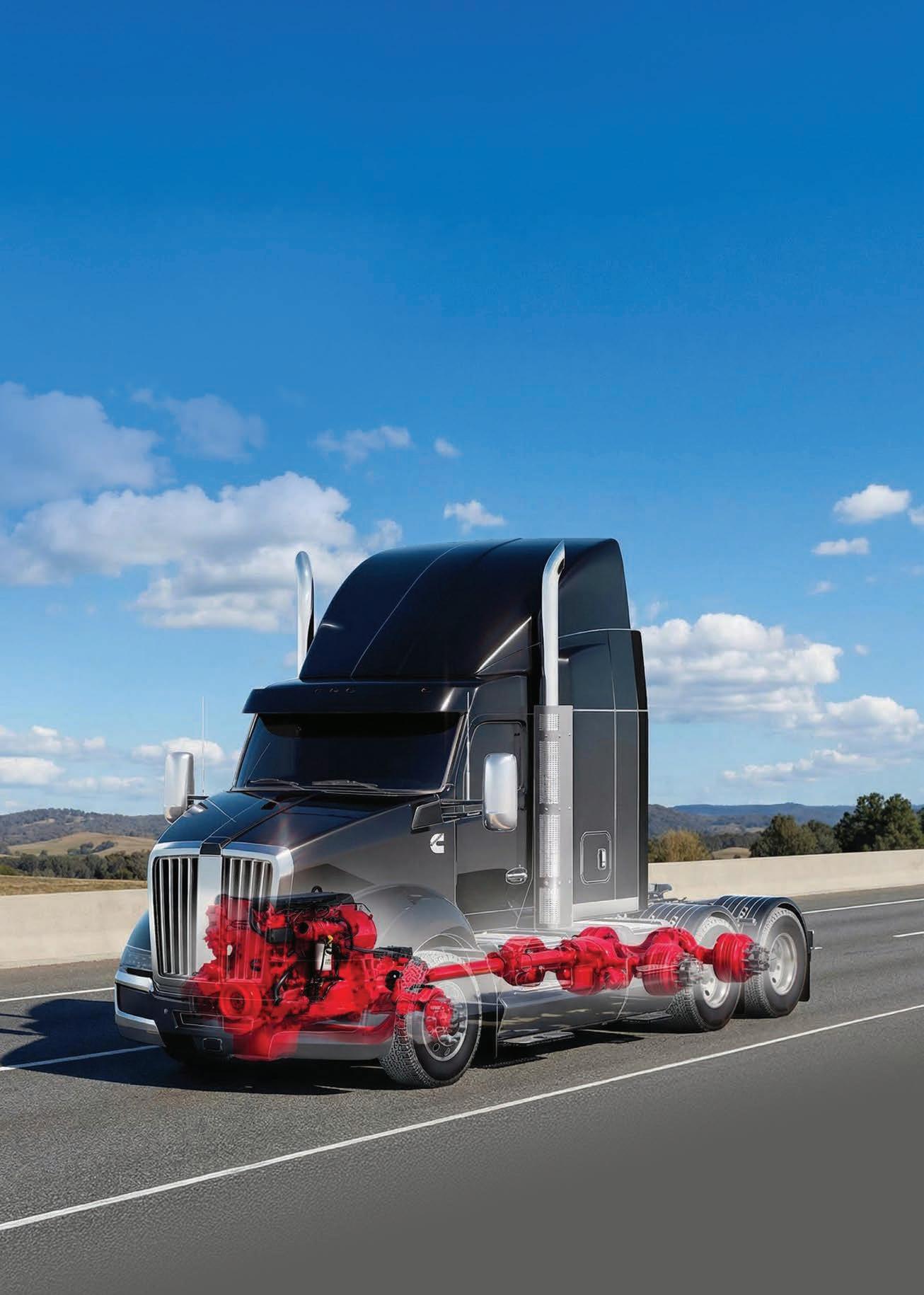
Alongside the Kenworth chassis and Dana driveline package, Wayne is equally enthusiastic about the PACCAR MX-13 engine.
“That’s like the MX engine. I love it. Absolutely love them.”
Operating predominantly at 46 tonnes gross combination mass with single trailers, he believes the engine is perfectly suited to the task.
“They’re light and they’re good on fuel. They’re so reliable. They’ll do a million kilometres easily.”
While he acknowledges the MX-13 may not be ideal for heavy B-double applications, it ts his operation perfectly.
“They’re not suitable for towing doubles, but we don’t have doubles, so they’re perfect for our work.”
For Wayne, the combination of Kenworth, PACCAR and Dana has proven itself repeatedly over many years of operation.
“I’m very happy with the Kenworth trucks and Dana drivelines and axles.”
“They all work very well together.”
Although reliability means support is rarely required, Wayne says both PACCAR and Dana have consistently
delivered strong after-sales service whenever assistance is needed.
“In terms of after-sales service, they’re pretty spot on.”
“The PACCAR guys and the Dana guys are pretty good.”
“They’re always accommodating.”
Yet the greatest compliment may be how infrequently he needs to contact them.
“We don’t really need to call them that much at all.”
“I don’t need to ring them very often.
That’s a good sign.”
Instead, Wayne is more likely to encounter supplier representatives at industry events than during breakdowns.
“I tend to see them more at truck shows than anywhere else.”
Wayne purchases his trucks through Brown and Hurley in Kyogle, continuing another longstanding family relationship.
“That’s where we always buy all our stuff from.”
“My dad and my uncle all got their trucks from there.”
For some operators, such unwavering loyalty may seem unusual in an industry where manufacturers and component suppliers constantly compete for market share.
For Wayne, however, consistency is a competitive advantage.
“I’ve never priced another truck,” he says.
“I don’t need to look at other stuff.”
That mindset extends throughout his operation.
“We know what we like and we stick to it.”
After more than two decades in his own business, the results speak for themselves.
With a highly productive eet, strong regional reputation and equipment package centred around proven Kenworth and Dana technology, Wayne has built a successful operation based on experience rather than experimentation:
“Doing this for more than 23 years shows that we know what we’re doing.”
And for Wayne Brims, knowing what works, and sticking with it, continues to be the foundation of that success.
HYBRID MISSION
Alinea is a not-for pro t organisation dedicated to supporting elderly individuals and people with disabilities in the Western Australian community. Hino Hybrid Electric trucks play a central role in the operations.
The overall organisation itself has been around for more than 50 years and has been heavily involved in the disability space and, over time, developed a number of ‘op’ shops and book bazaars to support employment for the nearly 120 staff living with disability who are working across the business including performing small scale packaging assembly for things such as the paint roller kits sold in Bunnings.
The organisation has the production capacity to handle large packaging volumes but also the expertise and exibility to process smaller jobs. Alinea also operates two aged care
facilities, while another division converts used clothing into cleaning rags for industry, cutting the material into regular sizes and then packaging into 15 kilogram boxes before sending out to clients such as the big miners.
Up to 800 kilograms of cleaning cloths are processed each day. Other services provided include putting together conference packs and home health test kits.
Stock for the op shops comes mostly from donations, much of it from donation bins located in the community, as well as home pick-ups.
Alinea operates a eet of ve Hino hybrid electric trucks to serve the main needs of its operations. The truck drivers perform furniture pickups as well as tidying up around donation bin locations. One Hino is equipped with a solid body with gull wing doors and is used to collect any unwanted waste which some people dump at the donation sites. This Hino also has a crane mounted on the back so the donation bins can be picked up if required. The body was conceived by members of the Alinea team and the local Hino dealer had a bodybuilder make it so that was all packaged when the truck was delivered.
One of the many factors in deciding upon the Hino brand was the manual park brake.
“The electric hybrid aspect de nitely played a part as well. The fuel consumption is lower so there’s de nitely a cost saving,” says Richard Horne, Alinea’s Manager. “We also quite like the tracking aspects provided by the Hino Connect telematics system and also the trucks’ load carrying capacities without going into a medium rigid for licensing.”
Initially trucks with six pallet capacities were utilised, but one of the latest Hino electric hybrids has a larger eight pallet curtain side body.
“We move quite a lot of stuff around, so having the slightly increased capacity is good, and now going to eight pallets over the six is helping keep the costs down,” says Richard.
As the trucks don’t operate outside of the greater Perth metropolitan area average kilometres are generally less than 500 each week.
Alinea has a contract with the libraries in Perth to move books between them. If someone wants a speci c book and their local library doesn’t have it, but another library does, Alinea vehicles are used to transfer to book to the client’s closest library. Alinea also receives donations of books from the libraries which it sells through its dedicated used-book shops as well as its op shops.
“We do the library transfers, and originally we were running three trucks that were heading towards 18 years old or more, so we consolidated it down to two,” says Richard. “We just moved the bodies across onto new Hino electric hybrid chassis. They were originally car licensed, but we have now gone up to the Light Rigid speci cation, mainly because books are heavy, and I think we were sometimes very close to our weight limits.”
Although trucks were previously kept for a relatively long period, the expected life cycle for the Hino’s is seven to ten years, particularly in light of the low mileage being travelled.
“The team do a pretty good job of looking after them as well,” says Richard. “We’re also about to commence a new project with one of the Perth councils, where the residents can book online a twice per year donation collection for clothing, kitchen ware or furniture. We rock up on the day they select, and we collect it from outside the front door and drive away. So we’ll be looking for more vehicles as that project gathers momentum.”
Regardless of scale, the relationship of a eet with its truck dealer is important to the success of all involved.
“The old library trucks were starting to rack up some bills because they were aging too much, but as a small organisation we’ve never really been on a replacement program, not like a big eet that’s got them all on the calendar.
Alinea operates five Hino 300 Series Hybrid Electric trucks across Perth.
The plan is to grow the number of opportunity shops, and as that happens, the eet may grow again.”
Jordan Odore has the role of Logistics Supervisor and has been a dedicated and valued member of the Paraquad team at Alinea since 2016. Initially employed as a Truck Driver to establish and operate the then-new Interlibrary Loan service, Jordan quickly demonstrated strong reliability, initiative, and a willingness to grow within the organisation. Since then, Paraquad has invested in Jordan’s development by providing comprehensive training and funding his Light Rigid (LR) licence. Through his commitment and capability, he progressed from Truck Driver to Senior Truck Driver and was later promoted to Logistics Supervisor.
In his current role, Jordan is responsible for managing a team of drivers and overseeing Paraquad’s eet of seven trucks, playing a vital leadership role in supporting employees with disabilities, ensuring safe and ef cient daily operations, coordinating logistics across donation and recycling routes, and maintaining
high standards of service delivery. “Jordan’s hands-on approach, strong people management skills, and deep operational knowledge have been instrumental in strengthening Paraquad’s transport capabilities and supporting the organisation’s mission,” says Richard.
In common with many successful transport operations, the relationship with the truck dealer is an important factor.
“Alinea Inc has been a valued client with WA Hino since their rst purchase back in 2007,” says Lee Carr from Government Sales at WA Hino. “When Richard Horne rst enquired about updating his ageing eet we sat down and went through the process to discuss their requirements.
Not only did we discuss the Hino cab chassis, but also what body con gurations would work the best and be easiest for his team.
We ended up on the Hino 300 Series Hybrid Electric as Richard saw the value over the diesel and ended up updating ve of the eet to Hino Hybrid Electrics.”
A number of the supported employees
Moving from six-pallet to eight-pallet Hino Hybrid trucks has improved efficiency for Alinea.
Jordan Odore.
PACCAR Connect is transforming the role of telematics from a vehicle tracking tool into a fully integrated business platform for Australian transport operators.
CONNECTED INTELLIGENCE
Software and connectivity are currently driving major gains for eet operators. PACCAR Connect represents the latest step in that development, providing transport operators with real-time vehicle insights, predictive diagnostics, compliance tools and operational integrations that extend well beyond traditional telematics.
Developed locally by PACCAR Australia, PACCAR Connect has been engineered speci cally for Australian operating conditions and embedded directly into Kenworth and DAF vehicles from the factory. According to PACCAR Australia Assistant Chief Engineer, Bill Rakis, that local focus was essential from the outset.
“PACCAR’s whole model in Australia is designing and delivering product speci cally for the Australian market requirements,” Bill says. “Australian vehicles operate in some of the most unique and extreme conditions around the world, PACCAR Connect needs to support them.”
Unlike imported telematics platforms adapted for local use, PACCAR Connect was built by Australian engineers working directly with customers, suppliers and regulators. The result is a platform designed around the realities of Australian freight operations, from
long-distance linehaul routes to specialised vocational applications. The integration goes far deeper than simply tting hardware to a truck. Bill explains that PACCAR Connect is developed alongside the vehicles themselves, with the same engineering teams responsible for both truck development and software functionality.
“The same engineers who work on integrating a new engine like the DAF XG PX-15 are also writing what PACCAR Connect needs to do for that engine,” he says.
That engineering relationship provides access to an enormous amount of vehicle intelligence. According to Bill, modern PACCAR vehicles process more than 23,000 messages every second.
“Our engineers know what those messages do and which ones should be converted into information on PACCAR Connect,” he says.
This enables operators to receive actionable insights covering everything from brake wear and air lter condition through to water contamination in fuel systems and diagnostic fault codes. Meanwhile, Kenworth General Sales Manager, Andrew Molnar, says the growing importance of connected vehicle technology re ects broader changes across the transport industry.
“Connected vehicle technology, or telematics as most people have referred to in the past, has moved from being a ‘nice to have’ reporting tool to a core part of running a modern eet,” Andrew says – adding that operators recognise the value of timely and relevant information that can directly in uence pro tability.
“Whether it’s identifying inef cient fuel use, understanding driver behaviour or addressing vehicle issues early, telematics enables faster, more informed decisions that directly impact the bottom line.”
As a result, discussions around connectivity now begin much earlier in the truck purchasing process.
“You’d be hard pressed to nd an operator today who doesn’t have a partnership with a connected vehicle provider,” Andrew says. “PACCAR Connect is now standard in all our vehicles, so the earlier a customer can understand the bene ts of what an OEM integrated solution can provide, the greater the outcome.”
One of the major differentiators of PACCAR Connect is its ability to simplify complex vehicle data.
Historically, some operators viewed telematics as dif cult to manage, requiring dedicated resources to interpret large volumes of information.
Andrew says those concerns often stemmed from the way data was presented rather than the data itself.
“Operators can worry that they’ll be ooded with data, or need extra resources to manage it,” he says. “In reality, the value comes from how that data is presented.”
The platform’s dashboards and reporting tools have been designed to make information accessible to users regardless of their technical expertise.
“You don’t need to be a data analyst,” Andrew says. “The system highlights what matters most.”
That usability is particularly important for smaller operators.
“Small eets see the impact even faster,” Andrew says. “When you’re running one or ve trucks, a single breakdown or inef ciency has a much bigger nancial impact.”
For many operators, the most immediate value comes through uptime protection.
Real-time diagnostics allow eet managers and owner-drivers to identify potential issues before they become costly roadside breakdowns.
Bill recalls a recent example involving an east coast express freight operator.
“The operator could see intermittent codes relating to clutch failure, quickly allowing the operator to swap the vehicle out before leaving the depot,” he says.
That early intervention prevented a breakdown and avoided disruptions to a time-sensitive freight task.
Andrew says remote diagnostics represent one of the platform’s most valuable capabilities.
“Remote diagnosis is where PACCAR Connect really proves its value,” he says.
By providing fault-code visibility before a truck reaches a workshop, operators can make informed decisions about whether a vehicle can continue operating or requires immediate attention.
“Avoiding just one tow or unplanned breakdown saves thousands of dollars,” Andrew says. “And because the fault is
shared with the PACCAR dealer before the truck arrives, diagnosis is faster, downtime is reduced, and uptime is protected.”
Beyond vehicle performance, PACCAR Connect is increasingly becoming a broader business management platform.
Central to that strategy is the PACCAR Connect marketplace, which brings together a growing network of integrated technology partners.
Andrew says the marketplace enables operators to manage multiple operational functions through a single ecosystem.
Through partnerships with organisations including KPMG, Gearbox, Logmaster and SafetyCulture, operators can access services ranging from fuel tax credit reporting and maintenance scheduling to electronic work diaries and safety management.
“PACCAR Connect positions each truck as a central part of the customer’s business ecosystem,” Andrew says.
The fuel tax credit functionality has emerged as a particularly valuable addition.
Using vehicle location and operational data, PACCAR Connect works with KPMG’s reporting algorithms to automate fuel tax credit calculations and reporting.
Bill says the system helps eliminate administrative burdens while improving accuracy.
“Traditionally, fuel tax credit reporting can involve extensive spreadsheets, paper records and manual calculations,” he says. “PACCAR Connect signi cantly reduces this burden by automating much of the
data capture and reporting process.”
The platform is also helping operators uncover entitlements they may have previously missed.
“Many operators are gaining visibility into legitimate fuel tax credit entitlements that were previously dif cult to identify or calculate accurately,” Bill says.
As connectivity becomes increasingly important, so too does data security.
Recognising this, PACCAR has ensured all PACCAR Connect data remains stored within Australia.
“Australian transport operators are increasingly focused on where their operational data is stored and how the data and its systems are protected,” Bill says.
Combined with SOC 2 security certi cation and secure API integration capabilities, the platform has been designed to balance accessibility with cybersecurity.
Both Andrew and Bill see PACCAR Connect on a trajectory to transform beyond traditional telematics.
Bill says the industry is moving towards a fully connected operational environment where vehicle data ows seamlessly between maintenance, compliance, safety and business systems.
“PACCAR Connect is the framework to enable that evolution and growth over the next ve years,” he says.
For Andrew, the platform’s purpose remains straightforward despite its expanding capabilities.
“PACCAR Connect isn’t just telematics,” he says. “It’s how PACCAR helps customers run smarter, safer, more ef cient businesses.”
PACCAR Connect is transforming fleet management.
Kenworth trucks and Alcoa Wheels are engineered to handle Australia’s harsh temperatures and demanding road conditions.
PARTNERS PERFECT
In the Australian transport industry, strong combinations make sense – a good driver and a reliable route, or a resilient prime mover tted with components that are built to handle a multiple of road conditions.
Truck wheels and tyres are as important to the operation of a eet as is a prime mover’s engine. Hence, many eet operators of Kenworth prime movers choose Alcoa wheels when looking for the perfect pairing.
Kenworth trucks are renowned as solid, dependable prime movers for undertaking long-haul highway work to livestock, construction and regional freight operations using a range of truck and trailer combinations.
It is quite the sight to see a B-double, or a triple combination, with a polished set of aluminium wheels hit the road. The primary reason the combination is popular among operators is due to performance, reliability and quality engineering.
Australia is not an easy place for trucks. Long distances, extreme temperatures, rough regional roads and demanding
payloads put serious pressure on equipment.
That’s why operators tend to stick with brands they trust and that consistently prove their value.
Kenworth has built its reputation on producing trucks designed speci cally for Australian conditions.
Tough chassis, driver comfort, durability and proven reliability have made the brand a popular across generations of eets and owner-drivers.
For decades Alcoa Wheels shares a similar philosophy and has long been a trusted option for transport operators around the world for their strength, lightweight performance and durability. When paired with a Kenworth, the result can support strong ef ciency outcomes while maintaining durability, providing components that work hard, are long lasting and keep trucks moving.
One of the biggest advantages of aluminium wheels is weight savings. Compared to traditional steel wheels, aluminium wheels can signi cantly reduce overall vehicle weight. That gives operators more exibility with payload, fuel ef ciency and overall eet performance.
When matched with a Kenworth that is designed for productivity, the potential bene ts may become more apparent
Many operators say the combination simply feels right on the road –balanced, dependable and ef cient over long distances.
Fuel ef ciency also continues to be a major focus across the transport industry. Every kilogram matters, especially in linehaul operations where trucks are covering thousands of kilometres each week.
Reducing rotational weight through lightweight wheel technology can help
support improved fuel performance over time, while also supporting lower maintenance demands.
For eets looking at long-term operational savings, those incremental gains may accumulate meaningfully over time. Appearance still matters in the trucking world. There’s a reason polished aluminium wheels have become such an iconic part of premium truck builds. A clean Kenworth sitting on polished Alcoa Wheels has a presence that re ects pride in the job.
For many eet operators, their truck is more than equipment – it’s a business, a lifestyle and a personal statement all rolled into one.
The aesthetic appeal of aluminium wheels helps create a standout nish while still delivering practical performance bene ts. The classic look of a Kenworth paired with polished aluminium wheels never really goes out of style.
Reliability is one of the biggest reasons operators continue coming back to both brands.
Downtime costs money as delays affect schedules, customers and drivers’ performance. Therefore equipment needs to perform consistently, day after day. high quality engineering plays an important role.
Kenworth’s reputation for durability is well known throughout Australia’s transport industry, and Alcoa Wheels are engineered with a strong focus on long-term performance and dependability.
Together, they provide a combination many operators rely on for demanding applications and changing road conditions. It’s also why many eets choose to standardise this combination where it suits their operational needs. Consistency matters when considering vehicle maintenance, uptime and operational ef ciency.
A visit to a major truck show, highway stop or eet yard and one thing that becomes obvious is how commonly Alcoa Wheels and Kenworth are seen
wheels can reduce vehicle weight compared to steel alternatives.
The pairing of Kenworth
Wheels delivers a balance of durability, reliability and performance for longhaul transport.
together.
It’s a combination that has become part of the Australian trucking landscape, as operators continue seeing realworld value from both products. That trust has been built over years of performance on Australian roads. At the end of the day, transport operators want equipment that helps them do the job supports safe, ef cient and reliable operations.
That’s why the pairing of Alcoa Wheels and Kenworth trucks continues to make sense.
Both brands share a focus on engineering quality products for hardworking conditions.
Both have built strong reputations through consistent performance, and both continue to play an important role in helping Australia’s transport industry keep moving.
Images: Howmet.
Aluminium
and Alcoa
THE LEADER FOLLOW
Followmont Transport CEO, Ross Longmire, has observed economic shifts, changing customer demands and increasing operational pressure over the past 20 years. However, he still returns to the same core idea that transport is ultimately about people.
While many operators have narrowed their focus to highvolume metropolitan freight lanes, Followmont has continued building its reputation in regional Australia, servicing towns and communities that larger carriers often consider too dif cult, too remote or too expensive to reach consistently.
Ross speaks about the business with the calm pragmatism of somebody who understands the realities of freight operations at scale. There is no grandstanding around eet size or depot footprint. Instead, he talks about service reliability, customer relationships and maintaining a culture capable of supporting an increasingly
complex regional network.
“Our business is built around servicing regional areas in Queensland and New South Wales,” he says. “We don’t move a lot of freight between Brisbane and Sydney, and we run produce from Far North Queensland into Melbourne every day of the week.”
That operational model has shaped virtually every aspect of the business. Followmont’s network now stretches across 25 depots, with all but two positioned in regional locations. The company services nearly every postcode across Queensland and New South Wales on a daily basis.
It is an immense undertaking in a country where freight distances are vast and infrastructure quality can vary dramatically
from one corridor to the next.
Yet regional transport is where Followmont believes it belongs.
The company’s roots stretch back to 1984 during a rail strike, when the business was initially formed to move newspapers, magazines and newsprint into regional areas. That early network laid the foundation for broader freight services as demand increased throughout Queensland’s agricultural and commercial sectors.
“At that time, and for the rst few, it was about providing magazines, newspapers and newsprint into regional areas,” Ross says. “Then off the back of that, the general freight business grew.”
The regional produce trade naturally
followed. Trucks heading north into Queensland’s agricultural regions returned southbound loaded with produce, creating backloading opportunities that steadily evolved into a major part of the business.
Today, Followmont moves freight across sectors including retail, pharmaceuticals, mining, trades, grocery and fresh produce. The diversity helps stabilise volumes across regional corridors where freight patterns can uctuate seasonally.
It also demands exibility from the eet.
Unlike some large operators that standardise around a single truck platform, Followmont operates a carefully segmented eet strategy designed around speci c operational requirements.
“It probably appears a little bit unstructured from outside,” Ross says of the company’s mixed eet approach. “It’s a little bit more structured inside the business.”
Short-haul operations typically rely on Volvo and Sitrak prime movers, while medium-distance shuttle operations utilise Volvo FH600s, newer
Volvo 700-series models, Kenworth K220s and Mack units. Long-distance westbound operations into regional Queensland are largely handled by Kenworths and Macks, chosen for their suitability across demanding regional routes.
The strategy re ects a practical understanding of Australia’s freight geography.
Different tasks require different equipment. Regional produce collection through Far North Queensland requires manoeuvrability and refrigeration capability. Longdistance freight into western Queensland demands durability, driver comfort and proven performance over punishing distances.
The recent addition of Isuzu refrigerated trucks into the eet highlights that philosophy in action. Ross says the decision stemmed partly from a previous acquisition in the Innisfail region several years ago. One of the refrigerated Isuzu units acquired through that business proved highly effective operationally, encouraging Followmont to continue investing in the platform during its eet
replacement planning.
“So far at the moment, there’s three,” Ross says of the refrigerated Isuzu eet. “And as our produce volumes grow, we’ll continue that.”
The refrigerated operation has become increasingly important as Followmont expands fresh produce capabilities across Far North Queensland. The business already operates established refrigerated services through Innisfail and Bowen, supporting growers and customers across key produce regions. More recently, Followmont has further strengthened its presence in Mareeba with upgraded refrigerated facilities and expanded service capability to support temperaturecontrolled freight movements throughout the Tablelands region.
“We already had a dry depot there, but we’ve started servicing refrigerated customers out of Mareeba as well,” Ross says. “It makes sense to get another Isuzu to service that work up on the Tablelands.”
The Isuzu con guration suits the operating environment. Regional produce freight often requires access into tighter farm locations and smaller collection points where larger
The company’s selection of Kenworth prime movers.
combinations become impractical.
Reliability also remains critical.
“Great reliability,” Ross says. “The service infrastructure up there is really good, and we’ve had a strong relationship with Isuzu.”
In an industry frequently dominated by discussions around margins, fuel costs and labour shortages, Ross’ emphasis on people stands out.
“It’s really about the people inside the business,” he says. “The legacy of the business is around the way that we service our customers.”
Followmont’s internal culture appears deliberately built around consistency. Longmire said the company invests heavily in induction processes to ensure staff understand the broader purpose behind the freight task.
“We try and ensure that everyone understands who our customers are,” he says. “Every customer is important and everyone’s freight is important to someone.”
That messaging is reinforced visually throughout the company’s operations through depot signage, toolbox meetings and day-to-day management communication.
The emphasis re ects the realities of regional freight where service failures
FOLLOWMONT TRANSPORT
• Operates 25 depots across QLD and NSW, with all but two located in regional areas.
• Its eet travels about 140,000 kilometres everyday servicing regional freight routes.
• Expanded refrigerated freight footprint in Mareeba to support growing FNQ produce volumes.
can have outsized consequences. In remote communities, delayed freight is rarely an inconvenience. It can directly impact supermarkets, pharmacies, workshops, agricultural operations and essential services.
For regional operators, consistency matters.
Regional connection, according to Ross, remains deeply embedded within Followmont’s identity through the in uence of the Tobin family, which founded the business more than four decades ago.
“The Tobin family are very strongly linked to the regional areas across Queensland and NSW,” he says.
That regional loyalty has arguably become a competitive advantage at a time when some transport providers have consolidated operations around major population centres and highdensity freight corridors.
Regional freight remains expensive to service. Distances are signi cant, infrastructure costs are high and freight density can vary widely across routes.
Yet demand remains constant because regional Australia still requires food, fuel, pharmaceuticals, building products and essential goods every day.
Followmont’s willingness to maintain those routes has helped position the company as a critical logistics link across large sections of Queensland and New South Wales.
The operational scale behind that commitment is substantial.
Ross estimates the company’s eet travels approximately 140,000 kilometres every day. Supporting that level of activity requires extensive workshop planning, supplier coordination and asset management discipline.
Followmont operates four internal workshops while also utilising external service providers throughout the network. Fleet replacement planning is
Followmont’s Mack trucks.
approached methodically through a rolling 10-year strategy.
Some equipment is turned over after only two years depending on utilisation levels, while other assets remain in service considerably longer.
“We work every year on a 10-year eet replacement program,” Ross says.
The company also tries to limit unnecessary eet variability to simplify workshop inventory requirements and maintenance support.
“If we can limit the variability of what we have in our eet, then that limits the workshop consumables that we need to carry through all our workshops,” he says.
Strong OEM relationships therefore become operationally important rather than purely commercial.
“Generally, the suppliers that we work with at the moment are fantastic when we have an issue at supporting and assisting us to nd a great outcome,” Ross says.
Even with that planning discipline, Longmire acknowledges the broader transport sector faces mounting
challenges.
The conversation around industry sustainability quickly turns toward fuel costs, government support and workforce pressures.
“I think from a short-term perspective, there certainly needs to be more support around fuel,” he says.
Fuel volatility continues to place signi cant pressure on regional carriers where route lengths are longer and alternatives are limited.
For operators servicing remote locations daily, fuel expenses become one of the de ning operational variables.
Ross is equally focused on the industry’s longer-term workforce challenge.
“How do we make transport more attractive as an industry for people?” he asks.
The issue extends beyond simple recruitment.
Longmire sees retention, exibility, training and career development as equally important if the sector hopes to
secure its future workforce.
“It can be a long and rewarding career for a lot of people,” he says.
But he also acknowledges the realities that make transport dif cult for many workers.
“It’s tough at times with time away from family,” Ross says.
“Working hours and things like that can be challenging for people, which is why exibility is important.”
Despite those pressures, he remains optimistic about transport’s longterm importance.
That belief appears to underpin Followmont’s growing investment in internal training and career development programs. The business now employs full-time trainers focused on helping staff build longterm career pathways within the organisation.
“We’re doing a lot of work at the moment on career planning for people, and that’s been quite successful for us as a business,” Ross says.
The approach re ects a broader understanding that retaining skilled workers increasingly requires more than competitive wages alone.
Employees want progression opportunities, workplace culture and long-term stability.
For Ross, maintaining the right culture remains central to everything else the business hopes to achieve.
“If we can maintain the right culture inside the business and retain people, then we’ll be in a strong position going forward,” he says.
That future-facing mindset perhaps explains why Followmont continues investing con dently into regional freight despite ongoing economic uncertainty throughout the transport sector.
The company’s strategy is not built around chasing rapid disruption or aggressive expansion headlines. Instead, it appears grounded in operational consistency, disciplined planning and long-term relationship building.
Followmont CEO, Ross Longmire, with Mark Tobin, Managing Director.
TURN IT UP TO ELEVEN
Scania’s new 11 litre ve cylinder engine is set to become a disrupter in the Australian concrete agitator scene
Scania has introduced its new ve cylinder 11 litre engine to the Australian market and in addition to the typical applications such as general freight, tippers, and atbed/crane combinations, the driveline also provides a good base for hook lift, fuel delivery, car transportation and waste collection work, as well as emergency vehicles such as re trucks.
Signi cantly, in addition to that wide range of suitable applications, Scania is also offering the Super 11 as the powertrain for a concrete agitator application.
Scania 11 litre 8x4 agitator ready for work.
This is Scania’s rst local foray into the agitator market and a recent drive of a loaded agitator around the suburbs of Melbourne shows a lot of thought has been invested to produce a serious contender for this specialised market.
“We’ve long been eager to play in this sandbox,” Ben Nye, Scania Australia Director of Sales tells us.
The ve cylinder 11 litre engine shares 85 per cent of the Scania Super 13’s engine architecture and can deliver a claimed seven per cent lower fuel consumption even when compared with the existing smaller capacity Scania nine litre engine. The 13 litre
Super engine has been powering much of Scania’s range in Australia since 2023, and has already built a reputation for fuel ef ciency, even exceeding the factory projections in many local instances.
The new Super 11 litre delivers the advantages of Scania’s mechanical modularity, particularly in the areas of servicing and parts availability. The engine is compact, lightweight, and has been designed for a working life of up to two million kilometres, depending on applications. The Scania Super 11 is available in three Euro 6e-compliant speci cations of 350hp/1,800Nm,
390hp/2,000Nm and 430hp/2,200Nm, all of which can run on HVO or B100 which is an important factor when today’s diesel prices are taken into account. Scania’s advanced combustion technology contributes to lower fuel consumption while maintaining peak performance and this re ned balance of power and ef ciency maximises uptime and long-term pro tability. The 11 litre engine is matched with a 14-speed automated transmission to deliver not just good performance in the local agitator market but also provides a signi cant tare weight advantage to operators in the concrete industry. The new Super 11 ve cylinder engine is 85 kg lighter than the Super 13 six cylinder engine and brings a new level of performance and exibility to the agitator segment.
Maintenance intervals are up to 30 percent longer than Scania’s 9-litre engines, which increases uptime and reduces overall servicing costs. Scania’s patented turbo dosing ensures ef cient AdBlue utilisation and enables the engine to operate in an overall more ef cient mode, feeding urea into the exhaust system before and after the turbocharger.
The new engine is equipped with Scania’s own cam phaser technology for variable valve timing, enabling realtime engine thermal management and improved combustion performance. This is combined with new engine
Images: Scania Australia.
The business end of the Scania/Cesco agitator.
Cordless remote provides safe and efficient discharge operations.
software and balance shafts for reduced vibration and an effective engine brake, which offers up to 344 kW through Scania’s innovative Variable Valve Brake (VVB) system.
The Variable Valve Brake is a combination of the Compression Release Brake and the Variable Valve Timing, which is controlled by the cam phasers. We are very familiar with Scania’s traditional use of a gearbox-mounted hydraulic retarder to augment the engine and service braking capabilities. To deliver more engine brake power for better braking, smoother gear shifting and better control of emissions, the Scania Variable Valve Brake has been developed to ful l these three crucial criteria. The additional components involved add a mere nine kg to the engine’s weight yet add signi cant operational and safety bene ts. “Combining these technologies increases the power of the engine brake and at the same time can better control that brake power,” explains Henrik Andersson, Development Engineer for Engine Brake Performance.
The demo truck is powered by a 350hp spec engine and has been put together with assistance from leading concrete equipment manufacturer Cesco Australia, and features the latest cordless remote plus in-cab controls via a touch screen located on the dash. For our demonstration exercise Pea gravel is used to simulate a load of concrete mixture to achieve a gross weight of 26 tonnes. For operators who desire the need for additional horsepower for express concrete deliveries, Scania can also offer the 390hp and 430 hp options of the 11 litre engine. Engine output is delivered through Scania’s own G25 automated manual gearbox, which has been speci cally designed and calibrated for low speed and off-road work while offering signi cant fuel saving when it comes to traveling from site-to-site. For on-site work the multiple reverse gear ratios will be appreciated by drivers. To augment Scania’s weight-saving programme still further, the drive axles are lightweight
hub reduction units which will ensure long-term robustness.
Scania also offers an optional Allison full torque converter automatic transmission.
Underlining Scania’s detailed suitability focus on agitator applications, the chassis is powder coated, rather than simply painted, and all chassis wiring has been encased to prevent damage when acid-based cleaners are used.
The PTO is engine driven, and as a result Scania has set service intervals by “engine-on” hours rather than by distance, given that the engine may well be working hard on site for longer durations than the travel times involved from loading at the batching plant to delivery on the construction site. Agitator trucks have to deal with high centres of gravity in combination with the dynamic challenge of a constantly shifting load. Scania’s rst step in addressing these challenges is its chassis roll-stiffness, and the sophisticated Electronic Stability System will come into play should the truck require a little more re-balancing.
Scania’s Advanced Driver Assistance Systems improve real world safety in areas where agitators are constantly in use.
Our test route through some of Melbourne’s northern suburbs includes eleven roundabouts (yes, we counted them!) to be negotiated during school drop-off times. At no point do we feel any instability and the loaded truck felt
comfortable on the road, even in heavy and sometime unpredictable traf c.
“We are very proud of the safety features that we bring to this industry, from our Advanced Emergency Braking with pedestrian recognition, to blind spot monitoring for vulnerable road users, adaptive cruise control and lane keep assist,” Ben Nye tells us. “These are no longer nice to have features, but they are almost mandatory for operators who need to demonstrate that they are serious about road safety, particularly in built-up urban areas.”
But should a roll over unfortunately occur, Scania remains the only heavy truck supplier in the Australian market specifying a driver steering wheel mounted airbag and dual side rollover curtain airbags as standard across in all vehicles in the entire range.
The cab features only two entry steps which, combined with the 90-degree opening doors, makes access easy and safe. The Scania agitator cab/chassis has the same Swedish crash tested all-steel cabin with inbuilt safety cage as the rest of the truck maker’s range.
The 360-view camera system with its bird’s eye view around the truck, is yet another safety feature and the images displayed by high resolution centredash screen are particularly sharp. Scania already seems to have a con dent determination to make a signi cant difference to the local concrete agitator market. On paper, and on the road, the Super 11 has the goods to make that happen.
Scania 8x4 agitator available with 350, 390 or 430 hp.
IKEA has reached 82 per cent zero-emission last-mile deliveries across Australia, moving closer to a fully electrified metro network. Image: Prime Creative Media.
DAYS OF PAST FUTURE
Fleet operators are grappling with change, particularly decisions around the tech and the partnerships needed to remain competitive and agile. At TruckShowX, held 17-19 May in the Hunter Valley, New South Wales, conversations turned to everything from fatigue-monitoring wearables and Electric Vehicle (EV) charging networks to renewable fuels and zero-emission last-mile delivery.
Opening the conference, Todd Hacking framed the event as an opportunity to showcase innovation and shape the future direction of Australian freight transport.
“This year’s theme, Driving the Future, could not be more relevant,” said Hacking. “Our industry is navigating transformational change in technology, sustainability, productivity, safety and supply chain disruption.”
Hacking urged delegates to use the event as a practical learning opportunity, highlighting the importance of collaboration between operators, suppliers and government.
“Ask questions, meet someone new, explore the expo, take a drive, and take full advantage of this incredible expertise gathered here over the next
two days,” he said.
Yet despite the conference’s heavy focus on technology and innovation, Hacking reminded attendees that people remain the industry’s most important asset — a theme that would continue throughout the day.
Representing Healthy Heads in Trucks & Sheds, Ben Maguire delivered one of the conference’s most personal and confronting presentations.
Maguire said Australia’s broader community had become more comfortable discussing mental health, but warned the transport industry continued to lag behind other sectors.
“This industry is sitting at 19 out of 19 industry categories at the lowest end for mental health and suicide,” said Maguire.
The presentation focused less on statistics and more on practical intervention, encouraging transport operators and workers to recognise behavioural changes in colleagues and mates before problems escalate.
“We don’t need to own the problem, we don’t need to be the professional expert,” said Maguire. “But we can all, when we notice a change in people, intervene in some way, and ask them if they’re okay.”
Maguire re ected on his own experiences working through dif cult periods and recounted helping a neighbouring sheep farmer who had reached crisis point mentally.
“It was that conversation that started a really positive journey for him to get back on his feet mentally,” he said.
Throughout the presentation, Maguire stressed that mental health initiatives needed to become embedded within day-to-day transport operations rather than treated as secondary concerns.
The organisation’s Healthy Heads app and podcast initiatives were highlighted as practical tools aimed speci cally at workers across trucking, warehousing and logistics.
Among the conference’s most anticipated speakers was Julie Russell, Director of Russell Transport.
Representing a family business with more than 100 years in transport, Russell delivered a broad assessment of the challenges confronting modern operators, arguing that today’s industry disruptions were arriving faster and with greater complexity than ever before.
“When I re ect back across my time within industry, I see a pace of change that appears to be getting faster and
The 2026 TruckShowX program revealed how Australia’s road transport industry has begun shifting from aspiration to execution on decarbonisation, safety and reform.
disruptions that are both unpredictable and often occurring at the same time,” said Russell.
Russell traced the company’s history back to her grandfather’s original decision to transition from horse-andcart transport into trucks — drawing a direct parallel with today’s shift toward digital systems, emissions reporting and alternative drivetrains.
“At our founding, my grandfather’s rst key decision was whether to go with the new technology of the day or stick with the horse and cart,” she said. While vehicle technology remains central to industry evolution,
Russell argued that the role of the freight operator itself is changing fundamentally.
“Tomorrow’s freight operator is the system owner, not necessarily just the eet owner,” she said.
That shift, according to Russell, creates signi cant challenges for operators already struggling to integrate telematics, data systems, compliance platforms and ESG reporting requirements into daily operations.
“Making the wrong decision on this is going to be very costly, but making no decision will have its own detrimental effect,” said Russell.
Russell warned that many businesses lacked the internal IT capability required to bridge growing technology gaps, particularly smaller and mediumsized operators attempting to integrate multiple platforms across eets.
At the same time, environmental reporting obligations are rapidly intensifying.
“Operators are going to be faced with the challenge of identifying the measures to use in reporting for themselves, but also as the Scope 3 for their various customer groups,” said Russell.
The presentation re ected a growing industry concern that transport businesses are being pushed to modernise rapidly while continuing to operate within tight commercial margins.
Russell said every operator would
ultimately need to determine its own pathway toward emissions reduction, whether through operational ef ciency, alternate fuels or zero-emission vehicle technologies.
“Each operator will need to consider what options are available that may best t their work tasks and the new costs of doing business,” she said.
In one of the session’s most memorable lines, Russell returned to the horse-andcart analogy to describe the uncertainty facing established operators.
“This time round, I have the horse and cart,” said Russell. “And I, like many, am having to navigate a number of changes to the way we operate.”
If Russell represented the operator perspective, Scott Greenow provided the government view from inside Transport for New South Wales. Greenow acknowledged the often dif cult relationship between regulators and industry but argued governments were increasingly recognising the need for more practical and collaborative freight policy.
“This is very much a partnership,” said Greenow. “Any time we are going to move forward, it has to be together.”
Greenow admitted that transport agencies had historically focused too narrowly on infrastructure protection and traditional safety thinking, often at the expense of productivity and innovation.
“We obsess about our assets, and we think about safety in a vacuum,” he said.
Instead, Greenow argued regulators now needed to evaluate freight reform through a broader lens encompassing safety, sustainability, productivity and commercial viability simultaneously.
“We need to be able to do it more sustainably,” he said. “We also need to continue productivity, so cost of living, economic activity, our competitiveness worldwide — all these things are critical.”
At the same time, Greenow stressed reforms could not simply transfer costs onto operators or taxpayers.
“We can’t load cost on the industry
to achieve these outcomes without offsetting that with signi cant productivity bene ts,” he said.
A major focus of Greenow’s presentation was the expansion of Performance-Based Standards (PBS) access and the use of smarter vehicle combinations across New South Wales. He suggested traditional thinking around freight access approvals was being replaced with a more outcomesbased approach.
“What we’re saying is, let’s toss that aside,” said Greenow. “Let’s go with the principles of safer, more sustainable, more productive.”
Greenow outlined the growing role of advanced combinations such as ABtriples and modular B-triples operating on networks traditionally limited to B-doubles.
“If you think about PBS Level 2, that’s equivalent to a 26-metre B-double today,” he said. “Imagine if you could start using an AB-triple or modular B-triple on those networks.”
The potential productivity gains from those reforms were substantial, particularly as freight demand continues rising across eastern Australia.
Greenow also revealed that New South Wales was preparing to move its temporary zero-emission heavy vehicle access notice toward a longer-term arrangement.
“We are looking at moving that to a permanent situation,” said Greenow.
The announcement was welcomed by delegates amid ongoing concerns around the rollout of battery-electric trucks.
While enthusiasm around zeroemission freight technology was evident throughout TruckShowX, discussions repeatedly returned to the practical barriers slowing deployment. Presenters acknowledged that batteryelectric trucks are increasingly viable for urban and depot-based applications, but warned operators continue to face fragmented approval processes, inconsistent regulations and major infrastructure complexity.
One speaker described permitting delays stretching well beyond of cial response timeframes.
“Some councils respond within their 30-day time periods,” the presenter said. “Others go beyond. We’ve had some that haven’t responded within ve or six months.”
The lack of national consistency was identi ed as a major obstacle for eet operators attempting to scale electric truck deployments across multiple states.
“When you go to implement something in New South Wales, it’s slightly different for Queensland, it’s different again for WA,” delegates heard.
Charging infrastructure approvals were also singled out as a growing issue, particularly where leased sites, landlords, local councils and re engineering requirements intersect.
“All of this again adds to the cost of the installation infrastructure,” the speaker said.
The concern was echoed later in the conference by representatives discussing large-scale electric eet deployments.
Questions around interoperability, cybersecurity and operational redundancy re ected broader uncertainty about how transport businesses will manage increasingly digitised eets.
“I think this is the elephant in the room,” one panellist said during a cybersecurity discussion. “What happens if one of those cyber attacks is on one of my trucks?”
Despite the challenges, presenters also pointed to measurable operational bene ts emerging from early electric truck deployments.
One operator revealed its electric vehicles were spending dramatically less time in workshops compared with diesel units.
“Our ICE vehicles are spending about 24 hours a year in the workshop,” the speaker said. “Our electric truck, six months old now, has only spent three hours in our workshop.”
The broader decarbonisation debate was expanded further by Alex Grant from Australian Renewable Energy Agency.
Grant argued freight transport is rapidly becoming one of Australia’s largest emissions challenges.
“The transport sector’s emissions are large, they’re growing, and road freight is a major wedge that has yet to budge,” said Grant.
According to Grant, freight and light commercial vehicles account for up to 40 per cent of total transport emissions, placing heavy road transport directly in the spotlight of national decarbonisation strategies.
Yet Grant acknowledged many operators remain sceptical about the commercial viability of electric trucks.
“The technologies ready for real freight tasks?” he said, describing one of the most common questions from operators.
“The second is even where it is, it’s too expensive, and we can’t afford it with the margins that we’re on.”
Grant described this hesitation as an “inertia trap” where uncertainty encourages operators to delay decisions rather than begin gradual transitions. Still, he argued electri cation was already commercially viable in several transport applications, particularly urban and last-mile freight.
“Waiting feels like the safest decision,” said Grant. “But we need to electrify what we can today.”
Importantly, Grant stressed electri cation was not being presented as the sole solution for every freight task.
“Not all solutions carry the same weight at the same time for the same task,” he said.
Instead, he framed the industry transition as a sequencing challenge where different technologies will emerge across different operational segments over time.
For WHG Telematics Chief Commercial Of cer Dylan Hartley, the transport industry’s next major leap is already underway.
Addressing delegates at TruckShowX, Hartley said the industry is rapidly moving beyond traditional telematics and compliance systems toward integrated platforms capable of predicting risks before they occur.
The shift, he explained, mirrors broader changes in technology adoption across transport.
“Where we see the industry going is from tracking to predictive eet and from compliance to digital and evidence-based systems,” Hartley said. WHG, which installs technology into at least one vehicle every 15 seconds, has a unique vantage point from which to observe industry trends. According to Hartley, operators are increasingly demanding fewer systems, fewer dashboards and greater interoperability between technology providers.
Rather than managing multiple disconnected platforms, eets want information owing seamlessly between systems.
“What customers are telling us is they don’t want ve dashboards,” said Hartley.
The rise of APIs and marketplace integrations is helping make that possible, creating opportunities for telematics, compliance, maintenance and safety systems to work together rather than independently.
Among all the technologies discussed during the session, however, one generated particularly strong interest from operators. Wearable fatigue monitoring.
Driver fatigue remains one of the most stubborn challenges facing heavy vehicle operators.
For years, eets have invested heavily in camera-based monitoring technologies designed to identify signs of drowsiness, distraction and driver impairment. While those systems continue to evolve, Hartley suggested wearables could provide a powerful additional layer of protection.
“Across the market, camera-based fatigue systems broadly range from about 55 per cent upwards in accuracy,” he said.
Wearables, by contrast, are designed to monitor physiological indicators directly.
The National Heavy Vehicle Regulatorsupported trial currently underway uses a wrist-worn device linked via Bluetooth to classify drivers as either awake or at risk of fatigue. Alerts are delivered both inside the cab and to back-of ce teams, creating opportunities for intervention before a fatigue event develops.
The technology is currently being trialled by transport operators including Wettenhalls and FBT Transwest.
Wettenhalls Chief People Of cer Jackie Allen said one of her most signi cant discoveries has been the reaction from drivers themselves.
Historically, driver-facing cameras have often attracted concerns around privacy and surveillance. Wearables, Allen said, have produced a very different response.
“It doesn’t look any different to my Garmin smart wearable,” she said.”It’s technology that’s with you, not staring at you.”
Technology adoption frequently succeeds or fails based on workforce acceptance, and Allen said drivers have responded positively because the device feels familiar rather than intrusive.
According to Allen, the wearable’s predictive capability provides an
operational advantage that traditional systems often struggle to deliver. Predictive alerts can be generated 10 to 20 minutes before a potential fatigue event occurs.
That additional warning time allows operators and drivers to act before risk escalates.
“It reduces those ‘holy hell that nearly happened’ moments,” Allen said.
Rather than responding to an incident or near miss, transport companies gain the opportunity to intervene proactively.
The result is a fundamentally different approach to fatigue management. Instead of identifying fatigue after it becomes visible, operators can begin managing risk before dangerous behaviour emerges.
Allen was candid about Wettenhalls’ approach to monitoring and safety.
The company, she said, makes no attempt to disguise the fact that it actively monitors drivers.
At the same time, it frames that monitoring within a broader duty of care.
“Do we monitor you? Hell yeah, we do,” Allen said. “If you’re out on the road on your own, we’re going to be there to take care of you.”
The comment resonated strongly with delegates because it captured a wider shift occurring across transport.
Increasingly, technology is being positioned not simply as a compliance requirement but as a tool for protecting drivers and improving outcomes.
FBT Transwest Managing Director, Cameron Dunn, reported similarly positive reactions from his workforce when the trial was announced.
“They just jumped on it when they heard it was a wearable and they could give feedback,” Dunn said.
Importantly, drivers were invited into the process rather than having technology imposed upon them. That collaborative approach re ects a broader trend emerging across successful technology deployments throughout the industry.
While much of the discussion focused on fatigue management, Dunn sees enormous potential for arti cial intelligence elsewhere in transport operations.
For his business, one of the biggest opportunities lies in automating auditing and compliance processes associated with operating a major hazard facility.
The prospect of reducing administrative burden while improving consistency is attracting growing interest across the sector.
“Usually legislation gets put in and you’ll do it a certain way,” said Dunn. “This time we had the opportunity to in uence the outcomes.”
Smart wearables and predictive safety tools are emerging as the next major shift in commercial road transport.
Hartley argued that before businesses can take advantage of advanced arti cial intelligence tools, they must rst establish strong digital foundations.
“In order to innovate, you have to have a solid foundation,” he said.
The quality of data remains critical.
AI can only deliver meaningful insights when supported by accurate and accessible information.
Hartley pointed to WHG’s own operations as an example.
“WHG uses AI internally to detect system issues before customers notice them,” he said. “We churn through data and try to identify problem areas, then report it to the customer rst.”
While fleet operators explore artificial intelligence and predictive safety systems, another transformation is unfolding across transport supply chains. The pressure to measure and reduce emissions is intensifying.
Speaking at TruckShowX, Toll Group Head of Sustainability Nanae Kii outlined how mandatory climate reporting requirements are changing
the way businesses approach decarbonisation.
Toll has committed to achieving net zero emissions by 2050, supported by near-term targets extending to 2031. Those commitments align with the Science Based Targets initiative and encompass Scope 1, Scope 2 and Scope 3 emissions.
The inclusion of Scope 3 is particularly signi cant because it extends accountability far beyond a company’s own operations.
Supply-chain emissions must also be measured and reported.
“These are ambitious targets,” Kii said. “But what’s important is how we actually navigate them in reality, because the context we’re operating in today is challenging economic conditions, rising operational costs, and a highly competitive transport market.”
According to Kii, mandatory climate reporting frameworks such as the Australian Sustainability Reporting Standards and AASB S2 are fundamentally changing how organisations view sustainability.
Climate reporting is no longer treated
as a standalone exercise.
Instead, it has become part of mainstream corporate governance.
“Climate reporting now sits inside the annual report alongside nancial reporting,” she said.
“It is audited, governed and signed off by directors of the company.”
The implications are substantial. Climate risk is increasingly being treated as a business risk.
As a result, companies are under growing pressure to produce credible, transparent and veri able emissions data.
For logistics providers such as Toll, one of the most dif cult aspects of reporting involves Scope 3 emissions. Unlike direct operational emissions, Scope 3 encompasses activities occurring throughout an organisation’s broader value chain.
That means transport operators, suppliers and subcontractors are all becoming part of the reporting equation.
“How do we at Toll do that?” Kii asked delegates.
“Well, simply, we ask all of you how
Russell Transport Director, Julie Russell, said the pace of change facing transport operators is only going to accelerate.
much emissions are emitted to produce the products or services that you provide to us – politely, kindly, but rmly.”
The remark drew laughter, but it underscored a serious point.
Large companies increasingly require emissions information from the businesses they engage.
Those expectations are likely to grow as reporting obligations mature.
Kii acknowledged that Australia’s transport sector, dominated by small and medium-sized operators, faces signi cant challenges in responding. Nevertheless, she argued that collaboration remains essential.
“We can’t decarbonise independently,” she said. “This must happen across the industry, across the value chain and in a coordinated way.”
The industry’s decarbonisation challenge is not limited to reporting. It also extends to operational change.
Few organisations have demonstrated that more visibly than IKEA Australia.
Representatives from IKEA and charging infrastructure provider Jet Charge used TruckShowX to outline the retailer’s progress toward a fully zero-emission delivery network.
The gures were striking.
IKEA has now achieved 82 per cent zero-emission last-mile deliveries across Australia, equating to approximately 650,000 deliveries each year from a total volume of around 750,000 orders.
The company currently operates more than 115 electric vans and trucks throughout its delivery network.
“We’ve got a goal of 100 per cent zero-emission delivery,” an IKEA representative told delegates.
“Initially that goal was 2025. We’re in 2026 and we’re 82 per cent.”
The nal stretch, however, may prove the hardest.
“We’re still aiming for 100 per cent in metro, but that nal 10 per cent is going to be pretty hard to get nationally unless we’ve got chargers on the way to Broken Hill and things like that.”
The comment highlighted one of the most persistent realities confronting eet electri cation.
Vehicles alone are not enough.
Infrastructure matters.
Toll’s Nanae Kii made a similar observation while discussing the company’s ARENA-supported heavyduty electric truck project involving 28 battery-electric trucks.
“The truck alone is not really the solution,” she said.
“Success depends on charging infrastructure, energy availability, route planning, permit systems and operational changes.”
IKEA’s experience reinforces that conclusion.
The retailer invested approximately $4.5 million in charging infrastructure, developing a national network across stores and distribution centres while working closely with logistics partners.
“When I joined from the Electric Vehicle Council, a lot of the noise was about the lack of vehicles,” an IKEA representative said.
“But we could see the vehicles were starting to come.
“No one was yet talking about the charging.”
Partnerships became central to the rollout strategy.
“We paid for the hardware, they paid for the electrical infrastructure,” the IKEA representative explained.
The approach accelerated deployment while encouraging logistics providers to participate earlier in the transition.
Another important lesson involved electricity supply.
Contrary to common assumptions, major grid upgrades were not always necessary.
“Check the capacity that you have to start with, because you might have enough,” the speaker said.
“I think there’s this perception you need all this extra power and, for us, we didn’t need any anywhere.”
As the network expanded, operational exibility became increasingly important. Customer expectations continue evolving, creating constant pressure to adapt delivery models.
“Customer expectations change, delivery operations change,” the IKEA
representative said.
“Sometimes it’s to the door, sometimes it’s in the room, sometimes you need two people, sometimes you need one person.”
Building exibility into charging infrastructure therefore became a critical design principle.
The rollout also revealed numerous practical challenges, from council approvals and traf c management redesigns to overlapping construction works.
“Because we were changing a car bay to a truck bay, we had to get council approval for nearly all sites,” the IKEA representative said.
Training emerged as another major focus.
“Drivers are converting to a technology that they’re not familiar with,” the speaker said.
“They do have basic questions like, ‘Is it okay to use in the rain?’ or ‘Can I leave it plugged in?’”
Such questions may seem simple, but they illustrate how signi cant technological transitions ultimately depend on people.
Jet Charge representatives stressed that long-term success required more than installing chargers.
“Having a good project management structure is absolutely key to managing these multi-site national rollouts,” a Jet Charge speaker said.
The company now supports a charging network operating at approximately 99.9 per cent uptime through remote monitoring, diagnostics and service-level agreements.
“It’s not just the box that you need to supply and install,” the Jet Charge representative said.
“You need to be able to make sure that it’s looked after for the duration of its asset life if you want to get good performance.”
For IKEA, the results have validated the effort.
“It’s never going to be perfect, so you just kind of have to accept that and roll with the punches,” the representative said.
“But it turned out a really good success for us.”
MATTER COOLING COSTS
Bob Woodward examines the realities of energy e ciency in refrigerated transport in which he asks: can trailer insulation deliver greater bene ts than some of the latest electri cation technologies?
Electric vehicles hybrid and full battery are in the news every day. Electric trucks and electric on road ancillaries are also in the news, though a little less frequently. Trailer electric refrigeration is also being promoted with varying technologies including powered axles. Some is realistic whilst others need a hard introduction to the real world. One news item promoted an electric
prime mover semi combination (A123 – single steer, tandem drive and triaxle trailer group) transporting toilet paper at a GCM of 49 tonnes from Sydney to Canberra. Really 49 tonne GCM with toilet paper! A HML semi-trailer with a seven-tonne steer axle mass concession the maximum statutory GCM would be 46.5 tonnes and getting volumetric load space based on a tare weight of thirty tonnes 16.5 tonnes of
toilet paper would require a volumetric capacity of more than 155 cubic metres – good luck with designing that within an overall length of 20 metres. The basic law of energy is that energy is neither created nor destroyed. When energy is used, it doesn’t disappear, but instead, it changes from one form of energy into another form. Solar photovoltaic cells (solar panels) change radiant energy from the
Lower K-factor insulation means less heat enters the trailer and less energy is needed for cooling.
sun into electrical energy. The energy changes form, but the total amount of energy in the universe stays the same. In common speak, there are no free lunches.
Energy ef ciency is the amount of useful energy obtained from a system. A perfectly energy-ef cient machine would convert all the energy it uses into useful work. Converting one form of energy into another form of energy always involves a conversion that includes useable and unusable energy. Many energy transformations are relatively inef cient. The human body is a good example, it is like a machine, and the fuel it requires is food. Food gives a person energy to move, breathe, and think. However, the human body isn’t very ef cient at converting food into useful work and is less than 5% ef cient most of the time. The remaining energy is converted to heat, which may or may not be useful, depending on how cool or warm a person wants to be.
There is much focus on electric vehicles and more recently electric trailer axles with the power generated by trailer axles used to power trailer refrigeration units.
Trailer axle/s as power generators: The power to drive the generator must come from somewhere and remembering that energy is neither created nor destroyed, that somewhere powering the generator, is the motive traction unit of the semi-trailer, the prime mover and the prime mover engine powering the drive wheels of the prime mover must now produce more tractive effort to overcome the drag of the wheel driven axle generator of the trailer. The net result being you may not need that diesel driven refrigeration unit on the road, but there are no energy freebies, there will be additional tyre wear on that generative axle, and the energy consumption of the prime mover will increase. Adding rolling resistance degrades fuel economy – just as do dual tyres versus wide singles with 4-6% fuel bene t on a semi, the prime mover fuel ef ciency will be
degraded. Add to this, many client operations require trailers to be parked and pre-chilled prior to loading.
To achieve refrigeration ef ciencies the basic design requirement is simple, reduce the heat leaking in and the cold leaking out.
So how can this be best addressed? There are some easy basics and others a little more complex. The basic is an external nish that re ects which should be prioritised over a nish that is darker and absorbs sunshine radiation. A test conducted by a recognised trailer engineer on real refrigerated trailers side wall panels revealed that plain white versus a dark coloured exterior resulted in surface temperatures up to 28oC higher (on the sun side) for the dark nish with resultant internal temperatures up to 6oC higher. The easy ef ciency gain –reduce the use of dark colours on the sidewall with logos and identi cation. That’s a simple winner!
A refrigerated trailer’s K-factor measures the body’s overall thermal insulation ef ciency, speci cally how much heat leaks into the trailer. It is expressed in Watts per square meter per Kelvin (W/m2K). A lower K-factor indicates better insulation, which means less heat penetrates the trailer, saving fuel and reducing strain on the refrigeration unit.
What other factors in uence the K-factor? A refrigerated trailer is an insulated box, dimensionally there are design limits length, width and height. Internal dimensions are limited by:
• Length – the thickness of the front wall and rear doors:
• Height – roof thickness and oor thickness
• Width – wall thickness Typically, the insulation thickness would be:
• Front Wall 100 mm
• Rear doors 40 mm
• Roof and oor – 100 mm
• Walls – 25 mm
For a typical trailer with module dimensions of 14.5x2.5x2.9 (LWH) metres the internal dimensions would
be 14.3x2.4x2.7 The heat transfer would be approx. 5730 watts and the K-factor 0.59 increasing the overall width to 2.6 metres and doubling sidewall insulation to 50mm would result in the heat transfer of approx. 3540 watts and a K-factor of 0.36. Very signi cant 38% improvement in thermal losses simply by increasing the side wall insulation thickness. By adding insulation for the full width increase the thermal losses reduce to about half.
One supply sector canvassed to prevent competition by convincing regulators to use vehicle standards (by controlling dimensions) as a platform to prevent international imports. Whilst another sector sought and achieved a width increase for prime movers meeting certain safety standards, because they were largely in uenced by what was happening internationally. Vehicle standards should only ever be about safety!
Operating temperature-controlled goods transport in the peaks of summer sometimes results in deliveries that don’t meet the delivery temperature requirements. At the end of the day, it’s the consumer that pays. Everyone is entitled to their opinion as to whether a lighter coloured frig van with or without a powered axle is the solution for them. But in an environment where consumers are hurting and being further hammered by a target of net zero, with an increasing population and increasing temperature-controlled freight task, if every refrigerated trailer migrated to a K-factor of about half the current by 2036, and the freight task increases by 28% the energy saving bene t irrespective of the chosen technology would be about 64% of the current.
What’s next? Short term with existing equipment, keep it clean and don’t forget the roof, its likely much dirtier than you think. Then support your industry association endeavours for increased width for trailers, remembering that curtain sided trailers have enjoyed addition al width 2.5 metres, (and sometimes a little more) for more than 25 years.
DIESEL DISRUPTION
Alex Grant, General Manager of Transport at ARENA, has spent the past four years working on the deployment and scaling of electric trucking in Australia.
The Australian Renewable Energy Agency (ARENA) is a Federal Government agency established in 2012 to support the global transition to net zero emissions by accelerating the pace of pre commercial innovation. It does this by providing nancial assistance to projects that improve the competitiveness and supply of renewable energy and support the uptake of electri cation, while sharing knowledge to bene t industry more broadly. Since its establishment,
ARENA has provided almost $3.4 billion in grant funding, including more than $300 million in the transport sector.
Prime Mover: What’s your main function at ARENA?
Alex Grant: I lead ARENA’s work to decarbonise transport. This involves making investments in projects that prove out the case for transitioning to low emissions pathways and sharing the insights generated from our portfolio. In the trucking and
heavy vehicle space, we are focused on electri cation opportunities as a near-term way to reduce emissions from the transport sector. Our role is to work with vehicle manufacturers, eet operators, energy providers and investors to move electri cation from concept into real operations and prove out how it can work technically, commercially and operationally at scale.
At a system level, we focus on overcoming inertia to get the market moving, and then accelerating scalable
Image: Prime Creative Media.
ARENA General Manager of Transport, Alex Grant.
solutions where momentum is emerging. We do that by co-funding projects, reducing risk for early movers, and ensuring those insights are shared across the broader market.
PM: Is this the right time to be considering electri cation?
AG: Like many parts of our economy in 2026, the freight and logistics sector is under pressure. This includes heightened focus on the cost of diesel, the reliability of existing fuel supply chains, driver availability and stakeholder pressure to decarbonise. What’s changed is that electri cation is no longer a future option. It’s now a practical pathway for a growing number of freight tasks. Battery electric trucks are already delivering operational, commercial and emissions bene ts in speci c use cases. The question for the sector isn’t whether to consider electri cation – it’s how quickly you gure out where to begin.
PM: Are we up to meeting this emissions challenge?
AG: Emissions from the road freight sector (including light commercial vehicles) comprise up to 40 per cent of all domestic transport emissions. We are seeing evidence that battery electric vehicles are capable of performing increasingly dif cult freight tasks, with capital costs continuing to fall. As such, we think that 2026 marks a key turning point in the momentum to electrify road freight.
However, in our conversations with freight operators, it usually comes down to two perspectives: Is the technology ready for real tasks? And secondly, even where it is ready, it’s too expensive, and they can’t afford it with the margins they’re on. Together these two points tend to create quite a powerful inertia trap, and it means that waiting feels like the safest decision. Given the size of the emissions task and the growing momentum behind electri cation, waiting is increasingly a risky move.
PM: Should the focus be exclusively on electri cation?
AG: Electri cation is by no means the only solution, particularly for longer freight routes. However, it is increasingly headed towards parity on a ‘total cost of ownership’ basis for several parts of the freight task. The key is sequencing.
We should electrify the routes, eets and applications where it already works, while continuing to develop solutions for harder-to-abate segments. That approach delivers real emissions reductions now and builds the capability needed for the broader transition.
PM: Can trucking bene t from the developments happening in electric passenger vehicles?
AG: Falling battery prices in electric cars means they’re getting cheaper and we’re seeing a similar level of interest in the electric trucking side as reduced battery costs continue to drive down the price. With the spike in diesel costs over recent months, the difference in switching to electric vehicles has caused many people (in both the passenger and the freight space) to ask “Maybe I should think about switching over?”
PM: Does that initially require a lot more capital expenditure?
AG: Battery electric vehicles will typically have a higher upfront purchase price, with savings made in the operational cost of refuelling from electricity rather than liquid fuels. Many businesses consider the ‘total cost of ownership’ in their eet decisions and, increasingly, moving to electric vehicles will make sense for many businesses over time.
PM: ARENA has worked with a number of major freight companies but what about the smaller operators with, say, six trucks?
AG: Early deployments have largely been led by larger eets, typically as they had the balance sheet, capability and risk appetite to go rst. Those
organisations have played a critical role in working through operational, regulatory and technical challenges. The next phase of the market is about broader adoption, particularly among small and medium operators. We’re seeing several businesses offer new delivery models, including “vehicleas-a-service” and “charging-as-aservice”. These offerings reduce the upfront capital required and will allow smaller operators to adopt electric trucks without needing to solve every challenge themselves. That model is likely to play a key role in unlocking the next wave of uptake.
PM: What lessons have been learned?
AG: Early projects have surfaced a wide range of challenges across operational integration, regulatory barriers and infrastructure constraints. These larger eets have absorbed the initial complexity and generated real-world insights that reduce risk for everyone that follows. The result is that the pathway is now much clearer and the barriers for the next wave of adopters are materially lower.
PM: Are there technologies to be considered other than electri cation?
AG: Decarbonising transport isn’t a single-technology problem, it’s a spectrum. At one end, for passenger vehicles and many freight tasks, electri cation is clearly the most ef cient and effective solution. At the other end, for hard-to-electrify sectors such as long-distance aviation and shipping, we’ll need different technologies including low carbon liquid fuels.
What we see today is there is a large middle segment (including light commercial, rigid and many articulated truck applications) where electric vehicles are technically viable and close to being commercially competitive.
So again, the question isn’t whether electri cation plays a role, it’s how much of the task can be transitioned now.
Australia has a parts crisis.It exists because many types of parts and equipment can be imported into Australia without adequate control over quality, safety and approval status. Harm to the community results when failures occur. Also, the local market is distorted by supply of non-standard or nonapproved parts. This problem cannot be easily solved, but it can be solved with reforms implemented by Australian governments. I will explain how. First I need to explain why the problem exists and how changes to the regulatory landscape are needed.
The Federal Government controls the borders. It could proclaim national technical standards for everything that crosses the border and require proof of compliance with standards. However, this would require a massive effort and would cause massive chaos. That approach is currently applied to most road vehicles and a few prescribed types of equipment such as domestic electrical appliances and telecommunications equipment.
Imported heavy road vehicles can only be released from the docks in Australia if an import approval exists. The Road Vehicle Standards Act 2018 requires that new heavy road vehicles meet national technical standards (the Australian Design Rules). So, a supplier that holds a Vehicle Type Approval (VTA) for that model can obtain import approval.
How to Prevent Non-Complaint Replacement-Parts
This is an example of a prescribed item because approval is required based upon compliance with a national technical standard. There are also non-road vehicles that require import approval. But there are no national technical standards, and no regulatory framework exists for these. They are non-prescribed and can be imported without restriction. Notably a non-road vehicle is plant equipment under OH&S Law. This law requires that hazards be identi ed, risks of those hazards be classi ed; and the risks be controlled. That is; a hazard and risk assessment is legally required. Such an assessment is not publicly revealed, and no authority checks that it was done. The hazard and risk assessment process should be basic engineering work for the designer and manufacturer of plant equipment. So, it should exist. Replacement parts are non-prescribed, and no national technical standards exist for replacement parts. They are plant equipment according to OH&S law. Use of non-standard parts might be a problem for a roadworthiness inspector, but not for Border Force because the hazard and risk assessment requirement is not enforced. The Federal Government has control over borders but does not try to stop replacement parts coming in, unless a speci c public safety issue exists, in which case the item will become prescribed. These are some national standards for vehicle components in the ADRs. For example, technical standards exist for signal lamps, mechanical couplings and trailer brake system components. But the Federal road-vehicle regulator has no legal responsibility for replacement parts and cannot prescribe standards for them. So, they are not checked at
the border. The ACCC does have the power to de ne national technical standards for consumer goods but does not get involved with vehicle replacement parts. State governments do have power to de ne safety standards and do so for domestic electrical equipment; but not for vehicle replacement parts.
The European Union requires all items that could be used in consumer equipment to have a CE declaration. This requires that a senior of cer of a supplier company makes a public declaration of compliance with a mandated technical standard or safety code. The various EU Directives, such as the Machinery Directive, the Low Voltage Directive and the Medical Directive underpin the EU’s CE mark process. For these, the technical standards exist, even though there is no formal government approval process. The European CE process provides a guide for Australia.
There are only a few Australia Standards that could be called up as technical standards applicable to replacement parts. Mostly, the technical standards do not exist, either in Australia or overseas. Despite this, there is a way to require replacement parts, and other safety-related equipment to meet basic engineering safety principles. My proposal is to identify actions that suppliers should take based on classi cation of parts based upon safety risk. The justi cation of suitability should be in the safety statement
Prescribed parts/equipment - must meet a technical standard and get an import approval. The safety statement identi es the approval.
PETER HART
Non-prescribed parts/equipment
– the importer must lodge a safety statement with the government before the goods are released by Border Force.
The safety statement is in a format de ned in a new Australian Standard. It should provide a brief statement of how the evident hazards: mechanical failure, electric shock risk, electrical re risk, chemical leakage risk, have been controlled. Once the document is lodged an AI tool can be applied to check that adequate controls appear to have been provided. Then the safety statement is approved and goods can be released.
The ACCC will not review the safety statement unless it has cause to do so.
Exempt equipment – has no low potential to cause harm and no safety statement or approval is required.
If an ADR technical standard exists for that type of part, and if the replacement part could be used on a road vehicle, then the safety statement should require a justi cation of compliance with the ADR technical standard. If a suitable technical standard does not exist for that part type, then a statement of the safety controls that exist should be made. For example, if the strength of a metal part is important for safety, then evidence supporting the claimed rating should be provided, including the Factor of Safety. I would argue that the name of the importer and the safety statement should be in the public domain for all parts that are not exempt and that are for supply to the market. The identi cation of the required contents of the safety statement for a type of part or a class of part/ equipment should be identi ed in a new Australian Standard. I will call it AS/Safety. This new standard should be developed jointly by government and industry. There is a precedent for this proposal because the classi cation of low-voltage electrical equipment is
in AS/NZS 4417.2.2020 “Regulatory compliance mark for electrical and electronic equipment, Part 2: Speci c requirements for particular regulatory applications”. The new safety reference standard AS/Safety would provide a single reference point for classi cation of parts/equipment and de nition of safety statement requirements. Imported parts/equipment could be released by Border Force when the importer has lodged a safety statement for the parts or equipment with Border Force (or on some government website). The process I envisage need not create a burden for regulators because it could be added to the existing import release procedures. Importers of non-prescribed equipment would have to do some work, but they should be doing that work anyway. Importers of exempt equipment would need to lodge a safety statement that
claims the equipment is exempt. AI would be used to determine whether the safety statement contains the prerequisite information. The statement would be available in the event that premature failures occur. This process could also be applied by state and territory governments to supply of local parts and equipment by calling up the new Australian Standard AS/Safety in OH&S regulations relevant to suppliers of these parts. The ACCC could do the same for consumer goods. This approach could also be used to prevent supply of unsafe equipment, such as USA 110V electrical equipment into Australia, high powered electric bikes and defective lithium battery cells. Here are some parts that the new standard AS/Safety should apply to:
Peter Hart Chair ARTSA-i
Mechanical couplings that could be used on road vehicles or agricultural machines. The Safety Statement would require a justification of compliance with ADR 62/02
Jacks that lift < 10t. The Safety Statement requires justification of compliance with AS/NZS 2693 or AS2615.
Steering Box . The Safety Statement could require a justification of the rating and range.
High current connectors. The Safety Statement would require a justification of the current terminal rating in A/mm2
In my November 2025 Prime Mover column, I reported that the Australian Government acknowledged the potential for a local Low Carbon Liquid Fuel (LCLF) industry and in their quarter three 2025 announcement, that government committed $1.1 billion to support the production of low carbon liquid fuels in Australia. This is the recognition and commitment that had been long missing from the Australian LCLF decarbonisation pathway. In their announcement, the government detailed that locally produced LCLFs, such as renewable diesel and sustainable aviation fuel, can help reduce emissions in hard to abate industries and sectors.
When announcing their $1.1 billion funding, the government speci cally detailed their target hard to abate industries include aviation, heavy road freight, rail, shipping and mining. Further, the announcement detailed that LCLFs can be produced sustainably from, waste products such as used cooking oil, agricultural and forest residuals, as well as biomass (garbage) by combining renewable hydrogen with captured carbon dioxide in these waste products. Stating that these fuels will play an important role to deliver on Australia’s Net Zero commitments.
The Cleaner Fuels Program will offer grants to domestic producers of LCLFs and will be designed to attract investment in LCLF projects in Australia. It will help projects to establish and compete
TIC supports Government’s Low Carbon Liquid Fuel demand side measures
with existing LCLF production overseas. Detailed design of the program is currently being nalised, following consultation with industry, with the program due to commence for opening applications for LCLF projects later in 2026-27.
While this was a much-welcomed government step in kick starting a low carbon liquid fuel industry, there was still a deal of hesitation by companies willing to invest in the Australian production of LCLFs, given that these fuels would generally be more expensive than the fossil based fuels that they would replace. In short, would these more expensive CO2 reducing fuels be embraced by vehicle operators? That very question has not been lost on our federal government. While there has been much discussion and debate about the government’s planned tax reforms announced in the recent Federal Budget, that dialogue has very much overshadowed another very important announcement in the Budget regarding LCLFs, that address this question.
Quoting the Budget announcement: The Government will introduce a demand measure that provides certainty for new Australian low carbon liquid fuel production and stimulates investment in new, clean fuel re ning capacity. (Budget Overview – Page 17). Australia is not unique, governments worldwide are creating strong demand for low-carbon fuels to meet fuel security and decarbonisation targets. The USA uses federal and state blending requirements, speci c percentages of LCLF in every gallon of liquid fuels. While Europe, UK, and Canada have similar blending mandates that use carbon credit systems. In Asia, policies are shifting from voluntary to mandatory measures. India is rapidly moving toward 20% ethanol blending for petrol, and South Korea is raising its biodiesel mandate.
These measures are building predictable demand for low carbon fuels in these regions. This is proving to be an essential foundation for building new re ning capacity, supply chains and lowering costs over time.
The development of an Australian LCLF industry could deliver fuel security that is substantially missing here, in an ever volatile geopolitical world. The development of an Australian LCLF industry could deliver the decarbonisation of Australia’s hard-toelectrify sectors. A LCLF industry could deliver a signi cant economic bene t to Australian farmers and fuel producers. The Australian agriculture sector has a competitive advantage with our abundant feedstock resources to supply the Australian and global LCLF market. The Truck Industry Council has been championing LCLFs as one of the solutions that is critical for fuel security and to decarbonising Australia’s heavy vehicle eet for some time now. Along with the electri cation of urban road freight and the use of higher productivity vehicle combinations, collectively these technologies will form the major pathways to decarbonisation of road freight in our country. TIC applauds the Albanese government in acknowledging the role LCLFs can play in Australia’s decarbonisation journey and setting Australia to become a major global player of locally produced LCLFs.
The previous announcement of $1.1 billion to develop a LCLF industry in Australia and now the government’s Budget announcement of demand side measures, will support the production of low carbon liquid fuels here. This is a major endorsement by the federal government of this decarbonisation pathway.
Tony McMullan CEO, Truck Industry Council
TONY MCMULLAN
There is growing momentum around decarbonisation across Australia’s freight and logistics sector, and rightly so. As an industry responsible for keeping supply chains moving and supporting every part of the economy, we recognise our role in reducing emissions and contributing to a more sustainable future.
But while the ambition is clear, the pathway must be grounded in operational reality.
Freight operators across Victoria broadly support the transition to loweremissions transport. They understand the expectations of customers, government and the community. However, this is not a transition that can happen quickly. It will take decades, not years, to reshape a sector as complex, capital-intensive and essential as freight and logistics.
The reality is that transport businesses are operating on tight margins, facing rising fuel, labour and compliance costs while also responding to growing freight demand. Any transition must ensure operators remain viable, productive and able to continue delivering the goods that keep our economy moving. Without a sustainable industry, there is no sustainable freight system.
That is why we have consistently advocated for a measured, evidencebased approach that supports operators
Decarbonising freight must be measured and supported
to adopt cleaner technologies when they make operational and commercial sense.
Government has a critical role to play. Transitioning to low and zeroemission freight will require signi cant investment in vehicles, infrastructure and technology. Programs that reduce upfront costs, encourage innovation and allow businesses to test new solutions are essential to building con dence across the industry. Equally important is ensuring that productivity is not compromised. Freight operators cannot afford to sacri ce payload, range or ef ciency without viable alternatives. Charging infrastructure, grid capacity, vehicle availability and cost remain real challenges that must be addressed through genuine collaboration between industry and government.
This is why the VTA has partnered with the Victorian Government to deliver the Victorian Electric Heavy Vehicle Trial to allow operators to trial electric trucks in real-world conditions.
The value of this program is simple: it moves the conversation from theory to practice. By integrating electric trucks into everyday freight tasks, operators can assess performance, range, payload suitability and how these vehicles t within their operations. That handson experience is critical in helping businesses make informed decisions about future investment.
We strongly encourage operators interested in participating in the trial to contact the VTA and register their interest. This is a unique opportunity to experience emerging technology
rsthand and play a role in shaping the future of freight in Victoria.
Importantly, this work reinforces a key point: there is no single solution to decarbonisation.
Electric vehicles will play an important role, particularly in urban and shorthaul freight. But they are not the only answer. Lower-emission fuels such as biodiesel and renewable diesel will have a signi cant role to play, particularly in the near term. These fuels offer practical, scalable ways to reduce emissions using existing eets and infrastructure. For many operators, alternative fuels will be the rst step on the journey, delivering immediate bene ts while longer-term technologies continue to evolve. Over time, a mix of solutions including electric, hydrogen and low-emission fuels, will need to coexist, re ecting the diversity of Australia’s freight task. Collaboration will be key to getting this transition right. In that spirit, the VTA will bring industry together at the Alternative Fuel Summit, to be held as part of MegaTrans 2026 in September. The Summit will provide a national platform to explore practical pathways, showcase emerging technologies and ensure that policy ambition is informed by real-world experience.
The transition to lower-emissions freight is both necessary and achievable. But it must be done carefully, collaboratively and with a clear understanding of the challenges facing the businesses at the heart of our supply chains.
Peter Anderson CEO, VTA ARTIO National Secretary
PETER ANDERSON
Cool Hand
As the Australian new truck market approaches the mid-point of 2026, a signi cant number of factors, both local and global, are exerting in uence on the local industry. The on-again off-again “cease res” in the Middle East are continuing to have a signi cant impact on the cost of fuel, increasing operating costs and causing some potential truck buyers to pause any decisions relative to replacing or expanding their eets. Other economic impacts on transport operators such as the reintroduction of the Road Use Charge which the Federal government had suspended and the return of the full excise charges on petroleum fuels. Because of the time involved in the order-build-delivery process, particularly at the heavier end of the truck market spectrum, it can possibly be many months, or even several years, before the impacts of the immediate situation become evident.
The Truck Industry Council statistics for new truck deliveries in Australia showed 2,406 new trucks were sold during May, taking the YTD accrual to 11,369 units, 2,117 less than at the same point in 2025 (-15.7 per cent).
The most seriously affected category was in the Medium Duty sector, with sales of 413 units for the month, 257 less than during May 2025 (-38.4 per cent), which is reasonably consistent with the 2026 YTD metric of 1,848 units which shows 1,086 fewer than during the rst ve months of 2025 (-37.0 per cent).
The Light Duty category registered 900 for May, 190 trucks less than during the previous May (-17.4 per cent), taking the YTD to 4,418, which was 472 less than at the same point in 2025 (-9.6 per cent).
Heavy Duty trucks represented the best performing sector, despite a reduction in year on year comparative results. May 2026 showed 1,093 new heavy duty trucks, 79 less than in May 2025 (-6.7 per
cent) and the YTD result of 5,103 new Heavy Duty cab-chassis and prime movers, 559 less than at the end of May 2025 (-9.9 per cent).
The Van category delivered 945 new units during May, just slightly lower than May 2025’s result of 989 (-4.4 per cent) and taking the YTD to 3,985 which is 13.2 per cent less that at the end of last May (-13.2 per cent).
Regardless of the contraction of current sales numbers, manufacturers are continuing to introduce new ranges, models and features to entice the market to invest in the latest technologies and modernise their eets.
As the official Shell Lubricants Macro Distributor in Australia, Viva Energy keeps your fleet moving