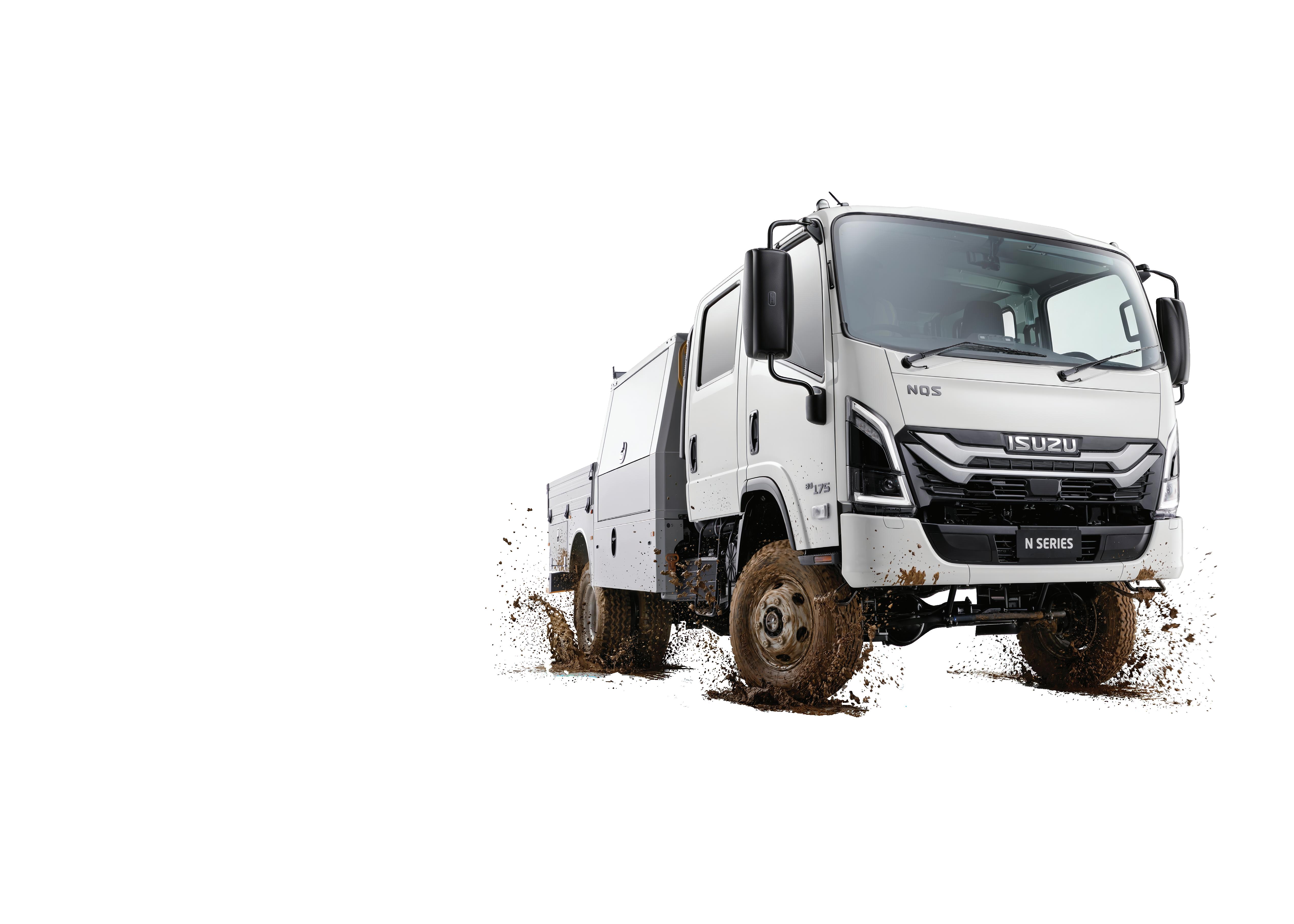
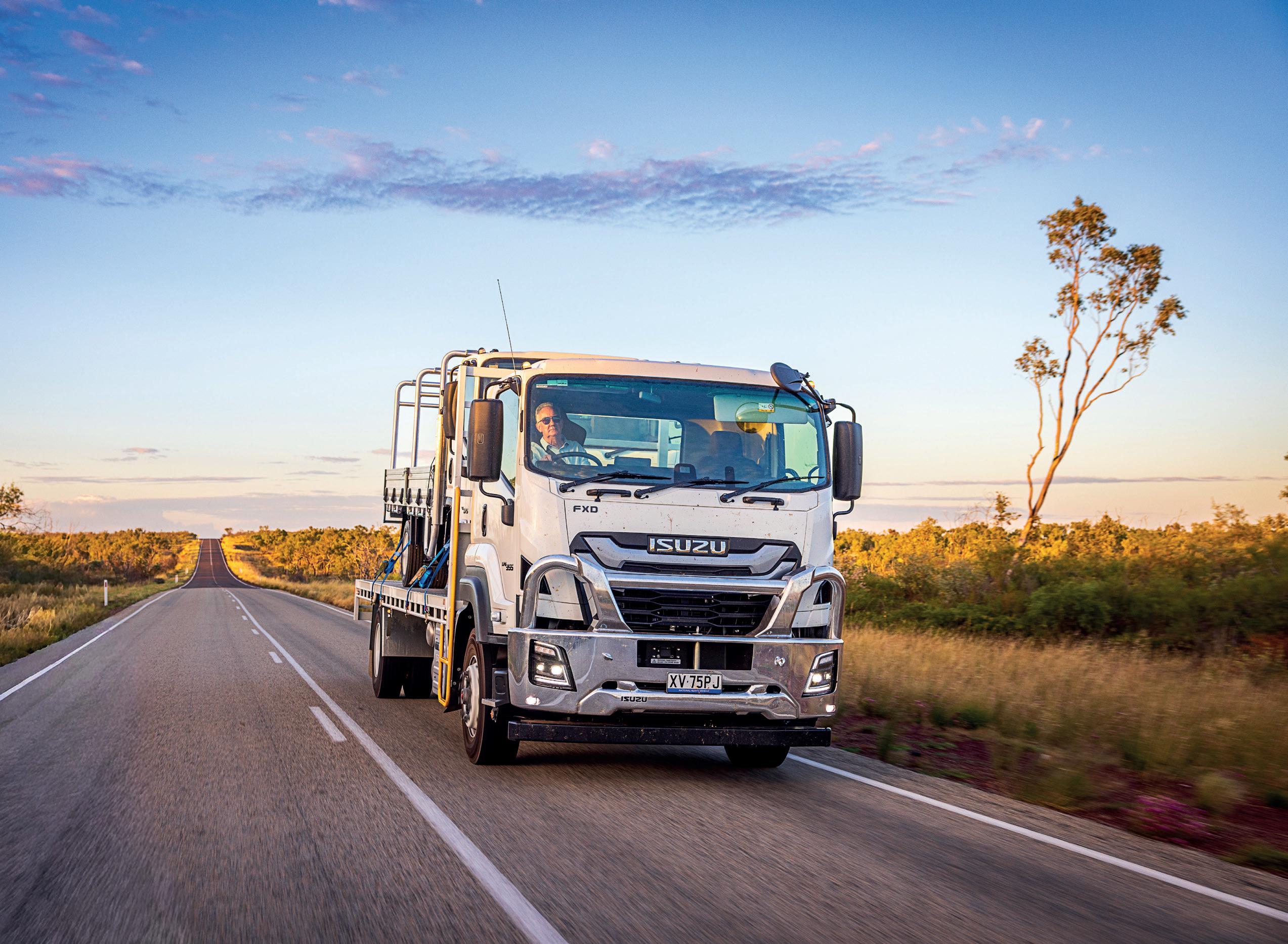
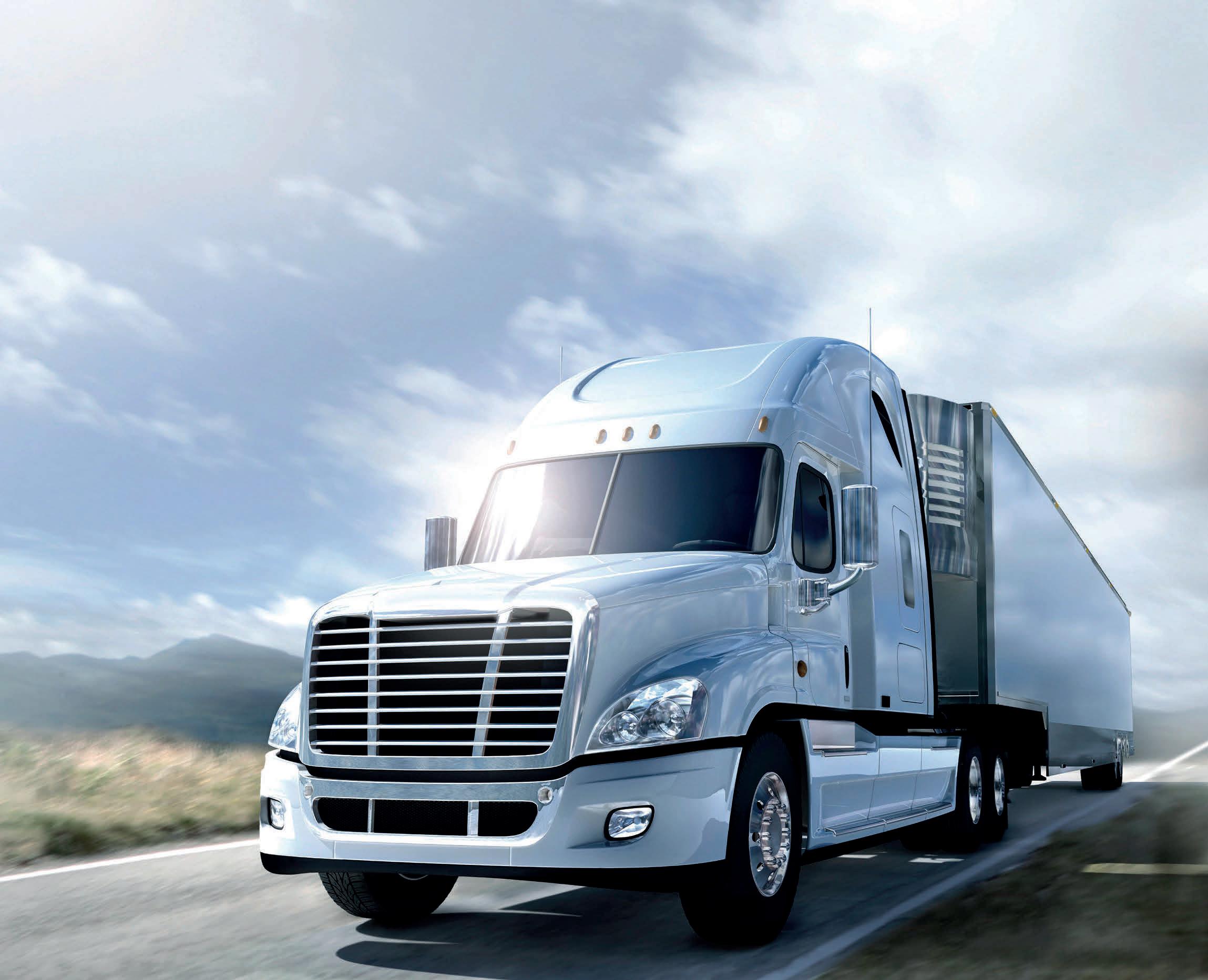
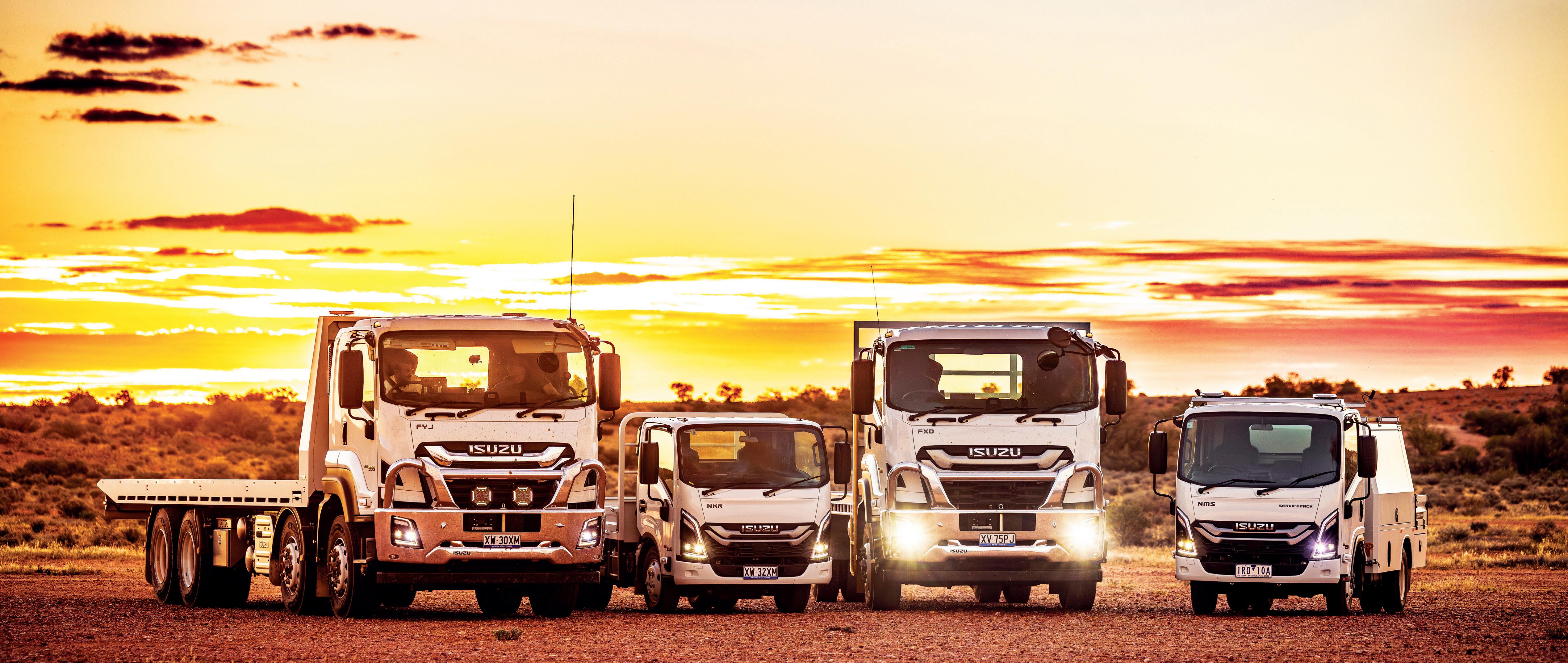
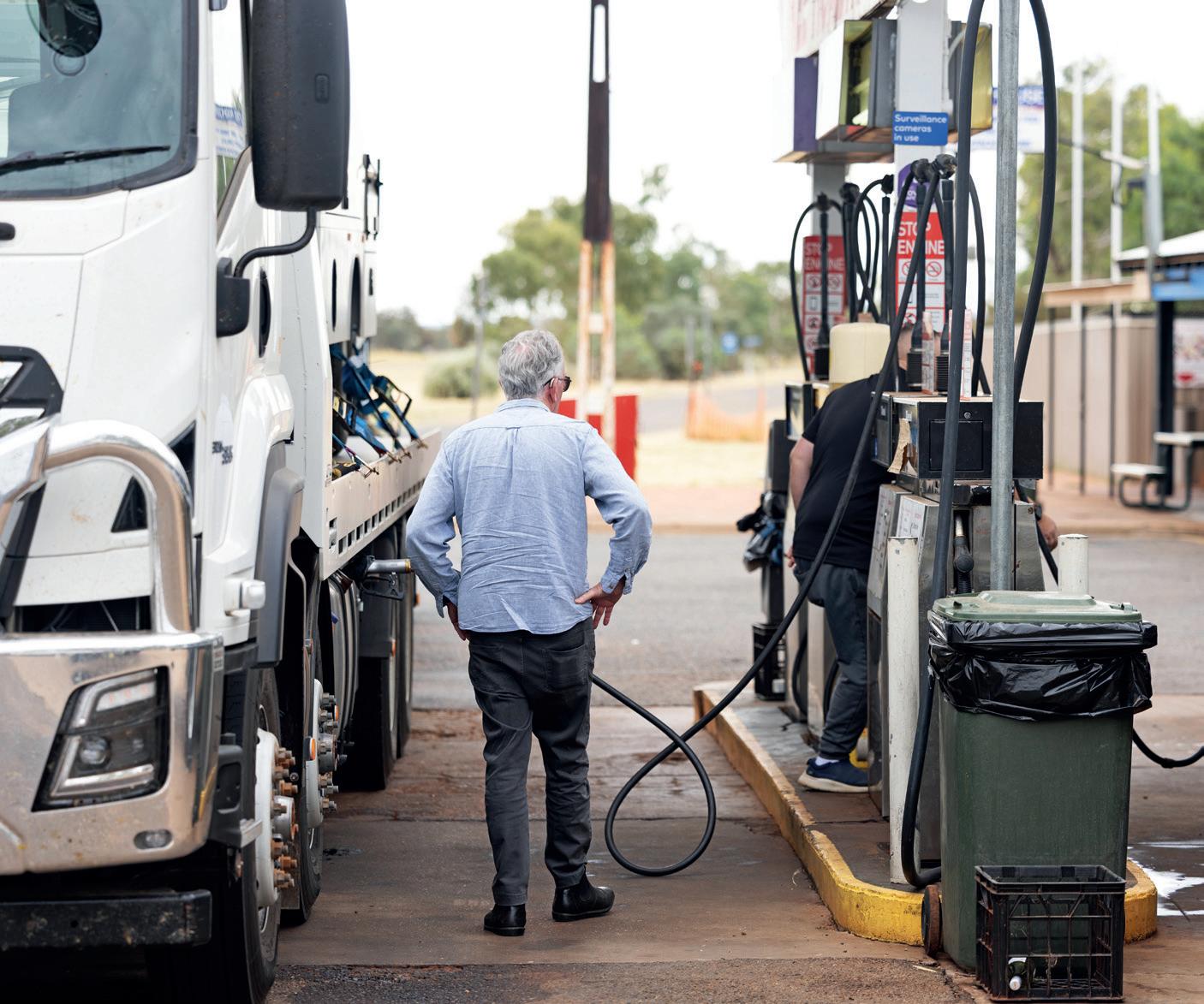
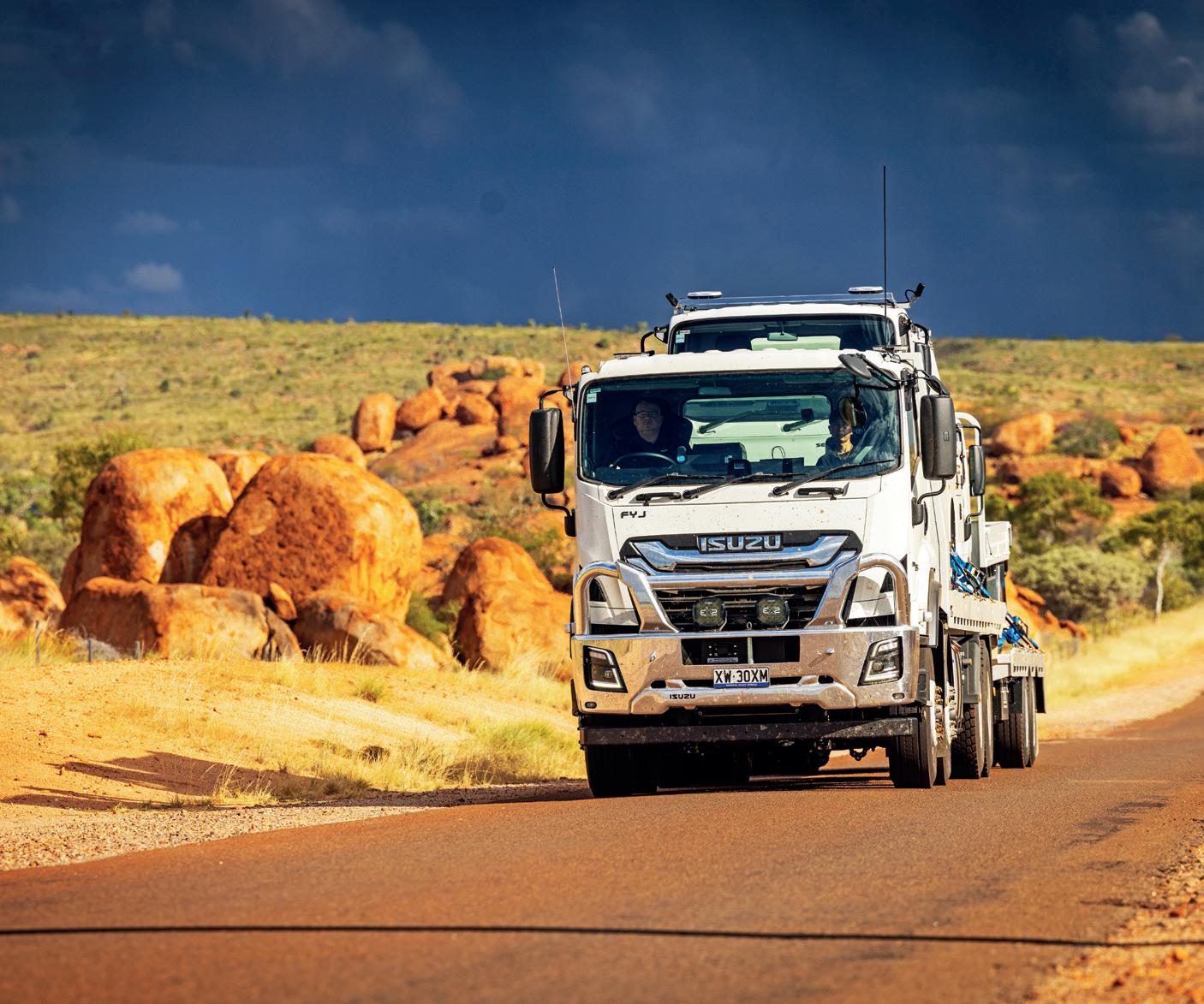
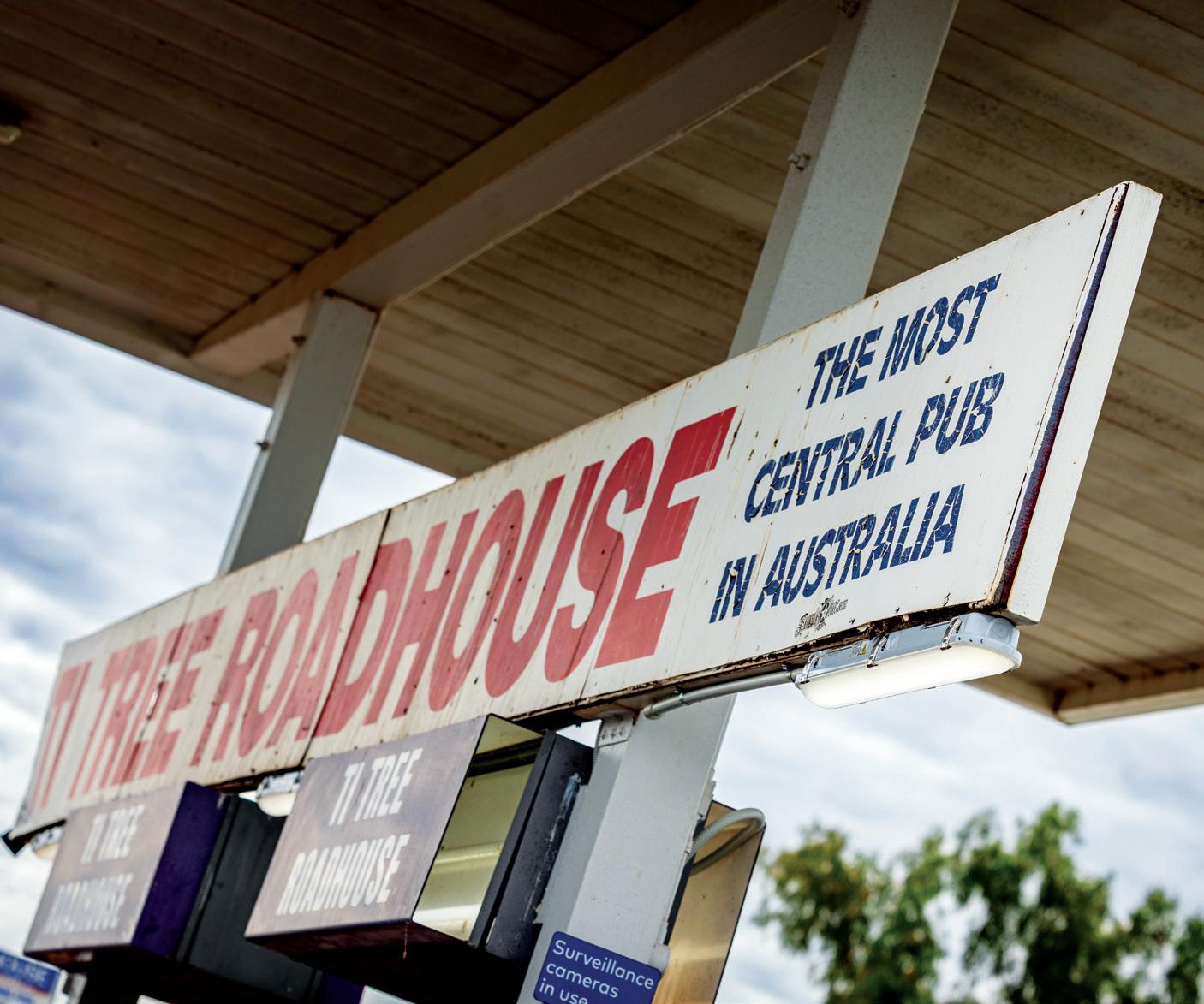
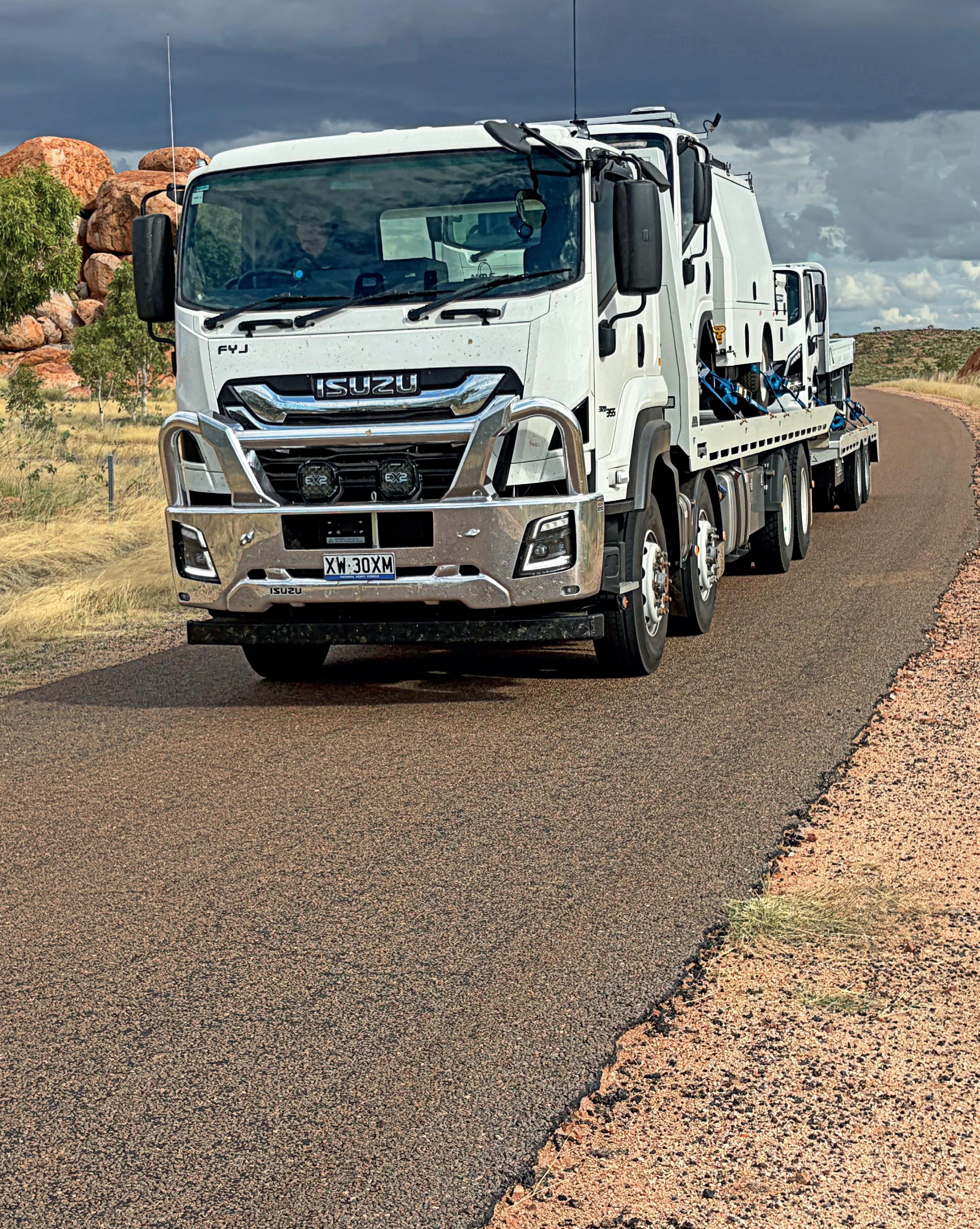
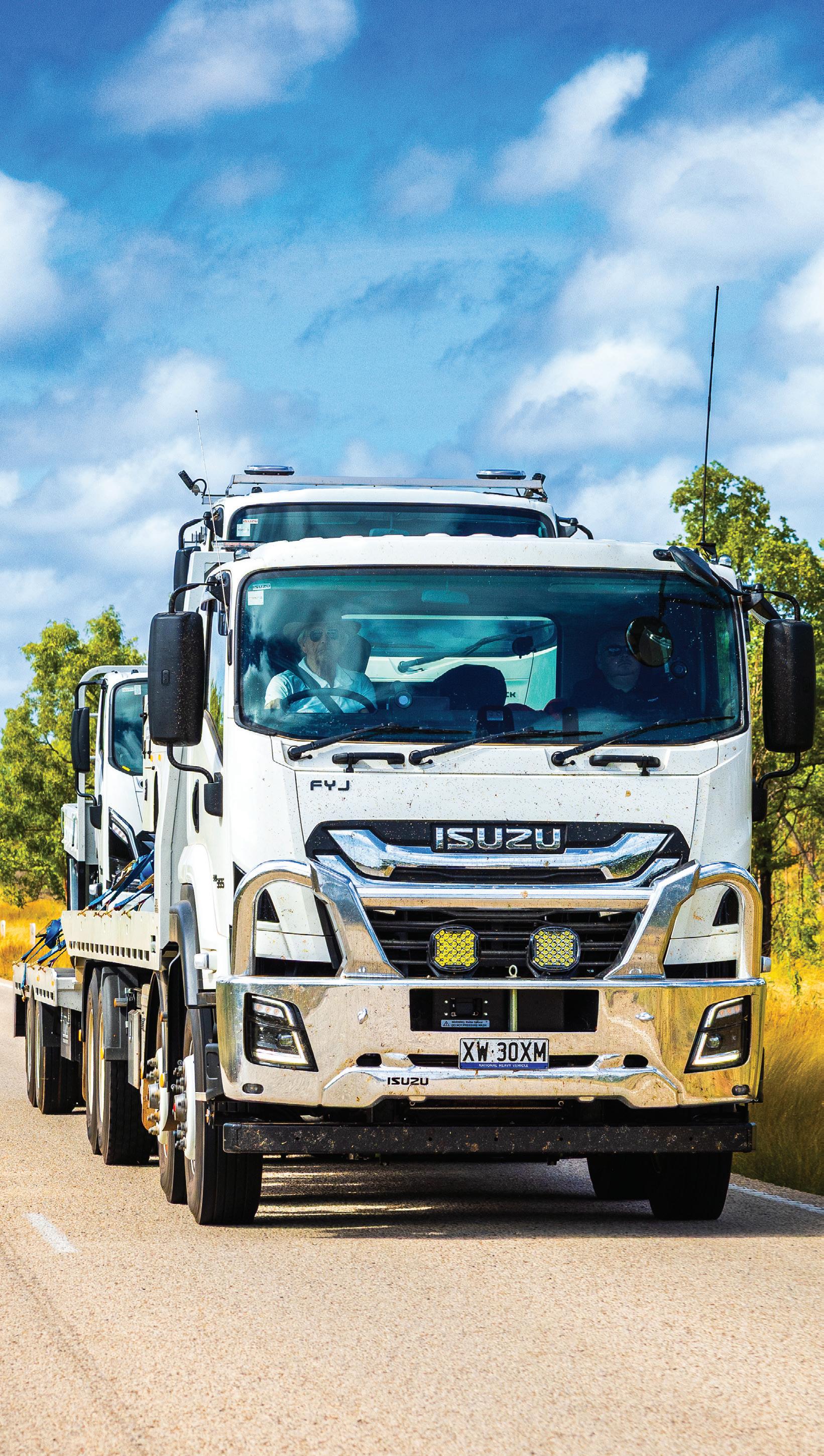
Get more from your 4x4 with Isuzu’s all-new range of off-road trucks. More protection, with a suite of safety features that breaks new ground in the category. More comfort, with an ISRI seat* that turns rough roads into smooth sailing. More performance with Isuzu’s latest turbocharged diesel engine. And more ease in every drive, with a 9-speed dual-clutch transmission on selected models. All backed by the Isuzu reliability you can trust when the going gets rough. It’s off-road trucking redefined.
Head to isuzu.com.au or visit your nearest Isuzu Trucks Dealer to find out more.
Trusted protection. Proven performance.
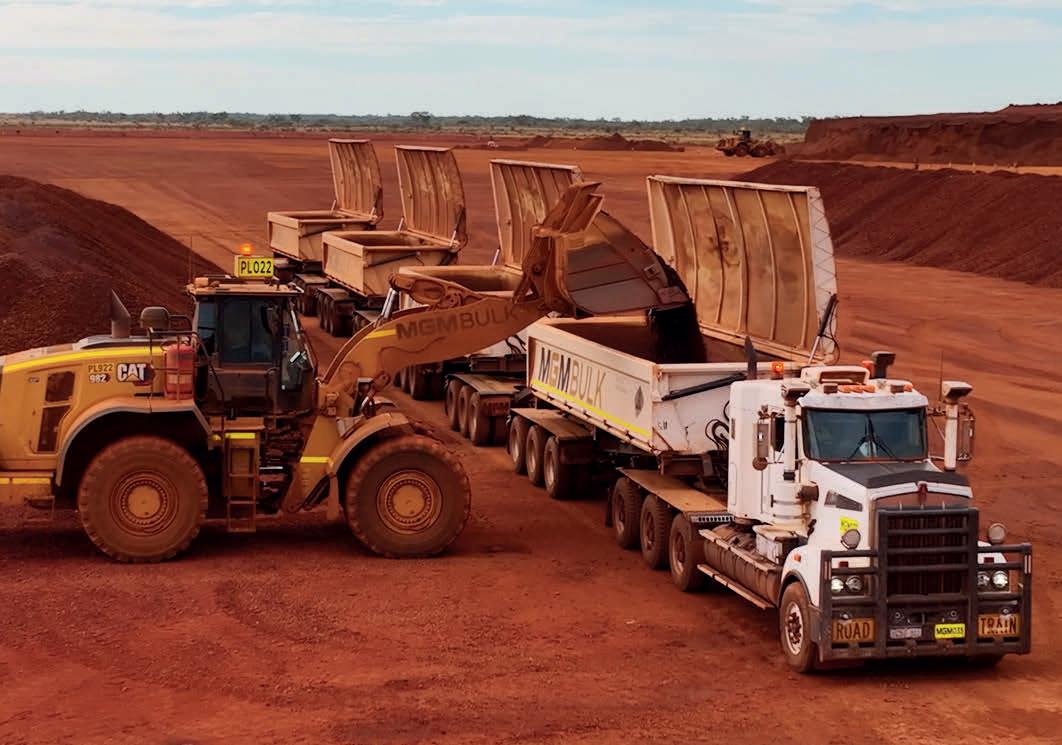
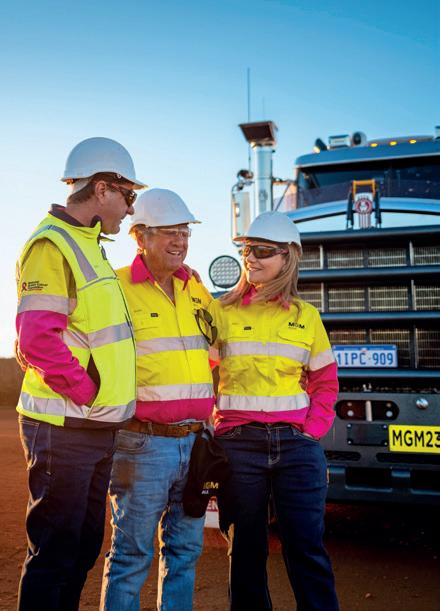
With a fleet of over 160 trucks and 550+ trailer configurations helping to export millions of tonnes of iron ore to the world MGM Bulk depends on Castrol oils, fluids, greases and advanced analytics to optimise performance and extend engine life, continuing to provide best in class service to their mining company customers - up and down Australia’s western seaboard.
Castrol - trusted no matter the challenge.
A critical link in Australia’s harshest conditions
In the remote reaches of Western Australia where temperatures soar, fine dust grinds through equipment and road trains endure relentless shock loads, the demands on heavy transport are unlike anywhere else on earth.
In these conditions, every minute of downtime is costly, and every operator must meet a higher standard. This is the environment MGM Bulk calls home, and where it has earned its reputation as a trusted link in Australia’s mining supply chain.
Keeping industries moving for 76 years
From a single truck to one of Australia’s largest privately owned bulk haulage fleets, the Giacci family has spent more than seven decades building the people, infrastructure and capability needed to support the mining and resources sector.
Today, MGM Bulk continues to build on that foundation, investing in the people, fleet and infrastructure that will help shape the future of bulk haulage in Australia.
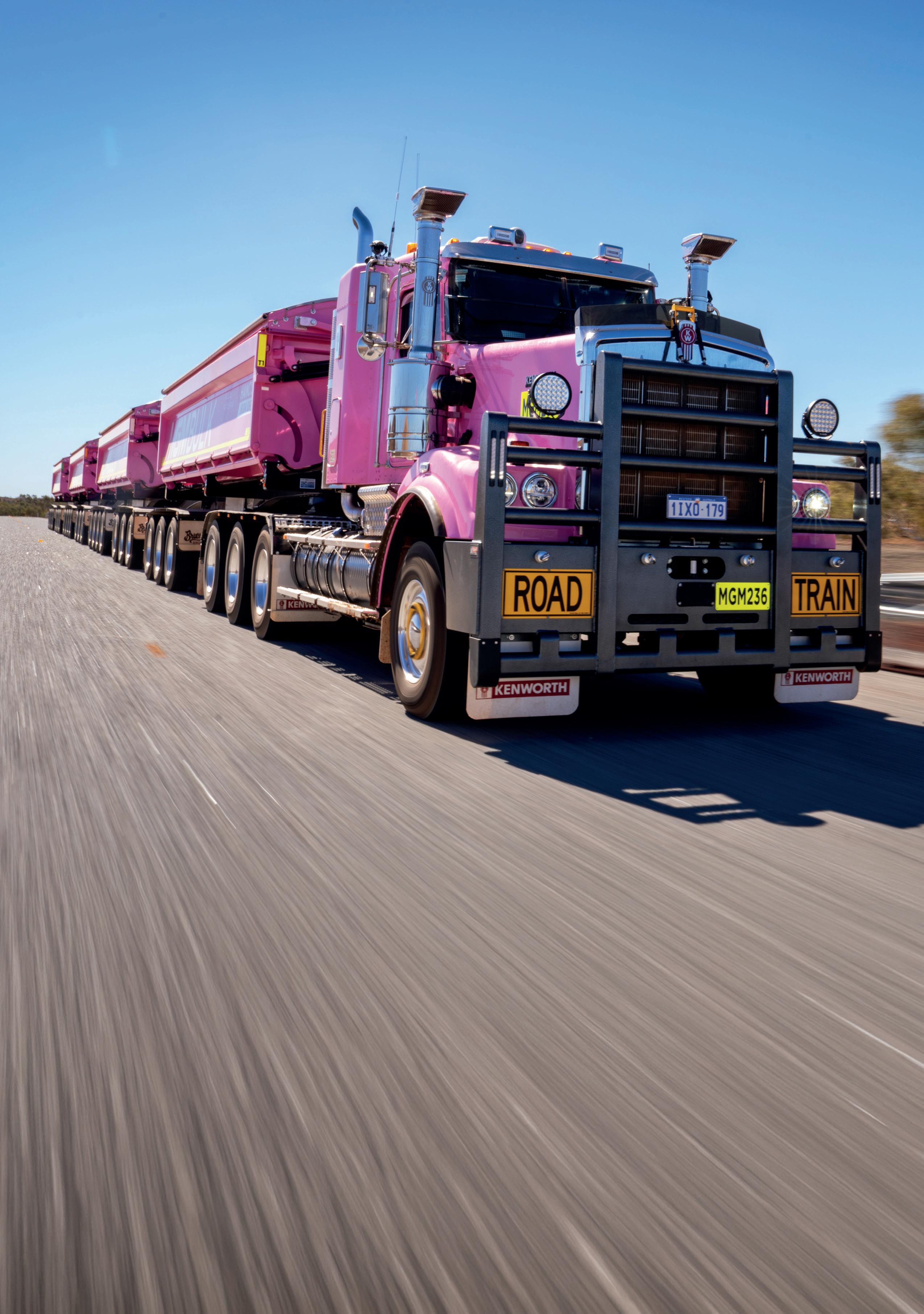
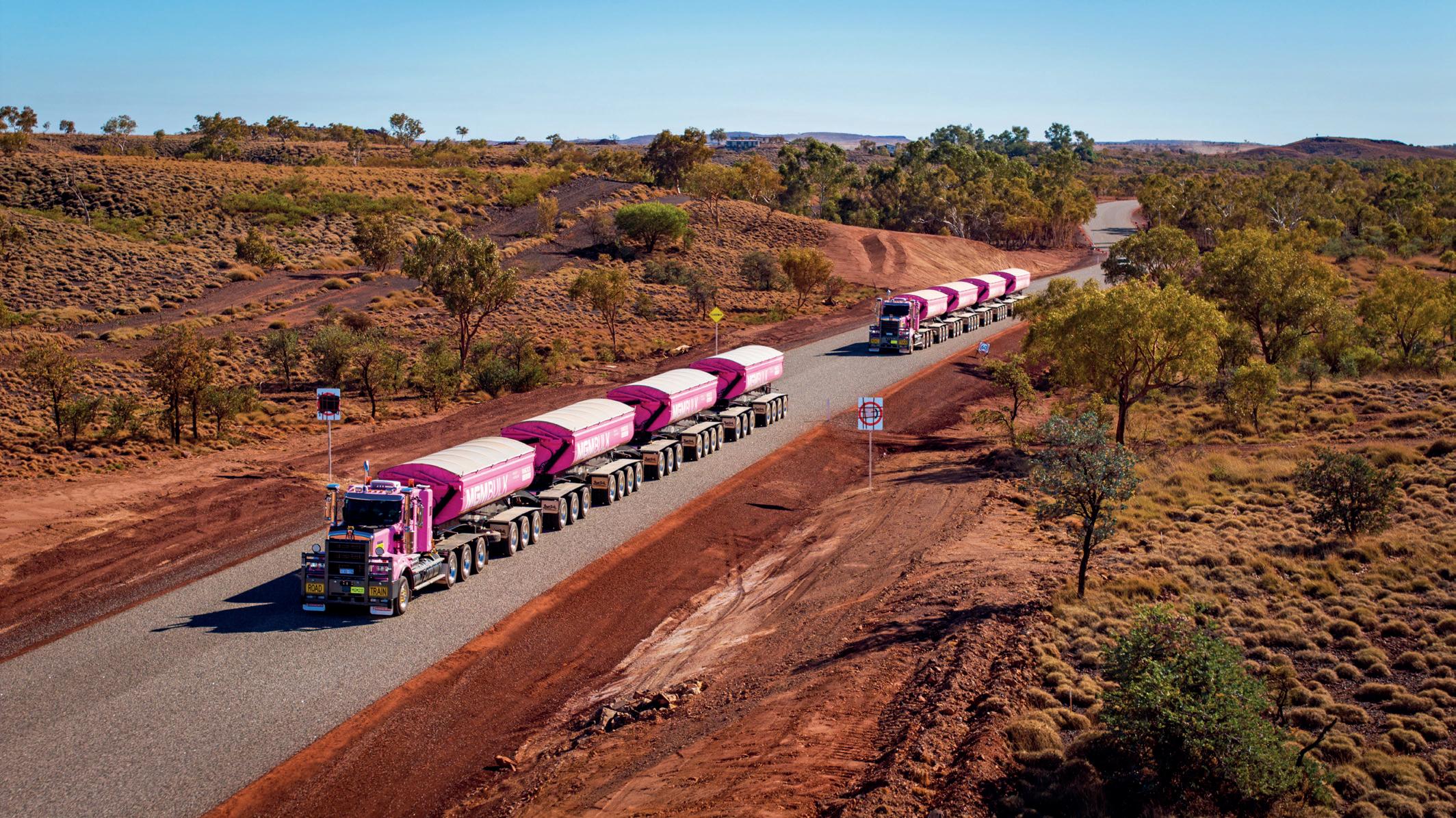
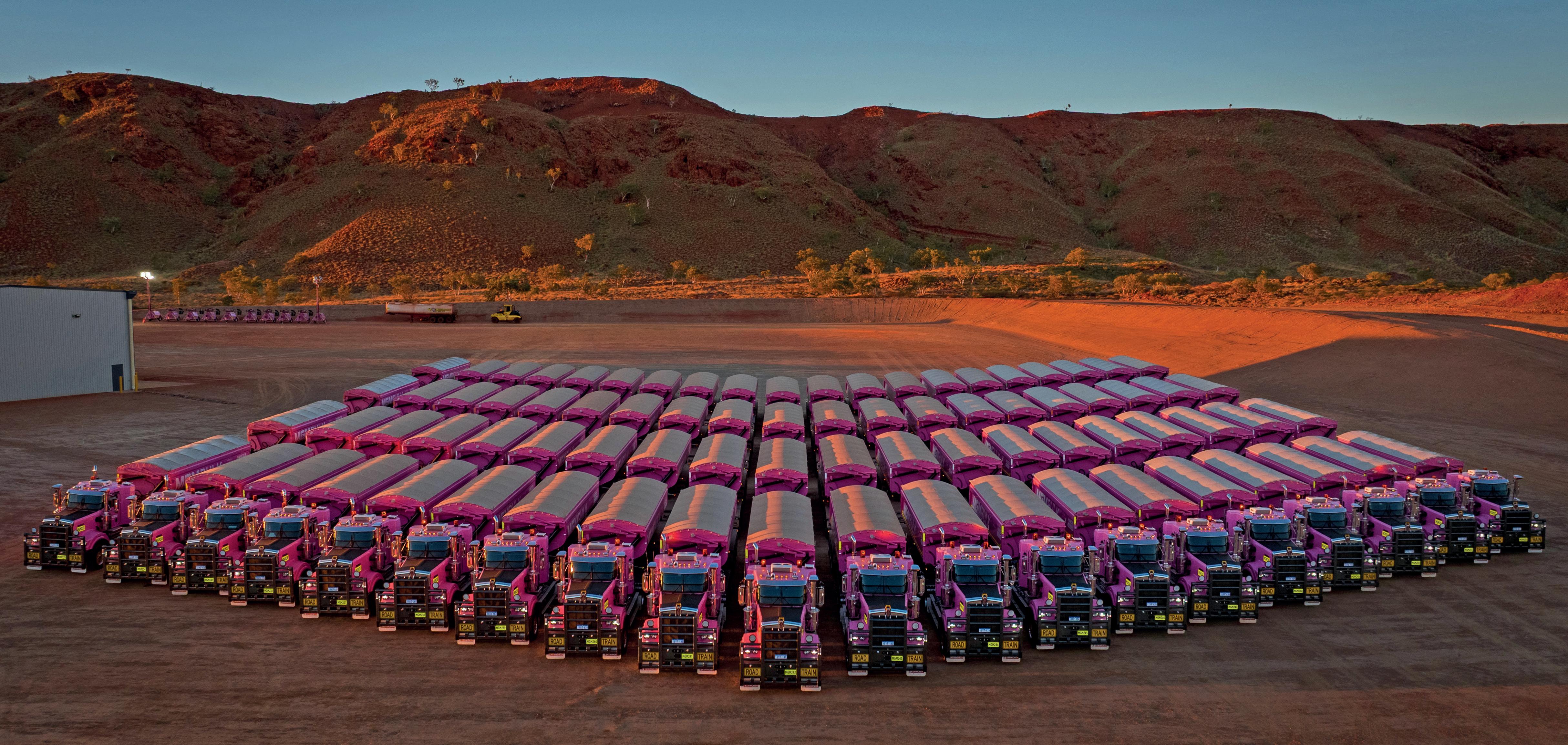
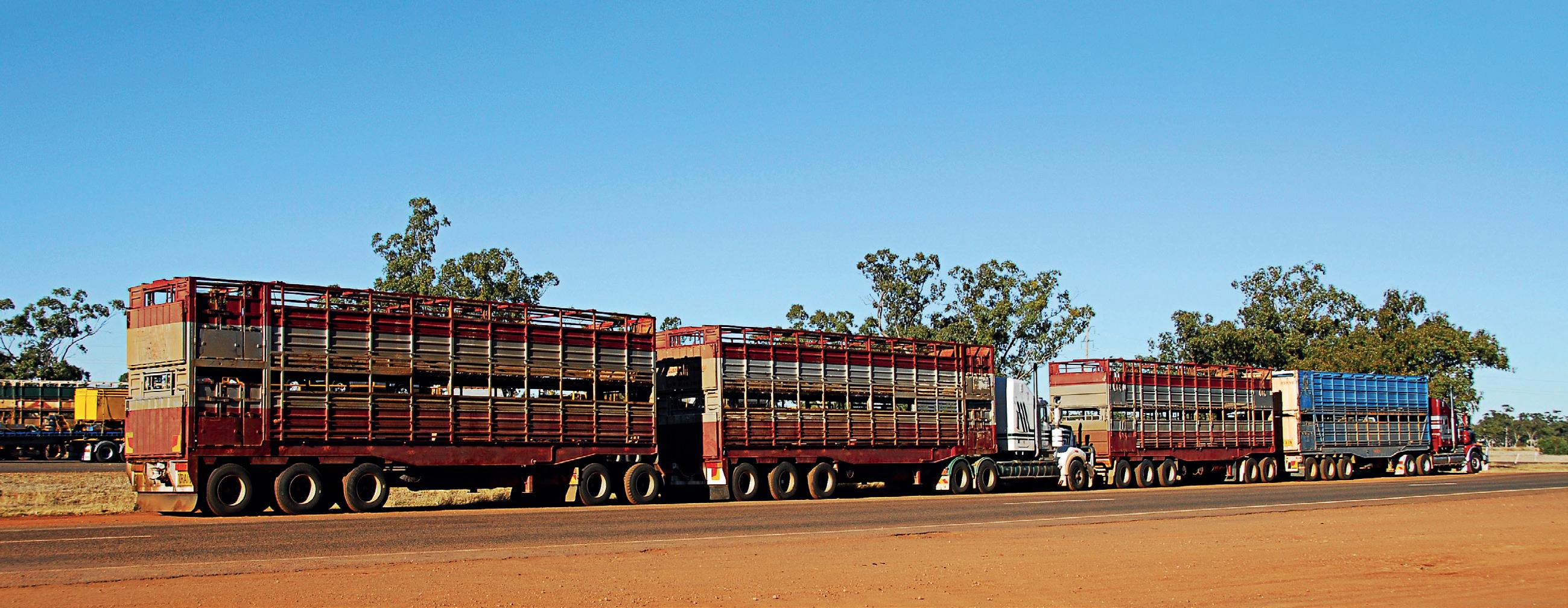
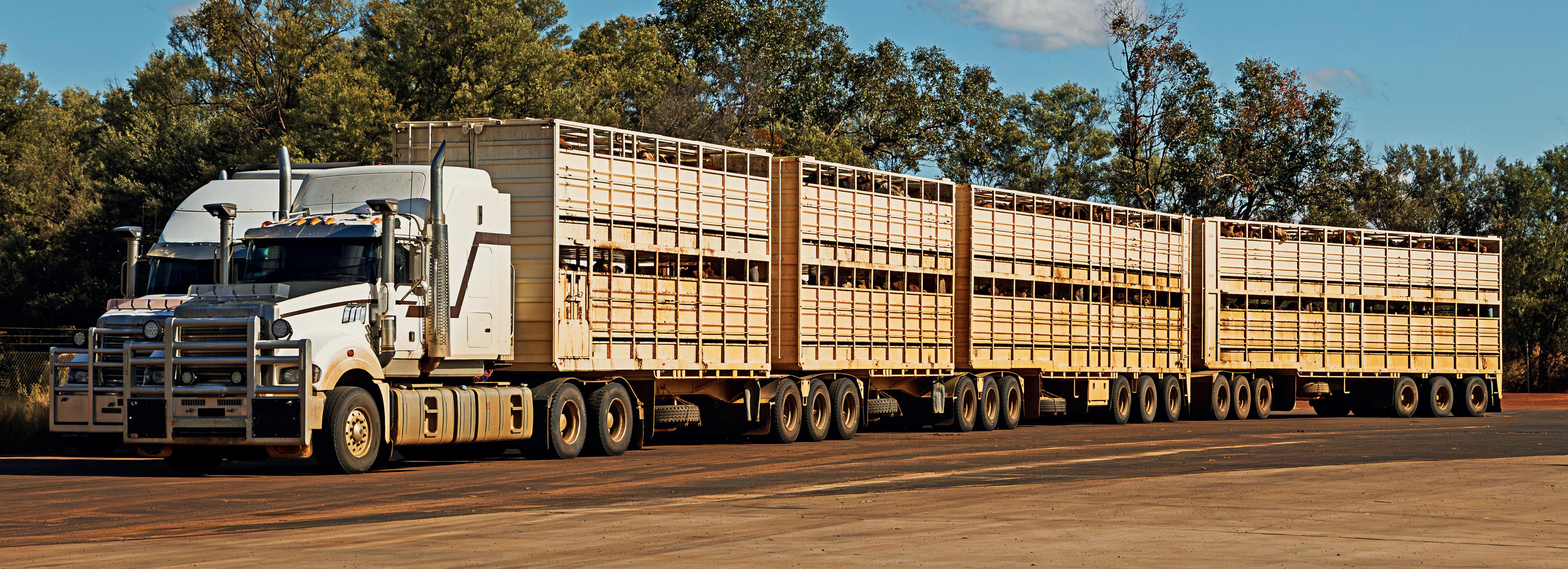
Established in 2014 by Mario, Giudi and Michael Giacci, and built on a foundation of work ethic and entrepreneurial acumen, MGM Bulk has grown into a powerhouse of Australian bulk haulage with hubs in Perth, Bunbury and the Pilbara. Today, the family-owned business runs more than 220 Kenworth trucks, including over 130 ultra-quad road trains stretching up to 60 metres from cab to tail, along with earthmoving equipment and heavy machinery.
CEO Michael Giacci says these giants service inland mine sites and haul loads through to the deep-water port at Port Hedland – 1700 kilometres north of Perth – moving millions of tonnes of iron ore and forming a vital link between remote operations and global markets.
Add to that, the 43,000 tonnes iron ore, lithium, spodumene, copper concentrate, activated carbon, methanol, mineral sands, timber, gravel, limestone and sand moved every day to support some of Australia’s most important mining and resource operations, and you begin to see why it’s a business that never sleeps.
“The company fleet puts roughly 20,000 wheels on the road at any given time, day or night,” Michael explains. “Every asset up north runs 24/7. The trucks will get turned on, and it won’t get turned off until 10 days later when they have hit roughly 20,000km’s and come in for service.”
With 113,000km travelled every day, and customers that depend on them, Michael says it’s a scale and intensity of work that demands absolute reliability.
And the Pilbara only amplifies the challenge. “It’s not for everyone,” he says. “The place is extremely hot and humid. It’s testing and challenging. It’s extreme.”
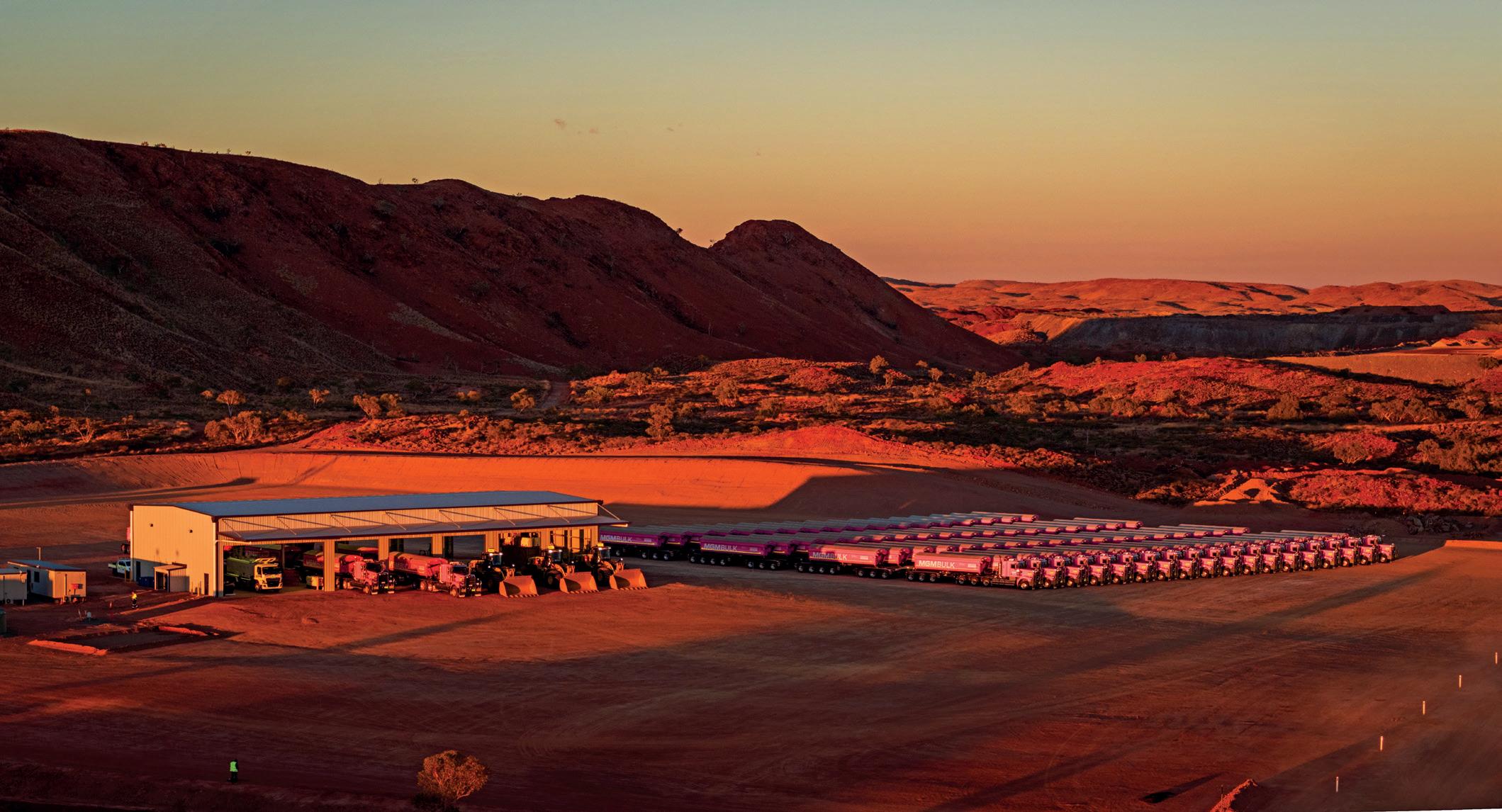
In conditions this tough, the MGM Bulk operation is built on uptime, major infrastructure investment and a relentless drive to perform. Central to that capability is MGM Bulk’s state-of-the-art Port Hedland workshop, which operates around the clock and has the capacity to grow as the business expands.
Keeping the chain unbroken means expecting more from every supplier and working with partners that match MGM Bulk’s pace, standards and commitment.
A relationship built on reliability and performance
Castrol plays an important and trusted role within the MGM Bulk fleet, with factory fill products engineered to withstand the Pilbara’s punishing conditions.
Workshop Manager Doug Forest says Castrol delivers a real commercial benefit. “By optimising engine performance and extending oil life in conditions that would challenge lesser products, Castrol VECTON directly contributes to MGM Bulk’s bottom line.”
This advantage is significant in an operation where every service stop represents both cost and lost productivity.
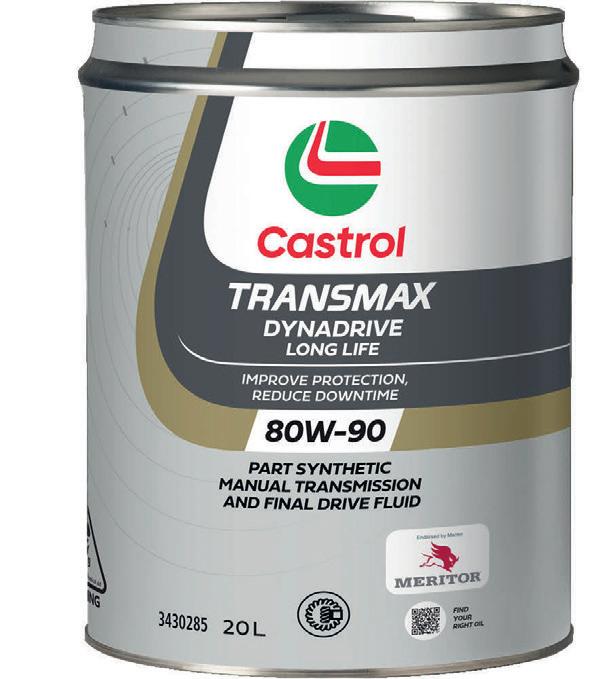
But engine oil is only part of the story. With ultra-quad road trains placing enormous strain on driveline components, Castrol Dynadrive delivers extreme pressure and thermal protection to keep transmissions and final drives performing in punishing terrain and under loads of up to 210 tonnes.
Castrol Radicool coolants also help maintain optimal engine temperatures, while Castrol Premium Heavy-Duty Grease protects lubrication points from the relentless onslaught of Pilbara dust.
What truly distinguishes the partnership, Forest points out, is the depth of support behind the products. Castrol provides diagnostics, oil analysis, logistics expertise and global engineering insight, identifying wear patterns, informing maintenance regimes, and helping MGM Bulk stay ahead of potential issues.
“In a region where supply chain disruptions can cascade rapidly into operational crises, that reliability is non-negotiable,” Forest says.
Driving the future of haulage
As MGM Bulk looks to grow its fleet and position itself as Australia’s most innovative bulk haulage business, it depends on partners that can support the intensity of daily operations and scale with it over time.
Castrol continues to play a quiet but crucial role, providing the support MGM Bulk depends on today and the capability it will need tomorrow, to help keep a vital part of Australia’s economy moving.
MEET THE TEAM
Australia’s leading truck magazine, Prime Mover, continues to invest more in its products and showcases a deep pool of editorial talent with a unique mix of experience and knowledge.
Christine Clancy | CEO
With more than two decades of experience as a media professional, Christine has worked in newsrooms across Canada, Vietnam and Australia. She joined the Prime Creative Media team 12 years ago, and today oversees more than 43 titles, including a dozen print and digital transportation titles. She continues to lead a team that focuses on continuous improvement to deliver quality insights that helps the commercial road transport industry grow.
Paul Lancaster | Editor
Paul joined Prime Creative Media as an editor in March 2025 and has enjoyed a broad career spanning over 20 years across different sectors, including law, journalism and marketing in Australia and internationally. He gets great satisfaction from creating targeted content that appeals to wide ranging audiences. Paul says this comes from listening to industry members, businesspeople and the broader community.
Peter Shields | Senior Feature Writer
A seasoned transport industry professional, Peter has spent two decades in the transport media sector. Starting out as a heavy vehicle mechanic, he managed a fuel tanker eet and held a range of senior marketing and management positions in the oil and chemicals industry before becoming a nationally acclaimed transport journalist.
CEO Christine Clancy christine.clancy@primecreative.com.au
Editor Paul Lancaster paul.lancaster@primecreative.com.au
Managing Editor, Luke Applebee Transport Group luke.applebee@primecreative.com.au
Senior Feature Peter Shields Writer peter.shields@primecreative.com.au
Business Ashley Blachford Development ashley.blachford@primecreative.com.au Manager 0425 699 819
Head of Design Clayton Hawley clayton.hawley@primecreative.com.au
Design Jacqueline Buckmaster, Danielle Harris
Client Success Ben Sammartino Manager ben sammartino@primecreative.com.au
Head Of ce 379 Docklands Drive, Docklands VIC 3008 info@primecreative.com.au
Ashley Blachford | Business Development Manager
Handling placements for Prime Mover magazine, Ashley has a unique perspective on the world of truck building both domestically and internationally. Focused on delivering the best results for advertisers, Ashley works closely with the editorial team to ensure the best integration of brand messaging across both print and digital platforms.
Peter White | Contributor
Since completing a Bachelor of Media and Communication degree at La Trobe University in 2021, Peter has obtained valuable newsroom experience, supplemented by direct industry exposure at Prime Creative Media. As the Editor of Trailer, Peter brings a fresh perspective to Prime Mover. He has a strong interest in commercial road transport and in furthering the magazine’s goal of growing the industry.
Subscriptions
03 9690 8766 subscriptions@primecreative.com.au
Prime Mover magazine is available by subscription from the publisher. The right of refusal is reserved by the publisher.
Annual rates: AUS $110.00 (inc GST). For overseas subscriptions, airmail postage should be added to the subscription rate.
Articles
All articles submitted for publication become the property of the publisher. The Editor reserves the right to adjust any article to conform with the magazine format.
Copyright PRIME MOVER magazine is owned and published by Prime Creative Media. All material in PRIME MOVER magazine is copyright and no part may be reproduced or copied in any form or by any means (graphic, electronic or mechanical including information and retrieval systems) without written permission of the publisher.
The Editor welcomes contributions but reserves the right to accept or reject any material.
While every effort has been made to ensure the accuracy of information
Prime Creative Media will not accept responsibility for errors or omissions or for any consequences arising from reliance on information published. The opinions expressed in PRIME MOVER magazine are not necessarily the opinions of, or endorsed by the publisher unless otherwise stated.
THAT’S ANOTHER HINO
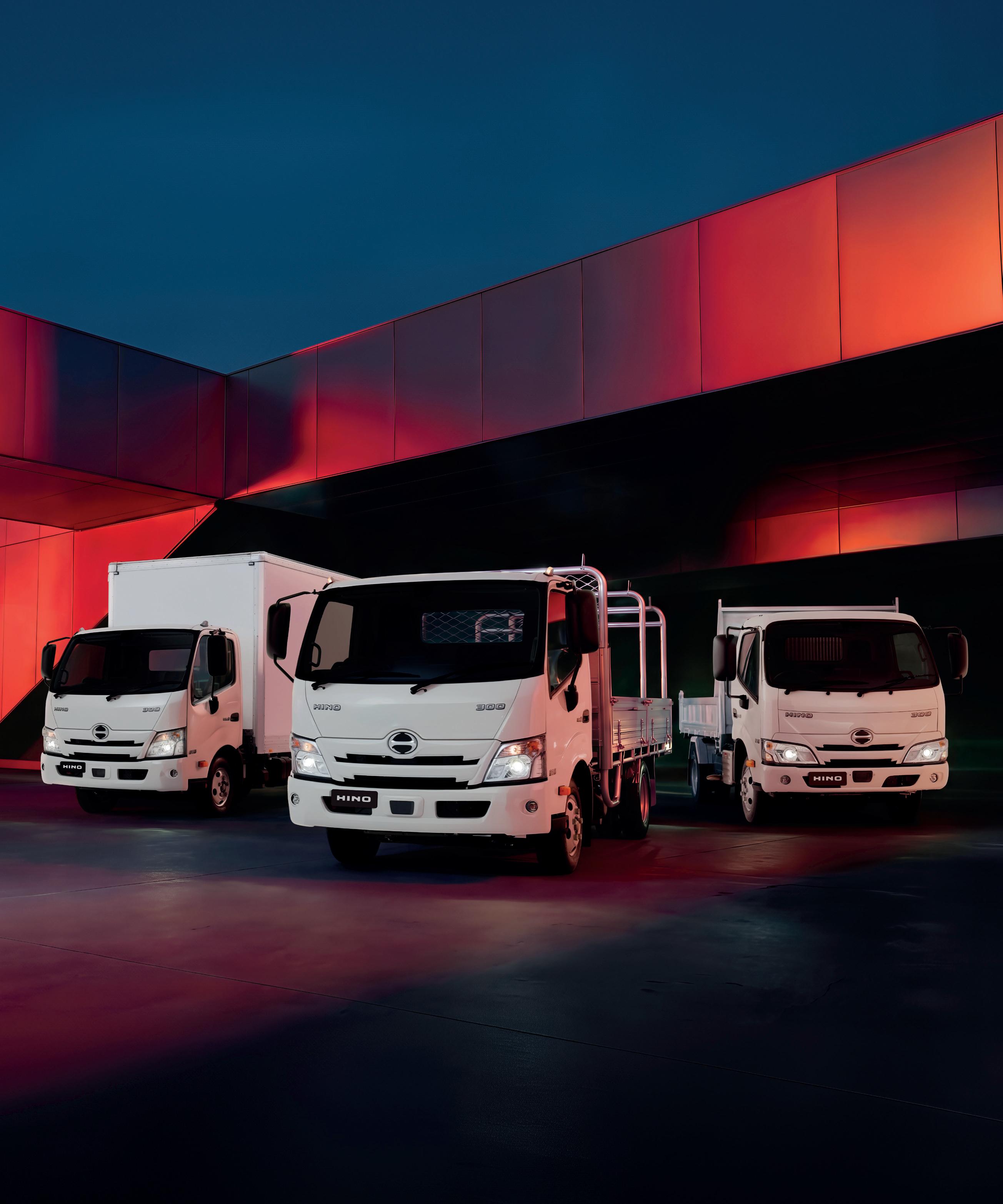
THE 2026 HINO 300 SERIES. ENHANCED CONTROL. ENHANCED VISIBILITY. SAME TRUSTED PERFORMANCE.
Engineered for businesses that demand exceptional performance, dependable reliability and long-term durability. Now with enhanced control and visibility, it delivers a safer, smoother and more confident drive in all conditions. With proven drivelines, a true automatic transmission delivering effortless operation, advanced Hino SmartSafe safety features, and the support of Hino Advantage, the Hino 300 Series is built to handle the toughest workloads, day in and day out. Find out more at hino.com.au
COVER STORY
“We go through an incredible amount of fuel daily, so the one or two per cent we can save here and there, we will take that. We spec our gear ratio for the application.”
Prime Feature STORIES TRAVELLIN’ NORTH 50
FLEET FOCUS
28 First Nations Driver
From a childhood in Frankston to a career in corporate advisory and consulting, this Indigenous entrepreneur never imagined his future lay behind the wheel of Australia’s transport industry.
34 Cream of the Crop
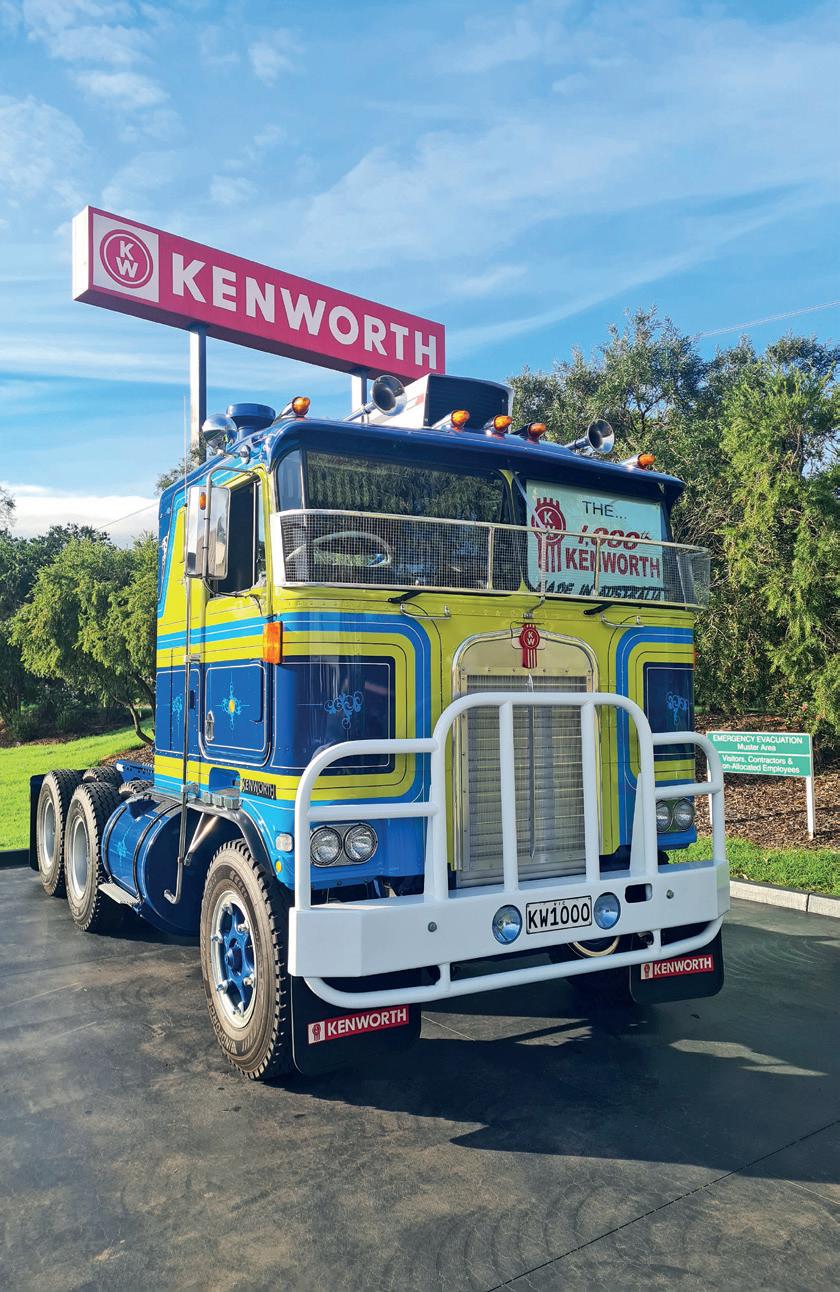
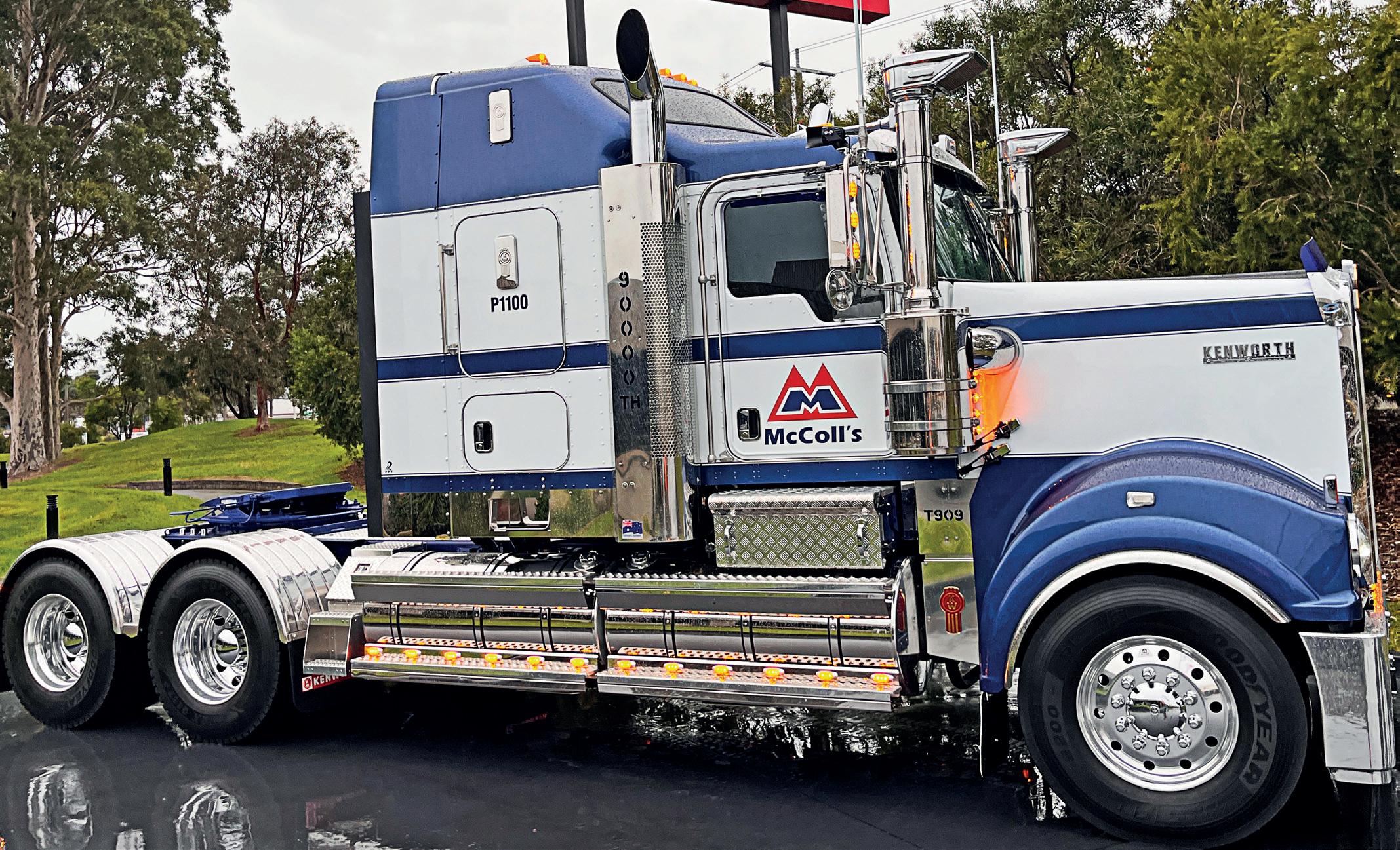
McColl’s Transport has taken delivery of the 90,000th Kenworth truck built in Australia which reinforces a partnership that spans decades.
TRUCK & TECH
40 Preserving Capital
As refrigerated transport operators reassess how they invest for growth, long-term fleet strategy is equally important as the equipment itself, according to Eurocold.
46 Moving on Up
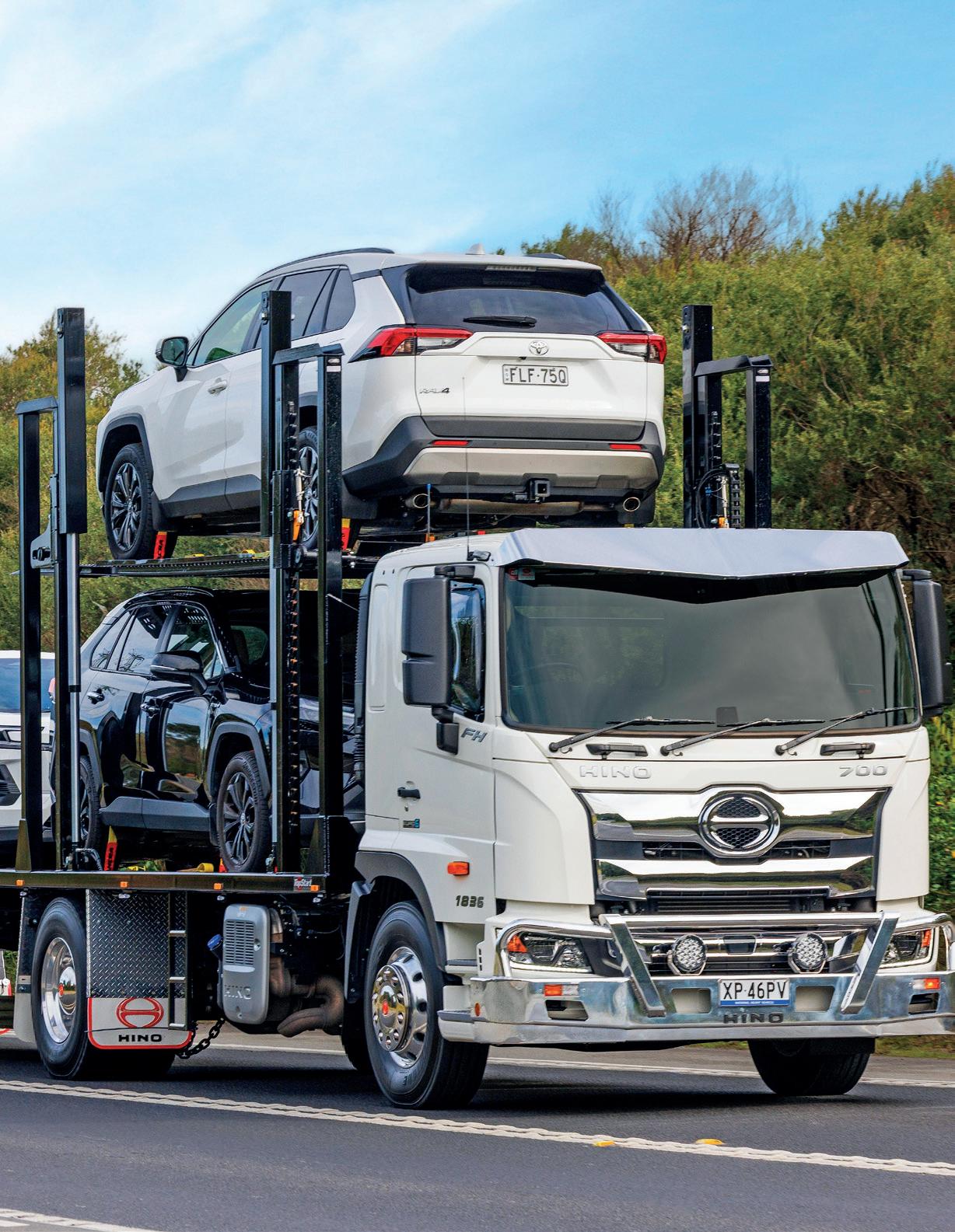
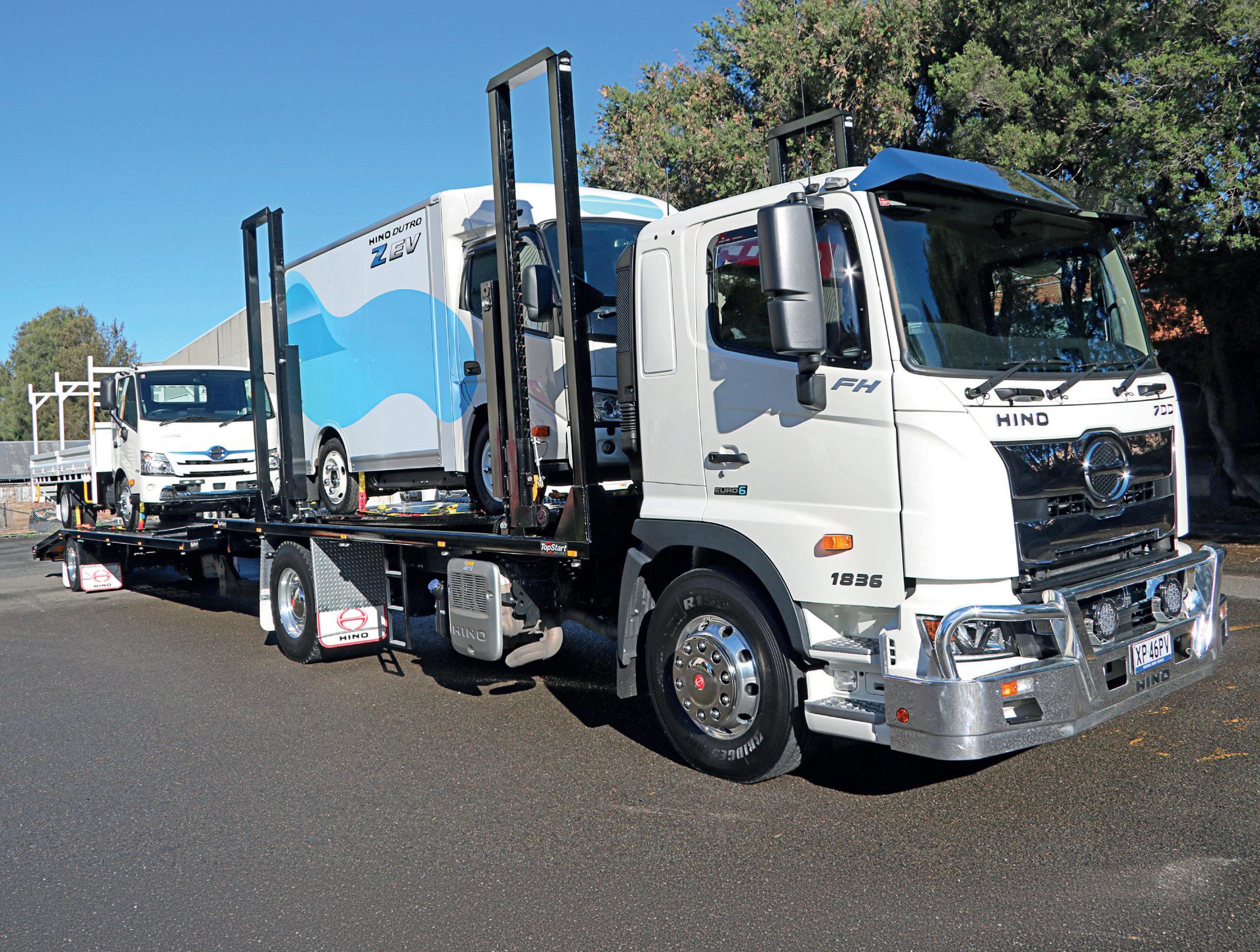
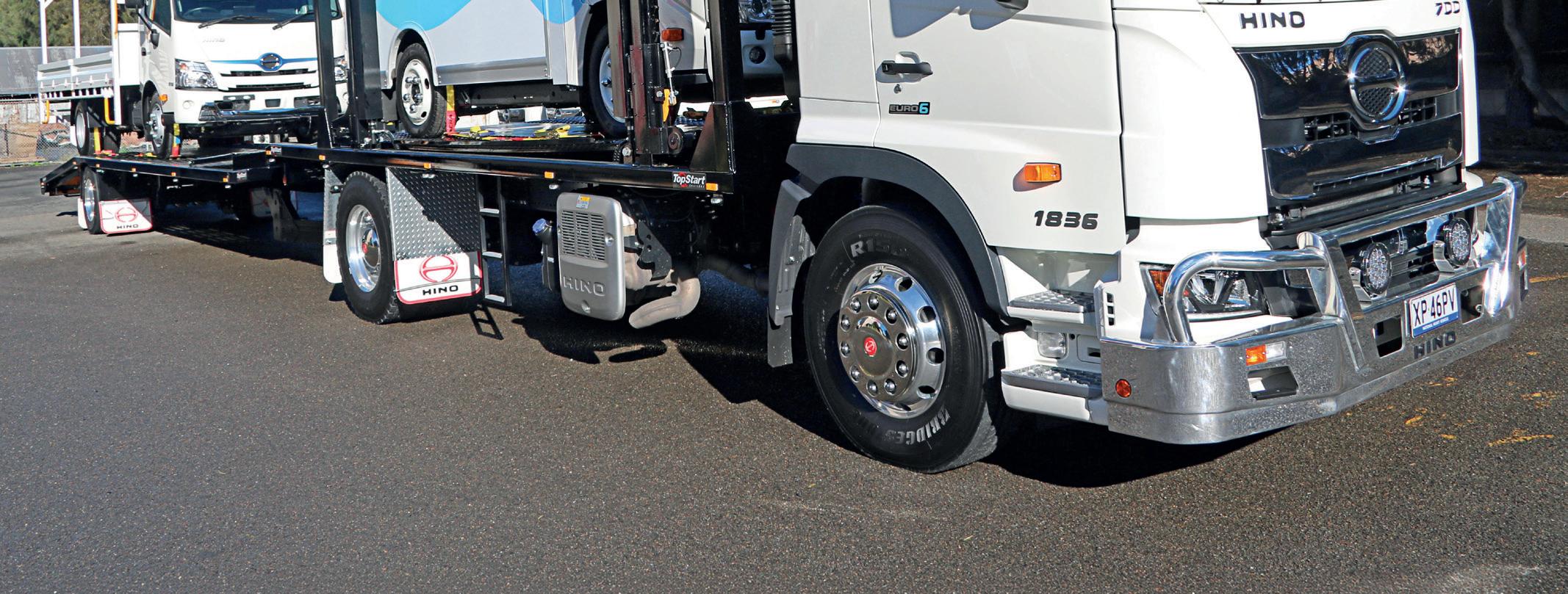
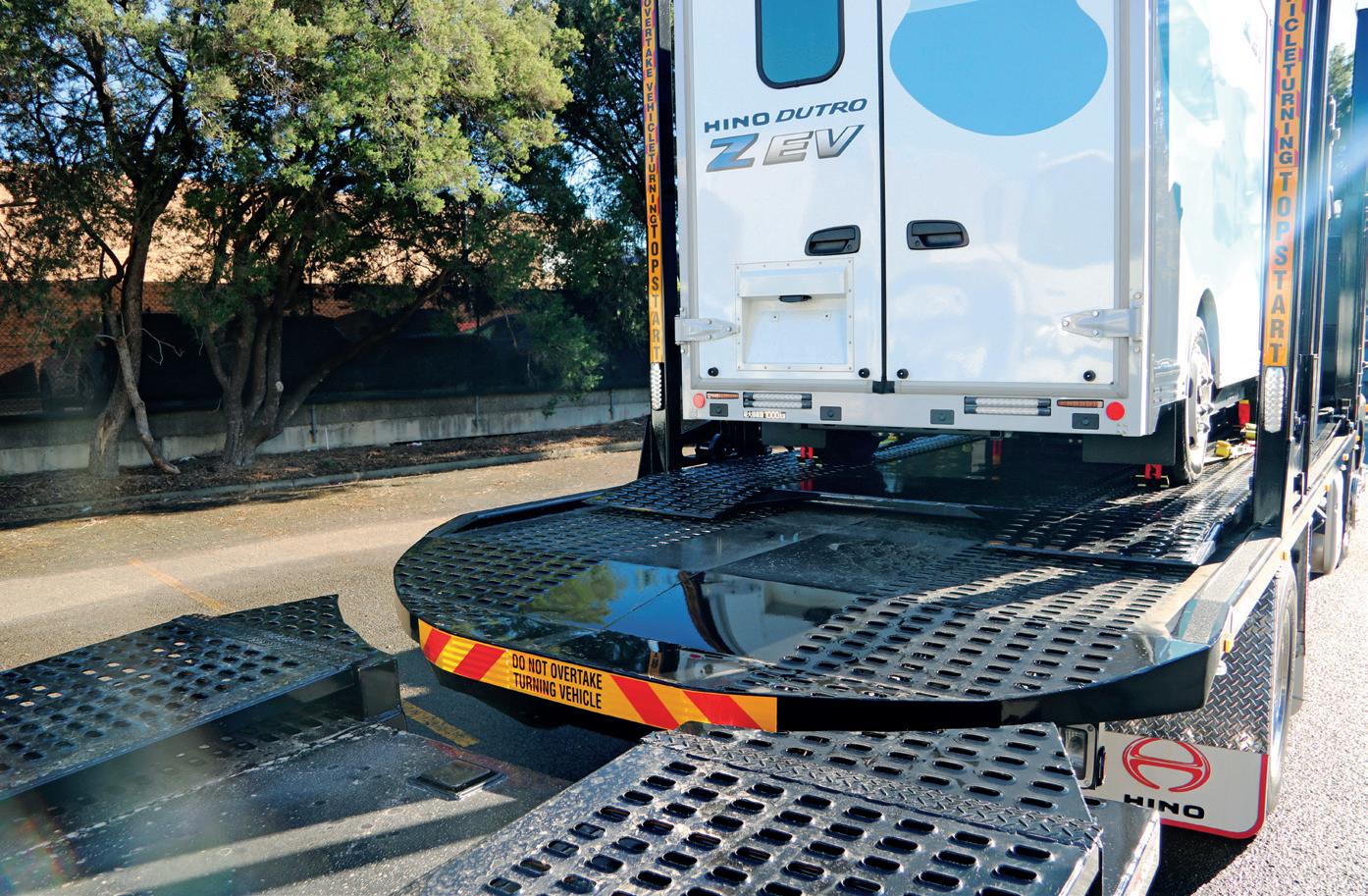
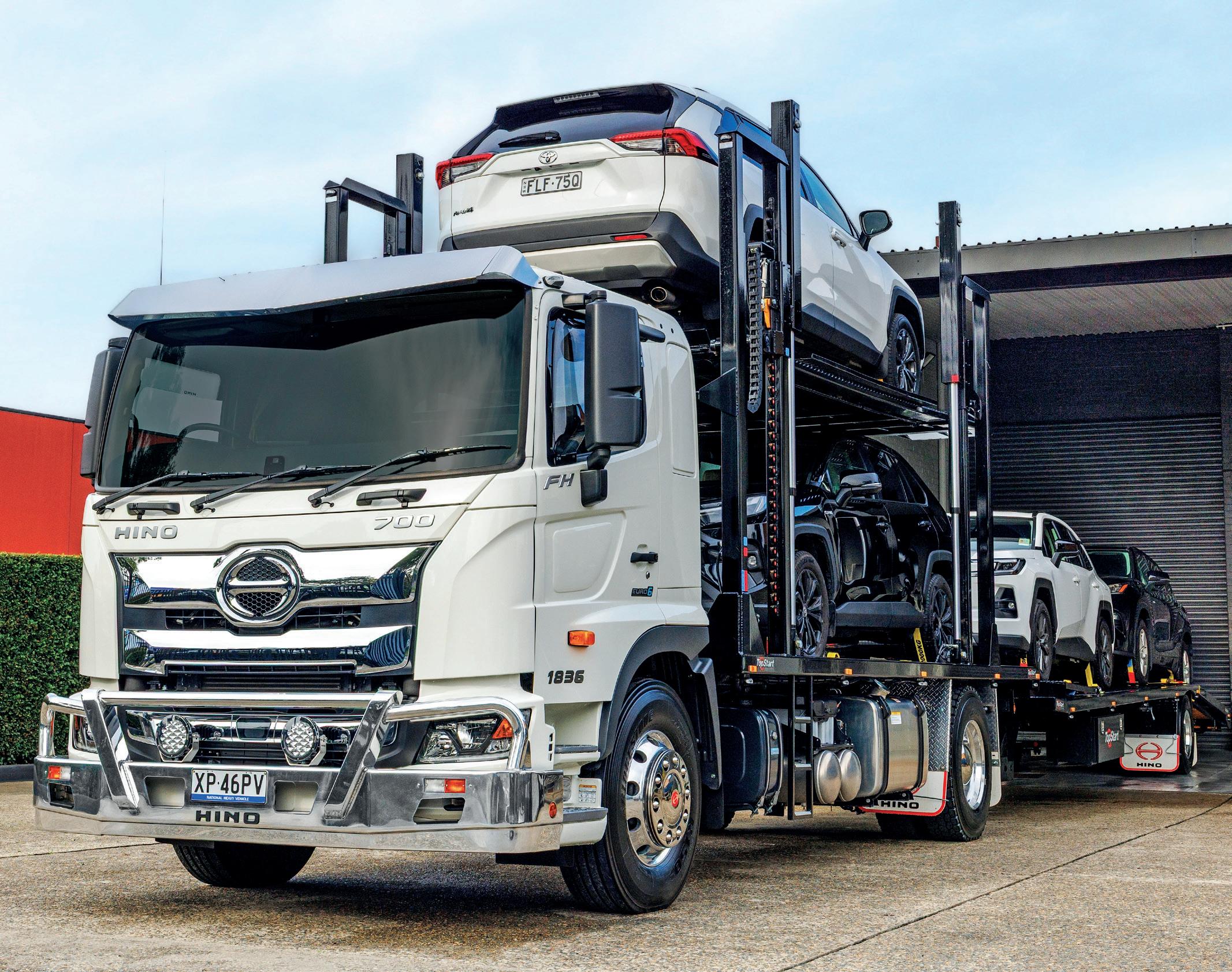
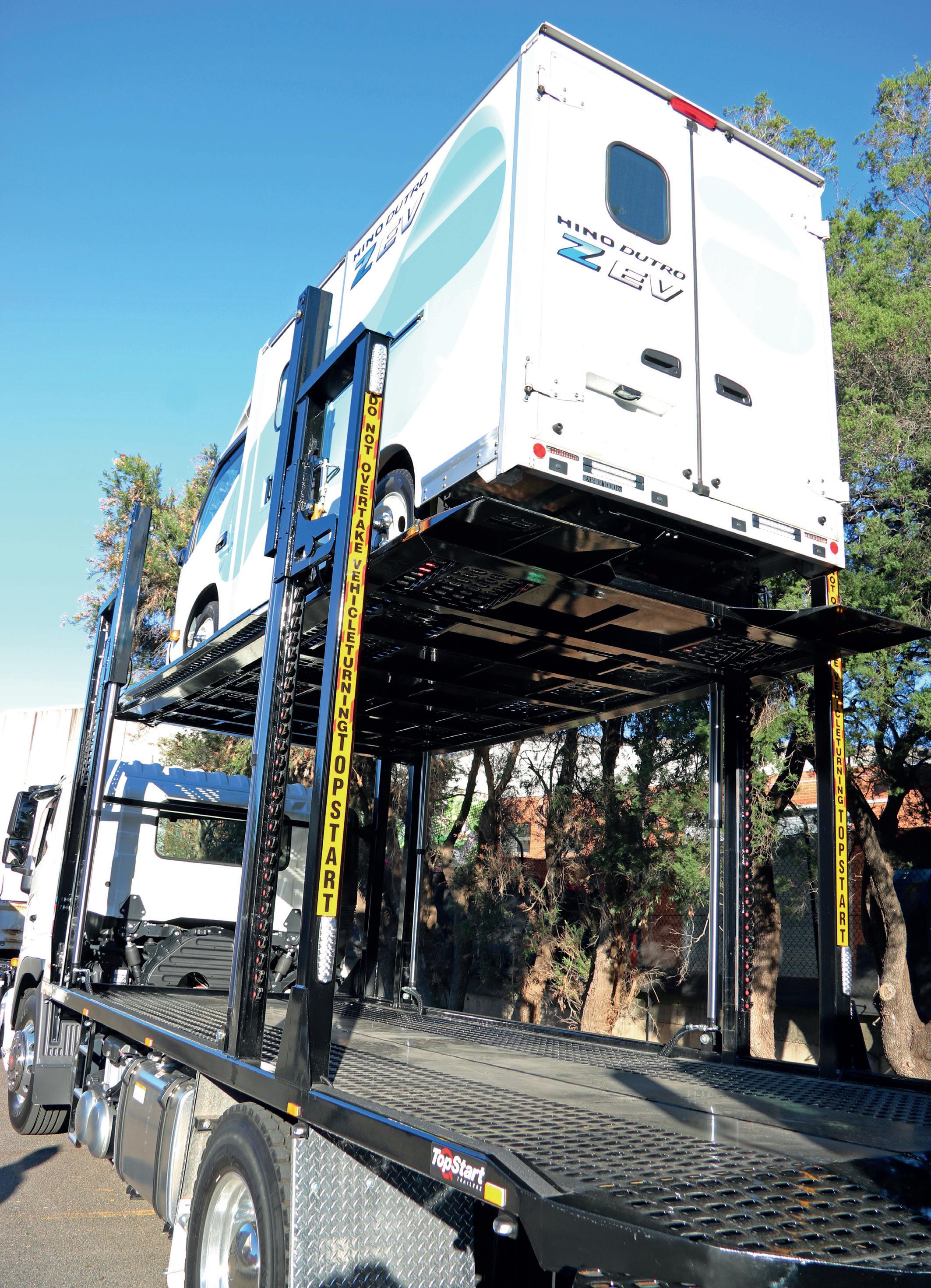
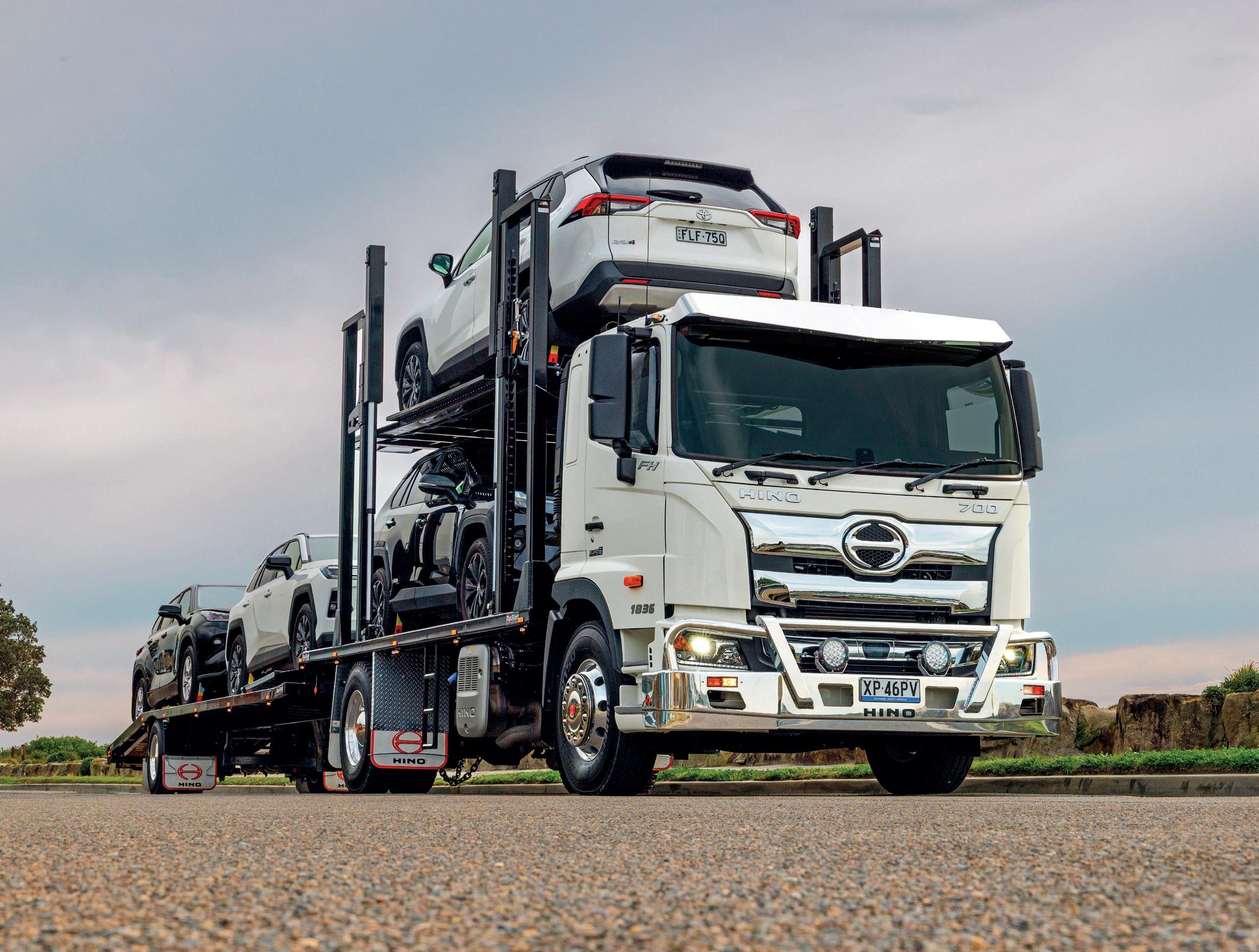
Australia’s new car market requires a high-tech approach to the transportation of new vehicles. Hino has come up with a handy solution.
ROADSHOW
50 Travellin’ North
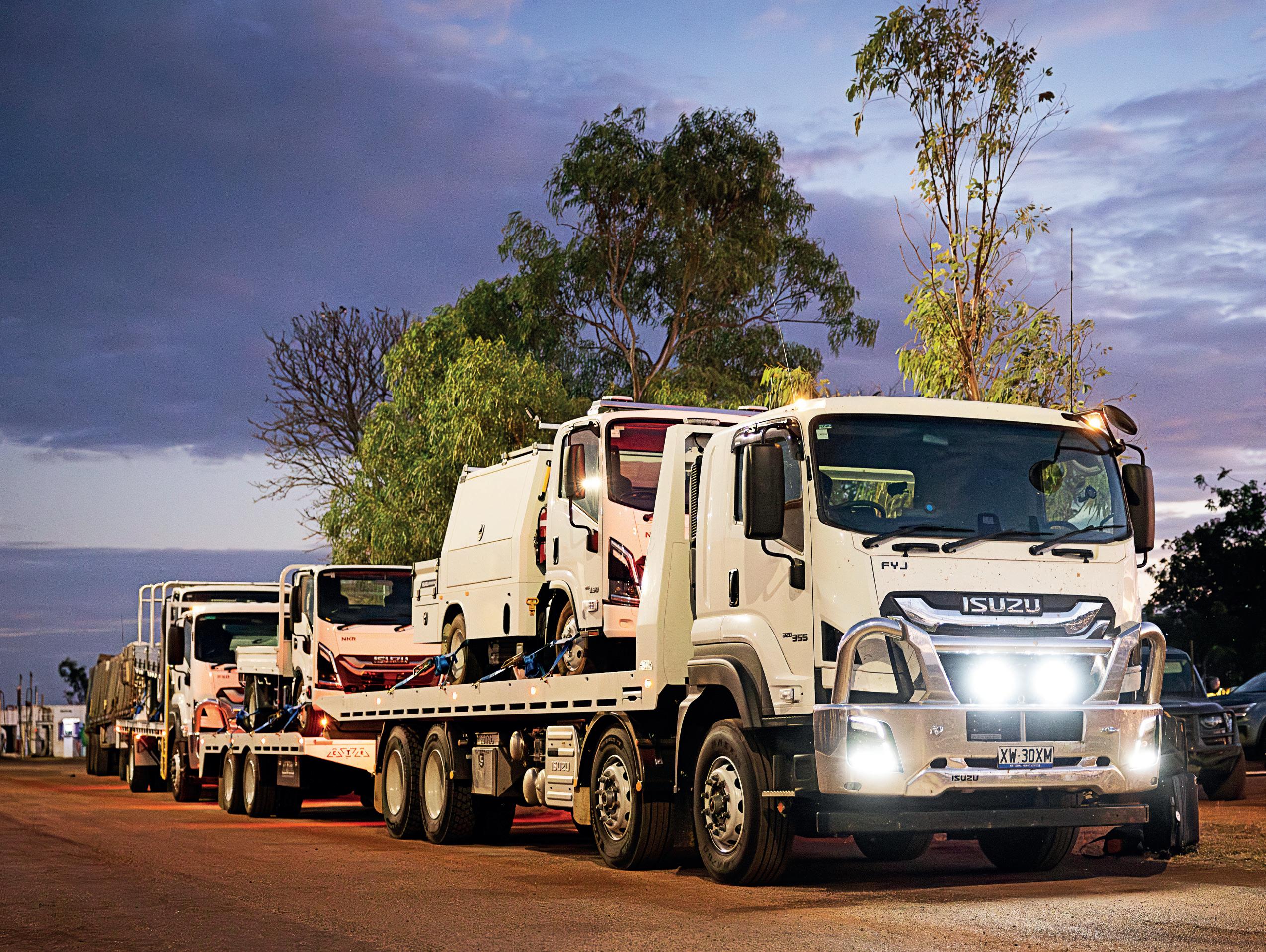
Isuzu’s National Roadshow takes on the rough and tough challenges that the Northern Territory throws up in its inimitable style.
Paul Lancaster Editor
The global truck driver shortage continues to be one of the transport industry’s most enduring and vexing talking points. Every year, another report con rms the challenge. Every year, governments, industry associations and operators roll out fresh initiatives. Yet the underlying problem remains remarkably unchanged.
Recently, the International Road Transport Union’s (IRU) latest Global Truck Driver Shortage Report hit our inboxes and again it has highlighted that this is not simply a temporary labour market uctuation but a structural demographic issue. Across the 36 countries surveyed, some 3.6 million truck driving positions remain vacant. More concerning is the widening age gap. Young people under the age of 25 account for just 6.5 per cent of the global truck driver workforce, while more than three million drivers are expected to retire over the next ve years. This same story has been repeated for a number of years now, without any viable x-it solution being unearthed.
Searching for a silver bullet
In Australia, according to NatRoad, there are more than 28,000 un lled truck driving positions, with that gure projected to climb to 78,000 by 2029 if current trends continue. Nearly half of Australia’s truck drivers are now aged over 55, while barely ve per cent are under the age of 25. Those gures should concern everyone who depends on the nation’s freight network which, in reality, means every Australian. The industry has not been sitting idle. Organisations such as NatRoad and the Australian Trucking Association continue to advocate for nationally consistent licensing, improved training pathways, better rest areas, stronger safety outcomes and programs that present trucking as a skilled, professional and technology-driven career rather than simply a job behind the wheel.
Engaging female truck drivers as role models, as well as younger mentors, there has also been increasing emphasis on attracting women and younger Australians into an industry that has traditionally struggled with workforce diversity.
These are worthwhile initiatives, but they illustrate a broader reality: there is no silver bullet.
Although recent campaigns have highlighted a ‘decent’ wage to be made from truck driving, wages aren’t necessarily the primary issue. The IRU’s
research found that driver satisfaction remains relatively high internationally, suggesting the shortage stems from a complex mix of demographics, lifestyle expectations, licensing barriers, public perception and competition from other industries. Younger workers today have more career options than ever before and are often seeking greater exibility, predictable schedules and work-life balance – areas where long-haul transport can struggle to compete.
Ultimately, solving Australia’s driver shortage will require sustained effort rather than quick xes. Industry, government, training providers and operators must continue working together to modernise the profession, improve career pathways and demonstrate that trucking offers rewarding, long-term employment in an increasingly sophisticated logistics sector.
The truck driver shortage has become a perennial challenge precisely because it cannot be solved overnight. But neither can it be ignored. Australia’s freight task continues to grow, and unless the next generation is encouraged to climb into the cab, the nation’s supply chains will increasingly feel the strain.
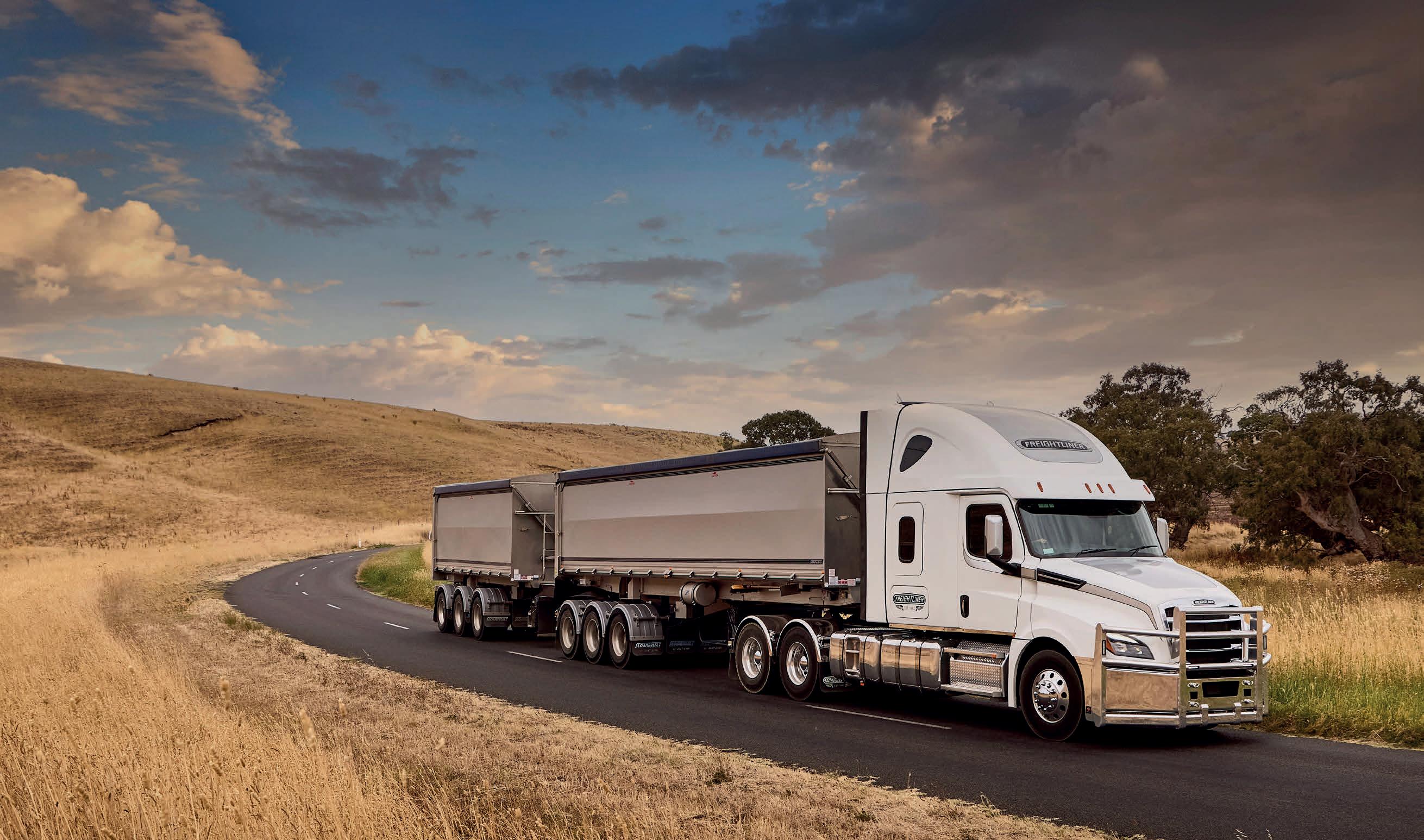
GET A HEAD START WITH FREIGHTLINER CASCADIA.
Get three months on us up to $20,000 when you finance a Freightliner Cascadia with Daimler Truck Financial Services. Experience the benefits of Guaranteed Buy Back and three years of servicing at no extra cost. Talk to your Freightliner dealer today to find out how you can take advantage of Cascadia’s remarkable fuel efficiency, advanced safety and superior comfort - Underestimate At Your Own Cost.
> VTA opens 2026 AFIA nominations
The Victorian Transport Association (VTA) is calling on businesses and individuals from across transport and logistics to submit entries for the awards program.
Supported by Viva Energy Australia, the Australian Freight Industry Awards (AFIAs) recognise excellence, innovation and leadership across the Australian freight industry, celebrating the achievements of operators, logistics providers and suppliers that are helping shape the sector’s future.
The 2026 awards program features seven categories:
• Women’s Leadership Award
• Investment in People Award
• Best Practice Safety Award
• Application of Technology Award
• Greenstart Award – Promoting Sustainability in the Workplace
• Emerging Leader Award
• Waste & Recycling Business of the Year Award
According to the VTA, the awards
provide an opportunity to showcase the people and organisations driving progress throughout the freight and logistics sector, from workforce development and safety initiatives to technology adoption and sustainability programs.
> Celebrating women driving industry forward
The 2026 Women in Industry Awards drew a record crowd of more than 350 attendees at Doltone House Darling Island Wharf.
The night delivered several significant wins for women in road transport and logistics.
Excellence in Transport went to True Ross of Ross Transport, recognised
for her leadership within the long established family business.
Rising talent was also in the spotlight, with Caitlin Barlow from JATEC Transport named Rising Star of the Year for her growing influence in fleet operations.
The awards program expanded to 15 categories, including four new additions – Women in Leadership, Marketer of the Year, Excellence in Health and Medicine, and Tradeswoman of the Year – reflecting the increasing breadth of women’s contributions across Australia’s industrial landscape.
Other winners included Shannen Jeffery (Tradeswoman of the Year), Karlie Zec (Women in Leadership), Laura Canning (Mentor of the Year), Tatiana Delendik (Industry Advocacy), Yuan Yuan (Business Development Success), Dr Sarah
Nominations are open now and can be submitted via the official awards website.
The winners will be announced at the AFIA gala awards dinner which will be held at the Palladium at Crown in Melbourne on 5 September 2026.
Crowe (Excellence in Health and Medicine), Caroline Luczynski (Marketer of the Year), Louise Bishop (Excellence in Energy), Alysse Reedy (Excellence in Construction), Charline Siccardi (Excellence in Manufacturing), Sarah Barnbrook (Safety Advocacy), and Hoda Ehsani (Excellence in Engineering).
The evening concluded with the program’s highest honour, Woman of the Year, awarded to Brooke Adamson of Newmont, who also received Excellence in Mining.
Prime Creative Media Head of Events Marketing, Molly Hancock, praised the calibre of this year’s nominees.
“Every nominee and finalist has demonstrated excellence in their field, a commitment to delivering outstanding results, and a determination to make a positive difference,” she said.
Image:
The Victorian Transport Association is calling for AFIA nominations.
Excellence in Transport winner, True Ross, accepts her award.
> Followmont Transport adds to charity fleet
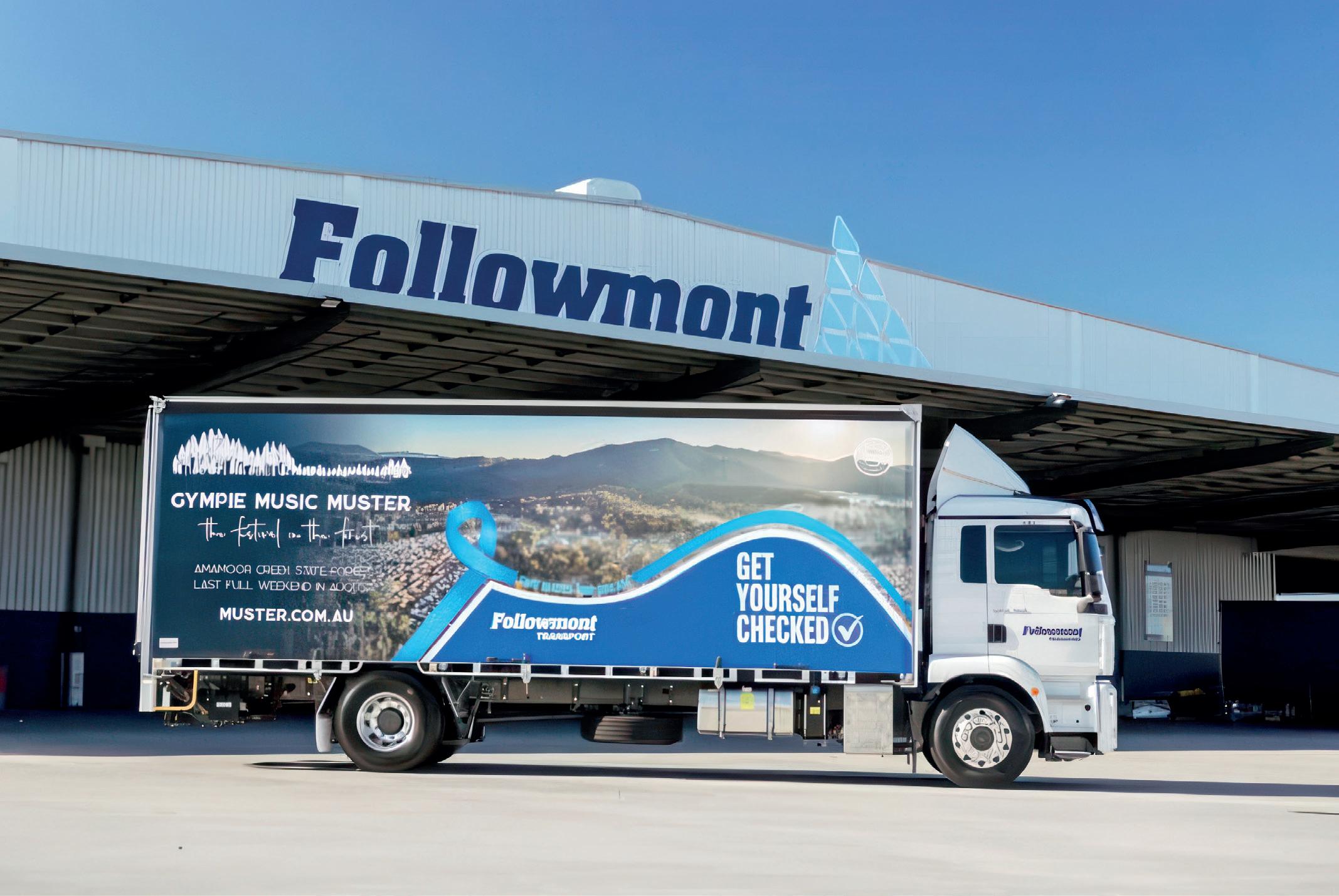
Followmont Transport and Get Yourself Checked have unveiled a new SITRAK G5S 4x12 12-pallet rigid truck dedicated to prostate cancer awareness.
The new vehicle features prominent branding to help deliver an important message about men’s health and early detection and encourage conversations around prostate cancer. It’s the third truck in Followmont’s fleet dedicated to promoting Get Yourself Checked, joining a Volvo prime mover and a 14-pallet SITRAK rigid in addition to a Get Yourself Checked B-double.
Based at Followmont’s Sunshine Coast depot, the new SITRAK will support customers throughout the region while serving as a moving billboard for the charity’s mission.
Followmont Transport Managing Director and Get Yourself Checked co-founder, Mark Tobin, said this investment is another important step
in taking the message directly to communities.
“One in six men will be diagnosed with prostate cancer in their lifetime,” he said.
“The reality is that most of us know someone who has been affected by it, whether it’s a mate, a father, a brother or a colleague.
“For too long there has been a stigma around talking about men’s health. We want to change that.
“We want blokes to check in on their mates, have the conversation and understand that getting tested is far easier than many people think. If this truck encourages even one person to have that conversation or book an appointment with their doctor, then it’s doing exactly what it was designed to do.”
The new SITRAK G5S also showcases a new partnership between Get Yourself Checked and the 2026 Gympie Music Muster, with Get Yourself Checked
> Leadership change at Centurion
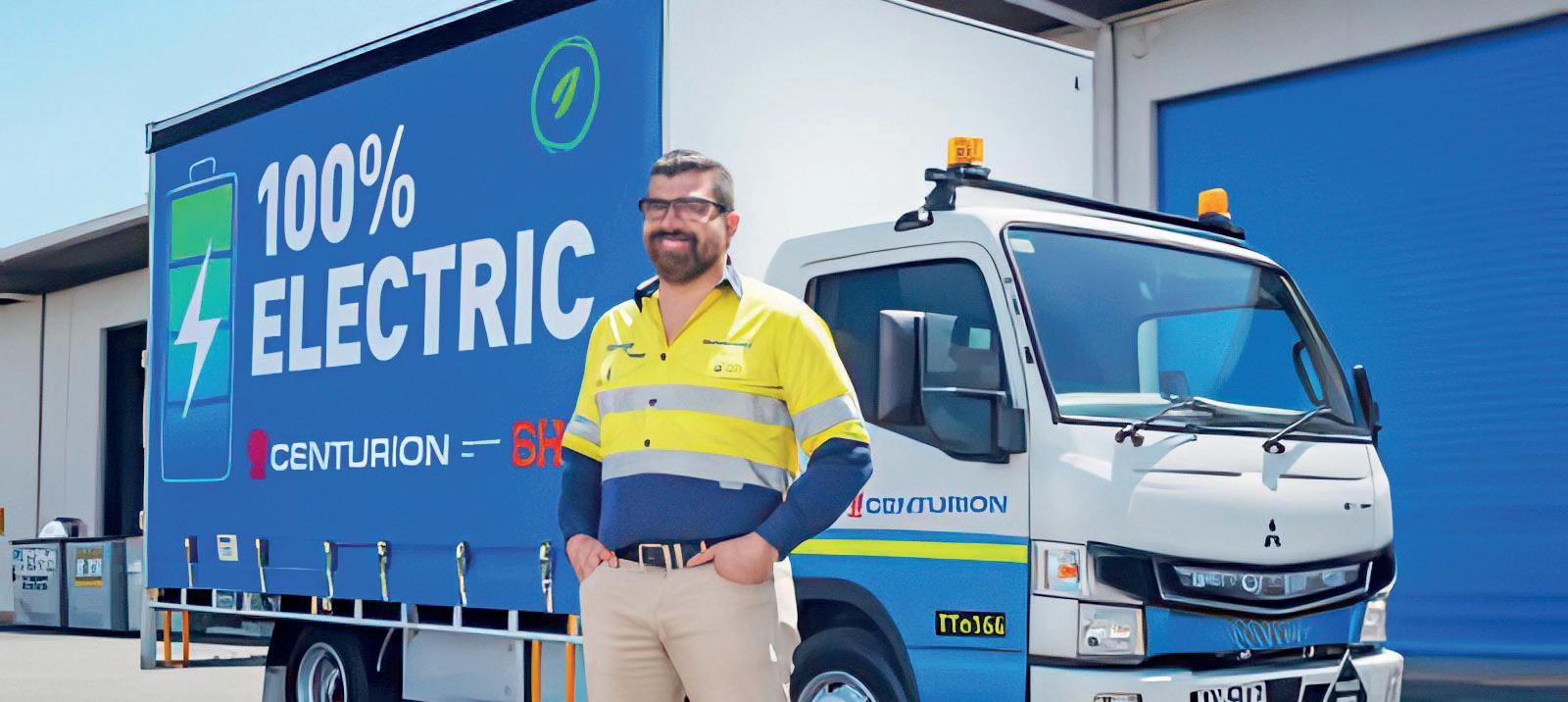
Centurion CEO, Justin Cardaci, said he will step down from the role after 12 years leading the national transport and logistics provider.
Cardaci confirmed a leadership transition will take place over the coming months.
Reflecting on his tenure, Cardaci highlighted the company’s growth during his time at the helm.
“Together, we have expanded our national footprint, strengthened our position as one of Australia’s leading transport and logistics providers and built a business that is well positioned for the future.”
While proud of Centurion’s commercial achievements, Cardaci said the company’s people remained his greatest source of pride.
“My proudest moments have been seeing our people live Centurion’s RIPPA values every day – Respect, Integrity, Passion, Persistence and Accountability,” he said.
“I have had the opportunity to work alongside a talented and dedicated
team, and I am grateful for the support, commitment and shared achievements that have defined my time with the business.”
Cardaci also thanked Centurion employees, customers, partners and Centurion Executive Chairman, Philip Cardaci, for their support throughout his leadership.
As part of the succession process, Michael West from parent company, CFC Group, has been appointed Interim CEO while the Board undertakes a search for a permanent replacement.
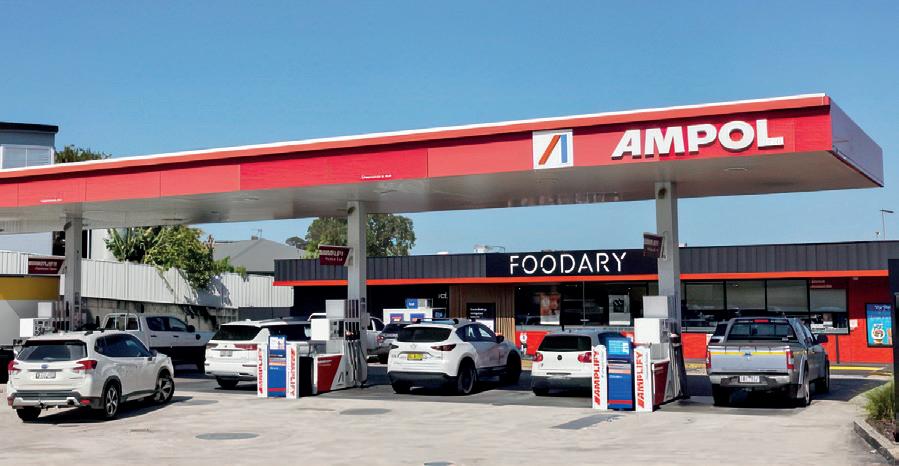
> Ampol completes EG Australia acquisition
Ampol has completed its formal acquisition of EG Australia.
The purchase marks a significant step forward in strengthening Ampol’s position as a leading Australian transport energy provider, the petroleum giant said.
Ampol is now well-placed to leverage its position as a known and trusted brand to approximately 1,100 company-owned and operated sites nationally, the company said. The acquisition will provide
customers with greater choice through the expansion of the Ampol Foodary convenience retail network, accelerated roll out of the valueoriented U-GO format, while providing Ampol greater flexibility to tailor its offering by location and expand the Woolworths Everyday Rewards program.
Ampol’s pay-at-the-pump U-GO is currently available in every Australian state, and the network will increase from 46 sites to 170 over the next two years.
CEO and Managing Director, Matt Halliday, reiterated the acquisition was a logical and strategically aligned growth opportunity for Ampol given the longstanding brand licensing and fuel supply relationship with EG Australia.
“As an Australian-owned company
According to Justin Cardaci, West is well placed to lead the business during the transition, having worked closely with Centurion’s leadership team and served on its Advisory Board for the past seven years.
“Centurion is in a strong position, with an outstanding team and significant opportunities ahead,” he said.
Justin Cardaci will remain actively involved in the business over the coming months to support a smooth transition before taking “some wellearned time off ” following 12 years in the CEO role.
that’s been keeping Australians moving for over 100 years, we understand our customers and what matters to them,” Halliday said.
“A larger, combined network of 1,100 sites will provide us the opportunity to better serve and tailor to the needs of more Australians – from on-thego sustenance at Ampol Foodary; to quality fuel at great value through our U-GO offering.
“This greater footprint will also provide a vital opportunity to install AmpCharge public charging infrastructure across more forecourts, in lockstep with the uptake of electric vehicles.”
Ampol will divest 41 sites as part of the ACCC approval. The ACCC has approved Dib Group (trading as Metro Petroleum) as the purchaser of these sites following a competitive process.
Image: Ampol.
Centurion CEO Justin Cardaci in front of an eCanter.
Ampol has completed its formal acquisition of EG Australia.
We went BIG in the 80s. Big hair, big suits, big phones and, starting in 1982, the first big FUSO heavy-duty truck. Now it’s time to go even bigger with the new FUSO Shogun 530, a 13-litre hauler with the biggest power figure of any Japanese truck – 530 horsepower. It can haul big weights too, up to 70 tonne GCM, and comes packed with advanced safety systems.* FUSO Shogun 530. Because bigger has always been better.
Learn more at your authorised FUSO dealer or visit fuso.com.au/shogun
Import-export logistics provider, Qube Holdings has celebrated the recent performance of its off-road operations team in Central Queensland.
The company revealed that over the past three months, the CQ team has consistently moved more than 1.2 million tonnes of coal per month at the Jellinbah and Yarrabee mines in Blackwater, as part of its haulage contract.
For FY26, the team achieved a 10 million tonne milestone, using Mack Trident and Kenworth C509 tri-drive prime movers with Smith and Lusty “C Train” trailer combinations.
Qube hauls processed coal from wash plants for both Jellinbah and Yarrabee Mines to the Boonal TLO, and also hauls unprocessed material for Jellinbah Mine from rom locations to wash plants for processing.
It operates high-capacity combinations of up to 320 tonnes GCM, following a series of successful payload uplift initiatives as part of its continuous improvement program.
With the company operating as a 24/7 operation, 364 days per year, it is a
feat that has not been achieved in the 40-plus years the mines have been operating, Qube said.
“This accomplishment highlights our commitment to operational excellence and reliability across the business,” the company said on LinkedIn.
“Thank you to the team for setting a new benchmark and inspiring us all to aim higher every day.”
The company currently employs 108 personnel across the project, covering operational, maintenance, administrative, safety and compliance, and site management functions.
Qube operates a workshop and operational offices at the Jellinbah South mine site, from which services are provided to both the Jellinbah and Yarrabee mines.
Qube Projects Manager, Blackwater Region, Joel Eaton said: “Over the past two years, we’ve focused on building a strong, united culture across our workforce, and the results speak for themselves.
“We have one of the best employee retention rates in the industry, which reflects the trust, commitment and
sense of belonging we’ve worked hard to create.
“I firmly believe that business success starts with people. You don’t achieve major milestones without first earning the trust of your team.
“At a time when job security remains a concern across many parts of the mining industry, we’re proud to provide stability and opportunity for our people. Their dedication and contribution have played a critical role in the success of our projects, and that success has helped secure a strong future for our workforce.
“As a Projects leader, my highest priority is the safety, wellbeing and security of our people. When we get that right, strong business performance naturally follows.”
Qube thanked the management and operations teams across both the Jellinbah and Yarrabee mining operations in Blackwater for their continued partnership and commitment.
“Together, we share a common set of values and a strong belief in our people, enabling us to achieve milestones that were once considered beyond reach,” the company said.
“FY2026 has established a new benchmark for performance, built on collaboration, trust and a relentless focus on excellence. Most importantly, every achievement was delivered safely – a result that remains our greatest measure of success.”
> Qube team hits CQ mines milestone
Some of Qube Holdings’ fleet of prime movers and trailers.
Part of the massive hauling operation in Blackwater by Qube Holdings.
Cool confidence in one move
> CEVA Logistics opens new WA hub
CEVA Logistics has officially opened its new Lakes Road logistics hub in Hazelmere, Western Australia.
The launch marks a major investment for the international logistics provider in innovation, operational excellence, and sustainable growth in the local market. The new facility is a high-performance logistics centre designed to meet the ever-evolving needs of customers’ supply chains, with a strong focus on sustainability.
Strategically positioned with direct access to Perth’s major arterial road and freight networks, the Lakes Road site enhances CEVA’s ability to serve both regional and national markets efficiently.
Construction of the new warehouse on Lakes Road began in September 2024, with the first two phases completed in November 2025.
Following the final handover on April 1, 2026, all operations previously located at Abernethy Road were successfully relocated to this larger, purpose-built
facility. The transition was executed seamlessly, with no disruption to customer operations.
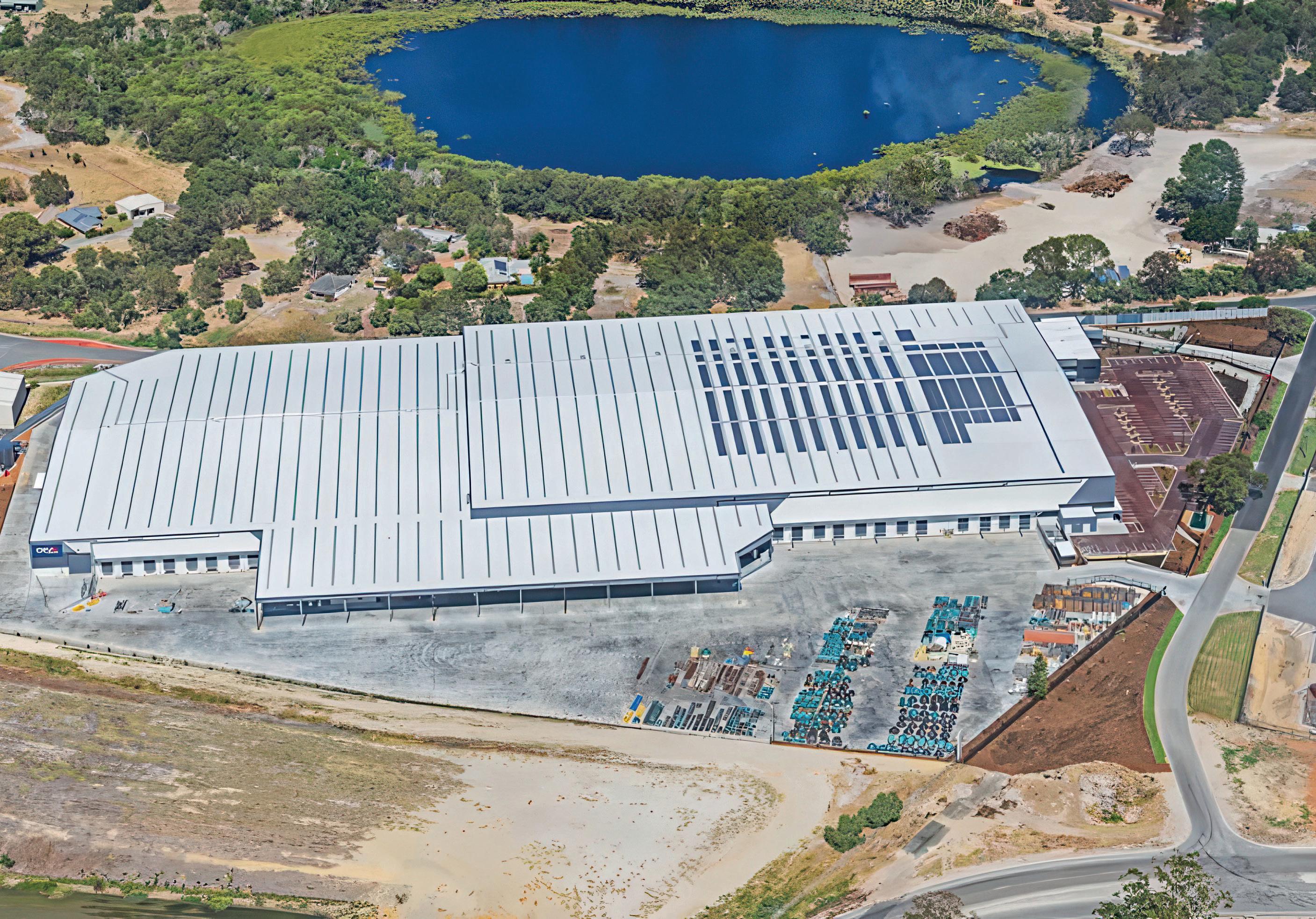
The facility features 37,000 square metres of internal warehouse space, 13,500 square metres of external hardstand, and a 4,600 square metre breezeway, providing the scale and flexibility required to support end-toend logistics operations.
It supports inbound and outbound handling, storage and inventory management, and bonded services, while complementing CEVA’s established strengths in transport, freight management and project logistics across Australia to deliver fully integrated supply chain solutions for a wide range of sectors, including Automotive and Tyres, Consumer and Retail, Telecommunications, Industrial, as well as Energy and Mining. The facility incorporates advanced infrastructure to support both operational performance and sustainability objectives, including
700 kW of solar generation, a 600-kW battery system, and 10 electric vehicle (EV) charging stations.
Customers will benefit from a highclearance design that maximises storage density, alongside modern infrastructure and robust sustainability credentials, including an on-site renewable energy system that powers 90 percent of the facility’s electricity needs.
CEVA Logistics VP Contract Logistics Pacific, Felipe Turra, said: “The opening of our Lakes Road supersite marks an important step in strengthening CEVA’s contract logistics footprint in Australia.
“This facility has been purposebuilt to give our customers greater capacity, flexibility and efficiency, while also supporting their sustainability ambitions through modern infrastructure and smarter energy solutions. It positions us well to meet growing demand in Western Australia and deliver long-term value for our customers.”
Image: CEVA Logistics.
CEVA Logistics has opened its new WA warehouse hub.
> Zenobē’s $400M deal supercharges electric fleet investment
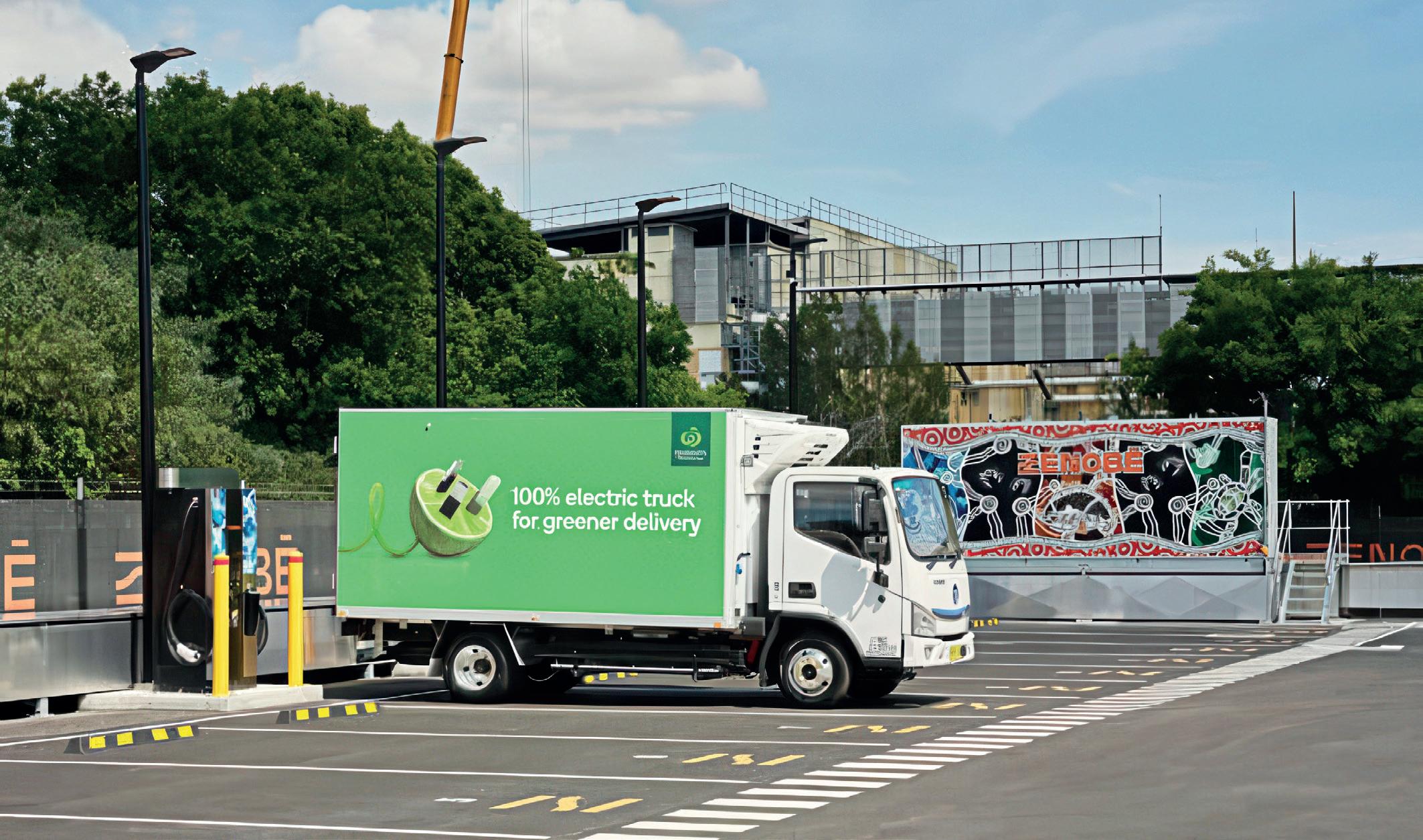
Zenobē has secured a $400 million financing platform to accelerate the rollout of zero-emission heavy vehicle fleets across Australia and New Zealand.
This is reported to mark the region’s first integrated multi-site fleet electrification funding model.
The debt facility, backed by a syndicate of global banks, is designed to help public transport operators and commercial fleet customers overcome the high upfront costs of transitioning to battery-electric vehicles by bundling vehicle financing, charging infrastructure and longterm operational support into a single offering.
The platform will support more than $400 million in investment and builds on Zenobē’s existing electrification projects in Australia and New Zealand, including operational depots in Leichhardt, Dunedin, West Auckland and Greater Wellington.
According to Zenobē, the financing structure combines turnkey depot electrification, long-term chassis
and battery leasing, mid-life battery replacement and ongoing fleet optimisation. The company says the model reduces technology and residual value risk while lowering the cost of financing through a centralised funding platform rather than individual project finance.
Zenobē Country Director for Australia and New Zealand, Gareth Ridge, said the financing would help remove key barriers to fleet electrification.
“This platform represents a major step forward for zero-emission transport in Australia and New Zealand,” he said.
“By combining proven operational projects with a strong pipeline into a single financing structure, we’re able to bring greater scale, certainty and cost efficiency to fleet electrification.
“Our model removes many of the traditional barriers operators face, from upfront capital costs to technology risk, while providing a fully integrated, end-to-end solution.”
The announcement follows Zenobē’s $100 million truck electrification
program announced in March 2026 and expands on financing models the company has already deployed in Europe and the UK.
Law firm, Allens, advised Zenobē Australia on the transaction, with Anderson Lloyd acting as New Zealand counsel.
Allens Head of Project Finance, Michael Ryan, said financing models for transport electrification were continuing to evolve.
“This financing demonstrates the increasing sophistication of capital structures that support transport electrification,” said Ryan.
“As fleet operators accelerate their decarbonisation strategies, platform financing solutions are becoming increasingly important in providing the scale and flexibility required to fund long-term infrastructure investment.”
Ryan said lender appetite remained strong for established decarbonisation platforms as demand for portfolio financing continued to grow across the transport and energy transition sectors.
Zenobē has raised significant funding for its zero-emissions transport program.
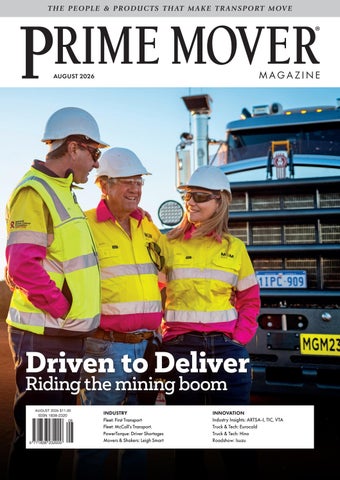
DRIVEN DELIVER TO
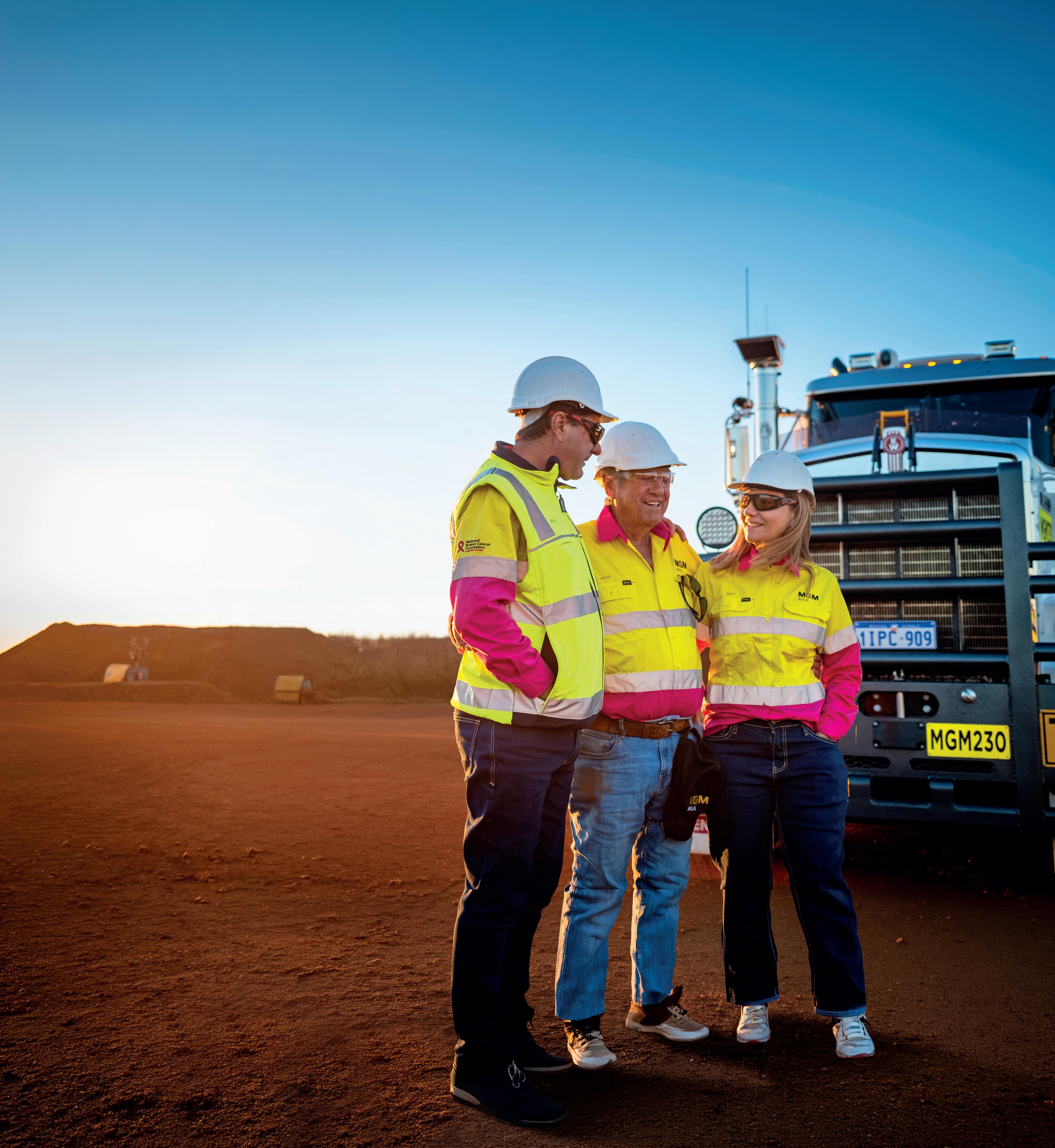
MGM Bulk is a family-owned and run transport operation playing a key role in Australia’s mining industry, centred around the Western Australian town of Bunbury and the state’s rugged north-west.
In 1959 Mario Giacci and his brothers established a modest transport and logistics company in the Western Australian town of Bunbury which grew to become an Australia-wide business called, appropriately enough, Giacci Bros.
In 2004 Mario teamed with his daughter Giudi and son Michael to found MGM Group, using the initials of their rst names as the basis of the company name, involved mainly with supplying and hauling quarry materials using some second-hand Kenworth K104s.
Following the acquisition of Giacci Bros by Qube in 2012, the MGM Bulk division was added, providing bulk haulage and material handling services to mining operations located throughout Western Australia.
In 2014 MGM Bulk entered a 10-year contract with WA Salt and bought ten brand new twin-steer Kenworth K200s with Graham Lusty high-sided end tippers.
“That was the start of our purpose-built trucks allocated to a project, and from there it’s just continued to grow,” says James Giacci, MGM Bulk’s Marketing Manager and Mario’s grandson. Currently the MGM Bulk eet operates
around 220 prime movers and about 1,200 pieces of trailing equipment. Kenworth C509 tri-drives dominate the eet which includes K200s and K220s, T410s & T909s. There are also 30 front end wheel loaders, a couple of mobile crushing and screening plants, several bulldozers, a couple of diggers, and around 100 light vehicles.
“I think the number is around 18,000 to 19,000 tyres on the ground for our bulk haulage road train eet,” says James.
The speci cations for the Kenworths and trailers have been ne-tuned over the years.
“We buy the equipment for the job. We set every axle the same, every rim the same, every tyre the same, every truck the same,” says Michael Giacci.
“Typically, in the North-west we run at 600 horsepower, but we have run them at 550 and low as 500,” says MGM Bulk Fleet Manager, Shayne Payton. “We go through an incredible amount of fuel daily, so the one or two per cent we can save here and there, we will take that. We spec our gear ratio for the application.”
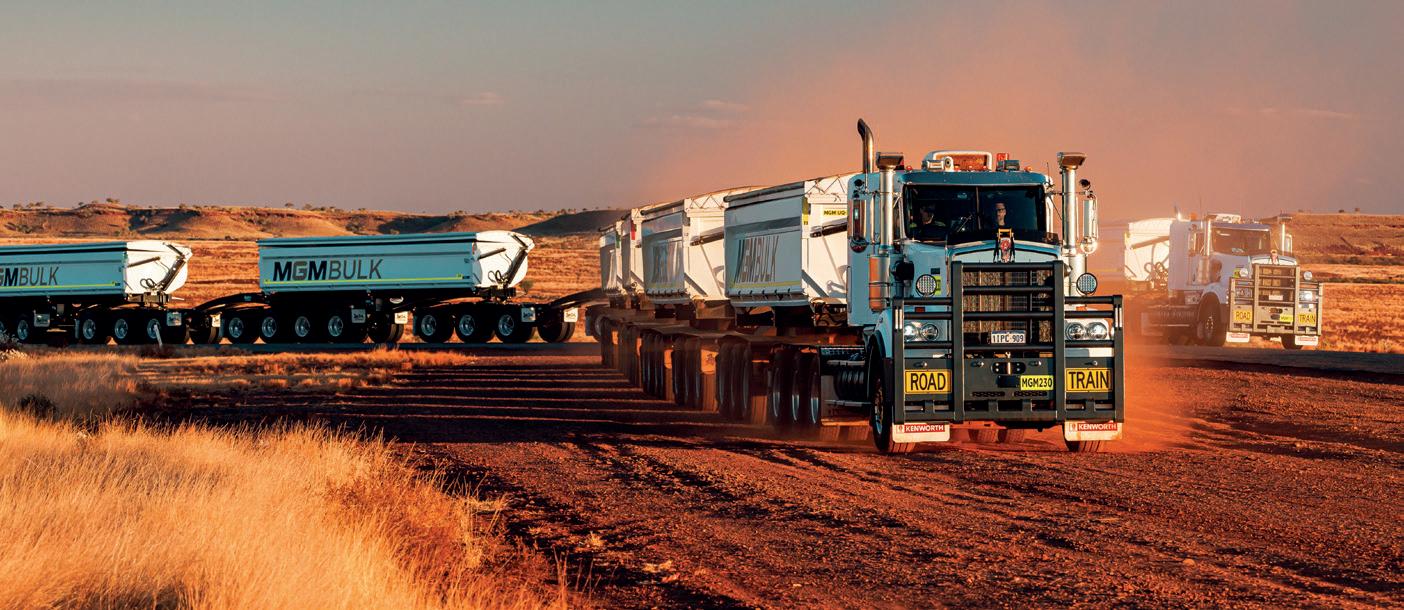
The ultra-quad road trains have a GCM of 210 tonnes and Bruce Rock Engineering side tippers are the trailers of choice.
“We’ve got the right relationship with Bruce Rock here in WA,” says Shayne. “They support us, they’re innovative, and they’re very easy to deal with and they’re always looking for ways to build a better product.”
The Kenworth trucks are sourced through the CJD Paccar dealership in Perth and an additional thirty new C509’s are being added to haul iron ore from the new McPhee Creek mine in the Pilbara region.
“We’ve now gone to Starlink on every one of those trucks, so that we can now more closely monitor what’s happening and we can get more accurate live data out of the trucks,” says James.
During the 2025 calendar year MGM Bulk’s Port Hedland eet clocked up 609,000 truck hours. The road train eet operates 24/7 which means servicing is critical. The Port Hedland service facility will complete up to eight services per day during peak times.
“If we run behind on a service that’s booked in from 10 o’clock until 4 o’clock in the afternoon, then the service after that’s banking up, and the service after that, and the service after that,” says Shayne. “It’s that ne a line getting it right, and then keeping on top of it,
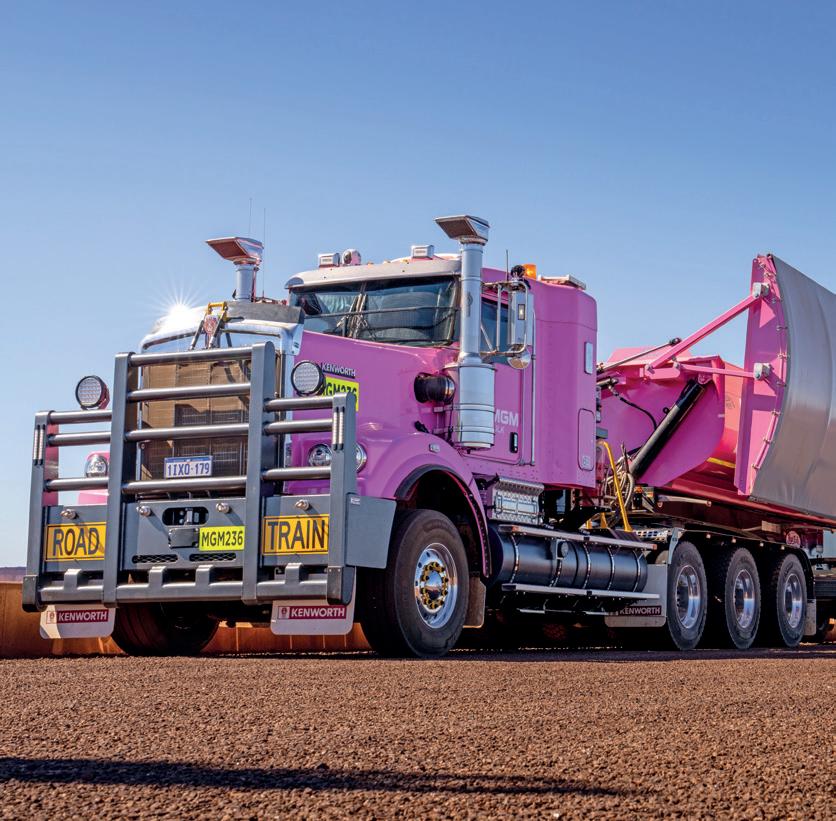
Two of MGM Bulk’s ultra quads in the Pilbara.
because it doesn’t stop. “
In addition to the standard daily checks, the drivers perform wheel temperature checks using hand-held infrared guns twice during each shift, one on the way out and one on the way back.
“The drivers ll out a form, they measure all the temperatures, and then we ask them if it varies above 15 degrees from the previous check to ring into the workshop, and then we’ll make a decision on where we go to from there,” says Shayne.
The eet uses MT Data telematics to manage the information in relation to driver behaviour, fuel burn, operating hours and distances travelled.
Due to the isolated nature of many of the mining operations MGM Bulk books up to 800 ights per month for its people and has constructed a purpose built 220 room “camp” to house them.
“We’re now a company of 800 people and you’re not going to manage everyone’s expectations, but all you can do is provide world-class facilities,
give them the best gear that’s well maintained, be constantly updating the eet, and giving them purpose-built camps that are different to any other FIFO camp with bigger rooms and better nishes,” says James.
“You really need to provide people with more than just a good-looking truck or a good pay packet, there’s so much more that needs to go into it to try and retain people and ensure that they have the best experience while they’re away from their families and working in some of
the harshest conditions in the country.”
Truck operations are built around a rolling roster shift.
“You can’t have everyone starting at the same time and have 150 quads all banked up because everyone started at 6am,” says James. “Their start times are constantly changing. Up in the Northwest, we’ve got a truck running every ve to seven minutes in and out of the yard, then out onto the road, and that shows the volume of movements happening.”
MGM Bulk incorporates the latest technologies available. The new generation of Guardian by Seeing Machines is tted to new trucks to provide another level of safety.
“We’re always trying to keep ahead of the game, and we’ve got some projects happening behind the scenes that we’re going to look at fatigue from other parameters, not just the camera looking at the driver,” says James. “We now have Lane Departure Warning on all our trucks as part of their standard build.”
Infrared cameras are tted to the road trains to reduce damage due to fauna strikes, particularly cattle. Such incidents, as well as fatigue events, are captured and the data is used to build a picture of what’s happening even in remote locations.
“With the data, we can make decisions based on real events,” says James. MGM Bulk has built a high-tech dedicated IT facility with data analysts looking at the information every day to help management make the best decisions
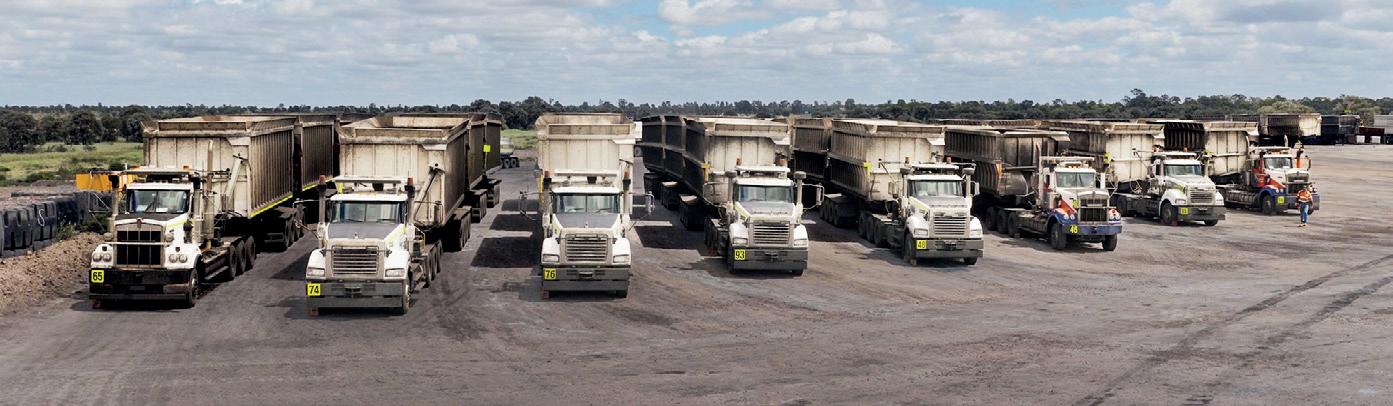
A fraction of the MGM Bulk ultra and super quad fleet.
and run the business accordingly.
Operations are not restricted to iron ore. MGM Bulk’s eet works around the clock throughout the state of Western Australia to move a diverse range of commodities including iron ore, lithium, spodumene, copper concentrate, zinc, activated carbon, methanol, mineral sands, salt, timber, gravel, limestone and sand.
The overall statistics are impressive. MGM Bulk moves 44,000 tonnes per day, the trucks drive a total 113,000 kilometres per day and use 150,000 litres of fuel per day. A truck may operate for ten days without being switched off. MGM Bulk’s rst new T909 is now ten years’ old and has covered over 2.9 million kilometres, clocking 55,000 hours of driving and shifting around 885,000 tonnes of iron ore to the port at Port Hedland.
Based on the long term average benchmark iron ore price of approximately US$105 to US$110 per tonne and the current exchange rate of around A$1.44 to US$1.00, that equates to approximately A$135 million to A$140 million worth of iron ore this one truck has delivered.
“Kenworth and Paccar and Cummins work very hard with the MGM team,” said Michael Giacci. “And they’ve made a lot
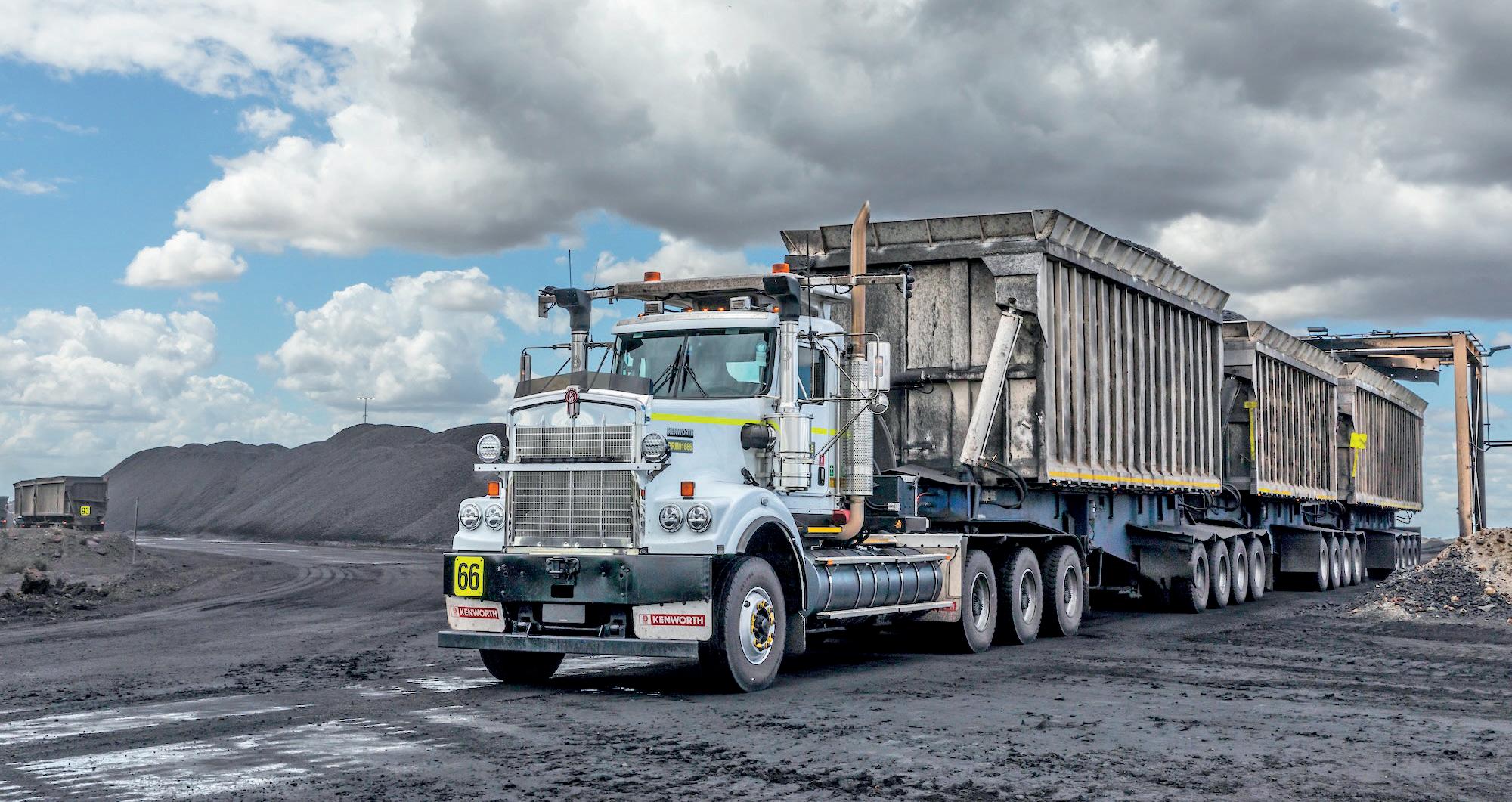
MGM Bulk’s trucks operate in some of Australia’s harshest conditions.
““You really need to provide people with more than just a good-looking truck or a good pay packet, there’s so much more that needs to go into it to try and retain people and ensure that they have the best experience while they’re away from their families and working in some of the harshest conditions in the country.””
MGM Bulk’s Marketing Manager, James Giacci.
of changes over the years, listening to the problems going through and working with our team at MGM. No other product will consistently last as well as Kenworth in these conditions”.
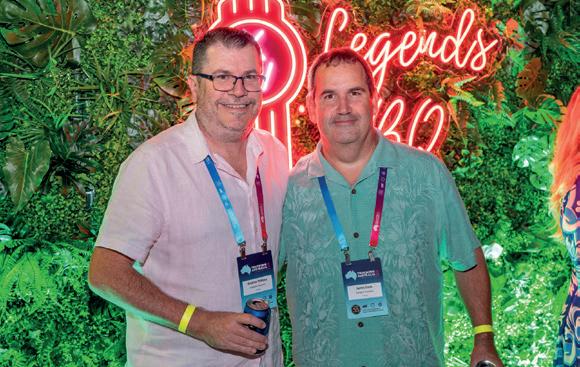
The Giacci Family has been justly recognised for their achievements by being presented the 2026 Kenworth Legends award at Trucking Australia.
“It means a great deal because Kenworth has the same values as MGM” said Giudi at the event. “They are our partners, and that’s why that relationship works with Kenworth. We never went into this business for any recognition. We went into it because of the love of what we do, but to be recognised is like, wow, the cherry on top.”
The Kenworth prime movers are maintained at MGM Bulk’s own service facilities.
Keep your drivers and fleets safe with AI-powered video telematics
Act on the most urgent risks in seconds.
Geotab’s all-in-one AI-powered video telematics solution provides the ultimate safety net for your team. Our smart detection identifies risks like tailgating or drowsiness in near real time, delivering instant in-cab alerts that help drivers stay sharp and get home safely.
For managers, the guesswork is over. Our connected workflow prioritises the highest risks first, turning hours of video into actionable coaching moments. Protect your drivers, exonerate your fleet, and elevate your safety standards with the power of AI.
Prevent accidents
Move from reviewing accidents after they’ve happened, to preventing them via near real-time alerts to mitigate distracted driving, tailgating and drowsiness
Unified Safety
Access both video and vehicle data in one integrated platform through MyGeotab. Plus, hand-pick the best tools to reach your operational goals through the Geotab Marketplace.
Video Evidence
Turn uncertainty into proof. Secure the visual evidence needed to shield your drivers from wrongful liability and reduce insurance premiums.
Ready to transform your fleet?
Visit geotab.com/au/ to learn how our video telematics solution can drive your business forward. to learn how
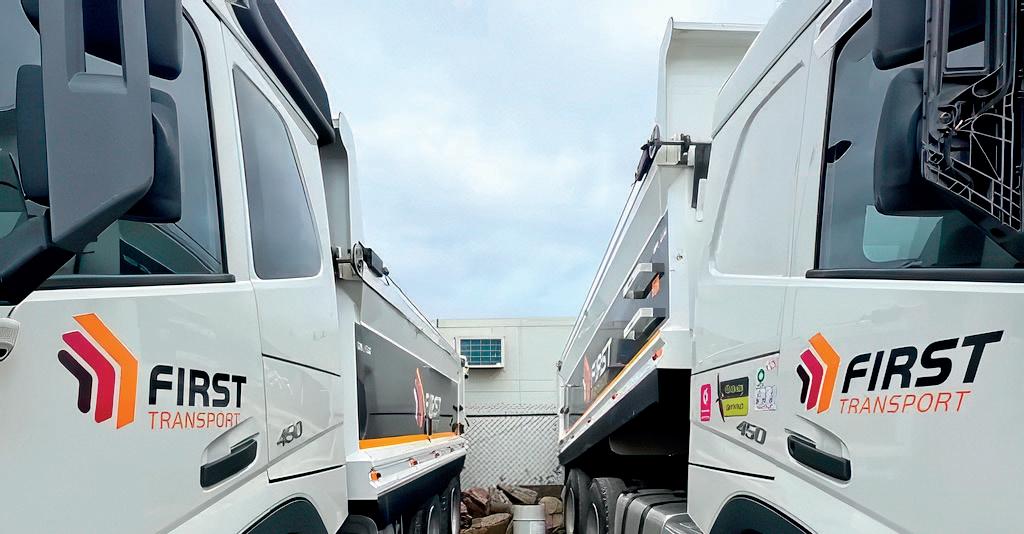
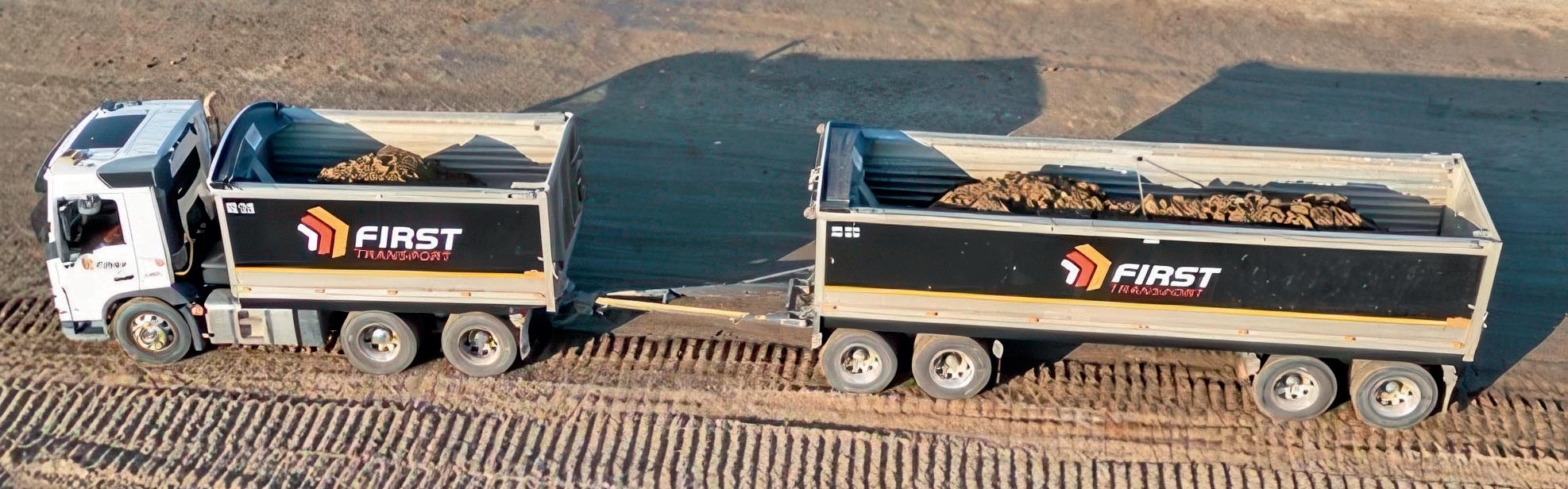
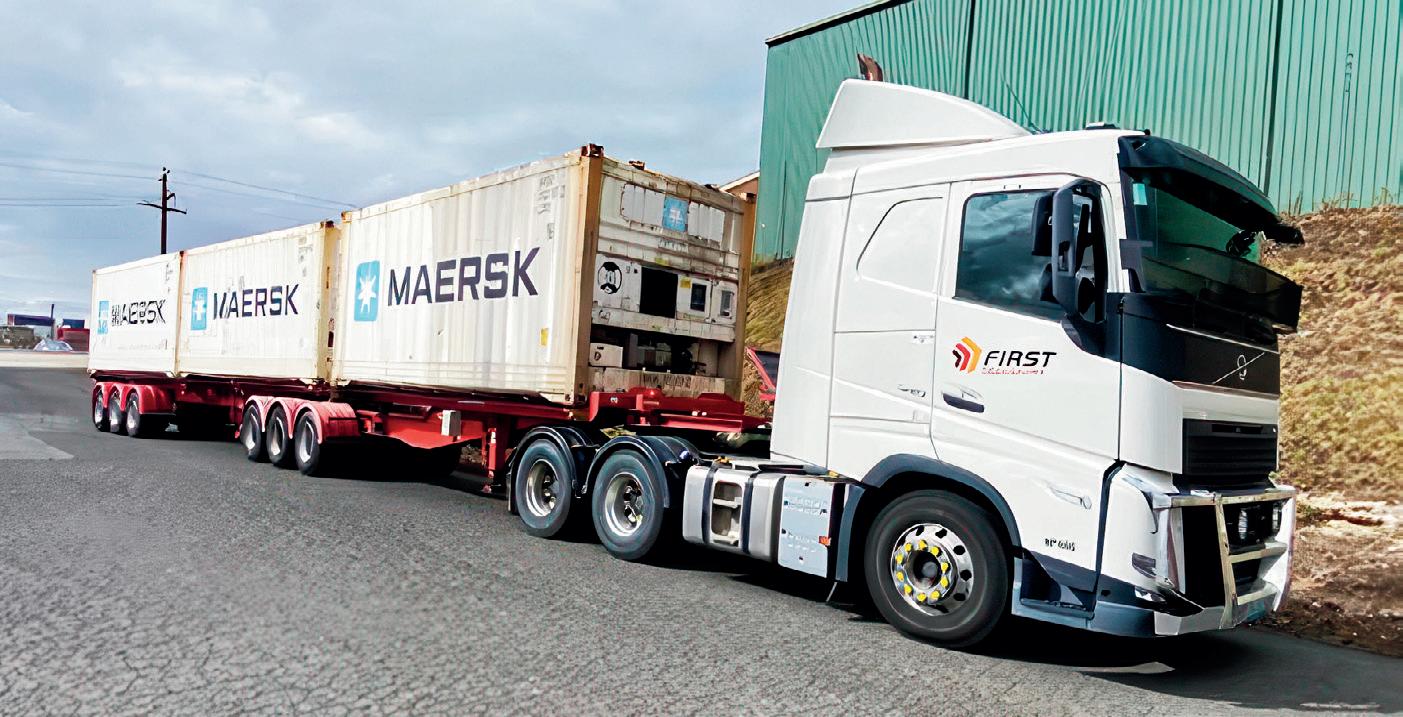
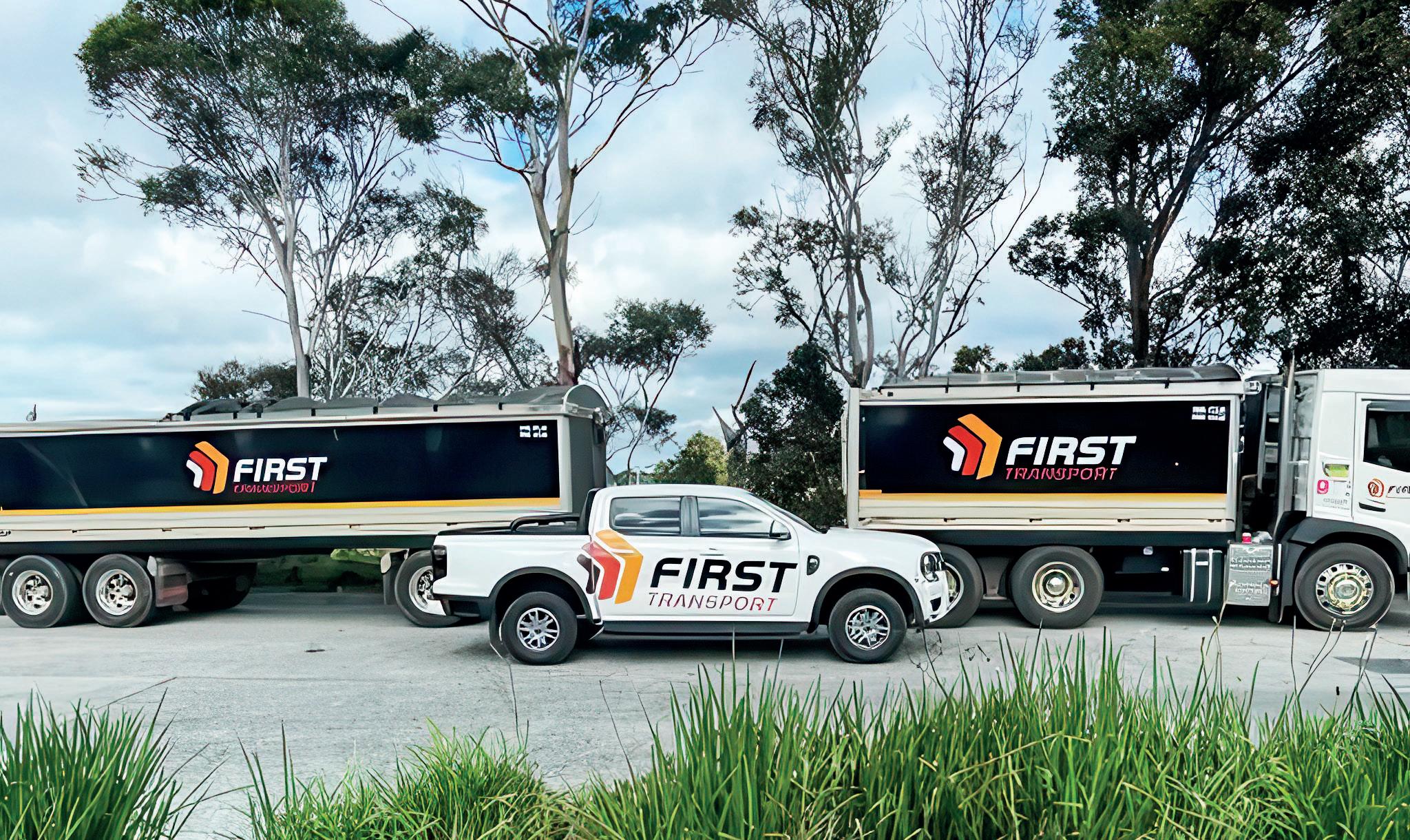
First Transport has developed a loyal customer base in its short history.
FIRST NATIONS
DRIVER
From a childhood in Frankston to a career in corporate advisory and consulting, Jacob Gabriel never imagined his future lay behind the wheel of Australia’s transport industry.
Six years after swapping the dream of buying an investment property for the purchase of a single tipper truck, the Indigenous entrepreneur has transformed Melbourne-based First Transport into one of the country’s emerging Aboriginalowned logistics businesses, combining commercial success with a deep commitment to creating opportunities for Indigenous Australians.
For most young professionals, the rst major nancial milestone is buying a home.
For Jacob Gabriel and his partner, the plan was exactly that. Six years ago, the pair were searching for an investment property when they made a decision that would completely change the course of their careers.
Rather than purchasing bricks and mortar, they bought a truck. Today, that decision has grown into First Transport, an Indigenous
Australian-owned transport business servicing some of Australia’s biggest infrastructure projects while proving that commercial success and social purpose can go hand in hand.
“We were looking at buying an investment property,” Jacob recalls.
“Having both spent our careers in corporate advisory, we decided we actually wanted to buy a small business instead.”
After approaching a business broker, one opportunity immediately stood out—a small earthmoving transport company operating tipper trucks.
Months of due diligence followed.
Although the purchase never proceeded because the parties couldn’t agree on a sale price, the research convinced Gabriel there was a strong future in transport.
“We liked the economy at the time, and the market was favourable, particularly construction where tipper trucks spend most of their time,” he says.
“So we decided, probably a bit silly at the time, to buy our rst tipper truck instead of a house.”
That rst truck marked the beginning of First Transport.
From one tipper to tier-one projects
Starting in earthmoving, the company gradually expanded into broader construction logistics and heavy transport.
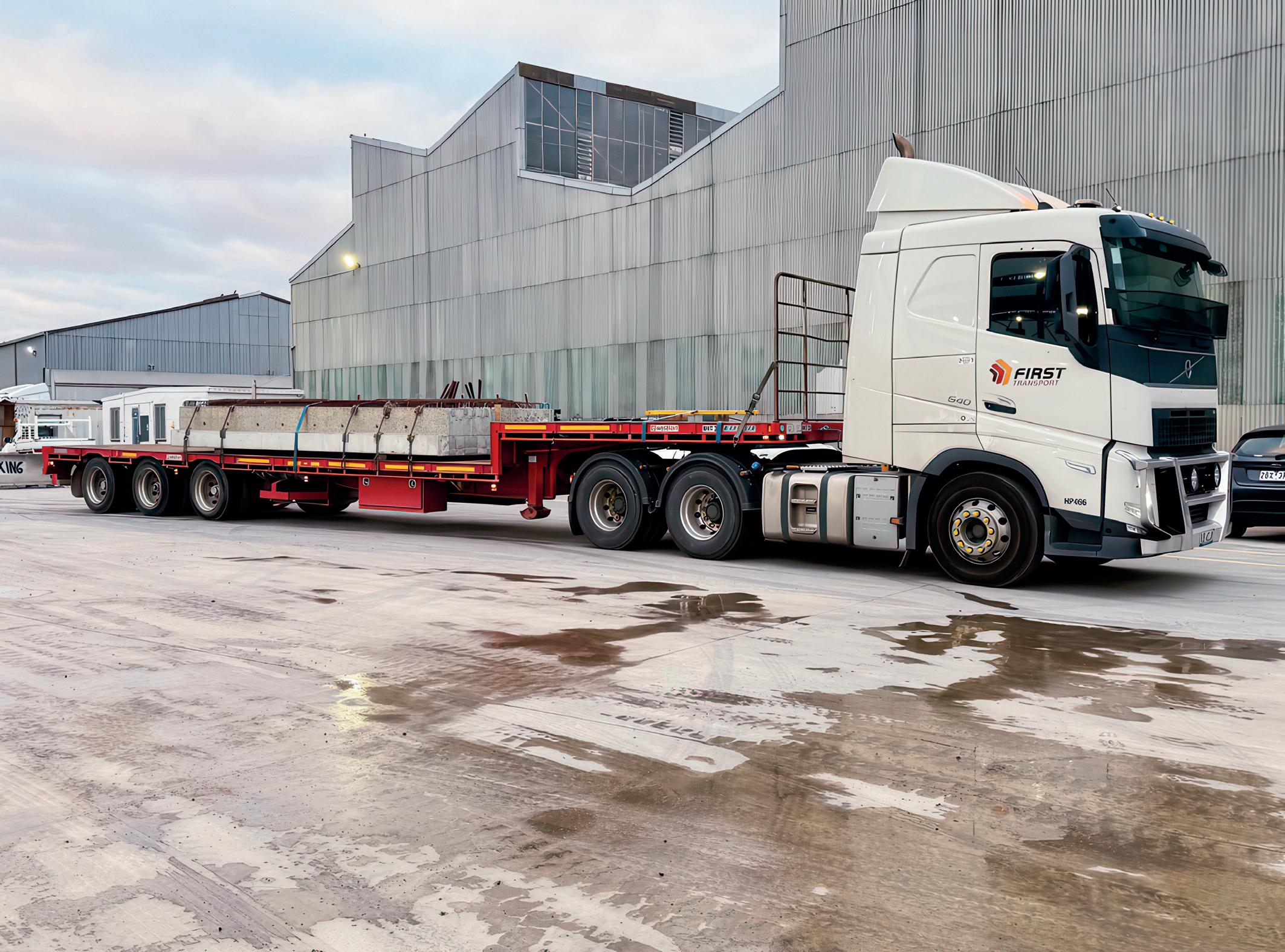
Today, First Transport specialises in servicing Australia’s construction sector, transporting steel, precast concrete, IBCs, oversized freight and general construction materials across major infrastructure projects.
While the eet has grown considerably, Jacob says the company’s strategy has remained focused.
“We specialise in transport for construction services,” he explains. “Steel, precast, heavy haulage and general freight for construction sites.”
The business now works with some of Australia’s largest contractors, including John Holland, Fulton Hogan and Spark, the consortium delivering Melbourne’s North-East Link project.
Supporting those tier-one clients has enabled First Transport to establish a strong reputation in a highly competitive market, while continuing to service tier-two and tier-three contractors and specialist precast manufacturers.
Unconventional path
Unlike many transport operators, Gabriel didn’t grow up in the industry. His professional career began in economics and corporate consulting. An Aboriginal man, Gabriel previously
served as Manager, and later Director, of Aboriginal Business Programs for the Victorian Government. Prior to that, he worked as a consultant with McKinsey & Company, while earlier in his career he was an economist with NSW Treasury.
Although the industries were vastly different, he believes the experience equipped him well for running a transport business.
“I think if you run a business you need to be someone who can work through problems,” he says.
“Being a consultant and working across different sectors helped me become a good problem solver.
“We were helping ASX-listed businesses improve their performance and enter new markets. Naively, I thought if I could help those businesses, how hard could running a small business be?”
He laughs at the memory.
“The skills I built through my corporate life have absolutely helped my decision-making.”
Determined to succeed
Gabriel’s journey into corporate Australia was far from conventional.
Growing up in Frankston in Melbourne’s south-east, he was raised in a lower socio-economic household by his mother and stepfather.
Money was tight, and after nishing
high school he went straight into the workforce to help support his family.
“It was important that I helped Mum out,” he says. “I went straight to work so I could help pay the rent.”
Despite working full-time, Jacob remained determined to continue his education.
By the age of just 22 he had commenced an MBA, beginning at the University of Melbourne before completing the degree through the University of New South Wales while working for NSW Treasury.
That combination of work, study and determination laid the foundation for a career spanning economics, government, management consulting and eventually entrepreneurship.
Business with a purpose
While First Transport is a commercially driven company, Jacob says pro tability has never been the sole objective.
As an Aboriginal entrepreneur, creating employment opportunities for Indigenous Australians has always been central to the company’s mission.
“Our ethos was that we wanted to support Aboriginal people looking for employment,” he says.
He points to the structural disadvantages many Indigenous Australians continue to face, including higher rates of poverty, unemployment and family violence.
The company has a strong reputation in the construction haulage sector.
“There are a lot of barriers preventing indigenous people from accessing employment.”
Transport, he says, provides a unique opportunity.
“Driving a truck doesn’t discriminate.
“It allows us to build a great commercial business while also helping employ community at the same time.”
Today around 10 per cent of First Transport’s workforce identi es as Indigenous.
Beyond employment, the company also supports Aboriginal organisations through sponsorships, donations and training initiatives.
“We’re a pro t-for-purpose business,” Jacob explains.
“Obviously the business needs to generate a pro t and be sustainable.
“But we also look at it as a vehicle for supporting people who are vulnerable and who need a helping hand.”
That philosophy continues to shape every stage of the company’s growth.
Right fleet
First Transport operates an all-Volvo eet comprising Volvo FM and Volvo FH models.
The FMs undertake local construction work while the FH eet handles longerdistance operations.
Jacob says the decision to standardise on Volvo came down to reliability, operating costs and driver satisfaction.
“Our drivers love them,” he says.
“They’re comfortable, reliable and the after-sales support has been fantastic.”
“We haven’t had many issues with the Volvos. The customer service and aftersale support has been fantastic, and I feel like they’re very affordable to run and to maintain and service.”
The company also enjoys a longstanding relationship with trailer manufacturer Freighter Group through dealer Rentco, which has supported the business throughout its expansion.
“They’ve been an integral partner in our growth over the years.”
First Transport tends to focus on state-based transportation, only doing inter-state work for specialised clients. With the eet running 24/7 the prime movers are still running upwards of 150,000 to 200,000 kilometres annually.
Sustainable growth
Unlike many operators, First Transport maintains a relatively small core workforce of employed drivers, supplemented by carefully selected subcontractors.
Jacob says reliability and compliance remain critical, particularly when servicing major infrastructure projects.
“We don’t want to run the risk of sham contracting or having drivers who aren’t reliable.
“If I need someone for a shift, I need to know they’re going to be there.”
That disciplined approach has helped First Transport secure long-term relationships with tier-one contractors,
First Transport specialises in working with construction companies.
where safety, compliance and consistency are paramount.
Future vision
Despite the company’s rapid growth, Jacob believes the biggest opportunities still lie ahead.
Expansion into warehousing is one priority, allowing First Transport to offer broader logistics solutions to existing customers.
“We’re a construction services transport business, primarily and we’re looking to expand into warehousing as well to support clients more broadly with some of their problems and challenges Geographically, the company is targeting South Australia, Western Australia, where they will support key clients, as well as Queensland.
Jacob sees enormous potential in Queensland as preparations continue for the Brisbane 2032 Olympic Games.
“We think Queensland presents fantastic opportunities with all the infrastructure work that’s happening.” The company already has employees who have relocated north to support the growing market.
More than freight
For Jacob, however, First Transport’s legacy won’t simply be measured by eet size or annual turnover.
Its greatest achievement, he says, will be creating genuine pathways for Indigenous Australians while demonstrating that Aboriginal-owned businesses can compete at the highest levels of Australia’s construction and logistics sectors.
His own story illustrates exactly that. From growing up in Frankston helping his mother pay the rent, to completing an MBA in his early twenties, advising governments and
listed companies, and then taking the unconventional leap of buying a truck instead of a house, Gabriel has built a business that re ects both commercial discipline and community purpose.
In an industry often de ned by freight volumes, kilometres travelled and eet numbers, First Transport offers a different measure of success—one where every delivery contributes not only to Australia’s infrastructure, but also to stronger Indigenous participation in the economy.
In Jacob Gabriel’s mind, that’s a destination well worth driving towards.
Some of the transport services the company provides.
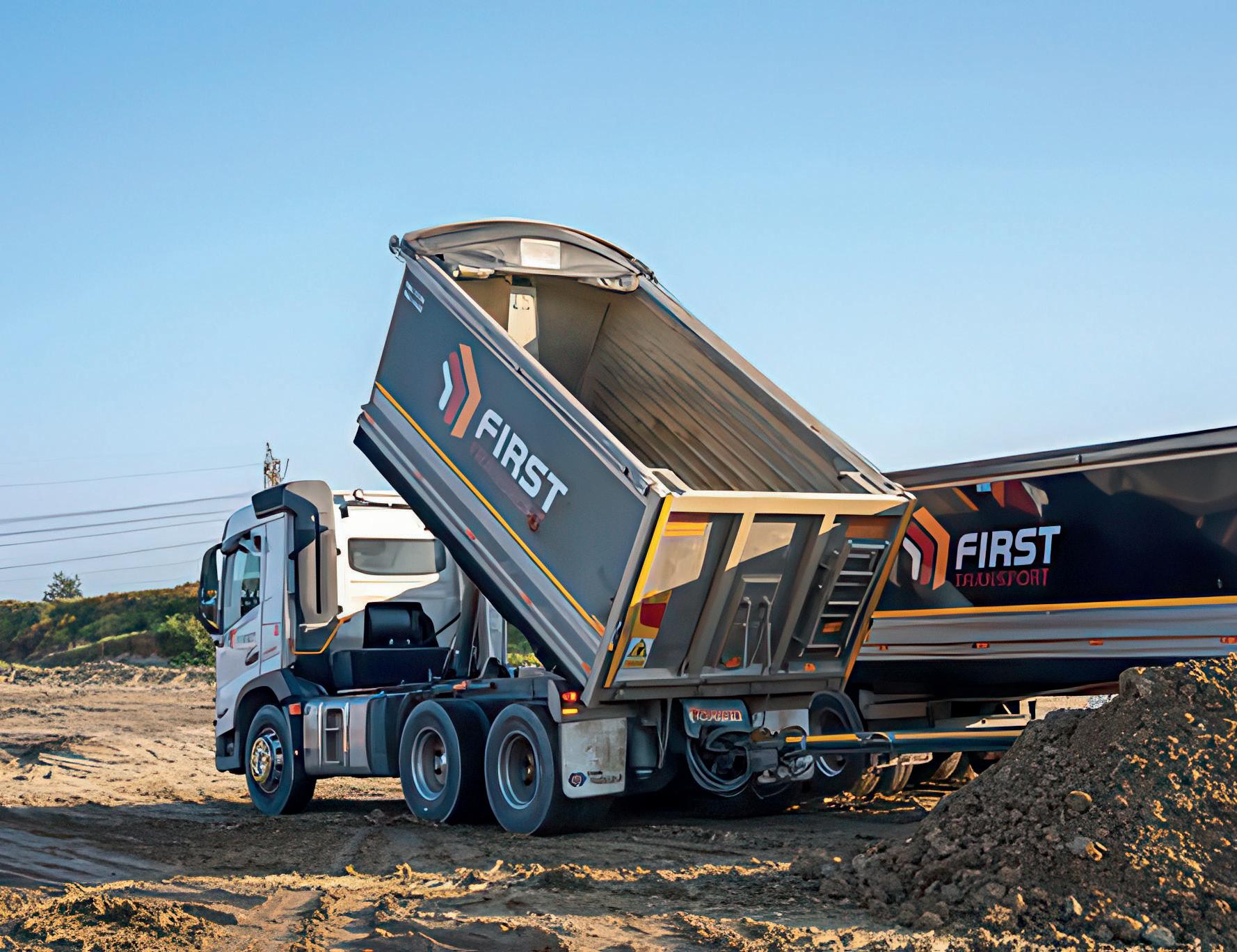
First Transport has expanded rapidly in the few short years since it was established.
Delivering cold chain confidence across regional Queensland with flexible fleet solutions.
STRENGTH REGIONAL
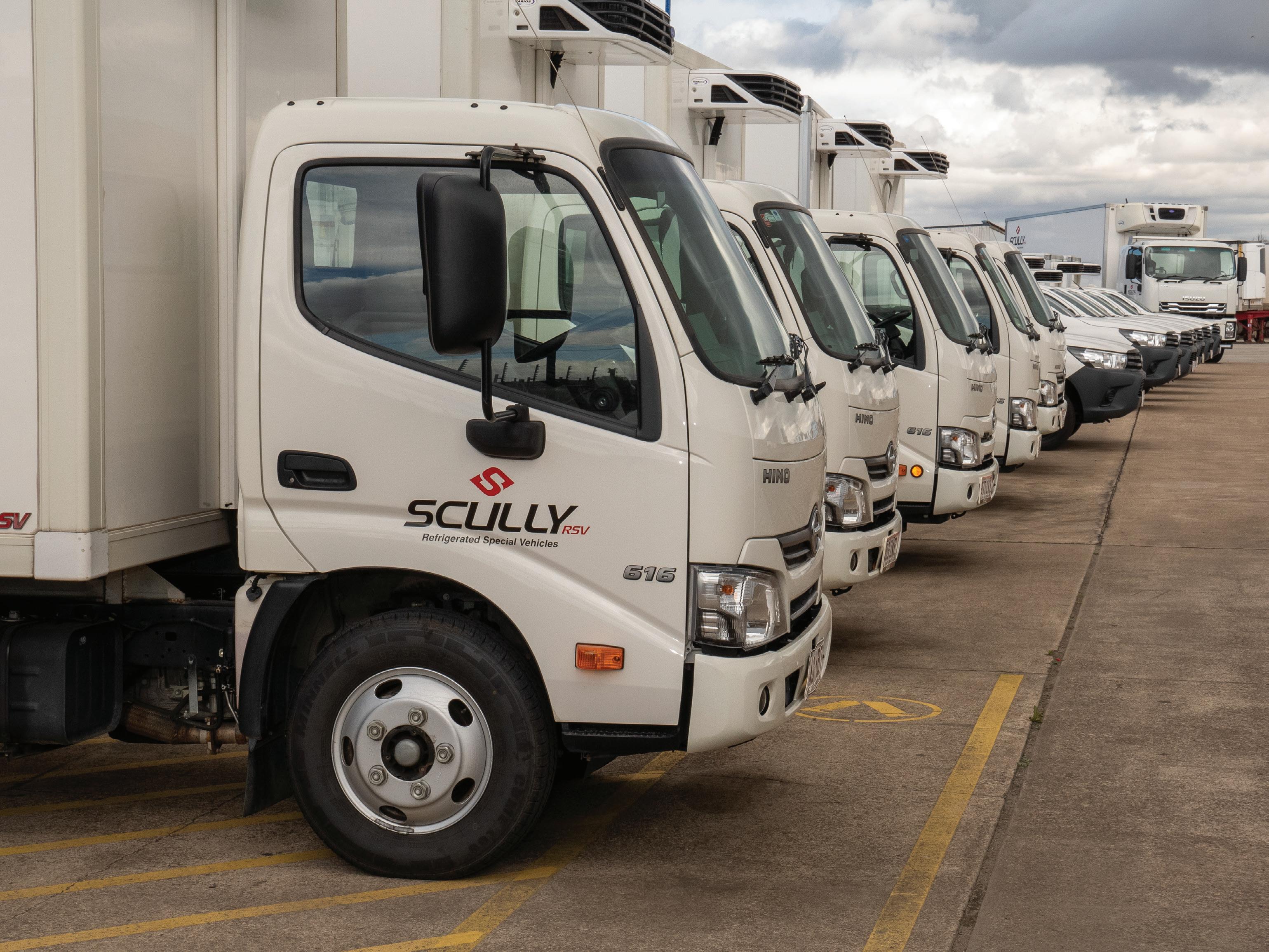
Harbourside Services has built a resilient refrigerated logistics operation across North Queensland, with Scully RSV providing the eet exibility and dependable support needed to sustain its steady growth.
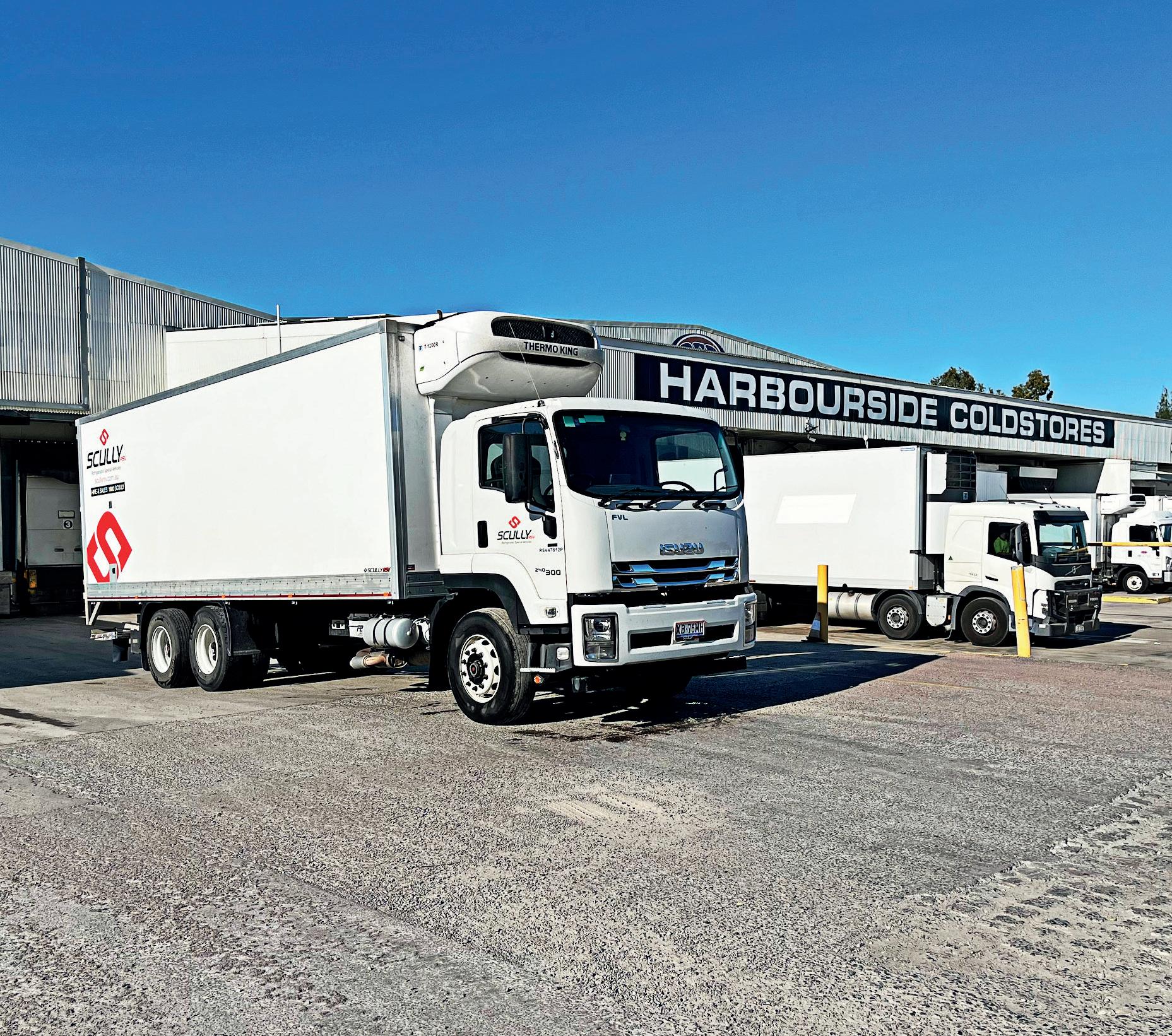
From a seafood business servicing Australia’s eastern prawn eet to one of North Queensland’s most capable integrated cold chain operators, Harbourside Services has expanded through careful planning rather than rapid expansion. Family owned and driven by long-term relationships the business has steadily grown its refrigerated transport, warehousing and distribution network across regional Queensland. Along that journey, its partnership with refrigerated transport specialist, Scully RSV, has become an
important contributor to the company’s ability to respond quickly to customer demand without compromising service standards.
Harbourside Services General Manager, Robert Hall, has overseen much of that transformation during his eight years with the business.
“The group was originally built in the late ‘80s on the back of the Eastern Prawn Fisheries,” he says. “It started in Cairns before moving to Townsville where a large proportion of Australia’s prawn catch came through our facility for export into markets like Japan and Korea.”
Changing conditions eventually prompted the business to adapt to new opportunities.
“When the bridge went across the mouth of the Ross River, it fundamentally changed the operation because the trawlers couldn’t come into the facility anymore,” Robert says.
“That pushed the business towards refrigerated warehousing, transport and third-party logistics instead.”
Today, Harbourside Services provides refrigerated transport throughout coastal Queensland from Bundaberg to Cape York, extending west to the
Image: Scully RSV.
Atherton Tablelands and Charters Towers, while also operating interstate linehaul services focusing on Brisbane to FNQ. Combined with exportapproved cold storage, order picking and distribution services, the company has developed into a fully integrated cold chain provider servicing a broad range of industries.
Much of that growth has come through disciplined expansion.
“When I rst came here we had fewer than 30 staff, a handful of trucks and only a relatively small export operation,” Robert says. “We concentrated on getting the fundamentals right, putting good people in place and building on what was already there.”
Rather than chasing competitors’ customers, Harbourside Services has preferred to grow alongside existing clients while selectively acquiring businesses that complement its network.
“Our strategy has always been targeted growth with existing customers and strategic acquisitions,” Robert says. “We don’t go out trying to slash rates or take work from everybody else. We identify good businesses and good people that t with us and bring them into the group.”
That philosophy has seen Harbourside Services acquire operations including JP Express in Cairns, strengthen its linehaul capability through Swiss Line Transport and more recently integrate TWD into its growing network. Today the business operates from multiple depots across regional Queensland, continuing to expand its last-mile delivery capability while maintaining a strong focus on refrigerated logistics. Supporting that growth requires eet exibility.
Unlike metropolitan operators, regional transport businesses often face sudden demand spikes, seasonal peaks and long replacement lead times for equipment. Having immediate access to refrigerated vehicles can make the difference between securing new work and turning it away.
For Robert, this is where Scully RSV has become an invaluable partner. He rst established the relationship many years ago when refrigerated rental options in North Queensland were extremely limited.
“There really wasn’t much capacity to rent refrigerated equipment in North Queensland,” he says. “The options that existed weren’t really focused on refrigerated transport.”
Instead, Hall worked alongside Scully RSV as the company was establishing its own presence in the region.
“I approached the Scully RSV team and said, ‘Why don’t we work together? Bring some equipment up here, use some of our yard space and we’ll help you establish a footprint in North Queensland.’”
The arrangement has proven bene cial for both businesses.
For Harbourside Services, having refrigerated rental equipment readily available onsite provides an immediate solution whenever eet requirements change.
“If something breaks down or we suddenly need extra trucks, we can simply grab another unit and keep moving,” Robert says. “That’s been enormously helpful.”
Instead of committing capital to vehicles that may only be required during peak periods, Harbourside can adjust eet numbers as workloads uctuate.
“You can expand or reduce your eet very quickly without carrying the nancial risk of owning every asset yourself,” he says.
At various times the company has operated around a dozen pieces of Scully RSV equipment as part of its broader eet.
The nancial predictability also simpli es eet management.
“It’s a known cost,” Hall explains. “Everything is covered. You know what your monthly expense is going to be and all you really have to do is put fuel in it.”
Perhaps more importantly, rental equipment removes much of the uncertainty associated with unexpected
mechanical failures.
“If one of our own trucks suffers a major issue, it can take time to repair or process warranty claims,” Hall says. “With Scully, if there’s a problem, they simply replace the vehicle and you keep operating.”
That responsiveness is particularly valuable in refrigerated logistics where missed deliveries or equipment downtime can quickly affect product integrity.
Harbourside Services transports temperature-sensitive freight across vast distances throughout regional Queensland, making reliability essential.
“They’ve got modern, well-maintained equipment and that’s important for maintaining the cold chain,” Hall says. “They’re de nitely an important part of our business.”
Beyond the equipment itself, Hall believes the relationship between the two organisations is what truly differentiates the partnership.
“It’s more about the relationship than anything else,” he says. “They genuinely want to help. They’re interested in improving the operation rather than simply making money from one job.”
As Harbourside has expanded, Scully RSV has continued to tailor vehicles to suit the company’s operational requirements.
“We’ve worked together on body construction and speci cations,” Robert says. “We generally have our rigids con gured with side doors and tailgates because that’s what suits our work.”
The collaborative approach re ects Harbourside’s broader philosophy of building partnerships that deliver long-term value rather than purely transactional outcomes.
As Harbourside Services continues expanding across regional Queensland, Robert expects partnerships like the one with Scully RSV to remain central to future growth.
“They’ve been good people to work with,” he says. “They haven’t let us down.”
CROP CREAM OF THE
McColl’s Transport has taken delivery of the 90,000th Kenworth truck built in Australia which reinforces a partnership that spans decades.
For a company that has spent more than seven decades moving dairy, food, consumer products and industrial chemicals across Australia, milestone moments are not taken lightly.
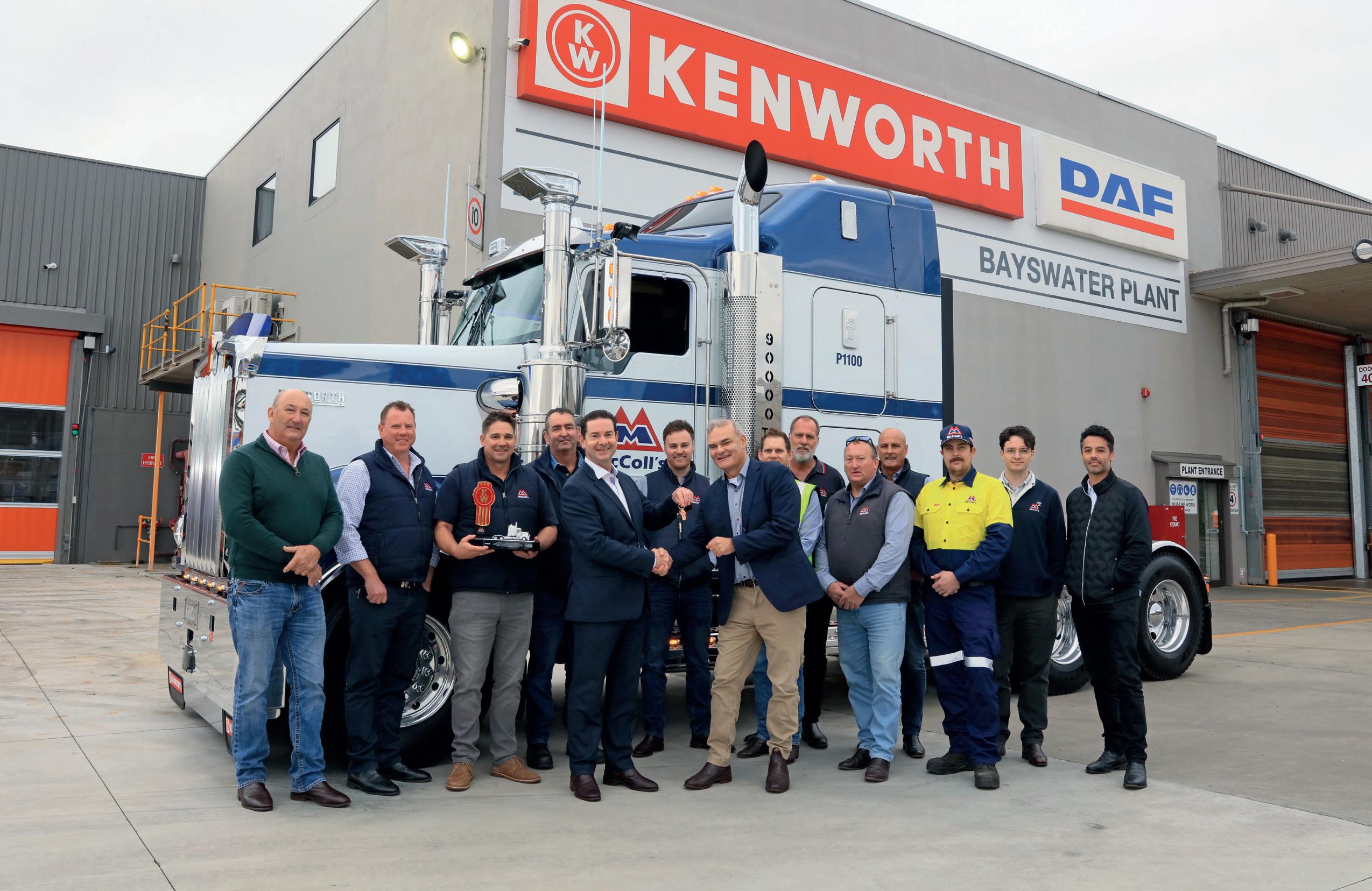
McColl’s General Manager Assets, John Hovey, says being selected to receive Kenworth’s 90,000th Australian-built truck was a proud moment for the business and a re ection of a long-standing partnership with PACCAR Australia.
“It was a genuine honour to be chosen by PACCAR to receive this milestone truck,” John says. “McColl’s has had a long-term relationship with PACCAR, and being part of celebrating this achievement together re ects how strong that partnership has become over the years.”
The delivery comes as McColl’s continues to operate one of the
country’s largest specialised transport eets. The company has been in operation for more than 74 years and today runs more than 263 prime movers and 770 tankers from 23 depots. Supported by six workshops and a workforce of more than 570 employees, the eet services customers across Australia’s dairy, food, consumer and industrial chemicals sectors.
The milestone truck is a Kenworth T909, the rst example of the model to enter the McColl’s eet. According to John, it has been earmarked for demanding long-haul operations.
“The new T909, the rst of its model in our eet, will run the eastern seaboard hauling a range of bulk liquid products, from dangerous goods through to food-grade product, operating in both roadtrain and B-double con gurations,” he says.
While the 90,000th truck represents a major industry achievement, it is also the latest chapter in a relationship between McColl’s and Kenworth that stretches back decades.
“Our rst new Kenworth purchase was a 1996 K100G,” John says. “Before that, we had operated a number of secondhand Kenworths, largely acquired through business purchases. Over the decades that followed, we have taken delivery of more than 400 new Kenworths from the Bayswater plant.”
The addition of the T909 aligns with McColl’s disciplined approach to eet management. Rather than reacting to market conditions, the company follows a structured replacement strategy designed to keep equipment current and productive.
“We run a structured replacement program of 30 to 40 trucks per year,”
FAST FACTS
• McColl’s operates more than 263 prime movers and 770 tankers across 23 depots, supported by six workshops and over 570 employees.
• The company has purchased more than 400 new Kenworth trucks built at Bayswater since taking delivery of its rst new Kenworth, a K100G, in 1996.
John says. “This delivery sits within that long-term plan, which keeps our eet current, compliant and performing at the level our customers expect.”
Supporting that strategy is a broad network of PACCAR services that extend well beyond vehicle supply.
“PACCAR and McColl’s work together across multiple levels, from initial truck procurement and PACCAR Finance through to servicing and parts support via their dealer network right across Australia,” John says. “That breadth of support is important when you’re running across ve states.”
For McColl’s, the value proposition of Kenworth trucks is particularly evident in long-distance operations where reliability and utilisation are critical.
“Kenworth performs best on highkilometre long-haul work, where reliability, driver retention and fuel economy compound over time,” John says. “The upfront cost is signi cant, but the combination of strong resale value, consistent uptime and the data we get through PACCAR Connect makes the total cost of ownership case straightforward for our eet.”
Drivers also play an important role in
purchasing decisions according to John. He says Kenworth continues to enjoy strong support among McColl’s operators.
“McColl’s has a particular breed of driver who prefers Kenworth,” he says.
“The more stylish cabin and bunk options, combined with less downtime, are consistently what our drivers point to. When you’re running big kilometres, those things matter.”
Safety remains another key consideration. John says every new truck entering the eet is speci ed with the latest safety technology available.
“Safety is one of McColl’s core values, so all new trucks are ordered with the full safety package,” he says. “That includes radar and camera-based collision mitigation, lane departure alerts, adaptive cruise control, LED lighting, heated wide-angle mirrors and electronic braking systems. It is not optional for us.”
McColl’s is also continuing to focus on emissions reduction as part of its broader sustainability objectives.
“Emissions performance is something we take seriously,” John says. “All current eet orders are speci ed to Euro 6 standard, and we use PACCAR Connect
technology to monitor and manage vehicle performance across the eet.”
John expects the relationship between the two organisations to continue ourishing as both businesses pursue improvements in safety, ef ciency and operational performance.
“The partnership is strong and runs deep,” he says. “We have worked together on a number of projects and changes over many years, and I expect that relationship to keep growing.
There is a genuine commitment on both sides to making things work better.”
The signi cance of the milestone Kenworth truck extends beyond McColl’s own eet. It is also a celebration of Australian manufacturing and the enduring success of Kenworth’s Bayswater production facility.
“McColl’s is proud to have taken delivery of the 90,000th Kenworth to come off the line at Bayswater,” John says. “It is a signi cant milestone, and it is great to see them continuing to manufacture in Australia at a time when many others have moved on from local production.”
Images: PACCAR Australia.
Above: The 90,000th chassis – 2026.
Left: A milestone is celebrated with the Kenworth truck handover to McColl’s Transport.
BUILT
TOUGH
Hi-Quality
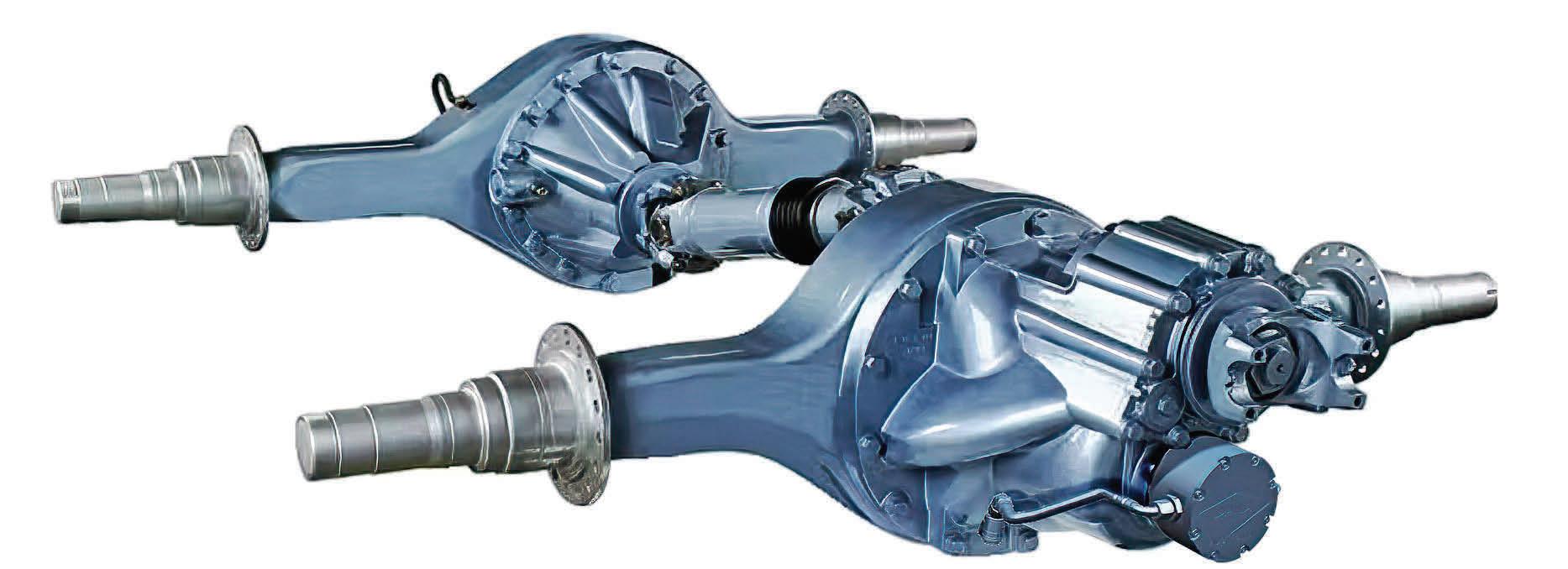
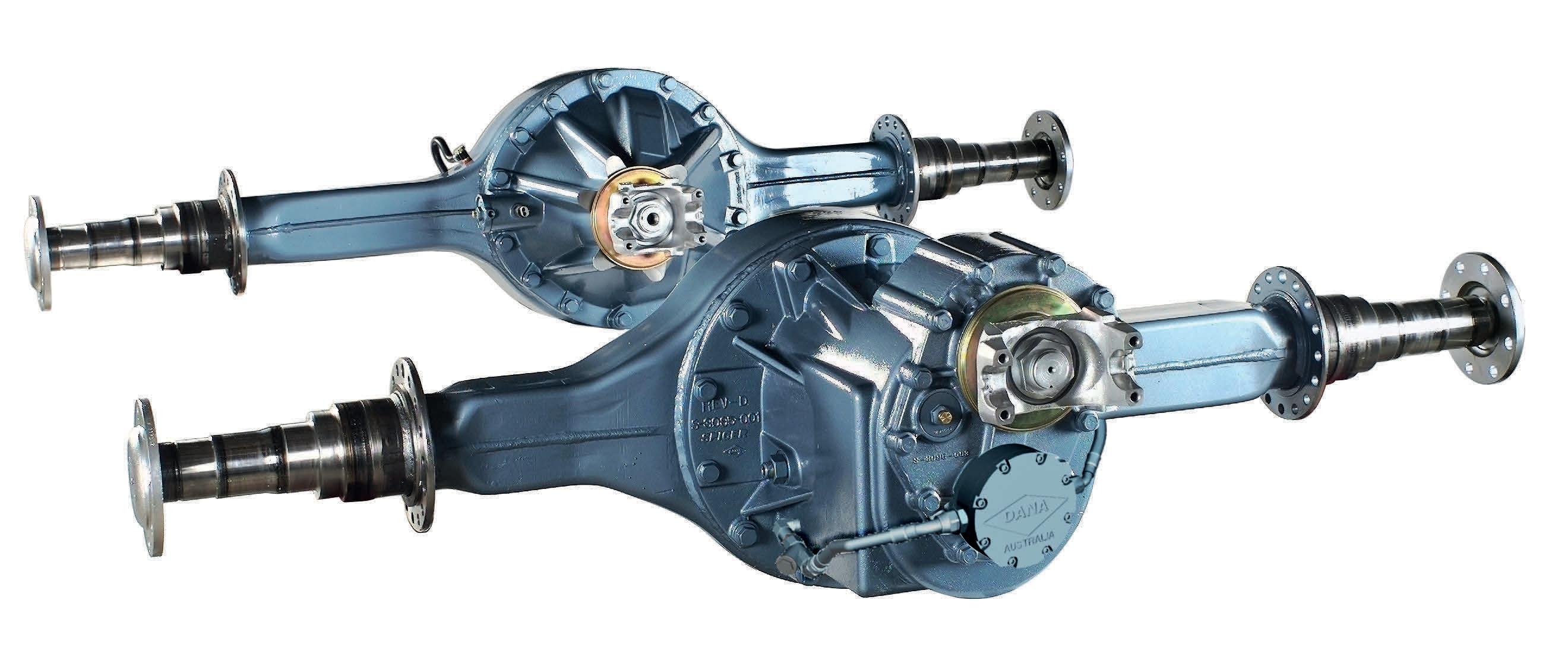
Heavy Haulage has built its reputation on reliability. Dana’s D52-190 rear axle has become a trusted contributor to the eet’s long-term operating e ciency.
From just two trucks to a national heavy haulage operation with 20 prime movers and an extensive trailer eet, Hi-Quality Heavy Haulage has experienced rapid growth over the past six years.
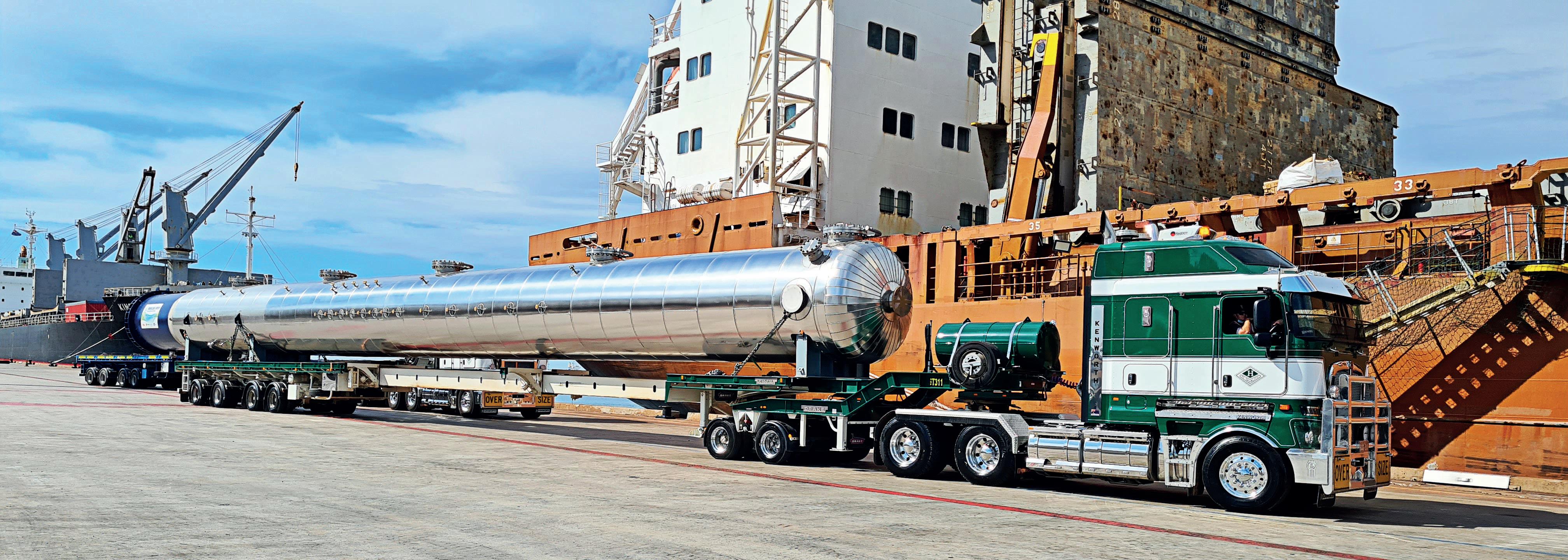
Mitchell Gregory, General Manager at Hi-Quality Heavy Haulage, has overseen much of that journey. Joining the business in 2020 as Business Development Manager, he helped transform what had largely been an internal transport operation supporting the broader Hi-Quality Group into a specialist heavy haulage business servicing customers across Australia. The eet currently operates from Brisbane, Wollongong and Mackay, moving oversized and overmass freight nationwide and supports a diverse workload.
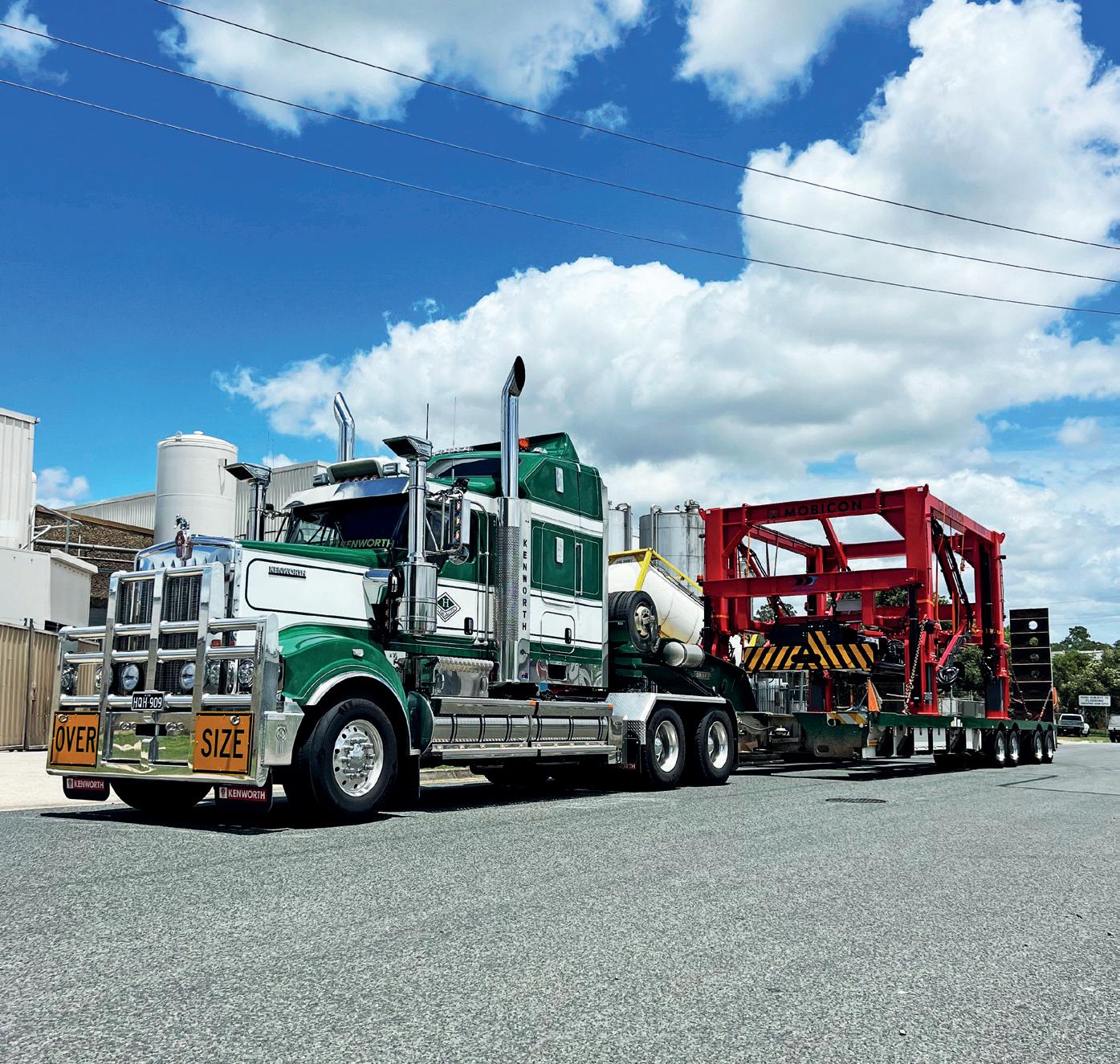
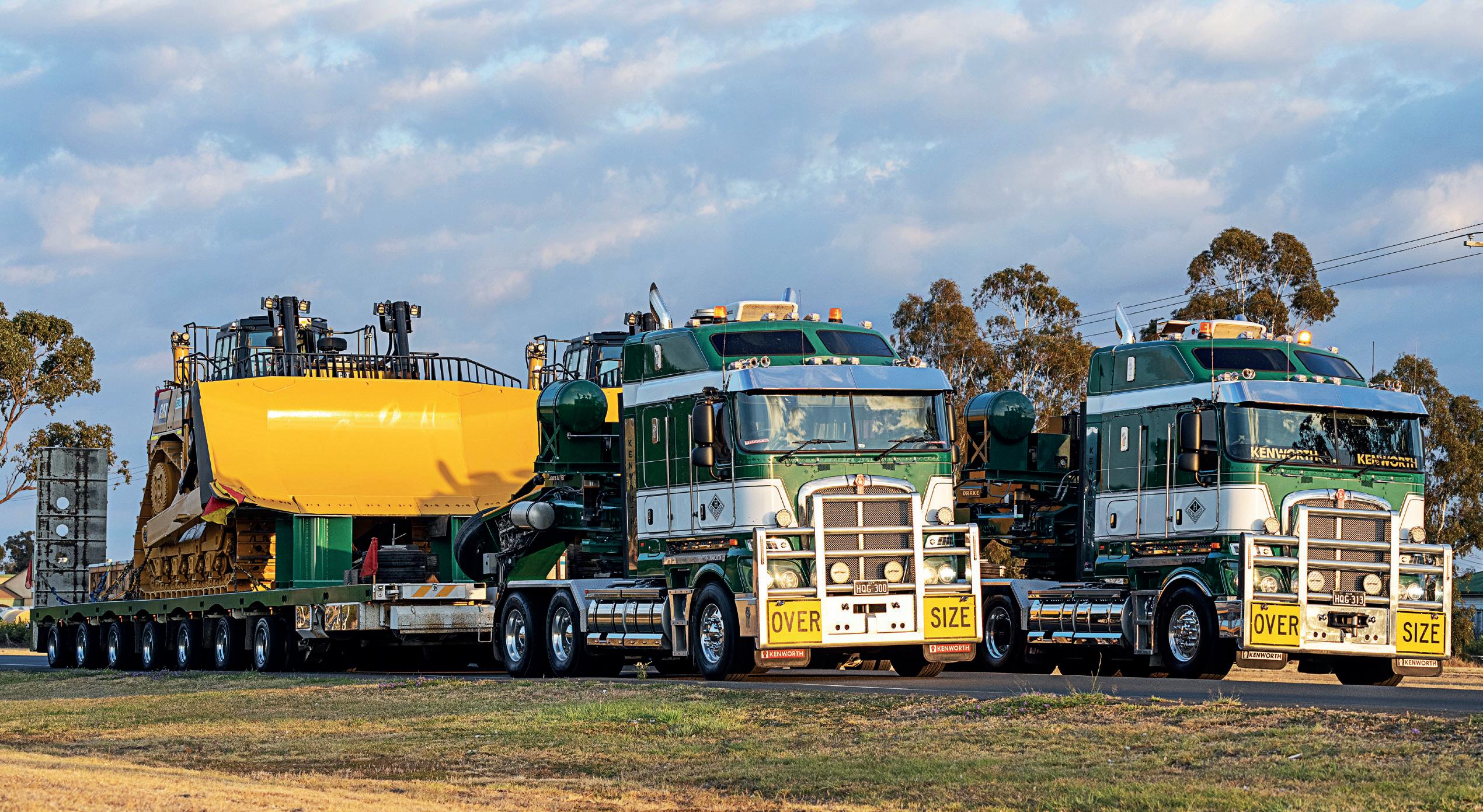
While mining equipment represents a signi cant portion of the company’s work, Hi-Quality Heavy Haulage is also involved in major infrastructure projects, oil and gas developments and specialised project logistics.
“We do a lot of mining machinery, working with OEMs, mining houses and machinery companies to mobilise equipment across Australia,” Mitchell says. “We’ve also been involved in major infrastructure projects like Cross River Rail and have transported everything from drilling rigs to gas compression stations. If it’s oversized or overmass, we can generally move it.”
With trucks regularly operating in demanding environments and hauling substantial payloads, drivetrain durability becomes a critical consideration when specifying new equipment.
For Mitchell, the choice of rear axle has become straightforward.
“The Dana D52-190 is our go-to in the mid-range rated trucks,” he says. “Up to around the 180-tonne rated trucks, that’s our standard speci cation.”
The eet exclusively operates Kenworth prime movers in this segment, making consistency across the operation another important consideration.
“It’s been the mainstay of our builds,” Mitchell says. “They perform well
in pretty harsh conditions. In heavy haulage we’re legally carrying up to eighteen and a half on the drive, so they’re always under considerable load, and they’ve performed really well.”
While durability is often measured over years of service, one unexpected incident provided Mitchell with a particularly memorable demonstration of the axle’s robustness.
“We actually had one that was serviced where the mechanic drained the oil but forgot to re ll it,” he recalls. “It ran for 10,000 kilometres without any oil before it nally failed.”
Importantly, Mitchell is quick to point out that the failure wasn’t the result of any product defect.
“That certainly wasn’t a Dana problem,” he says. “But it showed us just how strong they actually are to withstand that kind of punishment.”
Outside that isolated incident, axle failures have been virtually nonexistent.
“Touch wood, I actually haven’t had one fail yet,” Mitchell says. “They’ve been very good to run in the trucks.”
That reliability has meant Hi-Quality Heavy Haulage sees little reason to consider alternative products.
“When we know something works for us, we don’t really want to deviate from that,” Mitchell says. “There are obviously other products on the market, but for this application, the D52-190 is simply what we specify.”
This proven reliability directly contributes to eet uptime which remains one of the company’s most valuable operational metrics.
“It’s about reliability,” he says.
“Knowing we’ve had a good run with the product means you don’t really want to move away from it.”
Also important is the con dence that replacement parts are readily available should they ever be required.
“I don’t even keep spare parts on the shelf because I know if there is an issue, we go through the Kenworth dealer and they’ll have those parts available,” Mitchell says.
He attributes much of that con dence to Dana’s strong presence across Australia’s heavy vehicle market.
“Dana has signi cant market share, so those products are readily available off the shelf,” he says. “It’s not just us running them. Across other eets I’ve worked with previously, including Toll Heavy Haulage, we were also specifying the D52-190.”
That widespread adoption provides practical bene ts.
“It’s about having consistency and accessibility to those consumable parts,” Mitchell says.
Like every NHVAS-accredited operator, Hi-Quality Heavy Haulage follows strict preventative maintenance schedules.
“We’re religious about servicing the trucks according to our maintenance management system,” Mitchell says. “We’re not pushing trucks beyond their service intervals.”
Rather than stretching maintenance schedules to reduce short-term costs, Mitchell says preventative maintenance ultimately supports long-term reliability.
“We’re taking a preventative approach with the assets,” he says. “That probably
contributes to product reliability as well.”
Monitoring also plays an important role. Oil sampling occasionally identi es potential concerns before they develop into larger issues, and Mitchell says Dana has consistently responded quickly whenever questions arise.
“If we’ve had any concerns from oil samples or anything similar, Dana has always been very good at following up,” he says. “Fortunately, none of those have turned into anything major.”
That responsive technical support complements the broader dealer network.
“If there’s an issue, you know where to go,” Mitchell says. “Generally, they’re very responsive.”
For a business where every truck generates revenue only while moving freight, responsive aftermarket support helps minimise downtime whenever assistance is required.
Mitchell also values being able to communicate directly with Dana when
Dana D52-190 rear axles are specified as standard on Hi-Quality Heavy Haulage’s Kenworth fleet up to approximately 180-tonne applications.
Hi-Quality Heavy Haulage operates 20 Kenworth prime movers nationwide along with a fleet of 40 trailers including floats,
technical questions arise.
“It is refreshing that they’re standing behind the product and supporting the end user,” he says. “We don’t see that level of support from every supplier that contributes components to the truck.”
Being able to engage directly with the manufacturer can also accelerate problem solving.
“Sometimes dealing directly with the manufacturer speeds up the diagnosis time,” Mitchell says.
Although drivers rarely comment when components perform exactly as expected, Mitchell says their feedback reinforces the product’s reliability.
“You only hear about it if there’s a problem,” he laughs. “Nobody comes back after 10,000 kilometres and says the diff was fantastic.”
Instead, drivers report only unusual observations such as temperature variations between differentials.
That approach aligns with Hi-Quality Heavy Haulage’s broader operating culture.
The company assigns one driver to one truck, encouraging strong ownership and mechanical sympathy throughout the eet.
“Our drivers rely on those trucks,” Mitchell says. “Their lives are literally in the hands of that equipment.”
That ownership encourages operators to treat the vehicles carefully.
“They don’t want to be hard on the driveline because they’re the ones depending on it,” he says. “Mechanical sympathy de nitely contributes to the longevity of the product.”
Ultimately, Mitchell views total cost of ownership through a practical lens.
“It’s dif cult to compare one product directly against another,” he says. “But when they’re not costing us money, they’re saving us money.”
FAST FACT
With minimal failures, readily available parts, responsive aftermarket support and consistent performance across demanding heavy haulage applications, the Dana 52-190 has become an established part of Hi-Quality Heavy Haulage’s eet speci cation.
For Mitchell, that’s exactly where it belongs. “When something consistently works,” he says, “there’s really no reason to change.”
Hi-Quality Heavy Haulage operates 20 Kenworth prime movers nationwide along with a eet of 40 trailers including oats, dollies, vessel carriers, blade trailers and platforms.
dollies, vessel carriers, blade trailers and platforms.
GOING THE EXTRA MILE FOR OUR CUSTOMERS
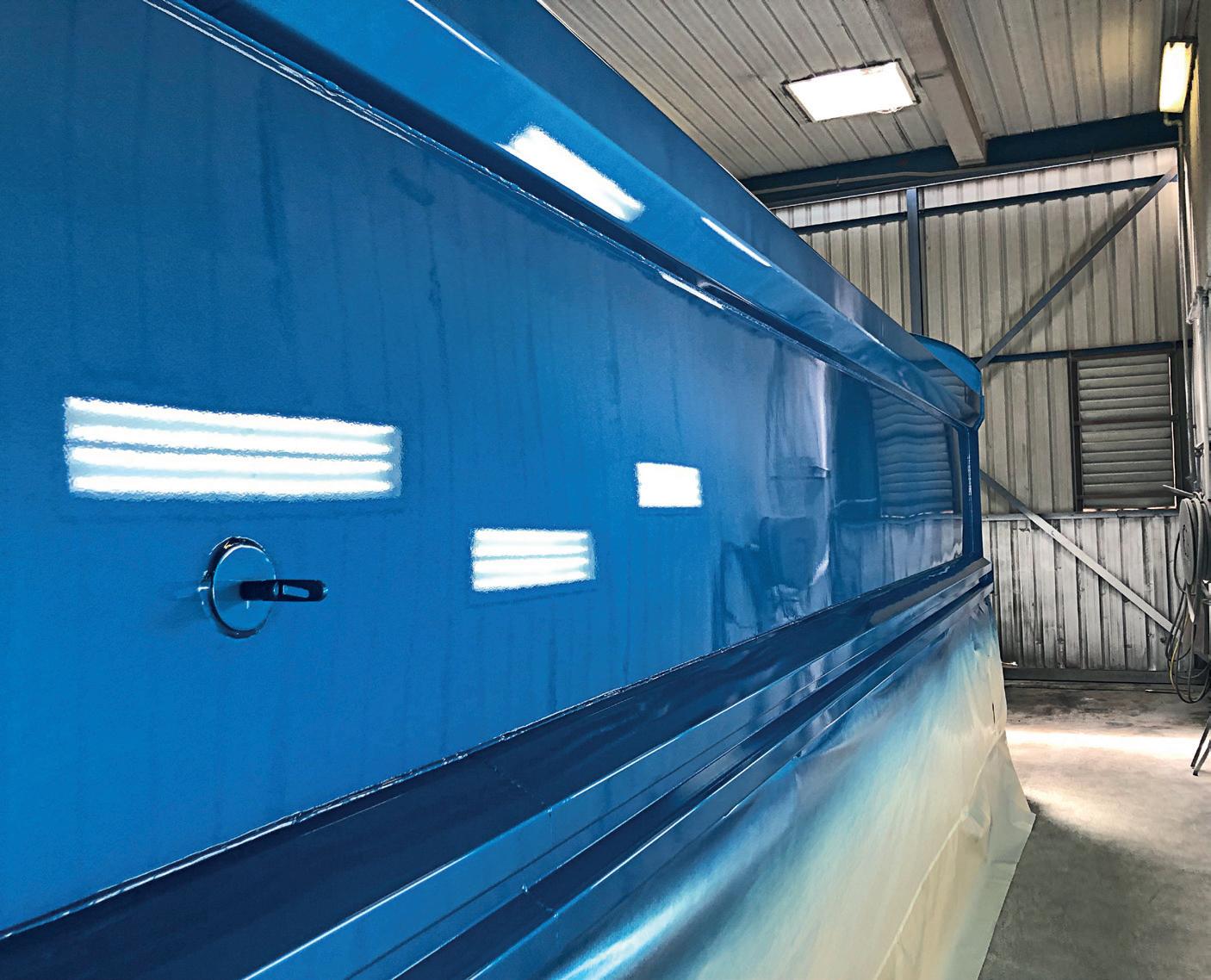
Time is money. Specifically developed for the commercial vehicle sector, the advanced DELFLEET Evolution® paint system offers a complete range of high productivity solutions that are easy to use and achieve exceptional results. To boost throughput and get vehicles on the road faster, complete with outstanding durability, colour and gloss, Delfleet Evolution is perfect for the long-haul! Follow us online!
PPG Refinish Australia & New Zealand
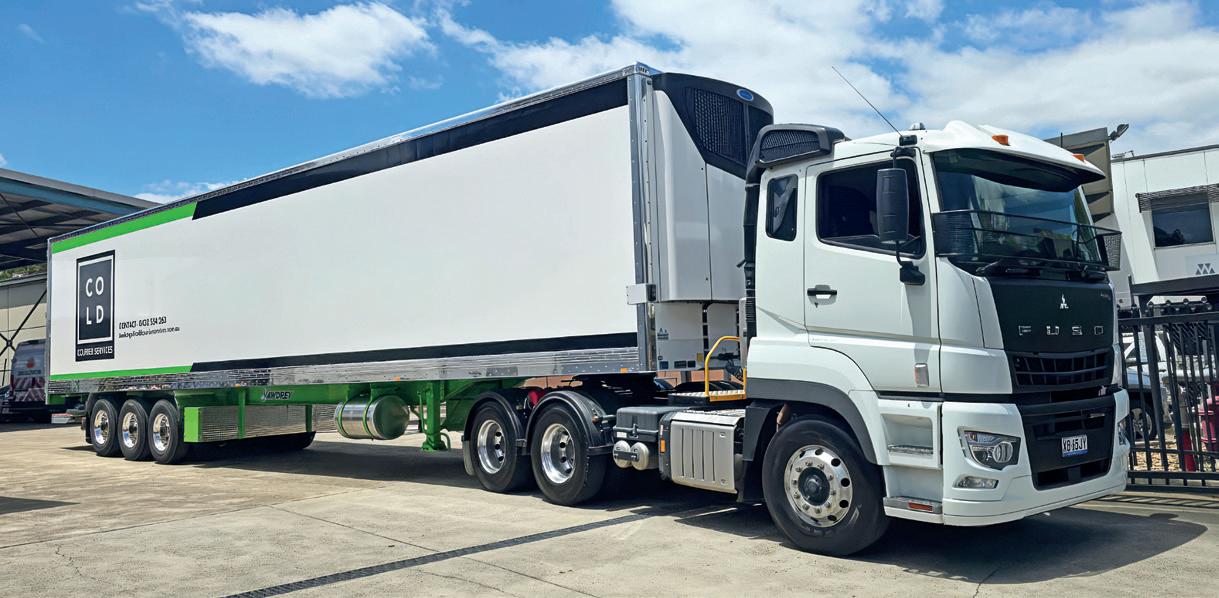
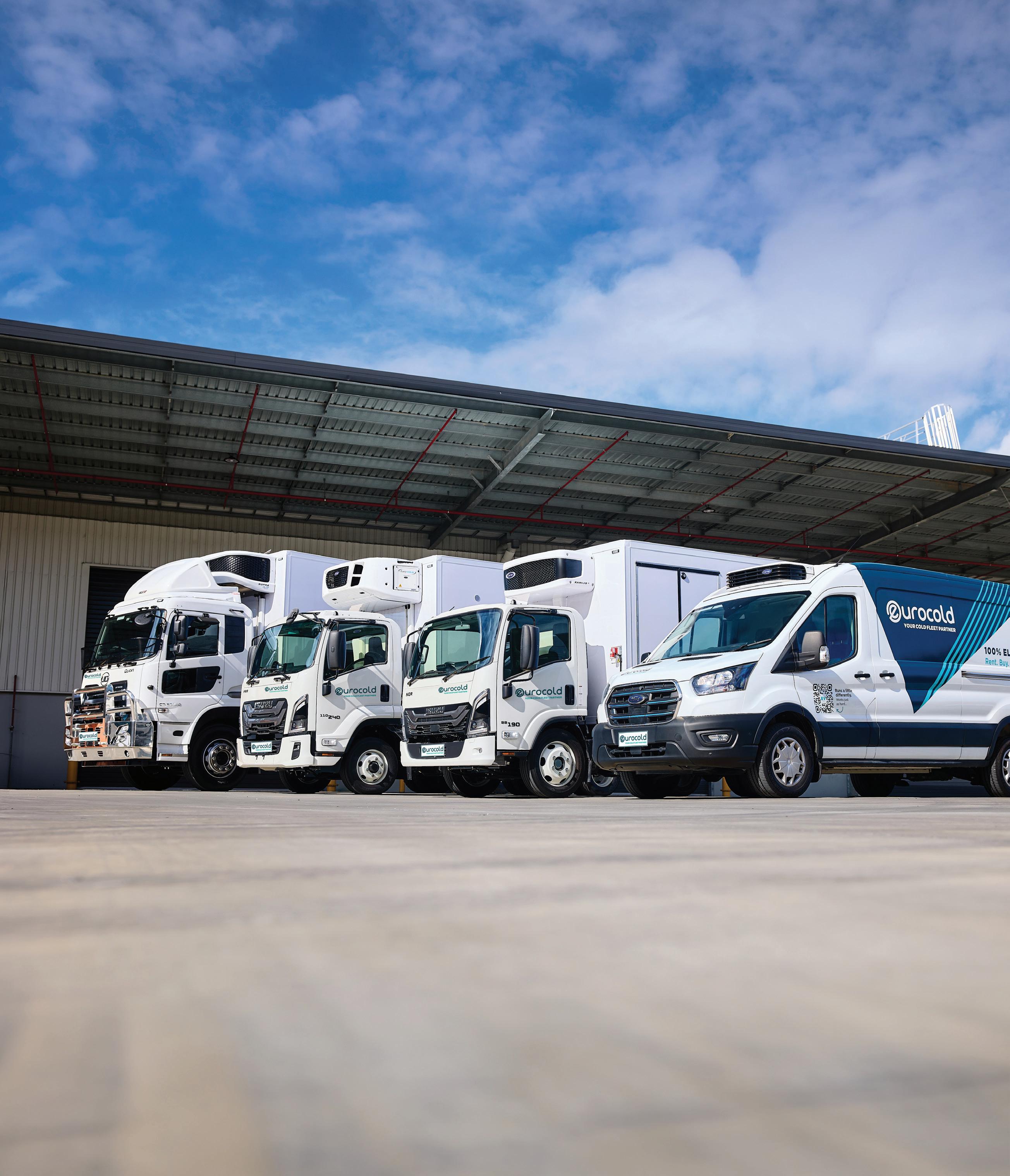
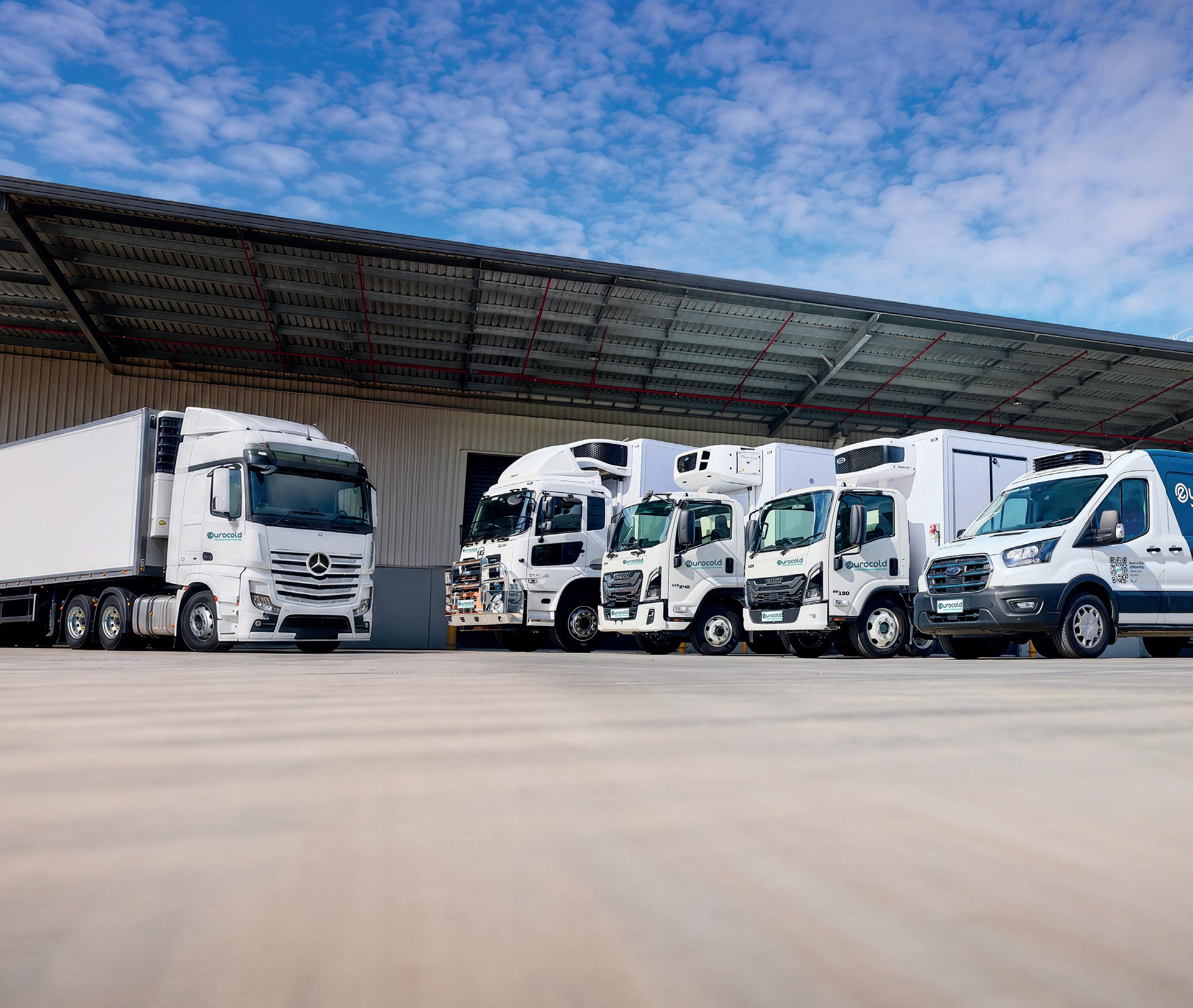
Eurocold’s refrigerated truck and trailer fleet supports Australian operators with flexible long-term rental solutions.
CAPITAL PRESERVING
As refrigerated transport operators reassess how they invest for growth, long-term eet strategy is becoming just as important as the equipment itself according to Eurocold.
For generations, purchasing refrigerated trailers was regarded as the natural progression for transport businesses expanding their operations. Ownership provided certainty, created tangible assets and gave operators con dence they could meet growing customer demand.
While ownership remains an important part of many eet strategies, today’s operating environment is encouraging businesses to take a broader view of how they invest their capital. Higher equipment costs, increased nancing expenses and greater economic uncertainty are prompting transport operators to ask a different question. Rather than simply deciding whether another trailer is required, many are considering whether purchasing that trailer represents the
best use of capital over the long term.
According to Eurocold Head of Growth & Revenue, Robert Smith, this shift re ects a more strategic approach to business planning.
“We’re seeing businesses become much more strategic in how they deploy capital,” he says. “The conversation has shifted from ‘Should we buy another trailer?’ to ‘Is this the best use of our capital over the next ve years?’
“Ownership absolutely has its place, but businesses now have more options. The right funding model should support both today’s operational needs and tomorrow’s growth.”
That broader perspective is changing how refrigerated eet procurement is approached. Instead of viewing trailers purely as assets to own, many operators are considering them as part of a wider investment strategy designed to
maximise business performance.
Every transport business has nite capital, making every investment decision increasingly signi cant.
Funds directed towards eet assets cannot simultaneously be invested in expanding into new markets, implementing new technologies, employing additional staff or improving customer service.
For many operators, preserving capital has therefore become an important commercial objective alongside maintaining eet capability.
Long-term rental offers one alternative by replacing a signi cant upfront capital investment with a predictable operating expense. This allows businesses to retain access to purposebuilt refrigerated equipment while maintaining stronger cash ow and greater nancial exibility.
“Capital is one of the most valuable resources a business has,” Robert says. “Every investment should contribute to growth.
“For many operators, preserving capital gives them the exibility to invest in opportunities that strengthen the business while still accessing the eet capability they need.”
One misconception surrounding long-term rental is that operators must compromise on equipment quality or speci cation. However, Smith argues the funding model should have little bearing on how well a trailer performs. Whether equipment is owned or rented, refrigerated trailers must still meet demanding operational requirements, comply with customer expectations and deliver consistent reliability.
Eurocold speci es each refrigerated trailer according to individual customer requirements, including trailer con guration, refrigeration systems and branding, ensuring operators receive equipment designed speci cally for their applications.
“Whether a business purchases or rents, the trailer still needs to perform exactly as the operation demands,” Robert says.
“The funding model shouldn’t mean compromising on speci cation, reliability or performance. Customers should have con dence that the equipment is built for their business.”
As eet strategies evolve, so too does the relationship between transport operators and equipment providers. Increasingly, businesses are seeking partners capable of supporting the entire lifecycle of their eets rather than simply supplying trailers.
That support extends beyond procurement to encompass funding solutions, maintenance planning, replacement schedules and ongoing eet optimisation as business requirements change.
This holistic approach, Robert says, is becoming increasingly valuable in an industry where uptime, predictability and long-term planning are critical.
“The trailer is only one part of the equation,” he says.
“Customers are looking for con dence that their entire eet will remain reliable, predictable and aligned with their business over the long term. That’s where a managed eet partnership creates true value.”
Eurocold’s position within the Petit Forestier Group also provides visibility into how refrigerated transport businesses around the world are approaching eet investment.
Across Europe and other international markets, long-term rental has become a well-established component of eet management. Rather than focusing solely on asset ownership, operators are using exible funding models to preserve capital, improve asset utilisation and remain responsive to changing market conditions.
Australia is beginning to follow a similar path as businesses increasingly prioritise nancial agility alongside operational performance.
“Being part of the Petit Forestier Group gives us a unique perspective on how refrigerated transport is evolving internationally,” Robert says.
“We’ve seen long-term rental become a core part of eet strategy across global markets because it allows businesses to preserve capital while maintaining the exibility to grow.
“That shift in thinking is becoming
increasingly relevant in Australia. Operators are moving beyond viewing eet as a collection of assets and starting to see it as a strategic part of the business.”
Ultimately, the discussion is no longer centred solely on purchasing or hiring equipment. Instead, it has shifted towards developing eet strategies that support sustainable growth over many years.
As supply chains become more dynamic and customer expectations continue to rise, transport businesses are increasingly looking for partners that can contribute strategic expertise across funding, lifecycle planning and long-term eet management.
Robert says the businesses that will be best positioned for future success will not necessarily be those with the largest eets, but those that deploy their capital most effectively.
“The conversation isn’t about hiring a trailer anymore,” he says.
“It’s about working with customers to develop a eet strategy that supports where their business is heading over the next ve or ten years.
“The businesses that will succeed won’t necessarily be those that own the most assets. They’ll be the ones that allocate capital wisely, remain nancially agile and build partnerships that support long-term growth.”
For refrigerated transport operators navigating an increasingly complex commercial landscape, eet procurement is becoming less about acquiring another trailer and more about building a resilient business. The equipment remains essential, but the strategy behind how that equipment is funded, managed and supported is increasingly shaping long-term competitiveness.
Cold Courier Services partners with Eurocold to access purpose-built refrigerated equipment through long-term rental.
Robert Smith, Head of Growth & Revenue at Eurocold.
FLEETS CONNECTING
The Australian transport industry is facing a critical period. Geotab’s newly released Connected Fleets in Australia Report 2026 has revealed that driver fatigue and safety remain the number one challenge facing eet managers.
Coupled with issues revolving around driver safety, rising fuel costs, increasing compliance obligations, increased TOC, and growing customer expectations continue to place pressure on eet operations.
With eets looking for more proactive ways to improve safety and reduce risk, Geotab Inc has created a video telematics solution that is designed to help organisations better support drivers, accelerate incident investigations, and strengthen eet operations.
The result is that Geotab has launched the GO Focus Pro in Australia and New Zealand, which brings predictive AI
and 360-degree visibility to eet safety. The product launch comes as Geotab’s Connected Fleets in Australia Report 2026 found driver fatigue and safety are the number one challenge facing Australian eet managers, while more than half (53 per cent) of Australian eets now use in-cab video technology to improve safety and reduce operational risk.
GO Focus Pro is the latest addition to Geotab’s GO Focus family of AIpowered dash cameras. The telematics solution combines full 360-degree visibility with AI-powered coaching and real-time in-cab alerts, helping drivers identify and respond to potential risks before incidents occur, particularly in light of Australian eets face growing
operational and compliance pressures.
The latest addition to the GO Focus family is designed to help eets reduce risk, improve driver safety and prevent collisions through AI-powered coaching and predictive risk detection.
“The Australian eet industry is facing a growing mix of safety, compliance and operational pressures. Driver fatigue remains the number one challenge for eet managers, while rising costs and increasing customer expectations continue to place additional strain on both businesses and drivers,” said Chris Martin, Senior Manager, Solutions Engineering APAC, Geotab.
“At the same time, we’re seeing organisations embrace connected vehicle technologies and video
Geotab has launched its Go Focus Pro dash cam system in Australia and New Zealand.
telematics as practical tools to improve safety outcomes and reduce risk.
“The opportunity isn’t simply to collect more data, but to use real-time insights to better support drivers, identify potential risks earlier and create safer, more resilient eet operations.
“Solutions like the GO Focus Pro are designed to help eets turn those insights into action, giving drivers greater support on the road while helping organisations build safer and more resilient operations.”
Natively integrated into the MyGeotab platform, GO Focus Pro delivers a comprehensive video telematics solution that combines full 360-degree visibility with advanced AI-powered safety intelligence that enhances predictive risk detection.
Key capabilities include:
360-degree visibility: Support for up to ve auxiliary cameras, providing complete coverage of the vehicle, driver, cargo, trailers and surrounding environment.
Predictive AI safety features: Detection of traf c light violations, forward collision risks and vulnerable road users in blind spots using AI-powered external cameras.
Driver score: Automated scoring to identify repeat infractions and risky driving behaviours, including mobile phone use and fatigue, helping prioritise coaching and recognise safe driving habits.
Smart Sequence: A streamlined view of critical eet events, reducing review time and helping safety teams focus on the incidents that matter most.
Automated coaching & sessions: Real-time in-cab audio alerts support immediate self-correction, while managers can assign and track coaching programs directly within the platform.
Smart Driver ID: AI driver assignment using facial recognition, improving operational ef ciency and data accuracy.
Zero-latency backup monitor: Instant video feeds to support reversing, docking, low-speed manoeuvres and blind spot visibility.
“The
Australian eet industry is facing a growing mix of safety, compliance and operational pressures. Driver fatigue remains the number one challenge for eet managers, while rising costs and increasing customer expectations continue to place additional strain on both businesses and drivers.”
Senior Manager, Solutions Engineering APAC, Geotab, Chris Martin.
compact but highly
No systematic human review: Unlike many market alternatives, GO Focus Pro uses a fully AI-driven pipeline without systematic human review. With full surround video coverage and predictive AI capabilities, GO Focus Pro provides eets with the visibility and intelligence needed to protect drivers, vehicles and the communities they serve. The solution helps accelerate incident investigations, defend against false claims and enable drivers to self-correct before high-impact events
occur, reducing collisions, downtime and operating costs.
GO Focus Pro expands Geotab’s GO Focus family of AI-powered dash cameras, which includes, GO Focus Plus and a suite of compatible auxiliary cameras. The portfolio provides eets with the exibility to deploy the right level of video telematics across different vehicle types, operational requirements and risk pro les, all within a streamlined and privacy-conscious work ow.
Images: Geotab Inc.
The
effective Geotab Go Focus Plus.
SILVER LININGS PLAYBOOK
The latest Del eet metallic technology from PPG is helping heavy vehicle operators achieve premium nishes with proven durability.
Paint has always played a vital role in protecting commercial heavy vehicles and equipment from Australia’s harsh operating conditions. It also serves as a powerful re ection of a eet’s image, with operators increasingly seeking nishes that combine long-term durability with striking visual appeal. Responding to this shift, PPG has introduced F3621 Del eet Medium Bright Metallic, the latest addition to its premium Del eet 419M Ultra High Solids range. Replacing the previous F3609 Del eet Bright Metallic, the new formulation has been developed to deliver a smoother application process while producing a cleaner, more consistent metallic nish.
According to PPG Key Account Manager, Commercial Coatings, Chris Rovere, metallic direct gloss systems
have become the benchmark across the commercial transport sector, placing greater emphasis on products that are both easy to apply and capable of delivering repeatable, high-quality results.
Historically, achieving an even metallic appearance has been one of the biggest challenges for painters. The coarse silver particles used in traditional formulations could lead to mottling and patchiness, creating inconsistent nishes that required greater skill and rework. The new Medium Bright Metallic addresses these issues by improving metallic laydown and mottle control, allowing painters to achieve a uniform, high-gloss nish straight from the spray gun.
Importantly, the application process remains unchanged. Instead, the innovation lies within the formulation
itself, which creates a smoother, more re ned metallic effect without altering the existing Del eet colour range. The result closely resembles the appearance typically associated with a basecoat and clearcoat system, while retaining the ef ciency of a single-layer direct gloss application.
Like the broader Del eet range, the new metallic coating has been engineered to withstand demanding Australian conditions. Extensive testing for UV stability, corrosion resistance and salt spray performance ensures the product delivers the durability expected across heavy transport, construction and agricultural applications.
The enhanced nish also makes metallic coatings a more accessible option across a broader range of commercial assets. From prime movers and trailers to cranes, earthmoving equipment and agricultural machinery, operators can now achieve a premium metallic appearance without compromising the robust performance required in daily service.
The coating has been tested for UV stability, corrosion resistance and salt spray performance.
PPG Delfleet F3621 Medium Bright Metallic improves metallic laydown and mottle control.
“Australian Truck Radio works for me. Great trucking tunes and heaps of handy info day and night. Keep on trucking guys!”
Visit us on www.australiantruckradio.com.au
KIRSTY MARTIN DRIVER FOR ACE CRANE TRUCKS
MOVING ON UP
Australia’s new car market requires a high-tech approach to the transportation of new vehicles. Hino has come up with a handy solution.
Despite some concerns about the economy, both local and global, the Australian car market is currently in a very strong position, much of it due to the increasing demand for affordable Asian manufactured cars, both petrol and electric powered. This “boom” also brings with it the requirement to move imported vehicles from the wharves to holding and distribution centres and then ultimately to the dealerships. Recognising the potential of this opportunity Hino has put together an assessment package capable of handling up to four passenger
or light commercial vehicles. The car carrying combination is based on a Hino 700 FH 1836 4x2 cab chassis tted with a Top Start two car dual level frame on top of the chassis and towing a two vehicle “half-moon” trailer which, thanks to its innovative design doesn’t require ramps between the trailer and the truck. The Bartlett ball hitch is strategically positioned so the arc of the half-moon shaped beaver tail (perhaps we could term it “platypus tail” in Australia) remains parallel with the arc of the front of the trailer. The upper front frame can be raised or
lowered hydraulically and can also be tilted to accommodate the pro le of a vehicle being transported on the six metre lower level while maintaining the lowest possible overall height. The hydraulics for the front frame and the trailer are powered by a transmission mounted PTO which also powers the retractable loading ramps on the single axle trailer which, like the rear axle of the Hino, rides on airbag suspension. The truck’s wheelbase has been shortened by one metre to ve metres to accommodate maximum length con guration. This also involved the
The Hino Car Carrier in action.
re-engineering of components such as the drive shafts and braking hoses. The trailer’s load rating was reduced from 13.3 tonnes to 9.0 tonnes to allow the combination to be legally operated by holders of Medium Rigid licences. The Electronic Braking System of the Hino 700 as the name says, uses sophisticated electronics to manage the braking system’s air valves to provide a smoother pedal stroke and application. As a trailer brake control system is not standard on the Hino 9.0 litre chassis, the engineers con gured this build with a Hino-guided kit to enable the trailer brake control system which replicates the genuine trailer brake valve components and design from the 13.0 litre chassis which features Trailer Brake Control hardware as standard. This kit installation requires reprogramming of the WABCO brake
ECU to suit the Trailer Brake Control con guration. The system identi es whether a “smart” trailer equipped with an Electronic Braking System (EBS) is
connected and shows a warning lamp on the dashboard to alert the driver if a non-EBS trailer is connected.
The Adaptive Cruise Control operates
Precision is needed for such a big haulage job.
Carrying a full load.
Putting together a big load.
All aboard for a long journey.
down to 35 km/hr and won’t operate if the engine brake wand is in an active position.
Other braking features of the full air, taper roller drum braking system include a two-stage engine compression retarder (“Jake Brake”) and a very sensible brake synchronisation system which can be activated from a switch on the dash. When operating, simply depressing the brake pedal very slightly brings on the rst stage of the Jake brake. Push a little more and the truck and trailer service brakes activate.
This “brake sync” feature reduces wear on the brake components which maximising the effectiveness of the overall braking system.
With the “Brake Sync” switch activated there is no need to manually use the engine brake wand in general driving.
The Adaptive Cruise Control operates down to 35 km/hr and won’t operate if the engine brake wand is in an active
position. The rst stage of travel of the foot brake actually activates the engine’s Jake brake before it brings on service brakes, which helps conserve brake components as they only are activated after the engine brake comes on.
The Hino’s Electronically Controlled Air Suspension (ECAS) controls the Hendrickson HAS airbag rear suspension and allows the ride height to be adjusted to suit the load on the truck. The trailer’s air suspension can also be adjusted by the operator. The ability to lower the truck and trailer by dumping air makes the tasks of loading and unloading vehicles easier.
The Hino 700 FH 1836 is powered by Hino’s 9.0 litre engine which produces 360hp (265kW) at 1,800 rpm and a maximum torque of 1,569 kW between 1,100 rpm and 1,600 rpm. The engine employs Supplementary Catalytic Reduction (SCR) and a Diesel Particulate Reduction (DPR) to meet
the latest Euro VI emission standard. On the road the DPR regeneration process was almost unnoticeable when it was occurring.
The transmission is Hino’s own M112 12-speed automated manual which has direct gearing in 11th, and a 0.795 overdrive in 12th. The combination of Hino’s own engine and transmission delivers a very smooth operation which may not have been achievable with the implementation of third party components. With its 3.90:1 rear axle ratio, the Hino sits just above 1,600rpm at 100 km/hr in top gear. Modern trucks are expected to be loaded with electronic-based systems to provide an improved mantle of safety, ef ciency and driver assistance. The combination of this 9.0 litre Hino 700 and its Top Start trailer is an excellent example of Japanese and Australian engineering expertise using the power of silicone chips.
NORTH TRAVELLIN’
Rather than launch its range of new models in a showroom or at an event venue, followed up with a few laps of a closed circuit such as Anglesea or Mt Cotton, Isuzu has put together its 2026 National Roadshow which is about taking examples of the MY25 Isuzu range on the road around the entire country with stop-offs at dealerships and customer events over seven months and 15,000 kilometres. This also presents some unique opportunities for selected members of the Australian truck media to experience a couple of F-Series along extensive legs of the trip. Hosting our trip is Isuzu Australia’s Sales Product Trainer and National Roadshow Lead Driver Tim Richardson who is able to convey some subtle ways to extract the best from the trucks
which are a FXD 260-355 4x2 rigid and a FYJ 320-355 8x4 tilt tray connected to a bogie trailer. Motive power for both trucks comes from the Isuzu 6UZ1 engines through smooth shifting six-speed Allison transmissions and Hendrickson airbag rear suspensions. The high-torque 9.8litre common rail turbo-diesel engines are rated at 259kW (352PS) and 1,437Nm of torque. It’s not just about power and acceleration with a seamless interaction between the engine brake and the Allison transmission enabling maximum braking power when it’s most needed. Isuzu taken a good initiative to put this Roadshow together, and has deliberately selected key examples of its MY25 range in order to show clients the potential of using Isuzu trucks in various applications. To simulate some load, the FYJ 8x4 becomes a truckload
of trucks by carrying an all-wheel drive NMS Servicepack on the tilt tray and a NKR Tipper on the trailer, while the FXD 4x2 is piggy-backing a NKR Tradepack.
The FY 8x4 is equipped with a 9.5 metre CTE tilt slide tray incorporating a 30,000 pound winch, and tows a 6.3 metre CTE tag trailer and the combination is just a few millimetres short of 19 metres in length. The trailer features a particularly long drawbar which connects to an air operated pintle hitch located just behind the truck’s rear axle, and with its airbag suspension and electronic braking, tows exceptionally well. The clever design of the tilt tray/ tag trailer combination is very well demonstrated under the control of Tim Richardson who shows how easy it is to kick the trailer to one side to allow for the operation of the tilt slide in order to load and unload vehicles from the truck
Isuzu’s National Roadshow takes on the challenges of the Northern Territory.
with no need to unhitch the trailer.
After ying in from the east coast, we nd ourselves departing Uluru a little later than intended due to the need to have a damaged steer tyre replaced. Eventually our little convoy heads towards Alice Springs, almost 450 kilometres to the east. A different crew had undertaken the Adelaide to Coober Pedy leg, before delivering the trucks to Uluru. Arriving in “The Alice” as darkness falls we enjoy a restful night before hitting the Stuart Highway just after dawn and begin heading evernorth towards Darwin.
For many hundreds of kilometres in the NT a 130km/hr general speed limit is in effect. With the cruise set at the speed limited 100km/hr, there isn’t too much of a speed differential between the Isuzu’s and other traf c. Most of the trucks we see on the road
and at rest stops are big bonneted American style prime movers with sleepers the size of small apartments towing multiple trailers carrying all manner of goods from machinery to cattle. So we ponder how does a Japanese truck t into this harsh environment? The answer is essentially a case of meeting the needs of the locals. Beer needs to be delivered to the remote pubs, smaller pieces of machinery need to be taken to locations which have dif cult access, broken down vehicles (and caravans) need to be taken to places of repair, water has to be carted and roads need to be mended and none of these tasks can be performed by a 60 metre road train. Isuzu dominates the Australian truck market and over three days and 2,000 kilometres, we only see one nonIsuzu rigid truck.
In addition to the road trains and ubiquitous 4x4 utes with off-road caravan combinations, we nd we are sharing the highway with the occasional over dimension wide load, usually consisting of large pieces of mining machinery heading south towards us, or modular accommodation “donga’s” travelling north like us. Via the UHF radio, they call us through when it is safe to pass. Most of the road is well maintained because it has to be, this being the vital main route between Adelaide and Darwin. Further north there is the occasional evidence of surface damage in the form of repaired potholes most likely appearing during the “wet” season but the Isuzu suspensions and seats absorb all of the roughness. In the main, the caravanning tourists we encounter tend to treat trucks of
Dawn in the Outback.
all sizes with respect. On a trip such as this, the Adaptive Cruise Control comes into its own domain and enables us to maintain legal speed and a safe adjustable gap from any vehicle in front. The system provides a level of protection against anyone who decides to suddenly stop for whatever reason, whether an animal on the road or maybe a photo opportunity. The nomads for the most part are courteous towards the trucks they share the road and rest stops with, one theory being they have learned a lot during their passage out here. You don’t get this far out of town if you act like a clown. We have just nished lunch at the Devil’s Marbles Hotel when a rare heavy rainstorm hits. The lm crew urge us to hit the road and travel the few kilometres to the iconic rock formation known to the indigenous people as Karlu Karlu. The effort was worthwhile, with some sensational images of the many massive granite boulders contrasting against the
dark sky which looked like a witch’s caldron, further contrasting with the bright white Isuzu trucks which really captured the unique light.
Back onto the road we travel through Tennant Creek heading towards our overnight stop at Renner Springs where we enjoy a great meal at the pub and contribute to the ceiling’s famous collection of truckers’ caps.
The FX and FY Isuzu look after their drivers with Isri air-suspended seats and well thought through control ergonomics and a second-to-none HVAC system. Although it’s almost mid-winter, the outside temperature gets to 35 degrees during the day but we remain at the very comfortable 22 degrees we have selected in the cab.
As darkness descends the LED headlights provide a broad beam of light which extends to the road side and are complemented on high beam by the NARVA driving lights.
We are accompanied by an experienced lm crew travelling in an SUV and a
dual cab ute. We’ve worked with these guys previously and they are masters at capturing the right images and sounds while remaining mostly unobtrusive. We pass through cattle stations the size of small European countries and stretch to the horizons on both sides of the highway. As we head north the countryside is anything but monotonous. Sure, the road doesn’t have many hills or curves but a driver needs to be on the lookout for wildlife and livestock and maintain vigilance of the roadside and table drains, especially as dusk approaches.
The F Series’ Advanced Driver Assistance Systems (ADAS) is a highly effective combination of an optical sensor (digital camera) and a milli-wave radar to monitor the forward environment of the trucks to detect objects such as vehicles, pedestrians, bicycles and, especially out here, animals. The odd stray bovine will stand their ground even if you give a toot of the horn. The system uses the camera to determine the
Pre-dawn departure.
object and the radar to measure distance and relative speed.
North of Katherine there are a few small hills but the torque of the Isuzu engines means we take them in our stride as the roadside vegetation becomes more lush and the traf c builds a little and the amount and variety of roadkill increases. We are entertained by the wit of previous travellers who have placed T-shirts and caps on roadside termite mounds to create an Aussie version of China’s terracotta warriors.
Isuzu is keeping up with communication technology with a Smartphone dock located below the info touch screen on the dash. This keeps a phone secure and provides cordless inductive charging. There’s also a charging socket plus a USB connection. The Isuzu infotainment system is comprehensive but on this trip it’s mostly my own playlist from my phone that I listen to.
Our journey takes place during the Middle East hostilities when the price of fuel has skyrocketed. Along the highway, the highest price we pay for diesel is $3.16 per litre. At least supply is not a problem, just as long as one is prepared to pay the price. Tim Richardson tells us that since leaving Perth the two trucks have averaged AdBlue consumption at no more than 1.5 per cent of diesel use.
It can be tough country out here and we pass the sad sights of numerous closed road houses. Modern cars and trucks have longer ranges between ll ups than was required when these places were built back in the 50’s and 60’s and the Covid pandemic also contributed to killing off tourism. The Northern Territory is not a signatory to the NHVR, so responsibility for fatigue management is up to the driver using published “guidelines”. We could have been on the road up to 12 hours a day, but take more than the regulation breaks for fuel, food and coffee without affecting our intended timelines in relation to meals, refuelling and accommodations. The Isuzu driver fatigue management
Images: Isuzu Australia.
Fuel was plentiful but expensive.
A geography lesson at a fuel stop.
Approaching the Devil’s Marbles (Karlu Kaarlu).
Playing tourist at Devil’s Marbles.
works off an algorithm which monitors that the driver is actually steering the vehicle and making inputs via the steering wheel. This system differs from others which may use an A-pillar mounted camera and facial recognition. On long straight roads like this we do get the occasional alert on the dash, but its unobtrusive enough to not be an annoyance while being suf ciently effective should the driver become de cit in their attention to the job. It’s reassuring to know the system is running in the background. Traf c sign recognition is another feature which boosts con dence in the inbuilt safety of the Isuzu trucks.
With the cruise control set to 100km/ hr, the tacho is just on the upper limit of the green band, so the engine is doing it easy and fuel ef ciency is maximised.
By performing this nation-wide Roadshow, Isuzu has deliberately put its trucks into remote and harsh environments with con dence they will come through whatever is thrown at them. As we eventually roll into Darwin after three days and a couple of thousand kilometres, consensus is that level of con dence is well placed. Normally arriving at a destination, in this case the Territory Isuzu dealership at the southern outskirts of Darwin, brings a certain degree of relief, but the overwhelming emotion this time is, surprisingly, one of disappointment that our trip is completed. Our experiences behind the wheels of both of the Isuzu’s during the trip have been nothing less than impressive. Covering a distance such as this provides a different appreciation for a truck. The things that matter over a short drive become even more important over a long one, factors such as comfort, visibility, safety, and drivability and the FX and FY delivered consistently across all. Conversely, anything annoying found during a short drive is only going to be magni ed if we’re driving for 2,000 k’s over three days. Fortunately, that doesn’t happen.
Smooth going in the Outback.
FUTURE POWERING THE
More than 250 delegates from across the Australian road freight industry gathered on Hamilton Island from 3–5 June for the Australian Trucking Association’s (ATA) annual Trucking Australia conference.
The annual Trucking Australia conference once again reinforced its reputation as the industry’s premier leadership and policy forum in Australia. Bringing together transport operators, suppliers, regulators, government representatives and industry stakeholders, the conference focused on the challenges and opportunities shaping the future of Australia’s trucking sector as it featured 13 conference sessions with 39 presenters and panellists.
The conference commenced with a preevent golf day and the Penske welcome reception, providing delegates with an opportunity to reconnect with industry colleagues before two days of intensive discussion and networking.
A much-anticipated feature of the three-day event was the presentation of the ATA’s 2026 National Trucking Industry Awards at the Foundation
Sponsors Gala Awards Dinner, held on the nal night.
Businesses and individuals were recognised for their outstanding contributions to safety, workforce development, professionalism and industry leadership. The awards provided a tting conclusion to an evet that balanced serious discussion of the industry’s challenges with recognition of the innovation, resilience and professionalism that continue to drive Australian road transport forward.
“The recipients of this year’s awards have demonstrated outstanding dedication to their businesses and the wider community,” ATA Chair, Mark Parry, said.
“They are the best our industry has to offer, and they are examples to us all.”
Throughout the conference, the emphasis was rmly on preparing the industry for a rapidly changing operating environment, with sessions
examining safety, workforce shortages, leadership, fuel security, productivity, regulatory reform and long-term industry sustainability.
A key highlight was the presentation of the ATA’s 2026 State of the Industry report, delivered in partnership with research company Fifth Quadrant.
The research provided delegates with an up-to-date snapshot of the issues affecting transport businesses nationwide, identifying driver fatigue, inexperienced drivers, driver behaviour, vehicle maintenance, distraction and load restraint as some of the industry’s most pressing safety concerns.
Operators also identi ed increasing compliance obligations, deteriorating road infrastructure and growing traf c congestion as signi cant pressures on their businesses.
Workforce development emerged as one of the dominant themes across the conference. Sessions examined
Trucking Australia delegates enjoyed the best of Hamilton Island hospitality.
Australia’s ongoing heavy vehicle driver shortage and the need to develop more effective pathways into the industry.
Speakers highlighted the importance of moving beyond tenure-based licensing towards competency-based training models that better prepare new drivers through mentoring, structured supervision and practical skills development. Delegates also discussed improving the industry’s image and encouraging more young people and women to pursue long-term careers in road transport.
Leadership was another major focus. Delegates heard from keynote speaker Rachael Robertson, who drew on her experience leading expedition teams in Antarctica to explore the characteristics of high-performing organisations. Robertson emphasised the importance of recruiting for attitude as much as technical capability, building respectful workplace cultures and recognising success to maintain morale. These themes aligned closely with broader discussions about strengthening leadership capability throughout transport businesses as operators adapt to increasing commercial and regulatory complexity.
Energy security also featured prominently following heightened geopolitical tensions in the Middle East. Conference sessions explored Australia’s dependence on imported fuel supplies and the importance of ensuring long-term fuel resilience for the freight task. Delegates considered the role renewable diesel and alternative fuels may play in reducing emissions while acknowledging the current cost barriers preventing widespread adoption. The discussions reinforced the strategic importance of freight transport to Australia’s economy, agriculture, mining and national security.
Policy and advocacy remained central to the conference agenda. Interactive sessions allowed delegates to help shape the ATA’s future policy priorities, with discussion covering transport reform, road user charging,
Hamilton Island even had room for a Volvo prime mover.
ATA Chair, Mark Parry, Senator Bridget McKenzie and ATA CEO Mathew Munro.
Networking in the Queensland sun.
productivity improvements, regulatory consistency and the growing role of telematics and data sharing in improving safety outcomes. The conference’s collaborative format encouraged operators to contribute directly to the industry’s advocacy agenda, re ecting the ATA’s continuing role as the national voice of Australian trucking.
The conference also placed renewed emphasis on developing the next generation of industry leaders through the expanded Future Leaders’ Forum. Sessions examined leadership development, advocacy skills and the importance of equipping emerging industry representatives to in uence future government policy and regulatory reform. Delegates also gained valuable insights into the practical realities of successful industry lobbying and the collaborative efforts required to secure meaningful policy outcomes.
Mental health and workplace wellbeing were recognised as increasingly important components of transport safety. Presentations from Healthy Heads in Trucks & Sheds highlighted the need to actively manage psychosocial hazards within transport businesses, reinforcing the relationship between positive workplace culture, driver wellbeing and safer road operations. The conference acknowledged that supporting drivers’ mental health is now an essential part of modern transport management. Overall, Trucking Australia 2026 demonstrated that while the industry continues to face signi cant challenges—from workforce shortages and rising compliance costs to fuel security and changing regulation— it remains committed to working collaboratively on practical solutions. The conference reinforced that leadership, innovation, investment in people and strong industry advocacy will be critical in ensuring Australia’s trucking sector continues to keep the nation’s freight moving for decades to come.
2026 NATIONAL TRUCKING INDUSTRY AWARDS
Outstanding Contribution to the Australian Trucking Industry
Michael Edmonds, NTI (Brisbane, Qld)
National Professional Driver of the Year
John Parry, IOR (Cannon Hill, Qld)
National Trucking Industry Woman of the Year
Jodie Jarratt, Jarratt Transport Solutions (Benowa, Qld)
National Trucking Industry Workforce Award
Formula Chemicals (West Ryde, NSW)
TruckSafe John Kelly Memorial Award K & S Freighters (Truganina, Vic)
Don Watson Memorial Award David Simon
Images: ATA.
The main sessions captivated attendees.
A highlight was the gala dinner.
Trucking Australia featured a wide array of industry topics.
Fun and networking Queensland style.
GEARS GRINDING
With Australia’s truck driver shortage running unabated, the industry, and relevant stakeholders, are still searching for the panacea.
For more than a decade, Australia’s heavy vehicle industry has been warning governments and the broader community that a chronic shortage of truck drivers threatens the ef ciency and resilience of the nation’s freight network. Despite sustained efforts by industry associations, transport operators and governments, the problem has not gone away. If anything, it has become more pressing as freight demand continues to increase while the workforce steadily ages.
The most recent ndings from the International Road Transport Union’s (IRU) 2025 Global Truck Driver Shortage Report reinforce what Australian operators have known for years: the driver shortage is not simply a recruitment problem—it is a demographic challenge that requires long-term structural reform.
Australia’s road freight task is forecast to continue growing over coming decades, with almost 80 per cent of the nation’s domestic freight already moved by road. Every supermarket shelf, construction project, manufacturing
plant and regional community relies on an ef cient trucking industry. Yet the sector continues to struggle to attract enough quali ed drivers to keep pace with demand.
According to the IRU, Australia currently faces tens of thousands of un lled truck driving positions. More concerning is the industry’s age pro le. Around one in ve Australian truck drivers is expected to retire by the end of this decade, while almost half of the current workforce is already over the age of 55, with less than six percent under the age of 25. This demographic imbalance represents one of the greatest workforce challenges confronting Australian transport.
IRU Secretary General Umberto de Pretto said: “Despite signi cant industry efforts, the shortage of drivers has deepened as a critical structural issue for the road transport industry. “Driver recruitment is directly affecting transport capacity, business growth and supply chain reliability.”
The IRU report also highlights a major change in how professional drivers
assess employment opportunities.
Pay remains important, which operators increasingly describe as a “wage wall”. Higher wages alone are no longer enough to attract or retain drivers. Cab and trailer conditions, secure parking, time at home, predictable schedules and work-life balance are increasingly decisive. This shift is particularly visible in long-haul transport and coach tourism.
“IRU is calling for coordinated action from governments and industry. The shortage cannot be solved by recruitment campaigns alone,” said de Pretto.
“The sector must improve the quality of the job and make professional driving a career that people can enter, build and remain in.”
According to NatRoad there is a shortfall of approximately 28,000 truck drivers across Australia, which is forecast to increase to 78,000 un lled positions by 2029.
Unlike many other occupations, truck driving cannot simply be replaced through automation in the foreseeable
future. Heavy vehicle drivers perform complex tasks involving customer service, vehicle inspections, load restraint, fatigue management, route planning and compliance with increasingly sophisticated safety regulations. Skilled, experienced drivers remain indispensable.
The IRU report found that retention is not the industry’s primary problem. Once people enter the profession, many remain in it for decades. Rather, the challenge lies in attracting new entrants to replace those leaving the workforce.
Industry associations have consistently argued that truck driving suffers from an outdated public image. Younger Australians often perceive the profession as involving long hours away from home, irregular schedules, physically demanding work and limited career progression. While modern trucks are safer, more comfortable and technologically advanced than ever before, perceptions have not kept pace with reality.
The Australian Trucking Association (ATA) has made workforce development one of its highest priorities. Through initiatives such as the InRoads Diversity Program, the
ATA is encouraging operators to recruit from traditionally underrepresented groups, including women, First Nations Australians and people from culturally diverse backgrounds. Increasing workforce diversity represents one of the industry’s greatest untapped opportunities.
The ATA has also strongly supported the National Truck Driving Apprenticeship, recognising truck driving as a skilled profession requiring structured training rather than simply time behind the wheel. The association has called for greater nancial support for apprentices, trainees and employers to encourage participation and reduce barriers to entry.
The ATA’s 2025 Technical & Maintenance Conference in Melbourne saw a roundtable discussion, involving truck driver and social media content creator, Casuarina “CJ” Smith, consider the need to attract and retain young people to the industry. In doing so, the panel emphasised the need to promote the transport industry as a career to young people.
NatRoad has consistently advocated for reform of Australia’s heavy vehicle licensing system. The organisation argues that the existing time-based
licensing framework can unnecessarily delay capable drivers from progressing through licence classes. Instead, it supports a national competency-based approach that focuses on demonstrated skills not on arbitrary waiting periods.
The Victorian Transport Association (VTA) has likewise highlighted the importance of workforce development, particularly through stronger links between industry, schools, training organisations and government. The VTA has argued that trucking should be promoted as a professional career offering long-term employment, advanced technology and multiple pathways into eet management, logistics and transport operations.
The Australian Government has recognised the importance of workforce planning through its National Skills Agreement and broader transport workforce initiatives. Federal and state governments have supported the development of nationally recognised training pathways while continuing discussions with industry regarding licensing reform, apprenticeships and improved vocational education.
Trucking industry advocates, such as Western Australian Senator, and former long-distance truck driver, Glenn Sterle, have long pushed to nd ways to ensure the trucking and transport industry remain sustainable, pro table, viable and safe.
Leading industry gures believe that improving recruitment must begin with changing public perceptions among young Australians. Today’s heavy vehicles incorporate sophisticated telematics, advanced driver assistance systems, automated transmissions, collision mitigation technology and comprehensive safety systems. Truck driving is increasingly becoming a technology-enabled profession requiring judgement, professionalism and technical competence.
Greater investment in education and career awareness can help students understand the industry’s diversity. Many drivers eventually move into
Casuarina Smith meeting with kids at a regional truck show. Image: HELLA.
elds of operations management, compliance, eet supervision and training. Presenting trucking as a longterm career rather than just a driving job could encourage more young people to enter the industry.
The ATA’s TMC2025 featured a panel discussion on how best to retain ‘Gen Z’ students in the automotive sector, through the promotion of trades as a profession. At that event, Apprenticeship Support Australia (ASA), highlighted that 40 per cent of apprentices drop out due to poor supervision and workplace conditions. Some of the potential measures that participants considered included:
• Involving parents in the apprenticeship journey; maintaining dedicated HR/mentorship roles to support apprentices.
• OEMs to provide training and equipment to trade schools.
• Mentoring programs for apprentices to help with workplace challenges.
• Engagement with high schools to promote trade careers and showcase industry technology.
• Regular meetings between employers and trade school educators on training plans and industry needs. Women also remain signi cantly underrepresented within Australia’s truck driver workforce despite
IRU 2025 DRIVER SHORTAGE SURVEY
• 2.9 million un lled truck driver positions across 18 markets.
• Approx. 20 per cent of Europe’s driver workforce and 24 per cent of Australia’s expected to retire within ve years.
• Driver shortage is most pressing concern for 65 per cent of European operators.
• Women account for 4 per cent of European truck drivers.
• Freight demand is growing faster than driver supply in Uzbekistan and China.
“Despite signi cant industry e orts, the shortage of drivers has deepened as a critical structural issue for the road transport industry. Driver recruitment is directly a ecting transport capacity, business growth and supply chain reliability.”
IRU Secretary General Umberto de Pretto.
representing almost half of the national labour force. Creating more inclusive workplaces through improved facilities, exible rostering, mentoring programs and targeted recruitment campaigns could substantially expand the industry’s talent pool.
Equally important is improving driver wellbeing. Fatigue, mental health, access to healthy food and the availability of safe, well-maintained rest areas continue to in uence both recruitment and retention. Investment in roadside infrastructure remains critical if governments expect drivers to comply with fatigue regulations while maintaining productivity.
Technology also offers opportunities to improve job satisfaction and operational ef ciency. The mandating and implementation of telematics systems, electronic work diaries, predictive maintenance, route optimisation software and digital proof-of-delivery platforms are now reducing administrative burdens while helping operators improve vehicle utilisation. Technology is seen as a remedy to make the profession safer, more productive and more attractive.
Immigration may also continue to play an important supporting role. While industry groups acknowledge that migration alone cannot resolve the shortage, carefully targeted skilled migration can help address immediate workforce gaps while domestic training programs expand. Any immigration strategy should complement rather than replace investment in developing Australia’s own transport workforce. Importantly, and obviously, industry and government need to work together
on nationally consistent licensing reform. Australia’s varying state-based licensing systems create unnecessary complexity for both employers and prospective drivers. A competencybased framework that maintains safety standards while removing unnecessary administrative barriers would make it easier for new entrants to begin their careers.
There is no single solution to Australia’s truck driver shortage. Higher wages alone have not eliminated workforce shortages, nor will technology or migration independently solve the challenge. Success will require coordinated action across recruitment, training, licensing, infrastructure, workplace culture and public perception.
The trucking industry has demonstrated remarkable resilience through natural disasters, pandemics and ongoing supply chain disruptions. Addressing the workforce challenge demands the same collaborative approach. With freight demand expected to continue growing for decades, Australia cannot afford to wait until today’s experienced drivers retire before acting decisively.
The driver shortage is no longer simply an industry issue - it is a national economic issue. Ensuring enough skilled people choose careers in road transport will ultimately determine how ef ciently Australia’s goods move, how resilient its supply chains remain and how competitive its economy will be in the years ahead. The road to solving the shortage may be long, but it is one that government, industry and the broader community must travel together.
AXLE CONFUSION BUSTING
Truck-trailer con gurations and axle spacing mass schedules have bedevilled the transport industry for many years, but is there a solution at hand? Prime Mover technical contributor, Bob Woodward investigates.
While it is encouraging to witness the broader uptake of freight combinations with increased productivity, there continues to be misunderstanding on the requirements of dimensions and the axle spacing of multi trailer combinations.
An example is the requirements of a B-double versus that of an AB-triple (road train) at 36.5 metres. A B-double trailer that may be mass compliant in an AB-triple may not be compliant at that same loading as a B-double. If a combination is length restricted, then to achieve payload the vehicle units will likely need to be shorter, resulting in higher loading centre of gravity. If you cannot go wider and/ or longer, the only way to increase capacity is to go up and this impacts on static roll threshold. The alternative of going longer has many positives, however for like con gurations increasing length will result in negative
swept path performance.
Transport for NSW recognised the improved stability offered by triaxle converter dollies when expanding the road train network east of the Newell Highway. But some other states appear to view triaxle converter dollies as being less safety enhancing, resulting to decreased group mass limits for these dollies.
This article references Tier (1) axle spacing mass schedule (ASMS), often referred to as the “Bridge Formula”. There are alternatives:
Tier (2) is a type of bridge assessment also known as Maximum Effect Relative to Reference Vehicle (MERRV); and, Tier (3) requires a detailed individual bridge assessment using the actual bridge’s data. This type of bridge assessment is organised by the Road Manager and may be outsourced to a qualified engineer. This type of bridge assessment may attract significant cost.
If a reference air suspension module has a roll stiffness on ONE, then for
these air suspension modules under HML loading, the triaxle dolly is allowed 22.5 tonnes for a reference roll stiffness of 3, 7.5 tonnes per roll stiffness unit; whereas at HML a tandem dolly is allowed 17 tonnes for a reference roll stiffness of 2, 8.5 tonnes per roll stiffness unit: In service the bene t of this principle is supported by drivers.
But the triaxle converter dolly tare is typically around 1.5 tonnes heavier than the tandem so the axle group loading needs to be increased to support the same kingpin load. But as a result, the roll stiffness loading is further improved (reduced) 6 tonnes per roll stiffness unit.
But it’s never simple, having to take into account axle groups, internal spacing and axle spacing mass schedule.
An example highlights this. An operator wants to run an AB-triple on a 3A network (limited to 36.5 metres OAL) – must be easy plenty in service! But is it?
The Road train axle spacing mass limits table is based on the formula 3L+12.5 where L is the length in metres and the mass is in tonnes (at general mass limits). Whereas the B-double axle spacing mass limits table is based on the formula 3L-12.5 up to 46.4 tonnes and 1.5L+29.5 greater than 46.4 tonnes.
So, what is the minimum EAM (extreme axle spacing) for 100.5 tonnes GCM (triaxle converter dolly at 18 tonnes to include additional tare weight) – Road Train ASMS Table 3 –29.3 metres?
Hence, based on nominal axle groups of 1.35 metres for a tandem and 2.7
metres for a triaxle the EAM will be approximately 34.1 metres - seems relatively easy! But the internal axle groups also need to comply. The following sets out the minimums for mass.
PBS Level 3A may work for bulk products, where achieving mass compliant spacing for axles 2-6, 2-12 and 2-15 is generally achievable as a secondary result of necessary loadspace, but shorter trailers are required and often the result is that the compliant axle spacing for axles 4-9 is becomes the problem. A general freight AB-double needs to be at least 42.5metres and PBS Level
3B at 42 metres is design restrictive, and especially so for modular combinations.
Even with short trailers (7.8 metre wheelbase) and a short wheelbase COE prime mover, then the required converter dolly drawbar length will be around 3.1 metres; herein is the issue. There are also examples where operators have been advised to “shorten the dolly drawbar length” to get the combination complaint within overall combination length.
Assuming typical axle group spacings of 1.35 metres for a tandem and 2.7 metres for a triaxle the resultant dimension for axles 4-9 will be about 8.0 metres shorter than required for the sum groups mass of 38 tonnes at 8.5 metres.
However, there’s another twist. If the AB-triple is disassembled to form a B-double with the same prime mover, the now B-double axle spacing mass schedule applies. The axle distance from axle 2-9 will likely be less than the minimum GML requirement of 18.0 metres so the mass loading that was compliant in the AB-triple will need to be reduced by at least 0.5 tonnes and dependent on dimensions possibly 1.0 tonne.
If a combination is length restricted, then to achieve payload the vehicle units will likely need to be shorter resulting in higher loading centre of gravity, if you cannot go wider and/or longer the only way to increase capacity is to go up and this will impact rollover.
So, what is the message from all this? Put simply, it can be reduced to the following points:
• Operators need to acknowledge the impacts of equipment on structures;
• Infrastructure and road managers need to accommodate the reality side of modular combinations improve safety;
• Simple maths highlights that 42metres is too short for a general freight AB-triple, and the longer con guration is better for bridge infrastructure.
Axle spacings for an AB-triple road train has proved to be vexing for the transport industry. Image: Shirley and Johan/adobe.stock.com.
Table 1: Fifteen (15) axle AB-Triple Axle Groups and GML Masses.
Table 2: EAM Spacing for Axle Group Masses.
Table 3: Nine (9) axle B-Double Axle Groups and GML Masses.
COMMON SENSE CHEMICAL
Prime Mover Senior Features Writer, Peter Shields, opens the CRT News Podcast in conversation with Formula Chemicals Managing Director, Leigh Smart – a transport-industry stalwart whose views on dangerous goods, compliance and the realities of running an in-house eet come with 53 years of lived experience.
Leigh says he never planned on running a chemical manufacturing business, let alone a dangerous goods eet. Fresh out of Hawkesbury Ag College, he tried dairy farming before moving into laboratory work with Dairy Farmers and later Peters Milk. It was there he realised detergents were “a fairly simple sort of process,” and that he could make them himself.
“I had this great decision that maybe I should start a chemical company,” Leigh says. He set up shop in his brother-in-law’s double garage in Putney, complete with storage tanks and bulk caustic soda deliveries. When council discovered a tanker parked in a suburban street with a hose running across the footpath, they politely suggested he relocate. That move, to a small factory in West
Ryde, became the foundation of Formula Chemicals. Leigh built the business supplying bottle-washing compounds to Tooheys Brewery, delivering product in a trailer behind his Cortina. “Everything was done with a handshake,” he says. “No 200-page contract.”
Leigh bought his rst truck, an old Bedford, because he needed to move heavy product. He shortened the tray himself, repainted the vehicle twice after registration knockbacks, and learned compliance the hard way.
“There was no dangerous goods in those days,” he says. “You just lled up a truck.”
Today, Formula Chemicals runs ve UD trucks, all dangerous goods compliant, all meticulously maintained. Leigh keeps each truck for only three years. “We’ve never had a problem with a UD
truck,” he says. “Never had one off the road for a day.”
He continues to drive them himself, despite being told by an RMS of cer he should “hand in” his licence due to his age. Leigh’s response was blunt: “I’ve nearly gone 50 years without a ne, without an incident.”
Leigh’s factories are tightly controlled environments. The real danger, he says, is transport.
“My biggest risk isn’t a chemical factory,” Leigh says. “Put it on a bloody truck, and it goes around the corner and wipes someone out.”
He describes motorists trying to pass a turning tanker without realising it carries 20,000 litres of Class 8 dangerous goods. “Last thing you want to be is under a truck with that in a tank,” he says.
This is why he refuses to outsource
transport. “I want to control that myself.”
Leigh sits on multiple committees across EPA, SafeWork NSW, Transport for NSW and the National Heavy Vehicle Regulator. His approach is pragmatic: “There’s an easy way to get through life and a bloody hard way. Don’t pick the hard way.”
He has seen regulators improve – and regress. Leigh praises former NHVR leader Sal Petroccitto for transforming the relationship between industry and enforcement. But he also notes recent shifts: “They’ve gone back to being a little bit nasty with our drivers.”
He is equally frustrated by the load restraint guide. “You’ve got to be able to measure the coef cient of friction forward, backwards, sideways, and up and down. Can’t measure it,” Leigh says. “If you can’t measure it, you can’t control it.”
He has invited regulators to his site to demonstrate dangerous goods loading. “Haven’t got a clue,” he says. “We don’t make trucks wide enough to t two IBCs and meet the requirements.”
Formula Chemicals was the rst company in NSW to adopt electronic work diaries. Leigh pushed for the change despite resistance from older drivers.
“Drivers hate change,” he says. “Most of our drivers are minimum age 55.”
He sold the system on its ability to eliminate nes. “Some very basic changes, the regulators could walk away and get anything up to $10,000 worth of nes on you,” Leigh says. Now, every driver uses the system. “They just can’t do anything wrong,” he says. “It takes all the stress away.”
Leigh still prefers paper – “I’m old school” – but accepts the industry
must move forward.
One of Leigh’s most signi cant contributions is his work with Corrective Services. Formula Chemicals currently employs 10 people through the work-release program.
“I’ve had one bloke that’s done 27 years in jail,” Leigh says. “Half of them are scared coming out. They don’t know how to get on a bus.”
He promotes from within. His operations manager started fruit-picking before joining Formula Chemicals. His HR manager spent 10 years in jail and is now responsible for audits, hiring and ring.
“He’s got more quali cations than any of us,” Leigh says. “Nicest bloke –do anything for me.”
Leigh sees this as part of his responsibility. “Give me a chance,” his staff tell him. “It’s a family.”
Australia’s driver shortage remains a major concern. Leigh has long advocated for an apprenticeship scheme to bring young people into transport earlier.
“For you to leave school and do nothing for three or four years until you’re old enough to get a truck licence, you lose them,” he says. He also sponsors encouragement awards at a local school – not for top academic performers, but for students who show grit. “It’s the one that gets off his bum and makes a go of it,” Leigh says.
He trains hundreds of workers each year in dangerous goods handling free of charge. He audits sites, solves compliance problems, and supports tanker drivers with facilities at his depot.
“I’ve got a really pro table business,” he says. “I don’t mind paying my fair share of tax, but I’m not going to give them too much extra.”
He has set up testamentary trusts for his 14 grandchildren, runs a charity in Fiji and continues to work at 77.
“If I fall off the perch tomorrow,” Leigh says. “I don’t think I’ve missed too much.”
Images: Prime Creative Media.
Peter Shields and Leigh Smart chat in the inaugural CRT News Podcast.
The modern heavy vehicle is no longer just a mechanical asset, it is a rolling data generator. In today’s transport landscape, our multi-trailer combinations are providing real-time insights and working together in perfect harmony.
But how does this actually happen?
How is it possible for a multicombination vehicle stretching 30 or 53.5 meters down the highway to act as a single, intelligent organism?
From a high-level perspective, these massive combinations are linked by just two wires carrying data back and forth. This digital architecture allows every component to communicate its exact status instantly. This magic happens in your truck-to-trailer connector known as ISO 7638. Pins 6 & 7 carry the data to and from the truck and trailer; this standard is known as ISO 11992.
The Roadway Inside the Wire
To understand CAN (Controller Area Network) in simple terms, think of it as a dedicated road system inside your vehicle’s wiring harness. Like any good road system, there are strict rules and regulations governing the traf c. The “vehicles” on this road are data packets, and the rules dictate their speed, direction, and which components they are allowed to visit.
I prefer this analogy because it is far friendlier than bogging down in baud rates
Can-do communications
In this edition guest author, Adam Woltanski, Senior Product Manager - Digital Solutions at AirBrake Corp, and an expert on electronic communications, investigates the Controller Area Network (CAN) bus communication with trailers – the Treasure Chest for Fleet E ciency.
(data speeds) and protocols (the rules).
On a multi-trailer combination, we generally look at two types of CAN networks:
• Localised CAN (J1939): This traf c stays on the speci c vehicle – either just the truck or a single trailer. Think of this as your local suburban roads.
• Combination CAN (ISO 11992): This is the network that connects all vehicles together, allowing up to ve trailers to talk directly to the prime mover. This is the highway. Let’s look at how the three main components of a combination interact across this network.
the end of the line. You might also hear this referred to in the industry as FMS CAN, but underneath the branding, the core principles remain the same. Under the ISO 11992 standard, tractortrailer data communication relies on a differential voltage between the CAN_H and CAN_L lines. Currently, no North American manufactured prime movers sold in the Australian market feature an OEM trailer CAN ISO 11992 connection, whereas European and Japanese models standardly do. Furthermore, the physical layer of the European and Japanese trucktrailer CAN network is ratiometric
1. The Prime Mover
The truck typically relies on the J1939 protocol. Physically, CAN requires two twisted wires (CAN_High and CAN_Low) and sometimes a shield depending on the length of the run. Internal network resistance is critical here. While a higher baud rate means faster data speeds, it typically limits the stable distance the signal can travel, requiring perfectly balanced impedance. This is why terminating resistors are built into electronic components – to clean up and terminate the message at
– meaning its voltage thresholds are directly referenced to a 24V electrical architecture. Consequently, these 24V networks cannot natively communicate with or interface into trailer control modules referenced to a 12V system.
What does this actually mean in the real world?
Imagine a fully unladen truck pulling away from a stoplight on a steep incline. The driver accelerates, and the drive wheels immediately lose traction on the slick bitumen. The ABS/EBS
ADAM WOLTANSKI
Image: Adam Woltanski.
controller instantly detects this wheel slip. Within milliseconds, it res a message across the CAN network telling the engine to cut torque. The engine receives the command, reduces power, and simultaneously signals the automated transmission to skip to a more appropriate gear. All of this occurs without a single driver intervention. The controllers are simply monitoring the data road, reading the inputs, and acting in unison.
2. The Trailer Evolution
Trailers have undergone a massive technological evolution, driven primarily by the adaptation of TEBS (Trailer Electronic Braking Systems). Modern TEBS monitors the status of the trailer and acts exactly like the truck logic described above. Because TEBS tracks live mass, wheel speed, air supply, and incoming brake pressures from the cabin, it can make splitsecond stability adjustments.
But today’s generation of TEBS goes far beyond active safety; it acts as a central data hub for peripheral devices. A prime example is the recent introduction of ECE R141, the European mandate for Tyre Pressure Monitoring Systems (TPMS). The Integration Milestone: TPMS sensors can now communicate directly with the TEBS via the local J1939 network. The TEBS smart controller then ingests that J1939 data, translates it into the ISO 11992 protocol, and broadcasts it down the main combination “highway” straight to the truck cabin. This is a phenomenal milestone for eet operators. We can now view live pressure and temperature data from every single wheel end on a multicombination trailer directly on the dash, without routing a single extra wire down the chassis.
3. The Combination View
When a prime mover is equipped with modern EBS, it reads the data streaming from its own electronic
control units (ECUs) alongside the incoming stream from the trailers via the ISO 11992 link.
With the prime mover understanding the drivetrain via J1939, and receiving the entire trailer network status via ISO 11992, the eet manager and the driver gain a complete, bird’s-eye view of the combination’s health. When the driver steps on the pedal, the system sees the exact deceleration rate of both the power unit and the trailing equipment.
From a technical standpoint, because CAN data is virtually instantaneous, applying the foot pedal triggers an immediate electronic brake application at the very furthest trailer. There is no waiting around for a traditional pneumatic air signal to travel down 70 meters of nylon control line. Naturally, safety demands redundancy. If there is a total power failure or a physical break in the CAN circuit, the system instantly falls back to a pneumatic state, using conventional air pressure to safely apply the brakes.
The Fleet Efficiency Payload: Moving Beyond the Data
If you’ve read this far, you’re likely asking the ultimate business question: How does this save my eet money? The data points waiting to be harvested from a properly integrated combination are staggering:
The Australian Advantage
This is where the unique nature of Australian transport becomes a massive competitive advantage. Because of our iconic long-combination vehicles – like B-doubles, Type 1, and Type 2 Road Trains – our combinations actually produce a richer, more complex stream of data than standard single-trailer setups found in Europe or North America.
To manage this, Australian combinations utilize advanced CAN routers and repeaters. These devices ensure that the data stream doesn’t degrade over long distances, and they uniquely identify each trailer in the link by its speci c VIN and trailer type.
While this is a highly simpli ed look at the architecture of heavy vehicle networks, the takeaway for the transport industry is clear. The data infrastructure is already sitting inside the chassis of your assets. The eets that learn to harness this CAN bus data today are the ones that will de ne the next generation of operational ef ciency, preventative maintenance, and on-road safety tomorrow.
Adam Woltanski Senior Product Manager –Digital solutions AirBrake Corp.
Live fuel burn, precise trip distance, engine hours, engine torque bands per gear, transmission shift patterns, odometer, and active diagnostic fault codes (DTCs).
System faults, trailer odometers, live axle mass, air supply status, voltage stability, braking duty cycles, RSS stability events, ABS events, wheel-end TPMS, and axle deployment (lift or steer states).
The Combination
Asset identi cation (VIN tracking per slot), coupling veri cation, reefer temperature data, braking pad life, suspension details, and overall combination layout stability.
Component Available Data Points
Prime Mover
The Trailers
Component Available Data Points
The Truck Industry Council (TIC) is constantly monitoring the global policy landscape with regards to the many issues that affect the heavy vehicle road freight sector, with none more important than policies designed to transition the sector to a lower carbon emissions footprint. However, in recent times, it is becoming obvious that there is signi cant divergence within governments around the world, as to how that transition should be accomplished.
In Europe, the divide over electric vehicle policy mandates is splitting member states as well as the automotive industry, over the pace and enforcement of the green transition. While some nations advocate for strict bans on the sale of traditional Internal Combustion Engined (ICE) vehicles, to secure climate goals and international agreements, others push for exibility to protect legacy manufacturing industry, jobs and accommodate slower consumer adoption. The debate centres on a few key areas of contention, rstly the 2035 Combustion Engine Ban. Initially, the European Commission (EU) planned an outright ban on selling new petrol and diesel vehicles by 2035. However, under pressure from countries like Germany and Italy, this was eased to a 90 percent reduction in CO2 emissions, leaving the door open for vehicles powered by alternative, renewable, low carbon, fuels. The Pro-Mandate Coalition, countries including, France, Spain, Sweden and
Nations increasingly divided over vehicle decarbonisation policy
Denmark, are pushing the EU in Brussels to hold that agreement. They argue, that softening emissions targets endangers climate objectives and leaves Europe even further behind the rapidly growing Chinese electric vehicle (EV) market. In addition to these overarching policies, there are more speci c programs such as the European Commission’s proposal to mandate corporate eet transition, requiring up to 45 percent of large companies’ new vehicles to be batteryelectric, or hydrogen fuel cell, by 2030. These policies have led to push back from some corporate eets, supported by a growing concern from European governments. A coalition led by Poland, Italy, Germany and several other Eastern and Southern European nations, argue that the inconsistent availability of EV charging infrastructure, a very limited hydrogen refuelling network and increasing nancial burdens on businesses make these quotas unrealistic. There are also increasing industrial and trade tensions within the EU car industry itself. There is a brewing clash developing over “Europe First” subsidy rules, which propose a 70 percent local content threshold to shield the bloc from Chinese competition. While domestic part suppliers support this to protect European jobs, automakers fear retaliation from China, including restricting, or a halt, to critical components out of China.
The United States of America is also deeply divided over government EV mandates, with a stark con ict between current government’s Federal deregulation and ambitious State level zero emission mandates. While the Federal administration has scaled back emissions enforcement, cut charging infrastructure funds, and rolled back aggressive EV production targets, States, like California, are pushing forward with strict bans on the sale of new ICE powered vehicles by 2035.
The national divide is characterised by
several key friction points including Federal verses State authority. The Federal administration actively seeks the repeal of Environmental Protection Agency (EPA) waivers, which allow California and a coalition of other states to implement their own strict emissions rules and ICE vehicle phase-out timelines. This disparate government action leaves legacy automakers caught in the middle of a confusing policy argument. While adapting to the ever-changing regulatory environment, auto companies have had to take massive nancial write-downs and cut speci c EV models due to softer-thanexpected consumer demand, prompting a strategic pivot toward hybrids and back to traditional ICE vehicles. Proponents of mandates in the USA, argue strict timelines are essential to reduce carbon emissions and combat climate change. Conversely, critics argue mandates unfairly penalise working-class Americans, ignore free-market consumer preferences, and hurt domestic industry.
The Truck Industry Council’s principal position regarding decarbonisation of the Australian heavy vehicle eet remains one of technology neutrality, supporting all pathways to decarbonisation. To this end, TIC continues to advise Australian governments, Federal, State and Territory, to develop greenhouse gas reduction policy that is technology agnostic. Policies that support pathways including, low carbon liquid fuels for new and existing ICE trucks, the purchase of new battery electric, hydrogen and diesel-electric hybrid trucks, freight consolidation and the use of more freight ef cient vehicles and combinations, all must be fostered with appropriate policies and incentives. Thus, ensuring that a practical and economically viable, decarbonisation pathway is fostered for the heavy vehicle freight sector.
Tony McMullan CEO, Truck Industry Council
TONY MCMULLAN
The Australian freight and logistics industry plays a vital role in keeping our economy moving. Every day, businesses across the sector work to deliver goods safely, ef ciently and reliably, often overcoming signi cant operational challenges along the way.
While much of this work happens behind the scenes, it is important that we take time to recognise the individuals and organisations whose achievements are helping make our industry safer, more productive and more effective. That is why the Australian Freight Industry Awards (AFIAs) continue to be such an important and respected industry initiative.
The AFIAs celebrate excellence across a range of areas that are critical to the future success of freight and logistics. From safety and technology to workforce development, sustainability and leadership, the awards recognise those businesses and individuals who are setting new benchmarks and driving positive change.
Recognition is about more than winning a trophy. It provides an opportunity to showcase innovative ideas, share best practice and promote continuous improvement across the industry. When a business develops a safer operating procedure, introduces new technology, invests in its people or implements a successful sustainability initiative, there is value in sharing that
Recognition Matters Nominate for the 2026 Australian Freight Industry Awards
success with others.
Safety remains one of the most important priorities for every freight operator. The industry continues to invest in initiatives that improve workplace safety, reduce risk and protect both employees and the broader community. By acknowledging organisations that deliver measurable safety improvements, the AFIAs help reinforce the importance of strong safety cultures and practical innovation. Technology is another area where Australian freight businesses are making signi cant advances. New systems, automation, data analytics and vehicle technologies are helping improve productivity and operational performance. Recognising successful applications of technology encourages further innovation and demonstrates what can be achieved when businesses embrace change.
Equally important is the investment being made in people. Our industry’s future depends on attracting, developing and retaining talented individuals. Organisations that support training, leadership development and career progression are not only strengthening their own businesses but helping build a more capable and sustainable industry workforce. The awards also recognise emerging leaders, women in leadership and organisations delivering meaningful sustainability outcomes. These categories highlight the breadth of talent and innovation that exists throughout the transport and logistics sector and celebrate those helping shape a stronger future for our industry. Importantly, the AFIAs are open to businesses of all sizes. Many outstanding initiatives come from small and medium-sized operators that identify a challenge and develop
practical solutions that deliver real results. Whether it is a safety improvement, a technology project, a people-focused initiative or an environmental achievement, every organisation has a story that may inspire others.
I encourage all industry participants to consider nominating a deserving colleague, team or business. Recognition not only celebrates success but acknowledges the dedication, effort and commitment of the people who make those achievements possible.
Nominations for the 2026 Australian Freight Industry Awards are now open and can be submitted online at www. a awards.com.au.
I encourage operators, logistics providers, suppliers and industry stakeholders to take the opportunity to showcase their achievements and contribute to a culture of excellence across the freight sector.
The Australian freight industry has every reason to be proud of its accomplishments. The AFIAs provide a valuable platform to recognise excellence, share success stories and inspire the next generation of industry leaders.
I look forward to seeing a strong eld of nominations and celebrating the achievements of our industry’s best at the Australian Freight Industry Awards Gala Dinner in Melbourne on 5 September 2026.
After all, recognising excellence is not simply about celebrating success, it is about encouraging the innovations, leadership and best practices that will continue to make our industry safer, more productive and more effective in the years ahead.
Peter Anderson CEO, VTA
PETER ANDERSON
Another Mixed Bag
During June the Australian new truck market added 3,071 prime movers and cab-chassis, which took the total for the rst half of the 2026 to 14,440 units. The statistics provided by the Truck Industry Council show the total for the month of June this year was down 506 units compared to June 2025 (-14.1 per cent).
The Australian road transport industry continues to be affected by factors as diverse as the global economic situation and its impact on the cost of fuel, and nance in the form of rising interest rates. Other local factors include the scarcity of competent drivers and the costs of “compliance” demanded by a multitude of authorities who are overseeing the industry. This last factor should actually encourage operators to retire ageing vehicles, however the current economic state is causing more individuals and eets to consider rebuilds and vehicle reconditioning seems to be becoming a more favoured option rather than the sizable capital investment required for new vehicles.
The year to date (YTD) accrued total reached 14,440 trucks across all categories, which is 2,623 less than for the rst six months of 2025 (-15.4 per cent).
The Light Duty category achieved a relatively good month with 1,256 new units during June, only 76 less than for June last year (-5.7 per cent). The YTD of 5,674 is 548 Light Duty trucks less than at the end of June 2025 (-8.8 per cent)
The sales of new Medium Duty truck remain a long way behind the 2025 results, with 468 clicked up for June, 296 less than for June 2025 (-38.7 per cent). The YTD total of 2,316 held the category back by 1,382 units compared to at the end of June 2025 (-37.4 per cent).
The Heavy-Duty truck category continues to run just slightly under the pace of 2025, achieving 1,347 new units during June, 134 less than for the corresponding month last year (-9.0 per cent) and the YTD total of 6,450 is down 9.8 per cent relative to the rst half of
last year (-693 units).
The results for the big van category show 1,101 new additions during June 2026, 210 less than during June of last year (-16.0 per cent).
The YTD total of 4,888 sits 631 below the same point in 2025 (-11.4 per cent).
Despite the level uncertainty in relation to the Australian economy, truck owners will have to weigh up the decisions to take as the depreciated value of a vehicle for taxation purposes is no longer exceeding its likely value as a trade-in on a new replacement.
As the official Shell Lubricants Macro Distributor in Australia, Viva Energy keeps your fleet moving