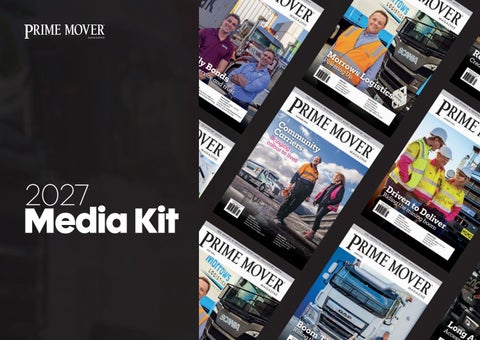
2027
Media Kit
Prime Mover connects commercial vehicle manufacturers and suppliers with fleet leaders and transport decision makers through authoritative coverage of trucks, technology, operations and road-freight business.
Brand Promises
Best exposure to decision makers
Best content that showcases you
Our print and digital publications have a proven database of engaged decision makers, with our content designed to be of interest to buyers in your targeted industry. They trust our publications and turn to us for the latest industry news, insights and developments, using that information to guide their purchasing decisions.
Our team of professional editors and journalists are industry experts, immersed in the latest trends, announcements and developments that help shape the national and global sectors. They work with our advertisers to craft original, insightful content that our audience will want to engage with.
The best external marketing department you’ll ever have With nearly 30 years of B2B marketing experience, you can trust our team to provide marketing services that deliver results. From content through to design and campaign delivery, we make it easy for you to leverage our knowledge and experience to develop unique campaigns that best showcase your business.
Audience snapshot
275.2K+ Monthly exposure opportunities for 12month partners
8.9K+ Magazine circulation
26.9% Enewsletter open rate
140K+
Average monthly page views
14.4K+ Enewsletter circulation
8.6% Enewsletter click rate
10.3K+ Social followers
Magazine circulation includes hard copies, pass on rate, event distribution and digital edition reads.
Prime Mover engages key decision makers with content that keeps professionals up to date with industry developments and supports purchasing decisions. We continually update our audience and track audience behaviour to deliver relevant, high-value content for our readers. Readership Executive
42.7%
Operations
26.9%
Mid-level Manager
18.1%
Sales/Marketing
10.0%
Finance
1.1%
Procurement
1.2%
Geography VIC
22.9%
NSW
26.7%
QLD
24.4%
SA
7.9%
WA
15.9%
Other
2.2%
A sample selection of our audience
T
he truck rental and leasing landscape in Australia has developed significantly over the past decade, a point which Penske Truck Leasing Managing Director Adrian Beach readily acknowledges. “We had a lot of other players come in just a couple years after we did, and each one of those players brought a higher level of professionalism and were better competitors than the people that were here before we were,” Adrian says. In its pursuit of a truly national service offering, the Penske rental and leasing operation has expanded to now include two locations in Brisbane, two in Melbourne, plus Adelaide and Sydney and Perth. The latest facility is located at Packenham in Melbourne and represents a new model for Penske Rental and Leasing as it is standalone and not part of a typical Penske 64
dealership. This stand-alone model can offer even more flexibility. “We can grow in different directions at Packenham,” Adrian says. “Maybe we want to do some light duty vehicles, plus we can do trailer rental and leasing for select customers.” A challenge for this sector of the industry is changing the philosophy of transport operators in terms of traditionally owning their vehicles. “I think much of the Australian market still needs to realise the benefits, especially around the full service lease product,” says Adrian. “There’s still a pride of ownership here which I think people have gotten over in the US a long time ago.” This mind-set can also lead to trucks being kept beyond the point of being economically sensible. “The technology is changing a lot faster than it used to,” Adrian says. “If I’m a fleet owner and I want to try a MAN the
two things that would probably worry me most are, what is this thing going to be worth at the end of five or six years? And how much is it going to cost to maintain?” “With our lease program, we make both of those worries go away, because all the maintenance is baked in. If we pick the budget wrong, that’s our loss, not the customer’s, and there’s zero residual risk. That’s also our cross to bear”. “To get the right customer into a MAN for the first time, we’ll lease a brandnew truck on a five-year term. That’s typically what generates the lowest monthly rate. Then we’ll give them a ‘walk’ after two years. “If, after two years, they find they don’t like Penske, they don’t like the truck, they don’t like the lease program, or even if they don’t like me, they can hand it back with no questions asked and no early exit penalties.
MOVERS AND SHAKERS
“I think much of the Australian market still needs to realise the benefits, especially around the full service lease product. There’s still a pride of ownership here which I think people have gotten over in the US a long time ago.”
BRIGHT
Penske Truck Leasing Australia Managing Director, Adrian Beach.
FUTURE
Hino Australia CEO & President, Richard Emery.
S
subdued through 2026, with growth now likely delayed until early 2027,” said Richard. “While there was some initial momentum earlier in the year, recent global factors have tempered this outlook, with the market forecast to remain relatively flat this year before returning to steady, long-term growth”. Mr. Emery expects Hino Australia’s core market sector (trucks under 500hp) to stabilise in 2026 before returning to steady, sustainable growth by 2030, following COVID-driven peaks and subsequent Euro VI supply-driven troughs. “Our 700 Series heavy duty range is gaining strong momentum driven by improved supply, a compelling value proposition and an expanded model range,” said Richard. “Our order intake on 700 Series has close to tripled in the last six months. So we can certainly see both our dealers and our customers are reacting in terms of what it offers. “Today, we have better supply, a strong value proposition, together with the expanded line-up. So we have the product, we have a great value proposition in place, and now we have a much broader model line-up than before”. It’s not just the Heavy Duty sector in which Richard has confidence. “Hino is well-positioned with our Euro VI emissions-compliant 300 Series 150hp diesel light-duty models available to order now, and the high horsepower and crew cab options arriving in the middle of 2027.
“We are also increasing our range of Built to Go products over the next 18 months, starting with a 300 Series Hybrid Electric Tipper, which will be on sale in Hino dealerships nationwide from June this year.” The Hino 300 Series Hybrid Electric Light Duty truck remains a strong focus for Hino and for its customers who can reduce fuel costs by as much as 24 per cent in Wide Cab variants and 22 per cent in Standard Cab models. “Higher diesel prices have further highlighted the strong value proposition of our 300 Series Hybrid Electric versus its diesel equivalent,” says Richard. “It will compound further when we introduce our Euro VI diesels in the middle of the year as they will have an associated price increase,” says Richard. “2025 was a record year for Hino Hybrid Electric with a 24 per cent increase compared to 2024 and we expect 2026 to be even stronger.” After being out of production for around two years the Hino 500 series is soon returning to the Australian market. “Completing our range is our 500 Series Medium Duty trucks which will be on sale from July, and arriving in dealerships in early 2027,” said Richard. Richard Emery recognised the challenges facing Australian transport operators including fine margins, and the shortage of drivers. “We still get customers saying to us, ‘If you could find me some drivers, I’ll buy
peaking to the Australian truck media at a recent business at the state level as well. I am calling The truck body building industry faces some more trucks from you’. We need about delivering more trucks more briefing, Hino Presidentour andbuild to for a renewed focus on the transport similar workforce challenges and Hino to do more work to encourage people quickly. We’re expanding has that we’ve portfolio with the appointment of a is implementing a strategy aimed at to choose trucking. The truck industry go CEO, rangeRichard beyondEmery, the models expressed confidence inthe the last Japanese dedicated Transport Minister within closing the time gap between truck is a great career, but we need to be had in place over five to ten future in Australia, Cabinet,” said Richard. order and delivery of a complete ready manufacturer’s able to keep them in the industry. And years. despite theare challenges the of “This is not a criticism of the current to work vehicle. we’ve got some issues rolling around “We workingarising with a from number dynamic environment. Minister Catherine King MP, who is “The challenge that we’ve had, in fact current the country at the moment in terms partners onglobal joint venture activities to the short-term Minister for Infrastructure, Transport, the whole industry has had, over the “Despite of workloads, delivery pressure, and bring anobvious even wider variety of vehicles global we believe Regional Development and Local last five years is getting vehicles to a racism - issues that are forcing many touncertainty, a finished state, so thatthe they are Hino Australia CEO & President, Richard Emery Australian outlook Government of Australia, and, point of delivery to customers in a out ofwho the industry. ready economic for delivery, rather remains than having to In this special report, Richardpeople Emery, is the President and CEO with steady long-term growth the holding company which was ironically, my local Member,” he says. suitable time frame. The time frame positive the moment, we need to keep go through a long body build process. Hino Australia’s of Hino in Australia, spoke to media about“At the state of Australia’s transport sector to 2030. Having that, to take established to assume full ownership “Catherine has a huge portfolio and an between arrival in Australia to delivery through everybody because we’re already short We’ve also taken thesaid decision impressive hybrid range. likely to remain and what plans Hino hasoffor its future of truck manufacturing companies expectation that any minister can be to a customer has blown out to close market people, and if wesuccess. keep losing people, onconditions some localare engineering solutions Hino 2026, across the intricacies of such a diverse pr i m e mMitsubishi to four and a half to five months. This then that’s only going to make things to speed up the availability of suitable ove r m a g . c o m . aFuso u 6 and 3 Ju n e 2026 following their 2025 merger agreement. portfolio, and give Transport the focus needs to be significantly shortened, and harder. Over the next five to ten years, products to our consumers and to our Archion became operational on 1 it deserves and requires, is unrealistic. we’ve been taking some action on this we’re already around 30,000 drivers dealers.” April 2026 to align with the Japanese “A dedicated Transport Minister would through what we call Project Vortex. short, and that will only get worse if we Richard Emery also used the business fiscal year. Daimler Truck and Toyota, help facilitate a more streamlined “In simple terms, Project Vortex is don’t arrest that leakage of drivers”. briefing to call on the Federal respectively the parent companies of approach to the safety, emissions, Government to provide more support Fuso and Hino, each own 25 per cent efficiency and productivity issues facing for the trucking and transport industry. of Archion. Hino Motor Sales Australia the industry including the aging truck “Recent shortages and increased prices is fully owned by Hino Motors Limited fleet, lack of drivers and a practical and of diesel have acutely highlighted the which, in turn, is now 100 per cent balanced regulatory transition to low importance of the trucking industry to owned by Archion with Daimler truck and zero emissions vehicles,” Richard the Australian public,” said Richard. and Toyota as major shareholders adds. “I remain frustrated at the lack of alongside other institutional and Another matter which is going to genuine understanding, care, dialogue Japanese financial investors. influence the Hino business in and focus on this industry at a Federal “We certainly see a positive outcome, Australia going forward is Archion, Government level, and to some extent, Hino Australia CEO & President, Richard Emery
“We are also increasing our range of Built to Go products over the next 18 months, starting with a 300 Series Hybrid Electric Tipper, which will be on sale in Hino dealerships nationwide from June this year.”
Penske’s range of prime movers includes the latest MAN trucks.
M ay 2 0 2 6
prim em overm ag .c om . au
65
64
Peter Shields and Leigh Smart chat in the inaugural CRT News Podcast.
CHEMICAL
COMMON SENSE Prime Mover Senior Features Writer, Peter Shields, opens the CRT News Podcast in conversation with Formula Chemicals Managing Director, Leigh Smart – a transport‑industry stalwart whose views on dangerous goods, compliance and the realities of running an in‑house fleet come with 53 years of lived experience.
The HINO 700 line up.
L
“Our 700 Series heavy duty range is gaining strong momentum driven by improved supply, a compelling value proposition and an expanded model range. Our order intake on 700 Series has close to tripled in the last six months.”
Prime Mover
62
INDUSTRY VOICE
PERSONALITY
The Penske offerings provide a much higher level of flexibility than what could usually be expected from a traditional financial provider such as a bank. Adrian cites an example of a customer who gets a new prime mover and they plan on going 250,000 kilometres per year under a short lease with a lot of maintenance built into it. “And then a year later, they might lose that contract, and they need to use the truck for a more local operation, so we go back and end the original lease, and write a new one and lower the payment and stretch out the term.” Understanding existing and potential clients’ needs and having the flexibility to address them has been a major plank in Penske Leasing and Rental’s local and global success. “So hopefully they’ve got no reason to go anywhere else,” Adrian says.
and it certainly will give us an opportunity to expand our portfolio over time, not only in terms of the product offering, but in terms of the technology both parties, Daimler and Toyota, will bring to the table. We look forward to the impact of Archion on over the next five to ten years, in terms of what will allow us to offer our customers here in Australia,” Richard says. “We therefore are pretty confident about the future in the short to medium term, and we certainly see a business environment that we can plan and build strategies to maximise our outcomes for the Hino business, for our stakeholders and our customers.”
June 2026
pr i m e m ove r m a g . c o m . a u
eigh says he never planned on running a chemical manufacturing business, let alone a dangerous goods fleet. Fresh out of Hawkesbury Ag College, he tried dairy farming before moving into laboratory work with Dairy Farmers and later Peters Milk. It was there he realised detergents were “a fairly simple sort of process,” and that he could make them himself. “I had this great decision that maybe I should start a chemical company,” Leigh says. He set up shop in his brother‑in‑law’s double garage in Putney, complete with storage tanks and bulk caustic soda deliveries. When council discovered a tanker parked in a suburban street with a hose running across the footpath, they politely suggested he relocate. That move, to a small factory in West 64
Ryde, became the foundation of Formula Chemicals. Leigh built the business supplying bottle‑washing compounds to Tooheys Brewery, delivering product in a trailer behind his Cortina. “Everything was done with a handshake,” he says. “No 200‑page contract.” Leigh bought his first truck, an old Bedford, because he needed to move heavy product. He shortened the tray himself, repainted the vehicle twice after registration knockbacks, and learned compliance the hard way. “There was no dangerous goods in those days,” he says. “You just filled up a truck.” Today, Formula Chemicals runs five UD trucks, all dangerous goods compliant, all meticulously maintained. Leigh keeps each truck for only three years. “We’ve never had a problem with a UD
truck,” he says. “Never had one off the road for a day.” He continues to drive them himself, despite being told by an RMS officer he should “hand in” his licence due to his age. Leigh’s response was blunt: “I’ve nearly gone 50 years without a fine, without an incident.” Leigh’s factories are tightly controlled environments. The real danger, he says, is transport. “My biggest risk isn’t a chemical factory,” Leigh says. “Put it on a bloody truck, and it goes around the corner and wipes someone out.” He describes motorists trying to pass a turning tanker without realising it carries 20,000 litres of Class 8 dangerous goods. “Last thing you want to be is under a truck with that in a tank,” he says. This is why he refuses to outsource
Images: Prime Creative Media.
Eleven years ago Adrian Beach relocated from the cold winters of Cleveland, Ohio to the sunshine of Brisbane where he has overseen establishment and expansion of the Australian arm of Penske Truck Rental and Leasing.
restricted to the Penske brands of Western Star and MAN. “Certainly we want to promote the brands represented by Penske, but medium duty rigids are a huge part of what we do,” he says. “And neither of those brands currently builds a 6x2 heavy rigid to move 14 pallets around the city. So, we’ve leaned on our global partnership with Hino to help in that category. We’ve got thousands of them in the US both in daily rental and longterm lease and we’re up to around 80 in the local fleet”. There can be a lot of flexibility between the mix of the long-term lease and the short-term rental. “A lot of our lease customers started renting for a couple of days, and that turned into a couple of months,” Adrian says. “And then we’d approach them and say, you’re at that point where it may make sense to have a longer-term lease.”
Images: Hino Australia.
WHY BUY?
“We just ask they give us 24 months to prove ourselves and the value of a MAN on a full-service lease can bring to their business. We’ve selectively used this program for over five years and so far nobody has terminated early. I think that says a lot about the gear and my team.” Not owning a truck used in a business still means that the management can retain control of their own transport needs, but without a lot of the complications. “We are able to offer real value to a customer who’s more of a manufacturer or distributor, where transport isn’t really their core competency, it’s more of a function of their business”. The service and maintenance programs built into the Penske offerings also contribute to the financial efficiency of the client. “Sometimes the financial needs of their business leaves them with capital that they can use on fleet so they purchase a lot of vehicles. There’s other times where they may be wanting to reinvest in some facilities or new production equipment, so the fleet manager doesn’t get the budget that they’d like.” “Most of our contacts with companies like that, they’re not really fleet people. There’s an operational guy or a warehouse manager.” Short term rental or longer full service leasing neutralises the typical problems associated with commercial vehicle servicing such as having the correct servicing equipment and competent staff who are properly trained. “My team proactively schedules services with the customer. Those services can take place at a Penske Truck Rental facility where we have our own service bays and technicians, or at an authorised dealership. This provides more control over the clients’ servicing experience and takes the admin burden off their shoulders. We can help run their fleet so they can concentrate on running their business.” Adrian points out that the Penske Rental and Leasing operation is not
Images: Penske Truck Leasing.
Adrian Beach, Managing Director of Penske Truck Leasing Australia.
transport. “I want to control that myself.” Leigh sits on multiple committees across EPA, SafeWork NSW, Transport for NSW and the National Heavy Vehicle Regulator. His approach is pragmatic: “There’s an easy way to get through life and a bloody hard way. Don’t pick the hard way.” He has seen regulators improve – and regress. Leigh praises former NHVR leader Sal Petroccitto for transforming the relationship between industry and enforcement. But he also notes recent shifts: “They’ve gone back to being a little bit nasty with our drivers.” He is equally frustrated by the load restraint guide. “You’ve got to be able to measure the coefficient of friction forward, backwards, sideways, and up and down. Can’t measure it,” Leigh says. “If you can’t measure it, you can’t control it.”
He has invited regulators to his site to demonstrate dangerous goods loading. “Haven’t got a clue,” he says. “We don’t make trucks wide enough to fit two IBCs and meet the requirements.” Formula Chemicals was the first company in NSW to adopt electronic work diaries. Leigh pushed for the change despite resistance from older drivers. “Drivers hate change,” he says. “Most of our drivers are minimum age 55.” He sold the system on its ability to eliminate fines. “Some very basic changes, the regulators could walk away and get anything up to $10,000 worth of fines on you,” Leigh says. Now, every driver uses the system. “They just can’t do anything wrong,” he says. “It takes all the stress away.” Leigh still prefers paper – “I’m old school” – but accepts the industry
A u gu s t 2 0 2 6
p r ime move r ma g . c om. a u
MOVERS & SHAKERS
Ross Longmire, Followmont’s CEO. Images: Followmont Transport.
must move forward. One of Leigh’s most significant contributions is his work with Corrective Services. Formula Chemicals currently employs 10 people through the work‑release program. “I’ve had one bloke that’s done 27 years in jail,” Leigh says. “Half of them are scared coming out. They don’t know how to get on a bus.” He promotes from within. His operations manager started fruit‑picking before joining Formula Chemicals. His HR manager spent 10 years in jail and is now responsible for audits, hiring and firing. “He’s got more qualifications than any of us,” Leigh says. “Nicest bloke – do anything for me.” Leigh sees this as part of his responsibility. “Give me a chance,” his staff tell him. “It’s a family.” Australia’s driver shortage remains a major concern. Leigh has long advocated for an apprenticeship scheme to bring young people into transport earlier. “For you to leave school and do nothing for three or four years until you’re old enough to get a truck licence, you lose them,” he says. He also sponsors encouragement awards at a local school – not for top academic performers, but for students who show grit. “It’s the one that gets off his bum and makes a go of it,” Leigh says. He trains hundreds of workers each year in dangerous goods handling free of charge. He audits sites, solves compliance problems, and supports tanker drivers with facilities at his depot. “I’ve got a really profitable business,” he says. “I don’t mind paying my fair share of tax, but I’m not going to give them too much extra.” He has set up testamentary trusts for his 14 grandchildren, runs a charity in Fiji and continues to work at 77. “If I fall off the perch tomorrow,” Leigh says. “I don’t think I’ve missed too much.”
INDUSTRY VOICE
FOLLOW
THE LEADER
Followmont Transport CEO, Ross Longmire, has observed economic shifts, changing customer demands and increasing operational pressure over the past 20 years. However, he still returns to the same core idea that transport is ultimately about people.
W
hile many operators have narrowed their focus to highvolume metropolitan freight lanes, Followmont has continued building its reputation in regional Australia, servicing towns and communities that larger carriers often consider too difficult, too remote or too expensive to reach consistently. Ross speaks about the business with the calm pragmatism of somebody who understands the realities of freight operations at scale. There is no grandstanding around fleet size or depot footprint. Instead, he talks about service reliability, customer relationships and maintaining a culture capable of supporting an increasingly 48
65
65
July 2026
Richard Emery of HINO Australia (PM0626 p62-65)
Companies most engaged with our content include:
Leigh Smart of Formula Chemicals (PM0826 p64-65)
replacement planning. Volvo 700-series models, Kenworth “So far at the moment, there’s three,” K220s and Mack units. Long-distance Ross says of the refrigerated Isuzu fleet. westbound operations into regional “And as our produce volumes grow, Queensland are largely handled by we’ll continue that.” Kenworths and Macks, chosen for their The refrigerated operation has become suitability across demanding regional increasingly important as Followmont routes. expands fresh produce capabilities across The strategy reflects a practical Far North Queensland. The business understanding of Australia’s freight already operates established refrigerated geography. services through Innisfail and Bowen, Different tasks require different supporting growers and customers across equipment. Regional produce key produce regions. More recently, collection through Far North Followmont has further strengthened Queensland requires manoeuvrability its presence in Mareeba with upgraded and refrigeration capability. Longrefrigeratedthrough facilitiesaand expanded distance freight into westernapproached methodically challenges. service capability to support temperatureQueensland demands durability, The conversation around industry rollingdriver 10-year strategy. comfort and proven performance Some over equipmentcontrolled is turnedfreight over movementssustainability quickly turns toward throughout the Tablelands region. punishing distances. fuel costs, government support and after only two years depending on already a dry depotworkforce there, The recent addition of Isuzuutilisation levels,“We pressures. while otherhad assets we’ve started servicing refrigerated refrigerated trucks into the fleet “I think from a short-term perspective, remain in servicebut considerably longer. customers out of fleet Mareeba asthere well,” highlights that philosophy in action. certainly needs to be more “We work every year on a 10-year Ross says. “Itsays. makes sense tosupport get Ross says the decision stemmed around fuel,” he says. replacement program,” Ross another work up partly from a previous acquisition volatility continues to place The company also tries toIsuzu limitto service thatFuel the Tablelands.” in the Innisfail region several years significant pressure on regional carriers unnecessary fleeton variability to simplify The Isuzu configuration the route lengths are longer and ago. One of the refrigerated workshop Isuzu inventory requirements and suitswhere operating environment. Regional units acquired through that maintenance business alternatives are limited. support. produce freight proved highly effective operationally, Foraccess operators servicing remote “If we can limit the variability ofoften requires tighter farm locations and encouraging Followmont towhat continue locations daily, fuel expenses become we have ininto our fleet, then that smaller collection points where investing in the platform during fleet one larger of the defining operational limitsitsthe workshop consumables
The company’s selection of Kenworth prime movers.
Followmont’s Mack from trucks. one corridor to the next. complex regional network. Yet regional transport is where “Our business is built around servicing Followmont believes it belongs. regional areas in Queensland and New combinations become impractical. The company’s roots stretch back to South Wales,” he says. “We don’t move FOLLOWMONT Reliability also remains critical. 1984 during a rail strike, when the a lot of freight between Brisbane and “Great reliability,” Ross says. “The TRANSPORT business was initially formed to move Sydney, and we run produce from Far service infrastructure up there is newspapers, magazines and newsprint North Queensland into Melbourne • Operates 25 depots across really good, and we’ve had a strong into regional areas. That early network every day of the week.” QLD and NSW, with all but relationship laid the foundation for broader That operational model has shapedwith Isuzu.” two located in regional areas. Inthe an business. industry frequently dominated freight services as by demand increased virtually every aspect of • Its fleet travels about 140,000 around margins, fuelQueensland’s costs throughout agricultural Followmont’s networkdiscussions now stretches labour Ross’ emphasissectors. kilometres everyday servicing commercial across 25 depots, withand all but two shortages,and people The stands out.“At that time, and for the firstregional freight routes. few, positioned in regionalon locations. “It’s really about the people inside the • Expanded refrigerated freight it was about providing magazines, company services nearly every postcode business,” he says. “The legacy of the newspapers and newsprint into across Queensland and New South footprint in Mareeba to support way that we Ross says. “Then off regional areas,” Wales on a daily basis.business is around the growing FNQ produce volumes. serviceinour customers.” the back of that, the general freight It is an immense undertaking a country Followmont’s internal culturegrew.” appears business where freight distances are vast and cannaturally have outsized consequences. In deliberately built around consistency. The regional produce trade infrastructure quality can vary dramatically remote communities, delayed freight is Longmire said the company invests rarely an inconvenience. It can directly heavily in induction processes to ensure impact supermarkets, pharmacies, staff understand the broader purpose workshops, agricultural operations and behind the freight task. essential services. “We try and ensure that everyone For regional operators, consistency understands who our customers are,” matters. he says. “Every customer is important Regional connection, according to and everyone’s freight is important to Ross, remains deeply embedded within someone.” Followmont’s identity through the That messaging is reinforced visually influence of the Tobin family, which throughout the company’s operations founded the business more than four through depot signage, toolbox decades ago. meetings and day-to-day management “The Tobin family are very strongly communication. linked to the regional areas across The emphasis reflects the realities of Queensland and NSW,” he says. regional freight where service failures 50
Adrian Beach of Penske Truck Leasing (PM0525 p64-65)
followed. Trucks heading north into Queensland’s agricultural regions returned southbound loaded with produce, creating backloading opportunities that steadily evolved into a major part of the business. Today, Followmont moves freight across sectors including retail, pharmaceuticals, mining, trades, grocery and fresh produce. The diversity helps stabilise volumes across regional corridors where freight patterns can fluctuate seasonally. It also demands flexibility from the fleet. Unlike some large operators that standardise around a single truck platform, Followmont operates a carefully segmented fleet strategy designed around specific operational requirements. “It probably appears a little bit unstructured from outside,” Ross says of the company’s mixed fleet approach. “It’s a little bit more structured inside the business.” Short-haul operations typically rely on Volvo and Sitrak prime movers, while medium-distance shuttle operations utilise Volvo FH600s, newer
That regional loyalty has arguably become a competitive advantage at a time when some transport providers have consolidated operations around major population centres and highdensity freight corridors. Regional freight remains expensive to service. Distances are significant, infrastructure costs are high and freight density can vary widely across routes. Yet demand remains constant because regional Australia still requires food, fuel, pharmaceuticals, building products and essential goods every day. Followmont’s willingness to maintain those routes has helped position the company as a critical logistics link across large sections of Queensland and New South Wales. The operational scale behind that commitment is substantial. Ross estimates the company’s fleet travels approximately 140,000 kilometres every day. Supporting that level of activity requires extensive workshop planning, supplier coordination and asset management discipline. Followmont operates four internal workshops while also utilising external service providers throughout the network. Fleet replacement planning is
that we need to carry through all our workshops,” he says. Strong OEM relationships therefore become operationally important rather than purely commercial. “Generally, the suppliers that we work with at the moment are fantastic when we have an issue at supporting and assisting us to find a great outcome,” Ross says. Even with that planning discipline, Longmire acknowledges the broader transport sector faces mounting
variables. Ross is equally focused on the industry’s longer-term workforce challenge. “How do we make transport more attractive as an industry for people?” he asks. The issue extends beyond simple recruitment. Longmire sees retention, flexibility, training and career development as equally important if the sector hopes to
primemoverma g .co m. a u
Followmont CEO, Ross Longmire, with Mark Tobin, Managing Director.
49
An autonomous Scania truck used in Rio Tinto’s mining operations.
Rob Taylor has been with Scania Australia for 25 years and heads the company’s National Mining Department, which includes locally developed autonomous and Battery Electric Vehicle (BEV) truck projects for mining applications.
R
ob Taylor is Scania Australia’s General Manager, Mining. After completing an apprenticeship as a mechanical fitter, he spent three years in the Army Reserves followed by six years in the regular Army. Decades later, the influence of his time in the Army continues to shape his professional life and approach to his role in the mining industry. “The Army taught me the importance of structure, discipline and how to keep my cool and think my way through problems,” Rob says. “Those traits have served me well in business after my service. Teamwork, mateship and leadership skills are vital elements of military life which former service personnel bring to the commercial world.” After leaving the Army in 1983 Rob gained extensive experience in Western Australia’s booming industry sectors — working in roles with mining and earthworks companies, along with the associated bulk transport and grain transport operations. Armed with his significant experience in transport and logistics operations, Rob joined Scania Australia in 2000 as a State Manager, at one point
64 primemoverma g .co m. a u
DRILL KNOW THE
secure its future workforce. “It can be a long and rewarding career for a lot of people,” he says. But he also acknowledges the realities that make transport difficult for many workers. “It’s tough at times with time away from family,” Ross says. “Working hours and things like that can be challenging for people, which is why flexibility is important.” Despite those pressures, he remains optimistic about transport’s longterm importance. That belief appears to underpin Followmont’s growing investment in internal training and career development programs. The business now employs full-time trainers focused on helping staff build longterm career pathways within the organisation. “We’re doing a lot of work at the moment on career planning for people, and that’s been quite successful for us as a business,” Ross says. The approach reflects a broader understanding that retaining skilled workers increasingly requires more than competitive wages alone. Employees want progression opportunities, workplace culture and long-term stability. For Ross, maintaining the right culture remains central to everything else the business hopes to achieve. “If we can maintain the right culture inside the business and retain people, then we’ll be in a strong position going forward,” he says. That future-facing mindset perhaps explains why Followmont continues investing confidently into regional freight despite ongoing economic uncertainty throughout the transport sector. The company’s strategy is not built around chasing rapid disruption or aggressive expansion headlines. Instead, it appears grounded in operational consistency, disciplined planning and long-term relationship building.
overseeing both Western Australia and Queensland. When Rob first joined Scania Australia, then Managing Director, Roger McCarthy, identified mining as a significant opportunity for the brand. Drawing upon his own mining background, Rob spent time with tier one mining companies developing a strong understanding of their operational needs in relation to trucks. “They’re strict and very forthright,” Rob recalls.” I believed if we could crack one of the majors, then we could crack anybody”. That belief paid off and Rob and his team secured a five-year contract with Rio Tinto which kick-started Scania’s Australian mining division. Other tier-one miners soon followed including BHP, BHP-Mitsubishi Alliance (BMA) and Fortescue. Rob is quick to credit his team with the success across the industry. “I think we have brought a lot to the table, right from the first big Scania 620 that Roger McCarthy let me bring in to trial,” he says. “With guidance from Scania engineer, Ian Butler, we built it to handle some serious gross tonnage. I told Roger I needed a truck that manage a 200 tonne payload.”
Working with Rio Tinto and others, the truck evolved from 240 tonnes, to 300 tonnes before reaching a 360 tonne gross combination weight. “We took it to the goldfields of Kalgoorlie and we finished with a 360 tonne gross combination. That truck is still probably best in class,” says Rob. Rob has also played a key role in the development of Scania’s autonomous trucks and with support from Australian and global management began collaborating with Rio Tinto to assess the new technology. “We started on salt operations for a couple of years, loading under harvesters,” Rob explains. “There was some interruption due to COVID, then we moved into iron ore. We currently have eleven autonomous Scania trucks operating in the Pilbara,” says Rob. “The autonomous program is nearing the end of the development phase, and we are now looking for broader operational deployment on the horizon. We’re particularly excited with the rigid heavy tipper trucks.” Beyond the total cost of ownership, the autonomous Scania trucks deliver additional advantages, including the ability to operate on narrower haul roads and having a smaller footprint
“Watching the business grow in volume through the introduction of new technologies has been the highlight of the past ten years. Scania has its own R&D, its own foundries, and component manufacturing. When we go to a customer it’s with a Scania engine, a Scania transmission, so it’s a true one-stop shop.”
Scania Australia’s General Manager, Mining, Rob Taylor.
Scania Australia’s General Manager, Mining, Rob Taylor.
on the ground which is particularly valuable when working in native title areas. The autonomous trucks also excel in “satellite pit” operations where larger trucks may not be as suitable. “It’s been a long road and a complex project,” says Rob. “But thanks to Rio Tinto we’ve learned a lot”. Battery electric Scania trucks are also being trialled across several Western Australian mine sites. The first BEV Scania truck was sold to Rio Tinto and operates as a stores truck servicing the Paraburdoo iron ore mine where the Scania autonomous fleet is also based. Fortescue has also joined the Scania BEV journey with eight Scania electric trucks currently operating. The first BEV Scania with 8x4 configuration is scheduled to begin operation during 2026. Fortescue plans to use the BEV’s as auxiliary vehicles including water trucks, tilt trays, vacuum trucks and tray trucks. “The beauty of mine sites is they have their own electricity grids,” says Rob. “The trucks aren’t travelling 1,000 kilometres; they return to the workshops with battery charging facilities. So far, the performance in the Pilbara has been excellent, even when working in temperatures such as 45 to 50 degrees.” Rob has relished the evolution of Scania’s mining offering. “Watching the business grow in volume through the introduction of new technologies has been the highlight of the past ten years,” he says. “Scania has its own R&D, its own foundries, and component manufacturing. When we go to a customer it’s with a Scania
engine, a Scania transmission, so it’s a true one-stop shop.” Another advantage in Australia, Rob notes, is Scania’s fully owned national footprint. “We own and operate our facilities in every state. A customer in Western Australia receives exactly the same level of service as one in to Queensland or Sydney.” In the specialised mining market understanding each customer’s operation is essential. “We have a sensational customer base, from small miners to major operators,” says Rob. “When you’re in their environment you understand what works for them, and that’s critical.” Rob believes regulation must keep pace with technological developments. “I look at the BEV and autonomous products running on mine sites where we can use our trucks at
maximum axle distances because it’s a controlled environment,” he says. “Moving into open road networks will be challenging, particularly for autonomous vehicles. I think public transport, such as buses with dedicated lanes will need to lead the way.” After 25 years with Scania Rob remains energised by his work, supported by the values instilled during his military service. “I use the skills I learned in the Army every day,” Rob says. “The core values are the values I live by, and they align closely with Scania’s values. Continuous learning is just as important in business as it was in the Army.”
Rob Taylor, Head of Mining, Scania Australia; Christian Levin, CEO Scania; Michael Still, MD Regroup with the first autonomous mining truck.
M arch 2 0 2 6
51
July 2026
Ross Longmire of Followmont Transport (PM0726 p48-51)
Rob Taylor of Scania Australia (PM0326 p64-65)
Roles our readers perform include:
Toll
Crawfords Freightlines
CEO
Operations Manager
Linfox
Cope Sensitive Freight
Contract Managers
Qube
SCT Group
Managing Director
StarTrack Express
CTI Logistics
CFO (Chief Financial Officer)
Compliance Managers
Direct Couriers
Lindsay Australia
CSO (Chief Sustainability Officer)
Director Logistics
Northline
Visy
COO (Chief Operations Officer)
Sadleirs Logistics
Fonterra
Centurion
Team Global Express
CTO (Chief Technology Officer
MainFreight
Cahill Transport
Kings Transport
Wettenhalls
Border Express Followmont Transport
CTO (Chief Transformation Officer)
Division Managers Director of Environmental Services & Planning Fleet Supervisor
CLO (Chief Logistics Officer)
Associate Directors
Blenner’s Transport
CIO (Chief Information Office)
Asset Managers
Carter Heavy Haulage
Fleet Manager
General Managers
Images: Scania Australia.
MOVERS AND SHAKERS
PRIME MOVERS AND SHAKERS
p ri m e m ove rm ag . co m . au
65
CRT News powered by Prime Mover, Trailer and PowerTorque Since 2010, CRT News has been keeping the commercial road transport sector informed, connected, and ahead of the curve. By drawing on the authority of Prime Mover, Trailer and PowerTorque. CRT News delivers the best of both worlds in one powerful, twice weekly enewsletter – making it the go-to digital resource for decision makers across the truck, trailer and tech industry. Whether you’re looking to launch a new product, build brand awareness, or align with trusted industry reporting, CRT News provides unmatched visibility in Australia’s commercial road transport market.
Powerful Audience
14,486+ Subscribers
Engaged Readership
Proven Visibility
26.9% 8.6%
132,000+
Enewsletter open rate
Enewsletter click rate
Monthly exposures for enews advertisers
Consistent Frequency
Twice Weekly Keeps your brand front of mind
One trusted source. Three leading brands. Endless opportunities to connect.
Content : the foundation of B2B marketing In the age of AI, buyers don’t discover brands through advertising alone – they find them through content that educates, builds trust and showcases proof.
Buyers conduct 80% of research before speaking to suppliers
This research is increasingly being done through AI
AI preferences content from trusted media over company websites
In 2027, campaigns that create impact will start with great content
* http://brixongroup.com/en/the-modern-b2b-buying-journey-why-buyers-complete-80-of-their-journey-alone-and-how-you-can-still-remain-visible ** https://searchengineland.com/google-zero-click-searches-2026-study-479717 ^ https://www.marketingmag.com.au/featured/why-ai-rewards-an-evidence-ecosystem-over-opinion/
Crafted by industry experts Great content doesn’t live in one place. With Prime Mover, a single piece of content can be amplified across multiple formats and channels - delivering compounding value on your marketing investment.
Enews
Podcast
Web
Video
Webinar
Build authority and credibility
Extend reach and AEO visibility
Deliver directly to engaged audiences
Bring real-world stories to life
Connect through expert conversations
Educate and engage audiences live
One story. Multiple channels. Compounding impact.
Foundational marketing products Print display advertising options include content created by our editors and journalists, showcasing your brand to our audience. Inside front cover
Early right hand page
Inside back cover
Double page spread
Enewsletter
Front cover
Full page
Back cover
Half page
Premium ad space - website LEADERBOARD (FIXED)
Solus EDM
LEADERBOARD (ROTATING) MREC (ROTATING)
BANNER (ROTATING)
Advanced marketing products Once brand awareness and trust are established, these formats allow you to tell richer stories, engage audiences in greater depth and connect in a more personalised way.
Case Study Videos Showcase real-world success stories in a highly engaging format that builds credibility, demonstrates outcomes and strengthens buyer confidence.
Podcasts Position your brand as an industry voice through expert-led conversations that deepen engagement and build trust with our audience.
Lead generation Engage decision makers with valuable content, converting your brand presence into a pipeline of qualified leads.
Resource downloads Offer high-value content in exchange for contact details, capturing engaged prospects actively seeking solutions.
Webinars Deliver expert-led sessions that educate audiences while enabling real-time interaction, capturing intent and building direct relationships.
Roundtables Facilitate exclusive, small-group discussions that create deeper engagement, peer validation and high-quality connections with senior decision makers.
Features schedule
February
March
Features Training & HR + Fleet Report
Features Oils, Fuels & Lubricants
Spotlight Focus Fleet Guide
Spotlight Focus Construction
Booking: 27 Nov 2026 Material: 21 Dec 2026 On sale: 2 Feb 2027
August
Booking: 3 Feb 2027 Material: 10 Feb 2027 On sale: 10 Mar 2027
September
Features Insurance & Finance
Features Fatigue Management & COR
Spotlight Focus Final Mile/Urban Logistics
Spotlight Focus Bulk Haulage
Booking: 28 Jun 2027 Material: 5 Jul 2027 On sale: 2 Aug 2027
Booking: 2 Aug 2027 Material: 9 Aug 2027 On sale: 6 Sep 2027
April Features Future Freight New Energy Vehicles & Solutions
May Events Brisbane Truck Show
Spotlight Focus Linehaul
Booking: 3 Mar 2027 Material: 10 Mar 2027 On sale: 7 Apr 2027
October
Features Service, Parts & Aftermarket products and Services Spotlight Focus Port Haulage/Intermodal
Booking: 6 Apr 2027 Material: 13 Apr 2027 On sale: 11 May 2027
November
Features Future Freight New Energy Vehicles & Solutions
Features Safety Technology & Applications
Spotlight Focus Heavy Haulage
Spotlight Focus Speciality Logistics – SuperCars/Entertainment
Booking: 30 Aug 2027 Material: 6 Sep 2027 On sale: 4 Oct 2027
June
Booking: 28 Sep 2027 Material: 5 Oct 2027 On sale: 3 Nov 2027
Booking: 3 May 2027 Material: 10 May 2027 On sale: 7 Jun 2027
December Features Executive Outlook 2028 Spotlight Focus Waste Logistics
Booking: 28 Oct 2027 Material: 4 Nov 2027 On sale: 2 Dec 2027
July Features Telematics Solutions Spotlight Focus Mining
Booking: 31 May 2027 Material: 7 Jun 2027 On sale: 5 Jul 2027
VIEW DESIGN SERVICES
VIEW DIGITAL SPECS
For Partnership Enquiries contact: Ashley Blachford
VIEW MAGAZINE
VIEW PRINT SPECS
Business Development Manager, Prime Mover P: +61 425 699 819 E: ashley.blachford@primecreative.com.au