manmonthly.com.au
MANAGEMENT >> TECHNOLOGY >> SOLUTIONS
APRIL 2018
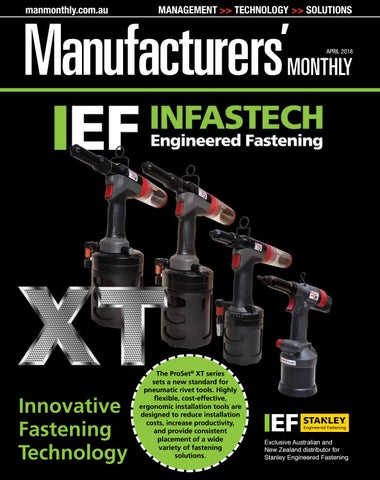
Innovative Fastening Technology
The ProSetÂŽ XT series sets a new standard for pneumatic rivet tools. Highly flexible, cost-effective, ergonomic installation tools are designed to reduce installation costs, increase productivity, and provide consistent placement of a wide variety of fastening solutions.
Exclusive Australian and New Zealand distributor for Stanley Engineered Fastening
ProSet has arrived... ®
The ProSet® XT series sets a new standard for pneumatic rivet tools. Highly flexible, cost-effective, ergonomic installation tools are designed to reduce installation costs, increase productivity, and provide consistent placement of a wide variety of fastening solutions.
ProSet® XT4
ProSet® XT3
The ProSet® XT4 is the strongest tool of the ProSet® family. With 23 kN the XT4 delivers the highest pull force in the range but weighs in at just about 2 kg. As well as structural breakstem rivets, the high capacity of the XT4 also allows installation of Avdelok, Maxlok and Avtainer lockbolts.
The ProSet® XT3 can be used in a
ProSet® XT2
ProSet® XTN20
The ProSet® XT2 sets a new standard for pneumatic rivet tools. Designed specifically to set a wide range of breakstem rivets, this tool delivers 8.9 kN of pull force with an outstanding force-to weight ratio of 7.18kN/kg. The innovative, ergonomic design ensures maximum user comfort and efficiency.
The ProSet® XTN20 is a high speed blind rivet nut tool with flexible pull-to-stroke & pull-to-force setting. The combined world-class innovations from POP Avdel created a high speed, lightweight tool with great strength, endurance, excellent ergonomics and optimal flexibility – responding to the latest and highest standards in tool manufacturing.
variety of applications, setting a large range of breakstem rivets, lockbolts and sealing plug sizes. The extremely large stroke of 26 mm allows the placement of longer rivets like Monobolt and Interlock in one set. The innovative, ergonomic design ensures maximum user comfort and efficiency.
Dual operating mode technology ensures enhanced productivity, improving your return on investment with the lowest installation cost per fastener.
INFASTECH Engineered Fastening
PH: 1800 062 355 Exclusive Australian and New Zealand distributor for Stanley Engineered Fastening
manmonthly.com.au
MANAGEMENT >> TECHNOLOGY >> SOLUTIONS
APRIL 2018
HELPING HANDS FROM AUTOMATION Official Event Partner
INSIDE >>
Print Post Approved PP100007882
18
The use of polymers in manufacturing
20
The IIoT story in Australia so far
30
Filling the gaps in risk strategy
>>
Dust and buildup on the antenna? No problem! The future is 80 GHz: a new generation of radar level sensors
VEGAPULSÂ 69 is designed specifically for level measurement of bulk solids. Even in dusty conditions, it always provides precise readings. Dust in the silo or buildup on the antenna have no effect. This radar sensor also features unrivalled focusing at a frequency of 80Â GHz. Simply world-class! www.vega.com/radar
manmonthly.com.au twitter.com/Manmonthly facebook.com/Manmonthly
Managing Director: John Murphy Managing Editor: Syed Shah Ph: (02) 9439 7227 syed.shah@primecreative.com.au
Inside APRIL 2018
For daily news visit manmonthly.com.au
26
27
Journalist: Steven Impey Ph: (02) 9439 7227 steven.impey@primecreative.com.au Art Director/ Production Coordinator: Michelle Weston michelle.weston@primecreative.com.au Design: James Finlay, Blake Storey, Adam Finlay Sales/Advertising: Madhu Singh Ph: 040 2718 081 madhu.singh@primecreative.com.au Subscriptions Published 11 times a year
18
Subscriptions $140.00 per annum (inc GST) Overseas prices apply Ph: (03) 9690 8766
Copyright Manufacturers’ Monthly is owned by Prime Creative Media and published by John Murphy. All material in Manufacturers’ Monthly is copyright and no part may be reproduced or copied in any form or by any means (graphic, electronic or mechanical including information and retrieval systems) without written permission of the publisher. The Editor welcomes contributions but reserves the right to accept or reject
9 Editor’s Comment
24 C-Level Profile
32 Packaging@MM
10 News@MM
26 Safety & Efficiency
34 Promotional Feature
14 Issues & Insights
27 Labelling & IoT
36 Events@MM
18 Industry Focus
28 Motors & Drives
40 What’s New
20 IoT in Manufacturing
30 Risk Management
any material. While every effort has been made to ensure the accuracy of information, Prime Creative Media will not accept responsibility for errors or omissions or for any consequences arising from reliance on The opinions expressed in Manufacturers’ Monthly are not necessarily the opinions of, or endorsed by the publisher unless otherwise stated. © Copyright Prime Creative Media, 2018 Articles All articles submitted for publication become the property of the publisher. The Editor reserves the right to adjust any article to conform with the magazine format. Head Office 11-15 Buckhurst St South Melbourne VIC 3205 P: +61 3 9690 8766 enquiries@primecreative.com.au www.primecreative.com.au Sydney Office Suite 3.06, 1-9 Chandos Street Saint Leonards NSW 2065, Australia
Average Net Distribution Period ending Sept ’16 17,911
Behind the cover With the increasing interest in the Internet of Things (IoT) within the manufacturing space, businesses have been on the road to reinventing their factory floors and business models. The IoT is driven by the need to streamline everyday processes to make life simpler through data analytics. Sensors, connectivity through the cloud, AI and automation are becoming more synonymous with one another. Still, despite the greater attention it is receiving, the IoT is a logical extension of automation and connectivity that has actually been around in a factory plant environment for many years. It was then known
as machine-to-machine (M2M) communication. However, moving forward, the transitioning from M2M and plant networking to tapping into the full potential of the IoT is a complex process. Implementation is the simplest step but the recalibrating of a company’s business model prior to that can be a complex issue. This is because, without proper planning, a company can potentially stand to lose more that it gains from the new technology. In this issue, we feature companies that have taken on that route successfully and suppliers, who are willing to walk with businesses down the IoT path.
manmonthly.com.au
MANAGEMENT >> TECHNOLOGY >> SOLUTIONS
APRIL 2018
HELPING HANDS FROM AUTOMATION Official Event Partner
INSIDE >> 18
Print Post Approved PP100007882
information published.
The use of polymers in manufacturing
20
The IIoT story in Australia so far
30
>>
Filling the gaps in risk strategy
Printed by: Manark Printing 28 Dingley Ave Dandenong VIC 3175 Ph: (03) 9794 8337
manmonthly.com.au
Manufacturers’ Monthly APRIL 2018 5
IT’S
WHERE DO
SPONSORS
10-12 MAY 2018 MELBOURNE CONVENTION & EXHIBITION CENTRE
BIG YOU FIT IN?
& INFRASTRUCTURE
MEGATRANS2018.COM.AU
FROM MICRON TO MILE. IN ALL DIMENSIONS.
Mobility, infrastructure, logistics or production - automation is forging ahead in all industries with no sign of stopping. And right at the forefront are distance sensors and detection and ranging solutions from SICK. As intelligent sources of data, they deliver precise information for nearly any application. Over any distance, in all environments. Equipped with high-developed technologies and a wide range of interfaces. Discover a unique portfolio unparalleled throughout the world which unites diverse industry knowledge and extraordinary capacity for innovation in all dimensions. Comprehensive performance and boundless flexibility - combined for your success. We think that’s intelligent. For more information please visit www.sick.com/micron-to-mile or call 1800 334 802.
Comment
SYED SHAH – Managing Editor, Manufacturers’ Monthly
Sensibility in a new era
R
ECENTLY, while in the need of some mindless comedy, I turned the pages of George Bernard Shaw’s Man and Superman and came across one of the play’s many famous lines: “The only man I know who behaves sensibly is my tailor; he takes my measurements anew each time he sees me. The rest go on with their old measurements and expect me to fit them.” This brought me to think about robotics, automation and artificial intelligence (AI). They go together well (and they should) but yet, they are not synonymous. Are we entering a new era of robotics and automation in manufacturing? We already have. One of the constant topics at manufacturing and IoT conferences always comes down to weighing up the notion of job losses due to automation and robotics. Workers across all industries are aware that the increasing level of automation creates uneasiness because they see the introduction of more robots as an obvious threat to jobs. But far from a gloomy dystopian
manmonthly.com.au
future, the rise of robots should benefit the wider human workforce by helping to deliver improved productivity, wages and working conditions. However, as Gartner analysts point out, without the AI component, it won’t amount to much. Sure, it can replace low level menial tasks in production lines but in a dynamic global economy, customer requirements are always changing. Creativity is essential to productivity and business sustainability in the long run. Gartner points out that many significant innovations in the past five years have been associated with a transition period of job loss followed by recovery. They have indicated that AI will improve productivity of many jobs, eliminating millions of middle and low-level positions, but at the same time create millions more new positions of highly skilled, management and even those of entrylevel and the low-skilled variety. Research vice-president at Gartner, Svetlana Sicular, said in a Gartner report late last year that the talk of job losses confuses
AI with automation – something which she says overshadows the greatest benefit AI can bring us which is AI augmentation. That is the combination of both human and AI where they complement each other. Now, that is a future that most industries will also look forward to. Within the manufacturing space, there are a number of factors that come into play when it comes to AI, robots and automation. In markets like Germany, where robot density is already at a high level, further automation programmes will enhance the work of humans rather than replace them. The Industry 4.0 movement is seeing faster development of software control for robots and their integration into more operations, leading to increasingly flexible automation systems with increasing elements of AI embedded into them. An interesting statistic in Germany to note is that over the period 2010 to 2014, the German automotive industry saw an increase in the robot population of 15 per cent, but instead of a decline in human personnel there
was an increase of 10 per cent. Last but not least, where do businesses start? As mentioned earlier “long tail” processes – repetitive, predictable but yet important tasks can be automated, according to accounting specialist firm Deloitte who terms it robotic process automation (RPA). They recommend looking for tasks that require manual intervention, are performed frequently, are rulesbased, and eat up a significant amount of time. Just as important, look for opportunities to start applying RPA where the potential risks are low. From there, a business can then look to upscale to smarter and more complex processes that could potentially incorporate AI. I suppose when businesses reach the stage when AI is powering the automated processes within them, they will appreciate the importance of predictive and prescriptive analytics that assist with commercial growth on the shorter-term basis. This is because then they can focus on the bigger vision ahead – one that only the human ambition can conceive. Manufacturers’ Monthly APRIL 2018 9
News@MM Victorian carbon fibre wheel manufacturer partners with new Ferrari supercar Geelong-based manufacturer Carbon Revolution has partnered with Ferrari to make high-performance carbon fibre wheels for its new 488 Pista. The new $645,000 supercar, which is said to be the most powerful roadgoing V8 built by the Italian sports car manufacturer, was unveiled at the Geneva Motor Show this week. Carbon Revolution is among 21 strategic partners in the program, with its wheels reportedly 40 per cent lighter than the wheels on Ferrari’s standard 488 GTB. “[Ferrari] are an innovation leader,” Carbon Revolution’s CEO Jake Dingle was reported saying by the AFR. “They put extreme demands on any technology that they employ in a car. “It is a really strong signal in terms of the technology and it’s a great
Carbon Revolution is among 21 strategic partners in the program. achievement for us to meet their requirements.” It was also reported that Carbon Revolution is considering its options to raise a further $100 million to fund an
expansion to its Waurn Ponds plant, in Geelong. Earlier this year in Las Vegas, Genovation Cars revealed its GXE all-electric supercar, which features
PREVENTION INFORMATION SUPPORT MELBOURNE CONVENTION & EXHIBITION CENTRE
custom carbon-fibre wheels made by Carbon Revolution, in Victoria. The wheels “enhance overall vehicle dynamics and efficiency”, Genovation said during its unveiling.
A must attend event for all industries
WED 23 & THU 24 MAY 2018 REGISTER TO ATTEND AT: WHSSHOW.COM.AU OFFICIAL EXHIBITION OF
IN CONJUNCTION WITH
MAJOR EXHIBITION SPONSOR
ORGANISER
(03) 9596 9205
10 APRIL 2018 Manufacturers’ Monthly
manmonthly.com.au
News@MM Siemens launches “gamechanging” master distributor for automation in Australia
APS Industrial will be led by David Hegarty and Lloyd Thomas. Siemens has launched a new master distributor of industrial low voltage electrical and automation products in Australia, which has been billed a “game changer” for the Australian market. APS Industrial will be led by former Rockwell Automation Australia and New Zealand managing director, David Hegarty, and former CEO of NHP, Lloyd Thomas. With Thomas as chairman, Hegarty will be the APS Industrial managing director and CEO, leading the national team. Jeff Connolly, CEO of Siemens Australia, said that APS Industrial is a “major move” and indicates Siemens’ commitment to long-term growth in the region “We’ve listened to customers and want to give them ‘real choice’ that delivers the best products, combined with the best customer experience,” Connolly said. “We see APS Industrial as an extension of the Siemens’ family and the credentials of the Board and senior management team speak for themselves.” APS Industrial has acquired Ramelec and HiTech, two Australian distributors and will be headquartered in Melbourne. Working closely with Siemens, the independent company will commence with the current staff of the acquired companies, in addition to new hires across leadership and other customerfocused positions. “The setup of a master distributor manmonthly.com.au
ensures we can respond to and manage customer demand quicker than ever, especially in current fast paced market conditions,” Connolly continued. “Customers will soon have access to the broadest portfolio in the industry for all their industrial electrical and automation requirements.” In addition to Hegarty and Thomas the APS Group Board will include Bryan Haynes, former director of Finance and Operations at NHP, and Brian Watson AO, former chairman of JP Morgan Australia, founding director of the Australian Future Fund and a former board member of CSIRO. “In today’s dynamic market, customers want the best – they require quick and efficient service at the most competitive pricing. APS Industrial is investing to provide an extensive range of connected products with the best local technical and stock support,” Hegarty said. “We are forming a strong and dynamic team who bring a wealth of industry knowledge and experience to the table – all highly focused on providing a great customer experience. “We are excited about the opportunity to start offering this range to the market and establish ourselves as a company known for its customer centric and ‘easy to do business with’ attitude and approach. In addition to the Siemens range, APS Industrial will provide complimentary products from other high quality global technology leaders.” Manufacturers’ Monthly APRIL 2018 11
News@MM Coopers Gap wind farm commences construction GE has commenced the construction of the Coopers Gap Wind Farm with a sod turning ceremony attended by Anthony Lynham, MP, Minister for Natural Resources, Mines and Energy earlier in February 2018. Being Australia’s largest wind farm, the Powering Australian Renewables Fund’s (PARF) development will include 123 GE wind turbines. AGL’s general manager power development, Dave Johnson, said up to 200 jobs would be created during the peak of construction of the project, which was developed by AGL and achieved a final investment decision in August 2017. “It is great to have Minister Lynham on hand today in the heart of the Coopers Gap community, to celebrate the benefits of this momentous project,” Johnson said. “AGL, together with PARF, is excited about the works and we will
be working closely with the GE – CATCON consortium to ensure a successful project outcome for all stakeholders. “The wind farm will employ up to 20 people once operational which means it will continue to deliver ongoing employment benefits in the local community after the construction phase. “The gathering today for the sod turn is an important milestone after an extensive period of planning and development.” Steven Oswald, Australian country executive for Onshore Wind, GE Renewable Energy, said: “This is an exciting day for the project and indeed in Australia’s ongoing transition to a cleaner, more modern energy system. It is tremendously encouraging to see this project progress, particularly at a time when we are discussing our energy future as a nation.
“I’d like to congratulate the Powering Australian Renewables Fund on their achievements to date and look forward to seeing our 123 GE turbines start to generate renewable electricity for the people of Queensland,” Oswald said. GE will deliver 91 of its 3.6 MW turbines with 137m rotors, and 32 of its 3.8 MW turbines with 130m rotors. GE will also undertake a 25-year full service agreement to maintain the windfarm over its lifetime. Steve Moreau, CEO at CATCON, said, “We are pleased to be celebrating this major milestone today and acknowledge the first sod turning marks the commencement of major construction activities for CATCON on this significant Renewable Energy project. Upon completion in 2019, the 453 MW wind farm will produce approximately 1,510,000 MWh of
200 jobs would be created for the project.
renewable electricity annually – enough to power the equivalent of more than 260,000 average Australian homes and reduce CO2 emissions by 1,180,000 tonnes each year. Coopers Gap wind farm is a significant project for GE. It will be the largest wind farm in the country on completion, and GE’s first wind project in Queensland. It is the second major renewables project that GE and AGL have announced in the last year, following the Silverton Wind Farm in western New South Wales.
Smart Factory Automation System Trainer solutions in hardware, software, maintenance and troubleshooting for integrated manufacturing
Articulated Robot, 6-axis ARISTO, 2and 3-axis loading arm • • • •
Robotic arm manipulation Programming and teaching robots Interaction with objects Troubleshooting integrated system
Modular Automated Production System- Bottling plant module • • • •
Simulate miniature bottling plant Fault introduction System expandable PLC and automation technology
For full range, visit:
www.bestech.com.au
Global Technology, Local Support 12 APRIL 2018 Manufacturers’ Monthly
enquiry@bestech.com.au | (03)9540 5100 manmonthly.com.au
News@MM Swinburne plans industrial 3D printer for Industry 4.0 Testlab Carbon fibre composites offer infitie manufacturing possibilities.
Swinburne University of Technology is to build the world’s first operational Industry 4.0 Testlab for carbon composite manufacturing as part of its research into digital manufacturing processes. The facility will become home to the world’s first industrial scale 3D printing “multilayer” approach to carbon fibre composite manufacture, developed by Austrian engineering company, Fill.
Fill’s unique Multilayer printing technology will be able to produce commercial parts out of carbon fibre at a cheaper cost, according to a announcement on Monday, with minimal waste and improved production capability. Swinburne has partnered with three equipment manufacturers and one supplier to demonstrate the manufacture of actual commercial parts in an integrated pilot line. Carbon fibre composites are engineered materials offering infinite design flexibility and the opportunity to manufacture smart products. However, they are currently difficult to produce in high volumes on a commercial scale due to limitations on manufacturing speed and high labour costs. “With our industrial partners,
we will create a digital twin of the process and push the boundaries of virtual commissioning,” says director of Swinburne’s Manufacturing Futures Research Institute, Professor Bronwyn Fox. Swinburne’s move to implement the Industry 4.0 Testlab comes only months after receiving a record $135 industrial digitisation grant from Siemens to digitise its Factory of the Future and create Australia’s first fully immersed Industry 4.0 facility. “Swinburne, with our partners, will lead the world in providing digital manufacturing solutions to secure Australia’s place in the lucrative intermediate product market.” Products design and part manufacturer, Mulitmatic, is also partnering with Swinburne on the Multilayer process and Industry
4.0 Testlab to help maximise the opportunities for manufacturing processes and to develop a new product at competitive prices for the automotive industry. “In order to make high valueadd products from such materials affordable to manufacture on scale in Australia we are developing technologies and processes that have the potential to disrupt and transform the manufacturing and infrastructure industries,” said Swinburne’s Deputy Vice Chancellor (Research), Professor Aleksander Subic. “The partnership with Fill (Austria) is of particular importance to our strategy as it allows us to introduce a unique form of 3D printing technology for composite products to our lab and fully automate the process.
We make drive systems comfortable and reliable.
Efficient. Durable. Flexible.
Torque transmission solutions for Industrial Equipment SGFlex-3F SERIES 100 Nm - 3240 Nm
TENBEX-ECO SERIES 4,8 kNm - 40 kNm
manmonthly.com.au
SGFlex-3F-CONNECT 100 Nm - 3240 Nm
SGF Asia Pacific Pty Ltd No:15, 191-195 Greens Rd Dandenong South 3175 Victoria. Australia. Phone: +61 (0) 3 9791 9393 Fax: +61 (0) 3 9792 0159 sales@sgfasiapac.com SGF GmbH & Co. KG Industry@sgf.de www.sgf.de
Manufacturers’ Monthly APRIL 2018 13
Issues &INSIGHTS World-first robotics for Australian gas exporter Specialist gas producer BOC has unveiled a $35 million upgrade to its Western Sydney plant. Manufacturers’ Monthly paid the site a visit.
BOC’s world-first robotics sorts through thousands of gas cylinders daily.
F
ROM the outside looking in, BOC’s gas operations at Wetherill Park in Western Sydney look relatively untouched. In its yard, hundreds of used and recycled cylinders are still painted an array of colours, which, by Australian government safety regulations, differentiate one gas from another. While some things don’t change, there has been a major transformation at the site, which represents a vision of the future. A new $20 million specialty gases production facility was unveiled
14 APRIL 2018 Manufacturers’ Monthly
last month to compliment a $15 million cylinder automation suite, which includes world-first robotics to sort through thousands of gas cylinders daily. The technology signifies a new way that gas is bottled and exported. At a time when Australia is chasing down the bill as the world’s biggest gas exporter, the manufacturing industry is facing uncertainty over gas prices domestically, and was a topic of debate at BOC’s official unveiling last month. Senator Matt Canavan,
Australia’s resources minister, told an audience that he acknowledged and shared concerns from John Evans, BOC South Pacific’s managing director, around the burden high electricity prices place on the manufacturing industry. “Like everybody else, we have been hit by substantial electricity bills,” Evans told Manufacturers’ Monthly. “For us, this investment [in a special gases facility] helps to minimise some of that pain to our customers, by giving them additional value to compete on the global stage.” Canavan stressed that, while
reducing electricity prices is a priority for the Australian government, a solution is being sought. “I note, today, in some of the financial press that they describe this [BOC’s new facilities] as an ‘unusual’ success story’,” Canavan said, “and, while I can sometimes understand that sentiment, I want to say up front that I don’t think that is right at all. “We have a very strong manufacturing sector in this country. We have a vibrant and successful manufacturing story in manmonthly.com.au
Issues&INSIGHTS
The new plant can supply and produce up to 8,000 high-purity and specialty gases.
Australia and this is yet another example of what we can do as Australians. “It has been a tough couple of decades for manufacturing but the reality is we have so many advantages in this country to continue to have a strong manufacturing sector.”
Automating gas production BOC’s specialty gases plant has the capacity to produce and supply 8,000 high-purity and specialty gases to high-value industries in Australia – from science and medical research, to manufacturing and energy exports. “From my point of view, this is a fantastic recommitment to this site, to this business, and our customers, demonstrating confidence in the way we want to go forward,” Evans said. manmonthly.com.au
“This is a critical part of our infrastructure and does supply all parts of Australia. Each year [across the whole site] we handled over 1.3 million cylinders and produce an enormous range of cylinders including a mix of special gases. “Typically, a lot of the hydrocarbon mixtures made here we import for the LNG plants, whereas now we will be able to make and mix those ourselves.” Given time, Evans explained that the upgrade will create millions of dollars of gas exports, once BOC has built “credibility and capability” in the Asian market, where demand is increasing. “This step gives us the confidence to expand overseas and also meet the future needs of our customers,” he continued.
“Moving some of these products into the research and development area, they are really unique mixtures of gas that need to be put together. “To me, this is a good example of a company finding a niche and finding a way to do it better. For us, it is about protecting the long-term future of our customers and ourselves.” Among the industrial and political entourage, BOC’s parent company, The Linde Group, gave the transformation its seal of approval. Sanjiv Lamba, Linde CEO for Asia-Pacific, described it as a “significant investment and recommitment” to gas manufacturing. “When I was here about a year ago, the [special gases] facility on my left was completely empty and had been cleared out to make way
for this facility of the future, which is how were described it at that point,” Lamba said. “Of course, this has all been made possible by the supreme effort put in by our team, with many people across Linde-BOC working together to make sure we have a facility we can be proud of and positions us well for the market of the future.” For the first time, BOC will have the opportunity to export out of its facility into the Asia-Pacific region in new sectors, he continued. “The growth represents a great new opportunity for BOC and its business here [in Australia] to support emerging markets in Asia across a number of segments including medical research, environmental, petrol-chemical industries and manufacturing,” Lamba said. Manufacturers’ Monthly APRIL 2018 15
Issues &INSIGHTS Innovating operations Embracing the new era of advanced manufacturing and digital technology, BOC revealed a robot cylinder automation system that has transformed the way cylinders are sorted, picked and moved around the busy production site. “We are in the gas business and, after 29 years, I have seen hundreds of thousands of cylinders being filled, sorted, and delivered every day – including 35,000 at this site alone,” Lamba continued. “Until this point, we have never seen this done with robots and automated vehicles. This is a world first and a great achievement for the BOC company, and will have a lasting impact on The Linde Group.” The system is a world-first application of a six-axis robot combined with four turntables that can see, pickup and handle cylinders. “The launch of this cylinder automation system is a landmark moment for BOC, driving a competitive advantage, and representing a significant safety investment for the Sydney Operations Centre, which produces more than 1.3 million cylinders each year,” Evans continued. “Designed with global experts and local engineers, the system integrates advanced laser vision technologies, automated guide vehicles, robots and 3D cameras,
which has successfully automated manual handling processes and introduced new skills of the future into BOC’s workforce.” Also in attendance, Western Sydney minister Stuart Ayers
said the site was a “strong tick” for advanced manufacturing in Australia. “For manufacturing to be successful in Australia, it has to operate at the end of the value
chain and leverage high-quality staff,” he said. “While we may pay them for the reflection of their skills, we have to make sure we continue to operate at the end of the value chain.”
The launch of the cylinder automation system is a landmark moment for BOC.
Test Machines Australia are your tes�ng machine experts. We offer Australia wide service and support as well as repairs to all makes and models of various tes�ng equipment.
Test Machines Australia offer the full range of Kyowa products including strain gages. Contact Test Machines Australia on 0418 369 505 or sales@testmachines.com.au | www.testmachines.com.au TMAAdMM_Mar18.indd 1
16 APRIL 2018 Manufacturers’ Monthly
5/03/2018 10:00:23 AM
manmonthly.com.au
Maximising Uptime through Remote Connectivity What can Domino Cloud do for you? Access to real-time printer & ink performance data and reports to increase OEE
Helpdesk support and email alerts when faults are detected
Domino Cloud comes standard with any SafeGuard* Warranty *SafeGuard is a remote monitoring, diagnostics and service cover for your printer.
Domino Cloud is compatible with Domino Ax150, Ax350 and Ax550 inkjet coders
Contact us to ďŹ nd out how the Domino Cloud can improve your inkjet coding, Overall Equipment Effectiveness and help you achieve maximum uptime.
www.insignia.com.au/domino-services/cloud
Industry FOCUS Manufacturing prescribed plastics across multiple industries Allplastics Engineering specialises in the precision manufacture of advanced and polymer parts for some of Australia’s biggest industries. Managing director Vic Kalloghlian, explains the role innovation has played during the company’s evolution.
A
LTHOUGH Allplastics Engineering is not a large corporation, it is an innovator in the industry. From its headquarters in Chatswood, on Sydney’s North Shore, the precision manufacturer has expanded substantially in more than four decades of production. From humble beginnings, the business began with the manual manufacture of hydraulic parts. Today, the factory runs with the addition of CNC turning and routing machinery. Thus enhancing the speed and quality of the company’s bespoke plastic products. Allplastics’ products are used throughout a diverse range of industries, including polycarbonate glazing panels in forestry vehicles, bushes in the marine environment,
Allplastics’ products are used across many industries including mining and defence.
18 APRIL 2018 Manufacturers’ Monthly
to chute liners in sugar refineries and safety guards for production. These capabilities maximise efficiency while ensuring a consistent level of high quality finished parts. Plastic machined parts, machined by Allplastics Engineering are used as replacements for OEM parts or newly designed parts to improve processes. Thermoplastics are available in sheet, rod and tube in materials such as nylon, acetal, PTFE, UHMWPE, polypropylene, PVC, ABS, polycarbonate or acrylics. Each plastic has its own specific advantages; some examples are chemical resistance, wear resistance, sound absorption, clarity and weight reduction. In 1980, managing director Vic Kalloghlian joined the team and
has taken a new direction with the adoption of automation and innovative materials. “Allplastics Engineering is a family company,” Kalloghlian said. “It was established in the early 1970s. My brother and director, Raffi Kalloghlian, and I have been taking it forward since 1983. “From being an industrial service only, we now serve the architectural and building market with niche products. We provide other services such as the diamond-edge polishing of acrylics and bubble free gluing of acrylics. “When we started, there was no computerised technology, so everything was done manually. While we still utilise some manual procedures, the CNC technology is able to replicate parts with a higher level of accuracy and is more productive.” The company specialises in the machining, fabrication and engineering of industrial plastics. Its showroom is a cause of wonder and fascination to visitors. Inside its doors, the walls are laden with translucent acrylic sheets, in a wide spectrum of colours. Among them, a sign lists the diversity of the manufacturer’s production line, which adds value to a variety of industries, including construction, mining, signage, defence, food, hospitality, pharmaceutical, marine and engineering. “Being an SME of 15–20 people is a challenge but we have discovered that we cannot put all our eggs into one basket,” Kalloghlian continued. “Roughly 30 years ago, our business was machining hydraulic seals. Whilst that is still a small part of our business, we have diversified in response to market demands.
“Our business is bespoke in everything that we do. At the machining level, our unique industry knowledge allows us to offer practical advice and solutions to clients when they come to us with design ideas.”
Pushing the envelope Expanding into different industries hasn’t come without its trials. In 1999, a fire destroyed virtually all of their machinery and stock. It was the hard work and perseverance of owners and staff that allowed Allplastics Engineering to reform bigger, better and smarter. Kalloghlian says there is always the risk of spreading yourself too thinly, but insists the company’s adoption of new technologies and a keen eye for global trends has kept it ahead of the curve. “We are multi-tasking in this business,” he said. “We are machining and fabricating plastics while also introducing new materials. “By automating some processes to significantly reduce manufacturing time, we are able to meet customer demands more efficiently. This has enabled us to establish our diverse client base. “Regardless of the industry; if there is something that moves or wears out, Allplastics Engineering will be involved in some way, supplying Australian made goods rather than importing from overseas. This, is of course, a challenge with the [high] labour costs in Australia.” By removing the tyranny of distance that offshore manufacturing can cause, Kalloghlian says Allplastics is providing the customer with “better control”, both in the quality of service provided and the guarantee of faster delivery. manmonthly.com.au
IndustryFOCUS
Most of the technology used today is computerised as compared to the past. By utilising materials with better wear-resistance than, say, steel, Kalloghlian explains how his wear resistant polymers are “prolonging the life” of their components.
MC
C
“For example if you compare, lightweight polyethylene versus timber, polycarbonate versus glass or acetal bearing versus steel, our plastics will reduce the weight of
C
Y
Fantastic Layer Resolution
Large Build Volumes
Automatic Print Resuming
305mm x 305mm x 305mm (N2) 305mm x 305mm x 610mm (N2 Plus)
Resume interrupted prints like it never happened!
Heated Bed
Unlocked versatility with a heated bed for a wide variety of filaments
Connect Your Way
360 degree see through enclosure ensure a stable print environment.
Connect using SD Card, USB, WiFi and LAN
Bright ideas are not always an automatic success, however. It takes time to find the right people to work with, Kalloghlian explains, and then present a solution businesses not only like, but need. “Quite often, end users are conservative and hesitant to try new possibilities,” he said, “so, in order to demonstrate the benefits of a new product, we sacrifice time by bringing them new samples before they go to market.” Allplastics Engineering successfully obtained ISO 9001 accreditation in 2017. They are currently in the process of implementing integrated ERP software to ensure the process of manufacture, sales and logistics will become even more streamlined. “We employ these new innovations and continual improvements to provide our customers with the highest level of service and enhanced quality,” added Kalloghlian.
250 microns - 10 microns
Dual or Single Extruder Options
Print in two colours or different materials like plastic + dissolvable supports, PLA + Flex
Persuading the industry
Y 33
7” Full Colour Touchscreen
Intuitive menu options make printing a breeze.
an assembly, structure or vehicle,” he said. “You can’t replace glass in every application but there are many where you can. It’s important to know what options are available and have them at your fingertips.” Film for bus windows and unbreakable safety shields used in pharmaceutical manufacturing are just two of many applications where the choice of plastic over glass makes sense. Introducing lighter-than-timber composite panels that will support heavy weight, Allplastics also offers an alternative material for the transport industry, which Kalloghlian says, can reduce travel time and fuel consumption. “Think of Australia Post – they have around 10,000 vehicles on the road,” he continued. “If they were able to reduce the weight of each vehicle in their fleet by 75kg – there are great savings to be made on travel time and fuel plus it’s a win for the environment.”
Fully Enclosed
Factory Levelled and Calibrated Bed Ready to print out of the box. Minimal setup
manmonthly.com.au
And many more
Manufacturers’ Monthly APRIL 2018 19
IOT IN MANUFACTURING Manufacturing collaboration: The fundamentals of sharing Australian manufacturers are still wary of new technology and big data, according to industry experts. Manufacturers’ Monthly visits the second Industrial Internet 4.0 summit in Sydney to find out more.
T
HE majority of Australian start-ups and small manufacturing businesses are avoiding big data at the expense of climbing the value chain, according to industry champions. The dawn of Industry 4.0 is still escaping a country used to going it alone – with several frontline professionals declaring a lack of trust in the Australian consciousness the root problem. Over a two-day event at the Sydney Masonic Centre last month, the second annual Industrial Internet 4.0 summit heard speakers from all walks of manufacturing discuss the benefits, and obstacles, digital disruption presents a divided industry. For some, the Industrial Internet of Things (IIoT) is an opportunity to unite the value chain, an audience heard – despite a hesitance within the ranks to share and cultivate. David Hart, CEO for Dematec Automation, considered the difficulty in persuading companies
20 APRIL 2018 Manufacturers’ Monthly
IoT is seen as being the building blocks in a manufacturing environment.
to take the plunge without first understanding the definition of “meaningful data”.
He notes real-time visibility as a benefit – so that “the manufacturer can see an issue and
deal with it before it became a problem”, such as stoppages and production downtime.
manmonthly.com.au
IOTIN MANUFACTURING
“IIoT provides an opportunity for those SMEs to realise some benefits from automation digitisation, which they may not have traditionally been willing to invest in,” he said. “All of this means it is essentially to lower the barrier to get the business going; to use digitisation techniques by starting with something small and to then build that up as your business begins to evolve.” By capturing meaningful data, a business can add value propositions to its production line, according to Hart, who suggests IIoT opens up opportunities for continuous improvement. “The business needs to have outcomes in mind, a willingness to implement change and to be able to do something with the information they get back from the production of their assets,” Hart continued. “IIoT is a great enabler for SMEs to reach their productivity, quality and performance benefits that automation can bring. “The cost of getting started is really as low as it has ever been, which makes it easier to take the plunge and to start to explore the benefits you can bring to the business.”
A cultural change is required across the industry if manufacturers are going to embrace and share data technology.
Issues of trust There is still a lot of uncertainty that goes hand-in-hand with a wave of new technology, according to Mark Goodsell, executive director for the Australian Advanced Manufacturing Council. During the event, he joined a panel to discuss how Australian manufacturers can make Industry 4.0 a reality. “What collaborative model could encourage manufacturers to integrate?” asked Frank Zeichner, CEO of the IoT Alliance Australia.
Goodsell said that, like others in the industry, he doesn’t have the answer, but says an answer could be found by first understanding the culture of Australia’s manufacturing mindset. “Just after the global financial crisis (GFC) and at the height of the mining boom, [former Labor Party leader] Peter Beattie was asked to go around the country and find out why a lot of Australian companies weren’t taking advantage of this global resources boom,” Goodsell said. “We were supplying the holes in
the ground but we weren’t supplying a lot of other value and the real issues that came out of that was Australian companies don’t tend to collaborate.” Essentially, it came down to a lack of trust, he explains. “Whatever it was about our previous economic model that allowed you to run a fairly successful business is now hurting us in a globalised world,” Goodsell said, “and I guess, with IoT and the information of the world of physical goods, the tyranny of distance is now completely absent. “We have made a lot of progress
Robust MAGNETIC PROGRAMMABLE Incremental and Absolute Encoders
Features TM
www.pca-aus.com.au
+ 61 2 9482 3733
manmonthly.com.au
• Program with a mobile phone • No software to install • Wi-Fi connection to encoder • Online storage of configuration • Range of housing sizes 58 and 36mm Dia.
Configu re with you mobile p r hon
e
Options • Incremental Only • Absolute single or multi turn • Gray or Binary Code • Dual Incremental and Absolute • Any values 1 to 16,384
Manufacturers’ Monthly APRIL 2018 21
IOT IN MANUFACTURING Keay discussed how artificial intelligence is enhancing efficiency around the manufacturing space. “Australians, in general, like to be self-sufficient and solve problems in-house, even if they are aware that they can fall back on specialist integrators,” she said. “Given the amount of data and new technologies that are coming at such a high pace, you need to get to that point where those collaborative partnerships can exist to keep you on top of all of those [new technologies].”
Giving IoT meaning IIoT provides an opportunity for those SMEs to realise some benefits from automation digitisation.
Knowledge and competencies need to be built within existing environments so people can start to utilise this new technology. in the area [of trust] but I think we need to do more work on what trust in commercial relationships looks like and what we actually mean by trust and collaboration, so people have something to hang their experiences on.” Dr Sue Keay, CEO for the
ARC Centre of Excellence for Robotic Vision, Science and Engineering faculty at the Queensland University, also said that a cultural change is required if the nation’s manufacturers are going to embrace, and share, data technology.
The general consensus is that Industry 4.0 shouldn’t be feared. Part of the problem, according to Shaun Westcott, CEO for HMPS Automation and Robotics, is that IoT has a different meaning depending on whom you talk to. “The way we understand it is the merging of physical and cyber assets into forming the cyber-physical manufacturing role,” Westcott said. “It can be interconnected and networked between machines and ultimately between factories, creating what we refer to as smart factories. “IoT will enable big data extraction and, when we start to ask ourselves what is the difference between ‘Industry three’ and ‘Industry four’, the
ability to extract big data through the cloud and overlay analytics of cognitive capabilities of value chain optimisation ultimately [creates] e-commerce networks.” Automation is “the first building block” towards that ideology – not only for the large corporate companies, but Westcott stresses its benefits for the small-to-mid manufacturing markets, where collaboration is key to opening new doors. “We believe that any manufacturer who doesn’t go down the line of IoT will be buried in the sands of time,” he continued. “In the future, we see IoT as being the building blocks in an environment were factories will be able to balance their production with demand cadence through collaborative smart supply chains, using artificial intelligence and flexible network assets.” Westcott says he is advocating an “evolutionary approach”, which, he insists, will also facilitate the acquisition of new skilled labour. “When we talk about the transformation of manufacturing, we also need to understand that there needs to be a consummation of workplace skills,” he said. “Knowledge and competencies need to be built within existing environments so people can start to utilise this new technology.”
TM
Ezi-Deploy
fully automatic “drag free” declutching system
Integrated Gear Box for safer rewind speed
Safer hose reel storage solutions email sales@reeltech.com.au phone +61 3 9583 2368
22 APRIL 2018 Manufacturers’ Monthly
reeltec.com.au
Heavy-duty galvanised
ultimate in outdoor corrosion protection
m
ch ore oice
Hose size range 1/4”ID - 2”ID
er safety op Oth tio optional
ns
TM
included
other metal an re t s included
s
optional
ise injurie nim s mi
el
nd shoul de ck a a r b
y jur in
mini mi se
PAT. WO 2005/09764 8A1
Choose effortless and safer hose handling solutions today minimise operator's back and shoulder injuries with Ezi-DeployTM
not ju
e
sa
18022602_RT
cho fer ic
Long Range Wireless Remote Control & TM FlatWinder automatic hose layering system
PitBullTM and accessories are Australian designed and manufactured by Reel Tech. Highest quality galvanised hose reels with robust construction and safer features suitable for all Wash Pad, Mobile Workshop and Service Vehicle projects.
manmonthly.com.au
A CLEAN
SOLUTION A proven leader in the parts washing industry and made in the USA, the patented bioremediating SmartWasher® range is the ultimate solution to parts washing. The SmartWasher® systems employ a natural process called bioremediation to degrade and remove contaminants from the cleaning fluid, allowing re-use of the cleaning fluid. There is no need to change out the cleaning fluid and therefore no liquid waste, which also makes it cost effective. The comprehensive SmartWasher® range has units suitable for the food & beverage industry through to automotive workshops, industrial and general manufacturing facilities requiring a safe mobile parts washer.
WWW.CRCSMARTWASHER.COM.AU
13 73 23 / blackwoods.com.au
9 – 11 May 2018 Sydney Showground
WHERE INNOVATION MEETS OPPORTUNITY 150+
FREE
EXHIBITORS
4500+
TO ATTEND Expo & Conference
ATTENDEES OVER 3 DAYS*
40+
INDUSTRY SPEAKERS
11 EXHIBITION ZONES INCLUDING:
Advanced Materials Automation & Robotics Industrial Internet of Things
Additive Manufacturing Engineering Welding Technology
*Based on 2016 attendance CAB Audited by AMAA
Register now at:
www.nationalmanufacturingweek.com.au Supporters
Co-located with
Gold Sponsor
Organised by
Silver Sponsor
C-Level PROFILE The people first Shona Fitzgerald, managing director of CRC Industries Australia tells Manufacturers’ Monthly how a focus on culture and its people builds a well-oiled business structure.
P
EOPLE first and the profits will take care of themselves. That’s the golden rule for CRC Industries Australia managing director Shona Fitzgerald who has helped transform the performances of some of Australia’s leading industrial, mining and chemical businesses by ensuring teams and culture were a priority. “People come first, the numbers will follow,’’ Fitzgerald said. “Seeing people grow and flourish in their roles because of the way you lead an organisation is the most rewarding thing for me. “With the right teams in place, and the right strategies, you can achieve anything,’’ she said. Raised in a working-class environment on the New South Wales central coast – her father worked in a power station and her mother was a bookkeeper – Fitzgerald had early ambitions of becoming a vet before pursuing a career in chemical science, an area she excelled in at school. “I love animals but I doubt I could have coped with the lack of compassion of some of the owners,” she said. Her love of animals has never waned, and she spends her free time recuperating native wildlife through her volunteer position with Wildlife Information Rescue and Education Service (WIRES), Australia’s largest wildlife rescue organisation. The family home – a 10-acre rural property on the north central coast – is a menagerie of sick, injured and orphaned native species plus nine family pets including two cats, one blind and the other with three legs. “Working with injured or orphaned wildlife is very rewarding, it’s how I spend my downtime and it’s a way of giving back,’’ she said. Fitzgerald has a strong talent for nursing businesses back to health as well, having transformed flat-lining
manmonthly.com.au
operations into successful entities in her previous senior management positions with Orica, BOC and now CRC Industries which just posted a record month for sales. “CRC has been an exciting challenge. It is a great brand with a strong legacy that has benefitted further from getting the right people in the right roles and setting a clear strategy that people understand,’’ she said. “Success comes from listening to people in the organisation and leveraging from our global network. I spend the first part of each day speaking with team members locally, as well as in the USA and New Zealand. “The main focus for CRC at the moment is new product development and we are also investigating the possibility of a future acquisition – an adjacent, complementary company to CRC that brings a capability that we don’t presently have. “My medium term goals with CRC is to continue to grow the business one step at a time, capitalising on the strong results achieved in 2017. “The aim is to find a footprint into new market segments and grow the product range, developing our people as we go.” Fitzgerald is well aware of the challenges women face in reaching the top of the corporate tree in Australia, agreeing that they are sadly under-represented in executive and senior management positions. “This is a can of worms that has had a lot said about it. Having spent my entire life in industrial, male-dominated sectors, I have experienced it all. Despite my qualifications and experience, I still have my technical capabilities doubted or questioned,’’ she said. “My advice to women looking
Shona Fitzgerald, managing director, CRC Industries Australia
to succeed in business is to make sound decisions and gain all the skills and training that you can to be empowered and in control. “If you are in an environment that is not allowing you to flourish, move on and up. “Organisations need to develop attitudes that value women from the top down. I have always operated with a gender-neutral mentality. CRC is an organisation which is a great example of this culture globally,’’ she said. In business and life in general, Fitzgerald is a firm believer in treating people with respect and integrity, values that were instilled in her by her parents.
“My parents are the people I look up to the most, for teaching me great base values and making me believe I could achieve anything I wanted. “I gravitate towards and admire people who demonstrate respect and integrity in the way they operate, people who are decisive, energetic and compassionate. “You don’t have to be brutal to run a business. You need to make tough decisions and have tough conversations, all with a high level of emotional intelligence,’’ she said. CRC Industries Tel: (02) 9849 6700 www.crcindustries.com.au Manufacturers’ Monthly APRIL 2018 25
Safety& EFFICIENCY Next steps in health and safety Manufacturers across industries regularly employ a culture of safety in order to maintain productivity within their respective organisations. Manufacturers’ Monthly interviews a few of these companies to find out more.
W
HEN it comes to health and safety in the workplace, most companies have extensive policies and strategies in place to ensure the wellbeing of their employees and staff. The zero-harm approach is the most wide-spread and generally accepted concept in workplace safety. The model is based on the ideology that workers should leave the workplace in the same state they came to work, without any major harm or injuries. Many companies have adopted this approach by focusing their health and safety strategies on reducing worker harm to as low as possible. BlueScope, a flat steel producer with operations in Australia and many other countries, is one company with a strong focus on health and safety. The company’s operations coordinator, Nancy Crawford told Manufacturers’ Monthly that her company conducts regular monthly and quarterly audits to identify the gaps in risk management and any potential issues and report them to the company’ national safety team. Conducting regular surveys help BlueScope track employee satisfaction and develop programmes that benefit its customers. One such programme aims at offering consultancy and guidance to their clients, mostly steel fabricators, on health and safety issues. As part of the programme, a group of professionals from BlueScope visits projects and factory sites and gets involved with educating its clients on how best to tackle its safety issues. A proactive and hands-on approach is the best way to prevent health and safety risks in the workplace. As Sharon Smith, safety manager at CSR puts it, “Don’t walk past anything. Always check each and every process beforehand to prevent risks.” 26 APRIL 2018 Manufacturers’ Monthly
CSR, a building products company in Australia and New Zealand, strives to achieve zero harm by complying with the laws and regulations and establishing measurable WHSE objectives and targets. Both Crawford and Smith were nominated for the 2017 Women in Industry Awards held in June last year. While the Zero Harm approach has been well established and embraced across all industries, there is a new school of thought that speaks of moving past zero harm to the next step, this is where the focus is no longer on simply preventing employee injuries, but rather on actively engaging people for an overall improvement to workplace health and safety. A report published by EY professional services company, titled “The future of health and safety: moving beyond zero,” refers to the new safety approach as the “Plus One” approach. Andi Csontos, EY Australia’s Health, Safety and Environment (HSE) Partner sees health and safety risk on a scale of minus one to plus one, from impact to opportunity and positive contribution. The approach reconfigures the scale that applies to workplace
health and safety, by no longer considering zero as the final objective but rather as a starting point, a minimum standard. It also shifts the goal to enable people to enter a workplace and not just simply avoid injury, but actually improve their wellbeing. According to John Green, health, safety, environment and quality director, European Hub at Laing O’Rourke, people are traditionally seen as a risk to control in organisations. He says, “They are controlled by limiting their choices and behaviours, or by placing constraints between them and the actual work. People are responsible for all your problems and if we could only get them to follow the perfect systems that we have created then all would be well.” Green asks, “What would happen if we saw people as part of the solution? Why can’t we take little steps by allowing projects to perform micro experiments pushing the boundaries of safety by trying new things and not doing old things.” Sidney Dekker, a prominent researcher and advocate of the positive approach to health
A proactive and hands-on approach is the best way to prevent health and safety risks in the workplace.
and safety, provided much of the theoretical basis to Green’s advocacy. In Dekker’s view, people are seen as a resource to harness, rather than a problem to control and safety is defined as presence of positive capacities to make things go right rather than an absence of negative events, in this case work place incidents and injuries. The view was reiterated by Catherine King, country health, safety and environment manager at ABB Australia, who won this year’s Women in Industry Award in the category of Safety Advocacy. Her safety message, “Zero Harm- it’s up to me” emphasises the role of employees in getting involved and taking ownership for resolving safety issues at their work. Catherine has been advocating this approach to safety culture through a range of workshops, presentations and campaigns. In a conversation with Manufacturers’ Monthly she spoke about her latest campaign, which will launch in mid 2018. Titled “In Your Shoes,” the campaign will see senior managers and industry leaders spending a day or half a days working with their employees and workers to identify potential risk areas as well as get the employees’ feedback on safety issues. According to the EY report, employee consultation is just the first step. To realise the full potential of Plus One, they need to be empowered to be an integral part of the process. “It is not enough to say that people are a company’s greatest asset, we need to demonstrate that this is the case and give employees an equal voice in developing answers and strategies to not only improve health and safety performance, but to link this strategically to the overall business context,” it states. manmonthly.com.au
Labelling Helping manufacturers into the factory of the future Labelling and coding products specialists, insignia, shares with Manufacturers’ Monthly how important it is to empower Australian manufacturers in achieving maximum efficiency in coding and marking processes.
T
HE fourth industrial revolution is upon us. Industry 4.0 is set to revolutionise manufacturing and production through the utilisation of cyber connected systems, which monitor factory processes to maximise efficiency and reduce downtime. Industry 4.0 is a globally accepted reality that is affecting nearly every industry worldwide and is transforming how businesses operate. It introduces a “smart factory”, where cyber-physical systems monitor production processes and are capable of making decentralised decisions – for example, monitoring consumable levels in a printer and alerting users that a consumable changeover is required. In an Industry 4.0 factory, every machine and computing device is integrated and connected to the internet, enabling them to send and receive data – this process is what’s commonly known as the Internet of Things. The interconnectivity of these smart devices is empowering a step change in productivity, efficiency and customer-centric innovation for manufacturers.
What is Domino Cloud? The release of Domino’s i-Techx platform and the Domino Cloud service tool are shaping Industry 4.0 in the areas of coding and marking. Both built into Domino’s latest continuous inkjet technology the AxSeries, is equipped with features to be ready for the factory of the future. Designed from the ground up to be industry 4.0 ready, the Domino Ax-Series easily integrates into existing production lines and supports a variety of standard factory automation communication protocols such as PACK-ML and OPC-UA. Additionally, an array of integrated sensors automates system monitoring, allowing for proactive and predictive diagnostics and remote service support through the Internet of Things (IoT) and connection to the Domino Cloud. The Domino Cloud provides powerful remote diagnostics, remote monitoring and customer reporting capabilities. For example, Domino’s i-Techx platform collects a vast array of data on printer operation – from
running performance to ink and makeup levels, to wear and tear on components. This data is can be accessed through the Domino Cloud dashboard where it can be viewed by the customer at any time, regardless of the location. This enables the customer to be alerted to any issues and forecast ink and consumable orders. Additionally, this data incorporates Overall Equipment Effectiveness (OEE) calculations and printer usage changes to provide insights for line improvement and lead manufacturing initiatives.
How does Domino Cloud help manufacturers? Domino’s i-Techx platform and the Domino Cloud service tool provides manufacturers with error-free coding and system integration, as well as remote access and monitoring. This results in a smart and interconnected network of machines and processes that centralises and simplifies coding processes. The consumption of ink and make-up can be monitored in
With Industry 4.0, coding and marking machines will become part of a single intelligent factory operation
real-time, utilising the Domino Cloud dashboard. Additionally, complications can be diagnosed from a distance by the helpdesk team and either fixed remotely or through an insignia service technician who can find the problem on-site. On top of this, through automation, streams of information for OEE calculations and cost structures can be closely monitored to maximise efficiency, resulting in reduced downtime and increased production at the lowest possible cost. Decentralised systems can increase profitability for manufacturers by streamlining and speeding up decisions, resulting in increased revenue, market share and profits for many businesses. For coding and marking processes, Industry 4.0 means that inaccurate codes and unplanned downtime caused by equipment will no longer be a problem faced by manufacturers. Coding and marking machines will become part of a single intelligent factory operation, capable of monitoring performance and assisting team members with making informed decisions. Domino Cloud is already shaping factories of the future and empowering a step change in productivity and efficiency for manufacturers. “We highly recommend Domino Cloud as a user friendly remote tool that gives us useful management information insight into all our connected production lines” affirms Dorin Cimpu, manager strategic projects, continental Tyres. insignia Tel: 1300467446 www.insignia.com.au/domino-services/cloud
manmonthly.com.au
Manufacturers’ Monthly APRIL 2018 27
Motors &DRIVES How customisation opened the door to Australia for an Italian manufacturer Peter Harrington, managing director of Lafert Electric Motors (Aust), tells how the company’s Italian operation is breaking the mould in the Pacific Rim.
I
N the late 1980s, Peter Harrington made a bold move that opened Australia and New Zealand to a new breed of electric brake motors. It was in Hanover, Germany, where he first saw Lafert Electric Motors product in action. The parent company is based in San Dona Di Piave, about 30km from Venice, and is completely automated in everything that it touches. Harrington, who admits he had a stroke of luck meeting with the manufacturer, is now the companies only distributer in Australia. “Picking Lafert to negotiate a distributive deal with is probably the best thing I ever did,” Harrington said. “They became the biggest electric motor company in Italy and have gone from success to higher success, whereas most of their competitors in Italy have fallen by the wayside to some degree.” Lafert specialises in customised AC Motors and prides itself on its quality of service. One speciality being Lafert brake motors, which – while more
expensive than standard brake motors manufactured and exported out of China are competitive for a reason and their standard is their products quality. “Companies are continually asking for a brake motor that is a bit smaller and lighter to help with installation, but now with the efficiency of the motor being so important and, with the Australian MEPS Regulations, it is not as easy for some companies to achieve this anymore. “An electric motor has to meet MEPS 2 efficiency in the Australian market, so it is easier to achieve these efficiency requirements if you use a standard frame size but by doing so you lose the lighter more compact design.” Lafert Australia imports a wide range of brake motors for different applications and customisation. The diversity Lafert can offer is substantial and it all meets the Australian MEPS Regulations. (1) High DC brake torque up to 300 per cent of brake torque available (2) Low DC brake torque as low as 100 per cent brake torque for parking
brake or applications such as saws. (3) High AC brake torque for those applications requiring super quick response times on your braking applications. Lafert Aust import brake motors for both three phase and single phase applications. Standard IP55 or as high as IP65 off the shelf in both AC and DC versions. Lafert also has a complete range of spare parts available from its Hallam warehouse. Around 90 per cent of the motors Lafert manufacture are customised, which means that Lafert are not competing against standard electric motors that come out of China and other non European countries. “People want a product that not everyone else has and what is seen in the market as “unique” this is what will set them aside from the rest,” Harrington continued. “By specialising in customised motors and with Lafert being the world leader in High Performance Electric motor production, they are Lafert Australia’s imported brake motors give customers more choice.
28 APRIL 2018 Manufacturers’ Monthly
setting extremely high standards in the electric motor industry.” Lafert’s IE4 and IE5 High performance motors are growing in leaps and bounds – generation of Permanent magnet Synchronous motors that offer approved electrical efficiency and equates to huge cost savings, at reduced production costs, without the use of rare earth magnets. This uniquely engineered product combines the electrical design of brushless servo motors with the mechanical design of AC induction motors. The result is a compact motor that is approximately half the physical size and half the weight of a standard electric motor and is targeted at the HVAC, compressor and pump industries. “The beauty of Laferts business is that its production line is completely automated,” Harrington said. “What this automation means is that nothing can go wrong – every motor comes out the same, and we never have any quality problems with the motors operation. “Fractions of a millimetre are extremely important, especially when making brake motors, so if they are building them in China, quality can vary, whereas an automated manufacturing process as Lafert have, gets it right every time.” Laferts automated process is an example of how advanced manufacturing can upscale a companys commercial demand according to Harrington, who says that a quality standard set across its unique designs is more attractive than lower costs offshore. “Coming from a top European company, our customers may pay a bit more for their custom-made motors, but they know that what they are buying is not going to disappoint.” manmonthly.com.au
PROMOTE YOUR BUSINESS AS AN INDUSTRY LEADER ANDÂ RECOGNISE THE WOMEN WHO ARE DRIVING
CHANGE IN YOUR INDUSTRY WOMENININDUSTRY.COM.AU
P R O U D LY P R E S E N T E D B Y
SPONSORED BY
Risk MANAGEMENT Using mathematics to improve supply chain recovery from sudden risks Dr Sanjoy Paul, a lecturer of operations and supply chain management at the University of Technology Sydney, has published a mathematical formula to help manufacturers recover from sudden supply chain risks. He spoke with Manufacturers’ Monthly about his research.
B
ORN in Bangladesh, Dr Sanjoy Paul’s first taste of the manufacturing industry came during an internship for a national pharmaceutical company in his homeland It was during this time in his capacity as an intern when he saw first-hand how a volatile supply chain can have an adverse impact on the productivity of a global manufacturer. Now researching operations and supply chain risk at the University of Technology Sydney’s Business School, the Australian-educated lecturer claims to have penned a mathematical formula that reduces the risk of financial loss and increases the rate of recovery during sudden supply chain risks. “In the last few years, I have been working around matters of risk within the supply chain, and more specifically the manufacturing supply chain,” Paul told Manufacturers’ Monthly. “In the supply chain, there are many incidents that can happen with no notice and are completely unpredictable. “It could happen at any time – in supply, in operation, in distribution, in transportation. For example, in supply, it can get delayed without any notice, so the question is how can you manage this sudden risk.” His theory considers several different factors within the manufacturer’s supply chain, including the nature of a delay, lost sales, quantity of safety stock, and also a term he refers to as “fuzzy demand”. “We are not able to predict the unpredictable, but we are able to come up with the best recovery plan,” Paul continued. “When sudden risks may happen to your system, the impact is always new to you. “For example, after you have an error in your supply, you will know how much time has been delayed and how much quantity you will have lost 30 APRIL 2018 Manufacturers’ Monthly
because of the incident. “The question is then: how do you recover that loss? My strategy is to revise the manufacturer’s future plan, including how much to produce, how much to distribute, and how much to sell.” While not prescriptive, fuzzy demand, as he calls it, is important to evaluate the best form of response after the incident. In other words, it is simply an estimation of demand, and fluctuates from business to business, country to country, continent to continent. One common factor across the industry is that almost all manufacturers retain some of their products for rainy days. Safety stock, as it is also known, is expensive and, by examining its power, Paul says that he has discovered that it is more beneficial in cases where the manufacturer experiences greater levels of incident along its supply chain. By combining estimated demand with more transparent quantities – including a company’s backorders and lost sales – Paul says his formula can reduce the overall impact of a sudden risks in the manufacturer’s supply chain. “There are many types of risk management strategies and I have found that this recovery strategy is the most effective for managing sudden risk,” Paul said. “The next question is: how do we turn that into a mathematical model? “Without any physical quantity to go by, how can a manufacturer determine what will be its optimal plan? Mathematics is an obvious answer here.” The theory can be found in Paul’s latest research paper, A quantitative and simulation model for managing sudden supply delay with fuzzy demand and safety stock, which he
Dr Sanjoy Paul, lecturer of operations and supply chain management at the University of Technology Sydney.
co-authored with fellow scholar, Shams Rahman, and has been published by the International Journal of Production Research. “We have come up with a mathematical model to determine that exact optimal level, so the manufacturer can make the optimal decision,” Paul explained. “When I carried out my internship in Bangladesh, I realised that there were issues around risk in the supply chain, which could happen without any notice. “While the formula is really complex, you don’t need to understand the mathematics – you simply need to know your demand, operational capacity, your customer, supplier, and
the commercial impact of the incident for it to have some benefit.” To understand the quantities, Paul says his research gives a robust argument for the role of data analytics within the manufacturer’s value chain. “You should have a centralised management system, looked after by a person who has power to change the plan where necessary,” he continued. “It is a challenge, but now that manufacturers are collaborating more, they share more information along the supply chain. “When the customer and the supplier are ready to accept that, they are more likely to benefit more from it.” manmonthly.com.au
NOMINATIONS
NOW OPENÂ
2018 TO NOMINATE, VISIT
WWW.ENDEAVOURAWARDS.COM.AU SPONSORS
Packaging @MM Why the whole package adds more value to the manufacturer An average four per cent of manufactured goods worldwide are spoiled en route to customers, meaning packaging pallets properly is just as important as building a quality product. Richard Layton, managing director for Fromm Australia, discusses the implications for poor presentation.
T
O add value to the supply chain, the integrity of a manufactured product is a high priority for both the manufacturer and the end consumer. As demand increases, the manufacturer seeks more efficient processes to develop its product – some are introducing automation to the factory floor to make sure the last unit to leave the plant on any given day is as good as the first. However, the chain of responsibility for the manufacturer doesn’t stop there. As the global supply chain becomes more accessible, the tyranny of distance becomes an even greater obstacle. Fromm Packaging Australia is a packaging specialist helping manufacturers to maintain production integrity on every step of the journey. Offering a range of packaging solutions, their ultimate goal is to provide advice and assistance to their customers on ways to transport their goods from A to B cost effectively,
There are two types of packaging for transported goods - wrapped or strapped.
32 APRIL 2018 Manufacturers’ Monthly
without causing any product damage and avoid any safety risks. Richard Layton, Fromm’s Australia’s managing director, spoke with Manufacturers’ Monthly to discuss the consequences of poorly packaged product. “As the manufacturer, the last thing you see when a product leaves a factory floor is its packaging and, likewise, the first thing the customer sees is how the product is packaged,” he said. “If you want to make a good impression, packaging is very important. If it is damaged, all the customer will see is damaged product, which can cause losses both financially and to your reputation.” Wasted and spoiled product is a burden for every manufacturer, Layton says – though there are ways to mitigate the risk of financial loss, starting with the quality of packaging a manufacturer chooses to use. There are two types of packaging for transported goods – wrapped or strapped.
The first thing that the customer sees is how the product is packaged.
Moving into the global market, our advice to the manufacturer can ensure that their product remains in pristine condition. There are many different levels of stretch wrap and strap in the market and its important you understand the differences. “People tend to become set in their methods of using stretch wrap film, strapping and machines,” he explained. “If you embrace the new technology, you’ll find you’re using less film and strap, getting a more secure load, saving money and labour time.” For transit overseas, where rocky oceans, increased humidity and handling increases the chances for product damage, Fromm offers reusable airtight dunnage bags, which hold stock steady during turbulence. Shipping container desiccant protects items from moisture, which can make packaging weaker or even
fail at the destination. “What we are able to do is look at what the manufacturer does and make suitable recommendations to optimise their packaged goods, because it is in everyone’s best interest to make sure distribution is done right the first time,” Layton continued. “For example, a $50-$60 per dunnage bag is able to mitigate the potential damage of $30,000 dollars worth of stock if a pallet becomes loose during transit. “Moving into the global market, our advice to the manufacturer can ensure that their product remains in pristine condition. Australia, as a country, is offering high-value products, therefore the packaging you use should be no different.” manmonthly.com.au
Packaging @MM Keeping it tight Manufacturers’ Monthly finds out from packaging specialist Signode what it means to forge close customer relationships and safety in its products.
M
ANUFACTURERS today are looking for packaging machinery that delivers them speed, accuracy and reliability, whilst minimising downtime. They want machines that will cut their labour costs and provide good returns on investment. It is essential to look for a top of the line supplier that specialises in load containment and protective packaging systems. Signode is one such supplier and their products are engineered right down to specific applications; systems that protect products, streamline production and improve profits. Signode has become a one stop shop for its customers’ strapping and wrapping needs. The company’s extensive range of equipment, strapping and consumables, backed up with onsite national service and parts supply, suit any application no matter how challenging or demanding.
Meeting customers’ evolving needs Signode provides a range of strapping machines that are used across a wide range of industries and applications including warehouses, logistics, distribution centres and fruit and vegetable carton packaging. Signode strapping machines are critical to customer operations because they provide a secure strapping solution for their cartons. The Predator 12 Stainless Steel is an automatic strapping machine manufactured with safety in mind, it is ideal for use in the corrosive environments found in the food and meat processing industries, and can apply up to 30 straps per minute. Features of the Predator 12 Stainless Steel include safety switches on all doors, automatic strap loading, and electronic tension adjustment up to 70kg. It also has an automatic strap eject feature for coil changes and it operates in three modes – manual, manmonthly.com.au
tabletop sensor and foot pedal. Any mis-fed straps are easily and quickly corrected with the Signode Predator’s automatic cut and refeed feature. The MOD GPX is a top-of-the-line strapping machine and can apply up to 65 straps per minute. Available in automatic and fully automatic inline options, this machine features an entirely modular design that provides unparalleled flexibility and longevity for general purpose strapping machines. Each module can be quickly replaced by operators for desired upgrades or maintenance without disrupting production. Available in stainless steel for hand presented cartons or fully automated applications, the MOD GPX is ideal for cold, damp environments where corrosion resistance is necessary. Further features include safety switches, adjustable strap tension up to 90kg, and self-diagnostics.
Safety first Each Signode machine, whether it is a wrapper or strapping machine, is tested and tagged, supplied with a risk assessment and manufacturer’s CE European manufacturing rating. For example, the safety features on
one of Signode’s pallet wrappers, the Predator T2, include a crush prevention device at the bottom of the film carriage. This prevents any operator foot injuries from occurring. Other safety feature includes an automatic film tear device. The pallet wrapper automatically cuts the film eliminating the need for the operator to do so with a knife. This makes the pallet wrapper operator friendly and safe as users do not have to bend down and cut the film.
The importance of after sales follow up Signode offers more than just quality products. The company’s service, maintenance, engineering and spare parts support help achieve year on year uptime for businesses and ultimately reduce their cost of ownership on their machinery. Before any sales take place, the company works with clients to choose the best machinery for each job. It also conducts audits in order to identify, and then fix operational bottlenecks. In terms of after sales support, Signode keeps standard equipment in stock to cover maintenance
requests and also offers training to enable businesses to fix their own machines, as well as safety training. Service agreements along with preventative maintenance help ensure mechanical issues are fixed before they result in costly downtime. While the company offers overthe-phone technical support, it realises that this cannot be relied upon in all circumstances. Its field sales and service representation are nation-wide. Importantly, this means that customers in regional areas of Australia are not left out of the service equation. The company offers flexible buying options for all strapping machines, meaning that customers can either buy outright or take advantage of a rental program. In summary, the Signode package allows customers the peace of mind that they are using safe, reliable, fast, new equipment technology available in full stainless steel or painted finish. Signode 1800 685 824 www.signode.com.au
Signode’s strapping machines are also available in a painted finish for non-corrosive environments.
Manufacturers’ Monthly APRIL 2018 33
Promotional Feature 3D Printing
Getting ahead of the 3D game Matt Minio, managing director of Objective 3D shares his thoughts on the advancements and popularity of metal 3D printing in the manufacturing space.
A
CCORDING to Wohler Associate analysts, 3D printing has grown into a multi-billion industry that has been picking up the pace since getting onto the scene more than 15 years ago and boasts a footprint across multiple industries. In 2016, the “additive manufacturing” industry, as it is known, grew by 17.4 per cent in worldwide revenues. By 2020, it is estimated that 6.7 million 3D printers will ship. Companies like Stratasys are experimenting with ways to scale up 3D printing production to make it more competitive with conventional manufacturing methods in terms of the return of investment (ROI) it brings. With automation, the production volume capabilities of these printers increase, and the total cost of production is cut. The result is a more cost-effective product that is created more quickly with minimal manual intervention. Enter Objective 3D, distributors of multiple 3D printing technologies who also manufacture parts in-house for customers all over Australia within their facility in Carrum Downs. “We started out as a distributor of high-end 3D printers and we are fairly niche in this area. We did this for a number of years before acquiring a 3D printing bureau service, and after that we collectively cover every aspect of the 3D printing market,” said Matt Minio, managing director of Objective 3D. He added that they manufacture parts for a huge range of industries and applications as well as for companies who are thinking about getting into 3D printing, starting with outsourcing their manufacture before committing to the purchase of their own in-house system. This includes anything from prototypes, tooling, jigs and fixtures to low volume production manufacturing parts. “Australia is pretty much following the trend with the rest of the world with slight variations in different 34 APRIL 2018 Manufacturers’ Monthly
countries,” said Minio. “But there’s still really good growth in both areas of our business with 3D printing in the sale of equipment. Also, our 3D printing and manufacturing services are both growing at a similar rate of knots.” With the advancement in the technology of the machines and more-so in the advancement of, the materials, 3D printers are able to produce stronger, tougher, more robust, durable parts. “We’re now manufacturing injection moulding tools that were traditionally manufactured out of steel or at least aluminium and had to be machined. That took weeks of turn-around to do but now we can actually 3D print them same day out of extremely tough plastic and perform low-volume production runs with them,” said Minio. While 3D printing has come a long way with the strength of parts that can be used, there are still challenges around producing fast machines that manufacture mass production parts. Minio explained that 3D printing is still in the realms of good prototyping, functional testing and low-volume production but with the speed of development that 3D printing is going, he thinks that it is only a matter of time before the technology becomes a mainstay in production lines.
Metal 3D printing Objective 3D also sells concept laser SLM (Selective Laser Melting) printers which utilises a bed of powder and a laser beam that basically traces a path of welds or fuses the metal powder together. Two key industries that can immediately benefit from this technology are aerospace and transport industries for lightweight parts with same strength applications, as well as part consolidation from many components into one. The second industry relates to medical applications including titanium
With the advancement in the technology of the machines and more-so in the advancement of, the materials, 3D printers are able to produce stronger, tougher, more robust, durable parts. patient specific implants in the human body and medical devices and tools used during surgery. In the metalworking space, Minio described the environment as one that is changing rapidly. “We are excited to be the ANZ distributors at the end of last year, for a new metal 3d printer manufacturer called Desktop Metal who has introduced a brand-new metal 3D printer to the market. One of the game changing aspects of this printer is its price.” It’s like an FDM extrusion based plastic printer, but it extrudes metal. Many of the traditional metal machines with the same build envelope size are over $1,000,000 while the Desktop Metal turnkey 3d printing solution is less than a quarter of this price. “There is dramatic cost savings on the machine itself, which is already shipping production units in the US, and shipping to Australia with deliveries from June 2018. Desktop Metal are also working on a high throughput low material cost production metal 3D printer, and that’s what I’m really excited about for Australian industry in the near future,” said Minio He describes the production machine (already in development) as a powder bed metal printer that uses a binder system, like a glue, to bind all the powder together. This is in contrast to using a laser beam melting and fusing the powder together, the traditional metal printing process. The parts are then taken off the printer, put into a furnace, with the metal
particles then fusing together into a strong metal part which is 99 per cent dense when compared to machining the same part on a CNC machine. The parts are actually stronger and more accurate than investment and traditionally cast parts. “With the Desktop Metal production system being release at the end of 2019, I see a whole new Australian market embracing metal 3D printing because of its commercial viability in terms of time and cost, comparing with traditional manufacturing.” said Minio.
The Objective3D range Minio said that one of their bestselling 3D Printers is a polymer 3D printer known as the Connex 3, which he describes as the only commercial machine in the world that can print multi material and multi-colour combinations in the one print at the one time. “These machines allow us to manufacture over 300,000 material combinations and colours off the one 3D printer. An example of this would be a part predominantly made of hard plastics but over moulded with rubber like materials in varying Shore A hardness in the one 3d printed part. “We also have our new F123 FDM machines that we launched in 2017, which have been our bestsellers volume wise during 2017. Our customers have described them to be value for money, producing strong parts, prototypes and great functional testing capabilities,” said Minio. manmonthly.com.au
Built-Rite Tool & Die Injection moulding firm investigates quick-turn mould application, identifies 90% cost savings. The Desktop Metal Studio System introduces the ability to make quick-turn mould assembly components with a process that is far less labour-intensive than other equipment in their machine shop and more cost competitive than a third-party prototyping firm. The Studio printer prints with closed-cell infill in order to minimize material without impacting wear resistance required for tooling which is a primary application for the system.
For more details visit www.objective3d.com.au/built-rite/
NMW Preview 9-11 May 2018
Manufacturers moving into a new age This year’s National Manufacturing Week (NMW) is themed “Where Innovation Meets Opportunity” and will look to create deeper bonds within the industry and showcase the latest in technology.
A
USTRALIA’S largest manufacturing showcase, National Manufacturing Week (NMW), will return this year and will be running from Wednesday, 9th to Friday 11th May at the Sydney Showground at Olympic Park. The three-day event offers the manufacturing community unrivalled access to world-class speakers and renowned exhibitors, discussing the latest in industry trends and innovations. Following on from a hugely successful Melbourne event in 2017 which attracted more than 10,000 attendees, this year’s event will feature more than 150 exhibitors and 40 manufacturing industry experts as part of the conference program. The exhibition will be co-located with the Safety First Conference & Expo and Inside 3D Printing Conference & Expo. Easy access to these additional exhibitions provide attendees with a unique opportunity to extend their knowledge and training. This year’s National Manufacturing Week speaker program will explore the impact of digital transformation, innovative design, and business management on the manufacturing industry. Specific subsections of the industry will be addressed; advanced materials, air technology, automation and robotics, digital manufacturing, electrical engineering, process control and instrumentation, research and development, safety, supply chain and logistics and welding technology. Themed “Where Innovation Meets Opportunity” to represent the leads, lessons, and partnerships formed at the event each year, the program will feature more than 40 confirmed speakers including Dresden Optics’ founder Bruce Jeffreys, Plastfix’s CEO Mario Dimovsk, Apollo Kitchens’ managing director Peter Bader,
36 APRIL 2018 Manufacturers’ Monthly
AusIndustry’s director of accelerating commercialisation Larry Lopez, and SSS Manufacturing’s CEO Chris Brugeaud. Split across two stages, the speaker program will feature the Industry 4.0 Theatre program which offers attendees the latest expert opinion on the future impact of Industry 4.0 on their business, the emerging boom in advanced manufacturing, and innovations and collaborations in manufacturing design and technology. This year will feature a presentation by AusIndustry focused on successfully commercialising novel solutions as well as a session run by the Advanced Manufacturing Growth Centre showcasing Australian manufacturing success stories. Other panel discussions and sessions will centre around innovation and collaboration, Industry 4.0 and new technologies, automation and robotics, powering up the manufacturing process, advanced materials, industry opportunities, and optimisation and process improvement. The other speaker segment will
be the Business of Manufacturing Theatre program that will focus on Business Management (Day 1 and 2) and Design (Day 3). The Business Management program (Day 1 and 2) is aimed at business leaders and entrepreneurs that want to improve the health and longevity of their business. These sessions will provide attendees with advice on internal processes improvements, concentrating on legal, financial and business needs. The Design program (Day 3) will be tailored to designers who want to experience the latest in innovation and design in the manufacturing sector. Live demonstrations will also be available on how design is taking the manufacturing process to the next level.
Safety First Conference & Expo The Safety First Conference & Expo, will be co-located with National Manufacturing Week 2018. It will provide attendees with the latest policy and regulatory overviews, practical expert advisory sessions, industry case studies, interactive
workshops, and live demonstrations catered to safety practitioners in manufacturing, mining and resources, construction, bulk handling and energy generation. This year will also see SafeWork NSW launch the Manufacturing Work Health and Safety (WHS) Sector Plan 2018-2022, which will provide a clear outline on how the industry and SafeWork NSW can improve safety standards and reduce safety expenditure.
Inside 3D Printing Conference & Expo With 3D printing stepping up several gears and looking to change supply chains globally, this year’s Inside 3D Printing Conference & Expo will look to shed more light and offerings that the 3D printing industry has to offer. The event will look to provide attendees with an insight into how the 3D printing boom will affect business and brands, along with a showcase of the latest business applications of 3D printing through conference sessions and industry specific keynote presenters.
This year’s NMW will be themed “Where Innovation Meets Opportunity.”
manmonthly.com.au
NMW Preview Floorplan 9-11 May 2018
manmonthly.com.au
Manufacturers’ Monthly APRIL 2018 37
NMW Preview Show Highlights 9-11 May 2018
St.George St.George is an institution that recognises and celebrates the uniqueness of every business it serves. Because of that, they offer tailored banking solutions to fit the changing needs of specific businesses and challenges of different industries. St.George Industry Banking provides access to a skilled team of specialist bankers with an extensive working knowledge of any industry in the manufacturing sector. They take the time to get to know any business, share valuable insights and offer a range of innovative banking products to help their customers prosper. Manufacturing and wholesale businesses operate in a constantly evolving and increasingly competitive environment. As the industry moves toward a global economy, management of commodity and currency volatility is essential to maintain profitability. Whether it is mixing chemicals, bend metals or producing scientific equipment, they understand the value fast delivery and high quality tailored products for customers. This requires the industry to stay at the forefront of technological innovation, work flow management and expanding staff expertise. Through their deep understanding of the supply chain, working capital insights and tools to help manage foreign exchange and interest rate movements, St.George’s dedicated bankers are focused on growing their clients’ businesses and capabilities. St.George can help businesses upgrade their equipment and facilities to meet demands, become more energy efficient and help even prepare business succession planning. Matt Kelly, head of manufacturing and wholesale NSW, St.George told Manufacturers’ Monthly that St.George has been a long-time supporter of the industry and has been participating at the show for three years. “We’ve always been supportive of the manufacturing sector in line with our strategy to align bankers to specific industries over three years ago. St.George has a speaking slot at the conference this year and will be focusing on energy efficiency and some of our partners that we work with around that topic,” Kelly said. “It is our focus on adding value to the manufacturing industry with better operating efficiencies and energy efficiency is one of the opportunities that we are looking at. We are really focused towards the industry as a whole and that’s why we continue to lend our expertise and support at National Manufacturing Week,” Kelly said. St George will be at Stand 3532 at NMW 2018.
Treotham Automation Treotham Automation is a leading supplier of high quality components and products to industrial markets. As the exclusive distributor for the many international product lines, Treotham’s customers gain from the company’s local presence and the extensive knowledge and experience of their staff. Treotham works with their customers on the basis of a trusting relationship. As a leader in automation control they have a broad capacity to provide systems and solutions using a diverse range of products and components. With multiple warehouses in Sydney, Brisbane, Melbourne, Perth and Auckland that stocks over 1,000 products, it is governed by a rigorous supply chain management system which ensures that that customers get their orders quickly, keeping them informed of its delivery time along the way. Often stock items are available for next-day delivery - if not, their products are airfreighted on a weekly basis direct from their suppliers in Europe. A fully equipped workshop facility with factory trained service and technical engineers provides fast and reliable service and custom-built solutions for special applications. Treotham Automation is also committed to embracing new technologies and pushing the boundaries of industry best practice to ensure they provide their customers with the highest quality products and service. At NMW 2018, Treotham will be featuring igus’s e-skin modular corrugated tube with ISO Class 1. The e-skin for the energy supply sector in clean production areas. It provides systems with data, media and energy without generating airborne particles through friction above the strict limit, which could contaminate the room. The improved corrugated hose for cleanroom applications received the 2nd prize in the Fraunhofer clean technology award in Germany and is available from Treotham Automation in Australia. The production of microchips, flat screens, implants, pharmaceutical
38 APRIL 2018 Manufacturers’ Monthly
products or micro- and nano-products would be inconceivable without a clean, pure or high-purity manufacturing environment. Any contamination has a direct negative impact on products and processes and costs a lot of money to the manufacturer. The motion plastics specialist igus has developed a novel corrugated tube for energy supply in clean rooms: the e-skin. It has the seal of approval Fraunhofer Tested Device of the ISO class 1 and received now the 2nd prize of the Fraunhofer clean technology award “Clean! 2018”. Treotham will be at stand 1624 at NMW 2018.
Treotham Automation is also committed to embracing new technologies and pushing the boundaries of industry best practices.
manmonthly.com.au
NHP NHP provides customisable solutions to improve the operation of any business using data they already own.
As we move further in to the era of Industry 4.0 and the Industrial Internet of Things (IIoT), implementing intuitive advanced analytics to access real-time data enables you to minimise operational downtime and maximise productivity. Whether the goal is to increase the safety and efficiency of manufacturing processes, improve the quality of a product or to create better visibility into the manufacturing data of the business, NHP offers a wealth of knowledge and experience in intelligent manufacturing. NHP delivers analytics and reporting solutions for manufacturers using Rockwell Automation’s FactoryTalk analytics. This software easily integrates with Allen Bradley controllers, gathering important data in the background and reporting on machine performance in real-time for machines located anywhere in the world. Whether management needs a site-wide real-time dashboard and regular reports sent directly to their inbox, or maintenance staff need access to a granular, detailed view of a machine’s performance on their handheld device, NHP can customise the perfect solution to improve the operation of any business using the data they already own. Complementing its comprehensive range of industrial and automation products, is their ability to add value to any businesses’ continuous improvement projects. NHP prides themselves on providing custom manufactured solutions tailored to the needs of any business, supported by expert service. NHP will be at stand 1322 at NMW 2018.
This year’s National Manufacturing Week will feature more than 150 exhibitors.
manmonthly.com.au
Manufacturers’ Monthly APRIL 2018 39
What’sNew FUTEK load cell application Space-saving colour measurement system of liquid paint - suspension system performance validation IN a high performance vehicle, the suspension system does more than hold the car up, it adapts to aerodynamic forces on the vehicle, such as varying road conditions, and driver inputs. Complex multipoint suspension systems in use in NASCAR and Formula 1 require the use of modeling and simulation to ensure compliance under load. Significant modelling and analysis is undertaken to account for these variables. However, the final step to maximise performance is live testing to validate the simulation model. To accomplish this validation, load cells are placed in line with each suspension arm on the vehicle, this provides detailed information of the load running through each arm, accurate steering load measurements, and indirect front tire grip, enabling adjustments of the suspension system to optimise performance and handling. FUTEK load cells are threaded in-line with each of the vehicles suspension arms. It is critical to study the load path to avoid any side load and/or moments. As the vehicle is operated on a test stand or is driven, the output signal is sent to the USB220, as depicted in the conceptual diagram, the USB displays and logs data to a PC via FUTEK’s SENSIT software. The data captured can then be used to validate and finetune the performance of the suspension system.
FOR paint manufacturers, measuring the colour of liquid paint has been a lengthy and difficult process. The paint is typically applied to the test area, which is then measured only after the paint has dried-off to achieve reliable measurement results. When the results are unsatisfactory, the container has to be remixed and blended or even disposed. This process requires a significantly long waiting time until a new measurement procedure can be started. Bestech Australia has now introduced the colorCONTROL ACS7000, high-speed inline photospectrometer, and the optoNCDT 1420, laser triangulation sensor, to enable real-time and high-precision colour measurement of liquid paint directly in the production process. This system eliminates the need of waiting for the paint sample to dry, therefore, significantly reduces production times and increases production efficiency. The spectral distribution of the reflected light greatly influences the colour measurement technology, where even changing the measuring distance by 0.05mm will vary the measurement results. However, the distance accuracy with which paints can be filled into the sample container can be tolerated to ±2mm. This is where the optoNCDT 1420 laser triangulation sensor plays role to readjust the distance of the colour sensor from the object to achieve high measurement accuracies. The colorCONTROL ACS7000 utilises ACS circular sensors, which eliminates error from the change in direction of sensor view. As both sensors are compact, Bestech, partner of MicroEpsilon, offers integrated and spacesaving solutions for in-line colour measurement.
Company: Metromatics Phone: (07) 3868-4255 Web: www.metromatics.com.au
Company: Bestech Australia Phone: (03) 9540 5100 Web: www.bestech.com.au
Reducing industrial hose reel handling injuries with ReelTech BACK and shoulder injuries are still the leading problems for mining workers, according to the 2017 injury figures issued by WorkCover Queensland. According to WorkCover Queensland’s 2017 report, there were 143 reported back injuries and 96 shoulder and upper arm injury cases. Workplace injuries not only affect the worker but also their families’ and the corporation’s resource performance. The key challenge for mining Corporations is finding safer solutions to minimise injuries. In the last decade, ReelTech team set out their focus to develop safer equipment to minimise hose handling injuries. Their quality and trusted galvanised Pitbull reels with Direct Drive Technology (no chain sprocket) revolutionised the mining reel industry. This patented technology eliminated the need for an external gearbox and produces a safer rewind speed. Their safer and integrated pneumatic and hydraulic rewind drive ensures safe pull force without the need for torque controls. This integrated gearbox technology is exclusive to ReelTech and they were engineered and made right here in Australia. In another major safety design development, ReelTech has introduced their latest easy add on safety technology for mining, the Ezi-DeployT. It’s a fully automatically declutching system with “drag free” pull motion making it effortless to handle. No levers, buttons or electric to operate, just pull and go. With smooth reel operation, it can minimise operator strain injuries and reduce excessive force that can prematurely damage equipment. This feature is critical for longer hose lengths and larger 1”, 1 ½”, and 2” hoses. This easy to add on accessory has become the most popular upgrade for Mining, Fire Fighting, Transport and General Industrial customers as ReelTech’s customers have experienced positive outcome to minimise their workers’ injury. Optional safety accessories from ReelTech also include long-range wireless remote control – reel-in-control allowing for single user operation. The new accessory duo FlatWinder – Automatic Hose Layering Technology and Follow Me Hose Guide – Swiveling Hose Guide making ReelTech hose reel storage solution even safer and easier to handle and reduce hose jam and damage. Company: SprayNozzle Engineering Phone: (03) 9583 2368 Web: www.sprayingsolutions.com.au
40 APRIL 2018 Manufacturers’ Monthly
manmonthly.com.au
Brought to you by
DeltaV control system makes project engineering more intuitive and secure EMERSON is expanding its Plantweb digital ecosystem with the launch of DeltaV version 14, a cybersecurity-certified control system designed to deliver new value in capital projects and make plant operations more connected and productive. The latest release provides innovations to the entire DeltaV architecture and was built with customers’ digital transformation initiatives in mind. This update to the DeltaV automation system includes several enhancements to eliminate costs and reduce complexity in capital projects, plus improve productivity during operations through enhanced access to production and equipment data, improved usability and greater security. Emerson wants to make connecting a plant’s OT systems with IT systems seamless by expanding OPC UA access in its DeltaV hardware and software offerings. DeltaV is the pathway for most plant data and now using the IIoT’s most prevalent protocol, OPC UA, DeltaV applications and servers can securely share data to cloud analytics applications, remote monitoring solutions, and third-party technologies. Emerson announced the first two additions of its new DeltaV system last year with the DeltaV PK Controller and DeltaV Mobile. The DeltaV PK Controller enables plants to control skids and applications typically managed by PLCs with a standalone DeltaV controller or connect into an integrated full-scale DCS automation architecture or the cloud via embedded OPC UA.
AFS launches new patented rediwall speedy-snap-in range AUSTRALIAN permanent formwork system manufacturer AFS has launched its new versatile rediwall speedy-snap-in range, which comes in an extended range of panel sizes including a 110mm, 156mm and 200mm together with the introduction of a new ‘ezy-fit’ corner panel. The new lightweight PVC panels snap together by hand and are then ready to be corefilled. You don’t even need a formed deck for installation. The speedy-snap-in system includes a patented 90 degree ezy-fit corner panel. The cover section is removable, which allows complete unobstructed access for the trouble-free installation of reinforcement bars. Reinforcement placement in conventional PVC systems is exceedingly difficult and this innovation eliminates the problem. Furthermore, certifying engineers can simply remove the cap to inspect and approve reinforcement placement prior to concrete pouring, which is not possible with conventional systems. A division of building products leader CSR, AFS has developed the new rediwall speedy-snap-in system in consultation with leading Australian builders and formworkers. The end result is a more efficient, versatile and low-maintenance permanent formwork solution for load bearing walls in every situation.
The DeltaV Mobile platform that natively connects into DeltaV—securely and without additional engineering—to enable managers, engineers, operators and subject matter experts to monitor operations and have critical data and alarms at their fingertips, whenever and wherever they need it. Company: Emerson Phone: (03) 9721 0200 Web: www.emerson.com
New POC-351 VTC Series of Ultra Compact In-Vehicle PCs BACKPLANE Systems Technology hasrelease Neousys Technology’s new POC-351VTC ultra compact in-vehicle PC powered by the Intel E3950 Atom processor. The POC-351VTC is an ultra-compact, fanless in-vehicle controller powered by Intel Apollo Lake Atom E3950 quad-core processor. It offers two PoE+ ports to power devices such as IP cameras, and one additional GbE port for data communication. It also features isolated CAN 2.0 port and RS-232/ 422/ 485 ports for communicating with other automotive devices. Wide-range DC input and ignition power control make POC-351VTC fit for most vehicle categories. The POC-351VTC can support a wide variety of expansion options as it comes equipped with one M.2 slot, three mini PCIe slots and six antenna holes that can accommodate a variety of 4G, 3G, WIFI and GPS modules. An aluminium heat-spreader is thoughtfully designed to dissipate heat generated by modules to maintain superior operating stability, for the system and communication modules. Company: Backplane Systems Technology Phone: (02) 9457 6400 Web: www.backplane.com.au
Company: AFS Systems Phone: 1300 727 237 Web: www.afsformwork.com.au manmonthly.com.au
Manufacturers’ Monthly APRIL 2018 41
What’sNew
NORD Drivesystems offers Industrial Gears with the World’s Largest UNICASE Housing
COMPONENTS and units required for heavy-duty applications are exposed to harsh environments and need to be robust to ensure a long-service life and reliability. In addition, extremely high output torques, cost effectiveness and quiet running are also key prerequisites for companies operating within these environments. With the company in operation for more than half a century, Nord Drivesystems offers gear units for various industries and applications, and the Nord Maxxdrive is no exception. This industrial gear unit provides high output torques from 15,000 Nm to 250,000 Nm and is ideal for applications such as agitators, conveyor belt drives, mixers, mills, drums or crushers. The Maxxdrive helical gear unit provides power from 1.5kW to 4000kW and is available in 11 sizes. These are supplied with various output shafts to ensure optimum connection for any application. In addition they can also be supplied with double or tripple input shafts, IEC input flanges for direct connection of electric motors, output flanges and a range of suitable torque arms. Company: NORD Drivesystems Phone: 1300 006 673 Web: www.nord.com
SIL compliant thermal flow meters and switches for safety instrumented systems ENGINEERS responsible for functional safety and safety instrumented systems (SIS) per standards IEC 61511 and 61508 will find that Fluid Components International (FCI) now offers the industry’s broadest offering of safety integrity level (SIL) compliant thermal flow meters and liquid/gas flow switches and level switches. The process industries over the past two decades have seen many changes
when it comes to the design and implementation of emergency shutdown/ safety systems. Today compliance with the various international and regional safety standards requires a more rigorous approach to the overall safety lifecycle of a system compared to the reliance on the best engineering design practices of the past. As a result, a broader and significant increase in the implementation of these standards has been noted within the instrumentation and control industry. The continuous global focus on improved safety within the chemical, electric power, oil/ gas, petroleum refining and other hazardous industries is driving these standards. FCI has responded to the requirements for SIL rated flow and level instruments with the design, testing and manufacture of its thermal sensor technology mass flow meters, flow switches and level switches. The result is the industry’s largest offering of SIL compliant thermal dispersion technology instrumentation products. Company: AMS Instrumentation & Calibration Phone: (03) 9017 8225 Web: www.ams-ic.com.au
42 APRIL 2018 Manufacturers’ Monthly
manmonthly.com.au
If you’ve got the plan we’ve got the finance. Whether you’re looking to create your first prototype, or improve your production facilities, our competitive finance and banking solutions could help your business make it. Talk to our team of Manufacturing and Wholesale specialists about your specific business needs and how we can help you continue to build Australia.
Andrew Eastwood
Head of Manufacturing and Wholesale
M 0402 970 792 E eastwooda@bankofmelbourne.com.au The Detail: Credit criteria, fees and charges apply. Terms and conditions available on request. © 2017 Bank of Melbourne – A Division of Westpac Banking Corporation ABN 33 007 457 141 AFSL and Australian credit licence 233714. WBC01059BOM 02/18
YOU'LL BE WRAPPED WITH SIGNODE'S
PALLET WRAPPING SOLUTIONS ASSOCIATED PRODUCTS
T2 PREDATOR PALLET WRAPPER
PRE - STRETCH 200%
10,000m free film 24 month warranty Free delivery
FULLY AUTOMATIC
1800 685 824
I
signode.com.au