East Rockingham WA, in a live operating environment instead of a controlled test setting. "It was important that we backed the product ourselves," Fairweather said. "It gives us the ability to provide immediate, practical feedback to our partner in Fenner, so any observations can be translated quickly into refinements in material specifications, manufacturing settings or belt design.” The early insights, according to Fairweather, are “very encouraging”. Running the belt internally closes one loop, the bigger question now is how the model scales across an industry that generates end-of-life belts by the kilometre. “The biggest impact would come from a regulatory framework that supports directing mining waste into the recycling sector, so end-of-life belts are treated as a recoverable resource rather than the default option being storage or landfill,” he said. Fairweather also pointed to two pressure points that determine whether recycling can work at scale: supply – consistent collection and logistics that get end-of-life belts from site into accredited processing – and demand – reliable end markets that use recovered material in high-value applications rather than downcycling it. In practice, a site aiming to create an endless lifecycle could operate on
Images: Tyrecycle
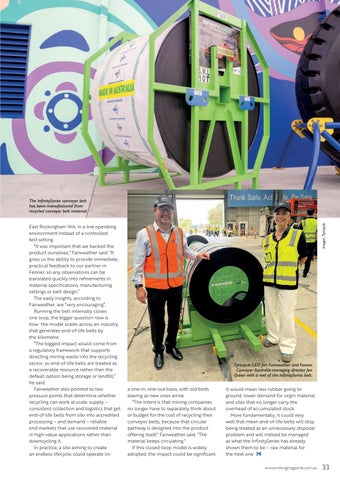
The InfinitySeries conveyor belt has been manufactured from recycled conveyor belt material.
Tyrecycle CEO Jim Fairweather and Fenner Conveyor Australia managing director Jen Green with a reel of the InfinitySeries belt.
a one-in, one-out basis, with old belts leaving as new ones arrive. "The intent is that mining companies no longer have to separately think about or budget for the cost of recycling their conveyor belts, because that circular pathway is designed into the product offering itself," Fairweather said. "The material keeps circulating." If this closed-loop model is widely adopted, the impact could be significant.
It would mean less rubber going to ground, lower demand for virgin material and sites that no longer carry the overhead of accumulated stock. More fundamentally, it could very well that mean end-of-life belts will stop being treated as an unnecessary disposal problem and will instead be managed as what the InfinitySeries has already shown them to be – raw material for the next one. www.miningmagazine.com.au
33