MHD SUPPLY CHAIN SOLUTIONS OCTOBER 2026
OCTOBER 2026
VOLVO TRANSFORMS PARTS LOGISTICS e
ydney C lifts efficiency and a ailability
LEADING SUPPLY CHAINS WITH ARGON & CO Darren Wedding outlines priorities for modern leadership
DEMATIC UNLOCKS WAREHOUSE CAPACITY Automation helps operators maximise existing facilities
Justin Carnaby Head of Logistics, AS Colour
Order Fulfilment Down to a Tee AS Colour achieves 344% throughput per worker with GTP “game-changer”
When AS Colour started out, the trend was for tight tees and baggy pants. But while clothing fashion trends come and go, the trend that doesn’t change is that customers want their orders delivered on time and accurately. Dematic’s Multishuttle Goods-to-Person (GTP) fulfilment system enables AS Colour to process orders with higher productivity, faster and with increased accuracy, down to the sequence of items in the package. As a result, AS Colour has seen a big increase in sales as customers see how fast and accurately their orders reach them. Learn more at dematic.com/as-colour
Scan to watch the video! Dematic.com 02 9486 5555 info.anz@dematic.com
EDITOR’S NOTE
MHD
Supply Chain Solutions CONTACT MHD Supply Chain Solutions is published by Prime Creative Media 379 Docklands Drive, Docklands VIC 3008 Telephone: (+61) 03 9690 8766 Website: www.primecreative.com.au
From promise to performance
THE TEAM
T
Chairman: John Murphy CEO: Christine Clancy Managing Editor: Mike Wheeler Editor: Phillip Hazell Business Development Manager: William Jenkin Design Production Manager: Michelle Weston Art Director: Blake Storey Graphic Designers: Danielle Harris, Jacqueline Buckmaster Client Success Manager: Justine Nardone
FOR ADVERTISING OPTIONS Contact: William Jenkin william.jenkin@primecreative.com.au
SUBSCRIBE Australian Subscription Rates (inc GST) 1yr (11 issues) for $99.00 2yrs (22 issues) for $179.00 To subscribe and to view other overseas rates visit: www.mhdsupplychain.com.au or Email: subscriptions@primecreative.com.au
ACKNOWLEDGEMENT MHD Supply Chain Solutions magazine is recognised by the Australian Supply Chain Institute, the Chartered Institute of Logistics and Transport Australia, the Supply Chain and Logistics Association of Australia and the Singapore Logistics and Supply Chain Management Society.
ARTICLES All articles submitted for publication become the property of the publisher. The Editor reserves the right to adjust any article to conform with the magazine format. COPYRIGHT MHD magazine is owned by Prime Creative Media. All material in MHD is copyright and no part may be reproduced or copied in any form or by any means (graphic, electronic or mechanical including information and retrieval systems) without written permission of the publisher. The Editor welcomes contributions but reserves the right to accept or reject any material. While every effort has been made to ensure the accuracy of information Prime Creative Media will not accept responsibility for errors or omissions or for any consequences arising from reliance on information published. The opinions expressed in MHD are not necessarily the opinions of, or endorsed by the publisher unless otherwise stated.
here is rarely a shortage of big claims in supply chain. New technologies promise to transform the warehouse, faster delivery models continue to reset customer expectations, and major investments are regularly presented as the next step in building smarter and more capable logistics networks. What is often more interesting is what happens when those ideas reach the warehouse floor. That question runs through several stories in this October issue, but perhaps nowhere more clearly than in ASCLA CEO Steven Ballerini’s examination of humanoid robots. Humanoids have become one of the most talked-about areas of automation, attracting extraordinary valuations and no shortage of impressive demonstrations. Yet the numbers that matter to warehouse operators are considerably less spectacular: totes moved, hours operated, interventions required, uptime achieved and cost per task. There are signs of genuine progress overseas. Agility Robotics’ Digit has moved more than 100,000 totes in a live GXO fulfilment operation, while other humanoid trials are beginning to produce measurable productivity data. But, as Steven explores, established automation remains a formidable competitor, and no Australian warehouse operator had publicly announced a live humanoid deployment or trial as of August. That balance between possibility and
practical performance can also be seen elsewhere in the issue. Volvo Group Australia’s new Sydney Parts Distribution Centre shows automation operating at a very different stage of maturity. Its automated storage and retrieval system is being used to improve parts availability, reduce retrieval times and lessen the physical demands placed on warehouse employees. Australia Post, meanwhile, is responding to an entirely different operational challenge as parcel growth continues to reshape its national network. The organisation invested $413.3 million during FY26 across fleet, technology, facilities and regional capacity as it adjusts to an increasingly parcel-led future. Bunnings is similarly connecting supply chain decisions with wider business objectives, investing in freight, fulfilment, last-mile delivery and automation as it expands its offer and commercial operations. Together, these stories make for an interesting contrast. Some technologies are already embedded in daily operations. Others are only beginning to prove themselves. For supply chain leaders, knowing the difference may be just as important as knowing what comes next. Happy reading! Phillip Hazell Editor, MHD Supply Chain Solutions
mhdsupplychain.com.au
3
OCTOBER 2026
THIS ISSUE 35
COVER STORY
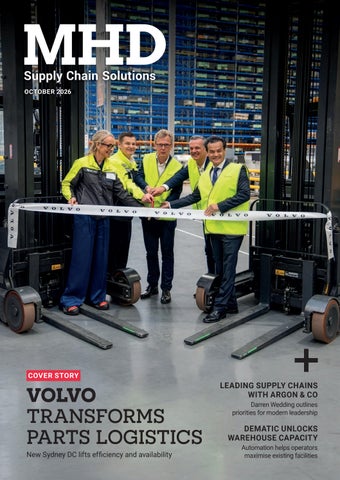
35 Volvo automates new Sydney parts centre.
SUPPLY CHAIN 12 Argon & Co explores modern supply chain leadership. 28 Netlogix urges businesses to prepare freight networks. 38 Woolworths strengthens food supply chain resilience. 40 Bunnings invests in freight and fulfilment.
COVER STORY
44 Bega automates warehouse, consolidates supply chain. 48 AusPost reshapes network around parcel growth.
MATERIAL HANDLING 19 Jungheinrich turns data into ESG gains. 22 Adaptalift’s electric capability. 32 Combilift helps Ego maximise capacity. 44 Conquest unifies capabilities. 58 TMHA appoints Cameron Paxton to lead growth.
MATERIAL HANDLING 24 TMHA fleet supports Arnhem warehouse growth.
12
WAREHOUSES 16 Dematic unlocks capacity in
16
existing warehouses. 20 Hai Robotics scales UMALL fulfilment capacity. 30 Dexory advances real-time warehousing with physical AI. 32 Interlogic helps Cardinal triple warehouse picking rates.
ASSOCIATIONS, EVENTS, AND REGULARS 03 Ed’s Letter. 06 Industry News. 50 ASCI. 52 ASCLA. 56 People on the Move. 58 Product Showcase. mhdsupplychain.com.au
5
INDUSTRY NEWS
L
DHL Supply Chain secures new Altona North facility
endlease’s Australian Prime Property Fund Industrial (APPFI) has entered into an agreement with DHL Supply Chain Australia to deliver a purpose-built logistics facility in Altona North, Victoria. The high-specification distribution facility will be developed on a ninehectare portion of APPFI’s site at 121–139 Dohertys Road. DHL Supply Chain will design and construct the facility to support its operational requirements and provide additional capacity for its Australian network. Construction commenced in June 2026, with completion targeted for October 2027. APPFI will retain ownership and manage the asset following practical completion, with DHL Supply Chain committed under a long-term lease. The project will redevelop part of the existing Dohertys Road property, where low site coverage has created an opportunity to introduce modern DHL Supply Chain will occupy a new purpose-built logistics facility at Altona North, with completion targeted for October 2027. Image: OleksKao/stock.adobe.com
6
industrial space aligned with current logistics requirements. APPFI Fund Manager Tim Simpson says the agreement reflects continued demand for premium logistics facilities in well-located infill markets. “This partnership with DHL Supply Chain highlights the continued strength of demand for premium logistics facilities in well-located infill markets,” Tim says. “The project demonstrates our ability to reposition assets and partner with leading global occupiers to deliver longterm, high-quality outcomes for our investors. “As supply chains evolve and customer expectations increase, occupiers are placing a premium on proximity to major population centres and transport infrastructure. Assets like 121 Dohertys Road in Altona North are uniquely positioned to meet that demand.” DHL Supply Chain Australia and New Zealand CEO Steve Thompsett says the
facility will strengthen the company’s network and support the evolving requirements of its customers. “We are pleased to be partnering with Lendlease and APPF Industrial on this development, which supports both our customers’ ambitions and our longterm growth in Australia,” Steve says. “As our customers grow and their supply chain needs become more complex, it’s important that we continue investing in the right infrastructure to support them. “This new facility in Melbourne will strengthen our network, provide capacity for future growth and help us deliver the reliable, flexible service our customers expect.” APPFI focuses on owning and managing logistics assets in supplyconstrained urban locations, with the Altona North project supporting its strategy of unlocking value in strategically located industrial submarkets.■
*Conditions apply.
THINKING ABOUT SWITCHING TO ELECTRIC? The Baoli KBE25 lithium-ion forklift delivers the performance many businesses are looking for, without the fuel costs, emissions and maintenance associated with traditional gas forklifts. Baoli combines competitive pricing with the strength of Linde Material Handling and the KION Group, giving you access to a trusted service network, parts support and technical expertise long after the sale. It’s everything you need from an electric forklift, with the confidence of one of the world’s leading materials handling organisations behind it.
TRY A BAOLI KBE25 TODAY AND EXPERIENCE THE DIFFERENCE FOR YOURSELF.
Learn more at
baoliforklifts.com.au
INDUSTRY NEWS
L
Lindsay secures major Woolworths freight contract
indsay Australia has secured a five-year contract to provide transport services to approximately 40 Woolworths and BIG W stores across North Queensland. The agreement will see Lindsay service stores between Mackay and Cairns, marking the company’s first entry into the mainland secondary freight market and its largest single contract win to date. The contract is expected to generate between $30 million and $36 million in annual revenue once fully operational. Lindsay will commit approximately $20 million in dedicated capital to support the agreement, including investment across four operating sites. New greenfield facilities will be established in Townsville and Cairns
as part of the expanded network. The contract will be introduced progressively from October 2026, with full operations expected to commence by July 2027. Lindsay anticipates receiving the contract’s full annual revenue contribution from FY2028. The announcement accompanied Lindsay Australia’s FY2026 results, in which the transport and rural services group recorded revenue of $1.07 billion, exceeding $1 billion for the first time. This represented an increase of 26.2 per cent compared with the previous financial year.
The company attributed its revenue growth to the full-year contribution of SRT Logistics and organic growth across its core transport routes. Its Transport division generated revenue of $762.9 million, up 32.9 per cent. Lindsay said the SRT acquisition provided the experience and capabilities needed to enter the secondary freight sector. The company estimates the Australian secondary freight market is worth approximately $3 billion and services around 4,000 stores nationally. The Woolworths agreement forms
Underlying earnings before interest and tax rose 37.7 per cent to $60.4 million, while underlying net profit after tax increased 27.1 per cent to $27.6 million.
part of Lindsay’s strategy to diversify its operations beyond refrigerated primary logistics while using its existing fleet, facilities and regional network to support further growth. ■
Lindsay Australia has secured a five-year contract to provide transport services to around 40 Woolworths and BIG W stores across North Queensland. arliftatoz2205/stock.adobe.com
8
INDUSTRY NEWS
A
Amazon expands same-day fulfilment
mazon Australia has expanded its Prime Free Same-Day service in Sydney and Melbourne, introducing overnight, afternoon and evening delivery windows as it continues to invest in faster fulfilment and last-mile capability. Prime members in the two cities can now receive eligible orders in as little as five hours, with hundreds of thousands of products available across the expanded service. The new delivery windows include overnight delivery for orders placed by 10pm, with parcels arriving between 4am and 8am; afternoon delivery for orders placed by 8am; and evening delivery for orders placed by midday. Amazon says the expanded windows are designed to provide customers with greater control over when orders arrive while making greater use of its fulfilment and delivery network throughout the day and overnight. Around one million products are eligible for the service in Sydney, while more than 500,000 are available in Melbourne.
Arno Lenior, Director of Prime for Amazon Australia, says the expansion reflects continued investment in delivery speed and flexibility. “Speed and convenience have always been at the heart of our delivery investment in Australia,” Arno says. “We’re seeing more demand from customers for delivery options that fit around their lives, not the other way around.” The company has also launched Amazon Day nationally, allowing Prime members to select a preferred day of the week and consolidate eligible orders into a single delivery. The option is intended to reduce the
expected to create an additional 4,500 jobs once fully operational. Amazon says 72 per cent of Australians can now access free next-day delivery or faster through Prime. Same-day delivery is also available to Prime members in Perth, Canberra, Geelong, the Central Coast, Newcastle and the Hunter region, with customers in those locations able to place orders as late as 11am for delivery before 10pm. The faster delivery network also extends to products sold through Fulfilment by Amazon, with eligible inventory stored within Amazon’s fulfilment network able to access Prime
number of individual deliveries required while allowing multiple orders to be grouped into fewer shipments. The latest service expansion comes as Amazon continues to grow its Australian fulfilment footprint. The company currently operates eight fulfilment centres and 12 logistics sites across Australia. Between 2024 and 2027, it says it will invest $1.6 billion in five new operational sites, which are
delivery services. For selling partners, this allows qualifying products to be picked, packed and dispatched through Amazon’s infrastructure for same-day or overnight delivery to customers in Sydney and Melbourne. Amazon says it intends to continue expanding its product selection, delivery coverage and delivery speeds as its Australian logistics network grows. ■
Amazon Australia has expanded its Prime Free Same-Day service in Sydney and Melbourne, adding new overnight, afternoon and evening delivery windows. age stoc .ado e.co
mhdsupplychain.com.au
9
INDUSTRY NEWS
C
Charter Hall acquires $192.4 million portfolio
harter Hall has expanded its industrial and logistics portfolio with the acquisition of three South East Queensland assets for a combined $192.4 million. The properties are occupied by Australia Post, automotive logistics operator PrixCar and healthcare distributor Symbion. Charter Hall Prime Industrial Fund (CPIF) and the newly established Charter Hall Industrial Partnership 6 (IP6) acquired the assets across Darra, Willawong and Acacia Ridge. The largest transaction was the $74.5 million acquisition of an 8.9-hectare, purpose-built industrial outdoor storage facility at 108 Burman Road, Willawong. Fully leased to PrixCar, the acquisition creates a consolidated holding of approximately 23 hectares across adjoining sites. The combined holding has a 20-year weighted average lease expiry following a 6.5-year lease extension.
IP6 also acquired Australia Post’s 21,757-square-metre logistics facility at 39 Gravel Pit Road, Darra, for $70.15 million through a sale-and-leaseback agreement. Located in Brisbane’s western industrial corridor, the property is secured by a new 10-year triple-net lease and was acquired on an initial yield of 5.75 per cent. IP6 is a 50:50 joint venture between CPIF and a major domestic capital partner. The latest acquisitions bring the partnership’s portfolio to three assets valued at more than $650 million. CPIF separately acquired a 12,856-square-metre healthcare and pharmaceutical distribution facility at 51 Peterkin Street, Acacia Ridge, for $47.75 million. The facility is leased to Symbion, part of the EBOS Group, under a 15-year triple-net lease. Charter Hall says the property was acquired on an initial yield of 5.65 per cent.
“These acquisitions provide exposure to high-quality assets leased to leading tenant customers operating critical infrastructure across the postal, healthcare and automotive sectors,” says Charter Hall Managing Director and Group CEO David Harrison. “We remain focused on disciplined investment in assets with strong underlying fundamentals that can deliver resilient income and long-term value for our investor customers.” Charter Hall Industrial and Logistics CEO Richard Stacker says South East Queensland continues to benefit from population growth, investment in freight infrastructure and demand from essential supply chain operators. “The acquisitions are consistent with CPIF’s strategy of acquiring high-quality industrial and logistics assets underpinned by leading tenant covenants, long lease profiles and strong underlying land value,” says Richard. ■ Charter Hall has acquired Symbion’s healthcare and pharmaceutical distribution facility at Acacia Ridge as part of a $192.4 million South East Queensland portfolio deal. Image: Charter Hall
10
EXTOLL
EXTOLLA_MHD_JUNE_FULL_PAGE_A4_FA_OL.indd 1
26/6/2024 10:12 AM
SUPPLY CHAIN
Leading the modern supply chain Drawing on four decades of experience, former Super Retail Group and Myer executive Darren Wedding explains why customer focus, disciplined execution and curiosity are essential to leading supply chains through rapid change.
W
hen Darren Wedding began his career, supply chain was not widely recognised as a profession. He learnt his craft in the military, studying applied mathematics at a time when computers were only beginning to emerge as business tools. Supply chain was typically buried within manufacturing or aligned with sales, with its contribution measured largely through cost reduction and efficiency. Across the four decades since, Darren has watched it mature into a distinct discipline and move closer to the centre of business decision-making. COVID-19 brought that transition into public view. Product shortages, delivery delays and pressure on freight networks made supply chain part of everyday conversation. Inside businesses, the disruption reinforced how directly the function affects customer experience, commercial performance and resilience. “In many cases, the supply chain role sits, if not at the executive table, very close to it,” says Darren. “It’s an end-to-end view of the business. It’s a service-based function, not just a costbased function.” For leaders, that means understanding the organisation’s strategy and shaping the function around the outcomes it needs to deliver. In sectors such as retail, manufacturing and pharmaceuticals, supply chain is integral to how the business serves its customers and competes.
Service before technology The function’s elevation has coincided with rising consumer expectations for speed, convenience and visibility, while businesses must still manage cost and
12
complexity. “At the essence of any supply chain leader, their first thought should be about service,” he says. “They should be customer-centric. If they’ve only been asked to focus on cost, then they’re too far back.” Automation can help businesses reconcile service expectations with labour and cost pressures, but Darren cautions against treating it as an objective in itself. Leaders should begin with the operational problem, then assess whether process improvement, mechanisation or automation is the right response. Online retail accelerated sharply during the pandemic, labour became scarcer and more expensive, and automation improved while becoming more accessible. Darren points to autonomous mobile robots as one category in which capability and economics have changed considerably within only a few years. “Just because that solution works for that business doesn’t mean it’s the right solution for the next business,” says Darren. “Everybody’s got a very unique problem to solve.” As the technology landscape expands, executives cannot be experts in every system. Darren says this has increased the value of trusted partners who can challenge assumptions and help businesses evaluate options objectively. At Super Retail Group, differing views existed across the board and executive team about which technologies the business should pursue. Darren engaged Argon & Co to conduct a brand-agnostic assessment, validate the problem and identify the technology categories that warranted closer consideration. This
SUPPLY CHAIN
Darren says businesses should start with the operational problem before deciding whether process improvement, mechanisation or automation is the right response. Image: Pugun & Photo Studio/stock.adobe.com
mhdsupplychain.com.au
13
SUPPLY CHAIN
Darren is interested in its ability to bring information together and provide near real-time visibility, even where enterprise systems and master data are imperfect. Analysis that once took weeks or months can increasingly be completed in minutes, helping leaders define the problem and assess possible responses. Technology does not replace preparation. Darren describes business continuity planning as part of the “boring stuff” easily overlooked until it becomes critical. Leaders should understand what happens if a system, distribution centre or major provider becomes unavailable, how long the interruption can be tolerated and when to move to a backup or manual process. Even a desktop exercise can expose gaps and give the team a sequence to follow instead of inventing a response under pressure.
created a clearer basis for investment before requests for proposal began.
The four foundations of execution Darren organises his approach to supply chain leadership around four Ps: planning, process, people and partners. Planning begins with alignment. A supply chain strategy must reflect the business strategy, with objectives clear enough for team members to make sound decisions without waiting for a senior leader. It also requires firm prioritisation. At one organisation, Darren arrived to find a team carrying 37 projects. He returned to the business strategy and narrowed the immediate focus to between three and five priorities. Once one was completed, another could enter the program. “You can’t have 37 projects,” he says. “Let’s get clear about what’s the strategy of the business, what are we trying to achieve, what do we need to deliver, and then let’s go after those top three to five.” Process is the second foundation. While agility has become an important ambition, Darren argues that it depends on consistently executing the fundamentals. Receiving goods, putting stock away, completing safety checks and starting shifts correctly establish the discipline that allows a team to respond when conditions change. When those practices become muscle memory, the team can concentrate on the exception rather than reconstructing the everyday operation during a crisis. People form the third foundation. Darren wants teams to understand why their work matters and how it supports the business. Across roles, he values logical thinking, customer focus, engagement, end-to-end awareness, commercial acumen and a commitment to continuous improvement. Partners complete the model. The speed of change makes it unrealistic for one organisation to possess every capability internally. Darren says COVID-19 demonstrated the value of trusted relationships when capacity tightened, costs escalated and even
14
Curiosity as a leadership capability Darren Wedding says modern supply chain leadership requires customer focus, disciplined execution and curiosity. Image Darren Wedding pallets and shipping containers became difficult to secure. Those relationships provide wider intelligence and perspectives. Darren encourages professionals to build networks among suppliers, advisers and peers in comparable roles. “If I go to the board and tell them this is my problem, their first question is, ‘What are other companies doing?’” he says. Leaders should be ready to explain the options and trade-offs behind their recommendation.
Preparing before disruption arrives When an operation is disrupted, Darren’s first response is to separate the underlying problem from the noise around it. “People will come in with their hair on fire,” he says. “The world is on fire, everything’s broken, we’re never going to make it, Christmas is toast. It’s okay. Tell me exactly what the problem is. What does the data say?” Artificial intelligence is beginning to strengthen that diagnostic process.
Looking ahead, Darren considers curiosity the most important quality for the next generation of supply chain leaders. It means remaining open to new technology, but also questioning information inside the business. A service measure may report 98 per cent performance, but a curious leader will still ask stores or customers whether their experience supports the figure. Curiosity also means talking with teams, peers and partners and continuing to learn. As technology and customer expectations change, leaders must connect new possibilities with the practical needs of their operations. “Better to embrace it and lead it than be dragged along,” says Darren. “If you’re there at the front of the curve, you’ve got the ability to influence and use your experience in shaping the best way to respond.” That combination of openness and discipline sits at the heart of Darren’s approach. Modern supply chain leadership requires an appetite for change, but it also demands clarity about the customer, the business problem and the operational foundations that make transformation possible. ■
Global consultancy in operations strategy and transformation e or oge her i h clien s o rans or heir sinesses an genera e real change
Discover real change:
WAREHOUSES
Autonomous mobile robots can automate repetitive pallet movements, freeing warehouse teams to focus on other tasks.
Getting more from the warehouse you already have With new warehouse developments taking longer and costing more, Dematic’s David Rubie says operators are taking a closer look at how automation can unlock capacity within their existing facilities.
B
uilding a new warehouse from the ground up is getting harder. Approval and construction timelines have stretched, with more complex planning, design and compliance requirements adding time to new developments. At the same time, building costs have risen and suitable industrial land remains difficult to secure in many of Australia’s major logistics hotspots. Dematic’s analysis of government planning and construction data indicates that today’s typical building cycle is on average nine months longer compared with pre2020.
16
However, the pressures driving the need for more warehouse capacity haven’t changed. Operators are still dealing with labour availability shortages, changing stock keeping unit (SKU) ranges, faster order expectations and the stress of holding more inventory while moving it more efficiently. David Rubie, ANZ Sales Director Integrated Systems at Dematic, says this is leading more businesses to look at how much additional capacity they can find within the buildings they already occupy. “For a long time, if you needed
significantly more capacity, the next logical step was to start looking at a new building,” David says. “That’s becoming a harder business case to make when the building itself takes longer, costs more and pushes the return on the overall project further out.”
Rethinking the existing footprint These pressures are changing where many businesses are directing their warehouse investment. While large greenfield projects remain an important part of the market, David says there is growing interest in smaller automation
WAREHOUSES
systems that can be introduced into existing facilities. “We’re seeing businesses look much harder at brownfield sites and ask what they can do with the footprint they already have,” David says. “Sometimes you don’t need another building. You might need to get more pallets into the same space, take unnecessary travel out of picking, automate repetitive pallet movements or make better use of the height you already have.” Importantly, businesses don’t necessarily need to automate an entire warehouse. They can focus on the parts of the operation where they need more capacity or efficiency, from storage and pallet movement through to picking. “The first thing is understanding what is actually holding the operation back,” David says. “Once you know where the constraint is, you can start looking at what can be done within the footprint you already have.”
simple, repetitive movements out of the manual operation, you can use your people in areas where they add more value,” says David.
Knowing when brownfield makes sense There are, of course, limits to what can be achieved within an existing building. Ceiling height, floor load capacity and flatness, power requirements, fire and other compliance requirements,
access and surrounding transport infrastructure all need to be considered before deciding whether an existing site is suitable for automation. “There will absolutely be buildings where it doesn’t stack up,” David says. “You have to understand the limitations of the site and what it will cost to work around them. It’s not about making automation fit at any cost.” That assessment also needs to start with the operation rather than the technology. What is limiting Four-way pallet shuttle systems increase storage density through deeper lanes and automated pallet put-away and retrieval. Images: Dematic
Finding capacity without adding floor space Increasing storage density is one way businesses can make better use of an existing footprint. For example, four-way pallet shuttle systems can increase pallet storage density through deeper lanes and automated put-away and retrieval, while still operating alongside traditional selective racking. For case and tote operations, highdensity systems can reduce the space taken up by manual picking. AutoStore can save up to four times the space typically used by manual picking paths, while providing a modular system that can be expanded as requirements change. The same thinking can be applied to how products move through a facility. AGVs and AMRs can automate repetitive pallet movements while integrating with conveyors, traditional racking and block-stacking areas. In many cases, these systems can also be introduced without requiring specialised building services or floors. Along with reducing manual movement, automation can provide greater consistency, visibility and traceability across these processes. “If you can take some of those mhdsupplychain.com.au
17
WAREHOUSES
throughput today? Where is space being lost? Which manual processes are consuming the most time? And what will the operation need to handle in the next few years? For some businesses, the answers will still point towards a new facility. For others, particularly where the existing site works well for their workforce, customers and transport AutoStore’s compact storage grid helps operators reduce the space required for manual picking and increase capacity within existing facilities.
18
network, it may make more sense to find additional capacity within the existing facility.
entire warehouse around them. “Before you decide you’ve outgrown a building, it’s worth understanding what else that building can give you,” David Getting more from what you have says. As automation becomes more “If you can improve the storage, modular and easier to integrate into throughput and productivity of the existing operations, businesses have existing operation, you may have more more options to address individual room to grow than you think,” he constraints without rebuilding theIn addition concludes. to the■logo, where
1.2
Brandmarks
appropriate, one of two brandmarks can be applied in isolation.
Netlogix Unlocking Freight Efficiency by Harnessing the Power of Advanced Technology Get in contact to see how we can help www.netlogixgroup.com +61 1 800 565 786 www.netlogixgroup.com enquiries.au@netlogixgroup.com
NETLOGIX BRAND GUIDE 3
SUPPLY CHAIN
Hai Robotics’ goods-toperson system retrieves inventory and delivers it to workstations, reducing manual travel during picking.
Building fulfilment capacity for growth
After two years of operating Hai Robotics technology, UMALL has expanded its fleet to 22 robots as it responds to rising order volumes, a broad SKU mix and rapid business growth. When UMALL first introduced Hai Robotics automation around two years ago, the goal was not simply to pick orders faster. The Australian online grocery retailer was looking to create more fulfilment capacity within its approximately 1,000-square-metre warehouse while preparing for future growth.
20
Two years later, the business has grown from approximately A$15–20 million in FY2024 revenue to A$60–65 million in FY2026, while the robotic warehouse has expanded from an initial 16 robots to 22. “Grocery has a very long tail of products, so we were not simply picking a small number of fast-moving
items,” Roc Zhang, CTO at Umall says. “Traditional manual picking involved a great deal of walking, searching and repeated handling, and it became increasingly difficult to keep the operation consistent during peak periods.” UMALL wanted to use the vertical capacity of its existing site more
SUPPLY CHAIN
effectively while creating an operation that could accommodate future demand. Rather than automating a single isolated task, it was looking to establish the infrastructure needed to increase its overall handling capacity. The company selected a Hai Robotics goods-to-person system, under which robots retrieve inventory and deliver it to workstations. This reduces the distance employees need to travel while picking and makes better use of the warehouse’s vertical space. Its suitability for UMALL’s site, product profile and fulfilment processes was central to the decision. The retailer could also bring the initial installation online and add capacity as volumes changed. That flexibility has since been tested in daily operation. UMALL recently added six robots to the system, bringing its operating fleet to 22, without replacing the original installation.
Growth raises the fulfilment task The expansion has occurred alongside substantial growth across UMALL’s
business. The company reports that revenue rose from approximately $15 million to $20 million in FY2024 to around $60 million to $65 million in FY2026, close to a fourfold increase. Automation was not the sole cause of that commercial growth, but UMALL says it has become an important part of the operational foundation supporting it. In one 30-day period, the robotic warehouse handled 58,189 orders and 296,742 individual units. That equates to about 1,940 orders and 9,891 units per day, while daily order volumes have peaked above 2,200. The same period involved 7,689 active SKUs. The 10 highest-volume products represented just 4.4 per cent of all units handled, demonstrating how widely demand was distributed across the range. For the warehouse, this means throughput cannot be built around only a small group of fast-moving lines. “Automation has helped us standardise the warehouse process and make it more predictable in a high-
growth, long-tail SKU environment,” Roc says. “It is not the only reason the business has grown, but it has become an important part of our capacity to support that growth.” As volumes and SKU complexity increased, UMALL required greater sustained handling capacity from the robotic operation. The robotic warehouse has sustained actual system flow of approximately 518 to 530 totes per hour, demonstrating that the system is being used intensively in a real production environment. The six additional robots were introduced to create more headroom during peaks, not because the original system had ceased to meet its intended function. With the platform already integrated and employees experienced in operating it, expansion involved less implementation risk than a new deployment.
Predictability over isolated speed For UMALL, the most important improvement has not been a single
UMALL has expanded its robotic fleet to 22 units, adding capacity to manage rising order volumes. Image: Hai Robotics
mhdsupplychain.com.au
21
SUPPLY CHAIN
measure of picking speed, but the increased predictability of the operation as a whole. Bringing goods to employees reduces repeated walking, searching and stock movement. System guidance and scanning also reduce dependence on individual memory. Employees can instead focus more attention on replenishment, exceptions, quality checks and order completion. UMALL says the system has remained stable over two years of daily use and performed in line with expectations. Its sustained tote flow indicates that the installation can support a production environment rather than reaching its performance level only in a demonstration. “For us, reliability does not mean that nothing ever goes wrong,” Roc says. “It means the operation can recover quickly and continue fulfilling customer orders.” Shoppers may never see the technology, but they experience its effects through the consistency and timing of fulfilment. A steadier processing rhythm helps UMALL manage busy periods and warehouse cut-off times. Yet customer outcomes continue to depend on inventory availability, replenishment, packing, delivery and service.
Creating room to scale UMALL believes that without automation it may still have achieved business growth, but accommodating its present scale would probably have demanded more warehouse employees, additional shifts and extra floor space. It would also have made training and day-to-day coordination more complex, particularly during peaks. Its experience suggests automation should be assessed more broadly than whether a robot completes one task faster than a person. The larger question is whether an operation can absorb rising volume and complexity without resources, space and coordination pressures increasing at the same rate. “Two years later, we can see that Hai Robotics’ automation solution was not just an investment in warehouse
22
Automated tote retrieval helps UMALL make better use of vertical space within its approximately 1,000-squaremetre warehouse.
efficiency,” Roc says. “It has become an important part of our ability to scale the business and keep up with customer expectations.” UMALL says it would make the same investment again for the original project. Two years of operation have shown the system can process real order volumes, while the extra robots demonstrate that it can scale while normal operations continue. However, every automation project must be assessed against its site, operating environment, workflow, integration requirements and commercial case. Its advice is to begin with the operation rather than the equipment. Businesses should understand their actual order profile, SKU mix and peak-period pressures before deciding how many robots, or what form of automation, they require. This is especially relevant in grocery, where a long tail of products can make a model designed around a limited number of
high-volume SKUs unsuitable. Automation must also be approached as a process and systems-integration project, not simply a hardware purchase. Planning should account for OMS and WMS integration, replenishment, workstations, packing, exception handling, employee training and future capacity. UMALL recommends that prospective users ask suppliers to model the operation using their own order and SKU data. It also advises focusing on sustainable operating throughput rather than a short-lived theoretical peak. The lesson from its first two years is not that automation removes every operational constraint. It is that a system designed around a company’s real demand profile, and capable of expanding with it, can make growth more manageable. For UMALL, the warehouse is no longer simply processing more orders. It has become a more stable platform from which the business can continue to scale. ■
MATERIAL HANDLING
Arnhem Pet products, sweeping to success with Toyota Forklifts Arnhem Pet Products is supporting its next stage of growth with a new purpose-built warehouse and a battery-electric Toyota fleet, streamlining order picking and keeping presentation a priority.
A
new Toyota Material Handling Australia (TMHA) Ride-On Sweeper has become the pride of the fleet in a fast-expanding Victorian distribution business riding the wave of demand for specialty pet nutrition products. Arnhem Pet Products has recently opened a 4,000-square-metre, purpose-built supply centre to service a niche segment of the annual $4 billion pet food industry.
It has fitted out the new warehouse with new racking and integrated a new Toyota Reach forklift, as well as an innovative Toyota order picker, all managed by a specialised stock control system. Most importantly, it has bought its first floor sweeper. “Our food products are imported, already packaged for retail, so presentation is vital,” says Jayde Growcott, Arnhem co-owner.
“The warehouse is sealed to keep dust to a minimum, and at the end of each shift, it is swept with our battery electric ride-on sweeper.” “It’s so popular there’s competition amongst our warehouse staff to use it.” The Toyota S28B Ride-on Sweeper has become a symbol of the success of the start-up company, begun in a small 300-square-meter shed by Jayde and his business partner, Waruna Seneviratne, just eleven years ago.
A Toyota reach forklift handles pallets in Arnhem’s new warehouse, which provides 3,000 pallet spaces across racking eight metres high.
24
MATERIAL HANDLING
Arnhem’s TMHA S28B ride-on sweeper keeps warehouse floors clean as part of its daily focus on product presentation. Images: TMHA
mhdsupplychain.com.au
25
MATERIAL HANDLING
The partners have moved four times, expanding in size and capacity each time. Now they’ve designed and built their own premises in Pakenham, 50 kms east of the Melbourne CBD, receiving products from international sources and distributing to companies across Australia. The pet business has become big business. The size of the specialty pet food industry has increased exponentially, spurred by pet owners demanding high-quality nutrition solutions for their animals, even on a breed-bybreed basis. Ethically sourced materials and
full traceability of product origin have become industry bywords and requirements. Arnhem Pet Products has partnered since the outset with specialist supplier TMHA to provide forklift and pallet jack solutions appropriate to their expanding size. “We still have our first 1.8-tonne counter-balance forklift, our single most expensive machinery purchase at the start of our company,” Jayde says. The fleet has now grown to eight, including an innovative combination OSE120CB forklift-order picker recommended by TMHA to streamline product selection in the new warehouse.
“We import from six locations throughout the world, and while there aren’t a huge number of products, our customers can choose from up to 450+ stock-keeping units,” Jayde says. “Our customer order sizes could vary from a hand full of items up to a semitrailer load depending on their needs. “The flexibility of Toyota’s OSE120CB order picker has substantially sped up the process.” “It enables the operator to easily step off to manually pick an item in the most efficient possible manner and with a view to optimising operator ergonomics.” Specialised racking within the warehouse provides 3,000 pallet spaces
Toyota’s OSE120CB forkliftorder picker helps Arnhem streamline product selection for orders ranging from a few items to a semi-trailer load.
26
MATERIAL HANDLING
to a height of eight metres. In an industry in which shelf-life matters, turnaround time from order to transhipping is less than 48 hours, demanding high efficiency in material handling. All Arnhem’s material handling machinery is battery electric. “It reduces noise and emissions within the warehouse, which is essential to meet expectations within our industry,” Jayde says. “We designed the warehouse to accept pallets and containers in a separate, dedicated area open to trucks 24/7. The area can accommodate up to six shipping containers simultaneously.” “Our forklifts then perform the transfer.” Demand for pet food in Australia will exceed $4 billion in 2026, with about 80 per cent through large supermarkets. Arnhem Pet Products services the
remaining 20 per cent, made up of three substantial specialty chains and multiple independent retailers. “There’s a lot of competition, but also a lot of specialty demand, which is why we are constantly sourcing products that meet the needs of an increasingly sophisticated market,” Jayde says. One of Arnhem’s many lines is sourced from a company in Iceland which trawls and processes cod, herring, wolfish, and salmon for highquality restaurants, then produces offcuts for pet food snacks. “It’s a long way from our start-up, which we began without product or, for that matter, customers,” Jayde says. “We’d hand deliver ourselves and sell to local retailers.” “It was the first time I’d worked for myself, and with a family of three young daughters, now four, it was something of a leap of faith.”
Now his eldest daughter, Charlie, is now part of the Arnhem team. For Jayde, the arrival of the company’s Toyota S28B Ride-on Sweeper was highly symbolic. “In our previous warehouses, we used two big brooms and a dustpan,” he says. “When we built this new warehouse, we agonized whether to go to the expense of laying diamond-polished concrete in our office and administrative area, but we did,” Jayde says. “Then we had the warehouse floor poured and finished with a power trowel to guarantee a super-smooth surface.” “Presentation is important.” “In so many ways, the ride-on sweeper is the icing on the cake.” ■ For more information freecall 1800 428 438 or visit online at www.toyotamaterialhandling.com.au
mhdsupplychain.com.au
27
SUPPLY CHAIN
Businesses urged to get freight networks ready before peak season hits
F
Netlogix explains why businesses should review freight capacity, carrier networks and digital connectivity now to stay ahead of rising peak-season demand.
or Australian organisations, the beginning of Spring is no longer the time to start thinking about peak season, it is the time to make sure the freight network is organised and ready for it. Companies need to start planning now, as order volumes and delivery expectations typically rise in the lead-up to the busiest retail period of the year. Digital Freight PlatformNetlogix, generally sees B2B customer freight volumes increase by 20–30 per cent between October and December, placing businesses under increasing
pressure to fulfil more orders faster while keeping costs and customer expectations in check. The scale of the challenge is significant, with businesses needing freight networks that can support higher order volumes, tighter delivery windows, complex distribution requirements and greater expectations from commercial customers. Seasonal demand is continuing to shift as B2B customers expect suppliers, manufacturers, distributors and retailers to maintain reliable service levels, accurate delivery
timeframes and clear freight visibility even when volumes increase. For businesses, the real test comes when larger order volumes need to move through the supply chain without disrupting service levels, inventory flow, customer commitments or cost control.
When more carriers create more complexity Increasing freight demand requires access to more capacity, often needing to bring on new carriers to an already complex multi-carrier freight services Higher freight volumes place greater pressure on businesses to maintain efficient inventory flow and fulfilment during peak season. Image: Photographee. eu/stock.adobe.com
28
SUPPLY CHAIN
Businesses are being urged to review freight capacity and carrier arrangements before seasonal demand intensifies. Image: markobe/stock.adobe.com
network. Using multiple freight carriers can give Aussie organisations flexibility, but without the right systems to orchestrate the freight task across complex set of service needs, it can create unnecessary business headaches. Relying on multiple carriers without digitally connected platform that can orchestrate the freight task to achieve optimal cost and service outcomes can mean having to rely on different manual processes, disparate systems, complex pricing structures and even different delivery capabilities and during peak season, these inefficiencies can quickly become costly. Fragmentation across carrier networks can lead to duplicated routes, inconsistent service and trucks travelling without being filled, all of which can increase costs, impact service levels and undermine sustainability efforts. A digitally connected freight network, not only reduce costs and improve service through asset availability to deliver on time, but also help improve a retailer’s green footprint by minimising unnecessary kilometres, improving vehicle utilisation and reducing avoidable emissions. The answer is not necessarily to reduce the number of carriers; instead, businesses can look at bringing those
carriers together through a unified digital freight platform to orchestrate the freight task to optimise the movement, which is something offered by Netlogix. By connecting multiple carriers and freight movements through one unified platform, businesses can gain greater visibility over their network, identify opportunities to consolidate freight and make more informed decisions about how and where goods move. Having a control tower view enables businesses to make proactive as opposed to reactive decisions. The Netlogix platform can design the bespoke freight network from more than 350 plus connected carrier network to suit their service requirements, giving businesses greater choice while helping match freight requirements with available transport capacity.
It is not too late While peak season planning should ideally begin months in advance, businesses that have not yet reviewed their freight operations should not assume they have missed the boat. For many organisations, October remains a critical window to review freight operations, test network capacity and address potential inefficiencies before demand intensifies.
This makes October an extremely crucial window in identifying any inefficiencies, carrier arrangements and considerations on whether a unified platform could relieve the pressure of businesses from day one. For Netlogix, this year carries an added significance as the company celebrates its 10th year in working with shippers in Australia across many industries digitising their domestic freight movements through unified freight platform. A decade of experience in working with great Australian companies has given the freight technology company a front row seat to the changing demands placed on Australian and New Zealand supply chains, and peak season remains one of the clearest tests of whether a network is genuinely working efficiently. The point of difference is simple, peak season should not require businesses to simply work harder. With the right technology, data and carrier network behind them, businesses can work smarter, reducing unnecessary costs, improving visibility and making their freight operations more sustainable. And for businesses still relying on fragmented systems and processes, it is not too late to make a change before the busiest months arrive. ■ mhdsupplychain.com.au
29
WAREHOUSES
Physical AI is helping warehouse operators build a real-time view of inventory, space utilisation and workflow as conditions change. Image: Unique Vision/stock.adobe.com
Physical AI and the shift to real-time warehousing Dexory’s Oana Jinga explores how physical AI is helping warehouses move beyond periodic visibility towards real-time operational awareness, enabling faster decisions, stronger inventory accuracy and better use of labour and space.
W
By Oana Jinga, Co-Founder & Chief Commercial & Product Officer at Dexory
arehouses are under growing pressure to do more with the resources they already have. Operators are managing increasingly complex inventory flows while seeking to improve productivity, make better use of warehouse space and reduce the time skilled teams spend on manual checks and investigations. Yet warehouses make thousands of operational decisions every hour, many based on information that is already out
30
of date. Inventory is constantly moving, storage locations change, congestion builds and pallets are relocated as demand shifts. By the time teams verify what is happening, the reality on the warehouse floor may already have changed. This gap between physical reality and operational information is becoming one of the most important challenges facing logistics operators. Recent advances in robotics, sensor technology, edge computing and artificial
intelligence are helping to close that gap. Together, they are enabling a new category of technology known as physical AI, where intelligent systems can perceive and interpret the physical world in real time. For warehousing and logistics, this represents more than another wave of automation: it marks a shift towards operations that are continuously aware of their environment and able to make faster, better-informed decisions based on what is happening now.
WAREHOUSES
Oana Jinga, Co-Founder & Chief Commercial & Product Officer, Dexory. Image: Dexory
Physical AI goes beyond traditional automation Warehouses have relied on automation for decades. Conveyors, automated storage and retrieval systems, palletising equipment and autonomous vehicles have all helped improve productivity by performing repetitive tasks with speed and consistency. Physical AI builds on these technologies rather than replacing them. Traditional automation is designed to execute predefined tasks in structured environments. Physical AI adds another layer of intelligence by continuously interpreting what is happening across the warehouse and adapting to changing conditions. In practice, this means autonomous systems can move through facilities, capture live operational data, identify misplaced pallets, detect inventory discrepancies, recognise blocked aisles, monitor congestion and highlight underutilised storage locations without relying solely on predefined instructions. The result is not simply greater automation. It is better operational decision-making.
From snapshots to realtime visibility Many warehouse decisions still rely on periodic counts, manual checks or reports that are outdated by the time they are reviewed. This creates friction across daily operations, with employees spending valuable time searching for inventory, confirming
locations, investigating discrepancies and checking available space. Physical AI replaces these snapshots with continuous operational awareness. Autonomous systems equipped with cameras, LiDAR and other sensors can capture millions of data points as they move through a facility, creating an up-to-date view of inventory, storage utilisation, workflow and performance. With this continuous visibility, operators can identify issues earlier and shift from reacting to problems after they occur to preventing them from disrupting operations.
Data quality is the foundation of physical AI Much of today’s AI discussion focuses on increasingly sophisticated models, but the success of physical AI depends on something more fundamental: data quality. AI is only as effective as the information it receives, yet warehouse data is often fragmented, manually updated or already inaccurate by the time it reaches decision-makers. This creates data decay. An inventory count completed in the morning may no longer reflect reality by lunchtime, as products are picked, replenished, relocated or shipped continuously throughout the day. When operational data falls behind physical reality, even advanced AI systems struggle to generate reliable recommendations. That is why high-frequency, realtime operational data is becoming a competitive advantage. The more accurately AI understands the current state of a warehouse, the better it can identify patterns, detect anomalies, predict emerging issues and support effective decisions. For physical AI, fresh data is not simply beneficial; it is essential.
From visibility to action Once a real-time data foundation is in place, physical AI can evolve from observing operations to helping operators understand and respond to what is happening. The first step is awareness: establishing a reliable, current picture of inventory, storage locations and activity across the facility.
The next step is insight. With a continuous stream of accurate operational data, AI can interpret what that information means, reveal patterns and identify inefficiencies such as bottlenecks, inventory inaccuracies and underutilised space. What was once hidden within fragmented or outdated data becomes clear and actionable, enabling operators to understand not only what is happening but also why. The final step is action. Intelligent systems can support or initiate responses by triggering workflows, adjusting operations or enabling faster, more confident decisions as conditions change. This progression from awareness to insight to action can improve inventory accuracy, space utilisation, labour efficiency and overall performance, while reducing the delay between detecting an issue and responding to it.
Why the timing matters now The concept of physical AI is not entirely new, but advances in robotics, sensing technologies, AI computing and cloud infrastructure now make it possible to deploy these systems at scale. Warehouses can increasingly collect, process and analyse operational data continuously across large and complex environments. The timing also reflects growing pressure on operators. Facilities are managing more SKUs, higher service expectations and continued constraints on labour and operating costs, while businesses seek greater productivity from existing warehouse footprints. For Australian supply chains, the scale and complexity of distribution networks make maximising the performance of each facility especially important. As warehouses become more connected, the distinction between digital systems and physical operations is beginning to disappear. AI can increasingly interpret what is happening inside the warehouse itself, helping operators identify problems sooner and use labour and space more effectively. Physical AI is moving warehouses from periodic visibility towards continuous understanding and intelligent action. ■ mhdsupplychain.com.au
31
WAREHOUSES
Cardinal’s Drury facility in New Zealand, where automation has helped lift picking productivity to around 380 cartons an hour.
Cardinal lifts picking rates threefold at Drury
C
Cardinal’s automated Drury warehouse is processing around 380 cartons an hour, more than three times the rate of its conventional operations, after a complex integration of warehouse software and automation.
ardinal has lifted picking productivity more than threefold at its Drury warehouse, with the automated operation now processing around 380 cartons an hour. Although Cardinal’s carton pick rate using multi-pick technology in its nonautomated warehouses is at industryhigh levels, the picking productivity uplift comes as the logistics operator reduces its reliance on manual labour while managing close to 2,000 SKUs through the facility. Cardinal COO Leonard Griessel says the shift has delivered a significant change in warehouse operations. “The main impact moving to Drury around performance was again less reliance on staff, more reliance on automation,” Leonard says. “If you look at the number of cartons we were able to pick per hour at non-automation sheds to Drury, it’s increased by at least threefold. The project brought Cardinal together with logistics technology provider Interlogic to integrate the company’s existing warehouse management
32
environment with the automation and warehouse control systems at Drury. But the ambition was broader than simply installing new equipment. Cardinal CEO Brendon Furness says the business wanted an operation capable of consistently delivering at a high level, particularly when customer expectations are at their highest. “The problem we were trying to solve, or the opportunity we were trying to go after, was to be world class,” Brendon says. “No one remembers the 45 Christmases you’ve had when the Christmas presents turn up, but everybody talks about the Christmas when they didn’t.” Interlogic Founder Les Wootton says one of the major challenges was connecting the automation to warehouse rules Cardinal had already spent years developing. “On this particular project, one of the most challenging areas for us was figuring out how to integrate into the warehouse control systems,” Les says. Cardinal had been operating its
existing warehouse management system for around six or seven years, building customer requirements and operating rules into the platform over that period. That meant the project team could retain much of that existing logic while applying it to the new automated environment. “So it was a very simple task for us to then overlay that on an automation system,” Les says. The warehouse itself added another layer of complexity. Leonard says Drury may look like a conventional automated facility from the outside, but its product profile is considerably broader than would normally be expected. “At the moment, we have close to 2,000 SKUs in the warehouse,” he says. “Generally, automation sheds would have probably 25 per cent of that.” Making that range work required the warehouse management system and warehouse control system to coordinate inventory allocation and physical movement throughout the facility.
WAREHOUSES
Brendon describes ensuring the allocation worked correctly with the WCS as “a massive challenge which we had to overcome”. There was also no ready-made blueprint for every challenge the teams encountered. Les says some operating scenarios could not simply be matched against an overseas automation project and replicated locally. “We had to design it from the ground up and think it through, and that can only come about by working very closely with Cardinal,” he says. That approach reflects how Interlogic positions its role in warehouse projects. “We don’t see ourselves as a software vendor,” Les says. “We see ourselves first of all as a logistics company.” For Les, that distinction means developers and consultants need to understand the physical warehouse before they start trying to change the systems running it. “They’ll be working in the warehouse from day one,” he says. “As a software developer, as a consultant, they need to understand how a warehouse works first and foremost.”
For Cardinal, the relationship became particularly important during the design and commissioning stages. Brendon says Interlogic was brought into the project early, working alongside Cardinal personnel and the engineers responsible for the equipment. The collaboration was also hands-on. “We don’t think of them as Interlogic,” Brendon says. “We think of them as Les and Justin and Sean and Reenie and Vlad and Illian, guys who are prepared to jump in the trucks or walk with us on the robots, so they can actually be in our shoes.” Having the team nearby proved just as important during implementation. “Probably the biggest key to the success we had here was having them a half an hour’s drive away from site, having them work late hours, and then the ability for them to go home and come the next morning was key,” Leonard says. Les says integrating a WMS is already demanding before automation is added to the equation. “Rolling out warehouse management
systems is hard enough as it is,” he says. “An automation system that’s never been put in before is just at another level. “But what made it easy, I think, is there was a willingness from the teams to work together.” That collaboration has left Cardinal with more than a faster warehouse. Brendon says completing a project of this complexity has increased the company’s confidence in pursuing similar initiatives in future. “When you take on something like this with your friends, there’s an inner confidence when you actually can do it and get it done, and you just want to go again,” he says. For Cardinal, that relationship has moved beyond a conventional customer-supplier arrangement. “It just moves it away from any form of master-servant, and you’re just partners, just going hard after it,” Brendon says. “You put your name behind them, next to them, with them, and we look forward to just carrying on with them deep into the future.” ■ Interlogic and Cardinal personnel inspect the automated systems operating inside Cardinal’s Drury warehouse. Images: Interlogic
mhdsupplychain.com.au
33
The MHD podcast explores the people, technologies and trends shaping Australia’s logistics, warehousing and supply chain sectors. Listen now F E AT U R E D G U E S T S
Phillip Hazell Editor and Host MHD Supply Chain Solutions
Scott Edwards Associate Director Sustainability Coca-Cola Europacific Partners
Dr Vinh Thai Professor of Logistics and Supply Chain Management, RMIT University
WAREHOUSES
Volvo lifts its parts operation
Volvo Group Australia’s new Sydney Parts Distribution Centre combines high-density storage, automated retrieval and improved ergonomics to support parts supply across Australia and New Zealand.
P
arts availability underpins the service network that keeps commercial vehicles and industrial equipment operating. At Volvo Group Australia’s new Sydney Parts Distribution Centre, investment in automation and storage capacity is aimed at strengthening that support while changing how warehouse employees carry out their daily work. Officially opened on 9 July 2026, the 21,000-square-metre facility in Minto, in Sydney’s south-west, replaces a centre that had supported Volvo Group’s national operations since 1975. The new facility is twice the size of its predecessor and has capacity for 72,000 distinct stock keeping units (SKUs). That capacity includes traction batteries and battery electric vehicle components, allowing the parts operation to accommodate evolving fleet requirements alongside existing vehicles and equipment. For Volvo Group Australia, the development brings together three operational priorities: improving parts availability, reducing retrieval times and creating a better working environment for its warehouse team. Automating parts retrieval Central to the facility is an automated storage and retrieval system (ASRS), which Volvo describes as a first for its global operations. The computer-controlled technology uses ultra-high-density storage to maximise space utilisation and automatically retrieves parts, delivering them directly to an operator’s console. Purpose-built cranes operate within the racking to retrieve and position parts, reducing the need for employees to walk long distances or manually access stored items. Volvo Group Australia President and CEO Martin Merrick says the technology is intended to improve the performance of the parts network.
Wearable technology supports parts picking at Volvo Group Australia’s Sydney distribution centre.
mhdsupplychain.com.au
35
WAREHOUSES
The Sydney facility has capacity for 72,000 distinct stock keeping units to support evolving fleet needs. Images: Volvo Australia
“This technology alone provides greater parts availability, reduced lead times, and improved first-time fill rates.” The investment connects warehouse processes with a broader customer objective: helping service operations access the components they need to maintain and repair vehicles and equipment. “This centre will strengthen support for customers in freight, public transport, marine and industrial segments, helping improve parts availability and customer uptime across Australia and New Zealand,” Martin says. Designing around the operator The changes extend beyond storage density and retrieval speed. Automation also reduces movement, bending and
36
manual lifting, making ergonomics a central part of the facility’s operating design. Height-adjustable workbenches, anti-fatigue matting and a comprehensive fleet of material handling equipment complement the automated system. Together, these features address both how parts move through the warehouse and how employees interact with them at their workstations. “Improving our teams’ work environment has been a key driver of this project,” Martin says. “We’ve made improving ergonomics a high priority, and equipment of this level of sophistication makes a massive difference to the working conditions of our people.”
The facility has also been designed to a 5-Star Green Star standard, with energy efficiency and indoor environment quality among its stated priorities. “The centre has been designed as a 5-Star Green Star facility, supporting Volvo Group’s sustainability ambitions and high standards for energy efficiency and indoor environment quality,” Martin says. Supporting a changing fleet The Sydney development forms part of close to A$400 million in Volvo Group investment in Australia over the preceding 18 months, spanning distribution, retail and capability. Volvo Trucks President Roger Alm, who cut the ribbon at the opening, says the centre strengthens the group’s local service infrastructure.
WAREHOUSES
“The Sydney Distribution Centre is the first of its kind anywhere in Volvo Group’s global operations and it is an important step in strengthening our support for customers in Australia,” Roger says. “It brings together safety, quality and efficiency to improve parts availability, enable faster service and enhance uptime – keeping trucks on the road where they belong.” With capacity for both conventional vehicle parts and components supporting battery electric fleets, the centre is designed to serve a changing mix of customer requirements. “With the new centre, we are creating a stronger logistics network, ready to support both today’s vehicles and the next generation of transport solutions,” Roger says. ■
Material handling equipment supports the movement of parts through the distribution centre.
mhdsupplychain.com.au
37
SUPPLY CHAIN
Keeping Australia’s food supply moving Woolworths CEO Amanda Bardwell highlights how supplier relationships, ordering systems and resilient logistics networks underpin Australia’s food security.
M
oving 30 million cartons each week gives Woolworths a substantial stake in the resilience of Australia’s food supply chain. It also exposes the retailer to the challenges of keeping essential goods moving when natural disasters disrupt transport networks. For Woolworths CEO Amanda Bardwell, national food security depends on the connections between growers, suppliers, retailers and the logistics operations that bring their
38
products to communities. In an opinion piece published in The Australian, Amanda outlines how Australia’s geography and concentration of agricultural production can extend the consequences of local disruptions across the country. “When floods, fires and cyclones sever road access, keeping communities connected to essential food becomes incredibly difficult,” Amanda says. “With so much of our nation’s produce concentrated in key growing
regions, disruptions can span right across the country.”
Resilience starts with suppliers Woolworths buys around 20 per cent of fresh produce grown in Australia and processes around 10 per cent of the nation’s weekly beef. Supporting that volume involves relationships with around 2,400 meat, fruit and vegetable suppliers. “Fresh food starts in the orchard or the paddock and is absolutely dependent on innovation from farmers and a
SUPPLY CHAIN
producers. Those visits also provided an opportunity to see how growers are applying technology, including third-generation apple grower Scott Montague’s use of MRI technology to assess internal fruit quality. Amanda says the retailer is supporting supplier conversations with measures designed to address practical operating pressures. These include payment terms of seven to 14 days for small suppliers to improve cash flow, and flexibility in product specifications to help growers bring imperfect produce to market during extreme weather.
Greater certainty and transparency
Woolworths moves 30 million cartons each week across its supply chain, highlighting the scale of its national logistics operations. Image: Benjamin Crone/stock.adobe.com
Amanda Bardwell, CEO, Woolworths. Image: Woolworths resilient supply chain,” Amanda says. Drawing on a 25-year retail career that began on the shop floor in Queensland, Amanda describes supermarkets as the front door to a much larger national food system. That position makes supplier
relationships central to the retailer’s operations. Acknowledging scrutiny following the ACCC inquiry, she says trust must be earned through action. Woolworths teams made more than 2,000 farm visits last year to understand the realities facing
Ordering systems are another area of investment, with Woolworths seeking to give growers greater certainty. “We’re also investing in new ordering systems to give growers greater certainty,” Amanda says. “And to tackle broader, complex issues together, we’re proposing that Hort Innovation publish aggregated wholesale pricing data to provide transparency across the entire industry.” The proposal sits alongside the retailer’s work on supplier payments, product specifications and farm engagement as part of its approach to supporting the production end of the food supply chain. Beyond the farm gate, however, maintaining supply depends on the ability to move significant volumes across a geographically dispersed network. “Food security at the farm gate is the start of the story. But the logistics of getting the food to customers are incredible,” Amanda says. “Australia has a unique scale and geography - and Woolworths alone moves 30 million cartons every week across our supply chain.” Her commentary highlights the connected nature of food security: growers need the confidence and flexibility to supply products, while distribution networks need to keep those products moving through disruptions. When road access is severed, the challenge reaches from individual farms to communities across the country. ■ mhdsupplychain.com.au
39
SUPPLY CHAIN
Bunnings backs supply chain to support growth Bunnings is investing in freight, fulfilment, last-mile delivery and automation as it strengthens product availability and builds its commercial business.
B
unnings is continuing to invest across its supply chain as the retailer expands its product range, grows commercial sales and seeks further productivity improvements across its operations. In its FY2026 results, the business says targeted investment in inbound freight, fulfilment, last-mile delivery and automation has simplified store replenishment, improved inventory flow and strengthened product availability.
40
The operational updates accompanied a 4.1 per cent increase in annual revenue to approximately $20.4 billion, while earnings rose 5.1 per cent to approximately $2.46 billion. Excluding net property contributions, earnings increased 5.0 per cent. Total store sales grew 4.0 per cent and store-on-store sales increased 3.7 per cent, with growth across consumer and commercial customers, all product categories and all regions. Bunnings says ongoing productivity
initiatives and disciplined execution supported the result while allowing it to continue investing in price for increasingly cost-conscious customers.
Supporting a broader offer The supply chain investment comes as Bunnings broadens the range of products and services available through its store network and digital channels. During the year, the retailer expanded its offer in tools, automotive, rural, pet and lifestyle categories. It
SUPPLY CHAIN
Bunnings is investing in freight, fulfilment and automation to improve inventory flow and product availability across its network. Image: Emagnetic/stock.adobe.com also continued to develop core ranges through product innovation and supplier partnerships. Consumer sales were supported by demand for home improvement, repairs and maintenance, alongside the expanded range. Commercial sales grew across all customer segments. Bunnings attributes this growth to a stronger proposition built around faster fulfilment, specialist services and targeted capability investment.
Digital sales also increased across all channels. The business says its marketplace continued to deliver strong growth following further range expansion and the launch of new commercial and services marketplace offers. Bunnings also launched an online store for customers in the Pacific, extending its geographic reach. Together, these developments place supply chain capability within a wider programme of investment spanning
physical stores, digital services and commercial customer support.
Productivity across the network Bunnings’ operational investment extended beyond freight and fulfilment into the technology used by store teams. Electronic shelf labels, rostering tools and AI-enabled workflows helped simplify operations, improve team productivity and enable faster decisionmaking, according to the business. mhdsupplychain.com.au
41
SUPPLY CHAIN
Bunnings is improving store layouts to showcase expanded ranges and increase sales density. Image: Doublelee/stock. adobe.com
Investment in digital, data and AI also supported faster commercial quoting, stronger merchandising decisions and greater customer personalisation. Its AI-powered shopping and DIY assistant, Buddy, formed part of its work to improve the omnichannel experience. Bunnings says the productivity programme strengthened cost discipline and supported further investment in price. Within the physical network, the retailer improved store layouts to better present new and expanded ranges, enhance the customer experience and
42
increase sales density. It also increased investment in growth categories, including home electrification. At the end of the financial year, the Bunnings network comprised 288 warehouse-format retail stores, 65 smaller format stores and 26 trade centres, alongside 110 Beaumont Tiles stores and 17 Tool Kit Depot stores. The business reported a return on capital of 69.2 per cent, which it attributes to its trading performance and capital discipline while continuing to invest in longer-term growth and productivity.
Commercial growth in focus Supply chain remains among Bunnings’ investment priorities, alongside technology, data and AI, its store network, marketplace, retail media and home electrification. The business says these investments will support customer experience, productivity and its integrated omnichannel operations as it pursues growth through its core offer, adjacent categories and commercial customers. The integration of Blackwoods and Workwear Group into Bunnings Group from 1 July 2026 adds another
SUPPLY CHAIN
Bunnings says investment in store technology and AI-enabled workflows is simplifying operations and improving team productivity. Images: Bunnings dimension to that commercial strategy. Bunnings says the businesses have complementary customer bases, creating opportunities to strengthen its commercial offer and accelerate growth among small and medium-sized enterprises. The July relaunch of its commercial loyalty programme, PowerPass Pro Rewards, is also expected to support customer engagement and growth. While Bunnings expects residential
building activity to remain subdued in the short term, it anticipates that structural housing undersupply and population growth will support increased activity over the medium term. Its stated approach is to continue investing in the capabilities needed for that growth, with freight, fulfilment, inventory flow and store productivity forming part of the operational foundation. ■
mhdsupplychain.com.au
43
SUPPLY CHAIN
Bega reshapes supply chain as automation delivers savings Bega Group has completed automation of its largest refrigerated distribution warehouse as part of a wider overhaul of its manufacturing and chilled distribution network, with two major efficiency projects expected to deliver approximately $38 million in savings in FY2027.
B
ega Group is moving into the next phase of a major supply chain transformation after completing automation of its largest refrigerated distribution warehouse in Laverton, Victoria. The project forms part of a broader effort by the Australian food and beverage manufacturer to simplify its physical network, consolidate operations and invest in technology capable of supporting a larger and more efficient business. Automation at the Laverton national distribution centre went live during the second half of FY2026 and became fully operational in July 2026. Bega expects the project alone to generate almost $8 million in annualised savings. It represents one of several significant operational investments undertaken as the company seeks greater efficiencies across a supply chain supporting brands including Bega, Vegemite, Dairy Farmers, Farmers Union and Dare. Bega Executive Chairman Barry Irvin and Chief Executive Officer Peter Findlay say the company directed $109.8 million in capital investment towards automation, additional capacity and manufacturing efficiency during FY2026. “Laverton’s warehouse automation went live during the second half of FY2026 and was fully operational in July of FY2027,” Irvin and Findlay
44
say in the company’s FY2026 Annual Report. “The project is expected to deliver almost $8 million in annualised savings.” The investment is significant because Laverton is not simply another facility within Bega’s network. The company identifies it as its largest refrigerated distribution warehouse, sitting within what Bega describes as one of Australia’s largest chilled food distribution networks. The automation project was completed alongside a broader rationalisation of Bega’s Branded manufacturing and supply chain footprint. This included consolidating cheese production, changing the structure of its peanut-processing operations and reducing the number of warehouses in its chilled network.
Consolidating the network The Laverton investment reflects a wider shift in how Bega is structuring its operations. Over time, the company has been moving towards a smaller number of larger facilities to improve utilisation and reduce duplication across its manufacturing and distribution network. During FY2026, it closed its Strathmerton cheese processing and packaging operation in Victoria and transferred production to its Ridge
SUPPLY CHAIN
Bega Group’s chilled distribution network supports a broad portfolio of dairy and food products across retail and other channels. Image: ltyuan/stock.adobe.com
mhdsupplychain.com.au
45
SUPPLY CHAIN
Street site in Bega, New South Wales. The phased closure was completed in June 2026 and is forecast to generate $30 million a year in savings from early FY2027 through the elimination of duplicated operations and lower fixed costs. “We consolidated our Strathmerton cheese site into Ridge Street in the Bega Valley in June 2026, which was our largest capital investment during the year,” Irvin and Findlay say. The company also sold its Kingaroy and Tolga primary peanut-processing sites in Queensland and entered a longterm agreement for the supply of its roasted peanut requirements. Within distribution, Bega completed the sale of its Frenchs Forest warehouse in New South Wales during the first half of FY2026. Irvin and Findlay say the sale formed part of the “ongoing optimisation of our chilled distribution network”. Together, the changes point to a supply chain strategy extending well beyond individual automation projects.
46
Bega is seeking to remove duplication across manufacturing, warehousing and transport while increasing the productivity of the facilities it retains. The company has also identified improving efficiencies in its route network, warehousing consolidation and Laverton automation as components of its strategic priority to increase capability and profitability.
Technology embedded in supply chain investment Technology has become another element of the transformation. Bega says advances in automation and diagnostics are being built into supply chain upgrades such as the Laverton warehouse and its cheese manufacturing operations. Its FY2026 Annual Report describes automation and diagnostics as being “baked in” to these investments, alongside digitisation and an expanding use of artificial intelligence. The company is developing an AI strategy and implementation roadmap
spanning areas including finance, customer service, trade promotions and marketing. It has also deployed AI for strategic revenue management and other process automation. For Bega, however, the significance of technology appears to be its ability to support broader operational changes rather than automation for its own sake. The company says technology is advancing at the same time as changing consumer requirements are creating new opportunities, with these developments unlocking efficiencies across its supply chain. That is particularly important for a business operating across both Branded and Bulk Nutritionals and Ingredients segments, with products distributed through grocery, foodservice, petrol, convenience and international markets. Bega generated $3.8 billion in revenue during FY2026, an increase of 6.7 per cent on the previous year. Statutory EBITDA increased 22.2 per cent to $202.3 million, while statutory
SUPPLY CHAIN
Bega Group’s investment in warehouse automation forms part of a wider push to improve efficiency across its chilled supply chain. Image: patboon/stock.adobe.com
profit after tax reached $54.8 million. Irvin and Findlay point to supply chain restructuring as one contributor to improving returns. “The ROFE target set in our original strategic plan has been delivered two years early and highlights the strength of our capital allocation program and our supply chain footprint consolidation,” they say. Bega’s return on funds employed reached 10 per cent in FY2026, compared with 3.7 per cent in FY2023.
Building resilience into the network The restructuring comes as Bega continues to operate against volatile supply chain conditions. During the latter stages of FY2026, geopolitical disruption affected the cost and availability of fuel and resin-based packaging, while conflict in the Middle East created additional challenges for international supply. The company nevertheless achieved 12 per cent growth in international Branded revenue and says it was able
to mitigate supply challenges affecting customers in the Middle East. These pressures add another dimension to Bega’s investment program. Greater productivity is important, but the company is also working across a network exposed to fluctuations in agricultural production, commodity prices, transport costs and international disruption. Bega received 1.43 billion litres of milk during FY2026, up seven per cent from 1.34 billion litres in the previous year, while operating manufacturing and distribution infrastructure spanning multiple Australian states. Its approach is increasingly focused on consolidating this footprint while ensuring the remaining facilities can handle higher volumes efficiently.
Savings flow through The financial impact of the transformation should become more visible during FY2027. Bega says the two major efficiency
initiatives, automation of its largest warehouse at Laverton and consolidation of cheese manufacturing at Ridge Street, are together expected to deliver approximately $38 million in savings in FY2027. Those savings will come as Bega embarks on its refreshed five-year strategy to FY2031, under which it is targeting normalised EBITDA of more than $310 million. For the supply chain, the direction is clear: fewer duplicated assets, more productive facilities and greater use of automation and technology across the network. With Laverton now fully operational, the warehouse provides one of the clearest examples of that strategy taking physical form. For Bega, the next test will be whether the efficiencies promised through automation and consolidation can continue to translate into lower costs while maintaining the reliability required of one of Australia’s largest chilled food supply chains. ■ mhdsupplychain.com.au
47
SUPPLY CHAIN
Australia Post invests $413m as parcel volumes climb Australia Post is continuing to reshape its national network around parcels, investing more than $400 million across fleet, technology, facilities and regional capacity as e-commerce volumes rise and traditional letter demand continues to fall.
A
ustralia Post invested $413.3 million across its business during FY26 as growing parcel volumes continued to reshape the national delivery network. The investment, up 11.1 per cent on the previous year, was directed towards fleet, technology, facilities and regional network expansion as the postal operator responded to changing customer behaviour, rising delivery demand and increasing competition in the parcels market. Group revenue reached $9.83 billion for the year to 30 June 2026, up four per cent from FY25, while Parcels and Services revenue increased 4.8 per cent to $8.01 billion. Parcel volumes increased 5.3 per cent during the year, supported by sustained
e-commerce growth. Australia Post says 9.3 million Australian households shopped online during the final quarter of FY26 alone. The growth is placing greater pressure on Australia Post to increase network capacity and maintain service levels while operating in an increasingly competitive parcels market. The organisation says global marketplaces, private equity and international delivery providers are continuing to expand their Australian operations. While parcel volumes remain strong, pricing pressure and the need to invest in network capacity, technology and customer experience have contributed to higher operating costs and lower margins.
Australia Post Group CEO and Managing Director Paul Graham says the changing mix of the business reflects a much broader transformation in the way Australians shop and communicate. “Australia Post has never stood still,” Graham says. “For more than 200 years, we have adapted to serve the changing needs of Australians; from horseback to rail, telegraph to air, and now from letters to a digital-first parcels network.” That transition is being reflected in Australia Post’s physical network. During FY26, the organisation continued expanding its regional footprint, announcing several new facilities intended to support local jobs, build a more modern network Australia Post is investing across its fleet and delivery network as parcel volumes continue to rise. Image: Daria Nipot/stock.adobe.com
48
SUPPLY CHAIN
and improve efficiency and service for businesses and customers. Investment in data and technology was also directed towards faster delivery, improved tracking and more convenient collection options. “We are upgrading what we do and how we do it because the way Australians work, shop and connect has changed,” Graham says. “Australians are sending fewer letters than ever before, while buying, selling and transacting online at record levels.” One of the clearest examples of the changing network is Australia Post’s parcel locker expansion. The number of parcel locker banks grew 64.3 per cent during FY26 to 1,510 nationally, accompanied by more parcel-focused locations in areas where customers increasingly want to send, collect and return goods. Australia Post also accelerated innovation within its parcels business through its acquisition of delivery technology platform Rendr, which is being used to broaden delivery options. The organisation also secured a partnership with Vinted as the secondhand marketplace entered Australia, extending Australia Post’s role in the growing re-commerce market. Fleet investment forms another part of the transformation. A one-off $40.5 million Federal Government investment announced during FY26 will help accelerate fleet electrification and reduce Australia Post’s reliance on diesel. Graham says the organisation is seeking efficiencies across its operations while continuing to invest in the network. “We continue to do everything in our power to create a sustainable business, including simplifying operations, improving productivity, driving business efficiencies and investing in the services customers need and expect now and in the future,” he says. “We have taken decisive action to transform and strengthen Australia Post, while continuing to serve communities right across the country.” The investment comes despite a challenging financial environment. Australia Post recorded group profit
Australia Post is expanding and modernising its parcel infrastructure to support growing e-commerce demand and improve network efficiency. Image: Australia Post
before tax of $31.8 million, improving from $18.8 million in FY25. However, the result was supported by $139.4 million in profit from targeted property divestments. Excluding those gains, Australia Post recorded an underlying loss before tax of $107.6 million, reflecting the continuing decline of its Letters service, rising delivery costs and competitive pressure in parcels. Productivity reforms and cost management generated $188.3 million in business efficiencies during the year. Operating costs nevertheless increased 3.9 per cent due to wages growth, increased licensee commissions and contractor rates, as well as higher costs associated with parcel volumes. The financial results highlight the widening divide between the growing parcels business and the organisation’s traditional letters operations. Letter volumes declined another 14.7 per cent during FY26 to 1.42 billion, while the Letters service recorded a $63.2 million loss. Australia Post says the cost of maintaining a nationwide delivery network continues to rise even as letter usage falls. The shift is also changing the role of Australia Post’s retail footprint. The organisation says the majority of visits to its outlets are now parcel related. Australia Post remains committed
to maintaining 4,000 retail outlets, including 2,500 in regional, rural and remote areas, while expanding Post Parcels outlets, 24/7 services and parcel locker access. Graham says Australia Post’s scale means the transformation extends beyond the organisation itself. “Australia Post is essential national infrastructure,” he says. “We connect communities, support businesses and help Australia’s economy grow.” “This is particularly critical in regional and remote Australia, where local post offices remain a vital connection point and where communities rely on us for access to important services.” The organisation is now looking beyond its Post26 transformation program towards its new Post30 strategy. “Australia Post is taking a different path,” Graham says. “We want to keep building a modern Australia Post for a modern Australia, one that provides even faster delivery, more convenient parcel collection and continued access to essential services for all Australians.” “As Australia changes, Australia Post is evolving, but what will not change is our commitment to connecting Australians, supporting communities and helping businesses grow.” ■ mhdsupplychain.com.au
49
ASCI
A digital supply chain connects warehousing, inventory, transport and fulfilment operations to improve visibility and coordination across the network. Image: InfiniteFlow/stock.adobe.com
Sharper Forecasts, stronger business performance
A
SCI’s one-day virtual workshop is designed to strengthen sales forecasting and demand management processes. The intermediate-to-advanced course focuses on improving forecasting accuracy, reducing data bias and supporting more effective safety stock management.
50
The workshop is suited to demand planners, master schedulers, sales and marketing teams, and S&OP process stakeholders in medium to large organisations. Participants earn eight Continuing Professional Development (CPD) points and the course supports ASCI Practitioner pathways.
Course dates and duration 27 October 2026 The course is conducted from 9 am to 5 pm Sydney time via Zoom, totalling eight training hours.
Prices ASCI member: $795 Non-member: $1,195 ■
ASCI
A
S&OP: aligning strategy, demand & supply
SCI’s two-day intermediate-toadvanced workshop is designed to help practitioners implement the five-step Sales & Operations Planning (S&OP) and Integrated Business Planning (IBP) processes. The course focuses on aligning sales, supply, finance and product development around a single strategy. The workshop is designed for
A
managers working across supply chain, production, planning, inventory and distribution. Participants learn approaches to optimise inventory, accelerate delivery times, improve profitability and streamline product portfolios. The course provides 16 Continuing Professional Development (CPD) points and supports ASCI Practitioner accreditation pathways.
Course dates and duration 24–25 November 2026 Classes are conducted daily from 9 am to 5 pm Sydney time via Zoom, totalling 16 training hours.
Prices ASCI member: $1,495 Non-member: $1,895 ■
ERP Data Excellence: from clean data to better decisions
SCI’s one-day online course covers best practices, tools and performance measures for maintaining high-quality data to support Enterprise Resource Planning (ERP) systems and Integrated Business Planning (IBP) processes. Participants learn to evaluate current data processes against global standards using self-assessment
checklists and lean root-cause analysis. The intermediate-toadvanced course is designed for professionals across supply chain, planning, inventory, logistics, IT and finance management. Participants earn eight Continuing Professional Development (CPD) points and the course aligns with ASCI Practitioner accreditation pathways.
Course dates and duration 1 December 2026 The course is conducted from 9 am to 5 pm Sydney time via Zoom, totalling eight training hours.
Prices ASCI member: $795 Non-member: $1,195 ■
mhdsupplychain.com.au
51
ASCLA
Humanoids in the warehouse: the gap between hype and reality By Steven Ballerini, CEO of Australasian Supply Chain & Logistics Association (ASCLA)
O
n the morning of 19 August, a robot maker from Hangzhou opened on Shanghai’s STAR Market at 1,100 yuan a share against an issue price of 150.80. That is a 629 per cent gain before most of the market had finished its first coffee, and it valued Unitree Robotics at roughly 445 billion yuan, or about US$66 billion, on the opening print. The stock gave some of it back and closed up 460 per cent. Then reality intervened. Within days, Unitree shares had
52
fallen sharply from their extraordinary debut, at one point shedding around 45 per cent from their peak. Concerns about limited commercial applications, reliability and the distance between investor enthusiasm and operating reality suddenly mattered again. Those are the numbers that made the news. They are not the numbers that should interest anyone running a distribution centre. The number that matters is 100,000. That is how many totes Agility
Robotics’ Digit has moved for GXO Logistics at a fulfilment site in Flowery Branch, Georgia. This was not in a demonstration hall, but in a live operation, lifting inventory off autonomous mobile robots and setting it onto conveyor. It is an unglamorous figure attached to an unglamorous job. It is also the kind of boring statistic the humanoid sector needs to produce more of, because boring is what a technology looks like when it starts to work.
ASCLA
robotics more broadly, might become. The subsequent sell off is therefore just as interesting as the opening surge. It is an early reminder of how difficult the market is finding it to put a value on a technology whose potential is enormous but whose commercial applications remain limited. The enthusiasm is not confined to Shanghai. Agility Robotics, the company behind the Digit units at GXO, agreed in June to go public through a merger with Churchill Capital Corp XI at a US$2.5 billion pre money equity valuation. The transaction is expected to provide more than US$620 million in gross proceeds. Its operating numbers tell a more useful story. Agility reports more than US$300 million in committed multiyear orders and more than 65,000 hours of real world operation across its customers. Sixty five thousand hours is the number I would put in front of a board. It is not a valuation. It is a run time.
What Is actually deployed Humanoid robots must demonstrate their value alongside established automation, including autonomous mobile robots and mobile manipulators. Images: IM Imagery/stock.adobe.com
Between US$66 billion and 100,000 totes sits the whole question for supply chain leaders this year.
What the market just priced Unitree raised about 6.1 billion yuan, roughly US$900 million, selling around a tenth of the enlarged company at a pricing valuation near US$9 billion. The float was not the surprise. The multiple the market instantly applied to it was. The business underneath is real, if small by industrial standards. Unitree generated approximately 1.7 billion yuan of revenue in 2025, after several years of rapid growth, and holds a dominant position in the global quadruped robot market. It also shipped thousands of humanoids during the year. But the market was clearly not pricing last year’s business. It was pricing what Unitree, and humanoid
Strip out the demonstration videos and the field is smaller than the coverage suggests, but it is no longer empty. GXO has been one of the most systematic operators. It ran a proof of concept with Digit in late 2023, signed what the companies described as the industry’s first multiyear humanoid Robots as a Service agreement in June 2024, and has subsequently tested humanoids from Apptronik and Reflex alongside it. Agility has followed with deployments involving customers including Schaeffler, Toyota Motor Manufacturing Canada and Mercado Libre. At Mercado Libre’s San Antonio fulfilment centre, senior vice president of shipping Agustin Costa framed the technology around creating a safer, more efficient and adaptable logistics network. It is the language of ergonomics, productivity and labour availability rather than wholesale headcount replacement. Other experiments are beginning to generate measurable results. In May, Figure AI ran three
humanoids continuously for more than 24 hours sorting parcels, processing more than 28,000 packages at approximately three seconds each. The company says this rate is comparable with human performance on the task. There was no teleoperation and, according to Figure, no failures. The run had originally been scheduled for eight hours and was extended because the system continued operating. In a two week proof of concept at a Siemens electronics plant, the wheeled HMND 01 humanoid handled tote to conveyor destacking at 60 tote moves an hour, sustained periods of unsupervised autonomy and achieved a reported pick and place success rate above 90 per cent across two tote sizes. At BMW’s Spartanburg plant, Figure’s third generation robot took up a sequencing role in logistics from the end of June, after the previous generation contributed to the assembly of 30,000 vehicles across 2025. None of that is a warehouse running on humanoids. All of it is a humanoid holding down a defined job long enough to be measured. That distinction matters.
Why a humanoid at all? There is a more fundamental question underneath the excitement. Why does a warehouse robot need to look like a human? The answer is not necessarily that two arms, two legs and a torso represent the most efficient design for moving goods. It is that warehouses were built for people. Doors, aisles, shelving, workstations, totes, tools and processes have all evolved around a roughly human physical envelope. Traditional automation generally requires the environment to be redesigned around the machine. The theoretical promise of a general purpose humanoid is the reverse: a machine capable of entering an environment designed for humans and using it largely as it already exists. That is potentially a powerful economic proposition. But it also exposes the central mhdsupplychain.com.au
53
ASCLA
challenge facing the sector. If an autonomous mobile robot with an arm can perform the same task faster, cheaper and for considerably longer between charges, then the flexibility of the humanoid form has to justify its additional complexity. In many warehouse applications today, it cannot.
The case against the case The counter evidence is just as specific, and worth understanding before the technology gets ahead of itself. Interact Analysis put 2025 global humanoid production above 20,000 units, a tenfold jump on 2024, but estimated only around 10 per cent went into real world applications. The remainder went largely to research, data collection and entertainment. The firm does not expect genuine commercial viability inside five years and places a more significant inflection point after 2032. The physical limitations help explain why. Current humanoids typically run for only a few hours on a charge compared with substantially longer operating windows for well specified AMRs. Payload remains limited for many models. Deloitte estimates current humanoid productivity at only a fraction of equivalent human performance across many tasks. Lennart Held, VP Robotics at Infios, describes humanoids as “experimental additions within carefully chosen use cases”, while noting that established goods to person systems and AMRs can still deliver materially higher returns per dollar. Safety standards are also catching up with the technology, with emerging frameworks increasingly assessing the application rather than the robot in isolation. That means the safety challenge cannot simply be outsourced to the manufacturer. There is also a cautionary tale in adjacent warehouse robotics from perhaps the best resourced operator on earth. Amazon unveiled Blue Jay, a multi arm sortation robot, in October 2025 and shelved the project less than
54
six months later. The underlying manipulation technology has not necessarily disappeared. Elements are being redirected into other robotics programs. But the decision illustrates something important. Even enormous budgets, world class engineering teams and compelling demonstrations do not guarantee that a warehouse automation concept survives contact with operational reality.
The economics, as deloitte frames them The most useful thing in Deloitte’s recent work on humanoids in warehouses is not the technology view but the arithmetic. An initial fleet of around five robots is estimated to land between US$800,000 and US$2 million with a payback approaching six years. Each additional robot could pay back in around two years today, falling towards seven months by 2030 as fixed integration costs are spread across larger fleets. Material cost per humanoid is forecast to fall substantially over the next decade, while manufacturing costs have already declined rapidly. Deloitte’s working threshold for a positive return is a five year total cost of ownership per robot below approximately €300,000 to €500,000. This assumes three to five robots are required to substitute for one full time equivalent once charging, maintenance and efficiency losses are taken into account. The timeline that falls out, with a pilot phase to 2028, early adoption from 2028 to 2032 and broader adoption thereafter, is perhaps more useful viewed as a potential procurement window than as a technology forecast. There is also an important technology sitting between today’s fixed automation and the humanoid ideal: the mobile manipulator. An autonomous mobile base with a robotic arm can already handle repetitive work of medium complexity in structured environments. DHL, for example, has continued expanding its relationship with Boston Dynamics after committing to further
deployments of its Stretch robot. This raises another question for humanoids. If existing technologies continue becoming more flexible, intelligent and capable, the humanoid is not competing against today’s warehouse. It is competing against whatever conventional warehouse automation looks like five years from now.
The Australian question Here is the uncomfortable local finding. To our knowledge, as of August 2026, no Australian warehouse operator has publicly announced a live deployment, pilot or proof of concept involving a humanoid robot. What we have had is the beginning of a commercial beachhead. AgiBot, one of China’s largest humanoid manufacturers, held its Asia Pacific partner conference in Melbourne on 17 July, launching a Robots as a Service network with a local commercial partner and targeting applications including mining, commercial cleaning, research and education, and entertainment. Warehousing was notably absent from the list. That is interesting because Australia’s problem set would appear, at least theoretically, to suit the technology. Industrial land constraints are pushing some operators towards increasingly dense and automated facilities. Labour availability remains an issue across parts of transport, postal and warehousing. Australia’s National Robotics Strategy also explicitly recognises the enormous productivity opportunity presented by advanced robotics and automation. But another consideration has emerged. In the United States, concerns about cybersecurity, data and national security have begun reshaping access to Chinese robotics technology. With China dominating global humanoid production, questions around data, software, spare parts, vendor support and long term supply security may become just as important to potential Australian buyers as payload, battery life or price.
ASCLA
Australia may therefore enter the humanoid era later than some markets, but potentially with a much clearer view of both the opportunities and the risks.
What the evidence doesn’t tell us yet For Australian operators, the more interesting question is not whether humanoids are coming. It is what would need to change before the current experiments become a credible warehouse proposition. The evidence so far leaves several questions unresolved. Can operating hours extend far enough to suit a warehouse shift without excessive charging or battery intervention? Can payload, speed and reliability improve while costs continue falling? Can humanoids compete economically with AMRs, goods to person systems and mobile manipulators already doing parts of the same work? And perhaps most importantly, can vendors establish the service networks,
safety frameworks, cybersecurity assurances and operating history required for a warehouse operator to depend on these machines rather than simply experiment with them? Those questions matter even more in Australia because we have not yet produced a publicly announced warehouse trial of our own. For now, local operators are largely watching an experiment being run elsewhere. That could change quickly. But the next meaningful milestone will not be another humanoid dancing at a technology conference, another funding round or another valuation. It will be an operator publishing sustained productivity, uptime, safety and cost data from a live warehouse. When that happens, the conversation changes.
The final word Unitree’s float told us what capital believes. Its subsequent volatility told us how uncertain that belief remains. Neither tells us what works.
The gap between a US$66 billion opening print and 100,000 totes moved in Georgia is the gap between a thesis and a shift roster. Closing it will require more than better robots. It will require thousands of hours of mundane operation: batteries being changed, faults being cleared, software being updated, safety cases being tested and individual tasks being performed often enough that someone can finally put a reliable cost against them. That is why the least spectacular numbers emerging from humanoid robotics may ultimately prove to be the most important. Not valuations. Not funding rounds. Not robots running obstacle courses. Totes moved. Hours operated. Interventions required. Uptime achieved. Cost per task. The market has put a number on the humanoid. The warehouse has not finished putting a number on it. That second number is the one worth watching. ■
The case for warehouse humanoids depends on sustained productivity, reliability and cost per task, says ASCLA CEO.
mhdsupplychain.com.au
55
PEOPLE ON THE MOVE
People on the move
Marc van Etten
Stephan Becherand
Stephen Vickers
Toyota Automated Logistics has welcomed Marc van Etten as a Sales Consultant within its warehousing solutions team. With nearly a decade of experience gained at Beumer, Ferag, and Daifuku, Marc brings a strong track record of developing complex automation projects across the intralogistics industry. Known for his customer-centric mindset, Marc combines his engineering background with a deep understanding of operational challenges to develop practical, tailored solutions. He works closely with customers to design tailored automation solutions that align with their operational needs and long-term logistics goals. ■
Stephan Becherand recently joined Jungheinrich as Sales Director, Oceania, leading sales strategy and team performance across Australia and New Zealand. With more than 20 years of experience in asset-intensive equipment rental and services, Stephan has built a career spanning field service engineering to senior commercial leadership roles. A native French speaker and Australian citizen based in Sydney, Stephan also recently completed a three-year term as Chairperson of the Crane Industry Council of Australia (CICA) NSW/ACT. In this role, Stephan is focused on driving revenue growth across the Oceania region. ■
TMX Transform has appointed Stephen Vickers as Director – Property & Project Services, strengthening its property and real estate capability in the UK. Stephen brings more than 30 years of industrial and logistics property experience, most recently serving as Commercial Delivery Director at Panattoni. He has also held senior roles at Bridge Industrial and Logicor Europe, where he worked across major logistics development and property portfolios. In the new role, Stephen will lead TMX’s UK property and project services offering, supporting its integrated approach across supply chain strategy, real estate, project delivery and operations. ■
Do you have career news to share? Email Phillip Hazell at phillip.hazell@primecreative.com.au to be featured.
56
LAST CHANCE TO SECURE TICKETS More than an Awards Night
Join industry leaders from across Australasia as we celebrate excellence, innovation and achievement throughout the supply chain and logistics sector.
>> Friday 23 October, Brisbane Town Hall >> 500 Attendees >> 12 Award Categories >> Keynote Speaker: Megan Corfield, Founder & CEO Glass Ladder >> Special Guest MC: Comedian Peter Rowsthorn >> Entertainment >> 3-Course Dinner & Premium Drinks Package SECURE TICKETS AT ASCLA.COM.AU
PRODUCT SHOWCASE
HaiPick Climb Simple, scalable automation is becoming a priority for warehouses facing growing SKU counts and evolving fulfilment demands. HaiPick Climb is designed to address these challenges with a streamlined goods-to-person ASRS solution. Its simplified system design enables fast implementation and easy operation while reducing overall system complexity. The modular architecture allows warehouses to expand capacity as demand grows and adapt quickly to changing business needs. Proven across e-commerce, footwear & apparel, and healthcare operations worldwide, HaiPick Climb helps businesses improve operational efficiency, and build future-ready warehouses with confidence – all while maintaining exceptionally high storage density.
HELI G3 SERIES 4T-5.5T LPG FORKLIFT HELI’s G3 Series 4-5.5T LPG/Diesel Forklift is designed for operations that need greater lifting capacity without compromising control, comfort or reliability. Built for demanding industrial environments, the G3 Series offers a strong and stable solution for handling heavier pallets, building materials, timber, steel and oversized loads. Its practical design supports confident operation across warehouses, loading yards and busy worksites, while the operator-focused cabin promotes visibility and ease of use during long shifts. Durable, versatile, and built for daily performance, the G3 Series forklift is a dependable choice for businesses that need more from their material-handling equipment.
Swisslog Vectura pallet stacker cranes Swisslog’s Vectura pallet stacker cranes help warehouses maximise storage density, throughput, and energy efficiency in high-bay automated storage and retrieval systems (ASRS). Designed for facilities where space is limited, Vectura can operate at heights of up to 48 metres and handle a wide range of pallet configurations, including single-, double-, and multi-deep storage layouts. The crane’s lightweight mast design can reduce energy consumption by up to 20 per cent compared with traditional pallet cranes, while pre-assembled, factory-tested modules enable rapid installation and commissioning. Proven in more than 600 projects worldwide, Vectura supports reliable, scalable warehouse automation across diverse industries.
58
UP-Carrier GTJ Your gateway to warehouse automation, scalable for tomorrow’s growth.
Maximum Space Utilisation
Flexible Storage Strategies: FIFO & LIFO
Flexibility With Load Carriers
Safe Handling Without Collision
Time Saving Through Parallel Processes
Reliable In Deep-Freeze Areas
131 687 www.jungheinrich.com.au
NEED A RACKING SUPPLY PARTNER YOU CAN RELY ON?
WAREHOUSE OWNERS & OPERATORS
TALK TO BHD ABOUT YOUR NEXT RACKING PROJECT.
NEED RACKING THAT WORKS WITH YOUR AUTOMATION— NOT AGAINST IT?
RACKING DISTRIBUTORS
SYSTEM INTEGRATORS
1300 072 254 / 03 8671 1500 sales@bhdstorage.com.au 3/49 Calarco DR, Derrimut VIC 3030
OCTOBER 2026
NEED MORE CAPACITY, NOT MORE SPACE?
MHD SUPPLY CHAIN SOLUTIONS
R U O Y S U G N I BR E G A R O T S T S E TOUGH LENGE CHAL