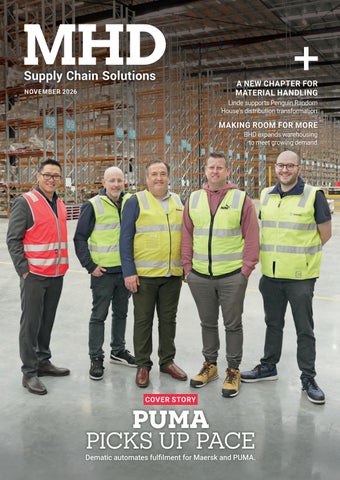
MHD SUPPLY CHAIN SOLUTIONS NOVEMBER 2026
A NEW CHAPTER FOR MATERIAL HANDLING
NOVEMBER 2026
Linde supports Penguin Random House’s distribution transformation.
MAKING ROOM FOR MORE
BHD expands warehousing to meet growing demand.
PUMA
PICKS UP PACE
Dematic automates fulfilment for Maersk and PUMA.
Frosty Precision, Fiery Productivity Keeping Americold’s cold chain cool and connected.
As a global leader in temperature-controlled logistics, Americold understands the importance of keeping operations moving. Partnering with the Connected Workforce Solutions (CWSTM) division at Dematic, they modernised their cold chain operations in Australia, upgrading wireless connectivity, voice-picking systems, and RF devices. The transformation significantly boosted efficiency, accuracy, and productivity. Dematic’s robust solution included meticulous planning and mapping to ensure seamless WiFi coverage and device connectivity, maintaining smooth operations, even in sub-zero conditions. Learn more at dematic.com/americold
Scan to watch the video! Dematic.com 02 9486 5555 info.anz@dematic.com
EDITOR’S NOTE
MHD
Supply Chain Solutions CONTACT MHD Supply Chain Solutions is published by Prime Creative Media 379 Docklands Drive, Docklands VIC 3008 Telephone: (+61) 03 9690 8766 Website: www.primecreative.com.au
THE TEAM Chairman: John Murphy CEO: Christine Clancy Managing Editor: Mike Wheeler Editor: Phillip Hazell Business Development Manager: William Jenkin Design Manager: Clayton Hawley Graphic Designers: Danielle Harris, Jacqueline Buckmaster Client Success Manager: Justine Nardone
FOR ADVERTISING OPTIONS Contact: William Jenkin william.jenkin@primecreative.com.au
SUBSCRIBE Australian Subscription Rates (inc GST) 1yr (11 issues) for $99.00 2yrs (22 issues) for $179.00 To subscribe and to view other overseas rates visit: www.mhdsupplychain.com.au or Email: subscriptions@primecreative.com.au
ACKNOWLEDGEMENT MHD Supply Chain Solutions magazine is recognised by the Australian Supply Chain Institute, the Chartered Institute of Logistics and Transport Australia, the Supply Chain and Logistics Association of Australia and the Singapore Logistics and Supply Chain Management Society.
ARTICLES All articles submitted for publication become the property of the publisher. The Editor reserves the right to adjust any article to conform with the magazine format. COPYRIGHT MHD magazine is owned by Prime Creative Media. All material in MHD is copyright and no part may be reproduced or copied in any form or by any means (graphic, electronic or mechanical including information and retrieval systems) without written permission of the publisher. The Editor welcomes contributions but reserves the right to accept or reject any material. While every effort has been made to ensure the accuracy of information Prime Creative Media will not accept responsibility for errors or omissions or for any consequences arising from reliance on information published. The opinions expressed in MHD are not necessarily the opinions of, or endorsed by the publisher unless otherwise stated.
The season of pressure
T
here is something about the final months of the year that brings the importance of supply chains into sharper focus. For most Australians, the lead-up to Christmas means shopping lists, Black Friday bargains, last-minute deliveries and the inevitable Boxing Day sales. For those working behind the scenes, however, it represents one of the most demanding periods on the logistics calendar. Retailers spend months preparing for a surge in consumer demand that can test almost every part of their operations. Inventory needs to be in the right place, warehouses must accommodate fluctuating volumes, and transport networks are expected to keep goods moving with little room for error. What has always interested me about this period is the contrast between the customer experience and the operations required by logistics and supply chain specialists to make it possible. A purchase that takes seconds online might be the final step in a supply chain that has been preparing for months. And as consumer expectations continue to evolve, so too must the infrastructure supporting them. ALDI’s recently announced automated distribution centre in Bradfield, Western Sydney (pp. 40-43), is a striking example of that long-term thinking. Representing an investment of more than $1 billion, the 108,000 sqm facility will double ALDI’s NSW warehouse capacity when it opens in 2030. With approximately 80 per cent of operations expected to be automated, it is being designed to handle more than 680,000 product cases a day at peak.
Those are substantial figures, but what I find more interesting is the timeframe. ALDI is investing in infrastructure intended to accommodate demand through to at least the mid-2040s. It is a reminder that while retailers operate around seasonal peaks, the decisions that determine their ability to manage them are often made years, sometimes decades, in advance. Of course, automation is only part of the equation. The availability of suitable industrial land (pp. 46-49), reliable freight connections and access to labour all influence how effectively distribution networks can respond to growing demand. These are challenges explored throughout this issue of MHD, particularly as operators weigh the benefits of larger, more sophisticated facilities against the practical constraints of bringing them online. As we approach another busy retail season, I think it is worth recognising that successful peak-period operations rarely happen by chance. They are the result of planning, investment and countless decisions made well before the first Black Friday promotion appears. For the supply chain industry, Christmas begins long before December. Happy reading! Phillip Hazell Editor, MHD Supply Chain Solutions
mhdsupplychain.com.au
3
RELIABILITY • SAFETY • INNOVATION • UPTIME
As Australia’s leading forklift company, it doesn’t matter whether we are supplying you with a single spare part, a rental forklift, or helping you manage your entire fleet, our objective and commitment remain the same – adding value to your operation. Whether it's the legendary reliability and world leading safety of our Toyota forklifts, the ongoing support of one of Australia’s most dedicated service and parts networks, or the innovations that have made Toyota the World’s number one forklift brand* , you can be assured we’ve got all your needs covered to power your business forward. To find out more contact your local Toyota Material Handling branch today. *dhf Intralogistics online / magazine 2024/25
PROUDLY DISTRIBUTED BY TOYOTA MATERIAL HANDLING
1800 425 438 toyotamaterialhandling.com.au
NOVEMBER 2026
THIS ISSUE 12
COVER STORY
12 Dematic triples productivity at PUMA’s distribution centre
SUPPLY CHAIN 18 Hino expands versatility across freight applications 32 DLL supports OCU Group’s infrastructure expansion 44 Black Friday tests supply chain resilience. 46 Industrial land shortages constrain warehouse development.
MATERIAL HANDLING COVER STORY
16 Toyota improves safety in trailer manufacturing 20 Linde optimises Penguin Random House’s warehouse operations 28 Jungheinrich explores practical pathways to warehouse automation
WAREHOUSES 24 BHD expands warehousing capacity across Victoria 34 Amazon expands Western Sydney fulfilment capacity 36 Woolworths nears completion of major Sydney DC
20 MHD SUPPLY CHAIN SOLUTIONS NOVEMBER 2026
24
42 ALDI transforms NSW distribution through automation
ASSOCIATIONS, EVENTS, AND REGULARS 03 Ed’s Letter
A NEW CHAPTER FOR MATERIAL HANDLING
NOVEMBER 2026
Linde supports Penguin Random House’s distribution transformation.
MAKING ROOM FOR MORE
BHD expands warehousing to meet growing demand.
06 Industry News 60 People on the Move 50 ASCLA 54 ASCI 56 People on the Move 58 Product Showcase
ON THE COVER: Dematic and Maersk have transformed PUMA Australia’s fulfilment operations with AutoStore technology, consolidating two warehouses into
PUMA
PICKS UP PACE
Dematic automates fulfilment for Maersk and PUMA.
one automated facility, tripling productivity, accelerating order fulfilment and creating additional capacity for future growth. mhdsupplychain.com.au
5
INDUSTRY NEWS
Charter Hall forms $1.2bn logistics partnership
C
harter Hall has established a new $1.2 billion industrial and logistics property partnership with Tokyo Tatemono and UBS Asset Management, spanning assets across Australia’s east coast. The portfolio includes three properties in Sydney, two in Brisbane and a 20-hectare infill development site in Melbourne’s Dandenong industrial precinct. The assets are predominantly leased to major consumer staples businesses including Coles, ALDI and Coca-Cola, providing the portfolio with exposure to essential consumer supply chains. The transaction represents Japanese property group Tokyo Tatemono’s first investment with Charter Hall and its first exposure to Australia’s industrial and logistics property sector. Charter Hall Managing Director and Group CEO David Harrison says continued investment in Australian real estate reflects demand from global capital partners.
“Investors continue to back Australian real estate, and Charter Hall is well positioned to meet that demand,” David says. “We welcome Tokyo Tatemono as a new capital partner. As one of Japan’s leading real estate groups, Tokyo Tatemono brings a highly aligned, long-term investment approach and shares our conviction in the Australian logistics sector.” David says the sector continues to benefit from long-term drivers including population growth and increasing demand for modern supply chain infrastructure. Tokyo Tatemono Managing Executive Officer, Overseas Business Division Director Fumio Tajima says Australia’s industrial and logistics sector offers long-term growth opportunities supported by occupier demand. “Charter Hall’s market-leading platform, deep local expertise and proven investment track record
made this portfolio an attractive entry point for Tokyo Tatemono’s first investment in the sector,” Fumio says. The transaction also expands Charter Hall’s existing relationship with UBS Asset Management, marking its first direct industrial and logistics partnership with Charter Hall. Charter Hall Industrial & Logistics CEO Richard Stacker says the deal follows another recently announced partnership with a domestic capital partner, which has grown to approximately $650 million through off-market industrial and logistics acquisitions. He says the transactions demonstrate continued demand from domestic and international investors for Australian logistics real estate. Charter Hall’s Industrial & Logistics platform is now valued at $24.9 billion. ■
Charter Hall’s new $1.2 billion industrial and logistics partnership spans properties across Australia’s east coast, with major tenants including Coles, ALDI and Coca-Cola. Image: Charter Hall
6
INDUSTRY NEWS
CoolDrive consolidates Melbourne distribution
C
oolDrive Auto Parts is preparing to consolidate three Melbourne distribution centres into a new national hub in Boronia, with the facility scheduled for completion in late 2026. Located at 1061 Mountain Highway, the development will become CoolDrive’s new Head Office and National Distribution Centre, bringing its Melbourne-based distribution operations together within a single facility. The purpose-built site will comprise more than 31,000 square metres of warehouse space and 2,300 square metres of office space. CoolDrive says the consolidation is intended to reduce operational duplication and improve supply chain efficiency across its Australian and New Zealand network. The facility has also been designed with a range of sustainability measures An artist’s impression of CoolDrive Auto Parts’ new national distribution centre in Boronia, which will consolidate three Melbourne facilities into a single 31,000 sqm warehouse. Image: CoolDrive Auto Parts
8
and is targeting a 5-Star Green Star rating from the Green Building Council of Australia. Planned sustainability features include 100 per cent grid-sourced renewable energy, a 300kW rooftop solar PV system with capacity for future expansion, smart LED lighting and electric vehicle charging stations for staff and visitors. The development will also incorporate rainwater harvesting systems, while the building design aims to improve natural light, indoor air quality and energy performance. During construction, the project team is targeting the diversion of 95 per cent of construction waste from landfill. The development is being delivered in collaboration with Charter Hall, Qanstruct and JXC Group. Qanstruct, which has delivered Green Star-rated projects since 2013, has incorporated sustainability
considerations into the planning and construction of the facility alongside operational and compliance requirements. Transport connectivity has also formed part of the development strategy. The Boronia site provides access to major arterial roads and EastLink, with the forthcoming North East Link expected to further improve connectivity across Melbourne’s freight network. CoolDrive says consolidating its existing distribution operations at the site will help streamline movements across its network and support greater operational efficiency. The project forms part of CoolDrive’s broader investment in its national distribution capability as it prepares for continued growth across Australia and New Zealand. Completion of the new Head Office and National Distribution Centre is expected in late 2026. ■
INDUSTRY NEWS
An automated can production line at CCEP’s Kewdale facility, where a $39.7 million upgrade has increased production speeds to 1,500 cans per minute. Image: CCEP
C
CCEP boosts Kewdale production capacity
oca-Cola Europacific Partners (CCEP) has completed a $39.7 million upgrade to its Kewdale manufacturing facility in Western Australia, increasing production capacity by more than 40 per cent ahead of the summer peak. The investment includes a new automated can production line designed to increase output, improve operational flexibility and strengthen the site’s role within CCEP’s national manufacturing network. The upgraded line has the capacity to produce approximately 384 million cans, equivalent to 16 million cases, with production speeds increasing from around 1,060 to 1,500 cans per minute. The new technology also introduces enhanced automation and improvements in water and energy efficiency, allowing the facility to respond more effectively to fluctuations in consumer demand. During the summer peak, the production line will operate 24 hours a day, seven days a week, supporting beverage supply across Western Australia as seasonal demand increases. Tom Schiebling, Director of Manufacturing at CCEP, says the
investment represents a significant upgrade to the facility’s long-term capabilities. “This upgrade is one of the largest investments in Kewdale’s recent history and reflects our long term belief in manufacturing in Western Australia,” says Tom. “As we head into summer, this line will operate around the clock to help ensure Western Australians can continue enjoying the beverages they know and love.” The Kewdale facility has operated for more than 50 years and employs approximately 300 people, including 125 manufacturing employees. It is CCEP’s fourth-largest manufacturing facility in Australia. By expanding production capacity within Western Australia, the investment supports CCEP’s strategy of manufacturing beverages closer to the markets they serve, while strengthening its local supply chain. The upgrade also forms part of the company’s broader investment in manufacturing technology and operational efficiency, with increased production speeds and automation expected to improve the
site’s ability to accommodate changing demand. Alongside the infrastructure investment, CCEP has introduced a flexible part-time manufacturing employment pilot at Kewdale. The initiative is designed to attract workers who may be unable to commit to traditional full-time manufacturing schedules, including people balancing family and caring responsibilities. According to CCEP, the pilot attracted more than 900 applications during its first intake and has already resulted in new employees joining the facility. “The future of manufacturing depends on both world-class equipment and a skilled, diverse workforce to operate it,” says Tom. “By rethinking traditional workforce models, we’re creating new pathways into manufacturing and opening opportunities for Western Australians that may have not previously considered a career in the industry.” The $39.7 million investment positions Kewdale to accommodate increased production requirements while maintaining local manufacturing capacity as CCEP prepares for peak summer demand. ■ mhdsupplychain.com.au
9
INDUSTRY NEWS
A
Australia Post to sell two Sydney logistics properties
ustralia Post has appointed Colliers to sell two industrial properties in Sydney, with combined price expectations exceeding $320 million and long-term leaseback arrangements securing its continued operations at both sites. The properties, located at 10–24 Ralph Street in Alexandria and 51 Sargents Road in Minchinbury, will be offered through separate sales campaigns managed by Colliers. Together, the assets comprise approximately 126,500 sqm of industrial land and 52,295 sqm of gross lettable area, generating combined commencing net income of approximately $17.6 million annually. Australia Post will continue operating from both facilities under long-term leaseback arrangements, with fixed annual rental increases of 3.25 per cent. Gavin Bishop, Managing Director, Industrial & Logistics at Colliers, says investor interest in industrial properties continues to be supported by demand for secure income and strategically located assets. “The depth of domestic and global capital targeting industrial real estate has continued to broaden with investors increasingly focused on the quality and durability of income alongside the underlying real estate,” says Gavin. “Assets with government-backed entities, strong locations and meaningful land value are particularly relevant in the current market.” The Alexandria property occupies approximately 36,500 sqm and includes an 18,632 sqm distribution facility incorporating warehousing, offices, awnings and extensive hardstand areas. Situated within the Alexandria, Rosebery and Green Square corridor, the site provides access to Sydney Airport, Port Botany, the Sydney CBD and major arterial roads. Colliers identifies the property as one of the largest remaining single-title industrial landholdings in the precinct, where limited investment stock has
10
An aerial view of Australia Post’s Alexandria distribution facility, one of two Sydney industrial properties being offered for sale by Colliers, with combined price expectations exceeding $320 million. Image: Colliers become available in recent years. Trent Gallagher, National Director, Property Sales & Leasing at Colliers, says the site’s location and scale could support several longer-term redevelopment opportunities, subject to planning approval. Meanwhile, the Minchinbury property occupies approximately 90,000 sqm and includes a 33,663 sqm industrial facility comprising a large cross-dock warehouse, corporate offices, a workshop and associated infrastructure. With approximately 37 per cent site coverage, the property also provides substantial hardstand and vehicle circulation areas. Its location near the M4 and Westlink motorways connects the facility to Sydney’s major freight corridors and distribution networks. The surrounding industrial precinct accommodates major logistics and retail operators, including ALDI, Bunnings, StarTrack and Woolworths. Colliers also points to growing
investment in digital infrastructure around Minchinbury, including approval for a two-storey, 62MW data centre on an adjoining site at 42 Sargents Road. Sean Thomson, National Director, Industrial & Logistics Capital Markets at Colliers, says investment in surrounding logistics and digital infrastructure is strengthening the precinct’s strategic importance. “Importantly, both the Minchinbury and Alexandria opportunities provide investors with the ability to secure high-quality income today while also evaluating a range of longer-term value enhancement strategies and future upside,” says Sean. The individual sales campaigns will target domestic and international institutional investors and private capital seeking long-term rental income alongside potential redevelopment opportunities. Colliers’ Gavin Bishop, Trent Gallagher, Michael Crombie and Sean Thomson will lead the campaigns. ■
One Partner for Smarter Warehouse Automation
As a warehouse systems integrator, Toyota Automated Logistics connects equipment, controls and software into one operation. From solution design and technology selection through to commissioning and lifecycle support. The result is simpler operations, smarter decisions and consistent performance across your supply chain. Because when everything is connected, everything works better. For every challenge a reliable solution.
Warehouse Design & Systems Integration
Scalable Automation Technologies
toyota-automated-logistics.com
Intelligent Software & Warehouse Controls
Lifecycle Services & Long Term Support
WAREHOUSES
Maersk automates PUMA warehouse with Dematic Maersk and Dematic have delivered an automated distribution centre for PUMA Australia in Ravenhall, Victoria, consolidating two warehouse operations into one facility and using AutoStore technology to triple productivity, accelerate order fulfilment and provide additional capacity for growth.
P
UMA is one of the world’s leading sports brands, serving customers across retail, B2B and ecommerce channels. In Australia, continued growth meant the business was approaching capacity across its two existing warehouse facilities and needed a fulfilment model that could support its future requirements. PUMA partnered with Maersk to consolidate its warehouse operations into a single purpose-built distribution centre in Ravenhall, Victoria. The move was designed to improve speed to market, increase responsiveness and create a more efficient operating model. As part of PUMA’s global supply chain strategy, the business sought to align its Australian operations with the automated fulfilment approach used across its international operations. Following a competitive evaluation of multiple automation providers, Maersk selected Dematic to deliver an AutoStore solution that would bring greater efficiency and flexibility to PUMA’s Australian fulfilment operations.
When growth outpaces capacity Previously, PUMA managed its operations from two separate manual warehouses, with different business segments managed independently across each facility. Inventory was split between the two sites, requiring separate management teams and workforces, with duplicated operating processes. As ecommerce volumes increased, manual operations made it increasingly difficult to respond quickly to customer demand while maintaining operational efficiency. Jennifer Paterson, Operations Director for PUMA Australia, says the legacy warehouse network was reaching the limits of its capacity as the business continued to grow.
12
Dematic’s AutoStore system uses robotic technology to store and retrieve products, supporting faster order fulfilment across PUMA’s retail, B2B and ecommerce channels. Images: Dematic “Our forecasts showed that, under our existing growth plans, capacity across both warehouses (individually and combined) would be breached across storage, inbound and outbound operations,” says Jennifer. Without addressing these constraints, PUMA faced the risk of being unable to meet customer SLAs across all channels, as well as additional costs associated with external storage and increased warehousing requirements. “Our ability to consistently service the ecommerce marketplace channel was also proving challenging most weeks, which was limiting the customer experience and, ultimately, our ability to support further growth and expansion,” says Jennifer. The largely manual operation also placed limits on fulfilment productivity. Operators spent considerable time walking through the warehouse to
pick and process orders, while manual handling across picking, quality assurance, labelling and dispatch added further steps to the fulfilment process.
A flexible approach to automated fulfilment Maersk selected Dematic to deliver an AutoStore solution designed around PUMA Australia’s different fulfilment requirements. Rather than automating every warehouse process, the solution applies automation where it delivers the greatest operational benefit, retaining manual processes where they remain the most efficient. Individual item picking is managed through AutoStore, while carton and pallet picking remain manual according to the order profile. Inventory is positioned according to order profile, allowing retail, B2B and ecommerce orders to be fulfilled from the same
WAREHOUSES
facility using the most appropriate process. This flexibility was particularly important given the different requirements of each channel. Retail and B2B orders typically involve larger volumes of products that need to be sorted across multiple orders, while ecommerce orders tend to be smaller, typically one or two items. Both order profiles require fast, accurate individual fulfilment. Dedicated AutoStore ports can be allocated to different fulfilment streams, allowing these orders to be processed simultaneously without compromising service levels. Once goods arrive at the distribution centre, products are stored on pallets within Dematic ColbyRACK before items destined for AutoStore are decanted into bins and made available for picking. Goods are then presented directly to operators at dedicated picking stations, reducing the walking and manual handling associated with the previous trolley-based picking process. The solution also incorporates automated quality assurance, labelling,
carton selection, carton closure and dispatch preparation. Together, these processes reduce manual intervention and support greater consistency throughout fulfilment, from picking through to the presentation of orders received by customers. Anthony Jones, Interim Country Head for Australia Maersk Contract Logistics, says the simplicity of the technology was an important consideration for the operation. “It’s the simplification of AutoStore that’s attractive to a contract logistics business. It’s easy to train people within four hours to be able to pick an order. That’s unheard of in manual operations,” says Anthony. The modular design also gives PUMA room to expand as demand increases, with additional AutoStore ports and storage capacity able to be added without requiring the operation to be redesigned.
Delivering a complex project in 12 months The new distribution centre and automation solution were delivered
within an ambitious 12-month timeframe, requiring close coordination between Maersk, Dematic and the wider project team. Rather than waiting for construction of the facility to be completed before beginning the automation installation, Dematic worked alongside the builder so installation could commence while construction was still underway. This overlapping approach helped reduce the overall project timeline and enabled the automation work to progress as different areas of the building became available. Terry Jamieson, Business Development Manager at Dematic, says the compressed schedule required a different approach to implementation. “Given the challenge of the timeline, Dematic had to be innovative in how we implemented our solution to speed up our installation,” says Terry. “Part of that innovation was working in collaboration with the infrastructure builder. Therefore, when the builder got halfway through, we could then start our job. And then as a builder finished, we were also able to finish.” The transition into the new facility was also staged to minimise disruption to PUMA’s customers while its warehouse workforce was trained on the technology. Operations and Logistics Manager at PUMA Australia, Travis Nuske explained that despite initial expectations that PUMA’s website could be unavailable for up to two weeks during the transition, the move was completed without any customer downtime. “We actually didn’t end up needing that to happen, so we had zero downtime for our customers which was the most important thing that we wanted out of this,” says Travis.
Faster fulfilment, greater productivity
Operators process orders at dedicated AutoStore picking stations, reducing manual handling and unnecessary travel throughout the warehouse.
Consolidating PUMA’s two manual warehouses into a single integrated distribution centre has created a faster fulfilment operation across retail, B2B and ecommerce. One of the most evident improvements has been in ecommerce fulfilment. Where ecommerce orders mhdsupplychain.com.au
13
WAREHOUSES
previously took between one to three days to dispatch, eligible orders received before midday can now be fulfilled same day. Dedicated workflows also allow ecommerce and wholesale orders to be processed simultaneously, helping PUMA respond to different customer requirements without one channel compromising another. “We can now turn around our ecommerce for same day delivery if that’s required,” says Travis. Picking productivity has also increased substantially. Manual trolley picking previously achieved approximately 80 to 100 order lines per hour. With AutoStore, PUMA now achieves approximately 150 order lines per hour for ecommerce orders and around 350 order lines per hour for retail and B2B orders. When the automated quality assurance, labelling, carton selection, carton closure and dispatch preparation processes are considered, the overall automated operation is estimated to deliver three times the productivity of PUMA’s previous manual operations. The change has also reshaped the working environment. Instead of operators travelling throughout the warehouse to locate and pick products, AutoStore brings goods directly to dedicated picking stations. This reduces unnecessary walking and manual handling, allowing employees to spend more time processing orders while supporting a safer working environment. Automation further supports consistency across the fulfilment process. Automated quality assurance and labelling reduce the risk of errors, while automated carton selection creates a more standardised packing process. The AutoStore operation has also created 40 per cent more available capacity for PUMA’s continued growth, with its modular design allowing further capacity to be added as volumes increase. “We were at approximately 90 per cent capacity, whereas when we moved into our new facility with AutoStore, it came down to 50 per cent. So, as our business grows, AutoStore can grow as
14
Representatives from Maersk, Dematic and PUMA at the Ravenhall distribution centre, where the automated fulfilment operation has increased productivity and created additional capacity for growth. well,” says Travis. For Maersk, the project has also demonstrated the importance of responsive local support when delivering automation within a live logistics environment. “The ability for Dematic to be able to react fast and solve any issues immediately and the support that they provided throughout the whole process has been excellent,” Anthony says.
A successful partnership The successful delivery of PUMA’s new distribution centre was the result of careful planning and close collaboration between PUMA, Maersk and Dematic. From the outset, the three businesses
worked together to define PUMA’s operational requirements and develop a detailed project plan. Ongoing coordination throughout implementation, combined with thorough testing ahead of the transition, helped the team manage the tight project timeline and ensure the new site was ready to support PUMA’s operations. With the facility fully operational, PUMA now has a more efficient and flexible fulfilment operation, with the capacity to accommodate growing order volumes and support its future expansion in Australia. ■
THE SAFEST HINO HEAVY-DUTY EVER BUILT. THAT’S ANOTHER HINO
XAVIER_HINO41236.1
HINO 700 SERIES. SAFETY YOU CAN RELY ON. COMFORT IN EVERY DRIVE.
With Hino SmartSafe standard across all models, the Hino 700 Series is designed to help protect drivers and
businesses across freight and logistics operations. Its ergonomic cab prioritises driver comfort, functionality
and ease of operation, while payload capability and greater application flexibility help meet the demands of the working environment. Visit hino.com.au
MATERIAL HANDLING
Manufacturing company pioneers new techniques with Toyota The Drake Group is introducing new assembly techniques at its Queensland manufacturing facilities, working with Toyota Material Handling Australia to improve operator safety, increase efficiency and support its plans to expand trailer production.
T
wo former schoolmates are working together to help a highly progressive Queensland trailer manufacturer pioneer new assembly techniques to make its processes safer and more efficient. Buchanan Pinder is the group maintenance supervisor of the Drake Group, a family-owned Australian manufacturer of specialised transport equipment, based in Wacol.
Chevy Date is the Queensland major account manager of Toyota Material Handling Australia (TMHA), in nearby Larapinta. The pair kept in touch after graduating 12 years ago from wellregarded Centenary High School, and their passion for solution resolution in the manufacturing and supply chain sector is now providing great benefit to both their employers.
Their collaboration has opened opportunities for both companies to initiate new techniques. In the latest of a series of innovations, Toyota scissor lifts have replaced scaffolding as a means of providing a safer and more flexible platform for the assembly of more than 300 heavy-duty Drake Group trailers per year. It’s a first for The Drake Group and, according to the two collaborators,
The Drake Group’s maintenance supervisor Buchanan Pinder alongside a Toyota counterbalance forklift at the company’s Wacol manufacturing facility in Queensland. Images: TMHA
16
MATERIAL HANDLING
most likely a breakthrough in the use of scissor lifts in heavy machinery manufacturing. “The industry standard for aboveground assembly is a scaffolding system,” Buchanan Pinder says. “Its use is limited in several areas. Firstly, in terms of its ability to provide close-up access to machinery under construction, requiring operators to lean out over open space to weld or affix components. “The fixed scaffolding also means heavy equipment has to be physically lifted up to the platform from ground level, sometimes as high as four metres. “Additionally, scaffolding has a life span, and it can become unstable over a period of use.” The alternative of using platform ladders is equally compromised. “Across the board, safety is a big issue,” Buchanan says. The TMHA solution devised by Buchanan and Chevy has replaced both methods with a fleet of four purposespecified SC06E battery electric scissor lifts. The compact scissor lifts can be easily positioned alongside the trailer in construction, providing a stable work platform with far greater access to all componentry. Equipment and components can be loaded on the ground and then lifted up to the work site position. The SC06E has an overall width of just 0.76 metres, suitable for manoeuvring the close aisle spaces on the Drake Group’s partial assembly line. Importantly, it can be driven at full working height of 5.9 metres and maximum platform height of 3.9 metres so the operator can move to new positions as required. The Drake Group is looking to achieve significant quality and productivity improvements from the new assembly solution. Its three separate facilities in the Wacol area are now able to access the Toyota SC06E fleet on an as-required basis, eliminating the need for duplication of fixed scaffolding. However, according to Buchanan Pinder, the major advantage has been in operator morale.
A Toyota SC06E scissor lift provides elevated access to trailer components during assembly at The Drake Group’s Wacol manufacturing facility, replacing traditional scaffolding.
“The scissor lift solution has provided a far more workable environment, and it is demonstrably safer,” he says. “Of The Drake Group’s 240 employees at our Wacol plant, more than 30 have completed VOCs (verification of competency) in order to use the scissor lifts. “Response has been overwhelmingly positive.” The Drake Group has yet to complete an operational cost analysis, but Buchanan expects results to be similar to an innovation devised jointly by his company and TMHA in late 2024. A TMHA-supplied Huski5SDK5 skid steer loader, fully dedicated to the task of cleaning up The Drake Group’s heavy-duty blast booth which prepares metal surfaces for coating and painting, has resulted in a substantial saving of between three and four hours per session. The Drake Group had previously fitted a non-TMHA attachment to a forklift to scrape away sand and debris. The compromise was clumsy, timeconsuming, and occasionally resulted in machine breakage when the forklift proved unable to cope with the harsh environment. The Drake Group now has more than 20 pieces of TMHA equipment in service, according to Buchanan Pinder, enroute to becoming a dedicated fleet. His goal is to use the material handling solution to contribute to an increase in total trailer production.
A Toyota Material Handling Australia SC06E battery-electric scissor lift, introduced to improve safety and efficiency during trailer assembly. “Annually we produce between 320 and 340 bespoke trailers a year,” Buchanan says. “My goal is to up it to 365, one trailer a day. Of course, management thinks the target should be 465,” he joked. The scissor lifts and skid steer loader complete an existing range of TMHA equipment already in use by The Drake Group, including a including six TMHA LHE150 electric pallet jacks, two TMHA Leonardo elevated work platforms and three Toyota 8FG25 counterbalance forklifts ■ For more information freecall 1800 425 438 or visit online at toyotamaterialhandling.com.au mhdsupplychain.com.au
17
SUPPLY CHAIN
Hino 700 Series hits the logistics sweet spot Hino’s updated 700 Series FS 2636 combines a new 12-speed automated manual transmission with driver assistance technology and a design focused on operator comfort. Truck journalist Cobey Bartels examines its performance across metropolitan and regional freight applications.
H
ino has expanded its heavy-duty 700 Series range, introducing additional transmission options, power ratings and configurations to accommodate a broader range of freight and distribution requirements. Among the updated models is the FS 2636 AMT Curtainsider, a 6x4 truck designed to accommodate metropolitan delivery schedules and longer regional freight movements. With a 6388mm wheelbase, optional Hendrickson HAS rear air suspension, a Gross Vehicle Mass (GVM) of 26,000kg and a Gross Combination Mass (GCM) of 45,000kg, the FS 2636 offers a configuration suited to varied freight applications. The vehicle is powered by Hino’s Euro 6-compliant A09C-VN 9.0-litre sixcylinder turbo-diesel engine, producing 360hp at 1800rpm and 1,569Nm of torque between 1100 and 1600rpm. Central to the updated configuration is Hino’s M112 12-speed automated manual transmission (AMT), developed from the manufacturer’s 12-speed synchromesh manual gearbox. The transmission incorporates the Jacobs Engine Brake to assist with engine speed management during gear changes. Combined with a 3.9:1 final drive ratio, the driveline operates at approximately 1617rpm when travelling at 100km/h in twelfth gear. For distribution operators balancing urban deliveries with highway movements, the transmission is
18
designed to provide flexibility across changing road conditions. Truck journalist Cobey Bartels, who recently tested the FS 2636 across metropolitan and regional roads, describes the updated driveline as a notable part of the vehicle’s appeal. “It’s a more refined and versatile driveline,” says Cobey, noting how the transmission integrates with the engine to maintain suitable operating speeds. The gear selection system incorporates a dashboard-mounted rotary dial and a steering columnmounted sequential gear selector. An automatic/manual selection button allows drivers to override gear changes when required. Hino’s Easy Start Hill Assist is also included, helping prevent rollback when moving off on inclines, particularly during repeated starts in congested urban environments.
Performance across the freight network Cobey assessed the FS 2636 Curtainsider over approximately 400km of metropolitan and regional roads, departing from Hino’s Caringbah headquarters with the vehicle loaded to around 75 per cent of its GVM. The test examined the vehicle’s performance at an operating weight of approximately 18 to 20 tonnes, incorporating stop-start traffic, highway driving and varying road surfaces.
Above: Hino’s expanded 700 Series range offers multiple configurations to accommodate varying freight, distribution and heavy-duty transport requirements. Cobey found the transmission particularly responsive during metropolitan driving, where repeated acceleration and braking place demands on the driveline. “The new 12-speed pulled cleanly from traffic lights without the typical AMT delay,” says Cobey. He also observed the benefits of Easy Start Hill Assist when moving off on urban inclines, particularly with other vehicles following closely in heavy traffic. “As we slid into the flow of traffic along the Princes Highway corridor, the AMT skipped gears to keep the 9.0-litre in its sweet spot, which is between 1100 and 1600rpm,” says Cobey. “It did it without fuss or confusion, and the shifts were quicker than I expected.” The transmission’s ability to skip gears contributed to maintaining engine performance without requiring drivers to intervene during changing traffic conditions. On the highway towards Sutton Forest, Cobey observed that the vehicle maintained approximately 1600rpm at 100km/h. “Once we opened it up on the highway, heading out towards Sutton Forest for our first stop, the 12-speed
SUPPLY CHAIN
allowed the truck to stretch its legs while keeping RPM low,” says Cobey. Fuel consumption varied between metropolitan and highway conditions. Across the test, consumption was in the mid-30L/100km range during stopstart urban driving, compared with 25.6L/100km on the highway section. Although these figures represent one road test rather than a standardised fuel efficiency assessment, they illustrate the different operating demands encountered across metropolitan and regional distribution routes. Cobey also examined the performance of the 9.0-litre engine compared with Hino’s larger 13-litre offering. While the smaller engine produces less low-end torque, he found its output sufficient for the 14-pallet distribution application, supported by the transmission’s ability to manage power delivery. “It’s a peppier engine than its would suggest, helped along by the smart ‘box’,” says Cobey.
Driver comfort and operational visibility Beyond the driveline, the updated 700 Series incorporates cabin features intended to support drivers working across metropolitan and regional transport routes. The four-point air-suspended cabin is complemented by an ISRI 6860/870 NTS2 air-suspended driver’s seat with an integrated seat belt. Seat-mounted adjustment controls, together with tilt and telescopic steering wheel functionality, allow drivers to configure their seating position. Cobey identified driver fit as an important contributor to comfort throughout the test, particularly during extended highway sections. “Cab comfort across the day was also exceptional, and a lot of that came down to driver fit,” says Cobey. “I was able to set the ISRI seat to my liking (nice and bouncy), and the airbag rear-end was compliant over some pretty harsh road joints and coarse bitumen down on the south coast.” Visibility is supported by electronically adjustable primary mirrors and a front
blind-spot mirror, providing additional assistance when navigating confined metropolitan environments. In the cabin, a 7.0-inch LCD MultiInformation Display presents vehicle operating information, while a 10.1-inch multimedia system supports wireless smartphone connectivity. The vehicle also incorporates HinoConnect telematics, enabling operators to monitor location, fuel consumption and vehicle performance data. For fleet managers, access to this information can support vehicle utilisation reviews, maintenance planning and assessments of operating efficiency across different routes.
Safety and braking technology The FS 2636 includes Hino’s SmartSafe suite of driver assistance technologies, covering both collision avoidance and driver monitoring. The package incorporates a PreCollision System with Autonomous Emergency Braking and Pedestrian Detection, Vehicle Stability Control, Lane Departure Warning System, Adaptive Cruise Control and Safety Eye distance warning. An A-pillar-mounted Driver Monitor camera also monitors driver attention and provides alerts when it detects potential distraction. During testing, Cobey found the safety systems operated largely in the background, with lane departure warning alerts providing reminders when the vehicle moved towards road markings. “Meanwhile, active safety operated quietly in the background, only buzzing if I’d done something wrong like kissed a white line,” says Cobey. He was particularly impressed by the Adaptive Cruise Control system and its contribution to managing highway driving. “My favourite advanced safety feature has to be the adaptive cruise control, which really does take the fatigue out of highway driving,” says Cobey. The system also integrates with the Jacobs Engine Brake, helping manage vehicle speed when descending hills or responding to changing traffic conditions.
Cobey also highlighted the engine brake’s performance. “It also integrates with the Jacobs Engine brake, which is stout for a 9.0litre engine, offering strong retardation down hills or when slowing with the flow of traffic,” says Cobey. Another feature is Hino’s Brake Sync function, which allows engine braking to engage through brake pedal application, even when the engine brake control stalk is switched off. This provides additional retardation during lighter braking applications and can reduce reliance on the service brakes. “It saves your service brakes and for light brake applications makes a lot of sense,” says Cobey.
A versatile distribution option The FS 2636 is covered by Hino Australia’s standard fiveyear/600,000km new vehicle warranty, together with a three-year/unlimitedkilometre genuine parts warranty. For freight operators, the combination of transmission flexibility, driver assistance systems and vehicle monitoring technology provides several considerations when assessing equipment for mixed metropolitan and regional operations. Cobey’s road test demonstrated the vehicle’s ability to manage changing traffic conditions, varying road surfaces and sustained highway travel while carrying a representative distribution load. His overall assessment was particularly positive regarding the transmission and the truck’s suitability for different freight applications. “To sum it all up, Hino has built a genuine all-rounder with the FS 2636, giving freight operators an option that’ll handle both inner-city and regional work without the usual compromises,” says Cobey. With Australian distribution networks requiring vehicles to accommodate increasingly varied operating conditions, the updated FS 2636 represents another option for operators evaluating heavy-duty fleet requirements. ■ mhdsupplychain.com.au
19
MATERIAL HANDLING
Jim Rozanitis, Operations Manager at Penguin Random House, highlights the importance of material handling equipment tailored to the facility’s operational requirements. Images: Linde Material Handling
Turning a page on warehouse efficiency
Penguin Random House has consolidated its Australian and New Zealand distribution operations into a new Dandenong South facility, supported by a tailored Linde material handling fleet designed for narrow aisles, high-level storage, safety and operational uptime.
W
hen Penguin Random House (PRH) consolidated its Australian and New Zealand distribution operations into a new facility in Dandenong South, it needed a material handling solution capable of keeping pace with an operation of enormous scale and complexity. Linde Material Handling Australia worked closely with the publisher to engineer a fleet around its specific requirements – from very narrow aisles and high-level storage to lithium-ion power, advanced safety technology and fleet management. As the world’s largest trade book publisher, PRH ships approximately 35 to 37 million books each year through its Australian and New Zealand distribution operation, along with book-related merchandise, to customers across the region.
20
Behind those numbers is a complex warehouse operation. On an average day, between 6,000 and 8,000 cartons leave the Dandenong South facility, representing as many as 40,000 individual product lines or order picks. Approximately 200 to 300 pallets arrive each day, while another 2,000 to 3,000 cartons are replenished into picking areas. Supporting that volume are 50,000 pallet locations, 57,000 long-span shelving locations, approximately 150 employees and a two-shift operation. “Our partnership with Linde is one of our most important partnerships because we operate at scale. A significant amount of product comes in and out, and without the equipment to move product around the warehouse, prepare it and load it onto trucks, we couldn’t operate,” says Matt O’Brien, Operations Director at PRH.
A new chapter in Dandenong South Before moving to Dandenong South, PRH had outgrown its existing Scoresby operation. At one point, the business was operating across four separate buildings, creating congestion and spreading employees and equipment across multiple locations. Bringing the operation back under one roof presented an opportunity to address those inefficiencies while supporting future growth. The new facility, however, introduced its own material handling requirements. Space was at a premium, resulting in very narrow aisles designed to maximise storage density. A pitched roof also allows racking heights to progressively increase towards
MATERIAL HANDLING
the centre of the facility, reaching approximately 12.5 metres. PRH required equipment capable of operating efficiently within narrow aisles, handling loads at significant height and adapting to varying lift limits throughout the warehouse. Improving fleet utilisation was another key objective. Rather than simply replacing like-for-like, PRH went to market looking for what was possible.
Engineering the right solution From the beginning of the tender process, the complexity of the application required more than an offthe-shelf solution. “We wanted machines that suited our operation,” says Jim Rozanitis, Operations Manager at PRH. “Linde were constantly asking us questions – what’s your height, what are you trying to do, what are your cycles? Eventually the penny dropped. They were asking those questions because they wanted to provide a machine that was tailored to our site.” Linde’s Technical Solutions team worked with detailed operational information including throughput, working patterns, aisle dimensions and expected equipment utilisation to engineer the trucks around the application and determine appropriate battery capacities. “It wasn’t a case of quoting a standard machine and hoping it would fit. We needed to understand the operation in detail and build the trucks around what PRH actually needed,” says Dion De Pace, Senior Business
Development Manager at Linde Material Handling Australia. The resulting fleet includes Linde K-Series turret trucks, V-Series order pickers, E20 electric counterbalance forklifts and T20 ride-on pallet trucks. The turret trucks are predominantly used to transfer incoming stock into high-level racking, while the order pickers support carton picking and replenishment. The E20 counterbalance forklifts handle vehicle loading and unloading, while pallet trucks move pallets throughout the facility. For PRH, operator comfort was also an important consideration. For the V-Series order pickers, the operator’s position provides clear visibility towards the load, while an auxiliary pallet lift allows the working height to be adjusted as the pallet is built. This reduces repeated bending and helps operators maintain a more comfortable working position throughout a shift. The E20 forklifts also incorporate Linde’s dual-pedal system, enabling operators to change direction using the pedals without repeatedly moving between accelerator and direction controls. The response from operators has been particularly positive. “Our operators are on these machines for long periods, so comfort was crucial. The feedback when they first got onto them was exceptional – the stability, the comfort and the ergonomics really stood out,” says Jim. With some equipment from PRH’s former fleet remaining on site during the transition, that preference has Matt O’Brien, Operations Director at Penguin Random House, oversees a distribution operation handling approximately 35 to 37 million books annually.
become especially visible. As one team member put it, operators have been known to arrive around 10 minutes early simply to secure a Linde machine for their shift.
Writing safety into the operation Safety was one of PRH’s highest priorities when selecting its new material handling provider, with the business identifying mobile plant as one of its most significant operational risk areas. With employees working in and around very narrow aisles, and operators travelling at significant heights, Linde incorporated a range of systems designed to provide additional safeguards throughout the warehouse. Wire guidance keeps the specialised equipment correctly positioned within the aisles, while RFID tags installed throughout the facility allow each machine to determine where it is operating and respond according to programmed parameters. Because the building has a pitched roof, available clearance varies depending on the truck’s position within an aisle. The equipment can automatically restrict its maximum lift height based on that position, rather than relying solely on the operator to judge clearance. “It’s not up to the operator to limit the height of the machine. It knows where it is in the aisle and it limits itself,” says Dion. Pedestrian detection technology provides another layer of protection. If a pedestrian enters the machine’s operating area, the system can respond by slowing or stopping the truck. Reverse cameras, automatic speed reduction and stability at height add further layers of protection. Together, these features allow PRH to manage safety within a demanding very-narrow-aisle operation while maintaining productivity.
More uptime with lithium-ion Energy was another major consideration. PRH’s previous fleet predominantly relied on lead-acid batteries, which required lengthy charging periods, battery changes and mhdsupplychain.com.au
21
MATERIAL HANDLING
Lithium-ion charging stations allow Penguin Random House’s material handling fleet to recharge during breaks, supporting equipment availability across multiple shifts.
ongoing maintenance. In a two-shift operation, maintaining equipment availability could therefore require additional batteries or machines. Linde’s analysis of the expected workload identified lithium-ion as a better fit. Rather than taking machines out of service for extended charging periods, operators can opportunity charge during breaks throughout the day. This enables the fleet to continue through the second shift and, during peak periods, support a third shift. “The opportunity charging was definitely one of the things that got our attention,” says Jim. “Rather than having a machine parked for hours, we
22
can charge throughout the day and keep it operating.” The benefits became particularly clear during PRH’s relocation to Dandenong South. At the height of the transition, incoming pallet volumes increased and PRH introduced a temporary third shift to manage the workload. The lithium-ion fleet continued operating throughout, reinforcing the decision to move away from lead-acid technology.
Delivering the move Engineering the solution was only one part of the project. Getting the fleet operational in time for
PRH’s relocation required extensive coordination between both businesses. The scale and dimensions of the specialised equipment meant some trucks could not simply arrive on site fully assembled. Linde instead coordinated delivery, assembly and commissioning in stages as the warehouse itself took shape. The rollout was timed around PRH’s transition from Scoresby, with equipment made available as different areas of the new warehouse became operational. The move itself involved transferring approximately 28,000 to 30,000 pallets between the two facilities, requiring an estimated 300 to 400 B-double movements.
MATERIAL HANDLING
The system brings information including pre-start checks, utilisation and incident reporting into one platform, giving the warehouse team greater visibility over its fleet. It also assists with identifying and following up on issues such as impacts and licence expiries while providing insight into how equipment is being utilised across the operation.
A partnership built for the long term For PRH, the right material handling partner is about more than the equipment itself. In an operation moving millions of books each year, reliability and access to responsive service support are equally important. “The fleet since we switched to Linde has been exceptionally reliable,” says Matt. “We downsized the number of machines when we moved here, and that hasn’t been an impediment because the equipment is available and operating when we need it.” The partnership now includes ongoing account management, fleet reviews and service support. “Running an operation this busy,
things do go wrong. What matters is knowing that when you pick up the phone, you’ll get the response you need,” says Jim. “They understand our requirements and how critical this equipment is to the operation. Having that relationship has been really beneficial.” For Linde, that collaboration remains central to the way the account is managed. “I find the relationship between Linde and PRH very strong,” says Russel Day, Service Manager at Linde Material Handling. “If there’s something they need help with, they don’t hesitate to pick up the phone, and we work together to find a solution.” PRH expects its material handling investment to support the operation for many years, making the relationship one that extends well beyond the initial fleet rollout. As Matt puts it: “Linde is critical to our success because material handling equipment is fundamental to our operation. Without it, we simply can’t deliver the outcomes our customers need.” ■
Throughout the process, regular communication kept PRH informed as equipment moved through production, shipping and delivery. “Linde would update me throughout the whole process – this is in production, this is on the boat, this is on its way,” says Jim. “That was critical for us. It was very quick, very proactive and they were always willing to help us out in a tight situation.”
Greater visibility across the fleet Once the fleet was operational, PRH also implemented Linde’s telematics system FleetFOCUS across its equipment.
Linde’s order pickers support efficient stock retrieval, accurate handling and streamlined warehouse operations.
mhdsupplychain.com.au
23
WAREHOUSES
BHD Storage Solutions is expanding its Victorian operations with a new 8,700 sqm warehouse in Melbourne’s east, increasing its local stockholding capacity.
BHD expands Victorian capability BHD Storage Solutions has established a new 8,700 sqm warehouse in Melbourne’s east and upgraded its inventory management systems as growing customer demand prompts a shift towards greater local stockholding.
B
HD Storage Solutions is expanding its warehousing operations in Victoria, establishing a new 8,700 sqm facility in Melbourne’s east as demand from major customers drives the company to hold more inventory onshore. The expansion follows several sizeable contract wins and will complement BHD’s existing 3,500 sqm warehouse in Derrimut, giving the racking and storage solutions supplier a larger presence across the greater Melbourne area. At the same time, BHD has introduced a digital upgrade to its warehouse operations, replacing processes that previously relied heavily on staff experience with a system that provides inventory visibility and
24
supports storage and picking decisions. John Harrison, General Manager of BHD Storage Solutions, says the additional capacity is primarily a response to changing customer expectations around product availability and delivery times. “We picked up a couple of fairly sizeable contracts with some large blue chip retail organisations, and the demand for us to keep product onshore rather than offshore was becoming more and more prominent,” John says. For BHD, the decision to expand locally is closely tied to the lead times associated with importing storage equipment. Where customers previously might have planned around longer international supply schedules, the
company is increasingly being asked to provide equipment within shorter windows, particularly for warehouse development and expansion projects. “It’s just the faster turnaround,” John says. “We’ve got a demand, we need supply within four to six weeks, and rather than have to wait for it to come in from offshore, having it here means we can turn around a lot quicker and supply the goods as needed.”
A larger footprint in Victoria The new warehouse will provide more than twice the floor space of BHD’s existing Derrimut facility. Together, the two facilities will bring BHD’s total floor space for local stockholding in Victoria to 12,200 sqm, expanding its presence across Melbourne.
WAREHOUSES
Located within an established logistics precinct, the site is close to other distribution and e-commerce infrastructure, including an Amazon facility. John says the location was selected partly because of its proximity to existing customers and suppliers, extending BHD’s reach beyond its western Melbourne operations. “The eastern side was chosen simply because of the fact that it’s in proximity to other suppliers and other customers in that particular region,” he says. The facility features approximately 14-metre internal clearance and new material handling equipment, allowing the business to accommodate larger volumes of its existing product range. This will include pallet racking and associated storage products, alongside an expanded offering of MeshX, which John identifies as an increasingly important part of BHD’s business. Rather than fundamentally changing the company’s product mix, the
additional space is intended to increase the quantity and range of equipment it can keep available for customers. The expansion also opens the possibility of different inventory arrangements, particularly for businesses with consistent or highvolume requirements. Under agreed stockholding arrangements, BHD could retain commonly required products for customers and release them as needed, reducing the need for those businesses to maintain equivalent inventory within their own facilities. For warehouse construction and fit-out projects, locally held stock could support staged deliveries and additional equipment requirements without initiating a new overseas supply cycle each time.
Moving beyond experienceled operations While the new warehouse increases BHD’s physical capacity, the company
has also been reviewing how inventory is managed across its operations. “We previously relied on experience to tell us where particular items were in our warehouse,” John acknowledges. “As the business expanded, the limitations of this approach became more apparent.” “We were pretty much running blind in our warehouse, and it was all about experience telling us where particular items are,” he says. BHD has since implemented an internally developed warehouse system integrated with inventory management platform Cin7. The system uses inventory, storage location and order information to recommend where incoming stock should be placed and which locations should be used when fulfilling orders. The software provides a consistent process for handling inbound and outbound products. This change is intended to reduce variations in how different BHD Storage Solutions has introduced a digital warehouse management system to improve inventory visibility, stock accuracy and picking processes.
mhdsupplychain.com.au
25
WAREHOUSES
An aerial rendering of the eastern Melbourne logistics precinct, highlighting the 8,000 sqm Lot 8A facility. employees carry out these tasks, improve inventory accuracy and make warehouse procedures easier to manage as inventory volumes increase. It also provides BHD with more detailed information about the products moving through its facilities. Stock movements, storage locations and order information are recorded within the system, allowing the company to monitor inventory levels and assess how warehouse space is being used. As more operational data becomes available, BHD expects to use it to inform purchasing, replenishment and storage allocation decisions. John says the company is already beginning to see improvements, although it has not yet established quantitative performance results. “The one thing that I am seeing and am starting to appreciate a whole lot more is how the system helps us maintain accuracy in our picking,” he says. “Managing the inventory in and out is a whole lot easier. Being able to see our stockholding at any one particular time and the total value of our inventory at any one particular time is a lot simpler.” One of the more immediate changes concerns stocktaking. Previously, the company relied on an annual stocktake, pausing warehouse operations for approximately a week to complete this important task. With more accurate inventory records, BHD expects to introduce regular cycle counting, allowing
26
this important task to be completed progressively without an extended pause in warehouse operations. The Australian implementation is also part of a wider group initiative, with BHD introducing a common stock management system across its international operations, including the United States, Asia and the United Arab Emirates. According to John, the shared system will provide greater visibility of stock availability across the group, making it easier to identify where products are held and coordinate inventory between markets.
Putting automation into practice Beyond increasing storage capacity, BHD intends to incorporate warehouse automation into the new eastern Melbourne facility. The move is notable given the company’s growing involvement in automated storage solutions, including four-way shuttle technology and associated warehouse control systems. John says the intention is to put some of that technology to use within BHD’s own operations, providing an opportunity to evaluate it in a working warehouse rather than solely through customer installations. “We spend a lot of time preaching about how good we can do it, but we’re actually going to do it for ourselves this time round,” he says. The planned installation will give BHD further hands-on insight into equipment operation and maintenance, strengthening its technical expertise
and readiness to respond to unexpected operational issues. This will provide a stronger practical foundation for developing customers’ automation solutions and supporting their ongoing maintenance. Similarly, while the recently implemented digital system has been developed primarily to improve internal operations, John does not rule out expanding BHD’s software offering in the future. “There is no doubt that it’s part of the suite of products that we’re probably looking to implement or be able to sell to our customers in the future,” he says. For now, however, the priority remains improving the management of BHD’s own inventory as its local stockholding increases. The new warehouse and digital upgrade address two related operational requirements: maintaining sufficient equipment locally to meet customer demand, and ensuring that the expanding inventory can be located, monitored and dispatched accurately. With a larger facility in Melbourne’s east, its established western Melbourne operation and more detailed stock information across the international business, BHD is positioning itself to respond to orders without relying as heavily on new overseas shipments. The extent to which those changes translate into faster fulfilment and fewer handling errors will become clearer as the new systems and expanded warehousing capacity are put into regular use. ■
The ultimate warehouse data intelligence platform, powered by autonomous robots.
Partnering with industry leaders to turn warehouse data into real-time actionable insights. Warehouse intelligence starts here Dexory.com
MATERIAL HANDLING
Jungheinrich’s automated material handling portfolio includes mobile robots and automated trucks designed to support efficient warehouse operations. Images: Jungheinrich
Finding the right path to warehouse automation As Australian and New Zealand warehouse operators seek greater productivity and efficiency, Jungheinrich is helping businesses find the right balance between conventional material handling equipment and automation. Jamie Cadman, Director of Automation & Warehouse Equipment – Oceania, explains why the best solutions start with understanding operational needs.
T
he pressure to automate is growing across Australian and New Zealand warehouses. Labour availability, tighter delivery expectations and rising operating costs are forcing businesses to reconsider how goods move through their facilities. Yet for many operators, the answer is not necessarily a fully automated distribution centre. It could be a different forklift configuration, higherdensity racking, very narrow aisle trucks, automated transport between workstations, an automated pallet store or a combination of technologies introduced over several years. For Jungheinrich, this distinction is central to how it approaches warehouse automation. Jamie Cadman, Director of Automation & Warehouse Equipment – Oceania at Jungheinrich, says the first conversation with a customer should focus on what is preventing the operation from performing at its best.
28
“We start by understanding what the operation needs to achieve before we talk about any equipment,” Jamie says. “What is the business trying to fix or enable? It could be capacity, labour, service levels, accuracy, safety or growth.” From there, Jungheinrich examines product movements, order volumes, seasonal peaks, storage requirements and the flow of goods from receiving through to dispatch. Budget is part of that initial assessment, rather than a consideration left until a solution has been designed. Jamie says this allows the company to identify technologies that match both the operational challenge and the investment available. “The data, the objectives and the budget make that decision, not the technology,” he says.
Where forklifts meet automation For all the attention surrounding warehouse robotics, forklifts and
other material handling equipment remain essential to many distribution operations. The challenge is determining where conventional equipment continues to deliver value and where automation can improve performance. A warehouse handling unpredictable volumes or varied products may have little reason to automate every movement. Skilled operators using appropriately specified forklifts can provide the flexibility needed to manage changing workloads. In contrast, repetitive movements between fixed locations may be better suited to automated transport, high volumes of pallets stored and retrieved around the clock may justify automated storage. “In practice, the answer is rarely one or the other,” he says. “Many of the best solutions automate specific processes, such as storage, transport or picking, and keep manual or semi-automated
MATERIAL HANDLING
processes where they add flexibility.” A distribution centre might introduce mobile robots to move goods between receiving, storage and dispatch areas while retaining operators for picking and more complex handling tasks. Elsewhere, guided or automated very narrow aisle (VNA) trucks can increase storage density and improve handling processes without requiring a complete automated storage and retrieval system. Where storage itself is the main constraint, the options extend further. Automated storage and retrieval systems with stacker cranes suit high-throughput pallet storage in high-bay buildings. Four-way pallet shuttle systems offer a more modular alternative, with shuttles moving along and across the rack levels to deliver high density in buildings of almost any shape. “Each of these suits a different profile,” Jamie says. “A crane system is very efficient for high, steady volumes in a purpose-built high-bay store. A four-way shuttle system gives high density, can grow with the business by adding shuttles, and often fits well into an existing building. The data tells us which is the right fit.” Such options are particularly relevant for operators seeking greater capacity from existing warehouses.
Equipment selection also influences how effectively available space can be used. The relationship between aisle widths, racking heights, truck capabilities and product accessibility can determine whether a facility requires additional floor space or can accommodate growth within its current footprint. For Jamie, the objective is not to maximise automation for its own sake. “The goal is the best overall outcome, not the highest level of automation,” he says.
Knowing when to make the move The decision to automate often follows a gradual deterioration in operational performance. Throughput may be approaching the limits of an existing forklift fleet. Labour shortages may be making additional shifts difficult to staff. Storage capacity may be running out, while repetitive movements consume time that could be directed towards higher-value activities. Safety is another consideration, particularly in areas where pedestrians and forklifts operate in close proximity. Jamie says these pressures can indicate that an operation needs a different approach. “When several of these appear
together, it’s usually a sign that adding more people and more trucks has stopped being the most efficient answer,” he says. But identifying the need for change is only the beginning. For businesses operating established facilities, replacing an entire material handling system may be financially or operationally impractical. Instead, Jungheinrich advocates examining which processes offer the greatest opportunity for improvement and developing an investment pathway around them. That could mean automating one repetitive transport task, introducing VNA equipment or improving storage configurations before considering more extensive automation. The approach also allows businesses to test the value of individual investments before committing additional capital. “A solution that only solves today’s problem may become tomorrow’s bottleneck,” Jamie says. Scalability therefore needs to be considered from the outset. Mobile robots and four-way pallet shuttle systems, for example, can allow operators to increase transport or storage capacity by adding vehicles as volumes grow. However, the warehouse layout, electrical infrastructure and software must also support future expansion. The same principle applies to conventional material handling equipment. Decisions about racking, aisle dimensions and truck specifications can either support or limit the technologies a business may want to introduce later.
More than a collection of equipment
Jungheinrich’s digital twin technology supports the integration of automated material handling equipment into warehouse operations.
A forklift may be well suited to its application, a racking system may provide the required storage capacity and an automated solution may perform its designated task efficiently. Yet if those elements are designed independently, the warehouse may still struggle to operate as a coordinated system. This is where Jungheinrich sees value in bringing material handling mhdsupplychain.com.au
29
MATERIAL HANDLING
equipment, racking, automation and software together under one strategy. “The main benefit is that everything is designed to work together from the start,” Jamie says. “The racking is designed around the trucks or automated systems that will use it. The equipment is matched to the racking and the flows. The software connects the whole operation.” Jungheinrich operates as both a manufacturer and systems integrator, supplying its own material handling equipment, automated VNA trucks, mobile robots, automated storage systems and software while also incorporating technologies from specialist partners. Its racking systems are produced by manufacturing partners using Jungheinrich’s own profile design. Jamie says this combination allows the company to select equipment according to the application rather than restrict customers to a single manufacturer’s technology portfolio. “We start with our own portfolio, but where a partner technology is the better fit, we act as the integrator: we select it, integrate it with our software and support it,” he says. Software becomes especially important when warehouses introduce automation alongside existing forklift operations. By coordinating inventory, equipment activity and operational priorities, it helps manual and automated processes function within the same material flow. It also provides visibility over throughput and equipment performance, allowing operators to identify problems before they affect the wider operation. “Software is the layer that turns individual pieces of equipment into a single operation,” Jamie says.
A different equation in Australia and New Zealand The case for warehouse automation takes on particular characteristics in Australia and New Zealand. Large distances between population centres, relatively high labour costs and expensive industrial property create competing pressures for warehouse operators. Major retailers and third-party
30
Jungheinrich’s warehouse management software provides visibility over inventory, equipment activity and operational performance, helping coordinate manual and automated processes.
logistics providers are investing in sophisticated automated distribution centres, but Jamie also sees considerable opportunity among established mid-sized businesses. Many of these operators occupy facilities designed around conventional forklifts and manual handling processes. For them, the more pressing question is how to improve the productivity and capacity of those buildings without undertaking an extensive redevelopment. Higher-density racking, VNA equipment, compact pallet shuttle systems and targeted automation can provide options for making better use of existing infrastructure. Warehouse consolidation is adding another dimension, as businesses look to accommodate greater inventory volumes and throughput within fewer or more intensively used facilities. The geographical spread of the local market also places greater emphasis on reliability, maintenance and accessible technical support. A system that performs well at commissioning must continue delivering over its operational life, with the necessary engineering expertise and spare parts available when required.
Looking beyond the initial investment As Jungheinrich strengthens its Automation & Warehouse Equipment capabilities in Oceania, its focus is extending across solution design, project delivery, integration and ongoing engineering support.
Jamie expects continued interest in projects that increase storage density, from VNA solutions to automated pallet storage with cranes or shuttles. He also expects growth in projects that use mobile robots to reduce repetitive manual handling, and in projects that improve safety and operational visibility. The appropriate solution may involve an upgraded material handling fleet, semi-automated equipment or a more extensive automation system. Whatever the technology, he says the investment needs to be evaluated against the wider cost of operating the warehouse. Maintenance, energy consumption, software, spare parts and future adaptability all affect the total cost of ownership. “Capital cost is only part of the picture,” Jamie says. “It’s also worth considering the cost of doing nothing. If service levels slip or the business can’t keep up with demand, that has a commercial impact too.” For operators weighing their next investment, the decision is increasingly about where conventional equipment delivers the greatest value, where automation can remove constraints and how the two can work together. “Technology is the means, not the goal,” Jamie says. “If a project starts with a product, the operation ends up being designed around the equipment, and the result can be impressive on the day it’s commissioned but a poor fit for how the business really works.” ■
Equipment Financing that keeps your supply chain moving Flexible asset finance designed to support long term growth, operational resilience and large scale transition. In a capital intensive industry, the right investment decisions depend on more than equipment alone, they depend on financing that aligns with long term strategy. As supply chain and logistics organisations modernise fleets and transition toward more efficient operations, they need funding structures that provide flexibility, certainty and scale. DLL, a wholly owned subsidiary of Rabobank Group, partners with businesses across logistics, manufacturing and infrastructure to deliver tailored finance solutions that support complex, multi asset investment programs. From fleet renewal, electrification and automation to expansion across facilities and regions, DLL helps organisations invest with confidence: balancing operational demands, cash flow requirements and long term objectives.
Contact us! Reach out to Geoff Anderson T + 61 414 381 769 E Geoff.anderson@dllgroup.com www.dllgroup.com
This document is provided for general information only. You should seek independent legal, financial and tax advice that takes into account your individual circumstances. While every effort has been made to verify the accuracy of the information contained in this document as at the date of publication, to the extent permitted by law, DLL disclaims all liability arising from any reliance on this document. 4/26
SUPPLY CHAIN
DLL financing OCU Group’s growth in ANZ A cross-border partnership between OCU Group, Rabobank and DLL is providing flexible equipment finance to support critical infrastructure and clean-energy projects across Australia and New Zealand.
A
s Australia and New Zealand accelerate the shift to cleaner, more resilient energy systems, OCU Group is expanding the people, capabilities and equipment needed to deliver increasingly complex infrastructure. A flexible equipmentfinance partnership with Rabobank and
Piling and geotechnical engineering capabilities support OCU Group’s renewable energy and infrastructure projects.
32
DLL is helping the group invest across its ANZ operations while drawing on an established global relationship. “OCU Group delivers critical energy and utilities infrastructure, with capabilities spanning design and engineering, construction, connection, commissioning and maintenance,” says
Blake Joppich, Chief Financial Officer of the OCU Group. “Across the business, we work in power transmission and distribution, energy transformation, water and environmental services, and digital infrastructure.” Blake says OCU’s operations in Australia and New Zealand bring
SUPPLY CHAIN
Blake Joppich, Chief Financial Officer, OCU Group. Image: OCU Group. together four complementary businesses. All Energy Contracting (AEC) delivers renewable energy and high-voltage infrastructure; Pilecom specialises in foundations and mechanical installation for utilityscale solar; Bam Bam provides piling and geotechnical engineering; and Volta adds energy advisory, design and specialist project delivery capability. Together, these businesses enable OCU to support clients across solar, wind, battery storage and grid connection projects. “Bringing together electrical, mechanical, foundation and advisory capabilities allows us to take on more of the work involved in delivering complex projects and to manage the interfaces between them,” Blake says. “We see significant long-term opportunity with the right people, local knowledge and capacity to deliver safely and effectively.”
Turning a global relationship into a local solution That growth also creates a need for flexible access to plant and equipment. OCU already had financing relationships with Rabobank and its equipment finance subsidiary DLL in the United Kingdom, giving the parties an established understanding of the group before the ANZ requirement emerged. “The opportunity was referred through the existing Rabobank and DLL UK relationship,” says Geoff Anderson, Director, DLL. “Drawing on the wider group relationship and understanding
of OCU’s business, our team was able to assess the local opportunity and establish limits and documentation quickly. Leveraging our global knowledge enabled us to commence funding in a short period of time.” From OCU’s perspective, the connection between DLL and the wider Rabobank relationship was central to the fit. Blake says DLL’s understanding of OCU’s current structure and future asset-finance needs helped shape a solution for the market in which the group operates. The existing relationship also enabled the Australian and New Zealand businesses to draw on the strength of the broader group. “OCU required flexible funding capacity across its multiple trading businesses to support its operations in Australia and New Zealand,” Geoff says. “The facility needed to cover both new and used civil construction assets. We established a large facility which is interchangeable between OCU’s trading entities. This gives the group greater flexibility to direct funding towards capital-equipment purchases where and when it is needed.” For OCU, the breadth of DLL’s assetfinance offering is part of the value. “DLL’s wide range of asset financing, from chattel mortgage to sale and leaseback, gives OCU Group leverage to get the best source of financing and cost of funding,” Blake says. He adds that the local capacity offers familiar product and operational support, backed by a dedicated team.
Building capacity for the energy transition Geoff says local expertise is critical when a global relationship moves into a new market. “Local expertise helps ensure finance structures reflect regional asset types, facility structures, business conditions and customer requirements,” he says. “It gives global customers responsive support from people who understand the ANZ construction and infrastructure markets. This combination provides global consistency without compromising local relevance.” “Our immediate priority is to deliver
Geoff Anderson, Director, DLL. Image: DLL the projects already under way safely and to build lasting client relationships from that work,” Blake says. “We are continuing to bring the strengths of all our OCU Group ANZ subsidiaries together so we can support broader, more integrated scopes across renewable generation, storage and grid connections.” In Australia, Blake says OCU will build on its high-voltage and renewable project experience to develop its role in grid connections and, selectively, regulated power infrastructure. In New Zealand, the focus is on deepening local relationships and delivery capability. “Across both markets, we will continue investing in people, plant, systems and operational capacity aligned to market demand,” he says. Geoff sees the relationship continuing to evolve alongside OCU’s regional ambitions. “The opportunity is to continue supporting OCU’s investment in equipment across its ANZ operations and explore further funding opportunities aligned with its infrastructure, utilities and cleanenergy activities,” he says. “The aim is to build a long-term partnership that can adapt to OCU’s future business and asset requirements.” ■ Curious to find out how DLL can help your business grow? Check out the DLL website here. mhdsupplychain.com.au
33
WAREHOUSES
Inside Amazon’s newest $400m fulfilment centre
Amazon Australia has opened an 80,000 sqm fulfilment centre at Horsley Park, with capacity for more than 10 million items and plans to create more than 1,000 jobs once fully operational.
A
mazon Australia has officially opened its new $400 million fulfilment centre at Horsley Park in Western Sydney, expanding its Australian operations with a facility capable of storing more than 10 million items. The 80,000 sqm development will increase Amazon’s capacity to store and dispatch products sold through Amazon.com.au, while supporting Australian businesses using its fulfilment services. The opening also marks a major employment investment in Western Sydney, with more than 1,000 local jobs expected once the facility is fully operational. Wayne Angus, Director of Operations at Amazon Australia, says the new centre will increase the range of Amazon employees at the new Horsley Park fulfilment centre, which is expected to create more than 1,000 jobs once operational. Images: Amazon
34
products available to customers and improve delivery speeds. “It’s a $400 million investment that will create approximately 1,000 jobs here in Western Sydney, but most importantly, it will increase the selection available to our customers, as well as the speed at which we are able to deliver that selection,” says Wayne. The purpose-built facility covers approximately 80,000 sqm, an area Wayne compares to four and a half Sydney Opera Houses. The centre will accommodate approximately 10 million units of inventory, adding storage capacity to Amazon’s Australian fulfilment network. “What that will allow us to do is increase the breadth of our selection to our customers,” says Wayne. “It will increase, because of its
proximity here in Western Sydney to our customer base, the speed at which we are able to get to our customers.” The facility will handle the picking, packing and dispatch of customer orders, with employees working across morning and evening shifts to process purchases. Wayne acknowledges the employees responsible for the day-to-day movement of products through the centre. “Every single morning, every single evening, people arrive at the facility to pick what you’ve ordered, to be able to pack and dispatch what you have ordered, to ensure that we can get what you’ve ordered on time and in full to you as quickly as we possibly can,” says Wayne. The new facility will also expand Amazon’s capacity to support small and medium-sized Australian businesses selling products through Amazon.com.au.
WAREHOUSES
Representatives tour the new 80,000 sqm Horsley Park fulfilment centre, which has capacity to store more than 10 million items.
This includes businesses using Fulfilment by Amazon, which allows sellers to store products within Amazon’s fulfilment network and use its services to pick, pack and ship customer orders. The investment was welcomed by Fairfield City Council Mayor Frank Carbone, who attended the official opening alongside Wayne and Fairfield City Council representative Kevin Lam. Frank says the development represents an opportunity for both local employment and businesses seeking to reach customers through Amazon’s online marketplace. “I think it’s a great story. It’s a bigger warehouse that actually provides not only 1,000 jobs, 80,000 square metres, $400 million investment into local economy, but most importantly, it provides people from all over the world opportunities to be able to sell their products, to be able to, I guess, reach places that you would never be able to reach,” says Frank. He also recognises the range of workers involved in operating the facility, including engineers, warehouse
From left: Wayne Angus, Director of Operations at Amazon Australia; Frank Carbone, Mayor of Fairfield City Council; and Kevin Lam, Fairfield City Council, at the official opening of the $400 million facility. employees and transport workers. “We know that this facility does have a lot of technical capabilities,” says Frank. “All the wonderful work that the people do to actually make it all happen – the engineers, the local workers, the transport workers.” Frank says the opening will benefit
the local economy, residents and small businesses. The Horsley Park development adds to Amazon’s Australian fulfilment infrastructure, increasing the company’s inventory capacity and supporting its delivery operations across Western Sydney. ■ mhdsupplychain.com.au
35
WAREHOUSES
Woolworths’ Eastern Creek DC nears completion
W
Woolworths’ new Sydney Chilled and Fresh Distribution Centre is approaching completion, with refrigeration systems commissioned and automation infrastructure installed. The facility will form a key part of the retailer’s NSW distribution network.
oolworths’ new multi-storey distribution centre at Eastern Creek in Western Sydney is more than 95 per cent complete, with construction entering its final stages ahead of planned operations in 2027. The Sydney Chilled and Fresh Distribution Centre (SCFDC), being delivered by BESIX Watpac, is expected to become the largest multi-storey, temperature-controlled distribution facility of its kind in the Southern Hemisphere. The development forms part of Woolworths’ ongoing investment in its national supply chain network, bringing fresh and chilled distribution capabilities together within a purposebuilt facility. According to BESIX Watpac’s latest construction update, the facility’s refrigeration system has been successfully commissioned, with temperature drawdown activities scheduled to commence in October. External landscaping has also been completed, while automation systems, specialist racking infrastructure and dedicated banana ripening rooms have been installed and integrated into the development. The milestones bring the project closer to operational readiness, as Woolworths prepares to introduce additional fresh food distribution capacity across NSW. Once operational, the centre is expected to handle more than 6,000 tonnes of fresh and chilled products daily, supplying supermarkets across Sydney, Canberra and regional NSW.
Expanding fresh food capacity The scale of the Eastern Creek development reflects the changing requirements of supermarket
36
distribution, particularly the need to manage high volumes of temperaturesensitive products while maintaining product availability and quality. The facility incorporates fresh and chilled warehousing across two levels, with more than 93,000 sqm of distribution space. Its configuration includes more than 31,000 sqm dedicated to fresh products and over 24,000 sqm for chilled goods, alongside office accommodation, ancillary facilities and staff amenities. A four-storey car park with 762 spaces forms part of the development, together with dedicated heavy vehicle parking and supporting transport infrastructure. The multi-storey configuration allows Woolworths to accommodate significant warehousing capacity within the site while providing separate areas for different product categories and handling requirements. Dedicated banana ripening rooms are among the specialist facilities installed, reflecting the importance of managing product conditions throughout the fresh food supply chain. The development also incorporates refrigeration infrastructure designed to maintain controlled storage environments across its fresh and chilled operations. Woolworths has previously identified improvements in fresh produce quality, shelf life and food waste reduction among the intended benefits of the new facility. The integration of these capabilities within a single distribution centre is expected to support more consistent product handling as goods move between suppliers, storage areas and supermarkets.
Supporting network transformation Eastern Creek is a major component of Woolworths’ broader supply chain transformation program, which has included substantial investment in new distribution facilities and automation. In its FY2025 results presentation, Woolworths outlined plans for the SCFDC to process approximately three million cartons each week, supported by semi-automated picking capabilities. The company expects the facility to improve fresh produce quality while delivering transport efficiencies and supporting the performance of its supermarket distribution network. Its location within Charter Hall’s Light Horse Logistics Hub provides access to major freight corridors, including the M4 and M7 motorways. This connectivity will support deliveries throughout metropolitan Sydney and to supermarkets in Canberra and regional NSW. The facility will also complement Woolworths’ recently developed national and regional distribution centres at Moorebank, which handle substantial volumes of ambient grocery products. Together, these investments are intended to modernise how products are received, stored, picked and dispatched across the retailer’s supply chain. While Moorebank provides capacity for grocery distribution, Eastern Creek will focus on fresh and chilled products, which require different storage conditions and handling processes. The investments also reflect the growing role of automation in largescale supermarket distribution, where operators are seeking to improve throughput, reduce manual handling
WAREHOUSES
requirements and make better use of available warehouse space. According to Woolworths’ FY2025 reporting, the Eastern Creek development represents an investment of approximately $900 million, including lease commitments, with around $250 million in capital expenditure. The company has acknowledged that commissioning new distribution facilities involves transition and implementation costs as operations are established and integrated into existing networks. Woolworths expects its broader supply chain investments to begin delivering material financial benefits from FY2028, following the initial commissioning and transition periods.
An aerial view of Woolworths’ new multi-storey Sydney Chilled and Fresh Distribution Centre at Eastern Creek, which is more than 95 per cent complete ahead of planned operations in 2027. Image: BESIX Watpac
Construction enters final stages Delivering the Eastern Creek facility has involved extensive construction activity, with the latest project figures highlighting the scale of the development. BESIX Watpac reports that more than 1.3 million project hours have been worked, with zero lost time injuries recorded throughout construction to date. More than 3,600 people have been inducted onto the site, while over 11,000 polyisocyanurate panels have been installed across the facility. These insulated panels form part of the building infrastructure required to maintain the controlled environments necessary for chilled and fresh food storage. The project has also involved the pouring of 64,877 cubic metres of concrete, with an FM2 concrete floor finish achieved across both slab-onground and suspended slab areas. Floor tolerances are an important consideration in warehouse environments, particularly where racking systems, material handling equipment and automated operations must function within specified operating conditions. The project has recorded 4.3 per cent First Nations engagement, representing $12.8 million in direct and indirect participation.
According to BESIX Watpac, all construction milestones have been achieved to date, supported by the coordination of the builder’s activities with Woolworths’ specialist operational workstreams. This coordination has included the installation of automation systems, racking infrastructure and other equipment required to prepare the facility for use.
Preparing for operations Sustainability and energy management have also formed part of the facility’s design, particularly given the electricity requirements associated with large-scale temperature-controlled warehousing. The development incorporates approximately 23,600 sqm of rooftop solar panel coverage and is targeting a 5 Star Green Star rating. These measures sit alongside the specialised refrigeration systems required to maintain appropriate storage conditions for fresh produce and chilled products. With refrigeration commissioning complete, temperature drawdown represents another step towards preparing the building for operational use. The process will establish the
required internal temperature conditions ahead of further testing and commissioning activities. Although construction is nearing completion, bringing the facility into service will involve more than completing the building itself. Automation, refrigeration, material handling equipment and distribution processes will need to operate together as Woolworths prepares to introduce product volumes into the new centre. The transition will also require coordination with the retailer’s existing distribution facilities, transport operations and supermarket network. For Woolworths, Eastern Creek will provide additional capacity to manage the movement of perishable goods through one of Australia’s largest supermarket supply chains. The development also reflects a wider shift towards larger, more specialised distribution facilities, where automation, multi-level layouts and temperature-controlled infrastructure are increasingly being incorporated into warehouse design. With the principal construction works approaching completion, the focus will now move towards commissioning the remaining systems and preparing the facility for its planned commencement of operations in 2027. ■ mhdsupplychain.com.au
37
The place to buy warehouse equipment
www.tradeplantequipment.com.au
Start your online search now
forklift Suggested categories Forklifts Forklifts › Combustion Counterbalanced Forklifts › Forklift Attachments Forklifts › Container Handlers Forklifts › Forklift Attachments › BURDER Forklifts › Forklift Attachments › DHE Forklifts › All Terrain Forklifts › Combustion Counterbalanced › TOYOTA
www.tradeplantequipment.com.au
WAREHOUSES
Construction progresses on ALDI’s new $1 billion automated distribution centre at Bradfield in Western Sydney, scheduled to open in 2030. Images: ALDI Australia
ALDI reshapes NSW distribution network
With construction underway on its $1 billion automated distribution centre at Bradfield, ALDI is preparing to consolidate three existing facilities into a single operation designed to double its NSW warehouse capacity and support its expanding store network.
A
LDI is undertaking one of the largest transformations of its Australian distribution network, with construction underway on a new automated distribution centre in Western Sydney that will eventually replace three existing facilities. Located at Bradfield, within the Western Sydney Aerotropolis, the Sydney Automated Distribution Centre
40
represents an investment of more than $1 billion and a significant shift in how the supermarket retailer will manage inventory, storage and distribution across NSW and the ACT. The 108,000-square-metre facility will replace ALDI’s existing distribution centres at Minchinbury, Prestons and Eastern Creek, consolidating their operations into a single site with
substantially greater capacity and automation. Scheduled to open in 2030, the centre is expected to double ALDI’s NSW warehouse capacity, handling more than 680,000 product cases per day during peak periods and 2.5 million pallets annually. The latter represents an increase of up to 30 per cent on current volumes,
WAREHOUSES
providing additional capacity as the retailer expands its national store network. For ALDI, the investment is intended to provide the infrastructure required to support its operations well beyond the facility’s opening, with capacity planned around forecast demand through to at least the mid-2040s.
An artist’s impression of ALDI’s 108,000-square-metre distribution centre, which will consolidate three existing NSW facilities into a single automated operation.
Consolidating the network The decision to replace three operational distribution centres with one larger facility marks a significant restructuring of ALDI’s NSW logistics footprint. Rather than continuing to distribute inventory across multiple warehouses, the retailer is developing a centralised operation designed to accommodate greater product volumes and more automated handling processes. While consolidation can reduce the complexity associated with operating several facilities, it also places greater importance on the capacity, reliability and performance of the remaining distribution infrastructure. The Bradfield centre has been designed with these requirements in
mind, combining large-scale storage with automated systems intended to manage inventory and facilitate product movement throughout the building. ALDI says the development will improve supply chain efficiency, support future store network expansion and enable more efficient distribution across the state. The facility’s projected throughput provides an indication of the volumes involved. At peak capacity, more than 680,000 cases will move through the operation
each day, requiring the coordination of inbound deliveries, inventory storage, order preparation and outbound distribution to stores. The centre is also expected to operate continuously, with automated processes running 24 hours a day, seven days a week. For ALDI, whose business model depends on maintaining relatively low operating costs, the investment represents a long-term approach to managing the increasing demands placed on its logistics network.
ALDI Australia CEO Anna McGrath joins representatives for a site inspection of the new Bradfield distribution centre, scheduled to open in 2030.
mhdsupplychain.com.au
41
WAREHOUSES
ALDI Australia CEO Anna McGrath at the construction site of the retailer’s new $1 billion automated distribution centre in Bradfield, Western Sydney.
Anna McGrath, CEO of ALDI Australia, says the development will support the retailer’s ambitions to expand its presence in the Australian market. “ALDI has always taken a longterm view of our investment in Australia. The automated distribution centre in Bradfield will support our growth ambitions for the future, as we add approximately 100 additional ALDI stores nationally,” Anna says. “This will help us bring our greatquality, low-price offer to more Australian communities.”
42
Automation across temperature zones Automation will be central to the facility’s operations, with approximately 80 per cent of processes expected to be automated. The development will incorporate advanced robotics technology, including automated storage and retrieval systems designed to manage inventory and move products through the distribution centre. One of its more notable features is the integration of a dedicated automation sub-system across multiple temperature-controlled environments.
ALDI describes the Bradfield development as the only supermarket distribution centre to feature this particular arrangement, allowing automated processes to operate across different product storage requirements. This is significant in grocery distribution, where products must be handled under varying temperature conditions while maintaining the throughput required to replenish stores. The movement of goods between receiving, storage, picking and dispatch must be coordinated without compromising the environmental
WAREHOUSES
conditions needed for different product categories. Automating these processes introduces additional technical requirements, particularly where equipment must operate reliably across temperature-controlled areas. It also places greater emphasis on the integration of warehouse systems, material handling equipment and inventory management. Although ALDI has not disclosed the specific automation suppliers or detailed equipment configuration, it has confirmed that robotics and automated storage and retrieval technology will form part of the operation. The systems are intended to improve product movement between suppliers and stores while accommodating the higher volumes anticipated as the network grows. For ALDI, however, automation is tied directly to its wider operating model. “We are investing in technology, automation and more sustainable infrastructure that will enable us to keep delivering on that promise in the future,” Anna says, referring to the retailer’s commitment to maintaining low grocery prices.
A facility built for scale The physical dimensions of the Bradfield development reflect the scale of the operation ALDI intends to establish. The distribution centre will occupy a 22-hectare site and extend more than half a kilometre in length, with 108,000 square metres of internal floor space. Richard Crookes Constructions has been appointed to deliver the development, which received planning approval from the NSW Government in March 2026. Jamie Crookes, Managing Director of Richard Crookes Constructions, says the project demonstrates the increasing complexity of major industrial developments. “This project reflects the scale, innovation and complexity of the industrial facilities shaping Australia’s future,” Jamie says. “We’re proud to be partnering with ALDI to deliver a distribution centre
which will support their operations and the NSW community.” Alongside its automation infrastructure, the facility will incorporate rooftop solar panels and energy-efficient design measures intended to support ALDI’s goal of achieving net-zero operations by 2035. The project is expected to generate approximately 3,700 construction jobs and 585 permanent operational positions, according to the NSW Government’s March announcement. While automation will account for a substantial proportion of the centre’s processes, the projected workforce illustrates the continuing requirement for people to manage, maintain and support large-scale distribution operations.
Western Sydney’s expanding logistics footprint The location of the new centre places ALDI within one of Australia’s most closely watched industrial development corridors. Situated beside Western Sydney International Airport, the facility forms part of the broader Western Sydney Aerotropolis, where investment in transport infrastructure, industrial estates and employment precincts is reshaping the region’s logistics landscape. The Bradfield development is the first major project within Ingham Property Group’s 182-hectare industrial estate and was the first State Significant Development approved within the group’s master plan area. Its approval in March also represented the largest distribution centre development approved in the Aerotropolis at that time. The proximity of the airport and associated infrastructure forms part of the precinct’s broader appeal to logistics and industrial operators, although ALDI has not detailed whether airport freight services will form part of the centre’s distribution arrangements. Matthew Ramaley, CEO of Ingham Property Group, says the investment
demonstrates the role private development is beginning to play in the emerging precinct. “We are pleased to be partnering with a forward-thinking business like ALDI, who opened the door to city-shaping private investment in the Aerotropolis as a firm response to the Federal and State government’s upfront investment in infrastructure,” Matthew says. At Bradfield, ALDI is committing to a substantial industrial footprint, with the intention of accommodating several decades of projected distribution demand.
Part of a wider investment program The Western Sydney project is not an isolated development within ALDI’s Australian supply chain. A similar automated distribution centre is under construction at Tarneit in Victoria, bringing the retailer’s combined investment in automated distribution centres to more than $2.5 billion. The parallel developments indicate the scale of ALDI’s ongoing investment in its Australian logistics infrastructure as it prepares for further national expansion. While the Bradfield facility will service NSW and the ACT, the Tarneit development will support the retailer’s Victorian operations. Together, the investments will introduce new automated distribution capacity into two of the country’s largest grocery markets. They also demonstrate the longerterm planning required for major retail logistics networks, where large automated facilities must be designed around anticipated product volumes and store requirements years before becoming operational. For ALDI, the Bradfield project represents a transition from an existing network of three distribution centres to a substantially larger, more automated operation. With construction underway and opening scheduled for 2030, the coming years will see the retailer develop the infrastructure intended to support its NSW distribution requirements for decades to come. ■ mhdsupplychain.com.au
43
SUPPLY CHAIN
Black Friday puts peak-season logistics to the test
With Black Friday approaching and Christmas close behind, Australian retailers and logistics operators are preparing for another demanding peak season. But changing shopping habits, concentrated demand and rising delivery expectations are making the festive rush increasingly difficult to predict.
F
or Australia’s supply chains, Christmas begins long before December. By the time shoppers are comparing Black Friday discounts and filling online baskets, the machinery behind the festive season is already in motion. Warehouses are preparing for surging order volumes, retailers are positioning inventory, and transport networks are working to accommodate one of the most demanding periods on the logistics calendar. Australia Post delivered almost 111 million parcels during November and December 2025, representing a 7.6 per cent increase on the previous year. Its busiest day, 8 December, saw more than 3.3 million parcels delivered, while volumes exceeded two million deliveries on 36 separate days. At the height of the period, the network was handling an average of 3,075 parcels every minute, according to figures published in Deloitte’s The
Warehouse operators are preparing for increased parcel volumes during Black Friday and Christmas, with sorting, picking and dispatch operations facing growing pressure to meet peak-season demand. Image: Gorodenkoff/stock.adobe.com
44
Retail Report 2026. With Black Friday falling on 27 November this year, the industry is preparing for another wave of activity. However, recent research suggests the challenge will extend beyond accommodating higher volumes. The timing of consumer spending is changing, creating a more complicated picture for retailers, warehouse operators and last-mile delivery providers.
A changing peak Deloitte’s report points to an interesting disconnect between retailer expectations and consumer intentions. Retailers anticipate that Click Frenzy, Black Friday and Cyber Monday will generate 52 per cent of their holiday revenue, with Black Friday expected to be the largest individual promotional event. Consumers, however, expect to allocate just 23 per cent of their holiday spending to those three events, with 45 per cent earmarked for early December.
The figures suggest retailers may be preparing for a concentration of November demand that does not entirely align with when consumers intend to make their purchases. Sean Maguire, VP Retail & 4PL, DHL Supply Chain Australia, says the traditional peak season has become increasingly dynamic over the past three years. Direct orders now account for 28 per cent of total retail orders shipped by DHL Supply Chain Australia, requiring greater responsiveness as retailers adjust promotional strategies to changing market conditions. “Whilst early planning is still critical to successful Peak management, it is also a reality that the plans and forecasts are unlikely to perfectly match the final demand profile,” Sean says. “This means supply chain and logistics organisations must also have the ability to pivot quickly.”
SUPPLY CHAIN
Sean says shared visibility of operational capacity, constraints and demand forecasts is critical, alongside a trained workforce and well-maintained automation. This preparation helped DHL maintain service levels close to normal during the record volumes of the 2025 peak season. The uncertainty comes as retailers remain cautiously optimistic about the season ahead. Deloitte found that 75 per cent expect holiday sales growth in 2026, compared with 83 per cent in 2025. Meanwhile, 34 per cent of consumers intend to spend less this festive season, reflecting continued pressure on household budgets.
The warehouse behind the discount Australia Post’s July 2026 Quarterly eCommerce Update reinforces the growing importance of promotional events. Australians spent $21.9 billion online during the April–June quarter, an increase of 14 per cent year-on-year, with online purchases accounting for approximately one-quarter of total retail spending. Yet the average online basket value fell five per cent to $90, highlighting the growing influence of priceconscious shopping. Black Friday and Cyber Monday remain particularly attractive to consumers, with 44 per cent of respondents identifying the events among those they look forward to. Consumers may delay purchases while waiting for discounts, but once a promotion begins, order volumes can accelerate rapidly. Distribution centres must be able to accommodate those fluctuations without compromising picking accuracy, dispatch performance or delivery commitments. Australia Post’s research found that 40 per cent of businesses were planning promotional periods before November, while one in four expected a busier peak season than in 2025. An extended promotional calendar could spread demand while requiring operators to sustain elevated activity for several weeks.
Holding insufficient stock risks missed sales and delayed fulfilment, while overestimating demand can leave businesses carrying excess inventory beyond Christmas. For warehouses handling multiple product categories, fluctuating demand also places pressure on storage configurations, replenishment processes and the allocation of picking resources.
Speed becomes part of the sale While discounts may attract customers, delivery performance is becoming an increasingly important factor in whether a purchase proceeds. Australia Post’s July research found that 61 per cent of consumers were more likely to shop during promotional events when fast delivery was available. Deloitte similarly found that 38 per cent of consumers identified faster delivery as a reason to switch brands or retailers. During peak season, disruptions at any point can affect the customer’s experience. Delivery flexibility is also becoming more important. In commentary published within Deloitte’s report, Josh Bannister, Executive General Manager, Retail, Brand and Marketing at Australia Post, outlines the scale of the organisation’s collection network. Australia Post now offers more than 5,000 out-of-home collection points, including over 4,000 post offices and more than 1,500 Parcel Lockers. Parcel Locker usage increased 20 per cent over the previous year, with more than two million Australians registered to use the service. The growth highlights changing expectations around how and where parcels are received, particularly when household availability and delivery convenience become concerns during busy periods. For logistics networks, alternative collection points provide another means of accommodating demand while offering consumers greater control over the final stage of delivery.
The Christmas countdown As the festive rush approaches, Australia Post has released its
recommended final sending dates for Christmas 2026. For standard Parcel Post between many metropolitan destinations, 21 December is the recommended cut-off, while parcels travelling within the same state can generally be lodged until 22 December. Earlier deadlines apply to some interstate routes, particularly those involving Western Australia and the Northern Territory. Express Post customers sending between most eastern and southern metropolitan destinations have until 23 December, although other routes have earlier cut-offs. Australia Post says parcels travelling to or from regional and remote locations may require additional time. For retailers, these deadlines represent more than an administrative consideration. They establish practical limits for order fulfilment and customer delivery promises during the final days before Christmas. Businesses must account for the time required to process orders, prepare consignments and lodge parcels before the applicable cut-off. Gary Starr, Executive General Manager, Parcel, Post and eCommerce Services at Australia Post, says preparations have been underway for months. “With major shopping events such as Black Friday and Cyber Monday just around the corner, we expect millions of Australians to take advantage of sales and start their Christmas shopping earlier than ever,” Gary says. “Whether you’re sending a gift close to home, across the country or internationally, getting organised early can help take some of the stress out of the festive season.” Beyond the immediate Christmas rush, technology is emerging as another consideration in preparations for future peak periods. Deloitte found that 49 per cent of retailers expect artificial intelligence to assist with inventory and replenishment decisions, pointing to a potential shift in how businesses approach demand forecasting and stock management. ■ mhdsupplychain.com.au
45
SUPPLY CHAIN
The battle for industrial land
Australia’s industrial land market is facing growing pressure as development-ready supply struggles to keep pace with demand. Infrastructure constraints, longer delivery timelines and increasing competition for strategically located sites are narrowing the options available to logistics operators.
A
ustralia’s next generation of warehouses will depend on more than finding land with the right zoning. Roads, power, water and planning coordination are increasingly determining whether a site can support development within the timeframe businesses need.
46
Cushman & Wakefield’s The Industrial Land Shift, released for Q3 2026, identifies approximately 12,577 hectares of industrial land nationally. However, only 3,365 hectares is classified as active supply, with 2,337 hectares of that controlled by developers.
That distinction matters for supply chain operators planning expansion, consolidation or investment in automation. A national land pipeline offers limited reassurance if the sites suited to their operations cannot be delivered when required. The report identifies a disconnect
SUPPLY CHAIN
Australia’s industrial land market faces growing pressure as demand for modern distribution centres outpaces the availability of development-ready sites, with infrastructure constraints and competition for strategically located land limiting future supply. Image: Vladyslav/stock.adobe.com
location of distribution centres is that they’re in the right place for the supply chain systems our country and our cities rely upon,” Hermione says. “If you have distribution centres in the wrong locations, the cost to consumers and the cost to business is astronomically different.”
A bigger pipeline, but less active supply
between headline industrial land supply and land that is development-ready. Issues such as servicing, infrastructure, utility capacity, planning coordination and fragmented ownership are among the factors delaying delivery. Luke Crawford, Head of Logistics & Industrial Research, Australia, Cushman & Wakefield, says occupiers are also becoming increasingly selective about the quality and functionality of the space they occupy. “Growing occupier selectivity is concentrating demand in prime
grade space,” Luke says. “Occupiers continue to use leasing events as a catalyst to optimise and modernise operations as they seek to stay competitive and manage costs amid economic uncertainty.” Speaking on the Location, Location, Location: Establishing DCs for the Future panel at MegaTrans 2026, Dr Hermione Parsons, CEO and Managing Director of the Australian Logistics Council (ALC), says distribution centre location needs to be considered as part of the wider freight and supply chain system. “What’s really important about the
Australia’s identified industrial land pipeline increased from approximately 9,600 hectares to around 12,575 hectares over the past year. The expansion largely reflects the inclusion of strategic landholdings, including the Boral site in Melbourne’s west and Enterprisezoned land within the Western Sydney Aerotropolis. However, active industrial land supply declined by around five per cent over the same period. The report defines active land as development-ready sites that are already serviced or expected to be serviced within two years. Longer term supply comprises industrialzoned land without the services or infrastructure required for development within that period. Under this definition, active supply represents approximately 27 per cent of identified land. The central challenge is therefore converting the pipeline into usable estates. Infrastructure delivery, utility capacity, fragmented ownership and planning coordination continue to influence how quickly that conversion occurs. For occupiers, the relevant question is how much land can support a facility within their operational timeframe. Hermione says the consequences of industrial land moving further from established freight infrastructure can be seen clearly in Sydney. She points to freight movements from Port Botany as an example of how the disappearance of industrial land closer to the port can increase transport costs. “From Botany, one truck taking one container to Alexandria, where mhdsupplychain.com.au
47
SUPPLY CHAIN
developer-controlled active supply remains nationally. The leasing market is simultaneously showing greater separation between prime and secondary properties. Cushman & Wakefield’s Q3 Industrial MarketBeat Reports recorded around 350,000 sqm of national net absorption during the quarter, but prime-grade space accounted for 650,000 sqm of positive absorption, while secondary stock recorded negative absorption of approximately 300,000 sqm. Luke says the divergence reflects a strengthening flight to quality among occupiers. “It helps explain why more than 70 per cent of available stock in Adelaide is secondary, also a growing share of on-market Brisbane space,” he says. “In Sydney, prime stock is leasing in almost half the time of secondary options, while older, less functional buildings are behind much of the vacancy increases in Melbourne’s North and West precincts.” The trend has implications beyond existing warehouses. If businesses are increasingly seeking modern, highly functional facilities, pressure is likely to remain strongest on developmentready sites capable of supporting the next generation of logistics operations.
Hermione Parsons, Chief Executive Officer and Managing Director, ALC. Image: ALC the transport depot used to be, was about $106,” Hermione says. “That land’s no longer there. Housing has taken it over, so it has to go out to Auburn, 30 kilometres away from the port. Suddenly, the cost for that same container movement is $367. “That land’s no longer there either, so now the trucks are going out to Kemps Creek. The same transport leg, the same task, is over $1,000, and that contributes to increases in the cost of living.”
Demand is absorbing larger sites Pressure on available land is also being shaped by the scale of occupier requirements. National industrial land take-up reached 899 hectares in 2025, making it the equal strongest year on record. This compares with a 10-year
48
annual average of 635 hectares. Melbourne led absorption, while every city covered by the report recorded take-up above its respective 10-year average. Larger pre-lease transactions are also changing how quickly development-ready land is absorbed. According to the research, a single commitment now regularly removes between 15 and 20 hectares from the market, compared with an average of three hectares a decade ago. This creates a replenishment challenge. Large commitments can absorb substantial portions of an estate while replacement land remains dependent on infrastructure and approvals. Using the five-year average annual take-up of 730 hectares, the report estimates approximately 3.2 years of
Location choices are narrowing The national figures also conceal geographic concentration. Five submarkets account for 65 per cent of active industrial land stock, while established infill precincts represent less than 15 per cent of active supply nationally. Sydney illustrates this imbalance. The city has approximately 3,652 hectares of identified industrial land, but only 829 hectares is classified as active. Its supply profile is heavily concentrated in the Outer West, which accounts for almost 80 per cent of active supply and around 85 per cent of the longer-term pipeline. Melbourne has the largest active land stock among the cities examined, at 1,258 hectares, while Brisbane
SUPPLY CHAIN
has approximately 700 hectares of development-ready land. These differences mean national availability cannot be treated as a substitute for assessing individual markets and precincts. Hermione told the MegaTrans panel that effective planning needs to consider industrial land as part of an interconnected transport and logistics network rather than simply as a property asset. “We need to make sure that we look at the city and the use of land as one connected system: ports, airports, rail, road and consumption areas,” she says. “We need to make sure we’re planning it so that the cost of living isn’t increasing as much as it has been.” She argues that understanding freight and logistics within the broader planning system is critical to protecting industrial land and transport connections. “If they don’t know we exist, why would they be protecting industrial land?” Hermione says. “If they don’t understand that this is an economic enabler of society, why would they care about freight transport, principal freight networks or road-rail interchanges?”
Data centres reshape competition Logistics operators are also competing with a broader range of industrial land users. Since 2018, data centre operators have acquired approximately 710 hectares of industrial land across Sydney and Melbourne. Cushman & Wakefield estimates those acquisitions have removed around 3.5 million sqm of potential future warehouse supply from the market. Data centres accounted for 17 per cent of national industrial land take-up in 2025, rising to 27 per cent across Sydney and Melbourne. Their requirements differ from those of conventional industrial occupiers. Access to power capacity is a primary consideration, giving suitable sites strategic value beyond their transport connections. The report finds data centre operators are paying significant
premiums for selected industrial sites. In some cases, those premiums exceed what an industrial developer can pay by more than 50 per cent. The potential effects extend beyond individual transactions. Higher sale prices could influence statutory land valuations, with consequences for land taxes, council rates and occupier outgoings. Cushman & Wakefield estimates recent data centre transactions in Sydney and Melbourne could contribute to statutory land value increases of more than 10 per cent per annum over the next three years. For logistics operators, that means competition for strategic industrial land can affect both where future warehouses are built and the cost of remaining in established precincts.
Delivery timing becomes an operational issue Development lead times reinforce the importance of distinguishing zoning from readiness. In New South Wales, Cushman & Wakefield gives an indicative delivery timeframe of three to six years for zoned but unserviced land. Unzoned and unserviced sites can take six to 10 years. Victoria’s corresponding indicative ranges are two to four years and four to eight years. Even zoned and serviced land generally requires around 1.5 to two years for approvals and facility construction across most markets, with the New South Wales range extending to 2.5 years. The report notes that roads, power, water, sewer and telecommunications infrastructure can ultimately determine when industrial land is capable of development. These timeframes mean warehouse planning needs to account for the delivery of the surrounding estate as well as the building itself. A site may be suitable in principle, but its usefulness depends on whether roads, utilities and approvals can align with an occupier’s lease expiry, growth plans or network changes. Luke says constraints on new development are also likely to
reinforce demand for better-quality existing facilities. “Planned pipelines are unlikely to translate fully into completed stock, which will keep conditions tight in the best-located precincts,” Luke says. “With limited new prime supply on the horizon, we expect the flight to quality to only intensify.”
Balancing property and supply chain performance As available land shifts towards outer metropolitan precincts, occupiers face a broader set of trade-offs. Cushman & Wakefield identifies freight efficiency, labour accessibility and customer proximity as factors businesses must increasingly balance against occupancy costs. For a distribution network, those considerations are closely connected. A facility’s location influences the distance goods travel, access to workers and the ability to serve customers within required delivery windows. The MegaTrans panel also highlighted the importance of infrastructure connectivity when businesses assess future DC locations. Richard Yeo, Chief Operating Officer of the National Transport Research Organisation, says access to established freight routes and different transport modes is fundamental. “You want a location with good access, and you don’t want to be stuck in congestion,” Richard says. “You want a safe route, and you want to be able to move freight efficiently.” Future energy requirements may also increasingly influence these decisions. Brooke Donnelly, Founder and CEO of Catalyst Dev Group, told the panel that businesses should consider how the energy requirements of a facility could change over its life. “Think really carefully about what energy looks like in 10 years’ time,” she says. “It’s not only about whether you can access electricity or gas, but what alternative energy sources might look like and what that means for where you locate your DC in the future.” ■ mhdsupplychain.com.au
49
ASCLA
Sixty days at a time By Steven Ballerini, CEO of Australasian Supply Chain & Logistics Association (ASCLA)
W
hen US Treasury Secretary Scott Bessent told Fox News on 23 September that Washington and Beijing had agreed to extend their trade truce, the headline sounded like good news. The detail was more sobering. Markets had been anticipating an extension of at least six months ahead of Xi Jinping’s state visit to Washington, the first by a Chinese president in more than a decade. What they received was two months, pushing the expiry of the so-called Busan
50
Agreement from 10 November to 10 January 2027. The market reaction was telling. China’s CSI 300 index fell 1.7 per cent on the day the two leaders met, its worst session in a month, and Hong Kong’s Hang Seng slid to a two-month low by the end of the week. Investors had hoped for a framework that would let businesses plan beyond the next quarter, and instead they were handed another deadline. For supply chain leaders, that
is the real story of the September summit. Trade policy between the world’s two largest economies is no longer being set through multi-year agreements or even annual reviews. It is arriving in increments of sixty days, with compliance tests, pending investigations and suspended penalties attached to each one. That changes how importers, exporters, carriers and forwarders need to think about tariffs, which can no longer be treated as a fixed input to a sourcing decision
ASCLA
and have instead become a recurring operational variable, much like weather or port congestion.
What was actually agreed The truce being extended dates back to Donald Trump and Xi Jinping’s meeting in Busan in October 2025. Under that arrangement, Washington halved its fentanyl-related tariff on Chinese goods to 10 per cent, while Beijing agreed to issue general licences for exports of rare earths, gallium, germanium, antimony and graphite and to suspend the sweeping export controls it had announced on 9 October 2025. China also committed to large purchases of US soybeans, and both sides agreed to pause their tit-for-tat port fees and
shipping industry investigations for a year. Much has changed since then. The US Supreme Court struck down the tariffs imposed under the International Emergency Economic Powers Act in February 2026, removing the legal basis for the fentanyl and reciprocal duties and triggering refunds estimated at between US$81 billion and US$100 billion. The administration rebuilt its tariff wall in stages, first through a temporary 10 per cent global tariff under Section 122 and then, from 24 July, through Section 301 tariffs of 10 to 12.5 per cent on 60 economies arising from a forced labour investigation, with China placed in the top tier at 12.5 per cent.
China’s Ministry of Commerce formally confirmed the extension on 28 September, saying it provided space for both sides to review and assess the implementation of the joint arrangement. Washington framed it rather differently. US Trade Representative Jamieson Greer described the two months as “compliance periods” during which the United States would assess whether China was meeting its commitments on agricultural purchases and rare earth exports, and Bessent indicated that Beijing had not met all of Washington’s expectations. US officials have said deliveries of rare earth magnets and critical minerals remain below agreed levels, and Chinese magnet shipments to the United States fell sharply in August. The extension, in other words, is less a reward than a probation period, and its outcome will be judged in Washington against benchmarks that are not entirely public.
The 30-for-30 framework
US–China trade uncertainty is placing pressure on global shipping networks, with potential implications for freight costs, port capacity and Australian supply chains. Image: tawatchai1990/stock.adobe.com
The summit’s more tangible deliverable was the activation of a new Board of Trade, a government-to-government mechanism first announced when Trump visited Beijing in May. On 27 September the White House released lists of goods worth roughly US$30 billion on each side that are recommended for reduced tariff treatment, a package the Australian Financial Review characterised as an A$86 billion low-tariff regime. According to China’s Ministry of Commerce, tariffs on around 90 per cent of the listed products will be reduced to most-favoured-nation levels. The composition of the lists is revealing. China’s list covers more than 1,600 US products, primarily agricultural goods and timber, while the US list contains just 77 Chinese products, largely consumer goods. China’s largest export categories to the United States, including computers, batteries and vehicle components, are absent. US$60 billion is not a trivial sum, but against two-way trade of around US$468 billion in 2025 it is a modest starting point. Nor will relief arrive quickly. Law firm Covington & Burling notes that officials mhdsupplychain.com.au
51
ASCLA
have ruled out immediate tariff cuts, that USTR must complete a notice-andcomment process to modify Section 301 tariffs which could take several months, and that China is unlikely to move before the US process concludes. Relief from Section 232 duties and antidumping and countervailing orders is not expected at all. Then there is coal. The White House says China has agreed to import at least 10 million tonnes of US coal in both 2027 and 2028, but Beijing’s readout stopped short of confirming that figure, saying only that lower tariffs would be conducive to increased imports.
The tariff in the drawer The most important number for importers into the United States may be one that has not yet been announced. USTR has reportedly concluded a separate Section 301 investigation into excess manufacturing capacity, launched in March against more than a dozen major trading partners, and has recommended an additional 7.5 per cent tariff on Chinese goods. China’s Commerce Ministry said in July that Washington had committed to capping its replacement tariffs on Chinese goods at 20 per cent. With the forced labour layer already at 12.5 per cent, a 7.5 per cent overcapacity duty would fill that ceiling exactly. Bloomberg reported in August that officials wanted to publish the findings before the September summit, but the administration ultimately held back, either to avoid an escalation or to retain the findings as leverage in the negotiations. Freight forwarder Dimerco’s October outlook notes that the overcapacity determinations remain pending, with no rate cap and no expiry. The investigation also covers economies including Vietnam, Thailand, Malaysia, India, South Korea, Japan, Taiwan and the European Union, which matters for any business that diversified away from China precisely to avoid this kind of exposure. The arithmetic is far from academic. Freight Figures modelled a US$100,000 Chinese-origin entry of a typical List 3 product carrying a 3 per cent general duty and found that its total duty rate
52
Steven Ballerini, CEO, ASCLA. Image: ASCLA would rise from 40.5 per cent today to 48 per cent if the overcapacity tariff were applied. For goods currently benefiting from one of the 178 Section 301 product exclusions, the rate would jump from 15.5 per cent to as much as 48 per cent if those exclusions were also allowed to lapse.
Port Fees and the Maritime Front For the shipping industry, the most consequential element of the truce is the suspension of port fees. Under the Section 301 action targeting China’s maritime, logistics and shipbuilding sectors, vessels owned or operated by Chinese entities were to pay US$50 per net ton per US port call from 14 October 2025, rising to US$80 from April 2026, US$110 from April 2027 and US$140 from April 2028. Chinese-built ships run by non-Chinese operators faced a parallel schedule of US$18 per net ton or US$120 per container discharged, rising to US$250 per container by 2028. Beijing responded with its own special port fees on US-linked vessels from 10 October 2025, and both regimes were suspended for a year from 10 November 2025. Had that suspension lapsed on schedule, the fees would have returned in the middle of the northern winter at a higher tier than when they began, and the brief period in which they applied last October showed how readily such costs find their way into surcharges. Here the formalities matter. Bessent’s announcement was political, but the legal instruments carry their own
dates. As at late September, the USTR notice suspending the port fees and the notice governing the 178 product exclusions were both still due to expire on 9 November, and a coalition of US trade associations wrote to Greer on 23 September urging a formal extension of the vessel fee suspension. Until those notices are published, the extension remains, strictly speaking, an announcement. Marine insurer NorthStandard has advised shipowners to include charterparty provisions allocating responsibility for US and Chinese port fees and to budget for potential liabilities, which is sensible advice for anyone contracting freight across the Pacific in the coming months.
Why January is a worse cliff The choice of 10 January as the new deadline deserves more attention than it has received. Chinese New Year falls on 6 February 2027, which makes January the pre-holiday rush, when factories push output before closing, forwarders run short of space and ocean rates traditionally rise. A tariff and port fee deadline in the middle of that window creates an obvious incentive for US importers to bring shipments forward, particularly as cargo sailing for the US East Coast after mid-December will arrive after the deadline has passed. We have already seen how this plays out. Freightos linked this year’s unusually early and prolonged transpacific peak season partly to frontloading ahead of a 24 July tariff deadline, and then to the fact that no sharp tariff increase followed, which left open the window for possibly higher duties later. By late September, Asia to US West Coast rates had risen to more than US$8,100 per forty-foot container and East Coast rates were sitting at about US$9,600, levels last seen in the 2024 peak season when Red Sea diversions were absorbing capacity. Persistent typhoon-driven congestion at Chinese ports and Golden Week blank sailings announced at unusually short notice have added to the pressure. Demand should ease as the northern peak season ends, with the US National Retail Federation projecting
ASCLA
October import arrivals 9 per cent below September. But if the January deadline approaches without a durable agreement, the industry should expect another round of precautionary shipping layered on top of the normal pre-holiday surge.
The Australian question Australia is not a party to any of this, but it is far from insulated, and the first exposure is freight capacity. Container carriers deploy tonnage globally and move it to wherever the yield is strongest. Australian importers have already absorbed a difficult few months, with KLN reporting general rate increases of about US$500 per TEU on both 1 and 15 September, peak season and bunker surcharges carried over from July, extended port omissions at Shanghai and Qingdao on key Australian services, and roll pools above 2,000 TEU per carrier. If US importers frontload heavily in December and January, Australian importers restocking after Christmas and shipping ahead of Chinese New Year will find themselves competing for the same ships, equipment and origin port capacity. The second exposure lies in our export markets. China’s list of imports eligible for reduced tariffs is weighted toward agricultural and aquatic products, logs and wood products, and foodstuffs, categories in which Australian exporters compete directly with US suppliers. Combined with the coal commitment, however it is ultimately honoured, the framework has the potential to make US product more competitive in the Chinese market at the margin. The effect is likely to be modest given the narrowness of the lists and the time implementation will take, but it is a reminder that a deal between the two largest economies is never purely bilateral in its consequences. The stakes are considerable, since even excluding iron ore and telecommunications equipment, Australia’s two-way trade with China is worth around $198 billion, compared with $133 billion with the United States. The third exposure is strategic. Continuing friction over Chinese rare earth deliveries keeps the case
Our immediate priority is to deliver the projects already under way safely and to build lasting client relationships from that work
for alternative supply firmly on Washington’s agenda, and Australia is already part of that response. Under the critical minerals framework signed by Anthony Albanese and Donald Trump in October 2025, Australia had committed A$1.4 billion and the United States US$2.2 billion by March this year to projects including Arafura’s Nolans rare earths project, Alcoa’s gallium recovery project and Northern Minerals’ heavy rare earths project. Every month in which Chinese export licensing remains a point of leverage strengthens the commercial case for those projects and for the logistics networks that will be needed to serve them.
What planners can actually control None of these decisions will be made in Australia, and few will be made by the businesses most affected by them. The practical question for supply chain leaders is therefore how to plan around policy they cannot predict. The starting point is to treat the policy calendar as part of the operating calendar. The dates that matter over the next four months are already known, beginning with the 9 November expiry of the existing USTR notices and running through the APEC leaders’ meeting in Shenzhen in November, the US-hosted G20 in December, the 10 January truce deadline and Chinese New Year on 6 February. Each of these should be reflected in sales and operations planning, booking strategy and inventory positioning in the same way that peak season and factory closures already are. Beyond the calendar, businesses need to understand their exposure before
each deadline rather than after it. Those shipping into the United States, or competing against goods that do, should know which of their products sit on the Board of Trade lists, which depend on Section 301 exclusions, and what their landed cost looks like if the overcapacity tariff is applied. For Australian importers whose exposure is indirect, the equivalent exercise is to model freight scenarios through to February and to secure space and equipment early on the lanes where US frontloading is most likely to compete for capacity. The final lever is contractual. The 2025 port fee episode showed how quickly new costs can be passed down the chain as surcharges. Freight agreements, charterparties and customer contracts that allocate tariff, fee and surcharge risk clearly are likely to prove far more valuable over the coming months than any forecast of what Washington and Beijing will eventually decide.
The final word The September summit produced warm words, a new trade mechanism, a list of goods ranging from toys to timber, and an extension measured in weeks. What it did not produce was certainty, and that is unlikely to change soon. The two months are a compliance window, the overcapacity tariff remains in the drawer, the port fee instruments still carry their original dates, and the next deadline falls in the busiest shipping month of the northern winter. Any of those could move quickly and in either direction. For supply chain leaders, the temptation is to wait for clarity before acting. The lesson of 2026 is that clarity arrives in sixty-day instalments, if it arrives at all. The businesses that cope best will be those that stop treating trade policy as an occasional shock and start managing it as a permanent feature of the operating environment, with the same discipline they already apply to weather, congestion and peak season. The truce has bought time, but it has not bought certainty, and planners would do well to remember the difference. ■ mhdsupplychain.com.au
53
ASCI
ERP data excellence: From clean data to better decisions
T
he Australasian Supply Chain Institute (ASCI) will deliver a one-day online workshop on 1 December 2026, focusing on improving data quality and decision-making within Enterprise Resource Planning (ERP) systems. The course covers data cleaning, management processes, practical tools and performance metrics to help supply chain professionals and planners maintain reliable information and support datadriven operational decisions. ■
Date: 1 December 2026 Format: Online via Zoom (8 hours) Cost: $795 members $1,195 non-members (ex-GST) CPD points: 8
ASCI’s upcoming workshops focus on improving ERP data quality, inventory forecasting and stock management to support more informed supply chain decisions. Image: Dusan Petkovic/stock.adobe.com
A
Right inventory, right place, right time
SCI will also deliver an intermediate-to-advanced inventory management workshop on 2 December 2026. The one-day online course uses practical Excel simulations to examine forecasting accuracy, safety
54
stock levels, batch sizing and cycle counting. Participants will explore inventory performance benchmarking and the relationship between production scheduling systems and broader ERP and Integrated Business Planning processes.
Date: 2 December 2026 Format: Online via Zoom (8 hours) Cost: $795 members $1,195 non-members (ex-GST) CPD points: 8
UNLOCK A WORLD OF INSIGHT AND OPPORTUNITY BY SUBSCRIBING TO MHD SUPPLY CHAIN MAGAZINE Stay ahead of the curve in logistics, warehousing, and supply chain management. MHD Supply Chain Solutions Magazine offers the latest trends, thought leadership, and actionable insights you need to drive your business forward. Unlock the ideas, information, and strategies that are shaping the future of supply chain management—only available to MHD subscribers. Don’t miss out on the critical insights that can give your business the edge.
• One-year subscription: $99 for 11 issues • Two-year subscription: $179 for 22 issues
Scan to subscribe
• Auto-renew subscription: $95 per year
Contact: subscriptions@primecreative.com.au Visit: mhdsupplychain.com.au/subscribe/
PEOPLE ON THE MOVE
People on the move
Chris Tyner
Gabriele Famous
Jason Varsamidis
Following Australian consultancy ThreeSixty’s expansion into the United States earlier this year, Chris Tyner has joined as Director, Projects & Technology Services, to support project work and growth in North America. Chris brings over 25 years’ experience in program and project management, having led enterprise transformation and ERP delivery for major organisations across supply chain, finance and technology. Most recently at lululemon, he led the Global Fulfillment program track for the retailer’s expansion into Mexico, working across logistics, trade compliance and technology to bring the market’s operations in-house and stand up a new e-commerce channel. ■
Radaro has appointed technology executive Gabriele Famous as Chief Strategy Officer, reinforcing its ambitions in enterprise last-mile delivery. With more than 20 years’ experience across Salesforce, Oracle Aconex, Versent, Zendesk and Trustpilot, Gabriele brings expertise in technology, go-to-market execution and enterprise expansion. CEO Brenton Gill said the appointment reflects Radaro’s ambition to move beyond traditional logistics technology and shape enterprise delivery orchestration. As Radaro marks ten years in the market, Gabriele will help drive its next phase of growth, focusing on AI, automation and helping clients deliver better at every mile.■
DP World has appointed Jason Varsamidis as Chief Executive Officer and Managing Director of its Asia Pacific region, effective immediately. Jason will oversee the company’s ports, terminals and logistics operations across 22 geographies, employing more than 12,000 people. He brings nearly three decades of experience with DP World and P&O Ports, having joined in 1997. Most recently, he served as Chief Financial Officer of DP World Asia Pacific since 2020, following seven years as CFO of DP World Australia. In his new role, Jason will focus on strengthening operational performance, expanding integrated logistics capabilities and advancing the company’s regional growth strategy. ■
Do you have career news to share? Email Phillip Hazell at phillip.hazell@primecreative.com.au to be featured.
56
The MHD podcast explores the people, technologies and trends shaping Australia’s logistics, warehousing and supply chain sectors. Listen now F E AT U R E D G U E S T S
Phillip Hazell Editor and Host MHD Supply Chain Solutions
Scott Edwards Associate Director Sustainability Coca-Cola Europacific Partners
Dr Vinh Thai Professor of Logistics and Supply Chain Management, RMIT University
PRODUCT SHOWCASE
LAPP UNIKA marine-certified cables LAPP Australia has launched its UNIKA range of marine-certified power, control, and Ethernet cables, with initial products now locally stocked. The range includes SH-PC-A armoured, SH-PC-U unarmoured, and SH-DATA Cat.6 and Cat.7a Ethernet cables for demanding marine and shipboard applications. Certified to DNV-GL and Lloyd’s Register requirements, the cables feature LSZH construction and are available in single core or multicore 600/1000 V configurations.
The Jungheinrich ERE M20/ M25 electric pallet truck The Jungheinrich ERE M20/ M25 electric pallet truck delivers efficient load handling, operator comfort and maximum uptime for medium and long-distance transport applications. Its compact design and manoeuvrability support productive operation in tight warehouse spaces. Intelligent assistance features, including curveCONTROL speed adjustment when cornering and a choice of warning signal options, help enhance operator safety, while the ergonomic smartPILOT tiller supports comfortable handling throughout the shift. Available with lead-acid or lithium-ion technology, including a built-in charger option, the ERE M offers flexibility for different operational needs. Enhanced pallet entry aids support smoother handling of Australian and New Zealand pallets.
58
Automation Built Around Your Needs
Whether manual, semi-automated or fully automated, Jungheinrich helps you find the right solution for your operation today and your growth plans tomorrow.
LEARN MORE
131 687
www.jungheinrich.com.au
MHD SUPPLY CHAIN SOLUTIONS
D. A O L T S E I V A E H R U ! T O I Y R S O U F G T L N I I U R B B E V ' E W d.
*Note: Uniformly distributed load (UDL) shown. Contact BHD if unsure.
TELL US WHAT YOU NEED TO STORE WE’LL SHOW YOU WHAT BHD CAN CARRY
1300 072 254 / 03 8671 1500 sales@bhdstorage.com.au 3/49 Calarco DR, Derrimut VIC 3030
NOVEMBER 2026
acking BHD r
, r loa aterials ands of you m y lk m and bu and de to long dimensions s t e ll a t, eavy p weigh From h around the d ineere is eng