MHD SUPPLY CHAIN SOLUTIONS SEPTEMBER 2026
SEPTEMBER 2026
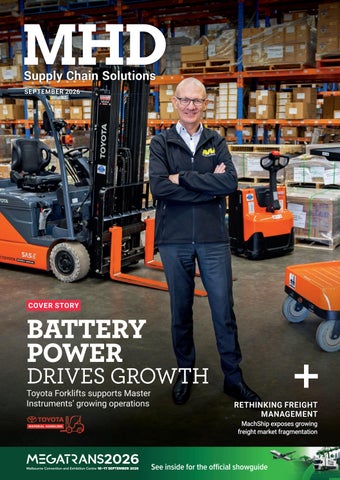
BATTERY POWER
DRIVES GROWTH
Toyota Forklifts supports Master Instruments’ growing operations
RETHINKING FREIGHT MANAGEMENT MachShip exposes growing freight market fragmentation
Melbourne Convention and Exhibition Centre 16–17 SEPTEMBER 2026
See inside for the official showguide
Stacking Success, Shelving Stress Storage efficiency engineered for Coghlan’s future.
Australian 3PL Coghlan’s warehouse transformation is a gamechanger. With Dematic’s ColbyRACK high-density storage and mezzanine solution, Coghlan boosted capacity by 10%, streamlined workflows, and cut costs—all within their existing building footprint. The scalable design supports future growth, while Colby’s locally-based engineering teams enabled rapid response to ensure compliance with evolving regulations. Coghlan now operates more efficiently and impresses clients with a layout built for performance. For companies facing similar challenges, Colby delivers smart, scalable solutions with Australian-made, quality racking and shelving that works. Learn more at www.colby.com.au
Scan to watch the video! www.colby.com.au 02 9486 5555 info.anz@dematic.com
EDITOR’S NOTE
MHD
Supply Chain Solutions CONTACT MHD Supply Chain Solutions is published by Prime Creative Media 379 Docklands Drive, Docklands VIC 3008 Telephone: (+61) 03 9690 8766 Website: www.primecreative.com.au
THE TEAM Chairman: John Murphy CEO: Christine Clancy Managing Editor: Mike Wheeler Editor: Phillip Hazell Business Development Manager: William Jenkin Design Production Manager: Clayton Hawley Graphic Designers: Danielle Harris, Jacqueline Buckmaster Client Success Manager: Justine Nardone
FOR ADVERTISING OPTIONS Contact: William Jenkin william.jenkin@primecreative.com.au
SUBSCRIBE Australian Subscription Rates (inc GST) 1yr (11 issues) for $99.00 2yrs (22 issues) for $179.00 To subscribe and to view other overseas rates visit: www.mhdsupplychain.com.au or Email: subscriptions@primecreative.com.au
ACKNOWLEDGEMENT MHD Supply Chain Solutions magazine is recognised by the Australian Supply Chain Institute, the Chartered Institute of Logistics and Transport Australia, the Supply Chain and Logistics Association of Australia and the Singapore Logistics and Supply Chain Management Society.
ARTICLES All articles submitted for publication become the property of the publisher. The Editor reserves the right to adjust any article to conform with the magazine format.
The industry comes together at MegaTrans
T
here is something uniquely valuable about bringing an industry together in one
place. MegaTrans provides an opportunity for supply chain, logistics, transport and warehousing professionals to step away from the daily pressures of operations and look more closely at where the sector is heading. It is a chance to see new technologies in action, hear directly from industry leaders and have the conversations that are often difficult to fit into a busy working week. This edition of MHD Supply Chain Solutions also serves as the official MegaTrans showguide, helping visitors prepare for the event and make the most of their time on the exhibition floor. Inside, you will find information on the exhibitors, speakers and key features shaping this year’s program, alongside our usual mix of industry news, analysis and technology coverage. Whether you are attending to investigate a particular solution, reconnect with colleagues or simply gain a clearer view of the market, we hope the guide helps you navigate the event with purpose. The timing feels especially
relevant. Supply chains continue to face pressure from rising costs, workforce constraints, changing compliance obligations and growing expectations around safety, resilience and sustainability. At the same time, technologies such as automation, telematics, artificial intelligence and connected fleet systems are giving operators new ways to manage that complexity. Events such as MegaTrans matter because they bring these challenges and opportunities into the same room. They allow operators to compare solutions, challenge assumptions and learn from businesses facing similar conditions. For the MHD team, it is also an opportunity to meet readers, contributors and partners who help shape the publication throughout the year. I look forward to seeing many of you at the event and hearing more about the issues influencing your operations. Until then, I hope you enjoy the edition and find the showguide a useful companion for MegaTrans. Happy reading! Phillip Hazell Editor, MHD Supply Chain Solutions
COPYRIGHT MHD magazine is owned by Prime Creative Media. All material in MHD is copyright and no part may be reproduced or copied in any form or by any means (graphic, electronic or mechanical including information and retrieval systems) without written permission of the publisher. The Editor welcomes contributions but reserves the right to accept or reject any material. While every effort has been made to ensure the accuracy of information Prime Creative Media will not accept responsibility for errors or omissions or for any consequences arising from reliance on information published. The opinions expressed in MHD are not necessarily the opinions of, or endorsed by the publisher unless otherwise stated.
mhdsupplychain.com.au
3
RELIABILITY • SAFETY • INNOVATION • UPTIME
As Australia’s leading forklift company, it doesn’t matter whether we are supplying you with a single spare part, a rental forklift, or helping you manage your entire fleet, our objective and commitment remain the same – adding value to your operation. Whether it's the legendary reliability and world leading safety of our Toyota forklifts, the ongoing support of one of Australia’s most dedicated service and parts networks, or the innovations that have made Toyota the World’s number one forklift brand* , you can be assured we’ve got all your needs covered to power your business forward. To find out more contact your local Toyota Material Handling branch today. *dhf Intralogistics online / magazine 2024/25
PROUDLY DISTRIBUTED BY TOYOTA MATERIAL HANDLING
1800 425 438 toyotamaterialhandling.com.au
SEPTEMBER 2026
THIS ISSUE 8
COVER STORY
8
TMHA supports Master Instruments’ warehouse growth.
SUPPLY CHAIN 24 MachShip helps navigate volatility. 26 SICK automates pallet inspection. 28
eotab s data driving fleet performance.
30 Wipotec automates parcel handling. 34 HERE addresses bridge strikes. 37 Microlise highlights work pressures. 50
ramps up freight in
elbourne.
52 MTData connects telematics data.
COVER STORY
54 Visy Logistics partners with Coopers’. 56 Mobil supports transition pathways.
MATERIAL HANDLING 19 Jungheinrich turns data into ESG gains. 22
daptalift s electric capability.
32
ombilift helps go ma imise capacity.
44
on uest unifies capabilities.
58
appoints ameron Pa ton to lead growth.
WAREHOUSES 10 TAL advances cold-chain logistics. 13 Prological links efficiency with sustainability.
13
16 BHD’s automated cold storage solutions. 41
ena ech s drones for warehouses.
47 Kärcher’s autonomous cleaning. MHD SUPPLY CHAIN SOLUTIONS
24
MEGATRANS SHOWGUIDE 64 CEO Note.
SEPTEMBER 2026
65 What’s On.
SEPTEMBER 2026
66
onference Program.
68
hibitor listings.
84 Floorplan. 86
ASSOCIATIONS, EVENTS, SPECIAL FEATURES AND REGULARS
BATTERY POWER BHD’S STATEMENT ON CANTILEVER RACK
WE WILL NOT BE BEATEN ON PRICE!
If you can provide evidence of a cheaper price, we will beat it by 5%. 130 0072 254
www.bhdstorage.com.au
DRIVES GROWTH
Toyota Forklifts supports Master Instruments’ growing operations
03 Ed’s Letter. RETHINKING FREIGHT MANAGEMENT MachShip exposes growing freight market fragmentation
Email: sales@bhdstorage.com.au Melbourne Convention and Exhibition Centre 16–17 SEPTEMBER 2026
hibitor eference ist.
See inside for the official showguide
06 Industry News. 60 ASCI. 62 ASCLA. mhdsupplychain.com.au
5
INDUSTRY NEWS
T
NHVR marks commencement of major heavy vehicle law reforms
he National Heavy Vehicle Regulator has marked the commencement of the amended Heavy Vehicle National Law, describing it as the most significant overhaul of Australia’s heavy vehicle regulatory framework in more than a decade. The amended HVNL took effect on Saturday, 1 August, following several years of planning, industry consultation and implementation work. According to the NHVR, the reforms are intended to create a more modern and practical regulatory framework, with a stronger emphasis on proactive risk management, shared responsibility and improved safety outcomes. NHVR Chief Executive Officer Nicole Rosie says the commencement marks the beginning of a new phase for Australia’s heavy vehicle industry. “This is the most significant heavy vehicle law reform in more than a decade and the beginning of a new chapter for our industry – one that delivers a more modern and practical regulatory framework to support
safer, more productive heavy vehicle operations,” Nicole says. “The amended HVNL reflects an important shift in how the system operates, moving beyond a traditional compliance-focused approach towards a stronger focus on proactive risk management, shared responsibility and achieving better safety outcomes.” The regulator says the commencement followed one of the largest implementation programs in its history. Nearly 400 resources, tools and support materials were developed or updated to help operators, drivers, auditors, road managers and supply chain participants prepare for the amended law. The NHVR also delivered more than 60 information sessions, webinars and training events, presented at more than 35 conferences and industry forums, and distributed close to 50 targeted updates. NHVR Director of Strategic Policy Paul Daly says implementing the
amended legislation across the heavy vehicle industry required substantial preparation. “Reforming legislation is one thing; successfully implementing it across an entire industry is another,” Paul says. “Teams across the NHVR delivered a significant program of work to prepare industry for the amended law, including developing practical guidance, updating operational systems, training frontline teams and engaging directly with operators, drivers, supply chain partners and governments across Australia.” Paul says consultation with operators, industry associations, auditors, governments and supply chain participants helped shape the regulator’s guidance and transition materials. “While commencement marks an important milestone, the NHVR will continue working closely with industry to ensure these reforms achieve the safety and productivity outcomes they were designed to deliver,” he says. ■
Heavy vehicle law reforms aim to strengthen proactive risk management, shared responsibility and safety outcomes across the industry. Image: Scott Donkin/stock.adobe.com
6
*Conditions apply.
THINKING ABOUT SWITCHING TO ELECTRIC? The Baoli KBE25 lithium-ion forklift delivers the performance many businesses are looking for, without the fuel costs, emissions and maintenance associated with traditional gas forklifts. Baoli combines competitive pricing with the strength of Linde Material Handling and the KION Group, giving you access to a trusted service network, parts support and technical expertise long after the sale. It’s everything you need from an electric forklift, with the confidence of one of the world’s leading materials handling organisations behind it.
TRY A BAOLI KBE25 TODAY AND EXPERIENCE THE DIFFERENCE FOR YOURSELF.
Learn more at
baoliforklifts.com.au
COVER STORY
Toyota Forklifts battery life powers alliance Master Instruments has expanded its battery-electric materials handling fleet with two Toyota pallet jacks, supporting growing demand and faster warehouse turnaround.
O
ne of Australia’s major suppliers of portable and micro battery packs has turned to Toyota Material Handling Australia (TMHA) to support growing activity across its warehouse network. Master Instruments, a thirdgeneration family-owned company, has taken delivery of two Toyota LWE180 pedestrian pallet trucks to increase turnaround capacity at its Sydney warehouse. Rapid growth in demand for electrification is driving the 83-yearold company to expand its warehouse capacity, with supply volumes increasing by more than 10 per cent year on year. Master Instruments delivers more than 10,000 products each month across Sydney, Melbourne and Perth, as well
8
as fulfilling orders through its Brisbane office. The addition of the two pallet trucks brings the number of battery-electric Toyota warehouse products operating across Master Instruments’ three distribution centres to eight. “We’re moving towards a total Toyota fleet,” Master Instruments General Manager Rodney Dunn says. “As part of our growth, we moved into a new 5,500 square metre premises in Sydney’s south-west and called for expressions of interest to assist with the relocation. “TMHA not only provided suitable forklifts, but also supported the move from our previous premises by placing equipment at both locations during the move-out and move-in periods.” Founded in 1942 by Rodney’s
grandfather, Joseph Dunn, Master Instruments manufactures battery solutions for commercial, government and consumer-facing retail customers. “Our key difference is our ability to custom-manufacture critical and industrial battery solutions,” Rodney says. “Enabling electrification and providing energy-storage solutions is a growth industry, and quality, safety and reliability are paramount. “The products we provide range from single-cell batteries for mobile devices through to multi-cell battery packs used to monitor remote infrastructure, along with the panels, batteries and power-conversion equipment required to support them. “These products are either distributed from or custom-manufactured within
COVER STORY
Master Instruments maintains its equipment internally while also relying on TMHA to service its forklift fleet. The Dunn family’s extensive experience with battery technology also informs how the company manages its materials handling equipment. “A battery is not just a battery to us,” Rodney says. “You can have the best device in the world, but it will only ever be as good as the battery that powers it. “It is a power source, and it needs to be understood and looked after.” According to Rodney, carefully monitoring the duty cycle of each forklift battery can help extend its operating life. “The battery tells you when it’s not feeling well,” he says. “It’s our job to look after it properly.” ■
Master Instruments’ Toyota fleet includes a pedestrian pallet truck, battery-electric forklift and order picker.
our purpose-built facilities.” Master Instruments manages an inventory of more than 25,000 line items through a warehouse management platform developed by an Australian software provider. Its Toyota fleet, which includes forklifts, order pickers and pallet trucks, supports the movement of this inventory across the company’s operations. The new Toyota LWE180 pedestrian pallet trucks are used to move incoming and outgoing products to and from the loading dock across multiple daily schedules. With a lift capacity of 1800 kilograms, compact dimensions and a 1.45-metre turning radius, the units are suited to close-range picking and fastresponse tasks.
For more information freecall Toyota Material Handling Australia on 1800 425 438 or visit online at toyotamaterialhandling.com.au
A Toyota LWE180 pedestrian pallet truck supports the movement of goods across the Master Instruments facility. Images: TMHA
mhdsupplychain.com.au
9
WAREHOUSES
Robotic palletising at Netto’s Køge distribution centre demonstrates how automation can improve throughput.
The future of cold chain logistics in Australia
C
Toyota Automated Logistics explains how integrated automation, intelligent software and energy-efficient design can help Australia’s cold-chain operators protect product integrity, improve resilience and support future growth.
old and frozen supply chains have always been among the most operationally demanding areas of logistics. In Australia, where agriculture, food production and exports play such an important role in the national economy, efficient and reliable cold-chain infrastructure is critical. Australia produces significantly more food than is required for its domestic population and has established a strong reputation for quality, safety and traceability. Australian meat, dairy products, seafood, fruit, vegetables and processed foods are supplied throughout APAC and to markets across the world. This creates a supply chain that must protect product quality across significant distances, multiple temperature zones and increasingly complex domestic and international distribution networks. Australia’s geographic position also presents unique challenges. Food may travel thousands of kilometres from farms and production facilities to distribution centres, ports, retailers and end customers. Export products must then continue their journey across APAC and into other global markets. Maintaining the integrity of the cooling chain throughout this process is therefore essential to protecting product quality, shelf life and Australia’s reputation as a trusted food-producing nation. At the same time, operators are facing increasing pressure from rising energy costs, labour availability, sustainability expectations and the need for greater operational flexibility.
10
The result is a market that is moving beyond traditional refrigerated warehousing towards more intelligent, integrated and automated solutions. As Toyota Automated Logistics (TAL), formerly Vanderlande’s warehousing business, expands its capabilities across Australia and New Zealand, the company sees opportunities to support food producers, processors, retailers, logistics providers and exporters with next-generation chilled and frozen automation solutions. “The future of cold-chain logistics is no longer just about refrigeration and storage capacity,” says Roald de Groot, Director of Sales at Toyota Automated Logistics Australia and New Zealand. “It is increasingly about how intelligently you design the complete flow of goods while maintaining an uninterrupted cooling chain from inbound through to storage, picking and dispatch.” Modern chilled and frozen environments present unique operational challenges. Manual processes inside freezer environments are expensive and labour-intensive and can also create variability, safety risks and inefficiencies. Recruiting and retaining people to work in these harsh environments is becoming increasingly difficult, particularly as labour availability remains constrained across many parts of Australia. Automated systems reduce the need for people to work for extended periods in sub-zero environments while improving consistency, traceability, inventory control and throughput. Automation can also support safer
operations by reducing manual handling, forklift movements and workforce exposure to cold conditions. Experience from automated coldstorage projects globally shows that the greatest benefits are achieved when process design, refrigeration, building infrastructure, automation and software are developed together as one integrated solution. The viastore cold and frozen storage capabilities, now part of the broader Toyota Automated Logistics portfolio, highlight several critical success factors for modern temperature-controlled facilities. These principles are particularly relevant to the Australian market. Cold-storage facilities can consume significant amounts of energy if they are not carefully planned and managed. The objective is not simply to create and maintain low temperatures, but to minimise the energy required without compromising product integrity or interrupting the cooling chain. “What we are increasingly seeing is that the biggest long-term operational costs are often locked in very early during the design phase,” says Roald. Building design is a major part of this equation. Automated highdensity storage makes better use of the available building volume and can reduce the refrigerated footprint required for a given storage capacity. Minimising the building’s external surface area, selecting appropriate insulation and carefully designing doors, portals, airlocks and interfaces between temperature zones all contribute to energy efficiency.
WAREHOUSES
The number of passages between cold and ambient areas should be kept to a minimum. Where transitions are required, solutions such as air curtains, airlocks and carefully coordinated conveyor interfaces can reduce heat exchange and condensation. Doors should be opened as briefly and infrequently as possible, while goods should be presented to dispatch at precisely the right time to avoid unnecessary exposure outside the controlled environment. Toyota Automated Logistics believes this integrated approach is where its evolving market position becomes particularly relevant. Rather than focusing solely on standalone equipment supply, TAL positions itself as an end-to-end systems integrator capable of combining its own technologies with complementary partner solutions to create the best outcome for each customer. Importantly, TAL can support a range of temperature-controlled applications, from ambient-controlled production supply and chilled food storage through to deep-freeze environments operating at temperatures as low as -30°C. Global references across food, pharmaceutical and retail sectors demonstrate capabilities spanning pallet, carton and container-based automation. Applications include automated frozen-pallet warehouses for food producers and retailers, high-density shuttle systems for frozen-food distribution, chilled pharmaceutical environments, carton-based deepfreeze automation and mixedtemperature facilities supporting frozen, chilled and ambient operations within a single integrated site. The portfolio also includes largescale pallet automation capabilities that are particularly relevant to Australian food production and exports. Globally proven solutions include frozen warehouses with more than 60,000 pallet positions and high-throughput food distribution systems operating across multiple temperature zones. This experience can help Australian businesses create facilities capable of supporting domestic growth while also strengthening their ability to service
A team member fulfils a temperaturesensitive grocery order at Udea’s Veghel distribution centre. Images: TAL
export markets throughout APAC and the rest of the world. Scalability is important because food production is frequently affected by seasonality, promotional peaks, agricultural cycles and changing export demand. Automation can provide the flexibility to manage these variations without requiring a corresponding increase in labour or refrigerated building space. It also enables businesses to increase capacity within a more compact footprint, which is increasingly important as industrial land and construction costs continue to rise. The role of automation within cold-chain facilities is also changing. Historically, automation was often viewed primarily as a means of reducing labour. Software is becoming increasingly critical. Modern warehouse management and warehouse control systems enable continuous monitoring of temperature-sensitive product flows, batch tracking, expirydate management and operational optimisation across the entire facility. Software-driven cooling-chain management helps ensure that products move efficiently from goods receipt through storage and picking to dispatch. The right product must be available in the right place at the right time, while maintaining traceability and compliance with the requirements of the food, pharmaceutical and healthcare industries. For Australian operators, this is particularly important given the country’s focus on food safety, biosecurity, export quality and traceability. International customers increasingly expect greater visibility over product origin, handling and
movement. Intelligent software and automation provide the data foundation needed to meet these expectations consistently. Cold-storage facilities are among the most energy-intensive operations in the supply chain. Automated high-density systems can reduce the refrigerated volume required, minimise unnecessary movement between temperature zones and reduce how frequently doors are opened. The refrigeration system should also be designed in coordination with the logistics operation. Temperature zones, equipment heat loads, airflow, evaporator access and operating patterns all influence overall system performance. In some applications, intelligent scheduling can enable parts of the refrigeration process to operate during periods of lower energy demand or cost while maintaining the required temperatures throughout the day. Close cooperation between the customer, logistics integrator, architect, builder and refrigeration specialist is therefore essential. As TAL strengthens its presence in the Australian food and coldchain sectors, the company sees strong alignment between its global experience and the evolving requirements of the local market. “Australia is already recognised as a high-quality food producer for APAC and the world,” says Roald. “The next opportunity is to combine that strength with smarter automation, software and integrated cold-chain design. This will help Australian businesses protect product quality, improve energy and labour efficiency, and build more resilient supply chains that can support both domestic customers and continued export growth.” Ultimately, the future of cold-chain logistics in Australia will not simply be defined by larger warehouses or colder temperatures. It will be defined by how intelligently facilities are designed, how efficiently products flow through them, and how effectively automation, refrigeration, buildings and software are brought together into one integrated operational ecosystem. ■ mhdsupplychain.com.au
11
PALLET INTEGRITY INSPECTION SYSTEM
WAREHOUSES
Efficient warehouse design can create the commercial headroom needed to invest in rooftop solar, batteries and other loweremission infrastructure. Image: Artamora/stock.adobe.com
Commercial sustainability comes first
Sustainability strategies often begin with solar panels, electric vehicles and batteries. Prological Managing Director Peter Jones argues businesses should first examine the inventory, warehouses and freight operations that provides the context for sustainable transition.
W
hen sustainability enters a business conversation, attention often moves quickly towards visible environmental technologies. Solar panels, batteries, electric vehicles and energy-efficient buildings have become familiar components of corporate sustainability strategies. Yet Peter Jones, Managing Director of Prological, says these investments cannot be considered separately from the commercial strength of the business making them. “The flip side of moving towards environmental sustainability is that the business must first be sustainable,” Peter says. For supply chain operators, the relationship between commercial and environmental performance is particularly important. Warehousing, inventory and freight are substantial operating costs, but also significant sources of energy use and carbon emissions. Reducing inefficiency can therefore deliver two outcomes: a stronger business today and greater capacity to invest in lower-emission operations tomorrow. “Businesses are unlikely to make a move that creates an unfavourable economic outcome simply because it offers a better environmental outcome,” Peter says.
“It is about getting those two things to walk together.”
Progress, not perfection The ability to develop and execute a sustainability strategy often depends on the resources available within an organisation. Large companies increasingly have dedicated sustainability teams involved in major operational decisions. Smaller businesses may struggle to allocate someone the time required to build the strategy, business case and implementation plan. However, Peter says limited resources should not become a reason to avoid action. “We should be pursuing progress, not perfection,” he says. “Some businesses have a narrow view of what sustainability looks like. They see that narrow range of options as difficult to access, so very little progress gets made. “Instead, the organisation should have a direction and make another small move towards it every day. After three years, the business will look back and be amazed at how much improvement has been made.” The starting point is a practical strategy linked to the broader business plan, with target dates and clearly identified opportunities. Peter points to a Prological client in the
Illawarra that developed a sustainability strategy several years before it became economical to implement. The business was operating under a favourable legacy electricity agreement, making investment in on-site generation difficult to justify. However, it knew the agreement would eventually expire. “When that expiry date arrived, the sustainability strategy looked very strong against continuing to draw all of the business’ power from the grid,” Peter says. “They understood what they could not do in the short term, but included it in their medium- and long-term planning. When the circumstances aligned, they already knew what to do.”
Finding money within the supply chain Before seeking capital for major environmental projects, Peter says many businesses should conduct an independent diagnostic of their supply chain. Prological regularly finds commercial opportunities across three areas: inventory, warehouses and freight. The first is slow-moving and obsolete inventory, commonly referred to as SLOB stock. This inventory does more than tie up working capital. It occupies warehouse locations, increases travel distances, mhdsupplychain.com.au
13
WAREHOUSES
complicates stocktakes and can create the impression that a facility has reached capacity. “When working capital is sitting on a shelf and not doing anything, that is money on leave,” Peter says. “It may be on the balance sheet, but it is not working for the business.” The issue can be compounded when replenishment settings are not updated. A business may finally sell an idle item, only for its system to interpret the sale as fresh demand and automatically reorder it. Addressing the underlying inventory settings can release cash while reducing the resources needed to store and handle stock.
Is the warehouse really full? Warehouse capacity is the second major area in which Peter believes businesses may be leaving money on the table. Facilities often evolve as product ranges, order profiles and customer expectations change. A layout that worked when the business entered the building may no longer suit the operation several years later. “When a business believes its warehouse is full, the first call is often to its industrial property partner,” Peter says. “The conversation can quickly become: you have 10,000 square metres now, so perhaps you need 15,000 square metres. Straight away, the business may have added 50 per cent to its warehousing footprint, with all the associated environmental impacts.=.” The warehouse management system may show that every storage location contains stock, but that does not necessarily mean the available cube is being used efficiently. Peter says Prological has assessed supposedly full warehouses achieving only 55 to 65 per cent volumetric utilisation and through internal redesign, have increased capacity by upwards of 30 per cent. Reconfiguring storage, inventory placement and operational processes may recover enough capacity to delay or avoid a costly relocation. However, when a move is genuinely required, it creates a financially
14
and environmentally significant opportunity. A new facility can be designed for efficient energy use, expanded rooftop solar, batteries, electric vehicle charging and future upgrades. “If you do not consider a battery during the initial design, its dangerous goods and location requirements may mean you effectively design out the ability to install one later,” Peter says. “The same applies to the roof structure for future solar expansion and the conduit needed to add electric vehicle chargers.”
Re-engineering freight Freight is the third area returning to focus after a period in which businesses were reluctant to test the market. During and immediately after the pandemic, taking freight to tender was often more likely to increase costs than reduce them. Since then, carrier capabilities and service offerings have continued to evolve. Peter says the opportunity is not simply to ask an incumbent carrier for a cheaper rate. “The key is not renegotiating, but re-engineering,” he says. “If all you do is renegotiate, you are effectively trying to take margin away from the transport provider. By re-engineering the task itself, there can often be benefits of 20 to 30 per cent available.” That may include reconsidering vehicle types, service profiles, delivery frequencies, carrier specialisations and the balance between single- and multicarrier models. The growing availability of electric vehicles in outsourced metropolitan fleets is also creating new options. While electric trucks remain far from universal, Peter says they are no longer rare. For some large business-to-consumer operations, aligning a warehouse move with an electric metropolitan fleet can create a compelling long-term model. A suitably designed facility may generate and store electricity on site, supply its own operations and charge vehicles used for urban distribution. Peter says the right operation may
Peter Jones, Managing Director, Prological. Image: Prological
achieve a return within approximately five years. However, that opportunity again demonstrates why commercial sustainability must come first. “The business has to possess the capital, or have access to the capital, in the first instance,” Peter says. “You can see that things are much better on the other side of the hill, but you still have to be capable of getting over the hill.” By releasing working capital from inventory, recovering warehouse capacity and re-engineering freight, businesses can create the financial headroom required to make that journey. “Have a direction and pursue progress over perfection,” Peter says. “Even when you cannot do much today, make sure that when the circumstances align, you already know where to begin.” ■ Read more about Prological’s sustainability approach in the company's white paper, “From Good Intentions to Practical Sustainability”
Seamless integration for future-ready performance
Demand is shifting. Labour is tightening. Expectations are accelerating. Built on Toyota strength, Toyota Automated Logistics delivers automation designed to adapt as fast as your business does. Toyota Automated Logistics is engineered for change. Combining scalable systems, intelligent software and global expertise to help your operation evolve in real time. Whether you’re automating for the first time or optimising at scale, Toyota Automated Logistics gives you the flexibility to move forward without limits. Not just automation for today. Automation that keeps you ready for what’s next. For every challenge a reliable solution.
Find out more: toyota-automated-logistics.com
WAREHOUSES
BHD Storage Solutions’ high-density racking is engineered to maximise pallet capacity while supporting the operational demands of cold storage. environments.
Building the foundations of efficient cold storage As cold chain operators pursue denser, more automated facilities, BHD Storage Solutions is sharpening its focus on the infrastructure supporting them.
C
old storage is becoming a harder equation to solve. Operators need to accommodate more inventory, accelerate throughput and introduce automation, all within facilities that are expensive to build and continuously consume energy. At the same time, food, fresh produce and pharmaceutical supply chains leave little room for temperature inconsistency, equipment failure or product disruption. For BHD Storage Solutions, these pressures are changing the role of warehouse racking. Once viewed primarily as a structure for holding pallets, racking is increasingly becoming part of a facility’s operational backbone – connecting stored products, automation equipment, refrigeration systems and warehouse processes. “Cold chain fits naturally with the direction BHD is taking in automation,” says John Harrison, General Manager,
16
BHD Storage Solutions. “With the introduction of our warehouse management and control systems and four-way shuttle solutions, we can bring the storage structure and automation technology together as one coordinated system.” The company is renewing its focus on cold chain storage as Australian operators look for greater capacity and efficiency from refrigerated footprints.
Making every cubic metre work Space has always carried a premium in warehousing, but in cold storage, unused or poorly configured space also carries an ongoing energy cost. Every cubic metre must be cooled, whether it is generating storage capacity or not. This is pushing operators towards high-density configurations that reduce aisle requirements and increase pallet positions within the same building envelope.
Four-way shuttle systems, pallet shuttles and double-deep racking can all support that objective. However, John says density alone is not the measure of a successful design. “The real goal is to find the right balance between storage density, accessibility, airflow and equipment performance,” he says. “A design might look efficient on paper because it delivers a high number of pallet positions, but it still needs to support the movement of equipment, the circulation of cold air and the operational requirements of the customer.” That balance becomes more complex in automated facilities. Pallet sizes, rack depths, lane configurations and storage-location tolerances must be designed around the equipment operating within the structure. Refrigeration layouts and airflow direction must also be considered, as overly compact storage
WAREHOUSES
can restrict cold-air circulation and contribute to uneven temperatures. A well-planned facility can reduce unnecessary equipment movement and limit the heat exchange caused by frequent door openings. The result is not only more storage capacity, but a more efficient refrigeration and handling environment.
Designed for harsher conditions Cold chain racking must also withstand conditions that are far less forgiving than those found in a conventional warehouse. Humidity and condensation can increase corrosion risks, while longterm heavy loading places sustained pressure on structural components. In frozen environments, steel performance at low temperatures becomes an additional engineering consideration. “The steel performance in lowtemperature environments is a critical part of the design,” John says. “Our cold-formed steel manufacturing capabilities, combined with the ability to increase steel toughness and thickness where required, lend themselves well to frozen storage applications.” The appropriate material specification depends on the operating environment. Chilled warehouses may require a
BHD’s four-way shuttle racking combines high-density storage with automated pallet movement to improve space utilisation. Images: BHD
stronger focus on moisture and corrosion protection, while facilities operating below minus 18°C need steel selected for low-temperature toughness and structural reliability. Pharmaceutical and biological storage can introduce further requirements around material consistency and quality control. BHD can provide low-temperaturegrade steel, including Q235D and Q355D materials, according to project requirements. Surface treatment is another important consideration. Coatings must remain consistent and durable despite ongoing exposure to moisture, condensation and changing temperatures. For higher-humidity applications, zinc-aluminiummagnesium coatings can be used to provide additional corrosion protection. John says these decisions should be judged over the life of the facility rather than against the initial purchase price alone.
Racking joins the automation system The rise of automated cold storage is also increasing the level of precision demanded from racking suppliers. Four-way shuttles, conveyors and automated pallet-handling equipment rely on consistent rack geometry. Small variations in upright alignment, beam levels or storage positions can affect equipment travel, pallet placement and commissioning. “In automated environments, the racking is part of the automation system,” John says. “The level of precision can directly affect commissioning, equipment performance and the long-term reliability of the operation.” This means structural calculations, manufacturing controls and installation quality must work together. The system must provide sufficient load capacity and stability, but it must also maintain the dimensional tolerances required by the automation operating within it. Poor alignment or structural deformation can lead to more difficult commissioning and ongoing reliability issues. For operators and integrators,
selecting a racking partner is therefore becoming a broader project decision. Engineering, manufacturing, certification, installation and onsite coordination can all influence whether an automated cold chain facility performs as intended.
Building on international experience BHD has previously delivered large food and frozen storage projects in international markets, including Argentina and the United Arab Emirates. John says that experience, combined with the company’s expanding automation offering, has created a clear opportunity to increase its focus on the sector. “We have had success in food and frozen storage projects internationally, and that experience is helping guide where we concentrate our capabilities,” he says. “There are many different variations within cold chain, from conventional and shuttle-based storage through to highly automated freezers and rackclad buildings. “It is an exciting area because every application presents a different combination of temperature, product and operational requirements.” BHD is now assessing opportunities in Australia across fresh fruit, fresh food, vegetable distribution and snapfrozen applications. While the projects differ, John says the central lesson remains the same: storage infrastructure must be considered at the beginning of the planning process, not added after the refrigeration and automation decisions have been made. “Cold chain warehouses are moving towards greater density, efficiency and intelligence,” he says. “To support that transition, racking cannot be treated as an afterthought. It needs to be designed as part of the complete operational and automation environment.” As cold storage facilities become taller, denser and more automated, the steel supporting the pallets is being asked to do far more than simply carry a load. ■ mhdsupplychain.com.au
17
Conquest Robotics Technology by
World-leading robotics. Local expertise. National support. ⚫ Industry-leading equipment and world-class robotics solutions ⚫ Designed to improve productivity and reduce operational disruption ⚫ Tailored to your site through our Intelligent Solutions Program ⚫ Supported by a national team that’s with you, all the way
Robot Sweeper Vacuum
Robot Sweeper
Robot Sweeper Scrubber Vacuum
Floor Cleaning Robot
Scan to learn more about upcoming Conquest Product Roadshows and demonstration opportunities.
1800 100 150 FLOOR CARE
MOWERS
TRANSPORT VEHICLES
STREET CLEANSING
MATERIAL HANDLING
The missing link in sustainable material handling
A
Jungheinrich Australia’s Anthony Zhao explains how greater visibility into fleet utilisation, energy use and battery performance can help warehouse operators reduce waste, improve safety and deliver measurable ESG gains.
s sustainability moves from a corporate aspiration to a measurable business requirement, warehouse and logistics operators are under increasing pressure to reduce emissions, improve energy efficiency, and demonstrate responsible resource management. While much of the sustainability conversation focuses on electric vehicles, renewable energy and building efficiency, many warehouse operators are discovering that significant gains can also be achieved by better understanding how existing equipment is utilised. In many cases, the greatest sustainability opportunities are already operating on the warehouse floor. Today’s warehouses generate vast amounts of operational data, yet many organisations still lack visibility into how their material handling equipment is being used on a dayto-day basis. Without this insight, opportunities to improve efficiency, reduce energy consumption, and support sustainability objectives can remain hidden. This is where fleet management technology is becoming increasingly valuable. Rather than focusing on individual assets, modern fleet management systems provide a holistic view of fleet operations, enabling businesses to make data-driven decisions that reduce energy consumption, improve asset productivity, and support Environmental, Social and Governance (ESG) objectives.
Sustainability starts with visibility A common challenge within warehouse operations is the lack of accurate data regarding fleet utilisation. It is common to find businesses operating
Connected equipment and intelligent systems give warehouse operators greater visibility into fleet activity and asset performance. Images: Jungheinrich
more forklifts than necessary simply because there is limited visibility of actual usage patterns. This can result in unnecessary energy consumption, additional maintenance requirements, and increased capital expenditure. Fleet management systems capture and analyse realworld operating data, including: • Equipment utilisation • Operating hours • Energy consumption • Battery performance • Idle time • Impact events • Driver access and usage patterns By transforming operational data into actionable insights, businesses can identify opportunities to optimise fleet size and eliminate underutilised equipment. For example, fleet analysis will often reveal that certain trucks are being used far less frequently than originally assumed. By reallocating resources or reducing underutilised assets, businesses can often lower energy consumption and maintenance requirements without impacting productivity. The result is a reduction in overall fleet energy demand while maintaining or improving operational performance.
Reducing carbon through fleet optimisation One of the most immediate sustainability benefits delivered through fleet management is fleet optimisation. Visibility into actual truck utilisation create opportunities to reduce the number of material handling equipments deployed across a site. Even in facilities operating electric forklifts, every machine consumes energy, requires maintenance, utilises spare parts, and eventually reaches end of life. Reducing fleet numbers without compromising productivity delivers measurable sustainability benefits: • Lower electricity consumption • Reduced battery charging requirements • Reduced maintenance-related waste • Lower embodied carbon associated with replacement equipment • Extended asset life cycles This approach aligns directly with the sustainability principle of using fewer resources to achieve the same operational outcome.
Maximising battery efficiency Battery technology has become a major focus of warehouse sustainability strategies, particularly with the widespread adoption of lithium-ion mhdsupplychain.com.au
19
MATERIAL HANDLING
solutions. Fleet management solutions such as Jungheinrich fleet management system (FMS) provide detailed visibility into battery charging behaviour and energy utilisation, helping operators identify: • Opportunity charging habits • Excessive energy consumption • Inefficient charging practices • Opportunities for operational improvements By ensuring batteries are used and charged correctly, businesses can extend battery life, reduce energy waste, and lower replacement frequency. This not only reduces operating costs but also minimises the environmental impact associated with battery manufacturing, transportation, and disposal.
Supporting safer and more responsible operations Sustainability is about more than environmental performance. Modern ESG frameworks increasingly place emphasis on worker wellbeing and operational safety. Fleet management systems contribute to these objectives through features such as: • Operator access control • Pre-operational safety checklists • Impact monitoring • Driver accountability • Fleet activity reporting By promoting safer operating practices and reducing preventable incidents, organisations can
Fleet management data helps operators monitor utilisation, operating hours, service costs and other performance indicators across their equipment. improve workplace outcomes while supporting their social responsibility commitments. A safe workplace is inherently a more sustainable workplace.
Data-driven ESG reporting Many companies now face increasing stakeholder expectations regarding sustainability reporting and ESG disclosures. As sustainability reporting expectations continue to grow across many industries, access to accurate operational data is becoming increasingly important for demonstrating measurable progress. Fleet management platforms enable organisations to monitor key performance indicators that contribute to sustainability measurement, including: • Fleet utilisation rates • Energy consumption trends • Equipment availability • Battery performance metrics • Productivity improvements The Jungheinrich Fleet Management System brings fleet, service and battery information together in a central digital platform.
20
• Operational efficiency gains These insights help businesses move beyond assumptions and demonstrate measurable progress against sustainability targets. For organisations pursuing corporate ESG initiatives, carbon reduction strategies, or sustainability certifications, data transparency is becoming a critical requirement.
The future of sustainable material handling The next phase of sustainability within the logistics sector will not be driven solely by new equipment technologies. It will be enabled by intelligent systems that maximise the effectiveness of existing resources. Fleet management platforms such as Jungheinrich FMS provide the data foundation required to optimise energy use, improve productivity, reduce waste, and support long-term sustainability objectives. In a world where every kilowatt-hour, every asset, and every tonne of carbon matters, visibility has become one of the most valuable sustainability tools available. By connecting fleet operations with sustainability outcomes, fleet management systems help businesses move beyond good intentions and deliver measurable results, showing that smarter and more sustainable operations go hand in hand. In many warehouses, technology is no longer the challenge, but a lack of visibility into how resources are performing and where efficiencies can be unlocked. Those organisations that can turn operational data into actionable insight will be best positioned to achieve both their productivity goals and their sustainability ambitions. ■
MATERIAL HANDLING
Electric without compromise The Hyster J2.5 XTLG combines lithium-ion power with indoor and outdoor capability, giving material handling operators another option when considering a move away from diesel or LPG forklifts.
F
or materials handling operations that move between warehouses, loading areas and outdoor yards, the transition from internal combustion forklifts to electric equipment has not always been straightforward. While battery-electric forklifts are well established in indoor environments, diesel and LPG machines have traditionally remained common where operators need to contend with ramps, uneven surfaces and exposed working areas. Hyster’s XTLG Outdoor Electric Forklift range has been developed with these mixed applications in mind, combining integrated lithiumion power with characteristics more commonly associated with internal combustion equipment. Within the range, the Hyster J2.5 XTLG is a 2.5-tonne counterbalance forklift suited to warehouses, manufacturing facilities, transport depots and industrial sites.
Built for mixed environments Large tyres and high ground clearance allow the J2.5 XTLG to operate across both indoor and outdoor surfaces, including applications where forklifts regularly move between racking, loading docks, hardstands and external storage areas. The model has a rated capacity of 2500 kilograms at a 500-millimetre load centre, with lift configurations available up to 6500 millimetres. An overall width of 1160 millimetres and turning radius of 2347 millimetres
22
are designed to retain manoeuvrability in indoor environments, while its outdoor capability can allow one truck to perform duties that may previously have been divided between different forklift types. Hyster has also designed the XTLG platform to provide travel speeds, lifting performance, responsiveness and gradeability comparable with internal combustion equipment. A permanent magnet drive motor and integrated drive axle provide power delivery, while selectable performance settings allow operators to adjust the truck according to the application. With no tailpipe emissions, the forklift can also operate inside enclosed facilities without producing the exhaust emissions associated with diesel or LPG equipment.
Lithium-ion power The J2.5 XTLG uses an integrated lithium-ion battery designed to reduce routine battery maintenance. Unlike conventional lead-acid batteries, the system does not require watering or equalisation. Side charging allows operators to connect the truck without accessing the battery compartment, while opportunity charging can be used during scheduled breaks or periods of inactivity. The battery also features an automatic heating function to manage temperature recovery during discharge and before charging. Adaptalift Group says the J2.0–3.5 XTLG range can typically halve energy
costs compared with an equivalent internal combustion forklift, although actual savings depend on factors including utilisation, energy prices and charging practices. Electrification can also reduce maintenance requirements by removing components including the engine and transmission, as well as eliminating engine oil changes, LPG cylinder handling and diesel refuelling.
Supporting the transition The J2.5 XTLG includes a spacious operator compartment, multiple seat options and a colour display providing truck information and selectable performance modes. A wide-view mast supports visibility, while weather-protection options are available for outdoor applications. The truck can also be configured with attachments and safety technologies to suit different operating requirements. Adaptalift Group is currently offering selected new Hyster J2.5 XTLG forklifts from $30,500 plus GST, with an indicative finance option from $19 per day. The company also offers site and electric fleet assessments covering operating conditions, utilisation, load requirements and available charging infrastructure. For operators looking to reduce their reliance on diesel or LPG equipment without restricting forklifts to indoor applications, the J2.5 XTLG represents another pathway towards fleet electrification. ■
CLEAN FLOORS. ZERO LABOUR. Boost your facility’s efficiency with the new KIRA B 200. This fully autonomous floor scrubber cleans 2,300 m²/h across large-scale warehouses and logistics hubs, allowing your team to focus on higher-value tasks. Consistency and cleanliness, delivered autonomously. karcher.com.au
Scan here to learn more about KIRA
SUPPLY CHAIN
Freight volatility is prompting shippers to rethink how they manage increasingly fragmented transport networks. Image: markobe/stock.adobe.com
Freight volatility pushes shippers towards orchestration
A
MachShip’s Freightability Report 2026 reveals a fragmented B2B freight market in which service, pricing and capacity increasingly vary by carrier, lane and mode, challenging businesses to rethink how they manage transport networks.
ustralian and New Zealand businesses are being pushed beyond traditional freight management as widening differences in carrier performance, pricing and capacity make static transport strategies increasingly difficult to maintain. MachShip CEO Sam Rowse says the market is shifting towards “freight orchestration”, where businesses manage their carriers, services, lanes, costs and performance as one connected network rather than treating each component independently. “Freight management assumed a stable market you could optimise within,” Sam says. “You selected your carriers, negotiated your rates and largely held those relationships in place. That market has gone. “Reliability, price and capacity are now moving in different directions depending on the carrier, mode and lane. When the market is that
24
fragmented, managing each piece on its own stops working.” The shift has been highlighted by MachShip’s inaugural Freightability Report 2026, which analyses actual booking and delivery behaviour across its freight network rather than relying on survey responses. The dataset covers more than 25,000 customers, 200 million shipped items and 500 connected carriers, giving the company a broad view of B2B freight activity across Australia and New Zealand. Sam says fragmentation has long been an unavoidable feature of Australian freight due to the country’s geography, regional networks and range of freight profiles. What has changed is the cost of failing to respond to that fragmentation. “Running freight on habit – using the same carriers because it is familiar or convenient – is starting to cost businesses,” he says. “Orchestration means running the
whole network as one system. It means bringing every carrier, lane, service and cost into one view and making decisions across all of it.”
Reliability varies widely One of the report’s clearest findings relates to delivered in full and on time performance, or Delivered In Full, On Time (DIFOT). Across the network, average carrier DIFOT reached 78 per cent in 2025. However, that figure concealed a significant performance range, with leading carriers recording results in the high 90s while some operators performed substantially below the national average. Sam says this variation means national averages offer limited value when selecting carriers. “You cannot look at an overall carrier average and assume that is what you will receive,” he says. “Performance needs to be understood at the lane, service and mode level. A
SUPPLY CHAIN
carrier may perform strongly in one market and poorly in another.” The data also challenges the assumption that premium freight services provide greater certainty. Thirty per cent of same-day deliveries examined in the report missed their service commitment, while 27 per cent of next-day deliveries were late. By comparison, 19 per cent of non-premium deliveries failed to arrive on time. Over five years, average same-day delivery times increased by 47 per cent. During the same period, next-day services improved by approximately three hours and non-premium services became around 16 hours faster, narrowing the gap between premium and standard options. “The result is quite counterintuitive,” Sam says. “Businesses are paying more for speed, but they are not necessarily receiving greater certainty. “In B2B freight, most businesses do not need the fastest possible delivery. They need the delivery to arrive when it was promised.” Capacity constraints, growing parcel volumes and established dispatch habits are contributing to pressure on faster services. The report found Friday was the most popular shipping day, with volumes commonly peaking at 3pm. MachShip says concentrating dispatches late in the week places additional pressure on carrier networks that are already managing constrained capacity.
are moving in a completely different direction. Even within a mode, every city and every lane can tell a different story.” Conditions have become more volatile since the report was finalised in February. MachShip recorded the effective fuel levy across carrier rates rising from 16.6 per cent in early March and peaking near 34 per cent in April, before easing to around 20 per cent by July. While the levy has fallen from its peak, it remains above the long-run baseline of 15 to 18 per cent. Sam says businesses should assess the complete cost of a service, including fuel levies, surcharges and the operational cost of missed deliveries, rather than comparing base rates alone. “The rate card does not tell you much anymore,” he says. “You need to know how the carrier performs, how its surcharge model operates and what the service actually costs when something goes wrong.”
From visibility to active decisions Australian shippers already use an average of 5.4 carriers, reflecting the need for different networks across parcels, pallets, linehaul, metropolitan
areas and regional markets. The report argues that carrier diversity is unavoidable, but unmanaged diversity is not. Sam says technology can provide the central visibility required to compare services and allocate freight more effectively, but strong carrier relationships remain essential. “Technology is an important part of orchestration, but this is still a relationship-based industry,” he says. “Shippers need to get closer to their carriers, ask for transparency and understand actual performance rather than advertised performance. “The advantage will go to businesses that look more closely and make decisions lane by lane, service by service and carrier by carrier.” For carriers, Sam says the opportunity lies in offering customers certainty and honest performance information rather than competing primarily on headline speed. “Help your customer keep the promise it has made to its own customer,” he says. “That does not always mean delivering faster. It means delivering when the customer expects it. The market needs transparency, and it increasingly values certainty.” ■ Sam Rowse, CEO, MachShip. Image: MachShip
No single pricing story Pricing data also demonstrated why shippers cannot rely on broad market narratives. Parcel prices declined by between two and four per cent across major capitalcity corridors during 2025, while full truckload prices on MachShip’s network increased by 12.48 per cent. Pallet pricing was more mixed, with Brisbane experiencing upward pressure in both prices and demand. “There is no single freight pricing story,” Sam says. “Parcels are doing one thing, pallets are doing another and full truckloads mhdsupplychain.com.au
25
SUPPLY CHAIN
Protecting the supply chain from the ground up SICK’s Pallet Integrity Inspection System is generating data that supports safer and more efficient supply chains.
P
26
allets may be among the most overlooked assets in warehouse operations. They move products through distribution centres, factories and transport networks, rarely attracting attention unless something goes wrong. Yet a cracked board, protruding nail or missing timber block can bring automated equipment to a halt, damage products, create safety hazards and generate costly downtime. As warehouses become more automated, pallet quality is emerging as a critical factor in maintaining throughput and workplace safety. Rather than relying solely on visual checks, operators are adopting automated inspection technologies that assess pallets in real time without interrupting operations. SICK has developed its Pallet Integrity Inspection System (PAIS) to inspect pallets automatically as they travel through material handling systems.
Traditional pallet inspections generally depend on employees visually assessing pallets before they enter service. While experienced operators can identify obvious faults, manual inspections are time consuming, subjective and can require conveyors to slow down or stop. PAIS instead allows every pallet to be assessed consistently while continuing through the warehouse at its normal operating speed.
The hidden cost of damage
Inspecting every pallet
Warehouses have invested heavily in autonomous vehicles, robotic palletisers, conveyors and automated storage and retrieval systems. These technologies allow facilities to move thousands of pallets each day, but they also reduce tolerance for defects. A loose board or damaged block that may once have been noticed by a forklift operator can become lodged in a conveyor, interfere with automated equipment or destabilise a valuable load. Even relatively minor defects can trigger stoppages that affect productivity across an entire facility. Damaged pallets can also expose workers to protruding nails, broken timber and unstable goods. They may damage automation equipment designed to handle pallets that meet consistent structural and dimensional standards.
The system consists of two inspection towers positioned on either side of a conveyor. Each tower incorporates highresolution 3D laser triangulation cameras and additional laser technology designed to maintain reliable performance when pallets are dirty or wet. As a pallet passes between the towers, PAIS creates a detailed threedimensional model that can identify cracked boards, missing timber sections, protruding nails, damaged blocks and other structural faults. The system identifies the location and size of each defect, allowing unsuitable pallets to be removed or repaired before entering automated handling equipment. PAIS can also be configured for different pallet formats and inspection criteria, depending on the pallet type,
Damaged pallets can result in product losses and safety incidents. Image: SICK
customer requirements or application. Operators can select configurations, monitor performance and review results through a touchscreen interface.
Turning inspections into intelligence Beyond quality control, inspecting every pallet creates operational data that can reveal recurring defect patterns across suppliers, pallet types and facilities. If one supplier regularly delivers damaged pallets, or a particular pallet format deteriorates faster than expected, operations teams can identify the trend and intervene before it affects warehouse performance. Inspection records also improve traceability by showing which pallets entered the system, the defects detected and where intervention occurred. As automation expands, operators must pay closer attention to the condition of the supporting assets entering their facilities. Pallets may appear simple, but their quality directly influences productivity, equipment reliability and worker safety. By combining automated inspection with operational analytics, SICK’s PAIS system helps operators identify problems before they become disruptions, adding an intelligent layer of protection to increasingly connected and automated supply chains. ■
SUPPLY CHAIN
The primary engine for Australian fleet success
Geotab explains how telematics safety data is helping Australian fleets strengthen compliance, reduce costs and turn safer operations into a competitive advantage.
I
n the Australian commercial landscape of 2026, the conversation often gravitates toward AI video breakthroughs. But the Geotab Report 2026 reveals a deeper truth: the core of the industry’s success is still anchored in fundamental telematics safety data. In the Australian commercial landscape of 2026, the conversation around fleet management often gravitates toward the latest AI video breakthroughs. However, the Geotab Report 2026: Connected Fleets in Australia reveals a deeper truth: while video is a powerful “visual shield,” the core of the industry’s success is still anchored in fundamental telematics safety data. For many Australian firms, winning a deal or securing a contract isn’t just about showing a camera feed; it’s about proving a rigorous, databacked commitment to the Chain of Responsibility (CoR). Safety remains the number one driver of telematics adoption, proving that even without video, the “connected pulse” of a vehicle is a fleet’s most valuable asset. While video adds a layer of visual intelligence, the “hidden” data within a standard telematics device is what currently secures the most significant operational wins in the Australian market.
1. The “invisible” safety shield: seat belts & speeding Basic telematics data provides a clear view of driver behaviour, enabling fleets to intervene quickly. Standard alerts helped 47 per cent of services fleets and 40 per cent of government fleets increase seat belt use by up to 60 per cent. In the oil and gas sector, businesses achieved a 100 per cent success rate in reducing speeding incidents by at least 21 per cent through real-time GPS monitoring.
2. Fatigue management: protecting the long-haul In a country defined by the “tyranny of distance,” managing fatigue is the difference between a successful delivery and a dangerous incident. Even without in-cab cameras, telematics provides the critical “hours of service” data needed to prevent exhaustion. 66 per cent of Government organisations and 59 per cent of Services firms reduced fatigue-related events by over 40 per cent simply by orchestrating better rest breaks and monitoring driving patterns.
The ROI of a “safety-first” culture The 2026 report confirms that a safer fleet is, by definition, a more profitable fleet. Australian businesses are finding that a commitment to safety data directly correlates with a reduction in the “Big Two” overheads: Fuel and Labour. The financial benefits of a safety-led approach are clear. Some 35 per cent of construction and services firms reduced accident-related costs, while verifiable safety data helped 43 per cent of government fleets and 33 per cent of utilities negotiate lower insurance premiums. Utilities also recorded a 50 per cent reduction in labour costs by adopting proactive, safety-led maintenance. In Australia, fleet safety is also a legal duty. Regulatory compliance was the leading achieved goal for 58 per cent of small businesses and 54 per cent of enterprises. Meanwhile, 72 per cent of government agencies described GPS tracking as extremely beneficial for maintaining service integrity and public safety.
Safety is the strategic edge The Australian market has made its choice clear: safety is the primary
Telematics data gives fleet teams greater visibility into safety, compliance and operational performance. Image: Geotab engine of operational sovereignty. While AI video represents the future of the “Visual Shield,” the foundation of every successful deal today is the ability to prove, through raw telematics data, that a fleet is compliant, controlled, and committed to the safety of every Australian road user. With the Heavy Vehicle National Law (HVNL) placing a shared burden of responsibility across the entire supply chain, fleet managers are using telematics as their primary mechanism for meeting NHVR obligations. The gap between “traditional hauling” and “safe logistics” is widening. For the forward-thinking Australian enterprise, winning the next deal starts with the data that protects your people. ■
28
MHD A4
STORE MORE. WORK SAFER.
50%
GAIN UP TO MORE STORAGE WITH AISLE MASTER
Day One Return on Investment
The Aisle Master range of articulated and pedestrian forklifts are designed specifically for warehouses that require ease of movement through very narrow aisles. With the ability to operate in aisles as narrow as 1.6m, the Aisle Master maximises storage capacity, dramatically increasing your storage space by up to 50%.
CONTACT US TODAY To find out how Aisle Master can help you unlock every inch of your storage space.
Space = Cost Space Saved = Profit Try our complimentary Warehouse Optimisation service, and increase your storage capacity by up to 50% within your current warehouse space – without the cost of expansion!
combilift.com MHD A4 rev 1.1.indd 1
11/03/2026 10:20:48
WAREHOUSES
The challenge of irregular parcels in distribution centres As e-commerce increases the volume and variety of freight moving through distribution centres, Wipotec says new inspection and dimensioning technologies are helping operators automate the handling of irregular consignments.
T
he rapid growth of e-commerce has transformed modern logistics. Distribution centres must now process millions of shipments in an increasingly wide variety of formats, ranging from standard cartons and polybags to oversized goods, unusually shaped products and freight that falls outside the parameters of conventional automation. This evolution has created an operational challenge: handling and controlling irregular parcels. Together with Wipotec, a German specialist in package flow control solutions for the logistics industry, MHD examines the growing importance of efficiently processing irregular consignments in modern distribution centres.
A growing automation challenge Traditional sorting systems are generally designed to process relatively uniform items with flat surfaces, predictable dimensions and sufficient stability to move through conveyor systems. Today’s logistics environment, however, is far more diverse. Colin Seddon, Managing Director of Wipotec Australia, says Australia provides a clear example of this shift. “Australians spent $82 billion online during 2025, a 14 per cent increase on the previous year, while 82 per cent of Australian households made online purchases,” Colin says. “The resulting increase in parcel volumes, combined with the growing diversity of products moving through distribution centres, is making the efficient handling of irregular consignments an increasingly important operational priority.” Oversized products, cylindrical packages, deformable items, irregularly
30
E-commerce, retail, parcel delivery and thirdparty logistics operations are among the sectors managing increasingly diverse shipment profiles. Image: Adrian Sulyok/Unsplash.com
shaped freight and heavy consignments can all disrupt automated operations. Common challenges include inaccurate dimensioning, failed barcode reads, manual handling requirements, conveyor stoppages, transport damage and incorrect freight billing. In this environment, obtaining accurate information about every shipment is essential. Advanced inspection systems, including Wipotec’s HC and DWS series, can automatically capture shipment weight, package dimensions, parcel volume, shape and orientation, as well as 1D and 2D barcode information and other data required for sorting and billing. This information can help logistics operators calculate transport charges, optimise vehicle loading, improve warehouse utilisation and maintain traceability throughout the supply chain.
Capturing freight data in motion Wipotec has developed its DWS Irreg systems specifically for consignments that cannot be processed using conventional sorting equipment. The systems are designed to support
the machine-compatible processing of freight that falls outside the capabilities of standard automated sorting systems due to its size, shape or weight. Each system combines dynamic weighing, optical dimensioning and automatic code reading within a single inspection point. Dynamic catchweighers can process consignments weighing up to 150 kilograms, capturing precise weight measurements while the freight remains in motion. In addition to weight, the system records parcel dimensions and volume while reading relevant 1D and 2D identification codes. Each shipment can therefore be identified and linked to its physical characteristics before moving into downstream transport and sorting processes. Available in configurations ranging from semi-automated workstations to fully automated systems, the DWS Irreg range can be integrated with conveyor and sorting lines. Shipment information is captured within seconds and synchronised with
WAREHOUSES
downstream handling systems, helping bulky and unusually shaped freight move more efficiently through the distribution centre. This capability is particularly valuable in industries where freight charges are calculated using both weight and dimensional data. Accurate measurement and data capture can support transparent customer invoicing while reducing disputes and revenue losses associated with manual measurement processes.
measurements,” he says. Automation can also reduce manual labour requirements. Employees no longer need to individually measure, weigh or identify oversized freight, allowing them to focus on other operational activities while reducing exposure to manual handling risks. Wipotec says its DWS Irreg systems can typically achieve payback within several months through a combination of more accurate billing and lower labour costs associated with manual processing.
Operational benefits
Towards smarter distribution centres
Automating the processing of irregular consignments can deliver benefits beyond reducing operational errors. Colin says one of the most significant advantages is improved profitability through more accurate invoicing. “When operators know the precise dimensions, weight and volume of every shipment, transportation charges can be calculated correctly, eliminating revenue leakage caused by inaccurate
Alberto Gómez, Regional Marketing Manager at Wipotec, says automation is increasingly being used to manage the growing complexity of supply chains, rather than simply increase the speed of standard parcel processing. “Our customers understand that automation is no longer simply about processing standard parcels faster; it is about adapting to the growing
complexity of today’s supply chains,” Alberto says. “That is the flexibility we deliver and the principle we stand for.” The future of logistics will increasingly depend on distribution centres capable of handling a broad variety of products without compromising efficiency. For Australian logistics operators, this transition is already underway. Continued e-commerce growth is driving investment in automated fulfilment facilities capable of processing a wider range of parcel types with greater speed and accuracy. Irregular parcels are no longer a niche challenge. They have become a routine part of modern logistics operations. As consumer expectations continue to rise, the ability to automatically identify, measure and route irregular consignments will become increasingly important to maintaining throughput, controlling labour costs and delivering consistent service levels. ■
n ors know their solution. Prological knows your options. ndi id a so tions matter. t the reatest a e o ten comes rom nderstandin ho rei ht areho sin and net or desi n or to ether. ro o ica isn t tied to an one so tion so o r recommendations are sha ed o r o eration not a rod ct ine cross nctiona data ed and d ed on o r commercia o tcome. alk to us a out et or esi n rei ht timisation areho se esi n tomation nd stria ro ert o rcin
he o ica irst ca e ore ma in s decisions that matter.
chain mhdsupplychain.com.au
31
MATERIAL HANDLING
Making more room for growth Selecting purpose-built forklifts and safety technologies helps reduce risk, improve visibility and protect workers in busy facilities.
A
material handling partnership stretching back almost two decades is helping Ego Pharmaceuticals increase storage capacity, support rising dispatch volumes. When Ego Pharmaceuticals introduced its first battery-powered Aisle Master forklift in 2005, the skincare manufacturer was looking for a practical answer to a familiar warehouse challenge: fitting more inventory into a restricted footprint. The articulated forklift, believed to be the first battery-powered Aisle Master brought into Australia, was deployed at Ego Pharmaceuticals’ manufacturing plant in Braeside, Victoria. At the time, the facility accommodated raw materials, packaging and finished goods within a limited amount of space. According to Michael Langford, Global Logistics Manager at Ego Pharmaceuticals, the forklift’s ability to operate in narrow aisles allowed the company to increase storage density without expanding the building. “A reach truck or counterbalance forklift requires more than 3.6 metres of aisle space, while the Aisle Master can work in around 2.1 metres,” says Michael. “The ability to work within that narrow space has probably added more than 20 per cent to our storage capability.” The equipment has remained part of Ego Pharmaceuticals’ logistics operations as the business and its distribution requirements have grown. When finished goods were moved out of Braeside in 2012, the company transferred approximately 1,400 pallets. Its Dandenong South distribution centre now holds more than 6,000 pallets, reflecting the expansion of a business behind well-known skincare brands including QV and Aqium. Ego Pharmaceuticals now operates five Aisle Master forklifts across its
32
Ego Pharmaceuticals operates five Aisle Master forklifts across its Braeside and Dandenong South sites. Image: Ego Pharmaceuticals Braeside and Dandenong South sites, with a sixth machine expected to arrive in early 2027. Two machines are based at the manufacturing facility, while the distribution centre is expected to operate four. Michael says the growing fleet has helped the company accommodate a increase in activity, with dispatch volumes rising approximately fivefold since the first forklift was introduced. “Logistics is about doing the right thing as efficiently and effectively as possible,” he says. “If you can reduce driving and lifting distances, it all adds up. To achieve the same storage capacity using conventional aisle widths, we probably would have needed a warehouse that was 20 to 25 per cent larger.” Consistency across the fleet has also made it easier for operators to move between Ego Pharmaceuticals’ sites. Although new employees do not always arrive with experience operating articulated forklifts, Michael says the machines are intuitive and relatively straightforward to learn. “People can swap between sites
knowing they are getting onto the same piece of equipment,” he says. “The operators are comfortable with the cabin and the controls, and we find the training time is fairly quick, even when someone is driving an articulated forklift for the first time.” Longevity is another important consideration. Ego Pharmaceuticals purchases its equipment outright and maintains it for long-term use, with the original Aisle Master still operating almost 20 years after entering service. “We buy equipment, we own it and we look after it,” says Michael. “The first Aisle Master is still in active use every day.” He says the relationship has endured because the Aisle Master team understands both its products and Ego Pharmaceuticals’ operational requirements. “They understand our business and come up with practical solutions,” says Michael. “It is ultimately boxes in and boxes out, but having equipment that supports the operation efficiently has helped us grow and prepare for future growth.” ■
n o r ee on an ev e eo a Proprietary in-cab tablets lock you into a single vendor and inflate your hardware costs. MyGeotab breaks that cycle with a device-agnostic app that runs on any approved phone or tablet, delivering the same compliance, safety and back-office visibility, without the price tag or the lock-in.
DATE:
JULY 25, 2026
START:
13:00
ODOMETER:
97650
VEHICLE:
o er ar are o
eg a or o an e
a er r ver on oar ng
o ore ven or o
Save on each unit by running on any approved device instead of proprietary tablets.
HVNL-ready compliance and driver safety, with real-time, verifiable digital evidence — on any vehicle, any driver.
Familiar phone-based technology cuts onboarding friction and helps you retain drivers in a tight labour market.
Choose the hardware that suits your operation now and adapt it as your fleet grows without being tied to a locked ecosystem.
ne a
. n
ev e. o o
ro
e on o
Visit .geo a . o a to learn how our device-agnostic telematics solution can drive your business forward.
an e.
n
SUPPLY CHAIN
The high cost of taking the wrong route
A
Australia’s bridge strikes cost the economy an estimated $101 million each year. Daniel Antonello, General Manager, Oceania at HERE Technologies, explains how better routing, data and in-cab warnings could prevent many incidents.
bridge strike may happen in seconds, but its consequences can disrupt the transport network for hours. Research released by HERE Technologies and the Australian Logistics Council, and conducted by HoustonKemp, estimates that approximately 1,220 bridge strike and protection-beam incidents occurred across Australia in FY2025. Without further intervention, that figure is projected to rise to around 1,500 incidents annually by FY2035. The research estimates the current economic cost at approximately $101 million each year.
Why do bridge strikes remain such a persistent problem? Daniel says bridge strikes sit at the intersection of growing freight demand, ageing infrastructure and the complexity of moving large commercial vehicles through urban environments. As freight volumes increase, heavy vehicles are interacting more frequently with height-restricted infrastructure. The report estimates that 97 per cent of incidents occur along Australia’s east coast. “Although bridge strikes are often viewed as isolated incidents, the research shows they are a systemic issue with broader implications for transport operators, infrastructure owners and the wider community,” Daniel says.
What are the main causes? There is rarely a single cause. Incidents may result from inadequate route planning, unfamiliarity with vehicle dimensions, changing load heights, missed warning signs, road conditions or navigation systems that were not
34
Low-clearance bridges continue to pose a significant risk for heavyvehicle operators. Image: thrimage/stock.adobe.com
designed for heavy vehicles. Daniel says the risk is often identified too late. Roadside warnings remain important, but they rely on the driver noticing, interpreting and responding to the hazard in real time. A driver may know the height of the vehicle but not accurately account for the load on the trailer, particularly when that load changes between journeys. Route-planning technology and advance in-cab warnings can help identify restrictions earlier.
Are some operating environments more exposed? Heavy vehicles carrying tall loads, oversized freight, construction equipment or specialised cargo are naturally more susceptible to clearance restrictions. The risk is particularly pronounced in cities. Around 80 per cent of heightrestricted roads identified in the report are in urban areas, with major concentrations in Sydney, Melbourne and Brisbane. Daniel says urban routes can be
particularly unforgiving, as drivers must manage congestion, delivery windows, unfamiliar streets and changing road conditions. “One incorrect turn can place a vehicle on a road from which it is difficult or unsafe to retreat,” he says. What happens when a bridge strike occurs? An operator may face vehicle and cargo damage, recovery expenses, delivery delays, driver downtime, investigations and potential liability for infrastructure repairs. The vehicle may also remain out of service while inspections, repairs and administrative processes are completed. Even a lower-severity event can disrupt a tightly planned operation. A delayed truck may miss a distribution centre booking, affect warehouse labour plans or be unavailable for its next assignment. Bridge strikes can also affect surrounding traffic. Road closures, lane restrictions and detours may delay other freight movements, while incidents involving rail bridges
SUPPLY CHAIN
can interrupt freight and passenger services. Across bridge strikes and protectionbeam incidents, the weighted average economic cost is approximately $82,500 per incident. More than 40 per cent of the total cost is borne by the wider community through congestion, rail delays and emergency response activities. Daniel says these costs extend beyond repairing the truck or structure to include delayed freight, lost productivity, business interruption and disruption to public transport. “This shows bridge strikes are not simply an individual fleet problem,” he says. “They are a broader transport network issue.”
Where do conventional navigation systems fall short? Most conventional navigation applications were developed for passenger vehicles rather than commercial transport operations. They generally do not account for vehicle height, weight, width and length, hazardous-goods restrictions or truck-access regulations. A route suitable for a passenger car may therefore be unsuitable for a heavy vehicle. Daniel says commercial routing systems must understand both the road network and the physical characteristics of the vehicle using it. “Many bridge strikes occur because drivers are relying on navigation tools that don’t understand the vehicle they’re driving,” he says. Vehicle-specific routing uses information such as a truck’s height, weight and dimensions to calculate a suitable journey. If the clearance of a structure is lower than the recorded vehicle height, the route can be avoided. Modern location technology can also provide advance in-cab warnings and turn-by-turn guidance, helping drivers respond before they reach a restricted structure. “This shifts bridge-strike prevention from a reactive exercise to a proactive one and reduces reliance on roadside signs alone,” Daniel says.
Daniel Antonello, General Manager, Oceania at HERE Technologies. Image: HERE Technologies
How important is realtime information? Real-time information is important because road networks continually change. Roadworks, crashes, closures, diversions, severe weather and traffic conditions can make a previously suitable route inefficient or unsafe. For a heavy vehicle, an unexpected detour may introduce a low-clearance bridge, weight restriction or truck-access limitation. Combining detailed map information with real-time traffic intelligence can allow operators to adjust journeys while continuing to account for the vehicle’s constraints. “Bridge-strike prevention isn’t just about knowing where low-clearance structures are,” Daniel says. “It’s about delivering the right guidance at the right moment.” Daniel says operators should use navigation tools designed for commercial vehicles, maintain accurate vehicle and load profiles, and train drivers in route compliance and risk awareness. Technology providers must also connect clearance data, route planning, real-time updates and in-cab navigation. Infrastructure owners have a role in improving the quality and accessibility of bridge-clearance information. Commercial routing systems must account for both the road network and the physical characteristics of the vehicle using it. This includes factors such as height, weight, width and length, as well as clearance limits, access restrictions and other conditions that may make a route unsuitable for a heavy vehicle. How does vehicle-specific routing help? Vehicle-specific routing uses the dimensions and operating attributes
of a truck to calculate a suitable route. When a structure’s clearance is lower than the recorded vehicle height, the system can exclude that road before the journey begins. Location technology can also provide advance in-cab alerts and turn-by-turn guidance, giving drivers more time to respond before they encounter a restricted structure. “This shifts prevention from a reactive process to a proactive one,” Daniel says. Real-time information adds another layer of protection. Roadworks, crashes, temporary closures, diversions and severe weather can change the suitability of a route after a vehicle has left the depot. While an unexpected detour may present little difficulty for a passenger vehicle, it could direct a truck towards a low-clearance bridge, weightrestricted road or area with limited heavy-vehicle access. By combining map data with current traffic and network information, operators can adjust journeys while continuing to account for the truck’s dimensions and restrictions.
What must happen next? Daniel says prevention will require action from across the transport ecosystem. Operators can reduce their exposure by using commercialvehicle navigation, maintaining accurate vehicle and load profiles, and reinforcing route compliance through driver training. Technology providers must ensure clearance information, route planning, real-time updates and in-cab navigation work together. Infrastructure owners also have a role in improving the accuracy and accessibility of bridge-clearance data. “The industry needs to adopt a prevention-first mindset,” Daniel says. He adds that better data, truckspecific routing, driver education and industry collaboration could help shift the industry away from managing incidents after they occur and towards preventing them in the first place. ■ mhdsupplychain.com.au
35
MELBOURNE’S LARGEST INTERMODAL TERMINAL HAS ARRIVED UNLOCKING THE FUTURE OF RAIL FREIGHT FOR ALL Australian owned and operated — 100% owned by Aware Super
Helping supply chain customers to decarbonise freight operations
Located in the heart of Melbourne’s northern industrial and logistics zone
Multi-purpose terminal — regional, port shuttle and interstate rail freight services
Central to Melbourne’s largest integrated freight and logistics precinct: the Melbourne Intermodal & Industrial Exchange (MIIX)
Direct access to Victorian (broad-gauge) and national (standard-gauge) rail networks and Hume Highway
Avoid traffic congestion and city road tolls to and from Port of Melbourne
Lower the cost of your supply chain operations using the safety and efficiency advantages of rail
Enlisted by Port of Melbourne in Port Rail Shuttle Network Start-up Incentive Program
One stop shop for customers – customs bonded storage and empty container park areas, on-hiring and de-hiring services, and facilities to wash, fumigate and repair containers
To register your interest in Melbourne’s newest intermodal terminal, please contact info@intermodal-terminal.com
intermodal-terminal.com/mit
SUPPLY CHAIN
Addressing a growing challenge
Nearly half of Australian transport and logistics professionals are considering leaving the sector, with long hours, compliance demands and mental health concerns driving calls for greater technology adoption, says new Microlise research.
y
s
m
t
Regular vehicle inspections and digital maintenance records can help fleet operators strengthen safety, simplify compliance and reduce administrative pressure. Image: Prashanth Bala/stock.adobe.com
N
ew Microlise research has found that 44 per cent of Australian transport and logistics professionals are considering leaving the industry within the next five years, as long working hours, compliance demands and labour shortages place growing pressure on the workforce. The findings are contained in Microlise’s Australian Fleet Safety & Compliance Benchmark 2026, which surveyed 200 senior transport and logistics professionals about their experiences managing fleet health, safety and compliance. According to the report, 42 per cent of respondents say working in the
sector has affected their mental health, while 68 per cent believe drivers feel undervalued by the public. Long working hours were the most commonly cited reason for considering leaving the industry, selected by 29 per cent of respondents. Difficulty keeping up with compliance requirements followed at 25 per cent, while 22 per cent pointed to an overreliance on paperwork and other manual processes. Microlise says these pressures are being compounded by rising operating costs, labour shortages and changing regulatory obligations. According to the Australian Logistics Council, Australia is facing a significant nationwide driver
shortage, currently estimated at 28,000 drivers. The challenge is compounded by an ageing workforce, with 60 per cent of drivers aged over 50 and 15 per cent aged over 65. According to Shaun Gray, Head of Operations - APAC at Microlise, technology is the key to improving mental health and driver retention in the logistics sector. “Having the right technology not only improves safety and physical health outcomes, but also reduces the compliance burden and day-to-day pressure on staff, supporting better mental health across the workforce,” he says. mhdsupplychain.com.au
37
SUPPLY CHAIN
”In the current climate, where Australian fleet operators are facing ongoing labour shortages, businesses that invest in technology will be better placed to attract and retain the best workers over the long term.”
Long hours and mounting workplace pressures are contributing to mental health concerns across Australia’s transport and logistics workforce. Image: Dusan Petkovic/stock.adobe.com
Compliance confidence questioned Despite growing regulatory pressures, 89 per cent of respondents describe compliance management as fairly or very easy, while 68 per cent say technology has reduced their concerns about compliance complexity. However, more than one-third of surveyed operators continue to use manual processes for tasks such as licence and qualification checks and vehicle maintenance records. Microlise says these findings suggest that some Australian businesses may be overconfident in their ability to manage evolving compliance regulations, potentially exposing their operations to greater risk. Cyber security also remains a concern, with 49 per cent of respondents worried about an attack on their organisation. Only 41 per cent say their business is fully prepared to respond to one. “Maintaining regulatory compliance is an increasingly difficult balancing act,” Shaun says. “As rules continuously shift and requirements become more rigid, the pressure on fleet operators is intensifying, causing some professionals to consider leaving the industry altogether. Businesses that digitise and automate manual compliance processes using technology will drive greater efficiencies and reduce the pressure on their fleet managers who form the backbone of their operations.”
Technology supports fleet safety The report found strong confidence in the role technology can play in improving fleet safety and working conditions. • 81 per cent of respondents say technology is essential for keeping drivers safe. • 83 per cent believe technological advances have made drivers feel safer
38
on the road than they did five years ago. • Advanced driver-assistance systems and active vehicle systems were among the technologies most frequently identified as having a positive impact on safety, cited by 16 per cent of respondents. • Multi-camera systems were also selected by 16 per cent, followed by daily vehicle defect checks at 15 per cent and telematics and driver behaviour monitoring at 14 per cent. All respondents reported using vehicle cameras in some capacity, with fleets operating an average of two to three cameras per vehicle. The report says 99 per cent of
respondents believe in-cab cameras have improved driver performance, while 85 per cent say artificial intelligence-enabled distraction cameras have prevented a serious road accident involving one of their drivers. Better technology to support transport and logistics roles was also identified as the leading measure that could improve mental health across the workforce. Microlise says businesses that digitise compliance processes and invest in safety technology may be better positioned to reduce administrative pressure, support drivers and retain skilled employees amid ongoing workforce shortages. ■
ELEVATE WHAT’S POSSIBLE
THE SMARTER WAY TO MANAGE YOUR WAREHOUSE
AI-powered drone technology improves inventory accuracy with automated code/tag scanning, monitors operations, enhances safety, and reduces costs. Licensed Pilots | Registered Drones | Regulatory Approvals | Data Management APPLY FOR A FREE SITE EVALUATION
sales@droneasaservice.com Grosvenor Place, 15/225 George St, Sydney New South Wales, 2000, AU (+61) 404 628 880
AI-powered logistics starts HERE. Reduce costs, improve efficiency and operate more safely with AI-powered location intelligence, truck-specific routing and advanced mapping solutions. Discover how leading fleets are improving efficiency, navigating with confidence and helping prevent costly bridge strikes through better location data. Meet us at MegaTrans 2026 Join us at our booth for coffee, pastries and to discuss new research by HERE Technologies and HoustonKemp on the economic costs of vehicle bridge strikes in Australia. Booth J25 | MCEC Melbourne | September 16–17, 2026
Find out more
Join our panel Future in Motion: The Tech Powering Tomorrow's Transport Featuring Lex Vasdekis, Head of Transport and Logistics, HERE Technologies and others. September 16, 2026 | 10:35–11:05AM Prevent costly bridge strikes Dive into new research from HERE Technologies and Houston Kemp on the economic impact of vehicle bridge strikes in Australia and learn how better location data can help fleets prevent costly incidents.
WAREHOUSES
Bringing managed warehouse drones to Australia ZenaTech is bringing its Drone as a Service model to Australian warehouses, helping operators improve inventory visibility, reduce working-at-height risks and adopt automation without building an in-house drone program.
ZenaTech’s autonomous IQ Nano drone is designed to scan warehouse inventory, improving stock visibility while reducing risk. Images: Drones as a Service
F
or some warehouse operators, conducting a stocktake still means slowing operations, often redirecting employees from their usual duties and, in some cases, sending people several metres into the air to inspect pallets stored at height. ZenaTech believes drones can take much of that burden out of the warehouse and improve on-demand access to accurate data for inventory management and cost reduction. The North American drone technology company is preparing to expand its Drone as a Service model into Australian warehousing, giving operators access to autonomous inventory-scanning technology without requiring them to purchase aircraft or build an internal drone program. Drone as a Service supplies the drones, software, maintenance, training and system integration, while the customer determines where and how frequently inventory scans should occur. Phil Franklin, Vice President of Operations and Business Development for the Americas at ZenaTech, says the model is designed to remove the
cost and complexity that can prevent businesses from adopting drone technology. “A lot of people are interested in drones, but they do not necessarily know what it takes to deploy a drone program,” Phil says. “It is not just about flying a drone. It is about capturing what is required for inventory control and having the pilot support, maintenance and technology programs, safety protocols and regulatory support in place.”
A managed path to automation Under the Drones as a Service model, warehouse managers retain control over inventory scanning without carrying the cost and complexity of establishing a dedicated internal drone department. “For an entity that is already pushed to the limit making sure it meets its clients’ needs, adding an entirely new department to the business is not necessarily productive or in line with the economics of running a business,” Phil says. “We bring all the elements of the drone operation into the facility. The
customer can still manage how it wants the scans to take place, but it does not have to absorb all the costs associated with it.” Drones as a Service is entering the Australian warehouse sector as operators contend with labour constraints, an ageing workforce and the safety risks associated with repetitive inventory work at height. Phil says those conditions make Australia a promising market for technologies that can automate difficult-to-resource activities. “There are a lot of growing companies, and in parallel there are entities dealing with personnel ageing out,” he says. “It is difficult to find skilled personnel to meet the needs of the business, so we see Australia as being a prime opportunity for us to enter the indoor warehousing space.” The company has personnel in Sydney and has acquired a land surveying business in Brisbane, giving it a local operating base and experience using drones commercially. Its warehouse offering remains new to Australia. Drones as Service is mhdsupplychain.com.au
41
WAREHOUSES
moving equipment into the country for testing and intends to pursue pilot agreements with local operators. “We have very talented people on the ground already, both in Sydney and Brisbane,” Phil says. “They are extremely excited about the product and are already knocking on doors.”
Turning stocktakes into a continuous process Inventory counting is unavoidable, but the labour, cost and disruption involved can limit how often operators obtain an accurate picture of their stock. Large physical counts may take place quarterly, twice a year or annually. Between those counts, misplaced stock can be difficult to identify, and discrepancies can flow into operational and financial reporting. Drone as a Service’s indoor drones are designed to fly through warehouse aisles and capture barcode information from stored goods. The data can then be transferred into the operator’s warehouse management or enterprise resource planning system. Phil says increasing the frequency of scanning can give businesses a clearer understanding of what stock they hold and where it is located. “Objects can move around the warehouse,” he says. “If something is not where it is supposed to be, it gives the impression that it is lost, and that can add up to poor reporting, all the way through to the financials.” “The introduction of drones allows that frequency to go up. You can have the activity happening more often and increase your visibility into where your inventory is.” The value is not simply completing the same annual stocktake with different equipment. It is giving operators the option to move from occasional counts towards more regular inventory visibility. Phil says a single drone can typically capture between 100 and 200 barcodes an hour, although storage density, label size, flight height and warehouse configuration all affect performance. Drone as a Service therefore tailors each deployment to the site. A smaller warehouse may need one or two drones,
42
while a larger distribution centre could use several aircraft operating together. “Sometimes a customer wants us to scan parts of the warehouse, and sometimes it is the entire warehouse,” Phil says. “In that scenario, a drone swarm can complete inventory faster than a manual ground count.”
Taking people out of the risk zone The strongest case for warehouse drones may be found above the warehouse floor. High-bay storage can require workers to use elevated platforms or material handling equipment simply to view and count stock. Phil says automating that activity can reduce unnecessary exposure to working-at-height risks. “If you have to put someone 30 or 40 feet in the air to count boxes, you are creating risk,” he says. “That is a risk-management factor for companies looking to onboard drones to replace those duties.” Phil is careful to distinguish between automating a duty and eliminating a position. “I would not say it is replacing jobs,” he says. “This frees the staff responsible for inventory checks to support other departments and complete more productive work.” “In exchange for creating a safer environment, you can achieve a higher level of productivity on the tasks that are less repetitive.” Inventory counting is necessary, but it is not necessarily the best use of a skilled employee’s time, particularly when it involves repetitive scanning or accessing stock at height. By assigning the activity to drones, the company argues operators can redirect workers towards tasks requiring human judgement.
Supporting the system behind the drone Establishing a warehouse drone program involves more than acquiring the aircraft. Operators must also consider system integration, maintenance, software licensing, safety procedures, training and ongoing support.
Phil Franklin, Vice President of Operations and Business Development at ZenaTech, says the managed service model removes much of the cost and complexity involved in deploying warehouse drones. Drone as a Service begins with a site assessment to understand the warehouse layout and the customer’s reporting requirements. Phil says implementation is expected to take between three and six months in most cases, depending on the facility’s complexity. Although the drones operate autonomously, warehouse personnel receive training in basic checks, such as inspecting motors and propellers for debris before scheduled flights. The service also includes quarterly maintenance, warranties and local technical support. Drone as a Service is targeting a response time of 72 hours when an aircraft needs to be repaired or replaced, subject to location and travel availability. While inventory scanning is the immediate focus, Phil says the platform could eventually support security patrols, facility inspections and volumetric measurements. For the Australian market, Drone as Service’s proposition begins with a straightforward operational question: why continue sending people to count stock at height when the task can be completed autonomously? “By removing that risk, businesses can create a safer environment while reallocating their people to more productive work.” ■
The Technology Powering the World's Smartest Fleets Fleet Telematics Fleet Safety, Health & Compliance Journey Management Planning & Optimisation Delivery Management Electronic Work Diary (EWD) & Fatigue Compliance Powered by Logmaster
PROUDLY SUPPORTING 2,500+ CUSTOMERS GLOBALLY
FIND OUT MOR E
MATERIAL HANDLING
Conquest brings its growing portfolio under one national brand Conquest has unified its equipment, service and automation capabilities under a refreshed national identity as it prepares for the next phase of facilities maintenance.
W
arehouse operators, manufacturers and logistics businesses are being asked to lift productivity while managing tighter budgets, labour constraints and rising expectations around equipment performance. For Australian family-owned business Conquest, these pressures are shaping the next stage of its growth, as automation, electrification and service become increasingly important to facility operations. The company has launched a new website and refreshed brand identity, bringing its expanding range of equipment, service programs and acquired businesses under one national Conquest brand. The move is intended to give customers a clearer view of its capabilities across industrial floor care, electric utility vehicles, commercial mowing, street cleansing equipment, robotics and flexible fleet access. While many operators know Conquest for industrial sweepers and scrubbers, the company now supports a much broader range of facility requirements.
A service-first foundation Conquest was established in 2006 after its founders identified gaps in the local support available to Australian equipment users. Long waits for spare parts and slow service responses could leave machines idle, creating unnecessary disruption for customers operating in busy and safety-critical environments. Rather than focusing solely on equipment supply, Conquest developed its business around local service, customer feedback and machinery suited to Australian operating conditions. That approach continues through its
44
Conquest’s Hire-to-Buy program offers a flexible pathway from equipment rental to ownership. Image: Conquest national technician network and Zero Downtime Program, which is available across metropolitan locations supported by Conquest distribution centres in Sydney, Melbourne, Brisbane, Adelaide and Perth. The program includes same-day breakdown support and service options designed to reduce disruption and keep equipment operating. Conquest has also introduced its Unmatched Warranty Protection initiative, alongside a 60-day moneyback guarantee and four-year warranty coverage on its industrial sweepers and scrubbers.
Expanding the range The refreshed brand reflects the expansion of Conquest’s portfolio through organic growth and acquisition. Its acquisition of EcoTeq added electric commercial mowers, electric utility vehicles, street sweepers and street washers. These operations have since been incorporated into Conquest, providing customers with one point of contact for equipment, parts and support.
The acquisition of EcoPower in 2026 further expanded its electric utility vehicle offering, adding configurations including people movers, laundry vehicles and storage options. The company is also launching Conquest Robotics – Technology by Pudu, a range of autonomous sweepers, scrubbers and combination machines using artificial intelligence. The robotics range is targeted at warehouses, manufacturing sites and logistics facilities seeking to automate repetitive cleaning tasks and improve consistency. It complements Conquest’s Intelligent Solutions Program, which includes robotics readiness assessments for businesses considering autonomous equipment. “What has not changed is our belief that customers need more than equipment. They need a partner they can trust when productivity is on the line,” says Michael Mathews, Managing Director, Conquest. “Our rebrand reflects how far Conquest has evolved as a business, but it also signals where we are heading.” Michael says robotics, electric transport equipment, flexible fleet options and direct service support will remain central to the company’s strategy. Conquest will showcase its unified range through branch roadshows during October and November, featuring live robotics demonstrations, industrial floor care equipment, electric mowers, utility vehicles and service programs. The refreshed identity brings these capabilities together under one promise: helping Australian operators reduce downtime, improve productivity and prepare their facilities for the future. ■
Logistics done differently Big, bulky and built for industry. Visy Logistics excels at delivering: • Cementitious products • Waste & Recyclables • Stockfeed • Polymer Resins
VISIT VISY.COM
Protect Your Revenue
Eliminate billing inaccuracies at scale "Time is money" – a well-known saying that applies particularly to mail and logistics service providers. With e-commerce volumes rising, parcel handling is intensifying, and so is the pressure on throughput, efficiency, and cost control. For sorting centres, distribution hubs, and warehouse operations, every second and every square meter count.
Our advanced Catchweighers and Dimensioning, Weighing and Scanning solutions fit right into your environment, capturing critical data from all angles, fast, reliably, and without disruption. The result: better visibility, optimized workflows, and measurable impact on performance and revenue protection.
HC-FL-T Six virtual scales combined into one system Up to 3.4 m/s. Accuracy ≥ 20 g Minimum product gaps 250 mm
Wipotec Australia Pty Ltd 1/46 Aylesbury Drive Altona 3018 Victoria Australia
info.au@wipotec.com www.wipotec.com/au phone +61 370 316 100
WAREHOUSES
Closing the automation gap in floor care
As distribution centres automate more of their operations, Kärcher says floor care should be approached with the same focus on efficiency, reliability and long-term support. By Nathan Briggs, Head of Product Management, Kärcher Oceania.
The KIRA B 200 uses multisensor navigation to avoid obstacles in active warehouse environments. Images: Kärcher
A
utomation is systematically removing inefficiencies from supply chains. Yet, while automated guided vehicles are now common across modern distribution centres, floor care often remains highly manual. Selecting the right automated cleaning partner requires procurement leaders to balance capital outlay against genuine operational efficiency, equipment reliability and robust aftermarket support. Maintaining clean facilities is nonnegotiable. Dust can create slip hazards and interfere with delicate sensors on automated handling equipment. At the same time, skilled labour shortages mean allocating employees to manual floor cleaning can divert resources
from revenue-generating activities such as picking, packing and inventory management. The autonomous KIRA B 200 robotic scrubber dryer can help distribution centres maintain high workplace health and safety standards without slowing materials handling operations, while also easing staffing pressures.
Proven reliability across ANZ networks Theoretical capability must translate into real-world reliability. Kärcher equipment is already used across some of Australia and New Zealand’s most demanding retail and logistics environments. Its walk-behind scrubbers maintain two of Australia’s largest supermarket
chains, while the KIRA B 50 robotic scrubber is used in key New Zealand supermarkets and logistics centres across Australia and New Zealand. One of the region’s largest DIY retailers also relies on Kärcher ride-on sweepers and scrubbers for heavy-duty floor care.
Smart navigation for dynamic environments Active warehouses are constantly changing. The KIRA B 200 has been designed to integrate into modern Australian distribution centres, using 360-degree LiDAR and multi-sensor navigation to avoid obstacles and operate safely alongside employees. The machine is safety-certified to IEC mhdsupplychain.com.au
47
WAREHOUSES
The autonomous scrubber dryer operates alongside materials handling equipment.
63327 for use in high-traffic industrial areas, providing additional assurance for procurement and workplace health and safety teams. The KIRA B 200 can clean up to 4590 square metres an hour, or as much as 45,000 square metres a day when used with the automated docking station. This allows it to service large facilities without obstructing materials handling equipment.
Hands-free autonomous operation The KIRA B 200’s standard docking station supports hands-free maintenance. Rather than requiring manual servicing during a shift, the robot autonomously returns to its station to refill its fresh-water supply, discharge wastewater and recharge.
48
Kärcher says this reduces total cost of ownership while supporting continuous background operation.
Data-driven compliance Through the KIRA Robotics app, managers can access operational data to monitor live cleaning, map optimised routes and demonstrate hygiene efficiencies and workplace health and safety compliance. The system also provides greater visibility over cleaning performance, helping operators manage servicelevel agreements and confirm that required areas have been serviced.
Local support and global backing Vendor support and long-term service capability are important considerations when introducing automated
equipment into a distribution centre. Kärcher is backed by 85 subsidiaries globally and operates 12 dedicated branches across Australia and New Zealand. Its regional service network includes more than 30 technicians and over 200 service partners, providing support intended to maximise equipment uptime. Kärcher says facility hygiene should be treated with the same strategic automation mindset as the rest of the supply chain. By automating floor care, distribution centres can reduce reliance on manual cleaning, support workplace safety and turn facility maintenance from a cost centre into a potential operational advantage. ■
SUPPLY CHAIN
Freight ramps up at Australia’s largest intermodal terminal
A
Intermodal Terminal Company’s new $400m facility in Melbourne is ramping up freight operations, giving importers and exporters greater access to rail, integrated logistics services and direct connections to the Port of Melbourne.
t a time when federal and state governments are focused on enhancing both the resilience and reliability of regional and national supply chains, its timely the Intermodal Terminal Company (ITC) has delivered the largest facility of its type in the nation. “Over a period of only two years, the ITC worked closely with company shareholder Aware Super, government transport and planning agencies, lead construction contractor Acciona, and industrial equipment supplies like Konecranes to deliver a $400 million intermodal terminal in the heart of Melbourne’s busy northern freight
and logistics demand zone,” says John Fullerton, Chair, ITC. The Melbourne Intermodal Terminal (MIT) is located 20 kilometres by rail from the Port of Melbourne, adjacent to the Hume Highway and connected to both Victoria’s broad-gauge and the interstate standard-gauge rail networks. “Delivering strategically positioned intermodal terminals, which enable the seamless consolidation, storage, and transfer of freight between rail, road and shipping, is a smart way to enhance supply chain productivity and help boost the environmental and community credentials of beneficial
A port shuttle service passes beneath a semi-automated rail mounted gantry crane at the ITC-MIT. Each crane can handle up to 40 containers an hour. Images: Intermodal Terminal Company
50
freight owners,” John says. Spanning more than 45 hectares, the MIT brings interstate and importexport operations together on one site. The facility includes 30 hectares of concrete hardstand, dual-gauge rail sidings and seven semi-automated railmounted gantry cranes, each capable of handling up to 40 containers an hour. Initially, the MIT is planned to have a total annual capacity of one million TEUs, with approximately 650,000 and 350,000 TEUs for interstate and port shuttle (IMEX) operations, respectively. Brendon Gibson, Chief Operating Officer, ITC, describes the MIT as a ‘one-stop shop’ for customers by
SUPPLY CHAIN
A 600-metre port shuttle departs the MIT for the Port of Melbourne, carrying about 80 TEUs on average.
providing customs-bonded storage and empty container park areas, on-hiring and de-hiring services, and on-site facilities to wash, fumigate and repair containers. “Combined, these integrated MIT features help supply chain customers achieve a raft of advantages over their competitors, including capacity to rapidly ramp-up container storage at scale and regional exporters having access to improved rail freight services,” he says. “Direct rail access to the MIT also enables customers to avoid heavy traffic congestion and motorway tolls in and around the Dynon port precinct, thereby allowing trucks to remain in the industrial north without having to travel across the city, thereby generating better fleet and labour utilisation.” “Over the decades there have been numerous proposals for the development of major world class intermodal terminals in Melbourne to create rail capacity and replace existing outdated facilities, but most have not progressed beyond the design phase or have been descoped in scale,” Brendon adds. “I’m therefore delighted to report the MIT commenced freight operations in late 2025 and has subsequently secured a diverse range of major importers, exporters, shipping lines and freight forwarders as early adopters of the terminal, including COSCO Shipping, Harders Global Logistics, Plasdene Glass-Pak and O’Brien Logistics Group. “Customers are not only drawn to the state-of-the-art facilities and
technologies on offer at the MIT, but also the critical commercial component of having access to co-located warehousing and integrated logistical services. “For instance, within a short radius of the MIT is approximately 20 per cent of Victoria’s containerised freight volumes and three-and-a-half million square metres of warehousing.” The MIT forms part of the broader Melbourne Intermodal and Industrial Exchange (MIIX), a 99-hectare industrial and logistics precinct in Somerton backed by Aware Real Estate and Barings. Internal road connections between the terminal and neighbouring warehouses can handle containers above public-road weight limits while reducing transfer costs. “The MIT is now receiving COSCO containers direct to Somerton under a single through bill of lading which allows end customers in the supply chain to avoid port pickups – and associated congestion – and the need to book landside slots,” says COSCO Shipping. “The use of the ITC-MIT has provided COSCO Shipping with greater scope and flexibility to handle ocean and inland transportation under a single streamlined agreement.” The MIT provides COSCO Shipping customers the ability to access daily rail shuttle services between the port and Somerton. In a further boost to freight volumes at the MIT, Australian freight forwarder and global logistics provider Harders Global Logistics will process beverage
products in Victoria through the terminal. “The MIT allows major global brands to access the many benefits of rail freight, including lower emissions and improved safety outcomes across supply chain operations,” a Harders Global Logistics spokesperson says. The terminal is also servicing Australian-owned businesses including packaging supplier Plasdene GlassPak and O’Brien Logistics Group, which provides linehaul transport, distribution, warehousing and integrated logistics services across Australia’s east coast. ITC says customers are using the MIT’s scale, infrastructure and technology to consolidate large import and export operations through a single intermodal platform. “For the first time, large volumes of freight can avoid traffic congestion and move by rail between Melbourne’s industrial north and the port through a world-class intermodal facility,” Brendon says. “This model is already well established in Sydney, and customers now have the opportunity to realise the same rail benefits in Melbourne. “The MIT has also provided the Port of Melbourne with a bimodal solution for both imports and exports, reducing reliance on road connections and associated tolls.” Since operations began in late 2025, ITC has delivered more than 300 rail freight services between the MIT and the Port of Melbourne. Each 600-metre port shuttle train carries about 80 TEUs on average. ■ mhdsupplychain.com.au
51
SUPPLY CHAIN
Telematics data is helping fleet operators move from passive reporting towards faster, more informed decision-making. Image: MOTION ARF/stock.adobe.com.
From fleet visibility to intelligent action MTData is building the connected data and digital workflows needed to move telematics beyond passive reporting and towards an agentic future capable of supporting faster, safer and more informed fleet decisions.
F
leet telematics has traditionally helped operators understand what has already happened. Vehicle locations, fatigue events, speeding incidents and completed jobs are captured and presented to fleet managers, who must then interpret the information and determine what action to take. The emergence of agentic artificial intelligence could fundamentally change that relationship. Rather than simply reporting information, future telematics platforms could interpret operational conditions, recommend an appropriate response and, within established parameters, initiate workflows on behalf of fleet teams. For MTData, reaching that future begins with creating a trusted and connected foundation of vehicle, driver, safety and operational data. MTData Chief Technology Officer Neil Dando says the company’s Hawk-Eye platform currently operates primarily as a system of record rather than an agentic AI platform. “We collect the data from the drivers and the vehicles, and we present that in the Hawk-Eye platform,” says Neil. “Generally, users then self-serve that information and act upon it.” However, MTData is increasingly introducing connected workflows that provide a foundation for more intelligent decision support. The company already supports processes including fatigue nonconformance reporting and integration with transport management systems.
52
Jobs can be transferred to an in-vehicle driver tablet, updated as they progress and returned to Hawk-Eye and the transport management system. Neil says the next evolution will involve capturing the full workflow surrounding an event, including what occurred, how the business responded and whether the issue was resolved. This capability is becoming increasingly important as transport businesses strengthen their Safety Management Systems under the amended Heavy Vehicle National Law. “If there was a fatigue breach, what did you do to make sure you improved the number and frequency of fatigue breaches?” says Neil. “That is where we are looking at the future state of the Hawk-Eye platform.”
Building the data foundation AI systems are only as effective as the information available to them. Fleet environments generate considerable volumes of structured and timesensitive data, including vehicle location, driving hours, planned jobs, traffic conditions, fatigue requirements and delivery status. When these sources are connected, they can provide more meaningful operational context than an isolated alert. MTData’s 7000AI in-vehicle device demonstrates this principle by combining certified telematics, multichannel video recording and driver monitoring within the same hardware. The system monitors signs of drowsiness and distraction, including
extended eye closure, changing blink patterns and the direction of a driver’s gaze. When a potential microsleep or distraction event is detected, the driver can be alerted through audio and a haptic seat warning. The event can also be sent to a backoffice team for human review and escalation. Neil says the value of the system comes from connecting an incident with a broader body of operational information. “We understand the driver’s history for the day, how long they have been driving, when their breaks are due and their overall driver performance,” he says. This allows an operator reviewing an event to consider previous drowsiness alerts, speeding incidents or unusual vehicle movements before deciding how to intervene.
Digitising the runsheet Runsheet is designed to replace the paper records still widely used across transport operations. Information already collected from MTData’s in-vehicle tablets and telematics hardware can be compiled into a digital daily record. This may include when a driver logged in, declared they were fit for duty, took required breaks, completed jobs or reported an incident. At the end of the shift, the driver can review the recorded events and add notes before submitting the runsheet through Hawk-Eye for approval. Neil says the objective is to preserve the flexibility of a paper document while
SUPPLY CHAIN
removing the administrative burden of manually transcribing it into another system. Because much of the information is captured automatically and timestamped, the resulting record can provide greater auditability and traceability as part of a transport operator’s Safety Management System.
Managing disruption in real time Control Room brings the same connected approach to scheduling and fleet planning. The digital job board allows schedulers to allocate vehicles and resources while monitoring fleet activity in real time. It can highlight when the operating plan is no longer progressing as expected due to congestion, delays at pickup points, vehicle breakdowns or driver fatigue requirements. “We understand travel times between pickups and deliveries, and we understand the fatigue break
requirements for that particular driver,” says Neil. This can help schedulers identify a compromised delivery earlier, advise the customer and adjust the operating plan before the disruption escalates. It is also an area where MTData sees an opportunity for agentic AI. A future AI agent could analyse a disruption alongside vehicle availability, delivery priorities, driver hours and customer commitments before recommending the most practical response.
Creating a connected ecosystem MTData Head of Sales and Account Management Anthony Kakumanu says the value comes from bringing hardware, driver interfaces and backoffice platforms together. “We have the hardware that is the enabler, the tablets and the driver interface, and then the back office where customers use the web portals,” says Anthony. “That gives a transport
company end-to-end visibility.” Customer feedback on Control Room and Runsheet has focused on reducing reliance on paper records, whiteboards, telephone calls and separate messaging applications. Anthony says retaining communications, approvals, job information and proof of delivery within one system gives operators a clearer record when customers or auditors ask what occurred and how it was managed. “We are super proud to provide these solutions to our customers,” he says. “Their growth and their success are our success.” MTData will demonstrate Control Room, Runsheet and its wider telematics capabilities at MegaTrans, giving fleet operators an opportunity to explore how connected data and digital workflows could support the next generation of transport safety, compliance and operational decisionmaking. ■
Intelligent delivery management that delivers on your bottom line • Better fleet utilization: more deliveries, ~20% less fuel • Real time view of exactly where every delivery is at
• Proactive alerts/chat between dispatch, truck & customer • 100% proof you delivered: time stamped & auditable
6k+ active users I 500k+ jobs per month I 10 countries
vworkapp.com
mhdsupplychain.com.au
53
SUPPLY CHAIN
A Visy Logistics prime mover and B-double featuring Coopers Brewery branding, part of a 32-asset investment supporting the new national linehaul partnership.
Visy Logistics partners with Coopers Brewery A new national linehaul partnership between Visy Logistics and Coopers Brewery will increase freight capacity, support growing beer sales and reduce the number of truck movements required across the brewer’s interstate distribution network.
V
isy Logistics has been appointed as Coopers Brewery’s sole linehaul provider, taking responsibility for more than 2,000 interstate freight movements each year. The agreement will see Coopers products transported from Adelaide to major markets including Melbourne, Sydney, Brisbane and Perth as the South Australian brewer responds to growing demand across Australia. Through investment in new fleet assets, higher-capacity trailers and alternative transport modes, the partnership is expected to service the existing national distribution network with six per cent fewer truck movements annually.
54
SUPPLY CHAIN
Visy Logistics has invested in 32 new assets to support the contract, including prime movers and B-double combinations. It has also created 17 roles across South Australia, spanning experienced linehaul drivers, administration and supervisory positions. Michael Shearer, Managing Director of Coopers Brewery, says the partnership will help the company maintain reliable deliveries as sales continue to increase nationally. “Coopers beer sales are growing right across Australia and this partnership with Visy Logistics will help ensure our product continues to reach local bottleshops, pubs, clubs and the end consumer as efficiently and reliably as possible,” he says.
Increasing capacity A central component of the partnership is the introduction of 36-pallet trailer
configurations, replacing the standard 34-pallet equivalent. The additional capacity represents a six per cent increase in the amount of product carried on each trip, allowing the same volume of beer to be moved with fewer journeys. The new trailer configurations have also been designed to help protect product quality in varying weather conditions. Visy Logistics says the combination of higher payloads and modern equipment will support Coopers’ future growth while improving the efficiency of its national freight network. The fleet will include Euro 6 prime movers, which Visy says use five per cent less fuel than previous-generation Euro 5 vehicles. Wayne Boxshall, President of Visy Logistics Australia, says the solution demonstrates how freight networks can be redesigned to improve capacity while
reducing unnecessary movements. “Visy Logistics is excited to partner with a great Australian business built on quality, family values and generations of experience,” he says. “By finding a way to meet Coopers’ Australia-wide distribution network with fewer truck movements, we have found a solution that takes trucks off the road, facilitates future growth and saves money for an iconic Australian brand.”
Strengthening safety The new assets will also feature additional safety technology, including roll stability systems and Guardian driver-monitoring technology. Retractable trailer stairs will be incorporated to improve access and help reduce risks associated with drivers entering and exiting trailers. The investment forms part of Visy Logistics’ broader focus on safety and compliance across its national transport operations. The company operates across 70 Australian sites, providing metropolitan warehousing and distribution, linehaul, intermodal transport, bulk warehousing and haulage, and global forwarding services.
Expanding intermodal transport
Visy Logistics’ newly branded fleet will support more than 2,000 annual interstate freight movements for Coopers Brewery. Images: Visy Logistics
Under the agreement, freight destined for Western Australia will also be moved using rail and coastal shipping services. The use of multiple transport modes is intended to reduce the distance travelled by road and limit the number of trucks required for long-distance freight movements. Coopers Brewery was founded in 1862 and remains a sixth-generation South Australian family company. It is Australia’s largest independent brewery, producing a range of ales, lagers and stouts, including its flagship Original Pale Ale. The partnership positions Coopers to expand its national distribution network while maintaining product quality, delivery reliability and transport efficiency as sales continue to grow. ■ mhdsupplychain.com.au
55
SUPPLY CHAIN
Keeping fleets moving while planning what comes next Fleet operators cannot afford to stand still, but neither can they replace every vehicle overnight. Mobil says practical improvements to fuel, visibility and supply resilience can help businesses perform today while preparing for a lower-emissions future.
F
or transport and logistics operators, the road to fleet transition is rarely straight or simple. Businesses are being pushed to control rising costs, improve efficiency and respond to growing pressure from customers to reduce emissions. At the same time, their vehicles still need to leave the depot each morning, meet delivery windows and keep supply chains moving. For most operators, replacing an entire diesel fleet is not an immediate or commercially realistic option. Vehicles may still have years of productive life remaining, while the cost of new equipment and supporting infrastructure can be difficult to justify. That makes pragmatism essential. “Fleet operators are balancing cost, reliability, emissions expectations and fuel availability all at once,” says Aaron Incoll, Commercial Fuel Sales Manager, Mobil Oil Australia. “The focus has to be on practical improvements that support the operation today without losing sight of where the fleet needs to go next.” Rather than treating fleet transition as a single leap, Aaron argues that operators can make progress through smaller, measurable steps. Improving the performance of existing vehicles is one place to start. Mobil Diesel Efficient is designed to support fuel economy and reduce engine deposits, allowing businesses to pursue efficiency gains using the assets already in their fleet. Better visibility can also reveal where savings are being lost. Through the Mobil Fleet Card, managers can monitor fuel purchases, set spending controls and examine consumption across vehicles and routes.
56
Mobil says reliable supply and practical efficiencies can keep fleets moving while supporting long-term transition. Image: Prashanth Bala/stock.adobe.com
This can help identify unusual usage, simplify fuel administration and provide a clearer picture of how the fleet is performing. “Better fuel data gives fleet managers the information they need to make decisions based on how vehicles are actually being used,” says Aaron. For businesses exploring loweremissions fuels, renewable diesel may provide a bridge between current operations and future fleet technologies. Mobil Renewable Diesel R20 contains at least 20 per cent renewable content and can be used in compatible existing diesel engines without modifications or new refuelling infrastructure. Mobil says it delivers approximately 15.4 per cent lower lifecycle greenhouse gas emissions than conventional diesel. Rather than switching an entire fleet immediately, operators can begin with a limited trial. Mobil suggests testing renewable diesel across 10 to 20 per cent of a fleet, allowing businesses to assess performance, availability and operational suitability before considering a wider rollout. “Trials turn transition from a theoretical discussion into something measurable,” says Aaron. “They give businesses confidence that a solution works in their vehicles, on their routes and under their operating conditions.” Fuel availability, however, remains just as important as fuel type.
A vehicle cannot complete its run if fuel is unavailable, making supply continuity fundamental to fleet resilience. Mobil’s Australian infrastructure includes depots and distribution points serving metropolitan, regional and remote operations. This reach is increasingly important as global fuel markets face disruption, longer import chains and geopolitical uncertainty. “When fuel supply is interrupted, the impact moves quickly through the entire logistics operation,” says Aaron. There is no single fleet strategy that will suit every business. A national line-haul operator will face different pressures from an urban delivery fleet or a regional transport provider. The most workable pathway may therefore be a combination of better fuel performance, stronger cost visibility, reliable supply and gradual renewable fuel adoption. For fleet operators, preparing for the future does not mean abandoning the equipment keeping the business moving today. It means getting more from current assets, testing new options carefully and making each investment based on operational evidence. “Progress does not have to happen all at once,” says Aaron. “Practical steps taken today can improve efficiency and resilience now while helping businesses build a clearer pathway towards the future.” ■
MATERIAL HANDLING
Steady hand takes the helm at TMHA After almost three decades with the business, Cameron Paxton has stepped into the role of President and CEO of Toyota Material Handling Australia (TMHA), bringing continuity, deep operational experience and a clear focus on people-led growth.
F
or Cameron Paxton, taking the helm at Toyota Material Handling Australia is less about changing direction than maintaining momentum. Recently appointed President and CEO, Cameron brings almost 30 years of experience with the business to the position, having most recently served as executive vice President and chief operating officer. His long tenure means he enters the role with an intimate understanding of TMHA’s operations, people and ambitions. While a succession plan had been established, Cameron says he never viewed the appointment as inevitable. “These things are purely a plan, and until they’re ratified, I never took it for granted that would be the natural turn of events,” he says. “I’m incredibly delighted and humbled to be given the opportunity to lead this business and the outstanding group of people that we have.” The appointment follows the departure of former President and CEO Steve Takacs, who played a significant role in Cameron’s development as a leader. Rather than focusing solely on the technical responsibilities of senior management, Cameron says Steve’s mentoring centred on how to lead people effectively – particularly during demanding or uncertain periods. “What Steve worked to develop with me was the management of people, and leading people at all times with a cool head and a steady hand,” Cameron says. That approach also means combining a strong desire to succeed with humility and respect. “It doesn’t mean we’re not
58
Cameron Paxton, President and CEO, TMHA. Image: TMHA aggressive to win, but it is about being incredibly respectful with people,” he says. “That is consistent with the values of our parent company.” Cameron’s journey in materials handling began in January 1997 with ProLift Toyota, then a Toyota industrial equipment dealer operating in South Australia and Victoria. He remained in Victoria until September 2012, when he relocated to Sydney as general manager of branch operations, with additional responsibility for the corporate sales team. That experience across branch management, sales and national operations has given him a broad view of how the business works – from customer-facing teams to senior leadership. It has also shaped his belief that
TMHA’s people will remain central to its next chapter. Although his leadership style will naturally differ from that of his predecessor, Cameron does not anticipate a major shift in the company’s underlying culture. “What you’re going to see is more of the same when it comes to how we treat our people and understanding that they’re the secret sauce,” he says. One of his immediate priorities will be guiding TMHA through a period of generational change. Alongside Steve’s departure, several other senior team members have recently retired, creating an opportunity to develop the next generation of leaders. Cameron says the company will aim to fill those positions internally wherever possible, prioritising people who understand TMHA’s culture and share its values. Beyond leadership succession, the focus will remain on sustainable business growth for the Toyota Forklifts distributor and retailer, particularly in regional Australia. TMHA is also looking to expand its construction equipment operations, supported by its Takeuchi range of excavators and compact track loaders. For Cameron, the objective is clear: protect the qualities that have supported TMHA’s success while positioning the business for its next phase of growth. The title may be new, but the organisation, its people and its values are deeply familiar. After nearly three decades with TMHA, Cameron is stepping into the top job with the experience to understand where the company has come from – and a steady hand to guide where it goes next. ■
AN EVENING NOT TO BE MISSED AUSTRALASIA’S MOST PRESTIGIOUS SUPPLY CHAIN & LOGISTICS AWARDS
More than an Awards Night Join industry leaders from across Australasia as we celebrate excellence, innovation and achievement throughout the supply chain and logistics sector.
>> Friday 23 October, Brisbane Town Hall >> 500 Attendees >> 12 Award Categories >> Entertainment >> Keynote Speaker >> Special Guest MC >> 3-Course Dinner & Premium Drinks Package SECURE TICKETS AT ASCLA.COM.AU
LOOKING FOR PREMIUM BRAND EXPOSURE? Position your brand alongside leading organisations. Limited sponsorship opportunities remain.
ASCI
A
Master Planning & MRP 2-Day Course
SCI’s comprehensive two-day masterclass is designed to help transform supply chains from cost centres into strategic competitive advantages. The course provides an in-depth exploration of integrated planning, capacity management and inventory optimisation. By connecting tactical operations
with executive-level strategy, ASCI provides participants with practical frameworks to support world-class service levels while minimising capital investment.
am to 5 pm Sydney time, totalling 16 training hours. The course is delivered via Zoom, and participants earn 16 CPD points towards certification maintenance.
Course dates and duration
Prices
22–23 September 2026 Classes are conducted daily from 9
ASCI member: $1,495 Non-member: $1,895 ■
ASCI’s upcoming courses will strengthen supply chain planning, forecasting and inventory management capabilities. Image: InfiniteFlow/stock.adobe.com
A
Production Planning & Control 2-Day Course
SCI’s two-day workshop provides an in-depth exploration of Integrated Planning & Control (IP&C) and its role in strengthening supply chain management, particularly across different inventory types and frequently used items. The curriculum balances high-level Sales & Operations Planning (S&OP) concepts with the practical requirements of operational execution.
60
Participants can benchmark their organisations against industryleading standards using three self-assessment tools, including the Excel-based Tom Wallace checklist, which supports cross-functional accountability. The course also covers key performance indicators (KPIs) and standardised formulas to help participants measure performance effectively.
Course dates and duration 20–21 October 2026 Classes are conducted daily from 9 am to 5 pm Sydney time, totalling 16 training hours. The course is delivered via Zoom, and participants earn 16 CPD points towards certification maintenance.
Prices ASCI member: $1,495 Non-members: $1,895 ■
ASCI
A
Sales Forecasting 1-Day Course
SCI’s one-day workshop provides a comprehensive, stepby-step approach to improving forecasting processes. Participants learn about common mistakes to avoid and practical strategies that can minimise forecasting effort while maximising accuracy. The course covers accountabilities and cross-functional connections, enabling participants to evaluate their current forecasting processes against established world-class standards. It
also examines options for customer engagement, approaches to determining safety stock levels, product range refinement and a straightforward method for simulating stock levels. The workshop is suited to practitioners in medium to large organisations involved in safety stock settings, customer service, inventory management, sales forecasting, planning and communication. It is also relevant to professionals working in sales, marketing, demand management,
new product introductions, portfolio management and S&OP.
Course dates and duration 6 October 2026 The course is conducted from 9 am to 5 pm Sydney time, totalling eight training hours, and is delivered via Zoom.
Prices ASCI member: $795 Non-member: $1,195 ■
mhdsupplychain.com.au
61
ASCLA
Full rate: the end of fuel relief and the bill that rolls downhill By Steven Ballerini, CEO of Australasian Supply Chain & Logistics Association (ASCLA).
T
his week the number on the diesel bowser looks much as it did last week, and most of the cost-of-living coverage has already moved on. For freight, that is the wrong place to be looking. The change that matters landed on Monday, and it did not show up on the forecourt at all. It sits a few lines down a Business Activity Statement, in a road user charge that quietly climbed back to full rate on 3 August while the headlines chased petrol. For five months the freight task has run on temporary relief. Fuel excise and the Heavy Vehicle Road User Charge were both cut in response to the price spikes that followed the war in Iran, then stepped back up in stages. Monday was the last step: the relief is gone, the full rates are back, and the sixteen cents that came off each side of the ledger has gone back on. This is not a petrol story, whatever the bowser coverage suggests. It is a structural cost stepping back into freight at a moment when the sector can least absorb it, and it rewards the operators who treat it as a pricing and contracts event rather than a fuel-price headline.
The number that actually moved Two figures reset on 3 August, and only one of them made the news. At the bowser, fuel excise returned from 36.6 cents a litre to 52.6 cents, a clean sixteen-cent jump that everyone with a car will feel, and the number the cost-
62
of-living stories ran with. The one that actually moves the freight task is the other. The Heavy Vehicle Road User Charge – the slice of excise that operators of on-road heavy vehicles cannot claim back – lifted from 16.4 cents a litre to 32.4 cents on the same day. That doubling is the real event for anyone running trucks. The mechanism is worth being precise about. A heavy-vehicle operator buys diesel at the pump with excise included, then claims a fuel tax credit on the BAS equal to the excise minus the road user charge. Because both figures rose by sixteen cents, the credit rate itself did not move – it holds at 20.2 cents a litre either side of the reset. What changed is the un-claimable portion. The road user charge is the part the operator wears, and it has doubled. In net terms that is a sixteen-cent-a-litre rise in the cost of running a truck, on top of a diesel price already elevated by global markets. NatRoad chief executive Warren Clark put the division of responsibility plainly: “The price of diesel is set by global markets. Canberra can’t control that,” he says – but the tax stacked on top is a domestic choice, and it has just gone up.
Five months of relief The relief now ending was never meant to last. When conflict involving Iran disrupted global energy markets earlier in 2026 and drove diesel sharply higher, the Federal Government cut both the
excise and the road user charge by sixteen cents to take some heat out of the price. The charge was set to zero from April to June, lifted to 16.4 cents for July, and scheduled to return to full rate from 3 August – a deliberate staircase built to avoid a hard cliff at the end of the financial year. When the ceasefire collapsed, the relief was extended a few weeks, to 2 August. Monday was where the staircase ended. It ends into a market that has not settled. Through July the national average diesel price pushed above two dollars a litre, up more than forty cents across the month and running roughly thirty per cent above pre-conflict levels. The excise is also indexed to inflation twice a year, so the rate the sector returns to is not the rate it left – it is a little higher, and it will step again in February. The baseline has moved, not just the headline.
The bill rolls downhill Fuel is not a marginal line in a freight business; for many road operators it is the largest single controllable cost after wages. A sixteen-cent-a-litre step change lands straight on the margin, and the sector went into this reset with the margin already thin. The complication is that freight cannot simply eat it. Operators run on contracts and rate schedules, and the ones who cannot adjust quickly are squeezed hardest – a point the Australian Trucking Association has made throughout the debate. ATA chief
ASCLA
Steven Ballerini, CEO, ASCLA. Image: ASCLA executive Mathew Munro warned that “trucking was already in a precarious position before the war,” and that operators now face paying more for fuel while claiming less back through their credits. What cannot be absorbed gets passed on, and that is where the rest of the economy meets this reset. Diesel moves nearly everything on a shelf at some point between the farm gate, the port and the store, so a sustained lift in freight costs works into grocery, retail and building-material prices with a lag. The pattern is familiar from the last time the excise snapped back to full rate: wholesale moves first, retail follows weeks later, and consumers see it well after the industry does. Agriculture and freight feel it first precisely because they have the least room to hand it on.
should not proceed while international conflict is still driving fuel-market volatility. ALC chief executive Dr Hermione Parsons framed it as an avoidable cost loaded onto the whole economy at the wrong moment, and the associations sought a meeting with Transport Minister Catherine King to press it directly. The Government did not shift. Foreign Minister Penny Wong confirmed there would be no further extension, describing the relief as always designed to step down. The Prime Minister pointed instead to tax cuts, minimum-wage increases and steadier fuel supply as the levers already cushioning households. Whatever the merits on each side, the schedule held, and 3 August arrived as gazetted.
The case the industry made
For supply chain leaders, this is a prompt to reopen a few assumptions left untouched since the relief came in. Start with the fuel levy. Most freight contracts carry a fuel surcharge indexed to a diesel benchmark, and a sixteen-cent structural rise should flow through it – but only if the formula is live, the benchmark current, and someone actually applying it. A surcharge that lagged the fall may now lag the rise, in either party’s favour, so read the clause now rather than after the invoices land. Then budget for the baseline, not the shock: the full rate is now the floor,
The reset did not arrive unopposed. In the fortnight before 3 August the industry lined up with unusual unanimity: the Australian Trucking Association, NatRoad, the Australian Livestock and Rural Transporters Association, Road Freight NSW and the Australian Logistics Council all pressed Canberra to hold the line. Their asks differed at the margin – NatRoad wanted the road user charge held at zero until at least January 2027, while the ATA sought an extension to the end of August with a review to follow – but the message was singular: this increase
What this asks of shippers
indexed upward again in February, so model a higher run-rate across the year rather than a one-off bump. And check the fuel tax credit itself. The rate has held at 20.2 cents, but with the road user charge doubling, confirm every BAS claim is calculated on the post-3 August figures – small per-litre errors compound quickly across a fleet’s annual burn, in either direction.
The final word Reset days like this one rarely announce themselves. There was no ribbon to cut on Monday, no crowd, just a line on a tax schedule reverting to where it sat before the war – and a sixteen-cent cost stepping back into every heavy-vehicle kilometre on the network. The relief did its job for five months, and its expiry is less a surprise than the end of a countdown the whole sector could see on the calendar. What separates operators now is not whether they saw it coming, but what they do with the fortnight after. The ones who treat it as a fuelprice headline will absorb it quietly and wonder where the margin went. The ones who treat it as a contracts, surcharge and credit event – who reopen the rate conversation before the cost compounds – will be the ones still holding their margin when the next indexation lands. The bowser number will keep making the news. The one on the Business Activity Statement is the one to watch. ■ mhdsupplychain.com.au
63
Melbourne Convention and Exhibition Centre 16–17 SEPTEMBER 2026
E
Welcome to MegaTrans 2026
very two years, this event brings together people from across transport, logistics, warehousing and the wider supply chain. What makes it special is not only the technology on display, but the conversations, ideas and relationships that emerge when the industry comes together. The past year has once again shown how important supply chains are to everyday life. Fuel market volatility, changing customer expectations and ongoing operational pressures have tested businesses across the country. Yet the response from the industry has been impressive. Organisations are continuing to adapt, invest and find better ways to work. They are improving efficiency, strengthening partnerships and exploring new technologies that can make their operations more productive, resilient and sustainable. That spirit of progress sits at the heart of MegaTrans 2026. Across the event, visitors will have the opportunity to see new equipment, technology, and services; hear from industry leaders and connect with the
64
people shaping the future of the sector. Just as importantly, it is a chance to step away from the day-to-day, share experiences and learn from one another. No business operates in isolation. The strongest outcomes are achieved when manufacturers, operators, technology providers, government and industry work together. Events such as MegaTrans help create those connections and turn good ideas into action. There is a great deal to be optimistic about. The industry is embracing automation, smarter use of data, cleaner technologies and new approaches to workforce development. These changes are creating safer workplaces, stronger businesses and more capable supply chains. On behalf of Prime Creative Media, I would like to thank our sponsors, exhibitors, speakers, partners and visitors for being part of MegaTrans 2026. I hope you enjoy the event, make valuable connections and leave with fresh ideas for the road ahead. Christine Clancy, CEO, Prime Creative Media
There is a great deal to be optimistic about. The industry is embracing automation, smarter use of data, cleaner technologies and new approaches to workforce development.
Plan your 2026 MegaTrans Make the most of your MegaTrans experience by discovering everything happening across the show floor and beyond.
S
essions will examine practical pathways beyond diesel, the growing role of automation across ports and road transport, and the pressures facing mid-tier logistics operators. The program will also explore future distribution centre planning, sustainability across manufacturing and supply chains, and strategies to address ongoing workforce shortages. Speakers include representatives from Freight Victoria, Team Global Express, Victoria International Container Terminal, Amazon Australia, the Australian Logistics Council, CocaCola Europacific Partners Australia and Hi-Trans Express. Bringing together operators, infrastructure leaders, technology providers and policymakers, the program will cover the issues influencing the future of road, rail, ports, intermodal freight and warehousing. Plan your visit and explore the events designed to keep you informed and inspired throughout MegaTrans 2026.
MegaTrans Operator Hub Wednesday 16 – Thursday 17 September | Show Floor The MegaTrans Operator Hub brings together leading fleet operators, logistics providers and industry experts to share insights, discuss challenges and explore the technologies shaping the future of transport operations.
VTA MegaTrans 2026 Official Opening Breakfast Wednesday 16 September | 7:00am – 9:00am Venue: MegaTrans Show Floor Hosted by the Victorian Transport
Association, the Official Opening Breakfast launches MegaTrans 2026 with industry leaders, government representatives and attendees coming together to discuss the future of freight and logistics.
ASCLA Conference 2026 Wednesday 16 September | 10:15am – 4:00pm Venue: Association Stage (Show Floor) The ASCLA Conference brings together supply chain and logistics professionals to explore industry trends, challenges and opportunities shaping the future of Australia’s supply chain sector.
Telematics Industry Group (TIG) Meeting Wednesday 16 September | 10:30am – 12:30pm Venue: Hospitality Suite 1, Level One, Melbourne Exhibition Centre Hosted by Transport Certification Australia, this session explores the future of transport technology, including electronic work diaries, telematics innovation and regulatory developments shaping safer and more productive heavy vehicle operations.
NHVR Safety Forum Wednesday 16 September | 1:15pm – 4:45pm Venue: Melbourne Exhibition Centre The NHVR Safety Forum provides industry with updates on heavy vehicle regulation changes, accreditation reforms, safety management systems and practical tools to support compliance and safer operations.
Excellence in Fleet Management & Sustainable Warehouse Award Wednesday 16 September | Time 4:00pm Venue: MegaTrans Show Floor Recognising innovation and leadership across the transport and logistics sector, this award celebrates businesses driving excellence in fleet management and sustainable warehouse practices.
MegaTrans Networking Drinks – Sponsored by Allotrac Wednesday 16 September | Time 5:00pm – 6:30pm Venue: MegaTrans Show Floor Connect with industry peers, exhibitors and transport professionals at the official MegaTrans Networking Drinks, held on the show floor.
VTA Alternative Fuel Summit Thursday 17 September | 8:00am – 4:30pm Venue: MegaTrans Association Stage (Show Floor) Presented by the Victorian Transport Association, this summit explores practical pathways to decarbonising freight through alternative fuels, emerging technologies and strategies for a more sustainable transport future.
CLOCS-A Safety Forum in Victoria – Beyond Compliance Thursday 17 September | 9:00am – 2:30pm Venue: Melbourne Exhibition Centre The CLOCS-A Safety Forum brings together construction, transport and government leaders to share practical approaches, case studies and strategies for improving safety across construction logistics. ■ mhdsupplychain.com.au
65
Melbourne Convention and Exhibition Centre 16–17 SEPTEMBER 2026
2026 CONFERENCE PROGRAM DAY 1 – WEDNESDAY 16 SEPTEMBER 2026 TIME
SESSION
10:00–10:05am
MC introduction and opening remarks
10:05–10:35am
Beyond diesel: the best way forward
10:35–11:05am
Future in motion: the technology powering tomorrow’s transport
11:05–11:35am
Automate all avenues: driving all modes forward
11:35–12:05pm
Powering the supply chain with 100 per cent renewable electricity
12:05–12:35pm
Driving safer, smarter freight: NHVR’s safety and productivity priorities
12:35–1:05pm
Seal the deal: top tips for securing logistics contracts
1:05–1:35pm
Preparing for global disruptions
1:35–2:05pm
Reinvigorating mid-tier logistics
2:05–2:35pm
Financing the future
2:35–3:05pm
Preparing freight for the future: technology, data and workforce capability
3:05–3:35pm
From dispatch chaos to delivery control: turning transport complexity into operational advantage
4:00–4:30pm
MegaTrans Awards presentation, sponsored by Jialift Australia
SUMMER STEWARD SUSTAINABILITY MANAGER – TEAM GLOBAL EXPRESS
MARK MAZUREK CEO LINFOX AUSTRALIA AND NEW ZEALAND
DAY 2 – THURSDAY 17 SEPTEMBER 2026 TIME
SESSION
10:00–10:05am
MC introduction and day two opening remarks
10:05–10:35am
From risk to resilience: the latest transport technology
10:35–11:05am
Recruiting right: overcoming workforce shortages
11:05–11:35am
Unlocking rail freight productivity and competitiveness
11:35–12:05pm
Keeping Australia moving in a crisis: building a homegrown low-carbon fuels industry
12:05–12:35pm
Keeping it cool: inside the evolution of cold chain logistics
12:35–1:05pm
Location, location, location: establishing distribution centres for the future
1:05–1:35pm
Defending digital: cybersecurity in the supply chain
1:35–2:05pm
Session to be confirmed
2:05–2:35pm
Greener by design: how manufacturing is driving sustainability across the supply chain
*Please be advised that the conference program is not final and is subject to change
66
SCOTT EDWARDS ASSOCIATE DIRECTOR SUSTAINABILITY FOR COCACOLA EUROPACIFIC PARTNERS
ANNA REID ANZ DIRECTOR OF CUSTOMER SERVICE AND LOGISTICS FOR MONDELĒZ INTERNATIONAL
MEGATRANS 2026 SPONSORS AND PARTNERS GOLD SPONSORS
SILVER SPONSORS
AWARD SPONSOR
INDUSTRY PARTNER
INDUSTRY ENGAGEMENT PARTNERS
ASSOCIATION PARTNERS
CHARITY PARTNER
mhdsupplychain.com.au
67
Melbourne Convention and Exhibition Centre 16–17 SEPTEMBER 2026
A.P. Moller - Maersk maersk.com
abss.net.au
ABSS
ACTIVE FLEET activefleet.com.au
adeptconveyor.com.au
Maersk is an integrated logistics company providing ocean freight, logistics and terminal services. It operates in almost 130 countries, serves more than 100,000 customers and employs more than 100,000 people. Its network includes container terminals at more than 60 locations globally.
ABSS is a leading Australian manufacturer of high-quality shot peening and abrasive blasting equipment, including shot blast machines, turbine wheel blasters, blasting rooms, cabinets, and pots. We supply a full range of abrasive media such as steel shot, steel grit, glass bead, garnet, plastic, aluminium oxide, and walnut shell, plus a wide selection of accessories. With Australia’s most experienced design and manufacturing team, ABSS delivers custom engineered solutions, reliable dust collection systems, and strong local after-sales support for industry performance and productivity.
Active Fleet is a premium Australian provider of advanced fleet safety, telematics and vehicle technology solutions. Partnering with transport, logistics, bus, government and enterprise fleets, Active Fleet delivers smarter, safer and more connected operations. Through best-in-market hardware, intelligent SaaS platforms and national installation capability, Active Fleet helps organisations improve driver safety, reduce risk, strengthen compliance and gain real-time visibility across their fleets.
Adept Conveyors is an Australian owned and operated conveyor solutions provider. With over 25 years of experience, we have become leaders in the goods transfer and materials handling industries. From warehousing and packaging to freight, food handling and much more, the team at Adept Conveyors have designed, manufactured and installed conveyor systems for an extensive array of satisfied clients.
OH06
J01
J38
F01
Amazon
ANZ Clean Freight Council
Aramex Australia
Allotrac.io
allotrac.com.au
logistics.amazon.com.au
Allotrac.io provides a connected transport management platform designed to replace paperwork and disconnected systems. It supports dispatch, driver workflows, compliance, invoicing and payments within a single platform. Its AI assistant, Allie, assists with onboarding and task management, while providing real-time visibility across fleets, drivers and jobs.
Amazon operates a global logistics network that delivers packages to customers worldwide. In Australia, the company is expanding its Delivery Service Partner Program to support the growth of its last-mile delivery operations. The program provides participating entrepreneurs with access to Amazon delivery demand, operational systems and technology to establish and manage their own delivery businesses.
G38 68
OH09
anzcleanfreightcouncil.org
Adept Conveyors
aramex.com.au
The ANZ Clean Freight Council exists to accelerate the decarbonisation of freight transport across Australia and New Zealand Ñ equipping the sector with the tools, standards, and market mechanisms it needs to act, and serving as the credible, independent voice engaging government and regulators to shape policy that reflects the realities of freight.
Aramex provides domestic and international courier and logistics services for e-commerce businesses. Its scheduled delivery network supports shipments across Australia and to international destinations. The company offers real-time tracking, online delivery management and integrations with major e-commerce platforms, helping businesses manage and monitor their shipments.
K42
OH16
Area Safe Products areasafe.com.au
Area Safe Products is an Australian family-owned supplier of industrial, warehouse, pedestrian and car park safety products. Based in Western Sydney, the company supplies businesses nationwide with bollards, barriers, wheel stops, speed humps and custom safety solutions. It also provides product advice, installation support and delivery services to help organisations improve workplace safety and site efficiency.
Australasian Supply Chain & Logistics Association (ASCLA) ascla.org
Australian Bus & Truck Care
AutogenAI Australia autogenai.com
AutogenAI provides artificial intelligence software for proposal, bid and grant writing. Founded in 2022, the company combines language technology with input from linguists, writers, business development professionals and AI engineers. Its platform is designed to help organisations manage tendering processes, improve productivity and prepare business submissions more efficiently.
The Australasian Supply Chain & Logistics Association (ASCLA) supports supply chain and logistics professionals across Australasia. The association provides professional development and education programs, industry networking events, corporate partnerships and member services. It brings together individuals and organisations from across the sector to share knowledge, build connections and support industry capability.
Australian Bus and Truck Care (ABTC) provides aftermarket services for commercial bus and truck fleets. Its capabilities include vehicle fit-outs, accessory installation, electrical diagnostics, servicing, predelivery preparation and compliance work. The company also undertakes chassis and wheelbase modifications, supported by engineering and certification. ABTC installs, repairs and upgrades telematics, electrical and onboard camera systems for individual vehicles and larger fleets.
K13
L18
D24
E25
Badger Workwear
Big Rig Maintenance
Big Wheels Truck Alignment - Loadmass
Bizerba Australia Pty Ltd
badgeraustralia.com.au
bigrigmaintenance.com.au
bigwheels.net.au
Badger Workwear manufactures and supplies workwear and personal protective equipment to warehousing, logistics and other businesses across Australia and New Zealand. Its product range includes industryfocused designs supported by its QuickSystems procurement tools and direct-to-business service model. The company aims to simplify the ordering and management of workplace clothing and protective equipment.
Big Rig Maintenance & Servicing provides mobile heavy vehicle servicing across Melbourne and surrounding areas. Its services include truck and trailer servicing, fleet maintenance programs, ABS and EBS diagnostics, repairs, welding and fabrication. The company also provides 24-hour emergency breakdown support, with work carried out on site to help reduce vehicle downtime.
Loadmass provides on-board mass systems for Australian fleet operators. With more than 20 years of industry experience, the company supplies engineered systems designed to help operators monitor vehicle loads, improve productivity, maximise payload capacity and support compliance with road regulations.
J17
D33
C33
bizerba.com
Bizerba provides weighing and labelling solutions for the logistics industry. Its industrial scales are used for weighing applications across logistics operations, while its labelling systems support a range of labelling requirements and processes.
K10 mhdsupplychain.com.au
69
Melbourne Convention and Exhibition Centre 16–17 SEPTEMBER 2026
BusinessHub
Cahill Transport Pty Ltd cahilltransport.com.au
cargowise.com
CargoWise
CARIO TECHNOLOGIES
BusinessHub is an Australian enterprise resource planning consultancy serving supply chain, logistics, wholesale distribution and transport businesses. The company implements MYOB Acumatica, a cloud-based ERP platform that supports inventory, warehousing, procurement, finance and customer service functions. BusinessHub has received MYOB Partner of the Year and Customer Excellence awards.
Cahill Transport is a familyowned and operated transport company with roots in the industry dating back to 1915. The company provides transport and distribution services, working with clients across their supply chain networks to support ongoing logistics requirements and long-term partnerships.
CargoWise is a cloud-based logistics software platform used by supply chain providers and freight forwarding operations. The platform supports logistics transactions and operational management across multiple users, functions, offices and countries through a single database. It includes tools for integration, compliance and a range of logistics processes.
Cario is a freight execution and cost intelligence platform used by transport and logistics teams. It combines multi-carrier freight execution, freight cost analysis, Scope 3 carbon reporting and AI-based insights. Cario is used by more than 1,000 companies and connects with more than 500 carriers across Australia and New Zealand.
J41
OH12
E24
J07
CartonCloud
Cascade (Australia) Pty Ltd
centurion.net.au
Centurion
CHANGE Fuel Technologies
businesshub.com.au
cartoncloud.com
70
cascorp.com
CartonCloud is a logistics software platform used by businesses ranging from small and medium-sized operators to larger enterprises. It brings logistics processes into a connected platform, providing visibility and operational management tools for transport and warehouse teams. CartonCloud is used by operators across Australia, New Zealand and North America.
Cascade Corporation designs, manufactures and supplies materials handling equipment and related technologies. The company serves customers across global markets, with a focus on product quality, service, employee development and long-term business performance.
Centurion is an independently owned Australian 3PL transport and logistics company operating a national network of more than 35 distribution centres and 4,900 operational assets. It provides end-toend supply chain services across the mining, energy, oil and gas, retail, defence and construction sectors, connecting metropolitan, regional and remote communities.
H32
H01
OH18
cario.com.au
changefueltech.com Change Fuel Technologies develops hydrogen dual-fuel systems for heavy vehicles. The company specialises in retrofitting existing diesel engines with hydrogen technology, allowing operators to reduce emissions while continuing to use existing fleet assets and infrastructure. Its systems are designed to maintain vehicle range, payload capacity and operational flexibility.
D34 & V3
CILT Australia and CLOCS-A
CipherLab
CMI Hino - Melbourne
CMV Truck & Bus
CipherLab is a provider of automatic identification and data capture (AIDC) solutions, including mobile computers, barcode scanners, RFID readers and business mobility technologies. Founded in 1988, the company supplies data collection systems used across logistics, transportation, warehousing, retail, manufacturing, healthcare and government.
CMI Hino Melbourne supplies Hino trucks and provides associated customer and support services. The dealership assists customers with vehicle sales and ongoing service requirements across its Melbourne operations.
CMV Truck & Bus supplies new and used Mack Trucks, UD Trucks, Volvo Trucks and Volvo Buses. Operating eight dealerships across Victoria, the company provides vehicle sales, servicing, parts, fleet management, AdBlue and finance services for truck and bus operators.
H41
E09
V10
Cold Xpress
COLKU INDUSTRIAL CO LTD
CTI Logistics
cilta.com.au
CILT Australia is a professional body for people working across supply chain, logistics and transport. It supports professional development, industry capability and standards across the sector. CILT Australia also hosts CLOCS-A, a national framework focused on managing road safety risks associated with construction logistics, including planning, vehicle safety, driver competency and interactions between construction sites and public roads.
coldxpress.com.au Cold Xpress is a family-owned and operated refrigerated transport, storage and 3PL company. It provides carton and pallet distribution services across Victoria and New South Wales.
OH05
cipherlab.com.au
cmihinomelbourne.com.au
cmvtb.com.au
V1
Daimler
ctilogistics.com
daimlertruck.com.au
Colku Electrical Appliance Ltd. was founded in 1989 and manufactures truck air conditioners and portable refrigerators. The company operates a 50,000 sqm production facility with four automated assembly lines and a stated production capacity of up to 2,000 units per day.
CTI Logistics is an Australian transport and logistics provider operating since 1973. Headquartered in Western Australia, the company provides transport, warehousing, distribution, regional and interstate freight, project logistics, security services and records management. CTI employs more than 1,000 people and operates a fleet of more than 750 vehicles.
Daimler Truck Australia Pacific supplies a range of commercial vehicles across the Australian and Pacific markets. Operating in Australia since the 1970s, the company provides vehicles along with associated service and support for transport operators.
E11
OH13
V5
colkuint.com
mhdsupplychain.com.au
71
Melbourne Convention and Exhibition Centre 16–17 SEPTEMBER 2026
Damon Australia Pty Ltd damon-group.com.au
DONGYING JOYO AUTO PARTS CO.,LTD
Damon Australia provides intralogistics and warehouse automation solutions, including conveyor systems, sortation, storage and material handling technologies. Backed by the Damon Group, the company combines local manufacturing and support with a broader international product range. Its solutions are used across warehousing, parcel, retail and industrial operations.
Dongying Joyo Auto Parts Co., Ltd. manufactures truck and bus wheel rims from its facility in Xishui Industrial Park, China. The company produces tube and tubeless steel wheel rims, as well as forged aluminiummagnesium alloy wheel rims, across multiple production lines. Its stated annual production capacity exceeds 1.3 million wheel rims.
F07
D16
Dynamis Material Handling and Construction
Eco Route Advisory
Drone as a Service
DP World provides supply chain and logistics services supporting the movement of goods and materials. Its operations span areas including ports and terminals, freight forwarding, transport and other logistics services.
Drone as a Service provides drone-based services for business and government clients across Australia. Its services include AI-supported drone intelligence and payload delivery, with applications across a range of operational environments.
OH01
K20
EROAD
droneasaservice.com
EVSE
ecorouteadvisory.com
eroad.com
evse.com.au
Dynamis Material Handling & Construction supplies material handling and warehouse equipment across Australia. Its services include the rental, sale and servicing of forklifts, electric pallet jacks, walkie stackers and other lifting equipment. The company also supplies floor scrubbers and sweepers for warehouse, logistics and construction applications.
Eco Route Advisory is an Australian consultancy focused on road freight decarbonisation. It uses engineering, data analytics, machine learning and simulation modelling to assess the transition to battery electric heavy vehicles. Its services include route feasibility analysis, charging infrastructure planning and charging demand modelling for transport operators, infrastructure providers and investors.
EROAD is a hardware-enabled software company providing fleet safety, compliance, sustainability and efficiency solutions across Australia, New Zealand and North America. Its platform supports commercial and government fleets with tools including fatigue, distraction and speed management, in-cab alerts, GPS tracking, geofencing and regulatory reporting.
EVSE provides electric vehicle charging solutions across Australia and New Zealand. Established in 2015, the company works with residential customers, businesses, fleets and governments, providing services spanning charging system design, installation and ongoing support.
J04
K45
K22
E40
dynamismhac.com.au
72
joyowheel.com
DP World
dpworld.com
fareye.com
FarEye
fbttranswest.com.au
FBT Transwest
Fleet Plant Hire fph.com.au
fleetware.net.au
FarEye provides AI-based lastmile and delivery management software for businesses. Its platform supports delivery planning, execution and visibility across end-to-end logistics operations. FarEye serves more than 150 customers across 30 countries, with tools designed to support delivery accuracy, timeliness, operational efficiency and sustainability.
FBT Transwest is an Australianowned hazardous materials transport company established in 1972. The company provides transport services for hazardous materials, with operations focused on safety, reliability and compliance across its transport network.
Fleet Plant Hire is an Australian plant hire and materials provider established in 1988. It supports infrastructure and civil construction projects with access to plant equipment, materials and operators. The company works with a network of more than 2,500 registered earthmoving contractors across Australia.
Fleetware provides fleet technology solutions for Australian businesses. Its services include consulting and technology implementation across fleet operations and risk management. Its Tyre Hero platform provides cloud-based tyre pressure monitoring, lifecycle tracking and alerts to support tyre management and vehicle uptime.
G30
OH08
V9
F09
Flexi Narrow Aisle Australia
fork2u.com.au
Fork2U
Foton Mobility Distribution
FreightInsure
flexinarrowaisle.com.au
Flexi Narrow Aisle Australia supplies articulated forklifts for high-density warehouse applications. Its Flexi range is designed to operate in aisles as narrow as 1.6Ð1.8 metres, supporting increased pallet storage capacity while reducing double handling. The company is backed by Narrow Aisle UK Ltd and provides materials handling solutions for Australian operations.
C32
fotonmobility.com.au
Fleetware
freightinsure.com
Fork2U is an Australian transport and logistics company providing forklift-assisted delivery, heavy-item transport and relocation services. It operates forklift-equipped trucks across Melbourne, Brisbane and surrounding regions, with services including pallet deliveries, container unloading, storage and distribution support.
FOTON offers a battery-electric system for its AUMARK range, designed to support loweremission commercial vehicle operations. The system provides an electric powertrain option for operators seeking to reduce tailpipe emissions.
FreightInsure provides embedded freight protection for transport companies and technology platforms. It enables customers to obtain cover for individual consignments at the point of booking, with cover of up to $100,000 and no excess on covered events.
E08
V6
J19 mhdsupplychain.com.au
73
Melbourne Convention and Exhibition Centre 16–17 SEPTEMBER 2026
FreightTracker
Gamma Solutions
Geekplus Australia geekplus.com
geotab.com
FreightTracker is an Australiandeveloped transport management system (TMS) provider established in 2009. Its cloud-based platform supports container transport, general freight, warehousing, intermodal operations and fleet management, with tools for scheduling, tracking, reporting, invoicing and customer connectivity.
Gamma Solutions provides barcode scanning, mobility, RFID and supply chain technology across Australia and New Zealand. At MegaTrans 2026, the company is showcasing the QBOID Mobile Dimensioner, which captures item dimensions and weights for use across logistics and warehouse operations.
Geek+ provides autonomous mobile robot (AMR) and warehouse automation solutions. Founded in 2015, the company develops systems for goods-to-person picking, sorting, pallet handling and warehouse management across sectors including e-commerce, retail, logistics, manufacturing and pharmaceuticals.
Geotab provides connected vehicle, video telematics and fleet management technology. Its platform supports safety, compliance and operational management across commercial and public-sector fleets. Geotab serves more than 100,000 customers, connects approximately six million vehicles and assets, and works with a network of more than 700 partners.
J08
D32
E26
J31
Goose
Graphene Manufacturing Group
grid-rig.com.au
Grid Rig
Growthmates.ai (by D-BST Solutions Pty Ltd)
freighttrackertms.com
get-goose.com Goose is a pricing and profitability platform for the trucking industry. It provides visibility into job profitability across loads, routes, states and customers, helping operators assess the financial performance of their freight operations.
K09 74
gammasolutions.com
graphenemg.com
Graphene Manufacturing Group Ltd (GMG) is a Brisbane-based clean technology company developing graphene-based energy-saving and energy storage products. The company manufactures graphene using its own production process and applies it to products including G¨ Lubricant, a grapheneenhanced lubricant additive for transport, freight and industrial applications.
J40
Grid Rig provides mobile energy storage and charging systems for remote, temporary and offgrid applications. Its solutions support electric vehicles, heavy machinery and industrial operations where fixed grid connections are unavailable or impractical.
E46
Geotab
growthmates.ai
Growthmates.ai, developed by D-BST Solutions Pty Ltd, is an operations platform for transport and logistics businesses. It connects with existing systems to provide AI-driven recommendations, workflow automation and real-time operational insights, supporting decision-making, resource management and cost control.
K08
GUANGZHOU CASSELIN TRADING CO.,LTD
Healthy Heads in Trucks and Sheds
Guangzhou Casselin Trading Co., Ltd. was established in 2013 and supplies automotive spare parts to markets across more than 70 countries and regions. Its product range includes radiators, intercoolers, condensers, heater cores, oil coolers, evaporators, cooling fans and compressors for passenger vehicles, heavy vehicles, buses, generators, forklifts and tractors.
Healthy Heads in Trucks & Sheds supports mental health and physical wellbeing across AustraliaÕs road transport, warehousing and logistics sectors. The organisation provides programs, resources and initiatives designed around challenges including long working hours, isolation and time pressures.
E19
casselinautoparts.com
Hiab
HERE Technologies
Hi-Trans Express
HERE Technologies provides mapping, location data and location intelligence solutions for industries including transport and logistics, automotive, government and enterprise. Its technology supports navigation, operational planning and the movement of people, goods and vehicles through real-time and location-based data.
Hi-Trans Express is an Australian family-owned transport and logistics provider established in 1969. Headquartered in Adelaide, the company provides general and express road freight, palletised freight, temperature-controlled transport, distribution management and customised logistics services across metropolitan, regional and interstate networks.
L22
J35
OH20
healthyheads.org.au
here.com
hi-trans.com.au
hiab.com
hitrak.com
Hitrak
HMPS Propac propac.com.au
hubfleet.com.au
HubFleet
Hiab develops and manufactures on-road load handling equipment, including cranes and tail lifts. Its products are used across a range of industries to support the loading, movement and delivery of goods.
Hitrak is a transport management platform used by freight operators to manage dispatch, rating, invoicing, customer visibility and exception management. It records operational activity using data including photos, signatures, GPS and timestamps, and includes AI-supported tools for claims, training, risk identification and operational improvement.
HMPS Propac is an Australian manufacturer of automated packaging equipment. Its range includes VFFS systems, aseptic fillers, liquid packaging systems, case packers, palletisers, stretch wrappers and autonomous mobile robots. The company supplies equipment across food, dairy, coffee, confectionery, meat and non-food industries, with products manufactured in Australia and exported internationally.
Hubfleet provides compliance software for AustraliaÕs heavy vehicle road transport industry. Its platform is designed to help drivers and fleet managers manage Heavy Vehicle National Law (HVNL) record-keeping and compliance requirements through digital tools and streamlined communication.
V11
G04
D12
K14 mhdsupplychain.com.au
75
Melbourne Convention and Exhibition Centre 16–17 SEPTEMBER 2026
ICHCA
Industrial Batteries Australia Pty Ltd
Integrated Vehicle Solutions
Industrial Batteries Australia (IBA) is an Australian-owned and operated supplier of industrial battery and charging systems. Established in 2014, the company provides lead-acid and lithium-ion power solutions for electric forklifts, airport ground support equipment and other industrial electric equipment, along with servicing, technical support and fleet optimisation services across Australia.
Integrated Vehicle Solutions Pty Ltd supplies products and systems for Australia’s heavy vehicle industry. Its range includes LoadSMART onboard weighing systems, truck camera systems, TireCheck tyre pressure monitoring and Fristom vehicle lighting, along with associated support services for transport operators.
IntelliTrac is an Australian telematics provider supporting trucking, transport and fleet operators. Its platform includes real-time GPS tracking, driver behaviour and fatigue monitoring, video telematics, pre-start checks, electronic forms and operational reporting, with tools designed to support Heavy Vehicle National Law and Chain of Responsibility compliance.
J44
E30
H38
G02
Intermodal Terminal Company
Ipswich City Council
Janus Electric
Jarrah Integrated Services
Ipswich City Council is the local government authority for the City of Ipswich in Queensland. It provides services and infrastructure across areas including roads, parks, waste management, libraries, planning, environmental management, community programs and economic development.
Janus Electric provides electric vehicle conversion technology for heavy transport. Its system converts existing diesel prime movers to electric drivetrains and uses interchangeable battery packs supported by a network of battery swap stations. The company works with transport operators, dealers and industry partners on fleet electrification.
E07
E36
ichca.com ICHCA International is an independent, not-for-profit organisation established in 1952. It represents the cargo handling industry before national and international agencies and regulatory bodies, while its Technical Panel develops guidance and publications on cargo handling safety, productivity and operational practices.
intermodal-terminal.com
Intermodal Terminal Company (ITC) is an Australian owner and operator of open-access intermodal terminals established in 2022. Backed by Aware Super, the company is developing a national terminal network, including the Melbourne Intermodal Terminal, which will provide rail connections to the Port of Melbourne and interstate freight networks.
J03 76
industrialbatteries.com.au
ipswich.qld.gov.au
integratedvs.com.au
januselectric.com
IntelliTrac
intellitrac.com.au
jarrahis.com.au
Jarrah Integrated Services is a First Nations-owned facilities management company providing maintenance, asset management, cleaning and other support services. It operates across sectors including logistics, warehousing, healthcare, retail, education and commercial property, with multi-site service delivery across Australia.
D02
Jialift
jialift.com.au JIALIFT Australia supplies warehouse and industrial equipment, including walkie stackers and electric pallet jacks. Established in 2013, the company operates branches in Victoria, New South Wales, Queensland and South Australia, and also provides customised equipment, after-sales service and maintenance.
K49
Korea Transport Institute
JIANGSU SULI MACHINERY CO., LTD.
Jungheinrich Australia
Karcher
jungheinrich.com.au
kaercher.com
Jungheinrich provides material handling equipment and solutions for warehouse and logistics operations. The company has operated for more than 70 years and employs about 21,000 people globally, with 12 production plants and sales and service operations across 42 countries.
Karcher brings quality, German engineered cleaning solutions to your doorstep. With over 90 years of experience designing purpose-built machines that provide excellent results, we are the global leaders in cleaning. Our range includes Sweepers, Scrubber Dryers, Steam Cleaners, Spray Extractors, Dry Vacuum Cleaners, High Pressure Washers and Vehicle Wash System Solutions.
D18
E04
I14
Leopard Systems
LRS - Long Range Systems Australia
machship.com
ispraybooth.com
Surico Machinery Co., Ltd. specialises in industrial coating and painting production lines for passenger vehicles, automotive parts, construction machinery, commercial vehicles and specialised equipment. With more than 20 years of experience, the company provides planning, design, manufacturing and implementation services for projects across a range of international markets.
koti.re.kr
leopardsystems.com.au
The Korea Transportation Research Institute is the Korean government’s transport research institute. Its mission is to provide recommendations and alternatives for national transport policy, create the optimal transport system through specialised research and technical innovations, while positioning itself as one of the world’s leading transport research institutions.
Leopard Systems is an Australian-owned enterprise mobility technology company providing software, mobility and fleet solutions for transport, logistics and warehousing operations. Its services include freight dimensioning, proof of delivery, telematics, enterprise mobility and managed services.
K15
E23
lrsaustralia.com.au
Long Range Systems (LRS) Australia provides wireless communication systems for businesses across a range of industries. Established in 1993, its products include paging systems, staff communication devices, driver paging solutions and two-way radios. LRS Australia is part of a global network with 25 offices worldwide.
D08
MachShip
MachShip is a cloud-based freight management system (FMS) for e-commerce, wholesale, 3PL and 4PL businesses. Integrated with more than 500 carriers across Australia and New Zealand, the platform supports freight booking, carrier and service selection, shipment tracking and reporting through a single system.
I32 mhdsupplychain.com.au
77
Melbourne Convention and Exhibition Centre 16–17 SEPTEMBER 2026
marketmotion.com.au
Market Motion
microlise.com
mlaholdings.com.au
MLA Holdings
MOBICON SYSTEMS
Market Motion provides fleet management software and services across Australia, New Zealand and Asia. Operating since 2005, the company supports fleet and field operations with tools including route planning, dispatch, mobility, telematics and analytics. It is a certified reseller of Solera Fleet Solutions.
Microlise Group Plc is a fleet management and IoT technology provider established in 1982. Its products support logistics and fleet operations with tools focused on connectivity, efficiency, safety and emissions management. Microlise serves more than 2,500 clients globally and has offices in the United Kingdom, Australia, France and India.
MLA Complete Forklift Solutions supplies material handling equipment across Australia. Its range includes Mitsubishi Forklift Trucks, Nichiyu Electric Forklifts, HELI Heavy Forklifts and reachstackers, supported by nationwide sales, servicing and dealer networks.
Mobicon Systems Pty Ltd is an Australian engineering and manufacturing company established in 1994 and based in Queensland. It designs and manufactures lightweight straddle carriers and containerhandling equipment used across logistics, transport, manufacturing, mining, customs, defence and port operations.
K43
E16
C31
D10
MTData
Ningbo Gyatso Auto Parts Co., Ltd
normancarriers.com.au
Mobil Oil Australia
78
Microlise
mobil.com.au
mtdata.com.au
Mobil Australia supplies fuels, lubricants and energy products to motorists, businesses and industry. Operating in Australia since 1895 as part of ExxonMobil, its services include petrol, diesel, lubricants, fleet card solutions and wholesale fuel supply through a network of service stations, terminals and distribution partners.
MTData provides vehicle telematics and connected fleet management technology across Australia and New Zealand. With more than 20 years of experience, the company supports businesses with tools for operational efficiency, cost management, safety compliance and connected fleet operations.
I02
J39
Gyatso is a manufacturer based in Ningbo, China, supplying cargo restraint and lifting products. Its range includes ratchet tie-downs, slings, chains, cargo bars and corner protectors, with products manufactured to relevant Australian and New Zealand standards and other certification requirements.
D26
mobiconsystems.com
Norman Carriers
Norman Carriers is a Melbournebased, family-owned transport and logistics company operating since 1949. The company provides local transport, freight management and storage services, supporting businesses with a range of cartage and logistics requirements.
OH14
Pathtech - Drug Detection pathtech.com.au
powerfleet.com
Powerfleet
Premier Contact Point
Pronto Software
Pathtech is an Australianowned supplier of drug testing solutions with more than 40 years of experience. The company provides saliva drug detection devices and support for workplace drug testing programs, and is the exclusive distributor of Securetec DrugWipe in Australia and New Zealand.
Powerfleet provides AIoT software and mobile asset management solutions for transport, logistics, industrial and enterprise customers. The company integrates data from multiple sources to support operational visibility and decision-making. Its Australian operations are based in Perth and Adelaide, supported by a national partner network and regional sales team.
Premier provides an Australiandeveloped cloud-based contact centre platform for customer service operations. Its solutions integrate with Microsoft Teams, Power BI and Dynamics 365, and are supported by an Australianbased team. The company works with clients across a range of sectors, including transport and logistics.
Pronto Software is an Australian developer of business management and analytics software. Its Pronto Xi enterprise resource planning (ERP) platform combines accounting, operational and mobile functions within a single system. The company’s software is used by more than 1,500 organisations.
D28
F32
E27
E34
PTV Logistics ptvlogistics.com
RACV Commercial Energy Solutions
Ramco Systems Australia Pty Ltd
realmounts.com.au
PTV Logistics provides software for route planning, optimisation, real-time transport visibility and delivery management. With more than 40 years of experience, its solutions are used by logistics operators to plan transport movements, manage deliveries and improve fleet and routing efficiency.
RACV Commercial Energy Solutions provides commercial solar and energy services for Australian businesses. Its services include commercial solar systems, battery storage, EV charging, renewable energy planning, and system operation and maintenance.
Ramco Systems provides enterprise resource planning (ERP) software for logistics, transport and supply chain businesses. Its cloud-based platform supports fleet management, warehouse operations, tracking, route optimisation and supply chain visibility, with integrations across carrier and third-party systems.
H44
V8
I20
racv.com.au
premiercontactpoint.com
ramco.com
pronto.net
Real Mounts
Real Mounts is the Australian distributor of RAM¨ Mounts across Australia and New Zealand. It supplies mounting systems for phones, tablets, GPS units, scanners, rugged devices and telematics equipment, with applications across transport, fleet, warehousing, mining and industrial operations.
D31 mhdsupplychain.com.au
79
Melbourne Convention and Exhibition Centre 16–17 SEPTEMBER 2026
Regional Growth NSW Development Corporation nsw.gov.au
Regional Growth NSW Development Corporation (RGDC) delivers Special Activation Precincts across regional New South Wales. These precincts combine coordinated planning, infrastructure and business support to provide developmentready locations for investment and regional economic activity.
J05
Seeing Machines
80
RouteCTRL routectrl.com
RouteCTRL is a transport and field service management solution for Microsoft Dynamics 365 SCM and Business Central. It provides tools for route planning, driver dispatch, real-time tracking and logistics management.
Royal Flying Doctor Service Victoria flyingdoctor.org.au
Royal Flying Doctor Service Victoria provides health care and transport services for people living in rural, regional and remote communities. Its services include patient transport, primary health care and specialist services, supported by community partnerships, donors and technology.
RWW Group
rwwgroup.com.au RWW provides workforce procurement, management and distribution services across Australia. Its services include uniform management, personal protective equipment (PPE), warehousing and distribution, supported by technology and supply chain management.
K44
L40
I24
SGS Logistics
SHANDONG JUNCHENG METAL TECHNOLOGY CO.,LTD
shippit.com
seeingmachines.com
sgslogistics.com.au
Seeing Machines develops vision-based human monitoring technology for transport applications including automotive, commercial fleets, aviation, rail and off-road operations. Its Guardian fleet solution uses in-cab sensors and driver monitoring technology to detect fatigue and distraction, supported by 24/7 monitoring services.
SGS Logistics provides dedicated fleet and distribution services across Australia. Established in 2015, the company operates more than 125 vehicles across Melbourne, Sydney, Brisbane, Perth, Adelaide and selected regional locations, with a fleet ranging from one-tonne vans to B-doubles.
I22
OH19
Shippit
JC Forged is a China-based manufacturer of aluminium wheels for trucks and trailers. Founded in 2017, the company supplies customers in international markets and has a stated annual production capacity of 1.6 million wheels.
Shippit provides last-mile delivery and shipping management software for businesses across Australia, New Zealand and Southeast Asia. Its platform supports multi-carrier shipping, fleet orchestration and B2B freight management across stores, warehouses and vehicles. Shippit processes more than 100 million deliveries annually for over 4,000 businesses.
J20
H40
jcforged.com
STONKAM CO., LTD
Svitla Systems Inc.
Sweepers Australia
T-Power Pty Ltd
STONKAM CO., LTD. provides AI vision-based vehicle safety systems for commercial vehicles, public transport and industrial applications. Founded in 2003, the company develops in-vehicle monitoring, driver assistance and safety technologies, supported by in-house software, hardware and algorithm development.
Svitla Systems is a global digital solutions company supporting transport, logistics and supply chain organisations. Together with its Australian subsidiary, Kiandra, it provides services including legacy system modernisation, platform integration, workflow automation, AI implementation and operational visibility.
Sweepers Australia is an Australian-owned supplier of sweeping and scrubbing equipment. It is the Australian importer of RCM sweepers and scrubbers and also supplies robotic cleaning equipment. The company provides national distribution, spare parts, servicing and on-site repairs for a range of brands.
T-POWER is an Australian EV charging company providing charging solutions for homes, businesses, fleets and public charging projects. Its range includes AC chargers, DC fast chargers, energy storage systems, mobile app controls, cloud management and OCPP platform integration, supported by local research and development and Australian stock.
J02
H36
J42
E44
TAIZHOU CHINABEST INDUSTRIAL CO., LTD
Team Global Express
stonkam.com
cnbwinch.com
Taizhou Chinabest Industrial Co., Ltd. was established in 2008 and specialises in the research, design and development of winches for a range of applications.
E03
svitla.com
sweepersausralia.com.au
t-power.com.au
teamglobalexp.com
tfmxpress.com.au
TFMXpress
The Asset Finance Shop
Team Global Express (TGE) Freight provides transport and logistics services across Australia. Its freight services include palletised express, intermodal and specialised transport, supported by a multimodal network connecting capital cities, regional centres and communities.
TFMXpress is an Australian family-owned transport and logistics company established in 2017. It provides nationwide door-to-door express freight services for parcels, cartons, pallets and bulk freight through a network of company-owned depots and regional partners. Its services include Road Express and Priority Express across a range of industries.
TAFS Ð The Asset Finance Shop is a commercial and equipment finance brokerage operating across Australia. It provides finance structuring and funding support for businesses seeking commercial and equipment lending solutions.
OH11
OH04
D04
tafs.com.au
mhdsupplychain.com.au
81
Melbourne Convention and Exhibition Centre 16–17 SEPTEMBER 2026
Thundergrid
TIG Freight Management tigfreight.com
toyota.com.au
Toyota
Transvirtual
Thundergrid is a New Zealandbased EV charging specialist and part of the Landis+Gyr group. It provides charging solutions for businesses, fleets, commercial buildings and heavy vehicles across New Zealand and Australia, with services spanning assessment, design, installation, load management and ongoing system management.
TIG is an Australian-owned freight management provider operating since 2001. It provides freight and supply chain services supported by its Open360 platform, which includes quoting, booking, tracking and reporting tools to help businesses manage shipments and freight activity.
Toyota provides a range of mobility technologies for passenger and commercial vehicles, including hydrogen fuel cell systems. Its approach to heavy transport includes the development of hydrogenpowered buses and trucks designed to reduce tailpipe emissions while maintaining refuelling times, payload capability and operational functionality.
TransVirtual is an Australian transport management software provider offering cloud-based solutions for logistics, courier and freight businesses. Its platform includes job management, dispatch, tracking, customer communication, driver workflows, compliance and reporting tools, and is used by operators across Australia and New Zealand.
E10
L19
V4
E01
TreviPay
UPS Australia ups.com
v-daq.com.au
V-DAQ
Visy Logistics
TreviPay is a B2B payments platform that provides accounts receivable automation and invoicing solutions for businesses. Its software supports order-to-cash processes and integrates with enterprise systems and sales channels across sectors including retail, manufacturing and travel.
UPS Australia provides domestic and international logistics, parcel delivery, freight, customs and supply chain services. As part of UPS’s global network, the company supports businesses with shipping, tracking and logistics solutions across Australia and international markets.
V-DAQ is an Australian transport technology company providing fleet management and compliance solutions for heavy vehicle operators. Its platform integrates telematics, video safety, asset tracking, onboard mass, regulatory compliance and operational data to support fleet safety, productivity and decision-making.
Visy Logistics Australia provides end-to-end logistics services across warehousing, transport, linehaul, intermodal, bulk haulage and global forwarding. The company operates 67 sites nationally, including 30 distribution centres, and has a fleet of more than 500 company trucks, moving more than 10 million tonnes of product annually.
J13
OH17
E32
H02
thundergrid.net
trevipay.com
82
transvirtual.com
visy.com
Viva Energy Australia vivaenergy.com.au
Viva Energy is an Australian convenience retail, commercial services and energy infrastructure business with a history spanning more than 120 years. The company operates almost 900 convenience and fuel stores and supplies fuels and lubricants to a network of nearly 1,500 service stations across Australia.
vWork - Intelligent Delivery Management vworkapp.com
vWork provides delivery management software for Australian fleets with 15 or more drivers. Its platform connects dispatchers, drivers and customers, with tools for route optimisation, electronic proof of delivery and real-time job management. It is used across sectors including building supplies, perishable goods and bulky or heavy-item delivery.
Wettenhalls
Windrose
Wettenhalls is an Australian logistics provider with more than 100 years of industry experience. The company provides freight and logistics services across Victoria and other regions, supported by a transport network, fleet operations and regional delivery capabilities.
Windrose is an electric truck manufacturer founded in 2022 and headquartered in Antwerp. The company develops longhaul electric trucks that have been tested and deployed across 24 countries on five continents.
wettenhalls.com.au
windrose.ai
G32
K07
OH10
V7
Workwear Group Uniforms
workweargroupuniforms.com.au
YANGZHOU YINJIANG SMART LOGISTICS EQUIPMENT CO., LTD.
ZIBO CHUANQIANG MOTOR CO.,LTD
Workwear Group Uniforms, part of Workwear Group, provides end-to-end uniform solutions across sectors including transport, healthcare, defence, professional services, industrial and emergency services. Its portfolio includes brands such as Hard Yakka, KingGee and NNT Uniforms, supported by national supply chain and technology capabilities.
ZHUMADIAN XINCHUANGYE TUBE PILE ACCESSORY CO., LTD.
Yangzhou Yinjiang Smart Logistics Equipment Co., Ltd., established in 2019, manufactures tarp systems, side curtains, truck superstructures and other logistics equipment. Its products are used across trucking, agriculture, transport and waste applications, with inhouse engineering and OEM and ODM capabilities.
J15
E17
tarpsystem.com
rsinxcy.com
Founded in 2007, the company manufactures wheel hubs and brake drums for trucks and trailers, as well as construction machinery parts and other OEM castings. Its operations include automated casting and machining lines, supported by quality control and in-house research and development capabilities.
D20
zbcqdj.com
Zibo Chuanqiang Motor Co., Ltd. was established in 2013 and manufactures micro and specialised motors. Its products include permanent magnet DC motors, DC gear motors, motors for caravan movers and tarp systems, golf cart motors, and oil pump motors for automatic cab tilting systems.
E15 mhdsupplychain.com.au
83
Melbourne Convention and Exhibition Centre 16–17 SEPTEMBER 2026
V6 V4 V5
ASSOCIATION STAGE
V7
V1
V2
V10
V9 V8
E46
V11
E44 E40
V3 E36
C32 C31
C33
D33 D34
E34
D31
D32
E30
D28
E27
E26
D26
E25
D24
E23
D20
E19
D18
E17
D16
E15
D12
E11
D10
E09
D08 E07
D04 E03 D02
84
E01
E24
E32
E16
E10 F09 E08
F07
E04
F01
LOUNGE
K50
K42
K44
K45 L40
G38
F32
H44
H40 H41
J41
H36 H38
J40
J42
J44
K49
J38
J39
K43
G32 H32
G30
J31
i32
MAIN THEATRE OH20
OH11 OH10
OH19
OH09
OH18
J35 i24
K22 OH08 OH06
THE OPERATOR HUB Presented by
OH05
OH17
i20
J19
J20
K20
OH16
OH14
L22 i14
OH04
OH01
i22
L24
OH12
J17
K15
L19 K14
J13
J15
K13
J07
J08
K09 K10
J05
J04
K07 K08
J02
K01
L18
L06
i02 G04
H02
J03
G02
H01
J01
ENTRY/EXIT mhdsupplychain.com.au
85
Melbourne Convention and Exhibition Centre 16–17 SEPTEMBER 2026
2026 EXHIBITOR REFERENCE COMPANY NAME
COMPANY NAME
STAND
COMPANY NAME
STAND
OH06
Fleetware
F09
Ningbo Gyatso Auto Parts Co., Ltd
D26
ABSS
J01
Flexi Narrow Aisle Australia
C32
Norman Carriers
OH14
Active Fleet
J38
Fork2U
E08
Pathtech - Drug Detection
D28
Adept Conveyors
F01
Foton Mobility Distribution
V6
Powerfleet
F32
Allotrac.io
G38
FreightInsure
J19
Premier Contact Point
E27
Amazon
OH09
FreightTracker
J08
Prime Creative Media
K01
ANZ Clean Freight Council
K42
Gamma Solutions
D32
Pronto Software
E34
Aramex Australia
OH16
Geekplus Australia
E26
PTV Logistics
H44
Area Safe Products
K13
Geotab
J31
RACV Commercial Energy Solutions
V8
Australasian Supply Chain & Logistics Association (ASCLA)
L18
Goose
K09
Ramco Systems Australia Pty Ltd
I20
Australian Bus & Truck Care
D24
Graphene Manufacturing Group
J40
Real Mounts
D31
AutogenAI Australia
E25
Grid Rig
E46
Regional Growth NSW Development Corporation
J05
Badger Workwear
J17
Growthmates.ai (by D-BST Solutions Pty Ltd)
K08
RouteCTRL
K44
Big Rig Maintenance
D33
Guangzhou Casselin Trading Co.,Ltd
E19
Royal Flying Doctor Service Victoria
L40
Big Wheels Truck Alignment - Loadmass
C33
Healthy Heads in Trucks and Sheds
L22
RWW Group
I24
Bizerba Australia Pty Ltd
K10
HERE Technologies
J35
Seeing Machines
I22
BusinessHub
J41
Hi-Trans Express
OH20
SGS Logistics
OH19
Cahill Transport Pty Ltd
OH12
Hiab
V11
Shandong Juncheng Metal Technology CO.,LTD
J20
CargoWise
E24
Hitrak
G04
Shippit
H40
Cario Technologies
J07
HMPS Propac
D12
Stonkam Co., Ltd
J02
CartonCloud
H32
HubFleet
K14
Svitla Systems Inc.
H36
Cascade (Australia) Pty Ltd
H01
ICHCA
J44
Sweepers Australia
J42
Centurion
OH18
Industrial Batteries Australia Pty Ltd
E30
T-Power Pty Ltd
E44
Integrated Vehicle Solutions
E03
A.P. Moller - Maersk
CHANGE Fuel Technologies
D34 & V3
H38
Taizhou Chinabest Industrial Co., Ltd
CILT Australia and CLOCS-A
H41
IntelliTrac
G02
Team Global Express
OH11
CipherLab
E09
Intermodal Terminal Company
J03
TFMXpress
OH04
CMI Hino - Melbourne
V10
Ipswich City Council
E07
The Asset Finance Shop
D04
CMV Truck & Bus
V1
Janus Electric
E36
Thundergrid
E10
OH05
Jarrah Integrated Services
D02
TIG Freight Management
L19
Colku Industrial Co Ltd
E11
Jialift
K49
Toyota
V4
CTI Logistics
OH13
Jiangsu Suli Machinery Co., Ltd.
D18
Transvirtual
E01
Daimler
V5
Jungheinrich Australia
E04
TreviPay
J13
Damon Australia Pty Ltd
F07
Karcher
I14
UPS Australia
OH17
Dongying Joyo Auto Parts Co.,Ltd
D16
Korea Transport Institute
K15
V-DAQ
E32
DP World
OH01
Leopard Systems
E23
Visy Logistics
H02
Drone as a Service
K20
LRS - Long Range Systems Australia
D08
Viva Energy Australia
G32
Dynamis Material Handling and Construction
J04
MachShip
I32
vWork - Intelligent Delivery Management
K07
Eco Route Advisory
K45
Market Motion
K43
Wettenhalls
OH10
EROAD
K22
Microlise
E16
Windrose
V7
EVSE
E40
MLA Holdings
C31
Workwear Group Uniforms
J15
FarEye
G30
Mobicon Systems
D10
Yangzhou Yinjiang Smart Logistics Equipment Co., Ltd.
E17
FBT Transwest
OH08
Mobil Oil Australia
I02
Zhumadian Xinchuangye Tube Pile accessory Co., Ltd.
D20
Fleet Plant Hire
V9
MTData
J39
Zibo Chuanqiang Motor Co.,Ltd
E15
Cold Xpress
86
STAND
Enabling sustainable material handling solutions
Join us at MegaTrans 2026 and discover innovative technologies that improve efficiency, productivity and sustainability. V ISI T US AT
STAND
E04
Join Anthony Zhao at the Powering the Supply Chain panel discussion
Book a meeting
MHD SUPPLY CHAIN SOLUTIONS SEPTEMBER 2026
BHD’S STATEMENT ON CANTILEVER RACK
WE WILL NOT BE BEATEN ON PRICE!
If you can provide evidence of a cheaper price, we will beat it by 5%. 130 0072 254
www.bhdstorage.com.au
Email: sales@bhdstorage.com.au