MHD SUPPLY CHAIN SOLUTIONS AUGUST 2026
AUGUST 2026
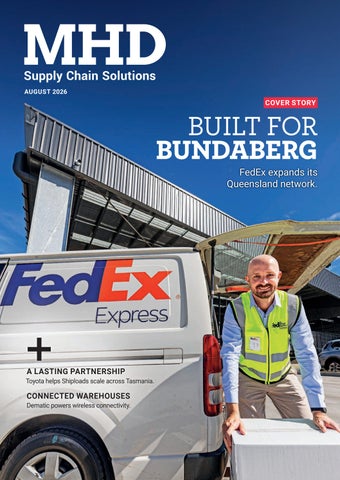
BUILT FOR BUNDABERG
FedEx expands its Queensland network.
A LASTING PARTNERSHIP
Toyota helps Shiploads scale across Tasmania.
CONNECTED WAREHOUSES
Dematic powers wireless connectivity.
Frosty Precision, Fiery Productivity Keeping Americold’s cold chain cool and connected.
As a global leader in temperature-controlled logistics, Americold understands the importance of keeping operations moving. Partnering with the Connected Workforce Solutions (CWSTM) division at Dematic, they modernised their cold chain operations in Australia, upgrading wireless connectivity, voice-picking systems, and RF devices. The transformation significantly boosted efficiency, accuracy, and productivity. Dematic’s robust solution included meticulous planning and mapping to ensure seamless WiFi coverage and device connectivity, maintaining smooth operations, even in sub-zero conditions. Learn more at dematic.com/americold
Scan to watch the video! Dematic.com 02 9486 5555 info.anz@dematic.com
EDITOR’S NOTE
MHD
Supply Chain Solutions CONTACT MHD Supply Chain Solutions is published by Prime Creative Media 379 Docklands Drive, Docklands VIC 3008 Telephone: (+61) 03 9690 8766 Website: www.primecreative.com.au
THE TEAM Chairman: John Murphy CEO: Christine Clancy Managing Editor: Mike Wheeler Editor: Phillip Hazell Business Development Manager: William Jenkin Design Production Manager: Clayton Hawley Graphic Designers: Danielle Harris, Jacqueline Buckmaster Client Success Manager: Justine Nardone
FOR ADVERTISING OPTIONS Contact: William Jenkin william.jenkin@primecreative.com.au
SUBSCRIBE Australian Subscription Rates (inc GST) 1yr (11 issues) for $99.00 2yrs (22 issues) for $179.00 To subscribe and to view other overseas rates visit: www.mhdsupplychain.com.au or Email: subscriptions@primecreative.com.au
ACKNOWLEDGEMENT MHD Supply Chain Solutions magazine is recognised by the Australian Supply Chain Institute, the Chartered Institute of Logistics and Transport Australia, the Supply Chain and Logistics Association of Australia and the Singapore Logistics and Supply Chain Management Society.
ARTICLES All articles submitted for publication become the property of the publisher. The Editor reserves the right to adjust any article to conform with the magazine format. COPYRIGHT MHD magazine is owned by Prime Creative Media. All material in MHD is copyright and no part may be reproduced or copied in any form or by any means (graphic, electronic or mechanical including information and retrieval systems) without written permission of the publisher. The Editor welcomes contributions but reserves the right to accept or reject any material. While every effort has been made to ensure the accuracy of information Prime Creative Media will not accept responsibility for errors or omissions or for any consequences arising from reliance on information published. The opinions expressed in MHD are not necessarily the opinions of, or endorsed by the publisher unless otherwise stated.
Building resilience before the next disruption
S
upply chain resilience is often discussed most urgently when disruption is already underway. Fuel prices rise, a key freight route closes or capacity becomes constrained, and businesses are forced to respond with the options immediately available to them. The stories in this issue show why resilience must instead be built well before the pressure arrives. Our latest MHD Supply Chain Podcast feature examines the lessons Australian businesses can draw from recent fuel disruption. Professor Vinh Thai of RMIT University argues that fuel risk should not be viewed solely as a transport issue. Its effects can quickly move through freight networks, manufacturing operations, warehouses, retailers and regional communities. The figures demonstrate the scale of that exposure. Fuel prices and availability negatively affected 72 per cent of Australian businesses, while half reported higher operating expenses. The message for supply chain leaders is clear: mapping dependencies, testing scenarios and preparing response plans cannot wait until the next crisis. Long-term investment in infrastructure is another important part of that preparation. Western Sydney continues to emerge as one of Australia’s most significant freight and logistics regions. Amazon’s agreement to purchase 17.2 hectares of land in Bradfield adds to a network in which the company says it has invested almost $2 billion since 2018. While the future use of the Bradfield site has not been confirmed, the acquisition further demonstrates the scale of investment being directed towards the region.
That growth is occurring alongside the development of Western Sydney International Airport and the continued expansion of Moorebank Intermodal. Prime Minister Anthony Albanese has positioned both projects as important parts of Australia’s future freight capability, economic growth and national resilience. Elsewhere, the rebuilding of the Great Western Highway crossing at Mitchells Causeway highlights the consequences when a critical transport connection is lost. The closure has affected communities, businesses and freight operators, reinforcing the importance of infrastructure that can withstand future pressure. Investment is also reshaping individual supply chains. Asahi Beverages’ planned automated distribution centre at Redbank will use robotics and a high-speed shuttle system to simplify its east coast warehousing and distribution network. It represents the type of coordinated, longterm investment increasingly required to improve capacity, efficiency and service. These projects differ in size, geography and purpose, but they share a common principle. Resilience is not created through one technology, facility or policy. It comes from understanding vulnerabilities, investing ahead of demand and ensuring supply chains have options when normal operations are disrupted. The next shock may look different from the last. The best-prepared businesses will be those that begin acting before it arrives. Happy reading! Phillip Hazell Editor, MHD Supply Chain Solutions
mhdsupplychain.com.au
3
DRIVENBY
INNOVATION
TRUSTED TOYOTA MANUFACTURING
INDUSTRY LEADING TECHNOLOGIES
ENERGY LEADING SOLUTIONS
For over 60 years Toyota has been at the forefront of the materials handling market. From our patented System of Active Stability™ safety technology, range of leading automation solutions, to our exclusive I_Site telematics system, our spirit of innovation drives our continuous improvement. We’re also proudly committed to a sustainable future with one of Australia’s most comprehensive range of zero operating emissions forklifts to power your business forward. To find out more contact your local Toyota Material Handling branch today.
PROUDLY DISTRIBUTED BY TOYOTA MATERIAL HANDLING
1800 425 438 toyotamaterialhandling.com.au
AUGUST 2026
THIS ISSUE 12
COVER STORY
12 FedEx expands its Queensland operations with Bundaberg Facility.
SUPPLY CHAIN 30 Flexco protects conveyor performance at vulnerable edges.
MATERIAL HANDLING 16 Toyota supports Shiploads’ decade of Tasmanian growth. 25 Adaptalift advances M3 Logistics’ electric fleet transition.
COVER STORY
WAREHOUSES 20 Dematic connects modern warehouses through resilient wireless infrastructure. 32 Production Reality balances automation cost and quality.
ASSOCIATIONS, EVENTS, SPECIAL FEATURES AND REGULARS 03 Ed’s Letter. 06 Industry News. 34 Amazon invests further into Western Sydney growth.
16
39 Fuel crisis exposes Australia’s
20
49 ASCLA.
supply-chain vulnerabilities. 44 MegaTrans 2026. 46 Bulk2026. MHD SUPPLY CHAIN SOLUTIONS
52 ASCI. 54 People on the Move.
AUGUST 2026
AUGUST 2026
BUILT FOR BUNDABERG
FedEx expands its Queensland network.
55 Product Showcase. 57 Strategic fleet strengthens supply-chain resilience.
ON THE COVER FedEx’s new Bundaberg facility combines energy-efficient design, natural lighting, automation and A LASTING PARTNERSHIP
BHD’S STATEMENT ON CANTILEVER RACK
WE WILL NOT BE BEATEN ON PRICE!
If you can provide evidence of a cheaper price, we will beat it by 5%. 130 0072 254
www.bhdstorage.com.au
Email: sales@bhdstorage.com.au
Toyota helps Shiploads scale across Tasmania.
CONNECTED WAREHOUSES
Dematic powers wireless connectivity.
streamlined freight flows to reduce energy use while strengthening reliable regional logistics across Queensland’s Wide Bay-Burnett region for businesses. mhdsupplychain.com.au
5
INDUSTRY NEWS
V
Volvo opens automated Sydney parts centre
olvo Group Australia has opened a new 21,000-square-metre parts distribution centre in Minto, doubling the size of its previous Sydney facility. The centre, officially opened on 9 July, replaces Volvo Group Australia’s original Minto site, which had supported its national operations since 1975. With capacity for 72,000 stock keeping units, the facility will store components for Volvo Group’s freight, public transport, marine and industrial customers, including traction batteries and parts for battery-electric vehicles. At the centre of the operation is a new automated storage and retrieval system, which Volvo says is the first of its kind across the group’s global network.
The high-density system automatically retrieves parts and delivers them directly to operators, while purpose-built cranes within the racking reduce the need for manual handling, walking and climbing. Volvo Group Australia President and CEO Martin Merrick says the technology will improve parts availability, reduce lead times and lift first-time fill rates. “Improving our teams’ work environment has been a key driver of this project,” he says. “We’ve made improving ergonomics a high priority, and equipment of this level of sophistication makes a massive difference to the working conditions of our people.” The centre also includes heightadjustable workbenches, anti-fatigue
matting and a fleet of materials handling equipment designed to improve operator safety and comfort. Built as a 5-Star Green Star facility, the site incorporates energy-efficiency measures and features intended to improve indoor environmental quality. The development forms part of Volvo Group’s investment of close to $400 million in Australia over the past 18 months across distribution, retail and operational capability. Volvo Trucks President Roger Alm says the centre will strengthen the company’s logistics network and support both current vehicles and future transport technologies. “It brings together safety, quality and efficiency to improve parts availability, enable faster service and enhance uptime,” he says. ■
L–R: Sandra Finér, Christopher Murphy, Roger Alm, Martin Merrick and NSW Industry and Trade Minister Anoulack Chanthivong. Image: Volvo Group Australia
6
INDUSTRY NEWS
W
Cargo trial flights begin at Western Sydney International Airport
estern Sydney International (Nancy-Bird Walton) Airport (WSI) has commenced cargo trial flights ahead of the opening of its dedicated Cargo Precinct later this month. The first Qantas A321 freighter was due to land at the airport on 13 July as part of the final phase of WSI’s operational readiness program, with additional trial flights scheduled over the coming fortnight before commercial freight operations begin on 26 July. WSI CEO Simon Hickey says the trials are designed to validate the airport’s systems, infrastructure and operational processes in a live environment. “Today we’ll welcome a Qantas A321 freighter to WSI as we continue to ramp up operational preparations and really bring this airport to life,” he says. “These trials are an integral part of ensuring that our systems, infrastructure and staff have been put through their paces in a live and controlled operating environment. Today’s flight will be followed by further
A Qantas Freight A321 conducts a cargo trial at Western Sydney International Airport ahead of commercial freight operations beginning on 26 July. Image: Western Sydney International Airport
8
trials over the following fortnight as we make our final preparations for commercial freight services.” When operations commence, Qantas Freight will be joined at the Cargo Precinct by Menzies Aviation, dnata Cargo and Texel Air. According to Simon, the precinct has been designed using the latest technologies available to Australia’s first greenfield international airport in more than 50 years. “We’ve utilised the latest technology and innovations to deliver a highly efficient, sustainable, and futureproofed Cargo Precinct. Our trials present an excellent opportunity to test these capabilities,” he says. Acting Minister for Transport Kristy McBain says the arrival of the Qantas freighter marks an important milestone ahead of the airport’s opening. “This is the largest plane to land at Western Sydney International Airport so far, as we get ready to open for freight services,” she says. “The new airport will connect
Western Sydney to the world, allowing us to move produce and goods from every corner of the state to new markets across the globe.” Qantas Freight Executive Manager Igor Kwiatkowski says the airport will strengthen the carrier’s freight network as demand for air cargo continues to grow. “In just a few weeks, this new 24-hour facility will provide greater flexibility for our freight network, helping us meet growing demand for e-commerce and next-day deliveries,” he says. “The airport will increase Sydney’s air cargo capacity helping us to move time-critical supplies around Australia and overseas in the months ahead.” Once operational, WSI’s Cargo Precinct is expected to support the movement of up to 220,000 tonnes of freight annually. The facility has dedicated access via The Northern Road and is located close to freight and logistics hubs at Kemps Creek and industrial developments across the Western Sydney Aerotropolis. ■
INDUSTRY NEWS
T
Great Western Highway contractor named after months of disruption
he Great Western Highway at Victoria Pass is set for a major rebuild after months of disruption for local communities, businesses and freight operators, with Seymour Whyte appointed to deliver a new crossing at Mitchells Causeway. Major construction is expected to begin in July, with the road scheduled to reopen in the second quarter of next year. The route has been closed since serious defects were identified at Mitchells Causeway, cutting a key link between the Blue Mountains and Central West and placing pressure on detour routes. Following geotechnical investigations and an accelerated procurement process, Seymour Whyte has been selected to construct a new bridge structure over the existing Mitchells
Causeway. The structure will be supported by deep piles anchored into stable bedrock, while the convict-built causeway beneath it will be stabilised as part of the works. The NSW Government says the design will restore the connection while improving long-term resilience. The new crossing will also be capable of accommodating an additional lane in the future, which was not possible under the existing roadway. Minister for Roads Jenny Aitchison says the closure has been difficult for families, businesses, freight
a new crossing designed to serve local communities and freight for the next 100 years,” she says. The announcement comes alongside an expanded $20 million support package for small businesses affected by the closure. Grants for businesses experiencing financial hardship in Mount Victoria, Hartley, Little Hartley and Hartley Vale will increase from $10,000 to up to $25,000. Support will also be expanded to eligible businesses in Lithgow, Oberon and Blackheath, with grants of up to $10,000 available.
operators and daily road users, but the Government would not pursue a temporary repair. “The NSW Government will not apply a band-aid fix. We are building
Transport for NSW will continue public transport uplifts, including extra rail, coach and bus services, while work continues on the crossing and detour routes. ■
The Great Western Highway at Victoria Pass is set for a major rebuild, with Seymour Whyte appointed to deliver a new crossing at Mitchells Causeway. Image: Phillip Wittke/stock.adobe.com
mhdsupplychain.com.au
9
INDUSTRY NEWS
G
Goodman to deliver new Asahi distribution centre at Redbank
oodman will develop a new 48,500 sqm distribution facility for Asahi Beverages at Redbank Motorway Estate in south-east Queensland. The facility will support Asahi’s supply chain transformation and use advanced technology, including a highspeed shuttle system and robotics, to distribute the company’s alcohol and non-alcohol beverage range. Located within one of Queensland’s major logistics precincts, the site will provide direct access to key freight routes and support distribution across south-east Queensland, the rest of the state and beyond. Adrian Benson, Chief Supply Chain Officer at Asahi Beverages, says the investment highlights the company’s long-term commitment to Queensland. “More than 97 per cent of the beverages we sell in Australia are made by us in Australia and the investment in the new Redbank distribution centre further highlights our long-term commitment to Queensland,” Adrian says. “The development will help Asahi simplify our warehousing and distribution network along
Australia’s east coast while delivering sustainability benefits via more efficient distribution routes. “The investment means more customers can receive our full range of alcohol and non-alcohol beverages more efficiently with one order, one payment and delivery on one truck.” Asahi says the new distribution centre will not affect its manufacturing operations. Goodman Australia CEO Jason Little says the site will support Asahi’s growth and service capability across Queensland. “We’re pleased to welcome Asahi as a new, long-term customer to Redbank Motorway Estate,” Jason says. “This site offers outstanding automation and logistics connectivity, providing the essential infrastructure needed to support Asahi’s growth and service across Queensland.” Supply chain specialists, TMX Transform, supported with network design, property procurement and project management. “We’re proud to be supporting Asahi Beverages on this significant investment, bringing together our capabilities across network design, property procurement and project
delivery,” says Adam McDonald, Global Director TMX Transform. “Redbank is the second in a threesite national program, and seeing that kind of long-term, coordinated commitment to infrastructure is increasingly what separates the bestperforming supply chains.” The facility is targeting a 5 Star Green Star rating and will include a 1MW solar system, native landscaping and 50,000L of rainwater collection tanks for reuse in irrigation and amenities. McNab has been appointed as builder, with the project expected to create around 300 full-time jobs during construction. Following the build, a 12-month automation fit-out and commissioning process will take place, with the facility expected to be fully operational by 2028. The project adds to Redbank Motorway Estate’s growing logistics base, which includes facilities for Australia Post, FedEx, Visy, Coles and Cosentino, with Officeworks’ 77,100 sqm automated omnichannel distribution centre also under construction. ■ Goodman will develop a new 48,500 sqm automated distribution centre for Asahi Beverages at Redbank Motorway Estate in Queensland. Image: Goodman
10
ERE M SERIES Electric ride-on pallet truck Ready for every pallet.
The ERE M20/M25 delivers efficient load handling, operator comfort and maximum uptime. Powerful all-rounder for medium and long distance
Superior manoeuvrability even in tight spaces
Intelligent assistance systems with curveCONTROL and warning signals
Powerful Lead-Acid or Lithium-Ion technology with built in charger
Ergonomic design with adjustable tiller height and SmartPILOT control
Robust steel chassis for demanding applications
LEARN MORE
131 687 www.jungheinrich.com.au
COVER STORY
FedEx builds efficiency into Bundaberg hub The new FedEx Bundaberg logistics facility combines automation, energy-conscious design and more direct regional freight connections. The development is now under consideration for Australia’s Most Sustainable Warehouse Award, to be presented at MegaTrans 2026.
F
edEx has opened a new purposebuilt logistics facility in Bundaberg, Queensland, designed to strengthen regional freight capacity while improving the efficiency of how packages move through the network. The 5962-square-metre facility is located near Bundaberg Airport and the region’s growing industrial precinct, providing businesses across Bundaberg and surrounding communities, including Gin Gin, Childers and Biggenden,
FedEx’s new 5962-square-metre Bundaberg facility is designed to improve regional freight capacity, operational efficiency and connectivity across the Wide Bay region. Images: FedEx
12
with closer access to domestic and international freight services. Its combination of automation, energy-efficient building features and streamlined freight movements has also earned the facility a place in MHD’s Australia’s Most Sustainable Warehouse column. Every facility featured in the column is automatically considered for Australia’s Most Sustainable Warehouse Award, which will be presented at MegaTrans 2026.
Vice President of FedEx Australasia, Peter Langley, says the development was planned with operational efficiency and reduced energy use in mind. “The new regional facility was designed with both operational efficiency and reduced energy consumption in mind,” Peter says. “The site features energy-efficient LED lighting and natural skylights.” The facility also includes weatherprotected freight handling areas,
COVER STORY
which support more consistent operations during poor conditions while creating a safer and more comfortable environment for employees. Its broader layout has been arranged to streamline freight flow and reduce unnecessary handling as packages move through the site. Peter says these practical design decisions support FedEx Corporation’s goal of achieving carbon-neutral operations across its global business lines by 2040. “Every new network investment gives us an opportunity to build greater efficiency into our network,” he says. “The new Bundaberg site incorporates practical design features that improve how freight moves through the facility while helping reduce overall facility energy use.”
FedEx Queensland Senior Operations Manager Andrew Martland at the new Bundaberg facility.
The new regional facility was designed with both operational efficiency and reduced energy consumption in mind
“These investments help support our parent company, FedEx Corporation’s, goal of achieving carbon-neutral operations across its global business lines by 2040 and demonstrate how we’re embedding network efficiency into the way we grow our network.” Automation forms a central part of the facility’s operations. Its automated conveyor system can sort up to 1500 packages an hour, reducing sorting time by up to 30 per cent, while a telescopic conveyor improves loading and unloading efficiency and reduces manual handling. Peter says the systems increase throughput, reduce unnecessary package touches and help the team process freight more safely and consistently, particularly during peak periods. mhdsupplychain.com.au
13
COVER STORY
businesses. “By strategically positioning this infrastructure investment close to Bundaberg Airport and the region’s growing industrial precinct, we’re able to improve connectivity for businesses across Bundaberg and surrounding communities,” Peter says. FedEx has also streamlined its Brisbane-to-Bundaberg linehaul routes. Peter says the changes provide more direct freight movements, reduce unnecessary handling between network touchpoints and improve schedule
The facility also includes dedicated trailer zones and a large weatherprotected awning where heavyweight freight can be staged away from the elements. Together with the conveyors, these features are intended to improve the continuity of freight movements from arrival through to dispatch. Location is another important part of the site’s efficiency proposition. Its proximity to Bundaberg Airport and the industrial precinct places freight capability closer to many of the region’s producers, manufacturers and small
14
reliability and network resilience. Improved vehicle turnaround times are expected to help FedEx optimise the use of its transport assets and move freight more predictably through the supply chain. While FedEx has not attributed a specific emissions reduction to the revised routes, it says the focus on fewer inefficiencies and better asset utilisation forms part of building a smarter regional network. The site has also been designed with future network changes
in mind. Peter says it provides flexibility for further enhancements as transport technology and operational requirements evolve, including electrification where it aligns with the needs and performance of the network. For the Wide Bay-Burnett region, the investment is intended to support industries including agriculture, fresh produce, seafood, manufacturing and e-commerce. These sectors depend not only on speed, but also on reliable and predictable transport for time-sensitive or high-value shipments.
COVER STORY
Bundaberg Mayor Helen Blackburn and FedEx Queensland Senior Operations Manager Andrew Martland inspect the facility’s automated conveyor system.
By strategically positioning this infrastructure investment close to Bundaberg Airport and the region’s growing industrial precinct, we’re able to improve connectivity for businesses across Bundaberg and surrounding communities
Aletek Advanced Exhaust Technologies Warehouse Manager James Rains says closer access to FedEx services will strengthen the reliability of the company’s supply chain. “Improved proximity and access to FedEx services will drive efficiencies in our freight operations and strengthen the reliability of our supply chain, helping us better serve both domestic and international markets,” James says. Bundaberg Region Mayor Helen Blackburn attended the official opening
alongside Natural Resources and Environment portfolio spokesperson Councillor Gary Kirk, FedEx representatives and customers. “This direct infrastructure investment into the Bundaberg region will strengthen supply chain capability, support local employment and create new economic opportunities for not only our community but the greater Wide Bay area,” Helen says. Peter says investments outside major metropolitan centres can reduce network complexity and improve resilience by placing capability closer to regional customers. “The Bundaberg operation strengthens supply chain capability across the Wide Bay region while helping to support local employment and long-term economic growth,” he says. The facility demonstrates an approach to sustainability centred on the combined effect of building design, automation, freight flow and network planning. Its consideration for Australia’s Most Sustainable Warehouse Award will assess how those measures contribute to a more efficient, resilient and lower-impact logistics operation. ■ FedEx team members, customers and community representatives celebrate the official opening of the Bundaberg facility.
“Consistency is just as important as speed,” Peter says. “Reliable freight connections, efficient supply chains and greater network visibility can help businesses better manage timesensitive shipments, maintain product quality and reduce the risk of delays across the supply chain.” The facility includes an on-site small business shipping hub, giving local operators access to shipping services, documentation support and customs processing without needing to travel to a metropolitan facility. mhdsupplychain.com.au
15
MATERIAL HANDLING
Shiploads and Toyota Forklifts delivering a decade of value and growth Shiploads’ decade-long partnership with Toyota Material Handling Australia has supported the retailer’s growth, fleet expansion and warehouse operations across Tasmania.
T
en years ago, ambitious Tasmanian discount retail chain Shiploads took bulk delivery of 15 Toyota Material Handling Australia (TMHA) forklifts/walkie stackers and electric pallet jacks to support its fastgrowing distribution network. The mass purchase suited Shiploads’ philosophy of achieving “extreme value” on behalf of its many customers. The model has proven effective, with Shiploads building a strong presence
16
in Tasmania by sourcing competitively and offering value to customers. “The population of Tasmania is 575,000, and at some stage every one of them has visited one of our stores,” Dan Bryan, Head of Retail Operations, explains. Shiploads now have twelve thriving stores across the state, offering core products from homeware to gardening implements, as well as a constantly changing range of special offers bought
opportunistically anywhere in the world. Its central warehouse capacity has more than doubled to meet demand, and its material-handling fleet has grown to 35. At the beginning of this financial year, the first of its fleet was replaced. Shiploads took delivery of three new Toyota 1.8-tonne 8FBE18 three-wheel battery-electric forklifts, replacing three of the original machines.
MATERIAL HANDLING
Shiploads Head of Retail Operations Dan Bryan with two of the company’s Toyota 1.8tonne battery-electric forklifts.
Shiploads has effectively outsourced control of its fleet management to national distributor TMHA, which established its own footprint in Tasmania shortly after the Shiploads start-up. “All 35 machines are covered under a long-term rental agreement,” Dan says. “It provides us with assurance of machine capability and the security of a fixed annual budget allocation.” It’s been a mutually beneficial partnership. TMHA’s Area Sales Manager, Hobart/Southern Region, Tim French, rates Shiploads as one of his
largest Tasmanian clients and highly regards the company for its adherence to strict policies of cost containment and social responsibility. “All 35 machines are battery electric,” Tim says. “That’s not only environmentally accountable, but it makes sound operational sense when you consider Tasmania’s hydroelectricity network delivers lower energy costs than the mainland.” Four forklifts work within the central warehouse; the others are employed in the stores. They’re part of a companywide adoption of ecologically sensible initiatives like switching to LED lighting and giving customers free cardboard boxes in which products arrive, rather than sending them to waste. Dan and Tim, both long-serving members of their respective companies, work closely together to manage the fleet and support the logistics planning behind Shiploads’ expansion. The three new 8FBE18 three-wheel forklifts are a good example. “The dramatically reduced turning circle of the new machines made a lot of sense in order to support a new warehouse racking system we’re planning,” Dan says. “We were initially wary of three wheels instead of four. “Tim provided us with ample demonstration of their advantages in our soon-to-be new warehouse configuration, including test time for our operators. Shiploads will soon expand capacity
A Shiploads operator transports palletised stock through the company’s central warehouse using a Toyota 8FBE18 three-wheel battery-electric forklift.
mhdsupplychain.com.au
17
MATERIAL HANDLING
within its 2,300-square-metre central warehouse in Cambridge, Hobart, reducing aisle width from its current three metres and requiring new picking solutions. The new three-wheelers deliver a 13 per cent improvement in turning capability, helping to improve operational efficiency. “Tim personally delivered the new machines and provided operator training,” Dan says. “More than that, he’s our go-to person for all matters of machine function on our fleet. “Our people listen to him. By following his advice we’ve never had a battery failure, and we’ve never had a piece of equipment fail on the job.” Shiploads employ 300 staff within a framework that prioritises work-life balance.
Shiploads’ Toyota battery-electric forklifts operate within the company’s central warehouse in Cambridge, Hobart. Images: TMHA
18
“The warehouse works seven till three and the shops shut promptly at 5.45 pm,” Dan says. “It’s one of the reasons I work here. Work-life balance is important.” The company actively supports its communities with an after-school student employment program that provides teenagers with paid work. And its employment policy has no upper age limit. “We have an 80-year-old on staff, age is just a number,” Dan says. “We employ on mojo. If a person’s values, genuine, passionate, customer-obsessed, match ours, then that’s the fit we’re seeking.” It’s one of the reasons the connection with TMHA, its only material-handling partner, is so successful.
“We rely on them for good advice, and because of them it’s definitely one area of the business that doesn’t require my daily attention,” Dan says. Shiploads’ other business covenant is “fun.” It aims to be a happy place to work and visit. In keeping with its nautical theme, it answers its phone with “Ahoy,” and its employees are given ranks, from Admiral (CEO) through Captain (store managers) to crew. Dan Bryan is in charge of Back-of-Ship operations. The company’s business name holds the promise of a wide variety of products on sale, but its website warns: “Don’t mispronounce us.” ■ For more information freecall 1800 428 438 or visit online at www.toyotamaterialhandling.com.au
Technology doesn’t build great cold chain operations.
Integration does. Cold chain facilities demand careful planning, seamless integration and technologies that work together from goods receipt to dispatch. Toyota Automated Logistics integrates high-density storage, material handling, robotics and warehouse software into a single, intelligent logistics ecosystem. Combining the global expertise of Vanderlande, viastore and Bastian Solutions with the trusted strength of Toyota, we help customers reduce complexity, improve performance and build warehouses ready for tomorrow. For every challenge a reliable solution.
High Density Storage
Order Fulfilment
toyota-automated-logistics.com
Material Flow
Digital Warehouse
WAREHOUSES
The invisible infrastructure powering the modern warehouse By Lee Koutsos, Director Connected Workforce Solutions & Storage Equipment Division, Dematic As automation, AI and connected devices become embedded in warehouse operations, Dematic explains why a robust wireless network is critical to supporting productivity, visibility and future growth.
W
arehouse operators are investing more than ever in technologies designed to improve productivity, visibility and operational efficiency. According to IMARC Group, Australia’s logistics automation market is forecast to grow from USD 1.65 billion in 2024 to over USD 4 billion by 2033. That investment is showing up on the floor of modern
20
distribution centres, where automatic guided vehicles (AGVs), autonomous mobile robots (AMRs), voice-directed workflows, handheld devices, IoT sensors and AI-powered analytics are becoming part of everyday operations. But none of these technologies work in isolation. For them to deliver their full value, they must be able to communicate with each other
seamlessly. A reliable wireless local area network (WLAN) enables that connectivity, allowing information to move continuously between the warehouse floor, warehouse management systems (WMS), analytics platforms and other business-critical applications. Without a robust wireless network, every digital investment sitting above
WAREHOUSES
it is compromised. If connectivity is interrupted, delayed or unreliable, the impact can quickly be felt across the entire operation. As organisations continue to modernise their warehouses and plan for future growth, it is critical that WLAN is considered alongside automation, software and robotics from the earliest stages of warehouse design.
Building the right foundation Like constructing a building, every connected warehouse depends on a strong foundation. Before inventory can be updated, an AGV or AMR can receive its next instruction or AI can analyse warehouse performance, information must first travel across the wireless network. WLAN provides the communications foundation that connects people, devices and systems, allowing information to move reliably throughout the operation.
Lee Koutsos, Director Connected Workforce Solutions & Storage Equipment Division, Dematic. Images: Dematic When the WLAN is disrupted, the effects are immediate and far-reaching. AGVs and AMRs lose connectivity and stop in the aisle. One stalled AMR robot is capable of delaying an entire picking operation. Scanners and voice headsets drop out, forcing workers back to manual processes while missing data has to be reconciled later. Sensors monitoring temperature or equipment performance stop reporting, reducing visibility just when it’s needed most. Because warehouse operations are highly interconnected, a disruption at picking can quickly ripple through packing, dispatch and, ultimately, the delivery promises made to customers. This is why the success of warehouse modernisation increasingly depends on infrastructure that is rarely seen. Organisations can invest heavily in automation, software and connected technologies, but without a WLAN designed to support those systems, those investments may never deliver their full operational value.
Warehouse WLAN requires a different approach
Connected devices provide warehouse teams with real-time operational data, supporting greater visibility and faster issue resolution.
Unlike office environments, warehouses present unique challenges for wireless networking. As WLAN relies on radio frequency (RF) signals to transmit data, the physical warehouse environment plays a key role in network performance. Steel racking, moving forklifts, changing inventory profiles, temperature-controlled environments
and expansive facilities can all affect how those wireless signals travel throughout a facility. Cold storage facilities are a good example. Metal racking, dense product stacks and freezer environments can significantly reduce signal quality if the network hasn’t been designed specifically for those conditions. This makes access point placement, antenna selection and RF planning critical to maintaining reliable coverage across the warehouse. Dematic worked with Americold to design and deploy a WLAN across its distribution centres, where cold storage conditions presented particularly complex wireless challenges. By carefully planning access point locations, selecting industrial-grade hardware and optimising antenna placement, the network was able to provide reliable connectivity throughout the facility, including freezer environments where signal interference is often greatest. Designing a warehouse WLAN is therefore about much more than eliminating coverage gaps. Organisations must consider network capacity, seamless roaming, resilience and the ability to support increasing device density as operations evolve.
More connectivity means more data The rapid growth in connected technologies is changing not only the demands placed on warehouse WLAN, but also the value of the information it carries. Where organisations previously relied on periodic WMS reports generated at the end of a shift, today’s wireless networks support continuous streams of operational data from handheld devices, automation, real-time location systems (RTLS), IoT sensors and connected equipment. Device telemetry, battery health metrics, network roaming information and operational events all contribute to a richer, realtime understanding of warehouse performance. Most warehouses already have access to vast amounts of data. The challenge is combining information from the WMS, wireless network and connected mhdsupplychain.com.au
21
WAREHOUSES
Dematic automated guided vehicles rely on robust wireless connectivity to receive instructions and operate continuously across the warehouse.
C
M
Y
devices to build a complete picture of warehouse operations. Traditionally, these datasets have existed in separate systems. Operational data sits within the WMS, network performance is managed by IT, while device health is monitored through mobile device management platforms. Identifying the root cause of an issue has often required manual investigation across multiple teams and technologies. The next evolution of warehouse connectivity is making it easier to integrate these previously separate sources of information. Enterprise networking platforms can provide visibility into RF congestion, network performance and client connectivity, while mobile device management platforms monitor device health and connection quality. At the operational level, Dematic’s Connected Workforce Platform (CWP) provides supervisors with visibility across workflows involving handheld devices, voice solutions, wearables and AMRs. Rather than viewing these as separate systems, organisations are increasingly combining network, device and operational intelligence to create a more complete understanding of warehouse performance.
22
AI is making warehouse connectivity smarter
Designing WLAN for future growth
as it grows. Specialist RF design, predictive modelling, implementation, commissioning and ongoing optimisation all play a role in ensuring the network continues to perform as operational requirements change. This is the approach taken by Dematic’s Connected Workforce Solutions (CWS), supporting organisations from the initial design phase through implementation and ongoing optimisation to deliver wireless networks that can grow alongside the business. Warehouse technology will continue to advance, but every new investment in automation, AI and connected devices will rely on the same foundation – a well-designed wireless network. Considering WLAN as part of the broader warehouse design process helps organisations support future technologies, adapt to changing operational requirements and maximise the value of their technology investments. ■
As warehouse operations continue to evolve, the wireless infrastructure supporting them should evolve in parallel. Planning a warehouse WLAN starts with understanding current operational requirements and anticipated future needs, helping ensure the network can support the business
To learn more about Dematic’s Connected Workforce Solutions and its approach to warehouse WLAN design, implementation and support, visit https://www.dematic.com/en-au/ solutions/connected-workforcesolutions/
As these technologies become more integrated, AI is transforming how organisations manage warehouse connectivity. Rather than simply reporting that productivity has declined, AI can increasingly correlate operational performance with network conditions, device health and workforce activity to identify the likely cause. For example, a reduction in pick rates, may not always indicate a workforce issue. It could be the result of wireless congestion in a particular warehouse zone, deteriorating device batteries or roaming issues affecting mobile workers. Having visibility across these different data sources helps organisations identify the underlying cause more quickly and resolve issues before they escalate.
CM
MY
CY
CMY
K
Australia MHD Ads 20260714.pdf 1 2026/7/14 15:57:59
C
M
Y
CM
MY
CY
CMY
K
Intralogistics Automation & Robotics
Automation Innovation your way Tailored solutions for your business success
PALLET AS/RS
TOTE AS/RS ROBOTICS AMR’S VLM/VRC’s WMS/WCS
Production Reality advances productivity through innovative warehouse automation and robotics—delivering smarter, more efficient fulfilment. Custom-engineered in Australia for your operation to boost throughput, reduce costs, and scale with confidence.
productionreality.com.au
Australian Owned & Operated Guaranteed AS4024 Safety Compliant
MATERIAL HANDLING
L–R: Vince Tassone, General Manager – Corporate Sales, Adaptalift; Saby Bhattacharya, Managing Director, M3 Logistics; and Adam Duncan, General Manager – Sales, Adaptalift.
Adaptalift supports M3 Logistics with national electric fleet transition Adaptalift’s work with M3 Logistics highlights how a national materials handling fleet transition can support safety, flexibility and long-term operational growth.
W
hen M3 Logistics began reviewing its national materials handling fleet, the objective was not simply to replace ageing equipment. The business wanted to transition away from LPG forklifts, improve safety and operator comfort, and introduce a fleet flexible enough to support changing requirements across its national footprint. For Adaptalift, the project required more than supplying forklifts. It involved an extended tender, equipment and battery trials, consultation with operators and stakeholders, and a rollout designed around M3 Logistics’ operational needs.
Blake Russell, Corporate Sales Executive at Adaptalift, led the tender from its early stages through to contract execution and implementation. “I led the tender from start to finish until we executed the contract, and then handled the implementation and rollout of the new fleet as well,” Blake says.
A data-led selection process The tender began in April 2024 and extended through to September 2025. During that period, M3 Logistics underwent a change of ownership, adding complexity to the process and requiring elements of the proposed
solution to be revisited with new stakeholders. Blake says Adaptalift remained engaged through demonstrations, trials and requests for technical information, while allowing the customer time to complete its detailed internal review. “It was like we did a mini tender once the new ownership came on board,” Blake says. “We had to do trials again and get the new owners and all the key stakeholders back on board with the proposed solution.” Saby Bhattacharya, Managing Director, M3 Logistics, says Adaptalift was already an established materials handling partner and was closely mhdsupplychain.com.au
25
MATERIAL HANDLING
aligned with the company’s objective of moving to a fully electric fleet. “We have really invested in sustainable solutions, whether that is electric materials handling equipment or waste management,” Saby says. “Adaptalift continued to support us in a very collaborative manner, and hence it was our partner of choice for this refresh.” For M3 Logistics, the decision was grounded in operational evidence rather than brand perception or assumptions. The business collected data throughout the trial process to establish the functional and commercial case for the selected equipment. “We are very data driven. We do not go by hunches or perceptions,” Saby says. “We ran a data-driven process to establish the business case, and Adaptalift readily participated in and facilitated that data collection exercise.” He says the final decision was based on concrete data and evidence, supported by Adaptalift’s willingness to provide information and modify the equipment where required. “The data will tell the story, and M3 Logistics’ new Hyster fleet supports the company’s transition from LPG to electric materials handling equipment. Images: Adaptalift
26
commercials come later,” Saby says. “First is functional fit, and Adaptalift was very flexible. It worked with us to ensure the equipment was fit for purpose by making changes as needed.”
Transitioning from LPG to lithium-ion M3 Logistics’ existing fleet was made up largely of LPG counterbalance units, alongside some electric reach trucks. According to Blake, approximately 80 to 85 per cent of the operation was supported by LPG counterbalance forklifts. The fleet renewal created an opportunity to evaluate electric alternatives, including lead acid and lithium-ion batteries. Adaptalift trialled both options before determining, together with M3 Logistics, that lithium-ion was the stronger fit for the company’s operating environment. Blake says the decision was influenced by charging flexibility, maintenance requirements and the variable nature of warehouse demands. For a business managing fluctuating volumes, the ability to opportunity
charge lithium-ion equipment provides a practical way to protect uptime during busier-than-expected periods. “You can fast charge lithium, and it gives you a lot more uptime,” Blake says. “It is a lot more suitable for M3 Logistics’ operations.” The electric fleet is being deployed across M3 Logistics’ network, with equipment supporting day-to-day tasks such as container unloading, pallet put-away, pallet picking, stock transfer and outbound loading. A key feature of the fleet are Bolzoni White Goods clamps which are used to handle a range of products. “They unload containers with product coming in from their customers, then store it in the relevant sections inside the warehouse,” Blake says. “When they receive a customer order, they pick it, prepare it and load it for outbound transport.”
Operator-led equipment trials M3 Logistics placed strong emphasis on operator feedback before selecting the final forklift model. Experienced operators in Sydney and Melbourne
MATERIAL HANDLING
tested multiple units during the tender process, with comfort and usability assessed alongside operational performance. Saby says the final model was selected by the people who would use the equipment each day, rather than by management alone. “The final choice of the model was actually their choice, not management’s choice,” he says. “Small things such as the size of the drink bottle holder, the armrest, the comfort of the seat and how the operator sat in it were scored.” Adaptalift proposed two potential models, which were trialled side by side over the course of a week. Blake says the preferred unit provided the familiarity operators wanted while supporting the shift from LPG to electric power. “The unanimous feedback was that the Hyster J2.5 UT series was the most comfortable,” Blake says. “It felt more like an LPG forklift, and even though it was electric, it did not create a perception that the unit lacked power.” M3 Logistics then introduced
A Hyster reach truck operates within M3 Logistics’ warehouse as part of the company’s national fleet renewal.
the new forklift fleet progressively according to a rollout schedule, with operator training included to account for the unique characteristics of electric equipment.
Safety, visibility and fleet flexibility The new fleet has been fitted with a range of safety features. A fleet management system records usage, supports pre-start and post-start checks, monitors operating data and helps prevent unauthorised use. Blake says the fleet management
system operates through M3 Logistics’ Wi-Fi network and not a cellular connection. The fleet also includes red zone lights and blue safety lights to improve pedestrian awareness, along with automatic park brakes designed to bring a unit to a controlled stop when the operator disengages. “They feel very comfortable and safe with the new fleet,” Blake says. Adaptalift also adjusted fleet configurations as M3 Logistics’ operating profile changed during the mhdsupplychain.com.au
27
MATERIAL HANDLING
Adaptalift and M3 Logistics personnel inspect a Hyster reach truck following the rollout of the new electric fleet.
project. When a greater proportion of goods began arriving palletised, some clamps were removed. “M3 did not need as many clamps as they originally ordered,” Blake says. “We took the clamps off the trucks and converted them into normal forklifts for them.” That flexibility reflects what Saby describes as one of the central strengths of the relationship: Adaptalift’s willingness to listen and respond to M3 Logistics’ requirements. “It is the service and the offer,” Saby says. “Adaptalift provides multiple options, has been at the forefront of new technologies and has always been responsive to our needs. It also listens.”
28
A platform for further automation Adaptalift supports the fleet under a fully maintained rental model, with scheduled servicing and breakdown support included. While Adaptalift Connect allows M3 Logistics to lodge service requests and manage its fleet online. Looking ahead, the partnership is expected to extend beyond the current fleet transition. M3 Logistics plans to assess autonomous and semi-autonomous materials handling equipment as part of its broader focus on warehouse efficiency and risk reduction. “We want to move into further efficiency improvements,” Saby says. “The whole idea is to improve warehouse efficiency and reduce the risk inherent in operating a physical facility at scale through interlinked automation.” He says M3 Logistics intends to trial
intelligent materials handling equipment within the financial year, assessing the technology against practical operating requirements. “We are talking about autonomous and semi-autonomous materials handling equipment,” Saby says. “If solutions can reduce safety risk and improve efficiency, then we will certainly be looking at them.” For Adaptalift, the project demonstrates how a fleet replacement can develop into a broader operational partnership when the supplier remains involved from tender and trials through to implementation, service and future technology planning. “They see us as their materials handling equipment provider for whatever they do,” Blake says. ■
AN EVENING NOT TO BE MISSED AUSTRALASIA’S MOST PRESTIGIOUS SUPPLY CHAIN & LOGISTICS AWARDS
More than an Awards Night Join industry leaders from across Australasia as we celebrate excellence, innovation and achievement throughout the supply chain and logistics sector.
>> Friday 23 October, Brisbane Town Hall >> 500 Attendees >> 12 Award Categories >> Entertainment >> Keynote Speaker >> Special Guest MC >> 3-Course Dinner & Premium Drinks Package SECURE TICKETS
LOOKING FOR PREMIUM BRAND EXPOSURE? SPONSORSHIP AVAILABLE
Gain premium exposure to industry decision-makers while supporting the recognition of excellence, innovation and achievement across the sector. Sponsors receive premium brand exposure while helping recognise and celebrate excellence across the sector.
SUPPLY CHAIN
Flexco’s Belt Edge Protector segments and link plate are assembled to create a barrier around the conveyor belt edge. Images: Flexco
Protecting the edge of conveyor performance Flexco Sales Manager Aaron Alzoubi explains how the Belt Edge Protector helps logistics operators prevent parcel impacts, belt-edge wear and costly conveyor downtime at transfer points.
F
lexco’s Belt Edge Protector is designed to stop parcels, mistracking belts and conveyor structures from damaging one of the most vulnerable parts of a light-duty conveyor system. A damaged conveyor belt rarely begins as a major failure. It may start with a parcel catching a transfer point, a soft package slipping beneath the belt or the belt repeatedly rubbing against the side of the conveyor structure. The initial damage can appear minor. Over time, however, continued contact can fray the belt edge, weaken the belt and eventually cause it to tear. In a busy parcel, postal or distribution operation, the resulting shutdown can affect far more than the cost of replacing the belt.
30
Flexco developed its Belt Edge Protector to provide a physical barrier between the belt edge and the objects or structures that can damage it. Aaron Alzoubi, Sales Manager at Flexco, says the product was developed in response to a problem regularly seen at conveyor transfer points in logistics facilities. “At transfer points, you can have one conveyor travelling in one direction and feeding onto a main belt travelling in another direction,” Aaron says. “A package can hit the edge of that main belt, or something such as a jiffy bag can slip underneath it. Sometimes the belt is also mistracking and hitting the wall of the conveyor. Over time, that contact starts wearing the belt along the edge.”
The Belt Edge Protector is bolted to the side wall of the conveyor and positioned over the belt edge. The belt continues to travel underneath the protector, while parcels and other objects are prevented from making direct contact with the exposed edge. Aaron compares the arrangement to a protective case around a mobile phone. “When a phone is dropped, the edges are often where the damage happens,” he says. “You put a case around it to protect those vulnerable areas. The Belt Edge Protector works on a similar principle. It guards the edge while allowing the belt to continue running underneath.” The product is intended for lightduty conveyor applications, particularly
SUPPLY CHAIN
parcel handling, postal processing, airport baggage, fulfilment and distribution environments. These operations often use multiple conveyors feeding into sortation lines, creating junctions where items can strike or become trapped around the main belt. The range includes straight and curved configurations. The straight protector can be fitted along conventional conveyor sections, while the curved model addresses areas where a belt changes direction and packages may be pushed towards the outside of a bend. Aaron says the curved version was developed after Flexco observed that products could strike both the conveyor wall and the belt edge while travelling around powered curves. “In a logistics site, you do not only have straight conveyors,” he says. “You have bends and powered turns. If a parcel hits the wall as it moves around the curve, it can also make contact with the belt. That led to the second design.” The product’s development began after an issue was identified within Amazon’s US fulfilment and sortation network. Flexco reviewed footage of the affected conveyors, examined the transfer points and worked with the customer to understand how products were reaching the belt edge. Its engineering team then developed prototypes that could be tested on conveyors before being trialled in operational conditions. The design was revised through
several stages, including changes to its height and width, to ensure it could be fitted across different conveyor arrangements. “You are not going to make one prototype and have it fit every application immediately,” Aaron says. “We changed dimensions and looked at what else needed to be included so it could work at multiple locations. Flexco also has a conveyor available for testing, so we could install the prototypes and see how they performed before releasing the final product.” The development and trial process took place over an extended period rather than through a single installation. Flexco sought to produce a standardised system that could be fitted to different sites without requiring a completely new design for every conveyor. Installation kits include gauges and templates to help maintenance teams determine where the protector should sit in relation to the belt. The components are positioned so the belt has sufficient clearance to run underneath while the exposed edge remains covered. The protector can be installed at known problem areas, including merges, transfer points and curves, or added more broadly as part of a preventative maintenance program. Aaron says this flexibility is important because the dimensions and configurations of conveyor systems
Flexco’s Belt Edge Protector helps shield vulnerable belt edges from parcels, conveyor structures and repeated contact at transfer points.
can differ between facilities. “Once the solution gets to site, the gauges and templates show where it needs to be positioned,” he says. “The aim is to make the installation process practical across different conveyor layouts.” The product has since been introduced to the Australian market, where Flexco has received interest from parcel and logistics operators including Amazon, Australia Post, StarTrack and Team Global Express. Some operators have installed the protector after identifying belt wear, while others have included it in new conveyor designs before operations begin. Aaron says preventative installation is particularly important on main belts that receive products from several smaller conveyor lines. “If one small conveyor stops, you may be able to work around it,” he says. “If a main belt stops, you can stop a large part of the operation.” A belt failure can require maintenance personnel to isolate the conveyor, remove the damaged belt, install or splice a replacement and test the system before production resumes. During that period, parcels may need to be redirected, accumulated or handled manually. The full cost therefore extends beyond the replacement belt and the labour required to fit it. It can include lost operating time, delayed orders, reduced sortation capacity and the effect on employees working upstream and downstream from the stopped conveyor. “It is not just the time taken to put another belt through,” Aaron says. “If you shut down the conveyor, everyone else depending on that line can be affected because the operation cannot run normally.” Aaron says the cost of installing the protector is small when compared with the possible effect of a damaged main belt. “The investment compared with a breakdown is minimal,” he says. “The question is why wait until the problem happens when it can be prevented?” ■ mhdsupplychain.com.au
31
WAREHOUSES
Finding the right automation balance
By David Husband, Managing Director of the Production Reality Group European automation systems have traditionally been associated with quality and reliability, while Asian equipment has competed on affordability. However, a hybrid approach may offer Australian warehouse operators the advantages of both.
F
or many years, the warehouse automation industry has tended to divide equipment choices into two broad camps: Europeanbuilt systems and lower-cost, Asianmanufactured alternatives. Conventional wisdom suggests European equipment offers superior quality, reliability and engineering sophistication, while Asian equipment delivers attractive pricing and accessibility. But is it really that simple? For Australian businesses – particularly small and medium-sized enterprises (SMEs) – the answer may increasingly lie somewhere in the middle.
The European advantage European automated storage and retrieval system (AS/RS) suppliers have
built their reputations on precision engineering, robust design standards and highly refined control systems. For end users, this often translates into: • Proven reliability over long operating lifecycles • Advanced software platforms and intuitive user interfaces • CE safety compliance and detailed engineering documentation • Established global support networks However, these benefits typically come at a premium. Higher acquisition costs, long lead times, imported spare parts and specialist servicing requirements can place European solutions beyond the reach of many SMEs seeking to automate their warehouse operations. Some larger European providers may also be less flexible, promoting
established technologies even when they are not ideally suited to a customer’s operational needs. Many reference projects are based on European operating models, which do not always translate directly to Australian conditions. For larger organisations running 24-hour operations, the additional costs may be justified. For growing businesses seeking to improve productivity while maintaining capital discipline, however, the investment hurdle can be significant.
The Asian opportunity Asian manufacturing has evolved considerably over the past decade. Many suppliers now operate sophisticated facilities producing mechanical systems, structures and components that meet or rival
A hybrid approach can help Australian warehouse operators balance automation cost, engineering quality, safety compliance and local support. Image: Production Reality Group
32
WAREHOUSES
international standards. Increased manufacturing capability, scale and efficiency have also made automation equipment significantly more affordable. European warehouse automation suppliers have historically included racking manufacturers that expanded into automation. While some Asian suppliers share this background, the region is increasingly focused on developing automation intelligence and technology companies, with some observers arguing that Asia is now leading parts of the artificial intelligence revolution. The potential benefits of Asian equipment include: • Lower capital expenditure • Faster production times • Greater flexibility in design and customisation However, valid concerns remain. Questions around consistency, component selection, software capability, local support and longterm serviceability can make some businesses hesitant to adopt lower-cost alternatives. Walking the floor of an industry exhibition, such as the recent CeMAT Australia, can also reveal that the safety compliance of some Asian machinery offerings remains below the standards required in Australia. In a world of increased connectivity and cybersecurity risks, another consideration is data confidentiality and business continuity, particularly when cloud connectivity with overseas servers is required for a system to operate. At first glance, these factors may justify the additional expense of a European system. However, the challenge may not be choosing between Asian and European equipment, but determining how to capture the strengths of both approaches.
can be created without compromising reliability. “Australia can barely buy the steel for what China can make the machines for,” he says. Rather than importing equipment unchanged, Production Reality carefully selects proven mechanical components from vetted Asian manufacturing partners and specifies enhancements where upgrades are required. Jon notes that CE certification, whether applied to European or Asian equipment, does not guarantee compliance with the AS 4024 or AS/NZS 3000 Australian safety standards. Production Reality has replaced electronic components on imported equipment because of differences in local power systems and regulatory requirements. In one example, a recently imported autonomous mobile robot charger carried a CE compliance plaque, but its circuit breakers were marked as not being suitable for use in Australia. Critical areas such as control electronics, software architecture, safety systems and integration are then developed, upgraded or localised in Australia by Production Reality’s internal team of mechanical, electrical, controls, software and safety engineers. This helps ensure systems comply with AS 4024 and other applicable Australian standards. The result is an automation platform that combines: • Competitive capital costs • Reliable, high-quality electromechanical systems • Locally engineered control solutions • Australian-based and locally managed software • Faster access to technical assistance In many ways, it represents the best of both worlds.
Finding the middle ground
Making reliable automation affordable
Australian automation integrator Production Reality is demonstrating that there may be another path. Jon Ferguson, Sales Director at Production Reality, says the company has invested years in research and development to identify where value
For Australian SMEs, the initial capital expenditure associated with automation has traditionally limited adoption to larger organisations. Under a hybrid model, automation can be made available with a return on investment that is commercially viable
for SMEs and larger companies alike, without compromising safety, reliability or information security. By leveraging trusted global supply chains while retaining Australian engineering expertise, software development and commissioning capability, integrators such as Production Reality can deliver systems that are both economically viable and operationally dependable. More importantly, this approach is helping make reliable automation more accessible to SMEs. It enables businesses to adopt technologies that may once have been considered out of reach, supporting improved efficiency, labour optimisation and long-term competitiveness.
Service matters Perhaps the greatest advantage of a locally supported solution is not found in the equipment itself, but in what happens after installation. When production is interrupted, businesses need answers quickly. Access to local engineers, responsive service teams and rapid troubleshooting capabilities can often prove more valuable than the original purchase price. Australian-based support can provide: • Faster response times • Reduced downtime • Ongoing optimisation and system upgrades As automation becomes increasingly central to manufacturing and logistics performance, service capability is emerging as a key differentiator. Ultimately, the question may no longer be whether Asian or European equipment is better. Instead, businesses should ask a more practical question: who has already done the work to identify the right combination of quality, cost, engineering and support? For many Australian manufacturers and warehouse operators, the future may not lie in choosing one region over another, but in partnering with providers that have found the right balance between performance, reliability and affordability. ■ mhdsupplychain.com.au
33
SPECIAL FEATURE
Amazon expands Western Sydney investment with Bradfield land deal Amazon Australia has agreed to purchase 17.2 hectares in Bradfield, adding to a Western Sydney network in which it has invested almost $2 billion since 2018.
Amazon’s Western Sydney investment aims to expand its fulfilment network, create local jobs and improve delivery capacity for Australian customers. Image: Amazon
34
SPECIAL FEATURE
A
mazon Australia has entered into an agreement to purchase 17.2 hectares of land in Bradfield, Western Sydney, as it continues to expand its operations across the region. The company has not disclosed the purchase price or confirmed how the land will be used. Amazon says it has invested almost $2 billion in Western Sydney since opening its first Sydney fulfilment centre in Moorebank in 2018. “This land acquisition demonstrates Amazon Australia’s ongoing commitment to Western Sydney and the communities we serve,” Wayne Angus, Director of Operations at Amazon Australia, says. “Since 2018, we have invested almost $2 billion in the region, creating thousands of local jobs and building world-class infrastructure to better serve Australian customers. “Western Sydney continues to be a strategic priority for our operations, and we look forward to further contributing to the economic growth and development of this vibrant region.” Amazon opened its robotics fulfilment centre at Kemps Creek in 2022, followed by a logistics site in Regents Park and a fulfilment centre in Horsley Park. The Kemps Creek facility spans approximately 200,000 sqm across four levels and has capacity to store more than 20 million items. Amazon says the centre supports around 1,500 local jobs. Amazon announced a further $490 million investment in two Horsley Park fulfilment centres in 2024. The first involved the fit-out of an existing 33,400 sqm building, with capacity to store up to 600,000 larger products. The second is a purpose-built facility at the Oakdale East Industrial Estate. It has an approximately 80,000 sqm ground-floor footprint and capacity to hold up to 1.6 million larger items. Amazon previously said the two centres would create more than 1,000 permanent jobs, alongside about 3,500 jobs during construction and fit-out. The company says the additional Horsley Park fulfilment centre is on track to open later in 2026. Amazon has also lodged a State
Significant Development Application for another robotics fulfilment centre to complement its existing Kemps Creek operation. Its expansion across Moorebank, Kemps Creek, Regents Park and Horsley Park has created more than 4,000 local jobs across fulfilment operations, logistics, technology and management, according to the company. The Bradfield acquisition comes as governments continue to develop the area surrounding Western Sydney International Airport. Speaking at a Western Sydney business event, Prime Minister Anthony Albanese said the airport and Bradfield development would support highquality employment across the region. Albanese said connecting Macarthur with the airport and Bradfield was important to providing access to the jobs being created in the precinct. “It makes absolute sense to connect up Macarthur with not just the airport, but importantly with the high-quality jobs that will be there at Bradfield,” he says. The Prime Minister also said the Australian Government was open to further cooperation with the NSW Government on economic development surrounding Bradfield. He said agreements involving the Bradfield Development Authority and different levels of government could be used to progress investment and development in the area.
Since 2018, we have invested almost $2 billion in the region, creating thousands of local jobs and building world-class infrastructure to better serve Australian customers.
mhdsupplychain.com.au
35
SPECIAL FEATURE
“In Bradfield, I don’t see any reason why the Bradfield Authority … can’t do agreements, and they’re just basically stamped by the different levels of government to get things going,” Albanese says. “They should be able to appoint people to do deals. It shouldn’t be complex, and we need the investment to happen.” Albanese identified Western Sydney International Airport and Moorebank Intermodal as major transport investments supporting the region. He said he took “enormous satisfaction” from the development of Moorebank Intermodal and its current operations. The terminal connects interstate rail freight with warehousing and distribution facilities in southwestern Sydney and is located near Amazon’s first Western Sydney fulfilment centre. “The airport here will be fantastic, and it’s right that it is the first airport for Western Sydney, rather than just a second, rather than a build-on, an add-on of Mascot,” Albanese says. “It will be the best airport in Australia when it opens. On day one.” The Prime Minister described Western Sydney International as an Australian international gateway
It makes absolute sense to connect up Macarthur with not just the airport, but importantly with the high-quality jobs that will be there at Bradfield
Anthony Albanese, Prime Minister of Australia. Image: Wirestock Creators/shutterstock.com
36
and said the surrounding population would provide a substantial market for airlines operating from the airport. He said the government was encouraging domestic and international airlines to use the airport, including carriers from Asia, Europe and North America. “This is an enormous market,” Albanese says. “Most Sydneysiders will live closer to Western Sydney than they live to Mascot.” Albanese said he expected the airport to become a significant driver of economic growth over its first five years of operation. He also pointed to Western Sydney’s multicultural population and international connections as an economic advantage for the region. “One of the great assets of Western Sydney is our human capital,” he says. “It’s the diaspora, it’s the connections with everywhere in the world. And that’s what makes it easier to do business.” The Prime Minister said transport infrastructure including Western Sydney International, Moorebank Intermodal, the proposed high-speed rail network and Australia’s strategic maritime fleet formed part of a broader national freight and transport agenda. Amazon has not stated whether its Bradfield land will be developed as a
fulfilment centre, logistics facility or another type of operation. The acquisition adds to the company’s existing Western Sydney network and its proposed additional robotics facility near Kemps Creek. “Since opening its first Sydney fulfilment centre in Moorebank in 2018, Amazon has invested almost $2 billion in the region,” the company says. The company says its latest land agreement further demonstrates its long-term commitment to Western Sydney and its growing Australian operations. ■
SPECIAL FEATURE
Western Sydney International Airport is being positioned as a key piece of national freight infrastructure, supporting jobs, investment and supply chain resilience. Image: Steve/stock.adobe.com
mhdsupplychain.com.au
37
Minimise Product Loss. Maximise Belt Life.
Meet the Belt Edge Protector • Stops packages from slipping under the belt • Shields belt edges from wear and damage • Built from recycled, wear-resistant UHMW • Cut to fit any conveyor length • Fast staging and simple installation
Scan to learn more.
AD580_enAU_580_BEPad_MHDmag.indd 1
www.flexco.com
5/5/26 2:23 PM
6 2:23 PM
MHD PODCAST
Fuel carriers form a critical link between global energy markets and Australia’s domestic supply chains. Image: Yellow Boat/stock.adobe.com
Lessons learnt from the fuel crisis
Australia’s recent fuel pressures have reinforced a direct lesson for supply chains: fuel risk is not just a transport issue. It is a whole-of-economy risk that can move quickly through freight networks, manufacturing operations, retail supply chains and regional businesses.
F
uel prices and supply availability have negatively affected 72 per cent of Australian businesses, according to new data from the Australian Bureau of Statistics, showing how quickly fuel disruption can move beyond transport and into the wider economy. The ABS Business Conditions and Sentiments survey for May 2026 found businesses across all industries were affected by rising fuel costs, global
volatility and supply chain disruption. One in six businesses experienced supply chain disruption, with transport, logistics, agriculture and small businesses among those most affected. The commercial impact is already being felt. More than one third of businesses, 36 per cent, reported revenue had fallen over the previous four weeks, while 27 per cent expected revenue to decline over the next four weeks. Half of all businesses reported
higher operating expenses, with fuel prices, freight and delivery costs among the most commonly cited causes. For Dr Vinh Thai, Professor of Logistics and Supply Chain Management at RMIT University, the figures point to a larger lesson: fuel risk is not just a transport issue. It is a systemic risk that can affect freight networks, manufacturing operations, retail supply chains, regional businesses and consumers. mhdsupplychain.com.au
39
MHD PODCAST
regional routes. When diesel costs rise or availability tightens, freight operators are among the first to absorb the pressure. But the impact does not stop there. Fuel affects transport costs, procurement costs, distribution costs, manufacturing inputs and consumer prices. It reaches sectors including manufacturing, agriculture, retail, construction, mining, healthcare and hospitality. “Fuel is not simply a transport sector issue,” says Dr Thai. “It is very much a systemic supply chain risk affecting the entire economy.”
Cost, availability and continuity
The ROPMIS Health Check helps businesses assess supply chain resilience across resources, outcomes, processes, management, information and strategy. Dr Thai joined the second episode of the MHD Supply Chain Podcast to discuss what Australian businesses can learn from the latest fuel disruption, and why resilience needs to become a more active part of supply chain planning. “Australia’s economy is very much trade dependent,” he says. “We are surrounded by sea, so therefore shipping is extremely important to our national economy.” Dr Thai says Australia imports more than 90 per cent of its fuel from overseas, including refined products such as petrol, diesel and jet fuel from
40
Asian markets. That means global disruption can have both direct and indirect effects on domestic supply chains. “We import the refined oil product, like petrol, diesel and jet fuel from some Asian countries,” he says. “Whatever happens over there in the Middle East, for instance, will directly have an impact on us, both directly and indirectly.” The immediate pressure is most visible in road freight. Australia’s domestic freight task depends heavily on diesel-powered transport, particularly across long distances and
The ABS figures show about 60 per cent of businesses made operational changes in May because of fuel prices or availability. These included absorbing cost increases, increasing prices, changing or delaying production targets, and implementing fuel surcharges or levies. That reflects one of the central differences in fuel risk: cost and availability are connected, but they are not the same problem. Businesses may be able to absorb higher costs for a short period by reducing margins, renegotiating contracts or changing delivery settings. But if fuel is unavailable, the issue becomes more serious. “Businesses can sometimes absorb higher costs, especially during short periods of time,” says Dr Thai. “But they cannot operate if fuel is unavailable, especially for transport, for machinery or for distribution.” This distinction matters for business continuity. A fuel price spike may damage margins. A supply shortage can stop operations altogether. Regional businesses can be more exposed than companies in metropolitan areas because they often depend on long transport routes from major distribution centres and economic hubs. Australia’s geography amplifies this exposure, with large distances between ports, production centres, warehouses, farms, mines, retailers and end customers. “We are a big country, with vast land mass,” says Dr Thai. “Economic centres
MHD PODCAST
are concentrated along the coast, especially on the east coast.” Because of those characteristics, Australia remains heavily dependent on road freight to connect the domestic economy. “We are so much dependent on road freight,” he says. “A majority of our freight transport, especially from the major economic centres to regional areas, is by road, by trucks, and they are very much depending on diesel.”
Australia’s economy is very much trade dependent, we are surrounded by sea, so therefore shipping is extremely important to our national economy
How pressure moves through the chain Fuel disruption rarely remains isolated. Manufacturers may face higher input costs, higher inbound freight costs and higher outbound distribution costs. Retailers may not consume fuel at the same rate as transport operators, but they remain exposed through suppliers, warehouses and delivery networks. “Retailers would be generally less exposed directly, but they are highly exposed indirectly to their supply
network,” says Dr Thai. “If the manufacturers, the logistics operators and the warehouse operators are affected, everything will be passed on down the chain to the retailers.” A fuel shock that begins with transport can affect production schedules, stock availability, delivery windows, inventory planning, customer service levels and retail prices. The ABS data shows some businesses
are already changing operations in response. Six per cent changed or delayed production targets, schedules or volumes, while the same proportion implemented a fuel surcharge or levy. Twenty-eight per cent made workforce changes, including 15 per cent reducing or suspending non-essential travel and nine per cent reducing workforce size. These responses show how quickly fuel pressures can become broader operational pressures. They also show why businesses should not wait until a disruption is underway before assessing their exposure. “The most important lesson is that businesses should not wait for the fuel shock, or a similar event, to happen and then start thinking about their fuel risk,” says Dr Thai. “By the time fuel prices spike or supply becomes constrained, many of the most effective options are no longer available.” The businesses that cope best are usually those that have already identified fuel as a strategic risk and
Professor Vinh Thai, Professor of Logistics and Supply Chain Management at RMIT University, discusses the lessons Australian businesses can draw from recent fuel disruption. Images: RMIT University
mhdsupplychain.com.au
41
MHD PODCAST
built contingency measures into their operating model. That does not mean every company needs to hold large fuel reserves or redesign its entire network. It means fuel risk should be visible, regularly reviewed and linked to wider resilience planning.
Mapping the risk The first practical step is supply chain mapping. Businesses need to understand where fuel dependency exists in their operations and where those dependencies sit outside their direct control. Some exposure may be obvious, such as an owned transport fleet, warehouse equipment, site machinery or company travel. Other exposure may sit with transport providers, suppliers, subcontractors or tier-two suppliers. “They need to map out the supply chain, identify where the pain points can be, and identify whether those pain points are totally under their direct control or indirectly under their control,” says Dr Thai. The next step is scenario planning. Businesses should ask what happens if fuel costs rise sharply for several weeks, if a key route is disrupted, if a logistics partner cannot maintain service levels, if regional distribution becomes slower or more expensive, or if fuel surcharges become unavoidable. These questions should lead to response plans. That may include alternative suppliers, different transport options, revised inventory settings, clearer contract mechanisms, customer communication plans and escalation processes. Dr Thai frames resilience around three capabilities: the ability to predict, the ability to respond and the ability to adapt. “The first is the capability to predict what’s going to happen, how it’s going to happen and where it’s going to happen,” he says. “The second is the capability to respond. The third capability is the capability to adapt.” Prediction does not mean knowing
42
Diversification and transition
We are so much dependent on road freight,” he says. “A majority of our freight transport, especially from the major economic centres to regional areas, is by road, by trucks, and they are very much depending on diesel.
exactly when the next disruption will occur. It means having enough visibility, information and risk awareness to identify where disruption is most likely to hurt the business. Response means having a plan when things go wrong. A business should know who makes decisions, what actions are available and how quickly changes can be made. Adaptation is the longer-term capability. When disruption exposes weakness, businesses need to learn from it and adjust. For many years, supply chain management has focused heavily on efficiency. Lean networks, low inventory, tight transport schedules and cost optimisation can perform well in stable conditions. But they can leave businesses exposed when disruption occurs. Dr Thai says the focus can no longer be on cost efficiency alone. “The emphasis should not be about cost efficiency anymore,” he says. “By saying that, I don’t mean businesses shouldn’t be bothered about cost efficiency. It’s always there. But the focus now is also about when things like this happen, you know exactly what you should do.” The lesson is not that cost efficiency no longer matters. It does. But it cannot be the only measure of supply chain performance. A network that is efficient in normal conditions but fragile during disruption may create higher costs over time.
A broader response requires diversification. On the external side, that means diversifying fuel procurement sources and reducing reliance on concentrated supply channels. On the domestic side, it means building greater capability and reducing dependence on imported fossil fuels over time. That is why diversification is the more realistic near-term lesson. Businesses and governments should be reducing single points of dependency, not assuming one replacement technology or one policy setting will solve the problem. “Diversification is the name of the game,” says Dr Thai. “In the short term, I do not think we can switch immediately from reliance on fossil fuel into something else. It will take some time.”
Resilience starts with mindset For individual businesses, the most important shift may be cultural. Resilience needs to start with senior management. If leadership continues to view supply chains only through the lens of lowest cost, businesses will remain exposed to future shocks. A more resilient mindset accepts that disruption will occur. The question is not whether something will go wrong. The question is whether the business knows what to do when it happens. The fuel crisis should therefore be seen as a warning rather than a one-off event. Fuel shocks have happened before, and similar disruptions will happen again. They may not come from the same source, and they may not affect the same parts of the supply chain. But the underlying lesson remains the same. Australian businesses need to understand their exposure, build visibility across their networks, reduce avoidable dependencies and prepare before the next shock arrives. Dr Thai says businesses should not be complacent just because immediate pressure appears to ease. “Don’t wait, because you never know,” he says. ■
UNLOCK A WORLD OF INSIGHT AND OPPORTUNITY BY SUBSCRIBING TO MHD SUPPLY CHAIN MAGAZINE Stay ahead of the curve in logistics, warehousing, and supply chain management. MHD Supply Chain Solutions Magazine offers the latest trends, thought leadership, and actionable insights you need to drive your business forward. Unlock the ideas, information, and strategies that are shaping the future of supply chain management—only available to MHD subscribers. Don’t miss out on the critical insights that can give your business the edge.
• One-year subscription: $99 for 11 issues • Two-year subscription: $179 for 22 issues
Scan to subscribe
• Auto-renew subscription: $95 per year
Contact: subscriptions@primecreative.com.au Visit: mhdsupplychain.com.au/subscribe/
MEGATRANS 2026
Geek+ joins MegaTrans as exhibitor directory goes live
G
MegaTrans 2026 has announced Geek+ as a Silver Sponsor, as the event’s exhibitor directory highlights major transport, logistics, automation and supply chain organisations set to gather in Melbourne.
lobal robotics company Geek+ has joined MegaTrans 2026 as a Silver Sponsor, reinforcing the event’s focus on automation, warehousing technology and integrated supply chain solutions. Taking place from 16 to 17 September at the Melbourne Convention and Exhibition Centre, MegaTrans will bring together companies from across transport, logistics, warehousing and supply chain operations. Geek+ says its involvement reflects the growing demand for scalable automation solutions in Australian warehouse environments, as businesses look to improve operational performance and respond to rising supply chain pressures.
“MegaTrans is the meeting point for Australia’s logistics and supply chain community, and that’s exactly where Geek+ should be,” a Geek+ representative says. “Warehouse automation is no longer a future conversation – operators across Australia are actively looking for robotics solutions that work at scale, and MegaTrans gives us the right stage to have those conversations with the people making those decisions.” The company says the strength and relevance of the MegaTrans audience was a key factor in its decision to partner with the event. “MegaTrans brings together operators, engineers and decision
makers who are dealing with real supply chain pressures every day,” the representative says. “As a global leader in AMR solutions, Geek+ is here to show what’s possible – and MegaTrans is where that dialogue happens.” Beyond showcasing robotics technology, Geek+ says the event provides an opportunity to speak directly with industry professionals working through practical operational challenges. “When someone walks off the floor with a concrete idea of how automation could work for their warehouse – not just a brochure – that’s a good day,” the company says.
MegaTrans brings together organisations from across transport, logistics, warehousing and supply chain operations to showcase solutions and build industry connections. Image: Prime Creative Media
44
MEGATRANS 2026
MegaTrans gives industry professionals access to expert discussions, practical insights and emerging technologies shaping transport, logistics and supply chain operations.
“MegaTrans creates the right environment for those practical, grounded conversations.” The company also says face-to-face events continue to play an important role in an industry where technology and infrastructure decisions often involve multiple stakeholders. “Supply chain decisions are rarely made in isolation – they involve multiple stakeholders, real operational constraints, and a lot of questions that don’t fit neatly into a slide deck,” the company says. “Face-to-face events like MegaTrans give you the space to have those unscripted conversations, meet the people behind the solutions, and walk away with clarity you simply can’t get from a screen.” Prime Creative Media Head of Marketing – Events Molly Hancock says Geek+’s involvement reflects a broader shift across the sector as automation becomes a practical priority for warehouse and logistics operators. “Geek+ joining MegaTrans signals the pace of change we are seeing across logistics and warehousing,” Molly says. “Operators are no longer asking if automation fits, but how quickly it can be implemented in real environments.”
Molly says the presence of global technology providers will support more detailed and practical discussions across the exhibition floor. “When leading robotics providers are in the room, the conversations become more focused and more useful,” she says. “It allows attendees to move beyond ideas and into real application, which is exactly what MegaTrans is designed to support.” Alongside the announcement of Geek+ as Silver Sponsor, the full exhibitor directory for MegaTrans 2026 is now live, giving visitors a first look at the companies set to take part in the event. The directory includes major names from across logistics, transport, technology, fleet management, automation and supply chain services, including Amazon, DP World, Maersk, UPS, WiseTech Global, Team Global Express, Aramex Australia, Centurion, Visy Logistics, HERE Technologies, Geotab, Jungheinrich Australia, Microlise, Powerfleet and Viva Energy Australia. Molly says the directory gives visitors a clearer picture of the scale and breadth of the event.
“The exhibitor directory gives visitors a real sense of the scale of MegaTrans 2026,” she says. “From global logistics leaders and major transport operators through to the companies developing the next generation of automation, AI and fleet technology, MegaTrans will truly showcase the end-to-end supply chain.” The exhibition floor will feature solutions designed to help businesses improve productivity, strengthen resilience and prepare for changing operational demands. “This is an opportunity to have conversations with the people behind the products, compare solutions side by side and discover technologies that can deliver real operational improvements,” Molly says. “Whether you’re responsible for transport, warehousing, procurement or supply chain strategy, you’ll find ideas and connections that can make an immediate impact.” With exhibitor momentum continuing to build, MegaTrans 2026 will provide a national platform for transport, logistics and supply chain professionals to explore the technologies, services and partnerships shaping the sector. ■ mhdsupplychain.com.au
45
BULK2026
Bulk Expo gains momentum ahead of Melbourne event Bulk Expo will bring suppliers, engineers and industry specialists together in Melbourne to address efficiency, safety and reliability challenges.
B
ulk Expo is gathering momentum ahead of its 2026 return to Melbourne, with more than 80 per cent of the exhibition floor now sold and a technical conference program set to bring engineers, operators and industry specialists together across two days. Taking place from 16 to 17 September 2026 at the Melbourne Convention & Exhibition Centre, the event will focus on the technologies, equipment and technical knowledge supporting Australia’s bulk solids handling sector. The strong early uptake points to continued demand for face-to-face engagement, as businesses look to improve efficiency, reliability and safety across demanding industrial environments. The bulk materials handling sector supports a broad range of industries, from mining and ports to manufacturing, agriculture, construction materials, processing and logistics. Across those operations, common challenges continue to shape investment decisions.
Strong demand for exhibition space For exhibitors, Bulk Expo provides an opportunity to position solutions in front of decision makers working across materials handling, processing, storage, logistics and supply chain applications. With companies moving early to secure space, organisers say the response reflects both the strength of the sector and the value the industry continues to place on direct engagement. Prime Creative Media Head of Marketing – Events Molly Hancock says the level of commitment from exhibitors has exceeded expectations at this stage of the sales cycle. “To see 80 per cent of the floor already committed is a strong signal
46
The exhibition floor allows visitors to compare equipment, speak directly with suppliers and assess solutions for real operating environments. Images: Prime Creative Media of where the industry is at right now,” Molly says. “There is clear appetite for innovation, practical solutions and direct engagement. Exhibitors are recognising the value of being part of that conversation early.” Remaining floor space is now limited, with organisers encouraging companies still considering participation to move quickly to secure a preferred position. The exhibition will bring suppliers and service providers together across materials handling, processing, storage, logistics and supply chain applications, giving attendees the chance to compare technologies and speak directly with the people behind them.
A technical program for industry challenges Running alongside the exhibition will be the Bulk Handling Technical Conference, which is designed to provide practical insight into the engineering, operational and maintenance issues shaping the sector. The program will include presentations across conveyor technology, wear management, mining innovation, dust
control, safety, storage, flow challenges and engineering solutions. The conference is aimed at engineers, plant managers, operators, maintenance professionals and business leaders seeking technical knowledge that can be applied in real operating environments. Rather than focusing only on broad market trends, the program will place emphasis on the practical problems that bulk handling operations encounter every day, from conveyor wear and dust leakage through to mobile equipment design and deep mining applications.
Conveyor performance in focus Among the confirmed speakers is Tiago Cousseau, Consulting Engineer at TUNRA Bulk Solids, who will present Assessing Conveyor Belt Wear Resistance: A Critical Review of Current Test Methods. His session will examine current approaches to belt wear testing and consider how testing methodologies can support better conveyor performance and longer equipment life. Conveyor systems remain central to many bulk handling operations, and
BULK2026
wear resistance is a critical issue for sites managing abrasive or high-volume materials. Poor belt performance can contribute to unplanned downtime, higher maintenance costs and reduced throughput. By reviewing the effectiveness of existing test methods, Tiago’s presentation will offer attendees a technical lens on how conveyor components can be assessed and improved.
As mining operations move deeper and become more complex, bulk handling systems are expected to operate under increasing technical and environmental pressure. Equipment design, automation, material movement and reliability all play a role in supporting productivity and safety underground. Luke’s presentation will provide attendees with insight into how these challenges are being addressed through new thinking and technology.
Engineering mobile ship loading systems
Reducing dust and downtime
Bob Dunbabin, Principal Structural Engineer at WGA, will also join the program with a presentation on Travel System Design for Mobile Ship Loading Conveyor. Drawing on realworld engineering experience, Bob will explore the design considerations involved in developing reliable and efficient travel systems for mobile ship loading applications. Ship loading environments place significant demands on equipment design. Systems must operate reliably in challenging conditions while supporting efficient material transfer and safe movement. For ports and export supply chains, the performance of this equipment can have a direct impact on loading efficiency, asset utilisation and operational reliability.
Matthew Bailey, Engineer at BFM Global and BFM Australia, will deliver a practical presentation titled From Downtime to Uptime: Reducing Dust Leaks and Increasing Productivity with Quality Flexible Connectors. His session will focus on the operational impact of dust leaks and the role that connector design can play in improving productivity and reducing disruption. Dust control remains a major issue across bulk handling environments. Beyond its impact on cleanliness, dust can affect safety, product loss, maintenance requirements and equipment performance. By focusing on flexible connectors, Matthew’s presentation will address a specific but important part of the broader dust management challenge.
Innovation in deep mining
Connecting knowledge and suppliers
The conference will also feature Luke Bennett, Head of Sales at Koch Solutions, who will present IBEX – The Future of Deep Mining. His session will focus on emerging approaches to mining operations and the technologies being developed to support more efficient and future-ready extraction environments. The Bulk Handling Technical Conference gives attendees practical insight into engineering, maintenance and operational issues affecting bulk materials handling.
Together, the first round of confirmed speakers reflects the technical depth of the conference program. The sessions cover issues that are directly relevant to operators managing conveyors, transfer points, mobile systems, underground operations and plant reliability. For
attendees, the program is designed to provide both technical understanding and practical takeaways that can support better decision making on site. The conference will also offer opportunities for attendees to connect with peers facing similar challenges. In industries where equipment performance, safety and reliability are closely linked, the ability to share knowledge and speak directly with technical specialists can help operators benchmark their own practices and identify areas for improvement.
A platform for the sector For suppliers, the event provides access to a concentrated audience of decision makers across bulk material movement industries. For attendees, it creates an opportunity to assess new technologies, compare approaches and gather technical knowledge. Prime Creative Media Head of Marketing – Events Molly Hancock said the level of commitment from exhibitors has exceeded expectations at this stage of the sales cycle. “To see 80 per cent of the floor already committed is a strong signal of where the industry is at right now,” she says. “There is clear appetite for innovation, practical solutions and direct engagement. Exhibitors are recognising the value of being part of that conversation early.” As operational pressures continue to build across mining, ports, agriculture, processing and industrial supply chains, the need for practical, reliable and technically informed solutions remains clear. Bulk Expo and the Bulk Handling Technical Conference will place those conversations at the centre of the program, bringing suppliers, engineers, operators and business leaders together in Melbourne. For companies still considering whether to exhibit, organisers say the message is to act quickly while remaining space is available. For attendees, the event will offer access to the suppliers, technologies and technical expertise shaping the future of bulk materials handling in Australia. ■ mhdsupplychain.com.au
47
The MHD podcast explores the people, technologies and trends shaping Australia’s logistics, warehousing and supply chain sectors. Listen now F E AT U R E D G U E S T S
Phillip Hazell Editor and Host MHD Supply Chain Solutions
Scott Edwards Associate Director Sustainability Coca-Cola Europacific Partners
Dr Vinh Thai Professor of Logistics and Supply Chain Management, RMIT University
ASCLA
The night shift: Western Sydney and the end of the curfew era By Steven Ballerini, CEO of Australasian Supply Chain & Logistics Association (ASCLA).
L
ast month, a Qantas A321 freighter dropped out of a clear sky and put its wheels down at Badgerys Creek. No cargo, no fanfare, just a readiness flight checking that the ground crews, the systems and the handling all hold up. It was the first freighter to land at Western Sydney International (NancyBird Walton) Airport, and it will not be the last. In a fortnight the airport starts moving real freight. Most of the coverage will fix on 25 October, when the first passengers walk through the terminal. For our sector, that is the wrong date to circle. The one that matters sits earlier and quieter. From 1 November, Sydney’s overnight freight is meant to move west, and a constraint the east coast has planned around for thirty years starts to lift. This is not simply another airport. It is a structural change to how freight moves through the busiest corner of the country, and it rewards the operators who see it coming. Steven Ballerini, CEO, ASCLA. Image: ASCLA
The date that actually matters Sydney Kingsford Smith has run under a legislated curfew since 1995. Bar a handful of exemptions, aircraft cannot move between 11pm and 6am, and the airport is capped at eighty movements an hour on top of that. For three decades those rules have been the single biggest argument for a second Sydney airport, and the single biggest headache for anyone trying to fly freight in or out of Sydney overnight. Western Sydney International runs curfew-free, around the clock. From 1 November 2026, in line with the Sydney Airport Curfew Act, it is intended to take over as Sydney’s airport for night movements. The freight flights currently allowed to
slip through Mascot’s curfew under special dispensation will stop, and that traffic has two options. Move west, or reschedule outside the curfew and give up the overnight slot altogether. Overnight is where air cargo makes its money. The late departure that connects to a dawn international service. The red-eye that lands stock before the shop doors open. Put a curfew-free airport on the east coast, in the same time zone as the country’s largest consumer market, and you strip out a limitation the industry has spent a generation designing around. That is the real prize, and it switches on in November, not October.
A freight airport, first The commissioning order tells you what kind of airport this is. Freight goes first. The 24-hour Cargo Precinct opens on Sunday 26 July, a full three months ahead of the passenger terminal. Texel Air Australasia, a New Zealand charter operator running Boeing 737-800 freighters, is among the first in. Qantas Freight follows on the evening of Monday 27 July with its upgraded A321 and A330 aircraft. That was the purpose of this week’s trial landing, and of the further flights lined up before the precinct goes live. Running cargo ahead of passengers is the sensible way to bed down a mhdsupplychain.com.au
49
ASCLA
greenfield airport. Systems, staff and ground handling get tested under real load before the terminal fills with travellers. It also hands freight customers a three-month head start, with genuine operating history behind them before the passenger network even opens. An airport commissioned cargo-first is a rare thing in this country, and worth reading as a statement of intent.
Capacity, and who’s taking it The numbers are not marginal. The precinct opens able to handle at least 220,000 tonnes of freight a year, service eight wide-body aircraft at once, and hold up to 75,000 square metres of warehousing. That alone lifts Sydney’s air cargo capacity by roughly a third on day one, in a market that has been tight for years. Further out, the Sydney air freight task is tipped to climb from around 650,000 tonnes a year now to about 1.4 million by 2045, and the site has been built to grow into that demand rather than fill up on opening week. The tenant list reads like a roll call of the sector. Qantas Freight anchors the precinct across 24,000 square metres and expects to push more than 850 tonnes through each week. dnata is spending around A$32 million on a terminal built for pharmaceuticals and other temperature-controlled freight. Menzies Aviation has signed a twenty-year lease on a facility rated above 150,000 tonnes a year across cool-chain, e-commerce and heavy cargo. Behind them sit agreements with Australia Post, StarTrack, DB Schenker, DHL Express, DSV, FedEx and Toll. The common thread is the freight that lives on speed: pharmaceuticals, perishables, electronics, parcels. For exporters of premium produce and seafood, and importers of medical and high-value goods, Sydney finally has dedicated round-the-clock infrastructure with freighter, terminal and truck lined up in the one place.
The road question None of this counts for much without the network feeding it, and here the
50
What this asks of shippers
Western Sydney International runs curfewfree, around the clock. From 1 November 2026, in line with the Sydney Airport Curfew Act, it is intended to take over as Sydney’s airport for night movements.
picture is mixed. On the road side it is strong. The precinct sits on the tollfree M12 and the upgraded Northern Road, close to the freight and logistics estates at Kemps Creek and across the wider Aerotropolis. In June the federal and NSW governments brought forward A$600 million of upgrades to Elizabeth Drive and Fifteenth Avenue, the two arterials carrying freight to and from the airport, pulling construction forward a year to late 2026 as part of a A$2.4 billion road spend. The western position pays off well beyond Sydney. A large share of freight lands in Sydney only to be trucked on to Brisbane or Melbourne. Sitting on the western edge of the city, closer to the interstate motorways, the airport trims the road leg for freight that was never bound for Sydney in the first place. Menzies’ global cargo head Beau Paine has made the same point: quicker access to the freeways is a real advantage for interstate road freight. Rail is the weak link, and it pays to be honest about that. The Sydney Metro line meant to serve the airport is running well behind and is now unlikely to open before mid-2027, possibly later. The proposed Western Sydney Freight Line remains a longer-term idea. For years to come the road network carries this airport, which makes those arterial upgrades more important, not less.
For supply chain leaders, this is a prompt to reopen a few settled assumptions, and the first one has a clock on it. If any of your freight currently rides the curfew exemption at Mascot, 1 November is a deadline, not a talking point, and the planning for where it lands instead should already be underway. The second is a question of geography. The value of a western airport depends entirely on where your freight is actually headed, so the thing to model is your whole east-coast flow, not just the Sydney leg. Consignments bound for Brisbane, Melbourne or regional New South Wales may find the motorway network matters more than the distance to the CBD. The third is commercial. A one-third lift in Sydney’s air cargo capacity, in a market that has run tight for years, is leverage. It should ease pressure and open room to negotiate, and it belongs in your carrier conversations rather than being left to sit while everyone assumes last year’s constraints still apply.
The final word Airports like this come along maybe once a working lifetime in Australia. The last at this scale opened before most of today’s supply chain careers began. Western Sydney International arrives in a freight market squeezed on cost and capacity, and it brings something the east coast has not had before: room to move, at any hour, on a site built for the road network of the next half-century. The ribbon-cutting and the crowds belong to October. The part that matters to us is already happening on the southern apron, where the freighters will run through the night while the terminal sits dark. The first one is down. The rest are weeks away. The operators who treat this as a network event, rather than a new building on the map, will be the ones holding the advantage when the night shift begins. ■
16–17 SEPTEMBER 2026 Melbourne Convention and Exhibition Centre
MOVE STORE OPTIMISE CONNECT 2026
Where the whole supply chain connects. Experience Australia’s largest integrated conference and exhibition dedicated to the transport, logistics and supply chain industry.
Be part of the future supply chain
REGISTER FOR FREE megatrans.com.au
ASCI
C
APICS CLTD - Online Certification Review Course
ertified in Logistics, Transportation and Distribution (CLTD) proves an in-depth understanding of how to streamline logistics, transportation and distribution including order management, distribution inventory management and warehouse management. By earning the CLTD designation, professionals join a network
Develop expertise in end-to-end supply chain management, global sourcing, logistics and supply chain strategy through APICS CSCP certification. Image: Framestock/stock.adobe.com
52
of professionals in logistics, transportation and distribution who are dedicated to reducing their industry’s impact while providing new, innovative solutions. With a CLTD designation, professionals can advance their ability to lead in this sector through best practices and the most up-todate strategies and trends.
Course Dates & Duration 3 September - 3 December 2026 Classes are conducted weekly, 6:30 pm to 9:30 pm (3 hours) Sydney Time, totaling 13 sessions and 39 training hours.
Prices ASCI Member: $2,599 Non-Member: $2,999
ASCI The MRP course helps supply chain professionals with inventory management, capacity planning and service processes. Image: InfiniteFlow/stock.adobe.com
Master Planning & Material Requirements Planning (MRP) 2-Day Course
I
mprove the key processes that enable effective inventory management and higher levels of customer service. This Two-Day Master Class will focus on the Master Planning processes of IBP/S&OP, Master Scheduling, Distribution Requirements Planning, Rough Cut Capacity Planning as well as Material Requirements Planning and Purchasing using Vendor Scheduling. These processes are the key to effective inventory management and high levels of customer service. Accountabilities and cross functional
links will be discussed to enable participants to assess the quality of their current processes against world class checklists. Options on “where to meet the customer” will also be addressed, including the strategies associated with setting safety stocks, the organisation’s product offering and a simple approach to simulating stock levels. The instructor will show participants how to get the best of their ERP software system, manage inventories and capacity effectively, and ensure their senior management team is
utilising the best data to drive decision making at the IBP/S&OP meeting.
Course Dates & Duration 22 - 23 September 2026 Classes are conducted daily, 9am to 5pm Sydney Time, totaling 16 training hours. Participants will join the training via ZOOM. Participants will earn 16 CPD points for certification maintenance.
Prices ASCI Member: $1,950 Non-Member: $2,350
Strategic Supply Chain Management 2-Day Course
T
his workshop examines the strategic role of modern Supply Chain Management (SCM) in driving corporate performance, resilience, and competitive advantage. Participants will gain a comprehensive understanding of how core supply chain functions – procurement, operations, logistics, and customer fulfilment – interact with finance, marketing, and corporate strategy to deliver enterprise value. Using case examples and practical discussions, the course will address the real-world challenges facing today’s supply chains, including digital
transformation, geopolitical volatility, risk exposure, and sustainability imperatives. Tailored for professionals in operations, finance, strategy, and general management, this workshop equips attendees with frameworks and tools to evaluate supply chain effectiveness, design for resilience, and align execution with business priorities. Whether their objective is to improve internal performance or respond proactively to external disruption, this session provides actionable insights for immediate application in the corporate environment.
Course Dates & Duration
15 - 16 September 2026 Classes are conducted daily, 8:30 am to 5 pm AEST, totalling 16 training hours. Participants will join the training via ZOOM. Participants will earn 16 CPD points for maintaining their certifications. Prices ASCI Member: $1,950 Non-member: $2,350 mhdsupplychain.com.au
53
PEOPLE ON THE MOVE
People on the move
Erica Berchtold
David Dessmann
David Jones has appointed Erica Berchtold as Chief Executive Officer, replacing Scott Fyfe in a planned leadership transition. Berchtold previously served as Chief Commercial Officer, with responsibility for the retailer’s supply chain over the past 12 months. She will lead the next phase of David Jones’ fiveyear INSPIRE30 transformation plan, including operating model improvements, technology modernisation and stronger cost efficiency. She has also highlighted the importance of warehousing, inventory forecasting and automation to retail performance, drawing on her previous experience leading THE ICONIC through rapid online growth and distribution centre capacity challenges. Berchtold has also served as Managing Director of Rebel Sport. ■
Extolla has welcomed David Dessmann as Solutions Consultant, bringing over 25 years of experience across automation, technology, and operational strategy. With expertise spanning both hardware and software environments, David has built a reputation for helping organisations align right-fit technology investments with practical business outcomes. He specialises in identifying scalable solutions that improve efficiency, resilience, and long-term performance. Building on a career shaped by senior leadership roles across diverse operational environments, David is a valuable asset to businesses navigating complex supply chain transformations. At Extolla, he will help clients solve operational challenges and unlock value through technology, automation, and data-driven decision-making. ■
Do you have career news to share? Email Phillip Hazell at phillip.hazell@primecreative.com.au to be featured.
54
STRAP
PRODUCT SHOWCASE
HELI G3 SERIES 4T-5.5T LPG forklift HELI’s G3 Series 4-5.5T LPG/Diesel Forklift is designed for operations that need greater lifting capacity without compromising control, comfort or reliability. Built for demanding industrial environments, the G3 Series offers a strong and stable solution for handling heavier pallets, building materials, timber, steel and oversized loads. Its practical design supports confident operation across warehouses, loading yards and busy worksites, while the operator-focused cabin promotes visibility and ease of use during long shifts. Durable, versatile, and built for daily performance, the G3 Series forklift is a dependable choice for businesses that need more from their material-handling equipment.
New AI-powered video telematics with 360-degree visibility The Geotab GO Focus Pro gives Australian fleets a smarter way to see, understand and reduce road risk. Geotab’s AI-powered video telematics solution combines 360-degree visibility, predictive risk detection and real-time in-cab alerts to help drivers self-correct before incidents occur. Integrated with MyGeotab, it supports up to five auxiliary cameras, automated Driver Scores and coaching workflows, Smart Driver ID, Smart Sequence event review and zero-latency backup monitoring. By removing systematic human review and using a fully AI-driven pipeline, GO Focus Pro helps protect drivers, speed up investigations, defend against false claims and lower collision, downtime and operating costs for businesses.
Swisslog Vectura pallet stacker cranes for high bay warehouses Swisslog’s Vectura pallet stacker cranes help warehouses maximise storage density, throughput, and energy efficiency in high-bay automated storage and retrieval systems (ASRS). Designed for facilities where space is limited, Vectura can operate at heights of up to 48 metres and handle a wide range of pallet configurations, including single-, double-, and multi-deep storage layouts. The crane’s lightweight mast design can reduce energy consumption by up to 20 per cent compared with traditional pallet cranes, while pre-assembled, factory-tested modules enable rapid installation and commissioning. Proven in more than 600 projects worldwide, Vectura supports reliable, scalable warehouse automation across diverse industries.
mhdsupplychain.com.au
55
SOLVE YOUR TOUGHEST PROBLEMS AT AUSTRALIA’S ONLY BULK HANDLING EVENT Melbourne Convention and Exhibition Centre
16-17 September 2026
ASSOCIATION PARTNER
Get Tickets
SPECIAL FEATURE
Can Australia’s strategic fleet strengthen supply-chain resilience?
Escalating tensions between the United States and Iran have renewed concern over shipping through the Strait of Hormuz, as Australia moves ahead with its Maritime Strategic Fleet.
A
s this edition went to press, renewed conflict between the United States and Iran was placing fresh pressure on global shipping and fuel markets, with the Australian Government raising concerns about attacks on commercial vessels in the Strait of Hormuz. Responding to the latest developments on 14 July, Health and Ageing Minister Mark Butler said Australia wanted the conflict
de-escalated and freedom of navigation restored through the waterway. “We want to see this situation deescalate,” he says. “We want to see the ceasefire that was concluded a little while ago to remain in place while the parties, particularly the US and Iran, continue negotiations to bring this conflict to a final end.” Butler says the conflict is affecting economies beyond the region.
“This conflict, this war, can’t end soon enough, obviously, for innocents who are caught up in it in the region but also for the broader global economy,” he says. “It’s reverberating right through every country in the world really, including here in Australia.” Butler says the government is concerned about the latest escalation and reported attacks on shipping. “We’re very concerned about the
From left: David Borcoski, ASP Ships Group and MIAL; Vlad Jotic, ANL and CMA CGM Oceania; Esra Bora, ANL and CMA CGM Oceania; Peter Court, Port of Townsville; Catherine King, Minister for Infrastructure, Transport, Regional Development and Local Government; Bo Wegener, CMA CGM APAC; Angela Gilham, MIAL; Ranee Crosby, Port of Townsville; Andrew Johnson, Department of Infrastructure; Chris Schultz, ANL and CMA CGM Oceania; and Anne Waters, Department of Infrastructure. Image: ANL
mhdsupplychain.com.au
57
SPECIAL FEATURE
escalation of conflict over recent days, which in significant part is a result of Iran frankly attacking shipping again, trying to make their way through the strait, but also attacking third-party countries in the region,” he says. “Iran has to allow free passage through the strait.” He says the strait is an international waterway and freedom of navigation must resume. “We’ve been very clear, as have other countries, these are international waters and it’s important that freedom of navigation be able to resume and then continue through the Strait of Hormuz,” Butler says. The latest escalation comes as the Australian Government progresses its Maritime Strategic Fleet, with the ANL Kokoda confirmed as the first vessel in the program. The large cargo ship will participate in the five-year Strategic Fleet Pilot Program and will be available for Australian Government agencies to requisition during emergencies, natural disasters and supply-chain disruptions. The vessel will remain privately owned and commercially operated, while becoming Australian flagged and crewed. Infrastructure, Transport, Regional Development and Local Government Minister Catherine King says the vessel will provide additional maritime capability. “This is an incredible chapter in Australia’s maritime history with the first vessel being announced in Australia’s Strategic Fleet,” she says. “Recent global events have emphasised the importance of Australia having a resilient domestic maritime sector. “The ANL Kokoda will provide critical maritime capabilities, including by adding a new tool to be able to respond to disruption events.” The ANL Kokoda was built in 2011 and is 175 metres long and 27 metres wide, with a deadweight capacity of more than 23,000 tonnes. The vessel is designed for containerised transport and can also carry breakbulk cargo. It is equipped with onboard cranes,
58
We’ve been very clear, as have other countries, these are international waters and it’s important that freedom of navigation be able to resume and then continue through the Strait of Hormuz
allowing it to load and unload cargo without relying entirely on shore-based infrastructure. Esra Bora, Managing Director of ANL and CMA CGM Agencies Oceania, says the vessel will support Australia’s shipping capability. “Supporting Australia’s maritime supply chain and capability is central to our nation’s ability to utilise the sea for economic prosperity, essential trade and merchant shipping,” she says. “Designed for containerised transport, the vessel also provides capabilities for breakbulk cargo and flexibility to load and unload cargo independently of shore-based infrastructure, significantly increasing its application when called on.” The vessel could be used to transport containerised supplies, machinery, vehicles, generators and other equipment during emergencies.
We are pleased to be providing the ANL Kokoda as a platform to enhance Australia’s domestic capability and maritime workforce
It is not a fuel tanker and will not carry petrol, diesel, jet fuel or crude oil in bulk. The Australian Government has separately continued to monitor fuelmarket conditions as the conflict affects global oil prices. Butler says the government’s fuel excise measures were introduced in response to pressure on households and businesses. “It’s a very significant piece of expenditure from the government, but it was put in place because of the real pressure that this conflict was placing on global oil prices and, through that, on households and businesses at the bowser,” he says. The government has said it will continue monitoring conditions and consider further measures if required. The Strategic Fleet Pilot Program will initially include three vessels, with the government continuing to work with industry to secure another two ships. The broader Maritime Strategic Fleet is intended to eventually comprise up to 12 privately owned, commercially operated, Australianflagged and crewed vessels. The program also includes a workforce component, with the ANL Kokoda to become Australian crewed during the pilot. “We are pleased to be providing the ANL Kokoda as a platform to enhance Australia’s domestic capability and maritime workforce,” Bora says. The Strategic Fleet forms part of a wider maritime program that includes the Maritime Skills and Training Initiative, a review of the Coastal Trading Act and measures targeting wage theft aboard foreign-flagged vessels. The renewed conflict and disruption to shipping through the Strait of Hormuz have brought further attention to Australia’s reliance on international maritime routes. The ANL Kokoda is the first vessel secured under the government’s Strategic Fleet Pilot Program, with additional vessels expected to be announced as the program progresses. ■
See Real Change. Argon & Co is a global management consultancy that specialises in operations strategy and transformation.
Argonandco.com
MHD SUPPLY CHAIN SOLUTIONS AUGUST 2026
BHD’S STATEMENT ON CANTILEVER RACK
WE WILL NOT BE BEATEN ON PRICE!
If you can provide evidence of a cheaper price, we will beat it by 5%. 130 0072 254
www.bhdstorage.com.au
Email: sales@bhdstorage.com.au