manmonthly.com.au
MANAGEMENT >> TECHNOLOGY >> SOLUTIONS
OCTOBER 2026
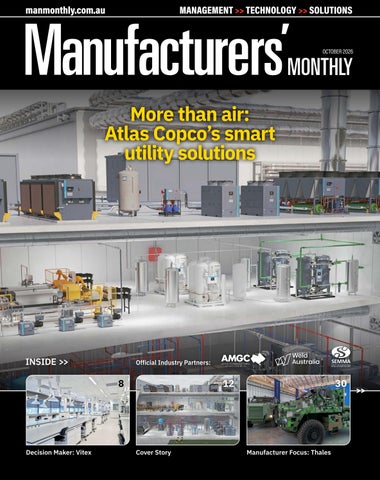
More than air: Atlas Copco’s smart utility solutions
INSIDE >>
Official Industry Partners:
8
Decision Maker: Vitex
12
Cover Story
30
Manufacturer Focus: Thales
>>
Your Backup For The Unexpected
When unexpected outages occur, Atlas Copco Rental delivers emergency steam and compressed air solutions backed by 24/7 support.
✓ Emergency Response ✓ Shutdowns & Turnarounds ✓ Business Continuity
Level up your experience at www.atlascopco.com/en-au/Rental Phone: 13 34 20 | rental.australia@atlascopco.com
Atlas Copco Rental Making Agility Count
manmonthly.com.au
OCTOBER 2026
For daily news visit manmonthly.com.au
twitter.com/Manmonthly facebook.com/Manmonthly linkedin.com/showcase/manufacturer’s-monthly/ Chairman: John Murphy CEO: Christine Clancy Managing Editor: Mike Wheeler Editor: Jack Lloyd jack.lloyd@primecreative.com.au Design: Alejandro Molano Head of Design: Clayton Hawley Sales/Advertising: Emily Gorgievska Ph: 0432 083 392 emily.gorgievska@primecreative.com.au Subscriptions Published 11 times a year Subscriptions $140.00 per annum (inc GST) Overseas prices apply Ph: (03) 9690 8766
Copyright Manufacturers’ Monthly is owned by Prime Creative Media and published by John Murphy. All material in Manufacturers’ Monthly is copyright and no part may be reproduced or copied in any form or by any means (graphic, electronic or mechanical including information and retrieval systems) without written permission of the publisher. The Editor welcomes contributions but reserves the right to accept or reject any material. While every effort has been made to ensure the accuracy of information, Prime Creative Media will not accept responsibility for errors or omissions or for any consequences arising from reliance on information published. The opinions expressed in Manufacturers’ Monthly are not necessarily the opinions of, or endorsed by the publisher unless otherwise stated. © Copyright Prime Creative Media, 2024 Articles All articles submitted for publication become the property of the publisher. The Editor reserves the right to adjust any article to conform with the magazine format. Head Office 379 Docklands Drive Docklands VIC 3008 P: +61 3 9690 8766 info@primecreative.com.au www.primecreative.com.au Sydney Office Suite 11.01, 201 Miller St, North Sydney, NSW 2060 Printed by: The Precision Group 83-89 Freight Drive. Somerton Vic 3062 Ph: (03) 9794 8337
Manufacturers’ Monthly Contents 4
Editor’s Note
8
Decision Maker Column
12
Cover Story: Atlas Copco
14
Case Study: Central Innovation
16
Industrial Compressors: CAPS
18
Financial Advisory
20
Air Compressor Rentals
22
Events: Avalon 2027
24
Industrial Compressors: ALUP
26
Case Study: Capral
28
Sensor Technology
30
Manufacturer Focus
34
Industrial Compressors: ELGi
36
Industrial Compressors: Boge
38
Association Comment: AMGC
40
Air Condensate Management
42
Events: Endeavour Awards
44
Product Showcases
47
Preventative Maintenance
49
Weld Comment
8
26
Behind the cover manmonthly.com.au
Welcome to the October edition of Manufacturers’ Monthly. This month’s cover story from Atlas Copco explore how its Smart Utility Solutions integrate industrial utilities into one intelligent system, helping manufacturers reduce energy consumption, improve reliability and simplify plant management. Our September showcase edition also spotlights Vitex in the Decision Maker column, as the company has bet $250 million on local pharmaceutical manufacturing capacity, high-skilled jobs and sovereign supply chains. Also featured in our Manufacturer Focus is Thales Australia, whose manufacturing operations in Bendigo and Lithgow preserve specialised industrial capability while supporting the nation’s evolving defence requirements.
MANAGEMENT >> TECHNOLOGY >> SOLUTIONS
OCTOBER 2026
More than air: Atlas Copco’s smart utility solutions
INSIDE >>
Official Industry Partners:
8
Decision Maker: Vitex
12
Cover Story
30
>>
Manufacturer Focus: Thales
manmonthly.com.au Manufacturers’ Monthly
3
EDITOR’S NOTE JACK LLOYD – EDITOR, MANUFACTURERS’ MONTHLY
Image: Apichat/stock.adobe.com
Building a more resilient manufacturing base
A
ustralian manufacturing is entering a period where investment in capability, technology and resilience is becoming increasingly important. Across pharmaceuticals, defence, food, medtech and heavy equipment, manufacturers are making decisions that will shape their competitiveness and the strength of Australia’s industrial base. One example is the Advanced Manufacturing Growth Centre’s (AMGC) $10 million SME Industrial Decarbonisation Fund, generating strong interest from manufacturers seeking practical ways to reduce costs, improve productivity and strengthen competitiveness. While electrification will not suit every process, applications and site visits across multiple industries are demonstrating a compelling commercial case. Projects such as replacing gas-fired furnaces with induction heating, or investigating lowerfossil-fuel surface coating processes, show that decarbonisation can deliver benefits beyond emissions reduction, including greater energy efficiency, improved process control, product quality and supply chain resilience. The shift away from fossil fuels is also becoming a competitiveness issue as global customers impose stricter emissions requirements and energy productivity becomes more important.
4
Manufacturers’ Monthly October 2026
Heat pumps, infrared systems and induction heating can reduce energy waste, cut defects and create safer working environments. The AMGC Fund provides up to 50 per cent matched funding for eligible Australian-owned manufacturers with fewer than 200 employees, supporting surface treatment, process steam and metals processing projects valued at up to $1 million. With applications open until 31 December 2027, it positions decarbonisation as a practical pathway to modernisation. That focus on long-term capability can also be seen in this month’s Decision Maker Column, which looks at Vitex’s $250 million investment in Australian pharmaceutical manufacturing. The Western Sydney family-owned business is expanding its Eastern Creek “Wonderland” facility to triple its production footprint and move towards 30 billion doses of combined annual capacity. The investment comes as reliance on imported medicines has highlighted vulnerabilities in critical supply chains. Vitex argues that sovereign pharmaceutical manufacturing should be regarded as essential national infrastructure, while the expansion is expected to create around 800 high-skilled jobs and potentially support greater domestic production of pharmaceutical ingredients.
Our Manufacturer Focus turns to Thales Australia and the specialised capabilities maintained at its Bendigo and Lithgow facilities. Bendigo’s heavy engineering operation manufactures and supports protected vehicles including Bushmaster and Hawkei, while Lithgow provides precision manufacturing for small arms, alongside engineering, prototyping and development. Both sites demonstrate why sovereign capability is about more than having a factory on Australian soil. It depends on retaining skilled workers, specialist knowledge, suppliers, technology and infrastructure that can support production when circumstances demand it. Thales’ investment in local suppliers, technology and apprentices is therefore as important as the products manufactured at its facilities. Taken together, these stories highlight a manufacturing sector building capability for the future – through cleaner and more productive processes, greater control over critical supply chains and the preservation of specialised industrial expertise. For manufacturers, the challenge is no longer simply to maintain capacity, but to continually strengthen it through investment, innovation and the people and technologies that turn capability into long-term resilience.
E ross.dixon@rsm.com.au
% 0 0 AI R
1
EFFICIENT OIL E E -F R
CAPS.COM.AU
TECHNOLOGY Engineered Centrifugal compressors to maximise operational efficiency
COMPLETE AIR & POWER SOLUTIONS K
DECISION MAKER COLUMN
DR ANISS CHAMI, CEO, VITEX PHARMACEUTICALS
Images: Vitex
At full operation Wonderland will add some 800 high-skilled roles.
Everyone offshored, we bet $250 million we could do it better here As Australia confronts growing medicine supply risks, Vitex is betting $250 million on local pharmaceutical manufacturing capacity, high-skilled jobs and sovereign supply chains.
I
was nine years old the first time I worked on our factory floor, filling shippers with medicine my father was preparing to send out the door. Vitex was a small operation then – a family business my father, Elie, had started in Western Sydney in 1989, not long after arriving in this country with little more than a conviction that Australia could make medicines as well as anyone in the world. More than 35 years on, I am still in the same industry, in the same part of Sydney, making the same case. What has changed is that the country is finally ready to listen. For most of my working life, the dominant logic
8
Manufacturers’ Monthly October 2026
of manufacturing ran in one direction: offshore. Lower costs, longer supply chains, leaner balance sheets. Between 2000 and 2020, manufacturing’s share of Australia’s GDP roughly halved, and much of our capacity to make essential goods went with it. In pharmaceuticals, we told ourselves this was simply efficient. We found out, the hard way, that it was fragile. My family learned that lesson early. Vitex began packing and selling vitamins, but before long, my father decided we would make the medicine ourselves. That instinct – to control more of the supply chain rather than less – runs through everything we have built.
A fragility we can no longer ignore The numbers are stark. In 2023, 61 per cent of the medicines supplied in Australia were imported. By the middle of 2024, more than 400 medicines were in shortage – affecting treatments for cardiovascular disease, depression and hormone therapies. These are not abstractions on a balance sheet. They are Australians who went to a pharmacy and could not get what their doctor had prescribed. Few people get to see this industry from every angle, so I set out to. I trained first as a pharmacist, added an MBA, then a medical degree, all while learning how to manufacture medicine – because I wanted the helicopter view: the science, the
business and the patient, not one in isolation. Domestic manufacturing capability is not a nostalgic indulgence. It is national infrastructure, as real as a road or a power station, and every bit as strategic.
What sovereign capability actually means “Sovereign capability” has become one of those phrases at risk of losing its meaning through overuse. Slogans don’t make medicine – factories do. It requires scale. Our new Eastern Creek facility, Wonderland, represents a $250 million investment – the most significant of its kind in Australian pharmaceutical manufacturing in more than two decades. It triples our production footprint and, operating alongside our existing sites, taking our combined capacity towards 30 billion doses a year. It requires breadth. For years, Australia made a narrow slice well – vitamins and complementary medicines – while depending on imports for almost everything else. Wonderland brings the full spectrum of dosage forms under one roof: tablets, capsules and powders, gummies, effervescents, probiotics, liquids and creams. It also extends our licence beyond listed complementary medicines into registered medicines, including Schedule 4 prescription products – the difference between
sick.com.au
New Eastern Creek facility, Wonderland, represents a $250 million investment.
making supplements and being able to help close genuine gaps in the supply of the medicines Australians rely on. And it requires stringent standards. Every Vitex facility is licensed by the Therapeutic Goods Administration, whose regime aligns with the international PIC/S Guide to Good Manufacturing
Practice and ranks among the most rigorous in the world. Australia is unusual here: unlike most of the world, we regulate vitamins and supplements as therapeutic goods – made to the same standards as prescription medicine rather than treated as food – which is a large part of why “Australian-made” carries such weight across the 26 export markets
SGS-TÜV SAAR
CERTIFIED FUNCTIONAL SAFETY APPLICATION EXPERT (CFSAE) TRAINING
Discover a new level of safety
manmonthly.com.au Manufacturers’ Monthly
9
DECISION MAKER COLUMN we supply. It is our quiet competitive advantage. My father puts it more bluntly: we are not selling medicine, he says – we are selling Australian provenance, the trust that comes with a product made to this country’s standards.
The unseen hand and why private capital went the other way Most Australians have never heard of Vitex, and that is by design. As a contract manufacturer, we are the unseen hand behind many of the country’s trusted health brands – unglamorous, capital-intensive work, and precisely the kind the offshoring era told us to give away. We made the opposite decision, and we funded it ourselves. Vitex has taken no government money; every dollar the business earns goes back into it – people, equipment, capacity, capability. As a privately held, family-owned company, we answer to no offshore shareholders waiting on repatriated profits. For the brands we make for, that carries a plain commercial meaning: the money they spend with us is reinvested here, in Australian capability, not drawn out of the country. It also means we carry the risk ourselves. A family that funds a $250 million project without a public dollar has a great deal to lose – and that, more than any incentive, is what keeps a company’s conviction honest.
DR ANISS CHAMI, CEO, VITEX PHARMACEUTICALS
We believe it is a world first – and it is deliberately just the start. Building a domestic ingredient supply chain, not only manufacturing capacity but the raw materials that feed it, opens room for innovation. AO3 is the first of several ingredients we intend to bring onshore.
A rare moment of alignment For the first time in my career, the commercial case and the policy environment point the same way: the Commonwealth’s $22.7 billion Future
Made in Australia agenda has named medical manufacturing a priority for sovereign investment, and the National Reconstruction Fund is looking to back the GMP facilities that reduce our dependence on offshore supply. That one family company could build Wonderland without public funding is not an argument against support – it is an argument for it: if conviction alone can do this, imagine the scale possible when policy and patient capital pull the same way. And this is the moment to
The people behind the capability Capability is ultimately about people, not just the infrastructure. At full operation Wonderland will add some 800 high-skilled roles – engineers, scientists, pharmacists, operators and quality specialists – taking our Western Sydney workforce beyond 1,200. But those people are harder to find than they should be. Australia produces outstanding scientists, pharmacists and engineers, yet there is no dedicated training pathway for the specialist discipline of pharmaceutical manufacturing, so we train most of our operators and quality specialists in-house – a rising cost that manufacturers carry alone, and one place where industry-led training support would repay itself many times over.
The next frontier: making the ingredients too That same instinct – to make rather than depend – now takes us a step further up the chain. Reshoring the factory is only half the task; if our supply chains are to be genuinely resilient, we also have to make more of what goes into the product – the ingredients themselves. This year we are launching Australian Omega-3 (AO3), a fish oil refinery in Sydney co-founded by our family and expected to supply its first 100 per cent Australian wildcaught, Australian-refined fish oil concentrates.
10 Manufacturers’ Monthly October 2026
Every Vitex facility is licensed by the Therapeutic Goods Administration.
be ambitious, because policy alignment is not permanent. If we want a manufacturing base capable of supplying the nation through the next supply shock, the investment decisions have to be made now, while capital, capability and politics will sit in the same place.
Vitex is a privately held, family-owned company.
Made here, when it matters I began on a factory floor in Western Sydney, and that is still where this comes back to for me. Sovereign capability, stripped of the jargon, is a simple proposition: that a country as capable as ours should be able to make the medicines its people depend on, to the highest standards in the world, here at home – and have them available when they are needed most. Government cannot carry it alone, and neither can manufacturers. The other half of the equation is the market: brands that choose to make here, and consumers who keep faith with ‘Australian-made’ and carry that preference into the world. Provenance is only ever worth what the market will reward. Australia can do this – we have the standards, the export markets and, increasingly, the policy settings. What it takes now is the conviction to keep building. My family made that choice more than 35 years ago; the opportunity in front of the country is to make it too.
Contamination isn't an option Protect your products, processes and reputation with 100% oil-free compressed air
ISO CLASS 0
AIR QUALITY
ENERGY-EFFICIENT PERFORMANCE
RELIABLE
CONTINUOUS OPERATION
alup.com manmonthly.com.au Manufacturers’ Monthly
11
COVER STORY
One partner, one Smart Utility Solution Atlas Copco’s Smart Utility Solutions integrate industrial utilities into one intelligent system, helping manufacturers reduce energy consumption, improve reliability and simplify plant management.
M
anufacturing and industrial facilities are facing more pressure to do more with less. Rising energy costs, increasing sustainability targets, labour shortages and growing production demands mean every utility system is expected to deliver greater efficiency while consuming fewer resources. Yet many plants still operate their utilities as separate systems. Smart Utility Solutions take a broader view, treating compressors, blowers, dryers, generators, chillers, and controllers as one integrated utility system. This integrated solution helps customers reduce energy consumption, improve reliability, and simplify day-today system management.
Looking beyond individual equipment For decades, many efficiency projects have focused on replacing a single compressor, installing a more efficient dryer or upgrading one section of a plant. While these improvements remain valuable, they don’t always unlock the full opportunity.
For many facilities, one of the biggest opportunities sits in the compressed air system. Compressed air is essential across manufacturing, food and beverage, wastewater treatment, mining, and other industrial applications, but it can also be one of the most energy-intensive utilities on site. Changes in demand affect the performance of connected systems, while waste heat and intelligent controls create opportunities to improve overall efficiency. When utilities operate independently, these opportunities are often missed. A Smart Utility Solution considers the entire utility network by analysing the full network, matching technology to the application and using intelligent controls to keep the system operating efficiently. The goal isn’t simply to install new equipment. It’s to create a smarter, more efficient system that continually adapts to changing operating conditions.
Data drives better decisions One of the biggest changes in industrial utilities has been the growing availability of operational data.
Modern utility systems generate large amounts of operational data, but its real value comes from turning that information into better decisions. When this information is brought together through intelligent controllers and monitoring platforms, plant managers gain a clearer understanding of how their utilities are performing. Instead of relying on assumptions or periodic manual checks, they can identify inefficiencies in real time. For example, a central controller can coordinate multiple compressors or blowers so they operate as one optimised network rather than as separate machines competing. This helps reduce unloaded running, improve pressure stability and ensure the most efficient unit is used at the right time. Connected monitoring also supports predictive maintenance by tracking running hours, energy use, pressure, temperature and other key performance indicators. This helps identify leaks, pressure losses and developing equipment issues
As industries continue to evolve, manufacturers are looking beyond individual assets towards integrated utility strategies.
12 Manufacturers’ Monthly October 2026
before they affect production, improving uptime while reducing unexpected maintenance.
Energy efficiency beyond the compressor room Compressed air is often described as one of the most expensive utilities in manufacturing, with energy typically representing most of the compressor’s lifetime operating cost. However, improving efficiency isn’t simply about purchasing a more efficient compressor. System design, controls, storage, pressure optimisation, leak management and equipment sequencing all contribute to overall performance. Smart Utility Solutions combine the right mix of technologies; including oil-free or oilinjected compressors, blowers, air treatment, industrial gases, cooling, energy recovery and intelligent control to meet each application’s specific requirements. When these technologies are designed to operate as one coordinated system rather than separate assets, the cumulative efficiency gains can be significant.
Simplifying complexity As utility infrastructure expands over time, many industrial sites end up managing multiple suppliers, technologies and service arrangements. This can make troubleshooting, optimisation and long-term planning more difficult. Working with a single partner simplifies system design, installation, monitoring and ongoing support while providing expertise across the entire utility network. This reduces complexity and creates a clearer roadmap for future optimisation and expansion.
Building for the future Industrial facilities are under increasing pressure to reduce carbon emissions while maintaining productivity and profitability. Achieving both objectives requires more than replacing ageing equipment. It requires understanding how utilities interact, where energy is being lost and how technology can continuously optimise performance over time. Variable Speed Drive technology, heat recovery, efficient dryers, correctly sized equipment, leak
management and intelligent control all contribute to a more efficient utility room. Smart Utility Solutions are not limited to new facilities. Existing sites can benefit from a system assessment that reviews demand, energy consumption, and operating hours conditions to identify practical improvements, such as intelligent control, remote monitoring, equipment upgrades or distribution network optimisation. Even small changes can deliver efficiency gains and impact when they address the real cause of inefficiency. As industries continue to evolve, manufacturers are looking beyond individual assets towards integrated utility strategies that improve efficiency, reliability and sustainability. Smart Utility Solutions provide a practical framework for reducing energy consumption while preparing facilities for future growth. Industrial utilities may sit behind the scenes, but they are fundamental to productivity. The future isn’t about managing more systems; it’s about managing one smarter system. For more information, contact Atlas Copco Compressors Australia at 1800 023 469 or compressorsau@au.atlascopco.com
Images: Atlas Copco
Modern utility systems generate large amounts of operational data, turning that information into better decisions.
manmonthly.com.au Manufacturers’ Monthly
13
CASE STUDY: IGNITE ENGINEERING & CENTRAL INNOVATION
Engineering more, administering less How Ignite Engineering has used #Task to automate SOLIDWORKS work, save engineering time and deliver complex projects at scale.
W
Complex and unique by design Ignite prefers to work at the difficult end of engineering consultancy, with the company usually brought in when a construction methodology has a gap, a contractor needs a one-off solution, or a project requires equipment that does not yet exist. The result may be temporary – many structures are built, used and removed within the life of a project – but the engineering still needs to be safe, efficient, detailed and buildable. “Our vision is to be Australia’s leading engineering consultancy for those who have the complex and unique challenges that our team are inspired to solve,” said Cox. That focus means Ignite rarely repeats the same design. As every job is different, the engineering work demands creativity, and the surrounding document preparation work demands speed, accuracy and repeatability. One recent example was a large, complex
14 Manufacturers’ Monthly October 2026
Images: Ignite/Central Innovation
hen Ignite Engineering takes on a project, it is rarely routine. The Australian mechanical and structural design consultancy specialises in unique engineering problems – often filling critical methodology gaps in projects with custom temporary structures and purpose built equipment. Founded by now director Scott Cox just over seven years ago, Ignite has grown from one engineer to a team of around 15. Its portfolio includes work associated with Cross River Rail, North East Link and Bridgewater Bridge, alongside flood protection systems, tunnel ventilation supports, marine equipment, wastewater infrastructure and custom lifting solutions. Around 80 per cent of Ignite’s work is design, typically taking a project from concept through detailed design and shop drawings. Most jobs begin from a blank page which makes engineering judgement central to the value Ignite provides. The design cycle also creates large volumes of repetitive drawing and file administration. #Task has been part of Ignite’s answer almost since day one. “Every single drawing that leaves Ignite has had #Task used on it,” said Cox. #Task, an Australian made product, is developed and provided by Central Innovation to automate repetitive SOLIDWORKS tasks across multiple files and drawings. It helps engineering teams batchprocess routine work, standardise output and create more time for design, review and problem-solving.
Around 80 per cent of Ignite’s work is design, typically taking a project from concept through detailed design and shop drawings.
flood-barrier system for Brisbane’s Cross River Rail. Other projects have ranged from ramps carrying heavy construction vehicles into tunnels, to systems for moving large escalators through constrained access points, to specialist lifting and handling equipment.
Automation from the beginning Before #Task, Cox had experienced the manual alternative. Updating drawing revisions, generating PDFs and creating cut files across a large set meant opening files one by one and repeating the same actions for hours. He briefly considered teaching himself to build the necessary macros, then decided there had to be a ready-made solution. An online search led him to #Task, which was then available as a free tool. It could run repetitive operations rapidly across multiple files while he watched the work happen automatically. For a new consultancy trying to maximise the value of every engineering hour, the decision was straightforward. “We picked up #Task at an early stage of the business, and as we’ve grown it has become essential to the workflows we use,” said Cox. What began as a founder’s productivity tool grew alongside the business. Ignite’s relationship with #Task now spans nearly seven years, from the product’s earlier free version through to its current commercial phase as a solution developed and provided by Central Innovation.
What #Task automates at Ignite Ignite uses #Task primarily in its SOLIDWORKS drawing workflow. Cox estimated that about 90 per cent of the team’s use is drawing-related, with the balance supporting model-side tasks. The most common workflows include: • managing custom properties across drawing sets; • updating revision tables and drawinglevel properties; • controlling layers, client drawing borders and issue stamps; • creating PDFs in batches; • exporting flat patterns; and; • assigning materials across relevant model files. The value is not simply that each action can be automated. #Task gives the team a consistent interface for selecting files, configuring a sequence of macros and processing the work as a batch. Instead of relying on disconnected scripts or repeating a command hundreds of times, engineers can start the job and move their attention elsewhere. “In its essence, #Task is a system to automate repetitive tasks and allow your people to work on something else while that’s happening,” said Cox.
The economics of a 500-plus drawing project The benefit becomes visible when the drawing count rises. Ignite’s Cross River Rail flood-barrier project ran over roughly two years and produced more than
500 drawings, including associated components and accessories. Versions of the set were issued around five times. Each issue required drawing data, revision information, client borders and approximately 15 custom properties to be managed consistently across the package. Doing that file by file would have created an administrative burden. Cox said that #Task saved hundreds of hours on that project alone. He also estimated that automating drawing data and revision management can remove around 10 to 20 per cent of drafting time on drawing-heavy work, depending on the number of files and issue cycles involved. “We’re working on hundreds of drawings, we couldn’t economically do the job without using #Task at that scale,” said Cox. That is not just a productivity gain; it changes resourcing and competitiveness. Ignite delivers detailed shop drawings in a market where this work is frequently outsourced. Automation helps the consultancy keep more of that capability close to the engineering team, maintain its drawing quality and respond quickly without adding unnecessary drafting capacity. “We would have to have more drafters to do the same job if we weren’t using it. You couldn’t be as competitive, and you couldn’t punch out drawings as quickly,” said Cox.
A simple tool that becomes second nature New team members generally arrive without prior experience of #Task. Ignite introduces them to the small set of tools and standard sequences used most often, then builds from there. Cox described the onboarding process as smooth: the simpler tools are quick to learn, the interface is consistent and regular use soon becomes second nature. For Ignite, this matters because the product does not sit with one automation specialist. It is used by the people producing and managing the drawings. A common interface makes repeatable automation accessible across the team and turns good practice into part of the everyday workflow.
A product relationship that has grown with the business Ignite did not adopt #Task as part of a one-off transformation project. The product grew with the company – from a tool used by a sole founder to a shared operating standard within a 15-person consultancy. That history gives Central Innovation a customer perspective spanning small drawing packages, one-off jobs and multi-year infrastructure projects containing hundreds of drawings. As the developer and provider of #Task, Central Innovation gives Ignite a connection to the product and a channel for sharing practical ideas drawn from real engineering work. The day-to-day experience
#Task gives the team a consistent interface for selecting files, configuring a sequence of macros and processing the work as a batch.
remains intentionally low-touch: the software runs as part of Ignite’s established workflow, while the team behind it remains available when product expertise or support is needed. For an engineering business, that is an important form of service. The product does not demand attention for its own sake; it gives attention back to the engineers using it. Central Innovation’s role is to keep #Task practical, accessible and focused on the repetitive work that prevents skilled people from concentrating on higher-value design and problemsolving.
Scaling for the next interesting problem Ignite does not have an arbitrary headcount target. Its ambition is to be the first choice for the clients with the complex, unusual problems its engineers want to solve. The business has continued to grow each year, while the scale and complexity of its projects have risen even faster. That trajectory makes automation increasingly valuable. On a package of two or three drawings, a manual step may be tolerable. On a set of hundreds, the same step becomes a commercial constraint. #Task allows the workflow to scale without turning engineers into file administrators or forcing Ignite to add people simply to repeat avoidable work. For Ignite Engineering, #Task is no longer an optional productivity add-on. “#Task is integral to our modelling, drafting and design process,” said Cox. Central Innovation helps manufacturers turn technology into improvements, developing solutions like #Task to solve real engineering challenges.
Ignite’s portfolio includes work associated with Cross River Rail, North East Link and Bridgewater Bridge.
Using SOLIDWORKS? Learn more about batch processing automation
manmonthly.com.au Manufacturers’ Monthly
15
OIL-FREE AIR COMPRESSORS Images: CAPS
Oil-free air built to scale CAPS is helping businesses match Class 0 oil-free compressed air systems to both current production needs and future growth.
C
ompressed air is a critical utility across manufacturing, but not every production environment has the same requirements for air quality. For applications where contamination cannot be tolerated, oil-free compressors can provide the clean ISO 8573-1 Class 0, high-quality air needed to support production, from food and beverage processing and pharmaceutical manufacturing to medical, dental, electronic, laboratory, printing and spray painting operations. CAPS Australia provides a range of oil-free air compressors spanning scroll and rotary screw compressors, two-stage compression and centrifugal technologies. This depth gives its technical team the ability to assess an application and recommend equipment according to its actual requirements. “CAPS provide a range of oil-free air compressors which offer flexibility for varying air demand conditions, whilst helping you save on energy
16 Manufacturers’ Monthly October 2026
costs,” said CAPS Australia’s director of operations, Paul Goodwin. The importance of selecting the right technology becomes particularly apparent when compressed air forms part of a production process where air quality is directly linked to product quality. Goodwin said CAPS’ oil-free solutions are aimed at applications requiring high-quality air, with Class 0 technology providing an option for industries where there can be no oil contamination. “Having exclusive access to a diverse portfolio of air quality solutions means that CAPS’ expert team will recommend oil-free industrial air compressors based on what customers actually need,” he said.
Matching air quality to application For manufacturers, the decision to use oil-free technology ultimately comes down to the demands of the application. Rotary screw compressors are broadly divided into two classifications – oil-
CAPS’ oil-free solutions are aimed at applications requiring high-quality air.
lubricated, also known as oil-injected or oil-flooded, and oil-free, or Class 0. Understanding that distinction is important when determining the most appropriate compressed air solution for a particular production environment. Rotary screw air compressors can provide continuous airflow and larger quantities of air, with class leading specific power. They can also offer a longer operational lifespan while operating more quietly and efficiently, making the technology relevant to manufacturers looking beyond simply meeting an immediate air demand. At the same time, not every application necessarily requires a Class 0 compressor. Where an operation needs very clean air but can tolerate very limited oil contamination, the required air quality can technically be achieved through a combination of accessories such as filtration and dryers. This reinforces the importance of assessing the complete application before specifying equipment.
Designing around production demands Compressed air requirements can change as a manufacturing operation develops. Production volumes can increase, new processes can be introduced and operating requirements can shift, while manufacturers may also need redundancy so that production is protected if an individual asset becomes unavailable. For this reason, compressed air infrastructure needs to be considered in the context of the wider operation rather than as an isolated equipment purchase. Capacity, redundancy, energy efficiency, maintenance requirements and future expansion all need to be considered together, according to Goodwin. This is particularly the case when a manufacturer is planning to scale production or introduce new processes. He said finding the right balance between having sufficient capacity and maintaining efficient operation can be challenging. “Having the right balance of efficiency and additional capacity can be a tough call. The timeframes of current needs and those of an operation’s growth and future volumes are part of the efficiency calculation that CAPS supports customers through,” said Goodwin. Goodwin emphasised that over-specifying equipment can also create its own efficiency challenges. “Investing in a machine that has additional capacity but then runs for an extended period below its peak operating window can prove more costly than having the right machine for now and then adding or replacing equipment when the capacity is actually needed,” he said.
From equipment to complete solutions This approach is central to CAPS’ Complete Solutions philosophy, which treats compressed air infrastructure as a long-term strategy rather than simply a machine selection exercise. For manufacturers, that means considering current production volumes alongside potential changes in processes, operating requirements, redundancy and future expansion when developing an infrastructure plan. CAPS works with manufacturers to assess these factors together, helping establish the appropriate balance between current capacity, efficiency and future requirements. The objective is to avoid installing a compressor that operates inefficiently outside its optimal range while providing a practical pathway to add or replace equipment as additional capacity becomes necessary. The approach also extends beyond the initial installation. CAPS combines equipment with engineering expertise, servicing, preventive maintenance, monitoring and technical support to support manufacturers throughout the lifecycle of
For manufacturers, the decision to use oil-free technology ultimately comes down to the demands of the application.
their compressed air infrastructure. Rather than treating installation as the end point, the company can continue working with manufacturers to identify performance issues, improve energy efficiency, plan maintenance and adapt systems as production needs change. That ongoing support is backed by CAPS’ nationwide network of 10 branches, which provides access to technical expertise and genuine spare parts, alongside 24/7 emergency breakdown support. For manufacturers facing changing operational conditions, the company’s rental fleet also provides short- and long-term compressor and generator solutions for planned shutdowns, seasonal peaks, project work and emergencies. Together, these capabilities are intended to help manufacturers minimise downtime, manage operational risk and maintain reliable and efficient compressed air infrastructure as their operations evolve.
Planning for the next stage For manufacturers, the challenge is therefore not simply determining how much compressed air a facility needs today. The selection of oil-free or oil-lubricated technology, the required air quality, production volumes, operating hours, redundancy
and potential expansion all form part of a broader infrastructure decision. CAPS’ diverse portfolio allows its team to approach that decision according to the application rather than prescribing a single technology. Its oil-free range includes scroll and rotary screw compressors, reliable two-stage compression, centrifugal compressors and Ingersoll Rand’s Nirvana – described by CAPS as the world’s first true variable speed drive oil-free air compressor system. The company also has exclusive access to technologies delivering ISO Class 0 across both rotary screw and centrifugal systems. Class 0 provides a guarantee of 100 per cent oil-free air for industrial applications, giving manufacturers a solution where air purity is a production requirement rather than simply a desirable feature. As manufacturing operations become more dynamic, the ability to scale infrastructure without sacrificing efficiency becomes increasingly important. For CAPS, the focus is on combining the right equipment with engineering, maintenance, servicing and ongoing technical support so that compressed air infrastructure can respond to what a manufacturer needs now, while providing a clear pathway for what comes next.
manmonthly.com.au Manufacturers’ Monthly
17
COMMENT
MARK NICHOLS, PARTNER, BUSINESS ADVISORY AT RSM AUSTRALIA
Image: Konstantin Z/stock.adobe.com
Manufacturers continue to face pressure to invest in productivity, technology and lower-emissions equipment.
Four things our manufacturing clients are thinking about today Mark Nichols, partner, business advisory at RSM Australia, explores four issues shaping manufacturers’ decisions today – from grants and tax changes to automation and climate reporting.
A
t RSM Australia we provide a suite of accounting and advisory services to a broad range of manufacturing clients in both metropolitan and regional Australia. We are always speaking with our clients about their tax, structuring, R&D, ERP and other consulting needs. Below are four topics that we are discussing with our manufacturing clients today.
Grants and initiatives: Opportunities for manufacturers Manufacturers continue to face pressure to invest in productivity, technology and lower-emissions
18 Manufacturers’ Monthly October 2026
equipment while managing cash flow and implementation risk. These current programs may help eligible businesses bring forward carefully scoped projects.
SME Industrial Decarbonisation Fund This national $10 million co-investment fund aims to help small-to-medium manufacturers reduce emissions by replacing fossil-fuelled processes with electric or other renewable-energy alternatives. We are seeing clients think strategically about how this co-investment scheme can help them fund upgrade projects that are beneficial to them.
The scheme focuses on surface treatment, process steam and metals processing. Eligible projects may include equipment and process upgrades, workforce training, certification or compliance work, and industry knowledge sharing. Qualifying Manufacturers can access at least dollar-for-dollar cash co-investment. AMGC contributions range from $200,000 to $500,000, generally supporting total eligible projects of $400,000 to $1 million.
NSW Net Zero Manufacturing Initiative The National Reconstruction Fund Corporation’s
(NRFC) $5 billion Net Zero Fund is designed to accelerate industrial decarbonisation and expand Australian manufacturing of renewable and lowemissions technologies. Rather than providing grants, the NRFC can invest through concessional debt, equity and guarantees. The Fund will support large-scale industrial facilities to reduce emissions, improve energy efficiency and transition production processes, while also helping domestic manufacturers scale technologies such as batteries, solar components, wind-turbine parts and hydrogen electrolysers.
Transforming Queensland Manufacturing Grants Program The Transforming Queensland Manufacturing Grants Program is a Queensland Government initiative supporting manufacturers to innovate, adopt advanced technology, create jobs and improve productivity and competitiveness. Supported expenditure may include advanced manufacturing equipment and software that integrates systems or improves manufacturing processes, such as ERP, material requirements planning and manufacturing execution systems. Of note 50 per cent of funding is reserved for regional manufacturers. Round 2 applications are expected to open in the second half of 2026.
R&D Tax Incentive Whilst not new, we continue to come across manufacturers who are spending on R&D developing new products and processes in Australia and who aren’t giving thought to whether the R&D Tax Incentive program could be of benefit to them.
Defence Industry Development Grants Program A reminder that this grant stream closes on 31 October 2026. These are just a sample of some of the targeted grants and opportunities available to Manufacturers in Australia right now. In realty, the net of potential opportunities is much broader. Feel free to reach out to your local RSM office for more information.
Budget changes: Impacts for all business There has been a lot of noise around recent budget changes and the associated impacts on business and private investment. Below are two changes that are raising questions from our clients.
Group Structures The 2026–27 Budget reforms contain some changes that are relevant to privately held manufacturing groups using discretionary trusts, corporate beneficiaries or structures holding business and property assets.
With this many of our private client groups are taking a look at their structures and considering whether what worked historically is still appropriate going forward. • From 1 July 2028, a 30 per cent minimum tax is proposed to apply at trustee level to discretionary trust income. This will create challenges for groups with corporate beneficiaries utilised in their business and investment group structures. • From 1 July 2027, the 50 per cent CGT discount is proposed to be replaced by inflation indexation and a 30 per cent minimum tax on real gains. Whilst not isolated to the manufacturing space, many of our manufacturers are private client groups with structures set up to protect business assets and property, fund group operations and achieve personal financial goals, who are now looking to model distributions, asset ownership, succession plans and potential restructures early in light of these changes.
Instant asset write-off The Budget has made the $20,000 instant asset write-off permanent from 1 July 2026 for small businesses with aggregated turnover below $10 million. Eligible manufacturers using the simplified depreciation rules can immediately deduct the business-use portion of acquired depreciating assets costing less than $20,000. The threshold applies per asset, allowing multiple qualifying purchases. Assets costing $20,000 or more generally enter the small business pool, depreciated at 15 per cent in the first year and 30 per cent thereafter. Manufacturers should consider whether these changes influence their decisions around asset investment.
Robotics Australia Group AutomationFinder Robotics Australia Group has launched AutomationFinder, a vendor-neutral platform designed to help Australian manufacturers move from recognising an automation opportunity to implementing a commercially sound project. The platform provides a local entry point to more than 20,000 vetted automation suppliers worldwide, including approximately 500 in Australia, together with experience drawn from more than 600 automation projects. For manufacturers – particularly SMEs without dedicated automation teams – the platform addresses the practical questions that often cause projects to stall: • what to automate first; • whether the task is technically feasible;
• what a solution should cost; and; • which technology is appropriate and which suppliers can deliver it. Users can turn an initial idea into a structured project brief, test supplier and product availability, issue an anonymous request for information and compare budgetary quotes in a consistent format. The process is intended to validate feasibility, market pricing and supplier capability before significant expenditure is committed, with access to independent Australian automation experts where additional support is needed.
Climate reporting (AASB S2) – A challenge on the horizon for many manufacturers The Australian Sustainability Reporting Standard is making climate risk a financial reporting issue for many more Australian manufacturers. AASB S2 is mandatory for entities meeting the Corporations Act thresholds, with reporting phased from 1 January 2025. Applicable manufacturers must now report on governance, strategy, risk management, metrics and targets, including greenhouse gas emissions and climate resilience supported by scenario analysis. Considering also how climate-related risks and opportunities affect performance, strategy, cash flows, access to finance and cost of capital. However, the practical effect also extends beyond entities with a direct reporting obligation. Climate expectations are increasingly being transmitted through procurement, contractor management and commercial terms. Large customers – particularly those subject to AASB S2, the Safeguard Mechanism or public emissions targets – will require better information from manufacturers and other suppliers about energy use, fuel efficiency, emissions performance and transition plans. Scope 3 reporting will intensify these requests because customers need credible data across their upstream and downstream value chains. For manufacturers, preparation should start with determining whether and when the business is in scope, establishing oversight, understanding their data, and then mapping material physical and transition risks across operations, suppliers, freight, customers and product end-of-life. They will also ultimately need to consider whether climate factors could change asset lives, impairment assessments, capital expenditure priorities, insurance costs, financing or customer demand. Early preparation is also something to consider where it may protect tender eligibility or strengthen access to key customers.
manmonthly.com.au Manufacturers’ Monthly
19
COMPRESSOR RENTALS
From emergency call to full steam ahead When critical boiler failures put production at risk for a dairy drink producer, Atlas Copco Rental delivered two Plug & Steam boilers within 24 hours to stabilise operations.
I
n an emergency, such as unexpected downtime, the importance of getting production back on track is critical. Because of this, Atlas Copco Rental operates 24/7 and has strategic branches across the country ready to support customers. The company’s fast and efficient response times recently enabled a dairy manufacturer to receive emergency boilers within 24 hours of placing the enquiry.
Providing a solution to the customer challenge The customer faced an unexpected outage of its two main steam boilers, which are critical to pasteurisation, sterilisation and cleaning processes. With both boilers unavailable, the production and the company’s ability to supply more than 10,000 outlets were placed at risk. To minimise disruption and restore steam capacity quickly, Atlas Copco Rental delivered and installed two Plug & Steam boilers, supported by comprehensive on-site services and water
treatment to ensure a reliable and efficient solution. This resulted in production stabilisation within 24 hours with reliable steam capacity When something like this happens, speed matters. Within 24 hours of the first call, the company delivered two steam boilers to the site without complex logistics or delays.
How Atlas Copco Rental made it work • Plug & Play setup: The steam boilers were delivered in ready-to-use 20-foot containers, allowing the units to be deployed with minimal installation requirements. Once connected to water, power and fuel, the boilers could be brought online quickly – eliminating the need for a complex installation process and helping the customer restore critical steam capacity with minimal downtime. • Easy to operate: With an intuitive touch panel and automated systems, operators could shift focus on production instead of the equipment.
• Full support included: Alongside the boilers, Atlas Copco Rental provided water treatment to prevent scale and corrosion, and dual-fuel burners for flexibility. In this case, the system ran on diesel for six weeks.
Plan for the unexpected Atlas Copco Rental is prepared to support customers during unexpected emergencies, but believes the best solution is to plan before an issue occurs. Whether customers are scheduling maintenance or developing a reliable backup strategy, Atlas Copco Rental works alongside them to help anticipate potential challenges, minimise disruption and maintain continuity of operations. Ultimately, the focus is on providing customers with the support they need to operate safely and reliably.
C
M
Y
CM
MY
CY
CMY
K
Image: Atlas Copco
Atlas Copco Rental is prepared to support customers during unexpected emergencies, but believes the best solution is to plan before an issue occurs.
20 Manufacturers’ Monthly October 2026
EVENTS: AVALON
Avalon 2027: Where industry meets opportunity Avalon 2027 will bring aviation, aerospace, defence and industrial supply chains together, giving businesses a focused platform to connect.
A
valon 2027 is more than an airshow. For businesses in aviation, aerospace, defence and the wider industrial supply chain, it is where capability is benchmarked, partners are identified and decision-makers who are otherwise hard to reach can be met, all in one place. Returning to Avalon Airport from 23 to 28 February 2027, the Avalon Australian International Airshow will again combine a major international aerospace and defence exposition with flying and static aircraft displays, specialist presentations and professional networking. Its dedicated Trade Sessions, from Tuesday 23 to Friday 26 February, are reserved for visitors from Defence and government or with an industry connection to aviation, aerospace, defence and adjacent sectors, creating a focused environment for business engagement before the event opens to public audiences. That focus matters. Australia’s aviation and aerospace ecosystem is increasingly tied to advanced manufacturing, sovereign industrial capability, logistics resilience, digital systems, sustainment, workforce development and emerging technologies. Avalon places these themes in one setting, giving trade visitors the opportunity to see capability on display, hear from sector leaders and connect directly with Australian and international businesses across the supply chain. Scale is central to that value. Avalon 2027 will span four exhibition halls and more than 900 Australian and international exhibiting companies, presenting products, services and technologies across civil aviation, defence, aerospace, uncrewed systems, training, sustainment and enabling industries. This provides an opportunity to benchmark capability, identify partners and understand where future demand is forming. The current Avalon 2027 program highlights the breadth of trade content across the week, with sessions spanning uncrewed flight, maritime security, aerospace innovation, capability, security and workforce, along with the Avalon Hub Program and the Innovation Pitchfest and Awards. Together, these sessions point to the major themes expected to drive discussion across the trade program. These include the future of air mobility, the integration of autonomous and advanced technologies,
22 Manufacturers’ Monthly October 2026
the security environment shaping capability requirements, and the workforce and skills pipeline needed to support growth. Innovation sits at the centre of it. Emerging aircraft systems, advanced materials, simulation, autonomy, data, sensors and digital engineering are pushing manufacturers to think beyond traditional production models, and Avalon’s trade sessions are expected to link that technical capability with commercial opportunity and practical pathways to market. Security and resilience run close behind. Aviation, aerospace and defence capability are increasingly tied to national and regional resilience, from border and maritime security to supply chain assurance and industrial preparedness. For manufacturers and adjacent sectors, that creates an opening to think about how products, processes and partnerships can support customers who need reliable, future-ready capability in complex operating environments. And none of it works without people. As programs become more technically demanding, industry needs skilled workers across engineering, production, maintenance, systems integration, project delivery Avalon 2027 Trade-only sessions run from Tuesday 23 to Friday 26 February 2027.
and specialist trades. Avalon places careers and workforce alongside technology and capability, recognising that future growth depends as much on who can build it as on what gets built. Freight and logistics get dedicated focus for the first time in 2027, too. A new addition is the inaugural Australian Air Freight Summit, an Avalon initiative that brings together leaders from air cargo, logistics, airports, government and supply chain to examine the future of Australia’s air freight sector. Its timing reflects a strong market outlook, one already visible in the near-term numbers. The National Freight Data Hub projects 103 per cent growth in air freight volume between 2020 and 2050, and IATA reported that Asia-Pacific airlines recorded 4.1 per cent year-on-year growth in air cargo demand in July 2026, with capacity up 3.0 per cent. For Australian manufacturers, exporters and supply chain partners, that growth underlines air freight’s role as both an economic opportunity and a strategic enabler for high-value, time-sensitive and technology-rich goods. That makes the case for treating Avalon as a
business event, not a spectator one. It’s a meeting point for industry, government, defence, academia and the wider ecosystem enabling aviation and aerospace capability: a place to gather market intelligence, identify procurement and partnership opportunities, track technology trends and engage decision-makers you won’t find together anywhere else. For manufacturers specifically, it is a chance to position themselves within the supply chains behind defence programs, airports, logistics networks and technology integrators, with SMEs given visibility alongside major primes and international exhibitors, the kind of exposure that turns into contracts, export relationships and longterm growth. As Australia builds out its aviation, aerospace and defence industrial base, events like Avalon are where interest turns into engagement: a forum to test ideas, demonstrate capability, build relationships and respond to the forces reshaping the sector, from autonomy and digital transformation to workforce constraints and supply chain resilience. Images: Avalon
Avalon 2027 Trade-only sessions run from Tuesday 23 to Friday 26 February 2027, open to defence and trade visitors with an industry connection to aviation, aerospace, defence and related sectors. Register now at airshow.com.au.
Avalon 2027 will span four exhibition halls and more than 900 Australian and international exhibiting companies.
@BOGE
COMPRESSED AIR & GAS SOLUTIONS
On-Site .Nitrogen Generation High-purity to ultra-pure nitrogen
@ Nitrogen at any time and at any place. @ Lower compressed air requirement and @ Power savings of up to 50 per cent. @ Cost-effective through low operating costs. @ Sophisticated and reliable technology. @ Exact purity for every application. @ No rental commitments as with bottles @ No CO2 pollution for the environment.
BOGE Compressors Australia Ph: +61 3 5940 5913 Email: au@boge.com Website: https://www.boge.com/en-au/
manmonthly.com.au Manufacturers’ Monthly
23
AIR COMPRESSORS: ALUP
When clean air becomes a competitive advantage Oil-free compressed air is helping manufacturers protect product quality, reduce contamination risk, improve energy efficiency and build reliable operations.
I
n manufacturing, it’s often the unseen things that have the biggest impact. Compressed air is a perfect example. It powers production lines, supports critical processes and keeps operations moving, yet it rarely attracts attention until something goes wrong. As Australian manufacturers continue to focus on quality, efficiency and sustainability, the demand for cleaner and more reliable compressed air is growing. For many businesses, oil-free compressor technology is no longer simply a technical choice. It’s becoming a strategic one. Contamination isn’t an option, neither is compromise.
The hidden risk of contamination Whether producing food and beverages, pharmaceuticals, electronics or precisionengineered products, manufacturers face increasing
pressure to maintain strict quality standards. Even the smallest trace of oil contamination can result in product spoilage, rework, downtime or reputational damage. That is why oil-free compressed air has become an important consideration across a growing number of industries. Class 0 certified oil-free compressors provide air without the risk of oil contamination, helping manufacturers protect product quality while meeting increasingly stringent compliance and safety requirements. More importantly, they provide peace of mind. When compressed air is integral to the production process, certainty matters.
Efficiency matters While air quality is a major driver, energy efficiency is equally important.
With energy costs continuing to challenge manufacturers, businesses are looking for practical ways to reduce operating expenses without compromising productivity. Modern oil-free compressors are designed with this in mind, incorporating technologies such as variable speed drives that automatically adjust output to match demand. The result is a reduction in wasted energy and a lower total cost of ownership over the life of the equipment. For manufacturers balancing productivity targets with sustainability goals, efficiency improvements like these can deliver measurable benefits to both the bottom line and environmental performance.
Built for the realities of industry Reliability remains one of the most valuable assets
Class 0 certified oil-free compressors provide air without the risk of oil contamination.
24 Manufacturers’ Monthly October 2026
As manufacturing continues to evolve, the focus is increasingly shifting beyond simply keeping production running.
Images: ALUP
on any factory floor. Unexpected downtime can quickly turn into lost production, delayed deliveries and increased costs. Today’s oil-free compressor systems are engineered to withstand demanding operating conditions while providing consistent performance. Advanced monitoring and control technologies also give operators greater visibility into system performance, helping identify issues before they become problems. This shift towards smarter, more connected equipment is giving manufacturers more control over their compressed air systems than ever before.
Looking ahead As manufacturing continues to evolve, the focus is increasingly shifting beyond simply keeping production running. Businesses are seeking solutions that improve quality, reduce risk, support sustainability targets and deliver long-term value. Oil-free compressed air sits at the intersection of all four. For manufacturers looking to future-proof their operations, cleaner air may prove to be one of the smartest investments they make.
The leading supplier of the BIGGEST names in automation E-Chain & Bearings
Cables & Glands
Flexible Conduits
Connectors
Safety
Treotham.com.au
For more information, visit https://www.alup.com/en-au
Sensors
Treotham Automation • 1300 65 75 64 • info@treotham.com.au manmonthly.com.au Manufacturers’ Monthly
25
ALUMINIUM MANUFACTURING Images: Capral/Kings Outdoor Living
Kings Outdoor Living manufactures designs, fabricates and installs outdoor shade and shelter systems.
Building a smarter approach to shade Tasmanian manufacturer Kings Outdoor Living is using Capral aluminium to develop lighter, smarter and more durable outdoor shade and shelter
F
rom a small shade sail business established in 2008, Kings Outdoor Living has grown into a Tasmanian manufacturer designing, fabricating and installing outdoor shade and shelter systems for schools, childcare centres, sporting clubs, councils, hospitality venues and residential customers. Based in Sorell, the company now employs around 17 people and produces umbrellas, shade sails, barrel vault structures, balustrades, sunrooms, outdoor blinds, retractable roof systems, decks and other outdoor products. For co-owner Sam King, the company’s evolution has been driven by a willingness to find better ways of doing things. King originally purchased the shade sail business while working in residential construction, with his brother Will joining around four years later. As the business expanded, sourcing products from mainland Australia became increasingly difficult because of Bass Strait freight costs, timing, complexity and damage, prompting Kings to bring more manufacturing in-house.
From installer to manufacturer Initially, much of Kings’ manufacturing was based around steel, with components subcontracted to other businesses. But the material’s weight and the challenges of transporting large components into schools, childcare centres and residential properties
26 Manufacturers’ Monthly October 2026
led the company to investigate aluminium, particularly after seeing its use in modular systems such as Ziptrak and glass balustrades. “Once you’ve carried a large steel pipe up flights of stairs with a few guys, you realise the advantages of aluminium,” King said. Because Kings designs and installs what it manufactures, manual handling and site access are important considerations from the outset. Many projects are undertaken in established schools and public spaces where access is limited, and large cranes may not be practical. Aluminium’s lower weight has helped address those challenges, while its corrosion resistance is also valuable in Tasmania’s coastal environment. The shift has progressively moved much of Kings’ modular product range from steel to aluminium. While aluminium can carry a higher initial cost in some applications, Kings has found benefits in its powder-coating process and long-term performance. King said aluminium under a powdercoat system can offer a substantially longer service life than an externally painted steel structure, particularly in coastal locations.
Engineering for the real world Engineering and practical performance have become central to Kings’ product development.
The company has developed its own modular shade sail post system, incorporating screw-together components, tap-in caps and bolt-through eyelets, with engineering and testing undertaken to validate the design. In-house CAD and 3D printing allow Kings to develop and test concepts before committing to an extrusion or manufacturing die. Where suitable profiles already exist, the company draws on Capral’s catalogue of dies, while more specialised applications have led to Kings developing its own extrusions. Some of those profiles have subsequently been sold to other shade providers on the mainland. Tasmania also provides a demanding environment in which to test those systems. “Tasmania’s a great testing ground to see what your stuff’s like,” he said. “The company works with mainland engineers alongside its drafting team, modelling structures before they are manufactured and installed.” That engineering-led approach has also helped Kings address underground services. Schools, parks and play spaces can contain extensive networks of pipes, making excavation difficult and expensive. The company has therefore developed aboveground ballast footing systems that allow engineered modular structures to be installed without digging, reducing excavation, spoil removal and uncertainty.
Manufacturing closer to home
Building with Capral
Kings’ workshop combines modern machinery with the skills of its workforce. Sean leads much of the fabrication work, bringing experience from a heavy industrial background, while King’s own experience is rooted in residential carpentry. Josh’s CAD expertise allows concepts to move from the computer to fabrication with less guesswork. The workshop includes up-cut saws for large aluminium profiles and a Dragon A-400 five-axis pipe cutter. Originally developed in the United States for building roll cages, the machine has been adapted by Kings for umbrellas, shade systems and barrel vault structures. It can rapidly produce complex fish-mouth joints and other intersections, allowing the company to build weeks’ worth of components in minutes. A water-feed system also helps prevent dross sticking to the inside of pipe, reducing cleanup requirements for telescopic and sleeved components. For a relatively small manufacturer, the machinery allows Kings to increase production without carrying the same labour requirements associated with more traditional fabrication methods. That capability is particularly valuable because the shade market is seasonal. Kings can build stocks of components ahead of summer, ensuring products are ready when demand increases. Prefabrication is also changing how the company approaches installation. Around 10 to 11 of its 17 employees work in installation, with crews commonly completing two to three sites a day. By completing more fabrication, powder coating and assembly in the workshop, Kings can reduce site time, minimise weather-related delays and remove uncertainty from installation.
Capral has played an important role as Kings has developed its aluminium capability. Coming from a carpentry rather than fabrication background, King says understanding aluminium grades, extrusions and manufacturing processes represented a learning curve. Capral’s support has therefore extended beyond material supply, providing technical guidance as Kings develops and refines its products. “Capral’s capability, especially talking you through extrusions, how they work, and the grades of aluminium was a bit of a learning curve for me,” King said. He described Capral representative Luke Batchelor as an important source of technical knowledge, particularly when questions require specialist input. Kings predominantly uses structural aluminium grades, with fatigue, welding and long-term performance considered during product development. Capral also helps fill gaps in Kings’ own manufacturing capability, including large-scale routing and machining thicker aluminium plate. Some umbrella base plates, for example, are 25mm thick and produced in large batches before being incorporated into Kings’ fabrication process. The relationship also supports Kings’ commitment to Australian manufacturing. The company uses Australian-extruded aluminium produced through Capral’s Campbellfield operations and has incorporated Capral LocAl lower-carbon aluminium into its offering. The lower-carbon option has been particularly relevant when quoting directly to schools, where environmental considerations can influence purchasing decisions alongside price. Kings includes the option in its quotations and explains its benefits to procurement and business managers. For Kings, the relationship with Capral is therefore based as much on service, consistency and technical support as the aluminium itself. “We’re after service, consistency and product knowledge, and I don’t think anyone covers that anywhere near as well as Capral,” King said.
Because Kings designs and installs what it manufactures, manual handling and site access are important considerations from the outset.
Taking Tasmanian manufacturing further Kings has established a strong position in Tasmania’s shade and shelter market, working extensively across Catholic, Christian and public schools, as well as childcare centres, council parks, sporting clubs and hospitality venues. Landscape architects and designers are increasingly specifying Kings’ systems into projects, allowing the company to become involved before projects reach the tender stage. The company is also taking on increasingly complex projects. At a Tasmanian high school, Kings manufactured a large split-skillion roof structure featuring nine-metre aluminium profiles. The roof was welded on the ground, transported to site in four sections and bolted together, with privacy screens and handrails still to be completed. At Devonport Country Club, Kings is working on a barrel vault structure with a large truss section and an approximately eight-metre span using a 152mm extruded Capral profile. The profile was rolled locally, while the structure was prefabricated off site to reduce disruption to the club. Kings’ ambitions now extend beyond Tasmania. Its first hip structure has been installed in northern New South Wales, while umbrellas and other products are beginning to reach the mainland through third-party customers. After years of testing products, refining engineering and building confidence in aluminium systems, King believes the company is ready to expand its footprint. For a business that began with shade sails, the next milestone is seeing Kings products appear in places its founders never expected. “I’d like to drive down a street unexpectedly somewhere on the mainland and go, ‘Oh, there’s an umbrella I didn’t know was even going to be there,’” he said.
manmonthly.com.au Manufacturers’ Monthly
27
SENSOR TECHNOLOGIES
SICK puts identification at the centre SICK is combining intuitive code reading, connectivity and image-based identification to help manufacturers build more efficient and traceable production environments
A
s manufacturers look to automate more processes while managing greater product variation and shorter production runs, identification technology is becoming an important part of the production environment. SICK’s latest identification technologies are designed to address this shift, ranging from the cost-effective sensingCam SEC200 for operator workstations through to the higher-performance Lector82x and CLV82x platforms. Elon Solomona, market product manager of identification technologies at SICK Asia & Pacific, said the SEC200 has been developed as a straightforward code-reading solution for operator workstations, as well as basic automation applications. Its purpose is to remove additional tasks from operators, supporting a more ergonomic and efficient process while providing reliable 1D and 2D code identification. “This is designed to be a simple and cost-effective solution for operator workstations where manual handling and sortation is involved,” said Solomona. “It’s also for basic automation applications, such as simple carton scanning or hand sortation.” The SEC200 is designed around ease of use, with an integrated web server allowing configuration through a browser without additional software. Its LED alignment aid, feedback LED and acoustic signal provides clear confirmation during scanning, while Ethernet or USB connectivity allows it to be integrated into existing workstations and systems. The IP65 The CLV82x is targeted more specifically at high-speed sortation and reliable carton and parcel identification.
housing provides protection against dust and vibration, while a 1.3-megapixel camera produces high-quality images for decoding.
Removing complexity from commissioning For manufacturers, making identification technology easier to commission can have an impact beyond the initial installation. Traditional code readers can require detailed knowledge of both the application and the technology, creating a barrier when equipment needs to be deployed, replaced or reconfigured. SICK has therefore focused on making the SEC200 intuitive enough to reduce the knowledge and training requirements associated with code reading. The device’s large depth of field, spanning 100mm to 300mm, is another feature aimed at production environments where product dimensions and positions can vary. Rather than requiring mechanical adjustment between product lines, the SEC200 can read codes across a broader range of distances. “Simplified commissioning and operation removes this requirement and has benefits across the entire lifecycle process, from faster deployments of new product lines, to replacement of existing product lines,” said Solomona. “It also eliminates setup errors and most importantly improves operator confidence.”
That emphasis on confidence extends into ongoing maintenance. The integrated web server can simplify configuration, while the device’s accessible information and straightforward operation are intended to make troubleshooting easier.
Identification for more demanding applications Alongside the SEC200, SICK’s identification portfolio includes the Lector82x and CLV82x for more advanced industrial applications. The Lector82x is designed for challenging identification environments where performance and code quality can vary from product to product. It can also be integrated directly into users’ control or management systems, with connectivity forming an increasingly important part of modern identification technology. The CLV82x is similarly positioned as a highperformance code reader, but is targeted more specifically at high-speed sortation and reliable carton and parcel identification. While the Lector82x supports a mix of 1D and 2D codes, as well as DPM codes or direct part marked identification, the CLV is aimed more towards 1D codes. Together, the platforms address different requirements within industrial identification and automation systems. Connectivity itself has moved from being a secondary consideration to an expected capability, according to Solomona. “In the past, connectivity was often an afterthought. Nowadays, connectivity is really a requirement and an expectation from the consumer. It provides users with the ability to report the efficiency and effectiveness of a product line, reduces manual data entry, as well as a reduction in the overall equipment needed” he said.
Building a traceable production process
Images: SICK
28 Manufacturers’ Monthly October 2026
Reliable identification also provides an important connection between physical products and the digital systems increasingly underpinning manufacturing. As manufacturers seek greater visibility over production, code reading provides a means of identifying products and linking them to their associated histories and production records. The SEC200’s ability to reliably identify both 1D and 2D codes is therefore relevant to more than simply moving a product through the next production step. It can contribute to traceability and process control, particularly as demand for product
traceability continues to increase. SICK’s broader product development reflects the same movement towards identification technologies that can support manufacturers’ growing data requirements. The industry is also seeing a shift from laserbased to image-based code reading, driven by the greater tolerance of image-based systems for variations in code quality. At the same time, manufacturing is becoming increasingly data-driven, requiring more data points to feed analytics around areas such as quality and predictive maintenance.
The SEC200 has been developed as a straightforward code-reading solution for operator workstations.
From codes to data-driven manufacturing SICK sees this development continuing alongside the GS1 Sunrise movement from 1D to 2D codes, which supports growing traceability requirements for both consumers and manufacturers. As more products carry increasingly detailed digital information, the ability to identify those products reliably becomes an important foundation for connecting physical production with digital records. For Australian manufacturers, equipment must also contend with demanding operating conditions. Dust and vibration are important considerations, alongside the high temperatures experienced across Australia and applications involving lower temperatures. SICK offers
specialty variants according to the use case, with the company positioning durability and long service life as important characteristics of its identification products. Looking ahead, Solomona identifies three major growth areas for advanced code reading and identification technology: end-to-end traceability, quality and compliance, and the broader transition from conventional manufacturing towards datadriven manufacturing. The objective is greater
visibility across the production journey, from raw material through to finished goods and all the stages in between. For SICK, the evolution of identification technology is therefore about more than reading a code. As manufacturers pursue greater automation, traceability, quality control and data-driven decision-making, identification becomes a link between the product moving through the factory and the information generated around it.
OIL-FREE AIR COMPRESSORS FOR FOOD PRODUCTION Class 0 oil-free compressed air solutions Indigenous airend design and manufacturing PTFE-coated airend for efficiency and durability Stable pressure for sensitive operations Corrosion-resistant internal components
AB Series 11 – 110 KW
OF Series 45 – 450 KW
ISO 8573-1 & ISO 8573-7 Certified Compressed Air
ISO 8573-1 Certified Compressed Air
Energy-efficient operations with lower lifecycle cost Scan to learn more
1300 625 704 BEST-IN-CLASS
WARRANTY
ISO 22000
CERTIFIED
MANUFACTURING
elgi.com/au enquiry@elgi.com.au
manmonthly.com.au Manufacturers’ Monthly
29
MANUFACTURER FOCUS
Manufacturing capability built for defence Thales Australia’s manufacturing operations in Bendigo and Lithgow preserve specialised industrial capability while supporting the nation’s evolving defence requirements.
F
or Andrew Downes, Vice President Land at Thales Australia, working within the company’s Australian manufacturing operations is more than a professional responsibility. His connection to the industry stretches back to childhood, when he lived near one of the factories operated by Australian Defence Industries, a predecessor of Thales Australia. His later career in the Army gave that connection an even more personal dimension, with products manufactured in Australia
becoming equipment he used operationally. Downes now has responsibility for Thales Australia’s vehicle business, its explosive ordnance services business – which moves the Australian Defence Force’s weapon stocks around the country – and the business at Lithgow. Between Bendigo and Lithgow, those operations represent two very different but equally important areas of manufacturing expertise – heavy engineering and precision manufacturing. “Coming to Thales is a bit like coming home,”
he said. “Quite literally the products the business is famous for I used and was protected by rifles made in Lithgow and the Bushmaster built in Bendigo.” This personal connection also informs Downes’ view of the people behind the manufacturing. The facilities are not simply production sites for defence equipment, he argues, but repositories of skills, trades and knowledge that have become increasingly difficult to maintain as manufacturing’s share of the economy has changed.
Bendigo is central to the manufacture and support of protected vehicles including the Bushmaster and Hawkei.
30 Manufacturers’ Monthly October 2026
Images: Thales Australia
Preserving industrial capability Thales’ Bendigo operation is one of the country’s remaining heavy engineering sites, while Lithgow represents one of the last precision manufacturing sites of its kind. Bendigo is central to the manufacture and support of protected vehicles including the Bushmaster and Hawkei, while Lithgow Arms manufactures small arms for the Australian Defence Force, law enforcement and other customers, alongside engineering, prototyping and development activities. For Downes, the significance of these sites extends well beyond the defence industry. Their value lies in the ecosystems they support – the skilled workers, tradespeople, manufacturing knowledge and industrial infrastructure required to produce highly specialised equipment domestically. “They’re precious not just because of their
Bendigo operation is one of the country’s remaining heavy engineering sites, while Lithgow represents one of the last precision manufacturing sites of its kind.
connection to defence, but they’re precious in terms of the overall industrial base,” he said. The scale of those operations reflects that industrial importance. Downes said Bendigo employs more than 200 people, while the Lithgow operation has well over 100. He points to the experience of other nations that reduced or closed defence manufacturing facilities following the end of the Cold War as an indication of what can be lost when industrial capability is allowed to disappear. Rebuilding such capacity is not a matter of simply restarting a production line. Workforce development, supply chains and machine tooling all require time and investment. “These sites are ecosystems of skills and trades that in some respects have been lost as manufacturing’s share of the economy has declined over the last 30 to 40 years,” Downes said.
Manufacturing for self-reliance That industrial capability has a particular importance in defence, where the ability to maintain production and supply during a crisis can be as important as the equipment already in service. Thales therefore undertakes a substantial amount of manufacturing work locally, while also working with Australian suppliers and smaller businesses that feed into its production activities. “We do a lot of our work locally,” he said. “We also use a lot of local suppliers and smaller companies feeding some of the work, because we need that work done onshore, not offshore.” The approach differs from that of businesses able to rely heavily on global supply chains. Defence manufacturing requires a degree of self-reliance, not only to ensure supplies are available when needed, but also to provide confidence around quality, security and the origin of components and materials.
manmonthly.com.au Manufacturers’ Monthly
31
MANUFACTURER FOCUS For Downes, this industrial base is therefore part of the broader defence mission. An adversary will consider not only the capabilities of a nation’s existing armed forces, but also how rapidly that nation can draw upon its industrial capacity in response to a threat. “A strong, robust, resilient industrial base that can scale in times of need is a deterrent to an adversary who may wish to do harm,” he said.
Where precision matters Downes continued to emphasise the high level of precision required across Thales’ manufacturing operations when producing equipment designed to protect people in combat environments. At Bendigo, that includes the manufacturing of protected vehicles where the integrity of construction is critical to their performance. The nature of the welds, the materials used and the way a vehicle moves through the production process all contribute to the integrity of the finished product. At Lithgow,
Lithgow Arms manufactures small arms for the Australian Defence Force, law enforcement and other customers.
32 Manufacturers’ Monthly October 2026
precision manufacturing is similarly fundamental to the products being developed and produced. “Microns matter,” Downes said. “There is a very important difference in terms of the precision necessary for a vehicle being able to withstand blast and one that doesn’t.” The technology supporting these processes must itself be protected. Thales’ operational technology is considered sensitive infrastructure, creating another layer of complexity for a modern defence manufacturer. Manufacturing capability is therefore not simply about machinery and production techniques, but also about safeguarding the systems underpinning those operations.
maintain a continuous flow of skilled workers into the organisation. Downes sees that workforce pipeline as particularly important given the long-term nature of defence programmes. People entering the sector today could work on programmes that continue well into, or beyond, their expected retirement dates. That creates both a responsibility and an opportunity to develop careers around specialised manufacturing skills. The attraction is not simply technical. “We need to ensure that we have a continuously flowing pipe of skills, not just for what we produce, but because these are good jobs, secure jobs, jobs in which people can see progression, that they can advance,” Downes said.
Building the next workforce
Evolving with the mission
Maintaining this capability also depends on developing the people who will operate it. Thales’ manufacturing businesses have an apprentice intake of around 10 per cent, reflecting the need to
While established products such as Bushmaster and the firearms produced at Lithgow remain important, Thales is also looking towards how those capabilities can evolve. Downes describes warfare
The Bushmaster platform, which has protected soldiers for 25 years, has evolved through a partnership with Kongsberg.
as a competitive learning environment, creating a continuing requirement to anticipate future threats and develop equipment that can protect personnel and enable mission success. The company’s position within a large global organisation provides access to a broader product and technology base, while its Australian manufacturing footprint gives it machinery, people and knowledge with which to innovate and experiment locally. That evolution is already evident in the direction of Thales’ vehicle business. According to Downes, ground autonomy and autonomous vehicles are emerging areas of focus, driven by the principle that personnel should not be placed in harm’s way
where a machine can perform the task instead. There is also a growing expectation that vehicles themselves can perform a wider range of functions. The Bushmaster platform, which has protected soldiers for 25 years, has evolved through a partnership with Kongsberg to create a vehicle with strike capability. Kongsberg is also part of the Australian defence industrial base, with its missile factory under construction in Newcastle. “My business will be whatever Australia needs it to be,” Downes said. “We have a higher purpose beyond just a commercial approach.” For Thales, that means the future of Australian manufacturing is not simply about producing more
of the equipment already in service. It is about maintaining the industrial foundations that allow new capabilities to be developed, integrating technology with established manufacturing expertise and ensuring the workforce and supply chains remain available when they are needed. Downes believes the direction of travel is towards a vehicle business focused not only on protecting personnel, but on developing mobile systems capable of contributing to a broader defence mission. “The evolution into mobile protection for our vehicle business – not just protected mobility for soldiers, but mobile systems that can protect – is where we’re heading,” he said.
THE
CONDENSATE MANAGEMENT SPECIALIST ZERO AIR LOSS DRAINS OIL-WATER SEPARATORS AIR SAVING PRODUCTS
manmonthly.com.au Manufacturers’ Monthly
33
INDUSTRIAL COMPRESSORS: ELGI Product quality, energy efficiency and operational resilience are gaining greater attention for compressed air as a strategic utility.
Image: ELGi
When air purity becomes a production requirement Compressed air purity from oil-free technology is helping manufacturers protect product quality, improve efficiency and strengthen operational reliability.
C
ompressed air is an essential utility across modern manufacturing. It powers pneumatic equipment, moves products, operates valves and actuators, supports packaging and can even come into direct or indirect contact with the finished product. But when compressed air encounters a product or critical production process, air quality is no longer simply an equipment consideration - it becomes a production requirement. For industries such as food and beverage, pharmaceuticals, electronics and other contamination-sensitive manufacturing environments, even small amounts of oil contamination can create quality, safety and operational risks. This is driving greater attention towards oil-free compressed air as manufacturers look to protect product integrity while improving efficiency and reliability.
Why does oil-free air matter? In a conventional oil-lubricated compressor, oil is used within the compression process for purposes such as lubrication and cooling. While downstream filtration can remove contaminants,
34 Manufacturers’ Monthly October 2026
filtration adds another layer of equipment and maintenance to the system. For applications where contamination cannot be tolerated, eliminating oil from the compression process itself provides a fundamentally different approach. Oil-free compressors are designed to produce compressed air without introducing oil into the compression chamber. This can be particularly important in applications involving direct or indirect contact with products, packaging or sensitive manufacturing processes. For food and beverage manufacturers, for example, compressed air can be used in packaging, bottling, conveying, cleaning and pneumatic handling. In pharmaceuticals and electronics, air quality can be equally critical. ELGi identifies food and beverage, pharmaceuticals, semiconductors and electronics among the industries where oil-free compressed air is particularly relevant.
Class 0: Raising the standard for air purity When evaluating oil-free compressed air,
manufacturers should look beyond the term “oil-free” and consider recognised air-quality standards. ISO 8573-1 Class 0 represents the most stringent classification for oil content in compressed air. It is intended for applications where contamination needs to be controlled to the highest level. This distinction is important because an oil-free system is not simply about removing oil after compression. It is about designing the compression process and air system to minimise the potential for oil contamination at its source. ELGi’s oil-free compressor range is designed to provide compressed air meeting ISO 8573-1 Class 0 requirements. The company has also developed and manufactures its own oil-free airends, giving it control over a critical part of the compression technology.
Beyond contamination: efficiency matters Air purity may be the primary reason for selecting an oil-free compressor, but energy efficiency remains an important consideration. Compressed air can represent a significant
portion of a manufacturing facility’s energy consumption. Consequently, selecting a compressor based solely on its purchase price or air-quality specification can overlook the larger lifecycle cost. Airend efficiency, pressure losses, compressor controls, cooling systems and operating profile can all influence the energy required to produce compressed air. ELGi’s oil-free technology incorporates its proprietary airend design and η-V rotor technology, which is intended to reduce pressure losses and improve stage efficiency. Its Australian AB Series has also undergone efficiency improvements, including specific power consumption and free-air-delivery improvements across the range. For manufacturers, this creates an important opportunity: clean air does not have to mean compromising on efficiency.
The complete system still matters Choosing an oil-free compressor is an important step, but it does not eliminate the need to consider the entire compressed-air system. Air treatment, dryers, filtration, condensate management, storage and distribution all influence the quality delivered at the point of use. Moisture, particulates and contaminants can
enter or develop within a compressed-air network, making appropriate downstream treatment and system maintenance essential. Manufacturers should therefore assess their complete system - from the compressor room through to the production line to ensure the required air quality is consistently maintained. This also means avoiding unnecessary pressure. Every additional bar of pressure can increase energy consumption, so the system should be designed to deliver the required pressure at the point of use rather than simply operating at the highest possible pressure.
Reliability is part of air quality For critical production environments, compressed-air reliability can be just as important as air purity. A compressor failure can stop production, disrupt packaging or create costly downtime. Oil-free systems therefore need to combine air quality with dependable operation, appropriate maintenance and access to technical support. ELGi positions its oil-free range around reliability and uptime as well as Class 0 air quality, with its Australian offering including oil-free screw compressors for applications such as food and beverage, pharmaceuticals, electronics and other industries requiring high-purity compressed air.
compressors “ Oil-free are designed to
compress air without using oil as a lubricant in the compression chamber.
”
Clean air as a competitive advantage As manufacturing becomes increasingly focused on product quality, energy efficiency and operational resilience, compressed air deserves greater attention as a strategic utility. At the same time, modern oil-free compressors are increasingly being designed around efficiency, reliability and lifecycle cost - not simply air purity. ELGi’s approach reflects this shift, combining Class 0 oil-free air with proprietary airend technology and a focus on energy efficiency and reliability. Its AB and OF Series, for example, is designed to deliver Class 0 compressed air for applications where air purity is critical. Ultimately, the objective is straightforward: produce the clean air the process requires, efficiently and reliably, while protecting product quality and the long-term performance of the manufacturing operation.
REGISTRATIONS NOW OPEN
THE INDO-PACIFIC IS INVESTING. BE IN THE ROOM. Avalon Australian International Airshow Geelong, Victoria, Australia | 23-28 February 2027 The Asia-Pacific’s premier aerospace and defence event. Registration, exhibition and sponsorship are open now. REGISTER
EXHIBIT & SPONSOR PROUDLY SUPPORTED BY
www.airshow.com.au
manmonthly.com.au Manufacturers’ Monthly
35
COMPRESSOR SOLUTIONS
German engineering meets a new generation of industrial efficiency BOGE’s new E Series screw compressors combine proven German engineering, energy-efficient technology and practical design for reliable, cost-effective compressed air.
I
n today’s manufacturing environment, compressed air is no longer simply a utility. It is a critical part of the production ecosystem – supporting automation, powering equipment and enabling processes across countless industries. With energy costs under scrutiny, production uptime is a constant priority and businesses are increasingly focused on total cost of ownership. The expectations placed on compressed air systems have never been higher.
The challenge is clear: deliver more value, with less complexity
Performance without the complexity Available from 4 to 30 kW, the E Series is designed to meet the compressed air requirements of workshops, manufacturing facilities, trades and general industrial applications. At its core is proven BOGE compressor technology complemented by IE3 motor technology and a GM drive system. The result is a compressor range designed around the fundamentals that matter most to industry.
is “ Cooling guaranteed by an intelligently designed combination cooler.
”
36 Manufacturers’ Monthly October 2026
Optimised intake process Seamless operation is determined by the efficient channelling of air to the compressor and by the purity of the intake air. To ensure ideal conditions, large intake filters are used to keep out dirt and dust, thus extending the compressor’s service life. The intake regulator is designed for ideal flow and the automatic intake control – hermetically sealed during standstill – enables a machine-friendly, fully balanced start-up. The BOGE efficient airend also stands out with efficiency and optimised free air delivery, with low rotor speed and quality ball bearings ensuring quiet, low-vibration and low-maintenance operation.
Multi-stage oil separation system Effective pre-separation takes place in the oil-air combination tank to ensure a consistently low residual oil content in the compressed air. Fine separation is achieved using a highly efficient oil-separator cartridge – all with a view to the oil’s long service life and easy access in case of needing a replacement.
Integrated machine control Automatic frost protection mode, leakage monitor – the BOGE base control offers more than just the basic functions of a compressor control unit. In the new E series, this control – a guarantee of efficient operation – is integrated into the electrical switch cabinet as standard.
Effective cooling Cooling is guaranteed by an intelligently designed combination cooler. With its optimised cooling air routing and generous dimensions, the compressed air cooler ensures low compressed air temperatures at the outlet.
Images: Boge
BOGE’s new E Series screw compressors have been engineered around this principle – combining proven German engineering with practical design, dependable performance and a focus on efficiency. Headquartered in the German city of Bielefeld, BOGE is a family-run firm that combines the principle of dynamic growth with the customer-oriented values of a medium-sized company. In Australia, the company is based in Pakenham, Victoria, importing and distributing high-quality machines, spare parts and all ancillary equipment through a comprehensive network of fully-trained sales and service partners.
The E3 is consistently reduced to the essentials, allowing it to deliver reliable, straightforward and cost-effective compressed air in a price segment where this level of quality is new. Its solid construction, including internal pipework combines durable components with low purchasing and maintenance costs, while providing quality.
Supply air filter mat supplied as standard All systems are equipped with a supply air filter mat to protect them from gross contamination and to always keep the interior clean.
Proven drive technology With durable standard components, such as the GM drive system developed in-house, the unit promises trouble-free operation with minimal wear and simplified maintenance. The three phase motors are ideal for industrial applications and thanks to Energy Efficiency Class IE3, power consumption and operating costs are reduced.
Consistent vibration decoupling To effectively reduce pulsation-induced vibrations
The BOGE Base control offers man than just the basic functions of a compressor control unit. In the new E series.
and the noise level, both the machine assembly and the overall construction are fully vibration-isolated. This is because fewer vibrations reduce wear and ensure a longer service life for the components.
Plug and play with a matching dryer and compressed air receiver What really counts in trades, workshops and bakeries is the reliability of processes. This is where the new BOGE E series fills a gap, providing the required free air delivery using technology which lowers the threshold for purchasing costs. It is designed as a central compressed air system for “plug & play” – with a matching dryer and 400-litre tank. The DT e refrigerant compressed air dryer, specially designed for the E series, is advantageous in terms of its CO2 footprint and its low power consumption. Low flow rates and a stable dew point – these dryers offer what matters in practice. Operation and setting of the pressure dew point (up to +3 °C) are simple. A time-controlled condensate drain is also integrated.
All types of servos and variable speed drives (Stober, Fanuc, Okuma, Kollmorgen, Allen Bradley & more)
manmonthly.com.au Manufacturers’ Monthly
37
COMMENT
TYSON BOWEN, DIRECTOR, AMGC
Dismissing decarbonisation leaves a massive opportunity wanting AMGC’s $10 million SME Industrial Decarbonisation Fund is helping manufacturers turn electrification into a practical pathway to long-term competitiveness.
W
38 Manufacturers’ Monthly October 2026
automotive component manufacturers. That diversity reflects an important point: there is no single pathway to industrial decarbonisation. Recent site visits have brought this to life. At Lovells Springs in Newcastle, replacing gas-fired furnaces with induction heating could reduce emissions while improving productivity, precision, and product quality. At DECO in Sydney, the team is investigating surface-coating processes that could reduce fossil fuel use while maintaining high-quality products. What stands out from these nationwide conversations is that manufacturers are not looking at the Fund simply through an emissions lens. They are considering investments that can simultaneously strengthen supply chain resilience, reduce operating costs, lower emissions, and improve productivity.
Energy for global competitiveness Looking beyond the factory floor reveals a broader economic reality: transitioning away from fossil fuels directly drives international competitiveness and shields businesses from volatile energy markets. Moreover, global titans like Shell, BP, BHP, Fortescue, and many others are navigating
increasingly strict Scope 1 and Scope 2 emissions mandates – requirements that are rapidly flowing down their supply chains to local SMEs. Recent OECD analysis reinforces this shift, proving that higher industrial energy productivity accelerates decarbonisation while improving financial performance. The findings uncover vast performance gaps between companies operating within the exact same sector. Manufacturers that proactively invest in efficient technologies extract more value from every unit of energy consumed, radically sharpening their long-term market advantage. The tangible efficiency gains are undeniable. While traditional gas boilers constantly bleed heat through exhaust stacks, data from the Australian Alliance for Energy Productivity (A2EP) shows that electric heat pumps can deliver up to four times more thermal energy than they consume in suitable applications. Similarly, standard gas furnaces waste power by “cooking the whole room” just to heat a specific part, dragging operational efficiency down to a dismal 30 per cent. Conversely, ARENA-backed industrial audits reveal that electric induction transfers energy directly into the target metal,
Images: AMGC
hen the Advanced Manufacturing Growth Centre (AMGC) recently unveiled its new $10 million SME Industrial Decarbonisation Fund, the reaction across Australian industry was immediate. Alongside constructive questions about practicality and timing, one message came through clearly: manufacturers are paying close attention to the opportunity. That strong response prompted a useful moment of reflection. How could we make sure the Fund was understood as a practical, commercially grounded opportunity rather than a one-size-fits-all mandate? And how could we better explain that decarbonisation, done well, is about strengthening manufacturers? The reality on the ground has been overwhelmingly encouraging. Expressions of interest have been strong, applications are active, and conversations with manufacturers are showing a clear appetite for practical projects that reduce costs, improve productivity, and support long-term competitiveness. The feedback has reinforced an important point: electrification is not a magic bullet. Every factory floor has its own constraints, and, for some complex or highly specialised processes, fossil fuels remain a technical necessity. Change will only stick when it makes commercial sense. For some manufacturers, that shift is not yet viable – and that is a practical reality worth recognising. At the same time, conversations across industry are showing that, for many manufacturers, the business case is increasingly compelling. Moving away from fossil fuels can become a distinct operational advantage: lowering long-term input costs, strengthening supply chains, and building resilience. That is why AMGC has and will be visiting manufacturers across the country. Funded by the Australian Renewable Energy Agency (ARENA), this co-investment initiative supports practical, bottom-up solutions that reflect real factory conditions. Industry response to date has been strong, with Expressions of Interest spanning smallgoods producers, dairies, heavy equipment businesses, defence suppliers, construction materials firms, medtech companies, and
DECO is investigating surfacecoating processes that could reduce fossil fuel use while maintaining high-quality products.
achieving a staggering 90 per cent thermal-toobject efficiency.
Electrification as a productivity play Traditional gas-fired infrastructure is often constrained by indirect heat transfer. Gas furnaces rely on convection currents to warm air, furnace atmospheres, and refractory materials before heat reaches the target component, introducing nonproductive lag into production schedules. Electrification reclaims this lost production time. Gas ovens often need to run before a shift just to reach operating temperature. Electric infrared curing lines and industrial heat pumps can reach useful conditions far more quickly. ARENA-supported process heat studies show that industrial heat pumps are highly feasible in suitable low-temperature applications, particularly when supported by good energy data, heat mapping, and process integration.
are required. In dairy, beverage, and specialty food processing, reducing combustion-related variables similarly supports product consistency, cleaner processing conditions, and stronger traceability for export customers.
A safer workforce Industrial safety and commercial productivity are closely linked. Cleaner, cooler, and more controlled factory environments reduce operational disruption and help workers focus on highquality output. Replacing combustion assets with electrified machinery reduces emissions, particulate matter, and combustible fuel-handling risks inside the factory. It cuts waste heat on the shop floor, easing ventilation, HVAC, and cooling loads while delivering longer-term asset management benefits.
Eliminating waste and defect rates
Future-proofing through decarbonisation
Fossil fuel combustion can introduce atmospheric fluctuations, uneven thermal zones, and localised contaminants into production environments. In high-tolerance engineering sectors, these factors can increase scrap rates and post-production rework. In traditional furnaces, prolonged exposure to oxygen and combustion gases causes surface metal scaling and dross (waste) formation, reducing the share of raw material converted into high-value product. The rapid, direct nature of electric induction heating reduces these surface oxidation losses. Electric thermal processing gives plant engineers precise control over localised temperature profiles. This reduces internal thermal distortion and product warping, supporting reliable repeatability. That precision is vital in disciplines such as automotive and defence component manufacturing, and aerospace fabrication, where very low defect rates
Industrial decarbonisation should be viewed as a practical modernisation strategy, not an environmental chore. As Australia’s electricity grid shifts toward renewable energy, the financial case for electrification will only strengthen. Where electric alternatives are commercially viable, manufacturers can future-proof operations against fossil fuel price volatility and carbon liabilities. AMGC recognises that capital upgrades must improve a firm’s bottom line before old assets are replaced. To support that balance, the $10 million SME Industrial Decarbonisation Fund helps eligible SMEs upgrade fossil-fuelled equipment, upskill workers, and meet compliance requirements. The Fund targets three priority areas where electrification unlocks the highest potential productivity gains: • Surface Treatment: Upgrading from gas ovens
At Lovells Springs in Newcastle, replacing gas-fired furnaces with induction heating could reduce emissions.
to fast electric infrared or induction systems for paints, coatings, and galvanising. • Process Steam: Replacing inefficient gas boilers with precise electric boilers or industrial heat pumps for drying and sterilisation. • Metals Processing: Electrifying furnaces and kilns or adopting advanced electric arc and induction melting systems. For eligible projects valued up to $1 million, AMGC provides up to 50 per cent matched funding on a dollar-for-dollar basis. To qualify, manufacturers must be Australian owned, operate locally, and employ fewer than 200 staff. Interest in the Fund has been high, with applications open now and assessed continuously until 31 December 2027, or until the funding pool is fully allocated. While the grid continues to transition, the immediate gains from electrification – speed, precision and safety – are available today. The interest already shown in the Fund suggests many manufacturers recognise the commercial opportunity. For those with viable electrification projects, this fund offers a practical, bottomup pathway to build leaner, faster, and more competitive low-emission operations.
manmonthly.com.au Manufacturers’ Monthly
39
INDUSTRIAL AIR COMPRESSORS: JORC
JORC: Managing the details behind compressed air Marking 35 years in business, JORC is reflecting on how a family company built around condensate management has evolved into a global compressed-air solution company.
C
ompressed air is a familiar utility across manufacturing, powering everything from automated production equipment and pneumatic tools to packaging lines, process machinery and material-handling systems. Yet while considerable attention is often placed on compressor efficiency, the performance of the wider compressed-air system can have an equally important bearing on operating costs. Filtration, drying, leakage, distribution and condensate removal all play a role in determining how efficiently a system operates. It is in this area that Dutch company JORC Industrial has built its business.
Headquartered in Heerlen in the south of the Netherlands, JORC specialises in compressedair condensate management and related system solutions. Rather than manufacturing compressors, the company develops the equipment needed to manage the moisture and condensate generated during compressedair production. In 2026, JORC is celebrating 35 years since it was founded in 1991 – a milestone that reflects the company’s long-term focus on specialist expertise, product development and relationships with manufacturers and distributors around the world.
Building a specialist business JORC was established in 1991 by Marc and Joke de Bie, before responsibility for the business passed to the next generation, Jan, Darren and Austin de Bie. The family ownership has remained an important part of the company’s identity as it has expanded its product portfolio and international reach. Over the years, JORC has developed from a family business into a specialist in condensate management, while maintaining its focus on practical solutions for compressed-air users. At the centre of that portfolio is a relatively simple industrial problem: compressed air inevitably creates condensate. As atmospheric air is compressed and subsequently cooled, moisture condenses and can accumulate throughout a system. Compressors, receivers, filters, dryers, aftercoolers and distribution networks can all become collection points. If that condensate is not effectively managed, the consequences can extend well beyond a full drain. Moisture can contribute to corrosion, blockages and equipment damage, while contaminated condensate can compromise compressed-air quality and increase maintenance requirements. JORC’s approach has been to automate this process, developing drainage and treatment technologies that allow condensate to be removed reliably without creating additional inefficiencies.
Preventing wasted compressed air
Images: JORC
JORC’s zero-loss systems detect condensate and discharge it when required, helping to prevent compressed air from being released unnecessarily.
40 Manufacturers’ Monthly October 2026
One of the company’s key areas of development is zero-loss condensate drainage. Conventional timer-controlled drains operate according to a predetermined schedule, opening at set intervals whether condensate is present or not. The potential downside is straightforward: when there is no condensate to discharge, compressed air can escape through the drain. That matters because compressed air is an energy-intensive utility. The electricity required to generate it means that seemingly small losses can accumulate across a manufacturing operation. JORC’s zero-loss systems instead detect condensate and discharge it when required, helping to prevent compressed air from being released unnecessarily. The principle reflects a broader shift in manufacturing towards looking at compressed air as an integrated system rather than focusing solely on the compressor. For plant operators, efficiency can be influenced by a collection of relatively small components, and
ThirdPage - MYZEL(v2).pdf 1 28/8/2026 11:11:49 am
Pilz Expertise. Embedded Into Your Process.
addressing those components can contribute to lower energy consumption and operating costs.
Developing the technology While the fundamentals of condensate management have remained consistent, JORC’s products have continued to evolve throughout its 35-year history. The company’s latest developments include the SEPREMIUMS i-Series, which incorporates features such as Flash Light technology and achieves oil residue levels below 5 ppm. The development reflects JORC’s broader approach to condensate treatment: providing manufacturers with equipment that can manage the by-products of compressed-air generation while supporting the operational requirements of modern industrial systems. Oil-containing condensate is particularly important in applications using lubricated compressors. Depending on the system and local requirements, contaminated condensate cannot simply be discharged and may require separation and treatment before disposal. JORC’s separation and treatment technologies therefore form another part of the company’s role within the compressed-air system.
Efficiency beyond the compressor Condensate drainage is only one part of JORC’s wider approach to compressed-air efficiency. The company also offers products such as the Air Saver, capacitive drains and leak detectors, which can be combined to address different sources of energy loss within an installation. The concept is particularly relevant as manufacturers continue to examine energy consumption and operating costs across their facilities. A leak, inefficient drainage system or inappropriate pressure level may appear relatively insignificant in isolation, but compressed-air losses can become substantial when they persist across a production environment. For JORC, this creates an opportunity to approach efficiency at the system level. Rather than treating condensate management as an isolated maintenance task, its products are designed to form part of a broader strategy for managing compressed-air performance.
Reliability is part of the equation Energy efficiency is not the only consideration. Effective condensate management can also contribute to equipment reliability and maintenance by preventing moisture from remaining in parts of the compressed-air system where it can cause problems. Automatic drains reduce the need for operators to manually monitor collection points, while condensate treatment helps manage contaminated waste streams. For manufacturers, the result is
Filtration, drying, leakage, distribution and condensate removal all play a role in determining how efficiently a system operates.
Take control of machine safety with MYZEL Machine Safety Lifecycle Platform. From risk assessment and validation to compliance management, MYZEL helps organisations take ownership of machine safety across the entire lifecycle in one secure platform. C
M
While the fundamentals of condensate management have remained consistent,CM JORC’s products have continued to evolve.
Which checks have already been carried out on the machine?
Y
Where do I find the safety validation documents?
MY
ultimately about more than removing water. CY Reliable drainage can support compressed-air CMY quality, reduce maintenance demands and help K protect downstream equipment – all factors that contribute to keeping production running. That practical focus has remained central to JORC’s development as a specialist.
35 years of specialist expertise After 35 years, JORC’s proposition remains centred on solving the details that can have a wider impact on industrial operations. Its evolution from a family business founded by Marc and Joke de Bie in 1991 to an international specialist has been accompanied by an expanding range of technologies for drainage, condensate treatment, leakage detection and compressedair efficiency. The company is now part of Ingersoll Rand, while continuing to operate with its own identity and specialist focus. The anniversary provides an opportunity to look back at that evolution, but also at the role condensate management will play in the next generation of compressed-air systems. After all, compressed-air efficiency is rarely determined by one machine alone. It is the result of how the entire system works together – including the often-overlooked task of managing what the system leaves behind.
Do all the protective measures comply with the standards?
How do I ensure that I meet my obligation to provide documentary evidence?
Your Benefits at a glance: Manage machine risk assessments and validation activities - The Pilz way Centralised overview of the status of all tasks throughout the machine lifecycle Security, traceability, legal compliance and liability protection Access Pilz expertise when specialist guidance is required
Digitise Safety, Improve Compliance, Reduce Risk w/ MYZEL.
41
EVENTS: ENDEAVOUR MANUFACTURING AWARDS Images: Prime Creative Media
This year’s program will also expand with three new award categories.
Endeavour Manufacturing Awards return for 2027 Australia’s manufacturing industry is being called on to nominate its leading businesses, innovators and professionals as the Endeavour Manufacturing Awards return for 2027.
P
resented annually by Manufacturers’ Monthly and held alongside Australian Manufacturing Week, the Endeavour Manufacturing Awards are the premier celebration of excellence and innovation across Australian manufacturing, recognising the individuals and organisations driving the industry forward. The 2027 awards will once again bring together manufacturers, industry leaders, innovators and emerging talent to celebrate the achievements helping shape the future of Australian manufacturing. Nominations are now open, providing businesses and individuals with the opportunity to showcase their achievements and recognise those making a significant contribution to the sector. This year’s program will also expand with three new award categories, highlighting some of the key priorities and opportunities facing Australian manufacturing. The Apprentice of the Year Award will recognise an outstanding apprentice who has demonstrated exceptional commitment, technical ability, initiative, and contribution to the manufacturing industry. The SME of the Year Award will celebrate an
42 Manufacturers’ Monthly October 2026
Returning as platinum partners of the awards is BDO Australia, RSM Australia, Weld Australia and Manufacturing Industry Skills Alliance.
Australian small or medium-sized manufacturing enterprise that has demonstrated strong business performance, innovation, resilience and commitment to the industry. Meanwhile, the Excellence in Sovereign Capability Award will spotlight a manufacturing business strengthening Australia’s sovereign manufacturing capability through the development, production or delivery of critical products, technologies, systems or capabilities. The new categories join existing awards categories including excellence in sustainability, outstanding start-up, innovation in food and beverage manufacturing, health technology, aerospace and transport, leader of the year and advanced manufacturer of the year to provide greater opportunities to recognise the diverse achievements and contributions of individuals and organisations across Australia’s manufacturing industry. Prime Creative Media’s Head of Awards and Conferences Caitlyn Douglas said the additional categories in the 2027 program are vital to the development of not only the awards but industry recognition as a whole. “Introducing these additional categories is an important step in the growth of the 2027 program and reflects the evolving nature of Australia’s manufacturing industry. They provide more opportunities to recognise the diverse businesses,
Australian Manufacturing Technology Institute Limited (AMTIL) and Australian Manufacturing Week continues as the awards collaboration partner for 2027.
individuals and achievements contributing to the sector, ensuring that more of the industry’s success stories have a platform to be celebrated,” said Douglas. Returning as platinum partners of the awards is BDO Australia, RSM Australia, Weld Australia and Manufacturing Industry Skills Alliance, while Australian Manufacturing Technology Institute Limited (AMTIL) and Australian Manufacturing Week continues as the awards collaboration partner for 2027. With nominations now open, manufacturers
across Australia are encouraged to put forward the individuals, businesses and initiatives they believe deserve industry recognition. The awards will culminate in the Endeavour Manufacturing Awards gala dinner in May 2027, held in Melbourne during Australian Manufacturing Week, bringing the industry together for an evening of networking, celebration and recognition. Head to the website and start your nomination at endeavourawards.com.au.
Effective industrial dust collectors for a cleaner, safer workspace The Gold Series III sets the standard for industrial dust and fume collection, delivering exceptional filtration efficiency, safety and energy savings. Modular construction: easy to build and assemble in limitless sizes and configurations
Tested to meet NFPA and ATEX standards
Available with numerous fire safety and explosion protection options
camfil.com
manmonthly.com.au Manufacturers’ Monthly
43
PRODUCT SHOWCASE
The gold standard, elevated Camfil’s Gold Series III dust collector combines enhanced filtration efficiency, energy savings and simplified maintenance for industrial workplaces.
C
44 Manufacturers’ Monthly October 2026
Image: Camfil
amfil Air Pollution Control introduces the Gold Series III dust collector, the latest evolution of its flagship Gold Series range. Building on more than two decades of proven performance, the Gold Series III incorporates design enhancements that deliver improved filtration efficiency, lower energy consumption and simplified maintenance. The new collector features OptiCone filter cartridge with OmniPleat filter media, engineered to maximise filtration performance. The OptiCone cartridge uses an open-bottom inner cone to increase usable filter surface area, ensuring pulsed air is distributed evenly from top to bottom for more effective filter cleaning. OmniPleat media packs incorporate synthetic, custom-shaped glue beads on both sides of the filter media to keep pleats open and evenly spaced. This design allows full media exposure to the airstream, resulting in more effective airborne pollutant capture, improved pulse cleaning, fewer filter replacements and a safer, cleaner workplace. An advanced baffle configuration distributes particles evenly throughout the unit while directing larger particles towards the hopper before they reach the filters. This helps extend filter life and reduces maintenance requirements. “Australian manufacturers are under increasing pressure to improve productivity, reduce energy consumption and maintain safe working environments. The Gold Series III addresses these challenges by delivering highly efficient dust collection, longer filter life and simpler maintenance, helping customers reduce operating costs while supporting cleaner air in the workplace,” said Heath Roberts, sales manager, air pollution control at Camfil Australia. Featuring a modular design with vertically oriented filters, the Gold Series III is constructed from individual modules rather than a single welded structure, making it easier to install, expand and adapt to specific site requirements. Each module houses four filters and handles airflow volumes of up to 6,000 cfm, allowing for virtually unlimited configurations across a wide range of industrial applications. The Gold Series III is suitable for industries including food processing, metalworking, pharmaceuticals, chemical manufacturing, woodworking and other operations that generate dust, fumes or combustible particulate.
The Gold Series III is suitable for food processing, metalworking, pharmaceuticals, chemical manufacturing, and more
When equipped with Camfil’s explosion protection technologies, including explosion vents, integrated safety monitoring filters and the Stinger explosion isolation valve, the system provides advanced combustible dust protection
in accordance with relevant NFPA and ATEX standards. For more information about the Gold Series III dust collector, visit www.camfil.com
PRODUCT SHOWCASE
Testing that fits the factory floor Test Machines Australia is bringing materials testing closer to the production line with a compact, flexible tester.
F
Image: TMA
or manufacturers, testing is an essential part of maintaining product quality, verifying performance and ensuring consistency. But as production environments become more responsive and manufacturers look for faster ways to make decisions, testing is increasingly moving closer to the production line. Test Machines Australia (TMA) is responding to this shift with equipment designed around practical, accessible and efficient materials testing. An Australian supplier of materials testing equipment and laboratory solutions, TMA supports manufacturers, research organisations, universities and testing laboratories across a range of industries. Its equipment is used to assess the physical, mechanical and performance characteristics of materials and products, helping customers verify quality, meet relevant standards and improve production outcomes. The company also provides equipment selection, installation, calibration, servicing and technical assistance. That focus on practical testing has informed TMA’s latest development – a compact tensile and compression tester designed for manufacturers that want to bring more testing directly onto the production floor. The machine responds to a growing demand for smaller-footprint equipment capable of performing specific production-line testing, rather than requiring samples to be sent to a laboratory and results to be awaited. Despite its compact size, the tester has a 15kN capacity, allowing it to perform high-capacity testing on smaller samples. Applications can include tensile testing of strapping bands, joints and fittings, as well as compression testing of cubes and other smaller samples. The system can also be configured for flexure testing, giving manufacturers flexibility across a range of applications. For TMA, however, the machine’s capabilities are only part of the story. Ease of use was a key consideration in its design. The touchscreen control panel is intended to provide a straightforward operating experience, allowing users to begin testing in two clicks. By simplifying the process, the system is designed to reduce operator confusion and the potential for errors. Its compact footprint also gives manufacturers greater flexibility in how and where testing is carried out. The tester can be mounted on a table with wheels, allowing it to be moved around the factory
and used where testing is required. It operates from standard 240V power, meaning it can be used wherever an appropriate power point is available. This approach reflects a broader role for materials testing within manufacturing. Testing can help identify defects, validate designs, assess production consistency and provide data for quality assurance and research and development. Moving suitable testing capabilities closer to production can also give manufacturers more immediate information about materials and products. TMA’s wider equipment offering covers applications
TMA’s wider equipment offering covers applications including plastics, rubber, packaging, metals, composites and other manufactured materials.
including plastics, rubber, packaging, metals, composites and other manufactured materials. By combining equipment with technical expertise and after-sales support, the company aims to provide manufacturers with more than an individual testing machine. As production requirements continue to evolve, testing equipment must evolve with them. For TMA, that means developing solutions that are not only capable, but practical – putting reliable testing within easier reach of the people and processes that need it.
manmonthly.com.au Manufacturers’ Monthly
45
PRODUCT SHOWCASE
PSENscan now with Profinet Interface Pilz has expanded the PSENscan safety laser scanner with a new Profinet interface, enabling faster integration, simpler wiring and real-time diagnostics.
T
he PSENscan safety laser scanner is now available with a Profinet interface, providing greater connectivity and simplifying integration into industrial automation systems. At its core, PSENscan provides two-dimensional area monitoring with a 275-degree opening angle and a protected field range of up to 5.5 metres. Its ability to freely configure warning and protected fields means it can be tailored to suit a wide variety of structural layouts. Whether deployed for stationary guarding, mobile applications, or access monitoring, PSENscan can deliver precise and reliable protection in demanding environments. With Profinet connectivity, PSENscan PN can now be integrated into existing automation systems. This not only simplifies wiring but also reduces commissioning time – an advantage in fast-paced production settings. A compelling benefit of the new interface is the ability to access safety data from the controller. This enables rapid, real-time diagnostics, allowing operators to identify and resolve issues with minimal delay. PSENscan PN also supports the simultaneous monitoring of up to eight protection zones, offering flexibility for complex or multi-directional applications. It also features a faster start-up time, ensuring that systems are back online quickly after maintenance or power interruptions. Simple configuration Configuration remains straightforward thanks to the dedicated PSENscan software tool, which allows users to set up all operational parameters with ease. When paired with Pilz’s PNOZmulti configurable small controllers or PSSuniversal controllers, PSENscan PN becomes part of a complete, costeffective safety solution – from detection to control.
Features of the safety laser scanner, PSENscan
46 Manufacturers’ Monthly October 2026
Flexible solutions for your application Simultaneous monitoring of up to 3 safety zones With PSENscan, up to three safety zones can be monitored simultaneously and independently. Only the plant section that is accessed by a person is stopped. As a result, safety distances in your plant can be optimised. This ensures increased productivity and improved ergonomics for your plant – and optimum safety.
PSENscan connected in series
High availability through fast replacement The safety laser scanners PSENscan have an exchangeable memory module. Should a device become damaged and another laser scanner is used (same model), the configuration is simply transferred to the new device.
Stationary protection on zones
Coding ensures an “interferencefree environment” Two safety laser scanners not connected in series can be operated flexibly at close proximity to each other. This increases the availability of the plant and machinery while shortening the production time.
PSENscan exchangeable memory module
For more information, visit Safety laser scanner – Pilz AU, email sales@pilz.com.au, visit www.pilz.com.au or call 1300 723 334. PSENscan provides twodimensional area monitoring with a 275-degree opening angle.
Images: Pilz
• Compliant and approved in accordance with EN IEC 61496-1 (Type 3), EN ISO 13849-1 (PL d/Cat. 3) and IEC 61508 (SIL 2) • Opening angle: 275 degrees • Operating range: 3 / 5.5 m safety zone, 40 m warning zone • Reaction time: 62ms • Protection type: IP65 • Simple configuration with the PSENscan Configurator • Additional functions for the light, master and
subscriber version: muting, EDM, override • Additional functions for the master version: restart in accordance with EN ISO 61496-3, vertical applications
SERVICE SHOWCASE
Is preventive maintenance back in fashion? According to Datafactory, a planned preventive maintenance approach can extend servo drive life, reduce costly downtime and avoid the disruption of emergency replacements. Image: Datafactory
P
reventive maintenance has been something of a dirty word in manufacturing circles for some time. The days of stopping a production line for several days to carry out checks and repairs put on hold by production pressures have largely disappeared, with maintenance often viewed as an unnecessary expense. According to Datafactory, the prevailing approach has instead become one of running machinery continuously and addressing failures when they occur, often without keeping critical spares on hand. Responsibility for sourcing replacements and carrying out repairs is then left to the machine vendor or an external service provider. For complex systems such as electronic servo drives, however, Datafactory’s experience suggests this approach can create significant costs and disruption when equipment eventually fails. The typical electronic servo drive has a lifespan of around 5 to 12 years, depending on operating conditions and the environment in which it is installed. A drive housed in a clean, well-ventilated enclosure is likely to have a longer service life than one operating around the clock in a compact switchboard with faulty cooling fans, dirty louvres and poor ventilation. The problem is compounded when an older drive eventually reaches the end of its service life. By that point, the original model may be obsolete, meaning a direct replacement is no longer available. A replacement drive may also require reengineering, a new application program and a new interface with the existing control system. In some cases, replacing the drive can extend to installing a new servo motor and engaging specialist expertise to recommission the entire system. For manufacturers, the consequences can extend well beyond the cost of the replacement hardware. Unplanned downtime can interrupt production, disrupt delivery schedules and leave customers waiting while a solution is developed and implemented. Datafactory argues that a preventive maintenance program can provide an alternative by servicing servo drives while they remain operational. According to the company, this can potentially extend the working life of a drive by five to seven years.
Datafactory argues that a preventive maintenance program can provide an alternative by servicing servo drives while they remain operational
typical electronic servo drive has a “ The lifespan of around 5 to 12 years, depending
on operating conditions and the environment in which it is installed.
Typical servicing can include replacing power filters, cleaning high-current connections, replacing cooling fans, checking electronic boards for dry solder joints and renewing components where required. Carrying out this work during a planned production stoppage can also avoid the disruption associated with an unexpected failure. It allows maintenance activities to be scheduled around production requirements rather than forcing manufacturers to respond to an equipment breakdown. The effectiveness of such an approach depends on having the specialist skills required to work on electronic servo drives. Datafactory has experience in repairing, retrofitting and replacing servo drive systems and says advance planning can further reduce the time required for servicing.
”
With sufficient notice, the necessary parts for a particular servo drive model can be sourced ahead of the maintenance window, allowing the servicing work to be completed within the shortest practical timeframe. For manufacturers operating ageing equipment, the argument therefore goes beyond simply returning to an old maintenance philosophy. Preventive maintenance can provide a way of managing the risks associated with increasingly obsolete equipment while avoiding the much greater costs that can arise when a critical component fails without warning. Rather than waiting for an ageing servo drive to become a production problem, maintaining it while it remains functional may offer a more predictable and economical approach to keeping existing equipment running.
manmonthly.com.au Manufacturers’ Monthly
47
PODCAST WITH JACK LLOYD
FE AT URED GUE ST S JACK LLOYD Editor & Host Manufacturers’ Monthly
DR CAMILE FARAH CEO & Managing Director Optiscan Imaging
SHINING A SPOTLIGHT ON
BERNIE QUINN CEO & Engineering Director Premcar
The challenges and opportunities defining modern manufacturing – and the role Australia plays in its future.
DR M AT THE W TE TLOW CEO Inovor Technologies
LISTEN NOW
SEARCH
ˮMANUFACTURERS MONTHLY“
WELD COMMENT
GEOFF CRITTENDEN, CEO, WELD AUSTRALIA
Image: robertoa/stock.adobe.com
Crittenden believes real productivity comes from capability, including better technology, skills, systems, planning, use of capital, and stronger local supply chains.
Australian manufacturing doesn’t need more speeches – it needs a fair go Australia’s productivity challenge will not be solved by rhetoric – it requires procurement, investment and policy that give local manufacturers confidence.
A
ustralia has a productivity problem. The Productivity Commission’s latest data shows labour productivity fell by 0.6 per cent in the March 2026 quarter and grew by just 0.3 per cent over the year, with hours worked continuing to outpace output. Multifactor productivity declined by 0.5 per cent in 2024–25, well below the 20-year average. The Australian Bureau of Statistics is clear about why this matters: labour productivity is a driver of economic growth, real wages and living standards. So, when we talk about productivity, we are not talking about an abstract economic measure. We are talking about whether Australians can earn more, build more, export more, compete globally and maintain the industrial capability needed to support our national interest. The problem is that too much of the national productivity conversation starts and ends with cost. How do we make things cheaper? How do we get
the lowest bid? How do we strip another percentage point out of procurement? That is not productivity. That is short-term accounting. Real productivity comes from capability: better technology, better skills, better systems, better planning, better use of capital, and stronger local supply chains. It comes from businesses having the confidence to invest in automation, robotics, apprentices, welding supervisors, inspectors, engineers and quality systems. For Australian fabricators, that confidence is being weakened. For more than 20 years, governments have said the same things. Manufacturing matters. Sovereign capability matters. Regional jobs matter. Apprenticeships matter. Local industry matters. Then they procure the cheapest option from overseas. Governments talk about Australian jobs, then award work offshore. They talk about supply chain resilience, then rely on imported fabricated steel. They talk about sovereign capability, then
allow the small and medium-sized fabricators that underpin that capability to be undercut by products made in countries that have spent decades investing in manufacturing scale, automation and industrial infrastructure. We cannot blame China, Korea, Vietnam or India for pursuing their national interest. They have done what industrial nations do: they have invested in manufacturing capability. China has built extraordinary manufacturing scale, with automation and robotics that allow some plants to produce in hours what others produce in days. The question is not what they have done. The question is: what have we done? Too often, Australia has done the opposite of what it says it wants. We say we want manufacturing capability, then make it harder for manufacturers to operate. We say we want productivity, then bury SMEs in compliance costs, energy costs, tax complexity, labour shortages and procurement
manmonthly.com.au Manufacturers’ Monthly
49
WELD COMMENT processes that reward lowest upfront price over whole-of-life value. We say we want sovereign capability, then stand by while local fabricators shrink, close or lose work to imported steel that may not be verified to Australian Standards. This hypocrisy is not harmless. It is showing up in the economy. Small and medium-sized businesses are under immense pressure. ASIC has reported that 47,728 businesses entered insolvency since May 2022, with 14,011 businesses collapsing during the 2025-26 financial year alone. The construction industry has recorded the largest number of business failures over the past four years, more than 10,000 insolvencies. For context, ASIC recorded 8,105 insolvencies in the 2018-19 financial year. Most Australian fabricators are SMEs. They are not multinational primes, and they do not have endless balance sheets. They do not have dedicated teams to manage every new compliance obligation, nor do they have the market power to simply pass on every cost increase. Yet these are the businesses we will rely on to build the future. We will need Australian fabricators for defence. For AUKUS. For shipbuilding. For infrastructure. For power generation. For renewable energy. For transmission. For mining. For critical minerals. For the maintenance and repair of the assets Australia already owns. If these companies disappear, we cannot recreate their capability overnight. A welding workshop is not just a building full of machines. It is people, procedures, and decades of trade knowledge. It
50 Manufacturers’ Monthly October 2026
is supervisors, welders, inspectors, apprentices, relationships, experience and hard-won technical judgement. Once that is gone, it is gone. Other countries understand this. When Canada was recently hit with new United States tariffs, its government did not respond with another industry roundtable and a promise to consider options. It announced targeted countermeasures and a $7.5 billion package of support for workers and businesses, including specific liquidity support for SMEs and targeted measures for steel and aluminium. The Honourable François-Philippe Champagne, Canada’s Minister of Finance and National Revenue, said: “When the United States asked too much and offered too little, we chose to stand up for Canadians. Our dollar-for-dollar, rate for rate counter-tariffs as well as a multi-billion dollar support package will protect workers, farmers, families, and businesses as we build a stronger, more resilient, and more diversified Canadian economy.” That is what it looks like when a country backs its industry. Australia needs the same clarity of purpose. Not protectionism, slogans and yet more speeches. Practical, enforceable, productivityfocused industrial policy. That starts with government procurement. Price matters, but it cannot be the only measure. The right price, the right quality and delivery on time should be the baseline. Government procurement must also consider local content, standards compliance, whole-of-life value, sovereign capability, skills development, supply chain resilience and
the economic return generated when Australian businesses employ Australian workers and train Australian apprentices. It also means enforcing standards. Australian fabricators are expected to comply with Australian Standards, maintain welding procedures, employ qualified people, keep records, pass inspections and meet safety obligations. Imported fabricated steel must be held to the same bar. If it complies, it should be welcome. If it does not, it should not be used. It also means helping fabricators invest in productivity. Australia cannot compete with the cheapest overseas production on price alone. Nor should we try. Our competitive advantage must be quality, reliability, speed, compliance, engineering capability and advanced manufacturing. That requires investment in robotics, cobots, digital systems, apprenticeships, qualification, certification and practical training. It requires making it easier – not harder – for SMEs to modernise. Productivity is not achieved by squeezing Australian manufacturers until they break. It is achieved by giving them the work, certainty and confidence to invest. So, let’s stop pretending this is complicated. If we want Australian jobs, we must buy from Australian industry. If we want sovereign capability, we must maintain the fabricators who make it possible. If we want productivity, we must invest in the people, technology and businesses that actually produce things. Australian welders and fabricators are not asking for special treatment. They’re simply asking for a fair go.
Image: sakarin14/stock.adobe.com
Crittenden said productivity achieved by giving manufacturers the work, certainty and confidence to invest.
GEOFF CRITTENDEN, CEO, WELD AUSTRALIA
Smart Compressed Air Utility Solutions. Smart compressed air utility solutions by Atlas Copco are designed for more than immediate efficiency. With lifecycle support, future-ready technologies behind each product, and proven industry expertise that spans across decades, we are here to help you improve performance today and build resilience for tomorrow, making us your reliable partner for the long run.
Our solutions for today and tomorrow offer -
Reduced energy consumption and lower operating costs
Expert support and service throughout the equipment lifecycle
Increased productivity and operational uptime
Reliable and efficient compressed air solutions
Sustainable solutions that help customers reduce their environmental impact
A trusted global partner with proven industry experience
Scan to know more
Atlas Copco Compressors Phone: 1800 023 469 Email: compressrorsau@au.atlascopco.com Level up to the Atlas Copco experience
Some suppliers come and go.
Capral stays. For 90 years, Australian manufacturers have relied on Capral. We manufacture aluminium extrusions right here in Australia, backed by a nationwide network supplying extrusion, sheet and plate.
90 years supporting Australian businesses. And we’re planning on the next 90. Need a reliable supplier? Call us 1800 ALUMINIUM 258
Australian Made. Nationwide. Here for the long haul.
646
Order online 24/7 Pick-up & Delivery shop.capral.com.au