manmonthly.com.au
MANAGEMENT >> TECHNOLOGY >> SOLUTIONS
NOVEMBER 2026
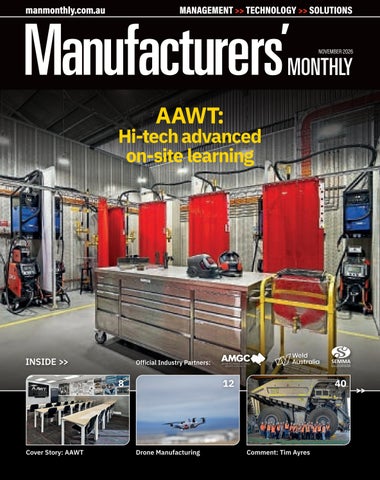
AAWT:
Hi-tech advanced on-site learning
INSIDE >>
Official Industry Partners:
8
Cover Story: AAWT
12
Drone Manufacturing
40
Comment: Tim Ayres
>>
EFFICIENT
TECHNOLOGY 100%
O I L-
FR
E E AI R
Engineered Centrifugal compressors to maximise operational efficiency
COMPLETE AIR & POWER SOLUTIONS
CAPS.COM.AU
manmonthly.com.au
NOVEMBER 2026
For daily news visit manmonthly.com.au
twitter.com/Manmonthly facebook.com/Manmonthly linkedin.com/showcase/manufacturer’s-monthly/ Chairman: John Murphy CEO: Christine Clancy Managing Editor: Mike Wheeler Editor: Jack Lloyd jack.lloyd@primecreative.com.au Design: Alejandro Molano Head of Design: Clayton Hawley Sales/Advertising: Emily Gorgievska Ph: 0432 083 392 emily.gorgievska@primecreative.com.au Subscriptions Published 11 times a year Subscriptions $140.00 per annum (inc GST) Overseas prices apply Ph: (03) 9690 8766
Copyright Manufacturers’ Monthly is owned by Prime Creative Media and published by John Murphy. All material in Manufacturers’ Monthly is copyright and no part may be reproduced or copied in any form or by any means (graphic, electronic or mechanical including information and retrieval systems) without written permission of the publisher. The Editor welcomes contributions but reserves the right to accept or reject any material. While every effort has been made to ensure the accuracy of information, Prime Creative Media will not accept responsibility for errors or omissions or for any consequences arising from reliance on information published. The opinions expressed in Manufacturers’ Monthly are not necessarily the opinions of, or endorsed by the publisher unless otherwise stated. © Copyright Prime Creative Media, 2024 Articles All articles submitted for publication become the property of the publisher. The Editor reserves the right to adjust any article to conform with the magazine format. Head Office 379 Docklands Drive Docklands VIC 3008 P: +61 3 9690 8766 info@primecreative.com.au www.primecreative.com.au Sydney Office Suite 11.01, 201 Miller St, North Sydney, NSW 2060 Printed by: Brougham Press 865 Mountain Hwy, Bayswater VIC 3153 Ph: (03) 9873 5144
Manufacturers’ Monthly Contents 4
Editor’s Note
6
Decision Maker: GoZero
8
Cover Story: AAWT
12
Manufacturer Focus: Boresight
16
Industrial Compressors: CAPS
18
Welding Fume
20
Software Solutions
22
Building Systems
24
Case Study: Orrcon Steel Distribution
28
Events: APPEX
30
Logistics and Freight Solutions
32
Case Study: TAFE NSW
34
Improvement Consultancy
36
Manufacturer Focus: Kite Aero
40
Comment: Senator the Hon Tim Ayres
42
Australian Decarbonisation Awards
44
Recap: Land Forces
46
Endeavour Manufacturing Awards
48
Weld Comment
50
SEMMA Comment
12
36
Behind the cover manmonthly.com.au
MANAGEMENT >> TECHNOLOGY >> SOLUTIONS
Welcome to the November edition NOVEMBER 2026
of Manufacturers’ Monthly. This month’s cover story explores the establishment
AAWT:
of the Australian Academy of Welding Technology
Hi-tech advanced on-site learning
(AAWT), launched by Global Welding Technologies Group to support workforce development and technology adoption across the welding industry. Our November Decision Maker, Stephen Cartwright OAM from GoZero Group Australia, examines how long-term, coordinated government procurement could help build a competitive Australian bus manufacturing industry.
INSIDE >>
Official Industry Partners:
8
Also featured in Manufacturer Focus is Boresight, an
12
40
>>
Australian drone manufacturer scaling up domestic production of cost-effective uncrewed aircraft to help
Cover Story: AAWT
Drone Manufacturing
Comment: Tim Ayres
defence forces train against emerging drone threats.
manmonthly.com.au Manufacturers’ Monthly
3
EDITOR’S NOTE JACK LLOYD – EDITOR, MANUFACTURERS’ MONTHLY
Image: Daco/stock.adobe.com
Building on Australia’s Manufacturing Strengths Welcome to the November edition of Manufacturers’ Monthly.
T
his month, we explore how Australia can build on its established industrial capabilities to strengthen manufacturing, create skilled jobs and secure long-term economic opportunities. From major investments in the Hunter Valley to the future of local bus manufacturing, government policy, procurement and industry investment remain critical to developing a competitive and resilient manufacturing sector. Senator Tim Ayres examines the Hunter Valley’s industrial future, highlighting how existing manufacturing expertise, skilled workers and established supply chains can support emerging industries. With investment in the Tomago Aluminium smelter, renewable energy, hydrogen and local train manufacturing, the
4
Manufacturers’ Monthly November 2026
region demonstrates how traditional industrial strengths can provide a foundation for future growth. Our Decision Maker column features Stephen Cartwright OAM, chairman and managing director of GoZeroGroup Australia, who makes the case for a long-term approach to Australian bus manufacturing. With an estimated $16 billion in replacement demand over the next 20 years, coordinated government procurement and clear local-content targets could give manufacturers the certainty to invest in facilities, technology, skills and domestic supply chains. We also examine the pressures facing Australian manufacturers following the Reserve Bank of Australia’s latest interest rate increase
and its concerns about business productivity. Weld Australia has responded to the RBA’s decision and Governor Michele Bullock’s call for businesses to improve their performance, raising important questions about the conditions manufacturers need to invest, innovate and remain competitive. Across these issues, a common theme emerges: Australia’s manufacturing future depends on more than ambition. It requires consistent policy, long-term investment, a skilled workforce and a commitment to building domestic capability. By making better use of the expertise, infrastructure and supply chains already in place, Australia can strengthen its industrial base and create new opportunities for manufacturers across the country.
Cairns
Townsville
Mt Isa Distribution network: Orrcon Steel Distribution Distribution
Australian-Made Precision Tube.
Gladstone
Charters Towers
BlueScope Distribution
Bundaberg
Metalcorp
Impact Steel
Proud national distributor of Orrcon Steel manufactured Precision tube, backed by technical expertise and value-added processing solutions. Proud supplier
Northgate Brisbane
Toowoomba Kewdale Esperance
Perth
Dubbo
Tamworth
Albury
Sydney
Ottoway Adelaide
Newcastle Unanderra
Bendigo Albany
Ballarat
Melbourne Geelong
Morwell
Dandenong Hobart
Launceston
Get in touch:
13 STEEL Product Guide Scan to view!
Orrcon Steel Distribution, BlueScope Distribution and Metalcorp form the Distribution division of BlueScope in Australia. Collectively, our national network of 29 sites provide customers with access to steel and aluminium products Australia-wide. The advertisement has been prepared for information purposes only. BlueScope makes no representation or warranty as to the completeness or accuracy of the information contained in this advertisement. You must make your own assessment of the information contained in this advertisement, including when necessary seeking specific advice as to the suitability of the products featured in this advertisement for the purpose for which, and the manner in which, you propose to use them. This may involve further independent analysis and testing. Images are for illustrative purposes only. Available products for specified applications may differ in appearance. BlueScope Steel Limited, and its related bodies corporate, take no responsibility for any adverse consequences of any nature which arise as a result of reliance on this advertisement. Information on safe storage and safety datasheets for BlueScope’s products can be found here: https://steel.com.au/. BlueScope Distribution®, Metalcorp®, Orrcon Steel® and Impact Steel® are registered trade marks of BlueScope Steel Limited. © 2026 BlueScope Distribution Pty Ltd (ABN 88 096 380 068).
COMMENT
STEPHEN CARTWRIGHT OAM, CHAIRMAN & MANAGING DIRECTOR, GOZERO GROUP AUSTRALIA
If government wants Australian-Made buses, it must buy for the long term Long-term, coordinated government procurement could help build a competitive Australian bus manufacturing industry, creating skilled jobs and strengthening local supply chains.
B
uses are the most used mode of public transport in Australia, and building replacements for the huge fleets around the country could be worth around $16 billion over the next 20 years. With this comes an incredible opportunity that goes well beyond just replacing diesel buses with electric ones. Australia has an opportunity to build a modern, competitive and sustainable local bus manufacturing industry that creates skilled jobs, develops technology, strengthens supply chains and gives governments greater security over a critical part of our public transport infrastructure. The Federal Government’s Buy Australian Plan recognises government procurement can be used to build domestic industry capability.
6
Manufacturers’ Monthly November 2026
But to do that, governments need to work with industry on the way they buy buses. That’s because you cannot build a sustainable sovereign bus manufacturing capability through ad-hoc or shortterm purchasing decisions. Manufacturing requires investment into factories, tooling, engineering capability, apprenticeships, supply chains, technology and product development. All of these require businesses to commit substantial capital today to prepare for demand that may not arrive for several years. We need a credible and reliable view of what governments intend to buy over the next five, 10 and even 15 years.
Australia’s governments are already some of the country’s largest purchasers of buses, and their purchasing power can either support the development of domestic capability or simply become a mechanism for buying the lowest-cost product available at a particular point in time. The Federal Government’s Buy Australian Plan recognises government procurement can be used to build domestic industry capability. The NSW Treasurer has also recognised the importance of certainty, with the recently announced $6.5 billion New Electric Bus Program, which is intended to provide a 10-year investment
pipeline and a 50 per cent local-content target. This is the right intention, and the same principle needs to be embedded consistently around the country. A manufacturer needs to know how many buses will be purchased, when they will be purchased, what specifications will apply, and what proportion of the build is expected to be local content. This information allows a company to recruit and train local apprentices because there is confidence those skills will be needed in the years to follow, and it enables local component suppliers to invest alongside manufacturers. This approach shouldn’t be done to protect an inefficient industry. Rather it should be to create an industry capable of competing successfully. The Australian bus industry has experienced the consequences of uncertain procurement for too long. When orders surge, manufacturers scramble to recruit people, secure components and increase capacity, but as government purchasing falls away, that investment is difficult to sustain. The result is a boom-and-bust cycle that is damaging to manufacturing because skilled people and
They could also coordinate purchasing between jurisdictions where practical, use longer-term contracts where they provide better value, and reward investment in local capability. Most importantly, they should be evaluating tenders on whole-of-life value rather than purchase price alone. If governments do those things, manufacturers can make long-term investment decisions. The bus industry is a useful case study for a broader question facing Australia. Do we want to remain primarily a consumer of advanced manufactured products, or do we want to retain the capability to design, engineer and manufacture strategically important products ourselves? Buses sit at the intersection of transport, energy, manufacturing, technology and infrastructure, and the transition to zero-emission buses makes the question even more important. Australia does not have to choose between value for taxpayers and Australian manufacturing. With intelligent procurement, we can achieve both. The question is whether we treat government purchasing as a series of individual transactions – or as an opportunity to build a national industry capability that delivers value for decades. As an Australian bus manufacturer, I want there to be local and international competition. But we need to compete in a market where the rules recognise the value of resilience, skills, technology, innovation and long-term economic contribution. Government has enormous purchasing power, and when used strategically it won’t just build buses, it will build an industry. Stephen Cartwright OAM, Chairman & Managing Director, GoZero Group Australia.
Images: GoZero Group
productive capability can’t be quickly rebuilt once they have been lost. The NSW Bus Industry Taskforce has previously identified the lack of certainty around forward orders as a factor in the closure of local manufacturing facilities. Every time manufacturing capability disappears, Australia loses engineering knowledge, skilled workers, apprenticeships, supplier relationships and the ability to respond quickly when demand increases. We should not have to be rebuilding those capabilities from scratch every decade because of an inefficient procurement cycle that could easily be changed. It would help if governments would look at buses not as vehicles, but as long-held public assets that consume energy, require maintenance, parts, and technical support all while carrying Australians every day for many years. The procurement decision therefore has consequences well beyond the initial purchase price. A bus that is marginally cheaper to purchase but creates no locally skilled jobs, and no local supply-chain exposure may not represent better value over its operating life. Australia has a fragmented bus market divided across multiple states and territories, each with different procurement processes, specifications and interpretations of local content. The Federal Government has already recognised the value of greater coordination through the national Zero Emission Bus Procurement Pipeline, designed to make future procurement more visible and improve coordination across governments and industry. This is a great first step, but what is really needed is a nationally aligned approach to procurement. That does not mean every purchaser has to buy the same bus. It means governments should work towards greater consistency in specifications, safety requirements, local-content definitions, contracting arrangements and technical standards. As governments provide the certainty and policy framework, all manufacturers must deliver. We must become more productive and invest in training, automation and technology. We must develop products that compete on quality, reliability and whole-of-life cost, that allow us to build export opportunities. Australian manufacturing cannot ask taxpayers to pay a premium indefinitely. The ambition should be to use the purchasing power of governments to help Australian manufacturers reach sufficient scale to become internationally competitive. The most valuable thing governments can give manufacturers is not a grant, but certainty. They should publish the pipeline and then stick to the timetable, while providing indicative volumes and giving sufficient notice of major tenders.
manmonthly.com.au Manufacturers’ Monthly
7
COVER STORY: LORCH
The AAWT includes a classroom capable of accommodating up to 20 participants and equipped with audio-visual capabilities.
AAWT: Strengthening Australia’s welding workforce Earlier this month, Global Welding Technologies Group Pty. Ltd. (W.E.S.S.) announced the establishment of the Australian Academy of Welding Technology (AAWT), providing industry and training organisations with a state-of-the-art, scalable facility for workforce development and technology adoption.
A
ustralia’s industrial and manufacturing sectors are entering a period of transformation. Advanced manufacturing, major defence programs, infrastructure investment, renewable energy projects and the adoption of Industry 4.0 technologies are creating new opportunities for Australian industry, all while placing greater pressure on the skilled workforce needed to deliver them. “These developments have intensified demand for a highly skilled welding workforce and modern, professionally equipped training environments,” said David Wilton, managing director of Global Welding Technologies Group Pty. Ltd. (W.E.S.S). Welding remains a critical capability across many of these industries. From defence production and high-precision manufacturing to infrastructure
8
Manufacturers’ Monthly November 2026
and fabrication, the availability of appropriately skilled workers will play an important role in Australia’s ability to build and maintain sovereign industrial capability. Importantly, AAWT is not a training provider. Instead, its role is to provide the facility, equipment and technology that enable organisations, or their nominated training providers, to deliver their own programs in a professionally supported environment. “As a purpose-built, state-of-the-art welding training facility, AAWT provides scalable, flexible and contemporary infrastructure that supports workforce development, industry competitiveness and sovereign capability. It’s a uniquely flexible facility to cater for a broad range of education and training needs,” said Wilton.
This model allows both accredited and nonaccredited programs to be delivered without organisations having to establish and maintain their own dedicated welding workshops.
A modern training environment AAWT gives organisations access to advanced welding technology while reducing the financial and operational burden associated with establishing dedicated training infrastructure. The facility includes 8-10 fully equipped welding bays fitted with the latest state-of-the-art multiprocess welding systems, alongside a classroom capable of accommodating up to 20 participants and equipped with audio-visual capabilities. Its leading workshop facilities are designed to Australian Standards and include the latest in
Images: Corey, Shameless Visuals
The facility includes 8-10 fully equipped welding bays fitted with the latest stateof-the-art multi-process welding systems.
welding fume management, while configurable training areas allow the facility to be adapted to different training and workforce development requirements. This includes utilising Lorch iQS welding systems, which sets the standard for GMAW, GMAWP and FCAW with its industry 4.0 and 14 advanced waveform processes. “We see the equipment and technology limitations in traditional training environments. AAWT will always be at the very forefront of welding equipment technology,” said Wilton. “This is critical. There is no point training on 1980 conventional technology. Yes, I agree the base welding processes are still the same, however, advanced digital waveforms have changed the game and provide, faster, superior welding solutions than the past. We should be training on and adopting superior technology and welding processes that are the most cost-effective welding solutions.” The facility is also designed around the increasing role of technology in welding and fabrication. Its Industry 4.0 capabilities support advanced data capture, digital monitoring, performance analytics and traceability, giving users access
to technologies increasingly relevant to modern manufacturing environments. The first phase of equipment focuses on manual welding systems, including advanced process digital waveform MIG/MAG systems and premium AC/DC TIG equipment. A second phase will expand the technology offering to include automation, with orbital TIG welding systems, cobot welding platforms and submerged arc welding (SAW) equipment planned for the facility. “Sadly, we know Australia is a long way behind the western world when it comes to the adoption of welding automation. Some of that is down to our industry and lack of volume manufacturing, but the advent of COBOT technologies has been a game changer for us. COBOTS are cool and are well suited to our market with typical low volume/high mix,” he said. According to Wilton, in manual welding systems, the digital microprocessor-controlled, synergic, advanced waveform processes are created to further optimise the welding process for a specific application. Welders need higher level training to understand and fully utilise these advanced processes.
He continued to say that digital monitoring is not so much for the welder but the welding supervisor. “This is simple these days. I see as an opportunity, true insight into what’s happening on a shop floor with regard to things like arc on time. What is easily measured can be effectively managed to drive productivity improvements,” he said.
Connecting industry and education AAWT’s infrastructure is intended to support a range of workforce development activities, from internal training and upskilling through to competency assessments, practical evaluations, technology demonstrations and trials. The facility can also support RTO-delivered accredited programs, recruitment and pre-employment assessments, as well as advanced process training covering technologies such as COBOT welding, orbital TIG and submerged arc welding. “Under AAWT model, we all come together, we are providing the state -of -the -art facility and technology as the platform to enable all training providers including, RTOs and industry to flourish,” said Wilton.
manmonthly.com.au Manufacturers’ Monthly
9
COVER STORY: LORCH For industry, this creates an opportunity to expose existing and prospective workers to modern equipment and processes without requiring every organisation to invest in its own specialist training infrastructure. The approach also reflects the changing requirements of manufacturers. As businesses adopt new production technologies, workforce development needs to extend beyond traditional welding competencies to include familiarity with digital systems, automation and emerging fabrication processes. By providing access to this technology in a dedicated training environment, AAWT aims to help organisations bridge that gap.
Supporting sovereign capability The workforce challenge extends beyond individual businesses. Welding and fabrication skills underpin capabilities across defence,
infrastructure and manufacturing supply chains, making workforce development an important component of Australia’s broader sovereign capability agenda. AAWT is positioned to support this requirement by providing scalable infrastructure for accredited training, helping prepare workers for national projects and supporting technology adoption across manufacturing sectors. “Welding is a critical skill. Ships and submarines are all made using materials that need welding; it’s a critical skill for manufacturing in Australia,” said Wilton. The facility can also contribute to workforce readiness by supporting practical assessments, recruitment activities and pre-employment testing. This gives organisations another avenue to identify and develop workers with the skills required for specialised manufacturing and fabrication roles.
For government and industry bodies, the model is intended to help address skills shortages while improving access to modern training environments and increasing training throughput.
Building the skills pipeline The economic impact of stronger welding capability extends beyond the individual trade. A larger and better-equipped workforce can improve the readiness of manufacturers and contractors working across defence, infrastructure and other critical industries. AAWT aims to contribute to increased participation in skilled trades, improved training outcomes and greater alignment between training and industry requirements. It can also help reduce some of the barriers faced by organisations seeking to introduce new technologies. Rather than making significant investments in specialist equipment solely for training purposes, businesses
Its workshop facilities are designed to Australian Standards and include the latest in welding fume management.
10 Manufacturers’ Monthly November 2026
can access a professionally supported environment configured for workforce development. That scalability is relevant as Australia’s manufacturing base continues to evolve and companies seek to improve productivity while responding to changing technology and skills requirements. “These products and welding processes are all necessary for leading and advanced manufacturing. They are all unique and require specialised training and qualifications,” said Wilton.
Preparing for the next generation The expansion of AAWT’s technology offering is intended to reflect the direction of modern fabrication, where automation, digital monitoring and advanced welding processes are increasingly integrated into production environments. For workers and organisations, exposure to these systems can provide an opportunity to build familiarity with technologies that are becoming increasingly relevant to advanced manufacturing. “Better education and training with a curriculum aligned with modern welding technologies and advanced manufacturing processes is key, as well as knowledge of advanced waveform welding processes and where to use them. This is relevant for both manual or automation welding,” said Wilton. He said that ultimately, the challenge facing Australia’s welding workforce is not just about increasing the number of qualified workers. It is also about ensuring those workers can train on equipment and processes that reflect the realities of contemporary industry. By providing the infrastructure, equipment and professional support for organisations and training providers to deliver their own programs, AAWT is seeking to create a more accessible pathway between vocational education, workforce development and the technology being adopted across Australian industry. “Global Welding Technologies Group Pty, Ltd with its AAWT facility simply wants to be part of the solution to create the environment and provide the platform for all welding training, from basic entry level to advanced specialised training,” said Wilton. As Australia invests in defence, infrastructure, advanced manufacturing and other critical industries, the ability to develop and maintain the skilled workforce behind those projects will remain central to their success. For welding and fabrication, access to modern training infrastructure is one part of building that capability – connecting workers, educators and industry with the technology required for the next generation of Australian manufacturing.
The first phase of equipment focuses on manual welding systems, including advanced process digital waveform MIG/ MAG systems and premium AC/ DC TIG equipment.
The economic impact of stronger welding capability extends beyond the individual trade.
AAWT aims to contribute to increased participation in skilled trades and improved training outcomes.
manmonthly.com.au Manufacturers’ Monthly
11
MANUFACTURER FOCUS
Designed to destroy, built to scale Australian drone manufacturer Boresight is scaling domestic production of cost-effective uncrewed aircraft designed to help defence forces train against emerging drone threats.
F
or Boresight, success in drone manufacturing is measured differently from that of many defence industry companies. Rather than building aircraft designed to withstand years of demanding military service, the Australian manufacturer produces drones intended to be hunted down, intercepted and destroyed. Its target aircraft provide defence forces with a realistic, cost-effective way to train against the growing threat posed by uncrewed aerial systems (UAS). Based in Fyshwick, ACT, Boresight undertakes its executive operations, design, research and development (R&D) and manufacturing at a single Australian facility. The company has two main product ranges: target drones developed for counterdrone training and testing, and more advanced surveillance aircraft. Its target drones are used to emulate realistic aerial threats, allowing military personnel to practise engaging hostile drones using kinetic counter-UAS capabilities, including weapons and interceptor aircraft. “Our drones get shot down,” said Justin Olde, managing director at Boresight. “They are used for what they call kinetic counter UAS capabilities, where they either shoot them or intercept them with another drone or that kind of thing.” The company’s approach differs from conventional defence manufacturing, where products are often engineered to survive harsh operating environments. Boresight instead prioritises affordability, rapid design and straightforward production, enabling customers to acquire and use target aircraft in the
quantities required for training. “We’re really targeting a very cost-effective, fast to manufacture and fast to design product,” Olde said. Although some of its BQ400 drones have accumulated hundreds of flight hours, their primary purpose is to give defence forces repeatable opportunities to practise countering the threat.
Designed for volume Boresight’s target range includes three aircraft designed and manufactured in Canberra. Its BQ400, named for the approximately 400-millimetre diagonal distance between its rotors, is the company’s mainstay product. The relatively simple aircraft uses a fused deposition modelling (FDM) 3D-printed airframe and electronics designed by Boresight, with more than 6,000 units sold. The larger BQ750 is another 3D-printed target drone, measuring 750mm from motor to motor, while the BF100 is a fixed-wing aircraft with a one-metre wingspan. All three are manufactured at the Canberra facility, with printed airframes and domestically designed electronics supporting a production model focused on simplicity and repeatability. Olde said Boresight’s manufacturing approach reflects that priority. The company operates a farm of Prusa 3D printers, alongside Formlabs selective laser sintering (SLS) and stereolithography (SLA) printers for more advanced printing requirements. Laser cutters and computer numerical control (CNC) cutters also support the business, although these are primarily used for prototyping because they are too
slow for production manufacturing. Olde said the company sources its printed airframes and undertakes assembly domestically, while its printed circuit boards (PCBs) and electronic components are made in South Australia. Motors, batteries and radios are imported. Every drone is test-flown before it is shipped to a customer, providing an internal quality check across production volumes.
Manufacturing at scale According to Olde, Boresight currently has the capacity to manufacture a high volume of BQ400 drones annually, with production expected to reach around 3,000 units in 2026. “We can easily scale up from there,” Olde said. However, the company’s combined capability across its three target drone models in terms of time required to manufacture each model varies. Its more advanced BS350 surveillance drone represents a separate manufacturing requirement. Developed through the Australian Strategic Capability Accelerator’s (ASCA) Sovereign UAS programme, the aircraft was designed as a sovereign-made surveillance option to replace Chinese surveillance drones removed from Australian military service. Three companies were selected for the programme, which has since transitioned from ASCA to the UAS Program Office within Capability Acquisition and Sustainment Group (CASG). “We’re contracted with Defence to have the capacity to make 40 of the BS350 drones a month,” said Olde.
Boresight undertakes its executive operations, design, R&D and manufacturing at a single Australian facility in Fishwick, ACT.
12 Manufacturers’ Monthly November 2026
The company employs 30 people in Australia, including 28 in Canberra and one each in Melbourne and Perth. It is also considering options for additional facilities and expects to expand its manufacturing capability before the end of 2026.
Boresight’s target range includes three aircraft designed and manufactured in Canberra.
Sovereign capability through production
Images: Boresight
Boresight works with Australian engineering and development companies to support its software, hardware and systems development. It has also worked with Defence R&D and test and evaluation organisations, using its target drones to help assess and develop counter-UAS technologies rather than solely developing products for those organisations. Olde believes this work is becoming increasingly important as drones reshape modern warfare. The conflicts witnessed in Ukraine and elsewhere have demonstrated the need for militaries to develop effective methods of detecting, engaging and defeating uncrewed aircraft. Training against realistic threats is an essential part of preparing personnel and systems for those environments. “Any modern military that is not good at countering best of his knowledge, Australia’s highest-volume the drone threat isn’t a modern military,” Olde drone manufacturer, producing aircraft at a scale said. “Drones have changed the shape of a that few Australian defence businesses could readily modern battlefield.” match. Building that capability domestically also For Boresight, the industrial implications are gives Australia a local manufacturing base that can 29_APPEX 2027 - Dec Half Page Adverts_PRIME_Manufacturers1_PRINT_1.pdf 1 12/10/2026 1:27 pm equally important. Olde said the company was, to the respond to changing defence requirements.
Exporting Australian-made drones Exports already account for an estimated 60–75 per cent of Boresight’s revenue, according to Olde, with the company supplying customers in Europe, the Middle East, Southeast Asia, the United States and the United Kingdom.
REGISTER FREE NOW
C
M
Y
CM
MY
CY
CMY
K
Australasia’s Largest Processing & Packaging Expo Think you’ve seen it all? Think again.
16-19 MARCH 2027 Melbourne Convention Exhibition Centre
manmonthly.com.au Manufacturers’ Monthly
13
MANUFACTURER FOCUS
While some BQ400 drones have logged hundreds of flight hours, their main role is to provide repeatable counter-threat training for defence forces.
Its US operation has expanded beyond sales into manufacturing. After establishing low-scale production in the country during 2025, Boresight moved into an 812-square-metre facility in Huntsville, Alabama, during the third quarter of 2026. The facility is being refitted to support largerscale production, with manufacturing already under way and capacity being increased to match the Australian operation. The US site also employs manufacturing, sales and field support staff, supporting demonstrations and
other customer activities. Olde said the company had conducted two demonstrations simultaneously in the week before the interview. The decision to manufacture closer to customers reflects the economics of Boresight’s production model. The production method is scalable so once a region’s demand reaches a certain level, the business case to produce locally makes sense. Also, sovereign made products are becoming increasingly important for some industries, in particular military. The US facility therefore complements Australian operations while giving the company a way to meet demand in a major export market.
Building a sustainable industry
Boresight and the other two companies involved in the Sovereign UAS programme submitted a joint proposal to the government in 2025.
14 Manufacturers’ Monthly November 2026
Despite the company’s existing production and export capability, Olde believes Australia’s broader drone manufacturing industry needs a more consistent approach to industry development. He pointed to the United States, and Huntsville’s established defence industry, as an example of how sustained procurement can maintain industrial capability. Rather than commissioning a product once, he said, the US government continues purchasing from manufacturers, helping keep businesses, expertise and production capacity active. Here in Australia, Boresight and the other
two companies involved in the Sovereign UAS programme submitted a joint proposal to the government in 2025 for a multi-year contract that would purchase quantities of surveillance drones from each company on a regular schedule. Olde said this would provide the revenue assurance needed to invest in people, technology and production without relying on individual customer requests to fund each new development. He also sees potential applications for sovereignmade drones beyond Defence, including surf lifesaving organisations, rural fire services, Country Fire Authority (CFA) units, State Emergency Service (SES) units and police. A broader, whole-of-government approach to procurement could give more public-facing organisations access to the technology while supporting domestic manufacturers. Without that demand, Olde argued, Australian manufacturers are left waiting for a government agency or customer to request a particular product and help fund its development. Long-term programmes would instead provide the confidence to invest ahead of individual orders and build a sustainable industrial base. “Good, solid, long-term programmes would have a really positive impact on the broader industry,” he said.
THE NEW BENCHMARK IN INDUSTRIAL WELDING. The Lorch iQS is the solution with its future proof platform setting the new benchmark in industrial welding. A smart iQ, Industry 4.0, game changing welding platform with wifi connectivity and leading new welding processes to drive quality, efficiency and productivity improvements. The RCS (Rapid Current Shutdown) and Speedwave XT processes are examples of the the continuous innovation Lorch strives for in their welding systems. Serious machines for serious welders. To arrange a product demonstration contact: david.wilton@lorch.eu
INDUSTRIAL SOLUTIONS
The value of a complete solution CAPS Australia is helping manufacturers improve efficiency and reliability by combining equipment expertise with ongoing operational support.
C
ompressed air, power generation and supporting infrastructure play a vital role in keeping manufacturing operations running. When these systems underperform or fail, the effects can ripple across production, increasing costs and disrupting schedules. With energy prices rising, production demands increasing and skilled maintenance personnel in short supply, manufacturers are placing emphasis on how critical assets perform over their working life. Rather than focusing solely on equipment purchases, businesses are looking for solutions that address the broader needs of their operations. CAPS Australia takes this approach by bringing together equipment supply, engineering, installation, maintenance, monitoring and ongoing technical support to help manufacturers maintain reliable, efficient production. For more than 45 years, CAPS has supplied compressed air, power generation, gas generation and blower solutions to Australian industry. Its approach centres on understanding each manufacturer’s operational requirements, selecting appropriate technology and providing the support needed to maintain performance as production demands change. “Providing complete solutions means taking responsibility for the entire operational outcome rather than just supplying a piece of equipment,” said CAPS Australia director of operations Paul Goodwin. “Our role is to understand the process, identify the risks, design the right solution, install it correctly and provide ongoing support throughout the lifecycle.”
Looking beyond the purchase price According to Goodwin, manufacturers are increasingly assessing infrastructure investments through the lens of total lifecycle cost rather than initial capital expenditure alone. Energy consumption, servicing requirements, replacement parts and unplanned downtime can have a greater influence on an asset’s overall cost than its purchase price. Infrastructure must also accommodate changing production requirements. Systems designed only for current demand can become constraints as facilities expand, while equipment with excessive capacity can operate inefficiently if it spends extended periods outside its optimal operating range. CAPS works with manufacturers to assess production processes, operating conditions, load profiles and future requirements before
16 Manufacturers’ Monthly November 2026
recommending a solution. This includes considering equipment scale, capacity, pressure, existing infrastructure and the reticulation system to help identify opportunities for improved efficiency. “Understanding the load profile and operational conditions, and adequate reticulation, allow us to model efficiency. Efficiency is key, from equipment scale, capacity and pressure to the operating environment, existing infrastructure and available operational data,” said Goodwin. For compressed air systems, selecting the appropriate technology is important when air quality directly affects production. CAPS offers oil-free compressors across scroll, rotary screw, two-stage compression and centrifugal technologies, enabling its team to match equipment to the demands of individual applications. Oil-free compressed air can provide ISO 85731 Class 0 air quality for applications where oil contamination cannot be tolerated. These include food and beverage processing, pharmaceutical manufacturing, medical and dental applications, electronics, laboratories, printing and spray painting. However, not every application requires Class 0 technology. Where very clean air is needed but limited oil contamination can be tolerated, filtration and drying equipment can also form part of an appropriate solution. Assessing the application helps manufacturers balance air quality, efficiency and capacity without investing in equipment beyond their actual requirements. “CAPS provides a range of oil-free air compressors, which offer flexibility for varying air demand conditions, whilst helping you save on energy costs,” said Goodwin. Planning for growth is equally important. Manufacturers must weigh current air demand against projected production volumes, redundancy requirements and the timing of future expansion. “Having the right balance of efficiency and additional capacity can be a tough call. The timeframes of current needs and those of an operation’s growth and future volumes are part of the efficiency calculation that CAPS supports customers through,” Goodwin said.
Maintenance that protects performance Selecting the right equipment is only part of maintaining reliable infrastructure. Regular servicing can help extend asset life, preserve
efficiency and identify developing problems before they result in costly failures. CAPS encourages manufacturers to maintain and optimise existing equipment rather than relying solely on replacement programs. Its CAPS Care maintenance program supports compressed air assets through scheduled servicing, diagnostic testing, genuine replacement parts and ongoing technical support. Manufacturers can choose from Packaged Care, Planned Care, Parts Care and Performance Care programs according to their operational requirements, while Power Care provides dedicated support for power generation equipment. Goodwin emphasised the importance of using trained technicians, appropriate tooling and genuine consumable parts to maintain equipment correctly and minimise unnecessary wear. “Compressors are like any other working machinery; the better you look after it, the better and longer it will perform, maximising its service life. It is vital that they are properly maintained with the correct tooling, to the right tolerances, using the appropriate consumable parts, and at the right intervals,” he said. Digital monitoring and remote connectivity are also helping manufacturers gain greater visibility over equipment performance. By tracking operating conditions and identifying changes, businesses can plan maintenance more effectively, investigate efficiency opportunities and reduce reliance on reactive repairs. CAPS is exploring artificial intelligence to help analyse operating conditions and tailor equipment performance to individual site requirements. Through its association with Ingersoll Rand, the company can also support customers using Ecoplant, an advanced dynamic controls platform designed to provide real-time insights into compressed air system performance. Compatible with compressed air systems from major original equipment manufacturers, Ecoplant provides predictive maintenance insights and alerts about potential system failures. These capabilities can help manufacturers identify issues earlier and make more informed decisions about equipment operation and servicing. “AI and its utilisation across manufacturing continues to increase, as industry naturally seeks to maximise operational efficiencies and returns,” said Goodwin. “As part of the Ingersoll Rand family,
Images: CAPS
CAPS has supplied compressed air, power generation, gas generation and blower solutions to Australian industry.
CAPS is able to directly support its customers on this journey utilising the Ecoplant controls platform. Ecoplant is a machine learning, compressed air monitoring and control network that optimizes the efficiency of compressed air generation systems.”
Support beyond installation Even well-designed systems with appropriate maintenance programs can experience unexpected failures. Access to technical expertise, replacement parts and alternative equipment can therefore be critical to maintaining production continuity. CAPS operates a nationwide network of 10 branches, providing local technical support, genuine spare parts and 24/7 emergency breakdown assistance. Its rental fleet offers shortand long-term compressor and generator solutions for planned shutdowns, seasonal production peaks, project work and emergency situations. For manufacturers operating with lean maintenance teams, these services provide additional support when internal resources are stretched or equipment becomes unavailable. “With service, support and rental equipment if needed, there is no need for customers to experience extended disruptions to their operations,” said Goodwin. This combination of equipment, servicing, monitoring and responsive support reflects CAPS’ focus on the entire operational lifecycle rather than the initial installation alone. As manufacturers navigate energy costs, changing production requirements and skills shortages,
infrastructure decisions will increasingly need to account for efficiency, reliability and future operating demands. Selecting the appropriate equipment, maintaining it correctly and using operational data to guide decisions can help businesses manage costs and reduce risk over time. For CAPS, the objective is to develop solutions around each manufacturer’s requirements,
providing the technology and ongoing expertise needed to support reliable operations. “Reliability and efficiency will always be the key drivers of any infrastructure. While the specifics will vary by industry, location and demands, having the right equipment – and it performing reliably and efficiently – always be critical to the success of any Australian company delivering locally, nationally or competing on a global scale,” said Goodwin.
CAPS’ service technicians support manufacturers through its 10 branches across Australia.
manmonthly.com.au Manufacturers’ Monthly
17
WELDING FUME
Smarter shielding gases for improved health, productivity and quality Images: Coregas
According to Coregas, lowering welding fume exposure can start with smarter shielding gas selection, helping manufacturers improve safety, quality, productivity and consistency.
In January 2024, Safe Work Australia reduced the workplace exposure standard for welding fumes.
A
ccording to Coregas, manufacturer and distributor of compressed gases and cryogenic liquids across Australia and New Zealand, welding fume is now firmly in focus. In January 2024, Safe Work Australia reduced the workplace exposure standard for welding fumes from 5 mg/m³ to 1 mg/m³ (8-hour time-weighted average), and from 1 December 2026 these standards become workplace exposure limits. This reflects the growing recognition that even lowlevel exposure can present health risks, alongside existing limits for other hazardous components found in welding materials like chromium and nickel.
What drives welding fume? According to Coregas, fume is influenced by several variables: base material, coatings, filler metal, shielding gas, welding parameters and technique. Managing exposure requires a layered approach. First, reduce fume generation where practical. Then support the welder with local extraction, ventilation and appropriate respiratory protection.
Why shielding gas matters Coregas states that in GMAW on carbon steel, carbon dioxide (CO₂) is commonly used to support heat transfer and weld penetration. But higher CO₂ levels can also increase fume, spatter and arc instability. That makes the shielding gas an important lever in fume management, productivity and weld appearance. Coregas welding trials have shown a clear relationship between higher CO₂ levels and increased fume formation. In heavy carbon steel, gas mixes with 15–25 per cent CO₂, or even 100 per cent CO₂, may be required for some procedures. However, many applications can still meet weld performance requirements with lower-CO₂ mixtures. The potential benefit is large: lower fume generation, reduced spatter, cleaner welds,
18 Manufacturers’ Monthly November 2026
HOW TO PREVENT FUME EXPOSURE
Choose the lowest fume-generating material and filler metal
Reduce fume levels by using gas mixtures with lower CO2
Consult with suppliers for accurate advice on specific products and alternative low-fume options.
CO2 levels are linked to increased spatter and fume levels. Alternative lower CO2 gas mixes may still meet your performance needs.
Optimise machine settings to reduce fume levels
Reduce fumes with fume extraction
Filter out fumes with respiratory protection
Avoid using unnecessarily high consistent currents. Pulsed welding machines can be optimised in most cases to reduce fume level generation.
This can be on torch extraction through to portable/fixed styles. Also consider monitoring systems that constantly measure fume levels in the workshop.
At a minimum, wear rated masks. Ideally, PAPR style welding masks/ helmets are best practice as they provide clean air, respiratory protection and support productivity.
Fume is influenced by several variables: base material, coatings, filler metal, shielding gas, welding parameters and technique.
improved weld profile, and in some cases, faster welding speeds. In other words, a gas change can support both safer work practices and better fabrication outcomes. Many workshops continue using the gas mix they have always used because it is familiar. But gas selection should be a process choice, not a habit. Coregas offers a broad range of shielding gases designed to deliver different performance outcomes for all welding applications. For example, Coregas 10 and ShieldPro Heavy (formerly Coregas He30) may be suitable lower-CO₂ alternatives while maintaining or improving weld performance and quality. Coregas 10 (10 per cent CO₂, balance argon) is suited to a range of carbon steel thicknesses from 3 mm to 16 mm. It provides excellent arc stability, smooth weld appearance and strong suitability for GMAW, many MCAW wires and robotic applications. ShieldPro Heavy (30 per cent helium, 10 per cent CO₂, balance argon) takes it to the next level and is designed for heavy-section carbon steel and high-performance welding. The helium supports greater heat transfer, helping improve deposition, penetration and welding speed compared with typical argon and CO₂/O₂ mixtures. Coregas reaffirms that welding fume management should be holistic, but the shielding gas is often one of the simplest places to start. Reviewing your
welding trials have “ Coregas shown a clear relationship
between higher CO₂ levels and increased fume formation
Coregas trial data: fume formation rate rises with CO₂ content (GMAW, carbon steel, 200 A).
gas mix with Coregas may help reduce fume at the source while supporting productivity, quality and consistency. Coregas and its welding equipment partners can help assess an application and identify the right shielding gas for a process.
”
Coregas 10 and ShieldPro Heavy may be suitable lower-CO₂ alternatives.
For more information, view Coregas’ welding fume information flyer at https://www.coregas. com.au/images/heroImages/Fume-FlyerFinal-24-9-24.pdf, or visit www.coregas.com.au/ contact or call 1800 807 203.
A Commercial & Industrial Builder You Can Trust From tilt panel warehouses to large-scale industrial developments, Chappell Building Systems has built its reputation on precise and reliable delivery. Chappell Building Systems delivers high-performance industrial and commercial facilities engineered for durability, efficiency and long term functionality across Australia’s Eastern Seaboard and the Northern Territory.
Contact us to assist you with the design and construction or construction only of your next project. (02) 4959 3000
enquiries@chappellbuild.com.au
chappellbuild.com.au
manmonthly.com.au Manufacturers’ Monthly
19
SOFTWARE SOLUTIONS
Building capability through local expertise Central Innovation is helping Australian manufacturers strengthen engineering capability and improve workflows through local training, consulting and customer support for its offerings.
F
or manufacturers, investing in engineering software is only part of the equation. How effectively employees use that technology can determine whether businesses achieve the productivity, consistency and efficiency they need to remain competitive. Central Innovation works with manufacturers to bridge the gap between owning the right tools and having the skills to use them effectively. A common starting point is a new employee who brings engineering experience but has previously worked with different software. While the underlying engineering principles remain similar, unfamiliar interfaces, functions and workflows can create a learning curve that affects productivity. Structured training helps businesses bring employees up to speed quickly, establish effective working practices from the outset, and reduce mistakes. “People switching from another design program would take some significant time to get used to the new type of software,” said Kate Kononchuk, training coordinator at Central Innovation. “The company would prefer to get them up to speed by having a structured training on SolidWorks rather than getting them slowly figuring this out on their own and not being as productive during this period.” The same challenge arises when manufacturers expand their product offerings, introduce new design requirements, or seek to bring previously outsourced activities in-house. Businesses already using SolidWorks may need to explore
Kate Kononchuk, training coordinator, Central Innovation.
20 Manufacturers’ Monthly November 2026
advanced capabilities, while those wanting to conduct their own design simulations must develop the skills to use the relevant software effectively. Training also helps address the gap between engineering education and workplace readiness. Graduate engineers may understand the underlying principles but still require practical software knowledge to contribute productively to industry projects. For manufacturers facing skills shortages, developing that capability efficiently is increasingly important.
Understanding the skills gap Central Innovation takes a tailored approach to training, beginning with an understanding of each customer’s business, workforce and objectives. Account managers discuss the products being developed, the people involved and the outcomes the business wants to achieve. Many account managers have engineering backgrounds, allowing them to assess capability needs from an informed technical perspective. A SolidWorks skills analyser facilitated by Central Innovation provides another starting point, assessing individual employees or entire teams across different SolidWorks disciplines, including modelling, assemblies and drawings. The results help identify existing strengths and capability gaps, which can then be considered alongside the customer’s day-to-day workflows and business goals. “Rather than assuming where a customer’s capability gaps are, we can assess them and their current SolidWorks knowledge,” said Shem Carroll, inside sales executive at Central Innovation. “We can then sit them down with a customer, look at these results alongside how they’re working day-to-day and what they’re trying to achieve as a business together.” From there, Central Innovation can recommend scheduled instructor-led training or develop a private programme around specific requirement. Scheduled courses provide a predefined set of lessons, while private training allows businesses to concentrate on the areas where they need the most support. Additional scoping meetings with Central Innovation’s technical team and engineers help shape programmes to suit individual customers. The assessment can also identify situations where the challenge extends beyond an employee’s
technical knowledge. If inefficient workflows are contributing to operational problems, the next step may be a broader consulting engagement rather than training alone. For Carroll, this is where the value of local expertise becomes particularly important. “We’re not simply giving someone an assessment and then leaving them with the results there,” he said. “We have local training and technical expertise that can help interpret where those gaps are and work with the customer on the next steps that are going to be right.”
Developing in-house engineering capability Targeted training can help engineering and design teams use their existing technology effectively while building the confidence to manage more processes internally. With SolidWorks, a stronger understanding of modelling techniques, design intent, assemblies and advanced functionality can help engineers work more efficiently and produce more consistent designs. Additional tools can extend these benefits beyond individual design tasks. #Task automates repetitive activities, including drawing exports, file conversions, property updates and other routine computer-aided design (CAD) operations. Automating these activities reduces the time engineers spend on manual work that can otherwise consume considerable resources. MaXXlink addresses the management and collaboration of engineering bill of materials information, helping teams work with structured product information and connect engineering data with downstream business processes. This reduces reliance on spreadsheets and repeated data entry, supporting more connected operations. “The real benefit comes from combining the right technology with the right knowledge, and we want customers to develop the confidence and capability to manage these processes internally, freeing their engineering teams to focus on higher value work,” said Chatura Elkaduwa, head of technical and product development at Central Innovation. Building that internal capability also means looking beyond the engineering department. Better-connected information and more consistent processes can benefit other teams involved in product documentation, administration and downstream business activities.
Moving from support to continuous improvement
Tackling engineering data challenges One area where this combined approach can deliver value is engineering data management. Manufacturers may rely on shared folders, spreadsheets, manual processes and employees’ accumulated knowledge to manage product information, revisions and documentation. These arrangements can make it difficult for teams to locate the correct information, confirm revisions and prepare documentation for downstream activities. Central Innovation’s consulting approach involves reviewing existing processes, identifying risks and implementing a more structured product data management environment. This can include standardising file structures, introducing
Chatura Elkaduwa, head of technical and product development at Central Innovation
controlled workflows, automating repetitive activities, and providing targeted training to help employees adopt the new processes. In a recent example, Central Innovation implemented a product data management solution while identifying opportunities to extend the benefits to non-engineering teams. Training in tools such as MaXXlink and #Task helped support these improvements beyond the CAD environment, including processes involving Excel and metadata. The resulting improvements can include consistent revision management, reduced manual administration, better access to engineering information and stronger collaboration between departments. These benefits may extend to finance and administration teams, as well as engineering and other operational functions. Central Innovation measures the impact against the customer’s original challenges, including time spent on repetitive tasks, the frequency of data-related issues, and the efficiency of engineering handovers.
Images: Central Innovation
While training and consulting help manufacturers implement improvements, maintaining effective software environments and workflows requires ongoing attention. Central Innovation’s CI Care offering is designed to extend the customer relationship beyond initial implementation, combining support with a proactive approach to maintaining and improving technology. Traditional technical support remains important when users encounter problems or need assistance with specific functions. However, CI Care also provides structured activities such as periodic health checks, technical reviews, upgrade planning, and access to training and consulting expertise, depending on the service level. For customers with more complex environments, this can include reviewing system utilisation, identifying workflow inefficiencies and helping maintain sound data management practices. The objective is to keep technology stable and efficient while ensuring it continues to support changing business requirements. “It’s about moving from simply resolving issues to actively contributing to the customer’s longterm success,” Elkaduwa said. The three offerings are designed to complement one another. Training develops the knowledge and confidence of software users; consulting helps businesses design and implement more efficient processes; and CI Care provides ongoing engagement to monitor improvements and identify further opportunities. Having these capabilities available through one partner also provides continuity. Central Innovation’s teams develop an understanding of each customer’s environment, objectives and operational challenges, reducing the need for manufacturers to repeatedly explain their requirements to different providers.
advance and allocate training days throughout the year. Employees can begin with essential or fundamental courses, apply what they have learnt in the workplace and return for more advanced upskilling as their capabilities develop. Alongside these changes, increasing automation and the emergence of artificial intelligence are making human interaction and connected technology environments important considerations. Access to knowledgeable people who can demonstrate processes, answer questions and provide practical guidance remains valuable as manufacturers navigate evolving systems and expectations. “Technology is evolving quite quickly, but simply having the technology doesn’t automatically mean that you’re going to create efficiencies within your workplace,” Carroll said. “You still need the right people with the right skills. You need the workflows that can support the business and you need to continually look at where things can be improved.” For Central Innovation, the answer is a locally supported, ongoing partnership that brings together technical expertise, workforce development and continuous improvement. “We have local trainers, consultants, engineers and product specialists who can work alongside customers, understand how their business operates, help build capability within their teams and continue supporting them as their needs evolve in such a changing industry,” Carroll said. “Rather than it being a one-off software or training conversation, I think it’s increasingly becoming an ongoing partnership focused on continuous improvement.
Keeping pace with changing demands As manufacturers continue to automate and digitise their operations, the need to develop workforce capability is unlikely to diminish. Australia and New Zealand face a shortage of experienced engineers, making it important for businesses to help new employees become productive quickly, even when they have previously used different engineering tools. Kononchuk also expects training to become more personalised and continuous. Rather than relying solely on one-off, standardised courses, manufacturers are increasingly looking for training that addresses their specific tasks and operational requirements. Central Innovation’s training passport offering allows customers to purchase training credits in
Shem Carroll, inside sales executive, Central Innovation.
Browse upcoming training by scanning this QR code.
manmonthly.com.au Manufacturers’ Monthly
21
INDUSTRIAL BUILDING SYSTEMS
Breaking ground on commercial and industrial developments With decades of experience across industrial and commercial construction, Chappell Building Systems continues to deliver facilities designed around the demands of modern business.
A
ustralia’s industrial construction landscape continues to evolve, with manufacturers, logistics operators and commercial businesses demanding facilities that perform reliably, accommodate changing operational requirements and support future growth. For Chappell Building Systems, these demands have shaped its approach for more than three decades. Based in Morisset on the NSW Central Coast, the company has evolved into an integrated design and construct contractor delivering warehouses, workshops, manufacturing facilities, multi-unit industrial developments and complex operational spaces across Australia’s eastern seaboard and the Northern Territory. Its capabilities span design, engineering, fabrication and construction, allowing it to manage projects across multiple stages of development. Founder and director Chris Chappell remains closely involved in the business, bringing technical experience to project planning and delivery. The company’s focus extends beyond completing a building. Industrial facilities must support daily operations, accommodate future growth and provide the structural performance expected over decades of use. Chappell Building Systems combines technical capability with an emphasis on coordination, quality and reliable delivery.
From concept to completion A key part of Chappell Building Systems’ offering is its Chappell Building Systems offers an end-to-end delivery model, becoming involved from the early stages of a project through feasibility advice, design, engineering, approvals support, fabrication and construction to final certification. This approach provides greater oversight of costs, timelines and quality while reducing coordination gaps between consultants, contractors and clients. Its capabilities include design and construct delivery, industrial and commercial construction, concrete tilt panel and precast systems, structural steel fabrication and installation, roofing and cladding systems, and commercial fitout. Reinforced concrete tilt panel construction and structural steel systems underpin much of its work, providing scalable, durable solutions for warehouses, manufacturing facilities and industrial developments.
22 Manufacturers’ Monthly November 2026
Roofing and wall cladding systems incorporate CodeMark-approved products designed for long-term weather resistance and durability. Early contractor involvement allows clients to assess feasibility, develop budgets, identify potential issues and consider value engineering before construction begins. Alongside traditional fixed lump-sum contracts, the company offers construction management models that provide greater flexibility and visibility throughout delivery.
Designing for modern industry Industrial buildings increasingly support sophisticated manufacturing, logistics and supply chain operations. Automation, changing storage requirements, equipment loads and future expansion can all influence facility design and construction. Chappell Building Systems has delivered projects across multi-unit developments, warehouses, workshops and commercial buildings incorporating specialised operational areas. At 11 Bluewater Close, Taylors Beach, the company completed a 27-unit reinforced concrete tilt panel industrial development in April 2025. Delivered through a design and construct model, the 1,955-square-metre development was designed to provide flexible operational space while maintaining durability and efficiency. At 19 Brodie Street, Morisset, a development for Sanitarium was completed in August 2024. It incorporated warehouse facilities, laboratories, cool rooms, multi-level office space and a compliant commercial kitchen, requiring the coordination of multiple operational requirements within one development. At 40 Accolade Avenue, Morisset, the company delivered 10 reinforced concrete tilt panel units on a challenging site featuring a four-metre suspended rear structure. The project required detailed structural coordination, highlighting the technical considerations involved in developing industrial sites with complex conditions. In August 2026, Chappell Building Systems completed a three-level, 3,000-square-metre concrete tilt panel warehouse for Autosmart (Australia) Pty Ltd at 12 Darrambal Close, Rathmines. The complex incorporated offices, meeting rooms, a lunch room, bathrooms, an undercover car park, external car parking, a lift, underground water
tanks, a fire pump room, a sprinkler system and warehouse racking. These projects demonstrate the company’s experience adapting construction methods to different operational and site requirements.
Experience across the business Chappell Building Systems’ project delivery is supported by an experienced leadership and management team. Chris Chappell brings more than 30 years of experience spanning prefabricated steel construction, concrete tilt panel systems and largescale design and construct projects. He remains closely involved in delivery, overseeing compliance, quality control and overall project outcomes. Operations and business development manager Ben Isenhood has 26 years of industry experience across industrial developments, commercial construction, high-end hotels, taverns and childcare facilities. Construction manager Jake Evans oversees site operations, subcontractor coordination and quality assurance, while office manager Tina Smith manages the operational and financial systems supporting projects. Project planning and approvals manager Nartasha Evans works with contracted design consultants and local certifying authorities throughout planning and approvals. Together with experienced site supervisors overseeing day-to-day works, the team maintains oversight across the construction process and supports communication among project stakeholders.
Safety, compliance and control Safety remains central to project delivery as industrial developments become larger and more complex. Chappell Building Systems has established internal safety management systems supported by independent external auditing. According to the company, it maintains zero lost-time injuries, 100 per cent monthly external safety audits and 100 per cent induction compliance. A full-time work health and safety manager supports the business, while project teams operate under site-specific Safe Work Method Statements (SWMS), risk assessments, mandatory personal
Image: Chappell Building Systems
protective equipment requirements and ongoing competency training. Environmental management measures cover waste reduction, erosion control, dust and noise management, in line with Environmental Protection Authority and local environmental guidelines. Digital systems also support operations. The company’s integrated project management ecosystem is designed to improve reporting, documentation control and communication between project teams, providing greater visibility throughout construction.
253-257 Nolan Avenue, Unanderra
A platform for continued growth Chappell Building Systems enters its next phase with an established project portfolio and a pipeline of industrial developments across the region, with project values ranging from $2.4 million to $12 million. The pipeline includes a concrete industrial tilt panel building at Industrial Road, Oak Flats; three large industrial warehouses at Accolade Avenue, Morisset; a warehouse and office project at Mount Thorley; two industrial units at Somersby; and a gym and office complex at Boolaroo. Additional projects are planned for Helensburgh, Gateshead, Spring Hill, Wauchope and Port Macquarie. The projects reflect demand for industrial
property and purpose-built facilities supporting manufacturing, warehousing, logistics and other commercial operations. For Chappell Building Systems, the next stage builds on more than 30 years of experience, with opportunities to apply its integrated approach to an evolving industrial sector. Contact Chappell Building Systems at: W: www.chappellbuild.com.au P: (02) 4959 3000 E: enquiries@chappellbuild.com.au
NEW 2026/27 DEVELOPMENTS 2026 has seen a number of projects moving towards completion during 2026 with some new projects to kick off in 2027. Completed: • 20 Cedar Mill Drive, Jilliby -26 industrial units located in the Warner Business Park on the Central Coast of New South Wales, ranging in size from 68m2 to 350m2; • 18 Sara Street, Toronto – 13 industrial units ranging in size from 86m2 to 249m2 with high set roller doors to each unit, bathroom and kitchenette facilities; • 6 Nelson Road, Cardiff – a boutique collection of 18 high-quality, modern industrial units located in the Hyde business park which range in size from 153m2 to 171m2 with mezzanines. Nearing completion: • 10 Bluewater Close, Taylors Beach – industrial building comprising 2 warehouses; • 3 Tinnula Drive, Jilliby – industrial factory and office with parking for 31 vehicles; • Munibung Road, Cardiff – 34 industrial units within 5 buildings with carparking; • 3 Woodbine Place, Toronto – 7 off reinforced concrete tilt panel industrial units.
Don’t Digitise Your Waste. Streamline first. Make Industry 4.0 count. Technology can accelerate production. It can also accelerate inefficiency. Before investing: • Remove unnecessary steps. • Resolve bottlenecks. • Standardise how work gets done. Efficiency Works helps manufacturers build better processes, so technology supports productive operations. Make your next investment work harder. Find Your Top 3 Bottlenecks in Under 20 Minutes Free guide to help you identify and fix plant productivity issues fast.
www.efficiencyworks.com.au info@efficiencyworks.com.au
manmonthly.com.au Manufacturers’ Monthly
23
CASE STUDY
Woods Furniture and Orrcon Steel Distribution: A partnership built on precision and trust Woods Furniture and Orrcon Steel Distribution have built a long-standing partnership to support the production of furniture for schools across the country.
F
or more than seven decades, Woods Furniture has been designing and manufacturing innovative school furniture that transforms learning environments across Australia. From flexible seating to ergonomic desks, their products combine durability, function, and style, meeting the evolving needs of students and teachers alike. Behind every Woods Furniture product lies a network of local supply partners who share their commitment to quality and reliability. Among those supply partners, Orrcon Steel Distribution stands out as a trusted steel supplier, providing thin gauge precision-engineered steel tube products that form the backbone of Woods Furniture’s manufacturing process. “We’ve been supplying Woods Furniture for approximately 15 years,” said Gary Harkness, account manager at Orrcon Steel Distribution. “They’re one of the country’s leading educational furniture manufacturers and we’re proud to be supplying Australian Orrcon Steel products to help bring their designs to life.”
Precision Tube: the foundation of function and form Orrcon Steel thin gauge Precision tube is well known for its consistent dimensional accuracy, surface finish, and strength. Locally manufactured by Orrcon Steel Manufacturing in compliance with AS1450 and under an ISO9001 certified quality management system, each batch of tube is subject to multiple quality checks throughout the production process, ensuring every length adheres to strict tolerances and finish standards. Available in various profiles such as round, square, rectangular, and oval, these tubes are designed for applications where precision and consistency are essential. “For us, that reliability is critical,” said Nick Delic, CEO of Woods Furniture. “We design furniture that’s used every day by students across the country. We need to know that every steel tube we receive meets the exact specifications, so our frames, legs, and fittings align perfectly during production. Orrcon Steel products give us that confidence.”
24 Manufacturers’ Monthly November 2026
Orrcon Steel Distribution supply a range of Precision tubular products.
Orrcon Steel Distribution supplies cut-to-length ERW Precision Tube, which reduces material waste and streamlines Woods Furniture’s production workflow. “Their ability to provide us with Precision thingauge material to exact lengths is a huge advantage,” said Delic. “It gives us efficiency while reinforcing our commitment to Australian-made quality and locally sourced materials.”
Aligned for success: managing seasonal demand The relationship between Woods Furniture and Orrcon Steel Distribution is a strategic partnership built on shared planning and trust. Woods Furniture’s production is highly seasonal, peaking around the summer months when schools prepare for the new year. To be successful, suppliers need to forecast, produce and deliver seamlessly. “The Orrcon Steel Distribution team works closely with us to align production schedules around our
seasonal cycles,” said Delic. “When we ramp up, they’re ready. When we slow down, they adapt. That kind of responsiveness only comes from a partner who truly understands your business.” “Surety of supply is everything for Woods Furniture. We forecast ahead to ensure their product is available when they need it, whether it’s a full mill rolling or short lead-time top-ups. It’s a partnership that’s built on communication and responsiveness,” Harkness agreed.
Australian steel for Australian schools Woods Furniture is proudly Australian-owned, with all its design and production work based in Victoria. “Working with local mills and suppliers like Orrcon Steel and Orrcon Steel Distribution keeps our supply chain strong and reliable,” said Delic. “It supports Australian jobs and ensures the quality of our products remains consistent. Our customers trust that when they buy Woods Furniture, they’re supporting Australian manufacturing.”
Images: Woods Furniture
The cut-to-length ERW Precision Tube’s reduce waste and streamline Woods Furniture’s production.
Innovation and collaboration Innovation sits at the heart of Woods Furniture’s design philosophy, and the partnership with Orrcon Steel Distribution extends beyond supply; it’s a collaborative relationship that continually seeks improvement. “As we develop new furniture designs, Orrcon Steel Distribution works with us to identify the most suitable tube sizes,” said Delic. “Sometimes that means testing a new gauge or exploring different types of tube products to improve durability and aesthetics. Having access to their local technical team makes that process much easier.” Orrcon Steel Precision tube products are available with specialised finishes, giving Woods Furniture the flexibility to meet performance and appearance needs across various product lines. “That versatility lets us design furniture that not only performs but looks great in modern learning spaces,” said Delic.
your pressures, and wants to help. That kind of service is rare, and it’s something we truly value,” he said.
Built on people and purpose
The future for Woods Furniture
Both companies share similar values: quality, reliability, and a people-first culture. “Our teams know each other well,” said Harkness. “There’s mutual respect, open communication, and a genuine desire to see each other succeed. That’s what makes the partnership work.” For Delic, it’s that human element that makes Orrcon Steel Distribution stand out. “When you pick up the phone, you’re talking to someone who knows your business, understands
As demand for locally manufactured products continues to grow, both Woods Furniture and Orrcon Steel Distribution see an opportunity to strengthen their partnership. “We’re always looking for ways to innovate, whether that’s through material efficiency or sustainability improvements,” Delic said. “With supply partners like Orrcon Steel Distribution, we know we have the support to keep moving forward.”
Orrcon Steel thin gauge Precision tube is well known for its consistent dimensional accuracy, surface finish, and strength.
“It’s a partnership that’s stood the test of time. We’ve grown together, adapted to market changes, and built a level of trust that delivers value to both businesses, and ultimately to every student that sits on a Woods Furniture chair or table,” Harkness agreed. The collaboration between Woods Furniture and Orrcon Steel Distribution showcases the strength of Australian manufacturing partnerships, founded on shared values, technical excellence, and a commitment to quality. “It’s more than just steel and furniture,” Harkness said. “It’s about two Australian companies working together to deliver quality, trust, and performance, year after year.”
manmonthly.com.au Manufacturers’ Monthly
25
The place to buy warehouse equipment
www.tradeplantequipment.com.au
Start your online search now
forklift Suggested categories Forklifts Forklifts › Combustion Counterbalanced Forklifts › Forklift Attachments Forklifts › Container Handlers Forklifts › Forklift Attachments › BURDER Forklifts › Forklift Attachments › DHE Forklifts › All Terrain Forklifts › Combustion Counterbalanced › TOYOTA
www.tradeplantequipment.com.au
EVENTS: APPEX
Images: APPEX
AI and Robotics in the Spotlight at APPEX 2027
APPEX 2027 comes at a time of rapid technological change across the industry.
APPEX 2027 will showcase how AI, robotics and automation are helping manufacturers improve productivity, efficiency and competitiveness across processing and packaging.
T
he pressure to produce more, improve efficiencies and remain competitive continues to shape key decisions made by manufacturers in the processing and packaging industry. Today, AI, machine vision, robotics and automation are increasingly central to this response. APPEX 2027 will place these technologies firmly in the spotlight, bringing together leading technology developers, machinery suppliers, integrators and manufacturers to demonstrate how AI, robotics and intelligent automation are being applied across processing and packaging. Presented by the Australian Packaging and Processing Machinery Association (APPMA), APPEX 2027 comes at a time of rapid technological change across the industry. APPMA CEO Michael Moran said the pace of development means the solutions available to manufacturers in 2027 will be markedly different from those seen at APPEX 2024. “Three years is a long time in the world of technology. The experience for visitors walking into APPEX in 2027 will be very different from the one they left in 2024,” Moran said. “The conversation around AI and robotics is moving very quickly from what might be possible
28 Manufacturers’ Monthly November 2026
in the future to what manufacturers can implement today.”
AI and Robotics in Action at APPEX Among the technology leaders exhibiting at APPEX 2027 will be global robotics specialist ABB Robotics. At APPEX 2027, exhibitor ABB Robotics will showcase its latest robotic technologies, with the anticipated line-up including the IRB 460 palletising robot, PoWa CRB 1920 collaborative palletiser, IRB 360 FlexPicker, IRB 1100 and ABB Autonomous Mobile Robots, alongside its SafeMove safety technology. Peter Bradbury, channel manager Australia and New Zealand at ABB Robotics, said advances in AI-enabled vision are already expanding opportunities for manufacturers to improve productivity and quality. “We are seeing AI-enabled vision systems connected to mobile and stationary robots deliver improved recognition and higher levels of inspection, supporting both safer operations and better quality assurance,” he said. Another APPEX 2027 exhibitor, Beckhoff Automation, a leader in open, PC-based control technology and TwinCAT software,
will demonstrate how AI, machine learning and robotics can be integrated directly into the real-time control environment through its TwinCAT platform. The impact can already be measured in production output. Saleem points to one pharmaceutical packaging system using Beckhoff’s XTS intelligent transport system that achieved an output of 450 vials per minute, while another XTS-based packaging application increased machine speed from 120 to 150 bottles per minute – a 25 per cent increase in cycle rate. The Robotic Automation (RA) Group will also use APPEX 2027 as a platform to showcase Motoman NEXT – a robot platform from Yaskawa. The physical AI-enabled robotic platform is designed to support applications that require robots to respond more effectively to changing production conditions, helping manufacturers improve flexibility, productivity and operational efficiency.
Building Australia’s Manufacturing Capability The opportunity presented by automation also feeds into a broader discussion around Australia’s manufacturing capability and the role technology can play in making local production more
productive and internationally competitive. Australia’s National Robotics Strategy notes that the country ranks 32nd globally for the adoption of industrial robots, despite its strengths in robotics research and development. Furthermore, the Strategy suggests that a mere 1 per cent increase in robotics adoption could contribute to a 0.8 per cent increase in economywide productivity. It also estimates that automation and robotics could increase Australia’s annual productivity growth by between 50 per cent and 150 per cent, with the potential to add between $170 billion and $600 billion a year to GDP by 2030. “There is so much scope for collaboration among both exhibitors at the show and visitors to the show, and that’s what makes APPEX so exciting,” Moran said. “Anyone attending has the opportunity to see applications in action first-hand, speak directly to suppliers and producers, and explore how the latest advances can be applied to their own production lines.”
More Than AI and Robotics APPEX 2027 will bring the processing and packaging industry together at the Melbourne Convention and Exhibition Centre (MCEC) from 16 to 19 March 2027. Across all 20 bays of the MCEC, the 30,000m² exhibition will be a showcase of the latest
The Robotic Automation (RA) Group will also use APPEX 2027 as a platform to showcase Motoman NEXT.
processing and packaging technology across hundreds of exhibitors, including the largest display of working machinery, end-to-end applications and solutions designed to tackle realworld business challenges. Alongside AI, robotics and automation, APPEX 2027 will feature thousands of solutions across four dedicated zones: Materials & Packaging, Packaging Machinery, IT and Services, as well as Processing and Packaging Machinery, giving visitors the opportunity to explore technologies and solutions relevant to their operations. “With three years of development since the industry last came together at APPEX 2024, our
2027 exhibition provides an opportunity to see what has changed, what is available now and where AI, robotics and automation could take manufacturing next,” said Moran. For more information and free registration for APPEX, visit www.appex.com.au/register
Register today to attend Appex 2027 by scanning this QR code.
Centres of Excellence Manufacturing
Help shape the future of Australian manufacturing TAFE NSW Manufacturing Centres of Excellence offer a range of fully subsidised short courses and higher apprenticeships. Learn online and on-demand to upskill quickly and contribute to a smarter, stronger, and greener future in manufacturing. TAFE NSW Manufacturing Centres of Excellence specialist courses in: + Advanced Manufacturing + Heavy Industry Manufacturing + Net Zero Manufacturing
Enrol for free today TAFE NSW Manufacturing Centres of Excellence
131 601
RTO 90003 | CRICOS 00591E | HEP PRV12049
manmonthly.com.au Manufacturers’ Monthly
29
FREIGHT AND LOGISTICS TGE’s freight business supports Australian manufacturers through an integrated Australia wide network of strategically located depots.
Strengthening Australia’s manufacturing supply chains Team Global Express’s freight division combines national reach, transport flexibility and industry expertise to help businesses maintain efficient, resilient supply chains.
F
or Australian manufacturers, managing costs, maintaining productivity and ensuring reliable access to materials are ongoing challenges. Add the distances involved in moving goods across the country, and the importance of efficient, dependable freight becomes clear. From receiving essential production inputs to delivering finished products to customers, transport and logistics play a critical role in keeping manufacturing operations running and businesses competitive. “Supply chain resilience is very high on the agenda, as manufacturers look to improve productivity and remain competitive,” said Mario Philippou, executive general manager of intermodal and specialised at Team Global Express (TGE). Philippou said transport providers can help manufacturers strengthen their supply chains by identifying efficiencies that optimise freight loads and delivery cycles. Selecting the right solution involves balancing cost, efficiency and reliability. Team Global Express (TGE) freight division combines palletised, intermodal and specialised transport solutions with an extensive national road and rail network, helping Australian manufacturers move materials and finished goods efficiently between production sites, distribution centres and customers across the country.
30 Manufacturers’ Monthly November 2026
Keeping production moving
Building resilience into supply chains
The relationship between freight and manufacturing extends beyond the movement of finished goods. Manufacturers also depend on the timely delivery of raw materials and other inputs, meaning a disruption to one part of the supply chain can affect the entire production process. For some businesses, maintaining continuity requires a transport provider to understand both what leaves the factory and what needs to arrive for production to continue. TGE’s long-standing relationships with Australian manufacturers provides an understanding of customers’ operations, and the consequences of supply interruptions. This knowledge allows freight solutions to be developed around individual operational requirements, helping businesses plan for continuity. David Leak, executive general manager of palletised express at TGE, said manufacturers must strike a careful balance between maintaining sufficient materials to keep production running and avoiding excessive capital tied up in inventory. Reliable freight services are central to maintaining that balance. “Who you choose as a transport partner is as important as any of your other raw ingredients ultimately,” said Leak.
Philippou said global supply chain disruptions have exposed vulnerabilities in manufacturing models that rely heavily on offshore production and justin-time inventory. Interruptions to international freight networks can create significant difficulties for manufacturers sourcing materials or delivering products to market. These disruptions have prompted businesses to reassess inventory levels and the strategic location of stock, including positioning goods closer to end customers. Reliable domestic transport networks that can adapt when established routes are interrupted are an important part of maintaining supply. “The ability to maintain resilience in the domestic network is critical,” said Philippou. Extreme weather events and other disruptions can also affect domestic freight movements. Philippou said manufacturers need transport providers capable of planning how goods will be packed and moved, as well as responding when unexpected events interrupt the original arrangements. Distribution centres positioned around the country, supported by reliable domestic transport services, can help businesses maintain supply when disruptions occur. For manufacturers, resilience does not necessarily
mean abandoning efficiency or maintaining excessive inventory. Instead, it involves understanding where vulnerabilities exist and developing transport arrangements that can respond to changing circumstances. A reliable freight partner can help manufacturers balance the cost of holding stock against the operational risks of running short of essential materials.
Matching freight to the right solution Australia’s vast distances make national reach and transport flexibility important considerations when moving goods between manufacturing sites, distribution centres and customers. Access to different transport modes allows manufacturers to match freight solutions to the weight, volume, destination and urgency of each consignment, while providing alternatives when transport networks are disrupted. Rail can offer cost advantages for heavy freight travelling long distances, while road and palletised services provide flexibility for smaller consignments and destinations beyond established rail corridors. Philippou said the objective is not necessarily to rely on one transport mode, but to understand each customer’s requirements and how the available options can work together. This calls for a transport partner with the network, expertise and solutions capability to assess individual freight movements rather than applying a single approach to every shipment. “TGE’s freight business can flex across transport modes, for example, the ability to consolidate pallets from multiple customers heading to the same location, maximising vehicle utilisation, meaning the customer only pays for the footprint their freight occupies rather than sending a dedicated truck for a small load,” Philippou said. By consolidating compatible consignments, TGE can help manufacturers manage transport costs while making more efficient use of available network capacity.
The distances involved in domestic freight make the location of transport facilities and the scale of a carrier’s network important factors in service reliability. A manufacturer’s freight requirements may span metropolitan centres, regional markets and remote destinations. Proximity to transport facilities can reduce the distance goods need to travel, while a broader network provides greater flexibility when freight volumes change. Leak said building a national network takes time, particularly in a country as large as Australia. TGE freight network uses multiple sites, a hub-and-spoke model and relay arrangements to move goods across
metropolitan, regional and remote areas. “The key is proximity. If you’re miles away in a country of this size, you’re also potentially days away,” said Leak. Network efficiency depends on having facilities close enough to customers to support timely freight movements, alongside the capacity to accommodate fluctuations in demand. TGE’s established freight operations and access to additional equipment help it respond when customers require greater transport capacity, while its hub-and-spoke and relay arrangements support movements across longer distances. For manufacturers, the practical value lies in consistent service and the ability to reach customers across Australia, with freight solutions that account for the nature of the goods, the distances involved and the operational requirements at each end of the journey.
People, experience and safety Supporting TGE’s national network are experienced teams coordinating freight movements and working directly with customers. Images: TGE
The reach of a national network
David Leak, executive general manager, palletised express, TGE.
Leak describes a leadership structure that empowers local teams to contribute to operational decisions, supported by regional managers and senior executives. This approach allows decisions to draw on the knowledge of people working closest to customers and day-to-day freight operations. Philippou said safety remains fundamental to how the company assesses jobs and makes operational decisions, with the risks associated with freight transport requiring careful consideration. “Safety culture is critical,” said Philippou. “When we assess any job, we always start with a safety assessment.” For Australian manufacturers, maintaining productivity and managing supply chain risk depend on more than what happens inside the factory. Reliable access to materials, efficient distribution and the flexibility to respond to disruption are equally important. By combining national network reach, integrated transport services and operational expertise, TGE works with manufacturers to develop logistics solutions that support efficiency, resilience and continuity.
Mario Philippou, executive general manager, intermodal and specialised, TGE.
Supporting TGE’s national freight network are experienced teams coordinating cargo movements and working directly with customers.
manmonthly.com.au Manufacturers’ Monthly
31
SKILLS AND APPRENTICESHIPS
TAFE NSW training gives Nowra teen the edge in high-demand trade TAFE NSW pre-apprenticeship training helped Tannah Munson gain the skills and confidence to enter a sheet metal apprenticeship.
A
t just 16 years old, Tannah Munson has launched into a career in an industry in high demand that will offer a sense of accomplishment and endless variety. While still at school, the Worrigee teenager took part in a six-week welding taster course at TAFE NSW Nowra because he enjoyed building things and working with his hands. “I enjoyed the welding a lot. I liked the procedures and the hands-on experience,” said Munson. After completing the course, he enrolled in a Certificate II in Engineering. “I learned a lot in that course. It went into procedures and covered engineering measurement, angles, safety, and the use of different tools and machines for fabrication and welding. It also built my confidence in the trade. Once I finished the course, I decided I wanted to continue with this as a career,” said Munson. This story comes at a relevant time in the industrial landscape, with annual demand for trade welders forecast to grow by around 1,100 workers each year, according to Jobs and Skills Australia. “It’s great that I get to use the skills I’m learning
Stormtech Human Resources manager Nicole Creighton said Munson’s pre-apprenticeship training helped him stand out from other applicants in the job interviews.
to build things. Welding skills are always handy. With what I’ve learned, I can help others with metal projects and repairs,” said Munson. Armed with a Statement of Attainment and a Certificate II in Engineering, Fabrication Trade, Images: TAFE NSW
Tannah Munson completed a six-week welding taster course at TAFE NSW Nowra before enrolling in a Certificate II in Engineering.
32 Manufacturers’ Monthly November 2026
Munson began searching for an apprenticeship. He saw local architectural drains manufacturer Stormtech was looking for an apprentice sheet metal worker, so he applied for the job. “In the interview, I spoke about my training and the skills I had learned,” said Munson. He was offered an apprenticeship and credits his success to his TAFE training. “I went from completing my Certificate II to starting an apprenticeship a month later. On my first day at work, I was already using skills I had learned during my course. When I’m welding, I’m completely focused on the job in front of me. I’m always striving for clean, high-quality welds that make the customer happy.” Stormtech Human Resources manager Nicole Creighton said Munson’s pre-apprenticeship training helped him stand out from other applicants in the job interviews. “There is great value in pre-apprenticeship training because it helps young people confirm that a trade is right for them while giving employers confidence they have enough skills to hit the ground running,” she said. To further support skills development and encourage more people to consider careers in manufacturing, TAFE NSW Manufacturing Centres of Excellence offer a range of online microcredentials, including Maths for Manufacturing, Generative Design and Analysis, Introduction to Digital Technologies for Manufacturing, and CNC Machining courses.
For over 50 years, Coregas has been a trusted partner in many of Australia’s major metal fabrication projects. Our high performing shielding gases help to ensure these complex structures are resilient against the test of time and demanding conditions. Coregas continues to support the welding industry, transforming gases and changing lives.
Image courtesy of Incat, Tasmania
Coregas, your trusted partner.
www.coregas.com 1800 807 203
IMPROVEMENT CONSULTANCY
Building the foundations for continuous improvement Continuous improvement initiatives from Efficiency Works are helping Bayer Crop Science and Brickworks tackle waste, variation and inefficiency.
F
34 Manufacturers’ Monthly November 2026
Bayer Crop Science’s Pinkenba site includes the manufacture and distribution of crop protection products for Australian agriculture.
Image: Bayer
or manufacturers operating in complex and competitive environments, improving efficiency is rarely about finding a single solution. Sustainable gains depend on understanding how work is performed, identifying where losses occur and giving people the tools to address the underlying causes of problems. That approach is being demonstrated by Bayer Crop Science Australia and Brickworks, with both companies working with Efficiency Works to strengthen continuous improvement capabilities across their operations. While the two manufacturers operate in different sectors, both identified a similar challenge: although improvement opportunities existed throughout their businesses, delivering lasting results required a structured methodology and greater capability within their teams. At Bayer Crop Science’s Pinkenba site, the business manufactures and distributes crop protection products for Australian agriculture, including herbicides and insecticides. Operating in a highly regulated environment means safety, quality, reliability and efficiency must work together, creating a need for processes that are stable, consistent and continuously improving. “Technology is an important enabler, but technology alone does not solve inefficient or unstable processes,” said Rafael E. Parias Gonzalez, operational excellence lead at Bayer Crop Science Australia. “Our view is that sustainable performance improvement starts with understanding the process, reducing waste, improving flow, standardising work and building problem-solving capabilities within the team.” Brickworks faced a similarly broad challenge across its manufacturing network, which produces bricks, masonry, roofing products and other construction materials. Rather than targeting one isolated operational issue, the company wanted to build a stronger culture in which employees at different levels could identify opportunities, solve problems and improve processes. The common thread was capability. Both organisations recognised that continuous improvement needed to become part of the way their people approached their work, rather than being limited to individual projects or specialist teams.
Moving beyond quick fixes For Bayer, the opportunity centred on strengthening problem-solving capability and creating a more structured way to identify and eliminate losses. Areas of focus included process variation, workflow, equipment effectiveness, rework, waste and consistency in operational practices. The business also wanted to move beyond addressing individual issues as they arose. Building the ability to systematically identify root causes, use data effectively and sustain improvements would create benefits extending beyond any single project. Brickworks similarly identified opportunities around process stability, variation, waste and workflow. Its challenge was not necessarily a lack of ideas, but providing employees with a consistent methodology and the confidence to investigate problems, prioritise opportunities and implement sustainable improvements. That emphasis explains why both manufacturers chose a Lean and continuous improvement approach rather than making technology or automation the starting point. For both, digital tools have an important role to play, but only after the underlying process is understood. “Technology and automation can deliver significant benefits, but they are most effective when applied to stable and well-understood processes,” said Kyrien Nolan, general manager of NZ and QLD at Brickworks. “We believed it was important to strengthen our improvement capability first. By understanding how work is performed, removing inefficiencies and standardising processes, we create a stronger foundation for future investment in automation and digitalisation.” The principle is straightforward: technology should
enhance an effective process rather than simply automate an inefficient one.
Creating a common methodology At Bayer, Efficiency Works’ Green Belt training has helped establish a common language and methodology for problem-solving across the Pinkenba site. Employees have developed skills in applying the DMAIC approach, analysing process performance, identifying root causes and implementing sustainable improvements. The change is as much cultural as technical. Rather than relying on assumptions or immediately moving towards a solution, teams are increasingly gathering evidence, analysing variation and determining which factors genuinely influence performance. This has also helped increase ownership of improvement activities across different functions, with continuous improvement becoming something employees can contribute to through their everyday work. Brickworks has seen a similar shift through its Continuous Improvement training. Teams have developed stronger skills in analysing processes, identifying waste, understanding root causes and implementing measurable improvements. “The training has provided a common language and structured problem-solving framework across the business,” Nolan said. “Rather than relying on individual experience or assumptions, our teams have developed stronger skills in analysing processes, identifying waste, understanding root causes and implementing measurable improvements. Most importantly, it has increased engagement by giving people practical tools they can use in their everyday work.”
The methodology is already being applied to a range of projects across both businesses, with teams using data and structured problem-solving to identify opportunities rather than relying on quick fixes. At Bayer, many Green Belt projects are still progressing through the Analyse and Improve phases, meaning it is too early to claim final realised benefits. However, the work has already identified opportunities with the potential to deliver meaningful improvements. One project is examining a milling process, where process mapping, data analysis and structured rootcause analysis have been used to understand the factors contributing most strongly to processing time. The analysis has identified an opportunity to reduce the relevant milling requirement by up to 49 per cent, with the potential to improve productivity and resource utilisation. Other Bayer projects are examining manufacturing changeovers, campaign scheduling, operational standards, active ingredient utilisation, warehouse capacity and wastewater loading reduction. Together, the projects have identified opportunities to improve efficiency, increase product yield, reduce costs and strengthen sustainability outcomes. At Brickworks, meanwhile, employee-led projects have produced measurable outcomes across different sites and functions. Angela Richardson, change manager at Brickworks said the company identified an opportunity to improve tool management at the site. Root-cause analysis, dedicated tooling stations, toolboxes and visual management practices improved tool accessibility while identifying an opportunity to recover more than 21 hours of productive time annually. The changes also improved safety and reduced frustration for employees. At Caloundra, a project focused on kiln car reliability following production delays and lost production. Structured problem-solving identified several contributing factors, leading to a combination of maintenance improvements and upgraded laser positioning technology. The result was a significant reduction in downtime, improved reliability and recovery of production value previously lost through unplanned stoppages. At Gympie, another team focused on waste reduction through improvements to material handling, storage controls, production monitoring and maintenance practices. The objective has been to improve product recovery, reduce costs and maximise the value of every product produced.
Making improvement part of the culture For both manufacturers, however, the significance of the work extends beyond the individual projects. Bayer has identified potential improvements in manufacturing losses associated with changeovers,
Image: Brickworks
Turning analysis into results
Brickworks identified an opportunity to improve processes at its Ayr, Caloundra and Gympie sites.
production scheduling, active ingredient consumption, warehousing and wastewater generation. Yet one of the most important outcomes has been the development of a more disciplined approach to problem-solving. Teams are becoming more capable of defining problems, collecting and analysing data, identifying root causes and validating improvement opportunities. That capability can continue delivering value after individual projects have finished. “Continuous improvement is a long-term commitment rather than a one-off initiative,” Gonzalez said. “We will continue developing capability within our teams, building problem-solving skills, strengthening standard work, and embedding continuous improvement into everyday operations.” Brickworks has reached a similar conclusion. While its projects have delivered improvements in process consistency, waste reduction, problem resolution and efficiency, the cumulative effect of numerous smaller improvements is what creates longerterm value. The company has also seen a change in how employees approach problems, moving from reacting to issues towards understanding their causes and preventing recurrence. “Yes. This has probably been the most important outcome,” Nolan said. “The training has helped shift thinking from simply reacting to issues towards understanding causes and preventing recurrence. People are asking better questions, using data more effectively and taking greater ownership of improvement opportunities within their own areas.”
Preparing for Industry 4.0 The focus on process fundamentals becomes particularly relevant as manufacturers invest in Industry 4.0 technologies, digitalisation and automation. For both Bayer and Brickworks, continuous improvement and digital transformation are complementary rather than competing priorities. Understanding the process first allows manufacturers to determine what should be automated, what information matters and where digital tools can have the greatest impact.
Bayer’s approach is to use continuous improvement to understand processes, identify losses and define the desired future state before using digital tools to increase visibility, accelerate decision-making and improve process control. Brickworks takes a similar view: if an inefficient process is digitised without first being understood and improved, technology can simply make the inefficiency occur faster. The objective, therefore, is not to introduce technology for its own sake, but to ensure digital capability supports business outcomes and empowers people.
Building capability for the long term For both manufacturers, the next stage is about embedding what has been developed rather than treating continuous improvement as a completed programme. Bayer intends to continue developing internal problem-solving capability, strengthening standard work and integrating continuous improvement into everyday operations. The Green Belt programme provides a foundation for employees who can lead improvement projects while helping others develop their own capabilities. Brickworks is likewise focused on supporting employee-led projects and integrating continuous improvement principles into the way it leads, manages and operates its business. In both cases, Efficiency Works has helped provide the methodology, training and structure required to support that journey. The result is not simply a collection of isolated efficiency projects, but a stronger foundation from which manufacturing teams can continue identifying opportunities, solving problems and sustaining improvements. As manufacturers navigate increasing pressure to improve productivity, manage costs, strengthen sustainability and adopt new technologies, that foundation is becoming increasingly important. The lesson from Bayer and Brickworks is that lasting transformation does not necessarily begin with the newest technology. It begins with understanding the work, developing the people and building processes capable of delivering better results – consistently.
manmonthly.com.au Manufacturers’ Monthly
35
MANUFACTURER FOCUS
Building an Australian logistics drone capability Kite Aero is building on Australian engineering expertise to scale autonomous critical logistics aircraft for medical and humanitarian applications worldwide.
Headquartered in Sydney, the company designs, builds and operates KITE, a sub-25kg autonomous logistics aircraft.
K
ite Aero is positioning Australian engineering and manufacturing at the centre of its effort to expand autonomous aviation, combining long-range logistics aircraft with software designed to manage operations from production through to deployment. Headquartered in Sydney, the company designs, builds and operates the KITE, a sub-25kg autonomous logistics aircraft, alongside AXIOM, its AI-first autonomous aviation operating system. Its Australian operations span engineering and software development in Sydney and Melbourne, aircraft production in Geelong, Victoria, and preparations for regional medical logistics networks. Chief executive officer Philip van der Burg co-founded Kite Aero after a career spanning aerospace and defence finance, technology businesses and investment. Having worked in London and New York before moving to Australia about 10 years ago, he subsequently worked with startups and investors before becoming chief executive of Carbonix. After leaving that business in late 2024, he helped assemble a team to acquire assets from drone company Swoop Aero, which had entered voluntary administration. The acquisition brought together existing technical capability and a platform with experience across international markets. Van der Burg said the team wanted to build on the technology rather than simply repeat the approach that had preceded Swoop Aero’s collapse. The aircraft technology began its operational development in Vanuatu before gaining experience in Africa and expanding
36 Manufacturers’ Monthly November 2026
into Europe, the United States and Asia. Kite Aero is continuing to develop the hardware while extending AXIOM’s potential application to other drone platforms. “What we loved about the assets was not only the technical capability and all the development that was done, but also the humanitarian aspect,” he said.
Keeping manufacturing capability onshore Kite Aero’s Australian manufacturing footprint is a key part of its operating model. The company restarted low-rate KITE production with Sykes Advanced Manufacturing (SAM) in Geelong in September 2026, using the former Quickstep composites facility. Sydney and Melbourne support corporate leadership, engineering and AXIOM software development, while a team in Melbourne, monitors and supervises missions in Australia and overseas. The company is also preparing regional medical logistics routes with logistics partners and public and private healthcare providers, including pathology corridors in Queensland and New South Wales. The KITE and AXIOM are designed in Australia, with the company retaining its core intellectual property, including airframe design, avionics architecture, flight software and operating-system development. Kite Aero estimates that 90 per cent of KITE’s manufacturing value is undertaken domestically, although some critical components remain dependent on overseas suppliers. Its
Australian supply chain includes local electronics manufacturing, with CircuitWise building the aircraft’s circuit boards, and SAM producing composite structures. “The remaining 10 per cent relates to technology, particularly VTOL motors, where off-shore manufacturers remain dominant and are effectively the leaders in the field,” said van der Burg. Battery technology presents a similar challenge, with van der Burg identifying the performance of the leading global suppliers as difficult for other markets to match. Kite Aero is looking for alternatives, particularly to support customers in the United States and Europe, where component origins and supply-chain security are increasingly important. The company seeks overseas suppliers from Five Eyes and other Western-aligned countries wherever possible, while identifying further opportunities for Australian manufacturers in wiring harnesses, machined and 3D-printed parts, printed circuit board assembly, battery-pack assembly, Pod Docks and ground equipment.
Designing for repeatable production The KITE’s modular architecture is intended to make manufacturing, testing and maintenance more manageable as production increases. Engineers design modules using computer-aided design (CAD), validate them through analysis and simulation, and prototype new or modified parts before ground and flight testing. Once approved, designs are released to production with moulds, jigs and test fixtures, with composite structures laid up,
Learning from operational experience The KITE’s composite structure provides a high strength-to-weight ratio, corrosion resistance and a
Kite Aero has a fleet of approximately 30 aircraft, of which about 20 are operational globally.
Kite Aero has already secured 35 approvals across 25 jurisdictions.
smooth aerodynamic surface, characteristics suited to tropical rain, coastal salt air and dusty regional airstrips. Its design keeps the aircraft below the 25kg regulatory threshold used in approval pathways across Australia, Europe and many other jurisdictions, while enabling flights of more than 250km on a single battery charge with a medical payload of up to 4kg. The modular approach also supports field maintenance. Damaged wings and motor modules can be replaced in minutes rather than requiring an entire aircraft to return to a workshop. Although
Images: Kite Aero
cured and finished against controlled drawings and acceptance criteria. Modules including the Avionics Block, Battery Pods, wings, booms, motor modules, doors and fairings are built and tested individually before integration. Completed aircraft are configured, serialised and documented in AXIOM, then undergo ground functional checks and an acceptance flight before release. Each aircraft is delivered with Battery Pods and a Pod Dock, commissioned on AXIOM, and supported by on-site training for the customer’s ground team. Van der Burg said moving from development into repeatable manufacturing required more than demonstrating that an aircraft could fly reliably. Manufacturing efficiency, component consistency and the ability to build lightweight parts to precise specifications were equally important, particularly at the production volumes typical of aerospace. “The big challenge is quality, and how do you then do that, and also design for manufacture,” he said. “A lot of the work is still in how you optimise it for manufacturing so that it becomes cheaper to manufacture, with fewer errors.” Van der Burg recalled a previous manufacturing operation in which two to four aircraft out of every 10 could be scrapped because they could not be built to the required quality. Unlike automotive manufacturing, where products can be produced in much larger batches, aerospace production often involves in comparison smaller runs, making repeatability and the economics of tooling more difficult to balance.
composite tooling carries upfront costs, repeatable production and higher volumes are expected to reduce unit costs. Operational data recorded through AXIOM informs engineering changes, maintenance schedules and the identification of components that wear first. Kite Aero supports international operations across the United States, Europe and Africa. Three KITE aircraft operated by Skyy Network for MedLife flew 13,795km during the first five months of 2026 across approximately 800km of approved routes. The operation demonstrates how the aircraft can be handled by clinical staff without an aviation background, using tool-free battery swaps, accessible payload compartments and straightforward pre-flight checks. “Even after 12,000 flights, we’re still finding bugs,” van der Burg said. “You can times the flight experience by ten and you will still be finding some problems here and there.” He said redundancy was therefore central to the aircraft’s design, with eight vertical take-off and landing motors, two pusher motors, four pitot tubes, and duplicated control surfaces across the wings and tail. The aircraft is designed to maintain safe operation when individual components fail, and van der Burg said the KITE had been able to land safely during a test when one wing had disconnected. Other deployments have driven specific improvements. Operator demand prompted an increase in range from 150km to 250km, while five missions on Kwajalein Atoll in the Marshall Islands for US-PACOM included a 248km flight through tropical rain. Data from more than 12,000
manmonthly.com.au Manufacturers’ Monthly
37
MANUFACTURER FOCUS
KITE’s composite structure provides a high strength-to-weight ratio.
flights also informs module-level spares holdings and service intervals, helping operators keep the appropriate replacement parts locally.
Assurance from factory to flight Quality control is embedded at module level, with each component manufactured to controlled drawings and tested against defined acceptance criteria using dedicated jigs. Aircraft and major modules are serialised, and build records, test results and software configurations are linked in AXIOM. Fleet telemetry helps identify emerging issues and trace faults back to particular production batches, while customers conduct their own validation before accepting aircraft. The software also manages manufacturing traceability, change control, maintenance, fleet management, pilots and routes. This becomes increasingly important as operators move towards complex beyond visual line of sight (BVLOS) operations, where regulators require documented evidence of safety and system performance. Kite Aero operates under Australia’s Civil Aviation Safety Authority (CASA) Part 101 framework and is pursuing broader-area BVLOS approvals and integration with Airservices Australia’s Flight Information Management System. Its international operations also require compliance with European Union Aviation Safety Agency and United States Federal Aviation Administration frameworks, alongside export permits and end-user checks for defence and dualuse sales. Van der Burg said the platform’s history provided valuable operational experience, but flight hours alone were not enough to establish reliability. Kite Aero must continue improving manufacturing
38 Manufacturers’ Monthly November 2026
processes while maintaining evidence that each aircraft matches its approved design. The company is also working with Australian universities, including UNSW and Swinburne University of Technology, on research and engineering development. AXIOM’s role is to connect that evidence across the aircraft’s lifecycle, supporting traceability from components and assembly through to maintenance and operational deployment. The system is intended to give regulators confidence in the aircraft and support approvals within existing regulatory pathways.
Scaling Australian production Kite Aero has a fleet of approximately 30 aircraft, of which about 20 are operational globally. Van der Burg said the current platform had accumulated roughly 3,500 flight hours, with a further 17,000 hours on its predecessor. The company has more than 100 KITE aircraft covered by letters of intent across seven partners in the United States, Europe and Africa, creating a potential pathway to higher production rates over the next 12 months. The company aims to increase Australian output from low-rate production to around 80 aircraft annually by 2030. Achieving this will require continued investment partnerships for production efficiency, supply-chain development and specialist skills, including composite manufacturing, embedded systems, avionics, software, autonomy, flight testing, airworthiness and quality assurance. Its partnership with SAM provides access to an experienced composites workforce in Geelong, while university relationships offer a pipeline of graduate and research talent. Van der Burg said the company would need
to balance Australian production with the practical requirements of supporting customers internationally. Remote markets can make shipping replacement parts from Australia expensive and slow, creating a case for local assembly or manufacturing in some regions while retaining highvalue intellectual property at home. “We very much see the Australian opportunity as one where we can keep everything onshore,” he said. “But sometimes localised manufacturing would probably need to happen, or assembly would need to happen, just so that we can support remote areas.” Kite Aero is also working with Swinburne University on manufacturing techniques intended to improve production efficiency and reduce costs. Van der Burg said retaining that intellectual property in Australia could help the company compete internationally, even where labour and manufacturing costs are lower elsewhere. The company’s longer-term priorities include partnerships to establish regional Australian medical logistics networks to reduce delivery times for pathology and critical supplies, expanding the engineering and operations workforce across Sydney and Victoria, and working with CASA and Airservices Australia on assurance for scaled BVLOS operations. Its export pipeline spans Europe, North America, Africa, South-East Asia and the Pacific, with opportunities in medical and humanitarian logistics, government resupply and software licensing. Kite Aero has already secured 35 approvals across 25 jurisdictions, but van der Burg said further regulatory approvals, in-country support, appropriate component sourcing and customer financing would remain essential to international growth.
AUSTRALIAN
DECARBONISATION AWARDS
September 2027
Australia’s first cross-sector awards where net zero leaders are recognised Find out more
COMMENT
SENATOR THE HON TIM AYRES, MINISTER FOR INDUSTRY AND INNOVATION, MINISTER FOR SCIENCE
Images: Federal Government
Governments are attracting new industries and strengthening the future of former mine sites like Mt Arthur.
The Hunter Valley shows that Australia’s best industrial days are on the horizon Senator Tim Ayres outlines how investment in energy, infrastructure and local manufacturing are building on the Hunter Valley’s industrial strengths.
A
few decades ago, commentators in Sydney’s CBD said the Hunter Valley was at a fork in the road. It could either use its successful university and research ecosystem to reimagine itself as a ‘smart city’. Or it could follow America’s industrial heartlands into a long and painful decline where businesses and jobs went offshore and nothing good replaced them. What the scenarios had in common was a conviction that the Hunter Valley of yesterday was already gone. It was as if the 1999 closure of Newcastle’s steelworks – The BHP, as the town affectionately called it – marked the end of something rather than a chapter in an unfinished
40 Manufacturers’ Monthly November 2026
story. The Hunter’s traditional industrial identity, commentators implied, should be left to wither on the vine. In fact, the Hunter Valley’s industrial experience is central to its competitive advantage. It’s got strategic materials like aluminium, clean energy systems to drive the energy transition, and know-how to build major public infrastructure like trains that Australians – including those in our capital cities – take for granted each day. One of the biggest obstacles for regional manufacturing has been the cost of energy. For decades, cheap coal-fired power – publicly owned and transmitted – was crucial for the Hunter’s
industrial success. Today, the system – now mostly privatised – is too old and too expensive. That’s why the Federal Government is getting on with the rollout of new wind, solar and batteries to drive down cost for businesses and households. We are focused on building a modern electricity system that delivers reliable, affordable power and industries that support thousands of local jobs. That is why the Commonwealth and State Government have jointly committed $2.5 billion to secure the future of the Tomago Aluminium smelter. Combined with Rio Tinto’s additional $1.1 billion investment in the facility, private and public sector investment will result in the construction of new energy generation
and firming capacity and secure more than 6,000 jobs across the Hunter. It’s also why the Federal Government is securing the next phase of the Hunter Valley’s competitive advantage in energy. A crucial component of that will be the Domestic Gas Reservation Scheme, requiring Australian exporters to reserve 20 per cent of their supply for the Australian market. The scheme is about securing more supply, which pushes down prices, particularly for industrial firms that rely on gas. Orica – the mining explosives and chemical manufacturer – is building a renewable hydrogen electrolyser at Kooragang Island. It will use renewables to make hydrogen to replace the need for some gas in Orica’s gas-intensive activities, reducing emissions and creating more than 100 construction jobs. It has reached Final Investment Decision because of over $500 million from the Federal Government and $45 million from the NSW Government’s Hydrogen Hub Initiative. The Federal Government’s commitment to the Hunter Valley’s industrial future is a priority on all levels. After campaigning against the former Liberals’ decision to offshore train manufacturing last decade, I was delighted to see the NSW Government’s announcement, led by former Newcastle kid and Transport Minister John Graham, that NSW will once again buy trains from Hunter manufacturing facilities. That $12 billion commitment to local train production
will help bring about a new construction facility, 780 construction jobs, hundreds of manufacturing roles and hundreds more apprenticeships. Commonwealth and State Governments, with local government, are working together to attract new industries and strengthen the future of former mine sites like Mt Arthur near Muswellbrook and Macquarie Coal at West Wallsend. That work is about ensuring the Hunter remains a powerhouse of manufacturing and innovation as the economy changes. This is a time for optimism. Recently, I launched a $17 million Central Coast Food Manufacturing Hub. The opening of the recent mine at Maxwell Mines is creating and backing blue collar jobs in the Upper Hunter. The proposed electric arc steelmaking facility at Mayfield and the Lockheed Martin Air Power Precinct at Williamtown give more confidence in good technical trades. A more secure future for a proud Australian industrial region to sustain its communities and families. Newcastle and the Hunter Valley never needed to choose between an industrial past and a scientific, technological future. The region’s best days are in front of it, not behind it. In that respect, the Hunter’s story is not unique. Right across Australia’s industrial heartland, communities are confronting the same challenge: how to build on existing strengths while adapting to new technologies, new sources of energy, and new patterns of global competition.
For decades, industry policy has been framed as a choice between backing old industries or embracing the new. But manufacturing regions know that industrial capability is cumulative. A strong skills base supports deep supplier networks. Those networks attract investment. Investment justifies industrial infrastructure, which attracts new firms and creates new opportunities for workers. New opportunities help sustain the skills base on which a region’s industrial capability depends. Each element reinforces the others, and together they form an industrial ecosystem that takes decades to build. That is why communities like the Hunter Valley, the Illawarra, Whyalla, Gladstone, Mount Isa, Geelong, the Latrobe Valley and more continue to matter for Australia’s industrial future. Their greatest strength is not any one factory or industry, but the capability that each has developed over generations. They will continue to be Australia’s strongest industrial regions not by abandoning what they already do well, but by building on their existing strengths and using established capabilities as the foundation for new economic opportunities. The Federal Government’s Future Made in Australia plan is about supporting that capability right across the country. The challenge for Australia is not about choosing between old and new industries. It is about ensuring the capabilities developed over generations become the foundation for the industries, jobs and economic opportunities of the future.
The Commonwealth and State Government have jointly committed $2.5 billion to secure the future of the Tomago Aluminium smelter.
manmonthly.com.au Manufacturers’ Monthly
41
AUSTRALIAN DECARBONISATION AWARDS
New national awards program recognises decarbonisation excellence Australia’s first cross-sector decarbonisation awards program has launched, celebrating the leaders driving Australia’s transition to net zero, with the inaugural event set for September 2027. Image: PCM
The Australian Decarbonisation Awards will recognise organisations, projects and individuals delivering measurable greenhouse gas emissions reductions.
T
he Australian Decarbonisation Awards will recognise organisations, projects and individuals delivering measurable greenhouse gas emissions reductions across sectors including energy, transport, infrastructure, construction, manufacturing, waste, agriculture, mining, technology and financial services. Featuring a diverse range of categories recognising the organisations, projects and individuals accelerating emissions reductions across Australia, the launch of the awards program will bring together industries that are often recognised separately, creating a platform to share knowledge, celebrate collaboration and highlight the initiatives making a measurable difference. From industrial decarbonisation, clean infrastructure and transport to energy systems, the built environment, circular economy and climate technology, the awards will spotlight practical solutions delivering measurable environmental outcomes. Categories will also recognise innovation in financing the transition,
42 Manufacturers’ Monthly November 2026
cross-sector collaboration, and initiatives creating positive impacts for regional communities. Alongside project and organisational achievements, the awards will celebrate the individuals driving change through the Net Zero Leader of the Year, Future Leader Award and Outstanding Woman in Decarbonisation Award. The First Nations Engagement Award will recognise meaningful partnerships with First Nations communities, highlighting initiatives that support participation and shared benefits as Australia transitions to a lower-carbon future. Caitlyn Douglas, head of awards and conferences at Prime Creative Media, said recognition was an important part of bringing visibility to the organisations and individuals contributing to Australia’s decarbonisation efforts. “Recognition is an important part of celebrating the organisations and individuals who are putting in the work to create meaningful change,” said Douglas. “Decarbonisation is a significant challenge, and there are organisations across Australia doing
impressive work that deserves to be recognised and shared. The awards provide an opportunity to put those achievements in the spotlight and acknowledge the people behind them.” Douglas said recognition could also help successful projects reach audiences beyond their immediate industry. “An awards program can give organisations a platform to share their achievements with a much broader audience,” she said. Entries must have contributed to measurable greenhouse gas emissions reductions through technology, finance, products, services, infrastructure or operational change. To nominate, visit https:// australiandecarbonisationawards.com.au/ nominate/ and for more information, visit australiandecarbonisationawards.com.au/. For sponsorship opportunities, reach out to Michael Ingram-Casha at michael.ingram@ primecreative.com.au and 0423 266 991, or Nick Lovering nick.lovering@primecreative.com.au and 0414 217 190.
Endeavour Manufacturing Awards 2027
MAY 2027
MELBOURNE
NOMINATE
NOW endeavourawards.com.au AWARDS PARTNERS
LET’S RECOGNISE AUSTRALIA’S BEST MANUFACTURERS
EVENTS: LAND FORCES 2026
Land Forces 2026: a landmark week for defence industry in the west Land Forces 2026 brought Australia’s defence industry to Perth, showcasing local innovation, strengthening international partnerships and highlighting Western Australia’s growing role in future land capability.
L
44 Manufacturers’ Monthly November 2026
Images: AMDA
and Forces 2026 brought the national and international land defence community to Perth on a large scale, confirming both the strength of Australia’s defence industry and Western Australia’s growing role in the nation’s defence ecosystem. Across three days at the Perth Convention and Exhibition Centre, approximately 22,000 attendances, 1,011 exhibiting companies and organisations, and representatives from 60 nations came together for one of the largest defence industry gatherings held in Australia. The result was more than a successful exposition. It was a clear demonstration of the value of bringing the wider defence and capability ecosystem together in one place. For Western Australia, hosting Land Forces for the first time was an important opportunity to showcase the state’s contribution to Australia’s defence industry. Perth’s defence and industry communities embraced the event, with local companies, government agencies and supporting organisations highlighting the depth of capability, expertise and collaboration across the state. The event also provided an opportunity to strengthen Western Australia’s connections with the broader national and international defence community, with engagement extending beyond the exhibition halls into the wider Perth business community. That response matters. Western Australia’s strategic geography, industrial base and proximity to the Indian Ocean region give it an important place in Australia’s defence future. Land Forces provided a national platform through which Western Australian businesses could connect directly with Defence primes, small and medium enterprises, international partners, research organisations and government decision-makers. For visiting organisations, it also offered a closer view of the expertise and infrastructure that characterises the state’s defence sector. The scale of the exhibition reflected confidence across the market. Of the 1,011 participating organisations, 763 were Australian and 248 were international, meaning almost a quarter of exhibitors came from overseas. Six nations maintained national pavilions, while delegations represented all eight Australian states and territories. This breadth created an environment in which established suppliers
and emerging businesses could be seen alongside global companies, encouraging conversations across traditional boundaries and supply chains. Commercial engagement was matched by high-level participation. Land Forces hosted 258 official delegations from government, Defence and research organisations, including 24 Chief of Army counterparts or representatives. These engagements are central to the event’s purpose: giving industry direct access to the people shaping requirements, policy, investment and future capability. The exhibition floor became a working forum for exchanging ideas, testing propositions and building the relationships from which future partnerships and opportunities can develop. The exhibition provided a tangible view of the technologies and industry partnerships shaping future land capability. Thales Australia and 3ME Technology unveiled BladeHAUL, a heavy-duty, hybrid-electric uncrewed ground vehicle designed for a range of roles, including logistics transport, mobile power supply and mission-system integration. Counter-drone capability was also on display, including a Bushmaster Dual Cab configuration integrating Thales’ RapidStriker counter-uncrewed
Land Forces hosted 258 official delegations from government, Defence and research organisations.
aerial system. Elsewhere, a collaboration involving Tasmania’s Jayben Group, Victoria’s Corvus Technology Solutions and Western Australia’s Innovaero demonstrated how locally developed engineering and technology could be brought together in an integrated land-based uncrewed capability concept. The system combined an integrated trailer platform and autonomous multi-UAV launcher with Innovaero’s OWL-B loitering munition. New industry partnerships announced during the event also highlighted the growing focus on human-machine teaming. Rheinmetall Defence Australia and Breaker signed a teaming agreement to integrate Breaker’s tactical orchestration software into the Boxer Combat Reconnaissance Vehicle, enabling crews to direct teams of autonomous systems using voice commands. Together, these developments showcased the breadth of Australian industry innovation, the growing role of uncrewed and autonomous technologies, and the importance of collaboration in advancing future land capability. The accompanying conference program gave that industry activity greater strategic context. The Chief of Army Symposium, themed Hardwired for
Thales Australia and 3ME Technology unveiled BladeHAUL, a heavy-duty, hybrid-electric uncrewed ground vehicle.
Adaptation, examined how the Australian Army must respond to changing warfare, accelerate innovation and integrate emerging technologies. Contributions from senior Defence leaders, government and expert voices reinforced a consistent message: future readiness will require adaptability and closer collaboration across Defence, industry, science and technology. Land Forces also looked beyond immediate business development to the pipeline of talent required to sustain the sector. More than 70 participants took part in the Land Forces Careers Program, connecting people with opportunities across defence industry and helping to make the range of technical and professional pathways more visible. Workforce remains one of the sector’s defining challenges, and creating practical points of connection between employers and prospective talent is an important part of building longterm capability. The value of Land Forces extends beyond the statistics. Three days of concentrated engagement provided opportunities to exchange market intelligence, explore emerging technologies, strengthen existing relationships and establish new connections across the national and international defence community. The longer-term impact will be reflected in how these conversations develop into partnerships, supply chain opportunities and new approaches to addressing Australia’s future land capability requirements. Delivering an event of this scale also depends on strong collaboration behind the scenes. The
The Chief of Army Symposium examined how the Australian Army must respond to changing warfare, accelerate innovation and integrate emerging technologies.
support of the Western Australian Government, Defence West, Business Events Perth, the Australian Army, Western Australia Police Force and the many organisations involved in its delivery was integral to the event’s success. Their contribution helped create an environment in which exhibitors, delegates and visitors could focus on showcasing capability, building relationships and conducting business. Land Forces 2026 demonstrated the strength and breadth of Australia’s land defence industry, while reinforcing the value of collaboration in advancing future capability. Its first staging in Perth showcased Western Australia’s contribution to the national defence enterprise and strengthened connections
across the Australian and international defence communities, creating a foundation for continued engagement and new opportunities well beyond the event itself. With Perth now part of Land Forces’ history, attention turns to Melbourne, where the international land defence community will reconvene from 13–15 September 2028. The next exposition will build on the connections and momentum generated in Western Australia, continuing to provide a national platform for industry to showcase capability, engage with Defence and international partners, and contribute to the development of Australia’s future land capability.
manmonthly.com.au Manufacturers’ Monthly
45
EVENTS: ENDEAVOUR MANUFACTURING AWARDS
Manufacturing excellence recognised in 2027 Australia’s manufacturers are being encouraged to nominate for the 2027 Endeavour Manufacturing Awards, with new categories expanding opportunities to celebrate achievements.
P
resented annually by Manufacturers’ Monthly and held in collaboration with Australian Manufacturing Week, the Endeavour Manufacturing Awards are the premier celebration of excellence and innovation across Australian manufacturing, recognising the individuals and organisations driving the industry forward. With the night now confirmed for 12 May 2027 in Melbourne, nominations are now open, providing businesses and individuals with the opportunity to showcase their achievements and recognise those making a notable contribution to the sector. This year’s program will also expand with three new award categories in the Apprentice of the Year Award, the SME of the Year Award and the Excellence in Sovereign Capability Award, highlighting some of the key priorities and opportunities facing Australian manufacturing. The new categories join existing awards categories including excellence in sustainability, outstanding start-up, innovation in food and beverage manufacturing, health technology,
This year’s program will also expand with three new award categories.
46 Manufacturers’ Monthly November 2026
aerospace and transport, leader of the year and advanced manufacturer of the year to provide greater opportunities to recognise the diverse achievements and contributions of individuals and organisations across Australia’s manufacturing industry. Prime Creative Media’s head of awards and conferences Caitlyn Douglas said the additional categories in the 2027 program are vital to the development of not only the awards but industry recognition as a whole. “Introducing these additional categories is an important step in the growth of the 2027 program and reflects the evolving nature of Australia’s manufacturing industry. They provide more opportunities to recognise the diverse businesses, individuals and achievements contributing to the sector, ensuring that more of the industry’s success stories have a platform to be celebrated,” said Douglas. Returning as platinum partners of the awards is BDO Australia, RSM Australia, Weld Australia
and Manufacturing Industry Skills Alliance, while Australian Manufacturing Technology Institute Limited (AMTIL) and Australian Manufacturing Week continues as the awards collaboration partner for 2027.
Reflecting on previous winners For Alan Oppenheim AM, Managing Director of Ego Pharmaceuticals and winner of the 2026 Leader of the Year Award, the Endeavour Manufacturing Awards provide an important opportunity to recognise the people and businesses contributing to the strength of Australian manufacturing. Oppenheim, who has served as Ego’s managing director for three decades alongside his wife, CEO Dr Jane Oppenheim, said his nomination was particularly meaningful because it came from a member of the company’s team. “I was actually nominated by a member of our team, which meant the absolute world to me. Knowing that our staff value our culture and leadership enough to put forward a nomination is
NEW AWARD CATEGORIES FOR 2027
• Apprentice of the Year Award (Individual): This award recognises an outstanding apprentice who has demonstrated exceptional commitment, technical ability, initiative, and contribution to Australia’s manufacturing industry. • SME of the Year Award (Company): Recognising an outstanding Australian small or medium-sized manufacturing enterprise that has demonstrated strong business performance, innovation, resilience, and commitment to the manufacturing industry. • Excellence in Sovereign Capability Award (Company): Recognising an Australian manufacturing business that has strengthened the nation’s sovereign manufacturing capability through the development, production, or delivery of critical products, technologies, systems, or capabilities.
Alan Oppenheim AM, Managing Director of Ego Pharmaceuticals, winner of the 2026 Leader of the Year Award.
RETURNING AWARD CATEGORIES FOR 2027
deeply humbling,” said Oppenheim. He said the award represented the contribution of Ego’s wider workforce rather than an individual achievement. “Our 700-strong team across the globe lives and breathes Ego’s Values every single day. Because of that, the Leader of the Year award is not my Images: Prime Creative Media
personal achievement – it is a win for every single person at Ego.” Oppenheim said the awards also provide an opportunity to challenge perceptions about the state of Australian manufacturing and highlight the capabilities of the sector. “There is a perception that manufacturing in Australia has gone overseas. But Australian manufacturing is diverse, growing and winning on the world stage. It is important that we, as a nation, celebrate manufacturing in Australia,” he said. He encouraged manufacturers considering whether to nominate to take part in the program, highlighting the opportunity to recognise teams, connect with industry peers and celebrate the sector. “The Endeavour Manufacturing Awards play a vital role in showcasing the strength, innovation, and capability of Australian manufacturing, which is so crucial to our national economy,” said Oppenheim. “To anyone hesitating to submit a nomination or buy a ticket: jump in and do it. It’s a wonderful platform to recognise your team’s hard work, connect with industry leaders, and at the very least, enjoy a fantastic night celebrating Australian industry success.” With nominations now open, manufacturers across Australia are encouraged to put forward the individuals, businesses and initiatives they believe deserve industry recognition. The awards will culminate in the Endeavour Manufacturing Awards gala dinner in May 2027, held in Melbourne during Australian Manufacturing Week, bringing the industry together for an evening of networking, celebration and recognition. Head to the website and start your nomination at endeavourawards.com.au.
• Advanced Manufacturing Excellence Award: Celebrating outstanding achievement in precision engineering, automation, or digital manufacturing technologies. • Excellence in Sustainability Award: Celebrating a manufacturing business that has demonstrated leadership and innovation in environmental sustainability. • Innovation in Aerospace: Celebrating advancements in aerospace technology, this category is for companies driving innovation in aircraft, space, and defence aircraft manufacturing. • Innovation in Health Technology: Recognising technologies that improve healthcare and medical manufacturing. • Innovation in Food & Beverage Manufacturing: Recognising advancements that enhance food and beverage production, this category is open to businesses developing innovative processing, packaging, automation, or sustainability solutions for the industry. • Innovation in Transport: Highlighting innovation in transport, this category is for businesses enhancing vehicle manufacturing, public transport, or sustainable mobility solutions. • Outstanding Start-Up Award: Recognising an Australian manufacturing start-up that has introduced a new product to market, filling a market gap. • Leader of the Year: A leader who holds a senior person (executive, manager, director, or equivalent) in a private, not-for-profit, or government organisation who has effectively shaped their business’ success, delivered financial growth, significantly and positively impacted the business’ culture, and championed the industry widely. • Manufacturer of the Year: Manufacturer of the Year is chosen from the winners of the other Awards categories. This category is not open for nomination.
manmonthly.com.au Manufacturers’ Monthly
47
WELD COMMENT
GEOFF CRITTENDEN, CEO, WELD AUSTRALIA
Lectured on productivity, squeezed on rates: manufacturers deserve better than the RBA’s blame game
Weld Australia says the Reserve Bank of Australia cannot demand that businesses ‘step up to the plate’ on productivity while delivering a fourth rate hike that makes it impossible for them to invest.
W
eld Australia has responded to the Reserve Bank of Australia’s decision in late September to lift the cash rate by 0.25 percentage points to 4.6 per cent (the fourth hike this year and the highest cash rate since November 2011) and RBA Governor Michele Bullock’s comments that Australian businesses have become “less dynamic” and must “step up to the plate” on productivity. You cannot lecture Australian businesses
48 Manufacturers’ Monthly November 2026
about dynamism one week and then jack up the cost of their capital the next. The Governor wants businesses to invest in productivity, which requires new technology, automation and skills. Every fabricator in the country would love to be in a position to do this. But with the cash rate at a 15-year high, four hikes in a single year, and more flagged to come, the money to invest simply isn’t there. You cannot demand that businesses step up to the plate while you’re
taking the bat out of their hands. According to the Australian Bureau of Statistics, headline inflation climbed to 4 per cent in the year to August, up from 3.5 per cent, but underlying inflation, which strips out volatile items, remained steady at 3.6 per cent. The ABS attributed much of the increase to higher petrol prices, alongside housing costs up 5.7 per cent on the back of rising construction costs. Look at what is driving inflation: petrol and
Images: Jag_cz/stock.adobe.com
productivity growth is at its lowest level in 60 years, that manufacturing’s share of GDP has fallen to a record low of 5.1 per cent, and that construction output per worker has fallen 25.4 per cent – from $196,800 in 2018 to $180,100 in 2023 – despite more people working in the industry. We told the Treasurer in February: this is not a labour problem, it is a systems problem. Rework masquerading as productivity. Procurement that rewards the lowest upfront price. Rules without a referee. Fix those, and productivity will follow. Blame business while bleeding it dry, and it won’t.
need “ They cheaper capital,
fair procurement, enforced standards and a government that buys what they make.
”
No money to invest, and no incentive either
According to the Australian Bureau of Statistics, headline inflation climbed to 4 per cent in the year to August, up from 3.5 per cent.
construction costs. Neither of those is caused by a welding workshop in Western Sydney or a fabricator in regional Queensland. Yet it is those businesses – and their owners and their workers with mortgages – who are being punished with every hike. Higher interest rates will not produce one extra litre of petrol or build one extra house. What they will do is strangle the investment in technology, training and capacity that lifts productivity.
The blame for productivity lies elsewhere If the Reserve Bank wants to find the cause of Australia’s productivity malaise, it should look at government procurement, not at the businesses being squeezed by it. The Governor said businesses have become less dynamic over the past decade. Let me tell her what has actually happened over the past decade. State governments have sent billions of dollars of fabrication work offshore in pursuit of
the cheapest upfront price. The multinational primes and head contractors clip the ticket either way. And the hardworking Australian tradespeople at the bottom of the chain get consistently screwed over, no matter who they vote for. Here is the bitter irony: when that cheap imported fabricated steel arrives noncompliant, it is Australian welders who repair it, re-weld it and rebuild it. Our members are doing less and less manufacturing. Instead, they are doing the rework. If a project should take 1,000 labour hours but consumes 5,000 because imported product fails to meet Australian Standards, that is recorded as economic activity, but it adds no value. It is inefficiency forced onto compliant Australian businesses, and it is dragging down the productivity numbers the Governor is lecturing us about. In Weld Australia’s February open letter to the Treasurer, we warned that Australia’s
The rate hikes compound an already hostile investment environment for manufacturers, including ongoing uncertainty around research and development incentives. Every hike makes the business case for a new robot, a new laser cutter or a new apprentice harder to stack up. At the same time, the R&D tax incentive settings that are supposed to encourage innovation have been wound back and tangled in complexity. So, borrowing costs more, investing returns less, and the work keeps going offshore. What exactly is an Australian manufacturer meant to do? The RBA and the Government cannot have it both ways: you either create the conditions for investment, or you stop complaining about the lack of it. Our message to the Reserve Bank and governments at every level is simple. Australian manufacturers are among the most resilient, inventive and hardworking businesses in this country. They have survived energy price shocks, skills shortages, a flood of cheap imports and now the sharpest rate-hiking cycle in a generation. They do not need a lecture from Martin Place. They need cheaper capital, fair procurement, enforced standards and a government that buys what they make. Give them that, and they will deliver all the productivity this country needs.
manmonthly.com.au Manufacturers’ Monthly
49
COMMENT
HONI WALKER, CEO, SEMMA
Manufacturing policy should not be a “one size fits all” approach SEMMA is calling for tailored policies, regulatory reform and clearer small business definitions to help Australian manufacturers invest, grow and strengthen.
R
ecently, SEMMA held our final Australian Manufacturing BLUEPRINT forum titled EVOLVE. This Pillar of Growth is about evolving our policies to support SMEs. In what was a first, we had the leaders from Victoria and Australia’s prominent industry associations present to provide insight as panel members – Australian Industry Group, Victorian Chamber of Commerce and Industry, Geelong Manufacturing Council, North Link and SEMMA. Importantly, we were all singing from the same song sheet. Reduce or freeze land tax, immediately review Work Cover Premiums, review I.R laws to support SMEs and ensure our Local Jobs Content echoes our Sovereign Capability needs – assembled here is different to manufactured here – skills will be lost, jobs and entire industries and communities are at stake. SEMMA is for local manufacturing – it doesn’t matter what you make or process – food, stairs and railings, metal fencing and facades, truck chassis and shells, bull bars, buses, plastic products and chemicals for a range of essential sectors like medtech and food packaging, artillery and other defence needs and everyday items like bread, milk and butter or even where you’re located. We’d like to see a few changes in the Victorian and Australian business landscape when it comes to policies and definitions and dare I
say it, respect for our largest business sector – small business. It is a sector that employs 5.17 million people and contributes $594billion to the nation’s economy. In Australia, the definition of a small business differs across our states and even the ATO uses a different method to the ABS. The ATO uses Annual Turnover: $2m to less than $10m. Whereas the ABS uses the number of employees. We’d prefer it be based on employee numbers – previously we stated up to 25 employees, but a recent review has led us to move that to 30 employees as it better reflects the resource constraints of small businesses while maintaining protections for workers in larger firms. A medium business is classified by the ATO with an Annual Turnover of $10 million to less than $100 million and a large business is classified by the ATO with an Annual Turnover of $100 million to less than $250million. If the policies could redefine “Small Business” as enterprises with up to 30 employees in industrial
Australia, the definition of a small business “ Indiffers across our states and even the ATO
uses a different method to the ABS. The ATO use Annual Turnover: $2m to less than $10m. Whereas the ABS uses number of employees. Images: SEMMA
SEMMA Image: SEMMA’s final Australian Manufacturing BLUEPRINT forum titled EVOLVE
50 Manufacturers’ Monthly November 2026
laws, this would be more aligned with modern operational realities. Establishing a secondary tier for “Medium Business” 31-100 employees with graduated obligations and reserving the strictest regulations for large corporations (101+ employees) would enable small businesses to invest in capital, hire more people and grow – thus paying more tax and contributing more to the nations’ economy. Small businesses with fewer than 30 employees operate on limited budgets and often lack dedicated HR or legal teams. In contrast, larger corporations benefit from economies of scale, sophisticated management structures and greater financial resilience. A uniform regulatory approach disproportionally burdens small businesses, stifling growth and deterring hiring beyond artificial thresholds. We also propose a review of WorkSafe and a review of Industrial Relations including redundancy laws, sick leave and performance management.
”
According to the ABS as of 30 June 2025, there were 2,656,469 small businesses in Australia, representing approximately 97.3 per cent of the country’s 2,729,648 actively trading businesses. The ABS classifies a small business as a nonemploying business or one with fewer than 20 employees – so the point is, small business whether classified as up to 30 employees or below 20 employees deserve supportive not restrictive policies. The big guys can and do take care of themselves. With the Victorian election just around the corner – we hope voters understand what’s at stake – because we’re afraid our current policy makers have an alternative plan for manufacturing. If you’re looking for small business support and you’re based in Melbourne’s south east – join SEMMA at www.semma.com.au
FREIGHT SOLUTIONS MADE FOR MANUFACTURING
MORROW ON TRACK
KEEPING TOMORROW ON TRACK
From pallets and machinery to dangerous goods and high-volume or complex freight, we deliver reliable, end-to-end logistics solutions to help keep your operations on track.
KEEPING TOMORROW ON TRACK
KEEPING TOMORROW ON
REACH AND SCALE Integrated transport networks
TAILORED SOLUTIONS Built around your freight needs
FREIGHT EXPERTS We know logistics and supply chains
RELIABLE OPERATIONS Consistency you can plan around
Talk to us about your next move Visit teamglobalexp.com/freight-enquiries
LOCAL TEAMS. LOCAL SUPPORT. LOCAL EXPERTISE. Give your manufacturing team the skills, systems and ongoing care to work smarter. BACKED BY EXPERTS ACROSS AUSTRALIA AND NEW ZEALAND.
Stronger skills. Smarter workflows. Better manufacturing.
01
Training
BUILD CAPABILITY.
Live online courses with local engineers, plus on-demand learning. Tailored training using your parts and workflows. Training Passport: 5, 10 or 20 days, shared across your team for 12 months.
02
Consulting
IMPROVE YOUR WORKFLOWS.
Practical help with CAD, simulation, data management and integration. Automate repetitive tasks and connect CAD, PDM and ERP. Improve handovers from engineering to production.
03
Ci Care
KEEP IMPROVING.
Proactive annual plans to get more from your engineering technology. Engineering health, workflow and data governance reviews. Upgrade readiness, learning guidance and an improvement roadmap.
Ci Care includes reviews, assessments and guidance. Technical support, project delivery and instructor-led training are scoped separately.
Australian-owned. Locally invested.
35+ years supporting industry. Makers of Australian Made & Owned software: MaXXflow, MaXXlink and #Task.
Start with a FREE
SOLIDWORKS skills assessment.
Identify skills gaps and get a targeted training recommendation. 30–45 mins online | No cost | No obligation | 1800 633 701 | centralinnovation.com
Scan to Register