+ BONUS + BONUS
Just flip!
NOV/DEC 2026 • $8.95 INC GST
New HEIGHTS Tree climbers go for gold
SUBSCRIBE TO
WIN! PPE HUSQVARNA AT KIT VALUED
1141
$
Nov/Dec 2026 $8.95 inc GST
Battery power
Stump solutions
AI arborists
STIHL ALLPRO PUT TO THE TEST
RAYCO GRINDER ON SITE
EXPERT ADVICE FOR REPORTS
Just flip!
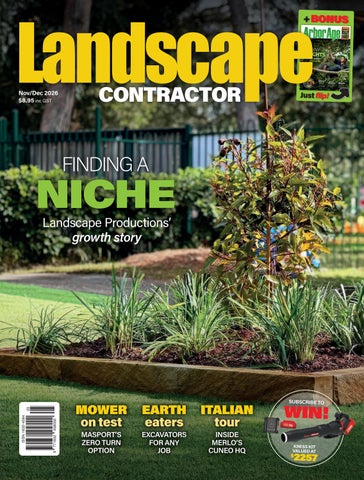
FINDING A
458000 9 771832
ISSN 1832-4584
05
Landscape Productions’ growth story
MOWER on test MASPORT’S ZERO TURN OPTION
EARTH eaters
EXCAVATORS FOR ANY JOB
ITALIAN tour INSIDE MERLO’S CUNEO HQ
SUBSCRIBE TO
WIN! KRESS KIT VALUED AT
2257
$
There’s no time like right now for enjoying the great outdoors. Image: Paul/stock.adobe.com
Chairman John Murphy
CEO Christine Clancy
National Advertising Manager Joanne Davies P: +61 434 785 611 joanne.davies@primecreative.com.au
Editor Ashley Grogan ashley.grogan@primecreative.com.au
Assistant Editor Alex Catalano alex.catalano@primecreative.com.au
Client Success Manager Michelle Alder michelle.alder@primecreative.com.au
Design Jacqueline Buckmaster, Danielle Harris, Daz Woolley
Stay summer smart
W
e’ve reached this time of year again – summer is in full swing across Australia, and the warmer weather is finally here. With that said, it does feel like all that I’ve heard from weather reports is about the ‘record’ incoming El Niño pushing temperatures across the Pacific to record levels. ‘One of the strongest events recorded’, experts have said. All that is to say, stay safe and stay hydrated on the jobsite over the warmer months. In spite of what are always challenging conditions, my chats with those across the industry have reflected what we already know. Everybody in every field is determined to close out 2026 strong and put their best foot forward into the new year. On the cover of this edition is some of the great work of Shannon Baker and his team from Landscape Productions in Sydney. Their work covers a wide range of services from building walls, paths, paving, water features and stonework to irrigation, drainage, land clearing and commercial maintenance services. They and many others reflect the importance of continuing to evolve your business and keeping modern needs from your clients front of mind. For those of us who lean more towards visual learning, we’ve got some great videos
featured in this edition of the magazine, including some of the best equipment from Hitachi, Masport and Positec. Our vehicle tester Mat Wandmaker got the Masport zero-turn mower out for a spin while we went on site with the teams at Grolife and GTS Earthworks to check out the hard yards they put their gear through. There is plenty happening across the industry, as always, from new battery technology to excavator development to trips to Italy. Our walkthrough of Merlo HQ is definitely one to look out for. As always, our contributors have their expertise to add for one last time this year. We’ve got Marc Worner on compliance, Jonathan Garner on the fungi at our feet, John Gabriele looking at how your landscapes change across summer and Anna Turner with her trusty business advice. I’d like to sign off 2026 by wishing everyone happy holidays. I hope you get time to enjoy the good weather with your friends and family.
WITH ALEX CATALANO, ASSISTANT EDITOR, LANDSCAPE CONTRACTOR
Subscriptions P. +61 3 9690 8766 subscriptions@primecreative.com.au
Website landscapecontractor.com.au
Copyright
Landscape Contractor magazine is owned by Prime Creative Media and published by John Murphy. All material in Landscape Contractor magazine is copyright and no part may be reproduced or copied in any form or by any means (graphic, electronic or mechanical, including information and retrieval systems) without written permission of the publisher. The editor welcomes contributions but reserves the right to accept or reject any material. While every effort has been made to ensure the accuracy of information, Prime Creative Media will not accept responsibility for errors or omissions, or for any consequences arising from reliance on information published. The opinions expressed in Landscape Contractor magazine are not necessarily the opinions of, or endorsed by, the publisher unless otherwise stated. © Copyright Prime Creative Media, 2026. Articles All articles submitted for publication become the property of the publisher. The editor reserves the right to adjust any article to conform with the magazine format. Head Office 379 Docklands Dr, Docklands VIC 3008 P: +61 3 9690 8766 enquiries@primecreative.com.au www.primecreative.com.au Sydney Office Suite 11.01, 201 Miller Street, North Sydney, NSW, 2060, Australia
www.landscapecontractor.com.au
3
Contents
Insight 42
Where compliance costs
Focus 06
On the cover + BONUS
On the cover
44
The underground workforce
18
Construction equipment
46
Landscaping for a changing climate
22
Mowers and turf equipment
27
Eye on the industry
+ BONUS
New HEIGHTS Tree climbers go for gold
SUBSCRIBE TO
WIN! HUSQVARNA PPE KIT VALUED AT
1141
$
Business and finance
54
Association news
55
Subscribe and win
GTS Earthworks takes on big jobs. Image: Prime Creative Media
4
LANDSCAPE CONTRACTOR
Case studies 10
Hitachi and GTS Earthworks
12
Positec and Grolife
14
Form and Foliage and Clark Equipment
16
A1 Rubber and Luxury Synthetic Grass
AI arborists
RAYCO GRINDER ON SITE
EXPERT ADVICE FOR REPORTS
Landscape Productions’ growth story
05
50
Stump solutions
458000
From the editor
Battery power STIHL ALLPRO PUT TO THE TEST
Just flip!
FINDING A
9 771832
03
Nov/Dec 2026 $8.95 inc GST
ISSN 1832-4584
Regulars
Just flip!
NOV/DEC 2026 • $8.95 INC GST
MOWER on test MASPORT’S ZERO TURN OPTION
EARTH eaters
EXCAVATORS FOR ANY JOB
ITALIAN tour INSIDE MERLO’S CUNEO HQ
SUBSCRIBE TO
WIN! KRESS KIT VALUED AT
2257
$
MORE MACHINE. GREAT RATE. Do more with ZX135US-7H.
RELIABILITY FOCUS
JAPANESE ENGINEERING
ADVANCED SAFETY TECHNOLOGY
270° AERIAL ANGLE® CAMERA SYSTEM
PREMIUM OPERATOR COMFORT
SPACIOUS CABIN WITH HEATED AIR SEAT & CLIMATE CONTROL MORE REACH & DEPTH
8.85M REACH 5.98M DIG DEPTH
INDUSTRY-LEADING WARRANTY
5YR/10K HRS POWERTRAIN WARRANTY
Now available with
1.99% Finance or a Free Tilt Hitch. T&Cs apply.
Offer ends 31st March 2027 Contact us to find out more.
On the cover
Landscape Productions has been around for 23 years. Images: Landscape Productions
Construction that counts
N
Sydney-based Landscape Productions is always looking for a way to make its services better.
o two paths into the world of landscaping are the same. Shannon Baker’s journey begins with what he describes as a ‘long story’, but it’s where the next chapters lead that has ended up being more important. He is the Owner and Co-Founder of Landscape Productions, based in Sydney’s Northern Beaches. The business is best described as a commercial and residential landscape service provider, covering a range of services across construction, horticulture and maintenance. Baker’s landscaping career began with a few busy years, where he was working odd jobs while continuing to complete his trade apprenticeship on the side. “I was helping a friend out, and I started working on some small landscaping jobs with him,” Baker said. “That was 23 years ago. I was working with a landscape company and did my trade and went from there. After a couple years, I decided I wanted to go on my own and really try to start a business. “So while I say Landscape Productions has been around for 23 years, I was working in landscaping for three or four years before that as well.” With the business now underway, Baker had to identify what exactly Landscape
6
LANDSCAPE CONTRACTOR
Productions was going to offer. Much of the work available was on residential properties, which became his primary focus to get the business started. “For the first 10 years of the business, the work I was getting was almost entirely residential jobs,” Baker explained. “I saw a little bit of a hole in the market and went for it. That’s changed now to pretty much commercial only.” Now with nine staff and a larger fleet of machinery and equipment, Landscape Productions’ focus has shifted away from residential property work into more commercial projects. Baker now takes on contracts with councils and builders. The work is varied, from building walls, paths, paving, water features and stonework on the construction side, to irrigation, drainage, land clearing and commercial maintenance services. That variety of services has become one of their strengths. “We do everything that comes with landscaping, the whole package really.”
Machinery market
Taking on bigger commercial jobs hasn’t come without its challenges. Having the right tools for the job is step zero. Baker purchased a Hitachi ZX33U
excavator two years ago, and has been taking it out on jobsites ever since. The 3.3 to 3.5-ton zero-tail swing machine is designed to fit into a variety of civil and landscaping jobs, and has been more than up to the task. “The ZX33U is a fantastic machine for the work I do,” Baker said. “It’s quite strong for its size. I’ve been impressed with it so far. I’m looking to buy another machine next year, and I’m going to go with Hitachi again. “It gets in the back of the truck and it goes anywhere. I usually put in on the six-ton tipper and move it around that way or leave it on jobsites.” The ZX33U features a Yanmar engine and a maximum digging depth of 3.13 metres. It is equipped with advanced hydraulic systems as well as auxiliary hydraulic piping for use with various attachments. With plenty of recent construction work, Baker has been using the machine consistently and effectively. “I use it for a lot of block work; installing blocks, sandstone blocks, excavation work and a lot of site preparation,” he explained. “That extends to building out stone block and stone walls with it as well. “It also gets use digging out areas if I’m working on a playground for example. I’m digging all the way down to sub-base
Landscape Productions is based in Sydney’s Northern Beaches.
material so we can then start to build from the ground upwards.” The ZX33U has met every challenge Baker has needed it for so far. He is already looking at how he can potentially add to his fleet with another Hitachi excavator. “I’ve spoken to Mike Tomasic at Hitachi, and I’m hoping I’ll be able to see them next year and hopefully get a new excavator sorted,” Baker said. “I’d like a bigger machine, and I will get one next year, but at the moment the 33U is fantastic. It does so well for everything we need it for.”
Continued support
Anyone who uses a large bit of machinery understands the importance of the support of the dealer not just to make the purchase, but afterwards. With regular check-ups on the machine and Baker and the team, he has nothing but praise for Hitachi. “The support network at Hitachi has been great,” Baker said. “Mike still rings me up and comes and sees us all the time. The follow up and touching base to see how the machine is going has been really good. I haven’t really had that before with other dealers. I’m usually hearing from every two months.” Baker has had the same positive experience on the aftersales side.. While he has barely had any issues with the ZX33U in a mechanical sense, having the knowledge that support is always available has been invaluable. “The aftersales service has also been fantastic,” Baker said. “It’s probably half the reason why I’m looking to go back to Hitachi. We bought a rock grabber attachment off them, and they were the ones who rang me and said they wanted to modify it to better for our work. “They came out and got that sorted for us straight away.” Hitachi Sales Representative Mike Tomasic has consistently been in touch with Baker throughout the process, from the first sale up to now, two years in. “The constant contact has ended up
helping to build the personal relationship with Mike,” Baker said. “I could ring him and tell him all the things I need and what needs servicing and he’d be there the next day. I know it’s his job, but the extra stuff means a million bucks. They always follow through.”
Commercial change
With more than 20 years of business not only running Landscape Productions, but in the landscaping industry as a whole, Baker has seen plenty of change across that time. Being on both the residential and commercial side of landscaping work has
offered a unique perspective. When he first started, Baker saw the gap in the market that needed to be filled in residential work. As more businesses have continued to enter that space, the case for going primarily commercial has become stronger. “I had found that residential was becoming more difficult to deal with in a lot of ways,” Baker said. “With commercial jobs, you’re given a plan, you get your quote off it. That quote is pretty much spot on, and you know what you’re getting into straight away.” It isn’t just the state of the industry that has changed Landscape Productions’ focus.
Owner Shannon Baker primarily takes on contracts with councils and builders.
www.landscapecontractor.com.au
7
On the cover
The deck and synthetic grass job was at a Sydney kindergarten. It is also the way that Baker has continued to build the business and fleet of machinery to meet the demands of commercial work. Working on jobs that require a construction-heavy focus creating paths, paving and walls means more use for machinery like the ZX33U. When you’re looking to go up to bigger gear like Baker is, that equipment needs to be working. “I found that on commercial jobs, you’re working on a bigger scale,” Baker said. “With all these machines and tools that I’ve got now, I’ve just built for better scale with commercial. For example, I’m quoting for a playground at the moment. I’ve got the plan from the council and I know exactly what I’m getting into. “When you go to a house, you’re always running the risk that you might lay something down and then the client wants to change it. With commercial projects, what you see is what you get.”
The deck and synthetic grass job was at a The ZX33U Sydney on the job. kindergarten.
It’s not just the work on the jobsite that has changed over more than two decades. What needs to be done behind the scenes is also more demanding. Landscape Productions’ work begins as soon as the client makes first contact. From working out the quote to figuring out what the scale of the job will be, every detail needs to be considered and pored over before any work begins. While it means every job is bigger than it ever was when Baker first started, it also means the team is working as thoroughly as they can to get the job right. “The industry is getting a lot more competitive,” Baker said. “It’s so different from when I started. These days, you’ve really got to strategise when you’re taking on jobs and sit down and work out the quotes thoroughly so you don’t miss things. We need to make sure we’re being competitive as well.
“Part of that is also having the right machinery to get work done faster so you can get ahead.” Working with a machine like the ZX33U has already offered Landscape Productions a great boost in efficiency. Baker believes they can go even further. While there are details to be ironed out, he knows that any new machine has to be able to offer the next step in their operations. “That’s the reason why I’m looking at buying a 5.5-ton machine,” Baker said. “I want to be able to keep pushing our productivity. I’d like to be able to move bigger blocks and get things done faster. Having the right machines to do the job does make you more efficient and helps to get the job done fast. “You’ve got to manage your jobs a bit better these days and calculate everything you’re putting in and be very accurate with your quoting.” Being on both the residential and commercial side of landscaping work has offered Baker a unique perspective.
Baker now employs nine staff. 8
LANDSCAPE CONTRACTOR
Same crew. More accounts. Higher profits. Introducing Kress Voyager, the autonomous mower transforming commercial landscaping.
Cut operating costs by up to 80%* Grow your business without increasing headcount. Voyager helps you take on more work while delivering consistent, professional results. While Voyager handles routine mowing, your crew can focus on higher-value tasks, helping you increase capacity and take on more work. To find out more visit your Authorised Kress dealer, or learn more at kress.com *
Based on indicative modelling vs. a petrol or diesel-fuelled commercial zero-turn mower
Case study
GTS Earthworks sticks with Kenworth for trucks and Hitachi for excavators. Images: Prime Creative Media
Taking on the biggest jobs Reliable machinery and a 20-year relationship have enabled GTS Earthworks to tackle difficult work head-on.
G
TS Earthworks, based in Kurnell in Sydney’s Sutherland Shire, has never been a business afraid of doing the hard yards. Owner and Managing Director Gavin Sant has overseen the operation for two decades now, leading the business headfirst into some of Australia’s most technically challenging earthmoving jobs. Landscape Contractor caught up with the GTS team on a job in Sydney, where the business’s experience was plain to see. “We marked 20 years this year. It all started out with one little excavator doing pools and a bit of residential work, and now we have six machines and multiple trucks,” Sant said. “We don’t just dig. If a customer wants us to do the landscaping, we’ll do it.
“That also includes civil works, from good residential jobs to big bulk jobs as well. Our main niche, though, is tricky sites.” The challenge begins immediately on those sites. Sometimes getting the gear and equipment onto the jobsite in the first place is half the battle, given the geography of the Sutherland Shire area. “The excavators have to be craned in or barged into sites that no one else has the capacity to do,” Sant said. “We like the challenge of doing the work and thinking on our feet as we go.” Starting out small and working his way up to more difficult work, Sant has cut his teeth in the world of earthmoving. He now finds satisfaction in being able to pass that knowledge down to his team, which is always continuing to grow alongside him.
“It all comes from experience. When I first started, we were working with local builders up near Illawong. Everything was waterfront and we were working on cliffs. A couple of the older guys took me under their wings, and I learned about the work through that experience,” Sant said. “Now I’m teaching my guys as they each come into the team to understand properly how the machines work and how to get the most out of them for our clients.”
Faithful fleet
When it comes to trucks, Sant is all Kenworth. The brand has captured the heart of many an Aussie, and he won’t buy anything different. The same applies to his excavators, which are all Hitachi.
Jobsites can get large.
Owner Gavin Sant says Hitachi has offered great support throughout their long working relationship. 10
LANDSCAPE CONTRACTOR
With six machines currently in the fleet, Sant and the team stick to what they know works. He explained the excavators have never given him any reason to look elsewhere, and every time he has looked to upgrade, it has always been with Hitachi. “We’ve bought somewhere around 20 machines from Hitachi. It’s been a long-term relationship. That’s not even including all the people I’ve introduced to them as well. I go a fair way back with them,” Sant said. “Hitachi understands my business. If something goes wrong, we’ve got to be straight onto it. We’re working in precarious positions and it’s not always easy to deal with, but the Hitachi excavators come through every time.” Aftersales and servicing have also been a consistent draw to keep Sant and GTS Earthworks continually coming back to Hitachi excavators. While they rarely create downtime from the job, having the peace of mind back at the dealer has always been a positive. “The machines are more than reliable. But more than that, it’s the actual sales service from George Paradisis and the
GTS has purchased 20 Hitachi machines since its inception. team at Hitachi. The attention to detail they show when we need a machine and how they follow up on that with aftersales support are fantastic,” Sant said. “Whether it’s something additional that we didn’t think about when we purchased a machine or a part we need for a new job, everything’s there. They’ve been great to deal with over the whole 20 years.” The GTS Earthworks team is continuing the strong relationship with Hitachi, recently taking on new machinery; two new ZX55U-5 compact five-tonne excavators
and a ZX33U three-tonne excavator. With two decades of experience backing the purchase, Sant is sticking with Hitachi and hasn’t looked back. “The new excavators have been just as reliable as the ones before them.”
Scan the QR code to watch our video with GTS Earthworks.
Turn your experience into a qualification Have you been working in the horticulture and land management sector but never completed your trade qualification? Turn your experience into a sought-after qualification through the Trade Pathways for Experienced Workers* program and take the next step in your career. Fee-free* courses available in:
+ Landscape Construction + Landscape Design + Nursery Operations
Enrol now for Semester 1, 2027 TAFE NSW Trade Pathways
In partnership with:
131 601 *Eligibility criteria apply. RTO 90003 | CRICOS 00591E | HEP PRV12049
www.landscapecontractor.com.au
11
Case study
Cameron Stacey (left) and Lachlan Van Der Horn (right) own Grolife Landscape Management. Images: Prime Creative Media
Making the electric move This Queensland company has made the jump to battery-powered equipment.
G
rolife Landscape Management is a specialist landscaping business that operates out of Fortitude Valley in Queensland. It looks after more than 300 commercial, industrial, and retail properties as well as several government and education sites. While the business is located centrally in Brisbane, it takes on work from the Tweed River at the New South Wales border all the way up to Cairns and Toowoomba thanks to the other companies in the Grolife Group. With a large collection of tools and equipment, Grolife does not take purchasing decisions lightly. When joint owners Cameron Stacey and Lachlan Van Der Horn decided to look at the benefits that electric equipment could offer, it marked a new era for the business. “Over the last few years, we have decided to make the move from petrol equipment to electric equipment,” Stacey said. “Through this process, we’ve sought out
12
LANDSCAPE CONTRACTOR
and checked out many companies, and we decided to create a partnership with Kress.” The first and most noticeable benefit was the reduction of operating costs. With petrol out of the budget, operating the new equipment was up to the reliability of the batteries powering it. Kress’ eight-minute CyberPack batteries can be charged from 0-100 per cent in as little as eight minutes when used with a Kress CyberTank charger in Flash mode. They are also guaranteed for up to 3,000 charge cycles. “Our fuel cost is reduced to zero, our maintenance cost is reduced by 90 per cent or more and our staff absolutely loves the quality and the professionalism of the equipment that we now get the chance to use,” Stacey said. “The reliability, durability and charge time of the batteries are have all really played a part in our decision to partner with Kress.
“Our staff is never without any power; they’re able to just keep going. As soon as one battery runs out, the other’s ready to go. “It means we don’t have to carry around multiple small chargers or find power points.” As the year draws into the summer months, working hours become a consideration, particularly on sites in Far North Queensland when the sun is up early and the thermometer is ticking over by 10 in the morning. Lowering noise pollution has given the Grolife team greater flexibility to get jobs done earlier in the day. “Not having that noise allows us to start earlier in the morning and get out of that Queensland heat to be able to save the rest of the day,” Van Der Horn said. The utilisation of the suite of Kress apps in conjunction with the electric equipment has enabled Grolife to monitor and track much more information than it could previously. The team is now able to track all the battery-
Kress Commercial equipment features CyberPack Nano batteries.
powered equipment, which is kept in trailers, as well as the numbers on battery lifespan and frequency of use. “Previously, we used vehicle trackers to track our trailers and all our equipment. But with the Kress app, we’re able to track all the batteries and all the equipment, which are kept on the trailers,” Stacey said. “It also shows us how often the batteries are being used, so we’re able to monitor the lifespan of the batteries and how frequently those tools are being used. “This means we can monitor the performance of the guys on site remotely to make sure that they’re getting through all the tasks that they need to do, and we can make sure that we’re assigning the right amount of labour to each job.”
Hitting zero
A part of Stacey and Van Der Horn’s inspiration in introducing the electric equipment with Kress was identifying the need to work towards zero emissions in their operations. While this was partially driven by how the industry is shifting, it was also inspired by the feedback from within their close business relationships. “Our clients’ demands require us to really push towards that environmental sustainability, which is why we want to be the industry leader and be the first in the country to go fully electric with our zero-turn mowers, hand tools, vehicles, everything throughout our business,” Stacey said. When Stacey and Van Der Horn were first looking to make the electric switch, they had to think about how they would present the move to their staff. They admit they had their sceptics within the group. They ultimately decided on a trial day, where they would give anyone who was interested a chance to try out the batterypowered equipment. “We brought some of our team leaders out who had spent many years in the industry working with petrol technology – a couple of them were very sceptical about the battery gear,” Stacey said. “We picked the person who was going to be the roughest and gave them the gear and told them to be as rough as they could with it and see what issues they could bring to us,” Van Der Horn added. “After three weeks, they had completely turned around. They are now some of the biggest advocates of the new Kress gear that we have.” Grolife has spent the past few years switching from petrol to battery-powered equipment.
Scan the QR code to watch our full video with Grolife. www.landscapecontractor.com.au
13
Case study
Garden design and planting, paving, turf and lawn renovations are all parts of the Form and Foliage repertoire.
Pipes to plants A new excavator has enhanced this Queensland operation.
I
t’s been estimated that the average person can make up to as many as seven career changes in their lifetime. Finn Bowe is only up to his second, but he believes this one could be the winner. He started his professional life as a plumber, which he pursued for 12 years. But Bowe had the itch to try a new challenge and turned his attention to landscaping instead. That’s the story of how Form and Foliage came to be. It’s a one-man show based out of Nambour on the Sunshine Coast, delivering landscape services including garden design and planting, paving, turf and lawn renovations. But requested most is his expertise in draining and irrigation. “I find a lot of my clients saying, ‘I saw that you were a plumber, can you help us with this drainage issue?’ It has a lot of handy crossover,” Bowe said. “I was passionate about landscaping and gardening, and I was getting a bit sick of plumbing. I wanted to use that prior
14
LANDSCAPE CONTRACTOR
knowledge to my advantage and be able to offer a bit of a unique selling point as a landscaping business.” Bowe started pulling double duty to chase his new passion, completing a Certificate III in Structural Landscaping while keeping up his plumbing work. Form and Foliage only began in April this year, but business has already boomed. Bowe has been taking on a range of different jobs for his clients. “I love native gardens, so that’s been a lot of the work I’ve been doing,” he said. “That’s included redesigns and makeovers of small domestic gardens. I’ve also done a fair bit of ripping up and re-turfing, a few retaining walls and some footpaths. The plumbing background has helped with stormwater modifications, installing drainage pits and ag drains.” Bowe also found significant demand for excavation work among his clients. He had been hiring a mini excavator but found the volume of work justified buying his own.
He looked to Clark Equipment Sunshine Coast in Maroochydore and its range of Bobcat excavators, settling on the E20z excavator. While access to clients’ properties was one of the main considerations, he wanted a two-ton machine over the 1.7-ton option for the extra power it could offer. Once he went through his options with Clark Equipment’s Clint Warren, Bowe decided he was ready to add excavation to his business offerings. “It made a lot of sense to look at owning my own excavator rather than continuing to hire,” he said. “Having it at home has been handy. I don’t have to worry about going out to the hire place to pick it up and drop it back. It’s been worthwhile because I’ve gotten so much use out of it already.” While it may be mini, the E20z is powered by a 14.7hp/10.9kW engine and offers 20,835N of digging force and a 4.1m reach. It also features zero tail swing, allowing for
easy manoeuvrability on even the most restricted jobsites. “There’s been plenty of work booked in for it since I had it delivered,” Bowe said. “It’s been out on a job nearly every week so far. The Bobcat gives me the ability to take on much more work. I can use it for jobs I otherwise wouldn’t have taken. It’s making life easier for sure.”
Ready to work
Only a leisurely drive away, the Clark Equipment Sunshine Coast team was more than happy to welcome Bowe’s inquiries about a new excavator. For the type of work he does, Clint Warren was able to recommend the E20z, which Bowe had already gained experience with through hiring. It arrived at his door ready to go and was able to be put to work almost straight away. “When our customers are able to call up and specify what they want, we can put it together in a package and it gets delivered ready to work,” Warren said. “It can be appealing to smaller operations like Finn who are just starting or growing their fleet.”
Bowe is passionate about redesigns and makeovers of small domestic gardens. The hiring to buying pipeline isn’t unique just to Bowe and Form and Foliage in Warren’s experience. With more than 20 years’ experience with Bobcat
Owner Finn Bowe of Form and Foliage uses a Bobcat E20z excavator. Images: Clark Equipment
equipment, he has seen it become a common pathway for professionals building up their fleets. “We have a lot of customers who start hiring,” Warren said. “From that hire they realise that utilisation is a big part of their equipment. They can analyse the business cost and the lifecycle and decide that purchasing is the best option once they see the work rolling in. “Hiring is a good platform for a lot of tradespeople who are starting out in landscaping. You get a good feel for what equipment operates well in your application. Once they get a good feel for that, then they can start looking into what is specific to their needs.” The Bobcat E20z excavator occupies a unique section of the market across multiple industries, including landscaping. First revealed in 2024, it was designed with transportability and ease of operation in mind. This not only helped meet design standards globally but also appeal to businesses that don’t need the largest, most intensive excavator out there. “With the E20z excavator, no one else really builds that type of small machine on the market,” Warren said. “To the landscaping industry, an excavator is a tool they need to use at the end of the day. Having the advantage of being able to set up a tailor-made package for that type of equipment has given us a sort of edge. “The big thing we focus on at Bobcat is the build quality of the machine. Along with that is operator comfort. “And for someone like Finn on a landscaping job, he’s using the excavator alongside other equipment. It needs to be able to handle multiple different jobs and do them well.” www.landscapecontractor.com.au
15
Case study
Luxury Synthetic Grass installs rubber and synthetic turf on school playgrounds. Images: Luxury Synthetic Grass
Giving rubber another run Recycled materials proved to be the right choice for this Sydney business.
W
orking with rubber and acrylic surfacing on jobs is a process that requires both expertise and confidence in materials. With more than a decade of experience in this space, Corey Stephenson has worked hard to provide just that to his clients. He is the founder and owner of Luxury Synthetic Grass, a Sydney-based business that provides turf, synthetic and rubber surface services. This can range from residential artificial grass for front and backyards to larger projects installing rubber surfacing in schools and for councils. “We do all types of surfacing, like synthetic grass, rubber, acrylic, and resinbound stone,” Stephenson said. “We’re always working on playgrounds and courts.” When he started the business five years ago, Stephenson was seeking out a supplier for rubber. At the recommendation of a colleague, he came across A1 Rubber and hasn’t looked back since. He continues to take on work building rubber surfaces and synthetic courts using A1 Rubber products. “It’s always very straightforward when I go to A1 Rubber,” he said. “I’m usually using butadiene rubber. There are a lot of playgrounds that I work on, so I’m using those materials for them. It’s similar with the council work. We’ve recently done a few playgrounds for Liverpool Council.” Stephenson has been going to A1 Rubber for his rubber materials for almost the whole time he has been running Luxury Synthetic Grass for several reasons. “It’s one of my longer working relationships,” he explained.
16
LANDSCAPE CONTRACTOR
Council projects are a key part of Corey Stephenson’s work.
“We find that a lot of their materials are specified for the jobs. I started with them, so it’s been five years of working together now. They’ve usually got the stock on hand, and I’ve never had any problems.” His clients’ growing interest in sustainable materials has also encouraged Stephenson to continue working with A1 Rubber. Upcycled rubber, in conjunction with traditional surfacing materials, is emerging as a smart option. A1 Rubber’s range of rubber surfacing solutions designed for landscaping and outdoor surrounds
combine design needs like durability, safety, and low maintenance with an environmentally conscious approach. “Not only myself, but a lot of people I’ve spoken to like to use A1 Rubber products because they’re recycled,” Stephenson said. “It’s important to me when I’m working on jobs. It helps for the councils when they know that they’re recycling materials.” He has found A1 Rubber’s materials reliable and fit for the job, with the added benefit of being Australian-made, from Australian tyres, for Australian surfaces.
CHARGED WITH
next level power NEW STIHL ALLPRO BATTERY SYSTEM
SCAN TO LEARN MORE. COMMERCIAL DEMONSTRATIONS AVAILABLE.
Construction equipment
Constructor collaboration
F
A key partnership has developed between an equipment dealer and a growing construction business.
or SA and Vic-based civil construction, structural concreting and commercial landscaping business Outside Ideas, the decision to standardise much of its compact earthmoving fleet around Caterpillar equipment has been about more than the machines themselves. Behind the fleet is a long-running relationship with South Australian Caterpillar dealer Cavpower. Outside Ideas first purchased a Cat 226B2 Skid Steer in 2008. In the 18 years since, the relationship has resulted in the purchase of 90 Caterpillar machines, with further
18
LANDSCAPE CONTRACTOR
equipment already on order as the company continues to modernise its fleet. Outside Ideas Operations Manager Dylan Thomson was there for the first Caterpillar machine and has seen the partnership go from strength to strength. “I’ve overseen 90 Cat purchases since I’ve been at the company and it’s all been through Cavpower, which has been fantastic,” he said. “We trust Cat machines, and Cavpower, as the South Australian distributor, has been fantastic for our ideas. We use them because the reliability and resale of the machines are exceptional.”
Today, Outside Ideas has more than 260 full-time staff across its operations, while the wider group has grown since the acquisition of Convic Skate Parks. Its fleet includes 65 units of earthmoving equipment, alongside trucks and other vehicles, taking the total asset count to more than 200. Having a dealer that understands the business, responds when machines need attention and can provide access to parts, servicing, rental and fleet management tools has become an important part of keeping projects moving.
Outside Ideas has Cat skid steers, excavators, wheel loaders and much more in its fleet. Images: Prime Creative Media
“We need to rely on the best products available and Caterpillar provides that,” Thomson said. That confidence extends beyond the machines themselves. For Outside Ideas, its relationship with Cavpower means it can turn to one dealer for support.
Beyond the machine
One of the advantages of the relationship is the breadth of support available. Parts availability is important when a fleet is spread across Victoria and South Australia and machines are working on tight project programs. Outside Ideas uses parts.cat. com (PCC) to support its operations, while Cavpower’s local parts inventory provides another layer of availability. Cavpower Territory Manager Marcel van Aalst said minimising downtime is a crucial part of supporting Outside Ideas.
“For us at Cavpower, it’s very important to help them to maintain that high standard of quality with new machines and new technology we bring out,” he said. “Avoiding downtime is everything for them. Not only is it important that we bring them the appropriate machinery, it’s also very important on the back end to make sure that the uptime is as good as possible.” For a contractor, that can have a direct impact on reputation. Outside Ideas Service Manager David Wieloch explained how PCC makes life easier. “I use PCC for ordering all my planned maintenance kits, which is nice and easy,” he said. “You just scroll straight down. All our machines are on file. We select what machines are due for a service and I can select what filters are required for the required service.
“It makes my life really easy and it’s nice and quick.” Cat Rentals also gives Outside Ideas flexibility when demand exceeds its owned fleet. Rather than permanently increasing the size of the fleet to cover occasional peaks, the business uses rental equipment as a short-term supplement. “They know exactly what we need. Very rarely do they not have what we need. We use it when we’re very busy on site or when our whole fleet is going,” Thomson said. Cat Rentals is relevant to a business working across multiple disciplines and project types, where equipment requirements can change considerably from one contract to the next. Fleet visibility is another part of the equation. VisionLink provides Outside Ideas with visibility of machine utilisation and helps with service scheduling across multiple concurrent sites, supporting a more structured approach the management of a growing fleet. Cavpower Product Support Representative David Roberts, who oversees the Outside Ideas account, said the practice of looking after the company’s machines is a constant process. “They could order parts in their own time and we have also assisted them by setting up regular parts deliveries to their workshop,” he said. “If there was emergency freight required for an urgent part or a repair, we’d organise that emergency freight outside of the regular delivery times to get them going.” Together, those services mean the dealer relationship is not simply about purchasing a machine and taking delivery. It becomes an ongoing support system around the asset throughout its working life.
Selected around the work
The ongoing support system is reflected in Outside Ideas’ current Cat fleet, where different machines have distinct roles. The Cat 301.5 Mini Hydraulic Excavator is an example of equipment selected for access rather than outright size. For landscaping and civil contractors, some of the most challenging excavation work can occur when there is simply not enough room to deploy larger equipment. Commercial sites can contain existing structures, services and other assets that restrict machine movement. For Outside Ideas, that makes the smallest excavator in the group a specialist productivity tool rather than simply a scaled-down version of a larger machine. If the 301.5 is about access, the Cat 305 CR Mini Hydraulic Excavator is much closer to a fleet workhorse. The 305 CR is one of Outside Ideas’ core machines, www.landscapecontractor.com.au
19
Construction equipment
From left: Cavpower Senior Marketing Specialist Aayushi Seth, Cavpower Territory Manager Marcel van Aalst, Outside Ideas Operations Manager Dylan Thomson and Cavpower Territory Manager Andrew Weinert. handling much of its day-to-day civil work. Its applications include trenching, bulk excavation, service installation, pad preparation and general site development. At about five tonnes, the 305 CR provides a balance between digging performance and transportability, while its compactradius configuration allows it to operate effectively on constrained commercial sites. The machine’s tight tail swing is particularly relevant to Outside Ideas’ urban and commercial work, where working space can be restricted by buildings, roads and other site infrastructure. The 305 CR’s Stick Steer system allows operators to move from conventional travel controls to joystick-controlled travel and blade operation, helping reduce physical effort during long shifts. Its load-sensing hydraulic system and variable displacement piston pump provide smooth operation and auxiliary flow for attachments, increasing the range of work the machine can perform. The operator environment has also been considered, with ergonomic controls, a next-generation colour LCD monitor and airconditioning options for cabbed machines.
When the job gets heavier
When the 305 CR reaches its limits, Outside Ideas steps up to the Cat 308 CR Mini Hydraulic Excavator. 20
LANDSCAPE CONTRACTOR
The 308 is an eight-tonne class machine designed to deliver greater digging depth, lifting capacity and breakout force. Outside Ideas uses it for heavier civil work, deep trenching, and higher-risk environments where additional performance is required. The machine retains a compact-radius configuration, allowing it to work close to structures, walls and roadside projects without requiring the footprint or workload of a larger excavator. Power comes from a Cat C3.3B turbo diesel engine producing 69.5 net horsepower, with automatic engine idle and shutdown functions helping reduce unnecessary fuel consumption. Its load-sensing hydraulic system and electronic variable displacement piston pump provide high main pressures and auxiliary flow of up to 131 litres per minute for demanding attachments such as hammers and augers. The Stick Steer system brings the same operator-focused approach found on the 305, while the sealed and pressurised cab provides improved air conditioning, suspension seating, adjustable wrist rests and the option of a next-generation touchscreen monitor. Grouped daily check points can be accessed from ground level through wideopening service panels, allowing routine checks to be completed quickly.
Built for the next stage
A recent rebrand brought Landscape Plus Victoria under the Outside Ideas name, while the company has continued to expand beyond conventional landscaping and into increasingly bigger jobs. For Thomson, the quick response to the needs of the jobsite and the regular reliability of Cavpower’s team of mechanics provide an exceptional partnership between the businesses. “The combination of both helps us as a company to keep our machines going. The biggest part of having a reliable machine is to make sure that they keep going with little downtime,” he said. The decision to stay with Cavpower for almost two decades reflects another part of the fleet equation: residual value. The resale value of Cat equipment has consistently been high, and Thomson said this is a contributing factor in Outside Ideas’ regular fleet turnover. For Outside Ideas, those factors are now wrapped into a growing long-term relationship with Cavpower. “Our future is with Cat. We love working with them and look forward to all the models and the new next gens that come out,” Thomson said. For more information, visit: www.cavpower.com
Mowers and turf equipment
Commander conquers
M
Dual-clutch technology brings greater precision to cylinder mowers.
asport has expanded its cylinder mower offering with the launch of the new Commander DC510 and Commander DC510 Plus. The two 20-inch cylinder mowers are designed for lawn enthusiasts and professionals who demand precision, control and a consistently refined finish from their equipment. The new Commander range combines cylinder-mowing technology with a key innovation: dual clutch control, giving operators independent control of the mower’s ground drive and cutting reel from the handlebars. The Commander DC510 is powered by a Briggs & Stratton 163cc engine, while the DC510 Plus steps up to a Honda 163cc GX160 engine.
The Masport Commander DC510 is a 20-inch cylinder mower.
22
LANDSCAPE CONTRACTOR
At the heart of the new Commander range is its dual-clutch system. Controlled through an easily accessible clutch engagement lever on the upper handle, it allows the operator to independently control ground movement and reel engagement. This provides greater control when starting, stopping, manoeuvring and positioning the mower, while making it easier to achieve a precise, consistent cut. For cylinder-mower users who take pride in their turf, that level of control can make all the difference in the world.
Precision cuts
Both Commander models feature a 510mm (20-inch), precision-balanced six-blade steel
cutting reel, engineered to deliver a refined cylinder cut at a standard 124 cuts per metre. The cutting height can be adjusted from 7 to 30mm using a single dial, making it quick and straightforward to select the desired cutting height. An integrated optimal mowing zone indicator further simplifies setup, helping operators identify the preferred cutting range at a glance. The combination of precision reel design and straightforward height adjustment makes the Commander suited to users who want to maintain a consistently manicured finish without complicated setup. The cutting performance is supported by a 205mm-diameter rubber-lined split steel
The roller provides traction and stability while helping the mower maintain consistent contact with the turf. Images: Masport
INTRODUCING THE NEW
Cutting range can be adjusted with a single dial.
DUAL CLUTCH CYLINDER MOWERS Dual Clutch System
rear roller. It provides traction and stability while helping the mower maintain consistent contact with the turf. Its split design also assists with manoeuvrability, allowing the mower to be turned with greater ease while maintaining the controlled feel that you would expect to come from a cylinder mower. Together with the mower’s overall weight and precision-balanced reel, the roller contributes to the smooth, refined mowing experience the Commander range is designed to deliver.
Rubber Lined Split Steel Rear Roller 70L Polypropylene Catcher
Smart performance
The Commander DC510 range is equipped with a 70-litre UVstabilised polypropylene catcher, providing a durable and practical solution for collecting clippings. Directional deflector fins help distribute grass evenly into the catcher, reducing the tendency for clippings to build up in one area and helping maximise the available capacity. For operators mowing regularly, it’s a small but important detail that helps keep the mowing process efficient and the finished lawn clean. Powering the two models are two engine options. The Commander DC510 uses a Briggs & Stratton 163cc OHV 5.0HP I/C engine, while the Commander DC510 Plus is powered by a Honda 163cc GX160 engine. Both provide the power required to drive the mower’s cutting and ground-drive systems while complementing the robust construction of the Commander platform. Both models also feature a heavy-duty chain-drive system, with a sealed chain-case cover providing additional protection for the drivetrain from grass, dirt and debris. Maintenance is further simplified through the use of maintenancefree bearings and straightforward adjustment systems, helping operators spend less time working on the machine and more time working on the lawn.
7-30mm Cutting Height Adjustment 20” (510mm) 6 Blade Steel Cutting Reel
Chain Driven Mower
Perfect your lawn with Masport The Commander features a 510mm six-blade steel cutting reel.
masport.com www.landscapecontractor.com.au
23
Mowers and turf equipment
Machine tester Mat Wandmaker took the Masport ZTM for a spin at Chirnside Park in Melbourne. Images: Prime Creative Media
Zero turn, zero worries Machine tester Mat Wandmaker put the Masport ZTM through its paces.
H
aving greater control of your landscaping and mowing equipment can offer advantages that you just won’t get elsewhere. This can certainly be said of the Masport ZTM 50. The ZTM is a side discharge zero turn ride on mower, giving the operator the ability to control both rear wheels independently. In cases where access may be tight around the property, that extra turning can make all the difference. Landscape Contractor’s machine tester Mat Wandmaker was on hand to have a crack at Masport’s newest offering. The ZTM 50 is the larger of Masport’s two zero
24
LANDSCAPE CONTRACTOR
turn options, featuring a 764cc V-Twin engine and a 50” steel side-discharging deck. This is in comparison to the ZTM 42, which features a 42” discharge deck. We took the ZTM 50 for a spin on a wet and windy Melbourne day, and it handled the conditions excellently. “The machine itself is great to use,” Wandmaker said. “It’s designed for the residential market, but I think that the twist with it is that it would actually suit the entry level commercial market as well.” The ZTM range features seven cutting height positions, from 25mm-102mm, for
precision and flexibility during the cut. The electromagnetic Warner PTO clutch allows for easy engagement of the cutting blades with just a pull of a switch. From an ergonomic perspective, the adjustable padded seat and cup holder were winners with Wandmaker. The seat is spring-mounted with armrests for maximum operator comfort. “It’s got a nice comfy seat, and you know how I do like my comfy seats,” he said. “The cup holder is nice, easy and accessible. It’s one of the big things I look for on most machines. In a residential market, I think it’s extremely important.”
Even on a damp day, the ZTM handled the conditions well.
The blades sit on a 50” cutting deck.
Powered by a Masport 764cc V-Twin 23HP engine.
Controls are ergonomically positioned. The seat is adjustable for operator comfort.
Wandmaker was also impressed with how simple the ZTM 50 was to clean after the mow was over. The built-in deck-wash system allows for quick and easy cleaning beneath the cutting deck, helping maintain peak cutting performance. This was evident in the wet conditions on the day of the test. “On days like today where it’s a little bit wet, at the end of the day we can plug it in and clean underneath the deck, which is fantastic,” Wandmaker said. “It’s those little thoughtful features that just really make a mower, isn’t it?”
Access to the battery for charging or removal is also simple, located under the seat. For any maintenance work, this convenient access is key. “You’ve got easy access into the battery compartment, which is great and simple to blow out. The engine is accessible too,” Wandmaker said. “These are the things that I like and what I look for in all my machines, the ability to easily maintain.” The ZTM features 11” front and 20” rear wheels which helps it to handle gentle slopes on large properties. Alloy spindle housing keeps the bearings cooler, extending working life.
The ZTM features 11” front and 20” rear wheels.
Wandmaker took note of the adjustable operator controls, which allows for the operator to change their set up to their preferred position. “The handles are all steel. These are all adjustable as well, including your lap bar,” he said. “I think it will do well in the market that it is designed for, and I’m looking forward to seeing it out there.” Scan the QR code to watch the full video of our test of the Masport ZTM. www.landscapecontractor.com.au
25
MINI MIGHTY EARTHMOVERS. Move your business with 0% finance or a rebate on Hitachi | LANDCROS Mini Excavators.
MAKE YOUR MINI MIGHTY MOVE. Offer ends 31 December 2026. T&Cs apply.
Contact us to find out more.
From April 2027 Hitachi becomes LANDCROS
Eye on the industry
STIHL’s ALLPRO batteries work across a range of STIHL tools. Images: Prime Creative Media
S.
Mowing with power Hedge trimmers and lawnmowers powered by batteries were put to the test.
Tim the Lawnmower Man got behind the mowers.
W
here does the next edge in landscaping equipment and tools come from? If you ask some of the experts, it could be from battery power. Landscape Contractor was given the opportunity to take a closer look at STIHL’s ALLPRO battery-powered gear, including mowers, leaf blowers and hedge trimmers, alongside landscaping professionals. We caught up with STIHL Australia Oceania
Product Portfolio Manager Silvio Matas to learn more about the ALLPRO battery range and its development. “The great thing about the ALLPRO battery system is I can take the newest battery we have and plug it in any single machine that we started back in 2009,” Matas explained. “Our current AP battery system works – it does the job and it’s industry leading in its
own class, but there’s a way to evolve this. That’s where we make the jump into the Performance series.” ALLPRO packs work in existing AP tools – more than 60 of them – and existing AP chargers still charge them. They come in two ranges: the Standard series offers a more accessible entry into the system, while the Performance series is designed for crews and professionals who www.landscapecontractor.com.au
27
Eye on the industry
need maximum output, faster charging and longer battery life. The big advance is inside the Performance packs, where STIHL has used a new cell design that allows the battery to deliver power more efficiently and recharge faster. In practice, it means more usable power under load, less waiting between jobs, and a battery platform built for years of professional use. The top ALLPRO pack delivers a lift in peak and continuous power, adds extra energy capacity, and cuts charging time. With the AL 1802 MO high-speed charger, a Performance pack can reach 80 per cent charge in about nine minutes and is rated for up to 3,000 charge cycles before any noticeable drop-off. “One of the great things about ALLPRO is that it works when it’s raining. They can sit out in the rain while you’re out on the job, and they won’t stop and they’ll keep working. The batteries are IPX5 rated,” Matas said. “The coldest recorded day in Australia was negative 22°C. ALLPRO is rated to negative 20°C. When we talk about high temperature, they’ll run up to plus 50°C.”
More to mow
Over on the testing grounds, landscaping professionals were able to get a taste of what ALLPRO-powered tools can offer in practical scenarios. Goat Gardens, co-founded by Jimmy White and Angus Wruck, is a garden maintenance and landscaping company operating across New South Wales. Its work is usually centred around managing gardens on properties around Sydney’s north shore. White and Wruck had the chance to test out STIHL’s HSA 100 and HLA 140 hedge trimmers, powered by ALLPRO batteries. “The ALLPRO battery tools are very different to what we normally use. We’re currently all petrol,” White said. “The handheld hedger was awesome. It’s so easy to use. You can twist the handle; it’s got different speeds and the blade cuts well. We only have one battery tool we use: an extendable pole chainsaw. Now I’m leaning into getting more out of battery and looking at the ALLPRO range.” There was also the opportunity to test out STIHL’s range of battery-powered mowers, which included the self-propelling STIHL RMA 453 PV.
“I’ve never used an electric mower before,” White said. “STIHL’s range is quite good, and I can see the hype around it.” Tim Parker, more commonly known online as Tim the Lawnmower Man, is an expert in all things lawn and grass (as his online alias might suggest). A popular figure in the social media world, with more than one million Instagram followers and 300,000 YouTube subscribers, Parker gave valuable insight into where battery equipment can take the industry. “All of the pro mowers I got to test have a four-in-one cutting system,” he explained. “You can have grass cuttings go straight into the bag, side discharge if it’s a bit longer and a rear discharge without having to add anything on. “Then there’s a switch you can use to open and close the rear chute to go straight to mulching mode. It gives you an all-in-one mower for every scenario. “The mono handle looks very different. It’s jarring at first – myself and a lot of other landscapers wouldn’t be used to seeing it. But it makes sense. It offers better access to the bag, and it seems very stable.”
Jimmy White from Goat Gardens tried out the hedge trimmers. 28
LANDSCAPE CONTRACTOR
CAU108
BIG THINGS START HERE.
EXPERIENCE THE CAT® COMPACT DIFFERENCE. A range of advanced machines with integrated technology. The service and support to give your business room to grow. And all the genuine Cat® parts and attachments you need. Experience it all through the Cat dealer network. Offer ends December 31. Call 1300 BUY CAT (1300 289 228) or visit cat.com/offers-au
0.99
%*
FINANCE 36 MONTHS
*Approved applicants only, terms apply.
*20% deposit, fees apply. Available on selected equipment to approved business applicants. For full terms and conditions, visit cat.com/offers-au © 2026 Caterpillar. All Rights Reserved. CAT, CATERPILLAR, LET’S DO THE WORK, their respective logos, “Caterpillar Corporate Yellow”, the “Power Edge” and Cat “Modern Hex” trade dress as well as corporate and product identity used herein, are trademarks of Caterpillar and may not be used without permission.
CAU1087 BCP Finance Q4 press LCM.indd 1
18/9/2026 11:32 am
Eye on the industry
Old dogs, new tricks Sticking with the same equipment for 19 years was a no-brainer for this Ballarat business.
Terry Hodge has some of the oldest Diamond Mowers equipment in Australia. Images: Hodge Earthmoving
T
erry Hodge is a man who always seems to be working on something. He is the owner of Hodge Earthmoving, which has been operating in Ballarat since 2000. He loves machinery of all kinds, following in the footsteps of his father, who forged out a career as a sawmiller for 30 years. Hodge’s introduction to landscaping and earthmoving, however, came while he was operating his skip bin business. “I bought a truck and had 20 skips, but it was very sporadic work. You might do two or three bins a day, but then you’ve got them sitting around for four days. In those four days, I had nothing to do,” he said. “I had previously bought a Bobcat, and my background is in machines anyway, so
30
LANDSCAPE CONTRACTOR
I started the earthmoving business doing driveways and landscaping. I upgraded from there, and the more I upgraded, the more different machines I got, and the more work I ended up with.” That work has continued to grow into what Hodge Earthmoving is today. Hodge has evolved his fleet of machinery over the last 26 years, but the star of the show is his equipment from Diamond Mowers. He purchased a brush cutter back in 2007 and has been actively putting it to work ever since, continuing to use the 60’’ ‘slasher’ for all kinds of clearing work with his compact track loaders. “I use it every year now,” Hodge said. “Originally when I got it, I was doing everything. I was doing small trees, shrubs,
blackberries and grass. They said it would cut up to a six-inch tree.” Alongside the ‘slasher’ is a disc mulcher, which Hodge uses for work that requires extra mulching power. He initially had his doubts when he saw it in action, but it has become just as invaluable to his work as the brush cutter. “The mulching side of the business is creating fire breaks. I saw a demo of the disc mulcher. I thought it was great but that I would never have the need to buy one. Two years later, I did, so I use it all the time for mulching work,” Hodge said. “I used to do a bit for Parks Victoria as well. I did that when I had the slasher, quite a bit down in Inverleigh. I mainly use it for cutting grass for the Moorabool Shire, and
from November until April I’m reasonably busy in the summer doing blackberries.” With the reliability and versatility that the brush cutter offers, Hodge said he has never had a reason to look past Diamond Mowers for his equipment. He has a strong relationship with Managing Director Rob Plageman, which has always been a help when considering buying new equipment. “With the slasher, I personally wouldn’t use anything else. I’ve been using it for 20 years now. My slasher is what is called a tri blade, and I prefer that over anything else. I’ve never looked to buy anything other than Diamond,” Hodge said. “If Diamond Mowers has new products out and they want to test them tested, Australia is certainly the right place to test their durability.”
Cutting down challenges
One of the biggest challenges in brush cutting jobs typically arises from the landscape itself. Some grass and plant species can prove more difficult to clear. Knowing the right techniques and having
The disc mulcher is used for creating fire breaks. the right equipment for the job makes the work easier to manage. “Acacia paradoxa and lantana have been issues when it comes to cutting,” Hodge said. “When I first went out to Ararat for work, the stuff out there was as thick as the hairs on a dog’s back. It would have been about 12 feet high. You can’t see what’s in
front of you, so you just have to go in and cut from the bottom.” Maintenance and repairs have been relatively straightforward for the Diamond Mowers equipment. Hodge’s background in machinery certainly helps, but you don’t get to 20 years of use without sturdiness. “I’ve had the mulcher for seven or eight years, and the only thing I’ve replaced has been the skids,” Hodge said. “Between the mulcher and the slasher, I’m probably changing them every couple of years. I’ve had to replace the motor on the slasher once in 20 years, but it was an easy process. I’d consider that a pretty good run. You pull it off, put the new one in, and within a couple of hours you’re working again.” While Hodge is consistently taking on tough jobs between mulching and brush cutting, he has full faith in his equipment to get the job done. “People say I’m hard on the gear, but I’ve bought it to work. If it can’t do that, it’s not worth it,” he said. “With the Diamond Mowers equipment, I looked carefully at the way it was made inside and out. It does exactly what I want it to.”
SAVED^
Martin
Landscape Construction from NSW
$500
COMPARE QUOTES
*Must be a Qantas Business Rewards member. Maximum of 10,000 Qantas Points earned per policy. Available to new BizCover policy purchase only and not available with any other offer. See Terms & Conditions at bizcover.com.au/qbr. ^Savings made in May 2026 on Public Liability Insurance. This information is provided as a guide only and may not reflect pricing for your particular business, as individual underwriting criteria will apply. BizCover Pty Ltd (ABN 68 127 707 975; AFSL 501769) © 2026 BizCover. BC3880
Earn Qantas Points for every dollar spent on a new small business insurance policy*
bizcover.com.au
1300 805 821 www.landscapecontractor.com.au
31
Eye on the industry
The Hitachi ZX17U covers a variety of applications. Images: Hitachi | LANDCROS
Mini excavator, maximum versatility
B
The right machine offers the capability to tackle all kinds of jobs.
usy doesn’t even begin to describe the year that has passed at Hitachi Construction Machinery. From the announcement of a new head office in Japan to the development of the move to the LANDCROS name, excitement has been brewing both within the company and among its customers. Hitachi Construction Machinery Australia National Product Manager Neal Vaz has been one of the figures at the centre of the always moving operation. Across his career he’s experienced the world of construction and earthmoving machinery from several different angles, from service to aftersales and everything in between. Since 2025, he has been adding that broad knowledge base to Hitachi.
32
LANDSCAPE CONTRACTOR
“This year’s been full of big and exciting things for us, especially with the transition over to LANDCROS in 2027,” Vaz told Landscape Contractor. “There have been a few tweaks that we’ve made within the product lineup. It’s all to get to that end goal of providing the best package, the best value and the best reliability that we can in our machinery to the customer.”
“There’s always a piece of the pie that the ZX17 fits into.”
A large part of his work over 2026 has been observing the industry’s changing demands on equipment and how Hitachi can meet those requirements. Part of that need has been machines that can not only perform reliably but also justify their place in a fleet or on a jobsite in several ways. That’s where Vaz would point customers towards a machine like the ZX17 mini excavator. With applications in jobs from residential landscaping to large earthmoving sites, it has plenty to offer businesses or contractors looking for a diverse piece of gear. “The ZX17 is our most versatile machine. It’s one of those machines you’re going to probably have from the get-go if you’re looking to start a business. That could
be plumbers using it for trenching, for example. A lot of these machines are going on residential jobs and a lot of landscape projects,” Vaz said. “Even if it’s not working continuously, there’s always a piece of the pie that the ZX17 fits into. Given it is a nimble machine, the best part about it is you don’t really need to rely too much on having a truck to carry it around. You can put it on a trailer and keep it all within a 3.5-tonne towing capacity.” The flexibility of the ZX17 extends to the type of attachments that Vaz sees customers both using and asking about. “With the versatility of the ZX17, a lot of our customers are running different kinds of work tools as attachments. This could be grabs, hammers, rock breakers or augers,” he said. “I often get asked if it will run a specific attachment. Can it run it to the best of that attachment’s efficiency? “So that tends to be a big focus for construction sites in general.”
Tilted stability
One of the newer trends developing in mini excavator attachments has been the addition of tilt hitches. These allow buckets and other attachments up to 180° of movement from the cab to improve
This mini excavator offers maximum punch. precision. While they can come with their challenges, Hitachi has been able to find solutions to meet operator feedback. “While previous uptake had been low,
we’re now seeing an increase in tilt hitches across the industry. It can add a fair bit of weight to the end of the stick, with comes with a few trade-offs, but also plenty of benefits,” Vaz explained. “But with the ZX17, we manage the overall stability of the machine by adding an additional counterweight as standard. That helps to offset some of the weight that’s sitting at the end of the arm, so you get greater stability when you’re reaching out.” In landscaping and earthmoving applications, this can allow the operator greater precision, particularly when working in areas with tight access. One of the other benefits the ZX17 can offer is an increase in its safe working load (SWL) due to its configuration. “There are multiple applications that benefit from the tilted setup. The biggest benefit is not having to constantly worry about the stability of the machine. You can curl the arm in, swing it over, dump earth where you need to and find the overall job goes by quicker,” Vaz said. “When you think about the SWLs, the ZX17 is looking at a 15 to 30 per cent increase in comparison to some other similar excavators. Some models will even be able to get as far as up to a 50 to 60 per cent difference.”
The type of attachments used on the ZX17 can help it work across many different tasks. www.landscapecontractor.com.au
33
Eye on the industry
Regional landscapes growing together
T
Bringing public and shared spaces to life is an acquired skill.
here is something familiar about the outdoor spaces in a regional town: the local park, the gardens along the main street, the school grounds that generations of families have passed through. They become part of daily life, providing places to meet, play, pause and spend time outside. As communities evolve, these landscapes need to evolve with them. A school may rethink how its outdoor areas are used. A town centre may refresh its planting. An established park may need improvements that respect its character while making it more practical to maintain. Each project presents an opportunity to
build on what people already value about their local area. For landscape contractors, this work carries responsibilities that extend beyond the finished appearance. Public and shared spaces need to accommodate regular use, fit within available budgets and remain manageable for the people caring for them. The decisions made during design and construction influence how well those spaces settle into everyday community life. Regional landscape projects often involve working around established features. Mature trees, existing paths, older buildings and familiar garden layouts can all shape the approach. Understanding what
should be retained is an important part of deciding what comes next. A thoughtful upgrade can give an existing space renewed purpose. Reworking garden beds, improving connections between areas or introducing planting around a gathering place can change how a landscape feels without requiring a complete rebuild. The most successful additions feel comfortable within their surroundings and give existing features room to remain part of the story. Across Horsham and the surrounding region, Shapescaper edging can be found in botanic gardens, town planting displays and school grounds. At Horsham Botanic Gardens, the edging was installed by the Horsham Rural City Council Parks and Gardens Team.
Landscape details and edging are adapted to suit the setting. Images: Shapescaper
34
LANDSCAPE CONTRACTOR
Shapescaper edging is also used for flower beds.
landscapes and provides structure among colourful town planting. The common thread is a considered approach to how each space comes together.
Landscaping at Donald Primary and High School was completed by Jarrod Tyler of Mallee Landscapes, based in Birchip. Together, these projects show the variety of settings that make up a community’s outdoor spaces. Each has a different character and purpose, with landscape details adapted to suit.
The value of local work
Planning for everyday use
A school garden and a public park may have different briefs, but both need to work beyond the day of completion. Planting will develop, surfaces will need attention and maintenance crews will return to the same areas throughout the year. Considering ongoing care early in the process helps inform practical choices. How will mowing equipment move around a bed? Where do gravel and mulch meet? Is there enough room for planting to mature without crowding a pathway? These are familiar questions for contractors, and answering them during planning can help avoid awkward compromises later. Edging is one part of this process. It establishes boundaries between materials
and gives planted areas a defined shape. Its height, placement and relationship with surrounding surfaces need to suit the application, whether that is a low border beside lawn or a more visible feature within a planted display. These regional projects illustrate that range. Edging sits within established gardens, follows curves through school
Community landscaping also deserves recognition for the contribution it makes at a local level. A refreshed garden near the shops or an improved outdoor area at a school may be modest in scale, yet it becomes part of a place people encounter every day. Delivering these projects takes coordination between those commissioning the work, the contractors building it and the teams responsible for its upkeep. Material selection and careful installation support that shared effort, helping translate a design into something practical and lasting. Growing communities need outdoor places that continue to serve them. Through considered upgrades and attention to everyday requirements, landscape contractors help ensure those places remain welcoming, useful and connected to local life.
www.landscapecontractor.com.au
35
Eye on the industry
The edge in your next tender
P
The best equipment can deliver something better on the ground.
rice, capability and track record are all important as ever to your business’ reputation. But as clients look more closely at noise, emissions and efficiency, the technology behind your crew can give them another reason to choose you. Winning commercial work has always come down to more than who can cut the grass. Clients want confidence in the price, the people and the result. They want a contractor who’ll turn up, get the work done and not create problems along the way. But the questions being asked are changing. How much disruption will the work cause? Can noise be reduced around
The Kress Commercial system gives contractors some practical answers. Images: Kress 36
LANDSCAPE CONTRACTOR
residents, students or guests? Can petrol use and emissions on site be lowered? Can we find a smarter way to maintain large areas without simply putting more people on mowers? For contractors, those questions create another opportunity to stand out. Not by making broad claims about sustainability, but by showing how the equipment they use can deliver something better on the ground.
Make sustainability tangible
Sustainability can become vague very quickly. The Kress Commercial system gives contractors some practical answers.
Quieter battery-powered equipment can make a real difference around schools, aged care facilities, residential properties and hospitality sites, where grounds maintenance has to happen alongside the people using the space. Moving work onto the Kress Commercial battery platform also means no exhaust emissions from the tools at point of use, while removing the fuel mixing, storage and refuelling that comes with petrol equipment. In a competitive tender, benefits like these give contractors something specific to put behind their sustainability claims.
The questions being asked of commercial work are changing.
Commercial means keeping up
The technology still has to perform. For a commercial crew, the real test of battery isn’t what happens in the first hour of the day. It’s whether the tools can keep earning their place when the run sheet is full and there’s still another property to finish. Kress built its CyberSystem as a commercial-grade platform for professional crews, with tools and batteries designed for the demands of day-in, day-out use. At the heart of the system, CyberPack batteries can recharge from zero to 100 per cent in as little as eight minutes and are designed for a lifespan of up to 3,000 charge cycles*. “It’s really about keeping the crew moving,” said Kress Australia Commercial General Manager Lachlan McDonald. “With an eight-minute charge, one battery can be on the charger while another is being used. You’re charging as you work.”
Taking the technology further
While battery changes what powers the equipment, autonomous mowing can change how the work itself gets done. For sites that need regular mowing, Kress robotic mowers can work independently using RTK satellite positioning without boundary wires, mowing systematically in parallel lines. Once set up, they take repetitive mowing off the crew’s workload.
Voyager takes that autonomy on the road. It travels with commercial crews from property to property, handling the bulk mowing while the operator moves onto edging, trimming and detail work. Each property is mapped once and saved for future visits. Both help contractors get more done with the crew they already have. And in a tender, that becomes a practical advantage: a more efficient way to service the property without simply adding labour.
Put it into the pitch
Having the technology is one thing. Making it count in a tender is another. If Kress Commercial equipment forms part of the way you plan to service a contract, don’t leave it buried on an equipment list. Show the client what it changes for them. If quieter equipment means less disruption, make that part of the methodology. If battery replaces petrolpowered equipment on site, explain where. If autonomous mowing changes how you deploy the crew, show how. Then you can back it up with the detail that matters to you and your client equipment specifications, measured noise data where relevant, a clear charging plan and experience on similar sites. Don’t just tell the client what equipment you’ll use. Show them what it will change.
Another reason to choose you
Price will matter. Experience will matter. The finish will always matter. But those things are expected of every serious contractor tendering for commercial work. The opportunity is in what else you can offer. With Kress, that can mean quieter operation, no exhaust emissions at point of use, commercial-grade battery performance, rapid charging and autonomous technology that helps a crew get more done. None of those replaces the fundamentals of a strong tender. But together, they give contractors something valuable: another reason for the client to choose them. To find out more about the Kress Commercial and robotic mower ranges, visit kress.com/ en-au or contact your local Kress dealer. *Eight-minute charging applies to Kress eightminute CyberPack batteries when used with Kress CyberTank chargers in flash mode. Battery lifespan is based on Kress testing under highdischarge commercial-use conditions; actual performance may vary according to use and operating conditions.
www.landscapecontractor.com.au
37
ONLY A 10% DEPOSIT REQUIRED!
E10, E17 & E20 EXCAVATORS
0% FINANCE OVER 36 MONTHS
*
*0% over 36 month finance is offered on new Bobcat E10, E17 & E20 excavators on a chattel mortgage with 10% deposit required, followed by equal monthly repayments and no balloon. Finance is subject to credit approval and is only available to approved ABN holders. Not available in conjunction with any other offers. Terms and conditions apply. For further details, contact Clark Equipment.
ALL-NEW ELECTRIC MOWER!
ZERO-TURN MOWERS
SAVE $700 WITH A FACTORY REBATE
*Factory rebate by way of discount on machine at time of sale. Not available in conjunction with any other offers. Terms and conditions apply. For further details, contact Clark Equipment.
Distributed by www.bobcat.com.au | 1300 736 848
*
Eye on the industry
Dealers from Australia and New Zealand gathered at Merlo’s Cuneo facility. Images: Prime Creative Media
Behind the curtain Dealers from across Australia got a closer look at Merlo’s European operation.
A
ustralian and New Zealand Merlo dealers were invited to Italy recently to visit the Italian manufacturer’s facility in Cuneo and get a behind-thescenes look at how its machinery is built. With over 90 per cent of Merlo components designed and manufactured in-house, the event gave the dealers the opportunity to see the manufacturing process and gain insight into ongoing research and development.
Merlo’s growth
*
Now selling machinery in over 80 countries worldwide through a network of over 600 dealers, Merlo Group operates eight subsidiaries in Europe, USA and Australia. Merlo HQ remains in the town where it all started over 100 years ago. Cuneo – a city located in the north-west of Italy near the border with France – is where Giuseppe Merlo set up his ironworking shop in 1911. Over the decades the business expanded into construction and industry, developing machinery for cement works, paper mills and hydroelectric power generation. In the 1960s it started developing lifting and transport systems, with the company’s flagship DBM concrete mixer joining its offerings along with forklifts and cranes. Merlo’s first telehandler model was developed in 1981 after Amilcare Merlo saw a tractor modified with a telescopic boom, with the company subsequently becoming best known for its telehandler range as it expanded its reach. Now, Merlo offers telehandlers for a variety of industries, including electric models, alongside tracked carriers, specialist machinery and attachments.
In 2005, Merlo opened its first distributor by establishing Merlo Australia in Perth and its new now-HQ in Sydney in 2012. Merlo Group Australia Managing Director Michael Lombardo said the establishment of Merlo’s Australia subsidiary in 2012 was a major milestone for the company as it looked to establish a greater presence in the Australian market. “Over more than 20 years in Australia, establishing Merlo Group Australia and taking control of our own distribution has been a defining milestone,” Lombardo said. “It has strengthened our connection with dealers and customers and proven to be a highly successful model. “I genuinely believe we offer one of the best telehandlers on the market. Our challenge is to ensure that the market recognises the quality, capability and value that Merlo brings.” When it comes to adapting its products to meet Australian requirements, Lombardo
points to the stringent workplace safety standards in NSW and Merlo’s commitment to designing and manufacturing machines with operator safety at the forefront. “Visibility from the cabin, the integrated load management system, along with the spacious cabin design are clear differentiators,” he said. “We want our operators to feel comfortable and confident when operating a Merlo for hours at a time.”
Centre of manufacturing
All of Merlo’s machinery is manufactured at its Cuneo facility before being shipped worldwide. The 337,000 square metre site employs around 1,700 people and has seen investment from Merlo in recent years to greater automate production. In 2025, Merlo produced 7,000 machines with 79 per cent of these exported. Merlo global event manager Mattia Bodino explained that having the one focal Merlo’s global headquarters are located in Cuneo, Italy.
www.landscapecontractor.com.au
39
Eye on the industry
Merlo produces a range of telehandlers. point for manufacturing means the company can ensure the quality of the finished product, no matter where in the world it ends up being delivered. “This is the only factory we have in the world,” he said. “Every machine being delivered to Australia, New Zealand, Canada, or wherever in the world is produced here. “This means we can concentrate all of our know-how and development that is being carried out daily.” Bodino said that Merlo’s focus on its production process and the level of control it has over the finished machinery is a key point of difference for the manufacturer in the global market. “One of the biggest investments for us in the last few years has been in automation and improving of the quality of the production process. Now we have systems that automatically manage the logistics, while every production step has its own quality inspection system. “If step B finds a problem on a piece, this goes automatically back to step A to solve the problem. This means we are problem solving in real time. “In a factory this size, where we produce thousands of pieces for each machine, that has delivered significant advantages in terms of efficiency and quality.” This evolution is also being seen with the breadth of machinery options that Merlo is bringing to the market, including the electric EW25.5 telehandler. Bodino said that this electric offering is forming a new platform for production as Merlo looks to how industry demands are changing. “Making electric machines zero emission is a major focus, but we are also looking at the efficiency of the machine,” he said. “Our approach is 360 degrees, so we’re not just looking at building electric machines, but also electric components for our machines. 40
LANDSCAPE CONTRACTOR
“The goal for us is to have a 30 per cent more efficient machine. It doesn’t matter if it’s electric or not. With a modular concept, electric power would be an option. With cost being the big issue right now, efficiency is the answer to make a machine more profitable for a customer.”
Offering showcase
Merlo Australia National Sales Manager Chris Wilson said the aim of the dealer visit to Italy was to introduce Merlo’s factory to several new dealers that have recently been added to its network. “In the last six months, we’ve appointed new dealers,” he said. “So, we’ve brought over guys from Airpower in Darwin and Supergroups in Melbourne, as well as a couple of our older dealers, so they can see the site and how things are manufactured.” The visitors also heard about new products coming out from Merlo and their relevance to the Australian market. The TurboFarmer range will see an upgrade in visibility from the cab by 85 per cent compared to the current generation, with a redesign of the upper protection grill giving the operator full visibility of the load when lifting materials at height. The first step up to the cab has also been redesigned, positioned further out to improve access. The ROTO range of telehandlers that have a rotating cab will also see a 2026 upgrade with a remote-control option, pedestrian detection cameras, longer frames and an engine option that improves engine cooling and fuel consumption. “In the telehandler space we’ve started to get some traction, and now we’ve got some improvements that will be ideal for the market, especially in the arbor space,” Wilson said. “The TurboFarmer range will see a third generation released, which will be fantastic
for farmers, along with a hyper compact model. This can be pulled on a trailer behind a ute for example, so will open up Merlo to that three-tonne and below market.” Merlo Export Business Manager Francesco Brondino has been working with Merlo Australia since 2013, managing the distribution network across the Asia Pacific and United States. He said that Merlo has ensured that all products manufactured at its Italian facility have the custom options and attachments required by the Australian market. In terms of areas of growth, he sees agriculture as offering strong opportunities as Merlo prepares to bring in new models. “Globally the construction sector is moving more and more towards rental. The rental industry is a price-driven environment, which is not our preferred battlefield,” Brondino says. “For me, agriculture is a market that shows constant growth. At the end of the day, people will need always food, so the agricultural industry, whether it’s crops, cultivation or livestock, is essential. “We are also looking at niche applications such as arboriculture. That’s a strong industry with huge growth at the moment.”
Dealer feedback
One of the new dealers that attended the trip to Italy was Airpower Director Jack Rau. Distributing Merlo telehandlers in the Darwin and Palmerston region of the Northern Territory, Rau is the third generation of his family to run the business. In his first trip to Merlo’s factory, what stood out to him was the fact that Merlo is still family-run and is producing what he describes as forward-thinking and innovative products. “For us we have both construction and agricultural customers, so we stock models with the cab suspension, which is unique to Merlo,” Rau said. “This suits the ag guys doing hay contracting as well as the bigger construction companies that are doing defence work in the Territory.” STM brand specialist Shannon Nicholson adds that it was “fantastic to see everything that’s happening here” at the factory, with the “quality of the build and the pride they take in putting the machines together” being particularly impressive. Queensland’s Allclass was represented by Jayden Arndell who said that the dealer had only been selling Merlo machinery for six to eight months leading up to the trip. The visit therefore was a way for him to gain valuable technical knowledge about the brand’s range. “It’s been very informative and it’s been a fantastic experience.”
Joining TLA ensures that you have a say in the future of our industry. What’s in it for you? Business Promotion Business Resources Services and Advice Awards and Recognition Events & Networking Industry Information Advocacy & Representation
Join your NSW/ACT industry association today! TLA membership is open to residential and commercial landscape businesses in construction, maintenance and design. Check website for eligibility.
Follow TLA today
The Landscape Association @the_landscape_association The Landscape Association
www.landscapeassociation.com.au FREE STUDENT MEMBERSHIP AVAILABLE
+123-456-7890
Technical insight
Where compliance costs Government compliance requirements are expanding in our daily lives.
T
WORDS: MARC WORNER, HORTICULTURALIST AND LICENSED STRUCTURAL LANDSCAPER
he idea behind all levels of government in Australia introducing more legislation is to try and keep our population safe from all forms of harm, including financial, physical and mental harm. Examples of this legislation can be found across the building, hospitality, aged care and transport sectors. With the current cost-of-living crisis, it’s no surprise that many small business owners are suffering because of the cost of compliance for small businesses. Likewise, a structural landscape business must pass on its increasing costs of compliance to the consumer. Since the cost of compliance is always passed on to the consumer, it reduces their demand for goods and services because the price increases. The landscape sector is suffering under the weight of the increasing breadth of compliance, so perhaps we need to review the way we arrange our respective business models to suit the increasing burden of government intervention. Presently, we have businesses operating under structures such as sole traders, companies and trusts. As each organisation tries to grow, it reaches a level where it must
42
LANDSCAPE CONTRACTOR
comply with yet more legislation imposed on it from the three levels of government: federal, state and local. Prices to consumers increase because business profit margins must be maintained as any business grows. This is reflected in the cost of doing business with a landscape company with, say, 30 employees or a sole trader for the same project. The sole trader can possibly carry out the same smaller project for a lower price than the company landscape business. Obviously, some projects are outside the scope of the sole trader for reasons that will become more apparent later in this article. No matter the industry, compliance costs add to inflationary pressure.
Sole trader pressure
Consider a sole trader preparing a quote for the construction of a 10-metre-long retaining wall standing more than one metre high and adjacent to an active watercourse. Firstly, they will need to read that particular council’s LEP (local environmental plan) and DCP (development control plan) and act on those relevant elements. Then they must read and understand the legislation imposed by that state
government’s planning authority to check for additional controls. They may also need to refer to federal legislation depending on several factors. Next, they will need to engage an engineer. A structural engineer must design and certify the wall to ensure it can withstand bank movement, soil hydrostatic pressure, and potential flood events. Meetings will ensue between them to ensure the landscaper gets their desired outcome given the limitations. They will then obtain a VMP (vegetation management plan) – an ecological assessment proving that the wall’s footprint or construction will not degrade native riparian vegetation. This means engaging the services of a consultant ecologist to provide their written opinion. The sole trader will then create their own ESCP (Erosion and Sediment Control Plan): details on how they will prevent sediment, dirt, and construction runoff from spilling directly into that active waterway. All these documents need to be attached to a full DA (Development Application) and lodged with council, which generally takes months to be considered.
Stay aware of how compliance affects your business. Image: Tomasz Zajda/stock.adobe.com It’s most unlikely that the sole trader will bother to quote for this work given the amount of paperwork, specialists involved and the time taken to get the project even considered, let alone approved by council. Meanwhile, they must earn a living. On the other hand, a company or trust business structure with office staff and one or more teams probably employs at least one specialist. It will likely have contacts to call on and office staff to copy and paste much of the DA information based on previous similar projects. The foreman in the business would likely know the staff at different councils and would have built a rapport with them over time, which may decrease the time council needs to consider the DA.
Not every landscape business is in this privileged position because it takes years to build these intangible assets. When an owner works on the business instead of in the business, the business grows.
achieve steady income. Time is reduced between projects. The quality of work improves and productivity increases. This means more landscape projects completed in less time by the industry.
Group overheads
New management
What if those bigger landscape businesses didn’t employ people but rather had others come together as a group of licensed specialists working as a team for each landscape project? For instance, the group could include office admin staff from an agency, sourced labourers, computer specialists, excavation experts, brickies, engineers, and other licensed structural landscapers who specialise in retaining walls and water features. The business would not have to carry the different liabilities associated with staff like the different insurances, taxes and the increasing cost of compliance. Consequently, the overhead costs of running the business would decrease. With this scenario, even the sole trader would be able to organise a similar team of specialists and could compete more successfully with the other business structures because the playing field has been somewhat altered. From the point of view of the specialists and contractors, and those other trades involved, it’s also a win-win. Instead of having variable income with higher peaks and lower troughs, their incomes become more frequent and therefore less variable. More businesses would be in contact with each specialist more often because of shedding employees for whom they must carry all those responsibilities and liabilities. Meanwhile, all those specialists and contractors will continue to carry those same legal obligations as they do at present. The compliance burden is markedly reduced for small business. The sole trader becomes more competitive. The specialists
Let’s not fool ourselves. This new way of managing the compliance cost of doing business is not the panacea for the landscape world and may not be within the capability or desire of many owners because it takes an enormous amount of organisational skill and self-drive on the part of whoever is the driving force behind that business enterprise. Many entrepreneurs have this skill set whilst other entrepreneurs love working onsite every day and prefer to leave office work and the burden of compliance to employees. These same owners are usually running several sites at once and manage to do so most successfully. However, when our business environment changes, we need to be adaptable and open to new ideas lest we run the of risk falling behind our competition. Enter the business owners’ accountant and financial adviser. We need to ask our experts, with whom we meet once a year, “Given the high probability that our profit margins will be reduced going forward, is this business model a feasible option for our unique business to execute?” The answer may lie in implementing this business model in full, or it may be introducing only the parts of it where our cost burden is having the biggest impact on us at present or could do so in the future. It may be that this business model works for us best as a sole trader if we choose to expand our landscape business and take it to the next level. The more information we have on hand from the experts around us, the better will be our decision making. SPECIALIST INSURANCE FOR LANDSCAPERS
You know landscaping. We know the risks. Tailored cover for your projects, tools, equipment and business.
TALK TO A SPECIALIST
1300 306 571
midlandinsurance.com.au Midland Insurance Brokers Australia Pty Ltd | ABN 81 006 528 329 | AFSL 238963
www.landscapecontractor.com.au
43
Technical insight
Soil fungi are best at breaking down organic material. Image: nickel_ bella2534/stock.adobe.com
The underground workforce Soil fungi have many more benefits than you may think. WORDS: JONATHAN GARNER,
F
CONSULTING HORTICULTURIST AND FELLOW OF THE AUSTRALIAN INSTITUTE OF HORTICULTURE
ungi can often get a bad name in horticulture. We tend to associate them with several diseases such as root rots, leaf spots, wilts and other problems, but only a small proportion of fungi cause plant diseases. The vast majority are either harmless, beneficial or simply part of the natural soil ecosystem. In fact, a healthy garden soil should contain a diverse population of fungi. The trick for us landscape professionals is not to eliminate fungi, but to encourage the good ones and create conditions where they can do their work. Last time we looked at soil bacteria. This time, we are going to turn our attention to another group of workers that are every bit as important. We’ll also spend time with my favourite group of fungi, Trichoderma. These guys rock!
What are beneficial fungi?
Fungi are microscopic organisms that are quite different from plants and bacteria. 44
LANDSCAPE CONTRACTOR
Most of the fungi we are interested in below ground grow as a network of microscopic threads called hyphae. When lots of hyphae grow together, they form a network known as mycelium. You may have seen mycelium without realising it. Those white threads you find growing through compost, mulch or decomposing timber are fungal mycelium. In many situations, that white fungal growth is a sign that organic matter is being broken down and nutrients are being recycled. Think of fungi as some of the garden’s recyclers and underground transport workers.
Nature’s recyclers
One of the most important jobs performed by soil fungi is breaking down organic material. Leaves, branches, bark, dead roots and other plant material contain complex compounds that are difficult for many organisms to digest. Fungi are particularly good at breaking these
materials down. As the fungal communities decompose organic matter, nutrients such as potassium, phosphorus, sulphur and nitrogen to a certain extent are gradually released and made available to other organisms and plants. This is one reason why adding organic matter to your landscape asset can have such beneficial effects. We are not simply adding nutrients. We are also providing food and habitat for the organisms that make those nutrients available. A soil profile full of healthy organic matter can therefore become a self-supporting biological system rather than simply a growing medium that needs constant fertilising to be sustained.
Mycorrhizal fungi
Perhaps the most fascinating beneficial fungi are the mycorrhizal fungi. The word mycorrhiza basically means a partnership between a fungus and a plant root. The relationship is remarkably simple.
The fungus colonises the plant’s roots and extends its microscopic hyphae out into the surrounding soil. These fungal threads can explore soil beyond the immediate root zone. In return, the plant supplies the fungus with carbohydrates produced through photosynthesis. It is a classic example of cooperation in the ecosystem. Imagine a plant root as a network of garden hoses. Now imagine attaching thousands of extremely fine extensions to those hoses and sending them through the surrounding soil. This should give you a rough idea of what mycorrhizal fungi can do. Fungal threads or hyphae are extremely fine compared with plant roots and root hairs. They can occupy tiny spaces within the soil and explore areas that plant roots may not reach efficiently. This can increase the effective soil volume explored by the plant. One of the nutrients particularly associated with mycorrhizal relationships is phosphorus, which can be relatively immobile in soil. The fungal hyphae secrete specialised enzymes that unlock the insoluble phosphorus and deliver it safely to the plant in tiny, manageable doses. This is very important for many native plants that have evolved to live in phosphorus-poor soils. The fungal hyphae help to control the flow of nutrients into the roots, ensuring the plant isn’t hit with what can be a sudden, lethal spike of phosphorus. Most Proteaceae, including many grevilleas, banksias and waratahs, have evolved without the usual mycorrhizal partnership. Instead, they have developed specialised cluster roots (aka proteoid roots) that are extremely effective at extracting phosphorus from poor soils. This is one reason these plants can be particularly sensitive to excessive phosphorus fertiliser. You’ve probably noticed mycorrhizal fungi available from suppliers. Unless the product has a relationship with the plants you’re growing, it’s probably not worth the loot or effort to grow it. On another note, don’t assume that adding a mycorrhizal product automatically creates a healthy soil. If the soil is compacted, poorly drained, low in organic matter or repeatedly disturbed, then these underlying problems must be addressed first. These soil inoculants are useful additions to effective soil management; they’re not substitutes for it.
Trichoderma
This team of fungi is like soil security guards that no soil profile should be without. They’re a large group of fungi that can be found naturally within soils, compost and around plant roots.
For the rest of the chat, we’ll cover the trio Trichoderma harzianum, T. koningii and T. viride. These useful three behave in different manners and can generate better outcomes when they work together. Trichoderma harzianum is probably the best-known member of the group and has been widely studied and used in biological disease-management products. Once established around plant roots, it competes with harmful fungi for food and space. Some strains can also attack other fungi by producing enzymes that break down their cell walls. This can make it particularly useful when you’re dealing with soil-borne pathogens, including rhizoctonia, pythium and fusarium. Beyond their hunting ability, they can also stimulate the plant’s own defence responses and, in some situations, improve root development and nutrient uptake. Trichoderma koningii could be described as the hunter of our trio. This one is able to attack a range of plant pathogens, including fungi such as rhizoctonia, sclerotinia, fusarium and botrytis. Some strains can also interact with phytophthora and other soil-borne pathogens. One of its most interesting weapons is mycoparasitism. This basically means it can grow towards another fungus, where it grows around it, then produces enzymes that break down the pathogen’s cell walls, allowing it to utilise the released nutrients. The other trick up its sleeve is that some strains can stimulate the plant’s own defence responses, which effectively prime the plant to respond more quickly or strongly when it encounters a pathogen. Trichoderma viride has also been studied for its ability to suppress a range of soilborne plant pathogens. This one competes with pathogens for space in the soil ecology. It also produces enzymes and other compounds that are able to interfere with competing fungi. Beyond managing fungal pathogens and other diseases, Trichoderma can be quite effective against plant-parasitic nematodes, or eelworms. They can attack nematode eggs, produce enzymes and compounds that interfere with nematode development and stimulate plant defence responses. There are numerous Trichoderma products on the market. Don’t assume that the most expensive bottle is going to give you the best result. Look for products that clearly identify the species, the concentration, shelf life and recommended application instructions. Look for products that contain the trio that we’ve discussed. This will be a good start.
Proteoid roots are extremely effective at extracting phosphorus from poor soils. Image: Jonathan Garner
www.landscapecontractor.com.au
45
Technical insight
Plants that have low moisture content and masses of fine leaves will burn easily. Images: John Gabriele
Landscaping for a changing climate Changing environmental conditions demand a fresh approach to landscape design and plant selection.
W
WORDS: JOHN GABRIELE, HORTICULTURAL CONSULTANT AT GARDEN RELIEF
ith global temperatures reaching record highs and climate change already affecting environmental conditions, it’s time to reconsider how plant selection and management practices impact our built landscapes. According to the Bureau of Meteorology’s September 2026 climate monitoring report, Australia is experiencing a strong El Niño event, with sea surface temperatures in the tropical Pacific well above average and expected to peak in late spring or summer. The Bureau’s long-range forecast for November 2026 to January 2027 indicates that rainfall is likely to be above average across parts of western, central and eastern Australia, but below average in parts of
46
LANDSCAPE CONTRACTOR
the north and south-east. Daytime and overnight temperatures are also expected to be above average across the country. With rising temperatures and the prospect of more extreme weather events, we need to be sure to position ourselves adequately for uncertain times ahead.
Right plant, right place
We can learn from the experience of past events to assist in the development of a new design paradigm in regions across Australia. A starting point is the type of plant species selected to bring a design together. There will most likely be a need for compromise on the preferred characteristics that a garden design attempts to achieve as
well as the reality of whether the concept can be fulfilled without compromising on species selection. Plant selection is a critical component of good design, but inappropriate choices have been common in the past. Thorough research is therefore critical to ensure suitable species are selected. The usual considerations for species selection include: • Regional suitability; • provision of shade; • wind protection; • screening; • growth rate; • provision of habitat; and • form.
The use of local species in a design may be appropriate in meeting certain considerations relating to impacts on surrounding bushland and existing edaphic and environmental factors. Growing awareness of the potential for many exotic and some native plant species to become environmental weeds in certain regions has led to greater use of local species in many gardens. While this is a worthy consideration for environmental reasons such as reducing weed infestation into natural areas and providing new and diverse habitat for native fauna, it may inadvertently be providing the potential for disaster. In fire-prone regions, the naturally occurring plant species probably pose the greatest threat as many of these species have evolved with fire and can be quite volatile due to their high oil content, particularly in the foliage. Eucalyptus species and Xanthorrhoea spp. (grass trees) are examples of highly volatile plants. Plant origin is not, however, the only factor that could see a species relegated from selection. There are other considerations that must be observed. The contribution plants make to fine fuel loads is also a factor. Plants that create or accumulate a lot of dry debris during the fire season, have low moisture content or have masses of fine leaves will burn more readily. Other factors include the cultural history of plants within an existing landscape. For established gardens, plants that have not been adequately watered, particularly during the dry summer period, will pose a greater threat of ignition. The locality of plants in relation to permanent structures in the landscape will also contribute to the potential fire hazard to property. Evaluation of these factors is required throughout all stages of design and implementation. A landscape design and the plant species that are selected by the designer to fulfil design requirements can at times conflict with local conditions or not take into consideration the inevitable growth that will occur post planting. Once established, plants will continue to grow to maturity under favourable soil and climatic conditions. It is this aspect of plant characteristics that makes the selection and maintenance of plants an important part of effective landscape management. Selection of plant species in the design phase will impact on the level of post construction maintenance required and on the longevity of the design concept itself. Plants are dynamic by nature and therefore landscapes too are inherently dynamic. If we do not consider this in plant selection or in post construction
maintenance, what may have originally been a good design could result in long-term failure. Your understanding of plants becomes paramount in ensuring the success of any planting and the ongoing maintenance process that is then associated with those plantings. When plants are added to a landscape post construction, the entire installation can be taken from the ordinary to the extraordinary. A landscape design can appear great on paper, but it’s not until the installation process is complete with plants that the true essence of that design can then be appreciated.
Plant selection in terms of design is crucial to landscape success. Establishing canopy cover in a landscape is another design consideration critical to the success of understory plantings. Canopy not only provides protection to the understory plants, but larger trees also establish the backbone of the design and help anchor all other elements within a landscape through their structure and scale. The trend in garden design towards a minimalist approach, with low-waterdemand plants such as ornamental grasses, natives and succulents favoured over more traditional high-maintenance, high-waterdemand ornamental species, will continue.
Plant palette selections may need to be reconsidered as our climate changes. www.landscapecontractor.com.au
47
Technical insight
Plant selection is a critical component of good design. There is no doubt though that an effective irrigation system and its correct use can ensure optimal growth and consistent, quality presentation of the plant materials used in landscapes, from turf to trees. The trick, however, is in designing the right system for the situation at hand. Regardless of the plant palette utilised, irrigation systems are an effective means of water management and should be carefully planned for in the early stage of landscape design. Systems can be installed at any stage of a landscape’s life, but the costs and pitfalls tend to increase when installing a system once a garden has been established.
Plant protection
With increasing temperatures associated with El Niño events, there may be good cause to utilise anti-transpirants as part of plant establishment and maintenance plans. Consideration must also be afforded by the fact that plants vary in their capacity to control moisture loss through their leaves. Plants have evolved in almost every corner of the earth, and their morphological (external) features, modifications and adaptations have also evolved and are largely species-specific. 48
LANDSCAPE CONTRACTOR
This means that in many cases, the use of anti-transpirants will not yield any net gain in plant establishment success or otherwise. Much of the current research on antitranspirants is contradictory, and as such, the use of anti-transpirants may come down to personal choice. I have found these products to be useful in assisting some of the more droughtsensitive species through periods of drought stress. Having said that, I cannot endorse the commercial use of such products as my limited experience with anti-transpirants was not conducted under controlled conditions nor was their use monitored as part of any scientific research. The results, although positive, are anecdotal at best. Australian native plants have adapted to existing environmental conditions of the regions from where they evolved. It is when we attempt to grow plants under different conditions that intervention is often required to modify the growing conditions to ensure establishment and ongoing success. Anti-transpirants may provide us with some advantage in achieving this during drought conditions when plants may be under stress. If drought stress occurs, it is most likely going to be due to plants being in adverse site conditions.
The bottom line is that there are no miracle cures for such conditions. The suitable selection of site-appropriate plants taking into consideration the water needs of the species should be a major factor of good plant selection at the design phase. If correct selections according to prevailing site conditions are made, then in many instances the need for intervention with anti-transpirants would be unnecessary when a moisture deficit occurs in the soil through drought conditions. Anti-transpirants may be beneficial in plant establishment, but the most appropriate action to take in reducing drought stress in plants is to ensure adequate soil moisture in the first instance. During the establishment phase, this is critical and can be achieved through sustainable practices such as mulching and monitoring soil moisture levels through correct irrigation scheduling. Remember, there is no substitute for correct soil moisture levels or correct species selection. Ultimately, climate-resilient landscapes will depend on several factors; informed plant selection, thoughtful design and responsive management that work with, rather than against, changing environmental conditions.
Business and finance
Make sure you read contracts thoroughly before signing. Image: peopleimages.com/stock.adobe.com
Get your contract right Making sure that business contracts cover the basics can save you plenty of trouble.
I
WORDS: ANNA TURNER, CO-FOUNDER AT GAUGE PM AND LANDSCAPE ESTIMATOR
t goes without saying, but I’ll say it anyway: you can’t do a landscape job without a contract. The rules vary from state to state, but taking on any job without a contract is asking for trouble. It’s a requirement by law to have a written contract for all works valued at more than about $3,300 to $5,000 including GST. The contract doesn’t have to be arduous, but it must cover the basics, including: • Contractor and client details; • dates – offer date and ‘valid until’ date; • site address; • scope of works; • contract sum; • payment terms; • terms and conditions; • insurance details; and • licence details. The good news is there are many free contract templates out there that you can take and adapt for your business. The NSW Fair Trading website has two cracking contracts, one for works valued at $5,000 to $20,000 and one for contracts valued at more than $20,000. However, the rules vary from state to state so you will need to do some research to make sure your contract complies with that state’s legislation. Search the fair-trading sites that apply to your state. It is well worth the investment to engage a construction lawyer to draw a contract template up for you.
50
LANDSCAPE CONTRACTOR
To keep the lawyer costs down, approach them with your own first draft, using the available free templates to help you draft it. It’s always a good idea to ask for a fixed fee, so you know the cost from the start. Aside from the standard, I think all landscape construction contracts should include clear inclusions and exclusions. For the inclusions I write a detailed and itemised Scope of Works. I don’t believe in itemising all the materials as I think that can run into problems down the track – I’ve watched a client count bricks – but a detailed description of each build item goes a long way to clearly stating inclusions. Not only that, but it also gives the client confidence in the contract. For exclusions, I write a list of items that I am excluding from the project and why. For example, I write, “no allowance has been made to build the planters; by builder,” to make it clear that this contract does not include the planters and that I understand they are in the builder’s scope. Other things I think should be in the contract are: • Reference to the drawings used to calculate the work. This will help to cover you if/when the landscape architect issues new drawings and those are not passed on to you; • reference to items that may change due to circumstances outside your control, such as fuel prices. Most contracts are
30 days, but most clients don’t care about that. They expect you to honour the contract well after the expiry. In normal times that is okay, but at the moment fuel levy changes can cost you your profit. Passing the price increase on to the client is only fair; • reference to additional charges that may apply. For example, engineering cost or traffic management fees (if they have not already been calculated in the contract); • potential variations that may arise; and • delays and weather. When you use a customised template, it saves you time and covers you in most situations. However, it isn’t any good if the client doesn’t read and understand it. Signing the contract does not prove the client read the contract. Don’t skip this step. Meet with the client and run through the contract, line by line, so that they understand what they are signing. I have had a client say, “I didn’t read the contract that closely,” as a defence. It is your responsibility to make sure they know what they are reading. Make the meeting official and send a meeting invite, so they can’t say they were not informed. A good contract clearly outlines the scope of works and explains the constraints. It helps everyone understand what is and isn’t included. It’s not about bracing for a fight; it’s about preventing one in the first place.
Business and finance
Get ahead on summer trading
E
Have you reviewed your business insurance package this year?
very good landscaper knows how important it is to have the right cover for their business. But when was the last time you checked your current policies? What was right 12 months ago may not cover you now. Your cover that addresses residential work could need to be reviewed. Public Liability covers you if a third-party (like a client, supplier, or member of the public) claims that your negligent business activities caused them injury or property damage—some of the most common claims faced by landscaping businesses. If you already have Public Liability cover, check whether your workers are covered too. If you’re using subcontractors, it may be worth finding out if they have their own cover, as policies typically only cover a business’ direct employees. What happens if your tools go missing, or worse, are stolen? Portable Equipment
cover can help repair or replace items like tools, business equipment, electronic items, and stock that are damaged or stolen. You may need to update your cover for higher value items which need to be specifically listed on the policy to be covered. Consider Theft insurance to cover your tools and equipment stored in your locked garage or shed. Theft insurance generally offers cover against loss and damage as a result of theft or attempted theft from your business premises. Damage to the building, locks, and safes as a result of a covered event is generally also covered. Theft and Portable Equipment insurance are both optional parts of a Business Insurance Package, which can be a convenient way to protect multiple parts of your business under a single policy. It may also be worth looking at Personal Accident & Illness insurance for cases when
you’ve been suddenly put out of work for weeks, or even months. That way, even if you can’t get the summer work done, you are still covered for the time you miss. Organising cover can be quicker than your coffee run. It’s as simple as a few clicks on your phone, tablet or laptop. For on the go cover, go BizCover.com.au or call 1300 805 821 today. This information is general advice only and does not take into account your objectives, financial situation or needs. It should not be relied upon as personal advice. As with any insurance, cover will be subject to the terms, conditions and exclusions contained in the policy wording or Product Disclosure Statement (available on our website). Please consider whether the advice is suitable for you before proceeding with any purchase. Target Market Determination document is also available (as applicable). © 2026 BizCover Pty Limited, all rights reserved. ABN 68 127 707 975; AFSL 501769
LEADERS IN VEGETATION MANAGEMENT MACHINERY
50° SLOPE CAPABILITY REMOTE OPERATED SLOPE MOWERS • Reduces your labour requirements and costs.
• Manage fewer employees with greater productivity.
• Remote operated for optimum operator safety.
• Single operator can generate the same revenue as a crew of three.
• Grow your business with less labour.
• Mow slopes and hazardous terrain in half the time with just a crew of one.
75-77 Westgate Drive, Altona North, VIC 3025
P (03) 8369 6610
E info@colbrookindustries.com.au
• Designed to secure niche revenue, maintaining: Hillside and steep inclines; Golf course rough; Dam, water course, drainage & levy embankments; wet or swampy terrain; hard to access roadsides
COLBROOKINDUSTRIES.COM.AU
www.landscapecontractor.com.au
51
The place to buy ride on mowers
www.tradefarmmachinery.com.au
Start your online search now
Ride on mowers Suggested Power Gardening › Power Gardening Equipment › Ride on Mowers Power Gardening › Power Gardening Equipment › Ride on Mowers › TORO Power Gardening › Power Gardening Equipment › Ride on Mowers › HUSQVARNA Power Gardening › Power Gardening Equipment › Ride on Mowers › JOHN DEERE Power Gardening › Power Gardening Equipment › Ride on Mowers › KUBOTA Power Gardening › Power Gardening Equipment › Ride on Mowers › TORO › TORO Power Gardening › Power Gardening Equipment › Ride on Mowers › TORO › TORO
www.tradefarmmachinery.com.au
Association news
Adelaide Hills Lawns & Gardens’ display, titled ‘Warm Welcome’. Images: Master Landscapers South Australia
Show time One of the biggest events on the Adelaide calendar was the stage for landscaping excellence.
A
WORDS: CHRIS WILTSHIRE, CEO OF MASTER LANDSCAPERS SOUTH AUSTRALIA
t this year’s Royal Adelaide Show, you may have spotted something different – we were there. Master Landscapers South Australia (MLSA) is now proud to be involved with the horticultural section, and what a spectacle it is. The landscape displays this year were described as the best ever. The people behind them not only highlighted the skill and craftsmanship involved in landscaping but showed how diverse our profession is. The Royal Adelaide Show provides an opportunity for our industry to step into the
spotlight and demonstrate to the broader community just what we are capable of. For many visitors, these displays may be their first real opportunity to see the level of planning, creativity and technical ability that goes into creating a quality landscape. It provides a platform for our members to showcase their businesses and inspire the next generation of landscapers. The designs were diverse – a great example of the adage “something for everyone”. With an array of exotic and native plants, the themes presented were executed with great attention to detail.
Prestigious Gardens’ ‘Ikigai Garden’ won gold as the Most Outstanding Landscape Garden.
Simon Hutchinson’s work included several whimsical elements.
Yergan Landscape took a high concept approach with ‘Breakaway’, focusing on rewilding and solitude. 54
LANDSCAPE CONTRACTOR
From sharp, crisp edges to the imperfections of a rustic look, attendees who viewed these works were treated to finishes of the highest quality. A big congratulations to our members that participated: Yergan, Climbing Tree Creations, Adelaide Hills Lawns & Gardens and Prestigious Gardens. A special mention must go out to the latter, which took out the competition ribbon. I was pleased to see the pride and enthusiasm shown by everyone involved. Well done to everyone that entered. In my eyes, all of them are winners.
CONTRACTOR
SUBSCRIBE AND WIN
A KRESS OUTDOOR POWER PACK, INCLUDING:
- KC510.9 BLOWER - CYBERPACK NANO BATTERY - CYBERPLUG CHARGER Subscribe to Landscape Contractor, Australia’s leading landscaping trade publication, today to go into the draw to win this pro equipment. Scan the QR code to subscribe.
T&Cs apply visit www.bit.ly/4bvJeUd
Association news
Bushland beauty An award-winning coastal landscape project connects stunning architecture with bushland.
L
WORDS: LYNNE TESTONI FROM THE LANDSCAPE ASSOCIATION
andscaping is so much more than construction and planting – it’s about connecting the work with the surrounding environment. This spectacular coastal garden is a great example of a landscape plan that managed to be integrated seamlessly with the architecture of the home and the surrounding bushland environment. Located in Avalon on Sydney’s Northern Beaches, and constructed by Reflective Gardens, the garden was the winner of the just-announced Residential Construction of the Year Award at The Landscape Association’s (TLA) 2026 Landscape Excellence Awards. This is the first look at the award winners for 2026. The awards are the industry’s highest honours, and every year provide an opportunity to celebrate the best landscape projects of the year at TLA’s Gala Dinner, held this year on October 30 at Dolton House in Pyrmont. The garden also won Gold and Best in Category for Residential Construction ($200,000 to $300,000) on the night. The landscape works were part of a renovation of a substantial residence in a bushland setting. The award judges noted that the softscape areas were thoughtfully carried out and have ensured that the hardscape features have become subtle to add a more natural feel to the overall project. They added that the hardscape areas were completed to a very high standard, which will ensure this garden looks amazing for many years to come.
Scope of work
The masterplan sought to preserve the site’s natural character while introducing a layered subtropical landscape that softened the architecture and strengthened the connection between the home and its bushland setting. The project was completed in just three months and encompassed soft landscape installation, irrigation, landscape lighting coordination, gravel pathways, natural sandstone features, custom steel elements, planting works and the integration of the landscape with the completed residence and surrounding environment. The site was situated on a steeply sloping block of about 4200sqm with extensive sandstone rock outcrops, mature eucalyptus 56
LANDSCAPE CONTRACTOR
This garden was designed to complement a renovation of an architecturally designed house, combining existing trees and extensive plantings of subtropical species. Image: The Landscape Association trees, established palms and significant existing vegetation that was to be retained wherever possible. Protecting these existing trees was a priority throughout the construction process, requiring excavation, grading and installation works to be planned around critical root zones while maintaining tree health and structural stability. A key component of the works involved integrating new landscape features into the existing geology. Natural sandstone boulders were repositioned and reused throughout the project using specialist stonemasons, to create retaining edges, define garden beds and reinforce the site’s natural character. Where shallow sandstone prevented adequate planting depth for mature feature palms, custom-fabricated Corten steel tree rings were introduced to increase soil volume while becoming sculptural landscape elements in their own right. The project also included installation of an automatic irrigation system, coordination of landscape lighting infrastructure, construction of gravel pathways and natural stone steps through the bushland garden, steel edging, imported specialty soils and mulches, together with the installation of hundreds of advanced trees, palms, shrubs, groundcovers and feature plants to create a layered subtropical environment.
Planting schedule
The extensive subtropical planting palette softened the sandstone landscape, creating immediate visual impact while respecting the natural bushland character of the site.
No turf was included within the landscape works, with the project instead focusing on densely layered garden beds comprising advanced trees, palms, shrubs, ferns and groundcovers that respond to the natural bushland setting. Shade-tolerant species were used extensively beneath the retained trees. The comprehensive plant schedule included Asplenium australasicum (Birds Nest Fern), Alcantarea extensa (Bromeliad), advanced Phoenix roebelenii (Pygmy Date Palms) and Neomarica gracilis (Walking Iris). More than 180 Plectranthus ciliates (African Spur flowers) were planted, along with 66 Chamaedorea atrovirens (Cascade palms) and 50 Cordyline glauca (Green Ti plants). Planting was undertaken once all major construction works were complete. Significant soil improvement was carried out in accordance with the varying site conditions, with imported garden soils used where required and existing sandy soils reused where suitable.
About the awards
The Landscape Association’s (TLA) annual Landscape Excellence Awards are the highest accolades in the industry and celebrate the pinnacle of achievement in Landscape Construction, Design and Maintenance. The 2026 Awards were announced at the Gala Dinner, the industry night of nights on Friday, October 30 in Pyrmont, Sydney. Visit the TLA website to get a first look at all the winners from 2026.
Association news
Landscaping Victoria is campaigning for policy changes. Image: Cameo/stock.adobe.com
Pushing for regulation From insurance costs to skills shortages, Landscaping Victoria is advocating for practical policy changes.
G
WORDS: RICHIE HINTON, CEO AT LANDSCAPING VICTORIA
overnment policy may seem worlds away from the jobsite, but it can significantly affect landscape contractors in several ways. From rising insurance costs and complex approvals to workforce shortages, decisions made behind closed doors can directly affect a business’s bottom line. Landscaping Victoria is working to ensure the industry’s voice is heard where those decisions are made. A key priority is Victoria’s new Statutory Insurance Scheme and Minimum Financial Requirements for registered builders, which could place disproportionate financial pressure on landscape businesses. Unlike conventional building projects, landscape contracts frequently combine structural works, such as retaining walls and decks, with non-structural elements including planting, paving and irrigation. Under current arrangements, insurance premiums can be calculated against the entire contract value, even when structural works represent only a fraction of the project’s value.
In one case presented to government, structural works accounted for just 4.15 per cent of a landscape project that was valued at more than $1 million, yet the insurance premium was calculated against the full amount. The organisation supports appropriate consumer protection in these cases, but is also seeking a more proportionate approach that reflects the actual structural work being insured. Beyond insurance reform, the association is advocating for more consistent housing approval processes and greater recognition of both landscaping and green infrastructure as essential components of liveable, resilient communities. Workforce development is another major focus. Through Victorian industry advisory groups and the national Landscaping Skills Review, Landscaping Victoria is contributing to continuing discussions around apprenticeships, qualifications, licensing and clearer career pathways. With skills shortages continuing to challenge contractors across the industry,
ensuring training keeps pace with modern industry practices is critical to the development of the workforce. While these issues span different areas of government, they share a common objective: creating conditions that allow professional landscape businesses to operate efficiently, grow sustainably and deliver quality outcomes. Landscaping Victoria is encouraging contractors to share their experiences of insurance costs, regulatory barriers and workforce challenges to help strengthen its advocacy efforts. After all, the most compelling case for meaningful reform comes from those working on the ground. To learn more about Landscaping Victoria’s advocacy work, or to share an industry issue affecting your business, visit landscapingvictoria.com.au. www.landscapecontractor.com.au
57