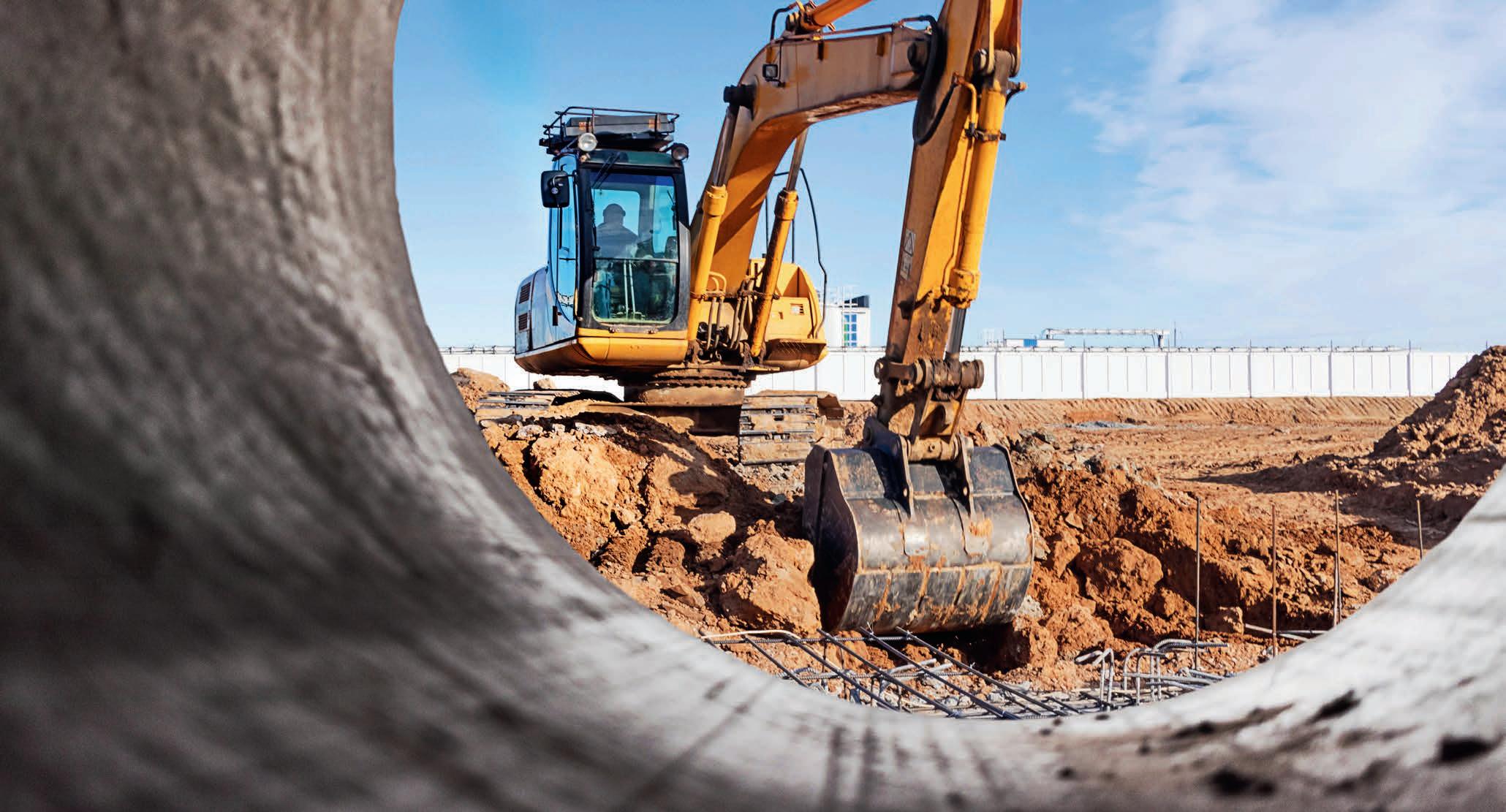
It’s impossible to ignore the pressure on the industry brought about by the sudden increase in fuel prices.
As I write this, even with the government halving the fuel excise, diesel is retailing for more than $3.30 per litre at my local servo, and I’m aghast at that figure.
Swerving around the memory of my father’s comment when petrol hit 60 cents per gallon in the 1970s (“The Australian public will never stand for this”), I’m still overawed when I consider the e ect escalating fuel prices are having on Australia.
But there it is. There’s nothing to be gained by wailing about the injustice of the situation. It’s here and we have to deal with it.
While there’s no easy or guaranteed procedure for ensuring we all emerge from the crisis with our businesses intact, there are clever people o ering sensible advice on weathering the financial storm. The good
news is, a few of them are contributing to this magazine. I urge you to set aside the time to block out distractions and look at what the associations and contributors have to say this issue.
That advice applies equally to me, of course. It may seem producing a magazine shouldn’t be too much a ected by volatility in the price of fossil fuels, but as we learned during the COVID 19 years, everything e ects everything else in our world, and none of us are exempt from an international crisis.
Hopefully, we also learned during that time that we can and will endure. We need to accept change and we need to innovate, and the challenge will take its toll. But we’ll still be here when it’s over, and Australians will still be in love with their homes and properties. They’ll still be looking for sharp, professional people and companies to keep
those homes and properties looking their best.
So hang in there. Keep an open mind, be prepared to try new ideas, and accept what can’t be changed.
Another saying from my father’s time springs to mind. When it seems these things just can’t be dealt with, it might be time for ‘a cup of tea, a Bex, and a good lie down’.
Let’s hope the whole complex situation untangles itself and we can all adjust to whatever the new ‘normal’ will be…again. Meanwhile, this is a tough situation. Make sure you’re looking after yourselves, your families and your work colleagues. The mental toll could easily be the highest price we have to pay.
Tom Foster Editor
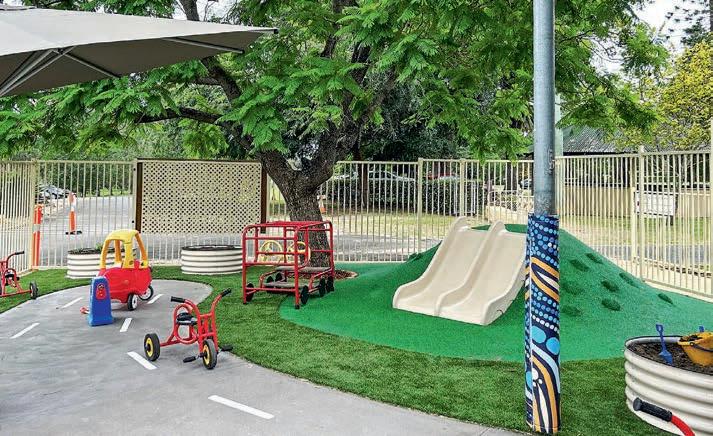
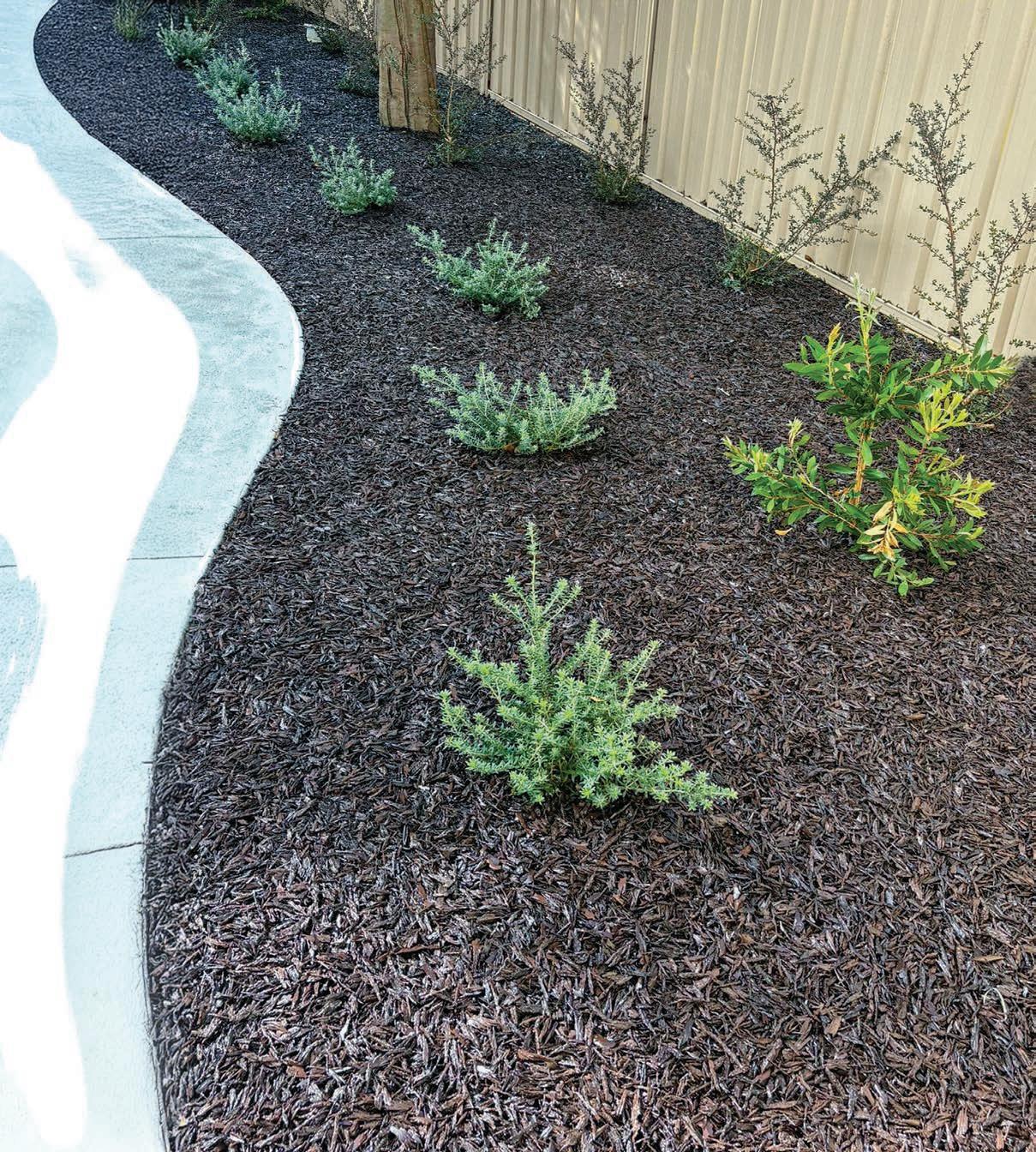
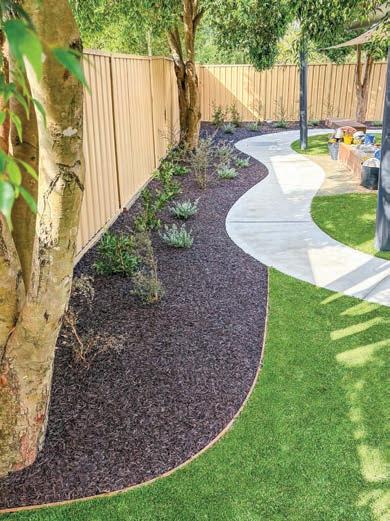
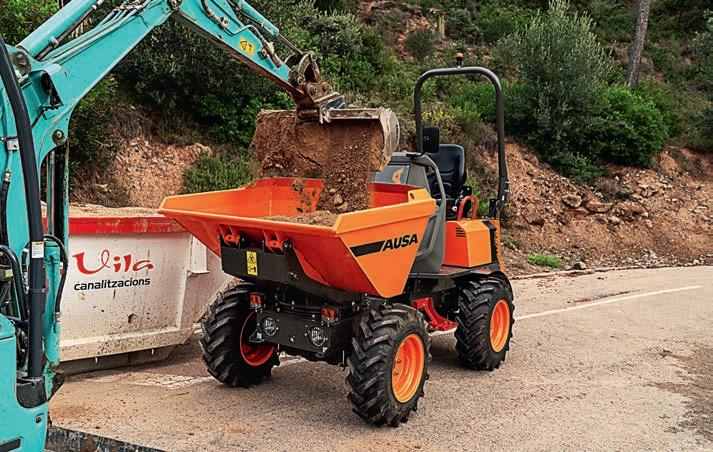
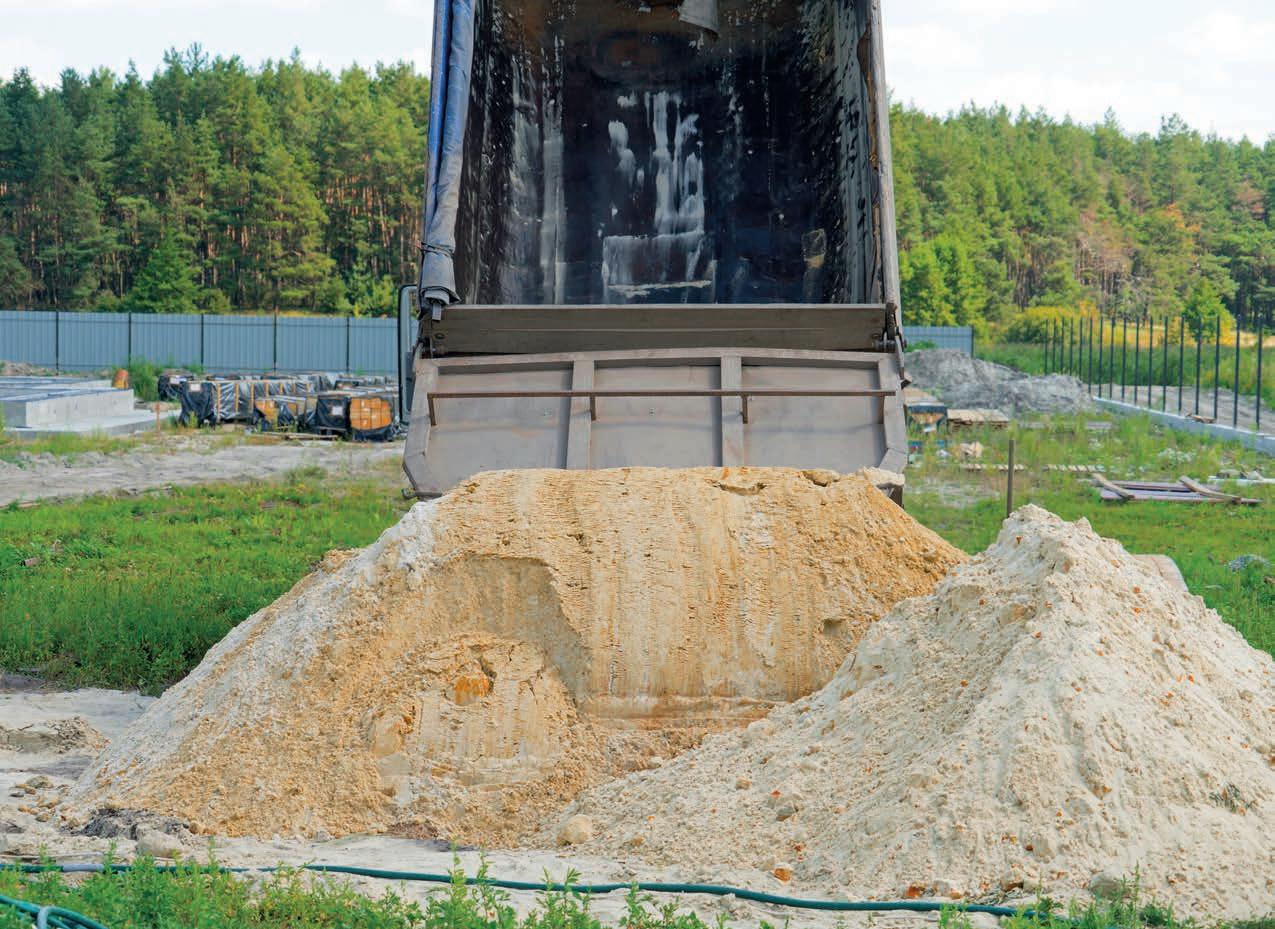
The Australian landscaping industry will adapt and overcome. Image: TF Welcome
LEGENDARY POWER.
PROVEN PERFORMANCE.
A hundred years ago, we took the saw to the tree. Today, we bring a total site solution. The STIHL AP System is a proven, interchangeable battery platform with 50+ tools to power your entire fleet. Delivering pro power for your blower, mower, chainsaw, hedge trimmer and more - day in, day out.
No compromise. No downtime. Just legendary performance since 1926.
Copyright Landscape Contractor magazine is owned by Prime Creative Media and published by John Murphy. All material in Landscape Contractor magazine is copyright and no part may be reproduced or copied in any form or by any means (graphic, electronic or mechanical, including information and retrieval systems) without written permission of the publisher. The editor welcomes contributions but reserves the right to accept or reject any material. While every e ort has been made to ensure the accuracy of information, Prime Creative Media will not accept responsibility for errors or omissions, or for any consequences arising from reliance on information published.
Articles All articles submitted for publication become the property of the publisher. The editor reserves the right to adjust any article to conform with the magazine format.
Head
G‘We the Wild’ achieved Best in Show, a gold medal, and the Horticultural Media Association Award for Best Use of Plant
The expo experience: where professionals go to learn, build, and grow
Horticulturalist John Gabriele recommends industry events for business and personal advancement.
arden shows, expos and trade-shows are held every year in all capital cities and in many provincial centres around Australia. These events provide insight into design trends, advancement in machinery technology, plant releases, and innovations in products of the garden-maintenance and landscape industries.
The Melbourne International Flower and Garden Show (MIFGS) has been running since 1995 and is the Australian benchmark for garden shows. It’s the largest flower and garden show in the Southern Hemisphere and showcases the creativity of Australia’s best landscape designers coupled with an extensive display of plants, garden, and landscape products – arguably second only to the Chelsea Flower Show in England.
Awarded
Anticipated highlights of the event were the jaw-dropping display gardens designed and constructed by Australia’s top landscape designers.
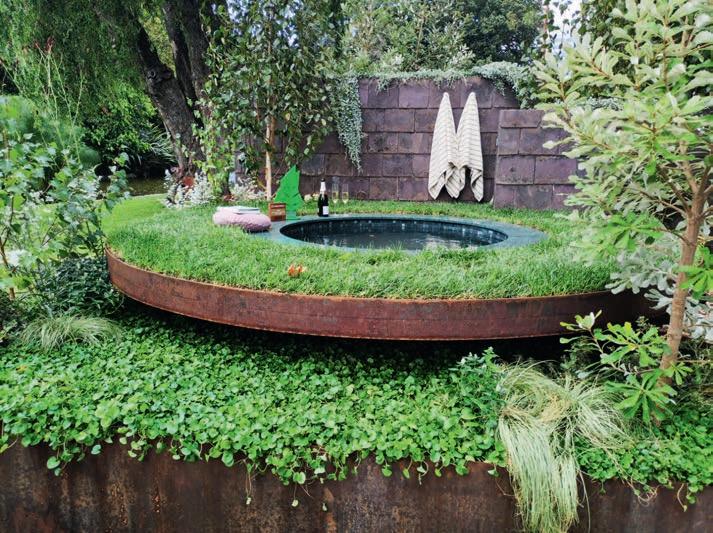
The gardens highlighted the latest trends, innovative concepts, and sustainable designs that will set the stage for the future. All the display gardens executed the fundamentals of good landscape design and construction through layering, texture, movement and colour. All the show gardens inspired creativity and demonstrated how the living spaces of the urban environment can be enhanced through thoughtful design and plant selection. In the Show Garden category, ‘We the Wild’, designed by Matt York, constructed by Ratio and lead nurseries
Kuranga Native Nursery and Surf Coast Palms, achieved Best in Show, a gold medal, and the Horticultural Media Association Award for Best Use of Plant Life.
On a smaller scale, and probably with more immediate influence on urban landscape designs, were the Boutique Gardens and Achievable Gardens categories. These competition gardens invited both established and emerging landscape designers to create show-stopping gardens in 5x5m spaces. What stood out was the use of native and edible plants in many of the designs. This trend towards ‘edimentals’ in landscape design continues to gain traction and will remain an influencing factor into the future. The winner of this category was Reverie, designed by Timeless Outdoors, constructed
Life at MIFGS. Images: John Gabriele
Technical insight
‘Reverie’ was awarded first place in the Boutique Garden category.
by Timeless Outdoors, Coastal Elements Landscaping, and lead nursery Spring Hill Nursery Native Whispers.
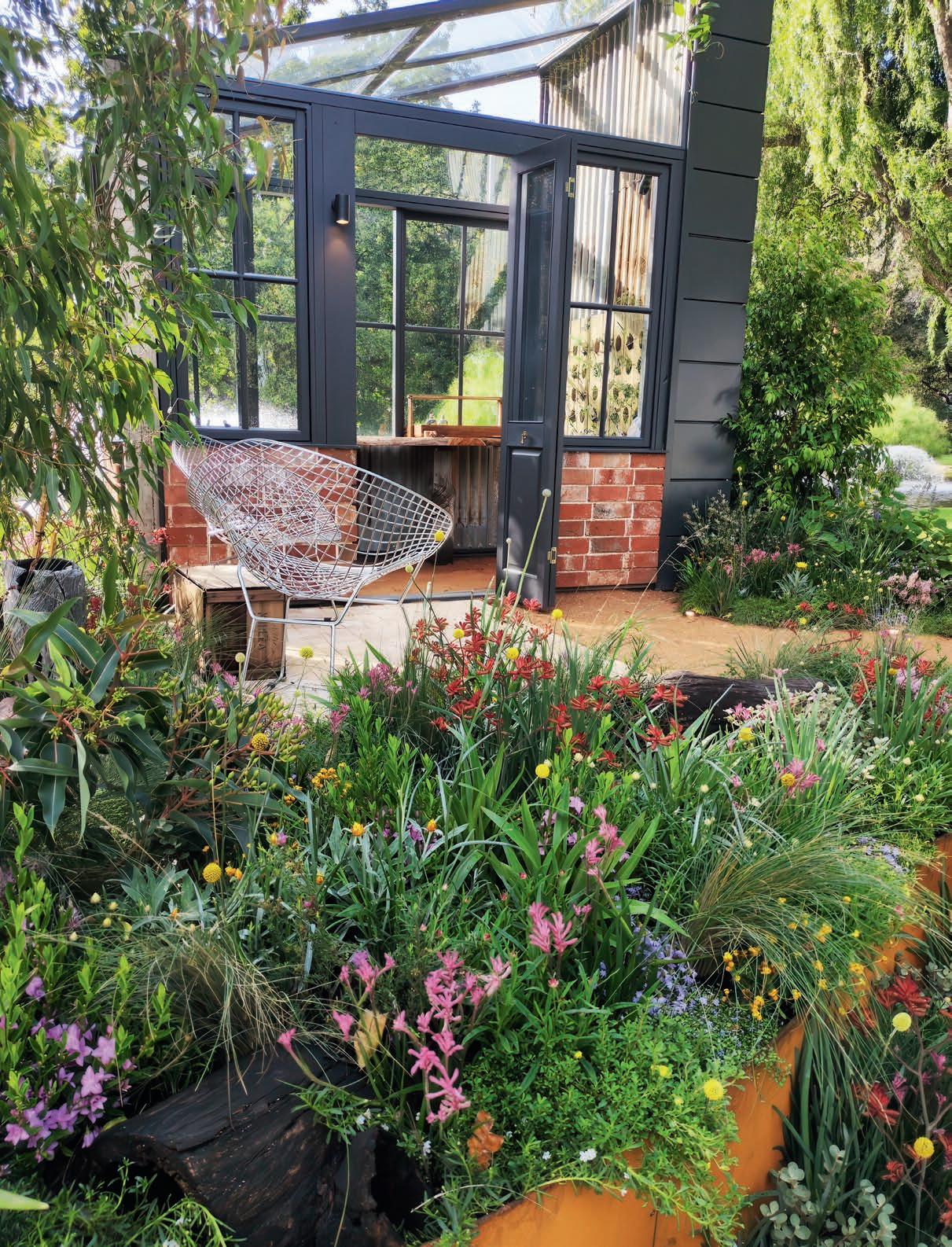
This author’s favourite was ‘Native Whispers’, designed by Emily Rubira of Rubira by Design, constructed by Semken Landscaping, and lead nurseries Kuranga Native Nursery and Humphris Nursery.
An impressive installation in the Achievable Garden competition was the Women’s Garden. Designed by Megan Blair, Sarah Jones and Georgina Honner, this garden achieved several awards, including an excellence award, gold medal, and Best Construction. The garden celebrates the contribution of women in designing and caring for their gardens into the future. With room for fruit and flowers, pest-proof worm towers, social seating and contemplative shade, no stone was left unturned in what was a remarkable functional space.
Tracking the talent
Assessing the calibre of designs and workmanship of the display gardens at expos and trade shows is a good way of identifying potential new talent for your enterprise. The up-and-coming landscape design and construction students who take part in the student competitions are often looking for their big break.
One event where the best of the best are on display is at WorldSkills, where every two years, more than 700 regional competitions are held in 34 centres across Australia. The skills and knowledge of 6000+ apprentices, trainees and students are tested, o ering the
chance to win gold, silver and bronze medals and to compete at a national level.
The WorldSkills Australia Landscape Construction Competition is designed to test the competitors’ skills in performing projects aligned to the training requirements of a landscaper. There are a series of skill-specific tests designed by industry experts that focus on unearthing talent in young Australians undertaking a trade or skills-based career.
The next Landscape Construction Regional Competition rounds will commence this year, and 2027 is the next National Championship year. Those interested should contact their local vocational training provider for details on 2026 WorldSkills regional competitions for their area and encourage your apprentices to compete.
Building capacity
Take a look at the events both large and small on o er across the country and you’re sure to be surprised at the changes occurring in landscape-construction materials, machinery, equipment, plants and more. Attending events such as expos, shows and conferences are crucial to building industry knowledge, providing an opportunity for networking, marketing, professional development and industry showcasing. Here are some of the more popular events held throughout the year:
• The Australian Landscape Conference 2027 is a key event for any landscape professional serious about their craft. The conference is a bi-annual event which includes presentations from international
The author’s favourite ‘Native Whispers’.
and Australian landscape designers, workshops designed to expand learning experiences, and interactive discussion around the issues that a ect the industry now and into the future.
• The National Diesel Dirt & Turf Expo provides an opportunity to gain insight into the latest technology in earthmoving, construction and public-space maintenance equipment. This expo brings together a range of earthmoving machinery dealers, earthmoving attachments, trucks, boats, bikes, mowing equipment and more. Diesel, Dirt & Turf attracts visitors from around the country, making it one of the most exciting trade fairs to attend and providing a platform for doing business with dealers and suppliers, and networking across industry sectors. The next expo is yet to be scheduled for 2027.
• Other notable events include Sydney Build Expo 2027; the Ekka Royal Queensland Show; the Royal Easter Show Sydney; the Perth Garden Show; the Landscape Show in Victoria; and the Adelaide Home & Gardening Show.
There are a variety of events that provide opportunities relevant to the landscape construction and maintenance industry that are also held annually at metropolitan and regional levels – events such as small farm field days in regional centres and the annual agricultural shows. They’re all notable a airs, often patronised by a range of suppliers providing opportunities to network and build business relationships or showcase your business.
Get down and dirty
Getting involved in landscape trade events as an exhibitor can be a better option than being a passive viewer.
There are marketing opportunities in displaying a product line or skills to an audience of potentially thousands over a couple of days. Exhibiting does not come cheap, but the return on investment can be substantial. Exhibition costs can be reduced through appropriate planning, strategic marketing and critical partnership agreements. This is where the state and regional associations can play a role, as can be seen in the garden-show involvement of the landscaping associations in a number of states. The organisations take a proactive approach to promoting the professionalism of their members.
Those interested should consult with the peak industry body in their state or territory on events that may be occurring in their region and get involved.
Technical insight
Electrifying landscapers
Horticulturalist and licensed structural landscaper Marc Worner considers the state of electric work vehicles and their viability.
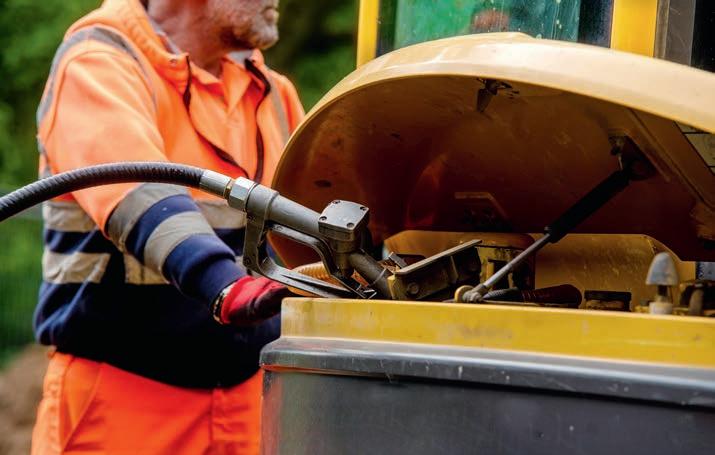
Landscapers use power tools and drive utes, trucks, and heavy machinery every day of the working week. In 2026 we’ve seen global events force a rise in the cost of energy, and Australia’s population is vulnerable because our energy is largely imported.
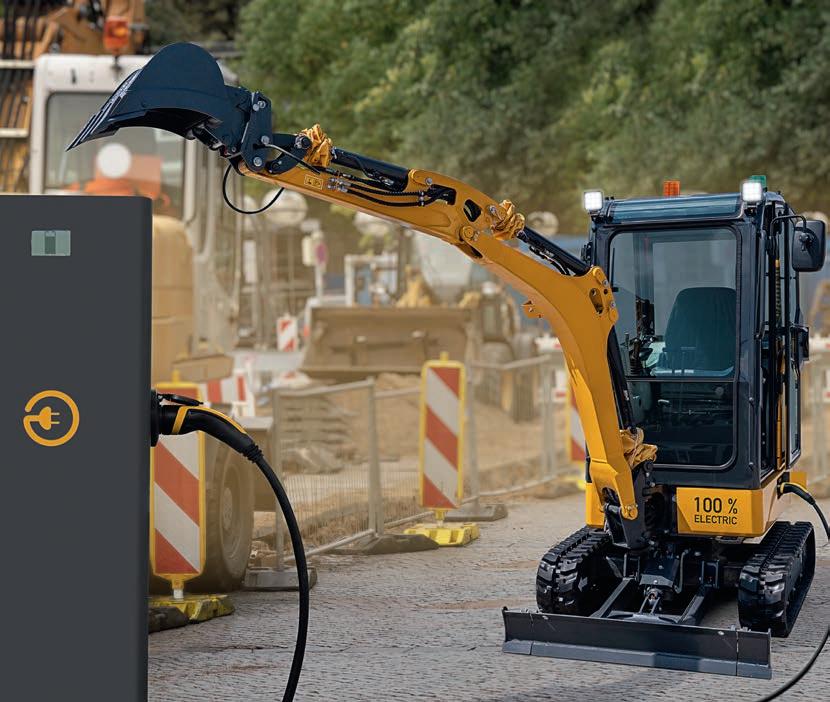
One way to mitigate these rising overhead costs is to consider going electric and to determine whether this strategy would suit your business model.
I can imagine readers saying: “It’s not e icient because the battery doesn’t last long enough for me.” Or, “I couldn’t tow with that truck.” Or, “It’s not powerful enough for my needs.”
The recent increase in sales of all types of battery-powered vehicles and equipment clearly reflects Australians realising what others in the world have accepted for the past 20 years.
One way to mitigate rising overhead costs is to consider going electric. Image: ungvar/stock.adobe.com
If you want to achieve savings in your business overheads, read on.
Possibles
upfront cost, and a limited model availability into 2027. Charging logistics in public during a full workday fall short of what is acceptable, and the reality for now is most landscapers still use diesel or petrol utes.
Let’s consider the use of hybrid utes as a strategy.
Hybrids are battery powered but also have an internal combustion engine. Hybrid utes can save money, but only if the battery is used properly and the vehicle does little heavy towing.
Landscapers use heavy machinery every day of the working week. Image: Anoo/stock.adobe.com
Battery-powered mowers, hedge trimmers, blowers, chainsaws, impact drivers and drills are now used by both residential and commercial landscapers. Electric utes and trucks are emerging, and while they’re not so widespread, there are a few notable models available.
Converted to right-hand-drive for Australia, the Ford F-150 Lightning is a full-size American electric ute with a range of about 515km and is capable of towing up to 4.5 tonnes. It’s priced at around $150k+ depending on specs, and is only available via importers like AusEV.
That’s beyond the financial reach of the average landscaper.
However, consider the Korean dual-cab KGM Musso EV. It’s priced from a very reasonable $65k drive-away, has a range of up to 420km and is available in 2WD and AWD options. With a payload of 900kg and a towing capacity of 1.8 tonnes, it’s currently the closest thing to a ‘normal’ Hilux/Ranger replacement in EV form.
The Tembo Tusker EV ute is another alternative suitable for those working for a council or with a landscaping crew, and it is used on mine sites and educational campuses. It’s priced from $81k and has a range of 350km with a payload of 1000kg, but with less towing capacity.
An each-way bet
The reasons most landscapers aren’t switching to electric vehicles include the limited range when towing trailers, the high
All hybrids are quiet while running on battery, which is ideal. They also save on brake pad wear because they have regenerative braking – the car is slowed by converting it’s kinetic energy into electrical energy, rather than losing it as heat during braking friction. Engine wear is less because the motor is running for less time. Savings with a hybrid can be up to $1000 per year over a comparable petrol or diesel vehicle, and for those working locally and driving about 100km per day, hybrids are cost e ective.
The BYD Shark 6 is an interesting option. It o ers 100km of electric-only range (an advantage for daily jobs) and excellent electric torque. Important weaknesses of the Shark for some buyers may be that it’s more of a lifestyle ute than a heavy-duty ute, and its towing capacity is 2.5 tonnes – lower than most work utes.
TIP: Towing daily for long distances with a hybrid will reduce savings because it will switch over to the internal combustion motor under load.
If you’re a Ford fan, the dual-cab Ford Ranger PHEV is designed to behave like a normal Ranger, but with hybrid assist. It o ers
Technical insight
The upfront cost of a battery-powered mini excavator is normally high, but the running costs are about 60 per cent less than a comparable diesel machine. Image: scharfsinn86/stock.adobe.com
a 3.5t towing capacity, but there’s always compromise. The smaller battery (45km EV range) means a smaller financial saving.
The sweet spot for all hybrid utes is short, daily runs, charging every night, and only moderate towing. That’s why many landscapers save in the suburbs with hybrids but see less benefit in daily commercial use – until now.
Head to head
Enter the 2026 GWM Cannon Alpha PHEV.
The GWM has a 4WD system with low range (like a diesel ute), is built on a traditional ladder-frame chassis, is designed to match a diesel ute’s o -road capability, and its towing capacity is a class-competitive 3–3.5 tonnes. It will handle trailers with mini excavators, mowers, and materials, and feels like a Hilux/Ranger replacement and a lifestyle vehicle at the same time.
In other words, it has ‘diesel-like’ capability with little compromise.
Money talks
Look at these cost comparisons to see if there are possible savings for you by changing to a hybrid ute this winter.
Let’s say a typical landscape contractor drives 100km per day. Allowing for annual and sick leave, rain, and public holidays, the distance driven over a 45-week work year would be 22,500km.
For a hybrid ute, assuming no diesel was used, electricity would run to about $5.00 per 100km. That tallies up to $1125 per year.
A diesel-only ute will run at about 8.5 litres per 100km, and let’s say diesel averages out
at $3.00 per litre for rest of the year. That’s $25.50 per 100km, so 22,500km will cost $5738 per year.
Hybrid utes win the cost argument hands down.
TIP: If a landscaper installs a solar system with battery at home or at the depot, the savings increase. There are numerous installers of solar systems but do the research. The quality of all components, including the battery, play a role in achieving the best outcomes to suit individual requirements. Also remember southern states benefit less from solar because of the arc of the sun.
In charge
Let’s review the electric versions of skid steers suited to landscaping.
First, the Bobcat S7X All-Electric Skid Steer Loader with no hydraulics. Its battery is a 60.5 kWh lithium-ion unit which provides up to eight hours of run time on a light workload. The key advantage is that it has three times the torque response of a diesel machine, and it’s near silent with zero emissions, making it ideal for noise-restricted landscaping, councils, and indoor work. The downside is the Bobcat S7X is, as I write this, in short supply.
Then there’s the Bobcat T7X All-Electric Compact Track Loader. It’s more common than the skid-steer variant, and comes with a 72.6 kWh battery and of course, no hydraulics. It uses electric actuators. Bobcat says its performance is comparable or stronger than diesel equivalents.
Several other electric front-end loaders and compact electric mini-loaders are
available for purchase or hire in Australia, o ering zero emissions and reduced noise for landscaping. An online search will turn up the manufacturers with active o erings.
Diesel has its place
A progressive landscape company setup would have a diesel skid steer for heavy lifting, electric tools, an electric front-end loader, a compact electric mini-loader, and a small electric excavator.
The downside of that line-up is that there are some operational issues – such as the availability of charging on site – because runtime drops under heavy load, not to mention the high upfront cost of purchasing the equipment.
Over the next three years it would pay to consider a transition to an electric track loader and then an electric skid steer when they’re more widely available.
If you’re looking to update your mini excavator in the short term for tight-access jobs, small residential landscaping, and digging trenches, footings, and drainage, do some research and see what’s available. The upfront cost is normally high, but the running costs are about 60 per cent less than diesel, so the advantage is there if the machines are being used daily.
TIP: Stick with diesel if you do heavy bulk excavation work on remote sites and need all-day continuous operation.
Transition
Typically, there are lower maintenance costs with electric vehicles and heavy equipment, including tools, and hourly running costs with electric equipment are about 50 per cent cheaper than diesel.
So, with high usage, expect payback from a transition to electric to be at around the six-year mark, and with low usage to be at around the eight-year mark or more. However, keep in mind that right now most batteries have a lifecycle of about 10 years.
TIP: Be careful using electric machines on wet or muddy sites. The battery will become exhausted comparatively quickly.
Electric wins if you work in urban or residential areas and carry out light to medium-duty work such as turf preparation, soil moving, mulching, and your workday is six to eight hours per day. Home and depot charging, preferably solar, is a must have.
For a landscaping business, as things stand in Australia today, it’s probably best to stick with a diesel skid steer and add an electric mini loader, then transition to an electric skid steer when their prices ease, onsite charging becomes common, and dealer support is more widespread.
REAL WORK NEEDS A REAL MOWER
When you have real work to do, you can rely on your Hustler to front up day after day, year after year.
Proudly American made for over 60 years, every Hustler mower is built with the same uncompromising commitment to quality and reliability.
Leaders in innovations that really matter and with the power to perform, so you know that your Hustler is Here to Work.
2 YEAR
5 YEAR
Plants and landscaping materials can be carriers of ecological disasters – like introduced species of ants. Image: kardaska/stock.adobe.com
CTechnical insight
Dealing with invasive ants
Horticulturist Jonathan Garner encourages landscapers to be watchful for introduced species of ants.
arrying on from last issue where we discussed the threat from Polyphagous Shot Hole Borer and what to look out for, I figured it would be worthwhile to look at other destructive critters setting up residence on our shores – in particular, invasive ants.
Responsibilities
Landscape professionals can work across dozens of properties in a week, handling and transporting materials that native and exotic ants like to live in. This positions our profession not just as carriers of these ecological disasters, but also to be an e ective early-warning network.
pollination, soil aeration, and seed dispersal. There’s a growing number of invasive species threatening native species, natural ecologies, and our horticultural industry.
It’s both sad and frustrating, but invasive species take advantage of the global supply chain to stowaway in shipping containers and bulk loads. Lax or hasty quarantine processes can, and have, enabled destructive creatures to migrate to our shores.
Here’s a handful of tiny creatures that are causing, or will cause, massive disruptions if left unchecked or unknowingly allowed to spread through this great brown land.
Red imported fire ants
These South American nasties, Solenopsis invicta, are considered Australia’s most dangerous invasive ants.
First detected in Queensland in 2001, they build mounded nests in open ground, lawns, and garden beds. Their sting delivers a burning venom that can also cause anaphylactic shock, so when the nest is disturbed, get away fast.
The most valuable tool we have to avoid spreading pests and diseases is to understand what these pests and diseases are and what to look out for. Hopefully our recent chats have brought to your attention the responsibilities landscapers have towards the protection and management of natural and urban ecologies and the built environment.
Home grown
Australia is home to more than 1300 native ant species, and many of these play roles in
The sting of red imported fire ants can cause anaphylactic shock. Image: Séa/stock. adobe.com
Red imported fire ants (RIFA) devastate ground-nesting birds, reptiles, and small mammals. They’ve been shown to reduce native insect diversity by up to 40 per cent in infested areas, and they damage irrigation systems and electrical equipment.
RIFA eradication remains an active, government-funded program in southeast Queensland, but the management scheme is dividing communities. Residents and some community activists have raised fears that aerial spraying and baiting on the ground are killing domestic pets and wildlife.
There may be negative consequences of the management processes, but this disastrous pest must be eradicated. It seems we’re in a situation where we must break eggs to make an omelette.
Technical insight
Yellow crazy ants
These south-east Asian critters earn their name from their erratic, rapid movement.
Established on Christmas Island and detected in parts of Queensland’s wet tropics, yellow crazy ants (Anoplolepis gracilipes) form super-colonies – interconnected networks of nests without territorial boundaries. These nests can dominate landscapes. On Christmas Island, they famously devastated the keystone species population of red crabs.
In garden settings, yellow crazy ants ‘farm’ sap-sucking insects like aphids and mealybugs, protecting them from predators and causing plant damage. The protection of aphids further encourages the prevalence of plant viruses and diseases, and their ecological impact on ground fauna and soil invertebrates is severe, although they’re not as poisonous or dangerous to humans. Crazy ants crowd out native species, unbalancing natural cycles.
Electric ants
Also known as ‘little fire ants’, Wasmannia auropunctata originates from the central and south Americas.
Being around 1.5mm long, these tiny ants pack a sting out of proportion to their size. Found in parts of northern Queensland and
on some Pacific islands, they are dangerous to biodiversity because they attack the eyes of vertebrates (birds, mammals and reptiles), causing blindness in wildlife, pets, and in rare cases, humans.
Electric ants form dense super-colonies and suppress populations of native ants, spiders, and other invertebrates. A single potted plant or piece of nursery stock can harbour an entire colony.
Coastal brown ants
Sometimes called ‘big-headed ants’, Pheidole megacephala is an African species already widespread across tropical and subtropical Australia.
Though less dramatic in their sting than some other species, they are ecological killers. They’re very successful at displacing native ant communities that support seed dispersal and, in some cases, pollination. Many native Australian plants rely on ants to carry their seeds (a process called ‘myrmecochory’), and when coastal brown ants displace native species, seeds are moved to unsuitable locations or consumed rather than planted.
Coastal brown ants also protect plant pests and can destabilise soil structure around garden beds.
Yellow crazy ants form super-colonies – interconnected networks of nests without territorial boundaries.
Image: Narupon/stock.adobe.com
Though less dramatic in their sting than some other species, the invasive coastal brown ant is an ecological killer. Image: peter/stock.adobe.com
Technical insight
Argentine ants are extraordinarily aggressive toward native ants. Image: Matthew/stock.adobe.com
Argentine
ants (Linepithema humile)
These successful South American ants have colonised every continent except Antarctica. They are well established in cool, moist parts of southern and south-western Australia, including Adelaide, Perth, and parts of Victoria. Like their crazy ant counterparts, they form vast super-colonies. In some regions, a single interconnected colony can extend hundreds of kilometres.
Argentine ants are extraordinarily aggressive toward native ants. Studies in South Africa and California have linked Argentine ant invasion to the collapse of plant-pollinator networks and the disruption of the ant/seed dispersal systems.
In garden environments, they are persistent pests in kitchens and structures and are nearly impossible to eradicate.
Browsing ants
Yet another emerging concern in Western Australia, Lepisiota frauenfeldi was first detected in the Perth region in around 2015. These nasties originate from the Mediterranean and nest in soil and under rocks. They disturb root systems and have
been associated with the spread of fungal pathogens, and large infestations have been linked to tree deaths.
Browsing ants have the potential to form super-colonies, and their full ecological impact in Australia is still being assessed.
Be vigilant
Early detection is the single most e ective tool against invasive-ant establishment. Here is how to build monitoring into your practice:
• Know what you are working with and what’s in it. Soil, mulch, potted plants, and paving materials are common vectors for ant introduction. Before unloading or planting, check the base of pots and packaging for ant trails or queen cells.
• Know what you’re looking at. In northern NSW and south-east Queensland, familiarise yourself with the dome-shaped mounds that lack a central entry hole and feel spongy. These are likely to be homes for fire ants. Photograph any unfamiliar species and cross-reference the images with the Invasive Species Council’s identification resources or the My Pest Guide app.
• On new projects or gardens, it’s a good
idea to identify the ants onsite. This is relatively easy to do by placing simple protein and carbohydrate bait stations. A small amount of tinned fish works well for protein hunters, while honey on a card is a great lure for carbohydrate feeders. It’s good to let your client know you’re actively monitoring their landscape asset for possible pests and drawing another arrow from your integrated pest-management quiver. Identify species before reaching for the poison granules.
• Government and private contracts may require documenting baselines of ant activity at the start of a project. Observing changes in ant diversity and behaviour can be early indicators of invasion.
Responsibility
Landscape professionals need to know a whole lot more than just the skills of making the place look pretty. Staying informed, staying observant, and knowing who to call when something looks wrong may prove as important as any pest killer in your kit. Let’s all remember that we have a duty of care to our client, to society, and to the environment that sustains us.
Landscaping and pool projects demand equipment that can work where space is limited and access is tight.
TSL2000
D151
Built for Australia’s commercial landscape
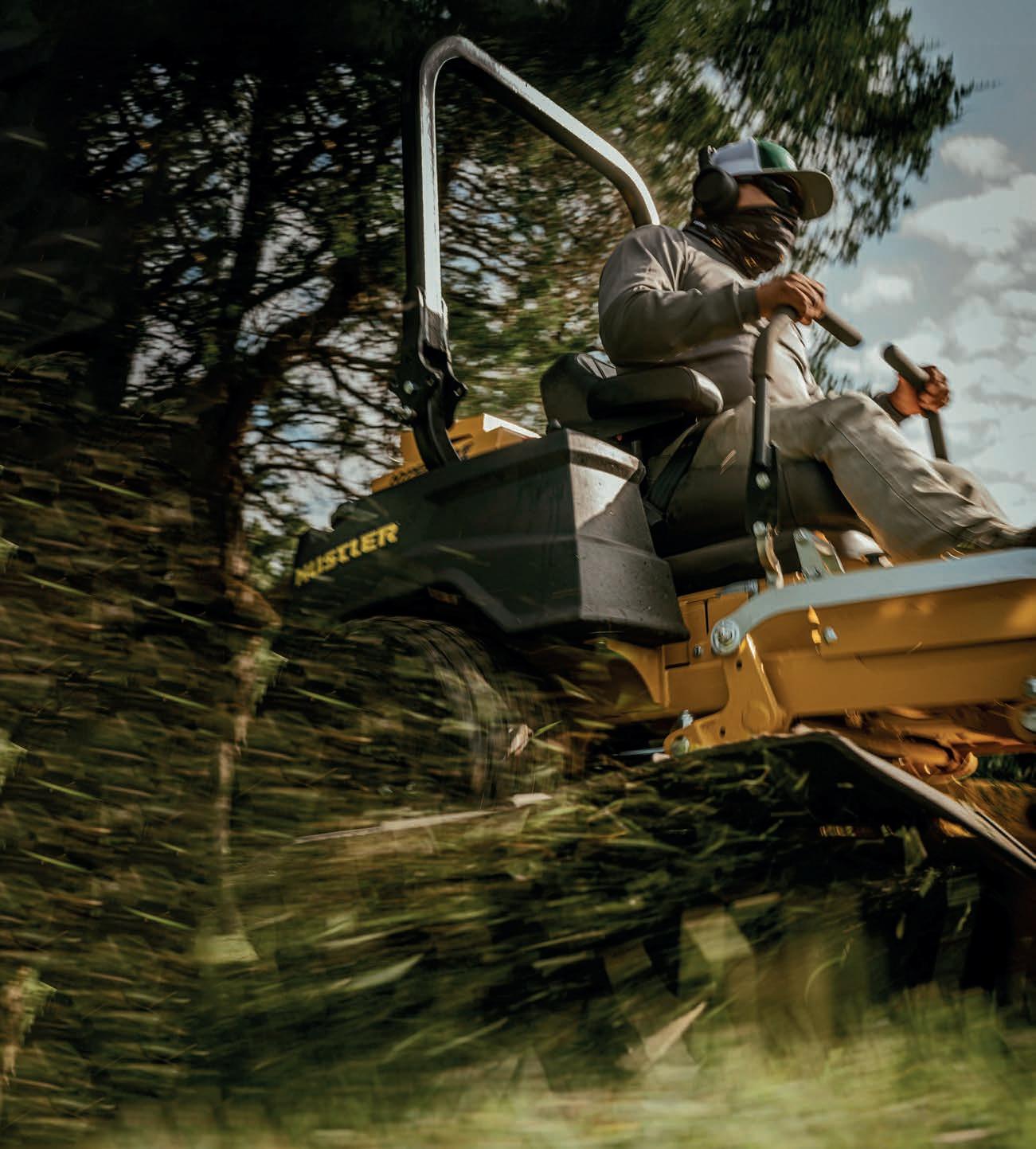
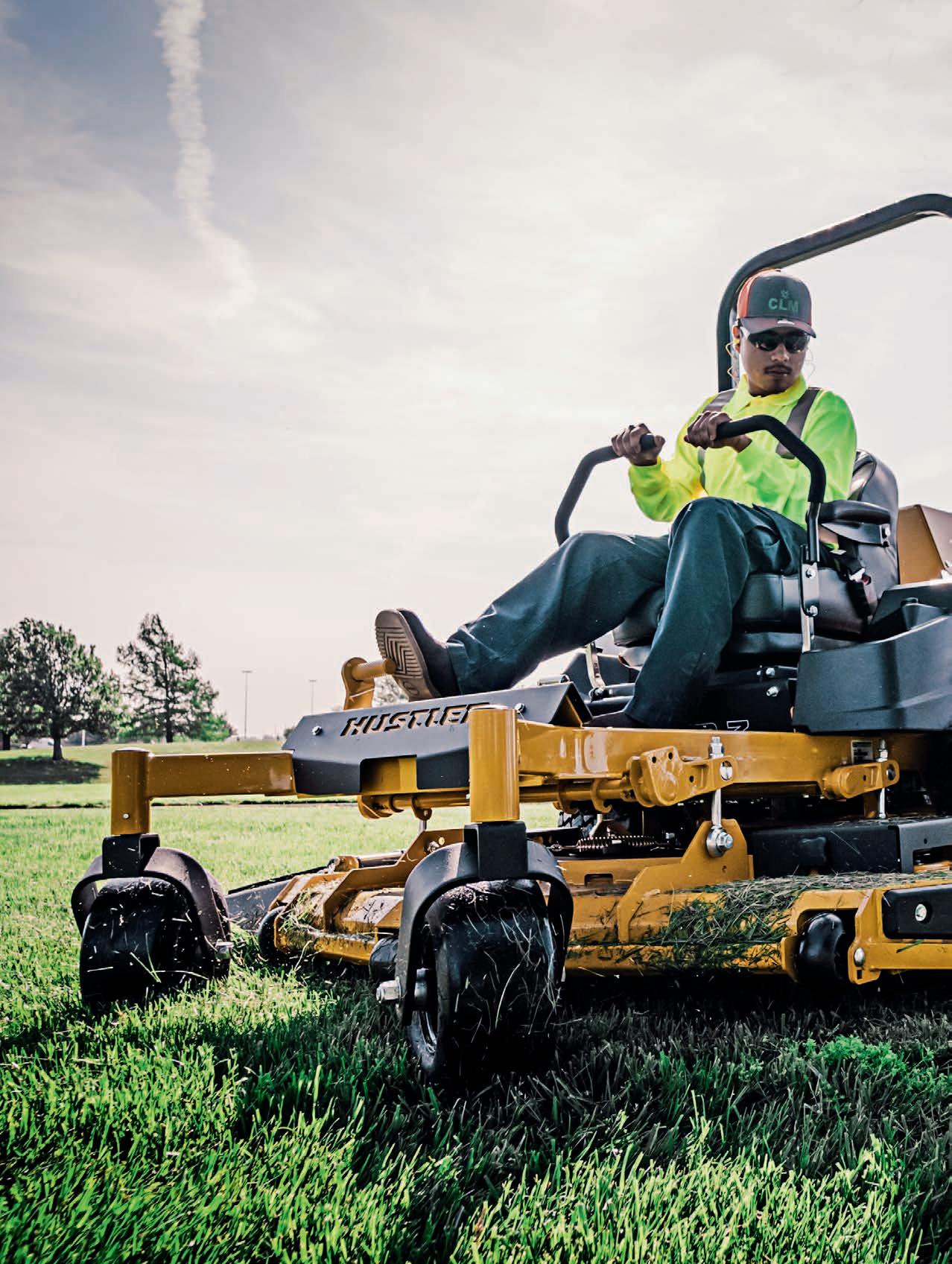
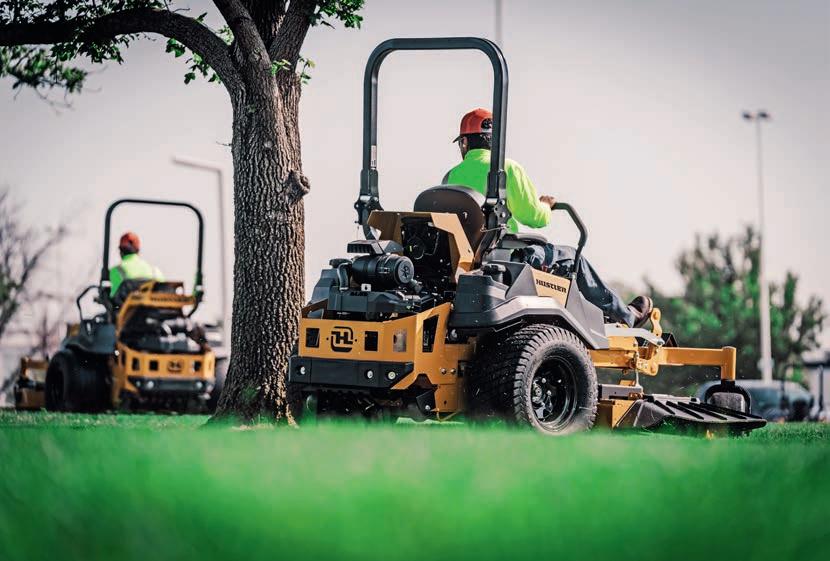
Hustler zero-turn mowers are cutting edge in performance and durability.
Across Australia’s councils, schools, and municipal reserves, the demand for reliable, high-performance groundsmaintenance equipment has never been greater. With tightening budgets, rising labour costs, and an ever-present pressure to maintain public spaces to the highest standard, operators can’t a ord downtime, ine iciency, or equipment that can’t handle the rigours of the Australian environment.
This is where Hustler commercial zero-turn mowers have carved out a reputation that grounds managers across the country take seriously.
Hustler’s zero-turn platform is built to get the job done faster without sacrificing quality. Images: Hustler Australia
Engineered for productivity
Time is money in commercial grounds maintenance.
A council grounds crew maintaining parklands, road verges, and recreational reserves across a municipality can’t a ord the luxury of slow equipment. Hustler’s zeroturn platform is built around one principle: get the job done faster without sacrificing quality. With industryleading turning radii and mowing speeds that outpace conventional ride-on mowers, operators can cut productive hours from every
maintenance run – translating into cost savings and the ability to service more sites per shift.
For school zones and sporting facilities – areas that demand a consistently neat presentation – Hustler’s cutting decks deliver a clean, even finish across varied terrain. Whether it’s the manicured oval of a primary school or the undulating verges of a regional park, the quality of cut speaks to the professionalism of the organisation responsible for it.
EFI technology and Kawasaki power
For fleet operators managing tight operational budgets, Hustler’s Electronic Fuel Injection (EFI) engine options – many powered by Kawasaki’s commercial engines – represent an advantage. Kawasaki engines are known for their reliability and longevity in commercial outdoor power equipment and paired with EFI technology they raise the bar further. EFI continuously optimises the air-tofuel mixture in real time, meaning the engine consumes only what it needs – regardless of load conditions, temperature, or altitude. In practical terms, commercial operators can expect fuel savings of up to 25 per cent compared to equivalent carburetted engines, a figure that adds up across a large fleet running daily routes.
For councils and municipalities with sustainability targets or carbon reduction commitments, Kawasaki EFI models also produce fewer emissions – a quiet but meaningful benefit when reporting to ratepayers and government bodies.
Staying cool under pressure: Hyperdrive cooling systems
Australian summers test equipment to its limits, and overheating remains a common cause of unplanned downtime in commercial mowing fleets. Hustler addresses this with its Hyperdrive cooling system, engineered to manage heat in the hydraulic drive components during sustained, heavy-load operation. In the kind of extended daily runs that councils and grounds-maintenance contractors demand, conventional cooling systems can struggle, leading to reduced performance, premature component wear, and costly repairs. Hyperdrive keeps operating temperatures in check, ensuring the machine performs consistently from the first hour of a shift to the last, even in the most punishing summer conditions. For fleet managers, that translates to fewer breakdowns, lower servicing costs, and greater confidence in scheduling.
For fleet operators working public areas, Hustler’s EFI engine options produce fewer emissions than carburetted machinery.
Safety first: the case for rear-discharge decks
In high-tra ic environments – school grounds, council parks, roadside verges –the safety of bystanders is a non-negotiable concern. Hustler’s rear-discharge cutting decks address this. Unlike side-discharge configurations that can propel debris laterally at high velocity toward pedestrians, fencing, vehicles, or buildings, rear-discharge decks direct clippings downward and behind the machine into a controlled zone. For grounds crews working around children, playground equipment, parked cars, or public infrastructure, this design reduces the risk of property damage or injury – and the liability that comes with it.
For risk-conscious procurement managers in local government and education, specifying rear-discharge equipment is often a WHS requirement, not merely a preference. The availability of Hustler’s reardischarge configurations makes compliance straightforward without compromising cutting performance.
Built tough
From the baking heat of a Queensland summer to the wet, heavy grass of Victoria’s coastal regions, commercial mowing equipment takes punishment that would humble lesser machines. Hustler’s commercial range is engineered with heavygauge steel decks, robust drivetrains, and Kawasaki engines selected for their ability to meet the thermal and mechanical demands of extended operation in harsh conditions. Hustler backs this build quality with commercial warranties that give fleet operators peace of mind. In an industry where warranty fine print often excludes the very conditions under which commercial machines operate, Hustler’s warranty coverage is structured for real-world
commercial use, protecting councils, contractors, and institutions against the costs of unexpected failures and reinforcing the long-term value of the investment.
Comfort drives real-world performance
Operator fatigue is an often-overlooked factor in commercial mowing.
A grounds-crew member spending six to eight hours a day on a machine that vibrates, jolts, and strains will inevitably slow down and make mistakes. Hustler’s commercial zero-turns feature well-designed operator platforms, ergonomic controls, and suspension systems that reduce fatigue during long shifts.
Comfortable operators are safer, more productive, and more likely to take pride in the quality of their work.
Dealer support across Australia
A mower is only as good as the network that supports it. Hustler’s growing Australian dealer presence means parts, service, and technical expertise are accessible when operators need them most – not weeks later when the grass has grown past acceptable limits.
For Australian councils, municipalities, and school zones seeking equipment that delivers commercial-grade performance, durability, and long-term value, Hustler zero-turn mowers represent a compelling investment. With Kawasaki-powered EFI engines delivering fuel savings, Hyperdrive cooling systems keeping machines running at peak performance through Australia’s harshest conditions, rear-discharge decks meeting the safety demands of public environments, and commercial warranties that stand behind every machine, Hustler isn’t simply a mower – it’s the commercial solution Australia’s grounds managers have been waiting for.
Softfall that takes some beating
When it comes to constructing play and recreation areas, highquality softfall surfaces are non-negotiable. One brand can be relied on to ensure compliance and attractive results.
PLJ Group Australia is an Australianowned, family-run company based in the Southern Highlands of NSW. The company services NSW and the ACT providing schools, child-care centres, council parks, swimming centres, and sports clubs in all aspects of playground design and construction, including rubber softfall.
The company takes pride in its insistence on the high-quality of its finished product, and all equipment supplied and installed by PLJ Group Australia is designed to be compliant with the relevant Australian Standards.
For its softfall and playground surfaces, PLJ goes to A1 Rubber.
Long-term customer
Feda Arifaki is Sales Manager, Open Space Projects Professional, at PLJ Group, and she has definite views on A1 Rubber formed over many years.
“We’ve been using A1 Rubber the whole time I’ve been at PLJ,” she said. “But even before that, Paul Johnson, a director at PLJ, and I worked together at another company
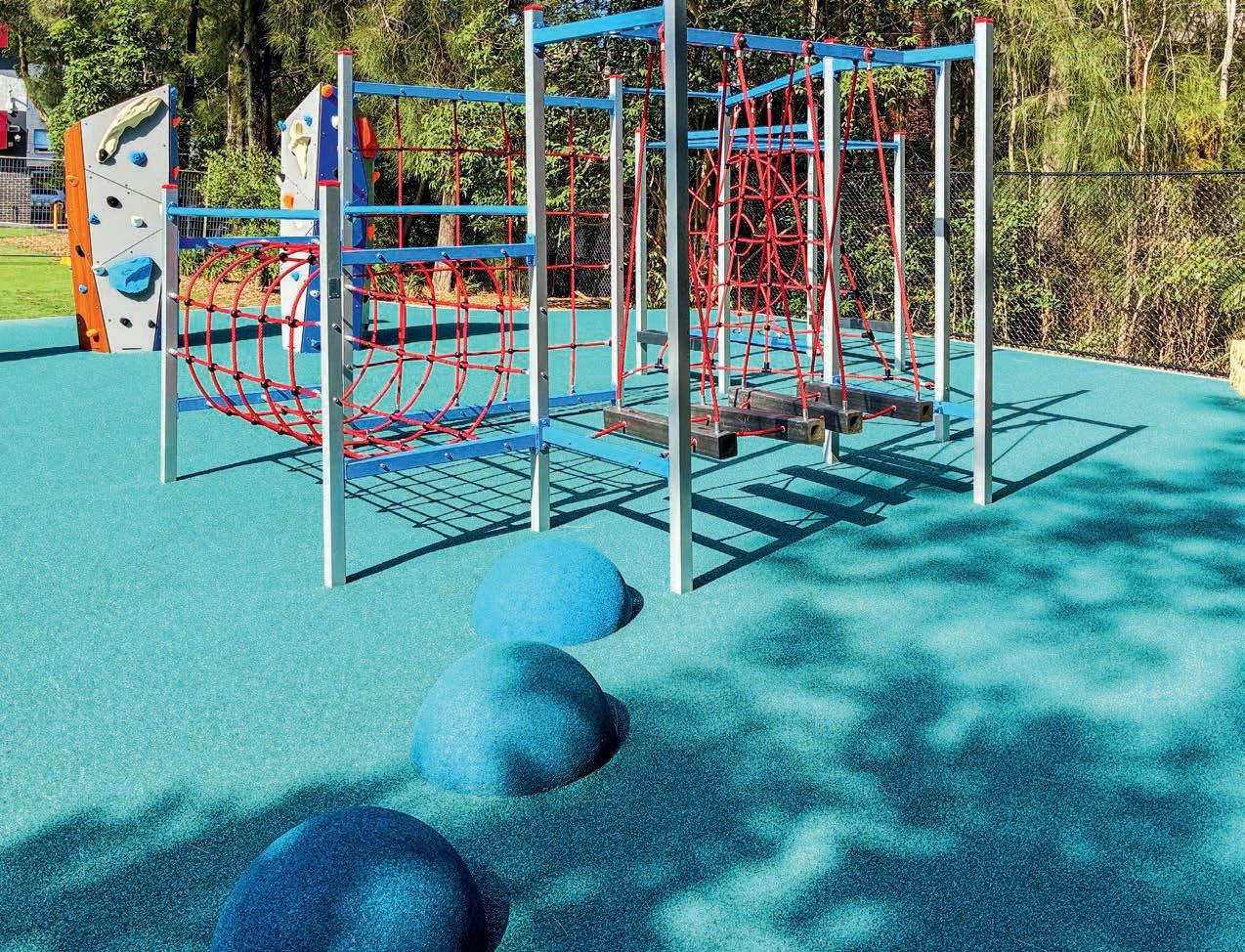
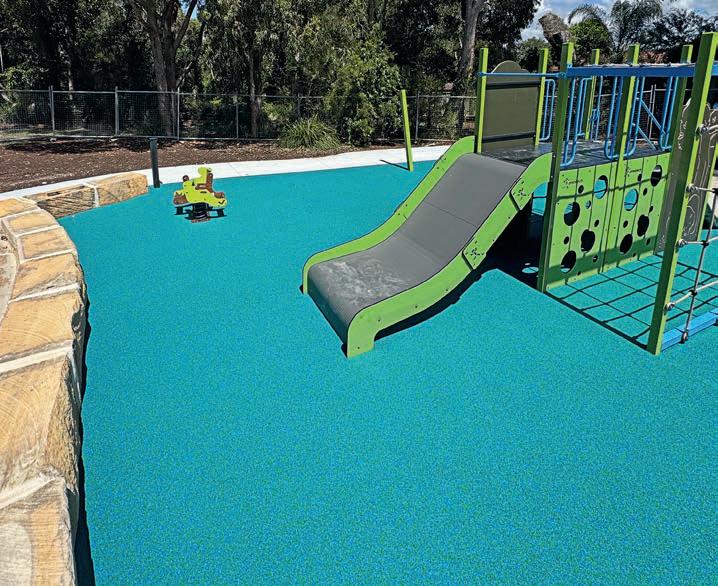
For its softfall and playground surfaces, PLJ Group goes to A1 Rubber.
Images: PLJ Group
All equipment supplied and installed by PLJ Group Australia is designed to comply with relevant Australian Standards.
for more than a decade, and we’ve always used A1 Rubber products, especially the CSBR brand.
“The A1 Rubber team is amazing. It looks after its loyal clients better than any other rubber supplier I know.”
Feda sources and quotes projects for the company, and she has no hesitation when it comes to vouching for PLJ’s supplier to
More customers are now opting for rubber wetpour because it’s low maintenance.
Dig, lift, and dump with JLG
Size matters on urban sites. Tight spaces, narrow paths, and cramped conditions are a constant challenge. That’s where JLG’s expanded range of mini-dumpers and forklifts excel.
JLG has been supplying equipment to Australia and New Zealand’s construction industry for over four decades, earning a reputation for quality and service.
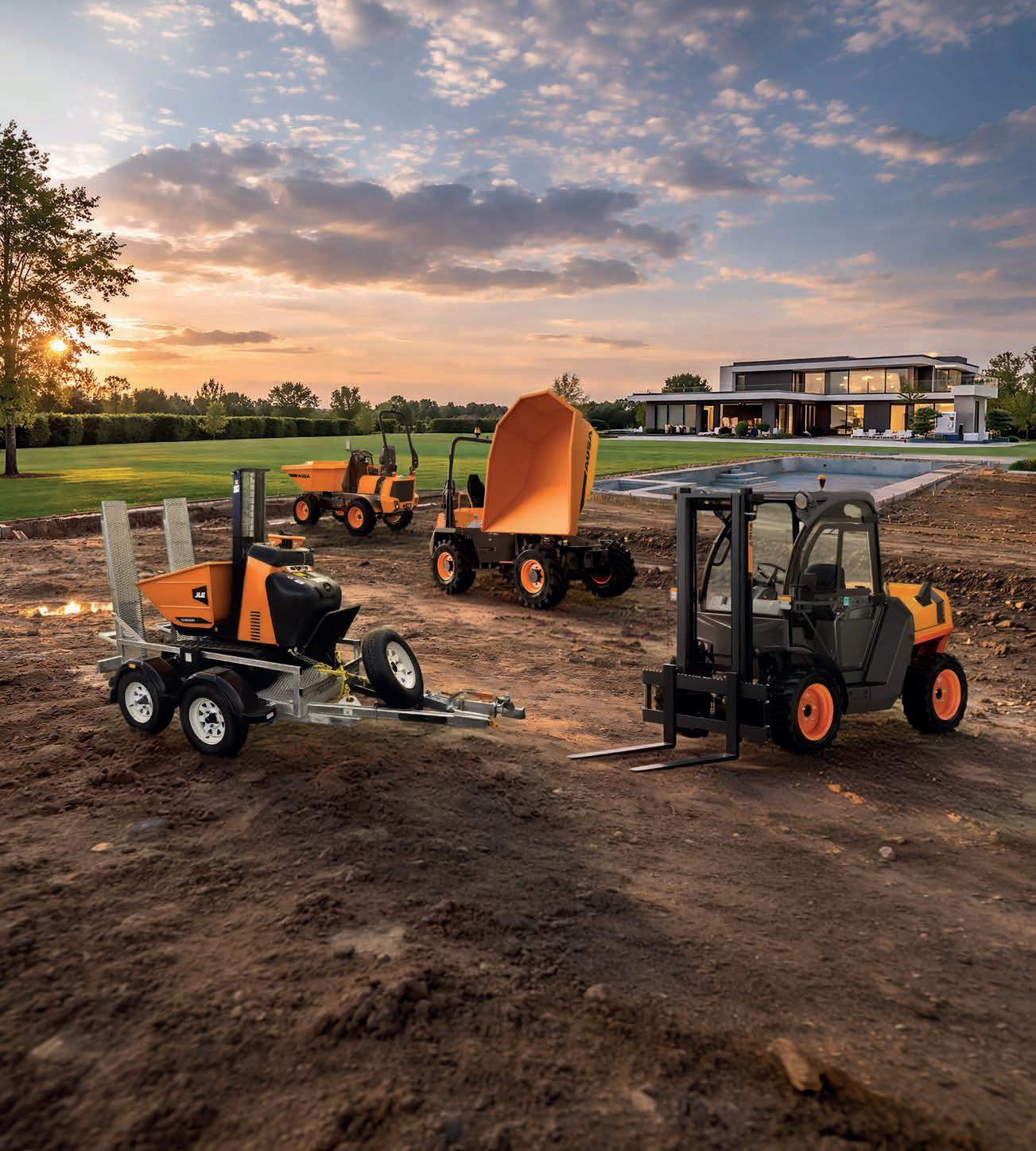
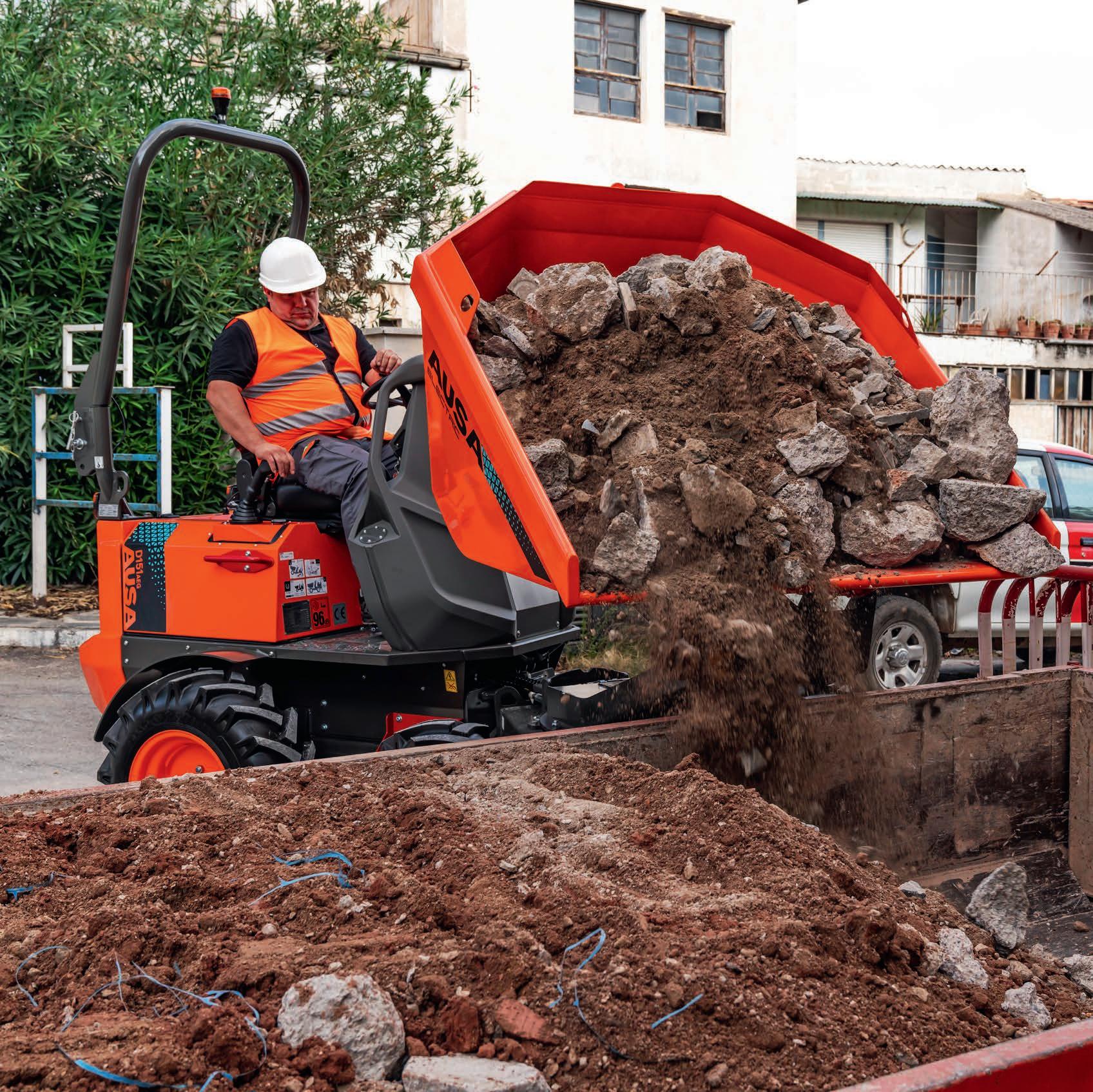
Recent acquisitions have broadened JLG’s range to include tracked mini-dumpers, AUSA wheeled dumpers, and forklifts that service the unique needs of landscapers working on smaller construction sites, including private gardens.
For jobs of all sizes
The JLG Tracked Mini Dumper range – from the compact TD1500H Hi-tip that can handle up to half-tonne loads to the TD2500H Hi-tip and TD2500R rotating dumper with its onetonne capacity – is ideal for landscape work or tackling jobs in areas where space is at a premium.
For restricted-access construction, the TD1500H Tracked Mini Dumper is a gamechanger. At under two metres tall, less than 780mm wide, and with a 500kg lift capacity, it can fit through most standard doorways and garden gates. It’s easy to transport on a trailer, and tracks distribute the weight more evenly than wheeled machines, causing less damage to surfaces. The dumper tip-over lift height of up to 1.6m means it can be used with high-sided skips, small tipper trucks, and trailers.
It’s an ideal solution for a backyard pool, landscaping or a granny-flat renovation.
More space?
For larger constructions like golf courses or council parks, the JLG range of AUSA articulated dumpers ranges from 1.5-tonnes up to a 10-tonnes in capacity. Roughterrain forklifts range from 1.5 to 5-tonnes in capacity, and along with JLG’s range of telehandlers, make light work of even the biggest landscaping job.
They also o er solar lighting solutions for temporary street or footpath illumination.
Expert support
Beyond expanding the product lines, JLG continues to invest in aftermarket support,
expanding its team of in-house technicians and field-service mechanics across capital cities and regional areas.
Dealing with JLG gives access to the nationwide network of JLG service centres for spares and workshop facilities, as well as the mobile mechanics who can be on-site ASAP.
JLG doesn’t rely on third-party service support. It employs its own technicians to ensure customers receive the highest level of support and service.
Complete package
As Arron Cooper, JLG Product Manager, explained, “With JLG you get the complete package. We can help you pick the right product to suit your requirements, discuss your finance needs – including hire purchase or leasing options – and keep it fully serviced, anywhere in Australia or New Zealand.
“The range of solutions we o er means whatever the size of the job, whatever the equipment, and whatever the back-up you need, JLG has you covered, from start to finish.”
Interested to learn more?
Visit jlg.com.au and ausa.com/en-au/.
where
and
is
JLG Tracked Mini Dumpers are ideal for landscape work
jobs
space
at a premium. Images: JLG Industries
JLG’s recent acquisition of AUSA has broadened its range to include tracked minidumpers, wheeled dumpers, and forklifts.
Using steel edging and planters in residential construction
When you’re building homes for a living, the details matter. Not just the major structural ones, but the finishing touches. Modular steel planters and edging provide a practical way to complete external works without complicating the build program.
Steel edging brings structural certainty to a garden bed and definition between lawn and pathways. A weathered steel planter can e ectively turn a dead-end corner into an attractive feature. These elements might seem minor in the scope of a build, but they’re often what clients notice first.
ShapeScaper’s modular steel edging resolves these issues e ectively.
Manufactured in Australia from premium BlueScope steel, the system features commercial 2.0mm and 2.5mm gauges suited to landscape construction in heavy tra ic areas, and a 1.6mm gauge suitable for budget-conscious domestic applications.
These options are commonly used in residential work, providing adequate rigidity across straight runs while still allowing easy shaping on site without additional tools.
Edging
All lengths are 2400mm long, with a recommended three or four stakes used per length. All lengths, connectors, and stakes are pre-drilled for on-site convenience. Edging profile heights are available at 75mm, 100mm, 150mm, 185mm, 230mm, 390mm and 590mm, with stakes ranging from 230mm to 1180mm high, depending on profile heights and soil conditions.
With safety and rigidity in mind, all ShapeScaper steel edging has a rolled top edge, creating a flush, finished look. Concealed joining plates and stakes allow sections to align without visible brackets or exposed fixings, speeding up the installation process. On-site modification is straightforward. Edging can be easily cut to length and bent to form corners or shaped manually to follow contours with graceful flowing lines. For tighter radii and bending of higher profiles, ShapeScaper o ers custom factory shaping services. Along with this, stock 90-degree corners come in all profile heights. This flexibility is particularly useful on builds where
landscape plans evolve during construction. Unlike plastic alternatives, steel edging will not become brittle or warp under UV exposure. Steel will not rot in contact with soil or break down like timber edging. When installed correctly with adequate compaction, the edge remains fixed, even under irrigation and pressure from lawn growth.
Weathering
If the design calls for raised beds or standalone planters, modular steel provides form and reliable performance without overcomplicating the install. As with the edging, planters are manufactured from Redcor® weathering steel and form a stable oxide layer over time, similar to Corten steel. The surface patina develops naturally through exposure to water and typically stabilises within 12 to 18 months depending on climate and rainfall.
The oxidised layer protects the base steel beneath, removing the need for painting or protective coatings. In sensitive areas where light-coloured paving or porous stone is used, consideration should be given during the early weathering phase to manage potential run-o staining. This is temporary and the risk diminishes as the patina stabilises.
Installation
Landscaping is often a condition of final finance release, with many councils also requiring landscape bonds as part of planning permits. This places external works within the construction program, not as an afterthought. Installation is straightforward with no delays before moving on to the next stage of the build. From a sequencing perspective, steel edging and planters can be installed late in the build without compromising finished areas. They provide immediate structural definition to garden beds, gravel zones, and turf boundaries, allowing landscapers to complete works cleanly and e iciently prior to handover.
In contemporary residential construction, the outside of the home carries equal weight to the internal finishes. Strong lines, neat garden beds and properly contained spaces aren’t just landscaping; they are part of the finished product. They’re the first thing a buyer sees, and often what draws them in. ShapeScaper steel edging and modular planters provide long-term durability, reduced maintenance, and are backed by a 10-year warranty.
For builders and landscapers seeking reliable edging and planters that perform long after the build, weathering steel is a robust and e icient choice.
For more information, visit shapescaper.com
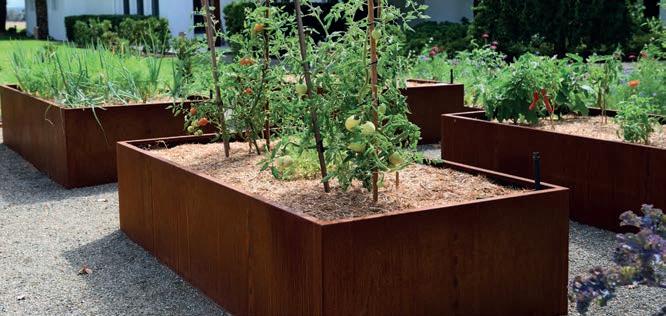
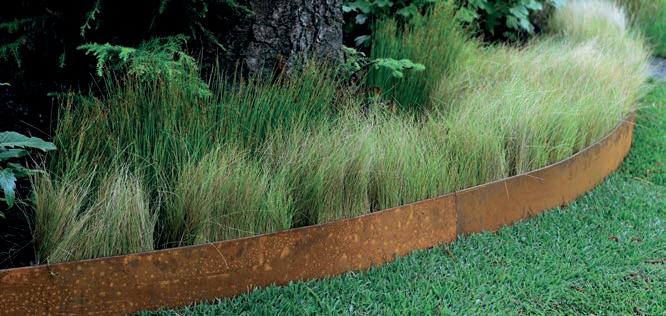
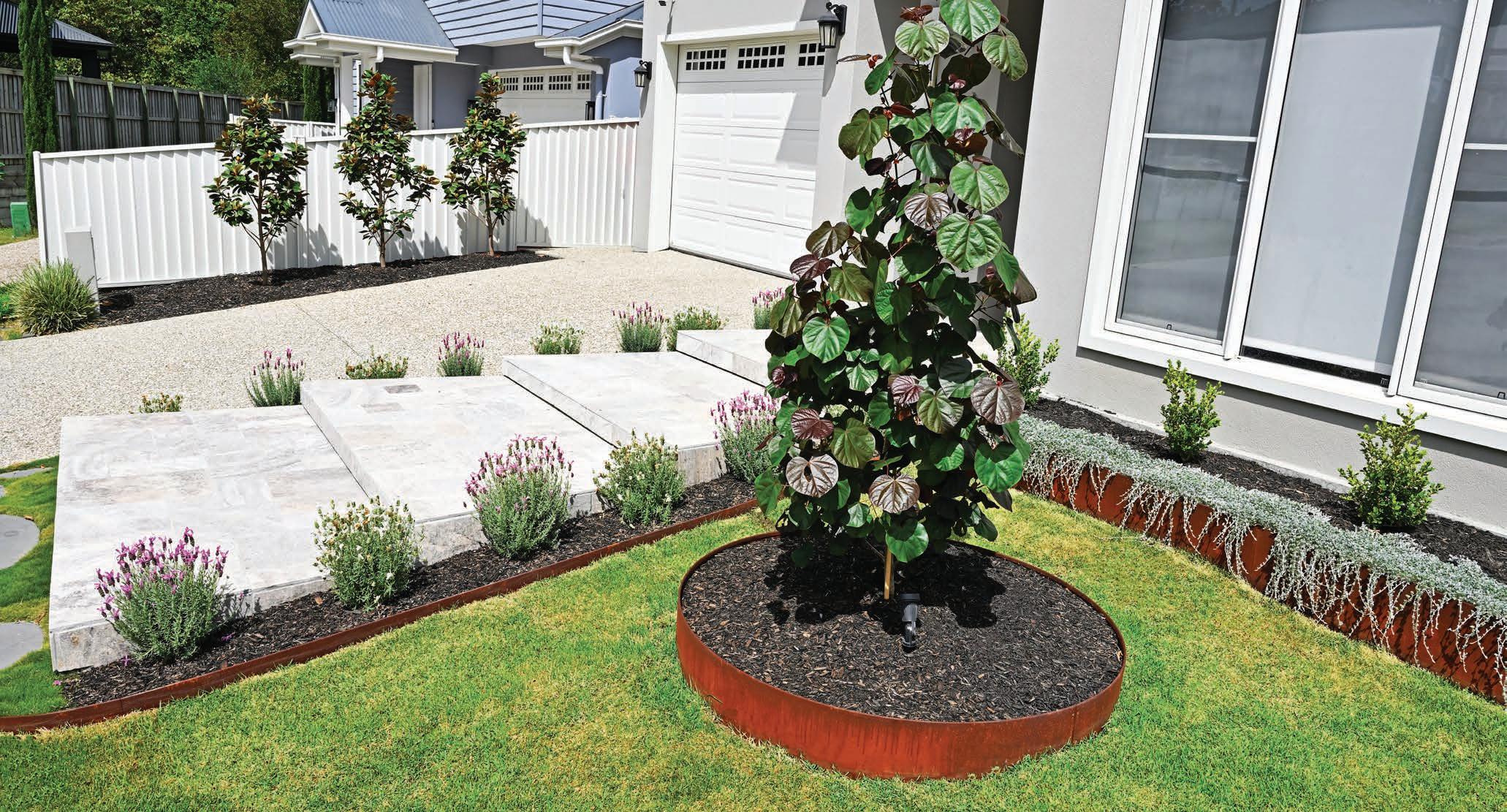
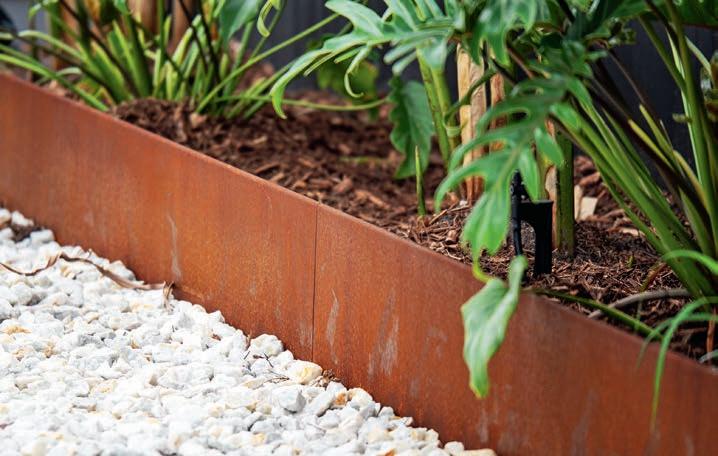
Redcor steel edging and planter rings provide structural definition to garden beds, gravel zones, and turf boundaries.
A unique surface patina develops naturally through exposure to water and typically stabilises within 12 to 18 months. Images: ShapeScaper
Property maintenance
Gaining national trust
Updating the irrigation infrastructure at two iconic Australian homesteads was a task that needed both quality products and expertise in commercial irrigation. The National Trust of Australia (Victoria) turned to a company that had demonstrated those traits for many years.
Rippon Lea and Como House are Victorian estates from the 1800s, and both o er gardens as majestic and beautiful as the houses themselves.
Como House overlooks the Yarra River and is surrounded by a pleasure garden and community parkland. Rippon Lea, at Elsternwick in Melbourne’s south, has more than 14 acres of 19th-century ornamental garden and is on the National Heritage List. The upgrade of irrigation and watermanagement systems of both gardens was recently entrusted to the experts at Reece Irrigation and Pools.
Priceless
Justin Buckley, Executive Manager – Gardens and Landscapes at the National Trust of Australia (Victoria), has an obvious passion for both the homesteads and their surrounds.
“Places like Rippon Lea and Como House are priceless,” he said. “Almost all the 14 acres of ornamental garden at Rippon Lea have survived and are still here for us to enjoy.”
Built in 1847, Como House is presented as a family home, and the garden has retained many elements of its 1850s design.
Rippon Lea has an excellent water supply of its own, but the e ort and maintenance needed to keep the water moving in the right quantities to the right places at the right time is considerable, and the antiquated plumbing
and irrigation systems on both sites were struggling.
“Irrigation at sites like these is huge,” said Buckley. “It’s not just a matter of turning on a tap.”
Modern tech in a period-correct setting
The National Trust gardening team is made up of only four people, and as Darren Ball: Lead Gardener at the National Trust of Australia (Victoria), pointed out, the two properties demand and deserve a lot of attention.
“Some of these trees date back to the 1880s,” said Ball. “If we lost them, it would be a terrible loss of heritage.
“Irrigation maintenance here is fundamental to the care of the properties, especially in summer. It’s almost a full-time job keeping the system operating e iciently. The Reece products installed recently, like the irrigation system, have been a blessing for us.”
“Working with the National Trust on iconic sites like Rippon Lea and Como House is something we’re proud to support,” said Jamie McClelland, Reece Irrigation and Pools Customer Leader. “These sites are part of Australia’s history, and our role is to ensure the equipment supporting them is reliable, e icient and future ready, without compromising their heritage value.”
Solutions
Jamie Hamilton, Regional Sales Manager at Rainbird, took stock and made some recommendations.
“The National Trust was kind enough to invite us along to Rippon Lea and Como House and have us bring them up to speed with the newest hardware and technology,” he said. “When you get an opportunity to partake in these types of landscaping projects, you jump at it.
“We decided on Rainbird’s LX series of controllers, along with the IQ Central Control platform. That provides the user with the capability to operate the system whether they’re at Como House, Rippon Lea, or anywhere in the world.
“It’s one platform that gives them access to the whole irrigation system.”
It’s a long way from some of the large commercial projects handled by Reece, and probably just as far from the systems supplied for domestic pools and water features, but Hamilton’s satisfaction at being involved was obvious.
“We feel great pride and privilege being part of this,” he said. “It’s been a pleasure to be involved.”
To learn more about Reece and its irrigation o ering, visit reece.com.au/irrigation.
The upgrade of irrigation and water-management systems was recently entrusted to the experts at Reece. Image: Reece
Battery
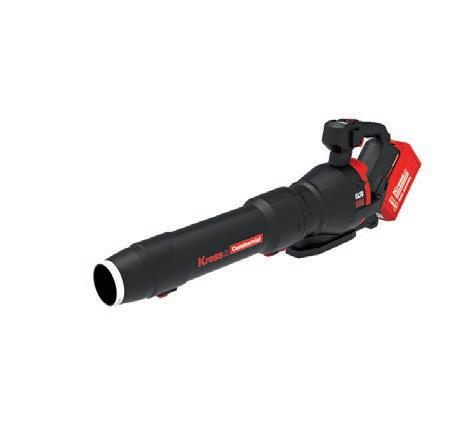
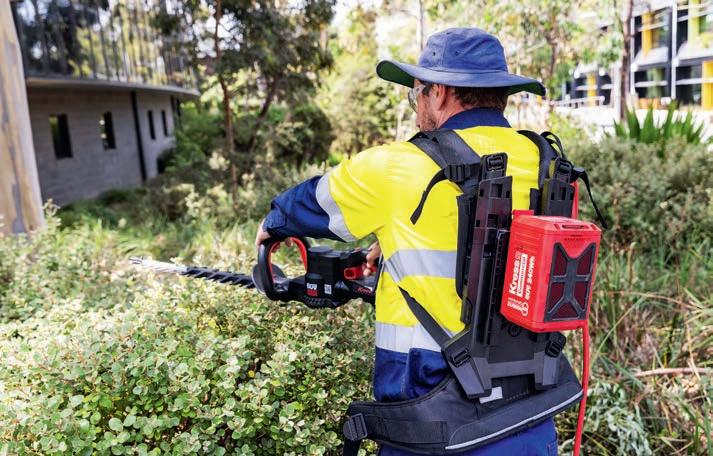
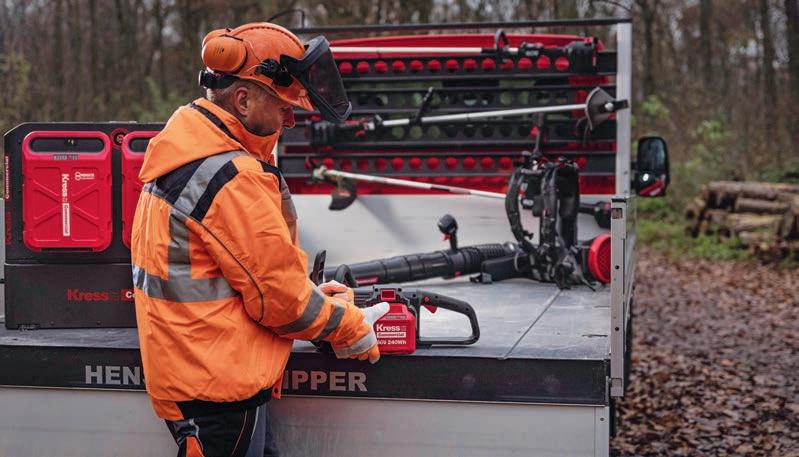
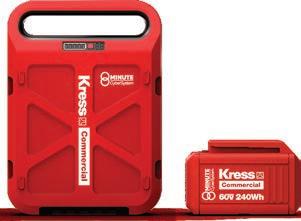
Battery systems remove exposure to fuel shocks, support predictable operating costs and enable consistent workflow planning.
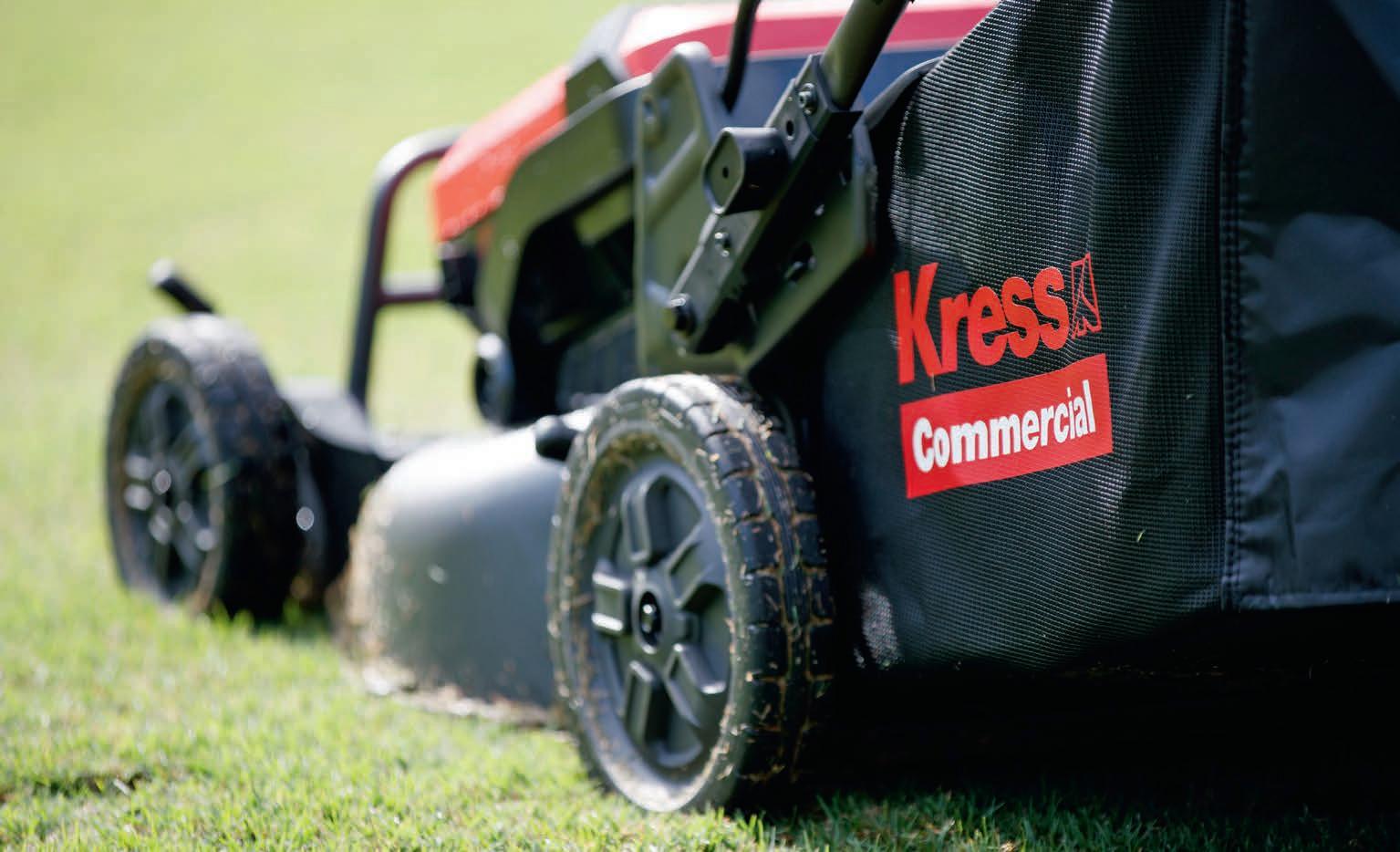
Replacing small petrol engines with Kress Commercial equipment reduces routine servicing, consumables and fuel-system faults.
fleets o er benefits over petroldriven machinery, eliminating the impact of petrol price swings. Images: Kress
Battery power o ers reliability and lower costs
With petrol currently an unreliable resource, switching to battery-powered equipment is a forward-thinking response.
Australia is facing elevated petrol prices and pressure on fuel supply with no confirmed timeline for stabilisation. The situation shows how exposed petrol-dependent landscaping businesses can be.
In March, Australia’s petrol bu er was estimated at about 36 days of supply. Regional areas in Victoria and New South Wales saw service stations exhausting petrol reserves as panic buying and distribution delays strained supply, with some locations recording prices above $3 per litre. To increase supply, the Australian Government temporarily relaxed fuel-quality standards for 60 days, allowing an additional 100 million litres of petrol per month into the market. These events emphasise the supply risk faced by contractors.
Even if supply conditions improve, petrol remains an unpredictable operating cost. Sudden price changes weaken margins, and supply issues jeopardise fixed-schedule and fixed-price maintenance contracts.
Battery systems remove exposure to fuel shocks, support predictable operating costs and enable consistent workflow planning.
A Kress Commercial fleet
portfolios. Also, councils, education, health, and corporate clients are prioritising low-emission and low-noise operations. Transitioning to Kress helps contractors meet these requirements as they become standard in tenders and service agreements aligned with government sustainability goals.
Battery equipment reduces vibration and eliminates exposure to exhaust fumes, improving operator comfort during long shifts. Lower noise levels extend workable hours in schools, healthcare facilities and residential areas, helping crews optimise routes without noise complaints.
Petrol depends on international supply routes and is a ected by global political events. Battery operations use domestic electricity, increasing resilience during periods of fuel market disruptions.
Commercial electrification
Electric equipment once meant compromise –less power, shorter runtime and higher upfront costs. Kress Commercial tackles these challenges head-on. The Kress CyberSystem delivers commercial power with all-day capability and ultra-fast charging with virtually no downtime.
The CyberSystem advantage
Battery fleets o er benefits over petrol-driven machinery. They eliminate the impact of petrol price swings on daily operations because locally determined electricity prices avoid the sharp spikes seen in fuel, improving job costing and protecting margins on fixed-price contracts.
The Kress CyberSystem delivers commercial-grade performance across the full range of professional landscaping tasks. Rapid charging – in as little as eight minutes – and platform compatibility let crews swap batteries as needed. Teams stay productive throughout shifts without fuel runs or idling, reducing downtime and supporting consistent service across multiple sites.
Replacing small petrol engines with Kress Commercial equipment reduces routine servicing, consumables and fuel-system faults, and fewer unplanned workshop visits increase equipment availability and simplify maintenance planning. These are important considerations for lean teams managing municipal or commercial
Kress tools are priced comparably to petrol equipment. The di erence is the CyberTank, which consolidates years of fuel and maintenance costs into a single, predictable investment. This lowers the total cost of ownership over time and simplifies budgeting while maintaining commercial-grade performance.
Regardless of future fuel conditions, the case remains strong. A battery-first approach with Kress Commercial stabilises costs, delivers no downtime, aligns with procurement trends and protects margins in an unpredictable fuel market. For professional landscaping contractors, this is a commercial advantage.
To find the right setup for your business, visit your local authorised Kress dealer. Look out for select Kress Commercial Kits with double the batteries for extended runtime. T&Cs apply. To find out more, visit kress.com.
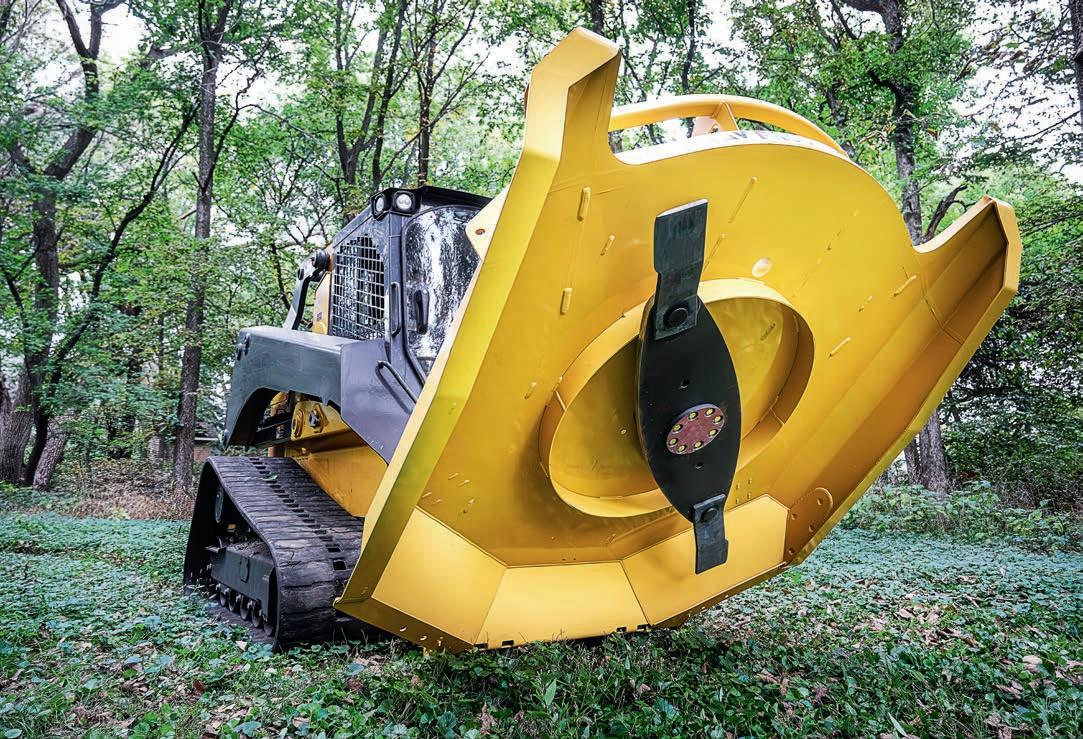
For contractors, municipalities, and vegetation-management professionals, blade performance on machine attachments is a day-to-day productivity issue.
The right blade can help keep jobs moving, but the wrong fit can drive unnecessary downtime. Australia throws some of the harshest conditions at vegetation management equipment, and it’s vital to keep on top of blade maintenance for optimum performance.
Bryan Campbell, Vice President of Parts Business at Diamond Mowers, said many crews focus on the visible components – the carrier and the attachment – but blades are where the work actually happens.
“When these parts stay sharp longer, fit correctly, and withstand heavy impact, teams spend less time servicing machines and more time clearing hectares,” he said.
Drawing from field experience and service conversations with operators, Campbell o ered the following guidance on bladerelated areas crews should routinely evaluate. These considerations reflect the performance
and maintenance checks contractors should use to keep blades working in demanding job-site conditions.
Increased
e
iciency and
performance
E iciency in the field isn’t just about speed. It’s also about maximising productivity and minimising disruptions. Blades designed to maintain sharpness can reduce the frequency of sharpening and changeouts, meaning less time in the shop and more time staying productive. Consistent cutting also reduces the need for repasses, which saves fuel and time and helps maintain steady performance across varying vegetation densities.
“You shouldn’t have to babysit the carrier,” Campbell said. “When the blade matches the material, the head runs true and the cut stays uniform, allowing operators to cover more ground, experience fewer
interruptions, and keep equipment operating the way it was intended.”
Durability
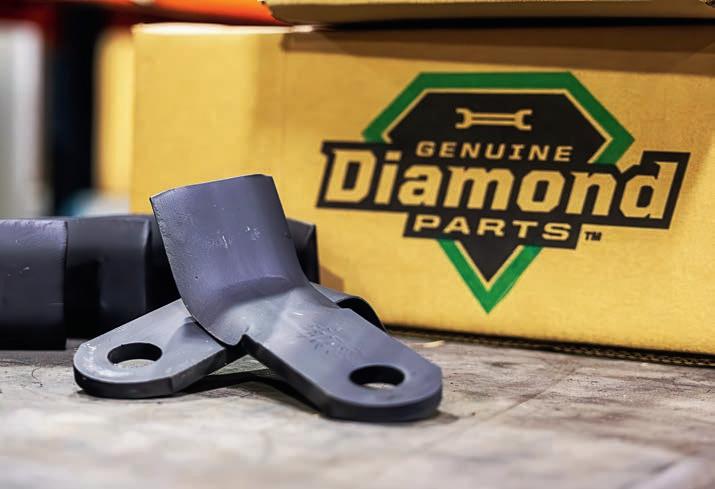
Maintaining that level of performance over long shifts depends on how well a blade holds up. Whether working along roadsides, clearing overgrown land, or managing forestry applications, blades must withstand repeated strikes without compromising performance. Hidden rocks, wires, roots, and debris are sometimes unavoidable, so users need to rely on components that can absorb shock rather than chip or bend.
Blades with reduced damage resistance may cut aggressively at first but can dull quickly or send force back into the machine. Designs that absorb the hit help extend component life, maintain smoother operation, and reduce operator fatigue.
“We know the toughest jobs demand
the toughest tools,” said Campbell. “That’s why each Diamond blade is manufactured using high-strength steel to deliver durability under stress. Doing so o ers longer blade life and gives customers the confidence to take on challenging work and maintain peak performance.”
Compatibility breakdown
Durability alone isn’t enough, though. Matching blades to the specific attachment and application is essential for safely handling machinery. Tip speed, carrier size, and cutting width all influence how a blade behaves during use, so mounting patterns and material types should be confirmed before installing replacements.
“The way blades fit a ects their cut quality, safety, and e ectiveness,” Campbell explained. “If they aren’t compatible with the head, they can introduce vibration and add unnecessary strain on the machine and the operator.”
In practice, crews select blade profiles based on how equipment is used. Skidsteer attachments, for example, favour shorter, heavier blades for mixed brush and occasional ground contact. Conversely, excavator attachments rely on balanced sets sized to cutting widths to prevent oscillation or uneven rotation, while those compatible with tractors use lighter swinging blades to maintain coverage at di erent traveling speeds.
Verifying compatibility before installation also helps maintain consistent results and reduces deterioration.
Features supporting performance
Beyond application and fit, operators should also look closely at the physical characteristics that influence how a blade performs over time. From a maintenance perspective, evaluate how quickly a blade can return to action and how well it protects
E iciency in the field isn’t just about speed “ “
surrounding components between service intervals. The following traits are commonly associated with high-performance, heavyduty cutting blades:
• Thick, hardened steel helps the cutting edge maintain shape after repeated contact with material, extending maintenance cycles and preserving cutting consistency;
• pivoting mounts allow blades to deflect when hitting rocks or debris, reducing shock transfer to bearings and motors and helping protect the carrier; and
• simplified replacement kits allow crews to restore functionality quickly.
Operational tips
In addition to choosing the right blade(s) for the job and attachment, routine inspections and handling habits play roles in optimising service life. Best practices for reducing strain on hydraulic systems and improving overall longevity include:
• Inspecting blades daily during heavy landclearing cycles;
• avoiding prolonged ground contact while spooling up; and
• matching cut speed to material density rather than engine RPM alone. While equipment capability often drives purchasing decisions, experienced operators know consumable components determine productivity.
For more information about Diamond Mowers, visit colbrookindustries.com.au
Thick, hardened steel helps a blade’s cutting edge maintain shape after repeated contact with material.
Property maintenance
Masport rear bagger gains popularity
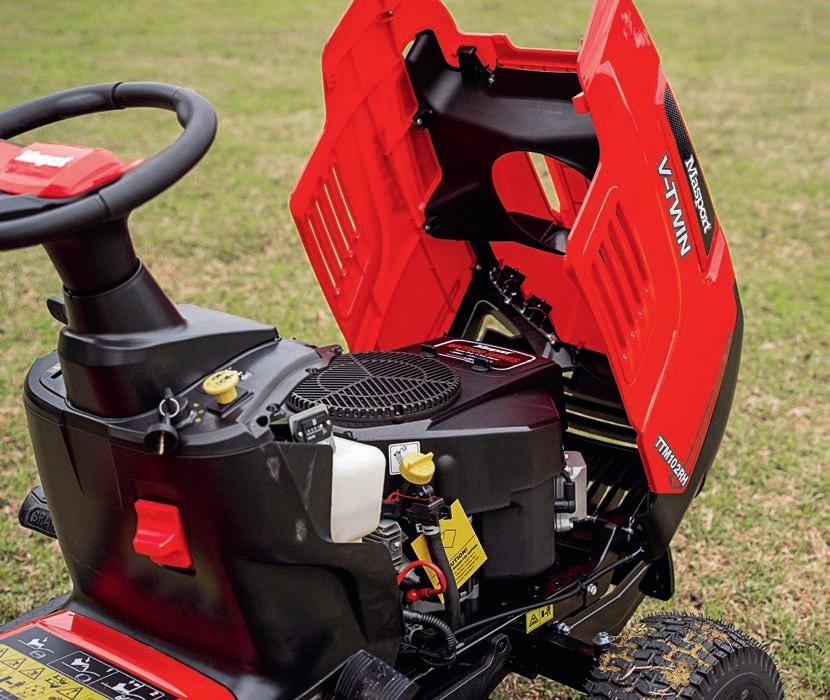
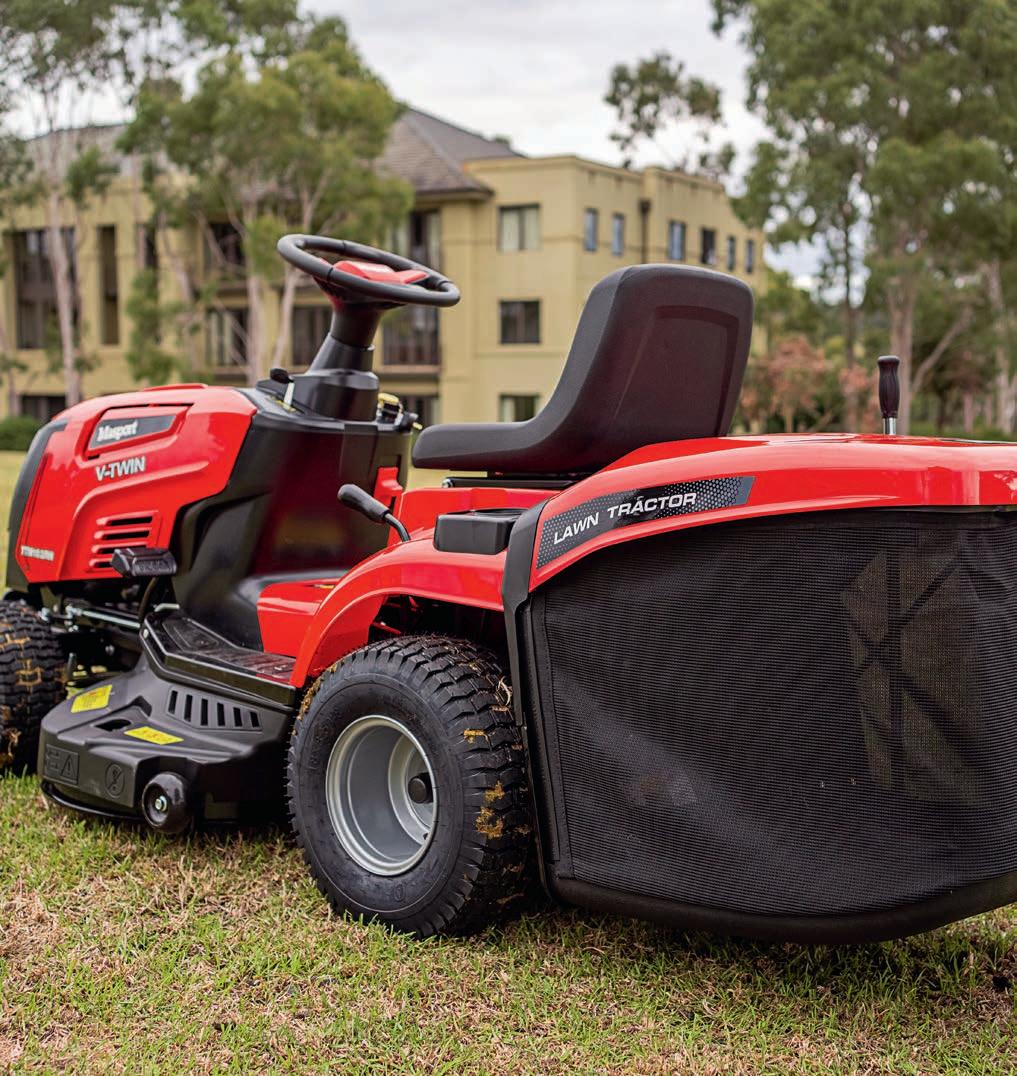
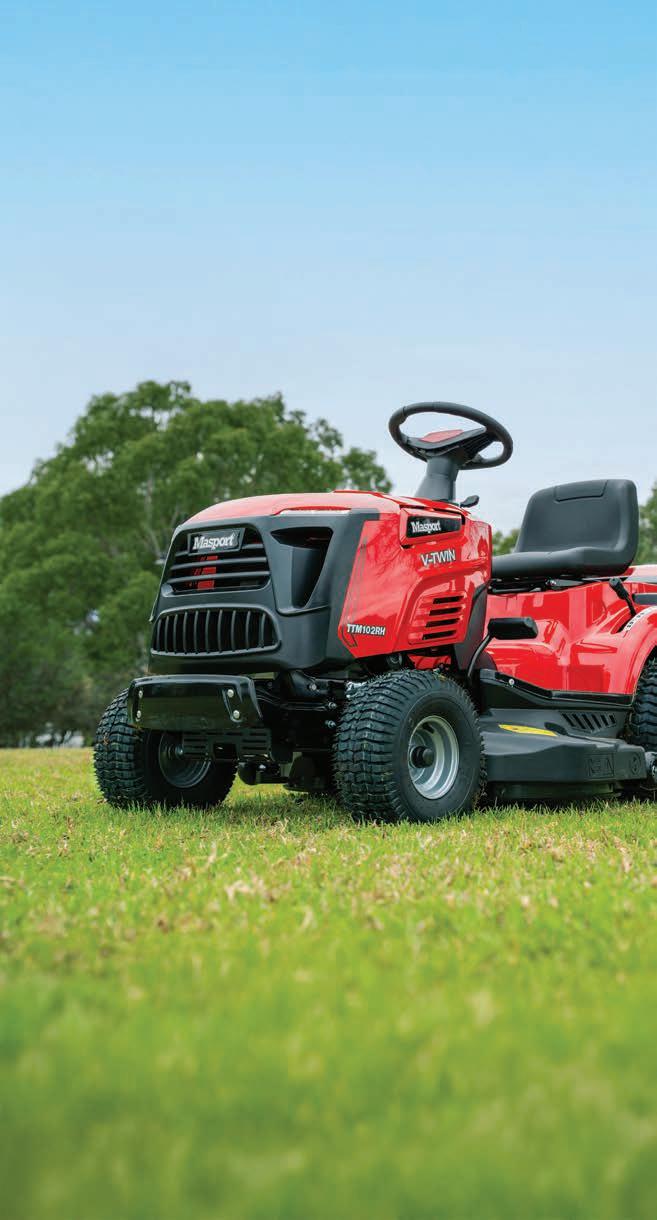
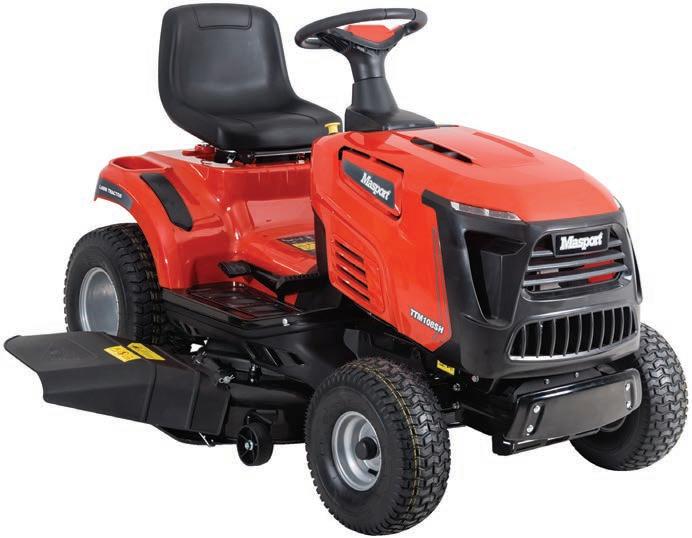
Masport’s TTM102RH rear bagger model is the latest edition to the fleet, combining a 40” cutting deck with a generous 245-litre catcher for clean rear discharge.
Masport brands the TTM102RH as a ‘lawn tractor’ rather than just a ride-on, and that’s possibly something to do with not just the look of the machine, but with its versatility.
Thanks to the spacious catcher, this TTM mower is now designed for those who want to leave a job with a cleaner finish. All the clippings, leaves and whatever else the mower picks up are thrown into the rear catcher, and it can be emptied by the operator without leaving the seat, thanks to a lever just behind their right elbow.
Making the cut
The 40” cutting deck stands out, not just for its size, but for its versatility. With the ability to fit a mulch plug, the unit adapts easily to
di erent mowing conditions while delivering a clean, consistent finish across the lawn.
At the heart of the TTM102RH’s performance is a cleverly engineered deck design. Featuring counter-rotating blades, the system works e iciently to lift and direct clippings straight into the rear catcher. The result is e icient collection and a noticeably tidier cut, even in more demanding conditions.
With the driver in mind
Ease of use is another clear highlight. The intuitive heel-and-toe control allows for smooth, e ortless transitions between forward and reverse, minimising downtime and keeping productivity high. Adding to this convenience is a simple push-button function on the dash, enabling the blades to remain engaged while
reversing – an invaluable feature for maintaining workflow without interruption.
The Masport MVT500 Series 586cc V-Twin engine delivers 19HP and 37Nm of torque. Images: Prime Creative Media
Durability and practicality haven’t been overlooked either. A front bumper comes standard, o ering added protection, while the inclusion of a tow hitch expands the mower’s functionality beyond cutting alone. Altogether, it’s a well-considered package that combines performance, e iciency, and user-friendly design.
To see more detail on the TTM102 RH and the TTM range of mowers through Masport, visit masport.com.au.
TTM RIDE ON MOWERS
Features
The list of features is impressive, and includes:
• The Masport MVT500 Series 586cc V-Twin 19HP engine;
• a 40” (102cm) steel rear-discharging cutting deck;
• an alloy spindle housing to keep bearings cooler;
• a Tu Torq® K46 transmission;
• a mulch option;
• LED lights;
• an electromagnetic clutch, which allows engaging and disengaging the cutting blades with the pull of a switch;
• a pivoting steel front axle;
• Reverse Mode Operation (RMO), which allows mowing while in reverse;
• a steel front bumper;
• a 7.5-litre translucent fuel tank;
• front 15 x 6.00-6, and rear 18 x 8.50-8 wheels;
• seven-position cutting range from 30mm-90mm cut height;
• an adjustable high-back seat;
• ergonomically positioned controls;
• deck wash for easy cleaning;
• anti-scalp wheels;
• park brake; and
• tow hitch.
Powerful Masport engine options
Durable modern design
Side or Rear Discharge with Mulch feature
Electromagnetic blade engagement
Manual or automatic transmission
Masport’s TTM102RH is designated and designed for those who want to leave a job with a cleaner finish.
Building better roads with the right equipment
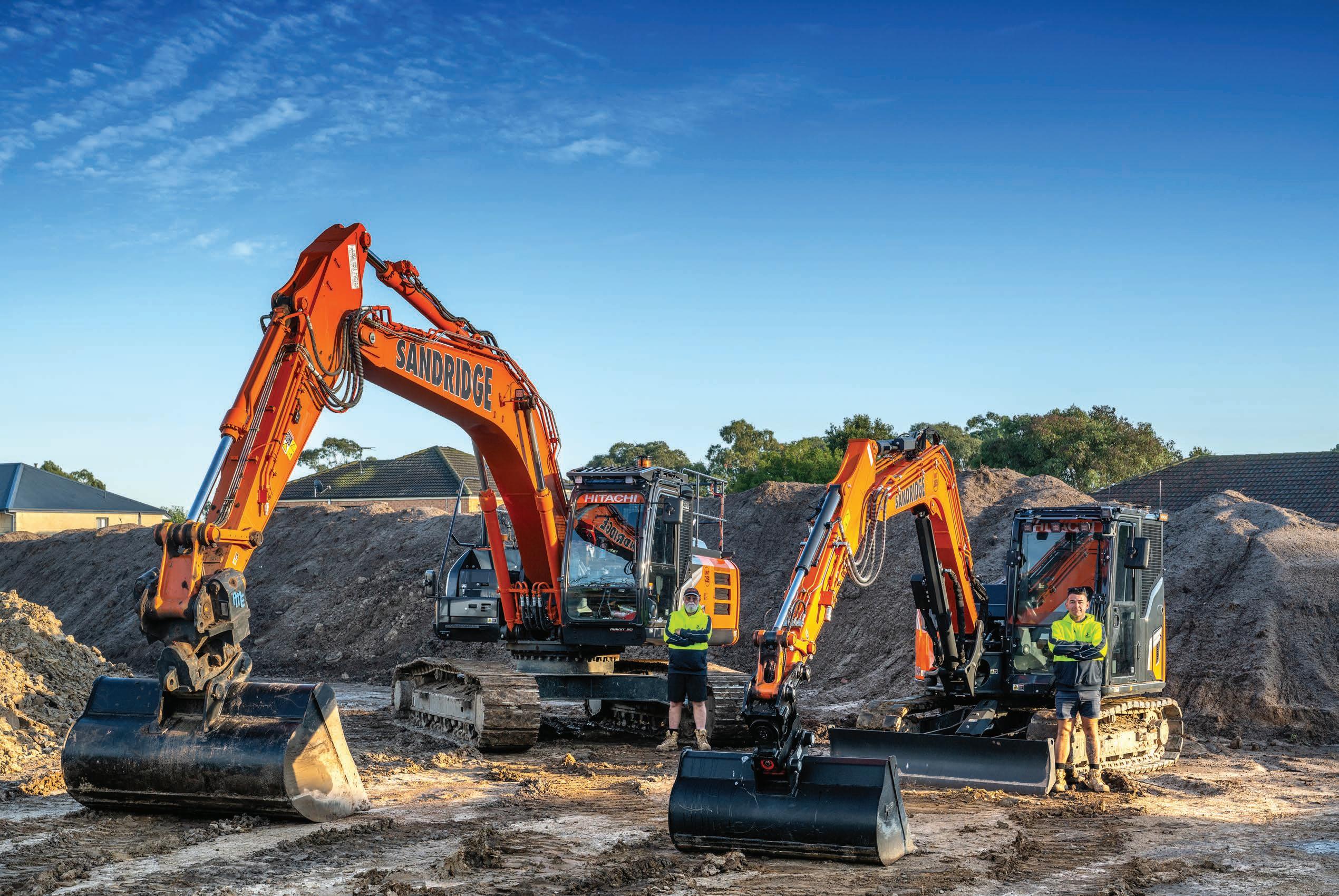
With decades of experience in civil construction and road infrastructure, Sandridge Roads sets a benchmark for project delivery across residential and commercial developments. The company has recently added to its Hitachi fleet.
Sandridge Roads’ investment in Hitachi machines reflects its ongoing commitment to performance, e iciency, and operator safety. Image: Hitachi CM
Known for reliability and high standards, the Sandridge Roads team understands that delivering consistent results starts with having the right equipment on site.
Over the past 18 months, the company has strengthened its fleet with the addition of two Hitachi ZX260LC-7 excavator units and one Hitachi ZX85USB-7 excavator.
Designed for durability and productivity, these excavators are suited to the demanding nature of civil and road construction. From bulk earthworks to detailed infrastructure tasks, the Hitachi fleet supports the Sandridge Roads team in maintaining smooth workflows and meeting tight project deadlines. The investment in the machines reflects the company’s ongoing commitment to performance, e iciency, and operator safety.
“Hitachi has had a reputable name in our industry for a long while,” said Managing Director Kevin Spencer. “We purchased our
first 260-7 excavator nearly two years ago and it’s been a reliable performer from the get-go.
“The hydraulic performance and smoothness for detailed finesse has been exceptional.”
Supporting productivity
With a focus on delivering high-quality outcomes, Sandridge Roads relies on equipment that performs under pressure. The addition of these excavators has helped enhance site e iciency while ensuring operators benefit from improved comfort and control.
“Our two 260-7s are used predominantly for final trimming, shaping of wetlands, and road boxing with minimal tolerances,” said Spencer. “They’re also are used for bulk loading of dump trucks and trenching.”
By aligning its fleet with trusted, highperformance Hitachi machinery, the company
continues to optimise productivity while upholding high standards of safety.
Built on trust
Long-term success in civil construction is built on strong partnerships and dependable equipment. Sandridge Roads’ continued investment in Hitachi equipment highlights its confidence in machinery that delivers, project after project.
Looking ahead
As Sandridge Roads continues to grow and deliver infrastructure, its commitment to quality, reliability, and the right machinery ensures it’s well equipped for the road ahead. Hitachi appreciates Sandridge Roads’ ongoing trust and will continue to support its infrastructure works.
Both companies are looking to many more kilometres of quality work together.
A great fit
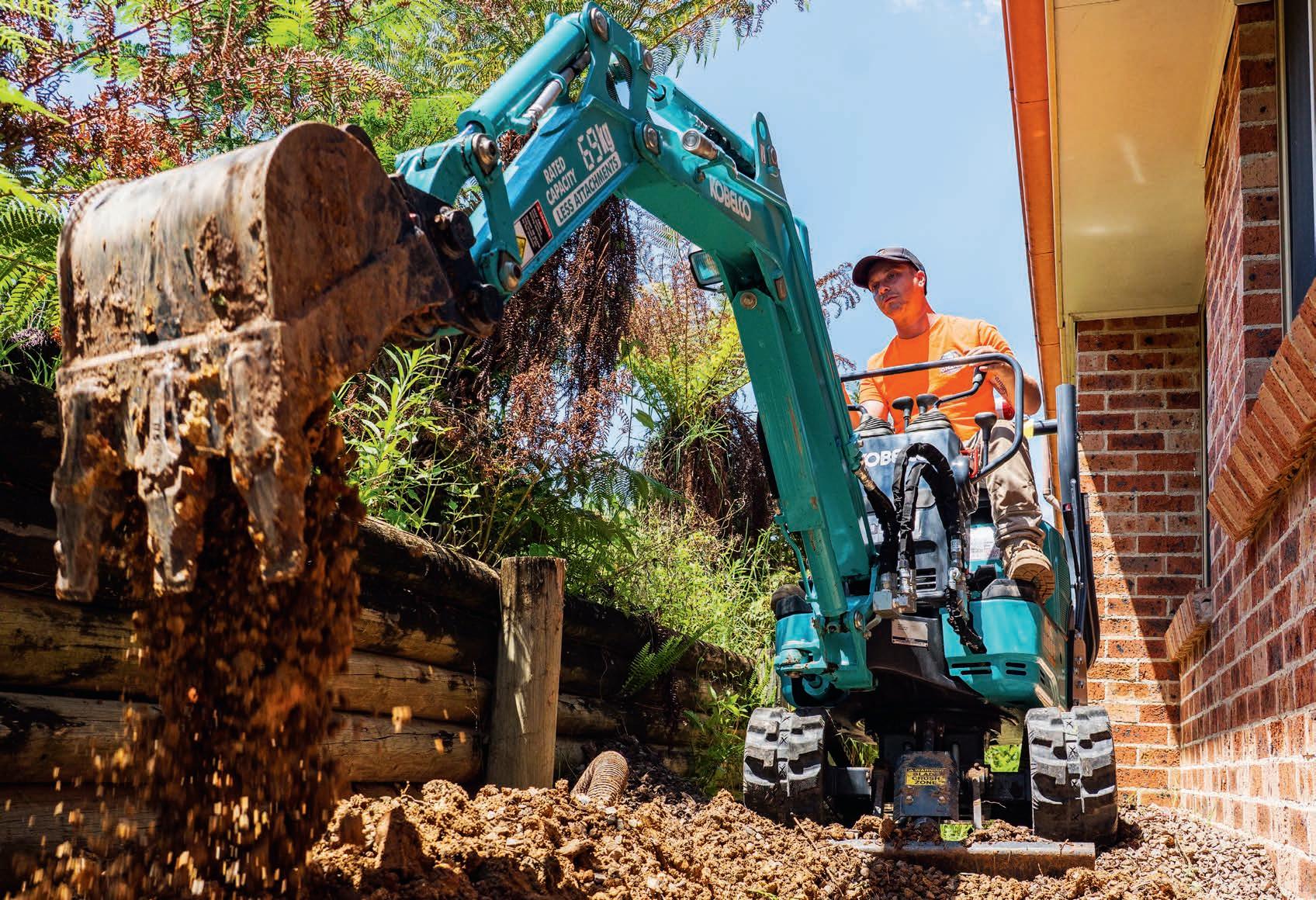
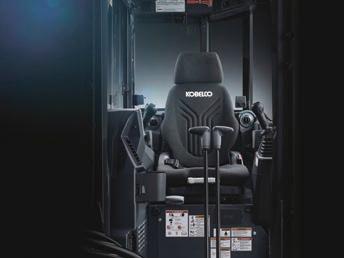
Kobelco’s SK008 mini excavator could almost be designed for a plumbing service needing to cope with tight access on domestic sites.
Sam and Star Orifice set up Ohana Plumbing in early 2025 with four values to guide every job: trust, care, transparency, and education.
Sam makes it a point of pride for the company – two plumbers and two o ice sta , along with Sam and his wife, Star – to make sure customers understand the work being proposed and the cost before the job begins. In the company’s short time in operation it’s already served more than 25,000 customers, suggesting his philosophies are sound.
While Sam and his sta can handle pretty much any plumbing job, the company specialises in a challenging area.
“We focus on sub-soil drainage and specialise in flood-prevention,” Sam told Landscape Contractor magazine. “In essence,
if a house is moving, if walls are cracked, if there’s water running inside or underneath the house, we can stop that.”
Tight access
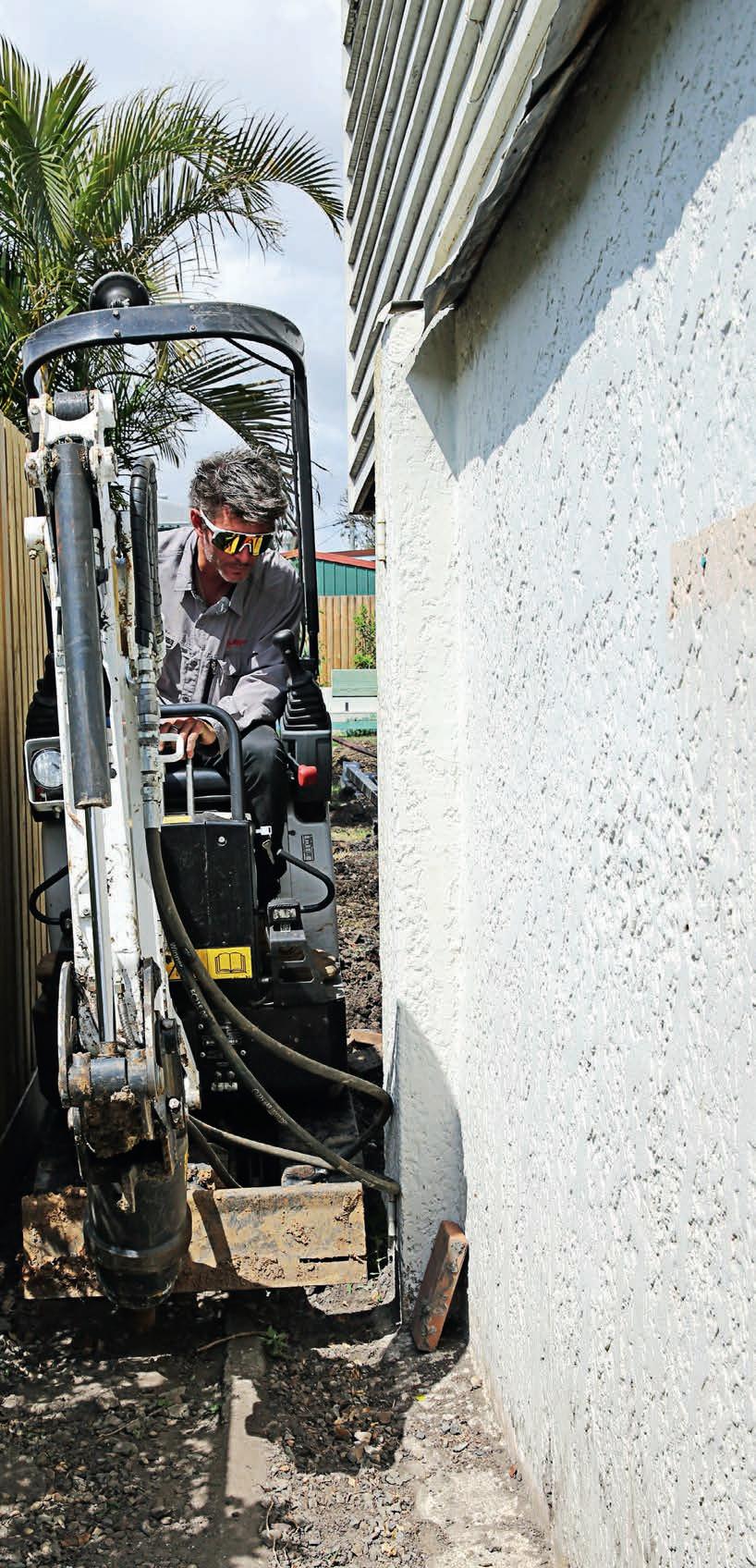
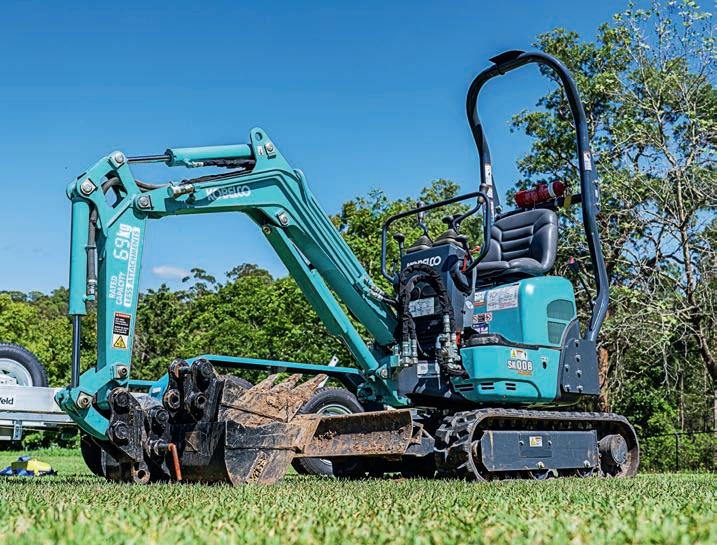
Ohana Plumbing has only one excavator: a Kobelco SK008. It’s a mini excavator by anyone’s reckoning – a 0.8-tonne machine with a 7.7kW engine delivering 10.5kN of digging force. While these may seem like small numbers on some work sites, for Ohana’s needs, they’re ideal – and so is the SK008’s footprint.
“Because we’re dealing with drainage problems in domestic houses we often have to get the machine through tight access,” he said. “A domestic gate is typically between 700mm and 800mm wide. A standard one-tonne
excavator is 860mm wide, which is still narrow, but not narrow enough for what we do.
“Two weeks ago we did a job where the site access was 800mm. Nothing would fit down there except the Kobelco, and even it was just about touching the wall on one side and the fence on the other.”
Prior experience
The SK008 being so well suited to Sam’s needs made the sale, and he’s been using Kobelco for quite a while.
“I’ve worked at various companies as an operator, and they’ve often had Kobelco machines,” he recalled. “I knew they were reliable.
“When I started researching ‘what is the smallest machine I can get?’ because I knew
that the footprint was going to govern what we could do – and it was also important the machine could take a jackhammer – I came across the Kobelco.
“I already trusted the brand, and I thought, ‘That’s it. It’s ideal for our needs’.”
Service with a smile Ohana’s experience with the Kobelco sales and service teams has been the icing on the SK008 cake.
“It’s been fantastic,” he said. “We went to STM Trucks and Machinery, and from the moment I spoke to them, STM’s care went far beyond just the sale.
“The trailer wasn’t available at the time we bought the excavator. It was still being manufactured. But we needed the machine
and we had work that was relying on it. STM gave us the company’s own trailer to use while we were waiting for ours to be ready.
“That’s well above the normal service I’d expect with the sale on a mini excavator,” he said.
And as for how well the Kobelco is performing, Sam couldn’t be happier.
“We haven’t had a fault,” he said. “We use the jackhammer all the time. Everything’s held up well.
“It’s super. Absolutely.”
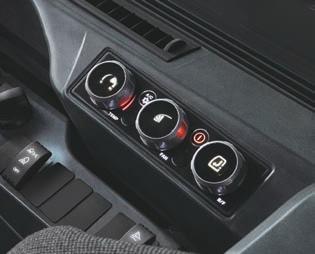
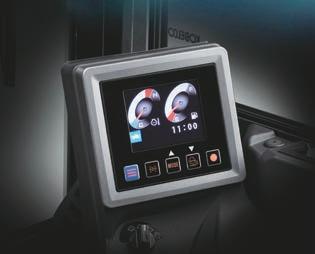
The Kobelco SK008 is a 0.8-tonne machine with a 7.7kW engine delivering 10.5kN of digging force.
The Kobelco SK008’s footprint is ideal for the narrow-access work Ohana needs it to do. Images: Kobelco
Sam and Star Orifice set up Ohana Plumbing in early 2025.
Mini excavators
The feeling is electric
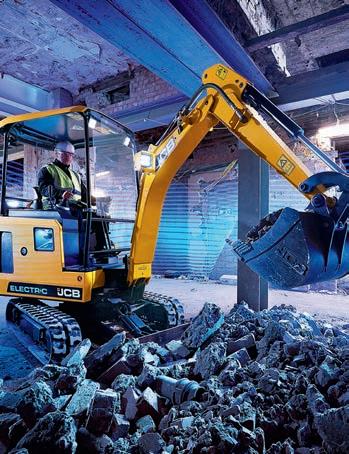
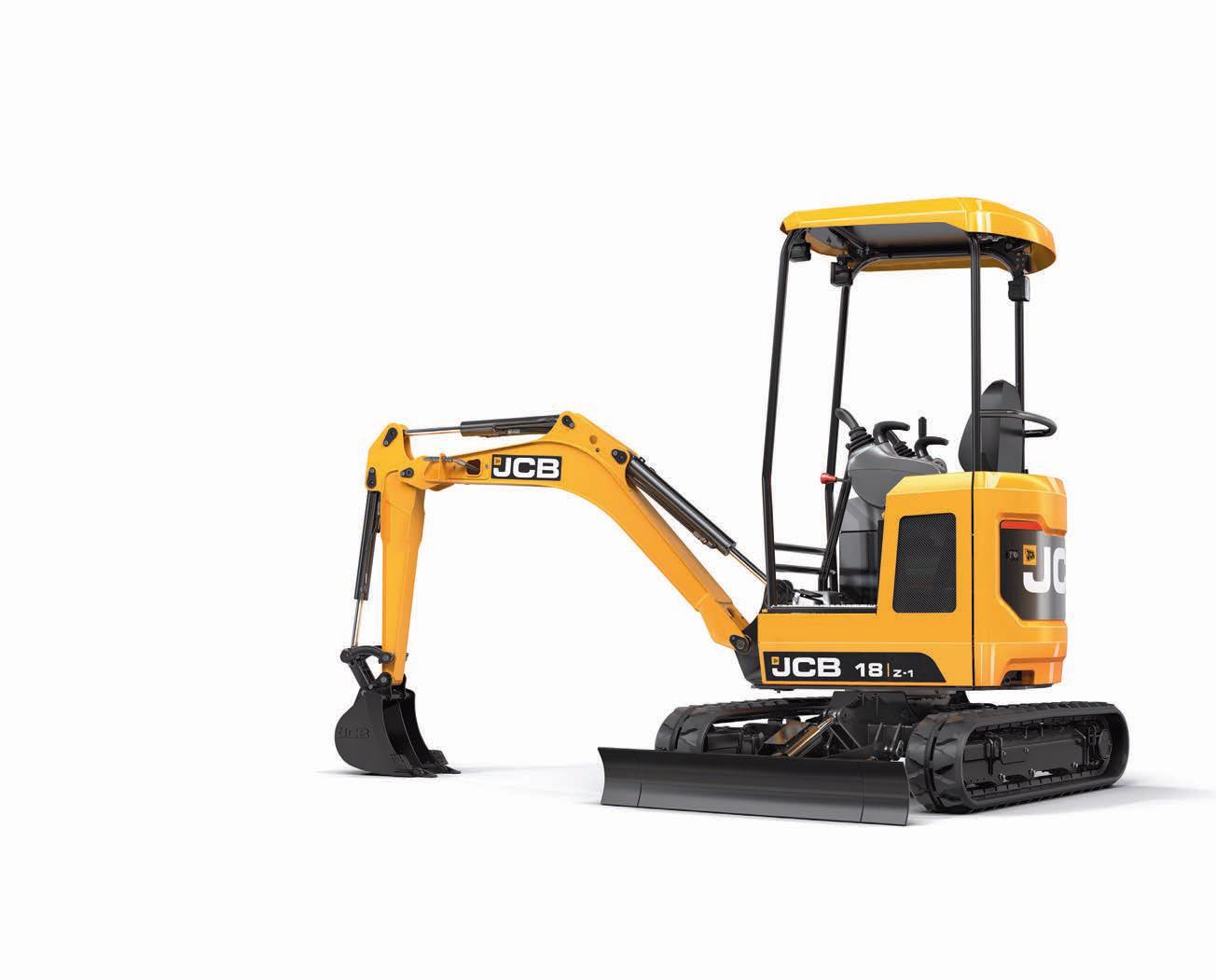
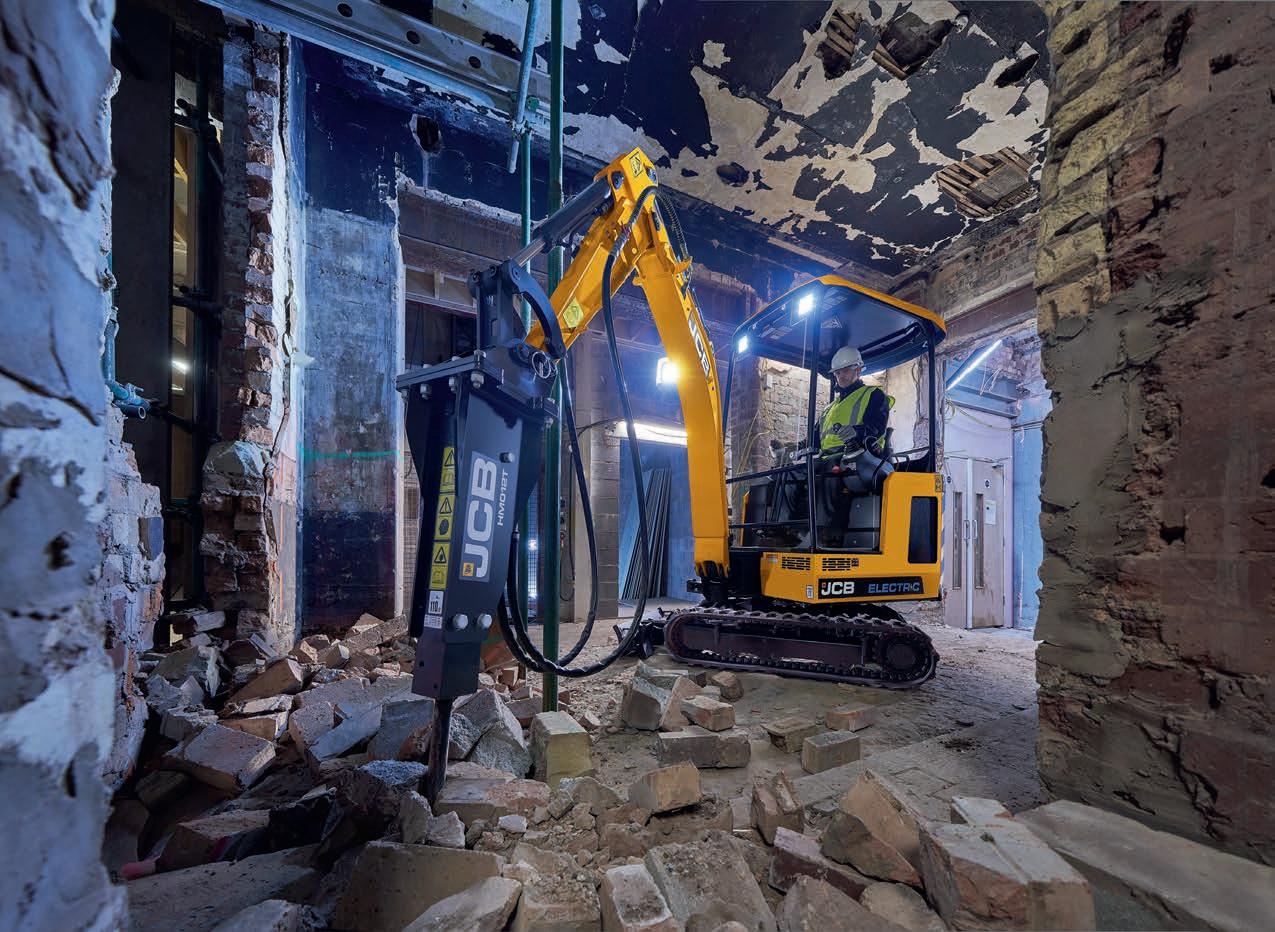
JCB’s 19C-1E fully electric mini excavator is set for a future of clean technology and reduced harmful emissions.
The JCB 19C-1E the quick charging and long battery life that allows work anywhere and anytime. A three-battery pack allows a full day’s work on a single charge, and if the machine is left on but not put to work, the battery will last up to 120 hours.
Battery status can be checked via a gauge on the instrument panel, and there are three charging options: 110V, 230V and 415V.
Economical
The 19C-1E has maintenance-free batteries, needs minimal daily checks and requires less servicing, saving rental companies, hirers and owner operators time and money.
Electricity is far less expensive than fossil fuel, and the 19C-1E having no internalcombustion engine and associated hardware reduces servicing time. There’s no need for emissions extraction, and with no engine fluid or filter checks required, time is saved in each working day.
Safety plus
It’s not only the reduced maintenance in the JCB’s favour. The sound level at the operator station is 10dB less than the diesel version, and safety features like a blue-light
indicator to show the machine is running and three single-flanged bottom rollers, allied with short pitch tracks, ensure a safe, quiet, smooth ride.
It adds up to increased operator comfort and safety, and the option to work ‘out-ofhours’ or in confined spaces – something
the diesel machines with their higher sound levels and high exhaust emissions can’t do.
The 19C-1E operates free of any trailing tethers, has zero emissions, the canopy is ROPS, TOPS and FOGS certified, and JCB’s unique 2GO system safely isolates controls.
Built to work
JCB’s 19C-1E has been designed and built with long-lasting components for minimum downtime. The bodywork is steel for maximum protection and easy repair, and the electrical circuitry, including the heavy-duty cables, has been tested to maximise longevity. A full-width rear cast counterweight gives full protection against site damage, and extending undercarriage beams are constructed from 25mm solidsteel plate.
A great option
With a two-year warranty on batteries and machine, and with more councils and LGAs imposing tougher sound restrictions, JCB’s 19C-1E makes for an excellent investment.
Visit a JCB dealer to find out more, or go to jcbcea.com.au.
The industry’s first fully electric mini excavator. Images: JCB CEA
The machine o ers maintenancefree batteries, minimal daily checks and less servicing.
On the verge
A Cat® 304 Next Generation Mini Excavator is proving a small footprint can hide a big heart.
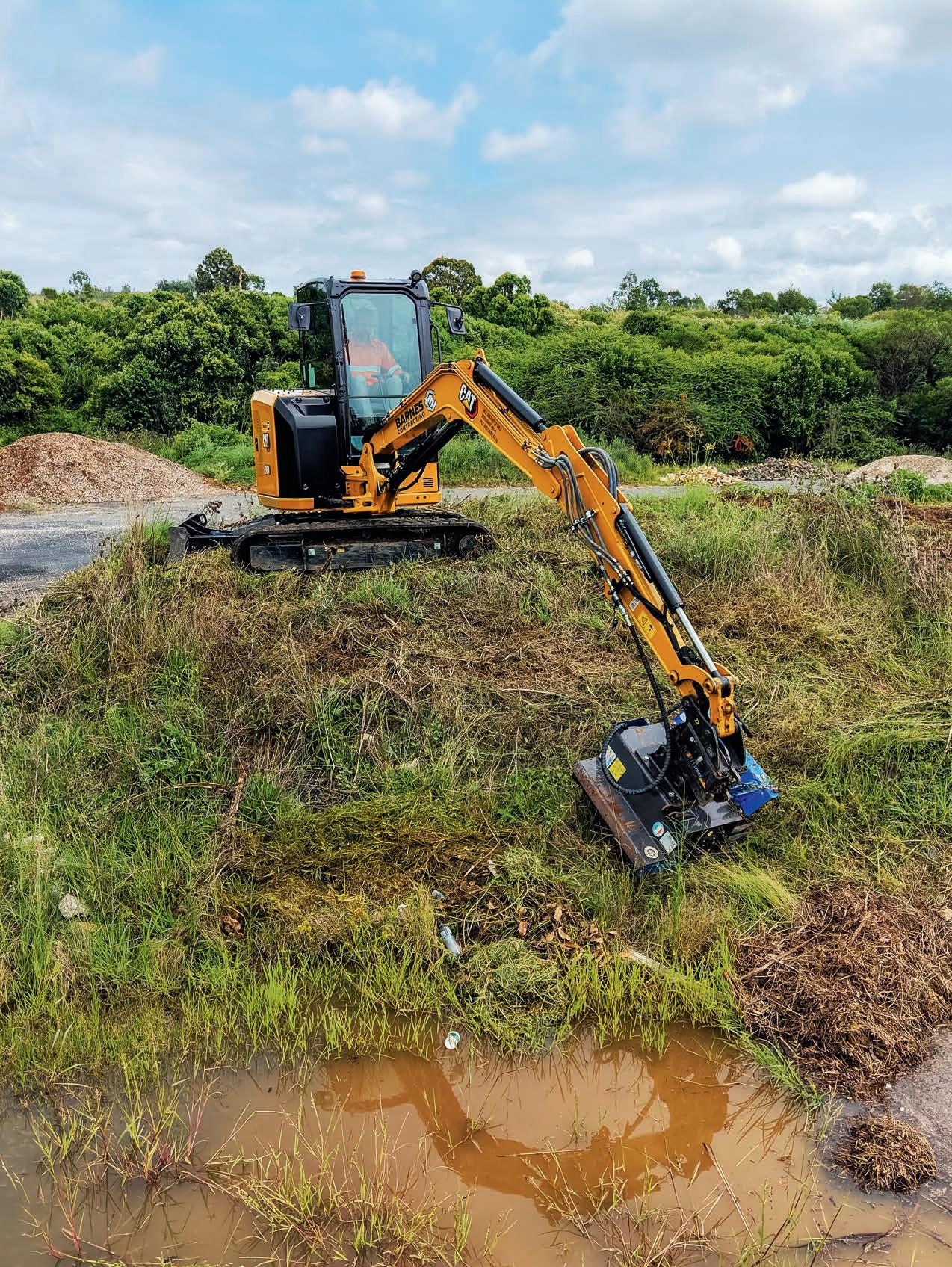
The Cat 304 is used for general excavation and verge mowing.
Images: Caterpillar
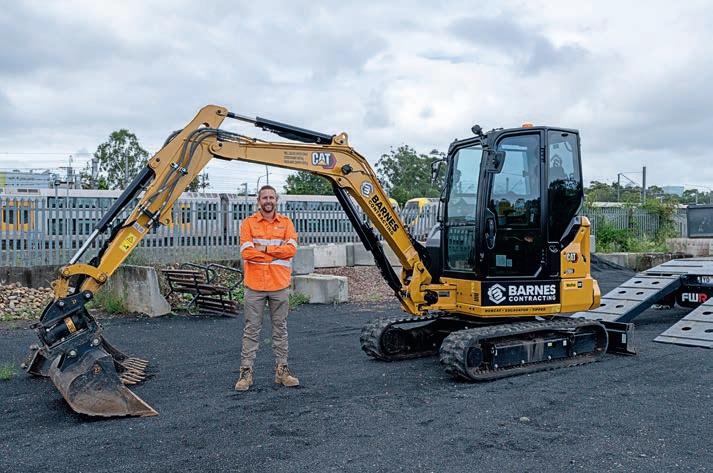
Beau Barnes is rapt with the contribution the Cat 304 Next Generation Mini Excavator is making to the Barnes Contracting workflow.
Barnes Contracting is a family business.
Managing Director Beau Barnes has continued to grow the business his father started in the late 1980s, and right now things are going well – so well that a new machine was recently added to the fleet, bringing the tally to four.
The latest addition to the southern Sydneybased outfit is a Cat 304 Next Generation Mini Excavator, and Beau’s rapt with the contribution the machine is making to the Barnes Contracting workflow.
“We use the Cat for our general excavation
and verge mowing,” he said. “It’s used across the board for everything we do.”
The
right fit
When it came time to purchase a new excavator, Beau, like any sensible business owner faced with making a capital investment, did his research and the Cat 304 came up a winner where it mattered most.
“We wanted a machine to fill the gap between our five-tonner and our two-tonner,” he said. “This machine was head-andshoulders above everything else in its lifting
capacity, reach, and operator comfort. But above all, its capabilities were greater than every other machine we looked at. That’s what drew us to it.”
Aside from the performance of the Cat, there was another consideration.
“We’re all quite tall guys on the crew,” said Beau, “and the Cat has a big cab. It’s roomy. When we jumped in it, we loved the feel of it.
“We looked at other brands and got quotes from everyone else, but at the end of the day we had our hearts set on the Cat.”
Dialled in
One feature of the 304 the Barnes Contracting crew enjoys is that it allows the operator to set control sensitivity.
“I like it dulled down,” said Beau. “I set it so the machine’s a bit more docile. Some of the other boys like a quicker response, so they dial everything back up. They want to go fast, where I like to take it a little easier.”
While zero-swing mini excavators are popular, Beau saw the configuration of the 304 was better suited to the work his company was doing.
“It has a counterweight and we have to be mindful of that,” he said, “but the 304 is so strong and so well balanced. The counterweight makes a big di erence when you’re leaning over trenches or you need to lift something heavy.
“This machine is strong for its size. It punches well above its weight.”
Service from start to finish Beau feels he’s had great service from both Cat and the WesTrac dealer at nearby Casula.
“We had a minor warranty issue when we first got the machine,” he recalled. “It was only some hoses rubbing – nothing that would stop work. With one phone call the service guys fixed it and repainted it, and it was as good as gold within a couple of days.
“They come out and do their in-field servicing for us too, and the service is excellent.”
Beau is a happy Caterpillar customer, there’s no doubt about that, and he’s a fan of the 304 for the work his company needs to do.
“I love being in the Cat,” he said.
“We could be in the machine for 12 or 14 hours in a day, and we get less fatigued in the Cat than we do in some of our other machines because it’s comfortable and quiet. It’s even got Bluetooth so you can hook up your phone and play the radio or take calls. It’s got it all.”
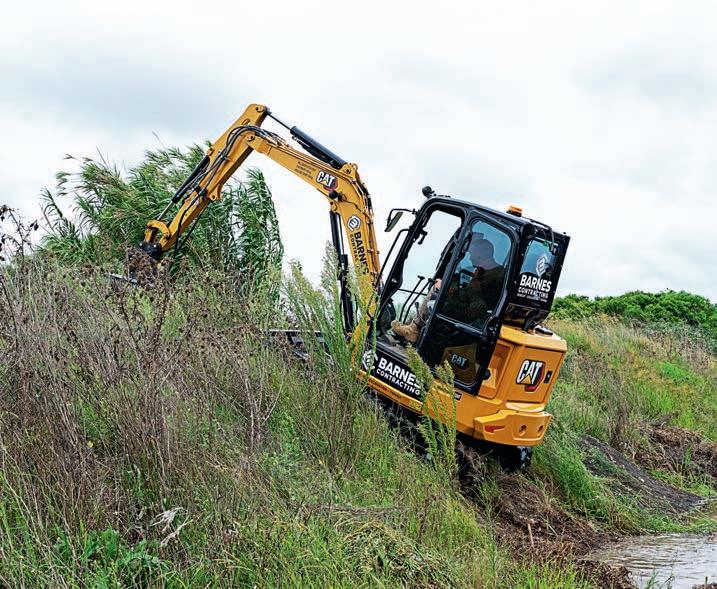
Manoeuvrability is excellent thanks to the small footprint.
Case study
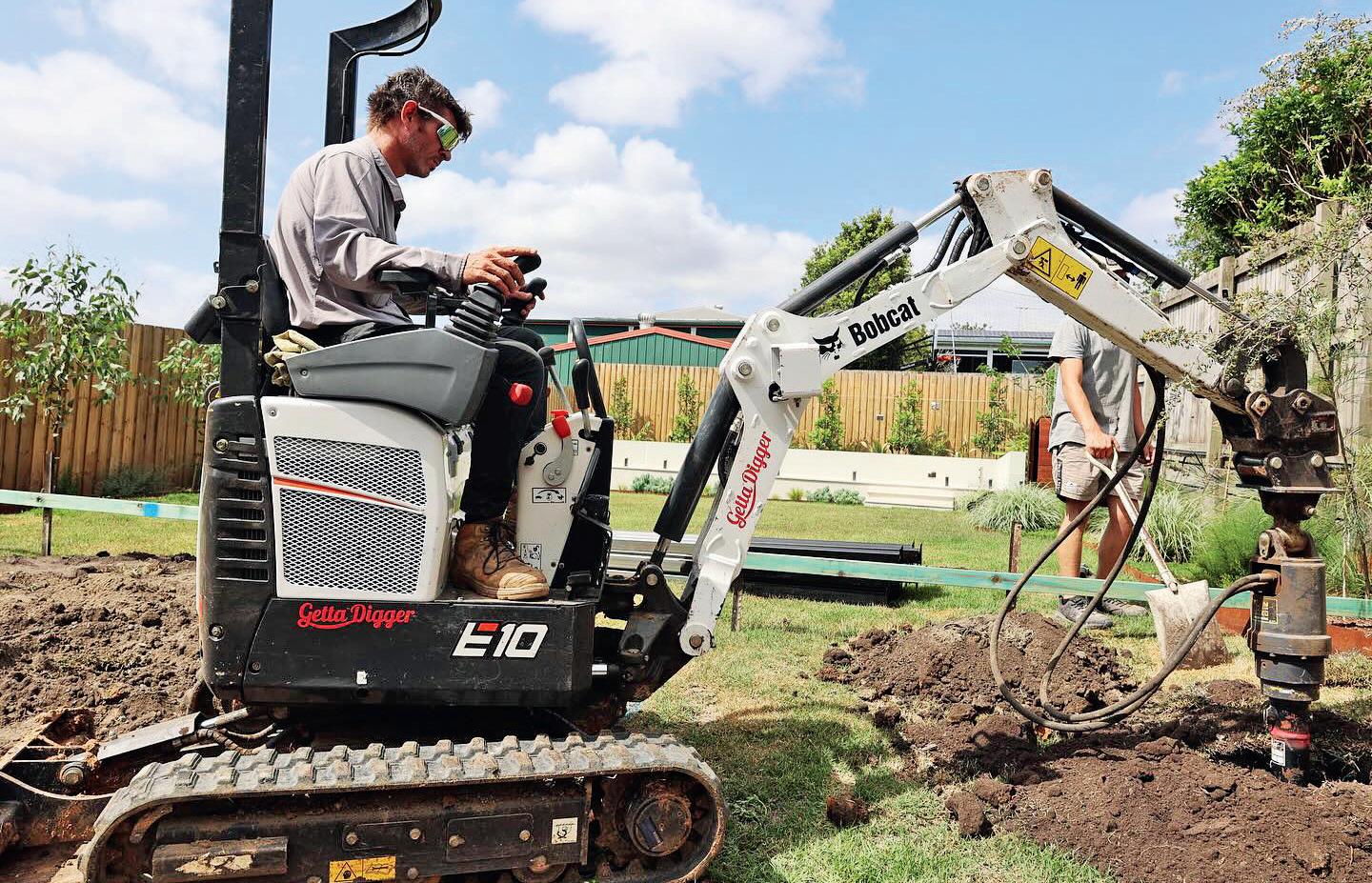
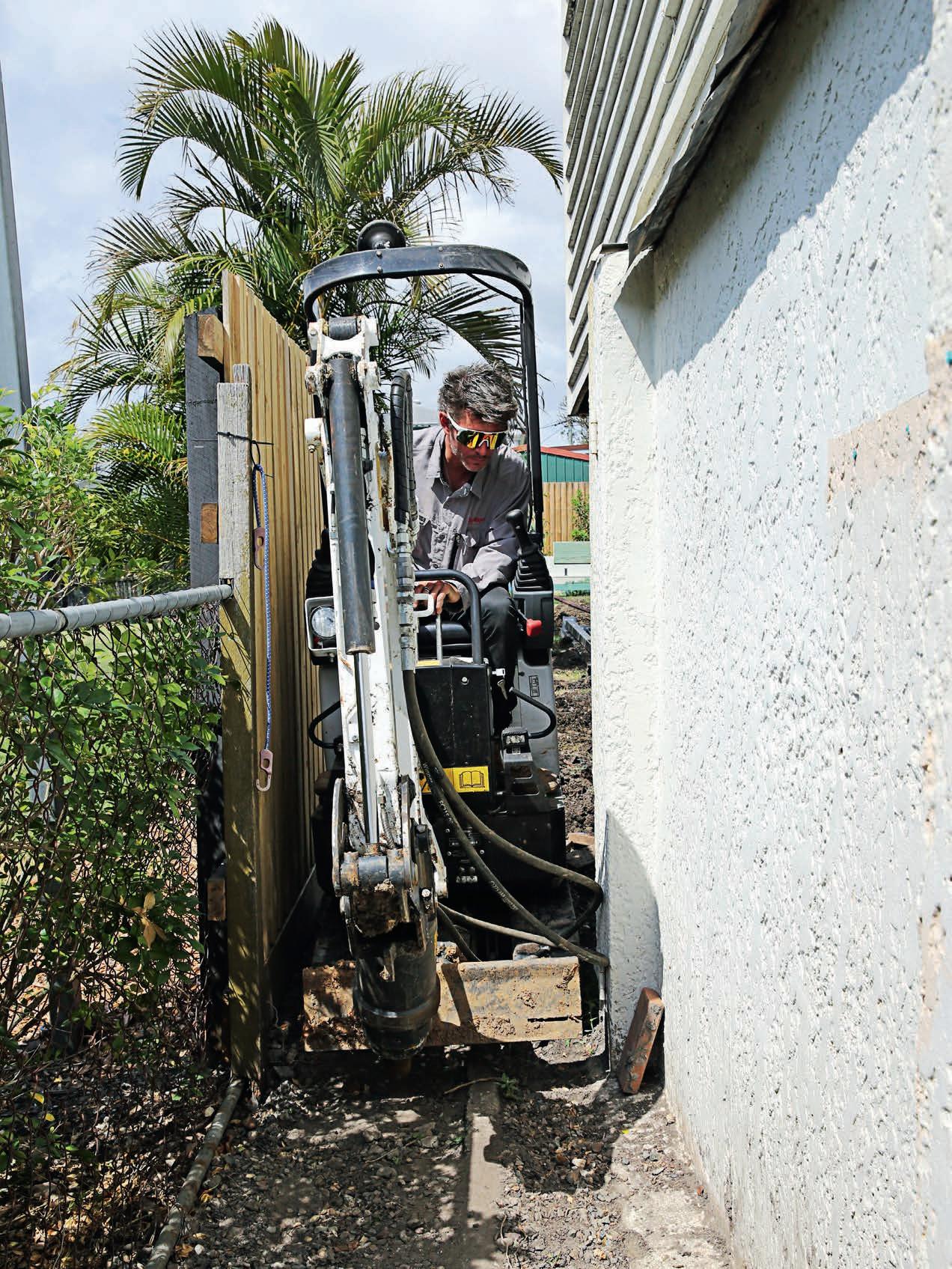
The Bobcat E10 is a compact excavator with enough grunt for the work found in most tight-access situations.
Using the scope of the micro
A Brisbane plumbing company has found the smallest Bobcat to be ideal for suburban sites and precision excavation.
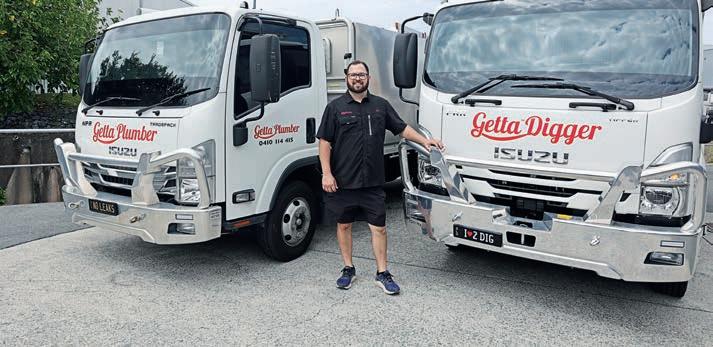
Getta Plumber was established by Lou Giaccio in 2018 and is based in Enoggera, Queensland. Managing Director Lou is himself an experienced plumber and machinery operator, and runs a Bobcat E10 mini excavator.
The Bobcat not only services Lou’s plumbing jobs, it’s available for hire through micro-earthmoving sister business, Getta Digger.
Both Lou and the E10 work consistently and work hard.
The machine
The Bobcat E10 excavator is ideal for domestic and suburban jobsites where access is restricted, typically by gates and property boundaries close to structures. With a retracted track width of 711mm, the compact design allows navigation through narrow openings and operating in tight conditions. Its zero tail swing o ers the flexibility to slew and deposit spoil while staying clear of jobsite obstacles, and a 10.2 horsepower diesel drives the machine and gives a bucket breakout force of 8294Nm.
It’s a compact excavator with enough grunt to cope with the work found in most tightaccess situations.
A lot to like
“The Bobcat E10 is in use every day,” Lou told Landscape Contractor magazine.
“Getta Plumber specialises in blocked drains, line locating, and drainage repairs, so the Bobcat comes in handy. We also service other plumbers, builders, landscapers and the general public doing tight-access earthmoving.”
Lou’s had plenty of experience on small excavators, and having had the E10 for a few years, he’s clear about its advantages for the work he asks of it.
“The Bobcat E10 is spot on for the work we do, he said. “The joystick controls are a big win on a compact machine – they’re nice and familiar and easy to be precise with.
“We’ve hired other minis in the past, but the controls never felt quite right. We’ve also used 1.7-tonne machines, but the E10’s
smaller footprint, with not much less digging power, really makes a di erence on sites where every millimetre counts.”
Good deal
Nothing works harder than hire equipment, and between the E10’s schedule with Getta Plumber and the extra work from outside companies, the Bobcat is in use pretty much every working day.
Lou and his nearby Clark Equipment sta keep up with the servicing, and the Bobcat is proving a reliable and trouble-free machine.
“It performs well,” said Lou. “We haven’t had any issues and it does everything we need it to do. The service from Clark Equipment has been great.”
Lou Giaccio, Managing Director of Brisbanebased Getta Plumber and Getta Digger.
The Bobcat E10 excavator is ideal for domestic and suburban jobsites where access is restricted.
Images: Getta Plumber
Business & finance
Build resilience into your business
Landscape Estimator and Business Advisor Anna Turner has some suggestions to help during tough times.
Yet again we are in a crisis that will hit the landscape industry hard, not only because we are the bottom of the tradie food chain, but because most landscape businesses run on low margins and are vulnerable to cost increases.
So, let’s talk about ways we can reduce the risk, because we all know this is not going to be the last crisis we see.
The current situation
First, take stock. Carry out a detailed risk assessment to identify where your business is most exposed. Focus on Workplace Health and Safety, profit margin, plant and equipment, skills and expertise, Cost of Goods Sold (COGS) and cashflow. When looking at profit margin and COGS, weigh up the bu er you have between costs and sales. Is it large enough to cover you if or when that margin is squeezed?
The risk assessment will allow you to know where you are most vulnerable and where you need to implement change or changes to reduce risk.
COGS
Supply chain is a big factor when it comes to procuring products to complete projects. The supply of locally sourced stone, such as Bluestone in Victoria and Sandstone in NSW, is often more reliable than the supply of imported stone. While freight is an issue within Australia itself, the problem is exacerbated when the materials must come from further afield. Freight is turning out to be the killer in this current crisis, as it was in the COVID-19 crisis. So, the closer the source of materials, the less disruption to supply and fluctuation in prices.
Aussie product may be more expensive, but it carries less risk than imported material. The good news is, many of our bread-andbutter products (sand, mulch, growing media, and so forth) are locally sourced.
Freight
While we are on the topic, let’s look at ways to mitigate the risks associated with transporting materials.
Standard practice is to include freight and fuel costs in the price for supplying the product or service. But maybe, for the foreseeable future at least, we should separate that cost from everything else? You could state in your clarification that freight charges may fluctuate. The trouble with this option is that the original cost is not transparent to the client, so proving you are out of pocket is hard. Or you could exclude freight altogether and pass it on as a variation. The option I prefer is to include a Provisional Sum (PS) line item for freight. You could base the PS on the costs you would incur if the work went ahead today, explaining that additional costs will be passed onto the client. All these options are time-consuming from the paperwork side, so please factor that into your pricing.
Staying afloat
Here are a few other things to consider when you are trying to build your business a lifeboat. You are at greater risk when your business specialises in or focuses on one type of client or trend.
For example, if your business specialises in architectural concrete work, you will find yourself busy when it is on trend, but work will slow when it’s no longer in fashion. The same goes for your client base. Try to work for as wide a range of clients as possible, so when one designer/builder goes quiet, others are busily feeding you work. And don’t forget maintenance. Maintenance departments are a good earner with regular paying clients. They may not bring in the big bucks, but they help with cashflow.
Speaking of cashflow, it is one of the most important ways you can keep your business healthy. Make sure you invoice daily and chase regularly. Cashflow is king.
Another key component to a healthy business is sta . Not only do you need to make sure you have the skills and knowledge base to carry out the work you win, but that base needs to be stable and happy. You must encourage and support your team at work as well as socially. Not only is it important they feel like they are growing their individual skills and knowledge, but it is also important to build a community or family around them. When they feel connected socially, they will be more loyal, making them more willing to stick with you through the tough times.
Last, I wanted to touch on how to mitigate financial risk.
Try to build a financial bu er. Then, when a client doesn’t pay, your business is resilient enough to withstand the pain. Focus on cashflow, but also look at other ways to build reserves. Choose to hire a machine instead of buying it. Every hour the machine you own is sitting still is an hour it is costing you money, whereas the hired machine can go back to the shop and not be a headache. Look at other e iciencies within your business to try and reduce your overheads. This may mean spending money on a bookkeeper to free up your time to price and/or run projects.
Apprehensive
Another area to focus on is subscriptions. It is crazy how many apps people pay for that are not being used. Or there might be an app you should be using that would save you time and money (good estimating software, for example). Look at how you are running things and try to streamline where you can.
I have no idea how long this global crisis is going to last, or the extent of the fallout for us landscapers, but one thing I do know is that this won’t be the last crisis we face. It is better to put in the hard work up front to try to build some resilience into your business rather than sail into a storm with no liferaft.
Meet the new Kobelco Series 7 mini excavators – SK26SR-7, SK28SR-7, SK30SR-7 and SK35SR-7. Engineered for excellence, the new Series 7 mini excavators feature increased engine output, reduced cycle times, and a massive 15% increase in digging force. Step into the updated spacious cabin and discover a world of comfort and innovation. With intuitive controls and ample storage space, every detail of this ergonomic operator station is crafted to enhance operability.
The new Series 7 Kobelco mini range. Small size, big impact.
THE NEW KOBELCO
MINI RANGE
According to the BizCover Business Theft Report 2025, tools and cash are the two most common targets for thieves1. Businesses, especially small businesses, should consider protection from the potentially devastating e ects of this common crime.
Data from the Crime Statistics Agency
Victoria reveals that tools and power tools were in the top 10 categories of stolen property in that state in 20252 . Tools are portable, often left in vehicles and on jobsites, and are essential to any landscaping business. They’re an attractive proposition to someone wandering past or someone who’s spotted a jobsite.
Losing hand tools can be expensive enough, but laser levels and power tools? That can bring work to a stop, disrupting schedules and material deliveries, and lead to the delay of invoicing and payments.
Other items at the top of the list of stolen items in the BizCover Business Theft Report 2025 are mobile phones, laptops, and tablets.
Imagine the loss of laptop or phone. All the contacts, quote information, notes and images gone.
It’d be a nightmare, potentially bringing
work to a standstill or delaying jobs by days or even weeks.
Protection
Fortunately, the right business insurance through BizCover may help reduce the impact of stolen equipment with Theft insurance and Portable Equipment cover, both optional additions to a Business Insurance Package. Theft insurance generally o ers cover against loss and damage as a result of theft or attempted theft from your business premises. Damage to the building, locks and safes as a result of a covered event are generally also covered.
Comparing free quotes is that simple.
For on the go cover, visit BizCover.com.au or call 1300 805 821 today.
And while you’re onsite, Portable Equipment insurance may help repair or replace items like tools, business equipment, electronic items, and stock that are lost or damaged due to theft, fire, and other events. Getting both is as easy as visiting the BizCover website from a phone, laptop, tablet or computer. Just log on, answer a few questions about your work and the type of equipment you’d like covered, and BizCover will help you compare insurance products so you can choose which best suits your business needs and budget.
THE BRANDT ADVANTAGE.
GET A PARTNERSHIP BUILT ON TRUST AND PRODUCTIVITY WITH BRANDT— THE EXCLUSIVE JOHN DEERE DEALER FOR SOUTH AUSTRALIA, TASMANIA, AND KEY MARKETS IN VICTORIA.
Eye on the industry
Safe and e icient vacuum excavation
The Ditch Witch AX30-300, developed exclusively for the Australian market, is an excavation powerhouse.
Vacuum excavation is proving e ective over traditional excavation methods for many infrastructure projects, and is regarded as safer and more environmentally sound.
It’s also considered quicker and cheaper than traditional methods.
The Ditch Witch AX30-300, developed exclusively for the Australian market, will suit contractors, landscapers and propertymaintenance companies.
Built to perform
Equipped with a 32.5HP Kubota diesel engine, the Ditch Witch AX30-300 delivers power and performance while reducing damage to underground utilities and infrastructure when removing soil and debris.
Boasting a class-leading vacuum-tank capacity of 1135L (300 gallons), the AX30-300 also has the largest spoils tank available on a 4.49T GVM trailer in Australia.
Other benefits include a cam-over autolocking hydraulic rear door, hydraulic motor system for tank lift and tilt functions, curbside controls, hose reel and tooling that can be left connected, and reverse-flow control.
It also comes equipped with a silenced power pack to keep noise to a minimum without sacrificing performance.
Maintenance
All maintenance points are accessible, with a lift-o power pack door design and a highcapacity cyclonic filtration system minimising filter-cleaning frequency. The AX30-300 is built for reliability and features a highperformance engine and advanced vacuum excavation technology.
Paired with its operator-friendly design, the machine proves itself as a partner for the landscape-construction industry and remains a top choice for contractors.
The Ditch Witch range prioritises power in every machine produced, ensuring it can withstand the demands placed on it during daily or regular use.
Supplied on a heavy-duty galvanised Australian ADR-compliant trailer, Ditch Witch CEA has retail branches across Adelaide, Brisbane, Melbourne, Perth, and Sydney, all ready to assist with all equipment needs.
Cost and time saver
Through saving time, labour and costs for contractors, as well as reducing surface disruption and reducing the risk of damaging utilities, vacuum excavation is gaining popularity for excavation work.
For more information on the Ditch Witch range and the AX30-300 in particular, visit ditchwitchcea.com.au.
The Ditch Witch AX30-300 has a silenced power pack to keep noise to a minimum without sacrificing performance. Image: Ditch Witch CEA
EXPERIENCE THE DITCH WITCH DIFFERENCE.
Don’t let the size fool you, the HX20G is built to work. Engineered with a sleek, low profile for maximum maneuverability, this trailer vac packs heavyweight performance into a compact frame.
Whether you’re navigating tight jobsites or demanding high-capacity suction, the HX20G delivers the big machine results you need without the bulk.
Western Australia’s landscaping industry has again demonstrated its depth of talent, creativity, and professionalism, with the winners of the 2026 Landscape Industry Association of Western Australia (LIAWA) Resi-scape Awards setting a new benchmark.
Across a diverse range of categories, the 2026 LIAWA Resi-scape Awards winners represented the best in design, construction, maintenance and green life supply, delivering outdoor spaces that were not only visually striking, but functional and enduring.
Best from the west From compact, budget-conscious transformations to expansive, high-end landscape builds, the awarded projects highlighted the industry’s ability to deliver quality outcomes at every scale. Coastal retreats, suburban sanctuaries and complete outdoor living environments were all recognised, reflecting a strong understanding of Western Australia’s unique climate and lifestyle.
Standout projects across Perth – from Two Rocks to Floreat and Bayswater to Kardinya – demonstrated a commitment to innovation, craftsmanship and attention to detail. Whether it’s a cleverly reimagined front
yard, a seamless indoor-outdoor extension, or a meticulous garden in Peppermint Grove, each winning entry showcased the skill and passion driving the industry forward.
2026 Resi-scape Awards winners
• Residential Design & Construction – Under $10,000: Mint Landscapes (Coastal).
• Residential Design & Construction – Up to $30,000: Luke’s Landscaping Co (Mt Lawley).
• Residential Design & Construction – Over $30,000: O2 Greenspace (Kardinya).
• Landscape Maintenance: Garden Solutions (Peppermint Grove Project).
• Greenlife Supplier of the Year: Domus Nursery.
Equally important was the role of green-life suppliers, whose contribution underpinned the success of every project. This year’s recognised supplier, Domus Nursery, exemplified excellence in quality, sustainability and service – supporting landscapers to bring their visions to life.
Professional values
What sets the winners apart is not just the finished product, but the process behind it: thoughtful design, collaboration with clients and a dedication to achieving lasting results. These are landscapes designed to be lived in – spaces that enhance wellbeing, increase property value, and connect people with the outdoors.
LIAWA extends its sincere thanks to major sponsor Hunter Industries, and category sponsors Ellenby Tree Farm, Web Force Five, StraightCurve and Nutrien for their continued support of the industry.
As the winners were celebrated at the Perth Garden Show at McCallum Park, Victoria Park, their work stands as a reminder of the value professional landscaping brings to homes and communities across Western Australia.
To see more from LIAWA, visit landscaping.net.au
Luke’s Landscaping Co took out top spot in Residential Design & Construction – up to $30,000 with this work. Image: LIAWA
Give to gain for a more resilient industry
Keynote speaker Sally McGrath from Burnout Sydney set the tone for a powerful and engaging session.
More than 120 members and guests of The Landscape Association (TLA) gathered to celebrate the role of women in the industry alongside International Women’s Day.
With a new format, TLA’s annual Women in Landscaping Brunch showcased insights from keynote speaker Sally McGrath from Burnout Sydney, under the International Women’s Day theme ‘Give to Gain’.
The atmosphere was optimistic, with attendees gathering to engage with the keynote theme, ‘Built to Last: creating resilient owners, leaders and teams for the landscape industry’.
Stories that inspire McGrath’s personal insights and stories set the tone for an engaging session.
Among the key themes explored, Sally addressed several challenges facing the industry, including rising fuel costs, increasing operational pressure, and the accelerating pace of work. She also emphasised the importance of shifting our mindset, noting that resilience begins with recognising what needs to change and taking intentional steps to adapt.
Strengthening wellbeing and performance
Sally inspired attendees at the Women in Landscaping Brunch with a series of insights designed to strengthen wellbeing and performance across the industry. She encouraged participants to rethink how they approach pressure, recovery, and team culture, highlighting some key takeaways, including:
• Recovery is a strategy essential for building resilience;
• burnout isn’t weakness and recognising the signs that matter; and
• strong teams thrive when supported by intentional, healthy workplace practices.
Industry support and future vision
Aligned with the theme ‘Give to Gain’, TLA President Shannon Decker drew attention to the power of contribution and connection in strengthening the industry. He emphasised that progress is built through the actions
The diverse mix of attendees embraced the chance to connect with peers. Images: The Landscape Association
people take to support one another.
“Progress happens when people choose to support others, open doors and create opportunities,” he said. “When women in our industry are supported to thrive, we all gain with stronger businesses, better teams and a more resilient industry.”
Jodie Dean, CEO of TLA, spoke about the power of collective resilience, noting the industry grows stronger when people share their time, knowledge and support.
“When we invest in ourselves and each other, we create stronger, more sustainable outcomes for everyone,” she said.
The event was supported by Gold Sponsor NextMinute and Silver Sponsors StoneSet Permeable Paving, Straightcurve Garden Edge, Bunnings Trade, Andreasens Green Wholesale Nurseries, ShapeScaper, and
The attendees embraced the chance to connect with peers, build cross-industry networks, and share experiences – a reflection of this year’s ‘Give to Gain’ theme, celebrating the collective strength and success of women across the industry.
About The Landscape Association
The Landscape Association is the peak industry body for landscaping in NSW and the ACT, providing resources, industry insights, and support to help landscaping professionals. To see more of TLA, visit landscapeassociation.com.au.
Cutting-edge performance meets sustainability.
The Kress CyberSystem is the fastest-charging, longest-lasting battery solution available. Guaranteed for 3,000 cycles, Kress CyberPack batteries are the only batteries to outsave fossil fuels. Charging in as little as 8 minutes, they allow you to power through the work day with minimal downtime. The future is now. Speak to your local authorised Kress dealer today, or learn more at kress.com
Advocating for a stronger landscaping industry
When workforce pressures, policy reform and shifting economic conditions are reshaping the built environment, e ective industry advocacy is critical. Landscaping Victoria accepts this as a central responsibility.
U
nder the leadership of Ritchie Hinton, CEO of Landscaping Victoria, the organisation is representing the interests of its members across key government and industry forums, ensuring the landscaping sector is not only heard, but understood and considered in decisions that shape its future.
From skills development to regulatory reform, the work underway reflects the objective to build a more resilient, capable and sustainable industry.
Building a workforce for what comes next
Through its involvement in the Victorian Skills Authority’s Industry Advisory Groups (IAGs) for both Construction and Primary Production, Landscaping Victoria is contributing to conversations that will influence how the next generation of tradespeople is trained.
In the Construction IAG, discussions are tied to broader government priorities, including increasing housing supply and progressing towards net zero. Landscaping Victoria is advocating for a contemporary and flexible approach to training that better reflects how people enter and move through the industry.
But equally important is how the sector is perceived.
“There is a real opportunity to position landscaping and the broader construction trades as aspirational career pathways,” Ritchie noted. “If we want to attract the next generation, we need to meet them earlier, through schools, work placements, and clearer, more visible career pathways.”
That thinking extends into Landscaping Victoria’s work within the Primary Production IAG, where collaboration with allied sectors, including horticulture, arboriculture, and turf, is shaping a potential entry-level qualification for the ‘green’ industries.
Defining the industry nationally
While much of Landscaping Victoria’s advocacy operates at a state level, its influence also extends nationally, supporting the Landscaping Skills Review
led by Skills Insight, a federally funded initiative designed to map the roles, skills, and career pathways that define the industry.
For Ritchie, this work is foundational.
“You can’t advocate for an industry that isn’t clearly defined,” he said. “This review is about building that clarity, understanding what we do, the skills we require, and how we present those pathways to the next generation.”
The outcomes will help ensure qualifications remain aligned with contemporary practice, while also providing a coherent picture of the opportunities available within landscaping.
A collective voice
Landscaping Victoria’s advocacy work has a clear theme: progress is most e ective when informed by those working in the industry. Whether shaping training pathways, contributing to national skills reviews, or responding to regulatory reform, the organisation’s role is to ensure the perspectives of landscaping professionals are part of the conversation.
For those wanting to stay across this work or contribute to future advocacy, Landscaping Victoria regularly shares updates and opportunities for industry input via its website. Visit landscapingvictoria.com.au
Ritchie Hinton, CEO of Landscaping Victoria. Image: Landscaping Victoria
Rise and fall clauses are used to protect contractors against sharp rises in production costs. Image: Vladimir/stock.adobe.com
Dealing with unstable supply prices
Chris Wiltshire, CEO of Master Landscapers of South Australia (MLSA), o ers advice on dealing with the current instability in material and transport costs.
With the conflict in Iran having an e ect on fuel prices in Australia, the consequences for business can be dramatic if work has been secured under fixed-price contacts. Despite these troubling times, we must remind ourselves this situation is not unfamiliar to us, with COVID having had a similar impact on the supply and cost of goods to the construction industry five years ago.
In this context, we can learn from our direct past and put measures in place to help deal with client expectations.
Rise and fall clauses in a contract Thankfully, there are mechanisms we can implement to alleviate some of those pressures and to futureproof our finances for upcoming jobs.
The MLSA contract provides information on rise and fall clauses (R&F). Such clauses are used to protect contractors against sharp rises in production costs, e ectively passing surplus expenditure onto the consumer. This can be done by the contractor nominating all works, or a portion of works, being subject to cost adjustments under an R&F. It is important to note the following:
• A higher level of documentation is required by the contractor to justify R&F, and the collection of these records should be diligent and accurate.
• Consumers may be reluctant to sign contracts with R&F clauses because of the uncertainty surrounding total project costs. It’s a good idea for contractors to be transparent when discussing the possibilities of price adjustments.
• The MLSA contract does not provide specific R&F clauses. Rather, it is up to the contractor to form its own R&F and issue them to the client as an addendum with the contract. ‘Variations’ to costs can be made under the MLSA contract separate to R&F clauses, however, it does require the consent of both the client and the contractor before they’re put in place.
Who to contact
If you would like to find out how to draft an R&F clause that suits your business, contact MLSA partners Lynch Meyer at cmoran@ lynchmeyer.com.au. If you want to obtain one of MLSA’s standard contracts, make sure you’re a member, then log on to your member hub at landscapesa.com.au.
Chris Wiltshire, CEO of Master Landscapers of South Australia. Image: MLSA
BUILT TOUGH.
Mini Excavators and reliability in a sturdy, compact machine.